<?xml version="1.0" encoding="ISO-8859-1"?><article xmlns:mml="http://www.w3.org/1998/Math/MathML" xmlns:xlink="http://www.w3.org/1999/xlink" xmlns:xsi="http://www.w3.org/2001/XMLSchema-instance">
<front>
<journal-meta>
<journal-id>1028-4796</journal-id>
<journal-title><![CDATA[Revista Cubana de Plantas Medicinales]]></journal-title>
<abbrev-journal-title><![CDATA[Rev Cubana Plant Med]]></abbrev-journal-title>
<issn>1028-4796</issn>
<publisher>
<publisher-name><![CDATA[ECIMED]]></publisher-name>
</publisher>
</journal-meta>
<article-meta>
<article-id>S1028-47962011000400012</article-id>
<title-group>
<article-title xml:lang="es"><![CDATA[Acercamiento al género Murraya (Rutaceae) y a la especie Murraya paniculata (L.) Jack.]]></article-title>
<article-title xml:lang="en"><![CDATA[Approach to Murraya (Rutaceae) genus and Murraya paniculata (L.) Jack. species]]></article-title>
</title-group>
<contrib-group>
<contrib contrib-type="author">
<name>
<surname><![CDATA[Casado Martín]]></surname>
<given-names><![CDATA[Celia Magaly]]></given-names>
</name>
<xref ref-type="aff" rid="A01"/>
</contrib>
<contrib contrib-type="author">
<name>
<surname><![CDATA[Gutiérrez Gaitén]]></surname>
<given-names><![CDATA[Yamilet Irene]]></given-names>
</name>
<xref ref-type="aff" rid="A01"/>
</contrib>
<contrib contrib-type="author">
<name>
<surname><![CDATA[Rodríguez Amado]]></surname>
<given-names><![CDATA[Elvis]]></given-names>
</name>
<xref ref-type="aff" rid="A01"/>
</contrib>
</contrib-group>
<aff id="A01">
<institution><![CDATA[,Instituto de Farmacia y Alimentos Universidad de La Habana ]]></institution>
<addr-line><![CDATA[La Habana ]]></addr-line>
<country>Cuba</country>
</aff>
<pub-date pub-type="pub">
<day>00</day>
<month>12</month>
<year>2011</year>
</pub-date>
<pub-date pub-type="epub">
<day>00</day>
<month>12</month>
<year>2011</year>
</pub-date>
<volume>16</volume>
<numero>4</numero>
<fpage>408</fpage>
<lpage>418</lpage>
<copyright-statement/>
<copyright-year/>
<self-uri xlink:href="http://scielo.sld.cu/scielo.php?script=sci_arttext&amp;pid=S1028-47962011000400012&amp;lng=en&amp;nrm=iso"></self-uri><self-uri xlink:href="http://scielo.sld.cu/scielo.php?script=sci_abstract&amp;pid=S1028-47962011000400012&amp;lng=en&amp;nrm=iso"></self-uri><self-uri xlink:href="http://scielo.sld.cu/scielo.php?script=sci_pdf&amp;pid=S1028-47962011000400012&amp;lng=en&amp;nrm=iso"></self-uri><abstract abstract-type="short" xml:lang="es"><p><![CDATA[Introducción: Murraya paniculata (L.) Jack (Rutaceae) es empleada tradicionalmente en algunas provincias de Cuba para el alivio del dolor y la inflamación asociados a enfermedades osteomioarticulares. No se reportan estudios en el país que profundicen en la composición química de esta especie o del género Murraya, ni tampoco relacionados con información etnomédica y actividades biológicas comprobadas. Objetivos: reunir y analizar información científica actualizada referente al género, y a esta especie en particular, como fuente natural de compuestos biológicamente activos que determinan sus potencialidades medicinales. Métodos: se incluyeron en el análisis artículos científicos y libros relacionados con los temas de composición química, usos tradicionales y evaluaciones farmacológicas, así como otros elementos de interés de plantas medicinales. Resultados: la información analizada puede servir de base para el desarrollo de nuevas investigaciones que avalen el empleo en la terapéutica de productos fitoterápicos de elevada eficacia, seguridad y calidad. La revisión de los resultados de otros grupos de investigación permite establecer estrategias racionales de investigación científica, que contribuyan al uso racional de los recursos que se encuentran en universidades y centros de investigación y salud. Conclusiones: los elementos encontrados en la bibliografía consultada permiten asegurar que la especie Murraya paniculata puede ser potencialmente empleada en fitoterapia, debido entre otras cosas, al importante número de metabolítos secundarios identificados con actividad farmacológica reconocida.]]></p></abstract>
<abstract abstract-type="short" xml:lang="en"><p><![CDATA[Introduction: Murraya paniculata (L.) Jacq (Rutaceae) is traditionally used in some Cuban provinces for pain relief and inflammation associated to osteomyoarticulary diseases. There has been no reported studied at domestic level, which delves into neither the chemical composition of this species or of Murraya genus nor the confirmation of etnomedical information and biological actions. Objectives: to gather and analyze updated scientific information about this genus, particularly this species, as likely natural source of biologically active compounds responsible for their medicinal potentialities. Methods: the analysis comprised scientific articles and books on chemical composition, traditional uses and pharmacological assessment, and other interesting elements of medicinal plants. Results: the analyzed information can provide the basis for the development of new research studies that will support the use of highly effective, safe and quality phytotherapeutic products. The review of the results achieved by other research groups allows drawing reasonable scientific research strategies to contribute to the rational use of resources by universities and research and health institutions. Conclusions: the elements found in the literature review allow assuring that Murraya paniculata species may be potentially used in phytotherapy because of the significant numbers of detected secondary metabolites with recognized pharmacological action.]]></p></abstract>
<kwd-group>
<kwd lng="es"><![CDATA[Murraya paniculata]]></kwd>
<kwd lng="es"><![CDATA[metabolítos secundarios]]></kwd>
<kwd lng="es"><![CDATA[actividad farmacológica]]></kwd>
<kwd lng="en"><![CDATA[Murraya paniculada]]></kwd>
<kwd lng="en"><![CDATA[secondary metabolites]]></kwd>
<kwd lng="en"><![CDATA[pharmacological activity]]></kwd>
</kwd-group>
</article-meta>
</front><body><![CDATA[  <font face="Verdana" size="2"><B>     <div align="right">ART&Iacute;CULO DE REVISI&Oacute;N </div> </B></font>      <p>&nbsp;</p>    <P>      <P><b><font face="Verdana" size="4">Acercamiento al g&eacute;nero</font><font size="4"><i><font face="Verdana">    Murraya </font></i><font face="Verdana">(Rutaceae) y a la especie</font><i><font face="Verdana">    Murraya paniculata </font></i><font face="Verdana">(L.) Jack.</font></font></b>     <P>     <P><font face="Verdana" size="2"><b><font color="#000000" size="3">Approach to<i>    Murraya </i>(Rutaceae)<i> genus </i>and <i>Murraya paniculata </i>(L.) Jack.    species </font></b></font>      <P>     <p>     <P>      ]]></body>
<body><![CDATA[<P><font face="Verdana" size="2"><b>MSc. Celia Magaly Casado Mart&iacute;n, MSc.    Yamilet Irene Guti&eacute;rrez Gait&eacute;n, Lic. Elvis Rodr&iacute;guez Amado</b></font><b><font face="Verdana" size="2"></font></b><font face="Verdana" size="2"><SUP>    </SUP> </font>      <P><font face="Verdana" size="2">Instituto de Farmacia y Alimentos. Universidad    de La Habana. La Habana, Cuba. </font>      <P>     <P>  <hr size="1" noshade> <font face="Verdana" size="2"><B>RESUMEN</B></font>      <p><B> </B><font face="Verdana" size="2"><B>Introducci&oacute;n</b>: <I>Murraya    paniculata</I> (L.) Jack (Rutaceae) es empleada tradicionalmente en algunas    provincias de Cuba para el alivio del dolor y la inflamaci&oacute;n asociados    a enfermedades osteomioarticulares. No se reportan estudios en el pa&iacute;s    que profundicen en la composici&oacute;n qu&iacute;mica de esta especie o del    g&eacute;nero <I>Murraya</I>, ni tampoco relacionados con informaci&oacute;n    etnom&eacute;dica y actividades biol&oacute;gicas comprobadas. <B>    <br>   Objetivos</B>: reunir y analizar informaci&oacute;n cient&iacute;fica actualizada    referente al g&eacute;nero, y a esta especie en particular, como fuente natural    de compuestos biol&oacute;gicamente activos que determinan sus potencialidades    medicinales. <B>    <br>   M&eacute;todos</B>: se incluyeron en el an&aacute;lisis art&iacute;culos cient&iacute;ficos    y libros relacionados con los temas de composici&oacute;n qu&iacute;mica, usos    tradicionales y evaluaciones farmacol&oacute;gicas, as&iacute; como otros elementos    de inter&eacute;s de plantas medicinales. <B>    <br>   Resultados</B>: la informaci&oacute;n analizada puede servir de base para el    desarrollo de nuevas investigaciones que avalen el empleo en la terap&eacute;utica    de productos fitoter&aacute;picos de elevada eficacia, seguridad y calidad.    La revisi&oacute;n de los resultados de otros grupos de investigaci&oacute;n    permite establecer estrategias racionales de investigaci&oacute;n cient&iacute;fica,    que contribuyan al uso racional de los recursos que se encuentran en universidades    y centros de investigaci&oacute;n y salud. <B>    <br>   Conclusiones</B>: los elementos encontrados en la bibliograf&iacute;a consultada    permiten asegurar que la especie <I>Murraya paniculata</I> puede ser potencialmente    empleada en fitoterapia, debido entre otras cosas, al importante n&uacute;mero    de metabol&iacute;tos secundarios identificados con actividad farmacol&oacute;gica    reconocida. </font> </p> <B></B>      <P>      ]]></body>
<body><![CDATA[<P><font face="Verdana" size="2"><B>Palabras clave</B>:<B> </B><I>Murraya paniculata</I>,    metabol&iacute;tos secundarios, actividad farmacol&oacute;gica. </font>  <hr size="1" noshade> <b><font size="2" face="Verdana">ABSTRACT</font></b>      <p><font face="Verdana" size="2" color="#000000"><b>Introduction</b>:<b> </b><i>Murraya    paniculata</i> (L.) Jacq (Rutaceae) is traditionally used in some Cuban provinces    for pain relief and inflammation associated to osteomyoarticulary diseases.    There has been no reported studied at domestic level, which delves into neither    the chemical composition of this species or of <i>Murraya </i>genus nor the    confirmation of etnomedical information and biological actions.<b>     <br>   Objectives</b>: to gather and analyze updated scientific information about this    genus, particularly this species, as likely natural source of biologically active    compounds responsible for their medicinal potentialities. <b>    <br>   Methods</b>: the analysis comprised scientific articles and books on chemical    composition, traditional uses and pharmacological assessment, and other interesting    elements of medicinal plants.<b>     <br>   Results</b>: the analyzed information can provide the basis for the development    of new research studies that will support the use of highly effective, safe    and quality phytotherapeutic products. The review of the results achieved by    other research groups allows drawing reasonable scientific research strategies    to contribute to the rational use of resources by universities and research    and health institutions. <b>    <br>   Conclusions</b>: the elements found in the literature review allow assuring    that <i>Murraya paniculata</i> species may be potentially used in phytotherapy    because of the significant numbers of detected secondary metabolites with recognized    pharmacological action. </font> </p>     <p>      <p><font face="Verdana" size="2" color="#000000"><b>Key words</b>: <i>Murraya    paniculada</i>, secondary metabolites, pharmacological activity.</font><font face="Verdana" size="2">    </font>  <hr size="1" noshade>     <p>&nbsp;</p>     <p>&nbsp;</p>     ]]></body>
<body><![CDATA[<P>      <P><font face="Verdana" size="3"><B>INTRODUCCI&Oacute;N </B></font><font face="Verdana" size="2">    </font>      <P><font face="Verdana" size="2">El uso de las plantas medicinales como alternativa    terap&eacute;utica ha demostrado ser un importante instrumento, tanto en la    atenci&oacute;n primaria de salud como en forma de fitomedicamento industrializado.    Representan cerca de 25 % del total de las prescripciones m&eacute;dicas en    los pa&iacute;ses desarrollados<SUP>1,2</SUP> y en los pa&iacute;ses en desarrollo    constituyen 80 % del arsenal terap&eacute;utico.<SUP>3</SUP> Desde hace varios    a&ntilde;os, la Organizaci&oacute;n Mundial de la Salud (OMS) ha recomendado    incluir en los programas de salud los componentes tradicionales y aprovechar    los recursos locales, como medicamentos sobre la base de plantas.<SUP>4</SUP>    El mercado de estos productos es un sector con un incremento mayor que 10 %    en los &uacute;ltimos 12 a&ntilde;os.<SUP>5</SUP> </font>     <P><font face="Verdana" size="2">Entre las razones que justifican el inter&eacute;s    creciente por las plantas medicinales se pueden citar: la falta de nuevos descubrimientos,    por los procesos tradicionales de s&iacute;ntesis qu&iacute;mica, de mol&eacute;culas    farmacol&oacute;gicamente activas y de su posible uso terap&eacute;utico, los    efectos secundarios producto del uso incorrecto o abusivo de algunos f&aacute;rmacos    sint&eacute;ticos y el cambio de perfil del consumidor que, desde finales de    la d&eacute;cada de los ochenta del pasado siglo, est&aacute; prefiriendo los    productos naturales en detrimento de los productos sint&eacute;ticos, en todos    los segmentos del mercado, que abarca de esta manera los sectores de salud,    alimentaci&oacute;n, vestuario e higiene.<SUP>3</SUP> </font>     <P><font face="Verdana" size="2">A pesar del amplio uso de las plantas medicinales    en pa&iacute;ses iberoamericanos, se han estudiado pocas con la profundidad    requerida para la aplicaci&oacute;n m&eacute;dica; los datos de seguridad y    eficacia est&aacute;n dispersos y disponibles solo para un n&uacute;mero reducido    de estas, que carecen muchas veces de una metodolog&iacute;a que garantice su    calidad, lo cual limita el desarrollo, la producci&oacute;n y comercializaci&oacute;n    de fitomedicamentos, tanto en los mercados nacionales como internacionales.<SUP>6,7</SUP>    </font>     <P><font face="Verdana" size="2">Una de las tantas especies vegetales de la amplia    y rica flora cubana, con grandes perspectivas desde el punto de vista terap&eacute;utico,    es <I>Murraya paniculata </I>(Rutaceae), reconocida tradicionalmente por sus    propiedades astringentes, estimulantes, analg&eacute;sicas, antiinflamatorias,    entre otras. La ausencia de investigaciones nacionales relacionadas con esta    especie hace imprescindible el an&aacute;lisis de la bibliograf&iacute;a internacional    que permita establecer esquemas de trabajo, en cuanto a su composici&oacute;n    qu&iacute;mica y sus actividades farmacol&oacute;gicas. </font>     <P><font face="Verdana" size="2">En este sentido y teniendo en cuenta los elementos    anteriores, el objetivo del presente trabajo es compilar y analizar informaci&oacute;n    cient&iacute;fica actualizada acerca de las potencialidades fitoqu&iacute;micas    y medicinales del g&eacute;nero<I> Murraya </I>(Rutaceae) y de la especie<I>    Murraya paniculata</I>. </font>     <P>      <P>      <P><font face="Verdana" size="3"><B>DESARROLLO</B></font>     ]]></body>
<body><![CDATA[<P>      <P><font face="Verdana" size="2"><b>Familia Rutaceae </b></font>      <P><font face="Verdana" size="2">La familia Rutaceae comprende plantas le&ntilde;osas    o raramente herb&aacute;ceas, provistas de gl&aacute;ndulas secretoras ole&iacute;feras.    Hojas alternas u opuestas, simples o compuestas, sin est&iacute;pulas, a veces    con espinas axilares. Flores por lo general hermafroditas, actinomorfas o cigomorfas,    pent&aacute;meras o tetr&aacute;meras, con piezas libres o soldadas en la base;    androceo con un n&uacute;mero variable de estambres. Frutos en c&aacute;psula,    polifol&iacute;culo, hesperidio, drupa o samara. Unas 1 600 especies la mayor&iacute;a    de pa&iacute;ses tropicales y subtropicales. <font color="#000000">Presenta    unas 1 700 especies la mayor&iacute;a de pa&iacute;ses tropicales y subtropicales,    pero particularmente abundantes en Sudam&eacute;rica y Australia.<SUP>8</SUP></font>    </font>      <P><font face="Verdana" size="2">Dentro de esta familia se encuentran diferentes    g&eacute;neros, entre los que se pueden citar: <I>Citrus</I>, <I>Zanthoxylum</I>    (2 030 especies), <I>Fagara<B> </B></I>(250), <I>Choisya<B> </B></I>(6), <I>Ruta<B>    </B></I>(7), <I>Dictamnus</I> (6), <I>Diosma</I> (15), <I>Galipea</I> (13),    <I>Cusparia</I> (<I>Angostura</I>) (30), <I>Ptelea</I> (3), <I>Toddalia</I>    (1), <I>Skimmia</I> (7 8), <I>Limonia</I> (1), <I>Aegle</I> (3), <I>Moniera</I>    (2), <I>Haplophyllum</I> (70), <I>Teclea</I> (30), <I>Esenbeckia</I> (38) y    <I>Murraya<B> </B></I>(35 especies, aproximadamente).<SUP>9,10</SUP> </font>      <P><font face="Verdana" size="2">Entre los componentes de las Rutaceae se halla    una amplia variedad de alcaloides (del tipo imidazol, ind&oacute;licos, isoquinol&iacute;nicos,    pirid&iacute;nicos, pirrolid&iacute;nicos, quinazolina, etc.), esencias, cumarinas    y terpenoides. Muchos de los frutos son ricos en &aacute;cido c&iacute;trico    y vitamina C.<SUP>11</SUP> </font>     <P>      <P><font face="Verdana" size="2"><b>G&eacute;nero <I>Murraya</I> </b></font>      <P><font face="Verdana" size="2">El g&eacute;nero <I>Murraya</I> comprende alrededor    de 35 especies de plantas con flores, son originarias del sudeste asi&aacute;tico,    aunque se puede plantear que tienen una distribuci&oacute;n casi cosmopolita;    se encuentran fundamentalmente en regiones tropicales y templadas.<SUP>12</SUP>    </font>     <P><font face="Verdana" size="2">Entre las especies de este g&eacute;nero se pueden    citar: <I>Murraya euchrestifolia</I>, <I>M. koenigii</I> (L.) Spreng, <I>M.    paniculata </I>(<I>M. exotica)</I>,<I> M. sumatrana, M. amoena</I>, <I>M. omphalocarpa    </I>Hayata, <I>M. alata Drake</I>,<I> M. caloxylon Ridl</I>,<I> M. crenulata    (Turcz.) Oliv</I>, <I>M. brevifolia</I>,<I> M. burmanni</I>,<I> M. alternans</I>,<I>    M. siamensis</I>.<SUP>13</SUP> </font>     <P>      ]]></body>
<body><![CDATA[<P><font face="Verdana" size="2"><b>Usos en medicina tradicional</b> </font>      <P><font face="Verdana" size="2">Las especies de este g&eacute;nero han sido empleadas    tradicionalmente como analg&eacute;sico, anest&eacute;sico local para el tratamiento    de eczema, reumatismo.<SUP>14</SUP> La decocci&oacute;n de las hojas es utilizada    para el tratamiento de hongos en la piel; las hojas y frutos son astringentes,    act&uacute;an como antidiarreicos, febr&iacute;fugos, emenagogos e inclusive    efectivos contra los dolores de muelas.<SUP>15-17</SUP> </font>     <P><font face="Verdana" size="2">Por ejemplo, en la India y sudeste asi&aacute;tico,    <I>M. koenigii</I> es usada para incrementar las secreciones digestivas, aliviar    n&aacute;useas, indigestiones y v&oacute;mitos.<SUP>18,19</SUP> Las hojas son    utilizadas como condimentos en la preparaci&oacute;n de encurtidos.<SUP>20,21</SUP>    </font>     <P><font face="Verdana" size="2"><I>M. alternans</I> se ha empleado como ant&iacute;doto    en intoxicaciones con el veneno de serpientes.<SUP>22</SUP> </font>     <P><font face="Verdana" size="2">En China y otros pa&iacute;ses asi&aacute;ticos,    <I>M. siamensis</I> es utilizada como astringente y analg&eacute;sico.<SUP>23</SUP>    </font>     <P>      <P><font face="Verdana" size="2"><b>Fitoqu&iacute;mica y farmacolog&iacute;a </b></font>      <P><font face="Verdana" size="2">Las plantas del g&eacute;nero <I>Murraya </I>han    sido investigadas desde el punto de vista fitoqu&iacute;mico en muchas partes    del mundo, conduciendo al aislamiento de gran cantidad de componentes, principalmente    alcaloides carbaz&oacute;licos de los cuales se conocen cerca de 60.<SUP>24</SUP>    Se han encontrado tambi&eacute;n coumarinas, quinonas, flavonoides, polisac&aacute;ridos,    aceites esenciales, entre otros. Paralelo a ello, se han reportado para extractos    y metabolitos aislados, propiedades antioxidantes, antitumoral, hipoglicemiante,    analg&eacute;sica, antibacteriana, y otros. </font>     <P><font face="Verdana" size="2">Por ejemplo, el estudio qu&iacute;mico de <I>M.    siamensis</I> permiti&oacute; el aislamiento y la elucidaci&oacute;n estructural    de 3 coumarinas, murrayacoumarina A, B y C, las que manifestaron propiedad antitumoral.<SUP>23</SUP>    </font>     <P><font face="Verdana" size="2"><I>Myoe</I> y otros aislaron de las partes a&eacute;reas    de <I>M. alternans </I>(Kurz) Swingle, la alternamina, una nueva dihidrofuranocoumarina.    Este compuesto mostr&oacute; actividad <I>in vitro</I> contra el veneno de la    serpiente <I>Trimeresurus flavoviridis</I>.<SUP>25</SUP> </font>     ]]></body>
<body><![CDATA[<P><font face="Verdana" size="2">Otros estudios revelan la presencia de carbazolequinonas,    murrayaquinona A, B, C y D de <I>M. euchrestifolia</I>.<SUP>12</SUP> </font>     <P><font face="Verdana" size="2">Empleando un m&eacute;todo de fraccionamiento    guiado por actividad biol&oacute;gica, 2 coumarinas, minomicrolina acetonido    y epimurpanicunol senecionato se aislaron de <I>M. omphalocarpa </I>Hayata,<B>    </B>las cuales resultaron efectivas como antiagregante plaquetario.<SUP>26</SUP>    </font>     <P><font face="Verdana" size="2">Del estudio de hojas, ramas y ra&iacute;ces de    <I>M. koenigii</I> result&oacute; el aislamiento y la elucidaci&oacute;n estuctural    de alcaloides carbaz&oacute;licos,<SUP>19,24</SUP> los que han mostrado propiedad    antioxidante.<SUP>19</SUP> Igual efecto tuvieron los extractos hidroalcoh&oacute;licos    y acuosos obtenidos de hojas.<SUP>27,28</SUP> </font>     <P><font face="Verdana" size="2">Tambi&eacute;n se evidenci&oacute; actividad    hipoglicemiante para extractos de hojas<SUP>29</SUP> y se demostr&oacute; que    los metabolitos mayoritarios responsables de aroma y sabor de las hojas son    el pineno, sabineno, cariofileno, cardinal y cadineno.<SUP>20,30-33</SUP> Otros    constituyentes del aceite esencial son <font face="Symbol">b</font>-felandreno,    aromandreno, <font face="Symbol">a</font>-selineno y <font face="Symbol">b</font>-ocimeno.<SUP>34,35</SUP>    </font>      <P><font face="Verdana" size="2">Estudios recientes efectuados por <I>Jagadeesh    </I>y otros, demuestran que la mahanina, alcaloide carbaz&oacute;lico aislado    de <I>M. koenigii</I>, revierte la situaci&oacute;n asociada con el grado avanzado    del c&aacute;ncer de pr&oacute;stata.<SUP>36</SUP> </font>     <P><font face="Verdana" size="2">En t&eacute;rminos generales se reporta para    el aceite esencial, de algunas especies de <I>Murraya</I>,<B><I> </I></B>actividad    antibacteriana y antif&uacute;ngica, que ha sido ensayado cl&iacute;nicamente<B><I>    </I></B>contra la influenza y enfermedades de los ri&ntilde;ones.<SUP>37</SUP>    </font>     <P>      <P><font face="Verdana" size="2"><I><b>Murraya paniculata</b></I> </font>      <P><font face="Verdana" size="2">Esta especie vegetal<B><I> </I></B>presenta la    clasificaci&oacute;n taxon&oacute;mica siguiente:<SUP>13</SUP> </font>     <P><font face="Verdana" size="2">Reino: Plantae.    ]]></body>
<body><![CDATA[<br>   </font><font face="Verdana" size="2">Subreino: Tracheobionta (planta vascular).    <br>   </font><font face="Verdana" size="2">Superdivisi&oacute;n: Spermatophyta (planta    con semillas).    <br>   </font><font face="Verdana" size="2">Divisi&oacute;n/Divisione: Magnoliophyta    (plantas con flores).    <br>   </font><font face="Verdana" size="2">Clase: Magnoliopsida (dicotiled&oacute;neas).    <br>   </font><font face="Verdana" size="2">Subclase: Rosidae.    <br>   </font><font face="Verdana" size="2">Orden: Sapindales.    <br>   </font><font face="Verdana" size="2">Familia: Rutaceae.    <br>   </font><font face="Verdana" size="2">Subfamilia: Citroideae.    <br>   </font><font face="Verdana" size="2">Tribu:<B> </B>Clauseneae.    <br>   </font><font face="Verdana" size="2">G&eacute;nero: <I>Murraya</I>.    ]]></body>
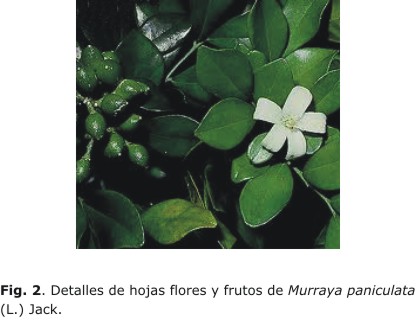
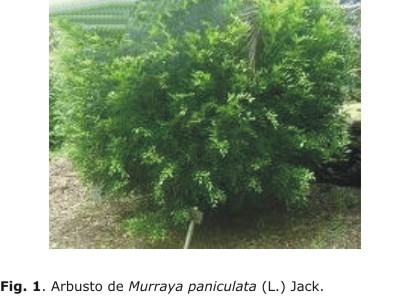
<body><![CDATA[<br>   </font><font face="Verdana" size="2">Especie: <I>Murraya paniculata </I>(L.)    Jack. </font>      <P>      <P><font face="Verdana" size="2">Es conocida tambi&eacute;n por los sin&oacute;nimos    de <I>Chalcas paniculata</I> L., <I>M. ex&oacute;tica</I> y por los nombres    comunes de naranjo de jazm&iacute;n, jazm&iacute;n de Persia, mirto (Puerto    Rico), murallera (Cuba), caf&eacute; de la india.<SUP>38,39</SUP> </font>     <P><font face="Verdana" size="2">Es un precioso arbusto o &aacute;rbol ornamental    (<a href="#fig1">Fig. 1</a>) con un tama&ntilde;o promedio de 2 a 3 m de altura.<SUP>40</SUP>    Las hojas (<a href="#fig2">Fig. 2</a>) son de color verde, oscuras, enteras,    alternas o subopuestas. Foliolos de 3 a 9, aovados o a veces r&oacute;mbico-aovados,    de 1,5-5 cm de largo y de 0,7-2,3 cm de ancho, obtusos u obtusamente acuminados    y con frecuencia emargindas en el &aacute;pice, cuneiformes en la base, cortamente    pecioladas; las flores son acampanadas, fragantes, de 1,3-2 cm de ancho, s&eacute;palos    triangulares, obtusos, p&eacute;talos de 1-2,5 cm; fruto rojo, subgloboso, de    1-1,6 cm (<a href="#fig2">Fig. 2</a>).<SUP>39</SUP> </font>     <P>     <P align="center"><img src="/img/revistas/pla/v16n4/f0112411.jpg" width="420" height="297"><a name="fig1"></a>      
<P align="center"><img src="/img/revistas/pla/v16n4/f0212411.jpg" width="420" height="321"><a name="fig2"></a>      
<P>     <P><font face="Verdana" size="2"><b>H&aacute;bitat y distribuci&oacute;n </b></font>      <P><font face="Verdana" size="2"><I>Murraya paniculata</I> es nativa de China,    India, Sri Lanka, Viet Nam, Laos, Noreste de Australia y Taiwan, adicionalmente,    puede adaptarse a pa&iacute;ses tropicales.<SUP>41</SUP> Es una de las plantas    m&aacute;s comunes en patios y jardines, muy empleada para formar setos y podarlas.    A causa de su f&aacute;cil propagaci&oacute;n por semillas, se ha hecho espont&aacute;nea    en muchos lugares, cultiv&aacute;ndose en las Antillas y en Am&eacute;rica tropical    continental.<SUP>39</SUP> </font>     ]]></body>
<body><![CDATA[<P><font face="Verdana" size="2">Esta especie se adapta a un amplio rango de condiciones.    Crece en lugares desde el nivel del mar, hasta elevaciones de 1 300 m.<SUP>42</SUP>    Se desarrolla en suelos bien drenados, sedimentarios<SUP>43</SUP>. La planta    resiste temperaturas de - 4 &#186;C.<SUP>44</SUP> Puede crecer tanto en la sombra    como en la luz. </font>     <P>      <P><font face="Verdana" size="2"><b>Usos atribuidos, farmacolog&iacute;a y fitoqu&iacute;mica</b>    </font>      <P><font face="Verdana" size="2">Se ha usado tradicionalmente para formar guardarrayas    en los jardines y para adornos florales<SUP>39</SUP>. Las hojas, cortezas y    ra&iacute;ces de esta planta han sido empleadas para tratamiento de diarrea,    disenter&iacute;a, reumatismo, erupciones en la piel y picaz&oacute;n<SUP>16,45</SUP>.    Las flores son empleadas en la fabricaci&oacute;n de cosm&eacute;ticos<SUP>46</SUP>.    </font>     <P><font face="Verdana" size="2">A la especie <I>M. paniculata</I> se le han realizado    varios estudios fitoqu&iacute;micos, los cuales revelan la presencia de alcaloides    (ind&oacute;licos),<SUB> </SUB>flavonoides, carotenoides, coumarinas<SUB> </SUB>y    aceites esenciales en las hojas y flores, como constituyentes de este &uacute;ltimo    se reportan el <font face="Symbol">a</font> y <font face="Symbol">b</font>-pineno,    limoneno, terpinol, terpineno, <font face="Symbol">b</font>-cariofileno, citral,    citronelol, bencil acetato, fenil etil alcohol, geraniol y diversos sesquiterpenos<SUP>46</SUP>,    isogermacreno, metilsalicilato, <font face="Symbol">a</font> y <font face="Symbol">b</font>-cubebeno,    cubenol<SUP>47</SUP>, el 3-careno<SUP>48,49</SUP>, entre otros. Los aceites    esenciales han manifestado actividad antibacteriana contra <I>Escherichia coli,    Pseudomonas aeruginosa, Staphylococcus aureus </I>y <I>Sarchina lutea</I><SUP>36</SUP>,    actividad anti-inflamatoria y analg&eacute;sica<SUP>50</SUP> y actividad antiamebiana<SUP>51</SUP>.    </font>      <P><font face="Verdana" size="2">Los tejidos de la planta contienen el alcaloide    tipo indol yuehchukeno<SUP>52</SUP> y al menos ocho flavonas altamente oxigenadas<SUP>53</SUP>.    </font>     <P><font face="Verdana" size="2">La determinaci&oacute;n estructural de cuatro    nuevas coumarinas, murralonginol isovalerato, isomurralonginol isovalerato,    minumicrolin isovalerato, cloculol y el alcaloide ind&oacute;lico paniculol    fueron descritas por Ito y Furukawa<SUP>54</SUP>. </font>     <P><font face="Verdana" size="2">Las coumarinas 1',2'-O-isopropilideno murrangatina<SUP>55</SUP>,    omphamurrayina<SUP>56</SUP>, bismurragantina y murramarina A<SUP>17</SUP>, fueron    aisladas de las partes a&eacute;reas de la misma especie. </font>     <P><font face="Verdana" size="2">Se hallaron en la c&aacute;scara y la pulpa del    fruto fresco nueve flavonoides: 5,7,3',4',5'-pentametoxiflavanonol, 5,6,7,3',4',5'-hexametoxiflavona,    3,5,6,7,3',4',5'-heptametoxiflavona, 5,7,8,3',4',5'-hexametoxiflavona, 3,5,7,8,3',4',5'-heptametoxiflavona,    3,5,7,8,3',4'-hexametoxiflavona, 5-hidroxi-3,7,8,3',4'-pentametoxiflavona, 5-hidroxi-3,7,8,3',4',5'-hexametoxiflavona    y 8-hidroxi-3,5,7,3',4',5'-hexamethoxiflavona.<SUP>57</SUP> </font>     <P>      ]]></body>
<body><![CDATA[<P><font face="Verdana" size="2"><B><font size="3">CONSIDERACIONES FINALES </font></B>    </font>      <P><font face="Verdana" size="2">La distribuci&oacute;n del g&eacute;nero <I>Murraya</I>    es amplia y espec&iacute;ficamente en Cuba la especie <I>M. paniculata</I>,    que se ha adaptado casi al punto de convertirse en espont&aacute;nea. Existen    referencias de la presencia en esta misma especie en otras regiones del mundo,    de importantes metabol&iacute;tos secundarios como flavonoides, coumarinas,    alcaloides, aceites esenciales, etc., los cuales est&aacute;n asociados a actividades    farmacol&oacute;gicas de relevancia en la salud humana (antimicrobiana, antioxidante,    antiinflamatoria, antitumoral, etc.). Estos factores antes se&ntilde;alados    constituyen de manera inobjetable argumentos v&aacute;lidos que justifican la    necesidad de profundizar en los estudios fitoqu&iacute;micos y farmacol&oacute;gicos    de esta especie vegetal, que puede convertirse en una importante herramienta    de la medicina natural y tradicional. </font>      <P>      <P>      <P><font face="Verdana" size="2"><B><font size="3">REFERENCIAS BIBLIOGR&Aacute;FICAS    </font></B> </font>      <!-- ref --><P><font face="Verdana" size="2">1. Farnsworth N, Morris RW. Higher plants-the    sleeping giant of drug development.<I> </I>Am J Pharm. 1976;148:46-52.     </font>     <!-- ref --><P><font face="Verdana" size="2">2. Akerele O. Who&#180;s traditional medicine    programme: progress and perspectives. Who Chron. 1984;38:78-81.     </font>     <!-- ref --><P><font face="Verdana" size="2">3. Sharapin N, Machado L, Souza E, de Albuquerque    E, Valverde E, L&oacute;pez JM. Fundamentos de tecnolog&iacute;a de productos    fitoterap&eacute;uticos. Santa Fe de Bogot&aacute;. Colombia: Ed. Convenio Andr&eacute;s    Bello y Red Iberoamericana de Productos Fitofarmac&eacute;uticos (RIPROFITO)    del Subprograma X de CYTED; 2000. p. 17.     </font>     <!-- ref --><P><font face="Verdana" size="2">4. Attiso MA. Aproveche scientifique rationnelle    des medication traditionelles despays en voie de developpement en vue d&#180;une    Phytotherapie renov&eacute;. DPM/78.<I> </I>Ginebra: OMS&#160;; 1978.     </font>     <!-- ref --><P><font face="Verdana" size="2">5. Gr&ucirc;newald J. The emerging role of herbal    medicine in health care in Europe. Drug Inf. J. 2000;32:151-153.     </font>     <!-- ref --><P><font face="Verdana" size="2">6. World Health Organization. General Guidelines    for methodologies on research and evaluation of traditional medicine. WHO/EDM/TRM/2000.1.    Geneva, Suiza: WHO; 2000. p. 5.     </font>     <!-- ref --><P><font face="Verdana" size="2">7. World Health Organization. Repor of the Inter-Regional    Workshop on Intellectual Property Rights in the Context of Traditional Medicine.<I>    </I>WHO/EDM/TRM/2000.1. Bangkok, Thailand: WHO; 2000. p. 2.     </font>     <!-- ref --><P><font face="Verdana" size="2">8. Wikipedia. La Enciclopedia libre; 2009. Disponible    en: <U><FONT  COLOR="#0000ff"><a href="http://es.wikipedia.org/wiki/Rutaceae" target="_blank">http://es.wikipedia.org/wiki/Rutaceae</a></FONT></U></font>      <!-- ref --><P><font face="Verdana" size="2">9. Chase MW, Cynthia MM, Kallunki JA. Phylogenetic    relationship or Rutaceae: a cladistic analysis of the subfamilies using evidence    from RBC and ATP sequence variation. Am J Botany. 1999;86(8):1191-9.     </font>     <!-- ref --><P><font face="Verdana" size="2">10. Singh G. Plant systematic. An integrated    approach. New Hampshire: Science Publisher; 2004. p. 438-40.     </font>     <!-- ref --><P><font face="Verdana" size="2">11. Annual Proceedings of the Phytochemical Society    of Europe. vol. 22; 1983.     </font>     <!-- ref --><P><font face="Verdana" size="2">12. Murphy W, Bertrand M. Bromoquinoneenaminone    annulations: syntheses of murrayaquinone-A and (&#177;)-bismurrayaquinone-A.    J Chemical Society Perkin Trans. 1998;1:4115-9.     </font>     <!-- ref --><P><font face="Verdana" size="2">13. Wikipedia. La Enciclopedia libre;2009. Disponible    en: <a href="http://es.wikipedia.org/wiki/Murraya" target="_blank">http://es.wikipedia.org/wiki/Murraya</a>    </font>      <!-- ref --><P><font face="Verdana" size="2" color="#000000">14. Chang CE. Flora of Taiwan.    Vol. 3. China: Epoch Publishing Co.; 1977. p. 520-3.     </font>      <!-- ref --><P><font face="Verdana" size="2">15. Walter HL, Memory PF. Medicinal plants affecting    man's health. New York: John Wiley; 1977. p. 243.     </font>     <!-- ref --><P><font face="Verdana" size="2">16. Perry LM, Metzger J. Medicinal plants of    east and Southeast Asia: attributed properties and uses. Cambridge, England:    the MIT Press; 1980. p. 367.     </font>     <!-- ref --><P><font face="Verdana" size="2">17. Negi N, Ochi A, Kurosawa M, Ushijima K, Kitaguchi    Y, Kusakabe E, et al. Two new dimeric coumarins isolated from <I>Murraya exotica</I>.    Chem Pharm Bull. 2005;53(9):1180-2.     </font>     <!-- ref --><P><font face="Verdana" size="2">18. Chevallier A. The Encyclopedia of Medicinal    Plants.<I> </I>London, New York, Stuttgart, Moscow: Dorling Kindersley; 1996.        </font>     <!-- ref --><P><font face="Verdana" size="2">19. Tachibana Y, Kikuzaki H, Lajis N, Nakatani    N. Antioxidative activity of carbazoles from <I>Murraya koenigii</I> leaves.    J Agric Food Chem. 2001;49(11):5589-94.     </font>     <!-- ref --><P><font face="Verdana" size="2">20. Anonymous.<I> </I>The wealth of India: The    raw materials<I>.</I> Vol. 6, India: CSIR; 1962. p. 446-8.     </font>     <!-- ref --><P><font face="Verdana" size="2">21. Hiremath SM, Madalageri BB, Basarkar PW.    Composition of curry leaf (<I>Murraya koenigii</I> Spreng) oil during leaf growth.    Indian Perfum. 1998;42:58-9.     </font>     <!-- ref --><P><font face="Verdana" size="2">22. Min HM, Aye M, Taniguchi T, Miura N, Monde    K, Ohzawa K, et al. A structure and an absolute configuration of (+)-alternamin,    a new coumarin from <I>Murraya alternans</I> having antidote activity against    snake venom. Tetrahedron Letters. 2007;48:6155-8.     </font>     <!-- ref --><P><font face="Verdana" size="2">23. Ito C, Itoigawa M, Onoda S, Hosokawa A, Ruangrungsi    N, Okuda T, et al. Chemical constituents of <I>Murraya siamensis</I>: three    coumarins and their anti-tumor promoting effect. Phytochemistry. 66:567-72.        </font>     <!-- ref --><P><font face="Verdana" size="2">24. Chakrabarty M, Nath A, Khasnobis AS, Konda    Y, Harigaya Y, Komiyama K. Carbazole alkaloids from <I>Murraya koenigii</I>.    J Phytochemistry. 2005;46:751-5.     </font>     <!-- ref --><P><font face="Verdana" size="2">25. Myoe H. A structure and an absolute configuration    of (+)- alternamin, a new coumarin from <I>Murraya alternans</I> having antidote    activity against snake venom. Tetrahedron Letters. 2007;48:6155-8.     </font>     <!-- ref --><P><font face="Verdana" size="2">26. Chia YC, Chang FR, Wang JC, Wu CC, Chiang    MY, Lan YH, et al. Antiplatelet aggregation coumarins from the leaves of <I>Murraya    omphalocarpa. </I>Molecules. 2008;13(1):122-8.     </font>     <!-- ref --><P><font face="Verdana" size="2">27. Dasgupta T, Rao AR, Yadava PK. Chemomodulatory    action of curry leaf (<I>Murraya koenigii</I>) extract on hepatic and extrahepatic    xenobiotic metabolising enzymes, antioxidant levels, lipid peroxidation, skin    and forestomach papillomagenesis. Nutrition Research. 2003;23:1427-46.     </font>     <!-- ref --><P><font face="Verdana" size="2">28. Ningappa M, Dinesha R, Srinivas L. Antioxidant    and free radical scavenging activities of polyphenol-enriched curry leaf (<I>Murraya    koenigii</I> L.) extracts. Food Chemistry. 2008;106:720-8.     </font>     <!-- ref --><P><font face="Verdana" size="2">29. Yadav S, Vats V, Dhunnoo Y, Grover JK. Hypoglycemic    and antihyperglycemic activity of <I>Murraya koenigii</I> leaves in diabetic    rats. J Ethnopharmacol. 2002;82:111-6.     </font>     <!-- ref --><P><font face="Verdana" size="2">30. Nigam SS, Purohit RM. Chemical examination    of the essential oil derived from the leaves of <I>Murraya koenigii </I>(Linn.)<I>    </I>Spreng. (Indian curry leaf). Perfum Ess Oil Rec. 1961;11:152-5.     </font>     <!-- ref --><P><font face="Verdana" size="2">31. Prakesh V, Natarajan CP. Studies on curry    leaf (<I>Murraya koenigii </I>L.). J Food Sci Tech. 1974;11:285-6.     </font>     <!-- ref --><P><font face="Verdana" size="2">32. MacLeod AJ, Pieris NM. Analysis of the essential    oil of <I>Murraya koenigii</I> and <I>Pandanus latifollus.</I> Phytochemistry.    1982;21:1653-8.     </font>     <!-- ref --><P><font face="Verdana" size="2">33. Uddin JC, Islam MNB, Yusuf M. Chemical composition    of the leaf essential oils of <I>Murraya koenigii </I>(L.) Spreng and <I>Murraya    paniculata </I>(L.)<I> Jack</I>. Bangladesh J Pharmacol. 2008;3:59-63.     </font>     <!-- ref --><P><font face="Verdana" size="2">34. Raina VK, Lal RK, Tripathi S, Khan M, Syamasundar    KV, Srivastava SK. Essential oil composition of genetically diverse stocks of    <I>Murraya koenigii</I> from India. Flav Frag J. 2002;17:144-6.     </font>     <!-- ref --><P><font face="Verdana" size="2">35. Walde GS, Joythirmay T, Rao P, Shivaswamy    R, Srinivas P. Flavour volatiles of leaves, fruits and seed cotyledons of <I>Murraya    koenigii </I>L. Flav Frag J. 2005;20:169-72.     </font>     <!-- ref --><P><font face="Verdana" size="2">36. Jagadeesh S, Sinha S, Pal B, Bhattacharya    S, Banerjee P. Mahanine reverses an epigenetically silenced tumor suppressor    gene RASSF1A in human prostate cancer cells. Biochem Biophysical Research Communications.    2007;362:212-7.     </font>     <!-- ref --><P><font face="Verdana" size="2">37. El-Sakhawy F, El-Tantawy M, Ross S, El-Sohly    M. Composition and antimicrobial activity of the essential oil of <I>Murraya    exotica </I>L. Flavour Fragrance J. 1998;13:59-62.     </font>     <!-- ref --><P><font face="Verdana" size="2">38. Little EL Jr., Woodbury RO, Wadsworth FH.    Trees of Puerto Rico and the Virgin Islands. Vol. 2. U.S. Department of Agriculture,    Washington, DC: Agriculture Handbook.1974;2:10-24.     </font>     <!-- ref --><P><font face="Verdana" size="2">39. Roig JT. Diccionario bot&aacute;nico de nombres    vulgares cubano. La Habana: Editorial Cient&iacute;fico-T&eacute;cnica; 1988.    p. 695.     </font>     <!-- ref --><P><font face="Verdana" size="2">40. Bhatterjee SK. Hand book of aromatic plants.    India: popular offset services Pvt. Ltd., Jaipur 302004; 2000. p. 299.     </font>     <P><font face="Verdana" size="2">41. Parrotta JA. Healing plants of Peninsular    India. Wallingford, UK and New York: CABI Publishing; 2001. p. 917 </font>     <P><font face="Verdana" size="2">42. Neal MC. In gardens of Hawaii. Special Publication    50. Bernice P. Bishop, editor Honolulu, HI: Museum Press; 1965. p. 924. </font>     <!-- ref --><P><font face="Verdana" size="2">43. Pacific Island Ecosystems at Risk. Invasive    plant species: <I>Murraya paniculata </I>(L.) Jack, Rutaceae; 2002. p. 2. </font>    <font face="Verdana" size="2"> Disponible en: <a href="http://www.hear.org/pier/species/murraya_paniculata.htm" target="_blank">http://www.hear.org/pier/species/murraya_paniculata.htm</a>    <U><FONT  COLOR="#0000ff"></FONT></U></font>      <!-- ref --><P><font face="Verdana" size="2">44. Desert-Tropicals. Orange jasamine; 2002.    Disponible en: <U><FONT  COLOR="#0000ff"><a href="http://www.desert-tropicals.com/Plants/Rutaceae/Murraya_paniculata.html" target="_blank">http://www.desert-tropicals.com/Plants/Rutaceae/Murraya_paniculata.html</a></FONT></U></font>      <P><font face="Verdana" size="2">45. Ghani A. Medicinal plants of Bangladesh:    Chemical constituents and uses. 2nd Asiatic Society of Bangladesh: ed. Dhaka;    2003. p 309-10. </font>     <!-- ref --><P><font face="Verdana" size="2">46. Rout PK, Rao YR, Sree A, Naik, SN. Composition    of essential oil, concrete, absolute, wax and headspace volatiles of <I>Murrarya    paniculata </I>(L.)<I> Jack flowers</I>. Flavour Fragr J. 2007;22:352-7.     </font>     ]]></body>
<body><![CDATA[<!-- ref --><P><font face="Verdana" size="2">47. Olawore NO, Ogunwande IA, Ekundayo O, Adeleke    KA. Chemical composition of the leaf and fruit essential oils of <I>Murraya    paniculata</I> (L.) Jack. (Syn. <I>Murraya exotica</I> L.<I>)</I>. Flav Frag    J. 2004;20:54-6.     </font>     <!-- ref --><P><font face="Verdana" size="2">48. Lastbom L, Boman A, Camner P, Ryrfeldt A.    Does airway responsiveness increase after skin sensitization to 3-carene: a    study in isolated guinea pig lungs. Toxicology. 1998;125:59-66.     </font>     <!-- ref --><P><font face="Verdana" size="2">49. Jeong JG, Kim YS, Min TY, Kim SH.<I> </I>Low    concentration of 3-carene stimulates the differentiation of mouse osteoblastic    MC3T3-E1 subclone 4 cells. Phytotherapy Res. 2007;22:18-22.     </font>     <!-- ref --><P><font face="Verdana" size="2">50. Dash GK, Patro CP, Maiti AK. Anti-inflammatory    and analgesic activity of leaf essential oil from <I>Murraya koenigii</I> Spreng.    Hamdard Medicus. 2004;47:22-6.     </font>     <!-- ref --><P><font face="Verdana" size="2">51. Sawangjaroen N, Phongpaichit S, Subhadhirasakul    S, Visutthi M, Srisuwan N, Thammapalerd N. The anti-amoebic activity of some    medicinal plants used by AIDS patients in southern Thailand. Parasitol Res.    2006;98:588-92.     </font>     ]]></body>
<body><![CDATA[<!-- ref --><P><font face="Verdana" size="2">52. Kong YC, Cheng KF, Cambie RC, Watermand PG.    Yuehchukene: a novel lndole alkaloid with anti-implantation activity. J Chem    Soc<I> </I>Chem Commun. 1985;47-8. Disponible en: <a href="http://pubs.rsc.org/en/content/articlepdf/1985/c3/c39850000047" target="_blank">http://pubs.rsc.org/en/content/articlepdf/1985/c3/c39850000047</a>    </font>      <!-- ref --><P><font face="Verdana" size="2">53. Kinoshita T, Firman K. Highly oxygenated    flavonoids from <I>Murraya paniculata</I>. Phytochemistry. 1996;42:1207-10.        </font>     <!-- ref --><P><font face="Verdana" size="2">54. Ito C, Furukawa H. The Chemical Composition    of <I>Murraya paniculata</I>. The Structure of Five New Coumarins and One New    Alkaloid and the Stereochemistry of Murrangatin and Related Coumarins. J Chem    Soc Perkin Trans. 1990;1:2047-55.     </font>     <!-- ref --><P><font face="Verdana" size="2">55. Saied S, Uddin S. 1', 2'-o-isopropylidene    murrangatin from <I>Murraya paniculata</I>. J Basic Applied Sciences. 2008;4(1):13-5.        </font>     <!-- ref --><P><font face="Verdana" size="2">56. Kinoshita T, Shimada M. Isolation and structure    elucidation of a new prenylcoumarin from <I>Murraya paniculata var. omphalocarpa</I>    (Rutaceae)<I>. </I>Chem Pharm Bull. 2002;50(1):118-20.     </font>     <!-- ref --><P><font face="Verdana" size="2">57. Ferracin R, Das F, Jo&atilde;o DS, Vieira    P. Flavonoids from the fruits of <I>Murraya paniculata</I>. Phytochemistry.    1998;47(3):393-6.     </font>     <P>     <P>      <P>      <P><font face="Verdana" size="2">Recibido: 29 de marzo de 2010.     <br>   Aprobado: 5 de junio de 2011. </font>     <P>     <P>      <P><font face="Verdana" size="2"><I>Celia Magaly Casado Mart&iacute;n</I>.<B>    </B>Departamento de Farmacia. Instituto de Farmacia y Alimentos. Universidad    de la Habana. La Habana, Cuba. Tel&eacute;f.: 271-6076, 271-6898. Correo electr&oacute;nico:    <U><a href="mailto:celiamcm@ifal.uh.cu">celiamcm@ifal.uh.cu</a></U>; <a href="mailto:celiamcm7@gmail.com">celiamcm7@gmail.com</a></font>      ]]></body><back>
<ref-list>
<ref id="B1">
<label>1</label><nlm-citation citation-type="journal">
<person-group person-group-type="author">
<name>
<surname><![CDATA[Farnsworth]]></surname>
<given-names><![CDATA[N]]></given-names>
</name>
<name>
<surname><![CDATA[Morris]]></surname>
<given-names><![CDATA[RW]]></given-names>
</name>
</person-group>
<article-title xml:lang="en"><![CDATA[Higher plants-the sleeping giant of drug development]]></article-title>
<source><![CDATA[Am J Pharm.]]></source>
<year>1976</year>
<volume>148</volume>
<page-range>46-52</page-range></nlm-citation>
</ref>
<ref id="B2">
<label>2</label><nlm-citation citation-type="journal">
<person-group person-group-type="author">
<name>
<surname><![CDATA[Akerele]]></surname>
<given-names><![CDATA[O]]></given-names>
</name>
</person-group>
<article-title xml:lang="en"><![CDATA[Who´s traditional medicine programme: progress and perspectives]]></article-title>
<source><![CDATA[Who Chron.]]></source>
<year>1984</year>
<volume>38</volume>
<page-range>78-81</page-range></nlm-citation>
</ref>
<ref id="B3">
<label>3</label><nlm-citation citation-type="book">
<person-group person-group-type="author">
<name>
<surname><![CDATA[Sharapin]]></surname>
<given-names><![CDATA[N]]></given-names>
</name>
<name>
<surname><![CDATA[Machado]]></surname>
<given-names><![CDATA[L]]></given-names>
</name>
<name>
<surname><![CDATA[Souza]]></surname>
<given-names><![CDATA[E]]></given-names>
</name>
<name>
<surname><![CDATA[de Albuquerque]]></surname>
<given-names><![CDATA[E]]></given-names>
</name>
<name>
<surname><![CDATA[Valverde]]></surname>
<given-names><![CDATA[E]]></given-names>
</name>
<name>
<surname><![CDATA[López]]></surname>
<given-names><![CDATA[JM]]></given-names>
</name>
</person-group>
<source><![CDATA[Fundamentos de tecnología de productos fitoterapéuticos]]></source>
<year>2000</year>
<page-range>17</page-range><publisher-loc><![CDATA[Santa Fe de Bogotá ]]></publisher-loc>
<publisher-name><![CDATA[Ed. Convenio Andrés Bello y Red Iberoamericana de Productos Fitofarmacéuticos (RIPROFITO) del Subprograma X de CYTED]]></publisher-name>
</nlm-citation>
</ref>
<ref id="B4">
<label>4</label><nlm-citation citation-type="book">
<person-group person-group-type="author">
<name>
<surname><![CDATA[Attiso]]></surname>
<given-names><![CDATA[MA]]></given-names>
</name>
</person-group>
<source><![CDATA[Aproveche scientifique rationnelle des medication traditionelles despays en voie de developpement en vue d´une Phytotherapie renové DPM/78]]></source>
<year>1978</year>
<publisher-loc><![CDATA[Ginebra ]]></publisher-loc>
<publisher-name><![CDATA[OMS]]></publisher-name>
</nlm-citation>
</ref>
<ref id="B5">
<label>5</label><nlm-citation citation-type="journal">
<person-group person-group-type="author">
<name>
<surname><![CDATA[Grûnewald]]></surname>
<given-names><![CDATA[J]]></given-names>
</name>
</person-group>
<article-title xml:lang="en"><![CDATA[The emerging role of herbal medicine in health care in Europe]]></article-title>
<source><![CDATA[Drug Inf J.]]></source>
<year>2000</year>
<volume>32</volume>
<page-range>151-153</page-range></nlm-citation>
</ref>
<ref id="B6">
<label>6</label><nlm-citation citation-type="book">
<collab>World Health Organization</collab>
<source><![CDATA[General Guidelines for methodologies on research and evaluation of traditional medicine. WHO/EDM/TRM/2000.1]]></source>
<year>2000</year>
<page-range>5</page-range><publisher-loc><![CDATA[Geneva ]]></publisher-loc>
<publisher-name><![CDATA[WHO]]></publisher-name>
</nlm-citation>
</ref>
<ref id="B7">
<label>7</label><nlm-citation citation-type="book">
<collab>World Health Organization</collab>
<source><![CDATA[Repor of the Inter-Regional Workshop on Intellectual Property Rights in the Context of Traditional Medicine. WHO/EDM/TRM/2000.1]]></source>
<year>2000</year>
<page-range>2</page-range><publisher-loc><![CDATA[Bangkok ]]></publisher-loc>
<publisher-name><![CDATA[WHO]]></publisher-name>
</nlm-citation>
</ref>
<ref id="B8">
<label>8</label><nlm-citation citation-type="">
<source><![CDATA[Wikipedia.La Enciclopedia libre]]></source>
<year>2009</year>
</nlm-citation>
</ref>
<ref id="B9">
<label>9</label><nlm-citation citation-type="journal">
<person-group person-group-type="author">
<name>
<surname><![CDATA[Chase]]></surname>
<given-names><![CDATA[MW]]></given-names>
</name>
<name>
<surname><![CDATA[Cynthia]]></surname>
<given-names><![CDATA[MM]]></given-names>
</name>
<name>
<surname><![CDATA[Kallunki]]></surname>
<given-names><![CDATA[JA]]></given-names>
</name>
</person-group>
<article-title xml:lang="en"><![CDATA[Phylogenetic relationship or Rutaceae: a cladistic analysis of the subfamilies using evidence from RBC and ATP sequence variation]]></article-title>
<source><![CDATA[Am J Botany.]]></source>
<year>1999</year>
<volume>86</volume>
<numero>8</numero>
<issue>8</issue>
<page-range>1191-9</page-range></nlm-citation>
</ref>
<ref id="B10">
<label>10</label><nlm-citation citation-type="book">
<person-group person-group-type="author">
<name>
<surname><![CDATA[Singh]]></surname>
<given-names><![CDATA[G]]></given-names>
</name>
</person-group>
<source><![CDATA[Plant systematic. An integrated approach]]></source>
<year>2004</year>
<page-range>438-40</page-range><publisher-loc><![CDATA[New Hampshire ]]></publisher-loc>
<publisher-name><![CDATA[Science Publisher]]></publisher-name>
</nlm-citation>
</ref>
<ref id="B11">
<label>11</label><nlm-citation citation-type="">
<source><![CDATA[Annual Proceedings of the Phytochemical Society of Europe]]></source>
<year>1983</year>
</nlm-citation>
</ref>
<ref id="B12">
<label>12</label><nlm-citation citation-type="journal">
<person-group person-group-type="author">
<name>
<surname><![CDATA[Murphy]]></surname>
<given-names><![CDATA[W]]></given-names>
</name>
<name>
<surname><![CDATA[Bertrand]]></surname>
<given-names><![CDATA[M]]></given-names>
</name>
</person-group>
<article-title xml:lang="en"><![CDATA[Bromoquinoneenaminone annulations: syntheses of murrayaquinone-A and (±)-bismurrayaquinone-A]]></article-title>
<source><![CDATA[J Chemical Society Perkin Trans.]]></source>
<year>1998</year>
<volume>1</volume>
<page-range>4115-9</page-range></nlm-citation>
</ref>
<ref id="B13">
<label>13</label><nlm-citation citation-type="">
<source><![CDATA[Wikipedia. La Enciclopedia libre]]></source>
<year>2009</year>
</nlm-citation>
</ref>
<ref id="B14">
<label>14</label><nlm-citation citation-type="book">
<person-group person-group-type="author">
<name>
<surname><![CDATA[Chang]]></surname>
<given-names><![CDATA[CE]]></given-names>
</name>
</person-group>
<source><![CDATA[Flora of Taiwan]]></source>
<year>1977</year>
<page-range>520-3</page-range><publisher-name><![CDATA[Epoch Publishing Co]]></publisher-name>
</nlm-citation>
</ref>
<ref id="B15">
<label>15</label><nlm-citation citation-type="book">
<person-group person-group-type="author">
<name>
<surname><![CDATA[Walter]]></surname>
<given-names><![CDATA[HL]]></given-names>
</name>
<name>
<surname><![CDATA[Memory]]></surname>
<given-names><![CDATA[PF]]></given-names>
</name>
</person-group>
<source><![CDATA[Medicinal plants affecting man's health]]></source>
<year>1977</year>
<page-range>243</page-range><publisher-loc><![CDATA[New York ]]></publisher-loc>
<publisher-name><![CDATA[John Wiley]]></publisher-name>
</nlm-citation>
</ref>
<ref id="B16">
<label>16</label><nlm-citation citation-type="book">
<person-group person-group-type="author">
<name>
<surname><![CDATA[Perry]]></surname>
<given-names><![CDATA[LM]]></given-names>
</name>
<name>
<surname><![CDATA[Metzger]]></surname>
<given-names><![CDATA[J]]></given-names>
</name>
</person-group>
<source><![CDATA[Medicinal plants of east and Southeast Asia: attributed properties and uses]]></source>
<year>1980</year>
<page-range>367</page-range><publisher-loc><![CDATA[Cambridge ]]></publisher-loc>
<publisher-name><![CDATA[the MIT Press]]></publisher-name>
</nlm-citation>
</ref>
<ref id="B17">
<label>17</label><nlm-citation citation-type="journal">
<person-group person-group-type="author">
<name>
<surname><![CDATA[Negi]]></surname>
<given-names><![CDATA[N]]></given-names>
</name>
<name>
<surname><![CDATA[Ochi]]></surname>
<given-names><![CDATA[A]]></given-names>
</name>
<name>
<surname><![CDATA[Kurosawa]]></surname>
<given-names><![CDATA[M]]></given-names>
</name>
<name>
<surname><![CDATA[Ushijima]]></surname>
<given-names><![CDATA[K]]></given-names>
</name>
<name>
<surname><![CDATA[Kitaguchi]]></surname>
<given-names><![CDATA[Y]]></given-names>
</name>
<name>
<surname><![CDATA[Kusakabe]]></surname>
<given-names><![CDATA[E]]></given-names>
</name>
</person-group>
<article-title xml:lang="en"><![CDATA[Two new dimeric coumarins isolated from Murraya exotica]]></article-title>
<source><![CDATA[Chem Pharm Bull.]]></source>
<year>2005</year>
<volume>53</volume>
<numero>9</numero>
<issue>9</issue>
<page-range>1180-2</page-range></nlm-citation>
</ref>
<ref id="B18">
<label>18</label><nlm-citation citation-type="book">
<person-group person-group-type="author">
<name>
<surname><![CDATA[Chevallier]]></surname>
<given-names><![CDATA[A]]></given-names>
</name>
</person-group>
<source><![CDATA[The Encyclopedia of Medicinal Plants]]></source>
<year>1996</year>
<publisher-loc><![CDATA[LondonNew YorkStuttgartMoscow ]]></publisher-loc>
<publisher-name><![CDATA[Dorling Kindersley]]></publisher-name>
</nlm-citation>
</ref>
<ref id="B19">
<label>19</label><nlm-citation citation-type="journal">
<person-group person-group-type="author">
<name>
<surname><![CDATA[Tachibana]]></surname>
<given-names><![CDATA[Y]]></given-names>
</name>
<name>
<surname><![CDATA[Kikuzaki]]></surname>
<given-names><![CDATA[H]]></given-names>
</name>
<name>
<surname><![CDATA[Lajis]]></surname>
<given-names><![CDATA[N]]></given-names>
</name>
<name>
<surname><![CDATA[Nakatani]]></surname>
<given-names><![CDATA[N]]></given-names>
</name>
</person-group>
<article-title xml:lang="en"><![CDATA[Antioxidative activity of carbazoles from Murraya koenigii leaves]]></article-title>
<source><![CDATA[J Agric Food Chem.]]></source>
<year>2001</year>
<volume>49</volume>
<numero>11</numero>
<issue>11</issue>
<page-range>5589-94</page-range></nlm-citation>
</ref>
<ref id="B20">
<label>20</label><nlm-citation citation-type="book">
<source><![CDATA[Anonymous. The wealth of India: The raw materials]]></source>
<year>1962</year>
<page-range>446-8</page-range><publisher-name><![CDATA[CSIR]]></publisher-name>
</nlm-citation>
</ref>
<ref id="B21">
<label>21</label><nlm-citation citation-type="journal">
<person-group person-group-type="author">
<name>
<surname><![CDATA[Hiremath]]></surname>
<given-names><![CDATA[SM]]></given-names>
</name>
<name>
<surname><![CDATA[Madalageri]]></surname>
<given-names><![CDATA[BB]]></given-names>
</name>
<name>
<surname><![CDATA[Basarkar]]></surname>
<given-names><![CDATA[PW]]></given-names>
</name>
</person-group>
<article-title xml:lang="en"><![CDATA[Composition of curry leaf (Murraya koenigii Spreng) oil during leaf growth]]></article-title>
<source><![CDATA[Indian Perfum.]]></source>
<year>1998</year>
<volume>42</volume>
<page-range>58-9</page-range></nlm-citation>
</ref>
<ref id="B22">
<label>22</label><nlm-citation citation-type="journal">
<person-group person-group-type="author">
<name>
<surname><![CDATA[Min]]></surname>
<given-names><![CDATA[HM]]></given-names>
</name>
<name>
<surname><![CDATA[Aye]]></surname>
<given-names><![CDATA[M]]></given-names>
</name>
<name>
<surname><![CDATA[Taniguchi]]></surname>
<given-names><![CDATA[T]]></given-names>
</name>
<name>
<surname><![CDATA[Miura]]></surname>
<given-names><![CDATA[N]]></given-names>
</name>
<name>
<surname><![CDATA[Monde]]></surname>
<given-names><![CDATA[K]]></given-names>
</name>
<name>
<surname><![CDATA[Ohzawa]]></surname>
<given-names><![CDATA[K]]></given-names>
</name>
</person-group>
<article-title xml:lang="en"><![CDATA[A structure and an absolute configuration of (+)-alternamin, a new coumarin from Murraya alternans having antidote activity against snake venom]]></article-title>
<source><![CDATA[Tetrahedron Letters.]]></source>
<year>2007</year>
<volume>48</volume>
<page-range>6155-8</page-range></nlm-citation>
</ref>
<ref id="B23">
<label>23</label><nlm-citation citation-type="journal">
<person-group person-group-type="author">
<name>
<surname><![CDATA[Ito]]></surname>
<given-names><![CDATA[C]]></given-names>
</name>
<name>
<surname><![CDATA[Itoigawa]]></surname>
<given-names><![CDATA[M]]></given-names>
</name>
<name>
<surname><![CDATA[Onoda]]></surname>
<given-names><![CDATA[S]]></given-names>
</name>
<name>
<surname><![CDATA[Hosokawa]]></surname>
<given-names><![CDATA[A]]></given-names>
</name>
<name>
<surname><![CDATA[Ruangrungsi]]></surname>
<given-names><![CDATA[N]]></given-names>
</name>
<name>
<surname><![CDATA[Okuda]]></surname>
<given-names><![CDATA[T]]></given-names>
</name>
</person-group>
<article-title xml:lang="en"><![CDATA[Chemical constituents of Murraya siamensis: three coumarins and their anti-tumor promoting effect]]></article-title>
<source><![CDATA[Phytochemistry]]></source>
<year></year>
<volume>66</volume>
<page-range>567-72</page-range></nlm-citation>
</ref>
<ref id="B24">
<label>24</label><nlm-citation citation-type="journal">
<person-group person-group-type="author">
<name>
<surname><![CDATA[Chakrabarty]]></surname>
<given-names><![CDATA[M]]></given-names>
</name>
<name>
<surname><![CDATA[Nath]]></surname>
<given-names><![CDATA[A]]></given-names>
</name>
<name>
<surname><![CDATA[Khasnobis]]></surname>
<given-names><![CDATA[AS]]></given-names>
</name>
<name>
<surname><![CDATA[Konda]]></surname>
<given-names><![CDATA[Y]]></given-names>
</name>
<name>
<surname><![CDATA[Harigaya]]></surname>
<given-names><![CDATA[Y]]></given-names>
</name>
<name>
<surname><![CDATA[Komiyama]]></surname>
<given-names><![CDATA[K]]></given-names>
</name>
</person-group>
<article-title xml:lang="en"><![CDATA[Carbazole alkaloids from Murraya koenigii]]></article-title>
<source><![CDATA[J Phytochemistry.]]></source>
<year>2005</year>
<volume>46</volume>
<page-range>751-5</page-range></nlm-citation>
</ref>
<ref id="B25">
<label>25</label><nlm-citation citation-type="journal">
<person-group person-group-type="author">
<name>
<surname><![CDATA[Myoe]]></surname>
<given-names><![CDATA[H]]></given-names>
</name>
</person-group>
<article-title xml:lang="en"><![CDATA[A structure and an absolute configuration of (+)- alternamin, a new coumarin from Murraya alternans having antidote activity against snake venom]]></article-title>
<source><![CDATA[Tetrahedron Letters.]]></source>
<year>2007</year>
<volume>48</volume>
<page-range>6155-8</page-range></nlm-citation>
</ref>
<ref id="B26">
<label>26</label><nlm-citation citation-type="journal">
<person-group person-group-type="author">
<name>
<surname><![CDATA[Chia]]></surname>
<given-names><![CDATA[YC]]></given-names>
</name>
<name>
<surname><![CDATA[Chang]]></surname>
<given-names><![CDATA[FR]]></given-names>
</name>
<name>
<surname><![CDATA[Wang]]></surname>
<given-names><![CDATA[JC]]></given-names>
</name>
<name>
<surname><![CDATA[Wu]]></surname>
<given-names><![CDATA[CC]]></given-names>
</name>
<name>
<surname><![CDATA[Chiang]]></surname>
<given-names><![CDATA[MY]]></given-names>
</name>
<name>
<surname><![CDATA[Lan]]></surname>
<given-names><![CDATA[YH]]></given-names>
</name>
</person-group>
<article-title xml:lang="en"><![CDATA[Antiplatelet aggregation coumarins from the leaves of Murraya omphalocarpa]]></article-title>
<source><![CDATA[Molecules.]]></source>
<year>2008</year>
<volume>13</volume>
<numero>1</numero>
<issue>1</issue>
<page-range>122-8</page-range></nlm-citation>
</ref>
<ref id="B27">
<label>27</label><nlm-citation citation-type="journal">
<person-group person-group-type="author">
<name>
<surname><![CDATA[Dasgupta]]></surname>
<given-names><![CDATA[T]]></given-names>
</name>
<name>
<surname><![CDATA[Rao]]></surname>
<given-names><![CDATA[AR]]></given-names>
</name>
<name>
<surname><![CDATA[Yadava]]></surname>
<given-names><![CDATA[PK]]></given-names>
</name>
</person-group>
<article-title xml:lang="en"><![CDATA[Chemomodulatory action of curry leaf (Murraya koenigii) extract on hepatic and extrahepatic xenobiotic metabolising enzymes, antioxidant levels, lipid peroxidation, skin and forestomach papillomagenesis]]></article-title>
<source><![CDATA[Nutrition Research.]]></source>
<year>2003</year>
<volume>23</volume>
<page-range>1427-46</page-range></nlm-citation>
</ref>
<ref id="B28">
<label>28</label><nlm-citation citation-type="journal">
<person-group person-group-type="author">
<name>
<surname><![CDATA[Ningappa]]></surname>
<given-names><![CDATA[M]]></given-names>
</name>
<name>
<surname><![CDATA[Dinesha]]></surname>
<given-names><![CDATA[R]]></given-names>
</name>
<name>
<surname><![CDATA[Srinivas]]></surname>
<given-names><![CDATA[L]]></given-names>
</name>
</person-group>
<article-title xml:lang="en"><![CDATA[Antioxidant and free radical scavenging activities of polyphenol-enriched curry leaf (Murraya koenigii L: ) extracts]]></article-title>
<source><![CDATA[Food Chemistry.]]></source>
<year>2008</year>
<volume>106</volume>
<page-range>720-8</page-range></nlm-citation>
</ref>
<ref id="B29">
<label>29</label><nlm-citation citation-type="journal">
<person-group person-group-type="author">
<name>
<surname><![CDATA[Yadav]]></surname>
<given-names><![CDATA[S]]></given-names>
</name>
<name>
<surname><![CDATA[Vats]]></surname>
<given-names><![CDATA[V]]></given-names>
</name>
<name>
<surname><![CDATA[Dhunnoo]]></surname>
<given-names><![CDATA[Y]]></given-names>
</name>
<name>
<surname><![CDATA[Grover]]></surname>
<given-names><![CDATA[JK]]></given-names>
</name>
</person-group>
<article-title xml:lang="en"><![CDATA[Hypoglycemic and antihyperglycemic activity of Murraya koenigii leaves in diabetic rats]]></article-title>
<source><![CDATA[J Ethnopharmacol.]]></source>
<year>2002</year>
<volume>82</volume>
<page-range>111-6</page-range></nlm-citation>
</ref>
<ref id="B30">
<label>30</label><nlm-citation citation-type="journal">
<person-group person-group-type="author">
<name>
<surname><![CDATA[Nigam]]></surname>
<given-names><![CDATA[SS]]></given-names>
</name>
<name>
<surname><![CDATA[Purohit]]></surname>
<given-names><![CDATA[RM]]></given-names>
</name>
</person-group>
<article-title xml:lang="en"><![CDATA[Chemical examination of the essential oil derived from the leaves of Murraya koenigii (Linn.) Spreng. (Indian curry leaf)]]></article-title>
<source><![CDATA[Perfum Ess Oil Rec.]]></source>
<year>1961</year>
<volume>11</volume>
<page-range>152-5</page-range></nlm-citation>
</ref>
<ref id="B31">
<label>31</label><nlm-citation citation-type="journal">
<person-group person-group-type="author">
<name>
<surname><![CDATA[Prakesh]]></surname>
<given-names><![CDATA[V]]></given-names>
</name>
<name>
<surname><![CDATA[Natarajan]]></surname>
<given-names><![CDATA[CP]]></given-names>
</name>
</person-group>
<article-title xml:lang="en"><![CDATA[Studies on curry leaf (Murraya koenigii L: )]]></article-title>
<source><![CDATA[J Food Sci Tech.]]></source>
<year>1974</year>
<volume>11</volume>
<page-range>285-6</page-range></nlm-citation>
</ref>
<ref id="B32">
<label>32</label><nlm-citation citation-type="journal">
<person-group person-group-type="author">
<name>
<surname><![CDATA[MacLeod]]></surname>
<given-names><![CDATA[AJ]]></given-names>
</name>
<name>
<surname><![CDATA[Pieris]]></surname>
<given-names><![CDATA[NM]]></given-names>
</name>
</person-group>
<article-title xml:lang="en"><![CDATA[Analysis of the essential oil of Murraya koenigii and Pandanus latifollus]]></article-title>
<source><![CDATA[Phytochemistry.]]></source>
<year>1982</year>
<volume>21</volume>
<page-range>1653-8</page-range></nlm-citation>
</ref>
<ref id="B33">
<label>33</label><nlm-citation citation-type="journal">
<person-group person-group-type="author">
<name>
<surname><![CDATA[Uddin]]></surname>
<given-names><![CDATA[JC]]></given-names>
</name>
<name>
<surname><![CDATA[Islam]]></surname>
<given-names><![CDATA[MNB]]></given-names>
</name>
<name>
<surname><![CDATA[Yusuf]]></surname>
<given-names><![CDATA[M]]></given-names>
</name>
</person-group>
<article-title xml:lang="en"><![CDATA[Chemical composition of the leaf essential oils of Murraya koenigii (L: )Spreng and Murraya paniculata (L]]></article-title>
<source><![CDATA[)Jack. Bangladesh J Pharmacol.]]></source>
<year>2008</year>
<volume>3</volume>
<page-range>59-63</page-range></nlm-citation>
</ref>
<ref id="B34">
<label>34</label><nlm-citation citation-type="journal">
<person-group person-group-type="author">
<name>
<surname><![CDATA[Raina]]></surname>
<given-names><![CDATA[VK]]></given-names>
</name>
<name>
<surname><![CDATA[Lal]]></surname>
<given-names><![CDATA[RK]]></given-names>
</name>
<name>
<surname><![CDATA[Tripathi]]></surname>
<given-names><![CDATA[S]]></given-names>
</name>
<name>
<surname><![CDATA[Khan]]></surname>
<given-names><![CDATA[M]]></given-names>
</name>
<name>
<surname><![CDATA[Syamasundar]]></surname>
<given-names><![CDATA[KV]]></given-names>
</name>
<name>
<surname><![CDATA[Srivastava]]></surname>
<given-names><![CDATA[SK]]></given-names>
</name>
</person-group>
<article-title xml:lang="en"><![CDATA[Essential oil composition of genetically diverse stocks of Murraya koenigii from India]]></article-title>
<source><![CDATA[Flav Frag J.]]></source>
<year>2002</year>
<volume>17</volume>
<page-range>144-6</page-range></nlm-citation>
</ref>
<ref id="B35">
<label>35</label><nlm-citation citation-type="journal">
<person-group person-group-type="author">
<name>
<surname><![CDATA[Walde]]></surname>
<given-names><![CDATA[GS]]></given-names>
</name>
<name>
<surname><![CDATA[Joythirmay]]></surname>
<given-names><![CDATA[T]]></given-names>
</name>
<name>
<surname><![CDATA[Rao]]></surname>
<given-names><![CDATA[P]]></given-names>
</name>
<name>
<surname><![CDATA[Shivaswamy]]></surname>
<given-names><![CDATA[R]]></given-names>
</name>
<name>
<surname><![CDATA[Srinivas]]></surname>
<given-names><![CDATA[P]]></given-names>
</name>
</person-group>
<article-title xml:lang="en"><![CDATA[Flavour volatiles of leaves, fruits and seed cotyledons of Murraya koenigii L]]></article-title>
<source><![CDATA[Flav Frag J.]]></source>
<year>2005</year>
<volume>20</volume>
<page-range>169-72</page-range></nlm-citation>
</ref>
<ref id="B36">
<label>36</label><nlm-citation citation-type="journal">
<person-group person-group-type="author">
<name>
<surname><![CDATA[Jagadeesh]]></surname>
<given-names><![CDATA[S]]></given-names>
</name>
<name>
<surname><![CDATA[Sinha]]></surname>
<given-names><![CDATA[S]]></given-names>
</name>
<name>
<surname><![CDATA[Pal]]></surname>
<given-names><![CDATA[B]]></given-names>
</name>
<name>
<surname><![CDATA[Bhattacharya]]></surname>
<given-names><![CDATA[S]]></given-names>
</name>
<name>
<surname><![CDATA[Banerjee]]></surname>
<given-names><![CDATA[P]]></given-names>
</name>
</person-group>
<article-title xml:lang="en"><![CDATA[Mahanine reverses an epigenetically silenced tumor suppressor gene RASSF1A in human prostate cancer cells]]></article-title>
<source><![CDATA[Biochem Biophysical Research Communications.]]></source>
<year>2007</year>
<volume>362</volume>
<page-range>212-7</page-range></nlm-citation>
</ref>
<ref id="B37">
<label>37</label><nlm-citation citation-type="journal">
<person-group person-group-type="author">
<name>
<surname><![CDATA[El-Sakhawy]]></surname>
<given-names><![CDATA[F]]></given-names>
</name>
<name>
<surname><![CDATA[El-Tantawy]]></surname>
<given-names><![CDATA[M]]></given-names>
</name>
<name>
<surname><![CDATA[Ross]]></surname>
<given-names><![CDATA[S]]></given-names>
</name>
<name>
<surname><![CDATA[El-Sohly]]></surname>
<given-names><![CDATA[M]]></given-names>
</name>
</person-group>
<article-title xml:lang="en"><![CDATA[Composition and antimicrobial activity of the essential oil of Murraya exotica L]]></article-title>
<source><![CDATA[Flavour Fragrance J.]]></source>
<year>1998</year>
<volume>13</volume>
<page-range>59-62</page-range></nlm-citation>
</ref>
<ref id="B38">
<label>38</label><nlm-citation citation-type="book">
<person-group person-group-type="author">
<name>
<surname><![CDATA[Little]]></surname>
<given-names><![CDATA[EL Jr]]></given-names>
</name>
<name>
<surname><![CDATA[Woodbury]]></surname>
<given-names><![CDATA[RO]]></given-names>
</name>
<name>
<surname><![CDATA[Wadsworth]]></surname>
<given-names><![CDATA[FH]]></given-names>
</name>
</person-group>
<source><![CDATA[Trees of Puerto Rico and the Virgin Islands. Vol. 2. U.S. Department of Agriculture]]></source>
<year>1974</year>
<page-range>10-24</page-range><publisher-loc><![CDATA[Washington^eDC DC]]></publisher-loc>
<publisher-name><![CDATA[Agriculture Handbook]]></publisher-name>
</nlm-citation>
</ref>
<ref id="B39">
<label>39</label><nlm-citation citation-type="book">
<person-group person-group-type="author">
<name>
<surname><![CDATA[Roig]]></surname>
<given-names><![CDATA[JT]]></given-names>
</name>
</person-group>
<source><![CDATA[Diccionario botánico de nombres vulgares cubano]]></source>
<year>1988</year>
<page-range>695</page-range><publisher-loc><![CDATA[La Habana ]]></publisher-loc>
<publisher-name><![CDATA[Editorial Científico-Técnica]]></publisher-name>
</nlm-citation>
</ref>
<ref id="B40">
<label>40</label><nlm-citation citation-type="book">
<person-group person-group-type="author">
<name>
<surname><![CDATA[Bhatterjee]]></surname>
<given-names><![CDATA[SK]]></given-names>
</name>
</person-group>
<source><![CDATA[Hand book of aromatic plants]]></source>
<year>2000</year>
<page-range>299</page-range><publisher-name><![CDATA[popular offset services Pvt. Ltd]]></publisher-name>
</nlm-citation>
</ref>
<ref id="B41">
<label>41</label><nlm-citation citation-type="book">
<person-group person-group-type="author">
<name>
<surname><![CDATA[Parrotta]]></surname>
<given-names><![CDATA[JA]]></given-names>
</name>
</person-group>
<source><![CDATA[Healing plants of Peninsular India]]></source>
<year>2001</year>
<page-range>917</page-range><publisher-loc><![CDATA[WallingfordNew York ]]></publisher-loc>
<publisher-name><![CDATA[CABI Publishing]]></publisher-name>
</nlm-citation>
</ref>
<ref id="B42">
<label>42</label><nlm-citation citation-type="book">
<person-group person-group-type="author">
<name>
<surname><![CDATA[Neal]]></surname>
<given-names><![CDATA[MC]]></given-names>
</name>
</person-group>
<source><![CDATA[Gardens of Hawaii. Special Publication 50]]></source>
<year>1965</year>
<page-range>924</page-range><publisher-loc><![CDATA[Honolulu^eHI HI]]></publisher-loc>
<publisher-name><![CDATA[Museum Press]]></publisher-name>
</nlm-citation>
</ref>
<ref id="B43">
<label>43</label><nlm-citation citation-type="">
<collab>Pacific Island Ecosystems at Risk</collab>
<source><![CDATA[Invasive plant species: Murraya paniculata (L.) Jack, Rutaceae]]></source>
<year>2002</year>
<page-range>2</page-range></nlm-citation>
</ref>
<ref id="B44">
<label>44</label><nlm-citation citation-type="">
<source><![CDATA[Desert-Tropicals. Orange jasamine]]></source>
<year>2002</year>
</nlm-citation>
</ref>
<ref id="B45">
<label>45</label><nlm-citation citation-type="book">
<person-group person-group-type="author">
<name>
<surname><![CDATA[Ghani]]></surname>
<given-names><![CDATA[A]]></given-names>
</name>
</person-group>
<source><![CDATA[Medicinal plants of Bangladesh: Chemical constituents and uses]]></source>
<year>2003</year>
<page-range>309-10</page-range><publisher-name><![CDATA[ed. Dhaka]]></publisher-name>
</nlm-citation>
</ref>
<ref id="B46">
<label>46</label><nlm-citation citation-type="journal">
<person-group person-group-type="author">
<name>
<surname><![CDATA[Rout]]></surname>
<given-names><![CDATA[PK]]></given-names>
</name>
<name>
<surname><![CDATA[Rao]]></surname>
<given-names><![CDATA[YR]]></given-names>
</name>
<name>
<surname><![CDATA[Sree]]></surname>
<given-names><![CDATA[A]]></given-names>
</name>
<name>
<surname><![CDATA[Naik]]></surname>
<given-names><![CDATA[SN]]></given-names>
</name>
</person-group>
<article-title xml:lang="en"><![CDATA[Composition of essential oil, concrete, absolute, wax and headspace volatiles of Murrarya paniculata (L.) Jack flowers]]></article-title>
<source><![CDATA[Flavour Fragr J.]]></source>
<year>2007</year>
<volume>22</volume>
<page-range>352-7</page-range></nlm-citation>
</ref>
<ref id="B47">
<label>47</label><nlm-citation citation-type="journal">
<person-group person-group-type="author">
<name>
<surname><![CDATA[Olawore]]></surname>
<given-names><![CDATA[NO]]></given-names>
</name>
<name>
<surname><![CDATA[Ogunwande]]></surname>
<given-names><![CDATA[IA]]></given-names>
</name>
<name>
<surname><![CDATA[Ekundayo]]></surname>
<given-names><![CDATA[O]]></given-names>
</name>
<name>
<surname><![CDATA[Adeleke]]></surname>
<given-names><![CDATA[KA]]></given-names>
</name>
</person-group>
<article-title xml:lang="en"><![CDATA[Chemical composition of the leaf and fruit essential oils of Murraya paniculata (L.) Jack. (Syn. Murraya exotica L.)]]></article-title>
<source><![CDATA[Flav Frag J]]></source>
<year>2004</year>
<volume>20</volume>
<page-range>54-6</page-range></nlm-citation>
</ref>
<ref id="B48">
<label>48</label><nlm-citation citation-type="journal">
<person-group person-group-type="author">
<name>
<surname><![CDATA[Lastbom]]></surname>
<given-names><![CDATA[L]]></given-names>
</name>
<name>
<surname><![CDATA[Boman]]></surname>
<given-names><![CDATA[A]]></given-names>
</name>
<name>
<surname><![CDATA[Camner]]></surname>
<given-names><![CDATA[P]]></given-names>
</name>
<name>
<surname><![CDATA[Ryrfeldt]]></surname>
<given-names><![CDATA[A]]></given-names>
</name>
</person-group>
<article-title xml:lang="en"><![CDATA[Does airway responsiveness increase after skin sensitization to 3-carene: a study in isolated guinea pig lungs]]></article-title>
<source><![CDATA[Toxicology.]]></source>
<year>1998</year>
<volume>125</volume>
<page-range>59-66</page-range></nlm-citation>
</ref>
<ref id="B49">
<label>49</label><nlm-citation citation-type="journal">
<person-group person-group-type="author">
<name>
<surname><![CDATA[Jeong]]></surname>
<given-names><![CDATA[JG]]></given-names>
</name>
<name>
<surname><![CDATA[Kim]]></surname>
<given-names><![CDATA[YS]]></given-names>
</name>
<name>
<surname><![CDATA[Min]]></surname>
<given-names><![CDATA[TY]]></given-names>
</name>
<name>
<surname><![CDATA[Kim]]></surname>
<given-names><![CDATA[SH]]></given-names>
</name>
</person-group>
<article-title xml:lang="en"><![CDATA[Low concentration of 3-carene stimulates the differentiation of mouse osteoblastic MC3T3-E1 subclone 4 cells]]></article-title>
<source><![CDATA[Phytotherapy Res.]]></source>
<year>2007</year>
<volume>22</volume>
<page-range>18-22</page-range></nlm-citation>
</ref>
<ref id="B50">
<label>50</label><nlm-citation citation-type="journal">
<person-group person-group-type="author">
<name>
<surname><![CDATA[Dash]]></surname>
<given-names><![CDATA[GK]]></given-names>
</name>
<name>
<surname><![CDATA[Patro]]></surname>
<given-names><![CDATA[CP]]></given-names>
</name>
<name>
<surname><![CDATA[Maiti]]></surname>
<given-names><![CDATA[AK]]></given-names>
</name>
</person-group>
<article-title xml:lang="en"><![CDATA[Anti-inflammatory and analgesic activity of leaf essential oil from Murraya koenigii Spreng]]></article-title>
<source><![CDATA[Hamdard Medicus.]]></source>
<year>2004</year>
<volume>47</volume>
<page-range>22-6</page-range></nlm-citation>
</ref>
<ref id="B51">
<label>51</label><nlm-citation citation-type="journal">
<person-group person-group-type="author">
<name>
<surname><![CDATA[Sawangjaroen]]></surname>
<given-names><![CDATA[N]]></given-names>
</name>
<name>
<surname><![CDATA[Phongpaichit]]></surname>
<given-names><![CDATA[S]]></given-names>
</name>
<name>
<surname><![CDATA[Subhadhirasakul]]></surname>
<given-names><![CDATA[S]]></given-names>
</name>
<name>
<surname><![CDATA[Visutthi]]></surname>
<given-names><![CDATA[M]]></given-names>
</name>
<name>
<surname><![CDATA[Srisuwan]]></surname>
<given-names><![CDATA[N]]></given-names>
</name>
<name>
<surname><![CDATA[Thammapalerd]]></surname>
<given-names><![CDATA[N]]></given-names>
</name>
</person-group>
<article-title xml:lang="en"><![CDATA[The anti-amoebic activity of some medicinal plants used by AIDS patients in southern Thailand]]></article-title>
<source><![CDATA[Parasitol Res.]]></source>
<year>2006</year>
<volume>98</volume>
<page-range>588-92</page-range></nlm-citation>
</ref>
<ref id="B52">
<label>52</label><nlm-citation citation-type="journal">
<person-group person-group-type="author">
<name>
<surname><![CDATA[Kong]]></surname>
<given-names><![CDATA[YC]]></given-names>
</name>
<name>
<surname><![CDATA[Cheng]]></surname>
<given-names><![CDATA[KF]]></given-names>
</name>
<name>
<surname><![CDATA[Cambie]]></surname>
<given-names><![CDATA[RC]]></given-names>
</name>
<name>
<surname><![CDATA[Watermand]]></surname>
<given-names><![CDATA[PG]]></given-names>
</name>
</person-group>
<article-title xml:lang="en"><![CDATA[Yuehchukene: a novel lndole alkaloid with anti-implantation activity]]></article-title>
<source><![CDATA[J Chem Soc Chem Commun]]></source>
<year>1985</year>
<page-range>47-8</page-range></nlm-citation>
</ref>
<ref id="B53">
<label>53</label><nlm-citation citation-type="journal">
<person-group person-group-type="author">
<name>
<surname><![CDATA[Kinoshita]]></surname>
<given-names><![CDATA[T]]></given-names>
</name>
<name>
<surname><![CDATA[Firman]]></surname>
<given-names><![CDATA[K]]></given-names>
</name>
</person-group>
<article-title xml:lang="en"><![CDATA[Highly oxygenated flavonoids from Murraya paniculata]]></article-title>
<source><![CDATA[Phytochemistry.]]></source>
<year>1996</year>
<volume>42</volume>
<page-range>1207-10</page-range></nlm-citation>
</ref>
<ref id="B54">
<label>54</label><nlm-citation citation-type="journal">
<person-group person-group-type="author">
<name>
<surname><![CDATA[Ito]]></surname>
<given-names><![CDATA[C]]></given-names>
</name>
<name>
<surname><![CDATA[Furukawa]]></surname>
<given-names><![CDATA[H]]></given-names>
</name>
</person-group>
<article-title xml:lang="en"><![CDATA[The Chemical Composition of Murraya paniculata: The Structure of Five New Coumarins and One New Alkaloid and the Stereochemistry of Murrangatin and Related Coumarins]]></article-title>
<source><![CDATA[J Chem Soc Perkin Trans.]]></source>
<year>1990</year>
<volume>1</volume>
<page-range>2047-55</page-range></nlm-citation>
</ref>
<ref id="B55">
<label>55</label><nlm-citation citation-type="journal">
<person-group person-group-type="author">
<name>
<surname><![CDATA[Saied]]></surname>
<given-names><![CDATA[S]]></given-names>
</name>
<name>
<surname><![CDATA[Uddin]]></surname>
<given-names><![CDATA[S]]></given-names>
</name>
</person-group>
<article-title xml:lang="en"><![CDATA[1', 2'-o-isopropylidene murrangatin from Murraya paniculata]]></article-title>
<source><![CDATA[J Basic Applied Sciences.]]></source>
<year>2008</year>
<volume>4</volume>
<numero>1</numero>
<issue>1</issue>
<page-range>13-5</page-range></nlm-citation>
</ref>
<ref id="B56">
<label>56</label><nlm-citation citation-type="journal">
<person-group person-group-type="author">
<name>
<surname><![CDATA[Kinoshita]]></surname>
<given-names><![CDATA[T]]></given-names>
</name>
<name>
<surname><![CDATA[Shimada]]></surname>
<given-names><![CDATA[M]]></given-names>
</name>
</person-group>
<article-title xml:lang="en"><![CDATA[Isolation and structure elucidation of a new prenylcoumarin from Murraya paniculata var: omphalocarpa (Rutaceae)]]></article-title>
<source><![CDATA[Chem Pharm Bull.]]></source>
<year>2002</year>
<volume>50</volume>
<numero>1</numero>
<issue>1</issue>
<page-range>118-20</page-range></nlm-citation>
</ref>
<ref id="B57">
<label>57</label><nlm-citation citation-type="journal">
<person-group person-group-type="author">
<name>
<surname><![CDATA[Ferracin]]></surname>
<given-names><![CDATA[R]]></given-names>
</name>
<name>
<surname><![CDATA[Das]]></surname>
<given-names><![CDATA[F]]></given-names>
</name>
<name>
<surname><![CDATA[João]]></surname>
<given-names><![CDATA[DS]]></given-names>
</name>
<name>
<surname><![CDATA[Vieira]]></surname>
<given-names><![CDATA[P]]></given-names>
</name>
</person-group>
<article-title xml:lang="en"><![CDATA[Flavonoids from the fruits of Murraya paniculata]]></article-title>
<source><![CDATA[Phytochemistry.]]></source>
<year>1998</year>
<volume>47</volume>
<numero>3</numero>
<issue>3</issue>
<page-range>393-6</page-range></nlm-citation>
</ref>
</ref-list>
</back>
</article>