<?xml version="1.0" encoding="ISO-8859-1"?><article xmlns:mml="http://www.w3.org/1998/Math/MathML" xmlns:xlink="http://www.w3.org/1999/xlink" xmlns:xsi="http://www.w3.org/2001/XMLSchema-instance">
<front>
<journal-meta>
<journal-id>1028-4796</journal-id>
<journal-title><![CDATA[Revista Cubana de Plantas Medicinales]]></journal-title>
<abbrev-journal-title><![CDATA[Rev Cubana Plant Med]]></abbrev-journal-title>
<issn>1028-4796</issn>
<publisher>
<publisher-name><![CDATA[ECIMED]]></publisher-name>
</publisher>
</journal-meta>
<article-meta>
<article-id>S1028-47962012000100012</article-id>
<title-group>
<article-title xml:lang="en"><![CDATA[Standardization of the quality control parameters of the Tamarindus indica L. soft extract]]></article-title>
<article-title xml:lang="es"><![CDATA[Estandarización de parámetros para el control de la calidad del extracto blando de Tamarindus indica L]]></article-title>
</title-group>
<contrib-group>
<contrib contrib-type="author">
<name>
<surname><![CDATA[Rodríguez-Amado]]></surname>
<given-names><![CDATA[Jesús]]></given-names>
</name>
<xref ref-type="aff" rid="A01"/>
</contrib>
<contrib contrib-type="author">
<name>
<surname><![CDATA[Pérez Rosés]]></surname>
<given-names><![CDATA[Renato]]></given-names>
</name>
<xref ref-type="aff" rid="A02"/>
</contrib>
<contrib contrib-type="author">
<name>
<surname><![CDATA[Escalona-Arranz]]></surname>
<given-names><![CDATA[Julio César]]></given-names>
</name>
<xref ref-type="aff" rid="A01"/>
</contrib>
<contrib contrib-type="author">
<name>
<surname><![CDATA[Lafourcade Prada]]></surname>
<given-names><![CDATA[Ariadna]]></given-names>
</name>
<xref ref-type="aff" rid="A01"/>
</contrib>
<contrib contrib-type="author">
<name>
<surname><![CDATA[Sierra González]]></surname>
<given-names><![CDATA[Gustavo]]></given-names>
</name>
<xref ref-type="aff" rid="A03"/>
</contrib>
</contrib-group>
<aff id="A02">
<institution><![CDATA[,University of Barcelona  ]]></institution>
<addr-line><![CDATA[ ]]></addr-line>
<country>Spain</country>
</aff>
<aff id="A03">
<institution><![CDATA[,Finlay Institute  ]]></institution>
<addr-line><![CDATA[La Habana ]]></addr-line>
<country>Cuba</country>
</aff>
<aff id="A01">
<institution><![CDATA[,Universidad de Oriente Departament of Pharmacy ]]></institution>
<addr-line><![CDATA[Santiago de Cuba ]]></addr-line>
<country>Cuba</country>
</aff>
<pub-date pub-type="pub">
<day>00</day>
<month>03</month>
<year>2012</year>
</pub-date>
<pub-date pub-type="epub">
<day>00</day>
<month>03</month>
<year>2012</year>
</pub-date>
<volume>17</volume>
<numero>1</numero>
<fpage>108</fpage>
<lpage>114</lpage>
<copyright-statement/>
<copyright-year/>
<self-uri xlink:href="http://scielo.sld.cu/scielo.php?script=sci_arttext&amp;pid=S1028-47962012000100012&amp;lng=en&amp;nrm=iso"></self-uri><self-uri xlink:href="http://scielo.sld.cu/scielo.php?script=sci_abstract&amp;pid=S1028-47962012000100012&amp;lng=en&amp;nrm=iso"></self-uri><self-uri xlink:href="http://scielo.sld.cu/scielo.php?script=sci_pdf&amp;pid=S1028-47962012000100012&amp;lng=en&amp;nrm=iso"></self-uri><abstract abstract-type="short" xml:lang="en"><p><![CDATA[Introduction: Tamarindus indica L or Tamarind as commonly known is a medicinal plant witha broad spectrum of application in medicine. Tamarind is the most useful plant for liver disorders treatment in Cuba and The Caribbean. People use it as decoction and have to take up to four liters a day of this preparation, because the use of alcohol in the Tamarind fluid extracts prevent its use in patient with lever desorders. Objective: the aim of this study was the preliminary establisment of quality control parameters of the Tamarindus indica L. soft extract as a novel alcohol-free active ingredient for solids pharmaceutical formulation. Methods: organoleptics properties, total solids, relative density, pH, and total ashes were stablished. The polyphenols content was evaluated as a chemical marker using Folin-Ciocalteau spectrophotometric method. The WHO methodology was followed for the establishment of limits for each one of the parameters. Results: the proposed limits were: total solids 63.55-69.22 %; relative density 1.311-1.441g/mL; pH 3.20-3.32; total ashes 1.00-1.21 %; polyphenols content 6.19-8.12 %, and flavonoids 0.35-1.27 %. Conclusion: the obtained data are a preliminary guide to implement the quality control procedure for further preparation of this novel natural extract, for its utilization as an active ingredient in pharmaceutical formulations.]]></p></abstract>
<abstract abstract-type="short" xml:lang="es"><p><![CDATA[Introducción: el Tamarindus indica L. o tamarindo, como se le conoce comúnmente, es una planta medicinal con un amplio espectro de aplicación en la medicina. Es la más utilizada en Cuba y en el Caribe para los trastornos hepáticos. La población la utiliza en forma de decocción y consume alrededor de 4 L/d de esta preparación, porque el contenido de alcohol del extracto fluido de tamarindo impide su utilización en pacientes con estas enfermedades. Objetivo: establecer de forma preliminar los parámetros de control de calidad en el extracto blando de las hojas de Tamarindus indica L. como un nuevo ingrediente activo libre de etanol, para la preparación de formas farmacéuticas sólidas. Métodos: se evaluaron las propiedades organolépticas, sólidos totales, densidad relativa, pH y cenizas totales. Se evaluó el contenido de polifenoles como marcador para el control de calidad de este extracto utilizando el método de Folin Ciocalteau. Se empleó la metodología propuesta por la Organización Mundial de la Salud para el establecimiento de los límites de control. Resultados: los parámetros propuestos fueron: sólidos totales 63,55-69,22 %; densidad relativa 1,311-1,441 g/mL; pH 3,20-3,32; cenizas totales 1,00-1,21 %; polifenoles 6,19-8,12 % y flavonoides 0,35-1,27 %. Conclusiones: los datos obtenidos son una guía preliminar para implementar el procedimiento de control de calidad en la preparación de este nuevo extracto natural para su utilización como ingrediente activo en preparaciones farmacéuticas.]]></p></abstract>
<kwd-group>
<kwd lng="en"><![CDATA[soft extract]]></kwd>
<kwd lng="en"><![CDATA[polyphenols]]></kwd>
<kwd lng="en"><![CDATA[flavonoids]]></kwd>
<kwd lng="en"><![CDATA[antioxidant]]></kwd>
<kwd lng="en"><![CDATA[tamarind]]></kwd>
<kwd lng="en"><![CDATA[Tamarindus indica]]></kwd>
<kwd lng="es"><![CDATA[extracto blando]]></kwd>
<kwd lng="es"><![CDATA[polifenoles]]></kwd>
<kwd lng="es"><![CDATA[flavonoides]]></kwd>
<kwd lng="es"><![CDATA[antioxidante]]></kwd>
<kwd lng="es"><![CDATA[tamarindo]]></kwd>
<kwd lng="es"><![CDATA[Tamarindus indica]]></kwd>
</kwd-group>
</article-meta>
</front><body><![CDATA[ <div align="right">       <p><font face="Verdana" size="2"><B>ART&Iacute;CULO ORIGINAL</B></font></p>       <p>&nbsp;</p>       <p align="left"><font face="Verdana" size="4"><b>Standardization of the quality      control parameters of the <I>Tamarindus indica</I> L. soft extract</b></font>    </p>   </div> <B>     <P>&nbsp;      <P>      <P><font face="Verdana" size="3">Estandarizaci&oacute;n de par&aacute;metros para    el control de la calidad del extracto blando de <I>Tamarindus indica</I> L.    </font>     <P>&nbsp;     <P>&nbsp;      <P>      ]]></body>
<body><![CDATA[<P><font face="Verdana" size="2">MSc. Jes&uacute;s Rodr&iacute;guez-Amado,<SUP>I</SUP>    Dr. Renato P&eacute;rez Ros&eacute;s,<SUP>II</SUP> MSc.Julio C&eacute;sar Escalona-Arranz,<SUP>I</SUP>    MSc. Ariadna Lafourcade Prada,<SUP>I</SUP> Dr. C. Gustavo Sierra Gonz&aacute;lez<SUP>III</SUP></font> </B>      <P>      <P>      <P><font face="Verdana" size="2"><SUP>I</SUP> University of Oriente. Santiago    de Cuba, Cuba.    <br>   </font><font face="Verdana" size="2"><SUP>II</SUP> University of Barcelona.    Spain.    <br>   </font><font face="Verdana" size="2"><SUP>III </SUP>Finlay Institute. La Habana,    Cuba. </font>      <P>&nbsp;     <P>&nbsp; <hr size="1" noshade> <font face="Verdana" size="2"><B>ABSTRACT </B></font>      <P><font face="Verdana" size="2"><B>Introduction:</b> <I>Tamarindus indica</I>    L or Tamarind as commonly known is a medicinal plant witha broad spectrum of    application in medicine. Tamarind is the most useful plant for liver disorders    treatment in Cuba and The Caribbean. People use it as decoction and have to    take up to four liters a day of this preparation, because the use of alcohol    in the Tamarind fluid extracts prevent its use in patient with lever desorders.    <B>    <br>   Objective:</B> the aim of this study was the preliminary establisment of quality    control parameters of the <I>Tamarindus indica</I> L. soft extract as a novel    alcohol-free active ingredient for solids pharmaceutical formulation.    ]]></body>
<body><![CDATA[<br>   </font><font face="Verdana" size="2"><B>Methods</B>: organoleptics properties,    total solids, relative density, pH, and total ashes were stablished. The polyphenols    content was evaluated as a chemical marker using Folin-Ciocalteau spectrophotometric    method. The WHO methodology was followed for the establishment of limits for    each one of the parameters. <B>    <br>   Results</B>: the proposed limits were: total solids 63.55-69.22 %; relative    density 1.311-1.441g/mL; pH 3.20-3.32; total ashes 1.00-1.21 %; polyphenols    content 6.19-8.12 %, and flavonoids 0.35-1.27 %.     <br>   <B>Conclusion:</B> the obtained data are a preliminary guide to implement the    quality control procedure for further preparation of this novel natural extract,    for its utilization as an active ingredient in pharmaceutical formulations.    </font>      <P>      <P><font face="Verdana" size="2"><B>Key words: </B>soft extract, polyphenols,    flavonoids, antioxidant, tamarind, <I>Tamarindus indica</I>. </font> <hr size="1" noshade> <font face="Verdana" size="2"><B>RESUMEN</B></font><B></B>      <P><font face="Verdana" size="2"><B>Introducci&oacute;n</b>:<B> </b>el <I>Tamarindus    indica</I> L. o tamarindo, como se le conoce com&uacute;nmente, es una planta    medicinal con un amplio espectro de aplicaci&oacute;n en la medicina. Es la    m&aacute;s utilizada en Cuba y en el Caribe para los trastornos hep&aacute;ticos.    La poblaci&oacute;n la utiliza en forma de decocci&oacute;n y consume alrededor    de 4 L/d de esta preparaci&oacute;n, porque el contenido de alcohol del extracto    fluido de tamarindo impide su utilizaci&oacute;n en pacientes con estas enfermedades.    <B>    <br>   Objetivo</B>: establecer de forma preliminar los par&aacute;metros de control    de calidad en el extracto blando de las hojas de <I>Tamarindus indica</I> L.    como un nuevo ingrediente activo libre de etanol, para la preparaci&oacute;n    de formas farmac&eacute;uticas s&oacute;lidas. <B>    <br>   M&eacute;todos</B>: se evaluaron las propiedades organol&eacute;pticas, s&oacute;lidos    totales, densidad relativa, pH y cenizas totales. Se evalu&oacute; el contenido    de polifenoles como marcador para el control de calidad de este extracto utilizando    el m&eacute;todo de Folin Ciocalteau. Se emple&oacute; la metodolog&iacute;a    propuesta por la Organizaci&oacute;n Mundial de la Salud para el establecimiento    de los l&iacute;mites de control. <B>    <br>   Resultados</B>: los par&aacute;metros propuestos fueron: s&oacute;lidos totales    63,55-69,22 %; densidad relativa 1,311-1,441 g/mL; pH 3,20-3,32; cenizas totales    1,00-1,21 %; polifenoles 6,19-8,12 % y flavonoides 0,35-1,27 %. <B>    <br>   Conclusiones</B>: los datos obtenidos son una gu&iacute;a preliminar para implementar    el procedimiento de control de calidad en la preparaci&oacute;n de este nuevo    extracto natural para su utilizaci&oacute;n como ingrediente activo en preparaciones    farmac&eacute;uticas. </font>      ]]></body>
<body><![CDATA[<P>      <P><font face="Verdana" size="2"><B>Palabras clave</B>:<B> </B>extracto blando,    polifenoles, flavonoides, antioxidante, tamarindo, <I>Tamarindus indica</I>.    </font> <hr size="1" noshade>     <p>&nbsp;</p>     <p>&nbsp;</p>     <P>      <P><font face="Verdana" size="3"><B>INTRODUCTION</B> </font>      <P>      <P><font face="Verdana" size="2">Researches with medicinal plants are focused    on the identification of new active molecules; specially, in plants that have    a broad ethnopharmacological use. <I>Tamarindus indica</I> L. or tamarind as    it is commonly known, belongs to the Fabaceae family, Caessalpiniaceae subfamily,    and it is a tropical tree, native of Africa, Southern Asia, America and the    Caribbean. Tamarind is rich in fatty acids and heavy alcohols. Leaves also contain    protein and essential aminoacids, carbohydrates and minerals as zinc, magnesium,    phosphorus, copper, selenium, and calcium;<SUP>1</SUP> volatile oils,<SUP>2</SUP>    steroids, resins, mucilage and sugars are reported in this species too.<SUP>3</SUP>    Tamarind also contains iron, vitamins A, B and C and organic acids like citric,    tartaric and malic;<SUP>1</SUP> as well as polyphenols and flavonoids,<SUP>4</SUP>    who are the main responsible of the strong antioxidant;<SUP>5,6</SUP> hepatoprotective<SUP>7,8</SUP>    and antimicrobial activity<SUP>9,10</SUP> of the tamarind leaf extract. </font>     <P><font face="Verdana" size="2">In Cuba, ethnobotanical use of tamarind is extended    for the treatment of hepatitis.<SUP>11</SUP> The ethnopharmacological broad    spectrum of <I>Tamarindus indica</I> L. leaves extract and all recent studies    that confirm its pharmaceutical activity, compelled us to establish the quality    control parameters of the tamarind soft extract (TSE) in order to use it as    an active ingredient in pharmaceutical formulations.</font>     <P>&nbsp;      ]]></body>
<body><![CDATA[<P>      <P><font face="Verdana" size="3"><B>METHODS</B> </font>      <P>      <P><font face="Verdana" size="2"><I>Plant material</I>:<B> </B>tamarind leaves    were collected from a tamarind population in El Caney, Santiago de Cuba province.    They were previously identified by Dr. Jorge Sierra Calzado. A voucher specimen    registered as 052216 was deposited at the teaching section of the BSC herbarium    at the Biology Department, Natural Sciences Faculty, Oriente University, Cuba.    </font>     <P><font face="Verdana" size="2"><I>Soft extract</I>:<B> </B>soft extract was    obtained by vacuum concentration of the fluid extract, in a vacuum evaporation    system (KIKA WERKE GMBH &amp; Co. Germany), at temperature of 42 &#177; 2 &#186;C.    Ten one-liter batches every one, were prepared with dried drug collected from    September 2009 to June, 2010. </font>     <P><font face="Verdana" size="2"><I>Organoleptics characteristics</I>:<B> </B>organoleptic    properties were evaluated by simple inspection through the senses. Color, appearance,    smell and taste were evaluated. </font>     <P><font face="Verdana" size="2"><I>Total solids and relative density</I>:<I>    </I>these properties were determined according to the British pharmacopoeia.<SUP>12</SUP>    </font>     <P><font face="Verdana" size="2"><I>pH evaluation</I>:<I> </I>the pH measurement    was made at 30 &#186;C. One gram of TSE was weighed and diluted in 25mL of distilled    water, the solution was filtered. A direct pH value was obtained from a pH-meter    (Hanna Instruments, Spain). The pH-meter was calibrated using potassium tetraoxalate    0.05M (pH 1.68 at 30 &#186;C) and potassium dihydrogen citrate 0.05M (pH 3.77    at 30 &#186;C) (both reactive Riedel - de Hai&euml;n; Germany) as buffer solutions.<SUP>13</SUP>    </font>     <P><font face="Verdana" size="2"><I>Total ashes</I><B>: </B>they were determined    according to literature<SUP>12,13</SUP> using a German furnace MLW. </font>     <P><font face="Verdana" size="2"><I>Total polyphenols and flavonoids content</I>:    the Folin Ciocalteau<SUP>12</SUP> analytical procedure was performed and validated    to spectrophotometrically measure, polyphenols content in tamarind soft extract    whereas flavonoids were determined by spectrophotometrical method reported in    the British Pharmacopoeia.<SUP>12</SUP> </font>     ]]></body>
<body><![CDATA[<P><font face="Verdana" size="2"><I>Establishment of limits: </I>Reasonable limits    were established through the use of the 3&oacute; statistical method.<SUP>14</SUP>    Ten successive batches were evaluated using 5 samples per batch and the grand    average and standard deviation (SD) were computed. Minimum and maximum limits    for each parameter were calculated using the following expressions: </font>     <P>      <P><font face="Verdana" size="2">Minimum limit= Mean 3*SD (1) </font>     <P><font face="Verdana" size="2">Maximum limit= Mean + 3*SD (2) </font>     <P>      <P><font face="Verdana" size="2"><I>Statistical analysis:</I><B> </B>All assays    were made by quintuplicate, and the mean and standard deviation were reported.    Statistical analysis was made using Statgraphics Plus 5.0. Stat Ease Co. Minneapolis,    USA. An F-test followed by a Tukey HSD test was performed to compare pairs of    group mean. An &aacute; equal to 0.05 was used. In all cases, the normality    of the data were proved to confirm the validity of the statistical analysis.</font>     <P>&nbsp;      <P>      <P><font face="Verdana" size="3"><B>RESULTS</B> </font>      <P>      ]]></body>
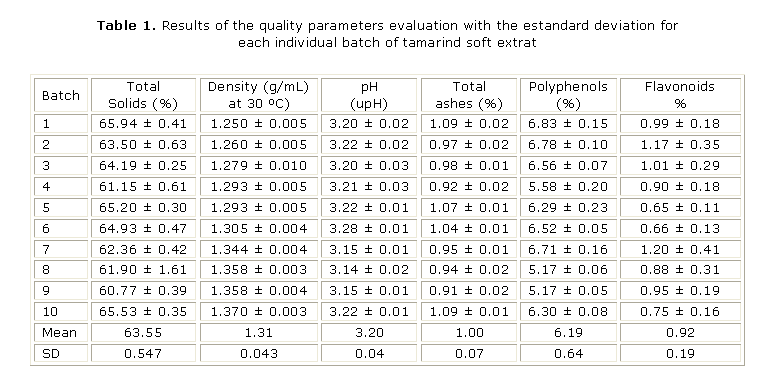
<body><![CDATA[<P><font face="Verdana" size="2"><I>Organoleptics</I><B>:</B><I> </I>tamarind    soft extract appears as a dark brownish syrup with strong acidic and ripe fruit    flavor, with a viscous and resinous appearance. </font>     <P><font face="Verdana" size="2"><a href="/img/revistas/pla/v17n1/t0112112.gif">Table 1</a> exhibits the    results of the quality parameters evaluated for TSE. Standardized kurtosis and    asymmetry for all parameters were between &#177; 2, indicating the normality    of the data (data not reported). </font>      
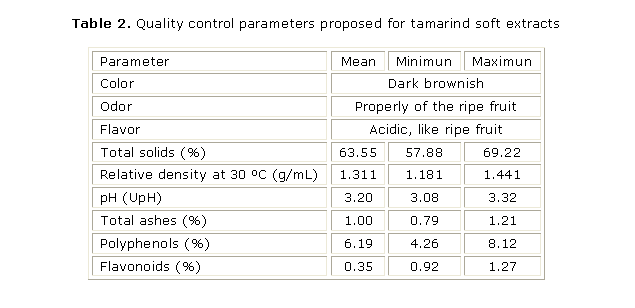
<P><font face="Verdana" size="2"><a href="/img/revistas/pla/v17n1/t0212112.gif">Table 2</a> shows the    proposed parameters for the quality control evaluation of the tamarind soft    extract, with the corresponding maximum and minimum limits. </font>      
<P><font face="Verdana" size="2">For all evaluated properties in the ten batches,    statistical significant differences among mean were founded. Anova test for    <I>Total solids showed a </I>F-value of 39.02 and p-value equal to 0.0000; <I>Relative    density, </I>F=366,20, p-value = 0,0000; <I>Total ashes, </I>F-value of 366.20    and p-value equal to 0.0000; <I>Ph, </I>F-value of 23.93 and p-value equal to    0.0000; <I>Poliphenols,</I> F-value of 103.09 and p-value equal to 0.0000; Flavonoids,    F-value of 245.63 and p-value equal to 0.0000.</font>     <P>&nbsp;      <P>      <P>      <P>      <P><font face="Verdana" size="3"><B>DISCUSSION</B> </font>      <P>      ]]></body>
<body><![CDATA[<P><font face="Verdana" size="2"><I>Organoleptic properties</I> of TSE showed    great uniformity in the ten batches studied. The acid taste is linked in literature    to the presence of ascorbic, tartaric and citric acids.<SUP>3</SUP> The result    observed for total solids was caused by variability in the vegetable composition    related to different phenologic states of plant.<SUP>15</SUP> Relative standard    deviation in all batches was below 1 %, this fact highlights the uniformity    and validity of the preparation method. </font>     <P><font face="Verdana" size="2">The amount of <I>total solids</I> in TSE is a    synonymous of the efficiency in the extractive process, and in a general way,    has an influence in the concentration of all compounds present in the extract.    For this reason an Anova test was made to evaluate total variability of total    solids in the ten batches studied and after that, to propose a standard value.    According to this analysis, all parameters in <a href="/img/revistas/pla/v17n1/t0212112.gif">table 2</a>    will show similar values, 95 percent of the time that the tamarind soft extract    is prepared by this method. </font>      
<P><font face="Verdana" size="2">For relative density, the observed results are    coherent with total solid contained in tamarind soft extract, where was observed    a statistical relationship between them (data not reported). </font>     <P><font face="Verdana" size="2">For <I>Total ashes i</I>t was found that the    higher values of TS in the TSE the higher total ashes remains, usually the more    efficient extraction process shows the highest amount of total solids and the    hihgest content of ashes. </font>     <P><font face="Verdana" size="2">The <I>pH</I> measures in the ten batches showed    the acidity of TSE, peculiar characteristic of this species. As reported in    literature, this fact is the result of the presence of organic acids like malic,    citric, tartaric, cafeic, ferulic, and ascorbic acids.<SUP>3,4</SUP> </font>     <P><font face="Verdana" size="2"><I>Polyphenols and flavonoids</I> are complex    groups of substances that usually occur as a mixture and which are difficult    to purify and crystallize. They are easily oxidized and polymerized in solution;    if this happens they lose much of their astringent effect and are therefore    of little therapeutic value.<SUP>16</SUP> </font>     <P><font face="Verdana" size="2">Heat affects the bio-pharmaceutical and chemical    stability of the polyphenols and flavonoids, therefore this is the most important    parameter to consider in the evaluation of the quality parameters of this product    because of they are responsibles of the antioxidant activity of this product.    </font>     <P><font face="Verdana" size="2">Polyphenols content in batches were significantly    different, in the same way, the mean flavonoid content in all batches were significantly    different too. This behavior is frequent in natural products, due to natural    variability. This is especially true in this species, and variation appears    related to climate, collected time, soil characteristics and phenological stages    of the plant, being the fructification stage (january to march), the moment    where the phenolics and flavonoids compounds in leaves of the plants are higher,<SUP>15</SUP>    probably due to the need of the plant to protect itself from the insects and    other predators attacks. </font>     <P><font face="Verdana" size="2">The organoleptic and physicochemical quality    control parameters of tamarind soft extract were established in this paper.    The proposed limits were: total solids 63.55-69.22 %; relative density 1.311-1.441    g/mL; pH 3.20-3.32; total ashes 1.00-1.21 %; polyphenols content 6.19- 8.12    %, flavonoids 0.27-1.27 %. Obtained data are a preliminary guide to implement    the quality control procedure for further preparation of this novel natural    extract, for it utilization as an active ingredient in pharmaceutical formulations.    </font>      <P>&nbsp;     ]]></body>
<body><![CDATA[<P>      <P><font face="Verdana" size="3"><B>REFERENCES</B> </font>      <!-- ref --><P><font face="Verdana" size="2">1. Samina KK, Shaikh W, Shahzadi S, Kazi TG,    Usmanghani K, Kabir A, et al. Chemical constituents of <I>Tamarindus indica    </I>l. Medicinal plant in sindh. Pak J Bot. 2008;40(6):2553-9.     </font>     <!-- ref --><P><font face="Verdana" size="2">2. Pino JA, Escalona JC, Licea I., Perez RR,    Ag&uuml;ero J. Leaf oil of <I>Tamarindus indica </I>L.<I> </I>J Essential Research.<I>    </I>2002;14(3):187-8.     </font>     <!-- ref --><P><font face="Verdana" size="2">3. El-Siddig K, Gunasena HPM, Prasad BA, Pushpakumara    DK, Ramana KVR, Vijayanand P, et al. Tamarind, <I>Tamarindus indica</I>. Southampton,    UK: Southampton Centre for Underutilized Crops; 2006. p. 13-27.     </font>     <!-- ref --><P><font face="Verdana" size="2">4. Dehesa MA, Jauregui O, Ca&ntilde;igueral S.    Estudio por HPLC-MS/MS de compuestos fen&oacute;licos presentes en las hojas    de <I>Tamarindus indica</I> L. Revista Fitoterapia. 2006;6(SI):116.     </font>     ]]></body>
<body><![CDATA[<!-- ref --><P><font face="Verdana" size="2">5. Ramos A, Visozo A, Piloto J, Garc&iacute;a    A, Rodr&iacute;guez CA, Rivero R. Screening of antimutagenicity via antioxidant    activity in Cubans medicinal plants. J Ethnopharmacol. 2003;87(2-3):241-6.     </font>     <!-- ref --><P><font face="Verdana" size="2">6. Komutarin T. Extract of the seed coat of <I>Tamarindus    indica </I>L. inhibits nitric oxide production by murine macrophages <I>in vitro    </I>and <I>in vivo</I>. Food and Chemical Toxicology. 2004;42(4):649-58.     </font>     <!-- ref --><P><font face="Verdana" size="2">7. Escalona JC, Dehesa MA, Boizzan ML. Evaluaci&oacute;n    precl&iacute;nica del efecto hepatoprotector de extractos flavon&oacute;licos    de las hojas de <I>Tamarindus indica </I>L. Rev Cubana Farm. 1995;30(1):292.        </font>     <!-- ref --><P><font face="Verdana" size="2">8. Pimple BP, Kadam PV, Badgujar NS, Bafna AR,    Patil MJ. Protective effect of <I>Tamarindus indica</I> linn against paracetamol-induced    hepatotoxicity in rats. Indian J Pharm Sci. 2007;69:827-31 </font>     <!-- ref --><P><font face="Verdana" size="2">9. Escalona JC, P&eacute;res R, Urdaneta I, Camacho    MI, Rodr&iacute;guez AJR, Licea I. Antimicrobial activity of extracts from <I>Tamarindus    indica</I> L. leaves. Pharmacognosy Magazine. 2010;6(23):242-7.     </font>     <!-- ref --><P><font face="Verdana" size="2">10. Doughary JH. Antimicrobial activity of <I>Tamarindus    indica</I> Linn. Trop J Pharm Resesearch. 2006;5(2):597-603 </font>     <!-- ref --><P><font face="Verdana" size="2">11. Roig JT. Plantas medicinales arom&aacute;ticas    o venenosas de Cuba. La Habana: Editorial Cient&iacute;fico-T&eacute;cnica;    1981. p. 889.     </font>     <!-- ref --><P><font face="Verdana" size="2">12. British Pharmacopoeia (BP). London, UK: Stationary    Office; 2010.     </font>     <!-- ref --><P><font face="Verdana" size="2">13. United State Pharmacopeia. 30 ed. New York,    USA: United State Pharmacopeia Convention; 2007.     </font>     <!-- ref --><P><font face="Verdana" size="2">14. World Health Organization (WHO). Quality    control methods for medicinal plant materials. Geneva, Switzerland: WHO Library    Cataloguing; 1999.     </font>     <!-- ref --><P><font face="Verdana" size="2">15. Escalona JC, Villal&oacute;n RC. Estudio    de la acumulaci&oacute;n de flavonoides en las hojas de una poblaci&oacute;n    de <I>Tamarindus indica </I>L. Rev Cubana Qu&iacute;mica. 2001;22(3):3-8 </font>     <!-- ref --><P><font face="Verdana" size="2">16. Souza CR, Oliveira WP. Powder properties    and system behavior during spray drying of <I>Bauhinia forficata</I> link extract.    Drying Technology. 2008;24:735-49.    </font>     <P>&nbsp;     <P>&nbsp;     <P>      <P><font face="Verdana" size="2">Recibido: 24 de agosto de 2011.     <br>   Aprobado: 15 de noviembre de 2011.</font>     <P>&nbsp;     <P>&nbsp;      <P>      <P><font face="Verdana" size="2"><I>Jes&uacute;s Rodr&iacute;guez-Amado</I>. Departament    of Pharmacy. Universidad de Oriente. </font><font face="Verdana" size="2">Patricio    Lumumba s/n. Santiago de Cuba, Cuba. Tel&eacute;f.: 53 22 632263. E-mail: <U><FONT COLOR="#0000ff"><a href="mailto:jimmy@cnt.uo.edu.cu">jimmy@cnt.uo.edu.cu</a></FONT></U>    </font>      ]]></body>
<body><![CDATA[ ]]></body><back>
<ref-list>
<ref id="B1">
<label>1</label><nlm-citation citation-type="journal">
<person-group person-group-type="author">
<name>
<surname><![CDATA[Samina]]></surname>
<given-names><![CDATA[KK]]></given-names>
</name>
<name>
<surname><![CDATA[Shaikh]]></surname>
<given-names><![CDATA[W]]></given-names>
</name>
<name>
<surname><![CDATA[Shahzadi]]></surname>
<given-names><![CDATA[S]]></given-names>
</name>
<name>
<surname><![CDATA[Kazi]]></surname>
<given-names><![CDATA[TG]]></given-names>
</name>
<name>
<surname><![CDATA[Usmanghani]]></surname>
<given-names><![CDATA[K]]></given-names>
</name>
<name>
<surname><![CDATA[Kabir]]></surname>
<given-names><![CDATA[A]]></given-names>
</name>
</person-group>
<article-title xml:lang="en"><![CDATA[Chemical constituents of Tamarindus indica l: Medicinal plant in sindh]]></article-title>
<source><![CDATA[Pak J Bot.]]></source>
<year>2008</year>
<volume>40</volume>
<numero>6</numero>
<issue>6</issue>
<page-range>2553-9</page-range></nlm-citation>
</ref>
<ref id="B2">
<label>2</label><nlm-citation citation-type="journal">
<person-group person-group-type="author">
<name>
<surname><![CDATA[Pino]]></surname>
<given-names><![CDATA[JA]]></given-names>
</name>
<name>
<surname><![CDATA[Escalona]]></surname>
<given-names><![CDATA[JC]]></given-names>
</name>
<name>
<surname><![CDATA[Licea]]></surname>
<given-names><![CDATA[I]]></given-names>
</name>
<name>
<surname><![CDATA[Perez]]></surname>
<given-names><![CDATA[RR]]></given-names>
</name>
<name>
<surname><![CDATA[Agüero]]></surname>
<given-names><![CDATA[J]]></given-names>
</name>
</person-group>
<article-title xml:lang="en"><![CDATA[Leaf oil of Tamarindus indica L]]></article-title>
<source><![CDATA[J Essential Research.]]></source>
<year>2002</year>
<volume>14</volume>
<numero>3</numero>
<issue>3</issue>
<page-range>187-8</page-range></nlm-citation>
</ref>
<ref id="B3">
<label>3</label><nlm-citation citation-type="book">
<person-group person-group-type="author">
<name>
<surname><![CDATA[El-Siddig]]></surname>
<given-names><![CDATA[K]]></given-names>
</name>
<name>
<surname><![CDATA[Gunasena]]></surname>
<given-names><![CDATA[HPM]]></given-names>
</name>
<name>
<surname><![CDATA[Prasad]]></surname>
<given-names><![CDATA[BA]]></given-names>
</name>
<name>
<surname><![CDATA[Pushpakumara]]></surname>
<given-names><![CDATA[DK]]></given-names>
</name>
<name>
<surname><![CDATA[Ramana]]></surname>
<given-names><![CDATA[KVR]]></given-names>
</name>
<name>
<surname><![CDATA[Vijayanand]]></surname>
<given-names><![CDATA[P]]></given-names>
</name>
</person-group>
<source><![CDATA[Tamarind, Tamarindus indica]]></source>
<year>2006</year>
<page-range>p. 13-27</page-range><publisher-loc><![CDATA[Southampton^eUK UK]]></publisher-loc>
<publisher-name><![CDATA[Southampton Centre for Underutilized Crops]]></publisher-name>
</nlm-citation>
</ref>
<ref id="B4">
<label>4</label><nlm-citation citation-type="journal">
<person-group person-group-type="author">
<name>
<surname><![CDATA[Dehesa]]></surname>
<given-names><![CDATA[MA]]></given-names>
</name>
<name>
<surname><![CDATA[Jauregui]]></surname>
<given-names><![CDATA[O]]></given-names>
</name>
<name>
<surname><![CDATA[Cañigueral]]></surname>
<given-names><![CDATA[S]]></given-names>
</name>
</person-group>
<article-title xml:lang="es"><![CDATA[Estudio por HPLC-MS/MS de compuestos fenólicos presentes en las hojas de Tamarindus indica L]]></article-title>
<source><![CDATA[Revista Fitoterapia.]]></source>
<year>2006</year>
<volume>6</volume>
<numero>SI</numero>
<issue>SI</issue>
<page-range>116</page-range></nlm-citation>
</ref>
<ref id="B5">
<label>5</label><nlm-citation citation-type="journal">
<person-group person-group-type="author">
<name>
<surname><![CDATA[Ramos]]></surname>
<given-names><![CDATA[A]]></given-names>
</name>
<name>
<surname><![CDATA[Visozo]]></surname>
<given-names><![CDATA[A]]></given-names>
</name>
<name>
<surname><![CDATA[Piloto]]></surname>
<given-names><![CDATA[J]]></given-names>
</name>
<name>
<surname><![CDATA[García]]></surname>
<given-names><![CDATA[A]]></given-names>
</name>
<name>
<surname><![CDATA[Rodríguez]]></surname>
<given-names><![CDATA[CA]]></given-names>
</name>
<name>
<surname><![CDATA[Rivero]]></surname>
<given-names><![CDATA[R]]></given-names>
</name>
</person-group>
<article-title xml:lang="en"><![CDATA[Screening of antimutagenicity via antioxidant activity in Cubans medicinal plants]]></article-title>
<source><![CDATA[J Ethnopharmacol.]]></source>
<year>2003</year>
<volume>87</volume>
<numero>2-3</numero>
<issue>2-3</issue>
<page-range>241-6</page-range></nlm-citation>
</ref>
<ref id="B6">
<label>6</label><nlm-citation citation-type="journal">
<person-group person-group-type="author">
<name>
<surname><![CDATA[Komutarin]]></surname>
<given-names><![CDATA[T]]></given-names>
</name>
</person-group>
<article-title xml:lang="en"><![CDATA[Extract of the seed coat of Tamarindus indica L. inhibits nitric oxide production by murine macrophages in vitro and in vivo]]></article-title>
<source><![CDATA[Food and Chemical Toxicology.]]></source>
<year>2004</year>
<volume>42</volume>
<numero>4</numero>
<issue>4</issue>
<page-range>649-58</page-range></nlm-citation>
</ref>
<ref id="B7">
<label>7</label><nlm-citation citation-type="journal">
<person-group person-group-type="author">
<name>
<surname><![CDATA[Escalona]]></surname>
<given-names><![CDATA[JC]]></given-names>
</name>
<name>
<surname><![CDATA[Dehesa]]></surname>
<given-names><![CDATA[MA]]></given-names>
</name>
<name>
<surname><![CDATA[Boizzan]]></surname>
<given-names><![CDATA[ML]]></given-names>
</name>
</person-group>
<article-title xml:lang="es"><![CDATA[Evaluación preclínica del efecto hepatoprotector de extractos flavonólicos de las hojas de Tamarindus indica L]]></article-title>
<source><![CDATA[Rev Cubana Farm.]]></source>
<year>1995</year>
<volume>30</volume>
<numero>1</numero>
<issue>1</issue>
<page-range>292</page-range></nlm-citation>
</ref>
<ref id="B8">
<label>8</label><nlm-citation citation-type="journal">
<person-group person-group-type="author">
<name>
<surname><![CDATA[Pimple]]></surname>
<given-names><![CDATA[BP]]></given-names>
</name>
<name>
<surname><![CDATA[Kadam]]></surname>
<given-names><![CDATA[PV]]></given-names>
</name>
<name>
<surname><![CDATA[Badgujar]]></surname>
<given-names><![CDATA[NS]]></given-names>
</name>
<name>
<surname><![CDATA[Bafna]]></surname>
<given-names><![CDATA[AR]]></given-names>
</name>
<name>
<surname><![CDATA[Patil]]></surname>
<given-names><![CDATA[MJ]]></given-names>
</name>
</person-group>
<article-title xml:lang="en"><![CDATA[Protective effect of Tamarindus indica linn against paracetamol-induced hepatotoxicity in rats]]></article-title>
<source><![CDATA[Indian J Pharm Sci.]]></source>
<year>2007</year>
<volume>69</volume>
<page-range>827-31</page-range></nlm-citation>
</ref>
<ref id="B9">
<label>9</label><nlm-citation citation-type="journal">
<person-group person-group-type="author">
<name>
<surname><![CDATA[Escalona]]></surname>
<given-names><![CDATA[JC]]></given-names>
</name>
<name>
<surname><![CDATA[Péres]]></surname>
<given-names><![CDATA[R]]></given-names>
</name>
<name>
<surname><![CDATA[Urdaneta]]></surname>
<given-names><![CDATA[I]]></given-names>
</name>
<name>
<surname><![CDATA[Camacho]]></surname>
<given-names><![CDATA[MI]]></given-names>
</name>
<name>
<surname><![CDATA[Rodríguez]]></surname>
<given-names><![CDATA[AJR]]></given-names>
</name>
<name>
<surname><![CDATA[Licea]]></surname>
<given-names><![CDATA[I]]></given-names>
</name>
</person-group>
<article-title xml:lang="en"><![CDATA[Antimicrobial activity of extracts from Tamarindus indica L. leaves]]></article-title>
<source><![CDATA[Pharmacognosy Magazine.]]></source>
<year>2010</year>
<volume>6</volume>
<numero>23</numero>
<issue>23</issue>
<page-range>242-7</page-range></nlm-citation>
</ref>
<ref id="B10">
<label>10</label><nlm-citation citation-type="journal">
<person-group person-group-type="author">
<name>
<surname><![CDATA[Doughary]]></surname>
<given-names><![CDATA[JH]]></given-names>
</name>
</person-group>
<article-title xml:lang="en"><![CDATA[Antimicrobial activity of Tamarindus indica Linn]]></article-title>
<source><![CDATA[Trop J Pharm Resesearch.]]></source>
<year>2006</year>
<volume>5</volume>
<numero>2</numero>
<issue>2</issue>
<page-range>597-603</page-range></nlm-citation>
</ref>
<ref id="B11">
<label>11</label><nlm-citation citation-type="book">
<person-group person-group-type="author">
<name>
<surname><![CDATA[Roig]]></surname>
<given-names><![CDATA[JT]]></given-names>
</name>
</person-group>
<source><![CDATA[Plantas medicinales aromáticas o venenosas de Cuba]]></source>
<year>1981</year>
<page-range>p. 889</page-range><publisher-loc><![CDATA[La Habana ]]></publisher-loc>
<publisher-name><![CDATA[Editorial Científico-Técnica]]></publisher-name>
</nlm-citation>
</ref>
<ref id="B12">
<label>12</label><nlm-citation citation-type="book">
<source><![CDATA[British Pharmacopoeia (BP)]]></source>
<year>2010</year>
<publisher-loc><![CDATA[LondonUK ]]></publisher-loc>
<publisher-name><![CDATA[Stationary Office]]></publisher-name>
</nlm-citation>
</ref>
<ref id="B13">
<label>13</label><nlm-citation citation-type="book">
<source><![CDATA[United State Pharmacopeia]]></source>
<year>2007</year>
<edition>30 ed</edition>
<publisher-loc><![CDATA[New York^eUSA USA]]></publisher-loc>
<publisher-name><![CDATA[United State Pharmacopeia Convention]]></publisher-name>
</nlm-citation>
</ref>
<ref id="B14">
<label>14</label><nlm-citation citation-type="book">
<collab>World Health Organization (WHO)</collab>
<source><![CDATA[Quality control methods for medicinal plant materials]]></source>
<year>1999</year>
<publisher-loc><![CDATA[Geneva^eSwitzerland Switzerland]]></publisher-loc>
<publisher-name><![CDATA[WHO Library Cataloguing]]></publisher-name>
</nlm-citation>
</ref>
<ref id="B15">
<label>15</label><nlm-citation citation-type="journal">
<person-group person-group-type="author">
<name>
<surname><![CDATA[Escalona]]></surname>
<given-names><![CDATA[JC]]></given-names>
</name>
<name>
<surname><![CDATA[Villalón]]></surname>
<given-names><![CDATA[RC]]></given-names>
</name>
</person-group>
<article-title xml:lang="es"><![CDATA[Estudio de la acumulación de flavonoides en las hojas de una población de Tamarindus indica L]]></article-title>
<source><![CDATA[Rev Cubana Química.]]></source>
<year>2001</year>
<volume>22</volume>
<numero>3</numero>
<issue>3</issue>
<page-range>3-8</page-range></nlm-citation>
</ref>
<ref id="B16">
<label>16</label><nlm-citation citation-type="journal">
<person-group person-group-type="author">
<name>
<surname><![CDATA[Souza]]></surname>
<given-names><![CDATA[CR]]></given-names>
</name>
<name>
<surname><![CDATA[Oliveira]]></surname>
<given-names><![CDATA[WP]]></given-names>
</name>
</person-group>
<article-title xml:lang="en"><![CDATA[Powder properties and system behavior during spray drying of Bauhinia forficata link extract]]></article-title>
<source><![CDATA[Drying Technology.]]></source>
<year>2008</year>
<volume>24</volume>
<page-range>735-49</page-range></nlm-citation>
</ref>
</ref-list>
</back>
</article>