<?xml version="1.0" encoding="ISO-8859-1"?><article xmlns:mml="http://www.w3.org/1998/Math/MathML" xmlns:xlink="http://www.w3.org/1999/xlink" xmlns:xsi="http://www.w3.org/2001/XMLSchema-instance">
<front>
<journal-meta>
<journal-id>1028-4796</journal-id>
<journal-title><![CDATA[Revista Cubana de Plantas Medicinales]]></journal-title>
<abbrev-journal-title><![CDATA[Rev Cubana Plant Med]]></abbrev-journal-title>
<issn>1028-4796</issn>
<publisher>
<publisher-name><![CDATA[ECIMED]]></publisher-name>
</publisher>
</journal-meta>
<article-meta>
<article-id>S1028-47962012000200006</article-id>
<title-group>
<article-title xml:lang="en"><![CDATA[In vitro antimalarial activity of fractions and constituents isolated from Tabebuia billbergii]]></article-title>
<article-title xml:lang="es"><![CDATA[Actividad antimalárica in vitro de fracciones y constituyentes aislados de Tabebuia billbergii]]></article-title>
</title-group>
<contrib-group>
<contrib contrib-type="author">
<name>
<surname><![CDATA[Gómez-Estrada]]></surname>
<given-names><![CDATA[Harold]]></given-names>
</name>
<xref ref-type="aff" rid="A01"/>
</contrib>
<contrib contrib-type="author">
<name>
<surname><![CDATA[Gaitán-Ibarra]]></surname>
<given-names><![CDATA[Ricardo]]></given-names>
</name>
<xref ref-type="aff" rid="A01"/>
</contrib>
<contrib contrib-type="author">
<name>
<surname><![CDATA[Díaz-Castillo]]></surname>
<given-names><![CDATA[Fredyc]]></given-names>
</name>
<xref ref-type="aff" rid="A01"/>
</contrib>
<contrib contrib-type="author">
<name>
<surname><![CDATA[Pérez]]></surname>
<given-names><![CDATA[Hilda A]]></given-names>
</name>
<xref ref-type="aff" rid="A02"/>
</contrib>
<contrib contrib-type="author">
<name>
<surname><![CDATA[Medina]]></surname>
<given-names><![CDATA[José D]]></given-names>
</name>
<xref ref-type="aff" rid="A03"/>
</contrib>
</contrib-group>
<aff id="A02">
<institution><![CDATA[,Instituto Venezolano de Investigaciones Científicas  ]]></institution>
<addr-line><![CDATA[ ]]></addr-line>
<country>Venezuela</country>
</aff>
<aff id="A03">
<institution><![CDATA[,Universidad Central de Venezuela  ]]></institution>
<addr-line><![CDATA[Caracas ]]></addr-line>
<country>Venezuela</country>
</aff>
<aff id="A01">
<institution><![CDATA[,Universidad de Cartagena Facultad de Ciencias Farmacéuticas Grupo de Investigación en Química de Medicamentos]]></institution>
<addr-line><![CDATA[Cartagena ]]></addr-line>
<country>Colombia</country>
</aff>
<pub-date pub-type="pub">
<day>00</day>
<month>06</month>
<year>2012</year>
</pub-date>
<pub-date pub-type="epub">
<day>00</day>
<month>06</month>
<year>2012</year>
</pub-date>
<volume>17</volume>
<numero>2</numero>
<fpage>172</fpage>
<lpage>180</lpage>
<copyright-statement/>
<copyright-year/>
<self-uri xlink:href="http://scielo.sld.cu/scielo.php?script=sci_arttext&amp;pid=S1028-47962012000200006&amp;lng=en&amp;nrm=iso"></self-uri><self-uri xlink:href="http://scielo.sld.cu/scielo.php?script=sci_abstract&amp;pid=S1028-47962012000200006&amp;lng=en&amp;nrm=iso"></self-uri><self-uri xlink:href="http://scielo.sld.cu/scielo.php?script=sci_pdf&amp;pid=S1028-47962012000200006&amp;lng=en&amp;nrm=iso"></self-uri><abstract abstract-type="short" xml:lang="en"><p><![CDATA[Introduction: in vitro antimalarial activity of naphthoquinones (1-5), isolated from Tabebuia billbergii (Bureau & K. Schum.) Standl., was investigated. Tabebuia billbergii, commonly known as guayacán, is a plant traditionally used in the Amazon in numerous conditions like bacterial and fungal infections, fever, syphilis, malaria, trypanosomiasis, as well as stomach and bladder disorders, and tumours. Objective: to study the dichloromethane extracts of both the trunk and the inner bark of Tabebuia billbergii and to demonstrate the antimalarial activity of some of its bioactive components. Methods: some bioactive components were evaluated for the antimalarial activity against Plasmodium berghei, by using the inhibition of the differentiation cycle of the parasite measure by the ³H-hypoxanthine incorporation and compared to that obtained for chloroquine. Results: conventional chromatographic techniques and bioassay-guided fractionation (Artemia salina) allowed isolating from the active fractions one naphthoquinone (lapachol) and four naphtho-furan-4,9-diones. These compounds proved to have an important antiplasmodial effect, with very encouraging IC50's, especially when compared to the results shown by Chloroquine in the same experiment. In addition, two triterpenes, &#946;-sitosterol and stigmasterol, were obtained from the bark. Conclusions: the activity-guided fractionation (A. salina) of dichloromethane extracts of the trunk and the inner bark of Tabebuia billbergii led to the isolation and the identification of five quinonoid compounds with antiplasmodial effect. The significant inhibitory activity in vitro against Plasmodium berghei observed for compound 2-acetyl-naphtho-[2,3b]-furan-4,9-dione allow us to present them as a potential antimalarial compound.]]></p></abstract>
<abstract abstract-type="short" xml:lang="es"><p><![CDATA[Introducción: se evaluó la actividad antimalárica in vitro de una serie de naftoquinonas (1-5), aisladas de Tabebuia billbergii (Bureau & K. Schum.) Standl., que es conocida comúnmente como guayacán, una planta utilizada tradicionalmente en la Amazonía en numerosos problemas de salud como infecciones bacterianas y fúngicas, fiebre, sífilis, paludismo, tripanosomiasis, así como en problemas estomacales, tumores y trastornos de la vejiga. Objetivo: estudiar los extractos en diclorometano tanto del tronco como la corteza interna de Tabebuia billbergii y evaluar la actividad antimalárica de algunos de sus componentes bioactivos. Métodos: la actividad antimalárica contra Plasmodium berghei se evaluó en algunos componentes bioactivos, por la inhibición del ciclo de la diferenciación de la medida de los parásitos mediante la incorporación de 3H-hipoxantina y se comparó con la obtenida para la cloroquina. Resultados: a través de técnicas cromatográficas convencionales y el fraccionamiento guiado por bioensayo (Artemia salina) se aislaron de las fracciones activas, una naftoquinona (lapachol) y 4 nafto-furan-4,9-dionas. Estos compuestos presentaron un efecto antiplasmodial importante, con buenos valores de IC50, especialmente cuando se compara con los resultados mostrados por la cloroquina en el mismo experimento. Además, se obtuvieron de la corteza 2 triterpenos, &#946;-sitosterol y estigmasterol. Conclusiones: el fraccionamiento guiado por Artemia salina de los extractos en diclorometano del tronco y la corteza interna de Tabebuia billbergii, condujo al aislamiento y la identificación de 5 compuestos de naturaleza quinoidal con efecto antiplasmódicol. La actividad in vitro contra Plasmodium berghei observada para el compuesto 2-acetil-nafto-[2,3 b]-furan-4,9-diona, permite proponerlo como un potencial compuesto antimalárico.]]></p></abstract>
<kwd-group>
<kwd lng="en"><![CDATA[Tabebuia billbergii]]></kwd>
<kwd lng="en"><![CDATA[naphthoquinones]]></kwd>
<kwd lng="en"><![CDATA[Plasmodium berghei]]></kwd>
<kwd lng="es"><![CDATA[Tabebuia billbergii]]></kwd>
<kwd lng="es"><![CDATA[naftoquinonas]]></kwd>
<kwd lng="es"><![CDATA[Plasmodium berghei]]></kwd>
</kwd-group>
</article-meta>
</front><body><![CDATA[ <div align="right">       <p><font face="Verdana" size="2"><B>ART&Iacute;CULO ORIGINAL </B></font></p>       <p>&nbsp;</p>       <p align="left"><font face="Verdana" size="4"><I><b>In vitro</b></I><b> antimalarial      activity of fractions and constituents isolated from <I>Tabebuia billbergii</I></b></font>    </p> </div> <B>     <P>&nbsp;      <P><font face="Verdana" size="3">Actividad antimal&aacute;rica <I>in vitro</I>    de fracciones y constituyentes aislados de <I>Tabebuia billbergii</I> </font>     <P>&nbsp;     <P>&nbsp;      <P>  </B>      <P><b><font face="Verdana" size="2">MSc. Harold G&oacute;mez-Estrada,<SUP>I</SUP>    PhD. Ricardo Gait&aacute;n-Ibarra,<SUP>I</SUP> MSc. Fredyc D&iacute;az-Castillo,<SUP>I</SUP>    PhD. Hilda A. P&eacute;rez,<SUP>II</SUP> PhD. Jos&eacute; D. Medina<SUP>III</SUP></font>    </b>      ]]></body>
<body><![CDATA[<P>      <P><font face="Verdana" size="2"><SUP>I </SUP>Universidad de Cartagena. Cartagena-Colombia.    <br>   </font><font face="Verdana" size="2"><SUP>II </SUP>Instituto Venezolano de Investigaciones    Cient&iacute;ficas. Venezuela.    <br>   </font><font face="Verdana" size="2"><SUP>III </SUP>Universidad Central de Venezuela.    Caracas, Venezuela. </font>     <P>&nbsp;     <P>&nbsp;  <hr size="1" noshade> <font face="Verdana" size="2"><B>ABSTRACT</B></font>      <P><font face="Verdana" size="2"><B>Introduction</b>: <I>in vitro</I> antimalarial    activity of naphthoquinones (1-5), isolated from <I>Tabebuia billbergii</I>    (Bureau &amp; K. Schum.) Standl., was investigated. <I>Tabebuia billbergii,    </I>commonly known as&#160;<I>guayac&aacute;n</I>, is a plant traditionally    used in the Amazon in numerous conditions like bacterial and fungal infections,    fever, syphilis, malaria, trypanosomiasis, as well as stomach and bladder disorders,    and tumours. <B>    <br>   Objective</B>: to study the dichloromethane extracts of both the trunk and the    inner bark of <I>Tabebuia billbergii</I> and to demonstrate the antimalarial    activity of some of its bioactive components. <B>    <br>   Methods</B>: some bioactive components were evaluated for the antimalarial activity    against <I>Plasmodium berghei</I>, by using the inhibition of the differentiation    cycle of the parasite measure by the <sup>3</sup>H-hypoxanthine incorporation    and compared to that obtained for chloroquine. <B>    <br>   Results</B>: conventional chromatographic techniques and bioassay-guided fractionation    (<I>Artemia salina</I>) allowed isolating from the active fractions one naphthoquinone    (lapachol) and four naphtho-furan-4,9-diones. These compounds proved to have    an important antiplasmodial effect, with very encouraging IC<SUB>50</SUB>'s,    especially when compared to the results shown by Chloroquine in the same experiment.    In addition, two triterpenes, <span   style='font-size:10.0pt;font-family:Verdana'>&#946;</span>-sitosterol and stigmasterol,    were obtained from the bark. <B>    ]]></body>
<body><![CDATA[<br>   Conclusions</B>: the activity-guided fractionation (<I>A. salina</I>) of dichloromethane    extracts of the trunk and the inner bark of <I>Tabebuia billbergii</I> led to    the isolation and the identification of five quinonoid compounds with antiplasmodial    effect. The significant inhibitory activity <I>in</I> <I>vitro </I>against <I>Plasmodium    berghei</I> observed for compound 2-acetyl-naphtho-[2,3<I>b</I>]-furan-4,9-dione    allow us to present them as a potential antimalarial compound. </font> <B></B>      <P>      <P><font face="Verdana" size="2"><B>Key words: </B><I>Tabebuia billbergii</I>,    naphthoquinones, <I>Plasmodium berghei</I>. </font> <hr size="1" noshade> <font face="Verdana" size="2"><B>RESUMEN </B></font>      <P><font face="Verdana" size="2"><B>Introducci&oacute;n</b>: se evalu&oacute;    la actividad antimal&aacute;rica <I>in vitro</I> de una serie de naftoquinonas    (1-5), aisladas de <I>Tabebuia billbergii</I> (Bureau &amp; K. Schum.) Standl.,    que es<I> </I>conocida com&uacute;nmente como&#160;guayac&aacute;n, una planta    utilizada tradicionalmente en la Amazon&iacute;a en numerosos problemas de salud    como infecciones bacterianas y f&uacute;ngicas, fiebre, s&iacute;filis, paludismo,    tripanosomiasis, as&iacute; como en problemas estomacales, tumores y trastornos    de la vejiga. <B>    <br>   Objetivo</B>: estudiar los extractos en diclorometano tanto del tronco como    la corteza interna de <I>Tabebuia billbergii</I> y evaluar la actividad antimal&aacute;rica    de algunos de sus componentes bioactivos. <B>    <br>   M&eacute;todos</B>: la actividad antimal&aacute;rica contra <I>Plasmodium berghei</I>    se evalu&oacute; en algunos componentes bioactivos, por la inhibici&oacute;n    del ciclo de la diferenciaci&oacute;n de la medida de los par&aacute;sitos mediante    la incorporaci&oacute;n de 3H-hipoxantina y se compar&oacute; con la obtenida    para la cloroquina. <B>    <br>   Resultados</B>: a trav&eacute;s de t&eacute;cnicas cromatogr&aacute;ficas convencionales    y el fraccionamiento guiado por bioensayo (<I>Artemia salina</I>) se aislaron    de las fracciones activas, una naftoquinona (lapachol) y 4 nafto-furan-4,9-dionas.    Estos compuestos presentaron un efecto antiplasmodial importante, con buenos    valores de IC<SUB>50</SUB>, especialmente cuando se compara con los resultados    mostrados por la cloroquina en el mismo experimento. Adem&aacute;s, se obtuvieron    de la corteza 2 triterpenos, <span   style='font-size:10.0pt;font-family:Verdana'>&#946;</span>-sitosterol y estigmasterol.    <B>    <br>   Conclusiones</B>: el fraccionamiento guiado por <I>Artemia salina</I> de los    extractos en diclorometano del tronco y la corteza interna de <I>Tabebuia billbergii</I>,    condujo al aislamiento y la identificaci&oacute;n de 5 compuestos de naturaleza    quinoidal con efecto antiplasm&oacute;dicol. La actividad <I>in vitro</I> contra    <I>Plasmodium berghei</I> observada para el compuesto 2-acetil-nafto-[2,3 <I>b</I>]-furan-4,9-diona,    permite proponerlo como un potencial compuesto antimal&aacute;rico. </font>      <P>      <P><font face="Verdana" size="2"><B>Palabras clave</B>: <I>Tabebuia billbergii</I>,    naftoquinonas, <I>Plasmodium berghei</I>. </font> <hr size="1" noshade>     ]]></body>
<body><![CDATA[<p>&nbsp;</p>     <p>&nbsp;</p>     <P>      <P><font face="Verdana" size="3"><B>INTRODUCTION</B> </font>      <P>      <P><font face="Verdana" size="2">Malaria is a serious infectious disease caused    by protozoan parasites in tropical and subtropical regions. Global spread of    multiple drug-resistant malaria has become a major health problem and efforts    to search for new antimalarial are needed. The inner bark of <I>Tabebuia </I>spp<I>.</I>    has been used for many years by the Tukuna Indians of the Colombian Amazon as    antimalarial.<SUP>1-3</SUP> The genus <I>Tabebuia </I>belongs to the Bignoniaceae    family. It comprises about 100 species that are distributed from Mexico to northern    Argentina. Many of these species have interesting biological activities against    tumours, viruses, bacteria and the plasmodia.<SUP>4</SUP> Previous studies on    the chemistry of some Tabebuia spp have resulted in the isolation of naphthoquinone    and anthraquinone derivatives,<SUP>5,6</SUP> which were shown active against    malaria,<SUP>7-9</SUP> bacteria<SUP>10</SUP> as well as cancer cells.<SUP>11,12    </SUP>A particularly interesting species is <I>Tabebuia chrysantha</I>, from    which lapachol and &acirc;-lapachone were isolated, together with several other    naphthoquinones and antraquinones, which have shown antitumoral activity.<SUP>13-15</SUP>    From <I>T. cassinoides</I> were isolated three naphtho-furan-diones, which were    shown to have <I>in vitro</I> cytotoxic activity against KB cells.<SUP>16</SUP>    Natural and synthetic naphthoquinones have shown significant antimalarial activity    against chloroquine-resistant <I>Plasmodium</I> parasites.<SUP>17,18</SUP> </font>      <P><font face="Verdana" size="2">These important findings justified our studies    on the flora of the Atlantic coast of Colombia. As a result, this paper deals    with the isolation of lapachol and several naphtho-furan-4,9-diones from the    trunk and inner bark of <I>Tabebuia billbergii </I>(Bureau &amp; K. Schum.)    Standl. (Bignoniaceae) and their effects on the differentiation cycle of <I>Plasmodium    berghei</I>, measured by the <sup>3</sup>H-hypoxanthine incorporation. </font>      <P>&nbsp;     <P>      <P><font face="Verdana" size="3"><B>METHODS</B> </font>      ]]></body>
<body><![CDATA[<P>      <P><font face="Verdana" size="2"><I>General</I> </font>     <P>      <P><font face="Verdana" size="2">Column chromatography (CC): silica gel 60 Merck    (70-230 mesh). Preparative TLC: pre-coated TLC plates, silica gel 60 F<SUB>254</SUB>    (2 mm, Merck). UV: spectrophotometer Milton Roy Spectronic 3000 Array; 1mg/mL    MeOH. FT-IR spectra: (KBr) spectrophotometer Nicolet 5DX. <SUP>1</SUP>H-NMR    spectra: Bruker AM 300 (300 MHz) in CDCl<SUB>3</SUB>, TMS as internal standard.    EIMS: Kratos MS25RFA, at 70 eV, in brackets identification and relative abundance.    GC-MS: Hewlett-Packard GC-5890 Series II, with a Mass detector and a Wiley library    of spectra, DB-5, 30 m column and He as carrier gas. </font>     <P>      <P><font face="Verdana" size="2"><I>Plant Material</I> </font>     <P>      <P><font face="Verdana" size="2">In April of 2008, samples from the trunk and    inner bark of <I>T. billbergii </I>were collected in the vicinity of Arjona,    located in the Department of Bol&iacute;var, Colombia. The species was taxonomically    identified by Hermes Cuadros (Universidad del Atl&aacute;ntico, Barranquilla-Colombia)    and a voucher specimen N&#186; 258, deposited in the Botanical Garden &quot;Guillermo    Pi&ntilde;eres&quot;, Cartagena, Colombia. The name was cross-referenced with<FONT COLOR="#ff0000">    </FONT>the International Plant Name Index (IPNI) and W3Tropicos. </font>      <P>      <P><font face="Verdana" size="2"><I>Extraction </I> </font>     ]]></body>
<body><![CDATA[<P>      <P><font face="Verdana" size="2">Powdered dry wood (5 kg) and inner bark (4 kg)    were successively introduced into a Soxhlet apparatus with hexane, dichloromethane    and ethanol. Evaporation of the solvents under reduced pressure produced the    following residues: 2.5, 6.1, and 15.8 g from the wood and 2.8, 8.5, and 12.8    g from the bark. These extracts were evaluated through lethality tests against    <I>Artemia salina</I>,<SUP>19</SUP> in order to select the more active ones    for subsequent fractionation. </font>     <P>      <P><font face="Verdana" size="2"><I>Fractionation of the dichloromethane trunk    wood extract</I> </font>     <P>      <P><font face="Verdana" size="2">Column chromatography (CC) of the CH<SUB>2</SUB>Cl<SUB>2</SUB>    extract of the trunk wood using eluents of increasing polarity from hexane to    AcOEt-MeOH (1:1), produced 150 fractions (20 mL ea.) which were monitored by    TLC and combined according to their TLC profiles to obtain 9 fractions. At this    stage, all the fractions were assayed against <I>A. salina</I>. Fractions 2    and 4 showed the best LC<SUB>50</SUB>'s and were further fractionated. Fraction    2 (280 mg) was chromatographed by column using hexane with increasing amounts    of AcOEt as eluent. The fraction obtained from hexane-AcOEt (1:1), was further    purified by PTLC (CH<SUB>2</SUB>Cl<SUB>2</SUB>) and yielded compound I (<a href="#fig1">Fig.</a>).    Fraction 4 (80 mg) was subjected to PTLC (Hexane-AcOEt, 1:1) and yielded compound    II (<a href="#fig1">Fig.</a>). </font>     <P align="center"><img src="/img/revistas/pla/v17n2/f0106212.jpg" width="580" height="573"><a name="fig1"></a>      <P>      <P><font face="Verdana" size="2"><I>Fractionation of the dichloromethane inner    bark extract</I> </font>     <P>      ]]></body>
<body><![CDATA[<P><font face="Verdana" size="2">Column chromatography of the CH<SUB>2</SUB>Cl<SUB>2</SUB>    extract of the inner bark, under the same conditions mentioned above, produced    220 fractions (20 mL ea.). They were monitored by TLC and combined to obtain    17 fractions according to their TLC profiles. Of these, fractions 3, 5, 6, 12    and 17 showed good LC<SUB>50</SUB>'s and were assessed against <I>Plasmodium    berghei</I>. These active fractions were<I> </I>further fractionated. Fraction    3 was purified by repeated PTLC to yield compound IV (<a href="#fig1">Fig.</a>).    Fraction 5 purified by PTLC with Hexane-CH<SUB>2</SUB>Cl<SUB>2 </SUB>(3:7) produced    compounds II and III (<a href="#fig1">Fig.</a>). Fraction 6 treated in the same    manner produced compound 3, together with <span   style='font-size:10.0pt;font-family:Verdana'>&#946;</span>-sitosterol and stigmasterol.    Fraction 12 subjected to PTLC with CH<SUB>2</SUB>Cl<SUB>2</SUB> produced compound    V (<a href="#fig1">Fig.</a>). </font>      <P><font face="Verdana" size="2">Compounds 1-5 were identified using spectral    data such as <SUP>1</SUP>H NMR, <SUP>13</SUP>C NMR, as well as EI-MS spectra,    and by direct comparison with the data reported in the literature, as lapachol    (I), 2-acetyl-8-methoxy-naphtho-[2,3<I>b</I>]-furan-4,9-dione (II),<SUP>20</SUP>    2-acetyl-7,8-dimethoxy-naphtho-[2,3<I>b</I>]-furan-4,9-dione (III),<SUP>21</SUP>    2-acetyl-naphtho-[2,3<I>b</I>]-furan-4,9-dione (IV),<SUP>5,9</SUP> and 2-acetyl-7-hydroxi-8-methoxy-naphtho-[2,3<I>b</I>]-furan-4,9-dione    (V)<SUP>6</SUP> (<a href="#fig1">Fig.</a>). <span   style='font-size:10.0pt;font-family:Verdana'>&#946;</span>-sitosterol and stigmasterol    were separated by GC-MS and identified through comparison with their spectra    in the instrument's library. </font>      <P>      <P><font face="Verdana" size="2"><I>Artemia salina</I> lethality tests </font>     <P><font face="Verdana" size="2">These tests were performed using the protocol    reported in the literature.<SUP>19,22</SUP> Briefly, a few milligrams of brine    shrimp eggs were placed for hatching in seawater. After 10-12 h, the eggs began    hatching. Two days were allowed for the shrimp to mature into nauplii (shrimp    can be used 48-72 h after the initiation of hatching). Stock solutions of extracts    and fractions were prepared by dissolving extracts in saltwater. Working solutions    of 10 to 1000 ppm were prepared by dilution and placed in culture tubes. Ten    nauplii were placed into each tube. Tubes were incubated for 24 h at room temperature    under illumination. Three replicates were prepared for each concentration. After    24h, the numbers of dead nauplii were counted. All results are expressed as    mean LC<SUB>50</SUB> values &#177; standard deviation () of at least three independent    experiments. </font>     <P>      <P><font face="Verdana" size="2"><I>Antimalarial activity</I> </font>     <P>      <P><font face="Verdana" size="2">Estimation of antimalarial activity was performed    as reported in the literature.<SUP>9</SUP> The biological activity of the fractions    and isolated compounds was assessed in <I>Plasmodium berghei</I> using the inhibition    of the differentiation cycle of the parasite measured through the <SUP>3</SUP>H-hypoxanthine    incorporation. Short- term cultures of <I>Plasmodium berghei</I> followed the    protocol described by Kamiyama and Matsubara (1992).<SUP>23</SUP> Chloroquine    was used as control. </font>      <P>      ]]></body>
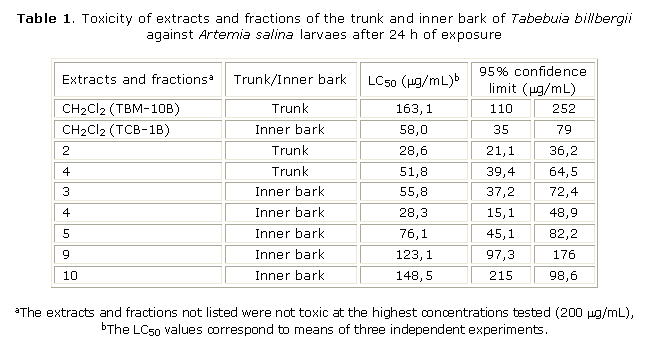
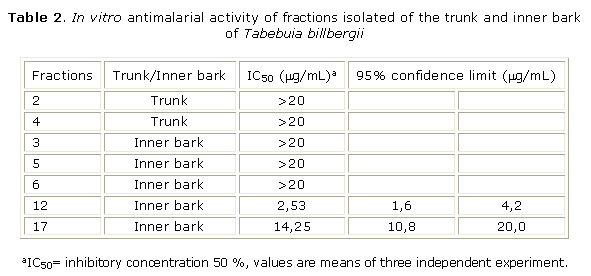
<body><![CDATA[<P><font face="Verdana" size="2"><I>Statistical Analyses</I> </font>     <P>      <P><font face="Verdana" size="2">The lethal concentration 50 of <I>A. salina</I>    (LC<SUB>50</SUB>) and the inhibitory concentration 50 % (IC<SUB>50</SUB>) of    <I>Plasmodium berghei</I> were calculated on the basis of a nonlinear regression    (curve fit), Statistical analyses were performed by one-way analysis of variance    and Newman&#187;Keuls multiple comparison tests. Differences were considered    significant where p values were &lt; 0.05.<SUP>24</SUP> </font>      <P>&nbsp;      <P>      <P><font face="Verdana" size="3"><B>RESULTS</B> </font>      <P>      <P><font face="Verdana" size="2">The extracts from the trunk and inner bark of    <I>T. billbergii</I> were evaluated by conducting lethality tests against <I>Artemia    salina</I><SUP>19</SUP> and selecting the more active extracts for fractionation.    In both cases, the CH<SUB>2</SUB>Cl<SUB>2 </SUB>extracts showed to be the more    actives, giving lethal concentrations (LC<SUB>50</SUB>) at 163 and 58 mg/mL,    respectively (<a href="/img/revistas/pla/v17n2/t0106212.gif">Table 1</a>). </font>      <P><font face="Verdana" size="2">Fractionation of these extracts produced several    active fractions (<a href="/img/revistas/pla/v17n2/t0206212.gif">Table 2</a>) which were assessed for    antiplasmodial activity against <I>Plasmodium berghei</I> (<a href="/img/revistas/pla/v17n2/t0306212.gif">Table    3</a>). Posterior separation permitted the isolation and identification of the    quinonic compounds 1-5, together with the triterpenoids <span   style='font-size:10.0pt;font-family:Verdana'>&#946;</span>-sitosterol and stigmasterol.    </font>      <P><font face="Verdana" size="2">Compounds 1-5 were identified using spectral    information such as that from <SUP>1</SUP>H NMR, <SUP>13</SUP>C NMR, as well    as EI-MS spectra, and by direct comparison with the data reported in the literature,    as 2-hydroxy-3-(3<SUP>'</SUP>methyl-2<SUP>'</SUP>-butenyl)-naphthalen-1,4-dione    (lapachol, 1), 2-acetyl-8-methoxy-naphtho-[2,3b]-furan-4,9-dione (<I>2</I>),<SUP>20</SUP>    2-acetyl-7,8- dimethoxy-naphtho-[2,3b]-furan-4,9-dione (3),<SUP>21</SUP> 2-acetyl-naphtho-[2,3b]-furan-4,9-dione    (4)<SUP>5,9</SUP> and 2-acetyl-7-hydroxi-8-methoxy-naphtho-[2,3b]-furan-4,9    -dione (5).<SUP>6</SUP> <span   style='font-size:10.0pt;font-family:Verdana'>&#946;</span>-sitosterol and stigmasterol    were separated by GC-MS and identified by comparison with their spectra in the    instrument's library. </font>      ]]></body>
<body><![CDATA[<P><font face="Verdana" size="2">The naphtho-furan-diones showed important inhibitory    activity when assayed <I>in vitro </I>against <I>Plasmodium berghei</I>, especially    in comparison to the activity exhibited by Chloroquine which was used as control.    The IC<SUB>50</SUB> values obtained with these pure compounds are summarized    in <a href="/img/revistas/pla/v17n2/t0306212.gif">Table 3</a>.</font>      <P>&nbsp;      <P>      <P><font face="Verdana" size="3"><B>DISCUSSION</B></font><font face="Verdana" size="2">    </font>      <P>      <P><font face="Verdana" size="2">The activity-guided fractionation (<I>A. salina</I>)    of different extracts from the wood and inner bark of <I>T. billbergii</I> led    to the isolation and identification of five quinonoid compounds. The results    from the spectral data for compounds I-V isolated in this study were compared    with the data reported previously in the literature for these compounds. The    antimalarial activity of the fractions and isolated compounds was assayed against    <I>Plasmodium berghei</I> by using the inhibition of the differentiation cycle    of the parasite measured through the <SUP>3</SUP>H-hypoxanthine incorporation.    Short-term cultures of <I>Plasmodium berghei</I> followed the protocol described    by Kamiyama and Matsubara (1992).<SUP>23</SUP> Chloroquine was used as control    for the experiments. The IC<SUB>50</SUB> values obtained with various fractions    and isolates from the plant are summarized in <a href="/img/revistas/pla/v17n2/t0106212.gif">Tables    1</a> and <a href="/img/revistas/pla/v17n2/t0206212.gif">2</a>. </font>      <P><font face="Verdana" size="2">Preliminary evaluation of the antiparasitic activity    of compounds 1, 2, 3 and 5, suggests there is much ground for further investigation,    since the values of IC<SUB>50</SUB>'s obtained are rather encouraging. The activity    observed for compound 4<B> </B>deserves special attention because of its pharmaceutical    potential. Of course, this requires further deep research, but we are already    involved in the synthesis of some of these quinones, in order to be able to    proceed with the <I>in vivo </I>tests. </font>     <P>&nbsp;      <P>      <P><font face="Verdana" size="2"><B><font size="3">ACKNOWLEDGEMENTS</font></B>    </font>      ]]></body>
<body><![CDATA[<P>      <P><font face="Verdana" size="2">This work was partially financed by Colciencias,    Colombia, and by the Instituto Venezolano de Investigaciones Cient&iacute;ficas    (IVIC). We are grateful to Prof. Hermes Cuadros, Universidad del Atl&aacute;ntico,    Barranquilla, Colombia, and Prof. Prisciliano Mart&iacute;nez, Facultad de Ciencias    Qu&iacute;micas Farmac&eacute;uticas, Universidad de Cartagena, for the collection    and identification of plant material. HGE acknowledges Colciencias and the Universidad    de Cartagena for a graduate study fellowship. JDM is grateful to Dr. Werner    Wilbert, of the Department of Anthropology of the Instituto Venezolano de Investigaciones    Cient&iacute;ficas (IVIC), for his kind review of the manuscript. </font>      <P>&nbsp;     <P>      <P><font face="Verdana" size="3"><B>REFERENCES </B></font><font face="Verdana" size="2">    </font>      <P>      <!-- ref --><P><font face="Verdana" size="2">1. Bernal HY, Correa JE. Especies vegetales promisorias    de los pa&iacute;ses del Convenio Andr&eacute;s Bello. vol. 2. Secretar&iacute;a    Ejecutiva del Convenio Andr&eacute;s Bello (SECAB). Bogot&aacute;, Colombia:    Editora Guadalupe Ltda.; 1986. p. 241-4.     </font>     <!-- ref --><P><font face="Verdana" size="2">2. Gentry AH. Bignoniaceae. Flora de Venezuela.    Vol 8. Parte 4. Instituto Nacional de Parques, Venezuela: Ediciones Fundaci&oacute;n    Educaci&oacute;n Ambiental; 1982. p. 389-91.     </font>     ]]></body>
<body><![CDATA[<!-- ref --><P><font face="Verdana" size="2">3. G&oacute;mez JR, Prieto JM, Heinrich M. Red    Lapacho (<I>Tabebuia impetiginosa</I>) -A global ethnopharmacological commodity?.    J Ethnopharmacol. 2009;121(1):1-13.     </font>     <!-- ref --><P><font face="Verdana" size="2">4. Weiss CR, Moideen SV, Croft SL, Houghton Peter    J. Activity of extracts and isolated naphthoquinones from <I>Kigelia pinnata</I>    against <I>Plasmodium falciparum</I>. J Nat Prod. 2000;63:1306-9.     </font>     <!-- ref --><P><font face="Verdana" size="2">5. Girard M, Kindack D, Dawson B, Ethier J-C,    Awang DVC. Naphthoquinone constituents of <I>Tabebuia </I>spp. J Nat Prod. 1988;51(5):1023-4.        </font>     <!-- ref --><P><font face="Verdana" size="2">6. D&iacute;az F, Medina JD. Furanonaphthoquinones    from <I>Tabebuia ochracea</I> ssp. <I>neochrysantha</I>. J Nat Prod. 1996;59(4):423-4.        </font>     <!-- ref --><P><font face="Verdana" size="2">7. Hudson AT, Randall AW, Fry M, Ginger CD, Hill    B, Latter VS, et al. Novel anti-malarial hydroxynaphthoquinones with potent    broad spectrum anti-protozoal activity. Parasitology. 1985;90:45-55.     </font>     ]]></body>
<body><![CDATA[<!-- ref --><P><font face="Verdana" size="2">8. Fry M, Pudney M. Site of action of the antimalarial    hydroxynaphthoquinone, 2-[<I>trans</I>-4-(4'-chlorophenyl)-cyclohexyl]-3-hydroxy-1,4-naphthoquinone.    Biochemical Pharmacol. 1992;43(7):1545-53.     </font>     <!-- ref --><P><font face="Verdana" size="2">9. P&eacute;rez E, D&iacute;az R, Est&eacute;vez    A, Ravelo A, Garc&iacute;a J, Pardo L, et al. Synthesis and pharmacophore modeling    of naphthoquinone derivatives with cytotoxic activity in human promyelocytic    leukemia HL-60 cell line. J Med Chem. 2007;50:696-706.     </font>     <!-- ref --><P><font face="Verdana" size="2">10. Park BS, Kim JR, Lee SE, Kim K, Takeoka GR,    Ahn YJ, et al. Selective growth-inhibiting effects of compounds identified in    <I>Tabebuia impetiginosa</I> inner bark on human intestinal bacteria. J Agric    Food Chem. 2005;53:1152-7.     </font>     <!-- ref --><P><font face="Verdana" size="2">11. Boothman DA, Trask DK, Pardee AB. Inhibition    of potentially DNA damage repair in human cells by b-Lapachone, an activator    of topoisomerase I. Cancer Research<I>.</I> 1989;49:605-12.     </font>     <!-- ref --><P><font face="Verdana" size="2">12. Kapadia GJ, Balasubramanian V, Tokuda H,    Konoshima T, Takasaki M, Koyama J, et al. Anti-tumour promoting effects of naphthoquinone    derivatives on short term Epstein-Barr early antigen activation assay and in    mouse skin carcinogenesis. Cancer Letters. 1997;113:47-53.     </font>     ]]></body>
<body><![CDATA[<!-- ref --><P><font face="Verdana" size="2">13. Bonifazi EL, R&iacute;os-Luci C, Le&oacute;n    LG, Burton G, Padr&oacute;n JM, Misico RI. Antiproliferative activity of synthetic    naphthoquinones related to lapachol. First synthesis of 5-hydroxylapachol. Bioorganic    Medicinal Chemistry. 2010;18(7):2621-30.     </font>     <!-- ref --><P><font face="Verdana" size="2">14. Frydman B, Marton LJ, Sun JS, Neder K, Witiak    DT, Liu AA, et al. Induction of DNA topoisomerase II-mediated DNA cleavage by    b-lapachone and related naphthoquinones. Cancer Research. 1997;57:620-7.     </font>     <!-- ref --><P><font face="Verdana" size="2">15. P&eacute;rez H, D&iacute;az F, Medina JD.    Chemical investigation and <I>in vitro</I> antimalarial activity of <I>Tabebuia    ochracea </I>ssp.<I> neochrysantha</I>. International J Pharmacognosy. 1997;35:227-31.        </font>     <!-- ref --><P><font face="Verdana" size="2">16. Madhusudana R, Kingston D. Plant anticancer    agents. XII. Isolation and structure elucidation of new cytotoxic quinones from    <I>Tabebuia cassinoides</I>. J Nat Prod. 1982;45(5):600-4.     </font>     <!-- ref --><P><font face="Verdana" size="2">17. Friebolin W, Jannack B, Wenzel N, Furrer    J, Oeser T, S&aacute;nchez CP, et al. Antimalarial dual drugs based on potent    inhibitors of glutathione reductase from <I>Plasmodium falciparum</I>. J Med    Chem. 2008;(51):1260-77.     </font>     ]]></body>
<body><![CDATA[<!-- ref --><P><font face="Verdana" size="2">18. Kongkathip N, Pradidphol N, Hasitapan K,    Grigg R, Kao WC, Hunte C, et al. Transforming rhinacanthin analogues from potent    anticancer agents into potent antimalarial agents. J Med Chem. 2010;53:1211-21.        </font>     <!-- ref --><P><font face="Verdana" size="2">19. Meyer BN, Ferrigni NR, Putnam JE, Jacobsen    LB, Nichols DE, McLaughlin JL. Brine shrimp: A convenient general bioassay for    active plant constituents.<I> </I>Planta Medica. 1982;45:31-4.     </font>     <!-- ref --><P><font face="Verdana" size="2">20. Wagner H, Kreher B, Lotter H, Hamburger MO,    Cordell GA. Structure elucidation of new isomeric naphtho-[2,3<I>b</I>]furan-4,9-diones    from <I>Tabebuia avellanedae </I>by the selective-INEPT technique. Helvetica    Chimica Acta. 1989;72:659-67.     </font>     <!-- ref --><P><font face="Verdana" size="2">21. Zani CL, Chiari E, Krettli AU, Murta SM,    Cunningham ML, Fairlamb AH, et al. Anti-plasmodial and anti-trypanosomal activity    of synthetic naphtho [2,3<I>b</I>] thiophen-4,9-quinones. Bioorganic Medicinal    Chemistry. 1997;5(12):2185-92.     </font>     <!-- ref --><P><font face="Verdana" size="2">22. McLaughlin JL, Chang CJ, Smith DL. &quot;Bench-top&quot;    bioassays for the discovery of bioactive natural products: an update. In: Rahman    A, editor, Studies in Natural Products Chemistry 9. New York: Elsevier Science    Publishing Company Inc.; 1991. p. 383-409.     </font>      ]]></body>
<body><![CDATA[<!-- ref --><P><font face="Verdana" size="2">23. Kamiyama T, Matsubara J. Application of a    simple culture of <I>Plasmodium berghei</I> for assessment of antiparasitic    activity. International J Parasitol. 1992;22:1137-42.     </font>     <!-- ref --><P><font face="Verdana" size="2">24. Finney DK. Probit analysis. 3<SUP>rd</SUP>    ed. Cambridge, U.K.: Cambridge University Press; 1971.     </font>     <P>&nbsp;     <P>&nbsp;      <P>      <P><font face="Verdana" size="2">Recibido: 1 de diciembre de 2011.     <br>   Aprobado: 30 de enero de 2012. </font>     <P>&nbsp;     ]]></body>
<body><![CDATA[<P>&nbsp;      <P><font face="Verdana" size="2"><I>Harold G&oacute;mez-Estrada</I>. Facultad    de Ciencias Farmac&eacute;uticas, Universidad de Cartagena. Grupo de Investigaci&oacute;n    en Qu&iacute;mica de Medicamentos (GIQM). Cartagena, Colombia. Tel&eacute;f.:    57-5-6698323. Correo electr&oacute;nico: <U><FONT  COLOR="#0000ff"><a href="mailto:hgomeze@unicartagena.edu.co">hgomeze@unicartagena.edu.co</a></FONT></U>    </font>       ]]></body><back>
<ref-list>
<ref id="B1">
<label>1</label><nlm-citation citation-type="book">
<person-group person-group-type="author">
<name>
<surname><![CDATA[Bernal]]></surname>
<given-names><![CDATA[HY]]></given-names>
</name>
<name>
<surname><![CDATA[Correa]]></surname>
<given-names><![CDATA[JE]]></given-names>
</name>
</person-group>
<source><![CDATA[Especies vegetales promisorias de los países del Convenio Andrés Bello]]></source>
<year>1986</year>
<page-range>p. 241-4</page-range><publisher-loc><![CDATA[Bogotá ]]></publisher-loc>
<publisher-name><![CDATA[Editora Guadalupe Ltda]]></publisher-name>
</nlm-citation>
</ref>
<ref id="B2">
<label>2</label><nlm-citation citation-type="book">
<person-group person-group-type="author">
<name>
<surname><![CDATA[Gentry]]></surname>
<given-names><![CDATA[AH]]></given-names>
</name>
</person-group>
<source><![CDATA[Bignoniaceae: Flora de Venezuela]]></source>
<year>1982</year>
<page-range>p. 389-91</page-range><publisher-loc><![CDATA[Venezuela ]]></publisher-loc>
<publisher-name><![CDATA[Ediciones Fundación Educación Ambiental]]></publisher-name>
</nlm-citation>
</ref>
<ref id="B3">
<label>3</label><nlm-citation citation-type="journal">
<person-group person-group-type="author">
<name>
<surname><![CDATA[Gómez]]></surname>
<given-names><![CDATA[JR]]></given-names>
</name>
<name>
<surname><![CDATA[Prieto]]></surname>
<given-names><![CDATA[JM]]></given-names>
</name>
<name>
<surname><![CDATA[Heinrich]]></surname>
<given-names><![CDATA[M]]></given-names>
</name>
</person-group>
<article-title xml:lang="en"><![CDATA[Red Lapacho (Tabebuia impetiginosa): A global ethnopharmacological commodity?]]></article-title>
<source><![CDATA[J Ethnopharmacol]]></source>
<year>2009</year>
<volume>121</volume>
<numero>1</numero>
<issue>1</issue>
<page-range>1-13</page-range></nlm-citation>
</ref>
<ref id="B4">
<label>4</label><nlm-citation citation-type="journal">
<person-group person-group-type="author">
<name>
<surname><![CDATA[Weiss]]></surname>
<given-names><![CDATA[CR]]></given-names>
</name>
<name>
<surname><![CDATA[Moideen]]></surname>
<given-names><![CDATA[SV]]></given-names>
</name>
<name>
<surname><![CDATA[Croft]]></surname>
<given-names><![CDATA[SL]]></given-names>
</name>
<name>
<surname><![CDATA[Houghton Peter]]></surname>
<given-names><![CDATA[J]]></given-names>
</name>
</person-group>
<article-title xml:lang="en"><![CDATA[Activity of extracts and isolated naphthoquinones from Kigelia pinnata against Plasmodium falciparum]]></article-title>
<source><![CDATA[J Nat Prod.]]></source>
<year>2000</year>
<volume>63</volume>
<page-range>1306-9</page-range></nlm-citation>
</ref>
<ref id="B5">
<label>5</label><nlm-citation citation-type="journal">
<person-group person-group-type="author">
<name>
<surname><![CDATA[Girard]]></surname>
<given-names><![CDATA[M]]></given-names>
</name>
<name>
<surname><![CDATA[Kindack]]></surname>
<given-names><![CDATA[D]]></given-names>
</name>
<name>
<surname><![CDATA[Dawson]]></surname>
<given-names><![CDATA[B]]></given-names>
</name>
<name>
<surname><![CDATA[Ethier]]></surname>
<given-names><![CDATA[J-C]]></given-names>
</name>
<name>
<surname><![CDATA[Awang]]></surname>
<given-names><![CDATA[DVC]]></given-names>
</name>
</person-group>
<article-title xml:lang="en"><![CDATA[Naphthoquinone constituents of Tabebuia spp]]></article-title>
<source><![CDATA[J Nat Prod.]]></source>
<year>1988</year>
<volume>51</volume>
<numero>5</numero>
<issue>5</issue>
<page-range>1023-4</page-range></nlm-citation>
</ref>
<ref id="B6">
<label>6</label><nlm-citation citation-type="journal">
<person-group person-group-type="author">
<name>
<surname><![CDATA[Díaz]]></surname>
<given-names><![CDATA[F]]></given-names>
</name>
<name>
<surname><![CDATA[Medina]]></surname>
<given-names><![CDATA[JD]]></given-names>
</name>
</person-group>
<article-title xml:lang="en"><![CDATA[Furanonaphthoquinones from Tabebuia ochracea ssp: neochrysantha]]></article-title>
<source><![CDATA[J Nat Prod.]]></source>
<year>1996</year>
<volume>59</volume>
<numero>4</numero>
<issue>4</issue>
<page-range>423-4</page-range></nlm-citation>
</ref>
<ref id="B7">
<label>7</label><nlm-citation citation-type="journal">
<person-group person-group-type="author">
<name>
<surname><![CDATA[Hudson]]></surname>
<given-names><![CDATA[AT]]></given-names>
</name>
<name>
<surname><![CDATA[Randall]]></surname>
<given-names><![CDATA[AW]]></given-names>
</name>
<name>
<surname><![CDATA[Fry]]></surname>
<given-names><![CDATA[M]]></given-names>
</name>
<name>
<surname><![CDATA[Ginger]]></surname>
<given-names><![CDATA[CD]]></given-names>
</name>
<name>
<surname><![CDATA[Hill]]></surname>
<given-names><![CDATA[B]]></given-names>
</name>
<name>
<surname><![CDATA[Latter]]></surname>
<given-names><![CDATA[VS]]></given-names>
</name>
</person-group>
<article-title xml:lang="en"><![CDATA[Novel anti-malarial hydroxynaphthoquinones with potent broad spectrum anti-protozoal activity]]></article-title>
<source><![CDATA[Parasitology.]]></source>
<year>1985</year>
<volume>90</volume>
<page-range>45-55</page-range></nlm-citation>
</ref>
<ref id="B8">
<label>8</label><nlm-citation citation-type="journal">
<person-group person-group-type="author">
<name>
<surname><![CDATA[Fry]]></surname>
<given-names><![CDATA[M]]></given-names>
</name>
<name>
<surname><![CDATA[Pudney]]></surname>
<given-names><![CDATA[M]]></given-names>
</name>
</person-group>
<article-title xml:lang="en"><![CDATA[Site of action of the antimalarial hydroxynaphthoquinone, 2-[trans-4-(4'-chlorophenyl)-cyclohexyl]-3-hydroxy-1,4-naphthoquinone]]></article-title>
<source><![CDATA[Biochemical Pharmacol.]]></source>
<year>1992</year>
<volume>43</volume>
<numero>7</numero>
<issue>7</issue>
<page-range>1545-53</page-range></nlm-citation>
</ref>
<ref id="B9">
<label>9</label><nlm-citation citation-type="journal">
<person-group person-group-type="author">
<name>
<surname><![CDATA[Pérez]]></surname>
<given-names><![CDATA[E]]></given-names>
</name>
<name>
<surname><![CDATA[Díaz]]></surname>
<given-names><![CDATA[R]]></given-names>
</name>
<name>
<surname><![CDATA[Estévez]]></surname>
<given-names><![CDATA[A]]></given-names>
</name>
<name>
<surname><![CDATA[Ravelo]]></surname>
<given-names><![CDATA[A]]></given-names>
</name>
<name>
<surname><![CDATA[García]]></surname>
<given-names><![CDATA[J]]></given-names>
</name>
<name>
<surname><![CDATA[Pardo]]></surname>
<given-names><![CDATA[L]]></given-names>
</name>
</person-group>
<article-title xml:lang="en"><![CDATA[Synthesis and pharmacophore modeling of naphthoquinone derivatives with cytotoxic activity in human promyelocytic leukemia HL-60 cell line]]></article-title>
<source><![CDATA[J Med Chem.]]></source>
<year>2007</year>
<volume>50</volume>
<page-range>696-706</page-range></nlm-citation>
</ref>
<ref id="B10">
<label>10</label><nlm-citation citation-type="journal">
<person-group person-group-type="author">
<name>
<surname><![CDATA[Park]]></surname>
<given-names><![CDATA[BS]]></given-names>
</name>
<name>
<surname><![CDATA[Kim]]></surname>
<given-names><![CDATA[JR]]></given-names>
</name>
<name>
<surname><![CDATA[Lee]]></surname>
<given-names><![CDATA[SE]]></given-names>
</name>
<name>
<surname><![CDATA[Kim]]></surname>
<given-names><![CDATA[K]]></given-names>
</name>
<name>
<surname><![CDATA[Takeoka]]></surname>
<given-names><![CDATA[GR]]></given-names>
</name>
<name>
<surname><![CDATA[Ahn]]></surname>
<given-names><![CDATA[YJ]]></given-names>
</name>
</person-group>
<article-title xml:lang="en"><![CDATA[Selective growth-inhibiting effects of compounds identified in Tabebuia impetiginosa inner bark on human intestinal bacteria]]></article-title>
<source><![CDATA[J Agric Food Chem.]]></source>
<year>2005</year>
<volume>53</volume>
<page-range>1152-7</page-range></nlm-citation>
</ref>
<ref id="B11">
<label>11</label><nlm-citation citation-type="journal">
<person-group person-group-type="author">
<name>
<surname><![CDATA[Boothman]]></surname>
<given-names><![CDATA[DA]]></given-names>
</name>
<name>
<surname><![CDATA[Trask]]></surname>
<given-names><![CDATA[DK]]></given-names>
</name>
<name>
<surname><![CDATA[Pardee]]></surname>
<given-names><![CDATA[AB]]></given-names>
</name>
</person-group>
<article-title xml:lang="en"><![CDATA[Inhibition of potentially DNA damage repair in human cells by b-Lapachone, an activator of topoisomerase I]]></article-title>
<source><![CDATA[Cancer Research.]]></source>
<year>1989</year>
<volume>49</volume>
<page-range>605-12</page-range></nlm-citation>
</ref>
<ref id="B12">
<label>12</label><nlm-citation citation-type="journal">
<person-group person-group-type="author">
<name>
<surname><![CDATA[Kapadia]]></surname>
<given-names><![CDATA[GJ]]></given-names>
</name>
<name>
<surname><![CDATA[Balasubramanian]]></surname>
<given-names><![CDATA[V]]></given-names>
</name>
<name>
<surname><![CDATA[Tokuda]]></surname>
<given-names><![CDATA[H]]></given-names>
</name>
<name>
<surname><![CDATA[Konoshima]]></surname>
<given-names><![CDATA[T]]></given-names>
</name>
<name>
<surname><![CDATA[Takasaki]]></surname>
<given-names><![CDATA[M]]></given-names>
</name>
<name>
<surname><![CDATA[Koyama]]></surname>
<given-names><![CDATA[J]]></given-names>
</name>
</person-group>
<article-title xml:lang="en"><![CDATA[Anti-tumour promoting effects of naphthoquinone derivatives on short term Epstein-Barr early antigen activation assay and in mouse skin carcinogenesis]]></article-title>
<source><![CDATA[Cancer Letters.]]></source>
<year>1997</year>
<volume>113</volume>
<page-range>47-53</page-range></nlm-citation>
</ref>
<ref id="B13">
<label>13</label><nlm-citation citation-type="journal">
<person-group person-group-type="author">
<name>
<surname><![CDATA[Bonifazi]]></surname>
<given-names><![CDATA[EL]]></given-names>
</name>
<name>
<surname><![CDATA[Ríos-Luci]]></surname>
<given-names><![CDATA[C]]></given-names>
</name>
<name>
<surname><![CDATA[León]]></surname>
<given-names><![CDATA[LG]]></given-names>
</name>
<name>
<surname><![CDATA[Burton]]></surname>
<given-names><![CDATA[G]]></given-names>
</name>
<name>
<surname><![CDATA[Padrón]]></surname>
<given-names><![CDATA[JM]]></given-names>
</name>
<name>
<surname><![CDATA[Misico]]></surname>
<given-names><![CDATA[RI]]></given-names>
</name>
</person-group>
<article-title xml:lang="en"><![CDATA[Antiproliferative activity of synthetic naphthoquinones related to lapachol: First synthesis of 5-hydroxylapachol]]></article-title>
<source><![CDATA[Bioorganic Medicinal Chemistry.]]></source>
<year>2010</year>
<volume>18</volume>
<numero>7</numero>
<issue>7</issue>
<page-range>2621-30</page-range></nlm-citation>
</ref>
<ref id="B14">
<label>14</label><nlm-citation citation-type="journal">
<person-group person-group-type="author">
<name>
<surname><![CDATA[Frydman]]></surname>
<given-names><![CDATA[B]]></given-names>
</name>
<name>
<surname><![CDATA[Marton]]></surname>
<given-names><![CDATA[LJ]]></given-names>
</name>
<name>
<surname><![CDATA[Sun]]></surname>
<given-names><![CDATA[JS]]></given-names>
</name>
<name>
<surname><![CDATA[Neder]]></surname>
<given-names><![CDATA[K]]></given-names>
</name>
<name>
<surname><![CDATA[Witiak]]></surname>
<given-names><![CDATA[DT]]></given-names>
</name>
<name>
<surname><![CDATA[Liu]]></surname>
<given-names><![CDATA[AA]]></given-names>
</name>
</person-group>
<article-title xml:lang="en"><![CDATA[Induction of DNA topoisomerase II-mediated DNA cleavage by b-lapachone and related naphthoquinones]]></article-title>
<source><![CDATA[Cancer Research.]]></source>
<year>1997</year>
<volume>57</volume>
<page-range>620-7</page-range></nlm-citation>
</ref>
<ref id="B15">
<label>15</label><nlm-citation citation-type="journal">
<person-group person-group-type="author">
<name>
<surname><![CDATA[Pérez]]></surname>
<given-names><![CDATA[H]]></given-names>
</name>
<name>
<surname><![CDATA[Díaz]]></surname>
<given-names><![CDATA[F]]></given-names>
</name>
<name>
<surname><![CDATA[Medina]]></surname>
<given-names><![CDATA[JD]]></given-names>
</name>
</person-group>
<article-title xml:lang="en"><![CDATA[Chemical investigation and in vitro antimalarial activity of Tabebuia ochracea ssp: neochrysantha]]></article-title>
<source><![CDATA[International J Pharmacognosy.]]></source>
<year>1997</year>
<volume>35</volume>
<page-range>227-31</page-range></nlm-citation>
</ref>
<ref id="B16">
<label>16</label><nlm-citation citation-type="journal">
<person-group person-group-type="author">
<name>
<surname><![CDATA[Madhusudana]]></surname>
<given-names><![CDATA[R]]></given-names>
</name>
<name>
<surname><![CDATA[Kingston]]></surname>
<given-names><![CDATA[D]]></given-names>
</name>
</person-group>
<article-title xml:lang="en"><![CDATA[Plant anticancer agents: XII. Isolation and structure elucidation of new cytotoxic quinones from Tabebuia cassinoides]]></article-title>
<source><![CDATA[J Nat Prod]]></source>
<year>1982</year>
<volume>45</volume>
<numero>5</numero>
<issue>5</issue>
<page-range>600-4</page-range></nlm-citation>
</ref>
<ref id="B17">
<label>17</label><nlm-citation citation-type="journal">
<person-group person-group-type="author">
<name>
<surname><![CDATA[Friebolin]]></surname>
<given-names><![CDATA[W]]></given-names>
</name>
<name>
<surname><![CDATA[Jannack]]></surname>
<given-names><![CDATA[B]]></given-names>
</name>
<name>
<surname><![CDATA[Wenzel]]></surname>
<given-names><![CDATA[N]]></given-names>
</name>
<name>
<surname><![CDATA[Furrer]]></surname>
<given-names><![CDATA[J]]></given-names>
</name>
<name>
<surname><![CDATA[Oeser]]></surname>
<given-names><![CDATA[T]]></given-names>
</name>
<name>
<surname><![CDATA[Sánchez]]></surname>
<given-names><![CDATA[CP]]></given-names>
</name>
</person-group>
<article-title xml:lang="en"><![CDATA[Antimalarial dual drugs based on potent inhibitors of glutathione reductase from Plasmodium falciparum]]></article-title>
<source><![CDATA[J Med Chem.]]></source>
<year>2008</year>
<numero>51</numero>
<issue>51</issue>
<page-range>1260-77</page-range></nlm-citation>
</ref>
<ref id="B18">
<label>18</label><nlm-citation citation-type="journal">
<person-group person-group-type="author">
<name>
<surname><![CDATA[Kongkathip]]></surname>
<given-names><![CDATA[N]]></given-names>
</name>
<name>
<surname><![CDATA[Pradidphol]]></surname>
<given-names><![CDATA[N]]></given-names>
</name>
<name>
<surname><![CDATA[Hasitapan]]></surname>
<given-names><![CDATA[K]]></given-names>
</name>
<name>
<surname><![CDATA[Grigg]]></surname>
<given-names><![CDATA[R]]></given-names>
</name>
<name>
<surname><![CDATA[Kao]]></surname>
<given-names><![CDATA[WC]]></given-names>
</name>
<name>
<surname><![CDATA[Hunte]]></surname>
<given-names><![CDATA[C]]></given-names>
</name>
</person-group>
<article-title xml:lang="en"><![CDATA[Transforming rhinacanthin analogues from potent anticancer agents into potent antimalarial agents]]></article-title>
<source><![CDATA[J Med Chem.]]></source>
<year>2010</year>
<volume>53</volume>
<page-range>1211-21</page-range></nlm-citation>
</ref>
<ref id="B19">
<label>19</label><nlm-citation citation-type="journal">
<person-group person-group-type="author">
<name>
<surname><![CDATA[Meyer]]></surname>
<given-names><![CDATA[BN]]></given-names>
</name>
<name>
<surname><![CDATA[Ferrigni]]></surname>
<given-names><![CDATA[NR]]></given-names>
</name>
<name>
<surname><![CDATA[Putnam]]></surname>
<given-names><![CDATA[JE]]></given-names>
</name>
<name>
<surname><![CDATA[Jacobsen]]></surname>
<given-names><![CDATA[LB]]></given-names>
</name>
<name>
<surname><![CDATA[Nichols]]></surname>
<given-names><![CDATA[DE]]></given-names>
</name>
<name>
<surname><![CDATA[McLaughlin]]></surname>
<given-names><![CDATA[JL]]></given-names>
</name>
</person-group>
<article-title xml:lang="en"><![CDATA[Brine shrimp: A convenient general bioassay for active plant constituents]]></article-title>
<source><![CDATA[Planta Medica.]]></source>
<year>1982</year>
<volume>45</volume>
<page-range>31-4</page-range></nlm-citation>
</ref>
<ref id="B20">
<label>20</label><nlm-citation citation-type="journal">
<person-group person-group-type="author">
<name>
<surname><![CDATA[Wagner]]></surname>
<given-names><![CDATA[H]]></given-names>
</name>
<name>
<surname><![CDATA[Kreher]]></surname>
<given-names><![CDATA[B]]></given-names>
</name>
<name>
<surname><![CDATA[Lotter]]></surname>
<given-names><![CDATA[H]]></given-names>
</name>
<name>
<surname><![CDATA[Hamburger]]></surname>
<given-names><![CDATA[MO]]></given-names>
</name>
<name>
<surname><![CDATA[Cordell]]></surname>
<given-names><![CDATA[GA]]></given-names>
</name>
</person-group>
<article-title xml:lang="en"><![CDATA[Structure elucidation of new isomeric naphtho-[2,3b]furan-4,9-diones from Tabebuia avellanedae by the selective-INEPT technique]]></article-title>
<source><![CDATA[Helvetica Chimica Acta.]]></source>
<year>1989</year>
<volume>72</volume>
<page-range>659-67</page-range></nlm-citation>
</ref>
<ref id="B21">
<label>21</label><nlm-citation citation-type="journal">
<person-group person-group-type="author">
<name>
<surname><![CDATA[Zani]]></surname>
<given-names><![CDATA[CL]]></given-names>
</name>
<name>
<surname><![CDATA[Chiari]]></surname>
<given-names><![CDATA[E]]></given-names>
</name>
<name>
<surname><![CDATA[Krettli]]></surname>
<given-names><![CDATA[AU]]></given-names>
</name>
<name>
<surname><![CDATA[Murta]]></surname>
<given-names><![CDATA[SM]]></given-names>
</name>
<name>
<surname><![CDATA[Cunningham]]></surname>
<given-names><![CDATA[ML]]></given-names>
</name>
<name>
<surname><![CDATA[Fairlamb]]></surname>
<given-names><![CDATA[AH]]></given-names>
</name>
</person-group>
<article-title xml:lang="en"><![CDATA[Anti-plasmodial and anti-trypanosomal activity of synthetic naphtho [2,3b] thiophen-4,9-quinones]]></article-title>
<source><![CDATA[Bioorganic Medicinal Chemistry.]]></source>
<year>1997</year>
<volume>5</volume>
<numero>12</numero>
<issue>12</issue>
<page-range>2185-92</page-range></nlm-citation>
</ref>
<ref id="B22">
<label>22</label><nlm-citation citation-type="book">
<person-group person-group-type="author">
<name>
<surname><![CDATA[McLaughlin]]></surname>
<given-names><![CDATA[JL]]></given-names>
</name>
<name>
<surname><![CDATA[Chang]]></surname>
<given-names><![CDATA[CJ]]></given-names>
</name>
<name>
<surname><![CDATA[Smith]]></surname>
<given-names><![CDATA[DL]]></given-names>
</name>
</person-group>
<article-title xml:lang="en"><![CDATA["Bench-top" bioassays for the discovery of bioactive natural products: an update]]></article-title>
<person-group person-group-type="editor">
<name>
<surname><![CDATA[Rahman]]></surname>
<given-names><![CDATA[A]]></given-names>
</name>
</person-group>
<source><![CDATA[Studies in Natural Products Chemistry 9]]></source>
<year>1991</year>
<page-range>p. 383-409</page-range><publisher-loc><![CDATA[New York ]]></publisher-loc>
<publisher-name><![CDATA[Elsevier Science Publishing Company Inc]]></publisher-name>
</nlm-citation>
</ref>
<ref id="B23">
<label>23</label><nlm-citation citation-type="journal">
<person-group person-group-type="author">
<name>
<surname><![CDATA[Kamiyama]]></surname>
<given-names><![CDATA[T]]></given-names>
</name>
<name>
<surname><![CDATA[Matsubara]]></surname>
<given-names><![CDATA[J]]></given-names>
</name>
</person-group>
<article-title xml:lang="en"><![CDATA[Application of a simple culture of Plasmodium berghei for assessment of antiparasitic activity]]></article-title>
<source><![CDATA[International J Parasitol.]]></source>
<year>1992</year>
<volume>22</volume>
<page-range>1137-42</page-range></nlm-citation>
</ref>
<ref id="B24">
<label>24</label><nlm-citation citation-type="book">
<person-group person-group-type="author">
<name>
<surname><![CDATA[Finney]]></surname>
<given-names><![CDATA[DK]]></given-names>
</name>
</person-group>
<source><![CDATA[Probit analysis]]></source>
<year>1971</year>
<edition>3rd ed</edition>
<publisher-loc><![CDATA[Cambridge^eU.K U.K]]></publisher-loc>
<publisher-name><![CDATA[Cambridge University Press]]></publisher-name>
</nlm-citation>
</ref>
</ref-list>
</back>
</article>