<?xml version="1.0" encoding="ISO-8859-1"?><article xmlns:mml="http://www.w3.org/1998/Math/MathML" xmlns:xlink="http://www.w3.org/1999/xlink" xmlns:xsi="http://www.w3.org/2001/XMLSchema-instance">
<front>
<journal-meta>
<journal-id>1028-4796</journal-id>
<journal-title><![CDATA[Revista Cubana de Plantas Medicinales]]></journal-title>
<abbrev-journal-title><![CDATA[Rev Cubana Plant Med]]></abbrev-journal-title>
<issn>1028-4796</issn>
<publisher>
<publisher-name><![CDATA[ECIMED]]></publisher-name>
</publisher>
</journal-meta>
<article-meta>
<article-id>S1028-47962013000200005</article-id>
<title-group>
<article-title xml:lang="en"><![CDATA[Anxiogenic effects of Tabernaemontana solanifolia A. DC. (Apocynaceae) extracts in rats tested in the elevated plus-maze]]></article-title>
<article-title xml:lang="es"><![CDATA[Determinación mediante la prueba del laberinto elevado en cruz del efecto ansiogénico en ratas de extractos de Tabernaemontana solanifolia A. DC. (Apocynaceae)]]></article-title>
</title-group>
<contrib-group>
<contrib contrib-type="author">
<name>
<surname><![CDATA[Mestriner Felipe Melo]]></surname>
<given-names><![CDATA[Adriana Mary]]></given-names>
</name>
<xref ref-type="aff" rid="A01"/>
</contrib>
<contrib contrib-type="author">
<name>
<surname><![CDATA[Benitez Macorini]]></surname>
<given-names><![CDATA[Luis Fernando]]></given-names>
</name>
<xref ref-type="aff" rid="A01"/>
</contrib>
<contrib contrib-type="author">
<name>
<surname><![CDATA[Müeller]]></surname>
<given-names><![CDATA[André]]></given-names>
</name>
<xref ref-type="aff" rid="A02"/>
</contrib>
<contrib contrib-type="author">
<name>
<surname><![CDATA[Lima Cardoso]]></surname>
<given-names><![CDATA[Cláudia Andréia]]></given-names>
</name>
<xref ref-type="aff" rid="A02"/>
</contrib>
<contrib contrib-type="author">
<name>
<surname><![CDATA[Gama]]></surname>
<given-names><![CDATA[Stephanie]]></given-names>
</name>
<xref ref-type="aff" rid="A03"/>
</contrib>
<contrib contrib-type="author">
<name>
<surname><![CDATA[Gomes]]></surname>
<given-names><![CDATA[Sueli Maria]]></given-names>
</name>
<xref ref-type="aff" rid="A03"/>
</contrib>
<contrib contrib-type="author">
<name>
<surname><![CDATA[Silveira]]></surname>
<given-names><![CDATA[Dâmaris]]></given-names>
</name>
<xref ref-type="aff" rid="A03"/>
</contrib>
</contrib-group>
<aff id="A02">
<institution><![CDATA[,University of Mato Grosso  ]]></institution>
<addr-line><![CDATA[Sinop MT]]></addr-line>
<country>Brazil</country>
</aff>
<aff id="A03">
<institution><![CDATA[,University of Brasilia  ]]></institution>
<addr-line><![CDATA[Brasília DF]]></addr-line>
<country>Brazil</country>
</aff>
<aff id="A01">
<institution><![CDATA[,University of Grande Dourados Department of Pharmacology ]]></institution>
<addr-line><![CDATA[Dourados MS]]></addr-line>
<country>Brazil</country>
</aff>
<pub-date pub-type="pub">
<day>00</day>
<month>06</month>
<year>2013</year>
</pub-date>
<pub-date pub-type="epub">
<day>00</day>
<month>06</month>
<year>2013</year>
</pub-date>
<volume>18</volume>
<numero>2</numero>
<fpage>216</fpage>
<lpage>223</lpage>
<copyright-statement/>
<copyright-year/>
<self-uri xlink:href="http://scielo.sld.cu/scielo.php?script=sci_arttext&amp;pid=S1028-47962013000200005&amp;lng=en&amp;nrm=iso"></self-uri><self-uri xlink:href="http://scielo.sld.cu/scielo.php?script=sci_abstract&amp;pid=S1028-47962013000200005&amp;lng=en&amp;nrm=iso"></self-uri><self-uri xlink:href="http://scielo.sld.cu/scielo.php?script=sci_pdf&amp;pid=S1028-47962013000200005&amp;lng=en&amp;nrm=iso"></self-uri><abstract abstract-type="short" xml:lang="en"><p><![CDATA[Introduction: Tabernaemontana solanifolia A. DC. (Apocynaceae) grows in the Cerrado (savanna), Caatinga (shrublands), and Atlantic Forest of Brazil. Objective: to investigate the potential anxiolytic activity of the crude extracts and ß-amyrin acetate obtained from the leaves of Tabernaemontana solanifolia in the elevated plus-maze (EPM) test for anxiety in rats. Methods: the crude extracts (aqueous, ethanol, and hexane), as well as ß-amyrin acetate, obtained from Tabernaemontana solanifolia leaves were evaluated for possible anxiolytic effects in rats tested in the elevated plus-maze. Acute toxicity in rats was determined by OECD 423 guidelines. The leaves of T. solanifolia specimens collected in Brasília, Brazil, were air dried at 40 °C and macerated with hexane or ethanol. After filtration, the solvents were removed under reduced pressure, yielding the crude hexane and ethanolic extracts (5.96 and 18.62 % yield, respectively). The crude aqueous extract was obtained by infusion, followed by lyophilization (13.5 % yield). Thirty minutes before the elevated plus-maze experiments, the animals were treated with the crude ethanol extract (1 000 mg/kg of body weight [bw], p.o.), the crude hexane extract (1 000 mg/kg bw, p.o.), the crude extract (1 000 mg/kg bw, p.o.), or ß-amyrin acetate (21 mg/kg bw, p.o.). Results: the extracts cauded no mortality up to 2 000 mg/kg, so half of DL50 doses were selected for the present study. The crude extracts (hexane, ethanolic and aqueous) (1.0 g/kg) as well as the substance ß-amyrin acetate (21 mg/kg) were administered once, increasing the number of entries into and the time spent in the closed arms of the elevated plus-maze. Conclusion: the oral administration of the extracts and ß-amyrin acetate obtained from Tabernaemontana solanifolia had an anxiogenic effect in rats. Further studies are needed in order to identify and characterize the anxiogenic properties of Tabernaemontana solanifolia and to understand the anxiogenic mechanisms of the extracts.]]></p></abstract>
<abstract abstract-type="short" xml:lang="es"><p><![CDATA[Introducción: Tabernaemontana solanifolia A. DC. (Apocynaceae) crece en el Cerrado (sabana), Caatinga (matorrales) y la Mata Atlántica de Brasil. Objetivo: investigar la posible actividad ansiolítica de los extractos crudos y el acetato de ß-amirina obtenidos de las hojas de Tabernaemontana solanifolia en la prueba del laberinto elevado en cruz (EPM) para la ansiedad en ratas. Métodos: los extractos crudos (etanol acuoso y hexano), así como el acetato de ß-amirina, se evaluaron para posibles efectos ansiolíticos en ratas mediante la prueba del laberinto elevado en cruz. La toxicidad aguda en ratas se determinó por las directrices OCDE 423. Las hojas de Tabernaemontana solanifolia se secaron al aire a 40 °C y fueron maceradas con hexano y etanol. Después de la filtración, los disolventes se eliminaron bajo presión reducida, produciendo los extractos crudos hexano y etanólico (5,96 y 18,62 % de rendimiento, respectivamente). El extracto acuoso bruto se obtuvo por infusión, seguida por liofilización (13,5 % de rendimiento). A 30 min antes de los experimentos de laberinto elevado en cruz, los animales se trataron con el extracto de etanol crudo (1 000 mg/kg de peso corporal [bw], p.o.), el extracto de hexano crudo (1 000 mg/kg de peso corporal, por vía oral), el extracto acuoso (1 000 mg/kg de peso corporal, por vía oral) o ß-amirina acetato (21 mg/kg de peso corporal, por vía oral). Resultados: los extractos no produjeron mortalidad hasta 2 000 mg/kg, por lo que para el presente estudio se seleccionó la mitad de la dosis DL50. Los extractos crudos (hexano, etanol y acuoso) (1 000 mg/kg), así como la sustancia acetato de ß-amirina (21 mg/kg) se administraron una vez, aumentando el número de entradas y el tiempo pasado en los brazos cerrados de la prueba del laberinto elevado en cruz. Conclusión: la administración oral de los extractos y el acetato de ß-amirina obtenidos de Tabernaemontana solanifolia tuvo un efecto ansiogénico en ratas. Se necesitan estudios adicionales para identificar y caracterizar las propiedades ansiogénicas de Tabernaemontana solanifolia y para entender los mecanismos ansiogénicos de los extractos.]]></p></abstract>
<kwd-group>
<kwd lng="en"><![CDATA[elevated plus-maze]]></kwd>
<kwd lng="en"><![CDATA[anxiogenic]]></kwd>
<kwd lng="en"><![CDATA[Tabernaemontana solanifolia]]></kwd>
<kwd lng="en"><![CDATA[Apocynaceae]]></kwd>
<kwd lng="es"><![CDATA[laberinto elevado en cruz]]></kwd>
<kwd lng="es"><![CDATA[ansiogénicos]]></kwd>
<kwd lng="es"><![CDATA[Tabernaemontana solanifolia]]></kwd>
<kwd lng="es"><![CDATA[Apocynaceae]]></kwd>
</kwd-group>
</article-meta>
</front><body><![CDATA[ <div align="right">     <p><font face="Verdana" size="2"><B>ART&Iacute;CULO ORIGINAL  </B></font></p>    <p>&nbsp;</p></div><B>     <P>     <P><font face="Verdana" size="4">Anxiogenic  effects of <I>Tabernaemontana solanifolia </I>A. DC. (Apocynaceae) extracts in  rats tested in the elevated plus-maze </font>     <P>&nbsp; </B>     <P><font size="3" face="Verdana"><b>Determinaci&oacute;n  <font face="Verdana" size="3">mediante la prueba del laberinto elevado en cruz</font>  del efecto ansiog&eacute;nico en ratas de extractos de <i>Tabernaemontana solanifolia  </i>A. DC. (Apocynaceae)</b></font> <b></b>     <P>&nbsp; <B>    <P>&nbsp;     <P> </B>     ]]></body>
<body><![CDATA[<P><b><font face="Verdana" size="2">Dra.  Adriana Mary Mestriner Felipe Melo,<SUP>I</SUP> MSc. Luis Fernando Benitez Macorini,<SUP>I</SUP>  MSc. Andr&eacute; M&uuml;eller,<SUP>II</SUP> Dra. Cl&aacute;udia Andr&eacute;ia  Lima Cardoso,<SUP>II</SUP> Lic. Stephanie Gama,<SUP>III</SUP> Dra. Sueli Maria  Gomes,<SUP>III</SUP> Dra. D&acirc;maris Silveira<SUP>III</SUP></font> </b>     <P>      <P><font face="Verdana" size="2"><SUP>I</SUP> University of Grande Dourados. Dourados,  MS, Brazil.    <br> </font><font face="Verdana" size="2"><SUP>II</SUP> University  of Mato Grosso. Sinop, MT, Brazil.    <br> </font><font face="Verdana" size="2"><SUP>III</SUP>  University of Bras&iacute;lia. Bras&iacute;lia, DF, Brazil.</font>     <P>&nbsp;     <P>&nbsp; <hr size="1" noshade>  <font face="Verdana" size="2"><B>ABSTRACT </B></font>     <P><font face="Verdana" size="2"><B>Introduction:</b><I>  Tabernaemontana solanifolia </I>A. DC. (Apocynaceae) grows in the <I>Cerrado</I>  (savanna), <I>Caatinga</I> (shrublands), and Atlantic Forest of Brazil. <B>    <br>  Objective:</B> to investigate the potential anxiolytic activity of the crude extracts  and &szlig;-amyrin acetate obtained from the leaves of <I>Tabernaemontana solanifolia  </I>in the elevated plus-maze (EPM) test for anxiety in rats. <B>    <br> Methods:</B>  the crude extracts (aqueous, ethanol, and hexane), as well as &szlig;-amyrin acetate,  obtained from <I>Tabernaemontana solanifolia</I> leaves were evaluated for possible  anxiolytic effects in rats tested in the elevated plus-maze. Acute toxicity in  rats was determined by OECD 423 guidelines. The leaves of <I>T. solanifolia</I>  specimens collected in Bras&iacute;lia, Brazil, were air dried at 40 &#176;C and  macerated with hexane or ethanol. After filtration, the solvents were removed  under reduced pressure, yielding the crude hexane and ethanolic extracts (5.96  and 18.62 % yield, respectively). The crude aqueous extract was obtained by infusion,  followed by lyophilization (13.5 % yield). Thirty minutes before the elevated  plus-maze experiments, the animals were treated with the crude ethanol extract  (1 000 mg/kg of body weight [bw], p.o.), the crude hexane extract (1 000 mg/kg  bw, p.o.), the crude extract (1 000 mg/kg bw, p.o.), or &szlig;-amyrin acetate  (21 mg/kg bw, p.o.). <B>    ]]></body>
<body><![CDATA[<br> Results:</B> the extracts cauded no mortality up  to 2 000 mg/kg, so half of DL<SUB>50</SUB> doses were selected for the present  study. The crude extracts (hexane, ethanolic and aqueous) (1.0 g/kg) as well as  the substance &szlig;-amyrin acetate (21 mg/kg) were administered once, increasing  the number of entries into and the time spent in the closed arms of the elevated  plus-maze. <B>    <br> Conclusion:</B> the oral administration of the extracts and  &szlig;-amyrin acetate obtained from <I>Tabernaemontana solanifolia </I>had an  anxiogenic effect in rats. Further studies are needed in order to identify and  characterize the anxiogenic properties of <I>Tabernaemontana solanifolia </I>and  to understand the anxiogenic mechanisms of the extracts. </font>     <P><font face="Verdana" size="2"><B>Key  words:</B> elevated plus-maze, anxiogenic, <I>Tabernaemontana solanifolia</I>,  Apocynaceae. </font> <hr size="1" noshade> <font face="Verdana" size="2"><B>RESUMEN</B></font>      <p><B> </B><font face="Verdana" size="2"><B>Introducci&oacute;n:</b> <I>Tabernaemontana  solanifolia</I> A. DC. (Apocynaceae) crece en el Cerrado (sabana), Caatinga (matorrales)  y la Mata Atl&aacute;ntica de Brasil. <B>    <br> Objetivo:</B> investigar la posible  actividad ansiol&iacute;tica de los extractos crudos y el acetato de &szlig;-amirina  obtenidos de las hojas de <I>Tabernaemontana solanifolia </I>en la prueba del  laberinto elevado en cruz (EPM) para la ansiedad en ratas. <B>    <br> M&eacute;todos:</B>  los extractos crudos (etanol acuoso y hexano), as&iacute; como el acetato de &szlig;-amirina,  se evaluaron para posibles efectos ansiol&iacute;ticos en ratas mediante la prueba  del laberinto elevado en cruz. La toxicidad aguda en ratas se determin&oacute;  por las directrices OCDE 423. Las hojas de <I>Tabernaemontana solanifolia </I>se  secaron al aire a 40 &#176;C y fueron maceradas con hexano y etanol. Despu&eacute;s  de la filtraci&oacute;n, los disolventes se eliminaron bajo presi&oacute;n reducida,  produciendo los extractos crudos hexano y etan&oacute;lico (5,96 y 18,62 % de  rendimiento, respectivamente). El extracto acuoso bruto se obtuvo por infusi&oacute;n,  seguida por liofilizaci&oacute;n (13,5 % de rendimiento). A 30 min antes de los  experimentos de laberinto elevado en cruz, los animales se trataron con el extracto  de etanol crudo (1 000 mg/kg de peso corporal [bw], p.o.), el extracto de hexano  crudo (1 000 mg/kg de peso corporal, por v&iacute;a oral), el extracto acuoso  (1 000 mg/kg de peso corporal, por v&iacute;a oral) o &szlig;-amirina acetato  (21 mg/kg de peso corporal, por v&iacute;a oral). <B>    <br> Resultados:</B> los  extractos no produjeron mortalidad hasta 2 000 mg/kg, por lo que para el presente  estudio se seleccion&oacute; la mitad de la dosis DL<SUB>50</SUB>. Los extractos  crudos (hexano, etanol y acuoso) (1 000 mg/kg), as&iacute; como la sustancia acetato  de &szlig;-amirina (21 mg/kg) se administraron una vez, aumentando el n&uacute;mero  de entradas y el tiempo pasado en los brazos cerrados de la prueba del laberinto  elevado en cruz. <B>    <br> Conclusi&oacute;n:</B> la administraci&oacute;n oral  de los extractos y el acetato de &szlig;-amirina obtenidos de <I>Tabernaemontana  solanifolia </I>tuvo un efecto ansiog&eacute;nico en ratas. Se necesitan estudios  adicionales para identificar y caracterizar las propiedades ansiog&eacute;nicas  de <I>Tabernaemontana solanifolia </I>y para entender los mecanismos ansiog&eacute;nicos  de los extractos. </font> </p><B></B>     <P>     <P><font face="Verdana" size="2"><B>Palabras  clave:</B> laberinto elevado en cruz, ansiog&eacute;nicos, <I>Tabernaemontana  solanifolia</I>, Apocynaceae. </font> <hr size="1" noshade>     ]]></body>
<body><![CDATA[<P>&nbsp;     <P>&nbsp;     <P>     <P>     <P><font face="Verdana" size="3"><B>INTRODUCTION</B>  </font>     <P>     <P><font face="Verdana" size="2">The genus<I> Tabernaemontana</I>,  is represented by approximately 100 species worldwide, and produces a wide variety  of indole alkaloids that have various biological activities.<SUP>1</SUP> Most  <I>Tabernaemontana </I>species have been studied in terms of their chemical composition  and biological activity. However, for some species of the genus, there is a lack  of knowledge related to one or both of those aspects. One such species is <I>Tabernaemontana  solanifolia</I> A. DC. [<I>Peschiera solanifolia</I> var. fallax (Muell. Arg)  L. Allorge], which is an endemic species of Brazil, found in the <I>Cerrado</I>  (savanna), <I>Caatinga</I> (shrublands), and Atlantic Forest.<SUP>2</SUP> This  species has been useful as an ornamental,<SUP>3</SUP> and the vernacular name  (mata-pasto) has rarely been noted.<SUP>4,5</SUP> Leaves of <I>T. solanifolia  </I>are sessile or with petioles up to 3 mm in length, usually rounded or cordate  at the base and rounded to acuminate at the apex.<SUP>5</SUP></font>     <P><font face="Verdana" size="2">Various  <I>Tabernaemontana</I> species have been used as folk or traditional medicines  for the treatment of central nervous system disorders. For example, <I>T</I>.<I>  sananho </I>Ruiz &amp; Pav. has been reported to have possible psychoactive effects,  ostensibly &quot;calming the nerves&quot; in rituals carried out by the Krah&ocirc;  Indians of Brazil.<SUP>6</SUP> In addition, the alcoholic extract of the flowers  of <I>T. divaricata </I>(Linn) R. Br., administered orally to mice at a dose of  100, 200, or 400 mg/kg of body weight (bw), has been shown to have anxiolytic  effects in the elevated plus-maze (EPM), the open-field test, and the light-dark  transition test.<SUP>7</SUP> Anticonvulsive properties have also been ascribed  to <I>T. divaricata</I>.<SUP>7</SUP></font>     <P><font face="Verdana" size="2">Symptoms  of anxiety are quite common and accompany many disorders. Various animal models  of anxiety have been developed in order to determine the effectiveness of new  drugs, study their mechanisms of action, or investigate the pathophysiological  phenomena involved. The EPM is one of the most widely used animal tests of anxiety  and was developed on the basis of the observation that rodents avoid open elevated  alleys and on the assumption that this avoidance is generated by fear.<SUP>8</SUP>  In the EPM model, the use of anxiolytic drugs, such as diazepam, has been found  to increase the number of entries by the animals into the open arms of the maze,  whereas anxiogenic drugs have been found to reduce the number of such entries.  The analysis of other aspects, such as ethological parameters, has also been adopted.  The advantages of the EPM are its simplicity of use, as well as the low cost of  its assembly and maintenance, together with the fact that it can be used for the  assessment of anxiolytic and anxiogenic substances alike.<SUP>9,10</SUP> The major  disadvantage of the EPM model is its sensitivity to external noise and interruptions.<SUP>11</SUP></font>      <P><font face="Verdana" size="2">In view of reports regarding the central nervous  system activity of crude extracts and fractions obtained from other <I>Tabernaemontana  </I>species, the aim of this study was to investigate the potential anxiolytic  activity of the crude extracts and &szlig;-amyrin acetate obtained from the leaves  of <I>T. solanifolia </I>in the EPM test of anxiety in rats. </font>     ]]></body>
<body><![CDATA[<P>&nbsp;     <P><font face="Verdana" size="2"><B><font size="3">METHODS</font></B>  </font>     <P><font face="Verdana" size="2"><I>Plant material and preparation of  the extract</I> </font>     <P><font face="Verdana" size="2">Leaves of <I>T. solanifolia</I>  were collected in the city of Brasilia, Brazil, in March of 2007. Specimens were  deposited in the Herbarium of the University of Brasilia (voucher number S.M.  Gomes &amp; R. G. Tostes 846). The plant material was air dried at 40 &#176;C  and ground and powdered in a knife mill. Part of this material was macerated at  room temperature for seven days (repeated weekly over a four-week period), first  in hexane and then in ethanol. After filtration, the solvents were removed under  reduced pressure, at a temperature below 40 &#176;C, yielding the crude hexane  and ethanolic extracts (5.9 and 18.62 % yield, respectively). The crude aqueous  extract was obtained by infusion, with 100 g of powdered plant material and 1  L of distilled water at 70 &#176;C. After filtration, the extract was lyophilized  (13.5 % yield). </font>     <P> <font face="Verdana" size="2"><I>Preparation of extract  and substance</I></font>     <P><font face="Verdana" size="2">Animals</font> <I></I>      <P><font face="Verdana" size="2">Male Wistar rats (<I>Rattus norvegicus</I>),  2-3 months of age and weighing 300-400 g, were obtained from the animal facilities  of the Federal University of Mato Grosso do Sul. The animals were randomly housed  in groups of 6 per polyethylene cage and maintained under normal 12/12 h light/dark  cycle (lights on at 07:00 h) in a temperature -and humidity-controlled environment.  The rats were given <I>ad libitum</I> access to food and water until 12 h before  the experimental procedures. </font>     <P><font face="Verdana" size="2"><I>Determination  of acute toxicity</I> </font>     <P><font face="Verdana" size="2">The animals were  fasted for 3 h prior to the acute toxicity experiment, in which we employed the  Organization for Economic Cooperation and Development (OECD) Acute Toxic Class  Method (OECD guideline no. 423).<SUP>12</SUP> Animals received a single dose of  extract, and mortality was monitored over the following 48 h (determination of  short-term toxicity). On the basis of the short-term toxicity profile of each  extract, the dose for the next animal was determined as per the OECD guideline.<B><FONT  COLOR="#ff0000"> </FONT></B>Each extract was administered orally at different  dose levels, and, up to a dose of 2000 mg/kg bw, none caused mortality. Therefore,  half of that dose was selected for use in the present study.<SUP>13</SUP></font>      <P><font face="Verdana" size="2"><I>Ethical considerations</I> </font>     ]]></body>
<body><![CDATA[<P><font face="Verdana" size="2">The  study was approved by the Research Ethics Committee of the University of Grande  Dourados (UNIGRAN) with R. No. 171/09), located in the city of Dourados, Brazil.  </font>     <P><font face="Verdana" size="2"><I>Administration</I> </font>     <P><font face="Verdana" size="2">The  crude extracts were suspended in Tween 80 (8 %) and saline (0.9 % NaCl), followed  by homogenization and sonication for 20 min. The &szlig;-amyrin acetate (isolated  from the hexane extract) was also suspended in Tween 80 (8 %) and saline (0.9  % NaCl). </font>     <P><font face="Verdana" size="2">Animals were treated, by gavage,  with the crude ethanolic extract (1000 mg/kg bw), the crude hexane extract (1  000 mg/kg bw), the crude aqueous extract (1 000 mg/kg bw), or &szlig;-amyrin acetate  (21 mg/kg bw). For convenience, a fixed dose was chosen, given that there have  been no previous studies using this plant species in rodent models of anxiety.  As positive and negative controls, respectively, one group of rats were i.p. injected  with diazepam (2 mg/kg bw) and those in another group received only vehicle (an  equivalent volume of 0.9 % NaCl + 8 % Tween 80, by gavage). All compounds were  administered 30 min before the experiments. </font>     <P><font face="Verdana" size="2"><I>Apparatus</I>  </font>     <P><font face="Verdana" size="2">The EPM comprised two open arms (50 &#215;  10 &#215; 1 cm) and two closed arms (50 &#215; 10 &#215; 40 cm) extending from  a common central platform (10 &#215; 10 cm). The apparatus was constructed of  wood and elevated to 50 cm above floor level. Experiments were carried out in  a sound-attenuated, temperature-controlled room, illuminated by two 60-w fluorescent  lights. </font>     <P><font face="Verdana" size="2"><I>Procedure</I> </font>     <P><font face="Verdana" size="2">Thirty  minutes after the administration of the extracts, vehicle, or diazepam, each animal  was placed, individually, at the center of the EPM and observed for 5 min (300  s). During the test, the following spatiotemporal parameters were recorded: length  of time (in seconds) that each animal spent in the open and closed arms; number  of open and closed arm entries (arm entry= all four paws within the arm); percentage  of open-arm entries [(open total/300) &#215; 100]; and percentage of open-arm  time [(time in the open/300) &#215; 100]. The percentage of open-arm entries and  percentage of open-arm time were used as anxiety indices, and the frequency of  closed-arm entries was used as an index of locomotor activity.<SUP>9,11</SUP>  The ethological parameters head dipping, rearing, and fecal boli were also analyzed.<SUP>10,14</SUP></font>      <P><font face="Verdana" size="2"><I>Statistical analysis</I> </font>     <P><font face="Verdana" size="2">Results  are expressed as mean &#177; SEM. The data were evaluated by one-way analysis  of variance followed by Tukey's test. Data from experimental groups were compared  with those obtained for the vehicle-only and diazepam groups, and values of p<I>&lt;  </I>0.05 were considered statistically significant. The analyses were performed  with the Instat program, version 3.0 (GraphPad Software, San Diego, CA), and the  graph was constructed with GraphPad Prism, version 5.0 (GraphPad Software).</font>      ]]></body>
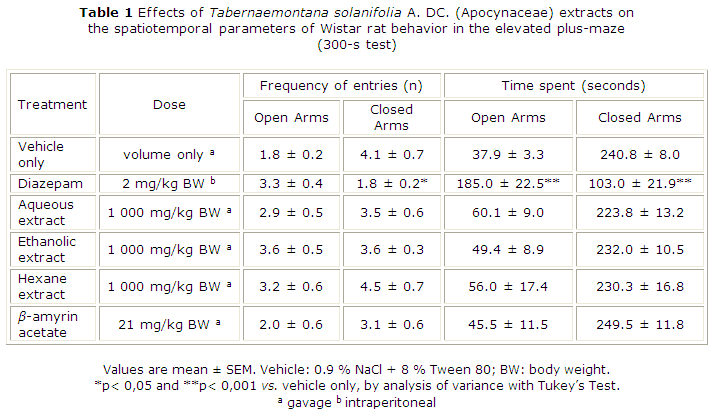
<body><![CDATA[<P>&nbsp;     <P>     <P><font face="Verdana" size="3"><B>RESULTS </B> </font>     <P><font face="Verdana" size="2">Acute  toxicity studies: Acute toxicity of extracts of <I>T. solanifolia</I> was determined  in rats, by OECD guidelines. Each extract was administered orally at different  dose levels and extracts caused no mortality up to 2 000 mg/kg. Therefore DL<SUB>50</SUB>  doses were halved for the present study. </font>     <P><font face="Verdana" size="2">Elevated  Plus Maze Model (EPM): diazepam has long been known to have anxiolytic effects  in rats tested in the EPM. As can be seen in <a href="/img/revistas/pla/v18n2/t0105213.gif">table  1</a>, we also found the administration of diazepam to have a significant anxiolytic  effect, in comparison with that of vehicle only, as evidenced by an increased  number of entries into open arms, a decreased number of entries into closed arms,  a longer time spent on the open, central platform, and a shorter time spent in  the closed arms (p&lt; 0.05 for all). When the crude ethanolic extract, the crude  hexane extract and the crude aqueous extract (1.0 g/kg) as well as the substance  &szlig;-amyrin acetate (21 mg/kg) were administered once, no significant effects  were observed on the number of entries and time spent in the open arm, central  platform and decreased the number of entries and time spent in the closed arm  as compared to the control group (<a href="/img/revistas/pla/v18n2/t0105213.gif">table  1</a>). </font>     
<P><font face="Verdana" size="2">The application of the crude  aqueous extract and the crude ethanolic extract significantly increased the rearing  (<a href="/img/revistas/pla/v18n2/t0205213.gif">table 2</a>). </font>     
<P>&nbsp;      <P>     <P><font face="Verdana" size="3"><B>DISCUSSION</B> </font>     <P><font face="Verdana" size="2">Stress  has become a part of the modern world and lifestyles. Evidence suggests that anxiety  is caused by dysfunction of one or more neurotransmitters and their receptors.  The study of anxiety has emerged as a very important area of research. </font>      ]]></body>
<body><![CDATA[<P><font face="Verdana" size="2">Behavioral scoring of performance in the EPM  has been extended to include a variety of specific acts and postures which, incorporated  into more comprehensive factor analyses, have revealed additional dimensions of  the EPM behavior patterns, such as vertical activity, directed exploration, decision  making, and risk assessment.<SUP>15</SUP> However, the frequency of entries, which  is related to locomotion, is more often evaluated than are ethological measures,  which might be more sensitive to anxiety modulating compounds.<SUP>10</SUP> Other  ethological parameters that can be observed in rodents tested in the EPM are the  numbers of rears, head dips, fecal boli, freezing episodes, and stretch-attend  postures.<SUP>16</SUP></font>     <P><font face="Verdana" size="2">The EPM is one  of the most important animal tests used in the evaluation of the anxiolytic effects  of drugs,<SUP>8,9,17</SUP> in mice<SUP>18</SUP> as well as in rats.<SUP>19</SUP>  When used appropriately, the EPM can be a very valuable tool in drug screening  and in the study of the neurobiology of anxiety and defense.<SUP>20</SUP> In addition  to the classic parameters (frequency of entries into and time spent in open arms),  other anxiety-related rodent behaviors, such as freezing/immobility and defecation,  are more frequent in the open arms than in the closed arms<SUP>8</SUP>. These  parameters have been used to investigate the anxiolytic-like effect.<SUP>21</SUP></font>      <P><font face="Verdana" size="2">Plants known to possess enormous anxiolytic potential  have been used to cure ailments from time immemorial.<SUP>21</SUP> Other botanical  extracts have been tested in rodent models of anxiety. The anxiolytic effects  of <I>T. divaricata </I>(Linn) R. Br. were documented by <i>Basavaraj et al</i>.,<SUP>7</SUP>  who administered the alcoholic extract of the flowers of <I>T. divaricata </I>(100,  200, or 400 mg/kg bw, p.o.) for 7 days to mice subsequently tested in the EPM,  the open-field test, and the light-dark transition test.<SUP>8</SUP> Those authors  also found <I>T. divaricata </I>to have anticonvulsant properties and effects  on spontaneous motor activity. In addition, a mixture of <font face="Symbol">a</font>-  and &szlig;-amyrin pentacyclic triterpenes,<I> </I>isolated from the stem bark  resin of <I>Protium heptaphyllum</I> (Aubl.) March., has been found to have anxiolytic  and antidepressant effects in mice receiving various doses of the mixture (ranging  from 2.5 to 5.0 mg/kg bw, p.o. or i.p<I>.</I>) and tested in the EPM, the open-field  test, the rota rod test, the forced swimming test, and the pentobarbital-induced  sleeping time test.<SUP>19</SUP> Furthermore, administration of the hydroalcoholic  extract of the stem bark of <I>Erythrina velutina </I>(100 mg/kg bw, p.o.) in  mice tested in the EPM has been shown to increase the percentage of open arm entries  when the administration was chronic but not when it was acute.<SUP>21</SUP> In  the present study, acute oral administration of an extract prepared from the leaves  of <I>T. solanifolia </I>had an anxiogenic effect in rats tested in the EPM, increasing  the number of entries into and the time spent in closed arms. </font>     <P><font face="Verdana" size="2">We  can conclude that the crude ethanol, hexane, and aqueous extracts, as well as  the &szlig;-amyrin acetate, isolated from <I>T. solanifolia</I> have an anxiogenic  effect in rats, increasing the number of entries into and the time spent in closed  arms of the EPM. However, further studies are required to identify and characterize  the anxiogenic properties of <I>T. solanifolia </I>and to understand their mechanisms  of anxiogenic action of the extracts.</font>     <P>&nbsp;     <P>     <P><font face="Verdana" size="3"><B>ACKNOWLEDGMENTS</B>  </font>     <P>     <P><font face="Verdana" size="2">The authors are grateful for the  financial support received from the Brazilian <I>Conselho Nacional de Desenvolvimento  Cient&iacute;fico e Tecnol&oacute;gico</I> (CNPq, National Council for Scientific  and Technological Development, <I>Coordena&ccedil;&atilde;o de Aperfei&ccedil;oamento  de Pessoal de N&iacute;vel Superior</I> (CAPES, Office for the Advancement of  Higher Education), <I>Funda&ccedil;&atilde;o de Apoio &agrave; Pesquisa do Distrito  Federal</I> (FAPDF, Foundation for the Support of Research in the Federal District  of Bras&iacute;lia), Mato Grosso do Sul State <I>Funda&ccedil;&atilde;o de Apoio  ao Desenvolvimento do Ensino, Ci&ecirc;ncia e Tecnologia</I> (FUNDECT, Foundation  for the Advancement of Education, Science, and Technology), and the Centro Universit&aacute;rio  <I>da Grande Dourados</I> (UNIGRAN, University of Grande Dourados).</font>     <P>&nbsp;      ]]></body>
<body><![CDATA[<P>     <P><font face="Verdana" size="3"><B>REFERENCES </B></font><font face="Verdana" size="2">  </font>     <P>     <!-- ref --><P><font face="Verdana" size="2">1. Van Beek TA, Verpoorte R<I>, </I>Baerheim  Svendsen A, Leeuwenberg AJM, Bisset NG. <I>Tabernaemontana</I> L. (Apocynaceae).  A review of its taxonomy, phytochemistry, ethnobotany and pharmacology. J Ethnopharmacol.  1984;10(1):1-156.     </font>     <!-- ref --><P><font face="Verdana" size="2">2. Rapini A, Koch I,  Kinoshita, LS, Sim&otilde;es AO, Spina AP. Apocynaceae <I>in</I> Lista de Esp&eacute;cies  da Flora do Brasil. Jardim Bot&acirc;nico do Rio de Janeiro. Available at: <a href="http://floradobrasil.jbrj.gov.br/2010/FB004866" target="_blank">http://floradobrasil.jbrj.gov.br/2010/FB004866</a>  </font>     <!-- ref --><P><font face="Verdana" size="2">3. Gower AE, Pereira BDS, Marsaioli AJ.  Indole alkaloids from <I>Peschiera campestris</I>. Phytochemistry. 1986;25(12):2908-10.      </font>     <!-- ref --><P><font face="Verdana" size="2">4. Leeuwenberg AJM: A revision of <I>Tabernaemontana  1.</I> The old World species. Kew, United Kingdom; 1991. p. 223.     </font>     ]]></body>
<body><![CDATA[<!-- ref --><P><font face="Verdana" size="2">5.  Leeuwenberg AJM: A revision of <I>Tabernaemontana.</I> The new World Species and  Stemmadenia. Vol. 2. Kew, United Kingdom: Royal Botanical Gardens Press; 1994.  p. 450.     </font>     <!-- ref --><P><font face="Verdana" size="2">6. Rodrigues E, Carlini EL, Araujo  L. Plants with possible psychoactive actions used by the Krah&ocirc; Indian, Brazil.  Rev Bras Psiquiatr. 2006;28(4):277-82.     </font>     <!-- ref --><P><font face="Verdana" size="2">7.  Basavaraj P, Shivakumar B, Shivakumar H. Anxiolytic activity of <I>Tabernaemontana  divaricata</I> (Linn) R. Br. Flowers extract in mice<I>. </I>J Pharma Bio Sciences.  2011;2(3):65-72.     </font>     <!-- ref --><P><font face="Verdana" size="2">8. Montgomery KC. The  relation between fear induced by novel stimulation and exploratory behavior. J  Comp Physiol Psychol. 1955;48(4):254-60.     </font>     <!-- ref --><P><font face="Verdana" size="2">9.  Pellow S, Chopin<I> </I>P, File SE, Briley M. Validation of open: closed arm entries  in an elevated plus-maze as a measure of anxiety in the rat<I>. </I>J Neurosci  Methods. 1985;14(3):149-67.     </font>     ]]></body>
<body><![CDATA[<!-- ref --><P><font face="Verdana" size="2">10. Carobrez  AP, Bertoglio LJ. Ethological and temporal analyses of anxiety-like behavior:  the elevated plus-maze model 20 years on<I>. </I>Neurosci Biobehav Rev. 2005;29(8):1193-205.      </font>     <!-- ref --><P><font face="Verdana" size="2">11. Hogg S. A review of the validity  and variability of the elevated plus-maze as an animal model of anxiety. Pharmacol  Biochem Behav. 1996;54(1):21-30.     </font>     <!-- ref --><P><font face="Verdana" size="2">12.  Organization of Economic Co-operation and Development (OECD). OECD guidelines  on acute oral toxicity, environmental health and safety monograph series on testing  and adjustment: 423 acute oral toxicity. Paris: OECD; 1996.     </font>     <!-- ref --><P><font face="Verdana" size="2">13.  Melo AAMF, Gama SM, Macorini LFB, Nascimento C, Honorato CA, Vasconcelos PC, et  al. Acute oral toxicity of extracts of <I>Tabernaemontana solanifolia </I>A. DC.  (Apocynaceae). Lat Am J Pharm. 2012;31(8):1149-54.     </font>     <!-- ref --><P><font face="Verdana" size="2">14.  Graeff FG, Ferreira Neto C, Zangrossi JH. The elevated T-maze as an experimental  model of anxiety. Neurosci Behav Rev<I>. </I>1998;23(2):237-46.     </font>     ]]></body>
<body><![CDATA[<!-- ref --><P><font face="Verdana" size="2">15.  Cruz AP, Frei F, Graeff FG. Ethnopharmacological analysis of rat behavior on the  elevated plus-maze.<B> </B>Pharmacol Biochem Behav<I>.</I> 1994; 49(1):171-6.      </font>     <!-- ref --><P><font face="Verdana" size="2">16. Walf AA, Frye CA. The use of the  elevated plus maze as an assay of anxiety-related behavior in rodents. Nat Protoc.  2007;2(2):322-8.     </font>     <!-- ref --><P><font face="Verdana" size="2">17. Handley SL, MacBlane  JW. 5-HT drugs in animal models of anxiety. Psychopharmacol. 1993;112(1):13-20.      </font>     <!-- ref --><P><font face="Verdana" size="2">18. Lister RG. The use of a plus-maze  to measure anxiety in the mouse<I>.</I> J Psychopharmacol. 1987;92(2):180-5.     </font>      <!-- ref --><P><font face="Verdana" size="2">19. Arag&atilde;o GF, Carneiro LMV<I>, </I>Junior  APF, Vieira LC, Lemos TLG, Viana GS de B.<I> </I>A possible mechanism for anxiolytic  and antidepressant effects of alpha- and beta-amyrin from <i>Protium heptaphyllum</i>  (Aubl.)<I>. </I>Pharmacol Biochem Behav. 2006;85(4):827-34.     </font>     ]]></body>
<body><![CDATA[<!-- ref --><P><font face="Verdana" size="2">20.  Rodgers RJ, Johnson NJT. Behaviorally selective effects of neuroactive steroids  on plus-maze anxiety in mice. Pharmacol Biochem Behav. 1998;59(1):221-32.     </font>      <!-- ref --><P><font face="Verdana" size="2">21. Rauppa IM, Serenikia A<I>, </I>Virtuoso S,  Ghislandi C, Cavalcanti Silva EL, Trebien HA, et al. Anxiolytic-like effect of  chronic treatment with <I>Erythrina velutina </I>extract in the elevated plus-maze  test<I>. </I>J Ethopharmacol. 2008;118(2):295-9.     </font>     <P>&nbsp;     <P>&nbsp;     <P>     <P><font face="Verdana" size="2">Recibido  15 de junio de 2012.     <br> Aprobado: 30 de diciembre de 2012. </font>     <P>&nbsp;     ]]></body>
<body><![CDATA[<P>&nbsp;     <P><font face="Verdana" size="2"><I>Adriana  Mary Mestriner Felipe </I>Melo. Department of Pharmacology, University of Grande  Dourados (UNIGRAN), 79824-900, Dourados, MS, Brazil. Telephone: +55 67 3411 4121,  Fax: +55 67 3411 4167. E-mail: <U><FONT  COLOR="#0033cc"><a href="mailto:mestriner@unigran.br">mestriner@unigran.br</a></FONT></U>  </font>       ]]></body><back>
<ref-list>
<ref id="B1">
<label>1</label><nlm-citation citation-type="journal">
<person-group person-group-type="author">
<name>
<surname><![CDATA[Van Beek]]></surname>
<given-names><![CDATA[TA]]></given-names>
</name>
<name>
<surname><![CDATA[Verpoorte]]></surname>
<given-names><![CDATA[R]]></given-names>
</name>
<name>
<surname><![CDATA[Baerheim Svendsen]]></surname>
<given-names><![CDATA[A]]></given-names>
</name>
<name>
<surname><![CDATA[Leeuwenberg]]></surname>
<given-names><![CDATA[AJM]]></given-names>
</name>
<name>
<surname><![CDATA[Bisset]]></surname>
<given-names><![CDATA[NG]]></given-names>
</name>
</person-group>
<article-title xml:lang="en"><![CDATA[Tabernaemontana L. (Apocynaceae): A review of its taxonomy, phytochemistry, ethnobotany and pharmacology]]></article-title>
<source><![CDATA[J Ethnopharmacol.]]></source>
<year>1984</year>
<volume>10</volume>
<numero>1</numero>
<issue>1</issue>
<page-range>1-156</page-range></nlm-citation>
</ref>
<ref id="B2">
<label>2</label><nlm-citation citation-type="book">
<person-group person-group-type="author">
<name>
<surname><![CDATA[Rapini]]></surname>
<given-names><![CDATA[A]]></given-names>
</name>
<name>
<surname><![CDATA[Koch]]></surname>
<given-names><![CDATA[I]]></given-names>
</name>
<name>
<surname><![CDATA[Kinoshita]]></surname>
<given-names><![CDATA[LS]]></given-names>
</name>
<name>
<surname><![CDATA[Simões]]></surname>
<given-names><![CDATA[AO]]></given-names>
</name>
<name>
<surname><![CDATA[Spina]]></surname>
<given-names><![CDATA[AP]]></given-names>
</name>
</person-group>
<source><![CDATA[Apocynaceae in Lista de Espécies da Flora do Brasil]]></source>
<year></year>
<publisher-name><![CDATA[Jardim Botânico do Rio de Janeiro]]></publisher-name>
</nlm-citation>
</ref>
<ref id="B3">
<label>3</label><nlm-citation citation-type="journal">
<person-group person-group-type="author">
<name>
<surname><![CDATA[Gower]]></surname>
<given-names><![CDATA[AE]]></given-names>
</name>
<name>
<surname><![CDATA[Pereira]]></surname>
<given-names><![CDATA[BDS]]></given-names>
</name>
<name>
<surname><![CDATA[Marsaioli]]></surname>
<given-names><![CDATA[AJ]]></given-names>
</name>
</person-group>
<article-title xml:lang="en"><![CDATA[Indole alkaloids from Peschiera campestris]]></article-title>
<source><![CDATA[Phytochemistry.]]></source>
<year>1986</year>
<volume>25</volume>
<numero>12</numero>
<issue>12</issue>
<page-range>2908-10</page-range></nlm-citation>
</ref>
<ref id="B4">
<label>4</label><nlm-citation citation-type="book">
<person-group person-group-type="author">
<name>
<surname><![CDATA[Leeuwenberg]]></surname>
<given-names><![CDATA[AJM]]></given-names>
</name>
</person-group>
<source><![CDATA[A revision of Tabernaemontana 1: The old World species]]></source>
<year>1991</year>
<page-range>223</page-range><publisher-loc><![CDATA[Kew ]]></publisher-loc>
<publisher-name><![CDATA[United Kingdom]]></publisher-name>
</nlm-citation>
</ref>
<ref id="B5">
<label>5</label><nlm-citation citation-type="book">
<person-group person-group-type="author">
<name>
<surname><![CDATA[Leeuwenberg]]></surname>
<given-names><![CDATA[AJM]]></given-names>
</name>
</person-group>
<source><![CDATA[A revision of Tabernaemontana: The new World Species and Stemmadenia]]></source>
<year>1994</year>
<page-range>450</page-range><publisher-loc><![CDATA[Kew ]]></publisher-loc>
<publisher-name><![CDATA[United Kingdom: Royal Botanical Gardens Press]]></publisher-name>
</nlm-citation>
</ref>
<ref id="B6">
<label>6</label><nlm-citation citation-type="journal">
<person-group person-group-type="author">
<name>
<surname><![CDATA[Rodrigues]]></surname>
<given-names><![CDATA[E]]></given-names>
</name>
<name>
<surname><![CDATA[Carlini]]></surname>
<given-names><![CDATA[EL]]></given-names>
</name>
<name>
<surname><![CDATA[Araujo]]></surname>
<given-names><![CDATA[L]]></given-names>
</name>
</person-group>
<article-title xml:lang="en"><![CDATA[Plants with possible psychoactive actions used by the Krahô Indian, Brazil]]></article-title>
<source><![CDATA[Rev Bras Psiquiatr.]]></source>
<year>2006</year>
<volume>28</volume>
<numero>4</numero>
<issue>4</issue>
<page-range>277-82</page-range></nlm-citation>
</ref>
<ref id="B7">
<label>7</label><nlm-citation citation-type="journal">
<person-group person-group-type="author">
<name>
<surname><![CDATA[Basavaraj]]></surname>
<given-names><![CDATA[P]]></given-names>
</name>
<name>
<surname><![CDATA[Shivakumar]]></surname>
<given-names><![CDATA[B]]></given-names>
</name>
<name>
<surname><![CDATA[Shivakumar]]></surname>
<given-names><![CDATA[H]]></given-names>
</name>
</person-group>
<article-title xml:lang="en"><![CDATA[Anxiolytic activity of Tabernaemontana divaricata (Linn) R. Br: Flowers extract in mice]]></article-title>
<source><![CDATA[J Pharma Bio Sciences]]></source>
<year>2011</year>
<volume>2</volume>
<numero>3</numero>
<issue>3</issue>
<page-range>65-72</page-range></nlm-citation>
</ref>
<ref id="B8">
<label>8</label><nlm-citation citation-type="journal">
<person-group person-group-type="author">
<name>
<surname><![CDATA[Montgomery]]></surname>
<given-names><![CDATA[KC]]></given-names>
</name>
</person-group>
<article-title xml:lang="en"><![CDATA[The relation between fear induced by novel stimulation and exploratory behavior]]></article-title>
<source><![CDATA[J Comp Physiol Psychol.]]></source>
<year>1955</year>
<volume>48</volume>
<numero>4</numero>
<issue>4</issue>
<page-range>254-60</page-range></nlm-citation>
</ref>
<ref id="B9">
<label>9</label><nlm-citation citation-type="journal">
<person-group person-group-type="author">
<name>
<surname><![CDATA[Pellow]]></surname>
<given-names><![CDATA[S]]></given-names>
</name>
<name>
<surname><![CDATA[Chopin]]></surname>
<given-names><![CDATA[P]]></given-names>
</name>
<name>
<surname><![CDATA[File]]></surname>
<given-names><![CDATA[SE]]></given-names>
</name>
<name>
<surname><![CDATA[Briley]]></surname>
<given-names><![CDATA[M]]></given-names>
</name>
</person-group>
<article-title xml:lang="en"><![CDATA[Validation of open: closed arm entries in an elevated plus-maze as a measure of anxiety in the rat]]></article-title>
<source><![CDATA[J Neurosci Methods.]]></source>
<year>1985</year>
<volume>14</volume>
<numero>3</numero>
<issue>3</issue>
<page-range>149-67</page-range></nlm-citation>
</ref>
<ref id="B10">
<label>10</label><nlm-citation citation-type="journal">
<person-group person-group-type="author">
<name>
<surname><![CDATA[Carobrez]]></surname>
<given-names><![CDATA[AP]]></given-names>
</name>
<name>
<surname><![CDATA[Bertoglio]]></surname>
<given-names><![CDATA[LJ]]></given-names>
</name>
</person-group>
<article-title xml:lang="en"><![CDATA[Ethological and temporal analyses of anxiety-like behavior: the elevated plus-maze model 20 years on]]></article-title>
<source><![CDATA[Neurosci Biobehav Rev.]]></source>
<year>2005</year>
<volume>29</volume>
<numero>8</numero>
<issue>8</issue>
<page-range>1193-205</page-range></nlm-citation>
</ref>
<ref id="B11">
<label>11</label><nlm-citation citation-type="journal">
<person-group person-group-type="author">
<name>
<surname><![CDATA[Hogg]]></surname>
<given-names><![CDATA[S]]></given-names>
</name>
</person-group>
<article-title xml:lang="en"><![CDATA[A review of the validity and variability of the elevated plus-maze as an animal model of anxiety]]></article-title>
<source><![CDATA[Pharmacol Biochem Behav.]]></source>
<year>1996</year>
<volume>54</volume>
<numero>1</numero>
<issue>1</issue>
<page-range>21-30</page-range></nlm-citation>
</ref>
<ref id="B12">
<label>12</label><nlm-citation citation-type="book">
<collab>Organization of Economic Co-operation and Development (OECD)</collab>
<source><![CDATA[OECD guidelines on acute oral toxicity, environmental health and safety monograph series on testing and adjustment: 423 acute oral toxicity]]></source>
<year>1996</year>
<publisher-loc><![CDATA[Paris ]]></publisher-loc>
<publisher-name><![CDATA[OECD]]></publisher-name>
</nlm-citation>
</ref>
<ref id="B13">
<label>13</label><nlm-citation citation-type="journal">
<person-group person-group-type="author">
<name>
<surname><![CDATA[Melo]]></surname>
<given-names><![CDATA[AAMF]]></given-names>
</name>
<name>
<surname><![CDATA[Gama]]></surname>
<given-names><![CDATA[SM]]></given-names>
</name>
<name>
<surname><![CDATA[Macorini]]></surname>
<given-names><![CDATA[LFB]]></given-names>
</name>
<name>
<surname><![CDATA[Nascimento]]></surname>
<given-names><![CDATA[C]]></given-names>
</name>
<name>
<surname><![CDATA[Honorato]]></surname>
<given-names><![CDATA[CA]]></given-names>
</name>
<name>
<surname><![CDATA[Vasconcelos]]></surname>
<given-names><![CDATA[PC]]></given-names>
</name>
</person-group>
<article-title xml:lang="en"><![CDATA[Acute oral toxicity of extracts of Tabernaemontana solanifolia A. DC: Apocynaceae]]></article-title>
<source><![CDATA[Lat Am J Pharm]]></source>
<year>2012</year>
<volume>31</volume>
<numero>8</numero>
<issue>8</issue>
<page-range>1149-54</page-range></nlm-citation>
</ref>
<ref id="B14">
<label>14</label><nlm-citation citation-type="journal">
<person-group person-group-type="author">
<name>
<surname><![CDATA[Graeff]]></surname>
<given-names><![CDATA[FG]]></given-names>
</name>
<name>
<surname><![CDATA[Ferreira Neto]]></surname>
<given-names><![CDATA[C]]></given-names>
</name>
<name>
<surname><![CDATA[Zangrossi]]></surname>
<given-names><![CDATA[JH]]></given-names>
</name>
</person-group>
<article-title xml:lang="en"><![CDATA[The elevated T-maze as an experimental model of anxiety]]></article-title>
<source><![CDATA[Neurosci Behav Rev.]]></source>
<year>1998</year>
<volume>23</volume>
<numero>2</numero>
<issue>2</issue>
<page-range>237-46</page-range></nlm-citation>
</ref>
<ref id="B15">
<label>15</label><nlm-citation citation-type="journal">
<person-group person-group-type="author">
<name>
<surname><![CDATA[Cruz]]></surname>
<given-names><![CDATA[AP]]></given-names>
</name>
<name>
<surname><![CDATA[Frei]]></surname>
<given-names><![CDATA[F]]></given-names>
</name>
<name>
<surname><![CDATA[Graeff]]></surname>
<given-names><![CDATA[FG]]></given-names>
</name>
</person-group>
<article-title xml:lang="en"><![CDATA[Ethnopharmacological analysis of rat behavior on the elevated plus-maze]]></article-title>
<source><![CDATA[Pharmacol Biochem Behav.]]></source>
<year>1994</year>
<volume>49</volume>
<numero>1</numero>
<issue>1</issue>
<page-range>171-6</page-range></nlm-citation>
</ref>
<ref id="B16">
<label>16</label><nlm-citation citation-type="journal">
<person-group person-group-type="author">
<name>
<surname><![CDATA[Walf]]></surname>
<given-names><![CDATA[AA]]></given-names>
</name>
<name>
<surname><![CDATA[Frye]]></surname>
<given-names><![CDATA[CA]]></given-names>
</name>
</person-group>
<article-title xml:lang="en"><![CDATA[The use of the elevated plus maze as an assay of anxiety-related behavior in rodents]]></article-title>
<source><![CDATA[Nat Protoc.]]></source>
<year>2007</year>
<volume>2</volume>
<numero>2</numero>
<issue>2</issue>
<page-range>322-8</page-range></nlm-citation>
</ref>
<ref id="B17">
<label>17</label><nlm-citation citation-type="journal">
<person-group person-group-type="author">
<name>
<surname><![CDATA[Handley]]></surname>
<given-names><![CDATA[SL]]></given-names>
</name>
<name>
<surname><![CDATA[MacBlane]]></surname>
<given-names><![CDATA[JW]]></given-names>
</name>
</person-group>
<article-title xml:lang="en"><![CDATA[5-HT drugs in animal models of anxiety]]></article-title>
<source><![CDATA[Psychopharmacol.]]></source>
<year>1993</year>
<volume>112</volume>
<numero>1</numero>
<issue>1</issue>
<page-range>13-20</page-range></nlm-citation>
</ref>
<ref id="B18">
<label>18</label><nlm-citation citation-type="journal">
<person-group person-group-type="author">
<name>
<surname><![CDATA[Lister]]></surname>
<given-names><![CDATA[RG]]></given-names>
</name>
</person-group>
<article-title xml:lang="en"><![CDATA[The use of a plus-maze to measure anxiety in the mouse]]></article-title>
<source><![CDATA[J Psychopharmacol.]]></source>
<year>1987</year>
<volume>92</volume>
<numero>2</numero>
<issue>2</issue>
<page-range>180-5</page-range></nlm-citation>
</ref>
<ref id="B19">
<label>19</label><nlm-citation citation-type="journal">
<person-group person-group-type="author">
<name>
<surname><![CDATA[Aragão]]></surname>
<given-names><![CDATA[GF]]></given-names>
</name>
<name>
<surname><![CDATA[Carneiro]]></surname>
<given-names><![CDATA[LMV]]></given-names>
</name>
<name>
<surname><![CDATA[Junior]]></surname>
<given-names><![CDATA[APF]]></given-names>
</name>
<name>
<surname><![CDATA[Vieira]]></surname>
<given-names><![CDATA[LC]]></given-names>
</name>
<name>
<surname><![CDATA[Lemos]]></surname>
<given-names><![CDATA[TLG]]></given-names>
</name>
<name>
<surname><![CDATA[Viana GS de]]></surname>
<given-names><![CDATA[B]]></given-names>
</name>
</person-group>
<article-title xml:lang="en"><![CDATA[A possible mechanism for anxiolytic and antidepressant effects of alpha- and beta-amyrin from Protium heptaphyllum (Aubl.)]]></article-title>
<source><![CDATA[Pharmacol Biochem Behav]]></source>
<year>2006</year>
<volume>85</volume>
<numero>4</numero>
<issue>4</issue>
<page-range>827-34</page-range></nlm-citation>
</ref>
<ref id="B20">
<label>20</label><nlm-citation citation-type="journal">
<person-group person-group-type="author">
<name>
<surname><![CDATA[Rodgers]]></surname>
<given-names><![CDATA[RJ]]></given-names>
</name>
<name>
<surname><![CDATA[Johnson]]></surname>
<given-names><![CDATA[NJT]]></given-names>
</name>
</person-group>
<article-title xml:lang="en"><![CDATA[Behaviorally selective effects of neuroactive steroids on plus-maze anxiety in mice]]></article-title>
<source><![CDATA[Pharmacol Biochem Behav.]]></source>
<year>1998</year>
<volume>59</volume>
<numero>1</numero>
<issue>1</issue>
<page-range>221-32</page-range></nlm-citation>
</ref>
<ref id="B21">
<label>21</label><nlm-citation citation-type="journal">
<person-group person-group-type="author">
<name>
<surname><![CDATA[Rauppa]]></surname>
<given-names><![CDATA[IM]]></given-names>
</name>
<name>
<surname><![CDATA[Serenikia]]></surname>
<given-names><![CDATA[A]]></given-names>
</name>
<name>
<surname><![CDATA[Virtuoso]]></surname>
<given-names><![CDATA[S]]></given-names>
</name>
<name>
<surname><![CDATA[Ghislandi]]></surname>
<given-names><![CDATA[C]]></given-names>
</name>
<name>
<surname><![CDATA[Cavalcanti Silva]]></surname>
<given-names><![CDATA[EL]]></given-names>
</name>
<name>
<surname><![CDATA[Trebien]]></surname>
<given-names><![CDATA[HA]]></given-names>
</name>
</person-group>
<article-title xml:lang="en"><![CDATA[Anxiolytic-like effect of chronic treatment with Erythrina velutina extract in the elevated plus-maze test]]></article-title>
<source><![CDATA[J Ethopharmacol.]]></source>
<year>2008</year>
<volume>118</volume>
<numero>2</numero>
<issue>2</issue>
<page-range>295-9</page-range></nlm-citation>
</ref>
</ref-list>
</back>
</article>