<?xml version="1.0" encoding="ISO-8859-1"?><article xmlns:mml="http://www.w3.org/1998/Math/MathML" xmlns:xlink="http://www.w3.org/1999/xlink" xmlns:xsi="http://www.w3.org/2001/XMLSchema-instance">
<front>
<journal-meta>
<journal-id>1028-4796</journal-id>
<journal-title><![CDATA[Revista Cubana de Plantas Medicinales]]></journal-title>
<abbrev-journal-title><![CDATA[Rev Cubana Plant Med]]></abbrev-journal-title>
<issn>1028-4796</issn>
<publisher>
<publisher-name><![CDATA[ECIMED]]></publisher-name>
</publisher>
</journal-meta>
<article-meta>
<article-id>S1028-47962015000100004</article-id>
<title-group>
<article-title xml:lang="en"><![CDATA[Plants considered useful for hypoglycemic, antihypertensive or hypolipidemic treatments by patients with peripheral vascular diseases]]></article-title>
<article-title xml:lang="es"><![CDATA[Plantas consideradas útiles como hipoglicemiantes, antihipertensivas o hipolipemiantes por pacientes con enfermedades vasculares periféricas]]></article-title>
</title-group>
<contrib-group>
<contrib contrib-type="author">
<name>
<surname><![CDATA[García-Lazo]]></surname>
<given-names><![CDATA[Gertrudis]]></given-names>
</name>
<xref ref-type="aff" rid="A01"/>
</contrib>
<contrib contrib-type="author">
<name>
<surname><![CDATA[Lauzant-Diaz]]></surname>
<given-names><![CDATA[Ela]]></given-names>
</name>
<xref ref-type="aff" rid="A01"/>
</contrib>
<contrib contrib-type="author">
<name>
<surname><![CDATA[Díaz Batista]]></surname>
<given-names><![CDATA[Arquímedes]]></given-names>
</name>
<xref ref-type="aff" rid="A01"/>
</contrib>
<contrib contrib-type="author">
<name>
<surname><![CDATA[Garcia-Mesa]]></surname>
<given-names><![CDATA[Milagros]]></given-names>
</name>
<xref ref-type="aff" rid="A02"/>
</contrib>
</contrib-group>
<aff id="A01">
<institution><![CDATA[,National Institute of Angiology and Vascular Surgery  ]]></institution>
<addr-line><![CDATA[La Habana ]]></addr-line>
<country>Cuba</country>
</aff>
<aff id="A02">
<institution><![CDATA[,Central Laboratory of Pharmacology  ]]></institution>
<addr-line><![CDATA[La Habana ]]></addr-line>
<country>Cuba</country>
</aff>
<pub-date pub-type="pub">
<day>00</day>
<month>03</month>
<year>2015</year>
</pub-date>
<pub-date pub-type="epub">
<day>00</day>
<month>03</month>
<year>2015</year>
</pub-date>
<volume>20</volume>
<numero>1</numero>
<fpage>38</fpage>
<lpage>47</lpage>
<copyright-statement/>
<copyright-year/>
<self-uri xlink:href="http://scielo.sld.cu/scielo.php?script=sci_arttext&amp;pid=S1028-47962015000100004&amp;lng=en&amp;nrm=iso"></self-uri><self-uri xlink:href="http://scielo.sld.cu/scielo.php?script=sci_abstract&amp;pid=S1028-47962015000100004&amp;lng=en&amp;nrm=iso"></self-uri><self-uri xlink:href="http://scielo.sld.cu/scielo.php?script=sci_pdf&amp;pid=S1028-47962015000100004&amp;lng=en&amp;nrm=iso"></self-uri><kwd-group>
<kwd lng="en"><![CDATA[medicinal plant]]></kwd>
<kwd lng="en"><![CDATA[herb medicine]]></kwd>
<kwd lng="en"><![CDATA[Diabetes mellitus]]></kwd>
<kwd lng="en"><![CDATA[arterial hypertension]]></kwd>
<kwd lng="en"><![CDATA[dyslipidemia]]></kwd>
<kwd lng="en"><![CDATA[glucose]]></kwd>
<kwd lng="en"><![CDATA[cholesterol]]></kwd>
<kwd lng="en"><![CDATA[atherosclerosis]]></kwd>
<kwd lng="en"><![CDATA[atherothrombosis]]></kwd>
<kwd lng="es"><![CDATA[planta medicinal]]></kwd>
<kwd lng="es"><![CDATA[medicina herbaria]]></kwd>
<kwd lng="es"><![CDATA[Diabetes mellitus]]></kwd>
<kwd lng="es"><![CDATA[hipertensión arterial]]></kwd>
<kwd lng="es"><![CDATA[dislipidemia]]></kwd>
<kwd lng="es"><![CDATA[glucosa]]></kwd>
<kwd lng="es"><![CDATA[colesterol]]></kwd>
<kwd lng="es"><![CDATA[aterosclerosis]]></kwd>
<kwd lng="es"><![CDATA[aterotrombosis]]></kwd>
</kwd-group>
</article-meta>
</front><body><![CDATA[ <p align="right"> <font face="Verdana" size="2"><b>ART&#205;CULO ORIGINAL</b></font></p>     <p align="left">&nbsp;</p>     <p> <font face="Verdana" size="2"><b><font size="4">Plants considered useful for    hypoglycemic, antihypertensive or hypolipidemic treatments by </font></b> <font size="4"><b>patients    with peripheral vascular diseases</b></font> </font></p>     <p>&nbsp;</p>     <p> <font face="Verdana" size="2"><b> </b></font><font face="Verdana" size="2"><b>    <font size="3">Plantas consideradas &#250;tiles como hipoglicemiantes, antihipertensivas    o hipolipemiantes por pacientes con enfermedades vasculares perif&#233;ricas</font>    </b> </font></p>     <p>&nbsp; </p>     <p>&nbsp;</p>     <p><font face="Verdana" size="2"><b>MSc. Gertrudis Garc&#237;a-Lazo,<sup>I</sup>    MSc. Ela Lauzant-Diaz,<sup>I</sup> DrC. Arqu&#237;medes D&#237;az Batista,<sup>I</sup>    DraC. </b> <b>Milagros Garcia-Mesa<sup>II</sup></b> </font></p>     <p> <font face="Verdana" size="2"><sup>I</sup> National Institute of Angiology    and Vascular Surgery. Cerro, La Habana, Cuba. </font>    <br>   <font face="Verdana" size="2"><sup>II</sup> Central Laboratory of Pharmacology.    Cerro, La Habana, Cuba.</font></p>     ]]></body>
<body><![CDATA[<p>&nbsp;</p>     <p>&nbsp;</p> <hr>     <p><font face="Verdana" size="2"><b>ABSTRACT </b> </font></p>     <p> <font face="Verdana" size="2"><b>Introduction:</b> knowing patients &#8216;believes    about the medicinal utility of plants may provide a basis for educating them    for a rational use of herb preparations.    <br>   <b>Objective:</b> to characterize the plants that are considered useful for    antidiabetic, antihypertensive or hypolipidemic treatment among patients with    peripheral vascular diseases.    <br>   <b>Methods:</b> a survey was performed    among patients of the National Institute of Angiology and Vascular Surgery from    February through April 2007. The characteristics of the use of plants as medicinal    remedies and the names of species considered useful for the treatment of diabetes,    arterial hypertension and dyslipidemia were recorded.    <br>   <b>Results:</b> two hundred and forty five    both sex adult volunteers (142 female/103 male), aged 44 to 72 years) were included    in the study. More than 80 % of them used medicinal plants at least occasionally    and confided on their efficacy to treat different illnesses Fifteen species,    mainly <i>Allium sativum </i>L.,<i> Citrus aurantifolia </i>Ch., <i>Justicia    pectoralis </i>Jacq.<b>.</b><i>, Morinda citrifolia </i>L<i>., Ocinum sanctum    </i>L<i> </i>and <i> Salvia officinalis </i>L, from 11 botanical families, were    mentioned by participants<b>. </b>Most patients&#8217; claims about plants&#180;    properties have been scientifically supported in some extent, nevertheless,    the majority of the pharmacological evidence relays on pre-clinical studies    and results of clinical trials are not conclusive. The lack of standardized    plant preparations with identified active principles and demonstrated clinical    effectiveness are limitations for recommending their therapeutic use.    <br>   <b>Conclusion:</b> this study has provided the first characterization of the    use of plant products by patients with peripheral vascular diseases for medicinal    purposes and confirmed that physicians should be aware about the possibility    of herb-drug interactions that should be diagnosed. This information would aid    the scientifically supported integration of Phytotherapy to the clinical practice.    </font></p>     <p> <font face="Verdana" size="2"><b>Key words: </b> medicinal plant, herb medicine,    Diabetes mellitus, arterial hypertension, dyslipidemia, glucose, cholesterol,    atherosclerosis, atherothrombosis. </font></p> <hr>     <p> <font face="Verdana" size="2"><b>RESUMEN</b> </font></p>     ]]></body>
<body><![CDATA[<p> <font face="Verdana" size="2"><b>Introducci&#243;n:</b> el conocimiento tradicional    de los pacientes sobre la utilidad de las plantas medicinales puede servir de    base para su educaci&#243;n en el uso racional de las preparaciones herbarias.    <br>   <b>Objetivo: </b> caracterizar las plantas que los pacientes con enfermedades    vasculares consideran &#250;tiles para el tratamiento de la diabetes, la hipertensi&#243;n    y como hipolipemiante.    <br>   </font><font face="Verdana" size="2"><b>M&#233;todos:</b> se realiz&#243; una    encuesta a los pacientes del Instituto Nacional de Angiolog&#237;a y Cirug&#237;a    Vascular entre febrero y abril de 2007. Las caracter&#237;sticas del empleo    de las plantas con fines medicinales y los nombres de las especies consideradas    &#250;tiles para tratar la diabetes, la hipertensi&#243;n arterial y la dislipidemia    fueron tabulados.    <br>   </font><font face="Verdana" size="2"><b>Resultados:</b> doscientos cuarenta    y cinco adultos voluntarios de ambos sexos (142 femeninos/103 masculinos, edad    44 a 72 a&#241;os) fueron incluidos en el estudio. M&#225;s del 80 % de ellos    utilizaban las plantas medicinales al menos ocasionalmente y confiaban en su    eficacia para tratar diferentes enfermedades. Quince especies, fundamentalmente    <i>Allium sativum </i>L.,<i> Citrus aurantifolia </i>Ch., <i>Justicia pectoralis    </i>Jacq.<i>, </i> <i>Morinda citrifolia </i>L<i>., Ocinum sanctum </i>L.<i>    </i>y<i> Salvia officinalis </i>L.,<b> </b>pertenecientes a 11 familias bot&#225;nicas,    fueron mencionadas<i> </i>por los<i> </i>participantes en la encuesta. La mayor&#237;a    de los planteamientos de los pacientes sobre las propiedades de estas plantas    tienen alg&#250;n fundamento cient&#237;fico, sin embargo, las evidencias farmacol&#243;gicas    disponibles son fundamentalmente de tipo pre-cl&#237;nico y los resultados de    los ensayos cl&#237;nicos efectuados no son concluyentes. La carencia de preparaciones    derivadas de plantas estandarizadas, con principios activos identificados y    efectividad cl&#237;nica demostrada, son limitaciones para recomendar su utilizaci&#243;n    terap&#233;utica.    <br>   </font><font face="Verdana" size="2"><b>Conclusiones:</b> esta es la primera    caracterizaci&#243;n del uso de productos de plantas con fines medicinales por    pacientes con enfermedades vasculares perif&#233;ricas, y confirma que los facultativos    deben conocer sobre la posibilidad de interacciones planta-medicamento que deben    ser diagnosticadas. Esta informaci&#243;n ayudar&#237;a a la integraci&#243;n    de la Fitoterapia a la pr&#225;ctica cl&#237;nica sustentada cient&#237;ficamente.    </font></p>     <p> <font face="Verdana" size="2"><b>Palabras clave: </b> planta medicinal,<b>    </b>medicina herbaria,<b> </b>Diabetes mellitus, hipertensi&#243;n arterial,    dislipidemia, glucosa, colesterol, aterosclerosis, aterotrombosis.</font></p> <hr>     <p>&nbsp;</p>     <p>&nbsp;</p>     <p> <font face="Verdana" size="2"><b><font size="3">INTRODUCTION</font></b> </font>  </p>     <p><font face="Verdana" size="2"> Atherosclerosis is a silent and chronic inflammatory    process at the artery wall that reduces the arterial lumen, the blood flow inside    it and the oxygen supply to the affected organs. Secondary to atherosclerotic    plaque disruption a procoagulant state may arise leading to the occurrence of    acute arterial thrombosis (atherothrombosis). The clinical consequences of these    events (myocardial infarction, stroke or lower limb occlusive disease) are responsible    for high number of deaths and disabilities worldwide. The progression of the    atherosclerotic plaque and occurrence of its clinical manifestations are directly    related to the oxidation of lipids in low dense lipoproteins (LDLs) that become    trapped in the extracellular matrix of the subendotelial space.<sup>1</sup>    </font></p>     ]]></body>
<body><![CDATA[<p><font face="Verdana" size="2"> Diabetes mellitus, arterial hypertension and    dyslipidemia are risk factors for atherothrombosis<sup> </sup>and different    drugs are used for their pharmacological control,<sup>2-4</sup> However, the    need for effective, safe and low-cost therapeutic options that contribute to    the quality of life of the growing number of subjects who suffer from these    diseases is still a problem and people has empirically looked for herb remedies    to relieve their clinical symptoms.<sup>4-7</sup> However, it has been suggested    that physicians should be alert about the possibility of adverse effects due    to concomitant intake of conventional drugs and herb remedies and ask their    patients about the use of these products.<sup>8</sup> </font></p>     <p><font face="Verdana" size="2"> Since patients with peripheral vascular diseases,    mainly those with arterial diseases<sup>9</sup> are likely to suffer from Diabetes    mellitus, arterial hypertension and dyslipidemia, knowing their believes about    the medicinal utility of plants may provide a basis for educating them for a    rational use of herb preparations. In consequence, this work was aimed to characterize    the plants that are considered useful for antidiabetic, antihypertensive or    hypolipidemic treatment among this group of patients.</font></p>     <p>&nbsp;</p>     <p> <font face="Verdana" size="2"><b><font size="3">METHODS</font></b> </font></p>     <p><font face="Verdana" size="2"> Adult patients with peripheral vascular diseases    admitted to the medical care units of the National Institute of Angiology and    Vascular Surgery were included in a survey aimed to determine the medicinal    plants that they considered useful for the treatment of diabetes, arterial hypertension    and hypercholesterolemia. </font></p>     <p>    <br>   <font face="Verdana" size="2"><b>Sample size calculation</b> </font></p>     <p><font face="Verdana" size="2"> Ten percent of the average number of patients    who attended each single unit in a three-month period was considered an appropriate    sample of institutional attendees for the stated purpose. These figures were:    100; 65 and 80 for Diabetic Angiopathy, Arteriology and Phlebo-Lymphology units,    respectively. Thus, 245 was the whole number of patients to be included in the    study. </font></p>     <p>    <br>   <font face="Verdana" size="2"><b>Patient inclusion strategy</b> </font></p>     ]]></body>
<body><![CDATA[<p><font face="Verdana" size="2"> Ambulatory and hospitalized patients from each    medical unit were included in the study from February through April, 2007, according    to a randomized blocks method. They were interviewed about the following issues:    </font></p> <ul>       <li><font face="Verdana" size="2">Frequency of the use of medicinal plants (seldom,      occasionally or often).    <br>         <br>     </font></li>       <li> <font face="Verdana" size="2">Level of confidence on the effects of medicinal      plants (low, moderate or high).    <br>         <br>     </font></li>       <li><font face="Verdana" size="2">Known medicinal plants (common name) useful      for the treatment of Diabetes mellitus, arterial hypertension or high blood      lipids.    <br>         <br>     </font></li>       ]]></body>
<body><![CDATA[<li><font face="Verdana" size="2">Type of herb preparation more frequently used      (domestic or pharmaceutical). </font></li>     </ul>     <p>    <br>   <font face="Verdana" size="2"><b>Ethics </b> </font></p>     <p><font face="Verdana" size="2"> This study was done according to a research    protocol previously approved by the Ethics Committee and the Scientific Council    of the National Institute of Angiology and Vascular Surgery. </font></p>     <p><font face="Verdana" size="2"> The objective and the characteristics of the    investigation were explained to the patients and their informed consent obtained    before their inclusion in the study. </font></p>     <p>    <br>   <font face="Verdana" size="2"><b>Quality assurance of the study</b> </font></p>     <p><font face="Verdana" size="2"> A group of nurses of the three medical care    units were trained to perform the survey and informed on topics regarding medicinal    plants nomination. Protocol adherence and the quality of the information recorded    in a data base were systematically double-checked by two researchers. </font></p>     <p> <font face="Verdana" size="2"><b>    ]]></body>
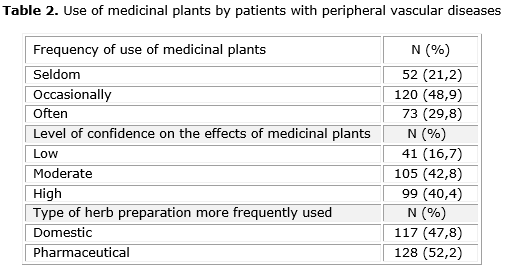
<body><![CDATA[<br>   Statistical analysis</b> </font></p>     <p><font face="Verdana" size="2"> The data are expressed as absolutes values and    percentages. </font></p>     <p>&nbsp; </p>     <p><font face="Verdana" size="2"><b><font size="3">RESULTS</font></b> </font></p>     <p> <font face="Verdana" size="2"><b>Included patients demographic characteristics</b>    </font></p>     <p><font face="Verdana" size="2"> The research protocol was accomplished according    to the plan. Two hundred and forty five both sex adult volunteers, were included    in the study. The majority of them had a secondary or higher level of education    and was socially active persons that lived in Havana or in the two nearest provinces    to it (<a href="#Tab1_04">table 1</a>). </font></p>     <p align="center"><a name="tab1_04"></a><img src="/img/revistas/pla/v20n1/t0104115.gif" width="373" height="342"><font face="Verdana" size="2">    </font></p>     <p> <font face="Verdana" size="2"><b>    <br>   Use of medicinal plants by patients with peripheral vascular diseases</b> </font></p>     <p><font face="Verdana" size="2"> More than 80 % of participants used medicinal    plants at least occasionally and confide on their efficacy to treat different    illnesses either as domestic remedies or pharmaceutical herb preparations (<a href="#tab2_04">table    2</a>). </font></p>     ]]></body>
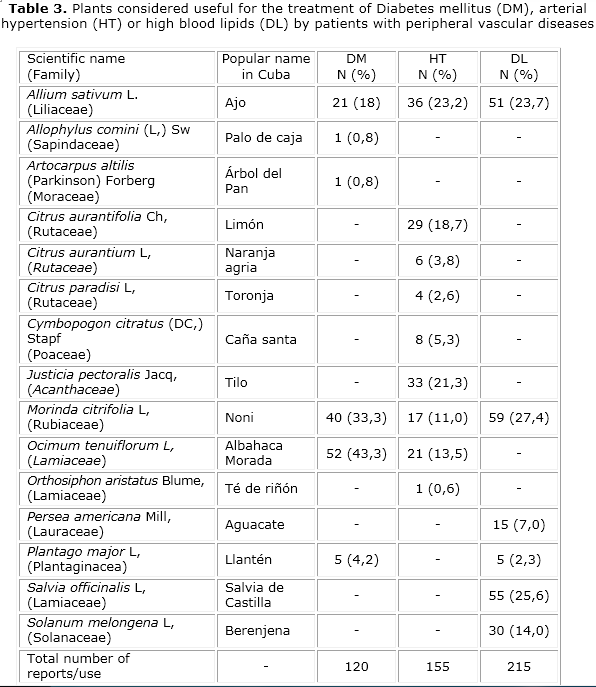
<body><![CDATA[<p align="center"> <font face="Verdana" size="2"><a name="tab2_04"></a><img src="/img/revistas/pla/v20n1/t0204115.gif" width="505" height="268"></font></p>     <p> <font face="Verdana" size="2"><b>     <br>   Plants considered useful for the treatment of Diabetes mellitus (DM), arterial    hypertension (HT) or high blood lipids (DL) by patients with peripheral vascular    diseases </b> </font></p>     <p><font face="Verdana" size="2"> The number of reports recorded regarding plants    considered useful to treat diabetes, hypertension and hypercholesterolemia were    120; 155 and 215 respectively. Fifteen plant species from 11 botanical families    were mentioned by the participants in the study. <i>Ocimum tenuiflorum L.</i>,<i>    Morinda citrifolia </i>L.<i> </i>and <i>Allium sativum </i>L. were the most    reported plants among those with attributed hypoglycemic effect. <i>Allium sativum    </i>L., <i>Justicia pectoralis </i>Jacq. and <i>Citrus aurantifolia </i>Ch<i>.,    </i>were the most mentioned within the group of plants considered good for blood    pressure lowering, while <i>Morinda citrifolia </i>L.,<i> Salvia officinalis</i>    L<i>. and Allium sativum </i>L <i>. </i>had the highest number of reports among    plants appreciated as blood cholesterol reducers (<a href="/img/revistas/pla/v20n1/t0304115.gif">table    3</a>).</font></p>     <p>&nbsp;</p>     <p><font face="Verdana" size="2"><b><font size="3">DISCUSSION</font></b> </font></p>     <p><font face="Verdana" size="2"> This work has provided the first characterization    of the use of plant products by patients with peripheral vascular diseases for    medicinal purposes and has demonstrated the usefulness of this kind of studies.    </font></p>     <p><font face="Verdana" size="2"> Most patients claims about the beneficial properties    of plants have been scientifically supported. Nevertheless, the majority of    the pharmacological evidence available relays on pre-clinical studies and the    results of the clinical trials performed are not conclusive.<sup>10-12</sup>    In addition, some information gaps and contradictory facts, like those described    below, are limitations to assure that some of them would be clinically effective    in humans. </font></p>     <p><font face="Verdana" size="2"> For instance, it has been reported the use of    <i>Solanum melongena </i>L.<i> </i>fruit aqueous macerates as natural remedies    for hypercholesterolemia in Cuba,<sup>13</sup> however, as far as we know, there    is no scientific evidence that support this practice. Besides, the results of    the evaluation of other types of preparations from this species are variable.    Thus, oral administration of fresh, ripe fruits to rabbits under atherogenic    diet significantly reduced serum concentrations of total cholesterol, triglyceride,    LDL-cholesterol, increased HDL-C and HDL/LDL- C ratio and decreased hepatic    lesions.<sup>14</sup> However, ad libitum intake of <i>S. melongena </i>fruit    aqueous extract provoked serum cholesterol increase and hepatic cholesterol    decrease in rats under hypercholesterolemic diet without influence on circulating    and tissue triglyceride levels.<sup>15</sup> Furthermore, serum total cholesterol    and atherogenic lipoproteins, as well as aortic lesion area were unaffected,    while oxidative stress markers were elevated in LDLR (-/-) mice fed atherogenic    diet treated with a fruit extract.<sup>16</sup> Moreover, a double-blind placebo-controlled    study with hypercholesterolemic human volunteers demonstrated significant reduction    of blood levels of total and LDL-cholesterol and of apolipoprotein B after daily    intake of a dried powder fruit<i> </i> infusion, however these changes were    similar to those achieved when patients accomplished dietary changes and exercise    activities.<sup>17</sup> Besides, oral intake of dried powdered fruits failed    to decrease serum total cholesterol, LDL- cholesterol and LDL/HDL during another    double-blind placebo-controlled study with hyperlipidemic volunteers.<sup>18</sup>    Therefore, the possible hypolipidemic effects of <i>S. melongena </i>fruit aqueous    macerates should be assessed. </font></p>     <p> <font face="Verdana" size="2"><i>Plantago major</i> L. is another example,    since a single oral dose of <i>P. major</i> leaf crude aqueous extract was unable    to prevent hyperglycemia in rats during the glucose tolerance test <sup>19</sup>.    However, lower blood cholesterol levels and atherosclerotic lesions in aorta    were demonstrated in rabbits treated with a leaf extract given concomitantly    with a hypercholesterolemic diet.<sup>20</sup> Thus, suggesting a hypolipidemic    but not a hypoglycemic potential of products derived from this species. </font></p>     ]]></body>
<body><![CDATA[<p><font face="Verdana" size="2"> Finally, patients&#180; believes with respect    to the utility of <i>Citrus aurantifolia </i>Ch.<i> </i>and<i> Justicia pectoralis    </i>Jacq.<b> </b> for hypertension control agrees with Ethnomedical reports<sup>21,22    </sup>but scientific evidence is missing.<sup> </sup> </font></p>     <p><font face="Verdana" size="2"> This study has led to the identification of    botanical species that could be candidates for the development of plant preparations    useful as complementary therapies for Diabetes mellitus, arterial hypertension    and dyslipidemia. Pharmaceutical products from three of these species (<i>Allium    sativum </i>L.<i>, Justicia pectoralis </i>Jacq.<i> </i>and <i>Orthosiphon aristatus    </i>Blume)<i> </i>are included in Cuban Ministry of Health&#8217;s Formulary    of Phyto pharmaceutical products from<sup>23-25 </sup>and their hypoglycemic,    anti-hypertensive and/or hypolipidemic efficacy should be demonstrated during    clinical studies with patients who would benefit from these treatments. </font></p>     <p><font face="Verdana" size="2"> Similar preparations should be developed from    the other species mentioned by the interviewees that have been accepted for    their medicinal use in Cuba<sup>26</sup> (<i>Citrus aurantifolia </i>Ch., <i>Cymbopogon    citratus </i>(DC.) Stapf, <i>Morinda citrifolia</i> L., <i>Ocimum enuiflorum    </i>L.<i>, Plantago major </i>L. and <i>Salvia officinalis </i>L.) and pharmacologically    assessed in pre/clinical and clinical conditions. Nevertheless,<i>Allophylus    comini </i>(L.) Sw., <i>Artocarpus altilis</i> (Parkinson) Forberg, <i>Citrus    paradisi </i>L. <i>Persea americana </i>Mill. and<i>Solanum melongena</i> L.,    should not be excluded from a research plan, since, they are used in Cuba as    medicinal and /or edible plants.<sup>13,22,27,26,29 </sup> </font></p>     <p><font face="Verdana" size="2"> The scientific evidence available suggests that    some herb remedies that patients with peripheral vascular diseases consider    therapeutically useful could, in fact, be pharmacologically active. Thus, pharmacological    interactions between these products and conventional drugs may be expected.    Therefore, physicians should be aware about this possibility that should be    diagnosed. This information would aid the scientifically supported integration    of Phytotherapy to the clinical practice. </font></p>     <p>&nbsp; </p>     <p><font face="Verdana" size="2"><b><font size="3">REFERENCES</font> </b> </font></p>     <!-- ref --><p><font face="Verdana" size="2"> 1. Galkina E, Ley K. Immune and inflammatory    mechanisms of atherosclerosis. Annu Rev Immunol. 2009;27:165-97.     </font></p>     <!-- ref --><p><font face="Verdana" size="2"> 2. Colagiuri R. Diabetes: A pandemic, a development    issue or both? Expert Rev Cardiovasc Ther. 2010;8(3):305-9.     </font></p>     ]]></body>
<body><![CDATA[<!-- ref --><p><font face="Verdana" size="2"> 3. Gamboa R<i>. </i>Fisiopatolog&#237;a de la    hipertensi&#243;n arterial esencial.<b> </b>Acta Med Per. 2006;23(2):76-82.        </font></p>     <!-- ref --><p><font face="Verdana" size="2"> 4. Canalizo-Miranda E, Favela-P&#233;rez EA,    Salas-Anaya JA, G&#243;mez-D&#237;az R, Jara-Espino R, Torres-Arreola LP, et    al. Clinical practice guideline. Diagnosis and treatment of dyslipidemia. Rev    Med Inst Mex Seg Soc. 2013;51(6):700-9.     </font></p>     <!-- ref --><p><font face="Verdana" size="2"> 5. Karou SD, Tchacondo T, Tchibozo MAD, Abdoul-Rahaman    S, Anani K, Koudouvo K, et al. Ethnobotanical study of medicinal plants used    in the management of diabetes mellitus and hypertension in the Central Region    of Togo. Pharm Biol. 2011;49(12):1286-97.     </font></p>     <!-- ref --><p><font face="Verdana" size="2"> 6. Borokini TI, Clement M, Dickson NJ, Edagbo    DE. Ethnobiological survey of traditional medicine practice for circulatory    and nervous system related diseases in Oyo State, Nigeria. J Herb Med. 2013;2(6):111-20.        </font></p>     <!-- ref --><p><font face="Verdana" size="2"> 7. Matheka DM, Alkizim FO. Complementary and    alternative medicine for type 2 diabetes mellitus: Role of medicinal herbs.    J Diabetes Endocrinol. 2012;3(4):44-56.     </font></p>     ]]></body>
<body><![CDATA[<!-- ref --><p><font face="Verdana" size="2"> 8. Stanger MJ, Thompson LA, Young AJ, Lieberman    HR. Anticoagulant activity of select dietary supplements. Nutr Rev. 2012;70:107-17.        </font></p>     <!-- ref --><p><font face="Verdana" size="2"> 9. Mutirangura P, Ruangsetakit C, Wongwanit    C, Sermsathanasawadi N, Chinsakchai K. Clinical differentiation between acute    arterial embolism and acute arterial thrombosis of the lower extremities. <a title="Journal of the Medical Association of Thailand = Chotmaihet thangphaet.">J    Med Assoc Thai</a>. 2009;92(7):891-7.     </font></p>     <!-- ref --><p><font face="Verdana" size="2"> 10. Garcia M. Antidiabetic potential of plants    used in Cuba. Pharmacologyonline. 2014;1:52-62.    </font></p>     <!-- ref --><p><font face="Verdana" size="2"> 11. Garcia M. Hypolipidemic potential of plants    used in Cuba. Pharmacologyonline. 2014;1:73-80.    </font></p>     <!-- ref --><p><font face="Verdana" size="2"> 12. Garcia M. Antihypertensive potential of    plants used in Cuba. Pharmacologyonline. 2014;2:10-7.     </font></p>     ]]></body>
<body><![CDATA[<!-- ref --><p><font face="Verdana" size="2"> 13. Garc&#237;a-Valido PE, P&#233;rez-Alejo    JL. Especies medicinales en el Delta Orinoco: aspectos promisorios para la medicina    tradicional cubana. Quesada Pantoja J, editor. La Habana: ECIMED; 2011:275-6.        </font></p>     <!-- ref --><p><font face="Verdana" size="2"> 14. Odetola AA, Iranloye YO, Akinloye O. Hypolipidaemic    potentials of <i>Solanum melongena </i>and <i>Solanum gilo </i>on hypercholesterolemic    rabbits. Pakistan J Nutr. 2004;3(3):180-7.     </font></p>     <!-- ref --><p><font face="Verdana" size="2"> 15. Silva ME, Santos RC, Leary MC, Santos RS.    Effect of aubergine (<i>Solanum melongena</i>) on serum and hepatic cholesterol    and triglycerides in rats. Braz Arch Biol Technol. 1999;42(3).     </font></p>     <!-- ref --><p><font face="Verdana" size="2"> 16. Botelho FV, En&#233;as LR, Cesar GC, Bizzotto    CS, Tavares E, Oliveira FA. Effects of eggplant (Solanum melongena) on the atherogenesis    and oxidative stress in LDL receptor knock out mice (LDLR(-/-).<b> </b>Food    Chem Toxicol. 2004;42(8):1259-67.     </font></p>     <!-- ref --><p><font face="Verdana" size="2"> 17. Guimar&#227;es PR, Galv&#227;o AMP, Batista    CM, Azevedo GS, Oliveira RD, Lamounier RP, et al. Eggplant (<i>Solanum melongena</i>)    infusion has a modest and transitory effect on hypercholesterolemic subjects<b>.    </b>Braz J Med Biol Res. 2000;33(9).    <b> </b> </font></p>     ]]></body>
<body><![CDATA[<!-- ref --><p><font face="Verdana" size="2"> 18. da Silva GEC, Takahashi MH, Filho WE, Albino    CC, Tasim GE, Serri LAF, et al. Aus&#234;ncia de efeito hipolipemiante da Solanum    melongena L. (Berinjela) em pacientes hiperlipid&#234;micos. Arq Bras Endocrinol    Metab. 2004;48(3):368-73.     </font></p>     <!-- ref --><p><font face="Verdana" size="2"> 19. Rodriguez J, Loyola JI, Maul&#233;n G, Schmeda-Hirschmann    G. Hypoglycaemic activity of <i>Geranium core-core, Oxalis rosea </i>and <i>Plantago    major </i>extract in rats. Phytother Res. 1994;8(6):372-4.     </font></p>     <!-- ref --><p><font face="Verdana" size="2"> 20. Angarskaya MA, Sokolova VE. The effect of    plantain (Plantago major) on the course of experimental atherosclerosis in rabbits.    Bull Exp Biol Med. 1963;53(4):410-12.     </font></p>     <!-- ref --><p><font face="Verdana" size="2"> 21. Yirga G. Assessment of traditional medicinal    plants in Endrta District, South-eastern Tigray, Northern Ethiopia.<b> </b>Afr    J Plant Sci. 2010;4(7):255-60.     </font></p>     <!-- ref --><p><font face="Verdana" size="2"> 22. Scull Lizama R, Miranda Mart&#237;nez M,    Infante Lantigua RE. Plantas medicinales de uso tradicional en Pinar del R&#237;o.    Estudio etnobot&#225;nico. I. Rev Cubana Farm. 1998;2(1).    </font></p>     ]]></body>
<body><![CDATA[<!-- ref --><p><font face="Verdana" size="2"> 23. Ministerio de Salud P&#250;blica. Direcci&#243;n    Nacional de Farmacias. Formulario Nacional Fitof&#225;rmacos y Apif&#225;rmacos.    Editorial Ciencias M&#233;dicas, La Habana, 2010:5-9.     </font></p>     <!-- ref --><p><font face="Verdana" size="2"> 24. Ministerio de Salud P&#250;blica. Direcci&#243;n    Nacional de Farmacias. Formulario Nacional Fitof&#225;rmacos y Apif&#225;rmacos.    Editorial Ciencias M&#233;dicas, La Habana, 2010:105-7.     </font></p>     <!-- ref --><p><font face="Verdana" size="2"> 25. Ministerio de Salud P&#250;blica. Direcci&#243;n    Nacional de Farmacias. Formulario Nacional Fitof&#225;rmacos y Apif&#225;rmacos.    Editorial Ciencias M&#233;dicas, La Habana, 2010:108-10.     </font></p>     <!-- ref --><p><font face="Verdana" size="2"> 26. Ministerio de Salud P&#250;blica. Direcci&#243;n    nacional de Farmacias. Formulario nacional Fitof&#225;rmacos y Apif&#225;rmacos.    Editorial Ciencias M&#233;dicas, La Habana, 2010:164-5.     </font></p>     <!-- ref --><p><font face="Verdana" size="2"> 27. Garc&#237;a-Valido PE, P&#233;rez-Alejo    JL. Especies medicinales en el Delta Orinoco: aspectos promisorios para la medicina    tradicional cubana. Quesada Pantoja J, editor. La Habana: ECiMED; 2011:225-6.        </font></p>     ]]></body>
<body><![CDATA[<!-- ref --><p><font face="Verdana" size="2"> 28. Hern&#225;ndez Cano J, Volpato G. Herbal    mixtures in the traditional medicine of Eastern Cuba. J Ethnopharmacology. 2004;90:293-316.        </font></p>     <!-- ref --><p><font face="Verdana" size="2"> 29. Arencibia-Figueroa R. Un cient&#237;fico    popular. Capdevila Prado C, editor. La Habana: Ediciones M&#233;dicas, Centro    Provincial del Libro y la Literatura; 2008:52.     </font></p>     <p>&nbsp;</p>     <p>&nbsp;</p>     <p><font face="Verdana" size="2">Recibido: 16 de junio de 2014.    <br>   Aprobado: 16 de enero de 2015.</font></p>     <p>&nbsp;</p>     <p>&nbsp;</p>     ]]></body>
<body><![CDATA[<p> <font face="Verdana" size="2"><i>DraC. </i> <i>Milagros Garcia-Mesa</i>. Central    Laboratory of Pharmacology, 156 Carvajal ST, Postal code 12000. Cerro, Habana,    Cuba. </font><font face="Verdana" size="2">    <br>   Correo electr&#243;nico: <a href="mailto:milagros.mesa@infomed.sld.cu">milagros.mesa@infomed.sld.cu</a>    </font></p>      ]]></body><back>
<ref-list>
<ref id="B1">
<label>1</label><nlm-citation citation-type="journal">
<person-group person-group-type="author">
<name>
<surname><![CDATA[Galkina]]></surname>
<given-names><![CDATA[E]]></given-names>
</name>
<name>
<surname><![CDATA[Ley]]></surname>
<given-names><![CDATA[K]]></given-names>
</name>
</person-group>
<article-title xml:lang="en"><![CDATA[Immune and inflammatory mechanisms of atherosclerosis]]></article-title>
<source><![CDATA[Annu Rev Immunol]]></source>
<year>2009</year>
<volume>27</volume>
<page-range>165-97</page-range></nlm-citation>
</ref>
<ref id="B2">
<label>2</label><nlm-citation citation-type="journal">
<person-group person-group-type="author">
<name>
<surname><![CDATA[Colagiuri]]></surname>
<given-names><![CDATA[R]]></given-names>
</name>
</person-group>
<article-title xml:lang="en"><![CDATA[Diabetes: A pandemic, a development issue or both?]]></article-title>
<source><![CDATA[Expert Rev Cardiovasc Ther]]></source>
<year>2010</year>
<volume>8</volume>
<numero>3</numero>
<issue>3</issue>
<page-range>305-9</page-range></nlm-citation>
</ref>
<ref id="B3">
<label>3</label><nlm-citation citation-type="journal">
<person-group person-group-type="author">
<name>
<surname><![CDATA[Gamboa]]></surname>
<given-names><![CDATA[R]]></given-names>
</name>
</person-group>
<article-title xml:lang="es"><![CDATA[Fisiopatología de la hipertensión arterial esencial]]></article-title>
<source><![CDATA[Acta Med Per]]></source>
<year>2006</year>
<volume>23</volume>
<numero>2</numero>
<issue>2</issue>
<page-range>76-82</page-range></nlm-citation>
</ref>
<ref id="B4">
<label>4</label><nlm-citation citation-type="journal">
<person-group person-group-type="author">
<name>
<surname><![CDATA[Canalizo-Miranda]]></surname>
<given-names><![CDATA[E]]></given-names>
</name>
<name>
<surname><![CDATA[Favela-Pérez]]></surname>
<given-names><![CDATA[EA]]></given-names>
</name>
<name>
<surname><![CDATA[Salas-Anaya]]></surname>
<given-names><![CDATA[JA]]></given-names>
</name>
<name>
<surname><![CDATA[Gómez-Díaz]]></surname>
<given-names><![CDATA[R]]></given-names>
</name>
<name>
<surname><![CDATA[Jara-Espino]]></surname>
<given-names><![CDATA[R]]></given-names>
</name>
<name>
<surname><![CDATA[Torres-Arreola]]></surname>
<given-names><![CDATA[LP]]></given-names>
</name>
</person-group>
<article-title xml:lang="en"><![CDATA[Clinical practice guideline: Diagnosis and treatment of dyslipidemia]]></article-title>
<source><![CDATA[Rev Med Inst Mex Seg Soc]]></source>
<year>2013</year>
<volume>51</volume>
<numero>6</numero>
<issue>6</issue>
<page-range>700-9</page-range></nlm-citation>
</ref>
<ref id="B5">
<label>5</label><nlm-citation citation-type="journal">
<person-group person-group-type="author">
<name>
<surname><![CDATA[Karou]]></surname>
<given-names><![CDATA[SD]]></given-names>
</name>
<name>
<surname><![CDATA[Tchacondo]]></surname>
<given-names><![CDATA[T]]></given-names>
</name>
<name>
<surname><![CDATA[Tchibozo]]></surname>
<given-names><![CDATA[MAD]]></given-names>
</name>
<name>
<surname><![CDATA[Abdoul-Rahaman]]></surname>
<given-names><![CDATA[S]]></given-names>
</name>
<name>
<surname><![CDATA[Anani]]></surname>
<given-names><![CDATA[K]]></given-names>
</name>
<name>
<surname><![CDATA[Koudouvo]]></surname>
<given-names><![CDATA[K]]></given-names>
</name>
</person-group>
<article-title xml:lang="en"><![CDATA[Ethnobotanical study of medicinal plants used in the management of diabetes mellitus and hypertension in the Central Region of Togo]]></article-title>
<source><![CDATA[Pharm Biol]]></source>
<year>2011</year>
<volume>49</volume>
<numero>12</numero>
<issue>12</issue>
<page-range>1286-97</page-range></nlm-citation>
</ref>
<ref id="B6">
<label>6</label><nlm-citation citation-type="journal">
<person-group person-group-type="author">
<name>
<surname><![CDATA[Borokini]]></surname>
<given-names><![CDATA[TI]]></given-names>
</name>
<name>
<surname><![CDATA[Clement]]></surname>
<given-names><![CDATA[M]]></given-names>
</name>
<name>
<surname><![CDATA[Dickson]]></surname>
<given-names><![CDATA[NJ]]></given-names>
</name>
<name>
<surname><![CDATA[Edagbo]]></surname>
<given-names><![CDATA[DE]]></given-names>
</name>
</person-group>
<article-title xml:lang="en"><![CDATA[Ethnobiological survey of traditional medicine practice for circulatory and nervous system related diseases in Oyo State, Nigeria]]></article-title>
<source><![CDATA[J Herb Med]]></source>
<year>2013</year>
<volume>2</volume>
<numero>6</numero>
<issue>6</issue>
<page-range>111-20</page-range></nlm-citation>
</ref>
<ref id="B7">
<label>7</label><nlm-citation citation-type="journal">
<person-group person-group-type="author">
<name>
<surname><![CDATA[Matheka]]></surname>
<given-names><![CDATA[DM]]></given-names>
</name>
<name>
<surname><![CDATA[Alkizim]]></surname>
<given-names><![CDATA[FO]]></given-names>
</name>
</person-group>
<article-title xml:lang="en"><![CDATA[Complementary and alternative medicine for type 2 diabetes mellitus: Role of medicinal herbs]]></article-title>
<source><![CDATA[J Diabetes Endocrinol]]></source>
<year>2012</year>
<volume>3</volume>
<numero>4</numero>
<issue>4</issue>
<page-range>44-56</page-range></nlm-citation>
</ref>
<ref id="B8">
<label>8</label><nlm-citation citation-type="journal">
<person-group person-group-type="author">
<name>
<surname><![CDATA[Stanger]]></surname>
<given-names><![CDATA[MJ]]></given-names>
</name>
<name>
<surname><![CDATA[Thompson]]></surname>
<given-names><![CDATA[LA]]></given-names>
</name>
<name>
<surname><![CDATA[Young]]></surname>
<given-names><![CDATA[AJ]]></given-names>
</name>
<name>
<surname><![CDATA[Lieberman]]></surname>
<given-names><![CDATA[HR]]></given-names>
</name>
</person-group>
<article-title xml:lang="en"><![CDATA[Anticoagulant activity of select dietary supplements]]></article-title>
<source><![CDATA[Nutr Rev]]></source>
<year>2012</year>
<volume>70</volume>
<page-range>107-17</page-range></nlm-citation>
</ref>
<ref id="B9">
<label>9</label><nlm-citation citation-type="journal">
<person-group person-group-type="author">
<name>
<surname><![CDATA[Mutirangura]]></surname>
<given-names><![CDATA[P]]></given-names>
</name>
<name>
<surname><![CDATA[Ruangsetakit]]></surname>
<given-names><![CDATA[C]]></given-names>
</name>
<name>
<surname><![CDATA[Wongwanit]]></surname>
<given-names><![CDATA[C]]></given-names>
</name>
<name>
<surname><![CDATA[Sermsathanasawadi]]></surname>
<given-names><![CDATA[N]]></given-names>
</name>
<name>
<surname><![CDATA[Chinsakchai]]></surname>
<given-names><![CDATA[K]]></given-names>
</name>
</person-group>
<article-title xml:lang="en"><![CDATA[Clinical differentiation between acute arterial embolism and acute arterial thrombosis of the lower extremities]]></article-title>
<source><![CDATA[J Med Assoc Thai]]></source>
<year>2009</year>
<volume>92</volume>
<numero>7</numero>
<issue>7</issue>
<page-range>891-7</page-range></nlm-citation>
</ref>
<ref id="B10">
<label>10</label><nlm-citation citation-type="journal">
<person-group person-group-type="author">
<name>
<surname><![CDATA[Garcia]]></surname>
<given-names><![CDATA[M]]></given-names>
</name>
</person-group>
<article-title xml:lang="en"><![CDATA[Antidiabetic potential of plants used in Cuba]]></article-title>
<source><![CDATA[Pharmacologyonline]]></source>
<year>2014</year>
<volume>1</volume>
<page-range>52-62</page-range></nlm-citation>
</ref>
<ref id="B11">
<label>11</label><nlm-citation citation-type="journal">
<person-group person-group-type="author">
<name>
<surname><![CDATA[Garcia]]></surname>
<given-names><![CDATA[M]]></given-names>
</name>
</person-group>
<article-title xml:lang="en"><![CDATA[Hypolipidemic potential of plants used in Cuba]]></article-title>
<source><![CDATA[Pharmacologyonline]]></source>
<year>2014</year>
<volume>1</volume>
<page-range>73-80</page-range></nlm-citation>
</ref>
<ref id="B12">
<label>12</label><nlm-citation citation-type="journal">
<person-group person-group-type="author">
<name>
<surname><![CDATA[Garcia]]></surname>
<given-names><![CDATA[M]]></given-names>
</name>
</person-group>
<article-title xml:lang="en"><![CDATA[Antihypertensive potential of plants used in Cuba]]></article-title>
<source><![CDATA[Pharmacologyonline]]></source>
<year>2014</year>
<volume>2</volume>
<page-range>10-7</page-range></nlm-citation>
</ref>
<ref id="B13">
<label>13</label><nlm-citation citation-type="book">
<person-group person-group-type="author">
<name>
<surname><![CDATA[García-Valido]]></surname>
<given-names><![CDATA[PE]]></given-names>
</name>
<name>
<surname><![CDATA[Pérez-Alejo]]></surname>
<given-names><![CDATA[JL]]></given-names>
</name>
</person-group>
<source><![CDATA[Especies medicinales en el Delta Orinoco: aspectos promisorios para la medicina tradicional cubana]]></source>
<year>2011</year>
<page-range>275-6</page-range><publisher-loc><![CDATA[La Habana ]]></publisher-loc>
<publisher-name><![CDATA[ECIMED]]></publisher-name>
</nlm-citation>
</ref>
<ref id="B14">
<label>14</label><nlm-citation citation-type="journal">
<person-group person-group-type="author">
<name>
<surname><![CDATA[Odetola]]></surname>
<given-names><![CDATA[AA]]></given-names>
</name>
<name>
<surname><![CDATA[Iranloye]]></surname>
<given-names><![CDATA[YO]]></given-names>
</name>
<name>
<surname><![CDATA[Akinloye]]></surname>
<given-names><![CDATA[O]]></given-names>
</name>
</person-group>
<article-title xml:lang="en"><![CDATA[Hypolipidaemic potentials of Solanum melongena and Solanum gilo on hypercholesterolemic rabbits]]></article-title>
<source><![CDATA[Pakistan J Nutr]]></source>
<year>2004</year>
<volume>3</volume>
<numero>3</numero>
<issue>3</issue>
<page-range>180-7</page-range></nlm-citation>
</ref>
<ref id="B15">
<label>15</label><nlm-citation citation-type="journal">
<person-group person-group-type="author">
<name>
<surname><![CDATA[Silva]]></surname>
<given-names><![CDATA[ME]]></given-names>
</name>
<name>
<surname><![CDATA[Santos]]></surname>
<given-names><![CDATA[RC]]></given-names>
</name>
<name>
<surname><![CDATA[Leary]]></surname>
<given-names><![CDATA[MC]]></given-names>
</name>
<name>
<surname><![CDATA[Santos]]></surname>
<given-names><![CDATA[RS]]></given-names>
</name>
</person-group>
<article-title xml:lang="en"><![CDATA[Effect of aubergine (Solanum melongena) on serum and hepatic cholesterol and triglycerides in rats]]></article-title>
<source><![CDATA[Braz Arch Biol Technol]]></source>
<year>1999</year>
<volume>42</volume>
<numero>3</numero>
<issue>3</issue>
</nlm-citation>
</ref>
<ref id="B16">
<label>16</label><nlm-citation citation-type="journal">
<person-group person-group-type="author">
<name>
<surname><![CDATA[Botelho]]></surname>
<given-names><![CDATA[FV]]></given-names>
</name>
<name>
<surname><![CDATA[Enéas]]></surname>
<given-names><![CDATA[LR]]></given-names>
</name>
<name>
<surname><![CDATA[Cesar]]></surname>
<given-names><![CDATA[GC]]></given-names>
</name>
<name>
<surname><![CDATA[Bizzotto]]></surname>
<given-names><![CDATA[CS]]></given-names>
</name>
<name>
<surname><![CDATA[Tavares]]></surname>
<given-names><![CDATA[E]]></given-names>
</name>
<name>
<surname><![CDATA[Oliveira]]></surname>
<given-names><![CDATA[FA]]></given-names>
</name>
</person-group>
<article-title xml:lang="en"><![CDATA[Effects of eggplant (Solanum melongena) on the atherogenesis and oxidative stress in LDL receptor knock out mice (LDLR(-/-)]]></article-title>
<source><![CDATA[Food Chem Toxicol]]></source>
<year>2004</year>
<volume>42</volume>
<numero>8</numero>
<issue>8</issue>
<page-range>1259-67</page-range></nlm-citation>
</ref>
<ref id="B17">
<label>17</label><nlm-citation citation-type="journal">
<person-group person-group-type="author">
<name>
<surname><![CDATA[Guimarães]]></surname>
<given-names><![CDATA[PR]]></given-names>
</name>
<name>
<surname><![CDATA[Galvão]]></surname>
<given-names><![CDATA[AMP]]></given-names>
</name>
<name>
<surname><![CDATA[Batista]]></surname>
<given-names><![CDATA[CM]]></given-names>
</name>
<name>
<surname><![CDATA[Azevedo]]></surname>
<given-names><![CDATA[GS]]></given-names>
</name>
<name>
<surname><![CDATA[Oliveira]]></surname>
<given-names><![CDATA[RD]]></given-names>
</name>
<name>
<surname><![CDATA[Lamounier]]></surname>
<given-names><![CDATA[RP]]></given-names>
</name>
</person-group>
<article-title xml:lang="en"><![CDATA[Eggplant (Solanum melongena) infusion has a modest and transitory effect on hypercholesterolemic subjects]]></article-title>
<source><![CDATA[Braz J Med Biol Res]]></source>
<year>2000</year>
<volume>33</volume>
<numero>9</numero>
<issue>9</issue>
</nlm-citation>
</ref>
<ref id="B18">
<label>18</label><nlm-citation citation-type="journal">
<person-group person-group-type="author">
<name>
<surname><![CDATA[da Silva]]></surname>
<given-names><![CDATA[GEC]]></given-names>
</name>
<name>
<surname><![CDATA[Takahashi]]></surname>
<given-names><![CDATA[MH]]></given-names>
</name>
<name>
<surname><![CDATA[Filho]]></surname>
<given-names><![CDATA[WE]]></given-names>
</name>
<name>
<surname><![CDATA[Albino]]></surname>
<given-names><![CDATA[CC]]></given-names>
</name>
<name>
<surname><![CDATA[Tasim]]></surname>
<given-names><![CDATA[GE]]></given-names>
</name>
<name>
<surname><![CDATA[Serri]]></surname>
<given-names><![CDATA[LAF]]></given-names>
</name>
</person-group>
<article-title xml:lang="pt"><![CDATA[Ausência de efeito hipolipemiante da Solanum melongena L. (Berinjela) em pacientes hiperlipidêmicos]]></article-title>
<source><![CDATA[Arq Bras Endocrinol Metab]]></source>
<year>2004</year>
<volume>48</volume>
<numero>3</numero>
<issue>3</issue>
<page-range>368-73</page-range></nlm-citation>
</ref>
<ref id="B19">
<label>19</label><nlm-citation citation-type="journal">
<person-group person-group-type="author">
<name>
<surname><![CDATA[Rodriguez]]></surname>
<given-names><![CDATA[J]]></given-names>
</name>
<name>
<surname><![CDATA[Loyola]]></surname>
<given-names><![CDATA[JI]]></given-names>
</name>
<name>
<surname><![CDATA[Maulén]]></surname>
<given-names><![CDATA[G]]></given-names>
</name>
<name>
<surname><![CDATA[Schmeda-Hirschmann]]></surname>
<given-names><![CDATA[G]]></given-names>
</name>
</person-group>
<article-title xml:lang="en"><![CDATA[Hypoglycaemic activity of Geranium core-core, Oxalis rosea and Plantago major extract in rats]]></article-title>
<source><![CDATA[Phytother Res]]></source>
<year>1994</year>
<volume>8</volume>
<numero>6</numero>
<issue>6</issue>
<page-range>372-4</page-range></nlm-citation>
</ref>
<ref id="B20">
<label>20</label><nlm-citation citation-type="journal">
<person-group person-group-type="author">
<name>
<surname><![CDATA[Angarskaya]]></surname>
<given-names><![CDATA[MA]]></given-names>
</name>
<name>
<surname><![CDATA[Sokolova]]></surname>
<given-names><![CDATA[VE]]></given-names>
</name>
</person-group>
<article-title xml:lang="en"><![CDATA[The effect of plantain (Plantago major) on the course of experimental atherosclerosis in rabbits]]></article-title>
<source><![CDATA[Bull Exp Biol Med]]></source>
<year>1963</year>
<volume>53</volume>
<numero>4</numero>
<issue>4</issue>
<page-range>410-12</page-range></nlm-citation>
</ref>
<ref id="B21">
<label>21</label><nlm-citation citation-type="journal">
<person-group person-group-type="author">
<name>
<surname><![CDATA[Yirga]]></surname>
<given-names><![CDATA[G]]></given-names>
</name>
</person-group>
<article-title xml:lang="en"><![CDATA[Assessment of traditional medicinal plants in Endrta District, South-eastern Tigray, Northern Ethiopia]]></article-title>
<source><![CDATA[Afr J Plant Sci]]></source>
<year>2010</year>
<volume>4</volume>
<numero>7</numero>
<issue>7</issue>
<page-range>255-60</page-range></nlm-citation>
</ref>
<ref id="B22">
<label>22</label><nlm-citation citation-type="journal">
<person-group person-group-type="author">
<name>
<surname><![CDATA[Scull Lizama]]></surname>
<given-names><![CDATA[R]]></given-names>
</name>
<name>
<surname><![CDATA[Miranda Martínez]]></surname>
<given-names><![CDATA[M]]></given-names>
</name>
<name>
<surname><![CDATA[Infante Lantigua]]></surname>
<given-names><![CDATA[RE]]></given-names>
</name>
</person-group>
<article-title xml:lang="es"><![CDATA[Plantas medicinales de uso tradicional en Pinar del Río: Estudio etnobotánico. I]]></article-title>
<source><![CDATA[Rev Cubana Farm]]></source>
<year>1998</year>
<volume>2</volume>
<numero>1</numero>
<issue>1</issue>
</nlm-citation>
</ref>
<ref id="B23">
<label>23</label><nlm-citation citation-type="book">
<collab>Ministerio de Salud Pública^dDirección Nacional de Farmacias</collab>
<source><![CDATA[Formulario Nacional Fitofármacos y Apifármacos]]></source>
<year>2010</year>
<page-range>5-9</page-range><publisher-loc><![CDATA[La Habana ]]></publisher-loc>
<publisher-name><![CDATA[Editorial Ciencias Médicas]]></publisher-name>
</nlm-citation>
</ref>
<ref id="B24">
<label>24</label><nlm-citation citation-type="book">
<collab>Ministerio de Salud Pública^dDirección Nacional de Farmacias</collab>
<source><![CDATA[Formulario Nacional Fitofármacos y Apifármacos]]></source>
<year>2010</year>
<page-range>105-7</page-range><publisher-loc><![CDATA[La Habana ]]></publisher-loc>
<publisher-name><![CDATA[Editorial Ciencias Médicas]]></publisher-name>
</nlm-citation>
</ref>
<ref id="B25">
<label>25</label><nlm-citation citation-type="book">
<collab>Ministerio de Salud Pública^dDirección Nacional de Farmacias</collab>
<source><![CDATA[Formulario Nacional Fitofármacos y Apifármacos]]></source>
<year>2010</year>
<page-range>108-10</page-range><publisher-loc><![CDATA[La Habana ]]></publisher-loc>
<publisher-name><![CDATA[Editorial Ciencias Médicas]]></publisher-name>
</nlm-citation>
</ref>
<ref id="B26">
<label>26</label><nlm-citation citation-type="book">
<collab>Ministerio de Salud Pública^dDirección nacional de Farmacias</collab>
<source><![CDATA[Formulario nacional Fitofármacos y Apifármacos]]></source>
<year>2010</year>
<page-range>164-5</page-range><publisher-loc><![CDATA[La Habana ]]></publisher-loc>
<publisher-name><![CDATA[Editorial Ciencias Médicas]]></publisher-name>
</nlm-citation>
</ref>
<ref id="B27">
<label>27</label><nlm-citation citation-type="book">
<person-group person-group-type="author">
<name>
<surname><![CDATA[García-Valido]]></surname>
<given-names><![CDATA[PE]]></given-names>
</name>
<name>
<surname><![CDATA[Pérez-Alejo]]></surname>
<given-names><![CDATA[JL]]></given-names>
</name>
</person-group>
<source><![CDATA[Especies medicinales en el Delta Orinoco: aspectos promisorios para la medicina tradicional cubana]]></source>
<year>2011</year>
<page-range>225-6</page-range><publisher-loc><![CDATA[La Habana ]]></publisher-loc>
<publisher-name><![CDATA[ECiMED]]></publisher-name>
</nlm-citation>
</ref>
<ref id="B28">
<label>28</label><nlm-citation citation-type="journal">
<person-group person-group-type="author">
<name>
<surname><![CDATA[Hernández Cano]]></surname>
<given-names><![CDATA[J]]></given-names>
</name>
<name>
<surname><![CDATA[Volpato]]></surname>
<given-names><![CDATA[G]]></given-names>
</name>
</person-group>
<article-title xml:lang="en"><![CDATA[Herbal mixtures in the traditional medicine of Eastern Cuba]]></article-title>
<source><![CDATA[J Ethnopharmacology]]></source>
<year>2004</year>
<volume>90</volume>
<page-range>293-316</page-range></nlm-citation>
</ref>
<ref id="B29">
<label>29</label><nlm-citation citation-type="book">
<person-group person-group-type="author">
<name>
<surname><![CDATA[Arencibia-Figueroa]]></surname>
<given-names><![CDATA[R]]></given-names>
</name>
</person-group>
<source><![CDATA[Un científico popular]]></source>
<year>2008</year>
<page-range>52</page-range><publisher-loc><![CDATA[La Habana ]]></publisher-loc>
<publisher-name><![CDATA[Ediciones Médicas, Centro Provincial del Libro y la Literatura]]></publisher-name>
</nlm-citation>
</ref>
</ref-list>
</back>
</article>