<?xml version="1.0" encoding="ISO-8859-1"?><article xmlns:mml="http://www.w3.org/1998/Math/MathML" xmlns:xlink="http://www.w3.org/1999/xlink" xmlns:xsi="http://www.w3.org/2001/XMLSchema-instance">
<front>
<journal-meta>
<journal-id>1028-4796</journal-id>
<journal-title><![CDATA[Revista Cubana de Plantas Medicinales]]></journal-title>
<abbrev-journal-title><![CDATA[Rev Cubana Plant Med]]></abbrev-journal-title>
<issn>1028-4796</issn>
<publisher>
<publisher-name><![CDATA[ECIMED]]></publisher-name>
</publisher>
</journal-meta>
<article-meta>
<article-id>S1028-47962015000300002</article-id>
<title-group>
<article-title xml:lang="en"><![CDATA[Effects of ethanol extract of Cenostigma macrophyllum Tul. (caneleiro) on reproductive parameters of female rats]]></article-title>
<article-title xml:lang="es"><![CDATA[Efectos del extracto etanólico de Cenostigma macrophyllum Tul. (caneleiro) sobre parámetros reproductivos de ratas hembras]]></article-title>
</title-group>
<contrib-group>
<contrib contrib-type="author">
<name>
<surname><![CDATA[Barbosa Santos]]></surname>
<given-names><![CDATA[Denise]]></given-names>
</name>
<xref ref-type="aff" rid="A01"/>
</contrib>
<contrib contrib-type="author">
<name>
<surname><![CDATA[Guerra de Oliveira]]></surname>
<given-names><![CDATA[Jamylla Mirck]]></given-names>
</name>
<xref ref-type="aff" rid="A01"/>
</contrib>
<contrib contrib-type="author">
<name>
<surname><![CDATA[Neto Bueno]]></surname>
<given-names><![CDATA[Martins]]></given-names>
</name>
<xref ref-type="aff" rid="A01"/>
</contrib>
<contrib contrib-type="author">
<name>
<surname><![CDATA[Bezerra Sales]]></surname>
<given-names><![CDATA[Paulo Alex]]></given-names>
</name>
<xref ref-type="aff" rid="A01"/>
</contrib>
<contrib contrib-type="author">
<name>
<surname><![CDATA[Sena Costa]]></surname>
<given-names><![CDATA[Charllyton Luis]]></given-names>
</name>
<xref ref-type="aff" rid="A01"/>
</contrib>
<contrib contrib-type="author">
<name>
<surname><![CDATA[Chaves]]></surname>
<given-names><![CDATA[Mariana Helena]]></given-names>
</name>
<xref ref-type="aff" rid="A01"/>
</contrib>
<contrib contrib-type="author">
<name>
<surname><![CDATA[Carvalho e Martins]]></surname>
<given-names><![CDATA[Maria do Carmo]]></given-names>
</name>
<xref ref-type="aff" rid="A01"/>
</contrib>
<contrib contrib-type="author">
<name>
<surname><![CDATA[Raposo Costa]]></surname>
<given-names><![CDATA[Amilton Paulo]]></given-names>
</name>
<xref ref-type="aff" rid="A01"/>
</contrib>
</contrib-group>
<aff id="A01">
<institution><![CDATA[,Universidade Federal do Piauí  ]]></institution>
<addr-line><![CDATA[ ]]></addr-line>
<country>Brasil</country>
</aff>
<pub-date pub-type="pub">
<day>00</day>
<month>09</month>
<year>2015</year>
</pub-date>
<pub-date pub-type="epub">
<day>00</day>
<month>09</month>
<year>2015</year>
</pub-date>
<volume>20</volume>
<numero>3</numero>
<fpage>0</fpage>
<lpage>0</lpage>
<copyright-statement/>
<copyright-year/>
<self-uri xlink:href="http://scielo.sld.cu/scielo.php?script=sci_arttext&amp;pid=S1028-47962015000300002&amp;lng=en&amp;nrm=iso"></self-uri><self-uri xlink:href="http://scielo.sld.cu/scielo.php?script=sci_abstract&amp;pid=S1028-47962015000300002&amp;lng=en&amp;nrm=iso"></self-uri><self-uri xlink:href="http://scielo.sld.cu/scielo.php?script=sci_pdf&amp;pid=S1028-47962015000300002&amp;lng=en&amp;nrm=iso"></self-uri><kwd-group>
<kwd lng="en"><![CDATA[reproductive toxicity]]></kwd>
<kwd lng="en"><![CDATA[estrogenic activity]]></kwd>
<kwd lng="en"><![CDATA[estrous cycle]]></kwd>
<kwd lng="es"><![CDATA[toxicidad para la reproducción]]></kwd>
<kwd lng="es"><![CDATA[actividad estrogénica]]></kwd>
<kwd lng="es"><![CDATA[ciclo estral]]></kwd>
</kwd-group>
</article-meta>
</front><body><![CDATA[ <p align="right"> <font size="2" face="Verdana"><b>ART&#205;CULO ORIGINAL</b></font></p>     <p align="right">&nbsp; </p>     <p> <font size="2" face="Verdana"><b><font size="4">Effects of ethanol extract    of <i>Cenostigma macrophyllum</i> Tul. (caneleiro) on reproductive parameters    of female rats</font></b> </font></p>     <p>&nbsp; </p>     <p> <font size="2" face="Verdana"><b><font size="3">Efectos del extracto etan&#243;lico    de <i>Cenostigma macrophyllum</i> Tul. (<i>caneleiro</i>) sobre par&#225;metros    reproductivos de ratas hembras</font></b> </font></p>     <p>&nbsp;</p>     <p>&nbsp;</p>     <p> <font size="2" face="Verdana"><b>MSc. Denise Barbosa Santos, MSc. Jamylla    Mirck Guerra de Oliveira, MSc. Martins Neto Bueno, </b> <b>MSc. </b> <b>Paulo    Alex Bezerra Sales, </b> <b>Dr. </b> <b>Charllyton Luis Sena Costa, </b> <b>Dra.    </b> <b>Mariana Helena Chaves, </b> <b>Dra. </b> <b>Maria do Carmo Carvalho    e Martins, Dr. Amilton Paulo Raposo Costa</b> </font></p>     <p><font size="2" face="Verdana"> Universidade Federal do Piau&#237;. Brasil.    </font></p>     <p>&nbsp;</p>     ]]></body>
<body><![CDATA[<p>&nbsp;</p> <hr size="1" noshade>     <p><font size="2" face="Verdana"><b>ABSTRACT</b> </font></p>     <p> <font size="2" face="Verdana"><b>Introduction: </b> <i>Cenostigma</i> <i>macrophyllum</i>    Tul., known as <i>Caneleiro</i> presents anti-inflammatory, antinociceptive,    antiulcerogenic activities.    <br>   </font><font size="2" face="Verdana"><b>Objective:</b> to evaluate the effects    of the ethanol extract from <i>C. macrophyllum </i>Tul. leaves on the reproductive    parameters of female Wistar rats.    <br>   </font><font size="2" face="Verdana"><b>Methods: </b> for estrogenic activity    assay were used 32 ovariectomized female rats (n= 8) treated for four days:    I<b>-</b> NaCl 0.9 %, 10 mL/kg of body weight orally + corn oil 1 mL/kg intramuscular    (IM); II- NaCl 0.9 % orally + estradiol 10 &#181;g/kg bw IM; III- extract 500    mg/kg orally + corn oil IM and IV<b>-</b> extract orally + estradiol IM. The    uteri were weighted. The estrous cycle evaluation was made using 12 female rats    examined daily by vaginal smear, before, after and during the treatment (16    days) with extract (500 mg/kg). The each estrous cycle phase duration and the    interval between the cycles were measured. For reproductive toxicity study were    used 16 female rats (n= 8) that were treated orally during all gestational period    with: NaCl 0.9 % 10 mL/kg and extract 500 mg/kg. The rats were anesthetized    and laparotomized for uterus and fetus evaluation. Furthermore, the heart, liver    and kidneys were collected and submitted to histopathological evaluation.    <br>   </font><font size="2" face="Verdana"><b>Results:</b> the uterine weight did    not differ between the groups. There was a decrease in the estrous number and    an increase in the estrous cycle duration in the treatment and pos treatment    groups. The extract did not cause toxicity in pregnant rats nor signs of alterations    in the newborns. The histopathological analysis did not reveal significant alterations    in the organs.    <br>   </font><font size="2" face="Verdana"><b>Conclusion: </b> the extract interferes    in the estrous cycle but does not present toxicity over gestation and nor alters    macroscopically or microscopically the analyzed organs structures. </font></p>     <p> <font size="2" face="Verdana"><b>Key words</b>: reproductive toxicity, estrogenic    activity, estrous cycle. </font></p> <hr size="1" noshade>     <p><font size="2" face="Verdana"><b>RESUMEN</b> </font></p>     <p> <font size="2" face="Verdana"><b>Introducci&#243;n: </b> <i>Cenostigma macrophyllum</i>    Tul. conocido como <i>Caneleiro</i> demuestra actividades antiinflamatorio,    antiulcerog&#233;nico y antinociceptiva.    ]]></body>
<body><![CDATA[<br>   </font><font size="2" face="Verdana"><b>Objetivo: </b> evaluar los efectos del    extracto etan&#243;lico de hojas de <i>C. macrophyllum </i>Tul. en los par&#225;metros    de reproducci&#243;n de ratas Wistar.    <br>   </font><font size="2" face="Verdana"><b>M&#233;todos: </b> para el ensayo de    actividad estrog&#233;nica se utilizaron 32 ratas hembras ovariectomizadas (n    = 8) tratadas durante cuatro d&#237;as: I- NaCl 0,9 % 10 mL/kg de peso corporal    por v&#237;a oral + aceite de ma&#237;z 1 mL/kg por v&#237;a intramuscular (IM);    II- NaCl 0,9 % por v&#237;a oral + estradiol 10 &#181;g/kg IM; III - extracto    500 mg/kg por v&#237;a oral + aceite de ma&#237;z IM y IV- extracto oral + estradiol    IM. Los &#250;teros fueron pesados. Para la evaluaci&#243;n del ciclo estral,    12 ratas hembra fueron examinadas diarias por frotis vaginal, antes, despu&#233;s    y durante el tratamiento (16 d&#237;as) con el extracto (500 mg/kg). Se midi&#243;    la duraci&#243;n de cada fase del ciclo estral y el intervalo entre ciclos.    Para el estudio de toxicidad reproductiva se utilizaron 16 ratas hembras (n    = 8) que fueron tratados, por v&#237;a oral, durante todo el per&#237;odo de    gestaci&#243;n con NaCl 0,9 % (10 mL/kg) y extracto (500 mg/kg). Las ratas fueron    anestesiadas y laparotomizadas para evaluar el &#250;tero y los fetos. Adem&#225;s,    se recogieron el coraz&#243;n, el h&#237;gado y los ri&#241;ones y se sometieron    a evaluaci&#243;n histopatol&#243;gica.    <br>   </font><font size="2" face="Verdana"><b>Resultados: </b> el peso del &#250;tero    no fue diferente entre los grupos. Hubo una disminuci&#243;n en el n&#250;mero    de estro y un aumento en la duraci&#243;n del ciclo estral en los grupos tratamiento    y post-tratamiento. El extracto no caus&#243; toxicidad en ratas pre&#241;adas    y ni muerte fetal o signos de alteraciones en los reci&#233;n nacidos.    <br>   </font><font size="2" face="Verdana"><b>Conclusiones: </b> el extracto interfiere    en el ciclo estral, pero no presenta toxicidad sobre la gestaci&#243;n y ni    altera macrosc&#243;picamente o microsc&#243;picamente las estructuras de los    &#243;rganos analizados. </font></p>     <p> <font size="2" face="Verdana"><b>Palabras clave: </b> toxicidad para la reproducci&#243;n,    actividad estrog&#233;nica, ciclo estral. </font></p> <hr size="1" noshade>     <p>&nbsp;</p>    <p>&nbsp;</p>     <p> <font size="2" face="Verdana"><b><font size="3">INTRODUCTION</font></b> </font></p>     <p><font size="2" face="Verdana"> The importance of researches with medicinal    plants in developing countries is evident, especially for Brazil, in which the    growth of research in this area is below 10 % per year, even though the country    has the bigger plant biodiversity in the world. This reality difficults the    rational use of medicinal plants and the production of phytotherapics due to    lack of information about the effectiveness and safety of these products, stimulating    the increasing exclusion of native species from medicine and from official pharmaceutical    guides.<sup>1-5</sup> </font></p>     <p><font size="2" face="Verdana"> Many plants utilized as medication or for human    and animal nutrition are rich in flavonoids, some of them with estrogenic activity.    Many beneficial effects of soy (Glycine max) flavonoids were demonstrated like    the prevention of many human chronic illnesses such as osteoporosis, menopause    alterations, decrease in the incidence of prostate, colon and breast cancer,    hypercholesterolemia, atherosclerosis and heart diseases.<sup>6-8</sup> </font></p>     ]]></body>
<body><![CDATA[<p><font size="2" face="Verdana"> The estrogenic and antiestrogenic activity of    phytoestrogens depends on the concentration of the endogen sexual steroids and    the specific target organ. This effects variation can be explained by the existence    of fetal death and of two types of estrogen receptors (ER): &#945; and &#946;.    The &#945;-receptors (ER-&#945;) are the main receptors found in the breast    and uterus, and the &#946;-receptors (ER-&#946;) are the ones that predominate    in the bones and in the cardiovascular system.<sup>9</sup> </font></p>     <p><font size="2" face="Verdana"> Besides the effects via estrogen receptors,    many of the possible effects of isoflavones and other phytoestrogen can be attributed    to the metabolic activity that involves other systems not associated with these    receptors, including the influence over enzymes such as ATPase, inhibition of    DNA, topoisomerase, antioxidants effects over lipids, lipoproteins and DNA,    besides effects on the transport of glucose and of ions. Effects of the phytoestrogens    over the proteic synthesis, cell proliferation, angiogenesis, growth factors,    smooth vascular muscle and cellular differentiation have also been related.    <sup>10,11</sup> </font></p>     <p><font size="2" face="Verdana"> The family Leguminosae Adms, of which the Caneleiro    is part of <i>(Cenostigma. macrophyllum</i> Tul.), is constituted by species    in which preliminary phytochemical study of extracts and fractions demonstrated    the presence of substances of the class of the flavonoids,<sup>12-14</sup> specifically    biflavonoids.<sup>15</sup> </font></p>     <p><font size="2" face="Verdana"> Different evidences point to the capacity that    the biflavones have of increasing the degree of lipolysis in adipocytes. Such    characteristics associated to the anti-inflamatory activities and vascular relaxants    turn these substances in potential therapeutical agents for the regressive amyotrophic    panicle disease or liosclerosis, commonly known as cellulites, which is characterized    by presenting venous stasis and/or venous chronic insufficiency. The reduction    of the sclerotic phenomenon can be obtained with the topic application of substances    that moderate the microcirculation of the skin and that have lipolytic activity.<sup>16-17</sup>    </font></p>     <p><font size="2" face="Verdana"> The <i>Cenostigma macrophyllum </i>Tul. variety    acuminata Teles Freire, occurs in the West-Central, Southeast and Northeast    regions, where it is observed in the states of Maranh&#227;o, Piau&#237;, Cear&#225;,    Pernambuco and Bahia.<sup>18</sup> It has an ample distribution in the city    of Teresina-PI, especially in the afforestation of streets and squares, for    this reason it was chosen as the tree symbol of the city. </font></p>     <p><font size="2" face="Verdana"> Many plants of the Leguminosae family, among    them the Caneleiro, are popularly used as an antidiarrheal, laxatives, gum&#8217;s    astringents and in the treatment of wounds. In raw extracts of <i>Cenostigma    </i>it was observed antiinflamatory activity, antinociceptive, antiulcerogenic,    hepatoprotective, antioxidant, hypoglycemic, antimicrobial, inhibitory activity    of Walker tumor in rats, besides the restriction of the coronary flow and secondary    electrocardiographic changes.<sup>3,19-21</sup> </font></p>     <p><font size="2" face="Verdana"> The evaluation of estrogenic and antiestrogenic    activity can be done by researching the effects of the suspected material on    the uterus, which is a very sensitive organ to estrogen, increasing the volume    and accumulating liquid in its interior when exposed to little doses of estrogen.<sup>22</sup>    Since the estrogens derived from plants and other sources have, besides specific    therapeutical potential, also potential to change the estrous cycle, the evaluation    of the estrogenic activity of plants with therapeutical potential is important.    For this purpose, an important method is the determination of the phases of    the estrous cycle in female rats, because of the short duration of the cycle    in this specie.<sup>23</sup> </font></p>     <p><font size="2" face="Verdana"> The present research has the goal of investigating    a possible toxicity of the ethanol extract from the leaves of <i>Cenostigma.    macrophyllum</i> Tul. on reproductive and also histopathological parameters    in female rats. </font></p>     <p>&nbsp;</p>     <p> <font size="2" face="Verdana"><b><font size="3">METHODS</font></b> </font></p>     ]]></body>
<body><![CDATA[<p> <font size="2" face="Verdana"><b>    <br>   Vegetal material</b> </font></p>     <p><font size="2" face="Verdana"> Fresh leaves of the specie <i>Cenostigma macrophyllum</i>    Tul var. acuminata Teles Freire were collected from the headquarters of the    Workers&#8217; Union of the Federal University of Piau&#237; (SINTUFPI), Teresina-PI,    in 24 of July of 2006, being identified by Prof. Maur&#237;cio Teles Freire    from the Department of Biology at UFPI whom exsicata n&#176; TEPB 10.374 is    located in the Herbarium Graziela Barroso-UFPI. </font></p>     <p><font size="2" face="Verdana"> The extract was obtained from the leaves of    <i>C</i>.<i> macrophyllum </i>that were air-dried (45&#177;1 &#176;C), crushed    (knife mill Marconi, S&#227;o Paulo, Brazil) and submitted to maceration process    five times with ethanol at 70 % (Vetec, Rio de Janeiro, Brazil) at room temperature.    After removal of the solvent on the rotary evaporator (Quimis 344B2, Sao Paulo,    Brazil) at 55 &#176;C under reduced pressure, the ethanol extract was maintained    under refrigeration, at 4 &#186;C, until its use. </font></p>     <p><font size="2" face="Verdana"><b>    <br>   Animals</b> </font></p>     <p> <font size="2" face="Verdana"><i>Wistar</i> female rats were used weighting    180-250 g, raised and kept in the vivarium from the Agrarian Science Center-UFPI,    in regimen of 12 h with light and 12 h in darkness, in a room with a refrigeration    system with air exits and with free access to water and food (FRI-LAB Rats -    Fri-Ribe). </font></p>     <p> <font size="2" face="Verdana"><b>    <br>   Ovarietcomy of the rats</b> </font></p>     <p><font size="2" face="Verdana"> The female rats were anesthetized with ketamine    + xylazine and were laid down on their sides. In each side, in the region of    the flank, an incision of 1.0 to 1.5 cm was made on the skin and in the subcutaneous    tissue. Next, the peritoneal cavity was open by divulsion of the muscles and    peritoneum layers. Through each incision, each corresponding ovary was located.    A ligature was then made in the uterus-tube junction involving all of the vascularization    of the ovary and a section of the tube and other structures between the ligature    and the ovary were removed. The uterine horn was replaced in the abdominal cavity    and the incision was sutured. The animals were kept under rest for a period    of 20 days so that they could recover from the surgical trauma and for the uterine    involution to happen. </font></p>     ]]></body>
<body><![CDATA[<p> <font size="2" face="Verdana"><b>    <br>   Estrogenic activity </b> </font></p>     <p><font size="2" face="Verdana"> After 20 days of the spaying the female rats    were distributed, randomly, in four groups (n = 8) and received the following    treatments: </font></p> <ul type="disc">       <li> <font size="2" face="Verdana"><i>Group I:</i> NaCl 0.9 %, 10 mL/kg of body      weight (bw) orally + corn oil 1 mL/kg bw intramuscular (IM). </font></li>       <li> <font size="2" face="Verdana"><i>Group II:</i> NaCl 0.9 %, 10 mL/kg of      body weight (bw) orally + estradiol 10 &#181;g/kg bw) IM. </font></li>       <li> <font size="2" face="Verdana"><i>Group III:</i> extract 500 mg/kg bw orally      + corn oil 1 mL/kg bw IM and group IV- extracto 500 mg/kg bw orally + estradiol      10 &#181;g/kg bw IM. </font></li>     </ul>     <p><font size="2" face="Verdana"> The treatment was performed during 4 days and    in the fifth day, the rats from all groups were euthanized by excess of anesthetic    and soon after the removal, cleaning and weighting of the uterus were done.    The weights obtained were converted to 100 g of body weight and were submitted    to a statistical analysis. </font></p>     <p><font size="2" face="Verdana"> The protocols used in the present research were    according to the current ethical and technical guidelines for the use of animals    in experiments, having been approved by the Ethics in Research Committee of    the Federal University of Piau&#237; created by the Resolution CNS 196/96. </font></p>     <p> <font size="2" face="Verdana"><b>    ]]></body>
<body><![CDATA[<br>   Reproductive toxicity </b> </font></p>     <p><font size="2" face="Verdana"> Sixteen adult female rats, which were divided,    randomly, in two groups (n=8): Control and Extract were used. The rats were    examined daily as to which phase of the estrous cycle they were, using a fresh    vaginal scrub. Those that were detected in proestrus were mated with a fertile    male and the presence of spermatozoids in the scrub in the morning following    the mating process was taken as an indicative sign of the pregnancy (first day).    Once they were pregnant, the rats received two treatments related below, from    the first to the twentieth day of pregnancy, orally: </font></p> <ul type="disc">       <li> <font size="2" face="Verdana"><i>Control:</i> they were treated with 10      mL/kg of body weight, of NaCl 0.9 %. </font></li>       <li> <font size="2" face="Verdana"><i>Extract</i> : they received extract 500      mg/kg in the volume of 10 mL/kg of body weight. </font></li>     </ul>     <p> <font size="2" face="Verdana"><b>    <br>   Euthanasia, exam and weighting of the animals</b> </font></p>     <p><font size="2" face="Verdana"> After the period of treatment, in the twentieth    first day of pregnancy, the rats were anesthetized and submitted to caesarian    section, for the removal and the evaluation of the pregnant uterus and its contents.    The number of live fetus was counted, as well as the number of implantation    sites. Then, the individual weighting of the fetus and of the placenta was done.    The fetus was examined macroscopically and evaluated according to the presence    of anomalies and/or congenital malformations. </font></p>     <p> <font size="2" face="Verdana"><b>    <br>   Systemic toxicity </b> </font></p>     ]]></body>
<body><![CDATA[<p><font size="2" face="Verdana"> The systemic toxicity was evaluated by the analysis    of histological cuts of the heart, kidneys and liver. After the procedures of    evaluation of the reproductive toxicity, the removal of the cited organs was    then made from the mother rats. Tissues&#8217; sections were fixed in buffered    formalin (formaldehyde solution at 10 %), after 24 h, were resectioned and submitted    to the histopathological processing: dehydrating with a crescent series of alcohol    (70 to 100 %), diaphanisation in xilol, saturation and inclusion in paraffin,    according to the usual methods. In a microtome, the tissues&#8217; fragments    were sectioned at a thickness of 3.0 &#181;M and subsequently submitted to the    hematoxylin-eosin staining protocol and examined with a light microscope. </font></p>     <p> <font size="2" face="Verdana"><b>    <br>   Evaluation of the Estrous cycle</b> </font></p>     <p><font size="2" face="Verdana"> Were used 12 female <i>Wistar</i> rats, weighting    between 180-220g. All of the rats were examined daily, between 8:00 and 9:00    am, during 48 days concerning the phase of the estrous cycle, being 16 days    before, 16 days during and 16 days after the treatment with the extract under    study. </font></p>     <p><font size="2" face="Verdana"> The vaginal smears were collected with a plastic    pipette containing approximately 10 &#181;L of saline (NaCl at 0.9 %) and deposited    on a glass microscope slide and analyzed using a light microscope, with the    objectives of 10 and 40x. The treatment consisted in the application of the    extract from leaves of Caneleiro (<i>Cenostigma. macrophyllum</i> Tul.), orally,    in the dose of 500 mg/kg of body weight, daily, during 16 days. After the end    of the treatment, the female rats were still evaluated during 16 additional    days and the duration of each phase of the cycle was used as a parameter for    the analysis. </font></p>     <p> <font size="2" face="Verdana"><b>    <br>   Statistical analysis</b> </font></p>     <p><font size="2" face="Verdana"> The results of the estrogenic activity were    submitted to the One-Way Test (ANOVA), followed by the test of <i>Student Newman-Keuls    </i>for the comparison of the means. The reproductive toxicity data was compared    by the <i>t Student</i> test and the results of the evaluation of the estrous    cycle using the Dunnett&#8217;s test. All of the analysis was done using a statistical    software Sigma Stat. The level of significance used was of 5 % (p &lt; 0.05).    </font></p>     <p>&nbsp;</p>     <p> <font size="2" face="Verdana"><b><font size="3">RESULTS</font></b> </font></p>     ]]></body>
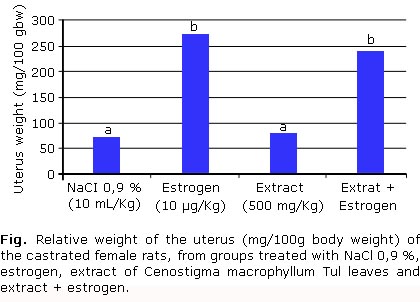
<body><![CDATA[<p><font size="2" face="Verdana"> Was no observed difference in the uterus weight    from rats treated with the extract when compared to the NaCl 0.9 % group, which    demonstrates the absence of estrogenic activity in the ethanol extract of <i>Cenostigma</i>    <i>macrophyllum </i>Tul. (<a href="#fig1">Fig.</a>). When was compared uterine    weight of rats treated with estrogen relative to the group that received estrogen    and extract, no significant difference was detected. This result indicates absence    of anti-estrogenic activity in the extract. </font></p>     <p align="center"> <img src="/img/revistas/pla/v20n3/f0102315.jpg" width="420" height="302"><a name="fig1"></a></p>     <p><font size="2" face="Verdana"> The mean of reproductive parameters evaluated    in pregnant rats showed no significant difference between treatments (<a href="/img/revistas/pla/v20n3/t0102315.gif">table    1</a>). Also no morphological or functional changes in mothers or fetuses were    observed, showing that the ethanol extract of <i>Cenostigma macrophyllum </i>Tul.    has no toxicity over pregnancy of rats. </font></p>     <p align="left"> <font size="2" face="Verdana">There was a decrease in the duration    of the estrus stage during and after treatment with the ethanol extract of <i>Cenostigma    macrophyllum</i> Tul., whereas the overall duration of the estrous cycle was    longer during these periods (<a href="/img/revistas/pla/v20n3/t0202315.gif">table 2</a>). </font></p>     <p align="left"> <font size="2" face="Verdana">Histopathological analysis revealed    no signs of degenerative, inflammatory or necrotic changes in the organs of    rats subjected to treatment with extract when compared to the control group    (data not shown). </font></p>     <p>&nbsp; </p>     <p> <font size="2" face="Verdana"><b><font size="3">DISCUSSION </font></b> </font></p>     <p><font size="2" face="Verdana"> Chemical or physical agents can affect the female    reproductive system in any period of the cycle of their life. This system starts    to be formed in the beginning of pregnancy, but the structural and functional    maturation only is completed at the start of puberty.<sup>24</sup> In the prenatal    and postnatal phases, the sexual organs and the central nervous system, which    still are not differentiated, can be affected also by substances present in    the maternal blood by means of the placenta. Moreover, during the critical periods    of development the individuals are more vulnerable to the action of chemical    substances in function of the lesser metabolic and excretory capacity and the    absence of many feedback mechanisms of the endocrine system.<sup>25</sup> </font></p>     <p><font size="2" face="Verdana"> The evaluation of the toxic effects of a drug    includes researches about possible results on the maternal organism,<sup> </sup>because    the maternal toxicity, that is defined as a transitory or permanent alteration    in the maternal physiology with potential to cause adverse effects in the offspring    during the embryo development or postnatal, is intimately associated with particular    malformations of each species.<sup>26</sup> </font></p>     <p><font size="2" face="Verdana"> One of the effects researched in plants with    therapeutical potential is the estrogenic and antiestrogen activity. The <a href="/img/revistas/pla/v20n3/f0102315.jpg">figure</a><b>    </b>presents the means of the uterine weights of the castrated female rats submitted    to several treatments. It is observed that there was no difference regarding    the weight of the uterus of rats treated with extract when compared with the    group treated with NaCl 0.9 %. This demonstrates the absence of the estrogenic    activity in the ethanol extract of <i>C. macrophyllum </i>Tul. On the other    hand, in the comparison between the groups treated with estrogen and extracts    associated with estrogen, a significant difference was not observed, revealing    the lack of antiestrogenic activity of the extract under study. Evaluating the    quality of the experiment carried out, it was verified that the uterine weight    of the female rats treated with estrogen was significantly superior to the ones    treated with NaCl 0.9 % (p &lt; 0.05), indicating that the controls, negative    and positive, were well established and that the hormone used has satisfactory    activity. </font></p>     ]]></body>
<body><![CDATA[<p><font size="2" face="Verdana"> The implantation is the process by which the    embryo does physical contact and intimate physiological contact with the maternal    endometrium for the establishment of the gestation. Although there is a variation    in the process between species, certain basic events are similar. The fundamental    characteristic of this process is the synchronized development of the embryo    for the stage of blastocyst and the differentiation of the uterus for the receptive    condition. Following, interaction happens between the blastocyst activated and    the uterine epithelium to start the implantation.<sup>27</sup> </font></p>     <p><font size="2" face="Verdana"> The implantation occurs normally in the 4th    or 5th day in rodents, interferences during this period can lead to losses in    the embryonic implantation. <sup>28,29</sup> The ingestion of the extract did    not cause modifications in the number of implantation sites (<a href="/img/revistas/pla/v20n3/t0102315.gif">table    1</a>), which indicates the absence of toxicity during this phase and also confirms    the lack of estrogenic activity, since the presence of this activity in plant&#8217;s    extracts can inhibit up to 100 % of the implantations in female rats, as was    observed by Jagadish for <i>Calotropis procera</i>.<sup>30</sup> It also confirms    the lack of antiestrogenic activity, since the antiestrogenics substances administered    to the rats during the first three days of pregnancy present anti-implantation    effect.<sup>31 </sup>According to Gandhi, plants that exhibit antiestrogenic    activity have the capacity of interrupting the gestation in rats and mice, by    means of the inhibition of the estrogen necessary for the implantation in several    species, including non-humans.<sup>32</sup> </font></p>     <p><font size="2" face="Verdana"> As can be observed in <a href="/img/revistas/pla/v20n3/t0202315.gif">table    2</a>, besides the means of the implantation number, the number of live fetuses,    mean weight of the fetuses and mean weight of the placentas, in the control    and extract groups, did not present a statistically significant difference between    the treatments, not showing morphological or functional alterations on the mothers    of on the fetuses, demonstrating that there is no toxicity in the plant&#8217;s    extract over gestation. That also demonstrates the lack of antiestrogenic activity,    once the estrogens are necessary to the development of an environment appropriate    for fertilization, implantation, nutrition of the embryo and parturition.<sup>33</sup>    </font></p>     <p><font size="2" face="Verdana"> In this study, the number of offspring in each    litter was not changed by the treatment of the mothers with extract, suggesting    that it does not exert toxicity during this phase.<sup>34 </sup>There was also    no alteration in the weight of the newborn, showing a lack of toxicity during    the growing phase. Congenital defects were not observed, what demonstrates the    lack of teratogenic effects in the extract, indicating that the extract did    not significantly change the immunological, endocrine, nutritional and the vascular    aspects necessary to the growing and the normal development of the embryo and    the fetuses.<sup>35</sup> </font></p>     <p><font size="2" face="Verdana"> The pattern of events in the estrous cycle provides    an useful indicator of the normality of the neurocrine function of the non pregnant    females, its knowledge permits that the most favorable moment for mating be    monitored, as well as the evaluation of the hormonal cycle based in the anatomical,    histological and cytological alterations of the genital systems. The estrous    cycle can be followed, in the rat, by observing the changes in the standard    cytological vaginal smear.<sup>36,37</sup> In this experiment, the frequency    of appearance of each of the phases was evaluated and it was only observed a    significant reduction in the number of estrus in the treatment and pos-treatment    periods, indicating a toxic effect of the extract on follicular growing mechanism    and/or ovulation (<a href="/img/revistas/pla/v20n3/t0202315.gif">table 2</a>). </font></p>     <p><font size="2" face="Verdana"> The regular duration of the estrous cycle of    the rat, represented by the interval between estrus, varies between 98 to 106    h, while the proestrus varies between 12 to 14, the estrus between 25 to 27,    the metestrus between 6 to 8 and the diestrus 55 to 57 h.<sup>38</sup> In <a href="/img/revistas/pla/v20n3/t0202315.gif">table    2</a>, a mean duration of the estrous cycle of 81,1 h was observed during the    pretreatment period, 111.4 during the treatment and of 106,1 in the pos-treatment    period, being observed a significant raise of the duration of the estrous cycle    (p &lt; 0.05) during the treatment and pos-treatment period, which can be related    to the decrease of the follicular growth.<sup>24</sup> </font></p>     <p><font size="2" face="Verdana"> The histopathological analysis did not reveal    the signs of degenerative, inflammatory or necrotic alterations, be in the heart,    liver or kidneys in the female pregnant rats from the groups treated with the    extract in relation to the control group. This shows that the extract did not    change the morphological structures of these organs, suggesting the absence    of systemic toxicity, considering that they are very effused and exposed to    substances present in the circulation. </font></p>     <p><font size="2" face="Verdana"> In synthesis, the extract from the leaves of    <i>C. macrophyllum</i> Tul, used orally in castrated female rats did not present    estrogenic activity on the uterus, did not affect the pregnant rats in the litter&#8217;s    uterine development, did not produce histopathological alterations on the heart,    kidneys and liver of pregnant female rats. However, it produced alteration of    the estrous cycle, decreasing the number of estrus and raising the duration    of the cycle. Considering this, the extract from the leaves of <i>C. macrophyllum</i>    Tul, must have its use better evaluated, if it is to be recommended for oral    therapy in women of reproductive age. </font></p>     <p>&nbsp;</p>     <p> <font size="2" face="Verdana"><b>ACKNOWLEDGEMENTS</b> </font></p>     ]]></body>
<body><![CDATA[<p> <font size="2" face="Verdana"><i>Dr. Maur&#237;cio Teles Freire</i> from the    Department of Biology of the Federal University of Piau&#237;, for the identification    of the botanical material, to the grant&#8217;s organs for the scholarships    given to <i>Mariana H. Chaves</i> and <i>Jamylla Mirck Guerra de Oliveira</i>    and the financial help (CNPq, CAPES/PROCAD). </font></p>     <p>&nbsp;</p>     <p> <font size="2" face="Verdana"><b><font size="3">REFERENCES</font></b> </font></p>     <!-- ref --><p><font size="2" face="Verdana"> 1. Minist&#233;rio do Meio Ambiente, dos Recursos    H&#237;dricos e da Amaz&#244;nia. </font><font size="2" face="Verdana">Legal.    Primeiro relat&#243;rio nacional para a Conven&#231;&#227;o sobre Biodiversidade    Biol&#243;gica &#8211; Brasil. Minist&#233;rio do Meio Ambiente, dos Recursos    H&#237;dricos e da Amaz&#244;nia Legal, Bras&#237;lia;1998.     </font></p>     <!-- ref --><p><font size="2" face="Verdana"> 2. Torres AR, Oliveira RAG, Diniz MFFM, Ara&#250;jo    EC. Estudo sobre o uso de plantas medicinais em crian&#231;as hospitalizadas    da cidade de Jo&#227;o Pessoa: riscos e benef&#237;cios. Rev Bras Farmacogn<i>.</i>    2005;(15):373-80.     </font></p>     <!-- ref --><p><font size="2" face="Verdana"> 3. Sousa CD, Silva HR, Vieira GM, Ayres MC,    Costa CD, Ara&#250;jo DS, et al. Fen&#243;is totais e atividade antioxidante    de cinco plantas medicinais. Quim Nova. 2007;30(2):351-55.     </font></p>     <!-- ref --><p><font size="2" face="Verdana"> 4. Brand&#227;o MG, Consenza GP, Moreira RA,    Monte RL. Medicinal plants and other botanical products from the Brazilian Official    Pharmacopeia. Rev Bras Farmacog. 2006;(16):408-20.     </font></p>     <!-- ref --><p><font size="2" face="Verdana"> 5. Brand&#227;o MG, Consenza GP, Moreira RA,    Monte RL. Medicinal plants and other botanical products from the Brazilian Official    Pharmacopeia. Rev Bras Farmacog. 2008;(18):127-34.     </font></p>     <!-- ref --><p><font size="2" face="Verdana"> 6. Goldwyn S, Lazinsky A, Wei H. Promotion of    health by soy isoflavones: efficacy, benefit and safety concerns. Drug Metabolism    and Drug Interaction. 2000;(17):261&#8211;89.     </font></p>     <!-- ref --><p><font size="2" face="Verdana"> 7. Suthar AC, Banavalikar MM, Biyani MK. Pharmacological    activities of genistein, an isoflavone from soy (<i>Glycine max</i>): part Ianti-    cancer activity. Indian Journal of Experimental Biology. 2001;(39):511&#8211;19.        </font></p>     <!-- ref --><p><font size="2" face="Verdana"> 8. Suthar AC, Banavalikar MM, Biyani MK. Pharmacological    activities of genistein, an isoflavone from soy (Glycine max): part IIanti-    cholesterol activity, effects on osteoporosis and menopausal symptoms. Indian    Journal of Experimental Biology. 2001;(39):520&#8211;25.     </font></p>     <!-- ref --><p><font size="2" face="Verdana"> 9. Kuiper GG, Carlsson B, Gradien K. Comparison    of the ligand binding specificity and transcript tissue distribution of estrogen    receptors alpha and beta. Endocrinology. 1998;(70):138.     </font></p>     <!-- ref --><p><font size="2" face="Verdana"> 10. Tham DM, Gardner CD, Haskell WL. Potential    health benefits of dietary phytoestrogens: a review of the clinical, epidemiological    and mechanistic evidence. J Clin Endocrinol Metab. 1998;(83):2223-35.     </font></p>     <!-- ref --><p><font size="2" face="Verdana"> 11. Kurzer MS, Xu X. Dietary phytoestrogens.    Annu Rev Nutr. 1997;(17):353-81.     </font></p>     <!-- ref --><p><font size="2" face="Verdana"> 12. Hegnauer R, Barkmeijer RJG. Relevance of    seed polyssacarides and flavon&#243;ides for the classification of the Leguminosae:    a chemotaxonomic approach. Phytochemistry. 1993;(34):3.     </font></p>     <!-- ref --><p><font size="2" face="Verdana"> 13. Sales BHLN. Flavon&#243;ides de <i>Lonchocarpus    subguacescens</i> (Benth) &#8211; Leguminosae e s&#237;ntese de &#945;- Hidroxichalconas.    [dissertation]. Campinas (SP): Instituto de Qu&#237;mica da UNICAMP; 1994.     </font></p>     <!-- ref --><p><font size="2" face="Verdana"> 14. Santos CA, Torres KR, Leonart R. Plantas    medicinais: Herbarium, flora et scientia<i>. </i>2nd ed. S&#227;o Paulo: Editora    &#205;cone; 1988.     </font></p>     <!-- ref --><p><font size="2" face="Verdana"> 15. Rocha H, Silva CC, Neto LB, Lopes JA, Cit&#243;    AM, Chaves MH. Constituintes qu&#237;micos das cascas do caule de <i>Cenostigma    macrophyllum</i>: ocorr&#234;ncia de colesterol. Quim Nova. 2007;30(8):1877-881.        </font></p>     <!-- ref --><p><font size="2" face="Verdana"> 16. Kang DG, Yin MH, Oh H, Lee DH, Lee HS. Inhibiting    activities of the secondary metabolites of <i>Phlomis brunneogaleata</i> against    parasitic protozoa and plasmodia enoyl-ACP reductase, a crucial enzyme in fatty    acid biosynthesis. Planta Medica. 2004;(70):718.     </font></p>     <!-- ref --><p><font size="2" face="Verdana"> 17. Saponara R, Bosisio E. Inhibition of CAMP-Phosphodiesterase    by biflavones of <i>Ginkgo biloba</i> in rat adipose tissue. Journal of Natural    Products. 1997;(61):1386.     </font></p>     <!-- ref --><p><font size="2" face="Verdana"> 18. Rodrigues MD, Martins-da-Silva RC, Secco    RDS. Caesalpinieae (Leguminosae-Caesalpinioideae) from the Experimental field    of the Embrapa Eastern Amazon, Moju, Par&#225; State, Brazil. Hoehnea. 2012;39(3):489-516.    <!-- ref -->    </font>  </font>      ]]></body>
<body><![CDATA[<!-- ref --><p><font size="2" face="Verdana"> 20. Nascimento JM, Concei&#231;&#227;o GM. Plantas    medicinais e indica&#231;&#245;es terap&#234;uticas da comunidade quilombola    olho d&#8217;&#225;gua do raposo, Caxias, Maranh&#227;o, Brasil. BioFar. 2011;6(2):138-51.        </font></p>     <!-- ref --><p><font size="2" face="Verdana"> 21. Hanrahan JR, Chebib M, Davucheron NL, Hall    BJ, Johnston GAR. Semi synthetic Preparation of amentoflavone: a negative modator    at GABA receptors Bioorganic. Medicinal Chemistry Letters. 2003;(13):2281.     </font></p>     <!-- ref --><p><font size="2" face="Verdana"> 22. Silva MI, Gondim AP, Nunes IF, Sousa FC.    Utiliza&#231;&#227;o de fitoter&#225;picos nas unidades b&#225;sicas de aten&#231;&#227;o    &#224; sa&#250;de da fam&#237;lia no munic&#237;pio de Maracana&#250; (CE).    Rev Bras farmacogn<i>.</i> 1997;(16):455-62.     </font></p>     <!-- ref --><p><font size="2" face="Verdana"> 23. Marcondes FK, Bianchi FJ, Tanno AP. Determination    of the estrous cycle phases of rats: some helpful considerations. Braz. J Biol.    2001;(62):609-14.     </font></p>     <!-- ref --><p><font size="2" face="Verdana"> 24. US EPA. Guidelines for reproductive toxicity    risk assessment. EPA/630/R-96/009: Washington;1996.     </font></p>     ]]></body>
<body><![CDATA[<!-- ref --><p><font size="2" face="Verdana"> 25. Zenick H, Clegg ED. Assessment of male reproductive    toxicity: A risk of assessment approach. In: Principles and methods of toxicology.    In: New York: Raven Press; 1989. p. 275-309.     </font></p>     <!-- ref --><p><font size="2" face="Verdana"> 26. Khera KS. Maternal toxicity of drugs and    metabolic disorders: a possible etiologic factor in the intrauterine death and    congenital malformations: a critique on human data.<i> </i>Rev Toxicol. 1987;(17):345-75.        </font></p>     <!-- ref --><p><font size="2" face="Verdana"> 27. Paria BC, Lim K, Das SK, Reese J, Dey SK.    Molecular signaling in uterine receptivity for implantation. Cell &amp; Develop    Biology. 2000;(11):67-76.     </font></p>     <!-- ref --><p><font size="2" face="Verdana"> 28. Beaudoin AR. Embryology and teratology.    In: Baker HJ, Lindsey JR, Weisbroth SH. The laboratory rat (Research application).    New York: Academic Press. 1980;2:75-94.     </font></p>     <!-- ref --><p><font size="2" face="Verdana"> 29. Allen WR. Maternal recognition and maintenance    of pregnancy in the mare. Anim. Reprod. 2005;2(4):209-23.     </font></p>     ]]></body>
<body><![CDATA[<!-- ref --><p><font size="2" face="Verdana"> 30. Jagadish VK, Rana AC. Preliminary study    on fertility activity of <i>Calotropis procera</i> roots in female rats. Fitoterapia.    2002;(73):111-15.     </font></p>     <!-- ref --><p><font size="2" face="Verdana"> 31. Dao B. Anti-Implantation Activity of Antiestrogens    and Mifepristone. Contraception. 1996;(54): 253-8.     </font></p>     <!-- ref --><p><font size="2" face="Verdana"> 32. Ghandi M, Lal R, Sankaranarayanan A, Sharma    PL. Post-coital antifertility activity of <i>Ruta gravoleolens</i> in female    rats and hamsters. Journal of Ethnopharmacology. 1991;(34):49-50.     </font></p>     <!-- ref --><p><font size="2" face="Verdana"> 33. Lindzey J, Korach K. Estrogen Action on    the Female Reproductive Tract. In: Knobil E, Neill JD. Encyclopedia of Reproduction.    San Diego: Academic Press; 1999. p. 79-86.     </font></p>     <!-- ref --><p><font size="2" face="Verdana"> 34. Frohberg H. An introduction to research    teratology. In: Neubert D, Merker HJ, Kwasigroch TE. Methods in prenatal toxicology.    Stuttgart: Georg Thieme Publisher; 1977. p. 1-13.     </font></p>     ]]></body>
<body><![CDATA[<!-- ref --><p><font size="2" face="Verdana"> 35. Chahoud I, Ligensa A, Dietzel L, Faqi AS.    Correlation between maternal toxicity and embryo/fetal effects. Reprod Toxicol.<i>    </i>1999;(13):375-81.     </font></p>     <!-- ref --><p><font size="2" face="Verdana"> 36. Long JA, Evans HM. The oestrus cycle in    the rat and its associated phenomena. Mem Univ Calif. 1922;(6):1-111.     </font></p>     <!-- ref --><p><font size="2" face="Verdana"> 37. Cooper RL, Goldman JM, Vandenbergh JG. Monitoring    of the estrous in the laboratory rodent by lavage vaginal. In: Heidell, JJ,    Chapin RE. Methods in Toxicology: Female Reproductive Toxicology. San Diego:    Academic Press; 1993. p. 45-56.     </font></p>     <!-- ref --><p><font size="2" face="Verdana"> 38. Freeman ME. The neuroendocrine control of    the ovarian cycle of the rat. In Knobill and Neill (Ed.). The Physiology of    reproduction, 2nd ed. New York: Raven Press; 1994. p. 12.     </font></p>     <p>&nbsp;</p>     <p>&nbsp;</p>     ]]></body>
<body><![CDATA[<p><font size="2" face="Verdana"> Recibido: 26 de enero de 2014.    <br>   </font><font size="2" face="Verdana">Aprobado: 21 de marzo de 2015. </font></p>     <p>&nbsp;</p>     <p>&nbsp;</p>     <p> <font size="2" face="Verdana"><i>Amilton Paulo Raposo Costa</i>. Rua Sem Luis    Mendes R. Gon&#231;alves, 4403, CEP 64055-350.Teresina Piau&#237;, Brazil. </font><font size="2" face="Verdana">    <br>   Correo electr&#243;nico:<i> </i><a href="mailto:amilfox@uol.com.br">amilfox@uol.com.br</a></font></p>      ]]></body><back>
<ref-list>
<ref id="B1">
<label>1</label><nlm-citation citation-type="book">
<collab>Ministério do Meio Ambiente, dos Recursos Hídricos e da Amazônia</collab>
<source><![CDATA[Legal: Primeiro relatório nacional para a Convenção sobre Biodiversidade Biológica - Brasil]]></source>
<year>1998</year>
<publisher-loc><![CDATA[Brasília ]]></publisher-loc>
<publisher-name><![CDATA[Ministério do Meio Ambiente, dos Recursos Hídricos e da Amazônia Legal]]></publisher-name>
</nlm-citation>
</ref>
<ref id="B2">
<label>2</label><nlm-citation citation-type="journal">
<person-group person-group-type="author">
<name>
<surname><![CDATA[Torres]]></surname>
<given-names><![CDATA[AR]]></given-names>
</name>
<name>
<surname><![CDATA[Oliveira]]></surname>
<given-names><![CDATA[RAG]]></given-names>
</name>
<name>
<surname><![CDATA[Diniz]]></surname>
<given-names><![CDATA[MFFM]]></given-names>
</name>
<name>
<surname><![CDATA[Araújo]]></surname>
<given-names><![CDATA[EC]]></given-names>
</name>
</person-group>
<article-title xml:lang="pt"><![CDATA[Estudo sobre o uso de plantas medicinais em crianças hospitalizadas da cidade de João Pessoa: riscos e benefícios]]></article-title>
<source><![CDATA[Rev Bras Farmacogn]]></source>
<year>2005</year>
<numero>15</numero>
<issue>15</issue>
<page-range>373-80</page-range></nlm-citation>
</ref>
<ref id="B3">
<label>3</label><nlm-citation citation-type="journal">
<person-group person-group-type="author">
<name>
<surname><![CDATA[Sousa]]></surname>
<given-names><![CDATA[CD]]></given-names>
</name>
<name>
<surname><![CDATA[Silva]]></surname>
<given-names><![CDATA[HR]]></given-names>
</name>
<name>
<surname><![CDATA[Vieira]]></surname>
<given-names><![CDATA[GM]]></given-names>
</name>
<name>
<surname><![CDATA[Ayres]]></surname>
<given-names><![CDATA[MC]]></given-names>
</name>
<name>
<surname><![CDATA[Costa]]></surname>
<given-names><![CDATA[CD]]></given-names>
</name>
<name>
<surname><![CDATA[Araújo]]></surname>
<given-names><![CDATA[DS]]></given-names>
</name>
</person-group>
<article-title xml:lang="pt"><![CDATA[Fenóis totais e atividade antioxidante de cinco plantas medicinais]]></article-title>
<source><![CDATA[Quim Nova]]></source>
<year>2007</year>
<volume>30</volume>
<numero>2</numero>
<issue>2</issue>
<page-range>351-55</page-range></nlm-citation>
</ref>
<ref id="B4">
<label>4</label><nlm-citation citation-type="journal">
<person-group person-group-type="author">
<name>
<surname><![CDATA[Brandão]]></surname>
<given-names><![CDATA[MG]]></given-names>
</name>
<name>
<surname><![CDATA[Consenza]]></surname>
<given-names><![CDATA[GP]]></given-names>
</name>
<name>
<surname><![CDATA[Moreira]]></surname>
<given-names><![CDATA[RA]]></given-names>
</name>
<name>
<surname><![CDATA[Monte]]></surname>
<given-names><![CDATA[RL]]></given-names>
</name>
</person-group>
<article-title xml:lang="en"><![CDATA[Medicinal plants and other botanical products from the Brazilian Official Pharmacopeia]]></article-title>
<source><![CDATA[Rev Bras Farmacog]]></source>
<year>2006</year>
<numero>16</numero>
<issue>16</issue>
<page-range>408-20</page-range></nlm-citation>
</ref>
<ref id="B5">
<label>5</label><nlm-citation citation-type="journal">
<person-group person-group-type="author">
<name>
<surname><![CDATA[Brandão]]></surname>
<given-names><![CDATA[MG]]></given-names>
</name>
<name>
<surname><![CDATA[Consenza]]></surname>
<given-names><![CDATA[GP]]></given-names>
</name>
<name>
<surname><![CDATA[Moreira]]></surname>
<given-names><![CDATA[RA]]></given-names>
</name>
<name>
<surname><![CDATA[Monte]]></surname>
<given-names><![CDATA[RL]]></given-names>
</name>
</person-group>
<article-title xml:lang="en"><![CDATA[Medicinal plants and other botanical products from the Brazilian Official Pharmacopeia]]></article-title>
<source><![CDATA[Rev Bras Farmacog]]></source>
<year>2008</year>
<numero>18</numero>
<issue>18</issue>
<page-range>127-34</page-range></nlm-citation>
</ref>
<ref id="B6">
<label>6</label><nlm-citation citation-type="journal">
<person-group person-group-type="author">
<name>
<surname><![CDATA[Goldwyn]]></surname>
<given-names><![CDATA[S]]></given-names>
</name>
<name>
<surname><![CDATA[Lazinsky]]></surname>
<given-names><![CDATA[A]]></given-names>
</name>
<name>
<surname><![CDATA[Wei]]></surname>
<given-names><![CDATA[H]]></given-names>
</name>
</person-group>
<article-title xml:lang="en"><![CDATA[Promotion of health by soy isoflavones: efficacy, benefit and safety concerns]]></article-title>
<source><![CDATA[Drug Metabolism and Drug Interaction]]></source>
<year>2000</year>
<numero>17</numero>
<issue>17</issue>
<page-range>261-89</page-range></nlm-citation>
</ref>
<ref id="B7">
<label>7</label><nlm-citation citation-type="journal">
<person-group person-group-type="author">
<name>
<surname><![CDATA[Suthar]]></surname>
<given-names><![CDATA[AC]]></given-names>
</name>
<name>
<surname><![CDATA[Banavalikar]]></surname>
<given-names><![CDATA[MM]]></given-names>
</name>
<name>
<surname><![CDATA[Biyani]]></surname>
<given-names><![CDATA[MK]]></given-names>
</name>
</person-group>
<article-title xml:lang="en"><![CDATA[Pharmacological activities of genistein, an isoflavone from soy (Glycine max): part Ianti- cancer activity]]></article-title>
<source><![CDATA[Indian Journal of Experimental Biology]]></source>
<year>2001</year>
<numero>39</numero>
<issue>39</issue>
<page-range>511-19</page-range></nlm-citation>
</ref>
<ref id="B8">
<label>8</label><nlm-citation citation-type="journal">
<person-group person-group-type="author">
<name>
<surname><![CDATA[Suthar]]></surname>
<given-names><![CDATA[AC]]></given-names>
</name>
<name>
<surname><![CDATA[Banavalikar]]></surname>
<given-names><![CDATA[MM]]></given-names>
</name>
<name>
<surname><![CDATA[Biyani]]></surname>
<given-names><![CDATA[MK]]></given-names>
</name>
</person-group>
<article-title xml:lang="en"><![CDATA[Pharmacological activities of genistein, an isoflavone from soy (Glycine max): part IIanti- cholesterol activity, effects on osteoporosis and menopausal symptoms]]></article-title>
<source><![CDATA[Indian Journal of Experimental Biology]]></source>
<year>2001</year>
<numero>39</numero>
<issue>39</issue>
<page-range>520-25</page-range></nlm-citation>
</ref>
<ref id="B9">
<label>9</label><nlm-citation citation-type="journal">
<person-group person-group-type="author">
<name>
<surname><![CDATA[Kuiper]]></surname>
<given-names><![CDATA[GG]]></given-names>
</name>
<name>
<surname><![CDATA[Carlsson]]></surname>
<given-names><![CDATA[B]]></given-names>
</name>
<name>
<surname><![CDATA[Gradien]]></surname>
<given-names><![CDATA[K]]></given-names>
</name>
</person-group>
<article-title xml:lang="en"><![CDATA[Comparison of the ligand binding specificity and transcript tissue distribution of estrogen receptors alpha and beta]]></article-title>
<source><![CDATA[Endocrinology]]></source>
<year>1998</year>
<numero>70</numero>
<issue>70</issue>
<page-range>138</page-range></nlm-citation>
</ref>
<ref id="B10">
<label>10</label><nlm-citation citation-type="journal">
<person-group person-group-type="author">
<name>
<surname><![CDATA[Tham]]></surname>
<given-names><![CDATA[DM]]></given-names>
</name>
<name>
<surname><![CDATA[Gardner]]></surname>
<given-names><![CDATA[CD]]></given-names>
</name>
<name>
<surname><![CDATA[Haskell]]></surname>
<given-names><![CDATA[WL]]></given-names>
</name>
</person-group>
<article-title xml:lang="en"><![CDATA[Potential health benefits of dietary phytoestrogens: a review of the clinical, epidemiological and mechanistic evidence]]></article-title>
<source><![CDATA[J Clin Endocrinol Metab]]></source>
<year>1998</year>
<numero>83</numero>
<issue>83</issue>
<page-range>2223-35</page-range></nlm-citation>
</ref>
<ref id="B11">
<label>11</label><nlm-citation citation-type="journal">
<person-group person-group-type="author">
<name>
<surname><![CDATA[Kurzer]]></surname>
<given-names><![CDATA[MS]]></given-names>
</name>
<name>
<surname><![CDATA[Xu]]></surname>
<given-names><![CDATA[X]]></given-names>
</name>
</person-group>
<article-title xml:lang="en"><![CDATA[Dietary phytoestrogens]]></article-title>
<source><![CDATA[Annu Rev Nutr]]></source>
<year>1997</year>
<numero>17</numero>
<issue>17</issue>
<page-range>353-81</page-range></nlm-citation>
</ref>
<ref id="B12">
<label>12</label><nlm-citation citation-type="journal">
<person-group person-group-type="author">
<name>
<surname><![CDATA[Hegnauer]]></surname>
<given-names><![CDATA[R]]></given-names>
</name>
<name>
<surname><![CDATA[Barkmeijer]]></surname>
<given-names><![CDATA[RJG]]></given-names>
</name>
</person-group>
<article-title xml:lang="en"><![CDATA[Relevance of seed polyssacarides and flavonóides for the classification of the Leguminosae: a chemotaxonomic approach]]></article-title>
<source><![CDATA[Phytochemistry]]></source>
<year>1993</year>
<numero>34</numero>
<issue>34</issue>
<page-range>3</page-range></nlm-citation>
</ref>
<ref id="B13">
<label>13</label><nlm-citation citation-type="">
<person-group person-group-type="author">
<name>
<surname><![CDATA[Sales]]></surname>
<given-names><![CDATA[BHLN]]></given-names>
</name>
</person-group>
<source><![CDATA[Flavonóides de Lonchocarpus subguacescens (Benth) - Leguminosae e síntese de &#945;- Hidroxichalconas]]></source>
<year></year>
</nlm-citation>
</ref>
<ref id="B14">
<label>14</label><nlm-citation citation-type="book">
<person-group person-group-type="author">
<name>
<surname><![CDATA[Santos]]></surname>
<given-names><![CDATA[CA]]></given-names>
</name>
<name>
<surname><![CDATA[Torres]]></surname>
<given-names><![CDATA[KR]]></given-names>
</name>
<name>
<surname><![CDATA[Leonart]]></surname>
<given-names><![CDATA[R]]></given-names>
</name>
</person-group>
<source><![CDATA[Plantas medicinais: Herbarium, flora et scientia]]></source>
<year>1988</year>
<edition>2nd</edition>
<publisher-loc><![CDATA[São Paulo ]]></publisher-loc>
<publisher-name><![CDATA[Editora Ícone]]></publisher-name>
</nlm-citation>
</ref>
<ref id="B15">
<label>15</label><nlm-citation citation-type="journal">
<person-group person-group-type="author">
<name>
<surname><![CDATA[Rocha]]></surname>
<given-names><![CDATA[H]]></given-names>
</name>
<name>
<surname><![CDATA[Silva]]></surname>
<given-names><![CDATA[CC]]></given-names>
</name>
<name>
<surname><![CDATA[Neto]]></surname>
<given-names><![CDATA[LB]]></given-names>
</name>
<name>
<surname><![CDATA[Lopes]]></surname>
<given-names><![CDATA[JA]]></given-names>
</name>
<name>
<surname><![CDATA[Citó]]></surname>
<given-names><![CDATA[AM]]></given-names>
</name>
<name>
<surname><![CDATA[Chaves]]></surname>
<given-names><![CDATA[MH]]></given-names>
</name>
</person-group>
<article-title xml:lang="pt"><![CDATA[Constituintes químicos das cascas do caule de Cenostigma macrophyllum: ocorrência de colesterol]]></article-title>
<source><![CDATA[Quim Nova]]></source>
<year>2007</year>
<volume>30</volume>
<numero>8</numero>
<issue>8</issue>
<page-range>1877-881</page-range></nlm-citation>
</ref>
<ref id="B16">
<label>16</label><nlm-citation citation-type="journal">
<person-group person-group-type="author">
<name>
<surname><![CDATA[Kang]]></surname>
<given-names><![CDATA[DG]]></given-names>
</name>
<name>
<surname><![CDATA[Yin]]></surname>
<given-names><![CDATA[MH]]></given-names>
</name>
<name>
<surname><![CDATA[Oh]]></surname>
<given-names><![CDATA[H]]></given-names>
</name>
<name>
<surname><![CDATA[Lee]]></surname>
<given-names><![CDATA[DH]]></given-names>
</name>
<name>
<surname><![CDATA[Lee]]></surname>
<given-names><![CDATA[HS]]></given-names>
</name>
</person-group>
<article-title xml:lang="en"><![CDATA[Inhibiting activities of the secondary metabolites of Phlomis brunneogaleata against parasitic protozoa and plasmodia enoyl-ACP reductase, a crucial enzyme in fatty acid biosynthesis]]></article-title>
<source><![CDATA[Planta Medica]]></source>
<year>2004</year>
<numero>70</numero>
<issue>70</issue>
<page-range>718</page-range></nlm-citation>
</ref>
<ref id="B17">
<label>17</label><nlm-citation citation-type="journal">
<person-group person-group-type="author">
<name>
<surname><![CDATA[Saponara]]></surname>
<given-names><![CDATA[R]]></given-names>
</name>
<name>
<surname><![CDATA[Bosisio]]></surname>
<given-names><![CDATA[E]]></given-names>
</name>
</person-group>
<article-title xml:lang="en"><![CDATA[Inhibition of CAMP-Phosphodiesterase by biflavones of Ginkgo biloba in rat adipose tissue]]></article-title>
<source><![CDATA[Journal of Natural Products]]></source>
<year>1997</year>
<numero>61</numero>
<issue>61</issue>
<page-range>1386</page-range></nlm-citation>
</ref>
<ref id="B18">
<label>18</label><nlm-citation citation-type="journal">
<person-group person-group-type="author">
<name>
<surname><![CDATA[Rodrigues]]></surname>
<given-names><![CDATA[MD]]></given-names>
</name>
<name>
<surname><![CDATA[Martins-da-Silva]]></surname>
<given-names><![CDATA[RC]]></given-names>
</name>
<name>
<surname><![CDATA[Secco]]></surname>
<given-names><![CDATA[RDS]]></given-names>
</name>
</person-group>
<article-title xml:lang="en"><![CDATA[Caesalpinieae (Leguminosae-Caesalpinioideae) from the Experimental field of the Embrapa Eastern Amazon, Moju, Pará State, Brazil]]></article-title>
<source><![CDATA[Hoehnea]]></source>
<year>2012</year>
<volume>39</volume>
<numero>3</numero>
<issue>3</issue>
<page-range>489-516</page-range></nlm-citation>
</ref>
<ref id="B19">
<label>19</label><nlm-citation citation-type="journal">
<person-group person-group-type="author">
<name>
<surname><![CDATA[Coelho]]></surname>
<given-names><![CDATA[NP]]></given-names>
</name>
<name>
<surname><![CDATA[Nogueira]]></surname>
<given-names><![CDATA[VC]]></given-names>
</name>
<name>
<surname><![CDATA[Cardoso]]></surname>
<given-names><![CDATA[MA]]></given-names>
</name>
<name>
<surname><![CDATA[Lopes]]></surname>
<given-names><![CDATA[LD]]></given-names>
</name>
<name>
<surname><![CDATA[Nascimento]]></surname>
<given-names><![CDATA[PP]]></given-names>
</name>
<name>
<surname><![CDATA[Rocha]]></surname>
<given-names><![CDATA[ED]]></given-names>
</name>
</person-group>
<article-title xml:lang="en"><![CDATA[Cenostigma macrophyllum Tul: on the healing of skin wounds in rats with Diabetes mellitus]]></article-title>
<source><![CDATA[Acta Cir Bras]]></source>
<year>2013</year>
<volume>28</volume>
<numero>8</numero>
<issue>8</issue>
<page-range>594-600</page-range></nlm-citation>
</ref>
<ref id="B20">
<label>20</label><nlm-citation citation-type="journal">
<person-group person-group-type="author">
<name>
<surname><![CDATA[Nascimento]]></surname>
<given-names><![CDATA[JM]]></given-names>
</name>
<name>
<surname><![CDATA[Conceição]]></surname>
<given-names><![CDATA[GM]]></given-names>
</name>
</person-group>
<article-title xml:lang="pt"><![CDATA[Plantas medicinais e indicações terapêuticas da comunidade quilombola olho d'água do raposo, Caxias, Maranhão, Brasil]]></article-title>
<source><![CDATA[BioFar]]></source>
<year>2011</year>
<volume>6</volume>
<numero>2</numero>
<issue>2</issue>
<page-range>138-51</page-range></nlm-citation>
</ref>
<ref id="B21">
<label>21</label><nlm-citation citation-type="journal">
<person-group person-group-type="author">
<name>
<surname><![CDATA[Hanrahan]]></surname>
<given-names><![CDATA[JR]]></given-names>
</name>
<name>
<surname><![CDATA[Chebib]]></surname>
<given-names><![CDATA[M]]></given-names>
</name>
<name>
<surname><![CDATA[Davucheron]]></surname>
<given-names><![CDATA[NL]]></given-names>
</name>
<name>
<surname><![CDATA[Hall]]></surname>
<given-names><![CDATA[BJ]]></given-names>
</name>
<name>
<surname><![CDATA[Johnston]]></surname>
<given-names><![CDATA[GAR]]></given-names>
</name>
</person-group>
<article-title xml:lang="en"><![CDATA[Semi synthetic Preparation of amentoflavone: a negative modator at GABA receptors Bioorganic]]></article-title>
<source><![CDATA[Medicinal Chemistry Letters]]></source>
<year>2003</year>
<numero>13</numero>
<issue>13</issue>
<page-range>2281</page-range></nlm-citation>
</ref>
<ref id="B22">
<label>22</label><nlm-citation citation-type="journal">
<person-group person-group-type="author">
<name>
<surname><![CDATA[Silva]]></surname>
<given-names><![CDATA[MI]]></given-names>
</name>
<name>
<surname><![CDATA[Gondim]]></surname>
<given-names><![CDATA[AP]]></given-names>
</name>
<name>
<surname><![CDATA[Nunes]]></surname>
<given-names><![CDATA[IF]]></given-names>
</name>
<name>
<surname><![CDATA[Sousa]]></surname>
<given-names><![CDATA[FC]]></given-names>
</name>
</person-group>
<article-title xml:lang="pt"><![CDATA[Utilização de fitoterápicos nas unidades básicas de atenção à saúde da família no município de Maracanaú (CE)]]></article-title>
<source><![CDATA[Rev Bras farmacogn]]></source>
<year>1997</year>
<numero>16</numero>
<issue>16</issue>
<page-range>455-62</page-range></nlm-citation>
</ref>
<ref id="B23">
<label>23</label><nlm-citation citation-type="journal">
<person-group person-group-type="author">
<name>
<surname><![CDATA[Marcondes]]></surname>
<given-names><![CDATA[FK]]></given-names>
</name>
<name>
<surname><![CDATA[Bianchi]]></surname>
<given-names><![CDATA[FJ]]></given-names>
</name>
<name>
<surname><![CDATA[Tanno]]></surname>
<given-names><![CDATA[AP]]></given-names>
</name>
</person-group>
<article-title xml:lang="en"><![CDATA[Determination of the estrous cycle phases of rats: some helpful considerations]]></article-title>
<source><![CDATA[Braz J Biol]]></source>
<year>2001</year>
<numero>62</numero>
<issue>62</issue>
<page-range>609-14</page-range></nlm-citation>
</ref>
<ref id="B24">
<label>24</label><nlm-citation citation-type="">
<collab>US EPA</collab>
<source><![CDATA[Guidelines for reproductive toxicity risk assessment: EPA/630/R-96/009]]></source>
<year>1996</year>
<publisher-loc><![CDATA[Washington ]]></publisher-loc>
</nlm-citation>
</ref>
<ref id="B25">
<label>25</label><nlm-citation citation-type="book">
<person-group person-group-type="author">
<name>
<surname><![CDATA[Zenick]]></surname>
<given-names><![CDATA[H]]></given-names>
</name>
<name>
<surname><![CDATA[Clegg]]></surname>
<given-names><![CDATA[ED]]></given-names>
</name>
</person-group>
<article-title xml:lang="en"><![CDATA[Assessment of male reproductive toxicity: A risk of assessment approach]]></article-title>
<source><![CDATA[Principles and methods of toxicology]]></source>
<year>1989</year>
<page-range>275-309</page-range><publisher-loc><![CDATA[New York ]]></publisher-loc>
<publisher-name><![CDATA[Raven Press]]></publisher-name>
</nlm-citation>
</ref>
<ref id="B26">
<label>26</label><nlm-citation citation-type="journal">
<person-group person-group-type="author">
<name>
<surname><![CDATA[Khera]]></surname>
<given-names><![CDATA[KS]]></given-names>
</name>
</person-group>
<article-title xml:lang="en"><![CDATA[Maternal toxicity of drugs and metabolic disorders: a possible etiologic factor in the intrauterine death and congenital malformations: a critique on human data]]></article-title>
<source><![CDATA[Rev Toxicol]]></source>
<year>1987</year>
<numero>17</numero>
<issue>17</issue>
<page-range>345-75</page-range></nlm-citation>
</ref>
<ref id="B27">
<label>27</label><nlm-citation citation-type="journal">
<person-group person-group-type="author">
<name>
<surname><![CDATA[Paria]]></surname>
<given-names><![CDATA[BC]]></given-names>
</name>
<name>
<surname><![CDATA[Lim]]></surname>
<given-names><![CDATA[K]]></given-names>
</name>
<name>
<surname><![CDATA[Das]]></surname>
<given-names><![CDATA[SK]]></given-names>
</name>
<name>
<surname><![CDATA[Reese]]></surname>
<given-names><![CDATA[J]]></given-names>
</name>
<name>
<surname><![CDATA[Dey]]></surname>
<given-names><![CDATA[SK]]></given-names>
</name>
</person-group>
<article-title xml:lang="en"><![CDATA[Molecular signaling in uterine receptivity for implantation]]></article-title>
<source><![CDATA[Cell & Develop Biology]]></source>
<year>2000</year>
<numero>11</numero>
<issue>11</issue>
<page-range>67-76</page-range></nlm-citation>
</ref>
<ref id="B28">
<label>28</label><nlm-citation citation-type="">
<person-group person-group-type="author">
<name>
<surname><![CDATA[Beaudoin]]></surname>
<given-names><![CDATA[AR]]></given-names>
</name>
</person-group>
<article-title xml:lang="en"><![CDATA[Embryology and teratology]]></article-title>
<person-group person-group-type="editor">
<name>
<surname><![CDATA[Baker]]></surname>
<given-names><![CDATA[HJ]]></given-names>
</name>
<name>
<surname><![CDATA[Lindsey]]></surname>
<given-names><![CDATA[JR]]></given-names>
</name>
<name>
<surname><![CDATA[Weisbroth]]></surname>
<given-names><![CDATA[SH]]></given-names>
</name>
</person-group>
<source><![CDATA[The laboratory rat (Research application)]]></source>
<year>1980</year>
<page-range>75-94</page-range><publisher-loc><![CDATA[New York ]]></publisher-loc>
</nlm-citation>
</ref>
<ref id="B29">
<label>29</label><nlm-citation citation-type="journal">
<person-group person-group-type="author">
<name>
<surname><![CDATA[Allen]]></surname>
<given-names><![CDATA[WR]]></given-names>
</name>
</person-group>
<article-title xml:lang="en"><![CDATA[Maternal recognition and maintenance of pregnancy in the mare: Anim]]></article-title>
<source><![CDATA[Reprod]]></source>
<year>2005</year>
<volume>2</volume>
<numero>4</numero>
<issue>4</issue>
<page-range>209-23</page-range></nlm-citation>
</ref>
<ref id="B30">
<label>30</label><nlm-citation citation-type="journal">
<person-group person-group-type="author">
<name>
<surname><![CDATA[Jagadish]]></surname>
<given-names><![CDATA[VK]]></given-names>
</name>
<name>
<surname><![CDATA[Rana]]></surname>
<given-names><![CDATA[AC]]></given-names>
</name>
</person-group>
<article-title xml:lang="en"><![CDATA[Preliminary study on fertility activity of Calotropis procera roots in female rats]]></article-title>
<source><![CDATA[Fitoterapia]]></source>
<year>2002</year>
<numero>73</numero>
<issue>73</issue>
<page-range>111-15</page-range></nlm-citation>
</ref>
<ref id="B31">
<label>31</label><nlm-citation citation-type="journal">
<person-group person-group-type="author">
<name>
<surname><![CDATA[Dao]]></surname>
<given-names><![CDATA[B]]></given-names>
</name>
</person-group>
<article-title xml:lang="en"><![CDATA[Anti-Implantation Activity of Antiestrogens and Mifepristone]]></article-title>
<source><![CDATA[Contraception]]></source>
<year>1996</year>
<numero>54</numero>
<issue>54</issue>
<page-range>253-8</page-range></nlm-citation>
</ref>
<ref id="B32">
<label>32</label><nlm-citation citation-type="journal">
<person-group person-group-type="author">
<name>
<surname><![CDATA[Ghandi]]></surname>
<given-names><![CDATA[M]]></given-names>
</name>
<name>
<surname><![CDATA[Lal]]></surname>
<given-names><![CDATA[R]]></given-names>
</name>
<name>
<surname><![CDATA[Sankaranarayanan]]></surname>
<given-names><![CDATA[A]]></given-names>
</name>
<name>
<surname><![CDATA[Sharma]]></surname>
<given-names><![CDATA[PL]]></given-names>
</name>
</person-group>
<article-title xml:lang="en"><![CDATA[Post-coital antifertility activity of Ruta gravoleolens in female rats and hamsters]]></article-title>
<source><![CDATA[Journal of Ethnopharmacology]]></source>
<year>1991</year>
<numero>34</numero>
<issue>34</issue>
<page-range>49-50</page-range></nlm-citation>
</ref>
<ref id="B33">
<label>33</label><nlm-citation citation-type="book">
<person-group person-group-type="author">
<name>
<surname><![CDATA[Lindzey]]></surname>
<given-names><![CDATA[J]]></given-names>
</name>
<name>
<surname><![CDATA[Korach]]></surname>
<given-names><![CDATA[K]]></given-names>
</name>
</person-group>
<article-title xml:lang="en"><![CDATA[Estrogen Action on the Female Reproductive Tract]]></article-title>
<person-group person-group-type="editor">
<name>
<surname><![CDATA[Knobil]]></surname>
<given-names><![CDATA[E]]></given-names>
</name>
<name>
<surname><![CDATA[Neill]]></surname>
<given-names><![CDATA[JD]]></given-names>
</name>
</person-group>
<source><![CDATA[Encyclopedia of Reproduction]]></source>
<year>1999</year>
<page-range>79-86</page-range><publisher-loc><![CDATA[San Diego ]]></publisher-loc>
<publisher-name><![CDATA[Academic Press]]></publisher-name>
</nlm-citation>
</ref>
<ref id="B34">
<label>34</label><nlm-citation citation-type="book">
<person-group person-group-type="author">
<name>
<surname><![CDATA[Frohberg]]></surname>
<given-names><![CDATA[H]]></given-names>
</name>
</person-group>
<article-title xml:lang="en"><![CDATA[An introduction to research teratology]]></article-title>
<person-group person-group-type="editor">
<name>
<surname><![CDATA[Neubert]]></surname>
<given-names><![CDATA[D]]></given-names>
</name>
<name>
<surname><![CDATA[Merker]]></surname>
<given-names><![CDATA[HJ]]></given-names>
</name>
<name>
<surname><![CDATA[Kwasigroch]]></surname>
<given-names><![CDATA[TE]]></given-names>
</name>
</person-group>
<source><![CDATA[Methods in prenatal toxicology]]></source>
<year>1977</year>
<page-range>1-13</page-range><publisher-loc><![CDATA[Stuttgart ]]></publisher-loc>
<publisher-name><![CDATA[Georg Thieme Publisher]]></publisher-name>
</nlm-citation>
</ref>
<ref id="B35">
<label>35</label><nlm-citation citation-type="journal">
<person-group person-group-type="author">
<name>
<surname><![CDATA[Chahoud]]></surname>
<given-names><![CDATA[I]]></given-names>
</name>
<name>
<surname><![CDATA[Ligensa]]></surname>
<given-names><![CDATA[A]]></given-names>
</name>
<name>
<surname><![CDATA[Dietzel]]></surname>
<given-names><![CDATA[L]]></given-names>
</name>
<name>
<surname><![CDATA[Faqi]]></surname>
<given-names><![CDATA[AS]]></given-names>
</name>
</person-group>
<article-title xml:lang="en"><![CDATA[Correlation between maternal toxicity and embryo/fetal effects]]></article-title>
<source><![CDATA[Reprod Toxicol]]></source>
<year>1999</year>
<numero>13</numero>
<issue>13</issue>
<page-range>375-81</page-range></nlm-citation>
</ref>
<ref id="B36">
<label>36</label><nlm-citation citation-type="journal">
<person-group person-group-type="author">
<name>
<surname><![CDATA[Long]]></surname>
<given-names><![CDATA[JA]]></given-names>
</name>
<name>
<surname><![CDATA[Evans]]></surname>
<given-names><![CDATA[HM]]></given-names>
</name>
</person-group>
<article-title xml:lang="en"><![CDATA[The oestrus cycle in the rat and its associated phenomena]]></article-title>
<source><![CDATA[Mem Univ Calif]]></source>
<year>1922</year>
<numero>6</numero>
<issue>6</issue>
<page-range>1-111</page-range></nlm-citation>
</ref>
<ref id="B37">
<label>37</label><nlm-citation citation-type="book">
<person-group person-group-type="author">
<name>
<surname><![CDATA[Cooper]]></surname>
<given-names><![CDATA[RL]]></given-names>
</name>
<name>
<surname><![CDATA[Goldman]]></surname>
<given-names><![CDATA[JM]]></given-names>
</name>
<name>
<surname><![CDATA[Vandenbergh]]></surname>
<given-names><![CDATA[JG]]></given-names>
</name>
</person-group>
<article-title xml:lang="en"><![CDATA[Monitoring of the estrous in the laboratory rodent by lavage vaginal]]></article-title>
<person-group person-group-type="editor">
<name>
<surname><![CDATA[Heidell]]></surname>
<given-names><![CDATA[JJ]]></given-names>
</name>
<name>
<surname><![CDATA[Chapin]]></surname>
<given-names><![CDATA[RE]]></given-names>
</name>
</person-group>
<source><![CDATA[Methods in Toxicology: Female Reproductive Toxicology]]></source>
<year>1993</year>
<page-range>45-56</page-range><publisher-loc><![CDATA[San Diego ]]></publisher-loc>
<publisher-name><![CDATA[Academic Press]]></publisher-name>
</nlm-citation>
</ref>
<ref id="B38">
<label>38</label><nlm-citation citation-type="book">
<person-group person-group-type="author">
<name>
<surname><![CDATA[Freeman]]></surname>
<given-names><![CDATA[ME]]></given-names>
</name>
</person-group>
<article-title xml:lang="en"><![CDATA[The neuroendocrine control of the ovarian cycle of the rat]]></article-title>
<person-group person-group-type="editor">
<name>
<surname><![CDATA[Knobill]]></surname>
</name>
<name>
<surname><![CDATA[Neill]]></surname>
</name>
</person-group>
<source><![CDATA[The Physiology of reproduction]]></source>
<year>1994</year>
<edition>2nd</edition>
<page-range>12</page-range><publisher-loc><![CDATA[New York ]]></publisher-loc>
<publisher-name><![CDATA[Raven Press]]></publisher-name>
</nlm-citation>
</ref>
</ref-list>
</back>
</article>
