<?xml version="1.0" encoding="ISO-8859-1"?><article xmlns:mml="http://www.w3.org/1998/Math/MathML" xmlns:xlink="http://www.w3.org/1999/xlink" xmlns:xsi="http://www.w3.org/2001/XMLSchema-instance">
<front>
<journal-meta>
<journal-id>1028-4796</journal-id>
<journal-title><![CDATA[Revista Cubana de Plantas Medicinales]]></journal-title>
<abbrev-journal-title><![CDATA[Rev Cubana Plant Med]]></abbrev-journal-title>
<issn>1028-4796</issn>
<publisher>
<publisher-name><![CDATA[ECIMED]]></publisher-name>
</publisher>
</journal-meta>
<article-meta>
<article-id>S1028-47962015000300005</article-id>
<title-group>
<article-title xml:lang="en"><![CDATA[Antihaemostatic effect of combination of Allium sativum L. ethanol extract and warfarin in Wistar rats]]></article-title>
<article-title xml:lang="es"><![CDATA[Efecto antihemostático del extracto alcohólico de Allium sativum L. combinado con warfarina en ratas Wistar]]></article-title>
</title-group>
<contrib-group>
<contrib contrib-type="author">
<name>
<surname><![CDATA[Musubika]]></surname>
<given-names><![CDATA[Barbra]]></given-names>
</name>
<xref ref-type="aff" rid="A01"/>
</contrib>
<contrib contrib-type="author">
<name>
<surname><![CDATA[Domínguez Montero]]></surname>
<given-names><![CDATA[Genny]]></given-names>
</name>
<xref ref-type="aff" rid="A02"/>
</contrib>
<contrib contrib-type="author">
<name>
<surname><![CDATA[Betancourt Valladares]]></surname>
<given-names><![CDATA[Miriela]]></given-names>
</name>
<xref ref-type="aff" rid="A03"/>
</contrib>
<contrib contrib-type="author">
<name>
<surname><![CDATA[Nkwangu]]></surname>
<given-names><![CDATA[David]]></given-names>
</name>
<xref ref-type="aff" rid="A01"/>
</contrib>
</contrib-group>
<aff id="A01">
<institution><![CDATA[,Mbarara University of Science and Technology  ]]></institution>
<addr-line><![CDATA[Mbarara ]]></addr-line>
<country>Uganda</country>
</aff>
<aff id="A02">
<institution><![CDATA[,Hospital Municipal  ]]></institution>
<addr-line><![CDATA[Camagüey ]]></addr-line>
<country>Cuba</country>
</aff>
<aff id="A03">
<institution><![CDATA[,Universidad de Ciencias Médicas de Camagüey  ]]></institution>
<addr-line><![CDATA[Camagüey ]]></addr-line>
<country>Cuba</country>
</aff>
<pub-date pub-type="pub">
<day>00</day>
<month>09</month>
<year>2015</year>
</pub-date>
<pub-date pub-type="epub">
<day>00</day>
<month>09</month>
<year>2015</year>
</pub-date>
<volume>20</volume>
<numero>3</numero>
<fpage>0</fpage>
<lpage>0</lpage>
<copyright-statement/>
<copyright-year/>
<self-uri xlink:href="http://scielo.sld.cu/scielo.php?script=sci_arttext&amp;pid=S1028-47962015000300005&amp;lng=en&amp;nrm=iso"></self-uri><self-uri xlink:href="http://scielo.sld.cu/scielo.php?script=sci_abstract&amp;pid=S1028-47962015000300005&amp;lng=en&amp;nrm=iso"></self-uri><self-uri xlink:href="http://scielo.sld.cu/scielo.php?script=sci_pdf&amp;pid=S1028-47962015000300005&amp;lng=en&amp;nrm=iso"></self-uri><kwd-group>
<kwd lng="en"><![CDATA[allium sativum]]></kwd>
<kwd lng="en"><![CDATA[warfarin]]></kwd>
<kwd lng="en"><![CDATA[antihemostatic]]></kwd>
<kwd lng="en"><![CDATA[additive interaction]]></kwd>
<kwd lng="en"><![CDATA[concomitant]]></kwd>
<kwd lng="es"><![CDATA[Allium sativum]]></kwd>
<kwd lng="es"><![CDATA[warfarina]]></kwd>
<kwd lng="es"><![CDATA[antihemostático]]></kwd>
<kwd lng="es"><![CDATA[interacción aditiva]]></kwd>
<kwd lng="es"><![CDATA[concomitante]]></kwd>
</kwd-group>
</article-meta>
</front><body><![CDATA[ <p align="right"> <font size="2" face="Verdana"><b>ART&#205;CULO ORIGINAL</b></font></p>     <p align="right">&nbsp;</p>     <p> <font size="4" face="Verdana"><b>Antihaemostatic effect of combination of    <i>Allium sativum</i> L. ethanol extract and warfarin in <i>Wistar</i> rats</b>    </font></p>     <p>&nbsp;</p>     <p> <font size="2" face="Verdana"><b><font size="3">Efecto antihemost&#225;tico    del extracto alcoh&#243;lico de <i>Allium sativum</i> L. combinado con warfarina    en ratas <i>Wistar</i></font></b> </font></p>     <p>&nbsp;</p>     <p>&nbsp;</p>     <p> <font size="2" face="Verdana"><b>BSc. Barbra Musubika,<sup>I</sup> MSc. Genny Dom&iacute;nguez    Montero,<sup>II</sup> Dr. Miriela Betancourt Valladares,<sup>III</sup> Tech. David Nkwangu<sup>I</sup> </b></font></p>     <p><font size="2" face="Verdana"> <sup>I</sup> Mbarara University of Science and Technology.    Mbarara, Uganda.    <br>   <sup>II</sup> Hospital Municipal. Florida, Camag&uuml;ey, Cuba.    ]]></body>
<body><![CDATA[<br>   <sup>III</sup> Universidad de Ciencias M&eacute;dicas de Camag&uuml;ey. Camag&uuml;ey,    Cuba.    <br>   </font></p>     <p>&nbsp;</p>     <p>&nbsp;</p> <hr size="1" noshade>     <p><font size="2" face="Verdana"><b>ABSTRACT</b> </font></p>     <p> <font size="2" face="Verdana"><b>Background:</b> concomitant use of herbal    products with commonly prescribed conventional medications has been associated    with higher risks of adverse effects. <i>Allium sativum </i>L. (garlic)<i> </i>has    long been used both for flavoring and for medicinal purposes in many cultures    but many serious concerns over surgery or contraindications with anticlotting    medications such as warfarin are expressed in the medical arena.    <br>   </font><font size="2" face="Verdana"><b>Objectives: </b> to evaluate the antihaemostatic    effect resulting from the combination of <i>Allium sativum</i> and warfarin    in <i>Wistar</i> rats.    <br>   </font><font size="2" face="Verdana"><b>Methods:</b> 22.5 % <i>A. sativum</i>    ethanol extract was obtained from fresh <i>A. sativum</i> cloves and the phytochemical    screening was done. Twelve <i>Wistar</i> rats were divided into four groups,    one control and three experimental. A single oral warfarin dose (3 mg/kg) was    administered to one experimental group. The other two groups received orally    <i>A. sativum</i> ethanol extract (10 mg/kg) once daily for 11 days, and a single    dose of warfarin (3 mg/kg) was added to one of them the last day of the study.    The clotting time and clot retraction were determined to assess the hemostatic    functions on the study groups. The mean differences were calculated and <i>P</i>    value less than 0.05 were considered significant.    <br>   </font><font size="2" face="Verdana"><b>Results:</b> fats and oils, terpenoids,    reducing sugars, and tannins were present in the <i>A. sativum</i> ethanol extract.    The clotting time was significantly delayed in the experimental groups which    received <i>A. sativum</i> and the combination of <i>A. sativum</i> and warfarin.    The clot retraction was poor in the group treated with the combination of the    drugs studied.    <br>   </font><font size="2" face="Verdana"><b>Conclusions:</b> <i>a. sativum</i> oils    may be responsible for the antihaemostatic effects found which can be potentiated    by its additive interaction with warfarin increasing the risk of bleeding complications    when both drugs are used concomitantly. </font></p>     ]]></body>
<body><![CDATA[<p> <font size="2" face="Verdana"><b>Key words:</b> <i>allium sativum</i> , warfarin,    antihemostatic, additive interaction, concomitant. </font></p> <hr size="1" noshade>     <p><font size="2" face="Verdana"><b>RESUMEN </b> </font></p>     <p> <font size="2" face="Verdana"><b>Introducci&#243;n:</b> el uso concomitante    de productos herbarios con medicamentos convencionales ha sido asociado con    un elevado riesgo de reacciones adversas. Muchas culturas han utilizado <i>Allium    sativum </i>L. (ajo) con prop&#243;sitos saborizantes y medicinales pero en    el campo de la salud existen serias preocupaciones sobre su efecto durante la    cirug&#237;a o contraindicaciones con drogas anticoagulantes como la warfarina.    <br>   </font><font size="2" face="Verdana"><b>Objetivos: </b> evaluar el efecto antihemost&#225;tico    de la combinaci&#243;n de <i>Allium sativum </i>y la warfarina en ratas <i>Wistar</i>.    <br>   </font><font size="2" face="Verdana"><b>M&#233;todo:</b> fueron usados bulbos    frescos de <i>A. sativum </i>para obtener el extracto alcoh&#243;lico al 22,5    %, y su estudio fitoqu&#237;mico fue realizado. Doce ratas <i>Wistar</i> fueron    divididas en cuatro grupos, uno control y tres experimentales. Un grupo experimental    recibi&#243; warfarina (3 mg/kg) en dosis &#250;nica v&#237;a oral. Los otros    dos grupos recibieron extracto alcoh&#243;lico de <i>A. sativum </i>(10 mg/kg)    v&#237;a oral una vez al d&#237;a por 11 d&#237;as. A uno de estos dos grupos    se le administr&#243; adem&#225;s 3 mg/kg de warfarina en dosis &#250;nica por    v&#237;a oral, el &#250;ltimo d&#237;a del estudio. El tiempo de coagulaci&#243;n    y la retracci&#243;n del coagulo fueron determinados. Las diferencias entre    las medias fueron calculadas consider&#225;ndose significativa el valor de <i>P    </i>menor que 0,05.    <br>   </font><font size="2" face="Verdana"><b>Resultados:</b> aceites, grasas, terpenoides,    az&#250;cares reducidos y taninos, fueron encontrados en el extracto alcoh&#243;lico    de <i>A. sativum</i>. El tiempo de coagulaci&#243;n fue mayor en los grupos    experimentales que recibieron <i>A. sativum</i> y la combinaci&#243;n de <i>A.    sativum</i> y warfarina. La retracci&#243;n del co&#225;gulo fue pobre en el    grupo tratado con la combinaci&#243;n de drogas.    <br>   </font><font size="2" face="Verdana"><b>Conclusiones:</b> los aceites presentes    en el extracto de <i>A. sativum </i>pueden ser responsables de su efecto antihemost&#225;tico,    el cual pueden ser potenciado por su interacci&#243;n aditiva con la warfarina,    lo que incrementa el riesgo de complicaciones hemorr&#225;gicas cuando ambas    drogas se administran relacionadas. </font></p>     <p> <font size="2" face="Verdana"><b>Palabras clave:</b> <i>Allium sativum</i>    , warfarina, antihemost&#225;tico, interacci&#243;n aditiva, concomitante. </font></p> <hr size="1" noshade>     <p>&nbsp;</p>    <p>&nbsp;</p>     ]]></body>
<body><![CDATA[<p> <font size="2" face="Verdana"><b><font size="3">INTRODUCTION</font></b> </font></p>     <p><font size="2" face="Verdana"> The use of herbs as medicine is the oldest form    of healthcare known and has been used in all cultures throughout history.<sup>1</sup>    Herbal medicines form the basis of therapeutic use in developing countries but    in recent years it has been seen an increase in the use of herbal medications    in the developed world as well.<sup>2,3</sup> It is estimated that up to four    billion people (80 % of the world&#8217;s population) living in the developing    world rely on herbal medicinal products as a primary source of healthcare and    traditional medical practice.<sup>4 </sup>In Africa up to 90 % of the population    use medicinal plants to treat diseases of varying etiology, in fact this practice    is part of the African tradition.<sup>3,5</sup> </font></p>     <p><font size="2" face="Verdana"><a></a> <a></a> <a></a> <a></a> <a> Several reasons    explain the increasing use of traditional medicine. It is more affordable, more    closely related to the patient&#8217;s ideology and allays concerns about the    adverse effects of chemical medicines because they are widely perceived as natural    and safe drugs which is not necessarily true, especially when herbs are taken    with prescribed drugs, over-the-counter medications, or other herbs, that is    very common.<sup>3</sup> </a> </font></p>     <p><font size="2" face="Verdana"> Based on current public perception, many patients    do not consider the herbal self-medication a risk and they unlikely associate    plants with drug interactions, therefore the healthcare professional is not    informed about their use. Beyond this, healthcare professionals usually do not    request from their patients information about consumption of herbal medicines.    Hence there is lack of awareness of the potential for herbal products to cause    undesirable clinical outcomes.<sup>6</sup> </font></p>     <p> <font size="2" face="Verdana">Vasospasm, platelet plug and clotting are the    major mechanisms of haemostasis being clotting the most potent. These mechanisms    are dependent one from the other and their interaction is a complex process    responsible for blood loss prevention. Haemostatic dysfunction, however, arises    from any alteration of this complex system, leading to pathological thrombosis    or vascular occlusion by thrombus fragments. Haemostatic dysfunction can result    in increased risk of haemorrhage or thrombosis.<sup>7 </sup> </font></p>     <p><font size="2" face="Verdana">Warfarin is an oral <a title="Anticoagulant">anticoagulant</a>    known to inhibit vitamin K dependent synthesis of clotting factors II, VII,    IX and X, normally used to prevent the progression or recurrence of acute deep    vein thrombosis or pulmonary embolism, venous thromboembolism in patients undergoing    orthopedic or gynecological surgery, and systemic embolization in patients with    acute myocardial infarction, prosthetic heart valves, or chronic atrial fibrillation.<sup>8</sup>    </font></p>     <p><font size="2" face="Verdana"> The list of drugs and other factors that may    affect the action of warfarin is prodigious.<sup>8,9 </sup>Many herbal medicines    have confirmed to alter the metabolism of warfarin by acting on cytochrome P450    enzymes. Other potentially interacting complementary medicines include those    containing natural coumarins and those<sup> </sup>with possible effects on platelets    and clotting factors thus leading to bleeding complications.<sup>10,11</sup>    </font></p>     <p><font size="2" face="Verdana"> Allium vegetables, such as garlic and onions,    are commonly consumed across the world and are sources of a variety of nutrients    and phytochemicals.<sup>12 </sup><i>Allium sativum </i>L. (<i>A. sativum</i>)    species, which belongs to Alliaceae family, is a plant native to Central Asia,    used commonly for its pungent odor and taste being the bulb the most commonly    used part of the plant.<sup>13</sup> It has been used throughout history for    both culinary and medicinal purposes.<sup>14</sup> </font></p>     <p><font size="2" face="Verdana"><i>A. sativum</i> has a higher concentration    of sulfur compounds (oil- and water-soluble) than any other <i>Allium species</i>    which are responsible for both its pungent odor and many of its medicinal effects.<sup>15    </sup><i>In-vitro </i>studies have reported antimicrobial, antithrombotic, anticancer,    antiplatelet aggregation and antioxidant activities of <i>A. sativum</i>. Additionally,    <i>in vivo </i>studies in both animal and human clinical trials demonstrated    enormous benefits of the plant in hyperlipidemia, cardiovascular disorders and    arteriosclerosis.<sup>14,16,17</sup> </font></p>     <p> <font size="2" face="Verdana"><i>A. sativum </i> may be more effective in    preventing health problems and as a complementary medicine than as a therapeutic    option. Long-term supplementation is required to obtain the preventive benefits    of <i>A. sativum</i>, which makes necessary to consider its toxicity and interactions.    Due to the narrow therapeutic index of warfarin, its interaction with <i>A.    sativum</i> can result in potentially fatal bleeding complications. </font></p>     ]]></body>
<body><![CDATA[<p><font size="2" face="Verdana"> The above background motivated this study, aimed    to evaluate the antihaemostatic effect resulting from the combination of <i>A.    sativum</i> and warfarin since herbal drug interaction is a serious problem    that leads to dangerous side effects. </font></p>     <p>&nbsp;</p>     <p> <font size="2" face="Verdana"><b><font size="3">METHODS</font></b> </font></p>     <p><font size="2" face="Verdana"> The antihaemostatic effect resulting from the    combination of <i>A. sativum</i> and warfarin was assessed determining the clotting    time and clot retraction in <i>Wistar</i> rats. </font></p>     <p> <font size="2" face="Verdana"><b>    <br>   Plant material</b> </font></p>     <p><font size="2" face="Verdana"> Fresh <i>A sativum </i>(garlic)<i> </i>bulbs    were purchased from the local market of Mbarara, Uganda and identified by Dr.    Olet Eunice, a botanist at Mbarara University of Science and Technology; and    given a Voucher number Musubika Barbra 001. </font></p>     <p><font size="2" face="Verdana"> The bulb consists of about daughter bulbs (cloves)    arranged roughly in a circle around a central axis. Each daughter bulb has a    tough, white or reddish skin around a fleshy tubular leaf, investing a more    or less rounded elongated cone of leaf primordia and vegetative apex. </font></p>     <p> <font size="2" face="Verdana"><b>    <br>   Preparation of A. sativum ethanol extract</b> </font></p>     ]]></body>
<body><![CDATA[<p><font size="2" face="Verdana"> One kilogram of <i>A. sativum</i> cloves were    pealed to obtain the fresh cloves which were crashed using a blender. The mashed    <i>A. sativum</i> was weighed and 300 g were placed into 2L beaker and 1500    mL of 95 % absolute ethanol was poured into the beaker which was then closed    tightly to prevent loss of the solvent. The cold maceration of <i>A. sativum</i>    was allowed to take place for over 72 hours for extraction of <i>A. sativum</i>    components. The resultant supernatant was decanted using a filter cloth. The    filtrate was concentrated using a rotary evaporator in the Nature Chemotherapeutic    Laboratory to obtain a viscous solid which was then dried in an oven between    40-50 <sup>o</sup>C for a period of two weeks. A sticky solid extract was obtained    at a percentage yield of 22.5 % w/w.<sup>18</sup> </font></p>     <p> <font size="2" face="Verdana"><b>    <br>   Phytochemical screening</b> </font></p>     <p><font size="2" face="Verdana"> Phytochemical analysis was performed on 22.5    % ethanol extract using some chemical reactions (tests) to identify, predominantly    by color change or precipitated formations, the presence of secondary metabolites:    </font></p> <ul type="disc">       <li><font size="2" face="Verdana"> Saponins (foam). </font></li>       <li><font size="2" face="Verdana"> Tannins (ferric chloride FeCl<sub>3</sub>).      </font></li>       <li><font size="2" face="Verdana"> Terpenoids (Libermann-Buchard). </font></li>       <li><font size="2" face="Verdana"> Cardiac glycosides (Keller-killiani). </font></li>       <li><font size="2" face="Verdana"> Flavonoids (Shinoda). </font></li>       <li><font size="2" face="Verdana"> Reducing sugars (Fehling). </font></li>       ]]></body>
<body><![CDATA[<li><font size="2" face="Verdana"> Fats and oils (sudan III) and volatile oils      peptides (ammonia gas).<sup>19</sup> </font></li>     </ul>     <p> <font size="2" face="Verdana"><b>Animals</b> </font></p>     <p><font size="2" face="Verdana"> Twelve <i>Wistar</i> rats from 150 to 200 g    of weight were divided into four groups of three rats each. The rats were obtained    from the Animal house of MUST and were kept for two months under controlled    conditions, 23 &#177; 0.5 <sup>o</sup>C, relative humidity around 50 %, in a    12h:12h alternate light-dark cycle, food and water add libitum. The Guide for    the care and use of laboratory animals was strictly followed.<sup>20</sup> </font></p>     <p><font size="2" face="Verdana"> The feeding of the animals which received treatment    with warfarin was restricted for a limited period of time to avoid decrease    rate of absorption of the drug because presence of food in the gastrointestinal    tract is considered as a factor to reduce warfarin absorption;<sup>8 </sup>the    free access to water was not restricted. </font></p>     <p><font size="2" face="Verdana"> Pain, suffering or distress was minimized both    in duration and magnitude to the greatest possible extent without jeopardizing    the aim of the experiment. The method used for animal&#180;s euthanasia was    overdose of anesthesia (three times the anesthetic dose of sodium pentobarbital)    as described by the American Veterinary Medical Association Guidelines for the    Euthanasia of Animals.<sup>21</sup> </font></p>     <p> <font size="2" face="Verdana"><b>    <br>   Administration of drug extract and warfarin to the experimental animals</b>    </font></p>     <p><font size="2" face="Verdana"> The experiment was carried out following the    method designed by Blumenthal and collaborators (1998) for human beings modified    by the researchers in order to achieve the objectives of the study using rats    as biomodel.<sup>22</sup> The modifications are listed below: </font></p>     <p> <font size="2" face="Verdana"><i>For A. sativum administration</i> </font></p> <ul type="disc">       ]]></body>
<body><![CDATA[<li><font size="2" face="Verdana"> Type of formulation from enteric coated tablets      to a liquid solution. </font></li>       <li><font size="2" face="Verdana"> Dose from 2000mg twice a day for two weeks      to 10mg/kg once a day for 11 days. </font></li>     </ul>     <p> <font size="2" face="Verdana"><i>For warfarin administration</i> </font></p> <ul type="disc">       <li><font size="2" face="Verdana"> A single dose from 25 mg to 3 mg/kg prepared      from the tablet dissolved in distilled water. </font></li>       <li><font size="2" face="Verdana"> Group 1 (N): received neither the extract      nor warfarin, this group served as the normal control. </font></li>       <li><font size="2" face="Verdana"> Group 2 (G): was administered 10 mg/kg <i>A.      sativum</i> extract once a day for 11 days orally. </font></li>       <li><font size="2" face="Verdana"> Group 3 (W): was administered 3 mg/kg warfarin      in single dose orally only after an overnight fast. </font></li>       <li><font size="2" face="Verdana"> Group 4 (GW): was administered 10mg/kg <i>A.      sativum</i> extract once a day for 10 days orally and, on the day 11,3 mg/kg      of warfarin in a single dose orally after an overnight fast. </font></li>     </ul>     ]]></body>
<body><![CDATA[<p><font size="2" face="Verdana"> The 11<sup>th</sup> day of the study and after    12 hours of administering warfarin to the respective experimental groups, the    blood was collected by cardiac puncture under anesthesia with sodium pentobarbital    at 30mg/kg through intraperitonial injection.<sup>23 </sup>The blood sample    was used to determine the clotting time and clot retraction and the animals    were humanely euthanized after the blood collection. </font></p>     <p> <font size="2" face="Verdana"><b>    <br>   Antihemostatic effect</b> </font></p>     <p><font size="2" face="Verdana"> The clotting time was determined to assess the    intrinsic pathway of coagulation. To evaluate the platelet function the clot    retraction time was performed. </font></p>     <p> <font size="2" face="Verdana"><i>Clotting time</i> </font></p>     <p><font size="2" face="Verdana"> During the blood sample collection, the stopwatch    was started as soon as the blood entered the syringe. Blood samples (2 mL) collected    using a syringe were delivered into the test tubes and immediately placed in    a water bath at 37 <sup>0</sup>C. The test tubes were gently tilted every 30    sec to horizontal level until the blood clot was not flowing out even when tilting    the tubes to 90 degrees. The stopwatch was stopped at this point and the time    was recorded. This was considered to be the clotting time.<sup>24 </sup>The    results obtained were then compared to the normal values of clotting time in    rats (1.88 - 2.27 min).<sup>25</sup> </font></p>     <p> <font size="2" face="Verdana"><i>Clot retraction time</i> <sup>24</sup> </font></p>     <p><font size="2" face="Verdana"> The clot retraction test was determined in the    whole blood sample using the following procedure: </font></p> <ul type="disc">       <li><font size="2" face="Verdana"> After clotting of the blood sample the test      tubes were kept undisturbed for its subsequent retraction in the water bath      at 37 <sup>0</sup>C. </font></li>       <li><font size="2" face="Verdana"> The tube was inspected at 1, 2, 4 and 24      hours. </font></li>     ]]></body>
<body><![CDATA[</ul>     <p><font size="2" face="Verdana"> The clot retraction was evaluated qualitatively:    </font></p> <ul type="disc">       <li><font size="2" face="Verdana"> Poor: If clot retraction has occurred at      2-4 hours. </font></li>       <li><font size="2" face="Verdana"> Fair: If clot retraction occurs after 4 hours      but within 24 hours. </font></li>       <li><font size="2" face="Verdana"> Good: If no retraction occurs even at 24      hours. </font></li>     </ul>     <p> <font size="2" face="Verdana"><b>    <br>   Statistical analysis</b> </font></p>     <p><font size="2" face="Verdana"> Statistical analysis of the data was carried    out using SPSS (version 16.0) software. The mean differences were calculated    by one-way ANOVA test and <i>P</i> value less than 0.05 was considered significant.    </font></p>     <p>&nbsp;</p>     ]]></body>
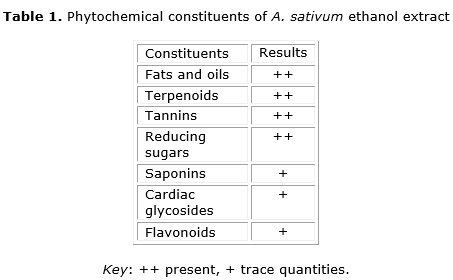
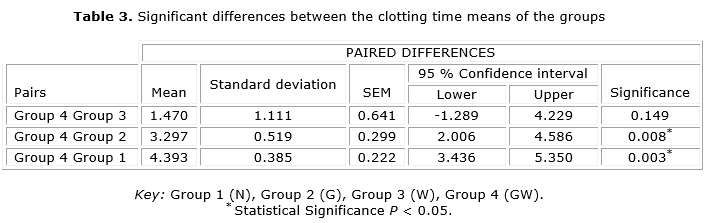
<body><![CDATA[<p> <font size="2" face="Verdana"><b><font size="3">RESULTS</font></b> </font></p>     <p> <font size="2" face="Verdana"><b>    <br>   Phytochemistry</b> </font></p>     <p><font size="2" face="Verdana"> The phytochemical screening of the <i>A. sativum</i>    ethanol extract found a positive reaction to fats and oils, terpenoids, tannins,    and reducing sugars. Other secondary metabolites were present in trace quantities    (<a href="#tab1">table 1</a>). </font></p>     <p align="center"> <img src="/img/revistas/pla/v20n3/t0105315.gif" width="453" height="280"><a name="tab1"></a></p>     <p> <font size="2" face="Verdana"><b>Clotting Time</b> </font></p>     <p><font size="2" face="Verdana"> The clotting time obtained per rat and the mean    calculated in each group are shown in <a href="#tab2">table 2</a>. The groups    of rats which received <i>A. sativum</i>, warfarin or the combination of both    exhibited clotting times beyond the normal range. The highest value (6.73) was    found in group 4 which received the combination of warfarin and <i>A. sativum</i>    ethanol extract. The higher value between the groups which received either warfarin    or <i>A. sativum</i> extract alone was obtained in the group administered with    warfarin (5.27). </font></p>     <p align="center"><img src="/img/revistas/pla/v20n3/t0205315.gif" width="357" height="370"> <a name="tab2"></a></p>     <p><font size="2" face="Verdana"> The statistical analysis results obtained from    the comparison between group 4 which received the combination of <i>A. sativum</i>    and warfarin with each of the other three groups of study according to the clotting    time are shown in <a href="/img/revistas/pla/v20n3/t0305315.gif">table 3</a>. The mean obtained in group    4 was significantly higher (P &#706; 0.05) when comparing it with both group    1 (control) and group 2 (received warfarin). </font></p>     <p align="center">     ]]></body>
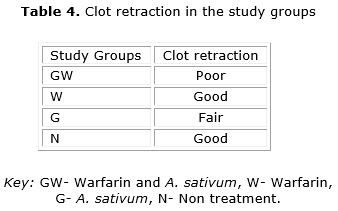
<body><![CDATA[<br>   <font size="2" face="Verdana"><b>Clot retraction</b> </font></p>     <p><font size="2" face="Verdana"> The results of the clot retraction time are    represented in <a href="#tab4">table 4</a>. The combination of <i>A. sativum</i>    and warfarin demonstrated to interfere with the clot retraction, found poor    in this experimental group. The <i>A. sativum</i> ethanol extract alone also    delayed to some extend the clot retraction. </font></p>     <p align="center"> <img src="/img/revistas/pla/v20n3/t0405315.gif" width="338" height="211"><a name="tab4"></a></p>     <p> <font size="2" face="Verdana"><b><font size="3">DISCUSSION</font></b> </font></p>     <p><font size="2" face="Verdana"> The screened <i>A. sativum</i> extract contained    fats and oils, terpenoids, reducing sugars, and tannins; the same components    reported by Olusanmi and collaborators.<sup>26 </sup>These phytochemicals are    known to have medicinal importance. For example, fats and oils have cardiovascular    effects like hypolipidemic, anticoagulant/antiplatelet and procirculatory effects,    terpenoids are known to have antioxidant and cardiotonic properties.<sup>27</sup>    </font></p>     <p><font size="2" face="Verdana"> An increase of the clotting time is an indicator    of the coagulation function defect (secondary hemostasis) and the inefficient    clot retraction indicates platelet function impairment or reduced number in    the blood (primary hemostasis). </font></p>     <p><font size="2" face="Verdana"> The significant rise (with mean values = 6.7)    in the clotting time of the group of rats which received a combination between    <i>A. sativum</i> extract and warfarin in comparison with those groups that    received any of the drugs of the study, means that one or more clotting factors    were either low in number or functionally affected. This shows the interaction    that exists between warfarin and <i>A. sativum</i> and this is in line with    previous studies and cases, <sup>10,28 </sup>and it emphasizes the antihemostatic    activity of <i>A. sativum</i> already demonstrated in studies conducted by Harshita    Chandhary and collaborators among others.<sup>14,16,17</sup> </font></p>     <p><font size="2" face="Verdana"> The results obtained suggest the existence of    additive interaction between <i>A. sativum</i> and warfarin whose anticoagulant    effects can be potentiated by the first one with proven antiplatelet activity.    These is in agreement with researches previously conducted to evaluate the interaction    between drugs or herbs that possess antiplatelet activity with warfarin in an    additive way resulting in increased bleeding time, prothrombin time and clotting    time, hence leading to bleeding complications.<sup>11,29,30 </sup> </font></p>     <p><font size="2" face="Verdana"> To complete the hemostatic mechanisms, the clot    already formed is then retracted aided by the action of platelets. Contractile    components found in the platelet structure make this process of retraction possible.    The poor clot retraction exhibited by the group that received <i>A. sativum</i>    and warfarin implies that one or both drugs impaired the function of the platelets    in the sample. It is known the action of warfarin in the coagulation cascade,    so the <i>A. sativum</i> extract shall be considered the one responsible for    the antiplatelet function demonstrated in this group of rats. </font></p>     <p><font size="2" face="Verdana"> The good quality of the retracted clot observed    in groups 1 and 3 was due to the ability of the activated platelets to interact    with the fibrin within the clot and the contraction of the platelet cytoskeleton    needed for the retraction. </font></p>     ]]></body>
<body><![CDATA[<p><font size="2" face="Verdana">The presence of oil components found through    the phytochemical screening may be responsible for the anticoagulant/antiplatelet    pharmacological action of <i>A. sativum</i>. Researchers like Gebreselema and    Mebrahtu in 2013,<sup> </sup>stated that <i>A. sativum</i> constituents can    reduce fibrin formation and also help to reduce the fibrin existing in the blood    even better than aspirin. These researches also asserted that Ajoene, an oil-soluble    sulfur compound found in <i>A. sativum</i>, seems to be responsible for its    anti-clotting effect.<sup>15</sup> </font></p>     <p><font size="2" face="Verdana"> An Egyptian study examined the effects of concomitant    intake of aspirin and <i>A. sativum </i>preparations on the coagulation profile    in cardiac patients and a significant difference was evident in those who received    both <i>A. sativum</i> and aspirin when compared with those who received aspirin    alone. In addition, there was a significant association between <i>A. sativum    </i>intake with aspirin and the incidence of gastrointestinal bleeding.<sup>31</sup>    </font></p>     <p><font size="2" face="Verdana"> While several <i>in vitro</i> studies suggest    that <i>A. sativum</i> or its individual components may decrease platelet aggregation,    recent clinical trials suggest otherwise. For example, a small randomized, double-blind,    placebo-controlled, crossover research study was performed involving 14 healthy    volunteers and the use of <i>A. sativum</i> macerate preparation containing    ajoene and dithiins (oil components). Four hours after consuming one large dose    of <i>A. sativum</i> oil, the study showed that there was little or no effect    in platelet aggregation.<sup>31</sup> </font></p>     <p><font size="2" face="Verdana"> Taking into account the results of this study    can be concluded that <i>A. sativum</i> has antihaemostatic effects in regard    to clotting mechanisms and further clot retraction which may be attributed to    the presence of <i>A. sativum</i> oils. The antihaemostatic effects of the plant    can be potentiated by an additive interaction with warfarin when both drugs    are used concomitantly increasing the risk of bleeding complications. </font></p> <font size="2" face="Verdana"><b> <br clear="all"/> </b> </font>      <p> <font size="2" face="Verdana"><b><font size="3">REFERENCES</font></b> </font></p>     <!-- ref --><p><font size="2" face="Verdana"> 1. Kunle Folashade O, Egharevba Omoregie H,    Ahmadu Ochogu P. Standardization of herbal medicines - A review. Int J Biodivers    Conserv. 2012;4(3):101-12.     </font></p>     <!-- ref --><p><font size="2" face="Verdana"> 2. Abubakar MG, Yerima MB, Zahriya AG, Ukwuani    AN. Acute toxicity and antifungal studies of ethanolic leaves, stem and pulp    extract of <i>Tamarindus indica</i>. RJPBCS. 2010;1(4):104-11.     </font></p>     <!-- ref --><p><font size="2" face="Verdana"> 3. Benzie IFF, Wachtel-Galor S. Herbal Medicine:    Biomolecular and Clinical Aspects. 2nd ed. Los Angeles, California: CRC Press;    2011.     </font></p>     <!-- ref --><p><font size="2" face="Verdana"> 4. <a>Martins E</a>. The growing use of herbal    medicines: issues relating to adverse reactions and challenges in monitoring    safety. Front Pharmacol. 2013 [cited 17 Mar 2014];4:5. Available from: <a href="http://www.ncbi.nlm.nih.gov/pmc/articles/PMC3887317/%20" target="_blank">http://www.ncbi.nlm.nih.gov/pmc/articles/PMC3887317/    </a></font><!-- ref --><p><font size="2" face="Verdana"> 5. EL-mahmood MA. Efficacy of crude extracts    of garlic (<i>Allium sativum </i>Linn.) against nosocomial <i>Escherichia coli,    Staphylococcus aureus, Streptococcus pneumoniae and Pseudomonas aeruginosa.    </i>J Med Plants Res. 2009;3(4):179-85.     </font></p>     <!-- ref --><p><font size="2" face="Verdana"> 6. Tirona GR, Bailey GD. Herbal product&#8211;drug    interactions mediated by induction. Br J of Clinical Pharmacology. 2006;61(6):677-81.        </font></p>     <!-- ref --><p><font size="2" face="Verdana"> 7. Soronnadi CN, Neboh EEt. Long-term smoking    results in haemostatic dysfunction in chronic smokers. Niger Med J. 2014;55:121-5.        </font></p>     <!-- ref --><p><font size="2" face="Verdana"> 8. Brunton LL, Chabner BA, Knollmann BC. Goodman    &amp; Gilman's. The Pharmacological Basis of Therapeutics. 12<sup>th</sup> ed.    New York: The McGraw-Hill;2011.     </font></p>     ]]></body>
<body><![CDATA[<!-- ref --><p><font size="2" face="Verdana"> 9. Rang HP, Dale MM, Ritter JM, Flower RJ. Rang    and Dale&#8217;s Pharmacology. 7th ed. </font><font size="2" face="Verdana">London:    Churchill Livingstone; 2012.     </font></p>     <!-- ref --><p><font size="2" face="Verdana"> 10. Chen XW, Serag ES, Sneed KB, Liang J, Chew    H, Pan SY, et al. Review Clinical herbal interactions with conventional drugs:    From molecules to maladies. Curr Med Chem. 2011;18(31):4836-50.     </font></p>     <!-- ref --><p><font size="2" face="Verdana"> 11. Myers SP. Interactions between complementary    medicines and warfarin. Australian prescriber. 2002 [cited 17 Jun 2013];25(3):8.    Available from: <a href="http://www.australianprescriber.com/magazine/25/3/54/6" target="_blank">http://www.australianprescriber.com/magazine/25/3/54/6</a>    </font><!-- ref --><p><font size="2" face="Verdana"> 12. Xiao-Feng Z, Zhen-Shan D, Nai-Bo L. Allium    Vegetables and Risk of Prostate Cancer: Evidence from 132,192 Subjects. Asian    Pac J Cancer Prev. 2013;14(7):4131-4.     </font></p>     <p><font size="2" face="Verdana"> 13. Vipul V, Rachana S, Rajesh KT, Navneet S,    Alpika V. Antibacterial activity of extracts of Citrus, Allium &amp; Punica    against food borne spoilage. Asian J Plant Sci Res. 2012;2(4):503-9 </font></p>     <!-- ref --><p><font size="2" face="Verdana"> 14. Harshita C, Ruby A, Ankita V, Prasant KJ,    Sriram S. Evaluating the anti-cancer potential of hydro-alcoholic extract of    <i>Allium sativum </i>L.: An <i>In vitro </i>and <i>In vivo </i>study. The Journal    of Ethnobiology and Traditional Medicine. Photon. 2012;117:189-98.     </font></p>     ]]></body>
<body><![CDATA[<!-- ref --><p><font size="2" face="Verdana"> 15. Gebreselema G, Mebrahtu G. Medicinal values    of garlic: A review. Int J Med Med Sci. 2013;5(9):401-8.     </font></p>     <!-- ref --><p><font size="2" face="Verdana"> 16. Abano EE, Ma H, Qu W, Teye E. Modeling pre-treatments    effect on drying kinetics of garlic (<i>Allium sativum L.</i>) slices in a convective    hot air dryer. Afr J Food Sci. 2011;5(7):425-35.     </font></p>     <!-- ref --><p><font size="2" face="Verdana"> 17. Hamlaoui-Gasmi S, Mokni M, Limam N, Limam    F, Amri M, Aouani E, et al. Effect of garlic&#8217;s mode of administration    on erythrocytes and plasma parameters in <i>Wistar</i> rat. Afr J Biotechnol.    2012;11(33):8259-63.     </font></p>     <!-- ref --><p><font size="2" face="Verdana"> 18. Olayemi AB, Opaleye FI. Antibiotic resistance    among Coliform bacteria isolated from Hospital and Urban Waste Waters. World    J Microb Biot. 1999;6:285-8 </font><!-- ref --><p><font size="2" face="Verdana"> 19. Khandelwal KR, Vrunda S. Practical Pharmacognosy    Techniques and Experiments. 23<sup>th</sup> ed. New Delhi, India: Nirali Prakashan;    2013.     </font></p>     <!-- ref --><p><font size="2" face="Verdana"> 20. National Research Council. <em>Guide for    the Care and Use of Laboratory Animals: Eighth Edition</em><i>.</i> Washington,    DC: The National Academies Press;2011.     </font></p>     <!-- ref --><p><font size="2" face="Verdana"> 21. AVMA Guidelines for the Euthanasia of Animals:    2013 Edition. American Veterinary Medical Association. ISBN 978-1-882691-21-0.        </font></p>     <!-- ref --><p><font size="2" face="Verdana"> 22. Blumenthal M, Busse WR, Goldberg A, Gruenwald    J, Hall T, Riggins CW, et al. The Complete German Commission E Monographs: Therapeutic    Guide to Herbal Medicines. Austin, TX: American Botanical Council;1998.     </font></p>     <!-- ref --><p><font size="2" face="Verdana"> 23. Office of Regulatory Affairs; University    of Pennsylvania. IACUC Guideline. Rodent anesthesia &amp; Analgesia Formulary.    Pennsylvania; 2008.     </font></p>     <!-- ref --><p><font size="2" face="Verdana"> 24. Ramakrishnan S, Sulochana KN. Manual of    Medical laboratory techniques. New Delhi: JAYPEE BROTHERS; 2012.     </font></p>     <!-- ref --><p><font size="2" face="Verdana"> 25. Garc&#237;a Manzano A, Gonz&#225;lez Llaven    J, Lemini C, Rubio Poo C. Standardization of rat blood clotting tests with reagents    used for humans. West. Pharmacol. Soc. 2001;44:153-5.     </font></p>     <!-- ref --><p><font size="2" face="Verdana"> 26. Olusanmi JE, Amadi JE. Studies on the antimicrobial    properties and phytochemical screening of garlic (<i>Allium sativum</i>) extracts.    Ethnobot Leaflets. 2010;14:537-45.     </font></p>     <!-- ref --><p><font size="2" face="Verdana"> 27. Sharma CP, Sunny MC. Effects of garlic extracts    and of three pure components isolated from it on human platelet aggregation,    arachidonate metabolism, release reaction and platelet ultrastructure-comments.    Thromb Res. 1988;52:493-4.     </font></p>     <!-- ref --><p><font size="2" face="Verdana"> 28. Morris J, Burke V, Mori TA, Vandongen R,    Bellin LJ. Effects of garlic extract on platelet aggregation: a randomized placebo    &#8211;controlled double blind study. Clin Exp Pharmacol Physiol. 1995;22(6-7):414-7    </font><!-- ref --><p><font size="2" face="Verdana"> 29. Heck A, Dewitt B, Lukes A. Potential interactions    between alternative therapies and warfarin. Am J Health-Syst Pharm. 2000;57(13):1221-7.        </font></p>     <!-- ref --><p><font size="2" face="Verdana"> 30. Piscatelli SC, Burstein AH, Welden N, Gallicano    KD, Falloon J. The effect of garlic supplements on the pharmacokinetics of saquinavir.    Clin Infect Dis. 2002;34:234-8.     </font></p>     ]]></body>
<body><![CDATA[<!-- ref --><p><font size="2" face="Verdana"> 31. Block E. Garlic and other alliums. The Lore    and the Science. New York: RSC; 2010.     </font></p>     <p>&nbsp;</p>     <p>&nbsp;</p>     <p><font size="2" face="Verdana"> Recibido: 13 de junio de 2014.    <br>   </font><font size="2" face="Verdana">Aprobado: 24 de mayo de 2015. </font></p>     <p>&nbsp;</p>     <p>&nbsp;</p>     <p> <font size="2" face="Verdana"><i>Genny Dom&#237;nguez Montero</i>. Hospital    Municipal. Florida. Camag&uuml;ey, Cuba.</font><font size="2" face="Verdana">    <br>   Correo electr&#243;nico: <a href="mailto:dominguezgenny@gmail.com">dominguezgenny@gmail.com</a>    </font></p>     ]]></body>
<body><![CDATA[ ]]></body><back>
<ref-list>
<ref id="B1">
<label>1</label><nlm-citation citation-type="journal">
<person-group person-group-type="author">
<name>
<surname><![CDATA[Kunle Folashade]]></surname>
<given-names><![CDATA[O]]></given-names>
</name>
<name>
<surname><![CDATA[Egharevba Omoregie]]></surname>
<given-names><![CDATA[H]]></given-names>
</name>
<name>
<surname><![CDATA[Ahmadu Ochogu]]></surname>
<given-names><![CDATA[P]]></given-names>
</name>
</person-group>
<article-title xml:lang="en"><![CDATA[Standardization of herbal medicines - A review]]></article-title>
<source><![CDATA[Int J Biodivers Conserv]]></source>
<year>2012</year>
<volume>4</volume>
<numero>3</numero>
<issue>3</issue>
<page-range>101-12</page-range></nlm-citation>
</ref>
<ref id="B2">
<label>2</label><nlm-citation citation-type="journal">
<person-group person-group-type="author">
<name>
<surname><![CDATA[Abubakar]]></surname>
<given-names><![CDATA[MG]]></given-names>
</name>
<name>
<surname><![CDATA[Yerima]]></surname>
<given-names><![CDATA[MB]]></given-names>
</name>
<name>
<surname><![CDATA[Zahriya]]></surname>
<given-names><![CDATA[AG]]></given-names>
</name>
<name>
<surname><![CDATA[Ukwuani]]></surname>
<given-names><![CDATA[AN]]></given-names>
</name>
</person-group>
<article-title xml:lang="en"><![CDATA[Acute toxicity and antifungal studies of ethanolic leaves, stem and pulp extract of Tamarindus indica]]></article-title>
<source><![CDATA[RJPBCS]]></source>
<year>2010</year>
<volume>1</volume>
<numero>4</numero>
<issue>4</issue>
<page-range>104-11</page-range></nlm-citation>
</ref>
<ref id="B3">
<label>3</label><nlm-citation citation-type="book">
<person-group person-group-type="author">
<name>
<surname><![CDATA[Benzie]]></surname>
<given-names><![CDATA[IFF]]></given-names>
</name>
<name>
<surname><![CDATA[Wachtel-Galor]]></surname>
<given-names><![CDATA[S]]></given-names>
</name>
</person-group>
<source><![CDATA[Herbal Medicine: Biomolecular and Clinical Aspects]]></source>
<year>2011</year>
<edition>2nd</edition>
<publisher-loc><![CDATA[Los Angeles^eCalifornia California]]></publisher-loc>
<publisher-name><![CDATA[CRC Press]]></publisher-name>
</nlm-citation>
</ref>
<ref id="B4">
<label>4</label><nlm-citation citation-type="journal">
<person-group person-group-type="author">
<name>
<surname><![CDATA[Martins]]></surname>
<given-names><![CDATA[E]]></given-names>
</name>
</person-group>
<article-title xml:lang="en"><![CDATA[The growing use of herbal medicines: issues relating to adverse reactions and challenges in monitoring safety]]></article-title>
<source><![CDATA[Front Pharmacol]]></source>
<year>2013</year>
<volume>4</volume>
<page-range>5</page-range></nlm-citation>
</ref>
<ref id="B5">
<label>5</label><nlm-citation citation-type="journal">
<person-group person-group-type="author">
<name>
<surname><![CDATA[EL-mahmood]]></surname>
<given-names><![CDATA[MA]]></given-names>
</name>
</person-group>
<article-title xml:lang="en"><![CDATA[Efficacy of crude extracts of garlic (Allium sativum Linn.) against nosocomial Escherichia coli, Staphylococcus aureus, Streptococcus pneumoniae and Pseudomonas aeruginosa]]></article-title>
<source><![CDATA[J Med Plants Res]]></source>
<year>2009</year>
<volume>3</volume>
<numero>4</numero>
<issue>4</issue>
<page-range>179-85</page-range></nlm-citation>
</ref>
<ref id="B6">
<label>6</label><nlm-citation citation-type="journal">
<person-group person-group-type="author">
<name>
<surname><![CDATA[Tirona]]></surname>
<given-names><![CDATA[GR]]></given-names>
</name>
<name>
<surname><![CDATA[Bailey]]></surname>
<given-names><![CDATA[GD]]></given-names>
</name>
</person-group>
<article-title xml:lang="en"><![CDATA[Herbal product-drug interactions mediated by induction]]></article-title>
<source><![CDATA[Br J of Clinical Pharmacology]]></source>
<year>2006</year>
<volume>61</volume>
<numero>6</numero>
<issue>6</issue>
<page-range>677-81</page-range></nlm-citation>
</ref>
<ref id="B7">
<label>7</label><nlm-citation citation-type="journal">
<person-group person-group-type="author">
<name>
<surname><![CDATA[Soronnadi]]></surname>
<given-names><![CDATA[CN]]></given-names>
</name>
<name>
<surname><![CDATA[Neboh EEt]]></surname>
</name>
</person-group>
<article-title xml:lang="en"><![CDATA[Long-term smoking results in haemostatic dysfunction in chronic smokers]]></article-title>
<source><![CDATA[Niger Med J]]></source>
<year>2014</year>
<volume>55</volume>
<page-range>121-5</page-range></nlm-citation>
</ref>
<ref id="B8">
<label>8</label><nlm-citation citation-type="book">
<person-group person-group-type="author">
<name>
<surname><![CDATA[Brunton]]></surname>
<given-names><![CDATA[LL]]></given-names>
</name>
<name>
<surname><![CDATA[Chabner]]></surname>
<given-names><![CDATA[BA]]></given-names>
</name>
<name>
<surname><![CDATA[Knollmann]]></surname>
<given-names><![CDATA[BC]]></given-names>
</name>
</person-group>
<collab>Goodman & Gilman's</collab>
<source><![CDATA[The Pharmacological Basis of Therapeutics]]></source>
<year>2011</year>
<edition>12th</edition>
<publisher-loc><![CDATA[New York ]]></publisher-loc>
<publisher-name><![CDATA[The McGraw-Hill]]></publisher-name>
</nlm-citation>
</ref>
<ref id="B9">
<label>9</label><nlm-citation citation-type="book">
<person-group person-group-type="author">
<name>
<surname><![CDATA[Rang]]></surname>
<given-names><![CDATA[HP]]></given-names>
</name>
<name>
<surname><![CDATA[Dale]]></surname>
<given-names><![CDATA[MM]]></given-names>
</name>
<name>
<surname><![CDATA[Ritter]]></surname>
<given-names><![CDATA[JM]]></given-names>
</name>
<name>
<surname><![CDATA[Flower]]></surname>
<given-names><![CDATA[RJ]]></given-names>
</name>
</person-group>
<source><![CDATA[Rang and Dale&#8217;s Pharmacology]]></source>
<year>2012</year>
<edition>7th</edition>
<publisher-loc><![CDATA[London ]]></publisher-loc>
<publisher-name><![CDATA[Churchill Livingstone]]></publisher-name>
</nlm-citation>
</ref>
<ref id="B10">
<label>10</label><nlm-citation citation-type="journal">
<person-group person-group-type="author">
<name>
<surname><![CDATA[Chen]]></surname>
<given-names><![CDATA[XW]]></given-names>
</name>
<name>
<surname><![CDATA[Serag]]></surname>
<given-names><![CDATA[ES]]></given-names>
</name>
<name>
<surname><![CDATA[Sneed]]></surname>
<given-names><![CDATA[KB]]></given-names>
</name>
<name>
<surname><![CDATA[Liang]]></surname>
<given-names><![CDATA[J]]></given-names>
</name>
<name>
<surname><![CDATA[Chew]]></surname>
<given-names><![CDATA[H]]></given-names>
</name>
<name>
<surname><![CDATA[Pan]]></surname>
<given-names><![CDATA[SY]]></given-names>
</name>
</person-group>
<article-title xml:lang="en"><![CDATA[Review Clinical herbal interactions with conventional drugs: From molecules to maladies]]></article-title>
<source><![CDATA[Curr Med Chem]]></source>
<year>2011</year>
<volume>18</volume>
<numero>31</numero>
<issue>31</issue>
<page-range>4836-50</page-range></nlm-citation>
</ref>
<ref id="B11">
<label>11</label><nlm-citation citation-type="journal">
<person-group person-group-type="author">
<name>
<surname><![CDATA[Myers]]></surname>
<given-names><![CDATA[SP]]></given-names>
</name>
</person-group>
<article-title xml:lang="en"><![CDATA[Interactions between complementary medicines and warfarin]]></article-title>
<source><![CDATA[Australian prescriber]]></source>
<year>2002</year>
<volume>25</volume>
<numero>3</numero>
<issue>3</issue>
<page-range>8</page-range></nlm-citation>
</ref>
<ref id="B12">
<label>12</label><nlm-citation citation-type="journal">
<person-group person-group-type="author">
<name>
<surname><![CDATA[Xiao-Feng]]></surname>
<given-names><![CDATA[Z]]></given-names>
</name>
<name>
<surname><![CDATA[Zhen-Shan]]></surname>
<given-names><![CDATA[D]]></given-names>
</name>
<name>
<surname><![CDATA[Nai-Bo]]></surname>
<given-names><![CDATA[L]]></given-names>
</name>
</person-group>
<article-title xml:lang="en"><![CDATA[Allium Vegetables and Risk of Prostate Cancer: Evidence from 132,192 Subjects]]></article-title>
<source><![CDATA[Asian Pac J Cancer Prev]]></source>
<year>2013</year>
<volume>14</volume>
<numero>7</numero>
<issue>7</issue>
<page-range>4131-4</page-range></nlm-citation>
</ref>
<ref id="B13">
<label>13</label><nlm-citation citation-type="journal">
<person-group person-group-type="author">
<name>
<surname><![CDATA[Vipul]]></surname>
<given-names><![CDATA[V]]></given-names>
</name>
<name>
<surname><![CDATA[Rachana]]></surname>
<given-names><![CDATA[S]]></given-names>
</name>
<name>
<surname><![CDATA[Rajesh]]></surname>
<given-names><![CDATA[KT]]></given-names>
</name>
<name>
<surname><![CDATA[Navneet]]></surname>
<given-names><![CDATA[S]]></given-names>
</name>
<name>
<surname><![CDATA[Alpika]]></surname>
<given-names><![CDATA[V]]></given-names>
</name>
</person-group>
<article-title xml:lang="en"><![CDATA[Antibacterial activity of extracts of Citrus, Allium & amp; Punica against food borne spoilage]]></article-title>
<source><![CDATA[Asian J Plant Sci Res]]></source>
<year>2012</year>
<volume>2</volume>
<numero>4</numero>
<issue>4</issue>
<page-range>503-9</page-range></nlm-citation>
</ref>
<ref id="B14">
<label>14</label><nlm-citation citation-type="journal">
<person-group person-group-type="author">
<name>
<surname><![CDATA[Harshita]]></surname>
<given-names><![CDATA[C]]></given-names>
</name>
<name>
<surname><![CDATA[Ruby]]></surname>
<given-names><![CDATA[A]]></given-names>
</name>
<name>
<surname><![CDATA[Ankita]]></surname>
<given-names><![CDATA[V]]></given-names>
</name>
<name>
<surname><![CDATA[Prasant]]></surname>
<given-names><![CDATA[KJ]]></given-names>
</name>
<name>
<surname><![CDATA[Sriram]]></surname>
<given-names><![CDATA[S]]></given-names>
</name>
</person-group>
<article-title xml:lang="en"><![CDATA[Evaluating the anti-cancer potential of hydro-alcoholic extract of Allium sativum L: : An In vitro and In vivo study. The Journal of Ethnobiology and Traditional Medicine]]></article-title>
<source><![CDATA[Photon]]></source>
<year>2012</year>
<volume>117</volume>
<page-range>189-98</page-range></nlm-citation>
</ref>
<ref id="B15">
<label>15</label><nlm-citation citation-type="journal">
<person-group person-group-type="author">
<name>
<surname><![CDATA[Gebreselema]]></surname>
<given-names><![CDATA[G]]></given-names>
</name>
<name>
<surname><![CDATA[Mebrahtu]]></surname>
<given-names><![CDATA[G]]></given-names>
</name>
</person-group>
<article-title xml:lang="en"><![CDATA[Medicinal values of garlic: A review]]></article-title>
<source><![CDATA[Int J Med Med Sci]]></source>
<year>2013</year>
<volume>5</volume>
<numero>9</numero>
<issue>9</issue>
<page-range>401-8</page-range></nlm-citation>
</ref>
<ref id="B16">
<label>16</label><nlm-citation citation-type="journal">
<person-group person-group-type="author">
<name>
<surname><![CDATA[Abano]]></surname>
<given-names><![CDATA[EE]]></given-names>
</name>
<name>
<surname><![CDATA[Ma]]></surname>
<given-names><![CDATA[H]]></given-names>
</name>
<name>
<surname><![CDATA[Qu]]></surname>
<given-names><![CDATA[W]]></given-names>
</name>
<name>
<surname><![CDATA[Teye]]></surname>
<given-names><![CDATA[E]]></given-names>
</name>
</person-group>
<article-title xml:lang="en"><![CDATA[Modeling pre-treatments effect on drying kinetics of garlic (Allium sativum L.) slices in a convective hot air dryer]]></article-title>
<source><![CDATA[Afr J Food Sci]]></source>
<year>2011</year>
<volume>5</volume>
<numero>7</numero>
<issue>7</issue>
<page-range>425-35</page-range></nlm-citation>
</ref>
<ref id="B17">
<label>17</label><nlm-citation citation-type="journal">
<person-group person-group-type="author">
<name>
<surname><![CDATA[Hamlaoui-Gasmi]]></surname>
<given-names><![CDATA[S]]></given-names>
</name>
<name>
<surname><![CDATA[Mokni]]></surname>
<given-names><![CDATA[M]]></given-names>
</name>
<name>
<surname><![CDATA[Limam]]></surname>
<given-names><![CDATA[N]]></given-names>
</name>
<name>
<surname><![CDATA[Limam]]></surname>
<given-names><![CDATA[F]]></given-names>
</name>
<name>
<surname><![CDATA[Amri]]></surname>
<given-names><![CDATA[M]]></given-names>
</name>
<name>
<surname><![CDATA[Aouani]]></surname>
<given-names><![CDATA[E]]></given-names>
</name>
</person-group>
<article-title xml:lang="en"><![CDATA[Effect of garlic's mode of administration on erythrocytes and plasma parameters in Wistar rat]]></article-title>
<source><![CDATA[Afr J Biotechnol]]></source>
<year>2012</year>
<volume>11</volume>
<numero>33</numero>
<issue>33</issue>
<page-range>8259-63</page-range></nlm-citation>
</ref>
<ref id="B18">
<label>18</label><nlm-citation citation-type="journal">
<person-group person-group-type="author">
<name>
<surname><![CDATA[Olayemi]]></surname>
<given-names><![CDATA[AB]]></given-names>
</name>
<name>
<surname><![CDATA[Opaleye]]></surname>
<given-names><![CDATA[FI]]></given-names>
</name>
</person-group>
<article-title xml:lang="en"><![CDATA[Antibiotic resistance among Coliform bacteria isolated from Hospital and Urban Waste Waters]]></article-title>
<source><![CDATA[World J Microb Biot]]></source>
<year>1999</year>
<volume>6</volume>
<page-range>285-8</page-range></nlm-citation>
</ref>
<ref id="B19">
<label>19</label><nlm-citation citation-type="book">
<person-group person-group-type="author">
<name>
<surname><![CDATA[Khandelwal]]></surname>
<given-names><![CDATA[KR]]></given-names>
</name>
<name>
<surname><![CDATA[Vrunda]]></surname>
<given-names><![CDATA[S]]></given-names>
</name>
</person-group>
<source><![CDATA[Practical Pharmacognosy Techniques and Experiments]]></source>
<year>2013</year>
<edition>23th</edition>
<publisher-loc><![CDATA[New Delhi ]]></publisher-loc>
<publisher-name><![CDATA[Nirali Prakashan]]></publisher-name>
</nlm-citation>
</ref>
<ref id="B20">
<label>20</label><nlm-citation citation-type="book">
<collab>National Research Council</collab>
<source><![CDATA[Guide for the Care and Use of Laboratory Animals]]></source>
<year>2011</year>
<edition>Eighth</edition>
<publisher-loc><![CDATA[Washington, DC ]]></publisher-loc>
<publisher-name><![CDATA[The National Academies Press]]></publisher-name>
</nlm-citation>
</ref>
<ref id="B21">
<label>21</label><nlm-citation citation-type="book">
<source><![CDATA[AVMA Guidelines for the Euthanasia of Animals]]></source>
<year></year>
<edition>2013</edition>
<publisher-name><![CDATA[American Veterinary Medical Association]]></publisher-name>
</nlm-citation>
</ref>
<ref id="B22">
<label>22</label><nlm-citation citation-type="book">
<person-group person-group-type="author">
<name>
<surname><![CDATA[Blumenthal]]></surname>
<given-names><![CDATA[M]]></given-names>
</name>
<name>
<surname><![CDATA[Busse]]></surname>
<given-names><![CDATA[WR]]></given-names>
</name>
<name>
<surname><![CDATA[Goldberg]]></surname>
<given-names><![CDATA[A]]></given-names>
</name>
<name>
<surname><![CDATA[Gruenwald]]></surname>
<given-names><![CDATA[J]]></given-names>
</name>
<name>
<surname><![CDATA[Hall]]></surname>
<given-names><![CDATA[T]]></given-names>
</name>
<name>
<surname><![CDATA[Riggins]]></surname>
<given-names><![CDATA[CW]]></given-names>
</name>
</person-group>
<source><![CDATA[The Complete German Commission E Monographs: Therapeutic Guide to Herbal Medicines]]></source>
<year>1998</year>
<publisher-loc><![CDATA[Austin^eTX TX]]></publisher-loc>
<publisher-name><![CDATA[American Botanical Council]]></publisher-name>
</nlm-citation>
</ref>
<ref id="B23">
<label>23</label><nlm-citation citation-type="">
<collab>Office of Regulatory Affairs; University of Pennsylvania</collab>
<source><![CDATA[IACUC Guideline: Rodent anesthesia & Analgesia Formulary]]></source>
<year>2008</year>
<publisher-loc><![CDATA[^ePennsylvania Pennsylvania]]></publisher-loc>
</nlm-citation>
</ref>
<ref id="B24">
<label>24</label><nlm-citation citation-type="book">
<person-group person-group-type="author">
<name>
<surname><![CDATA[Ramakrishnan]]></surname>
<given-names><![CDATA[S]]></given-names>
</name>
<name>
<surname><![CDATA[Sulochana]]></surname>
<given-names><![CDATA[KN]]></given-names>
</name>
</person-group>
<source><![CDATA[Manual of Medical laboratory techniques]]></source>
<year>2012</year>
<publisher-loc><![CDATA[New Delhi ]]></publisher-loc>
<publisher-name><![CDATA[JAYPEE BROTHERS]]></publisher-name>
</nlm-citation>
</ref>
<ref id="B25">
<label>25</label><nlm-citation citation-type="journal">
<person-group person-group-type="author">
<name>
<surname><![CDATA[García Manzano]]></surname>
<given-names><![CDATA[A]]></given-names>
</name>
<name>
<surname><![CDATA[González Llaven]]></surname>
<given-names><![CDATA[J]]></given-names>
</name>
<name>
<surname><![CDATA[Lemini]]></surname>
<given-names><![CDATA[C]]></given-names>
</name>
<name>
<surname><![CDATA[Rubio Poo]]></surname>
<given-names><![CDATA[C]]></given-names>
</name>
</person-group>
<article-title xml:lang="en"><![CDATA[Standardization of rat blood clotting tests with reagents used for humans]]></article-title>
<source><![CDATA[West Pharmacol Soc]]></source>
<year>2001</year>
<volume>44</volume>
<page-range>153-5</page-range></nlm-citation>
</ref>
<ref id="B26">
<label>26</label><nlm-citation citation-type="journal">
<person-group person-group-type="author">
<name>
<surname><![CDATA[Olusanmi]]></surname>
<given-names><![CDATA[JE]]></given-names>
</name>
<name>
<surname><![CDATA[Amadi]]></surname>
<given-names><![CDATA[JE]]></given-names>
</name>
</person-group>
<article-title xml:lang="en"><![CDATA[Studies on the antimicrobial properties and phytochemical screening of garlic (Allium sativum) extracts]]></article-title>
<source><![CDATA[Ethnobot Leaflets]]></source>
<year>2010</year>
<volume>14</volume>
<page-range>537-45</page-range></nlm-citation>
</ref>
<ref id="B27">
<label>27</label><nlm-citation citation-type="journal">
<person-group person-group-type="author">
<name>
<surname><![CDATA[Sharma]]></surname>
<given-names><![CDATA[CP]]></given-names>
</name>
<name>
<surname><![CDATA[Sunny]]></surname>
<given-names><![CDATA[MC]]></given-names>
</name>
</person-group>
<article-title xml:lang="en"><![CDATA[Effects of garlic extracts and of three pure components isolated from it on human platelet aggregation, arachidonate metabolism, release reaction and platelet ultrastructure-comments]]></article-title>
<source><![CDATA[Thromb Res]]></source>
<year>1988</year>
<volume>52</volume>
<page-range>493-4</page-range></nlm-citation>
</ref>
<ref id="B28">
<label>28</label><nlm-citation citation-type="journal">
<person-group person-group-type="author">
<name>
<surname><![CDATA[Morris]]></surname>
<given-names><![CDATA[J]]></given-names>
</name>
<name>
<surname><![CDATA[Burke]]></surname>
<given-names><![CDATA[V]]></given-names>
</name>
<name>
<surname><![CDATA[Mori]]></surname>
<given-names><![CDATA[TA]]></given-names>
</name>
<name>
<surname><![CDATA[Vandongen]]></surname>
<given-names><![CDATA[R]]></given-names>
</name>
<name>
<surname><![CDATA[Bellin]]></surname>
<given-names><![CDATA[LJ]]></given-names>
</name>
</person-group>
<article-title xml:lang="en"><![CDATA[Effects of garlic extract on platelet aggregation: a randomized placebo -controlled double blind study]]></article-title>
<source><![CDATA[Clin Exp Pharmacol Physiol]]></source>
<year>1995</year>
<volume>22</volume>
<numero>6-7</numero>
<issue>6-7</issue>
<page-range>414-7</page-range></nlm-citation>
</ref>
<ref id="B29">
<label>29</label><nlm-citation citation-type="journal">
<person-group person-group-type="author">
<name>
<surname><![CDATA[Heck]]></surname>
<given-names><![CDATA[A]]></given-names>
</name>
<name>
<surname><![CDATA[Dewitt]]></surname>
<given-names><![CDATA[B]]></given-names>
</name>
<name>
<surname><![CDATA[Lukes]]></surname>
<given-names><![CDATA[A]]></given-names>
</name>
</person-group>
<article-title xml:lang="en"><![CDATA[Potential interactions between alternative therapies and warfarin]]></article-title>
<source><![CDATA[Am J Health-Syst Pharm]]></source>
<year>2000</year>
<volume>57</volume>
<numero>13</numero>
<issue>13</issue>
<page-range>1221-7</page-range></nlm-citation>
</ref>
<ref id="B30">
<label>30</label><nlm-citation citation-type="journal">
<person-group person-group-type="author">
<name>
<surname><![CDATA[Piscatelli]]></surname>
<given-names><![CDATA[SC]]></given-names>
</name>
<name>
<surname><![CDATA[Burstein]]></surname>
<given-names><![CDATA[AH]]></given-names>
</name>
<name>
<surname><![CDATA[Welden]]></surname>
<given-names><![CDATA[N]]></given-names>
</name>
<name>
<surname><![CDATA[Gallicano]]></surname>
<given-names><![CDATA[KD]]></given-names>
</name>
<name>
<surname><![CDATA[Falloon]]></surname>
<given-names><![CDATA[J]]></given-names>
</name>
</person-group>
<article-title xml:lang="en"><![CDATA[The effect of garlic supplements on the pharmacokinetics of saquinavir]]></article-title>
<source><![CDATA[Clin Infect Dis]]></source>
<year>2002</year>
<volume>34</volume>
<page-range>234-8</page-range></nlm-citation>
</ref>
<ref id="B31">
<label>31</label><nlm-citation citation-type="book">
<person-group person-group-type="author">
<name>
<surname><![CDATA[Block]]></surname>
<given-names><![CDATA[E]]></given-names>
</name>
</person-group>
<source><![CDATA[Garlic and other alliums: The Lore and the Science]]></source>
<year>2010</year>
<publisher-loc><![CDATA[New York ]]></publisher-loc>
<publisher-name><![CDATA[RSC]]></publisher-name>
</nlm-citation>
</ref>
</ref-list>
</back>
</article>