<?xml version="1.0" encoding="ISO-8859-1"?><article xmlns:mml="http://www.w3.org/1998/Math/MathML" xmlns:xlink="http://www.w3.org/1999/xlink" xmlns:xsi="http://www.w3.org/2001/XMLSchema-instance">
<front>
<journal-meta>
<journal-id>1028-4796</journal-id>
<journal-title><![CDATA[Revista Cubana de Plantas Medicinales]]></journal-title>
<abbrev-journal-title><![CDATA[Rev Cubana Plant Med]]></abbrev-journal-title>
<issn>1028-4796</issn>
<publisher>
<publisher-name><![CDATA[ECIMED]]></publisher-name>
</publisher>
</journal-meta>
<article-meta>
<article-id>S1028-47962015000400009</article-id>
<title-group>
<article-title xml:lang="en"><![CDATA[Antibacterial effect of crude methanol Carica papaya L. (papaya) extract and amoxicillin combination]]></article-title>
<article-title xml:lang="es"><![CDATA[Efecto antibacteriano de la combinación del extracto metanólico crudo de Carica papaya L. (papaya) y amoxicilina]]></article-title>
</title-group>
<contrib-group>
<contrib contrib-type="author">
<name>
<surname><![CDATA[Bridge]]></surname>
<given-names><![CDATA[Mwesigwa]]></given-names>
</name>
<xref ref-type="aff" rid="A01"/>
</contrib>
<contrib contrib-type="author">
<name>
<surname><![CDATA[Dominguez Montero]]></surname>
<given-names><![CDATA[Genny]]></given-names>
</name>
<xref ref-type="aff" rid="A01"/>
</contrib>
<contrib contrib-type="author">
<name>
<surname><![CDATA[Betancourt Valladares]]></surname>
<given-names><![CDATA[Miriela]]></given-names>
</name>
<xref ref-type="aff" rid="A01"/>
</contrib>
<contrib contrib-type="author">
<name>
<surname><![CDATA[Katawera]]></surname>
<given-names><![CDATA[Victoria]]></given-names>
</name>
<xref ref-type="aff" rid="A01"/>
</contrib>
<contrib contrib-type="author">
<name>
<surname><![CDATA[Nkwangu]]></surname>
<given-names><![CDATA[David]]></given-names>
</name>
<xref ref-type="aff" rid="A01"/>
</contrib>
<contrib contrib-type="author">
<name>
<surname><![CDATA[Oweta Noah]]></surname>
<given-names><![CDATA[Joseph Openy]]></given-names>
</name>
<xref ref-type="aff" rid="A01"/>
</contrib>
</contrib-group>
<aff id="A01">
<institution><![CDATA[,Mbarara University of Science and Technology  ]]></institution>
<addr-line><![CDATA[Uganda ]]></addr-line>
</aff>
<pub-date pub-type="pub">
<day>00</day>
<month>12</month>
<year>2015</year>
</pub-date>
<pub-date pub-type="epub">
<day>00</day>
<month>12</month>
<year>2015</year>
</pub-date>
<volume>20</volume>
<numero>4</numero>
<fpage>0</fpage>
<lpage>0</lpage>
<copyright-statement/>
<copyright-year/>
<self-uri xlink:href="http://scielo.sld.cu/scielo.php?script=sci_arttext&amp;pid=S1028-47962015000400009&amp;lng=en&amp;nrm=iso"></self-uri><self-uri xlink:href="http://scielo.sld.cu/scielo.php?script=sci_abstract&amp;pid=S1028-47962015000400009&amp;lng=en&amp;nrm=iso"></self-uri><self-uri xlink:href="http://scielo.sld.cu/scielo.php?script=sci_pdf&amp;pid=S1028-47962015000400009&amp;lng=en&amp;nrm=iso"></self-uri><kwd-group>
<kwd lng="en"><![CDATA[additive interaction]]></kwd>
<kwd lng="en"><![CDATA[Carica papaya]]></kwd>
<kwd lng="en"><![CDATA[amoxicillin]]></kwd>
<kwd lng="en"><![CDATA[minimum inhibitory concentration]]></kwd>
<kwd lng="en"><![CDATA[fractional inhibitory concentration index]]></kwd>
<kwd lng="es"><![CDATA[Interacción aditiva]]></kwd>
<kwd lng="es"><![CDATA[Carica papaya]]></kwd>
<kwd lng="es"><![CDATA[amoxicillin]]></kwd>
<kwd lng="es"><![CDATA[concentración mínima inhibitoria]]></kwd>
<kwd lng="es"><![CDATA[concentración inhibitoria fraccionada]]></kwd>
</kwd-group>
</article-meta>
</front><body><![CDATA[ <p align="right"> <font face="Verdana, Arial, Helvetica, sans-serif" size="2">    </font><font face="Verdana, Arial, Helvetica, sans-serif" size="2"><b>ART&#205;CULO    ORIGINAL</b> </font></p>     <p>&nbsp; </p>     <p><font face="Verdana, Arial, Helvetica, sans-serif" size="2"><b><font size="4">Antibacterial    effect of crude methanol <i>Carica papaya</i> L. (papaya) extract and amoxicillin    combination</font></b> </font></p>     <p>&nbsp;</p>     <p><font face="Verdana, Arial, Helvetica, sans-serif" size="2"><b><font size="3">Efecto    antibacteriano de la combinaci&#243;n del extracto metan&#243;lico crudo de    <i>Carica papaya L</i>. (papaya) y amoxicilina.</font></b> </font></p>     <p>&nbsp;</p>     <p>&nbsp;</p>     <p> <font face="Verdana, Arial, Helvetica, sans-serif" size="2"><b> BPhm. Mwesigwa    Bridge,<sup> </sup>MSc. Genny Dominguez Montero,<sup> </sup>MSc.<sup> </sup>Miriela    Betancourt Valladares,<sup> </sup>MSc Victoria Katawera, DLT. David Nkwangu,<sup>    </sup>BPhm.<sup> </sup>Joseph Openy Oweta Noah </b> </font></p>     <p><font face="Verdana, Arial, Helvetica, sans-serif" size="2"> Mbarara University    of Science and Technology, Uganda. </font></p>     <p>&nbsp;</p>     ]]></body>
<body><![CDATA[<p>&nbsp;</p> <hr> <h1> <font face="Verdana, Arial, Helvetica, sans-serif" size="2"><a>ABSTRACT</a>    </font></h1>     <p> <font face="Verdana, Arial, Helvetica, sans-serif" size="2"><a><b>Background:    </b></a> the emergence of multi-drug resistant bacteria and the diseases caused    by them are a serious threat to global health necessitating an urgent need for    new approaches to combat them. Synergy studies of conventional antimicrobial    drugs and medicinal plants with antibacterial effects are important to establish    whether it is prudent to recommend their concurrent administration to get successful    treatments.     <br>   </font><font face="Verdana, Arial, Helvetica, sans-serif" size="2"><b>Objective:    </b> evaluate the antibacterial effect resulting from the combination of <i>Carica    papaya</i> (papaya) and amoxicillin.     <br>   </font><font face="Verdana, Arial, Helvetica, sans-serif" size="2"><b>Methods:</b>    the papaya methanol extract was obtained from seeds and phytochemical screening    was done. Checkerboard assay was used to determine the Minimum Inhibitory Concentration.    Combined effect of both <i>Carica papaya</i> methanol extract and amoxicillin    was determined by calculating the Fractional Inhibitory Concentration index.    Strains of <i>Staphylococcus aureus</i> ATCC 25923 and <i>Escherichia coli</i>    ATCC 25922 were used in the tests.     <br>   </font><font face="Verdana, Arial, Helvetica, sans-serif" size="2"><b>Results:    </b> phenols and tannins were found in the <i>Carica papaya</i> seed methanol    extract. The minimum inhibitory concentration of <i>Carica papaya </i>extract    was 100 &#181;g/mL for both microorganisms<i> </i>studied which was higher than    the Minimum Inhibitory Concentration of amoxicillin being 3.12 &#181;g/mL for    <i>Escherichia coli </i>and 0.2 &#181;g/mL for <i>Staphylococcus aureus.</i>    The Fractional Inhibitory Concentration of the combination of drugs was 0.99    for <i>Escherichia coli </i>and 2.51 for <i>Staphylococcus aureus.</i>     <br>   </font><font face="Verdana, Arial, Helvetica, sans-serif" size="2"><b>Conclusions:</b>    the antibacterial effect of <i>Carica papaya</i> extract may be attributed to    the presence of phenolic compounds. There was no interaction between amoxicillin    and <i>Carica papaya</i> extract on <i>Staphylococcus aureus,</i> but the antimicrobial    activity against <i>Escherichia coli</i> of both drugs can be potentiated by    their additive interaction. </font></p>     <p> <font face="Verdana, Arial, Helvetica, sans-serif" size="2"><b>Key words:    </b> additive interaction, <i>Carica papaya,</i> amoxicillin, minimum inhibitory    concentration, fractional inhibitory concentration index. </font></p> <hr>     <p> <font face="Verdana, Arial, Helvetica, sans-serif" size="2"><a> </a></font><font face="Verdana, Arial, Helvetica, sans-serif" size="2"><b>RESUMEN</b>    </font></p>     <p> <font face="Verdana, Arial, Helvetica, sans-serif" size="2"><b>Introducci&#243;n:    </b> la creciente multi-resistencia bacteriana y emergencia de enfermedades    causadas por estas bacterias, constituyen un serio problema global, por lo que    es importante y urgente el desarrollo de nuevas propuestas terap&#233;uticas    para combatirlas. Estudios sin&#233;rgicos sobre la combinaci&#243;n de antimicrobianos    convencionales y plantas con efectos antibacterianos son importantes para determinar    si es aconsejable la administraci&#243;n concomitante de los mismos.     <br>   </font><font face="Verdana, Arial, Helvetica, sans-serif" size="2"><b>Objetivo:    </b> evaluar el efecto antibacteriano de la combinaci&#243;n de <i>Carica papaya</i>    (papaya) y amoxicilina.     ]]></body>
<body><![CDATA[<br>   </font><font face="Verdana, Arial, Helvetica, sans-serif" size="2"><b>M&#233;todo:    </b> fueron usadas semillas de papaya para obtener el extracto alcoh&#243;lico    de papaya y realizado el estudio fitoqu&#237;mico. La Concentraci&#243;n M&#237;nima    Inhibitoria fue determinada por el m&#233;todo del "tablero de ajedrez". La    Concentraci&#243;n Inhibitoria Fraccionada se calcul&#243; para medir el posible    efecto sin&#233;rgico de la combinaci&#243;n entre el extracto alcoh&#243;lico    de <i>Carica papaya</i> y la amoxicilina. Cepas de <i>Staphylococcus aureus</i>    ATCC 25923 y <i>Escherichia coli</i> ATCC 25922 fueron usadas.     <br>   </font><font face="Verdana, Arial, Helvetica, sans-serif" size="2"><b>Resultados:    </b> en el extracto alcoh&#243;lico de papaya fueron encontrados fenoles y taninos.    La Concentraci&#243;n M&#237;nima Inhibitoria del extracto de papaya coincidi&#243;    para ambos microorganismos (100 &#181;g/mL), la cual fue mayor que la Concentraci&#243;n    M&#237;nima Inhibitoria de la amoxicilina, siendo 3.125 &#181;g/mL para <i>Escherichia    coli </i>y 0.2 &#181;g/mL para <i>Staphylococcus aureus.</i> La Concentraci&#243;n    Inhibitoria Fraccionada de la combinaci&#243;n de drogas, fue 0.99 para <i>Escherichia    coli</i> y 2.51 para <i>Staphylococcus aureus</i>.     <br>   </font><font face="Verdana, Arial, Helvetica, sans-serif" size="2"><b>Conclusiones:</b>    los compuestos fen&#243;licos presentes en el extracto de papaya pueden ser    responsables de su efecto antimicrobiano. No existe interacci&#243;n entre la    amoxicilina y el extracto metan&#243;lico de papaya contra <i>Staphylococcus    aureus</i>. Sin embargo, la actividad antomicrobiana contra <i>Escherichia coli</i>    puede ser potenciada por su interacci&#243;n aditiva. </font></p>     <p> <font face="Verdana, Arial, Helvetica, sans-serif" size="2"><b>Palabras clave:</b>    Interacci&#243;n aditiva, <i>Carica papaya,</i> amoxicillin<i>, </i>concentraci&#243;n    m&#237;nima inhibitoria, concentraci&#243;n inhibitoria fraccionada. </font></p> <hr>     <p>&nbsp; </p>     <p>&nbsp;</p>     <p><font face="Verdana, Arial, Helvetica, sans-serif" size="2"><b><font size="3">INTRODUCTION</font></b>    </font></p>     <p> <font face="Verdana, Arial, Helvetica, sans-serif" size="2"><a>Infectious    diseases are among the major diseases of public health concern and account for    almost 50.000 deaths every day. This situation has further been complicated    by the rapid development of multidrug resistant organisms and emergence of new    pathogenic microorganisms.<sup>1,2</sup> </a> </font></p>     <p><font face="Verdana, Arial, Helvetica, sans-serif" size="2"> Antibiotics are    one of the most important drugs in fighting bacterial infections and have greatly    improved the health-related quality of human life since their introduction in    the medical practice. However, over the past few decades these health benefits    are under threat as many commonly used antibiotics have become less and less    effective against certain illnesses not only because many of them produce toxic    reactions but also due to emergence of drug resistant bacteria,<sup>3</sup>    thus resulting into their non-responsiveness to treatment with mostly a single    drug regimen and, consequently in therapeutic failure.<sup>4</sup> </font></p>     <p><font face="Verdana, Arial, Helvetica, sans-serif" size="2"> The situation    of resistance to previously effective antibiotics that have emerged globally    in recent years is especially dire in Africa where irrational antibiotic practices    are common. According to a study conducted in Northern Uganda in 2013, there    was widespread resistance among all uropathogens tested to cotrimoxazole, amoxicillin,    nitrofurantoin and nalidixic acid. Among those microorganisms were included    <i>S</i>almonella species and <i>E</i>. <i>coli</i>.<sup>5</sup> </font></p>     ]]></body>
<body><![CDATA[<p><font face="Verdana, Arial, Helvetica, sans-serif" size="2"> The current edition    of the National Treatment Guidelines in Uganda recommends the use of amoxicillin    for many conditions like typhoid fever, laryngitis, pneumonia, infective endocarditis,    cellulitis and other skin diseases, ear, nose and throat conditions, genito-urinary    diseases, obstetric and gynecological conditions, zoonotic diseases and oral    and dental conditions<sup>6 </sup>as supported by most of the updated Pharmacological    books.<sup>7,8</sup> </font></p>     <p><font face="Verdana, Arial, Helvetica, sans-serif" size="2"> However, evidence    based medicine as well as studies conducted in Ugandan setting, have suggested    a high resistance to amoxicillin.<sup>5,9 </sup>Therefore, continued use of    this antibiotic may increase chances of treatment failure, leading to unnecessary    patient suffering and increased health care costs in the long run.<i> </i> </font></p>     <p><font face="Verdana, Arial, Helvetica, sans-serif" size="2"> In rational drug    therapy, it is often essential to concurrently administer two or more agents    in order to reduce development of resistance and minimize side effects. However,    the drug interaction may have different effects on the host as well as the infecting    organism and can increase or decrease potency, as well as increase adverse effect    or toxicity.<sup>10</sup> </font></p>     <p><font face="Verdana, Arial, Helvetica, sans-serif" size="2"> The combination    of known antimicrobial agents and bioactive plant extracts is a novel concept    and has been reported to be profitable for patients with serious infections    caused by drug-resistant pathogens. Plants antimicrobials have been found to    be synergistic enhancers; they may not have any antimicrobial properties when    used alone, but taken concurrently with standard drugs they can enhance the    effect of them.<sup>3</sup> </font></p>     <p><font face="Verdana, Arial, Helvetica, sans-serif" size="2"> Considering the    surfacing of resistant species of <i>S. species </i>and <i>E. coli</i> to therapeutically    available agents like amoxicillin, probably due to antibiotic misuse by poorly    trained health workers and by domiciliary self-medication practices that have    become commonplace in Uganda,<sup>5 </sup>it has verified a clear and emerging    need to introduce new antimicrobial alternatives in the therapeutic arsenal.    In this view arises the possibility to investigate the interactive effects of    conventional compounds and natural products, which can promote greater effectiveness    of each drug.<sup>11</sup> </font></p>     <p> <font face="Verdana, Arial, Helvetica, sans-serif" size="2"><i>Carica papaya</i>    L. (<i>C. papaya</i>) specie, known as papaya, which belongs to Caricaceae family,    grows in tropical and subtropical countries,<sup>12 </sup>Uganda being one of    them. Considering the known antimicrobial activity of this plant,<sup>2,13,14    </sup>the purpose of this study was to assess the antibacterial effect resulting    from the combination of <i>C. papaya</i> and amoxicillin on strains of <i>S.    aureus </i>and <i>E. coli</i>. </font></p>     <p>&nbsp;</p>     <p><font face="Verdana, Arial, Helvetica, sans-serif" size="3"><b>METHOD </b></font>  </p>     <p><font face="Verdana, Arial, Helvetica, sans-serif" size="2"> The antibacterial    effect resulting from the combination of <i>C. papaya</i> and amoxicillin was    assessed determining the Minimum Inhibitory Concentration. Finally, the combined    effect of both was determined by calculating the Fractional Inhibitory Concentration    index. </font></p> <h2> <font face="Verdana, Arial, Helvetica, sans-serif" size="2"><b>Plant material</b>    </font></h2>     <p> <font face="Verdana, Arial, Helvetica, sans-serif" size="2"><i>C. papaya </i>    seeds were collected from a garden in Mbarara, Uganda, identified by the University    botanist and given a voucher Number Bridge Mwesigwa 001. </font></p> <h2> <font face="Verdana, Arial, Helvetica, sans-serif" size="2"><b>Preparation    of the extract</b> </font></h2>     ]]></body>
<body><![CDATA[<p><font face="Verdana, Arial, Helvetica, sans-serif" size="2"> The <i>C. papaya    </i>fruits, commonly known as pawpaw or papaya, were cut open to obtain the    seeds; the seeds were air dried under a shade for five consecutive days to preserve    the activity of the active constituents and later pulverized in a blender to    obtain the surface area for optimal drug extraction, to obtain a desirable yield.    </font></p>     <p><font face="Verdana, Arial, Helvetica, sans-serif" size="2"> The cold maceration    method of extraction was used to macerate 250.8 g of the powder (70 % methanol    w/v). The extract was filtered and concentrated to a solid residue of plant    extract. </font></p>     <p><font face="Verdana, Arial, Helvetica, sans-serif" size="2"> The plant extract    was obtained at a percentage yield of 4.54 % after evaporating off the methanol    to dryness using an oven (MEMMERT 2000)<b> </b>at 60 <sup>o</sup>C.<sup>15</sup>    </font></p> <h2> </h2> <h2> <font face="Verdana, Arial, Helvetica, sans-serif" size="2"><a>hytochemical    screening</a> </font></h2>     <p><font face="Verdana, Arial, Helvetica, sans-serif" size="2"> Two grams of 4.54    % of <i>C. papaya</i> extract were dissolved in 20 mL of distilled water to    form a solution which was used for phytochemical screening. </font></p>     <p><font face="Verdana, Arial, Helvetica, sans-serif" size="2"> Various tests,    mainly chemical reactions identification by color change or precipitated formations,    were used to determine the presence of secondary metabolites: saponins (Foam),    proteins (Biuret), free amino acid/ amines (nihydrin), isoflavones (Shinoda),    steroids and triterpenoids (Libermann-Buchard), phenols and tannins (ferric    chloride FeCl<sub>3</sub>), fats and oils (Sudan III), lactones and coumarins    (Baljet), alkaloids (Dragendorff), glycosides (Keller-killiani), and reducing    sugars (Fehling).<sup>16</sup> </font></p> <h2> <font face="Verdana, Arial, Helvetica, sans-serif" size="2"><a> </a></font><font face="Verdana, Arial, Helvetica, sans-serif" size="2">Microbiological    Assay </font></h2>     <p><font face="Verdana, Arial, Helvetica, sans-serif" size="2"> The organisms    used were standard strains of <i>S. aureus</i> ATCC 25923<i> </i>and <i>E. coli</i>    ATCC 25922 which were obtained from MUST Microbiology Laboratory and Epicenter    Laboratory. The checkerboard assay was used to determine the individual Minimum    Inhibitory Concentration (MIC) of <i>C. papaya</i> methanol extract and amoxicillin,    as well as the MIC of the combination of these two drugs/compounds. </font></p>     <p><font face="Verdana, Arial, Helvetica, sans-serif" size="2"> The MIC results<sup>    </sup>were used to calculate the Fractional Inhibitory Concentration Index (FIC    index) to determine the possible synergistic effects of the association between    amoxicillin and <i>C. papaya</i> methanol extract.<a></a> </font></p>     <p> <font face="Verdana, Arial, Helvetica, sans-serif" size="2"><b>Determination    of MIC by checkerboard assay</b> </font></p>     <p> <font face="Verdana, Arial, Helvetica, sans-serif" size="2"><sup>&#183; </sup>    <i>Preparation of Rezasurin solution 0.01 %</i>: Resazurin solution 0.01 % was    prepared from Resazurin powder and filtered through the 0.2 &#181;m pore filter.    If not immediately used, the solution was preserved at 4 &#176;C for a maximum    period of one week and protected from the light. Resazurin solution which is    an oxy-reduction indicator was employed as MIC indicator.<sup>17</sup> </font></p>     <p><font face="Verdana, Arial, Helvetica, sans-serif" size="2"><sup>&#183;</sup>    <i>Preparation of the bacteria culture suspension</i>: Upon sub-culturing the    reference strains on Nutrient agar, a colony of each organism was emulsified    in 1.5 mL of Muller-Hinton broth and incubated overnight at 37 <sup>0 </sup>C.    The density of the bacteria culture suspension to be used for the tests was    adjusted, using the broth, to McFarland standard 0.5 (1.5 x 10<sup>8 </sup>Colony    Forming Units/ml) using a Turbidometer (DENSIMAT).<sup>17</sup> </font></p>     ]]></body>
<body><![CDATA[<p><font face="Verdana, Arial, Helvetica, sans-serif" size="2"><sup>&#183;</sup>    <i>Preparation of the antibiotic working solutions:</i><sup>17</sup> Both amoxicillin    and <i>C. papaya</i> stock solutions with a concentration of 1mg/mL were each    diluted 1 in 5, giving a concentration of 200 &#181;g/mL. This was filtered    through a 0.2 &#181;m membrane pore into separate sterile well-labeled 2 mL    cryo-vials. Sterility of the suspensions was tested by inoculating a drop of    each on a blood agar plate and incubating at 37 <sup>0</sup>C for 48 h and observing    for growth. </font></p>     <p><font face="Verdana, Arial, Helvetica, sans-serif" size="2"> <sup>&#183;</sup>    Amoxicillin with a concentration of 1 mg/mL (1000 &#181;g/mL) was diluted 1    in 5 to easily filter through the millipore filter, giving a concentration of    200 &#181;g/mL, then was serially diluted 9 fold in Muller-Hinton broth on the    microtiter plate (neat, 1/2, 1/4, 1/8, 1/16, 1/32, 1/64, 1/128, 1/256, 1/512;    giving concentrations of 200 &#181;g/mL, 100 &#181;g/mL, 50 &#181;g/mL, 25 &#181;g/mL,    12.5 &#181;g/mL 6.25 &#181;g/mL, 3.12 &#181;g/mL, 1.5 &#181;g/mL, 0.8 &#181;g/mL,    0.4 &#181;g/mL, 0.2 &#181;g/mL, respectively. </font></p>     <p><font face="Verdana, Arial, Helvetica, sans-serif" size="2"><sup>&#183;</sup>    <i>C. papaya</i> with a concentration of 1 mg/mL (1000 &#181;g/mL) was serially    diluted 9 fold in Muller-Hinton broth on the microtiter plate (neat, 1/2, 1/4,    1/8, 1/16, 1/32, 1/64, 1/128, 1/256, 1/512, giving concentrations of 200 &#181;g/mL,    100 &#181;g/mL, 50 &#181;g/mL, 25 &#181;g/mL, 12.5 &#181;g/mL, 6.25 &#181;g/mL,    3.12 &#181;g/mL, 1.5 &#181;g/mL, 0.8 &#181;g/mL, 0.4 &#181;g/mL, 0.2 &#181;g/mL,    respectively. </font></p>     <p><font face="Verdana, Arial, Helvetica, sans-serif" size="2"><sup>&#183;</sup>    <i>Preparation of the microtiter plates:</i> <sup>17 </sup> 100 &#181;L of sterile    water were pipetted in all the outer wells of a 96-well microtitre plate to    provide moisture for the test. </font></p>     <p><font face="Verdana, Arial, Helvetica, sans-serif" size="2"> A total of 50    &#181;L of Mueller-Hinton broth was distributed into each well of the micro-dilution    plates. The first drug (<i>C. papaya</i>) working solution of the combination    was serially diluted along the first column, while the second drug (amoxicillin)    solution was serially diluted along the first row. Dilutions were started from    the last well with a higher concentration (neat) towards the first well for    the two drugs. These concentrations were then diluted along the ordinate (vertical    axis) and abscissa (horizontal axis) to obtain varying concentrations of the    combined drugs (Range: 200 &#181;g/mL to 0.2 &#181;g/mL). The resulting checkerboard    contained each combination of the two antimicrobial agents, with wells that    contain the highest concentration of each antibiotic at opposite corners. </font></p>     <p><font face="Verdana, Arial, Helvetica, sans-serif" size="2"> To each of the    wells, 50 &#181;L of the bacterial suspension was added. The plates were incubated    aerobically at 37 <sup>0</sup>C for 24 h. After 24 h of incubation, 20 &#181;L    of 0.01 % reassuring solution were added to each of the well and incubated for    another 24 hours under the same conditions. </font></p>     <p><font face="Verdana, Arial, Helvetica, sans-serif" size="2"> The wells that    showed a colour change, by visual inspection, from blue to pink were considered    to have growth. The colour change was a result of reduction of reassuring by    live organisms. </font><font face="Verdana, Arial, Helvetica, sans-serif" size="2">The    MIC was taken as the lowest concentration of each antibiotic alone or in combination    that prevented bacterial growth. </font></p>     <p><font face="Verdana, Arial, Helvetica, sans-serif" size="2"> The bacterial    growth was determined by the color of the reassuring indicator<sup>:17</sup>    </font></p>     <p><font face="Verdana, Arial, Helvetica, sans-serif" size="2"> <sup>&#183;</sup>    No Growth: the color remained blue. </font></p>     <p><font face="Verdana, Arial, Helvetica, sans-serif" size="2"> <sup>&#183;</sup>    Growth: the color changed from blue to pink. </font></p>     ]]></body>
<body><![CDATA[<p> <font face="Verdana, Arial, Helvetica, sans-serif" size="2"><b>Calculation    of the Fractional Inhibitory Concentration (FIC) Index</b> </font></p>     <p><font face="Verdana, Arial, Helvetica, sans-serif" size="2"> Interaction between    the two study drugs was assessed algebraically by determining the FIC index    which was calculated as follows:<sup>11</sup> </font></p>     <p><font face="Verdana, Arial, Helvetica, sans-serif" size="2"> FIC= FIC<sub>A</sub>    + FIC<sub>B</sub> </font></p>     <p><font face="Verdana, Arial, Helvetica, sans-serif" size="2"> Where: </font></p>     <p><font face="Verdana, Arial, Helvetica, sans-serif" size="2"> FIC<sub>A</sub>    was calculated through the ratio MIC<sub>A</sub> combined / MIC<sub>A</sub>    alone, <sub>A</sub> being amoxicillin. </font></p>     <p><font face="Verdana, Arial, Helvetica, sans-serif" size="2"> FIC<sub>B</sub>    was calculated through the ratio MIC<sub>B</sub> combined / MIC<sub>B</sub>    alone, <sub>B </sub>being <i>C. papaya</i> methanol extract. </font></p>     <p><font face="Verdana, Arial, Helvetica, sans-serif" size="2"> This index was    interpreted as follows:<sup>11</sup> </font></p>     <p> <font face="Verdana, Arial, Helvetica, sans-serif" size="2">&#183; Synergy:    FIC &#8804; 0.5 </font></p>     <p> <font face="Verdana, Arial, Helvetica, sans-serif" size="2">&#183; Addition:    0.5 &lt; FIC &lt; 1 </font></p>     <p> <font face="Verdana, Arial, Helvetica, sans-serif" size="2">&#183; Indifference    or No interaction: 1 &lt; FIC &lt; 4 </font></p>     ]]></body>
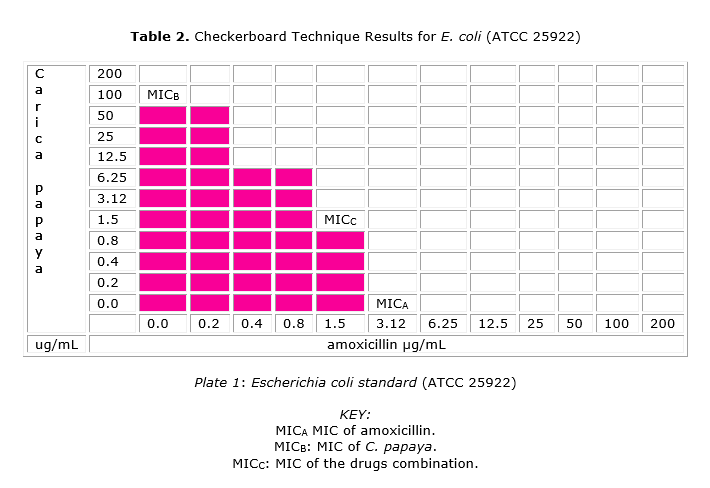
<body><![CDATA[<p> <font face="Verdana, Arial, Helvetica, sans-serif" size="2">&#183; Antagonism:    FIC &#8805; 4 </font></p> <h2> <font face="Verdana, Arial, Helvetica, sans-serif" size="2"><a>Quality control</a>    </font></h2>     <p><font face="Verdana, Arial, Helvetica, sans-serif" size="2"> Media was controlled    for sterility and viability using the reference strain<b>. </b>Positive and    negative controls were used along with the extract and drug. The expiry dates    of the reagents were checked and Good Clinical Laboratory Practices were observed.    </font></p>     <p>&nbsp; </p>     <p><font face="Verdana, Arial, Helvetica, sans-serif" size="2"><a><b><font size="3">RESULTS</font></b></a>    </font></p>     <p> <font face="Verdana, Arial, Helvetica, sans-serif" size="2"><b>Phytochemistry</b>    </font></p>     <p><font face="Verdana, Arial, Helvetica, sans-serif" size="2"> The phytochemical    screening of the <i>C. papaya</i> methanol extract found a positive reaction    to phenols and tannins, which were present in high quantities. Is flavones,    glycosides and free amino acids were found in moderate concentrations (<a href="/img/revistas/pla/v20n4/t0109415.gif">table    1</a>). </font></p>     <p> <font face="Verdana, Arial, Helvetica, sans-serif" size="2"><b>MIC of <i>C.    papaya</i> and amoxicillin on <i>E. coli </i>and FIC index</b> </font></p>     <p><font face="Verdana, Arial, Helvetica, sans-serif" size="2"> The MIC of <i>C.    papaya</i> extract and amoxicillin on<b> </b><i>E. coli</i>, determined by checkerboard    assay, was 100 &#181;g/mL and 3.12 &#181;g/mL respectively; while the MIC for    the combination of both drugs was 3 &#181;g/mL. Results are shown in <a href="/img/revistas/pla/v20n4/t0209415.gif">table    2</a>. </font></p>     <p><font face="Verdana, Arial, Helvetica, sans-serif" size="2"> The FIC index    was calculated using the MICs obtained and the result was 0.99 demonstrating    that there is an additive interaction between amoxicillin and <i>C. papaya</i>    methanol extract on <i>E. coli.</i> </font></p>     <p> <font face="Verdana, Arial, Helvetica, sans-serif" size="2"><b>MIC of <i>C.    papaya</i> and amoxicillin on <i>S. aureus </i>and FIC index</b> </font></p>     ]]></body>
<body><![CDATA[<p><font face="Verdana, Arial, Helvetica, sans-serif" size="2"> The MIC of <i>C.    papaya</i> extract and amoxicillin on<b> </b><i>S. aureus</i>, also determined    by checkerboard assay, are shown in <a href="/img/revistas/pla/v20n4/t0309415.gif">table 3</a>. Results    indicated that for the plant extract the MIC was 100 &#181;g/mL while for the    conventional drug was 0.4 &#181;g/mL. The MIC for the combination of both drugs    was 1 &#181;g/mL. </font></p>     <p><font face="Verdana, Arial, Helvetica, sans-serif" size="2"> The FIC index    was calculated using the MIC obtained and the result was 2.51 indicating no    interaction between amoxicillin and <i>C. papaya</i> methanol extract on this    microorganism<i>.</i> </font></p>     <p>&nbsp; </p>     <p><font face="Verdana, Arial, Helvetica, sans-serif" size="2"><b><font size="3">DISCUSSION</font></b>    </font></p> <font face="Verdana, Arial, Helvetica, sans-serif" size="2"> Phytochemical screening  of <i>C. papaya </i>extract<i> </i>showed the presence of phenols, tannins, amino  acids, reducing sugars, flavonoids, lactones, coumarins and alkaloids, which match  with those components reported by Augustine Ocloo in 2012. Concentration of phenols  and tannins in <i>C. papaya</i> extract was high which are believed to be responsible  for the antimicrobial activity.<sup>1</sup> </font>     <p><font face="Verdana, Arial, Helvetica, sans-serif" size="2"> The phenolic components,    for example tannins in <i>C. papaya</i> work by different proposed mechanisms    to exert antimicrobial activity against microbes which include inhibition of    extracellular microbial enzymes, deprivation of the substrates required for    microbial growth or direct action on microbial metabolism through inhibition    of oxidative phosphorylation. A further mechanism involving iron deprivation    has been also proposed.<sup>18</sup> </font></p>     <p><font face="Verdana, Arial, Helvetica, sans-serif" size="2"> The MIC of <i>C.    papaya </i>seed extract was the same on <i>E. coli </i>(Gram negative bacterium)    and <i>S. aureus </i>(Gram positive bacterium) meaning that the papaya extract    shows the same activity against both types of bacteria. Earlier studies have    been conducted with similar objectives and also similar results. However, those    researchers reported slight differences compared to the present findings. In    Nigeria in 2012, investigators found that dried and fresh leaves extracts of    <i>C. papaya</i> tested at 25, 50 and 100 mg/mL concentrations<i> </i>have a    potent activity against Gram-positive and Gram-negative bacteria including <i>S.    aureus</i> and <i>E. coli</i>, with differences in relation to the type of extract    used; the dried sample was equally effective against both types of bacteria    while the fresh sample was more effective against Gram-negative bacteria.<sup>14    </sup> In 2013 Nirosha and Mangalanayaki, from India, tested papaya leaf and    stem extracts at 150, 200 and 250 mg/mL against <i>S. aureus</i> and <i>E. coli</i>    among other bacteria. They reported both leaf and root extracts more active    against gram-negative than gram-positive bacteria.<sup>2 </sup>The referred    differences may be related to the use of different strains of microorganisms    under study, as well as the use of different parts of the plant, the types and    concentrations of the extracts and the geographical region where <i>C. papaya    </i>is cultivated and obtained from, since environmental factors like climate,    altitude, season and soil can all influence the plants metabolism leading to    differences in the composition of secondary metabolites. </font></p>     <p><font face="Verdana, Arial, Helvetica, sans-serif" size="2"> The MIC of <i>C.    papaya </i>was found to be higher than the MIC of amoxicillin on both microorganisms,    which implies that amoxicillin is more active than <i>C. papaya </i>against    both <i>E. coli </i>and <i>S. aureus </i>standard strains. </font></p>     <p><font face="Verdana, Arial, Helvetica, sans-serif" size="2"> When amoxicillin    is used alone, it has a higher activity against <i>S. aureus </i>compared to    <i>E. coli</i>. This &#946;-lactam antibiotic inhibits the last step in the    peptidoglycan synthesis, heteropolymer that provides rigid mechanical stability    to the bacterial cell wall by virtue of its highly cross-linked structure. One    of the mechanisms of &#946;-lactam bacterial resistance results from the inability    of the drug to penetrate to its site of action. In gram-positive bacteria, the    peptidoglycan polymer is very near to the cell surface and the antibiotic penetration    is easy, but in gram-negative bacteria, the inner membrane is covered by the    outer membrane, lipopolysaccharides and capsule, which block the access of some    antibiotics. Some small hydrophilic antibiotics, including &#946;-lactam, diffuse    through aqueous channels in the outer membrane formed by proteins called <i>porins,    </i>which vary among different gram-negative bacteria, thereby providing greater    or lesser antibiotics access to the site of action.<sup>7</sup> </font></p>     <p><font face="Verdana, Arial, Helvetica, sans-serif" size="2">After conducting    a deep search looking for published data on antibacterial effects of combination    between plants and amoxicillin, none of the accessed by the research team was    aimed to evaluate the antibacterial effect of the combination between this conventional    drug and <i>C. papaya</i>. However, the association of other natural products    to conventional antibiotics has been reported by some contemporary authors,<sup>11,19-25</sup>    what reflects an increasing interest for this type of theoretical and methodological    approach. </font></p>     <p><font face="Verdana, Arial, Helvetica, sans-serif" size="2"> Several techniques    measure the effects of drug combinations. One of the simplest and well-known    protocols is the &#171;checkerboard&#187; test, which provides a two-dimensional    array of different concentrations of the substances evaluated and allows the    calculation of FIC index.<sup>11</sup> </font></p>     ]]></body>
<body><![CDATA[<p><font face="Verdana, Arial, Helvetica, sans-serif" size="2"> When the two antimicrobials    where combined in different concentrations, the FIC index showed different interaction    between the study drugs according to the microorganism against which the combination    was used. </font></p>     <p><font face="Verdana, Arial, Helvetica, sans-serif" size="2"> In the case of    <i>S. aureus</i>, was found that <i>C. papaya methanol extract</i> does not    modify the amoxicillin&#180;s total activity showing an indifference interaction;    therefore, it is not significant to combine <i>C. papaya </i>with amoxicillin    against <i>S. aureus </i>since amoxicillin effect is not enhanced. However,    it is important to combine the two antimicrobials against <i>E. coli </i>since    the mixture has an additive interaction meaning that the resultant effect is    the sum of the individual antimicrobial effects obtained when each drug is used    alone. </font></p>     <p><font face="Verdana, Arial, Helvetica, sans-serif" size="2"> Taking into account    the results of this study can be concluded that <i>Carica papaya</i> has antibacterial    effect which may be attributed to the presence of phenolic compounds. There    was no interaction between amoxicillin and <i>Carica papaya</i> extract on <i>Staphylococcus    aureus,</i> but the antimicrobial activity against <i>Escherichia coli</i> of    both drugs can be potentiated by their additive interaction<i> </i>increasing    the<i> </i>susceptibility of this microorganism when they are used concomitantly.    </font></p>     <p>&nbsp; </p>     <p><font face="Verdana, Arial, Helvetica, sans-serif" size="2"><a><b><font size="3">REFERENCES</font></b></a>    </font></p>     <!-- ref --><p><font face="Verdana, Arial, Helvetica, sans-serif" size="2"> 1. Ocloo A, Nwokolo    NC, Dayiew NTKD. Phytochemical characterization and comparative efficacies of    crude extracts of <i>Carica papaya.</i>Inter. J Drug Res Tech. 2012;2(5):399-406.        </font></p>     <!-- ref --><p><font face="Verdana, Arial, Helvetica, sans-serif" size="2"> 2. Nirosha N,    Mangalanayaki R. Antibacterial activity of leaves and stems extract of <i>Carica    papaya</i> L. IJAPBC. 2013;2(3):473:6.     </font></p>     <!-- ref --><p><font face="Verdana, Arial, Helvetica, sans-serif" size="2"> 3. Kalpna R, Sumitra    C. <i>In vitro</i> interaction of certain antimicrobial agents in combination    with plant extracts against some pathogenic bacterial strains. Asian Pacific    Journal of Asian Medicine. 2012;2(2):876-80 </font><!-- ref --><p><font face="Verdana, Arial, Helvetica, sans-serif" size="2"> 4. Divyashree    BC, Vishwanatha T, Spoorthi NJ, Reena V, Aishwarya S, Siddhalingeshwara KG,    et al. Evaluation on in vitro synergy between ampicillin and kanamycin against    <i>Staphylococcus aureus</i>. Journal of Drug Delivery &amp; Therapeutics. 2012;2(4):144-6    </font><!-- ref --><p><font face="Verdana, Arial, Helvetica, sans-serif" size="2"> 5. Odongo CO,    Anywar DA, Luryamamoi K, Odongo P. Antibiograms for community-acquired uropathogens    in Gulu, northern Uganda- a cross sectional study. BMC Infectious Diseases.    [internet] 2013 [cited March 12<sup>th</sup> 2014];13:[aprox. 28p.]. Available    from: <a href="http://www.biomedcentral.com/1471-2334/13/193" target="_blank">http://www.biomedcentral.com/1471-2334/13/193</a>    </font><!-- ref --><p><font face="Verdana, Arial, Helvetica, sans-serif" size="2"> 6. Uganda Clinical    Guidelines 2012. National Guidelines for Management of Common Conditions. Published    by the Ministry of Health; November 2012.     </font></p>     <!-- ref --><p><font face="Verdana, Arial, Helvetica, sans-serif" size="2"> 7. Brunton LL,    Chabner BA, Knollmann BC. Goodman &amp; Gilman's. The Pharmacological Basis    of Therapeutics. 12<sup>th</sup> ed. New York: The McGraw-Hill; 2011.     </font></p>     <!-- ref --><p><font face="Verdana, Arial, Helvetica, sans-serif" size="2"> 8. Rang HP, Dale    MM, Ritter JM, Flower RJ. Rang and Dale&#8217;s Pharmacology. 7th ed. London:    Churchill Livingstone; 2012.     </font></p>     <!-- ref --><p><font face="Verdana, Arial, Helvetica, sans-serif" size="2"> 9. Mwaka AD, Mayanja-Kizza    H, Kigonya E, Kaddu-Mulindwa D. Bacteriuria among adult non-pregnant women attending    Mulago hospital assessment center in Uganda. Afr Health Sci. 2011;11:182-9 </font><!-- ref --><p><font face="Verdana, Arial, Helvetica, sans-serif" size="2"> 10. Ibezim EC,    Esimone CO, Okorie O, Onyishi, IV, Nnamani PO, Brown, SA, et al. In vitro study    of the interaction between some fluorquinolones and extracts of <i>Kola nitida    </i>seed. African Journal of Biotechnology. 2006;5(19):1781-4 </font><!-- ref --> Arial, Helvetica, sans-serif" size="2"> 11. Dias Castro R,<sup>  </sup>Leite Cavalcanti A, de Oliveira Lima E. Combined effect of <i>Cinnamomum  zeylanicum</i> blume essential oil and nystatin on strains of non-albicans C<i>andida.  </i>Rev Cubana Estomatol. [internet] 2013 [cited May 17<sup>th</sup> 2014];50(2):[aprox.  15p.]. Available from: <a href="http://scielo.sld.cu/scielo.php?pid=S0034-75072013000200007&amp;script=sci_arttext" target="_blank">  http://scielo.sld.cu/scielo.php?pid=S0034-75072013000200007&amp;script=sci_arttext  </a> </font>      <!-- ref --><p><font face="Verdana, Arial, Helvetica, sans-serif" size="2"> 12. Marchiori    Mariani P, Da R&#243;s Freitas P, Carneiro Kalil I, Alexandre Brasil G, Nascimento    Ronchi S, Lenz D, et al. Efectos quimiopreventivos y anti-mutag&#233;nicos en    vivo del extracto hidroetan&#243;lico de frutos de <i>Carica papaya</i> L. Rev    Cubana Plan Med. [internet] 2013 [cited Jun 14 <sup>th</sup> 2014];18(3):[aprox.    19 p.]. Available from: <a href="http://www.revplantasmedicinales.sld.cu/index.php/pla/article/view/21/21" target="_blank">    http://www.revplantasmedicinales.sld.cu/index.php/pla/article/view/21/21 </a>    </font><!-- ref --><p><font face="Verdana, Arial, Helvetica, sans-serif" size="2"> 13. Doughari JH,    El-mahmood AM, Manzara S. Studies on the antibacterial activity of root extracts    of <i>Carica papaya </i>Linn. Afr. J. Microbiol. Res. 2007;14:37-41.     </font></p>     <!-- ref --><p><font face="Verdana, Arial, Helvetica, sans-serif" size="2"> 14. Alabi OA,    Haruna MT, Anokwuru CP, Jegede T, Avia H, Okegbe VU, et al. Comparative studies    on antimicrobial properties of extracts of fresh and dried leaves of <i>Carica    papaya</i> (L) on clinical bacterial and fungal isolates. Advances in Applied    Science Research. 2012;3(5):3107-14.     </font></p>     <!-- ref --><p><font face="Verdana, Arial, Helvetica, sans-serif" size="2"> 15. Dawkins G,    Hewitt H, Wint Y, Obiefuna PC, Wint B. Antibacterial effects of <i>Carica papaya</i>    fruit on common wound organisms. West Indian Med. J. 2003;52: 290-2.     </font></p>     <!-- ref --><p><font face="Verdana, Arial, Helvetica, sans-serif" size="2"> 16. Khandelwal    KR, Vrunda S. Practical Pharmacognosy Techniques and Experiments. 23<sup>th</sup>    ed. New Delhi, India: Nirali Prakashan; 2013.     </font></p>     ]]></body>
<body><![CDATA[<!-- ref --><p><font face="Verdana, Arial, Helvetica, sans-serif" size="2"> 17. Anandi M,    Palomino JC. Procedure Manual. Colorimetric Redox Indicator (CRI). Drug susceptibility    testing for <i>Mycobacterium tuberculosis;</i> June 2012.     </font></p>     <!-- ref --><p><font face="Verdana, Arial, Helvetica, sans-serif" size="2"> 18. Scalbert A.    Antimicrobial properties of tannins. Phytochemistry. 1991;30(12): 3875-83.     </font></p>     <!-- ref --><p><font face="Verdana, Arial, Helvetica, sans-serif" size="2"> 19. Adwan G, Abu-Shanab    B, Adwan K. Antibacterial activities of some plant extracts alone and in combination    with different antimicrobials against multidrug-resistant <i>Pseudomonas aeruginosa</i>    strains. Asian Pac J Trop Med. 2010;3:266-9.     </font></p>     <!-- ref --><p><font face="Verdana, Arial, Helvetica, sans-serif" size="2"> 20. Gamarra S,    Rocha EMF, Zhang YQ, Park S, Rao R, Perlin DS, et al. Mechanism of the synergistic    effect of amiodarone and fluconazole in <i>Candida albicans</i>. Antimicrob    Agents Chemother. 2010;54:1753-61.     </font></p>     <!-- ref --><p><font face="Verdana, Arial, Helvetica, sans-serif" size="2"> 21. Zhai B, Zhou    H, Yang I, Zhang J, Jung K, Giam C, et al. Polymyxin B, in combination with    fluconazole, exerts a potent fungicidal effect. J Antimicrob Chemother. 2010;65:931-8.        </font></p>     ]]></body>
<body><![CDATA[<!-- ref --><p><font face="Verdana, Arial, Helvetica, sans-serif" size="2"> 22. Chatterjee    SK, Bhattacharjee I, Chandra G. In vitro synergistic effect of doxycycline &amp;    ofloxacin in combination with ethanolic leaf extract of <i>Vangueria spinosa</i>    against four pathogenic bacteria. Indian J Med Res. 2009;130:475-8.     </font></p>     <!-- ref --><p><font face="Verdana, Arial, Helvetica, sans-serif" size="2"> 23. Coutinho HD,    Costa JG, Lima EO, Falc&#227;o-Silva VS, Siqueira-J&#250;nior JP. <i>In vitro</i>    interference of <i>Hyptis martiusii</i> Benth and chlorpromazine against an    aminoglycoside-resistant <i>Escherichia coli</i>. Indian J Med Res. 2009;129:566-8.        </font></p>     <!-- ref --><p><font face="Verdana, Arial, Helvetica, sans-serif" size="2"> 24. Coutinho HD,    Costa JG, Lima EO, Falc&#227;o-Silva VS, Siqueira-J&#250;nior JP. Potentiating    effect of <i>Mentha arvensis</i> and chlorpromazine in the resistance to aminoglycosides    of methicillin-resistant <i>Staphylococcus aureus</i>. In Vivo. 2009;23:287-9.        </font></p>     <!-- ref --><p><font face="Verdana, Arial, Helvetica, sans-serif" size="2"> 25. Toroglu S.    <i>In vitro</i> antimicrobial activity and synergistic/antagonistic effect of    interactions between antibiotics and some spice essential oils. J Environ Biol.    2011;32:23-9.     </font></p>     <p>&nbsp;</p>     <p>&nbsp;</p>     ]]></body>
<body><![CDATA[<p><font face="Verdana, Arial, Helvetica, sans-serif" size="2">Recibido: 13 de    agosto de 2014.     <br>   Aprobado: 12 de agosto de 2015. </font></p>     <p>&nbsp;</p>     <p>&nbsp;</p>     <p> <font face="Verdana, Arial, Helvetica, sans-serif" size="2"><i>Genny Dominguez    Montero. </i> Mbarara University of Science and Technology, Uganda. </font><font face="Verdana, Arial, Helvetica, sans-serif" size="2">    <br>   Correo electr&#243;nico: <a href="mailto:dominguezgenny@gmail.com">dominguezgenny@gmail.com</a>    </font></p> <font face="Verdana, Arial, Helvetica, sans-serif" size="2"><br clear="all"/> </font>      <p align="center">&nbsp; </p>      ]]></body><back>
<ref-list>
<ref id="B1">
<label>1</label><nlm-citation citation-type="journal">
<person-group person-group-type="author">
<name>
<surname><![CDATA[Ocloo]]></surname>
<given-names><![CDATA[A]]></given-names>
</name>
<name>
<surname><![CDATA[Nwokolo]]></surname>
<given-names><![CDATA[NC]]></given-names>
</name>
<name>
<surname><![CDATA[Dayiew]]></surname>
<given-names><![CDATA[NTKD]]></given-names>
</name>
</person-group>
<article-title xml:lang="en"><![CDATA[Phytochemical characterization and comparative efficacies of crude extracts of Carica papayaInter]]></article-title>
<source><![CDATA[J Drug Res Tech]]></source>
<year>2012</year>
<volume>2</volume>
<numero>5</numero>
<issue>5</issue>
<page-range>399-406</page-range></nlm-citation>
</ref>
<ref id="B2">
<label>2</label><nlm-citation citation-type="journal">
<person-group person-group-type="author">
<name>
<surname><![CDATA[Nirosha]]></surname>
<given-names><![CDATA[N]]></given-names>
</name>
<name>
<surname><![CDATA[Mangalanayaki]]></surname>
<given-names><![CDATA[R]]></given-names>
</name>
</person-group>
<article-title xml:lang="en"><![CDATA[Antibacterial activity of leaves and stems extract of Carica papaya L]]></article-title>
<source><![CDATA[IJAPBC]]></source>
<year>2013</year>
<volume>2</volume>
<numero>3</numero>
<issue>3</issue>
<page-range>473-6</page-range></nlm-citation>
</ref>
<ref id="B3">
<label>3</label><nlm-citation citation-type="journal">
<person-group person-group-type="author">
<name>
<surname><![CDATA[Kalpna]]></surname>
<given-names><![CDATA[R]]></given-names>
</name>
<name>
<surname><![CDATA[Sumitra]]></surname>
<given-names><![CDATA[C]]></given-names>
</name>
</person-group>
<article-title xml:lang="en"><![CDATA[In vitro interaction of certain antimicrobial agents in combination with plant extracts against some pathogenic bacterial strains]]></article-title>
<source><![CDATA[Asian Pacific Journal of Asian Medicine]]></source>
<year>2012</year>
<volume>2</volume>
<numero>2</numero>
<issue>2</issue>
<page-range>876-80</page-range></nlm-citation>
</ref>
<ref id="B4">
<label>4</label><nlm-citation citation-type="journal">
<person-group person-group-type="author">
<name>
<surname><![CDATA[Divyashree]]></surname>
<given-names><![CDATA[BC]]></given-names>
</name>
<name>
<surname><![CDATA[Vishwanatha]]></surname>
<given-names><![CDATA[T]]></given-names>
</name>
<name>
<surname><![CDATA[Spoorthi]]></surname>
<given-names><![CDATA[NJ]]></given-names>
</name>
<name>
<surname><![CDATA[Reena]]></surname>
<given-names><![CDATA[V]]></given-names>
</name>
<name>
<surname><![CDATA[Aishwarya]]></surname>
<given-names><![CDATA[S]]></given-names>
</name>
<name>
<surname><![CDATA[Siddhalingeshwara]]></surname>
<given-names><![CDATA[KG]]></given-names>
</name>
</person-group>
<article-title xml:lang="en"><![CDATA[Evaluation on in vitro synergy between ampicillin and kanamycin against Staphylococcus aureus]]></article-title>
<source><![CDATA[Journal of Drug Delivery & Therapeutics]]></source>
<year>2012</year>
<volume>2</volume>
<numero>4</numero>
<issue>4</issue>
<page-range>144-6</page-range></nlm-citation>
</ref>
<ref id="B5">
<label>5</label><nlm-citation citation-type="">
<person-group person-group-type="author">
<name>
<surname><![CDATA[Odongo]]></surname>
<given-names><![CDATA[CO]]></given-names>
</name>
<name>
<surname><![CDATA[Anywar]]></surname>
<given-names><![CDATA[DA]]></given-names>
</name>
<name>
<surname><![CDATA[Luryamamoi]]></surname>
<given-names><![CDATA[K]]></given-names>
</name>
<name>
<surname><![CDATA[Odongo]]></surname>
<given-names><![CDATA[P]]></given-names>
</name>
</person-group>
<source><![CDATA[Antibiograms for community-acquired uropathogens in Gulu, northern Uganda- a cross sectional study. BMC Infectious Diseases]]></source>
<year>2013</year>
<volume>13</volume>
<page-range>28</page-range></nlm-citation>
</ref>
<ref id="B6">
<label>6</label><nlm-citation citation-type="">
<source><![CDATA[Uganda Clinical Guidelines 2012. National Guidelines for Management of Common Conditions. Published by the Ministry of Health]]></source>
<year>Nove</year>
<month>mb</month>
<day>er</day>
</nlm-citation>
</ref>
<ref id="B7">
<label>7</label><nlm-citation citation-type="book">
<person-group person-group-type="author">
<name>
<surname><![CDATA[Brunton]]></surname>
<given-names><![CDATA[LL]]></given-names>
</name>
<name>
<surname><![CDATA[Chabner]]></surname>
<given-names><![CDATA[BA]]></given-names>
</name>
<name>
<surname><![CDATA[Knollmann]]></surname>
<given-names><![CDATA[BC]]></given-names>
</name>
</person-group>
<source><![CDATA[Goodman / Gilman's.The Pharmacological Basis of Therapeutics]]></source>
<year>2011</year>
<edition>12</edition>
<publisher-loc><![CDATA[New York ]]></publisher-loc>
<publisher-name><![CDATA[The McGraw-Hill]]></publisher-name>
</nlm-citation>
</ref>
<ref id="B8">
<label>8</label><nlm-citation citation-type="book">
<person-group person-group-type="author">
<name>
<surname><![CDATA[Rang]]></surname>
<given-names><![CDATA[HP]]></given-names>
</name>
<name>
<surname><![CDATA[Dale]]></surname>
<given-names><![CDATA[MM]]></given-names>
</name>
<name>
<surname><![CDATA[Ritter]]></surname>
<given-names><![CDATA[JM]]></given-names>
</name>
<name>
<surname><![CDATA[Flower]]></surname>
<given-names><![CDATA[RJ]]></given-names>
</name>
</person-group>
<source><![CDATA[Rang and Dale's Pharmacology]]></source>
<year>2012</year>
<edition>7</edition>
<publisher-loc><![CDATA[London ]]></publisher-loc>
<publisher-name><![CDATA[Churchill Livingstone]]></publisher-name>
</nlm-citation>
</ref>
<ref id="B9">
<label>9</label><nlm-citation citation-type="journal">
<person-group person-group-type="author">
<name>
<surname><![CDATA[Mwaka]]></surname>
<given-names><![CDATA[AD]]></given-names>
</name>
<name>
<surname><![CDATA[Mayanja-Kizza]]></surname>
<given-names><![CDATA[H]]></given-names>
</name>
<name>
<surname><![CDATA[Kigonya]]></surname>
<given-names><![CDATA[E]]></given-names>
</name>
<name>
<surname><![CDATA[Kaddu-Mulindwa]]></surname>
<given-names><![CDATA[D]]></given-names>
</name>
</person-group>
<article-title xml:lang="en"><![CDATA[Bacteriuria among adult non-pregnant women attending Mulago hospital assessment center in Uganda]]></article-title>
<source><![CDATA[Afr Health Sci]]></source>
<year>2011</year>
<volume>11</volume>
<page-range>182-9</page-range></nlm-citation>
</ref>
<ref id="B10">
<label>10</label><nlm-citation citation-type="journal">
<person-group person-group-type="author">
<name>
<surname><![CDATA[Ibezim]]></surname>
<given-names><![CDATA[EC]]></given-names>
</name>
<name>
<surname><![CDATA[Esimone]]></surname>
<given-names><![CDATA[CO]]></given-names>
</name>
<name>
<surname><![CDATA[Okorie]]></surname>
<given-names><![CDATA[O]]></given-names>
</name>
<name>
<surname><![CDATA[Onyishi]]></surname>
</name>
<name>
<surname><![CDATA[IV]]></surname>
</name>
<name>
<surname><![CDATA[Nnamani]]></surname>
<given-names><![CDATA[PO]]></given-names>
</name>
<name>
<surname><![CDATA[Brown]]></surname>
</name>
<name>
<surname><![CDATA[SA]]></surname>
</name>
</person-group>
<article-title xml:lang="en"><![CDATA[In vitro study of the interaction between some fluorquinolones and extracts of Kola nitida seed]]></article-title>
<source><![CDATA[African Journal of Biotechnology]]></source>
<year>2006</year>
<volume>5</volume>
<numero>19</numero>
<issue>19</issue>
<page-range>1781-4</page-range></nlm-citation>
</ref>
<ref id="B11">
<label>11</label><nlm-citation citation-type="journal">
<person-group person-group-type="author">
<name>
<surname><![CDATA[Dias Castro]]></surname>
<given-names><![CDATA[R]]></given-names>
</name>
<name>
<surname><![CDATA[Leite Cavalcanti]]></surname>
<given-names><![CDATA[A]]></given-names>
</name>
<name>
<surname><![CDATA[de Oliveira Lima]]></surname>
<given-names><![CDATA[E]]></given-names>
</name>
</person-group>
<article-title xml:lang="en"><![CDATA[Combined effect of Cinnamomum zeylanicum blume essential oil and nystatin on strains of non-albicans Candida]]></article-title>
<source><![CDATA[Rev Cubana Estomatol]]></source>
<year>2013</year>
<volume>50</volume>
<numero>2</numero>
<issue>2</issue>
<page-range>15</page-range></nlm-citation>
</ref>
<ref id="B12">
<label>12</label><nlm-citation citation-type="journal">
<person-group person-group-type="author">
<name>
<surname><![CDATA[Marchiori Mariani]]></surname>
<given-names><![CDATA[P]]></given-names>
</name>
<name>
<surname><![CDATA[Da Rós Freitas]]></surname>
<given-names><![CDATA[P]]></given-names>
</name>
<name>
<surname><![CDATA[Carneiro Kalil]]></surname>
<given-names><![CDATA[I]]></given-names>
</name>
<name>
<surname><![CDATA[Alexandre Brasil]]></surname>
<given-names><![CDATA[G]]></given-names>
</name>
<name>
<surname><![CDATA[Nascimento Ronchi]]></surname>
<given-names><![CDATA[S]]></given-names>
</name>
<name>
<surname><![CDATA[Lenz]]></surname>
<given-names><![CDATA[D]]></given-names>
</name>
</person-group>
<article-title xml:lang="es"><![CDATA[Efectos quimiopreventivos y anti-mutagénicos en vivo del extracto hidroetanólico de frutos de Carica papaya L]]></article-title>
<source><![CDATA[Rev Cubana Plan Med]]></source>
<year>2013</year>
<volume>18</volume>
<numero>3</numero>
<issue>3</issue>
<page-range>19</page-range></nlm-citation>
</ref>
<ref id="B13">
<label>13</label><nlm-citation citation-type="journal">
<person-group person-group-type="author">
<name>
<surname><![CDATA[Doughari]]></surname>
<given-names><![CDATA[JH]]></given-names>
</name>
<name>
<surname><![CDATA[El-mahmood]]></surname>
<given-names><![CDATA[AM]]></given-names>
</name>
<name>
<surname><![CDATA[Manzara]]></surname>
<given-names><![CDATA[S]]></given-names>
</name>
</person-group>
<article-title xml:lang="en"><![CDATA[Studies on the antibacterial activity of root extracts of Carica papaya Linn]]></article-title>
<source><![CDATA[Afr. J. Microbiol Res]]></source>
<year>2007</year>
<volume>14</volume>
<page-range>37-41</page-range></nlm-citation>
</ref>
<ref id="B14">
<label>14</label><nlm-citation citation-type="journal">
<person-group person-group-type="author">
<name>
<surname><![CDATA[Alabi]]></surname>
<given-names><![CDATA[OA]]></given-names>
</name>
<name>
<surname><![CDATA[Haruna]]></surname>
<given-names><![CDATA[MT]]></given-names>
</name>
<name>
<surname><![CDATA[Anokwuru]]></surname>
<given-names><![CDATA[CP]]></given-names>
</name>
<name>
<surname><![CDATA[Jegede]]></surname>
<given-names><![CDATA[T]]></given-names>
</name>
<name>
<surname><![CDATA[Avia]]></surname>
<given-names><![CDATA[H]]></given-names>
</name>
<name>
<surname><![CDATA[Okegbe]]></surname>
<given-names><![CDATA[VU]]></given-names>
</name>
</person-group>
<article-title xml:lang="en"><![CDATA[Comparative studies on antimicrobial properties of extracts of fresh and dried leaves of Carica papaya (L) on clinical bacterial and fungal isolates]]></article-title>
<source><![CDATA[Advances in Applied Science Research]]></source>
<year>2012</year>
<volume>3</volume>
<numero>5</numero>
<issue>5</issue>
<page-range>3107-14</page-range></nlm-citation>
</ref>
<ref id="B15">
<label>15</label><nlm-citation citation-type="journal">
<person-group person-group-type="author">
<name>
<surname><![CDATA[Dawkins]]></surname>
<given-names><![CDATA[G]]></given-names>
</name>
<name>
<surname><![CDATA[Hewitt]]></surname>
<given-names><![CDATA[H]]></given-names>
</name>
<name>
<surname><![CDATA[Wint]]></surname>
<given-names><![CDATA[Y]]></given-names>
</name>
<name>
<surname><![CDATA[Obiefuna]]></surname>
<given-names><![CDATA[PC]]></given-names>
</name>
<name>
<surname><![CDATA[Wint]]></surname>
<given-names><![CDATA[B]]></given-names>
</name>
</person-group>
<article-title xml:lang="en"><![CDATA[Antibacterial effects of Carica papaya fruit on common wound organisms]]></article-title>
<source><![CDATA[West Indian Med]]></source>
<year>2003</year>
<volume>52</volume>
<page-range>290-2</page-range></nlm-citation>
</ref>
<ref id="B16">
<label>16</label><nlm-citation citation-type="book">
<person-group person-group-type="author">
<name>
<surname><![CDATA[Khandelwal]]></surname>
<given-names><![CDATA[KR]]></given-names>
</name>
<name>
<surname><![CDATA[Vrunda]]></surname>
<given-names><![CDATA[S]]></given-names>
</name>
</person-group>
<source><![CDATA[Practical Pharmacognosy Techniques and Experiments]]></source>
<year>2013</year>
<edition>23</edition>
<publisher-loc><![CDATA[New Delhi ]]></publisher-loc>
<publisher-name><![CDATA[Nirali Prakashan]]></publisher-name>
</nlm-citation>
</ref>
<ref id="B17">
<label>17</label><nlm-citation citation-type="">
<person-group person-group-type="author">
<name>
<surname><![CDATA[Anandi]]></surname>
<given-names><![CDATA[M]]></given-names>
</name>
<name>
<surname><![CDATA[Palomino]]></surname>
<given-names><![CDATA[JC]]></given-names>
</name>
</person-group>
<source><![CDATA[Procedure Manual. Colorimetric Redox Indicator (CRI). Drug susceptibility testing for Mycobacterium tuberculosis]]></source>
<year>June</year>
<month> 2</month>
<day>01</day>
</nlm-citation>
</ref>
<ref id="B18">
<label>18</label><nlm-citation citation-type="journal">
<person-group person-group-type="author">
<name>
<surname><![CDATA[Scalbert]]></surname>
<given-names><![CDATA[A]]></given-names>
</name>
</person-group>
<article-title xml:lang="en"><![CDATA[Antimicrobial properties of tannins]]></article-title>
<source><![CDATA[Phytochemistry]]></source>
<year>1991</year>
<volume>30</volume>
<numero>12</numero>
<issue>12</issue>
<page-range>3875-83</page-range></nlm-citation>
</ref>
<ref id="B19">
<label>19</label><nlm-citation citation-type="journal">
<person-group person-group-type="author">
<name>
<surname><![CDATA[Adwan]]></surname>
<given-names><![CDATA[G]]></given-names>
</name>
<name>
<surname><![CDATA[Abu-Shanab]]></surname>
<given-names><![CDATA[B]]></given-names>
</name>
<name>
<surname><![CDATA[Adwan]]></surname>
<given-names><![CDATA[K]]></given-names>
</name>
</person-group>
<article-title xml:lang="en"><![CDATA[Antibacterial activities of some plant extracts alone and in combination with different antimicrobials against multidrug-resistant Pseudomonas aeruginosa strains]]></article-title>
<source><![CDATA[Asian Pac J Trop Med]]></source>
<year>2010</year>
<volume>3</volume>
<page-range>266-9</page-range></nlm-citation>
</ref>
<ref id="B20">
<label>20</label><nlm-citation citation-type="journal">
<person-group person-group-type="author">
<name>
<surname><![CDATA[Gamarra]]></surname>
<given-names><![CDATA[S]]></given-names>
</name>
<name>
<surname><![CDATA[Rocha]]></surname>
<given-names><![CDATA[EMF]]></given-names>
</name>
<name>
<surname><![CDATA[Zhang]]></surname>
<given-names><![CDATA[YQ]]></given-names>
</name>
<name>
<surname><![CDATA[Park]]></surname>
<given-names><![CDATA[S]]></given-names>
</name>
<name>
<surname><![CDATA[Rao]]></surname>
<given-names><![CDATA[R]]></given-names>
</name>
<name>
<surname><![CDATA[Perlin]]></surname>
<given-names><![CDATA[DS]]></given-names>
</name>
</person-group>
<article-title xml:lang="en"><![CDATA[Mechanism of the synergistic effect of amiodarone and fluconazole in Candida albicans]]></article-title>
<source><![CDATA[Antimicrob Agents Chemother]]></source>
<year>2010</year>
<volume>54</volume>
<page-range>1753-61</page-range></nlm-citation>
</ref>
<ref id="B21">
<label>21</label><nlm-citation citation-type="journal">
<person-group person-group-type="author">
<name>
<surname><![CDATA[Zhai]]></surname>
<given-names><![CDATA[B]]></given-names>
</name>
<name>
<surname><![CDATA[Zhou]]></surname>
<given-names><![CDATA[H]]></given-names>
</name>
<name>
<surname><![CDATA[Yang]]></surname>
<given-names><![CDATA[I]]></given-names>
</name>
<name>
<surname><![CDATA[Zhang]]></surname>
<given-names><![CDATA[J]]></given-names>
</name>
<name>
<surname><![CDATA[Jung]]></surname>
<given-names><![CDATA[K]]></given-names>
</name>
<name>
<surname><![CDATA[Giam]]></surname>
<given-names><![CDATA[C]]></given-names>
</name>
</person-group>
<article-title xml:lang="en"><![CDATA[Polymyxin B, in combination with fluconazole, exerts a potent fungicidal effect]]></article-title>
<source><![CDATA[J Antimicrob Chemother]]></source>
<year>2010</year>
<volume>65</volume>
<page-range>931-8</page-range></nlm-citation>
</ref>
<ref id="B22">
<label>22</label><nlm-citation citation-type="journal">
<person-group person-group-type="author">
<name>
<surname><![CDATA[Chatterjee]]></surname>
<given-names><![CDATA[SK]]></given-names>
</name>
<name>
<surname><![CDATA[Bhattacharjee]]></surname>
<given-names><![CDATA[I]]></given-names>
</name>
<name>
<surname><![CDATA[Chandra]]></surname>
<given-names><![CDATA[G]]></given-names>
</name>
</person-group>
<article-title xml:lang="en"><![CDATA[In vitro synergistic effect of doxycycline & ofloxacin in combination with ethanolic leaf extract of Vangueria spinosa against four pathogenic bacteria]]></article-title>
<source><![CDATA[Indian J Med Res]]></source>
<year>2009</year>
<volume>130</volume>
<page-range>475-8</page-range></nlm-citation>
</ref>
<ref id="B23">
<label>23</label><nlm-citation citation-type="journal">
<person-group person-group-type="author">
<name>
<surname><![CDATA[Coutinho]]></surname>
<given-names><![CDATA[HD]]></given-names>
</name>
<name>
<surname><![CDATA[Costa]]></surname>
<given-names><![CDATA[JG]]></given-names>
</name>
<name>
<surname><![CDATA[Lima]]></surname>
<given-names><![CDATA[EO]]></given-names>
</name>
<name>
<surname><![CDATA[Falcão-Silva]]></surname>
<given-names><![CDATA[VS]]></given-names>
</name>
<name>
<surname><![CDATA[Siqueira-Júnior]]></surname>
<given-names><![CDATA[JP]]></given-names>
</name>
</person-group>
<article-title xml:lang="en"><![CDATA[In vitro interference of Hyptis martiusii Benth and chlorpromazine against an aminoglycoside-resistant Escherichia coli]]></article-title>
<source><![CDATA[Indian J Med Res]]></source>
<year>2009</year>
<volume>129</volume>
<page-range>566-8</page-range></nlm-citation>
</ref>
<ref id="B24">
<label>24</label><nlm-citation citation-type="journal">
<person-group person-group-type="author">
<name>
<surname><![CDATA[Coutinho]]></surname>
<given-names><![CDATA[HD]]></given-names>
</name>
<name>
<surname><![CDATA[Costa]]></surname>
<given-names><![CDATA[JG]]></given-names>
</name>
<name>
<surname><![CDATA[Lima]]></surname>
<given-names><![CDATA[EO]]></given-names>
</name>
<name>
<surname><![CDATA[Falcão-Silva]]></surname>
<given-names><![CDATA[VS]]></given-names>
</name>
<name>
<surname><![CDATA[Siqueira-Júnior]]></surname>
<given-names><![CDATA[JP]]></given-names>
</name>
</person-group>
<article-title xml:lang="en"><![CDATA[Potentiating effect of Mentha arvensis and chlorpromazine in the resistance to aminoglycosides of methicillin-resistant Staphylococcus aureus]]></article-title>
<source><![CDATA[In Vivo]]></source>
<year>2009</year>
<volume>23</volume>
<page-range>287-9</page-range></nlm-citation>
</ref>
<ref id="B25">
<label>25</label><nlm-citation citation-type="journal">
<person-group person-group-type="author">
<name>
<surname><![CDATA[Toroglu]]></surname>
<given-names><![CDATA[S]]></given-names>
</name>
</person-group>
<article-title xml:lang="en"><![CDATA[In vitro antimicrobial activity and synergistic/antagonistic effect of interactions between antibiotics and some spice essential oils]]></article-title>
<source><![CDATA[J Environ Biol]]></source>
<year>2011</year>
<volume>32</volume>
<page-range>23-9</page-range></nlm-citation>
</ref>
</ref-list>
</back>
</article>