<?xml version="1.0" encoding="ISO-8859-1"?><article xmlns:mml="http://www.w3.org/1998/Math/MathML" xmlns:xlink="http://www.w3.org/1999/xlink" xmlns:xsi="http://www.w3.org/2001/XMLSchema-instance">
<front>
<journal-meta>
<journal-id>1028-4796</journal-id>
<journal-title><![CDATA[Revista Cubana de Plantas Medicinales]]></journal-title>
<abbrev-journal-title><![CDATA[Rev Cubana Plant Med]]></abbrev-journal-title>
<issn>1028-4796</issn>
<publisher>
<publisher-name><![CDATA[ECIMED]]></publisher-name>
</publisher>
</journal-meta>
<article-meta>
<article-id>S1028-47962016000300009</article-id>
<title-group>
<article-title xml:lang="en"><![CDATA[Antimicrobial activity of essential oil from Baccharis trimera (Less.) DC. (carqueja-amarga)]]></article-title>
<article-title xml:lang="es"><![CDATA[Aceite esencial de Baccharis trimera (Less.) DC. (carqueja-amarga): actividad antimicrobiana]]></article-title>
</title-group>
<contrib-group>
<contrib contrib-type="author">
<name>
<surname><![CDATA[Yoko Suzuki]]></surname>
<given-names><![CDATA[Érika]]></given-names>
</name>
<xref ref-type="aff" rid="A01"/>
</contrib>
<contrib contrib-type="author">
<name>
<surname><![CDATA[Caneschi]]></surname>
<given-names><![CDATA[César Augusto]]></given-names>
</name>
<xref ref-type="aff" rid="A01"/>
</contrib>
<contrib contrib-type="author">
<name>
<surname><![CDATA[Costa Fochat]]></surname>
<given-names><![CDATA[Romário]]></given-names>
</name>
<xref ref-type="aff" rid="A01"/>
</contrib>
<contrib contrib-type="author">
<name>
<surname><![CDATA[Fernandes Brandão]]></surname>
<given-names><![CDATA[Marcos Antônio]]></given-names>
</name>
<xref ref-type="aff" rid="A01"/>
</contrib>
<contrib contrib-type="author">
<name>
<surname><![CDATA[Rezende Barbosa Raposo]]></surname>
<given-names><![CDATA[Nádia]]></given-names>
</name>
<xref ref-type="aff" rid="A01"/>
</contrib>
</contrib-group>
<aff id="A01">
<institution><![CDATA[,Universidade Federal de Juiz de Fora Faculdade de Farmácia ]]></institution>
<addr-line><![CDATA[ ]]></addr-line>
<country>Brazil</country>
</aff>
<pub-date pub-type="pub">
<day>00</day>
<month>09</month>
<year>2016</year>
</pub-date>
<pub-date pub-type="epub">
<day>00</day>
<month>09</month>
<year>2016</year>
</pub-date>
<volume>21</volume>
<numero>3</numero>
<fpage>346</fpage>
<lpage>358</lpage>
<copyright-statement/>
<copyright-year/>
<self-uri xlink:href="http://scielo.sld.cu/scielo.php?script=sci_arttext&amp;pid=S1028-47962016000300009&amp;lng=en&amp;nrm=iso"></self-uri><self-uri xlink:href="http://scielo.sld.cu/scielo.php?script=sci_abstract&amp;pid=S1028-47962016000300009&amp;lng=en&amp;nrm=iso"></self-uri><self-uri xlink:href="http://scielo.sld.cu/scielo.php?script=sci_pdf&amp;pid=S1028-47962016000300009&amp;lng=en&amp;nrm=iso"></self-uri><kwd-group>
<kwd lng="en"><![CDATA[Baccharis]]></kwd>
<kwd lng="en"><![CDATA[bacteria]]></kwd>
<kwd lng="en"><![CDATA[medicinal plants]]></kwd>
<kwd lng="en"><![CDATA[personal hygiene products]]></kwd>
<kwd lng="en"><![CDATA[products with antimicrobial action]]></kwd>
<kwd lng="en"><![CDATA[scanning electron microscopy]]></kwd>
<kwd lng="es"><![CDATA[Baccharis]]></kwd>
<kwd lng="es"><![CDATA[bacterias]]></kwd>
<kwd lng="es"><![CDATA[plantas medicinales]]></kwd>
<kwd lng="es"><![CDATA[productos de higiene personal]]></kwd>
<kwd lng="es"><![CDATA[productos con acción antimicrobiana]]></kwd>
<kwd lng="es"><![CDATA[microscopía electrónica de barrido]]></kwd>
</kwd-group>
</article-meta>
</front><body><![CDATA[ <p align="right"><font size="2"><b><font face="Verdana, Arial, Helvetica, sans-serif">ART&Iacute;CULO    ORIGINAL</font></b></font></p>     <p>&nbsp; </p>     <p> <font face="Verdana, Arial, Helvetica, sans-serif" size="2"><b><font size="4">Antimicrobial    activity of essential oil from <i>Baccharis trimera</i> </font> <font size="4">(Less.)    DC. (carqueja-amarga)</font></b> </font></p>     <p>&nbsp;</p>     <p> <font face="Verdana, Arial, Helvetica, sans-serif" size="2"><b><font size="3">Aceite    esencial de <i>Baccharis trimera</i></font></b> <font size="3"><b>(Less.) DC.    </b> <b>(carqueja-amarga)</b><b>: actividad antimicrobiana</b> </font></font></p>     <p>&nbsp;</p>     <p>&nbsp; </p>     <p> <font face="Verdana, Arial, Helvetica, sans-serif" size="2"><b>&#201;rika    Yoko Suzuki, C&#233;sar Augusto Caneschi, Rom&#225;rio Costa Fochat, Marcos    Ant&#244;nio Fernandes Brand&#227;o, N&#225;dia Rezende Barbosa Raposo </b></font></p>     <p><font face="Verdana, Arial, Helvetica, sans-serif" size="2">Faculdade de Farm&#225;cia,    Universidade Federal de Juiz de Fora, Juiz de Fora-MG, Brazil. </font></p>     <p>&nbsp; </p>     ]]></body>
<body><![CDATA[<p> <font face="Verdana, Arial, Helvetica, sans-serif" size="2"><b>Financial support</b>    </font></p>     <p><font face="Verdana, Arial, Helvetica, sans-serif" size="2"> The authors acknowledge    the financial support from CAPES. </font></p>     <p>&nbsp;</p> <hr>     <p><font face="Verdana, Arial, Helvetica, sans-serif" size="2"><b>ABSTRACT </b></font></p>     <p> <font face="Verdana, Arial, Helvetica, sans-serif" size="2"><b>Introduction:    </b>the recent enhancement of interest in 'green' consumerism has given rise    to a renewed scienti&#64257;c awareness towards essential oils. Essential oil    from <i>Baccharis trimera</i> (Less.) DC. (<i>B. trimera</i>) (Asteraceae) is    cited as one of the ten most consumed oils by the cosmetic and other industries    in Brazil.     <br>   <b>Objective:    </b> to investigate the antimicrobial activity of the essential oil from the    leaves of <i>B. trimera</i> against <i>Staphylococcus epidermidis</i> ATCC 12228,    <i>Proteus vulgaris</i> ATCC 13315, <i>Micrococcus luteus</i> ATCC 7468 and    <i>Corynebacterium xerosis</i> IAL105, which are the main bacteria responsible    for bad perspiration odor.     <br>   <b>Methods: </b>the gas chromatography (GC) analysis was performed and the antimicrobial    activity was evaluated by means of the turbidimetric method, using a microdilution    assay.    <br>   <b>Results:</b>    ywenty constituents were identified, being that &#946;-pinene (23.4%) was the    major compound found. The minimum inhibitory concentration (MIC) values of the    essential oil ranged from 500 &#956;g/mL to 1,000 &#956;g/mL. A detrimental    effect of the essential oil was observed on the morphology of cell membranes    of the bacteria studied by scanning electron microscopy (SEM).     <br>   </font><font face="Verdana, Arial, Helvetica, sans-serif" size="2"><b>Conclusions:</b>    yhe results demonstrate the essential oil of <i>B. trimera</i> has potential    in the application of antimicrobial agents in personal care products. </font></p>     <p> <font face="Verdana, Arial, Helvetica, sans-serif" size="2"><b>Key words:</b>    <i>Baccharis</i>; bacteria; medicinal plants; personal hygiene products; products    with antimicrobial action; scanning electron microscopy. </font></p> <hr>     ]]></body>
<body><![CDATA[<p><font face="Verdana, Arial, Helvetica, sans-serif" size="2"><b> RESUMEN</b></font></p>     <p> <font face="Verdana, Arial, Helvetica, sans-serif" size="2"><b>Introducci&#243;n:    </b> el reciente aumento del inter&#233;s por el consumo "verde" ha dado lugar    a una renovada conciencia cient&#237;fica hacia a los aceites esenciales. El    aceite esencial de <i>Baccharis trimera</i> (Less.) DC. (<i>B. trimera</i>)    (Asteraceae) es considerado uno de los diez aceites m&#225;s consumidos por    la industria cosm&#233;tica del Brasil.     <br>   <b>Objetivos:</b>    valorar la actividad antimicrobiana del aceite esencial de hojas de <i>B. trimera</i>    frente al <i>Staphylococcus epidermidis</i> ATCC 12228, <i>Proteus vulgaris</i>    ATCC 13315, <i>Micrococcus luteus</i> ATCC 7468 y <i>Corynebacterium xerosis</i>    IAL105, que son las principales bacterias responsables del mal olor que es consecuencia    de la transpiraci&#243;n.     <br>   <b>M&#233;todos:</b>    se realiz&#243; la cromatograf&#237;a de gases (GG) y la actividad antimicrobiana    fu&#233; valorada por el m&#233;todo turbidim&#233;trico, usando el ensayo de    microdiluci&#243;n.     <br>   <b>Resultados:</b>    se identificar&#243;n veinte constituyentes, siendo el &#946;-pineno (23,4%)    el principal compuesto encontrado. Los valores de la concentraci&#243;n m&#237;nima    inhibitoria (CMI) del aceite esencial variaron de 500 &#956;g/mL a 1,000 &#956;g/mL.    Se observ&#243; un efecto perjudicial del aceite esencial en la morfolog&#237;a    de las membranas celulares de las bacterias estudiadas por microscop&#237;a    electr&#243;nica de barrido (SEM).     <br>   </font><font face="Verdana, Arial, Helvetica, sans-serif" size="2"><b>Conclusi&#243;n:</b>    los resultados demuestran que el aceite esencial de <i>B. trimera</i> tiene    potencial en la aplicaci&#243;n de los agentes antimicrobianos en productos    de higiene personal. </font></p>     <p> <font face="Verdana, Arial, Helvetica, sans-serif" size="2"><b>Palabras Clave:</b>    <i>Baccharis</i>; bacterias; plantas medicinales; productos de higiene personal;    productos con acci&#243;n antimicrobiana; microscop&#237;a electr&#243;nica    de barrido. </font></p> <hr>     <p>&nbsp; </p>     <p>&nbsp;</p>     <p><font face="Verdana, Arial, Helvetica, sans-serif" size="2"><b><font size="3">INTRODUCTION</font></b>    </font></p>     ]]></body>
<body><![CDATA[<p><font face="Verdana, Arial, Helvetica, sans-serif" size="2"> Many people use    numerous personal care products between them deodorant, which are carefully    prepared by using intricate recipes and a variety of substances with diverse    functions. Such substances include active ingredients, solvents, preservatives    and additives, some of which are suspected to affect the consumer's health,    such as phthalates, parabens or antimicrobials (triclosan/triclocarban).<sup>1</sup>    </font></p>     <p><font face="Verdana, Arial, Helvetica, sans-serif" size="2"> Deodorants deserve    special attention, in its formulation including antimicrobial substances and    fragrances whose aim to control the bacterial growth and avoid bad body odor    caused by them. According to Euromonitor International, the global deodorant    market stood at almost $20.4 bn in 2011, up 6.7% from $19.1 bn in 2010. The    deodorant sector is on the rise both in active growth as saturated markets due    to innovative of the targeted products, such as Latin America, Pacific Asia,    the Middle East, and Africa were major growth areas.<sup>2</sup> </font></p>     <p><font face="Verdana, Arial, Helvetica, sans-serif" size="2"> Essential oils    are frequently incorporated into these kinds of products because of the complexity    of their active compounds, strong fragrant properties and 'natural' marketing    image.<sup>3,4</sup> Essential oils are present in almost 3,000 different species    of plants, 10% of this total being of commercial interest in agriculture, food    industry and the pharmaceutical area.<sup>5</sup> </font></p>     <p><font face="Verdana, Arial, Helvetica, sans-serif" size="2"> Although some    essential oils have long been researched for their medicinal properties, the    recent enhancement of interest in 'green' consumerism has given rise to a renewed    scienti&#64257;c awareness towards them.<sup>6</sup> The growing 'green' consciousness    is pushing to the consumers to choose premium natural personal care products,    instead of products containing synthetic ingredients. Natural cosmetics exhibited    an increased revenue of 20.9%, partly as a result of the increased awareness    towards the chemicals contained in some commercial products.<sup>7</sup> Moreover,    essential oils have shown activity as penetration enhancers for antiseptics    and could be applied as antimicrobial actives against antiseptic-resistant species.<sup>8</sup>    </font></p>     <p><font face="Verdana, Arial, Helvetica, sans-serif" size="2"> Among the different    species of the plants studied, <i>Baccharis trimera</i> (Less.) DC. (Asteraceae)    is native to South America and it is popularly known as "carqueja-amarga". The    leaves of <i>B. trimera</i> are widely used in the popular medicine in the form    of infusion in order to obtain an anti-inflammatory, antacid, antiulcer and    digestive extract.<sup>9-12</sup> The hydroalcoholic extract of the leaves and    flowers of the plant also shows potential as an antioxidant and an antiulcer,<sup>13</sup>    and it is used in the treatment of rheumatism, hepatobiliary disorders,<sup>14</sup>    diabetes, as well as an antimicrobial,<sup>15 </sup>antifungal<sup>16</sup>    and antigenotoxic agent.<sup>14</sup> The essential oil extracted from the shrub    presents activity against <i>Schistosoma mansoni</i><sup>11</sup> and <i>Candida    albicans.</i><sup>17</sup> It is currently employed in the food and in the pharmaceutical    industries.<sup>11 </sup>Additionally, it has been reported antimicrobial activity    of the essential oil obtained from aerial parts of many species of <i>Baccharis</i>    gender indicating action against Gram-negative and Gram-positive bacteria.<sup>18-22</sup>    Moreover, essential oil from <i>B. trimera</i> is cited as one of the ten most    consumed oils by the cosmetic and other industries in Brazil.<sup>15</sup> </font></p>     <p><font face="Verdana, Arial, Helvetica, sans-serif" size="2"> Based on this    context, the aim of this work was to evaluate the antimicrobial activity of    the essential oil of <i>B. trimera</i> against four main bacteria responsible    for bad perspiration odor, as a possible alternative for application as an antimicrobial    agent in personal care products. </font></p>     <p>&nbsp; </p>     <p><font face="Verdana, Arial, Helvetica, sans-serif" size="2"><b><font size="3">METHODS</font></b>    </font></p>     <p> <font face="Verdana, Arial, Helvetica, sans-serif" size="2"><b>Essential oil</b>    </font></p>     <p><font face="Verdana, Arial, Helvetica, sans-serif" size="2"> The essential    oil from <i>B. trimera </i>leaves (lot BATRI0111) was obtained from Lazlo Aromatologia    Ltda, which was extracted by vapor entrainment. </font></p>     ]]></body>
<body><![CDATA[<p> <font face="Verdana, Arial, Helvetica, sans-serif" size="2"><b>Gas chromatography</b>    </font></p>     <p><font face="Verdana, Arial, Helvetica, sans-serif" size="2"> In order to qualitatively    and quantitatively characterize the main chemical constituents from essential    oil, an aliquot was subjected to analysis by high-resolution gas chromatography    (HP 5890) equipped with flame ionization detector. A BP-1 (SGE) 25 m x 0.25    mm column was used, with a temperature gradient of 60&#176;C/1 minute, 3&#176;C/minute    to 220&#176;C; injector (split of 1/50) at 220&#176;C and detector at 220&#176;C.    The carrier gas used was hydrogen (2 mL/minute) and the injection volume was    of 1 &#956;L. Samples were diluted to 0.5% in chloroform. Identification of    essential oil components was based on the retention times of sample components    and a mixture of n-alkanes from C<sub>10</sub>-C<sub>18</sub> and the calculated    Kovats Index compared with the available literature.<sup>23</sup> In the biological    assays, essential oil concentration is referenced as an equivalent of its major    component. </font></p>     <p> <font face="Verdana, Arial, Helvetica, sans-serif" size="2"><b>Antimicrobial    activity</b> </font></p>     <p> <font face="Verdana, Arial, Helvetica, sans-serif" size="2">Microorganisms    </font></p>     <p> <font face="Verdana, Arial, Helvetica, sans-serif" size="2"><i>Micrococcus    luteus</i> (ATCC 7468), <i>Proteus vulgaris</i> (ATCC 13315) and <i>Staphylococcus    epidermidis</i> (ATCC 12228) were obtained from the American Type Culture Collection.    <i>Corynebacterium xerosis</i> (IAL105) was obtained from Adolfo Lutz Institute    Culture Collection. </font></p>     <p> <font face="Verdana, Arial, Helvetica, sans-serif" size="2">Antimicrobial    screening and minimum inhibitory concentration (MIC) </font></p>     <p><font face="Verdana, Arial, Helvetica, sans-serif" size="2"> A total of four    microorganisms, including three Gram-positive (<i>Corynebacterium xerosis</i>    IAL105, <i>Micrococcus luteus</i> ATCC 7468 and <i>Staphylococcus epidermidis</i>    ATCC 12228) and a Gram-negative (<i>Proteus vulgaris</i> ATCC 13315<i>)</i>    bacteria were tested. The inhibition of microorganism growth was determined    by means of turbidimetric method by using a microdilution assay in a sterile    96-well microplate (Sarstedt, Germany). <sup>24</sup> Each well contained 100    &#956;L of the essential oil (62.5 to 1,000 &#956;g/mL of &#946;-pinene) and    100 &#956;L of Brain Heart Infusion (BHI) for <i>C. xerosis</i> or Mueller Hinton    Broth (MHB) for the others with the bacteria representing, approximately, 4    x 10<sup>3</sup> colony-forming units (CFU)/mL. The microplates were incubated    at 35&#186;C for 24 hours. Next, 30 &#956;L of aqueous solution of 0.01 mg/mL    resazurin were added in each well and the microplate was reincubated for 4 hours.    The MIC values were determined by change in color, with the highest dilution    remaining blue indicating the MIC. In addition, chloramphenicol (0.025 - 250    &#956;g/mL) and neomycin (0.0125 - 125 &#956;g/mL) were used as drugs references.    Tests were carried out in triplicate. </font></p>     <p> <font face="Verdana, Arial, Helvetica, sans-serif" size="2">Minimum bactericidal    concentration (MBC) </font></p>     <p><font face="Verdana, Arial, Helvetica, sans-serif" size="2"> The minimum bactericidal    concentration value was determined in the wells with absence of growth obtained    in the MIC assay and 20 &#956;L of culture of each well were transferred to    tubes with Tryptone Soy Broth (TSB). The tubes were incubated at 35&#186;C for    24 hours. The MBC value was regarded as the lowest concentration of the essential    oil where no visible growth was observed. </font></p>     <p> <font face="Verdana, Arial, Helvetica, sans-serif" size="2">Scanning electron    microscopy analysis </font></p>     ]]></body>
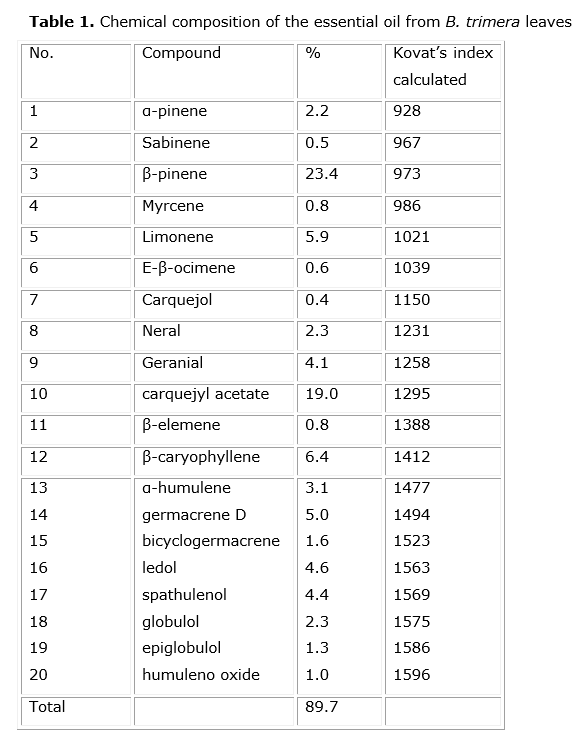
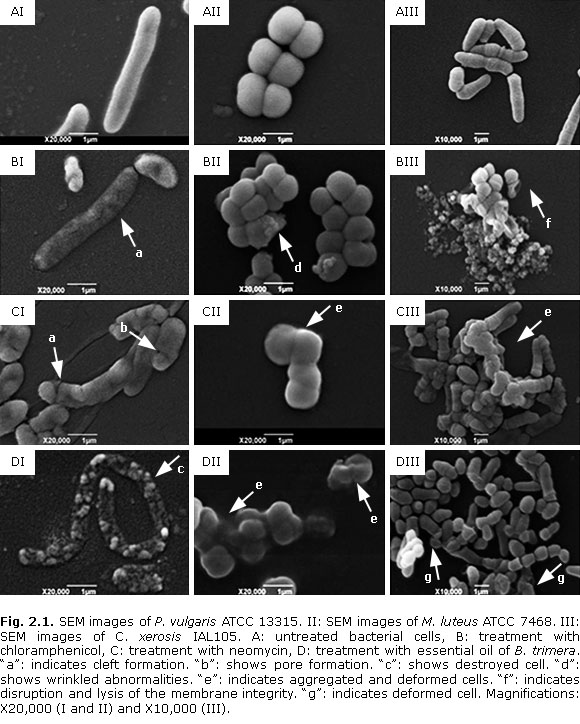
<body><![CDATA[<p><font face="Verdana, Arial, Helvetica, sans-serif" size="2"> The scanning electron    microscopy (SEM) was used to investigate morphological changes in the strains    of interest submitted to the treatment with the essential oil, chloramphenicol    and neomycin. The SEM was carried out by a method adapted from Gao et al.<sup>25</sup>    The bacteria cells were incubated for 24 hours in MHB<b> </b>(<i>S. epidermidis</i>,    <i>P. vulgaris</i>, <i>M. luteus</i>) or BHI (<i>C. xerosis</i>) at 35&#186;C.    The suspension was treated with essential oil (1,000 &#956;g/mL of &#946;-pinene)    or the drugs reference (chloramphenicol and neomycin at MBC value), and then    the samples were reincubated at 35&#186;C for 24 hours. After incubation, cells    were harvested by centrifugation for 10 minutes at 5,000 x <i>g</i> and transferred    onto slides. The cells were fixed with 2.5% glutaraldehyde for 12 hours. After    that, the slides were washed with 0.1 M phosphate buffer solution (pH 7.4),    dehydrated with increasing concentrations of ethanol (50 to 100%) with an interval    of 20 minutes between each exchange, and dried at room temperature. The slides    were assembled in aluminum stubs with double-faced carbon and then covered with    gold in a sputter (2 mm) for 2 minutes in Balzers Union FL - 9496 (Balzers,    Germany). Subsequently, they were analyzed in the scanning electron microscope    JSM 5310 (Jeol, Japan) in high vacuum in secondary electron mode. </font></p>     <p>&nbsp; </p>     <p> <font face="Verdana, Arial, Helvetica, sans-serif" size="2"><b><font size="3">RESULTS    </font></b> </font></p>     <p> <font face="Verdana, Arial, Helvetica, sans-serif" size="2"><b>Chemical composition    of the essential oil</b> </font></p>     <p><font face="Verdana, Arial, Helvetica, sans-serif" size="2"> Twenty constituents    were identified by GC in the essential oil, accounting for 89.7% of all components    in the essential oil. Other components not listed are present in amounts of    less than 0.1%. &#946;-pinene (23.4%) and carquejyl acetate (19.0%) were the    constituents in highest concentrations (<a href="#fig1">Fig 1</a> and <a href="#tab1">table    1</a>). </font></p>     <p>&nbsp;</p>     <p align="center"><a name="fig1"></a><img src="/img/revistas/pla/v21n3/f0109316.jpg" width="580" height="290"></p>     <p align="center"><a name="tab1"></a><img src="/img/revistas/pla/v21n3/t0109316.gif" width="574" height="740"></p>     <p align="center">&nbsp;</p>     <p><font face="Verdana, Arial, Helvetica, sans-serif" size="2"><b>Antimicrobial    activity</b> </font></p>     ]]></body>
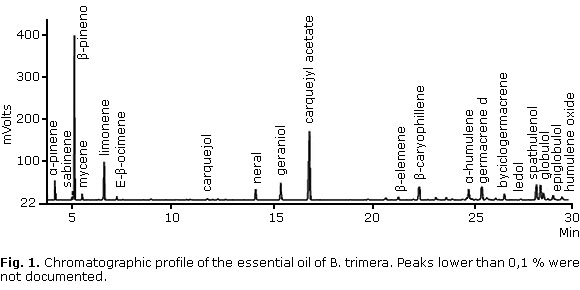
<body><![CDATA[<p> <font face="Verdana, Arial, Helvetica, sans-serif" size="2">Minimum Inhibitory    Concentration (w/v) and Minimal Bactericidal Concentration (w/v) </font></p>     <p><font face="Verdana, Arial, Helvetica, sans-serif" size="2"> According to the    results given in<a href="/img/revistas/pla/v21n3/t0209316.gif"> table 2</a>, the oil exhibited antimicrobial    activity against all bacteria, except <i>S. epidermidis </i>ATCC 12228. The    MIC values of the essential oil ranged from 500 &#956;g/mL to 1,000 &#956;g/mL.    The findings of our study showed bactericidal activity only against <i>P. vulgaris</i>    (MBC=1000 &#956;g/mL) and bacteriostatic activity against <i>P. vulgaris,</i>    <i>M. luteus</i> and <i>C. xerosis</i>. </font></p>     <p><font face="Verdana, Arial, Helvetica, sans-serif" size="2"> </font></p>     <p> <font face="Verdana, Arial, Helvetica, sans-serif" size="2">Scanning electron    microscopy<i> </i> </font></p>     <p><font face="Verdana, Arial, Helvetica, sans-serif" size="2"> The SEM analysis    allowed for morphologically identifying structures and to perceive morphological    changes of the studied bacteria. There was a change in the structure of the    treated bacteria when compared to the negative control. The untreated cells    of all microorganisms tested (negative control) showed cell membrane with a    regular and smooth surface, whereas the treated ones revealed a severe detrimental    effect on the morphology of the cell membrane. </font></p>     <p><font face="Verdana, Arial, Helvetica, sans-serif" size="2"> The cells exposed    to the essential oil and the reference drugs (neomycin and chloramphenicol)    were capable to alter the bacterial cell membrane. The cells exposed to the    action of antimicrobial agents have shown deformities in the structure (orifices    and appearance of fissures, disintegration of the cell membrane, aggregated    cells and cell extravasation) with probable cell destruction (<a href="#FIG2">Fig    2</a>). </font></p>     <p align="center"><a name="FIG2"></a><img src="/img/revistas/pla/v21n3/f0209316.jpg" width="580" height="724"></p>     <p> <font face="Verdana, Arial, Helvetica, sans-serif" size="2"><b> </b></font></p>     <p><font face="Verdana, Arial, Helvetica, sans-serif" size="2"><b><font size="3">DISCUSSION</font></b>    </font></p>     <p><font face="Verdana, Arial, Helvetica, sans-serif" size="2"> According to Bakkali    et al.<sup>26</sup> essential oils are characterized by two or three major components    at high concentrations (20 - 70%) compared to other components present in trace    amounts. The major compound found in this study was &#946;-pinene (23.4%). It    is a bicyclic monoterpene which has been identified as one of the most important    bioactive constituents of many essential oils. The antimicrobial effect of &#946;-pinene    has been attributed to alterations produced at the membrane level.<sup>27</sup>    This work has been developed according to the percentage of &#946;-pinene. However,    there is some evidence that minor components of essential oils have contributed    to the antimicrobial activity, possibly by producing a synergistic or antagonistic    effect between other components.<sup>28,29</sup> </font></p>     ]]></body>
<body><![CDATA[<p><font face="Verdana, Arial, Helvetica, sans-serif" size="2"> In addition, carquejyl    acetate, which accounted for 19.0% of the essential oil, can also make a contribution    to the antimicrobial activity. It has been reported that the great commercial    value of the essential oil of "carqueja" produced in Brazil has been associated    with high carquejyl acetate content.<sup>30</sup> Carquejyl acetate and carquejol,    which are present in the essential oil, were proposed as a chemotaxonomic marker    of this species. Nevertheless, some populations of <i>B.</i> <i>trimera</i>    without these compounds have been recently reported, suggesting the existence    of a novel chemotype or chemical variations which arise as a result of different    environmental conditions.<sup>31</sup> </font></p>     <p><font face="Verdana, Arial, Helvetica, sans-serif" size="2"> Amaral et al.<sup>32</sup>    found &#946;-pinene, palustrol and carquejyl acetate as the major compounds    in the essential oil of <i>B. trimera</i>. Such findings are in agreement with    our results which demonstrated &#946;-pinene and carquejyl acetate in higher    percentages. </font></p>     <p><font face="Verdana, Arial, Helvetica, sans-serif" size="2"> On the other hand,    Oliveira et al.<sup>11</sup> identified (E) - caryophyllene, germacrene D and    bicyclogermacrene as the main compounds. Although those compounds were not the    major constituents in the present study, they are present in the chemical composition    of the essential oil. </font></p>     <p><font face="Verdana, Arial, Helvetica, sans-serif" size="2"> Lago et al.<sup>33</sup>    found &#945;-humulene (19.44%) as the major constituent and other compounds    in lower percentages, such as myrcene (6.09%) and germacrene D (8.86%). Those    constituents were found in the present study, but in different concentrations.    </font></p>     <p><font face="Verdana, Arial, Helvetica, sans-serif" size="2"> Morais and Castanha<sup>30</sup>    suggested the essential oil of <i>B. trimera</i> is mainly composed by carquejol,    carquejyl acetate, &#945; and &#946;-pinene, trans-&#946;-ocimene, nerolidol    and spathulenol. Our study revealed the presence of all those compounds, except    nerolidol. In contrast, they observed a higher concentration of sesquiterpenes    compared to monoterpenes and the presence of ledol (13.7%) in high concentration.    Nevertheless, this compound is frequently found in low concentrations in the    essential oil of <i>B. trimera,</i> as we found in this study (4.6%).<sup>30,34</sup>    </font></p>     <p><font face="Verdana, Arial, Helvetica, sans-serif" size="2"> According to Silva    et al.<sup>15</sup> the seasonal variations of the essential oil of wild and    cultivated <i>B. trimera</i> populations indicated differences in the chemical    composition of wild and cultivated flowering samples from a period of March-May    showed high percentages of globulol and spathulenol. Wild samples collected    from June-February exhibited germacrene D and (E)-caryophyllene as the major    constituents, while samples cultivated from June-February contained a high content    of ledol. </font></p>     <p><font face="Verdana, Arial, Helvetica, sans-serif" size="2"> Furthermore, Silva    et al.<sup>12</sup> evaluated the effect of different post-harvest processing    forms of drugs constituted of parts of "carqueja" on the chemical composition    of its essential oil. The concentration of the major constituents of "carqueja"    essential oil, spathulenol and ledol, was not affected by the post-harvest treatment.    Although they presented different variations, with ledol concentrations decreasing    and spathulenol concentrations increasing. </font></p>     <p><font face="Verdana, Arial, Helvetica, sans-serif" size="2"> Accordingly, it    should be noticed that there are factors which may lead to changes in its chemical    composition, such as extraction technique, time of collection, drying of the    plant material, soil types, genetic factors and climate.<sup>35</sup> </font></p>     <p><font face="Verdana, Arial, Helvetica, sans-serif" size="2"> Although several    researchers reported antimicrobial activity of essential oils or extracts of    <i>B. trimera</i> against some bacteria, such as <i>Escherichia coli</i>, <i>Staphylococcus    aureus</i> and <i>Streptococcus uberis,</i><sup>36-38</sup> the antimicrobial    activity with the establishment of the MIC value of the essential oil against    the tested bacteria has not been performed up to now. </font></p>     <p><font face="Verdana, Arial, Helvetica, sans-serif" size="2"> Pires<sup>34</sup>    researched the antimicrobial activity of the essential oil of <i>B. trimera</i>    against <i>S. epidermidis</i> ATCC 12228 and <i>M. luteus</i> ATCC 9341. However,    this author used the bioautography method as a preliminary biological screening    with no quantitative analysis. </font></p>     ]]></body>
<body><![CDATA[<p><font face="Verdana, Arial, Helvetica, sans-serif" size="2"> Despite the fact    that the MIC values of the essential oil were higher than those of chloramphenicol    and neomycin, the use of the essential oil of <i>B. trimera</i> may be an alternative    as a natural antimicrobial agent in personal care products. The MIC values (500    and 1000 &#181;g/mL) demonstrated to be sufficient inhibiting the growth of    bacteria. The use of plant extracts or essential oils by consumers and regulatory    agencies is expected and reported to be increasing due to "green consumerism".<sup>39</sup>    Therefore, as well as some essential oils have pharmacological properties, others    can be used as starting compounds which are useful in the chemical, cosmetic    and pharmaceutical industries.<sup>11</sup> </font></p>     <p><font face="Verdana, Arial, Helvetica, sans-serif" size="2"> The findings of    the SEM suggested that the essential oil of <i>B. trimera</i> could affect the    morphology of cells and destroy cell membranes. Such results demonstrated that    the essential oil had a destructive effect on <i>P. vulgaris </i>ATCC 13315<i>,    M. luteus </i>ATCC 7468<i> </i>and <i>C. xerosis </i> IAL105<i> </i>bacterial    cells. </font></p>     <p><font face="Verdana, Arial, Helvetica, sans-serif" size="2"> Damages to the    cell membrane structure and function of the bacteria are probably due to the    presence of monoterpenes, which can cause damage to the cell membrane. According    to Flor&#227;o,<sup>40</sup> these constituents have a lipophilic character,    resulting in the expansion and increase of the fluidity of the membrane and    enzymatic inhibition. </font></p>     <p><font face="Verdana, Arial, Helvetica, sans-serif" size="2"> In conclusion,    the essential oil of <i>Baccharis trimera</i> has a chemical composition complex    with a potential application as antimicrobial agent against to bacteria causal    of bad body odor in modern human being. Further studies are necessary. </font></p>     <p>&nbsp; </p>     <p><font face="Verdana, Arial, Helvetica, sans-serif" size="2"><b><font face="Verdana, Arial, Helvetica, sans-serif" size="2"><b><font size="3">REFERENCES    </font></b></font><font size="3">BIBLIOGRAPHIC </font></b> </font></p>     <!-- ref --><p><font face="Verdana, Arial, Helvetica, sans-serif" size="2"> 1. Biesterbos    JWH, Dudzina T, Delmaar CJE, Bakker MI, Russel FGM, Goetz N, et al. Usage patterns    of personal care products: Important factors for exposure assessment. Food Chem    Toxicol. 2013;55(5):8-17.     </font></p>     <!-- ref --><p><font face="Verdana, Arial, Helvetica, sans-serif" size="2"> 2. SPC. Still    smelling sweet: deodorant market. England: HPCi Media. 2012.     </font></p>     ]]></body>
<body><![CDATA[<!-- ref --><p><font face="Verdana, Arial, Helvetica, sans-serif" size="2"> 3. Antignac E,    Nohynek GJ, Re T, Clouzeau J, Toutain H. Safety of botanical ingredients in    personal care products/cosmetics. Food Chem Toxicol. 2011;49(2):324-41.     </font></p>     <!-- ref --><p><font face="Verdana, Arial, Helvetica, sans-serif" size="2"> 4. Manou I, Bouillard    L, Devleeschouwer MJ, Barel AO. Evaluation of the preservative properties of    <i>Thymus vulgaris</i> essential oil in topically applied formulations under    a challenge test. J Appl Microbiol. 1998;84(3):368-76.     </font></p>     <!-- ref --><p><font face="Verdana, Arial, Helvetica, sans-serif" size="2"> 5. Vila R, Santana    AI, P&#233;rez-Ros&#233;s R, Valderrama A, Castelli MV, Mendonca S, et al. Composition    and biological activity of the essential oil from leaves of <i>Plinia cerrocampanensis</i>,    a new source of alpha-bisabolol. Bioresour Technol. 2010;101(7):2510-4.     </font></p>     <!-- ref --><p><font face="Verdana, Arial, Helvetica, sans-serif" size="2"> 6. Lv F, Liang    H, Yuan Q, Li C. In vitro antimicrobial effects and mechanism of action of selected    plant essential oil combinations against four food-related microorganisms. Food    Res Int. 2011;44(9):3057-64.     </font></p>     <!-- ref --><p><font face="Verdana, Arial, Helvetica, sans-serif" size="2"> 7. Vermaak I,    Kamatou GPP, Komane-Mofokeng B, Viljoen AM, Beckett K. African seed oils of    commercial importance - Cosmetic applications. S A J Bot. 2011;77(4):920-33.        </font></p>     ]]></body>
<body><![CDATA[<!-- ref --><p><font face="Verdana, Arial, Helvetica, sans-serif" size="2"> 8. Sol&#243;rzano-Santos    F, Miranda-Novales MG. Essential oils from aromatic herbs as antimicrobial agents.    Curr Opin Biotechnol. 2012;23(2):136-41.     </font></p>     <!-- ref --><p><font face="Verdana, Arial, Helvetica, sans-serif" size="2"> 9. Aboy AL, Apel    MA, Debenedetti S, Francescato L, Rosella MA, Henriques AT. Assay of caffeoylquinic    acids in <i>Baccharis trimera</i> by reversed-phase liquid chromatography. J    Chromatogr A. 2012; 1219(53):147-53.     </font></p>     <!-- ref --><p><font face="Verdana, Arial, Helvetica, sans-serif" size="2"> 10. Biondo TM,    Tanae MM, Coletta ED, Lima-Landman MT, Lapa AJ, Souccar C. Antisecretory actions    of <i>Baccharis trimera</i> (Less.) DC aqueous extract and isolated compounds:    Analysis of underlying mechanisms. J Ethnopharmacol. 2011;136(2):368-73.     </font></p>     <!-- ref --><p><font face="Verdana, Arial, Helvetica, sans-serif" size="2"> 11. Oliveira RN,    Rehder VLG, Oliveira ASS, Montanari-J&#250;nior I, Carvalho JE, Ruiz ALTG, et    al. <i>Schistosoma mansoni</i>: In vitro schistosomicidal activity of essential    oil of <i>Baccharis trimera</i> (less) DC. Exp Parasitol. 2012;132(2):135-43.        </font></p>     <!-- ref --><p><font face="Verdana, Arial, Helvetica, sans-serif" size="2"> 12. Silva FG,    Nascimento VE, Pinto JEBP, Oliveira CBA, Santos MR, Ferri PH. Influ&#234;ncia    do processamento p&#243;s-colheita e armazenamento na composi&#231;&#227;o qu&#237;mica    da droga vegetal e do &#243;leo essencial de carqueja [<i>Baccharis trimera    </i>(Less) D.C.]. Rev Bras Plantas Med. 2010;12(4):436-42.     </font></p>     ]]></body>
<body><![CDATA[<!-- ref --><p><font face="Verdana, Arial, Helvetica, sans-serif" size="2"> 13. Dias LFT,    Melo ES, Hernandes LS, Bacchi EM. Atividades anti&#250;lcera e antioxidante    <i>Baccharis trimera</i> (Less) DC (Asteraceae). Rev Bras Farmacogn. 2009;19(1b):309-14.        </font></p>     <!-- ref --><p><font face="Verdana, Arial, Helvetica, sans-serif" size="2"> 14. Rodrigues    CR, Dias JH, Mello RN, Richter MF, Picada JN, Ferraz AB. Genotoxic and antigenotoxic    properties of <i>Baccharis trimera</i> in mice. J Ethnopharmacol. 2009;125(1):97-101.        </font></p>     <!-- ref --><p><font face="Verdana, Arial, Helvetica, sans-serif" size="2"> 15. Silva FG,    Oliveira CBA, Pinto JEBP, Nascimento VE, Santos SC, Seraphin JC, et al. Seasonal    variability in the essential oils of wild and cultivated <i>Baccharis trimera</i>.    J Braz Chem Soc. 2007;18(5):990-7.     </font></p>     <!-- ref --><p><font face="Verdana, Arial, Helvetica, sans-serif" size="2"> 16. Schuch LFD,    Wiest JM, Garcia EN, Prestes LS, Schramm RC, Coimbra H, et al. Atividade antif&#250;ngica    de extratos de plantas utilizados por agricultores familiares como antimicrobiano.    Acta Sci Vet. 2008;36(3):267-71.     </font></p>     <!-- ref --><p><font face="Verdana, Arial, Helvetica, sans-serif" size="2"> 17. Lermen C,    Cagnini CZ, Pelisson DC, Girotto D, Rodrigues KPLC, Nicareta L, et al. A&#231;&#227;o    do &#243;leo essencial obtido da carqueja - <i>Baccharis trimera</i> D.C. (Asteraceae)    sobre <i>C&#226;ndida albicans</i>.<i> </i>Rev Biol Sa&#250;de Unisep. 2009;3(2):30-6.        </font></p>     ]]></body>
<body><![CDATA[<!-- ref --><p><font face="Verdana, Arial, Helvetica, sans-serif" size="2"> 18. Demo M, Oliva    MM, L&#243;pez ML, Zunino MP, Zygadlo JA. Antimicrobial activity of essential    oils obtained from aromatic plants of Argentina. Pharm Biol. 2005;43(2):129-34.        </font></p>     <!-- ref --><p><font face="Verdana, Arial, Helvetica, sans-serif" size="2"> 19. Cobos MI,    Rodriguez JL, Oliva ML, Demo M, Faillaci SM, Zygadlo JA. Composition and antimicrobial    activity of the essential oil of <i>Baccharis notosergila</i>.<i> </i>Planta    Med. 2001;67(1):84-6.     </font></p>     <!-- ref --><p><font face="Verdana, Arial, Helvetica, sans-serif" size="2"> 20. Albuquerque    MRJR, Souza EB, Lins MUDS, Nogueira NAP, Lemos TLG, Silveira ER, et al. Composition    and antimicrobial activity of the essential oil from aerial parts of <i>Baccharis    trinervis</i> (Lam.) Pers. ARKIVOC. 2004;6:59-65.     </font></p>     <!-- ref --><p><font face="Verdana, Arial, Helvetica, sans-serif" size="2"> 21. Hadad M, Zygadlo    JA, Lima B, Derita M, Feresin GE, Zacchino SA, et al. Chemical composition and    antimicrobial activity of essential oil from <i>Baccharis grisebachii Hieron</i>    (Asteraceae). J Chil Chem Soc. 2007;52(2):1186-9.     </font></p>     <!-- ref --><p><font face="Verdana, Arial, Helvetica, sans-serif" size="2"> 22. Sim&#245;es-Pires    CA, Debenedetti S, Spegazzini E, Mentz LA, Matzenbacher NI, Limberger RP, et    al. Investigation of the essential oil from eight species of <i>Baccharis</i>    belonging to sect. <i>Caulopterae</i> (Asteraceae, Astereae): a taxonomic approach.    Pl Syst Evol. 2005;253(1):23-32.     </font></p>     ]]></body>
<body><![CDATA[<!-- ref --><p><font face="Verdana, Arial, Helvetica, sans-serif" size="2"> 23. Adams RP.    Identification of essential oil components by Gas Chromatography/Mass Spectrometry.    4th edn. Allured Publ Corp., Carol Stream IL. 2007.     </font></p>     <!-- ref --><p><font face="Verdana, Arial, Helvetica, sans-serif" size="2"> 24. Candan F,    Unlu M, Tepe B, Daferera D, Polissiou M, S&#246;kmen A, et al. Antioxidant and    antimicrobial activity of the essential oil and methanol extracts of <i>Achillea    millefolium</i> subsp. <i>millefolium Afan</i>. (Asteraceae). J Ethnopharmacol.    2003;87(2-3):215-20.     </font></p>     <!-- ref --><p><font face="Verdana, Arial, Helvetica, sans-serif" size="2"> 25. Gao C, Tian    C, Lu Y, Xu J, Luo J, Guo X. Essential oil composition and antimicrobial activity    of <i>Sphallerocarpus gracilis</i> seeds against selected food-related bacteria.    Food Control. 2011;22(3-4):517-22.     </font></p>     <!-- ref --><p><font face="Verdana, Arial, Helvetica, sans-serif" size="2"> 26. Bakkali F,    Averbeck S, Averbeck D, Idaomar M. Biological effects of essential oils - A    review. Food Chem Toxicol. 2008;46(2):446-75.     </font></p>     <!-- ref --><p><font face="Verdana, Arial, Helvetica, sans-serif" size="2"> 27. Belletti N,    Kamdem SS, Tabanelli G, Lanciotti R, Gardini F. Modeling of combined effects    of citral, linalool and beta-pinene used against <i>Saccharomyces cerevisiae</i>    in citrus-based beverages subjected to a mild heat treatment. Int J Food Microbiol.    2010;136(3):283-9.     </font></p>     ]]></body>
<body><![CDATA[<!-- ref --><p><font face="Verdana, Arial, Helvetica, sans-serif" size="2"> 28. Burt S. Essential    oils: their antibacterial properties and potential applications in foods - a    review. Int J Food Microbiol. 2004;94(3):223-53.     </font></p>     <!-- ref --><p><font face="Verdana, Arial, Helvetica, sans-serif" size="2"> 29. Jiang Y, Wu    N, Fu YJ, Wang W, Luo M, Zhao CJ, et al. Chemical composition and antimicrobial    activity of the essential oil of Rosemary. Environ Toxicol Pharmacol. 2011;32(1):63-8.        </font></p>     <!-- ref --><p><font face="Verdana, Arial, Helvetica, sans-serif" size="2"> 30. Morais LAS,    Castanha RF. Composi&#231;&#227;o qu&#237;mica do &#243;leo essencial de duas    amostras de carqueja<i> (Baccharis sp.) </i>coletadas em Paty do Alferes - Rio    de Janeiro. Rev Bras Plantas Med. 2011;13(spe):628-32.     </font></p>     <!-- ref --><p><font face="Verdana, Arial, Helvetica, sans-serif" size="2"> 31. Retta D, Gattuso    M, Gattuso S, Lira PDL, Baren C, Bandonia A. Volatile constituents of five <i>Baccharis</i>    species from Northeastern Argentina. J Braz Chem Soc. 2009;20(7):1379-84.     </font></p>     <!-- ref --><p><font face="Verdana, Arial, Helvetica, sans-serif" size="2"> 32. Amaral AS,    Mossi AJ, Rad&#252;nz LL, Treichel H, Teixeira AJ, Lerin LA, et al. Cultivo    de carqueja (<i>Baccharis trimera</i>) em solu&#231;&#227;o nutritiva com diferentes    concentra&#231;&#245;es de nitrog&#234;nio, f&#243;sforo e pot&#225;ssio.<b>    </b>Perspectiva. 2010;34(127):25-34.     </font></p>     ]]></body>
<body><![CDATA[<!-- ref --><p><font face="Verdana, Arial, Helvetica, sans-serif" size="2"> 33. Lago JHG,    Romoff P, F&#225;vero OA, Soares MG, Baraldi PT, Corr&#234;a AG, et al. Composi&#231;&#227;o    qu&#237;mica dos &#243;leos essenciais das folhas de seis esp&#233;cies do g&#234;nero    <i>Baccharis</i> de "Campos de Altitude" da Mata Atl&#226;ntica Paulista. Quim    Nova. 2008;31(4):727-30.     </font></p>     <!-- ref --><p><font face="Verdana, Arial, Helvetica, sans-serif" size="2"> 34. Pires CAS.    Avalia&#231;&#227;o qu&#237;mica e biol&#243;gica de extratos de <i>Baccharis</i>    pertencentes &#224; se&#231;&#227;o <i>Caulopterae</i> (carquejas). Master's    dissertation. Universidade Federal do Rio Grande do Sul, Brazil. 2004.     </font></p>     <!-- ref --><p><font face="Verdana, Arial, Helvetica, sans-serif" size="2"> 35. Silva DCMN,    Bresciani LFV, Dalagnol RL, Danielski L, Yunes RA, Ferreira SRS. Supercritical    &#64258;uid extraction of carqueja (<i>Baccharis trimera</i> ) oil: Process    parameters and composition pro&#64257;les. Food Bioprod Process. 2009:87(4):317-26.        </font></p>     <!-- ref --><p><font face="Verdana, Arial, Helvetica, sans-serif" size="2"> 36. Duarte MCT,    Leme EE, Delarmelina C, Soares AA, Figueira GM, Sartoratto A. Activity of essential    oils from Brazilian medicinal plants on <i>Escherichia coli.</i> J Ethnopharmacol.    2007;111(2):197-201.     </font></p>     <!-- ref --><p><font face="Verdana, Arial, Helvetica, sans-serif" size="2"> 37. Martinez MJA,    Bessa AL, Benito PB. Biologically active substances from the genus <i>Baccharis</i>    L. (Compositae). Stud Nat Prod Chem. 2005;30:703-59.     </font></p>     ]]></body>
<body><![CDATA[<!-- ref --><p><font face="Verdana, Arial, Helvetica, sans-serif" size="2"> 38. Avancini CAM,    Wiest JM, Mundstock E. Atividade bacteriost&#225;tica e bactericida do decocto    de <i>Baccharis trimera</i> (Less.) D.C., Compositae, carqueja, como desinfetante    ou anti-s&#233;ptico. Arq Bras Med Vet Zootec. 2000;52(3):230-4.     </font></p>     <!-- ref --><p><font face="Verdana, Arial, Helvetica, sans-serif" size="2"> 39. Arthanari    SK, Vanitha J, Ganesh M, Venkateshwaran K, Clercq D. Evaluation of antiviral    and cytotoxic activities of methanolic extract of <i>S. grandiflora</i> (Fabaceae)    flowers. Asian Pac J Trop Biomed. 2012;2(2):S855-8.     </font></p>     <!-- ref --><p><font face="Verdana, Arial, Helvetica, sans-serif" size="2"> 40. Flor&#227;o    A. Avalia&#231;&#227;o de atividades biol&#243;gicas de &#243;leos essenciais    de quatro esp&#233;cies de <i>Baccharis</i>, Asteraceae. Master's dissertation.    Universidade Federal do Paran&#225;, Brazil. 2006.     </font></p>     <p><font face="Verdana, Arial, Helvetica, sans-serif" size="2">41. &#201;rika    Yoko Suzuki: N&#250;cleo de Pesquisa e Inova&#231;&#227;o em Ci&#234;ncias da    Sa&#250;de (NUPICS), Faculdade de Farm&#225;cia, Universidade Federal de Juiz    de Fora, Juiz de Fora-MG, Brazil. Correo electr&#243;nico: <a href="mailto:suzukibarbacena@uol.com.br">suzukibarbacena@uol.com.br</a>    </font></p>     <p>&nbsp;</p>     <p>&nbsp;</p>     <p><font face="Verdana, Arial, Helvetica, sans-serif" size="2"> Recibido: 14 de    julio de 2015.     ]]></body>
<body><![CDATA[<br>   </font><font face="Verdana, Arial, Helvetica, sans-serif" size="2">Aprobado:    22 de abril de 2016. </font></p>     <p>&nbsp;</p>     <p>&nbsp;</p>     <p><font face="Verdana, Arial, Helvetica, sans-serif" size="2"><i>&#201;rika Yoko    Suzuki:</i> Faculdade de Farm&#225;cia, Universidade Federal de Juiz de Fora,    Juiz de Fora-MG, Brazil. Correo electr&oacute;nico: <a href="mailto:revistamil@infomed.sld.cu">revistamil@infomed.sld.cu</a></font></p>      ]]></body><back>
<ref-list>
<ref id="B1">
<label>1</label><nlm-citation citation-type="journal">
<person-group person-group-type="author">
<name>
<surname><![CDATA[Biesterbos]]></surname>
<given-names><![CDATA[JWH]]></given-names>
</name>
<name>
<surname><![CDATA[Dudzina]]></surname>
<given-names><![CDATA[T]]></given-names>
</name>
<name>
<surname><![CDATA[Delmaar]]></surname>
<given-names><![CDATA[CJE]]></given-names>
</name>
<name>
<surname><![CDATA[Bakker]]></surname>
<given-names><![CDATA[MI]]></given-names>
</name>
<name>
<surname><![CDATA[Russel]]></surname>
<given-names><![CDATA[FGM]]></given-names>
</name>
<name>
<surname><![CDATA[Goetz]]></surname>
<given-names><![CDATA[N]]></given-names>
</name>
</person-group>
<article-title xml:lang="en"><![CDATA[Usage patterns of personal care products: Important factors for exposure assessment]]></article-title>
<source><![CDATA[Food Chem Toxicol]]></source>
<year>2013</year>
<volume>55</volume>
<numero>5</numero>
<issue>5</issue>
<page-range>8-17</page-range></nlm-citation>
</ref>
<ref id="B2">
<label>2</label><nlm-citation citation-type="book">
<collab>SPC</collab>
<source><![CDATA[Still smelling sweet: deodorant market]]></source>
<year>2012</year>
<publisher-loc><![CDATA[England ]]></publisher-loc>
<publisher-name><![CDATA[HPCi Media]]></publisher-name>
</nlm-citation>
</ref>
<ref id="B3">
<label>3</label><nlm-citation citation-type="journal">
<person-group person-group-type="author">
<name>
<surname><![CDATA[Antignac]]></surname>
<given-names><![CDATA[E]]></given-names>
</name>
<name>
<surname><![CDATA[Nohynek]]></surname>
<given-names><![CDATA[GJ]]></given-names>
</name>
<name>
<surname><![CDATA[Re]]></surname>
<given-names><![CDATA[T]]></given-names>
</name>
<name>
<surname><![CDATA[Clouzeau]]></surname>
<given-names><![CDATA[J]]></given-names>
</name>
<name>
<surname><![CDATA[Toutain]]></surname>
<given-names><![CDATA[H]]></given-names>
</name>
</person-group>
<article-title xml:lang="en"><![CDATA[Safety of botanical ingredients in personal care products/cosmetics]]></article-title>
<source><![CDATA[Food Chem Toxicol]]></source>
<year>2011</year>
<volume>49</volume>
<numero>2</numero>
<issue>2</issue>
<page-range>324-41</page-range></nlm-citation>
</ref>
<ref id="B4">
<label>4</label><nlm-citation citation-type="journal">
<person-group person-group-type="author">
<name>
<surname><![CDATA[Manou]]></surname>
<given-names><![CDATA[I]]></given-names>
</name>
<name>
<surname><![CDATA[Bouillard]]></surname>
<given-names><![CDATA[L]]></given-names>
</name>
<name>
<surname><![CDATA[Devleeschouwer]]></surname>
<given-names><![CDATA[MJ]]></given-names>
</name>
<name>
<surname><![CDATA[Barel]]></surname>
<given-names><![CDATA[AO]]></given-names>
</name>
</person-group>
<article-title xml:lang="en"><![CDATA[Evaluation of the preservative properties of Thymus vulgaris essential oil in topically applied formulations under a challenge test]]></article-title>
<source><![CDATA[J Appl Microbiol]]></source>
<year>1998</year>
<volume>84</volume>
<numero>3</numero>
<issue>3</issue>
<page-range>368-76</page-range></nlm-citation>
</ref>
<ref id="B5">
<label>5</label><nlm-citation citation-type="journal">
<person-group person-group-type="author">
<name>
<surname><![CDATA[Vila]]></surname>
<given-names><![CDATA[R]]></given-names>
</name>
<name>
<surname><![CDATA[Santana]]></surname>
<given-names><![CDATA[AI]]></given-names>
</name>
<name>
<surname><![CDATA[Pérez-Rosés]]></surname>
<given-names><![CDATA[R]]></given-names>
</name>
<name>
<surname><![CDATA[Valderrama]]></surname>
<given-names><![CDATA[A]]></given-names>
</name>
<name>
<surname><![CDATA[Castelli]]></surname>
<given-names><![CDATA[MV]]></given-names>
</name>
<name>
<surname><![CDATA[Mendonca]]></surname>
<given-names><![CDATA[S]]></given-names>
</name>
</person-group>
<article-title xml:lang="en"><![CDATA[Composition and biological activity of the essential oil from leaves of Plinia cerrocampanensis, a new source of alpha-bisabolol]]></article-title>
<source><![CDATA[Bioresour Technol]]></source>
<year>2010</year>
<volume>101</volume>
<numero>7</numero>
<issue>7</issue>
<page-range>2510-4</page-range></nlm-citation>
</ref>
<ref id="B6">
<label>6</label><nlm-citation citation-type="journal">
<person-group person-group-type="author">
<name>
<surname><![CDATA[Lv]]></surname>
<given-names><![CDATA[F]]></given-names>
</name>
<name>
<surname><![CDATA[Liang]]></surname>
<given-names><![CDATA[H]]></given-names>
</name>
<name>
<surname><![CDATA[Yuan]]></surname>
<given-names><![CDATA[Q]]></given-names>
</name>
<name>
<surname><![CDATA[Li]]></surname>
<given-names><![CDATA[C]]></given-names>
</name>
</person-group>
<article-title xml:lang="en"><![CDATA[In vitro antimicrobial effects and mechanism of action of selected plant essential oil combinations against four food-related microorganisms]]></article-title>
<source><![CDATA[Food Res Int]]></source>
<year>2011</year>
<volume>44</volume>
<numero>9</numero>
<issue>9</issue>
<page-range>3057-64</page-range></nlm-citation>
</ref>
<ref id="B7">
<label>7</label><nlm-citation citation-type="journal">
<person-group person-group-type="author">
<name>
<surname><![CDATA[Vermaak]]></surname>
<given-names><![CDATA[I]]></given-names>
</name>
<name>
<surname><![CDATA[Kamatou]]></surname>
<given-names><![CDATA[GPP]]></given-names>
</name>
<name>
<surname><![CDATA[Komane-Mofokeng]]></surname>
<given-names><![CDATA[B]]></given-names>
</name>
<name>
<surname><![CDATA[Viljoen]]></surname>
<given-names><![CDATA[AM]]></given-names>
</name>
<name>
<surname><![CDATA[Beckett]]></surname>
<given-names><![CDATA[K]]></given-names>
</name>
</person-group>
<article-title xml:lang="en"><![CDATA[African seed oils of commercial importance - Cosmetic applications]]></article-title>
<source><![CDATA[S A J Bot]]></source>
<year>2011</year>
<volume>77</volume>
<numero>4</numero>
<issue>4</issue>
<page-range>920-33</page-range></nlm-citation>
</ref>
<ref id="B8">
<label>8</label><nlm-citation citation-type="journal">
<person-group person-group-type="author">
<name>
<surname><![CDATA[Solórzano-Santos]]></surname>
<given-names><![CDATA[F]]></given-names>
</name>
<name>
<surname><![CDATA[Miranda-Novales]]></surname>
<given-names><![CDATA[MG]]></given-names>
</name>
</person-group>
<article-title xml:lang="en"><![CDATA[Essential oils from aromatic herbs as antimicrobial agents]]></article-title>
<source><![CDATA[Curr Opin Biotechnol]]></source>
<year>2012</year>
<volume>23</volume>
<numero>2</numero>
<issue>2</issue>
<page-range>136-41</page-range></nlm-citation>
</ref>
<ref id="B9">
<label>9</label><nlm-citation citation-type="journal">
<person-group person-group-type="author">
<name>
<surname><![CDATA[Aboy]]></surname>
<given-names><![CDATA[AL]]></given-names>
</name>
<name>
<surname><![CDATA[Apel]]></surname>
<given-names><![CDATA[MA]]></given-names>
</name>
<name>
<surname><![CDATA[Debenedetti]]></surname>
<given-names><![CDATA[S]]></given-names>
</name>
<name>
<surname><![CDATA[Francescato]]></surname>
<given-names><![CDATA[L]]></given-names>
</name>
<name>
<surname><![CDATA[Rosella]]></surname>
<given-names><![CDATA[MA]]></given-names>
</name>
<name>
<surname><![CDATA[Henriques]]></surname>
<given-names><![CDATA[AT]]></given-names>
</name>
</person-group>
<article-title xml:lang="en"><![CDATA[Assay of caffeoylquinic acids in Baccharis trimera by reversed-phase liquid chromatography]]></article-title>
<source><![CDATA[J Chromatogr A]]></source>
<year>2012</year>
<volume>1219</volume>
<numero>53</numero>
<issue>53</issue>
<page-range>147-53</page-range></nlm-citation>
</ref>
<ref id="B10">
<label>10</label><nlm-citation citation-type="journal">
<person-group person-group-type="author">
<name>
<surname><![CDATA[Biondo]]></surname>
<given-names><![CDATA[TM]]></given-names>
</name>
<name>
<surname><![CDATA[Tanae]]></surname>
<given-names><![CDATA[MM]]></given-names>
</name>
<name>
<surname><![CDATA[Coletta]]></surname>
<given-names><![CDATA[ED]]></given-names>
</name>
<name>
<surname><![CDATA[Lima-Landman]]></surname>
<given-names><![CDATA[MT]]></given-names>
</name>
<name>
<surname><![CDATA[Lapa]]></surname>
<given-names><![CDATA[AJ]]></given-names>
</name>
<name>
<surname><![CDATA[Souccar]]></surname>
<given-names><![CDATA[C]]></given-names>
</name>
</person-group>
<article-title xml:lang="en"><![CDATA[Antisecretory actions of Baccharis trimera (Less) DC aqueous extract and isolated compounds: Analysis of underlying mechanisms]]></article-title>
<source><![CDATA[J Ethnopharmacol]]></source>
<year>2011</year>
<volume>136</volume>
<numero>2</numero>
<issue>2</issue>
<page-range>368-73</page-range></nlm-citation>
</ref>
<ref id="B11">
<label>11</label><nlm-citation citation-type="journal">
<person-group person-group-type="author">
<name>
<surname><![CDATA[Oliveira]]></surname>
<given-names><![CDATA[RN]]></given-names>
</name>
<name>
<surname><![CDATA[Rehder]]></surname>
<given-names><![CDATA[VLG]]></given-names>
</name>
<name>
<surname><![CDATA[Oliveira]]></surname>
<given-names><![CDATA[ASS]]></given-names>
</name>
<name>
<surname><![CDATA[Montanari-Júnior]]></surname>
<given-names><![CDATA[I]]></given-names>
</name>
<name>
<surname><![CDATA[Carvalho]]></surname>
<given-names><![CDATA[JE]]></given-names>
</name>
<name>
<surname><![CDATA[Ruiz]]></surname>
<given-names><![CDATA[ALTG]]></given-names>
</name>
</person-group>
<article-title xml:lang="en"><![CDATA[Schistosoma mansoni: In vitro schistosomicidal activity of essential oil of Baccharis trimera (less) DC]]></article-title>
<source><![CDATA[Exp Parasitol]]></source>
<year>2012</year>
<volume>132</volume>
<numero>2</numero>
<issue>2</issue>
<page-range>135-43</page-range></nlm-citation>
</ref>
<ref id="B12">
<label>12</label><nlm-citation citation-type="journal">
<person-group person-group-type="author">
<name>
<surname><![CDATA[Silva]]></surname>
<given-names><![CDATA[FG]]></given-names>
</name>
<name>
<surname><![CDATA[Nascimento]]></surname>
<given-names><![CDATA[VE]]></given-names>
</name>
<name>
<surname><![CDATA[Pinto]]></surname>
<given-names><![CDATA[JEBP]]></given-names>
</name>
<name>
<surname><![CDATA[Oliveira]]></surname>
<given-names><![CDATA[CBA]]></given-names>
</name>
<name>
<surname><![CDATA[Santos]]></surname>
<given-names><![CDATA[MR]]></given-names>
</name>
<name>
<surname><![CDATA[Ferri]]></surname>
<given-names><![CDATA[PH]]></given-names>
</name>
</person-group>
<article-title xml:lang="pt"><![CDATA[Influência do processamento pós-colheita e armazenamento na composição química da droga vegetal e do óleo essencial de carqueja Baccharis trimera (Less) DC]]></article-title>
<source><![CDATA[Rev Bras Plantas Med]]></source>
<year>2010</year>
<volume>12</volume>
<numero>4</numero>
<issue>4</issue>
<page-range>436-42</page-range></nlm-citation>
</ref>
<ref id="B13">
<label>13</label><nlm-citation citation-type="journal">
<person-group person-group-type="author">
<name>
<surname><![CDATA[Dias]]></surname>
<given-names><![CDATA[LFT]]></given-names>
</name>
<name>
<surname><![CDATA[Melo]]></surname>
<given-names><![CDATA[ES]]></given-names>
</name>
<name>
<surname><![CDATA[Hernandes]]></surname>
<given-names><![CDATA[LS]]></given-names>
</name>
<name>
<surname><![CDATA[Bacchi]]></surname>
<given-names><![CDATA[EM]]></given-names>
</name>
</person-group>
<article-title xml:lang="en"><![CDATA[Atividades antiúlcera e antioxidante Baccharis trimera (Less) DC (Asteraceae)]]></article-title>
<source><![CDATA[Rev Bras Farmacogn]]></source>
<year>2009</year>
<volume>19</volume>
<numero>1b</numero>
<issue>1b</issue>
<page-range>309-14</page-range></nlm-citation>
</ref>
<ref id="B14">
<label>14</label><nlm-citation citation-type="journal">
<person-group person-group-type="author">
<name>
<surname><![CDATA[Rodrigues]]></surname>
<given-names><![CDATA[CR]]></given-names>
</name>
<name>
<surname><![CDATA[Dias]]></surname>
<given-names><![CDATA[JH]]></given-names>
</name>
<name>
<surname><![CDATA[Mello]]></surname>
<given-names><![CDATA[RN]]></given-names>
</name>
<name>
<surname><![CDATA[Richter]]></surname>
<given-names><![CDATA[MF]]></given-names>
</name>
<name>
<surname><![CDATA[Picada]]></surname>
<given-names><![CDATA[JN]]></given-names>
</name>
<name>
<surname><![CDATA[Ferraz]]></surname>
<given-names><![CDATA[AB]]></given-names>
</name>
</person-group>
<article-title xml:lang="en"><![CDATA[Genotoxic and antigenotoxic properties of Baccharis trimera in mice]]></article-title>
<source><![CDATA[J Ethnopharmacol]]></source>
<year>2009</year>
<volume>125</volume>
<numero>1</numero>
<issue>1</issue>
<page-range>97-101</page-range></nlm-citation>
</ref>
<ref id="B15">
<label>15</label><nlm-citation citation-type="journal">
<person-group person-group-type="author">
<name>
<surname><![CDATA[Silva]]></surname>
<given-names><![CDATA[FG]]></given-names>
</name>
<name>
<surname><![CDATA[Oliveira]]></surname>
<given-names><![CDATA[CBA]]></given-names>
</name>
<name>
<surname><![CDATA[Pinto]]></surname>
<given-names><![CDATA[JEBP]]></given-names>
</name>
<name>
<surname><![CDATA[Nascimento]]></surname>
<given-names><![CDATA[VE]]></given-names>
</name>
<name>
<surname><![CDATA[Santos]]></surname>
<given-names><![CDATA[SC]]></given-names>
</name>
<name>
<surname><![CDATA[Seraphin]]></surname>
<given-names><![CDATA[JC]]></given-names>
</name>
</person-group>
<article-title xml:lang="en"><![CDATA[Seasonal variability in the essential oils of wild and cultivated Baccharis trimera]]></article-title>
<source><![CDATA[J Braz Chem Soc]]></source>
<year>2007</year>
<volume>18</volume>
<numero>5</numero>
<issue>5</issue>
<page-range>990-7</page-range></nlm-citation>
</ref>
<ref id="B16">
<label>16</label><nlm-citation citation-type="journal">
<person-group person-group-type="author">
<name>
<surname><![CDATA[Schuch]]></surname>
<given-names><![CDATA[LFD]]></given-names>
</name>
<name>
<surname><![CDATA[Wiest]]></surname>
<given-names><![CDATA[JM]]></given-names>
</name>
<name>
<surname><![CDATA[Garcia]]></surname>
<given-names><![CDATA[EN]]></given-names>
</name>
<name>
<surname><![CDATA[Prestes]]></surname>
<given-names><![CDATA[LS]]></given-names>
</name>
<name>
<surname><![CDATA[Schramm]]></surname>
<given-names><![CDATA[RC]]></given-names>
</name>
<name>
<surname><![CDATA[Coimbra]]></surname>
<given-names><![CDATA[H]]></given-names>
</name>
</person-group>
<article-title xml:lang="pt"><![CDATA[Atividade antifúngica de extratos de plantas utilizados por agricultores familiares como antimicrobiano]]></article-title>
<source><![CDATA[Acta Sci Vet]]></source>
<year>2008</year>
<volume>36</volume>
<numero>3</numero>
<issue>3</issue>
<page-range>267-71</page-range></nlm-citation>
</ref>
<ref id="B17">
<label>17</label><nlm-citation citation-type="journal">
<person-group person-group-type="author">
<name>
<surname><![CDATA[Lermen]]></surname>
<given-names><![CDATA[C]]></given-names>
</name>
<name>
<surname><![CDATA[Cagnini]]></surname>
<given-names><![CDATA[CZ]]></given-names>
</name>
<name>
<surname><![CDATA[Pelisson]]></surname>
<given-names><![CDATA[DC]]></given-names>
</name>
<name>
<surname><![CDATA[Girotto]]></surname>
<given-names><![CDATA[D]]></given-names>
</name>
<name>
<surname><![CDATA[Rodrigues]]></surname>
<given-names><![CDATA[KPLC]]></given-names>
</name>
<name>
<surname><![CDATA[Nicareta]]></surname>
<given-names><![CDATA[L]]></given-names>
</name>
</person-group>
<article-title xml:lang="pt"><![CDATA[Ação do óleo essencial obtido da carqueja - Baccharis trimera DC. (Asteraceae) sobre Cândida albicans]]></article-title>
<source><![CDATA[Rev Biol Saúde Unisep]]></source>
<year>2009</year>
<volume>3</volume>
<numero>2</numero>
<issue>2</issue>
<page-range>30-6</page-range></nlm-citation>
</ref>
<ref id="B18">
<label>18</label><nlm-citation citation-type="journal">
<person-group person-group-type="author">
<name>
<surname><![CDATA[Demo]]></surname>
<given-names><![CDATA[M]]></given-names>
</name>
<name>
<surname><![CDATA[Oliva]]></surname>
<given-names><![CDATA[MM]]></given-names>
</name>
<name>
<surname><![CDATA[López]]></surname>
<given-names><![CDATA[ML]]></given-names>
</name>
<name>
<surname><![CDATA[Zunino]]></surname>
<given-names><![CDATA[MP]]></given-names>
</name>
<name>
<surname><![CDATA[Zygadlo]]></surname>
<given-names><![CDATA[JA]]></given-names>
</name>
</person-group>
<article-title xml:lang="en"><![CDATA[Antimicrobial activity of essential oils obtained from aromatic plants of Argentina]]></article-title>
<source><![CDATA[Pharm Biol]]></source>
<year>2005</year>
<volume>43</volume>
<numero>2</numero>
<issue>2</issue>
<page-range>129-34</page-range></nlm-citation>
</ref>
<ref id="B19">
<label>19</label><nlm-citation citation-type="journal">
<person-group person-group-type="author">
<name>
<surname><![CDATA[Cobos]]></surname>
<given-names><![CDATA[MI]]></given-names>
</name>
<name>
<surname><![CDATA[Rodriguez]]></surname>
<given-names><![CDATA[JL]]></given-names>
</name>
<name>
<surname><![CDATA[Oliva]]></surname>
<given-names><![CDATA[ML]]></given-names>
</name>
<name>
<surname><![CDATA[Demo]]></surname>
<given-names><![CDATA[M]]></given-names>
</name>
<name>
<surname><![CDATA[Faillaci]]></surname>
<given-names><![CDATA[SM]]></given-names>
</name>
<name>
<surname><![CDATA[Zygadlo]]></surname>
<given-names><![CDATA[JA]]></given-names>
</name>
</person-group>
<article-title xml:lang="en"><![CDATA[Composition and antimicrobial activity of the essential oil of Baccharis notosergila]]></article-title>
<source><![CDATA[Planta Med]]></source>
<year>2001</year>
<volume>67</volume>
<numero>1</numero>
<issue>1</issue>
<page-range>84-6</page-range></nlm-citation>
</ref>
<ref id="B20">
<label>20</label><nlm-citation citation-type="journal">
<person-group person-group-type="author">
<name>
<surname><![CDATA[Albuquerque]]></surname>
<given-names><![CDATA[MRJR]]></given-names>
</name>
<name>
<surname><![CDATA[Souza]]></surname>
<given-names><![CDATA[EB]]></given-names>
</name>
<name>
<surname><![CDATA[Lins]]></surname>
<given-names><![CDATA[MUDS]]></given-names>
</name>
<name>
<surname><![CDATA[Nogueira]]></surname>
<given-names><![CDATA[NAP]]></given-names>
</name>
<name>
<surname><![CDATA[Lemos]]></surname>
<given-names><![CDATA[TLG]]></given-names>
</name>
<name>
<surname><![CDATA[Silveira]]></surname>
<given-names><![CDATA[ER]]></given-names>
</name>
</person-group>
<article-title xml:lang="en"><![CDATA[Composition and antimicrobial activity of the essential oil from aerial parts of Baccharis trinervis (Lam) Pers]]></article-title>
<source><![CDATA[ARKIVOC]]></source>
<year>2004</year>
<volume>6</volume>
<page-range>59-65</page-range></nlm-citation>
</ref>
<ref id="B21">
<label>21</label><nlm-citation citation-type="journal">
<person-group person-group-type="author">
<name>
<surname><![CDATA[Hadad]]></surname>
<given-names><![CDATA[M]]></given-names>
</name>
<name>
<surname><![CDATA[Zygadlo]]></surname>
<given-names><![CDATA[JA]]></given-names>
</name>
<name>
<surname><![CDATA[Lima]]></surname>
<given-names><![CDATA[B]]></given-names>
</name>
<name>
<surname><![CDATA[Derita]]></surname>
<given-names><![CDATA[M]]></given-names>
</name>
<name>
<surname><![CDATA[Feresin]]></surname>
<given-names><![CDATA[GE]]></given-names>
</name>
<name>
<surname><![CDATA[Zacchino]]></surname>
<given-names><![CDATA[SA]]></given-names>
</name>
</person-group>
<article-title xml:lang="en"><![CDATA[Chemical composition and antimicrobial activity of essential oil from Baccharis grisebachii Hieron (Asteraceae)]]></article-title>
<source><![CDATA[J Chil Chem Soc]]></source>
<year>2007</year>
<volume>52</volume>
<numero>2</numero>
<issue>2</issue>
<page-range>1186-9</page-range></nlm-citation>
</ref>
<ref id="B22">
<label>22</label><nlm-citation citation-type="journal">
<person-group person-group-type="author">
<name>
<surname><![CDATA[Simões-Pires]]></surname>
<given-names><![CDATA[CA]]></given-names>
</name>
<name>
<surname><![CDATA[Debenedetti]]></surname>
<given-names><![CDATA[S]]></given-names>
</name>
<name>
<surname><![CDATA[Spegazzini]]></surname>
<given-names><![CDATA[E]]></given-names>
</name>
<name>
<surname><![CDATA[Mentz]]></surname>
<given-names><![CDATA[LA]]></given-names>
</name>
<name>
<surname><![CDATA[Matzenbacher]]></surname>
<given-names><![CDATA[NI]]></given-names>
</name>
<name>
<surname><![CDATA[Limberger]]></surname>
<given-names><![CDATA[RP]]></given-names>
</name>
</person-group>
<article-title xml:lang="en"><![CDATA[Investigation of the essential oil from eight species of Baccharis belonging to sectCaulopterae (Asteraceae, Astereae): a taxonomic approach]]></article-title>
<source><![CDATA[Pl Syst Evol]]></source>
<year>2005</year>
<volume>253</volume>
<numero>1</numero>
<issue>1</issue>
<page-range>23-32</page-range></nlm-citation>
</ref>
<ref id="B23">
<label>23</label><nlm-citation citation-type="book">
<person-group person-group-type="author">
<name>
<surname><![CDATA[Adams]]></surname>
<given-names><![CDATA[RP]]></given-names>
</name>
</person-group>
<source><![CDATA[Identification of essential oil components by Gas Chromatography/Mass Spectrometry]]></source>
<year>2007</year>
<edition>4th edn</edition>
<publisher-name><![CDATA[Allured Publ Corp, Carol Stream IL]]></publisher-name>
</nlm-citation>
</ref>
<ref id="B24">
<label>24</label><nlm-citation citation-type="journal">
<person-group person-group-type="author">
<name>
<surname><![CDATA[Candan]]></surname>
<given-names><![CDATA[F]]></given-names>
</name>
<name>
<surname><![CDATA[Unlu]]></surname>
<given-names><![CDATA[M]]></given-names>
</name>
<name>
<surname><![CDATA[Tepe]]></surname>
<given-names><![CDATA[B]]></given-names>
</name>
<name>
<surname><![CDATA[Daferera]]></surname>
<given-names><![CDATA[D]]></given-names>
</name>
<name>
<surname><![CDATA[Polissiou]]></surname>
<given-names><![CDATA[M]]></given-names>
</name>
<name>
<surname><![CDATA[Sökmen]]></surname>
<given-names><![CDATA[A]]></given-names>
</name>
</person-group>
<article-title xml:lang="en"><![CDATA[Antioxidant and antimicrobial activity of the essential oil and methanol extracts of Achillea millefolium subspmillefolium Afan. (Asteraceae)]]></article-title>
<source><![CDATA[J Ethnopharmacol]]></source>
<year>2003</year>
<volume>87</volume>
<numero>2-3</numero>
<issue>2-3</issue>
<page-range>215-20</page-range></nlm-citation>
</ref>
<ref id="B25">
<label>25</label><nlm-citation citation-type="journal">
<person-group person-group-type="author">
<name>
<surname><![CDATA[Gao]]></surname>
<given-names><![CDATA[C]]></given-names>
</name>
<name>
<surname><![CDATA[Tian]]></surname>
<given-names><![CDATA[C]]></given-names>
</name>
<name>
<surname><![CDATA[Lu]]></surname>
<given-names><![CDATA[Y]]></given-names>
</name>
<name>
<surname><![CDATA[Xu]]></surname>
<given-names><![CDATA[J]]></given-names>
</name>
<name>
<surname><![CDATA[Luo]]></surname>
<given-names><![CDATA[J]]></given-names>
</name>
<name>
<surname><![CDATA[Guo]]></surname>
<given-names><![CDATA[X]]></given-names>
</name>
</person-group>
<article-title xml:lang="en"><![CDATA[Essential oil composition and antimicrobial activity of Sphallerocarpus gracilis seeds against selected food-related bacteria]]></article-title>
<source><![CDATA[Food Control]]></source>
<year>2011</year>
<volume>22</volume>
<numero>3-4</numero>
<issue>3-4</issue>
<page-range>517-22</page-range></nlm-citation>
</ref>
<ref id="B26">
<label>26</label><nlm-citation citation-type="journal">
<person-group person-group-type="author">
<name>
<surname><![CDATA[Bakkali]]></surname>
<given-names><![CDATA[F]]></given-names>
</name>
<name>
<surname><![CDATA[Averbeck]]></surname>
<given-names><![CDATA[S]]></given-names>
</name>
<name>
<surname><![CDATA[Averbeck]]></surname>
<given-names><![CDATA[D]]></given-names>
</name>
<name>
<surname><![CDATA[Idaomar]]></surname>
<given-names><![CDATA[M]]></given-names>
</name>
</person-group>
<article-title xml:lang="en"><![CDATA[Biological effects of essential oils - A review]]></article-title>
<source><![CDATA[Food Chem Toxicol]]></source>
<year>2008</year>
<volume>46</volume>
<numero>2</numero>
<issue>2</issue>
<page-range>446-75</page-range></nlm-citation>
</ref>
<ref id="B27">
<label>27</label><nlm-citation citation-type="journal">
<person-group person-group-type="author">
<name>
<surname><![CDATA[Belletti]]></surname>
<given-names><![CDATA[N]]></given-names>
</name>
<name>
<surname><![CDATA[Kamdem]]></surname>
<given-names><![CDATA[SS]]></given-names>
</name>
<name>
<surname><![CDATA[Tabanelli]]></surname>
<given-names><![CDATA[G]]></given-names>
</name>
<name>
<surname><![CDATA[Lanciotti]]></surname>
<given-names><![CDATA[R]]></given-names>
</name>
<name>
<surname><![CDATA[Gardini]]></surname>
<given-names><![CDATA[F]]></given-names>
</name>
</person-group>
<article-title xml:lang="en"><![CDATA[Modeling of combined effects of citral, linalool and beta-pinene used against Saccharomyces cerevisiae in citrus-based beverages subjected to a mild heat treatment]]></article-title>
<source><![CDATA[Int J Food Microbiol]]></source>
<year>2010</year>
<volume>136</volume>
<numero>3</numero>
<issue>3</issue>
<page-range>283-9</page-range></nlm-citation>
</ref>
<ref id="B28">
<label>28</label><nlm-citation citation-type="journal">
<person-group person-group-type="author">
<name>
<surname><![CDATA[Burt]]></surname>
<given-names><![CDATA[S]]></given-names>
</name>
</person-group>
<article-title xml:lang="en"><![CDATA[Essential oils: their antibacterial properties and potential applications in foods - a review]]></article-title>
<source><![CDATA[Int J Food Microbiol]]></source>
<year>2004</year>
<volume>94</volume>
<numero>3</numero>
<issue>3</issue>
<page-range>223-53</page-range></nlm-citation>
</ref>
<ref id="B29">
<label>29</label><nlm-citation citation-type="journal">
<person-group person-group-type="author">
<name>
<surname><![CDATA[Jiang]]></surname>
<given-names><![CDATA[Y]]></given-names>
</name>
<name>
<surname><![CDATA[Wu]]></surname>
<given-names><![CDATA[N]]></given-names>
</name>
<name>
<surname><![CDATA[Fu]]></surname>
<given-names><![CDATA[YJ]]></given-names>
</name>
<name>
<surname><![CDATA[Wang]]></surname>
<given-names><![CDATA[W]]></given-names>
</name>
<name>
<surname><![CDATA[Luo]]></surname>
<given-names><![CDATA[M]]></given-names>
</name>
<name>
<surname><![CDATA[Zhao]]></surname>
<given-names><![CDATA[CJ]]></given-names>
</name>
</person-group>
<article-title xml:lang="en"><![CDATA[Chemical composition and antimicrobial activity of the essential oil of Rosemary]]></article-title>
<source><![CDATA[Environ Toxicol Pharmacol]]></source>
<year>2011</year>
<volume>32</volume>
<numero>1</numero>
<issue>1</issue>
<page-range>63-8</page-range></nlm-citation>
</ref>
<ref id="B30">
<label>30</label><nlm-citation citation-type="journal">
<person-group person-group-type="author">
<name>
<surname><![CDATA[Morais]]></surname>
<given-names><![CDATA[LAS]]></given-names>
</name>
<name>
<surname><![CDATA[Castanha]]></surname>
<given-names><![CDATA[RF]]></given-names>
</name>
</person-group>
<article-title xml:lang="pt"><![CDATA[Composição química do óleo essencial de duas amostras de carqueja (Baccharis sp) coletadas em Paty do Alferes - Rio de Janeiro]]></article-title>
<source><![CDATA[Rev Bras Plantas Med]]></source>
<year>2011</year>
<volume>13</volume>
<numero>spe</numero>
<issue>spe</issue>
<page-range>628-32</page-range></nlm-citation>
</ref>
<ref id="B31">
<label>31</label><nlm-citation citation-type="journal">
<person-group person-group-type="author">
<name>
<surname><![CDATA[Retta]]></surname>
<given-names><![CDATA[D]]></given-names>
</name>
<name>
<surname><![CDATA[Gattuso]]></surname>
<given-names><![CDATA[M]]></given-names>
</name>
<name>
<surname><![CDATA[Gattuso]]></surname>
<given-names><![CDATA[S]]></given-names>
</name>
<name>
<surname><![CDATA[Lira]]></surname>
<given-names><![CDATA[PDL]]></given-names>
</name>
<name>
<surname><![CDATA[Baren]]></surname>
<given-names><![CDATA[C]]></given-names>
</name>
<name>
<surname><![CDATA[Bandonia]]></surname>
<given-names><![CDATA[A]]></given-names>
</name>
</person-group>
<article-title xml:lang="en"><![CDATA[Volatile constituents of five Baccharis species from Northeastern Argentina]]></article-title>
<source><![CDATA[J Braz Chem Soc]]></source>
<year>2009</year>
<volume>20</volume>
<numero>7</numero>
<issue>7</issue>
<page-range>1379-84</page-range></nlm-citation>
</ref>
<ref id="B32">
<label>32</label><nlm-citation citation-type="journal">
<person-group person-group-type="author">
<name>
<surname><![CDATA[Amaral]]></surname>
<given-names><![CDATA[AS]]></given-names>
</name>
<name>
<surname><![CDATA[Mossi]]></surname>
<given-names><![CDATA[AJ]]></given-names>
</name>
<name>
<surname><![CDATA[Radünz]]></surname>
<given-names><![CDATA[LL]]></given-names>
</name>
<name>
<surname><![CDATA[Treichel]]></surname>
<given-names><![CDATA[H]]></given-names>
</name>
<name>
<surname><![CDATA[Teixeira]]></surname>
<given-names><![CDATA[AJ]]></given-names>
</name>
<name>
<surname><![CDATA[Lerin]]></surname>
<given-names><![CDATA[LA]]></given-names>
</name>
</person-group>
<article-title xml:lang="pt"><![CDATA[Cultivo de carqueja (Baccharis trimera) em solução nutritiva com diferentes concentrações de nitrogênio, fósforo e potássio]]></article-title>
<source><![CDATA[Perspectiva]]></source>
<year>2010</year>
<volume>34</volume>
<numero>127</numero>
<issue>127</issue>
<page-range>25-34</page-range></nlm-citation>
</ref>
<ref id="B33">
<label>33</label><nlm-citation citation-type="journal">
<person-group person-group-type="author">
<name>
<surname><![CDATA[Lago]]></surname>
<given-names><![CDATA[JHG]]></given-names>
</name>
<name>
<surname><![CDATA[Romoff]]></surname>
<given-names><![CDATA[P]]></given-names>
</name>
<name>
<surname><![CDATA[Fávero]]></surname>
<given-names><![CDATA[OA]]></given-names>
</name>
<name>
<surname><![CDATA[Soares]]></surname>
<given-names><![CDATA[MG]]></given-names>
</name>
<name>
<surname><![CDATA[Baraldi]]></surname>
<given-names><![CDATA[PT]]></given-names>
</name>
<name>
<surname><![CDATA[Corrêa]]></surname>
<given-names><![CDATA[AG]]></given-names>
</name>
</person-group>
<article-title xml:lang="pt"><![CDATA[Composição química dos óleos essenciais das folhas de seis espécies do gênero Baccharis de "Campos de Altitude" da Mata Atlântica Paulista]]></article-title>
<source><![CDATA[Quim Nova]]></source>
<year>2008</year>
<volume>31</volume>
<numero>4</numero>
<issue>4</issue>
<page-range>727-30</page-range></nlm-citation>
</ref>
<ref id="B34">
<label>34</label><nlm-citation citation-type="book">
<person-group person-group-type="author">
<name>
<surname><![CDATA[Pires]]></surname>
<given-names><![CDATA[CAS]]></given-names>
</name>
</person-group>
<source><![CDATA[Avaliação química e biológica de extratos de Baccharis pertencentes à seção Caulopterae (carquejas). Master's dissertation]]></source>
<year>2004</year>
<publisher-name><![CDATA[Universidade Federal do Rio Grande do Sul]]></publisher-name>
</nlm-citation>
</ref>
<ref id="B35">
<label>35</label><nlm-citation citation-type="journal">
<person-group person-group-type="author">
<name>
<surname><![CDATA[Silva]]></surname>
<given-names><![CDATA[DCMN]]></given-names>
</name>
<name>
<surname><![CDATA[Bresciani]]></surname>
<given-names><![CDATA[LFV]]></given-names>
</name>
<name>
<surname><![CDATA[Dalagnol]]></surname>
<given-names><![CDATA[RL]]></given-names>
</name>
<name>
<surname><![CDATA[Danielski]]></surname>
<given-names><![CDATA[L]]></given-names>
</name>
<name>
<surname><![CDATA[Yunes]]></surname>
<given-names><![CDATA[RA]]></given-names>
</name>
<name>
<surname><![CDATA[Ferreira]]></surname>
<given-names><![CDATA[SRS]]></given-names>
</name>
</person-group>
<article-title xml:lang="en"><![CDATA[Supercritical ?uid extraction of carqueja (Baccharis trimera ) oil: Process parameters and composition pro?les]]></article-title>
<source><![CDATA[Food Bioprod Process]]></source>
<year>2009</year>
<volume>87</volume>
<numero>4</numero>
<issue>4</issue>
<page-range>317-26</page-range></nlm-citation>
</ref>
<ref id="B36">
<label>36</label><nlm-citation citation-type="journal">
<person-group person-group-type="author">
<name>
<surname><![CDATA[Duarte]]></surname>
<given-names><![CDATA[MCT]]></given-names>
</name>
<name>
<surname><![CDATA[Leme]]></surname>
<given-names><![CDATA[EE]]></given-names>
</name>
<name>
<surname><![CDATA[Delarmelina]]></surname>
<given-names><![CDATA[C]]></given-names>
</name>
<name>
<surname><![CDATA[Soares]]></surname>
<given-names><![CDATA[AA]]></given-names>
</name>
<name>
<surname><![CDATA[Figueira]]></surname>
<given-names><![CDATA[GM]]></given-names>
</name>
<name>
<surname><![CDATA[Sartoratto]]></surname>
<given-names><![CDATA[A]]></given-names>
</name>
</person-group>
<article-title xml:lang="en"><![CDATA[Activity of essential oils from Brazilian medicinal plants on Escherichia coli]]></article-title>
<source><![CDATA[J Ethnopharmacol]]></source>
<year>2007</year>
<volume>111</volume>
<numero>2</numero>
<issue>2</issue>
<page-range>197-201</page-range></nlm-citation>
</ref>
<ref id="B37">
<label>37</label><nlm-citation citation-type="journal">
<person-group person-group-type="author">
<name>
<surname><![CDATA[Martinez]]></surname>
<given-names><![CDATA[MJA]]></given-names>
</name>
<name>
<surname><![CDATA[Bessa]]></surname>
<given-names><![CDATA[AL]]></given-names>
</name>
<name>
<surname><![CDATA[Benito]]></surname>
<given-names><![CDATA[PB]]></given-names>
</name>
</person-group>
<article-title xml:lang="en"><![CDATA[Biologically active substances from the genus Baccharis L(Compositae)]]></article-title>
<source><![CDATA[Stud Nat Prod Chem]]></source>
<year>2005</year>
<volume>30</volume>
<page-range>703-59</page-range></nlm-citation>
</ref>
<ref id="B38">
<label>38</label><nlm-citation citation-type="journal">
<person-group person-group-type="author">
<name>
<surname><![CDATA[Avancini]]></surname>
<given-names><![CDATA[CAM]]></given-names>
</name>
<name>
<surname><![CDATA[Wiest]]></surname>
<given-names><![CDATA[JM]]></given-names>
</name>
<name>
<surname><![CDATA[Mundstock]]></surname>
<given-names><![CDATA[E]]></given-names>
</name>
</person-group>
<article-title xml:lang="en"><![CDATA[Atividade bacteriostática e bactericida do decocto de Baccharis trimera (Less) D.C., Compositae, carqueja, como desinfetante ou anti-séptico]]></article-title>
<source><![CDATA[Arq Bras Med Vet Zootec]]></source>
<year>2000</year>
<volume>52</volume>
<numero>3</numero>
<issue>3</issue>
<page-range>230-4</page-range></nlm-citation>
</ref>
<ref id="B39">
<label>39</label><nlm-citation citation-type="journal">
<person-group person-group-type="author">
<name>
<surname><![CDATA[Arthanari]]></surname>
<given-names><![CDATA[SK]]></given-names>
</name>
<name>
<surname><![CDATA[Vanitha]]></surname>
<given-names><![CDATA[J]]></given-names>
</name>
<name>
<surname><![CDATA[Ganesh]]></surname>
<given-names><![CDATA[M]]></given-names>
</name>
<name>
<surname><![CDATA[Venkateshwaran]]></surname>
<given-names><![CDATA[K]]></given-names>
</name>
<name>
<surname><![CDATA[Clercq]]></surname>
<given-names><![CDATA[D]]></given-names>
</name>
</person-group>
<article-title xml:lang="en"><![CDATA[Evaluation of antiviral and cytotoxic activities of methanolic extract of Sgrandiflora (Fabaceae) flowers]]></article-title>
<source><![CDATA[Asian Pac J Trop Biomed]]></source>
<year>2012</year>
<volume>2</volume>
<numero>2</numero>
<issue>2</issue>
<page-range>S855-8</page-range></nlm-citation>
</ref>
<ref id="B40">
<label>40</label><nlm-citation citation-type="book">
<person-group person-group-type="author">
<name>
<surname><![CDATA[Florão]]></surname>
<given-names><![CDATA[A]]></given-names>
</name>
</person-group>
<source><![CDATA[Avaliação de atividades biológicas de óleos essenciais de quatro espécies de Baccharis, Asteraceae. Master's dissertation]]></source>
<year>2006</year>
<publisher-name><![CDATA[Universidade Federal do Paraná]]></publisher-name>
</nlm-citation>
</ref>
<ref id="B41">
<label>41</label><nlm-citation citation-type="book">
<person-group person-group-type="author">
<name>
<surname><![CDATA[Yoko Suzuki]]></surname>
<given-names><![CDATA[É]]></given-names>
</name>
</person-group>
<source><![CDATA[Núcleo de Pesquisa e Inovação em Ciências da Saúde (NUPICS)]]></source>
<year></year>
<publisher-loc><![CDATA[^eJuiz de Fora-MG Juiz de Fora-MG]]></publisher-loc>
<publisher-name><![CDATA[Faculdade de FarmáciaUniversidade Federal de Juiz de Fora]]></publisher-name>
</nlm-citation>
</ref>
</ref-list>
</back>
</article>