<?xml version="1.0" encoding="ISO-8859-1"?><article xmlns:mml="http://www.w3.org/1998/Math/MathML" xmlns:xlink="http://www.w3.org/1999/xlink" xmlns:xsi="http://www.w3.org/2001/XMLSchema-instance">
<front>
<journal-meta>
<journal-id>1561-3003</journal-id>
<journal-title><![CDATA[Revista Cubana de Higiene y Epidemiología]]></journal-title>
<abbrev-journal-title><![CDATA[Rev Cubana Hig Epidemiol]]></abbrev-journal-title>
<issn>1561-3003</issn>
<publisher>
<publisher-name><![CDATA[Centro Nacional de Información de Ciencias MédicasEditorial Ciencias Médicas]]></publisher-name>
</publisher>
</journal-meta>
<article-meta>
<article-id>S1561-30031999000200007</article-id>
<title-group>
<article-title xml:lang="es"><![CDATA[Caracterización de un brote de Shigella boydii 14 por primera vez en Cuba]]></article-title>
</title-group>
<contrib-group>
<contrib contrib-type="author">
<name>
<surname><![CDATA[Ramírez Álvarez]]></surname>
<given-names><![CDATA[Margarita]]></given-names>
</name>
<xref ref-type="aff" rid="A01"/>
</contrib>
<contrib contrib-type="author">
<name>
<surname><![CDATA[Bravo Fariñas]]></surname>
<given-names><![CDATA[Laura]]></given-names>
</name>
</contrib>
<contrib contrib-type="author">
<name>
<surname><![CDATA[Llop Hernández]]></surname>
<given-names><![CDATA[Alina]]></given-names>
</name>
</contrib>
<contrib contrib-type="author">
<name>
<surname><![CDATA[Cabrera Ortega]]></surname>
<given-names><![CDATA[Roberto]]></given-names>
</name>
</contrib>
<contrib contrib-type="author">
<name>
<surname><![CDATA[García Rodríguez]]></surname>
<given-names><![CDATA[Belkys]]></given-names>
</name>
</contrib>
<contrib contrib-type="author">
<name>
<surname><![CDATA[Fernández Abreu]]></surname>
<given-names><![CDATA[Anabel]]></given-names>
</name>
</contrib>
</contrib-group>
<aff id="A01">
<institution><![CDATA[,. Instituto de Medicina Tropical Pedro Kourí  ]]></institution>
<addr-line><![CDATA[Ciudad de La Habana ]]></addr-line>
<country>Cuba</country>
</aff>
<pub-date pub-type="pub">
<day>00</day>
<month>08</month>
<year>1999</year>
</pub-date>
<pub-date pub-type="epub">
<day>00</day>
<month>08</month>
<year>1999</year>
</pub-date>
<volume>37</volume>
<numero>2</numero>
<fpage>90</fpage>
<lpage>93</lpage>
<copyright-statement/>
<copyright-year/>
<self-uri xlink:href="http://scielo.sld.cu/scielo.php?script=sci_arttext&amp;pid=S1561-30031999000200007&amp;lng=en&amp;nrm=iso"></self-uri><self-uri xlink:href="http://scielo.sld.cu/scielo.php?script=sci_abstract&amp;pid=S1561-30031999000200007&amp;lng=en&amp;nrm=iso"></self-uri><self-uri xlink:href="http://scielo.sld.cu/scielo.php?script=sci_pdf&amp;pid=S1561-30031999000200007&amp;lng=en&amp;nrm=iso"></self-uri><abstract abstract-type="short" xml:lang="es"><p><![CDATA[Se propuso la caracterización de 14 cepas de Shigella boydii 14 aisladas de pacientes con enfermedad diarreica aguda mediante sus plásmidos de resistencia y de las proteínas de la membrana externa presentes en ellas. Se realizó la determinación de la susceptibilidad antimicrobiana por el método de concentración mínima inhibitoria, la extracción de plásmidos R fue según Manaitis, los extractos proteicos de las cepas se obtuvieron según el método de Blaser modificado y las proteínas de la membrana externa fueron separadas por SDS-PAGE por el método de Laemmli. Se comprobó que las cepas resultaron resistentes a la ampicilina (100 %), la tetraciclina (70 %) y al cotrimoxazol (50 %), y sensibles al ácido nalidíxico y a la ciprofloxacina. Se observó la presencia de plásmidos al nivel de los 43; 23; 20; 5,6 y 1,2 kb. Las proteínas de la membrana externa y el perfil proteico demostraron diferencias con otras especies de Shigella. Este serotipo de Shigella se aísla por primera vez en Cuba y y sus características la hacen altamente patógena y de muy difícil diagnóstico, por lo que la caracterización de este brote es importante desde el punto de vista epidemiológico.]]></p></abstract>
<abstract abstract-type="short" xml:lang="en"><p><![CDATA[The characterization of strains of Shigella boydii isolated from patients with acute diarrheal disease by resistance susplasmides, and of the proteins of the outer membrane that appear in these strans was suggested. The antimicrobial susceptibility was determined by the minimum inhibitory concentration method, and the extraction of plasmids R. According to Manaitis, the protein extracts of the strains were obtained by the modified method of Blaser, whereas the proteins of the outer membrane were separated by SDS-PAGE, using the Laemmli's method. It was proved that the strains were resistant to ampicillin (100 %), tetracycline (70 %) and cotrimoxazole (50 %), and sensitive to nolidixic acid and to cyprofoflaxine. Plasmides were observed at the level of 43; 23; 20; 5.6 and 1.2 kb. The proteins of the outer membrane and the protein profile proved to be different from other species of Shigella. This serotype of Shigella was isolated for the first time in Cuba and its characteristics make it highly pathogen and very difficult to be diagnosed. That's why, the characterization of this outbreak is important from the epidemiological point of view.]]></p></abstract>
<kwd-group>
<kwd lng="es"><![CDATA[SHIGELLA BOYDII]]></kwd>
<kwd lng="es"><![CDATA[DISENTERIA BACILAR]]></kwd>
<kwd lng="es"><![CDATA[FACTORES R]]></kwd>
<kwd lng="es"><![CDATA[PROTEINAS DE LA MEMBRANA BACTERIANA EXTERNA]]></kwd>
<kwd lng="es"><![CDATA[CUBA]]></kwd>
<kwd lng="en"><![CDATA[SHIGELLA BOYDII]]></kwd>
<kwd lng="en"><![CDATA[DYSENTERY, BACILLARY]]></kwd>
<kwd lng="en"><![CDATA[R FACTORS]]></kwd>
<kwd lng="en"><![CDATA[BACTERIAL OUTER MEMBRANE PROTEINS]]></kwd>
<kwd lng="en"><![CDATA[CUBA]]></kwd>
</kwd-group>
</article-meta>
</front><body><![CDATA[ <H3>Comunicacion breve</H3>     <P>Instituto de Medicina Tropical "Pedro Kour&iacute;" </P> <H2>Caracterizaci&oacute;n de un brote de <I>Shigella boydii</I> 14 por primera vez en Cuba</H2>     <P><A HREF="#autores"><I>Dra. Margarita Ram&iacute;rez &Aacute;lvarez,<SUP>1</SUP> Lic. Laura Bravo Fari&ntilde;as,<SUP>2</SUP> Dra. Alina Llop Hern&aacute;ndez,<SUP>3</SUP> Lic. Roberto Cabrera Ortega,<SUP>4</SUP> T&eacute;c. Belkys Garc&iacute;a Rodr&iacute;guez<SUP>5</SUP> y T&eacute;c. Anabel Fern&aacute;ndez Abreu<SUP>6</sup></I></A> </P> <H4>Resumen</H4>     <P>Se propuso la caracterizaci&oacute;n de 14 cepas de <I>Shigella boydii</I> 14 aisladas de pacientes con enfermedad diarreica aguda mediante sus pl&aacute;smidos de resistencia y de las prote&iacute;nas de la membrana externa presentes en ellas. Se realiz&oacute; la determinaci&oacute;n de la susceptibilidad antimicrobiana por el m&eacute;todo de concentraci&oacute;n m&iacute;nima inhibitoria, la extracci&oacute;n de pl&aacute;smidos R fue seg&uacute;n Manaitis, los extractos proteicos de las cepas se obtuvieron seg&uacute;n el m&eacute;todo de Blaser modificado y las prote&iacute;nas de la membrana externa fueron separadas por SDS-PAGE por el m&eacute;todo de Laemmli. Se comprob&oacute; que las cepas resultaron resistentes a la ampicilina (100 %), la tetraciclina (70 %) y al cotrimoxazol (50 %), y sensibles al &aacute;cido nalid&iacute;xico y a la ciprofloxacina. Se observ&oacute; la presencia de pl&aacute;smidos al nivel de los 43; 23; 20; 5,6 y 1,2 kb. Las prote&iacute;nas de la membrana externa y el perfil proteico demostraron diferencias con otras especies de <I>Shigella</I>. Este serotipo de <I>Shigella</I> se a&iacute;sla por primera vez en Cuba y y sus caracter&iacute;sticas la hacen altamente pat&oacute;gena y de muy dif&iacute;cil diagn&oacute;stico, por lo que la caracterizaci&oacute;n de este brote es importante desde el punto de vista epidemiol&oacute;gico. </P>     <P>Descriptores DeCS: SHIGELLA BOYDII/aislamiento &amp; purificaci&oacute;n; DISENTERIA BACILAR; FACTORES R/analisis; PROTEINAS DE LA MEMBRANA BACTERIANA EXTERNA/an&aacute;lisis; CUBA. </P>     <P>Los microorganismos del g&eacute;nero <I>Shigella </I>se encuentran entre los agentes identificados con mayor frecuencia en los ni&ntilde;os con enfermedad diarreica aguda (EDA) en los pa&iacute;ses en v&iacute;as de desarrollo.<SUP>1</SUP> Las drogas antimicrobianas han demostrado su utilidad en esta entidad, en la shigelosis se han empleado cl&aacute;sicamente la ampicilina, el cotrimoxazol y la tetraciclina, a las cuales las cepas han demostrado alta resistencia transmitida por pl&aacute;smidos R, que codifican los genes de multirresistencia que las hacen muy pat&oacute;genas.<SUP>2</SUP> En este estudio se propuso la caracterizaci&oacute;n de cepas de <I>Shigella boydii </I>14 aisladas de pacientes con EDA mediante sus pl&aacute;smidos de resistencia y de las prote&iacute;nas de la membrana externa presentes en ellas. </P> <H4>M&eacute;todos</H4>     <P>Se estudiaron 14 cepas de<I> Shigella boydii</I> 14 aisladas de un brote ocurrido en la provincia de Camag&uuml;ey en el mes de julio de 1997 y remitidas por el Centro Provincial de Higiene y Epidemiolog&iacute;a al Laboratorio Nacional de Referencia de EDA del Instituto de Medicina Tropical "Pedro Kour&iacute;". Las cepas fueron comprobadas bioqu&iacute;mica y serol&oacute;gicamente para verificar si pertenec&iacute;an a este serotipo. </P>     <P>Se les realiz&oacute; la determinaci&oacute;n de la susceptibilidad antimicrobiana por el m&eacute;todo de concentraci&oacute;n m&iacute;nima inhibitoria (CMI)<SUP>2</SUP> y a las cepas que resultaron multirresistentes a las drogas de elecci&oacute;n se les realiz&oacute; la extracci&oacute;n de pl&aacute;smidos R seg&uacute;n<I> </I>Manaitis<I>,</I><SUP>3</SUP> los extractos proteicos de las cepas se realizaron seg&uacute;n el m&eacute;todo de Blaser modificado,<SUP>4</SUP> las prote&iacute;nas de la membrana externa fueron separadas por SDS-PAGE por el m&eacute;todo de Laemmli<SUP>5</SUP> con un gel concentrador al 5 % de acrilamida y un gel separador al 10 %, para conocer los patrones relacionados con el serotipo de <I>Shigella boydii</I> 14. </P> <H4>Resultados</H4>     <P>Se comprob&oacute; que el 100 % de las cepas resultaron resistentes a la ampicilina, 70 % resistentes a la tetraciclina, y 50 % al cotrimoxazol, fueron sensibles al &aacute;cido nalid&iacute;xico y a la ciprofloxacina (tabla). </P>     <P ALIGN="CENTER">TABLA.<I> Susceptibilidad a las drogas de </I>Shigella boydii 14</P>     ]]></body>
<body><![CDATA[<P ALIGN="CENTER">    <CENTER><TABLE CELLSPACING=0 BORDER=0 CELLPADDING=5 WIDTH=617> <TR><TD WIDTH="33%" VALIGN="TOP">     <P>Drogas&nbsp;</TD> <TD WIDTH="33%" VALIGN="TOP">     <P ALIGN="CENTER">Resistencia (%)&nbsp;</TD> <TD WIDTH="33%" VALIGN="TOP">     <P ALIGN="CENTER">Sensibilidad (%)</TD> </TR> <TR><TD WIDTH="33%" VALIGN="TOP">     <P>Ampicilina</TD> <TD WIDTH="33%" VALIGN="TOP">     <P ALIGN="CENTER">100</TD> <TD WIDTH="33%" VALIGN="TOP">     <P ALIGN="CENTER">0</TD> </TR> <TR><TD WIDTH="33%" VALIGN="TOP">     <P>Trimeth-sulfamet</TD> <TD WIDTH="33%" VALIGN="TOP">     <P ALIGN="CENTER">70</TD> <TD WIDTH="33%" VALIGN="TOP">     ]]></body>
<body><![CDATA[<P ALIGN="CENTER">30</TD> </TR> <TR><TD WIDTH="33%" VALIGN="TOP">     <P>Tetraciclina</TD> <TD WIDTH="33%" VALIGN="TOP">     <P ALIGN="CENTER">50</TD> <TD WIDTH="33%" VALIGN="TOP">     <P ALIGN="CENTER">50</TD> </TR> <TR><TD WIDTH="33%" VALIGN="TOP">     <P>&Aacute;cido nalid&iacute;xico</TD> <TD WIDTH="33%" VALIGN="TOP">     <P ALIGN="CENTER">2</TD> <TD WIDTH="33%" VALIGN="TOP">     <P ALIGN="CENTER">98</TD> </TR> <TR><TD WIDTH="33%" VALIGN="TOP" HEIGHT=23>     <P>Ciprofloxacina</TD> <TD WIDTH="33%" VALIGN="TOP" HEIGHT=23>     <P ALIGN="CENTER">0</TD> <TD WIDTH="33%" VALIGN="TOP" HEIGHT=23>     <P ALIGN="CENTER">100</TD> </TR> </TABLE> </CENTER>    ]]></body>
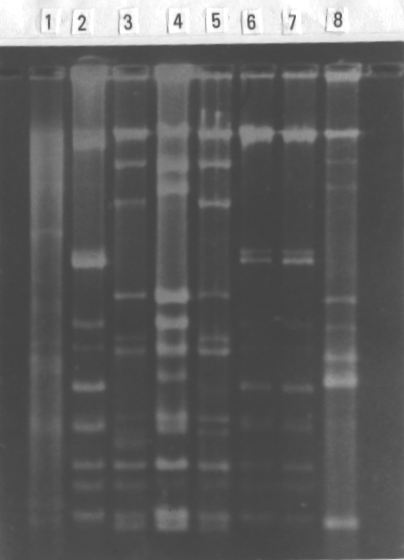
<body><![CDATA[<p></P>      <P ALIGN="CENTER">Al analizarse el perfil plasm&iacute;dico de las cepas se observ&oacute; la presencia de pl&aacute;smidos al nivel de los 43; 23; 20; 5,6 y 1,2 kb en todas, lo que se corresponde con los pl&aacute;smidos que codifican los genes de resistencia a las diferentes drogas estudiadas (fig.). </P>     <P ALIGN="CENTER"><A HREF="/img/revistas/hie/v37n2/f0107299.jpg"><IMG SRC="/img/revistas/hie/v37n2/f0107299.jpg" BORDER=0 WIDTH=196 HEIGHT=273 ALT="Figura 1"></A>    
<BR> Fig.<I> Perfil plasm&iacute;dico de las cepas de </I>Shigella boydii <I>14.</I>     <BR> Columna 1: patr&oacute;n de peso molecular, Fago Lambda Hind III. Columnas 2, 3, 4, 5, 6, 7 y 8: cepas de <I>Shigella boydii </I>14 con bandas de pl&aacute;smidos de 43; 23; 20; 5,6 y 1, 2 kb.</P>     <P>Se analizaron las prote&iacute;nas de la membrana externa presentes en estas cepas y el perfil proteico de &eacute;stas demostr&oacute; diferencias con otras especies de <I>Shigella</I> al observarse bandas a los niveles de 38, 34 y 29 kD. </P> <H4>Discusi&oacute;n</H4>     <P>Este serotipo de <I>Shigella</I> se a&iacute;sla por primera vez en nuestro pa&iacute;s a partir de pacientes con enfermedad diarreica aguda, por lo que la multirresistencia a las drogas y la presencia de pl&aacute;smidos R las hace muy pat&oacute;genas, pues es conocido que &eacute;stos son transferidos f&aacute;cilmente de una enterobacteria a otra y esto podr&iacute;a dar lugar a la aparici&oacute;n de nuevos brotes de <I>Shigella boydii</I> 14 con cepas muy resistentes a las drogas de elecci&oacute;n. Este serotipo es aislado con poca frecuencia en otros pa&iacute;ses y los brotes reportados han sido tambi&eacute;n resistentes al tratamiento de elecci&oacute;n.<SUP>6</SUP> </P>     <P>Las diferencias observadas en el comportamiento electrofor&eacute;tico de las prote&iacute;nas de la membrana externa de <I>Shigella</I> permite establecer una diferenciaci&oacute;n entre especies y puede utilizarse como un instrumento m&aacute;s en la caracterizaci&oacute;n de un brote por un nuevo serotipo como es el caso de <I>Shigella boydii</I> 14 en Cuba. </P>     <P>La caracterizaci&oacute;n de este brote es importante epidemiol&oacute;gicamente debido a que este serotipo es de dif&iacute;cil diagn&oacute;stico, ya que una de sus caracter&iacute;sticas bioqu&iacute;micas es la producci&oacute;n de gas lo que hace que sea at&iacute;pica para <I>Shigella</I>. Su aislamiento por primera vez en la provincia de Camag&uuml;ey indica que esta cepa comienza a circular en nuestro pa&iacute;s y si no se tiene presente puede escapar al diagn&oacute;stico microbiol&oacute;gico. </P> <H4>Summary</H4>     <P>The characterization of strains of <I>Shigella boydii</I> isolated from patients with acute diarrheal disease by resistance susplasmides, and of the proteins of the outer membrane that appear in these strans was suggested. The antimicrobial susceptibility was determined by the minimum inhibitory concentration method, and the extraction of plasmids R. According to Manaitis, the protein extracts of the strains were obtained by the modified method of Blaser, whereas the proteins of the outer membrane were separated by SDS-PAGE, using the Laemmli's method. It was proved that the strains were resistant to ampicillin (100 %), tetracycline (70 %) and cotrimoxazole (50 %), and sensitive to nolidixic acid and to cyprofoflaxine. Plasmides were observed at the level of 43; 23; 20; 5.6 and 1.2 kb. The proteins of the outer membrane and the protein profile proved to be different from other species of <I>Shigella</I>. This serotype of <I>Shigella</I> was isolated for the first time in Cuba and its characteristics make it highly pathogen and very difficult to be diagnosed. That's why, the characterization of this outbreak is important from the epidemiological point of view. </P>     ]]></body>
<body><![CDATA[<P>Subject headings: SHIGELLA BOYDII/isolation &amp; purification; DYSENTERY, BACILLARY; R FACTORS/analysis; BACTERIAL OUTER MEMBRANE PROTEINS/analysis; CUBA. </P> <H4>Referencias bibliogr&aacute;ficas</H4> <OL>      <!-- ref --><LI>Rahman S. Shigellosis a continuing global problem proceedings of International Conferences Cox's. ICDDRB Special publication No.20 1981.</LI>    <!-- ref --><LI>Vila J, Gasc&oacute;n J, Abdalla S, G&oacute;mez J, Marco F, Moreno A. Antimicrobial resistance of Shigella isolates causing traveler's diarrhoea. Antimicrob Agents Chemother 1994;38(11):2668-70.</LI>    <!-- ref --><LI>Manaitis T, Frish EF, Sambrook J. Molecular Cloning A Laboratory Manual. New York: Cold Spring Harbor Laboratory, 1989:9-31.</LI>    <!-- ref --><LI>Blaser MJ, Hopkins JA, Berka RM, Vasil ML, Wang WL. Identification and characterization of Campylobacter jejuni. Microbiol Meth 1995;21(1):276-84.</LI>    <!-- ref --><LI>Smith BJ. SDS Polyacrilamide Gel Electrophoresis of practics. En: Walker JM. Methods in Molecular Biology. Basic protein and Peptide Protocols Humans Press Inc. Totowa, NJ: Times Mirror Publisher, 1994; Vol 32:34.</LI>    <!-- ref --><LI>Gurgui Ferrer M. Infecciones por Shigella En: Farreras Valenti PY, Rozman C. Medicina Interna. 13 ed. Edit. Mosby/Doyma Libros SA. Times Mirror International Publisher, 1995;vol 2:67-9.</LI>    </OL>      <P>Recibido: 21 de mayo de 1998. Aprobado: 4 de febrero de 1999. </P>     <P>Dra. <I>Margarita Ram&iacute;rez &Aacute;lvarez. </I>Instituto de Medicina Tropical "Pedro Kour&iacute;". Apartado 601, Marianao 13, Ciudad de La Habana, Cuba.     ]]></body>
<body><![CDATA[<BR> &nbsp; </P>     <P><SUP>1<A NAME="autores"></A></sup>Especialista de I Grado en Microbiolog&iacute;a. Investigadora Agregada.     <BR> <SUP>2</SUP> Licenciada en Microbiolog&iacute;a. Investigadora Auxiliar.     <BR> <SUP>3</SUP> Especialista de II Grado en Microbiolog&iacute;a. Investigadora Titular. Profesora Titular. Subdirectora de Microbiolog&iacute;a.     <BR> <SUP>4</SUP> Licenciado en Microbiolog&iacute;a.     <BR> <SUP>5</SUP> T&eacute;cnica en Procesos Biol&oacute;gicos.     <BR> <SUP>6</SUP> T&eacute;cnica en Farmacia. </P> <H5></H5>     ]]></body><back>
<ref-list>
<ref id="B1">
<nlm-citation citation-type="">
<person-group person-group-type="author">
<name>
<surname><![CDATA[Rahman]]></surname>
<given-names><![CDATA[S]]></given-names>
</name>
</person-group>
<source><![CDATA[Shigellosis a continuing global problem proceedings of International Conferences Cox's. ICDDRB Special publication No.20]]></source>
<year>1981</year>
</nlm-citation>
</ref>
<ref id="B2">
<nlm-citation citation-type="journal">
<person-group person-group-type="author">
<name>
<surname><![CDATA[Vila]]></surname>
<given-names><![CDATA[J]]></given-names>
</name>
<name>
<surname><![CDATA[Gascón]]></surname>
<given-names><![CDATA[J]]></given-names>
</name>
<name>
<surname><![CDATA[Abdalla]]></surname>
<given-names><![CDATA[S]]></given-names>
</name>
<name>
<surname><![CDATA[Gómez]]></surname>
<given-names><![CDATA[J]]></given-names>
</name>
<name>
<surname><![CDATA[Marco]]></surname>
<given-names><![CDATA[F]]></given-names>
</name>
<name>
<surname><![CDATA[Moreno]]></surname>
<given-names><![CDATA[A]]></given-names>
</name>
</person-group>
<article-title xml:lang="en"><![CDATA[Antimicrobial resistance of Shigella isolates causing traveler's diarrhoea]]></article-title>
<source><![CDATA[Antimicrob Agents Chemother]]></source>
<year>1994</year>
<volume>38</volume>
<numero>11</numero>
<issue>11</issue>
<page-range>2668-70</page-range></nlm-citation>
</ref>
<ref id="B3">
<nlm-citation citation-type="book">
<person-group person-group-type="author">
<name>
<surname><![CDATA[Manaitis]]></surname>
<given-names><![CDATA[T]]></given-names>
</name>
<name>
<surname><![CDATA[Frish]]></surname>
<given-names><![CDATA[EF]]></given-names>
</name>
<name>
<surname><![CDATA[Sambrook]]></surname>
<given-names><![CDATA[J]]></given-names>
</name>
</person-group>
<source><![CDATA[Molecular Cloning A Laboratory Manual]]></source>
<year>1989</year>
<page-range>9-31</page-range><publisher-loc><![CDATA[New York ]]></publisher-loc>
<publisher-name><![CDATA[Cold Spring Harbor Laboratory]]></publisher-name>
</nlm-citation>
</ref>
<ref id="B4">
<nlm-citation citation-type="journal">
<person-group person-group-type="author">
<name>
<surname><![CDATA[Blaser]]></surname>
<given-names><![CDATA[MJ]]></given-names>
</name>
<name>
<surname><![CDATA[Hopkins]]></surname>
<given-names><![CDATA[JA]]></given-names>
</name>
<name>
<surname><![CDATA[Berka]]></surname>
<given-names><![CDATA[RM]]></given-names>
</name>
<name>
<surname><![CDATA[Vasil]]></surname>
<given-names><![CDATA[ML]]></given-names>
</name>
<name>
<surname><![CDATA[Wang]]></surname>
<given-names><![CDATA[WL]]></given-names>
</name>
</person-group>
<article-title xml:lang="en"><![CDATA[Identification and characterization of Campylobacter jejuni]]></article-title>
<source><![CDATA[Microbiol Meth]]></source>
<year>1995</year>
<volume>21</volume>
<numero>1</numero>
<issue>1</issue>
<page-range>276-84</page-range></nlm-citation>
</ref>
<ref id="B5">
<nlm-citation citation-type="book">
<person-group person-group-type="author">
<name>
<surname><![CDATA[Smith]]></surname>
<given-names><![CDATA[BJ]]></given-names>
</name>
</person-group>
<article-title xml:lang="en"><![CDATA[SDS Polyacrilamide Gel Electrophoresis of practics]]></article-title>
<person-group person-group-type="editor">
<name>
<surname><![CDATA[Walker]]></surname>
<given-names><![CDATA[JM]]></given-names>
</name>
</person-group>
<source><![CDATA[Methods in Molecular Biology. Basic protein and Peptide Protocols Humans Press Inc.]]></source>
<year>1994</year>
<page-range>34</page-range><publisher-loc><![CDATA[Totowa, NJ ]]></publisher-loc>
<publisher-name><![CDATA[Times Mirror Publisher]]></publisher-name>
</nlm-citation>
</ref>
<ref id="B6">
<nlm-citation citation-type="book">
<person-group person-group-type="author">
<name>
<surname><![CDATA[Gurgui Ferrer]]></surname>
<given-names><![CDATA[M]]></given-names>
</name>
</person-group>
<article-title xml:lang="en"><![CDATA[Infecciones por Shigella]]></article-title>
<person-group person-group-type="editor">
<name>
<surname><![CDATA[Farreras Valenti]]></surname>
<given-names><![CDATA[PY]]></given-names>
</name>
<name>
<surname><![CDATA[Rozman]]></surname>
<given-names><![CDATA[C]]></given-names>
</name>
</person-group>
<source><![CDATA[Medicina Interna]]></source>
<year>1995</year>
<edition>13</edition>
<page-range>67-9</page-range><publisher-name><![CDATA[Edit. Mosby/Doyma Libros SA. Times Mirror International Publisher]]></publisher-name>
</nlm-citation>
</ref>
</ref-list>
</back>
</article>
