<?xml version="1.0" encoding="ISO-8859-1"?><article xmlns:mml="http://www.w3.org/1998/Math/MathML" xmlns:xlink="http://www.w3.org/1999/xlink" xmlns:xsi="http://www.w3.org/2001/XMLSchema-instance">
<front>
<journal-meta>
<journal-id>1684-1859</journal-id>
<journal-title><![CDATA[Revista Cubana de Informática Médica]]></journal-title>
<abbrev-journal-title><![CDATA[RCIM]]></abbrev-journal-title>
<issn>1684-1859</issn>
<publisher>
<publisher-name><![CDATA[Universidad de Ciencias Médicas de La Habana]]></publisher-name>
</publisher>
</journal-meta>
<article-meta>
<article-id>S1684-18592011000100002</article-id>
<title-group>
<article-title xml:lang="en"><![CDATA[On the use of Auto Regressive Dimensional Index for the evaluation of heart rate variability changes associated to yoga meditation]]></article-title>
<article-title xml:lang="es"><![CDATA[Utilidad del índice ARDI (Auto Regressive Dimensional Index) para evaluar los cambios inducidos por la meditación yoga sobre la variabilidad de la frecuencia cardiaca]]></article-title>
</title-group>
<contrib-group>
<contrib contrib-type="author">
<name>
<surname><![CDATA[Kindelán Cira]]></surname>
<given-names><![CDATA[Eligio]]></given-names>
</name>
<xref ref-type="aff" rid="A01"/>
</contrib>
<contrib contrib-type="author">
<name>
<surname><![CDATA[María Morales]]></surname>
<given-names><![CDATA[Ana]]></given-names>
</name>
<xref ref-type="aff" rid="A01"/>
</contrib>
<contrib contrib-type="author">
<name>
<surname><![CDATA[Hernández Cáceres]]></surname>
<given-names><![CDATA[José Luis]]></given-names>
</name>
<xref ref-type="aff" rid="A02"/>
</contrib>
</contrib-group>
<aff id="A01">
<institution><![CDATA[,Pedagogical University in Technical and Professional Education (ISPETP) Héctor Alfredo Pineda Zaldívar  ]]></institution>
<addr-line><![CDATA[ ]]></addr-line>
</aff>
<aff id="A02">
<institution><![CDATA[,Center for Cybernetics Applications to Medicine (CECAM), Havana Medical University  ]]></institution>
<addr-line><![CDATA[ ]]></addr-line>
</aff>
<pub-date pub-type="pub">
<day>00</day>
<month>06</month>
<year>2011</year>
</pub-date>
<pub-date pub-type="epub">
<day>00</day>
<month>06</month>
<year>2011</year>
</pub-date>
<volume>3</volume>
<numero>1</numero>
<fpage>3</fpage>
<lpage>10</lpage>
<copyright-statement/>
<copyright-year/>
<self-uri xlink:href="http://scielo.sld.cu/scielo.php?script=sci_arttext&amp;pid=S1684-18592011000100002&amp;lng=en&amp;nrm=iso"></self-uri><self-uri xlink:href="http://scielo.sld.cu/scielo.php?script=sci_abstract&amp;pid=S1684-18592011000100002&amp;lng=en&amp;nrm=iso"></self-uri><self-uri xlink:href="http://scielo.sld.cu/scielo.php?script=sci_pdf&amp;pid=S1684-18592011000100002&amp;lng=en&amp;nrm=iso"></self-uri><abstract abstract-type="short" xml:lang="en"><p><![CDATA[Changes induced by Yoga meditation upon the complexity of Heart Rate Variability were explored via the Auto-Regressive Dimensionality Index (ARDI). Data were downloaded from the "Physionet.org" website, and corresponded to HRV traces recorded before and during meditation with two Yoga techniques. Statistical support was found for the changes in ARDI being inversely dependent upon the basal ARDI levels before meditation (p<0.01). This suggests that Yoga meditation exerts a set-point mechanism at the level of overall complexity. This is in agreement with the documented effects of Yoga upon different components of the human body. At the same time, the possibility to regulate the level of complexity might be a novel mechanism of action for this ancient technique.]]></p></abstract>
<abstract abstract-type="short" xml:lang="es"><p><![CDATA[Se exploraron los cambios inducidos por la meditación Yoga sobre la complejidad de la Variabilidad de la Frecuencia Cardiaca evaluada mediante el índice ARDI (Auto-Regressive Dimensionality Index). Los datos fueron obtenidos desde el sitio "Physionet.org" y se correspondían con trazos de Variabilidad de Frecuencia Cardiaca registrados antes y durante meditación con dos técnicas Yoga. Se obtuvo apoyo estadístico para la correlación negativa entre el cambio en ARDI y los niveles basales de ARDI antes de la meditación. Esto apoya la idea de que la práctica sostenida de Yoga ejerce un mecanismo regulador sobre la complejidad. Esto se corresponde con los efectos beneficiosos reportados por el Yoga sobre diferentes componentes del organismo. Al mismo tiempo, la posibilidad de regular los niveles de complejidad puede ser un mecanismo novedoso para esta técnica tan antigua.]]></p></abstract>
<kwd-group>
<kwd lng="en"><![CDATA[Yoga meditation]]></kwd>
<kwd lng="en"><![CDATA[heart rate variability]]></kwd>
<kwd lng="en"><![CDATA[complexity]]></kwd>
<kwd lng="es"><![CDATA[Meditación yoga]]></kwd>
<kwd lng="es"><![CDATA[variabilidad de la frecuencia cardiaca]]></kwd>
<kwd lng="es"><![CDATA[complejidad]]></kwd>
</kwd-group>
</article-meta>
</front><body><![CDATA[ <p align="right"><font size="2" face="Verdana"><strong>TRABAJO ORIGINAL</strong></font></p>     <p align="right">&nbsp;</p>     <p align="left"><font size="4" face="Verdana"><strong>On the use of Auto Regressive    Dimensional Index for the evaluation of heart rate variability changes associated    to yoga meditation</strong></font></p>     <p>&nbsp;</p>     <p><font size="4" face="Verdana"> </font><font size="3" face="Verdana"><strong>Utilidad    del &iacute;ndice ARDI (Auto Regressive Dimensional Index) para evaluar los    cambios inducidos por la meditaci&oacute;n yoga sobre la variabilidad de la    frecuencia cardiaca</strong></font></p>     <p>&nbsp;</p>     <p>&nbsp;</p>     <p><font size="2" face="Verdana"><strong>Eligio Kindel&aacute;n Cira,<sup>I</sup>    Ana Mar&iacute;a Morales,<sup>I</sup> Jos&eacute; Luis Hern&aacute;ndez C&aacute;ceres<sup>II</sup>    </strong></font> </p>     <P><font size="2" face="Verdana"><sup>I</sup>Pedagogical University in Technical    and Professional Education (ISPETP) &quot;H&eacute;ctor Alfredo Pineda Zald&iacute;var&quot;.    E-mail: <a href="mailto:kinyoga43@yahoo.es">kinyoga43@yahoo.es</a> and <a href="mailto:eloyoga43@ispetp.rimed.cu">eloyoga43@ispetp.rimed.cu</a>        <br>   </font><font size="2" face="Verdana"><sup>II</sup>Center for Cybernetics Applications    to Medicine (CECAM), Havana Medical University. E-mail: <a href="mailto:cacerjlh@infomed.sld.cu">cacerjlh@infomed.sld.cu</a></font>      ]]></body>
<body><![CDATA[<P>&nbsp;     <P>&nbsp;      <P>     <P> <hr> <strong><font size="2" face="Verdana"> ABSTRACT</font></strong>      <P><font size="2" face="Verdana">Changes induced by Yoga meditation upon the complexity    of Heart Rate Variability were explored via the Auto-Regressive Dimensionality    Index (ARDI). Data were downloaded from the &quot;Physionet.org&quot; website,    and corresponded to HRV traces recorded before and during meditation with two    Yoga techniques. Statistical support was found for the changes in ARDI being    inversely dependent upon the basal ARDI levels before meditation (p&lt;0.01).    This suggests that Yoga meditation exerts a set-point mechanism at the level    of overall complexity. This is in agreement with the documented effects of Yoga    upon different components of the human body. At the same time, the possibility    to regulate the level of complexity might be a novel mechanism of action for    this ancient technique. </font>     <P><font size="2" face="Verdana"><strong>Key words:</strong> yoga meditation,    heart rate variability, complexity. </font>  <hr> <font size="2" face="Verdana"><strong>RESUMEN</strong></font>      <P><font size="2" face="Verdana">Se exploraron los cambios inducidos por la meditaci&oacute;n    Yoga sobre la complejidad de la Variabilidad de la Frecuencia Cardiaca evaluada    mediante el &iacute;ndice ARDI (Auto-Regressive Dimensionality Index). Los datos    fueron obtenidos desde el sitio &quot;Physionet.org&quot; y se correspond&iacute;an    con trazos de Variabilidad de Frecuencia Cardiaca registrados antes y durante    meditaci&oacute;n con dos t&eacute;cnicas Yoga. Se obtuvo apoyo estad&iacute;stico    para la correlaci&oacute;n negativa entre el cambio en ARDI y los niveles basales    de ARDI antes de la meditaci&oacute;n. Esto apoya la idea de que la pr&aacute;ctica    sostenida de Yoga ejerce un mecanismo regulador sobre la complejidad. Esto se    corresponde con los efectos beneficiosos reportados por el Yoga sobre diferentes    componentes del organismo. Al mismo tiempo, la posibilidad de regular los niveles    de complejidad puede ser un mecanismo novedoso para esta t&eacute;cnica tan    antigua. </font>      <P><font size="2" face="Verdana"><strong>Palabras clave:</strong> meditaci&oacute;n    yoga, variabilidad de la frecuencia cardiaca, complejidad. </font>  <hr>     <p>&nbsp;</p>     <p>&nbsp;</p>     ]]></body>
<body><![CDATA[<p><font size="3" face="Verdana"><strong>INTRODUCTION    <br>   <font size="2">    <br>   </font> </strong></font><font size="2" face="Verdana">Peng et al<sup>1</sup>    reported that meditation with two different Yoga techniques induce an &quot;exaggerated&quot;    increase in heart rate variability (HRV). This result, according to those authors    is counterintuitive, since Yoga meditation can be regarded as the &quot;induction    of a basal, quiescent state of the organism&quot;. Similar results were obtained    recently using another yoga meditation technique.<sup>2</sup>    <br>       <br>   A relatively unclear aspect of heart rate variability has dealt with its apparent    fractal nature. Several authors have suggested that HRV behaves as a fractal,    which can be illustrated from the linear behaviour of log-log power spectra    of intervals between heart beats. As it can be seen from different sources,    this fractal-like behaviour is not universal, and different suggestions has    been made, including both the attempts to evaluate the &quot;degree of fractality&quot;    proposed by Yamamoto and various claims about the multifractal nature of HRV.<sup>3</sup>    Perhaps the most sound outcome from this line of thought is the finding that    the slope of HRV log-log spectra (a value linearly related to their fractal    dimension) is the best sole predictor of death risk in a population of elderly    individuals.<sup>4</sup>    <br>       <br>   Another, apparently less explored approach is based on the estimation of nonlinear    nonparametric autoregressive models from HRV recordings lasting several hours.    Enzmann et al<sup>5-6</sup> found that an index based on this approach can discriminate    between hemodynamically stable uremic patients from those suffering hypotensive    crises during the hemodialysis session. </font>     <br>   <font size="2" face="Verdana">    <br>   Later on Hernandez Caceres et al<sup>7</sup> found that this &quot;Auto-Regressive    Dimensionality Index&quot; (ARDI) is negatively correlated with the fractal    dimension of &quot;pure&quot; fractal signals that were synthesized via inverse    Fourier's Transform following Higuchi's methodology.<sup>8</sup> ARDI is increased    in aged healthy subjects,<sup>7</sup> as well as in patients at a higher risk    of death due to Encainide treatment after an acute myocardial infarction.<sup>9</sup>    <br>   </font><font size="2" face="Verdana">Primary HRV data from the paper by Peng    are freely available at the &quot;Physionet&quot; website. </font><font size="2" face="Verdana">It    seems plausible to check whether Yoga meditation induces changes in HRV complexity    assessed via ARDI. This has been the aim of this paper.</font></p>     ]]></body>
<body><![CDATA[<p>&nbsp;</p>     <p><font size="2" face="Verdana"> </font><font size="2" face="Verdana"><strong><font size="3">METHODS    </font></strong></font> </p>     <P><font size="2" face="Verdana"><strong>HRV data    <br>   </strong></font> <font size="2" face="Verdana">Heart Rate Variability data were    downloaded from the &quot;Physionet&quot; site at <a href="http://www.physionet.org" target="_blank">http://www.physionet.org</a>.    The data set corresponds to those recordings about Kundaliny meditation mentioned    in the paper by Peng et al.<sup>1</sup> The original data are arranged in two    column, the first 6000 data points from the second column, corresponding to    the duration of successive heart beats, was saved for further processing. </font>      <P><font size="2" face="Verdana"><strong>Signal Analysis</strong>    <br>   </font><font size="2" face="Verdana"><em>Auto-Regressive Dimensionality Index    (ARDI)</em>. Enzmann et al<sup>5-6</sup> firstly introduced this index as a    measure for evaluating HRV in patients under haemodialysis treatment. The rationale    of the method is to apply a non-linear identification approach to non-stationary    data. Non-linear identification has proven to be adequate for the analysis of    short duration (150-500 data points) time series whose dynamical nature is unknown.<sup>10-12</sup>    The method apparently allows separating the deterministic and stochastic components    of a stochastic non-linear system. In particular, most of the known classical    chaotic attractors could be reproduced by this method. It can be viewed as an    extension of classical linear autoregressive estimation to the non-linear case,    but also as an extension of classical chaos theory approach to the case when    the non-linear system is fed by innovation noise. From all the wealth of information    that is obtained by this method we selected a single parameter, namely, the    optimal order of the autoregressive model. </font>      <P><font size="2" face="Verdana">For ARDI estimation a recording of duration N = 6000 was    divided into 30 non-overlapping segments 200 data points long each. To each    segment the following non-linear autoregressive model was fit: </font>     <P><font size="2" face="Verdana">I n = f (I n-1, In-2,&#133;, In-m) + <img src="/img/revistas/rcim/v3n1/f0502111.jpg" width="26" height="18">(1)    </font>      
<P><font size="2" face="Verdana">Where I n-1 , l n-2 ,&#133;, I n-m are the z    n-1, z n-2,&#133;, z n-m R-R intervals in the sequence. </font>      <P><font size="2" face="Verdana">f is a multivariate non-linear function relating    the nth interval to the k preceding intervals in the sequence. Under our assumptions,    {<img src="/img/revistas/rcim/v3n1/f0502111.jpg" width="26" height="18">} corresponds to a random, independent,    identically distributed variable. The parameter m is the order of the non-linear    autoregressive model. The function f is estimated non-parametrically. </font>      
]]></body>
<body><![CDATA[<P><font size="2" face="Verdana">According to this method, the estimate at an    arbitrary point (Zt-1, Zt-2,&#133;Zt-m) of the state space is obtained as a    weighted average of the data (<a href="/img/revistas/rcim/v3n1/f0402111.jpg">Formula 1</a>).</font>      
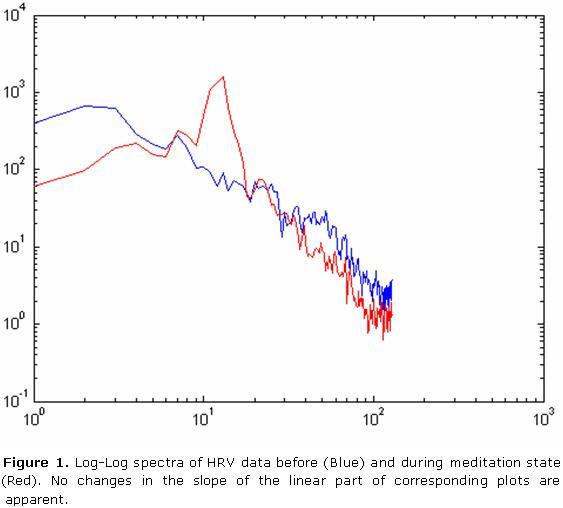
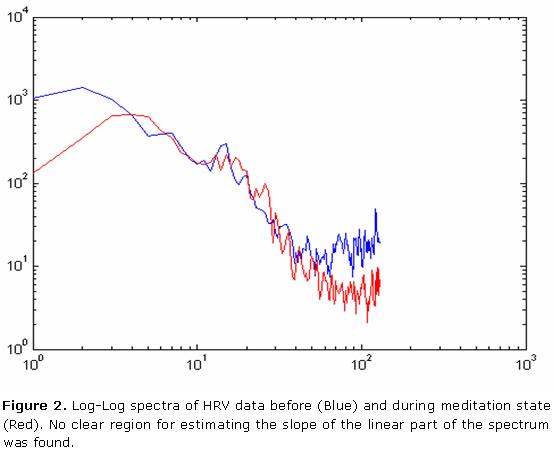
<P align="left"><font size="2" face="Verdana"> </font><font size="2" face="Verdana">The    bandwidth parameter h determines the weight of each neighbouring point: if h    is too large we have just averaging, whereas for a too small h noise will be    incorporated into the deterministic function. A minimal cross validation error    criterion has been used for selecting the bandwidth parameter.<sup>13</sup></font>      <P><font size="2" face="Verdana">After computing the optimal order m for each segment of    the whole trace it is possible to compute ARDI as the proportion of m-values    equal or higher than 15 found among all 200-point windows from the whole recording.    </font>     <P><font size="2" face="Verdana">ARDI = (Number of segments with optimal order    higher than 15)/(Total number of segments)</font>      <P>&nbsp;     <P>     <P> <font size="3"><strong><font face="Verdana"> RESULTS</font></strong><font face="Verdana">    </font></font>      <P><font size="2" face="Verdana"><strong>Appearance of the log-log plots of HRV    traces</strong>.     <br>   </font><font size="2" face="Verdana">The slope of the linear phase of HRV log-log    spectrum has been recommended as a faithful way to estimate HRV fractal dimension.    However the analysis from Log-log spectra did not allow arriving to clear conclusions.    Thus, in <a href="#figura1">figure 1</a> meditation seem to exert little influence    in the slope of the log-log spectral line. However, in some recordings, as <a href="#figura2">figure    2</a> indicates, it is hard to find the supposed linear region from which the    slope has to be estimated. </font>      <P align="center"> <img src="/img/revistas/rcim/v3n1/f0102111.jpg" width="563" height="508"><a name="figura1"></a>      ]]></body>
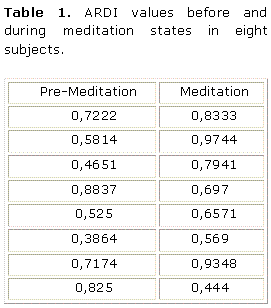
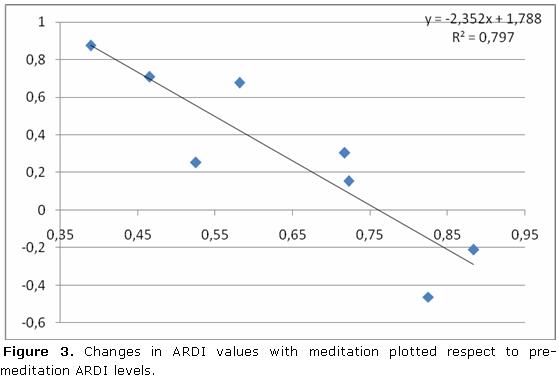
<body><![CDATA[<P align="center"><img src="/img/revistas/rcim/v3n1/f0202111.jpg" width="554" height="452"> <a name="figura2"></a>      <P><font size="2" face="Verdana">On the light of these difficulties, it seems    plausible to explore possible changes in complexity assessed via ARDI estimation.    </font>      <P><font size="2" face="Verdana"><strong>Changes in ARDI values with yoga meditation</strong>.    </font>     <br>   <font size="2" face="Verdana">The ARDI values obtained for all the eight subjects    included in the data set are presented in <a href="#tabla1">table 1</a>. </font>      <P>      <P align="center"><img src="/img/revistas/rcim/v3n1/t0102111.gif" width="271" height="308"> <a name="tabla1" id="tabla1"></a>      <P><font size="2" face="Verdana">As it can be seen, in most of the cases ARDI    increased with meditation. In two individuals, however, the ARDI value was reduced.    Only when these two subjects were removed from the sample, an increase in ARDI    could be documented (p&lt;0.01, permutation test). However, there is no sound    reason for excluding them from the analysis. At the same time, it is notice    worthy that they corresponded to two subjects with the highest pre-meditation    ARDI values. This leads to suggest the possibility of a dependence of the meditation    effect upon the premeditation ARDI level. </font>      <P><font size="2" face="Verdana">As illustrated in <a href="#figura3">figure 3</a>,    this hypothesis seems to be statistically sound (p&lt;0.05). </font>     <P align="center"><img src="/img/revistas/rcim/v3n1/f0302111.jpg" width="559" height="380"> <a name="figura3"></a>     <P align="left"><font size="2" face="Verdana">The best fit line suggests that    with pre-meditation ARDI levels above 0.76, meditation induces a reduction in    ARDI and vice-versa. </font>      ]]></body>
<body><![CDATA[<P><font size="2" face="Verdana">Thus, our results point to a set-point like mechanism    for meditation: In subjects with very low ARDI values, meditation seems to induce    increases on this index, but it will be reduced if the pre meditation level    is too high.</font>      <P>&nbsp;     <P>     <P><font size="2" face="Verdana"> </font><strong><font size="3" face="Verdana">DISCUSSION    </font></strong>      <P><font size="2" face="Verdana">Literature reports about changes in the nonlinear    dynamics of HRV induced by meditation are scarce. In fact, we did not find any    reference searching in the Medline Database. For electroencephalograms, using    other techniques the dimensionality of the EEG signal of meditating persons    has been addressed. According to,<sup>14</sup> meditation leads to a complexity    reduction along the scalp central line. </font>      <P><font size="2" face="Verdana">This result however is not consistent with those    obtained by Pradham et al,<sup>15</sup> who claims that EEG dimensionality is    increased with yoga. </font>      <P><font size="2" face="Verdana">Thus, the apparent contradictions of these two studies    with EEG data might find explanation trough a mechanism like the one apparently    observed with HRV data through ARDI. </font>     <P><font size="2" face="Verdana">In our opinion, the results from this paper have the following    limitations: </font>     <P><font size="2" face="Verdana">- The small number of participants    <br>   - </font><font size="2" face="Verdana"> The relatively short experience of the    participants as engaged in yoga practicing. </font><font size="2" face="Verdana">Unlike    other measures of complexity, the use of ARDI in literature is very uncommon.    At the same time, it presents the following advantages.     ]]></body>
<body><![CDATA[<br>   - </font><font size="2" face="Verdana"> ARDI is based on a theoretically sound    way of reconstructing the nonlinear dynamics of a time series.    <br>   - </font><font size="2" face="Verdana"> ARDI is inversely associated to the    fractal dimension of a &quot;pure&quot; fractal time series. </font>      <P><font size="2" face="Verdana">In the last decades a large amount of documented    evidence has been obtained pointing to helpful effects of different modalities    of Yoga meditation upon many different functions of the organism.<sup>16</sup>    A theoretical explanation for such diversity of effects may include the involvement    of global mechanisms operating at the level of the complex arrangement of body    functions. What is surprising from our results is the suggestion that meditation    states are capable of &quot;regulate&quot; the complexity of the whole body.    This might be a reflection at global level of the modulatory role ascribed to    yoga practice.<sup>17</sup></font>      <P>&nbsp;      <P>     <P> <font size="3" face="Verdana"><strong>CONCLUSIONS </strong></font>      <P><font size="2" face="Verdana">Yoga meditation induced changes in HRV complexity    assessed via the ARDI index. </font>      <P><font size="2" face="Verdana">Changes seem depend upon pre-meditation complexity    levels, decreasing it in subjects with high complexity and vice versa.</font>      <P>&nbsp;     <P>     ]]></body>
<body><![CDATA[<P><font size="2" face="Verdana"> </font><font size="3" face="Verdana"><strong>REFERENCES    </strong></font>      <!-- ref --><P><font size="2" face="Verdana">1. Peng CK, Mietus JE, Liu Y, Khalsa G, Douglas    PS, Benson H, Goldberger AL. Exaggerated heart rate oscillations during two    meditation techniques. International Journal of Cardiology. 1999, 70:101-107.        </font>      <!-- ref --><P><font size="2" face="Verdana">2. Khattab K, Khattab AA, Ortak J, Richardt G,    Bonnemeier H. Iyengar Yoga Increases Cardiac Parasympathetic Nervous Modulation    Among Healthy Yoga Practitioners. eCAM. 2007, 4:511-517.     </font>      <!-- ref --><P><font size="2" face="Verdana"> 3. Yamamoto Y, Hughson RL. Coarse Graining spectral    analysis: new method for studying heart rate variability. J. Appl. Physiol.    1991,71(3): 1143-1150.     </font>      <!-- ref --><P><font size="2" face="Verdana">4. M&auml;kikallio TH, Huikuri HV, M&auml;kikallio    A, Sourander LB, Mitrani RD, Castellanos A, Myerburg RJ. Prediction of sudden    cardiac death by fractal analysis of heart rate variability in elderly subjects.    J Am Coll Cardiol. 2001; 37:1395-1402.     </font>      <!-- ref --><P><font size="2" face="Verdana">5. Enzmann G, Garcia Lanz A, Hernandez Caceres    JL, Garcia Dominguez L, Gonzalez. A Valutazione della funzionalita autonomica    in corso di emodialisi: componenti caotiche della dinamica cardiaca. In: Buoncristiani    U, Timio M. (Eds) Nefrologia Dialisi &amp; Trapianto, Ed. Bios, Roma, 1999;    p. 315-318.     </font>      <!-- ref --><P><font size="2" face="Verdana">6. Enzmann G, Garcia Lanz A, Hernandez Caceres    JL, Garcia Dominguez L, Gonzalez A. La dimensione di Riconstruzione come un    nuovo indice di complesita della dinamica cardiaca in pazienti in tratamiento    emodialitico. In: Timio M, Wizemann V, Venazi S (Eds) Cardionefrology Ed. Bios,    Roma, 1999; p.149-151.     </font>      <!-- ref --><P><font size="2" face="Verdana">7. Hern&aacute;ndez C&aacute;ceres JL, Foyaca    Sibat H, Hong R, Garcia L, Sauti&eacute; M, Namugowa V. towards the estimation    of the fractal dimension of heart rate variability data. Electron J Biomed 2004;2(1).        </font>      <!-- ref --><P><font size="2" face="Verdana">8. Higuchi H, Approach to an irregular time series    on the basis of the fractal theory, Physica. D, 1988; 31, 277-283.     </font>      <!-- ref --><P><font size="2" face="Verdana">9. Hern&aacute;ndez C&aacute;ceres JL, Tejera    E, Vald&eacute;s Crespo K, Sauti&eacute; Castellanos M, Mart&iacute;nez Ortiz    C, Garc&iacute;a Dom&iacute;nguez L. Encainide Reduces Heart Rate Variability    Fractal Dimension among Arrhythmic Patients who suffered acute Myocardial Infarct.    Electr&oacute;n. J. Biomed, 2005; 3(2).     </font>      <!-- ref --><P><font size="2" face="Verdana">10. Vald&eacute;s SP, Bosch J, Jim&eacute;nez    J C, Trujillo N, Biscay R, Morales F, Hern&aacute;ndez-Caceres J L, Ozaki T.    The statistical identification of non-linear brain dynamics: A progress report.    In: Pradhan N., Rapp P, Sreenivasan E (Eds.), Non-linear Dynamics and Brain    Functioning. Nova Science Publishing. 1999. p. 278-284.     </font>      <!-- ref --><P><font size="2" face="Verdana">11. Hernandez Caceres JL, Biscay R, Grave de    Peralta R, Jimenez JC: Measuring the dissimilarity between EEG recordings through    a non-linear identification approach. Int J. Biomed Computing. 1994;26:256-262.        </font>      <!-- ref --><P><font size="2" face="Verdana">12. Hernandez Caceres JL, Valdes SP,Vila P: The    spike and wave EEG activity modelled as a stochastically perturbed limit cycle.    NeuroReport. 1996;28:164-170.     </font>      <!-- ref --><P><font size="2" face="Verdana">13. Haerdle W. Applied Nonparametric Regression.    Cambridge University Press;1989.     </font>      <!-- ref --><P><font size="2" face="Verdana">14. Aftanas LI, Golocheikine SA. Non-linear dynamic    complexity of the human EEG during meditation. Neurosci Lett. 2002 Sep 20;330(2):143-6.        </font>      <!-- ref --><P><font size="2" face="Verdana">15. Pradhan N, Narayana D D. An analysis of dimensional    complexity of brain electrical activity during meditation. ProcRC. IEEE-EMBS    &amp; 14th BMESI, 1995, 1:92-93.     </font>      <!-- ref --><P><font size="2" face="Verdana">16. Ricci G, Yoga e Medicina, Ed. Ibis:Trento;    1989.     </font>      <!-- ref --><P><font size="2" face="Verdana">17. Ponce G. Dynamic Yoga. Ed. Yogashala: Santiago    de Chile; 2002.     </font>     <P>&nbsp;      <P>     <P><font size="2" face="Verdana">Recibido: 13 de marzo de 2011.    <br>   Aprobado: 11 de junio de 2011.</font>       ]]></body><back>
<ref-list>
<ref id="B1">
<label>1</label><nlm-citation citation-type="journal">
<person-group person-group-type="author">
<name>
<surname><![CDATA[Peng]]></surname>
<given-names><![CDATA[CK]]></given-names>
</name>
<name>
<surname><![CDATA[Mietus]]></surname>
<given-names><![CDATA[JE]]></given-names>
</name>
<name>
<surname><![CDATA[Liu]]></surname>
<given-names><![CDATA[Y]]></given-names>
</name>
<name>
<surname><![CDATA[Khalsa]]></surname>
<given-names><![CDATA[G]]></given-names>
</name>
<name>
<surname><![CDATA[Douglas]]></surname>
<given-names><![CDATA[PS]]></given-names>
</name>
<name>
<surname><![CDATA[Benson]]></surname>
<given-names><![CDATA[H]]></given-names>
</name>
<name>
<surname><![CDATA[Goldberger]]></surname>
<given-names><![CDATA[AL]]></given-names>
</name>
</person-group>
<article-title xml:lang="en"><![CDATA[Exaggerated heart rate oscillations during two meditation techniques]]></article-title>
<source><![CDATA[International Journal of Cardiology]]></source>
<year>1999</year>
<volume>70</volume>
<page-range>101-107</page-range></nlm-citation>
</ref>
<ref id="B2">
<label>2</label><nlm-citation citation-type="journal">
<person-group person-group-type="author">
<name>
<surname><![CDATA[Khattab]]></surname>
<given-names><![CDATA[K]]></given-names>
</name>
<name>
<surname><![CDATA[Khattab]]></surname>
<given-names><![CDATA[AA]]></given-names>
</name>
<name>
<surname><![CDATA[Ortak]]></surname>
<given-names><![CDATA[J]]></given-names>
</name>
<name>
<surname><![CDATA[Richardt]]></surname>
<given-names><![CDATA[G]]></given-names>
</name>
<name>
<surname><![CDATA[Bonnemeier]]></surname>
<given-names><![CDATA[H]]></given-names>
</name>
</person-group>
<article-title xml:lang="en"><![CDATA[Iyengar Yoga Increases Cardiac Parasympathetic Nervous Modulation Among Healthy Yoga Practitioners]]></article-title>
<source><![CDATA[eCAM]]></source>
<year>2007</year>
<volume>4</volume>
<page-range>511-517</page-range></nlm-citation>
</ref>
<ref id="B3">
<label>3</label><nlm-citation citation-type="journal">
<person-group person-group-type="author">
<name>
<surname><![CDATA[Yamamoto]]></surname>
<given-names><![CDATA[Y]]></given-names>
</name>
<name>
<surname><![CDATA[Hughson]]></surname>
<given-names><![CDATA[RL]]></given-names>
</name>
</person-group>
<article-title xml:lang="en"><![CDATA[Coarse Graining spectral analysis: new method for studying heart rate variability]]></article-title>
<source><![CDATA[. Appl. Physiol]]></source>
<year>1991</year>
<volume>71</volume>
<numero>3</numero>
<issue>3</issue>
<page-range>1143-1150</page-range></nlm-citation>
</ref>
<ref id="B4">
<label>4</label><nlm-citation citation-type="journal">
<person-group person-group-type="author">
<name>
<surname><![CDATA[Mäkikallio]]></surname>
<given-names><![CDATA[TH]]></given-names>
</name>
<name>
<surname><![CDATA[Huikuri]]></surname>
<given-names><![CDATA[HV]]></given-names>
</name>
<name>
<surname><![CDATA[Mäkikallio]]></surname>
<given-names><![CDATA[A]]></given-names>
</name>
<name>
<surname><![CDATA[Sourander]]></surname>
<given-names><![CDATA[LB]]></given-names>
</name>
<name>
<surname><![CDATA[Mitrani]]></surname>
<given-names><![CDATA[RD]]></given-names>
</name>
<name>
<surname><![CDATA[Castellanos]]></surname>
<given-names><![CDATA[A]]></given-names>
</name>
<name>
<surname><![CDATA[Myerburg]]></surname>
<given-names><![CDATA[RJ]]></given-names>
</name>
</person-group>
<article-title xml:lang="en"><![CDATA[Prediction of sudden cardiac death by fractal analysis of heart rate variability in elderly subjects]]></article-title>
<source><![CDATA[J Am Coll Cardiol]]></source>
<year>2001</year>
<volume>37</volume>
<page-range>1395-1402</page-range></nlm-citation>
</ref>
<ref id="B5">
<label>5</label><nlm-citation citation-type="book">
<person-group person-group-type="author">
<name>
<surname><![CDATA[Enzmann]]></surname>
<given-names><![CDATA[G]]></given-names>
</name>
<name>
<surname><![CDATA[Garcia Lanz]]></surname>
<given-names><![CDATA[A]]></given-names>
</name>
<name>
<surname><![CDATA[Hernandez Caceres]]></surname>
<given-names><![CDATA[JL]]></given-names>
</name>
<name>
<surname><![CDATA[Garcia Dominguez]]></surname>
<given-names><![CDATA[L]]></given-names>
</name>
<name>
<surname><![CDATA[Gonzalez]]></surname>
<given-names><![CDATA[A]]></given-names>
</name>
</person-group>
<article-title xml:lang="it"><![CDATA[Valutazione della funzionalita autonomica in corso di emodialisi: componenti caotiche della dinamica cardiaca]]></article-title>
<person-group person-group-type="editor">
<name>
<surname><![CDATA[Buoncristiani]]></surname>
<given-names><![CDATA[U]]></given-names>
</name>
<name>
<surname><![CDATA[Timio]]></surname>
<given-names><![CDATA[M]]></given-names>
</name>
</person-group>
<source><![CDATA[]]></source>
<year>1999</year>
<page-range>315-318</page-range><publisher-loc><![CDATA[Roma ]]></publisher-loc>
<publisher-name><![CDATA[Nefrologia Dialisi & Trapianto]]></publisher-name>
</nlm-citation>
</ref>
<ref id="B6">
<label>6</label><nlm-citation citation-type="book">
<person-group person-group-type="author">
<name>
<surname><![CDATA[Enzmann]]></surname>
<given-names><![CDATA[G]]></given-names>
</name>
<name>
<surname><![CDATA[Garcia Lanz]]></surname>
<given-names><![CDATA[A]]></given-names>
</name>
<name>
<surname><![CDATA[Hernandez Caceres]]></surname>
<given-names><![CDATA[JL]]></given-names>
</name>
<name>
<surname><![CDATA[Garcia Dominguez]]></surname>
<given-names><![CDATA[L]]></given-names>
</name>
<name>
<surname><![CDATA[Gonzalez]]></surname>
<given-names><![CDATA[A]]></given-names>
</name>
</person-group>
<article-title xml:lang="it"><![CDATA[La dimensione di Riconstruzione come un nuovo indice di complesita della dinamica cardiaca in pazienti in tratamiento emodialitico]]></article-title>
<person-group person-group-type="editor">
<name>
<surname><![CDATA[Timio]]></surname>
<given-names><![CDATA[M]]></given-names>
</name>
<name>
<surname><![CDATA[Wizemann]]></surname>
<given-names><![CDATA[V]]></given-names>
</name>
<name>
<surname><![CDATA[Venazi]]></surname>
<given-names><![CDATA[S]]></given-names>
</name>
</person-group>
<source><![CDATA[Cardionefrology]]></source>
<year>1999</year>
<page-range>149-151</page-range><publisher-name><![CDATA[Bios]]></publisher-name>
</nlm-citation>
</ref>
<ref id="B7">
<label>7</label><nlm-citation citation-type="journal">
<person-group person-group-type="author">
<name>
<surname><![CDATA[Hernández Cáceres]]></surname>
<given-names><![CDATA[JL]]></given-names>
</name>
<name>
<surname><![CDATA[Foyaca Sibat]]></surname>
<given-names><![CDATA[H]]></given-names>
</name>
<name>
<surname><![CDATA[Hong]]></surname>
<given-names><![CDATA[R]]></given-names>
</name>
<name>
<surname><![CDATA[Garcia]]></surname>
<given-names><![CDATA[L]]></given-names>
</name>
<name>
<surname><![CDATA[Sautié]]></surname>
<given-names><![CDATA[M]]></given-names>
</name>
<name>
<surname><![CDATA[Namugowa]]></surname>
<given-names><![CDATA[V]]></given-names>
</name>
</person-group>
<article-title xml:lang="en"><![CDATA[towards the estimation of the fractal dimension of heart rate variability data]]></article-title>
<source><![CDATA[Electron J Biomed]]></source>
<year>2004</year>
<volume>2</volume>
<numero>1</numero>
<issue>1</issue>
</nlm-citation>
</ref>
<ref id="B8">
<label>8</label><nlm-citation citation-type="journal">
<person-group person-group-type="author">
<name>
<surname><![CDATA[Higuchi]]></surname>
<given-names><![CDATA[H]]></given-names>
</name>
</person-group>
<article-title xml:lang="en"><![CDATA[Approach to an irregular time series on the basis of the fractal theory]]></article-title>
<source><![CDATA[Physica. D]]></source>
<year>1988</year>
<volume>31</volume>
<page-range>277-283</page-range></nlm-citation>
</ref>
<ref id="B9">
<label>9</label><nlm-citation citation-type="journal">
<person-group person-group-type="author">
<name>
<surname><![CDATA[Hernández Cáceres]]></surname>
<given-names><![CDATA[JL]]></given-names>
</name>
<name>
<surname><![CDATA[Tejera]]></surname>
<given-names><![CDATA[E]]></given-names>
</name>
<name>
<surname><![CDATA[Valdés Crespo]]></surname>
<given-names><![CDATA[K]]></given-names>
</name>
<name>
<surname><![CDATA[Sautié Castellanos]]></surname>
<given-names><![CDATA[M]]></given-names>
</name>
<name>
<surname><![CDATA[Martínez Ortiz]]></surname>
<given-names><![CDATA[C]]></given-names>
</name>
<name>
<surname><![CDATA[García Domínguez]]></surname>
<given-names><![CDATA[L]]></given-names>
</name>
</person-group>
<article-title xml:lang="en"><![CDATA[Encainide Reduces Heart Rate Variability Fractal Dimension among Arrhythmic Patients who suffered acute Myocardial Infarct]]></article-title>
<source><![CDATA[Electrón. J. Biomed]]></source>
<year>2005</year>
<volume>3</volume>
<numero>2</numero>
<issue>2</issue>
</nlm-citation>
</ref>
<ref id="B10">
<label>10</label><nlm-citation citation-type="book">
<person-group person-group-type="author">
<name>
<surname><![CDATA[Valdés]]></surname>
<given-names><![CDATA[SP]]></given-names>
</name>
<name>
<surname><![CDATA[Bosch]]></surname>
<given-names><![CDATA[J]]></given-names>
</name>
<name>
<surname><![CDATA[Jiménez]]></surname>
<given-names><![CDATA[J C]]></given-names>
</name>
<name>
<surname><![CDATA[Trujillo]]></surname>
<given-names><![CDATA[N]]></given-names>
</name>
<name>
<surname><![CDATA[Biscay]]></surname>
<given-names><![CDATA[R]]></given-names>
</name>
<name>
<surname><![CDATA[Morales]]></surname>
<given-names><![CDATA[F]]></given-names>
</name>
<name>
<surname><![CDATA[Hernández-Caceres]]></surname>
<given-names><![CDATA[J L]]></given-names>
</name>
<name>
<surname><![CDATA[Ozaki]]></surname>
<given-names><![CDATA[T]]></given-names>
</name>
</person-group>
<article-title xml:lang="en"><![CDATA[The statistical identification of non-linear brain dynamics: A progress report]]></article-title>
<person-group person-group-type="editor">
<name>
<surname><![CDATA[Pradhan]]></surname>
<given-names><![CDATA[N]]></given-names>
</name>
<name>
<surname><![CDATA[Rapp]]></surname>
<given-names><![CDATA[P]]></given-names>
</name>
<name>
<surname><![CDATA[Sreenivasan]]></surname>
<given-names><![CDATA[E]]></given-names>
</name>
</person-group>
<source><![CDATA[Non-linear Dynamics and Brain Functioning]]></source>
<year>1999</year>
<page-range>278-284</page-range><publisher-name><![CDATA[Nova Science Publishing]]></publisher-name>
</nlm-citation>
</ref>
<ref id="B11">
<label>11</label><nlm-citation citation-type="journal">
<person-group person-group-type="author">
<name>
<surname><![CDATA[Hernandez Caceres]]></surname>
<given-names><![CDATA[JL]]></given-names>
</name>
<name>
<surname><![CDATA[Biscay]]></surname>
<given-names><![CDATA[R]]></given-names>
</name>
<name>
<surname><![CDATA[Grave de Peralta]]></surname>
<given-names><![CDATA[R]]></given-names>
</name>
<name>
<surname><![CDATA[Jimenez]]></surname>
<given-names><![CDATA[JC]]></given-names>
</name>
</person-group>
<article-title xml:lang="en"><![CDATA[Measuring the dissimilarity between EEG recordings through a non-linear identification approach]]></article-title>
<source><![CDATA[Int J. Biomed Computing]]></source>
<year>1994</year>
<volume>26</volume>
<page-range>256-262</page-range></nlm-citation>
</ref>
<ref id="B12">
<label>12</label><nlm-citation citation-type="journal">
<person-group person-group-type="author">
<name>
<surname><![CDATA[Hernandez Caceres]]></surname>
<given-names><![CDATA[JL]]></given-names>
</name>
<name>
<surname><![CDATA[Valdes]]></surname>
<given-names><![CDATA[SP]]></given-names>
</name>
<name>
<surname><![CDATA[Vila]]></surname>
<given-names><![CDATA[P]]></given-names>
</name>
</person-group>
<article-title xml:lang="en"><![CDATA[The spike and wave EEG activity modelled as a stochastically perturbed limit cycle]]></article-title>
<source><![CDATA[NeuroReport]]></source>
<year>1996</year>
<volume>28</volume>
<page-range>164-170</page-range></nlm-citation>
</ref>
<ref id="B13">
<label>13</label><nlm-citation citation-type="book">
<person-group person-group-type="author">
<name>
<surname><![CDATA[Haerdle]]></surname>
<given-names><![CDATA[W]]></given-names>
</name>
</person-group>
<source><![CDATA[Applied Nonparametric Regression]]></source>
<year>1989</year>
<publisher-name><![CDATA[Cambridge University Press]]></publisher-name>
</nlm-citation>
</ref>
<ref id="B14">
<label>14</label><nlm-citation citation-type="journal">
<person-group person-group-type="author">
<name>
<surname><![CDATA[Aftanas]]></surname>
<given-names><![CDATA[LI]]></given-names>
</name>
<name>
<surname><![CDATA[Golocheikine]]></surname>
<given-names><![CDATA[SA]]></given-names>
</name>
</person-group>
<article-title xml:lang="en"><![CDATA[Non-linear dynamic complexity of the human EEG during meditation]]></article-title>
<source><![CDATA[Neurosci Lett]]></source>
<year>2002</year>
<month> S</month>
<day>ep</day>
<volume>330</volume>
<numero>2</numero>
<issue>2</issue>
<page-range>143-6</page-range></nlm-citation>
</ref>
<ref id="B15">
<label>15</label><nlm-citation citation-type="journal">
<person-group person-group-type="author">
<name>
<surname><![CDATA[Pradhan]]></surname>
<given-names><![CDATA[N]]></given-names>
</name>
<name>
<surname><![CDATA[Narayana]]></surname>
<given-names><![CDATA[D D]]></given-names>
</name>
</person-group>
<article-title xml:lang="en"><![CDATA[An analysis of dimensional complexity of brain electrical activity during meditation]]></article-title>
<source><![CDATA[rocRC]]></source>
<year>1995</year>
<volume>1</volume>
<page-range>92-93</page-range></nlm-citation>
</ref>
<ref id="B16">
<label>16</label><nlm-citation citation-type="book">
<person-group person-group-type="author">
<name>
<surname><![CDATA[Ricci]]></surname>
<given-names><![CDATA[G]]></given-names>
</name>
</person-group>
<source><![CDATA[Yoga e Medicina]]></source>
<year>1989</year>
<publisher-name><![CDATA[Ibis:Trento]]></publisher-name>
</nlm-citation>
</ref>
<ref id="B17">
<label>17</label><nlm-citation citation-type="book">
<person-group person-group-type="author">
<name>
<surname><![CDATA[Ponce]]></surname>
<given-names><![CDATA[G]]></given-names>
</name>
</person-group>
<source><![CDATA[Dynamic Yoga]]></source>
<year>2002</year>
<publisher-loc><![CDATA[Santiago de Chile ]]></publisher-loc>
<publisher-name><![CDATA[Yogashala]]></publisher-name>
</nlm-citation>
</ref>
</ref-list>
</back>
</article>