<?xml version="1.0" encoding="ISO-8859-1"?><article xmlns:mml="http://www.w3.org/1998/Math/MathML" xmlns:xlink="http://www.w3.org/1999/xlink" xmlns:xsi="http://www.w3.org/2001/XMLSchema-instance">
<front>
<journal-meta>
<journal-id>1684-1859</journal-id>
<journal-title><![CDATA[Revista Cubana de Informática Médica]]></journal-title>
<abbrev-journal-title><![CDATA[RCIM]]></abbrev-journal-title>
<issn>1684-1859</issn>
<publisher>
<publisher-name><![CDATA[Universidad de Ciencias Médicas de La Habana]]></publisher-name>
</publisher>
</journal-meta>
<article-meta>
<article-id>S1684-18592011000200009</article-id>
<title-group>
<article-title xml:lang="en"><![CDATA[Identifying main research areas in Health Informatics as revealed by papers presented in the 13th world congress on Medical and Health Informatics]]></article-title>
<article-title xml:lang="es"><![CDATA[Identificación de las principales áreas de investigación en Informática en Salud según los artículos presentados en el 13 congreso mundial de Informática Médica y de Salud]]></article-title>
</title-group>
<contrib-group>
<contrib contrib-type="author">
<name>
<surname><![CDATA[Hernández Cáceres]]></surname>
<given-names><![CDATA[José Luis]]></given-names>
</name>
<xref ref-type="aff" rid="A01"/>
</contrib>
</contrib-group>
<aff id="A01">
<institution><![CDATA[,Centro de Cibernética Aplicada a la Medicina (CECAM)  ]]></institution>
<addr-line><![CDATA[La Habana ]]></addr-line>
<country>Cuba</country>
</aff>
<pub-date pub-type="pub">
<day>00</day>
<month>12</month>
<year>2011</year>
</pub-date>
<pub-date pub-type="epub">
<day>00</day>
<month>12</month>
<year>2011</year>
</pub-date>
<volume>3</volume>
<numero>2</numero>
<fpage>196</fpage>
<lpage>204</lpage>
<copyright-statement/>
<copyright-year/>
<self-uri xlink:href="http://scielo.sld.cu/scielo.php?script=sci_arttext&amp;pid=S1684-18592011000200009&amp;lng=en&amp;nrm=iso"></self-uri><self-uri xlink:href="http://scielo.sld.cu/scielo.php?script=sci_abstract&amp;pid=S1684-18592011000200009&amp;lng=en&amp;nrm=iso"></self-uri><self-uri xlink:href="http://scielo.sld.cu/scielo.php?script=sci_pdf&amp;pid=S1684-18592011000200009&amp;lng=en&amp;nrm=iso"></self-uri><abstract abstract-type="short" xml:lang="en"><p><![CDATA[To identify the main research areas in Health Informatics is an important goal for specialists in the Discipline. The proposals of the Think Tank at Oatley (2005) are one of the outstanding examples in this direction. With the aim of finding the main areas of scientific production in Health Informatics, the 284 oral presentations included into the program of the 13th World Congress on Medical and Health Informatics (Medinfo'2010) held in Cape Town in September 2010, were analyzed. Twelve of the 13 areas identified in Oatley were present, being the most salient: Computer Science for Health Informatics (61 papers); Toolkit and systems (35);People in organizations (23);Politics and policy (21);Health informatics standards (21 papers).Nineteen papers did not fit into Oatley's classification, including the areas of Bioinformatics (6) and Mining of Biomedical Literature (6).This study on one hand points to the importance of theoretical aspects for our discipline's body, and, on the other hand, suggest the need of similar studies at larger scales.]]></p></abstract>
<abstract abstract-type="short" xml:lang="es"><p><![CDATA[Identificar las áreas de investigación más importantes en la Disciplina Informática en Salud es un objetivo importante para los especialistas en la temática. Las propuestas del Tanque Pensante de Oatley (2005) constituyen uno de los ejemplos más ilustrativos. Con el interés de definir las principales áreas de producción científica en la disciplina, se analizaron las 284 presentaciones orales incluidas en el programa del 13 congreso mundial de informática Médica y de Salud (Medinfo'2010) celebrado en Cape Town en septiembre de 2010. Doce de las 13 áreas principales definidas en Oatley estuvieron representadas, destacándose "Ciencias de la computación al servicio de la Salud" (61 trabajos) "Herramientas y Sistemas" (35) "Personas en las organizaciones" (23) y "Políticas y estrategias" (23) "Normas y estándares" (21 artículos). Diecinueve artículos no se ajustaban a las sugerencias de Oatley destacándose Bioinformática (6) y exploración de la literatura biomédica (6). Este estudio por una parte sugiere la importancia de aquellas áreas con alto contenido teórico en el cuerpo de nuestra Disciplina, mientras que por otra parte sugiere la utilidad de realizar estudios similares a mayor escala.]]></p></abstract>
<kwd-group>
<kwd lng="en"><![CDATA[Health informatics]]></kwd>
<kwd lng="en"><![CDATA[computer science for health informatics]]></kwd>
<kwd lng="en"><![CDATA[toolkit and systems in health informatics]]></kwd>
<kwd lng="es"><![CDATA[Informática en salud]]></kwd>
<kwd lng="es"><![CDATA[ciencias de la computación al servicio de la salud]]></kwd>
<kwd lng="es"><![CDATA[herramientas y sistemas en informática médica]]></kwd>
</kwd-group>
</article-meta>
</front><body><![CDATA[ <p align="right"><strong><font size="2" face="Verdana">TRABAJO ORIGINAL</font></strong></p>     <p align="right">&nbsp;</p>     <p align="left"><font size="4" face="Verdana"><strong>Identifying main research    areas in Health Informatics as revealed by papers presented in the 13th world    congress on Medical and Health Informatics</strong></font></p>     <p align="left">&nbsp;</p>     <p align="left"><font size="3" face="Verdana"><strong>Identificaci&oacute;n de    las principales &aacute;reas de investigaci&oacute;n en Inform&aacute;tica en    Salud seg&uacute;n los art&iacute;culos presentados en el 13 congreso mundial    de Inform&aacute;tica M&eacute;dica y de Salud </strong></font></p>     <p align="left">&nbsp;</p>     <p align="left">&nbsp;</p>     <p align="left"><strong><font size="2" face="Verdana">Jos&eacute; Luis Hern&aacute;ndez    C&aacute;ceres</font></strong></p>     <P><font size="2" face="Verdana"> Doctor en Ciencias. Centro de Cibern&eacute;tica    Aplicada a la Medicina (CECAM), La Habana, Cuba. E-mail: <a href="mailto:cacerjlh@infomed.sld.cu">cacerjlh@infomed.sld.cu</a>    </font>     <P>&nbsp;     ]]></body>
<body><![CDATA[<P>&nbsp;      <P>     <P> <hr> <font size="2" face="Verdana"><strong>ABSTRACT </strong></font>      <p><font size="2" face="Verdana">To identify the main research areas in Health    Informatics is an important goal for specialists in the Discipline. The proposals    of the Think Tank at Oatley (2005) are one of the outstanding examples in this    direction. With the aim of finding the main areas of scientific production in    Health Informatics, the 284 oral presentations included into the program of    the 13th World Congress on Medical and Health Informatics (Medinfo'2010) held    in Cape Town in September 2010, were analyzed. Twelve of the 13 areas identified    in Oatley were present, being the most salient: Computer Science for Health    Informatics (61 papers); Toolkit and systems (35);People in organizations (23);Politics    and policy (21);Health informatics standards (21 papers).Nineteen papers did    not fit into Oatley's classification, including the areas of Bioinformatics    (6) and Mining of Biomedical Literature (6).This study on one hand points to    the importance of theoretical aspects for our discipline's body, and, on the    other hand, suggest the need of similar studies at larger scales. </font> </p>     <P><font size="2" face="Verdana"><strong>Key words:</strong> Health informatics,    computer science for health informatics, toolkit and systems in health informatics.</font> <hr> <font size="2" face="Verdana"><strong>RESUMEN </strong></font>     <br>     <br> <font size="2" face="Verdana">Identificar las &aacute;reas de investigaci&oacute;n  m&aacute;s importantes en la Disciplina Inform&aacute;tica en Salud es un objetivo  importante para los especialistas en la tem&aacute;tica. Las propuestas del Tanque  Pensante de Oatley (2005) constituyen uno de los ejemplos m&aacute;s ilustrativos.  Con el inter&eacute;s de definir las principales &aacute;reas de producci&oacute;n  cient&iacute;fica en la disciplina, se analizaron las 284 presentaciones orales  incluidas en el programa del 13 congreso mundial de inform&aacute;tica M&eacute;dica  y de Salud (Medinfo'2010) celebrado en Cape Town en septiembre de 2010. Doce de  las 13 &aacute;reas principales definidas en Oatley estuvieron representadas,  destac&aacute;ndose &quot;Ciencias de la computaci&oacute;n al servicio de la  Salud&quot; (61 trabajos) &quot;Herramientas y Sistemas&quot; (35) &quot;Personas  en las organizaciones&quot; (23) y &quot;Pol&iacute;ticas y estrategias&quot;  (23) &quot;Normas y est&aacute;ndares&quot; (21 art&iacute;culos). Diecinueve  art&iacute;culos no se ajustaban a las sugerencias de Oatley destac&aacute;ndose  Bioinform&aacute;tica (6) y exploraci&oacute;n de la literatura biom&eacute;dica  (6). Este estudio por una parte sugiere la importancia de aquellas &aacute;reas  con alto contenido te&oacute;rico en el cuerpo de nuestra Disciplina, mientras  que por otra parte sugiere la utilidad de realizar estudios similares a mayor  escala.     <br> </font>      <P><font size="2" face="Verdana"><strong>Palabras clave:</strong> Inform&aacute;tica    en salud, ciencias de la computaci&oacute;n al servicio de la salud, herramientas    y sistemas en inform&aacute;tica m&eacute;dica. </font> <hr>     <p>&nbsp;</p>     ]]></body>
<body><![CDATA[<p>&nbsp;</p>     <p><font size="3" face="Verdana"> <strong>INTRODUCTION </strong></font></p>     <P><font size="2" face="Verdana">Health (medical) informatics takes its roots    from Medical Science, Informatics Technology and Information Theory. Perhaps    this can explain why it finds application in many diverse areas whereas it is    hard to predict when a formal theory of medical informatics will be brought    to light. </font>     <P><font size="2" face="Verdana">The lack of a formal unifying theory does not    mean that there are no attempts from scholars to systematize this young science.    One of the breakthroughs in this endeavor was the Oatley's meeting held in 2005,<sup>1</sup>    where European Health Informatics experts met and created a think tank destined    to identify the main areas and subdivisions (&quot;Ponds&quot; and &quot;Ducks&quot;)    of the discipline. The Oatley think tank did identify 221 subdivisions (ducks)    grouped into 13 mainstream areas (ponds). </font>     <P><font size="2" face="Verdana">It seems plausible to establish how these diverse    areas are represented in the scientific production from authors in the health    informatics field. Realizing that this is a valuable, but formidable task, we    decided to explore this presence in a relatively small, but very representative    sample of the world's health informatics community: the oral presentations included    into the program of the 13<sup>th</sup> World Congress on Medical and Health Informatics    (Medinfo-2010), held in Cape Town, South Africa, in September 2010. </font>     <P><font size="2" face="Verdana">Medinfo-2010 was attended by 1200 delegates from    almost 60 countries, including the highest number of African Delegates in Medinfo's    history. During the scientific program conformation, 905 papers were submitted.    Papers were evaluated by two or three experts and the approval rate was 42%.    </font>     <P><font size="2" face="Verdana">According to the Scientific Committee chairs,    &quot;The final program covers all aspects of modern health informatics, ranging    from traditional topics, such as hospital information systems, patient registries,    nursing informatics, data integration, standards, interoperability issues and    decision support, to new topics such as translational bioinformatics, text mining,    intelligent data analysis, emerging technologies, quality, social networking,    workflow and organizational issues. </font>     <P><font size="2" face="Verdana">The papers have been selected with the guiding    principle of including in the program both high quality methodological research    and high impact applications of health informatics. In some cases, the authors    achieved both goals.<sup>3</sup> These words seem to endorse Medinfo-2010 as    an excellent sample of today's Medical Informatics worldwide.</font>      <P>&nbsp;     <P>     ]]></body>
<body><![CDATA[<P><font size="3" face="Verdana"> <strong>METHODOLOGY</strong> </font>      <P><font size="2" face="Verdana"> <strong>Data</strong> </font>      <P><font size="2" face="Verdana">Primary data included all oral presentations    included into the Official Program of Medinfo-2010.<sup>2</sup> In total, 284 papers were    analyzed. </font>      <P><font size="2" face="Verdana"> <strong>Data classification</strong></font>      <P><font size="2" face="Verdana">As a classification guide, the Oatley's think    tank recommendations were followed.<sup>1</sup> An expert in Health Informatics (JLHC) analyzed    all articles, and allocated each to one subdivision from the Oatley's classification    (&quot;duck&quot;). No more than 1 subdivision was allocated to each paper.    Mainstream division (&quot;ponds&quot;) was taken in strict correspondence with    Oatley's criteria. The main criteria for allocation were: </font>      <P><font size="2" face="Verdana">- Title of the papers    <br>   </font><font size="2" face="Verdana">- Classification by Medinfo-2010 organizers<sup>2</sup></font>      <P><font size="2" face="Verdana">If further information were required, the paper    was read as it appeared in the proceedings book. For further details on Oatley's    think tank methodology, see Wright et al, 2007.<sup>2</sup> </font>      <P><font size="2" face="Verdana"> <strong>Limitations of present study</strong></font>      <P><font size="2" face="Verdana">- A relatively small sample has been considered    (285 papers)    ]]></body>
<body><![CDATA[<br>   </font><font size="2" face="Verdana">- Only the criterion of one expert was    taken into account.    <br>   </font><font size="2" face="Verdana">- Only the Oatley's classification was    considered. </font>      <P><font size="2" face="Verdana">In any case, the sample seems to represent the    state of the art of Health Informatics worldwide, and the classification procedure    was also partially supported by the classification scheme selected by the congress    organizers. </font>     <P>&nbsp;      <P>     <P><font size="3" face="Verdana"> <strong>RESULTS </strong></font>      <P><font size="2" face="Verdana">All but one of the 13 main categories defined    in Oatley were present at Medinfo. The fact that the category &quot;Health and    Social care Industry&quot; </font>     <P><font size="2" face="Verdana">Was not present might reflect the fact that only    oral scientific presentations were selected. Some posters as well as stand shows    in Medinfo-2010 reflected this aspect. </font>     <P><font size="2" face="Verdana">At the same time, there were 19 out of the 284    papers reviewed (circa 7%) that could not be allocated to any of the Oatley's    &quot;ducks&quot;.</font>     <P><font size="2" face="Verdana">Those papers not included in Oatley's classification    were: </font>      ]]></body>
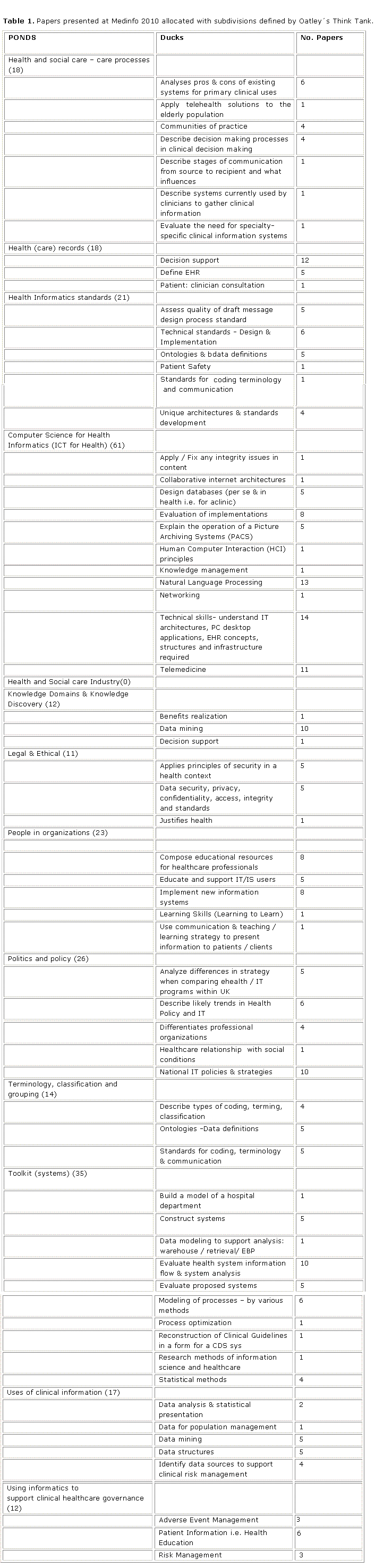
<body><![CDATA[<P><font size="2" face="Verdana">- Bioinformatics: 6 papers    <br>   </font><font size="2" face="Verdana">- Mining biomedical literature: 6 papers    <br>   </font><font size="2" face="Verdana">- Open source: 2 papers    <br>   </font><font size="2" face="Verdana">- Virtual reality: 3 papers    <br>   </font><font size="2" face="Verdana">- Medical informatics history: 1 paper    <br>   </font><font size="2" face="Verdana">- Grid computing: 1 paper </font>      <P><font size="2" face="Verdana">A total of 65 &quot;ducks&quot; were identified.    This does not mean that the other subdivisions were not present, since one paper    may contain multiple areas, and only one area per paper was selected in this    study. Details about the &quot;ducks&quot; represented in Medinfo-2010 may be    obtained from <a href="/img/revistas/rcim/v3n2/t0109211.gif">table 1</a>. </font>      <P><font size="2" face="Verdana">As it can be noticed from Table 1, the most represented    individual subdivisions (&quot;ducks&quot;) in Cape Town's meeting were: &quot;Technical    skills&quot; (14 papers);&quot; Decision support&quot; (12);&quot;Telemedicine&quot;    (11); &quot;Data mining&quot; (10); &quot;National IT policies &amp; strategies&quot;    (10) and &quot;Evaluating health system information flow &amp; system analysis&quot;    (10 papers). </font>     <P>&nbsp;      <P>     ]]></body>
<body><![CDATA[<P><font size="3" face="Verdana"> <strong>DISCUSSION </strong></font>      <P><font size="2" face="Verdana">Our results suggest that Oatley&#180;s think    tank classification, emanated from theoretical opinions of a group of experts,    quite faithfully reflects the state-of the- art of the Discipline. At the same    time, new emerging areas are appearing, thus reflecting that Health Informatics    is a dynamic Science. The large proportion of papers related to the application    of theoretical aspects into health practice suggest that Health Informatics    is centered in both theoretical aspects as well as in practical applications    for providing prompt solutions to health problems of our time. We foresee that    the time of massive computer illiteracy eradication among health professional    is giving the way to a new era of informatics-oriented organization of health    systems, spanning from the consultation to the national level. </font>     <P>&nbsp;      <P>     <P><font size="3" face="Verdana"> <strong>CONCLUSIONS</strong> </font>      <P><font size="2" face="Verdana">Our study revealed the great importance attributed    by authors in the area of Health Informatics to theoretical aspects for our    discipline's body, as well as to their application for the solution of concrete    problems in health management and practice. On the other hand, it suggests the    need of similar studies at larger scales, as well as the organization of updated    versions of the Oatley's meeting. </font>     <P>&nbsp;      <P>     <P><font size="3" face="Verdana"><strong>ACKNOWLEDGEMENTS</strong></font>     <P><font size="2" face="Verdana">The author is deeply thankful to the British    Computer Society, the Rockefeller Foundation and MEDINFO' 2010 organizers for    their support to his attendance to the Cape Town meeting. </font>     ]]></body>
<body><![CDATA[<P>&nbsp;      <P>     <P><font size="3" face="Verdana"><strong>REFERENCES</strong> </font>      <!-- ref --><P><font size="2" face="Verdana">1. Wright, G.; Murray, P. and Betts H. Exploring    the knowledge base for Health Informatics: The outcomes of the Otley (2005)    meeting. Revista Cubana de Inform&aacute;tica M&eacute;dica, #13, 2007. Available    online at: <a href="http://www.rcim.sld.cu/revista_13/articulos_htm/graham.htm" target="_blank">http://www.rcim.sld.cu/revista_13/articulos_htm/graham.htm</a></font>      <!-- ref --><P><font size="2" face="Verdana">2. Safran, C.; Reti S.; and Marin, H.F (eds.),    MEDINFO 2010. Proceedings of the 13th World Congress on Medical Informatics.    Amsterdam-Berlin-Tokyo-Washington: IOS Press BV, 2010.     </font>      <!-- ref --><P><font size="2" face="Verdana">3. Bellazzi R. and Westbrook J. Preface from    the Scientific Program Co-Chairs. in: Safran, C.; Reti S.; and Marin, H.F (eds.),    MEDINFO 2010. Proceedings of the 13th World Congress on Medical Informatics.    Amsterdam-Berlin-Tokyo-Washington: IOS Press BV, 2010, pp x-xi.    </font>      <P>&nbsp;     <P>&nbsp;      ]]></body>
<body><![CDATA[<P>     <P><font size="2" face="Verdana">Recibido: 14 de septiembre de 2011.    <br>   </font><font size="2" face="Verdana">Aprobado: 15 de octubre de 2011. </font>       ]]></body><back>
<ref-list>
<ref id="B1">
<label>1</label><nlm-citation citation-type="journal">
<person-group person-group-type="author">
<name>
<surname><![CDATA[Wright]]></surname>
<given-names><![CDATA[G]]></given-names>
</name>
<name>
<surname><![CDATA[Murray]]></surname>
<given-names><![CDATA[P]]></given-names>
</name>
<name>
<surname><![CDATA[Betts]]></surname>
<given-names><![CDATA[H]]></given-names>
</name>
</person-group>
<article-title xml:lang="en"><![CDATA[Exploring the knowledge base for Health Informatics: The outcomes of the Otley (2005) meeting]]></article-title>
<source><![CDATA[Revista Cubana de Informática Médica]]></source>
<year>2007</year>
<numero>13</numero>
<issue>13</issue>
</nlm-citation>
</ref>
<ref id="B2">
<label>2</label><nlm-citation citation-type="book">
<person-group person-group-type="author">
<name>
<surname><![CDATA[Safran]]></surname>
<given-names><![CDATA[C]]></given-names>
</name>
<name>
<surname><![CDATA[Reti]]></surname>
<given-names><![CDATA[S]]></given-names>
</name>
<name>
<surname><![CDATA[Marin]]></surname>
<given-names><![CDATA[H.F]]></given-names>
</name>
</person-group>
<source><![CDATA[MEDINFO 2010. Proceedings of the 13th World Congress on Medical Informatics]]></source>
<year>2010</year>
<publisher-loc><![CDATA[Amsterdam-Berlin-Tokyo-Washington ]]></publisher-loc>
<publisher-name><![CDATA[IOS Press BV]]></publisher-name>
</nlm-citation>
</ref>
<ref id="B3">
<label>3</label><nlm-citation citation-type="book">
<person-group person-group-type="author">
<name>
<surname><![CDATA[Bellazzi]]></surname>
<given-names><![CDATA[R]]></given-names>
</name>
<name>
<surname><![CDATA[Westbrook]]></surname>
<given-names><![CDATA[J]]></given-names>
</name>
</person-group>
<article-title xml:lang="en"><![CDATA[Preface from the Scientific Program Co-Chairs]]></article-title>
<person-group person-group-type="editor">
<name>
<surname><![CDATA[Safran]]></surname>
<given-names><![CDATA[C]]></given-names>
</name>
<name>
<surname><![CDATA[Reti]]></surname>
<given-names><![CDATA[S]]></given-names>
</name>
<name>
<surname><![CDATA[Marin]]></surname>
<given-names><![CDATA[H.F]]></given-names>
</name>
</person-group>
<source><![CDATA[MEDINFO 2010. Proceedings of the 13th World Congress on Medical Informatics]]></source>
<year>2010</year>
<page-range>x-xi</page-range><publisher-loc><![CDATA[Amsterdam-Berlin-Tokyo-Washington ]]></publisher-loc>
<publisher-name><![CDATA[IOS Press BV]]></publisher-name>
</nlm-citation>
</ref>
</ref-list>
</back>
</article>