<?xml version="1.0" encoding="ISO-8859-1"?><article xmlns:mml="http://www.w3.org/1998/Math/MathML" xmlns:xlink="http://www.w3.org/1999/xlink" xmlns:xsi="http://www.w3.org/2001/XMLSchema-instance">
<front>
<journal-meta>
<journal-id>1684-1859</journal-id>
<journal-title><![CDATA[Revista Cubana de Informática Médica]]></journal-title>
<abbrev-journal-title><![CDATA[RCIM]]></abbrev-journal-title>
<issn>1684-1859</issn>
<publisher>
<publisher-name><![CDATA[Universidad de Ciencias Médicas de La Habana]]></publisher-name>
</publisher>
</journal-meta>
<article-meta>
<article-id>S1684-18592014000100006</article-id>
<title-group>
<article-title xml:lang="en"><![CDATA[Applying the 3-element windkessel model to photoplethysmographic signals. Gender differences and age correlation]]></article-title>
<article-title xml:lang="es"><![CDATA[Aplicación a señales fotopletismográficas del modelo de "Cámara de aire con tres elementos". Diferencias en cuanto a género y correlación con la edad]]></article-title>
</title-group>
<contrib-group>
<contrib contrib-type="author">
<name>
<surname><![CDATA[Hernández Cáceres]]></surname>
<given-names><![CDATA[Jorge Luis]]></given-names>
</name>
<xref ref-type="aff" rid="A01"/>
</contrib>
</contrib-group>
<aff id="A01">
<institution><![CDATA[,Havana Medical Sciences University Center for Cybernetics Applications to Medicine (CECAM) ]]></institution>
<addr-line><![CDATA[ ]]></addr-line>
<country>Cuba</country>
</aff>
<pub-date pub-type="pub">
<day>00</day>
<month>06</month>
<year>2014</year>
</pub-date>
<pub-date pub-type="epub">
<day>00</day>
<month>06</month>
<year>2014</year>
</pub-date>
<volume>6</volume>
<numero>1</numero>
<fpage>48</fpage>
<lpage>56</lpage>
<copyright-statement/>
<copyright-year/>
<self-uri xlink:href="http://scielo.sld.cu/scielo.php?script=sci_arttext&amp;pid=S1684-18592014000100006&amp;lng=en&amp;nrm=iso"></self-uri><self-uri xlink:href="http://scielo.sld.cu/scielo.php?script=sci_abstract&amp;pid=S1684-18592014000100006&amp;lng=en&amp;nrm=iso"></self-uri><self-uri xlink:href="http://scielo.sld.cu/scielo.php?script=sci_pdf&amp;pid=S1684-18592014000100006&amp;lng=en&amp;nrm=iso"></self-uri><abstract abstract-type="short" xml:lang="en"><p><![CDATA[Automatically averaged photoplethysmographic (PPG) signals were fit to a 3-element windkessel model using a Gauss-Newton optimization algorithm. Data corresponded to 78 healthy subjects (ages from 8 to 87 years). Unlike other reports, two phase velocities are also estimated from the model. Gender differences were found, particularly respect to individual parameters correlation with age. When a nonlinear model was fit to the two first principal components, a high correlation with age was found for both females (r=0.69) and male subjects (r=0.77). Our results further support the idea that the PPG signal is a valuable source of information about the cardiovascular system, comparable to the much more expensive continuous pressure signal.]]></p></abstract>
<abstract abstract-type="short" xml:lang="es"><p><![CDATA[Señales fotopletismográficas automáticamente promediadas fueron ajustadas a un modelo de "bomba hidráulica" de tres elementos. Para ello se utilizó un algoritmo de optimización del tipio "Gauss-Newton". Los datos fueron obtenidos de 78 individuos sanos con edades entre 8 y 87 años. A diferencia de otros reportes, en el presente trabajo se estimaron dos velocidades de fase a partir del modelo. Al aplicar un modelo no lineal respecto los dos primeros componentes principales, se obtuvo una elevada correlación con la edad tanto para los sujetos femeninos (r=0.69) como para los masculinos (r=0.77). Nuestros resultados ofrecen un apoyo adicional a la idea de que la señal fotopletismográfica es una fuente importante de información acerca del sistema cardiovascular, comparable a la señal de presión continua, aun cuando esta última es mucho más costosa.]]></p></abstract>
<kwd-group>
<kwd lng="en"><![CDATA[photoplethysmographic signal]]></kwd>
<kwd lng="en"><![CDATA[windkessel model]]></kwd>
<kwd lng="en"><![CDATA[cardiovascular age]]></kwd>
<kwd lng="en"><![CDATA[mathematical model]]></kwd>
<kwd lng="es"><![CDATA[señal fotopletismográfica]]></kwd>
<kwd lng="es"><![CDATA[modelo de cámara de aire]]></kwd>
<kwd lng="es"><![CDATA[edad cardiovascular]]></kwd>
<kwd lng="es"><![CDATA[modelo matemático]]></kwd>
</kwd-group>
</article-meta>
</front><body><![CDATA[ <div align="right">        <p><font size="2" face="Verdana"><strong>ART&Iacute;CULO ORIGINAL </strong></font></p>       <p>&nbsp;</p>       <p align="left"><font size="4" face="Verdana"><strong>Applying the 3-element      windkessel model to photoplethysmographic signals. Gender differences and      age correlation</strong></font></p>       <p align="left">&nbsp;</p>       <p align="left"><font size="3" face="Verdana"><strong>Aplicaci&oacute;n a se&ntilde;ales      fotopletismogr&aacute;ficas del modelo de &quot;C&aacute;mara de aire con      tres elementos&quot;. Diferencias en cuanto a g&eacute;nero y correlaci&oacute;n      con la edad</strong></font></p>       <p align="left">&nbsp;</p>       <p align="left">&nbsp;</p>       <p align="left"><font size="2" face="Verdana"><strong>Dr. Jorge Luis Hern&aacute;ndez      C&aacute;ceres</strong></font></p>       <p align="left"><font size="2" face="Verdana">Center for Cybernetics Applications      to Medicine (CECAM), Havana Medical Sciences University. Cuba. E-mail: <a href="mailto:cacerjlh@infomed.sld.cu">cacerjlh@infomed.sld.cu</a>;      <a href="mailto:cacerjlh@yahoo.com">cacerjlh@yahoo.com</a></font></p>       ]]></body>
<body><![CDATA[<p align="left">&nbsp;</p>       <p align="left">&nbsp;</p>   <hr>       <div align="left"><font size="2" face="Verdana"><strong>ABSTRACT</strong></font>    </div>       <P align="left"><font size="2" face="Verdana">Automatically averaged photoplethysmographic      (PPG) signals were fit to a 3-element windkessel model using a Gauss-Newton      optimization algorithm. Data corresponded to 78 healthy subjects (ages from      8 to 87 years). Unlike other reports, two phase velocities are also estimated      from the model. Gender differences were found, particularly respect to individual      parameters correlation with age. When a nonlinear model was fit to the two      first principal components, a high correlation with age was found for both      females (r=0.69) and male subjects (r=0.77). Our results further support the      idea that the PPG signal is a valuable source of information about the cardiovascular      system, comparable to the much more expensive continuous pressure signal.      </font>        <P align="left"><font size="2" face="Verdana"><strong>Key words:</strong> photoplethysmographic      signal, windkessel model, cardiovascular age, mathematical model.</font>        <div align="left"></div> </div> <hr>     <div align="right">       <div align="left"><font size="2" face="Verdana"><strong>RESUMEN</strong></font></div> </div>     <P><font size="2" face="Verdana">Se&ntilde;ales fotopletismogr&aacute;ficas autom&aacute;ticamente    promediadas fueron ajustadas a un modelo de &quot;bomba hidr&aacute;ulica&quot;    de tres elementos. Para ello se utiliz&oacute; un algoritmo de optimizaci&oacute;n    del tipio &quot;Gauss-Newton&quot;. Los datos fueron obtenidos de 78 individuos    sanos con edades entre 8 y 87 a&ntilde;os. A diferencia de otros reportes, en    el presente trabajo se estimaron dos velocidades de fase a partir del modelo.    Al aplicar un modelo no lineal respecto los dos primeros componentes principales,    se obtuvo una elevada correlaci&oacute;n con la edad tanto para los sujetos    femeninos (r=0.69) como para los masculinos (r=0.77). Nuestros resultados ofrecen    un apoyo adicional a la idea de que la se&ntilde;al fotopletismogr&aacute;fica    es una fuente importante de informaci&oacute;n acerca del sistema cardiovascular,    comparable a la se&ntilde;al de presi&oacute;n continua, aun cuando esta &uacute;ltima    es mucho m&aacute;s costosa. </font>      <P><font size="2" face="Verdana"><strong>Palabras clave:</strong> se&ntilde;al    fotopletismogr&aacute;fica, modelo de c&aacute;mara de aire, edad cardiovascular,    modelo matem&aacute;tico.</font> <hr>     ]]></body>
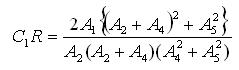
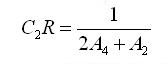
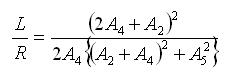
<body><![CDATA[<p>&nbsp;</p>     <p>&nbsp;</p>     <p><font size="3" face="Verdana"> <strong>INTRODUCTION</strong> </font></p>     <P><font size="2" face="Verdana">The first cardiovascular model that considered    pulsatile flow was suggested by Otto Frank in 1899.<sup>1,2</sup> Frank hypothesized    that the arterial tree functions as a compression chamber or &quot;windkessel&quot;    in a fire pump. The first half of 20<sup>th</sup> century saw very little application    of Frank's model to cardiovascular function, limited mainly by scarce knowledge    about vessel's dynamics as well as poor technological resources for continuous    pulse pressure recordings.<sup>3</sup> Recently this state of affairs has changed    for the better, and small modifications introduced to the lumped model are leading    to the extraction of clinically sound information. From a practical viewpoint,    the most important part of the analysis with a 3-elements' variant of the Frank's    model includes the approximation of the systolic component of the waveform to    the following nonlinear function with 6 parameters (<em>A</em><sub>1</sub>&#133;    <em>A</em><sub>6</sub>). </font>     <P align="center"><font size="2" face="Verdana"><img src="/img/revistas/rcim/v6n1/c0106114.jpg" width="365" height="27">    (1) <a name="c1"></a></font>      <P align="left"><font size="2" face="Verdana">Where <em>P(t) </em>denotes the    continuous pressure as a function of time.<sup>4</sup> </font>      <P><font size="2" face="Verdana">If systemic vascular resistance can be estimated,    then two compliance components (&quot;resistive compliance&quot; C<sub>1</sub>and &quot;oscillatory    compliance&quot; C<sub>2</sub>) can be obtained, since<sup>4</sup> </font>     <P align="center"><font size="2" face="Verdana"> <img src="/img/revistas/rcim/v6n1/c0206114.jpg" width="239" height="70">(2)    </font>      <P align="center"><font size="2" face="Verdana"> <img src="/img/revistas/rcim/v6n1/c0306114.jpg" width="168" height="70">(3)    </font>      <P align="center"><font size="2" face="Verdana"> <img src="/img/revistas/rcim/v6n1/c0406114.jpg" width="230" height="78">(4)    </font>      ]]></body>
<body><![CDATA[<P><font size="2" face="Verdana">In particular, oscillatory compliance (C<sub>2</sub>)    has reported the strongest correlation with age thus far<sup>5</sup> (r=-0.66,    n=210). </font>      <P><font size="2" face="Verdana">Widespread application of these results in primary    care settings meets at least two drawbacks. The first limitation is related    to the need to record pulse pressure continuously. This is possible only in    specialized laboratories, and public health facilities in many countries lack    them. On the other hand, obtaining a compliance estimate requires measuring    peripheral resistance, but peripheral resistance can be obtained either from    cardiac output or from a nonlinear function of age, mean heart rate, mean systolic    and mean diastolic blood pressure. Such estimation can add substantial error    (due to individual's variability) to the estimated compliance. </font>     <P><font size="2" face="Verdana">The use of the photoplethysmographic signal (PPG)    as a proxy for continuous pulse recordings has been proposed.<sup>6,7</sup>    Theoretical models suggest that pulse pressure and volume changes are linearly    proportional.<sup>4</sup> Even when the &quot;plethysmographic&quot; signal    is not purely about volume changes, an important part of it is associated to    volume dynamics. On the other hand, PPG signals can be acquired at a high sampling    frequency, 1000 Hz being a typical value. Compared to the 128Hz sampling frequency    reported in most studies with continuous pressure recordings, PPG signal can    add a larger number of data points thus improving the time resolution. It seems    that the low temporal resolution of continuous pressure signals can be the cause    of errors in compliance estimation.<sup>5,8</sup> </font>      <P><font size="2" face="Verdana">Theoretical elaborations, however, suggest that    another important parameter can be estimated from the 6-parameter model without    the need of estimating peripheral resistance. </font>     <P><font size="2" face="Verdana">In particular, phase space velocity may be deduced    from:<sup>9</sup></font>     <P align="center"><font size="2" face="Verdana"> <img src="/img/revistas/rcim/v6n1/c0506114.jpg" width="90" height="59">(5)    </font>      <P><font size="2" face="Verdana">Hopefully these two velocities can be somehow    related to propagation velocity, a measurable entity highly correlated with    age.<sup>10-15</sup> </font>      <P><font size="2" face="Verdana">Here, we approximate the diastolic component    of the PPG signal with function (1). Besides parameters A<sub>1</sub>-A<sub>6</sub>,    we calculate C<sub>1</sub>R, C<sub>2</sub>R as well as two phase velocities:    &quot;resistive phase velocity&quot; <img src="/img/revistas/rcim/v6n1/c0606114.jpg" width="25" height="21" align="top">and    &quot;oscillatory phase velocity&quot;<img src="/img/revistas/rcim/v6n1/c0706114.jpg" width="20" height="21" align="top">.    </font>      <P><font size="2" face="Verdana">All these are submitted to multivariate analysis    focused on association with age. </font>      <P>&nbsp;     ]]></body>
<body><![CDATA[<P><font size="3" face="Verdana"><strong>METHODS</strong> </font>      <P><font size="2" face="Verdana"><em>Subjects</em>. Seventy eight volunteers (47    males with ages from 12 y to 87 y, and 31 females with ages from 8 y to 89 y)    were recruited in the city of Orense (Spain). They were free of clinical cardiovascular    disease and medication, and Body Mass Index never surpassed 31 kgxm<sup>-2</sup>. Approval    was obtained from the local research ethics committee, and written informed    consent was obtained from all participants. Five-min-duration photoplethysmographic    signals were obtained from the pointer finger of the right arm with the subject    in supine position, using a validated oximeter (Nellcor 395, USA). Signals were    digitized at 1000 Hz and saved as ASCII files. </font>      <P><font size="2" face="Verdana"><em>Wave averaging</em>. For wave averaging,    a pattern vector of length L (usually about 90 data points) was picked by visual    inspection. Correlations were measured between the pattern vector and each individual    vector of length L starting at the point I of the original signal. The obtained    vector of correlations (corresponding to about 100 seconds of recording) was    then submitted to further analysis. Those vectors signal having a correlation    higher than a certain threshold &quot;Th&quot; and corresponding to a local    correlation maximum were picked as individual waves and entered as rows of the    matrix M of the waveforms. From M the average waveform was obtained via averaging    over all rows. The main virtue of the method is that a representative wave is    obtained without the need to rely on subjective opinions of experts. </font>      <P><font size="2" face="Verdana"><em>Fitting of data into the model</em>. Averaged    waves were fit to equation (1) by using a Gauss-Newton optimization algorithm.<sup>16</sup>    Only solutions whose correlation coefficients exceeded 0.99 were accepted. </font>      <P><font size="2" face="Verdana"><em>Statistical methods</em>: Correlation matrices    and multiple regression analysis (forward stepwise variant) were performed.    </font>      <P><font size="2" face="Verdana">Multivariate analysis included principal component    determination and nonlinear regression respect to PC1 and PC2. For nonlinear    estimation, the following 4<sup>th</sup> degree function was fitted to age data. </font>     <P align="center"><font size="2" face="Verdana"> <img src="/img/revistas/rcim/v6n1/c0806114.jpg" width="503" height="51">(6)    <a name="c6"></a> </font>      <P><font size="2" face="Verdana"><em>Limitations of present study</em>. Using    PPG signal as a proxy for continuous pulse wave recordings seems to be justified    for the case when both signals are proportionally dependent. Evidence from the    literature supports this assumption.<sup>7</sup> At the same time, the surrogate    variables obtained (&quot;compliance&quot;, &quot;phase velocity&quot;, etc.)    can be approximated to the real variables with the precision of a linear factor.    Since the PPG signal is expressed in units of absorbance, it is very difficult    to express these variables in their real units without a shrewd calibration    experiment. Thus the words &quot;compliance&quot;, velocity, etc. cannot be    taken at face value. </font>      <P><font size="2" face="Verdana">The second limitation is related to the sample    size. This study uses a smaller sample than other reports. Some of the differences    obtained here between male and female subjects may vanish with increased sample    size. </font>      <P>&nbsp;     ]]></body>
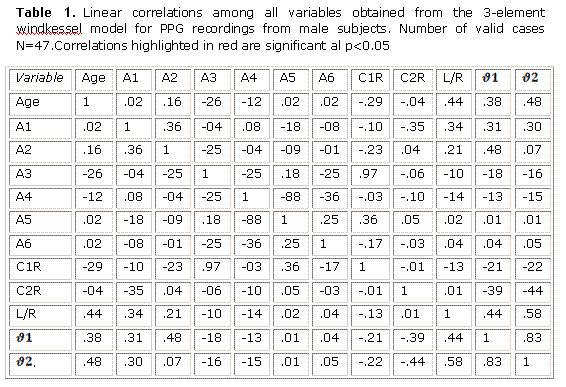
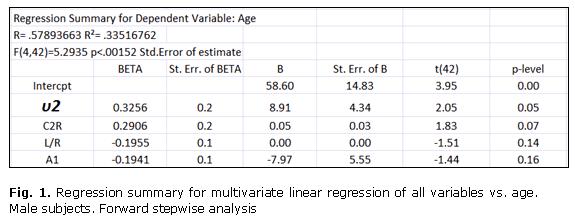
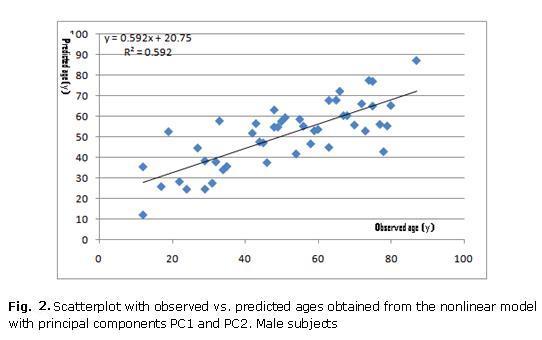
<body><![CDATA[<P><font size="3" face="Verdana"><strong>RESULTS</strong> </font>      <P><font size="2" face="Verdana">Evidences from the literature suggest marked    differences between women and men in their compliance values.<sup>4 </sup>Thus    the analysis was conducted separately for each gender. </font>      <P><font size="2" face="Verdana"><em>Male subjects</em>. The correlation matrix    for all variables appears represented in <a href="#t1">Table 1</a>. As can be    seen, significant correlations with age were obtained for both phase velocities    and &quot;L/R&quot;. At the same time,<img src="/img/revistas/rcim/v6n1/c0706114.jpg" width="20" height="21" align="top">    is highly correlated with <img src="/img/revistas/rcim/v6n1/c0606114.jpg" width="25" height="21" align="top">whereas    for <img src="/img/revistas/rcim/v6n1/c0706114.jpg" width="20" height="21" align="top">a    significant correlation was found with &quot;L/R&quot;. </font>      <P align="center"><img src="/img/revistas/rcim/v6n1/t0106114.gif" width="566" height="387"> <a name="t1"></a>      <P><font size="2" face="Verdana">Unexpected is the very high correlation between    C<sub>1</sub>R and A<sub>3</sub> even when no explicit theoretical association is perceived (see equations    <a href="#c1">1-4</a>). </font>      <P><font size="2" face="Verdana">Since there are significant univariate correlations    with age, it is to be expected that a multivariate linear regression could yield    a correlation with age stronger than any of the individual variables does. </font>     <P><font size="2" face="Verdana">Regression summary (<a href="#fig1">Fig.1</a>)    accounts for a strong presence of &quot;oscillatory phase velocity&quot; in    the regression model. Overall, the strength of association increased to 0.58.    In terms of significance an improvement from p= 0.0080 to p=0.00152 took place    when passing from univariate to multivariate regression. </font>     <P align="center"><font size="2" face="Verdana"><img src="/img/revistas/rcim/v6n1/f0106114.jpg" width="575" height="219"></font>    <a name="fig1"></a>     <P><font size="2" face="Verdana">Multivariate analysis including principal component    determination and nonlinear regression of age respect to PC1 and PC2 (equation    <a href="#c6">6</a>). Led to a further improvement in prediction quality (r=0.77;    <a href="#fig2">figure 2</a>). </font>      <P align="center"><img src="/img/revistas/rcim/v6n1/f0206114.jpg" width="542" height="340">    <a name="fig2" id="fig2"></a>      ]]></body>
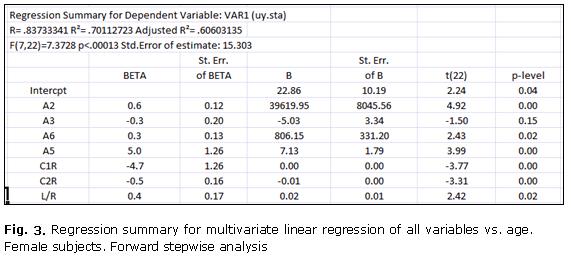
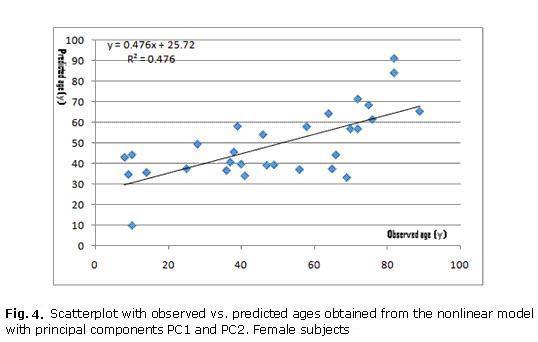
<body><![CDATA[<P><font size="2" face="Verdana"><em>Female subjects.</em> <a href="/img/revistas/rcim/v6n1/t0206114.gif">Table    2</a> represents the correlation matrix for all variables. In this case, several    differences with male subjects appeared. As can be noticed, a significant correlation    with age was obtained for parameter A2 only. At the same time, similar to male    subjects,<img src="/img/revistas/rcim/v6n1/c0706114.jpg" width="20" height="21" align="top">    is highly correlated with <img src="/img/revistas/rcim/v6n1/c0606114.jpg" width="25" height="21" align="top">.    </font>      <P><font size="2" face="Verdana">The high correlation between C<sub>1</sub>R and    A<sub>3</sub> observed for male subjects is still present among female subjects.    </font>      <P><font size="2" face="Verdana">The results of multivariate analysis for female    subjects are summarized in <a href="#fig3">figure 3</a>. As observed, both the    two compliances and 4 coefficients from model (1) are contributing to the linear    multivariate model. Salient here is the sharp improvement obtained with the    multivariate regression. In terms of probability it changed from p=0.0441 to    p=0.00013when passing from univariate to multivariate regression.</font>      <P align="center"><img src="/img/revistas/rcim/v6n1/f0306114.jpg" width="571" height="256"><a name="fig3"></a>     <P><font size="2" face="Verdana">Multivariate analysis including principal component    determination and nonlinear regression of age with respect to PC1 and PC2 (equation    <a href="#c6">6</a>) led to a similarly high prediction quality (r=0.69; <a href="#fig4">figure    4</a>). </font>      <P align="center"><img src="/img/revistas/rcim/v6n1/f0406114.jpg" width="538" height="342">    <a name="fig4"></a>      <P align="center">&nbsp;     <P align="left"><font size="3"><strong><font face="Verdana">DISCUSSION</font></strong></font><font size="2" face="Verdana">    </font>      <P><font size="2" face="Verdana">In this work, we tried to get an answer to the    rather na&iuml;ve question of what information can be obtained if we apply the    3-element windkessel model to a sample of PPG recordings with no possibility    of recording other variables such as peripheral resistance. According to our    results the answer heavily depends on the gender of recorded subjects: More    variables retain a strong univariate association with age among male subjects    whereas a surprisingly high correlation can be obtained in a linear multiple    regression for female subjects. Nonlinear regression of age against PC1 and    PC2 leads to comparable results for both genders. </font>      <P><font size="2" face="Verdana">In this study based on the 3-elements windkessel    model, versions of both resistive and oscillatory phase velocities are introduced.    Since these do not depend upon peripheral resistance, a certain advantage respect    to oscillatory compliance. Our results showed that both velocities (resistive    and oscillatory) were highly correlated to each other among both female and    male subjects. It reached significant values with age among male subjects. </font>     ]]></body>
<body><![CDATA[<P><font size="2" face="Verdana">That strong associations are found, especially    in multivariate analysis with female subjects, as well as in nonlinear analysis,    is noteworthy. We do not exclude the possibility that some differences will    be erased as the sample size is increased. However, at this stage results remain    encouraging, especially because they illustrated other potentialities of the    3-element windkessel model. </font>     <P><font size="2" face="Verdana">Even when the structure of the correlation matrices    differed among genders, the introduction of two phase velocities into the model,    as well as he application of nonlinear multivariate regression respect to principal    components clearly suggests that the 3-element windkessel model is a promising    platform for further analysis of PPG signals. </font>      <P>&nbsp;     <P><font size="3" face="Verdana"><strong>REFERENCES BIBLIOGRAPHICS</strong></font>      <!-- ref --><P><font size="2" face="Verdana">1. Frank O. Die Grundform des arteriellen Pulses.    Z. Biol. 1899;22: 253-277.     </font>     <!-- ref --><P><font size="2" face="Verdana">2. Frank O. Die Elastizit&auml;t der Blutgef&auml;sse.    Z. Biol. 1920; 71:255-272.     </font>     <!-- ref --><P><font size="2" face="Verdana">3. Imholz BPM, Wieling W, van Montfrans GA, Wesseling    KH. Fifteen years of experience with finger arterial pressure monitoring: assessment    of the technology. Cardiovasc Res. 1998;38: 605-616.     </font>     ]]></body>
<body><![CDATA[<!-- ref --><P><font size="2" face="Verdana">4. Crabtree VP. Noninvasive vascular assessment    using protoplethysmography [doctoral thesis]. Loughborough University; 2003.        </font>     <!-- ref --><P><font face="Verdana, Arial, Helvetica, sans-serif" size="2">5. Glasser SM,    McVeigh GE, Bratteli CW, Morgan DJ, Finkelstein SM, Cohn JN. Age-Related Abnormalities    in Arterial Compliance Identified by Pressure Pulse Contour Analysis: Aging    and Arterial Compliance. Hypertension. 1999; 33:1392-1398.     </font>     <!-- ref --><P><font size="2" face="Verdana">6. In CJ, Jae IK, Sung OH, Hyung RY.<SPAN  style="FONT-FAMILY: 'Verdana','sans-serif'; FONT-SIZE: 10pt; mso-ansi-language: EN-GB; mso-bidi-font-family: Arial"  lang=EN-GB><SPAN class=grame> A new method to estimate arterial blood pressure using </SPAN><SPAN class=spelle>photoplethysmographic</SPAN><SPAN class=grame> signal.</SPAN> <SPAN class=grame>Conference Proceedings of the 28th <SPAN  style="mso-spacerun: yes">&nbsp;</SPAN>International Conference of IEEE Engineering in Medicine and Biology Society, New York, USA.</SPAN> <SPAN class=grame>2006; 1: 4667-4670.    </SPAN></SPAN></font>     <!-- ref --><P><font size="2" face="Verdana">7. Teng XF, Zhang YT. <SPAN  style="FONT-FAMILY: 'Verdana','sans-serif'; FONT-SIZE: 10pt; mso-ansi-language: EN-GB; mso-bidi-font-family: Arial"  lang=EN-GB><SPAN class=grame>Continuous and </SPAN><SPAN  class=spelle>noninvasive</SPAN><SPAN class=grame> estimation of arterial blood pressure using a </SPAN><SPAN class=spelle>photoplethysmographic</SPAN><SPAN  class=grame> approach.</SPAN> <SPAN class=grame>In Engineering in Medicine and Biology Society, 2003.</SPAN> <SPAN class=grame>Proceedings of the 25th Annual International Conference of the IEEE, </SPAN></SPAN></font><SPAN  style="FONT-FAMILY: 'Verdana','sans-serif'; FONT-SIZE: 10pt; mso-ansi-language: EN-GB; mso-bidi-font-family: Arial"  lang=EN-GB>Cancun</SPAN><font size="2" face="Verdana"><SPAN  style="FONT-FAMILY: 'Verdana','sans-serif'; FONT-SIZE: 10pt; mso-ansi-language: EN-GB; mso-bidi-font-family: Arial"  lang=EN-GB><SPAN class=grame>, </SPAN></SPAN></font><SPAN  style="FONT-FAMILY: 'Verdana','sans-serif'; FONT-SIZE: 10pt; mso-ansi-language: EN-GB; mso-bidi-font-family: Arial"  lang=EN-GB>M&eacute;xico</SPAN><font size="2" face="Verdana"><SPAN  style="FONT-FAMILY: 'Verdana','sans-serif'; FONT-SIZE: 10pt; mso-ansi-language: EN-GB; mso-bidi-font-family: Arial"  lang=EN-GB><SPAN class=grame>, 2003.</SPAN> 4: 3153-3156.    </SPAN></font>     <!-- ref --><P><font size="2" face="Verdana">8. McVeigh GE, urns DE, Finkelstein SM, McDonald    KM, Mock JE, Feske W, Carlyle PF, Flack J, Grimm R, Cohn JN. Reduced vascular    compliance as a marker for essential hypertension. Am J Hypertens. 1991; 4:245-257.        </font>     ]]></body>
<body><![CDATA[<!-- ref --><P><font size="2" face="Verdana">9. Westterhof N, Elzinga G, Sipkema P, van den    Bos GC. Quantitative Analysis of the arterial system and heart by means of pressure-flow    relations. In: N. H. Wang and N. A. Norman (eds.). Cardiovascular flow dynamics    and measurements. Baltimore: University Park Press; 1977: 403-438.     </font>     <!-- ref --><P><font size="2" face="Verdana">10. O'Rourke MF, Blazek JV, Morreels CL, Krovetz    LJ. Pressure Wave Transmission along the Human Aorta: Changes With Age and in    Arterial Degenerative Disease. Circ Res. 1968;23:567-579.     </font>     <!-- ref --><P><font size="2" face="Verdana">11. Milnor WR, Conti CR, Lewis KB, O'Rourke MF.    Pulmonary Arterial Pulse Wave Velocity and Impedance in Man. Circ Res. 1969;25:637-649.        </font>     <!-- ref --><P><font size="2" face="Verdana">12. Cox RH. Determination of the True Phase Velocity    of Arterial Pressure Waves in Vivo. Circ Res. 1971;29:407-418.     </font>     <!-- ref --><P><font size="2" face="Verdana">13. Farrar DJ, Green HD, Bond MG, Wagner WD,    Gobbe&eacute; RA. Aortic pulse wave velocity, elasticity, and composition in    a nonhuman primate model of atherosclerosis. Circ Res. 1978;43:52-62.     </font>     ]]></body>
<body><![CDATA[<!-- ref --><P><font size="2" face="Verdana">14. O'Rourke M. Arterial stiffness, systolic    blood pressure, and logical treatment of arterial hypertension. Hypertension.    1990;15: 339-347.     </font>     <!-- ref --><P><font size="2" face="Verdana">15. Qasem A, Avolio A. Determination of Aortic    Pulse Wave Velocity From Waveform Decomposition of the Central Aortic Pressure    Pulse. Hypertension. 2008;51:188-195.     </font>     <!-- ref --><P><font size="2" face="Verdana">16. Grave de Peralta R, Hern&aacute;ndez Caceres    JL, Castellanos M. Garateix A. A computer program for the estimation of membrane    currents based on the Gauss-Newton method. Int J Biomed Comput. 1991; 28:47-52.    </font>     <P>&nbsp;     <P>&nbsp;     <P><font size="2" face="Verdana">Recibido: 10 de diciembre de 2013.    <br>   Aprobado: 20 de enero de 2014. </font>      ]]></body>
<body><![CDATA[ ]]></body><back>
<ref-list>
<ref id="B1">
<label>1</label><nlm-citation citation-type="journal">
<person-group person-group-type="author">
<name>
<surname><![CDATA[Frank]]></surname>
<given-names><![CDATA[O]]></given-names>
</name>
</person-group>
<article-title xml:lang="en"><![CDATA[Die Grundform des arteriellen Pulses]]></article-title>
<source><![CDATA[Z. Biol.]]></source>
<year>1899</year>
<volume>22</volume>
<page-range>253-277</page-range></nlm-citation>
</ref>
<ref id="B2">
<label>2</label><nlm-citation citation-type="journal">
<person-group person-group-type="author">
<name>
<surname><![CDATA[Frank]]></surname>
<given-names><![CDATA[O]]></given-names>
</name>
</person-group>
<article-title xml:lang="en"><![CDATA[Die Elastizität der Blutgefässe]]></article-title>
<source><![CDATA[Z. Biol.]]></source>
<year>1920</year>
<volume>71</volume>
<page-range>255-272</page-range></nlm-citation>
</ref>
<ref id="B3">
<label>3</label><nlm-citation citation-type="journal">
<person-group person-group-type="author">
<name>
<surname><![CDATA[Imholz]]></surname>
<given-names><![CDATA[BPM]]></given-names>
</name>
<name>
<surname><![CDATA[Wieling]]></surname>
<given-names><![CDATA[W]]></given-names>
</name>
<name>
<surname><![CDATA[van Montfrans]]></surname>
<given-names><![CDATA[GA]]></given-names>
</name>
<name>
<surname><![CDATA[Wesseling]]></surname>
<given-names><![CDATA[KH]]></given-names>
</name>
</person-group>
<article-title xml:lang="en"><![CDATA[Fifteen years of experience with finger arterial pressure monitoring: assessment of the technology]]></article-title>
<source><![CDATA[Cardiovasc Res]]></source>
<year>1998</year>
<volume>38</volume>
<page-range>605-616</page-range></nlm-citation>
</ref>
<ref id="B4">
<label>4</label><nlm-citation citation-type="">
<person-group person-group-type="author">
<name>
<surname><![CDATA[Crabtree]]></surname>
<given-names><![CDATA[VP]]></given-names>
</name>
</person-group>
<source><![CDATA[Noninvasive vascular assessment using protoplethysmography]]></source>
<year></year>
</nlm-citation>
</ref>
<ref id="B5">
<label>5</label><nlm-citation citation-type="journal">
<person-group person-group-type="author">
<name>
<surname><![CDATA[Glasser]]></surname>
<given-names><![CDATA[SM]]></given-names>
</name>
<name>
<surname><![CDATA[McVeigh]]></surname>
<given-names><![CDATA[GE]]></given-names>
</name>
<name>
<surname><![CDATA[Bratteli]]></surname>
<given-names><![CDATA[CW]]></given-names>
</name>
<name>
<surname><![CDATA[Morgan]]></surname>
<given-names><![CDATA[DJ]]></given-names>
</name>
<name>
<surname><![CDATA[Finkelstein]]></surname>
<given-names><![CDATA[SM]]></given-names>
</name>
<name>
<surname><![CDATA[Cohn]]></surname>
<given-names><![CDATA[JN]]></given-names>
</name>
</person-group>
<article-title xml:lang="en"><![CDATA[Age-Related Abnormalities in Arterial Compliance Identified by Pressure Pulse Contour Analysis: Aging and Arterial Compliance]]></article-title>
<source><![CDATA[Hypertension]]></source>
<year>1999</year>
<volume>33</volume>
<page-range>1392-1398</page-range></nlm-citation>
</ref>
<ref id="B6">
<label>6</label><nlm-citation citation-type="confpro">
<person-group person-group-type="author">
<name>
<surname><![CDATA[In]]></surname>
<given-names><![CDATA[CJ]]></given-names>
</name>
<name>
<surname><![CDATA[Jae]]></surname>
<given-names><![CDATA[IK]]></given-names>
</name>
<name>
<surname><![CDATA[Sung]]></surname>
<given-names><![CDATA[OH]]></given-names>
</name>
<name>
<surname><![CDATA[Hyung]]></surname>
<given-names><![CDATA[RY]]></given-names>
</name>
</person-group>
<source><![CDATA[A new method to estimate arterial blood pressure using photoplethysmographic signal]]></source>
<year></year>
<volume>1</volume>
<conf-name><![CDATA[ Conference Proceedings of the 28th International Conference of IEEE Engineering in Medicine and Biology Society]]></conf-name>
<conf-date>2006</conf-date>
<conf-loc>New York </conf-loc>
<page-range>4667-4670</page-range></nlm-citation>
</ref>
<ref id="B7">
<label>7</label><nlm-citation citation-type="confpro">
<person-group person-group-type="author">
<name>
<surname><![CDATA[Teng]]></surname>
<given-names><![CDATA[XF]]></given-names>
</name>
<name>
<surname><![CDATA[Zhang]]></surname>
<given-names><![CDATA[YT]]></given-names>
</name>
</person-group>
<source><![CDATA[Continuous and noninvasive estimation of arterial blood pressure using a photoplethysmographic approach. In Engineering in Medicine and Biology Society, 2003.]]></source>
<year></year>
<volume>4</volume>
<conf-name><![CDATA[ Proceedings of the 25th Annual International Conference of the IEEE]]></conf-name>
<conf-date>2003</conf-date>
<conf-loc>Cancun </conf-loc>
<page-range>3153-3156</page-range></nlm-citation>
</ref>
<ref id="B8">
<label>8</label><nlm-citation citation-type="journal">
<person-group person-group-type="author">
<name>
<surname><![CDATA[McVeigh]]></surname>
<given-names><![CDATA[GE]]></given-names>
</name>
<name>
<surname><![CDATA[urns]]></surname>
<given-names><![CDATA[DE]]></given-names>
</name>
<name>
<surname><![CDATA[Finkelstein]]></surname>
<given-names><![CDATA[SM]]></given-names>
</name>
<name>
<surname><![CDATA[McDonald]]></surname>
<given-names><![CDATA[KM]]></given-names>
</name>
<name>
<surname><![CDATA[Mock]]></surname>
<given-names><![CDATA[JE]]></given-names>
</name>
<name>
<surname><![CDATA[Feske]]></surname>
<given-names><![CDATA[W]]></given-names>
</name>
<name>
<surname><![CDATA[Carlyle]]></surname>
<given-names><![CDATA[PF]]></given-names>
</name>
<name>
<surname><![CDATA[Flack]]></surname>
<given-names><![CDATA[J]]></given-names>
</name>
<name>
<surname><![CDATA[Grimm]]></surname>
<given-names><![CDATA[R]]></given-names>
</name>
<name>
<surname><![CDATA[Cohn]]></surname>
<given-names><![CDATA[JN]]></given-names>
</name>
</person-group>
<article-title xml:lang="en"><![CDATA[Reduced vascular compliance as a marker for essential hypertension]]></article-title>
<source><![CDATA[Am J Hypertens]]></source>
<year>1991</year>
<volume>4</volume>
<page-range>245-257</page-range></nlm-citation>
</ref>
<ref id="B9">
<label>9</label><nlm-citation citation-type="book">
<person-group person-group-type="author">
<name>
<surname><![CDATA[Westterhof]]></surname>
<given-names><![CDATA[N]]></given-names>
</name>
<name>
<surname><![CDATA[Elzinga]]></surname>
<given-names><![CDATA[G]]></given-names>
</name>
<name>
<surname><![CDATA[Sipkema]]></surname>
<given-names><![CDATA[P]]></given-names>
</name>
<name>
<surname><![CDATA[van den Bos]]></surname>
<given-names><![CDATA[GC]]></given-names>
</name>
</person-group>
<article-title xml:lang="en"><![CDATA[Quantitative Analysis of the arterial system and heart by means of pressure-flow relations]]></article-title>
<person-group person-group-type="editor">
<name>
<surname><![CDATA[N. H.]]></surname>
<given-names><![CDATA[Wang]]></given-names>
</name>
<name>
<surname><![CDATA[N. A.]]></surname>
<given-names><![CDATA[Norman]]></given-names>
</name>
</person-group>
<source><![CDATA[Cardiovascular flow dynamics and measurements]]></source>
<year>1977</year>
<page-range>403-438</page-range><publisher-loc><![CDATA[Baltimore ]]></publisher-loc>
<publisher-name><![CDATA[University Park Press]]></publisher-name>
</nlm-citation>
</ref>
<ref id="B10">
<label>10</label><nlm-citation citation-type="journal">
<person-group person-group-type="author">
<name>
<surname><![CDATA[O'Rourke]]></surname>
<given-names><![CDATA[MF]]></given-names>
</name>
<name>
<surname><![CDATA[Blazek]]></surname>
<given-names><![CDATA[JV]]></given-names>
</name>
<name>
<surname><![CDATA[Morreels]]></surname>
<given-names><![CDATA[CL]]></given-names>
</name>
<name>
<surname><![CDATA[Krovetz]]></surname>
<given-names><![CDATA[LJ]]></given-names>
</name>
</person-group>
<article-title xml:lang="en"><![CDATA[Pressure Wave Transmission along the Human Aorta: Changes With Age and in Arterial Degenerative Disease]]></article-title>
<source><![CDATA[Circ Res]]></source>
<year>1968</year>
<volume>23</volume>
<page-range>567-579</page-range></nlm-citation>
</ref>
<ref id="B11">
<label>11</label><nlm-citation citation-type="journal">
<person-group person-group-type="author">
<name>
<surname><![CDATA[Milnor]]></surname>
<given-names><![CDATA[WR]]></given-names>
</name>
<name>
<surname><![CDATA[Conti]]></surname>
<given-names><![CDATA[CR]]></given-names>
</name>
<name>
<surname><![CDATA[Lewis]]></surname>
<given-names><![CDATA[KB]]></given-names>
</name>
<name>
<surname><![CDATA[O'Rourke]]></surname>
<given-names><![CDATA[MF]]></given-names>
</name>
</person-group>
<article-title xml:lang="en"><![CDATA[Pulmonary Arterial Pulse Wave Velocity and Impedance in Man]]></article-title>
<source><![CDATA[Circ Res]]></source>
<year>1969</year>
<volume>25</volume>
<page-range>637-649</page-range></nlm-citation>
</ref>
<ref id="B12">
<label>12</label><nlm-citation citation-type="journal">
<person-group person-group-type="author">
<name>
<surname><![CDATA[Cox]]></surname>
<given-names><![CDATA[RH]]></given-names>
</name>
</person-group>
<article-title xml:lang="en"><![CDATA[Determination of the True Phase Velocity of Arterial Pressure Waves in Vivo]]></article-title>
<source><![CDATA[Circ Res]]></source>
<year>1971</year>
<volume>29</volume>
<page-range>407-418</page-range></nlm-citation>
</ref>
<ref id="B13">
<label>13</label><nlm-citation citation-type="journal">
<person-group person-group-type="author">
<name>
<surname><![CDATA[Farrar]]></surname>
<given-names><![CDATA[DJ]]></given-names>
</name>
<name>
<surname><![CDATA[Green]]></surname>
<given-names><![CDATA[HD]]></given-names>
</name>
<name>
<surname><![CDATA[Bond]]></surname>
<given-names><![CDATA[MG]]></given-names>
</name>
<name>
<surname><![CDATA[Wagner]]></surname>
<given-names><![CDATA[WD]]></given-names>
</name>
<name>
<surname><![CDATA[Gobbeé]]></surname>
<given-names><![CDATA[RA]]></given-names>
</name>
</person-group>
<article-title xml:lang="en"><![CDATA[Aortic pulse wave velocity, elasticity, and composition in a nonhuman primate model of atherosclerosis]]></article-title>
<source><![CDATA[Circ Res]]></source>
<year>1978</year>
<volume>43</volume>
<page-range>52-62</page-range></nlm-citation>
</ref>
<ref id="B14">
<label>14</label><nlm-citation citation-type="journal">
<person-group person-group-type="author">
<name>
<surname><![CDATA[O'Rourke]]></surname>
<given-names><![CDATA[M]]></given-names>
</name>
</person-group>
<article-title xml:lang="en"><![CDATA[Arterial stiffness, systolic blood pressure, and logical treatment of arterial hypertension]]></article-title>
<source><![CDATA[Hypertension]]></source>
<year>1990</year>
<volume>15</volume>
<page-range>339-347</page-range></nlm-citation>
</ref>
<ref id="B15">
<label>15</label><nlm-citation citation-type="journal">
<person-group person-group-type="author">
<name>
<surname><![CDATA[Qasem]]></surname>
<given-names><![CDATA[A]]></given-names>
</name>
<name>
<surname><![CDATA[Avolio]]></surname>
<given-names><![CDATA[A]]></given-names>
</name>
</person-group>
<article-title xml:lang="en"><![CDATA[Determination of Aortic Pulse Wave Velocity From Waveform Decomposition of the Central Aortic Pressure Pulse]]></article-title>
<source><![CDATA[Hypertension]]></source>
<year>2008</year>
<volume>51</volume>
<page-range>188-195</page-range></nlm-citation>
</ref>
<ref id="B16">
<label>16</label><nlm-citation citation-type="journal">
<person-group person-group-type="author">
<name>
<surname><![CDATA[Grave de Peralta]]></surname>
<given-names><![CDATA[R]]></given-names>
</name>
<name>
<surname><![CDATA[Hernández Caceres]]></surname>
<given-names><![CDATA[JL]]></given-names>
</name>
<name>
<surname><![CDATA[Castellanos]]></surname>
<given-names><![CDATA[M]]></given-names>
</name>
<name>
<surname><![CDATA[Garateix]]></surname>
<given-names><![CDATA[A]]></given-names>
</name>
</person-group>
<article-title xml:lang="en"><![CDATA[A computer program for the estimation of membrane currents based on the Gauss-Newton method]]></article-title>
<source><![CDATA[Int J Biomed Comput]]></source>
<year>1991</year>
<volume>28</volume>
<page-range>47-52</page-range></nlm-citation>
</ref>
</ref-list>
</back>
</article>