<?xml version="1.0" encoding="ISO-8859-1"?><article xmlns:mml="http://www.w3.org/1998/Math/MathML" xmlns:xlink="http://www.w3.org/1999/xlink" xmlns:xsi="http://www.w3.org/2001/XMLSchema-instance">
<front>
<journal-meta>
<journal-id>1684-1859</journal-id>
<journal-title><![CDATA[Revista Cubana de Informática Médica]]></journal-title>
<abbrev-journal-title><![CDATA[RCIM]]></abbrev-journal-title>
<issn>1684-1859</issn>
<publisher>
<publisher-name><![CDATA[Universidad de Ciencias Médicas de La Habana]]></publisher-name>
</publisher>
</journal-meta>
<article-meta>
<article-id>S1684-18592015000200001</article-id>
<title-group>
<article-title xml:lang="en"><![CDATA[Heart Rate Variability Analysis Based on Photoplethysmographic Signals]]></article-title>
<article-title xml:lang="es"><![CDATA[Análisis de la Variabilidad de la Frecuencia Cardíaca a partir de Señales Fotopletismográficas]]></article-title>
</title-group>
<contrib-group>
<contrib contrib-type="author">
<name>
<surname><![CDATA[Syed Hasan]]></surname>
<given-names><![CDATA[Emmanuel]]></given-names>
</name>
<xref ref-type="aff" rid="A01"/>
</contrib>
<contrib contrib-type="author">
<name>
<surname><![CDATA[Hernández Cáceres]]></surname>
<given-names><![CDATA[José Luis]]></given-names>
</name>
<xref ref-type="aff" rid="A02"/>
</contrib>
</contrib-group>
<aff id="A01">
<institution><![CDATA[,University Of The Gambia (UTG) School of Arts and Sciences Division Of Physical And Natural Sciences]]></institution>
<addr-line><![CDATA[ ]]></addr-line>
</aff>
<aff id="A02">
<institution><![CDATA[,University of The Gambia (UTG) School of Medicine and Allied Health Sciences Biomedical Sciences Department]]></institution>
<addr-line><![CDATA[ ]]></addr-line>
</aff>
<pub-date pub-type="pub">
<day>00</day>
<month>12</month>
<year>2015</year>
</pub-date>
<pub-date pub-type="epub">
<day>00</day>
<month>12</month>
<year>2015</year>
</pub-date>
<volume>7</volume>
<numero>2</numero>
<fpage>113</fpage>
<lpage>121</lpage>
<copyright-statement/>
<copyright-year/>
<self-uri xlink:href="http://scielo.sld.cu/scielo.php?script=sci_arttext&amp;pid=S1684-18592015000200001&amp;lng=en&amp;nrm=iso"></self-uri><self-uri xlink:href="http://scielo.sld.cu/scielo.php?script=sci_abstract&amp;pid=S1684-18592015000200001&amp;lng=en&amp;nrm=iso"></self-uri><self-uri xlink:href="http://scielo.sld.cu/scielo.php?script=sci_pdf&amp;pid=S1684-18592015000200001&amp;lng=en&amp;nrm=iso"></self-uri><abstract abstract-type="short" xml:lang="en"><p><![CDATA[An algorithm for extracting tachograms for Heart Rate Variability (HRV) analysis on the basis of Photoplethysmographic (PPG) signals (instead of electro cardiograms) has been proposed. The main feature of this proposal is to detect peaks from correlograms between a pattern waveform and a sliding time window in the PPG signal. Analysis was carried out with a set of two groups of patients (young and elderly).HRV variables were estimated using the publicly available Kubios HRV package. Results showed that both the sympathetic component of the autonomous nervous system (assessed by LF/HF) and the cardiovascular complexity (assessed by correlation dimension) are reduced with age. These results are supported by literature and may be taken as a support for the validity of the proposed algorithm. Since oximeters for getting PPG signals are affordable even in poor settings, this allows extending autonomic nervous system studies into remote areas of developing countries.]]></p></abstract>
<abstract abstract-type="short" xml:lang="es"><p><![CDATA[Se propone un algoritmo para obtener tacogramas con la finalidad de realizar estudios de variabilidad de la frecuencia cardiaca, partiendo de registros de señales fotopletismográficas (PPG). La principal peculiaridad de esta propuesta lo es la detección de los picos en las ondas de la señal PPG a partir de un correlograma obtenido como una secuencia de correlaciones entre una onda patrón y una ventana deslizante de la señal PPG. Se realizó un análisis de variabilidad de frecuencia cardiaca sobre dos grupos de pacientes (jóvenes y de avanzada edad). Las variables de variabilidad de frecuencia cardiaca seleccionadas se obtuvieron a partir del programa "Kubios HRV", de acceso público y gratuito. Los resultados mostraron que tanto el componente simpático del Sistema Nervioso Autónomo (evaluado a través de la variable LF/HF) como la complejidad cardiovascular (evaluada a través de la dimensión de correlación) disminuyeron con la edad. Estos resultados encuentran apoyo en datos de la literatura que apoyan así la validez del algoritmo propuesto. Por cuanto el oxímetro utilizado para obtener las señales PPG está al alcance de instituciones primarias de salud se hace posible de esta manera extender estudios del sistema nervioso autónomo hacia áreas remotas de países en desarrollo.]]></p></abstract>
<kwd-group>
<kwd lng="en"><![CDATA[heart rate variability]]></kwd>
<kwd lng="en"><![CDATA[PPG signal]]></kwd>
<kwd lng="en"><![CDATA[correlogram]]></kwd>
<kwd lng="en"><![CDATA[autonomic nervous system]]></kwd>
<kwd lng="en"><![CDATA[complexity]]></kwd>
<kwd lng="es"><![CDATA[variabilidad de la frecuencia cardiaca]]></kwd>
<kwd lng="es"><![CDATA[señal PPG]]></kwd>
<kwd lng="es"><![CDATA[correlograma]]></kwd>
<kwd lng="es"><![CDATA[sistema nervioso autónomo]]></kwd>
<kwd lng="es"><![CDATA[complejidad]]></kwd>
</kwd-group>
</article-meta>
</front><body><![CDATA[ <p align="right"><font size="2" face="Verdana"><b>ART&Iacute;CULO ORIGINAL</b></font></p>     <p align="right">&nbsp;</p>     <p align="left"><font size="4" face="Verdana"><strong>Heart Rate Variability Analysis    Based on Photoplethysmographic Signals </strong></font></p>     <p align="left">&nbsp;</p>     <p align="left"><font size="3"><strong><font face="Verdana">An&aacute;lisis de    la Variabilidad de la Frecuencia Card&iacute;aca a partir de Se&ntilde;ales    Fotopletismogr&aacute;ficas</font></strong></font></p>     <p align="left">&nbsp;</p>     <p align="left">&nbsp;</p>     <p align="left"><strong><font size="2" face="Verdana">Emmanuel Syed Hasan,<sup>I</sup>    Jos&eacute; Luis Hern&aacute;ndez C&aacute;ceres<sup>II,III</sup></font> </strong>  </p>     <P><font size="2" face="Verdana"><sup>I</sup> Physics Department, Division Of    Physical And Natural Sciences, School of Arts and Sciences, University Of The    Gambia (UTG). E-mail: <a href="mailto:syed.emmanuel@gmail.com">syed.emmanuel@gmail.com</a>    </font>     <br>   <font size="2" face="Verdana"><sup>II </sup>Biomedical Sciences Department,    School of Medicine and Allied Health Sciences, University of The Gambia (UTG).    E-mail: <a href="mailto:cacerjlh@yahoo.com">cacerjlh@yahoo.com</a> </font> <font size="2" face="Verdana">    ]]></body>
<body><![CDATA[<br>      <sup>III</sup> Universidad de Ciencias M&eacute;dicas de La Habana, La Habana, Cuba.    E-mail:</font> <font size="2" face="Verdana"><a href="mailto:cacerjlh@infomed.sld.cu">cacerjlh@infomed.sld.cu</a></font>      <P>&nbsp;     <P>&nbsp; <hr> <font size="2" face="Verdana"><strong>ABSTRACT</strong> </font>      <P><font size="2" face="Verdana">An algorithm for extracting tachograms for Heart    Rate Variability (HRV) analysis on the basis of Photoplethysmographic (PPG)    signals (instead of electro cardiograms) has been proposed. The main feature    of this proposal is to detect peaks from correlograms between a pattern waveform    and a sliding time window in the PPG signal. Analysis was carried out with a    set of two groups of patients (young and elderly).HRV variables were estimated    using the publicly available Kubios HRV package. Results showed that both the    sympathetic component of the autonomous nervous system (assessed by LF/HF) and    the cardiovascular complexity (assessed by correlation dimension) are reduced    with age. These results are supported by literature and may be taken as a support    for the validity of the proposed algorithm. Since oximeters for getting PPG    signals are affordable even in poor settings, this allows extending autonomic    nervous system studies into remote areas of developing countries. </font>     <P><font size="2" face="Verdana"><strong>Key words:</strong> heart rate variability,    PPG signal, correlogram, autonomic nervous system, complexity. </font>  <hr> <font size="2" face="Verdana"><strong>RESUMEN</strong></font>      <P><font size="2" face="Verdana">Se propone un algoritmo para obtener tacogramas    con la finalidad de realizar estudios de variabilidad de la frecuencia cardiaca,    partiendo de registros de se&ntilde;ales fotopletismogr&aacute;ficas (PPG).    La principal peculiaridad de esta propuesta lo es la detecci&oacute;n de los    picos en las ondas de la se&ntilde;al PPG a partir de un correlograma obtenido    como una secuencia de correlaciones entre una onda patr&oacute;n y una ventana    deslizante de la se&ntilde;al PPG. Se realiz&oacute; un an&aacute;lisis de variabilidad    de frecuencia cardiaca sobre dos grupos de pacientes (j&oacute;venes y de avanzada    edad). Las variables de variabilidad de frecuencia cardiaca seleccionadas se    obtuvieron a partir del programa &quot;Kubios HRV&quot;, de acceso p&uacute;blico    y gratuito. Los resultados mostraron que tanto el componente simp&aacute;tico    del Sistema Nervioso Aut&oacute;nomo (evaluado a trav&eacute;s de la variable    LF/HF) como la complejidad cardiovascular (evaluada a trav&eacute;s de la dimensi&oacute;n    de correlaci&oacute;n) disminuyeron con la edad. Estos resultados encuentran    apoyo en datos de la literatura que apoyan as&iacute; la validez del algoritmo    propuesto. Por cuanto el ox&iacute;metro utilizado para obtener las se&ntilde;ales    PPG est&aacute; al alcance de instituciones primarias de salud se hace posible    de esta manera extender estudios del sistema nervioso aut&oacute;nomo hacia    &aacute;reas remotas de pa&iacute;ses en desarrollo. </font>     <P><font size="2" face="Verdana"><b>Palabras clave:</b> variabilidad de la frecuencia    cardiaca, se&ntilde;al PPG, correlograma, sistema nervioso aut&oacute;nomo,    complejidad.</font> <hr>     <p>&nbsp;</p>     <p>&nbsp;</p>     <p><font size="3" face="Verdana"><strong>INTRODUCTION</strong></font> </p>     ]]></body>
<body><![CDATA[<P><font size="2" face="Verdana">Autonomic Nervous System (ANS) function impairments    are associated to many diverse pathological conditions. Assessing ANS function    is not as simple as assessing heart function (by ECG) or overall brain function    (via EEG). The network of ANS nodes are scattered, and relatively small ganglia    are difficult to be electrically recorded in vivo; the special ANS tests available    can be carried out only by specialized and skilled personnel. </font>     <P><font size="2" face="Verdana">Since 1980's with the wide spread application    of Heart Rate Variability (HRV) studies, ANS assessments found new avenues.<sup>1</sup>    First report about heart rate variability corresponds to 1973.<sup>2</sup> </font>     <P><font size="2" face="Verdana">The basic recording for HRV analysis is the so    called tachogram, a sequence of heart beat durations plotted against heart beat    numbers. </font>     <P><font size="2" face="Verdana">Different indices estimated from a tachogram    have been associated with either sympathetic or parasympathetic function.<sup>3</sup>    At the same time it has been supposed that some HRV indices are associated to    the global complexity of cardiovascular system, not merely to ANS function.<sup>4</sup>    </font>      <P><font size="2" face="Verdana">HRV analysis is relatively inexpensive since    an ECG machine, a data cable and a computer are enough to get the analysis,    especially when reliable packages for HRV analysis are readily available.<sup>5</sup>    Unfortunately in some settings even these requirements are not met, thus seeing    plausible to explore other attractive ways for sustainable HRV analysis in developing    countries. </font>     <P><font size="2" face="Verdana">Pulse Oximetry has been neglected for many years    by some, regarding that it provides no relevant information about individuals'    health.<sup>6</sup> In the 2000's, however, researchers have been engaged in the analysis    of the photoplethysmographic (PPG) signal, one of the main constituents required    for oximetry analysis.<sup>7-9</sup> In particular, it has been suggested that HRV can    be assessed from a PPG signal.<sup>10</sup> Most of the proposed solutions, however,    are either based on mobile platforms or lack the flexibility and the affordability    required in primary health settings.<sup>11</sup> </font>     <P><font size="2" face="Verdana">Here, we are proposing an algorithm for obtaining    tachograms from PPG data. By using a freely available package for HRV analysis,    we can perform high quality HRV analysis at the lowest cost possible. The reliability    of results obtained while comparing young and elderly subjects supports the    plausibility of our approach. </font>     <P>&nbsp;     <P><font size="3" face="Verdana"><strong>METHODS</strong> </font>      <P><font size="2" face="Verdana"><em>Subjects:</em> Two groups of apparently healthy    individuals with no history of cardio-vascular complications were included in    the present study, one group included 13 young subjects (ages 16-28) and another    group of 8 elderly persons (ages 67-80) </font>      ]]></body>
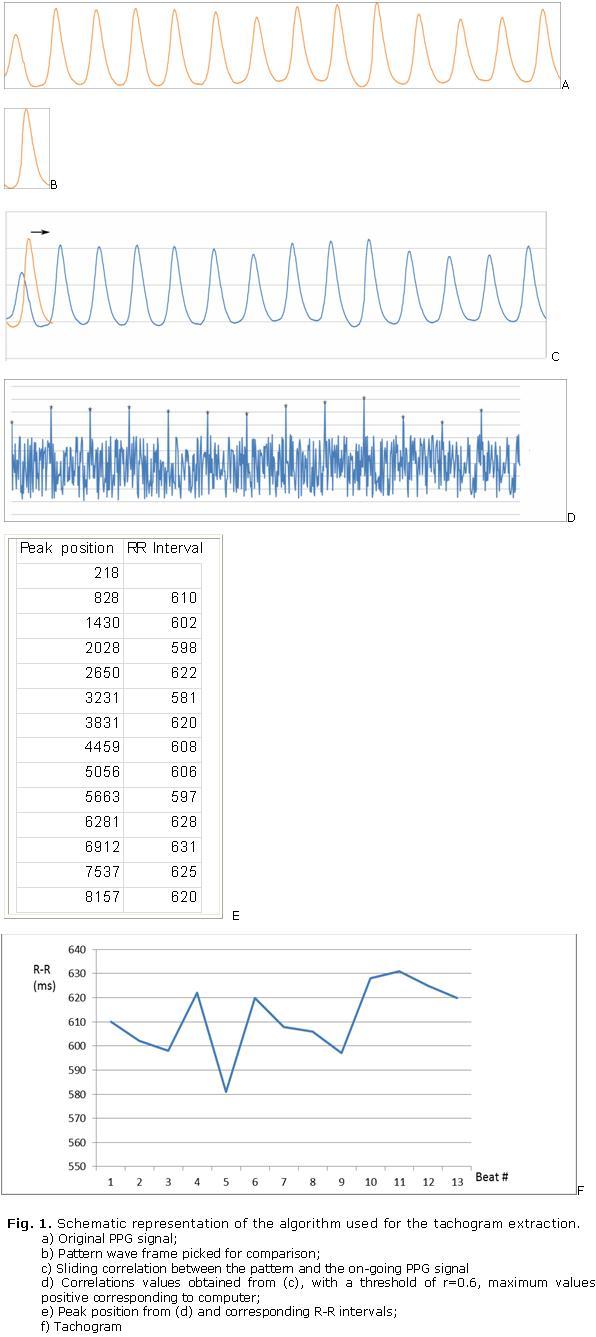
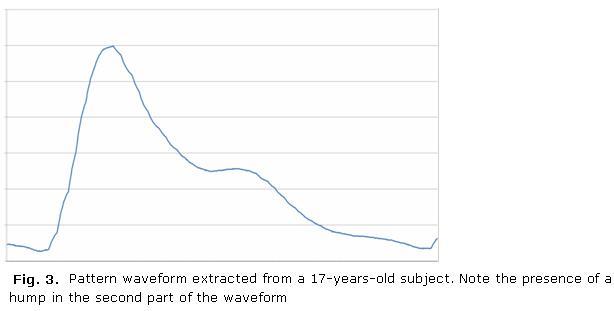
<body><![CDATA[<P><font size="2" face="Verdana">Data for PPG recording data were acquired through    a <em>Berry Pulse Oximeter</em> (Shanghai Berry Electronic Tech Co., Ltd, Shanghai,    China) and transferred through Bluetooth protocol into a desktop computer (Intel    Pentium 4, 1 GB RAM memory). Sampling rate was 100 Hz. Recordings were taken    after 5 minutes of relaxing, subjects were in a sitting position and recording    lasted 5 minutes. </font>      <P><font size="2" face="Verdana"><em>Peak Detection:</em> the algorithm for peak    detection was developed in Scilab. For that a typical PPG wave corresponding    to a full heart cycle was picked from the subjects' individual signal and taken    as pattern for comparison. Let L be the length of the pattern vector. By sliding    the pattern along the original recording correlation was estimated between the    pattern and each consecutive L-sized overlapping window of the original signal    as a result a correlogram is obtained by defining a threshold ( e.g.; r = 0.6).    Peaks were found as maximum values of the correlogram above the threshold value.    From the difference of the least of peak positions the tachogram is acquired.    A schematic description of the algorithm is represented in <a href="/img/revistas/rcim/v7n2/f0101215.jpg">figure    1</a> below. </font>      <P><font size="2" face="Verdana"><em>HRV Analysis;</em> the Kubios HRV (Version    2.2, University of Eastern Finland, Kuopio, Finland) was used. The following    two variables were estimated: </font>      <P><font size="2" face="Verdana">- <em>LF/HF</em>. Frequency domain measure reflecting    the level of the sympatho-vagal balance.<sup>12-13</sup>    <br>   - <em>d2</em>. It measures the correlation dimension, an index for complexity    of the whole cardiovascular system.<sup>14-15</sup> </font>      <P><font size="2" face="Verdana"><em>Statistical Analysis</em>. The non-parametric    Mann-Whitney U Test was used for group comparison (p&lt; 0.05) was set as significance    level. </font>     <P>&nbsp;     <P><font size="3" face="Verdana"><strong>RESULTS</strong></font>      <P><font size="2" face="Verdana">In <a href="/img/revistas/rcim/v7n2/f0201215.jpg">Figure    2</a>, a typical PPG recording is represented. </font>      <P><font size="2" face="Verdana">As it can be noticed the first wave in the trace    is much lower than the others. These can create some difficulty if a typical    detection algorithm is use. Since correlation is size independent the algorithm    introduced by us can avoid this shortcoming. Typical pattern vectors are shown    in <a href="/img/revistas/rcim/v7n2/f0301215.jpg">figures 3</a> and <a href="/img/revistas/rcim/v7n2/f0401215.jpg">4</a>.    </font>     ]]></body>
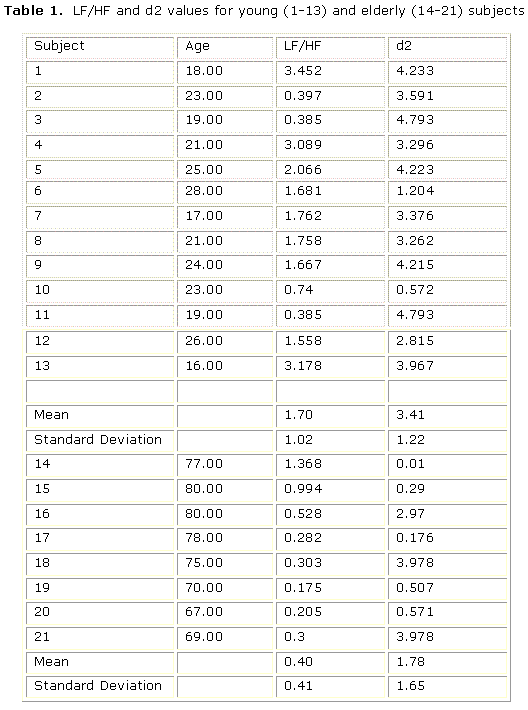
<body><![CDATA[<P><font size="2" face="Verdana">As is seen, age seems to heavily influence into    the recordings' shape, however this topic is beyond the scope of the present    study. </font>      <P><font size="2" face="Verdana"><em>HRV Analysis</em> </font>      <P><font size="2" face="Verdana"><a href="#t01">Table I</a> resumes the values    of the studied variables for all the subjects included into this research. As    it can be observed both LF/HF and d2 are decreasing with age. This has been    confirmed with non-parametric <em>Mann-Whitney</em> U Test (p= 0.003 for LF/HF,    p= 0.017 for d2) </font>      <P align="center"><img src="/img/revistas/rcim/v7n2/t0101215.gif" width="528" height="710"><a name="t01"></a>      <P align="center">&nbsp;     <P align="left"><font size="3" face="Verdana"><strong>DISCUSSION</strong> </font>      <P><font size="2" face="Verdana">Here we introduced new scenario for carrying    out HRV analysis that could be affordable for a wide range of low-income settings.    To our knowledge this is the first time that a correlation based algorithm for    peak detection is applied to HRV analysis. According to result presented in    Table I the vagal component of the ANS tend to prevail with age. This is compatible    with known facts as the reduction of Heart Rate with age.<sup>1</sup> On the    other hand the reduction in cardiovascular complexity with age is well documented.<sup>16</sup>    We interpret our result as a support for the validity for the algorithm of the    tachogram construction based on PPG presented in this research. </font>     <P>&nbsp;     <P><font size="3" face="Verdana"><strong>CONCLUSION</strong></font>      <P><font size="2" face="Verdana">An algorithm for tachogram estimation has been    developed based on correlogram with respect to a wave pattern. Results obtained    (reduction of LF/HF and d2 with age) point to the plausibility of the proposed    approach. </font>     ]]></body>
<body><![CDATA[<P>&nbsp;     <P><font size="3" face="Verdana"><strong>REFERENCES</strong></font>      <!-- ref --><P><font size="2" face="Verdana">1-Tulppo MP, Makikallio TH, Seppanen T, Laukkanen    RT, Huikuri HV. Vagal modulation of heart rate during exercise: effects of age    and physical fitness. Am J. Physiology 1998; 274: 424-29.     </font>      <!-- ref --><P><font size="2" face="Verdana">2-Wheeler T, Watkins PJ. Cardiac denervation    in diabetes. Br.Med.J 1973; 4:584-86.     </font>      <!-- ref --><P><font size="2" face="Verdana">3- Hern&aacute;ndez JL, Namugowa AV, Iputo J,    Hong R, Garc&iacute;a L, Sauti&eacute; M. Towards the determination of the optimal    recording duration for Heart Rate Variability Applications. A bootstrap study    on the Fantasia HRV database. Revista CENIC Ciencias Biol&oacute;gicas 2005;    35:1.     </font>      <!-- ref --><P><font size="2" face="Verdana">4-Hern&aacute;ndez JL, Foyaca SH, Garcia H, Sauti&eacute;    V. Namugowa: TOWARDS THE ESTIMATION OF THE FRACTAL DIMENSION OF HEART RATE VARIABILITY    DATA. Electronic Journal of Biomedicine 2004;2:1.    </font>      ]]></body>
<body><![CDATA[<!-- ref --><P><font size="2" face="Verdana">5-Task Force of the European Society of Cardiology    and the North American Society of Pacing and Electrophysiology. Heart rate variability:    standards of measurement, physiological interpretation, and clinical use. Circulation    1996; 93:1043-1065.     </font>      <P><font size="2" face="Verdana">6-Neuman MR. 1987. Pulse oximetry: physical principles,    technical realization and present limitations. Adv Exp Med Biol. 220:135-44.    </font>      <!-- ref --><P><font size="2" face="Verdana">7-Awad AA, Haddadin AS, Tantawy H, Badr TM, Stout    RG, Silverman DG, Shelley KH. The relationship between the photoplethysmographic    waveformand systemic vascular resistance. J Clin Monit Comput 2007; 21: 365-372.        </font>     <!-- ref --><P><font size="2" face="Verdana">8- Holmes S, Peffers SJ. PCRS-UK Opinion: Pulse    Oximetry in Primary Care 2009; Sheet No. 28. [cited 16 May 2014]. Available    from: <a href="http://www.pcrs-uk.org" target="_blank">http://www.pcrs-uk.org</a></font>      <!-- ref --><P><font size="2" face="Verdana">9- Hern&aacute;ndez JL, Caba&ntilde;as K, Jersys    O, Rodr&iacute;guez F, Hong R, Garc&iacute;a L. The Photoplethysmographic Signal    Processed With Nonlinear Time Series Analysis Tools. Revista Cubana de Inform&aacute;tica    M&eacute;dica. 1(1) ISSN: 1684-185.     </font>      <!-- ref --><P><font size="2" face="Verdana">10-Reyes I, Nazeran H, Franco M, Haltiwanger    E. Wireless Photoplethysmographic Device for Heart Rate variability Signal Acquisition    and Analysis. 34th Annual International Conference of the IEEE EMBS San Diego,    California USA, 1 September 2012.     </font>      ]]></body>
<body><![CDATA[<!-- ref --><P><font size="2" face="Verdana">11- Geltz B, Berlier J, McCollum J. Using the    iPhone and iPod touch for remote sensor control and data acquisition. IEEE SouthEastCon.    Proceedings of the IEEE 2010; 9-12.     </font>      <!-- ref --><P><font size="2" face="Verdana">12-Pagani M, Lombardi F, Guzzetti S. Power spectral    analysis of heart rate and arterial pressure variabilities as a marker of sympathovagal    interactions in man and conscious dog. Circ Res 1986; 59:178-193.     </font>      <!-- ref --><P><font size="2" face="Verdana">13- Seyd A, Thajudin A, Jeevamma J, Paul JK.    Time and Frequency Domain analysis of Heart Rate Variability and their Correlations    in Diabetes Mellitus, P.T. International Journal of Biological and Life Sciences    2008; 4:24-27.     </font>      <!-- ref --><P><font size="2" face="Verdana">14-Goldberger AL. Non-linear dynamics for clinicians:    chaos theory, fractals, and complexity at the bedside. Lancet. 1996; 347:1312-1314.    </font>      <!-- ref --><P><font size="2" face="Verdana">15- Schubert C, Lambertz M, Nelesen RA, Bardwell    W, ChoiJ. B. Dimsdale JEEffects of Stress on Heart Rate Complexity-A Comparison    between Short-Term and Chronic Stress. Biological Physiology 2009; 80:325-332.        </font>      ]]></body>
<body><![CDATA[<!-- ref --><P><font size="2" face="Verdana">16- Tejera E, Plain A, Portelinha A, Hern&aacute;ndez    JL, Rebelo I, Nieto-Villar JM. Heart rate variability complexity in the aging    process. Computational and Mathematical Methods in Medicine 2007; 8:287-296.        </font>      <P>&nbsp;     <P>&nbsp;     <P><font size="2" face="Verdana">Recibido: 3 de agosto de 2015.    <br>   Aprobado: 15 de octubre de 2015.</font>       ]]></body><back>
<ref-list>
<ref id="B1">
<label>1</label><nlm-citation citation-type="journal">
<person-group person-group-type="author">
<name>
<surname><![CDATA[Tulppo]]></surname>
<given-names><![CDATA[MP]]></given-names>
</name>
<name>
<surname><![CDATA[Makikallio]]></surname>
<given-names><![CDATA[TH]]></given-names>
</name>
<name>
<surname><![CDATA[Seppanen]]></surname>
<given-names><![CDATA[T]]></given-names>
</name>
<name>
<surname><![CDATA[Laukkanen]]></surname>
<given-names><![CDATA[RT]]></given-names>
</name>
<name>
<surname><![CDATA[Huikuri]]></surname>
<given-names><![CDATA[HV]]></given-names>
</name>
</person-group>
<article-title xml:lang="en"><![CDATA[Vagal modulation of heart rate during exercise: effects of age and physical fitness]]></article-title>
<source><![CDATA[Am J. Physiology]]></source>
<year>1998</year>
<volume>274</volume>
<page-range>424-29</page-range></nlm-citation>
</ref>
<ref id="B2">
<label>2</label><nlm-citation citation-type="journal">
<person-group person-group-type="author">
<name>
<surname><![CDATA[Wheeler]]></surname>
<given-names><![CDATA[T]]></given-names>
</name>
<name>
<surname><![CDATA[Watkins]]></surname>
<given-names><![CDATA[PJ]]></given-names>
</name>
</person-group>
<article-title xml:lang="en"><![CDATA[Cardiac denervation in diabetes]]></article-title>
<source><![CDATA[Br.Med.J]]></source>
<year>1973</year>
<volume>4</volume>
<page-range>584-86</page-range></nlm-citation>
</ref>
<ref id="B3">
<label>3</label><nlm-citation citation-type="journal">
<person-group person-group-type="author">
<name>
<surname><![CDATA[Hernández]]></surname>
<given-names><![CDATA[JL]]></given-names>
</name>
<name>
<surname><![CDATA[Namugowa]]></surname>
<given-names><![CDATA[AV]]></given-names>
</name>
<name>
<surname><![CDATA[Iputo]]></surname>
<given-names><![CDATA[J]]></given-names>
</name>
<name>
<surname><![CDATA[Hong]]></surname>
<given-names><![CDATA[R]]></given-names>
</name>
<name>
<surname><![CDATA[García]]></surname>
<given-names><![CDATA[L]]></given-names>
</name>
<name>
<surname><![CDATA[Sautié]]></surname>
<given-names><![CDATA[M]]></given-names>
</name>
</person-group>
<article-title xml:lang="en"><![CDATA[Towards the determination of the optimal recording duration for Heart Rate Variability Applications. A bootstrap study on the Fantasia HRV database]]></article-title>
<source><![CDATA[Revista CENIC Ciencias Biológicas]]></source>
<year>2005</year>
<volume>35</volume>
<numero>1</numero>
<issue>1</issue>
</nlm-citation>
</ref>
<ref id="B4">
<label>4</label><nlm-citation citation-type="journal">
<person-group person-group-type="author">
<name>
<surname><![CDATA[Hernández]]></surname>
<given-names><![CDATA[JL]]></given-names>
</name>
<name>
<surname><![CDATA[Foyaca]]></surname>
<given-names><![CDATA[SH]]></given-names>
</name>
<name>
<surname><![CDATA[Garcia]]></surname>
<given-names><![CDATA[H]]></given-names>
</name>
<name>
<surname><![CDATA[Sautié]]></surname>
<given-names><![CDATA[V]]></given-names>
</name>
</person-group>
<article-title xml:lang="en"><![CDATA[Namugowa: TOWARDS THE ESTIMATION OF THE FRACTAL DIMENSION OF HEART RATE VARIABILITY DATA]]></article-title>
<source><![CDATA[Electronic Journal of Biomedicine]]></source>
<year>2004</year>
<volume>2</volume>
<numero>1</numero>
<issue>1</issue>
</nlm-citation>
</ref>
<ref id="B5">
<label>5</label><nlm-citation citation-type="journal">
<collab>European Society of Cardiology^dNorth American Society of Pacing and Electrophysiology</collab>
<article-title xml:lang="en"><![CDATA[Heart rate variability: standards of measurement, physiological interpretation, and clinical use]]></article-title>
<source><![CDATA[Circulation]]></source>
<year>1996</year>
<volume>93</volume>
<page-range>1043-1065</page-range></nlm-citation>
</ref>
<ref id="B6">
<label>6</label><nlm-citation citation-type="journal">
<person-group person-group-type="author">
<name>
<surname><![CDATA[Neuman]]></surname>
<given-names><![CDATA[MR]]></given-names>
</name>
</person-group>
<article-title xml:lang="en"><![CDATA[Pulse oximetry: physical principles, technical realization and present limitations]]></article-title>
<source><![CDATA[Adv Exp Med Biol]]></source>
<year></year>
<volume>220</volume>
<page-range>135-144</page-range></nlm-citation>
</ref>
<ref id="B7">
<label>7</label><nlm-citation citation-type="journal">
<person-group person-group-type="author">
<name>
<surname><![CDATA[Awad]]></surname>
<given-names><![CDATA[AA]]></given-names>
</name>
<name>
<surname><![CDATA[Haddadin]]></surname>
<given-names><![CDATA[AS]]></given-names>
</name>
<name>
<surname><![CDATA[Tantawy]]></surname>
<given-names><![CDATA[H]]></given-names>
</name>
<name>
<surname><![CDATA[Badr]]></surname>
<given-names><![CDATA[TM]]></given-names>
</name>
<name>
<surname><![CDATA[Stout]]></surname>
<given-names><![CDATA[RG]]></given-names>
</name>
<name>
<surname><![CDATA[Silverman]]></surname>
<given-names><![CDATA[DG]]></given-names>
</name>
<name>
<surname><![CDATA[Shelley]]></surname>
<given-names><![CDATA[KH]]></given-names>
</name>
</person-group>
<article-title xml:lang="en"><![CDATA[The relationship between the photoplethysmographic waveformand systemic vascular resistance]]></article-title>
<source><![CDATA[J Clin Monit Comput]]></source>
<year>2007</year>
<volume>21</volume>
<page-range>365-372</page-range></nlm-citation>
</ref>
<ref id="B8">
<label>8</label><nlm-citation citation-type="">
<person-group person-group-type="author">
<name>
<surname><![CDATA[Holmes]]></surname>
<given-names><![CDATA[S]]></given-names>
</name>
<name>
<surname><![CDATA[Peffers]]></surname>
<given-names><![CDATA[SJ]]></given-names>
</name>
</person-group>
<source><![CDATA[PCRS-UK Opinion: Oximetry in Primary Care]]></source>
<year>2009</year>
</nlm-citation>
</ref>
<ref id="B9">
<label>9</label><nlm-citation citation-type="journal">
<person-group person-group-type="author">
<name>
<surname><![CDATA[Hernández]]></surname>
<given-names><![CDATA[JL]]></given-names>
</name>
<name>
<surname><![CDATA[Cabañas]]></surname>
<given-names><![CDATA[K]]></given-names>
</name>
<name>
<surname><![CDATA[Jersys]]></surname>
<given-names><![CDATA[O]]></given-names>
</name>
<name>
<surname><![CDATA[Rodríguez]]></surname>
<given-names><![CDATA[F]]></given-names>
</name>
<name>
<surname><![CDATA[Hong]]></surname>
<given-names><![CDATA[R]]></given-names>
</name>
<name>
<surname><![CDATA[García]]></surname>
<given-names><![CDATA[L]]></given-names>
</name>
</person-group>
<article-title xml:lang="en"><![CDATA[The Photoplethysmographic Signal Processed With Nonlinear Time Series Analysis Tools]]></article-title>
<source><![CDATA[Revista Cubana de Informática Médica]]></source>
<year></year>
<volume>1</volume>
<numero>1</numero>
<issue>1</issue>
</nlm-citation>
</ref>
<ref id="B10">
<label>10</label><nlm-citation citation-type="confpro">
<person-group person-group-type="author">
<name>
<surname><![CDATA[Reyes]]></surname>
<given-names><![CDATA[I]]></given-names>
</name>
<name>
<surname><![CDATA[Nazeran]]></surname>
<given-names><![CDATA[H]]></given-names>
</name>
<name>
<surname><![CDATA[Franco]]></surname>
<given-names><![CDATA[M]]></given-names>
</name>
<name>
<surname><![CDATA[Haltiwanger]]></surname>
<given-names><![CDATA[E]]></given-names>
</name>
</person-group>
<source><![CDATA[Wireless Photoplethysmographic Device for Heart Rate variability Signal Acquisition and Analysis]]></source>
<year></year>
<conf-name><![CDATA[34 Annual International Conference of the IEEE EMBS]]></conf-name>
<conf-date>1 September 2012</conf-date>
<conf-loc>San Diego California</conf-loc>
</nlm-citation>
</ref>
<ref id="B11">
<label>11</label><nlm-citation citation-type="book">
<person-group person-group-type="author">
<name>
<surname><![CDATA[Geltz]]></surname>
<given-names><![CDATA[B]]></given-names>
</name>
<name>
<surname><![CDATA[Berlier]]></surname>
<given-names><![CDATA[J]]></given-names>
</name>
<name>
<surname><![CDATA[McCollum]]></surname>
<given-names><![CDATA[J]]></given-names>
</name>
</person-group>
<source><![CDATA[Using the iPhone and iPod touch for remote sensor control and data acquisition. IEEE SouthEastCon.]]></source>
<year>2010</year>
<page-range>9-12</page-range><publisher-name><![CDATA[IEEE]]></publisher-name>
</nlm-citation>
</ref>
<ref id="B12">
<label>12</label><nlm-citation citation-type="journal">
<person-group person-group-type="author">
<name>
<surname><![CDATA[Pagani]]></surname>
<given-names><![CDATA[M]]></given-names>
</name>
<name>
<surname><![CDATA[Lombardi]]></surname>
<given-names><![CDATA[F]]></given-names>
</name>
<name>
<surname><![CDATA[Guzzetti]]></surname>
<given-names><![CDATA[S]]></given-names>
</name>
</person-group>
<article-title xml:lang="en"><![CDATA[Power spectral analysis of heart rate and arterial pressure variabilities as a marker of sympathovagal interactions in man and conscious dog]]></article-title>
<source><![CDATA[Circ Res]]></source>
<year>1986</year>
<volume>59</volume>
<page-range>178-193</page-range></nlm-citation>
</ref>
<ref id="B13">
<label>13</label><nlm-citation citation-type="journal">
<person-group person-group-type="author">
<name>
<surname><![CDATA[Seyd]]></surname>
<given-names><![CDATA[A]]></given-names>
</name>
<name>
<surname><![CDATA[Thajudin]]></surname>
<given-names><![CDATA[A]]></given-names>
</name>
<name>
<surname><![CDATA[Jeevamma]]></surname>
<given-names><![CDATA[J]]></given-names>
</name>
<name>
<surname><![CDATA[Paul]]></surname>
<given-names><![CDATA[JK]]></given-names>
</name>
</person-group>
<article-title xml:lang="en"><![CDATA[Time and Frequency Domain analysis of Heart Rate Variability and their Correlations in Diabetes Mellitus, P.T]]></article-title>
<source><![CDATA[International Journal of Biological and Life Sciences]]></source>
<year>2008</year>
<volume>4</volume>
<page-range>24-27</page-range></nlm-citation>
</ref>
<ref id="B14">
<label>14</label><nlm-citation citation-type="journal">
<person-group person-group-type="author">
<name>
<surname><![CDATA[Goldberger]]></surname>
<given-names><![CDATA[AL]]></given-names>
</name>
</person-group>
<article-title xml:lang="en"><![CDATA[Non-linear dynamics for clinicians: chaos theory, fractals, and complexity at the bedside]]></article-title>
<source><![CDATA[Lancet]]></source>
<year>1996</year>
<volume>347</volume>
<page-range>1312-1314</page-range></nlm-citation>
</ref>
<ref id="B15">
<label>15</label><nlm-citation citation-type="journal">
<person-group person-group-type="author">
<name>
<surname><![CDATA[Schubert]]></surname>
<given-names><![CDATA[C]]></given-names>
</name>
<name>
<surname><![CDATA[Lambertz]]></surname>
<given-names><![CDATA[M]]></given-names>
</name>
<name>
<surname><![CDATA[Nelesen]]></surname>
<given-names><![CDATA[RA]]></given-names>
</name>
<name>
<surname><![CDATA[Bardwell]]></surname>
<given-names><![CDATA[W]]></given-names>
</name>
<name>
<surname><![CDATA[ChoiJ]]></surname>
<given-names><![CDATA[B]]></given-names>
</name>
</person-group>
<article-title xml:lang="en"><![CDATA[Dimsdale JEEffects of Stress on Heart Rate Complexity-A Comparison between Short-Term and Chronic Stress]]></article-title>
<source><![CDATA[Biological Physiology]]></source>
<year>2009</year>
<volume>80</volume>
<page-range>325-332</page-range></nlm-citation>
</ref>
<ref id="B16">
<label>16</label><nlm-citation citation-type="journal">
<person-group person-group-type="author">
<name>
<surname><![CDATA[Tejera]]></surname>
<given-names><![CDATA[E]]></given-names>
</name>
<name>
<surname><![CDATA[Plain]]></surname>
<given-names><![CDATA[A]]></given-names>
</name>
<name>
<surname><![CDATA[Portelinha]]></surname>
<given-names><![CDATA[A]]></given-names>
</name>
<name>
<surname><![CDATA[Hernández]]></surname>
<given-names><![CDATA[JL]]></given-names>
</name>
<name>
<surname><![CDATA[Rebelo]]></surname>
<given-names><![CDATA[I]]></given-names>
</name>
<name>
<surname><![CDATA[Nieto-Villar]]></surname>
<given-names><![CDATA[JM]]></given-names>
</name>
</person-group>
<article-title xml:lang="en"><![CDATA[Heart rate variability complexity in the aging process]]></article-title>
<source><![CDATA[Computational and Mathematical Methods in Medicine]]></source>
<year>2007</year>
<volume>8</volume>
<page-range>287-296</page-range></nlm-citation>
</ref>
</ref-list>
</back>
</article>
