<?xml version="1.0" encoding="ISO-8859-1"?><article xmlns:mml="http://www.w3.org/1998/Math/MathML" xmlns:xlink="http://www.w3.org/1999/xlink" xmlns:xsi="http://www.w3.org/2001/XMLSchema-instance">
<front>
<journal-meta>
<journal-id>1684-1859</journal-id>
<journal-title><![CDATA[Revista Cubana de Informática Médica]]></journal-title>
<abbrev-journal-title><![CDATA[RCIM]]></abbrev-journal-title>
<issn>1684-1859</issn>
<publisher>
<publisher-name><![CDATA[Universidad de Ciencias Médicas de La Habana]]></publisher-name>
</publisher>
</journal-meta>
<article-meta>
<article-id>S1684-18592017000200004</article-id>
<title-group>
<article-title xml:lang="en"><![CDATA[Studying Protein kinases PKC&#950; and PKM&#950; with the Resonant Recognition Model. Implications for the study of Memory Mechanisms]]></article-title>
<article-title xml:lang="es"><![CDATA[Estudio de proteínas quinasas PKC&#950; y PKM&#950; mediante el Modelo de Reconocimiento Resonante. Implicaciones para el estudio de los Mecanismos de Memoria]]></article-title>
</title-group>
<contrib-group>
<contrib contrib-type="author">
<name>
<surname><![CDATA[Valdés García]]></surname>
<given-names><![CDATA[Suria]]></given-names>
</name>
<xref ref-type="aff" rid="A1"/>
</contrib>
<contrib contrib-type="author">
<name>
<surname><![CDATA[Hernández-Cáceres]]></surname>
<given-names><![CDATA[José Luis]]></given-names>
</name>
<xref ref-type="aff" rid="A1"/>
</contrib>
<contrib contrib-type="author">
<name>
<surname><![CDATA[Palmero Colmenares]]></surname>
<given-names><![CDATA[Damián]]></given-names>
</name>
<xref ref-type="aff" rid="A1"/>
</contrib>
</contrib-group>
<aff id="AA1">
<institution><![CDATA[,Diez de Octubre, Medical Faculty, Havana Medical Sciences University  ]]></institution>
<addr-line><![CDATA[Havana ]]></addr-line>
<country>Cuba</country>
</aff>
<pub-date pub-type="pub">
<day>00</day>
<month>12</month>
<year>2017</year>
</pub-date>
<pub-date pub-type="epub">
<day>00</day>
<month>12</month>
<year>2017</year>
</pub-date>
<volume>9</volume>
<numero>2</numero>
<fpage>121</fpage>
<lpage>134</lpage>
<copyright-statement/>
<copyright-year/>
<self-uri xlink:href="http://scielo.sld.cu/scielo.php?script=sci_arttext&amp;pid=S1684-18592017000200004&amp;lng=en&amp;nrm=iso"></self-uri><self-uri xlink:href="http://scielo.sld.cu/scielo.php?script=sci_abstract&amp;pid=S1684-18592017000200004&amp;lng=en&amp;nrm=iso"></self-uri><self-uri xlink:href="http://scielo.sld.cu/scielo.php?script=sci_pdf&amp;pid=S1684-18592017000200004&amp;lng=en&amp;nrm=iso"></self-uri><abstract abstract-type="short" xml:lang="en"><p><![CDATA[PKM&#950; is a brain-specific protein kinase that has been suggested as playing a key role in memory consolidation mechanisms. It is identical to catalytic portion of another protein kinase, PKC&#950;. Lacking the regulatory end, PKM&#950; is several times more active than PKC&#950;. However, knowledge about PKM&#950; mechanisms in memory consolidation is patchy, and sometimes contradictory. The resonant recognition model (RRM) might shed some light in understanding PKM&#950; role on memory consolidation. This is the first attempt in literature to apply the RRM to the study of PKM&#950; and PKC&#950;. We obtained that PKM&#950; presents a spectral peak at the resonant recognition frequency of fRRM= 0.063 (likely, corresponding to the infrared frequency of 3190 nm) and another peak at fRRM =0.211(950 nm in the near infrared). Peak at fRRM= 0.063 is also shared by PKC&#950;, and the peak at fRRM =0.211 is similar to the one recently reported in literature for regulatory proteins. We hypothesize that irradiating with a weak light infrared source at these frequencies would modify long term potentiation results. Finally, a scheme for resonant interactions in PKM&#950; and PKC&#950; is proposed.]]></p></abstract>
<abstract abstract-type="short" xml:lang="es"><p><![CDATA[PKM&#950; es una proteína quinasa específica del cerebro que se ha sugerido que desempeña un papel clave en los mecanismos de consolidación de la memoria. Es idéntica a la porción catalítica de otra proteína quinasa, PKC&#950;. Al carecer de la porción regulatoria, PKM&#950; es varias veces más activa que PKC&#950;. Sin embargo, el conocimiento sobre los mecanismos de PKM&#950; in en la consolidación de la memoria es parcial, y a veces contradictorio. El modelo de reconocimiento resonante (RRM) podría esclarecer la comprensión del papel de PKM&#950; en la consolidación de la memoria. Este es el primer intento en la literatura para aplicar el MRR al estudio de PKM&#950; y PKC&#950;. Se obtuvo que PKM&#950; presenta un pico espectral a la frecuencia de reconocimiento resonante fRRM = 0,063 (probablemente, correspondiente a la frecuencia infrarroja de 3190 nm) y otro pico a fRRM = 0,211 (950 nm en el infrarrojo cercano). Pico en fRRM = 0,063 es también compartida por PKC&#950;, y el pico a fRRM = 0,211 es similar a la recientemente informado en la literatura para las proteínas reguladoras. Se plantea la hipótesis de que la irradiación con una fuente de luz infrarroja débil a estas frecuencias podría modificar los resultados de potenciación a largo plazo. Finalmente, se propone un esquema para interacciones resonantes en PKM&#950; y PKC.]]></p></abstract>
<kwd-group>
<kwd lng="en"><![CDATA[long term potentiation]]></kwd>
<kwd lng="en"><![CDATA[protein kinases]]></kwd>
<kwd lng="en"><![CDATA[resonant recognition model]]></kwd>
<kwd lng="en"><![CDATA[bioinformatics]]></kwd>
<kwd lng="es"><![CDATA[potenciación a largo plaz]]></kwd>
<kwd lng="es"><![CDATA[proteínas kinasas]]></kwd>
<kwd lng="es"><![CDATA[modelo de reconocimiento resonante]]></kwd>
<kwd lng="es"><![CDATA[bioinformática]]></kwd>
</kwd-group>
</article-meta>
</front><body><![CDATA[ <p align="right" style='margin&#45;top:6.0pt;margin&#45;right:0cm; margin&#45;bottom:6.0pt;margin&#45;left:0cm;text&#45;align:right'><font size="2" face="Verdana"><b>TRABAJOS    ORIGINALES</b></font></p>  	    <p align="center" style='margin&#45;top:6.0pt;margin&#45;right:0cm; margin&#45;bottom:6.0pt;margin&#45;left:2.0cm;text&#45;align:center;text&#45;indent:&#45;2.0cm'><font face="verdana" size="4"><b>Studying Protein kinases PKC&#950; and PKM&#950; with the Resonant Recognition Model.</b> <b>Implications for the study of Memory Mechanisms</b></font></p>  	     <p align="center" style='text&#45;align:center'><font face="verdana" size="3"><b>Estudio    de prote&iacute;nas quinasas PKC&#950;</b> <b>y PKM&#950;</b> <b>mediante el    Modelo de Reconocimiento Resonante. Implicaciones para el estudio de los Mecanismos    de Memoria</b></font></p>  	    <p style='margin&#45;top:6.0pt;margin&#45;right:0cm;margin&#45;bottom:6.0pt; margin&#45;left:0cm;text&#45;align:justify;line&#45;height:10.0pt'><font face="verdana" size="2"><b>&nbsp;</b></font></p>  	     <p style='margin&#45;top:6.0pt;margin&#45;right:0cm;margin&#45;bottom:6.0pt; margin&#45;left:0cm'><font face="verdana" size="2"><strong>Dr.    Suria Vald&eacute;s Garc&iacute;a<sup>I</sup>    <br>   DrC. Jos&eacute;&nbsp; Luis&nbsp; Hern&aacute;ndez&#45;C&aacute;ceres<sup>I    <br>   </sup>Lic.Dami&aacute;n Palmero Colmenares<sup>I</sup><sup> </sup></strong></font></p>     <p style='margin&#45;top:6.0pt;margin&#45;right:0cm;margin&#45;bottom:6.0pt; margin&#45;left:0cm'><font face="verdana" size="2"><sup>    <br>   </sup></font></p>  	    <p style='margin&#45;top:6.0pt;margin&#45;right:0cm;margin&#45;bottom:6.0pt; margin&#45;left:0cm;text&#45;align:justify'><font face="verdana" size="2"><sup>I</sup> "Diez de Octubre," Medical Faculty, Havana Medical Sciences University, Havana, Cuba.</font></p>  	    ]]></body>
<body><![CDATA[<p style='margin&#45;top:6.0pt;margin&#45;right:0cm;margin&#45;bottom:6.0pt; margin&#45;left:0cm;text&#45;align:justify'><font face="verdana" size="2">&nbsp;</font></p>  	     <p style='margin&#45;top:6.0pt;margin&#45;right:0cm;margin&#45;bottom:6.0pt; margin&#45;left:0cm;text&#45;align:justify'><font face="verdana" size="2">Corresponding    author: <u><a href="mailto:cacerjlh@infomed.sld.cu">cacerjlh@infomed.sld.cu</a></u></font></p>     <p style='margin&#45;top:6.0pt;margin&#45;right:0cm;margin&#45;bottom:6.0pt; margin&#45;left:0cm;text&#45;align:justify'>&nbsp;</p>     <p style='margin&#45;top:6.0pt;margin&#45;right:0cm;margin&#45;bottom:6.0pt; margin&#45;left:0cm;text&#45;align:justify'>&nbsp;</p> <hr> <font face="verdana" size="2"><b>ABSTRACT</b></font>     <p style='margin&#45;top:6.0pt;margin&#45;right:0cm;margin&#45;bottom:6.0pt; margin&#45;left:0cm;text&#45;align:justify'><font face="verdana" size="2">PKM&#950; is a brain&#45;specific protein kinase that has been suggested as playing a key role in memory consolidation mechanisms. It is identical to catalytic portion of another protein kinase, PKC&#950;. Lacking the regulatory end, PKM&#950; is several times more active than PKC&#950;. However, knowledge about PKM&#950; mechanisms in memory consolidation is patchy, and sometimes contradictory. The resonant recognition model (RRM) might shed some light in understanding PKM&#950; role on memory consolidation. This is the first attempt in literature to apply the RRM to the study of PKM&#950; and PKC&#950;. We obtained that PKM&#950; presents a spectral peak at the resonant recognition frequency of fRRM= 0.063 (likely, corresponding to the infrared frequency of 3190 nm) and another peak at f<sub>RRM</sub> =0.211(950 nm in the near infrared). Peak at f<sub>RRM</sub>= 0.063 is also shared by PKC&#950;, and the peak at f<sub>RRM</sub> =0.211 is similar to the one recently reported in literature for regulatory proteins. We hypothesize that irradiating with a weak light infrared source at these frequencies would modify long term potentiation results. Finally, a scheme for resonant interactions in PKM&#950; and PKC&#950; is proposed.</font></p>  	     <p style='margin&#45;top:0cm;text&#45;align:justify'><font face="verdana" size="2"><b>Palabras    claves:</b> long term potentiation, protein kinases, resonant recognition model,    bioinformatics.</font></p> <hr> <font face="verdana" size="2"><b>RESUMEN</b></font>     <p style='text&#45;align:justify'><font face="verdana" size="2">PKM&#950; es una prote&iacute;na quinasa espec&iacute;fica del cerebro que se ha sugerido que desempe&ntilde;a un papel clave en los mecanismos de consolidaci&oacute;n de la memoria. Es id&eacute;ntica a la porci&oacute;n catal&iacute;tica de otra prote&iacute;na quinasa, PKC&#950;. Al carecer de la porci&oacute;n regulatoria, PKM&#950; es varias veces m&aacute;s activa que PKC&#950;. Sin embargo, el conocimiento sobre los mecanismos de PKM&#950; in en la consolidaci&oacute;n de la memoria es parcial, y a veces&nbsp; contradictorio. El modelo de reconocimiento resonante (RRM) podr&iacute;a esclarecer la comprensi&oacute;n del papel de PKM&#950; en la consolidaci&oacute;n de la memoria. Este es el primer intento en la literatura para aplicar el MRR al estudio de PKM&#950; y PKC&#950;. Se obtuvo que PKM&#950; presenta un pico espectral a la frecuencia de reconocimiento resonante&nbsp; f<sub>RRM</sub> = 0,063 (probablemente, correspondiente a la frecuencia infrarroja de 3190 nm) y otro pico a f<sub>RRM</sub> = 0,211 (950 nm en el infrarrojo cercano). Pico en f<sub>RRM</sub> = 0,063 es tambi&eacute;n compartida por PKC&#950;, y el pico a f<sub>RRM</sub> = 0,211 es similar a la recientemente informado en la literatura para las prote&iacute;nas reguladoras. Se plantea la hip&oacute;tesis de que la irradiaci&oacute;n con una fuente de luz infrarroja d&eacute;bil a estas frecuencias podr&iacute;a modificar los resultados de potenciaci&oacute;n a largo plazo. Finalmente, se propone un esquema para interacciones resonantes en PKM&#950; y PKC.</font></p>  	     <p style='text&#45;align:justify'><font face="verdana" size="2"><b> </b><b>Key    words:</b> potenciaci&oacute;n a largo plaz, prote&iacute;nas kinasas, modelo    de reconocimiento resonante, bioinform&aacute;tica.</font></p> <hr>     <p>&nbsp;</p>     <p>&nbsp;</p>     ]]></body>
<body><![CDATA[<p align="center" style="margin-bottom: 0cm"><font face="verdana" size="4"><b>Introduction</b></font></p>     <p align="center" style="margin-bottom: 0cm">&nbsp;</p>     <p align="justify" style="margin-bottom: 0cm"><font face="verdana" size="2">Elucidation    of memory mechanisms remains a central problemin Neuroscience. The discovery    of long term potentiation&#45;manifested as a substantial increase in synaptic    efficacy after a tetanic stimulus&#45; provided a model for studying memory    mechanisms.&nbsp; Studies carried out by Eric Kandel and his grouprevealed that    long term potentiation involves protein synthesis as well as structural changes    in involved synapses.<sup>1    <br>   </sup></font><font face="verdana" size="2">The possibility that a single molecule    can be the main responsible for memory processes was suggested by Todd Sacktor,    who found that PKM&#950;(a brain&#45;specific protein kinase devoid of regulatory    pseudo&#45;substrate portion)&nbsp; is the responsible for triggering a cascade    of events leading to sustained self&#45;maintenance of up&#45;regulated synaptic    efficacy.<sup>2</sup> Thus it has been suggested that inhibition of PKM&#950;    in the hippocampus, insular cortex, and amygdala erasesseveral types of memories    such as place memory, conditioned taste aversion, and fear memory, respectively,    as well as counters long term potentiation. <sup>3    <br>   </sup></font><font face="verdana" size="2">Proposed scenarios for&nbsp;&nbsp;    PKM&#950; mechanisms touch interaction of this protein with other proteins,    as CREB&#45;binding protein (CBP), the adaptor protein importin&#45;&#945;,    the peptide ZIP, can be viewed under the light of protein interactions.<sup>4</sup>    A universal mechanism has been proposed for protein interactions that offers    an alternative way to traditional views.    <br>   </font><font face="verdana" size="2">Thus Irena Cosic has developed the Resonant    Recognition Model (RRM). According to this model, bio&#45;photons are sent by    proteins and can be recognized by substrates and receptors as well as by proteins    participating in a common biological function. Proteins with a common biological    function do share the same frequency, whereas interacting proteins share the    same frequency and opposite phase.    <br>   </font><font face="verdana" size="2">We found no reports about RRM studies withPKM&#950;.    We hypothesize that a RRM study on this protein could suggest new possibilities    to appraise its role in memory consolidation.</font></p>     <p style='margin:0cm;margin&#45;bottom:.0001pt;text&#45;align:justify'><font face="verdana" size="2"><b>&nbsp;</b></font></p>  	    <p align="center" style='text&#45;align:center'><font face="verdana" size="4"><b>Methods</b></font></p>  	    <p align="center" style='text&#45;align:center'><font face="verdana" size="2"><b>&nbsp;</b></font></p>  	    ]]></body>
<body><![CDATA[<p style='text&#45;align:justify;line&#45;height:12.0pt'><font face="verdana" size="2"><i>Data:</i></font></p>  	     <p style='text&#45;align:justify;line&#45;height:12.0pt'><font face="verdana" size="2">In    order to perform RRM analysis, a group of sequences were downloaded from UNIPROT    at <a href="http://www.uniprot.org" target="_blank">www.uniprot.org</a></font></p>  	    <p style='text&#45;align:justify;line&#45;height:12.0pt'><font face="verdana" size="2">PKM&#950;:</font></p>  	     <p style='margin&#45;bottom:0cm;margin&#45;bottom:.0001pt;text&#45;align: justify'><font face="verdana" size="2">PKM&#950;    is the C&#45;terminal fragment of the brain&#45;specific protein kinase PKC&#950;    corresponding to amino acids positions from 184 to 592 (see <a href="/img/revistas/rcim/v9n2/t0104217.gif">Table    1</a>). Lacking inhibition from the pseudo&#45;substrate of the regulatory domain    of PKC&#950;, PKM&#950; is a persistently active enzyme. Although PKM is usually    thought of as a cleavage product of full&#45;length PKC it has been reported    that PKM is not formed in LTP by proteolysis but by gene expression of a brain&#45;specific    PKM mRNA, which is generated by an internal promoter within the PKC gene.<sup>5</sup>    Apparently Tetanic stimulation induces protein synthesis from the PKM mRNA,    persistently increasing the levels of the kinase during LTP maintenance.</font></p>     <p style='margin&#45;bottom:0cm;margin&#45;bottom:.0001pt;text&#45;align: justify'><font face="verdana" size="2">For    resonant frequencies identification, several proteins sharing the same function    were studied. Here we analyzed both PKC&#950;and PKM&#950; sequences from the    following twelve species:</font></p>  	     <p style='margin&#45;left:36.0pt;text&#45;align:justify;text&#45;indent: &#45;18.0pt;line&#45;height:12.0pt'><font face="verdana" size="2">1.&nbsp;&nbsp;&nbsp;    U3IRA8&nbsp;(U3IRA8_ANAPL) Anas platyrhynchos (Mallard) (Anas boschas) <b>&aacute;nade    real</b></font></p>     <p style='margin&#45;left:36.0pt;text&#45;align:justify;text&#45;indent: &#45;18.0pt;line&#45;height:12.0pt'><font face="verdana" size="2">2.&nbsp;&nbsp;&nbsp;    U3K4C5&nbsp;(U3K4C5_FICAL)Ficedula albicollis (Collared flycatcher) (Muscicapa    albicollis) <b>papamoscas collarino</b></font></p>  	    <p style='margin&#45;left:36.0pt;text&#45;align:justify;text&#45;indent: &#45;18.0pt;line&#45;height:12.0pt'><font face="verdana" size="2">3.&nbsp;&nbsp;&nbsp; E1BQN6&nbsp;(E1BQN6_CHICK) Gallus gallus (Chicken) <b>gallo/ gallina</b></font></p>  	    <p style='margin&#45;left:36.0pt;text&#45;align:justify;text&#45;indent: &#45;18.0pt;line&#45;height:12.0pt'><font face="verdana" size="2">4.&nbsp;&nbsp;&nbsp; G3RB70&nbsp;(G3RB70_GORGO) Gorilla gorilla gorilla (Western lowland gorilla) <b>gorila occidental de llanura o planicie</b></font></p>  	    <p style='margin&#45;left:36.0pt;text&#45;align:justify;text&#45;indent: &#45;18.0pt;line&#45;height:12.0pt'><font face="verdana" size="2">5.&nbsp;&nbsp;&nbsp; G3TKV6&nbsp;(G3TKV6_LOXAF) Loxodonta africana (African elephant) <b>elefante africano de sabana</b></font></p>  	    ]]></body>
<body><![CDATA[<p style='margin&#45;left:36.0pt;text&#45;align:justify;text&#45;indent: &#45;18.0pt;line&#45;height:12.0pt'><font face="verdana" size="2">6.&nbsp;&nbsp;&nbsp; G1MTR8&nbsp;(G1MTR8_MELGA)Meleagris gallopavo (Common turkey) <b>pavo salvaje</b></font></p>  	    <p style='margin&#45;left:36.0pt;text&#45;align:justify;text&#45;indent: &#45;18.0pt;line&#45;height:12.0pt'><font face="verdana" size="2">7.&nbsp;&nbsp;&nbsp; H0WJ10 (H0WJ10_OTOGA)Otolemur garnettii (Small&#45;eared galago) (Garnett's greater bushbaby) <b>g&aacute;lago de Garnet</b></font></p>  	    <p style='margin&#45;left:36.0pt;text&#45;align:justify;text&#45;indent: &#45;18.0pt;line&#45;height:12.0pt'><font face="verdana" size="2">8.&nbsp;&nbsp;&nbsp; K7FJG4&nbsp;(K7FJG4_PELSI) Pelodiscus sinensis (Chinese softshell turtle) (Trionyx sinensis) <b>tortuga de caparaz&oacute;n blando de China</b></font></p>  	    <p style='margin&#45;left:36.0pt;text&#45;align:justify;text&#45;indent: &#45;18.0pt;line&#45;height:12.0pt'><font face="verdana" size="2">9.&nbsp;&nbsp;&nbsp; H0YXM1&nbsp;(H0YXM1_TAEGU) Taeniopygia guttata (Zebra finch) <b>pinz&oacute;n cebra</b></font></p>  	     <p style='margin&#45;left:36.0pt;text&#45;align:justify;text&#45;indent: &#45;18.0pt;line&#45;height:12.0pt'><font face="verdana" size="2">10.&nbsp;    Q05513&nbsp;(KPCZ_HUMAN) Homo sapiens (Human) <b>humano</b></font></p>  	     <p style='margin&#45;left:36.0pt;text&#45;align:justify;text&#45;indent: &#45;18.0pt;line&#45;height:12.0pt'><font face="verdana" size="2">11.&nbsp;&nbsp;Q02956&nbsp;(KPCZ_MOUSE)    Mus musculus (Mouse) <b>rat&oacute;n com&uacute;n</b></font></p>  	     <p style='margin&#45;left:36.0pt;text&#45;align:justify;text&#45;indent: &#45;18.0pt;line&#45;height:12.0pt'><font face="verdana" size="2">12.&nbsp;&nbsp;P09217&nbsp;(KPCZ_RAT)    Rattus norvegicus (Rat) <b>rata parda</b></font></p>  	     <p style='margin-bottom:.0001pt;text-align: justify'><font face="verdana" size="2">Each    PKMC sequence in these twelve&nbsp; species contained exactly 592 amino acids.    The PKM&#950; sequence was obtained from corresponding PKC&#950; by extraction    of the fragment with amino acids from 184 to 592.    <br>   </font><font face="verdana" size="2">For comparison, the PKCZ segment from position    1 to 183 (containing the regulatory unit and the hinge) was also submitted to    RRM analysis.&nbsp;</font></p>  	    <p style='text&#45;align:justify;line&#45;height:12.0pt'><font face="verdana" size="2"><i>Resonant Recognition Model</i></font></p>  	     ]]></body>
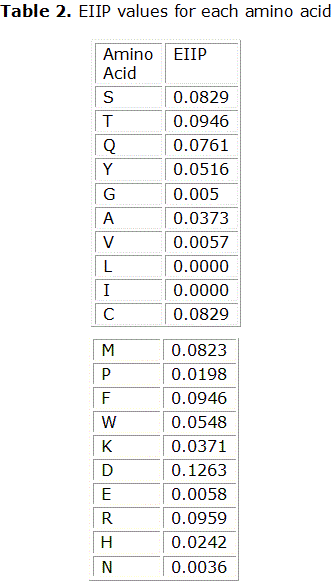
<body><![CDATA[<p style='margin-bottom:0cm;margin-bottom:.0001pt;text-align: justify'><font face="verdana" size="2">The    RRM, proposed by Irena Cosic,&nbsp; postulates that interactions of proteins    with receptors, peptide substrates and other proteinsare achieved through&nbsp;    resonant energy transfer between involved molecules at the frequency specific    for each observed function/interaction.<sup>6</sup> This transfer of bio&#45;photons    at energies of the order of 10<sup>&#45;20</sup> J is the universal mechanism    by which macromolecules and smaller peptides recognize each other.<sup>7</sup>    This vision is radically different from the idea of interactions of through    van der Waals forces, hydrogen bonds and structural complementarity as the main    role players in the molecular recognition by proteins. A key aspect of the RRM    approach is to represent a protein&rsquo;s primary structure as a numerical    series. For this, each amino acid in the sequence is symbolized with the (numerical)    value of a biologically relevant physical&#45;chemical parameter. If the chosen    parameter is suitable, it happens that proteins with the same biological function    have a common frequency component in their Fourierspectra. This common frequency    is considered to be a hallmark ofa protein&rsquo;s biological function/interaction.    After trying with different candidate parameters, it was found that the energy    of delocalized electrons, calculated as the electron&#150;ion interaction pseudo&#45;potential    (EIIP) of each amino acid residue is the best suited quantity for RRM analysis.<sup>8</sup>    EIIP values for each amino acid appear in Table 2. The EIIP parameter describes    the average energy states of all valence electrons in a particular amino acid.    Accordingly, the resulting numerical series represents the distribution of the    free electron energies along protein&rsquo;s backbone.    <br>   </font><font face="verdana" size="2">Once the numerical sequence is obtained,    it is submitted to spectral analysis using the Fourier Transform (FT) to extract    information pertinent to the biological function. In the frequency domain, the    FT of an individual protein sequence will contain nonzero values for many frequencies.    <sup>9    <br>   </sup></font><font face="verdana" size="2">However, if a cross spectral function    is estimated for a group of proteins sharing one common frequency, the cross    spectral function will have a nonzero value at this resonant frequency.    <br>   </font><font face="verdana" size="2">Since it can be expected that a given protein    can display more than one function, it may happen that the cross spectrum of    a group of orthologous proteins will exhibit more than one peak.    <br>   </font><font face="verdana" size="2">The multiple cross&#45;spectral function    obtained from a group of orthologous sequences with the same biological function    has been named &lsquo;consensus spectrum&rsquo;. The presence of a distinct    peak frequency in a consensus spectrum implies that this common frequency is    related to the shared biological function provided the following criteria are    met:</font></p>  	     <p style='margin&#45;left:36.0pt;text&#45;align:justify;text&#45;indent: &#45;18.0pt;line&#45;height:12.0pt'><font face="verdana" size="2">    &middot;&nbsp;&nbsp;&nbsp;&nbsp;&nbsp;&nbsp;&nbsp; One peak only exists for    a group of protein sequences sharing the same biological function;    <br>   </font><font face="verdana" size="2">&middot;&nbsp;&nbsp;&nbsp;&nbsp;&nbsp;&nbsp;&nbsp;    No significant peak exists for biologically unrelated protein sequences;    <br>   </font><font face="verdana" size="2">&middot;&nbsp;&nbsp;&nbsp;&nbsp;&nbsp;&nbsp;&nbsp;    Peak frequencies are different for different biological functions.</font></p>  	     <p style='margin-bottom:.0001pt;text-align: justify'><font face="verdana" size="2">Cosic    has studied a large amount of proteins and concluded that each specific biological    function of a given protein characterized by a single frequency. The RRM can    be applied to the study of interactions of proteins with their targets (receptors,    ligands and inhibitors) since it was found that interacting proteins and targets    display the same characteristic frequency in their interactions. <sup>6    <br>   </sup></font><font face="verdana" size="2">Thus, the RRM characteristic frequencies    represent a protein&rsquo;s general functions as well as the mutual recognition    between a particular protein and its target (receptor, ligand, etc.). As this    recognition arises from the matching of periodicities within the distribution    of energies of free electrons along the interacting proteins, it can be regarded    as the resonant recognition.    ]]></body>
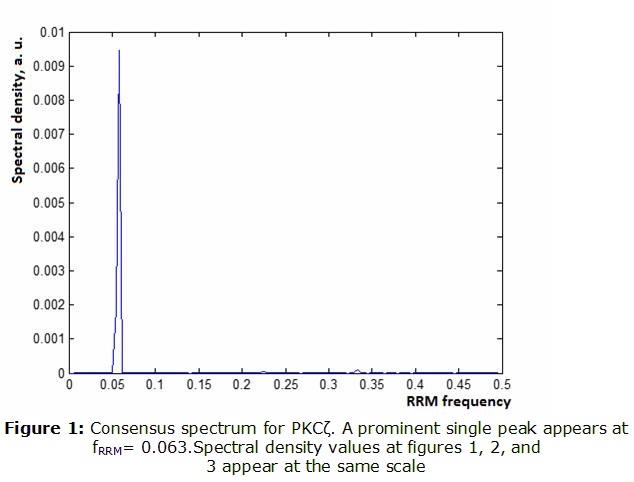
<body><![CDATA[<br>   </font><font face="verdana" size="2">It has been found that peptides attaching    to proteins do share the same resonant frequency and exhibit opposite phase.    Thus, abiding these two conditions is regarded as a hallmark for protein&#45;protein    interaction.    <br>   </font><font face="verdana" size="2">The primary amino acid sequences were transformed    into a numerical series following the Resonant Recognition Model (RRM) methodology.    For it, to each of the 20 amino acids in the entire sequence an electron&#45;ion    interaction potential (EIIP) value was assigned (<a href="#t02">Table 2</a>).</font></p>  	    <p style='margin&#45;bottom:0cm;margin&#45;bottom:.0001pt;text&#45;align: justify'>&nbsp;</p>     <p align="center" ><img src="/img/revistas/rcim/v9n2/t0204217.gif" width="334" height="588"><a name="t02"></a></p>     <p style='margin-bottom:0cm;margin-bottom:.0001pt;text-align: justify'><font face="verdana" size="2">The    obtained numerical series was treated as a time series. Power spectrum was estimated    for each sequence using a SciLab program based on Fourier analysis. For finding    the consensus spectrum, all the twelve spectral vectors were submitted to scalar    cross multiplication. The obtained product is considered as the consensus spectrum.    <br>   </font><font face="verdana" size="2">The RRM frequency was converted to a true    electromagnetic frequency by determining the appropriate wavelength using the    empirical function proposed by Cosic: <sup>6</sup> f<sub>RRM</sub> = 201/&#955;.</font></p>  	    <p align="center" style='margin&#45;right:2.2pt;text&#45;align:center'>&nbsp;</p>     <p align="center" style='margin&#45;right:2.2pt;text&#45;align:center'><font face="verdana" size="2"><b><font size="4">Results</font></b></font></p>     <p style='margin&#45;bottom:0cm;margin&#45;bottom:.0001pt'>&nbsp;</p>     <p style='margin-bottom:0cm;margin-bottom:.0001pt;text-align: justify'><font face="verdana" size="2"><i>PKC</i>&#950;.    As apparent from <a href="/img/revistas/rcim/v9n2/f0104217.jpg">Figure 1</a>,    a clear single peak was found at the frequency of f<sub>RRM</sub>= 0.063. Unlike    many other protein sequences, this protein kinase exhibits only one prominent    peak. Likely, this would correspond to the infrared frequency of 3190 <b><u>nm.    ]]></body>
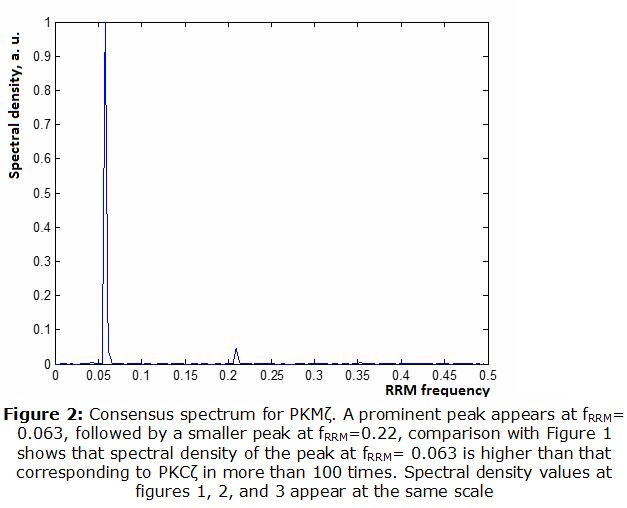
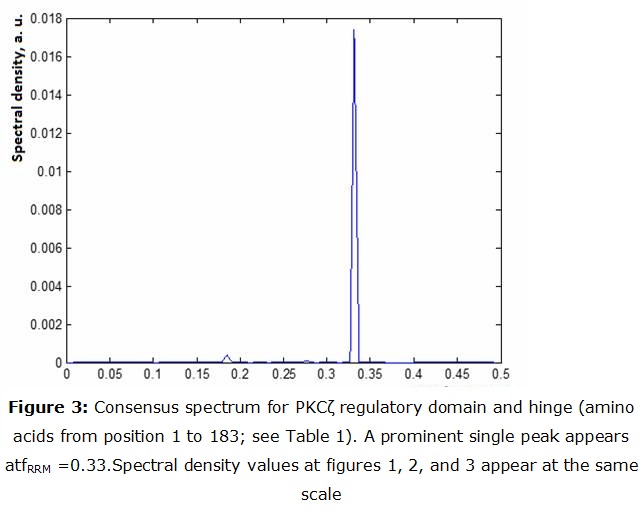
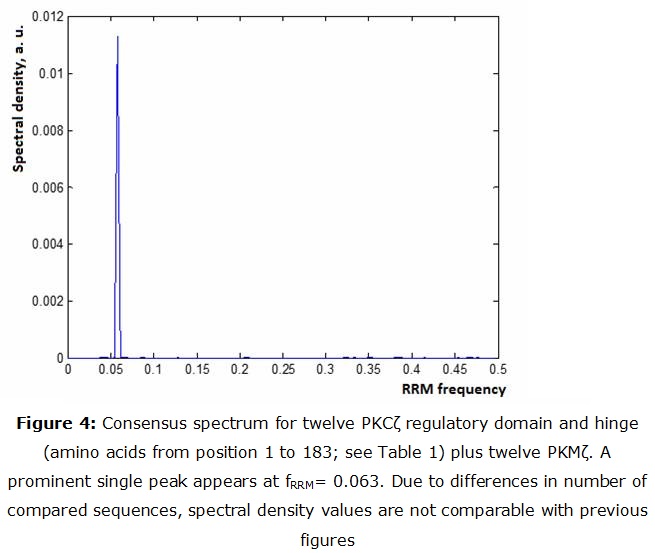
<body><![CDATA[<br>   </u></b></font><font face="verdana" size="2"><i>PKM&#950;.</i> We obtained,    that PKM&#950; shares some features of PKC&#950; whereas differing in others    (<a href="/img/revistas/rcim/v9n2/f0204217.jpg">Figure 2</a>).As observed, PKM&#950;    shows a prominent peak at the same frequency of f<sub>RRM</sub> =0.063. However,    when amplitudes were compared, the peak seems to be more than 100 times higher.    At the same time, a smaller second peak appears at f<sub>RRM</sub> =0.211(950    nm in the near infrared).</font></p>  	     <p align="center" style='margin&#45;bottom:0cm;margin&#45;bottom:.0001pt; text&#45;align:center;line&#45;height:10.0pt'>&nbsp;</p>  	     <p align="center" style='margin-bottom:0cm;margin-bottom:.0001pt; text-align:center'><font face="verdana" size="3"><b>Regulatory+Hingedomains</b></font></p>  	    <p align="center" style='margin&#45;bottom:0cm;margin&#45;bottom:.0001pt; text&#45;align:center'><font face="verdana" size="2">&nbsp;</font></p>  	     <p align="center" style='margin-bottom:0cm;margin-bottom:.0001pt; text-align:justify'><font face="verdana" size="2">&nbsp;</font><font face="verdana" size="2">As    it can be seen from <a href="/img/revistas/rcim/v9n2/f0304217.jpg">figure 3</a>,    the regulatory domain with the hinge exhibit a peak at f<sub>RRM</sub> =0.33,    corresponding to 609 nm (yellow light).</font></p>     <p align="center" style='margin-top:12.0pt;margin-right:0cm; margin-bottom:0cm;margin-left:0cm;text-align:center;line-height:150%'>&nbsp;</p>     <p align="center" style='margin-top:12.0pt;margin-right:0cm; margin-bottom:0cm;margin-left:0cm;text-align:center;line-height:150%'><font face="verdana" size="2"><b>May    regulatory unit be a "pseudo&#45;substrate"?</b></font></p>  	     <p align="center" style='margin&#45;bottom:0cm;margin&#45;bottom:.0001pt; text&#45;align:center'>&nbsp;</p>     <p align="center" style='margin-bottom:0cm;margin-bottom:.0001pt; text-align:justify'><font face="verdana" size="2">&nbsp;</font><font face="verdana" size="2">A    consensus spectrum was obtained from combining 12 PKM&#950; and 12 sequences    of the regulatory + hinge domain. As it can be noticed from <a href="/img/revistas/rcim/v9n2/f0404217.jpg">figure    4</a> there is a peak at fRRM= 0.063. This support the idea that PKM&#950; can    combine with the regulatory domain even after PKC&#950; cleavage.</font></p>  	     <p align="center" style='margin&#45;top:6.0pt;margin&#45;right:0cm; margin&#45;bottom:6.0pt;margin&#45;left:0cm;text&#45;align:center;line&#45;height:150%'>&nbsp;</p>  	     ]]></body>
<body><![CDATA[<p align="center" style='margin-bottom:6.0pt;margin-bottom:.0001pt; text-align:center'><font face="verdana" size="4"><b>Discussion</b></font></p>  	    <p align="center" style='text&#45;align:center'><font face="verdana" size="2">&nbsp;</font></p>  	     <p style='margin-bottom:0cm;margin-bottom:.0001pt;text-align: justify'><font face="verdana" size="2">So    far, RRM remains as a Hypothesis,<sup>10</sup> accepted by a small fraction    of research community. However, it brings plausible predictions to a group of    experimental data, such as a nice correspondence between spectral density changes    and results of mutagenesis experiments, excellent correlation between theoretical    f<sub>RRM</sub>and absorption frequency for light&#45;absorbing proteins, biological    function of different synthetic peptides designed via RRM, as well as bio&#45;photon    emissions of proteins in solution in full accordance with the Cosic model, among    others.<sup>11    <br>   </sup></font><font face="verdana" size="2">If proven true, Cosic&acute;s model    will herald a "true revolution in bioinformatics", as suggested by Mae.    <br>   </font><font face="verdana" size="2">It is worth of notice that RRM analysis    considers only primary structure of the protein backbone, which makes it radically    different from most approaches in structural biology and bioinformatics.</font></p>  	    <p style='margin&#45;bottom:0cm;margin&#45;bottom:.0001pt;text&#45;align: justify'><font face="verdana" size="2">Our results can be summarized as follows:</font></p>  	 <ul>       <li><font size="2" face="verdana" style="margin&#45;bottom:0cm;margin&#45;bottom:.0001pt;text&#45;align: justify">      There is a resonant frequency at f<sub>RRM</sub>= 0.063 that is shared by      both PKC&#950; and PKM&#950;. This frequency is not prominent at regulatory+      hinge domains. The peak corresponding to PKM&#950; is more than 100 times      higher.</font></li>       <li><font face="verdana" size="2"> A smaller, but significant peak appears at      f<sub>RRM</sub>=0.22. This peak is not observable in PKC&#950; nor in the      regulatory + hinge domains.</font></li>       <li><font face="verdana" size="2"> The regulatory + hinge domains may interact      with PKM&#950; at the resonant frequency of f<sub>RRM</sub>= 0.063.</font></li>     </ul>     ]]></body>
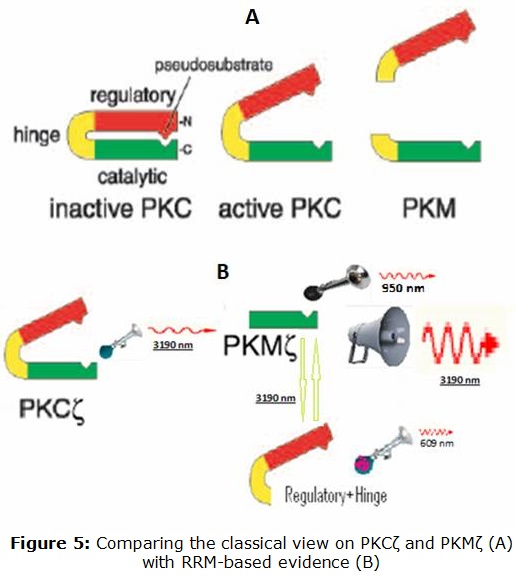
<body><![CDATA[<p style='margin&#45;top:0cm;margin&#45;right:2.55pt;margin&#45;bottom:0cm;margin&#45;left: 0cm;margin&#45;bottom:.0001pt;text&#45;align:justify'><font face="verdana" size="2">These    results do agree with the idea of PKC&#950; and PKM&#950; sharing a common function,    supported in this case by the common frequency at f<sub>RRM</sub>= 0.063. This    frequency is also used for recognition between PKM&#950; and the regulatory    unit.</font></p>      <p style='margin&#45;top:0cm;margin&#45;right:2.55pt;margin&#45;bottom:0cm;margin&#45;left: 0cm;margin&#45;bottom:.0001pt;text&#45;align:justify'><font face="verdana" size="2">It is recognized that PKM&#950; is much more active than PKC&#950;, and the higher amplitude of the peak could be a corroboration of this in RRM terms. However, the common view for this difference is the idea that the regulatory domain act as a pseudo&#45;substrate for the catalytic domain.&nbsp; However, in RRM analysis only the primary sequence is taken into account and this is enough for suggesting marked differences in activity levels.</font></p>  	    <p style='margin&#45;top:0cm;margin&#45;right:2.55pt;margin&#45;bottom:0cm;margin&#45;left: 0cm;margin&#45;bottom:.0001pt;text&#45;align:justify'><font face="verdana" size="2">On the other hand, interacting proteins do share the same frequency, only with different phases. The fact that the peak at f<sub>RRM</sub>= 0.063 is common between regulatory+hinge domains and PKM&#950; suggests that the two portions of the cleaved PKC&#950; would interact leading to a reduced function.&nbsp; This could explain why PKM&#950; is obtained in vivo by direct synthesis and not from the cleavage of PKC&#950;.</font></p>  	     <p style='margin-top:0cm;margin-right:2.55pt;margin-bottom:0cm;margin-left: 0cm;margin-bottom:.0001pt;text-align:justify'><font face="verdana" size="2">Our    results also suggest that the peak at f<sub>RRM</sub>=0.212 (950 nm in the near    infrared), is related to the function of PKM&#950; as a signal protein. Dotta    et al. suggested that "According to Cosic&rsquo;stheory to predict macromolecular    bioactivity, the 950&#45;nm band is associated with molecules involved with    signaling activities within the cell as well as cell proliferation. These processes    are activated by forskolin and inhibited by PD8059." <sup>7</sup> Thus this    peak probably reflects the condition of PKM&#950; as a signal protein, a function    that is shared with PKA, and enhanced with forskolin.    <br>   </font><font face="verdana" size="2">Similarly, it is to be clarified which    function is the peak at f<sub>RRM</sub> =0.33 &#45;observed for the regulatory    and hinge domain&#45; is&nbsp; associated to. </font><font face="verdana" size="2">In    <a href="/img/revistas/rcim/v9n2/f0504217.jpg">figure 5</a> we are comparing    the classical view on PKC&#950; andPKM&#950; with the RRM view based on results    from this work.</font></p>     <p style='margin&#45;top:0cm;margin&#45;right:2.55pt;margin&#45;bottom:0cm;margin&#45;left: 0cm;margin&#45;bottom:.0001pt;text&#45;align:justify;line&#45;height:12.0pt'><font face="verdana" size="2">PKC&#950;    can be viewed as a resonance system emitting/receiving infrared light 3190 nm.    PKM&#950; is much more active at this main wavelength, and also is tuned to    near infrared at 913 nm. The regulatory and hinge domains are tuned to yellow    light (609 nm). At the same time, they do interact with PKM&#950; through infrared    light 3190 nm.</font></p>  	    <p style='margin&#45;top:0cm;margin&#45;right:2.55pt;margin&#45;bottom:0cm;margin&#45;left: 0cm;margin&#45;bottom:.0001pt;text&#45;align:justify'><font face="verdana" size="2">Further studies would involve the RRM study of proteins putatively interacting with PKM&#950;, in order to elucidate if the condition of common frequency and opposite phase is met.</font></p>      <p style='margin&#45;top:0cm;margin&#45;right:2.55pt;margin&#45;bottom:0cm;margin&#45;left: 0cm;margin&#45;bottom:.0001pt;text&#45;align:justify'><font face="verdana" size="2">Finally, RRM suggest two ways of interacting with PKC&#950;. One is via the design of peptides<sup>12</sup> and the other via weak electromagnetic radiation at the above&#45;proposed wavelengths. The effect of them upon LTP could suggest new aspects of PKC&#950; in memory mechanisms.)</font></p>      <p style='margin&#45;top:0cm;margin&#45;right:2.55pt;margin&#45;bottom:0cm;margin&#45;left: 0cm;margin&#45;bottom:.0001pt;text&#45;align:justify'><font face="verdana" size="2">On    the light of present results it is expected that monochromatic infrared light    3190 nm should modify LTP. At this stage is difficult to predict whether the    effect will be inhibiting or enhancing. Apparently the experiment would be technically    affordable, either using infrared LED or Laser sources.</font></p>     <p style='margin&#45;top:0cm;margin&#45;right:2.55pt;margin&#45;bottom:0cm;margin&#45;left: 0cm;margin&#45;bottom:.0001pt;text&#45;align:justify'>&nbsp;</p>     ]]></body>
<body><![CDATA[<p style='margin&#45;top:0cm;margin&#45;right:2.55pt;margin&#45;bottom:0cm;margin&#45;left: 0cm;margin&#45;bottom:.0001pt;text&#45;align:center'>&nbsp;</p>     <p style='margin&#45;top:0cm;margin&#45;right:2.55pt;margin&#45;bottom:0cm;margin&#45;left: 0cm;margin&#45;bottom:.0001pt;text&#45;align:center'><font face="verdana" size="4"><b>Conclusion</b></font></p>     <p align="justify">&nbsp;</p>     <p align="justify" style="margin-bottom: 0cm"><font face="verdana" size="2">La    toma de decisiones se presenta muchas veces en los procesos administrativos,    especialmente en condiciones de incertidumbre, en condiciones de riesgo y en    condiciones de conflicto. En esta &uacute;ltima la toma de decisiones resulta    mucho m&aacute;s compleja, en el sentido que la decisi&oacute;n adoptada no    depende &uacute;nicamente del tomador de decisiones, sino adem&aacute;s de la    influencia de su oponente. </font><font face="verdana" size="2">Muchas son las    aplicaciones de la Teor&iacute;a de Juegos, entre las que destaca los juegos    contra la naturaleza, ejemplificado en este trabajo a trav&eacute;s de un problema    pr&aacute;ctico, en el que se decide invertir un presupuesto en recursos inform&aacute;ticos    en la Facultad de Tecnolog&iacute;a de la Salud de la Universidad de Ciencias    M&eacute;dicas de Santiago de Cuba para ser explotados durante el quinquenio    2016 &#150; 2020, y para lo cual, independientemente de la plataforma inform&aacute;tica    establecida, se puedan adaptar y reutilizar al m&aacute;ximo.</font></p>     <p style='margin&#45;top:0cm;margin&#45;right:2.55pt;margin&#45;bottom:0cm;margin&#45;left: 0cm;margin&#45;bottom:.0001pt;text&#45;align:justify'><font face="verdana" size="2">Dicho problema fue modelado como un problema de PL, y resuelto con el apoyo del Solver, una herramienta para la soluci&oacute;n de este tipo de problemas de optimizaci&oacute;n, incorporada en el Microsoft Excel.</font></p>  	    <p style='margin&#45;top:0cm;margin&#45;right:2.55pt;margin&#45;bottom:0cm;margin&#45;left: 0cm;margin&#45;bottom:.0001pt;text&#45;align:justify'><font face="verdana" size="2">Se pudo hallar una soluci&oacute;n &oacute;ptima, en el que se recomendaba invertir solamente en hardware para estaciones de trabajo, y en hardware y componentes de red, lo que garantizar&iacute;a por lo menos un 72.08% de adaptaci&oacute;n de los recursos invertidos, cualquiera que sea la plataforma inform&aacute;tica establecida en la Facultad.</font></p>  	    <p style='margin&#45;top:0cm;margin&#45;right:2.55pt;margin&#45;bottom:0cm;margin&#45;left: 0cm;margin&#45;bottom:.0001pt;text&#45;align:justify'><font face="verdana" size="2">&nbsp;</font></p>  	    <p style='margin&#45;top:0cm;margin&#45;right:2.55pt;margin&#45;bottom:0cm;margin&#45;left: 0cm;margin&#45;bottom:.0001pt;text&#45;align:justify'><font face="verdana" size="2"><b>&nbsp;</b></font></p>  	     <p align="justify"><font face="verdana" size="3"><b>References</b></font></p>  	     <!-- ref --><p align="justify" style="margin-bottom: 0cm"><font face="verdana" size="2">1.    Kandel ER, Dudai Y, Mayford MR.The molecular and systems biology of memory.    Cell, 2014; 157:163&#45;186.    </font></p>  	    <!-- ref --><p align="justify" style="margin-bottom: 0cm"><font face="verdana" size="2">2. Sacktor TC. How does PKMzeta maintain long&#45;term memory? Nature reviews. Neuroscience, 2011; 12: 9&#45;15.    </font></p>  	    <!-- ref --><p align="justify" style="margin-bottom: 0cm"><font face="verdana" size="2">3. Von Kraus LM, Sacktor TC, Francis JT. Erasing sensorimotor memories via PKMzeta inhibition. PLoS One 5 2010: 11&#45;15.    </font></p>  	     <!-- ref --><p align="justify" style="margin-bottom: 0cm"><font face="verdana" size="2">4.    Ko HG, Kim JI, Sim SE, Kim T, Yoo J, Choi SL, Baek SH, Yu WJ, Yoon JB, Sacktor    TC, Kaang BK. The role of nuclear PKM. in memory maintenance. Neurobiology of    Learning and Memory (2016);169, doi: <a href="http://dx.doi.org/10.1016/j.nlm.2016.06.010" target="_blank">http://dx.doi.org/10.1016/j.nlm.2016.06.010</a></font><!-- ref --><p align="justify" style="margin-bottom: 0cm"><font face="verdana" size="2">5. Serrano P, Yao Y, and Sacktor TC.&nbsp; Persistent Phosphorylation by Protein Kinase M Maintains. Late&#45;Phase Long&#45;Term Potentiation.The Journal of Neuroscience, February 23, 2005; 25(8):1979 &#150;1984.    </font></p>  	     <!-- ref --><p align="justify" style="margin-bottom: 0cm"><font face="verdana" size="2">6.    Cosic I. Macromolecular Bioactivity: Is It Resonant Interaction BetweenMacromolecules?&#45;Theory    and Applications IEEE. Transactions on Biomedical Engineering. DECEMBER 1994;    41(12): 1101&#45;1114.    </font></p>  	     ]]></body>
<body><![CDATA[<p align="justify" style="margin-bottom: 0cm"><font face="verdana" size="2">7.    Blake T, Dotta J, Murugan M, Karbowski RM, Persinger MA. Shifting wavelengths    of ultraweak photon emissions from dying melanoma cells: their chemical enhancement    and blocking are predicted by Cosic&rsquo;s theory of resonant recognition model    for macromolecules Naturwissenschaften 2014; 101:87&#150;94. DOI 10.1007/s00114&#45;013&#45;1133&#45;3.</font></p>  	    <!-- ref --><p align="justify" style="margin-bottom: 0cm"><font face="verdana" size="2">8. Lazovic J. Selection of amino acid parameters for Fouriertransform&#45;based analysis of proteins. CABIOS COMMUNICATION 1996; 12 (6): 553&#45;562.    </font></p>  	    <!-- ref --><p align="justify" style="margin-bottom: 0cm"><font face="verdana" size="2">9. Cosic I, Lazar K, Cosic D. Prediction of Tubulin resonant frequencies using the Resonant Recognition Model (RRM). IEEE Trans on NanoBioscience. 2015; 12:491&#150;6. doi:10.1109/TNB.2014.2365851.    ).</font></p>  	     <!-- ref --><p align="justify" style="margin-bottom: 0cm"><font face="verdana" size="2">10.    Cosic I. The Resonant Recognition Model of Bio&#45;molecular Interactions: possibility    of electromagnetic resonance. Polish Journal of Medical Physics and Engineering    2001; 7 (1): 73&#45;87.    </font></p>  	     <!-- ref --><p align="justify" style="margin-bottom: 0cm"><font face="verdana" size="2">11.    Murugan NJ, Karbowski LM, Persinger MA.Cosic D. Resonance Recognition Model    for Protein Sequences and Photon Emission Differentiates Lethal and Non&#45;Lethal    Ebola Strains: Implications for Treatment. OpenJBiophysics.2014; 5:35.    </font></p>  	     <!-- ref --><p align="justify" style="margin-bottom: 0cm"><font face="verdana" size="2">12.    Cosic I, Pirogova E.Bioactive Peptide Design using the Resonant Recognition    Model. Nonlinear Biomedical Physics, 2007; 1(7), doc: 10.1186/1753&#45;4631&#45;1&#45;7.    ).</font></p>     <p align="justify" style="margin-bottom: 0cm">&nbsp;</p>     <p align="justify" style="margin-bottom: 0cm">&nbsp;</p>     <p align="justify" style="margin-bottom: 0cm"><font size="2" face="Verdana">Recibido:    20 de julio de 2017.    <br>   Aprobado: 5 de septiembre de 2017.</font></p>      ]]></body><back>
<ref-list>
<ref id="B1">
<label>1</label><nlm-citation citation-type="journal">
<person-group person-group-type="author">
<name>
<surname><![CDATA[Kandel]]></surname>
<given-names><![CDATA[ER]]></given-names>
</name>
<name>
<surname><![CDATA[Dudai]]></surname>
<given-names><![CDATA[Y]]></given-names>
</name>
<name>
<surname><![CDATA[Mayford]]></surname>
<given-names><![CDATA[MR]]></given-names>
</name>
</person-group>
<article-title xml:lang="en"><![CDATA[The molecular and systems biology of memory]]></article-title>
<source><![CDATA[Cell]]></source>
<year>2014</year>
<volume>157</volume>
<page-range>163-186</page-range></nlm-citation>
</ref>
<ref id="B2">
<label>2</label><nlm-citation citation-type="journal">
<person-group person-group-type="author">
<name>
<surname><![CDATA[Sacktor]]></surname>
<given-names><![CDATA[TC]]></given-names>
</name>
</person-group>
<article-title xml:lang="en"><![CDATA[How does PKMzeta maintain long-term memory?]]></article-title>
<source><![CDATA[Nature reviews.Neuroscience]]></source>
<year>2011</year>
<volume>12</volume>
<page-range>9-15</page-range></nlm-citation>
</ref>
<ref id="B3">
<label>3</label><nlm-citation citation-type="journal">
<person-group person-group-type="author">
<name>
<surname><![CDATA[Von Kraus]]></surname>
<given-names><![CDATA[LM]]></given-names>
</name>
<name>
<surname><![CDATA[Sacktor]]></surname>
<given-names><![CDATA[TC]]></given-names>
</name>
<name>
<surname><![CDATA[Francis]]></surname>
<given-names><![CDATA[JT]]></given-names>
</name>
</person-group>
<article-title xml:lang="en"><![CDATA[Erasing sensorimotor memories via PKMzeta inhibition]]></article-title>
<source><![CDATA[PLoS One]]></source>
<year>2010</year>
<volume>5</volume>
<page-range>11-15</page-range></nlm-citation>
</ref>
<ref id="B4">
<label>4</label><nlm-citation citation-type="journal">
<person-group person-group-type="author">
<name>
<surname><![CDATA[Ko]]></surname>
<given-names><![CDATA[HG]]></given-names>
</name>
<name>
<surname><![CDATA[Kim]]></surname>
<given-names><![CDATA[JI]]></given-names>
</name>
<name>
<surname><![CDATA[Sim]]></surname>
<given-names><![CDATA[SE]]></given-names>
</name>
<name>
<surname><![CDATA[Kim]]></surname>
<given-names><![CDATA[T]]></given-names>
</name>
<name>
<surname><![CDATA[Yoo]]></surname>
<given-names><![CDATA[J]]></given-names>
</name>
<name>
<surname><![CDATA[Choi]]></surname>
<given-names><![CDATA[SL]]></given-names>
</name>
<name>
<surname><![CDATA[Baek]]></surname>
<given-names><![CDATA[SH]]></given-names>
</name>
<name>
<surname><![CDATA[Yu]]></surname>
<given-names><![CDATA[WJ]]></given-names>
</name>
<name>
<surname><![CDATA[Yoon]]></surname>
<given-names><![CDATA[JB]]></given-names>
</name>
<name>
<surname><![CDATA[Sacktor]]></surname>
<given-names><![CDATA[TC]]></given-names>
</name>
<name>
<surname><![CDATA[Kaang]]></surname>
<given-names><![CDATA[BK]]></given-names>
</name>
</person-group>
<article-title xml:lang="en"><![CDATA[The role of nuclear PKM. in memory maintenance]]></article-title>
<source><![CDATA[Neurobiology of Learning and Memory]]></source>
<year>2016</year>
<volume>169</volume>
</nlm-citation>
</ref>
<ref id="B5">
<label>5</label><nlm-citation citation-type="journal">
<person-group person-group-type="author">
<name>
<surname><![CDATA[Serrano]]></surname>
<given-names><![CDATA[P]]></given-names>
</name>
<name>
<surname><![CDATA[Yao]]></surname>
<given-names><![CDATA[Y]]></given-names>
</name>
<name>
<surname><![CDATA[Sacktor]]></surname>
<given-names><![CDATA[TC]]></given-names>
</name>
</person-group>
<article-title xml:lang="en"><![CDATA[Persistent Phosphorylation by Protein Kinase M Maintains. Late-Phase Long-Term Potentiation]]></article-title>
<source><![CDATA[The Journal of Neuroscience]]></source>
<year>Febr</year>
<month>ua</month>
<day>ry</day>
<volume>25</volume>
<numero>8</numero>
<issue>8</issue>
<page-range>1979 -1984</page-range></nlm-citation>
</ref>
<ref id="B6">
<label>6</label><nlm-citation citation-type="journal">
<person-group person-group-type="author">
<name>
<surname><![CDATA[Cosic]]></surname>
<given-names><![CDATA[I]]></given-names>
</name>
</person-group>
<article-title xml:lang="en"><![CDATA[Macromolecular Bioactivity: Is It Resonant Interaction BetweenMacromolecules?-Theory and Applications IEEE]]></article-title>
<source><![CDATA[Transactions on Biomedical Engineering]]></source>
<year>DECE</year>
<month>MB</month>
<day>ER</day>
<volume>41</volume>
<numero>12</numero>
<issue>12</issue>
<page-range>1101-1114</page-range></nlm-citation>
</ref>
<ref id="B7">
<label>7</label><nlm-citation citation-type="">
<person-group person-group-type="author">
<name>
<surname><![CDATA[Blake]]></surname>
<given-names><![CDATA[T]]></given-names>
</name>
<name>
<surname><![CDATA[Dotta]]></surname>
<given-names><![CDATA[J]]></given-names>
</name>
<name>
<surname><![CDATA[Murugan]]></surname>
<given-names><![CDATA[M]]></given-names>
</name>
<name>
<surname><![CDATA[Karbowski]]></surname>
<given-names><![CDATA[RM]]></given-names>
</name>
<name>
<surname><![CDATA[Persinger]]></surname>
<given-names><![CDATA[MA]]></given-names>
</name>
</person-group>
<source><![CDATA[Shifting wavelengths of ultraweak photon emissions from dying melanoma cells: their chemical enhancement and blocking are predicted by Cosic&#8217;s theory of resonant recognition model for macromolecules Naturwissenschaften]]></source>
<year>2014</year>
<volume>101</volume>
<page-range>87-94</page-range></nlm-citation>
</ref>
<ref id="B8">
<label>8</label><nlm-citation citation-type="journal">
<person-group person-group-type="author">
<name>
<surname><![CDATA[Lazovic]]></surname>
<given-names><![CDATA[J]]></given-names>
</name>
</person-group>
<article-title xml:lang="en"><![CDATA[Selection of amino acid parameters for Fouriertransform-based analysis of proteins]]></article-title>
<source><![CDATA[CABIOS COMMUNICATION]]></source>
<year>1996</year>
<volume>12</volume>
<numero>6</numero>
<issue>6</issue>
<page-range>553-562</page-range></nlm-citation>
</ref>
<ref id="B9">
<label>9</label><nlm-citation citation-type="journal">
<person-group person-group-type="author">
<name>
<surname><![CDATA[Cosic]]></surname>
<given-names><![CDATA[I]]></given-names>
</name>
<name>
<surname><![CDATA[Lazar]]></surname>
<given-names><![CDATA[K]]></given-names>
</name>
<name>
<surname><![CDATA[Cosic]]></surname>
<given-names><![CDATA[D]]></given-names>
</name>
</person-group>
<article-title xml:lang="en"><![CDATA[Prediction of Tubulin resonant frequencies using the Resonant Recognition Model (RRM)]]></article-title>
<source><![CDATA[IEEE Trans on NanoBioscience.]]></source>
<year>2015</year>
<volume>12</volume>
<page-range>491-6</page-range></nlm-citation>
</ref>
<ref id="B10">
<label>10</label><nlm-citation citation-type="journal">
<person-group person-group-type="author">
<name>
<surname><![CDATA[Cosic]]></surname>
<given-names><![CDATA[I]]></given-names>
</name>
</person-group>
<article-title xml:lang="en"><![CDATA[The Resonant Recognition Model of Bio-molecular Interactions: possibility of electromagnetic resonance]]></article-title>
<source><![CDATA[Polish Journal of Medical Physics and Engineering]]></source>
<year>2001</year>
<volume>7</volume>
<numero>1</numero>
<issue>1</issue>
<page-range>73-87</page-range></nlm-citation>
</ref>
<ref id="B11">
<label>11</label><nlm-citation citation-type="journal">
<person-group person-group-type="author">
<name>
<surname><![CDATA[Murugan]]></surname>
<given-names><![CDATA[NJ]]></given-names>
</name>
<name>
<surname><![CDATA[Karbowski]]></surname>
<given-names><![CDATA[LM]]></given-names>
</name>
<name>
<surname><![CDATA[Persinger]]></surname>
<given-names><![CDATA[MA]]></given-names>
</name>
<name>
<surname><![CDATA[Cosic]]></surname>
<given-names><![CDATA[D]]></given-names>
</name>
</person-group>
<article-title xml:lang="en"><![CDATA[Resonance Recognition Model for Protein Sequences and Photon Emission Differentiates Lethal and Non-Lethal Ebola Strains: Implications for Treatment]]></article-title>
<source><![CDATA[OpenJBiophysics]]></source>
<year>2014</year>
<volume>5</volume>
<numero>35</numero>
<issue>35</issue>
</nlm-citation>
</ref>
<ref id="B12">
<label>12</label><nlm-citation citation-type="journal">
<person-group person-group-type="author">
<name>
<surname><![CDATA[Cosic]]></surname>
<given-names><![CDATA[I]]></given-names>
</name>
<name>
<surname><![CDATA[Pirogova]]></surname>
<given-names><![CDATA[E]]></given-names>
</name>
</person-group>
<article-title xml:lang="en"><![CDATA[Bioactive Peptide Design using the Resonant Recognition Model]]></article-title>
<source><![CDATA[Nonlinear Biomedical Physics]]></source>
<year>2007</year>
<volume>1</volume>
<numero>7</numero>
<issue>7</issue>
</nlm-citation>
</ref>
</ref-list>
</back>
</article>