<?xml version="1.0" encoding="ISO-8859-1"?><article xmlns:mml="http://www.w3.org/1998/Math/MathML" xmlns:xlink="http://www.w3.org/1999/xlink" xmlns:xsi="http://www.w3.org/2001/XMLSchema-instance">
<front>
<journal-meta>
<journal-id>1729-519X</journal-id>
<journal-title><![CDATA[Revista Habanera de Ciencias Médicas]]></journal-title>
<abbrev-journal-title><![CDATA[Rev haban cienc méd]]></abbrev-journal-title>
<issn>1729-519X</issn>
<publisher>
<publisher-name><![CDATA[Universidad de Ciencias Médicas de la Habana]]></publisher-name>
</publisher>
</journal-meta>
<article-meta>
<article-id>S1729-519X2013000300016</article-id>
<title-group>
<article-title xml:lang="es"><![CDATA[La Tomografía Computarizada en la evaluación de la afección inflamatoria intestinal]]></article-title>
<article-title xml:lang="en"><![CDATA[Computed Tomography in the assessment of inflammatory bowel disease]]></article-title>
</title-group>
<contrib-group>
<contrib contrib-type="author">
<name>
<surname><![CDATA[Álvarez Rosell]]></surname>
<given-names><![CDATA[Eduardo]]></given-names>
</name>
<xref ref-type="aff" rid="A01"/>
</contrib>
<contrib contrib-type="author">
<name>
<surname><![CDATA[Ramírez Navarro]]></surname>
<given-names><![CDATA[Sonia Virgen]]></given-names>
</name>
<xref ref-type="aff" rid="A01"/>
</contrib>
<contrib contrib-type="author">
<name>
<surname><![CDATA[Paradela Ferrera]]></surname>
<given-names><![CDATA[Carlos]]></given-names>
</name>
<xref ref-type="aff" rid="A01"/>
</contrib>
<contrib contrib-type="author">
<name>
<surname><![CDATA[Peraza Roque]]></surname>
<given-names><![CDATA[Georgina]]></given-names>
</name>
<xref ref-type="aff" rid="A01"/>
</contrib>
</contrib-group>
<aff id="A01">
<institution><![CDATA[,Universidad de Ciencias Médicas de La Habana Facultad de Ciencias Médicas General Calixto García Hospital Universitario Clínico Quirúrgico General Calixto García]]></institution>
<addr-line><![CDATA[ ]]></addr-line>
</aff>
<pub-date pub-type="pub">
<day>00</day>
<month>09</month>
<year>2013</year>
</pub-date>
<pub-date pub-type="epub">
<day>00</day>
<month>09</month>
<year>2013</year>
</pub-date>
<volume>12</volume>
<numero>3</numero>
<fpage>438</fpage>
<lpage>445</lpage>
<copyright-statement/>
<copyright-year/>
<self-uri xlink:href="http://scielo.sld.cu/scielo.php?script=sci_arttext&amp;pid=S1729-519X2013000300016&amp;lng=en&amp;nrm=iso"></self-uri><self-uri xlink:href="http://scielo.sld.cu/scielo.php?script=sci_abstract&amp;pid=S1729-519X2013000300016&amp;lng=en&amp;nrm=iso"></self-uri><self-uri xlink:href="http://scielo.sld.cu/scielo.php?script=sci_pdf&amp;pid=S1729-519X2013000300016&amp;lng=en&amp;nrm=iso"></self-uri><abstract abstract-type="short" xml:lang="es"><p><![CDATA[Introducción: las técnicas de imagen tienen un importante papel en el diagnóstico de la enfermedad inflamatoria intestinal constituyendo la Tomografía Computarizada una técnica novedosa por su amplia perspectiva. Objetivos: describir la importancia de la Tomografía Computarizada en la valoración de la enfermedad inflamatoria intestinal e identificar los principales signos tomográficos de esta condición mediante la caracterización de la Enfermedad de Crohn. Material y Métodos: se realizó una búsqueda bibliográfica automatizada consultando las bases de datos de sistemas MEDLINE (motor de búsqueda PubMed) seleccionando aquellas más recientes y de mayor relevancia, preferentemente publicadas en el período del 2007 al 2012 utilizando como descriptores: enterografía por Tomografía Computarizada, enteroclisis por Tomografía Computarizada y Enfermedad de Crohn. Posteriormente, tras un proceso de análisis y síntesis se realizó la redacción del artículo. Desarrollo: se efectúa enfoque comparativo de las principales técnicas por imagen utilizadas en la enfermedad inflamatoria intestinal resaltando la utilidad de la Tomografía Computarizada en la valoración de la pared y lesiones extraluminales asociadas. Además son enunciados los principales hallazgos tomográficos en el diagnóstico, evolución y complicaciones de las mismas teniendo como entidad tipo la Enfermedad de Crohn. Conclusiones: la Tomografía Computarizada constituye una técnica novedosa en la valoración de la enfermedad inflamatoria intestinal, al superar las técnicas convencionales. Además nuevas generaciones de tomógrafos multicorte permitirán mejor valoración de los cambios morfológicos estructurales.]]></p></abstract>
<abstract abstract-type="short" xml:lang="en"><p><![CDATA[Introduction: image techniques play an important role in the diagnosis of inflammatory bowel diseases and computerized tomography constitutes a novel technique due to its wide scope. Objectives: to describe the importance of computed tomography in the assessment of inflammatory bowel disease and identify the tomographic findings by means of characterising features of Crohn´s disease. Material and Methods: it was made a review through automatized data base MEDLINE (PubMed as search engine) using computed tomography enterography, computed tomography enteroclysis and Crohn´s disease as descriptors. The review was based on the critical analysis of relevant publications, most appearing from 2007 to 2012 . Development: in the present revision article, we carried out a comparative approach of the main imaging techniques used in the inflammatory bowel disease pointing out the usefulness of computed tomography to evaluate the wall and extraluminal lesions and the main tomographic findings in the diagnosis, evolution and their complications were stated taking the Crohn´s disease as an entity type. Conclusions: computed tomography is a novel imaging study in the assessment of inflammatory bowel disease which goes beyond conventional imaging investigations. New generations of multislice computed tomography may provide a better assessment of structural morphologic changes.]]></p></abstract>
<kwd-group>
<kwd lng="es"><![CDATA[Enterografía por Tomografía Computarizada]]></kwd>
<kwd lng="es"><![CDATA[enteroclisis por Tomografía Computarizada]]></kwd>
<kwd lng="es"><![CDATA[Enfermedad de Crohn]]></kwd>
<kwd lng="en"><![CDATA[Computed tomography enterography]]></kwd>
<kwd lng="en"><![CDATA[computed tomography enteroclysis]]></kwd>
<kwd lng="en"><![CDATA[Crohn´s disease]]></kwd>
</kwd-group>
</article-meta>
</front><body><![CDATA[ <DIV ALIGN="RIGHT"><FONT FACE="Verdana, Arial, Helvetica, sans-serif" SIZE="2">  <B>CIENCIAS TECNOL&Oacute;GICAS</B> </FONT></DIV>    <P>     <P>&nbsp;    <P><FONT FACE="Verdana, Arial, Helvetica, sans-serif" SIZE="2">Universidad  de Ciencias M&eacute;dicas de La Habana    <BR></FONT><FONT FACE="Verdana, Arial, Helvetica, sans-serif" SIZE="2">Facultad  de Ciencias M&eacute;dicas &#171;General Calixto Garc&iacute;a&#187;    <BR></FONT><FONT FACE="Verdana, Arial, Helvetica, sans-serif" SIZE="2">Hospital  Universitario Cl&iacute;nico Quir&uacute;rgico &#171;General Calixto Garc&iacute;a&#187;  </FONT>    <P>     <P>    <P>&nbsp;</P>    <P><FONT FACE="Verdana, Arial, Helvetica, sans-serif" SIZE="2"><B><FONT SIZE="4">La  Tomograf&iacute;a Computarizada en la evaluaci&oacute;n de la afecci&oacute;n  inflamatoria intestinal</FONT> </B></FONT></P>    ]]></body>
<body><![CDATA[<P>&nbsp;</P>    <P>    <P>    <P>    <P>    <P><B><FONT FACE="Verdana, Arial, Helvetica, sans-serif" SIZE="3">Computed  Tomography in the assessment of inflammatory bowel disease</FONT></B>    <P>    <P>     <P>&nbsp;     <P>&nbsp;     ]]></body>
<body><![CDATA[<P><b><FONT FACE="Verdana, Arial, Helvetica, sans-serif" SIZE="2">Eduardo &Aacute;lvarez    Rosell<SUP>I</SUP>, Sonia Virgen Ram&iacute;rez Navarro<SUP>II</SUP>, Carlos    Paradela Ferrera<SUP>III</SUP>, Georgina Peraza Roque<SUP>IV</SUP> </FONT></b>     <P>      <P><FONT FACE="Verdana, Arial, Helvetica, sans-serif" SIZE="2"><SUP>I</SUP>Especialista  Primer Grado en Imagenolog&iacute;a. Instructor. e-mail: <FONT  COLOR="#0000ff"><A HREF="mailto:eduardo.alvarez@infomed.sld.cu">eduardo.alvarez@infomed.sld.cu</A>    <BR></FONT></FONT><FONT FACE="Verdana, Arial, Helvetica, sans-serif" SIZE="2"><SUP>II</SUP>Especialista  Primer Grado en Medicina Interna. Asistente. e-mail:<FONT  COLOR="#0000ff"><A HREF="mailto:soniavirgen@infomed.sld.cu">soniavirgen@infomed.sld.cu</A>    <BR></FONT></FONT><FONT FACE="Verdana, Arial, Helvetica, sans-serif" SIZE="2"><SUP>III</SUP>Especialista  Primer Grado en Gineco-obstetricia. Asistente. MSc en Atenci&oacute;n Integral  a la Mujer. e-mail:<A HREF="mailto:carlosparadela@infomed.sld.cu"><FONT COLOR="#0000ff">carlosparadela@infomed.sld.cu</FONT></A><FONT COLOR="#0000ff">    <BR></FONT></FONT><FONT FACE="Verdana, Arial, Helvetica, sans-serif" SIZE="2"><SUP>IV</SUP>Especialista  Segundo Grado en Pediatr&iacute;a. Profesor Auxiliar. e-mail:<FONT  COLOR="#0000ff"><A HREF="mailto:georgina.peraza@infomed.sld.cu">georgina.peraza@infomed.sld.cu</A></FONT></FONT>      <P>     <P>    <P>&nbsp;</P>    <P>&nbsp;</P><HR>    ]]></body>
<body><![CDATA[<P><FONT FACE="Verdana, Arial, Helvetica, sans-serif" SIZE="2"><B>RESUMEN  </B></FONT></P>    <P><FONT FACE="Verdana, Arial, Helvetica, sans-serif" SIZE="2"><B>Introducci&oacute;n:</B>  las t&eacute;cnicas de imagen tienen un importante papel en el diagn&oacute;stico  de la enfermedad inflamatoria intestinal constituyendo la Tomograf&iacute;a Computarizada  una t&eacute;cnica novedosa por su amplia perspectiva.    <BR></FONT><FONT FACE="Verdana, Arial, Helvetica, sans-serif" SIZE="2"><B>Objetivos:</B>  describir la importancia de la Tomograf&iacute;a Computarizada en la valoraci&oacute;n  de la enfermedad inflamatoria intestinal e identificar los principales signos  tomogr&aacute;ficos de esta condici&oacute;n mediante la caracterizaci&oacute;n  de la Enfermedad de Crohn.    <BR></FONT><FONT FACE="Verdana, Arial, Helvetica, sans-serif" SIZE="2"><B>Material  y M&eacute;todos: </B>se realiz&oacute; una b&uacute;squeda bibliogr&aacute;fica  automatizada consultando las bases de datos de sistemas MEDLINE (motor de b&uacute;squeda  PubMed) seleccionando aquellas m&aacute;s recientes y de mayor relevancia, preferentemente  publicadas en el per&iacute;odo del 2007 al 2012 utilizando como descriptores:  enterograf&iacute;a por Tomograf&iacute;a Computarizada, enteroclisis por Tomograf&iacute;a  Computarizada y Enfermedad de Crohn. Posteriormente, tras un proceso de an&aacute;lisis  y s&iacute;ntesis se realiz&oacute; la redacci&oacute;n del art&iacute;culo.    <BR></FONT><FONT FACE="Verdana, Arial, Helvetica, sans-serif" SIZE="2"><B>Desarrollo:</B>  se efect&uacute;a enfoque comparativo de las principales t&eacute;cnicas por imagen  utilizadas en la enfermedad inflamatoria intestinal resaltando la utilidad de  la Tomograf&iacute;a Computarizada en la valoraci&oacute;n de la pared y lesiones  extraluminales asociadas. Adem&aacute;s son enunciados los principales hallazgos  tomogr&aacute;ficos en el diagn&oacute;stico, evoluci&oacute;n y complicaciones  de las mismas teniendo como entidad tipo la Enfermedad de Crohn.    <BR></FONT><FONT FACE="Verdana, Arial, Helvetica, sans-serif" SIZE="2"><B>Conclusiones:</B>  la Tomograf&iacute;a Computarizada constituye una t&eacute;cnica novedosa en la  valoraci&oacute;n de la enfermedad inflamatoria intestinal, al superar las t&eacute;cnicas  convencionales. Adem&aacute;s nuevas generaciones de tom&oacute;grafos multicorte  permitir&aacute;n mejor valoraci&oacute;n de los cambios morfol&oacute;gicos estructurales.  </FONT>    <P>     <P><FONT FACE="Verdana, Arial, Helvetica, sans-serif" SIZE="2"><B>Palabras  clave:</B> Enterograf&iacute;a por Tomograf&iacute;a Computarizada, enteroclisis  por Tomograf&iacute;a Computarizada, Enfermedad de Crohn. </FONT>    <P>     <P><HR><FONT FACE="Verdana, Arial, Helvetica, sans-serif" SIZE="2"><B>ABSTRACT  </B></FONT>    ]]></body>
<body><![CDATA[<P><FONT FACE="Verdana, Arial, Helvetica, sans-serif" SIZE="2"><B>Introduction:</B>  image techniques play an important role in the diagnosis of inflammatory bowel  diseases and computerized tomography constitutes a novel technique due to its  wide scope.    <BR></FONT><FONT FACE="Verdana, Arial, Helvetica, sans-serif" SIZE="2"><B>Objectives:</B>  to describe the importance of computed tomography in the assessment of inflammatory  bowel disease and identify the tomographic findings by means of characterising  features of Crohn&#180;s disease.    <BR></FONT><FONT FACE="Verdana, Arial, Helvetica, sans-serif" SIZE="2"><B>Material  and</B> <B>Methods:</B> it was made<B> </B>a review through automatized data base  MEDLINE (PubMed as search engine) using computed tomography enterography, computed  tomography enteroclysis and Crohn&#180;s disease as descriptors. The review was  based on the critical analysis of relevant publications, most appearing from 2007  to 2012 .    <BR></FONT><FONT FACE="Verdana, Arial, Helvetica, sans-serif" SIZE="2"><B>Development:</B>  in the present revision article, we carried out a comparative approach of the  main imaging techniques used in the inflammatory bowel disease pointing out the  usefulness of computed tomography to evaluate the wall and extraluminal lesions  and the main tomographic findings in the diagnosis, evolution and their complications  were stated taking the Crohn&#180;s disease as an entity type.    <BR></FONT><FONT FACE="Verdana, Arial, Helvetica, sans-serif" SIZE="2"><B>Conclusions:</B>  computed tomography is a novel imaging study in the assessment of inflammatory  bowel disease which goes beyond conventional imaging investigations. New generations  of multislice computed tomography may provide a better assessment of structural  morphologic changes. </FONT>    <P>     <P><FONT FACE="Verdana, Arial, Helvetica, sans-serif" SIZE="2"><B>Key  words:</B> Computed tomography enterography, computed tomography enteroclysis,  Crohn&#180;s disease. </FONT>    <P> <HR>    <P>&nbsp;    <P>&nbsp;    ]]></body>
<body><![CDATA[<P><FONT FACE="Verdana, Arial, Helvetica, sans-serif" SIZE="2"><B><FONT SIZE="3">INTRODUCCI&Oacute;N</FONT></B>  </FONT>    <P><FONT FACE="Verdana, Arial, Helvetica, sans-serif" SIZE="2">Las modalidades  diagn&oacute;sticas por imagen han tenido un gran papel en la valoraci&oacute;n  de la afecci&oacute;n inflamatoria intestinal y dentro de ellas, la Tomograf&iacute;a  Computarizada (TC) goza de un lugar importante debido a su amplia perspectiva.  </FONT>    <P><FONT FACE="Verdana, Arial, Helvetica, sans-serif" SIZE="2">El primer  uso de la TC en la evaluaci&oacute;n del tracto intestinal se centr&oacute; en  la capacidad de reconocer el engrosamiento de la pared intestinal. </FONT>    <P><FONT FACE="Verdana, Arial, Helvetica, sans-serif" SIZE="2">La  TC tiene cada vez m&aacute;s importante papel en el diagn&oacute;stico de la enfermedad  inflamatoria intestinal. Logra definir la extensi&oacute;n de la enfermedad, presencia  o ausencia de obstrucci&oacute;n intestinal asociada, as&iacute; como enfermedad  mucosa activa. Adem&aacute;s puede detectar hallazgos m&aacute;s all&aacute; de  las asas intestinales como f&iacute;stulas o abscesos los cuales no son objetivados  por estudios endosc&oacute;picos. <SUP>1,2</SUP> </FONT>    <P><FONT FACE="Verdana, Arial, Helvetica, sans-serif" SIZE="2">Nuevos  horizontes se abren en la valoraci&oacute;n de la enfermedad inflamatoria intestinal.  T&eacute;cnicas como TC (la enterograf&iacute;a o la enteroclisis) han mostrado  una mejora en la visualizaci&oacute;n de la pared intestinal y su mucosa siendo  desarrollada como modalidad de imagen de primera l&iacute;nea en el estudio de  la Enfermedad de Crohn. <SUP>3-6</SUP> </FONT>    <P>&nbsp;    <P>     <P><FONT FACE="Verdana, Arial, Helvetica, sans-serif" SIZE="3"><B>OBJETIVO</B></FONT><FONT FACE="Verdana, Arial, Helvetica, sans-serif" SIZE="2">  </FONT>    <P><FONT FACE="Verdana, Arial, Helvetica, sans-serif" SIZE="2">Describir  la importancia de la TC en la valoraci&oacute;n de la enfermedad inflamatoria  intestinal, as&iacute; como identificar los principales signos tomogr&aacute;ficos  de esta condici&oacute;n mediante la caracterizaci&oacute;n de la Enfermedad de  Crohn.</FONT>    <P>&nbsp;    ]]></body>
<body><![CDATA[<P>     <P><FONT FACE="Verdana, Arial, Helvetica, sans-serif" SIZE="2"><B><FONT SIZE="3">MATERIAL  Y M&Eacute;TODOS</FONT></B> </FONT>    <P><FONT FACE="Verdana, Arial, Helvetica, sans-serif" SIZE="2">Se  realiz&oacute; una b&uacute;squeda bibliogr&aacute;fica de forma automatizada  en bases de datos MEDLINE (utilizando PubMed como motor de b&uacute;squeda), seleccionando  preferentemente aquellas publicadas en el per&iacute;odo del 2007 al 2012 (70%  de las referencias). Adem&aacute;s consideramos el impacto de la revista donde  fueron publicados, la calidad de los dise&ntilde;os de investigaci&oacute;n as&iacute;  como la pertinencia de los estudios y se utiliz&oacute; como descriptores: enterograf&iacute;a  por TC, enteroclisis por TC y Enfermedad de Crohn. La informaci&oacute;n m&aacute;s  relevante fue ordenada, evaluada y estructurada para su ulterior redacci&oacute;n.  </FONT>    <P>&nbsp;    <P>     <P><FONT FACE="Verdana, Arial, Helvetica, sans-serif" SIZE="3"><B>DESARROLLO</B></FONT><FONT FACE="Verdana, Arial, Helvetica, sans-serif" SIZE="2"><B>  </B> </FONT>    <P><FONT FACE="Verdana, Arial, Helvetica, sans-serif" SIZE="2">Rutinariamente  se han utilizado dos m&eacute;todos de radiolog&iacute;a convencional en la valoraci&oacute;n  de la enfermedad del intestino delgado: el tr&aacute;nsito intestinal convencional  y el tr&aacute;nsito intestinal por enteroclisis. Utilizando estos medios tanto  la actividad perist&aacute;ltica, la distribuci&oacute;n de las asas intestinales  en la cavidad abdominal, la distensibilidad, la morfolog&iacute;a de los pliegues  as&iacute; como las caracter&iacute;sticas de la superficie mucosa son bien discernibles  no siendo posible la valoraci&oacute;n propia de la pared intestinal y las eventuales  lesiones extraintestinales. </FONT>    <P><FONT FACE="Verdana, Arial, Helvetica, sans-serif" SIZE="2">T&eacute;cnicas  de im&aacute;genes seccionales como la TC poseen una gran capacidad para demostrar  el engrosamiento segmentario de la pared intestinal, zonas de estenosis y complicaciones  como f&iacute;stulas y abscesos. Sin embargo, sutiles manifestaciones de la enfermedad  intestinal no pueden ser detectadas primariamente debido a que el intestino delgado  se encuentra com&uacute;nmente colapsado y no puede ser distendido con el medio  de contraste convencional. Esta limitaci&oacute;n de la TC convencional se ha  visto superada recientemente por una relativa nueva t&eacute;cnica diagn&oacute;stica,  la enterograf&iacute;a por TC y la enteroclisis por TC, permitiendo una adecuada  distensi&oacute;n de las asas con la consiguiente visualizaci&oacute;n endoluminal.  <SUP>7,8</SUP> </FONT>    <P><FONT FACE="Verdana, Arial, Helvetica, sans-serif" SIZE="2">Una  desventaja de la TC en relaci&oacute;n con los estudios convencionales radica  en la p&eacute;rdida de la informaci&oacute;n din&aacute;mica por lo que la diferenciaci&oacute;n  entre peristalsis y lesiones salteadas como las observadas en la Enfermedad de  Crohn puede resultar dif&iacute;cil. <SUP>9</SUP> </FONT>    <P><FONT FACE="Verdana, Arial, Helvetica, sans-serif" SIZE="2">Otro  problema relacionado est&aacute; dado por los altos tenores de exposici&oacute;n  radioactiva. </FONT>    ]]></body>
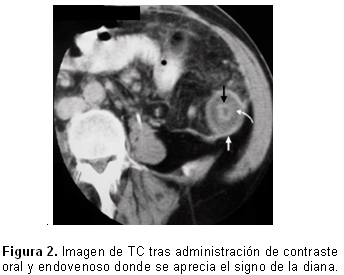
<body><![CDATA[<P><FONT FACE="Verdana, Arial, Helvetica, sans-serif" SIZE="2">Existe  un consenso en lo que se refiere a lo indispensable de utilizar un medio de contraste  enteral al realizar una TC. El medio de contraste de elecci&oacute;n debe ser  neutral significando esto que los valores de atenuaci&oacute;n deben ser comparables  con el agua, permitiendo esto una &oacute;ptima distinci&oacute;n entre la pared  intestinal y la luz. Esto adem&aacute;s mejorar&iacute;a la detecci&oacute;n de  segmento de asa inflamada, la cual tiene una alta atenuaci&oacute;n una vez que  el contraste endovenoso es administrado.<SUP>9</SUP> En algunas instituciones  el contraste enteral es administrado oralmente (enterograf&iacute;a por TC),<SUP>10</SUP>  mientras que en otras la distensi&oacute;n de las asas es controlada y llevada  a cabo por instilaci&oacute;n del medio de contraste a trav&eacute;s de una sonda  nasoyeyunal (enteroclisis por TC). Existen discrepancias en relaci&oacute;n con  cu&aacute;l de las t&eacute;cnicas ofrece mejores resultados en relaci&oacute;n  con la distensi&oacute;n de las asas. <SUP>11, 12, 13</SUP> Adem&aacute;s los  pacientes deben recibir medio de contraste endovenoso. </FONT>    <P><FONT FACE="Verdana, Arial, Helvetica, sans-serif" SIZE="2">La  ventaja de la TC en relaci&oacute;n con los estudios radiol&oacute;gicos convencionales  del tracto intestinal viene dado fundamentalmente por la adquisici&oacute;n de  una informaci&oacute;n adicional relacionada con la patolog&iacute;a extraluminal.  La TC tiene un papel esencial en el diagn&oacute;stico de abscesos en pacientes  con Enfermedad de Crohn, los cuales se localizan com&uacute;nmente en la fosa  isquio-rectal y adyacente al segmento intestinal esten&oacute;tico. Adem&aacute;s  constituye una t&eacute;cnica rutinaria como gu&iacute;a para drenaje de abscesos.  </FONT>    <P><FONT FACE="Verdana, Arial, Helvetica, sans-serif" SIZE="2">La apariencia  de los cambios morfol&oacute;gicos inflamatorios determina los hallazgos radiol&oacute;gicos  y utilizaremos la Enfermedad de Crohn como enfermedad tipo. </FONT>    <P><FONT FACE="Verdana, Arial, Helvetica, sans-serif" SIZE="2">El  engrosamiento y la estriaci&oacute;n de la pared del segmento intestinal afectado  y el aumento de realce mural post contraste endovenosa reflejan la inflamaci&oacute;n  parietal. </FONT>    <P><FONT FACE="Verdana, Arial, Helvetica, sans-serif" SIZE="2">El  engrosamiento de la pared intestinal est&aacute; presente cuando su grosor sobrepasa  los 3 mm en un asa que est&aacute; distendida por l&iacute;quido. <SUP>3, 11,  14</SUP> A menudo es prominente y asim&eacute;trico a lo largo del borde mesent&eacute;rico.  Adem&aacute;s puede existir estriaci&oacute;n mural que traduce la apariencia  laminada del engrosamiento mural. (<A HREF="#f1">Figura 1</A>). </FONT>     <P ALIGN="CENTER"><a name="f1"></a><IMG SRC="/img/revistas/rhcm/v12n3/f0116313.gif" WIDTH="369" HEIGHT="271">     <P><FONT FACE="Verdana, Arial, Helvetica, sans-serif" SIZE="2">El  aumento de realce de la pared postadministraci&oacute;n de contraste endovenoso,  ya sea transmural o a nivel del revestimiento interno de la pared puede ser identificado  cuando se compara con segmentos de asas intestinales adyacentes no afectadas y  es expresi&oacute;n de enfermedad activa. <SUP>10,13</SUP> Aunque pacientes sin  enfermedad pueden presentar estriaci&oacute;n mural en &iacute;leon Terminal,  estos no se acompa&ntilde;an de otros signos de inflamaci&oacute;n por lo que  la combinaci&oacute;n de hiperrealce segmentario asociado a engrosamiento parietal  mejora la detecci&oacute;n de inflamaci&oacute;n mural. <SUP>10, 11, 15</SUP>  </FONT>    <P><FONT FACE="Verdana, Arial, Helvetica, sans-serif" SIZE="2">El signo  de la diana es observado tanto en la Enfermedad de Crohn como en otras entidades  inflamatorias del intestino delgado y representa el aumento de la atenuaci&oacute;n  postadministraci&oacute;n del contraste de las capas interna y externa del asa  con conservaci&oacute;n de la densidad de la capa media, esta &uacute;ltima por  presencia de edema. (<A HREF="#f2">Figura 2</A>). Habitualmente asociado a engrosamiento  parietal, es signo de proceso inflamatorio, aunque puede ser visto en otras entidades  como enfermedad isqu&eacute;mica intestinal, enteritis por radiaci&oacute;n entre  otras. <SUP>16, 17</SUP> </FONT>    <P ALIGN="CENTER"><A NAME="f2"></A><IMG SRC="/img/revistas/rhcm/v12n3/f0216313.gif" WIDTH="344" HEIGHT="275">    <P><FONT FACE="Verdana, Arial, Helvetica, sans-serif" SIZE="2">Debido  a que la Enfermedad de Crohn es un proceso inflamatorio transmural, la inflamaci&oacute;n  se puede extender a la grasa adyacente y el tejido mesent&eacute;rico del intestino  delgado, condicionando un aumento de la grasa perient&eacute;rica por proliferaci&oacute;n  fibrograsa y un aumento de su atenuaci&oacute;n as&iacute; como de su vascularizaci&oacute;n  del tejido mesent&eacute;rico evidenciado como un aumento del realce tras la administraci&oacute;n  de contraste endovenoso. <SUP>13</SUP> El proceso inflamatorio, al extenderse  al mesenterio, puede ser causa de trombosis mesent&eacute;rica; en casos agudos  esta aparece como un trombo en el interior de una estructura vascular engrosada  y en casos cr&oacute;nicos como un estrechamiento del vaso con formaci&oacute;n  de colaterales. <SUP>18, 19</SUP> </FONT>    ]]></body>
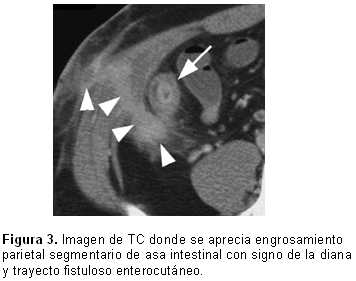
<body><![CDATA[<P><FONT FACE="Verdana, Arial, Helvetica, sans-serif" SIZE="2">Las  &aacute;reas de estenosis intestinal son representativas de inflamaci&oacute;n  activa, hipertrofia muscular o fibrosis y ellas pueden ser demostradas por TC.  </FONT>    <P><FONT FACE="Verdana, Arial, Helvetica, sans-serif" SIZE="2">La enfermedad  inflamatoria penetrante puede causar f&iacute;stulas, flemones y abscesos hasta  en 20% de los pacientes con Enfermedad de Crohn (<A HREF="#f3">Figura 3</A>),  mostr&aacute;ndose como tractos o colecciones extraent&eacute;ricas que pueden  contener aire o l&iacute;quido asociados a un asa intestinal engrosada. <SUP>19</SUP></FONT>    <P ALIGN="CENTER"><A NAME="f3"></A><IMG SRC="/img/revistas/rhcm/v12n3/f0316313.gif" WIDTH="356" HEIGHT="281">    <P><FONT FACE="Verdana, Arial, Helvetica, sans-serif" SIZE="2">La  TC puede facilitar la obtenci&oacute;n de una valiosa informaci&oacute;n en otros  procesos inflamatorios intestinales y con ello modificar de una manera tangible  lo concerniente al diagn&oacute;stico positivo y diferencial as&iacute; como aportar  datos relacionados con eventuales complicaciones todo lo cual redundar&iacute;a  en un adecuado manejo del paciente y de sus complicaciones. <SUP>20</SUP> </FONT>    <P>&nbsp;    <P>      <P><FONT FACE="Verdana, Arial, Helvetica, sans-serif" SIZE="3"><B>CONCLUSIONES</B></FONT><FONT FACE="Verdana, Arial, Helvetica, sans-serif" SIZE="2"><B>  </B> </FONT>    <P><FONT FACE="Verdana, Arial, Helvetica, sans-serif" SIZE="2">La  TC constituye una poderosa herramienta diagn&oacute;stica en la valoraci&oacute;n  de la enfermedad inflamatoria intestinal. En comparaci&oacute;n con las t&eacute;cnicas  convencionales, la Tomograf&iacute;a Computarizada eval&uacute;a adecuadamente  la patolog&iacute;a extraluminal asociada (f&iacute;stulas, abscesos), as&iacute;  como la propia lesi&oacute;n parietal. Las nuevas generaciones de tom&oacute;grafos  multicorte con obtenci&oacute;n de im&aacute;genes de alta resoluci&oacute;n de  contraste y espacial unidas a nuevos algoritmos de reconstrucci&oacute;n multiplanar  y t&eacute;cnicas de post-procesamiento permitir&aacute;n en un futuro la mejor  valoraci&oacute;n de los cambios morfol&oacute;gicos estructurales de la enfermedad  inflamatoria intestinal. </FONT>    <P>&nbsp;    <P><B>    ]]></body>
<body><![CDATA[<P><FONT FACE="Verdana, Arial, Helvetica, sans-serif" SIZE="3">REFERENCIAS  BIBLIOGR&Aacute;FICAS</FONT></B>     <!-- ref --><P><FONT FACE="Verdana, Arial, Helvetica, sans-serif" SIZE="2">1.  Lee SJ, Park SH, Kim AY, Yang SK, Yun SC, <I>et al</I>. A prospective comparison  of standard- dose CT enterography and 50 % reduced- dose CT enterography with  and without noise reduction for evaluating Crohn&#180;s disease. Am J Roentgenol.  2011; 197(1): 50- 7.     </FONT>    <P>     <!-- ref --><P><FONT FACE="Verdana, Arial, Helvetica, sans-serif" SIZE="2">2.  Bruining DH, Siddiki AH, Fletcher GJ, Tremaine JW, Sandborn JW et al. Prevalence  of penetrating disease and extraintestinal manifestations of Crohn's disease detected  with CT enterography. Inflamm Bowel Dis 2008; 14(12): 1701-1706.     </FONT>    <P>     <!-- ref --><P><FONT FACE="Verdana, Arial, Helvetica, sans-serif" SIZE="2">3.  Bruining DH, Loftus EV, Ehman EC, Siddiki HA, Nguyen DL, <I>et al</I>. Computed  tomography enterography detects intestinal wall changes and effects of treatment  in patients with Crohn's disease. Clin Gastroenterol Hepatol. 2011; 9 (8): 679-  683.     </FONT>    <P>     ]]></body>
<body><![CDATA[<!-- ref --><P><FONT FACE="Verdana, Arial, Helvetica, sans-serif" SIZE="2">4.  Dave-Verma H, Moore S, Singh A, Martins N, Zawacki J. Computed tomographic enterography  and enteroclysis: pearls and pitfalls. Curr Probl Diagn Radiol. 2008; 7(6):279-87.      </FONT>    <P>     <!-- ref --><P><FONT FACE="Verdana, Arial, Helvetica, sans-serif" SIZE="2">5. Schreyer  AG, Seitz Johannes, Feuerbach S, Rogler G, Herfarth H. Modern imaging using computed  tomography and magnetic resonance imaging for inflammatory bowel disease. Inflamm  Bowel Dis. 2004; 10(1): 45-54.     </FONT>    <P>     <!-- ref --><P><FONT FACE="Verdana, Arial, Helvetica, sans-serif" SIZE="2">6.  Higgins PD, Caoli E, Zimmermann M, Bhuket TP, Sonda LP, <I>et al.</I> Computed  tomography enterography adds information to clinical management in small bowel  Crohn's disease. Inflamm Bowel Dis. 2007; 13(3): 262-268.     </FONT>    <P>     <!-- ref --><P><FONT FACE="Verdana, Arial, Helvetica, sans-serif" SIZE="2">7.  MacKalski BA, Bernstein CN. New diagnostic imaging tools for inflammatory bowel  disease. Gut 2006; 55: 733- 741.     </FONT>    <P>     <!-- ref --><P><FONT FACE="Verdana, Arial, Helvetica, sans-serif" SIZE="2">8.  Fletcher JG, Fidler JL, Bruining DH, Huprich JE. New concepts in intestinal imaging  for inflammatory bowel diseases. Gastroenterol. 2011; 140 (6): 1795-1806.     </FONT>    <P>      <!-- ref --><P><FONT FACE="Verdana, Arial, Helvetica, sans-serif" SIZE="2">9. Horsthuis K,  Stokkers P, Stoker J. Detection of inflammatory bowel disease: diagnostic performance  of cross-sectional imaging modalities. Abdom Imaging. 2008; 33(4): 407-416.     </FONT>    <P>      <!-- ref --><P><FONT FACE="Verdana, Arial, Helvetica, sans-serif" SIZE="2">10. Lee SS, Kim  AY, Yang SK, Chung JW, Kim SY, <I>et al.</I> Crohn disease of the small bowel:  comparison of CT enterography, MR enterography, and Small-bowel follow-through  as diagnostic techniques. Radiology, 2009; 251(3): 751-761.     </FONT>    ]]></body>
<body><![CDATA[<P>     <!-- ref --><P><FONT FACE="Verdana, Arial, Helvetica, sans-serif" SIZE="2">11.  Rieber A, Wruk D, Potthast S, Nussle K, Reinshagen M, <I>et al</I>. Diagnostic  imaging in Crohn's disease: comparison of magnetic resonance imaging and conventional  imaging methods. Int J Colorectal Dis. 2000; 15:176-181.     </FONT>    <P>     <!-- ref --><P><FONT FACE="Verdana, Arial, Helvetica, sans-serif" SIZE="2">12.  Maglinte DD, Sandrasegaran K, Lappas JC, Chiorean M. CT Enteroclysis. Radiology.  2007; 245(3):661-71.     </FONT>    <P>     <!-- ref --><P><FONT FACE="Verdana, Arial, Helvetica, sans-serif" SIZE="2">13.  Paulsen SR, Huprich JE, Fletcher JG, Booya F, Young BM, <I>et al.</I> CT enterography  as a diagnostic tool in evaluating small bowel disorders: review of clinical experience  with over 700 cases. Radiographics. 2006; 26: 641-657.     </FONT>    <P>     ]]></body>
<body><![CDATA[<!-- ref --><P><FONT FACE="Verdana, Arial, Helvetica, sans-serif" SIZE="2">14.  Ahualli J. The target sign: bowel wall. Radiology. 2005; 234: 549- 550.     </FONT>    <P>      <!-- ref --><P><FONT FACE="Verdana, Arial, Helvetica, sans-serif" SIZE="2">15. Baker ME, Walter  J, Obuchowski NA, Achkar JP, Einstein D, <I>et al</I>. Mural attenuation in normal  small bowel and active inflammatory Crohn's disease on CT enterography: location,  absolute attenuation, relative attenuation, and the effect of wall thickness.  AJR Am J Roentgenol. 2009; 192(2):417-23.     </FONT>    <P>     <!-- ref --><P><FONT FACE="Verdana, Arial, Helvetica, sans-serif" SIZE="2">16.  Aguas G, Bastida G, Nos P. Septic Thrombophlebitis of the superior mesenteric  vein and multiple liver abscesses in a patient with Crohn&#180;s disease al onset.  BMC Gastroenterol. 2007; 7: 2.     </FONT>    <P>     <!-- ref --><P><FONT FACE="Verdana, Arial, Helvetica, sans-serif" SIZE="2">17.  Jackson CS, Fryer J, Danese S, Vanagunas A, Polensky S, <I>et al.</I> Mesenteric  vascular thromboembolism in inflammatory bowel disease: a single center experience.  J Gastrointest Surg. 2011; 15(1): 97-100.     </FONT>    <P>     <!-- ref --><P><FONT FACE="Verdana, Arial, Helvetica, sans-serif" SIZE="2">18.  Sanghavi P, Paramesh A, Dwivedi A. Mesenteric arterial thrombosis as a complication  of Crohn&#180;s disease. Dig Dis Sci. 2001; 46: 2344-2346.     </FONT>    <P>     <!-- ref --><P><FONT FACE="Verdana, Arial, Helvetica, sans-serif" SIZE="2">19.  Booya F, Akram S, Fletcher J. CT enterography and fistulizing Crohn's disease:  clinical benefit and radiographic findings. Abdom Imaging. 2009; 34: 467- 475.      </FONT>    <P>     <!-- ref --><P><FONT FACE="Verdana, Arial, Helvetica, sans-serif" SIZE="2">20.  Macari M, Megibow AJ, Balthazar EJ. A pattern approach to the abnormal small bowel:  observations at MDCT and CT enterography. AJR Am J Roentgenol. 2007; 188(5):1344-55.      </FONT>    ]]></body>
<body><![CDATA[<P>&nbsp;    <P>&nbsp;    <P><FONT FACE="Verdana, Arial, Helvetica, sans-serif" SIZE="2">Recibido:  1 de noviembre del 2012    <BR>Aprobado: 6 de junio del 2013</FONT>       ]]></body><back>
<ref-list>
<ref id="B1">
<label>1</label><nlm-citation citation-type="journal">
<person-group person-group-type="author">
<name>
<surname><![CDATA[Lee]]></surname>
<given-names><![CDATA[SJ]]></given-names>
</name>
<name>
<surname><![CDATA[Park]]></surname>
<given-names><![CDATA[SH]]></given-names>
</name>
<name>
<surname><![CDATA[Kim]]></surname>
<given-names><![CDATA[AY]]></given-names>
</name>
<name>
<surname><![CDATA[Yang]]></surname>
<given-names><![CDATA[SK]]></given-names>
</name>
<name>
<surname><![CDATA[Yun]]></surname>
<given-names><![CDATA[SC]]></given-names>
</name>
</person-group>
<article-title xml:lang="en"><![CDATA[A prospective comparison of standard- dose CT enterography and 50 % reduced- dose CT enterography with and without noise reduction for evaluating Crohn´s disease]]></article-title>
<source><![CDATA[Am J Roentgenol.]]></source>
<year>2011</year>
<volume>197</volume>
<numero>1</numero>
<issue>1</issue>
<page-range>50- 7</page-range></nlm-citation>
</ref>
<ref id="B2">
<label>2</label><nlm-citation citation-type="journal">
<person-group person-group-type="author">
<name>
<surname><![CDATA[Bruining]]></surname>
<given-names><![CDATA[DH]]></given-names>
</name>
<name>
<surname><![CDATA[Siddiki]]></surname>
<given-names><![CDATA[AH]]></given-names>
</name>
<name>
<surname><![CDATA[Fletcher]]></surname>
<given-names><![CDATA[GJ]]></given-names>
</name>
<name>
<surname><![CDATA[Tremaine]]></surname>
<given-names><![CDATA[JW]]></given-names>
</name>
</person-group>
<article-title xml:lang="en"><![CDATA[Prevalence of penetrating disease and extraintestinal manifestations of Crohn's disease detected with CT enterography]]></article-title>
<source><![CDATA[Inflamm Bowel Dis]]></source>
<year>2008</year>
<volume>14</volume>
<numero>12</numero>
<issue>12</issue>
<page-range>1701-1706</page-range></nlm-citation>
</ref>
<ref id="B3">
<label>3</label><nlm-citation citation-type="journal">
<person-group person-group-type="author">
<name>
<surname><![CDATA[Bruining]]></surname>
<given-names><![CDATA[DH]]></given-names>
</name>
<name>
<surname><![CDATA[Loftus]]></surname>
<given-names><![CDATA[EV]]></given-names>
</name>
<name>
<surname><![CDATA[Ehman]]></surname>
<given-names><![CDATA[EC]]></given-names>
</name>
<name>
<surname><![CDATA[Siddiki]]></surname>
<given-names><![CDATA[HA]]></given-names>
</name>
<name>
<surname><![CDATA[Nguyen]]></surname>
<given-names><![CDATA[DL]]></given-names>
</name>
</person-group>
<article-title xml:lang="en"><![CDATA[Computed tomography enterography detects intestinal wall changes and effects of treatment in patients with Crohn's disease]]></article-title>
<source><![CDATA[Clin Gastroenterol Hepatol.]]></source>
<year>2011</year>
<volume>9</volume>
<numero>8</numero>
<issue>8</issue>
<page-range>679- 683</page-range></nlm-citation>
</ref>
<ref id="B4">
<label>4</label><nlm-citation citation-type="journal">
<person-group person-group-type="author">
<name>
<surname><![CDATA[Dave-Verma]]></surname>
<given-names><![CDATA[H]]></given-names>
</name>
<name>
<surname><![CDATA[Moore]]></surname>
<given-names><![CDATA[S]]></given-names>
</name>
<name>
<surname><![CDATA[Singh]]></surname>
<given-names><![CDATA[A]]></given-names>
</name>
<name>
<surname><![CDATA[Martins]]></surname>
<given-names><![CDATA[N]]></given-names>
</name>
<name>
<surname><![CDATA[Zawacki]]></surname>
<given-names><![CDATA[J]]></given-names>
</name>
</person-group>
<article-title xml:lang="en"><![CDATA[Computed tomographic enterography and enteroclysis: pearls and pitfalls]]></article-title>
<source><![CDATA[Curr Probl Diagn Radiol.]]></source>
<year>2008</year>
<volume>7</volume>
<numero>6</numero>
<issue>6</issue>
<page-range>279-87</page-range></nlm-citation>
</ref>
<ref id="B5">
<label>5</label><nlm-citation citation-type="journal">
<person-group person-group-type="author">
<name>
<surname><![CDATA[Schreyer]]></surname>
<given-names><![CDATA[AG]]></given-names>
</name>
<name>
<surname><![CDATA[Seitz]]></surname>
<given-names><![CDATA[Johannes]]></given-names>
</name>
<name>
<surname><![CDATA[Feuerbach]]></surname>
<given-names><![CDATA[S]]></given-names>
</name>
<name>
<surname><![CDATA[Rogler]]></surname>
<given-names><![CDATA[G]]></given-names>
</name>
<name>
<surname><![CDATA[Herfarth]]></surname>
<given-names><![CDATA[H]]></given-names>
</name>
</person-group>
<article-title xml:lang="en"><![CDATA[Modern imaging using computed tomography and magnetic resonance imaging for inflammatory bowel disease]]></article-title>
<source><![CDATA[Inflamm Bowel Dis.]]></source>
<year>2004</year>
<volume>10</volume>
<numero>1</numero>
<issue>1</issue>
<page-range>45-54</page-range></nlm-citation>
</ref>
<ref id="B6">
<label>6</label><nlm-citation citation-type="journal">
<person-group person-group-type="author">
<name>
<surname><![CDATA[Higgins]]></surname>
<given-names><![CDATA[PD]]></given-names>
</name>
<name>
<surname><![CDATA[Caoli]]></surname>
<given-names><![CDATA[E]]></given-names>
</name>
<name>
<surname><![CDATA[Zimmermann]]></surname>
<given-names><![CDATA[M]]></given-names>
</name>
<name>
<surname><![CDATA[Bhuket]]></surname>
<given-names><![CDATA[TP]]></given-names>
</name>
<name>
<surname><![CDATA[Sonda]]></surname>
<given-names><![CDATA[LP]]></given-names>
</name>
</person-group>
<article-title xml:lang="en"><![CDATA[Computed tomography enterography adds information to clinical management in small bowel Crohn's disease]]></article-title>
<source><![CDATA[Inflamm Bowel Dis.]]></source>
<year>2007</year>
<volume>13</volume>
<numero>3</numero>
<issue>3</issue>
<page-range>262-268</page-range></nlm-citation>
</ref>
<ref id="B7">
<label>7</label><nlm-citation citation-type="journal">
<person-group person-group-type="author">
<name>
<surname><![CDATA[MacKalski]]></surname>
<given-names><![CDATA[BA]]></given-names>
</name>
<name>
<surname><![CDATA[Bernstein]]></surname>
<given-names><![CDATA[CN]]></given-names>
</name>
</person-group>
<article-title xml:lang="en"><![CDATA[New diagnostic imaging tools for inflammatory bowel disease]]></article-title>
<source><![CDATA[Gut]]></source>
<year>2006</year>
<volume>55</volume>
<page-range>733- 741</page-range></nlm-citation>
</ref>
<ref id="B8">
<label>8</label><nlm-citation citation-type="journal">
<person-group person-group-type="author">
<name>
<surname><![CDATA[Fletcher]]></surname>
<given-names><![CDATA[JG]]></given-names>
</name>
<name>
<surname><![CDATA[Fidler]]></surname>
<given-names><![CDATA[JL]]></given-names>
</name>
<name>
<surname><![CDATA[Bruining]]></surname>
<given-names><![CDATA[DH]]></given-names>
</name>
<name>
<surname><![CDATA[Huprich]]></surname>
<given-names><![CDATA[JE]]></given-names>
</name>
</person-group>
<article-title xml:lang="en"><![CDATA[New concepts in intestinal imaging for inflammatory bowel diseases]]></article-title>
<source><![CDATA[Gastroenterol.]]></source>
<year>2011</year>
<volume>140</volume>
<numero>6</numero>
<issue>6</issue>
<page-range>1795-1806</page-range></nlm-citation>
</ref>
<ref id="B9">
<label>9</label><nlm-citation citation-type="journal">
<person-group person-group-type="author">
<name>
<surname><![CDATA[Horsthuis]]></surname>
<given-names><![CDATA[K]]></given-names>
</name>
<name>
<surname><![CDATA[Stokkers]]></surname>
<given-names><![CDATA[P]]></given-names>
</name>
<name>
<surname><![CDATA[Stoker]]></surname>
<given-names><![CDATA[J]]></given-names>
</name>
</person-group>
<article-title xml:lang="en"><![CDATA[Detection of inflammatory bowel disease: diagnostic performance of cross-sectional imaging modalities]]></article-title>
<source><![CDATA[Abdom Imaging.]]></source>
<year>2008</year>
<volume>33</volume>
<numero>4</numero>
<issue>4</issue>
<page-range>407-416</page-range></nlm-citation>
</ref>
<ref id="B10">
<label>10</label><nlm-citation citation-type="journal">
<person-group person-group-type="author">
<name>
<surname><![CDATA[Lee]]></surname>
<given-names><![CDATA[SS]]></given-names>
</name>
<name>
<surname><![CDATA[Kim]]></surname>
<given-names><![CDATA[AY]]></given-names>
</name>
<name>
<surname><![CDATA[Yang]]></surname>
<given-names><![CDATA[SK]]></given-names>
</name>
<name>
<surname><![CDATA[Chung]]></surname>
<given-names><![CDATA[JW]]></given-names>
</name>
<name>
<surname><![CDATA[Kim]]></surname>
<given-names><![CDATA[SY]]></given-names>
</name>
</person-group>
<article-title xml:lang="en"><![CDATA[Crohn disease of the small bowel: comparison of CT enterography, MR enterography, and Small-bowel follow-through as diagnostic techniques]]></article-title>
<source><![CDATA[Radiology,]]></source>
<year>2009</year>
<volume>251</volume>
<numero>3</numero>
<issue>3</issue>
<page-range>751-761</page-range></nlm-citation>
</ref>
<ref id="B11">
<label>11</label><nlm-citation citation-type="journal">
<person-group person-group-type="author">
<name>
<surname><![CDATA[Rieber]]></surname>
<given-names><![CDATA[A]]></given-names>
</name>
<name>
<surname><![CDATA[Wruk]]></surname>
<given-names><![CDATA[D]]></given-names>
</name>
<name>
<surname><![CDATA[Potthast]]></surname>
<given-names><![CDATA[S]]></given-names>
</name>
<name>
<surname><![CDATA[Nussle]]></surname>
<given-names><![CDATA[K]]></given-names>
</name>
<name>
<surname><![CDATA[Reinshagen]]></surname>
<given-names><![CDATA[M]]></given-names>
</name>
</person-group>
<article-title xml:lang="en"><![CDATA[Diagnostic imaging in Crohn's disease: comparison of magnetic resonance imaging and conventional imaging methods]]></article-title>
<source><![CDATA[Int J Colorectal Dis.]]></source>
<year>2000</year>
<volume>15</volume>
<page-range>176-181</page-range></nlm-citation>
</ref>
<ref id="B12">
<label>12</label><nlm-citation citation-type="journal">
<person-group person-group-type="author">
<name>
<surname><![CDATA[Maglinte]]></surname>
<given-names><![CDATA[DD]]></given-names>
</name>
<name>
<surname><![CDATA[Sandrasegaran]]></surname>
<given-names><![CDATA[K]]></given-names>
</name>
<name>
<surname><![CDATA[Lappas]]></surname>
<given-names><![CDATA[JC]]></given-names>
</name>
<name>
<surname><![CDATA[Chiorean]]></surname>
<given-names><![CDATA[M]]></given-names>
</name>
</person-group>
<article-title xml:lang="en"><![CDATA[CT Enteroclysis]]></article-title>
<source><![CDATA[Radiology.]]></source>
<year>2007</year>
<volume>245</volume>
<numero>3</numero>
<issue>3</issue>
<page-range>661-71</page-range></nlm-citation>
</ref>
<ref id="B13">
<label>13</label><nlm-citation citation-type="journal">
<person-group person-group-type="author">
<name>
<surname><![CDATA[Paulsen]]></surname>
<given-names><![CDATA[SR]]></given-names>
</name>
<name>
<surname><![CDATA[Huprich]]></surname>
<given-names><![CDATA[JE]]></given-names>
</name>
<name>
<surname><![CDATA[Fletcher]]></surname>
<given-names><![CDATA[JG]]></given-names>
</name>
<name>
<surname><![CDATA[Booya]]></surname>
<given-names><![CDATA[F]]></given-names>
</name>
<name>
<surname><![CDATA[Young]]></surname>
<given-names><![CDATA[BM]]></given-names>
</name>
</person-group>
<article-title xml:lang="en"><![CDATA[CT enterography as a diagnostic tool in evaluating small bowel disorders: review of clinical experience with over 700 cases]]></article-title>
<source><![CDATA[Radiographics.]]></source>
<year>2006</year>
<volume>26</volume>
<page-range>641-657</page-range></nlm-citation>
</ref>
<ref id="B14">
<label>14</label><nlm-citation citation-type="journal">
<person-group person-group-type="author">
<name>
<surname><![CDATA[Ahualli]]></surname>
<given-names><![CDATA[J]]></given-names>
</name>
</person-group>
<article-title xml:lang="en"><![CDATA[The target sign: bowel wall]]></article-title>
<source><![CDATA[Radiology.]]></source>
<year>2005</year>
<volume>234</volume>
<page-range>549- 550</page-range></nlm-citation>
</ref>
<ref id="B15">
<label>15</label><nlm-citation citation-type="journal">
<person-group person-group-type="author">
<name>
<surname><![CDATA[Baker]]></surname>
<given-names><![CDATA[ME]]></given-names>
</name>
<name>
<surname><![CDATA[Walter]]></surname>
<given-names><![CDATA[J]]></given-names>
</name>
<name>
<surname><![CDATA[Obuchowski]]></surname>
<given-names><![CDATA[NA]]></given-names>
</name>
<name>
<surname><![CDATA[Achkar]]></surname>
<given-names><![CDATA[JP]]></given-names>
</name>
<name>
<surname><![CDATA[Einstein]]></surname>
<given-names><![CDATA[D]]></given-names>
</name>
</person-group>
<article-title xml:lang="en"><![CDATA[Mural attenuation in normal small bowel and active inflammatory Crohn's disease on CT enterography: location, absolute attenuation, relative attenuation, and the effect of wall thickness]]></article-title>
<source><![CDATA[AJR Am J Roentgenol.]]></source>
<year>2009</year>
<volume>192</volume>
<numero>2</numero>
<issue>2</issue>
<page-range>417-23</page-range></nlm-citation>
</ref>
<ref id="B16">
<label>16</label><nlm-citation citation-type="journal">
<person-group person-group-type="author">
<name>
<surname><![CDATA[Aguas]]></surname>
<given-names><![CDATA[G]]></given-names>
</name>
<name>
<surname><![CDATA[Bastida]]></surname>
<given-names><![CDATA[G]]></given-names>
</name>
<name>
<surname><![CDATA[Nos]]></surname>
<given-names><![CDATA[P]]></given-names>
</name>
</person-group>
<article-title xml:lang="en"><![CDATA[Septic Thrombophlebitis of the superior mesenteric vein and multiple liver abscesses in a patient with Crohn´s disease al onset]]></article-title>
<source><![CDATA[BMC Gastroenterol.]]></source>
<year>2007</year>
<volume>7</volume>
<page-range>2</page-range></nlm-citation>
</ref>
<ref id="B17">
<label>17</label><nlm-citation citation-type="journal">
<person-group person-group-type="author">
<name>
<surname><![CDATA[Jackson]]></surname>
<given-names><![CDATA[CS]]></given-names>
</name>
<name>
<surname><![CDATA[Fryer]]></surname>
<given-names><![CDATA[J]]></given-names>
</name>
<name>
<surname><![CDATA[Danese]]></surname>
<given-names><![CDATA[S]]></given-names>
</name>
<name>
<surname><![CDATA[Vanagunas]]></surname>
<given-names><![CDATA[A]]></given-names>
</name>
<name>
<surname><![CDATA[Polensky]]></surname>
<given-names><![CDATA[S]]></given-names>
</name>
</person-group>
<article-title xml:lang="en"><![CDATA[Mesenteric vascular thromboembolism in inflammatory bowel disease: a single center experience]]></article-title>
<source><![CDATA[J Gastrointest Surg.]]></source>
<year>2011</year>
<volume>15</volume>
<numero>1</numero>
<issue>1</issue>
<page-range>97-100</page-range></nlm-citation>
</ref>
<ref id="B18">
<label>18</label><nlm-citation citation-type="journal">
<person-group person-group-type="author">
<name>
<surname><![CDATA[Sanghavi]]></surname>
<given-names><![CDATA[P]]></given-names>
</name>
<name>
<surname><![CDATA[Paramesh]]></surname>
<given-names><![CDATA[A]]></given-names>
</name>
<name>
<surname><![CDATA[Dwivedi]]></surname>
<given-names><![CDATA[A]]></given-names>
</name>
</person-group>
<article-title xml:lang="en"><![CDATA[Mesenteric arterial thrombosis as a complication of Crohn´s disease]]></article-title>
<source><![CDATA[Dig Dis Sci.]]></source>
<year>2001</year>
<volume>46</volume>
<page-range>2344-2346</page-range></nlm-citation>
</ref>
<ref id="B19">
<label>19</label><nlm-citation citation-type="journal">
<person-group person-group-type="author">
<name>
<surname><![CDATA[Booya]]></surname>
<given-names><![CDATA[F]]></given-names>
</name>
<name>
<surname><![CDATA[Akram]]></surname>
<given-names><![CDATA[S]]></given-names>
</name>
<name>
<surname><![CDATA[Fletcher]]></surname>
<given-names><![CDATA[J]]></given-names>
</name>
</person-group>
<article-title xml:lang="en"><![CDATA[CT enterography and fistulizing Crohn's disease: clinical benefit and radiographic findings]]></article-title>
<source><![CDATA[Abdom Imaging.]]></source>
<year>2009</year>
<volume>34</volume>
<page-range>467- 475</page-range></nlm-citation>
</ref>
<ref id="B20">
<label>20</label><nlm-citation citation-type="journal">
<person-group person-group-type="author">
<name>
<surname><![CDATA[Macari]]></surname>
<given-names><![CDATA[M]]></given-names>
</name>
<name>
<surname><![CDATA[Megibow]]></surname>
<given-names><![CDATA[AJ]]></given-names>
</name>
<name>
<surname><![CDATA[Balthazar]]></surname>
<given-names><![CDATA[EJ]]></given-names>
</name>
</person-group>
<article-title xml:lang="en"><![CDATA[A pattern approach to the abnormal small bowel: observations at MDCT and CT enterography]]></article-title>
<source><![CDATA[AJR Am J Roentgenol.]]></source>
<year>2007</year>
<volume>188</volume>
<numero>5</numero>
<issue>5</issue>
<page-range>1344-55</page-range></nlm-citation>
</ref>
</ref-list>
</back>
</article>