<?xml version="1.0" encoding="ISO-8859-1"?><article xmlns:mml="http://www.w3.org/1998/Math/MathML" xmlns:xlink="http://www.w3.org/1999/xlink" xmlns:xsi="http://www.w3.org/2001/XMLSchema-instance">
<front>
<journal-meta>
<journal-id>1729-519X</journal-id>
<journal-title><![CDATA[Revista Habanera de Ciencias Médicas]]></journal-title>
<abbrev-journal-title><![CDATA[Rev haban cienc méd]]></abbrev-journal-title>
<issn>1729-519X</issn>
<publisher>
<publisher-name><![CDATA[Universidad de Ciencias Médicas de la Habana]]></publisher-name>
</publisher>
</journal-meta>
<article-meta>
<article-id>S1729-519X2013000500009</article-id>
<title-group>
<article-title xml:lang="es"><![CDATA[Complicaciones postoperatorias asociadas a la cirugía de dientes retenidos. Hospital Militar "Dr. Luis Díaz Soto"]]></article-title>
<article-title xml:lang="en"><![CDATA[Postoperative surgical complications associated to retained teeth. Army hospital "Dr. Luis Díaz Soto"]]></article-title>
</title-group>
<contrib-group>
<contrib contrib-type="author">
<name>
<surname><![CDATA[Martínez Gómez]]></surname>
<given-names><![CDATA[Naydit]]></given-names>
</name>
<xref ref-type="aff" rid="A01"/>
</contrib>
<contrib contrib-type="author">
<name>
<surname><![CDATA[Díaz Díaz]]></surname>
<given-names><![CDATA[Dayana]]></given-names>
</name>
<xref ref-type="aff" rid="A01"/>
</contrib>
<contrib contrib-type="author">
<name>
<surname><![CDATA[Guerra Cobian]]></surname>
<given-names><![CDATA[Orlando]]></given-names>
</name>
<xref ref-type="aff" rid="A01"/>
</contrib>
<contrib contrib-type="author">
<name>
<surname><![CDATA[Pérez Díaz]]></surname>
<given-names><![CDATA[Annelices]]></given-names>
</name>
<xref ref-type="aff" rid="A01"/>
</contrib>
<contrib contrib-type="author">
<name>
<surname><![CDATA[Guilian Carrión]]></surname>
<given-names><![CDATA[Maritza]]></given-names>
</name>
<xref ref-type="aff" rid="A02"/>
</contrib>
</contrib-group>
<aff id="A01">
<institution><![CDATA[,Universidad de Ciencias Médicas de La Habana Facultad de Estomatología Raúl González Sánchez ]]></institution>
<addr-line><![CDATA[La Habana ]]></addr-line>
</aff>
<aff id="A02">
<institution><![CDATA[,Hospital Militar Dr. Luis Díaz Soto  ]]></institution>
<addr-line><![CDATA[La Habana ]]></addr-line>
<country>Cuba</country>
</aff>
<pub-date pub-type="pub">
<day>00</day>
<month>00</month>
<year>2013</year>
</pub-date>
<pub-date pub-type="epub">
<day>00</day>
<month>00</month>
<year>2013</year>
</pub-date>
<volume>12</volume>
<fpage>65</fpage>
<lpage>73</lpage>
<copyright-statement/>
<copyright-year/>
<self-uri xlink:href="http://scielo.sld.cu/scielo.php?script=sci_arttext&amp;pid=S1729-519X2013000500009&amp;lng=en&amp;nrm=iso"></self-uri><self-uri xlink:href="http://scielo.sld.cu/scielo.php?script=sci_abstract&amp;pid=S1729-519X2013000500009&amp;lng=en&amp;nrm=iso"></self-uri><self-uri xlink:href="http://scielo.sld.cu/scielo.php?script=sci_pdf&amp;pid=S1729-519X2013000500009&amp;lng=en&amp;nrm=iso"></self-uri><abstract abstract-type="short" xml:lang="es"><p><![CDATA[Introducción: se denomina diente retenido a aquel que llegada la época normal de erupción permanece incluido total o parcialmente en el maxilar o la mandíbula sin alcanzar su posición en la arcada dentaria. La exéresis de dientes retenidos es un proceder quirúrgico muy realizado en los servicios de cirugía máxilofacial. Objetivo: caracterizar las complicaciones postoperatorias asociadas al tratamiento quirúrgico de dientes retenidos. Material y métodos: se realizó un estudio prospectivo descriptivo en una muestra de 100 pacientes seleccionados del total que acudieron a consulta de cirugía máxilofacial del Hospital Militar "Dr. Luis Díaz Soto", durante el 2011, para la exéresis de dientes retenidos. Se estudiaron las variables: edad, tipo de retención, técnica quirúrgica empleada y tiempo quirúrgico. Resultados: el 13% de los pacientes intervenidos presentaron complicaciones postoperatorias. Entre 26-35 años presentaron mayor porciento de complicaciones (34 %), así como la retención tipo 3 (5 %) y la variante 4 de la técnica quirúrgica (6 %). Las complicaciones más frecuentes fueron el dolor continuo (27,5%) y la limitación de la apertura bucal (22,5%). Conclusiones: las complicaciones postquirúrgicas asociadas a la exéresis de dientes retenidos se relacionaron con las características propias del paciente, la retención y el proceder implementado.]]></p></abstract>
<abstract abstract-type="short" xml:lang="en"><p><![CDATA[Introduction: the extraction of retained teeth is one of the procedures more frequently done in the maxilofacial service of Army Hospital ¨Luis Diaz Soto¨. Objective: to characterize the postoperative complications associated to surgical treatments of retained teeth. Material and methods: a prospective ,descriptive study was carried out with a sample of 100 patients selected of total who came to maxilo facial department of Army Hospital "Luis Díaz Soto" 2011, with retained teeth to surgical treatment. The variables studied were: age, type of retention, used surgical technique and surgical time. Results: 13% with postoperative complications, patients among 26-35 years had more complications (34%), the retention type 3( 5%) ,and the variant 4 of surgical technique( 6%) were more associated to complications. More frequent complicacions were continuos pain (27,5%) and limitation of oral opening (22,5%). Conclusions: the postoperative complications associated to surgical treatment of retained teeth became according to patient´s characteristics, type of retention and used surgical technique.]]></p></abstract>
<kwd-group>
<kwd lng="es"><![CDATA[dientes retenidos]]></kwd>
<kwd lng="es"><![CDATA[técnicas quirúrgicas]]></kwd>
<kwd lng="es"><![CDATA[complicaciones postoperatorias]]></kwd>
<kwd lng="en"><![CDATA[retained teeth]]></kwd>
<kwd lng="en"><![CDATA[surgical techniques]]></kwd>
<kwd lng="en"><![CDATA[postoperative complications]]></kwd>
</kwd-group>
</article-meta>
</front><body><![CDATA[ <DIV ALIGN="RIGHT"><FONT FACE="Verdana, Arial, Helvetica, sans-serif" SIZE="2">  <B>CIENCIAS QUIR&Uacute;RGICAS</B></FONT></DIV>    <P>&nbsp;</P>    <P><FONT FACE="Verdana, Arial, Helvetica, sans-serif" SIZE="2">Universidad  de Ciencias M&eacute;dicas de La Habana     <BR></FONT><FONT FACE="Verdana, Arial, Helvetica, sans-serif" SIZE="2">Facultad  de Estomatolog&iacute;a &#171;Ra&uacute;l Gonz&aacute;lez S&aacute;nchez&#187;      <BR></FONT><FONT FACE="Verdana, Arial, Helvetica, sans-serif" SIZE="2">Hospital  Militar &quot;Dr. Luis D&iacute;az Soto&quot; </FONT></P>    <P>&nbsp;</P>    <P>     <P>    <P><FONT FACE="Verdana, Arial, Helvetica, sans-serif" SIZE="4"><B>Complicaciones  postoperatorias asociadas a la cirug&iacute;a de dientes retenidos. Hospital Militar  &quot;Dr. Luis D&iacute;az Soto&quot; </B></FONT></P>    <P>&nbsp;</P><B>    ]]></body>
<body><![CDATA[<P>     <P><FONT FACE="Verdana, Arial, Helvetica, sans-serif" SIZE="3">Postoperative  surgical complications associated to retained teeth. Army hospital &quot;Dr. Luis  D&iacute;az Soto&quot;</FONT></B>     <P>&nbsp;</P>    <P>&nbsp;</P>    <P>     <P><B><FONT FACE="Verdana, Arial, Helvetica, sans-serif" SIZE="2">Naydit  Mart&iacute;nez G&oacute;mez<SUP>I</SUP>, Dayana D&iacute;az D&iacute;az<SUP>II</SUP>,  Orlando Guerra Cobian<SUP>III</SUP>, Annelices P&eacute;rez D&iacute;az<SUP>IV</SUP>,  Maritza Guilian Carri&oacute;n</FONT></B><FONT FACE="Verdana, Arial, Helvetica, sans-serif" SIZE="2"><SUP>V  </SUP></FONT>    <P><FONT FACE="Verdana, Arial, Helvetica, sans-serif" SIZE="2"><SUP>I</SUP>  Especialista Primer Grado en Cirug&iacute;a Maxilofacial. Asistente. Facultad  de Estomatolog&iacute;a &quot;Ra&uacute;l Gonz&aacute;lez S&aacute;nchez&quot;.  La Habana, Cuba. e.mail: <U><FONT  COLOR="#0000ff"><A HREF="mailto:nayditm@infomed.sld.cu">nayditm@infomed.sld.cu</A></FONT></U>      <BR></FONT><FONT FACE="Verdana, Arial, Helvetica, sans-serif" SIZE="2"><SUP>II</SUP>  Especialista Primer Grado en Cirug&iacute;a Maxilofacial. Asistente. Facultad  de Estomatolog&iacute;a &quot;Ra&uacute;l Gonz&aacute;lez S&aacute;nchez&quot;.  La Habana, Cuba. e.mail: <U><FONT  COLOR="#0000ff"><A HREF="mailto:dayanadiaz@infomed.sld.cu">dayanadiaz@infomed.sld.cu</A></FONT></U>      <BR></FONT><FONT FACE="Verdana, Arial, Helvetica, sans-serif" SIZE="2"><SUP>III</SUP>  Especialista Primer Grado en Cirug&iacute;a Maxilofacial. Asistente. Facultad  de Estomatolog&iacute;a &quot;Ra&uacute;l Gonz&aacute;lez S&aacute;nchez&quot;.  La Habana, Cuba. e.mail: <U><FONT  COLOR="#0000ff"><A HREF="mailto:orlando.guerra@infomed.sld.cu">orlando.guerra@infomed.sld.cu</A></FONT></U>      <BR></FONT><FONT FACE="Verdana, Arial, Helvetica, sans-serif" SIZE="2"><SUP>IV</SUP>  Especialista Primer Grado en Ortodoncia. Instructora. Facultad de Estomatolog&iacute;a  &quot;Ra&uacute;l Gonz&aacute;lez S&aacute;nchez&quot;. La Habana, Cuba<FONT  COLOR="#ff0000">. </FONT>e.mail: <U><FONT  COLOR="#0000ff"><A HREF="mailto:annelices.perez@infomed.sld.cu">annelices.perez@infomed.sld.cu</A></FONT></U>      ]]></body>
<body><![CDATA[<BR></FONT><FONT FACE="Verdana, Arial, Helvetica, sans-serif" SIZE="2"><SUP>V</SUP>  Especialista Primer Grado en Cirug&iacute;a Maxilofacial. Hospital Militar &quot;Dr.  Luis D&iacute;az Soto&quot;. La Habana, Cuba. e.mail:<FONT COLOR="#0000ff"> <A HREF="mailto:maritzaguilian@infomed.sld.cu">maritzaguilian@infomed.sld.cu</A></FONT></FONT>      <P>     <P>    <P>&nbsp;</P>    <P>&nbsp;</P><HR>    <P><FONT FACE="Verdana, Arial, Helvetica, sans-serif" SIZE="2"><B>RESUMEN  </B></FONT></P>    <P><FONT FACE="Verdana, Arial, Helvetica, sans-serif" SIZE="2"><B>Introducci&oacute;n:  </B>se denomina diente retenido a aquel que llegada la &eacute;poca normal de  erupci&oacute;n permanece incluido total o parcialmente en el maxilar o la mand&iacute;bula  sin alcanzar su posici&oacute;n en la arcada dentaria. La ex&eacute;resis de dientes  retenidos es un proceder quir&uacute;rgico muy realizado en los servicios de cirug&iacute;a  m&aacute;xilofacial. <B>    <BR>Objetivo:</B> caracterizar las complicaciones postoperatorias  asociadas al tratamiento quir&uacute;rgico de dientes retenidos. <B>    <BR>Material  y m&eacute;todos</B>: se realiz&oacute; un estudio prospectivo descriptivo en<B>  </B>una muestra de 100 pacientes seleccionados del total que acudieron a consulta  de cirug&iacute;a m&aacute;xilofacial del Hospital Militar &quot;Dr. Luis D&iacute;az  Soto&quot;, durante el 2011, para la ex&eacute;resis de dientes retenidos. Se  estudiaron las variables: edad, tipo de retenci&oacute;n, t&eacute;cnica quir&uacute;rgica  empleada y tiempo quir&uacute;rgico. <B>    <BR>Resultados</B>: el 13% de los pacientes  intervenidos presentaron complicaciones postoperatorias. Entre 26-35 a&ntilde;os  presentaron mayor porciento de complicaciones (34 %), as&iacute; como la retenci&oacute;n  tipo 3 (5 %) y la variante 4 de la t&eacute;cnica quir&uacute;rgica (6 %). Las  complicaciones m&aacute;s frecuentes fueron el dolor continuo (27,5%) y la limitaci&oacute;n  de la apertura bucal (22,5%). <B>    ]]></body>
<body><![CDATA[<BR>Conclusiones</B>: las complicaciones postquir&uacute;rgicas  asociadas a la ex&eacute;resis de dientes retenidos se relacionaron con las caracter&iacute;sticas  propias del paciente, la retenci&oacute;n y el proceder implementado. </FONT>    <P>      <P><FONT FACE="Verdana, Arial, Helvetica, sans-serif" SIZE="2"><B>Palabras clave</B>:  dientes retenidos, t&eacute;cnicas quir&uacute;rgicas, complicaciones postoperatorias.  </FONT>    <P>     <P><HR><FONT FACE="Verdana, Arial, Helvetica, sans-serif" SIZE="2"><B>ABSTRACT  </B></FONT>    <P><FONT FACE="Verdana, Arial, Helvetica, sans-serif" SIZE="2"><B>Introduction:</B>  the extraction of retained teeth is one of the procedures more frequently done  in the maxilofacial service of Army Hospital &#168;Luis Diaz Soto&#168;. <B>    <BR>Objective</B>:  to characterize the postoperative complications associated to surgical treatments  of retained teeth. <B>    <BR>Material and methods: </B>a prospective ,descriptive  study was carried out with a sample of 100 patients selected of total who came  to maxilo facial department of Army Hospital &quot;Luis D&iacute;az Soto&quot;  2011, with retained teeth to surgical treatment. The variables studied were: age,  type of retention, used surgical technique and surgical time. <B>    <BR>Results:  </B>13% with postoperative complications, patients among 26-35 years had more  complications (34%), the retention type 3( 5%) ,and the variant 4 of surgical  technique( 6%) were more associated to complications. More frequent complicacions  were continuos pain (27,5%) and limitation of oral opening (22,5%). <B>    <BR>Conclusions:</B>  the postoperative complications associated to surgical treatment of retained teeth  became according to patient&#180;s characteristics, type of retention and used  surgical technique </FONT>    ]]></body>
<body><![CDATA[<P>     <P><FONT FACE="Verdana, Arial, Helvetica, sans-serif" SIZE="2"><B>Key  Words</B>: retained teeth, surgical techniques, postoperative complications. </FONT><HR>    <P>      <P>&nbsp;    <P>&nbsp;    <P><FONT FACE="Verdana, Arial, Helvetica, sans-serif" SIZE="2"><B><FONT SIZE="3">INTRODUCCI&Oacute;N</FONT>  </B> </FONT>    <P><FONT FACE="Verdana, Arial, Helvetica, sans-serif" SIZE="2">Se  denomina diente retenido aquel que llegada la &eacute;poca normal de erupci&oacute;n  permanece incluido total o parcialmente en el maxilar o en la mand&iacute;bula  sin alcanzar su posici&oacute;n en la arcada dentaria. Este puede estar incluido,  impactado o aparecer en la cavidad bucal sin alcanzar el plano de oclusi&oacute;n.<SUP>1-4</SUP>  </FONT>    <P><FONT FACE="Verdana, Arial, Helvetica, sans-serif" SIZE="2">La retenci&oacute;n  dentaria es m&aacute;s com&uacute;n en la dentici&oacute;n permanente que en la  temporal y se retienen con mayor frecuencia los terceros molares inferiores. <SUP>1,5</SUP>  Entre los factores que aumentan la tendencia a la retenci&oacute;n podemos mencionar:  falta de espacio durante la erupci&oacute;n, posici&oacute;n y forma anormal del  diente, densidad del hueso circundante, entre otras. <SUP>6-9</SUP></FONT>    <P><FONT FACE="Verdana, Arial, Helvetica, sans-serif" SIZE="2">Todo  diente retenido es susceptible de producir m&uacute;ltiples afecciones patol&oacute;gicas.  Pueden presentarse accidentes mec&aacute;nicos, tumorales, infecciosos, sensitivos,  motores y otros.<SUP>10-12</SUP> </FONT>    <P><FONT FACE="Verdana, Arial, Helvetica, sans-serif" SIZE="2">Cuando  se decide la ex&eacute;resis de un diente retenido este debe ser minuciosamente  estudiado, analizando el tipo de retenci&oacute;n y su relaci&oacute;n con estructuras  adyacentes. M&uacute;ltiples son los accidentes y complicaciones que pueden presentarse  durante el trans y postoperatorio. <SUP>13-15</SUP> </FONT>    ]]></body>
<body><![CDATA[<P><FONT FACE="Verdana, Arial, Helvetica, sans-serif" SIZE="2">Entre  las complicaciones postoperatorias m&aacute;s frecuentes se destacan el dolor,  el edema, el trismo, la hemorragia, la infecci&oacute;n y las complicaciones nerviosas.<SUP>16,17  </SUP>Como la ex&eacute;resis de dientes retenidos es un proceder quir&uacute;rgico  muy com&uacute;n, nos trazamos como objetivo en nuestra investigaci&oacute;n caracterizar  las complicaciones postoperatorias asociadas a este tratamiento quir&uacute;rgico.  </FONT>    <P>&nbsp;    <P>     <P><FONT FACE="Verdana, Arial, Helvetica, sans-serif" SIZE="3"><B>MATERIAL  Y M&Eacute;TODO</B></FONT>    <P><FONT FACE="Verdana, Arial, Helvetica, sans-serif" SIZE="2">Se  realiz&oacute; un estudio prospectivo, descriptivo en el servicio de cirug&iacute;a  m&aacute;xilofacial del Hospital Militar &quot;Dr. Luis D&iacute;az Soto&quot;,  de enero a diciembre del 2011. </FONT>    <P><FONT FACE="Verdana, Arial, Helvetica, sans-serif" SIZE="2">El  universo de trabajo estuvo constituido por 240 pacientes, que coincidi&oacute;  con el total que acudi&oacute; al servicio de cirug&iacute;a m&aacute;xilofacial  para ex&eacute;resis de dientes retenidos. La muestra qued&oacute; constituida  por 100 pacientes que cumplieron los siguientes criterios de inclusi&oacute;n:  edad entre 15 y 55 a&ntilde;os, con diagn&oacute;stico cl&iacute;nico y radiogr&aacute;fico  de diente retenido que aceptaron ser incluidos en el estudio, los dientes retenidos  no hab&iacute;an padecido complicaciones infecciosas, mec&aacute;nicas o nerviosas  en los 21 d&iacute;as previos a la intervenci&oacute;n. </FONT>    <P><FONT FACE="Verdana, Arial, Helvetica, sans-serif" SIZE="2">Se  excluyeron aquellos pacientes con estados o enfermedades generales que pudieran  interferir con la adecuada evoluci&oacute;n de la herida quir&uacute;rgica (tabaquismo,  trastornos endocrinos, osteoporosis, problemas inmunol&oacute;gicos y otros).  </FONT>    <P><FONT FACE="Verdana, Arial, Helvetica, sans-serif" SIZE="2">Se consider&oacute;  caso complicado cuando el paciente en la evaluaci&oacute;n cronol&oacute;gica  present&oacute; s&iacute;ntomas y signos fuera de los esperados en el postoperatorio  de la ex&eacute;resis de un diente retenido ya sean mec&aacute;nicos, infecciosos,  sensitivos, etc&eacute;tera. </FONT>    <P><FONT FACE="Verdana, Arial, Helvetica, sans-serif" SIZE="2">Se  operacionalizaron las siguientes variables: </FONT>    <P><FONT FACE="Verdana, Arial, Helvetica, sans-serif" SIZE="2">Edad:  Se establecieron los intervalos de clases 16-25, 26-35, 36-45 y de 46-55 a&ntilde;os,  seg&uacute;n a&ntilde;os cumplidos. </FONT>    ]]></body>
<body><![CDATA[<P><FONT FACE="Verdana, Arial, Helvetica, sans-serif" SIZE="2">El  tipo de retenci&oacute;n fue clasificado en: Tipo 1 (diente parcialmente erupcionado,  que ha aparecido en la cavidad bucal pero no ha alcanzado el plano de oclusi&oacute;n);  Tipo 2 (diente retenido bajo una banda de tejido mucoso, retenci&oacute;n submucosa);  Tipo 3 (diente que permanece cubierto completamente por tejido &oacute;seo con  integridad del saco pericoronario, retenci&oacute;n intra&oacute;sea). </FONT>    <P><FONT FACE="Verdana, Arial, Helvetica, sans-serif" SIZE="2">La  t&eacute;cnica quir&uacute;rgica empleada se clasific&oacute; en: Variante 1:  Ex&eacute;resis del diente usando f&oacute;rceps o elevadores (ex&eacute;resis  simple). Variante 2: Ex&eacute;resis del diente con f&oacute;rceps o elevadores  previa secci&oacute;n del mismo empleando el aerotor con fresa quir&uacute;rgica  (odontosecci&oacute;n). Variante 3: Ex&eacute;resis del diente con f&oacute;rceps  o elevadores previo corte y retirada de hueso adyacente (ostectom&iacute;a) y  Variante 4: Incluye en un mismo acto quir&uacute;rgico todas las variantes anteriores.  </FONT>    <P><FONT FACE="Verdana, Arial, Helvetica, sans-serif" SIZE="2">El tiempo  quir&uacute;rgico se midi&oacute; con cron&oacute;metro Omega xl de procedencia  suiza, comenzando el registro desde la asepsia y antisepsia hasta el corte del  hilo del &uacute;ltimo punto de sutura una vez terminada la intervenci&oacute;n.  Se clasific&oacute; en menos de 20 minutos, de 20 a 40 y m&aacute;s de 40 minutos  </FONT>    <P><FONT FACE="Verdana, Arial, Helvetica, sans-serif" SIZE="2">Las complicaciones  postoperatorias se registraron todas aquellas que aparecieron durante el per&iacute;odo  de evaluaci&oacute;n acorde al examen cronol&oacute;gico postoperatorio estipulado  a los 3, 7 y 15 d&iacute;as. </FONT>    <P><FONT FACE="Verdana, Arial, Helvetica, sans-serif" SIZE="2">  Todos los pacientes contaron con un formulario donde se recogieron los datos de  la investigaci&oacute;n. Se les realizaron ex&aacute;menes complementarios preoperatorios  correspondientes, se midi&oacute; la m&aacute;xima apertura interincisal (distancia  expresada en mil&iacute;metros entre bordes incisales de hom&oacute;logos antagonistas)  utilizando un pie de rey, se consider&oacute; disminuida cuando fue menos de 30mm.  El examen cl&iacute;nico y radiogr&aacute;fico periapical permiti&oacute; planear  adecuadamente la t&eacute;cnica quir&uacute;rgica a emplear. Cuando se presentaron  complicaciones estas se trataron adecuadamente y se continu&oacute; el seguimiento  del paciente hasta la resoluci&oacute;n de las mismas. </FONT>    <P><FONT FACE="Verdana, Arial, Helvetica, sans-serif" SIZE="2">Los  resultados obtenidos fueron dispuestos en tablas y se us&oacute; como medida resumen  el porcentaje. Previamente, a los pacientes se les explic&oacute; la realizaci&oacute;n  de este estudio y sus beneficios, plan de visitas, as&iacute; como posibles complicaciones;  a continuaci&oacute;n se solicit&oacute; la firma del consentimiento informado  para su inclusi&oacute;n. Se implement&oacute; durante toda la investigaci&oacute;n  la adecuada protecci&oacute;n y cuidado de los investigadores, quienes fueron  previamente calibrados y estandarizados para el proceder. </FONT>    <P>&nbsp;    <P>     <P><FONT FACE="Verdana, Arial, Helvetica, sans-serif" SIZE="2"><B><FONT SIZE="3">RESULTADOS</FONT></B>  </FONT>    <P>     ]]></body>
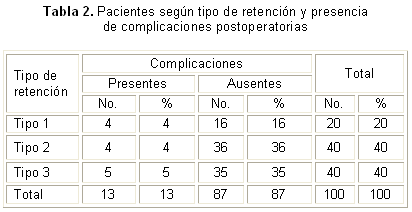
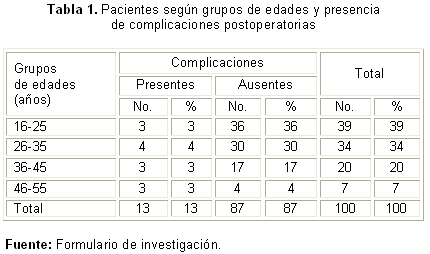
<body><![CDATA[<P>     <P><FONT FACE="Verdana, Arial, Helvetica, sans-serif" SIZE="2">La  <A HREF="#t1">Tabla 1</A> exhibe la relaci&oacute;n de pacientes seg&uacute;n  grupos de edades y la aparici&oacute;n de complicaciones postoperatorias. Se aprecia  que en el grupo 26-35 a&ntilde;os se present&oacute; el mayor n&uacute;mero de  pacientes con complicaciones 4 (4%), registr&aacute;ndose 13 pacientes con complicaciones  en total. </FONT>    <P ALIGN="CENTER"><A NAME="t1"></A><IMG SRC="/img/revistas/rhcm/v12s5/t0109s13.gif" WIDTH="430" HEIGHT="254">    <P>      <P>     <P>     <P>     <P>     <P><FONT FACE="Verdana, Arial, Helvetica, sans-serif" SIZE="2">La  posible asociaci&oacute;n entre tipo de retenci&oacute;n y presencia de complicaciones  postoperatorias se muestra en la <A HREF="#t2">Tabla 2</A>. Se aprecia que el  mayor n&uacute;mero de complicaciones se registraron en pacientes con retenci&oacute;n  intra&oacute;sea (tipo 3) con 5%, las retenciones de diente parcialmente erupcionado  y retenci&oacute;n submucosa (tipo 1 y 2) registraron igual n&uacute;mero de complicaciones  con 4% respectivamente. </FONT>    <P ALIGN="CENTER"><A NAME="t2"></A><IMG SRC="/img/revistas/rhcm/v12s5/t0209s13.gif" WIDTH="412" HEIGHT="212">    ]]></body>
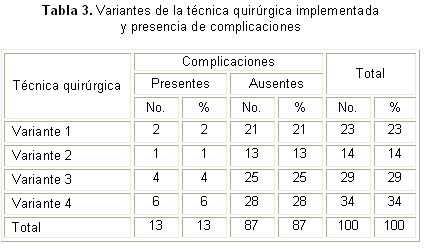
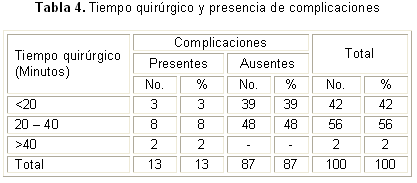
<body><![CDATA[<P>      <P>     <P>     <P><FONT FACE="Verdana, Arial, Helvetica, sans-serif" SIZE="2">La <A HREF="#t3">Tabla  3</A> expone la posible relaci&oacute;n entre tipo de t&eacute;cnica quir&uacute;rgica  implementada y complicaciones asociadas; se observa registro de mayor n&uacute;mero  de complicaciones asociados a la variante 4 (6%), esta variante fue utilizada  en 34 % de los pacientes. La variante 2 registr&oacute; el menor n&uacute;mero  de complicaciones con solo un caso. </FONT>    <P ALIGN="CENTER"><A NAME="t3"></A><IMG SRC="/img/revistas/rhcm/v12s5/t0309s13.gif" WIDTH="424" HEIGHT="249">    <P>      <P>     <P><FONT FACE="Verdana, Arial, Helvetica, sans-serif" SIZE="2">En la <A HREF="#t4">Tabla  4</A> se presenta la posible asociaci&oacute;n entre el tiempo quir&uacute;rgico  y presencia de complicaciones. El mayor n&uacute;mero de complicaciones se registr&oacute;  en procederes quir&uacute;rgicos implementados entre 20 y 40 minutos, siendo este  tiempo el m&aacute;s frecuente (observado en 56% de los casos). </FONT>    <P>    <P>    ]]></body>
<body><![CDATA[<P>    <P>    <P>      <P ALIGN="CENTER"><A NAME="t4"></A><IMG SRC="/img/revistas/rhcm/v12s5/t0409s13.gif" WIDTH="417" HEIGHT="183">    <P><FONT FACE="Verdana, Arial, Helvetica, sans-serif" SIZE="2">La  <A HREF="#t5">Tabla 5</A> muestra la distribuci&oacute;n de complicaciones asociadas  a la ex&eacute;resis de dientes retenidos. Se presentaron 40 complicaciones en  total, registr&aacute;ndose m&aacute;s de una por paciente complicado. El dolor  constante result&oacute; la complicaci&oacute;n postoperatoria m&aacute;s frecuente  (27,5%), seguido de la limitaci&oacute;n de apertura en el (22,5%). </FONT>    <P ALIGN="CENTER"><A NAME="t5"></A><IMG SRC="/img/revistas/rhcm/v12s5/t0509s13.gif" WIDTH="346" HEIGHT="285">    <P>    <P>    <P>    <P>      ]]></body>
<body><![CDATA[<P>&nbsp;    <P><FONT FACE="Verdana, Arial, Helvetica, sans-serif" SIZE="2"><B><FONT SIZE="3">DISCUSI&Oacute;N</FONT>  </B> </FONT>    <P><FONT FACE="Verdana, Arial, Helvetica, sans-serif" SIZE="2">El  mayor porciento de complicaciones se present&oacute; en los pacientes con edades  entre 26 y 35 a&ntilde;os, a pesar de no ser este el grupo m&aacute;s intervenido.  Esto pudo estar asociado a que con la edad el hueso se hace m&aacute;s compacto  y por tanto la ex&eacute;resis de los dientes retenidos es m&aacute;s laboriosa.  Estos resultados coincidieron con Hern&aacute;ndez Pedroso,<SUP>15</SUP> Moreno  Garc&iacute;a,<SUP>17</SUP> y Vara de la Fuente,<SUP>18</SUP> quienes presentaron  un aumento de las complicaciones en los pacientes de mayor edad. </FONT>    <P><FONT FACE="Verdana, Arial, Helvetica, sans-serif" SIZE="2">Se  observ&oacute; un mayor porciento de las complicaciones postoperatorias cuando  el diente se encontraba incluido totalmente en su lecho &oacute;seo (retenci&oacute;n  tipo 3). Similares resultados obtuvieron Moreno Garc&iacute;a<SUP>17</SUP> y Montalvo<SUP>19</SUP>  en sus respectivas investigaciones. Esto es debido a que una mayor retenci&oacute;n  &oacute;sea requiere mayor complejidad en la t&eacute;cnica quir&uacute;rgica.  </FONT>    <P><FONT FACE="Verdana, Arial, Helvetica, sans-serif" SIZE="2">En cuanto  a las diferentes variantes de la t&eacute;cnica quir&uacute;rgica vemos que al  comparar los porcientos de complicaciones de las variantes quir&uacute;rgicas  1 y 2 donde no se realiz&oacute; ostectom&iacute;a, con los de las variantes 3  y 4 donde s&iacute; se realiz&oacute;, pr&aacute;cticamente se duplica el porciento  de complicaciones postoperatorias, a mayor complejidad de la t&eacute;cnica quir&uacute;rgica  mayor porciento de complicaciones. En este aspecto se coincide con la mayor&iacute;a  de las investigaciones revisadas. <SUP>13- 23</SUP> </FONT>    <P><FONT FACE="Verdana, Arial, Helvetica, sans-serif" SIZE="2">A  medida que aument&oacute; el tiempo quir&uacute;rgico se incrementaron las complicaciones  postoperatorias. Sin embargo, es necesario se&ntilde;alar que la dehiscencia de  la herida y la alveolitis se presentaron en pacientes donde la t&eacute;cnica  quir&uacute;rgica fue sencilla y el tiempo quir&uacute;rgico bastante breve, por  lo que en particular para estos tipos de complicaciones no existi&oacute; una  relaci&oacute;n directa con el tiempo quir&uacute;rgico. Los resultados son similares  a los reportados por Mart&iacute;n PJ<SUP>16 </SUP>y<SUP> </SUP>L&oacute;pez Ram&iacute;rez.  <SUP>21</SUP> </FONT>    <P><FONT FACE="Verdana, Arial, Helvetica, sans-serif" SIZE="2">En  la investigaci&oacute;n la complicaci&oacute;n m&aacute;s frecuente fue el dolor  mantenido y la limitaci&oacute;n de la apertura bucal. En algunos pacientes coincidieron  varias complicaciones postoperatorias sobre todo la limitaci&oacute;n de la apertura  bucal asociada al dolor o a la celulitis postquir&uacute;rgica. Estos resultados  coinciden con los de Estrada y Montalvo, <SUP>22</SUP> quienes obtuvieron el trismo  por dolor, la infecci&oacute;n y la dehiscencia de la herida como complicaciones  m&aacute;s frecuentes. Resultados diferentes reporta Moreno G<SUP>17</SUP> y Vara  de la Fuente<SUP>18 </SUP>en cuyos estudios predominaron la alveolitis y la dehiscencia  de la herida como complicaciones m&aacute;s frecuentes. Morej&oacute;n &Aacute;lvarez  y colaboradores<SUP>23</SUP> presentaron la alveolitis, la celulitis y la hemorragia  como las complicaciones m&aacute;s usuales. </FONT>    <P>&nbsp;    <P>     <P><FONT FACE="Verdana, Arial, Helvetica, sans-serif" SIZE="2"><B><FONT SIZE="3">CONCLUSIONES</FONT></B>  </FONT><UL>    ]]></body>
<body><![CDATA[<LI><FONT FACE="Verdana, Arial, Helvetica, sans-serif" SIZE="2">Las  complicaciones post-operatorias resultaron mayores en pacientes con edades entre  26 y 35 a&ntilde;os. </FONT></LI>    <LI><FONT FACE="Verdana, Arial, Helvetica, sans-serif" SIZE="2">La  mayor&iacute;a de las complicaciones post-operatorias se present&oacute; en el  tipo de retenci&oacute;n 3, en las t&eacute;cnicas quir&uacute;rgicas m&aacute;s  complejas y en el mayor tiempo quir&uacute;rgico. </FONT></LI>    <LI><FONT FACE="Verdana, Arial, Helvetica, sans-serif" SIZE="2">Las  complicaciones m&aacute;s frecuentes fueron el dolor intenso, la limitaci&oacute;n  marcada de la apertura bucal y la Celulitis postquir&uacute;rgica. </FONT></LI>    <LI><FONT FACE="Verdana, Arial, Helvetica, sans-serif" SIZE="2">Las  complicaciones postquir&uacute;rgicas asociadas a la ex&eacute;resis de dientes  retenidos se relacionaron con las caracter&iacute;sticas propias del paciente,  la retenci&oacute;n y el proceder implementado. </FONT></LI>    </UL>    <P>&nbsp;</P>    <P>     <P><FONT FACE="Verdana, Arial, Helvetica, sans-serif" SIZE="2"><B><FONT SIZE="3">REFERENCIAS  BIBLIOGR&Aacute;FICAS </FONT></B></FONT>    <P><FONT FACE="Verdana, Arial, Helvetica, sans-serif" SIZE="2">1.  Al-Asfour A. Postoperative Infection after Surgical Removal of Impacted Mandibular  Third Molars: An Analysis of 110 Consecutive Procedures. <FONT  COLOR="#231f20">Med Princ Pract </FONT>[serial on the Internet]. 2011 May; 18(4):  48-52. [Cited February 18, 2013]. Disponible en: </FONT><FONT FACE="Verdana, Arial, Helvetica, sans-serif" SIZE="2">dx.doi.org/10.1159%2F000163046</FONT>      <P>     ]]></body>
<body><![CDATA[<!-- ref --><P><FONT FACE="Verdana, Arial, Helvetica, sans-serif" SIZE="2">2. Leonardi  R, Liccardello V, Greco M, Rossetti B. &amp; Barbato E. Alignment of a buccaly  displaced maxillary canine in the late mixed dentition with a modified utility  arch: a patient report. Word J. Orthod. 2010; 11(2):185-90.     </FONT>    <P>     <P><FONT FACE="Verdana, Arial, Helvetica, sans-serif" SIZE="2">3.  Camacho D, Gurrola B, Castro J, Casasa A.<B> </B>Incisivo central superior izquierdo  impactado. Reporte de caso cl&iacute;nico. Rev Lat Ortod y Odontop. [revista en  la Internet]. 2010&#160; Mayo;&#160; 10(2): 10-12. [Citado&#160;febrero 13,&#160;  2012] Disponible en: <FONT  COLOR="#0000ff"><A HREF="http://www.ortodoncia.ws/publicaciones/2010/art10.asp" TARGET="_blank">http://www.ortodoncia.ws/publicaciones/2010/art10.asp</A></FONT></FONT>      <P>     <P>     <!-- ref --><P><FONT FACE="Verdana, Arial, Helvetica, sans-serif" SIZE="2">4. P&eacute;rez  M, P&eacute;rez P. &amp; Fierro C. Alteraciones en la Erupci&oacute;n de Caninos  Permanentes. Int. J. Morphol. 2009; 27(1):139-43.     &#160;&#160; </FONT>    <P>     <!-- ref --><P><FONT FACE="Verdana, Arial, Helvetica, sans-serif" SIZE="2">5.  Bock JJ, Fuhrmann RA. Etiolog&iacute;a, diagn&oacute;stico y tratamiento de caninos  inferiores y dientes posteroinferiores desplazados o impactados. Quintessence.  2009; 02(22):82-91.     </FONT>    <P>     <!-- ref --><P><FONT FACE="Verdana, Arial, Helvetica, sans-serif" SIZE="2">6.  Baldawa RS, Khante KC, Kalburge JV, Kasat VO. Orthodontic management of an impacted  maxillary incisor due to odontoma. Contemp Clin Dent. 2011; 2(1):37-40.     </FONT>    <P>      <!-- ref --><P><FONT FACE="Verdana, Arial, Helvetica, sans-serif" SIZE="2">7. Vanarsdall RL.  Efficient management of unerupted teeth: A time-tested treatment modality. Semin.  Orthod. 2012; 16(3):212-21.     </FONT>    <P>     <!-- ref --><P><FONT FACE="Verdana, Arial, Helvetica, sans-serif" SIZE="2">8.  Rusu MC, Comes CA, Stanciu D, Ciuluvica RC, Motoc A, Niculescu MC &amp; Jianu  AM. Altered anatomy in a case with a buccally impacted maxillary canine tooth.  Rom. J. Morphol. Embryol.2010; 51(4):783-6.     &#160;&#160;&#160;&#160; </FONT>    ]]></body>
<body><![CDATA[<!-- ref --><P><FONT FACE="Verdana, Arial, Helvetica, sans-serif" SIZE="2">9.  Bedoya MM &amp; Park JH. A review of the diagnosis and management of impacted  maxillary canines. J. Am. Dent. Assoc.2009; 140:1485-93.     &#160;&#160;&#160;&#160;&#160;&#160;&#160;&#160;&#160;  </FONT>    <P>     <!-- ref --><P><FONT FACE="Verdana, Arial, Helvetica, sans-serif" SIZE="2">10.  Laskin D. Evaluation of the 3rd Molar Problems.J Am Dent Assoc.1971; 82:824-8.      </FONT>    <P>     <P><FONT FACE="Verdana, Arial, Helvetica, sans-serif" SIZE="2"> 11.  P&eacute;rez Barrero BR, Duharte Garbey C, Perdomo Estrada C, Ferrer Mustelier  A, Gan Cardero B. Pericoronaritis aguda en adolescentes y adultos j&oacute;venes  de un consultorio estomatol&oacute;gico del municipio venezolano de Valencia.  MEDISAN&#160; [revista en la Internet]. 2011&#160; Nov;&#160;15(11):1548-1556.  [Citado&#160;febrero 12,2012]. Disponible en:<FONT  COLOR="#0000ff"><A HREF="http://scielo.sld.cu/scielo.php?script=sci_arttext&pid=S1029%20-30192011001100007&lng=es" TARGET="_blank">http://scielo.sld.cu/scielo.php?script=sci_arttext&amp;pid=S1029  -30192011001100007&amp;lng=es</A>.</FONT></FONT>     <P>     <!-- ref --><P><FONT FACE="Verdana, Arial, Helvetica, sans-serif" SIZE="2">12.  Peterson LJ. Principles of management of impacted teeth. In: Peterson LJ, Ellis  E, Tucker MR. Contemporary oral and maxillofacial surgery. 4th ed. St Louis: CV  Mosby; 2003, p. 184-213.     </FONT>    ]]></body>
<body><![CDATA[<P>     <!-- ref --><P><FONT FACE="Verdana, Arial, Helvetica, sans-serif" SIZE="2">13.  Frank ChA, treatment options for impacted teeth. S. Am Dent Assoc. 2000; 131(5):  623-632.     </FONT>    <P>     <P><FONT FACE="Verdana, Arial, Helvetica, sans-serif" SIZE="2">14.  P&eacute;rez L&oacute;pez Y, C&aacute;rdenas P&eacute;rez E, Morales Pardo M,  Cepero Franco F, Quintero Herrer&iacute;a Y. Intervenciones quir&uacute;rgicas  por dientes retenidos. M Ciego[revista en la Internet]. 2011&#160; Ene; &#160;13(1):11-13.  [Citado&#160;febrero 12,2012]. [Disponible en: </FONT><FONT COLOR="#0000ff" FACE="Verdana, Arial, Helvetica, sans-serif" SIZE="2"><A HREF="http://bvs.sld.cu/revistas/mciego/vol13_01_07/%20articulos/a11_v13_0107.htm" TARGET="_blank">http://bvs.sld.cu/revistas/mciego/vol13_01_07/<U>  articulos</U>/a11_v13_0107.htm</A>.</FONT>     <P>     <P><FONT FACE="Verdana, Arial, Helvetica, sans-serif" SIZE="2">15.  Hern&aacute;ndez Pedroso L, Raymundo Padr&oacute;n E. Intervenciones quir&uacute;rgicas  realizadas en dientes retenidos. PM [revista en la Internet]. 2008&#160; Ene;  &#160;10(1):10-13. [Citado&#160;febrero 10,2012]. Disponible en: <FONT COLOR="#0000ff"><A HREF="http://www.portales%20m%E9dicos.com/publicaciones/articles/1154/1" TARGET="_blank">http://www.portales  m&eacute;dicos.com/publicaciones/articles/1154/1</A></FONT></FONT>     <P>     <!-- ref --><P><FONT FACE="Verdana, Arial, Helvetica, sans-serif" SIZE="2">  16. Mart&iacute;n PJ, Gerry MR, Boudewijn S, Pieter JS, Geert B. Complications  after mandibular third molar extraction. Quintessence Int. 2002; 26: 779-784.      </FONT>    ]]></body>
<body><![CDATA[<P>     <!-- ref --><P><FONT FACE="Verdana, Arial, Helvetica, sans-serif" SIZE="2">17.  Moreno Garc&iacute;a JM. Complications of impacted third molar surgery. Rev Fed  Odont Colombia. 2002; 5(202):5-9.     </FONT>    <P>     <!-- ref --><P><FONT FACE="Verdana, Arial, Helvetica, sans-serif" SIZE="2">18.  Vara de la Fuente JC. Complicaciones post-quir&uacute;rgicas de los cordales incluidos.  Gac Dent. 2004; 146:102-10.     </FONT>    <P>     <!-- ref --><P><FONT FACE="Verdana, Arial, Helvetica, sans-serif" SIZE="2">19.  Montalvo VM. Complications after extraction of the third molar in Seychelles.  Seychelles medical &amp; Dental Journal- 1999; 6(1): 27-8.     </FONT>    <P>     ]]></body>
<body><![CDATA[<P><FONT FACE="Verdana, Arial, Helvetica, sans-serif" SIZE="2">20.  Malkawi Z, Al-Omiri M, Khraisat A. Risk Indicators of Postoperative Complications  following Surgical Extraction of Lower Third Molars. Medical Principles &amp;  Practice [serial on the Internet]. 2011 May; 20(4): 321-325. [Cited February 12,  2013]. Disponible en: <FONT  COLOR="#0000ff"><A HREF="http://www.karger.com/Article/Abstract/324550" TARGET="_blank">http://www.karger.com/Article/Abstract/324550</A></FONT></FONT>      <P>     <P><FONT FACE="Verdana, Arial, Helvetica, sans-serif" SIZE="2">21. L&oacute;pez-Ram&iacute;rez  M, V&iacute;lchez-P&eacute;rez M, Gargallo-Albiol J, Arnabat-Dom&iacute;nguez  J, Gay-Escoda C. Efficacy of low-level laser therapy in the management of pain,  facial swelling, and postoperative trismus after a lower third molar extraction.  A preliminary study. Lasers In Medical Science [serial on the Internet]. 2012  May; 27(3): 559-566. [Cited February 12, 2013]. Disponible en: <FONT  COLOR="#0000ff"><A HREF="http://link.springer.com/article/10.1007/s10103-011-0936-" TARGET="_blank">http://link.springer.com/article/10.1007/s10103-011-0936-</A>8  </FONT></FONT>     <P>     <!-- ref --><P><FONT FACE="Verdana, Arial, Helvetica, sans-serif" SIZE="2">22.  Estrada SM, Montalvo VM. An&aacute;lisis de las complicaciones de los terceros  molares retenidos. Rev Cub Est. 1990; 27 (2): 244-9.     </FONT>    <P>     <!-- ref --><P><FONT FACE="Verdana, Arial, Helvetica, sans-serif" SIZE="2">23.  Morej&oacute;n &Aacute;lvarez F, L&oacute;pez Ben&iacute;tez H, Morej&oacute;n  &Aacute;lvarez T, Corbo Rodr&iacute;guez MT. Presentaci&oacute;n de un estudio  en 680 pacientes operados de terceros molares retenidos. Rev ADM. 2000; 46(1):7-10.      </FONT>    <P>&nbsp;    ]]></body>
<body><![CDATA[<P>&nbsp;    <P><FONT FACE="Verdana, Arial, Helvetica, sans-serif" SIZE="2">Recibido:  23 de junio de 2013     <BR>Aprobado: 18 de Septiembre de 2013 </FONT>       ]]></body><back>
<ref-list>
<ref id="B1">
<label>1</label><nlm-citation citation-type="journal">
<person-group person-group-type="author">
<name>
<surname><![CDATA[Al-Asfour]]></surname>
<given-names><![CDATA[A]]></given-names>
</name>
</person-group>
<article-title xml:lang="en"><![CDATA[Postoperative Infection after Surgical Removal of Impacted Mandibular Third Molars: An Analysis of 110 Consecutive Procedures]]></article-title>
<source><![CDATA[Med Princ Pract.]]></source>
<year>2011</year>
<month> M</month>
<day>ay</day>
<volume>18</volume>
<numero>4</numero>
<issue>4</issue>
<page-range>48-52</page-range></nlm-citation>
</ref>
<ref id="B2">
<label>2</label><nlm-citation citation-type="journal">
<person-group person-group-type="author">
<name>
<surname><![CDATA[Leonardi]]></surname>
<given-names><![CDATA[R]]></given-names>
</name>
<name>
<surname><![CDATA[Liccardello]]></surname>
<given-names><![CDATA[V]]></given-names>
</name>
<name>
<surname><![CDATA[Greco]]></surname>
<given-names><![CDATA[M]]></given-names>
</name>
<name>
<surname><![CDATA[Rossetti]]></surname>
<given-names><![CDATA[B]]></given-names>
</name>
<name>
<surname><![CDATA[Barbato]]></surname>
<given-names><![CDATA[E]]></given-names>
</name>
</person-group>
<article-title xml:lang="en"><![CDATA[Alignment of a buccaly displaced maxillary canine in the late mixed dentition with a modified utility arch: a patient report]]></article-title>
<source><![CDATA[Word J. Orthod.]]></source>
<year>2010</year>
<volume>11</volume>
<numero>2</numero>
<issue>2</issue>
<page-range>185-90</page-range></nlm-citation>
</ref>
<ref id="B3">
<label>3</label><nlm-citation citation-type="journal">
<person-group person-group-type="author">
<name>
<surname><![CDATA[Camacho]]></surname>
<given-names><![CDATA[D]]></given-names>
</name>
<name>
<surname><![CDATA[Gurrola]]></surname>
<given-names><![CDATA[B]]></given-names>
</name>
<name>
<surname><![CDATA[Castro]]></surname>
<given-names><![CDATA[J]]></given-names>
</name>
<name>
<surname><![CDATA[Casasa]]></surname>
<given-names><![CDATA[A]]></given-names>
</name>
</person-group>
<article-title xml:lang="es"><![CDATA[Incisivo central superior izquierdo impactado: Reporte de caso clínico]]></article-title>
<source><![CDATA[Rev Lat Ortod y Odontop.]]></source>
<year>2010</year>
<month> M</month>
<day>ay</day>
<volume>10</volume>
<numero>2</numero>
<issue>2</issue>
<page-range>10-12</page-range></nlm-citation>
</ref>
<ref id="B4">
<nlm-citation citation-type="journal">
<person-group person-group-type="author">
<name>
<surname><![CDATA[Pérez]]></surname>
<given-names><![CDATA[M]]></given-names>
</name>
<name>
<surname><![CDATA[Pérez]]></surname>
<given-names><![CDATA[P]]></given-names>
</name>
<name>
<surname><![CDATA[Fierro]]></surname>
<given-names><![CDATA[C]]></given-names>
</name>
</person-group>
<article-title xml:lang="es"><![CDATA[Alteraciones en la Erupción de Caninos Permanentes]]></article-title>
<source><![CDATA[Int J. Morphol.]]></source>
<year>2009</year>
<volume>27</volume>
<numero>1</numero>
<issue>1</issue>
<page-range>139-43</page-range></nlm-citation>
</ref>
<ref id="B5">
<label>5</label><nlm-citation citation-type="journal">
<person-group person-group-type="author">
<name>
<surname><![CDATA[Bock]]></surname>
<given-names><![CDATA[JJ]]></given-names>
</name>
<name>
<surname><![CDATA[Fuhrmann]]></surname>
<given-names><![CDATA[RA]]></given-names>
</name>
</person-group>
<article-title xml:lang="es"><![CDATA[Etiología, diagnóstico y tratamiento de caninos inferiores y dientes posteroinferiores desplazados o impactados]]></article-title>
<source><![CDATA[Quintessence.]]></source>
<year>2009</year>
<volume>02</volume>
<numero>22</numero>
<issue>22</issue>
<page-range>82-91</page-range></nlm-citation>
</ref>
<ref id="B6">
<label>6</label><nlm-citation citation-type="journal">
<person-group person-group-type="author">
<name>
<surname><![CDATA[Baldawa]]></surname>
<given-names><![CDATA[RS]]></given-names>
</name>
<name>
<surname><![CDATA[Khante]]></surname>
<given-names><![CDATA[KC]]></given-names>
</name>
<name>
<surname><![CDATA[Kalburge]]></surname>
<given-names><![CDATA[JV]]></given-names>
</name>
<name>
<surname><![CDATA[Kasat]]></surname>
<given-names><![CDATA[VO]]></given-names>
</name>
</person-group>
<article-title xml:lang="en"><![CDATA[Orthodontic management of an impacted maxillary incisor due to odontoma]]></article-title>
<source><![CDATA[Contemp Clin Dent.]]></source>
<year>2011</year>
<volume>2</volume>
<numero>1</numero>
<issue>1</issue>
<page-range>37-40</page-range></nlm-citation>
</ref>
<ref id="B7">
<label>7</label><nlm-citation citation-type="journal">
<person-group person-group-type="author">
<name>
<surname><![CDATA[Vanarsdall]]></surname>
<given-names><![CDATA[RL]]></given-names>
</name>
</person-group>
<article-title xml:lang="en"><![CDATA[Efficient management of unerupted teeth: A time-tested treatment modality]]></article-title>
<source><![CDATA[Semin. Orthod.]]></source>
<year>2012</year>
<volume>16</volume>
<numero>3</numero>
<issue>3</issue>
<page-range>212-21</page-range></nlm-citation>
</ref>
<ref id="B8">
<label>8</label><nlm-citation citation-type="journal">
<person-group person-group-type="author">
<name>
<surname><![CDATA[Rusu]]></surname>
<given-names><![CDATA[MC]]></given-names>
</name>
<name>
<surname><![CDATA[Comes]]></surname>
<given-names><![CDATA[CA]]></given-names>
</name>
<name>
<surname><![CDATA[Stanciu]]></surname>
<given-names><![CDATA[D]]></given-names>
</name>
<name>
<surname><![CDATA[Ciuluvica]]></surname>
<given-names><![CDATA[RC]]></given-names>
</name>
<name>
<surname><![CDATA[Motoc]]></surname>
<given-names><![CDATA[A]]></given-names>
</name>
<name>
<surname><![CDATA[Niculescu]]></surname>
<given-names><![CDATA[MC]]></given-names>
</name>
<name>
<surname><![CDATA[Jianu]]></surname>
<given-names><![CDATA[AM]]></given-names>
</name>
</person-group>
<article-title xml:lang="en"><![CDATA[Altered anatomy in a case with a buccally impacted maxillary canine tooth: Rom]]></article-title>
<source><![CDATA[J. Morphol. Embryol.]]></source>
<year>2010</year>
<volume>51</volume>
<numero>4</numero>
<issue>4</issue>
<page-range>783-6</page-range></nlm-citation>
</ref>
<ref id="B9">
<label>9</label><nlm-citation citation-type="journal">
<person-group person-group-type="author">
<name>
<surname><![CDATA[Bedoya]]></surname>
<given-names><![CDATA[MM]]></given-names>
</name>
<name>
<surname><![CDATA[Park]]></surname>
<given-names><![CDATA[JH]]></given-names>
</name>
</person-group>
<article-title xml:lang="en"><![CDATA[A review of the diagnosis and management of impacted maxillary canines: J Am]]></article-title>
<source><![CDATA[Dent. Assoc.]]></source>
<year>2009</year>
<volume>140</volume>
<page-range>1485-93</page-range></nlm-citation>
</ref>
<ref id="B10">
<label>10</label><nlm-citation citation-type="journal">
<person-group person-group-type="author">
<name>
<surname><![CDATA[Laskin]]></surname>
<given-names><![CDATA[D]]></given-names>
</name>
</person-group>
<article-title xml:lang="en"><![CDATA[Evaluation of the 3rd Molar Problems]]></article-title>
<source><![CDATA[J Am Dent Assoc.]]></source>
<year>1971</year>
<volume>82</volume>
<page-range>824-8</page-range></nlm-citation>
</ref>
<ref id="B11">
<label>11</label><nlm-citation citation-type="journal">
<person-group person-group-type="author">
<name>
<surname><![CDATA[Pérez Barrero]]></surname>
<given-names><![CDATA[BR]]></given-names>
</name>
<name>
<surname><![CDATA[Duharte Garbey]]></surname>
<given-names><![CDATA[C]]></given-names>
</name>
<name>
<surname><![CDATA[Perdomo Estrada]]></surname>
<given-names><![CDATA[C]]></given-names>
</name>
<name>
<surname><![CDATA[Ferrer Mustelier]]></surname>
<given-names><![CDATA[A]]></given-names>
</name>
<name>
<surname><![CDATA[Gan Cardero]]></surname>
<given-names><![CDATA[B]]></given-names>
</name>
</person-group>
<article-title xml:lang="es"><![CDATA[Pericoronaritis aguda en adolescentes y adultos jóvenes de un consultorio estomatológico del municipio venezolano de Valencia]]></article-title>
<source><![CDATA[MEDISAN.]]></source>
<year>2011</year>
<month> N</month>
<day>ov</day>
<volume>15</volume>
<numero>11</numero>
<issue>11</issue>
<page-range>1548-1556</page-range></nlm-citation>
</ref>
<ref id="B12">
<label>12</label><nlm-citation citation-type="book">
<person-group person-group-type="author">
<name>
<surname><![CDATA[Peterson]]></surname>
<given-names><![CDATA[LJ]]></given-names>
</name>
</person-group>
<article-title xml:lang="en"><![CDATA[Principles of management of impacted teeth]]></article-title>
<person-group person-group-type="editor">
<name>
<surname><![CDATA[Peterson]]></surname>
<given-names><![CDATA[LJ]]></given-names>
</name>
<name>
<surname><![CDATA[Ellis]]></surname>
<given-names><![CDATA[E]]></given-names>
</name>
<name>
<surname><![CDATA[Tucker]]></surname>
<given-names><![CDATA[MR]]></given-names>
</name>
</person-group>
<source><![CDATA[Contemporary oral and maxillofacial surgery]]></source>
<year>2003</year>
<edition>4</edition>
<page-range>184-213</page-range><publisher-loc><![CDATA[St Louis ]]></publisher-loc>
<publisher-name><![CDATA[CV Mosby]]></publisher-name>
</nlm-citation>
</ref>
<ref id="B13">
<label>13</label><nlm-citation citation-type="journal">
<person-group person-group-type="author">
<name>
<surname><![CDATA[Frank]]></surname>
<given-names><![CDATA[ChA]]></given-names>
</name>
</person-group>
<article-title xml:lang="en"><![CDATA[Treatment options for impacted teeth]]></article-title>
<source><![CDATA[S Am Dent Assoc.]]></source>
<year>2000</year>
<volume>131</volume>
<numero>5</numero>
<issue>5</issue>
<page-range>623-632</page-range></nlm-citation>
</ref>
<ref id="B14">
<label>14</label><nlm-citation citation-type="journal">
<person-group person-group-type="author">
<name>
<surname><![CDATA[Pérez López]]></surname>
<given-names><![CDATA[Y]]></given-names>
</name>
<name>
<surname><![CDATA[Cárdenas Pérez]]></surname>
<given-names><![CDATA[E]]></given-names>
</name>
<name>
<surname><![CDATA[Morales Pardo]]></surname>
<given-names><![CDATA[M]]></given-names>
</name>
<name>
<surname><![CDATA[Cepero Franco]]></surname>
<given-names><![CDATA[F]]></given-names>
</name>
<name>
<surname><![CDATA[Quintero Herrería]]></surname>
<given-names><![CDATA[Y]]></given-names>
</name>
</person-group>
<article-title xml:lang="es"><![CDATA[Intervenciones quirúrgicas por dientes retenidos]]></article-title>
<source><![CDATA[M Ciego.]]></source>
<year>2011</year>
<month> E</month>
<day>ne</day>
<volume>13</volume>
<numero>1</numero>
<issue>1</issue>
<page-range>11-13</page-range></nlm-citation>
</ref>
<ref id="B15">
<label>15</label><nlm-citation citation-type="journal">
<person-group person-group-type="author">
<name>
<surname><![CDATA[Hernández Pedroso]]></surname>
<given-names><![CDATA[L]]></given-names>
</name>
<name>
<surname><![CDATA[Raymundo Padrón]]></surname>
<given-names><![CDATA[E]]></given-names>
</name>
</person-group>
<article-title xml:lang="es"><![CDATA[Intervenciones quirúrgicas realizadas en dientes retenidos]]></article-title>
<source><![CDATA[PM.]]></source>
<year>2008</year>
<month> E</month>
<day>ne</day>
<volume>10</volume>
<numero>1</numero>
<issue>1</issue>
<page-range>10-13</page-range></nlm-citation>
</ref>
<ref id="B16">
<label>16</label><nlm-citation citation-type="journal">
<person-group person-group-type="author">
<name>
<surname><![CDATA[Martín]]></surname>
<given-names><![CDATA[PJ]]></given-names>
</name>
<name>
<surname><![CDATA[Gerry]]></surname>
<given-names><![CDATA[MR]]></given-names>
</name>
<name>
<surname><![CDATA[Boudewijn]]></surname>
<given-names><![CDATA[S]]></given-names>
</name>
<name>
<surname><![CDATA[Pieter]]></surname>
<given-names><![CDATA[JS]]></given-names>
</name>
<name>
<surname><![CDATA[Geert]]></surname>
<given-names><![CDATA[B]]></given-names>
</name>
</person-group>
<article-title xml:lang="en"><![CDATA[Complications after mandibular third molar extraction]]></article-title>
<source><![CDATA[Quintessence Int.]]></source>
<year>2002</year>
<volume>26</volume>
<page-range>779-784</page-range></nlm-citation>
</ref>
<ref id="B17">
<label>17</label><nlm-citation citation-type="journal">
<person-group person-group-type="author">
<name>
<surname><![CDATA[Moreno García]]></surname>
<given-names><![CDATA[JM]]></given-names>
</name>
</person-group>
<article-title xml:lang="en"><![CDATA[Complications of impacted third molar surgery]]></article-title>
<source><![CDATA[Rev Fed Odont Colombia.]]></source>
<year>2002</year>
<volume>5</volume>
<numero>202</numero>
<issue>202</issue>
<page-range>5-9</page-range></nlm-citation>
</ref>
<ref id="B18">
<label>18</label><nlm-citation citation-type="journal">
<person-group person-group-type="author">
<name>
<surname><![CDATA[Vara de la Fuente]]></surname>
<given-names><![CDATA[JC]]></given-names>
</name>
</person-group>
<article-title xml:lang="es"><![CDATA[Complicaciones post-quirúrgicas de los cordales incluidos]]></article-title>
<source><![CDATA[Gac Dent.]]></source>
<year>2004</year>
<volume>146</volume>
<page-range>102-10</page-range></nlm-citation>
</ref>
<ref id="B19">
<label>19</label><nlm-citation citation-type="journal">
<person-group person-group-type="author">
<name>
<surname><![CDATA[Montalvo]]></surname>
<given-names><![CDATA[VM]]></given-names>
</name>
</person-group>
<article-title xml:lang="es"><![CDATA[Complications after extraction of the third molar in Seychelles]]></article-title>
<source><![CDATA[Seychelles medical & Dental Journal-]]></source>
<year>1999</year>
<volume>6</volume>
<numero>1</numero>
<issue>1</issue>
<page-range>27-8</page-range></nlm-citation>
</ref>
<ref id="B20">
<label>20</label><nlm-citation citation-type="journal">
<person-group person-group-type="author">
<name>
<surname><![CDATA[Malkawi]]></surname>
<given-names><![CDATA[Z]]></given-names>
</name>
<name>
<surname><![CDATA[Al-Omiri]]></surname>
<given-names><![CDATA[M]]></given-names>
</name>
<name>
<surname><![CDATA[Khraisat]]></surname>
<given-names><![CDATA[A]]></given-names>
</name>
</person-group>
<article-title xml:lang="en"><![CDATA[Risk Indicators of Postoperative Complications following Surgical Extraction of Lower Third Molars]]></article-title>
<source><![CDATA[Medical Principles & Practice.]]></source>
<year>2011</year>
<month> M</month>
<day>ay</day>
<volume>20</volume>
<numero>4</numero>
<issue>4</issue>
<page-range>321-325</page-range></nlm-citation>
</ref>
<ref id="B21">
<label>21</label><nlm-citation citation-type="journal">
<person-group person-group-type="author">
<name>
<surname><![CDATA[López-Ramírez]]></surname>
<given-names><![CDATA[M]]></given-names>
</name>
<name>
<surname><![CDATA[Vílchez-Pérez]]></surname>
<given-names><![CDATA[M]]></given-names>
</name>
<name>
<surname><![CDATA[Gargallo-Albiol]]></surname>
<given-names><![CDATA[J]]></given-names>
</name>
<name>
<surname><![CDATA[Arnabat-Domínguez]]></surname>
<given-names><![CDATA[J]]></given-names>
</name>
<name>
<surname><![CDATA[Gay-Escoda]]></surname>
<given-names><![CDATA[C]]></given-names>
</name>
</person-group>
<article-title xml:lang="en"><![CDATA[Efficacy of low-level laser therapy in the management of pain, facial swelling, and postoperative trismus after a lower third molar extraction: A preliminary study]]></article-title>
<source><![CDATA[Lasers In Medical Science.]]></source>
<year>2012</year>
<month> M</month>
<day>ay</day>
<volume>27</volume>
<numero>3</numero>
<issue>3</issue>
<page-range>559-566</page-range></nlm-citation>
</ref>
<ref id="B22">
<label>22</label><nlm-citation citation-type="journal">
<person-group person-group-type="author">
<name>
<surname><![CDATA[Estrada]]></surname>
<given-names><![CDATA[SM]]></given-names>
</name>
<name>
<surname><![CDATA[Montalvo]]></surname>
<given-names><![CDATA[VM]]></given-names>
</name>
</person-group>
<article-title xml:lang="es"><![CDATA[Análisis de las complicaciones de los terceros molares retenidos]]></article-title>
<source><![CDATA[Rev Cub Est.]]></source>
<year>1990</year>
<volume>27</volume>
<numero>2</numero>
<issue>2</issue>
<page-range>244-9</page-range></nlm-citation>
</ref>
<ref id="B23">
<label>23</label><nlm-citation citation-type="journal">
<person-group person-group-type="author">
<name>
<surname><![CDATA[Morejón Álvarez]]></surname>
<given-names><![CDATA[F]]></given-names>
</name>
<name>
<surname><![CDATA[López Benítez]]></surname>
<given-names><![CDATA[H]]></given-names>
</name>
<name>
<surname><![CDATA[Morejón Álvarez]]></surname>
<given-names><![CDATA[T]]></given-names>
</name>
<name>
<surname><![CDATA[Corbo Rodríguez]]></surname>
<given-names><![CDATA[MT]]></given-names>
</name>
</person-group>
<article-title xml:lang="es"><![CDATA[Presentación de un estudio en 680 pacientes operados de terceros molares retenidos]]></article-title>
<source><![CDATA[Rev ADM.]]></source>
<year>2000</year>
<volume>46</volume>
<numero>1</numero>
<issue>1</issue>
<page-range>7-10</page-range></nlm-citation>
</ref>
</ref-list>
</back>
</article>