<?xml version="1.0" encoding="ISO-8859-1"?><article xmlns:mml="http://www.w3.org/1998/Math/MathML" xmlns:xlink="http://www.w3.org/1999/xlink" xmlns:xsi="http://www.w3.org/2001/XMLSchema-instance">
<front>
<journal-meta>
<journal-id>1729-519X</journal-id>
<journal-title><![CDATA[Revista Habanera de Ciencias Médicas]]></journal-title>
<abbrev-journal-title><![CDATA[Rev haban cienc méd]]></abbrev-journal-title>
<issn>1729-519X</issn>
<publisher>
<publisher-name><![CDATA[Universidad de Ciencias Médicas de la Habana]]></publisher-name>
</publisher>
</journal-meta>
<article-meta>
<article-id>S1729-519X2014000500006</article-id>
<title-group>
<article-title xml:lang="es"><![CDATA[Lesiones blancas de la cavidad bucal. Concordancia Diagnóstica]]></article-title>
<article-title xml:lang="en"><![CDATA[Diagnostic concordance of white lesions of oral cavity]]></article-title>
</title-group>
<contrib-group>
<contrib contrib-type="author">
<name>
<surname><![CDATA[Guerra Cobián]]></surname>
<given-names><![CDATA[Orlando]]></given-names>
</name>
<xref ref-type="aff" rid="A01"/>
</contrib>
<contrib contrib-type="author">
<name>
<surname><![CDATA[Sarracent Pérez]]></surname>
<given-names><![CDATA[Humberto]]></given-names>
</name>
<xref ref-type="aff" rid="A01"/>
</contrib>
<contrib contrib-type="author">
<name>
<surname><![CDATA[Urbizo Vélez]]></surname>
<given-names><![CDATA[Joaquin]]></given-names>
</name>
<xref ref-type="aff" rid="A01"/>
</contrib>
</contrib-group>
<aff id="A01">
<institution><![CDATA[,Universidad de Ciencias Médicas de La Habana Facultad de Estomatología Raúl González Sánchez ]]></institution>
<addr-line><![CDATA[ ]]></addr-line>
</aff>
<pub-date pub-type="pub">
<day>00</day>
<month>10</month>
<year>2014</year>
</pub-date>
<pub-date pub-type="epub">
<day>00</day>
<month>10</month>
<year>2014</year>
</pub-date>
<volume>13</volume>
<numero>5</numero>
<fpage>690</fpage>
<lpage>700</lpage>
<copyright-statement/>
<copyright-year/>
<self-uri xlink:href="http://scielo.sld.cu/scielo.php?script=sci_arttext&amp;pid=S1729-519X2014000500006&amp;lng=en&amp;nrm=iso"></self-uri><self-uri xlink:href="http://scielo.sld.cu/scielo.php?script=sci_abstract&amp;pid=S1729-519X2014000500006&amp;lng=en&amp;nrm=iso"></self-uri><self-uri xlink:href="http://scielo.sld.cu/scielo.php?script=sci_pdf&amp;pid=S1729-519X2014000500006&amp;lng=en&amp;nrm=iso"></self-uri><kwd-group>
<kwd lng="es"><![CDATA[lesiones bucales blanquecinas]]></kwd>
<kwd lng="es"><![CDATA[diagnóstico clínico]]></kwd>
<kwd lng="es"><![CDATA[diagnóstico histopatológico]]></kwd>
<kwd lng="es"><![CDATA[concordancia]]></kwd>
<kwd lng="en"><![CDATA[buccal white lesions]]></kwd>
<kwd lng="en"><![CDATA[clinical diagnosis]]></kwd>
<kwd lng="en"><![CDATA[histopathological diagnosis]]></kwd>
<kwd lng="en"><![CDATA[concordance]]></kwd>
</kwd-group>
</article-meta>
</front><body><![CDATA[ <DIV ALIGN="RIGHT">    <P><FONT FACE="Verdana, Arial, Helvetica, sans-serif" SIZE="2"><B>CIENCIAS  CL&Iacute;NICAS Y PATOL&Oacute;GICAS</B></FONT></P>    <P>&nbsp;</P></DIV>    <P><FONT FACE="Verdana, Arial, Helvetica, sans-serif" SIZE="2">Universidad  de Ciencias M&eacute;dicas de La Habana     <BR></FONT><FONT FACE="Verdana, Arial, Helvetica, sans-serif" SIZE="2">Facultad  de Estomatolog&iacute;a &quot;Ra&uacute;l Gonz&aacute;lez S&aacute;nchez&quot;</FONT>    <P>&nbsp;    <P>      <P>    <P><FONT FACE="Verdana, Arial, Helvetica, sans-serif" SIZE="4"><B>Lesiones  blancas de la cavidad bucal. Concordancia Diagn&oacute;stica</B></FONT><FONT FACE="Verdana, Arial, Helvetica, sans-serif" SIZE="2"><B>  </B></FONT></P>    <P>&nbsp;</P><B>    ]]></body>
<body><![CDATA[<P>     <P><FONT FACE="Verdana, Arial, Helvetica, sans-serif" SIZE="3">Diagnostic  concordance of white lesions of oral cavity</FONT></B>     <P>&nbsp;</P>    <P>&nbsp;</P>    <P>     <P><B><FONT FACE="Verdana, Arial, Helvetica, sans-serif" SIZE="2">Orlando  Guerra Cobi&aacute;n,<SUP>I</SUP> Humberto Sarracent P&eacute;rez,<SUP>II</SUP>  Joaquin Urbizo V&eacute;lez<SUP>III </SUP></FONT></B>    <P><FONT FACE="Verdana, Arial, Helvetica, sans-serif" SIZE="2"><SUP>I</SUP>  Especialista Primer Grado en Cirug&iacute;a Maxilofacial. Asistente. Facultad  de Estomatolog&iacute;a &quot;Ra&uacute;l Gonz&aacute;lez S&aacute;nchez&quot;.  e.mail: <FONT  COLOR="#0000ff"><A HREF="mailto:orlando.guerra@infomed.sld.cu">orlando.guerra@infomed.sld.cu</A></FONT></FONT>      <BR><FONT FACE="Verdana, Arial, Helvetica, sans-serif" SIZE="2"><SUP>II</SUP>  Especialista Segundo Grado en Cirug&iacute;a Maxilofacial. Auxiliar. Jefe de Departamento  de Cirug&iacute;a. Facultad de Estomatolog&iacute;a &quot;Ra&uacute;l Gonz&aacute;lez  S&aacute;nchez&quot;. e.mail: <FONT COLOR="#0000ff"><A HREF="mailto:hsarracentp@infomed.sld.cu">hsarracentp@infomed.sld.cu</A></FONT></FONT>      <BR> <FONT FACE="Verdana, Arial, Helvetica, sans-serif" SIZE="2"><SUP>III</SUP>  Especialista Segundo Grado en Anatom&iacute;a Patol&oacute;gica. Profesor Titular.  Facultad de Estomatolog&iacute;a &quot;Ra&uacute;l Gonz&aacute;lez S&aacute;nchez&quot;.  e.mail: <FONT  COLOR="#0000ff"><A HREF="mailto:joaquin.urbizo@infomed.sld.cu">joaquin.urbizo@infomed.sld.cu</A></FONT></FONT>      <P>&nbsp;    ]]></body>
<body><![CDATA[<P>&nbsp;    <P>    <P><HR>    <P><FONT FACE="Verdana, Arial, Helvetica, sans-serif" SIZE="2"><B>RESUMEN  </B></FONT>    <P><FONT FACE="Verdana, Arial, Helvetica, sans-serif" SIZE="2"><B>Introducci&oacute;n</B>:  las lesiones bucales resultan un fuerte indicador del estado de salud del individuo,  y dentro de estas, las lesiones de apariencia blanquecina est&aacute;n sujetas  a errores diagn&oacute;sticos dada su similitud y variada forma de presentaci&oacute;n.      <BR> <B>Objetivo:</B> determinar la concordancia existente entre el diagn&oacute;stico  cl&iacute;nico e histopatol&oacute;gico de lesiones bucales blanquecinas, as&iacute;  como caracterizar dichas lesiones socio-demogr&aacute;ficamente y distribuirlas  topogr&aacute;ficamente.     <BR> <B>Material y M&eacute;todos: </B>se realiz&oacute;  un estudio descriptivo retrospectivo de corte transversal en una muestra de 52  pacientes del total con lesiones de apariencia blanquecina en la cavidad bucal  sometidos a biopsia para confirmar diagn&oacute;stico en el Departamento de Cirug&iacute;a  de la Facultad de Estomatolog&iacute;a &quot;Ra&uacute;l Gonz&aacute;lez S&aacute;nchez&quot;,  en el per&iacute;odo comprendido de enero 2013 a diciembre 2013. Se tomaron datos  sociodemogr&aacute;ficos y diagn&oacute;sticos de modelo de solicitud de biopsia,  informe histopatol&oacute;gico y registro estad&iacute;stico de la Instituci&oacute;n.  La informaci&oacute;n recogida fue sometida al estad&iacute;grafo &Iacute;ndice  de Kappa para evaluar concordancia de diagn&oacute;stico cl&iacute;nico e histopatol&oacute;gico.      <BR> <B>Resultados</B>: pacientes con edades entre 40 y 49 a&ntilde;os resultaron  los m&aacute;s afectados (28,85%). Predominaron lesiones blanquecinas en pacientes  de piel blanca (59,62%) y femeninas (61,54%). Un 34,33% de las lesiones se ubicaron  en la mucosa del carrillo. Cl&iacute;nicamente, 50% de las lesiones clasificaron  como leucoplasia e histopatol&oacute;gicamente 42,31%. Existi&oacute; muy buena  concordancia entre ambos diagn&oacute;sticos para leucoplasia (k=0,84) liquen  plano (k=0,83). La concordancia total del grupo result&oacute; buena (k=0,79).      <BR> <B>Conclusiones</B>: la concordancia total de la muestra fue buena, aunque  la concordancia diagn&oacute;stica de leucoplasia y liquen plano clasific&oacute;  como muy buena. </FONT>    <P>     ]]></body>
<body><![CDATA[<P><FONT FACE="Verdana, Arial, Helvetica, sans-serif" SIZE="2"><B>Palabras  clave:</B> lesiones bucales blanquecinas, diagn&oacute;stico cl&iacute;nico, diagn&oacute;stico  histopatol&oacute;gico, concordancia. </FONT><HR>    <P>     <P><FONT FACE="Verdana, Arial, Helvetica, sans-serif" SIZE="2"><B>ABSTRACT  </B></FONT>    <P><FONT FACE="Verdana, Arial, Helvetica, sans-serif" SIZE="2"><B>Introduction:  </B>the buccal lesions are a strong indicator of the state of the individual's  health, and inside these the white lesions are subject to be misdiagnosed due  to their similarity and varied presentation form.<B>     <BR> Objective: </B>to determine  the concordance between the clinical and histopathological diagnosis of buccal  white lesions, as well as to characterize these lesions social-demographically  and to distribute them topographically.<B>     <BR> Material and Methods: </B>a cross  sectional descriptive retrospective study was conducted in a sample of 52 patients  of the total of patients with buccal white lesions to be biopsied in the Department  of Surgery of Dentistry College &quot;Ra&uacute;l Gonz&aacute;lez S&aacute;nchez&quot;  in the period January 2013 to December 2013. The Sociodemographic and diagnostics  data were obtained from the Biopsy request model and histopathological report  .The information was subjected to kappa index to evaluate the concordance between  clinical and histopathological diagnosis.     <BR> <B>Results: </B>patients with ages  between 40-49 were more affected (28,85%).White lesions prevailed in female( 61,54%)  and white race people (59,62%).34,33% was located in the cheek mucous. 50% was  clinically diagnosed like leukoplakia and confirmed histologically in 42.31%.  The concordance was very good in the diagnosis of leukoplakia (k=0,84) and lichen  planus (K=0,83). The total concordance of the group was good (k=0,79).<B>     <BR>  Conclusions: </B>the total concordance of the studied sample was good, although  the diagnostic concordance to leukoplakia and lichen planus were very good. </FONT>    <P><FONT FACE="Verdana, Arial, Helvetica, sans-serif" SIZE="2"><B>Key  words:</B> buccal white lesions, clinical diagnosis, histopathological diagnosis,  concordance. </FONT><HR>    <P>&nbsp;</P>    ]]></body>
<body><![CDATA[<P>&nbsp;</P>    <P>    <P>    <P>    <P>     <P><FONT FACE="Verdana, Arial, Helvetica, sans-serif" SIZE="3"><B>INTRODUCCI&Oacute;N</B></FONT><FONT FACE="Verdana, Arial, Helvetica, sans-serif" SIZE="2">  </FONT>    <P><FONT FACE="Verdana, Arial, Helvetica, sans-serif" SIZE="2">Las lesiones  de la cavidad bucal resultan un fuerte indicador del estado de salud general del  individuo.<SUP>1</SUP> Se ha se&ntilde;alado una prevalencia de lesiones bucales  que oscila entre 45 a 65% de la poblaci&oacute;n. <SUP>2-4 </SUP>Reflejando dentro  de estas, las lesiones de color blanquecino, unas de las m&aacute;s reportadas  y asociadas a diversos factores pudiendo aparecer de forma hereditaria o adquirida.<SUP>  5</SUP> </FONT>    <P><FONT FACE="Verdana, Arial, Helvetica, sans-serif" SIZE="2">Las  lesiones blanquecinas, constituyen aproximadamente 24,8% de las lesiones bucales  y dentro de estas la leucoplasia reporta tasas entre 0,3 a 3,6%. <SUP>6</SUP>  </FONT>    <P><FONT FACE="Verdana, Arial, Helvetica, sans-serif" SIZE="2">Se ha se&ntilde;alado  que cualquier condici&oacute;n que incremente el grosor epitelial de la mucosa  distanciando la superficie del lecho vascular produce apariencia de blancura.  La causa m&aacute;s frecuente aparece por ensanchamiento de la capa de queratina  denominada hiperqueratosis.<SUP>1,7-9</SUP> </FONT>    <P><FONT FACE="Verdana, Arial, Helvetica, sans-serif" SIZE="2">Las  lesiones adquiridas caracterizan por su amplio espectro etiol&oacute;gico. Entre  las de mayor frecuencia se ubica la leucoplasia, con un destacado pleomorfismo  cl&iacute;nico, histol&oacute;gico y etiol&oacute;gico, y que en una peque&ntilde;a  proporci&oacute;n de casos pod&iacute;a experimentar una transformaci&oacute;n  maligna.<SUP>10,11</SUP> </FONT>    ]]></body>
<body><![CDATA[<P><FONT FACE="Verdana, Arial, Helvetica, sans-serif" SIZE="2">La  O.M.S. (1978) la defini&oacute; como una mancha o placa que no puede ser eliminada  mediante el raspado, ni caracterizada cl&iacute;nica ni histopatol&oacute;gicamente  como ninguna otra enfermedad. En 1984, la Conferencia de Malmo a&ntilde;adi&oacute;  que no estaba asociada a ning&uacute;n otro agente o enfermedad que no sea el  tabaco, mientras que en Uppsala (1996), incluy&oacute; en su definici&oacute;n  su car&aacute;cter cancerizable.<SUP>10</SUP> </FONT>    <P><FONT FACE="Verdana, Arial, Helvetica, sans-serif" SIZE="2">Entre  70-90% de las leucoplasias se han relacionado con h&aacute;bitos t&oacute;xicos  como el fumar, aunque muchos estudios han encontrado papiloma virus humano en  estas lesiones no se ha evidenciado la relaci&oacute;n directa con la aparici&oacute;n  de las mismas o su potencial para cancerizarse.<SUP>11,12</SUP> </FONT>    <P><FONT FACE="Verdana, Arial, Helvetica, sans-serif" SIZE="2">Otra  de las lesiones blanquecinas que se observan con gran frecuencia en la mucosa  bucal es el liquen plano. Esta entidad constituye una enfermedad inflamatoria  que involucra piel y mucosas.<SUP>13</SUP> </FONT>    <P><FONT FACE="Verdana, Arial, Helvetica, sans-serif" SIZE="2">El  liquen plano tiene una prevalencia entre 1 y 2% de la poblaci&oacute;n general,  y su etiolog&iacute;a se ha vinculado a numerosos factores que incluyen: procesos  inmunol&oacute;gicos, <I>stress</I>, determinados grupos HLA e infecciones previas  con virus de la hepatitis.<SUP> 14</SUP> </FONT>    <P><FONT FACE="Verdana, Arial, Helvetica, sans-serif" SIZE="2">Se  han identificado diferentes formas de presentaci&oacute;n cl&iacute;nica del liquen  siendo la reticular la m&aacute;s frecuente, tambi&eacute;n se han descrito formas  puntiforme, dendr&iacute;ticas, anulares, plexiformes, en placas, y variantes  atr&oacute;ficas y erosivas.<SUP>13,14,15</SUP> </FONT>    <P><FONT FACE="Verdana, Arial, Helvetica, sans-serif" SIZE="2">Otras  lesiones blancas en apariencia pueden observarse en la mucosa bucal. Las denominadas  queratosis friccionales, constituyen placas blanquecinas con superficie rugosa  o irregular asociada a una fuente de irritaci&oacute;n mec&aacute;nica especifica  y que desaparecen al eliminarse esta &uacute;ltima; usualmente son muy reversibles  y no exhiben displasia. <SUP>3</SUP> </FONT>    <P><FONT FACE="Verdana, Arial, Helvetica, sans-serif" SIZE="2">Las  infecciones por <I>c&aacute;ndida</I>, fundamentalmente la subespecie <I>albicans</I>  en cavidad bucal pueden presentar dentro de sus manifestaciones cl&iacute;nicas  lesiones de apariencia blanquecina, tales como la <I>candidiasis</I> pseudomebranosa  aguda y la cr&oacute;nica hiperpl&aacute;sica.<SUP>16,17</SUP> </FONT>    <P><FONT FACE="Verdana, Arial, Helvetica, sans-serif" SIZE="2">Por  otra parte, marcados cambios neopl&aacute;sicos de la mucosa bucal pueden presentar  &aacute;reas blanquecinas homog&eacute;neas o no, los carcinomas espinocelulares  bien diferenciados y moderadamente diferenciados.<SUP>18</SUP> </FONT>    <P><FONT FACE="Verdana, Arial, Helvetica, sans-serif" SIZE="2">Otras  entidades cl&iacute;nicas pueden presentar lesiones blancas bucales: la psoriasis,  el lupus eritematoso discoide cr&oacute;nico, reacciones liquenoides con marcada  similitud cl&iacute;nica e histopatol&oacute;gica al liquen plano pero con una  bien identificada causa f&iacute;sica o qu&iacute;mica y de car&aacute;cter reversible.  <SUP>3</SUP> </FONT>    <P><FONT FACE="Verdana, Arial, Helvetica, sans-serif" SIZE="2">Las  condiciones y resultados del diagn&oacute;stico cl&iacute;nico de las lesiones  sin un basamento histopatol&oacute;gico solo exhiben deducciones emp&iacute;ricas  basadas en la experiencia cl&iacute;nica acumulada, que pueden concordar o no  con la real naturaleza de la entidad cl&iacute;nicamente diagnosticada. El estudio  de su concordancia permite evidenciar la fortaleza del diagn&oacute;stico cl&iacute;nico  en un grupo de profesionales. </FONT>    ]]></body>
<body><![CDATA[<P><FONT FACE="Verdana, Arial, Helvetica, sans-serif" SIZE="2">Antes  tales problem&aacute;ticas, espec&iacute;ficamente ante un grupo de lesiones que,  dado su mimetismo y similitud, pueden estar sujetas a errores diagn&oacute;sticos,  pretendemos dilucidar la siguiente hip&oacute;tesis &#191;existe concordancia  entre el diagn&oacute;stico cl&iacute;nico e histopatol&oacute;gico de lesiones  blanquecinas en nuestro departamento de cirug&iacute;a? </FONT>    <P><FONT FACE="Verdana, Arial, Helvetica, sans-serif" SIZE="2">Por  tanto, nos trazamos como objetivo determinar la concordancia existente entre el  diagn&oacute;stico cl&iacute;nico e histopatol&oacute;gico de lesiones bucales  blanquecinas, as&iacute; como caracterizar dichas lesiones sociodemogr&aacute;ficamente  y distribuirlas topogr&aacute;ficamente. </FONT>    <P>&nbsp;    <P>     <P><FONT FACE="Verdana, Arial, Helvetica, sans-serif" SIZE="2"><B><FONT SIZE="3">MATERIAL  Y M&Eacute;TODOS</FONT></B> </FONT>    <P><FONT FACE="Verdana, Arial, Helvetica, sans-serif" SIZE="2">  Se realiz&oacute; un estudio descriptivo retrospectivo de corte transversal en  un universo de 56 pacientes que constituy&oacute; la totalidad de pacientes diagnosticados  con lesiones de apariencia blanquecina en la cavidad bucal, sometidos a biopsia  para confirmar diagn&oacute;stico en el Departamento de Cirug&iacute;a de la Facultad  de Estomatolog&iacute;a &quot;Ra&uacute;l Gonz&aacute;lez S&aacute;nchez&quot;,  en el per&iacute;odo comprendido de enero 2013 a diciembre 2013. </FONT>    <P><FONT FACE="Verdana, Arial, Helvetica, sans-serif" SIZE="2">La  muestra qued&oacute; conformada por 52 pacientes, quienes pose&iacute;an los siguientes  criterios de inclusi&oacute;n: pacientes con edades comprendidas entre 20 y 79  a&ntilde;os, pacientes con adecuada y completa confecci&oacute;n de modelo de  solicitud de biopsia, pacientes con completo y certero diagn&oacute;stico histopatol&oacute;gico,  y respuesta positiva al consentimiento informado. </FONT>    <P><FONT FACE="Verdana, Arial, Helvetica, sans-serif" SIZE="2">Como  criterios de exclusi&oacute;n de la muestra, se definieron a los pacientes que  no cumplieran con los criterios de inclusi&oacute;n antes mencionados. </FONT>    <P><FONT FACE="Verdana, Arial, Helvetica, sans-serif" SIZE="2">Cada  paciente const&oacute; con un formulario que incluy&oacute; n&uacute;mero de orden  y datos probl&eacute;micos. Los datos a operacionalizar fueron tomados de fuentes  secundarias como solicitud de biopsia, modelo de informe histopatol&oacute;gico  y registro estad&iacute;stico de la Instituci&oacute;n. </FONT>    <P><FONT FACE="Verdana, Arial, Helvetica, sans-serif" SIZE="2">Las  variables operacionalizadas incluyeron edad (distribuidos en grupos de edades  de 20-29,30-39,40-49,50-59,60-69 y70-79), sexo en masculino y femenino, color  de la piel (clasificado en blanca, negra, amarilla y mestiza), localizaci&oacute;n  de la lesi&oacute;n (acorde a clasificaci&oacute;n de Roed-Peterson, sin lateralidad),<SUP>  9</SUP> que los agrupa seg&uacute;n subregiones en bermell&oacute;n, mucosa del  carrillo, enc&iacute;a inferior, enc&iacute;a superior, espacio retromolar, comisura  labial mucosa, mucosa dorso lingual, mucosa labial, reborde alveolar inferior,  reborde alveolar superior, mucosa paladar blando, mucosa paladar duro y borde  lateral lingual. Toda esta informaci&oacute;n se obtuvo de los modelos de solicitud  de biopsia. </FONT>    ]]></body>
<body><![CDATA[<P><FONT FACE="Verdana, Arial, Helvetica, sans-serif" SIZE="2">  El diagn&oacute;stico cl&iacute;nico fue obtenido de la impresi&oacute;n diagn&oacute;stica  referida en el modelo de solitud de biopsia, que en el caso de existir m&aacute;s  de una se tom&oacute; la n&uacute;mero uno como diagn&oacute;stico cl&iacute;nico.  El diagn&oacute;stico histopatol&oacute;gico se obtuvo del modelo de informe histopatol&oacute;gico  incluyendo solo los casos con completo y certero diagn&oacute;stico. </FONT>    <P><FONT FACE="Verdana, Arial, Helvetica, sans-serif" SIZE="2">Los  modelos de solicitud de biopsia e informe final histopatol&oacute;gico fueron  revisados en el laboratorio de patolog&iacute;a por los investigadores mediante  el sistema de pares para el mismo paciente. </FONT>    <P><FONT FACE="Verdana, Arial, Helvetica, sans-serif" SIZE="2">Los  datos fueron agrupados y presentados en tablas. Los resultados, sometidos al test  estad&iacute;stico &Iacute;ndice de Kappa (k) para determinar la concordancia  del diagn&oacute;stico cl&iacute;nico y el histopatol&oacute;gico, determinando  el porcentaje de discordancia y concordancia, adem&aacute;s se incluy&oacute;  la valorizaci&oacute;n cualitativa del nivel de concordancia para cada entidad  espec&iacute;fica y total del grupo estudiado. </FONT>    <P><FONT FACE="Verdana, Arial, Helvetica, sans-serif" SIZE="2"><B>Valoraci&oacute;n  del &Iacute;ndice de Kappa</B> </FONT>    <P>&nbsp;<TABLE WIDTH="29%" BORDER="0" HEIGHT="78"><TR><TD WIDTH="34%" HEIGHT="14">    <DIV ALIGN="CENTER"><FONT FACE="Verdana, Arial, Helvetica, sans-serif" SIZE="2">Valor  de k</FONT></DIV></TD><TD WIDTH="66%" HEIGHT="14">    <DIV ALIGN="CENTER"><FONT FACE="Verdana, Arial, Helvetica, sans-serif" SIZE="2">Fuerza  de la concordancia</FONT></DIV></TD></TR><TR><TD WIDTH="34%" HEIGHT="15">    <DIV ALIGN="CENTER"><FONT FACE="Verdana, Arial, Helvetica, sans-serif" SIZE="2">&lt;  0.20</FONT></DIV></TD><TD WIDTH="66%" HEIGHT="15">    <DIV ALIGN="CENTER"><FONT FACE="Verdana, Arial, Helvetica, sans-serif" SIZE="2">Pobre</FONT></DIV></TD></TR><TR><TD WIDTH="34%" HEIGHT="15">    <DIV ALIGN="CENTER"><FONT FACE="Verdana, Arial, Helvetica, sans-serif" SIZE="2">0.21  _ 0.40</FONT></DIV></TD><TD WIDTH="66%" HEIGHT="15">    ]]></body>
<body><![CDATA[<DIV ALIGN="CENTER"><FONT FACE="Verdana, Arial, Helvetica, sans-serif" SIZE="2">D&eacute;bil  </FONT></DIV></TD></TR><TR><TD WIDTH="34%" HEIGHT="15">    <DIV ALIGN="CENTER"><FONT FACE="Verdana, Arial, Helvetica, sans-serif" SIZE="2">0.41  _ 0.60</FONT></DIV></TD><TD WIDTH="66%" HEIGHT="15">    <DIV ALIGN="CENTER"><FONT FACE="Verdana, Arial, Helvetica, sans-serif" SIZE="2">Moderada</FONT></DIV></TD></TR><TR><TD WIDTH="34%" HEIGHT="15">    <DIV ALIGN="CENTER"><FONT FACE="Verdana, Arial, Helvetica, sans-serif" SIZE="2">0.61  _ 0.80</FONT></DIV></TD><TD WIDTH="66%" HEIGHT="15">    <DIV ALIGN="CENTER"><FONT FACE="Verdana, Arial, Helvetica, sans-serif" SIZE="2">Buena</FONT></DIV></TD></TR><TR><TD WIDTH="34%" HEIGHT="15">    <DIV ALIGN="CENTER"><FONT FACE="Verdana, Arial, Helvetica, sans-serif" SIZE="2">0.81  _ 1.00</FONT></DIV></TD><TD WIDTH="66%" HEIGHT="15">    <DIV ALIGN="CENTER"><FONT FACE="Verdana, Arial, Helvetica, sans-serif" SIZE="2">Muy  buena</FONT></DIV></TD></TR></TABLE>    <P><FONT FACE="Verdana, Arial, Helvetica, sans-serif" SIZE="2">Se  utilizaron adem&aacute;s como medidas-resumen: porcentaje, promedio, desviaci&oacute;n  est&aacute;ndar y la modal. </FONT>    <P><FONT FACE="Verdana, Arial, Helvetica, sans-serif" SIZE="2">El  estudio en todo momento mantuvo el respeto y los par&aacute;metros &eacute;ticos  con los pacientes, as&iacute; como para los profesionales sujetos a valoraci&oacute;n  prevaleci&oacute; el car&aacute;cter an&oacute;nimo de los casos y los resultados  individuales presentados acordes a los principios establecidos en Helsinki para  la investigaci&oacute;n cient&iacute;fica. </FONT>    <P>&nbsp;    ]]></body>
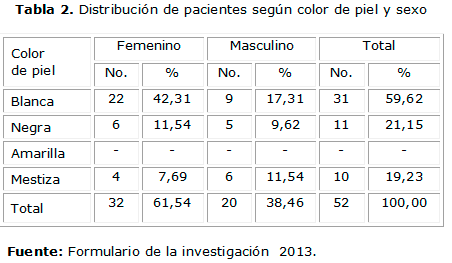
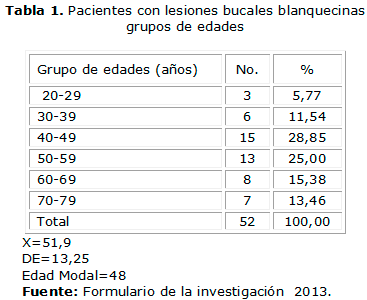
<body><![CDATA[<P>     <P><FONT FACE="Verdana, Arial, Helvetica, sans-serif" SIZE="3"><B>RESULTADOS</B></FONT><FONT FACE="Verdana, Arial, Helvetica, sans-serif" SIZE="2">  </FONT>    <P><FONT FACE="Verdana, Arial, Helvetica, sans-serif" SIZE="2">La <A HREF="#t1">Tabla  1</A> exhibe la distribuci&oacute;n de pacientes con lesiones blancas bucales  acorde a grupos de edades; se incluye adem&aacute;s la edad promedio del grupo,  la desviaci&oacute;n est&aacute;ndar y la edad modal. Se aprecia que predominaron  pacientes con edades comprendidas entre 40-49 a&ntilde;os (28,85%). La edad promedio  del grupo fue de 51,9 con una desviaci&oacute;n est&aacute;ndar de 13,25. La edad  modal fue 48. </FONT>    <P ALIGN="CENTER"><A NAME="t1"></A><IMG SRC="/img/revistas/rhcm/v13n5/t0106514.gif" WIDTH="367" HEIGHT="300">    <P>      <P><FONT FACE="Verdana, Arial, Helvetica, sans-serif" SIZE="2">La distribuci&oacute;n  de pacientes seg&uacute;n color de piel y sexo se aprecia en la <A HREF="#t2">Tabla  2</A>. Se evidencia que las lesiones blanquecinas predominaron en pacientes del  sexo femenino (61,74%) y pacientes de piel blanca (59,62%). </FONT>    <P ALIGN="CENTER"><A NAME="t2"></A><IMG SRC="/img/revistas/rhcm/v13n5/t0206514.gif" WIDTH="452" HEIGHT="263">    <P>      <P><FONT FACE="Verdana, Arial, Helvetica, sans-serif" SIZE="2">La distribuci&oacute;n  de lesiones blanquecinas acorde a su topograf&iacute;a se muestra en la <A HREF="#t3">Tabla  3</A>. Se muestran 67 localizaciones debido a la presencia de lesiones que incluyeron  en su extensi&oacute;n m&aacute;s de un &aacute;rea topogr&aacute;fica. Se observa  que la mucosa del carrillo result&oacute; el sitio de mayor asiento de lesiones  blanquecinas en 34,33% de los casos, le sigui&oacute; en frecuencia el reborde  alveolar inferior (14,93%). </FONT>    <P ALIGN="CENTER"><A NAME="t3"></A><IMG SRC="/img/revistas/rhcm/v13n5/t0306514.gif" WIDTH="422" HEIGHT="400">    ]]></body>
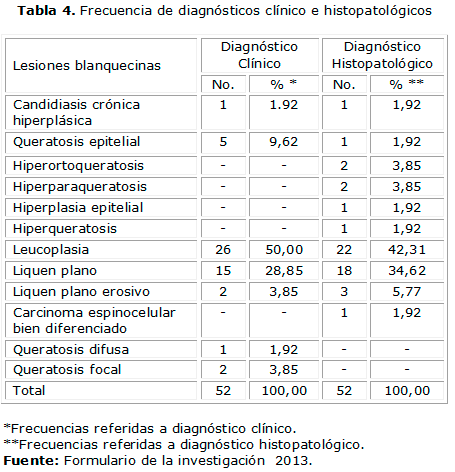
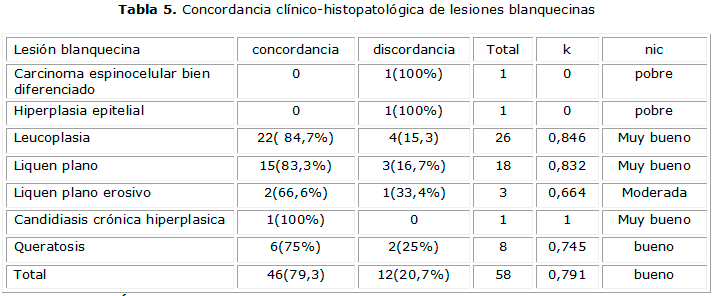
<body><![CDATA[<P>      <P><FONT FACE="Verdana, Arial, Helvetica, sans-serif" SIZE="2">La <A HREF="#t4">Tabla  4</A> ilustra la distribuci&oacute;n de pacientes acorde al diagn&oacute;stico  cl&iacute;nico e histopatol&oacute;gico. Se evidencia que la leucoplasia result&oacute;  la lesi&oacute;n blanquecina m&aacute;s diagnosticada cl&iacute;nicamente (50%),  seguida del liquen plano con 28,85%. Tambi&eacute;n se exhiben resultados del  examen histopatol&oacute;gico de los espec&iacute;menes enviados al laboratorio;  se evidencia que la leucoplasia tambi&eacute;n result&oacute; la lesi&oacute;n  blanquecina m&aacute;s encontrada en 42,31% de los casos. El carcinoma espinocelular  bien diferenciado result&oacute; 1,92% de la muestra. </FONT>    <P ALIGN="CENTER"><A NAME="t4"></A><IMG SRC="/img/revistas/rhcm/v13n5/t0406514.gif" WIDTH="455" HEIGHT="472">    <P>      <P><FONT FACE="Verdana, Arial, Helvetica, sans-serif" SIZE="2">Finalmente, la  <A HREF="/img/revistas/rhcm/v13n5/t0506514.gif">Tabla 5</A> exhibe la concordancia entre diagn&oacute;stico  cl&iacute;nico-histopatol&oacute;gico y su evaluaci&oacute;n cualitativa seg&uacute;n  lesi&oacute;n y grupo. Se observa un nivel de concordancia muy bueno en leucoplasia  (k=0,84), liquen plano (k=0,83) y en la candidiasis cr&oacute;nica hiperpl&aacute;sica  (k=1) . Resultando la concordancia final de todo el grupo, bueno (k=0,791). Se  exhibi&oacute; una concordancia pobre para la hiperplasia epitelial y el carcinoma  bien diferenciado. </FONT>    <P>&nbsp;    <P>     <P><FONT FACE="Verdana, Arial, Helvetica, sans-serif" SIZE="3"><B>DISCUSI&Oacute;N</B></FONT><FONT FACE="Verdana, Arial, Helvetica, sans-serif" SIZE="2"><B>  </B> </FONT>    <P><FONT FACE="Verdana, Arial, Helvetica, sans-serif" SIZE="2">En  nuestro trabajo se estudi&oacute; una muestra de 52 pacientes con lesiones blanquecinas  de la cavidad bucal con una edad promedio que resulta superior a lo encontrado  por Simi <SUP>1</SUP> en la India en una muestra semejante en un escenario hospitalario;  tambi&eacute;n result&oacute; superior a la media de 38,6 obtenida por Tatli <SUP>19</SUP>  en un escenario docente en Turqu&iacute;a, pero en una muestra muy numerosa y  que incluy&oacute; otras lesiones mucosas. </FONT>    <P><FONT FACE="Verdana, Arial, Helvetica, sans-serif" SIZE="2">Numerosos  estudios han expuesto la relaci&oacute;n entre el sexo y el color de la piel con  la aparici&oacute;n de lesiones bucales. En nuestro estudio, 61,54% de los sujetos  result&oacute; femenino, lo que resulta muy diferente de 88,9% de sujetos masculinos  registrado en la India por Patil <SUP>3</SUP> en muestra de pacientes fumadores  o mascadores de nuez de betel, pero concuerda con lo referido por Suliman<SUP>15</SUP>  en Sud&aacute;n en una muestra de referencia hospitalaria dermatol&oacute;gica.  Las referencias en relaci&oacute;n con el color de la piel son menos frecuentes,  pero la mayor&iacute;a de los trabajos consultados concuerda con nuestro estudio,<SUP>  5,13,19,20</SUP> predominando en sujetos de piel blanca, aunque es destacable  que mucha de ellas se realizaron en pa&iacute;ses con predomino racial blanco.  </FONT>    ]]></body>
<body><![CDATA[<P><FONT FACE="Verdana, Arial, Helvetica, sans-serif" SIZE="2">Topogr&aacute;ficamente,  nuestro estudio se caracteriz&oacute; por la prevalencia de lesiones en la mucosa  del carillo (34,33%), este hallazgo concuerda con los resultados de Simi,<SUP>1</SUP>  quien incluso subdividi&oacute; esta localizaci&oacute;n acorde a su lateralidad.  Brouns<SUP>5</SUP> tambi&eacute;n exhibi&oacute; semejantes hallazgos en Amsterdam  en estudios que profundizaron espec&iacute;ficamente en leucoplasia. Gorski y  Epstein,<SUP>13</SUP> por su parte, en trabajo dedicado a liquen plano encontr&oacute;  88% de esta localizaci&oacute;n en la Facultad Dental de Tel Aviv. </FONT>    <P><FONT FACE="Verdana, Arial, Helvetica, sans-serif" SIZE="2">En  nuestro estudio, 42,31% de las lesiones blanquecinas resultaron leucoplasias al  diagn&oacute;stico histopatol&oacute;gico; difiriendo de los escasos valores reportados  en el Norte de la India por Bhatnagar,<SUP>21</SUP> donde solo encontr&oacute;  leucoplasia en 2,83% de una extensa muestra poblacional, aunque solo report&oacute;  valoraci&oacute;n cl&iacute;nica. Misra,<SUP>4</SUP> tambi&eacute;n en India,  encontr&oacute; la leucoplasia como lesi&oacute;n premaligna m&aacute;s frecuente,  reportando 10% en su muestra. </FONT>    <P><FONT FACE="Verdana, Arial, Helvetica, sans-serif" SIZE="2">Las  tasa de liquen plano de nuestro estudio, 34,62%, result&oacute; relativamente  alta en relaci&oacute;n con otras series que analizan grupos poblacionales generales,<SUP>3,14</SUP>  donde la muestra no fue predominantemente femenina. Aunque Simi<SUP>1 </SUP>report&oacute;  en su serie 64% de liquen plano en registro de lesiones blanquecinas </FONT>    <P><FONT FACE="Verdana, Arial, Helvetica, sans-serif" SIZE="2">La  concordancia valorada de muy buena en nuestro estudio incluy&oacute; lesiones  como leucoplasia, liquen plano y <I>candidiasis </I>cr&oacute;nica hiperpl&aacute;sica  equipar&aacute;ndose acertadamente el diagn&oacute;stico cl&iacute;nico con el  histopatol&oacute;gico; en general, nuestra muestra calific&oacute; en concordancia  como buena (k=0,791), resultado que es algo inferior a Tatli,<SUP>19 </SUP>pero  s&iacute; concuerdan con los resultados de largos a&ntilde;os de observaci&oacute;n  de Suliman,<SUP>14,15 </SUP>en Sud&aacute;n. </FONT>    <P>&nbsp;    <P>     <P><FONT FACE="Verdana, Arial, Helvetica, sans-serif" SIZE="3"><B>CONCLUSIONES</B>  </FONT><UL>    <LI><FONT FACE="Verdana, Arial, Helvetica, sans-serif" SIZE="2">En  nuestra muestra de lesiones blanquecinas predominaron pacientes con edades entre  40-49 a&ntilde;os, de sexo femenino y piel blanca. </FONT></LI>    <LI><FONT FACE="Verdana, Arial, Helvetica, sans-serif" SIZE="2">La  regi&oacute;n anat&oacute;mica m&aacute;s afectada de lesiones blanquecinas result&oacute;  la mucosa del carrillo. </FONT></LI>    <LI><FONT FACE="Verdana, Arial, Helvetica, sans-serif" SIZE="2">Cl&iacute;nica  e histopatol&oacute;gicamente el diagn&oacute;stico m&aacute;s referido fue la  leucoplasia. </FONT></LI>    ]]></body>
<body><![CDATA[<LI><FONT FACE="Verdana, Arial, Helvetica, sans-serif" SIZE="2">Existi&oacute;  una concordancia muy buena entre diagn&oacute;sticos cl&iacute;nicos e histopatol&oacute;gicos  de leucoplasia y liquen plano. </FONT></LI>    <LI><FONT FACE="Verdana, Arial, Helvetica, sans-serif" SIZE="2">La  concordancia total de la muestra result&oacute; buena, influenciado por las pobres  concordancias encontradas en los diagn&oacute;sticos de hiperplasia epitelial  y carcinoma espinocelular bien diferenciado. </FONT></LI>    </UL>    <P>&nbsp;</P>    <P>    <P><FONT FACE="Verdana, Arial, Helvetica, sans-serif" SIZE="3"><B>REFERENCIAS  BIBLIOGR&Aacute;FICAS</B></FONT><FONT FACE="Verdana, Arial, Helvetica, sans-serif" SIZE="2">  </FONT>    <!-- ref --><P><FONT FACE="Verdana, Arial, Helvetica, sans-serif" SIZE="2">1. Simi  SM, Nandakumar G. White lesions in the oral cavity. A clinical histopathological  study from a tertiary care dermatology centre in Kerala INDIA. Indian J Dermatol.  [Serial on the Internet]. 2013 Jul.; 58(4):269-74. [Cited&#160;2014&#160; Mar&#160;  4]. Available from: <A HREF="http://dx.doi.org/10.4103%2F0019-5154.113933" TARGET="_blank">http://dx.doi.org/10.4103%2F0019-5154.113933</A>  </FONT>    <P>     <!-- ref --><P><FONT FACE="Verdana, Arial, Helvetica, sans-serif" SIZE="2">2. Ali  M, Joseph B. Prevalence of oral mucosal lesions in patients of the Kuwait University  Dental Center. Saudi Dental J. [Serial on the Internet]. 2013 Jul.;25(3):111-118.[Cited&#160;  2014&#160; Mar&#160; 5]. Available from: <A HREF="http://dx.doi.org/10.1016/j.sdentj.2013.05.003" TARGET="_blank">http://dx.doi.org/10.1016/j.sdentj.2013.05.003</A>  </FONT>    <P>     ]]></body>
<body><![CDATA[<!-- ref --><P><FONT FACE="Verdana, Arial, Helvetica, sans-serif" SIZE="2">3. Patil  P, Bathi R. Prevalence of oral mucosal lesions in dental patients with tobacco  smoking, chewing, and mixed habits: A cross-sectional study in South India. J  Family Community Med. [Serial on the Internet]. 2013 May.; 20(2). 130-135. [Cited&#160;  2014&#160; Mar&#160; 5]; Available from: <A HREF="http://dx.doi.org/10.4103%2F2230-8229.114777" TARGET="_blank">http://dx.doi.org/10.4103%2F2230-8229.114777</A>  </FONT>    <P>     <!-- ref --><P><FONT FACE="Verdana, Arial, Helvetica, sans-serif" SIZE="2">4. Misra  V, Singh P. Changing Pattern of Oral Cavity Lesions and Personal Habits Over a  Decade: Hospital Based Record Analysis from Allahabad. Indian J Community Med.  [Serial on the Internet].2009 Oct .; 34(4): 321-325. [Cited&#160; 2014&#160; Mar&#160;  1]. Available from: <A HREF="http://dx.doi.org/10.4103%2F0970-0218.58391" TARGET="_blank">http://dx.doi.org/10.4103%2F0970-0218.58391</A>  </FONT>    <P>     <!-- ref --><P><FONT FACE="Verdana, Arial, Helvetica, sans-serif" SIZE="2">5. Brouns  E, Baart J. The relevance of uniform reporting in oral leukoplakia: Definition,  certainty factor and staging based on experience with 275 patients. Med Oral Patol  Oral Cir Bucal. [Serial on the Internet]. 2013 Jan.; 18(1): 19-26. [Cited&#160;  2014&#160; Mar&#160; 11]. Available from: <A HREF="http://dx.doi.org/10.4317%2Fmedoral.18756" TARGET="_blank">http://dx.doi.org/10.4317%2Fmedoral.18756</A>  </FONT>    <P>     <!-- ref --><P><FONT FACE="Verdana, Arial, Helvetica, sans-serif" SIZE="2">6. Issrani  R, Prabhu N. Oral proliferative verrucous leukoplakia: A case report with an update.  Contemp Clin Dent. [Serial on the Internet]. 2013 Jan.; 4(2): 258-262. [Cited&#160;  2014&#160; Mar&#160; 13]. Available from: <U><A HREF="http://dx.doi.org/10.4103%2F0976-237X.114887" TARGET="_blank">http://dx.doi.org/10.4103%2F0976-237X.114887</A></U>  </FONT>    <P>     <!-- ref --><P><FONT FACE="Verdana, Arial, Helvetica, sans-serif" SIZE="2">7. Lee  L, Chen P. Quantitative physiology and immunohistochemistry of oral lesions. Biomed  Opt Express. [Serial on the Internet]. 2013 Nov.; 4(11): 2696-2709. [Cited&#160;  2014&#160; Mar&#160; 12]. Available from: <A HREF="http://dx.doi.org/10.1364%2FBOE.4.002696" TARGET="_blank">http://dx.doi.org/10.1364%2FBOE.4.002696</A>  </FONT>    <P>     ]]></body>
<body><![CDATA[<!-- ref --><P><FONT FACE="Verdana, Arial, Helvetica, sans-serif" SIZE="2">8. Tamgadge  S, Ganvir S. Oral leukoplakia: Transmission electron microscopic correlation with  clinical types and light microscopy. Dent Res J (Isfahan). [Serial on the Internet].  2012 Dec.; 9(1): 94-104. [Cited&#160; 2014&#160; Mar&#160; 10]. Available from:  <A HREF="http://www.ncbi.nlm.nih.gov/portal/utils/pageresolver.fcgi?recordid=1394927820919023" TARGET="_blank">http://www.ncbi.nlm.nih.gov/portal/utils/pageresolver.fcgi?recordid=1394927820919023</A>  </FONT>    <P>     <!-- ref --><P><FONT FACE="Verdana, Arial, Helvetica, sans-serif" SIZE="2">9. P&eacute;rez  Torres L, D&iacute;az Rojas P, Conde Mengana S, Rivero Manresa Y, Bello D&iacute;az  EA. Par&aacute;metros morfom&eacute;tricos de la mucosa en pacientes portadores  de leucoplasia bucal con displasia epitelial. AMC.&#160; [Revista en la Internet].  2013&#160; Ago.; 17(4): 468-478. [Citado&#160; 2014&#160; Mar&#160; 16]. Disponible  en: <A HREF="http://scielo.sld.cu/scielo.php?script=sci_arttext&pid=S1025-02552013000400005&lng=es" TARGET="_blank">http://scielo.sld.cu/scielo.php?script=sci_arttext&amp;pid=S1025-02552013000400005&amp;lng=es</A>.      </FONT>    <P>     <!-- ref --><P><FONT FACE="Verdana, Arial, Helvetica, sans-serif" SIZE="2">10.  Mart&iacute;nez-Sahuquillo A, Gallardo I. La leucoplasia oral. Su implicaci&oacute;n  como lesi&oacute;n precancerosa. Avances en Odontoestomatolog&iacute;a. Serial  on the Internet].2008 Ene.; 24(1):21-25. [Citado&#160; 2014&#160; Mar&#160; 16].  Disponible en: <A HREF="http://dx.doi.org/10.4321/S0213-12852008000100003" TARGET="_blank">http://dx.doi.org/10.4321/S0213-12852008000100003</A><U>  </U> </FONT>    <P>     <!-- ref --><P><FONT FACE="Verdana, Arial, Helvetica, sans-serif" SIZE="2">11.  Feller L, Lemmer J. Oral Leukoplakia as It Relates to HPV Infection: A Review.  Int J Dent. [Serial on the Internet]. 2012 Feb. [Cited&#160; 2014&#160; Mar&#160;  10]. Available from: <A HREF="http://dx.doi.org/10.1155%2F2012%2F540561" TARGET="_blank">http://dx.doi.org/10.1155%2F2012%2F540561</A>  </FONT>    <P>     <!-- ref --><P><FONT FACE="Verdana, Arial, Helvetica, sans-serif" SIZE="2">12.  Van der Waal I. Potentially malignant disorders of the oral and oropharyngeal  mucosa; present concepts of management. Oral Oncology. [Serial on the Internet].  2010 Feb.; 46(6):423-425. [Cited&#160; 2014&#160; Mar&#160; 10]. Available from:  <A HREF="http://www.ncbi.nlm.nih.gov/pubmed/20308005" TARGET="_blank">http://www.ncbi.nlm.nih.gov/pubmed/20308005</A>  </FONT>    <P>     <!-- ref --><P><FONT FACE="Verdana, Arial, Helvetica, sans-serif" SIZE="2">13.  Gorsky M, Epstein J. Smoking Habits Among Patients Diagnosed with Oral Lichen  Planus. Tob Induc Dis. [Serial on the Internet]. 2004 Jun.;2(2): 103-108. [Cited&#160;  2014&#160; Mar&#160; 9]. Available from: <A HREF="http://dx.doi.org/10.1186%2F1617-9625-2-2-103" TARGET="_blank">http://dx.doi.org/10.1186%2F1617-9625-2-2-103</A>  </FONT>    <P>     <!-- ref --><P><FONT FACE="Verdana, Arial, Helvetica, sans-serif" SIZE="2">14.  Suliman NM, Johannessen A. Influence of oral mucosal lesions and oral symptoms  on oral health related quality of life in dermatological patients: a cross sectional  study in Sudan. BMC Oral Health. [Serial on the Internet]. 2012 Jul;12: 19. [Cited&#160;  2014&#160; Mar&#160; 9]. Available from: <A HREF="http://dx.doi.org/10.1186%2F1472-6831-12-19" TARGET="_blank">http://dx.doi.org/10.1186%2F1472-6831-12-19</A>  </FONT>    <P>     <!-- ref --><P><FONT FACE="Verdana, Arial, Helvetica, sans-serif" SIZE="2">15.  Suliman NM, Astrom AN, Ali RW, Salman H, Johannessen AC. Oral mucosal lesions  in skin diseased patients attending a dermatologic clinic: a cross-sectional study  in Sudan. BMC Oral Health. [Serial on the Internet]. 2011 March.; 11(1):24. [Cited&#160;  2014&#160; Mar&#160; 9]. Avalaible from: <A HREF="http://www.ncbi.nlm.nih.gov/pmc/articles/PMC3187735/" TARGET="_blank">http://www.ncbi.nlm.nih.gov/pmc/articles/PMC3187735/</A>  </FONT>    <P>     <!-- ref --><P><FONT FACE="Verdana, Arial, Helvetica, sans-serif" SIZE="2">16.  Byadahally S, Rajappa S. Isolation and Identification of Candida from the Oral  Cavity. ISRN Dent. [Serial on the Internet]. 2011 Oct.;2011: 487921.[Cited&#160;  2014&#160; Mar&#160; 5]. Available from: <A HREF="http://dx.doi.org/10.5402%2F2011%2F487921" TARGET="_blank">http://dx.doi.org/10.5402%2F2011%2F487921</A>  </FONT>    <P>     <!-- ref --><P><FONT FACE="Verdana, Arial, Helvetica, sans-serif" SIZE="2">17.  Nweze El. Oral Candida isolates among HIV infected subjects in Nigeria. J Microbiol  Immunol Infect. [Serial on the Internet]. 2011 Jun.; 44(3):172-177. [Cited&#160;  2014&#160; Mar&#160; 10]. Available from: <U><FONT  COLOR="#0000ff"><A HREF="http://www.ncbi.nlm.nih.gov/pubmed/2152461" TARGET="_blank">http://www.ncbi.nlm.nih.gov/pubmed/21524610</A></FONT></U>  </FONT>    <P>     <!-- ref --><P><FONT FACE="Verdana, Arial, Helvetica, sans-serif" SIZE="2">18.  Wei L, Shun chi L. Oral Cancer Development in Patients with Leukoplakia _ Clinicopathological  Factors Affecting Outcome. PLoS One. [Serial on the Internet]. 2014; Apr.; 7(4):  e34773. [Cited&#160; 2014&#160; Mar&#160; 10]. Available from: <A HREF="http://dx.doi.org/10.1371%2Fjournal.pone.0034773" TARGET="_blank">http://dx.doi.org/10.1371%2Fjournal.pone.0034773</A>  </FONT>    <P>     <!-- ref --><P><FONT FACE="Verdana, Arial, Helvetica, sans-serif" SIZE="2">19.  Tatli U, Erdogan. Diagnostic Concordance characteristics of oral cavity lesions.  Scientific World Journal. [Serial on the Internet]. 2013 Jun. [Cited&#160; 2014&#160;  Mar&#160; 7] Available from: <A HREF="http://dx.doi.org/10.1155%2F2013%2F785929" TARGET="_blank">http://dx.doi.org/10.1155%2F2013%2F785929</A>  </FONT>    <P>     <!-- ref --><P><FONT FACE="Verdana, Arial, Helvetica, sans-serif" SIZE="2">20.  Jahanbani J, Sandvik L. Evaluation of Oral Mucosal Lesions in 598 Referred Iranian  Patients. Open Dent J. [Serial on the Internet]. 2009 Mar.; 3: 42-47. [ Cited&#160;  2014&#160; Mar&#160; 5]. Available from: <A HREF="http://dx.doi.org/10.2174%2F1874210600903010042" TARGET="_blank">http://dx.doi.org/10.2174%2F1874210600903010042</A>  </FONT>    <P>     <!-- ref --><P><FONT FACE="Verdana, Arial, Helvetica, sans-serif" SIZE="2">21.  Bhatnagar P. Prevalence study of oral mucosal lesions, mucosal variants, and treatment  required for patients reporting to a dental school in North India: In accordance  with WHO guidelines. J. Family Community Med. [Serial on the Internet]. 2013 Jan-Apr.;  20(1): 41-48. [Cited&#160; 2014&#160; Mar&#160; 4]. Available from: <A HREF="http://dx.doi.org/10.4103%2F2230-8229.108183" TARGET="_blank">http://dx.doi.org/10.4103%2F2230-8229.108183</A>  </FONT>    <P>&nbsp;    <P>&nbsp;    ]]></body>
<body><![CDATA[<P>     <P><FONT FACE="Verdana, Arial, Helvetica, sans-serif" SIZE="2">Recibido:  25 de marzo de 2014.     <BR></FONT><FONT FACE="Verdana, Arial, Helvetica, sans-serif" SIZE="2">Aprobado:  15 de septiembre de 2014. </FONT>       ]]></body><back>
<ref-list>
<ref id="B1">
<label>1</label><nlm-citation citation-type="journal">
<person-group person-group-type="author">
<name>
<surname><![CDATA[Simi]]></surname>
<given-names><![CDATA[SM]]></given-names>
</name>
<name>
<surname><![CDATA[Nandakumar]]></surname>
<given-names><![CDATA[G]]></given-names>
</name>
</person-group>
<article-title xml:lang="en"><![CDATA[White lesions in the oral cavity. A clinical histopathological study from a tertiary care dermatology centre in Kerala INDIA]]></article-title>
<source><![CDATA[Indian J Dermatol]]></source>
<year>2013</year>
<month> J</month>
<day>ul</day>
<volume>58</volume>
<numero>4</numero>
<issue>4</issue>
<page-range>269-74</page-range></nlm-citation>
</ref>
<ref id="B2">
<label>2</label><nlm-citation citation-type="journal">
<person-group person-group-type="author">
<name>
<surname><![CDATA[Ali]]></surname>
<given-names><![CDATA[M]]></given-names>
</name>
<name>
<surname><![CDATA[Joseph]]></surname>
<given-names><![CDATA[B]]></given-names>
</name>
</person-group>
<article-title xml:lang="en"><![CDATA[Prevalence of oral mucosal lesions in patients of the Kuwait University Dental Center]]></article-title>
<source><![CDATA[Saudi Dental J.]]></source>
<year>2013</year>
<month> J</month>
<day>ul</day>
<volume>25</volume>
<numero>3</numero>
<issue>3</issue>
<page-range>111-118</page-range></nlm-citation>
</ref>
<ref id="B3">
<label>3</label><nlm-citation citation-type="journal">
<person-group person-group-type="author">
<name>
<surname><![CDATA[Patil]]></surname>
<given-names><![CDATA[P]]></given-names>
</name>
<name>
<surname><![CDATA[Bathi]]></surname>
<given-names><![CDATA[R]]></given-names>
</name>
</person-group>
<article-title xml:lang="en"><![CDATA[Prevalence of oral mucosal lesions in dental patients with tobacco smoking, chewing, and mixed habits: A cross-sectional study in South India]]></article-title>
<source><![CDATA[J Family Community Med]]></source>
<year>2013</year>
<month> M</month>
<day>ay</day>
<volume>20</volume>
<numero>2</numero>
<issue>2</issue>
<page-range>130-135</page-range></nlm-citation>
</ref>
<ref id="B4">
<label>4</label><nlm-citation citation-type="journal">
<person-group person-group-type="author">
<name>
<surname><![CDATA[Misra]]></surname>
<given-names><![CDATA[V]]></given-names>
</name>
<name>
<surname><![CDATA[Singh]]></surname>
<given-names><![CDATA[P]]></given-names>
</name>
</person-group>
<article-title xml:lang="en"><![CDATA[Changing Pattern of Oral Cavity Lesions and Personal Habits Over a Decade: Hospital Based Record Analysis from Allahabad]]></article-title>
<source><![CDATA[Indian J Community Med]]></source>
<year>2009</year>
<month> O</month>
<day>ct</day>
<volume>34</volume>
<numero>4</numero>
<issue>4</issue>
<page-range>321-325</page-range></nlm-citation>
</ref>
<ref id="B5">
<label>5</label><nlm-citation citation-type="journal">
<person-group person-group-type="author">
<name>
<surname><![CDATA[Brouns]]></surname>
<given-names><![CDATA[E]]></given-names>
</name>
<name>
<surname><![CDATA[Baart]]></surname>
<given-names><![CDATA[J]]></given-names>
</name>
</person-group>
<article-title xml:lang="en"><![CDATA[The relevance of uniform reporting in oral leukoplakia: Definition, certainty factor and staging based on experience with 275 patients]]></article-title>
<source><![CDATA[Med Oral Patol Oral Cir Bucal]]></source>
<year>2013</year>
<month> J</month>
<day>an</day>
<volume>18</volume>
<numero>1</numero>
<issue>1</issue>
<page-range>19-26</page-range></nlm-citation>
</ref>
<ref id="B6">
<label>6</label><nlm-citation citation-type="journal">
<person-group person-group-type="author">
<name>
<surname><![CDATA[Issrani]]></surname>
<given-names><![CDATA[R]]></given-names>
</name>
<name>
<surname><![CDATA[Prabhu]]></surname>
<given-names><![CDATA[N]]></given-names>
</name>
</person-group>
<article-title xml:lang="en"><![CDATA[Oral proliferative verrucous leukoplakia: A case report with an update]]></article-title>
<source><![CDATA[Contemp Clin Dent]]></source>
<year>2013</year>
<month> J</month>
<day>an</day>
<volume>4</volume>
<numero>2</numero>
<issue>2</issue>
<page-range>258-262</page-range></nlm-citation>
</ref>
<ref id="B7">
<label>7</label><nlm-citation citation-type="journal">
<person-group person-group-type="author">
<name>
<surname><![CDATA[Lee]]></surname>
<given-names><![CDATA[L]]></given-names>
</name>
<name>
<surname><![CDATA[Chen]]></surname>
<given-names><![CDATA[P]]></given-names>
</name>
</person-group>
<article-title xml:lang="en"><![CDATA[Quantitative physiology and immunohistochemistry of oral lesions]]></article-title>
<source><![CDATA[Biomed Opt Express]]></source>
<year>2013</year>
<month> N</month>
<day>ov</day>
<volume>4</volume>
<numero>11</numero>
<issue>11</issue>
<page-range>2696-2709</page-range></nlm-citation>
</ref>
<ref id="B8">
<label>8</label><nlm-citation citation-type="journal">
<person-group person-group-type="author">
<name>
<surname><![CDATA[Tamgadge]]></surname>
<given-names><![CDATA[S]]></given-names>
</name>
<name>
<surname><![CDATA[Ganvir]]></surname>
<given-names><![CDATA[S]]></given-names>
</name>
</person-group>
<article-title xml:lang="en"><![CDATA[Oral leukoplakia: Transmission electron microscopic correlation with clinical types and light microscopy]]></article-title>
<source><![CDATA[Dent Res J (Isfahan)]]></source>
<year>2012</year>
<month> D</month>
<day>ec</day>
<volume>9</volume>
<numero>1</numero>
<issue>1</issue>
<page-range>94-104</page-range></nlm-citation>
</ref>
<ref id="B9">
<label>9</label><nlm-citation citation-type="journal">
<person-group person-group-type="author">
<name>
<surname><![CDATA[Pérez Torres]]></surname>
<given-names><![CDATA[L]]></given-names>
</name>
<name>
<surname><![CDATA[Díaz Rojas]]></surname>
<given-names><![CDATA[P]]></given-names>
</name>
<name>
<surname><![CDATA[Conde Mengana]]></surname>
<given-names><![CDATA[S]]></given-names>
</name>
<name>
<surname><![CDATA[Rivero Manresa]]></surname>
<given-names><![CDATA[Y]]></given-names>
</name>
<name>
<surname><![CDATA[Bello Díaz]]></surname>
<given-names><![CDATA[EA]]></given-names>
</name>
</person-group>
<article-title xml:lang="es"><![CDATA[Parámetros morfométricos de la mucosa en pacientes portadores de leucoplasia bucal con displasia epitelial]]></article-title>
<source><![CDATA[AMC]]></source>
<year>2013</year>
<month> A</month>
<day>go</day>
<volume>17</volume>
<numero>4</numero>
<issue>4</issue>
<page-range>468-478</page-range></nlm-citation>
</ref>
<ref id="B10">
<label>10</label><nlm-citation citation-type="">
<source><![CDATA[]]></source>
<year></year>
</nlm-citation>
</ref>
<ref id="B11">
<label>11</label><nlm-citation citation-type="journal">
<person-group person-group-type="author">
<name>
<surname><![CDATA[Feller]]></surname>
<given-names><![CDATA[L]]></given-names>
</name>
<name>
<surname><![CDATA[Lemmer]]></surname>
<given-names><![CDATA[J]]></given-names>
</name>
</person-group>
<article-title xml:lang="en"><![CDATA[Oral Leukoplakia as It Relates to HPV Infection: A Review]]></article-title>
<source><![CDATA[Int J Dent]]></source>
<year>2012</year>
<month> F</month>
<day>eb</day>
</nlm-citation>
</ref>
<ref id="B12">
<label>12</label><nlm-citation citation-type="journal">
<person-group person-group-type="author">
<name>
<surname><![CDATA[Van der Waal]]></surname>
<given-names><![CDATA[I]]></given-names>
</name>
</person-group>
<article-title xml:lang="en"><![CDATA[Potentially malignant disorders of the oral and oropharyngeal mucosa; present concepts of management]]></article-title>
<source><![CDATA[Oral Oncology]]></source>
<year>2010</year>
<month> F</month>
<day>eb</day>
<volume>46</volume>
<numero>6</numero>
<issue>6</issue>
<page-range>423-425</page-range></nlm-citation>
</ref>
<ref id="B13">
<label>13</label><nlm-citation citation-type="journal">
<person-group person-group-type="author">
<name>
<surname><![CDATA[Gorsky]]></surname>
<given-names><![CDATA[M]]></given-names>
</name>
<name>
<surname><![CDATA[Epstein]]></surname>
<given-names><![CDATA[J]]></given-names>
</name>
</person-group>
<article-title xml:lang="en"><![CDATA[Smoking Habits Among Patients Diagnosed with Oral Lichen Planus]]></article-title>
<source><![CDATA[Tob Induc Dis]]></source>
<year>2004</year>
<month> J</month>
<day>un</day>
<volume>2</volume>
<numero>2</numero>
<issue>2</issue>
<page-range>103-108</page-range></nlm-citation>
</ref>
<ref id="B14">
<label>14</label><nlm-citation citation-type="journal">
<person-group person-group-type="author">
<name>
<surname><![CDATA[Suliman]]></surname>
<given-names><![CDATA[NM]]></given-names>
</name>
<name>
<surname><![CDATA[Johannessen]]></surname>
<given-names><![CDATA[A]]></given-names>
</name>
</person-group>
<article-title xml:lang="en"><![CDATA[Influence of oral mucosal lesions and oral symptoms on oral health related quality of life in dermatological patients: a cross sectional study in Sudan]]></article-title>
<source><![CDATA[BMC Oral Health]]></source>
<year>2012</year>
<month> J</month>
<day>ul</day>
<volume>12</volume>
<page-range>19</page-range></nlm-citation>
</ref>
<ref id="B15">
<label>15</label><nlm-citation citation-type="journal">
<person-group person-group-type="author">
<name>
<surname><![CDATA[Suliman]]></surname>
<given-names><![CDATA[NM]]></given-names>
</name>
<name>
<surname><![CDATA[Astrom]]></surname>
<given-names><![CDATA[AN]]></given-names>
</name>
<name>
<surname><![CDATA[Ali]]></surname>
<given-names><![CDATA[RW]]></given-names>
</name>
<name>
<surname><![CDATA[Salman]]></surname>
<given-names><![CDATA[H]]></given-names>
</name>
<name>
<surname><![CDATA[Johannessen]]></surname>
<given-names><![CDATA[AC]]></given-names>
</name>
</person-group>
<article-title xml:lang="en"><![CDATA[Oral mucosal lesions in skin diseased patients attending a dermatologic clinic: a cross-sectional study in Sudan]]></article-title>
<source><![CDATA[BMC Oral Health]]></source>
<year>2011</year>
<month> M</month>
<day>ar</day>
<volume>11</volume>
<numero>1</numero>
<issue>1</issue>
<page-range>24</page-range></nlm-citation>
</ref>
<ref id="B16">
<label>16</label><nlm-citation citation-type="journal">
<person-group person-group-type="author">
<name>
<surname><![CDATA[Byadahally]]></surname>
<given-names><![CDATA[S]]></given-names>
</name>
<name>
<surname><![CDATA[Rajappa]]></surname>
<given-names><![CDATA[S]]></given-names>
</name>
</person-group>
<article-title xml:lang="en"><![CDATA[Isolation and Identification of Candida from the Oral Cavity]]></article-title>
<source><![CDATA[ISRN Dent]]></source>
<year>2011</year>
<month> O</month>
<day>ct</day>
<volume>2011</volume>
<page-range>487921</page-range></nlm-citation>
</ref>
<ref id="B17">
<label>17</label><nlm-citation citation-type="journal">
<person-group person-group-type="author">
<name>
<surname><![CDATA[Nweze]]></surname>
<given-names><![CDATA[El]]></given-names>
</name>
</person-group>
<article-title xml:lang="en"><![CDATA[Oral Candida isolates among HIV infected subjects in Nigeria]]></article-title>
<source><![CDATA[J Microbiol Immunol Infect]]></source>
<year>2011</year>
<month> J</month>
<day>un</day>
<volume>44</volume>
<numero>3</numero>
<issue>3</issue>
<page-range>172-177</page-range></nlm-citation>
</ref>
<ref id="B18">
<label>18</label><nlm-citation citation-type="journal">
<person-group person-group-type="author">
<name>
<surname><![CDATA[Wei]]></surname>
<given-names><![CDATA[L]]></given-names>
</name>
<name>
<surname><![CDATA[Shun chi]]></surname>
<given-names><![CDATA[L]]></given-names>
</name>
</person-group>
<article-title xml:lang="en"><![CDATA[Oral Cancer Development in Patients with Leukoplakia _ Clinicopathological Factors Affecting Outcome]]></article-title>
<source><![CDATA[PLoS One]]></source>
<year>2014</year>
<month>; </month>
<day>Ap</day>
<volume>7</volume>
<numero>4</numero>
<issue>4</issue>
<page-range>e34773</page-range></nlm-citation>
</ref>
<ref id="B19">
<label>19</label><nlm-citation citation-type="journal">
<person-group person-group-type="author">
<name>
<surname><![CDATA[Tatli]]></surname>
<given-names><![CDATA[U]]></given-names>
</name>
<name>
<surname><![CDATA[Erdogan]]></surname>
</name>
</person-group>
<article-title xml:lang="en"><![CDATA[Diagnostic Concordance characteristics of oral cavity lesions]]></article-title>
<source><![CDATA[Scientific World Journal]]></source>
<year>2013</year>
<month> J</month>
<day>un</day>
</nlm-citation>
</ref>
<ref id="B20">
<label>20</label><nlm-citation citation-type="journal">
<person-group person-group-type="author">
<name>
<surname><![CDATA[Jahanbani]]></surname>
<given-names><![CDATA[J]]></given-names>
</name>
<name>
<surname><![CDATA[Sandvik]]></surname>
<given-names><![CDATA[L]]></given-names>
</name>
</person-group>
<article-title xml:lang="en"><![CDATA[Evaluation of Oral Mucosal Lesions in 598 Referred Iranian Patients]]></article-title>
<source><![CDATA[Open Dent J]]></source>
<year>2009</year>
<month> M</month>
<day>ar</day>
<volume>3</volume>
<page-range>42-47</page-range></nlm-citation>
</ref>
<ref id="B21">
<label>21</label><nlm-citation citation-type="journal">
<person-group person-group-type="author">
<name>
<surname><![CDATA[Bhatnagar]]></surname>
<given-names><![CDATA[P]]></given-names>
</name>
</person-group>
<article-title xml:lang="en"><![CDATA[Prevalence study of oral mucosal lesions, mucosal variants, and treatment required for patients reporting to a dental school in North India: In accordance with WHO guidelines]]></article-title>
<source><![CDATA[J. Family Community Med]]></source>
<year>2013</year>
<month> J</month>
<day>an</day>
<volume>20</volume>
<numero>1</numero>
<issue>1</issue>
<page-range>41-48</page-range></nlm-citation>
</ref>
</ref-list>
</back>
</article>