<?xml version="1.0" encoding="ISO-8859-1"?><article xmlns:mml="http://www.w3.org/1998/Math/MathML" xmlns:xlink="http://www.w3.org/1999/xlink" xmlns:xsi="http://www.w3.org/2001/XMLSchema-instance">
<front>
<journal-meta>
<journal-id>1729-519X</journal-id>
<journal-title><![CDATA[Revista Habanera de Ciencias Médicas]]></journal-title>
<abbrev-journal-title><![CDATA[Rev haban cienc méd]]></abbrev-journal-title>
<issn>1729-519X</issn>
<publisher>
<publisher-name><![CDATA[Universidad de Ciencias Médicas de la Habana]]></publisher-name>
</publisher>
</journal-meta>
<article-meta>
<article-id>S1729-519X2014000500008</article-id>
<title-group>
<article-title xml:lang="en"><![CDATA[Congenital heart diseases in neonatal unit at Al-Wahda Pediatric Teaching Hospital, Aden, Yemen (2012- 2013)]]></article-title>
<article-title xml:lang="es"><![CDATA[Cardiopatías congénitas en la unidad neonatal del Hospital Docente Pediátrico Al-Wahda, Adén, Yemen (2012- 2013)]]></article-title>
</title-group>
<contrib-group>
<contrib contrib-type="author">
<name>
<surname><![CDATA[Hussein Badi]]></surname>
<given-names><![CDATA[Mohammed Ali]]></given-names>
</name>
<xref ref-type="aff" rid="A01"/>
</contrib>
<contrib contrib-type="author">
<name>
<surname><![CDATA[García Triana]]></surname>
<given-names><![CDATA[Bárbara Elena]]></given-names>
</name>
<xref ref-type="aff" rid="A02"/>
</contrib>
</contrib-group>
<aff id="A02">
<institution><![CDATA[,Universidad de Ciencias Médicas de La Habana Facultad de Estomatología Departamento de Morfofisiología]]></institution>
<addr-line><![CDATA[ ]]></addr-line>
</aff>
<aff id="A01">
<institution><![CDATA[,University of Aden Faculty of Medicine Department of Pediatrics]]></institution>
<addr-line><![CDATA[ ]]></addr-line>
<country>Yemen</country>
</aff>
<pub-date pub-type="pub">
<day>00</day>
<month>10</month>
<year>2014</year>
</pub-date>
<pub-date pub-type="epub">
<day>00</day>
<month>10</month>
<year>2014</year>
</pub-date>
<volume>13</volume>
<numero>5</numero>
<fpage>708</fpage>
<lpage>718</lpage>
<copyright-statement/>
<copyright-year/>
<self-uri xlink:href="http://scielo.sld.cu/scielo.php?script=sci_arttext&amp;pid=S1729-519X2014000500008&amp;lng=en&amp;nrm=iso"></self-uri><self-uri xlink:href="http://scielo.sld.cu/scielo.php?script=sci_abstract&amp;pid=S1729-519X2014000500008&amp;lng=en&amp;nrm=iso"></self-uri><self-uri xlink:href="http://scielo.sld.cu/scielo.php?script=sci_pdf&amp;pid=S1729-519X2014000500008&amp;lng=en&amp;nrm=iso"></self-uri><kwd-group>
<kwd lng="en"><![CDATA[congenital]]></kwd>
<kwd lng="en"><![CDATA[heart disease]]></kwd>
<kwd lng="en"><![CDATA[prevalence]]></kwd>
<kwd lng="en"><![CDATA[Aden]]></kwd>
<kwd lng="es"><![CDATA[congénito]]></kwd>
<kwd lng="es"><![CDATA[enfermedad cardiaca]]></kwd>
<kwd lng="es"><![CDATA[prevalencia]]></kwd>
<kwd lng="es"><![CDATA[Adén]]></kwd>
</kwd-group>
</article-meta>
</front><body><![CDATA[ <DIV ALIGN="RIGHT">    <P><FONT FACE="Verdana, Arial, Helvetica, sans-serif" SIZE="2"><B>CIENCIAS  CL&Iacute;NICAS Y PATOL&Oacute;GICAS</B></FONT></P>    <P>&nbsp;</P></DIV>    <P><FONT FACE="Verdana, Arial, Helvetica, sans-serif" SIZE="2">University  of Aden, Yemen     <BR></FONT><FONT FACE="Verdana, Arial, Helvetica, sans-serif" SIZE="2">Faculty  of Medicine. Department of Pediatrics.     <BR></FONT><FONT FACE="Verdana, Arial, Helvetica, sans-serif" SIZE="2">Universidad  de Ciencias M&eacute;dicas de La Habana     <BR></FONT><FONT FACE="Verdana, Arial, Helvetica, sans-serif" SIZE="2">Facultad  de Estomatolog&iacute;a. Departamento de Morfofisiolog&iacute;a. </FONT>    <P>&nbsp;    <P>      <P>    ]]></body>
<body><![CDATA[<P><FONT FACE="Verdana, Arial, Helvetica, sans-serif" SIZE="4"><B>Congenital  heart diseases in neonatal unit at Al-Wahda Pediatric Teaching Hospital, Aden,  Yemen (2012- 2013) </B></FONT></P>    <P>&nbsp;</P><B>    <P>     <P><FONT FACE="Verdana, Arial, Helvetica, sans-serif" SIZE="3">Cardiopat&iacute;as  cong&eacute;nitas en la unidad neonatal del Hospital Docente Pedi&aacute;trico  Al-Wahda, Ad&eacute;n, Yemen (2012- 2013)</FONT></B>     <P>&nbsp;</P>    <P>&nbsp;</P>    <P>     <P><B><FONT FACE="Verdana, Arial, Helvetica, sans-serif" SIZE="2">Mohammed  Ali Hussein Badi, Ph.D.,<SUP>I</SUP> B&aacute;rbara Elena Garc&iacute;a Triana,  PH.D.<SUP>II </SUP></FONT></B>    <P><FONT FACE="Verdana, Arial, Helvetica, sans-serif" SIZE="2"><SUP>I</SUP>  Doctor in Public Health and Community Medicine. MSc. in Pediatrics. Assistant  Professor. Department of Pediatrics, Faculty of Medicine, University of Aden,  Yemen. e.mail: <U><FONT COLOR="#0000ff"><A HREF="mailto:mohamedbadi1@yahoo.com">mohamedbadi1@yahoo.com</A></FONT></U>      <BR></FONT><FONT FACE="Verdana, Arial, Helvetica, sans-serif" SIZE="2"><SUP>II</SUP>  Doctor in Medical Sciences, Second degree specialist in Clinical Biochemistry.  Full Professor. Medical University of Havana, Cuba. Faculty of Dentistry. Department  of Morphophysiology. e.mail: <U><FONT  COLOR="#0000ff"><A HREF="mailto:barbara.garcia@infomed.sld.cu">barbara.garcia@infomed.sld.cu</A></FONT></U>  </FONT>    ]]></body>
<body><![CDATA[<P>     <P>     <P>    <P>&nbsp;</P>    <P>&nbsp;</P><HR>    <P><FONT FACE="Verdana, Arial, Helvetica, sans-serif" SIZE="2"><B>ABSTRACT  </B></FONT></P>    <P><FONT FACE="Verdana, Arial, Helvetica, sans-serif" SIZE="2"><B>Introduction</B>:  congenital heart diseases are serious and common conditions that have significant  impact on morbidity, mortality, and healthcare costs in children and adults.     <BR>  <B>Objective</B>: to identify the prevalence and pattern of congenital heart diseases  in the neonatal unit of Al-Wahda Pediatric Teaching Hospital in Aden, Yemen.     <BR>  <B>Material and Methods</B>: this descriptive cross-sectional study included all  of the newborns at Al-Wahda Pediatric Teaching Hospital, from January 2012 to  December 2013 (12987 newborns). Clinical examination, echocardiography and radiography  were used for diagnostic and a total of 69 newborns were diagnosed with congenital  heart diseases (41 males and 28 females) during the period. Clinical and demographic  data were collected from the charts of patients for analysis.     <BR> <B>Results</B>:  the prevalence of congenital heart diseases was 5.3/1000 live births. Ventricular  septal defect (39.1%), atrial septal defect (24.1%) and complex congenital heart  disease (24.1%) were the more frequent forms. Respiratory distress was the commonest  symptom (97.1%) and among the non-cardiac anomalies, Down's syndrome (10.1%) was  predominant.<I> </I>    ]]></body>
<body><![CDATA[<BR> <B>Conclusions</B>: Congenital heart disease is a public  health problem among newborns at Al-Wahda Pediatric Teaching Hospital in Aden,  being the commonest forms ventricular septal defect, atrial septal defect and  complex congenital heart disease, in which male predominance is found. Integrated  effects from all authorities should be directed to families and doctors for prevention,  early diagnosis and proper intervention. </FONT>    <P>     <P><FONT FACE="Verdana, Arial, Helvetica, sans-serif" SIZE="2"><B>Keywords:  </B>Congenital, heart disease, prevalence, Aden. </FONT><HR>    <P>     <P><FONT FACE="Verdana, Arial, Helvetica, sans-serif" SIZE="2"><B>RESUMEN  </B></FONT>    <P><FONT FACE="Verdana, Arial, Helvetica, sans-serif" SIZE="2"><B>Introducci&oacute;n</B>:  las cardiopat&iacute;as cong&eacute;nitas son problemas de salud comunes con impacto  significativo en la morbilidad, mortalidad y costos de salud en ni&ntilde;os y  adultos.<B>     <BR> Objectivo</B>: identificar la prevalencia y patr&oacute;n de  las cardiopat&iacute;as cong&eacute;nitas en la unidad neonatal del Hospital Docente  Pedi&aacute;trico &#168;Al-Wahda&#168; de Ad&eacute;n, Yemen. <B>    <BR> Material  y M&eacute;todos</B>: este estudio descriptivo transversal incluy&oacute; a los  neonatos en el Hospital Docente Pedi&aacute;trico &#168;Al-Wahda&#168; desde enero  2012 a diciembre 2013 (12987 neonatos). El diagn&oacute;stico se bas&oacute; en  examen cl&iacute;nico, ecocardiogr&aacute;fico y radiogr&aacute;fico por el cual  se identificaron 69 neonatos con cardiopat&iacute;as cong&eacute;nitas (41 ni&ntilde;os  y 28 ni&ntilde;as). Se obtuvieron datos cl&iacute;nicos y demogr&aacute;ficos  de las historias cl&iacute;nicas para su an&aacute;lisis.<B>     <BR> Resultados</B>:  la prevalencia de cardiopat&iacute;a cong&eacute;nita fue de 5.3/1000 nacidos  vivos. Las formas m&aacute;s frecuentes fueron la comunicaci&oacute;n interventricular  (39,1%), la comunicaci&oacute;n interatrial (24.1%) y la cardiopat&iacute;a cong&eacute;nita  compleja (24.1%), y predomin&oacute; el sexo masculino. El distr&eacute;s respiratorio  fue el s&iacute;ntoma m&aacute;s com&uacute;n (97,1%) y entre las anomal&iacute;as  no-cardiacas el s&iacute;ndrome de Down predomin&oacute; (10,1%).     <BR> <B>Conclusiones</B>:  la enfermedad cardiaca cong&eacute;nita es un problema de salud p&uacute;blica  entre los reci&eacute;n nacidos en el Hospital bajo estudio, y las formas m&aacute;s  comunes son el defecto ventricular septal, el defecto atrial septal y la enfermedad  cardiaca cong&eacute;nita compleja, con predominio del sexo masculino. Esfuerzos  integrados de las autoridades deben dirigirse a familias y personal de salud para  la prevenci&oacute;n, diagn&oacute;stico temprano e intervenci&oacute;n apropiada  de estas afecciones. </FONT>    ]]></body>
<body><![CDATA[<P>     <P><FONT FACE="Verdana, Arial, Helvetica, sans-serif" SIZE="2"><B>Palabras  clave<I>:</I></B> Cong&eacute;nito; enfermedad cardiaca, prevalencia, Ad&eacute;n.  </FONT><HR>    <P>&nbsp;    <P><FONT FACE="Verdana, Arial, Helvetica, sans-serif" SIZE="2">  </FONT>    <P>     <P><FONT FACE="Verdana, Arial, Helvetica, sans-serif" SIZE="3"><B>INTRODUCTION  </B> </FONT>    <P><FONT FACE="Verdana, Arial, Helvetica, sans-serif" SIZE="2">Congenital  heart diseases (CHD) are serious and common conditions that have significant impact  on morbidity, mortality, and healthcare costs in children and adults.<SUP>1</SUP>  these are abnormalities of the heart's structure and function caused by abnormal  or disordered heart development before birth.<SUP>2</SUP> </FONT>    <P><FONT FACE="Verdana, Arial, Helvetica, sans-serif" SIZE="2">Prevalence  of congenital heart disease is the rate of the total number of cases of congenital  heart diseases divided by the total population, usually expressed as the number  of babies born with congenital heart disease per 1,000 live births.<SUP>3</SUP>  </FONT>    <P><FONT FACE="Verdana, Arial, Helvetica, sans-serif" SIZE="2">The global  prevalence of CHD among newborns ranges from approximately 3.7 to 17.5 per 1.000,  which account for 30-45% of all congenital defects.<SUP>4</SUP> Continental variations  in birth prevalence have been reported, from 6.9 per 1000 births in Europe to  9.3 per 1000 in Asia.<SUP>1</SUP> </FONT>    <P><FONT FACE="Verdana, Arial, Helvetica, sans-serif" SIZE="2">According  to a report, 45% of infant deaths owing to congenital anomalies were caused by  CHD in Western Europe.<SUP>4</SUP> </FONT>    ]]></body>
<body><![CDATA[<P><FONT FACE="Verdana, Arial, Helvetica, sans-serif" SIZE="2">Prevalence  of congenital heart disease is underestimated due to home deliveries and early  discharge of mothers along with their neonates from hospitals, without proper  neonatal examination pertinent to cardiovascular system by a qualified and experienced  person.<SUP>5</SUP> </FONT>    <P><FONT FACE="Verdana, Arial, Helvetica, sans-serif" SIZE="2">Etiology  of CHD is multi factorial and a large collection of environmental and genetic  causes have a role in its pathogenesis.<SUP>6</SUP> </FONT>    <P><FONT FACE="Verdana, Arial, Helvetica, sans-serif" SIZE="2">The  most common CHD has been ventricular septal defect, followed by atrial septal  defect, patent ductus arteriosus, tetralogy of Fallot, single ventricle, atrium  ventricular septal defect and double outlet right ventricle.<SUP>7</SUP> </FONT>    <P><FONT FACE="Verdana, Arial, Helvetica, sans-serif" SIZE="2">The  warning signs of congenital heart disease in infants and children may include  a heart murmur or abnormal heart sound, cyanosis (a bluish tint to the skin, fingernails  and/or lips), fast breathing, anorexia, poor weight gain, an inability to exercise  and excessive sweating. <SUP>8</SUP> </FONT>    <P>     <P><FONT FACE="Verdana, Arial, Helvetica, sans-serif" SIZE="2">The  present study made specific efforts to detect all possible cases of CHD by examining  all neonates admitted in neonatal unit of Al-Wahda Pediatric Teaching Hospital  in Aden. There are no authentic data regarding the prevalence of CHD at national  level and it is almost nil in this hospital, where children with CHD are admitted  for treatment and its catchments area is very large, covering many governments  in Yemen. This factors increase the load of patient which ultimately increase  the prevalence of CHD in infancy in this hospital. </FONT>    <P><FONT FACE="Verdana, Arial, Helvetica, sans-serif" SIZE="2">This  knowledge is important for providers of care for patients with CHD as well as  for policy makers. </FONT>    <P><FONT FACE="Verdana, Arial, Helvetica, sans-serif" SIZE="2">The  objective of the work is to identify the prevalence and pattern of congenital  heart diseases in the neonatal unit of Al-Wahda Pediatric Teaching Hospital in  Aden, Yemen. </FONT>    <P>&nbsp;    <P>     ]]></body>
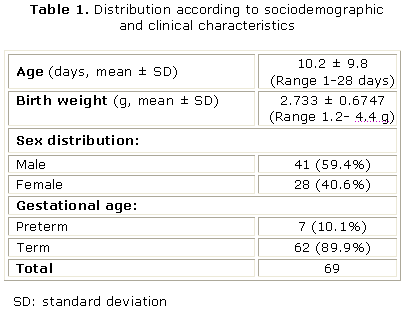
<body><![CDATA[<P><FONT FACE="Verdana, Arial, Helvetica, sans-serif" SIZE="2"><B><FONT SIZE="3">MATERIAL  AND METHODS</FONT></B> </FONT>    <P><FONT FACE="Verdana, Arial, Helvetica, sans-serif" SIZE="2">This  was a descriptive cross-sectional study carried out for two years (January 2012  to December 2013). It included all of the newborns at the hospital: Al-Wahda Pediatric  Teaching Hospital from Aden, Yemen, in that period of time (12987 newborns), among  which 69 newborns were diagnosed with CHD (41 males and 28 females, mean age 10.2  &#177; 9.8 days). </FONT>    <P><FONT FACE="Verdana, Arial, Helvetica, sans-serif" SIZE="2">CHD  was suspected in the presence of the following criteria defined by Mitchell et  al.:<SUP> 9</SUP> presence of cardiac murmur, presence of cyanosis or feeding  difficulty only, cyanosis associated with feeding difficulty, presence of congestive  heart failure or failure to thrive. Clinical examination, echocardiography and  radiography were considered as definitive tools for diagnosis of CHD.<SUP>9</SUP>  Babies of diabetic mothers, all Down's syndrome babies and babies with congenital  malformations were screened additionally. </FONT>    <P><FONT FACE="Verdana, Arial, Helvetica, sans-serif" SIZE="2">The  studied variables included: admission weight in grams<B>,</B> gestational age  (preterm: &lt;37 weeks and term: 37- 42 weeks),<SUP>10</SUP> sex (male and female),  residency of the children, clinical presentation of congenial heart diseases on  admission, non-cardiac anomalies of congenial heart diseases on admission (Down's  syndrome, cleft lip with palate, hernia and renal anomaly) and history of diseases  during pregnancy (maternal infections, diabetes mellitus, hypertension, cardiac  diseases) were obtained from the charts of the patients of the neonatal unit in  Al-Wahda Hospital. The types of congenital heart diseases in this study were:  ventricular septal defect (VSD, a hole in the wall separating the two lower chambers  of the heart), atrial septal defect (ASD, a hole in the wall separate the top  two chambers of the heart), complex congenital heart disease (CCHD, more than  two congenital heart diseases), patent ductus arteriosus (PDA, an unclosed hole  in the aorta)<I>,</I> transposition of great arteries (a heart in which the two  main arteries carrying blood away from the heart are reversed)<I>,</I> dextrocardia  (a condition in which the heart is pointed toward the right side of the chest  instead of normally pointing to the left).<SUP>1</SUP> </FONT>    <P><FONT FACE="Verdana, Arial, Helvetica, sans-serif" SIZE="2">Information  collected was confidential, informed consents were obtained from hospital authorities  and the project objectives were justified. </FONT>    <P><FONT FACE="Verdana, Arial, Helvetica, sans-serif" SIZE="2">Data  were tabulated and statistically analyzed using the appropriate statistical tests  through SPSS software package version 1.5. The chi square test, with a significance  level of 5% (p&lt;0.05), was used to determine the possible relationship between  the type of congenital heart disease and sex. </FONT>    <P>&nbsp;    <P>     <P><FONT FACE="Verdana, Arial, Helvetica, sans-serif" SIZE="3"><B>RESULTS</B></FONT><FONT FACE="Verdana, Arial, Helvetica, sans-serif" SIZE="2">  </FONT>    <P><FONT FACE="Verdana, Arial, Helvetica, sans-serif" SIZE="2">The total  numbers of alive birth in this hospital were 12987 in this period and a total  of 69 children (41 males and 28 females) were suffering from CHD. So, the prevalence  of CHD was 5.3/1000 live births at the neonatal unit in Al-Wahda Pediatric Teaching  Hospital, Aden. </FONT>    ]]></body>
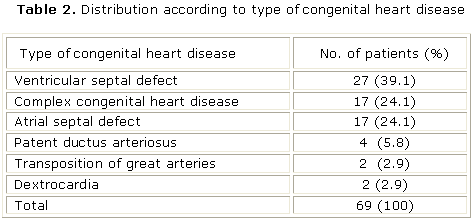
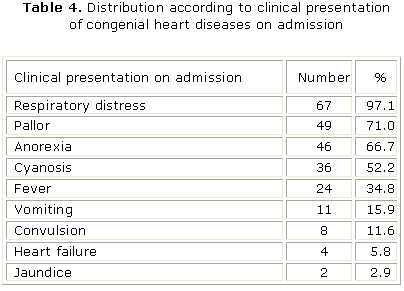
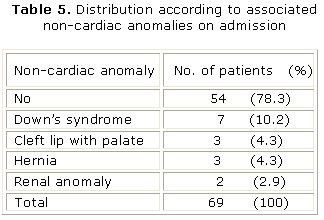
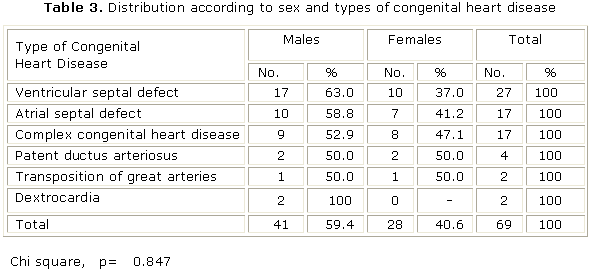
<body><![CDATA[<P><FONT FACE="Verdana, Arial, Helvetica, sans-serif" SIZE="2"><A HREF="#t1">Table  1</A> shows the distribution of neonates with CHD by age, birth weight, sex, and  gestational age. The results indicated that the mean age of the newborns was 10.2  &#177; 9.8 days (range 1-28 days). Seven patients (10.1%) had gestational ages  less than 37 completed weeks (preterm). It also shows that males were predominant  (59.4%). </FONT>    <P ALIGN="CENTER"><A NAME="t1"></A><IMG SRC="/img/revistas/rhcm/v13n5/t0108514.gif" WIDTH="406" HEIGHT="311">    <P>      <P><A HREF="#t2"><FONT FACE="Verdana, Arial, Helvetica, sans-serif" SIZE="2">Table  2</FONT></A><FONT FACE="Verdana, Arial, Helvetica, sans-serif" SIZE="2"> shows  types of congenital heart disease in the newborns under study. The results indicated  that the proportion of patients with VSD was the highest (39.1%), followed by  ASD and CCHD with 24.1%. </FONT>    <P ALIGN="CENTER"><A NAME="t2"></A><IMG SRC="/img/revistas/rhcm/v13n5/t0208514.gif" WIDTH="475" HEIGHT="223">    <P>      <P><A HREF="/img/revistas/rhcm/v13n5/t0308514.gif"><FONT FACE="Verdana, Arial, Helvetica, sans-serif" SIZE="2">Table  3</FONT></A><FONT FACE="Verdana, Arial, Helvetica, sans-serif" SIZE="2"> shows  that although the difference was not statistically significant (p&gt; 0.05); cases  of VSD, ASD and CCHD had male predominance (63.0%, 58.8% and 52.9 for males versus  37.0, 41.2% and 47.1% for females, respectively). </FONT>    <P>     <P><A HREF="#t4"><FONT FACE="Verdana, Arial, Helvetica, sans-serif" SIZE="2">Table  4</FONT></A><FONT FACE="Verdana, Arial, Helvetica, sans-serif" SIZE="2"> shows  that among the different clinical manifestations of CHD, the commonest were respiratory  distress (97.1 %), pallor (71.0%), anorexia (66.7%), cyanosis (52.2%) and fever  (34.8%). </FONT>    <P ALIGN="CENTER"><A NAME="t4"></A><IMG SRC="/img/revistas/rhcm/v13n5/t0408514.gif" WIDTH="404" HEIGHT="291">    ]]></body>
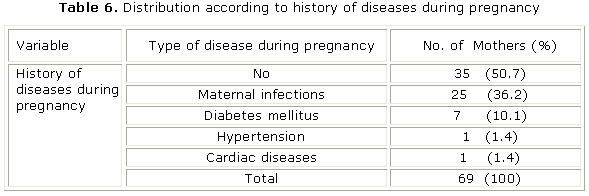
<body><![CDATA[<P>      <P><A HREF="#t5"><FONT FACE="Verdana, Arial, Helvetica, sans-serif" SIZE="2">Table  5</FONT></A><FONT FACE="Verdana, Arial, Helvetica, sans-serif" SIZE="2"> shows  associated non-cardiac anomalies which were present in 15 patients with CHD (21.7%).  Down's syndrome was noticed in the higher proportion (10.1%). </FONT>    <P ALIGN="CENTER"><A NAME="t5"></A><IMG SRC="/img/revistas/rhcm/v13n5/t0508514.gif" WIDTH="324" HEIGHT="220">    <P>      <P><A HREF="/img/revistas/rhcm/v13n5/t0608514.gif"><FONT FACE="Verdana, Arial, Helvetica, sans-serif" SIZE="2">Table  6</FONT></A><FONT FACE="Verdana, Arial, Helvetica, sans-serif" SIZE="2"> shows  the history of diseases during pregnancy in 34 out 69 cases of congenital heart  disease. The greatest proportion was found for maternal infections (36.2%), followed  by gestational diabetes mellitus (10.1%). </FONT>    <P>&nbsp;    <P>     <P>     <P>     <P><B><FONT FACE="Verdana, Arial, Helvetica, sans-serif" SIZE="3">DISCUSSION  </FONT></B><FONT FACE="Verdana, Arial, Helvetica, sans-serif" SIZE="3"> </FONT>    ]]></body>
<body><![CDATA[<P><FONT FACE="Verdana, Arial, Helvetica, sans-serif" SIZE="2">This  study was conducted to identify the pattern and the prevalence rate of CHD in  Al-Wahda Pediatric Teaching Hospital, Aden, Yemen. The overall prevalence of CHD  during the two-year period was 5.3/1000 live births, which is higher than the  findings from India (3.9/ 1000).<SUP>9</SUP> on the other hand, it corresponds  to the study in Al-Qassim, Saudi Arabia and Iran (5.4/1000 and 5.8/1000, respectively),  but it is lower than what was found in Oman (7.1/1000). <SUP>11, 12, 13</SUP>  </FONT>    <P><FONT FACE="Verdana, Arial, Helvetica, sans-serif" SIZE="2">We found  that CHD was more common in males (59.4%) than females (40.6%) with a male to  female ratio of 1.46:1 (<A HREF="#t1">Table 1</A>). This finding is similar to  that reported in Iran (male to female ratio of 1.5:1) and Bangladesh (male to  female ratio of 1.2:1), but it is not similar to that reported in Turkey (51%  boys and 49% girls) and in Saudi Arabia, where the frequency was the same for  males and females, while in Nigeria CHD was found to be more common in female  births. <SUP>6, 14 </SUP> </FONT>    <P><FONT FACE="Verdana, Arial, Helvetica, sans-serif" SIZE="2">Also  it was observed that CHD was more common in term (89.9%) than preterm (10.1%)  children (<A HREF="#t1">Table 1</A>). In this study, the prevalence of preterm  was higher than what is reported in Nelson's study (3% in preterm).<SUP>2</SUP>  the finding is not similar to a study in Korea where the frequency of the CHD  was higher in the pre-term group.<SUP>15</SUP> </FONT>    <P><FONT FACE="Verdana, Arial, Helvetica, sans-serif" SIZE="2">In  this study, the common forms of CHD were ventricular septal defect (39.1%), atrial  septal defect (24.1%), complex congenital heart disease (24.1%) and patent ductus  arteriosus (5.8%) (<A HREF="#t2">Table 2</A>). This finding is similar to a study  in Egypt that showed the most common types were VSD (29.65%), ASD (17.93%) and  PDA (12.41%) followed by complex congenital heart disease (10.34%).<SUP>16</SUP>  Another report in Egypt found ventricular septal defect in 41.49%, complex congenital  heart disease in 15.43% and pulmonary stenosis in 13.83%.<SUP>17</SUP> Also a  study in Bangladesh shows that the more frequent CHD were found to be VSD (29%),  ASD (24%), PDA (10%), and complex congenital heart diseases (8%).<SUP>5</SUP>  While, a study in Oman shows that the common CHD were ventricular septal defect  (24.9%), atrial septal defect (14.4%) and patent ductus arteriosus (10.3%).<SUP>13</SUP>  In Saudi Arabia the ventricular septal defect was the most common lesion diagnosed  (22.5%). Another study in Saudi Arabia found that ventricular septal defect was  the commonest lesion (33.9%) followed by atrial septal defect (18.1%).<SUP>11,  18</SUP> The discrepancy of the results may be attributed to many factors such  as sample size, age at detection and methods of identification of these defects.  </FONT>    <P><FONT FACE="Verdana, Arial, Helvetica, sans-serif" SIZE="2">A report  of the New England Regional Infant Cardiac Program showed VSD as the commonest  lesion, which is similar to the finding in the present study.<SUP>5</SUP> </FONT>    <P><FONT FACE="Verdana, Arial, Helvetica, sans-serif" SIZE="2">Also  it was observed in this study that the prevalence of CHD in males with VSD, ASD  and complex congenital heart disease (63.0%, 58.8% and 52.9%, respectively) was  higher than in females (37.0%, 41.2% and 47.1%, respectively). However, similar  prevalence in PDA and transposition of great arteries was found for both sexes  (<A HREF="/img/revistas/rhcm/v13n5/t0308514.gif">Table 3</A>). In Egypt, a study revealed that male predominance  was seen in cases of VSD, aortic stenoses and complex congenital heart disease  (1.7:1, 2:1 and 1.5:1, respectively), while female predominance was recorded for  cases with PDA, ASD and pulmonary stenoses (0.6:1, 0.5:1 and 0.8:1, respectively).  While a study in Iran found more VSD and ASD in males than females, but PDA and  VSD+ASD were found to be more common in females than in males. <SUP>6, 16</SUP>  </FONT>    <P><FONT FACE="Verdana, Arial, Helvetica, sans-serif" SIZE="2">This could  probably be explained by<I> </I>Carianne and Verheuget <SUP>45</SUP>,<I> </I>who  mentioned<I> </I>that several factors may account for<I> </I>observed gender difference  in CHD. One aspect likely to play a role is the biological distinction such as  inflow and outflow tracts of the heart between males and females.<SUP>19</SUP>  </FONT>    <P><FONT FACE="Verdana, Arial, Helvetica, sans-serif" SIZE="2">In the present  study it was found that respiratory distress, pallor, anorexia, cyanosis and fever  were the main symptoms among cases of CHD where they represented 97.1%, 71%, 66.7%,  52.2% and 34.8% respectively (<A HREF="#t4">Table 4</A>). A study in Bangladesh  found that clinically respiratory distress (71%) was the commonest presenting  symptom followed by cyanosis (26%) and anorexia (24%).<SUP>5</SUP> In Egypt, the  study revealed that history of cough (56.55%), dyspnea (52.41%) and failure to  thrive (42.75%) are the main symptoms and signs as mentioned by their mothers.<SUP>16</SUP>  Also El Hag found that breathlessness,<B><I> </I></B>failure to thrive and cyanosis  were the<B><I> </I></B>main symptoms and signs among<B><I> </I></B>children with  CHD. Symptoms depend on the type and severity of the defect.<B><I> </I></B><SUP>20</SUP>  </FONT>    <P><FONT FACE="Verdana, Arial, Helvetica, sans-serif" SIZE="2">The commonest  non-cardiac anomalies associated with CHD in this study were Down's syndrome (10.1%),  followed by cleft lip with palate (4.3%), hernia (4.3%), and renal anomaly (2.9%)  (<A HREF="#t5">Table 5</A>). This was similar to the studies in Turkey and Saudi  Arabia were the most common syndrome was Down's syndrome (78.3% and 15%, respectively)  from all syndromic CHD cases.<SUP>14, 11</SUP> However, in Czech Republic it was  reported that the most frequent non-cardiac anomalies were congenital malformations  of the nervous system (14.59%), the musculoskeletal system (12.44%), cleft lip  and cleft palate (7.42%) and congenital malformations of the urinary system (6.70%).<SUP>21</SUP>  It is concluded that chromosomal abnormalities resulting in genetic syndromes  such as Down's syndrome are often associated with a higher incidence of complex  congenital heart disease.<SUP>16</SUP> </FONT>    <P><FONT FACE="Verdana, Arial, Helvetica, sans-serif" SIZE="2">Maternal  disease like maternal infection, diabetes mellitus and hypertension might increase  occurrence of heart disease in neonates. Regarding the history of diseases during  pregnancy, in this study it was found that 50.7% of mothers of affected neonates  had no history of disease during pregnancy period, while 36.2% of mothers gave  a positive history suggestive of infection during their pregnancy period, 10.1%  mothers were diabetic, 1.4% hypertensive and 1.4% had cardiac diseases (<A HREF="/img/revistas/rhcm/v13n5/t0608514.gif">Table  6</A>). This was similar to a study in Bangladesh which revealed that 78% of mothers  had no history of disease during pregnancy period, while 10% of mothers were diabetic  but there were no similarity in 8% hypertensive and 4% mother's infection during  their pregnancy period.<SUP>5</SUP> Another study in Egypt showed that 8.27% of  them were exposed to febrile illness.<B><I> </I></B>Jupta mentioned that maternal  febrile illness during first trimester of pregnancy may be associated with increased  risk of certain CHD that may reach two folds. <SUP>22</SUP> </FONT>    ]]></body>
<body><![CDATA[<P><FONT FACE="Verdana, Arial, Helvetica, sans-serif" SIZE="2">The  differences among these results in different parts of the world could be related  to the study population, type of classification, and various selection criteria  such as live births and still births in the study or methods of diagnosis and  ethnic or genetic differences. This could be due to the severity of defects which  might have led to the death of patients before accessing the medical facilities.  This might also be due to differences in the improvement of diagnosis, attention  or awareness among the medical authorities. Further study is needed to explore  the exact etiological factors. Also, researchers have pointed out the effect of  ethnicity on CHD prevalence. Ethnical differences in the prevalence of cardiac  malformations in uterus and at live birth may have environmental components, e.g.,  nutritional status and teratogen exposure, in addition to genetic factors.<SUP>6</SUP>  </FONT>    <P><FONT FACE="Verdana, Arial, Helvetica, sans-serif" SIZE="2">This study  has several limitations. All of the subjects of this study were inpatients of  the neonatal unit only, and carried out in a single center. Since not all children  underwent echocardiography, minor cardiac defects might have been missed and we  cannot state the number of severely ill children who died during initial steps  of resuscitation (before the echocardiography could be performed). So the true  incidence might be somewhat higher than that reported here. As we could not get  detailed history of antenatal study with fetal echocardiography, we could not  reveal the impact of fetal imaging to these changes of epidemiologic findings  that might had affected. </FONT>    <P><FONT FACE="Verdana, Arial, Helvetica, sans-serif" SIZE="2">Observed  differences may be due to genetic, environmental, socioeconomical, or ethnic origin,  and there are needs to perform further investigation to tailor the management  of this global health problem. </FONT>    <P><FONT FACE="Verdana, Arial, Helvetica, sans-serif" SIZE="2">In  the light of the findings, it is recommended that concerted effort should be made  to develop adequate diagnostic (ex. newborn echocardiography survey) and treatment  programs (cardiac surgical intervention). Stress is pointed out to the importance  of genetic counseling for women before becoming pregnant. In antenatal care program,  it is important the health education of pregnant women to avoid maternal infection  especially during first trimester of pregnancy. The aim should be directed to  improve the outlook of CHD in the developing world, and to reduce mortality and  morbidity in neonates.<SUP>23-25</SUP> </FONT>    <P>&nbsp;    <P>     <P><FONT FACE="Verdana, Arial, Helvetica, sans-serif" SIZE="3"><B>CONCLUSIONS</B></FONT><FONT FACE="Verdana, Arial, Helvetica, sans-serif" SIZE="2">  </FONT>    <P><FONT FACE="Verdana, Arial, Helvetica, sans-serif" SIZE="2">The present  study shows that CHD is a public health problem among newborns at Al-Wahda Pediatric  Teaching Hospital in Aden, Yemen. VSD, ASD and complex congenital heart disease  are the commonest congenital heart diseases, in which male predominance is found.  A good number of studied mothers have got some diseases during pregnancy. Down's  syndrome is the predominant non-cardiac anomaly in this population. </FONT>    <P>&nbsp;    <P>      ]]></body>
<body><![CDATA[<P><FONT FACE="Verdana, Arial, Helvetica, sans-serif" SIZE="3"><B>ACKNOWLEDGMENT</B></FONT><FONT FACE="Verdana, Arial, Helvetica, sans-serif" SIZE="2">  </FONT>    <P><FONT FACE="Verdana, Arial, Helvetica, sans-serif" SIZE="2">Authors  would like to thank children, stuff nurse and archives workers in nutritional  unite in Al-Wahda Pediatric Teaching Hospital of Aden governorate for their cooperation  in this study. </FONT>    <P>&nbsp;    <P>     <P>     <P><FONT FACE="Verdana, Arial, Helvetica, sans-serif" SIZE="2"><B><FONT SIZE="3">BIBLIOGRAPHY  REFERENCES</FONT></B> </FONT>    <P><FONT FACE="Verdana, Arial, Helvetica, sans-serif" SIZE="2">1.  American Heart Association. Statistical Fact Sheet, Congenital Cardiovascular  Defects, American Heart Association. [Updated 2013; cited Apr 2014]. Cir. 2013;  127:e6-e245. Available from: <A HREF="http://www.uptodate.com/contents/congenital-heart-disease-chd-in-the%20-newborn-presentation-and-screening-for-critical-chd" TARGET="_blank">http://www.uptodate.com/contents/congenital-heart-disease-chd-in-the  -newborn-presentation-and-screening-for-critical-chd</A> and <A HREF="http://www.heart.org/HEARTORG/Conditions/CongenitalHeartDefects/AboutCongenitalHeartDefects/Ventricular-Septal-Defect%20-VSD_UCM_307041_Article.jsp" TARGET="_blank">http://www.heart.org/HEARTORG/Conditions/CongenitalHeartDefects/AboutCongenitalHeartDefects/Ventricular-Septal-Defect  -VSD_UCM_307041_Article.jsp</A> </FONT>    <P>     <!-- ref --><P><FONT FACE="Verdana, Arial, Helvetica, sans-serif" SIZE="2">2.  Nelson K. Text book of pediatrics, 17th edition. Philadelphia<B>:</B> Saunders-Elsevier;  2004.p. 1499-1502.     </FONT>    ]]></body>
<body><![CDATA[<P>     <!-- ref --><P><FONT FACE="Verdana, Arial, Helvetica, sans-serif" SIZE="2">3.  Department of Health. Basic Statistics: About Incidence, Prevalence, Morbidity,  and Mortality - Statistics Teaching Tools, New York, 1999 [cited Apr 2014]. Available  from: <A HREF="https://www.health.ny.gov/diseases/chronic/basicstat.htm" TARGET="_blank">https://www.health.ny.gov/diseases/chronic/basicstat.htm</A>  </FONT>    <P>     <!-- ref --><P><FONT FACE="Verdana, Arial, Helvetica, sans-serif" SIZE="2">4. Sayasathid  J, Sukonpan K, Somboonna N. Epidemiology and etiology of congenital heart diseases,  congenital heart disease - selected aspects, (2012), InTech, [cited Apr 2014].  Available from: <A HREF="http://www.intechopen.com/books/congenital-heartdisease" TARGET="_blank">http://www.intechopen.com/books/congenital-heartdisease</A>  </FONT>    <P>     <!-- ref --><P><FONT FACE="Verdana, Arial, Helvetica, sans-serif" SIZE="2">5. Islam  MN, Hossain MA, Khaleque MA, Das MK, Khan MRH, Bari MS, et al. Prevalence of congenital  heart disease in neonate in a tertiary level hospital. NJMS. 2013; 2(2):91-5.      </FONT>    <P>     <!-- ref --><P><FONT FACE="Verdana, Arial, Helvetica, sans-serif" SIZE="2">6. Bagher  N, Maliheh S, Arezo M, Mostafa Q, Mohammad JG. Prevalence and pattern of congenital  heart disease among neonates in Gorgan, Northern Iran (2007-2008). Iran J Pediatr.  2011 Sep; 21 (3):307-12.     </FONT>    ]]></body>
<body><![CDATA[<P>     <!-- ref --><P><FONT FACE="Verdana, Arial, Helvetica, sans-serif" SIZE="2">7.  Zhao QM, Ma XJ, Jia B, Huang GY. Prevalence of congenital heart disease at live  birth: an accurate assessment by echocardiographic screening. Acta Paediatr. 2013  Apr; 102(4):397-402.     </FONT>    <P>     <!-- ref --><P><FONT FACE="Verdana, Arial, Helvetica, sans-serif" SIZE="2">8.  Thomas T<I>. </I>What is a congenital heart defect (CHD)?. Children's Heart Foundation.  2012 [cited April 2014]. Available from: </FONT><FONT FACE="Verdana, Arial, Helvetica, sans-serif" SIZE="2"><A HREF="http://www.childrensheartfoundation.org/research/what-is-a-chd" TARGET="_blank">http://www.childrensheartfoundation.org/research/what-is-a-chd</A>  </FONT>    <P>     <!-- ref --><P><FONT FACE="Verdana, Arial, Helvetica, sans-serif" SIZE="2">9. Kapoor  R, Gupta S. Prevalence of congenital heart disease, Kanpur, India. Indian Pediatrics.  2008; 45:309-11.     </FONT>    <P>     <!-- ref --><P><FONT FACE="Verdana, Arial, Helvetica, sans-serif" SIZE="2">10.  World Health Organization. International classification of diseases and related  health problems. 10th revision. Geneva: World Health Organization; 1992. [cited  April 2014]. Available from: <A HREF="http://www.who.int/mediacentre/factsheets/fs363/en/" TARGET="_blank">http://www.who.int/mediacentre/factsheets/fs363/en/</A>  </FONT>    <P>     <!-- ref --><P><FONT FACE="Verdana, Arial, Helvetica, sans-serif" SIZE="2">11.  Al-Mesned A, Al-Akhfash AA, Sayed M. Incidence of severe congenital heart disease  at the province of Al-Qassim, Saudi Arabia.<B> </B>Congenit Heart Dis. 2012;7(3):277-82.  doi: 10.1111/j.1747-0803.2011.00614.x. Epub 2011 Dec 30.     </FONT>    <P>     <!-- ref --><P><FONT FACE="Verdana, Arial, Helvetica, sans-serif" SIZE="2">12.  Shah GS, Singh MK, Pandey TR, Kalakheti BK, Bhandari GP. Incidence of congenital  heart disease in tertiary care hospital. Kathmandu Univ Med J (KUMJ). 2008; 6(1):33-6.      </FONT>    <P>     <!-- ref --><P><FONT FACE="Verdana, Arial, Helvetica, sans-serif" SIZE="2">13.  Subramanyan R, Joy J, Venugopalan P, Sapru A, al Khusaiby SM. Incidence and spectrum  of congenital heart disease in Oman. Ann Trop Paediatr. 2000 Dec; 20(4):337-41.      </FONT>    <P>     ]]></body>
<body><![CDATA[<!-- ref --><P><FONT FACE="Verdana, Arial, Helvetica, sans-serif" SIZE="2">14.  Ba&#186;pinar O, Karaaslan S, Oran B, Baysal T, Elmaci AM, Yorulmaz A. Prevalence  and distribution of children with congenital heart diseases in the central Anatolian  region, Turkey. Turk J Pediatr. 2006 Jul-Sep;48(3):237-43.     </FONT>    <P>     <!-- ref --><P><FONT FACE="Verdana, Arial, Helvetica, sans-serif" SIZE="2">15.  Seon YC, Jin-Hee O, Jung HL, Jae YL, Soon JL, Ji WH, et al. Recent incidence of  congenital heart disease in neonatal care unit of secondary medical center: a  single center study. Korean J Pediatr. 2012 Jul; 55(7): 232-7.     </FONT>    <P>     <!-- ref --><P><FONT FACE="Verdana, Arial, Helvetica, sans-serif" SIZE="2">16.  Sabry AS, El-Feky OA. Epidemiological study of congenital heart diseases among  children attending outpatient clinics of Benha University Hospital. Egyp J Comm  Med. 2011;28 (4): 69-87.     </FONT>    <P>     <!-- ref --><P><FONT FACE="Verdana, Arial, Helvetica, sans-serif" SIZE="2">17.  Fekry Y. Prospective study of children with congenital heart diseases attending  to cardiology pediatric clinic of El Menoufia University Hospital [Master thesis],  Pediatrics, Menoufia University; 2002.     </FONT>    <P>     <!-- ref --><P><FONT FACE="Verdana, Arial, Helvetica, sans-serif" SIZE="2">18.  Alabdulgader AAA. Congenital heart disease in Saudi Arabia: current epidemiology  and future projections. E M H J. 2006; 12 (Supplement 2): S157.     </FONT>    <P>     <!-- ref --><P><FONT FACE="Verdana, Arial, Helvetica, sans-serif" SIZE="2">19.  Carianne J, Verheuget I. Gender and outcome in C.H.D. Academic Medical Centre,  Amesterdam, Department of Cardiology, Am Heart Assoc. 2008; Cir .3 ; 118-32 .      </FONT>    <!-- ref --><P><FONT FACE="Verdana, Arial, Helvetica, sans-serif" SIZE="2">20. El Hag  A. Pattern of congenital heart disease in Sudanse children. East Afr Med J. 2004;  71 (9): 580-6.     </FONT>    <P>     ]]></body>
<body><![CDATA[<!-- ref --><P><FONT FACE="Verdana, Arial, Helvetica, sans-serif" SIZE="2">21.  S&iacute;pek A. Incidence of congenital heart defects in the Czech Republic&#151;current  data. Ceska Gynekol. 2010 May; 75(3):221-42.     </FONT>    <P>     <!-- ref --><P><FONT FACE="Verdana, Arial, Helvetica, sans-serif" SIZE="2">22.  Jupta I. Epidemiology of rheumatic and congenital heart disease in school children.  J Indian Medial Assoc. 2002; 90:57-59. [cited Apr 2014].<I> </I>Available from:  <A HREF="http://www.ncbi.nlm.nih.gov/pubmed/20731304" TARGET="_blank">http://www.ncbi.nlm.nih.gov/pubmed/20731304</A>  </FONT>    <P>     <!-- ref --><P><FONT FACE="Verdana, Arial, Helvetica, sans-serif" SIZE="2">23<I>.</I>  Ram&iacute;rez L&oacute;pez MB, P&eacute;rez L&oacute;pez H, C&aacute;ceres L&oacute;riga  FM, Gonz&aacute;lez Greck O.<B> </B>Resultados del trabajo del 1er. Equipo completo  de Cirug&iacute;a Cardiovascular enviado por Cuba en Misi&oacute;n de colaboraci&oacute;n  internacional en el marco de la cooperaci&oacute;n Sur-Sur. Rev Cubana Cardiol  Cirug Cardiovasc. 2014; 20(1).<B> </B>Spanish.    &#160; </FONT>    <P>     <P><FONT FACE="Verdana, Arial, Helvetica, sans-serif" SIZE="2">24.  Vega Guti&eacute;rrez E, Rodr&iacute;guez Vel&aacute;squez L, G&aacute;lvez Morales  V, LB Sainz Cruz, Garc&iacute;a Guevara<SUP> </SUP>C. Incidencia y tratamiento  de las cardiopat&iacute;as cong&eacute;nitas en San Miguel del Padr&oacute;n.  Rev Cubana Med Gen Integr.&#160;2012 Jul-Sep; 28(3). Spanish.&#160; </FONT>    <P>      ]]></body>
<body><![CDATA[<!-- ref --><P><FONT FACE="Verdana, Arial, Helvetica, sans-serif" SIZE="2">25. Garc&iacute;a  Guevara C, Arencibia Faire J, Sav&iacute;o Benavides A, Garc&iacute;a Morej&oacute;n  C, Hern&aacute;ndez Y, Selman-Housein Sosa E. El pesquisaje prenatal sonogr&aacute;fico  de las Cardiopat&iacute;as Cong&eacute;nitas en Cuba. Rev Fed Arg Cardiol. 2011;  40 (3).&#160;Spanish.    &#160; </FONT>    <P>&nbsp;    <P>&nbsp;    <P>     <P><FONT FACE="Verdana, Arial, Helvetica, sans-serif" SIZE="2">Recibido:  23 de Julio de 2014     <BR></FONT><FONT FACE="Verdana, Arial, Helvetica, sans-serif" SIZE="2">Aprobado:  30 de Agosto de 2014 </FONT>       ]]></body><back>
<ref-list>
<ref id="B1">
<label>1</label><nlm-citation citation-type="journal">
<collab>American Heart Association</collab>
<article-title xml:lang="en"><![CDATA[Statistical Fact Sheet, Congenital Cardiovascular Defects, American Heart Association]]></article-title>
<source><![CDATA[Cir]]></source>
<year>2013</year>
<volume>127</volume>
<page-range>e6-e245</page-range></nlm-citation>
</ref>
<ref id="B2">
<label>2</label><nlm-citation citation-type="book">
<person-group person-group-type="author">
<name>
<surname><![CDATA[Nelson]]></surname>
<given-names><![CDATA[K]]></given-names>
</name>
</person-group>
<source><![CDATA[Text book of pediatrics]]></source>
<year>2004</year>
<edition>17th</edition>
<publisher-loc><![CDATA[Philadelphia ]]></publisher-loc>
<publisher-name><![CDATA[Saunders-Elsevier]]></publisher-name>
</nlm-citation>
</ref>
<ref id="B3">
<label>3</label><nlm-citation citation-type="">
<collab>Department of Health</collab>
<source><![CDATA[Basic Statistics: About Incidence, Prevalence, Morbidity, and Mortality - Statistics Teaching Tools]]></source>
<year>1999</year>
<publisher-loc><![CDATA[New York ]]></publisher-loc>
</nlm-citation>
</ref>
<ref id="B4">
<label>4</label><nlm-citation citation-type="">
<person-group person-group-type="author">
<name>
<surname><![CDATA[Sayasathid]]></surname>
<given-names><![CDATA[J]]></given-names>
</name>
<name>
<surname><![CDATA[Sukonpan]]></surname>
<given-names><![CDATA[K]]></given-names>
</name>
<name>
<surname><![CDATA[Somboonna]]></surname>
<given-names><![CDATA[N]]></given-names>
</name>
</person-group>
<source><![CDATA[Epidemiology and etiology of congenital heart diseases, congenital heart disease - selected aspects, (2012)]]></source>
<year></year>
</nlm-citation>
</ref>
<ref id="B5">
<label>5</label><nlm-citation citation-type="journal">
<person-group person-group-type="author">
<name>
<surname><![CDATA[Islam]]></surname>
<given-names><![CDATA[MN]]></given-names>
</name>
<name>
<surname><![CDATA[Hossain]]></surname>
<given-names><![CDATA[MA]]></given-names>
</name>
<name>
<surname><![CDATA[Khaleque]]></surname>
<given-names><![CDATA[MA]]></given-names>
</name>
<name>
<surname><![CDATA[Das]]></surname>
<given-names><![CDATA[MK]]></given-names>
</name>
<name>
<surname><![CDATA[Khan]]></surname>
<given-names><![CDATA[MRH]]></given-names>
</name>
<name>
<surname><![CDATA[Bari]]></surname>
<given-names><![CDATA[MS]]></given-names>
</name>
</person-group>
<article-title xml:lang="en"><![CDATA[Prevalence of congenital heart disease in neonate in a tertiary level hospital]]></article-title>
<source><![CDATA[NJMS]]></source>
<year>2013</year>
<volume>2</volume>
<numero>2</numero>
<issue>2</issue>
<page-range>91-5</page-range></nlm-citation>
</ref>
<ref id="B6">
<label>6</label><nlm-citation citation-type="journal">
<person-group person-group-type="author">
<name>
<surname><![CDATA[Bagher]]></surname>
<given-names><![CDATA[N]]></given-names>
</name>
<name>
<surname><![CDATA[Maliheh]]></surname>
<given-names><![CDATA[S]]></given-names>
</name>
<name>
<surname><![CDATA[Arezo]]></surname>
<given-names><![CDATA[M]]></given-names>
</name>
<name>
<surname><![CDATA[Mostafa]]></surname>
<given-names><![CDATA[Q]]></given-names>
</name>
<name>
<surname><![CDATA[Mohammad]]></surname>
<given-names><![CDATA[JG]]></given-names>
</name>
</person-group>
<article-title xml:lang="en"><![CDATA[Prevalence and pattern of congenital heart disease among neonates in Gorgan, Northern Iran (2007-2008)]]></article-title>
<source><![CDATA[Iran J Pediatr]]></source>
<year>2011</year>
<month>09</month>
<volume>21</volume>
<numero>3</numero>
<issue>3</issue>
<page-range>307-12</page-range></nlm-citation>
</ref>
<ref id="B7">
<label>7</label><nlm-citation citation-type="journal">
<person-group person-group-type="author">
<name>
<surname><![CDATA[Zhao]]></surname>
<given-names><![CDATA[QM]]></given-names>
</name>
<name>
<surname><![CDATA[Ma]]></surname>
<given-names><![CDATA[XJ]]></given-names>
</name>
<name>
<surname><![CDATA[Jia]]></surname>
<given-names><![CDATA[B]]></given-names>
</name>
<name>
<surname><![CDATA[Huang]]></surname>
<given-names><![CDATA[GY]]></given-names>
</name>
</person-group>
<article-title xml:lang="en"><![CDATA[Prevalence of congenital heart disease at live birth: an accurate assessment by echocardiographic screening]]></article-title>
<source><![CDATA[Acta Paediatr]]></source>
<year>2013</year>
<month>04</month>
<volume>102</volume>
<numero>4</numero>
<issue>4</issue>
<page-range>397-402</page-range></nlm-citation>
</ref>
<ref id="B8">
<label>8</label><nlm-citation citation-type="book">
<person-group person-group-type="author">
<name>
<surname><![CDATA[Thomas]]></surname>
<given-names><![CDATA[T]]></given-names>
</name>
</person-group>
<source><![CDATA[What is a congenital heart defect (CHD)?]]></source>
<year>2012</year>
<publisher-name><![CDATA[Children's Heart Foundation]]></publisher-name>
</nlm-citation>
</ref>
<ref id="B9">
<label>9</label><nlm-citation citation-type="journal">
<person-group person-group-type="author">
<name>
<surname><![CDATA[Kapoor]]></surname>
<given-names><![CDATA[R]]></given-names>
</name>
<name>
<surname><![CDATA[Gupta]]></surname>
<given-names><![CDATA[S]]></given-names>
</name>
</person-group>
<article-title xml:lang="en"><![CDATA[Prevalence of congenital heart disease, Kanpur, India]]></article-title>
<source><![CDATA[Indian Pediatrics]]></source>
<year>2008</year>
<volume>45</volume>
<page-range>309-11</page-range></nlm-citation>
</ref>
<ref id="B10">
<label>10</label><nlm-citation citation-type="book">
<collab>World Health Organization</collab>
<source><![CDATA[International classification of diseases and related health problems]]></source>
<year>1992</year>
<publisher-loc><![CDATA[Geneva ]]></publisher-loc>
<publisher-name><![CDATA[World Health Organization]]></publisher-name>
</nlm-citation>
</ref>
<ref id="B11">
<label>11</label><nlm-citation citation-type="journal">
<person-group person-group-type="author">
<name>
<surname><![CDATA[Al-Mesned]]></surname>
<given-names><![CDATA[A]]></given-names>
</name>
<name>
<surname><![CDATA[Al-Akhfash]]></surname>
<given-names><![CDATA[AA]]></given-names>
</name>
<name>
<surname><![CDATA[Sayed]]></surname>
<given-names><![CDATA[M]]></given-names>
</name>
</person-group>
<article-title xml:lang="en"><![CDATA[Incidence of severe congenital heart disease at the province of Al-Qassim, Saudi Arabia]]></article-title>
<source><![CDATA[Congenit Heart Dis]]></source>
<year>2012</year>
<volume>7</volume>
<numero>3</numero>
<issue>3</issue>
<page-range>277-82</page-range></nlm-citation>
</ref>
<ref id="B12">
<label>12</label><nlm-citation citation-type="journal">
<person-group person-group-type="author">
<name>
<surname><![CDATA[Shah]]></surname>
<given-names><![CDATA[GS]]></given-names>
</name>
<name>
<surname><![CDATA[Singh]]></surname>
<given-names><![CDATA[MK]]></given-names>
</name>
<name>
<surname><![CDATA[Pandey]]></surname>
<given-names><![CDATA[TR]]></given-names>
</name>
<name>
<surname><![CDATA[Kalakheti]]></surname>
<given-names><![CDATA[BK]]></given-names>
</name>
<name>
<surname><![CDATA[Bhandari]]></surname>
<given-names><![CDATA[GP]]></given-names>
</name>
</person-group>
<article-title xml:lang="en"><![CDATA[Incidence of congenital heart disease in tertiary care hospital]]></article-title>
<source><![CDATA[Kathmandu Univ Med J (KUMJ)]]></source>
<year>2008</year>
<volume>6</volume>
<numero>1</numero>
<issue>1</issue>
<page-range>33-6</page-range></nlm-citation>
</ref>
<ref id="B13">
<label>13</label><nlm-citation citation-type="journal">
<person-group person-group-type="author">
<name>
<surname><![CDATA[Subramanyan]]></surname>
<given-names><![CDATA[R]]></given-names>
</name>
<name>
<surname><![CDATA[Joy]]></surname>
<given-names><![CDATA[J]]></given-names>
</name>
<name>
<surname><![CDATA[Venugopalan]]></surname>
<given-names><![CDATA[P]]></given-names>
</name>
<name>
<surname><![CDATA[Sapru]]></surname>
<given-names><![CDATA[A]]></given-names>
</name>
<name>
<surname><![CDATA[al Khusaiby]]></surname>
<given-names><![CDATA[SM]]></given-names>
</name>
</person-group>
<article-title xml:lang="en"><![CDATA[Incidence and spectrum of congenital heart disease in Oman]]></article-title>
<source><![CDATA[Ann Trop Paediatr]]></source>
<year>2000</year>
<month>12</month>
<volume>20</volume>
<numero>4</numero>
<issue>4</issue>
<page-range>337-41</page-range></nlm-citation>
</ref>
<ref id="B14">
<label>14</label><nlm-citation citation-type="journal">
<person-group person-group-type="author">
<name>
<surname><![CDATA[Baºpinar]]></surname>
<given-names><![CDATA[O]]></given-names>
</name>
<name>
<surname><![CDATA[Karaaslan]]></surname>
<given-names><![CDATA[S]]></given-names>
</name>
<name>
<surname><![CDATA[Oran]]></surname>
<given-names><![CDATA[B]]></given-names>
</name>
<name>
<surname><![CDATA[Baysal]]></surname>
<given-names><![CDATA[T]]></given-names>
</name>
<name>
<surname><![CDATA[Elmaci]]></surname>
<given-names><![CDATA[AM]]></given-names>
</name>
<name>
<surname><![CDATA[Yorulmaz]]></surname>
<given-names><![CDATA[A]]></given-names>
</name>
</person-group>
<article-title xml:lang="en"><![CDATA[Prevalence and distribution of children with congenital heart diseases in the central Anatolian region, Turkey]]></article-title>
<source><![CDATA[Turk J Pediatr]]></source>
<year>2006</year>
<month> J</month>
<day>ul</day>
<volume>48</volume>
<numero>3</numero>
<issue>3</issue>
<page-range>237-43</page-range></nlm-citation>
</ref>
<ref id="B15">
<label>15</label><nlm-citation citation-type="journal">
<person-group person-group-type="author">
<name>
<surname><![CDATA[Seon]]></surname>
<given-names><![CDATA[YC]]></given-names>
</name>
<name>
<surname><![CDATA[Jin-Hee]]></surname>
<given-names><![CDATA[O]]></given-names>
</name>
<name>
<surname><![CDATA[Jung]]></surname>
<given-names><![CDATA[HL]]></given-names>
</name>
<name>
<surname><![CDATA[Jae]]></surname>
<given-names><![CDATA[YL]]></given-names>
</name>
<name>
<surname><![CDATA[Soon]]></surname>
<given-names><![CDATA[JL]]></given-names>
</name>
<name>
<surname><![CDATA[Ji]]></surname>
<given-names><![CDATA[WH]]></given-names>
</name>
</person-group>
<article-title xml:lang="en"><![CDATA[Recent incidence of congenital heart disease in neonatal care unit of secondary medical center: a single center study]]></article-title>
<source><![CDATA[Korean J Pediatr]]></source>
<year>2012</year>
<month>07</month>
<volume>55</volume>
<numero>7</numero>
<issue>7</issue>
<page-range>232-7</page-range></nlm-citation>
</ref>
<ref id="B16">
<label>16</label><nlm-citation citation-type="journal">
<person-group person-group-type="author">
<name>
<surname><![CDATA[Sabry]]></surname>
<given-names><![CDATA[AS]]></given-names>
</name>
<name>
<surname><![CDATA[El-Feky]]></surname>
<given-names><![CDATA[OA]]></given-names>
</name>
</person-group>
<article-title xml:lang="en"><![CDATA[Epidemiological study of congenital heart diseases among children attending outpatient clinics of Benha University Hospital]]></article-title>
<source><![CDATA[Egyp J Comm Med]]></source>
<year>2011</year>
<volume>28</volume>
<numero>4</numero>
<issue>4</issue>
<page-range>69-87</page-range></nlm-citation>
</ref>
<ref id="B17">
<label>17</label><nlm-citation citation-type="">
<person-group person-group-type="author">
<name>
<surname><![CDATA[Fekry]]></surname>
<given-names><![CDATA[Y]]></given-names>
</name>
</person-group>
<source><![CDATA[Prospective study of children with congenital heart diseases attending to cardiology pediatric clinic of El Menoufia University Hospital]]></source>
<year></year>
</nlm-citation>
</ref>
<ref id="B18">
<label>18</label><nlm-citation citation-type="journal">
<person-group person-group-type="author">
<name>
<surname><![CDATA[Alabdulgader]]></surname>
<given-names><![CDATA[AAA]]></given-names>
</name>
</person-group>
<article-title xml:lang="en"><![CDATA[Congenital heart disease in Saudi Arabia: current epidemiology and future projections]]></article-title>
<source><![CDATA[E M H J]]></source>
<year>2006</year>
<volume>12</volume>
<numero>^s2</numero>
<issue>^s2</issue>
<supplement>2</supplement>
<page-range>S157</page-range></nlm-citation>
</ref>
<ref id="B19">
<label>19</label><nlm-citation citation-type="journal">
<person-group person-group-type="author">
<name>
<surname><![CDATA[Carianne]]></surname>
<given-names><![CDATA[J]]></given-names>
</name>
<name>
<surname><![CDATA[Verheuget]]></surname>
<given-names><![CDATA[I]]></given-names>
</name>
</person-group>
<article-title xml:lang="en"><![CDATA[Gender and outcome in C.H.D. Academic Medical Centre, Amesterdam, Department of Cardiology]]></article-title>
<source><![CDATA[Am Heart Assoc]]></source>
<year>2008</year>
<volume>3</volume>
<page-range>118-32</page-range></nlm-citation>
</ref>
<ref id="B20">
<label>20</label><nlm-citation citation-type="journal">
<person-group person-group-type="author">
<name>
<surname><![CDATA[El Hag]]></surname>
<given-names><![CDATA[A]]></given-names>
</name>
</person-group>
<article-title xml:lang="en"><![CDATA[Pattern of congenital heart disease in Sudanse children]]></article-title>
<source><![CDATA[East Afr Med J]]></source>
<year>2004</year>
<volume>71</volume>
<numero>9</numero>
<issue>9</issue>
<page-range>580-6</page-range></nlm-citation>
</ref>
<ref id="B21">
<label>21</label><nlm-citation citation-type="journal">
<person-group person-group-type="author">
<name>
<surname><![CDATA[Sípek]]></surname>
<given-names><![CDATA[A]]></given-names>
</name>
</person-group>
<article-title xml:lang="en"><![CDATA[Incidence of congenital heart defects in the Czech Republic-current data]]></article-title>
<source><![CDATA[Ceska Gynekol]]></source>
<year>2010</year>
<month>05</month>
<volume>75</volume>
<numero>3</numero>
<issue>3</issue>
<page-range>221-42</page-range></nlm-citation>
</ref>
<ref id="B22">
<label>22</label><nlm-citation citation-type="journal">
<person-group person-group-type="author">
<name>
<surname><![CDATA[Jupta]]></surname>
<given-names><![CDATA[I]]></given-names>
</name>
</person-group>
<article-title xml:lang="en"><![CDATA[Epidemiology of rheumatic and congenital heart disease in school children]]></article-title>
<source><![CDATA[J Indian Medial Assoc]]></source>
<year>2002</year>
<volume>90</volume>
<page-range>57-59</page-range></nlm-citation>
</ref>
<ref id="B23">
<label>23</label><nlm-citation citation-type="journal">
<person-group person-group-type="author">
<name>
<surname><![CDATA[Ramírez López]]></surname>
<given-names><![CDATA[MB]]></given-names>
</name>
<name>
<surname><![CDATA[Pérez López]]></surname>
<given-names><![CDATA[H]]></given-names>
</name>
<name>
<surname><![CDATA[Cáceres Lóriga]]></surname>
<given-names><![CDATA[FM]]></given-names>
</name>
<name>
<surname><![CDATA[González Greck]]></surname>
<given-names><![CDATA[O]]></given-names>
</name>
</person-group>
<article-title xml:lang="es"><![CDATA[Resultados del trabajo del 1er. Equipo completo de Cirugía Cardiovascular enviado por Cuba en Misión de colaboración internacional en el marco de la cooperación Sur-Sur]]></article-title>
<source><![CDATA[Rev Cubana Cardiol Cirug Cardiovasc]]></source>
<year>2014</year>
<volume>20</volume>
<numero>1</numero>
<issue>1</issue>
</nlm-citation>
</ref>
<ref id="B24">
<label>24</label><nlm-citation citation-type="journal">
<person-group person-group-type="author">
<name>
<surname><![CDATA[Vega Gutiérrez]]></surname>
<given-names><![CDATA[E]]></given-names>
</name>
<name>
<surname><![CDATA[Rodríguez Velásquez]]></surname>
<given-names><![CDATA[L]]></given-names>
</name>
<name>
<surname><![CDATA[Gálvez Morales]]></surname>
<given-names><![CDATA[V]]></given-names>
</name>
<name>
<surname><![CDATA[Sainz Cruz]]></surname>
<given-names><![CDATA[LB]]></given-names>
</name>
<name>
<surname><![CDATA[García Guevara]]></surname>
<given-names><![CDATA[C]]></given-names>
</name>
</person-group>
<article-title xml:lang="es"><![CDATA[Incidencia y tratamiento de las cardiopatías congénitas en San Miguel del Padrón]]></article-title>
<source><![CDATA[Rev Cubana Med Gen Integr]]></source>
<year>2012</year>
<month> J</month>
<day>ul</day>
<volume>28</volume>
<numero>3</numero>
<issue>3</issue>
</nlm-citation>
</ref>
<ref id="B25">
<label>25</label><nlm-citation citation-type="journal">
<person-group person-group-type="author">
<name>
<surname><![CDATA[García Guevara]]></surname>
<given-names><![CDATA[C]]></given-names>
</name>
<name>
<surname><![CDATA[Arencibia Faire]]></surname>
<given-names><![CDATA[J]]></given-names>
</name>
<name>
<surname><![CDATA[Savío Benavides]]></surname>
<given-names><![CDATA[A]]></given-names>
</name>
<name>
<surname><![CDATA[García Morejón]]></surname>
<given-names><![CDATA[C]]></given-names>
</name>
<name>
<surname><![CDATA[Hernández]]></surname>
<given-names><![CDATA[Y]]></given-names>
</name>
<name>
<surname><![CDATA[Selman-Housein Sosa]]></surname>
<given-names><![CDATA[E]]></given-names>
</name>
</person-group>
<article-title xml:lang="es"><![CDATA[El pesquisaje prenatal sonográfico de las Cardiopatías Congénitas en Cuba]]></article-title>
<source><![CDATA[Rev Fed Arg Cardiol]]></source>
<year>2011</year>
<volume>40</volume>
<numero>3</numero>
<issue>3</issue>
</nlm-citation>
</ref>
</ref-list>
</back>
</article>