<?xml version="1.0" encoding="ISO-8859-1"?><article xmlns:mml="http://www.w3.org/1998/Math/MathML" xmlns:xlink="http://www.w3.org/1999/xlink" xmlns:xsi="http://www.w3.org/2001/XMLSchema-instance">
<front>
<journal-meta>
<journal-id>1729-519X</journal-id>
<journal-title><![CDATA[Revista Habanera de Ciencias Médicas]]></journal-title>
<abbrev-journal-title><![CDATA[Rev haban cienc méd]]></abbrev-journal-title>
<issn>1729-519X</issn>
<publisher>
<publisher-name><![CDATA[Universidad de Ciencias Médicas de la Habana]]></publisher-name>
</publisher>
</journal-meta>
<article-meta>
<article-id>S1729-519X2015000200008</article-id>
<title-group>
<article-title xml:lang="en"><![CDATA[Characterization of the patients with kwashiorkor attended in the therapeutic feeding center in Al-Sadaqa Teaching Hospital, Aden, Yemen]]></article-title>
<article-title xml:lang="es"><![CDATA[Caracterización de los pacientes con kwashiorkor en el centro terapéutico de alimentación del Hospital Docente "Al-Sadaqa", de Adén, Yemen]]></article-title>
</title-group>
<contrib-group>
<contrib contrib-type="author">
<name>
<surname><![CDATA[Hussein Badi]]></surname>
<given-names><![CDATA[Mohammed Ali]]></given-names>
</name>
<xref ref-type="aff" rid="A01"/>
</contrib>
<contrib contrib-type="author">
<name>
<surname><![CDATA[García Triana]]></surname>
<given-names><![CDATA[Bárbara Elena]]></given-names>
</name>
<xref ref-type="aff" rid="A01"/>
</contrib>
</contrib-group>
<aff id="A01">
<institution><![CDATA[,University of Aden Faculty of Medicine ]]></institution>
<addr-line><![CDATA[ ]]></addr-line>
<country>Yemen</country>
</aff>
<pub-date pub-type="pub">
<day>00</day>
<month>04</month>
<year>2015</year>
</pub-date>
<pub-date pub-type="epub">
<day>00</day>
<month>04</month>
<year>2015</year>
</pub-date>
<volume>14</volume>
<numero>2</numero>
<fpage>188</fpage>
<lpage>197</lpage>
<copyright-statement/>
<copyright-year/>
<self-uri xlink:href="http://scielo.sld.cu/scielo.php?script=sci_arttext&amp;pid=S1729-519X2015000200008&amp;lng=en&amp;nrm=iso"></self-uri><self-uri xlink:href="http://scielo.sld.cu/scielo.php?script=sci_abstract&amp;pid=S1729-519X2015000200008&amp;lng=en&amp;nrm=iso"></self-uri><self-uri xlink:href="http://scielo.sld.cu/scielo.php?script=sci_pdf&amp;pid=S1729-519X2015000200008&amp;lng=en&amp;nrm=iso"></self-uri><kwd-group>
<kwd lng="en"><![CDATA[kwashiorkor]]></kwd>
<kwd lng="en"><![CDATA[prevalence]]></kwd>
<kwd lng="en"><![CDATA[malnutrition]]></kwd>
<kwd lng="en"><![CDATA[children]]></kwd>
<kwd lng="en"><![CDATA[Al-Sadaqa Therapeutic Feeding Center]]></kwd>
<kwd lng="en"><![CDATA[Aden]]></kwd>
<kwd lng="es"><![CDATA[kwashiorkor]]></kwd>
<kwd lng="es"><![CDATA[prevalencia]]></kwd>
<kwd lng="es"><![CDATA[malnutrición]]></kwd>
<kwd lng="es"><![CDATA[niños]]></kwd>
<kwd lng="es"><![CDATA[centro terapéutico de alimentación "Al-Sadaqa"]]></kwd>
<kwd lng="es"><![CDATA[Adén]]></kwd>
</kwd-group>
</article-meta>
</front><body><![CDATA[  	     <p align="right"><font face="verdana" size="2"><b>CIENCIAS CL&Iacute;NICAS Y PATOL&Oacute;GICAS</b></font></p>  	     <p style='text&#45;align:left;line&#45;height:normal;direction:ltr; unicode&#45;bidi:embed'>&nbsp;</p>     <p style='text&#45;align:left;line&#45;height:normal;direction:ltr; unicode&#45;bidi:embed'><font face="verdana" size="2">University    of Aden, Yemen    <br>   </font><font face="verdana" size="2">Faculty of Medicine</font></p>  	    <p style='margin&#45;right:2.15pt;text&#45;align:left;line&#45;height:normal; text&#45;autospace:none;direction:ltr;unicode&#45;bidi:embed'><font face="verdana" size="2">&nbsp;</font></p>  	     <p style='text&#45;align:left;line&#45;height:normal;text&#45;autospace: none;direction:ltr;unicode&#45;bidi:embed'><font face="verdana" size="2"><b><font size="4">Characterization    of the patients with</font></b> <font size="4"><b>kwashiorkor attended in the</b>    <b>therapeutic feeding center in&nbsp;Al&#45;Sadaqa Teaching Hospital, Aden,    Yemen</b></font></font></p>  	    <p style='text&#45;align:left;line&#45;height:normal;text&#45;autospace: none;direction:ltr;unicode&#45;bidi:embed'><font face="verdana" size="2"><b>&nbsp;</b></font></p>  	     <p style='text&#45;align:left;line&#45;height:normal;text&#45;autospace: none;direction:ltr;unicode&#45;bidi:embed'><font face="verdana" size="2"><b><font size="3">Caracterizaci&oacute;n    de los pacientes con kwashiorkor en el centro terap&eacute;utico de alimentaci&oacute;n    del Hospital Docente "Al&#45;Sadaqa", de Ad&eacute;n, Yemen</font></b></font></p>  	    <p style='margin&#45;right:2.15pt;text&#45;align:left;line&#45;height:normal; text&#45;autospace:none;direction:ltr;unicode&#45;bidi:embed'><font face="verdana" size="2">&nbsp;</font></p>  	     ]]></body>
<body><![CDATA[<p style='text&#45;align:left;line&#45;height:normal;direction:ltr; unicode&#45;bidi:embed'><font face="verdana" size="2"><b>Mohammed    Ali Hussein Badi, Ph.D.<sup>I</sup>, </b></font><b><font face="verdana" size="2">B&aacute;rbara    Elena Garc&iacute;a Triana, Ph.D.<sup>II</sup></font></b></p>     <p style='text&#45;align:left;line&#45;height:normal;direction:ltr; unicode&#45;bidi:embed'><font face="verdana" size="2"><sup>I</sup> Department    of Pediatrician, Faculty of Medicine, University of Aden, Yemen.&nbsp; e.mail:&nbsp;    <a href="mailto:mohamedbadi1@yahoo.com">mohamedbadi1@yahoo.com</a>    <br>   <sup>II</sup> Department of Physiological Sciences, Faculty of Medicine, University of Aden,    Yemen. e.mail: <a href="mailto:barbaragarciatriana@gmail.com">barbaragarciatriana@gmail.com</a>&nbsp;</font></p>  	     <p style='text&#45;align:left;line&#45;height:normal;direction:ltr; unicode&#45;bidi:embed'><font face="verdana" size="2">&nbsp;</font></p>     <p style='text&#45;align:left;line&#45;height:normal;direction:ltr; unicode&#45;bidi:embed'>&nbsp;</p>  	 <hr>     <p style='margin&#45;right:153.9pt;text&#45;align:left;line&#45;height: normal;text&#45;autospace:none;direction:ltr;unicode&#45;bidi:embed'><font face="verdana" size="2"><b>ABSTRACT</b></font></p>  	     <p style='text&#45;align:left;line&#45;height:normal;direction:ltr; unicode&#45;bidi:embed'><font face="verdana" size="2"><b>Introduction:</b>    each year nine million children under age five years die. Malnutrition contributes    to one&#45;third of these deaths, being the mortality rate for kwashiorkor much    higher than for marasmus. <b>    <br>   Objective:</b> to characterize the patients with kwashiorkor attended in the    therapeutic feeding center in&nbsp; Al&#45;Sadaqa Teaching Hospital,&nbsp; Aden,    Yemen<b>.     <br>   Material and methods:</b> this cross&#45;sectional study was performed on 95    kwashiorkor children (45 males and 50 females) under 5 years of age, 2010&#45;2013.    Data was collected from the charts of children at the therapeutic feeding center    in&nbsp;Al&#45;Sadaqa Teaching Hospital, Aden, Yemen. Kwashiorkor was defined    as a very low weight for height with edema. <b>    <br>   Results:</b> a total of 1978 children under 5 years were diagnosed with malnutrition    in this feeding center during the period of study. The kwashiorkor cases were    95 (4.8%). A high percentage of kwashiorkor (92.6%) was found in children &#8804;4    years old. Although female cases were higher than male cases (52.6% versus 47.4%),    the difference was not statistically significant. Around 50.5% of kwashiorkor    cases were from Aden city. The proportion of patients who were cured (72.6%)    was markedly higher than the proportions for other groups, being the death rate    8.4%; there was a significant relationship between kwashiorkor and outcome among    studied children. <b>    ]]></body>
<body><![CDATA[<br>   Conclusions:</b> the prevalence of kwashiorkor at the therapeutic feeding center    in&nbsp;&nbsp; Al&#45;Sadaqa Teaching Hospital is 4.8%, which is higher for    &#8804;4 years old children. It is recommended to promote the knowledge and    health education and to improve the economic and cultural conditions of families.</font></p>  	     <p style='margin&#45;right:2.15pt;text&#45;align:left;line&#45;height:normal; text&#45;autospace:none;direction:ltr;unicode&#45;bidi:embed'><font face="verdana" size="2"><b>Keywords:</b>    kwashiorkor, prevalence, malnutrition, children, Al&#45;Sadaqa Therapeutic Feeding    Center, Aden.</font></p> <hr>     <p style='margin&#45;right:2.15pt;text&#45;align:left;line&#45;height:normal; text&#45;autospace:none;direction:ltr;unicode&#45;bidi:embed'><font face="verdana" size="2"><b>RESUMEN</b></font></p>  	     <p style='text&#45;align:left;line&#45;height:normal;direction:ltr; unicode&#45;bidi:embed'><font face="verdana" size="2"><b>Introducci&oacute;n:</b>    cada a&ntilde;o mueren nueve&nbsp; millones de ni&ntilde;os&nbsp; menores de    cinco &nbsp;a&ntilde;os. La malnutrici&oacute;n contribuye a un tercio de estas    muertes, siendo el porcentaje de mortalidad para el&nbsp; kwashiorkor muy superior    a la del marasmo. <b>    <br>   Objetivo:</b> caracterizar a los pacientes con kwashiorkor atendidos en el centro    terap&eacute;utico de alimentaci&oacute;n del Hospital Docente "Al&#45;Sadaqa",    Ad&eacute;n, Yemen. <b>    <br>   Material y m&eacute;todos:</b> este estudio de corte transversal se realiz&oacute;    en 95 ni&ntilde;os con kwashiorkor &nbsp;(45 ni&ntilde;os &nbsp;y &nbsp;50 ni&ntilde;as)    menores de 5 a&ntilde;os, 2010&#45;2013. Los datos se recogieron &nbsp;de las    historias cl&iacute;nicas &nbsp;en el centro terap&eacute;utico de alimentaci&oacute;n&nbsp;&nbsp;    del Hospital Docente "Al&#45;Sadaqa", Ad&eacute;n, Yemen. &nbsp;El se defini&oacute;    como muy bajo peso para la talla con &nbsp;edema. <b>    <br>   Resultados:</b> un total of 1978 ni&ntilde;os &nbsp;menores de 5 a&ntilde;os    &nbsp;fueron diagnosticados con &nbsp;malnutrici&oacute;n en esta unidad durante    el periodo de estudio. Los casos de &nbsp;kwashiorkor fueron 95 (4.8%). Se encontr&oacute;    un alto porcentaje de &nbsp;kwashiorkor (92.6%) en ni&ntilde;os &nbsp;&#8804;4    a&ntilde;os. Aunque el n&uacute;mero de&nbsp; casos en las hembras&nbsp; fue    mayor que en los varones (52.6% versus 47.4%), la diferencia no fue estad&iacute;sticamente    significativa. Alrededor del 50.5% de los casos de &nbsp;kwashiorkor fueron    de la ciudad de Ad&eacute;n. La proporci&oacute;n de pacientes curados &nbsp;(72.6%)    fue marcadamente superior a la de otros grupos, resultando fallecidos el&nbsp;    &nbsp;8.4%. <b>    <br>   Conclusiones:</b> el porcentaje de kwashiorkor en el centro terap&eacute;utico    de alimentaci&oacute;n&nbsp; del Hospital Docente "Al&#45;Sadaqa" es de &nbsp;4.8%,    la cual es mayor para los ni&ntilde;os de 4&nbsp; o menos a&ntilde;os de edad.    Se recomienda promover el conocimiento y la educaci&oacute;n para la salud y    mejorar las condiciones econ&oacute;micas y culturales de las familias.</font></p>  	     <p style='margin&#45;right:2.15pt;text&#45;align:left;line&#45;height:normal; text&#45;autospace:none;direction:ltr;unicode&#45;bidi:embed'><font face="verdana" size="2"><b>Palabras    clave:</b> kwashiorkor, prevalencia, malnutrici&oacute;n, ni&ntilde;os, centro    terap&eacute;utico de alimentaci&oacute;n "Al&#45;Sadaqa", Ad&eacute;n.</font></p> <hr>     <p style='margin&#45;right:2.15pt;text&#45;align:left;line&#45;height:normal; text&#45;autospace:none;direction:ltr;unicode&#45;bidi:embed'><font face="verdana" size="2"><b><i>&nbsp;</i></b></font></p>  	    ]]></body>
<body><![CDATA[<p style='margin&#45;right:2.15pt;text&#45;align:left;line&#45;height:normal; text&#45;autospace:none;direction:ltr;unicode&#45;bidi:embed'><font face="verdana" size="2"><b><i>&nbsp;</i></b></font></p>  	     <p style='margin&#45;right:2.15pt;text&#45;align:left;line&#45;height:normal; text&#45;autospace:none;direction:ltr;unicode&#45;bidi:embed'><font face="verdana" size="2"><b><font size="3">INTRODUCTION</font></b></font></p>  	     <p style='margin&#45;right:9.2pt;text&#45;align:left;line&#45;height:normal; text&#45;autospace:none;direction:ltr;unicode&#45;bidi:embed'><font face="verdana" size="2">Severe    acute malnutrition (SAM) is defined by a very low weight for height &#91;below    &#45;3 Z&#45;scores of the median World Health Organization (WHO) growth standards&#93;,    by visible severe wasting, or by the presence of nutritional edema in accordance    with the last recommendations of the WHO Expert Committee in malnutrition. SAM    has two forms: kwashiorkor and marasmus. <sup>1</sup></font></p>  	    <p align="justify"><font face="verdana" size="2">Each year nine million children under age five years die; malnutrition contributes to one&#45;third of these deaths. Sustained undernutrition in childhood can lead to distinct clinical syndromes of severe acute malnutrition: edematous(kwashiorkor) and non&#45;edematous (marasmus). The percentage &nbsp;of kwashiorkor is much higher than that for marasmus. There is currently no clear explanation of why some children waste progressively without developing edema, while others waste less but develop &nbsp;&nbsp;&nbsp;edema; it is probable a matter of host&rsquo;s response.<sup>2,3</sup></font></p>  	    <p style='text&#45;align:left;line&#45;height:normal;direction:ltr; unicode&#45;bidi:embed'><font face="verdana" size="2">The term kwashiorkor is taken from the Ga language of Ghana and means "the sickness of the weaning". Williams first used the term in 1933, and it refers to an inadequate protein intake with reasonable caloric (energy) intake. Edema is characteristic of kwashiorkor but is absent in marasmus. <sup>4</sup></font></p>  	    <p style='text&#45;align:left;line&#45;height:normal;direction:ltr; unicode&#45;bidi:embed'><font face="verdana" size="2">Increased secretion of anti&#45;diuretic substance (probably antidiuretic hormone), which prevents the normal excretory response to water administration has been associated to the nutritional oedema.<sup>5</sup></font></p>  	    <p style='text&#45;align:left;line&#45;height:normal;direction:ltr; unicode&#45;bidi:embed'><font face="verdana" size="2">The United Nations Children&rsquo;s Fund (UNICEF) reports that eastern and southern Africa accounts for roughly 20% of child deaths worldwide, and half of these deaths are a result of poor nutrition. Perhaps the public&#45;health consequences of kwashiorkor are difficult to quantify because it occurs most often in rural areas, where monotonous diets are common. Also, it is an acute condition with most cases remaining undetected in nutritional cross&#45;sectional surveys. <sup>6</sup></font></p>  	     <p align="justify"><font face="verdana" size="2">In the year 2004, kwashiorkor    killed two hundred eighty people in South Africa alone. <sup>7</sup></font></p>  	    <p style='text&#45;align:left;line&#45;height:normal;text&#45;autospace: none;direction:ltr;unicode&#45;bidi:embed'><font face="verdana" size="2">In kwashiorkor, adequate carbohydrate consumption and decreased protein intake lead to decreased synthesis of visceral proteins. The mortality in kwashiorkor tends to decrease as the age of onset increases. <sup>8</sup></font></p>  	    <p style='text&#45;align:left;line&#45;height:normal;text&#45;autospace: none;direction:ltr;unicode&#45;bidi:embed'><font face="verdana" size="2">It has been shown that kwashiorkor is caused by several factors which include among others poor weaning techniques, poverty, ignorance, diseases which are predisposed by overcrowding and poor hygiene as well as some cultural/religious taboos. <sup>9</sup></font></p>  	    ]]></body>
<body><![CDATA[<p style='text&#45;align:left;line&#45;height:normal;text&#45;autospace: none;direction:ltr;unicode&#45;bidi:embed'><font face="verdana" size="2">&nbsp;Kwashiorkor is often associated with, or even precipitated by infectious diseases, diarrhea, respiratory infections, measles, whooping cough, intestinal parasites and other infections are common underlying causes of protein energy malnutrition (PEM) and may precipitate children into either kwashiorkor or nutritional marasmus. <sup>10</sup></font></p>  	    <p align="justify"><font face="verdana" size="2">Kwashiorkor may initially present as vague manifestations that include lethargy, apathy, and/or irritability. When advanced, there is lack of growth, lack of stamina, loss of muscle tissue, increased susceptibility to infections, vomiting, diarrhea, anorexia, flabby subcutaneous tissues, edema and liver enlargement. Dermatitis is common and also depigmentation; the hair is sparse and thin, it may become streaky red or gray. Eventually, there is stupor, coma and death. <sup>11</sup></font></p>  	    <p style='text&#45;align:left;line&#45;height:normal;direction:ltr; unicode&#45;bidi:embed'><font face="verdana" size="2">Children with kwashiorkor are more likely to develop metabolic complications, heart failure and death than those with simple wasting. <sup>6</sup></font></p>  	    <p style='text&#45;align:left;line&#45;height:normal;text&#45;autospace: none;direction:ltr;unicode&#45;bidi:embed'><font face="verdana" size="2">There is poor population&#45;based data on prevalence of edematous malnutrition. This is due to the fact that large&#45;scale health and nutrition surveys do not make any attempts to detect edema. Case fatality, however, is very high among children hospitalized with edematous malnutrition. These observations indicate the need for better information on the global, regional and national prevalence of kwashiorkor and other forms of edematous malnutrition.<sup>5</sup> This knowledge is important for providers of care for patients with kwashiorkor as well as for policy makers.</font></p>  	    <p style='text&#45;align:left;line&#45;height:normal;direction:ltr; unicode&#45;bidi:embed'><font face="verdana" size="2">&nbsp;</font></p>  	     <p style='text&#45;align:left;line&#45;height:normal;direction:ltr; unicode&#45;bidi:embed'><font face="verdana" size="2"><b><font size="3">OBJECTIVE</font></b></font></p>  	    <p style='text&#45;align:left;line&#45;height:normal;direction:ltr; unicode&#45;bidi:embed'><font face="verdana" size="2">To characterize the patients with kwashiorkor attended in the therapeutic feeding center in Al&#45;Sadaqa Teaching Hospital, Aden, Yemen<b>.</b></font></p>  	    <p style='text&#45;align:left;line&#45;height:normal;text&#45;autospace: none;direction:ltr;unicode&#45;bidi:embed'><font face="verdana" size="2"><b><i>&nbsp;</i></b></font></p>  	     <p style='text&#45;align:left;line&#45;height:normal;text&#45;autospace: none;direction:ltr;unicode&#45;bidi:embed'><font face="verdana" size="2"><b><font size="3">MATERIAL    AND METHODS</font></b></font></p>  	    <p style='text&#45;align:left;line&#45;height:normal;text&#45;autospace: none;direction:ltr;unicode&#45;bidi:embed'><font face="verdana" size="2">The study comprised a cross&#45;sectional hospital survey. The setting for the study was at the therapeutic feeding center in Al&#45;Sadaqa Teaching Hospital, Aden, Yemen, within the period 2010&#45;2013. The studied population included all children under 5 years old, admitted in feeding center within the period of study, with available records and diagnosed with malnutrition (1978 children). The patients were classified into three groups: severe malnourished children (further divided into kwashiorkor and marasmus) and mild&#45;moderate malnourished children, using WHO malnutrition classification.<sup>1</sup> The 95 cases diagnosed with kwashiorkor (45 males and 50 females) were selected for the study.&nbsp; The children were between the ages of 0 and 60 months.</font></p>  	    ]]></body>
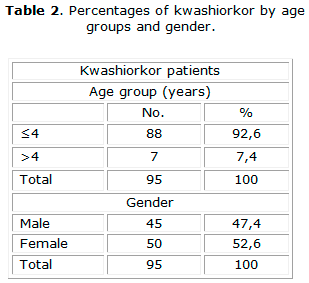
<body><![CDATA[<p style='margin&#45;right:2.15pt;text&#45;align:left;line&#45;height:normal; text&#45;autospace:none;direction:ltr;unicode&#45;bidi:embed'><font face="verdana" size="2">The weight of every child was measured by means of a German Seca scale with the accuracy of &plusmn;50 g. The height of every child was measured by means of a height&#45;measurer, the accuracy of which was 0.5 cm in standard situation; while each case had the least clothes and no shoes on (the height of over&#45;two year old children was measured in standing position and that of under&#45;two in supine position).</font></p>  	    <p style='margin&#45;right:2.15pt;text&#45;align:left;line&#45;height:normal; text&#45;autospace:none;direction:ltr;unicode&#45;bidi:embed'><font face="verdana" size="2">In order to differentiate between the types of malnutrition, Z&#45;score was used. Severe acute malnutrition was defined as a very low weight for height below &#45;3 Z&#45;scores of the median WHO growth standards; kwashiorkor was below &#45;3 Z&#45;scores with edema, and marasmus was below &#45;3 Z&#45;scores without edema; while mild&#45;moderate malnourished children was defined as weight for height between &#45;1 and &#45;3 Z&#45;scores in accordance with the last WHO growth reference standards. <sup>1</sup></font></p>  	    <p style='margin&#45;right:9.2pt;text&#45;align:left;line&#45;height:normal; text&#45;autospace:none;direction:ltr;unicode&#45;bidi:embed'><font face="verdana" size="2">The studied variables included the age group in years (&#8804;4 and &gt;4), gender (male and female), residency of the children (Aden city and rural areas) and the discharge &#91;cured, discharge against medical advice (DAMA) and dead&#93;. The data were obtained from the charts of the patients.</font></p>  	    <p style='margin&#45;right:2.15pt;text&#45;align:left;line&#45;height:normal; text&#45;autospace:none;direction:ltr;unicode&#45;bidi:embed'><font face="verdana" size="2">The written consent was obtained from the administration office of the hospital, the objectives of the study were justified and the information collected was kept totally confidential. Data were processed and analyzed by the SPSS software version 15.&nbsp;</font></p>  	    <p style='margin&#45;right:2.15pt;text&#45;align:left;line&#45;height:normal; text&#45;autospace:none;direction:ltr;unicode&#45;bidi:embed'><font face="verdana" size="2">The estimation of the true percentage was done utilizing interval of confidence with 95% of certain.</font></p>  	    <p style='text&#45;align:left;line&#45;height:normal;direction:ltr; unicode&#45;bidi:embed'><font face="verdana" size="2"><b><i>&nbsp;</i></b></font></p>  	     <p style='text&#45;align:left;line&#45;height:normal;direction:ltr; unicode&#45;bidi:embed'><font face="verdana" size="2"><b><font size="3">RESULTS</font></b></font></p>  	     <p style='margin&#45;right:2.15pt;text&#45;align:left;line&#45;height:normal; text&#45;autospace:none;direction:ltr;unicode&#45;bidi:embed'><font face="verdana" size="2">This    study was done on 1978 malnourished children under 5 years old. Among them,    1016 (51.3%) patients were classified as marasmus and 95 (4.8%) were diagnosed    as kwashiorkor. From 2010 to 2013 the kwashiorkor cases have slightly decreased    (1.6% in 2010, 0.9% in 2013); while marasmus cases have increased (8.7% in 2010,    13.6% in 2013). The total amount of malnourished children admitted at the therapeutic    feeding center in&nbsp; Al&#45;Sadaqa Teaching Hospital, Aden was decreased    from &nbsp;27.8% in 2010 to 21.4% in 2013 (<a href="/img/revistas/rhcm/v14n2/t0108215.gif">Table 1</a>).    The interval of confidence for the percentage of kwashiorkor is&nbsp; (3,84    ;&nbsp; 5,76) with certain of 95%.</font></p>  	     <p style='margin&#45;right:2.15pt;text&#45;align:left;line&#45;height:normal; text&#45;autospace:none;direction:ltr;unicode&#45;bidi:embed'><font face="verdana" size="2">A    high proportion of kwashiorkor children (92.6 %) were &#8804;4 years while only    7.4% were over 4 years. A slight higher proportion of females (52.6%) than males    (47.4%) were observed (<a href="#t2">Table 2</a>).</font></p>  	     <p align="center"><a name="t2"></a><img src="/img/revistas/rhcm/v14n2/t0208215.gif" width="309" height="283">&nbsp;</p>     ]]></body>
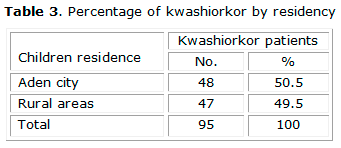
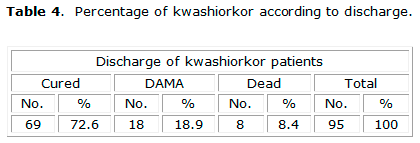
<body><![CDATA[<p style='margin&#45;right:2.15pt;text&#45;align:left;line&#45;height:normal; text&#45;autospace:none;direction:ltr;unicode&#45;bidi:embed'><font face="verdana" size="2">There    was no diferences between the percentage of kwashiorkor and the children residency,    as kwashiorkor&rsquo;s prevalence was similar in Aden city residency (50.5 %)    compared to rural area residence (49.5 %) (<a href="#t3">Table 3</a>).</font></p>  	     <p align="center"><font face="verdana" size="2"><a name="t3"></a>&nbsp;<img src="/img/revistas/rhcm/v14n2/t0308215.gif" width="341" height="148"></font></p>     <p style='text&#45;align:left;line&#45;height:normal;direction:ltr; unicode&#45;bidi:embed'><font face="verdana" size="2">The    results show that for the total kwashiorkor children, the greatest proportion    of discharge was found for cured group (72.6%) while death rate was 8.4%; there    was a statistically significant relationship (<a href="#t4">Table 4</a>).</font></p>  	     <p align="center"><font face="verdana" size="2"><a name="t4"></a>&nbsp;<img src="/img/revistas/rhcm/v14n2/t0408215.gif" width="420" height="143"></font></p>  	    <p style='text&#45;align:left;line&#45;height:normal;text&#45;autospace: none;direction:ltr;unicode&#45;bidi:embed'><font face="verdana" size="2"><b>&nbsp;</b></font></p>  	     <p style='text&#45;align:left;line&#45;height:normal;text&#45;autospace: none;direction:ltr;unicode&#45;bidi:embed'><font face="verdana" size="2"><b><font size="3">DISCUSSION</font></b></font></p>  	    <p align="justify"><font face="verdana" size="2">This study was conducted to estimate the prevalence and pattern of kwashiorkor at the therapeutic feeding center in&nbsp; Al&#45;Sadaqa Teaching Hospital, Aden, Yemen. TFC is one of the most important center providing services to patients with severe acute malnutrition coming mostly from Aden governorate and other nearby and far governorate. In 2011, WHO rehabilitated the center &nbsp;and expanded the bed capacity in addition to setting up a training room, maternal education and counseling corner, as well as mental development and playing corner.<sup>12</sup>&nbsp;&nbsp;&nbsp;</font></p>  	    <p align="justify"><font face="verdana" size="2">A population of 1978 malnourished children (age range: 1&#45; 60 months) were studied. The patients were classified into three groups: severe malnourished children (kwashiorkor or marasmus) and mild&#45;moderate malnourished children, using WHO malnutrition classification.<sup>1</sup></font></p>  	     <p align="justify"><font face="verdana" size="2">The overall prevalence of kwashiorkor    during the four&#45;year period (4.8%), was lower to the findings of children    with kwashiorkor in Sudan (16.3%) and Nigeria (28.7%).<sup>13,14 &nbsp;</sup>It    was also lower compared to studies which were done in other parts of Africa    which ranged from 35% to 86%, where common food is maize, yams and banana. Protein    was not taken much in their common food which contributes to a higher number    of edematous malnutrition than marasmus. <sup>14</sup> In this study, the prevalence    of kwashiorkor was not high and this may be explained by the fact that fish    is a common type of food found in Aden which is rich in protein.&nbsp;</font></p>  	    <p style='text&#45;align:left;line&#45;height:normal;direction:ltr; unicode&#45;bidi:embed'><font face="verdana" size="2">The decrease in 6.4% of kwashiorkor cases and malnourished children at the feeding center in Aden from 2010 to 2013 was lower compared to studies in India; fatality rates there were reported to be reduced by 25% after following WHO criteria. <sup>15</sup> This outcome was achieved by prompt treatment of all infections in these children with appropriate antibiotics, correction of the electrolytes, hypothermia, hypoglycemia, micronutrients and macronutrients following WHO criteria. <sup>1</sup></font></p>  	    ]]></body>
<body><![CDATA[<p style='text&#45;align:left;line&#45;height:normal;text&#45;autospace: none;direction:ltr;unicode&#45;bidi:embed'><font face="verdana" size="2">In the present study, there was no statistically significant difference between genders with respect to kwashiorkor. Kwashiorkor cases were found to be significantly more common among children &#8804;4 years old (92.6%). Kwashiorkor was slightly and no significantly higher among female children compared to male children (52.6% versus 47.4% respectively), which falls in agreement with a study in Nigeria with kwashiorkor 50.9% for males vs. 49.1% for females.<sup>9</sup> The study also agreed with the present research revealing that there was a higher occurrence of kwashiorkor among children of age &#8804;4 years than those older than 4 years. Because most mothers begin to wean their children from 4 months to 1&frac12; years and if adequate diet is not given as a substitute due to ignorance, illiteracy, disease/death of mother or poverty, the child becomes malnourished. <sup>8,9</sup></font></p>  	    <p align="justify"><font face="verdana" size="2">In this study the prevalence of kwashiorkor in Aden city was 50.5% and in rural areas it was 49.5 %, which revealed no statistically significant difference. This is different from the report of Nigeria&rsquo;s study of 87.6% in urban and 12.4 % in rural. Other study in Malawi revealed that the children from rural communities, particularly those from non&#45;pastoral subsistence farming areas without cattle, are more likely to present with kwashiorkor than other children. The typical age of presentation is 1&#150;3 years; kwashiorkor affects both girls and boys equally, and remains a major problem in food insecure regions of the world. <sup>16 &nbsp;</sup></font></p>  	    <p align="justify"><font face="verdana" size="2">Most families in Yemen had adopted manners to cope with their limited access to food. These manners included reducing food quantities, combining meals and removing meat from their diets. As Aden is sea land, the families commonly use fish in their meals. The rural population usually use the breast feeding or/and fresh animals milk as goat and cows to feed their children because it's cheap and rather available. On the other hand, the kwashiorkor cases from rural population in the poorest economic and health care conditions, perhaps don't reach the &nbsp;therapeutic feeding center in&nbsp; Al&#45;Sadaqa Teaching Hospital, due to the difficulties in transportation and the lower level of health education and information about the better treatment for the cases of severe malnutrition that this institution can provide.&nbsp;&nbsp;</font></p>  	    <p style='text&#45;align:left;line&#45;height:normal;text&#45;autospace: none;direction:ltr;unicode&#45;bidi:embed'><font face="verdana" size="2">This study showed significant relationship between kwashiorkor and discharge among study children. The prevalence of kwashiorkor was higher in the cure group compared to the rest. The 8.4% of patients who died is moderately accepted according to WHO criteria (5&#45;15%),<sup>1</sup> and similar to other studies in Malawi, Zaire (8%).<sup>6</sup></font></p>  	    <p style='text&#45;align:left;line&#45;height:normal;text&#45;autospace: none;direction:ltr;unicode&#45;bidi:embed'><font face="verdana" size="2">The lower mortality rate in this study may reflect the effective role of doctors and hospital stuff and the services and intervention provided by UNICEF at the therapeutic feeding center in&nbsp; Al&#45;Sadaqa Teaching Hospital.</font></p>  	    <p style='text&#45;align:left;line&#45;height:normal;direction:ltr; unicode&#45;bidi:embed'><font face="verdana" size="2">As this was a retrospective study there could be some misclassification. However, the authors sought to reduce the study bias by reviewing all admission clinical findings and derived independent diagnoses of kwashiorkor and marasmus using the WHO classification. Using the presence of edema alone as the basis of analysis gives a confounding effect of birth weight on later weight or height gain.</font></p>  	    <p style='text&#45;align:left;line&#45;height:normal;text&#45;autospace: none;direction:ltr;unicode&#45;bidi:embed'><font face="verdana" size="2">The healthy child is the pride of the nation but unfortunately many Yemeni children are not healthy due to malnutrition. This is probably due to the fact that issues bordering on the health of the child have not been adequately addressed in spite of emphasis laid on this by UNICEF, WHO and other international bodies that see to the wellbeing of children. <sup>9</sup></font></p>  	    <p style='text&#45;align:left;line&#45;height:normal;direction:ltr; unicode&#45;bidi:embed'><font face="verdana" size="2">Kwashiorkor is devastating when it progresses to the point that requires hospital admission, although if identified early can be treated on an outpatient basis with ready&#45;to&#45;use therapeutic food. <sup>6</sup></font></p>  	    <p style='text&#45;align:left;line&#45;height:normal;direction:ltr; unicode&#45;bidi:embed'><font face="verdana" size="2">It has been shown that kwashiorkor is caused by several factors which include among others poor weaning techniques, poverty, ignorance, diseases which are predisposed by overcrowding and poor hygiene as well as some cultural/religious taboos. It has a negative impact on the life of the child, thus directly affecting his/her immediate family, the society where he/she lives and ultimately the nation.<sup>9</sup> Carefully review of the circumstances of deaths and identification and solution of related problems should be done in order to reduce the case&#45;fatality rate, to achieve a case&#45;fatality rate of less than 5% according to recommendation of WHO. <sup>1</sup></font></p>  	    <p style='text&#45;align:left;line&#45;height:normal;direction:ltr; unicode&#45;bidi:embed'><font face="verdana" size="2"><b><i>&nbsp;</i></b></font></p>  	     ]]></body>
<body><![CDATA[<p style='text&#45;align:left;line&#45;height:normal;direction:ltr; unicode&#45;bidi:embed'><font face="verdana" size="2"><b><font size="3">CONCLUSIONS</font></b></font></p>  	    <p style='text&#45;align:left;line&#45;height:normal;text&#45;autospace: none;direction:ltr;unicode&#45;bidi:embed'><font face="verdana" size="2">The present study shows that the prevalence of kwashiorkor at the therapeutic feeding center in&nbsp; Al&#45;Sadaqa Teaching Hospital is 4.8%, which is slightly higher for females than males. Kwashiorkor predominance in children &#8804;4 years old is found.&nbsp; Kwashiorkor is similar in patients from Aden city and rural areas. The greatest proportion of children is cured.</font></p>  	    <p style='margin&#45;right:2.15pt;text&#45;align:left;line&#45;height:normal; text&#45;autospace:none;direction:ltr;unicode&#45;bidi:embed'><font face="verdana" size="2">&nbsp;</font></p>  	     <p style='margin&#45;right:2.15pt;text&#45;align:left;line&#45;height:normal; text&#45;autospace:none;direction:ltr;unicode&#45;bidi:embed'><font face="verdana" size="2"><b><font size="3">RECOMENDATIONS</font></b></font></p>  	    <p style='margin&#45;right:2.15pt;text&#45;align:left;line&#45;height:normal; text&#45;autospace:none;direction:ltr;unicode&#45;bidi:embed'><font face="verdana" size="2">It is necessary to promote the knowledge and health education of parents, particularly mothers. It is also recommended to improve the economic and cultural conditions of families. This is mainly the responsibility of the authorities to seek solutions to such problems and to create the clinical feeding center in all hospitals in Yemen.</font></p>  	    <p style='margin&#45;right:153.9pt;text&#45;align:left;line&#45;height: normal;direction:ltr;unicode&#45;bidi:embed'><font face="verdana" size="2"><b><i>&nbsp;</i></b></font></p>  	     <p style='margin&#45;right:153.9pt;text&#45;align:left;line&#45;height: normal;direction:ltr;unicode&#45;bidi:embed'><font face="verdana" size="2"><b><font size="3">ACKNOWLEDGMENT</font></b></font></p>  	    <p style='margin&#45;right:2.15pt;text&#45;align:left;line&#45;height:normal; text&#45;autospace:none;direction:ltr;unicode&#45;bidi:embed'><font face="verdana" size="2">Authors would like to thank children, nurses and archive&rsquo;s workers in Al&#45;Sadaqa Therapeutic Feeding Center of Aden governorate for their cooperation in this study.</font></p>  	    <p style='margin&#45;right:2.15pt;text&#45;align:left;line&#45;height:normal; text&#45;autospace:none;direction:ltr;unicode&#45;bidi:embed'><font face="verdana" size="2"><b>&nbsp;</b></font></p>  	     <p style='margin&#45;right:2.15pt;text&#45;align:left;line&#45;height:normal; text&#45;autospace:none;direction:ltr;unicode&#45;bidi:embed'><font face="verdana" size="2"><b><font size="3">BIBLIOGRAPHY    REFERENCES</font></b></font></p>  	     ]]></body>
<body><![CDATA[<!-- ref --><p style='margin&#45;right:2.15pt;text&#45;align:left;line&#45;height:normal; text&#45;autospace:none;direction:ltr;unicode&#45;bidi:embed'><font face="verdana" size="2">1.&nbsp;    WHO. Training course on the management of severe malnutrition World Health Organization    Department of Nutrition for Health and Development (NHD), Geneva, Switzerland,    and Regional Office for South&#45;East Asia (SEARO), New Delhi, India. &#91;Internet&#93;    Geneva: WHO. &#91;Accessed November 1st, 2014&#93; Available from: <a href="http://www.who.int/" target="_blank">http://www.who.int/nut/publications</a></font><!-- ref --><p style='text&#45;align:left;line&#45;height:normal;direction:ltr; unicode&#45;bidi:embed'><font face="verdana" size="2">2.    World Health Organization. Fact sheet 178. 2009 &#91;cited&nbsp; 19 September    2011&#93;; Accessed 2 Apr 2012. Available from: <a href="http://www.who.int/mediacentre/factsheets/fs178/en/" target="_blank">http://www.who.int/mediacentre/factsheet&#8203;s/fs178/en/</a>.    </font></p>  	     <!-- ref --><p style='text&#45;align:left;line&#45;height:normal;direction:ltr; unicode&#45;bidi:embed'><font face="verdana" size="2">3.    Golden MH. Evolution of nutritional management of acute malnutrition. Indian    Pediatr. 2010; 47: 667&#150;78.    </font></p>  	    <!-- ref --><p style='text&#45;align:left;line&#45;height:normal;text&#45;autospace: none;direction:ltr;unicode&#45;bidi:embed'><font face="verdana" size="2">4. Williams CD. Kwashiorkor: a nutritional disease of children associated with a maize diet. Lancet. 1935; 2: 1151&#45;2.    </font></p>  	    <!-- ref --><p style='text&#45;align:left;line&#45;height:normal;text&#45;autospace: none;direction:ltr;unicode&#45;bidi:embed'><font face="verdana" size="2">5. Ahmed T, Sabuktagin R, Alejandro C. Edematous malnutrition. Indian J Med Res. 2009; 130, 651&#45;4.    </font></p>  	     <!-- ref --><p style='text&#45;align:left;line&#45;height:normal;direction:ltr; unicode&#45;bidi:embed'><font face="verdana" size="2">6.    MacDonald JN. Kwashiorkor and severe acute malnutrition in childhood. The Lancet.    2008;371:P1748. &#91;cited May 2014&#93;. Available from: <a href="http://www.thelancet.com/journals/lancet/article/PIIS0140-6736%2808%2960752-7/fulltext" target="_blank">http://www.thelancet.com/journals/lancet/article/PIIS0140&#45;6736%2808%2960752&#45;7/fulltext</a></font><!-- ref --><p style='text&#45;align:left;line&#45;height:normal;text&#45;autospace: none;direction:ltr;unicode&#45;bidi:embed'><font face="verdana" size="2">7.    Emily Hildick. Increasing protein, decreasing malnutrition. Mortality statistics.    (n.d.) Retrieved October 24, 2012 Available from: <a href="http://www.nationmaster.com/graph/mor_kwa&#45;mortality&#45;kwashiorkor#source" target="_blank">http://www.nationmaster.com/graph/mor_kwa&#45;mortality&#45;kwashiorkor#source</a></font><!-- ref --><p style='text&#45;align:left;line&#45;height:normal;text&#45;autospace: none;direction:ltr;unicode&#45;bidi:embed'><font face="verdana" size="2">8.    Scheinfeld NS, Mokashi &nbsp;A. Protein&#45;energy malnutrition. Medscape network    &nbsp;&#91;cited&nbsp; Dec 2014, Updated: May 30, 2014&#93;. Available from:    <a href="http://emedicine.medscape.com/article/1104623&#45;overview" target="_blank">http://emedicine.medscape.com/article/1104623&#45;overview</a></font><!-- ref --><p style='text&#45;align:left;line&#45;height:normal;text&#45;autospace: none;direction:ltr;unicode&#45;bidi:embed'><font face="verdana" size="2">9.    Jamabo T, Onwukwen A. The incidence of marasmic&#45;kwashiorkor among children    in Port Harcourt, Nigeria. NJAFE. 2010; 6: 96&#45;100. &#91;cited May 2014&#93;    Available from: <a href="http://njafe.org/Njafe2010Vol6No3_4/17JAMABO.pdf" target="_blank">http://njafe.org/Njafe2010Vol6No3_4/17JAMABO.pdf</a></font><!-- ref --><p align="justify"><font face="verdana" size="2">10. FAO&nbsp; Corporate&nbsp;    Document&nbsp; Repository.&nbsp; Human&nbsp; nutrition in the developing world.    Part III. Disorders of malnutrition, Kwashiorkor. &#91;cited sep 2014&#93;.    Available from: <a href="http://www.fao.org/docrep/w0073e/w0073e05.htm" target="_blank">http://www.fao.org/docrep/w0073e/w0073e05.htm</a></font><!-- ref --><p style='text&#45;align:left;line&#45;height:normal;text&#45;autospace: none;direction:ltr;unicode&#45;bidi:embed'><font face="verdana" size="2">11.    Nelson K. Text book of pediatrics, 17th edition. Philadelphia: &nbsp;Saunders&#45;Elsevier;    2004. p.1499 &#45;1502.    </font></p>  	     <!-- ref --><p dir="rtl" style='line&#45;height:normal'><font face="verdana" size="2">12.    World Health Organization. Success of severe malnutrition management in Al&#45;Sadaqa    Hospital<b>.</b> Yemen<b>.</b> &#91;cited 26 Jan 2015&#93;; &#91;accessed 22    Mar 2015&#93;. Available from: <a href="http://www.emro.who.int/yem/yemen-news/severe-malnutrition-management-sadaqa-hospital.html" target="_blank">http://www.emro.who.int/yem/yemen&#45;news/severe&#45;malnutrition&#45;management&#45;sadaqa&#45;hospital.html</a></font><!-- ref --><p style='text&#45;align:left;line&#45;height:normal;direction:ltr; unicode&#45;bidi:embed'><font face="verdana" size="2">13.    Mahgoub HM, Adam I. Morbidity and mortality of severe malnutrition among Sudanese    children in New Halfa Hospital, Eastern Sudan. R Soc Trop Med Hyg. 2012; 106(1):66&#45;8.        &#91;cited sep 2014&#93;. Available from: <cite><a href="www.ncbi.nlm.nih.gov/p" target="_blank">www.ncbi.nlm.nih.gov/p</a></cite></font></p>     <!-- ref --><p align="justify"><font face="verdana" size="2">14. Maimuna MA. Prevalence of    undernutrition, risk factors and outcomes of severe malnutrition among undernourished    children admitted to Bugando Medical Centre in Mwanza, Tanzania &#91;Master    thesis&#93;, Catholic University Of Health And Allied Sciences; 2013. &#91;cited    Sep 2014&#93;. Available from: <a href="http://www.bugando.ac.tz/theses/M.Sc.DissertationMaimunaAhmed.pdf" target="_blank">http://<cite>www.bugando.ac.tz/theses/M.Sc.DissertationMaimunaAhmed.pdf</cite></a></font><!-- ref --><p style='text&#45;align:left;line&#45;height:normal;direction:ltr; unicode&#45;bidi:embed'><font face="verdana" size="2">15.    Puoane T, Sanders D, Ashworth A, Chopra M, Strasser S, McCoy D. Improving the    hospital management of malnourished children by participatory research. International    journal for quality in health care. 2004 Feb;16(1):31&#150;40.    </font></p>  	     <!-- ref --><p align="justify"><font face="verdana" size="2">16. Mark JM, Geert TH, Michael    G. Kwashiorkor: more hypothesis testing is needed to understand the aetiology    of oedema. Malawi Med J. Sep 2009; 21(3):106&#45;7.     &#91;cited Sep 2014&#93;.    Available from: <cite><a href="http://www.ncbi.nlm.nih.gov/pmc/articles/PMC3717490/" target="_blank">http://www.ncbi.nlm.nih.gov/pmc/articles/PMC3717490/</a></cite>    <cite>&nbsp;</cite></font></p>     <p align="justify">&nbsp;</p>     <p align="justify">&nbsp;</p>     <p align="justify"><font face="verdana" size="2"> Recibido: 16 de Enero de 2015    <br>   Aprobado: 30 de Marzo de 2015&nbsp;</font></p>      ]]></body><back>
<ref-list>
<ref id="B1">
<label>1</label><nlm-citation citation-type="book">
<collab>WHO</collab>
<source><![CDATA[Training course on the management of severe malnutrition World Health Organization Department of Nutrition for Health and Development (NHD), Geneva, Switzerland, and Regional Office for South-East Asia (SEARO), New Delhi, India]]></source>
<year></year>
<publisher-loc><![CDATA[Geneva ]]></publisher-loc>
<publisher-name><![CDATA[WHO]]></publisher-name>
</nlm-citation>
</ref>
<ref id="B2">
<label>2</label><nlm-citation citation-type="">
<collab>World Health Organization</collab>
<source><![CDATA[Fact sheet 178]]></source>
<year>2009</year>
</nlm-citation>
</ref>
<ref id="B3">
<label>3</label><nlm-citation citation-type="journal">
<person-group person-group-type="author">
<name>
<surname><![CDATA[Golden]]></surname>
<given-names><![CDATA[MH]]></given-names>
</name>
</person-group>
<article-title xml:lang="en"><![CDATA[Evolution of nutritional management of acute malnutrition]]></article-title>
<source><![CDATA[Indian Pediatr]]></source>
<year>2010</year>
<volume>47</volume>
<page-range>667-78</page-range></nlm-citation>
</ref>
<ref id="B4">
<label>4</label><nlm-citation citation-type="journal">
<person-group person-group-type="author">
<name>
<surname><![CDATA[Williams]]></surname>
<given-names><![CDATA[CD]]></given-names>
</name>
</person-group>
<article-title xml:lang="en"><![CDATA[Kwashiorkor: a nutritional disease of children associated with a maize diet]]></article-title>
<source><![CDATA[Lancet]]></source>
<year>1935</year>
<volume>2</volume>
<page-range>1151-2</page-range></nlm-citation>
</ref>
<ref id="B5">
<label>5</label><nlm-citation citation-type="journal">
<person-group person-group-type="author">
<name>
<surname><![CDATA[Ahmed]]></surname>
<given-names><![CDATA[T]]></given-names>
</name>
<name>
<surname><![CDATA[Sabuktagin]]></surname>
<given-names><![CDATA[R]]></given-names>
</name>
<name>
<surname><![CDATA[Alejandro]]></surname>
<given-names><![CDATA[C]]></given-names>
</name>
</person-group>
<article-title xml:lang="en"><![CDATA[Edematous malnutrition]]></article-title>
<source><![CDATA[Indian J Med Res]]></source>
<year>2009</year>
<volume>130</volume>
<page-range>651-4</page-range></nlm-citation>
</ref>
<ref id="B6">
<label>6</label><nlm-citation citation-type="journal">
<person-group person-group-type="author">
<name>
<surname><![CDATA[MacDonald]]></surname>
<given-names><![CDATA[JN]]></given-names>
</name>
</person-group>
<article-title xml:lang="en"><![CDATA[Kwashiorkor and severe acute malnutrition in childhood]]></article-title>
<source><![CDATA[The Lancet]]></source>
<year>2008</year>
<volume>371</volume>
<page-range>P1748</page-range></nlm-citation>
</ref>
<ref id="B7">
<label>7</label><nlm-citation citation-type="">
<person-group person-group-type="author">
<name>
<surname><![CDATA[Hildick]]></surname>
<given-names><![CDATA[Emily]]></given-names>
</name>
</person-group>
<source><![CDATA[Increasing protein, decreasing malnutrition. Mortality statistics]]></source>
<year>Octo</year>
<month>be</month>
<day>r </day>
</nlm-citation>
</ref>
<ref id="B8">
<label>8</label><nlm-citation citation-type="book">
<person-group person-group-type="author">
<name>
<surname><![CDATA[Scheinfeld]]></surname>
<given-names><![CDATA[NS]]></given-names>
</name>
<name>
<surname><![CDATA[Mokashi]]></surname>
<given-names><![CDATA[A]]></given-names>
</name>
</person-group>
<source><![CDATA[Protein-energy malnutrition]]></source>
<year></year>
<publisher-name><![CDATA[Medscape network]]></publisher-name>
</nlm-citation>
</ref>
<ref id="B9">
<label>9</label><nlm-citation citation-type="journal">
<person-group person-group-type="author">
<name>
<surname><![CDATA[Jamabo]]></surname>
<given-names><![CDATA[T]]></given-names>
</name>
<name>
<surname><![CDATA[Onwukwen]]></surname>
<given-names><![CDATA[A]]></given-names>
</name>
</person-group>
<article-title xml:lang="en"><![CDATA[The incidence of marasmic-kwashiorkor among children in Port Harcourt, Nigeria]]></article-title>
<source><![CDATA[NJAFE]]></source>
<year>2010</year>
<volume>6</volume>
<page-range>96-100</page-range></nlm-citation>
</ref>
<ref id="B10">
<label>10</label><nlm-citation citation-type="">
<collab>FAO^dCorporate Document Repository</collab>
<source><![CDATA[Human nutrition in the developing world: Part III. Disorders of malnutrition, Kwashiorkor]]></source>
<year></year>
</nlm-citation>
</ref>
<ref id="B11">
<label>11</label><nlm-citation citation-type="book">
<person-group person-group-type="author">
<name>
<surname><![CDATA[Nelson]]></surname>
<given-names><![CDATA[K]]></given-names>
</name>
</person-group>
<source><![CDATA[Text book of pediatrics]]></source>
<year>2004</year>
<edition>17</edition>
<publisher-loc><![CDATA[Philadelphia ]]></publisher-loc>
<publisher-name><![CDATA[Saunders-Elsevier]]></publisher-name>
</nlm-citation>
</ref>
<ref id="B12">
<label>12</label><nlm-citation citation-type="">
<collab>World Health Organization</collab>
<source><![CDATA[Success of severe malnutrition management in Al-Sadaqa Hospital]]></source>
<year></year>
</nlm-citation>
</ref>
<ref id="B13">
<label>13</label><nlm-citation citation-type="journal">
<person-group person-group-type="author">
<name>
<surname><![CDATA[Mahgoub]]></surname>
<given-names><![CDATA[HM]]></given-names>
</name>
<name>
<surname><![CDATA[Adam]]></surname>
<given-names><![CDATA[I]]></given-names>
</name>
</person-group>
<article-title xml:lang="en"><![CDATA[Morbidity and mortality of severe malnutrition among Sudanese children in New Halfa Hospital, Eastern Sudan]]></article-title>
<source><![CDATA[R Soc Trop Med Hyg]]></source>
<year>2012</year>
<volume>106</volume>
<numero>1</numero>
<issue>1</issue>
<page-range>66-8</page-range></nlm-citation>
</ref>
<ref id="B14">
<label>14</label><nlm-citation citation-type="">
<person-group person-group-type="author">
<name>
<surname><![CDATA[Maimuna]]></surname>
<given-names><![CDATA[MA]]></given-names>
</name>
</person-group>
<source><![CDATA[Prevalence of undernutrition, risk factors and outcomes of severe malnutrition among undernourished children admitted to Bugando Medical Centre in Mwanza, Tanzania]]></source>
<year></year>
</nlm-citation>
</ref>
<ref id="B15">
<label>15</label><nlm-citation citation-type="journal">
<person-group person-group-type="author">
<name>
<surname><![CDATA[Puoane]]></surname>
<given-names><![CDATA[T]]></given-names>
</name>
<name>
<surname><![CDATA[Sanders]]></surname>
<given-names><![CDATA[D]]></given-names>
</name>
<name>
<surname><![CDATA[Ashworth]]></surname>
<given-names><![CDATA[A]]></given-names>
</name>
<name>
<surname><![CDATA[Chopra]]></surname>
<given-names><![CDATA[M]]></given-names>
</name>
<name>
<surname><![CDATA[Strasser]]></surname>
<given-names><![CDATA[S]]></given-names>
</name>
<name>
<surname><![CDATA[McCoy]]></surname>
<given-names><![CDATA[D]]></given-names>
</name>
</person-group>
<article-title xml:lang="en"><![CDATA[Improving the hospital management of malnourished children by participatory research]]></article-title>
<source><![CDATA[International journal for quality in health care]]></source>
<year>2004</year>
<month>02</month>
<volume>16</volume>
<numero>1</numero>
<issue>1</issue>
<page-range>31-40</page-range></nlm-citation>
</ref>
<ref id="B16">
<label>16</label><nlm-citation citation-type="journal">
<person-group person-group-type="author">
<name>
<surname><![CDATA[Mark]]></surname>
<given-names><![CDATA[JM]]></given-names>
</name>
<name>
<surname><![CDATA[Geert]]></surname>
<given-names><![CDATA[TH]]></given-names>
</name>
<name>
<surname><![CDATA[Michael]]></surname>
<given-names><![CDATA[G]]></given-names>
</name>
</person-group>
<article-title xml:lang="en"><![CDATA[Kwashiorkor: more hypothesis testing is needed to understand the aetiology of oedema]]></article-title>
<source><![CDATA[Malawi Med J]]></source>
<year>Sep </year>
<month>20</month>
<day>09</day>
<volume>21</volume>
<numero>3</numero>
<issue>3</issue>
<page-range>106-7</page-range></nlm-citation>
</ref>
</ref-list>
</back>
</article>