<?xml version="1.0" encoding="ISO-8859-1"?><article xmlns:mml="http://www.w3.org/1998/Math/MathML" xmlns:xlink="http://www.w3.org/1999/xlink" xmlns:xsi="http://www.w3.org/2001/XMLSchema-instance">
<front>
<journal-meta>
<journal-id>1815-5901</journal-id>
<journal-title><![CDATA[Ingeniería Energética]]></journal-title>
<abbrev-journal-title><![CDATA[Energética]]></abbrev-journal-title>
<issn>1815-5901</issn>
<publisher>
<publisher-name><![CDATA[Universidad Tecnológica de La Habana José Antonio Echeverría, Cujae]]></publisher-name>
</publisher>
</journal-meta>
<article-meta>
<article-id>S1815-59012015000300002</article-id>
<title-group>
<article-title xml:lang="en"><![CDATA[Multivariate analysis of performance and emissions for internal combustion engines running with gasoline-ethanol blends]]></article-title>
<article-title xml:lang="es"><![CDATA[Análisis multivariable del desempeño y las emisiones en motores de combustión interna que utilizan mezclas de gasolina y etanol]]></article-title>
</title-group>
<contrib-group>
<contrib contrib-type="author">
<name>
<surname><![CDATA[Mantilla González]]></surname>
<given-names><![CDATA[Juan Miguel]]></given-names>
</name>
<xref ref-type="aff" rid="A01"/>
</contrib>
<contrib contrib-type="author">
<name>
<surname><![CDATA[Garzón Alvarado]]></surname>
<given-names><![CDATA[Diego Alexander]]></given-names>
</name>
<xref ref-type="aff" rid="A01"/>
</contrib>
<contrib contrib-type="author">
<name>
<surname><![CDATA[Galeano Urueña]]></surname>
<given-names><![CDATA[Carlos Humberto]]></given-names>
</name>
<xref ref-type="aff" rid="A01"/>
</contrib>
</contrib-group>
<aff id="A01">
<institution><![CDATA[,Universidad Nacional de Colombia  ]]></institution>
<addr-line><![CDATA[ Bogotá]]></addr-line>
<country>Colombia</country>
</aff>
<aff id="AND">
<institution><![CDATA[,Universidad Nacional de Colombia  ]]></institution>
<addr-line><![CDATA[ ]]></addr-line>
</aff>
<pub-date pub-type="pub">
<day>00</day>
<month>12</month>
<year>2015</year>
</pub-date>
<pub-date pub-type="epub">
<day>00</day>
<month>12</month>
<year>2015</year>
</pub-date>
<volume>36</volume>
<numero>3</numero>
<fpage>232</fpage>
<lpage>242</lpage>
<copyright-statement/>
<copyright-year/>
<self-uri xlink:href="http://scielo.sld.cu/scielo.php?script=sci_arttext&amp;pid=S1815-59012015000300002&amp;lng=en&amp;nrm=iso"></self-uri><self-uri xlink:href="http://scielo.sld.cu/scielo.php?script=sci_abstract&amp;pid=S1815-59012015000300002&amp;lng=en&amp;nrm=iso"></self-uri><self-uri xlink:href="http://scielo.sld.cu/scielo.php?script=sci_pdf&amp;pid=S1815-59012015000300002&amp;lng=en&amp;nrm=iso"></self-uri><abstract abstract-type="short" xml:lang="en"><p><![CDATA[Recent years have shown an increasing interest in ethanol blending to gasoline fuel, as well as a rapid implementation of this kind of biofuels in countries like Colombia. Taking into account the lack of studies about performance and emissions characteristics for the local engines, and the fact that new biofuels policies are emerging using studies made for non-local conditions, a study is proposed in order to verify the real changes in those characteristics into the Colombian conditions. This article presents a performance and emission analysis when different independent variables act on two engines working with gasoline-ethanol blends up to 30 % of the latter. A set of dependent variables are introduced in order to verify the real statistical influence of independent variables. Results confirm trends reported by other authors; nevertheless, these tendencies are not always statistical representative, like in the case of ethanol concentration influence on combustion duration.]]></p></abstract>
<abstract abstract-type="short" xml:lang="es"><p><![CDATA[Los últimos años han mostrado un creciente interés en la mezcla gasolina-alcohol, así como una rápida implementación de este tipo de biocombustible en países como Colombia. Tomando en cuenta la falta de estudios sobre desempeño y emisiones para los motores locales, y el surgimiento de nuevas políticas utilizando como soporte estudios realizados en otros países, se propone verificar los cambios reales sobre esas características para las condiciones Colombianas. Este artículo presenta un análisis de desempeño y emisiones cuando diferentes variables independientes actúan sobre dos motores de combustión interna que trabajan con gasolina-etanol, con hasta 30 % en volumen de este último.Un grupo de variables dependientes es introducido para verificar la verdadera significancia estadística sobre las variables independientes. Los resultados confirman las tendencias reportadas por otros autores; sin embargo, estas tendencias no son siempre estadísticamente representativas, como el caso de la influencia de la concentración de etanol sobre la duración de la combustión.]]></p></abstract>
<kwd-group>
<kwd lng="en"><![CDATA[biofuel]]></kwd>
<kwd lng="en"><![CDATA[emissions,gasoline-ethanol]]></kwd>
<kwd lng="en"><![CDATA[internal combustion engine]]></kwd>
<kwd lng="en"><![CDATA[performance]]></kwd>
<kwd lng="en"><![CDATA[statistical analysis]]></kwd>
<kwd lng="es"><![CDATA[análisis estadístico]]></kwd>
<kwd lng="es"><![CDATA[biocombustible]]></kwd>
<kwd lng="es"><![CDATA[desempeño]]></kwd>
<kwd lng="es"><![CDATA[emisiones]]></kwd>
<kwd lng="es"><![CDATA[gasolina-etanol]]></kwd>
<kwd lng="es"><![CDATA[motor de combustión interna]]></kwd>
</kwd-group>
</article-meta>
</front><body><![CDATA[  		 			    <p align="right"><font size="2" face="Verdana"><strong>TRABAJO TEORICOEXPERIMENTAL</strong></font></p> 			    <p align="right">&nbsp;</p> 			    <p align="left"><b><font size="4" face="Verdana">Multivariate analysis of performance and emissions for internal combustion engines running with gasoline-ethanol blends</font></b></p> 			    <p>&nbsp;</p> 			    <p><b><font size="3" face="Verdana">An&aacute;lisis multivariable del desempe&ntilde;o y las emisiones en motores de combusti&oacute;n interna que utilizan mezclas de gasolina y etanol</font></b></p> 			    <p>&nbsp;</p> 			    <p>&nbsp;</p> 			    <p><font size="2" face="Verdana"><b>Dr. C. Juan Miguel Mantilla Gonz&aacute;lez, Dr. C. Diego Alexander Garz&oacute;n Alvarado y Carlos Humberto Galeano Urue&ntilde;a</b></font></p>     <p><font size="2" face="Verdana">Universidad Nacional de Colombia, Bogot&aacute;, Colombia. </font></p> 	    ]]></body>
<body><![CDATA[<p>&nbsp;</p> 	    <p>&nbsp;</p> 	<hr> 			    <p><font size="2" face="Verdana"><b>ABSTRACT</b></font></p> 			    <p><font size="2" face="Verdana">Recent years have shown an increasing interest in ethanol blending to gasoline fuel, as well as a rapid implementation of this kind of biofuels in countries like Colombia. Taking into account the lack of studies about performance and emissions characteristics for the local engines, and the fact that new biofuels policies are emerging using studies made for non-local conditions, a study is proposed in order to verify the real changes in those characteristics into the Colombian conditions. This article presents a performance and emission analysis when different independent variables act on two engines working with gasoline-ethanol blends up to 30 % of the latter. A set of dependent variables are introduced in order to verify the real statistical influence of independent variables. Results confirm trends reported by other authors; nevertheless, these tendencies are not always statistical representative, like in the case of ethanol concentration influence on combustion duration. </font></p> 			    <p><font size="2" face="Verdana"><b>Key words:</b> biofuel, emissions,gasoline-ethanol, internal combustion engine, performance, statistical analysis. </font></p> 			<hr> 	    <p><font size="2" face="Verdana"><b>RESUMEN</b></font></p> 	    <p><font size="2" face="Verdana">Los &uacute;ltimos a&ntilde;os han mostrado un creciente inter&eacute;s en la mezcla gasolina-alcohol, as&iacute; como una r&aacute;pida implementaci&oacute;n de este tipo de biocombustible en pa&iacute;ses como Colombia. Tomando en cuenta la falta de estudios sobre desempe&ntilde;o y emisiones para los motores locales, y el surgimiento de nuevas pol&iacute;ticas utilizando como soporte estudios realizados en otros pa&iacute;ses, se propone verificar los cambios reales sobre esas caracter&iacute;sticas para las condiciones Colombianas. Este art&iacute;culo presenta un an&aacute;lisis de desempe&ntilde;o y emisiones cuando diferentes variables independientes act&uacute;an sobre dos motores de combusti&oacute;n interna que trabajan con gasolina-etanol, con hasta 30 % en volumen de este &uacute;ltimo.Un grupo de variables dependientes es introducido para verificar la verdadera significancia estad&iacute;stica sobre las variables independientes. Los resultados confirman las tendencias reportadas por otros autores; sin embargo, estas tendencias no son siempre estad&iacute;sticamente representativas, como el caso de la influencia de la concentraci&oacute;n de etanol sobre la duraci&oacute;n de la combusti&oacute;n. </font></p> 	    <p><font size="2" face="Verdana"><b>Palabras clave:</b> an&aacute;lisis estad&iacute;stico, biocombustible, desempe&ntilde;o, emisiones,  gasolina-etanol, motor de combusti&oacute;n interna. </font></p> 	<hr> 	    <p>&nbsp;</p> 	    <p>&nbsp;</p> 	    ]]></body>
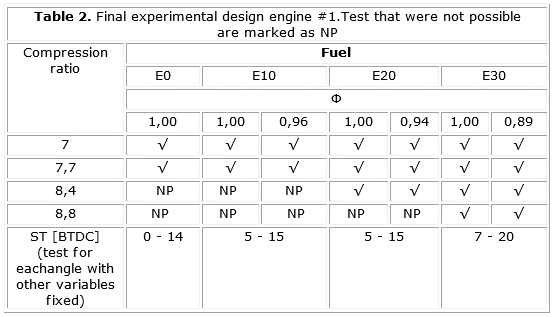
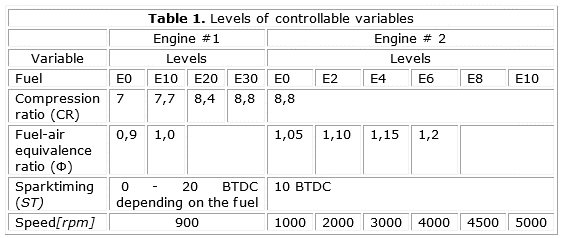
<body><![CDATA[<p><font size="3" face="Verdana"><b>INTRODUCCI&Oacute;N</b></font></p> 	    <p><font size="2" face="Verdana, Arial, Helvetica, sans-serif">Gasoline-ethanol  blends have been of interest since energy crisis in the 70&rsquo;s, caused by OPEC  (Organization of the Petroleum Exporting Countries) oil embargo [1; 2]. In  countries like Brazil, mixtures of gasoline and ethanol from sugarcane  were implemented since mid 70&rsquo;s [3], as a way of agricultural industry  enforcement and a strategy for pollutant emission reduce. In United States and  Canada, use of gasoline-ethanol blends or pure ethanol has had a slow  implementation [2]. </font></p> 	    <p><font size="2" face="Verdana, Arial, Helvetica, sans-serif">This  is because ethanol production and commercialization requires projects with high  investments and, in some cases, negative return rates [4; 5]. That is why the  governments, through subsidy or tax reduction, must help in the purpose of  biofuel accomplishment, together with a long term policy [5]. In Colombia  gasoline-ethanol mixtures have been implemented gradually since 2006. As today,  the whole country is using E8 (92 % gasoline and 8 % ethanol in  volume).Documented tests in [5] show that power and torque does not decrease  when gasoline-ethanol fuels are used, in spite of the smaller Lower Heating  Value (LHV) of it, in contrast to pure gasoline. In fact, an increase in fuel  consumption is expected [6], as well as a raise in engine&rsquo;s thermal efficiency  [7]. Research Octane Number, heat of vaporization and autoignition temperature  also augment with higher ethanol concentration in fuel [5;7]. Reid Vapor  Pressure is bigger for ethanol compared to gasoline [7]. But in blends, their  value is influenced by gasoline quality, i.e how much butane it has and what  are the T50 and T90 distillation temperatures (temperatures in which 50 % and  90% of fuel have been evaporated) [8]. &nbsp;Combustion  in general is improved by gasoline-ethanol blend use as a fuel in engines, when  is compared to gasoline fuel only. The best way to see this is through carbon  monoxide (CO) and total hydrocarbon emissions (THC), which decrease, 10 % to 40 %  for CO [7;8] and 5 % to 20 % for THC [7; 9], as ethanol concentration in the fuel  increase. Opposed to that behaviorare aldehyde emissions with 5% to 200%  [10;11] increase. In relationto emissionssuch asNOx,in the  literatureconflicting results are reported. Whilesome suggestits  reduction[12; 13] and the others an increment [7;9;14];  a third group[15] mention thedifficulty  of predictinga trendfor this issuemainly because theyhave notfound a  linkbetween thefuelandthe main parameters ofengine operation.This complicates  the processof comparison between different technologies for fuel flow control.  These authorsalso indicatethat the comparisonis  difficultbecauseNOxproduction canbe linkeddirectly to  theengine operatingcondition.</font></p> 	    <p><font size="2" face="Verdana, Arial, Helvetica, sans-serif">As  it can be seen in [14] and from this short literature review, that performance  and emissions are affected by many factors. Taking into account that in Bogot&aacute;,  Colombia&acute;s biggest city, the vehicles with spark ignited internal combustion  engines are 92 % of the total vehicle inventory, andfrom that only 34 % are  engines made after 2008 [16], an experimental study is necessary including  different types of engines. For this research two engines were selected: a  single cylinder CFR engine with a special high swirl combustion chamber, and a  four-cylinder commercial engine with flat piston and hemispherical head  combustion chamber. On the other hand, according to a recent Colombian law  [17], since 2013 the use of gasoline-ethanol fuel mixtures in percentages  bigger than 10% of the latter is encouraged.To include all of these aspects, in  this work a multivariate study was made overthedescribed engines, to analyze  real statistical influence on torque, maximum pressure, thermal efficiency,  combustion duration, exhaust temperature and regulated emissions when changes  in ethanol concentration in the fuel, compression ratio, spark timing,  crankshaft velocity and equivalence ratio are entered. The results will be a  good experimental resource to policy makers and researchers on what to expect  for performance and emissions when changes in the considered variables are  applied. This manuscript contains contributions to the body of knowledge not  only for a local interest, but holds contributions in terms of new data and a  new way of presenting results. The paper starts with the experimental set-up  and testing procedure. It continues with the statistical analysis outcome,  followed by results exposition. Finally, conclusions are drawn.</font></p> 	    <p><font size="2" face="Verdana, Arial, Helvetica, sans-serif"><b>EXPERIMENTAL SET-UP</b></font></p> 	    <p><font size="2" face="Verdana, Arial, Helvetica, sans-serif">An experiment design was conducted where different levels for  fuel, compression ratio (CR), fuel-air equivalence ratio (&Phi;), spark timing (ST) and crankshaft  velocity (speed) were included. The controllable (independent) variables and  its levels are presented in <a href="#t1">table 1</a>., <a href="#t2">table 2</a> and <a href="/img/revistas/rie/v36n3/t0302315.gif">table 3</a> show the final  experimental design. The valuesof &Phi;for lean condition are grouped as 0,9 for engine No. 1  in <a href="#t1">table 1</a>, in <a href="#t2">table 2</a>, the real values are shown. Tests for E0 and E10 on CR greater than 8,8 were not  feasible due to severe engine knock. Tests for ethanol volume bigger than 10%  for engine No. 2, were not possible because of over heating of exhaust manifold  and cylinder heads. The output variables were exhaust gas temperature,  combustion chamber pressure and brake torque. Three hundred and eight tests  were run, with three repetitions per test. For  example, in <a href="#t2">table 2</a>, one test is composed of independent variables: fuel (E10),  equivalence ratio (0,96), compression ratio (7,7) and spark timing (10 degrees  BTDC).</font></p> 	    
<p align="center"><img src="/img/revistas/rie/v36n3/t0102315.gif" width="561" height="238"><a name="t1"></a></p> 	    
<p align="center"><img src="/img/revistas/rie/v36n3/t0202315.gif" width="553" height="317"><a name="t2"></a></p> 	    
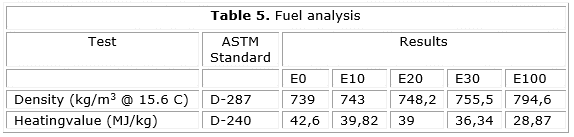
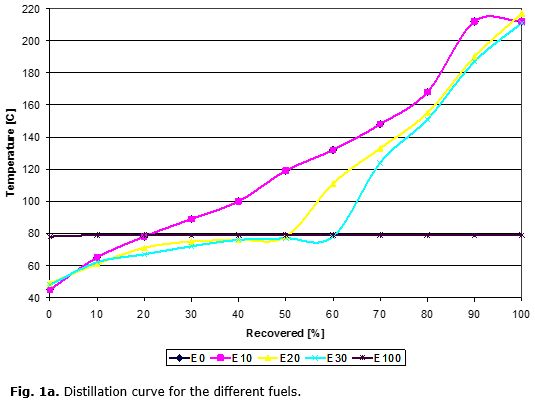
<p align="left"><font size="2" face="Verdana, Arial, Helvetica, sans-serif">The engines and fuels used are described in <a href="#t4">table 4</a>  and <a href="#t5">table 5</a>. Fuel analysis was performed at the fuels laboratory of the National  University of Colombia. <a href="#f1a">Figure 1a</a>, &nbsp;shows distillation curves for the fuels.</font></p> 	    <p align="center"><img src="/img/revistas/rie/v36n3/t0402315.gif" width="411" height="218"><a name="t4"></a></p> 	    
]]></body>
<body><![CDATA[<p align="center"><img src="/img/revistas/rie/v36n3/t0502315.gif" width="574" height="137"><a name="t5"></a></p> 	    
<p align="center"><img src="/img/revistas/rie/v36n3/f1a02315.jpg" width="535" height="402"><a name="f1a"></a></p> 	    
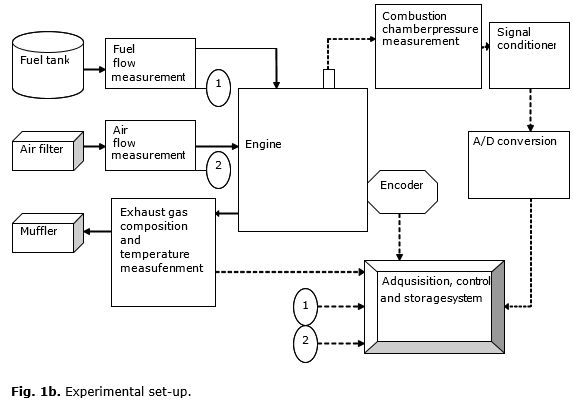
<p align="left"><font size="2" face="Verdana, Arial, Helvetica, sans-serif">A  MoTeC 3.41G2 Engine Control Unit (ECU) was used to manage fuel injection and  spark timing. Combustion chamber pressure was measured with a Kistler 6125B  pressure transducer, every 1/10 crank angle. Fuel flow was assessed with a  scale +/- 0.4% accuracy. A Meriam 50MC2-2 laminar flow elements sensor was used  for air flow measurement. Exhaust temperature evaluation was accomplished with  an Omega K thermocouple +/-0.01C accuracy. <a href="#f1b">Figure 1 (b)</a>, shows experimental  set-up.</font></p> 	    <p align="center"><img src="/img/revistas/rie/v36n3/f1b02315.jpg" width="573" height="403"><a name="f1b"></a></p> 	    
<p><font size="2" face="Verdana, Arial, Helvetica, sans-serif">Exhaust  gases were measureddirectly with a stainless steel probe located between  exhaust manifold and muffler, and followed by a water trap and a moisture  removal membrane.Theflue gas composition was measured with continuous emission  gas monitors, listed next:</font></p> 	<ul type="disc">                    <p><font size="2" face="Verdana, Arial, Helvetica, sans-serif">&#8226; Rosemount       Analytical Model 755R (&plusmn; 0,1 %)</font></p>        	   	        <p><font size="2" face="Verdana, Arial, Helvetica, sans-serif">&#8226; Rosemount Analytical       Model 880 (&plusmn; 0,05 %) </font></p> 	   	   	        <p><font size="2" face="Verdana, Arial, Helvetica, sans-serif">&#8226; Rosemount       Analytical Model 880 (&plusmn; 0,01 %) </font></p> 	   	   	        <p><font size="2" face="Verdana, Arial, Helvetica, sans-serif">&#8226; Rosemount       Analytical Model 955 (&plusmn;1 % Full Scale) </font></p> 	   	   	        <p><font size="2" face="Verdana, Arial, Helvetica, sans-serif">&#8226; Heated FID J.U.M.       Engineering (&plusmn; 10 ppm) </font></p> 	   	   	        ]]></body>
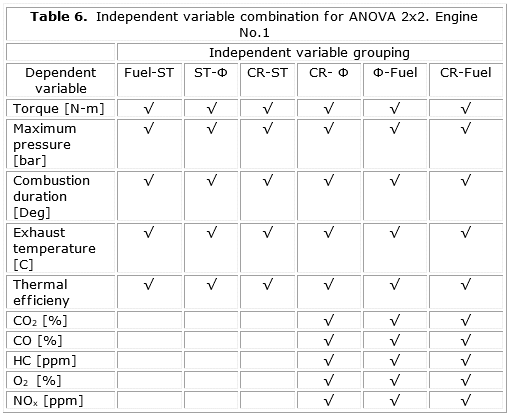
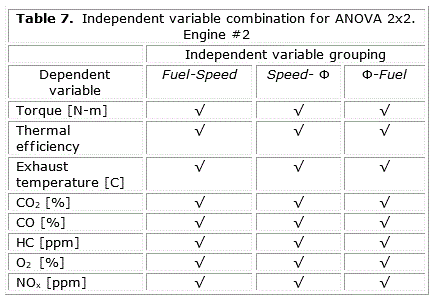
<body><![CDATA[<p><font size="2" face="Verdana, Arial, Helvetica, sans-serif">&#8226; Beckman Industrial       Model 400A Flame Ionization Detector (&plusmn; 1 PPM)</font></p>         </ul> 	    <p>&nbsp;</p> 	    <p><font size="3" face="Verdana, Arial, Helvetica, sans-serif"><b>DISCUSI&Oacute;N</b></font></p> 	    <p><font size="2" face="Verdana, Arial, Helvetica, sans-serif"><b>STATISTICAL ANALYSIS</b></font></p> 	    <p><font size="2" face="Verdana, Arial, Helvetica, sans-serif">After  running all the tests in the engines, collected data is analyzed in order to  obtain the statistical significance of every dependent variable as a function  of independent ones. To accomplish this, first homoscedasticity is checked. To  do that, archtest Matlab function is  used, which executes Engle&rsquo;s Autoregresive  Conditional Heteroscedasticity. This test use dependent variable residuals  from lineal regression, and as a result gives a Boolean variable accepting or  denying the null hypothesis of data homoscedasticity. Results show that for all  dependent variables homoscedasticity exists [18]. &nbsp;After completing previous step, an analysis of  variance (ANOVA) 2 x 2 is made using variable grouping of <a href="#t6">table 6</a>,  and <a href="#t7">table 7</a>,  for every engine. All the possibilities for independent variable grouping are  considered.</font></p> 	    <p align="center"><img src="/img/revistas/rie/v36n3/t0602315.gif" width="511" height="416"><a name="t6"></a></p> 	    
<p align="center"><img src="/img/revistas/rie/v36n3/t0702315.gif" width="435" height="300"><a name="t7" id="t7"></a></p> 	    
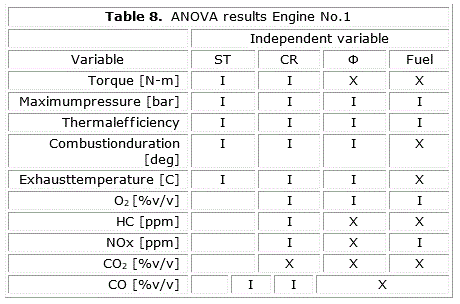
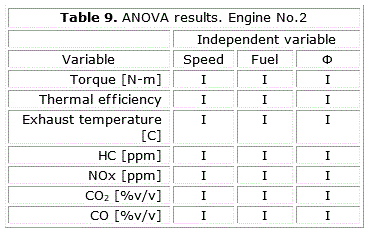
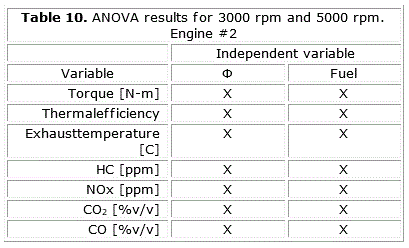
<p><font size="2" face="Verdana, Arial, Helvetica, sans-serif">In  <a href="#t6">table 6</a>, and  <a href="#t7">table 7</a>, dependent  variables are also shown, which were obtained from experiments. ANOVA 2 x 2 was  conducted on dependent variables to determine if the differences with the  changeofevery independent variable were significant at a 95 % confidence level  [19].The summarized results are shown in <a href="#t8">table 8</a>, <a href="#t9">table 9</a> and <a href="#t10">table 10</a>. In these three Tablessymbol I means that changes in independent  variables give statistically significant differences for dependent variables;  symbol X means the opposite to that. For example, in <a href="#t8">table 8</a> Torque is  modified, with a confidence of 95 %, when spark timing and compression ratio  change, but unmodified for changes in phi and fuel composition. To summarize, for  constant speed, as in the case of <a href="#t8">table 8</a> on engine No.1,  equivalence ratio and fuel do not influence torque, HC and CO&shy;2  emissions. Also fuel does not influence combustion duration, exhaust  temperature and CO emission. CO<sub>2</sub> emission is not statistically  different when compression ratio changes. Constant speed for engine No. 2 (<a href="#t10">table 10</a>) shows that differences in every independent variable do not represent  a statistically meaningful change in dependent variables. <a href="#t9">Table 9</a> presents a scenario where differences for every dependent variable were  statistically significant to changes in independent variables.</font></p> 	    <p><font size="2" face="Verdana, Arial, Helvetica, sans-serif">Gaseous  emissions were measured at Maximum Brake Torque (MBT) only in engine No. 1. That  is why in <a href="#t8">table 8</a>&nbsp; the values for ST are empty. </font></p> 	    ]]></body>
<body><![CDATA[<p align="center"><img src="/img/revistas/rie/v36n3/t0802315.gif" width="460" height="304"><a name="t8"></a></p> 	    
<p align="center"><img src="/img/revistas/rie/v36n3/t0902315.gif" width="371" height="233"><a name="t9"></a></p> 	    
<p align="center"><img src="/img/revistas/rie/v36n3/t1002315.gif" width="409" height="248"><a name="t10"></a></p> 	    
<p align="left"><font size="3" face="Verdana, Arial, Helvetica, sans-serif"><b>RESULTS</b></font></p> 	    <p><font size="2" face="Verdana, Arial, Helvetica, sans-serif">Complementing  the results from the statistical analysis (<a href="#t8">table 8</a>, <a href="#t9">table 9</a> and <a href="#t10">table 10</a>), the  effect of every independent variable on the dependent ones is analyzed in this  section. Due to the fact that compression ratio, spark timing, equivalence  ratio and fuel composition are the independent variables (controllable  variables), when we analyze the influence of one independent variable over the  dependent ones, all levels of the other independent variables are considered in  the figures and tables. Only the results for dependent variables that are  statistically meaningful are described in the summary tables (<a href="/img/revistas/rie/v36n3/t1102315.gif">table 11</a>, <a href="#t12">12</a>, <a href="/img/revistas/rie/v36n3/t1302315.gif">13</a>, <a href="/img/revistas/rie/v36n3/t1402315.gif">14</a> and <a href="/img/revistas/rie/v36n3/t1502315.gif">15</a>).</font></p> 	    
<p align="center"><img src="/img/revistas/rie/v36n3/t1202315.gif" width="504" height="160"><a name="t12" id="t12"></a></p> 	    
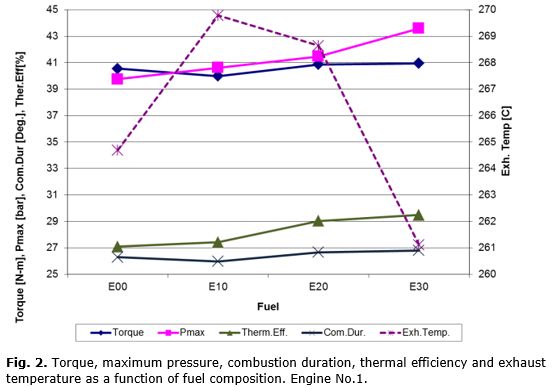
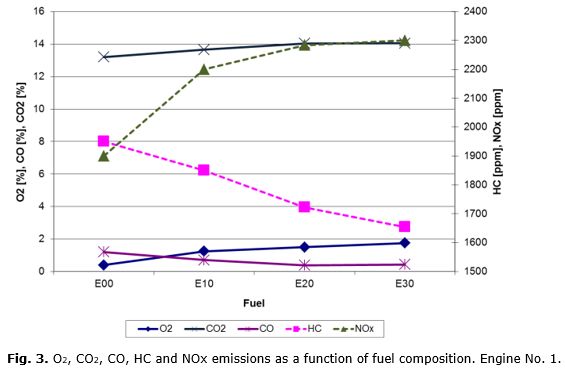
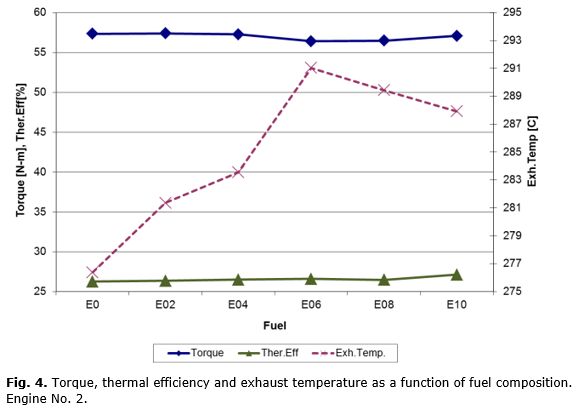
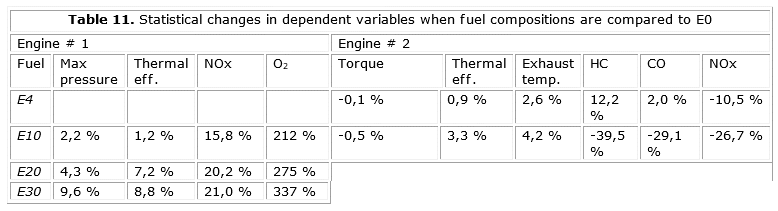
<p><font size="2" face="Verdana, Arial, Helvetica, sans-serif"><b>Ethanol concentration  in the fuel</b>: For engine No. 1 (<a href="#f2">figure 2</a> and <a href="#f3">figure 3</a>), it can be seen that ethanol concentration increases thermal  efficiency, maximum pressure, O<sub>2</sub> and NOx emissions; while torque  remains almost constant with no statistically significant differences as well  as combustion duration and exhaust temperature. In <a href="#f4">figure 4</a> and <a href="#f5">figure 5</a>, for engine No. 2, torque, CO, HC and NOx emissions are decreased  whereas thermal efficiency and exhaust temperature increase. <a href="/img/revistas/rie/v36n3/t1102315.gif">Table 11</a> presents these changes as percentage when results for several fuel  compositions are compared to the ones for E0.</font></p> 	    
<p align="center"><img src="/img/revistas/rie/v36n3/f0202315.jpg" width="552" height="387"><a name="f2"></a></p> 	    
<p align="center"><img src="/img/revistas/rie/v36n3/f0302315.jpg" width="565" height="369"><a name="f3"></a></p> 	    
<p align="center"><img src="/img/revistas/rie/v36n3/f0402315.jpg" width="577" height="410"><a name="f4"></a></p> 	    
]]></body>
<body><![CDATA[<p align="center"><img src="/img/revistas/rie/v36n3/f0502315.jpg" width="547" height="397"><a name="f5"></a></p> 	    
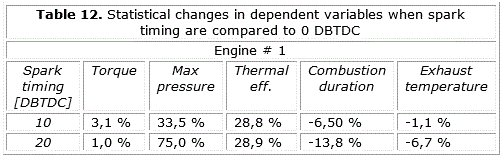
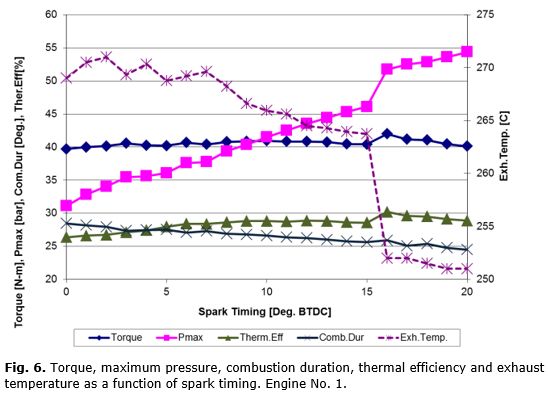
<p><font size="2" face="Verdana, Arial, Helvetica, sans-serif">In  general combustion is improved when ethanol is use as a blending agent into  gasolinedue to a combination of factors like a bigger oxygen concentration in  its molecular structure and higher heat of vaporization [7].These factors promote  better thermal efficiency through increased combustion efficiency and greater  volumetric efficiency. Another factor influencing this enhancing in thermal  efficiency is the use of bigger compression ratios as ethanol concentration in  the fuel increases (<a href="#t2">table 2</a>). This fact is inducing the growing in maximum  pressure as ethanol concentration becomes larger.</font></p> 	    <p><font size="2" face="Verdana, Arial, Helvetica, sans-serif">It  is clear from <a href="#t8">table 8</a> that at constant rpm and torque (engine No.1), exhaust  temperature, HC and CO emissions were not influenced by fuel composition, but  the trend is also to lower these values as ethanol increases [20] Oxygen (O<sub>2</sub>)  emission increased with greater ethanol concentration.</font></p> 	    <p><font size="2" face="Verdana, Arial, Helvetica, sans-serif">In  engine No. 2 exhaust temperature and thermal efficiency increased. Combustion  again is improved, CO and HC emissions are reduced, because of the factors  discussed for engine No.1, plus a benefit that comes from the bigger flame  speed of the ethanol mixture, which assists to complete combustion process at  different crankshaft speeds [21].</font></p> 	    <p><font size="2" face="Verdana, Arial, Helvetica, sans-serif">There  is a big difference between engine No. 1 and engine No.2 concerning NOx  emissions trend. In engine No. 1 NOx increased as ethanol concentration is  bigger, while exhaust temperature, torque and combustion duration show no  statistically meaningful changes. This is caused by the greater compression  ratios, as explain previously, and an increase in combustion efficiency  associated with more ethanol in the mixture [22]. In engine No. 2 torque  decreases as well as NOx emissions with increasing ethanol concentration in the  fuel, due to a combined effect of higher latent heat of vaporization and small  Low Heating Value of ethanol, just as explained in [23].</font></p> 	    <p><font size="2" face="Verdana, Arial, Helvetica, sans-serif"><b>Spark timing</b>: <a href="#f6">Figure 6</a>,  presents a small variation for torque, an increase in maximum pressure, thermal  efficiency and a decrease in exhaust temperature and combustion duration. <a href="#t12">Table 12</a>,  presents these changes as percentage when results for two spark timings are  compared to the ones for 0 DBTDC. </font></p> 	    <p align="center"><img src="/img/revistas/rie/v36n3/f0602315.jpg" width="548" height="393"><a name="f6"></a></p> 	    
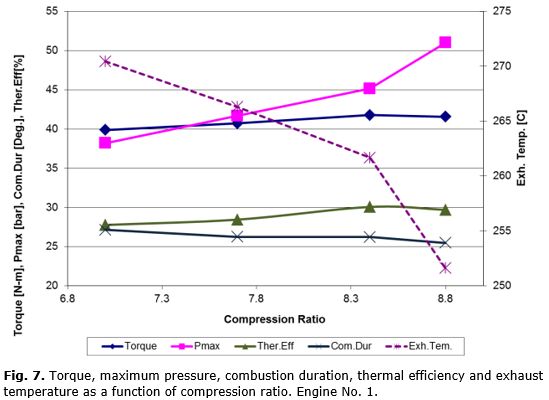
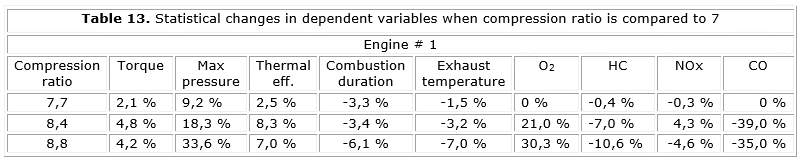
<p><font size="2" face="Verdana, Arial, Helvetica, sans-serif"> These  behaviors can be described using <a href="#t2">table 2</a>. It is seen in this Table that as  ethanol content increases, the tests were made via bigger advances in spark  timing. This must be done because engine could not run smoothly for spark  angles near TDC with ethanol. That tendency is caused by the higher  autoignition temperature of ethanol, which requires more time to ignite despite  of higher laminar speed of ethanol flames (combustion duration is decreased in (<a href="#t12">table 12</a>). So, at elevated spark timing there&rsquo;s more ethanol in the fuel and  bigger compression ratios (<a href="#t2">table 2</a>).</font></p> 	    <p><font size="2" face="Verdana, Arial, Helvetica, sans-serif">Despite  the greater compression ratio and smaller combustion duration with advanced  spark timing (<a href="#t12">table 12</a>), exhaust temperature decreases because of a combined  effect of the reduction of adiabatic flame temperature as ethanol concentration  increases [24] and bigger expansion ratios as more ethanol is used for larger  spark advances [25]. </font></p> 	    <p><font size="2" face="Verdana, Arial, Helvetica, sans-serif"><b>Compression ratio</b>: For engine No.1 (<a href="#f7">figure 7</a> and <a href="#f8">figure 8</a>) it can be seen that torque,  maximum pressure, thermal efficiency, O<sub>2</sub> and NOx emissions increase;  exhaust temperature, combustion duration, HC and CO emissions decrease. <a href="/img/revistas/rie/v36n3/t1302315.gif">Table 13</a>,  presents these changes as percentage when results for three compression ratios  are compared to the ones for a compression ratio of 7. </font></p> 	    
]]></body>
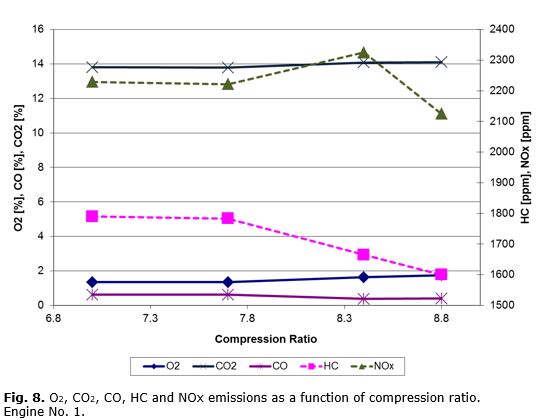
<body><![CDATA[<p align="center"><img src="/img/revistas/rie/v36n3/f0702315.jpg" width="549" height="400"><a name="f7"></a></p> 	    
<p align="center"><img src="/img/revistas/rie/v36n3/f0802315.jpg" width="542" height="420"><a name="f8"></a></p> 	    
<p><font size="2" face="Verdana, Arial, Helvetica, sans-serif">In  <a href="#t2">table 2</a>, it is seen that bigger compression ratios are reached with more  ethanol in the mixture. Thus maximum pressure increases with greater  compression ratios. Combustion is improved as HC and CO emissions are reduced  and thermal efficiency increased due to higher laminar flame speed, explained  by the results of the combustion duration variable. As explain before, exhaust  temperature decreased due to a combined effect of smaller adiabatic flame  temperature and bigger expansion ratios as increasing ethanol concentrations  within the mixture. </font></p> 	    <p><font size="2" face="Verdana, Arial, Helvetica, sans-serif">Nitrogen Oxides  (NOx) emission presents again a behavior briefly described previously. It is  seen in<a href="/img/revistas/rie/v36n3/t1302315.gif"> table 13</a> that this emission is influenced more by the changes in torque  than any other variable [9].</font></p> 	    
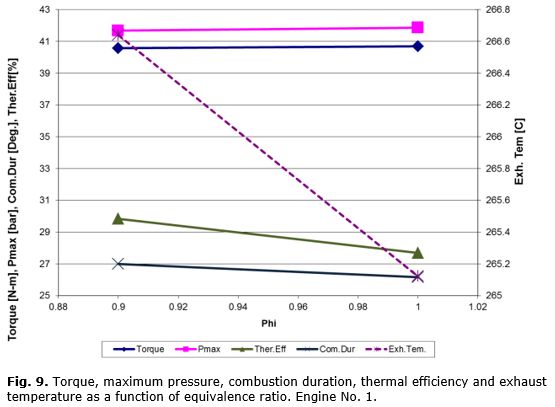
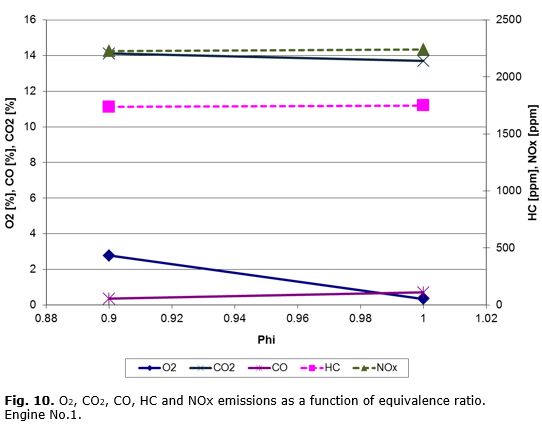
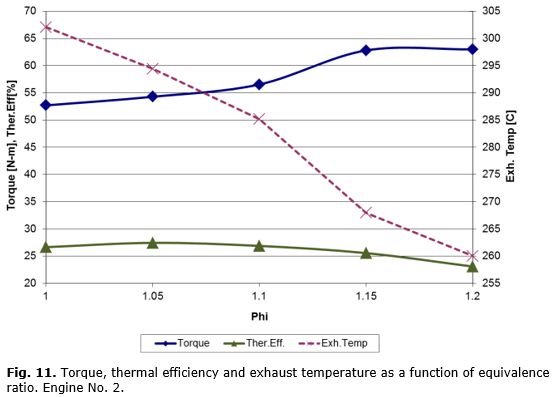
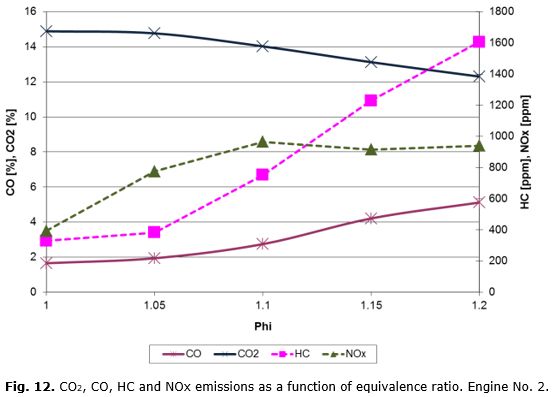
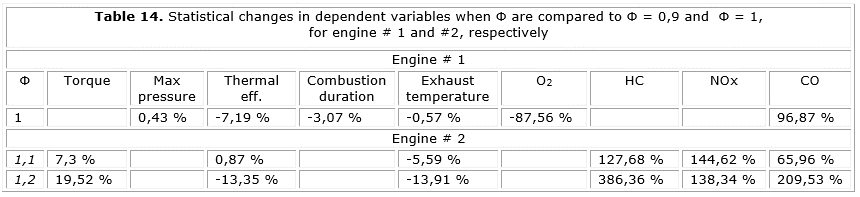
<p><font size="2" face="Verdana, Arial, Helvetica, sans-serif"><b>Fuel-air equivalence  ratio</b>: Engine No. 1 (<a href="#f9">figure 9</a> and <a href="#f10">figure 10</a>), presents variables like thermal efficiency, combustion duration,  exhaust temperature and O<sub>2</sub> emission which decrease, while maximum  pressure and CO emission increase. For engine No. 2 (<a href="#f11">figure 11</a> and <a href="#f12">figure12</a>), torque and CO, HC, NOx emissions increase whereas exhaust temperature  and thermal efficiency decrease. <a href="/img/revistas/rie/v36n3/t1402315.gif">Table 14</a> shows these changes as  percentage when results for &Phi; = 1 are compared to the  ones for &Phi;= 0,9 for engine # 1, andresults for &Phi;  = 1,1 and &Phi; = 1,2 are compared to the onesfor &Phi;= 1 for engine # 2.</font></p> 	    
<p align="center"><img src="/img/revistas/rie/v36n3/f0902315.jpg" width="555" height="407"><a name="f9" id="f9"></a></p> 	    
<p align="center"><img src="/img/revistas/rie/v36n3/f1002315.jpg" width="542" height="424"><a name="f10"></a></p> 	    
<p align="center"><img src="/img/revistas/rie/v36n3/f1102315.jpg" width="553" height="397"><a name="f11" id="f11"></a></p> 	    
<p align="center"><img src="/img/revistas/rie/v36n3/f1202315.jpg" width="553" height="397"><a name="f12"></a></p> 	    
<p><font size="2" face="Verdana, Arial, Helvetica, sans-serif">For  richer mixtures combustion is worse (<a href="/img/revistas/rie/v36n3/t1402315.gif">table 14</a>), as can be expected, because of  the behavior of variables like thermal efficiency, combustion duration, HC and  CO emissions. But in engine # 2 torque is increased, as well as NOx  emissions.This can be explained as a result of a leaner effect of ethanol under  fuel-rich conditions [7], and the direct relation of engine load and NOx  emission previously explained.</font></p> 	    
]]></body>
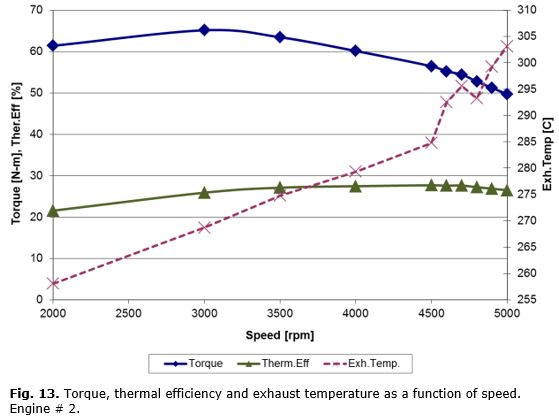
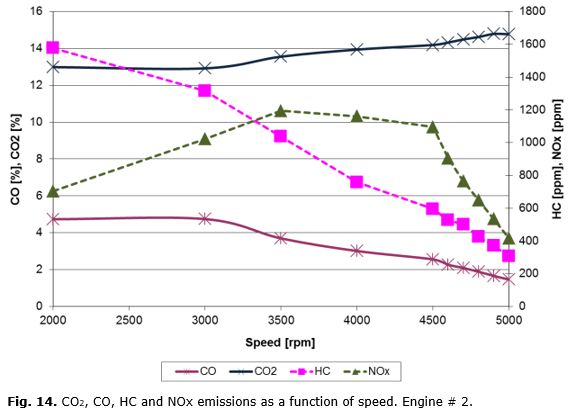
<body><![CDATA[<p><font size="2" face="Verdana, Arial, Helvetica, sans-serif"><b>Crankshaft speed</b>:<a href="#f13">Figure 13</a> and <a href="#f14">figure 14</a> show that thermal efficiency, exhaust temperature and torque (before  3000 rpm) increase, NOx, HC and CO emissions decrease. <a href="/img/revistas/rie/v36n3/t1502315.gif">Table 15</a> presents these changes as percentage when results for three speeds are  compared to the ones for 2000 rpm. </font></p> 	    
<p align="center"><img src="/img/revistas/rie/v36n3/f1302315.jpg" width="559" height="418"><a name="f13"></a></p> 	    
<p align="center"><img src="/img/revistas/rie/v36n3/f1402315.jpg" width="568" height="415"><a name="f14"></a></p> 	    
<p><font size="2" face="Verdana, Arial, Helvetica, sans-serif">With increasing  speed combustion is improved as more fuel is burnt resulting in high  in-cylinder temperatures [26]. Thermal efficiency and NOx emission reach a peak  between 3500 rpm and 4500 rpm, where engine torque and power, respectively,  have maximum values. A direct relationship between operating conditions and NOx  emission is seen.</font></p> 	    <p>&nbsp;</p> 	    <p><font size="3" face="Verdana, Arial, Helvetica, sans-serif"><b>CONCLUSIONS</b> </font></p> 	    <p><font size="2" face="Verdana, Arial, Helvetica, sans-serif">From  the results and the discussions above, it can be concluded that:</font></p> 	    <p><font size="2" face="Verdana, Arial, Helvetica, sans-serif">1. Thermal efficiency increases when gasoline-ethanol blends are used.  In this way it is fair to say that combustion is improved and compression ratio  can be raised. Best emission and performance are obtained at lean conditions  near equivalence ratio of 0,9. Using gasoline-ethanol blends lead to this  condition.</font></p> 	    <p><font size="2" face="Verdana, Arial, Helvetica, sans-serif"> 2. Exhaust temperature is bigger, up to 4 %, with 10 % ethanol  concentration when all range of crankshaft velocitiesis considered. For fixed  velocity ethanol concentration does not influence exhaust temperature.</font></p> 	    <p><font size="2" face="Verdana, Arial, Helvetica, sans-serif"> 3. Advance of spark timing must be made in order to attain  betterperformance conditionswhen increasing ethanol content in the fuel. Spark  timing change is 12 % higher for E20 and 50 % higher for E30, when is compared to  E0.</font></p> 	    ]]></body>
<body><![CDATA[<p><font size="2" face="Verdana, Arial, Helvetica, sans-serif"> 4. Combustion duration is decreased up to 13.85% for increasing advance  of spark timing to 20 DBTDC, i.e. more ethanol in the fuel.</font></p> 	    <p><font size="2" face="Verdana, Arial, Helvetica, sans-serif"> 5. Combustion duration, torque and HC emission are not influenced by  ethanol concentration in the fuel for fixed crankshaft velocity.</font></p> 	    <p><font size="2" face="Verdana, Arial, Helvetica, sans-serif"> 6. Combustion duration, torque, NOx and HC emissions are not influenced  by equivalence ratio in the fuel for fixed crankshaft velocity.</font></p> 	    <p><font size="2" face="Verdana, Arial, Helvetica, sans-serif">7. NOx emissions highly depend on operating conditions (load and speed).</font></p> 	    <p><font size="2" face="Verdana, Arial, Helvetica, sans-serif"> 8. HC and CO emissions decrease up to 80% and 69%, respectively, when  all range of velocities are considered.</font></p> 	    <p><font size="2" face="Verdana, Arial, Helvetica, sans-serif"><b>&nbsp;</b></font></p> 	    <p><font size="3" face="Verdana, Arial, Helvetica, sans-serif"><b>ACKNOWLEDGEMENTS</b></font></p> 	    <p><font size="2" face="Verdana, Arial, Helvetica, sans-serif">ThisstudywassupportedbyDepartamento Administrativo  de Ciencia, Tecnolog&iacute;a e Innovaci&oacute;n de la Rep&uacute;blica de Colombia-COLCIENCIAS  (<a href="www.colciencias.gov.co" target="_blank">www.colciencias.gov.co</a>)withproject No. 202010013830 contract 472 / 2007.</font></p> 	    <p>&nbsp;</p> 	    <p><b><font size="3" face="Verdana, Arial, Helvetica, sans-serif">REFERENCES</font></b></p> 	    ]]></body>
<body><![CDATA[<!-- ref --><p><font size="2" face="Verdana, Arial, Helvetica, sans-serif">1. BASTIANONI, S.; <i>et al</i>. &quot;Indicator and indicandum:  &quot;Sustainable way&quot; vs &quot;prevailing conditions&quot; in the Ecological Footprint&quot;. <i>Ecological Indicators. </i>2012, vol 16, p.  47-50.    </font></p> 	 				      <!-- ref --><p><font size="2" face="Verdana, Arial, Helvetica, sans-serif">2. MCPHAIL, Lihong;<i> et al. </i>&quot;Impact of US biofuel policy on US corn and  gasoline price variability&quot;.<i> Energy, </i>2012, vol 37, p. 505-513.      </font></p> 				      <!-- ref --><p><font size="2" face="Verdana, Arial, Helvetica, sans-serif">3. FURTADO Andr&eacute;; <i>et al</i>. &quot;The  Brazilian sugarcane innovation system&quot;. <i>Energy  Policy</i>, 2011, vol. 39, p. 156-166.    </font></p> 				      <!-- ref --><p><font size="2" face="Verdana, Arial, Helvetica, sans-serif">4. KOSTIN, A. M.; <i>et al</i>. &quot;Design and  planning of infrastructures for bioethanol and sugar production under demand  uncertainty&quot;. <i>Chemical Engineering  Research and Design</i>, 2012, vol. 90, p. 359-376.    </font></p> 				      <!-- ref --><p><font size="2" face="Verdana, Arial, Helvetica, sans-serif">5. MUENCH, Stefan; <i>et al.</i> &quot;A  systematic review of bioenergy life cycle assessments&quot;. <i>Applied Energy</i>, vol. 112, 2013, p. 257-273.    </font></p> 				      ]]></body>
<body><![CDATA[<p><font size="2" face="Verdana, Arial, Helvetica, sans-serif">6. CANAKCI, Mustafa; <i>et al</i>. &quot;Impact  of alcohol&ndash;gasoline fuel blends on the exhaust emission of an SI engine&quot;. <i>Renewable Energy.</i> 2013, vol. 52, p.  111-117.</font></p> 				      <!-- ref --><p><font size="2" face="Verdana, Arial, Helvetica, sans-serif">7. S</font><font size="2" face="Verdana, Arial, Helvetica, sans-serif">CHIFTER, I.; <i>et al .</i> &quot;Combustion  and emission behavior for ethanol-gasoline blends in a single cylinder engine&quot;. <i>Fuel</i>. 2011, vol. 90, p. 3586-3592.    </font></p> 				      <!-- ref --><p><font size="2" face="Verdana, Arial, Helvetica, sans-serif">8. ORBITAL ENGINE COMPANY. <i>A literature review based assessment on the  impacts of a 10 % and 20 % ethanol gasoline fuel blend on non-automotive engines</i> [en l&iacute;nea]. Environment Australia. 2002  [consulta: Abril, 24 de 2015]. Disponible en web: 			        <a href="http://www.environment.gov.au/archive/fuelquality/publications/review-non-automotive/pubs/review.pdf" target="_blank">http://www.environment.gov.au/archive/fuelquality/publications/review-non-automotive/pubs/review.pdf</a></font><p><font size="2" face="Verdana, Arial, Helvetica, sans-serif">9. MASUMB, M.; <i>et al</i>. &quot;Effect of  ethanol&ndash;gasoline blend on NOx emission in SI engine&quot;. <i>Renewable and Sustainable Energy Review</i>. 2013, vol. 24, p. 209-222. </font></p> 				      <!-- ref --><p><font size="2" face="Verdana, Arial, Helvetica, sans-serif">10. WALLNER, Thomas; <i>et al</i>. &quot;Study  of Regulated and Non-Regulated Emissions from Combustion of Gasoline, Alcohol  Fuels and their Blends in a DI-SI Engine&quot;. En: <i>SAE International Powertrains, Fuels &amp; Lubricants Meeting</i>, 2010,  Paper 2010-01-1571.    </font></p> 				      <!-- ref --><p><font size="2" face="Verdana, Arial, Helvetica, sans-serif">11. PANG, Xiaobing, <i>et al</i>. &quot;Carbonyls  emission from ethanol-blended gasoline and biodiesel-ethanol-diesel used in  engines&quot;. <i>Atmospheric Environment</i>. 2008,  vol 42, p. 1349-1358.    </font></p> 				      <!-- ref --><p><font size="2" face="Verdana, Arial, Helvetica, sans-serif">12. VAROLY., <i>et al</i>. &quot;Comparison of  Methanol, Ethanol, or n-Butanol Blending with Unleaded Gasoline on Exhaust  Emissions of an SI Engine&quot;. <i>Energy  Sources, Part A: Recovery, Utilization, and Environmental Effects</i>. 2014,  vol.9, p. 938-948.     </font></p> 				      <!-- ref --><p><font size="2" face="Verdana, Arial, Helvetica, sans-serif">13. ASFAR, K. R.; <i>et al.</i> &quot;Combustion of fuel blends&quot;. <i>Energy Conversion and Management</i>. 1998, vol. 39, p. 1081-1093.    </font></p> 				      <!-- ref --><p><font size="2" face="Verdana, Arial, Helvetica, sans-serif">14. TAVARES, J. R.; <i>et al</i>. Evaluation of pollutant gases  emitted by ethanol and gasoline powered vehicles&quot;. <i>Procedia Environmental Sciences</i>. 2011, vol. 4, p. 51-60.    </font></p> 				      <!-- ref --><p><font size="2" face="Verdana, Arial, Helvetica, sans-serif">15. KARAVALAKIS, Georgios; <i>et al</i>.  &quot;Impacts of ethanol fuel level on emissions of regulated and unregulated  pollutants from a fleet of gasoline light-duty vehicles&quot;. <i>Fuel</i>. 2012, vol. 93, p. 549-558.     </font></p> 				      <p><font size="2" face="Verdana, Arial, Helvetica, sans-serif">16. ALCALD&Iacute;A DE BOGOT&Aacute;. <i>Movilidad en cifras 2011, </i>[en l&iacute;nea].  Informe: Alcald&iacute;a Bogot&aacute; bolet&iacute;n cifras movilidad 2011. 2011  [consulta: Septiembre 24 de 2014] Disponible en web:&nbsp; <a href="http://www.movilidadbogota.gov.co/hiwebx_archivos/audio_y_video/boletin%20cifras.pdf" target="_blank">http://www.movilidadbogota.gov.co/hiwebx_archivos/audio_y_video/boletin%20cifras.pdf </a> </font></p> 				      <!-- ref --><p><font size="2" face="Verdana, Arial, Helvetica, sans-serif">17. MINISTERIO DE MINAS Y ENERG&Iacute;A. <i>Decreto 4892 de  Diciembre 23 de 2011</i> [en l&iacute;nea]. 2011 [consulta: Diciembre 9 de 2014].  Disponible en web:&nbsp; <a href="http://www.minminas.gov.co/minminas/downloads/archivosSoporteRevistas/8302.pdf" target="_blank">http://www.minminas.gov.co/minminas/downloads/archivosSoporteRevistas/8302.pdf </a> </font><p><font size="2" face="Verdana, Arial, Helvetica, sans-serif">18. KLEINBAUM, David; <i>et al</i>. <i>Applied regression analysis and other multivariable methods</i>. 5th  Edition. Belmont: Duxbury Press, 2013. 928 pages. ISBN 978-1285051086. </font></p> 				      ]]></body>
<body><![CDATA[<!-- ref --><p><font size="2" face="Verdana, Arial, Helvetica, sans-serif">19. GRINSTEAD, Charles; SNELL, Laurie. <i>Introduction  to Probability</i> [en l&iacute;nea]. Peter G. Doyle. 2006 [Consulta: Abril 24 de 2015].  Disponibleen web: <a href="http://www.math.dartmouth.edu/~prob/prob/prob.pdf" target="_blank">http://www.math.dartmouth.edu/~prob/prob/prob.pdf </a> </font><!-- ref --><p><font size="2" face="Verdana, Arial, Helvetica, sans-serif">20. STEIN, Robert; <i>et al.</i> &quot;Effect of Heat of Vaporization, Chemical Octane,  and Sensitivity on Knock Limit for Ethanol - Gasoline Blends&quot;. En: <i>SAE 2012 World Congress &amp; Exhibition</i>,  2012, Paper 2012-01-1277.     </font></p> 				      <!-- ref --><p><font size="2" face="Verdana, Arial, Helvetica, sans-serif">21. WALLNER, Thomas;<i> et al.</i> &quot;Analytical assessment  of C2-C8 alcohols as spark-ignition engine fuels&quot;. En: <i>Proceedings of the FISITA 2012 Automotive Congress Volume 3: Future  Automotive Powertrains Lecture Notes in Electrical Engineering 191</i>. Berlin,  Springer Verlag, 2013. p. 16-26.     				    </font>                  </p> 				      <!-- ref --><p><font size="2" face="Verdana, Arial, Helvetica, sans-serif">22. MANTILLA, Juan; <i>et al.</i> &quot;Combustion model for  spark-ignition engines operating on gasoline-ethanol blends&quot;.<i> EngenhariaT&eacute;rmica (Thermal Engineering)</i>. 2010,  vol. 9, p. 89&shy;97.     </font></p> 				      <!-- ref --><p><font size="2" face="Verdana, Arial, Helvetica, sans-serif">23. BALKI, Mustafa;<i> et al.</i> &quot;The effect of  different alcohol fuels on the performance, emission and combustion  characteristics of a gasoline engine&quot;. <i>Fuel</i>.  2012, vol. 115, p. 901-906.    </font></p> 				      <!-- ref --><p><font size="2" face="Verdana, Arial, Helvetica, sans-serif">24. FOONG, Tien; <i>et al.</i> &quot;The octane numbers of  ethanol blended with gasoline and its surrogates&quot;. <i>Fuel</i>. 2014, vol. 115, p. 727-739.    </font></p> 				      <!-- ref --><p><font size="2" face="Verdana, Arial, Helvetica, sans-serif">25. BALKI, Mustafa; <i>et al.</i> &quot;The effect of compression ratio on the  performance, emissions and combustion of an SI (spark ignition) engine fueled  with pure ethanol, methanol and unleaded gasoline&quot;. <i>Energy</i>. 2014, vol. 71, p. 194-201.    </font></p> 				      <!-- ref --><p><font size="2" face="Verdana, Arial, Helvetica, sans-serif">26. TURNER, Dale; <i>et al.</i> &quot;Combustion performance of  bio-ethanol at various blend ratios in a gasoline direct injection engine&quot;. <i>Fuel</i>. 2011, vol. 90, p. 1999-2006.    </font></p> 				                         <p>&nbsp;</p>         <p>&nbsp;</p>         <p><font size="2" face="Verdana, Arial, Helvetica, sans-serif">Recibido: marzo de 2014    <br>     Aprobado: febrero de 2015 </font></p>         <p>&nbsp;</p>         ]]></body>
<body><![CDATA[<p>&nbsp;</p>         <p><font size="2" face="Verdana, Arial, Helvetica, sans-serif"><i>Juan Miguel Mantilla Gonz&aacute;lez.  Ingeniero  Mec&aacute;nico, MSc, PhD, Profesor Asociado Departamento de Ingenier&iacute;a Mec&aacute;nica y  Mecatr&oacute;nica, Universidad Nacional de ColombiaCr30 45-03 edificio 453 of 401,  Bogot&aacute;, Colombia. email: <a href="mailto:jmmantillag@unal.edu.co">jmmantillag@unal.edu.co</a></i></font></p>          ]]></body><back>
<ref-list>
<ref id="B1">
<label>1</label><nlm-citation citation-type="journal">
<person-group person-group-type="author">
<name>
<surname><![CDATA[BASTIANONI]]></surname>
<given-names><![CDATA[S]]></given-names>
</name>
</person-group>
<article-title xml:lang="en"><![CDATA[Indicator and indicandum: Sustainable way" vs "prevailing conditions" in the Ecological Footprint]]></article-title>
<source><![CDATA[Ecological Indicators]]></source>
<year>2012</year>
<volume>16</volume>
<page-range>47-50</page-range></nlm-citation>
</ref>
<ref id="B2">
<label>2</label><nlm-citation citation-type="journal">
<person-group person-group-type="author">
<name>
<surname><![CDATA[MCPHAIL]]></surname>
<given-names><![CDATA[Lihong]]></given-names>
</name>
</person-group>
<article-title xml:lang="en"><![CDATA[Impact of US biofuel policy on US corn and gasoline price variability]]></article-title>
<source><![CDATA[Energy]]></source>
<year>2012</year>
<volume>37</volume>
<page-range>505-513</page-range></nlm-citation>
</ref>
<ref id="B3">
<label>3</label><nlm-citation citation-type="journal">
<person-group person-group-type="author">
<name>
<surname><![CDATA[FURTADO]]></surname>
<given-names><![CDATA[André]]></given-names>
</name>
</person-group>
<article-title xml:lang="en"><![CDATA[The Brazilian sugarcane innovation system]]></article-title>
<source><![CDATA[Energy Policy]]></source>
<year>2011</year>
<volume>39</volume>
<page-range>156-166</page-range></nlm-citation>
</ref>
<ref id="B4">
<label>4</label><nlm-citation citation-type="journal">
<person-group person-group-type="author">
<name>
<surname><![CDATA[KOSTIN]]></surname>
<given-names><![CDATA[A. M.]]></given-names>
</name>
</person-group>
<article-title xml:lang="en"><![CDATA[Design and planning of infrastructures for bioethanol and sugar production under demand uncertainty]]></article-title>
<source><![CDATA[Chemical Engineering Research and Design]]></source>
<year>2012</year>
<volume>90</volume>
<page-range>359-376</page-range></nlm-citation>
</ref>
<ref id="B5">
<label>5</label><nlm-citation citation-type="journal">
<person-group person-group-type="author">
<name>
<surname><![CDATA[MUENCH]]></surname>
<given-names><![CDATA[Stefan]]></given-names>
</name>
</person-group>
<article-title xml:lang="en"><![CDATA[A systematic review of bioenergy life cycle assessments]]></article-title>
<source><![CDATA[Applied Energy]]></source>
<year>2013</year>
<volume>112</volume>
<page-range>257-273</page-range></nlm-citation>
</ref>
<ref id="B6">
<label>6</label><nlm-citation citation-type="journal">
<person-group person-group-type="author">
<name>
<surname><![CDATA[CANAKCI]]></surname>
<given-names><![CDATA[Mustafa]]></given-names>
</name>
</person-group>
<article-title xml:lang="en"><![CDATA[Impact of alcohol-gasoline fuel blends on the exhaust emission of an SI engine]]></article-title>
<source><![CDATA[Renewable Energy]]></source>
<year>2013</year>
<volume>52</volume>
<page-range>111-117</page-range></nlm-citation>
</ref>
<ref id="B7">
<label>7</label><nlm-citation citation-type="journal">
<person-group person-group-type="author">
<name>
<surname><![CDATA[SCHIFTER]]></surname>
<given-names><![CDATA[I.]]></given-names>
</name>
</person-group>
<article-title xml:lang="en"><![CDATA[Combustion and emission behavior for ethanol-gasoline blends in a single cylinder engine]]></article-title>
<source><![CDATA[Fuel]]></source>
<year>2011</year>
<volume>90</volume>
<page-range>3586-3592</page-range></nlm-citation>
</ref>
<ref id="B8">
<label>8</label><nlm-citation citation-type="book">
<collab>ORBITAL ENGINE COMPANY</collab>
<source><![CDATA[A literature review based assessment on the impacts of a 10 % and 20 % ethanol gasoline fuel blend on non-automotive engines]]></source>
<year>2002</year>
<publisher-name><![CDATA[Environment Australia]]></publisher-name>
</nlm-citation>
</ref>
<ref id="B9">
<label>9</label><nlm-citation citation-type="journal">
<person-group person-group-type="author">
<name>
<surname><![CDATA[MASUMB]]></surname>
<given-names><![CDATA[M.]]></given-names>
</name>
</person-group>
<article-title xml:lang="en"><![CDATA[Effect of ethanol-gasoline blend on NOx emission in SI engine]]></article-title>
<source><![CDATA[Renewable and Sustainable Energy Review]]></source>
<year>2013</year>
<volume>24</volume>
<page-range>209-222</page-range></nlm-citation>
</ref>
<ref id="B10">
<label>10</label><nlm-citation citation-type="journal">
<person-group person-group-type="author">
<name>
<surname><![CDATA[WALLNER]]></surname>
<given-names><![CDATA[Thomas]]></given-names>
</name>
</person-group>
<article-title xml:lang="en"><![CDATA[Study of Regulated and Non-Regulated Emissions from Combustion of Gasoline, Alcohol Fuels and their Blends in a DI-SI Engine]]></article-title>
<source><![CDATA[SAE International Powertrains, Fuels & Lubricants Meeting]]></source>
<year>2010</year>
</nlm-citation>
</ref>
<ref id="B11">
<label>11</label><nlm-citation citation-type="journal">
<person-group person-group-type="author">
<name>
<surname><![CDATA[PANG]]></surname>
<given-names><![CDATA[Xiaobing]]></given-names>
</name>
</person-group>
<article-title xml:lang="en"><![CDATA[Carbonyls emission from ethanol-blended gasoline and biodiesel-ethanol-diesel used in engines]]></article-title>
<source><![CDATA[Atmospheric Environment]]></source>
<year>2008</year>
<volume>42</volume>
<page-range>1349-1358</page-range></nlm-citation>
</ref>
<ref id="B12">
<label>12</label><nlm-citation citation-type="journal">
<person-group person-group-type="author">
<name>
<surname><![CDATA[VAROLY]]></surname>
</name>
</person-group>
<article-title xml:lang="en"><![CDATA[Comparison of Methanol, Ethanol, or n-Butanol Blending with Unleaded Gasoline on Exhaust Emissions of an SI Engine]]></article-title>
<source><![CDATA[Energy Sources, Part A: Recovery, Utilization, and Environmental Effects]]></source>
<year>2014</year>
<volume>9</volume>
<page-range>938-948</page-range></nlm-citation>
</ref>
<ref id="B13">
<label>13</label><nlm-citation citation-type="journal">
<person-group person-group-type="author">
<name>
<surname><![CDATA[ASFAR]]></surname>
<given-names><![CDATA[K. R.]]></given-names>
</name>
</person-group>
<article-title xml:lang="en"><![CDATA[Combustion of fuel blends]]></article-title>
<source><![CDATA[Energy Conversion and Management]]></source>
<year>1998</year>
<volume>39</volume>
<page-range>1081-1093</page-range></nlm-citation>
</ref>
<ref id="B14">
<label>14</label><nlm-citation citation-type="journal">
<person-group person-group-type="author">
<name>
<surname><![CDATA[TAVARES]]></surname>
<given-names><![CDATA[J. R.]]></given-names>
</name>
</person-group>
<article-title xml:lang="en"><![CDATA[Evaluation of pollutant gases emitted by ethanol and gasoline powered vehicles]]></article-title>
<source><![CDATA[Procedia Environmental Sciences]]></source>
<year>2011</year>
<volume>4</volume>
<page-range>51-60</page-range></nlm-citation>
</ref>
<ref id="B15">
<label>15</label><nlm-citation citation-type="journal">
<person-group person-group-type="author">
<name>
<surname><![CDATA[KARAVALAKIS]]></surname>
<given-names><![CDATA[Georgios]]></given-names>
</name>
</person-group>
<article-title xml:lang="en"><![CDATA[Impacts of ethanol fuel level on emissions of regulated and unregulated pollutants from a fleet of gasoline light-duty vehicles]]></article-title>
<source><![CDATA[Fuel]]></source>
<year>2012</year>
<volume>93</volume>
<page-range>549-558</page-range></nlm-citation>
</ref>
<ref id="B16">
<label>16</label><nlm-citation citation-type="book">
<source><![CDATA[]]></source>
<year>2011</year>
<publisher-name><![CDATA[Alcaldía Bogotá]]></publisher-name>
</nlm-citation>
</ref>
<ref id="B17">
<label>17</label><nlm-citation citation-type="journal">
<source><![CDATA[Decreto 4892 de Diciembre 23 de 2011]]></source>
<year>2011</year>
</nlm-citation>
</ref>
<ref id="B18">
<label>18</label><nlm-citation citation-type="book">
<person-group person-group-type="author">
<name>
<surname><![CDATA[KLEINBAUM]]></surname>
<given-names><![CDATA[David]]></given-names>
</name>
</person-group>
<source><![CDATA[Applied regression analysis and other multivariable methods]]></source>
<year>2013</year>
<edition>5th</edition>
<page-range>928</page-range><publisher-loc><![CDATA[^eBelmont Belmont]]></publisher-loc>
<publisher-name><![CDATA[Duxbury Press]]></publisher-name>
</nlm-citation>
</ref>
<ref id="B19">
<label>19</label><nlm-citation citation-type="book">
<person-group person-group-type="author">
<name>
<surname><![CDATA[GRINSTEAD]]></surname>
<given-names><![CDATA[Charles]]></given-names>
</name>
<name>
<surname><![CDATA[SNELL]]></surname>
<given-names><![CDATA[Laurie]]></given-names>
</name>
</person-group>
<source><![CDATA[Introduction to Probability]]></source>
<year>2006</year>
<publisher-name><![CDATA[Peter G. Doyle]]></publisher-name>
</nlm-citation>
</ref>
<ref id="B20">
<label>20</label><nlm-citation citation-type="">
<person-group person-group-type="author">
<name>
<surname><![CDATA[STEIN]]></surname>
<given-names><![CDATA[Robert]]></given-names>
</name>
</person-group>
<article-title xml:lang="en"><![CDATA[Effect of Heat of Vaporization, Chemical Octane, and Sensitivity on Knock Limit for Ethanol - Gasoline Blends]]></article-title>
<source><![CDATA[SAE 2012 World Congress & Exhibition]]></source>
<year>2012</year>
</nlm-citation>
</ref>
<ref id="B21">
<label>21</label><nlm-citation citation-type="book">
<person-group person-group-type="author">
<name>
<surname><![CDATA[WALLNER]]></surname>
<given-names><![CDATA[Thomas]]></given-names>
</name>
</person-group>
<article-title xml:lang="en"><![CDATA[Analytical assessment of C2-C8 alcohols as spark-ignition engine fuels]]></article-title>
<source><![CDATA[Proceedings of the FISITA 2012 Automotive Congress Volume 3: Future Automotive Powertrains Lecture Notes in Electrical Engineering 191]]></source>
<year>2013</year>
<page-range>16-26</page-range><publisher-loc><![CDATA[Berlin ]]></publisher-loc>
<publisher-name><![CDATA[Springer Verlag]]></publisher-name>
</nlm-citation>
</ref>
<ref id="B22">
<label>22</label><nlm-citation citation-type="journal">
<person-group person-group-type="author">
<name>
<surname><![CDATA[MANTILLA]]></surname>
<given-names><![CDATA[Juan]]></given-names>
</name>
</person-group>
<article-title xml:lang="en"><![CDATA[Combustion model for spark-ignition engines operating on gasoline-ethanol blends]]></article-title>
<source><![CDATA[EngenhariaTérmica (Thermal Engineering)]]></source>
<year>2010</year>
<volume>9</volume>
<page-range>89­97</page-range></nlm-citation>
</ref>
<ref id="B23">
<label>23</label><nlm-citation citation-type="journal">
<person-group person-group-type="author">
<name>
<surname><![CDATA[BALKI]]></surname>
<given-names><![CDATA[Mustafa]]></given-names>
</name>
</person-group>
<article-title xml:lang="en"><![CDATA[The effect of different alcohol fuels on the performance, emission and combustion characteristics of a gasoline engine]]></article-title>
<source><![CDATA[Fuel]]></source>
<year>2012</year>
<volume>115</volume>
<page-range>901-906</page-range></nlm-citation>
</ref>
<ref id="B24">
<label>24</label><nlm-citation citation-type="journal">
<person-group person-group-type="author">
<name>
<surname><![CDATA[FOONG]]></surname>
<given-names><![CDATA[Tien]]></given-names>
</name>
</person-group>
<article-title xml:lang="en"><![CDATA[The octane numbers of ethanol blended with gasoline and its surrogates]]></article-title>
<source><![CDATA[Fuel]]></source>
<year>2014</year>
<volume>115</volume>
<page-range>727-739</page-range></nlm-citation>
</ref>
<ref id="B25">
<label>25</label><nlm-citation citation-type="journal">
<person-group person-group-type="author">
<name>
<surname><![CDATA[BALKI]]></surname>
<given-names><![CDATA[Mustafa]]></given-names>
</name>
</person-group>
<article-title xml:lang="en"><![CDATA[The effect of compression ratio on the performance, emissions and combustion of an SI (spark ignition) engine fueled with pure ethanol, methanol and unleaded gasoline]]></article-title>
<source><![CDATA[Energy]]></source>
<year>2014</year>
<volume>71</volume>
<page-range>194-201</page-range></nlm-citation>
</ref>
<ref id="B26">
<label>26</label><nlm-citation citation-type="journal">
<person-group person-group-type="author">
<name>
<surname><![CDATA[TURNER]]></surname>
<given-names><![CDATA[Dale]]></given-names>
</name>
</person-group>
<article-title xml:lang="en"><![CDATA[Combustion performance of bio-ethanol at various blend ratios in a gasoline direct injection engine]]></article-title>
<source><![CDATA[Fuel]]></source>
<year>2011</year>
<volume>90</volume>
<page-range>1999-2006</page-range></nlm-citation>
</ref>
</ref-list>
</back>
</article>