<?xml version="1.0" encoding="ISO-8859-1"?><article xmlns:mml="http://www.w3.org/1998/Math/MathML" xmlns:xlink="http://www.w3.org/1999/xlink" xmlns:xsi="http://www.w3.org/2001/XMLSchema-instance">
<front>
<journal-meta>
<journal-id>1815-5901</journal-id>
<journal-title><![CDATA[Ingeniería Energética]]></journal-title>
<abbrev-journal-title><![CDATA[Energética]]></abbrev-journal-title>
<issn>1815-5901</issn>
<publisher>
<publisher-name><![CDATA[Universidad Tecnológica de La Habana José Antonio Echeverría, Cujae]]></publisher-name>
</publisher>
</journal-meta>
<article-meta>
<article-id>S1815-59012017000300007</article-id>
<title-group>
<article-title xml:lang="en"><![CDATA[Analysis of Waste Biogas (Landfills) applied to Power Generation]]></article-title>
<article-title xml:lang="es"><![CDATA[Análisis de biogás de residuos (vertederos) aplicados a la Generación de Energía]]></article-title>
</title-group>
<contrib-group>
<contrib contrib-type="author">
<name>
<surname><![CDATA[Rangel de Oliveira]]></surname>
<given-names><![CDATA[Anderson José]]></given-names>
</name>
<xref ref-type="aff" rid="A01"/>
</contrib>
<contrib contrib-type="author">
<name>
<surname><![CDATA[Marques Paes da Costa]]></surname>
<given-names><![CDATA[Filipe]]></given-names>
</name>
<xref ref-type="aff" rid="A01"/>
</contrib>
<contrib contrib-type="author">
<name>
<surname><![CDATA[Novaes Barreto]]></surname>
<given-names><![CDATA[Lucas]]></given-names>
</name>
<xref ref-type="aff" rid="A01"/>
</contrib>
<contrib contrib-type="author">
<name>
<surname><![CDATA[dos Santos Moreira]]></surname>
<given-names><![CDATA[Luiz]]></given-names>
</name>
<xref ref-type="aff" rid="A01"/>
</contrib>
<contrib contrib-type="author">
<name>
<surname><![CDATA[Zamboti Fortes]]></surname>
<given-names><![CDATA[Márcio]]></given-names>
</name>
<xref ref-type="aff" rid="A01"/>
</contrib>
<contrib contrib-type="author">
<name>
<surname><![CDATA[Moreira Cesar Borba]]></surname>
<given-names><![CDATA[Bruno Soares]]></given-names>
</name>
<xref ref-type="aff" rid="A01"/>
</contrib>
</contrib-group>
<aff id="A01">
<institution><![CDATA[,Fluminense Federal University  ]]></institution>
<addr-line><![CDATA[ ]]></addr-line>
<country>Brazil</country>
</aff>
<pub-date pub-type="pub">
<day>00</day>
<month>12</month>
<year>2017</year>
</pub-date>
<pub-date pub-type="epub">
<day>00</day>
<month>12</month>
<year>2017</year>
</pub-date>
<volume>38</volume>
<numero>3</numero>
<fpage>213</fpage>
<lpage>225</lpage>
<copyright-statement/>
<copyright-year/>
<self-uri xlink:href="http://scielo.sld.cu/scielo.php?script=sci_arttext&amp;pid=S1815-59012017000300007&amp;lng=en&amp;nrm=iso"></self-uri><self-uri xlink:href="http://scielo.sld.cu/scielo.php?script=sci_abstract&amp;pid=S1815-59012017000300007&amp;lng=en&amp;nrm=iso"></self-uri><self-uri xlink:href="http://scielo.sld.cu/scielo.php?script=sci_pdf&amp;pid=S1815-59012017000300007&amp;lng=en&amp;nrm=iso"></self-uri><abstract abstract-type="short" xml:lang="en"><p><![CDATA[In Brazil, despite the high share of renewable energy sources in the energy mix compared to the world average, the use of gas generated by landfills for power generation is still incipient. There are landfills recently implanted with the purpose to produce electricity from biogas, but the oldest installations do not have this structure. Since the oil industry is energy intensive, the article proposes the evaluation of waste gas use in the steam generation system of a typical refinery in Brazil to generate electricity and feed the refinery process units and considering the economic impact. In this sense, it presents an analysis based on real data to contextualize and quantify the waste biogas potential in a specific landfill in Brazil. The study considers a landfill at the end of life (17 years), and the reuse of the residual gas generated until the full depletion of gases considering a case study with real data obtained from an existing landfill]]></p></abstract>
<abstract abstract-type="short" xml:lang="es"><p><![CDATA[En Brasil, a pesar del alto porcentaje de las energías renovables en el mix energético en comparación con el promedio mundial, el uso de gas generado por los vertederos para la generación de energía es aún incipiente. Hay vertederos desplegadas recientemente con el objetivo de producir electricidad a partir de biogás, pero las plantas más viejas, no tienen esta estructura. Dado que la industria petrolera es de alto consumo energético, este artículo propone la evaluación de la utilización de los gases residuales en el sistema de generación de vapor de una refinería típica en Brasil para generar electricidad y alimentar las unidades de proceso de la refinería. En este sentido, se presenta un análisis basado en datos reales para contextualizar y cuantificar el potencial de biogás de residuos en Brasil. Este estudio considera un relleno al final de la vida (17 años), y la reutilización del gas residual generado hasta el agotamiento completo de gases, teniendo en cuenta un estudio de casos con datos reales de un vertedero existente]]></p></abstract>
<kwd-group>
<kwd lng="en"><![CDATA[Biogas]]></kwd>
<kwd lng="en"><![CDATA[Waste Gas]]></kwd>
<kwd lng="en"><![CDATA[Municipal Solid Waste]]></kwd>
<kwd lng="en"><![CDATA[Electricity]]></kwd>
<kwd lng="en"><![CDATA[Landfill]]></kwd>
<kwd lng="en"><![CDATA[Steam Generation]]></kwd>
<kwd lng="es"><![CDATA[Biogás]]></kwd>
<kwd lng="es"><![CDATA[Gas Residual]]></kwd>
<kwd lng="es"><![CDATA[Residuos Sólidos Municipales]]></kwd>
<kwd lng="es"><![CDATA[Electricidad]]></kwd>
<kwd lng="es"><![CDATA[Vertedero]]></kwd>
<kwd lng="es"><![CDATA[Generacion de vapor]]></kwd>
</kwd-group>
</article-meta>
</front><body><![CDATA[ <p align="right"><b><font size="2" face="Verdana, Arial, Helvetica, sans-serif">APLICACIONES INDUSTRIALES </font></b></p>     <p>&nbsp;</p>     <p><b><font size="4" face="Verdana, Arial, Helvetica, sans-serif">Analysis of Waste  Biogas (Landfills) applied to Power Generation </font></b></p>     <p>&nbsp;</p>     <p><font size="2" face="Verdana, Arial, Helvetica, sans-serif">    <b><font size="3">An&aacute;lisis de biog&aacute;s de residuos (vertederos) aplicados a la Generaci&oacute;n de  Energ&iacute;a</font></b></font></p>     <p>&nbsp;</p>     <p>&nbsp;</p>     <p><font size="2" face="Verdana, Arial, Helvetica, sans-serif"><b>Anderson Jos&eacute; Rangel de Oliveira, Filipe Marques Paes da Costa,    Lucas  Novaes Barreto,&nbsp;&nbsp;Luiz  dos Santos Moreira    M&aacute;rcio  Zamboti Fortes, Bruno  Soares Moreira Cesar Borba</b></font></p>     <p><font size="2" face="Verdana, Arial, Helvetica, sans-serif">Fluminense Federal University, Niter&oacute;i, Rio de Janeiro, Brazil.</font></p>     <p>&nbsp;</p>     ]]></body>
<body><![CDATA[<p>&nbsp;</p> <hr>     <p><font size="2" face="Verdana, Arial, Helvetica, sans-serif">ABSTRACT</font></p>     <p><font size="2" face="Verdana, Arial, Helvetica, sans-serif"> In Brazil, despite the high share of renewable energy sources in the energy  mix compared to the world average, the use of gas generated by landfills for  power generation is still incipient. There are landfills recently implanted  with the purpose to produce electricity from biogas, but the oldest  installations do not have this structure. Since the oil industry is energy  intensive, the article proposes the evaluation of waste gas use in the steam  generation system of a typical refinery in Brazil to generate electricity and  feed the refinery process units and considering the economic impact. In this  sense, it presents an analysis based on real data to contextualize and quantify  the waste biogas potential in a specific landfill in Brazil. The study  considers a landfill at the end of life (17 years), and the reuse of the  residual gas generated until the full depletion of gases considering a case  study with real data obtained from an existing landfill.</font></p>     <p><font size="2" face="Verdana, Arial, Helvetica, sans-serif">  <b>Keywords: </b>&nbsp;Biogas; Waste  Gas; Municipal Solid Waste; Electricity; Landfill; Steam Generation.</font></p> <hr>     <p><font size="2" face="Verdana, Arial, Helvetica, sans-serif">RESUMEN </font></p>     <p><font size="2" face="Verdana, Arial, Helvetica, sans-serif">En Brasil, a pesar del alto porcentaje de las energ&iacute;as renovables en el mix  energ&eacute;tico en comparaci&oacute;n con el promedio mundial, el uso de gas generado por  los vertederos para la generaci&oacute;n de energ&iacute;a es a&uacute;n incipiente. Hay vertederos  desplegadas recientemente con el objetivo de producir electricidad a partir de  biog&aacute;s, pero las plantas m&aacute;s viejas, no tienen esta estructura. Dado que la  industria petrolera es de alto consumo energ&eacute;tico, este art&iacute;culo propone la  evaluaci&oacute;n de la utilizaci&oacute;n de los gases residuales en el sistema de  generaci&oacute;n de vapor de una refiner&iacute;a t&iacute;pica en Brasil para generar electricidad  y alimentar las unidades de proceso de la refiner&iacute;a. En este sentido, se  presenta un an&aacute;lisis basado en datos reales para contextualizar y cuantificar  el potencial de biog&aacute;s de residuos en Brasil. Este estudio considera un relleno  al final de la vida (17 a&ntilde;os), y la reutilizaci&oacute;n del gas residual generado  hasta el agotamiento completo de gases, teniendo en cuenta un estudio de casos  con datos reales de un vertedero existente. </font></p>     <p><font size="2" face="Verdana, Arial, Helvetica, sans-serif">  <b>Palabras clave:</b> Biog&aacute;s; Gas Residual; Residuos  S&oacute;lidos Municipales; Electricidad; Vertedero; Generacion de vapor.</font></p> <hr>     <p>&nbsp;</p>     <p>&nbsp;</p>     <p><b><font size="3" face="Verdana, Arial, Helvetica, sans-serif"> INTRODUCTION</font></b></p>     ]]></body>
<body><![CDATA[<p><font size="2" face="Verdana, Arial, Helvetica, sans-serif"> Every year, Brazil has an energy demand growth; a level of  296,2 Mtep was reached in 2013, representing a growth rate of 4,5 % over the  previous year. Although globally act or encouragement to reduce the use of  fossil fuels, the natural gas and oil persist as major sources of primary  energy in the country; in fact, its consumption increased by 7 % in 2014,  compared to the year 2012. </font></p>     <p><font size="2" face="Verdana, Arial, Helvetica, sans-serif"> It is noteworthy, however, that the use of products from sugar  cane and hydropower to generate electricity provide a high level of Brazil&rsquo;s  share of renewable sources in the energy mix, having reached 41 % in 2013.</font></p>     <p><font size="2" face="Verdana, Arial, Helvetica, sans-serif"> Another form of renewable energy production is from waste gas  recovery, whose technology presents slow exploration in Brazil. Indeed, the  generation of municipal solid waste inherent in the continued growth of the  population, which currently claims 201,900,000 inhabitants, reached the level  of 62,730 tonnes per year, of which 90% was collected. Thus, the average daily  per capita waste generation in the country reached 1.05 kg in 2012, and in  developed countries, each person produces an average 1,50 kg of solid waste per  day. A research evaluating the potential of electricity production from  municipal solid waste in the biggest cities in Brazil is presented in [1].</font></p>     <p><font size="2" face="Verdana, Arial, Helvetica, sans-serif"> In the past, the incineration of municipal waste was the  technology used to reduce the volume and destroy harmful substances in order to  avoid risks to human health. Currently, landfills are the main form of  management for virtually all types of municipal solid waste. In Brazil, the  disposal of municipal solid waste is distributed: 58 % to landfills, 24 % to  controlled landfills, and 18% to open dumps. In Brazil, the need to protecting  the environment and combating the pollution and sanitation supply is guaranteed  in the Constitution, which gives municipalities the burden of management of the  municipal solid waste [2]. Despite having one of the highest tax burdens in the  world, the country does not have a well-defined fiscal policy of encouraging  the reuse of waste.</font></p>     <p><font size="2" face="Verdana, Arial, Helvetica, sans-serif"> Properly handling the garbage generated in cities can bring  many benefits to society. For example, Florida, USA, which has 19 million  inhabitants and was the fourth most populous US state in 2010, deposited 40% of  its solid waste in 16 landfills, and the gases generated by them are harnessed  to generate energy. In [3] is reported the United Kingdom experience with  different scenarios assessment. Other concerns must also be considered as the  mitigation of greenhouse gases and climate change as outlined in [4] and [5]. Thus,  this paper aims to conduct a technical and economic evaluation of the use of  waste gas from a landfill as a supply for power generation in steam boilers of  a nearby typical oil refinery in Brazil.</font></p>     <p><b><font size="2" face="Verdana, Arial, Helvetica, sans-serif"> WASTE BIOGAS TECHNOLOGY</font></b></p>     <p><font size="2" face="Verdana, Arial, Helvetica, sans-serif"> Garbage disposal via landfills is one of the oldest techniques  used by man to dispose of waste. Nowadays, a work of engineering aims to  accommodate the waste ground in the smallest possible practical space that is  compact, so that it has the smallest volume and involves a smaller available  area, using the concept of layers. A review about waste management is presented  in [6].</font></p>     <p><font size="2" face="Verdana, Arial, Helvetica, sans-serif"> Proper waste management in landfills and its subsequent reuse  is an environmentally sustainable alternative, as there is the opportunity of  renewable energy generation, as well as the reduction of the emission of  greenhouse gases, thereby allowing the generation of carbon credits within the  Clean Development Mechanism (CDM). Techniques for use of these gases are  studied for more than 20 years and the research of Porteous [7] presented the  state of the art technology at this time. Recently, some research present a  similar research but focuses on information and communication technology (ICT)  to facilitate planning and design of sustainable new systems [8]. Wanichpongpan  and Gheewala [9] address this context discussing the Life Cycle Assessment  (LCA) concept to evaluate the environmental consequences of landfills.</font></p>     <p><font size="2" face="Verdana, Arial, Helvetica, sans-serif"> There are several studies/experiments related to management  and technology application for solid waste and waste gas generation, in this  paper the authors relate some among many other researches in development. The  authors highlight the researches: Methods for solid waste management [10],  Olive industry waste [11], food waste [12], agro-industrial residues [13],  thermal properties of municipal solid waste [14], landfill mining [15],  prediction model [16] and methane data comparison [17].</font></p>     <p><font size="2" face="Verdana, Arial, Helvetica, sans-serif"> The treatment of municipal solid waste landfills is based on  anaerobic digestion (absence of free oxygen). Thus, the biogas generated from  the deposition of waste in landfills is the result of biochemical  decomposition. In the presence of atmospheric air, the layer organic components  in contact with air are oxidized, generating carbon dioxide and water vapor.  The main phase of the reaction cycle occurs in three stages. First, fermenting  bacteria hydrolyze soluble complex organic molecules. Then, these molecules are  converted to organic acids, carbon dioxide, and hydrogen. Finally, methane is  formed by methanogen bacteria, which breaks both organic acids into methane and  carbon dioxide, but also reduces the carbon dioxide with hydrogen. The  simplified procedure is shown in <a href="#e1">equation (1)</a>.</font></p>     ]]></body>
<body><![CDATA[<p align="center"><img src="/img/revistas/rie/v38n3/e0107317.gif" width="360" height="35"><a name="e1"></a></p>     
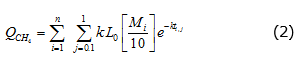
<p><font size="2" face="Verdana, Arial, Helvetica, sans-serif"> According to [18] and [19], the generated biogas is typically  comprised of methane (CH<sub>4</sub> - from 55 to 65 %), carbon dioxide (CO<sub>2</sub>  - 35 to 45 %), nitrogen (N<sub>2</sub> - 0 to 1 %), hydrogen (H<sub>2</sub> - 0  to 1 %), and hydrogen sulfide (H<sub>2</sub>S - 0 to 1 %). </font></p>     <p><font size="2" face="Verdana, Arial, Helvetica, sans-serif"> In their study, Themelis and Ulloa [20], show several  applications for biogas waste as:&nbsp;  industrial heaters and heat exchangers in industries, micro turbines and  fuel cells for electric power generation and others. </font></p>     <p><font size="2" face="Verdana, Arial, Helvetica, sans-serif"> However, the Brazilian reality in 2010 was that only two  landfills performed the use of biogas for power generation. The most common practice  was to direct the emission of biogas into the atmosphere through the exit of  the collectors drains. According to [21], there are methodological differences  to estimate the potential for energy generation in landfills due to the  difficulty of this process modeling, i.e., gas capture and effective power  generation.</font></p>     <p><font size="2" face="Verdana, Arial, Helvetica, sans-serif"> In recent years, several mathematical models of zero decay,  first and second order were developed, and the first-order model has been  widely used by industry and government agencies. The two main parameters of the  kinetic equation of the first order are the maximum potential methane  generation and the constant first-order decay, as shown in <a href="#e2">equation (2)</a>.</font></p>     <p align="center"><img src="/img/revistas/rie/v38n3/e0207317.gif" width="301" height="63"><a name="e2"></a></p>     
<p><font size="2" face="Verdana, Arial, Helvetica, sans-serif">Where: <i>    <br>   Q<sub>CH4</sub></i>: which is the annual rate of biogas  generation (m<sup>3</sup>/year),    <br>    <i>k</i>: is  the rate of methane generation (year -1),    <br>    <i>L</i><sub>0</sub>: is the maximum  potential methane generation (m<sup>3</sup>/t),    ]]></body>
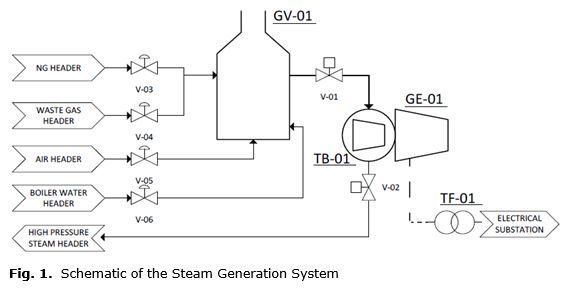
<body><![CDATA[<br>    <i>M<sub>i</sub></i> is the mass of  solid waste deposited in the year <i>i</i> and     <br> <i>t<sub>i, j</sub></i> is the age of the residue deposited in the year <i>i</i>. </font></p>     <p><font size="2" face="Verdana, Arial, Helvetica, sans-serif">On average, it is considered that the  biogas production capacity in landfills is approximately 83 Nm<sup>3</sup>, or  0,12 tons of methane per tonne of waste. The projection is that landfills  around the world produce about 20 to 60 million metric tons of methane per  year. An example is the Gramacho landfill in Rio de Janeiro, which produces  about 42,000 tons of methane per year. Among others, there is in the literature  a document presented by [22], studying the use of biogas in the region of Baja  California, Mexico and other with a optimization use of waste gas application  in Latvia [23]. Conventional technologies for biogas energy conversion are compared  in [18]. Silva [18], states that, for power generation with a small or medium  capacity, internal combustion engines are best suited. Only for high capacity,  gas turbines operate with efficiency and, the plant can further be optimized  when using them in combined cycles.</font></p>     <p>&nbsp;</p>     <p><font size="3" face="Verdana, Arial, Helvetica, sans-serif"> <b>METHODS</b></font></p>     <p><font size="2" face="Verdana, Arial, Helvetica, sans-serif"> This work aims to provide a technical and economic evaluation  of the use of waste gas from a landfill as a supply for power generation in  steam boilers of water at a nearby oil refinery. For this analysis, it is  assumed that the electricity consumption of the oil refinery to feed their  process units is 40 MWh. This energy is generated from two generators, driven  by steam turbines that require 325 tons of steam each. <a href="#f1">Figure 1</a>, is a schematic  model proposed for the generation of steam through natural and waste gas.</font></p>     <p align="center"><img src="/img/revistas/rie/v38n3/f0107317.jpg" width="564" height="292"><a name="f1"></a></p>     
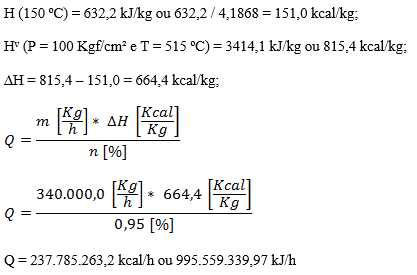
<p><font size="2" face="Verdana, Arial, Helvetica, sans-serif"> <i>Technical Analysis</i></font></p>     <p><font size="2" face="Verdana, Arial, Helvetica, sans-serif"> To generate steam, two boilers are  considered, each with a 340 t/h production capacity. The boilers use refinery  gas as an energy source, and the nominal name plate are: operating pressure  (main steam) of 100 kgf/cm2, operating temperature (main steam) of  515 &deg;C, design pressure of 115 kgf/cm<sup>2</sup>,&nbsp; supply water temperature of 150 &deg;C, dry bulb  ambient air temperature of 24 &deg;C, energy efficiency premise of 0,95, front  burning combustion system and forced exhaustion system.&nbsp; With&nbsp;  from the boiler, we are able to determine the amount of fuel needed to  generate 340 t/h of superheated steam to the operation pressure of 100 kgf/cm<sup>2</sup>,  considering an energy efficiency of 95 %. For this, calculation is made  considering primarily as fuel gas from the refinery. The typical refinergy gas  composition considered is: Methane (86,2 %Vol), Ethane (6,9 %Vol), Hydrogen  (2,5 %Vol),&nbsp; Propane (1,8 %Vol), Nitrogen  (1,3 %Vol), Carbon Dioxide (0,7 %Vol), Oxygen (0,2 %Vol), H<sub>2</sub>O (0,2 %Vol),  Butane (0,1 %Vol), Pentane (0,1 %Vol) and, Ethylene, Cyclopropane, 1-Butene,  2-trans-butene, 2-cis-butene and Hexane with 0% Vol.</font></p>     <p align="left"><font size="2" face="Verdana, Arial, Helvetica, sans-serif">  To calculate the amount of energy  required to generate super-saturated steam in the boiler must determine the  enthalpy (H) of the liquid input and steam output to conditions presented  (PERRY E SMITH, VAN NESS, ABBOTT &ndash; 1996). The HHV of refinery gas is 12,552  kcal/kg. The calculus to obtain the HHV of waste gas uses the methodology based  on the Combustion Heats of its components. Thus, once known mass or composition  of substance in an amount (volume or moles) of fuel in question, there is the  amount of heat released in the combustion of each of the components. The sum of  these released energies will be the estimated of the calorific value.</font></p>     ]]></body>
<body><![CDATA[<p align="center"><i><img src="/img/revistas/rie/v38n3/e0a07317.gif" width="417" height="275"></i></p>     
<p align="left"><font size="2" face="Verdana, Arial, Helvetica, sans-serif">  To find out the PCS of the waste gas, a  methodology of PCS determination is used through the Combustion Heat of its  components. Where the mass or quantity of matter (volume or moles) of the fuel  in question is known, the amount of heat released in the combustion of each  component is checked. The sum of these energies released will be the estimated  value of the calorific value. (SMITH, VAN NESS, ABBOTT - 1996). In order to  validate the method that calculate the density and calorific superior (<i>HHV</i>) for  refinery gas and so it is possible to calculate the waste gas, compared to the  <i>HHV</i> and density values calculated with typical operating data. The <a href="/img/revistas/rie/38n3/t0107317.gif">table 1</a>,  presents these data. For error calculations, the following methodology  [<a href="#e3">equation (3)</a>], was used:</font></p>     
<p align="center"><img src="/img/revistas/rie/v38n3/e0307317.gif" width="321" height="54"><a name="e3" id="e3"></a></p>     
<p><font size="2" face="Verdana, Arial, Helvetica, sans-serif">The errors revealed a minimum of 0,31 %  for density and 0,18 % for <i>HHV</i>. Therefore, the calculation method has been  validated. Similarly, the calculations were performed to HHV and density of the  waste gas. The <a href="/img/revistas/rie/38n3/t0207317.gif">table 2</a>, shows the results and the error of 7,26 % for <i>HHV</i>.</font></p>     
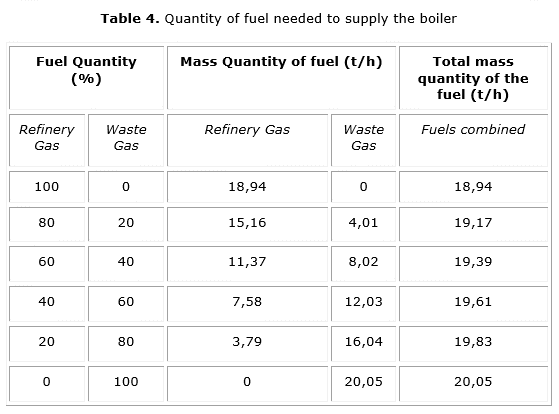
<p><font size="2" face="Verdana, Arial, Helvetica, sans-serif">With the data obtained, we can  calculate the quantity of fuel required to generate 340 t/h on a supersaturated  steam boiler (See <a href="/img/revistas/rie/38n3/t0307317.gif">table 3</a>). <a href="/img/revistas/rie/38n3/t0407317.gif">Table 4</a>, shows the quantity of fuel required for  the boiler with different percentage mixtures.</font></p>     
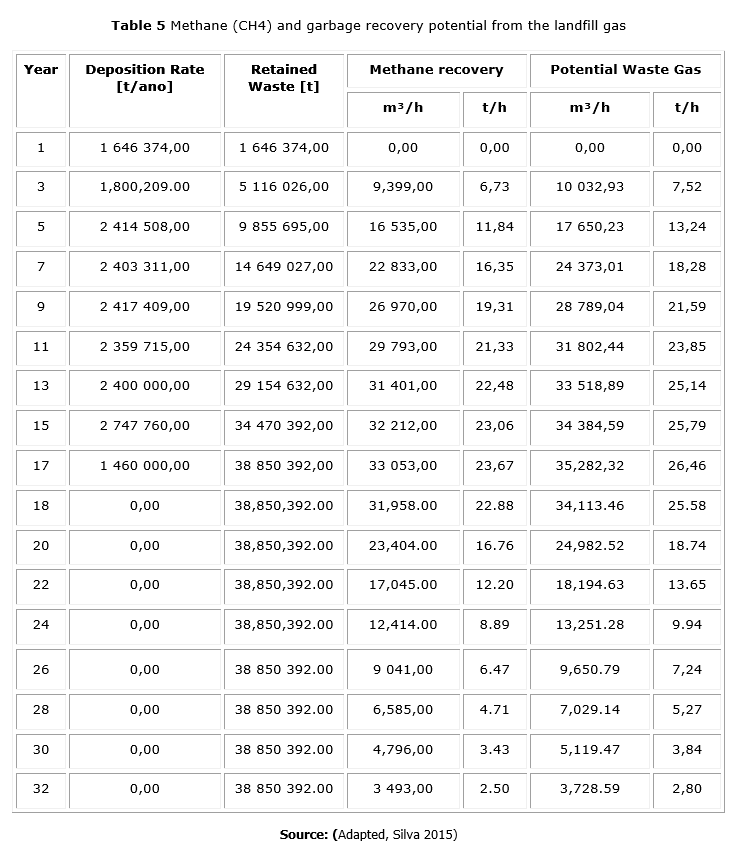
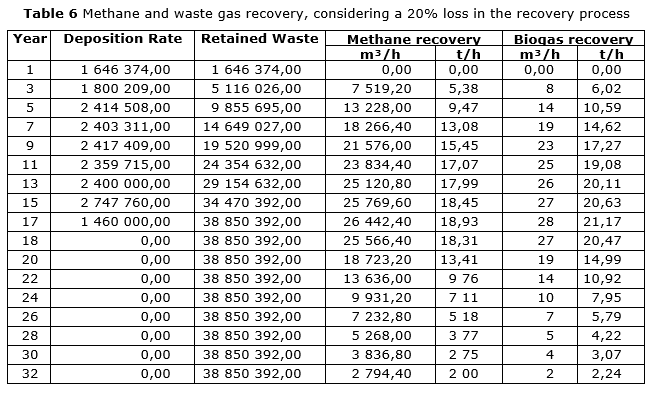
<p><font size="2" face="Verdana, Arial, Helvetica, sans-serif"><i>Biogas Recovery  Capacity</i></font></p>     <p><font size="2" face="Verdana, Arial, Helvetica, sans-serif"> Considering the example of a landfill,  which initiates the operation in year 1 and functions for 17 years, the methane  recovery potential is shown in <a href="/img/revistas/rie/38n3/t0507317.gif">table 5</a>. As the methane corresponds to 93,68 % of  waste gas volume, dividing the amount of methane (m&sup3;/h) by this value (93,68 %)  will determine the amount of waste gas (m&sup3;/h). The values in t/h of methane and  waste gas were found by multiplying the values found in m&sup3;/h by their  respective densities: Gas methane density: 0.000716 t/m&sup3; (temp. 25 &ordm;C)  and &nbsp;Waste gas density: 0,00074999 t/m&sup3;  (temp 25 &ordm;C). However, there are always losses in the recovery of  methane; that loss is considered to be approximately 20 %. The recoveries of  methane and biogas are shown in <a href="/img/revistas/rie/38n3/t0607317.gif">table 6</a>. The potential assessment has deemed  that the landfill waste depreciation stage ends in Year 17 and that the gases  generated in the final cycle can still be used.</font></p>     
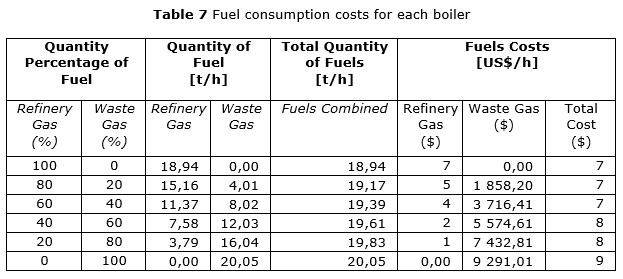
<p><font size="2" face="Verdana, Arial, Helvetica, sans-serif"><i>Cost</i></font></p>     <p><font size="2" face="Verdana, Arial, Helvetica, sans-serif"> With data obtained for consumer fuels,  we can do an economic analysis to verify the expenses of using the waste gas  and the possible savings from the sale of carbon credits.</font></p>     <p><font size="2" face="Verdana, Arial, Helvetica, sans-serif"> Considering the quotation of&nbsp; 6,65 US$/t de Ceq (day quote on  06/22/2015), waste gas cost of 463,37 US$/t and refinery gas cost of 373,98  US$/t,&nbsp; the &nbsp;<a href="/img/revistas/rie/38n3/t0707317.gif">table 7</a>, shows the gas cost in accordance with  the consumption and composition (i.e., waste gas and more refinery gas) and the  fuel consumption costs for a boiler.</font></p>     
]]></body>
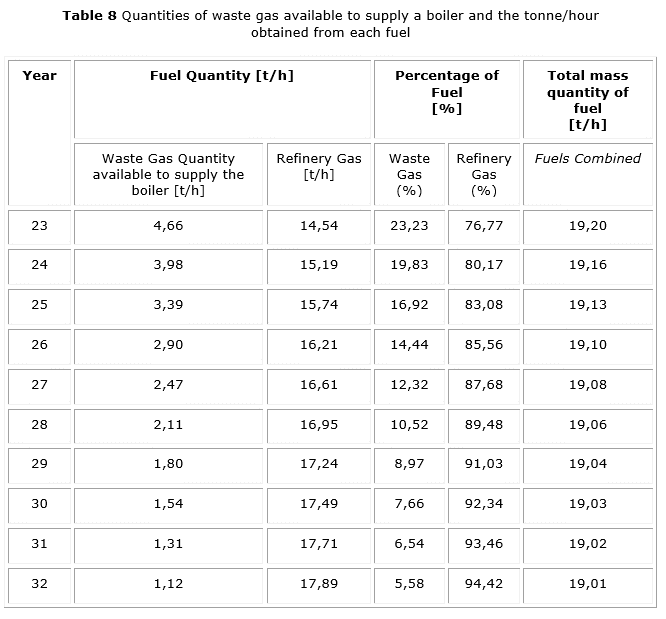
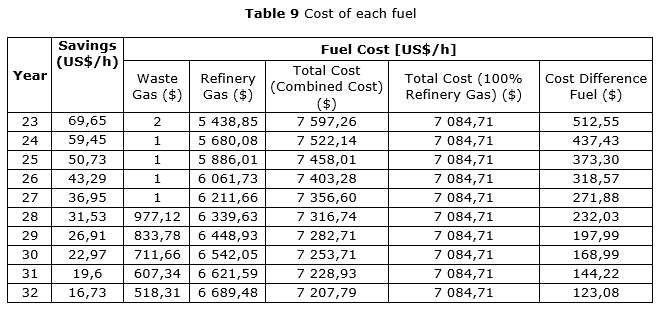
<body><![CDATA[<p><font size="2" face="Verdana, Arial, Helvetica, sans-serif"> To calculate the savings from the sale  of carbon credits, it is necessary to determine the amount of waste gas (t/h)  available for each boiler and, consequently, determine the amount of methane  (t/h) present in the waste gas. As the quantity of waste gas supplied decreases  over the years, an analysis will be necessary to verify that the quantity of  waste gas from year 1 to year 32 will be available to meet each boiler.</font></p>     <p><font size="2" face="Verdana, Arial, Helvetica, sans-serif"> <a href="/img/revistas/rie/38n3/t0807317.gif">Tables 8</a> and <a href="/img/revistas/rie/38n3/t0907317.gif">9</a>, present combinations of  gases to be used for the boiler and the cost of the fuels.</font></p>     
<p><font size="2" face="Verdana, Arial, Helvetica, sans-serif">However, with the sale of carbon  credits, it is possible to get an income that can be reduce in the final cost  with fuel. The calculation of carbon credits is calculated using the following  assumptions:</font></p>     <p><font size="2" face="Verdana, Arial, Helvetica, sans-serif"> &ndash; 1 t/h of methane [CH<sub>4</sub> (g)]  is 21 t/h carbon dioxide [CO<sub>2</sub> (g)], and the quantity of available  methane recovered was multiplied by 21, obtaining the flow of carbon equivalent;  &nbsp;To determine the amount of the carbon  credits [US$/h] with this amount of carbon equivalent, multiply the flow Ceq by  the carbon credit value [$ 6,65/t Ceq]; and using the value of the carbon  credits [US$/h] to obtain the savings achieved by using the combined fuel for  100 % utilization of refinery gas makes up the difference between carbon credits  [US$/h] and the fuel costs mentioned above.</font></p>     <p><font size="2" face="Verdana, Arial, Helvetica, sans-serif">In the <a href="/img/revistas/rie/38n3/t0907317.gif">table 9</a>, (first column) shows the possible carbon credits when using  the waste gas for each boiler.</font></p>     
<p>&nbsp;</p>     <p><b><font size="3" face="Verdana, Arial, Helvetica, sans-serif">RESULTS AND DISCUSSION</font></b></p>     <p><font size="2" face="Verdana, Arial, Helvetica, sans-serif"> <i>Waste Gas Quality</i></font></p>     <p><font size="2" face="Verdana, Arial, Helvetica, sans-serif"> The biogas  that reaches the refinery has a very good quality in terms of its energy,  compared to the quality of waste gases and other landfills. It was found that  this HHV is calculated to be around 8 894,18 kcal/m&sup3;, whereas studies show that  the average <i>HHV</i> of other biogases is around 4 900 kcal/m&sup3;. This is explained by  the fact that landfill waste gas goes through a purification process to  increase the concentration of CH<sub>4</sub>. Furthermore, the control leakage  in the gas pipes must be very intense; therefore, the concentration of nitrogen  in the gas is too low, it is assumed that no false air intake through pipes.  One can also observe that the waste gas <i>HHV</i> (11 858,97 kcal/kg) was very close  to the refinery gas (12 573,98 kcal/kg) currently used for the power supply of  boilers, i.e., a difference of only 5,7 %. This is another fact that proves the  quality of waste gas.</font></p>     <p><font size="2" face="Verdana, Arial, Helvetica, sans-serif"> <i>Waste Gas  Recovery</i></font></p>     ]]></body>
<body><![CDATA[<p><font size="2" face="Verdana, Arial, Helvetica, sans-serif"> <a href="/img/revistas/rie/38n3/f0207317.jpg">Figure 2</a>,  shows the waste gas recovery capability of a particular landfill. According to  the graph, peak biogas generation occurred at the end of the landfill  operation. With the waste deposition stop the same, the potential of waste gas  generation will fall exponentially as it goes occurring anaerobic decomposition  of organic matter there deposited. The biogas recovery is less than their  generation potential, as in the recovery process generally occurs gas loss to  the surface.</font></p>     
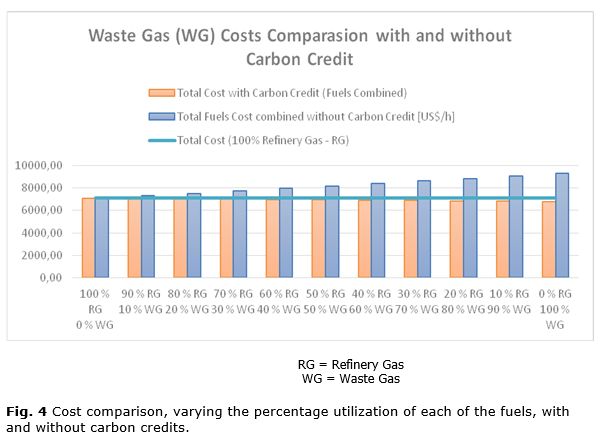
<p><font size="2" face="Verdana, Arial, Helvetica, sans-serif"><i>Cost Comparison</i></font></p>     <p><font size="2" face="Verdana, Arial, Helvetica, sans-serif"> The cost of  the waste gas going into the oil refinery is greater than the cost of the  refinery gas used for feeding the boilers. This should occur, as refinery gas  is a cleaner fuel with a calorific value, higher than that obtained by the  waste gas. <a href="/img/revistas/rie/38n3/f0307317.jpg">Figure 3</a>, shows the waste gas costs, with and without carbon credit,  considering the use of methane from year 23. The graph illustrates that the use  of waste gas, besides being a more sustainable process, also allows for a cost  reduction, compared with the use of 100 % refinery gas. However, the landfill  does not provide enough biogas to supply 100 % of the power demand from the two  boilers. The graph in <a href="/img/revistas/rie/38n3/f0407317.jpg">figure 4</a>, shows the fuel cost savings potential if we  increased the percentage of utilization of waste gas in each boiler. Note that  the cost reduction potential using 100% waste gas could reach US$ 299,83/ h.</font></p>     
<p>&nbsp;</p>     <p><font size="3" face="Verdana, Arial, Helvetica, sans-serif"><b>CONCLUSIONS</b></font></p>     <p><font size="2" face="Verdana, Arial, Helvetica, sans-serif">   The use of  waste gas to meet the energy demand of each of the boilers in the refinery  fully meets the triple bottom line (environmental, social, and economic).</font></p>     <p><font size="2" face="Verdana, Arial, Helvetica, sans-serif"> Regarding  the environmental issue, by using waste gas for boilers, the project provides a  reduction in the emission of methane gas (a very harmful gas that contributes  to the greenhouse effect) by using it sustainably, as an alternative fuel, on  average, methane recovery for the guidance years is around 40 000 t/year. In  addition to respect for the environment, the use of waste gas allows for a  reduction in the consumption of non-renewable fuels, such as refinery gas. Regarding  social issues, the project can generate more jobs and provide an increased  quality of life on the planet by reducing the emission of methane gas.</font></p>     <p><font size="2" face="Verdana, Arial, Helvetica, sans-serif"> Economic  developments in the project provide a reduction in the fuel consumption costs  of each boiler. It is estimated that approximately 6,6 million dollars can be  saved over 10 years of use of a waste gas landfill during a period of 23 to 32  years for this case study. In addiction, if you condider to use an one hundred  percent of a landfill gas, you can save 2,6 million dollars per year. This  waste gas recycling policy should be part of every energy plan. Specific  assessments of the implementation of pipelines or interconnection to existing  networks should be part of the bidding process infrastructure for power  generation.</font></p>     <p><font size="2" face="Verdana, Arial, Helvetica, sans-serif"> Sees up this energy as required in  energy development matrices considering that public policies at the federal,  state and municipal levels are in stage settings and deployment to end the  cycles of so-called &quot;dumps (lix&otilde;es in Portuguese)&quot; in Brazil.</font></p>     <p>&nbsp;</p>     ]]></body>
<body><![CDATA[<p><b><font size="3" face="Verdana, Arial, Helvetica, sans-serif">REFERENCES</font></b></p>     <!-- ref --><p><font size="2" face="Verdana, Arial, Helvetica, sans-serif">1. Souza S. NM. et al. Technical potential of electricity production from  municipal solid waste disposed in the biggest cities in Brazil: Landfill gas,  biogas and thermal treatment. Waste  Management &amp; Research<i>.</i> 2014;32(10):1015-1023. ISSN 1096-3669. DOI 10.1177/0734242X14552553.    </font></p>     <!-- ref --><p><font size="2" face="Verdana, Arial, Helvetica, sans-serif">2. Henriques RM. Aproveitamento  energ&eacute;tico dos residuos s&oacute;lidos urbanos: Uma abordagem tecnol&oacute;gica. Doctorate  Thesis. Rio de Janeiro Federal University: Rio de Janeiro, Brazil. 2004. Available in:&nbsp; <a href="http://observatorioambiental.iff.edu.br/publicacoes/publicacoes-cientificas/lixo_tese.pdf" target="_blank">http://observatorioambiental.iff.edu.br/publicacoes/publicacoes-cientificas/lixo_tese.pdf</a>.     </font></p>     <!-- ref --><p><font size="2" face="Verdana, Arial, Helvetica, sans-serif">3. Garg A. et al. An integrated appraisal of energy  recovery options in the United Kingdom using solid recovered fuel derived from  municipal solid waste. Waste Management<i>.</i> 2009;29:2289-2297. ISSN 0956-053X. DOI 10.1016/j.wasman.2009.03.031.    </font></p>     <!-- ref --><p><font size="2" face="Verdana, Arial, Helvetica, sans-serif">4. Udomsri S. et al. Clean energy conversion from municipal solid waste and  climate change mitigation in Thailand: Waste management and thermodynamic  evolution. Energy for Sustainable  Development. 2011;15(4):355-364.     ISSN 0973-0826. DOI <a href="10.1016/j.esd.2011.07.007" target="_blank">10.1016/j.esd.2011.07.007</a>.</font></p>     <!-- ref --><p><font size="2" face="Verdana, Arial, Helvetica, sans-serif">5. Papageorgiou A., Barton JR. and  Karagiannidis A. Assessment of the greenhouse effect impact of technologies  used for energy recovery from municipal waste: A case for England. Journal of Environmental Management<i>. </i>2009;90:2999-3012.&nbsp; ISSN 0301-4797. DOI <a href="10.1016/j.jenvman.2009.04.012" target="_blank">10.1016/j.jenvman.2009.04.012</a>.    </font></p>     <!-- ref --><p><font size="2" face="Verdana, Arial, Helvetica, sans-serif">6. Bosmans A.&nbsp; et al.  The crucial role of Waste to Energy technologies in enhanced landfill mining:  a technology review. Journal of Cleaner  Production<i>. </i>2013;55:10-23.  ISSN 0959-6526.  &nbsp;DOI <a href="10.1016/j.jclepro.2012.05.032" target="_blank">10.1016/j.jclepro.2012.05.032</a>.    </font></p>     <p><font size="2" face="Verdana, Arial, Helvetica, sans-serif">7. Porteous A. Developments in, and  environmental impacts of, electricity generation from municipal solid waste and  landfill gas combustion. IEE Proceedings  A &ndash; Science, Measurement and Technology<i>.</i> 1993;140(1):86-93.  ISSN 0960-7641. DOI <a href="10.1049/ip-a-3.1993.0015" target="_blank">10.1049/ip-a-3.1993.0015</a>.</font></p>     <p><font size="2" face="Verdana, Arial, Helvetica, sans-serif">8. Hannan, MA. et al. A review on technologies and their usage in solid waste  monitoring and management systems: Issues and challenges. Waste Management. 2015;43:509-523. ISSN 0956-053X. &nbsp;DOI <a href="10.1016/j.wasman.2015.05.033" target="_blank">10.1016/j.wasman.2015.05.033</a>.</font></p>     <!-- ref --><p><font size="2" face="Verdana, Arial, Helvetica, sans-serif">9.&nbsp;</font><font size="2" face="Verdana, Arial, Helvetica, sans-serif">Wanichpongpan, W. and&nbsp;  Gheewala SH. Life cycle assessment as a decision support tool for  landfill gas to energy projects. Journal  of Cleaner Production<i>.</i> 2007;15(18):1819-1826.     ISSN: 0959-6526. &nbsp;DOI:<a href="10.1016/j.jclepro.2006.06.008" target="_blank">10.1016/j.jclepro.2006.06.008</a>.</font></p>     <!-- ref --><p><font size="2" face="Verdana, Arial, Helvetica, sans-serif">10. Allesch A. and Brunner PH. Assessment methods for solid waste management: A literature review. Waste Management &amp; Research. 2014;32(6):461-473.     ISSN 1096-3669. DOI: 10.1177/0734242X14535653.</font></p>     <p><font size="2" face="Verdana, Arial, Helvetica, sans-serif">11. Vera D., Jurado F.,  Margaritis NK and Grammelis P. Experimental and economy study of a  gasification plant fuelled with olive industry wastes. Energy for Sustainable Development<i>.</i> 2014;23:247-257. ISSN 0973-0826. DOI 10.1016/j.esd.2014.09.011.</font></p>     ]]></body>
<body><![CDATA[<!-- ref --><p><font size="2" face="Verdana, Arial, Helvetica, sans-serif">12. Panyadee S., Petiraksakul A. and Phalakornkule C. Biogas production from co-digestion of Phyllanthus  emblica residues and food waste. Energy  for Sustainable Development. 2013;17(5):515-520.     ISSN 0973-0826. DOI 10.1016/j.esd.2013.07.003.</font></p>     <p><font size="2" face="Verdana, Arial, Helvetica, sans-serif">13. Portugal Pereira J., Soria R., Rathmann R., Schaeffer R. and Szklo A. Agricultural and agro-industrial residues-to-energy:  Techno-economic and environmental assessment in Brazil. Biomass and Bioenergy. 2015;81:521-533. ISSN 0961-9534. DOI 10.1016/j.biombioe.2015.08.010. </font></p>     <p><font size="2" face="Verdana, Arial, Helvetica, sans-serif">14. Faitli J., Magyar T.,  Erdelyi A. and Muranyi A. Characterization of thermal properties of  municipal solid waste landfills. Waste  Management<i>. </i>2015;36:213-221. ISSN 0956-053X. DOI  10.1016/j.wasman.2014.10.028.</font></p>     <p><font size="2" face="Verdana, Arial, Helvetica, sans-serif">15. Wolfsberger T., Nispel J.,  Sarc R., Aldrian A., Hermann R., Hollen D., Pomberger R., Budischowsky A.  and&nbsp; Ragossnig A. Landfill mining:  Development of a theoretical method for a preliminary estimate of the raw  material potential of landfill sites. Waste  Management &amp; Research. 2015;33(7):671-680. ISSN 1096-3669. DOI  10.1177/0734242X15590473.</font></p>     <p><font size="2" face="Verdana, Arial, Helvetica, sans-serif">16. Song J., He J. and Zhen, J. Real-Time  Data Assimilation for Improving Linear Municipal Solid Waste Prediction Model:  A Case Study in Seattle. Journal of  Energy Engineering<i>.</i> 2014;141(4). ISSN 1943-7897. DOI 10.1061/(ASCE)EY.1943-7897.0000217.</font></p>     <p><font size="2" face="Verdana, Arial, Helvetica, sans-serif">17. Amini HR, Reinhart DR and Niskanen A. Comparison of first-order-decay modeled and actual field  measured municipal solid waste landfill methane data. Waste Management<i>.</i> 2013;33(12):2720-2728.&nbsp; ISSN 0956-053X . DOI 10.1016/j.wasman.2013.07.025.</font></p>     <!-- ref --><p><font size="2" face="Verdana, Arial, Helvetica, sans-serif">18. Silva FM. Biog&aacute;s  de Lixo no Aterro Sanit&aacute;rio de Gramacho. Doctorate Thesis. Rio de Janeiro  Federal University. Rio de Janeiro, Brazil. 2015. Available in: <a href="http://monografias.poli.ufrj.br/monografias/monopoli10013773.pdf" target="_blank">http://monografias.poli.ufrj.br/monografias/monopoli10013773.pdf</a>.    </font></p>     <p><font size="2" face="Verdana, Arial, Helvetica, sans-serif">19. Rubio Romero JC, Arjona Jimenez R. and  Lopez Arquillos A. Profitability analysis of biog&aacute;s recovery in Municipal  Solid Waste landfills. Journal of  Cleaner Production<i>.</i> 2013;55:84-91. ISSN 0959-6526. DOI 10.1016/j.jclepro.2012.12.024.&nbsp; </font></p>     ]]></body>
<body><![CDATA[<p><font size="2" face="Verdana, Arial, Helvetica, sans-serif">20. Themelis NJ and&nbsp; Ulloa PA. Methane generation in  landfills. Renewable Energy. 2007;32(7):1243-1257. ISSN 0960-1481. DOI 10.1016/j.renene.2006.04.020.</font></p>     <p><font size="2" face="Verdana, Arial, Helvetica, sans-serif">21. Barros RM, Tiago Filho GL and Silva  TR. The electric energy potential of landfill biogas in Brazil. Energy Policy. 2014;65:150-164.  ISSN 0301-4215.  DOI  10.1016/j.enpol.2013.1.028.</font></p>     <p><font size="2" face="Verdana, Arial, Helvetica, sans-serif">22.&nbsp;Aguilar Virgen Q., Taboada Gonzalez P. and  Ojeda Benitez S. Analysis of the feasibility of the recovery of landfill gas:  a case study of Mexico. Journal of  Cleaner Production. 2014;79:53-60. ISSN 0959-6526. DOI 10.1016/j.jclepro.2014.05.025.</font></p>     <p><font size="2" face="Verdana, Arial, Helvetica, sans-serif">23. Dace E. et al. Optimization of landfill Gas  use in Municipal Solid Waste landfills in Latvia. Energy  Procedia<i>. </i>2015;72:293-299. ISSN 1876-6102.  DOI:10.1016/j.egypro.2015.06.042.</font></p>     <p><font size="2" face="Verdana, Arial, Helvetica, sans-serif">24. Pecora V. et al. Aproveitamento  do biog&aacute;s proveniente de aterro sanit&aacute;rio para a gera&ccedil;&atilde;o de energia el&eacute;trica e  ilumina&ccedil;&atilde;o a g&aacute;s.&nbsp; In: Induscon &ndash; VIII  Confer&ecirc;ncia Internacional de Aplica&ccedil;&otilde;es Industriais. Po&ccedil;os de Caldas, Brazil.  2008. Available in: <a href="http://143.107.4.241/download/publicacoes/congbioen_pecora.pdf" target="_blank">http://143.107.4.241/download/publicacoes/congbioen_pecora.pdf</a>. </font></p>     <p><font size="2" face="Verdana, Arial, Helvetica, sans-serif">25. Smith Van Ness, Abbott. Introduction to  chemical engineering thermodynamics. Nova Iorque: McGraw-Hill, 1996.</font></p>     <!-- ref --><p><font size="2" face="Verdana, Arial, Helvetica, sans-serif">26. Perry's chemical engineers' handbook. New  York: McGraw-hill, 2008.    </font></p>     <p>&nbsp;</p>     <p>&nbsp;</p>     ]]></body>
<body><![CDATA[<p><font size="2" face="Verdana, Arial, Helvetica, sans-serif">Recibido: febrero de 2017    <br> Aprobado: mayo de 2017</font></p>     <p>&nbsp;</p>     <p>&nbsp;</p>     <p><b><font size="3" face="Verdana, Arial, Helvetica, sans-serif">AUTHORS</font></b></p>     <p><font size="2" face="Verdana, Arial, Helvetica, sans-serif">  <i>Anderson Jos&eacute; Rangel de Oliveira.</i>  He and Electrical  Industrial Engineer , Automation Specialist by SENAI/RJ (2008), MBA Project  Management by FGV(2012). Maintenance Technical in PETROBRAS.     <br>   <a href="mailto:andersonrangel7@gmail.com">andersonrangel7@gmail.com</a> </font></p>     <p><font size="2" face="Verdana, Arial, Helvetica, sans-serif"><i>Filipe Marques Paes da Costa.</i>   He is Brazilian  and Chemical Engineer by UFF (2013), Operation Engineer in Essencis Solu&ccedil;&otilde;es  Ambientais.     <br> <a href="mailto:fpepaes@gmail.com">fpepaes@gmail.com</a> </font></p>     <p><font size="2" face="Verdana, Arial, Helvetica, sans-serif"><i>Lucas Novaes Barreto.</i>   He is Brazilian  and Chemical Engineer by UFF (2013), Planning Engineer White Martins.&nbsp;    ]]></body>
<body><![CDATA[<br> <a href="mailto:lucasnbarreto@hotmail.com">lucasnbarreto@hotmail.com</a></font></p>     <p><font size="2" face="Verdana, Arial, Helvetica, sans-serif">Luiz dos Santos Moreira.   He is Brazilian  and Mechanical &nbsp;&nbsp;Engineer by Souza Marques University (2007),  MBA Project Management by FGV(2012). He is a HVAC Specialist and research in  Fluminense Federal University (UFF).    <br> <a href="mailto:andersonrangel7@gmail.com">luizroux@ yahoo.com.br</a> </font></p>     <p><font size="2" face="Verdana, Arial, Helvetica, sans-serif"><i>Marcio Zamboti Fortes</i>.   He is Brazilian  and Electrical Engineer by ENVA (1991), Master in Energy Engineering by UNIFEI  (2000), Doctorate in Electrical Engineering by USP (2007). He is Adjunct  Professor in Fluminense Federal University.&nbsp;     <br> <a href="mailto:andersonrangel7@gmail.com">mzf@vm.uff.br</a> </font></p>     <p><font size="2" face="Verdana, Arial, Helvetica, sans-serif"><i>Bruno Soares Moreira Cesar Borba. </i>  He is Brazilian  and Electrical Engineer by UFRJ (2005), &nbsp;Master and Doctor degree in Energy Planning by  UFRJ (2008/2012). He is Adjunct Professor in Fluminense Federal University.    <br> <a href="mailto:bborba@id.uff.br">bborba@id.uff.br</a></font></p>       ]]></body><back>
<ref-list>
<ref id="B1">
<label>1</label><nlm-citation citation-type="journal">
<person-group person-group-type="author">
<name>
<surname><![CDATA[Souza S]]></surname>
<given-names><![CDATA[NM]]></given-names>
</name>
</person-group>
<article-title xml:lang="en"><![CDATA[Technical potential of electricity production from municipal solid waste disposed in the biggest cities in Brazil: Landfill gas, biogas and thermal treatment]]></article-title>
<source><![CDATA[Waste Management & Research]]></source>
<year>2014</year>
<volume>32</volume>
<numero>10</numero>
<issue>10</issue>
<page-range>1015-1023</page-range></nlm-citation>
</ref>
<ref id="B2">
<label>2</label><nlm-citation citation-type="">
<person-group person-group-type="author">
<name>
<surname><![CDATA[Henriques]]></surname>
<given-names><![CDATA[RM]]></given-names>
</name>
</person-group>
<source><![CDATA[Aproveitamento energético dos residuos sólidos urbanos: Uma abordagem tecnológica]]></source>
<year></year>
</nlm-citation>
</ref>
<ref id="B3">
<label>3</label><nlm-citation citation-type="journal">
<person-group person-group-type="author">
<name>
<surname><![CDATA[Garg]]></surname>
<given-names><![CDATA[A]]></given-names>
</name>
</person-group>
<article-title xml:lang="en"><![CDATA[An integrated appraisal of energy recovery options in the United Kingdom using solid recovered fuel derived from municipal solid waste]]></article-title>
<source><![CDATA[Waste Management]]></source>
<year>2009</year>
<volume>29</volume>
<page-range>2289-2297</page-range></nlm-citation>
</ref>
<ref id="B4">
<label>4</label><nlm-citation citation-type="journal">
<person-group person-group-type="author">
<name>
<surname><![CDATA[Udomsri]]></surname>
<given-names><![CDATA[S]]></given-names>
</name>
</person-group>
<article-title xml:lang="en"><![CDATA[Clean energy conversion from municipal solid waste and climate change mitigation in Thailand: Waste management and thermodynamic evolution]]></article-title>
<source><![CDATA[Energy for Sustainable Development]]></source>
<year>2011</year>
<volume>15</volume>
<numero>4</numero>
<issue>4</issue>
<page-range>355-364</page-range></nlm-citation>
</ref>
<ref id="B5">
<label>5</label><nlm-citation citation-type="journal">
<person-group person-group-type="author">
<name>
<surname><![CDATA[Papageorgiou]]></surname>
<given-names><![CDATA[A]]></given-names>
</name>
<name>
<surname><![CDATA[Barton]]></surname>
<given-names><![CDATA[JR]]></given-names>
</name>
<name>
<surname><![CDATA[Karagiannidis]]></surname>
<given-names><![CDATA[A]]></given-names>
</name>
</person-group>
<article-title xml:lang="en"><![CDATA[Assessment of the greenhouse effect impact of technologies used for energy recovery from municipal waste: A case for England]]></article-title>
<source><![CDATA[Journal of Environmental Management]]></source>
<year>2009</year>
<volume>90</volume>
<page-range>2999-3012</page-range></nlm-citation>
</ref>
<ref id="B6">
<label>6</label><nlm-citation citation-type="journal">
<person-group person-group-type="author">
<name>
<surname><![CDATA[Bosmans]]></surname>
<given-names><![CDATA[A]]></given-names>
</name>
</person-group>
<article-title xml:lang="en"><![CDATA[The crucial role of Waste to Energy technologies in enhanced landfill mining: a technology review]]></article-title>
<source><![CDATA[Journal of Cleaner Production]]></source>
<year>2013</year>
<volume>55</volume>
<page-range>10-23</page-range></nlm-citation>
</ref>
<ref id="B7">
<label>7</label><nlm-citation citation-type="journal">
<person-group person-group-type="author">
<name>
<surname><![CDATA[Porteous]]></surname>
<given-names><![CDATA[A]]></given-names>
</name>
</person-group>
<article-title xml:lang="en"><![CDATA[Developments in, and environmental impacts of, electricity generation from municipal solid waste and landfill gas combustion]]></article-title>
<source><![CDATA[IEE Proceedings A - Science, Measurement and Technology]]></source>
<year>1993</year>
<volume>140</volume>
<numero>1</numero>
<issue>1</issue>
<page-range>86-93</page-range></nlm-citation>
</ref>
<ref id="B8">
<label>8</label><nlm-citation citation-type="journal">
<person-group person-group-type="author">
<name>
<surname><![CDATA[Hannan]]></surname>
<given-names><![CDATA[MA]]></given-names>
</name>
</person-group>
<article-title xml:lang="en"><![CDATA[A review on technologies and their usage in solid waste monitoring and management systems: Issues and challenges]]></article-title>
<source><![CDATA[Waste Management]]></source>
<year>2015</year>
<volume>43</volume>
<page-range>509-523</page-range></nlm-citation>
</ref>
<ref id="B9">
<label>9</label><nlm-citation citation-type="journal">
<person-group person-group-type="author">
<name>
<surname><![CDATA[Wanichpongpan]]></surname>
<given-names><![CDATA[W]]></given-names>
</name>
<name>
<surname><![CDATA[Gheewala]]></surname>
<given-names><![CDATA[SH]]></given-names>
</name>
</person-group>
<article-title xml:lang="en"><![CDATA[Life cycle assessment as a decision support tool for landfill gas to energy projects]]></article-title>
<source><![CDATA[Journal of Cleaner Production]]></source>
<year>2007</year>
<volume>15</volume>
<numero>18</numero>
<issue>18</issue>
<page-range>1819-1826</page-range></nlm-citation>
</ref>
<ref id="B10">
<label>10</label><nlm-citation citation-type="journal">
<person-group person-group-type="author">
<name>
<surname><![CDATA[Allesch]]></surname>
<given-names><![CDATA[A]]></given-names>
</name>
<name>
<surname><![CDATA[Brunner]]></surname>
<given-names><![CDATA[PH]]></given-names>
</name>
</person-group>
<article-title xml:lang="en"><![CDATA[Assessment methods for solid waste management: A literature review]]></article-title>
<source><![CDATA[Waste Management & Research]]></source>
<year>2014</year>
<volume>32</volume>
<numero>6</numero>
<issue>6</issue>
<page-range>461-473</page-range></nlm-citation>
</ref>
<ref id="B11">
<label>11</label><nlm-citation citation-type="journal">
<person-group person-group-type="author">
<name>
<surname><![CDATA[Vera]]></surname>
<given-names><![CDATA[D]]></given-names>
</name>
<name>
<surname><![CDATA[Jurado]]></surname>
<given-names><![CDATA[F]]></given-names>
</name>
<name>
<surname><![CDATA[Margaritis]]></surname>
<given-names><![CDATA[NK]]></given-names>
</name>
<name>
<surname><![CDATA[Grammelis]]></surname>
<given-names><![CDATA[P]]></given-names>
</name>
</person-group>
<article-title xml:lang="en"><![CDATA[Experimental and economy study of a gasification plant fuelled with olive industry wastes]]></article-title>
<source><![CDATA[Energy for Sustainable Development]]></source>
<year>2014</year>
<volume>23</volume>
<numero>0</numero>
<issue>0</issue>
<page-range>247-257</page-range></nlm-citation>
</ref>
<ref id="B12">
<label>12</label><nlm-citation citation-type="journal">
<person-group person-group-type="author">
<name>
<surname><![CDATA[Panyadee]]></surname>
<given-names><![CDATA[S]]></given-names>
</name>
<name>
<surname><![CDATA[Petiraksakul]]></surname>
<given-names><![CDATA[A]]></given-names>
</name>
<name>
<surname><![CDATA[Phalakornkule]]></surname>
<given-names><![CDATA[C]]></given-names>
</name>
</person-group>
<article-title xml:lang="en"><![CDATA[Biogas production from co-digestion of Phyllanthus emblica residues and food waste]]></article-title>
<source><![CDATA[Energy for Sustainable Development]]></source>
<year>2013</year>
<volume>17</volume>
<numero>5</numero>
<issue>5</issue>
<page-range>515-520</page-range></nlm-citation>
</ref>
<ref id="B13">
<label>13</label><nlm-citation citation-type="journal">
<person-group person-group-type="author">
<name>
<surname><![CDATA[Portugal Pereira]]></surname>
<given-names><![CDATA[J]]></given-names>
</name>
<name>
<surname><![CDATA[Soria]]></surname>
<given-names><![CDATA[R]]></given-names>
</name>
<name>
<surname><![CDATA[Rathmann]]></surname>
<given-names><![CDATA[R]]></given-names>
</name>
</person-group>
<article-title xml:lang="en"><![CDATA[Agricultural and agro-industrial residues-to-energy: Techno-economic and environmental assessment in Brazil]]></article-title>
<source><![CDATA[Biomass and Bioenergy]]></source>
<year>2015</year>
<volume>81</volume>
<page-range>521-533</page-range></nlm-citation>
</ref>
<ref id="B14">
<label>14</label><nlm-citation citation-type="journal">
<person-group person-group-type="author">
<name>
<surname><![CDATA[Faitli]]></surname>
<given-names><![CDATA[J]]></given-names>
</name>
<name>
<surname><![CDATA[Magyar]]></surname>
<given-names><![CDATA[T]]></given-names>
</name>
<name>
<surname><![CDATA[Erdelyi]]></surname>
<given-names><![CDATA[A]]></given-names>
</name>
<name>
<surname><![CDATA[Muranyi]]></surname>
<given-names><![CDATA[A]]></given-names>
</name>
</person-group>
<article-title xml:lang="en"><![CDATA[Characterization of thermal properties of municipal solid waste landfills]]></article-title>
<source><![CDATA[Waste Management]]></source>
<year>2015</year>
<volume>36</volume>
<page-range>213-221</page-range></nlm-citation>
</ref>
<ref id="B15">
<label>15</label><nlm-citation citation-type="journal">
<person-group person-group-type="author">
<name>
<surname><![CDATA[Wolfsberger]]></surname>
<given-names><![CDATA[T]]></given-names>
</name>
</person-group>
<article-title xml:lang="en"><![CDATA[Landfill mining: Development of a theoretical method for a preliminary estimate of the raw material potential of landfill sites]]></article-title>
<source><![CDATA[Waste Management & Research]]></source>
<year>2015</year>
<volume>33</volume>
<numero>7</numero>
<issue>7</issue>
<page-range>671-680</page-range></nlm-citation>
</ref>
<ref id="B16">
<label>16</label><nlm-citation citation-type="journal">
<person-group person-group-type="author">
<name>
<surname><![CDATA[Song]]></surname>
<given-names><![CDATA[J]]></given-names>
</name>
<name>
<surname><![CDATA[He]]></surname>
<given-names><![CDATA[J]]></given-names>
</name>
<name>
<surname><![CDATA[Zhen]]></surname>
<given-names><![CDATA[J]]></given-names>
</name>
</person-group>
<article-title xml:lang="en"><![CDATA[Real Time Data Assimilation for Improving Linear Municipal Solid Waste Prediction Model: A Case Study in Seattle]]></article-title>
<source><![CDATA[Journal of Energy Engineering]]></source>
<year>2014</year>
<volume>141</volume>
<numero>4</numero>
<issue>4</issue>
</nlm-citation>
</ref>
<ref id="B17">
<label>17</label><nlm-citation citation-type="journal">
<person-group person-group-type="author">
<name>
<surname><![CDATA[Amini]]></surname>
<given-names><![CDATA[HR]]></given-names>
</name>
<name>
<surname><![CDATA[Reinhart]]></surname>
<given-names><![CDATA[DR]]></given-names>
</name>
<name>
<surname><![CDATA[Niskanen]]></surname>
<given-names><![CDATA[A]]></given-names>
</name>
</person-group>
<article-title xml:lang="en"><![CDATA[Comparison of first order decay modeled and actual field measured municipal solid waste landfill methane data]]></article-title>
<source><![CDATA[Waste Management]]></source>
<year>2013</year>
<volume>33</volume>
<numero>12</numero>
<issue>12</issue>
<page-range>2720-2728</page-range></nlm-citation>
</ref>
<ref id="B18">
<label>18</label><nlm-citation citation-type="">
<person-group person-group-type="author">
<name>
<surname><![CDATA[Silva]]></surname>
<given-names><![CDATA[FM]]></given-names>
</name>
</person-group>
<source><![CDATA[Biogás de Lixo no Aterro Sanitário de Gramacho]]></source>
<year></year>
</nlm-citation>
</ref>
<ref id="B19">
<label>19</label><nlm-citation citation-type="journal">
<person-group person-group-type="author">
<name>
<surname><![CDATA[Rubio Romero]]></surname>
<given-names><![CDATA[JC]]></given-names>
</name>
<name>
<surname><![CDATA[Arjona Jimenez]]></surname>
<given-names><![CDATA[R]]></given-names>
</name>
<name>
<surname><![CDATA[Lopez Arquillos]]></surname>
<given-names><![CDATA[A]]></given-names>
</name>
</person-group>
<article-title xml:lang="en"><![CDATA[Profitability analysis of biogás recovery in Municipal Solid Waste landfills]]></article-title>
<source><![CDATA[Journal of Cleaner Production]]></source>
<year>2013</year>
<volume>55</volume>
<page-range>84-91</page-range></nlm-citation>
</ref>
<ref id="B20">
<label>20</label><nlm-citation citation-type="journal">
<person-group person-group-type="author">
<name>
<surname><![CDATA[Themelis]]></surname>
<given-names><![CDATA[NJ]]></given-names>
</name>
<name>
<surname><![CDATA[Ulloa]]></surname>
<given-names><![CDATA[PA]]></given-names>
</name>
</person-group>
<article-title xml:lang="en"><![CDATA[Methane generation in landfills]]></article-title>
<source><![CDATA[Renewable Energy]]></source>
<year>2007</year>
<volume>32</volume>
<numero>7</numero>
<issue>7</issue>
<page-range>1243-1257</page-range></nlm-citation>
</ref>
<ref id="B21">
<label>21</label><nlm-citation citation-type="journal">
<person-group person-group-type="author">
<name>
<surname><![CDATA[Barros]]></surname>
<given-names><![CDATA[RM]]></given-names>
</name>
<name>
<surname><![CDATA[Tiago Filho]]></surname>
<given-names><![CDATA[GL]]></given-names>
</name>
<name>
<surname><![CDATA[Silva]]></surname>
<given-names><![CDATA[TR]]></given-names>
</name>
</person-group>
<article-title xml:lang="en"><![CDATA[The electric energy potential of landfill biogas in Brazil]]></article-title>
<source><![CDATA[Energy Policy]]></source>
<year>2014</year>
<volume>65</volume>
<page-range>150-164</page-range></nlm-citation>
</ref>
<ref id="B22">
<label>22</label><nlm-citation citation-type="journal">
<person-group person-group-type="author">
<name>
<surname><![CDATA[Aguilar Virgen]]></surname>
<given-names><![CDATA[Q]]></given-names>
</name>
<name>
<surname><![CDATA[Taboada Gonzalez]]></surname>
<given-names><![CDATA[P]]></given-names>
</name>
<name>
<surname><![CDATA[Ojeda Benitez]]></surname>
<given-names><![CDATA[S]]></given-names>
</name>
</person-group>
<article-title xml:lang="en"><![CDATA[Analysis of the feasibility of the recovery of landfill gas: a case study of Mexico]]></article-title>
<source><![CDATA[Journal of Cleaner Production]]></source>
<year>2014</year>
<volume>79</volume>
<page-range>53-60</page-range></nlm-citation>
</ref>
<ref id="B23">
<label>23</label><nlm-citation citation-type="journal">
<person-group person-group-type="author">
<name>
<surname><![CDATA[Dace]]></surname>
<given-names><![CDATA[E]]></given-names>
</name>
</person-group>
<article-title xml:lang="en"><![CDATA[Optimization of landfill Gas use in Municipal Solid Waste landfills in Latvia]]></article-title>
<source><![CDATA[Energy Procedia]]></source>
<year>2015</year>
<volume>72</volume>
<page-range>293-299</page-range></nlm-citation>
</ref>
<ref id="B24">
<label>24</label><nlm-citation citation-type="confpro">
<person-group person-group-type="author">
<name>
<surname><![CDATA[Pecora]]></surname>
<given-names><![CDATA[V]]></given-names>
</name>
</person-group>
<source><![CDATA[Aproveitamento do biogás proveniente de aterro sanitário para a geração de energia elétrica e iluminação a gás]]></source>
<year></year>
<conf-name><![CDATA[ Induscon - VIII Conferência Internacional de Aplicações Industriais]]></conf-name>
<conf-date>2008</conf-date>
<conf-loc>Poços de Caldas </conf-loc>
</nlm-citation>
</ref>
<ref id="B25">
<label>25</label><nlm-citation citation-type="book">
<person-group person-group-type="author">
<name>
<surname><![CDATA[Smith Van Ness]]></surname>
<given-names><![CDATA[A]]></given-names>
</name>
</person-group>
<source><![CDATA[Introduction to chemical engineering thermodynamics]]></source>
<year>1996</year>
<publisher-loc><![CDATA[Nova Iorque ]]></publisher-loc>
<publisher-name><![CDATA[McGraw-Hill]]></publisher-name>
</nlm-citation>
</ref>
<ref id="B26">
<label>26</label><nlm-citation citation-type="book">
<source><![CDATA[Perry's chemical engineers': handbook]]></source>
<year>2008</year>
<publisher-loc><![CDATA[^eNew York New York]]></publisher-loc>
<publisher-name><![CDATA[McGraw-hill]]></publisher-name>
</nlm-citation>
</ref>
</ref-list>
</back>
</article>