<?xml version="1.0" encoding="ISO-8859-1"?><article xmlns:mml="http://www.w3.org/1998/Math/MathML" xmlns:xlink="http://www.w3.org/1999/xlink" xmlns:xsi="http://www.w3.org/2001/XMLSchema-instance">
<front>
<journal-meta>
<journal-id>1815-5901</journal-id>
<journal-title><![CDATA[Ingeniería Energética]]></journal-title>
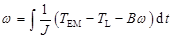
<abbrev-journal-title><![CDATA[Energética]]></abbrev-journal-title>
<issn>1815-5901</issn>
<publisher>
<publisher-name><![CDATA[Universidad Tecnológica de La Habana José Antonio Echeverría, Cujae]]></publisher-name>
</publisher>
</journal-meta>
<article-meta>
<article-id>S1815-59012018000300001</article-id>
<title-group>
<article-title xml:lang="en"><![CDATA[Flux-based rotor position estimator for a switched reluctance motor in simulink]]></article-title>
<article-title xml:lang="es"><![CDATA[Estimador para la posición de motores de reluctancia conmutada basado en las concatenaciones de flujo]]></article-title>
</title-group>
<contrib-group>
<contrib contrib-type="author">
<name>
<surname><![CDATA[Alvarez Tapia]]></surname>
<given-names><![CDATA[Luis Manuel]]></given-names>
</name>
<xref ref-type="aff" rid="A01"/>
</contrib>
<contrib contrib-type="author">
<name>
<surname><![CDATA[Morera Hernández]]></surname>
<given-names><![CDATA[Mario]]></given-names>
</name>
<xref ref-type="aff" rid="A01"/>
</contrib>
</contrib-group>
<aff id="A01">
<institution><![CDATA[,Universidad Tecnológica de La Habana  ]]></institution>
<addr-line><![CDATA[ ]]></addr-line>
<country>Cuba</country>
</aff>
<pub-date pub-type="pub">
<day>00</day>
<month>12</month>
<year>2018</year>
</pub-date>
<pub-date pub-type="epub">
<day>00</day>
<month>12</month>
<year>2018</year>
</pub-date>
<volume>39</volume>
<numero>3</numero>
<fpage>136</fpage>
<lpage>145</lpage>
<copyright-statement/>
<copyright-year/>
<self-uri xlink:href="http://scielo.sld.cu/scielo.php?script=sci_arttext&amp;pid=S1815-59012018000300001&amp;lng=en&amp;nrm=iso"></self-uri><self-uri xlink:href="http://scielo.sld.cu/scielo.php?script=sci_abstract&amp;pid=S1815-59012018000300001&amp;lng=en&amp;nrm=iso"></self-uri><self-uri xlink:href="http://scielo.sld.cu/scielo.php?script=sci_pdf&amp;pid=S1815-59012018000300001&amp;lng=en&amp;nrm=iso"></self-uri><abstract abstract-type="short" xml:lang="en"><p><![CDATA[In the present paper a flux-based rotor position estimation algorithm was implemented using the Simulink development suite. The aforementioned method was selected because of the simplicity, robustness and low computational complexity of the algorithm. The design was implemented in several blocks, where each one of them represents a different stage in the rotor position estimation algorithm. The results were tested on a mathematical model for the WEKA SR-30102 switched reluctance motor. In order to accurately model its behavior, the non-linearity of the motor was taken into account. The mathematical equations that describe the mechanical and electrical properties of the motor were used in order to model the corresponding effects that occur inside the machine. A closed-loop operation was used using a classical implementation of a PID controller. To validate the results the output of the rotor position estimation block was compared against the rotor position and the results were analyzed]]></p></abstract>
<abstract abstract-type="short" xml:lang="es"><p><![CDATA[En el presente trabajo se implementó un algoritmo para la estimación de la posición de rotor en motores de reluctancia conmutada usando las concatenaciones de flujo en la herramienta de desarrollo Simulink. El método anteriormente mencionado fue elegido por su simplicidad, robustez y baja complejidad computacional. El diseño fue implementado en diferentes bloques, donde cada uno representa una etapa del proceso algoritmo. Los resultados fueron probados en un modelo matemático para el motor WEKA SR-30102. Con el objetivo de modelar precisamente el comportamiento del motor se tomaron en cuenta las no linearidades propias de este tipo de motor. Se usaron las ecuaciones matemáticas que describen el comportamient eléctrico y mecánico para modelar el comportamiento interno del motor. Se usó una implementación clásica de un controlador PID para la operación a la lazo cerrado del accionamiento. Para validar los resultados, la salida del bloque para la estimación de la posición se comparó con la posición real, analizando los resultados obtenidos]]></p></abstract>
<kwd-group>
<kwd lng="en"><![CDATA[flux linkage]]></kwd>
<kwd lng="en"><![CDATA[sensorless]]></kwd>
<kwd lng="en"><![CDATA[simulation]]></kwd>
<kwd lng="en"><![CDATA[Simulink]]></kwd>
<kwd lng="en"><![CDATA[switched reluctance motor]]></kwd>
<kwd lng="es"><![CDATA[concatenaciones de flujo]]></kwd>
<kwd lng="es"><![CDATA[estimación sin sensores]]></kwd>
<kwd lng="es"><![CDATA[simulación]]></kwd>
<kwd lng="es"><![CDATA[Simulink]]></kwd>
<kwd lng="es"><![CDATA[motor de reluctancia conmutada]]></kwd>
</kwd-group>
</article-meta>
</front><body><![CDATA[ <p align="right"><font face="verdana" size="2"><b>TRABAJO TE&Oacute;RICO EXPERIMENTAL</b></font></p>     <p align="justify">&nbsp;</p>     <p align="justify"><font face="verdana" size="4"><b>Flux-based rotor position estimator for a switched reluctance motor in simulink</b></font></p>     <p align="justify">&nbsp;</p>     <p align="justify"><font face="verdana" size="3"><b>Estimador para la posici&oacute;n de motores de reluctancia conmutada basado en las concatenaciones de flujo</b></font></p>     <p align="justify">&nbsp;</p>     <p align="justify">&nbsp;</p>     <p align="justify"><font face="verdana" size="2"><b>Luis Manuel Alvarez Tapia, Mario Morera Hern&aacute;ndez</b></font></p>     <p align="justify"><font face="verdana" size="2">Universidad Tecnol&oacute;gica de La Habana, Cujae. Cuba.</font></p>     <p align="justify">&nbsp;</p>     ]]></body>
<body><![CDATA[<p align="justify">&nbsp;</p> <hr />     <p align="justify"><font face="verdana" size="2"><b>ABSTRACT </b></font></p>     <p align="justify"><font face="verdana" size="2">In the present paper a flux-based rotor position estimation algorithm was implemented using the Simulink development suite. The aforementioned method was selected because of the simplicity, robustness and low computational complexity of the algorithm. The design was implemented in several blocks, where each one of them represents a different stage in the rotor position estimation algorithm. The results were tested on a mathematical model for the WEKA SR-30102 switched reluctance motor. In order to accurately model its behavior, the non-linearity of the motor was taken into account. The mathematical equations that describe the mechanical and electrical properties of the motor were used in order to model the corresponding effects that occur inside the machine. A closed-loop operation was used using a classical implementation of a PID controller. To validate the results the output of the rotor position estimation block was compared against the rotor position and the results were analyzed.</font></p>     <p align="justify"><font face="verdana" size="2"><b>Keywords:</b> flux linkage; sensorless; simulation; Simulink; switched reluctance motor.</font></p> <hr />     <p align="justify"><font face="verdana" size="2"><b>RESUMEN</b></font></p>     <p align="justify"><font face="verdana" size="2">En el presente trabajo se implement&oacute; un algoritmo para la estimaci&oacute;n de la posici&oacute;n de rotor en motores de reluctancia conmutada usando las concatenaciones de flujo en la herramienta de desarrollo Simulink. El m&eacute;todo anteriormente mencionado fue elegido por su simplicidad, robustez y baja complejidad computacional. El dise&ntilde;o fue implementado en diferentes bloques, donde cada uno representa una etapa del proceso algoritmo. Los resultados fueron probados en un modelo matem&aacute;tico para el motor WEKA SR-30102. Con el objetivo de modelar precisamente el comportamiento del motor se tomaron en cuenta las no linearidades propias de este tipo de motor. Se usaron las ecuaciones matem&aacute;ticas que describen el comportamient el&eacute;ctrico y mec&aacute;nico para modelar el comportamiento interno del motor. Se us&oacute; una implementaci&oacute;n cl&aacute;sica de un controlador PID para la operaci&oacute;n a la lazo cerrado del accionamiento. Para validar los resultados, la salida del bloque para la estimaci&oacute;n de la posici&oacute;n se compar&oacute; con la posici&oacute;n real, analizando los resultados obtenidos.</font></p>     <p align="justify"><font face="verdana" size="2"><b>Palabras clave:</b> concatenaciones de flujo; estimaci&oacute;n sin sensores; simulaci&oacute;n; Simulink; motor de reluctancia conmutada.</font></p> <hr />     <p align="justify">&nbsp;</p>     <p align="justify">&nbsp;</p>     <p align="justify"><font face="verdana" size="3"><b>INTRODUCTION</b></font></p>     ]]></body>
<body><![CDATA[<p align="justify"><font face="verdana" size="2">The switched reluctance motor is an electric motor in which torque is produced by the tendency of its rotor to move towards a position where the inductance of the excited winding is maximized. The origin of the reluctance motor can be traced back to 1842, but the &ldquo;reinvention&rdquo; has been possibly due to the advent of inexpensive, high-power switching devices. The reluctance motor is a type of synchronous machine. It has wound field coils of a DC motor for its stator windings and has no coils or magnets on its rotor. Both the stator and rotor have salient poles; hence, the switched-reluctance motor is a doubly salient machine &#91;1,2&#93;.</font></p>     <p align="justify"><font face="verdana" size="2">It has several advantages that make it an important competitor among other widely used machines, such as direct-current motors, induction motors or even synchronous motors. We can point out its simple and low cost construction and the advantage that bidirectional currents are not necessary. Moreover, thermal losses appear only in the stator, which in fact is easier to cool down. Another important advantage is the speed-torque characteristic which is adjustable, making it possible to obtain high torque at low speed, thereby avoiding the use of gear boxes. It is also possible to make use of these motors at high temperatures and speed in comparison to other motors such as permanent magnet motors &#91;1,3&#93;.</font></p>     <p align="justify"><font face="verdana" size="2">As previously mentioned, switched-reluctance machines are attractive since they are reliable, relatively cheap and they produce high torque at low speed. These characteristics make them suitable for different purposes, among others for direct-drive and actioning robots applications, where position and velocity of joints must be controlled. However, this kind of machine is not easy to control; even under experimentally-validated assumptions leading to some simplifications.</font></p>     <p align="justify"><font face="verdana" size="2">Firstly, the dynamic model is highly nonlinear e.g., the generated electromagnetic torque is a complicated function of the electric currents and rotor positions. Secondly, reliable and accurate indirect sensing methods for the mechanical variables are fundamental in the development of low-cost, high-performance switched-reluctance motors. On one hand, the use of mechanical sensors increase the cost of the set-up and on the other, velocity sensors are often contaminated with noise. Therefore, avoiding the use of angular velocity and position sensors which is well known as sensorless control, is beyond pure theoretical interest.</font></p>     <p align="justify"><font face="verdana" size="2">Literature on sensorless adaptive control on other class of electrical machines is rich. For instance, in &#91;4&#93;, an adaptive observer of flux, velocity, load torque and resistance of an induction motor is presented and practical stability based on Lyapunov theory is guaranteed, experimental validation is presented as well. In &#91;5&#93;, is presented an adaptive high gain interconnected observer which is only supplied by the measurements of electrical currents and voltages of the permanent magnet synchronous motor, this observer estimates the rotor speed, the position, the stator resistance and the load torque.</font></p>     <p align="justify"><font face="verdana" size="2">In &#91;6&#93;, a sensorless speed control for interior permanent magnet synchronous motors is designed by combining a robust back-stepping controller with integral actions and an adaptive interconnected observer, sufficient conditions are given to prove practical stability of the closed-loop. A sensorless output feedback sliding-mode controller and observer are designed in order to drive the induction motor without using neither flux nor speed sensors, stability properties are guaranteed based in Lyapunov theory and experimental runs are presented as well. An interesting cascade and High-Gain Observers Comparison for Sensorless control of induction motor is presented in &#91;7&#93; and in &#91;8&#93;.</font></p>     <p align="justify"><font face="verdana" size="2">The authors of &#91;9&#93;, presented a sensorless control for switched-reluctance motors based on direct torque control. An interesting approach appears in &#91;10&#93;, where without using optical or magnetic sensors, stored magnetic characteristic information is utilized in order to elucidate the mechanical position, the same approach is presented in &#91;11&#93;.</font></p>     <p align="justify"><font face="verdana" size="2">A coordinate transformation of the current phases system is utilized in &#91;12&#93;, to design a position observer; experimental result are also presented. Some work on non model-based control has been as well reported, in &#91;13&#93; and in &#91;14&#93;, fuzzy logic-based sensorless control algorithms are described and experimental results are presented as well. In &#91;15&#93; neural networks have been applied to predict position from inductance. Likewise, in &#91;16&#93; an improved back propagate neural network with inductance input pretreatment for the rotor position estimator of switched-reluctance motor is proposed as well as a sensorless control algorithm.</font></p>     <p align="justify"><font face="verdana" size="2">For fully sensorless control, in &#91;17,18&#93;, is given a controller where position and velocity are obtained from information about flux linkage and phase currents. In this avenue, sliding mode observers are common, for example, paper &#91;19&#93;, deal with the velocity and position estimation problem, other works on sliding mode observers are &#91;20-22&#93;, where experimental results are also included.</font></p>     <p align="justify"><font face="verdana" size="2">In this paper a flux-based Rotor Position Estimator for a Switched Reluctance Motor in Simulink was implemented. The aforementioned method was selected because of the simplicity, robustness and low computational complexity of the algorithm. Also the selected method allows the motor to operate in a large portion of the speed-torque characteristic, aspect that is desirable.</font></p>     ]]></body>
<body><![CDATA[<p align="justify">&nbsp;</p>     <p align="justify"><font face="verdana" size="3"><b>MATERIALS AND METHODS</b></font></p>     <p align="justify"><font face="verdana" size="2"><b>Switched Reluctance Motor Model in Simulink</b></font></p>     <p align="justify"><font face="verdana" size="2">The SRM was modeled (<a href="#f1">Fig.1</a>), as part of a system that integrates a closed loop speed controller, a phase activation scheme and a power converter.</font></p>     <p align="center"><a name="f1" id="f1"></a></p>     <p align="center"><img src="/img/revistas/rie/v39n3/f0101318.gif" alt="Fig. 1. Switched Reluctance Motor control system." width="551" height="431" longdesc="/img/revistas/rie/v39n3/f0101318.gif" /></p>     
<p align="justify"><font face="verdana" size="2"><b>Speed Closed Loop Controller</b></font></p>     <p align="justify"><font face="verdana" size="2">A classical PID controller was implemented and his behavior is mathematically expressed as shown in <a href="#e1">equation (1)</a>.</font></p>     <p align="center"><font face="verdana" size="2"><a name="e1" id="e1"></a><img src="/img/revistas/rie/v39n3/e0101318.gif" width="251" height="39" longdesc="/img/revistas/rie/v39n3/e0101318.gif" />(1)</font></p>     
<p align="justify"><font face="verdana" size="2">In <a href="#f2">figure 2</a>, it can be seen the implementation a simple PID controller using a speed reference as an input.</font></p>     ]]></body>
<body><![CDATA[<p align="center"><a name="f2" id="f2"></a></p>     <p align="center"><img src="/img/revistas/rie/v39n3/f0201318.gif" alt="Fig. 2. Closed Loop Speed Controller." width="317" height="219" longdesc="/img/revistas/rie/v39n3/f0201318.gif" /></p>     
<p align="justify"><font face="verdana" size="2"><b>Phase Activation Scheme</b></font></p>     <p align="justify"><font face="verdana" size="2">The SRM WEKA SR-30102 has a 2-bit optical sensor attached to the shaft, yielding three possible combinations, that is either one of the sensor outputs is ON or none of them are, the last case in which both of them are ON is physically impossible, due to the mechanical characteristic of the rotary disc. This behavior was modeled in Simulink using the rotor position signal and a digital logic to select the correct phase to be powered.</font></p>     <p align="justify"><font face="verdana" size="2"><b>Power Converter</b></font></p>     <p align="justify"><font face="verdana" size="2">The power stage features an asymmetric half bridge power converter that uses two switches per phase, allowing high flexibility when implementing control strategies. Inside of the power converter module are implemented four different control strategies, that is, hysteresis current control, single pulse controller and open and closed loop PWM controllers.</font></p>     <p align="justify"><font face="verdana" size="2"><b>Switched Reluctance Motor</b></font></p>     <p align="justify"><font face="verdana" size="2"><a href="#f3">Figure 3</a> (left) shows the model of the switched reluctance motor. In order to accurately model its behavior, the non-linearity of the motor was taken into account. The mathematical equations that describe the mechanical and electrical properties of the motor were used in order to model the corresponding effects that occur inside the machine. In <a href="#f3">figure 3</a> (right) it can be seen the implementation of such model. As it can be seen, there are two submodules that lay the foundation on which the method is based, that is, the electrical and mechanical equations.</font></p>     <p align="center"><a name="f3" id="f3"></a></p>     <p align="center"><img src="/img/revistas/rie/v39n3/f0301318.gif" alt="Fig. 3. Switched reluctance motor implementation in Simulink." width="543" height="245" longdesc="/img/revistas/rie/v39n3/f0301318.gif" /></p>     
]]></body>
<body><![CDATA[<p align="justify"><font face="verdana" size="2">The electrical equation can be derived as follows: the applied voltage to a phase is equal to the sum of the resistive voltage drop and the rate of the flux linkage per phase, as it can be seen in <a href="#e2">equation (2)</a>.</font></p>     <p align="center"><font face="verdana" size="2"><a name="e2" id="e2"></a><img src="/img/revistas/rie/v39n3/e0201318.gif" width="116" height="49" longdesc="/img/revistas/rie/v39n3/e0201318.gif" />(2)</font></p>     
<p align="justify"><font face="verdana" size="2">Neglecting the mutual inductance between the phases equation 2 can be expanded, for phase A, as shown in <a href="#e3">equation (3)</a>.</font></p>     <p align="center"><font face="verdana" size="2"><a name="e3" id="e3"></a><img src="/img/revistas/rie/v39n3/e0301318.gif" width="231" height="49" longdesc="/img/revistas/rie/v39n3/e0301318.gif" />(3)</font></p>     
<p align="justify"><font face="verdana" size="2">Reorganizing and integrating<b> <a name="e7" id="e7"></a></b><img src="/img/revistas/rie/v39n3/e0701318.gif" width="30" height="49" longdesc="/img/revistas/rie/v39n3/e0701318.gif" /> in <a href="#e3">equation (3)</a> we have <a href="#e4">equation (4)</a>.</font></p>     
<p align="center"><font face="verdana" size="2"><a name="e4" id="e4"></a><img src="/img/revistas/rie/v39n3/e0401318.gif" width="212" height="97" longdesc="/img/revistas/rie/v39n3/e0401318.gif" />(4)</font></p>     
<p align="justify"><font face="verdana" size="2">Where,<b> <a name="e8" id="e8"></a></b><img src="/img/revistas/rie/v39n3/e0801318.gif" width="30" height="30" longdesc="/img/revistas/rie/v39n3/e0801318.gif" /> is the phase voltage,<b> <a name="e9" id="e9"></a></b><img src="/img/revistas/rie/v39n3/e0901318.gif" width="20" height="30" longdesc="/img/revistas/rie/v39n3/e0901318.gif" /> is the phase resistance,<b> <a name="e10" id="e10"></a><img src="/img/revistas/rie/v39n3/e1001318.gif" width="20" height="30" longdesc="/img/revistas/rie/v39n3/e1001318.gif" /> </b>is the phase current, <b><a name="e11" id="e11"></a><img src="/img/revistas/rie/v39n3/e1101318.gif" width="39" height="49" longdesc="/img/revistas/rie/v39n3/e1101318.gif" /></b> is the inductance,<b> <a name="e12" id="e12"></a></b><img src="/img/revistas/rie/v39n3/e1201318.gif" width="39" height="49" longdesc="/img/revistas/rie/v39n3/e1201318.gif" /> is the back-emf and<b> <a name="e13" id="e13"></a></b><img src="/img/revistas/rie/v39n3/e1301318.gif" width="39" height="39" longdesc="/img/revistas/rie/v39n3/e1301318.gif" /> is the rotor speed.</font></p>     
<p align="justify"><font face="verdana" size="2">Using the aforementioned equation, the electrical module was implemented (<a href="#f4">fig.4</a>). The module is integrated by four blocks that contain the necessary information (flux linkage, torque, inductance, back-emf) to do the calculations. Each one of them is represented as a three-dimensional look up table (LUT) with the data stored in memory.</font></p>     <p align="center"><a name="f4" id="f4"></a></p>     <p align="center"><img src="/img/revistas/rie/v39n3/f0401318.gif" alt="Fig. 4. Simulink block representation of the electrical equation of the switched reluctance motor." width="543" height="279" longdesc="/img/revistas/rie/v39n3/f0401318.gif" /></p>     
]]></body>
<body><![CDATA[<p align="justify"><font face="verdana" size="2">On the other hand, the mechanical equation (<a href="#e5">equation 5</a>), is widely known, and was used to implement the mechanical block in Simulink (<a href="#f5">figure 5</a>).</font></p>     <p align="center"><font face="verdana" size="2"><a name="e5" id="e5"></a><img src="/img/revistas/rie/v39n3/e0501318.gif" width="174" height="39" longdesc="/img/revistas/rie/v39n3/e0501318.gif" />(5)</font></p>     
<p align="center"><a name="f5" id="f5"></a></p>     <p align="center"><img src="/img/revistas/rie/v39n3/f0501318.gif" alt="Fig. 5. Simulink block representation of the mechanical equation of the switched reluctance motor." width="543" height="222" longdesc="/img/revistas/rie/v39n3/f0501318.gif" /></p>     
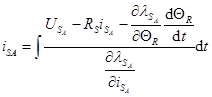
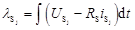
<p align="justify"><font face="verdana" size="2"><b>Sensorless Techniques</b></font></p>     <p align="justify"><font face="verdana" size="2">As was stated in the Introduction section, in this paper the flux linkage method was selected and was tested using a classical implementation of a PID controller.</font></p>     <p align="justify"><font face="verdana" size="2">In <a href="#e1">equation (1)</a>, phase voltage was defined as the sum of the resistive voltage drop and the rate of the flux linkage per phase. Isolating the flux linkage, and integrating, the equation remains as shown in <a href="#e6">equation (6)</a>.</font></p>     <p align="center"><font face="verdana" size="2"><a name="e6" id="e6"></a><img src="/img/revistas/rie/v39n3/e0601318.gif" width="135" height="30" longdesc="/img/revistas/rie/v39n3/e0601318.gif" />(6)</font></p>     
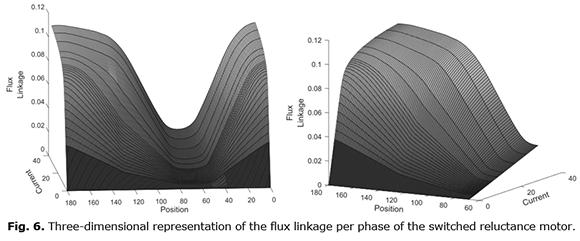
<p align="justify"><font face="verdana" size="2">The flux linkage method calculates the flux linkage of SRM under different phase currents and rotor position. Thereafter, establish a three-dimensional table to store the data. The rotor position can then, be determined, by looking at the stored current and flux linkage values (<a href="#f6">figure 6</a> left). Although the method is simple for implementation purposes, it does require extensive characterization of the machine and medium to large amounts of memory.</font></p>     <p align="center"><a name="f6" id="f6"></a></p>     ]]></body>
<body><![CDATA[<p align="center"><img src="/img/revistas/rie/v39n3/f0601318.gif" alt="Fig. 6. Three-dimensional representation of the flux linkage per phase of the switched reluctance motor." width="580" height="241" longdesc="/img/revistas/rie/v39n3/f0601318.gif" /></p>     
<p align="justify"><font face="verdana" size="2"><b>Look up table implementation</b></font></p>     <p align="justify"><font face="verdana" size="2">The LUT implementation requires the use of the machine flux linkage tree-dimensional surface. The data can be obtained using either mathematical methods to generate approximations of the flux linkage curves &#91;3,16&#93;, or using finite element analysis &#91;2,8&#93;. In either case the result is a three-dimensional LUT with the current, flux linkage and position data.</font></p>     <p align="justify"><font face="verdana" size="2">The first step was to select the data that will be used as the input for LUT. The goal is to replicate the relationship between the current, flux linkage and position with a one to one relationship between the first two variables and the third. <a href="#f7">Figure 7</a>, shows that there is a two to one relationship between the variables, i.e. there are two flux linkage values for each pair of current and position. This happens because the SRM in question presents an irregular rotor, therefore the flux linkage surface it&rsquo;s not symmetrical. This particular motor is designed to rotate in only one direction, therefore only one side of the flux linkage surface is needed (<a href="#f6">figure 6</a> right).</font></p>     <p align="justify"><font face="verdana" size="2"><a href="#f7">Figure 7</a> show the implementation of the algorithm in Simulink:</font></p>     <p align="center"><a name="f7" id="f7"></a></p>     <p align="center"><img src="/img/revistas/rie/v39n3/f0701318.gif" alt="Fig. 7. Rotor position estimation algorithm." width="543" height="278" longdesc="/img/revistas/rie/v39n3/f0701318.gif" /></p>     
<p align="justify">&nbsp;</p>     <p align="justify"><font face="verdana" size="3"><b>RESULTS</b></font></p>     <p align="justify"><font face="verdana" size="2">The results from the simulation of the Switched Reluctance Motor from section 2 and its control strategy are shown. Also, the rotor position estimation algorithm implementation is discussed, and then compared to the real values of the position.</font></p>     ]]></body>
<body><![CDATA[<p align="justify"><font face="verdana" size="2">To achieve this, an experiment was designed with the parameters presented on the <a href="#t1">table 1</a>.</font></p>     <p align="center"><a name="t1" id="t1"></a></p>     <p align="center"><img src="/img/revistas/rie/v39n3/t0101318.gif" alt="Table 1. Specifications of the 4/2 two-phase Switched Reluctance Motor" width="543" height="163" longdesc="/img/revistas/rie/v39n3/t0101318.gif" /></p>     
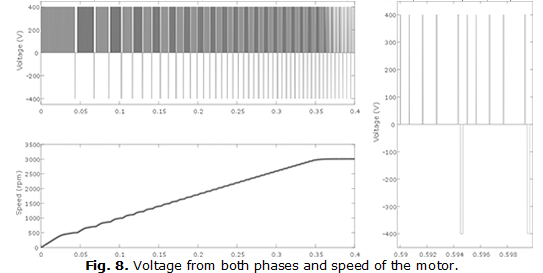
<p align="justify"><font face="verdana" size="2"><b>SRM Model in Simulink</b></font></p>     <p align="justify"><font face="verdana" size="2">In previous sections the Switched Reluctance Motor model implemented in Simulink was explained. In order to analyze its behavior, the electrical and magnetic parameters where measured.</font></p>     <p align="justify"><font face="verdana" size="2">In the <a href="#f8">figure 8</a> (left), the voltage and speed are shown, on the right side a zoom was made on the former to observe the commutation of the phase voltage. The operation of the motor is described starting form standstill position until the motor reaches 3 000 rpm.</font></p>     <p align="center"><a name="f8" id="f8"></a></p>     <p align="center"><img src="/img/revistas/rie/v39n3/f0801318.gif" alt="Fig. 8. Voltage from both phases and speed of the motor" width="543" height="273" longdesc="/img/revistas/rie/v39n3/f0801318.gif" /></p>     
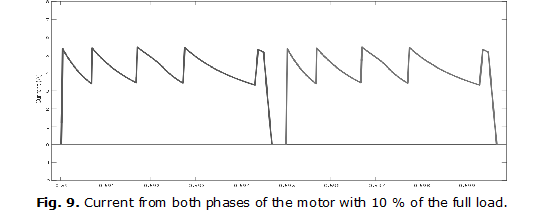
<p align="justify"><font face="verdana" size="2">Applying the nominal voltage to phase (<a href="#f9">figure 9</a>), using soft chopping modulation and current hysteresis closed loop control at 10 % of the full load, results in a peak current flowing through the windings of 5,2 A.</font></p>     <p align="center"><a name="f9" id="f9"></a></p>     ]]></body>
<body><![CDATA[<p align="center"><img src="/img/revistas/rie/v39n3/f0901318.gif" alt="Fig. 9. Current from both phases of the motor with 10 % of the full load." width="543" height="210" longdesc="/img/revistas/rie/v39n3/f0901318.gif" /></p>     
<p align="justify"><font face="verdana" size="2">From the electromagnetic part of the analysis are the flux linkage and torque which can be seen in <a href="#f10">figure 10</a>.</font></p>     <p align="center"><a name="f10" id="f10"></a></p>     <p align="center"><img src="/img/revistas/rie/v39n3/f1001318.gif" alt="Fig. 10. Flux linkage and torque from both phases of the motor" width="441" height="232" longdesc="/img/revistas/rie/v39n3/f1001318.gif" /></p>     
<p align="justify"><font face="verdana" size="2"><b>Flux based rotor position estimation algorithm</b></font></p>     <p align="justify"><font face="verdana" size="2">The calculation of the flux linkage using the current and voltage signals is the core of the rotor position estimation algorithm. <a href="#f11">figure 11</a>, shows the real flux linkage vs the estimated one and the error of the calculation. As it can be seen the worst error is less than 3,2 %.</font></p>     <p align="center"><a name="f11" id="f11"></a></p>     <p align="center"><img src="/img/revistas/rie/v39n3/f1101318.gif" alt="Fig. 11. Flux linkage real and estimated and error ." width="551" height="275" longdesc="/img/revistas/rie/v39n3/f1101318.gif" /></p>     
<p align="justify"><font face="verdana" size="2">The next step is to assess the rotor position estimation. <a href="#f12">figure 12</a>, shows the real position vs the estimated one and the error of the calculation. As it can be seen the worst error is less than 5 &deg;, that represents less than 2,8 %.</font></p>     <p align="center"><a name="f12" id="f12"></a></p>     ]]></body>
<body><![CDATA[<p align="center"><img src="/img/revistas/rie/v39n3/f1201318.gif" alt="Fig. 12. Real and Estimated positions and error." width="551" height="252" longdesc="/img/revistas/rie/v39n3/f1201318.gif" /></p>     
<p align="justify">&nbsp;</p>     <p align="justify"><font face="verdana" size="3"><b>CONCLUSIONS</b></font></p>     <p align="justify"><font face="verdana" size="2">In this paper, a position sensorless control strategy for high-speed SRM drives using a flux linkage method for the rotor angular position estimation has been proposed and tested. A reference flux linkage selecting principle was defined on the basis of FEM simulations. The motor speed and rotor position angle estimation equations were detailed. The experimental tests were performed in 4/2 pole SRM prototype, using the mathematical model implemented in Simulink. The results obtained demonstrate the feasibility, effectiveness and reliability of the proposed algorithm for both low- and high-speed SRM.</font></p>     <p align="justify">&nbsp;</p>     <p align="justify"><font face="verdana" size="3"><b>REFERENCES</b></font></p>     <!-- ref --><p align="justify"><font face="verdana" size="2">&#91;1&#93;.R. Krishnan. Switched Reluctance Motor Drives. CRC Press, 2001.Disponible en: <a href="http://ieeexplore.ieee.org/abstract/document/5186557/" target="_blank">http://ieeexplore.ieee.org/abstract/document/5186557/</a></font><p align="justify"><font face="verdana" size="2">&#91;2&#93;.Kandipati Rajani. Modelling and control of switched reluctance motor. BSc Thesis, Vignan&rsquo;s Engineering College, Vadlamudi, Guntur, 2011.disponible en <a href="http://ieeexplore.ieee.org/document/1546378/?denied" target="_blank">http://ieeexplore.ieee.org/document/1546378/?denied</a></font></p>     <!-- ref --><p align="justify"><font face="verdana" size="2">&#91;3&#93;.K. T. Chau, "Switched Reluctance Motor Drives," in Electric Vehicle Machines and Drives: Design, Analysis and Application , 1, Wiley-IEEE Press, 2015, p.375-doi: 10.1002/9781118752555.ch5.Disponible en: <a href="http://ieeexplore.ieee.org/abstract/document/5186557/" target="_blank">http://ieeexplore.ieee.org/abstract/document/5186557/</a></font><p align="justify"><font face="verdana" size="2">&#91;4&#93;.D. Traor&eacute;, J. De Leon, and A. Glumineau. Adaptive interconnected observer-based backstepping control design for sensorless induction motor. Automatica, 48(4):682 &ndash; 687, 2012. ISSN 0005-1098. Disponible en: <a href="https://www.sciencedirect.com/science/article/pii/S0005109812000349" target="_blank">https://www.sciencedirect.com/science/article/pii/S0005109812000349</a></font></p>     ]]></body>
<body><![CDATA[<p align="justify"><font face="verdana" size="2">&#91;5&#93;.Marwa Ezzat, Jesus de Leon, and Alain Glumineau. Sensorless speed control of pmsm via adaptive interconnected observer. International Journal of Control, 84(11):1926&ndash;1943, 2011. doi: 10.1080/00207179.2011.629684. Disponible en: <a href="http://www.tandfonline.com/doi/abs/10.1080/00207179.2011.629684" target="_blank">http://www.tandfonline.com/doi/abs/10.1080/00207179.2011.629684</a>.</font></p>     <p align="justify"><font face="verdana" size="2">&#91;6&#93;.Mohamed Assaad Hamida, Alain Glumineau, and Jesus de Leon. Robust integral backstepping control for sensorless {IPM} synchronous motor controller. Journal of the Franklin Institute, 349(5):1734 &ndash; 1757, 2012. ISSN 0016-0032.Disponible en: <a href="https://www.sciencedirect.com/science/article/pii/S0016003212000373" target="_blank">https://www.sciencedirect.com/science/article/pii/S0016003212000373</a></font></p>     <p align="justify"><font face="verdana" size="2">&#91;7&#93;.M. Ghanes, J. De Leon, and A. Glumineau. Cascade and high-gain observers comparison for sensorless closed-loop induction motor control. Control Theory Applications, IET, 2(2): 133&ndash;150, 2008. ISSN 1751-8644. doi: 10.1049/iet-cta:20070058.Disponible en: <a href="http://digital-library.theiet.org/content/journals/10.1049/iet-cta_20070058" target="_blank">http://digital-library.theiet.org/content/journals/10.1049/iet-cta_20070058</a></font></p>     <p align="justify"><font face="verdana" size="2">&#91;8&#93;.M. Ghanes. Tracking performances of backstepping and high gain observers for sensorless induction motor control against low frequencies benchmark. In Control Applications, 2007. CCA 2007. IEEE International Conference on, pages 652&ndash;657, 2007. doi: 10.1109/CCA. 2007.4389306.Disponible en: <a href="http://ieeexplore.ieee.org/document/4389306/" target="new">http://ieeexplore.ieee.org/document/4389306/</a></font></p>     <!-- ref --><p align="justify"><font face="verdana" size="2">&#91;9&#93;.S. Kim, J. H. Kim and R. Y. Kimf, "Sensor-less direct torque control using inductance peak detection for switched reluctance motor," 2015 IEEE Conference on Energy Conversion (CENCON), Johor Bahru, 2015, p. 7-12. doi: 10.1109/CENCON.2015.7409505.Disponible en: <a href="http://ieeexplore.ieee.org/document/7409505/" target="_blank">http://ieeexplore.ieee.org/document/7409505/</a></font><!-- ref --><p align="justify"><font face="verdana" size="2">&#91;10&#93;.F. Peng, J. Ye and A. Emadi, "Position sensorless control of switched reluctance motor based on numerical method," 2016 IEEE Energy Conversion Congress and Exposition (ECCE), Milwaukee, WI, 2016, p. 1-8. doi: 10.1109/ECCE.2016.7855353.Disponible en: <a href="http://ieeexplore.ieee.org/document/7855353/" target="_blank">http://ieeexplore.ieee.org/document/7855353/</a></font><p align="justify"><font face="verdana" size="2">&#91;11&#93;.J.A. Makwana, A. Mishra, P. Agarwal, and S.P. Srivastava. Sensorless control of switched reluctance motor drive: An analytical method. In Advances in Engineering, Science and Management (ICAESM), 2012 International Conference on, p. 571&ndash;576, 2012.Disponible en: <a href="http://ieeexplore.ieee.org/abstract/document/6216176/" target="_blank">http://ieeexplore.ieee.org/abstract/document/6216176/</a></font></p>     <p align="justify"><font face="verdana" size="2">&#91;12&#93;.Jun Cai, Qing-Chang Zhong, and Zhiquan Deng. Estimation of srm rotor position based on coordinate transformation. In Industrial Electronics Society, IECON 2013 - 39th Annual Conference of the IEEE, p. 2786&ndash;2791, 2013. doi: 10.1109/IECON.2013.6699572.Disponible en: <a href="http://ieeexplore.ieee.org/abstract/document/6699572/" target="_blank">http://ieeexplore.ieee.org/abstract/document/6699572/</a></font></p>     <p align="justify"><font face="verdana" size="2">&#91;13&#93;.Zhang Y, Liu C, Zhang L, &ldquo;Sensorless control of SRM based on improved simplified flux-linkage method&rdquo;, in 2014 17th international conference on electrical machines and systems (ICEMS), Oct. 2014, p. 722&ndash;726. DOI: 10.1109/ICEMS.2014.7013576.Disponible en: <a href="http://ieeexplore.ieee.org/document/7013576/" target="_blank">http://ieeexplore.ieee.org/document/7013576/</a></font></p>     <p align="justify"><font face="verdana" size="2">&#91;14&#93;.Divandari M, Rezaie B, Askari-Ziarati B, &ldquo;Torque estimation of sensorless SRM drive using adaptive fuzzy logic control&rdquo;, in 2016 IEEE NW Russia young researchers in electrical and electronic engineering conference (EIConRusNW), Feb. 2016, p. 542&ndash;546. DOI: 10.1109/EIConRusNW.2016.7448241.Disponible en: <a href="http://ieeexplore.ieee.org/document/7448241/" target="_blank">http://ieeexplore.ieee.org/document/7448241/</a></font></p>     ]]></body>
<body><![CDATA[<p align="justify"><font face="verdana" size="2">&#91;15&#93;.Paulson F, Prabhu VV, &ldquo;Back propagation based ANN technique for rotor position estimation of 8/6 switched reluctance motor&rdquo;, in 2015 international conference on innovations in information, embedded and communication systems (ICIIECS), Mar. 2015, p. 1&ndash;5. DOI: 10.1109/ICIIECS.2015.7192853.Disponible en: <a href="http://ieeexplore.ieee.org/document/7192853/" target="_blank">http://ieeexplore.ieee.org/document/7192853/</a></font></p>     <p align="justify"><font face="verdana" size="2">&#91;16&#93;.R. Zhong, Y.B. Wang, and Y.Z. Xu. Position sensorless control of switched reluctance motors based on improved neural network. Electric Power Applications, IET, 6(2):111&ndash;121, 2012. ISSN 1751-8660. doi: 10.1049/iet-epa.2011.0092.Disponible en: <a href="http://digital-library.theiet.org/content/journals/10.1049/iet-epa.2011.0092" target="_blank">http://digital-library.theiet.org/content/journals/10.1049/iet-epa.2011.0092</a></font></p>     <!-- ref --><p align="justify"><font face="verdana" size="2">&#91;17&#93;.D. Aliamkin, A. Anuchin, M. Lashkevich and F. Briz, "Sensorless control of two-phase switched reluctance drive in the whole speed range," IECON 2016 - 42nd Annual Conference of the IEEE Industrial Electronics Society, Florence, 2016, p. 2917-2922. doi: 10.1109/IECON.2016.7793719.Disponible en: <a href="http://ieeexplore.ieee.org/document/7793719/" target="_blank">http://ieeexplore.ieee.org/document/7793719/</a></font><p align="justify"><font face="verdana" size="2">&#91;18&#93;.Ma QQ, Liang WH, Ferreira FJTE, Bi DQ, Ge BM, &ldquo;Improved flux linkage method for position sensorless control of high-speed SRM&rdquo;, in 2014 international conference on electrical machines (ICEM), Sep. 2014, p. 783&ndash;788. DOI: 10.1109/ICELMACH.2014.6960270.Disponible en: <a href="http://ieeexplore.ieee.org/document/6960270/" target="_blank">http://ieeexplore.ieee.org/document/6960270/</a></font></p>     <p align="justify"><font face="verdana" size="2">&#91;19&#93;.P. Brandstetter and P. Krna. Sensorless control of switched reluctance motor using sliding mode observer. In Applied Electronics (AE), 2013 International Conference on, p. 1&ndash;4, ISSN:1803&ndash;7232, 2013.Disponible en: <a href="http://ieeexplore.ieee.org/abstract/document/6636477/" target="_blank">http://ieeexplore.ieee.org/abstract/document/6636477/</a></font></p>     <!-- ref --><p align="justify"><font face="verdana" size="2">&#91;20&#93;.Xiao Wang, Fei Peng and A. Emadi, "A position sensorless control of switched reluctance motors based on sliding-mode observer," 2016 IEEE Transportation Electrification Conference and Expo (ITEC), Dearborn, MI, 2016, p. 1-6. doi: 10.1109/ITEC.2016.7520312.Disponible en: <a href="http://ieeexplore.ieee.org/document/7520312/" target="_blank">http://ieeexplore.ieee.org/document/7520312/</a></font><p align="justify"><font face="verdana" size="2">&#91;21&#93;.Ouddah N, Loukkas N, Chaibet A, Boukhnifer M, Monmasson E, &ldquo;Experimental evaluation of second sliding modes observer and extended kalman filter in a sensorless robust control of switched reluctance motor for EV application&rdquo;, in 2015 23th mediterranean conference on control and automation (MED), Jun. 2015, p. 986&ndash;992. DOI: 10.1109/MED.2015.7158886.Disponible en: <a href="http://ieeexplore.ieee.org/document/7158886/" target="_blank">http://ieeexplore.ieee.org/document/7158886/</a></font></p>     <!-- ref --><p align="justify"><font face="verdana" size="2">&#91;22&#93;.B. Hongfen, Z. Jingwei and Q. Junfeng, "Sensorless control of the fault-tolerant permanent magnet motor based on sliding mode observer," 2016 Chinese Control and Decision Conference (CCDC), Yinchuan, 2016, p. 5623-5626. doi: 10.1109/CCDC.2016.7532003.Disponible en: <a href="http://ieeexplore.ieee.org/document/7532003/" target="_blank">http://ieeexplore.ieee.org/document/7532003/</a></font><p align="justify">&nbsp;</p>     <p align="justify">&nbsp;</p>     ]]></body>
<body><![CDATA[<p align="justify"><font face="verdana" size="2">Recibido: 1/4/2017</font></p>     <p align="justify"><font face="verdana" size="2">Aprobado: 1/11/2017</font></p>     <p align="justify">&nbsp;</p>     <p align="justify">&nbsp;</p>     <p align="justify"><font face="verdana" size="2"><i>Luis Manuel Alvarez Tapia,</i> Universidad Tecnol&oacute;gica de La Habana, Cujae. Cuba. E-mail:<a href="mailto:lalvarezt@electrica.cujae.edu.cu">lalvarezt@electrica.cujae.edu.cu</a></font></p>      ]]></body><back>
<ref-list>
<ref id="B1">
<label>1</label><nlm-citation citation-type="book">
<person-group person-group-type="author">
<name>
<surname><![CDATA[Krishnan]]></surname>
<given-names><![CDATA[R]]></given-names>
</name>
</person-group>
<source><![CDATA[Switched Reluctance Motor Drives]]></source>
<year>2001</year>
<publisher-name><![CDATA[CRC Press]]></publisher-name>
</nlm-citation>
</ref>
<ref id="B2">
<label>2</label><nlm-citation citation-type="book">
<person-group person-group-type="author">
<name>
<surname><![CDATA[Rajani]]></surname>
<given-names><![CDATA[Kandipati]]></given-names>
</name>
</person-group>
<source><![CDATA[Modelling and control of switched reluctance motor]]></source>
<year>2011</year>
<publisher-loc><![CDATA[Vadlamudi^eGuntur Guntur]]></publisher-loc>
<publisher-name><![CDATA[Vignan’s Engineering College]]></publisher-name>
</nlm-citation>
</ref>
<ref id="B3">
<label>3</label><nlm-citation citation-type="book">
<person-group person-group-type="author">
<name>
<surname><![CDATA[Chau]]></surname>
<given-names><![CDATA[K. T]]></given-names>
</name>
</person-group>
<article-title xml:lang="en"><![CDATA[Switched Reluctance Motor Drives]]></article-title>
<source><![CDATA[Electric Vehicle Machines and Drives: Design, Analysis and Application]]></source>
<year>2015</year>
<edition>1</edition>
<page-range>375</page-range><publisher-name><![CDATA[Wiley-IEEE Press]]></publisher-name>
</nlm-citation>
</ref>
<ref id="B4">
<label>4</label><nlm-citation citation-type="">
<person-group person-group-type="author">
<name>
<surname><![CDATA[Traoré]]></surname>
<given-names><![CDATA[D]]></given-names>
</name>
<name>
<surname><![CDATA[De Leon]]></surname>
<given-names><![CDATA[J]]></given-names>
</name>
<name>
<surname><![CDATA[Glumineau]]></surname>
<given-names><![CDATA[A]]></given-names>
</name>
</person-group>
<article-title xml:lang="en"><![CDATA[Adaptive interconnected observer-based backstepping control design for sensorless induction motor]]></article-title>
<source><![CDATA[]]></source>
<year>2012</year>
<volume>48</volume>
<numero>4</numero>
<issue>4</issue>
<page-range>682 - 687</page-range></nlm-citation>
</ref>
<ref id="B5">
<label>5</label><nlm-citation citation-type="">
<person-group person-group-type="author">
<name>
<surname><![CDATA[Ezzat]]></surname>
<given-names><![CDATA[Marwa]]></given-names>
</name>
<name>
<surname><![CDATA[de Leon]]></surname>
<given-names><![CDATA[Jesus]]></given-names>
</name>
<name>
<surname><![CDATA[Glumineau]]></surname>
<given-names><![CDATA[Alain]]></given-names>
</name>
</person-group>
<article-title xml:lang="en"><![CDATA[Sensorless speed control of pmsm via adaptive interconnected observer]]></article-title>
<source><![CDATA[]]></source>
<year>2011</year>
<volume>84</volume>
<numero>11</numero>
<issue>11</issue>
<page-range>1926-1943</page-range></nlm-citation>
</ref>
<ref id="B6">
<label>6</label><nlm-citation citation-type="">
<person-group person-group-type="author">
<name>
<surname><![CDATA[Assaad Hamida]]></surname>
<given-names><![CDATA[Mohamed]]></given-names>
</name>
<name>
<surname><![CDATA[Glumineau]]></surname>
<given-names><![CDATA[Alain]]></given-names>
</name>
<name>
<surname><![CDATA[de Leon]]></surname>
<given-names><![CDATA[Jesus]]></given-names>
</name>
</person-group>
<article-title xml:lang="en"><![CDATA[Robust integral backstepping control for sensorless {IPM} synchronous motor controller]]></article-title>
<source><![CDATA[]]></source>
<year>2012</year>
<volume>349</volume>
<numero>5</numero>
<issue>5</issue>
<page-range>1734 - 1757</page-range></nlm-citation>
</ref>
<ref id="B7">
<label>7</label><nlm-citation citation-type="">
<person-group person-group-type="author">
<name>
<surname><![CDATA[Ghanes]]></surname>
<given-names><![CDATA[M.]]></given-names>
</name>
<name>
<surname><![CDATA[De Leon]]></surname>
<given-names><![CDATA[J]]></given-names>
</name>
<name>
<surname><![CDATA[Glumineau]]></surname>
<given-names><![CDATA[A]]></given-names>
</name>
</person-group>
<article-title xml:lang="en"><![CDATA[Cascade and high-gain observers comparison for sensorless closed-loop induction motor control]]></article-title>
<source><![CDATA[]]></source>
<year>2008</year>
<volume>2</volume>
<numero>2</numero>
<issue>2</issue>
<page-range>133-150</page-range></nlm-citation>
</ref>
<ref id="B8">
<label>8</label><nlm-citation citation-type="">
<person-group person-group-type="author">
<name>
<surname><![CDATA[Ghanes]]></surname>
<given-names><![CDATA[M]]></given-names>
</name>
</person-group>
<article-title xml:lang="en"><![CDATA[Tracking performances of backstepping and high gain observers for sensorless induction motor control against low frequencies benchmark]]></article-title>
<source><![CDATA[Control Applications]]></source>
<year>2007</year>
<page-range>652-657</page-range></nlm-citation>
</ref>
<ref id="B9">
<label>9</label><nlm-citation citation-type="">
<person-group person-group-type="author">
<name>
<surname><![CDATA[Kim]]></surname>
<given-names><![CDATA[S]]></given-names>
</name>
<name>
<surname><![CDATA[Kim]]></surname>
<given-names><![CDATA[J. H]]></given-names>
</name>
<name>
<surname><![CDATA[Kimf]]></surname>
<given-names><![CDATA[R. Y]]></given-names>
</name>
</person-group>
<article-title xml:lang="en"><![CDATA[Sensor-less direct torque control using inductance peak detection for switched reluctance motor]]></article-title>
<source><![CDATA[2015 IEEE Conference on Energy Conversion (CENCON)]]></source>
<year>2015</year>
<page-range>7-12</page-range></nlm-citation>
</ref>
<ref id="B10">
<label>10</label><nlm-citation citation-type="">
<person-group person-group-type="author">
<name>
<surname><![CDATA[Peng]]></surname>
<given-names><![CDATA[F]]></given-names>
</name>
<name>
<surname><![CDATA[Ye]]></surname>
<given-names><![CDATA[J]]></given-names>
</name>
<name>
<surname><![CDATA[Emadi]]></surname>
<given-names><![CDATA[A]]></given-names>
</name>
</person-group>
<article-title xml:lang="en"><![CDATA[Position sensorless control of switched reluctance motor based on numerical method]]></article-title>
<source><![CDATA[2016 IEEE Energy Conversion Congress and Exposition (ECCE)]]></source>
<year>2016</year>
<page-range>1-8</page-range><publisher-loc><![CDATA[Milwaukee^eWI WI]]></publisher-loc>
</nlm-citation>
</ref>
<ref id="B11">
<label>11</label><nlm-citation citation-type="">
<person-group person-group-type="author">
<name>
<surname><![CDATA[Makwana]]></surname>
<given-names><![CDATA[J.A]]></given-names>
</name>
<name>
<surname><![CDATA[Mishra]]></surname>
<given-names><![CDATA[A]]></given-names>
</name>
<name>
<surname><![CDATA[Agarwal]]></surname>
<given-names><![CDATA[P]]></given-names>
</name>
<name>
<surname><![CDATA[Srivastava]]></surname>
<given-names><![CDATA[S.P]]></given-names>
</name>
</person-group>
<article-title xml:lang="en"><![CDATA[Sensorless control of switched reluctance motor drive: An analytical method]]></article-title>
<source><![CDATA[Advances in Engineering, Science and Management (ICAESM)]]></source>
<year>2012</year>
<page-range>571-576</page-range></nlm-citation>
</ref>
<ref id="B12">
<label>12</label><nlm-citation citation-type="">
<person-group person-group-type="author">
<name>
<surname><![CDATA[Cai]]></surname>
<given-names><![CDATA[Jun]]></given-names>
</name>
<name>
<surname><![CDATA[Qing-Chang]]></surname>
<given-names><![CDATA[Zhong]]></given-names>
</name>
<name>
<surname><![CDATA[Deng]]></surname>
<given-names><![CDATA[Zhiquan]]></given-names>
</name>
</person-group>
<article-title xml:lang="en"><![CDATA[Estimation of srm rotor position based on coordinate transformation]]></article-title>
<source><![CDATA[39th Annual Conference of the IEEE]]></source>
<year></year>
<page-range>2786-2791</page-range></nlm-citation>
</ref>
<ref id="B13">
<label>13</label><nlm-citation citation-type="">
<person-group person-group-type="author">
<name>
<surname><![CDATA[Zhang]]></surname>
<given-names><![CDATA[Y]]></given-names>
</name>
<name>
<surname><![CDATA[Liu]]></surname>
<given-names><![CDATA[C]]></given-names>
</name>
<name>
<surname><![CDATA[Zhang]]></surname>
<given-names><![CDATA[L]]></given-names>
</name>
</person-group>
<article-title xml:lang="en"><![CDATA[Sensorless control of SRM based on improved simplified flux-linkage method]]></article-title>
<source><![CDATA[17th international conference on electrical machines and systems (ICEMS)]]></source>
<year>2014</year>
<page-range>722-726</page-range></nlm-citation>
</ref>
<ref id="B14">
<label>14</label><nlm-citation citation-type="">
<person-group person-group-type="author">
<name>
<surname><![CDATA[Divandari]]></surname>
<given-names><![CDATA[M]]></given-names>
</name>
<name>
<surname><![CDATA[Rezaie]]></surname>
<given-names><![CDATA[B]]></given-names>
</name>
<name>
<surname><![CDATA[Askari-Ziarati]]></surname>
<given-names><![CDATA[B]]></given-names>
</name>
</person-group>
<article-title xml:lang="en"><![CDATA[Torque estimation of sensorless SRM drive using adaptive fuzzy logic control]]></article-title>
<source><![CDATA[2016 IEEE NW Russia young researchers in electrical and electronic engineering conference (EIConRusNW)]]></source>
<year>2016</year>
<page-range>542-546</page-range></nlm-citation>
</ref>
<ref id="B15">
<label>15</label><nlm-citation citation-type="">
<person-group person-group-type="author">
<name>
<surname><![CDATA[Paulson]]></surname>
<given-names><![CDATA[F]]></given-names>
</name>
<name>
<surname><![CDATA[Prabhu]]></surname>
<given-names><![CDATA[VV]]></given-names>
</name>
</person-group>
<article-title xml:lang="en"><![CDATA[Back propagation based ANN technique for rotor position estimation of 8/6 switched reluctance motor]]></article-title>
<source><![CDATA[2015 international conference on innovations in information, embedded and communication systems (ICIIECS)]]></source>
<year>2015</year>
<page-range>1-5</page-range></nlm-citation>
</ref>
<ref id="B16">
<label>16</label><nlm-citation citation-type="">
<person-group person-group-type="author">
<name>
<surname><![CDATA[Zhong]]></surname>
<given-names><![CDATA[R.]]></given-names>
</name>
<name>
<surname><![CDATA[Wang]]></surname>
<given-names><![CDATA[Y.B.]]></given-names>
</name>
<name>
<surname><![CDATA[Xu]]></surname>
<given-names><![CDATA[Y.Z.]]></given-names>
</name>
</person-group>
<article-title xml:lang="en"><![CDATA[Position sensorless control of switched reluctance motors based on improved neural network]]></article-title>
<source><![CDATA[]]></source>
<year>2012</year>
<volume>6</volume>
<numero>2</numero>
<issue>2</issue>
<page-range>111-121</page-range></nlm-citation>
</ref>
<ref id="B17">
<label>17</label><nlm-citation citation-type="">
<person-group person-group-type="author">
<name>
<surname><![CDATA[Aliamkin]]></surname>
<given-names><![CDATA[D.]]></given-names>
</name>
<name>
<surname><![CDATA[Anuchin]]></surname>
<given-names><![CDATA[A.]]></given-names>
</name>
<name>
<surname><![CDATA[Lashkevich]]></surname>
<given-names><![CDATA[M.]]></given-names>
</name>
<name>
<surname><![CDATA[Briz]]></surname>
<given-names><![CDATA[F.]]></given-names>
</name>
</person-group>
<article-title xml:lang="en"><![CDATA[Sensorless control of two-phase switched reluctance drive in the whole speed range]]></article-title>
<source><![CDATA[42nd Annual Conference of the IEEE Industrial Electronics Society]]></source>
<year>2016</year>
<page-range>2917-2922</page-range><publisher-loc><![CDATA[^eFlorence Florence]]></publisher-loc>
</nlm-citation>
</ref>
<ref id="B18">
<label>18</label><nlm-citation citation-type="">
<person-group person-group-type="author">
<name>
<surname><![CDATA[Ma]]></surname>
<given-names><![CDATA[QQ]]></given-names>
</name>
<name>
<surname><![CDATA[Liang]]></surname>
<given-names><![CDATA[WH]]></given-names>
</name>
<name>
<surname><![CDATA[Ferreira]]></surname>
<given-names><![CDATA[FJTE]]></given-names>
</name>
<name>
<surname><![CDATA[Bi]]></surname>
<given-names><![CDATA[DQ]]></given-names>
</name>
<name>
<surname><![CDATA[BM]]></surname>
<given-names><![CDATA[Ge]]></given-names>
</name>
</person-group>
<article-title xml:lang="en"><![CDATA[Improved flux linkage method for position sensorless control of high-speed SRM]]></article-title>
<source><![CDATA[2014 international conference on electrical machines (ICEM)]]></source>
<year>2014</year>
<page-range>783-788</page-range></nlm-citation>
</ref>
<ref id="B19">
<label>19</label><nlm-citation citation-type="">
<person-group person-group-type="author">
<name>
<surname><![CDATA[Brandstetter]]></surname>
<given-names><![CDATA[P.]]></given-names>
</name>
<name>
<surname><![CDATA[Krna]]></surname>
<given-names><![CDATA[P.]]></given-names>
</name>
</person-group>
<article-title xml:lang="en"><![CDATA[Sensorless control of switched reluctance motor using sliding mode observer]]></article-title>
<source><![CDATA[Applied Electronics]]></source>
<year>2013</year>
<page-range>1-4</page-range></nlm-citation>
</ref>
<ref id="B20">
<label>20</label><nlm-citation citation-type="">
<person-group person-group-type="author">
<name>
<surname><![CDATA[Wang]]></surname>
<given-names><![CDATA[Xiao]]></given-names>
</name>
<name>
<surname><![CDATA[Peng]]></surname>
<given-names><![CDATA[Fei]]></given-names>
</name>
<name>
<surname><![CDATA[Emadi]]></surname>
<given-names><![CDATA[A.]]></given-names>
</name>
</person-group>
<article-title xml:lang="en"><![CDATA[A position sensorless control of switched reluctance motors based on sliding-mode observer]]></article-title>
<source><![CDATA[2016 IEEE Transportation Electrification Conference and Expo (ITEC)]]></source>
<year>2016</year>
<page-range>1-6</page-range><publisher-loc><![CDATA[Dearborn^eMI MI]]></publisher-loc>
</nlm-citation>
</ref>
<ref id="B21">
<label>21</label><nlm-citation citation-type="">
<person-group person-group-type="author">
<name>
<surname><![CDATA[Ouddah]]></surname>
<given-names><![CDATA[N]]></given-names>
</name>
<name>
<surname><![CDATA[Loukkas]]></surname>
<given-names><![CDATA[N]]></given-names>
</name>
<name>
<surname><![CDATA[Chaibet]]></surname>
<given-names><![CDATA[A]]></given-names>
</name>
<name>
<surname><![CDATA[Boukhnifer]]></surname>
<given-names><![CDATA[M]]></given-names>
</name>
<name>
<surname><![CDATA[Monmasson]]></surname>
<given-names><![CDATA[E]]></given-names>
</name>
</person-group>
<article-title xml:lang="en"><![CDATA[Experimental evaluation of second sliding modes observer and extended kalman filter in a sensorless robust control of switched reluctance motor for EV application]]></article-title>
<source><![CDATA[23th mediterranean conference on control and automation (MED)]]></source>
<year>2015</year>
<page-range>986-992</page-range></nlm-citation>
</ref>
<ref id="B22">
<label>22</label><nlm-citation citation-type="">
<person-group person-group-type="author">
<name>
<surname><![CDATA[Hongfen]]></surname>
<given-names><![CDATA[B.]]></given-names>
</name>
<name>
<surname><![CDATA[Jingwei]]></surname>
<given-names><![CDATA[Z.]]></given-names>
</name>
<name>
<surname><![CDATA[Junfeng]]></surname>
<given-names><![CDATA[Q.]]></given-names>
</name>
</person-group>
<article-title xml:lang="en"><![CDATA[Sensorless control of the fault-tolerant permanent magnet motor based on sliding mode observer]]></article-title>
<source><![CDATA[2016 Chinese Control and Decision Conference (CCDC)]]></source>
<year>2016</year>
<page-range>5623-5626</page-range><publisher-loc><![CDATA[^eYinchuan Yinchuan]]></publisher-loc>
</nlm-citation>
</ref>
</ref-list>
</back>
</article>