<?xml version="1.0" encoding="ISO-8859-1"?><article xmlns:mml="http://www.w3.org/1998/Math/MathML" xmlns:xlink="http://www.w3.org/1999/xlink" xmlns:xsi="http://www.w3.org/2001/XMLSchema-instance">
<front>
<journal-meta>
<journal-id>1815-5928</journal-id>
<journal-title><![CDATA[Ingeniería Electrónica, Automática y Comunicaciones]]></journal-title>
<abbrev-journal-title><![CDATA[EAC]]></abbrev-journal-title>
<issn>1815-5928</issn>
<publisher>
<publisher-name><![CDATA[Universidad Tecnológica de La Habana José Antonio Echeverría, Cujae]]></publisher-name>
</publisher>
</journal-meta>
<article-meta>
<article-id>S1815-59282016000300005</article-id>
<title-group>
<article-title xml:lang="en"><![CDATA[A global fuzzy model for non linear systems using interval valued fuzzy sets]]></article-title>
<article-title xml:lang="es"><![CDATA[Un modelo difuso global para sistemas no lineales usando conjuntos difusos de intervalo evaluado]]></article-title>
</title-group>
<contrib-group>
<contrib contrib-type="author">
<name>
<surname><![CDATA[Herrera Fernández]]></surname>
<given-names><![CDATA[Francisco]]></given-names>
</name>
<xref ref-type="aff" rid="A01"/>
</contrib>
<contrib contrib-type="author">
<name>
<surname><![CDATA[Kerre]]></surname>
<given-names><![CDATA[Etienne E.]]></given-names>
</name>
<xref ref-type="aff" rid="A02"/>
</contrib>
<contrib contrib-type="author">
<name>
<surname><![CDATA[Martínez Jiménez]]></surname>
<given-names><![CDATA[Boris L.]]></given-names>
</name>
<xref ref-type="aff" rid="A03"/>
</contrib>
</contrib-group>
<aff id="A01">
<institution><![CDATA[,Universidad Central Marta Abreu de Las Villas  ]]></institution>
<addr-line><![CDATA[ ]]></addr-line>
<country>Cuba</country>
</aff>
<aff id="A02">
<institution><![CDATA[,University of Gent  ]]></institution>
<addr-line><![CDATA[ ]]></addr-line>
<country>Belgium</country>
</aff>
<aff id="A03">
<institution><![CDATA[,Universidad Católica de Temuco  ]]></institution>
<addr-line><![CDATA[ ]]></addr-line>
<country>Chile</country>
</aff>
<pub-date pub-type="pub">
<day>00</day>
<month>12</month>
<year>2016</year>
</pub-date>
<pub-date pub-type="epub">
<day>00</day>
<month>12</month>
<year>2016</year>
</pub-date>
<volume>37</volume>
<numero>3</numero>
<fpage>50</fpage>
<lpage>57</lpage>
<copyright-statement/>
<copyright-year/>
<self-uri xlink:href="http://scielo.sld.cu/scielo.php?script=sci_arttext&amp;pid=S1815-59282016000300005&amp;lng=en&amp;nrm=iso"></self-uri><self-uri xlink:href="http://scielo.sld.cu/scielo.php?script=sci_abstract&amp;pid=S1815-59282016000300005&amp;lng=en&amp;nrm=iso"></self-uri><self-uri xlink:href="http://scielo.sld.cu/scielo.php?script=sci_pdf&amp;pid=S1815-59282016000300005&amp;lng=en&amp;nrm=iso"></self-uri><abstract abstract-type="short" xml:lang="en"><p><![CDATA[This paper investigates the behavior of the fuzzy set in the antecedents of the Takagi Sugeno fuzzy model in identification of non linear and time variant systems. Data-driven techniques are applied by considering that measurement data are available. The principal question to solve in this paper is related with the representation of this kind of systems applying the concept of interval-valued fuzzy set. An overall model includes explicitly the nonlinear or time variant behavior of the system being identified by means of this concept using Takagi Sugeno fuzzy models. The determination of the nonlinear parameters of the antecedents is a central point in this modeling for time variant and nonlinear systems, because of the characteristics of these parameters. An illustrative experiment on a hybrid-tank system is conducted to present the benefits of the proposed approach.]]></p></abstract>
<abstract abstract-type="short" xml:lang="es"><p><![CDATA[En este trabajo se investiga el comportamiento de los conjuntos difusos en los antecedentes de un modelo difuso del tipo Takagi Sugeno en la identificación de sistemas no linelaes y variantes en el tiempo. Técnicas de manejo de datos son aplicadas considerando que las mediciones están disponibles. EL principal problema a resolver en el trabajo está relacionado con la representación de este tipo de sistemas aplicando el concepto de conjunto difuso de intervalo evaluado. Un modelo general incluye de forma explícita el comportamiento no lineal o variante en el tiempo del sistema siendo identificado por medio de este concepto usando modelos difusos del tipo Takagi Sugeno. La determinación de ls parámetros no lineales de los antecedentes es aspecto esencial en esta modelación para sistemas variantes en el tiempo y no lineales debido a las características de estos parámetros. Un experimento ilustrativo de un sistema de tanque híbrido es realizado con el objetivo de presentar el enfoque propuesto.]]></p></abstract>
<kwd-group>
<kwd lng="en"><![CDATA[Interval-valued fuzzy set]]></kwd>
<kwd lng="en"><![CDATA[fuzzy identification]]></kwd>
<kwd lng="en"><![CDATA[Takagi-Sugeno fuzzy model]]></kwd>
<kwd lng="es"><![CDATA[Conjunto difuso de intervalo evaluado]]></kwd>
<kwd lng="es"><![CDATA[identificación difusa]]></kwd>
<kwd lng="es"><![CDATA[modelo difuso Takagi Sugeno]]></kwd>
</kwd-group>
</article-meta>
</front><body><![CDATA[ <p align="right"><font face="Verdana" size="2"> <b>ORIGINAL ARTICLE</b></font></p>        <p>&nbsp;</p>     <p>&nbsp; </p> 	     <p align="justify"><font face="verdana" size="4"><b>A global fuzzy model for non    linear systems using interval valued fuzzy sets</b></font></p>     <p align="justify">&nbsp;</p>  	     <p align="justify"><font face="verdana" size="3"><b>Un modelo difuso global para sistemas no lineales usando conjuntos difusos de intervalo evaluado</b></font></p>  	     <p align="justify">&nbsp;</p>     <p align="justify">&nbsp;</p>  	    <p align="justify"><font face="verdana" size="2"><b>Francisco Herrera Fern&aacute;ndez</b>    <b><sup>I</sup></b><b>, Etienne E. Kerre <sup>II</sup>, Boris L. Mart&iacute;nez    Jim&eacute;nez <sup>III</sup></b></font><font face="verdana" size="2"><b><i>&nbsp;</i></b></font></p>  	    <p align="justify"><font face="verdana" size="2"><sup>I</sup> Universidad Central "Marta Abreu" de Las Villas, Cuba.    ]]></body>
<body><![CDATA[<br> 	<sup>II</sup> University of Gent, Belgium.    <br> 	<sup>III</sup> Universidad Cat&oacute;lica de Temuco, Chile.</font></p>      <P>&nbsp;     <P>&nbsp;  <hr size="1" noshade>     <P><B><font size="2" face="Verdana">ABSTRACT</font></B>  	     <p><font face="verdana" size="2">This paper investigates the behavior of the fuzzy    set in the antecedents of the Takagi Sugeno fuzzy model in identification of    non linear and time variant systems. Data&#45;driven techniques are applied    by considering that measurement data are available. The principal question to    solve in this paper is related with the representation of this kind of systems    applying the concept of interval&#45;valued fuzzy set. An overall model includes    explicitly the nonlinear or time variant behavior of the system being identified    by means of this concept using Takagi Sugeno fuzzy models. The determination    of the nonlinear parameters of the antecedents is a central point in this modeling    for time variant and nonlinear systems, because of the characteristics of these    parameters. An illustrative experiment on a hybrid&#45;tank system is conducted    to present the benefits of the proposed approach.</font></p>  	     <p align="justify"><font face="verdana" size="2"><b>Key words:</b> Interval&#45;valued    fuzzy set, fuzzy identification, Takagi&#45;Sugeno fuzzy model</font></p>  	    <p align="justify"><font face="verdana" size="2"><b>RESUMEN</b></font></p>  	     <p align="justify"><font face="verdana" size="2">En este trabajo se investiga    el comportamiento de los conjuntos difusos en los antecedentes de un modelo    difuso del tipo Takagi Sugeno en la identificaci&oacute;n de sistemas no linelaes    y variantes en el tiempo. T&eacute;cnicas de manejo de datos son aplicadas considerando    que las mediciones est&aacute;n disponibles. EL principal problema a resolver    en el trabajo est&aacute; relacionado con la representaci&oacute;n de este tipo    de sistemas aplicando el concepto de conjunto difuso de intervalo evaluado.    Un modelo general incluye de forma expl&iacute;cita el comportamiento no lineal    o variante en el tiempo del sistema siendo identificado por medio de este concepto    usando modelos difusos del tipo Takagi Sugeno. La determinaci&oacute;n de ls    par&aacute;metros no lineales de los antecedentes es aspecto esencial en esta    modelaci&oacute;n para sistemas variantes en el tiempo y no lineales debido    a las caracter&iacute;sticas de estos par&aacute;metros. Un experimento ilustrativo    de un sistema de tanque h&iacute;brido es realizado con el objetivo de presentar    el enfoque propuesto.</font></p>  	    <p align="justify"><font face="verdana" size="2"><b>Palabras Claves:</b> Conjunto difuso de intervalo evaluado, identificaci&oacute;n difusa, modelo difuso Takagi Sugeno</font></p>  <hr size="1" noshade>     ]]></body>
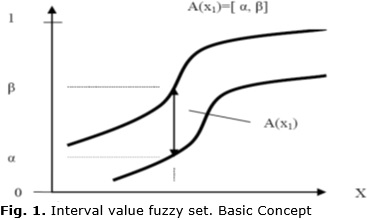
<body><![CDATA[<P>&nbsp;     <P>&nbsp;	     <p><font face="verdana" size="3"><b>1.&#45; INTRODUCTION</b></font></p>     <p>&nbsp;</p>  	     <p><font face="verdana" size="2">Many real&#45;world problems are non&#45;linear    processes that require to be represented by adapting nonlinear models capable    of representing the process dynamics. Particularly for nonlinear dynamic systems,    the conventional techniques of modeling and identification are difficult to    implement and sometimes impracticable. Therefore, there are demand for effective    approaches to design self&#45;developing systems which at the same time should    be flexible and robust. Recently, several algorithms for on&#45;line learning    with self&#45;constructing structure have been reported by including &nbsp;techniques    based on fuzzy logic &nbsp;used for modeling this kind of processes &#91;1&#45;    14&#93;. Specially the Takagi&#45;Sugeno &nbsp;model (TS) &#91;15&#93; has &nbsp;been    &nbsp;extensively used. This model consists of if&#45;then rules with fuzzy    antecedents and mathematical functions in the consequent part. The task of system    identification is to determine both the non&#45;linear parameters of the antecedents    and the linear parameters of the rules consequent.</font></p>  	     <p><font face="verdana" size="2">During the past few years, significant attention    has been given to data&#45;driven techniques for generation of fuzzy models.    It is well known that fuzzy systems are universal approximators, i.e., they    can approximate any nonlinear continuous function to any prescribed accuracy    if sufficient fuzzy rules are provided. The Takagi&#45;Sugeno fuzzy model has    become a powerful practical engineering tool for complex systems modeling because    its capability of describing a highly nonlinear system using a small number    of rules. Also fuzzy modeling involves structure and parameter identification.</font></p>  	     <p><font face="verdana" size="2">The determination of the nonlinear parameters    of the antecedent is a central point in this modeling for time variant and nonlinear    systems, because of the characteristics of these parameters. Generally this    situation is solved using linearization. Some methods based on data clustering    are used for the structure identification. Clustering algorithms can be divided    into two classes, off&#45;line and on&#45;line. Although a great number of clustering    algorithms have been proposed, the majority of them process the data off&#45;line,    hence, the variant structure is ignored &#91;10&#93;. On&#45;line clustering    algorithms should be adaptive in the sense that up&#45;to&#45;date clusters    are offered at any time, taking new data items into consideration as soon as    they arrive. For continuous on&#45;line learning of the TS fuzzy model, some    on&#45;line clustering methods responsible for the model structure (rule base)    learning have been developed. &#91;12, 16,17,18&#93;.</font></p>  	     <p><font face="verdana" size="2">Another method besides clustering to obtain a    global model is to consider the changing parameters in the antecedents. These    parameters are changing continually. For that reason it is very important to    obtain a correct determination of the membership function corresponding to the    fuzzy sets in the antecedents. These fuzzy sets don't take unique values. In    this sense a formal representation of this model implies use another concept.    An alternative for these classes of systems are the interval&#45;valued fuzzy    sets, where the membership degrees are closed subintervals of &#91;0,1&#93;,    see <a href="#fig1">Fig. 1</a>.</font></p>  	    <p align="center"><img src="/img/revistas/eac/v37n3/f0105316.jpg"><a name="fig1"/> 	     
<p><font face="verdana" size="2">In this form it's possible to determine a fuzzy    set which can represent all regions in the space state visited for the operation    point of the non linear and time variant process. The question is how to determine    the parameters of these fuzzy sets and what relations exist between these parameters    and the process parameters characterizing non linearity and time variability.</font></p>  	     ]]></body>
<body><![CDATA[<p><font face="verdana" size="2">In this paper, a short application is developed    in the identification of a non&#45;linear system to explore the way to determine    the global fuzzy set. Specially to determine the range where the antecedent    fuzzy set can take values. These features make the approach potentially useful    in adaptive control, robotics, diagnostic systems and as a tool for knowledge    acquisition from data &#91;12&#93;.</font></p>  	     <p><font face="verdana" size="2">The rest of the paper is organized as follows.    Section 2 gives a description of the TS fuzzy modeling. Section 3 gives a short    explication of the algorithm for equation solving and simulation.&nbsp; Section    4 presents the simulation results and Section 5 draws the concluding remarks.<b>&nbsp;</b></font></p>     <p><font face="verdana" size="2"><b>&nbsp;</b></font></p>  	    <p align="justify"><font face="verdana" size="3"><b>2.&#45;TAKAGI&#45;SUGENO FUZZY MODELING</b></font></p>  	     <p>&nbsp;</p>  	     <p><font face="verdana" size="2">The aim of this section is to describe a computationally    efficient and accurate algorithm for on&#45;line Takagi&#150;Sugeno (TS) fuzzy    model generation.</font></p>  	    <p><font face="verdana" size="2">Our on&#45;line dynamic fuzzy system uses the well&#45;known Takagi&#150;Sugeno inference engine &#91;15&#93;. Such fuzzy system is composed of N fuzzy rules indicated as follows:</font></p>  	    <p><img src="/img/revistas/eac/v37n3/e0105316.gif"><a name="ec1"/>  	     
<p align="justify"><font face="verdana" size="2">Where x<sub>j</sub>, j = 1,&hellip;,    r, are input variables defined over universes of discourse X., and A<sub>ij</sub>,    are fuzzy sets defined by their fuzzy membership functions</font></p>  	     <p align="center"><font face="verdana" size="2"><i>&micro;</i><i><sub>Aij</sub></i>:    <i>X<sub>j</sub></i> &#8594; &#91;0, 1&#93;.</font></p>  	     ]]></body>
<body><![CDATA[<p align="justify"><font face="verdana" size="2">Considering A<sub>ij</sub> as    interval&#45;valued fuzzy set then</font></p>  	     <p align="center"><font face="verdana" size="2"><i>&micro;</i><i><sub>Aij</sub></i>:    <i>X<sub>j</sub></i> &#8594; I(&#91;0, 1&#93;)</font></p>  	     <p><font face="verdana" size="2">where I (&#91;0, 1&#93;) denotes the class of    all closed subintervals of &#91;0, 1&#93;.&nbsp; In the consequent parts, <i>y<sub>i</sub></i>    is the rule output and a<sub>ij</sub> are scalars.</font></p>  	    <p align="justify"><font face="verdana" size="2">For an input vector x = &#91;x<sub>1</sub>, x<sub>2</sub>,&hellip;,x<sub>r</sub>&#93;<sup>T</sup>, each of the consequent functions can be expressed as follows:</font></p>  	    <p><img src="/img/revistas/eac/v37n3/e0205316.gif"><a name="ec2"/>  	    
<p align="justify"><font face="verdana" size="2">The result of inference, the output of the system y, is the weighted average of each rule output y<sub>i</sub>, computed as follows:</font></p>  	    <p><img src="/img/revistas/eac/v37n3/e0305316.gif"><a name="ec3"/> 	 	    
<p><img src="/img/revistas/eac/v37n3/e0405316.gif"><a name="ec4"/>  	     
<p align="justify"><font face="verdana" size="2">The quantity w<sub>i</sub> is    the firing strength of the rule i. <a href="#ec3">Equation (3)</a> can be rewritten    in the form:</font></p>  	    <p><img src="/img/revistas/eac/v37n3/e0505316.gif"><a name="ec5"/> 	 	    
]]></body>
<body><![CDATA[<p><img src="/img/revistas/eac/v37n3/e0605316.gif"><a name="ec6"/>  	     
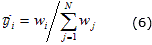
<p><font face="verdana" size="2">where &#964;<sub>i</sub> represents the normalized    firing strength of the i&#45;th rule. TS fuzzy rule&#45;based model, as a set    of local models, enables application of a linear LS method since this algorithm    requires a model that is linear in the parameters.</font></p>  	    <p><font face="verdana" size="2">Finally, all fuzzy membership functions are inverted bell&#45;shape type functions because, in practice, partitions of this type are recommended when Tagaki&#45;Sugeno consequents are used &#91;18&#93;. Inverted bell membership functions depend on three parameters as given by the following expression:</font></p>  	    <p><img src="/img/revistas/eac/v37n3/e0705316.gif"><a name="ec7"/>  	     
<p><font face="verdana" size="2">where:</font></p>  	    <p><font face="verdana" size="2">c is the center of the bell (maximum value) on the x<sub>d</sub> dimension,</font></p>  	    <p><font face="verdana" size="2">a is the width of the inverted bell, and</font></p>  	     <p><font face="verdana" size="2">b is proportional to the support of the fuzzy    set.</font></p>  	     <p><font face="verdana" size="2">If interval&#45;valued fuzzy sets are used the    result of inference changes. One needs to solve the <a href="#ec3">expressions    (3)</a> and <a href="#ec4">(4)</a> where the operations multiplication and division    must be solve with intervals and not with fixed numbers.&nbsp;</font></p>  	     <p align="justify">&nbsp;</p>  	     ]]></body>
<body><![CDATA[<p align="justify"><font face="verdana" size="3"><b>3.&#45;STRUCTURE IDENTIFICATION    AND PARAMETERS DETERMINATION</b></font></p>     <p align="justify">&nbsp;</p>  	     <p align="justify"><font face="verdana" size="2">The on&#45;line learning algorithm    consists of two main parts: structure identification and parameters determination.    The object of structure identification is to select fuzzy rules by input&#45;output    clustering. In on&#45;line identification, there is always new data coming,    and the parameters should be updated according to the new data.</font></p>  	     <p><font face="verdana" size="2">The first step is determine the numbers of input    and rules. After that the linear functions in the consequent parts are created    and updated using a linear least squares estimator. In this application the    well&#45;known method ANFIS was used.</font></p>  	     <p><font face="verdana" size="2">The recursive procedure for on&#45;line learning    of TS models used in this paper, includes the following stages.</font></p>  	    <p><font face="verdana" size="2">1) Stage 1: Initialization of the fuzzy model.    For this:</font></p>  	    <p><font face="verdana" size="2">&nbsp;&nbsp;&nbsp;&nbsp;&nbsp;&nbsp;&nbsp;&nbsp;&nbsp; (a) Take the first m data samples from the data set.</font></p>  	    <p><font face="verdana" size="2">&nbsp;&nbsp;&nbsp;&nbsp;&nbsp;&nbsp;&nbsp;&nbsp;&nbsp; (b) Determine the input variables using initial fuzzy inference systems</font></p>  	    <p align="justify"><font face="verdana" size="2">&nbsp;&nbsp;&nbsp;&nbsp;&nbsp;&nbsp;&nbsp;&nbsp;&nbsp; (c) Create the fuzzy model to be trained</font></p>  	    <p><font face="verdana" size="2">2) Stage 2: At the next time step reading of the next data sample.</font></p>  	    ]]></body>
<body><![CDATA[<p><font face="verdana" size="2">3) Stage 3: Recursive up&#45;date of the model&nbsp;</font></p>  	    <p><font face="verdana" size="2">5) Stage 5: Up&#45;grade of the antecedent parameters</font></p>  	    <p><font face="verdana" size="2">6) Stage 6: Calculation of the consequent parameters</font></p>  	     <p><font face="verdana" size="2">7) Stage 7: Prediction of the output for the    next time step by the TS fuzzy model.</font></p>  	     <p align="justify"><font face="verdana" size="2">The execution of the algorithm    continues for the next time step from stage 2. Stages 3 to 6 are solved using    ANFIS technique.</font></p>     <p align="justify">&nbsp;</p>  	     <p align="justify"><font face="verdana" size="3"><b>4.&#45; EXPERIMENTAL RESULTS</b></font></p>     <p align="justify">&nbsp;</p>  	     <p align="justify"><font face="verdana" size="2">This analysis is realized on a hypothetical non&#45;linear affine system, single input and single output, SISO, described by</font></p>  	    <p><img src="/img/revistas/eac/v37n3/e0805316.gif"><a name="ec8"/>  	     
]]></body>
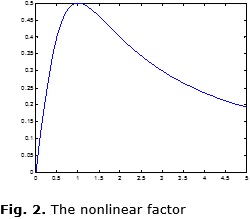
<body><![CDATA[<p align="justify"><font face="verdana" size="2"><a href="#fig2">Fig. 2</a> shows    the static characteristic of the non linearity, where it's possible to observe    the change in the behavior around y(k) = 1.</font></p>  	    <p align="justify"><font face="verdana" size="2">Logically the behavior of output    y depends on the operation point, that means in which zone or range is the input    u. It will be analyzed the behavior in the following 3 zones or ranges for u:</font></p>  	    <p align="justify"><font face="verdana" size="2">Zone 1 Input and output/&nbsp;&nbsp;&nbsp;&nbsp; u&nbsp;&nbsp; random in &#91;&#45;5.5&nbsp; &#45;4.5&#93;</font></p>  	    <p align="justify"><font face="verdana" size="2">Zone 2 Input and output/&nbsp;&nbsp;&nbsp; &nbsp;u&nbsp;&nbsp; random in &#91;&#45;0.5&nbsp; +0.5&#93;</font></p>  	    <p align="justify"><font face="verdana" size="2">Zone 3 Input and output/&nbsp;&nbsp;&nbsp;&nbsp; u&nbsp;&nbsp; random in &#91;+4.5&nbsp; +5.5&#93;</font></p>  	    <p align="center"><img src="/img/revistas/eac/v37n3/f0205316.jpg"><a name="fig2"/>  	     
<p align="center"><img src="/img/revistas/eac/v37n3/f0305316.jpg"><a name="fig3"/> <font face="verdana" size="2"><b>&nbsp;</b></font>     
<p align="justify"><font face="verdana" size="2">The rules obtained are presented    as:</font></p>  	    <p align="justify"><font face="verdana" size="2">If y(k&#45;1) is A<sub>11</sub> and y(k&#45;2) is A<sub>21</sub> and u(k&#45;1) is A<sub>31</sub> &nbsp;then y(k) = p<sub>10</sub> + p<sub>11</sub>y(k&#45;1) + p<sub>12</sub>y(k&#45;2) + p<sub>13</sub>u(k&#45;1)</font></p>  	    <p align="justify"><font face="verdana" size="2">If y(k&#45;1) is A<sub>11</sub> and y(k&#45;2) is A<sub>21</sub> and u(k&#45;1) is A<sub>32</sub> &nbsp;then y(k) = p<sub>20</sub> + p<sub>21</sub>y(k&#45;1) + p<sub>22</sub>y(k&#45;2) + p<sub>23</sub>u(k&#45;1)</font></p>  	    ]]></body>
<body><![CDATA[<p align="justify"><font face="verdana" size="2">If y(k&#45;1) is A<sub>11</sub> and y(k&#45;2) is A<sub>22</sub> and u(k&#45;1) is A<sub>31</sub> &nbsp;then y(k) = p<sub>30</sub> + p<sub>31</sub>y(k&#45;1) + p<sub>32</sub>y(k&#45;2) + p<sub>33</sub>u(k&#45;1)</font></p>  	    <p align="justify"><font face="verdana" size="2">If y(k&#45;1) is A<sub>11</sub> and y(k&#45;2) is A<sub>22</sub> and u(k&#45;1) is A<sub>32</sub> &nbsp;then y(k) = p<sub>40</sub> + p<sub>41</sub>y(k&#45;1) + p<sub>42</sub>y(k&#45;2) + p<sub>43</sub>u(k&#45;1)</font></p>  	    <p align="justify"><font face="verdana" size="2">If y(k&#45;1) is A<sub>12</sub> and y(k&#45;2) is A<sub>21</sub> and u(k&#45;1) is A<sub>31</sub> &nbsp;then y(k) = p<sub>50</sub> + p<sub>51</sub>y(k&#45;1) + p<sub>52</sub>y(k&#45;2) + p<sub>53</sub>u(k&#45;1)</font></p>  	    <p align="justify"><font face="verdana" size="2">If y(k&#45;1) is A<sub>12</sub> and y(k&#45;2) is A<sub>21</sub> and u(k&#45;1) is A<sub>32</sub> &nbsp;then y(k) = p<sub>60</sub> + p<sub>61</sub>y(k&#45;1) + p<sub>62</sub>y(k&#45;2) + p<sub>63</sub>u(k&#45;1)</font></p>  	    <p align="justify"><font face="verdana" size="2">If y(k&#45;1) is A<sub>12</sub> and y(k&#45;2) is A<sub>22</sub> and u(k&#45;1) is A<sub>31</sub> &nbsp;then y(k) = p<sub>70</sub> + p<sub>71</sub>y(k&#45;1) + p<sub>72</sub>y(k&#45;2) + p<sub>73</sub>u(k&#45;1)</font></p>  	     <p align="justify"><font face="verdana" size="2">If y(k&#45;1) is A<sub>12</sub>    and y(k&#45;2) is A<sub>22</sub> and u(k&#45;1) is A<sub>32</sub> &nbsp;then    y(k) = p<sub>80</sub> + p<sub>81</sub>y(k&#45;1) + p<sub>82</sub>y(k&#45;2)    + p<sub>83</sub>u(k&#45;1)</font></p>  	    <p><font face="verdana" size="2">Applying the algorithm described above for the three input zone the obtained antecedent parameters are:</font></p>  	    <p align="center"><img src="/img/revistas/eac/v37n3/i0105316.gif">  	     
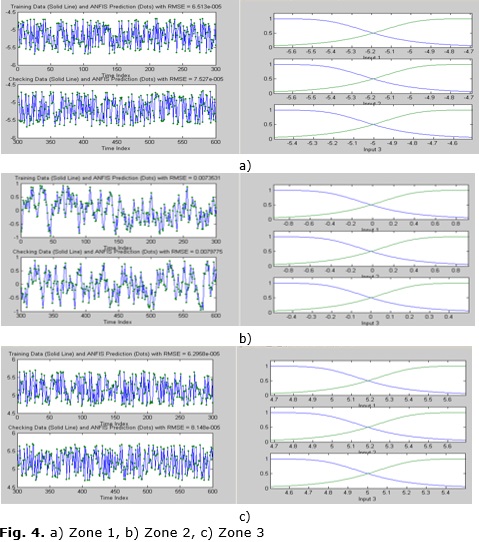
<p><font face="verdana" size="2">The results of the training and the final membership    function for antecedents are shown in <a href="#fig4">figures 4a)</a>, <a href="#fig4">4b)</a>    and <a href="#fig4">4c)</a>. These plots display error curves for both training    and checking data. Logically the training error is higher than the checking    error.&nbsp;&nbsp;</font></p>  	    <p><font face="verdana" size="2">But very important is the fact that for zone 2 both error are bigger than the error for the other two zones. The explication is in the accentuated non&#45;linearity in this zone 2.</font></p>  	    ]]></body>
<body><![CDATA[<p align="center"><img src="/img/revistas/eac/v37n3/f0405316.jpg"><a name="fig4"/>  	     
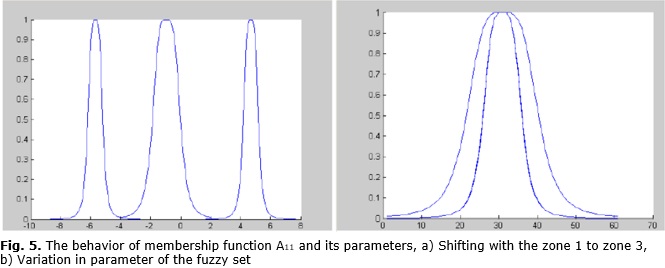
<p><font face="verdana" size="2">Taking only the first fuzzy set, A<sub>11</sub>,    as example it's possible to observe the variations in the value for this membership    function. The <a href="/img/revistas/eac/v37n3/f0505316.jpg">fig. 5a</a> shows how it's shifting    with the zone, and <a href="/img/revistas/eac/v37n3/f0505316.jpg">fig. 5b)</a> shows how the    basic parameters of this fuzzy set also are different.</font></p>     
<p><font face="verdana" size="2"><a href="/img/revistas/eac/v37n3/f0505316.jpg">Fig. 5b)</a> explains    the possibility of applying the interval&#45;valued fuzzy set concept for the    description of nonlinear (and time variant) systems.</font></p>     
<p>&nbsp;</p>     <p align="justify"><font face="verdana" size="3"><b>4.&#45; CONCLUSIONS</b></font></p>     <p align="justify">&nbsp;</p>  	     <p><font face="verdana" size="2">This paper presented an approach for Takagi&#150;Sugeno    fuzzy model generation for a non&#45;linear system, demonstrating the possibility    of using interval&#45;valued fuzzy set to represent this kind of systems.</font></p>  	     <p><font face="verdana" size="2">Quantitative analysis demonstrates the possibility    to solve this problem without using clustering algorithms. In this paper only    non linear SISO systems were analyzed, but this principle can also be applied    to time variant and MIMO systems.</font></p>  	    <p><font face="verdana" size="2">The experiments show that as the parameters of the antecedent fuzzy set change, so it is possible to analyze the relation between these changes and the changes in the process parameters. This constitutes important further directions for research in this area</font></p>  	     <p>&nbsp;</p>  	     ]]></body>
<body><![CDATA[<p><font face="verdana" size="3"><b>ACKNOWLEDMENTS</b></font></p>     <p>&nbsp;</p>  	     <p><font face="verdana" size="2">This paper is based on work supported in part    by ended VLIR&#45;UCLV Project: "Strengthening research and&nbsp; postgraduated    education in Computer Science".</font></p>     <p>&nbsp;</p>  	     <p align="justify"><font face="verdana" size="3"><b>REFERENCES</b></font></p>     <p align="justify">&nbsp;</p>  	     <!-- ref --><p><font size="2" face="Verdana">1. Hongmei J. Lianhua W. Interval-valued fuzzy subsemigroups    and subgroups associated by intervalvalued Fuzzy graphs. In: WRI Global Congress    on Intelligent Systems. Xiamen(China): 2009. p. 484-487.    <!-- ref --><br>   2. Bustince H. Interval-valued Fuzzy Sets in Soft Computing. International Journal    of Computational Intelligence Systems. 2010; 3(2): 215-222.    <!-- ref --><br>   3. Bustince H, Montero J, Pagola M, Barrenechea E, Gomez D. A survey of interval-valued    fuzzy sets. In: Pedrycz W, editors. Handbook of Granular Computing. New Jersey:    Wiley; 2008. p. 489-515    <!-- ref --><br>   4. Wang, CH, Cheng CS, Lee TT. Dynamical optimal training for interval type-2    fuzzy neural network (T2FNN). IEEE Transactions on Systems Man and Cybernetics:    Part B, 2004; 34 (3): 1462-1477    <!-- ref --><br>   5. Chen SH, Wang HY.Evaluating students answer scripts based on interval-valued    fuzzy grade sheets. Expert Systems with Applications. 2009; 36 (6): 9839-9846    <!-- ref --><br>   6. Sanz J, Fernandez A, Bustince F, Herrera F. A First Study on the Use of Interval-Valued    Fuzzy Sets with Genetic Tuning for Classification with Imbalanced Data-Sets.    In: 4th International Workshop on Hybrid Artificial Intelligence Systems. Salamanca(Spain):    Springer Berlin Heidelberg; 2009. p. 581-588    <!-- ref --><br>   7. Broumi S, Smarandach F. New Operations over Interval Valued Intuitionistic    Hesitant Fuzzy Set. Mathematics and Statistics. 2014 2(2): 62-71    <!-- ref --><br>   8. Xu ZS, Xia MM. On distance and correlation measures of hesitant fuzzy information.    International Journal of Intelligent Systems. 2011; 26(5): 410-425    <!-- ref --><br>   9. Kasabov NK, Song Q. DENFIS: Dynamic Evolving Neural-Fuzzy Inference System    and its application for time-series prediction. IEEE Transactions on Fuzzy Systems.    2012; 10(2): 144-154    <!-- ref --><br>   10. Li Z, Er MJ. A nonlinear transversal fuzzy filter with online clustering.    In: 5th Asian Control Conference. Melbourne(Australia): 2004. p. 1585- 1593    <!-- ref --><br>   11. Kukolj D, Levi E. Identification of complex systems based on neural and    Takagi-Sugeno fuzzy model. IEEE Transactions on Systems, Man, and Cybernetics    - Part B: Cybernetics. 2004; 34(1): 272-282    <!-- ref --><br>   12. Angelov PP, Filev DP. An approach to online identification of Takagi-Sugeno    fuzzy models. IEEE Transactions on Systems, Man, and Cybernetics - Part B: Cybernetics.    2004; 34(1): 484-498    <!-- ref --><br>   13. Yu W, Ferreyra A. On-line clustering for nonlinear system identification    using fuzzy neural networks. In: IEEE International Conference on Fuzzy Systems.    Reno(USA): 2005. p. 678-683    <!-- ref --><br>   14. Bouchachia A, Mittermeir R. Towards incremental fuzzy classifiers. Soft    Computing - A Fusion of Foundations, Methodologies and Applications. 2007; 11(2):    193-207    <!-- ref --><br>   15. Takagi T, Sugeno M. Fuzzy identification of systems and its applications    to modeling and control. IEEE Transactions on Systems, Man, and Cybernetics.    1985; 15 (1): 116-132    <!-- ref --><br>   16. Mart&iacute;nez B, Herrera F, Fern&aacute;ndez, JA. M&eacute;todos de agrupamiento    cl&aacute;sico para el modelado difuso en l&iacute;nea. In: Convenci&oacute;n    Internacional FIE'06. Santiago de Cuba(Cuba): 2006. p. 125-134    <!-- ref --><br>   17. Mart&iacute;nez BL, Herrera F, Fern&aacute;ndez JA, Marichal E. M&eacute;todo    de Agrupamiento en L&iacute;nea para la Identificaci&oacute;n de Modelos Borrosos    Takagi-Sugeno. Revista Iberoamericana de Autom&aacute;tica e Inform&aacute;tica    Industrial. 2008; 5(3): 63-69</font><P>&nbsp;     <P>&nbsp;      <P><font size="2" face="Verdana">Received: 4 de february de 2016    <br>   Accepted: 2 de september de 2016</font>      <P>&nbsp;     <P>&nbsp;     <p><font face="verdana" size="2"><em>Francisco Herrera Fern&aacute;ndez. </em>Universidad    Central "Marta Abreu" de Las Villas, Cuba. E&#45;mail: <a href="mailto:herrera@uclv.edu.cu">herrera@uclv.edu.cu</a>.</font></p>     ]]></body>
<body><![CDATA[ ]]></body><back>
<ref-list>
<ref id="B1">
<label>1</label><nlm-citation citation-type="">
<person-group person-group-type="author">
<name>
<surname><![CDATA[Hongmei]]></surname>
<given-names><![CDATA[J]]></given-names>
</name>
</person-group>
<article-title xml:lang="en"><![CDATA[Lianhua W. Interval-valued fuzzy subsemigroups and subgroups associated by intervalvalued Fuzzy graphs]]></article-title>
<source><![CDATA[WRI Global Congress on Intelligent Systems]]></source>
<year>2009</year>
<page-range>484-487</page-range><publisher-loc><![CDATA[Xiamen ]]></publisher-loc>
</nlm-citation>
</ref>
<ref id="B2">
<label>2</label><nlm-citation citation-type="journal">
<person-group person-group-type="author">
<name>
<surname><![CDATA[Bustince]]></surname>
<given-names><![CDATA[H]]></given-names>
</name>
</person-group>
<article-title xml:lang="en"><![CDATA[Interval-valued Fuzzy Sets in Soft Computing]]></article-title>
<source><![CDATA[International Journal of Computational Intelligence Systems]]></source>
<year>2010</year>
<volume>3</volume>
<numero>2</numero>
<issue>2</issue>
<page-range>215-222</page-range></nlm-citation>
</ref>
<ref id="B3">
<label>3</label><nlm-citation citation-type="book">
<person-group person-group-type="author">
<name>
<surname><![CDATA[Bustince]]></surname>
<given-names><![CDATA[H]]></given-names>
</name>
<name>
<surname><![CDATA[Montero]]></surname>
<given-names><![CDATA[J]]></given-names>
</name>
<name>
<surname><![CDATA[Pagola]]></surname>
<given-names><![CDATA[M]]></given-names>
</name>
<name>
<surname><![CDATA[Barrenechea]]></surname>
<given-names><![CDATA[E]]></given-names>
</name>
<name>
<surname><![CDATA[Gomez]]></surname>
<given-names><![CDATA[D]]></given-names>
</name>
</person-group>
<article-title xml:lang="en"><![CDATA[A survey of interval-valued fuzzy sets]]></article-title>
<person-group person-group-type="editor">
<name>
<surname><![CDATA[Pedrycz]]></surname>
<given-names><![CDATA[W]]></given-names>
</name>
</person-group>
<source><![CDATA[Handbook of Granular Computing]]></source>
<year>2008</year>
<page-range>489-515</page-range><publisher-loc><![CDATA[New Jersey ]]></publisher-loc>
<publisher-name><![CDATA[Wiley]]></publisher-name>
</nlm-citation>
</ref>
<ref id="B4">
<label>4</label><nlm-citation citation-type="journal">
<person-group person-group-type="author">
<name>
<surname><![CDATA[Wang]]></surname>
</name>
<name>
<surname><![CDATA[CH]]></surname>
</name>
<name>
<surname><![CDATA[Cheng]]></surname>
<given-names><![CDATA[CS]]></given-names>
</name>
<name>
<surname><![CDATA[Lee]]></surname>
<given-names><![CDATA[TT]]></given-names>
</name>
</person-group>
<article-title xml:lang="en"><![CDATA[Dynamical optimal training for interval type-2 fuzzy neural network (T2FNN)]]></article-title>
<source><![CDATA[IEEE Transactions on Systems Man and Cybernetics: Part B,]]></source>
<year>2004</year>
<volume>34</volume>
<numero>3</numero>
<issue>3</issue>
<page-range>1462-1477</page-range></nlm-citation>
</ref>
<ref id="B5">
<label>5</label><nlm-citation citation-type="journal">
<person-group person-group-type="author">
<name>
<surname><![CDATA[Chen]]></surname>
<given-names><![CDATA[SH]]></given-names>
</name>
<name>
<surname><![CDATA[Wang]]></surname>
<given-names><![CDATA[HY]]></given-names>
</name>
</person-group>
<article-title xml:lang="en"><![CDATA[Evaluating students answer scripts based on interval-valued fuzzy grade sheets]]></article-title>
<source><![CDATA[Expert Systems with Applications]]></source>
<year>2009</year>
<volume>36</volume>
<numero>6</numero>
<issue>6</issue>
<page-range>9839-9846</page-range></nlm-citation>
</ref>
<ref id="B6">
<label>6</label><nlm-citation citation-type="book">
<person-group person-group-type="author">
<name>
<surname><![CDATA[Sanz]]></surname>
<given-names><![CDATA[J]]></given-names>
</name>
<name>
<surname><![CDATA[Fernandez]]></surname>
<given-names><![CDATA[A]]></given-names>
</name>
<name>
<surname><![CDATA[Bustince]]></surname>
<given-names><![CDATA[F]]></given-names>
</name>
<name>
<surname><![CDATA[Herrera]]></surname>
<given-names><![CDATA[F]]></given-names>
</name>
</person-group>
<article-title xml:lang="en"><![CDATA[A First Study on the Use of Interval-Valued Fuzzy Sets with Genetic Tuning for Classification with Imbalanced Data-Sets]]></article-title>
<source><![CDATA[4th International Workshop on Hybrid Artificial Intelligence Systems]]></source>
<year>2009</year>
<page-range>581-588</page-range><publisher-loc><![CDATA[Salamanca ]]></publisher-loc>
<publisher-name><![CDATA[Springer Berlin Heidelberg]]></publisher-name>
</nlm-citation>
</ref>
<ref id="B7">
<label>7</label><nlm-citation citation-type="journal">
<person-group person-group-type="author">
<name>
<surname><![CDATA[Broumi]]></surname>
<given-names><![CDATA[S]]></given-names>
</name>
<name>
<surname><![CDATA[Smarandach]]></surname>
<given-names><![CDATA[F]]></given-names>
</name>
</person-group>
<article-title xml:lang="en"><![CDATA[New Operations over Interval Valued Intuitionistic Hesitant Fuzzy Set]]></article-title>
<source><![CDATA[Mathematics and Statistics]]></source>
<year>2014</year>
<volume>2</volume>
<numero>2</numero>
<issue>2</issue>
<page-range>62-71</page-range></nlm-citation>
</ref>
<ref id="B8">
<label>8</label><nlm-citation citation-type="journal">
<person-group person-group-type="author">
<name>
<surname><![CDATA[Xu]]></surname>
<given-names><![CDATA[ZS]]></given-names>
</name>
<name>
<surname><![CDATA[Xia]]></surname>
<given-names><![CDATA[MM]]></given-names>
</name>
</person-group>
<article-title xml:lang="en"><![CDATA[On distance and correlation measures of hesitant fuzzy information]]></article-title>
<source><![CDATA[International Journal of Intelligent Systems]]></source>
<year>2011</year>
<volume>26</volume>
<numero>5</numero>
<issue>5</issue>
<page-range>410-425</page-range></nlm-citation>
</ref>
<ref id="B9">
<label>9</label><nlm-citation citation-type="journal">
<person-group person-group-type="author">
<name>
<surname><![CDATA[Kasabov]]></surname>
<given-names><![CDATA[NK]]></given-names>
</name>
<name>
<surname><![CDATA[Song]]></surname>
<given-names><![CDATA[Q]]></given-names>
</name>
</person-group>
<article-title xml:lang="en"><![CDATA[DENFIS: Dynamic Evolving Neural-Fuzzy Inference System and its application for time-series prediction]]></article-title>
<source><![CDATA[IEEE Transactions on Fuzzy Systems]]></source>
<year>2012</year>
<volume>10</volume>
<numero>2</numero>
<issue>2</issue>
<page-range>144-154</page-range></nlm-citation>
</ref>
<ref id="B10">
<label>10</label><nlm-citation citation-type="">
<person-group person-group-type="author">
<name>
<surname><![CDATA[Li]]></surname>
<given-names><![CDATA[Z]]></given-names>
</name>
<name>
<surname><![CDATA[Er]]></surname>
<given-names><![CDATA[MJ]]></given-names>
</name>
</person-group>
<article-title xml:lang="en"><![CDATA[A nonlinear transversal fuzzy filter with online clustering]]></article-title>
<source><![CDATA[5th Asian Control Conference]]></source>
<year>2004</year>
<page-range>1585-1593</page-range><publisher-loc><![CDATA[Melbourne ]]></publisher-loc>
</nlm-citation>
</ref>
<ref id="B11">
<label>11</label><nlm-citation citation-type="journal">
<person-group person-group-type="author">
<name>
<surname><![CDATA[Kukolj]]></surname>
<given-names><![CDATA[D]]></given-names>
</name>
<name>
<surname><![CDATA[Levi]]></surname>
<given-names><![CDATA[E]]></given-names>
</name>
</person-group>
<article-title xml:lang="en"><![CDATA[Identification of complex systems based on neural and Takagi-Sugeno fuzzy model]]></article-title>
<source><![CDATA[IEEE Transactions on Systems, Man, and Cybernetics - Part B: Cybernetics]]></source>
<year>2004</year>
<volume>34</volume>
<numero>1</numero>
<issue>1</issue>
<page-range>272-282</page-range></nlm-citation>
</ref>
<ref id="B12">
<label>12</label><nlm-citation citation-type="journal">
<person-group person-group-type="author">
<name>
<surname><![CDATA[Angelov]]></surname>
<given-names><![CDATA[PP]]></given-names>
</name>
<name>
<surname><![CDATA[Filev]]></surname>
<given-names><![CDATA[DP]]></given-names>
</name>
</person-group>
<article-title xml:lang="en"><![CDATA[An approach to online identification of Takagi-Sugeno fuzzy models]]></article-title>
<source><![CDATA[IEEE Transactions on Systems, Man, and Cybernetics - Part B: Cybernetics]]></source>
<year>2004</year>
<volume>34</volume>
<numero>1</numero>
<issue>1</issue>
<page-range>484-498</page-range></nlm-citation>
</ref>
<ref id="B13">
<label>13</label><nlm-citation citation-type="">
<person-group person-group-type="author">
<name>
<surname><![CDATA[Yu]]></surname>
<given-names><![CDATA[W]]></given-names>
</name>
<name>
<surname><![CDATA[Ferreyra]]></surname>
<given-names><![CDATA[A]]></given-names>
</name>
</person-group>
<article-title xml:lang="en"><![CDATA[On-line clustering for nonlinear system identification using fuzzy neural networks]]></article-title>
<source><![CDATA[IEEE International Conference on Fuzzy Systems]]></source>
<year>2005</year>
<page-range>678-683</page-range><publisher-loc><![CDATA[Reno ]]></publisher-loc>
</nlm-citation>
</ref>
<ref id="B14">
<label>14</label><nlm-citation citation-type="journal">
<person-group person-group-type="author">
<name>
<surname><![CDATA[Bouchachia]]></surname>
<given-names><![CDATA[A]]></given-names>
</name>
<name>
<surname><![CDATA[Mittermeir]]></surname>
<given-names><![CDATA[R]]></given-names>
</name>
</person-group>
<article-title xml:lang="en"><![CDATA[Towards incremental fuzzy classifiers]]></article-title>
<source><![CDATA[Soft Computing - A Fusion of Foundations, Methodologies and Applications]]></source>
<year>2007</year>
<volume>11</volume>
<numero>2</numero>
<issue>2</issue>
<page-range>193-207</page-range></nlm-citation>
</ref>
<ref id="B15">
<label>15</label><nlm-citation citation-type="journal">
<person-group person-group-type="author">
<name>
<surname><![CDATA[Takagi]]></surname>
<given-names><![CDATA[T]]></given-names>
</name>
<name>
<surname><![CDATA[Sugeno]]></surname>
<given-names><![CDATA[M]]></given-names>
</name>
</person-group>
<article-title xml:lang="en"><![CDATA[Fuzzy identification of systems and its applications to modeling and control]]></article-title>
<source><![CDATA[IEEE Transactions on Systems, Man, and Cybernetics]]></source>
<year>1985</year>
<volume>15</volume>
<numero>1</numero>
<issue>1</issue>
<page-range>116-132</page-range></nlm-citation>
</ref>
<ref id="B16">
<label>16</label><nlm-citation citation-type="">
<person-group person-group-type="author">
<name>
<surname><![CDATA[Martínez]]></surname>
<given-names><![CDATA[B]]></given-names>
</name>
<name>
<surname><![CDATA[Herrera]]></surname>
<given-names><![CDATA[F]]></given-names>
</name>
<name>
<surname><![CDATA[Fernández]]></surname>
</name>
<name>
<surname><![CDATA[JA]]></surname>
</name>
</person-group>
<article-title xml:lang="es"><![CDATA[Métodos de agrupamiento clásico para el modelado difuso en línea]]></article-title>
<source><![CDATA[Convención Internacional FIE'06]]></source>
<year>2006</year>
<page-range>125-134</page-range><publisher-loc><![CDATA[Santiago de Cuba ]]></publisher-loc>
</nlm-citation>
</ref>
<ref id="B17">
<label>17</label><nlm-citation citation-type="journal">
<person-group person-group-type="author">
<name>
<surname><![CDATA[Martínez]]></surname>
<given-names><![CDATA[BL]]></given-names>
</name>
<name>
<surname><![CDATA[Herrera]]></surname>
<given-names><![CDATA[F]]></given-names>
</name>
<name>
<surname><![CDATA[Fernández]]></surname>
<given-names><![CDATA[JA]]></given-names>
</name>
<name>
<surname><![CDATA[Marichal]]></surname>
<given-names><![CDATA[E]]></given-names>
</name>
</person-group>
<article-title xml:lang="pt"><![CDATA[Método de Agrupamiento en Línea para la Identificación de Modelos Borrosos Takagi-Sugeno]]></article-title>
<source><![CDATA[Revista Iberoamericana de Automática e Informática Industrial]]></source>
<year>2008</year>
<volume>5</volume>
<numero>3</numero>
<issue>3</issue>
<page-range>63-69</page-range></nlm-citation>
</ref>
</ref-list>
</back>
</article>