<?xml version="1.0" encoding="ISO-8859-1"?><article xmlns:mml="http://www.w3.org/1998/Math/MathML" xmlns:xlink="http://www.w3.org/1999/xlink" xmlns:xsi="http://www.w3.org/2001/XMLSchema-instance">
<front>
<journal-meta>
<journal-id>1815-5928</journal-id>
<journal-title><![CDATA[Ingeniería Electrónica, Automática y Comunicaciones]]></journal-title>
<abbrev-journal-title><![CDATA[EAC]]></abbrev-journal-title>
<issn>1815-5928</issn>
<publisher>
<publisher-name><![CDATA[Universidad Tecnológica de La Habana José Antonio Echeverría, Cujae]]></publisher-name>
</publisher>
</journal-meta>
<article-meta>
<article-id>S1815-59282017000200002</article-id>
<title-group>
<article-title xml:lang="es"><![CDATA[Distribuciones Estadísticas para Modelar Clutter Marino: una Revisión]]></article-title>
<article-title xml:lang="en"><![CDATA[Statistical Distributions for Sea Clutter Modeling: A Survey]]></article-title>
</title-group>
<contrib-group>
<contrib contrib-type="author">
<name>
<surname><![CDATA[Machado Fernández]]></surname>
<given-names><![CDATA[José Raúl]]></given-names>
</name>
<xref ref-type="aff" rid="A01"/>
</contrib>
<contrib contrib-type="author">
<name>
<surname><![CDATA[Bacallao Vidal]]></surname>
<given-names><![CDATA[Jesús de la Concepción]]></given-names>
</name>
<xref ref-type="aff" rid="A01"/>
</contrib>
</contrib-group>
<aff id="A01">
<institution><![CDATA[,Universidad Tecnológica de la Habana José Antonio Echeverría (CUJAE) Departamento de Telecomunicaciones y Telemática Facultad de Telecomunicaciones y Electrónica]]></institution>
<addr-line><![CDATA[La Habana ]]></addr-line>
<country>Cuba</country>
</aff>
<pub-date pub-type="pub">
<day>00</day>
<month>08</month>
<year>2017</year>
</pub-date>
<pub-date pub-type="epub">
<day>00</day>
<month>08</month>
<year>2017</year>
</pub-date>
<volume>38</volume>
<numero>2</numero>
<fpage>12</fpage>
<lpage>35</lpage>
<copyright-statement/>
<copyright-year/>
<self-uri xlink:href="http://scielo.sld.cu/scielo.php?script=sci_arttext&amp;pid=S1815-59282017000200002&amp;lng=en&amp;nrm=iso"></self-uri><self-uri xlink:href="http://scielo.sld.cu/scielo.php?script=sci_abstract&amp;pid=S1815-59282017000200002&amp;lng=en&amp;nrm=iso"></self-uri><self-uri xlink:href="http://scielo.sld.cu/scielo.php?script=sci_pdf&amp;pid=S1815-59282017000200002&amp;lng=en&amp;nrm=iso"></self-uri><abstract abstract-type="short" xml:lang="es"><p><![CDATA[El clutter marino es una señal aleatoria interferente que aparece en lecturas de radar producto de la reflexión que experimenta la emisión sobre la superficie del mar. Luego de una intensa revisión sobre la literatura relacionada, se concluyó que existen 23 distribuciones estadísticas o modelos que pueden usarse para representar el clutter. Los autores clasificaron los modelos en cinco grupos diferentes atendiendo a la frecuencia de utilización y la relevancia de cada uno. La revisión realizada tiene dos logros fundamentales. Primeramente, se reunieron y unificaron las expresiones matemáticas de las distribuciones, lo que contribuye a la homogenización de los estudios. En segundo lugar, se ofreció un conjunto amplio de distribuciones candidatas para nuevas investigaciones relacionadas al ajuste de datos de lecturas de radar con modelos estadísticos. La investigación recomienda el empleo de 15 distribuciones, mientras que los estudios comunes rara vez utilizan más de cuatro.]]></p></abstract>
<abstract abstract-type="short" xml:lang="en"><p><![CDATA[The sea clutter is a random interfering signal that appears in radar readings caused by the reflection experienced by the emission over the sea surface. After a deep review on the related literature, 23 statistical distributions or models were found for representing sea clutter. The authors classified these models into five groups taking into account the frequency of use and the importance of each distribution. The performed review has two main achievements. Firstly, the mathematical expressions for the distributions were gathered and unified, which contributes to the homogenization of the studies. Secondly, a wide set of candidate distributions were offered enabling the execution of new investigations related to the fit of statistical distributions to empirical clutter data. The investigation strongly recommends the use of 15 distributions, while common studies rarely used more than four.]]></p></abstract>
<kwd-group>
<kwd lng="es"><![CDATA[Clutter Marino]]></kwd>
<kwd lng="es"><![CDATA[Distribuciones Estadísticas]]></kwd>
<kwd lng="es"><![CDATA[Distribución K]]></kwd>
<kwd lng="es"><![CDATA[Log-Normal]]></kwd>
<kwd lng="es"><![CDATA[Weibull]]></kwd>
<kwd lng="en"><![CDATA[Sea Clutter]]></kwd>
<kwd lng="en"><![CDATA[Statistical Distributions]]></kwd>
<kwd lng="en"><![CDATA[K distribution]]></kwd>
<kwd lng="en"><![CDATA[Weibull]]></kwd>
<kwd lng="en"><![CDATA[Log-Normal]]></kwd>
</kwd-group>
</article-meta>
</front><body><![CDATA[ <p align="right"><font face="Verdana" size="2"> <b>ART&Iacute;CULO ORIGINAL</b></font></p>     <p align="justify">&nbsp;</p>     <p align="justify">&nbsp; </p> 	    <p align="justify"><font size="4"><strong><font face="verdana">Distribuciones Estad&iacute;sticas para Modelar Clutter Marino: una Revisi&oacute;n</font></strong></font></p> 	    <p align="justify">&nbsp;</p> 	    <p align="justify"><strong><font face="verdana" size="3">Statistical Distributions for Sea Clutter Modeling: A Survey</font></strong></p> 	    <p align="justify">&nbsp;</p> 	    <p align="justify">&nbsp;</p> 	    <p align="justify"><font face="verdana" size="2"><b>Jos&eacute; Ra&uacute;l Machado Fern&aacute;ndez, Jes&uacute;s de la Concepci&oacute;n Bacallao Vidal</b></font></p>  	    <p align="justify"><font face="verdana" size="2">Departamento de Telecomunicaciones y Telem&aacute;tica, Facultad de Telecomunicaciones y Electr&oacute;nica, Universidad Tecnol&oacute;gica de la Habana "Jos&eacute; Antonio Echeverr&iacute;a" (CUJAE), La Habana, Cuba.</font></p>  	    ]]></body>
<body><![CDATA[<p align="justify">&nbsp;</p>     <p align="justify">&nbsp;</p> <hr align="JUSTIFY" size="1" noshade>     <p align="justify"><font face="verdana" size="2"><b>RESUMEN</b></font></p>     <p><font face="verdana" size="2">El <i>clutter</i> marino es una se&ntilde;al aleatoria interferente que aparece en lecturas de radar producto de la reflexi&oacute;n que experimenta la emisi&oacute;n sobre la superficie del mar. Luego de una intensa revisi&oacute;n sobre la literatura relacionada, se concluy&oacute; que existen 23 distribuciones estad&iacute;sticas o modelos que pueden usarse para representar el <i>clutter</i>. Los autores clasificaron los modelos en cinco grupos diferentes atendiendo a la frecuencia de utilizaci&oacute;n y la relevancia de cada uno. La revisi&oacute;n realizada tiene dos logros fundamentales. Primeramente, se reunieron y unificaron las expresiones matem&aacute;ticas de las distribuciones, lo que contribuye a la homogenizaci&oacute;n de los estudios. En segundo lugar, se ofreci&oacute; un conjunto amplio de distribuciones candidatas para nuevas investigaciones relacionadas al ajuste de datos de lecturas de radar con modelos estad&iacute;sticos. La investigaci&oacute;n recomienda el empleo de 15 distribuciones, mientras que los estudios comunes rara vez utilizan m&aacute;s de cuatro<i>.&nbsp;&nbsp;</i></font></p>  	    <p align="justify"><font face="verdana" size="2"><b>Palabras claves:</b> <i>Clutter</i> <i>Marino, Distribuciones Estad&iacute;sticas, Distribuci&oacute;n K, Log&#45;Normal, Weibull</i>.</font></p>  	<hr align="JUSTIFY" size="1" noshade>     <p align="justify"><font face="verdana" size="2"><b>ABSTRACT</b></font></p>     <p align="justify"><font face="verdana" size="2">The sea clutter is a random interfering signal that appears in radar readings caused by the reflection experienced by the emission over the sea surface. After a deep review on the related literature, 23 statistical distributions or models were found for representing sea clutter. The authors classified these models into five groups taking into account the frequency of use and the importance of each distribution. The performed review has two main achievements. Firstly, the mathematical expressions for the distributions were gathered and unified, which contributes to the homogenization of the studies. Secondly, a wide set of candidate distributions were offered enabling the execution of new investigations related to the fit of statistical distributions to empirical clutter data. The investigation strongly recommends the use of 15 distributions, while common studies rarely used more than four.&nbsp;&nbsp;&nbsp;&nbsp;&nbsp;&nbsp;&nbsp;</font></p>  	    <p align="justify"><font face="verdana" size="2"><b>Key words:</b> Sea Clutter, Statistical Distributions, K distribution, Weibull, Log&#45;Normal.</font></p>  	<hr align="JUSTIFY" size="1" noshade>     <p align="justify">&nbsp;</p>     <p align="justify">&nbsp;</p>     ]]></body>
<body><![CDATA[<p align="justify"><font face="verdana" size="3"><b>1.&#45;</b> <b>INTRODUCCI&Oacute;N</b></font></p>     <p align="justify">&nbsp;</p>  	    <p align="justify"><font face="verdana" size="2">La tarea de los radares primarios es detectar a los blancos dentro del &aacute;rea de observaci&oacute;n y estimar su posici&oacute;n &#91;<a href="#_ENREF_1" title="Madisetti, 2010 #608">1</a>&#93;. La detecci&oacute;n ser&iacute;a una tarea f&aacute;cil si los objetivos estuviesen ubicados en un medio no reflector, ya que los ecos captados en el receptor ser&iacute;an resultado exclusivamente de la retrodispersi&oacute;n de las ondas electromagn&eacute;ticas, emitidas por el radar durante el sondeo, en la superficie del blanco. En tal caso, los ecos recibidos pudieran simplemente ser comparados con un umbral fijo, y los blancos ser&iacute;an detectados cuando sobrepasasen dicho umbral &#91;<a href="#_ENREF_2" title="Kouemou, 2009 #604">2</a>&#93;.</font></p>  	    <p align="justify"><font face="verdana" size="2">Sin embargo, en ambientes de operaci&oacute;n reales aparece una se&ntilde;al interferente llamada <i>clutter</i> que se adiciona a la informaci&oacute;n del blanco y del ruido t&eacute;rmico, superando com&uacute;nmente la magnitud de este &uacute;ltimo &#91;<a href="#_ENREF_3" title="Richards, 2010 #609">3</a>&#93;. El <i>clutter</i> es el resultado del rebote de la emisi&oacute;n del radar en el fondo donde est&aacute; contenido el blanco. Dos de los fondos m&aacute;s comunes encontrados en aplicaciones operativas son el <i>clutter</i> marino y el <i>clutter</i> terrestre &#91;<a href="#_ENREF_4" title="Skolnik, 2008 #603">4</a>&#93;.</font></p>  	    <p align="justify"><font face="verdana" size="2">Los sistemas tradicionales de radar utilizan la detecci&oacute;n lineal de amplitud &#91;<a href="#_ENREF_5" title="Meikle, 2008 #602">5</a>&#93; como la base de la percepci&oacute;n que tiene el instrumento sobre el ente medido. La mayor&iacute;a de las investigaciones de radar usan este tipo de medici&oacute;n &#91;<a href="#_ENREF_6" title="Dong, 2006 #120">6</a>, <a href="#_ENREF_7" title="Ward, 2013 #270">7</a>&#93; aplicando la siguiente operaci&oacute;n sobre los componentes en fase (I, <i>In phase</i>) y en cuadratura (Q, <i>In Quadrature</i>):</font></p>  	    <p><font face="verdana" size="2"><a name="ec1"/><img width="275" height="29" src="/img/revistas/eac/v38n2/e0102217.gif"></font></p>  	    
<p align="justify"><font face="verdana" size="2">No obstante, algunos sistemas, y consecuentemente algunos estudios, han sido desplegados usando mediciones de potencia o intensidad &#91;<a href="#_ENREF_8" title="Ward, 1990 #34">8</a>, <a href="#_ENREF_9" title="Conte, 2004 #78">9</a>&#93;.</font></p>  	    <p align="justify"><font face="verdana" size="2">Por muchos a&ntilde;os, en radares de exploraci&oacute;n terrestre de baja resoluci&oacute;n, los ecos de <i>clutter</i> que forman las componentes individuales I y Q fueron interpretados como una distorsi&oacute;n gaussiana. En los radares modernos, que operan a bajos &aacute;ngulos rasantes con alta capacidad resolutiva, se ha probado que la estad&iacute;stica del <i>clutter</i> se desv&iacute;a de la caracter&iacute;stica Normal &#91;<a href="#_ENREF_8" title="Ward, 1990 #34">8</a>, <a href="#_ENREF_10" title="Chan, 1990 #33">10&#45;14</a>&#93;. Lo anterior significa que la distribuci&oacute;n de la amplitud global <i>Z</i> ya no seguir&aacute; una distribuci&oacute;n Rayleigh, que resultar&iacute;a de la uni&oacute;n de dos variables aleatorias Gaussianas o Normales.</font></p>  	    <p align="justify"><font face="verdana" size="2">El <i>clutter</i> no&#45;Rayleigh es catalogado en ingl&eacute;s con el t&eacute;rmino <i>spiky</i> o que tiene <i>spikes</i>. Los <i>spikes</i> son retornos de <i>clutter</i> de nivel mucho m&aacute;s alto que el promedio y que tienden a confundirse con blancos, provocando un incremento en la probabilidad de falsa alarma. Por ello, un problema de inter&eacute;s fundamental para la comunidad de radar es la modelaci&oacute;n del <i>clutter</i> no&#45;Gaussiano o no&#45;Rayleigh para el dise&ntilde;o de detectores &oacute;ptimos y sub&oacute;ptimos &#91;<a href="#_ENREF_15" title="Weinberg, 2011 #574">15</a>&#93;.</font></p>  	    <p align="justify"><font face="verdana" size="2">El <i>clutter</i> marino presenta frecuentemente a&uacute;n m&aacute;s problemas con la aparici&oacute;n de <i>spikes</i> que el terrestre, por lo que los radares que operan en ambientes de mar tienen una seria limitaci&oacute;n en su desempe&ntilde;o impuesta por los ecos indeseados &#91;<a href="#_ENREF_16" title="Watts, 1987 #17">16</a>&#93;. Para corregir el problema de la discriminaci&oacute;n entre fondo y blanco, m&uacute;ltiples distribuciones de probabilidad han sido propuestas para modelar el <i>clutter</i> &#91;<a href="#_ENREF_10" title="Chan, 1990 #33">10</a>, <a href="#_ENREF_13" title="Nohara, 1991 #12">13</a>, <a href="#_ENREF_14" title="Sekine, 1990 #66">14</a>, <a href="#_ENREF_17" title="Anastassopoulos, 1995 #40">17&#45;22</a>&#93;. Los modelos m&aacute;s utilizados son el Log&#45;Normal &#91;<a href="#_ENREF_11" title="Farina, 1986 #35">11</a>, <a href="#_ENREF_23" title="Chan, 1990 #44">23</a>&#93;, el Weibull &#91;<a href="#_ENREF_23" title="Chan, 1990 #44">23</a>, <a href="#_ENREF_24" title="Schleher, 1976 #6">24</a>&#93; y el K&nbsp; &#91;<a href="#_ENREF_8" title="Ward, 1990 #34">8</a>, <a href="#_ENREF_16" title="Watts, 1987 #17">16</a>, <a href="#_ENREF_25" title="Antipov, 1998 #583">25&#45;27</a>&#93;.</font></p>  	    ]]></body>
<body><![CDATA[<p><font face="verdana" size="2"><b>1.1.&nbsp;&nbsp; MOTIVACI&Oacute;N.</b></font></p>  	    <p align="justify"><font face="verdana" size="2">El grupo de radares del Departamento de Telecomunicaciones y Telem&aacute;tica de la Universidad Tecnol&oacute;gica de la Habana "Jos&eacute; Antonio Echeverr&iacute;a" (CUJAE) comenz&oacute; a desarrollar soluciones enfocadas en la identificaci&oacute;n de la estad&iacute;stica del <i>clutter</i> en &#91;<a href="#_ENREF_28" title="Machado Fern&aacute;ndez, 2012 #468">28</a>&#93;. El estudio de &#91;<a href="#_ENREF_28" title="Machado Fern&aacute;ndez, 2012 #468">28</a>&#93; recopil&oacute; 9 distribuciones, que modelan el <i>clutter</i> marino bajo condiciones clim&aacute;ticas y caracter&iacute;sticas de radar variadas, y las clasific&oacute; en tres grupos: distribuciones cl&aacute;sicas, compuestas y novedosas.</font></p>  	    <p align="justify"><font face="verdana" size="2">Pese a que la revisi&oacute;n efectuada fue adoptada con resultados satisfactorios, en &#91;<a href="#_ENREF_29" title="Machado Fern&aacute;ndez, 2014 #471">29</a>&#93; una versi&oacute;n diferente fue asumida para la distribuci&oacute;n Weibull, se&ntilde;al&aacute;ndose as&iacute; que la propuesta inicial no recomendaba la notaci&oacute;n utilizada con mayor frecuencia. En efecto, las distribuciones a menudo son identificadas con igual nombre pero algunos autores utilizan f&oacute;rmulas de Funciones de Densidad de Probabilidad (PDF, <i>Probability Density Function</i>) ligeramente diferentes, por lo que ciertas ambig&uuml;edades pueden aflorar en los estudios. Por ejemplo, la distribuci&oacute;n K tiene al menos dos f&oacute;rmulas de PDF global, una para la amplitud y otra para la intensidad &#91;<a href="#_ENREF_30" title="Dong, 2004 #83">30</a>&#93;.</font></p>  	    <p align="justify"><font face="verdana" size="2">Resumiendo lo planteado anteriormente, puede concluirse que un primer problema que afecta los desarrollos del grupo de radares de la CUJAE, y de la comunidad en general, es la variabilidad en la definici&oacute;n de las expresiones de cada distribuci&oacute;n.</font></p>  	    <p align="justify"><font face="verdana" size="2">Adicionalmente, un segundo problema de las investigaciones internacionales, dedicadas al estudio del ajuste de distribuciones te&oacute;ricas al <i>clutter</i> marino, es el hecho de que no todos los modelos son probados en cada ensayo. Mientras que la mayor&iacute;a de los estudios cl&aacute;sicos se han enfocado en las distribuciones Log&#45;Normal, Weibull y K &#91;<a href="#_ENREF_31" title="Chen, 2013 #191">31&#45;33</a>&#93;; otros tienen en cuenta una sola distribuci&oacute;n &#91;<a href="#_ENREF_34" title="Palama, 2013 #193">34&#45;36</a>&#93; o un conjunto restringido de ellas &#91;<a href="#_ENREF_37" title="Weiping, 2013 #215">37&#45;39</a>&#93;. El consenso generalizado parece ser el de</font></p>  	    <p align="justify"><font face="verdana" size="2">aceptar el modelo K compuesto como el que mejor representa el mar &#91;<a href="#_ENREF_40" title="Watts, 2013 #199">40</a>&#93; y el Weibull como el m&aacute;s adecuado para <i>clutter</i> terrestre. La elecci&oacute;n de la distribuci&oacute;n K suele estar sustentada en la fundamentaci&oacute;n f&iacute;sica que ofrece el modelo &#91;<a href="#_ENREF_7" title="Ward, 2013 #270">7</a>&#93;; si bien esta contradice la habilidad de la distribuci&oacute;n K para ajustarse al <i>clutter</i> terrestre &#91;<a href="#_ENREF_30" title="Dong, 2004 #83">30</a>, <a href="#_ENREF_41" title="Farina, 1997 #32">41</a>&#93;. Igualmente, ha sido probado el hecho de que para condiciones determinadas la Weibull puede superar a la K para el <i>clutter</i> marino &#91;<a href="#_ENREF_31" title="Chen, 2013 #191">31</a>&#93; o ser superada a su vez por la Log&#45;Normal para <i>clutter</i> terrestre &#91;<a href="#_ENREF_42" title="Sayama, 2013 #226">42</a>&#93;.</font></p>  	    <p align="justify"><font face="verdana" size="2">Estos son solo algunos ejemplos de contradicciones existentes con respecto al tema. La soluci&oacute;n podr&aacute; encontrarse a medida que m&aacute;s datos de radar est&eacute;n disponibles al p&uacute;blico &#91;<a href="#_ENREF_43" title="Watts, 2008 #238">43</a>&#93; y sean puestas a competir las diferentes distribuciones cuando se ejecuten las mediciones correspondientes.</font></p>  	    <p><font face="verdana" size="2"><b>1.2.&nbsp;&nbsp; OBJETIVO Y APORTES.</b></font></p>  	    <p align="justify"><font face="verdana" size="2">El presente estudio pretende contribuir a la soluci&oacute;n de los dos problemas planteados anteriormente. Para ello, los autores se propusieron como objetivo realizar una revisi&oacute;n de las distribuciones que han sido usadas en la literatura para el modelado del <i>clutter</i> marino, sentando as&iacute; una base te&oacute;rica que puede ser asumida para realizar nuevos estudios de ajuste de distribuciones.</font></p>  	    <p align="justify"><font face="verdana" size="2">La clasificaci&oacute;n efectuada dividi&oacute; las distribuciones que han sido aplicadas al <i>clutter</i> en cinco grupos, donde el primero es el de uso m&aacute;s frecuente y m&aacute;s efectivo, y el &uacute;ltimo incluye modelos que tienen una fuerte tendencia al olvido o discontinuidad. Los grupos intermedios describen naturalmente una tendencia decreciente en la presencia en art&iacute;culos cient&iacute;ficos.</font></p>  	    ]]></body>
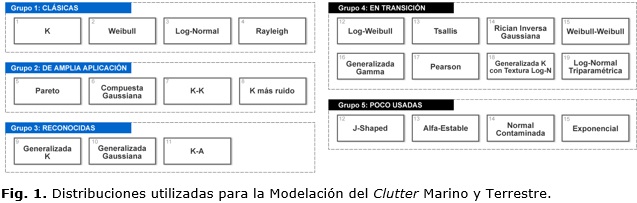
<body><![CDATA[<p align="justify"><font face="verdana" size="2">El presente art&iacute;culo, expande la clasificaci&oacute;n dada en &#91;<a href="#_ENREF_28" title="Machado Fern&aacute;ndez, 2012 #468">28</a>&#93; a un total de 23 distribuciones frente a las nueve enumeradas en la versi&oacute;n precedente. La posici&oacute;n otorgada a cada modelo, mostrada en la <a href="/img/revistas/eac/v38n2/f0102217.jpg">Figura 1</a>, es justificada en cada caso con an&aacute;lisis basados en art&iacute;culos recientes y cl&aacute;sicos de la literatura. Entre las 23 distribuciones encontradas, se recomienda el uso de las 15 primeras para la realizaci&oacute;n de estudios fiables sobre datos de radar. S&oacute;lo ejecutando experimentos con m&uacute;ltiples distribuciones de forma simult&aacute;nea, se obtendr&aacute; una valoraci&oacute;n adecuada del nivel de aplicaci&oacute;n de cada una, descart&aacute;ndose as&iacute; el resto.</font></p> 	    
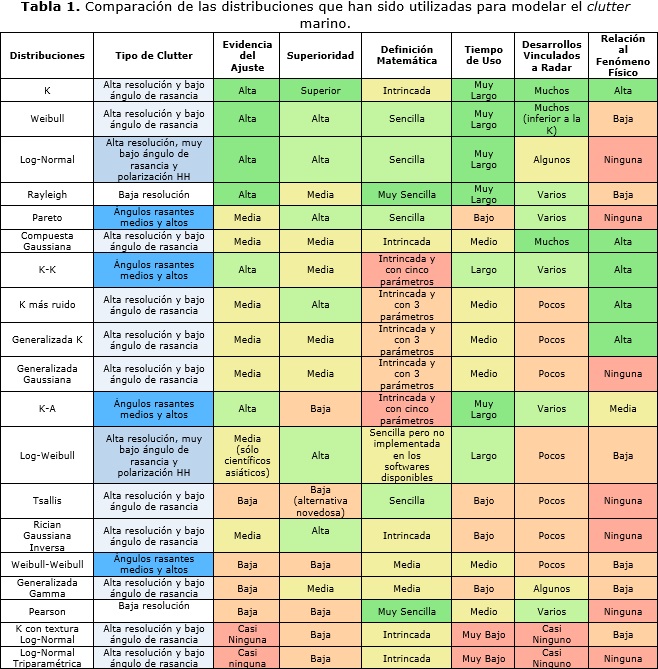
<p align="justify">&nbsp;</p> 	    <p><font face="verdana" size="3"><b>2.&nbsp;&nbsp;</b> <b>&#150;CLASIFICACI&Oacute;N DE LAS DISTRIBUCIONES</b></font></p> 	    <p>&nbsp;</p> 	    <p align="justify"><font face="verdana" size="2">Como puede apreciarse en la <a href="/img/revistas/eac/v38n2/f0102217.jpg">Figura 1</a>, los grupos de distribuciones han sido denominados como: (1) Distribuciones Cl&aacute;sicas, (2) Distribuciones de Amplia Aplicaci&oacute;n, (3) Distribuciones Reconocidas, (4) Distribuciones En Transici&oacute;n, y (5) Distribuciones Poco Usadas. Los tres primeros grupos re&uacute;nen las distribuciones principales, el cuarto aquellas que tienen posibilidades de adquirir relevancia y el &uacute;ltimo los modelos que est&aacute;n en desuso o han sido poco abordados. Las distribuciones del primer grupo son aquellas incluidas en la mayor cantidad de art&iacute;culos y cuya aplicaci&oacute;n ha sido validada por m&uacute;ltiples autores. El principal criterio para la ubicaci&oacute;n de una distribuci&oacute;n en la escala de clasificaci&oacute;n mostrada en la <a href="/img/revistas/eac/v38n2/t0102217.jpg">Tabla 1</a> es el nivel de aplicaci&oacute;n y las pruebas ofrecidas sobre su validaci&oacute;n por distintos autores y variados conjuntos de datos. Adicionalmente, se tuvo en cuenta como un criterio secundario la cantidad de art&iacute;culos encontrados en la literatura, que en su mayor&iacute;a coincid&iacute;a con el &eacute;xito de cada distribuci&oacute;n. Por ejemplo, luego de una revisi&oacute;n de la literatura se encontraron 122 art&iacute;culos para K, 65 para Weibull, 29 para Log&#45;Normal, 26 para Rayleigh, 19 para Pareto, y as&iacute; sucesivamente.</font></p>  	    
<p><font face="verdana" size="2"><b>2.1.&#45; G</b><b>RUPO 1: DISTRIBUCIONES CL&Aacute;SICAS</b></font></p>  	    <p align="justify"><font face="verdana" size="2">Las distribuciones cl&aacute;sicas son aquellas que han sido usadas en la literatura tradicionalmente para la modelaci&oacute;n del <i>clutter</i> marino, y que son incluidas com&uacute;nmente en entornos de simulaci&oacute;n &#91;<a href="#_ENREF_29" title="Machado Fern&aacute;ndez, 2014 #471">29</a>, <a href="#_ENREF_44" title="Zhang, 2012 #668">44</a>&#93;. Es muy dif&iacute;cil encontrar un art&iacute;culo cient&iacute;fico que considere el ajuste de los datos de <i>clutter</i> a varias distribuciones y no tenga en cuenta a la K &#91;<a href="#_ENREF_8" title="Ward, 1990 #34">8</a>, <a href="#_ENREF_16" title="Watts, 1987 #17">16</a>, <a href="#_ENREF_25" title="Antipov, 1998 #583">25&#45;27</a>&#93;, la Weibull &#91;<a href="#_ENREF_23" title="Chan, 1990 #44">23</a>, <a href="#_ENREF_24" title="Schleher, 1976 #6">24</a>, <a href="#_ENREF_45" title="Farina, 1996 #38">45</a>&#93; y la Log&#45;Normal &#91;<a href="#_ENREF_11" title="Farina, 1986 #35">11</a>, <a href="#_ENREF_23" title="Chan, 1990 #44">23</a>&#93;. Adem&aacute;s, si bien es sabido que el <i>clutter</i> adopta formas no&#45;Rayleigh para alta resoluci&oacute;n y/o &aacute;ngulo rasante bajo (condiciones encontradas frecuentemente), tambi&eacute;n es cierto que el modelo Rayleigh no ha dejado de ser usado. Esto es porque, aun reconociendo sus deficiencias, buena parte de los autores prueba el rechazo de la hip&oacute;tesis Rayleigh como un primer paso cuando se aplican m&eacute;todos de bondad de ajuste&nbsp; &#91;<a href="#_ENREF_9" title="Conte, 2004 #78">9</a>, <a href="#_ENREF_31" title="Chen, 2013 #191">31</a>, <a href="#_ENREF_46" title="Yim, 2007 #134">46</a>, <a href="#_ENREF_47" title="Antipov, 2001 #43">47</a>&#93;. Conjuntamente, el modelo Rayleigh sigue siendo utilizado para modelar datos obtenidos a baja resoluci&oacute;n. Adem&aacute;s, gracias a su simplicidad matem&aacute;tica, la distribuci&oacute;n es empleada para probar esquemas de detecci&oacute;n de radar que no requieren de una representaci&oacute;n exacta del eco recibido.</font></p>  	    <p><font face="verdana" size="2"><b>Distribuci&oacute;n K.</b></font></p>  	    <p align="justify"><font face="verdana" size="2">La distribuci&oacute;n K &#91;<a href="#_ENREF_8" title="Ward, 1990 #34">8</a>, <a href="#_ENREF_16" title="Watts, 1987 #17">16</a>, <a href="#_ENREF_25" title="Antipov, 1998 #583">25&#45;27</a>&#93; es la preferida por la comunidad de radares para la modelaci&oacute;n de los ecos de <i>clutter</i> marino a alta resoluci&oacute;n (inferior a 30 metros) y &aacute;ngulo rasante bajo (inferior a 5&deg;). M&uacute;ltiples estudios han demostrado que representa un ajuste razonable en un rango amplio de condiciones de <i>clutter</i> principalmente marino, adem&aacute;s de ser capaz de representar los efectos de la agilidad de frecuencia (<i>frequency agility</i>) &#91;<a href="#_ENREF_8" title="Ward, 1990 #34">8</a>, <a href="#_ENREF_48" title="Watts, 1990 #241">48&#45;50</a>&#93;. De igual manera, la K&nbsp; ha sido ajustada a mediciones de <i>clutter</i> terrestre para varias resoluciones, bandas de frecuencia y tipos de terreno &#91;<a href="#_ENREF_51" title="Yueh, 1989 #71">51&#45;53</a>&#93;. La forma del modelo K&nbsp; est&aacute; entre las variantes Weibull y Log&#45;Normal &#91;<a href="#_ENREF_23" title="Chan, 1990 #44">23</a>, <a href="#_ENREF_41" title="Farina, 1997 #32">41</a>&#93;.</font></p>  	    <p align="justify"><font face="verdana" size="2">Quiz&aacute;s su principal ventaja est&aacute; en su definici&oacute;n compuesta que implica la interpretaci&oacute;n del <i>clutter</i> marino como la uni&oacute;n de dos componentes: uno de variaci&oacute;n lenta y otro de variaci&oacute;n r&aacute;pida &#91;<a href="#_ENREF_10" title="Chan, 1990 #33">10</a>&#93;. Esta definici&oacute;n se corresponde con el mecanismo f&iacute;sico de generaci&oacute;n de las olas del mar. La superficie marina est&aacute; compuesta por dos tipos de olas: las capilares y las gravitatorias &#91;<a href="#_ENREF_54" title="Haykin, 2002 #107">54</a>&#93;. As&iacute;, el modelo K asume que una distribuci&oacute;n, conocida generalmente como textura, representa las olas gravitatorias y otra, referida en ingl&eacute;s como <i>speckle</i> (capilaridad), simula la contribuci&oacute;n de las olas capilares en la se&ntilde;al recibida.</font></p>  	    ]]></body>
<body><![CDATA[<p align="justify"><font face="verdana" size="2">Una segunda ventaja innegable de la distribuci&oacute;n K es la gran cantidad de investigaciones dedicadas a ella que han contribuido a su enriquecimiento &#91;<a href="#_ENREF_55" title="Meng, 2013 #619">55&#45;59</a>&#93;. Modelos como el K m&aacute;s ruido t&eacute;rmico &#91;<a href="#_ENREF_60" title="Mezache, 2013 #321">60</a>&#93;, el K&#45;K &#91;<a href="#_ENREF_6" title="Dong, 2006 #120">6</a>&#93; y el Generalizado K &#91;<a href="#_ENREF_61" title="Greco, 2004 #106">61</a>&#93; han aflorado en intentos de complejizar la expresi&oacute;n original y hacerla extensible a multitud de situaciones de radar. Adem&aacute;s, gracias a su formulaci&oacute;n compuesta, la K tiene ventajas en cuanto a la simulaci&oacute;n de las propiedades de correlaci&oacute;n del <i>clutter</i> marino &#91;<a href="#_ENREF_62" title="Watts, 1987 #462">62</a>, <a href="#_ENREF_63" title="Ward, 1997 #242">63</a>&#93;.&nbsp;</font></p>  	    <p align="justify"><font face="verdana" size="2">La principal desventaja del modelo K es la intrincada definici&oacute;n de su PDF que incluye una funci&oacute;n de Bessel, la cual hace que sea m&aacute;s dif&iacute;cil realizar c&aacute;lculos con ella que con el resto de los modelos &#91;<a href="#_ENREF_42" title="Sayama, 2013 #226">42</a>&#93;. Aun as&iacute;, la distribuci&oacute;n sigue siendo utilizada como referencia en gran parte de los desarrollos recientes relacionados a <i>clutter</i> &#91;<a href="#_ENREF_64" title="Schoenecker, 2016 #799">64&#45;68</a>&#93;.</font></p>  	    <p align="justify"><font face="verdana" size="2">La PDF de la distribuci&oacute;n K de la amplitud tiene la siguiente forma &#91;<a href="#_ENREF_69" title="Cetin, 2008 #618">69</a>&#93;:</font></p>  	    <p align="justify"><font face="verdana" size="2"><a name="ec2"/><img width="291" height="30" src="/img/revistas/eac/v38n2/e0202217.gif"></font></p>  	    
<p align=""><font face="verdana" size="2">Donde <i>c</i> es el par&aacute;metro de escala y <i>v</i> es el par&aacute;metro de forma que depende de las condiciones del mar y de las caracter&iacute;sticas del radar; por su parte <i>K</i>(.) es la funci&oacute;n modificada de Bessel de segunda especie y de orden <i>v&#45;</i>1.</font></p>  	    <p align="justify"><font face="verdana" size="2">Adem&aacute;s, producto de su definici&oacute;n compuesta, la distribuci&oacute;n tiene una versi&oacute;n diferente para el caso de las mediciones de potencia &#91;<a href="#_ENREF_69" title="Cetin, 2008 #618">69</a>&#93;:</font></p>  	    <p align="justify"><font face="verdana" size="2"><a name="ec3"/><img width="291" height="32" src="/img/revistas/eac/v38n2/e0302217.gif"></font></p>  	    
<p align="justify"><font face="verdana" size="2">De acuerdo a lo planteado por distintos autores &#91;<a href="#_ENREF_6" title="Dong, 2006 #120">6</a>, <a href="#_ENREF_13" title="Nohara, 1991 #12">13</a>, <a href="#_ENREF_61" title="Greco, 2004 #106">61</a>&#93;, el par&aacute;metro de forma de la distribuci&oacute;n K puede variar entre 0,1 y 30, seg&uacute;n el car&aacute;cter de las mediciones.</font></p>  	    <p><font face="verdana" size="2"><b>Distribuci&oacute;n Weibull.</b></font></p>  	    <p align="justify"><font face="verdana" size="2">El modelo Weibull es muy vers&aacute;til, ha sido aplicado para <i>clutter</i> terrestre &#91;<a href="#_ENREF_22" title="Rajalakshmi Menon, 1995 #25">22</a>, <a href="#_ENREF_53" title="Sayama, 2001 #95">53</a>, <a href="#_ENREF_70" title="Billingsley, 1999 #70">70</a>&#93;, marino &#91;<a href="#_ENREF_39" title="Ishii, 2011 #182">39</a>&#93;, atmosf&eacute;rico &#91;<a href="#_ENREF_42" title="Sayama, 2013 #226">42</a>&#93; y de hielo &#91;<a href="#_ENREF_71" title="Vicen Bueno, 2010 #524">71</a>&#93;. La distribuci&oacute;n Weibull, al igual que la K, sirve como base a otros modelos como el Log&#45;Weibull &#91;<a href="#_ENREF_72" title="O&rsquo;Connor, 2011 #552">72</a>&#93; y el Weibull&#45;Weibull &#91;<a href="#_ENREF_6" title="Dong, 2006 #120">6</a>&#93;. Adem&aacute;s, su utilidad se maximiza para &aacute;ngulo rasante bajo, alta resoluci&oacute;n y entre las frecuencias de 1 y 10 GHz.</font></p>  	    ]]></body>
<body><![CDATA[<p align="justify"><font face="verdana" size="2">Aunque generalmente se asume que la distribuci&oacute;n K modela mejor el <i>clutter</i> de mar, varias investigaciones dan ventaja a Weibull &#91;<a href="#_ENREF_6" title="Dong, 2006 #120">6</a>, <a href="#_ENREF_34" title="Palama, 2013 #193">34</a>, <a href="#_ENREF_39" title="Ishii, 2011 #182">39</a>, <a href="#_ENREF_42" title="Sayama, 2013 #226">42</a>&#93;. Adicionalmente, la convergencia hacia la distribuci&oacute;n Rayleigh, utilizada para baja resoluci&oacute;n, es m&aacute;s suave en el caso Weibull, ocurriendo de forma natural cuando el par&aacute;metro de forma es igual a dos. En cambio, para la distribuci&oacute;n K ocurre cuando el par&aacute;metro tiende a infinito &#91;<a href="#_ENREF_13" title="Nohara, 1991 #12">13</a>, <a href="#_ENREF_73" title="Haykin, 2002 #585">73</a>&#93;, lo que puede asumirse generalmente cuando <i>v</i> &gt; 30 &#91;<a href="#_ENREF_30" title="Dong, 2004 #83">30</a>&#93;. Este l&iacute;mite confuso hace que el par&aacute;metro de forma K incremente su varianza por el incremento del propio par&aacute;metro, haci&eacute;ndose dificultosa la creaci&oacute;n de soluciones de estimaci&oacute;n param&eacute;trica &#91;<a href="#_ENREF_74" title="Machado Fern&aacute;ndez, 2014 #467">74</a>, <a href="#_ENREF_75" title="Abraham, 2010 #616">75</a>&#93;.</font></p>  	    <p align="justify"><font face="verdana" size="2">Precisamente, una de las principales ventajas del modelo Weibull es su facilidad de simulaci&oacute;n. Las variables aleatorias Weibull pueden generarse de forma sencilla utilizando el m&eacute;todo de inversi&oacute;n &#91;<a href="#_ENREF_76" title="Owen, 2013 #554">76</a>&#93;. La definici&oacute;n de la PDF Weibull no presenta complejidades, propiciando la derivaci&oacute;n de soluciones sencillas en diversas situaciones de radares &#91;<a href="#_ENREF_30" title="Dong, 2004 #83">30</a>, <a href="#_ENREF_77" title="Oliver, 1993 #85">77</a>&#93;. Conjuntamente, los momentos de la distribuci&oacute;n Weibull son manejables, con una funci&oacute;n Gamma implementada en la mayor&iacute;a de las herramientas matem&aacute;ticas sin un costo computacional demasiado elevado. Todas estas ventajas de simulaci&oacute;n han permitido que la distribuci&oacute;n Weibull sea un modelo preferencial para nuevas implementaciones en campos como la inteligencia artificial &#91;<a href="#_ENREF_71" title="Vicen Bueno, 2010 #524">71</a>, <a href="#_ENREF_78" title="Vicen Bueno, 2007 #515">78</a>, <a href="#_ENREF_79" title="Vicen Bueno, 2010 #525">79</a>&#93;.</font></p>  	    <p align="justify"><font face="verdana" size="2">Lo contrario ocurre para el modelo K que asume una definici&oacute;n compuesta precisando la generaci&oacute;n de dos variables aleatorias, adem&aacute;s de incluir una funci&oacute;n de Bessel, cuyas dificultades de derivaci&oacute;n pueden limitar la implementaci&oacute;n de los sistemas.</font></p>  	    <p align="justify"><font face="verdana" size="2">La PDF de la distribuci&oacute;n Weibull puede tomarse de &#91;<a href="#_ENREF_80" title="Krishnamoorthy, 2016 #766">80</a>&#93; donde se us&oacute;:</font></p>  	    <p><font face="verdana" size="2"><a name="ec4"/><img width="292" height="34" src="/img/revistas/eac/v38n2/e0402217.gif"></font></p>  	    
<p align="justify"><font face="verdana" size="2">Siendo <i>&#945;</i> el par&aacute;metro de escala y <i>&#946;</i> el de forma. La mayor&iacute;a de las situaciones de <i>clutter</i> marino pueden ser modeladas variando el par&aacute;metro de forma en el rango entre 0,5 y 6,25 &#91;<a href="#_ENREF_6" title="Dong, 2006 #120">6</a>, <a href="#_ENREF_22" title="Rajalakshmi Menon, 1995 #25">22</a>, <a href="#_ENREF_39" title="Ishii, 2011 #182">39</a>, <a href="#_ENREF_47" title="Antipov, 2001 #43">47</a>, <a href="#_ENREF_53" title="Sayama, 2001 #95">53</a>, <a href="#_ENREF_61" title="Greco, 2004 #106">61</a>, <a href="#_ENREF_81" title="Sayama, 2011 #233">81</a>&#93;.</font></p>  	    <p><font face="verdana" size="2"><b>Distribuci&oacute;n Log&#45;Normal.</b></font></p>  	    <p align="justify"><font face="verdana" size="2">El modelo Log&#45;Normal &#91;<a href="#_ENREF_11" title="Farina, 1986 #35">11</a>, <a href="#_ENREF_23" title="Chan, 1990 #44">23</a>&#93; es casi tan reconocido como el Weibull y el K, pero su ajuste a los datos ocurre generalmente para condiciones m&aacute;s espec&iacute;ficas que los otros dos. La convergencia de la CDF (<i>Cumulative Distribution Function</i>, Funci&oacute;n de Distribuci&oacute;n Acumulativa) Log&#45;Normal es m&aacute;s lenta que la de las CDF Weibull y K, o lo que equivalente, su PDF es de cola m&aacute;s alargada &#91;<a href="#_ENREF_30" title="Dong, 2004 #83">30</a>&#93;. Esto hace que el modelo Log&#45;Normal&nbsp; sea usado especialmente para modelar <i>clutter</i> muy <i>spiky</i> (donde los m&aacute;ximos de la se&ntilde;al de fondo ocurren m&aacute;s frecuentemente y tienen mayor magnitud).</font></p>  	    <p align="justify"><font face="verdana" size="2">La distribuci&oacute;n Log&#45;Normal es usada ampliamente tanto para <i>clutter</i> marino &#91;<a href="#_ENREF_31" title="Chen, 2013 #191">31</a>, <a href="#_ENREF_33" title="Ping, 2011 #178">33</a>, <a href="#_ENREF_42" title="Sayama, 2013 #226">42</a>, <a href="#_ENREF_81" title="Sayama, 2011 #233">81</a>&#93; como para <i>clutter</i> terrestre &#91;<a href="#_ENREF_22" title="Rajalakshmi Menon, 1995 #25">22</a>, <a href="#_ENREF_30" title="Dong, 2004 #83">30</a>, <a href="#_ENREF_82" title="Sayama, 2011 #232">82</a>&#93;. Si bien en ocasiones se logra que el modelo prevalezca para una conjunto de mediciones de &aacute;ngulo rasante bajo &#91;<a href="#_ENREF_42" title="Sayama, 2013 #226">42</a>, <a href="#_ENREF_83" title="Stehwien, 1994 #22">83</a>&#93;, su mejor ajuste se logra generalmente para sub&#45;conjuntos de datos de polarizaci&oacute;n HH &#91;<a href="#_ENREF_41" title="Farina, 1997 #32">41</a>&#93;, en la medici&oacute;n de la distribuci&oacute;n espacial de los datos &#91;<a href="#_ENREF_30" title="Dong, 2004 #83">30</a>&#93;, y para celdas conteniendo reflexiones mezcladas de blancos y <i>clutter</i> &#91;<a href="#_ENREF_39" title="Ishii, 2011 #182">39</a>, <a href="#_ENREF_42" title="Sayama, 2013 #226">42</a>&#93;.</font></p>  	    <p align="justify"><font face="verdana" size="2">A pesar de su utilidad, la incapacidad del modelo de reducirse a la distribuci&oacute;n Rayleigh lo hace menos atractivo para simulaciones de <i>clutter</i> &#91;<a href="#_ENREF_84" title="Conte, 1991 #269">84</a>&#93;. No obstante, es usado como base para investigaciones relacionadas a detecci&oacute;n de blancos &#91;<a href="#_ENREF_85" title="Lin, 2012 #624">85</a>&#93;.</font></p>  	    ]]></body>
<body><![CDATA[<p align="justify"><font face="verdana" size="2">En&nbsp; &#91;<a href="#_ENREF_37" title="Weiping, 2013 #215">37</a>, <a href="#_ENREF_38" title="Jurgens Strydom, 2012 #263">38</a>&#93; se us&oacute; la siguiente expresi&oacute;n para la PDF de la Log&#45;Normal:</font></p>  	    <p align="justify"><font face="verdana" size="2"><a name="ec5"/><img width="326" height="40" src="/img/revistas/eac/v38n2/e0502217.gif"></font></p>  	    
<p align="justify"><font face="verdana" size="2">Donde <i>&#956;</i> y&nbsp; <i>&#963;</i> son los par&aacute;metros de escala y forma respectivamente.&nbsp;</font></p>  	    <p align="justify"><font face="verdana" size="2">La expresi&oacute;n de la distribuci&oacute;n Log&#45;Normal dada en <a href="#ec27">(27)</a> no sufre variaciones significativas en los art&iacute;culos cient&iacute;ficos de la mayor&iacute;a de los autores. En &#91;<a href="#_ENREF_32" title="Ding, 2011 #188">32</a>&#93; solo se alteraron las letras usadas en la definici&oacute;n de los par&aacute;metros. Conjuntamente, en &#91;<a href="#_ENREF_70" title="Billingsley, 1999 #70">70</a>&#93; el &uacute;nico cambio fue usar un par&aacute;metro de forma "inverso" dado por <i>&#948; = 1&#8260;&#963;<sub>N</sub></i>. Por el contrario, las distribuciones K y Weibull s&iacute; suelen sufrir transformaciones en su definici&oacute;n al pasar de un autor a otro, por lo que es importante revisar la expresi&oacute;n de PDF utilizada cuando se verifique un art&iacute;culo cient&iacute;fico.</font></p>  	    <p align="justify"><font face="verdana" size="2">Por &uacute;ltimo, tras revisar la literatura se comprob&oacute; que una variaci&oacute;n del par&aacute;metro de forma (<i>&#963;</i>) entre 0,025 y 1,25 cubre la mayor&iacute;a de las condiciones de operaci&oacute;n &#91;<a href="#_ENREF_41" title="Farina, 1997 #32">41</a>, <a href="#_ENREF_53" title="Sayama, 2001 #95">53</a>, <a href="#_ENREF_61" title="Greco, 2004 #106">61</a>, <a href="#_ENREF_82" title="Sayama, 2011 #232">82</a>&#93;.</font></p>  	    <p><font face="verdana" size="2"><b>Distribuci&oacute;n Rayleigh.</b></font></p>  	    <p align="justify"><font face="verdana" size="2">La &nbsp;Rayleigh &nbsp;se &nbsp;gana &nbsp;su &nbsp;lugar &nbsp;dentro &nbsp;del &nbsp;grupo &nbsp;1 &nbsp;de &nbsp;las distribuciones cl&aacute;sicas por su amplia aplicaci&oacute;n como modelo</font></p>  	    <p align="justify"><font face="verdana" size="2">efectivo para baja resoluci&oacute;n. Adem&aacute;s, su desacuerdo con los datos experimentales de amplitud para alta resoluci&oacute;n es verificado frecuentemente como un paso inicial de investigaciones m&aacute;s complejas &#91;<a href="#_ENREF_9" title="Conte, 2004 #78">9</a>, <a href="#_ENREF_32" title="Ding, 2011 #188">32</a>, <a href="#_ENREF_33" title="Ping, 2011 #178">33</a>, <a href="#_ENREF_46" title="Yim, 2007 #134">46</a>&#93;.</font></p>  	    <p align="justify"><font face="verdana" size="2">La Rayleigh fue el modelo concebido originalmente para el <i>clutter</i> de baja resoluci&oacute;n, por ejemplo en &#91;<a href="#_ENREF_10" title="Chan, 1990 #33">10</a>&#93; se encontr&oacute; que el ajuste para Rayleigh era bueno para resoluci&oacute;n de 150m. Sin embargo, los sistemas actuales son en su mayor&iacute;a de alta resoluci&oacute;n &#91;<a href="#_ENREF_86" title="Melvin, 2014 #606">86</a>&#93;. El modelo Rayleigh representa un <i>clutter</i> <i>speckle&#45;like</i> (parecido a la capilaridad del mar) pero se aleja de situaciones donde el <i>clutter</i> es <i>spiky</i> (tiene saltos bruscos de amplitud) &#91;<a href="#_ENREF_13" title="Nohara, 1991 #12">13</a>&#93;<i>.</i></font></p>  	    <p align="justify"><font face="verdana" size="2">Desde un punto de vista matem&aacute;tico, el problema de la distribuci&oacute;n Rayleigh est&aacute; en su incapacidad de adaptar su forma a los resultados cambiantes medidos en ensayos emp&iacute;ricos para condiciones variadas. Esto es debido a la forma simple de su PDF que cuenta con un solo par&aacute;metro, cuya variaci&oacute;n modifica de manera limitada la forma de la distribuci&oacute;n. Modelos como el Weibull y el K pueden ser interpretados como extensiones complejizadas de la Rayleigh, pues se reducen a ella para cierta configuraci&oacute;n de sus par&aacute;metros.</font></p>  	    ]]></body>
<body><![CDATA[<p align="justify"><font face="verdana" size="2">El PDF de la distribuci&oacute;n Rayleigh puede tomarse de &#91;<a href="#_ENREF_47" title="Antipov, 2001 #43">47</a>&#93; donde se us&oacute;:</font></p>  	    <p align="justify"><font face="verdana" size="2"><a name="ec6"/><img width="239" height="33" src="/img/revistas/eac/v38n2/e0602217.gif"></font></p>  	    
<p align="justify"><font face="verdana" size="2">Siendo <i>x</i> el valor de la amplitud, y <i>&#945;</i> el par&aacute;metro de escala y &uacute;nico de la distribuci&oacute;n. Vale la pena resaltar que el modelo Rayleigh es frecuentemente empleado en desarrollos novedosos gracias a su simplicidad &#91;<a href="#_ENREF_87" title="Xu, 2013 #669">87</a>, <a href="#_ENREF_88" title="Rosenberg, 2014 #674">88</a>&#93;.</font></p>  	    <p><font face="verdana" size="2"><b>2.2.&#45; G</b><b>RUPO 2: DISTRIBUCIONES DE AMPLIA APLICACI&Oacute;N</b></font></p>  	    <p align="justify"><font face="verdana" size="2">Luego de haber presentado las distribuciones del grupo 1 en el apartado anterior, el presente se dedica al grupo 2. El mismo fue denominado como distribuciones "de Amplia Aplicaci&oacute;n" dado que son empleadas con frecuencia relativamente alta en investigaciones de <i>clutter</i> y su efectividad est&aacute; probada en m&uacute;ltiples publicaciones. Las integrantes de este grupo son la Pareto, la Compuesta Gaussiana, la K&#45;K y la K m&aacute;s ruido.</font></p>  	    <p><font face="verdana" size="2"><b>Distribuci&oacute;n Pareto.</b></font></p>  	    <p align="justify"><font face="verdana" size="2">A la cabeza del grupo dos est&aacute; la distribuci&oacute;n Pareto &#91;<a href="#_ENREF_89" title="Evans, 2000 #105">89</a>&#93; que se ha venido desarrollando en a&ntilde;os recientes, superando a la variante K&#45;K. En &#91;<a href="#_ENREF_90" title="Weinberg, 2011 #207">90</a>&#93; se comprob&oacute; la efectividad de su ajuste para <i>clutter</i> marino, encontr&aacute;ndose que logra gran precisi&oacute;n para colas largas con la ventaja de solamente requerir dos par&aacute;metros y tener una definici&oacute;n m&aacute;s simple que la K&#45;K. De hecho, su formulaci&oacute;n compuesta es muy similar a la K, excepto que ahora el componente subyacente es modelado por una distribuci&oacute;n exponencial negativa. Dada la relativa simplicidad del modelo, m&uacute;ltiples autores han sugerido el desarrollo de detectores simples de radar basados en la distribuci&oacute;n &#91;<a href="#_ENREF_91" title="Weinberg, 2011 #637">91</a>, <a href="#_ENREF_92" title="Sangston, 2010 #628">92</a>&#93;.</font></p>  	    <p align="justify"><font face="verdana" size="2">El modelo Pareto apareci&oacute; por primera vez en an&aacute;lisis de radar en &#91;<a href="#_ENREF_93" title="Balleri, 2007 #311">93</a>&#93;, en el contexto del modelado de <i>clutter</i> como una distribuci&oacute;n Compuesta Gaussiana con textura Gamma Inversa. Adicionalmente, su validez fue reafirmada en &#91;<a href="#_ENREF_91" title="Weinberg, 2011 #637">91</a>&#93; donde se le emple&oacute; como modelo para la distribuci&oacute;n de la intensidad. La distribuci&oacute;n de Pareto se caracteriza por tener una cola muy larga, y ha podido ser validada para radar de Banda X &#91;<a href="#_ENREF_94" title="Farshchian, 2010 #642">94</a>&#93;, y para &aacute;ngulos rasantes altos &#91;<a href="#_ENREF_95" title="Weinberg, 2011 #643">95</a>&#93;. En &#91;<a href="#_ENREF_95" title="Weinberg, 2011 #643">95</a>&#93; se encontr&oacute; tambi&eacute;n que la distribuci&oacute;n de Pareto proporcionaba un mejor ajuste que la K&#45;K y la K.</font></p>  	    <p align="justify"><font face="verdana" size="2">En &#91;<a href="#_ENREF_91" title="Weinberg, 2011 #637">91</a>, <a href="#_ENREF_96" title="Weinberg, 2012 #213">96&#45;98</a>&#93; se investigaron detectores coherentes usando tanto la distribuci&oacute;n K&#45;K&nbsp; como la distribuci&oacute;n de Pareto. Los trabajos mostraron que la forma del detector &oacute;ptimo K&#45;K es extremadamente complicada y no es viable de aplicar en un sistema real de radar, mientras que el detector de Pareto es mucho m&aacute;s simple. Conjuntamente, varios esquemas de detecci&oacute;n coherentes, basados en el modelo de intensidad Pareto han sido analizados en varios art&iacute;culos recientes &#91;<a href="#_ENREF_99" title="Sangston, 2012 #645">99&#45;101</a>&#93;. Tambi&eacute;n, desde la perspectiva incoherente, en &#91;<a href="#_ENREF_102" title="Weinberg, 2013 #648">102</a>&#93; se abordan los integradores cl&aacute;sicos.</font></p>  	    <p align="justify"><font face="verdana" size="2">Otro aporte interesante aparece en &#91;<a href="#_ENREF_103" title="Weinberg, 2013 #649">103</a>&#93; donde se emplea una relaci&oacute;n entre las distribuciones Exponencial y Pareto para generalizar expresiones de detectores CFAR. En &#91;<a href="#_ENREF_104" title="Weinberg, 2014 #641">104</a>&#93; se extienden los detectores introducidos en &#91;<a href="#_ENREF_103" title="Weinberg, 2013 #649">103</a>&#93;, siendo la motivaci&oacute;n el desarrollo de detectores CFAR mejorados para la detecci&oacute;n de blancos cuando las celdas de referencia contienen blancos interferentes.</font></p>  	    ]]></body>
<body><![CDATA[<p align="justify"><font face="verdana" size="2">Una combinaci&oacute;n de la distribuci&oacute;n Pareto&#45;Pareto &#91;<a href="#_ENREF_105" title="Weinberg, 2012 #208">105</a>&#93; ha sido tambi&eacute;n estudiada, pero se encontr&oacute; que no ofrec&iacute;a beneficios significativos en comparaci&oacute;n con la versi&oacute;n individual. Por &uacute;ltimo, tambi&eacute;n existe un modelo Pareto m&aacute;s ruido &#91;<a href="#_ENREF_106" title="Rosenberg, 2015 #722">106</a>&#93; que a&uacute;n cuenta con poca validaci&oacute;n.</font></p>  	    <p align="justify"><font face="verdana" size="2">La distribuci&oacute;n de intensidad Pareto &#91;<a href="#_ENREF_107" title="Gandhi, 1994 #650">107</a>, <a href="#_ENREF_108" title="Beaumont, 1980 #651">108</a>&#93;, con par&aacute;metro de forma <i>&#945;</i> &gt; 0 y par&aacute;metro de escala <i>&#946;</i> &gt; 0 tiene como PDF:</font></p>  	    <p><font face="verdana" size="2"><a name="ec7"/><img width="188" height="29" src="/img/revistas/eac/v38n2/e0702217.gif"></font></p>  	    
<p align="justify"><font face="verdana" size="2">La distribuci&oacute;n de Pareto es adem&aacute;s aplicada a muchos otros fen&oacute;menos m&aacute;s all&aacute; del &aacute;mbito de los radares. En general, es una distribuci&oacute;n que constituye un excelente modelo para fen&oacute;menos de cola larga &#91;<a href="#_ENREF_109" title="Aban, 2006 #653">109</a>&#93;. Su aplicaci&oacute;n original fue en la modelaci&oacute;n del salario de una poblaci&oacute;n &#91;<a href="#_ENREF_110" title="Asimit, 2010 #654">110</a>&#93;. A la par, ha sido empleada para modelar diferentes tipos de variables econ&oacute;micas &#91;<a href="#_ENREF_111" title="Rytgaard, 1990 #655">111</a>&#93; y en otras &aacute;reas como la f&iacute;sica, la hidrolog&iacute;a y la sismolog&iacute;a &#91;<a href="#_ENREF_109" title="Aban, 2006 #653">109</a>&#93;; as&iacute; como aplicaciones vinculadas a la ingenier&iacute;a como la modelaci&oacute;n del teletr&aacute;fico en Internet &#91;<a href="#_ENREF_112" title="Chlebus, 2005 #656">112</a>&#93;.</font></p>  	    <p align="justify"><font face="verdana" size="2">La amplia literatura presentada justifica la inclusi&oacute;n de este modelo en el grupo dos y sugiere fuertemente su ascenso al grupo uno. Los autores decidieron no colocarla en dicho primer grupo dado su relativamente corto tiempo de aplicaci&oacute;n en &aacute;mbitos de radares. Otras distribuciones han dado a los investigadores un mayor tiempo para rebatir su validez.</font></p>  	    <p align="justify"><font face="verdana" size="2">Consultando las investigaciones de &#91;<a href="#_ENREF_104" title="Weinberg, 2014 #641">104</a>, <a href="#_ENREF_113" title="Metcalf, 2015 #718">113</a>, <a href="#_ENREF_114" title="Weinberg, 2013 #652">114</a>&#93;, se concluy&oacute; que el intervalo de 2 &#8804; <i>&#945;</i> &#8804; 10 es el m&aacute;s adecuado para la representaci&oacute;n del <i>clutter</i> marino. Simulaciones adicionales que fueron ejecutadas permitieron verificar que las muestras correspondientes a <i>&#945;</i> &lt; 2 produc&iacute;an magnitudes elevadas con demasiada frecuencia, mientras que aquellas pertenecientes a <i>&#945;</i> &gt; 10 desplegaban una cola muy corta en la PDF.</font></p>  	    <p><font face="verdana" size="2"><b>Distribuci&oacute;n Compuesta Gaussiana.</b></font></p>  	    <p align="justify"><font face="verdana" size="2">La distribuci&oacute;n Compuesta Gaussiana logra un buen ajuste para datos de bajo &aacute;ngulo de rasancia, al igual que la K y la Weibull. La Compuesta Gaussiana asume que la envolvente compleja del <i>clutter</i> puede ser escrita como el producto de un componente r&aacute;pido y uno lento &#91;<a href="#_ENREF_93" title="Balleri, 2007 #311">93</a>, <a href="#_ENREF_115" title="Wang, 2005 #312">115</a>&#93;:</font></p>  	    <p><font face="verdana" size="2"><a name="ec8"/><img width="214" height="17" src="/img/revistas/eac/v38n2/e0802217.gif"></font></p>  	    
<p align="justify"><font face="verdana" size="2">El componente r&aacute;pido <i>x(t) = x<sub>I</sub>(t) + jx<sub>Q</sub>(t)</i> conocido como speckle, tiene en cuenta la dispersi&oacute;n local y se asume como un proceso Gaussiano estacionario de media cero y potencia igual a la unidad; donde <i>x<sub>I</sub>(t)</i> y <i>x<sub>Q</sub>(t)</i> son las componentes en fase y en cuadratura respectivamente. El factor &#964;(t)es un proceso aleatorio real no&#45;negativo, usualmente llamado la textura, que describe las variaciones de la potencia local reflejada debido a cambios en el &aacute;rea iluminada.</font></p>  	    ]]></body>
<body><![CDATA[<p align="justify"><font face="verdana" size="2">En las mediciones de amplitud de &#91;<a href="#_ENREF_35" title="Shang, 2010 #310">35</a>, <a href="#_ENREF_116" title="Emmanuelle, 2003 #634">116&#45;118</a>&#93; se us&oacute; textura Inversa Gamma &#91;<a href="#_ENREF_116" title="Emmanuelle, 2003 #634">116</a>, <a href="#_ENREF_117" title="Lange, 1989 #635">117</a>&#93;, cuyo PDF se muestra a continuaci&oacute;n con par&aacute;metro de forma <i>&#945;</i> y par&aacute;metro de escala <i>&#946;</i>, donde <i>&#915;(.)</i> denota a la funci&oacute;n Gamma:</font></p>  	    <p><font face="verdana" size="2"><a name="ec9"/><img width="308" height="32" src="/img/revistas/eac/v38n2/e0902217.gif"></font></p>  	    
<p align="justify"><font face="verdana" size="2">Adicionalmente, en &#91;<a href="#_ENREF_93" title="Balleri, 2007 #311">93</a>&#93; se dio una f&oacute;rmula cerrada, que simplifica los c&aacute;lculos, para el PDF de la <i>Compound Gaussian</i> (Compuesta Gaussiana) con Textura Inversa Gaussiana:</font></p>  	    <p><font face="verdana" size="2"><a name="ec10"/><img width="310" height="33" src="/img/revistas/eac/v38n2/e1002217.gif"></font></p>  	    
<p align="justify"><font face="verdana" size="2">Tambi&eacute;n en &#91;<a href="#_ENREF_93" title="Balleri, 2007 #311">93</a>&#93; fue demostrada la superioridad del ajuste Compuesto Gaussiano para un conjunto de datos de polarizaciones VV, HH, VH. Adem&aacute;s, una aplicaci&oacute;n del modelo Compuesto Gaussiano al desarrollo de mecanismos novedosos de detecci&oacute;n puede encontrarse en &#91;<a href="#_ENREF_119" title="Breloy, 2014 #675">119</a>&#93;. Todo parece indicar que con el tiempo esta distribuci&oacute;n cobrar&aacute; mayor uso por lo que es una candidata fuerte a incluirse en el Grupo 1 de las distribuciones Cl&aacute;sicas. Referencia adicional sobre la distribuci&oacute;n puede encontrarse en &#91;<a href="#_ENREF_61" title="Greco, 2004 #106">61</a>, <a href="#_ENREF_93" title="Balleri, 2007 #311">93</a>, <a href="#_ENREF_115" title="Wang, 2005 #312">115</a>, <a href="#_ENREF_120" title="Farina, 1996 #36">120&#45;130</a>&#93;.</font></p>  	    <p><font face="verdana" size="2"><b>Distribuci&oacute;n K&#45;K.</b></font></p>  	    <p align="justify"><font face="verdana" size="2">La distribuci&oacute;n K&#45;K, como su nombre lo indica, se deriva directamente de la distribuci&oacute;n K. De hecho, el PDF es el resultado de la suma de dos variables K.</font></p>  	    <p align="justify"><font face="verdana" size="2">La K&#45;K fue propuesta en &#91;<a href="#_ENREF_6" title="Dong, 2006 #120">6</a>&#93; en un intento por mejorar el ajuste K en la zona de la cola para datos de <i>clutter</i> marino HH. Anteriormente, se utilizaba una distribuci&oacute;n K&#45;A con este prop&oacute;sito, pero la K&#45;K demostr&oacute; estar m&aacute;s cercana a los datos experimentales a la vez que ten&iacute;a una PDF, aunque no del todo sencilla, menos costosa computacionalmente que la de K&#45;A, que no tiene una forma cerrada.</font></p>  	    <p align="justify"><font face="verdana" size="2">Al igual que la Pareto y la K&#45;A, la K&#45;K se usa para <i>clutter</i> de &aacute;ngulos rasantes medios y altos, que se vuelven <i>spiky</i> cuando mejora la resoluci&oacute;n por distancia &#91;<a href="#_ENREF_6" title="Dong, 2006 #120">6</a>&#93;. La recolecci&oacute;n de datos para &aacute;ngulos rasantes por encima de diez grados ha sido reportada en &#91;<a href="#_ENREF_6" title="Dong, 2006 #120">6</a>, <a href="#_ENREF_131" title="Dong, 2007 #284">131</a>, <a href="#_ENREF_132" title="Crisp, 2008 #285">132</a>&#93; para diversas polarizaciones y resoluci&oacute;n de 0,75m.</font></p>  	    <p align="justify"><font face="verdana" size="2">La PDF de la amplitud K&#45;K es &#91;<a href="#_ENREF_6" title="Dong, 2006 #120">6</a>&#93;:</font></p>  	    ]]></body>
<body><![CDATA[<p><font face="verdana" size="2"><a name="ec11"/><img width="377" height="18" src="/img/revistas/eac/v38n2/e1102217.gif"></font></p>  	    
<p align="justify"><font face="verdana" size="2">Donde <i>f<sub>1</sub>(x;v,&#963;)</i> y <i>f<sub>2</sub> (x;v<sub>sp</sub>,&#963;<sub>sp</sub>)</i> son dos distribuciones K con par&aacute;metro de forma <i>v</i> e intensidad media <i>&#963;</i> para el componente de <i>Bragg/Whitecap</i> y <i>v<sub>sp</sub></i> y <i>&#963;<sub>sp</sub></i> para el componente de <i>spike</i>. El factor <i>k</i> determina la contribuci&oacute;n relativa de los <i>spikes</i> al retorno global del <i>clutter</i>. Si <i>k</i> = 0, <i>f(x) = f<sub>1</sub> (x;v,&#963;)</i> y la distribuci&oacute;n se simplifica a la K original. Importantes contribuciones al desarrollo de la distribuci&oacute;n fueron hechas en &#91;<a href="#_ENREF_96" title="Weinberg, 2012 #213">96</a>, <a href="#_ENREF_97" title="Weinberg, 2012 #214">97</a>, <a href="#_ENREF_133" title="Rosenberg, 2009 #203">133&#45;137</a>&#93;.</font></p>  	    <p><font face="verdana" size="2"><b>Distribuci&oacute;n K m&aacute;s ruido.</b></font></p>  	    <p align="justify"><font face="verdana" size="2">La distribuci&oacute;n K m&aacute;s ruido t&eacute;rmico es una extensi&oacute;n del modelo cl&aacute;sico K, concebida para incluir la influencia del ruido externo al <i>clutter</i>. Luego de la propuesta inicial de la distribuci&oacute;n en &#91;<a href="#_ENREF_16" title="Watts, 1987 #17">16</a>&#93;, una de las primeras referencias notables aparece en &#91;<a href="#_ENREF_41" title="Farina, 1997 #32">41</a>&#93; donde, usando el radar IPIX de la universidad de McMaster de Canad&aacute;, se comprueba que las muestras de polarizaci&oacute;n cruzada de <i>clutter</i> contienen un componente gaussiano adicional debido al ruido t&eacute;rmico. Conjuntamente, la importancia de la aplicaci&oacute;n de la versi&oacute;n que incluye ruido es se&ntilde;alada en &#91;<a href="#_ENREF_16" title="Watts, 1987 #17">16</a>&#93; y el modelo ha sido incluido en varias investigaciones de ajuste de distribuciones como es el caso de &#91;<a href="#_ENREF_60" title="Mezache, 2013 #321">60</a>&#93;. Estimaciones precisas de los par&aacute;metros pueden ser obtenidas por el m&eacute;todo desarrollado en &#91;<a href="#_ENREF_138" title="Mezache, 2011 #328">138</a>&#93;.</font></p>  	    <p align="justify"><font face="verdana" size="2">La PDF para el <i>clutter</i> distribuido K m&aacute;s ruido est&aacute; dado por &#91;<a href="#_ENREF_7" title="Ward, 2013 #270">7</a>&#93;:</font></p>  	    <p><font face="verdana" size="2"><a name="ec12"/><img width="389" height="34" src="/img/revistas/eac/v38n2/e1202217.gif"></font></p>  	    
<p align="justify"><font face="verdana" size="2">Donde <i>p<sub>n</sub></i> es el ruido t&eacute;rmico en el receptor, <i>x</i> es la intensidad local media, <i>v</i> es el par&aacute;metro de forma y <i>b</i> el de escala. Adem&aacute;s, una versi&oacute;n para las mediciones de amplitud fue usada en &#91;<a href="#_ENREF_60" title="Mezache, 2013 #321">60</a>&#93; donde 2<i>&#963;</i><sup>2</sup> es la potencia del ruido:</font></p>  	    <p><font face="verdana" size="2"><a name="ec13"/><img width="498" height="34" src="/img/revistas/eac/v38n2/e1302217.gif"></font></p>  	    
<p align="justify"><font face="verdana" size="2">La distribuci&oacute;n K m&aacute;s ruido t&eacute;rmico, si bien es m&aacute;s completa que la K original, tiene la limitaci&oacute;n de no contar con una expresi&oacute;n cerrada de la PDF. Este hecho ha limitado hasta el momento su rango de aplicaci&oacute;n. Contribuciones relacionadas a la distribuci&oacute;n han sido presentadas en &#91;<a href="#_ENREF_67" title="Rosenberg, 2015 #792">67</a>, <a href="#_ENREF_139" title="Fioranelli, 2016 #803">139&#45;143</a>&#93;.</font></p>  	    <p><font face="verdana" size="2"><b>2.3.&#45; G</b><b>RUPO 3: DISTRIBUCIONES RECONOCIDAS</b></font></p>  	    ]]></body>
<body><![CDATA[<p align="justify"><font face="verdana" size="2">El grupo 3 de las Distribuciones Reconocidas contiene distribuciones manejadas con regularidad dentro de la comunidad de radares pero que no han demostrado a&uacute;n su superioridad con respecto a las tratadas en apartados previos. Este grupo cierra la categor&iacute;a de los modelos m&aacute;s empleados por los diversos autores. Los grupos cuatro y cinco contienen distribuciones que no son de uso frecuente. El tercer grupo est&aacute; compuesto por los modelos Generalizado K, Generalizado Gaussiano y K&#45;A.</font></p>  	    <p><font face="verdana" size="2"><b>Distribuci&oacute;n Generalizada K.</b></font></p>  	    <p align="justify"><font face="verdana" size="2">La distribuci&oacute;n Generalizada K fue abordada en &#91;<a href="#_ENREF_61" title="Greco, 2004 #106">61</a>&#93; donde, luego de comparar los datos disponibles con varios PDFs te&oacute;ricos, se concluy&oacute; que proporcionaba el mejor ajuste, superando a la K original. El modelo cuenta con un par&aacute;metro de forma <i>v</i> y dos par&aacute;metros adicionales <i>&#956;</i> y <i>b</i>. Su PDF es presentado a continuaci&oacute;n &#91;<a href="#_ENREF_61" title="Greco, 2004 #106">61</a>, <a href="#_ENREF_144" title="Bithas, 2006 #639">144</a>&#93;:</font></p>  	    <p><font face="verdana" size="2"><a name="ec14"/><img width="366" height="33" src="/img/revistas/eac/v38n2/e1402217.gif"></font></p>  	    
<p align="justify"><font face="verdana" size="2">N&oacute;tese que cuando <i>b</i> = 1 el modelo se reduce al K tradicional con textura Gamma. Una extensi&oacute;n interesante del modelo se presenta en &#91;<a href="#_ENREF_145" title="Bithas, 2009 #640">145</a>&#93; donde se propone una alternativa denominada <i>Bivariate Generalized&#45;K</i> (K Bivariada Generalizada).</font></p>  	    <p align="justify"><font face="verdana" size="2">Aunque no ha sido ampliamente probado, el modelo generalizado K es un intento por expandir la K cl&aacute;sica, por lo que podr&iacute;a ser una alternativa prometedora. Advi&eacute;rtase que el modelo hereda todas las ventajas de la K con el bonus adquirido de ser capaz de adaptarse a un mayor rango de condiciones gracias a la inclusi&oacute;n de un nuevo par&aacute;metro. No obstante, cuenta con el inconveniente de no tener una expresi&oacute;n cerrada para la PDF.</font></p>  	    <p><font face="verdana" size="2"><b>Distribuci&oacute;n Generalizada Gaussiana.</b></font></p>  	    <p align="justify"><font face="verdana" size="2">La distribuci&oacute;n parte de la Compuesta Gaussiana que asume dos contribuciones diferentes, una de variaci&oacute;n lenta y otra de variaci&oacute;n r&aacute;pida conocida como <i>speckle</i> (capilaridad). La Compuesta Gaussiana se basa en la suposici&oacute;n de que el teorema del &nbsp;l&iacute;mite &nbsp;central &nbsp;es &nbsp;aplicable &nbsp;y &nbsp;asume &nbsp;una estad&iacute;stica Normal para las componentes I y Q &#91;<a href="#_ENREF_36" title="Carretero Moya, 2009 #156">36</a>&#93;. Se espera que cuando la resoluci&oacute;n de la celda sea m&aacute;s peque&ntilde;a que un cierto l&iacute;mite, el <i>speckle</i> se desv&iacute;e de la estad&iacute;stica Gaussiana, dado que el teorema del l&iacute;mite central no ser&aacute; ya aplicable. Este l&iacute;mite ha sido reportado en los 120 metros por resoluci&oacute;n de azimut y 4 metros por resoluci&oacute;n de distancia &#91;<a href="#_ENREF_146" title="Anastassopoulos, 1999 #81">146</a>&#93;, aunque los valores propuestos podr&iacute;an no ser definitivos.</font></p>  	    <p align="justify"><font face="verdana" size="2">Para sobreponerse a este problema, una versi&oacute;n m&aacute;s generalizada fue sugerida: el modelo Generalizado Gaussiano &#91;<a href="#_ENREF_146" title="Anastassopoulos, 1999 #81">146</a>, <a href="#_ENREF_147" title="Ollila, 2012 #196">147</a>&#93;, en el cual se asignan PDFs generales y multiparam&eacute;tricos tanto al <i>speckle</i> como a la textura. El PDF global de la distribuci&oacute;n Generalizada Gaussiana est&aacute; dado por:</font></p>  	    <p align="left"><font face="verdana" size="2"><a name="ec15"/><img width="338" height="34" src="/img/revistas/eac/v38n2/e1502217.gif"></font></p>  	    
]]></body>
<body><![CDATA[<p align="justify"><font face="verdana" size="2">Con par&aacute;metros de forma <i>&#946;</i> y <i>b</i>, y un par&aacute;metro de escala <i>&#945;</i>.</font></p>  	    <p align="justify"><font face="verdana" size="2">An&aacute;lisis sobre datos emp&iacute;ricos de <i>clutter</i> revelaron en &#91;<a href="#_ENREF_34" title="Palama, 2013 #193">34</a>&#93; que el mejor ajuste global de los datos era Weibull y Generalizado Gaussiano para toda la distancia examinada. Esto sugiere el uso de la distribuci&oacute;n como un modelo principalmente para <i>clutter</i> de bajo &aacute;ngulo rasante.</font></p>  	    <p align="justify"><font face="verdana" size="2">Finalmente, aunque el modelo Generalizado Gaussiano engloba al Compuesto Gaussiano, el segundo es m&aacute;s frecuentemente utilizado en investigaciones actuales, lo cual justifica que tenga un nivel superior en la clasificaci&oacute;n.</font></p>  	    <p><font face="verdana" size="2"><b>Distribuci&oacute;n K&#45;A.</b></font></p>  	    <p align="justify"><font face="verdana" size="2">La distribuci&oacute;n est&aacute;ndar compuesta K asume que la intensidad media subyacente modula un componente <i>speckle</i> Gaussiano, apropiado para la dispersi&oacute;n tradicional que ocurre en las olas capilares. Este modelo no se aplica cuando <i>spikes</i> <i>whitecap</i> (picos de cresta de ola) espacialmente estrechos son observados &#91;<a href="#_ENREF_148" title="Middleton, 1999 #132">148</a>, <a href="#_ENREF_149" title="Watts, 2005 #127">149</a>&#93;. Una aproximaci&oacute;n al modelado de ese tipo de <i>spikes</i> es la distribuci&oacute;n K&#45;A &#91;<a href="#_ENREF_150" title="Ward, 2002 #133">150</a>&#93;. Ella ha probado representar con &eacute;xito <i>clutter</i> real con spikes discretos cuando se usa agilidad en frecuencia pulso&#45;a&#45;pulso &#91;<a href="#_ENREF_149" title="Watts, 2005 #127">149</a>&#93; y ser efectiva para <i>clutter</i> de mar, particularmente para polarizaci&oacute;n HH &#91;<a href="#_ENREF_6" title="Dong, 2006 #120">6</a>&#93;.</font></p>  	    <p align="justify"><font face="verdana" size="2">En la distribuci&oacute;n K&#45;A, los dispersores tradicionales siguen una distribuci&oacute;n K, y los <i>spikes</i> discretos son asumidos como pertenecientes a una distribuci&oacute;n Poisson &#91;<a href="#_ENREF_149" title="Watts, 2005 #127">149</a>&#93;.</font></p>  	    <p align="justify"><font face="verdana" size="2">Hay cinco par&aacute;metros en la distribuci&oacute;n K&#45;A. Ellos son <em>&#963;<sub>n</sub></em>, <em>&#963;<sub>sp</sub></em>, <em>&#963;<sub>bw</sub></em>, <img src="/img/revistas/eac/v38n2/i0102217.gif" width="10" height="12"> y <i>v</i>. Esto, sumado a la no existencia de una expresi&oacute;n cerrada de la PDF, impone l&iacute;mites en la aplicaci&oacute;n de la distribuci&oacute;n que ha sido reemplazada por la K&#45;K y la Pareto en los &uacute;ltimos a&ntilde;os. No obstante, su presencia en la literatura a&uacute;n es m&aacute;s fuerte que la de las distribuciones de los grupos cuatro y cinco. Podr&iacute;a decirse que la K&#45;A es una candidata a caer del grupo 3.</font></p>  	    
<p><font face="verdana" size="2"><b>2.4.&#45; G</b><b>RUPO 4: DISTRIBUCIONES EN TRANSICI&Oacute;N</b></font></p>  	    <p align="justify"><font face="verdana" size="2">Las distribuciones del grupo 4 est&aacute;n "en transici&oacute;n", o sea, que su estado final no ha sido a&uacute;n definido: pueden devenir reconocidas o caer completamente en desuso. Es preciso se&ntilde;alar que las cuatro primeras del grupo son las que parecen tener mayor probabilidad de volverse "Reconocidas" mientras que el resto muestra una tendencia hacia el olvido. De cualquier forma, es beneficiosa la inclusi&oacute;n de estas distribuciones en an&aacute;lisis de ajuste de <i>clutter</i> ya sea para descartarlas completamente, o para resaltar su utilidad.</font></p>  	    <p align="justify"><font face="verdana" size="2">El cuarto grupo es el m&aacute;s amplio con 8 alternativas: Log&#45;Weibull, Tsallis, Rician Inversa Gaussiana, Weibull&#45;Weibull, Generalizada Gamma, Pearson, Generalizada K con Textura Log&#45;Normal y Log&#45;Normal Tri&#45;param&eacute;trica.</font></p>  	    ]]></body>
<body><![CDATA[<p><font face="verdana" size="2"><b>Distribuci&oacute;n Log&#45;Weibull.</b></font></p>  	    <p align="justify"><font face="verdana" size="2">La distribuci&oacute;n Log&#45;Weibull lucha fuertemente por ascender al grupo 3. El modelo propone una variante alternativa a la Log&#45;Normal ya que ambas son consideradas aptas para <i>clutter</i> muy <i>spiky</i> que aparece com&uacute;nmente para &aacute;ngulos rasantes muy bajos, polarizaci&oacute;n HH o muy alta resoluci&oacute;n. El modelo Log&#45;Weibull ha superado en ocasiones al Log&#45;Normal en estas situaciones &#91;<a href="#_ENREF_151" title="Sekine, 1980 #2">151</a>&#93;, aunque para sacar conclusiones definitivas son necesarios m&aacute;s experimentos. La distribuci&oacute;n Log&#45;Weibull ha sido utilizada con &eacute;xito para realizar ajustes sobre datos de <i>clutter</i> terrestre &#91;<a href="#_ENREF_53" title="Sayama, 2001 #95">53</a>, <a href="#_ENREF_82" title="Sayama, 2011 #232">82</a>&#93; y marino &#91;<a href="#_ENREF_39" title="Ishii, 2011 #182">39</a>, <a href="#_ENREF_42" title="Sayama, 2013 #226">42</a>, <a href="#_ENREF_81" title="Sayama, 2011 #233">81</a>, <a href="#_ENREF_151" title="Sekine, 1980 #2">151</a>&#93;, as&iacute; como para celdas que contienen reflexiones fuertes de blancos &#91;<a href="#_ENREF_39" title="Ishii, 2011 #182">39</a>&#93;.</font></p>  	    <p align="justify"><font face="verdana" size="2">La forma de la PDF Log&#45;Weibull se ubica entre las de la PDF Weibull y Log&#45;Normal. Las distribuciones Weibull y Log&#45;Weibull tienden a ser m&aacute;s <i>spiky</i> con el aumento del par&aacute;metro de forma; mientras que en la Log&#45;Normal ocurre lo contrario. La distribuci&oacute;n log&#45;Weibull tiene la ventaja tanto de la distribuci&oacute;n Log&#45;Normal como la de la Weibull. Esto quiere decir que tiene una cola larga y flexible en su forma &#91;<a href="#_ENREF_42" title="Sayama, 2013 #226">42</a>&#93;.</font></p>  	    <p align="justify"><font face="verdana" size="2">La expresi&oacute;n de la PDF Log&#45;Weibull es com&uacute;n para toda la literatura revisada &#91;<a href="#_ENREF_39" title="Ishii, 2011 #182">39</a>, <a href="#_ENREF_42" title="Sayama, 2013 #226">42</a>, <a href="#_ENREF_53" title="Sayama, 2001 #95">53</a>, <a href="#_ENREF_82" title="Sayama, 2011 #232">82</a>, <a href="#_ENREF_151" title="Sekine, 1980 #2">151</a>&#93;:</font></p>  	    <p><font face="verdana" size="2"><a name="ec16"/><img width="309" height="35" src="/img/revistas/eac/v38n2/e1602217.gif"></font></p>  	    
<p align="justify"><font face="verdana" size="2">Donde <i>x</i> es la amplitud reflejada, <i>b</i> es el par&aacute;metro de escala y <i>c</i> es el de forma.</font></p>  	    <p align="justify"><font face="verdana" size="2">Desafortunadamente, la distribuci&oacute;n no ha sido ampliamente aplicada en el modelado del <i>clutter</i> marino por m&uacute;ltiples autores, sino que las publicaciones relacionadas pertenecen todas a cient&iacute;ficos asi&aacute;ticos que defienden el uso de la distribuci&oacute;n.</font></p>  	    <p><font face="verdana" size="2"><b>Distribuci&oacute;n Tsallis.</b></font></p>  	    <p align="justify"><font face="verdana" size="2">El modelo Tsallis, pretende superar a las alternativas Weibull, Log&#45;Normal, K y Compuesta Gaussiana en la modelaci&oacute;n del <i>clutter</i> marino, proponiendo una alternativa diferencial &#91;<a href="#_ENREF_152" title="Tsallis, 1995 #299">152&#45;154</a>&#93;. Esto quiere decir que el tratamiento de los datos se realizar&iacute;a en el dominio diferenciado: si se denota la amplitud del <i>clutter</i> marino como <i>y(n) ,n=1,2,&hellip;</i> los datos diferenciados del&nbsp; <i>clutter</i> estar&aacute;n definidos como &#91;<a href="#_ENREF_155" title="Hu, 2009 #291">155</a>&#93;:</font></p>  	    <p><font face="verdana" size="2"><a name="ec17"/><img width="226" height="14" src="/img/revistas/eac/v38n2/e1702217.gif"></font></p>  	    
]]></body>
<body><![CDATA[<p align="justify"><font face="verdana" size="2">La distribuci&oacute;n Tsallis est&aacute; dada por &#91;<a href="#_ENREF_155" title="Hu, 2009 #291">155</a>&#93;:</font></p>  	    <p><font face="verdana" size="2"><a name="ec18"/><img width="319" height="34" src="/img/revistas/eac/v38n2/e1802217.gif"></font></p>  	    
<p align="justify"><font face="verdana" size="2">Donde se considera v&aacute;lida una variaci&oacute;n de1 &lt; <i>q</i> &lt; 3. N&oacute;tese que cuando <i>q</i> = 1, se obtiene la distribuci&oacute;n Normal. Cuando <i>q</i> = 2, la Tsallis se reduce a la distribuci&oacute;n Cauchy. Adem&aacute;s, cuando 5&#8260;3 &lt; <i>q</i> &lt; 3, la distribuci&oacute;n tiene una cola que cae.</font></p>  	    <p align="justify"><font face="verdana" size="2">En &#91;<a href="#_ENREF_155" title="Hu, 2009 #291">155</a>&#93; se encontr&oacute; que el ajuste de la distribuci&oacute;n Tsallis era muy bueno para <i>clutter</i> marino. Adicionalmente, otros trabajos dedicados a la aplicaci&oacute;n de la distribuci&oacute;n Tsallis al <i>clutter</i> marino pueden encontrarse en &#91;<a href="#_ENREF_156" title="Hu, 2008 #292">156&#45;158</a>&#93;. De forma general, la Tsallis parece un buen modelo, pero necesita de mayores desarrollos y validaciones para compararse con el volumen de investigaciones dedicadas a las alternativas reconocidas.</font></p>  	    <p><font face="verdana" size="2"><b>Distribuci&oacute;n Rician Gaussiana Inversa.</b></font></p>  	    <p align="justify"><font face="verdana" size="2">En &#91;<a href="#_ENREF_159" title="Eltoft, 2005 #323">159</a>&#93; fue introducida otra alternativa de modelado no&#45;Rayleigh que emplea a la distribuci&oacute;n Gaussiana Inversa &#91;<a href="#_ENREF_160" title="Michael, 1976 #324">160&#45;162</a>&#93; como componente de textura. La variante denominada distribuci&oacute;n Rician Gaussiana Inversa (RiIG, <i>Rician Inverse Gaussian</i>) tiene como PDF:</font></p>  	    <p><font face="verdana" size="2"><a name="ec19"/><img width="464" height="43" src="/img/revistas/eac/v38n2/e1902217.gif"></font></p>  	    
<p align="justify"><font face="verdana" size="2">Donde <i>&#945;</i>, <i>&#946;</i> y <i>&#947;</i> son los par&aacute;metros de la distribuci&oacute;n, <i>I<sub>0</sub></i> es la intensidad del ruido y &#947;=&#8730;(&#945;<sup>2</sup> &#45; &#946;<sup>2</sup>).</font></p>  	    <p align="justify"><font face="verdana" size="2">La distribuci&oacute;n ha sido empleada en estudios de comparaci&oacute;n entre varios PDFs de amplitud &#91;<a href="#_ENREF_60" title="Mezache, 2013 #321">60</a>&#93; pero su uso no est&aacute; extendido. Sin embargo, el empleo del componente Inverso Gaussiano para la textura ha sido ya probado como efectivo en otros modelos &#91;<a href="#_ENREF_138" title="Mezache, 2011 #328">138</a>, <a href="#_ENREF_163" title="Ollila, 2012 #327">163</a>&#93;.</font></p>  	    <p><font face="verdana" size="2"><b>Distribuci&oacute;n Weibull&#45;Weibull.</b></font></p>  	    ]]></body>
<body><![CDATA[<p align="justify"><font face="verdana" size="2">La distribuci&oacute;n Weibull&#45;Weibull es similar a la K&#45;K en el sentido de que se compone de dos distribuciones Weibull. El principal estudio que vincula esta distribuci&oacute;n con el <i>clutter</i> marino observado a &aacute;ngulos rasantes elevados ocurri&oacute; en &#91;<a href="#_ENREF_6" title="Dong, 2006 #120">6</a>&#93; donde se utiliz&oacute; la siguiente PDF:</font></p>  	    <p><font face="verdana" size="2"><a name="ec20"/><img width="401" height="18" src="/img/revistas/eac/v38n2/e2002217.gif"></font></p>  	    
<p align="justify"><font face="verdana" size="2">Informaci&oacute;n adicional relacionada a la distribuci&oacute;n puede encontrarse en &#91;<a href="#_ENREF_72" title="O&rsquo;Connor, 2011 #552">72</a>, <a href="#_ENREF_164" title="Prabhakar Murthy, 2004 #807">164</a>, <a href="#_ENREF_165" title="Bury, 1999 #808">165</a>&#93;.</font></p>  	    <p><font face="verdana" size="2"><b>Distribuci&oacute;n Generalizada Gamma.</b></font></p>  	    <p align="justify"><font face="verdana" size="2">La siguiente distribuci&oacute;n da inicio al conjunto de los modelos "en transici&oacute;n" que el autor considera con tendencia a caer en desuso. El modelo Generalizado Gamma fue encontrado con alta similitud a los datos medidos en &#91;<a href="#_ENREF_81" title="Sayama, 2011 #233">81</a>&#93; para <i>clutter</i> marino de banda X. Previamente este modelo hab&iacute;a sido empleado con gran efectividad para SAR &#91;<a href="#_ENREF_37" title="Weiping, 2013 #215">37</a>, <a href="#_ENREF_166" title="Werninghaus, 2004 #216">166</a>&#93;, siendo capaz de modelar im&aacute;genes de alta resoluci&oacute;n con regiones heterog&eacute;neas. Su PDF es &#91;<a href="#_ENREF_37" title="Weiping, 2013 #215">37</a>&#93;:</font></p>  	    <p><font face="verdana" size="2"><a name="ec21"/><img width="307" height="14" src="/img/revistas/eac/v38n2/e2102217.gif"></font></p>  	    
<p align="justify"><font face="verdana" size="2">Donde <i>&#915;(.)</i> es la funci&oacute;n Gamma, <i>&#945;</i> es el par&aacute;metro de forma y <i>&#946;</i> es el de escala. Igualmente se ha demostrado que el modelo Gamma, m&aacute;s sencillo que el Generalizado Gamma, es &uacute;til en la modelaci&oacute;n de <i>clutter</i> <i>spiky</i> principalmente en la zona central de la PDF de los datos experimentales &#91;<a href="#_ENREF_167" title="Messina Marco, 2010 #160">167</a>&#93;. No obstante, hasta el momento, la distribuci&oacute;n Generalizada Gamma y la Gamma han encontrado aplicaci&oacute;n limitada para radares de apertura real, no as&iacute; para SAR.</font></p>  	    <p><font face="verdana" size="2"><b>Pearson.</b></font></p>  	    <p align="justify"><font face="verdana" size="2">Un modelo que podr&iacute;a resultar interesante es el Pearson, que ha demostrado ser apropiado para modelar datos como se&ntilde;ales impulsivas &#91;<a href="#_ENREF_168" title="Nikias, 1995 #661">168</a>&#93; y retornos de sonares activos &#91;<a href="#_ENREF_169" title="Pierce, 1996 #663">169</a>&#93;; en adici&oacute;n al <i>clutter</i> marino &#91;<a href="#_ENREF_170" title="Kuruoglu, 2003 #662">170</a>&#93;. La distribuci&oacute;n Pearson es un caso especial de la distribuci&oacute;n sim&eacute;trica Alfa&#45;Estable cuando el par&aacute;metro caracter&iacute;stico es <i>&#945;=1/2</i>. Si una variable sigue la distribuci&oacute;n Pearson, su PDF es &#91;<a href="#_ENREF_171" title="Leung, 2002 #666">171</a>&#93;:</font></p>  	    <p><font face="verdana" size="2"><a name="ec22"/><img width="240" height="32" src="/img/revistas/eac/v38n2/e2202217.gif"></font></p>  	    
]]></body>
<body><![CDATA[<p align="justify"><font face="verdana" size="2">Aqu&iacute;, <i>&#947;</i> es el par&aacute;metro de escala que refleja el nivel medio de la potencia del <i>clutter</i>.</font></p>  	    <p align="justify"><font face="verdana" size="2">Advi&eacute;rtase que el modelo Pearson es de un solo par&aacute;metro, cuya influencia en la escala de la distribuci&oacute;n puede ser cancelada por los m&eacute;todos CFAR tradicionales. En efecto, se prob&oacute; que varios procesadores cl&aacute;sicos de radar mantienen la propiedad CFAR bajo <i>clutter</i> homog&eacute;neo distribuido Pearson en &#91;<a href="#_ENREF_172" title="Pierce, 1997 #664">172</a>, <a href="#_ENREF_173" title="Tsakalide, 2000 #665">173</a>&#93;, y varias expresiones han sido obtenidas para la relaci&oacute;n del modelo con varios detectores en &#91;<a href="#_ENREF_174" title="Hilal Abdenour, 2006 #577">174</a>&#93;. Adem&aacute;s, en &#91;<a href="#_ENREF_175" title="Meziani Abednour, 2010 #667">175</a>&#93; se analiz&oacute; el desempe&ntilde;o en ambientes multi&#45;blanco y con bordes de cambio en el nivel del <i>clutter</i> para fondos que siguen la distribuci&oacute;n Pearson y m&uacute;ltiples tipos de CFAR; as&iacute; como variantes CFAR con l&oacute;gica difusa descentralizada.</font></p>  	    <p align="justify"><font face="verdana" size="2">La distribuci&oacute;n Pearson podr&iacute;a competir con modelos simples como el Rayleigh, pero dada su definici&oacute;n uni&#45;param&eacute;trica es poco probable que adquiera relevancia. No obstante, ha sido utilizado en estudios actuales gracias a su forma sencilla &#91;<a href="#_ENREF_176" title="Cai, 2010 #671">176</a>, <a href="#_ENREF_177" title="Cai, 2009 #672">177</a>&#93;.</font></p>  	    <p><font face="verdana" size="2"><b>Distribuci&oacute;n K con textura Log&#45;Normal.</b></font></p>  	    <p align="justify"><font face="verdana" size="2">Una variante del modelo Generalizado K existe tambi&eacute;n para Textura Log&#45;Normal. Aunque menos conocido que el Generalizado K tradicional (de Textura Gamma), la alternativa ha sido empleada en comparaciones de PDFs te&oacute;ricas &#91;<a href="#_ENREF_61" title="Greco, 2004 #106">61</a>&#93;.</font></p>  	    <p align="justify"><font face="verdana" size="2">La distribuci&oacute;n parte de fundamentos s&oacute;lidos como el modelo Log&#45;Normal y el mecanismo de formulaci&oacute;n compuesta, pero a&uacute;n adolece de evidencia robusta que la respalde.</font></p>  	    <p><font face="verdana" size="2"><b>Distribuci&oacute;n Log&#45;Normal Tri&#45;param&eacute;trica.</b></font></p>  	    <p align="justify"><font face="verdana" size="2">Existe una variante de la distribuci&oacute;n Log&#45;Normal que la convierte en Triparam&eacute;trica mediante la inclusi&oacute;n de un par&aacute;metro extra de localizaci&oacute;n (<i>&#947;</i>). Esta variante fue empleada en comparaciones realizadas en &#91;<a href="#_ENREF_46" title="Yim, 2007 #134">46</a>&#93;. Su PDF es:</font></p>  	    <p><font face="verdana" size="2"><a name="ec23"/><img width="381" height="42" src="/img/revistas/eac/v38n2/e2302217.gif"></font></p>  	    
<p align="justify"><font face="verdana" size="2">A&uacute;n de limitado uso, la distribuci&oacute;n podr&iacute;a mejorar el ajuste de datos muy <i>spiky</i> y surgir como una alternativa para los modelos Log&#45;Normal tradicional y Log&#45;Weibull. Desafortunadamente, la falta de evidencia sustancial que respalde el modelo hace que se planteen dudas sobre su verdadera utilidad.</font></p>  	    ]]></body>
<body><![CDATA[<p><font face="verdana" size="2"><b>2.5.&#45; G</b><b>RUPO 5: DISTRIBUCIONES POCO USADAS</b></font></p>  	    <p align="justify"><font face="verdana" size="2">El &uacute;ltimo grupo de distribuciones se denomina Distribuciones Poco Usadas y contiene modelos que han encontrado aplicaci&oacute;n limitada o descontinuada. Los modelos que se presentan a continuaci&oacute;n son <i>J&#45;Shaped</i> (de forma J), Alfa Estable (<i>Alpha Stable</i>), Normal Contaminado y el Exponencial.</font></p>  	    <p><font face="verdana" size="2"><b>Distribuci&oacute;n <i>J&#45;Shaped</i>.</b></font></p>  	    <p align="justify"><font face="verdana" size="2">La distribuci&oacute;n J&#45;Shaped fue ajustada a datos de amplitud para Banda Ku, polarizaci&oacute;n lineal y &aacute;ngulos rasantes cercanos a la incidencia vertical en &#91;<a href="#_ENREF_178" title="Pistola, 1997 #29">178</a>&#93;, empleando el m&eacute;todo de los momentos. La principal desventaja de esta investigaci&oacute;n es que no se compar&oacute; la exactitud del ajuste alcanzado con otras distribuciones conocidas como la K o la Weibull.</font></p>  	    <p align="justify"><font face="verdana" size="2">Dentro de las distribuciones <i>J&#45;Shaped</i>, el ajuste correspondi&oacute; al caso especial conocido como <i>Beta J&#45;Shaped</i> cuya PDF es:</font></p>  	    <p><font face="verdana" size="2"><a name="ec24"/><img width="258" height="33" src="/img/revistas/eac/v38n2/e2402217.gif"></font></p>  	    
<p align="justify"><font face="verdana" size="2">Donde <i>&#915;(.)</i> es la funci&oacute;n Gamma, y <i>&#947;</i> y <i>&#951;</i> son los par&aacute;metros de la distribuci&oacute;n.</font></p>  	    <p><font face="verdana" size="2"><b>Distribuci&oacute;n Alfa Estable.</b></font></p>  	    <p align="justify"><font face="verdana" size="2">En un recuento de las distribuciones empleadas en la modelaci&oacute;n de <i>clutter</i> efectuada en &#91;<a href="#_ENREF_38" title="Jurgens Strydom, 2012 #263">38</a>&#93; se menciona la variante Alfa Estable (<i>Alpha Stable</i>). Empero, tambi&eacute;n en &#91;<a href="#_ENREF_38" title="Jurgens Strydom, 2012 #263">38</a>&#93; se se&ntilde;ala su limitado alcance. La PDF de la distribuci&oacute;n tiene dos propiedades importantes que pudieran hacerla &uacute;til para el modelado del <i>clutter</i>. La primera propiedad es la propiedad de estabilidad, la cual establece que la suma pesada (<i>weighted</i>) de variables aleatorias independientes distribuidas alfa estable est&aacute; distribuida nuevamente alfa estable, con el mismo exponente caracter&iacute;stico <i>&#945;</i>. La segunda propiedad es el teorema del l&iacute;mite central. A diferencia de la distribuci&oacute;n Normal, una distribuci&oacute;n alfa estable puede ser tambi&eacute;n asim&eacute;trica alrededor de la media.</font></p>  	    <p align="justify"><font face="verdana" size="2">La mejor forma de definir la PDF de la distribuci&oacute;n Alfa Estable es mediante la integral de transformaci&oacute;n inversa de Fourier &#91;<a href="#_ENREF_179" title="Shao, 1993 #658">179</a>&#93;:</font></p>  	    ]]></body>
<body><![CDATA[<p><font face="verdana" size="2"><a name="ec25"/><img width="319" height="31" src="/img/revistas/eac/v38n2/e2502217.gif"></font></p>  	    
<p align="justify"><font face="verdana" size="2">El exponente caracter&iacute;stico est&aacute; entre 0 y 2. La variable <i>&#948;</i> es el par&aacute;metro de localizaci&oacute;n y <i>&#947;</i> es el par&aacute;metro de dispersi&oacute;n &#91;18&#93;. La distribuci&oacute;n no ha encontrado a&uacute;n amplio uso en la literatura del <i>clutter</i> de radar &#91;<a href="#_ENREF_38" title="Jurgens Strydom, 2012 #263">38</a>&#93;, m&aacute;s all&aacute; de su aplicaci&oacute;n en forma reducida como distribuci&oacute;n Pearson, a pesar de intentos de autores de atraer el inter&eacute;s de la comunidad sobre el modelo como un buen ajuste para <i>clutter</i> &#91;<a href="#_ENREF_180" title="Tsihrintzis, 1997 #659">180</a>&#93;. Adicionalmente, el desempe&ntilde;o de receptores &oacute;ptimos y sub&oacute;ptimos en presencia de la distribuci&oacute;n Alfa Estable fue examinado en &#91;<a href="#_ENREF_181" title="Tsihrintzis, 1995 #657">181</a>&#93; y en &#91;<a href="#_ENREF_182" title="Liao, 2008 #660">182</a>&#93;.</font></p>  	    <p><font face="verdana" size="2"><b>Distribuci&oacute;n Normal Contaminada.</b></font></p>  	    <p align="justify"><font face="verdana" size="2">En &#91;<a href="#_ENREF_183" title="Trunk, 1970 #4">183</a>&#93; fueron relacionadas las distribuciones Log&#45;Normal y Normal&#45;Contaminada con los datos tomados por el NRL (<i>Naval Research Laboratory</i>, Laboratorio de Investigaciones Navales) a un &aacute;ngulo rasante de 4,70 usando un radar de banda X con polarizaci&oacute;n vertical y ancho de pulso de 0,02 <i>&#956;s</i>.</font></p>  	    <p align="justify"><font face="verdana" size="2">La distribuci&oacute;n Normal Contaminada ha sido utilizada para la modelaci&oacute;n del <i>clutter</i> debido a que las colas largas observadas no pueden ser descritas por la distribuci&oacute;n Normal. Una distribuci&oacute;n Normal contaminada es una distribuci&oacute;n donde las muestras son tomadas de dos distribuciones Normales diferentes, para crear as&iacute; las colas pesadas. La mayor&iacute;a de las muestras son tomadas de un distribuci&oacute;n Normal con media <i>&#956;<sub>1</sub></i> y desviaci&oacute;n est&aacute;ndar <i>&#963;<sub>1</sub></i>. Las muestras restantes son tomadas de una segunda distribuci&oacute;n Normal con media <i>&#956;<sub>2</sub></i> y desviaci&oacute;n est&aacute;ndar <i>&#963;<sub>2</sub></i>. La relaci&oacute;n entre las dos distribuciones es una media igual <i>&#956;<sub>1</sub> = &#956;<sub>2</sub></i>, y una varianza mayor para la distribuci&oacute;n menos muestreada <i>&#963;<sub>1</sub></i> <i>&#8810;</i> <i>&#963;<sub>2</sub></i>. Esto produce las colas pesadas, cre&aacute;ndose as&iacute; la distribuci&oacute;n Contaminada Normal &#91;<a href="#_ENREF_184" title="Simkins, 1977 #267">184</a>&#93;.</font></p>  	    <p align="justify"><font face="verdana" size="2">La PDF de la distribuci&oacute;n Normal es &#91;<a href="#_ENREF_80" title="Krishnamoorthy, 2016 #766">80</a>&#93;:</font></p>  	    <p><font face="verdana" size="2"><a name="ec26"/><img width="250" height="33" src="/img/revistas/eac/v38n2/e2602217.gif"></font></p>  	    
<p align="justify"><font face="verdana" size="2">Donde <i>&#956;</i> y <i>&#963;<sup>2</sup></i> son los par&aacute;metros de localizaci&oacute;n y escala de la distribuci&oacute;n que coinciden con la media y la varianza.</font></p>  	    <p><font face="verdana" size="2"><b>Distribuci&oacute;n Exponencial.</b></font></p>  	    <p align="justify"><font face="verdana" size="2">Pruebas realizadas por el laboratorio Lincoln del MIT (<i>Massachusetts Institute of Technology</i>, Instituto de Tecnolog&iacute;a de Massachusetts) en la d&eacute;cada del 90 apuntaron a la distribuci&oacute;n exponencial. La PDF exponencial de la amplitud es dada a continuaci&oacute;n. La variable <i>r</i> es conocida como par&aacute;metro de <i>rate</i> (raz&oacute;n) de la distribuci&oacute;n. La distribuci&oacute;n exponencial ha demostrado ser un mejor ajuste para <i>clutter</i> <i>windblown</i> (soplado por el viento) que la distribuci&oacute;n Gaussiana &#91;<a href="#_ENREF_185" title="Billingsley, 1997 #55">185</a>, <a href="#_ENREF_186" title="Lombardo, 2001 #268">186</a>&#93;.</font></p>  	    ]]></body>
<body><![CDATA[<p><font face="verdana" size="2"><a name="ec27"/><img width="158" height="12" src="/img/revistas/eac/v38n2/e2702217.gif"></font></p>  	    
<p align="justify"><font face="verdana" size="2">Este modelo es aplicado a <i>clutter</i> marino mayoritariamente como parte de la formulaci&oacute;n compuesta de la distribuci&oacute;n K. Conjuntamente, el modelo Exponencial se incluye dentro de la distribuci&oacute;n Weibull cuando el par&aacute;metro de forma es igual a 1. Por ello, evidencia de la aplicaci&oacute;n del modelo Exponencial para datos de <i>clutter</i> marino y terrestre puede encontrarse en estudios que recomiendan valores del par&aacute;metro de forma cercanos a la unidad &#91;<a href="#_ENREF_6" title="Dong, 2006 #120">6</a>, <a href="#_ENREF_30" title="Dong, 2004 #83">30</a>, <a href="#_ENREF_61" title="Greco, 2004 #106">61</a>&#93;. La distribuci&oacute;n Exponencial fue uno de los primeros modelos considerados pero actualmente ha sido reemplazado completamente por la Weibull que es un caso m&aacute;s general. A pesar de ello, puede emplearse en simulaciones que busquen maximizar la simplicidad de las variables implicadas &#91;<a href="#_ENREF_187" title="Zhang, 2014 #673">187</a>&#93;.</font></p>  	    <p><font face="verdana" size="2"><b>2.6.&#45; R</b><b>ESUMEN DE LA CLASIFICACI&Oacute;N</b></font></p>  	    <p align="justify"><font face="verdana" size="2">Para resumir o condensar los resultados de la escala de clasificaci&oacute;n dada anteriormente para las distribuciones estad&iacute;sticas que modelan el <i>clutter</i> marino los autores prepararon una tabla comparativa que incluye todas las distribuciones, a excepci&oacute;n de aquellas del &uacute;ltimo grupo, que son muy poco utilizadas. La <a href="/img/revistas/eac/v38n2/t0102217.jpg">Tabla 1</a> muestra los 7 campos fundamentales que se utilizan para comparar las distribuciones. El primero de ellos, el tipo de <i>clutter</i>, muestra 4 variantes fundamentales de <i>clutter</i> para las que pueden ser usadas las distribuciones. Por ejemplo, las distribuciones Pareto, K&#45;K, K&#45;A y Weibull&#45;Weibull han sido propuestas para modelar los ecos de &aacute;ngulos rasantes medios y altos, y por tanto compiten s&oacute;lo en esta categor&iacute;a.</font></p>  	    
<p align="justify"><font face="verdana" size="2">La <i>Evidencia del Ajuste</i> y la <i>Superioridad</i> son dos de los campos m&aacute;s importantes de la tabla. El primero refleja la cantidad de publicaciones que han se&ntilde;alado la cercan&iacute;a de la distribuci&oacute;n al modelado del <i>clutter</i>; mientras que la segunda indica la frecuencia con que el modelo ofrece un mejor ajuste cuando es comparado con otros. La distribuci&oacute;n K sostiene el mayor nivel en cuanto a <i>Superioridad</i> porque es la que ha prevalecido m&aacute;s veces como distribuci&oacute;n preferencial del <i>clutter</i>.</font></p>  	    <p align="justify"><font face="verdana" size="2">La <i>Definici&oacute;n Matem&aacute;tica</i>, el <i>Tiempo de Uso</i> y los <i>Desarrollos Vinculados a Radar</i> son &iacute;ndices que reflejan la aceptaci&oacute;n de la distribuci&oacute;n dentro de la comunidad de radares. Las primeras distribuciones de la lista tienen generalmente una definici&oacute;n matem&aacute;tica sencilla y han sido utilizadas por un largo tiempo, lo que ha permitido que sean validadas en diversos estudios por diferentes autores. Igualmente, los desarrollos de soluciones de radar presentados para ellas son numerosos; por tanto, al adoptar estas distribuciones se obtiene tambi&eacute;n una gran cantidad de an&aacute;lisis que ya han sido desarrollados sobre ellas y que facilitan la creaci&oacute;n o evaluaci&oacute;n de soluciones de detecci&oacute;n.</font></p>  	    <p align="justify"><font face="verdana" size="2">La <i>Relaci&oacute;n al Fen&oacute;meno F&iacute;sico</i> es un criterio que, aunque no influye directamente en la capacidad intr&iacute;nseca de la distribuci&oacute;n para adaptarse al fondo, se se&ntilde;ala como un factor importante porque otorga al modelo una explicaci&oacute;n del por qu&eacute; se ajusta a las muestras de <i>clutter</i>. Las distribuciones K y Compuesta Gaussiana, as&iacute; como sus derivadas, tienen una alta relaci&oacute;n con el fen&oacute;meno f&iacute;sico porque utilizan un mecanismo compuesto por dos aportes que se corresponden con los dos tipos de olas del mar: las capilares y las olas gravitatorias. Por su parte, la distribuci&oacute;n Rayleigh tiene una relaci&oacute;n baja porque asume que los componentes en fase y en cuadratura pertenecen a la distribuci&oacute;n Normal, lo que hace que la distribuci&oacute;n de la envolvente de la amplitud sea Rayleigh. Asimismo, la Weibull tiene una relaci&oacute;n baja con el <i>clutter</i> porque puede verse como una generalizaci&oacute;n del modelo Rayleigh, al que se reduce en cierta configuraci&oacute;n de sus par&aacute;metros. En cambio, otras distribuciones como la Pareto no tienen pr&aacute;cticamente ninguna justificaci&oacute;n de su cercan&iacute;a con los datos de <i>clutter</i>, y han sido relacionadas con &eacute;l &uacute;nicamente mediante an&aacute;lisis emp&iacute;ricos.</font></p> 	    <p align="justify">&nbsp;</p> 	    <p><font face="verdana" size="3"><b>3.&nbsp;&nbsp;</b> <b>&#150;VARIABILIDAD DE LAS EXPRESIONES EN LA LITERATURA</b></font></p> 	    <p>&nbsp;</p> 	    ]]></body>
<body><![CDATA[<p align="justify"><font face="verdana" size="2">Uno de los principales problemas que resuelve esta revisi&oacute;n es el de la variabilidad de las expresiones encontradas en la literatura concernientes a las distribuciones estad&iacute;sticas. Dado el volumen de investigaciones en la rama y la aplicaci&oacute;n de varias de las distribuciones en diversos campos de la ingenier&iacute;a, los modelos que han sido utilizados en la representaci&oacute;n del <i>clutter</i> han sido formulados con diversas notaciones en distintas fuentes, abarcando desde peque&ntilde;as modificaciones hasta cambios importantes en las letras designadas a cada variable. Los autores del presente documento realizaron una revisi&oacute;n detallada sobre las diferentes variantes disponibles y eligieron las de uso m&aacute;s frecuente en cada caso. Aunque, para facilitar la comprensi&oacute;n del art&iacute;culo, el an&aacute;lisis no se presenta de manera completa, los autores de este art&iacute;culo consideraron importante ejemplificar el problema encontrado en la literatura a trav&eacute;s de las variaciones de la distribuci&oacute;n Weibull que es una de las m&aacute;s empleadas. A continuaci&oacute;n se desarrolla este an&aacute;lisis.</font></p>  	    <p align="justify"><font face="verdana" size="2">La versi&oacute;n de PDF de la distribuci&oacute;n Weibull usada en &#91;<a href="#_ENREF_39" title="Ishii, 2011 #182">39</a>, <a href="#_ENREF_61" title="Greco, 2004 #106">61</a>, <a href="#_ENREF_70" title="Billingsley, 1999 #70">70</a>&#93; es:</font></p>  	    <p><font face="verdana" size="2"><a name="ec28"/><img width="255" height="29" src="/img/revistas/eac/v38n2/e2802217.gif"></font></p>  	    
<p align="justify"><font face="verdana" size="2">Donde <i>z</i> es la amplitud, <i>b</i> el par&aacute;metro de escala y c el de forma. En la definici&oacute;n anterior, <i>u(z)</i> es la funci&oacute;n paso unitario, que indica que la distribuci&oacute;n tiene siempre valor nulo para las cifras no positivas en el eje de las abscisas. La misma versi&oacute;n es usada en &#91;<a href="#_ENREF_37" title="Weiping, 2013 #215">37</a>, <a href="#_ENREF_42" title="Sayama, 2013 #226">42</a>, <a href="#_ENREF_53" title="Sayama, 2001 #95">53</a>, <a href="#_ENREF_60" title="Mezache, 2013 #321">60</a>&#93;, con la &uacute;nica diferencia de denotar la amplitud como <i>x</i>. Conjuntamente, en &#91;<a href="#_ENREF_32" title="Ding, 2011 #188">32</a>&#93; se denot&oacute; a <i>x</i> como la amplitud pero fueron asignadas a los par&aacute;metros de forma y escala las letras respectivas de <i>p</i> y <i>q</i>; y en &#91;<a href="#_ENREF_14" title="Sekine, 1990 #66">14</a>, <a href="#_ENREF_38" title="Jurgens Strydom, 2012 #263">38</a>&#93; se usaron en su lugar <i>k</i> y <i>&#955;</i>.</font></p>  	    <p align="justify"><font face="verdana" size="2">Otra definici&oacute;n semejante a <a href="#ec2">(2)</a> es usada en &#91;<a href="#_ENREF_47" title="Antipov, 2001 #43">47</a>&#93;:</font></p>  	    <p><font face="verdana" size="2"><a name="ec29"/><img width="246" height="29" src="/img/revistas/eac/v38n2/e2902217.gif"></font></p>  	    
<p align="justify"><font face="verdana" size="2">En este caso ocurre un cambio de notaci&oacute;n en las variables. Ahora <i>a</i> representa la amplitud, <i>&#947;</i> es el par&aacute;metro de forma y <i>w</i> es el de escala. Tambi&eacute;n se prescindi&oacute; de la funci&oacute;n de paso unitario en la definici&oacute;n, lo que no conlleva a ning&uacute;n cambio significativo.</font></p>  	    <p align="justify"><font face="verdana" size="2">La expresi&oacute;n utilizada en &#91;<a href="#_ENREF_72" title="O&rsquo;Connor, 2011 #552">72</a>&#93; es igualmente equivalente a <a href="#ec29">(29)</a>, aunque a primera vista parezca diferente:</font></p>  	    <p align="justify"><font face="verdana" size="2"><a name="ec30"/><img width="242" height="34" src="/img/revistas/eac/v38n2/e3002217.gif"></font></p>  	    
<p align="justify"><font face="verdana" size="2">En este caso <i>x</i> es la amplitud, <i>&#945;</i> el par&aacute;metro de escala y <i>&#946;</i> el de forma. N&oacute;tese que hay dos elementos que pueden llevar a confusi&oacute;n entre las ecuaciones de <a href="#ec30">(30)</a> y <a href="#ec28">(28)</a>. Primeramente, la expresi&oacute;n a la izquierda de la exponencial parece diferente, pero en realidad no lo es. Las dos expresiones son iguales (exceptuando el cambio de notaci&oacute;n) si la <i>b</i> fuera del denominador en <a href="#ec2">(2)</a> pasa hacia adentro. Con esa transformaci&oacute;n quedar&iacute;a <i>c</i> aislada, z<sup>c&#45;1</sup> y b<sup>c</sup> en el denominador. El segundo problema est&aacute; en la propia notaci&oacute;n. Para <a href="#ec2">(2)</a> <i>b</i> es el par&aacute;metro de escala y para <a href="#ec4">(4)</a> <i>&#946;</i> es el de forma: <i>b</i> y <i>&#946;</i> son la misma letra en abecedarios diferentes. La misma variante de <a href="#ec4">(4)</a> fue empleada en &#91;<a href="#_ENREF_31" title="Chen, 2013 #191">31</a>&#93; con la &uacute;nica salvedad de considerar a <i>E</i> como la amplitud y en &#91;<a href="#_ENREF_7" title="Ward, 2013 #270">7</a>&#93; donde la amplitud fue tomada como z.</font></p>  	    ]]></body>
<body><![CDATA[<p align="justify"><font face="verdana" size="2">Otra versi&oacute;n que a&ntilde;ade m&aacute;s confusi&oacute;n a la notaci&oacute;n es la empleada en &#91;<a href="#_ENREF_28" title="Machado Fern&aacute;ndez, 2012 #468">28</a>&#93;, donde <i>b</i> es ahora el par&aacute;metro de forma:</font></p>  	    <p align="justify"><font face="verdana" size="2"><a name="ec31"/><img width="245" height="34" src="/img/revistas/eac/v38n2/e3102217.gif"></font></p>  	    
<p align="justify"><font face="verdana" size="2">Aqu&iacute; se se&ntilde;ala adem&aacute;s que <i>a = 1&#8260;b</i> es un par&aacute;metro de pendiente y se presenta el par&aacute;metro <img src="/img/revistas/eac/v38n2/i0202217.gif"><sub>0</sub> cuyo equivalente inverso se denota como <i>c = 1/<img src="/img/revistas/eac/v38n2/i0202217.gif"></i><sub>0</sub>. Advi&eacute;rtase que hay contradicciones de notaci&oacute;n con respecto a <a href="#ec28">(28)</a> y <a href="#ec30">(30)</a> pero las expresiones son equivalentes si en <a href="#ec31">(31)</a> se hace &nbsp;<img src="/img/revistas/eac/v38n2/i0202217.gif"><sub>0</sub> <i>= b<sup>c</sup></i> para (28) o&nbsp; <img src="/img/revistas/eac/v38n2/i0202217.gif"><sub>0</sub> <i>= &#945;<sup>&#946;</sup></i> para <a href="#ec30">(30)</a>.</font></p>  	    
<p align="justify"><font face="verdana" size="2">Otra versi&oacute;n bastante difundida &#91;<a href="#_ENREF_6" title="Dong, 2006 #120">6</a>, <a href="#_ENREF_30" title="Dong, 2004 #83">30</a>&#93; es:</font></p>  	    <p><font face="verdana" size="2"><a name="ec32"/><img width="223" height="15" src="/img/revistas/eac/v38n2/e3202217.gif"></font></p>  	    
<p align="justify"><font face="verdana" size="2">Se explica en &#91;<a href="#_ENREF_30" title="Dong, 2004 #83">30</a>&#93; que <i>a = 1&#8260;b</i> y <i>c</i> son referidos como los par&aacute;metros de forma y escala respectivamente. En realidad tiene m&aacute;s sentido elegir como par&aacute;metro de forma a <i>b</i>; as&iacute; <i>b</i> en <a href="#ec32">(32)</a> es equivalente a <i>&#946;</i> en <a href="#ec30">(30)</a> y a <i>c</i> en <a href="#ec28">(28)</a>. El par&aacute;metro de escala <i>c</i> en <a href="#ec32">(32)</a> es igual a <i>&#945;<sup>&#946;</sup></i> en <a href="#ec30">(30)</a> y a <i>b<sup>c</sup></i> en <a href="#ec28">(28)</a>.</font></p>  	    <p align="justify"><font face="verdana" size="2">Una ecuaci&oacute;n similar a <a href="#ec32">(32)</a> se us&oacute; en &#91;<a href="#_ENREF_46" title="Yim, 2007 #134">46</a>&#93; con un cambio de notaci&oacute;n:</font></p>  	    <p><font face="verdana" size="2"><a name="ec33"/><img width="308" height="14" src="/img/revistas/eac/v38n2/e3302217.gif"></font></p>  	    
<p align="justify"><font face="verdana" size="2">Donde <i>&#945;<sub>W</sub></i> y <i>&#946;<sub>W</sub></i> son, respectivamente, los par&aacute;metros de forma y escala del modelo; y <i>a</i> denota la amplitud &#91;<a href="#_ENREF_46" title="Yim, 2007 #134">46</a>&#93;.</font></p>  	    <p align="justify"><font face="verdana" size="2">Por &uacute;ltimo, en &#91;<a href="#_ENREF_188" title="Davidson, 2004 #617">188</a>&#93; se ajustaron los datos de <i>clutter</i> para valores de intensidad en lugar de amplitud. Se utiliz&oacute; la siguiente f&oacute;rmula:</font></p>  	    ]]></body>
<body><![CDATA[<p align="justify"><font face="verdana" size="2"><a name="ec34"/><img width="233" height="30" src="/img/revistas/eac/v38n2/e3402217.gif"></font></p>  	    
<p align="justify"><font face="verdana" size="2">Donde <i>I</i> es la intensidad, <i>a</i> es el par&aacute;metro de forma y &#963;<sup>2</sup> es el de escala. Como la distribuci&oacute;n Weibull se ajusta a los datos de clutter por un mecanismo puramente emp&iacute;rico, el modelo de la intensidad coincide con el de la amplitud a diferencia de lo que ocurre con la distribuci&oacute;n K. La ecuaci&oacute;n <a href="#ec34">(34)</a> es muy parecida a la <a href="#ec31">(31)</a>. El <i>&#945;</i> de <a href="#ec34">(34)</a> es el <i>b</i> de <a href="#ec31">(31)</a>, y el 2&#963;<sup>2</sup> de <a href="#ec34">(34)</a> es el <img src="/img/revistas/eac/v38n2/i0202217.gif"><sub>0</sub> de <a href="#ec31">(31)</a>.</font></p>  	    
<p align="justify"><font face="verdana" size="2">A modo de conclusi&oacute;n, las expresiones m&aacute;s usadas para la PDF Weibull son la <a href="#ec28">(28)</a> y la <a href="#ec30">(30)</a> que son f&aacute;cilmente transformables entre s&iacute;. El autor recomienda el empleo de la expresi&oacute;n <a href="#ec35">(35)</a> para eliminar la confusi&oacute;n existente entre las variables <i>a</i>, <i>b</i> y <i>c</i> que son designadas en diversas publicaciones como par&aacute;metros de forma o escala indistintamente. La expresi&oacute;n recomendada para el uso con Weibull queda entonces como:</font></p>  	    <p><font face="verdana" size="2"><a name="ec35"/><img width="274" height="34" src="/img/revistas/eac/v38n2/e3502217.gif"></font></p>  	    
<p align="justify"><font face="verdana" size="2">La expresi&oacute;n <a href="#ec35">(35)</a> coincide con la <a href="#ec4">(4)</a> dada en la secci&oacute;n 2.</font></p> 	    <p align="justify">&nbsp;</p> 	    <p><font face="verdana" size="3"><b>4.&nbsp;&nbsp;</b> <b>&#150;EXPRESIONES COMPLEMENTARIAS</b></font></p> 	    <p>&nbsp;</p> 	    <p align="justify"><font face="verdana" size="2">Para &nbsp;la &nbsp;caracterizaci&oacute;n &nbsp;completa &nbsp;de &nbsp;varias de las distribuciones propuestas en la revisi&oacute;n es necesario de un estudio particular. No obstante, los autores presentan en la <a href="/img/revistas/eac/v38n2/t0202217.gif">Tabla 2</a> expresiones complementarias que pueden ayudar en la modelaci&oacute;n del clutter marino utilizando las cinco primeras distribuciones de la lista. La notaci&oacute;n "A/B" usada para los t&iacute;tulos de la <a href="/img/revistas/eac/v38n2/t0202217.gif">Tabla 2</a> significa que el elemento A es dado primero y abajo se ofrece el B; por ejemplo, en el campo "CDF/Generaci&oacute;n" se da la distribuci&oacute;n acumulativa primero y m&aacute;s abajo el m&eacute;todo de generaci&oacute;n de variables aleatorias.</font></p>  	    
<p align="justify"><font face="verdana" size="2">En la <a href="/img/revistas/eac/v38n2/t0202217.gif">Tabla 2</a>, <i>&#915;(.)</i> es la funci&oacute;n gamma, <i>Kv</i> es la funci&oacute;n de Bessel de segunda especie y orden <i>v</i>, <i>m<sub>2</sub></i> y <i>m<sub>4</sub></i> son los momentos algebraicos de segundo y cuarto orden, <i>E&#91;x<sup>n</sup>&#93;</i> es el momento algebraico de orden <i>n</i>, <i>u</i> es una variable distribuida uniformemente entre 0 y 1, <i>E&#91;X<sup>2</sup>&#93;</i> es el segundo momento algebraico, <i>E<sup>2</sup>&#91;X&#93;</i> es el cuadrado de la media, erf(.) es la funci&oacute;n de error, erf<sup>&#45;1</sup>(.) es la funci&oacute;n de error inversa, <i>E&#91;x&#93;</i> es la media y <i>V&#91;x&#93;</i> la varianza, y <i>x<sub>j</sub></i> es la muestra n&uacute;mero <i>j</i> de un conjunto de <i>n</i> muestras.</font></p>  	    
]]></body>
<body><![CDATA[<p align="justify">&nbsp;</p>  	    <p><font face="verdana" size="3"><b>5.&nbsp;&nbsp;</b> <b>&#150;VALORACI&Oacute;N DE LA INVESTIGACI&Oacute;N</b></font></p> 	    <p>&nbsp;</p> 	    <p align="justify"><font face="verdana" size="2">La presente investigaci&oacute;n reuni&oacute; y clasific&oacute; 23 distribuciones estad&iacute;sticas que han sido usadas por m&uacute;ltiples autores para modelar <i>clutter</i> marino y terrestre en distintas situaciones. Los modelos fueron divididos en 5 grupos atendiendo a su frecuencia de uso y resultados comprobados en la modelacion del <i>clutter</i>, siendo el &uacute;ltimo grupo quien incluy&oacute; las distribuciones en desuso.</font></p>  	    <p align="justify"><font face="verdana" size="2">El documento reune adem&aacute;s una gran cantidad de referencias a dis&iacute;miles investigaciones que brinda al lector un camino claro por el cual seguir investigando en cada distribuci&oacute;n. La revisi&oacute;n realizada ofrece una notaci&oacute;n unificada para las distribuciones, seleccionando las expresiones m&aacute;s comunes de entre las diferentes &nbsp;variantes &nbsp;utilizadas por los autores en la literatura. Por tanto, se recomienda utilizar este art&iacute;culo como una gu&iacute;a para futuras notaciones de las investigaciones y emplear las 15 primeras distribuciones en los nuevos ajustes de datos de <i>clutter</i> marino y terrestre. Precisamente, la principal dificultad que se encontr&oacute; en los estudios es que la mayor parte s&oacute;lo utilizan un grupo muy reducido de distribuciones.</font></p>  	    <p align="justify"><font face="verdana" size="2">La clasificaci&oacute;n presentada para los modelos de <i>clutter</i> marino dicta la direcci&oacute;n que ha seguido y pretende continuar el Grupo de Investigaci&oacute;n de Radares de la CUJAE. Los modelos K, Weibull, Log&#45;Normal, Rayleigh y Pareto (primeros en la lista) ya han sido modelados completamente en MATLAB &#91;<a href="#_ENREF_189" title="Machado Fern&aacute;ndez, 2016 #709">189</a>, <a href="#_ENREF_191" title="Machado Fern&aacute;ndez, 2016 #825">191</a>, <a href="#_ENREF_192" title="Machado Fern&aacute;ndez, 2016 #699">192</a>&#93; &nbsp;y soluciones de detecci&oacute;n adaptadas a estos modelos tambi&eacute;n han sido presentadas &#91;<a href="#_ENREF_193" title="Machado Fern&aacute;ndez, 2016 #737">193&#45;197</a>&#93;. Estos resultados pretenden sintetizarse en la librer&iacute;a MATE&#45;CFAR 2 (<i>MAtlab Test Environment&#45; for CFAR detectors</i>, Ambiente de Prueba en MATLAB para detectores CFAR) que a su vez es una progresi&oacute;n del ambiente de simulaci&oacute;n MATE&#45;CFAR presentado en &#91;<a href="#_ENREF_29" title="Machado Fern&aacute;ndez, 2014 #471">29</a>&#93;. A continuaci&oacute;n, el Grupo se enfocar&aacute; en la modelaci&oacute;n de las distribuciones Compuesta Gaussiana, K&#45;K y K m&aacute;s ruido t&eacute;rmico, as&iacute; como en la representaci&oacute;n de las propiedades de correlaci&oacute;n del <i>clutter</i>.</font></p> 	    <p align="justify">&nbsp;</p> 	    <p><font face="verdana" size="3"><b>6.&nbsp;&nbsp;</b> <b>&#150;CONCLUSIONES Y RECOMENDACIONES</b></font></p> 	    <p>&nbsp;</p> 	    <p align="justify"><font face="verdana" size="2">La revisi&oacute;n realizada muestra, por primera vez en un solo documento, la existencia de 23 distribuciones estad&iacute;sticas que pueden ser utilizadas para la modelaci&oacute;n del <i>clutter</i> marino. Tras ordenar y clasificar las distribuciones de acuerdo a su nivel de aplicaci&oacute;n, se identifica que hay 15 para las cuales se ha encontrado evidencia importante que valida su uso. Sin embargo, no existen comparaciones aplicadas a estas 15 distribuciones ni a una parte significativa de ellas, por lo que este es definitivamente uno de los problemas a resolver.</font></p>  	    ]]></body>
<body><![CDATA[<p align="justify"><font face="verdana" size="2">Las distribuciones K, Weibull y Log&#45;Normal, son a&uacute;n las m&aacute;s utilizadas en la modelaci&oacute;n del <i>clutter</i> marino, a pesar de que su uso fue propuesto hace ya varios a&ntilde;os. No obstante, recientemente se han presentado alternativas interesantes, como la Log&#45;Weibull y la Rician Gaussiana Inversa, que a&uacute;n carecen de la validaci&oacute;n suficiente para confirmar su efectividad. Una excepci&oacute;n lo constituye la distribuci&oacute;n de Pareto que, a pesar de su reciente vinculaci&oacute;n a radar, est&aacute; siendo muy utilizada en la representaci&oacute;n del <i>clutter</i> observado a &aacute;ngulos rasantes medios y altos.</font></p>  	    <p align="justify"><font face="verdana" size="2">En general, las distribuciones bi&#45;param&eacute;tricas, como la Weibull, Log&#45;Normal, K y Pareto, son las m&aacute;s utilizadas en la modelaci&oacute;n del <i>clutter</i>. En cambio, otras variantes, como la K m&aacute;s ruido, la Generalizada Gamma o la Weibul&#45;Weibull, agregan par&aacute;metros que aumentan las posibilidades de adaptaci&oacute;n del modelo. La adici&oacute;n de par&aacute;metros hace a su vez m&aacute;s intrincado el trabajo matem&aacute;tico con las distribuciones, dificultando la definici&oacute;n de expresiones cerradas para la funci&oacute;n de densidad, lo que complejiza los an&aacute;lisis.</font></p>  	    <p align="justify"><font face="verdana" size="2">Uno de los elementos importantes de la revisi&oacute;n presentada es que recopila las notaciones empleadas con mayor frecuencia para cada una de las distribuciones. El desarrollo progresivo de los estudios sobre el <i>clutter</i> de radar, y el hecho de que algunas distribuciones provienen de otros campos, hace que las notaciones var&iacute;en de un autor a otro, entorpeci&eacute;ndose as&iacute; el entendimiento de los materiales. Para corregir este problema, se recomienda el uso de las notaciones presentadas en futuros proyectos de investigaci&oacute;n.</font></p>  	    <p align="justify"><font face="verdana" size="2">Por &uacute;ltimo, se identifica que no existe una herramienta inform&aacute;tica que proporcione un acceso f&aacute;cil a la manipulaci&oacute;n de las distribuciones y a la ejecuci&oacute;n de an&aacute;lisis sobre datos de <i>clutter</i>. De hecho, esta es una de las limitantes para que los diferentes autores puedan conducir experimentos con un amplio conjunto de modelos. El grupo de radares de la CUJAE trabaja en este sentido, con el objetivo de crear el producto inform&aacute;tico MATE&#45;CFAR 2 que incluir&aacute; varias distribuciones de las citadas en el presente trabajo, as&iacute; como m&uacute;ltiples alternativas de detecci&oacute;n de radar. De hecho, la revisi&oacute;n constituye una especie de mapa que indica las distribuciones m&aacute;s importantes a incluir en el producto inform&aacute;tico.</font></p> 	    <p align="justify">&nbsp;</p> 	    <p align="left"><strong><font face="verdana" size="3">REFERENCIAS</font></strong></p> 	     <p align="justify">&nbsp;</p>     <!-- ref --><p><font face="verdana" size="2"><a name="_ENREF_1">1.&nbsp;&nbsp;&nbsp;&nbsp;&nbsp;&nbsp;&nbsp;&nbsp;&nbsp;&nbsp;&nbsp;&nbsp;    Madisetti VK. The Digital Signal Processing Handbook. 2nd ed: CRC Press; 2010.    </a></font></p>     <!-- ref --><p><font face="verdana" size="2"><a name="_ENREF_2">2.&nbsp;&nbsp;&nbsp;&nbsp;&nbsp;&nbsp;&nbsp;&nbsp;&nbsp;&nbsp;&nbsp;&nbsp;    Kouemou G. Radar Technology: I&#45;Tech; 2009.    </a></font></p>     <!-- ref --><p><font face="verdana" size="2"><a name="_ENREF_3">3.&nbsp;&nbsp;&nbsp;&nbsp;&nbsp;&nbsp;&nbsp;&nbsp;&nbsp;&nbsp;&nbsp;&nbsp;    Richards MA, Scheer JA, Holm WA. Principles of Modern Radar. Vol I Basic Principles:    Scitech Publishing; 2010.    </a></font></p>     <!-- ref --><p><font face="verdana" size="2"><a name="_ENREF_4">4.&nbsp;&nbsp;&nbsp;&nbsp;&nbsp;&nbsp;&nbsp;&nbsp;&nbsp;&nbsp;&nbsp;&nbsp;    Skolnik MI. Radar Handbook. 3er ed: McGraw&#45;Hill; 2008.    </a></font></p>     <!-- ref --><p><font face="verdana" size="2"><a name="_ENREF_5">5.&nbsp;&nbsp;&nbsp;&nbsp;&nbsp;&nbsp;&nbsp;&nbsp;&nbsp;&nbsp;&nbsp;&nbsp;    Meikle H. Modern Radar Systems. 2nd ed: Artech House; 2008.    </a></font></p>     <!-- ref --><p><font face="verdana" size="2"><a name="_ENREF_6">6.&nbsp;&nbsp;&nbsp;&nbsp;&nbsp;&nbsp;&nbsp;&nbsp;&nbsp;&nbsp;&nbsp;&nbsp;    Dong Y. Distribution of X&#45;Band High Resolution and High Grazing Angle Sea    Clutter, Technical Report DSTO&#45;RR&#45;0316. Edinburgh, South Australia:    Electronic Warfare and Radar Division, Defence Science and Technology Organization,    2006.    </a></font></p>     <!-- ref --><p><font face="verdana" size="2"><a name="_ENREF_7">7.&nbsp;&nbsp;&nbsp;&nbsp;&nbsp;&nbsp;&nbsp;&nbsp;&nbsp;&nbsp;&nbsp;&nbsp;    Ward K, Tough R, Watts S. Sea Clutter. Scattering, the K distribution and Radar    Performance. 2nd ed. London, United Kingdom: The Institution of Engineering    and Technology; 2013.    </a></font></p>     <!-- ref --><p><font face="verdana" size="2"><a name="_ENREF_8">8.&nbsp;&nbsp;&nbsp;&nbsp;&nbsp;&nbsp;&nbsp;&nbsp;&nbsp;&nbsp;&nbsp;&nbsp;    Ward KD, Baker CJ, Watts S. Maritime surveillance radar Part 1: Radar Scattering    from the ocean surface. IEE Proceedings on Radar and Signal Processing. 1990;137(2):51&#45;62.    </a></font></p>     <!-- ref --><p><font face="verdana" size="2"><a name="_ENREF_9">9.&nbsp;&nbsp;&nbsp;&nbsp;&nbsp;&nbsp;&nbsp;&nbsp;&nbsp;&nbsp;&nbsp;&nbsp;    Conte E, De Maio A, Galdi C. Statistical Analysis of Real Clutter at Different    Range Resolutions. IEEE Transactions on Aerospace and Electronic Systems. 2004;40(3):903&#45;18.    </a></font></p>     <!-- ref --><p><font face="verdana" size="2"><a name="_ENREF_10">10.&nbsp;&nbsp;&nbsp;&nbsp;&nbsp;&nbsp;&nbsp;&nbsp;&nbsp;&nbsp;    Chan HC, editor. Radar Sea Clutter at Low Grazing Angles. IEE Proceedings on    Radar and Signal Processing; 1990 Apr.    </a></font></p>     <!-- ref --><p><font face="verdana" size="2"><a name="_ENREF_11">11.&nbsp;&nbsp;&nbsp;&nbsp;&nbsp;&nbsp;&nbsp;&nbsp;&nbsp;&nbsp;    Farina A, Russo A, Studer R. Coherent Radar Detection in Log&#45;Normal Clutter.    IEE Proceedings on Communications, Radar and Signal Processing. 1986;133(1):39&#45;54.    </a></font></p>     <!-- ref --><p><font face="verdana" size="2"><a name="_ENREF_12">12.&nbsp;&nbsp;&nbsp;&nbsp;&nbsp;&nbsp;&nbsp;&nbsp;&nbsp;&nbsp;    Jakeman E, Pusey PN. A Model for Non&#45;Rayleigh Sea Echo. IEEE Transactions    on Antennas and Propagation. 1976;24(6):806&#45;14.    </a></font></p>     <!-- ref --><p><font face="verdana" size="2"><a name="_ENREF_13">13.&nbsp;&nbsp;&nbsp;&nbsp;&nbsp;&nbsp;&nbsp;&nbsp;&nbsp;&nbsp;    Nohara TJ, Haykin S, editors. Canadian East Coast Radar Trials and the K&#45;Distribution.    IEE Proceedings on Radar and Signal Processing; 1991 Apr.    </a></font></p>     <!-- ref --><p><font face="verdana" size="2"><a name="_ENREF_14">14.&nbsp;&nbsp;&nbsp;&nbsp;&nbsp;&nbsp;&nbsp;&nbsp;&nbsp;&nbsp;    Sekine M, Mao Y. Weibull Radar Clutter. New York: Peregrinus; 1990.    </a></font></p>     <!-- ref --><p><font face="verdana" size="2"><a name="_ENREF_15">15.&nbsp;&nbsp;&nbsp;&nbsp;&nbsp;&nbsp;&nbsp;&nbsp;&nbsp;&nbsp;    Weinberg GV. Neyman&#45;Pearson Optimal and Suboptimal Detection for Signals    in General Clutter Mixture Distributions, Technical Report DSTO&#150;RR&#150;0363.    Edinburgh, South Australia: Electronic Warfare and Radar Division, Defence Science    and Technology Organisation (DSTO), 2011</a></font><!-- ref --><p><font face="verdana" size="2"><a name="_ENREF_16">16.&nbsp;&nbsp;&nbsp;&nbsp;&nbsp;&nbsp;&nbsp;&nbsp;&nbsp;&nbsp;    Watts S. Radar Detection Prediction in K&#45;distributed Sea Clutter and Thermal    Noise. IEEE Transactions on Aerospace and Electronic Systems. 1987;23(1):40&#45;5.    </a></font></p>     <!-- ref --><p><font face="verdana" size="2"><a name="_ENREF_17">17.&nbsp;&nbsp;&nbsp;&nbsp;&nbsp;&nbsp;&nbsp;&nbsp;&nbsp;&nbsp;    Anastassopoulos V, Lampropoulos GA. High Resolution Radar Clutter Classification.&nbsp;    IEEE International Radar Conference; Washington, D.C., USA; 1995. p. 662&#45;7.    </a></font></p>     ]]></body>
<body><![CDATA[<!-- ref --><p><font face="verdana" size="2"><a name="_ENREF_18">18.&nbsp;&nbsp;&nbsp;&nbsp;&nbsp;&nbsp;&nbsp;&nbsp;&nbsp;&nbsp;    Billingsley JB, Larrabee JF. Multifrequency Measurements of Radar Ground Clutter    at 42 sites (Technical report 916, DTIC AD&#45;A246710). Massachusetts Institute    of Technology, Lincoln Laboratory, 1991.    </a></font></p>     <!-- ref --><p><font face="verdana" size="2"><a name="_ENREF_19">19.&nbsp;&nbsp;&nbsp;&nbsp;&nbsp;&nbsp;&nbsp;&nbsp;&nbsp;&nbsp;    Boothe R. The Weibull Distribution Applied to the Ground Clutter Backscatter    Coefficient (Technical Report RE&#45;TR&#45;69&#45;15). Army Missile Command    Redstone Arsenal AL Research and Engineering Directorate, 1969.    </a></font></p>     <!-- ref --><p><font face="verdana" size="2"><a name="_ENREF_20">20.&nbsp;&nbsp;&nbsp;&nbsp;&nbsp;&nbsp;&nbsp;&nbsp;&nbsp;&nbsp;    Chen KS, Fung AK, editors. Frequency Dependence of Backscattered Signals from    Forest Components. IEE Proceedings on Radar, Sonar and Navigation; 1995.    </a></font></p>     <!-- ref --><p><font face="verdana" size="2"><a name="_ENREF_21">21.&nbsp;&nbsp;&nbsp;&nbsp;&nbsp;&nbsp;&nbsp;&nbsp;&nbsp;&nbsp;    Jao JK. Amplitude Distribution of Composite Terrain Radar Clutter and the K&#45;Distribution.    IEEE Transaction on Antennas Propagation, AP&#45;32. 1984:1049&#45;62.    </a></font></p>     <!-- ref --><p><font face="verdana" size="2"><a name="_ENREF_22">22.&nbsp;&nbsp;&nbsp;&nbsp;&nbsp;&nbsp;&nbsp;&nbsp;&nbsp;&nbsp;    Rajalakshmi Menon K, Balakrishnan N, Janakiraman M, Ramchand K. Characterization    of Fluctuation Statistics of Radar Clutter for Indian Terrain. IEEE Transactions    on Geoscience and Remote Sensing. 1995;33(2):317 &#45; 24.    </a></font></p>     ]]></body>
<body><![CDATA[<!-- ref --><p><font face="verdana" size="2"><a name="_ENREF_23">23.&nbsp;&nbsp;&nbsp;&nbsp;&nbsp;&nbsp;&nbsp;&nbsp;&nbsp;&nbsp;    Chan HC. Analysis of the North Truro Sea Clutter Data (N. DREO 1051) Defense    Research Establishment Ottawa (Ontario), 1990.    </a></font></p>     <!-- ref --><p><font face="verdana" size="2"><a name="_ENREF_24">24.&nbsp;&nbsp;&nbsp;&nbsp;&nbsp;&nbsp;&nbsp;&nbsp;&nbsp;&nbsp;    Schleher DC. Radar Detection in Weibull Clutter. IEEE Transactions on Aerospace    Electronic Systems. 1976;12:736&#45;43.    </a></font></p>     <!-- ref --><p><font face="verdana" size="2"><a name="_ENREF_25">25.&nbsp;&nbsp;&nbsp;&nbsp;&nbsp;&nbsp;&nbsp;&nbsp;&nbsp;&nbsp;    Antipov I. Simulation of Sea Clutter Returns, DSTO&#45;TR&#45;0647. Edinburgh,    South Australia: Surveillance Systems Division, Electronics and Surveillance    Research Laboratory, 1998.    </a></font></p>     <!-- ref --><p><font face="verdana" size="2"><a name="_ENREF_26">26.&nbsp;&nbsp;&nbsp;&nbsp;&nbsp;&nbsp;&nbsp;&nbsp;&nbsp;&nbsp;    Raghavan RS. A Method for Estimating Parameters of K&#45;Distributed Clutter.    IEEE Transactions on Aerospace and Electronic Systems. 1991;27(2):238&#45;46.    </a></font></p>     <!-- ref --><p><font face="verdana" size="2"><a name="_ENREF_27">27.&nbsp;&nbsp;&nbsp;&nbsp;&nbsp;&nbsp;&nbsp;&nbsp;&nbsp;&nbsp;    Watts S, editor. Radar Detection Prediction in Sea Clutter using the Coumpound    K&#45;Distribution Model. IEE Proceedings in Communications, Radar and Signal    Processing; 1985.    </a></font></p>     ]]></body>
<body><![CDATA[<!-- ref --><p><font face="verdana" size="2"><a name="_ENREF_28">28.&nbsp;&nbsp;&nbsp;&nbsp;&nbsp;&nbsp;&nbsp;&nbsp;&nbsp;&nbsp;    Machado Fern&aacute;ndez JR, Bueno Gonz&aacute;lez A. Clasificaci&oacute;n del    Clutter Marino utilizando Redes Neuronales Artificiales. La Habana (Cuba): Instituto    Superior Polit&eacute;cnico Jos&eacute; Antonio Echeverr&iacute;a; 2012.    </a></font></p>     <!-- ref --><p><font face="verdana" size="2"><a name="_ENREF_29">29.&nbsp;&nbsp;&nbsp;&nbsp;&nbsp;&nbsp;&nbsp;&nbsp;&nbsp;&nbsp;    Machado Fern&aacute;ndez JR, Bacallao Vidal JC. MATE&#45;CFAR: Ambiente de Pruebas    para Detectores CFAR en MATLAB.</a> Telem@tica. 2014;13(3):86&#45;98.    </font></p>     <!-- ref --><p><font face="verdana" size="2"><a name="_ENREF_30">30.&nbsp;&nbsp;&nbsp;&nbsp;&nbsp;&nbsp;&nbsp;&nbsp;&nbsp;&nbsp;    Dong Y. Clutter Spatial Distribution and New Approaches of Parameter Estimation    for Weibull and K&#45;Distributions, DSTO&#45;RR&#45;0274. DSTO Systems Sciences    Laboratory, Edingburgh, South Asutralia: 2004.    </a></font></p>     <!-- ref --><p><font face="verdana" size="2"><a name="_ENREF_31">31.&nbsp;&nbsp;&nbsp;&nbsp;&nbsp;&nbsp;&nbsp;&nbsp;&nbsp;&nbsp;    Chen Z, Liu X, Wu Z, Wang X, editors. The Analysis of Sea Clutter Statistics    Characteristics Based on the Observed Sea Clutter of Ku&#45;Band Radar. IEEE    Proceedings of the International Symposium on Antennas &amp; Propagation; 2013    Oct.    </a></font></p>     <!-- ref --><p><font face="verdana" size="2"><a name="_ENREF_32">32.&nbsp;&nbsp;&nbsp;&nbsp;&nbsp;&nbsp;&nbsp;&nbsp;&nbsp;&nbsp;    Ding HF, Guo L&#45;X, Mao Y. Modeling Statistics of Sea Clutter from 1&#45;D    Time&#45;Varying Sea Surface. IEEE International Conference on Microwave Technology    &amp; Computational Electromagnetics; May 2011.    </a></font></p>     ]]></body>
<body><![CDATA[<!-- ref --><p><font face="verdana" size="2"><a name="_ENREF_33">33.&nbsp;&nbsp;&nbsp;&nbsp;&nbsp;&nbsp;&nbsp;&nbsp;&nbsp;&nbsp;    Ping Q, editor. Analysis of Ocean Clutter for Wide&#45;Band Radar Based on Real    Data. Proceedings of the 2011 International Conference on Innovative Computing    and Cloud Computing; 2011; Wuhan, China.    </a></font></p>     <!-- ref --><p><font face="verdana" size="2"><a name="_ENREF_34">34.&nbsp;&nbsp;&nbsp;&nbsp;&nbsp;&nbsp;&nbsp;&nbsp;&nbsp;&nbsp;    Palama R, Maria G, Stinco P, Gini F, editors.</a> Statistical Analysis of Netrad    High Resolution Sea Clutter. Proceedings of the 21st European Signal Processing    Conference&nbsp; (EUSIPCO); 2013.    </font></p>     <!-- ref --><p><font face="verdana" size="2"><a name="_ENREF_35">35.&nbsp;&nbsp;&nbsp;&nbsp;&nbsp;&nbsp;&nbsp;&nbsp;&nbsp;&nbsp;    Shang X, Song H. Radar Detection Based on Compound&#45;Gaussian Model with Inverse    Gamma Texture. IET Radar, Sonar and Navigation. 2010;5(3):315&#45;21.    </a></font></p>     <!-- ref --><p><font face="verdana" size="2"><a name="_ENREF_36">36.&nbsp;&nbsp;&nbsp;&nbsp;&nbsp;&nbsp;&nbsp;&nbsp;&nbsp;&nbsp;    Carretero Moya J, Gismero Menoyo J, Asensio L&oacute;pez A, Blanco del Campo    &Aacute;. Experimental Validation of the Compound Gaussian Sea Clutter Model    at Sub&#45;Meter Range Resolution.&nbsp; 2009 International Radar Conference    "Surveillance for Safer World (Radar 2009); Oct 2009.    </a></font></p>     <!-- ref --><p><font face="verdana" size="2"><a name="_ENREF_37">37.&nbsp;&nbsp;&nbsp;&nbsp;&nbsp;&nbsp;&nbsp;&nbsp;&nbsp;&nbsp;    Weiping N, Weidong Y, Hui B, Junzheng W, Gang Z. Statistical Analysis of High    Resolution TerraSAR&#45;X Images for Ground Targets Detection.&nbsp; 2013 7th    International Conference on Image and Graphics; Qingdao, China; 26&#45;28 Jul.    2013. p. 343&#45;7.    </a></font></p>     ]]></body>
<body><![CDATA[<!-- ref --><p><font face="verdana" size="2"><a name="_ENREF_38">38.&nbsp;&nbsp;&nbsp;&nbsp;&nbsp;&nbsp;&nbsp;&nbsp;&nbsp;&nbsp;    Jurgens Strydom J. Generic Ground Clutter Simulation for Radar Testing and Evaluation:    University of Cape Town; 2012.    </a></font></p>     <!-- ref --><p><font face="verdana" size="2"><a name="_ENREF_39">39.&nbsp;&nbsp;&nbsp;&nbsp;&nbsp;&nbsp;&nbsp;&nbsp;&nbsp;&nbsp;    Ishii S, Sayama S, Mizutani K. Effect of Changes in Sea&#45;Surface State on    Statistical Characteristics of Sea Clutter with X&#45;band Radar. Wireless Engineering    and Technology. 2011;2(3):175&#45;83.    </a></font></p>     <!-- ref --><p><font face="verdana" size="2"><a name="_ENREF_40">40.&nbsp;&nbsp;&nbsp;&nbsp;&nbsp;&nbsp;&nbsp;&nbsp;&nbsp;&nbsp;    Watts S, Rosenberg L. A Review of High Grazing Angle Sea Clutter.&nbsp; IEEE    2013 International Conference on Radar; 2013. p. 240&#45;5.    </a></font></p>     <!-- ref --><p><font face="verdana" size="2"><a name="_ENREF_41">41.&nbsp;&nbsp;&nbsp;&nbsp;&nbsp;&nbsp;&nbsp;&nbsp;&nbsp;&nbsp;    Farina A, Gini F, Greco MV, Verrazzani L. High Resolution Sea Clutter Data:    Statistical Analysis of Recorded Live Data. IEE Proceedings on Radar, Sonar    and Navigation. 1997;144(3):121&#45;30.    </a></font></p>     <!-- ref --><p><font face="verdana" size="2"><a name="_ENREF_42">42.&nbsp;&nbsp;&nbsp;&nbsp;&nbsp;&nbsp;&nbsp;&nbsp;&nbsp;&nbsp;    Sayama S, Ishii S. Suppression of Log&#45;Normal Distributed Weather Clutter    Observed by an S&#45;Band Radar. Wireless Engineering and Technology 2013;4    (3):125&#45;33.    </a></font></p>     ]]></body>
<body><![CDATA[<!-- ref --><p><font face="verdana" size="2"><a name="_ENREF_43">43.&nbsp;&nbsp;&nbsp;&nbsp;&nbsp;&nbsp;&nbsp;&nbsp;&nbsp;&nbsp;    Watts S. Radar Sea Clutter: Recent Progress and Future Challenges.&nbsp; IEEE    2008 International Conference on Radar; 2008.    </a></font></p>     <!-- ref --><p><font face="verdana" size="2"><a name="_ENREF_44">44.&nbsp;&nbsp;&nbsp;&nbsp;&nbsp;&nbsp;&nbsp;&nbsp;&nbsp;&nbsp;    Zhang L, Li J, editors. Airship Radar System Modeling and Simulation. Progress    in Electromagnetics Research Symposium Proceedings; 2012; Moscow, Rusia.    </a></font></p>     <!-- ref --><p><font face="verdana" size="2"><a name="_ENREF_45">45.&nbsp;&nbsp;&nbsp;&nbsp;&nbsp;&nbsp;&nbsp;&nbsp;&nbsp;&nbsp;    Farina A, Gini F, Greco MV, Verrazzani L. Analysis of Sea Clutter Radar Data.&nbsp;    CIE International Conference of Radar; Beijing, China; 1996.    </a></font></p>     <!-- ref --><p><font face="verdana" size="2"><a name="_ENREF_46">46.&nbsp;&nbsp;&nbsp;&nbsp;&nbsp;&nbsp;&nbsp;&nbsp;&nbsp;&nbsp;    Yim JZ, Chou C&#45;R, Wong W&#45;K. A Study of the Statistics of Sea Clutter    in the Northern Coast of Taiwan.&nbsp; Proceedings of the 17th International    Offshore and Polar Engineering Conference; Lisbon, Portugal; 2007. p. 1&#45;6.    </a></font></p>     <!-- ref --><p><font face="verdana" size="2"><a name="_ENREF_47">47.&nbsp;&nbsp;&nbsp;&nbsp;&nbsp;&nbsp;&nbsp;&nbsp;&nbsp;&nbsp;    Antipov I. Statistical Analysis of Northern Australian Coastline Sea Clutter    Data. Edinburgh, South Australia: Surveillance Systems Division, Electronics    and Surveillance Research Laboratory, 2001.    </a></font></p>     ]]></body>
<body><![CDATA[<!-- ref --><p><font face="verdana" size="2"><a name="_ENREF_48">48.&nbsp;&nbsp;&nbsp;&nbsp;&nbsp;&nbsp;&nbsp;&nbsp;&nbsp;&nbsp;    Watts S, Baker CJ, Ward KD. Maritime surveillance radar Part 2: Detection performance    prediction in sea clutter. IEE Proceedings on Radar and Signal Processing. 1990;137(2):63&#45;72.    </a></font></p>     <!-- ref --><p><font face="verdana" size="2"><a name="_ENREF_49">49.&nbsp;&nbsp;&nbsp;&nbsp;&nbsp;&nbsp;&nbsp;&nbsp;&nbsp;&nbsp;    Ward KD. Compound Representation of High Resolution Sea Clutter. Electronic    Letters. 1981;17(16):561&#45;3.    </a></font></p>     <!-- ref --><p><font face="verdana" size="2"><a name="_ENREF_50">50.&nbsp;&nbsp;&nbsp;&nbsp;&nbsp;&nbsp;&nbsp;&nbsp;&nbsp;&nbsp;    Jakeman E, Pusey PN. Statistics of Non&#45;Rayleigh Microwave Sea Echo.&nbsp;    IEE 1977 Radar International Conference Publications; 1977. p. 105&#45;9.    </a></font></p>     <!-- ref --><p><font face="verdana" size="2"><a name="_ENREF_51">51.&nbsp;&nbsp;&nbsp;&nbsp;&nbsp;&nbsp;&nbsp;&nbsp;&nbsp;&nbsp;    Yueh SH, Kong JA, Jao JK, Shin RT, Novak LM. K&#45;Distribution and Polarimetric    Terrain Radar Clutter. Journal of Electromagnetic Waves and Applications. 1989;3(8):747&#45;68.    </a></font></p>     <!-- ref --><p><font face="verdana" size="2"><a name="_ENREF_52">52.&nbsp;&nbsp;&nbsp;&nbsp;&nbsp;&nbsp;&nbsp;&nbsp;&nbsp;&nbsp;    Oliver C, Quegan S. Understanding Synthetic Aperture Radar Images. Dedham, MA:    Artech House; 1998.    </a></font></p>     ]]></body>
<body><![CDATA[<!-- ref --><p><font face="verdana" size="2"><a name="_ENREF_53">53.&nbsp;&nbsp;&nbsp;&nbsp;&nbsp;&nbsp;&nbsp;&nbsp;&nbsp;&nbsp;    Sayama S, Sekine M. Weibull, Log&#45;Weibull and K&#45;Distributed Ground Clutter    Modelling Analyzed by AIC. IEEE Transactions on Aerospace and Electronic Systems.    2001;37(3):1108&#45;13.    </a></font></p>     <!-- ref --><p><font face="verdana" size="2"><a name="_ENREF_54">54.&nbsp;&nbsp;&nbsp;&nbsp;&nbsp;&nbsp;&nbsp;&nbsp;&nbsp;&nbsp;    Haykin S, Bakker R, Currie BW. Uncovering nonlinear dynamics&#151;The case study    of sea clutter. Proceedings IEEE. 2002;90:860&#150;81.    </a></font></p>     <!-- ref --><p><font face="verdana" size="2"><a name="_ENREF_55">55.&nbsp;&nbsp;&nbsp;&nbsp;&nbsp;&nbsp;&nbsp;&nbsp;&nbsp;&nbsp;    Meng X, Feng G, Xue H, He Z. Wideband Radar Target Detection Theory in Coherent    K Distributed Clutter. Research Journal of Applied Sciences, Engineering and    Technology. 2013;5(5):1528&#45;32.    </a></font></p>     <!-- ref --><p><font face="verdana" size="2"><a name="_ENREF_56">56.&nbsp;&nbsp;&nbsp;&nbsp;&nbsp;&nbsp;&nbsp;&nbsp;&nbsp;&nbsp;    Tanriverdi G. Arma Model Based Clutter Estimation and its Effect on Clutter    Supression Algorithms: The graduate School of Natural and Applied Sciences;    2012.    </a></font></p>     <!-- ref --><p><font face="verdana" size="2"><a name="_ENREF_57">57.&nbsp;&nbsp;&nbsp;&nbsp;&nbsp;&nbsp;&nbsp;&nbsp;&nbsp;&nbsp;    Zhijian Z, Ruilai X, Yong H, Jian G, editors. New Nonparametric Detectors under    K&#45;Distributed Sea Clutter in Radar Applications. IEEE 2011 CIE International    Conference on Radar; 2011.    </a></font></p>     ]]></body>
<body><![CDATA[<!-- ref --><p><font face="verdana" size="2"><a name="_ENREF_58">58.&nbsp;&nbsp;&nbsp;&nbsp;&nbsp;&nbsp;&nbsp;&nbsp;&nbsp;&nbsp;    Yunlong L, Chao X, Hongzhong Z, Qiang F, editors. Modeling and Simulation of    Correlated K&#45;Dist based on ZMNL. 3er International Conference on Signal    Processing Systems (ICSPS 2011); 2012; Singapur.    </a></font></p>     <!-- ref --><p><font face="verdana" size="2"><a name="_ENREF_59">59.&nbsp;&nbsp;&nbsp;&nbsp;&nbsp;&nbsp;&nbsp;&nbsp;&nbsp;&nbsp;    Zhou Y, Wang X. K&#45;Dist Clutter Generation of Airborne Phased Array Radar.    Proceedings of the IEEE. 2009.    </a></font></p>     <!-- ref --><p><font face="verdana" size="2"><a name="_ENREF_60">60.&nbsp;&nbsp;&nbsp;&nbsp;&nbsp;&nbsp;&nbsp;&nbsp;&nbsp;&nbsp;    Mezache A, Soltani F, Sahed M, Chalabi I. A Model for Non Rayleigh Sea Clutter    Amplitudes using Compound Inverse Gaussian.&nbsp; IEEE Radar Conference (RadarCon13);    29 Apr &#45;3 May 2013.    </a></font></p>     <!-- ref --><p><font face="verdana" size="2"><a name="_ENREF_61">61.&nbsp;&nbsp;&nbsp;&nbsp;&nbsp;&nbsp;&nbsp;&nbsp;&nbsp;&nbsp;    Greco M, Bordoni F, Gini F. X&#45;Band Sea&#45;Clutter nonstationarity: Influence    of Long Waves. IEEE Journal of Oceanic Engineering. 2004;29(2):269&#45;83.    </a></font></p>     <!-- ref --><p><font face="verdana" size="2"><a name="_ENREF_62">62.&nbsp;&nbsp;&nbsp;&nbsp;&nbsp;&nbsp;&nbsp;&nbsp;&nbsp;&nbsp;    Watts S, Ward KD, editors. Spatial Correlation in K&#45;Distributed Sea Clutter.    IEE Proceedings in Communications, Radar and Signal Processing; 1987.    </a></font></p>     ]]></body>
<body><![CDATA[<!-- ref --><p><font face="verdana" size="2"><a name="_ENREF_63">63.&nbsp;&nbsp;&nbsp;&nbsp;&nbsp;&nbsp;&nbsp;&nbsp;&nbsp;&nbsp;    Ward KD, Tough RJA, Shepherd PW. Modelling sea clutter: correlation, resolution    and non&#45;Gaussian statistics.&nbsp; The International Radar '97 Conference    Publications; 1997. p. 95&#45;9.    </a></font></p>     <!-- ref --><p><font face="verdana" size="2"><a name="_ENREF_64">64.&nbsp;&nbsp;&nbsp;&nbsp;&nbsp;&nbsp;&nbsp;&nbsp;&nbsp;&nbsp;    Schoenecker S, Willett P, Bar Shalom Y. The Effect of K&#45;Distributed Clutter    on Trackability. IEEE Transactions on Signal Processing. 2016;64(2):475&#45;84.    </a></font></p>     <!-- ref --><p><font face="verdana" size="2"><a name="_ENREF_65">65.&nbsp;&nbsp;&nbsp;&nbsp;&nbsp;&nbsp;&nbsp;&nbsp;&nbsp;&nbsp;    Jiang H, Yi W, Cui G, Kong L, Yang X. Tracking Targets in K Clutter via Particle    Filter. IEEE '15 Radar Conference; 2015. p. 350&#45;5.    </a></font></p>     <!-- ref --><p><font face="verdana" size="2"><a name="_ENREF_66">66.&nbsp;&nbsp;&nbsp;&nbsp;&nbsp;&nbsp;&nbsp;&nbsp;&nbsp;&nbsp;    Preston JR, Abraham DA. Statistical Analysis of Multistatic Echoes From a Shipwreck    in the Malta Plateau. IEEE Journal of Oceanic Engineering. 2015;40(3):643&#45;56.    </a></font></p>     <!-- ref --><p><font face="verdana" size="2"><a name="_ENREF_67">67.&nbsp;&nbsp;&nbsp;&nbsp;&nbsp;&nbsp;&nbsp;&nbsp;&nbsp;&nbsp;    Rosenberg L, Angelliaume S, Fiche A. Comparison of Distributions for Real and    Synthetic Aperture Sea&#45;Clutter.&nbsp; IEEE 15' Radar Conference; 2015. p.    115&#45;20.    </a></font></p>     ]]></body>
<body><![CDATA[<!-- ref --><p><font face="verdana" size="2"><a name="_ENREF_68">68.&nbsp;&nbsp;&nbsp;&nbsp;&nbsp;&nbsp;&nbsp;&nbsp;&nbsp;&nbsp;    Wang Y, Zha Y, Huang Y, Zhang Y, Yang J. A Deconvolution Method for Ship Detection    in Sea Clutter Environment.&nbsp; IGARSS '15; 2015. p. 1590&#45;3.    </a></font></p>     <!-- ref --><p><font face="verdana" size="2"><a name="_ENREF_69">69.&nbsp;&nbsp;&nbsp;&nbsp;&nbsp;&nbsp;&nbsp;&nbsp;&nbsp;&nbsp;    Cetin A. CFAR Detection in K&#45;Distributed Sea Clutter: The Graduate School    of Natural and Applied Sciences of Middle East Technical University; 2008.    </a></font></p>     <!-- ref --><p><font face="verdana" size="2"><a name="_ENREF_70">70.&nbsp;&nbsp;&nbsp;&nbsp;&nbsp;&nbsp;&nbsp;&nbsp;&nbsp;&nbsp;    Billingsley JB, Farina A, Gini F, Greco MV, Verrazzani L. Statistical Analyses    of Measured Radar Ground Clutter Data. IEEE Transactions on Aerospace and Electronic    Systems. 1999;35(2):579&#45;93.    </a></font></p>     <!-- ref --><p><font face="verdana" size="2"><a name="_ENREF_71">71.&nbsp;&nbsp;&nbsp;&nbsp;&nbsp;&nbsp;&nbsp;&nbsp;&nbsp;&nbsp;    Vicen Bueno R, Rosa Zurera M, Jarabo Amores MP, de la Mata Moya D. Coherent    Detection of Swerling 0 Targets in Sea&#45;Ice Weibull&#45;Distributed Clutter    Using Neural Networks. IEEE Transactions on Instrumentation and Measurement.    2010;59(12):3139 &#45; 51.    </a></font></p>     <!-- ref --><p><font face="verdana" size="2"><a name="_ENREF_72">72.&nbsp;&nbsp;&nbsp;&nbsp;&nbsp;&nbsp;&nbsp;&nbsp;&nbsp;&nbsp;    O'Connor AN. Probability Distributions Used in Reliability Engineering: University    of Maryland; 2011.    </a></font></p>     ]]></body>
<body><![CDATA[<!-- ref --><p><font face="verdana" size="2"><a name="_ENREF_73">73.&nbsp;&nbsp;&nbsp;&nbsp;&nbsp;&nbsp;&nbsp;&nbsp;&nbsp;&nbsp;    Haykin S, Bakker R, Currie BW. Uncovering Nonlinear Dynamics&#151;The Case Study    of Sea Clutter. Proceedings of the IEEE. 2002;90(5):860&#150;81.    </a></font></p>     <!-- ref --><p><font face="verdana" size="2"><a name="_ENREF_74">74.&nbsp;&nbsp;&nbsp;&nbsp;&nbsp;&nbsp;&nbsp;&nbsp;&nbsp;&nbsp;    Machado Fern&aacute;ndez JR, Garc&iacute;a Delgado B, Machado Gil A. Reconocimientos    de Par&aacute;metros de la Distribuci&oacute;n K Asociados a Mediciones de Clutter    Marino usando Redes Neuronales Artificiales.&nbsp; VIII Congreso Internacional    de Telem&aacute;tica y Telecomunicaciones, Convenci&oacute;n Cient&iacute;fica    de Ingenier&iacute;a y Arquitectura '14; La Habana, Cuba; 2014.    </a></font></p>     <!-- ref --><p><font face="verdana" size="2"><a name="_ENREF_75">75.&nbsp;&nbsp;&nbsp;&nbsp;&nbsp;&nbsp;&nbsp;&nbsp;&nbsp;&nbsp;    Abraham DA, Lyons AP. Reliable Methods for Estimating the K&#45;Distribution    Shape Parameter. IEEE Journal of Oceanic Engineering. 2010;25(2):1&#45;15.    </a></font></p>     <!-- ref --><p><font face="verdana" size="2"><a name="_ENREF_76">76.&nbsp;&nbsp;&nbsp;&nbsp;&nbsp;&nbsp;&nbsp;&nbsp;&nbsp;&nbsp;    Owen A. Non&#45;Uniform Random Variables: Wiley; 2013.    </a></font></p>     <!-- ref --><p><font face="verdana" size="2"><a name="_ENREF_77">77.&nbsp;&nbsp;&nbsp;&nbsp;&nbsp;&nbsp;&nbsp;&nbsp;&nbsp;&nbsp;    Oliver CJ. Optimum Texture Estimators for SAR Clutter. Journal of Physics D:    Applied Physics. 1993;26(11):1824&#45;35.    </a></font></p>     ]]></body>
<body><![CDATA[<!-- ref --><p><font face="verdana" size="2"><a name="_ENREF_78">78.&nbsp;&nbsp;&nbsp;&nbsp;&nbsp;&nbsp;&nbsp;&nbsp;&nbsp;&nbsp;    Vicen Bueno R, Jarabo Amores MP, Rosa Zurera M, Mata Moya D, Gil Pita R. Robustness    with respect to the signal&#45;to&#45;noise ratio of MLP&#45;Based Detectors    in Weibull clutter. 15th European Signal Processing Conference. 2007.    </a></font></p>     <!-- ref --><p><font face="verdana" size="2"><a name="_ENREF_79">79.&nbsp;&nbsp;&nbsp;&nbsp;&nbsp;&nbsp;&nbsp;&nbsp;&nbsp;&nbsp;    Vicen Bueno R, Rosa Zurera M, Jarabo Amores MP, Gil Pita R. Automatic target    detection in simulated ground clutter (Weibull distributed) by multilayer perceptrons    in a low&#45;resolution coherent radar. IET Radar, Sonar and Navigation. 2010;4(2):315&#150;28.    </a></font></p>     <!-- ref --><p><font face="verdana" size="2"><a name="_ENREF_80">80.&nbsp;&nbsp;&nbsp;&nbsp;&nbsp;&nbsp;&nbsp;&nbsp;&nbsp;&nbsp;    Krishnamoorthy K. Handbook of statistical distributions with applications. 2016.    </a></font></p>     <!-- ref --><p><font face="verdana" size="2"><a name="_ENREF_81">81.&nbsp;&nbsp;&nbsp;&nbsp;&nbsp;&nbsp;&nbsp;&nbsp;&nbsp;&nbsp;    Sayama S, Ishii S. Amplitude Statistics of Sea Clutter by MDL Principle. IEEJ    Transactions Fundamentals and Materials. 2011;132(10):886&#45;92.    </a></font></p>     <!-- ref --><p><font face="verdana" size="2"><a name="_ENREF_82">82.&nbsp;&nbsp;&nbsp;&nbsp;&nbsp;&nbsp;&nbsp;&nbsp;&nbsp;&nbsp;    Sayama S, Ishii S. Amplitude Statistics of Ground Clutter from Town and Hill    Observed by S&#45;band Radar. IEEJ Transactions Fundamentals and Materials.    2011;131(11):916&#45;23.    </a></font></p>     ]]></body>
<body><![CDATA[<!-- ref --><p><font face="verdana" size="2"><a name="_ENREF_83">83.&nbsp;&nbsp;&nbsp;&nbsp;&nbsp;&nbsp;&nbsp;&nbsp;&nbsp;&nbsp;    Stehwien W. Statistical and Correlation Properties of High Resolution X&#45;band    Sea Clutter. IEEE Procedings. 1994:46&#45;51.    </a></font></p>     <!-- ref --><p><font face="verdana" size="2"><a name="_ENREF_84">84.&nbsp;&nbsp;&nbsp;&nbsp;&nbsp;&nbsp;&nbsp;&nbsp;&nbsp;&nbsp;    Conte E, Longo M, Lops M. Modelling and simulation of non&#45;Rayleigh radar    clutter. IEE Proceedings&#45;F. 1991;138(2).    </a></font></p>     <!-- ref --><p><font face="verdana" size="2"><a name="_ENREF_85">85.&nbsp;&nbsp;&nbsp;&nbsp;&nbsp;&nbsp;&nbsp;&nbsp;&nbsp;&nbsp;    Lin F, Qiu RC, Browing JP, Wicks MC. Target Detection with Function of Covariance    Matrices under Clutter Environment.&nbsp; IET International Conference on Radar    Systems; 2012. p. 1&#45;6.    </a></font></p>     <!-- ref --><p><font face="verdana" size="2"><a name="_ENREF_86">86.&nbsp;&nbsp;&nbsp;&nbsp;&nbsp;&nbsp;&nbsp;&nbsp;&nbsp;&nbsp;    Melvin WL, Scheer JA. Principles of Modern Radar, Vol III Radar Applications:    Scitech Publishing; 2014.    </a></font></p>     <!-- ref --><p><font face="verdana" size="2"><a name="_ENREF_87">87.&nbsp;&nbsp;&nbsp;&nbsp;&nbsp;&nbsp;&nbsp;&nbsp;&nbsp;&nbsp;    Xu Y, Hou C, Yan S, Li J. Fuzzy Statistical Normalization for Target Detection    in Active Sensing Data.&nbsp; 2nd International Symposium on Instrumentation    and Measurement, Sensor Network and Automation (IMSNA); 2013. p. 932&#45;5.    </a></font></p>     ]]></body>
<body><![CDATA[<!-- ref --><p><font face="verdana" size="2"><a name="_ENREF_88">88.&nbsp;&nbsp;&nbsp;&nbsp;&nbsp;&nbsp;&nbsp;&nbsp;&nbsp;&nbsp;    Rosenberg L. Coherent Detection with Non&#45;Stationary High Grazing Angle X&#45;Band    Sea&#45;Clutter.&nbsp; Proceedings of the 11th European Radar Conference; 2014.    p. 249&#45;52.    </a></font></p>     <!-- ref --><p><font face="verdana" size="2"><a name="_ENREF_89">89.&nbsp;&nbsp;&nbsp;&nbsp;&nbsp;&nbsp;&nbsp;&nbsp;&nbsp;&nbsp;    Evans M, Hastings N, Peacock B. Statistical Distributions. 3rd ed. New York:    Wiley; 2000.    </a></font></p>     <!-- ref --><p><font face="verdana" size="2"><a name="_ENREF_90">90.&nbsp;&nbsp;&nbsp;&nbsp;&nbsp;&nbsp;&nbsp;&nbsp;&nbsp;&nbsp;    Weinberg GV. An Investigation of the Pareto Distribution as a Model for High    Grazing Angle Clutter, DSTO&#45;TR&#45;2525. Edinburgh, South Australia: Electronic    Warfare and Radar Division, Defence Science and Technology Organisation, 2011.    </a></font></p>     <!-- ref --><p><font face="verdana" size="2"><a name="_ENREF_91">91.&nbsp;&nbsp;&nbsp;&nbsp;&nbsp;&nbsp;&nbsp;&nbsp;&nbsp;&nbsp;    Weinberg GV. Coherent multilook radar detection for targets in Pareto distributed    clutter. IET Electronic Letters. 2011;47:822&#45;4.    </a></font></p>     <!-- ref --><p><font face="verdana" size="2"><a name="_ENREF_92">92.&nbsp;&nbsp;&nbsp;&nbsp;&nbsp;&nbsp;&nbsp;&nbsp;&nbsp;&nbsp;    Sangston KJ, Gini F, Greco MS. New Results on Coherent Radar Target Detection    in Heavy&#45;Tailed Compound Gaussian Clutter.&nbsp; IEEE Radar Conference 20102010.    </a></font></p>     ]]></body>
<body><![CDATA[<!-- ref --><p><font face="verdana" size="2"><a name="_ENREF_93">93.&nbsp;&nbsp;&nbsp;&nbsp;&nbsp;&nbsp;&nbsp;&nbsp;&nbsp;&nbsp;    Balleri A, Nehorai A, Wang J. Maximum likelihood estimation for compound&#45;Gaussian    clutter with inverse gamma texture. IEEE Trans Aerosp Electron Syst. 2007;43(2):775&#150;9.    </a></font></p>     <!-- ref --><p><font face="verdana" size="2"><a name="_ENREF_94">94.&nbsp;&nbsp;&nbsp;&nbsp;&nbsp;&nbsp;&nbsp;&nbsp;&nbsp;&nbsp;    Farshchian M, Posner FL, editors. The Pareto Distribution for Low Grazing Angle    and High Resolution X&#45;Band Sea Clutter. IEEE Radar Conference Proceedings;    2010.    </a></font></p>     <!-- ref --><p><font face="verdana" size="2"><a name="_ENREF_95">95.&nbsp;&nbsp;&nbsp;&nbsp;&nbsp;&nbsp;&nbsp;&nbsp;&nbsp;&nbsp;    Weinberg GV. Assessing the Pareto Fit to High Resolution High Grazing Angle    Sea Clutter. IET Electronics Letters. 2011;47:516&#45;7.    </a></font></p>     <!-- ref --><p><font face="verdana" size="2"><a name="_ENREF_96">96.&nbsp;&nbsp;&nbsp;&nbsp;&nbsp;&nbsp;&nbsp;&nbsp;&nbsp;&nbsp;    Weinberg GV. Coherent Multilook Radar Detection for Targets in KK Distributed    Clutter: InTech; 2012.    </a></font></p>     <!-- ref --><p><font face="verdana" size="2"><a name="_ENREF_97">97.&nbsp;&nbsp;&nbsp;&nbsp;&nbsp;&nbsp;&nbsp;&nbsp;&nbsp;&nbsp;    Weinberg GV. Suboptimal Coherent Radar Detection in a KK Distributed Clutter    Environment. ISRN Signal Processing. 2012;2012.    </a></font></p>     ]]></body>
<body><![CDATA[<!-- ref --><p><font face="verdana" size="2"><a name="_ENREF_98">98.&nbsp;&nbsp;&nbsp;&nbsp;&nbsp;&nbsp;&nbsp;&nbsp;&nbsp;&nbsp;    Weinberg GV. Coherent Multilook Radar Detection for Targets in Pareto Distributed    Clutter, Technical Report DSTO&#45;TR&#45;2646. Edinburgh, South Australia:    Electronic Warfare and Radar Division, Defence Science and Technology Organisation,    2012.    </a></font></p>     <!-- ref --><p><font face="verdana" size="2"><a name="_ENREF_99">99.&nbsp;&nbsp;&nbsp;&nbsp;&nbsp;&nbsp;&nbsp;&nbsp;&nbsp;&nbsp;    Sangston KJ, Gini F, Greco MS. Coherent Radar Target Detection in Heavy&#45;Tailed    Compound Gaussian Clutter. IEEE Transactions on Aerospace and Electronic Systems.    2012;48:64&#45;77.    </a></font></p>     <!-- ref --><p><font face="verdana" size="2"><a name="_ENREF_100">100.&nbsp;&nbsp;&nbsp;&nbsp;&nbsp;&nbsp;&nbsp;&nbsp;    Weinberg GV. Assessing Detector Performance, with Application to Pareto Coherent    Multilook Radar Detection. IET Radar, Sonar and Navigation. 2013;7:401&#45;12.    </a></font></p>     <!-- ref --><p><font face="verdana" size="2"><a name="_ENREF_101">101.&nbsp;&nbsp;&nbsp;&nbsp;&nbsp;&nbsp;&nbsp;&nbsp;    Weinberg GV. Coherent CFAR Detection in Compound Gaussian Clutter with Inverse    Gamma Texture. European Association for Signal Processing (EURASIP) Journal    on Advances in Signal Processing. 2013;1:1&#45;13.    </a></font></p>     <!-- ref --><p><font face="verdana" size="2"><a name="_ENREF_102">102.&nbsp;&nbsp;&nbsp;&nbsp;&nbsp;&nbsp;&nbsp;&nbsp;    Weinberg GV. Analysis of Classical Incoherent Integrator Radar Detectors in    Compound Gaussian Clutter. IET Electronics Letters. 2013;49:213&#45;5.    </a></font></p>     ]]></body>
<body><![CDATA[<!-- ref --><p><font face="verdana" size="2"><a name="_ENREF_103">103.&nbsp;&nbsp;&nbsp;&nbsp;&nbsp;&nbsp;&nbsp;&nbsp;    Weinberg GV. Constant False Alarm Rate Detectors for Pareto Clutter Models.    IET Radar, Sonar and Navigation. 2013;7:153&#45;63.    </a></font></p>     <!-- ref --><p><font face="verdana" size="2"><a name="_ENREF_104">104.&nbsp;&nbsp;&nbsp;&nbsp;&nbsp;&nbsp;&nbsp;&nbsp;    Weinberg GV. Constant False Alarm Rate Detection in Pareto Distributed Clutter:    Further Results and Optimality Issues. Contemporary Engineering Sciences. 2014;7(6):231&#45;61.    </a></font></p>     <!-- ref --><p><font face="verdana" size="2"><a name="_ENREF_105">105.&nbsp;&nbsp;&nbsp;&nbsp;&nbsp;&nbsp;&nbsp;&nbsp;    Weinberg GV, Finch D. Analysis of a Pareto Mixture Distribution for Maritime    Surveillance Radar. Journal of Electrical and Computer Engineering. 2012.    </a></font></p>     <!-- ref --><p><font face="verdana" size="2"><a name="_ENREF_106">106.&nbsp;&nbsp;&nbsp;&nbsp;&nbsp;&nbsp;&nbsp;&nbsp;    Rosenberg L, Bocquet S. Application of the Pareto Plus Noise Distribution to    Medium Grazing Angle Sea&#45;Clutter. IEEE Journal of Selected Topics in Applied    Earth Observations and Remote Sensing. 2015;8(1):255&#45;61.    </a></font></p>     <!-- ref --><p><font face="verdana" size="2"><a name="_ENREF_107">107.&nbsp;&nbsp;&nbsp;&nbsp;&nbsp;&nbsp;&nbsp;&nbsp;    Gandhi PP, Kassam SA. Optimality of the Cell Averaging CFAR Detector. IEEE Transactions    on Information Theory. 1994;40:1226&#45;8.    </a></font></p>     ]]></body>
<body><![CDATA[<!-- ref --><p><font face="verdana" size="2"><a name="_ENREF_108">108.&nbsp;&nbsp;&nbsp;&nbsp;&nbsp;&nbsp;&nbsp;&nbsp;    Beaumont GP. Intermediate Mathematical Statistics. London: Chapman and Hall;    1980.    </a></font></p>     <!-- ref --><p><font face="verdana" size="2"><a name="_ENREF_109">109.&nbsp;&nbsp;&nbsp;&nbsp;&nbsp;&nbsp;&nbsp;&nbsp;    Aban IB, Meerschaert MM, Panorska AK. Parameter estimation for the truncated    pareto distribution Journal of the American Statistical Association. 2006;101(473):270&#150;7.    </a></font></p>     <!-- ref --><p><font face="verdana" size="2"><a name="_ENREF_110">110.&nbsp;&nbsp;&nbsp;&nbsp;&nbsp;&nbsp;&nbsp;&nbsp;    Asimit AV, Furman E, Vernic R. On a multivariate pareto distribution. Insurance.    2010;46(2):308&#150;16.    </a></font></p>     <!-- ref --><p><font face="verdana" size="2"><a name="_ENREF_111">111.&nbsp;&nbsp;&nbsp;&nbsp;&nbsp;&nbsp;&nbsp;&nbsp;    Rytgaard M. Estimation in the pareto distribution. ASTIN Bulletin. 1990;20(2):201&#150;16.    </a></font></p>     <!-- ref --><p><font face="verdana" size="2"><a name="_ENREF_112">112.&nbsp;&nbsp;&nbsp;&nbsp;&nbsp;&nbsp;&nbsp;&nbsp;    Chlebus E, Ohri R, editors. Estimating parameters of the pareto distribution    by means of zipf's law: application to internet research. IEEE Globecom; 2005.    </a></font></p>     ]]></body>
<body><![CDATA[<!-- ref --><p><font face="verdana" size="2"><a name="_ENREF_113">113.&nbsp;&nbsp;&nbsp;&nbsp;&nbsp;&nbsp;&nbsp;&nbsp;    Metcalf J, Blunt SD, Himed B. A Machine Learning Approach to Cognitive Radar    Detection.&nbsp; 2015 IEEE Radar Conference (RadarCon); 2015. p. 1405&#45;11.    </a></font></p>     <!-- ref --><p><font face="verdana" size="2"><a name="_ENREF_114">114.&nbsp;&nbsp;&nbsp;&nbsp;&nbsp;&nbsp;&nbsp;&nbsp;    Weinberg GV. Estimation of Pareto clutter parameters using order statistics    and linear regression. IET Electronics Letters 20th. 2013;49(13):845&#45; 6.    </a></font></p>     <!-- ref --><p><font face="verdana" size="2"><a name="_ENREF_115">115.&nbsp;&nbsp;&nbsp;&nbsp;&nbsp;&nbsp;&nbsp;&nbsp;    Wang J, Dogandzic A, Nehorai A, editors. Cramer&#45;Rao bounds for compound&#45;Gaussian    clutter and target parameters. Proc 2005 IEEE Int Conf on Acoustics, Speech,    and Signal Processing (ICASSP' 2005); 2005; Philadelphia, PA.    </a></font></p>     <!-- ref --><p><font face="verdana" size="2"><a name="_ENREF_116">116.&nbsp;&nbsp;&nbsp;&nbsp;&nbsp;&nbsp;&nbsp;&nbsp;    Emmanuelle J, Ovarlez JP, Declercq D, Duvaut P. BORD: Bayesian optimum radar    detector. Signal Processing. 2003;83(6):1151&#151;62.    </a></font></p>     <!-- ref --><p><font face="verdana" size="2"><a name="_ENREF_117">117.&nbsp;&nbsp;&nbsp;&nbsp;&nbsp;&nbsp;&nbsp;&nbsp;    Lange KL, Little RJA, Taylor JMG. Robust statistical modeling using thet distribution.    Journal of the American Statistical Association. 1989;84(Dec.):881-96.    </a></font></p>     ]]></body>
<body><![CDATA[<!-- ref --><p><font face="verdana" size="2"><a name="_ENREF_118">118.&nbsp;&nbsp;&nbsp;&nbsp;&nbsp;&nbsp;&nbsp;&nbsp;    Dogandzic A, Nehorai A, Wang J, editors. Maximum likelihood estimation of compound&#45;Gaussian    clutter and target parameters. Proceedings of 12th Annual Workshop Adaptive    Sensor, Array Processing(ASAP'04); 2004; Lexington, MA.    </a></font></p>     <!-- ref --><p><font face="verdana" size="2"><a name="_ENREF_119">119.&nbsp;&nbsp;&nbsp;&nbsp;&nbsp;&nbsp;&nbsp;&nbsp;    Breloy A, Ginolhac G, Pascal F, Forster P. CFAR Property and Robustness of the    Low Rank Adaptive Normalized Matched Filters Detectors in Low Rank Compound    Context. IEEE 8th Sensonr Array and MultiChannel Signal Processing Workshop.    2014:301&#45;4.    </a></font></p>     <!-- ref --><p><font face="verdana" size="2"><a name="_ENREF_120">120.&nbsp;&nbsp;&nbsp;&nbsp;&nbsp;&nbsp;&nbsp;&nbsp;    Farina A, Gini F, Greco MV, Sangston KJ, editors. Optimum and Sub&#45;Optimum    Coherent Radar Detection in Compound Gaussian Clutter: a Data&#45;Dependent    Threshold Interpretation. IEEE National Radar Conference; 1996; Ann Arbor, Michigan,    USA.    </a></font></p>     <!-- ref --><p><font face="verdana" size="2"><a name="_ENREF_121">121.&nbsp;&nbsp;&nbsp;&nbsp;&nbsp;&nbsp;&nbsp;&nbsp;    Gini F. Performance Analysis of Two Structured Covariance Matrix Estimators    in Compound&#45;Gaussian Clutter. Signal Processing. 2000;80:365&#45;71.    </a></font></p>     <!-- ref --><p><font face="verdana" size="2"><a name="_ENREF_122">122.&nbsp;&nbsp;&nbsp;&nbsp;&nbsp;&nbsp;&nbsp;&nbsp;    Gini F, Farina A, Montanari M. Vector subspace detection in compound&#45;Gaussian    clutter, Part II: performance analysis. IEEE Transactions on Aerospace and Electronic    Systems. 2002;38:1312&#45;23.    </a></font></p>     ]]></body>
<body><![CDATA[<!-- ref --><p><font face="verdana" size="2"><a name="_ENREF_123">123.&nbsp;&nbsp;&nbsp;&nbsp;&nbsp;&nbsp;&nbsp;&nbsp;    Yao K, Bhargava VK. Spherically invariant random processes: Theory and applications.    In: Dordrecht T, editor. Communications, Information and Network Security. The    Netherlands: Kluwer Academic Publishers; 2002. p. 315&#151;32.    </a></font></p>     <!-- ref --><p><font face="verdana" size="2"><a name="_ENREF_124">124.&nbsp;&nbsp;&nbsp;&nbsp;&nbsp;&nbsp;&nbsp;&nbsp;    Gini F, Greco MV, Diani M, Verrazzani L. Performance analysis of two adaptive    radar detectors against non&#45;Gaussian real sea clutter data. IEEE Transactions    on Aerospace and Electronic Systems. 2000;36(Oct. ):1429&#151;39.    </a></font></p>     <!-- ref --><p><font face="verdana" size="2"><a name="_ENREF_125">125.&nbsp;&nbsp;&nbsp;&nbsp;&nbsp;&nbsp;&nbsp;&nbsp;    Akcakaya M, Hurtado M, Nehorai A, editors. MIMO radar detection of targets in    compound&#45;Gaussian clutter. Proc 42nd Asilomar Conf on Signals, Systems,    and Computers; 2008.    </a></font></p>     <!-- ref --><p><font face="verdana" size="2"><a name="_ENREF_126">126.&nbsp;&nbsp;&nbsp;&nbsp;&nbsp;&nbsp;&nbsp;&nbsp;    Michels JH, Himed B, Rangaswamy M. Performance of STAP tests in Gaussian and    compound&#45;Gaussian clutter. Digit Signal Process. 2000;10(4):309 &#150;24.    </a></font></p>     <!-- ref --><p><font face="verdana" size="2"><a name="_ENREF_127">127.&nbsp;&nbsp;&nbsp;&nbsp;&nbsp;&nbsp;&nbsp;&nbsp;    Sangston KJ, Gini F, Greco M, Farina A. Structures for radar detection in compound    Gaussian clutter. IEEE Trans Aerosp Electron Syst. 1999;35(2):445&#150;58.    </a></font></p>     ]]></body>
<body><![CDATA[<!-- ref --><p><font face="verdana" size="2"><a name="_ENREF_128">128.&nbsp;&nbsp;&nbsp;&nbsp;&nbsp;&nbsp;&nbsp;&nbsp;    Gini F, Farina A. Vector subspace detection in compound&#45;Gaussian clutter.    Part I: Survey and new results. IEEE Transactions on Aerospace and Electronic    Systems. 2002;38:1295&#150;311.    </a></font></p>     <!-- ref --><p><font face="verdana" size="2"><a name="_ENREF_129">129.&nbsp;&nbsp;&nbsp;&nbsp;&nbsp;&nbsp;&nbsp;&nbsp;    Zhang B, Luo F, Zhang L, Liu G. A New Covariance Matrix Estimation Method in    Compound Gaussian Sea Clutter. Journal of Computational Information Systems.    2012;8(22):9353&#45;9.    </a></font></p>     <!-- ref --><p><font face="verdana" size="2"><a name="_ENREF_130">130.&nbsp;&nbsp;&nbsp;&nbsp;&nbsp;&nbsp;&nbsp;&nbsp;    Raj R, Bovik AC. The Multilinear Compound Gaussian Distribution.&nbsp; IEEE    2012 International Conference on Acoustics, Speech and Signal Processing (ICASSP);    2012.    </a></font></p>     <!-- ref --><p><font face="verdana" size="2"><a name="_ENREF_131">131.&nbsp;&nbsp;&nbsp;&nbsp;&nbsp;&nbsp;&nbsp;&nbsp;    Dong Y. High grazing angle and high resolution sea clutter: Correlation and    polarisation analyses, DSTO&#45;RR&#45;1972, DSTO Australia. Edinburgh, South    Australia: Electronic Warfare and Radar Division, Defence Science and Technology    Organisation, 2007.    </a></font></p>     <!-- ref --><p><font face="verdana" size="2"><a name="_ENREF_132">132.&nbsp;&nbsp;&nbsp;&nbsp;&nbsp;&nbsp;&nbsp;&nbsp;    Crisp DJ, Kyprianou R, Rosenberg L, Stacy NJS. Modelling X&#45;band sea clutter    at moderate grazing angles.&nbsp; International Radar Conference Radar 2008;    Adelaide; 2008. p. 596&#150;601.    </a></font></p>     ]]></body>
<body><![CDATA[<!-- ref --><p><font face="verdana" size="2"><a name="_ENREF_133">133.&nbsp;&nbsp;&nbsp;&nbsp;&nbsp;&nbsp;&nbsp;&nbsp;    Rosenberg L, Crisp DJ, Stacy NJ. Statistical Models for Medium Grazing Angle    X&#45;band Sea&#45;Clutter.&nbsp; Defence Applications of Signal Processing    Conference; 2009.    </a></font></p>     <!-- ref --><p><font face="verdana" size="2"><a name="_ENREF_134">134.&nbsp;&nbsp;&nbsp;&nbsp;&nbsp;&nbsp;&nbsp;&nbsp;    Crisp DJ, Rosenberg L, Stacy NJ. Modelling X&#45;band Sea&#45;Clutter with the    K distribution: Shape Parameter Variation.&nbsp; Radar International Conference    "Surveillance for a Safer World; 2009. p. 1&#45;6.    </a></font></p>     <!-- ref --><p><font face="verdana" size="2"><a name="_ENREF_135">135.&nbsp;&nbsp;&nbsp;&nbsp;&nbsp;&nbsp;&nbsp;&nbsp;    Rosenberg L. Persistent Sea&#45;spike Detection in Medium Grazing Angle X&#45;band    Sea&#45;clutter.&nbsp; European SAR conference; 2012. p. 203&#45;6.    </a></font></p>     <!-- ref --><p><font face="verdana" size="2"><a name="_ENREF_136">136.&nbsp;&nbsp;&nbsp;&nbsp;&nbsp;&nbsp;&nbsp;&nbsp;    Rosenberg L, Crisp DJ. X&#45;band Performance with Medium Grazing Angle Sea&#45;Clutter.&nbsp;    European SAR Conference; 2010. p. 669&#45;72.    </a></font></p>     <!-- ref --><p><font face="verdana" size="2"><a name="_ENREF_137">137.&nbsp;&nbsp;&nbsp;&nbsp;&nbsp;&nbsp;&nbsp;&nbsp;    Rosenberg L. The effect of temporal correlation with K and KK distributed Sea&#45;Clutter.&nbsp;    IEEE Radarcon Conference; 2012.    </a></font></p>     ]]></body>
<body><![CDATA[<!-- ref --><p><font face="verdana" size="2"><a name="_ENREF_138">138.&nbsp;&nbsp;&nbsp;&nbsp;&nbsp;&nbsp;&nbsp;&nbsp;    Mezache A, Sahed M, Laroussi T, Chicouche D. Two novel methods for estimating    the compound K clutter parameters in presence of thermal noise. IET Radar Sonar    Navig. 2011;5(9):934&#45;42.    </a></font></p>     <!-- ref --><p><font face="verdana" size="2"><a name="_ENREF_139">139.&nbsp;&nbsp;&nbsp;&nbsp;&nbsp;&nbsp;&nbsp;&nbsp;    Fioranelli F, Ritchie M, Griffiths H, Inggs M, Sandenbergh S. Analysis of polarimetric    bistatic sea clutter using the NetRAD radar system. IET Radar, Sonar and Navigation.    2016.    </a></font></p>     <!-- ref --><p><font face="verdana" size="2"><a name="_ENREF_140">140.&nbsp;&nbsp;&nbsp;&nbsp;&nbsp;&nbsp;&nbsp;&nbsp;    Palama R, Greco MS, Stinco P, Gini F. Statistical Analysis of Bistatic and Monostatic    Sea Clutter. IEEE Transactions on Aerospace and Electronic Systems. 2015;51(4):3036&#45;54.    </a></font></p>     <!-- ref --><p><font face="verdana" size="2"><a name="_ENREF_141">141.&nbsp;&nbsp;&nbsp;&nbsp;&nbsp;&nbsp;&nbsp;&nbsp;    Ritchie MA, Griffiths HD, Watts S, Rosenberg L. Statistical Comparison of Low    and High Grazing Angle Sea Clutter.&nbsp; IEEE '14 International Radar Conference;    2014. p. 1&#45;5.    </a></font></p>     <!-- ref --><p><font face="verdana" size="2"><a name="_ENREF_142">142.&nbsp;&nbsp;&nbsp;&nbsp;&nbsp;&nbsp;&nbsp;&nbsp;    Farshchian M. Characterization of Sea Clutter Amplitude and Doppler Bin PDFs.    Washington DC, USA: Advanced Concepts Group Radar Division, Naval Research Laboratory,    2014.    </a></font></p>     ]]></body>
<body><![CDATA[<!-- ref --><p><font face="verdana" size="2"><a name="_ENREF_143">143.&nbsp;&nbsp;&nbsp;&nbsp;&nbsp;&nbsp;&nbsp;&nbsp;    Al Ashwal WA, WoodBridge K, Griffiths HD. Analysis of Bistatic Sea Clutter &#150;    Part II: Amplitude Statistics. IEEE Transactions on Aerospace and Electronic    Systems. 2014;50(2):1293&#45;303.    </a></font></p>     <!-- ref --><p><font face="verdana" size="2"><a name="_ENREF_144">144.&nbsp;&nbsp;&nbsp;&nbsp;&nbsp;&nbsp;&nbsp;&nbsp;    Bithas PS, Sagias NC, Mathiopoulos PT, Karagiannidis GK, Rontogiannis AA. On    the performance analysis of digital communications over Generalized&#45;K fading    channels. IEEE Commun Lett. 2006;5(10):353&#45;5.    </a></font></p>     <!-- ref --><p><font face="verdana" size="2"><a name="_ENREF_145">145.&nbsp;&nbsp;&nbsp;&nbsp;&nbsp;&nbsp;&nbsp;&nbsp;    Bithas PS, Sagias NC, Takis Mathiopoulos P. The Bivariate Generalized&#45;K    Distribution and its Application to Diversity Receivers. IEEE Transactions on    Communications. 2009;57(9):2655&#45;62.    </a></font></p>     <!-- ref --><p><font face="verdana" size="2"><a name="_ENREF_146">146.&nbsp;&nbsp;&nbsp;&nbsp;&nbsp;&nbsp;&nbsp;&nbsp;    Anastassopoulos V, Lampropoulos GA, Drosopoulos A, Ray M. High Resolution Radar    clutter Statistics. IEEE Transactions on Aerospace and Electronic Systems. 1999;35(1):43&#45;60.    </a></font></p>     <!-- ref --><p><font face="verdana" size="2"><a name="_ENREF_147">147.&nbsp;&nbsp;&nbsp;&nbsp;&nbsp;&nbsp;&nbsp;&nbsp;    Ollila E, Tyler DE, Koivunen V, Poor HV. Complex Elliptically Symmetric Distributions:    Survey, New Results and Applications. IEEE Trans on Signal Processing. 2012;60(11):5597&#45;625.    </a></font></p>     ]]></body>
<body><![CDATA[<!-- ref --><p><font face="verdana" size="2"><a name="_ENREF_148">148.&nbsp;&nbsp;&nbsp;&nbsp;&nbsp;&nbsp;&nbsp;&nbsp;    Middleton D. New physical&#45;statistical methods and models for clutter and    reverberation: The KA&#45;distribution and related probability structures. IEEE    Journal of Oceanic Engineering. 1999;24(3): 261&#45;84.    </a></font></p>     <!-- ref --><p><font face="verdana" size="2"><a name="_ENREF_149">149.&nbsp;&nbsp;&nbsp;&nbsp;&nbsp;&nbsp;&nbsp;&nbsp;    Watts S, Ward KD, Tough RJA, editors. The physics and modelling of discrete    spikes in radar sea clutter. Proceedings of International Radar conference;    2005.    </a></font></p>     <!-- ref --><p><font face="verdana" size="2"><a name="_ENREF_150">150.&nbsp;&nbsp;&nbsp;&nbsp;&nbsp;&nbsp;&nbsp;&nbsp;    Ward KD, Tough RJA. Radar detection performance in sea clutter with discrete    spikes.&nbsp; International Radar Conference; 2002. p. 253&#45;7.    </a></font></p>     <!-- ref --><p><font face="verdana" size="2"><a name="_ENREF_151">151.&nbsp;&nbsp;&nbsp;&nbsp;&nbsp;&nbsp;&nbsp;&nbsp;    Sekine M, Musha MPS, Yomita Y, Hagisawa T, Iraby T, Kiuchi E. Log&#45;Weibull    Distributed Sea Clutter. IEE Proceedings. 1980;127(3).    </a></font></p>     <!-- ref --><p><font face="verdana" size="2"><a name="_ENREF_152">152.&nbsp;&nbsp;&nbsp;&nbsp;&nbsp;&nbsp;&nbsp;&nbsp;    Tsallis C, Levy SVF, Souza AMC, Maynard R. Statistical Mechanical Foundation    of the Ubiquity of Levy Distributions in Nature. Physical Review Letters. 1995;75(20):3589&#45;93.    </a></font></p>     ]]></body>
<body><![CDATA[<!-- ref --><p><font face="verdana" size="2"><a name="_ENREF_153">153.&nbsp;&nbsp;&nbsp;&nbsp;&nbsp;&nbsp;&nbsp;&nbsp;    Beck C, Lewis GS, Swinney HL. Measuring nonextensitivity parameters in a turbulent    Couette&#45;Taylor flow. Physical Review E. 2001;63(3).    </a></font></p>     <!-- ref --><p><font face="verdana" size="2"><a name="_ENREF_154">154.&nbsp;&nbsp;&nbsp;&nbsp;&nbsp;&nbsp;&nbsp;&nbsp;    Gheorghiu S, van Ommen JR, Coppens MO. Power&#45;law distribution of pressure    fluctuations in multiphase flow. Physical Review E. 2003;67(4).    </a></font></p>     <!-- ref --><p><font face="verdana" size="2"><a name="_ENREF_155">155.&nbsp;&nbsp;&nbsp;&nbsp;&nbsp;&nbsp;&nbsp;&nbsp;    Hu J, Tung W, Gao J. Modeling Sea Clutter as a Nonstationary and Nonextensive    Random Process. IEEE Conference on Radar Issues 09. 2009.    </a></font></p>     <!-- ref --><p><font face="verdana" size="2"><a name="_ENREF_156">156.&nbsp;&nbsp;&nbsp;&nbsp;&nbsp;&nbsp;&nbsp;&nbsp;    Hu J, Gao J, Lynch RS, Chen G. Multi&#45;Scale Modeling Approach for Detecting    Low Observable Targets within Sea Clutter: IEEE. 2008.    </a></font></p>     <!-- ref --><p><font face="verdana" size="2"><a name="_ENREF_157">157.&nbsp;&nbsp;&nbsp;&nbsp;&nbsp;&nbsp;&nbsp;&nbsp;    Tabataba Vakily V, Vahedi M. Sea Clutter Modeling Improvement and Target Detection    by Tsallis Distribution.&nbsp; International Conference on Advanced Computer    Control; 2008. p. 715&#45;9.    </a></font></p>     ]]></body>
<body><![CDATA[<!-- ref --><p><font face="verdana" size="2"><a name="_ENREF_158">158.&nbsp;&nbsp;&nbsp;&nbsp;&nbsp;&nbsp;&nbsp;&nbsp;    Hu J, Tung WW, Gao J. A New Way to Model Nonstationary Sea Clutter. IEEE Signal    Processing Letters. 2009;16(2):129&#45;32.    </a></font></p>     <!-- ref --><p><font face="verdana" size="2"><a name="_ENREF_159">159.&nbsp;&nbsp;&nbsp;&nbsp;&nbsp;&nbsp;&nbsp;&nbsp;    Eltoft T. The Rician Inverse Gaussian Distribution: A New Model for Non&#45;Rayleigh    Signal Amplitude statistics. IEEE Transactions on Image Processing. 2005;14(11):1722&#45;35.    </a></font></p>     <!-- ref --><p><font face="verdana" size="2"><a name="_ENREF_160">160.&nbsp;&nbsp;&nbsp;&nbsp;&nbsp;&nbsp;&nbsp;&nbsp;    Michael JR, Schucany WR, Haas RW. Generating Random Variates Using Transformations    with Multiple Roots. American Statistician. 1976;30(2):88&#45;90.    </a></font></p>     <!-- ref --><p><font face="verdana" size="2"><a name="_ENREF_161">161.&nbsp;&nbsp;&nbsp;&nbsp;&nbsp;&nbsp;&nbsp;&nbsp;    Schwarz W. The ex&#45;Wald distribution as a descriptive model of response times.    Behav Res Methods Instrum Comput. 2001;33(4):457&#45;69.    </a></font></p>     <!-- ref --><p><font face="verdana" size="2"><a name="_ENREF_162">162.&nbsp;&nbsp;&nbsp;&nbsp;&nbsp;&nbsp;&nbsp;&nbsp;    Folks JL, Chikara RS. The inverse Gaussian and its statistical application &#45;    a review. J Roy Stat Soc. 1978;40(3):263&#45;89.    </a></font></p>     ]]></body>
<body><![CDATA[<!-- ref --><p><font face="verdana" size="2"><a name="_ENREF_163">163.&nbsp;&nbsp;&nbsp;&nbsp;&nbsp;&nbsp;&nbsp;&nbsp;    Ollila E, Tayler E, Koivumen DE, Poor V. Compound&#45;Gaussian Clutter Modeling    with an Inverse Gaussian texture distribution. IEEE Transactions on Signal Processing    Letter. 2012;19(12):876&#45;9.    </a></font></p>     <!-- ref --><p><font face="verdana" size="2"><a name="_ENREF_164">164.&nbsp;&nbsp;&nbsp;&nbsp;&nbsp;&nbsp;&nbsp;&nbsp;    Prabhakar Murthy DN, Xie M, Jiang R. Weibull Models: Wiley; 2004.    </a></font></p>     <!-- ref --><p><font face="verdana" size="2"><a name="_ENREF_165">165.&nbsp;&nbsp;&nbsp;&nbsp;&nbsp;&nbsp;&nbsp;&nbsp;    Bury K. Statistical Distributions in Engineering: Cambridge University Press;    1999.    </a></font></p>     <!-- ref --><p><font face="verdana" size="2"><a name="_ENREF_166">166.&nbsp;&nbsp;&nbsp;&nbsp;&nbsp;&nbsp;&nbsp;&nbsp;    Werninghaus R, editor. TerraSAR&#45;X Mission.SAR image analysis, modeling and    techniques VI. Proceedings of the International Society for Optics and Photonics    (SPIE); 2004.    </a></font></p>     <!-- ref --><p><font face="verdana" size="2"><a name="_ENREF_167">167.&nbsp;&nbsp;&nbsp;&nbsp;&nbsp;&nbsp;&nbsp;&nbsp;    Messina M, Greco M, Pinelli G. Statistical Characterization of High Resolution    SAR Images under Different Sea State Conditions.&nbsp; IEEE Gold Remote Sensing    Conference; 2010.    </a></font></p>     ]]></body>
<body><![CDATA[<!-- ref --><p><font face="verdana" size="2"><a name="_ENREF_168">168.&nbsp;&nbsp;&nbsp;&nbsp;&nbsp;&nbsp;&nbsp;&nbsp;    Nikias CL, Shao M. Signal processing with alpha&#45;stable distributions and    applications. New York: John Wiley and Sons; 1995.    </a></font></p>     <!-- ref --><p><font face="verdana" size="2"><a name="_ENREF_169">169.&nbsp;&nbsp;&nbsp;&nbsp;&nbsp;&nbsp;&nbsp;&nbsp;    Pierce RD, editor. RCS characterisation using the alpha stable distribution.    IEEE National Radar Conference; 1996.    </a></font></p>     <!-- ref --><p><font face="verdana" size="2"><a name="_ENREF_170">170.&nbsp;&nbsp;&nbsp;&nbsp;&nbsp;&nbsp;&nbsp;&nbsp;    Kuruoglu EE, editor. Analytical representation for positive alpha stable densities.    IEEE International Conference in Acoustice, Speech and Signal processing; 2003.    </a></font></p>     <!-- ref --><p><font face="verdana" size="2"><a name="_ENREF_171">171.&nbsp;&nbsp;&nbsp;&nbsp;&nbsp;&nbsp;&nbsp;&nbsp;    Leung SW, Minett JW, Siu YM, Lee MK. A fuzzy&nbsp; approach to signal integration.    IEEE Transactions on Aerospace and electronic systems. 2002;38(1):346&#45;51.    </a></font></p>     <!-- ref --><p><font face="verdana" size="2"><a name="_ENREF_172">172.&nbsp;&nbsp;&nbsp;&nbsp;&nbsp;&nbsp;&nbsp;&nbsp;    Pierce RD. Application of the positive alpha stable distribution.&nbsp; IEEE    Signal Processing Workshop on Higher&#45;Order Statistics; Alberta, Canada;    1997. p. 420&#45;4.    </a></font></p>     ]]></body>
<body><![CDATA[<!-- ref --><p><font face="verdana" size="2"><a name="_ENREF_173">173.&nbsp;&nbsp;&nbsp;&nbsp;&nbsp;&nbsp;&nbsp;&nbsp;    Tsakalide P, Trinci F, Nikias CL. Performance assessment of CFAR processorsin    Pearson&#45;distributed clutter. IEEE Transactions on Aerospace and electronic    systems. 2000;36(4):1377&#45;86.    </a></font></p>     <!-- ref --><p><font face="verdana" size="2"><a name="_ENREF_174">174.&nbsp;&nbsp;&nbsp;&nbsp;&nbsp;&nbsp;&nbsp;&nbsp;    Hilal Abdenour M, Faouzi S. Performance analysis of some CFAR detectors in homogeneous    Pearson&#45;distributed clutter. Signal Processing. 2006;86(8):2115&#45;22.    </a></font></p>     <!-- ref --><p><font face="verdana" size="2"><a name="_ENREF_175">175.&nbsp;&nbsp;&nbsp;&nbsp;&nbsp;&nbsp;&nbsp;&nbsp;    Meziani Abednour H, Soltani F, editors. Generalised Decentralised Fuzzy CA&#45;CFAR    Detector in Pearson Distributed Clutter. IEEE 10th International Conference    on Signal Processing; 2010.    </a></font></p>     <!-- ref --><p><font face="verdana" size="2"><a name="_ENREF_176">176.&nbsp;&nbsp;&nbsp;&nbsp;&nbsp;&nbsp;&nbsp;&nbsp;    Cai L, Ma X, Yan S, Hao C. Some Analysis of Fuzzy CAGO/SO CFAR Detector in Non&#45;Gaussian    Background.&nbsp; IEEE 2nd International Workshop on Intelligent Systems and    Applications; 2010. p. 1&#45;4.    </a></font></p>     <!-- ref --><p><font face="verdana" size="2"><a name="_ENREF_177">177.&nbsp;&nbsp;&nbsp;&nbsp;&nbsp;&nbsp;&nbsp;&nbsp;    Cai L, Ma X, Hao C, Yang X. Performace Analysis of Distributed Fuzzy CA&#45;CFAR    Detector in Pearson Distributed Clutter.&nbsp; 6th International Conference    on Fuzzy Systems and Knowledge Discovery; 2009. p. 491&#45;5.    </a></font></p>     ]]></body>
<body><![CDATA[<!-- ref --><p><font face="verdana" size="2"><a name="_ENREF_178">178.&nbsp;&nbsp;&nbsp;&nbsp;&nbsp;&nbsp;&nbsp;&nbsp;    Pistola D. A New Statistical Model of Sea Clutter from Trials in Ku Band. Divisiones    Sistemi Missilistici, Rome, Italy. 1997.    </a></font></p>     <!-- ref --><p><font face="verdana" size="2"><a name="_ENREF_179">179.&nbsp;&nbsp;&nbsp;&nbsp;&nbsp;&nbsp;&nbsp;&nbsp;    Shao M, Nikias CL. Signal Processing with Fractional Lower&#45;Order Moments:    Stable Processes and Their Applications. Proceedings of the IEEE. 1993;81(7):986&#45;1010.    </a></font></p>     <!-- ref --><p><font face="verdana" size="2"><a name="_ENREF_180">180.&nbsp;&nbsp;&nbsp;&nbsp;&nbsp;&nbsp;&nbsp;&nbsp;    Tsihrintzis GA, Nikias CL. Evaluation of Fractional, Lower&#45;Order Statistics&#45;Based    Detection Algorithms on Real Radar Sea&#45;Clutter Data. IEE Proceedings on    Radar, Sonar and Navigation. 1997;144(1).    </a></font></p>     <!-- ref --><p><font face="verdana" size="2"><a name="_ENREF_181">181.&nbsp;&nbsp;&nbsp;&nbsp;&nbsp;&nbsp;&nbsp;&nbsp;    Tsihrintzis GA, Nikias CL. Performance of Optimum and Suboptimum receivers in    the Presence of Impulse Noise Modeled as an Alpha Stable Process. IEEE Transactions    on Communications. 1995;43:904&#45;14.    </a></font></p>     <!-- ref --><p><font face="verdana" size="2"><a name="_ENREF_182">182.&nbsp;&nbsp;&nbsp;&nbsp;&nbsp;&nbsp;&nbsp;&nbsp;    Liao M, Wang C, Wang Y, Jiang L. Using SAR Images to Detect Ships from Sea Clutter.    IEEE Geoscience and Remote Sensing Letters. 2008;5(2):194&#45;8.    </a></font></p>     ]]></body>
<body><![CDATA[<!-- ref --><p><font face="verdana" size="2"><a name="_ENREF_183">183.&nbsp;&nbsp;&nbsp;&nbsp;&nbsp;&nbsp;&nbsp;&nbsp;    Trunk GV, George SF. Detection of targets in Non&#45;Gaussian Sea Clutter. IEEE    Transactions. 1970;6:620&#45;8.    </a></font></p>     <!-- ref --><p><font face="verdana" size="2"><a name="_ENREF_184">184.&nbsp;&nbsp;&nbsp;&nbsp;&nbsp;&nbsp;&nbsp;&nbsp;    Simkins WL, Vannicola VC, Ryan JP. SEEK IGLOO Radar Clutter Study, Rome Air    Development Center, Report No. Rept. TR&#45;77&#45;338 (DDC AD&#45;A047 897).    1977.    </a></font></p>     <!-- ref --><p><font face="verdana" size="2"><a name="_ENREF_185">185.&nbsp;&nbsp;&nbsp;&nbsp;&nbsp;&nbsp;&nbsp;&nbsp;    Billingsley JB, Farina A, Gini F, Greco MV, Lombardo P, editors. Impact of Experimentally    Measured Doppler Spectrum of Ground clutter Cancellation on MTI and STAP. Proceedings    of 1997 International Radar Conference; 1997; Edinburgh, UK.    </a></font></p>     <!-- ref --><p><font face="verdana" size="2"><a name="_ENREF_186">186.&nbsp;&nbsp;&nbsp;&nbsp;&nbsp;&nbsp;&nbsp;&nbsp;    Lombardo P, Greco M, Gini F, Farina A, Billingsley JB. Impact of Clutter Spectra    on Radar Performance Prediction. IEEE Transactions on Aerospace and Electronic    Systems. 2001;37(3):1022&#45;38.    </a></font></p>     <!-- ref --><p><font face="verdana" size="2"><a name="_ENREF_187">187.&nbsp;&nbsp;&nbsp;&nbsp;&nbsp;&nbsp;&nbsp;&nbsp;    Zhang YR, Gao MG, Li YJ. Performance Analysis of Typical Mean&#45;Level CFAR    Detectors in the Interfering target Background. IEEE 9th Conference on Industrial    Electronics and Applications. 2014:1045&#45;8.    </a></font></p>     ]]></body>
<body><![CDATA[<!-- ref --><p><font face="verdana" size="2"><a name="_ENREF_188">188.&nbsp;&nbsp;&nbsp;&nbsp;&nbsp;&nbsp;&nbsp;&nbsp;    Davidson G, Griffiths HD, Ablett S, editors. Analysis of High&#45;Resolution    Land Clutter. IEE Proceedings on Visual Image Signal Processing; 2004.    </a></font></p>     <!-- ref --><p><font face="verdana" size="2"><a name="_ENREF_189">189.&nbsp;&nbsp;&nbsp;&nbsp;&nbsp;&nbsp;&nbsp;&nbsp;    Machado Fern&aacute;ndez JR, Bacallao Vidal JC. Modelaci&oacute;n de la Distribuci&oacute;n    K en MATLAB para Aplicaciones de Radar. Revista de Ingenier&iacute;a Electr&oacute;nica,    Autom&aacute;tica y Comunicaciones (RIELAC). 2016;37(2):54&#45;66.    </a></font></p>     <!-- ref --><p><font face="verdana" size="2"><a name="_ENREF_190">190.&nbsp;&nbsp;&nbsp;&nbsp;&nbsp;&nbsp;&nbsp;&nbsp;    Machado Fern&aacute;ndez JR. Modelaci&oacute;n de las Distribuciones Weibull    y Log&#45;Normal para Aplicaciones de Radar (aceptado para publicaci&oacute;n).    Ciencias Holgu&iacute;n. 2016.    </a></font></p>     <!-- ref --><p><font face="verdana" size="2"><a name="_ENREF_191">191.&nbsp;&nbsp;&nbsp;&nbsp;&nbsp;&nbsp;&nbsp;&nbsp;    Machado Fern&aacute;ndez JR. Modelaci&oacute;n de las Distribuciones Rayleigh    y Exponencial en MATLAB para Aplicaciones de Radar. Telem@tica. 2016;15(2):1&#45;15.    </a></font></p>     <!-- ref --><p><font face="verdana" size="2"><a name="_ENREF_192">192.&nbsp;&nbsp;&nbsp;&nbsp;&nbsp;&nbsp;&nbsp;&nbsp;    Machado Fern&aacute;ndez JR. Modelaci&oacute;n de la Distribuci&oacute;n Gamma    en MATLAB para Aplicaciones de Radar. Ciencias Holgu&iacute;n. 2016;22(4):1&#45;17.    </a></font></p>     ]]></body>
<body><![CDATA[<!-- ref --><p><font face="verdana" size="2"><a name="_ENREF_193">193.&nbsp;&nbsp;&nbsp;&nbsp;&nbsp;&nbsp;&nbsp;&nbsp;    Machado Fern&aacute;ndez JR, S&aacute;nchez Rams RC. Implementaci&oacute;n de    un Detector de Promediaci&oacute;n de Clutter (CA&#45;CFAR) usando VHDL.</a>    Telem@tica. 2016;15(2):52&#45;61.    </font></p>     <!-- ref --><p><font face="verdana" size="2"><a name="_ENREF_194">194.&nbsp;&nbsp;&nbsp;&nbsp;&nbsp;&nbsp;&nbsp;&nbsp;    Machado Fern&aacute;ndez JR, Bacallao Vidal JC. Improved Shape Parameter Estimation    in K Clutter with Neural Networks and Deep Learning. International Journal of    Interactive Multimedia and Artificial Intelligence. 2016;3(7):96&#45;103.    </a></font></p>     <!-- ref --><p><font face="verdana" size="2"><a name="_ENREF_195">195.&nbsp;&nbsp;&nbsp;&nbsp;&nbsp;&nbsp;&nbsp;&nbsp;    Machado Fern&aacute;ndez JR, Bacallao Vidal JC, Ch&aacute;vez Ferry N. A Neural    Network Approach to Weibull Distributed Sea Clutter Parameter's Estimation.    Inteligencia Artificial 2015;18(56):3&#45;13.    </a></font></p>     <!-- ref --><p><font face="verdana" size="2"><a name="_ENREF_196">196.&nbsp;&nbsp;&nbsp;&nbsp;&nbsp;&nbsp;&nbsp;&nbsp;    Machado Fern&aacute;ndez JR. Estimation of the Relation between Weibull Distributed    Sea clutter and the CA&#45;CFAR Scale Factor. Journal of Tropical Engineering.    2015;25(2):19&#45;28.    </a></font></p>     <!-- ref --><p align="justify"><font face="verdana" size="2"><a name="_ENREF_197">197.&nbsp;&nbsp;&nbsp;&nbsp;&nbsp;&nbsp;&nbsp;&nbsp;    Gonz&aacute;lez Padilla A, Bravo Quintana B, Machado Fern&aacute;ndez JR, Bueno    Gonz&aacute;lez A. Clasificaci&oacute;n del Clutter Marino utilizando Redes    Neuronales Artificiales. Revista de Ingenier&iacute;a Electr&oacute;nica, Autom&aacute;tica    y Comunicaciones (RIELAC). 2013;34(1):1&#45;11</a></font><p align="justify">&nbsp;</p>     ]]></body>
<body><![CDATA[<p align="justify">&nbsp;</p>     <p align="justify"><font face="verdana" size="2">Recibido: 2 de diciembre del    2016&nbsp;&nbsp;&nbsp;&nbsp;&nbsp;&nbsp;    <br>   Aprobado: 21 de febrero del 2017</font></p>     <p align="justify">&nbsp;</p>     <p align="justify">&nbsp;</p>  	    <p align="justify"><font face="verdana" size="2"><em>Jos&eacute; Ra&uacute;l Machado Fern&aacute;ndez</em>,  Ing. en Telecomunicaciones y Electr&oacute;nica, Profesor e Investigador, Aspirante a Doctor, Grupo de Investigaci&oacute;n de Radares, Departamento de Telecomunicaciones y Telem&aacute;tica, Facultad de Telecomunicaciones y Electr&oacute;nica, Universidad Tecnol&oacute;gica de la Habana "Jos&eacute; Antonio Echeverr&iacute;a" (CUJAE), La Habana, Cuba. Correo electr&oacute;nico: <a href="mailto:josemf@electrica.cujae.edu.cu">josemf@electrica.cujae.edu.cu</a></font></p>       ]]></body><back>
<ref-list>
<ref id="B1">
<label>1</label><nlm-citation citation-type="book">
<person-group person-group-type="author">
<name>
<surname><![CDATA[Madisetti]]></surname>
<given-names><![CDATA[VK]]></given-names>
</name>
</person-group>
<source><![CDATA[The Digital Signal Processing Handbook.]]></source>
<year>2010</year>
<edition>2</edition>
<publisher-name><![CDATA[CRC Press]]></publisher-name>
</nlm-citation>
</ref>
<ref id="B2">
<label>2</label><nlm-citation citation-type="book">
<person-group person-group-type="author">
<name>
<surname><![CDATA[Kouemou]]></surname>
<given-names><![CDATA[G]]></given-names>
</name>
</person-group>
<source><![CDATA[Radar Technology]]></source>
<year>2009</year>
<publisher-name><![CDATA[I-Tech]]></publisher-name>
</nlm-citation>
</ref>
<ref id="B3">
<label>3</label><nlm-citation citation-type="book">
<person-group person-group-type="author">
<name>
<surname><![CDATA[Richards]]></surname>
<given-names><![CDATA[MA]]></given-names>
</name>
<name>
<surname><![CDATA[Scheer]]></surname>
<given-names><![CDATA[JA]]></given-names>
</name>
<name>
<surname><![CDATA[Holm]]></surname>
<given-names><![CDATA[WA]]></given-names>
</name>
</person-group>
<source><![CDATA[Principles of Modern Radar]]></source>
<year>2010</year>
<publisher-loc><![CDATA[Vol I Basic Principles ]]></publisher-loc>
<publisher-name><![CDATA[Scitech Publishing]]></publisher-name>
</nlm-citation>
</ref>
<ref id="B4">
<label>4</label><nlm-citation citation-type="book">
<person-group person-group-type="author">
<name>
<surname><![CDATA[Skolnik]]></surname>
<given-names><![CDATA[MI]]></given-names>
</name>
</person-group>
<source><![CDATA[Radar Handbook.]]></source>
<year>2008</year>
<edition>3</edition>
<publisher-name><![CDATA[McGraw-Hill]]></publisher-name>
</nlm-citation>
</ref>
<ref id="B5">
<label>5</label><nlm-citation citation-type="book">
<person-group person-group-type="author">
<name>
<surname><![CDATA[Meikle]]></surname>
<given-names><![CDATA[H]]></given-names>
</name>
</person-group>
<source><![CDATA[Modern Radar Systems.]]></source>
<year>2008</year>
<edition>2</edition>
<publisher-name><![CDATA[Artech House]]></publisher-name>
</nlm-citation>
</ref>
<ref id="B6">
<label>6</label><nlm-citation citation-type="book">
<person-group person-group-type="author">
<name>
<surname><![CDATA[Dong]]></surname>
<given-names><![CDATA[Y]]></given-names>
</name>
</person-group>
<source><![CDATA[Distribution of X-Band High Resolution and High Grazing Angle Sea Clutter]]></source>
<year>2006</year>
<publisher-loc><![CDATA[Edinburgh ]]></publisher-loc>
<publisher-name><![CDATA[Electronic Warfare and Radar Division, Defence Science and Technology Organization]]></publisher-name>
</nlm-citation>
</ref>
<ref id="B7">
<label>7</label><nlm-citation citation-type="book">
<person-group person-group-type="author">
<name>
<surname><![CDATA[Ward]]></surname>
<given-names><![CDATA[K]]></given-names>
</name>
<name>
<surname><![CDATA[Tough]]></surname>
<given-names><![CDATA[R]]></given-names>
</name>
<name>
<surname><![CDATA[Watts]]></surname>
<given-names><![CDATA[S]]></given-names>
</name>
</person-group>
<source><![CDATA[Sea Clutter: Scattering, the K distribution and Radar Performance]]></source>
<year>2013</year>
<edition>2</edition>
<publisher-loc><![CDATA[London ]]></publisher-loc>
<publisher-name><![CDATA[The Institution of Engineering and Technology]]></publisher-name>
</nlm-citation>
</ref>
<ref id="B8">
<label>8</label><nlm-citation citation-type="journal">
<person-group person-group-type="author">
<name>
<surname><![CDATA[Ward]]></surname>
<given-names><![CDATA[KD]]></given-names>
</name>
<name>
<surname><![CDATA[Baker]]></surname>
<given-names><![CDATA[CJ]]></given-names>
</name>
<name>
<surname><![CDATA[Watts]]></surname>
<given-names><![CDATA[S]]></given-names>
</name>
</person-group>
<article-title xml:lang="en"><![CDATA[Maritime surveillance radar Part 1: Radar Scattering from the ocean surface]]></article-title>
<source><![CDATA[IEE Proceedings on Radar and Signal Processing]]></source>
<year>1990</year>
<volume>137</volume>
<numero>2</numero>
<issue>2</issue>
<page-range>51-62</page-range></nlm-citation>
</ref>
<ref id="B9">
<label>9</label><nlm-citation citation-type="journal">
<person-group person-group-type="author">
<name>
<surname><![CDATA[Conte]]></surname>
<given-names><![CDATA[E]]></given-names>
</name>
<name>
<surname><![CDATA[De Maio]]></surname>
<given-names><![CDATA[A]]></given-names>
</name>
<name>
<surname><![CDATA[Galdi]]></surname>
<given-names><![CDATA[C]]></given-names>
</name>
</person-group>
<article-title xml:lang="en"><![CDATA[Statistical Analysis of Real Clutter at Different Range Resolutions]]></article-title>
<source><![CDATA[IEEE Transactions on Aerospace and Electronic Systems]]></source>
<year>2004</year>
<volume>40</volume>
<numero>3</numero>
<issue>3</issue>
<page-range>903-18</page-range></nlm-citation>
</ref>
<ref id="B10">
<label>10</label><nlm-citation citation-type="journal">
<person-group person-group-type="author">
<name>
<surname><![CDATA[Chan]]></surname>
<given-names><![CDATA[HC]]></given-names>
</name>
</person-group>
<article-title xml:lang="en"><![CDATA[Radar Sea Clutter at Low Grazing Angles]]></article-title>
<source><![CDATA[IEE Proceedings on Radar and Signal Processing]]></source>
<year>1990</year>
<month> A</month>
<day>pr</day>
</nlm-citation>
</ref>
<ref id="B11">
<label>11</label><nlm-citation citation-type="journal">
<person-group person-group-type="author">
<name>
<surname><![CDATA[Farina]]></surname>
<given-names><![CDATA[A]]></given-names>
</name>
<name>
<surname><![CDATA[Russo]]></surname>
<given-names><![CDATA[A]]></given-names>
</name>
<name>
<surname><![CDATA[Studer]]></surname>
<given-names><![CDATA[R]]></given-names>
</name>
</person-group>
<article-title xml:lang="en"><![CDATA[Coherent Radar Detection in Log-Normal Clutter]]></article-title>
<source><![CDATA[IEE Proceedings on Communications, Radar and Signal Processing]]></source>
<year>1986</year>
<volume>133</volume>
<numero>1</numero>
<issue>1</issue>
<page-range>39-54</page-range></nlm-citation>
</ref>
<ref id="B12">
<label>12</label><nlm-citation citation-type="journal">
<person-group person-group-type="author">
<name>
<surname><![CDATA[Jakeman]]></surname>
<given-names><![CDATA[E]]></given-names>
</name>
<name>
<surname><![CDATA[Pusey]]></surname>
<given-names><![CDATA[PN]]></given-names>
</name>
</person-group>
<article-title xml:lang="en"><![CDATA[A Model for Non-Rayleigh Sea Echo]]></article-title>
<source><![CDATA[IEEE Transactions on Antennas and Propagation]]></source>
<year>1976</year>
<volume>24</volume>
<numero>6</numero>
<issue>6</issue>
<page-range>806-14</page-range></nlm-citation>
</ref>
<ref id="B13">
<label>13</label><nlm-citation citation-type="journal">
<person-group person-group-type="author">
<name>
<surname><![CDATA[Nohara]]></surname>
<given-names><![CDATA[TJ]]></given-names>
</name>
<name>
<surname><![CDATA[Haykin]]></surname>
<given-names><![CDATA[S]]></given-names>
</name>
</person-group>
<article-title xml:lang="en"><![CDATA[Canadian East Coast Radar Trials and the K-Distribution]]></article-title>
<source><![CDATA[IEE Proceedings on Radar and Signal Processing]]></source>
<year>1991</year>
<month> A</month>
<day>pr</day>
</nlm-citation>
</ref>
<ref id="B14">
<label>14</label><nlm-citation citation-type="book">
<person-group person-group-type="author">
<name>
<surname><![CDATA[Sekine]]></surname>
<given-names><![CDATA[M]]></given-names>
</name>
<name>
<surname><![CDATA[Mao]]></surname>
<given-names><![CDATA[Y]]></given-names>
</name>
</person-group>
<source><![CDATA[Weibull Radar Clutter]]></source>
<year>1990</year>
<publisher-loc><![CDATA[New York ]]></publisher-loc>
<publisher-name><![CDATA[Peregrinus]]></publisher-name>
</nlm-citation>
</ref>
<ref id="B15">
<label>15</label><nlm-citation citation-type="book">
<person-group person-group-type="author">
<name>
<surname><![CDATA[Weinberg]]></surname>
<given-names><![CDATA[GV]]></given-names>
</name>
</person-group>
<source><![CDATA[Neyman-Pearson Optimal and Suboptimal Detection for Signals in General Clutter Mixture Distributions]]></source>
<year>2011</year>
<publisher-loc><![CDATA[Edinburgh ]]></publisher-loc>
<publisher-name><![CDATA[Electronic Warfare and Radar Division, Defence Science and Technology Organisation (DSTO)]]></publisher-name>
</nlm-citation>
</ref>
<ref id="B16">
<label>16</label><nlm-citation citation-type="journal">
<person-group person-group-type="author">
<name>
<surname><![CDATA[Watts]]></surname>
<given-names><![CDATA[S]]></given-names>
</name>
</person-group>
<article-title xml:lang="en"><![CDATA[Radar Detection Prediction in K-distributed Sea Clutter and Thermal Noise]]></article-title>
<source><![CDATA[IEEE Transactions on Aerospace and Electronic Systems]]></source>
<year>1987</year>
<volume>23</volume>
<numero>1</numero>
<issue>1</issue>
<page-range>40-5</page-range></nlm-citation>
</ref>
<ref id="B17">
<label>17</label><nlm-citation citation-type="confpro">
<person-group person-group-type="author">
<name>
<surname><![CDATA[Anastassopoulos]]></surname>
<given-names><![CDATA[V]]></given-names>
</name>
<name>
<surname><![CDATA[Lampropoulos]]></surname>
<given-names><![CDATA[GA]]></given-names>
</name>
</person-group>
<source><![CDATA[High Resolution Radar Clutter Classification]]></source>
<year></year>
<conf-name><![CDATA[ IEEE International Radar Conference]]></conf-name>
<conf-date>1995</conf-date>
<conf-loc>Washington D.C. </conf-loc>
<page-range>662-7</page-range></nlm-citation>
</ref>
<ref id="B18">
<label>18</label><nlm-citation citation-type="book">
<person-group person-group-type="author">
<name>
<surname><![CDATA[Billingsley]]></surname>
<given-names><![CDATA[JB]]></given-names>
</name>
<name>
<surname><![CDATA[Larrabee]]></surname>
<given-names><![CDATA[JF]]></given-names>
</name>
</person-group>
<source><![CDATA[Multifrequency Measurements of Radar Ground Clutter at 42 sites]]></source>
<year>1991</year>
<publisher-name><![CDATA[Massachusetts Institute of Technology]]></publisher-name>
</nlm-citation>
</ref>
<ref id="B19">
<label>19</label><nlm-citation citation-type="book">
<person-group person-group-type="author">
<name>
<surname><![CDATA[Boothe]]></surname>
<given-names><![CDATA[R]]></given-names>
</name>
</person-group>
<source><![CDATA[The Weibull Distribution Applied to the Ground Clutter Backscatter Coefficient]]></source>
<year>1969</year>
<publisher-name><![CDATA[Army Missile Command Redstone Arsenal AL Research and Engineering Directorate]]></publisher-name>
</nlm-citation>
</ref>
<ref id="B20">
<label>20</label><nlm-citation citation-type="journal">
<person-group person-group-type="author">
<name>
<surname><![CDATA[Chen]]></surname>
<given-names><![CDATA[KS]]></given-names>
</name>
<name>
<surname><![CDATA[Fung]]></surname>
<given-names><![CDATA[AK]]></given-names>
</name>
</person-group>
<article-title xml:lang="en"><![CDATA[Frequency Dependence of Backscattered Signals from Forest Components]]></article-title>
<source><![CDATA[IEE Proceedings on Radar, Sonar and Navigation]]></source>
<year>1995</year>
</nlm-citation>
</ref>
<ref id="B21">
<label>21</label><nlm-citation citation-type="journal">
<person-group person-group-type="author">
<name>
<surname><![CDATA[Jao]]></surname>
<given-names><![CDATA[JK]]></given-names>
</name>
</person-group>
<article-title xml:lang="en"><![CDATA[Amplitude Distribution of Composite Terrain Radar Clutter and the K-Distribution]]></article-title>
<source><![CDATA[IEEE Transaction on Antennas Propagation, AP-32]]></source>
<year>1984</year>
<page-range>1049-62</page-range></nlm-citation>
</ref>
<ref id="B22">
<label>22</label><nlm-citation citation-type="journal">
<person-group person-group-type="author">
<name>
<surname><![CDATA[Rajalakshmi Menon]]></surname>
<given-names><![CDATA[K]]></given-names>
</name>
<name>
<surname><![CDATA[Balakrishnan]]></surname>
<given-names><![CDATA[N]]></given-names>
</name>
<name>
<surname><![CDATA[Janakiraman]]></surname>
<given-names><![CDATA[M]]></given-names>
</name>
<name>
<surname><![CDATA[Ramchand]]></surname>
<given-names><![CDATA[K]]></given-names>
</name>
</person-group>
<article-title xml:lang="en"><![CDATA[Characterization of Fluctuation Statistics of Radar Clutter for Indian Terrain]]></article-title>
<source><![CDATA[IEEE Transactions on Geoscience and Remote Sensing]]></source>
<year>1995</year>
<volume>33</volume>
<numero>2</numero>
<issue>2</issue>
<page-range>317-24</page-range></nlm-citation>
</ref>
<ref id="B23">
<label>23</label><nlm-citation citation-type="book">
<person-group person-group-type="author">
<name>
<surname><![CDATA[Chan]]></surname>
<given-names><![CDATA[HC]]></given-names>
</name>
</person-group>
<source><![CDATA[Analysis of the North Truro Sea Clutter Data]]></source>
<year>1990</year>
<publisher-loc><![CDATA[Ottawa^eOntario Ontario]]></publisher-loc>
<publisher-name><![CDATA[Defense Research Establishment]]></publisher-name>
</nlm-citation>
</ref>
<ref id="B24">
<label>24</label><nlm-citation citation-type="journal">
<person-group person-group-type="author">
<name>
<surname><![CDATA[Schleher]]></surname>
<given-names><![CDATA[DC]]></given-names>
</name>
</person-group>
<article-title xml:lang="en"><![CDATA[Radar Detection in Weibull Clutter]]></article-title>
<source><![CDATA[IEEE Transactions on Aerospace Electronic Systems]]></source>
<year>1976</year>
<volume>12</volume>
<page-range>736-43</page-range></nlm-citation>
</ref>
<ref id="B25">
<label>25</label><nlm-citation citation-type="book">
<person-group person-group-type="author">
<name>
<surname><![CDATA[Antipov]]></surname>
<given-names><![CDATA[I]]></given-names>
</name>
</person-group>
<source><![CDATA[Simulation of Sea Clutter Returns]]></source>
<year>1998</year>
<publisher-loc><![CDATA[Edinburgh ]]></publisher-loc>
<publisher-name><![CDATA[Surveillance Systems Division, Electronics and Surveillance Research Laboratory]]></publisher-name>
</nlm-citation>
</ref>
<ref id="B26">
<label>26</label><nlm-citation citation-type="journal">
<person-group person-group-type="author">
<name>
<surname><![CDATA[Raghavan]]></surname>
<given-names><![CDATA[RS]]></given-names>
</name>
</person-group>
<article-title xml:lang="en"><![CDATA[A Method for Estimating Parameters of K-Distributed Clutter]]></article-title>
<source><![CDATA[IEEE Transactions on Aerospace and Electronic Systems]]></source>
<year>1991</year>
<volume>27</volume>
<numero>2</numero>
<issue>2</issue>
<page-range>238-46</page-range></nlm-citation>
</ref>
<ref id="B27">
<label>27</label><nlm-citation citation-type="journal">
<person-group person-group-type="author">
<name>
<surname><![CDATA[Watts]]></surname>
<given-names><![CDATA[S]]></given-names>
</name>
</person-group>
<article-title xml:lang="en"><![CDATA[Radar Detection Prediction in Sea Clutter using the Coumpound K-Distribution Model]]></article-title>
<source><![CDATA[IEE Proceedings in Communications, Radar and Signal Processing]]></source>
<year>1985</year>
</nlm-citation>
</ref>
<ref id="B28">
<label>28</label><nlm-citation citation-type="book">
<person-group person-group-type="author">
<name>
<surname><![CDATA[Machado Fernández]]></surname>
<given-names><![CDATA[JR]]></given-names>
</name>
<name>
<surname><![CDATA[Bueno González]]></surname>
<given-names><![CDATA[A]]></given-names>
</name>
</person-group>
<source><![CDATA[Clasificación del Clutter Marino utilizando Redes Neuronales Artificiales]]></source>
<year>2012</year>
<publisher-loc><![CDATA[La Habana ]]></publisher-loc>
<publisher-name><![CDATA[Instituto Superior Politécnico José Antonio Echeverría]]></publisher-name>
</nlm-citation>
</ref>
<ref id="B29">
<label>29</label><nlm-citation citation-type="journal">
<person-group person-group-type="author">
<name>
<surname><![CDATA[Machado Fernández]]></surname>
<given-names><![CDATA[JR]]></given-names>
</name>
<name>
<surname><![CDATA[Bacallao Vidal]]></surname>
<given-names><![CDATA[JC]]></given-names>
</name>
</person-group>
<article-title xml:lang="es"><![CDATA[MATE-CFAR: Ambiente de Pruebas para Detectores CFAR en MATLAB]]></article-title>
<source><![CDATA[Telem@tica]]></source>
<year>2014</year>
<volume>13</volume>
<numero>3</numero>
<issue>3</issue>
<page-range>86-98</page-range></nlm-citation>
</ref>
<ref id="B30">
<label>30</label><nlm-citation citation-type="book">
<person-group person-group-type="author">
<name>
<surname><![CDATA[Dong]]></surname>
<given-names><![CDATA[Y]]></given-names>
</name>
</person-group>
<source><![CDATA[Clutter Spatial Distribution and New Approaches of Parameter Estimation for Weibull and K-Distributions]]></source>
<year>2004</year>
<publisher-loc><![CDATA[Edingburgh ]]></publisher-loc>
<publisher-name><![CDATA[DSTO Systems Sciences Laboratory]]></publisher-name>
</nlm-citation>
</ref>
<ref id="B31">
<label>31</label><nlm-citation citation-type="confpro">
<person-group person-group-type="author">
<name>
<surname><![CDATA[Chen]]></surname>
<given-names><![CDATA[Z]]></given-names>
</name>
<name>
<surname><![CDATA[Liu]]></surname>
<given-names><![CDATA[X]]></given-names>
</name>
<name>
<surname><![CDATA[Wu]]></surname>
<given-names><![CDATA[Z]]></given-names>
</name>
<name>
<surname><![CDATA[Wang]]></surname>
<given-names><![CDATA[X]]></given-names>
</name>
</person-group>
<source><![CDATA[The Analysis of Sea Clutter Statistics Characteristics Based on the Observed Sea Clutter of Ku-Band Radar]]></source>
<year></year>
<conf-name><![CDATA[ IEEE Proceedings of the International Symposium on Antennas & Propagation]]></conf-name>
<conf-date>2013 Oct</conf-date>
<conf-loc> </conf-loc>
</nlm-citation>
</ref>
<ref id="B32">
<label>32</label><nlm-citation citation-type="confpro">
<person-group person-group-type="author">
<name>
<surname><![CDATA[Ding]]></surname>
<given-names><![CDATA[HF]]></given-names>
</name>
<name>
<surname><![CDATA[Guo]]></surname>
<given-names><![CDATA[L-X]]></given-names>
</name>
<name>
<surname><![CDATA[Mao]]></surname>
<given-names><![CDATA[Y]]></given-names>
</name>
</person-group>
<source><![CDATA[Modeling Statistics of Sea Clutter from 1-D Time-Varying Sea Surface]]></source>
<year></year>
<conf-name><![CDATA[ IEEE International Conference on Microwave Technology & Computational Electromagnetics]]></conf-name>
<conf-date>May 2011</conf-date>
<conf-loc> </conf-loc>
</nlm-citation>
</ref>
<ref id="B33">
<label>33</label><nlm-citation citation-type="confpro">
<person-group person-group-type="author">
<name>
<surname><![CDATA[Ping]]></surname>
<given-names><![CDATA[Q]]></given-names>
</name>
</person-group>
<source><![CDATA[Analysis of Ocean Clutter for Wide-Band Radar Based on Real Data]]></source>
<year></year>
<conf-name><![CDATA[ Proceedings of the 2011 International Conference on Innovative Computing and Cloud Computing]]></conf-name>
<conf-date>2011</conf-date>
<conf-loc>Wuhan </conf-loc>
</nlm-citation>
</ref>
<ref id="B34">
<label>34</label><nlm-citation citation-type="confpro">
<person-group person-group-type="author">
<name>
<surname><![CDATA[Palama]]></surname>
<given-names><![CDATA[R]]></given-names>
</name>
<name>
<surname><![CDATA[Maria]]></surname>
<given-names><![CDATA[G]]></given-names>
</name>
<name>
<surname><![CDATA[Stinco]]></surname>
<given-names><![CDATA[P]]></given-names>
</name>
<name>
<surname><![CDATA[Gini]]></surname>
<given-names><![CDATA[F]]></given-names>
</name>
</person-group>
<source><![CDATA[Statistical Analysis of Netrad High Resolution Sea Clutter]]></source>
<year></year>
<conf-name><![CDATA[21 European Signal Processing Conference (EUSIPCO)]]></conf-name>
<conf-date>2013</conf-date>
<conf-loc> </conf-loc>
</nlm-citation>
</ref>
<ref id="B35">
<label>35</label><nlm-citation citation-type="journal">
<person-group person-group-type="author">
<name>
<surname><![CDATA[Shang]]></surname>
<given-names><![CDATA[X]]></given-names>
</name>
<name>
<surname><![CDATA[Song]]></surname>
<given-names><![CDATA[H]]></given-names>
</name>
</person-group>
<article-title xml:lang="en"><![CDATA[Radar Detection Based on Compound-Gaussian Model with Inverse Gamma Texture]]></article-title>
<source><![CDATA[IET Radar, Sonar and Navigation]]></source>
<year>2010</year>
<volume>5</volume>
<numero>3</numero>
<issue>3</issue>
<page-range>315-21</page-range></nlm-citation>
</ref>
<ref id="B36">
<label>36</label><nlm-citation citation-type="confpro">
<person-group person-group-type="author">
<name>
<surname><![CDATA[Carretero Moya]]></surname>
<given-names><![CDATA[J]]></given-names>
</name>
<name>
<surname><![CDATA[Gismero Menoyo]]></surname>
<given-names><![CDATA[J]]></given-names>
</name>
<name>
<surname><![CDATA[Asensio López]]></surname>
<given-names><![CDATA[A]]></given-names>
</name>
<name>
<surname><![CDATA[Blanco del Campo]]></surname>
<given-names><![CDATA[Á]]></given-names>
</name>
</person-group>
<source><![CDATA[Experimental Validation of the Compound Gaussian Sea Clutter Model at Sub-Meter Range Resolution]]></source>
<year>Oct </year>
<month>20</month>
<day>09</day>
<conf-name><![CDATA[ International Radar Conference "Surveillance for Safer World]]></conf-name>
<conf-date>2009</conf-date>
<conf-loc> </conf-loc>
</nlm-citation>
</ref>
<ref id="B37">
<label>37</label><nlm-citation citation-type="confpro">
<person-group person-group-type="author">
<name>
<surname><![CDATA[Weiping]]></surname>
<given-names><![CDATA[N]]></given-names>
</name>
<name>
<surname><![CDATA[Weidong]]></surname>
<given-names><![CDATA[Y]]></given-names>
</name>
<name>
<surname><![CDATA[Hui]]></surname>
<given-names><![CDATA[B]]></given-names>
</name>
<name>
<surname><![CDATA[Junzheng]]></surname>
<given-names><![CDATA[W]]></given-names>
</name>
<name>
<surname><![CDATA[Gang]]></surname>
<given-names><![CDATA[Z]]></given-names>
</name>
</person-group>
<source><![CDATA[Statistical Analysis of High Resolution TerraSAR-X Images for Ground Targets Detection]]></source>
<year>26-2</year>
<month>8 </month>
<day>Ju</day>
<conf-name><![CDATA[7 International Conference on Image and Graphics]]></conf-name>
<conf-date>2013</conf-date>
<conf-loc>Qingdao </conf-loc>
<page-range>343-7</page-range></nlm-citation>
</ref>
<ref id="B38">
<label>38</label><nlm-citation citation-type="book">
<person-group person-group-type="author">
<name>
<surname><![CDATA[Jurgens Strydom]]></surname>
<given-names><![CDATA[J]]></given-names>
</name>
</person-group>
<source><![CDATA[Generic Ground Clutter Simulation for Radar Testing and Evaluation]]></source>
<year>2012</year>
<publisher-name><![CDATA[University of Cape Town]]></publisher-name>
</nlm-citation>
</ref>
<ref id="B39">
<label>39</label><nlm-citation citation-type="journal">
<person-group person-group-type="author">
<name>
<surname><![CDATA[Ishii]]></surname>
<given-names><![CDATA[S]]></given-names>
</name>
<name>
<surname><![CDATA[Sayama]]></surname>
<given-names><![CDATA[S]]></given-names>
</name>
<name>
<surname><![CDATA[Mizutani]]></surname>
<given-names><![CDATA[K]]></given-names>
</name>
</person-group>
<article-title xml:lang="en"><![CDATA[Effect of Changes in Sea-Surface State on Statistical Characteristics of Sea Clutter with X-band Radar]]></article-title>
<source><![CDATA[Wireless Engineering and Technology]]></source>
<year>2011</year>
<volume>2</volume>
<numero>3</numero>
<issue>3</issue>
<page-range>175-83</page-range></nlm-citation>
</ref>
<ref id="B40">
<label>40</label><nlm-citation citation-type="confpro">
<person-group person-group-type="author">
<name>
<surname><![CDATA[Watts]]></surname>
<given-names><![CDATA[S]]></given-names>
</name>
<name>
<surname><![CDATA[Rosenberg]]></surname>
<given-names><![CDATA[L]]></given-names>
</name>
</person-group>
<source><![CDATA[A Review of High Grazing Angle Sea Clutter]]></source>
<year>2013</year>
<conf-name><![CDATA[ IEEE 2013 International Conference on Radar]]></conf-name>
<conf-loc> </conf-loc>
<page-range>240-5</page-range></nlm-citation>
</ref>
<ref id="B41">
<label>41</label><nlm-citation citation-type="journal">
<person-group person-group-type="author">
<name>
<surname><![CDATA[Farina]]></surname>
<given-names><![CDATA[A]]></given-names>
</name>
<name>
<surname><![CDATA[Gini]]></surname>
<given-names><![CDATA[F]]></given-names>
</name>
<name>
<surname><![CDATA[Greco]]></surname>
<given-names><![CDATA[MV]]></given-names>
</name>
<name>
<surname><![CDATA[Verrazzani]]></surname>
<given-names><![CDATA[L]]></given-names>
</name>
</person-group>
<article-title xml:lang="en"><![CDATA[High Resolution Sea Clutter Data: Statistical Analysis of Recorded Live Data]]></article-title>
<source><![CDATA[IEE Proceedings on Radar, Sonar and Navigation]]></source>
<year>1997</year>
<volume>144</volume>
<numero>3</numero>
<issue>3</issue>
<page-range>121-30</page-range></nlm-citation>
</ref>
<ref id="B42">
<label>42</label><nlm-citation citation-type="journal">
<person-group person-group-type="author">
<name>
<surname><![CDATA[Sayama]]></surname>
<given-names><![CDATA[S]]></given-names>
</name>
<name>
<surname><![CDATA[Ishii]]></surname>
<given-names><![CDATA[S]]></given-names>
</name>
</person-group>
<article-title xml:lang="en"><![CDATA[Suppression of Log-Normal Distributed Weather Clutter Observed by an S-Band Radar]]></article-title>
<source><![CDATA[Wireless Engineering and Technology]]></source>
<year>2013</year>
<volume>4</volume>
<numero>3</numero>
<issue>3</issue>
<page-range>125-33</page-range></nlm-citation>
</ref>
<ref id="B43">
<label>43</label><nlm-citation citation-type="confpro">
<person-group person-group-type="author">
<name>
<surname><![CDATA[Watts]]></surname>
<given-names><![CDATA[S]]></given-names>
</name>
</person-group>
<source><![CDATA[Radar Sea Clutter: Recent Progress and Future Challenges]]></source>
<year>2008</year>
<conf-name><![CDATA[ IEEE 2008 International Conference on Radar]]></conf-name>
<conf-loc> </conf-loc>
</nlm-citation>
</ref>
<ref id="B44">
<label>44</label><nlm-citation citation-type="confpro">
<person-group person-group-type="author">
<name>
<surname><![CDATA[Zhang]]></surname>
<given-names><![CDATA[L]]></given-names>
</name>
<name>
<surname><![CDATA[Li]]></surname>
<given-names><![CDATA[J]]></given-names>
</name>
</person-group>
<source><![CDATA[Airship Radar System Modeling and Simulation]]></source>
<year></year>
<conf-name><![CDATA[ Progress in Electromagnetics Research Symposium Proceedings]]></conf-name>
<conf-date>2012</conf-date>
<conf-loc>Moscow </conf-loc>
</nlm-citation>
</ref>
<ref id="B45">
<label>45</label><nlm-citation citation-type="confpro">
<person-group person-group-type="author">
<name>
<surname><![CDATA[Farina]]></surname>
<given-names><![CDATA[A]]></given-names>
</name>
<name>
<surname><![CDATA[Gini]]></surname>
<given-names><![CDATA[F]]></given-names>
</name>
<name>
<surname><![CDATA[Greco]]></surname>
<given-names><![CDATA[MV]]></given-names>
</name>
<name>
<surname><![CDATA[Verrazzani]]></surname>
<given-names><![CDATA[L]]></given-names>
</name>
</person-group>
<source><![CDATA[Analysis of Sea Clutter Radar Data]]></source>
<year></year>
<conf-name><![CDATA[ CIE International Conference of Radar]]></conf-name>
<conf-date>1996</conf-date>
<conf-loc>Beijing </conf-loc>
</nlm-citation>
</ref>
<ref id="B46">
<label>46</label><nlm-citation citation-type="confpro">
<person-group person-group-type="author">
<name>
<surname><![CDATA[Yim]]></surname>
<given-names><![CDATA[JZ]]></given-names>
</name>
<name>
<surname><![CDATA[Chou C-R]]></surname>
</name>
<name>
<surname><![CDATA[Wong W-K]]></surname>
</name>
</person-group>
<source><![CDATA[A Study of the Statistics of Sea Clutter in the Northern Coast of Taiwan;]]></source>
<year></year>
<conf-name><![CDATA[17 International Offshore and Polar Engineering Conference]]></conf-name>
<conf-date>2007</conf-date>
<conf-loc>Lisbon </conf-loc>
</nlm-citation>
</ref>
<ref id="B47">
<label>47</label><nlm-citation citation-type="book">
<person-group person-group-type="author">
<name>
<surname><![CDATA[Antipov]]></surname>
<given-names><![CDATA[I]]></given-names>
</name>
</person-group>
<source><![CDATA[Statistical Analysis of Northern Australian Coastline Sea Clutter Data,]]></source>
<year>2001</year>
<publisher-loc><![CDATA[Edinburgh ]]></publisher-loc>
<publisher-name><![CDATA[Surveillance Systems Division, Electronics and Surveillance Research Laboratory]]></publisher-name>
</nlm-citation>
</ref>
<ref id="B48">
<label>48</label><nlm-citation citation-type="journal">
<person-group person-group-type="author">
<name>
<surname><![CDATA[Watts]]></surname>
<given-names><![CDATA[S]]></given-names>
</name>
<name>
<surname><![CDATA[Baker]]></surname>
<given-names><![CDATA[CJ]]></given-names>
</name>
<name>
<surname><![CDATA[Ward]]></surname>
<given-names><![CDATA[KD]]></given-names>
</name>
</person-group>
<article-title xml:lang="en"><![CDATA[Maritime surveillance radar Part 2: Detection performance prediction in sea clutter]]></article-title>
<source><![CDATA[IEE Proceedings on Radar and Signal Processing]]></source>
<year>1990</year>
<volume>137</volume>
<numero>2</numero>
<issue>2</issue>
<page-range>63-72</page-range></nlm-citation>
</ref>
<ref id="B49">
<label>49</label><nlm-citation citation-type="journal">
<person-group person-group-type="author">
<name>
<surname><![CDATA[Ward]]></surname>
<given-names><![CDATA[KD]]></given-names>
</name>
</person-group>
<article-title xml:lang="en"><![CDATA[Compound Representation of High Resolution Sea Clutter]]></article-title>
<source><![CDATA[Electronic Letters]]></source>
<year>1981</year>
<volume>17</volume>
<numero>16</numero>
<issue>16</issue>
<page-range>561-3</page-range></nlm-citation>
</ref>
<ref id="B50">
<label>50</label><nlm-citation citation-type="confpro">
<person-group person-group-type="author">
<name>
<surname><![CDATA[Jakeman]]></surname>
<given-names><![CDATA[E]]></given-names>
</name>
<name>
<surname><![CDATA[Pusey]]></surname>
<given-names><![CDATA[PN]]></given-names>
</name>
</person-group>
<source><![CDATA[Statistics of Non-Rayleigh Microwave Sea Echo]]></source>
<year>1977</year>
<conf-name><![CDATA[ IEE 1977 Radar International Conference Publications]]></conf-name>
<conf-loc> </conf-loc>
<page-range>105-9</page-range></nlm-citation>
</ref>
<ref id="B51">
<label>51</label><nlm-citation citation-type="journal">
<person-group person-group-type="author">
<name>
<surname><![CDATA[Yueh]]></surname>
<given-names><![CDATA[SH]]></given-names>
</name>
<name>
<surname><![CDATA[Kong]]></surname>
<given-names><![CDATA[JA]]></given-names>
</name>
<name>
<surname><![CDATA[Jao]]></surname>
<given-names><![CDATA[JK]]></given-names>
</name>
<name>
<surname><![CDATA[Shin]]></surname>
<given-names><![CDATA[RT]]></given-names>
</name>
<name>
<surname><![CDATA[Novak]]></surname>
<given-names><![CDATA[LM]]></given-names>
</name>
</person-group>
<article-title xml:lang="en"><![CDATA[K-Distribution and Polarimetric Terrain Radar Clutter]]></article-title>
<source><![CDATA[Journal of Electromagnetic Waves and Applications]]></source>
<year>1989</year>
<volume>3</volume>
<numero>8</numero>
<issue>8</issue>
<page-range>747-68</page-range></nlm-citation>
</ref>
<ref id="B52">
<label>52</label><nlm-citation citation-type="book">
<person-group person-group-type="author">
<name>
<surname><![CDATA[Oliver]]></surname>
<given-names><![CDATA[C]]></given-names>
</name>
<name>
<surname><![CDATA[Quegan]]></surname>
<given-names><![CDATA[S]]></given-names>
</name>
</person-group>
<source><![CDATA[Understanding Synthetic Aperture Radar Images]]></source>
<year>1998</year>
<publisher-loc><![CDATA[Dedham^eMA MA]]></publisher-loc>
<publisher-name><![CDATA[Artech House]]></publisher-name>
</nlm-citation>
</ref>
<ref id="B53">
<label>53</label><nlm-citation citation-type="journal">
<person-group person-group-type="author">
<name>
<surname><![CDATA[Sayama]]></surname>
<given-names><![CDATA[S]]></given-names>
</name>
<name>
<surname><![CDATA[Sekine]]></surname>
<given-names><![CDATA[M]]></given-names>
</name>
</person-group>
<article-title xml:lang="en"><![CDATA[Weibull, Log-Weibull and K-Distributed Ground Clutter Modelling Analyzed by AIC]]></article-title>
<source><![CDATA[IEEE Transactions on Aerospace and Electronic Systems]]></source>
<year>2001</year>
<volume>37</volume>
<numero>3</numero>
<issue>3</issue>
<page-range>1108-13</page-range></nlm-citation>
</ref>
<ref id="B54">
<label>54</label><nlm-citation citation-type="journal">
<person-group person-group-type="author">
<name>
<surname><![CDATA[Haykin]]></surname>
<given-names><![CDATA[S]]></given-names>
</name>
<name>
<surname><![CDATA[Bakker]]></surname>
<given-names><![CDATA[R]]></given-names>
</name>
<name>
<surname><![CDATA[Currie]]></surname>
<given-names><![CDATA[BW]]></given-names>
</name>
</person-group>
<article-title xml:lang="en"><![CDATA[Uncovering nonlinear dynamics-The case study of sea clutter]]></article-title>
<source><![CDATA[Proceedings IEEE]]></source>
<year>2002</year>
<volume>90</volume>
<page-range>860-81</page-range></nlm-citation>
</ref>
<ref id="B55">
<label>55</label><nlm-citation citation-type="journal">
<person-group person-group-type="author">
<name>
<surname><![CDATA[Meng]]></surname>
<given-names><![CDATA[X]]></given-names>
</name>
<name>
<surname><![CDATA[Feng]]></surname>
<given-names><![CDATA[G]]></given-names>
</name>
<name>
<surname><![CDATA[Xue]]></surname>
<given-names><![CDATA[H]]></given-names>
</name>
<name>
<surname><![CDATA[He]]></surname>
<given-names><![CDATA[Z]]></given-names>
</name>
</person-group>
<article-title xml:lang="en"><![CDATA[Wideband Radar Target Detection Theory in Coherent K Distributed Clutter]]></article-title>
<source><![CDATA[Research Journal of Applied Sciences, Engineering and Technology]]></source>
<year>2013</year>
<volume>5</volume>
<numero>5</numero>
<issue>5</issue>
<page-range>1528-32</page-range></nlm-citation>
</ref>
<ref id="B56">
<label>56</label><nlm-citation citation-type="book">
<person-group person-group-type="author">
<name>
<surname><![CDATA[Tanriverdi]]></surname>
<given-names><![CDATA[G]]></given-names>
</name>
</person-group>
<source><![CDATA[Arma Model Based Clutter Estimation and its Effect on Clutter Supression Algorithms]]></source>
<year>2012</year>
<publisher-name><![CDATA[The graduate School of Natural and Applied Sciences]]></publisher-name>
</nlm-citation>
</ref>
<ref id="B57">
<label>57</label><nlm-citation citation-type="confpro">
<person-group person-group-type="author">
<name>
<surname><![CDATA[Zhijian]]></surname>
<given-names><![CDATA[Z]]></given-names>
</name>
<name>
<surname><![CDATA[Ruilai]]></surname>
<given-names><![CDATA[X]]></given-names>
</name>
<name>
<surname><![CDATA[Yong]]></surname>
<given-names><![CDATA[H]]></given-names>
</name>
<name>
<surname><![CDATA[Jian]]></surname>
<given-names><![CDATA[G]]></given-names>
</name>
</person-group>
<source><![CDATA[New Nonparametric Detectors under K-Distributed Sea Clutter in Radar Applications]]></source>
<year>2011</year>
<conf-name><![CDATA[ IEEE 2011 CIE International Conference on Radar]]></conf-name>
<conf-loc> </conf-loc>
</nlm-citation>
</ref>
<ref id="B58">
<label>58</label><nlm-citation citation-type="confpro">
<person-group person-group-type="author">
<name>
<surname><![CDATA[Yunlong]]></surname>
<given-names><![CDATA[L]]></given-names>
</name>
<name>
<surname><![CDATA[Chao]]></surname>
<given-names><![CDATA[X]]></given-names>
</name>
<name>
<surname><![CDATA[Hongzhong]]></surname>
<given-names><![CDATA[Z]]></given-names>
</name>
<name>
<surname><![CDATA[Qiang]]></surname>
<given-names><![CDATA[F]]></given-names>
</name>
</person-group>
<source><![CDATA[Modeling and Simulation of Correlated K-Dist based on ZMNL]]></source>
<year></year>
<conf-name><![CDATA[3 International Conference on Signal Processing Systems (ICSPS 2011)]]></conf-name>
<conf-date>2012</conf-date>
<conf-loc> </conf-loc>
</nlm-citation>
</ref>
<ref id="B59">
<label>59</label><nlm-citation citation-type="confpro">
<person-group person-group-type="author">
<name>
<surname><![CDATA[Zhou]]></surname>
<given-names><![CDATA[Y]]></given-names>
</name>
<name>
<surname><![CDATA[Wang]]></surname>
<given-names><![CDATA[X]]></given-names>
</name>
</person-group>
<source><![CDATA[K-Dist Clutter Generation of Airborne Phased Array Radar]]></source>
<year></year>
<conf-name><![CDATA[ Proceedings of the IEEE]]></conf-name>
<conf-date>2009</conf-date>
<conf-loc> </conf-loc>
</nlm-citation>
</ref>
<ref id="B60">
<label>60</label><nlm-citation citation-type="confpro">
<person-group person-group-type="author">
<name>
<surname><![CDATA[Mezache]]></surname>
<given-names><![CDATA[A]]></given-names>
</name>
<name>
<surname><![CDATA[Soltani]]></surname>
<given-names><![CDATA[F]]></given-names>
</name>
<name>
<surname><![CDATA[Sahed]]></surname>
<given-names><![CDATA[M]]></given-names>
</name>
<name>
<surname><![CDATA[Chalabi]]></surname>
<given-names><![CDATA[I]]></given-names>
</name>
</person-group>
<source><![CDATA[A Model for Non Rayleigh Sea Clutter Amplitudes using Compound Inverse Gaussian]]></source>
<year></year>
<conf-name><![CDATA[ IEEE Radar Conference (RadarCon13)]]></conf-name>
<conf-date>29 Apr -3 May 2013</conf-date>
<conf-loc> </conf-loc>
</nlm-citation>
</ref>
<ref id="B61">
<label>61</label><nlm-citation citation-type="journal">
<person-group person-group-type="author">
<name>
<surname><![CDATA[Greco]]></surname>
<given-names><![CDATA[M]]></given-names>
</name>
<name>
<surname><![CDATA[Bordoni]]></surname>
<given-names><![CDATA[F]]></given-names>
</name>
<name>
<surname><![CDATA[Gini]]></surname>
<given-names><![CDATA[F]]></given-names>
</name>
</person-group>
<article-title xml:lang="en"><![CDATA[X-Band Sea-Clutter nonstationarity: Influence of Long Waves]]></article-title>
<source><![CDATA[IEEE Journal of Oceanic Engineering]]></source>
<year>2004</year>
<volume>29</volume>
<numero>2</numero>
<issue>2</issue>
<page-range>269-83</page-range></nlm-citation>
</ref>
<ref id="B62">
<nlm-citation citation-type="confpro">
<person-group person-group-type="author">
<name>
<surname><![CDATA[Watts]]></surname>
<given-names><![CDATA[S]]></given-names>
</name>
<name>
<surname><![CDATA[Ward]]></surname>
<given-names><![CDATA[KD]]></given-names>
</name>
</person-group>
<source><![CDATA[Spatial Correlation in K-Distributed Sea Clutter]]></source>
<year></year>
<conf-name><![CDATA[ IEE Proceedings in Communications, Radar and Signal Processing]]></conf-name>
<conf-date>1987</conf-date>
<conf-loc> </conf-loc>
</nlm-citation>
</ref>
<ref id="B63">
<label>63</label><nlm-citation citation-type="confpro">
<person-group person-group-type="author">
<name>
<surname><![CDATA[Ward]]></surname>
<given-names><![CDATA[KD]]></given-names>
</name>
<name>
<surname><![CDATA[Tough]]></surname>
<given-names><![CDATA[RJA]]></given-names>
</name>
<name>
<surname><![CDATA[Shepherd]]></surname>
<given-names><![CDATA[PW]]></given-names>
</name>
</person-group>
<source><![CDATA[Modelling sea clutter: correlation, resolution and non-Gaussian statistics]]></source>
<year></year>
<conf-name><![CDATA[ The International Radar '97 Conference Publications]]></conf-name>
<conf-date>1997</conf-date>
<conf-loc> </conf-loc>
<page-range>95-9</page-range></nlm-citation>
</ref>
<ref id="B64">
<label>64</label><nlm-citation citation-type="journal">
<person-group person-group-type="author">
<name>
<surname><![CDATA[Schoenecker]]></surname>
<given-names><![CDATA[S]]></given-names>
</name>
<name>
<surname><![CDATA[Willett]]></surname>
<given-names><![CDATA[P]]></given-names>
</name>
<name>
<surname><![CDATA[Bar Shalom]]></surname>
<given-names><![CDATA[Y]]></given-names>
</name>
</person-group>
<article-title xml:lang="en"><![CDATA[The Effect of K-Distributed Clutter on Trackability]]></article-title>
<source><![CDATA[IEEE Transactions on Signal Processing]]></source>
<year>2016</year>
<volume>64</volume>
<numero>2</numero>
<issue>2</issue>
<page-range>475-84</page-range></nlm-citation>
</ref>
<ref id="B65">
<label>65</label><nlm-citation citation-type="confpro">
<person-group person-group-type="author">
<name>
<surname><![CDATA[Jiang]]></surname>
<given-names><![CDATA[H]]></given-names>
</name>
<name>
<surname><![CDATA[Yi]]></surname>
<given-names><![CDATA[W]]></given-names>
</name>
<name>
<surname><![CDATA[Cui]]></surname>
<given-names><![CDATA[G]]></given-names>
</name>
<name>
<surname><![CDATA[Kong]]></surname>
<given-names><![CDATA[L]]></given-names>
</name>
<name>
<surname><![CDATA[Yang]]></surname>
<given-names><![CDATA[X]]></given-names>
</name>
</person-group>
<source><![CDATA[Tracking Targets in K Clutter via Particle Filter]]></source>
<year></year>
<conf-name><![CDATA[ IEEE '15 Radar Conference]]></conf-name>
<conf-date>2015</conf-date>
<conf-loc> </conf-loc>
<page-range>350-5</page-range></nlm-citation>
</ref>
<ref id="B66">
<label>66</label><nlm-citation citation-type="journal">
<person-group person-group-type="author">
<name>
<surname><![CDATA[Preston]]></surname>
<given-names><![CDATA[JR]]></given-names>
</name>
<name>
<surname><![CDATA[Abraham]]></surname>
<given-names><![CDATA[DA]]></given-names>
</name>
</person-group>
<article-title xml:lang="en"><![CDATA[Statistical Analysis of Multistatic Echoes From a Shipwreck in the Malta Plateau]]></article-title>
<source><![CDATA[IEEE Journal of Oceanic Engineering]]></source>
<year>2015</year>
<volume>40</volume>
<numero>3</numero>
<issue>3</issue>
<page-range>643-56</page-range></nlm-citation>
</ref>
<ref id="B67">
<label>67</label><nlm-citation citation-type="confpro">
<person-group person-group-type="author">
<name>
<surname><![CDATA[Rosenberg]]></surname>
<given-names><![CDATA[L]]></given-names>
</name>
<name>
<surname><![CDATA[Angelliaume]]></surname>
<given-names><![CDATA[S]]></given-names>
</name>
<name>
<surname><![CDATA[Fiche]]></surname>
<given-names><![CDATA[A]]></given-names>
</name>
</person-group>
<source><![CDATA[Comparison of Distributions for Real and Synthetic Aperture Sea-Clutter]]></source>
<year></year>
<conf-name><![CDATA[ IEEE 15' Radar Conference]]></conf-name>
<conf-date>2015</conf-date>
<conf-loc> </conf-loc>
<page-range>115-20</page-range></nlm-citation>
</ref>
<ref id="B68">
<label>68</label><nlm-citation citation-type="confpro">
<person-group person-group-type="author">
<name>
<surname><![CDATA[Wang]]></surname>
<given-names><![CDATA[Y]]></given-names>
</name>
<name>
<surname><![CDATA[Zha]]></surname>
<given-names><![CDATA[Y]]></given-names>
</name>
<name>
<surname><![CDATA[Huang]]></surname>
<given-names><![CDATA[Y]]></given-names>
</name>
<name>
<surname><![CDATA[Zhang]]></surname>
<given-names><![CDATA[Y]]></given-names>
</name>
<name>
<surname><![CDATA[Yang]]></surname>
<given-names><![CDATA[J]]></given-names>
</name>
</person-group>
<source><![CDATA[A Deconvolution Method for Ship Detection in Sea Clutter Environment]]></source>
<year></year>
<conf-name><![CDATA[ IGARSS '15]]></conf-name>
<conf-date>2015</conf-date>
<conf-loc> </conf-loc>
<page-range>1590-3</page-range></nlm-citation>
</ref>
<ref id="B69">
<label>69</label><nlm-citation citation-type="book">
<person-group person-group-type="author">
<name>
<surname><![CDATA[Cetin]]></surname>
<given-names><![CDATA[A]]></given-names>
</name>
</person-group>
<source><![CDATA[CFAR Detection in K-Distributed Sea Clutter]]></source>
<year>2008</year>
<publisher-name><![CDATA[The Graduate School of Natural and Applied Sciences of Middle East Technical University]]></publisher-name>
</nlm-citation>
</ref>
<ref id="B70">
<label>70</label><nlm-citation citation-type="journal">
<person-group person-group-type="author">
<name>
<surname><![CDATA[Billingsley]]></surname>
<given-names><![CDATA[JB]]></given-names>
</name>
<name>
<surname><![CDATA[Farina]]></surname>
<given-names><![CDATA[A]]></given-names>
</name>
<name>
<surname><![CDATA[Gini]]></surname>
<given-names><![CDATA[F]]></given-names>
</name>
<name>
<surname><![CDATA[Greco]]></surname>
<given-names><![CDATA[MV]]></given-names>
</name>
<name>
<surname><![CDATA[Verrazzani]]></surname>
<given-names><![CDATA[L]]></given-names>
</name>
</person-group>
<article-title xml:lang="en"><![CDATA[Statistical Analyses of Measured Radar Ground Clutter Data]]></article-title>
<source><![CDATA[IEEE Transactions on Aerospace and Electronic Systems]]></source>
<year>1999</year>
<volume>35</volume>
<numero>2</numero>
<issue>2</issue>
<page-range>579-93</page-range></nlm-citation>
</ref>
<ref id="B71">
<label>71</label><nlm-citation citation-type="journal">
<person-group person-group-type="author">
<name>
<surname><![CDATA[Vicen Bueno]]></surname>
<given-names><![CDATA[R]]></given-names>
</name>
<name>
<surname><![CDATA[Rosa Zurera]]></surname>
<given-names><![CDATA[M]]></given-names>
</name>
<name>
<surname><![CDATA[Jarabo Amores]]></surname>
<given-names><![CDATA[MP]]></given-names>
</name>
<name>
<surname><![CDATA[de la Mata Moya]]></surname>
<given-names><![CDATA[D]]></given-names>
</name>
</person-group>
<article-title xml:lang="en"><![CDATA[Coherent Detection of Swerling 0 Targets in Sea-Ice Weibull-Distributed Clutter Using Neural Networks]]></article-title>
<source><![CDATA[IEEE Transactions on Instrumentation and Measurement]]></source>
<year>2010</year>
<volume>59</volume>
<numero>12</numero>
<issue>12</issue>
<page-range>3139-51</page-range></nlm-citation>
</ref>
<ref id="B72">
<label>72</label><nlm-citation citation-type="book">
<person-group person-group-type="author">
<name>
<surname><![CDATA[O'Connor]]></surname>
<given-names><![CDATA[AN]]></given-names>
</name>
</person-group>
<source><![CDATA[Probability Distributions Used in Reliability Engineering]]></source>
<year>2011</year>
<publisher-name><![CDATA[University of Maryland]]></publisher-name>
</nlm-citation>
</ref>
<ref id="B73">
<label>73</label><nlm-citation citation-type="journal">
<person-group person-group-type="author">
<name>
<surname><![CDATA[Haykin]]></surname>
<given-names><![CDATA[S]]></given-names>
</name>
<name>
<surname><![CDATA[Bakker]]></surname>
<given-names><![CDATA[R]]></given-names>
</name>
<name>
<surname><![CDATA[Currie]]></surname>
<given-names><![CDATA[BW]]></given-names>
</name>
</person-group>
<article-title xml:lang="en"><![CDATA[Uncovering Nonlinear Dynamics-The Case Study of Sea Clutter]]></article-title>
<source><![CDATA[Proceedings of the IEEE]]></source>
<year>2002</year>
<volume>90</volume>
<numero>5</numero>
<issue>5</issue>
<page-range>860-81</page-range></nlm-citation>
</ref>
<ref id="B74">
<label>74</label><nlm-citation citation-type="confpro">
<person-group person-group-type="author">
<name>
<surname><![CDATA[Machado Fernández]]></surname>
<given-names><![CDATA[JR]]></given-names>
</name>
<name>
<surname><![CDATA[García Delgado]]></surname>
<given-names><![CDATA[B]]></given-names>
</name>
<name>
<surname><![CDATA[Machado Gil]]></surname>
<given-names><![CDATA[A]]></given-names>
</name>
</person-group>
<source><![CDATA[Reconocimientos de Parámetros de la Distribución K Asociados a Mediciones de Clutter Marino usando Redes Neuronales Artificiales]]></source>
<year></year>
<conf-name><![CDATA[VIII Congreso Internacional de Telemática y Telecomunicaciones, Convención Científica de Ingeniería y Arquitectura '14]]></conf-name>
<conf-date>2014</conf-date>
<conf-loc>La Habana </conf-loc>
</nlm-citation>
</ref>
<ref id="B75">
<label>75</label><nlm-citation citation-type="journal">
<person-group person-group-type="author">
<name>
<surname><![CDATA[Abraham]]></surname>
<given-names><![CDATA[DA]]></given-names>
</name>
<name>
<surname><![CDATA[Lyons]]></surname>
<given-names><![CDATA[AP]]></given-names>
</name>
</person-group>
<article-title xml:lang="en"><![CDATA[Reliable Methods for Estimating the K-Distribution Shape Parameter]]></article-title>
<source><![CDATA[IEEE Journal of Oceanic Engineering]]></source>
<year>2010</year>
<volume>25</volume>
<numero>2</numero>
<issue>2</issue>
<page-range>1-15</page-range></nlm-citation>
</ref>
<ref id="B76">
<label>76</label><nlm-citation citation-type="book">
<person-group person-group-type="author">
<name>
<surname><![CDATA[Owen]]></surname>
<given-names><![CDATA[A]]></given-names>
</name>
</person-group>
<source><![CDATA[Non-Uniform Random Variables]]></source>
<year>2013</year>
<publisher-name><![CDATA[Wiley]]></publisher-name>
</nlm-citation>
</ref>
<ref id="B77">
<label>77</label><nlm-citation citation-type="journal">
<person-group person-group-type="author">
<name>
<surname><![CDATA[Oliver]]></surname>
<given-names><![CDATA[CJ]]></given-names>
</name>
</person-group>
<article-title xml:lang="en"><![CDATA[Optimum Texture Estimators for SAR Clutter]]></article-title>
<source><![CDATA[Journal of Physics D: Applied Physics]]></source>
<year>1993</year>
<volume>26</volume>
<numero>11</numero>
<issue>11</issue>
<page-range>1824-35</page-range></nlm-citation>
</ref>
<ref id="B78">
<label>78</label><nlm-citation citation-type="confpro">
<person-group person-group-type="author">
<name>
<surname><![CDATA[Vicen Bueno]]></surname>
<given-names><![CDATA[R]]></given-names>
</name>
<name>
<surname><![CDATA[Jarabo Amores]]></surname>
<given-names><![CDATA[MP]]></given-names>
</name>
<name>
<surname><![CDATA[Rosa Zurera]]></surname>
<given-names><![CDATA[M]]></given-names>
</name>
<name>
<surname><![CDATA[Mata Moya]]></surname>
<given-names><![CDATA[D]]></given-names>
</name>
<name>
<surname><![CDATA[Gil Pita]]></surname>
<given-names><![CDATA[R]]></given-names>
</name>
</person-group>
<source><![CDATA[Robustness with respect to the signal-to-noise ratio of MLP-Based Detectors in Weibull clutter]]></source>
<year></year>
<conf-name><![CDATA[15 European Signal Processing Conference]]></conf-name>
<conf-date>2007</conf-date>
<conf-loc> </conf-loc>
</nlm-citation>
</ref>
<ref id="B79">
<label>79</label><nlm-citation citation-type="journal">
<person-group person-group-type="author">
<name>
<surname><![CDATA[Vicen Bueno]]></surname>
<given-names><![CDATA[R]]></given-names>
</name>
<name>
<surname><![CDATA[Rosa Zurera]]></surname>
<given-names><![CDATA[M]]></given-names>
</name>
<name>
<surname><![CDATA[Jarabo Amores]]></surname>
<given-names><![CDATA[MP]]></given-names>
</name>
<name>
<surname><![CDATA[Gil Pita]]></surname>
<given-names><![CDATA[R]]></given-names>
</name>
</person-group>
<article-title xml:lang="en"><![CDATA[Automatic target detection in simulated ground clutter (Weibull distributed) by multilayer perceptrons in a low-resolution coherent radar]]></article-title>
<source><![CDATA[IET Radar, Sonar and Navigation]]></source>
<year>2010</year>
<volume>4</volume>
<numero>2</numero>
<issue>2</issue>
<page-range>315-28</page-range></nlm-citation>
</ref>
<ref id="B80">
<label>80</label><nlm-citation citation-type="">
<person-group person-group-type="author">
<name>
<surname><![CDATA[Krishnamoorthy]]></surname>
<given-names><![CDATA[K]]></given-names>
</name>
</person-group>
<source><![CDATA[Handbook of statistical distributions with applications]]></source>
<year>2016</year>
</nlm-citation>
</ref>
<ref id="B81">
<label>81</label><nlm-citation citation-type="journal">
<person-group person-group-type="author">
<name>
<surname><![CDATA[Sayama]]></surname>
<given-names><![CDATA[S]]></given-names>
</name>
<name>
<surname><![CDATA[Ishii]]></surname>
<given-names><![CDATA[S]]></given-names>
</name>
</person-group>
<article-title xml:lang="en"><![CDATA[Amplitude Statistics of Sea Clutter by MDL Principle]]></article-title>
<source><![CDATA[IEEJ Transactions Fundamentals and Materials]]></source>
<year>2011</year>
<volume>132</volume>
<numero>10</numero>
<issue>10</issue>
<page-range>886-92</page-range></nlm-citation>
</ref>
<ref id="B82">
<label>82</label><nlm-citation citation-type="journal">
<person-group person-group-type="author">
<name>
<surname><![CDATA[Sayama]]></surname>
<given-names><![CDATA[S]]></given-names>
</name>
<name>
<surname><![CDATA[Ishii]]></surname>
<given-names><![CDATA[S]]></given-names>
</name>
</person-group>
<article-title xml:lang="en"><![CDATA[Amplitude Statistics of Ground Clutter from Town and Hill Observed by S-band Radar]]></article-title>
<source><![CDATA[IEEJ Transactions Fundamentals and Materials]]></source>
<year>2011</year>
<volume>131</volume>
<numero>11</numero>
<issue>11</issue>
<page-range>916-23</page-range></nlm-citation>
</ref>
<ref id="B83">
<label>83</label><nlm-citation citation-type="journal">
<person-group person-group-type="author">
<name>
<surname><![CDATA[Stehwien]]></surname>
<given-names><![CDATA[W]]></given-names>
</name>
</person-group>
<article-title xml:lang="en"><![CDATA[Statistical and Correlation Properties of High Resolution X-band Sea Clutter]]></article-title>
<source><![CDATA[IEEE Procedings]]></source>
<year>1994</year>
<page-range>46-51</page-range></nlm-citation>
</ref>
<ref id="B84">
<label>84</label><nlm-citation citation-type="journal">
<person-group person-group-type="author">
<name>
<surname><![CDATA[Conte]]></surname>
<given-names><![CDATA[E]]></given-names>
</name>
<name>
<surname><![CDATA[Longo]]></surname>
<given-names><![CDATA[M]]></given-names>
</name>
<name>
<surname><![CDATA[Lops]]></surname>
<given-names><![CDATA[M]]></given-names>
</name>
</person-group>
<article-title xml:lang="en"><![CDATA[Modelling and simulation of non-Rayleigh radar clutter]]></article-title>
<source><![CDATA[IEE Proceedings-F]]></source>
<year>1991</year>
<volume>138</volume>
<numero>2</numero>
<issue>2</issue>
</nlm-citation>
</ref>
<ref id="B85">
<label>85</label><nlm-citation citation-type="confpro">
<person-group person-group-type="author">
<name>
<surname><![CDATA[Lin]]></surname>
<given-names><![CDATA[F]]></given-names>
</name>
<name>
<surname><![CDATA[Qiu]]></surname>
<given-names><![CDATA[RC]]></given-names>
</name>
<name>
<surname><![CDATA[Browing]]></surname>
<given-names><![CDATA[JP]]></given-names>
</name>
<name>
<surname><![CDATA[Wicks]]></surname>
<given-names><![CDATA[MC]]></given-names>
</name>
</person-group>
<source><![CDATA[Target Detection with Function of Covariance Matrices under Clutter Environment]]></source>
<year></year>
<conf-name><![CDATA[ IET International Conference on Radar Systems]]></conf-name>
<conf-date>2012</conf-date>
<conf-loc> </conf-loc>
<page-range>1-6</page-range></nlm-citation>
</ref>
<ref id="B86">
<label>86</label><nlm-citation citation-type="book">
<person-group person-group-type="author">
<name>
<surname><![CDATA[Melvin]]></surname>
<given-names><![CDATA[WL]]></given-names>
</name>
<name>
<surname><![CDATA[Scheer]]></surname>
<given-names><![CDATA[JA]]></given-names>
</name>
</person-group>
<source><![CDATA[Principles of Modern Radar: Vol III Radar Applications]]></source>
<year>2014</year>
<publisher-name><![CDATA[Scitech Publishing]]></publisher-name>
</nlm-citation>
</ref>
<ref id="B87">
<label>87</label><nlm-citation citation-type="confpro">
<person-group person-group-type="author">
<name>
<surname><![CDATA[Xu]]></surname>
<given-names><![CDATA[Y]]></given-names>
</name>
<name>
<surname><![CDATA[Hou]]></surname>
<given-names><![CDATA[C]]></given-names>
</name>
<name>
<surname><![CDATA[Yan]]></surname>
<given-names><![CDATA[S]]></given-names>
</name>
<name>
<surname><![CDATA[Li]]></surname>
<given-names><![CDATA[J]]></given-names>
</name>
</person-group>
<source><![CDATA[Fuzzy Statistical Normalization for Target Detection in Active Sensing Data]]></source>
<year></year>
<conf-name><![CDATA[2 International Symposium on Instrumentation and Measurement, Sensor Network and Automation (IMSNA)]]></conf-name>
<conf-date>2013</conf-date>
<conf-loc> </conf-loc>
<page-range>932-5</page-range></nlm-citation>
</ref>
<ref id="B88">
<label>88</label><nlm-citation citation-type="confpro">
<person-group person-group-type="author">
<name>
<surname><![CDATA[Rosenberg]]></surname>
<given-names><![CDATA[L]]></given-names>
</name>
</person-group>
<source><![CDATA[Coherent Detection with Non-Stationary High Grazing Angle X-Band Sea-Clutter]]></source>
<year></year>
<conf-name><![CDATA[11 European Radar Conference]]></conf-name>
<conf-date>2014</conf-date>
<conf-loc> </conf-loc>
<page-range>249-52</page-range></nlm-citation>
</ref>
<ref id="B89">
<label>89</label><nlm-citation citation-type="book">
<person-group person-group-type="author">
<name>
<surname><![CDATA[Evans]]></surname>
<given-names><![CDATA[M]]></given-names>
</name>
<name>
<surname><![CDATA[Hastings]]></surname>
<given-names><![CDATA[N]]></given-names>
</name>
<name>
<surname><![CDATA[Peacock]]></surname>
<given-names><![CDATA[B]]></given-names>
</name>
</person-group>
<source><![CDATA[Statistical Distributions]]></source>
<year>2000</year>
<edition>3</edition>
<publisher-loc><![CDATA[New York ]]></publisher-loc>
<publisher-name><![CDATA[Wiley]]></publisher-name>
</nlm-citation>
</ref>
<ref id="B90">
<label>90</label><nlm-citation citation-type="book">
<person-group person-group-type="author">
<name>
<surname><![CDATA[Weinberg]]></surname>
<given-names><![CDATA[GV]]></given-names>
</name>
</person-group>
<source><![CDATA[An Investigation of the Pareto Distribution as a Model for High Grazing Angle Clutter]]></source>
<year>2011</year>
<publisher-loc><![CDATA[Edinburgh ]]></publisher-loc>
<publisher-name><![CDATA[Electronic Warfare and Radar Division, Defence Science and Technology Organisation]]></publisher-name>
</nlm-citation>
</ref>
<ref id="B91">
<label>91</label><nlm-citation citation-type="journal">
<person-group person-group-type="author">
<name>
<surname><![CDATA[Weinberg]]></surname>
<given-names><![CDATA[GV]]></given-names>
</name>
</person-group>
<article-title xml:lang="en"><![CDATA[Coherent multilook radar detection for targets in Pareto distributed clutter]]></article-title>
<source><![CDATA[IET Electronic Letters]]></source>
<year>2011</year>
<volume>47</volume>
<page-range>822-4</page-range></nlm-citation>
</ref>
<ref id="B92">
<label>92</label><nlm-citation citation-type="confpro">
<person-group person-group-type="author">
<name>
<surname><![CDATA[Sangston]]></surname>
<given-names><![CDATA[KJ]]></given-names>
</name>
<name>
<surname><![CDATA[Gini]]></surname>
<given-names><![CDATA[F]]></given-names>
</name>
<name>
<surname><![CDATA[Greco]]></surname>
<given-names><![CDATA[MS]]></given-names>
</name>
</person-group>
<source><![CDATA[New Results on Coherent Radar Target Detection in Heavy-Tailed Compound Gaussian Clutter]]></source>
<year></year>
<conf-name><![CDATA[ IEEE Radar Conference 2010]]></conf-name>
<conf-date>2010</conf-date>
<conf-loc> </conf-loc>
</nlm-citation>
</ref>
<ref id="B93">
<label>93</label><nlm-citation citation-type="journal">
<person-group person-group-type="author">
<name>
<surname><![CDATA[Balleri]]></surname>
<given-names><![CDATA[A]]></given-names>
</name>
<name>
<surname><![CDATA[Nehorai]]></surname>
<given-names><![CDATA[A]]></given-names>
</name>
<name>
<surname><![CDATA[Wang]]></surname>
<given-names><![CDATA[J]]></given-names>
</name>
</person-group>
<article-title xml:lang="en"><![CDATA[Maximum likelihood estimation for compound-Gaussian clutter with inverse gamma texture]]></article-title>
<source><![CDATA[IEEE Trans Aerosp Electron Syst]]></source>
<year>2007</year>
<volume>43</volume>
<numero>2</numero>
<issue>2</issue>
<page-range>775-9</page-range></nlm-citation>
</ref>
<ref id="B94">
<label>94</label><nlm-citation citation-type="confpro">
<person-group person-group-type="author">
<name>
<surname><![CDATA[Farshchian]]></surname>
<given-names><![CDATA[M]]></given-names>
</name>
<name>
<surname><![CDATA[Posner]]></surname>
<given-names><![CDATA[FL]]></given-names>
</name>
</person-group>
<source><![CDATA[The Pareto Distribution for Low Grazing Angle and High Resolution X-Band Sea Clutter]]></source>
<year></year>
<conf-name><![CDATA[ IEEE Radar Conference Proceedings]]></conf-name>
<conf-date>2010</conf-date>
<conf-loc> </conf-loc>
</nlm-citation>
</ref>
<ref id="B95">
<label>95</label><nlm-citation citation-type="journal">
<person-group person-group-type="author">
<name>
<surname><![CDATA[Weinberg]]></surname>
<given-names><![CDATA[GV]]></given-names>
</name>
</person-group>
<article-title xml:lang="en"><![CDATA[Assessing the Pareto Fit to High Resolution High Grazing Angle Sea Clutter]]></article-title>
<source><![CDATA[IET Electronics Letters]]></source>
<year>2011</year>
<volume>47</volume>
<page-range>516-7</page-range></nlm-citation>
</ref>
<ref id="B96">
<label>96</label><nlm-citation citation-type="book">
<person-group person-group-type="author">
<name>
<surname><![CDATA[Weinberg]]></surname>
<given-names><![CDATA[GV]]></given-names>
</name>
</person-group>
<source><![CDATA[Coherent Multilook Radar Detection for Targets in KK Distributed Clutter]]></source>
<year>2012</year>
<publisher-name><![CDATA[InTech]]></publisher-name>
</nlm-citation>
</ref>
<ref id="B97">
<label>97</label><nlm-citation citation-type="confpro">
<person-group person-group-type="author">
<name>
<surname><![CDATA[Weinberg]]></surname>
<given-names><![CDATA[GV]]></given-names>
</name>
</person-group>
<source><![CDATA[Suboptimal Coherent Radar Detection in a KK Distributed Clutter Environment]]></source>
<year>2012</year>
<conf-name><![CDATA[ ISRN Signal Processing]]></conf-name>
<conf-date>2012</conf-date>
<conf-loc> </conf-loc>
</nlm-citation>
</ref>
<ref id="B98">
<nlm-citation citation-type="book">
<person-group person-group-type="author">
<name>
<surname><![CDATA[Weinberg]]></surname>
<given-names><![CDATA[GV]]></given-names>
</name>
</person-group>
<source><![CDATA[Coherent Multilook Radar Detection for Targets in Pareto Distributed Clutter]]></source>
<year>2012</year>
<publisher-loc><![CDATA[Edinburgh ]]></publisher-loc>
<publisher-name><![CDATA[Electronic Warfare and Radar Division, Defence Science and Technology Organisation]]></publisher-name>
</nlm-citation>
</ref>
<ref id="B99">
<label>99</label><nlm-citation citation-type="journal">
<person-group person-group-type="author">
<name>
<surname><![CDATA[Sangston]]></surname>
<given-names><![CDATA[KJ]]></given-names>
</name>
<name>
<surname><![CDATA[Gini]]></surname>
<given-names><![CDATA[F]]></given-names>
</name>
<name>
<surname><![CDATA[Greco]]></surname>
<given-names><![CDATA[MS]]></given-names>
</name>
</person-group>
<article-title xml:lang="en"><![CDATA[Coherent Radar Target Detection in Heavy-Tailed Compound Gaussian Clutter]]></article-title>
<source><![CDATA[IEEE Transactions on Aerospace and Electronic Systems]]></source>
<year>2012</year>
<volume>48</volume>
<page-range>64-77</page-range></nlm-citation>
</ref>
<ref id="B100">
<label>100</label><nlm-citation citation-type="journal">
<person-group person-group-type="author">
<name>
<surname><![CDATA[Weinberg]]></surname>
<given-names><![CDATA[GV]]></given-names>
</name>
</person-group>
<article-title xml:lang="en"><![CDATA[Assessing Detector Performance, with Application to Pareto Coherent Multilook Radar Detection]]></article-title>
<source><![CDATA[IET Radar, Sonar and Navigation]]></source>
<year>2013</year>
<volume>7</volume>
<page-range>401-12</page-range></nlm-citation>
</ref>
<ref id="B101">
<label>101</label><nlm-citation citation-type="journal">
<person-group person-group-type="author">
<name>
<surname><![CDATA[Weinberg]]></surname>
<given-names><![CDATA[GV]]></given-names>
</name>
</person-group>
<article-title xml:lang="en"><![CDATA[Coherent CFAR Detection in Compound Gaussian Clutter with Inverse Gamma Texture]]></article-title>
<source><![CDATA[European Association for Signal Processing (EURASIP) Journal on Advances in Signal Processing]]></source>
<year>2013</year>
<volume>1</volume>
<page-range>1-13</page-range></nlm-citation>
</ref>
<ref id="B102">
<label>102</label><nlm-citation citation-type="journal">
<person-group person-group-type="author">
<name>
<surname><![CDATA[Weinberg]]></surname>
<given-names><![CDATA[GV]]></given-names>
</name>
</person-group>
<article-title xml:lang="en"><![CDATA[Analysis of Classical Incoherent Integrator Radar Detectors in Compound Gaussian Clutter]]></article-title>
<source><![CDATA[IET Electronics Letters]]></source>
<year>2013</year>
<volume>49</volume>
<page-range>213-5</page-range></nlm-citation>
</ref>
<ref id="B103">
<label>103</label><nlm-citation citation-type="journal">
<person-group person-group-type="author">
<name>
<surname><![CDATA[Weinberg]]></surname>
<given-names><![CDATA[GV]]></given-names>
</name>
</person-group>
<article-title xml:lang="en"><![CDATA[Constant False Alarm Rate Detectors for Pareto Clutter Models]]></article-title>
<source><![CDATA[IET Radar, Sonar and Navigation]]></source>
<year>2013</year>
<volume>7</volume>
<page-range>153-63</page-range></nlm-citation>
</ref>
<ref id="B104">
<label>104</label><nlm-citation citation-type="journal">
<person-group person-group-type="author">
<name>
<surname><![CDATA[Weinberg]]></surname>
<given-names><![CDATA[GV]]></given-names>
</name>
</person-group>
<article-title xml:lang="en"><![CDATA[Constant False Alarm Rate Detection in Pareto Distributed Clutter: Further Results and Optimality Issues]]></article-title>
<source><![CDATA[Contemporary Engineering Sciences]]></source>
<year>2014</year>
<volume>7</volume>
<numero>6</numero>
<issue>6</issue>
<page-range>231-61</page-range></nlm-citation>
</ref>
<ref id="B105">
<label>105</label><nlm-citation citation-type="journal">
<person-group person-group-type="author">
<name>
<surname><![CDATA[Weinberg]]></surname>
<given-names><![CDATA[GV]]></given-names>
</name>
<name>
<surname><![CDATA[Finch]]></surname>
<given-names><![CDATA[D]]></given-names>
</name>
</person-group>
<article-title xml:lang="en"><![CDATA[Analysis of a Pareto Mixture Distribution for Maritime Surveillance Radar]]></article-title>
<source><![CDATA[Journal of Electrical and Computer Engineering]]></source>
<year>2012</year>
</nlm-citation>
</ref>
<ref id="B106">
<label>106</label><nlm-citation citation-type="journal">
<person-group person-group-type="author">
<name>
<surname><![CDATA[Rosenberg]]></surname>
<given-names><![CDATA[L]]></given-names>
</name>
<name>
<surname><![CDATA[Bocquet]]></surname>
<given-names><![CDATA[S]]></given-names>
</name>
</person-group>
<article-title xml:lang="en"><![CDATA[Application of the Pareto Plus Noise Distribution to Medium Grazing Angle Sea-Clutter]]></article-title>
<source><![CDATA[IEEE Journal of Selected Topics in Applied Earth Observations and Remote Sensing]]></source>
<year>2015</year>
<volume>8</volume>
<numero>1</numero>
<issue>1</issue>
<page-range>255-61</page-range></nlm-citation>
</ref>
<ref id="B107">
<label>107</label><nlm-citation citation-type="journal">
<person-group person-group-type="author">
<name>
<surname><![CDATA[Gandhi]]></surname>
<given-names><![CDATA[PP]]></given-names>
</name>
<name>
<surname><![CDATA[Kassam]]></surname>
<given-names><![CDATA[SA]]></given-names>
</name>
</person-group>
<article-title xml:lang="en"><![CDATA[Optimality of the Cell Averaging CFAR Detector]]></article-title>
<source><![CDATA[IEEE Transactions on Information Theory]]></source>
<year>1994</year>
<volume>40</volume>
<page-range>1226-8</page-range></nlm-citation>
</ref>
<ref id="B108">
<label>108</label><nlm-citation citation-type="book">
<person-group person-group-type="author">
<name>
<surname><![CDATA[Beaumont]]></surname>
<given-names><![CDATA[GP]]></given-names>
</name>
</person-group>
<source><![CDATA[Intermediate Mathematical Statistics]]></source>
<year>1980</year>
<publisher-loc><![CDATA[London ]]></publisher-loc>
<publisher-name><![CDATA[Chapman and Hall]]></publisher-name>
</nlm-citation>
</ref>
<ref id="B109">
<label>109</label><nlm-citation citation-type="journal">
<person-group person-group-type="author">
<name>
<surname><![CDATA[Aban]]></surname>
<given-names><![CDATA[IB]]></given-names>
</name>
<name>
<surname><![CDATA[Meerschaert]]></surname>
<given-names><![CDATA[MM]]></given-names>
</name>
<name>
<surname><![CDATA[Panorska]]></surname>
<given-names><![CDATA[AK]]></given-names>
</name>
</person-group>
<article-title xml:lang="en"><![CDATA[Parameter estimation for the truncated pareto distribution Journal of the American Statistical]]></article-title>
<source><![CDATA[Association]]></source>
<year>2006</year>
<volume>101</volume>
<numero>473</numero>
<issue>473</issue>
<page-range>270-7</page-range></nlm-citation>
</ref>
<ref id="B110">
<label>110</label><nlm-citation citation-type="journal">
<person-group person-group-type="author">
<name>
<surname><![CDATA[Asimit]]></surname>
<given-names><![CDATA[AV]]></given-names>
</name>
<name>
<surname><![CDATA[Furman]]></surname>
<given-names><![CDATA[E]]></given-names>
</name>
<name>
<surname><![CDATA[Vernic]]></surname>
<given-names><![CDATA[R]]></given-names>
</name>
</person-group>
<article-title xml:lang="en"><![CDATA[On a multivariate pareto distribution]]></article-title>
<source><![CDATA[Insurance]]></source>
<year>2010</year>
<volume>46</volume>
<numero>2</numero>
<issue>2</issue>
<page-range>308-16</page-range></nlm-citation>
</ref>
<ref id="B111">
<label>111</label><nlm-citation citation-type="journal">
<person-group person-group-type="author">
<name>
<surname><![CDATA[Rytgaard]]></surname>
<given-names><![CDATA[M]]></given-names>
</name>
</person-group>
<article-title xml:lang="en"><![CDATA[Estimation in the pareto distribution]]></article-title>
<source><![CDATA[ASTIN Bulletin]]></source>
<year>1990</year>
<volume>20</volume>
<numero>2</numero>
<issue>2</issue>
<page-range>201-16</page-range></nlm-citation>
</ref>
<ref id="B112">
<label>112</label><nlm-citation citation-type="confpro">
<person-group person-group-type="author">
<name>
<surname><![CDATA[Chlebus]]></surname>
<given-names><![CDATA[E]]></given-names>
</name>
<name>
<surname><![CDATA[Ohri]]></surname>
<given-names><![CDATA[R]]></given-names>
</name>
</person-group>
<source><![CDATA[Estimating parameters of the pareto distribution by means of zipf's law: application to internet research]]></source>
<year></year>
<conf-name><![CDATA[ IEEE Globecom]]></conf-name>
<conf-date>2005</conf-date>
<conf-loc> </conf-loc>
</nlm-citation>
</ref>
<ref id="B113">
<label>113</label><nlm-citation citation-type="confpro">
<person-group person-group-type="author">
<name>
<surname><![CDATA[Metcalf]]></surname>
<given-names><![CDATA[J]]></given-names>
</name>
<name>
<surname><![CDATA[Blunt]]></surname>
<given-names><![CDATA[SD]]></given-names>
</name>
<name>
<surname><![CDATA[Himed]]></surname>
<given-names><![CDATA[B]]></given-names>
</name>
</person-group>
<source><![CDATA[A Machine Learning Approach to Cognitive Radar Detection]]></source>
<year></year>
<conf-name><![CDATA[ 2015 IEEE Radar Conference (RadarCon)]]></conf-name>
<conf-date>2015</conf-date>
<conf-loc> </conf-loc>
<page-range>1405-11</page-range></nlm-citation>
</ref>
<ref id="B114">
<label>114</label><nlm-citation citation-type="journal">
<person-group person-group-type="author">
<name>
<surname><![CDATA[Weinberg]]></surname>
<given-names><![CDATA[GV]]></given-names>
</name>
</person-group>
<article-title xml:lang="en"><![CDATA[Estimation of Pareto clutter parameters using order statistics and linear regression]]></article-title>
<source><![CDATA[IET Electronics Letters 20th]]></source>
<year>2013</year>
<volume>49</volume>
<numero>13</numero>
<issue>13</issue>
<page-range>845-6</page-range></nlm-citation>
</ref>
<ref id="B115">
<label>115</label><nlm-citation citation-type="confpro">
<person-group person-group-type="author">
<name>
<surname><![CDATA[Wang]]></surname>
<given-names><![CDATA[J]]></given-names>
</name>
<name>
<surname><![CDATA[Dogandzic]]></surname>
<given-names><![CDATA[A]]></given-names>
</name>
<name>
<surname><![CDATA[Nehorai]]></surname>
<given-names><![CDATA[A]]></given-names>
</name>
</person-group>
<source><![CDATA[Cramer-Rao bounds for compound-Gaussian clutter and target parameters]]></source>
<year></year>
<conf-name><![CDATA[ Proc 2005 IEEE Int Conf on Acoustics, Speech, and Signal Processing (ICASSP' 2005)]]></conf-name>
<conf-date>2005</conf-date>
<conf-loc>Philadelphia PA</conf-loc>
</nlm-citation>
</ref>
<ref id="B116">
<label>116</label><nlm-citation citation-type="journal">
<person-group person-group-type="author">
<name>
<surname><![CDATA[Emmanuelle]]></surname>
<given-names><![CDATA[J]]></given-names>
</name>
<name>
<surname><![CDATA[Ovarlez]]></surname>
<given-names><![CDATA[JP]]></given-names>
</name>
<name>
<surname><![CDATA[Declercq]]></surname>
<given-names><![CDATA[D]]></given-names>
</name>
<name>
<surname><![CDATA[Duvaut]]></surname>
<given-names><![CDATA[P]]></given-names>
</name>
</person-group>
<article-title xml:lang="en"><![CDATA[BORD: Bayesian optimum radar detector]]></article-title>
<source><![CDATA[Signal Processing]]></source>
<year>2003</year>
<volume>83</volume>
<numero>6</numero>
<issue>6</issue>
<page-range>1151-62</page-range></nlm-citation>
</ref>
<ref id="B117">
<label>117</label><nlm-citation citation-type="journal">
<person-group person-group-type="author">
<name>
<surname><![CDATA[Lange]]></surname>
<given-names><![CDATA[KL]]></given-names>
</name>
<name>
<surname><![CDATA[Little]]></surname>
<given-names><![CDATA[RJA]]></given-names>
</name>
<name>
<surname><![CDATA[Taylor]]></surname>
<given-names><![CDATA[JMG]]></given-names>
</name>
</person-group>
<article-title xml:lang="en"><![CDATA[Robust statistical modeling using thet distribution]]></article-title>
<source><![CDATA[Journal of the American Statistical Association]]></source>
<year>1989</year>
<volume>84</volume>
<numero>Dic.</numero>
<issue>Dic.</issue>
<page-range>881-96</page-range></nlm-citation>
</ref>
<ref id="B118">
<label>118</label><nlm-citation citation-type="confpro">
<person-group person-group-type="author">
<name>
<surname><![CDATA[Dogandzic]]></surname>
<given-names><![CDATA[A]]></given-names>
</name>
<name>
<surname><![CDATA[Nehorai]]></surname>
<given-names><![CDATA[A]]></given-names>
</name>
<name>
<surname><![CDATA[Wang]]></surname>
<given-names><![CDATA[J]]></given-names>
</name>
</person-group>
<source><![CDATA[Maximum likelihood estimation of compound-Gaussian clutter and target parameters]]></source>
<year></year>
<conf-name><![CDATA[12 Annual Workshop Adaptive Sensor, Array Processing(ASAP '04)]]></conf-name>
<conf-date>2004</conf-date>
<conf-loc>Lexington MA</conf-loc>
</nlm-citation>
</ref>
<ref id="B119">
<label>119</label><nlm-citation citation-type="journal">
<person-group person-group-type="author">
<name>
<surname><![CDATA[Breloy]]></surname>
<given-names><![CDATA[A]]></given-names>
</name>
<name>
<surname><![CDATA[Ginolhac]]></surname>
<given-names><![CDATA[G]]></given-names>
</name>
<name>
<surname><![CDATA[Pascal]]></surname>
<given-names><![CDATA[F]]></given-names>
</name>
<name>
<surname><![CDATA[Forster]]></surname>
<given-names><![CDATA[P]]></given-names>
</name>
</person-group>
<article-title xml:lang="en"><![CDATA[CFAR Property and Robustness of the Low Rank Adaptive Normalized Matched Filters Detectors in Low Rank Compound Context]]></article-title>
<source><![CDATA[IEEE 8th Sensonr Array and MultiChannel Signal Processing Workshop]]></source>
<year>2014</year>
<page-range>301-4</page-range></nlm-citation>
</ref>
<ref id="B120">
<label>120</label><nlm-citation citation-type="confpro">
<person-group person-group-type="author">
<name>
<surname><![CDATA[Farina]]></surname>
<given-names><![CDATA[A]]></given-names>
</name>
<name>
<surname><![CDATA[Gini]]></surname>
<given-names><![CDATA[F]]></given-names>
</name>
<name>
<surname><![CDATA[Greco]]></surname>
<given-names><![CDATA[MV]]></given-names>
</name>
<name>
<surname><![CDATA[Sangston]]></surname>
<given-names><![CDATA[KJ]]></given-names>
</name>
</person-group>
<source><![CDATA[Optimum and Sub-Optimum Coherent Radar Detection in Compound Gaussian Clutter: a Data-Dependent Threshold Interpretation]]></source>
<year></year>
<conf-name><![CDATA[ IEEE National Radar Conference]]></conf-name>
<conf-date>1996</conf-date>
<conf-loc>Ann Arbor Michigan</conf-loc>
</nlm-citation>
</ref>
<ref id="B121">
<label>121</label><nlm-citation citation-type="journal">
<person-group person-group-type="author">
<name>
<surname><![CDATA[Gini]]></surname>
<given-names><![CDATA[F]]></given-names>
</name>
</person-group>
<article-title xml:lang="en"><![CDATA[Performance Analysis of Two Structured Covariance Matrix Estimators in Compound-Gaussian Clutter]]></article-title>
<source><![CDATA[Signal Processing]]></source>
<year>2000</year>
<volume>80</volume>
<page-range>365-71</page-range></nlm-citation>
</ref>
<ref id="B122">
<label>122</label><nlm-citation citation-type="journal">
<person-group person-group-type="author">
<name>
<surname><![CDATA[Gini]]></surname>
<given-names><![CDATA[F]]></given-names>
</name>
<name>
<surname><![CDATA[Farina]]></surname>
<given-names><![CDATA[A]]></given-names>
</name>
<name>
<surname><![CDATA[Montanari]]></surname>
<given-names><![CDATA[M]]></given-names>
</name>
</person-group>
<article-title xml:lang="en"><![CDATA[Vector subspace detection in compound-Gaussian clutter, Part II: performance analysis]]></article-title>
<source><![CDATA[IEEE Transactions on Aerospace and Electronic Systems]]></source>
<year>2002</year>
<volume>38</volume>
<page-range>1312-23</page-range></nlm-citation>
</ref>
<ref id="B123">
<label>123</label><nlm-citation citation-type="book">
<person-group person-group-type="author">
<name>
<surname><![CDATA[Yao]]></surname>
<given-names><![CDATA[K]]></given-names>
</name>
<name>
<surname><![CDATA[Bhargava]]></surname>
<given-names><![CDATA[VK]]></given-names>
</name>
</person-group>
<article-title xml:lang="en"><![CDATA[Spherically invariant random processes: Theory and applications]]></article-title>
<person-group person-group-type="editor">
<name>
<surname><![CDATA[Dordrecht]]></surname>
<given-names><![CDATA[T]]></given-names>
</name>
</person-group>
<source><![CDATA[Communications, Information and Network Security]]></source>
<year>2002</year>
<page-range>315-32</page-range><publisher-loc><![CDATA[The Netherlands ]]></publisher-loc>
<publisher-name><![CDATA[Kluwer Academic Publishers]]></publisher-name>
</nlm-citation>
</ref>
<ref id="B124">
<label>124</label><nlm-citation citation-type="journal">
<person-group person-group-type="author">
<name>
<surname><![CDATA[Gini]]></surname>
<given-names><![CDATA[F]]></given-names>
</name>
<name>
<surname><![CDATA[Greco]]></surname>
<given-names><![CDATA[MV]]></given-names>
</name>
<name>
<surname><![CDATA[Diani]]></surname>
<given-names><![CDATA[M]]></given-names>
</name>
<name>
<surname><![CDATA[Verrazzani]]></surname>
<given-names><![CDATA[L]]></given-names>
</name>
</person-group>
<article-title xml:lang="en"><![CDATA[Performance analysis of two adaptive radar detectors against non-Gaussian real sea clutter data]]></article-title>
<source><![CDATA[IEEE Transactions on Aerospace and Electronic Systems]]></source>
<year>2000</year>
<volume>36</volume>
<numero>Oct.</numero>
<issue>Oct.</issue>
<page-range>1429-39</page-range></nlm-citation>
</ref>
<ref id="B125">
<label>125</label><nlm-citation citation-type="confpro">
<person-group person-group-type="author">
<name>
<surname><![CDATA[Akcakaya]]></surname>
<given-names><![CDATA[M]]></given-names>
</name>
<name>
<surname><![CDATA[Hurtado]]></surname>
<given-names><![CDATA[M]]></given-names>
</name>
<name>
<surname><![CDATA[Nehorai]]></surname>
<given-names><![CDATA[A]]></given-names>
</name>
</person-group>
<source><![CDATA[MIMO radar detection of targets in compound-Gaussian clutter]]></source>
<year></year>
<conf-name><![CDATA[42 Asilomar Conf on Signals, Systems, and Computers]]></conf-name>
<conf-date>2008</conf-date>
<conf-loc> </conf-loc>
</nlm-citation>
</ref>
<ref id="B126">
<label>126</label><nlm-citation citation-type="journal">
<person-group person-group-type="author">
<name>
<surname><![CDATA[Michels]]></surname>
<given-names><![CDATA[JH]]></given-names>
</name>
<name>
<surname><![CDATA[Himed]]></surname>
<given-names><![CDATA[B]]></given-names>
</name>
<name>
<surname><![CDATA[Rangaswamy]]></surname>
<given-names><![CDATA[M]]></given-names>
</name>
</person-group>
<article-title xml:lang="en"><![CDATA[Performance of STAP tests in Gaussian and compound-Gaussian clutter]]></article-title>
<source><![CDATA[Digit Signal Process]]></source>
<year>2000</year>
<volume>10</volume>
<numero>4</numero>
<issue>4</issue>
<page-range>309-24</page-range></nlm-citation>
</ref>
<ref id="B127">
<label>127</label><nlm-citation citation-type="journal">
<person-group person-group-type="author">
<name>
<surname><![CDATA[Sangston]]></surname>
<given-names><![CDATA[KJ]]></given-names>
</name>
<name>
<surname><![CDATA[Gini]]></surname>
<given-names><![CDATA[F]]></given-names>
</name>
<name>
<surname><![CDATA[Greco]]></surname>
<given-names><![CDATA[M]]></given-names>
</name>
<name>
<surname><![CDATA[Farina]]></surname>
<given-names><![CDATA[A]]></given-names>
</name>
</person-group>
<article-title xml:lang="en"><![CDATA[Structures for radar detection in compound Gaussian clutter]]></article-title>
<source><![CDATA[IEEE Trans Aerosp Electron Syst]]></source>
<year>1999</year>
<volume>35</volume>
<numero>2</numero>
<issue>2</issue>
<page-range>445-58</page-range></nlm-citation>
</ref>
<ref id="B128">
<label>128</label><nlm-citation citation-type="journal">
<person-group person-group-type="author">
<name>
<surname><![CDATA[Gini]]></surname>
<given-names><![CDATA[F]]></given-names>
</name>
<name>
<surname><![CDATA[Farina]]></surname>
<given-names><![CDATA[A]]></given-names>
</name>
</person-group>
<article-title xml:lang="en"><![CDATA[Vector subspace detection in compound-Gaussian clutter: Part I: Survey and new results]]></article-title>
<source><![CDATA[IEEE Transactions on Aerospace and Electronic Systems]]></source>
<year>2002</year>
<volume>38</volume>
<page-range>1295-311</page-range></nlm-citation>
</ref>
<ref id="B129">
<label>129</label><nlm-citation citation-type="journal">
<person-group person-group-type="author">
<name>
<surname><![CDATA[Zhang]]></surname>
<given-names><![CDATA[B]]></given-names>
</name>
<name>
<surname><![CDATA[Luo]]></surname>
<given-names><![CDATA[F]]></given-names>
</name>
<name>
<surname><![CDATA[Zhang]]></surname>
<given-names><![CDATA[L]]></given-names>
</name>
<name>
<surname><![CDATA[Liu]]></surname>
<given-names><![CDATA[G]]></given-names>
</name>
</person-group>
<article-title xml:lang="en"><![CDATA[A New Covariance Matrix Estimation Method in Compound Gaussian Sea Clutter]]></article-title>
<source><![CDATA[Journal of Computational Information Systems]]></source>
<year>2012</year>
<volume>8</volume>
<numero>22</numero>
<issue>22</issue>
<page-range>9353-9</page-range></nlm-citation>
</ref>
<ref id="B130">
<label>130</label><nlm-citation citation-type="confpro">
<person-group person-group-type="author">
<name>
<surname><![CDATA[Raj]]></surname>
<given-names><![CDATA[R]]></given-names>
</name>
<name>
<surname><![CDATA[Bovik]]></surname>
<given-names><![CDATA[AC]]></given-names>
</name>
<name>
<surname><![CDATA[Distribution]]></surname>
<given-names><![CDATA[The Multilinear Compound Gaussian]]></given-names>
</name>
</person-group>
<source><![CDATA[]]></source>
<year></year>
<conf-name><![CDATA[ IEEE 2012 International Conference on Acoustics, Speech and Signal Processing (ICASSP)]]></conf-name>
<conf-date>2012</conf-date>
<conf-loc> </conf-loc>
</nlm-citation>
</ref>
<ref id="B131">
<label>131</label><nlm-citation citation-type="book">
<person-group person-group-type="author">
<name>
<surname><![CDATA[Dong]]></surname>
<given-names><![CDATA[Y]]></given-names>
</name>
</person-group>
<source><![CDATA[High grazing angle and high resolution sea clutter: Correlation and polarisation analyses]]></source>
<year>2007</year>
<publisher-loc><![CDATA[Edinburgh ]]></publisher-loc>
<publisher-name><![CDATA[Electronic Warfare and Radar Division, Defence Science and Technology Organisation]]></publisher-name>
</nlm-citation>
</ref>
<ref id="B132">
<label>132</label><nlm-citation citation-type="">
<person-group person-group-type="author">
<name>
<surname><![CDATA[Rosenberg]]></surname>
<given-names><![CDATA[L]]></given-names>
</name>
</person-group>
<source><![CDATA[]]></source>
<year></year>
</nlm-citation>
</ref>
<ref id="B133">
<label>133</label><nlm-citation citation-type="confpro">
<person-group person-group-type="author">
<name>
<surname><![CDATA[Rosenberg]]></surname>
<given-names><![CDATA[L]]></given-names>
</name>
<name>
<surname><![CDATA[Crisp]]></surname>
<given-names><![CDATA[DJ]]></given-names>
</name>
<name>
<surname><![CDATA[Stacy]]></surname>
<given-names><![CDATA[NJ]]></given-names>
</name>
</person-group>
<source><![CDATA[Statistical Models for Medium Grazing Angle X-band Sea-Clutter]]></source>
<year></year>
<conf-name><![CDATA[ Defence Applications of Signal Processing Conference]]></conf-name>
<conf-date>2009</conf-date>
<conf-loc> </conf-loc>
</nlm-citation>
</ref>
<ref id="B134">
<label>134</label><nlm-citation citation-type="confpro">
<person-group person-group-type="author">
<name>
<surname><![CDATA[Crisp]]></surname>
<given-names><![CDATA[DJ]]></given-names>
</name>
<name>
<surname><![CDATA[Rosenberg]]></surname>
<given-names><![CDATA[L]]></given-names>
</name>
<name>
<surname><![CDATA[Stacy]]></surname>
<given-names><![CDATA[NJ]]></given-names>
</name>
</person-group>
<source><![CDATA[Modelling X-band Sea-Clutter with the K distribution: Shape Parameter Variation]]></source>
<year></year>
<conf-name><![CDATA[ Radar International Conference "Surveillance for a Safer World]]></conf-name>
<conf-date>2009</conf-date>
<conf-loc> </conf-loc>
<page-range>1-6</page-range></nlm-citation>
</ref>
<ref id="B135">
<label>135</label><nlm-citation citation-type="confpro">
<person-group person-group-type="author">
<name>
<surname><![CDATA[Rosenberg]]></surname>
<given-names><![CDATA[L]]></given-names>
</name>
</person-group>
<source><![CDATA[Persistent Sea-spike Detection in Medium Grazing Angle X-band Sea-clutter]]></source>
<year></year>
<conf-name><![CDATA[ European SAR conference]]></conf-name>
<conf-date>2012</conf-date>
<conf-loc> </conf-loc>
<page-range>203-6</page-range></nlm-citation>
</ref>
<ref id="B136">
<label>136</label><nlm-citation citation-type="confpro">
<person-group person-group-type="author">
<name>
<surname><![CDATA[Rosenberg]]></surname>
<given-names><![CDATA[L]]></given-names>
</name>
<name>
<surname><![CDATA[Crisp]]></surname>
<given-names><![CDATA[DJ]]></given-names>
</name>
</person-group>
<source><![CDATA[X-band Performance with Medium Grazing Angle Sea-Clutter]]></source>
<year></year>
<conf-name><![CDATA[ European SAR Conference]]></conf-name>
<conf-date>2010</conf-date>
<conf-loc> </conf-loc>
<page-range>669-72</page-range></nlm-citation>
</ref>
<ref id="B137">
<label>137</label><nlm-citation citation-type="confpro">
<person-group person-group-type="author">
<name>
<surname><![CDATA[Rosenberg]]></surname>
<given-names><![CDATA[L]]></given-names>
</name>
</person-group>
<source><![CDATA[The effect of temporal correlation with K and KK distributed Sea-Clutter]]></source>
<year></year>
<conf-name><![CDATA[ IEEE Radarcon Conference]]></conf-name>
<conf-date>2012</conf-date>
<conf-loc> </conf-loc>
</nlm-citation>
</ref>
<ref id="B138">
<label>138</label><nlm-citation citation-type="journal">
<person-group person-group-type="author">
<name>
<surname><![CDATA[Mezache]]></surname>
<given-names><![CDATA[A]]></given-names>
</name>
<name>
<surname><![CDATA[Sahed]]></surname>
<given-names><![CDATA[M]]></given-names>
</name>
<name>
<surname><![CDATA[Laroussi]]></surname>
<given-names><![CDATA[T]]></given-names>
</name>
<name>
<surname><![CDATA[Chicouche]]></surname>
<given-names><![CDATA[D]]></given-names>
</name>
</person-group>
<article-title xml:lang="en"><![CDATA[Two novel methods for estimating the compound K clutter parameters in presence of thermal noise]]></article-title>
<source><![CDATA[IET Radar Sonar Navig]]></source>
<year>2011</year>
<volume>5</volume>
<numero>9</numero>
<issue>9</issue>
<page-range>934-42</page-range></nlm-citation>
</ref>
<ref id="B139">
<label>139</label><nlm-citation citation-type="confpro">
<person-group person-group-type="author">
<name>
<surname><![CDATA[Fioranelli]]></surname>
<given-names><![CDATA[F]]></given-names>
</name>
<name>
<surname><![CDATA[Ritchie]]></surname>
<given-names><![CDATA[M]]></given-names>
</name>
<name>
<surname><![CDATA[Griffiths]]></surname>
<given-names><![CDATA[H]]></given-names>
</name>
<name>
<surname><![CDATA[Inggs]]></surname>
<given-names><![CDATA[M]]></given-names>
</name>
<name>
<surname><![CDATA[Sandenbergh]]></surname>
<given-names><![CDATA[S]]></given-names>
</name>
</person-group>
<source><![CDATA[Analysis of polarimetric bistatic sea clutter using the NetRAD radar system]]></source>
<year></year>
<conf-name><![CDATA[ IET Radar, Sonar and Navigation]]></conf-name>
<conf-date>2016</conf-date>
<conf-loc> </conf-loc>
</nlm-citation>
</ref>
<ref id="B140">
<label>140</label><nlm-citation citation-type="journal">
<person-group person-group-type="author">
<name>
<surname><![CDATA[Palama]]></surname>
<given-names><![CDATA[R]]></given-names>
</name>
<name>
<surname><![CDATA[Greco]]></surname>
<given-names><![CDATA[MS]]></given-names>
</name>
<name>
<surname><![CDATA[Stinco]]></surname>
<given-names><![CDATA[P]]></given-names>
</name>
<name>
<surname><![CDATA[Gini]]></surname>
<given-names><![CDATA[F]]></given-names>
</name>
</person-group>
<article-title xml:lang="en"><![CDATA[Statistical Analysis of Bistatic and Monostatic Sea Clutter]]></article-title>
<source><![CDATA[IEEE Transactions on Aerospace and Electronic Systems]]></source>
<year>2015</year>
<volume>51</volume>
<numero>4</numero>
<issue>4</issue>
<page-range>3036-54</page-range></nlm-citation>
</ref>
<ref id="B141">
<label>141</label><nlm-citation citation-type="confpro">
<person-group person-group-type="author">
<name>
<surname><![CDATA[Ritchie]]></surname>
<given-names><![CDATA[MA]]></given-names>
</name>
<name>
<surname><![CDATA[Griffiths]]></surname>
<given-names><![CDATA[HD]]></given-names>
</name>
<name>
<surname><![CDATA[Watts]]></surname>
<given-names><![CDATA[S]]></given-names>
</name>
<name>
<surname><![CDATA[Rosenberg]]></surname>
<given-names><![CDATA[L]]></given-names>
</name>
</person-group>
<source><![CDATA[Statistical Comparison of Low and High Grazing Angle Sea Clutter]]></source>
<year></year>
<conf-name><![CDATA[ IEEE '14 International Radar Conference]]></conf-name>
<conf-date>2014</conf-date>
<conf-loc> </conf-loc>
<page-range>1-5</page-range></nlm-citation>
</ref>
<ref id="B142">
<label>142</label><nlm-citation citation-type="book">
<person-group person-group-type="author">
<name>
<surname><![CDATA[Farshchian]]></surname>
<given-names><![CDATA[M]]></given-names>
</name>
</person-group>
<source><![CDATA[Characterization of Sea Clutter Amplitude and Doppler Bin PDFs]]></source>
<year>2014</year>
<publisher-loc><![CDATA[Washington DC ]]></publisher-loc>
<publisher-name><![CDATA[Advanced Concepts Group Radar Division, Naval Research Laboratory]]></publisher-name>
</nlm-citation>
</ref>
<ref id="B143">
<label>143</label><nlm-citation citation-type="journal">
<person-group person-group-type="author">
<name>
<surname><![CDATA[Al Ashwal]]></surname>
<given-names><![CDATA[WA]]></given-names>
</name>
<name>
<surname><![CDATA[WoodBridge]]></surname>
<given-names><![CDATA[K]]></given-names>
</name>
<name>
<surname><![CDATA[Griffiths]]></surname>
<given-names><![CDATA[HD]]></given-names>
</name>
</person-group>
<article-title xml:lang="en"><![CDATA[Analysis of Bistatic Sea Clutter - Part II: Amplitude Statistics]]></article-title>
<source><![CDATA[IEEE Transactions on Aerospace and Electronic Systems]]></source>
<year>2014</year>
<volume>50</volume>
<numero>2</numero>
<issue>2</issue>
<page-range>1293-303</page-range></nlm-citation>
</ref>
<ref id="B144">
<label>144</label><nlm-citation citation-type="journal">
<person-group person-group-type="author">
<name>
<surname><![CDATA[Bithas]]></surname>
<given-names><![CDATA[PS]]></given-names>
</name>
<name>
<surname><![CDATA[Sagias]]></surname>
<given-names><![CDATA[NC]]></given-names>
</name>
<name>
<surname><![CDATA[Mathiopoulos]]></surname>
<given-names><![CDATA[PT]]></given-names>
</name>
<name>
<surname><![CDATA[Karagiannidis]]></surname>
<given-names><![CDATA[GK]]></given-names>
</name>
<name>
<surname><![CDATA[Rontogiannis]]></surname>
<given-names><![CDATA[AA]]></given-names>
</name>
</person-group>
<article-title xml:lang="en"><![CDATA[On the performance analysis of digital communications over Generalized-K fading channels]]></article-title>
<source><![CDATA[IEEE Commun Lett]]></source>
<year>2006</year>
<volume>5</volume>
<numero>10</numero>
<issue>10</issue>
<page-range>353-5</page-range></nlm-citation>
</ref>
<ref id="B145">
<label>145</label><nlm-citation citation-type="journal">
<person-group person-group-type="author">
<name>
<surname><![CDATA[Bithas]]></surname>
<given-names><![CDATA[PS]]></given-names>
</name>
<name>
<surname><![CDATA[Sagias]]></surname>
<given-names><![CDATA[NC]]></given-names>
</name>
<name>
<surname><![CDATA[Takis Mathiopoulos]]></surname>
<given-names><![CDATA[P]]></given-names>
</name>
</person-group>
<article-title xml:lang="en"><![CDATA[The Bivariate Generalized-K Distribution and its Application to Diversity Receivers]]></article-title>
<source><![CDATA[IEEE Transactions on Communications]]></source>
<year>2009</year>
<volume>57</volume>
<numero>9</numero>
<issue>9</issue>
<page-range>2655-62</page-range></nlm-citation>
</ref>
<ref id="B146">
<label>146</label><nlm-citation citation-type="journal">
<person-group person-group-type="author">
<name>
<surname><![CDATA[Anastassopoulos]]></surname>
<given-names><![CDATA[V]]></given-names>
</name>
<name>
<surname><![CDATA[Lampropoulos]]></surname>
<given-names><![CDATA[GA]]></given-names>
</name>
<name>
<surname><![CDATA[Drosopoulos]]></surname>
<given-names><![CDATA[A]]></given-names>
</name>
<name>
<surname><![CDATA[Ray]]></surname>
<given-names><![CDATA[M]]></given-names>
</name>
</person-group>
<article-title xml:lang="en"><![CDATA[High Resolution Radar clutter Statistics]]></article-title>
<source><![CDATA[IEEE Transactions on Aerospace and Electronic Systems]]></source>
<year>1999</year>
<volume>35</volume>
<numero>1</numero>
<issue>1</issue>
<page-range>43-60</page-range></nlm-citation>
</ref>
<ref id="B147">
<label>147</label><nlm-citation citation-type="journal">
<person-group person-group-type="author">
<name>
<surname><![CDATA[Ollila]]></surname>
<given-names><![CDATA[E]]></given-names>
</name>
<name>
<surname><![CDATA[Tyler]]></surname>
<given-names><![CDATA[DE]]></given-names>
</name>
<name>
<surname><![CDATA[Koivunen]]></surname>
<given-names><![CDATA[V]]></given-names>
</name>
<name>
<surname><![CDATA[Poor]]></surname>
<given-names><![CDATA[HV]]></given-names>
</name>
</person-group>
<article-title xml:lang="en"><![CDATA[Complex Elliptically Symmetric Distributions: Survey, New Results and Applications]]></article-title>
<source><![CDATA[IEEE Trans on Signal Processing]]></source>
<year>2012</year>
<volume>60</volume>
<numero>11</numero>
<issue>11</issue>
<page-range>5597-625</page-range></nlm-citation>
</ref>
<ref id="B148">
<label>148</label><nlm-citation citation-type="journal">
<person-group person-group-type="author">
<name>
<surname><![CDATA[Middleton]]></surname>
<given-names><![CDATA[D]]></given-names>
</name>
</person-group>
<article-title xml:lang="en"><![CDATA[New physical-statistical methods and models for clutter and reverberation: The KA-distribution and related probability structures]]></article-title>
<source><![CDATA[IEEE Journal of Oceanic Engineering]]></source>
<year>1999</year>
<volume>24</volume>
<numero>3</numero>
<issue>3</issue>
<page-range>261-84</page-range></nlm-citation>
</ref>
<ref id="B149">
<label>149</label><nlm-citation citation-type="confpro">
<person-group person-group-type="author">
<name>
<surname><![CDATA[Watts]]></surname>
<given-names><![CDATA[S]]></given-names>
</name>
<name>
<surname><![CDATA[Ward]]></surname>
<given-names><![CDATA[KD]]></given-names>
</name>
<name>
<surname><![CDATA[Tough]]></surname>
<given-names><![CDATA[RJA]]></given-names>
</name>
</person-group>
<source><![CDATA[The physics and modelling of discrete spikes in radar sea clutter]]></source>
<year></year>
<conf-name><![CDATA[ Proceedings of International Radar conference]]></conf-name>
<conf-date>2005</conf-date>
<conf-loc> </conf-loc>
</nlm-citation>
</ref>
<ref id="B150">
<label>150</label><nlm-citation citation-type="confpro">
<person-group person-group-type="author">
<name>
<surname><![CDATA[Ward]]></surname>
<given-names><![CDATA[KD]]></given-names>
</name>
<name>
<surname><![CDATA[Tough]]></surname>
<given-names><![CDATA[RJA]]></given-names>
</name>
</person-group>
<source><![CDATA[Radar detection performance in sea clutter with discrete spikes]]></source>
<year></year>
<conf-name><![CDATA[ International Radar Conference]]></conf-name>
<conf-date>2002</conf-date>
<conf-loc> </conf-loc>
<page-range>253-7</page-range></nlm-citation>
</ref>
<ref id="B151">
<label>151</label><nlm-citation citation-type="journal">
<person-group person-group-type="author">
<name>
<surname><![CDATA[Sekine]]></surname>
<given-names><![CDATA[M]]></given-names>
</name>
<name>
<surname><![CDATA[Musha]]></surname>
<given-names><![CDATA[MPS]]></given-names>
</name>
<name>
<surname><![CDATA[Yomita]]></surname>
<given-names><![CDATA[Y]]></given-names>
</name>
<name>
<surname><![CDATA[Hagisawa]]></surname>
<given-names><![CDATA[T]]></given-names>
</name>
<name>
<surname><![CDATA[Iraby]]></surname>
<given-names><![CDATA[T]]></given-names>
</name>
<name>
<surname><![CDATA[Kiuchi]]></surname>
<given-names><![CDATA[E]]></given-names>
</name>
</person-group>
<article-title xml:lang="en"><![CDATA[Log-Weibull Distributed Sea Clutter]]></article-title>
<source><![CDATA[IEE Proceedings]]></source>
<year>1980</year>
<volume>127</volume>
<numero>3</numero>
<issue>3</issue>
</nlm-citation>
</ref>
<ref id="B152">
<label>152</label><nlm-citation citation-type="journal">
<person-group person-group-type="author">
<name>
<surname><![CDATA[Tsallis]]></surname>
<given-names><![CDATA[C]]></given-names>
</name>
<name>
<surname><![CDATA[Levy]]></surname>
<given-names><![CDATA[SVF]]></given-names>
</name>
<name>
<surname><![CDATA[Souza]]></surname>
<given-names><![CDATA[AMC]]></given-names>
</name>
<name>
<surname><![CDATA[Maynard]]></surname>
<given-names><![CDATA[R]]></given-names>
</name>
</person-group>
<article-title xml:lang="en"><![CDATA[Statistical Mechanical Foundation of the Ubiquity of Levy Distributions in Nature]]></article-title>
<source><![CDATA[Physical Review Letters]]></source>
<year>1995</year>
<volume>75</volume>
<numero>20</numero>
<issue>20</issue>
<page-range>3589-93</page-range></nlm-citation>
</ref>
<ref id="B153">
<label>153</label><nlm-citation citation-type="journal">
<person-group person-group-type="author">
<name>
<surname><![CDATA[Beck]]></surname>
<given-names><![CDATA[C]]></given-names>
</name>
<name>
<surname><![CDATA[Lewis]]></surname>
<given-names><![CDATA[GS]]></given-names>
</name>
<name>
<surname><![CDATA[Swinney]]></surname>
<given-names><![CDATA[HL]]></given-names>
</name>
</person-group>
<article-title xml:lang="en"><![CDATA[Measuring nonextensitivity parameters in a turbulent Couette-Taylor flow]]></article-title>
<source><![CDATA[Physical Review E]]></source>
<year>2001</year>
<volume>63</volume>
<numero>3</numero>
<issue>3</issue>
</nlm-citation>
</ref>
<ref id="B154">
<label>154</label><nlm-citation citation-type="journal">
<person-group person-group-type="author">
<name>
<surname><![CDATA[Gheorghiu]]></surname>
<given-names><![CDATA[S]]></given-names>
</name>
<name>
<surname><![CDATA[van Ommen]]></surname>
<given-names><![CDATA[JR]]></given-names>
</name>
<name>
<surname><![CDATA[Coppens]]></surname>
<given-names><![CDATA[MO]]></given-names>
</name>
</person-group>
<article-title xml:lang="en"><![CDATA[Power-law distribution of pressure fluctuations in multiphase flow]]></article-title>
<source><![CDATA[Physical Review E]]></source>
<year>2003</year>
<volume>67</volume>
<numero>4</numero>
<issue>4</issue>
</nlm-citation>
</ref>
<ref id="B155">
<label>155</label><nlm-citation citation-type="confpro">
<person-group person-group-type="author">
<name>
<surname><![CDATA[Hu]]></surname>
<given-names><![CDATA[J]]></given-names>
</name>
<name>
<surname><![CDATA[Tung]]></surname>
<given-names><![CDATA[W]]></given-names>
</name>
<name>
<surname><![CDATA[Gao]]></surname>
<given-names><![CDATA[J]]></given-names>
</name>
</person-group>
<source><![CDATA[Modeling Sea Clutter as a Nonstationary and Nonextensive Random Process]]></source>
<year></year>
<conf-name><![CDATA[ IEEE Conference on Radar Issues 09]]></conf-name>
<conf-date>2009</conf-date>
<conf-loc> </conf-loc>
</nlm-citation>
</ref>
<ref id="B156">
<label>156</label><nlm-citation citation-type="book">
<person-group person-group-type="author">
<name>
<surname><![CDATA[Hu]]></surname>
<given-names><![CDATA[J]]></given-names>
</name>
<name>
<surname><![CDATA[Gao]]></surname>
<given-names><![CDATA[J]]></given-names>
</name>
<name>
<surname><![CDATA[Lynch]]></surname>
<given-names><![CDATA[RS]]></given-names>
</name>
<name>
<surname><![CDATA[Chen]]></surname>
<given-names><![CDATA[G]]></given-names>
</name>
</person-group>
<source><![CDATA[Multi-Scale Modeling Approach for Detecting Low Observable Targets within Sea Clutter]]></source>
<year>2008</year>
<publisher-name><![CDATA[IEEE]]></publisher-name>
</nlm-citation>
</ref>
<ref id="B157">
<label>157</label><nlm-citation citation-type="confpro">
<person-group person-group-type="author">
<name>
<surname><![CDATA[Tabataba Vakily]]></surname>
<given-names><![CDATA[V]]></given-names>
</name>
<name>
<surname><![CDATA[Vahedi]]></surname>
<given-names><![CDATA[M]]></given-names>
</name>
</person-group>
<source><![CDATA[Sea Clutter Modeling Improvement and Target Detection by Tsallis Distribution]]></source>
<year></year>
<conf-name><![CDATA[ International Conference on Advanced Computer Control]]></conf-name>
<conf-date>2008</conf-date>
<conf-loc> </conf-loc>
</nlm-citation>
</ref>
<ref id="B158">
<label>158</label><nlm-citation citation-type="journal">
<person-group person-group-type="author">
<name>
<surname><![CDATA[Hu]]></surname>
<given-names><![CDATA[J]]></given-names>
</name>
<name>
<surname><![CDATA[Tung]]></surname>
<given-names><![CDATA[WW]]></given-names>
</name>
<name>
<surname><![CDATA[Gao]]></surname>
<given-names><![CDATA[J]]></given-names>
</name>
</person-group>
<article-title xml:lang="en"><![CDATA[A New Way to Model Nonstationary Sea Clutter]]></article-title>
<source><![CDATA[IEEE Signal Processing Letters]]></source>
<year>2009</year>
<volume>16</volume>
<numero>2</numero>
<issue>2</issue>
<page-range>129-32</page-range></nlm-citation>
</ref>
<ref id="B159">
<label>159</label><nlm-citation citation-type="journal">
<person-group person-group-type="author">
<name>
<surname><![CDATA[Eltoft]]></surname>
<given-names><![CDATA[T]]></given-names>
</name>
</person-group>
<article-title xml:lang="en"><![CDATA[The Rician Inverse Gaussian Distribution: A New Model for Non-Rayleigh Signal Amplitude statistics]]></article-title>
<source><![CDATA[IEEE Transactions on Image Processing]]></source>
<year>2005</year>
<volume>14</volume>
<numero>11</numero>
<issue>11</issue>
<page-range>1722-35</page-range></nlm-citation>
</ref>
<ref id="B160">
<label>160</label><nlm-citation citation-type="journal">
<person-group person-group-type="author">
<name>
<surname><![CDATA[Michael]]></surname>
<given-names><![CDATA[JR]]></given-names>
</name>
<name>
<surname><![CDATA[Schucany]]></surname>
<given-names><![CDATA[WR]]></given-names>
</name>
<name>
<surname><![CDATA[Haas]]></surname>
<given-names><![CDATA[RW]]></given-names>
</name>
</person-group>
<article-title xml:lang="en"><![CDATA[Generating Random Variates Using Transformations with Multiple Roots]]></article-title>
<source><![CDATA[American Statistician]]></source>
<year>1976</year>
<volume>30</volume>
<numero>2</numero>
<issue>2</issue>
<page-range>88-90</page-range></nlm-citation>
</ref>
<ref id="B161">
<label>161</label><nlm-citation citation-type="journal">
<person-group person-group-type="author">
<name>
<surname><![CDATA[Schwarz]]></surname>
<given-names><![CDATA[W]]></given-names>
</name>
</person-group>
<article-title xml:lang="en"><![CDATA[The ex-Wald distribution as a descriptive model of response times]]></article-title>
<source><![CDATA[Behav Res Methods Instrum Comput]]></source>
<year>2001</year>
<volume>33</volume>
<numero>4</numero>
<issue>4</issue>
<page-range>457-69</page-range></nlm-citation>
</ref>
<ref id="B162">
<label>162</label><nlm-citation citation-type="journal">
<person-group person-group-type="author">
<name>
<surname><![CDATA[Folks]]></surname>
<given-names><![CDATA[JL]]></given-names>
</name>
<name>
<surname><![CDATA[Chikara]]></surname>
<given-names><![CDATA[RS]]></given-names>
</name>
</person-group>
<article-title xml:lang="en"><![CDATA[The inverse Gaussian and its statistical application - a review]]></article-title>
<source><![CDATA[J Roy Stat Soc]]></source>
<year>1978</year>
<volume>40</volume>
<numero>3</numero>
<issue>3</issue>
<page-range>263-89</page-range></nlm-citation>
</ref>
<ref id="B163">
<label>163</label><nlm-citation citation-type="journal">
<person-group person-group-type="author">
<name>
<surname><![CDATA[Ollila]]></surname>
<given-names><![CDATA[E]]></given-names>
</name>
<name>
<surname><![CDATA[Tayler]]></surname>
<given-names><![CDATA[E]]></given-names>
</name>
<name>
<surname><![CDATA[Koivumen]]></surname>
<given-names><![CDATA[DE]]></given-names>
</name>
<name>
<surname><![CDATA[Poor]]></surname>
<given-names><![CDATA[V]]></given-names>
</name>
</person-group>
<article-title xml:lang="en"><![CDATA[Compound-Gaussian Clutter Modeling with an Inverse Gaussian texture distribution]]></article-title>
<source><![CDATA[IEEE Transactions on Signal Processing Letter]]></source>
<year>2012</year>
<volume>19</volume>
<numero>12</numero>
<issue>12</issue>
<page-range>876-9</page-range></nlm-citation>
</ref>
<ref id="B164">
<label>164</label><nlm-citation citation-type="book">
<person-group person-group-type="author">
<name>
<surname><![CDATA[Prabhakar Murthy]]></surname>
<given-names><![CDATA[DN]]></given-names>
</name>
<name>
<surname><![CDATA[Xie]]></surname>
<given-names><![CDATA[M]]></given-names>
</name>
<name>
<surname><![CDATA[Jiang]]></surname>
<given-names><![CDATA[R]]></given-names>
</name>
</person-group>
<source><![CDATA[Weibull Models]]></source>
<year>2004</year>
<publisher-name><![CDATA[Wiley]]></publisher-name>
</nlm-citation>
</ref>
<ref id="B165">
<label>165</label><nlm-citation citation-type="book">
<person-group person-group-type="author">
<name>
<surname><![CDATA[Bury]]></surname>
<given-names><![CDATA[K]]></given-names>
</name>
</person-group>
<source><![CDATA[Statistical Distributions in Engineering]]></source>
<year>1999</year>
<publisher-name><![CDATA[Cambridge University Press]]></publisher-name>
</nlm-citation>
</ref>
<ref id="B166">
<label>166</label><nlm-citation citation-type="confpro">
<person-group person-group-type="author">
<name>
<surname><![CDATA[Werninghaus]]></surname>
<given-names><![CDATA[R]]></given-names>
</name>
</person-group>
<source><![CDATA[TerraSAR-X Mission.SAR image analysis, modeling and techniques VI]]></source>
<year></year>
<conf-name><![CDATA[ Proceedings of the International Society for Optics and Photonics (SPIE)]]></conf-name>
<conf-date>2004</conf-date>
<conf-loc> </conf-loc>
</nlm-citation>
</ref>
<ref id="B167">
<label>167</label><nlm-citation citation-type="confpro">
<person-group person-group-type="author">
<name>
<surname><![CDATA[Messina]]></surname>
<given-names><![CDATA[M]]></given-names>
</name>
<name>
<surname><![CDATA[Greco]]></surname>
<given-names><![CDATA[M]]></given-names>
</name>
<name>
<surname><![CDATA[Pinelli]]></surname>
<given-names><![CDATA[G]]></given-names>
</name>
</person-group>
<source><![CDATA[Statistical Characterization of High Resolution SAR Images under Different Sea State Conditions]]></source>
<year></year>
<conf-name><![CDATA[ IEEE Gold Remote Sensing Conference]]></conf-name>
<conf-date>2010</conf-date>
<conf-loc> </conf-loc>
</nlm-citation>
</ref>
<ref id="B168">
<label>168</label><nlm-citation citation-type="book">
<person-group person-group-type="author">
<name>
<surname><![CDATA[Nikias]]></surname>
<given-names><![CDATA[CL]]></given-names>
</name>
<name>
<surname><![CDATA[Shao]]></surname>
<given-names><![CDATA[M]]></given-names>
</name>
</person-group>
<source><![CDATA[Signal processing with alpha-stable distributions and applications]]></source>
<year>1995</year>
<publisher-loc><![CDATA[New York ]]></publisher-loc>
<publisher-name><![CDATA[John Wiley and Sons]]></publisher-name>
</nlm-citation>
</ref>
<ref id="B169">
<label>169</label><nlm-citation citation-type="confpro">
<person-group person-group-type="author">
<name>
<surname><![CDATA[Pierce]]></surname>
<given-names><![CDATA[RD]]></given-names>
</name>
</person-group>
<source><![CDATA[RCS characterisation using the alpha stable distribution]]></source>
<year></year>
<conf-name><![CDATA[ IEEE National Radar Conference]]></conf-name>
<conf-date>1996</conf-date>
<conf-loc> </conf-loc>
</nlm-citation>
</ref>
<ref id="B170">
<label>170</label><nlm-citation citation-type="confpro">
<person-group person-group-type="author">
<name>
<surname><![CDATA[Kuruoglu]]></surname>
<given-names><![CDATA[EE]]></given-names>
</name>
</person-group>
<source><![CDATA[Analytical representation for positive alpha stable densities]]></source>
<year></year>
<conf-name><![CDATA[ IEEE International Conference in Acoustice, Speech and Signal processing]]></conf-name>
<conf-date>2003</conf-date>
<conf-loc> </conf-loc>
</nlm-citation>
</ref>
<ref id="B171">
<label>171</label><nlm-citation citation-type="journal">
<person-group person-group-type="author">
<name>
<surname><![CDATA[Leung]]></surname>
<given-names><![CDATA[SW]]></given-names>
</name>
<name>
<surname><![CDATA[Minett]]></surname>
<given-names><![CDATA[JW]]></given-names>
</name>
<name>
<surname><![CDATA[Siu]]></surname>
<given-names><![CDATA[YM]]></given-names>
</name>
<name>
<surname><![CDATA[Lee]]></surname>
<given-names><![CDATA[MK]]></given-names>
</name>
</person-group>
<article-title xml:lang="en"><![CDATA[A fuzzy approach to signal integration]]></article-title>
<source><![CDATA[IEEE Transactions on Aerospace and electronic systems]]></source>
<year>2002</year>
<volume>38</volume>
<numero>1</numero>
<issue>1</issue>
<page-range>346-51</page-range></nlm-citation>
</ref>
<ref id="B172">
<label>172</label><nlm-citation citation-type="confpro">
<person-group person-group-type="author">
<name>
<surname><![CDATA[Pierce]]></surname>
<given-names><![CDATA[RD]]></given-names>
</name>
</person-group>
<source><![CDATA[Application of the positive alpha stable distribution]]></source>
<year></year>
<conf-name><![CDATA[ IEEE Signal Processing Workshop on Higher-Order Statistics]]></conf-name>
<conf-date>1997</conf-date>
<conf-loc>Alberta </conf-loc>
<page-range>420-4</page-range></nlm-citation>
</ref>
<ref id="B173">
<label>173</label><nlm-citation citation-type="journal">
<person-group person-group-type="author">
<name>
<surname><![CDATA[Tsakalide]]></surname>
<given-names><![CDATA[P]]></given-names>
</name>
<name>
<surname><![CDATA[Trinci]]></surname>
<given-names><![CDATA[F]]></given-names>
</name>
<name>
<surname><![CDATA[Nikias]]></surname>
<given-names><![CDATA[CL]]></given-names>
</name>
</person-group>
<article-title xml:lang="en"><![CDATA[Performance assessment of CFAR processorsin Pearson-distributed clutter]]></article-title>
<source><![CDATA[IEEE Transactions on Aerospace and electronic systems]]></source>
<year>2000</year>
<volume>36</volume>
<numero>4</numero>
<issue>4</issue>
<page-range>1377-86</page-range></nlm-citation>
</ref>
<ref id="B174">
<label>174</label><nlm-citation citation-type="journal">
<person-group person-group-type="author">
<name>
<surname><![CDATA[Hilal Abdenour]]></surname>
<given-names><![CDATA[M]]></given-names>
</name>
<name>
<surname><![CDATA[Faouzi]]></surname>
<given-names><![CDATA[S]]></given-names>
</name>
</person-group>
<article-title xml:lang="en"><![CDATA[Performance analysis of some CFAR detectors in homogeneous Pearson-distributed clutter]]></article-title>
<source><![CDATA[Signal Processing]]></source>
<year>2006</year>
<volume>86</volume>
<numero>8</numero>
<issue>8</issue>
<page-range>2115-22</page-range></nlm-citation>
</ref>
<ref id="B175">
<label>175</label><nlm-citation citation-type="confpro">
<person-group person-group-type="author">
<name>
<surname><![CDATA[Meziani Abednour]]></surname>
<given-names><![CDATA[H]]></given-names>
</name>
<name>
<surname><![CDATA[Soltani]]></surname>
<given-names><![CDATA[F]]></given-names>
</name>
</person-group>
<source><![CDATA[Generalised Decentralised Fuzzy CA-CFAR Detector in Pearson Distributed Clutter]]></source>
<year></year>
<conf-name><![CDATA[10 International Conference on Signal Processing]]></conf-name>
<conf-date>2010</conf-date>
<conf-loc> </conf-loc>
</nlm-citation>
</ref>
<ref id="B176">
<label>176</label><nlm-citation citation-type="confpro">
<person-group person-group-type="author">
<name>
<surname><![CDATA[Cai]]></surname>
<given-names><![CDATA[L]]></given-names>
</name>
<name>
<surname><![CDATA[Ma]]></surname>
<given-names><![CDATA[X]]></given-names>
</name>
<name>
<surname><![CDATA[Yan]]></surname>
<given-names><![CDATA[S]]></given-names>
</name>
<name>
<surname><![CDATA[Hao]]></surname>
<given-names><![CDATA[C]]></given-names>
</name>
</person-group>
<source><![CDATA[Some Analysis of Fuzzy CAGO/SO CFAR Detector in Non-Gaussian Background]]></source>
<year></year>
<conf-name><![CDATA[2 International Workshop on Intelligent Systems and Applications]]></conf-name>
<conf-date>2010</conf-date>
<conf-loc> </conf-loc>
<page-range>1-4</page-range></nlm-citation>
</ref>
<ref id="B177">
<label>177</label><nlm-citation citation-type="confpro">
<person-group person-group-type="author">
<name>
<surname><![CDATA[Cai]]></surname>
<given-names><![CDATA[L]]></given-names>
</name>
<name>
<surname><![CDATA[Ma]]></surname>
<given-names><![CDATA[X]]></given-names>
</name>
<name>
<surname><![CDATA[Hao]]></surname>
<given-names><![CDATA[C]]></given-names>
</name>
<name>
<surname><![CDATA[Yang]]></surname>
<given-names><![CDATA[X]]></given-names>
</name>
</person-group>
<source><![CDATA[Performace Analysis of Distributed Fuzzy CA-CFAR Detector in Pearson Distributed Clutter]]></source>
<year></year>
<conf-name><![CDATA[6 International Conference on Fuzzy Systems and Knowledge Discovery]]></conf-name>
<conf-date>2009</conf-date>
<conf-loc> </conf-loc>
<page-range>491-5</page-range></nlm-citation>
</ref>
<ref id="B178">
<label>178</label><nlm-citation citation-type="journal">
<person-group person-group-type="author">
<name>
<surname><![CDATA[Pistola]]></surname>
<given-names><![CDATA[D]]></given-names>
</name>
</person-group>
<article-title xml:lang="en"><![CDATA[A New Statistical Model of Sea Clutter from Trials in Ku Band]]></article-title>
<source><![CDATA[Divisiones Sistemi Missilistici, Rome, Italy]]></source>
<year>1997</year>
</nlm-citation>
</ref>
<ref id="B179">
<label>179</label><nlm-citation citation-type="journal">
<person-group person-group-type="author">
<name>
<surname><![CDATA[Shao]]></surname>
<given-names><![CDATA[M]]></given-names>
</name>
<name>
<surname><![CDATA[Nikias]]></surname>
<given-names><![CDATA[CL]]></given-names>
</name>
</person-group>
<article-title xml:lang="en"><![CDATA[Signal Processing with Fractional Lower-Order Moments: Stable Processes and Their Applications]]></article-title>
<source><![CDATA[Proceedings of the IEEE]]></source>
<year>1993</year>
<volume>81</volume>
<numero>7</numero>
<issue>7</issue>
<page-range>986-1010</page-range></nlm-citation>
</ref>
<ref id="B180">
<label>180</label><nlm-citation citation-type="journal">
<person-group person-group-type="author">
<name>
<surname><![CDATA[Tsihrintzis]]></surname>
<given-names><![CDATA[GA]]></given-names>
</name>
<name>
<surname><![CDATA[Nikias]]></surname>
<given-names><![CDATA[CL]]></given-names>
</name>
</person-group>
<article-title xml:lang="en"><![CDATA[Evaluation of Fractional, Lower-Order Statistics-Based Detection Algorithms on Real Radar Sea-Clutter Data]]></article-title>
<source><![CDATA[IEE Proceedings on Radar, Sonar and Navigation]]></source>
<year>1997</year>
<volume>144</volume>
<numero>1</numero>
<issue>1</issue>
</nlm-citation>
</ref>
<ref id="B181">
<label>181</label><nlm-citation citation-type="journal">
<person-group person-group-type="author">
<name>
<surname><![CDATA[Tsihrintzis]]></surname>
<given-names><![CDATA[GA]]></given-names>
</name>
<name>
<surname><![CDATA[Nikias]]></surname>
<given-names><![CDATA[CL]]></given-names>
</name>
</person-group>
<article-title xml:lang="en"><![CDATA[Performance of Optimum and Suboptimum receivers in the Presence of Impulse Noise Modeled as an Alpha Stable Process]]></article-title>
<source><![CDATA[IEEE Transactions on Communications]]></source>
<year>1995</year>
<volume>43</volume>
<page-range>904-14</page-range></nlm-citation>
</ref>
<ref id="B182">
<label>182</label><nlm-citation citation-type="journal">
<person-group person-group-type="author">
<name>
<surname><![CDATA[Liao]]></surname>
<given-names><![CDATA[M]]></given-names>
</name>
<name>
<surname><![CDATA[Wang]]></surname>
<given-names><![CDATA[C]]></given-names>
</name>
<name>
<surname><![CDATA[Wang]]></surname>
<given-names><![CDATA[Y]]></given-names>
</name>
<name>
<surname><![CDATA[Jiang]]></surname>
<given-names><![CDATA[L]]></given-names>
</name>
</person-group>
<article-title xml:lang="en"><![CDATA[Using SAR Images to Detect Ships from Sea Clutter]]></article-title>
<source><![CDATA[IEEE Geoscience and Remote Sensing Letters]]></source>
<year>2008</year>
<volume>5</volume>
<numero>2</numero>
<issue>2</issue>
<page-range>194-8</page-range></nlm-citation>
</ref>
<ref id="B183">
<label>183</label><nlm-citation citation-type="journal">
<person-group person-group-type="author">
<name>
<surname><![CDATA[Trunk]]></surname>
<given-names><![CDATA[GV]]></given-names>
</name>
<name>
<surname><![CDATA[George]]></surname>
<given-names><![CDATA[SF]]></given-names>
</name>
</person-group>
<article-title xml:lang="en"><![CDATA[Detection of targets in Non-Gaussian Sea Clutter]]></article-title>
<source><![CDATA[IEEE Transactions]]></source>
<year>1970</year>
<volume>6</volume>
<page-range>620-8</page-range></nlm-citation>
</ref>
<ref id="B184">
<label>184</label><nlm-citation citation-type="">
<person-group person-group-type="author">
<name>
<surname><![CDATA[Simkins]]></surname>
<given-names><![CDATA[WL]]></given-names>
</name>
<name>
<surname><![CDATA[Vannicola]]></surname>
<given-names><![CDATA[VC]]></given-names>
</name>
<name>
<surname><![CDATA[Ryan]]></surname>
<given-names><![CDATA[JP]]></given-names>
</name>
</person-group>
<source><![CDATA[SEEK IGLOO Radar Clutter Study]]></source>
<year>1977</year>
</nlm-citation>
</ref>
<ref id="B185">
<label>185</label><nlm-citation citation-type="confpro">
<person-group person-group-type="author">
<name>
<surname><![CDATA[Billingsley]]></surname>
<given-names><![CDATA[JB]]></given-names>
</name>
<name>
<surname><![CDATA[Farina]]></surname>
<given-names><![CDATA[A]]></given-names>
</name>
<name>
<surname><![CDATA[Gini]]></surname>
<given-names><![CDATA[F]]></given-names>
</name>
<name>
<surname><![CDATA[Greco]]></surname>
<given-names><![CDATA[MV]]></given-names>
</name>
<name>
<surname><![CDATA[Lombardo]]></surname>
<given-names><![CDATA[P]]></given-names>
</name>
</person-group>
<source><![CDATA[Impact of Experimentally Measured Doppler Spectrum of Ground clutter Cancellation on MTI and STAP]]></source>
<year></year>
<conf-name><![CDATA[ Proceedings of 1997 International Radar Conference]]></conf-name>
<conf-date>1997</conf-date>
<conf-loc>Edinburgh </conf-loc>
</nlm-citation>
</ref>
<ref id="B186">
<label>186</label><nlm-citation citation-type="journal">
<person-group person-group-type="author">
<name>
<surname><![CDATA[Lombardo]]></surname>
<given-names><![CDATA[P]]></given-names>
</name>
<name>
<surname><![CDATA[Greco]]></surname>
<given-names><![CDATA[M]]></given-names>
</name>
<name>
<surname><![CDATA[Gini]]></surname>
<given-names><![CDATA[F]]></given-names>
</name>
<name>
<surname><![CDATA[Farina]]></surname>
<given-names><![CDATA[A]]></given-names>
</name>
<name>
<surname><![CDATA[Billingsley]]></surname>
<given-names><![CDATA[JB]]></given-names>
</name>
</person-group>
<article-title xml:lang="en"><![CDATA[Impact of Clutter Spectra on Radar Performance Prediction]]></article-title>
<source><![CDATA[IEEE Transactions on Aerospace and Electronic Systems]]></source>
<year>2001</year>
<volume>37</volume>
<numero>3</numero>
<issue>3</issue>
<page-range>1022-38</page-range></nlm-citation>
</ref>
<ref id="B187">
<label>187</label><nlm-citation citation-type="confpro">
<person-group person-group-type="author">
<name>
<surname><![CDATA[Zhang]]></surname>
<given-names><![CDATA[YR]]></given-names>
</name>
<name>
<surname><![CDATA[Gao]]></surname>
<given-names><![CDATA[MG]]></given-names>
</name>
<name>
<surname><![CDATA[Li]]></surname>
<given-names><![CDATA[YJ]]></given-names>
</name>
</person-group>
<source><![CDATA[Performance Analysis of Typical Mean-Level CFAR Detectors in the Interfering target Background]]></source>
<year></year>
<conf-name><![CDATA[9 Conference on Industrial Electronics and Applications]]></conf-name>
<conf-date>2014</conf-date>
<conf-loc> </conf-loc>
<page-range>1045-8</page-range></nlm-citation>
</ref>
<ref id="B188">
<label>188</label><nlm-citation citation-type="confpro">
<person-group person-group-type="author">
<name>
<surname><![CDATA[Davidson]]></surname>
<given-names><![CDATA[G]]></given-names>
</name>
<name>
<surname><![CDATA[Griffiths]]></surname>
<given-names><![CDATA[HD]]></given-names>
</name>
<name>
<surname><![CDATA[Ablett]]></surname>
<given-names><![CDATA[S]]></given-names>
</name>
</person-group>
<source><![CDATA[Analysis of High-Resolution Land Clutter]]></source>
<year></year>
<conf-name><![CDATA[ IEE Proceedings on Visual Image Signal Processing]]></conf-name>
<conf-date>2004</conf-date>
<conf-loc> </conf-loc>
</nlm-citation>
</ref>
<ref id="B189">
<label>189</label><nlm-citation citation-type="journal">
<person-group person-group-type="author">
<name>
<surname><![CDATA[Machado Fernández]]></surname>
<given-names><![CDATA[JR]]></given-names>
</name>
<name>
<surname><![CDATA[Bacallao Vidal]]></surname>
<given-names><![CDATA[JC]]></given-names>
</name>
</person-group>
<article-title xml:lang="es"><![CDATA[Modelación de la Distribución K en MATLAB para Aplicaciones de Radar]]></article-title>
<source><![CDATA[Revista de Ingeniería Electrónica, Automática y Comunicaciones (RIELAC)]]></source>
<year>2016</year>
<volume>37</volume>
<numero>2</numero>
<issue>2</issue>
<page-range>54-66</page-range></nlm-citation>
</ref>
<ref id="B190">
<label>190</label><nlm-citation citation-type="journal">
<person-group person-group-type="author">
<name>
<surname><![CDATA[Machado Fernández]]></surname>
<given-names><![CDATA[JR]]></given-names>
</name>
</person-group>
<article-title xml:lang="es"><![CDATA[Modelación de las Distribuciones Weibull y Log-Normal para Aplicaciones de Radar]]></article-title>
<source><![CDATA[Ciencias Holguín]]></source>
<year>2016</year>
</nlm-citation>
</ref>
<ref id="B191">
<label>191</label><nlm-citation citation-type="journal">
<person-group person-group-type="author">
<name>
<surname><![CDATA[Machado Fernández]]></surname>
<given-names><![CDATA[JR]]></given-names>
</name>
</person-group>
<article-title xml:lang="es"><![CDATA[Modelación de las Distribuciones Rayleigh y Exponencial en MATLAB para Aplicaciones de Radar]]></article-title>
<source><![CDATA[Telem@tica]]></source>
<year>2016</year>
<volume>15</volume>
<numero>2</numero>
<issue>2</issue>
<page-range>1-15</page-range></nlm-citation>
</ref>
<ref id="B192">
<label>192</label><nlm-citation citation-type="journal">
<person-group person-group-type="author">
<name>
<surname><![CDATA[Machado Fernández]]></surname>
<given-names><![CDATA[JR]]></given-names>
</name>
</person-group>
<article-title xml:lang="es"><![CDATA[Modelación de la Distribución Gamma en MATLAB para Aplicaciones de Radar]]></article-title>
<source><![CDATA[Ciencias Holguín]]></source>
<year>2016</year>
<volume>22</volume>
<numero>4</numero>
<issue>4</issue>
<page-range>1-17</page-range></nlm-citation>
</ref>
<ref id="B193">
<label>193</label><nlm-citation citation-type="journal">
<person-group person-group-type="author">
<name>
<surname><![CDATA[Machado Fernández]]></surname>
<given-names><![CDATA[JR]]></given-names>
</name>
<name>
<surname><![CDATA[Sánchez Rams]]></surname>
<given-names><![CDATA[RC]]></given-names>
</name>
</person-group>
<article-title xml:lang="es"><![CDATA[Implementación de un Detector de Promediación de Clutter (CA-CFAR) usando VHDL]]></article-title>
<source><![CDATA[Telem@tica]]></source>
<year>2016</year>
<volume>15</volume>
<numero>2</numero>
<issue>2</issue>
<page-range>52-61</page-range></nlm-citation>
</ref>
<ref id="B194">
<label>194</label><nlm-citation citation-type="journal">
<person-group person-group-type="author">
<name>
<surname><![CDATA[Machado Fernández]]></surname>
<given-names><![CDATA[JR]]></given-names>
</name>
<name>
<surname><![CDATA[Bacallao Vidal]]></surname>
<given-names><![CDATA[JC]]></given-names>
</name>
</person-group>
<article-title xml:lang="en"><![CDATA[Improved Shape Parameter Estimation in K Clutter with Neural Networks and Deep Learning]]></article-title>
<source><![CDATA[International Journal of Interactive Multimedia and Artificial Intelligence]]></source>
<year>2016</year>
<volume>3</volume>
<numero>7</numero>
<issue>7</issue>
<page-range>96-103</page-range></nlm-citation>
</ref>
<ref id="B195">
<label>195</label><nlm-citation citation-type="journal">
<person-group person-group-type="author">
<name>
<surname><![CDATA[Machado Fernández]]></surname>
<given-names><![CDATA[JR]]></given-names>
</name>
<name>
<surname><![CDATA[Bacallao Vidal]]></surname>
<given-names><![CDATA[JC]]></given-names>
</name>
<name>
<surname><![CDATA[Chávez Ferry]]></surname>
<given-names><![CDATA[N]]></given-names>
</name>
</person-group>
<article-title xml:lang="en"><![CDATA[A Neural Network Approach to Weibull Distributed Sea Clutter Parameter's Estimation]]></article-title>
<source><![CDATA[Inteligencia Artificial]]></source>
<year>2015</year>
<volume>18</volume>
<numero>56</numero>
<issue>56</issue>
<page-range>3-13</page-range></nlm-citation>
</ref>
<ref id="B196">
<label>196</label><nlm-citation citation-type="journal">
<person-group person-group-type="author">
<name>
<surname><![CDATA[Machado Fernández]]></surname>
<given-names><![CDATA[JR]]></given-names>
</name>
</person-group>
<article-title xml:lang="en"><![CDATA[Estimation of the Relation between Weibull Distributed Sea clutter and the CA-CFAR Scale Factor]]></article-title>
<source><![CDATA[Journal of Tropical Engineering]]></source>
<year>2015</year>
<volume>25</volume>
<numero>2</numero>
<issue>2</issue>
<page-range>19-28</page-range></nlm-citation>
</ref>
<ref id="B197">
<label>197</label><nlm-citation citation-type="journal">
<person-group person-group-type="author">
<name>
<surname><![CDATA[González Padilla]]></surname>
<given-names><![CDATA[A]]></given-names>
</name>
<name>
<surname><![CDATA[Bravo Quintana]]></surname>
<given-names><![CDATA[B]]></given-names>
</name>
<name>
<surname><![CDATA[Machado Fernández]]></surname>
<given-names><![CDATA[JR]]></given-names>
</name>
<name>
<surname><![CDATA[Bueno González]]></surname>
<given-names><![CDATA[A]]></given-names>
</name>
</person-group>
<article-title xml:lang="es"><![CDATA[Clasificación del Clutter Marino utilizando Redes Neuronales Artificiales]]></article-title>
<source><![CDATA[Revista de Ingeniería Electrónica, Automática y Comunicaciones (RIELAC)]]></source>
<year>2013</year>
<volume>34</volume>
<numero>1</numero>
<issue>1</issue>
<page-range>1-11</page-range></nlm-citation>
</ref>
</ref-list>
</back>
</article>