ARTÍCULO ORIGINAL
Experimental Tailer like Thermal Lag Engine to obtain pressure and volume diagrams
Motor de Lag Térmico experimental tipo Tailer para obtener diagramas de presión y volumen
Carlos Fernández-Aballí-Altamirano,I Michael Calcoen,II Edward Vandermeersch,II Juan J. González-Bayón,I
I Instituto Superior Politécnico José Antonio Echeverría. Centro de Estudio de Tecnologías Energéticas Renovables. Havana. Cuba. ]]> II Gent University. Department of Flow, Heat and Combustion Mechanics. Gent, Belgium.
ABSTRACT
The Thermal Lag Engine (TLE) patented by Peter Tailer's is briefly introduced. The discussion about the thermodynamic working principle of this external combustion machine is presented. For this work the claims in literature have been studied by the authors to design and develop an experimental installation with the objective of measuring for the first time the pressure-volume (pV) relationship of a TLE as described by Tailer and West. The pV diagrams are presented here and support previous theoretical claims about the TLE. Their triangular form shows the effects described by West in the expansion and compression processes caused by the variation of the cold heat transfer area. Also the relationship between the heat transfer capacity of the engine and its working frequency becomes apparent from the measurements, indicating that larger heater areas and limited cold heat transfer characteristics allow more work production per cycle at higher operating frequencies.
Key words: thermal lag engine, pressure-volume diagrams, external combustion engines.
RESUMEN
Se introduce brevemente el Motor de Lag Térmico (MLT) patentado por Peter Tailer y se esboza el debate científico sobre la termodinámica de esta máquina de combustión externa. A partir del estudio de los distintos puntos de vista los autores de este trabajo desarrollaron una instalación experimental con el objetivo de medir por primera vez la relación presión-volumen (pV) de un MLT como el descrito por Tailer y West. Los diagramas pV son presentados y apoyan los planteamientos teóricos previos sobre los MLT. Su forma triangular muestra los efectos descritos por West sobre los procesos de compresión y expansión debido a la exposición variable del área fría de intercambio de calor. Las mediciones pV muestran la relación que existe entre la capacidad de intercambio de calor del motor y su frecuencia de operación. Estas indican que más áreas de transferencia de calor en el lado de la fuente y una transferencia limitada hacia el sumidero aumentan la producción de trabajo a mayores frecuencias de operación.
Palabras claves: motor de Lag térmico, diagramas de presión y volumen, motor de combustión externa.
]]>
INTRODUCTION
In the light of a growing awareness of environmental degradation the world is looking for solutions. Air engines, since their invention by Sir George Caley in 1807, have provided an alternative technology due to their mechanical simplicity and fuel flexibility. These engines became known as Stirling engines, because it was the Stirling brothers who made a major improvement through the addition of the economizer or regenerator in 1816. For the best part of the 200 years that have gone by, Stirling engines have been constructed in three configurations, Alfa, Beta and Gamma types. These have demonstrated high thermodynamic and mechanical performance. Thus, considering their fuel flexibility in the face of the growing concerns about fuel scarcity and the environment, they have become alternatives to small scale power generation technology with fossil fuels.
Stirling engines and refrigerators are still an active area of research. Researchers are constantly proposing improvements to these machines and better ways to describe them, mostly concentrating on the classical configurations. The three most challenging practical aspects of Stirling machines are: that its materials must work at the hottest temperature of the engine making lubrication and material selection difficult, the requirement for a constant mass process, and the design of heat exchangers that can accelerate the heat transfer processes, increasing the engine´s frequency. The mechanical coupling between the piston and the displacer introduces further difficulties in addressing these problems. In order to tackle these difficulties three different variants of Stirling like machines were proposed and developed since the 1970´s, the thermo-acoustic hybrid Stirling Engine (TASHE) developed by Swift and his team [1], the free piston Stirling Engine developed by Beale et al. [2] and finally the Thermal Lag Engine (TLE) proposed by Tailer in 1993 [3]. These three configurations eliminated the mechanical coupling between the displacer and the piston, reduced the moving parts and addressed the sealing problem.
The TLE represents a mechanical simplification of the Stirling engine where the piston also takes the role of the displacer. This reduces the number of moving parts and eliminates them from the hot section of the engine. The TLE could make a difference in applications where the need for low cost site built engines running on local resources is required. In a joint research initiative between Ghent University, Belgium and Cujae (Instituto Superior Politécnico José Antonio Echeverría) of Havana, Cuba, a project has been launched to investigate numerically and experimentally the thermodynamics of the TLE.
One of the factors limiting the power output of Stirling Engines is the time it takes for the gas to exchange heat. Tailer experienced this phenomena in the 1990's as he noticed, in his Stirling engines, that after completing the compression the gas would still require some time to reach its maximum pressure [3]. He referred to this effect as 'thermal lag'. This implies that in his engines the gas could be compressed into the hot space quicker than it would be heated. This created a diphase between the gas´s location in the engine and the mean effective pressure beyond the one induced by the displacer.
In classical Stirling configurations the displacer guarantees that heating occurs before the expansion and cooling before the compression by moving the gas into hot and cold spaces of the engine 90º out of phase with these processes respectively. Tailer realized that the thermal lag effect could be harnessed to produce the diphase normally induced by the displacer. This is what inspired Tailer to build an engine that instead of being limited by the slow heat transfer processes would harness this effect to reduce the number of moving parts [3]. In 1995, Peter Tailer was granted U.S. patent 5,414,997 for an elegantly simple external combustion engine without a displacer, the Thermal Lag Engine.
The engine consists of a hot space with a large heat transfer capacity connected to a cold space in which a piston runs, see figure 1. The piston's motion determines the proportion of gas exposed to the heat source and sink at any point during the cycle. This creates an alternating net heat flux in and out of the engine dominated by the piston dynamics. West describes the working principle of the engine based on the engine speed relative to the heat transfer in the cold space [4]. The time shift between the movement of the fluid and the heat transfer is such that the expansion takes place at a higher temperature and pressure than the compression. Therefore the engine produces a net work output. West and Tailer claim that, together the varying exposure of the cold sink and the enthalpy flux from the hot to the cold space and back determine the thermodynamics of the TLE.
]]>
Fourteen years later, in 2007, Allan Organ published an alternative approach in his book [5]. With a background in the area of pulse tube refrigeration devices, Organ explained the engine from a completely different perspective. He identified the connecting space between the hot and cold sections of Tailer's TLE as a pulse tube and contradicted the previously stated working principles. He neglects heat transfer effects in the piston chamber and considers the flow in the pulse tube as being very laminar and stratified while the gas is shifted by the piston's motion between the hot and cold heat exchangers. He explains 'thermal lag' through the time it takes for the piston's motion to displace the temperature profile of that stratified flow sufficiently out of equilibrium with the heat exchangers to generate a significant heat flux. Organ stresses that the pulse tube is essential to the functioning of the engine.Different working principles are claimed in literature, but all of these researchers lack the experimental proof to backup their statements. A thermal lag test engine was designed and built by the authors to perform experiments and to obtain the first pressure versus volume diagrams of a Tailer type TLE. The requirements for the test rig were based on claims concerning the possible working principles and descriptions of previously built engines in literature. The design incorporates the possibility to adopt the engine configurations of both Organ and Tailer and investigate different operating conditions. Also the engine can be driven in order to explore consistently the thermodynamic phenomena linked with engine speed and heat transfer characteristics. This rig is used to measure the relationship between engine volume and pressure for a Tailer type TLE at different frequencies. The results are discussed in the paper and yield that engine performance at different frequencies is determined by the heat transfer capacity of the hot and cold heat exchangers, and that the heat rejection should be limited and well bounded in time in order increase power output.
MATERIALS AND METHODS
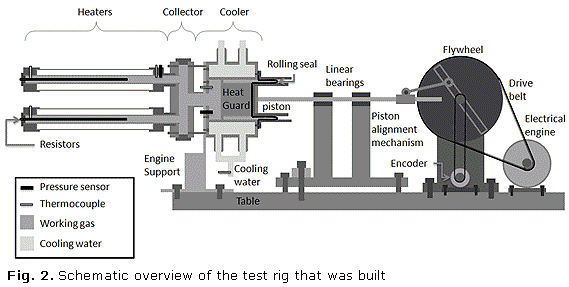
In order to investigate the thermodynamics of the TLE an experimental rig was designed by the authors. This setup was designed to investigate the different claims in literature about how this engine runs. A schematic overview of the test rig developed for this investigation is shown in figure 2 and the general parameters are detailed in table 1. The piston is sealed with a Bellowfram rolling seal to reduce mechanical friction. The piston chamber, machined from a brass piece, is cooled with a water jacket and the heater, also made from brass tubes, is designed to vary its dimension in order to extend the interface between the heater and the cooler. A stainless steel mesh is inserted into the heater in order to provide heat transfer area and heat is supplied using five 250 watt resistors. The rig is equipped with a variety of sensors to measure inside the engine in order to derive pV-diagrams and acquire a more profound insight of the thermodynamics of the TLE. The pressure sensors are fast response piezoelectric transducers (Kistler 701A), the engine frequency and piston displacement is measured using a 1000 pulses/rev incremental encoder and the temperature with K-type thermocouples. All the measurements were recorded into a PC using a data-acquisition system.
]]>
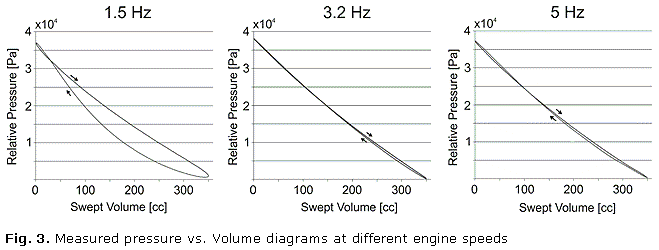
For the experiment presented the stroke length is 5,5 cm and the rig was driven at engine speeds of 1,5 Hz, 3,2 Hz and 5 Hz. The engine was heated with an electrical power input of 150 W, which guaranteed a stable wall temperature in the hot section of the engine. The engine was driven for the sake of control and because the expected power generation was smaller than the estimated mechanical losses in the system. The pressure and piston displacement were measured simultaneously, allowing the generation of the pV-diagrams of figure 3 and calculating indicated work.
EXPERIMENTAL RESULTS
The butterfly shaped pV-diagrams from the experimental results presented in figure 3 and table 2 corroborate West and Tailer's claims about the thermodynamic cycle of the TLE and its relationship with the velocity of the piston's displacement [3, 4]. Heated expansion and cooled compression processes in pistons when plotted in a pV-diagram are generally bounded within the equivalent adiabatic and isothermal processes. If the heat transfer is sufficient the process will approximate isothermal behaviour, if the heat transfer is insufficient the process would approximate adiabatic behaviour. Thus for the TLE the slope of the pV curve is determined by the relative intensity of the work flux to the net heat flux. A theoretical study of the TLE from this perspective has been presented in previous work [6].
From the expansion curves in the pV-diagrams it can be observed that the heat transfer capacity of the heater is not improved by increased engine speed, as a more isothermal behaviour is present at lower frequencies. Thus the slower the engine the more capable is the heater to match the cooling due to expansion. This effect can be observed with the decrease in slope of the expansion curves in the pV-diagrams with lower frequencies. Then, in order to increase power output by expanding closer to isothermal, greater heat transfer capacity is required in the heater. The larger the heat transfer capacity of the heater, the hotter the expansion that can be achieved. Wire meshes and other porous materials are chosen as hot heat exchangers in all the TLE's. These heat exchanger solutions exhibit both, high values of heat transfer coefficients and large areas per unit of volume. They are simple heat exchangers that maximize the heat transfer capacity and reduce dead space [7].
In the piston chamber there would be two effects governing the amount of heat transferred to the sink: the intensification of heat transfer due to increased gas velocity as a result of increased engine speed and the cold area exposure rate. From the bellies in the compression curves of figure 3 it can be deduced that the amount of cooling is inversely proportional with the engine speed. This indicates a weak intensification of the heat transfer due to increased piston velocity and a strong coupling of the heat transfer mechanisms with the cold area exposure time. Thus the varying cold area is a significant factor for the TLE as explained by Tailer and predicted by West and Wicks in their theoretical work [4, 8].
]]>
DISCUSSIONThe pV-cycles measured correspond to West predictions of triangular cycles for the TLE [4]. This is an important result, as it is the first experimental evidence that Tailer's TLE corresponds to a different thermodynamic cycle than the pulse tube engines measured [10]. This also contradicts Organ's claim about Tailer's TLE working principle. In correspondence the variation in exposure of the cold area becomes a key parameter to achieve higher performance. The other key parameter will be achieving a large heat transfer capacity in the heater.
While the heat transfer capacity in the heater should be as large as possible, the heat transfer to the sink should be limited in quantity and well bounded within a given time in the cycle. The early exposure of the cold surface during the expansion will initiate cooling hindering work delivery and efficiency. Insufficient exposure time will cause the compression to come above the expansion reducing indicated work; this effect is observed in the pV-diagrams and explains the butterfly forms. Insufficient cooling and heating will cause the engine to tend to behave like an adiabatic gas spring. Thus increasing engine frequency without improving the capacity of its heat exchangers will decrease power generation as observed in these and other experiments of TLE like engines [5, 9, 10]. Future research should investigate the different claims that have been made in literature to identify how to maximize heat delivery to the engine and where to allot in time its heat rejection.
CONCLUSIONS
An experimental thermal lag engine, where pressure and volume can be measured, has been constructed. This has permitted to produce the first measured pV-diagrams for a Tailer like TLE.
The measurements corroborate the importance of maximising the heat transfer area with the source to improve engine performance. The results support West´s theoretical work as they show a relationship between the engine´s operating frequency, its change in cooling capacity and the indicated work. This is supported by the triangular forms of the pV-diagrams.
The results allow concluding that greater heat transfer capacity with the source and the sink is required to sustain power production as the operating frequency increases. Further they corroborate that the heat transfer to the sink should be limited in quantity and well bounded within a given time in the cycle.
ACKNOWLEDGEMENTS ]]>
We would like to express a very special thank you to Peter Tailer for his vision and kind help, without the information he provided we would have never come this far. Further we would like to thank Prof. Frank Wicks, Union College, New York and Prof. Luc Bauwens, University of Calgary, Alberta for their encouragement and help. We would like to thank Prof. Michel De Paepe, Prof. Sebastian Verhelst, and Ghent University-UGENT, Belgium for their support and the funding, with the grant BOF08/FJD/006.
REFERENCES
1. Swift, G. W. Thermoacoustics: A unifying perspective for some engines and refrigerators. New York: Acoustical Society of America through the American Institute of Physics. 2002. ISBN 0-7354-0065-2.
2. Beale, W. T. "Free Piston Stirling Engines-Some Model Tests and Simulations". In: International Automotive Engineering Congress. Detroit, USA: SEA Transactions. 1969. p. 1-12.
3. Tailer, P. L. "External Combustion Otto Cycle Thermal Lag Engine". In: Proceedings of the 28th Intersociety Energy Conversion Engineering Conference. Atlanta, USA: American Chemical Society. 1993. p. 943-947.
4. West, C. D. "Some single-piston closed-cycle machines and Tailer, Peter thermal lag engine". In: Energy Environment Economics: 28th Intersociety Energy Conversion Engineering Conference Proceedings, vol 2 -environmental. Washington: American Chemical Society. 1993. p. 673-679. ISBN 0-8412-2772-5.
5. Organ, A. J. The air engine: Stirling Cycle power for a sustainable future. 1 ed. Cambridge: Woodhead Publishing Limited. 2007. p. 107-113. ISBN 978-1-84569-360-2.
6. Fernandez-Aballi Altamirano, C., De Paepe, M., Verhelst, S. et al. "Control Volume Energy Based Model for a Thermal Lag Engine". In: CIER 2009 - VI International Conference on Renewable Energy, Energy Saving and Energy Education. La Habana, Cuba. 2009.
7. Thombare, D. G. and Verma, S. K. "Technological development in the Stirling cycle engines". Renewable & Sustainable Energy Reviews. 2008, vol. 12, p. 1-38. ISSN 1364-0321. DOI 10.1016/j.rser.2006.07.001.
8. Wicks, F. and Caminero, C. "The Peter Tailer external combustion thermal lag piston cylinder engine analysis and potential applications". In: 29th Intersociety Energy Conversion Engineering Conference. pts 1-4-A Collection of Technical Papers. Washington, USA. 1994. p. 951-954. ISBN 1-56347-091-8.
9. Yoshida, T., Yazaki, T., Futaki, H. et al. "Work flux density measurements in a pulse tube engine". Applied Physics Letters. 2009. vol. 95, p. 2-4. ISSN 0003-6951. DOI 10.1063/1.3187546.
10. Hamaguchi, K., Futagi, H. and Yazaki, T. "Measurement of Work Generation and Improvement in Performance of a Pulse Tube Engine". Journal of Power and Energy Systems. 2008. vol. 2, p. 1267-1275. DOI 10.1299/jpes.2.1267.
Received: 15 september 2012.
Accepted: 7 november 2012
Carlos Fernández-Aballí-Altamirano. Instituto Superior Politécnico José Antonio Echeverría. Centro de Estudio de Tecnologías Energéticas Renovables. Havana. Cuba. Correo electrónico: carlos@ceter.cujae.edu.cu ]]>