<?xml version="1.0" encoding="ISO-8859-1"?><article xmlns:mml="http://www.w3.org/1998/Math/MathML" xmlns:xlink="http://www.w3.org/1999/xlink" xmlns:xsi="http://www.w3.org/2001/XMLSchema-instance">
<front>
<journal-meta>
<journal-id>1815-5944</journal-id>
<journal-title><![CDATA[Ingeniería Mecánica]]></journal-title>
<abbrev-journal-title><![CDATA[Ingeniería Mecánica]]></abbrev-journal-title>
<issn>1815-5944</issn>
<publisher>
<publisher-name><![CDATA[Facultad de Ingeniería Mecánica. Instituto Superior Politécnico "José Antonio Echeverría"]]></publisher-name>
</publisher>
</journal-meta>
<article-meta>
<article-id>S1815-59442013000200007</article-id>
<title-group>
<article-title xml:lang="en"><![CDATA[Control of critical parameters for square cup deep drawing of AISI 304 DDQ using genetic algorithm]]></article-title>
<article-title xml:lang="es"><![CDATA[Control de parámetros críticos en la embutición de una copa rectangular de AISI 304 DDQ empleando algoritmo genético]]></article-title>
</title-group>
<contrib-group>
<contrib contrib-type="author">
<name>
<surname><![CDATA[Bernal-Aguilar]]></surname>
<given-names><![CDATA[Yudieski]]></given-names>
</name>
<xref ref-type="aff" rid="A01"/>
</contrib>
<contrib contrib-type="author">
<name>
<surname><![CDATA[Marty-Delgado]]></surname>
<given-names><![CDATA[José Roberto]]></given-names>
</name>
<xref ref-type="aff" rid="A01"/>
</contrib>
<contrib contrib-type="author">
<name>
<surname><![CDATA[Okoye-Nwoye]]></surname>
<given-names><![CDATA[Celestine]]></given-names>
</name>
<xref ref-type="aff" rid="A02"/>
</contrib>
<contrib contrib-type="author">
<name>
<surname><![CDATA[Hernández Santana]]></surname>
<given-names><![CDATA[Edel]]></given-names>
</name>
<xref ref-type="aff" rid="A01"/>
</contrib>
<contrib contrib-type="author">
<name>
<surname><![CDATA[Hernández-Santana]]></surname>
<given-names><![CDATA[Ediel]]></given-names>
</name>
<xref ref-type="aff" rid="A01"/>
</contrib>
</contrib-group>
<aff id="A01">
<institution><![CDATA[,Universidad Central Marta Abreu de Las Villas Facultad de Ingeniería Mecánica ]]></institution>
<addr-line><![CDATA[Santa Clara ]]></addr-line>
<country>Cuba</country>
</aff>
<aff id="A02">
<institution><![CDATA[,Universidad Federal University of Technology Department of Mechanical and Electronics Engineering ]]></institution>
<addr-line><![CDATA[Yola ]]></addr-line>
<country>Nigeria</country>
</aff>
<pub-date pub-type="pub">
<day>00</day>
<month>08</month>
<year>2013</year>
</pub-date>
<pub-date pub-type="epub">
<day>00</day>
<month>08</month>
<year>2013</year>
</pub-date>
<volume>16</volume>
<numero>2</numero>
<fpage>144</fpage>
<lpage>151</lpage>
<copyright-statement/>
<copyright-year/>
<self-uri xlink:href="http://scielo.sld.cu/scielo.php?script=sci_arttext&amp;pid=S1815-59442013000200007&amp;lng=en&amp;nrm=iso"></self-uri><self-uri xlink:href="http://scielo.sld.cu/scielo.php?script=sci_abstract&amp;pid=S1815-59442013000200007&amp;lng=en&amp;nrm=iso"></self-uri><self-uri xlink:href="http://scielo.sld.cu/scielo.php?script=sci_pdf&amp;pid=S1815-59442013000200007&amp;lng=en&amp;nrm=iso"></self-uri><abstract abstract-type="short" xml:lang="en"><p><![CDATA[The main purpose of this work is to develop an intellectualized control technique on the deep drawing of square cup made of AISI 304 DDQ stainless steel using genetic algorithm. These control methods are employed in order to investigate the most significant parameters in sheet metal forming process such as drawing force, with a view of optimizing these parameters. The genetic algorithm is used for the optimization purpose to minimize the force of the deep drawing process and to investigate the roles of other parameters as blank holder force. Experimental results show that these combinations of control system can cover a wide range of both materials and influential forming parameters automatically. The results further confirm that the developed system is effective and valid alternative for quick responsible control system with high flexibility.]]></p></abstract>
<abstract abstract-type="short" xml:lang="es"><p><![CDATA[El objetivo principal del trabajo es desarrollar un método de control inteligente para la embutición de una pieza rectangular fabricada en AISI DDQ empleando algoritmo genético. Este método de control se utiliza para investigar parámetros críticos en el proceso de conformado de chapa metálica, tales como la fuerza en el prensachapas y la fuerza máxima de embutición, con el fin de minimizar este parámetro. Los resultados experimentales obtenidos demuestran que el método de control puede cubrir un amplio espectro de combinaciones, tanto para los materiales, como para los parámetros críticos y es una técnica alternativa y flexible, válida para desarrollar sistemas de control en los procesos de embutición con gran flexibilidad.]]></p></abstract>
<kwd-group>
<kwd lng="en"><![CDATA[intelligent control]]></kwd>
<kwd lng="en"><![CDATA[deep drawing]]></kwd>
<kwd lng="en"><![CDATA[genetic algorithm]]></kwd>
<kwd lng="en"><![CDATA[sheet metal forming]]></kwd>
<kwd lng="es"><![CDATA[control inteligente]]></kwd>
<kwd lng="es"><![CDATA[embutición profunda]]></kwd>
<kwd lng="es"><![CDATA[algoritmo genético]]></kwd>
<kwd lng="es"><![CDATA[conformado de chapa metálica]]></kwd>
</kwd-group>
</article-meta>
</front><body><![CDATA[ <div align="right">       <p><font face="Verdana" size="2"> <b>ART&Iacute;CULO ORIGINAL</b> </font></p>       <p>&nbsp; </p> </div>     <P><font face="Verdana" size="4"><b>Control of critical parameters for square    cup deep drawing of AISI 304 DDQ using genetic algorithm</b></font>     <P>&nbsp;     <P><font face="Verdana" size="2"><b><font size="3">Control de par&aacute;metros    cr&iacute;ticos en la embutici&oacute;n de una copa rectangular de AISI 304    DDQ empleando algoritmo gen&eacute;tico</font></b></font>     <P>&nbsp;     <P>&nbsp;     <P><font face="Verdana" size="2"><b>Yudieski Bernal-Aguilar<sup>I</sup>, Jos&eacute;    Roberto Marty-Delgado<sup>I</sup>, Celestine Okoye-Nwoye<sup>II</sup>, Edel    Hern&aacute;ndez Santana<sup>I</sup>, Ediel Hern&aacute;ndez Santana<sup>I</sup></b>    </font>      <P><font face="Verdana" size="2">I Universidad Central Marta Abreu de Las Villas.    Facultad de Ingenier&iacute;a Mec&aacute;nica. Santa Clara. Cuba    ]]></body>
<body><![CDATA[<br>   II Federal University of Technology. Department of Mechanical and Electronics    Engineering. Yola. Nigeria</font>     <P>&nbsp;     <P>&nbsp; <hr>     <P><font face="Verdana" size="2"><b>ABSTRACT</b></font>     <P><font face="Verdana" size="2">The main purpose of this work is to develop an    intellectualized control technique on the deep drawing of square cup made of    AISI 304 DDQ stainless steel using genetic algorithm. These control methods    are employed in order to investigate the most significant parameters in sheet    metal forming process such as drawing force, with a view of optimizing these    parameters. The genetic algorithm is used for the optimization purpose to minimize    the force of the deep drawing process and to investigate the roles of other    parameters as blank holder force. Experimental results show that these combinations    of control system can cover a wide range of both materials and influential forming    parameters automatically. The results further confirm that the developed system    is effective and valid alternative for quick responsible control system with    high flexibility. </font>     <P><font face="Verdana" size="2"><b>Key words:</b> intelligent control, deep drawing,    genetic algorithm, sheet metal forming.</font> <hr>     <P><font face="Verdana" size="2"><b>RESUMEN</b></font>      <P><font face="Verdana" size="2">El objetivo principal del trabajo es desarrollar    un m&eacute;todo de control inteligente para la embutici&oacute;n de una pieza    rectangular fabricada en AISI DDQ empleando algoritmo gen&eacute;tico. Este    m&eacute;todo de control se utiliza para investigar par&aacute;metros cr&iacute;ticos    en el proceso de conformado de chapa met&aacute;lica, tales como la fuerza en    el prensachapas y la fuerza m&aacute;xima de embutici&oacute;n, con el fin de    minimizar este par&aacute;metro. Los resultados experimentales obtenidos demuestran    que el m&eacute;todo de control puede cubrir un amplio espectro de combinaciones,    tanto para los materiales, como para los par&aacute;metros cr&iacute;ticos y    es una t&eacute;cnica alternativa y flexible, v&aacute;lida para desarrollar    sistemas de control en los procesos de embutici&oacute;n con gran flexibilidad.    </font>     <P><font face="Verdana" size="2"><b>Palabras claves:</b> control inteligente,    embutici&oacute;n profunda, algoritmo gen&eacute;tico, conformado de chapa met&aacute;lica.</font> <hr>     <P>&nbsp;     ]]></body>
<body><![CDATA[<P>&nbsp;      <P><font face="Verdana" size="2"><b><font size="3">INTRODUCTION</font></b></font>     <P><font face="Verdana" size="2">Sheet metal deep drawing process is a means in    manufacturing of complicated parts from sheet metal used in many industries    such as domestic, automobile, aerospace and so on. In this process, a flat metal    blank is placed between the blank holder and the die. The blank is deformed    by the action of a punch forcing the material into the die cavity. The trial-and-error    method is a traditional means to investigate and optimize engineering design    processes conditions in virtually every manufacturing process. Compared to other    numerical approximation techniques, the finite element method (FEM) is presently    the most frequently employed mathematical tool in the computer-aided analysis    of sheet metal forming processes. Consequently, systematical design and process    simulations have presented as a vital part in modern competitive systems. The    computer-aided engineering (CAE) using a FEM, predict a forming process by detecting    defects as wrinkling and fracture in design stage, in this way reducing prototyping    costs to a considera ble level. In this regard, a numbers of researchers have    reported the utilization of sheet-metal forming simulations in the last decade    with several purposes. </font>      <P><font face="Verdana" size="2">De Souza and Rolfe [1] in a recent study reported    the consistency and accuracy of FEM predictions to assess the sensitivity of    a stamping process. Zhenyu-Hu [2] demonstrated that the friction functions from    deep drawing of circular parts is also valid for the deep drawing of rectangular    work pieces. He has used size dependent FEM-simulation for this process. Firat    [3] used a finite element modeling technique based on necking models to calculate    Forming Limit Curve (FLC) and stretch formability of steel in square cup drawing    process. The computer aided analysis based on the finite element method may    help the stamping methods engineer to reduce the costly trial-and-error iterations    through the qualification of the sheet metal forming process in accordance with    the objective stamping criteria [4]. The computational requirements and the    desired accuracy of the results must balance against the cost of modeling and    process simulation. </font>     <P><font face="Verdana" size="2">The problem of optimal blank shape design, blank    holder force, die and punch radii, friction coefficient and drawing ratios for    the drawing forming process has attracted the attention of several researchers.    In order to achieve this optimization objective, a large number of solution    runs need to be performed to facilitate search for the optimum or near optimum    solution. A different contributions in terms of integration between FEM and    computer aided optimization techniques for stamping process design have been    presented recently, namely in order to: a) tooling configurations [5, 6], b)    blank configurations [7-9], c) material properties [1, 10] and d) forming condition    [11-13]. A response surface methodology (RSM) based on design of experiments    was used in [14] to minimize the forming force and maximum the forming height    during the deep drawing process. As can be seen from these results to optimization    a deep drawing process, many important factors must be taken into account. </font>     <P><font face="Verdana" size="2">The main purpose of this research is to develop    an intellectualized control technique on the deep drawing of square cup made    of AISI 304 DDQ stainless steel using genetic algorithm. These control methods    are employed in order to investigate the most significant parameters in sheet    metal forming process such as drawing force, with a view of optimizing these    parameters. The genetic algorithm is presented for the optimization purpose    to minimize the force of the deep drawing process and to investigate the roles    of other parameters. Experimental results show that these combinations of control    system can cover a wide range of both materials and influential forming parameters    automatically. The results further confirm that the developed system is effective    and valid alternative for quick responsible control system with high flexibility.    </font>      <P>&nbsp;     <P><font face="Verdana" size="2"><b><font size="3">MATERIALS AND METHOD</font></b></font>      <P><font face="Verdana" size="2">According to the DIN standard, DIN 8584, deep    drawing is defined as a tensile-compressive sheet forming process in which a    plane blank is formed into a hollow part open on one side (direct drawing) or    an open hollow part is formed into another hollow part with a smaller cross-section    (re-drawing). Deep drawing processes typically involve many complicated physics    and mechanical conditions. The main difficulty to improving the quality of this    system is the variability of the inputs (independent variables) and the constant    change in process conditions. </font>     <P><font face="Verdana" size="2">A workpiece is taken in to consideration from    home industry. This workpiece is one of the component parts from a cooking home    and was chosen because there were many problems with it, especially with critical    corner areas and wrinkling formation. The workpiece has a different depth of    draw on both sides, on the higher side 125 mm and on the lower side 102 mm.    The dimensions of the initial blank are A = 800xB = 625x s = 0.6 (mm). To improve    the material flow control, drawbeads are used. No wrinkles, scratches or cracks    are allowed. The main parts of the tool computer model contain die, blank, blank    holder and punch. It is reasonable for tools to be rigid, and only blank has    to be deformable. </font>     ]]></body>
<body><![CDATA[<P><font face="Verdana" size="2">In order to define the formability of the material,    the Forming Limits are widely applied. A forming limit can be determined experimentally,    analytically or numerically. Analytically, theories based on diffuse necking    proposed by Swift, localized necking introduced by Hill and thickness imperfection    developed by Marciniak and Kuczynski are used [15]. These theories may be applied    in forming of complicated geometries where strains and stresses required are    calculated using FEM. </font>      <P><font face="Verdana" size="2">A successful performance of the experiment demands    the identification and limitation of certain influential process parameters    to a concrete number. It refers to defining of only a certain input variables,    as the independent variables x<sub>i</sub>, as an input into the process, and    function defining of output process y<sub>i</sub> that are variable dependent    dimensions. Such approach enables qualitative managing of the process and development    towards modelling achievement. The input-output process parameters included    in the experiment, according to [16] are shown in <a href="#f1">figure 1</a>.</font>     <P align="center"><a name="f1"></a><img src="/img/revistas/im/v16n2/f0107213.jpg" width="381" height="251" alt="Fig. 1. Election of the input-output process parameters ">      
<P>      <P>      <P><font face="Verdana" size="2"><b>Drawing load for rectangular pan</b> </font>      <P><font face="Verdana" size="2">The required drawing load for workpiece in <a href="#f1">figure    1</a> can be determined in two ways, from theoretical equations based on plasticity    theory, or by using empirical equations. In scientific literature is possible    to find many different equations for calculating the maximum drawing load (F<sub>dmax</sub>)    and Blank Holder Force (BHF) in cylindrical shapes drawing. There no exists    a unique equation to calculate required drawing load for deep drawing, in wide    ranging shapes, the generalized expression take the form (<a href="#e1">equation    1</a>):</font>     <P><a name="e1"></a><img src="/img/revistas/im/v16n2/e0107213.gif" width="227" height="27" alt="Equation 1">      
<P>      <P>      ]]></body>
<body><![CDATA[<P><font face="Verdana" size="2">where h represents the drawing height, BHF is    the blank holder force, &#181; the friction coefficient, n the strain hardening    exponent, K the material strength coefficient, and r the normal anisotropy coefficient.    The following <a href="#e2">equation 2</a> to assess the maximum drawing load    F<sub>dmax</sub>, has been used for optimization purpose:</font>     <P><a name="e2"></a><img src="/img/revistas/im/v16n2/e0207213.gif" width="404" height="46" alt="Equation 2">      
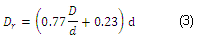
<P>      <P>      <P><font face="Verdana" size="2">The <a href="#e2">equation 2</a> considers the    ideal deformation load, load component produced by friction between die and    flange and between flange and blank holder, the load increase due to friction    at the die radius, and the load necessary for bending the sheet around the die    radius. Here, d<sub>1</sub> represent the final dimension of workpiece, </font><font face="Verdana" size="2">D<sub>r</sub>    the initial dimension in the blank (both d<sub>1</sub> and D<sub>r</sub> used    for rectangular cup are determined from equivalent diameter), s the initial    width of sheet and r<sub>p</sub> the die punch. </font>      <P>      <P><font face="Verdana" size="2">The initial equivalent diameter concept (D<sub>r</sub>)    [17] can be used here to overcome the limitations for the calculation of process    parameters of non-circular shapes drawing. </font>     <P><img src="/img/revistas/im/v16n2/e0307213.gif" width="198" height="41" alt="Equation 3">      
<P>     <P>     ]]></body>
<body><![CDATA[<P>      <P>      <P>      <P><img src="/img/revistas/im/v16n2/e3107213.gif" width="249" height="50" alt="Equation 3.1">      
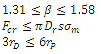
<P>      <P><b><font face="Verdana" size="2">Blank holder force</font></b><font face="Verdana" size="2">    </font>      <P><font face="Verdana" size="2">The required blank holder pressure can be estimated    from different empirical equation. Blank holder is forced with a pressure (PBH)    to elude wrinkles. The pressure necessary to avoid wrinkling depends on the    sheet material and the drawing ratio. If the contact area is ABH, then the load    applied by the blank holder is, BHF = ABH PBH. </font>     <P><img src="/img/revistas/im/v16n2/e0407213.gif" width="278" height="43" alt="Equation 4">      

<P>     <P>      ]]></body>
<body><![CDATA[<P>      <P><font face="Verdana" size="2">The factor c ranges from 2 to 3; m is the limited    drawing ratio and &#963;<sub>m</sub> is the ultimate tensile strength of the    sheet. </font>      <P>      <P><b><font face="Verdana" size="2">Cracking load </font> </b>     <P><font face="Verdana" size="2">The cracking load (F<sub>&#945;</sub>) must always    be larger than the maximum drawing load. It can be determined approximately    by the equation. </font>      <P>      <P>      <P><img src="/img/revistas/im/v16n2/e0507213.gif" width="145" height="28" alt="Equation 5">      
<P>      <P>      ]]></body>
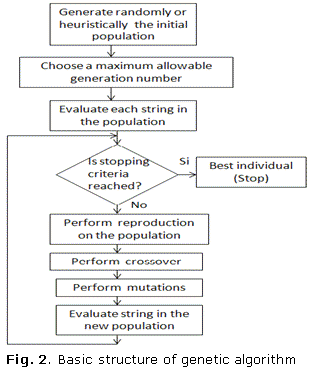
<body><![CDATA[<P><b><font face="Verdana" size="2">Optimization search method </font> </b>     <P><font face="Verdana" size="2">In order to achieve the optimization objective,    genetic algorithms (GA) are used. Evolutionary algorithms are probabilistic    optimization algorithms based on models of natural evolution. These algorithms    present advantages, such as: robustness, works with most functions: discontinuous,    multimodal, etc. and effectiveness [10]. These tools also appear to be robust    since they remain effective for many types of applications; GA effectiveness    is little problem dependent [18]. The GA search process is generally governed    by the size of population, the number of generations, the probabilities of crossover    and mutation, and probably the generation gap or proportion to be replaced with    new solutions in the next generation. These parameters could be adjusted to    improve the quality of GA search. The standard genetic algorithm proceeds, as    see in <a href="#f2">figure 2</a>. </font>     <P align="center"><a name="f2"></a><img src="/img/revistas/im/v16n2/f0207213.gif" width="310" height="376" alt="Fig. 2. Basic structure of genetic algorithm">      
<P align="left">&nbsp;     <P><font face="Verdana" size="2"><b><font size="3">RESULTS AND DISCUSSION</font></b></font>     <P><font face="Verdana" size="2">The equation for the drawing load is selected,    which is expressed in terms of all the related geometry parameters, process    parameters as well as machine parameters. The constraint equations have been    formulated in terms of geometry parameters as blank diameter, drawing ratio,    diameters of cup and corner radii of cup, machine parameters such as radius    on die and radius on punch and process parameters such as blank holder pressure    and coefficient of friction. All these variables are optimized with genetic    algorithm with optimization of forming load with due respect to material properties    and working conditions. </font>     <P><font face="Verdana" size="2"><b>Minimize:</b> </font>     <P><img src="/img/revistas/im/v16n2/emx07213.gif" width="336" height="50">      
<P>      <P>      ]]></body>
<body><![CDATA[<P><font face="Verdana" size="2">Subject to: </font>     <P><img src="/img/revistas/im/v16n2/egp07213.gif" width="101" height="54">      
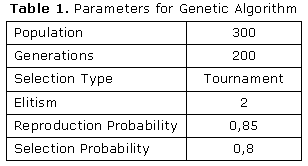
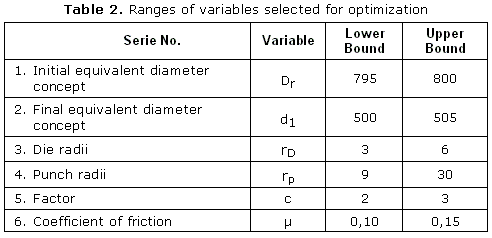
<P>      <P><font face="Verdana" size="2">The ranges of variables and parameters for Genetic    Algorithm, <a href="#t1">table 1</a> and <a href="#t2">table 2</a>, are selected    as below in consultation with company professionals. </font>      <P align="center"><a name="t1"></a><img src="/img/revistas/im/v16n2/t0107213.gif" width="308" height="166" alt="Table 1">      
<P><a name="t2"></a>     <P align="center"> <img src="/img/revistas/im/v16n2/t0207213.gif" width="492" height="238" alt="Table 2">     
<P>      <P><font face="Verdana" size="2"><b>Optimized design for workpiece</b> </font>      <P><font face="Verdana" size="2">The workpiece drawing successfully and computer    model are illustrated in <a href="#f3">figure 3</a>. The optimized geometry    of the workpiece requires a maximum drawing load of 338.88 KN. Presently geometry    requires a drawing load of 2 000 KN. There is 16,94 % reduction in the forming    load. The appropriate capacity press can be selected by knowing the drawing    load. Working with the presses of higher capacities may lead to many types of    defects such as cracks and tearing. Blank holder pressure has been optimized    from 7000 N/mm<sup>2</sup> to 73,56 N/mm<sup>2</sup>. </font>      ]]></body>
<body><![CDATA[<P><a name="f3"></a>      <P align="center"><img src="/img/revistas/im/v16n2/f0307213.jpg" width="563" height="244" alt="Fig. 3 a) Workpiece drawing successfully and b) Workpiece illustration computer model">      
<P>      <P><font face="Verdana" size="2">The control method development in this work used    genetic algorithm and finite element methods in order to develop an intellectualized    control technique on the deep drawing of rectangular pan made of AISI 304 DDQ    stainless steel. The ranges of variables and parameters for genetic algorithm    are selected in consultation with company professionals. The optimized geometry    of the workpiece requires a maximum drawing load of 338.88 KN. Presently geometry    requires a drawing load of 2 000 KN. There is 16.94 % reduction in the forming    load. The appropriate capacity press can be selected by knowing the drawing    load. Working with the presses of higher capacities may lead to many types of    defects such as cracks and tearing. Blank holder pressure has been optimized    from 7000 N/mm<sup>2</sup> to 73,56 N/mm<sup>2</sup>. </font>      <P><font face="Verdana" size="2">The preceding results highlight that the one    important key parameter for controlling the production process should be the    friction coefficient. This phenomenon is familiar to production engineers taking    an interest in stamping processes and is proved to be difficult to manage throughout    industrial processes. Friction mainly is sensitive to the temperature, lubrication,    material roughness and tool wear. Material properties are also influent parameters    (K and n) and their variability's provoke significant variability</font>     <P>&nbsp;      <P><font face="Verdana" size="3"><b>CONCLUSIONS</b></font>      <P><font face="Verdana" size="2">In this paper, effect of the most significant    parameters in sheet metal forming process of a square cup, such as punch and    dies radius, and their interaction on drawing force, is well analyzed with a    view of optimizing this parameter. The present results show that the intelligent    control in deep drawing of sheet metal can be successfully used in the field    of parameters optimization.</font>      <P><font face="Verdana" size="2">The present model can be useful in conducting    parametric studies on the different parameters affecting the process including    die design, process and material parameters. </font>     <P><font face="Verdana" size="2">Maximum drawing load and blank holder pressure    are optimized which enables selection of proper capacity press. The other process    parameters are also optimized using genetic algorithm. The equation for the    drawing load is selected, which is expressed in terms of all the related geometry    parameters, process parameters as well as machine parameters. The optimized    geometry of the workpiece requires a maximum drawing load of 338.88 KN. Presently    geometry requires a drawing load of 2000 KN, there is 16.9% reduction in the    forming load. Blank holder pressure has been optimized from 7000 N/mm<sup>2</sup>    to 73,56 N/mm<sup>2</sup>.</font>     ]]></body>
<body><![CDATA[<P>&nbsp;      <P><font face="Verdana" size="3"><b>REFERENCES</b></font>      <P><font face="Verdana" size="2">1. De Souza, T. y Rolfe, B. &quot;Multivariate    modelling of variability in sheet metal forming&quot;. <i>Journal of Materials    Processing Technology</i>. 2008, vol. 203, n&#186; 1-3, p. 1-12. Disponible    en: <a href="http://elsevier.com/locate/jmatprotec" target="_blank">http://elsevier.com/locate/jmatprotec</a>    ISSN 0924-0136. </font>      <P><font face="Verdana" size="2">2. Zhenyu, H. &quot;Realisation and application    of size dependent FEM-simulation for deep drawing of rectangular work pieces&quot;.    <i>CIRP Journal of Manufacturing Science and Technology</i>. Special Section    on Innovative and Cognitive Manufacturing Engineering. 2011, vol. 4, n&#186;    1, p. 90-95. ISSN 1755-5817. </font>      <!-- ref --><P><font face="Verdana" size="2">3. Firat, M. &quot;A finite element modeling    and prediction of stamping formability of a dual-phase steel in cup drawing&quot;.    <i>Materials &amp; Design</i>. 2012, vol. 34, p. 32-39. ISSN 0261-3069.     </font>      <P><font face="Verdana" size="2">4. Firat, M. &quot;Computer aided analysis and    design of sheet metal forming processes: Part I - The finite element modeling    concepts&quot;. <i>Materials and Design</i>. 2007, vol. 28, n&#186; p. 1298-1303.    ISSN 0261-3069. </font>      <!-- ref --><P><font face="Verdana" size="2">5. Sebastian, P., Quirante, T., Tiat, V. H. K.    <i>et al</i>. &quot;Multi-objective optimization of the design of two-stage    flash evaporators: Part 2. Multi-objective optimization&quot;. <i>International    Journal of Thermal Sciences</i>. 2010, vol. 49, n&#186; 12, p. 2459-2466 ISSN    1290-0729.     </font>      <!-- ref --><P><font face="Verdana" size="2">6. Gantar, G., Pepelnjak, T. y Kuzman, K. &quot;Optimization    of sheet metal forming processes by the use of numerical simulations&quot;.    <i>Journal of Materials Processing Technology</i>. 2002, vol. 130-131, p. 54-59.    </font><font face="Verdana" size="2">ISSN 0924-0136.     </font>      <!-- ref --><P><font face="Verdana" size="2">7. Morovvati, M. R., Mollaei-Dariani, B. y Haddadzadeh,    M. &quot;Initial Blank Optimization in Multilayer Deep Drawing Process Using    GONNS&quot;. <i>Journal of Manufacturing Science and Engineering</i>. 2010,    vol. 132 n&#186; 6, p. 10. ISSN 1087-1357.     </font>      <!-- ref --><P><font face="Verdana" size="2">8. Kitayama, S., Kita, K. y Yamazaki, K. &quot;Optimization    of variable blank holder force trajectory by sequential approximate optimization    with RBF network&quot;. <i>International Journal Advance Manufacturing Technolgies</i>.    2011, vol. 61, n&#186; 9-12 p. 1-17. ISSN 1433-3015.     </font>      <!-- ref --><P><font face="Verdana" size="2">9. Wang, J., Goel, A., Yang, F. <i>et al</i>.    &quot;Blank optimization for sheet metal forming using multi-step finite element    simulations&quot;. <i>International Journal Advance Manufacturing Technolgies</i>.    2009 vol. 40, n&#186; 7-9, p. 709-720. ISSN 0268-3768.     </font>      <!-- ref --><P><font face="Verdana" size="2">10. De-Carvalho, R., Valente, R. A. F. y Andrade-Campos,    A. &quot;Optimization strategies for non-linear material parameters identification    in metal forming problems&quot;. <i>Computers and Structures</i>. 2011, vol.    89, n&#186; 1-2, </font><font face="Verdana" size="2">p. 246-255. ISSN 0045-7949.        </font>      <P><font face="Verdana" size="2">11. Kwansoo-Chung Kim, D. y Park, T. &quot;Analytical    derivation of earing in circular cup drawing based on simple tension properties&quot;.    European Journal of Mechanics - A/Solids. 2011, vol. 30, n&#186; 3, p. 275-280.    </font><font face="Verdana" size="2">ISSN 0997-7538. </font>      ]]></body>
<body><![CDATA[<!-- ref --><P><font face="Verdana" size="2">12. Venkateswarlu, G., Davidson, M. J. y Tagore,    G. R. N. &quot;Influence of process parameters on the cup drawing of aluminium    7075 sheet&quot;. <i>International Journal of Engineering, Science and Technology</i>.    2010, vol. 2, n&#186; 11, p. 41-49. ISSN 2141-2839.     </font>      <P>      <P>      <!-- ref --><P><font face="Verdana" size="2">13. Singh, D.; Yousefi, R. y Boroushaki, M. &quot;Identification    of Optimum Parameters of Deep Drawing of a Cylindrical Workpiece using Neural    Network and Genetic Algorithm&quot;. <i>World Academy of Science, Engineering    and Technology</i>. 2011, vol. 78, ISSN 1307-6884.     </font>      <!-- ref --><P><font face="Verdana" size="2">14. Hsiao-Chu, T., Hua-Fuh, K. y Ching-Yeh, W.    &quot;Experimental Optimization of Deep Drawing Using Response Surface Methodology&quot;.    <i>Applied Mechanics and Materials</i>. 2012, vol. 121-126, p. 1495-1499. ISSN    1660-9336.     </font>      <!-- ref --><P><font face="Verdana" size="2">15. Watiti, V. B. y Labeas, G. N. &quot;Finite    Element Optimization of Deep Drawing Process Forming Parameters for Magnesium    Alloys&quot;. <i>International Journal Material Forming</i>. 2010, vol. 3, n&#186;    1, p. 97-100. </font><font face="Verdana" size="2">ISSN 1960-6206 </font>      <P><font face="Verdana" size="2">16. Arzola Ruiz, J. <i>Sistemas de Ingenier&iacute;a.    Preparaci&oacute;n y toma de decisiones de ingenier&iacute;a bajo criterios    m&uacute;ltiples</i>. La Habana: Felix Varela, 2009. p 104, 104 p. ISBN 978-959-261-299-0.    </font>      ]]></body>
<body><![CDATA[<!-- ref --><P><font face="Verdana" size="2">17. Garc&iacute;a-Zugasti, P. D. J., Rusek-Piela,    P., Aguilera-G&oacute;mez, E. <i>et al</i>. Embutido de produtos rectangulares    empleando el concepto de di&aacute;metro equivalente. En: <i>8&#186; Congreso    Iberoamericano de Ingenier&iacute;a Mec&aacute;nica. CIBIM 8</i>. Cusco. Per&uacute;.    23-25 October.2007.     </font>      <!-- ref --><P><font face="Verdana" size="2">18. Ledoux, Y., S&eacute;bastian, P. y Samper,    S. &quot;Optimization method for stamping tools under reliability constraints    using genetic algorithms and finite element simulations&quot;. <i>Journal of    Materials Processing Technology</i>. 2010, vol. 210, p. 474-486. ISSN 0924-0136.        </font>      <P>&nbsp;     <P>&nbsp;     <P><font face="Verdana" size="2">Recibido: 7 de noviembre de 2012.    <br>   Aceptado: 2 de marzo de 2013.</font>     <P>&nbsp;     <P>&nbsp;     ]]></body>
<body><![CDATA[<P><font face="Verdana" size="2"><i>Yudieski Bernal-Aguilar</i>. Universidad Central    Marta Abreu de Las Villas. Facultad de Ingenier&iacute;a Mec&aacute;nica. Santa    Clara. Cuba    <br>   Correo electr&oacute;nico: <a href="mailto:jmarty@uclv.edu.cu">jmarty@uclv.edu.cu</a></font>      ]]></body><back>
<ref-list>
<ref id="B1">
<label>1</label><nlm-citation citation-type="journal">
<person-group person-group-type="author">
<name>
<surname><![CDATA[De Souza]]></surname>
<given-names><![CDATA[T.]]></given-names>
</name>
<name>
<surname><![CDATA[Rolfe]]></surname>
<given-names><![CDATA[B.]]></given-names>
</name>
</person-group>
<article-title xml:lang="en"><![CDATA[Multivariate modelling of variability in sheet metal forming]]></article-title>
<source><![CDATA[Journal of Materials Processing Technology]]></source>
<year>2008</year>
<volume>203</volume>
<numero>1-3</numero>
<issue>1-3</issue>
<page-range>1-12</page-range></nlm-citation>
</ref>
<ref id="B2">
<label>2</label><nlm-citation citation-type="journal">
<person-group person-group-type="author">
<name>
<surname><![CDATA[Zhenyu]]></surname>
<given-names><![CDATA[H.]]></given-names>
</name>
</person-group>
<article-title xml:lang="en"><![CDATA[Realisation and application of size dependent FEM-simulation for deep drawing of rectangular work pieces]]></article-title>
<source><![CDATA[CIRP Journal of Manufacturing Science and Technology]]></source>
<year>2011</year>
<volume>4</volume>
<numero>1</numero>
<issue>1</issue>
<page-range>90-95</page-range></nlm-citation>
</ref>
<ref id="B3">
<label>3</label><nlm-citation citation-type="journal">
<person-group person-group-type="author">
<name>
<surname><![CDATA[Firat]]></surname>
<given-names><![CDATA[M.]]></given-names>
</name>
</person-group>
<article-title xml:lang="en"><![CDATA[A finite element modeling and prediction of stamping formability of a dual-phase steel in cup drawing]]></article-title>
<source><![CDATA[Materials & Design]]></source>
<year>2012</year>
<volume>34</volume>
<page-range>32-39</page-range></nlm-citation>
</ref>
<ref id="B4">
<label>4</label><nlm-citation citation-type="journal">
<person-group person-group-type="author">
<name>
<surname><![CDATA[Firat]]></surname>
<given-names><![CDATA[M.]]></given-names>
</name>
</person-group>
<article-title xml:lang="en"><![CDATA[Computer aided analysis and design of sheet metal forming processes:: Part I - The finite element modeling concepts]]></article-title>
<source><![CDATA[Materials and Design]]></source>
<year>2007</year>
<volume>28</volume>
<page-range>1298-1303</page-range></nlm-citation>
</ref>
<ref id="B5">
<label>5</label><nlm-citation citation-type="journal">
<person-group person-group-type="author">
<name>
<surname><![CDATA[Sebastian]]></surname>
<given-names><![CDATA[P.]]></given-names>
</name>
<name>
<surname><![CDATA[Quirante]]></surname>
<given-names><![CDATA[T.]]></given-names>
</name>
<name>
<surname><![CDATA[Tiat]]></surname>
<given-names><![CDATA[V. H. K.]]></given-names>
</name>
</person-group>
<article-title xml:lang="en"><![CDATA[Multi-objective optimization of the design of two-stage flash evaporators:: Part 2. Multi-objective optimization]]></article-title>
<source><![CDATA[International Journal of Thermal Sciences]]></source>
<year>2010</year>
<volume>49</volume>
<numero>12</numero>
<issue>12</issue>
<page-range>2459-2466</page-range></nlm-citation>
</ref>
<ref id="B6">
<label>6</label><nlm-citation citation-type="journal">
<person-group person-group-type="author">
<name>
<surname><![CDATA[Gantar]]></surname>
<given-names><![CDATA[G.]]></given-names>
</name>
<name>
<surname><![CDATA[Pepelnjak]]></surname>
<given-names><![CDATA[T.]]></given-names>
</name>
<name>
<surname><![CDATA[Kuzman]]></surname>
<given-names><![CDATA[K.]]></given-names>
</name>
</person-group>
<article-title xml:lang="en"><![CDATA[Optimization of sheet metal forming processes by the use of numerical simulations]]></article-title>
<source><![CDATA[Journal of Materials Processing Technology]]></source>
<year>2002</year>
<volume>130-131</volume>
<numero>54-59</numero>
<issue>54-59</issue>
</nlm-citation>
</ref>
<ref id="B7">
<label>7</label><nlm-citation citation-type="journal">
<person-group person-group-type="author">
<name>
<surname><![CDATA[Morovvati]]></surname>
<given-names><![CDATA[M. R.]]></given-names>
</name>
<name>
<surname><![CDATA[Mollaei Dariani]]></surname>
<given-names><![CDATA[B.]]></given-names>
</name>
<name>
<surname><![CDATA[Haddadzadeh]]></surname>
<given-names><![CDATA[M.]]></given-names>
</name>
</person-group>
<article-title xml:lang="en"><![CDATA[Initial Blank Optimization in Multilayer Deep Drawing Process Using GONNS]]></article-title>
<source><![CDATA[Journal of Manufacturing Science and Engineering]]></source>
<year>2010</year>
<volume>132</volume>
<numero>6</numero>
<issue>6</issue>
<page-range>10</page-range></nlm-citation>
</ref>
<ref id="B8">
<label>8</label><nlm-citation citation-type="journal">
<person-group person-group-type="author">
<name>
<surname><![CDATA[Kitayama]]></surname>
<given-names><![CDATA[S.]]></given-names>
</name>
<name>
<surname><![CDATA[Kita]]></surname>
<given-names><![CDATA[K.]]></given-names>
</name>
<name>
<surname><![CDATA[Yamazaki]]></surname>
<given-names><![CDATA[K.]]></given-names>
</name>
</person-group>
<article-title xml:lang="en"><![CDATA[Optimization of variable blank holder force trajectory by sequential approximate optimization with RBF network]]></article-title>
<source><![CDATA[International Journal Advance Manufacturing Technolgies]]></source>
<year>2011</year>
<volume>61</volume>
<numero>9-12</numero>
<issue>9-12</issue>
<page-range>1-17</page-range></nlm-citation>
</ref>
<ref id="B9">
<label>9</label><nlm-citation citation-type="journal">
<person-group person-group-type="author">
<name>
<surname><![CDATA[Wang]]></surname>
<given-names><![CDATA[J.]]></given-names>
</name>
<name>
<surname><![CDATA[Goel]]></surname>
<given-names><![CDATA[A.]]></given-names>
</name>
<name>
<surname><![CDATA[Yang]]></surname>
<given-names><![CDATA[F.]]></given-names>
</name>
</person-group>
<article-title xml:lang="en"><![CDATA[Blank optimization for sheet metal forming using multi-step finite element simulations]]></article-title>
<source><![CDATA[International Journal Advance Manufacturing Technolgies]]></source>
<year>2009</year>
<volume>40</volume>
<numero>7-9</numero>
<issue>7-9</issue>
<page-range>709-720</page-range></nlm-citation>
</ref>
<ref id="B10">
<label>10</label><nlm-citation citation-type="journal">
<person-group person-group-type="author">
<name>
<surname><![CDATA[De Carvalho]]></surname>
<given-names><![CDATA[R.]]></given-names>
</name>
<name>
<surname><![CDATA[Valente]]></surname>
<given-names><![CDATA[R. A. F.]]></given-names>
</name>
<name>
<surname><![CDATA[Andrade Campos]]></surname>
<given-names><![CDATA[A.]]></given-names>
</name>
</person-group>
<article-title xml:lang="en"><![CDATA[Optimization strategies for non-linear material parameters identification in metal forming problems]]></article-title>
<source><![CDATA[Computers and Structures]]></source>
<year>2011</year>
<volume>89</volume>
<numero>1-2</numero>
<issue>1-2</issue>
<page-range>246-255</page-range></nlm-citation>
</ref>
<ref id="B11">
<label>11</label><nlm-citation citation-type="journal">
<person-group person-group-type="author">
<name>
<surname><![CDATA[Kwansoo Cheng]]></surname>
<given-names><![CDATA[K. D.]]></given-names>
</name>
<name>
<surname><![CDATA[Park]]></surname>
<given-names><![CDATA[T.]]></given-names>
</name>
</person-group>
<article-title xml:lang="en"><![CDATA[Analytical derivation of earing in circular cup drawing based on simple tension properties]]></article-title>
<source><![CDATA[European Journal of Mechanics - A/Solids]]></source>
<year>2011</year>
<volume>30</volume>
<numero>3</numero>
<issue>3</issue>
<page-range>275-280</page-range></nlm-citation>
</ref>
<ref id="B12">
<label>12</label><nlm-citation citation-type="journal">
<person-group person-group-type="author">
<name>
<surname><![CDATA[Venkateswarlu]]></surname>
<given-names><![CDATA[G.]]></given-names>
</name>
<name>
<surname><![CDATA[Davidson]]></surname>
<given-names><![CDATA[M. J.]]></given-names>
</name>
<name>
<surname><![CDATA[Tagore]]></surname>
<given-names><![CDATA[G. R. N.]]></given-names>
</name>
</person-group>
<article-title xml:lang="en"><![CDATA[Influence of process parameters on the cup drawing of aluminium 7075 sheet]]></article-title>
<source><![CDATA[International Journal of Engineering, Science and Technology]]></source>
<year>2010</year>
<volume>2</volume>
<numero>11</numero>
<issue>11</issue>
<page-range>41-49</page-range></nlm-citation>
</ref>
<ref id="B13">
<label>13</label><nlm-citation citation-type="journal">
<person-group person-group-type="author">
<name>
<surname><![CDATA[Singh]]></surname>
<given-names><![CDATA[D.]]></given-names>
</name>
<name>
<surname><![CDATA[Yousefi]]></surname>
<given-names><![CDATA[R.]]></given-names>
</name>
<name>
<surname><![CDATA[Boroushaki]]></surname>
<given-names><![CDATA[M.]]></given-names>
</name>
</person-group>
<article-title xml:lang="en"><![CDATA[Identification of Optimum Parameters of Deep Drawing of a Cylindrical Workpiece using Neural Network and Genetic Algorithm]]></article-title>
<source><![CDATA[World Academy of Science, Engineering and Technology]]></source>
<year>2011</year>
<volume>78</volume>
</nlm-citation>
</ref>
<ref id="B14">
<label>14</label><nlm-citation citation-type="journal">
<person-group person-group-type="author">
<name>
<surname><![CDATA[Hsiao Chu]]></surname>
<given-names><![CDATA[T.]]></given-names>
</name>
<name>
<surname><![CDATA[Hua Fuh]]></surname>
<given-names><![CDATA[K.]]></given-names>
</name>
<name>
<surname><![CDATA[Ching Yeh]]></surname>
<given-names><![CDATA[W.]]></given-names>
</name>
</person-group>
<article-title xml:lang="en"><![CDATA[Experimental Optimization of Deep Drawing Using Response Surface Methodology]]></article-title>
<source><![CDATA[Applied Mechanics and Materials]]></source>
<year>2012</year>
<volume>121-126</volume>
<page-range>1495-1499</page-range></nlm-citation>
</ref>
<ref id="B15">
<label>15</label><nlm-citation citation-type="journal">
<person-group person-group-type="author">
<name>
<surname><![CDATA[Watiti]]></surname>
<given-names><![CDATA[V. B.]]></given-names>
</name>
<name>
<surname><![CDATA[Labeas]]></surname>
<given-names><![CDATA[G. N.]]></given-names>
</name>
</person-group>
<article-title xml:lang="en"><![CDATA[Finite Element Optimization of Deep Drawing Process Forming Parameters for Magnesium Alloys]]></article-title>
<source><![CDATA[International Journal Material Forming]]></source>
<year>2010</year>
<volume>3</volume>
<numero>1</numero>
<issue>1</issue>
<page-range>97-100</page-range></nlm-citation>
</ref>
<ref id="B16">
<label>16</label><nlm-citation citation-type="book">
<person-group person-group-type="author">
<name>
<surname><![CDATA[Arzola Ruiz]]></surname>
<given-names><![CDATA[J.]]></given-names>
</name>
</person-group>
<source><![CDATA[Sistemas de Ingeniería: Preparación y toma de decisiones de ingeniería bajo criterios múltiples]]></source>
<year>2009</year>
<page-range>104</page-range><publisher-loc><![CDATA[La Habana ]]></publisher-loc>
<publisher-name><![CDATA[Felix Varela]]></publisher-name>
</nlm-citation>
</ref>
<ref id="B17">
<label>17</label><nlm-citation citation-type="">
<person-group person-group-type="author">
<name>
<surname><![CDATA[García Zugasti]]></surname>
<given-names><![CDATA[P. D. J.]]></given-names>
</name>
<name>
<surname><![CDATA[Rusek Piela]]></surname>
<given-names><![CDATA[P.]]></given-names>
</name>
<name>
<surname><![CDATA[Aguilera Gómez]]></surname>
<given-names><![CDATA[E.]]></given-names>
</name>
</person-group>
<article-title xml:lang="es"><![CDATA[Embutido de produtos rectangulares empleando el concepto de diámetro equivalente]]></article-title>
<source><![CDATA[8º Congreso Iberoamericano de Ingeniería Mecánica. CIBIM 8.]]></source>
<year>23-2</year>
<month>5 </month>
<day>Oc</day>
<publisher-loc><![CDATA[Cusco ]]></publisher-loc>
</nlm-citation>
</ref>
<ref id="B18">
<label>18</label><nlm-citation citation-type="journal">
<person-group person-group-type="author">
<name>
<surname><![CDATA[Ledoux]]></surname>
<given-names><![CDATA[Y.]]></given-names>
</name>
<name>
<surname><![CDATA[Sébastian]]></surname>
<given-names><![CDATA[P.]]></given-names>
</name>
<name>
<surname><![CDATA[Samper]]></surname>
<given-names><![CDATA[S.]]></given-names>
</name>
</person-group>
<article-title xml:lang="en"><![CDATA[Optimization method for stamping tools under reliability constraints using genetic algorithms and finite element simulations]]></article-title>
<source><![CDATA[Journal of Materials Processing Technology]]></source>
<year>2010</year>
<volume>210</volume>
<page-range>474-486</page-range></nlm-citation>
</ref>
</ref-list>
</back>
</article>