<?xml version="1.0" encoding="ISO-8859-1"?><article xmlns:mml="http://www.w3.org/1998/Math/MathML" xmlns:xlink="http://www.w3.org/1999/xlink" xmlns:xsi="http://www.w3.org/2001/XMLSchema-instance">
<front>
<journal-meta>
<journal-id>1815-5944</journal-id>
<journal-title><![CDATA[Ingeniería Mecánica]]></journal-title>
<abbrev-journal-title><![CDATA[Ingeniería Mecánica]]></abbrev-journal-title>
<issn>1815-5944</issn>
<publisher>
<publisher-name><![CDATA[Facultad de Ingeniería Mecánica. Instituto Superior Politécnico "José Antonio Echeverría"]]></publisher-name>
</publisher>
</journal-meta>
<article-meta>
<article-id>S1815-59442016000200002</article-id>
<title-group>
<article-title xml:lang="en"><![CDATA[Assessment of components of operational reliability in walk- in freezer]]></article-title>
<article-title xml:lang="es"><![CDATA[Evaluación de los componentes de la confiabilidad operacional en una cámara fría]]></article-title>
</title-group>
<contrib-group>
<contrib contrib-type="author">
<name>
<surname><![CDATA[Benítez-Montalvo]]></surname>
<given-names><![CDATA[Reinaldo Ihosvanny]]></given-names>
</name>
<xref ref-type="aff" rid="A01"/>
</contrib>
<contrib contrib-type="author">
<name>
<surname><![CDATA[Díaz-Concepción]]></surname>
<given-names><![CDATA[Armando]]></given-names>
</name>
<xref ref-type="aff" rid="A02"/>
</contrib>
<contrib contrib-type="author">
<name>
<surname><![CDATA[Cabrera-Gómez]]></surname>
<given-names><![CDATA[Jesús]]></given-names>
</name>
<xref ref-type="aff" rid="A02"/>
</contrib>
<contrib contrib-type="author">
<name>
<surname><![CDATA[García-Palencia]]></surname>
<given-names><![CDATA[Oliverio]]></given-names>
</name>
<xref ref-type="aff" rid="A03"/>
</contrib>
<contrib contrib-type="author">
<name>
<surname><![CDATA[Maura-Echenique]]></surname>
<given-names><![CDATA[Alexander]]></given-names>
</name>
<xref ref-type="aff" rid="A04"/>
</contrib>
</contrib-group>
<aff id="A01">
<institution><![CDATA[,Centro de Inmunología Molecular  ]]></institution>
<addr-line><![CDATA[La Habana ]]></addr-line>
<country>Cuba</country>
</aff>
<aff id="A02">
<institution><![CDATA[,Instituto Superior Politécnico José Antonio Echeverría Centro de Estudios en Ingeniería de Mantenimiento ]]></institution>
<addr-line><![CDATA[La Habana ]]></addr-line>
<country>Cuba</country>
</aff>
<aff id="A03">
<institution><![CDATA[,Consultoría Internacional en Gestión de Activos y Excelencia Operacional CMRP  ]]></institution>
<addr-line><![CDATA[Bogotá ]]></addr-line>
<country>Colombia</country>
</aff>
<aff id="A04">
<institution><![CDATA[,Empresa Cubana de Servicios, ECUSE S.A.  ]]></institution>
<addr-line><![CDATA[La Habana ]]></addr-line>
<country>Cuba</country>
</aff>
<pub-date pub-type="pub">
<day>00</day>
<month>08</month>
<year>2016</year>
</pub-date>
<pub-date pub-type="epub">
<day>00</day>
<month>08</month>
<year>2016</year>
</pub-date>
<volume>19</volume>
<numero>2</numero>
<fpage>78</fpage>
<lpage>84</lpage>
<copyright-statement/>
<copyright-year/>
<self-uri xlink:href="http://scielo.sld.cu/scielo.php?script=sci_arttext&amp;pid=S1815-59442016000200002&amp;lng=en&amp;nrm=iso"></self-uri><self-uri xlink:href="http://scielo.sld.cu/scielo.php?script=sci_abstract&amp;pid=S1815-59442016000200002&amp;lng=en&amp;nrm=iso"></self-uri><self-uri xlink:href="http://scielo.sld.cu/scielo.php?script=sci_pdf&amp;pid=S1815-59442016000200002&amp;lng=en&amp;nrm=iso"></self-uri><abstract abstract-type="short" xml:lang="en"><p><![CDATA[The objective of this paper is to assess the elements integrant of operational reliability at one technical system walk-in freezer to conserve the intermediate product to do bottling. The mean time between failures was considered to analyze reliabilities equipment, process and human, as well as the mean time to repair to assess maintainability, as well as the mean time to repair to assess maintainability. Analyzing the state system on consider the failure that impact in the availability and to propose the actions to provide the make decisions for improve the operational reliability in the conservation process of pharmaceutical ingredient active. The results show the behavior of mentioned variables and the analysis of failure modes and effects, and also the actions proposed after risk assessment associated to the product conservation process.]]></p></abstract>
<abstract abstract-type="short" xml:lang="es"><p><![CDATA[En el trabajo se tuvo como objetivo la evaluación los elementos que conforman la confiabilidad operacional de un sistema técnico (cámara fría), para conservar un producto intermedio. Se consideró el tiempo medio entre fallas para el análisis de las confiabilidades de equipos, de procesos y humana, así como el tiempo medio de reparación para evaluar la mantenibilidad. Del análisis del estado del sistema se identificaron las insuficiencias que afectan la disponibilidad y proponer acciones que faciliten la toma de decisiones para mantener o mejorar la confiabilidad operacional en el proceso de conservación de un ingrediente farmacéutico activo. Los resultados muestran el comportamiento de las variables mencionadas y el análisis de los modos y los efectos de las fallas, así como las medidas a adoptar después de evaluar los riesgos en el proceso de conservación del producto.]]></p></abstract>
<kwd-group>
<kwd lng="en"><![CDATA[walk-in freezer]]></kwd>
<kwd lng="en"><![CDATA[operational reliability]]></kwd>
<kwd lng="en"><![CDATA[reliability equipment]]></kwd>
<kwd lng="en"><![CDATA[reliability process]]></kwd>
<kwd lng="en"><![CDATA[reliability human]]></kwd>
<kwd lng="en"><![CDATA[assess maintainability]]></kwd>
<kwd lng="es"><![CDATA[confiabilidad operacional]]></kwd>
<kwd lng="es"><![CDATA[cámara fría]]></kwd>
<kwd lng="es"><![CDATA[confiabilidad de equipo]]></kwd>
<kwd lng="es"><![CDATA[confiabilidad proceso]]></kwd>
<kwd lng="es"><![CDATA[confiabilidad humana]]></kwd>
<kwd lng="es"><![CDATA[mantenibilidad]]></kwd>
</kwd-group>
</article-meta>
</front><body><![CDATA[ <p align="right"><font face="verdana" size="2"><b> ORIGINAL ARTICLE</b></font></p>     <p align="right">&nbsp;</p>  	     <p align="justify"><font face="verdana" size="4"><b>Assessment of components of    operational reliability in walk&#45; in freezer</b></font></p>     <p align="justify">&nbsp;</p>  	     <p align="justify"><font face="verdana" size="3"><b>Evaluaci&oacute;n de los componentes    de la confiabilidad operacional en una c&aacute;mara fr&iacute;a</b></font></p>     <p align="justify">&nbsp;</p>     <p align="justify">&nbsp;</p>  	     <p align="justify"><font face="verdana" size="2"><b>Reinaldo Ihosvanny Ben&iacute;tez&#45;Montalvo<sup>I</sup>,    Armando D&iacute;az&#45;Concepci&oacute;n<sup>II</sup>, Jes&uacute;s Cabrera&#45;G&oacute;mez<sup>II</sup>,    Oliverio Garc&iacute;a&#45;Palencia<sup>III</sup>, Alexander Maura&#45;Echenique<sup>IV</sup></b></font></p>  	     <p align="justify"><font face="verdana" size="2"><sup>I</sup> Centro de Inmunolog&iacute;a    Molecular. La Habana. Cuba    <br>   </font><font face="verdana" size="2"><sup>II</sup> Instituto Superior Polit&eacute;cnico    Jos&eacute; Antonio Echeverr&iacute;a, Centro de Estudios en Ingenier&iacute;a    de Mantenimiento. La Habana. Cuba</font>    ]]></body>
<body><![CDATA[<br>   <font face="verdana" size="2"><sup>III</sup> Consultor&iacute;a Internacional    en Gesti&oacute;n de Activos y Excelencia Operacional, CMRP. Bogot&aacute;,    Colombia    <br>   </font><font face="verdana" size="2"><sup>IV</sup> Empresa Cubana de Servicios,    ECUSE S.A. La Habana, Cuba</font></p>     <p align="justify">&nbsp;</p>     <p align="justify">&nbsp;</p> <hr>     <p align="justify"><font face="verdana" size="2"><b>ABSTRACT</b></font></p>     <p align="justify"><font face="verdana" size="2">The objective of this paper is    to assess the elements integrant of operational reliability at one technical    system walk&#45;in freezer to conserve the intermediate product to do bottling.    The mean time between failures was considered to analyze reliabilities equipment,    process and human, as well as the mean time to repair to assess maintainability,    as well as the mean time to repair to assess maintainability. Analyzing the    state system on consider the failure that impact in the availability and to    propose the actions to provide the make decisions for improve the operational    reliability in the conservation process of pharmaceutical ingredient active.    The results show the behavior of mentioned variables and the analysis of failure    modes and effects, and also the actions proposed after risk assessment associated    to the product conservation process.</font></p>  	    <p align="justify"><font face="verdana" size="2"><b>Key words:</b> walk&#45;in freezer, operational reliability, reliability equipment, reliability process, reliability human, assess maintainability.</font></p>  	     <p align="justify"><font face="verdana" size="2"><b>RESUMEN</b></font></p>  	    <p align="justify"><font face="verdana" size="2">En el trabajo se tuvo como objetivo    la evaluaci&oacute;n los elementos que conforman la confiabilidad operacional    de un sistema t&eacute;cnico (c&aacute;mara fr&iacute;a), para conservar un    producto intermedio. Se consider&oacute; el tiempo medio entre fallas para el    an&aacute;lisis de las confiabilidades de equipos, de procesos y humana, as&iacute;    como el tiempo medio de reparaci&oacute;n para evaluar la mantenibilidad. Del    an&aacute;lisis del estado del sistema se identificaron las insuficiencias que    afectan la disponibilidad y proponer acciones que faciliten la toma de decisiones    para mantener o mejorar la confiabilidad operacional en el proceso de conservaci&oacute;n    de un ingrediente farmac&eacute;utico activo. Los resultados muestran el comportamiento    de las variables mencionadas y el an&aacute;lisis de los modos y los efectos    de las fallas, as&iacute; como las medidas a adoptar despu&eacute;s de evaluar    los riesgos en el proceso de conservaci&oacute;n del producto.</font></p>  	     <p align="justify"><font face="verdana" size="2"><b>Palabras clave:</b> confiabilidad    operacional, c&aacute;mara fr&iacute;a, confiabilidad de equipo, confiabilidad    proceso, confiabilidad humana, mantenibilidad.</font></p> <hr>     ]]></body>
<body><![CDATA[<p align="justify">&nbsp;</p>     <p align="justify"><font face="verdana" size="2"> <b><font size="3">INTRODUCTION</font></b></font></p>  	    <p align="justify"><font face="verdana" size="2">Actually there are a lot of new concept and technic of maintenance; between the recent organizations form is the maintenance productive overall the more important. This technic is associated to Overall Equipment Effectiveness (OEE), Reliability&#45;centered Maintenanceand operational reliability (CO). &#91;1&#93;</font></p>  	    <p align="justify"><font face="verdana" size="2">Deepak Prabhakar in 2014 &#91;1&#93; publish an explanation updated about the goal of TPM as a system select to eliminate the 6 bigger waster in the equipment, the goals is facility the implementation of work form just in time by the need to integrate the maintenance department and the production department for improve the productivity and availability. For this reason the organization work in the maintenance and the improve of equipment, but leave proof the same is a system or philosophy the organization, the reliability operational is the supporting tool for the talking decisions, and can or not to do inside in this system.</font></p>  	    <p align="justify"><font face="verdana" size="2">The overall equipment effectiveness, (OEE) &#91;2&#93; is parameters which represent the percentage of the time that machine produce the quality piece to do a comparison with the time planning to do that, follow up of active systematically, improve the availability, minimize the input and maximize the output, to permit identify the sequences of the activities relate of making of the products as well as to identify the waster that are hide in the process and the efficiency waster in the production installations. The result allow self&#45;finance the improve plan with the benefic obtained and mainly increase the personal motivation. Although for this way is possible to measure through of only parameter all the parameter of the industrial production (availability, quality and efficiency), show us the information about the elements causal witch are responsible to reduce each one of them that witch is necessary to use other auxiliary tools for to do the analyses of these causes.</font></p>  	    <p align="justify"><font face="verdana" size="2">The reliability operational is the more advanced tendency in maintenance engineering. The same emerge of the growth necessity to improve the productivity minimizing the stop of main equipment, proposing the model that takes the responsibility not only in the physic process of deteriorating but in the statistic of history of fails as the goal to search&nbsp; the causal relation between the elements of system.</font></p>  	    <p align="justify"><font face="verdana" size="2">The pro&#45;action as all the activities of improve to prognostic the human, process and equipment fails minimizing the consequence of unforeseen fails. The priority analyze give to systemic approach and the human pro&#45;action the real direction and support. Duran &#91;3&#93; explain that as a relation of elements to made up but never show as can be calculate.</font></p>  	    <p align="justify"><font face="verdana" size="2">The new research have been change the belief most basic about the maintenance by the quantity of date that are present in a context operational determined, is difficult to establish a direct relation&nbsp; an unique the useful time live of the&nbsp; equipment and the probability of fail. As part of the new way emerge the methodology of operational reliability &#91;4&#93;.&nbsp; That is one of the works most near to the goals of the research, but the change of the context, aeronautic industry to bio technology search have&nbsp; some influence in the analysis.</font></p>  	     <p align="justify"><font face="verdana" size="2">The reliability engineering stands    out as the theory framework in which the method coexist with the technic necessary    to optimize the use of the physic active and to include the improvement continuous    process, new technology methodology and diagnostic tools as the goal to improve    the quality. &#91;5&#93;</font></p>  	    <p align="justify"><font face="verdana" size="2">The article published about this theme are most to addressed at management the active that to maintenance management and any show the analysis of the integral elements, the asses and less a model to carry for the asses.</font></p>  	    ]]></body>
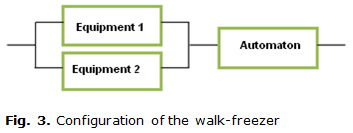
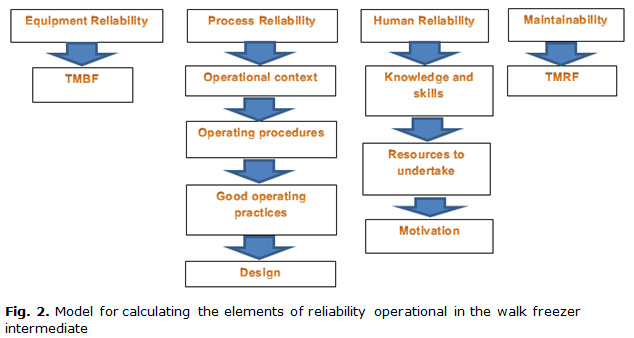
<body><![CDATA[<p align="justify"><font face="verdana" size="2">The date were obtained of the work order in the period 2013&#45;2014 and different method the analysis were applied for the equipment reliability was used the variable mean time between fail, the rate the fail, for process reliability was used the fail of the process and as the system is redundant for the reliability human was used the mode analysis and effect of fail and for the asses maintainability the parametric method.</font></p>  	     <p align="justify"><font face="verdana" size="2">Between the result most important    was obtained a value the reliability of the elements relative low but really    is tall if is considered the period in witch was estimated those values, the    mean repair time real was 50 % lower to planned.</font></p>  	     <p>&nbsp;</p>    <p align="justify"><font face="verdana" size="2"> <b><font size="3">METHOD</font></b></font></p>  	     <p align="justify"><font face="verdana" size="2">To management to do a high operational    reliability is necessary that the processes are characterized by securing the    required production with reasonable total costs due to minimal occurrence of    failures, plans to ensure the established production, risks to an acceptable    level and a highly motivated &#91;6&#93; .To evaluate the operational reliability    of a system or process any is necessary the analysis of the elements that form,    on which to act if we want to achieve long&#45;term continuous improvement is    necessary. In the <a href="#f01">figure 1</a> to supply a representation of    these elements.</font></p>     <p align="center" style='text&#45;align:center'><a name="f01"></a><img src="/img/revistas/im/v19n2/f0102216.jpg" width="365" height="251" alt="Fig. 1. Representation of the elements of operational reliability. Source: Garc&iacute;a-Palencia [8]"></p>  	     <p align="justify"><font face="verdana" size="2">The reliability of equipment    is defined as the probability of a equipment, system or component satisfactorily    perform the functions for which it was designed for a defined period of time    under given operating conditions. Process reliability is the probability that    a set of activities or events (coordinated or organized) made or happen (alternatively    or simultaneously) under certain circumstances with a particular purpose. Ensure    the reliable operation of the processes within the design parameters under an    operational context set, using operational procedures and good operating practices    to expire business objectives.</font></p>  	    <p align="justify"><font face="verdana" size="2">Human reliability is connected to the involvement, commitment and skills available to individuals in connection with the activities they perform and corresponding organizational structure to achieve it. It includes elements that improve labor skills associated with knowledge, skills and abilities of each of the members of the organization in the workplace in order to generate intellectual capital &#91;7&#93;</font></p>  	    <p align="justify"><font face="verdana" size="2">Maintainability is the probability of being able to perform a certain operation maintenance repair times prefixed with the planned conditions. It is associated with the speed with which the failure or malfunction in equipment are diagnosed and corrected or scheduled maintenance is executed successfully. It is linked to the design of equipment, logistical support, and reduction in the average time to repair, maintenance strategies equipment and maintenance effectiveness for increasing its mean time between failures.</font></p>  	     <p align="justify"><font face="verdana" size="2"><a href="/img/revistas/im/v19n2/f0202216.jpg">Figure    2</a> shows the interaction of the elements explained aforementioned and their    application to technical system studied, it was the walk&#45;freezer used in    the manufacture of an intermediate product (IFA) belonging to a production of    bio&#45;pharmaceutical products shown. The type of components, quantity, quality    and how they are arranged has a direct effect on system reliability.</font></p>     ]]></body>
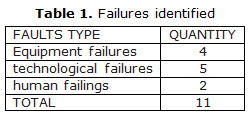
<body><![CDATA[<p align="justify"><font face="verdana" size="2">In <a href="#f03">figure 3</a>    the system shows schematically the walk&#45;freezer intermediate which comprises:</font></p>  	    <p align="justify"><font face="verdana" size="2">&bull; A system with an active redundant parallel configuration.</font></p>  	     <p align="justify"><font face="verdana" size="2">&bull; A mixed system consists    of a controller and active redundant parallel system.</font></p>     <p align="center"><a name="f03"></a><img src="/img/revistas/im/v19n2/f0302216.jpg" width="353" height="133" alt="Fig. 3. Configuration of the walk-freezer"></p>  	    <p align="justify"><font face="verdana" size="2">Maintenance management in the company that owns the system under study is focused on the processes and is done through an automated program maintenance management which, through work orders, collects information related to the active both unforeseen as planned actions.</font></p>  	     <p align="justify"><font face="verdana" size="2">They based work orders generated    for reactive corrections in a period of two years (both before the study years),    they were classified as equipment failures, failures of processes and technological    and human failure, identifying one total of 11 faults distribution as shown    in <a href="#t01">table 1</a>.</font></p>     <p align="center"><a name="t01"></a><img src="/img/revistas/im/v19n2/t0102216.jpg" width="250" height="116" alt="Table 1. Failures identified"></p>     <p align="justify"><font face="verdana" size="2">&nbsp;</font></p>  	    <p align="justify"><font face="verdana" size="2"><b><font size="3">RESULTS AND    DISCUSSION</font></b></font></p>  	    <p align="justify"><font face="verdana" size="2">Evaluation of equipment reliability</font></p>  	     ]]></body>
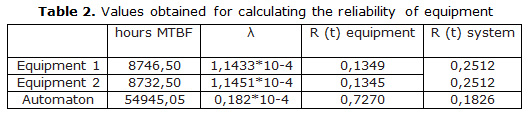
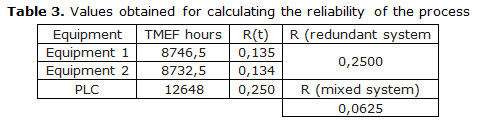
<body><![CDATA[<p align="justify"><font face="verdana" size="2">From the data obtained and the    analysis, in <a href="#t02">table 2</a> the values of equipment reliability    and system for a period equivalent to analyzed from the variable mean time between    failures (MTBF) period and the failure rate is (&#955;) corresponding.</font></p>     <p align="center"><a name="t02"></a><img src="/img/revistas/im/v19n2/t0202216.jpg" width="528" height="114" alt="Table 2. Values obtained for calculating the reliability of equipment"></p>  	    <p align="justify"><font face="verdana" size="2">Reliability Assessment Process</font></p>  	     <p align="justify"><font face="verdana" size="2"><a href="#t03">Table 3</a> shows    the result of calculating the reliability of a redundant system process (Team    1 and Team 2) and mixed regarding the programmer. By being configured in series    and present 5 trouble shooting, system reliability decreases to 6% for the same    time considered.</font></p>     <p align="center"><a name="t03"></a><img src="/img/revistas/im/v19n2/t0302216.jpg" width="479" height="122" alt="Table 3. Values obtained for calculating the reliability of the process"></p>  	     <p align="justify"><font face="verdana" size="2">Assessment of human reliability</font></p>  	    <p align="justify"><font face="verdana" size="2">Failures may originate in natural or human causes. Ignorance, emotional or moods, willingness to perform an activity, working conditions or the worker are likely causes of human error. The literature raises among the main methodologies for human reliability analysis methods called (by its acronym in English) SHARP, ATHENEA, Therp, SHERPA and HFMEA. Of these, it was decided to choose the latter because of its simplicity, being feasible for probabilistic risk analysis and ease in implementation.</font></p>  	    <p align="justify"><font face="verdana" size="2">Analysis of modes and effects of human failures (HFMEA)</font></p>  	    <p align="justify"><font face="verdana" size="2">To implement this method, the steps are:</font></p>  	     <p style='margin&#45;bottom:2.0pt;text&#45;align:justify; text&#45;indent:&#45;.25in;line&#45;height:normal'><font face="verdana" size="2">Establish    a method for analyzing and quantifying human failures mean time between human    errors (MTBE).Characterize the errors and the root causes of human failures.</font></p>  	     ]]></body>
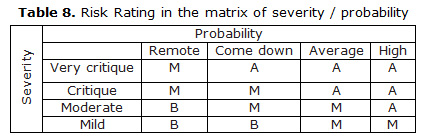
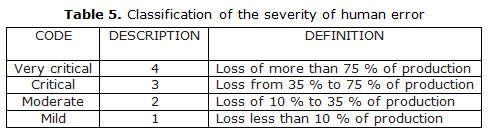
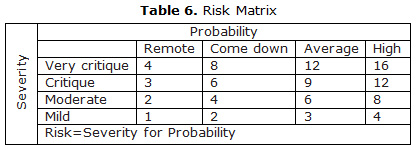
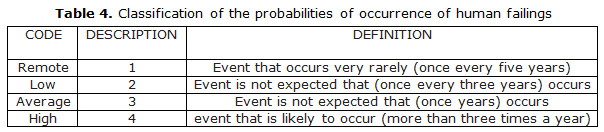
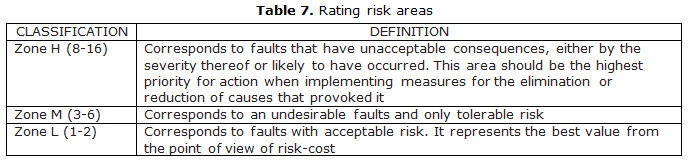
<body><![CDATA[<p style='margin&#45;bottom:2.0pt;text&#45;align:justify; text&#45;indent:&#45;.25in;line&#45;height:normal'><font face="verdana" size="2">    Develop a risk assessment matrix.</font></p>  	     <p style='margin&#45;bottom:2.0pt;text&#45;align:justify; text&#45;indent:&#45;.25in;line&#45;height:normal'><font face="verdana" size="2">Defining    risk levels and acceptance criteria. Then the development of the analysis is    presented done with reference to the above sequence raised.</font></p>  	     <p align="justify"><font face="verdana" size="2"><a href="/img/revistas/im/v19n2/t0402216.jpg">Table    4</a> shows the classification of the likelihood of human error and the corresponding    definition to each base for later risk analysis.</font></p>     <p align="justify"><font face="verdana" size="2">In the case it analyzed it was    determined that the failure occurs once a year and corresponds to an average    occurrence probability of receiving 3 codes as assigned value. &#91;8&#93;</font></p>  	     <p align="justify"><font face="verdana" size="2"><a href="#t05">Table 5</a> shows    the classification of the severity of human error and corresponding to each    definition basis also for later risk analysis.</font></p>     <p align="center"><a name="t05"></a><img src="/img/revistas/im/v19n2/t0502216.jpg" width="490" height="134" alt="Table 5.Classification of the severity of human error"></p>  	     <p align="justify"><font face="verdana" size="2">In the case studied, the severity    causing a failure is considered mild, causing losses to less than 10 % of production,    which receives code 1 as the assigned value.</font></p>     <p align="center"><a name="t06"></a><img src="/img/revistas/im/v19n2/t0602216.jpg" width="418" height="150" alt="Table 6. Risk Matrix"></p>  	     <p align="justify"><font face="verdana" size="2"><a href="/img/revistas/im/v19n2/t0702216.jpg">Table    7</a> shows the 3 zones established risk limits that frame each and its corresponding    definition.</font></p>     <p align="justify"><font face="verdana" size="2"><a href="#t08">Table 8</a> shows    that the risk of human error occurs in the area are characterized because the    average value obtained is between 3 and 6.</font></p>     ]]></body>
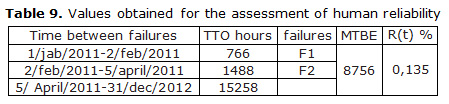
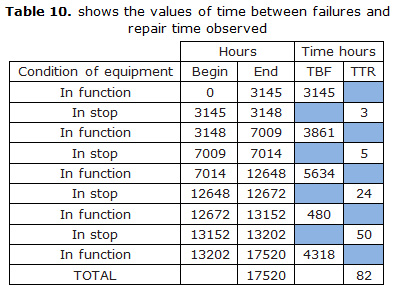
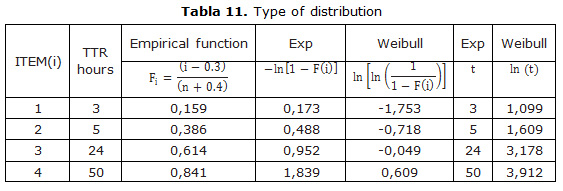
<body><![CDATA[<p align="center"><a name="t08"></a><img src="/img/revistas/im/v19n2/t0802216.jpg" width="424" height="139" alt="Table 8. Risk Rating in the matrix of severity / probability"></p>  	     <p align="justify"><font face="verdana" size="2">The value of human reliability    shown in <a href="#t09">table 9</a> corresponds to the two faults occurring    in the analyzed period, it can be noted that the value is very low.</font></p>     <p align="center"><a name="t09"></a><img src="/img/revistas/im/v19n2/t0902216.jpg" width="449" height="104" alt="Table 9. Values obtained for the assessment of human reliability"></p>  	     <p align="justify"><font face="verdana" size="2"><a href="#t10">Table 10</a> shows    the values of time between failures and repair time observed for two years taken    for the study. These data were the basis for identifying the type of distribution    (see <a href="#t11">table 11</a>) used in the subsequent calculation of the    maintainability &#91;9&#93;</font></p>     <p align="center"><a name="t10"></a><img src="/img/revistas/im/v19n2/t1002216.jpg" width="401" height="290" alt="Table 10. shows the values of time between failures and repair time observed"></p>  	     <p align="center"><font face="verdana" size="2">&nbsp;</font><font face="verdana" size="2"><a name="t11"></a><img src="/img/revistas/im/v19n2/t1102216.jpg" width="563" height="191" alt="Tabla 11. Type of distribution"></font></p>     <p align="center">&nbsp;</p>     <p align="justify"><font face="verdana" size="2"> <font size="3"><b>CONCLUSIONS</b></font></font></p>  	     <p align="justify"><font face="verdana" size="2">The reliability of the elements    may seem low (between 6 % and 13,5 %, equivalent to 2 or 3 failures in the reporting    period), but is actually relatively high given the extent of the period for    which it is estimating these values.</font></p>     <p align="justify"><font face="verdana" size="2">The average actual repair time    is approximately 50 % lower than expected.</font></p>  	     ]]></body>
<body><![CDATA[<p align="justify"><font face="verdana" size="2">Teams that are not repaired within    the stipulated time are successful in operation within 72 hours.</font></p>     <p align="justify">&nbsp;</p>     <p align="justify"><font face="Verdana" size="3"><b>REFERENCES </b></font> </p>  	     <!-- ref --><p align="justify"><font face="verdana" size="2">1. Deepak Prabhakar P., V.P.    JR, CBM, et al. A Qualitative Comparison of Maintenance Management. International    Journal of Management &amp; Business Studies. 2014;4(3):5&#45;8.     ISSN 2230&#45;9519.</font></p>  	    <!-- ref --><p align="justify"><font face="verdana" size="2">2. Parihar S, Jain S, Bajpai L. Calculation of OEE for an Assembly Process. International Journal of Management &amp; Business Studies. 2012;2(3):1&#45;2.     ISSN 2249&#45;5762.</font></p>  	    <!-- ref --><p align="justify"><font face="verdana" size="2">3. Viego N, D&iacute;az A, Abril J. Estudio de confiablidad operacional como soporte al mantenimiento aeron&aacute;utico en Cuba. Revistas Ingenieras. 2015;XVIII,7&#45;15.     ISSN 405&#45;0676. &nbsp;</font></p>  	     <!-- ref --><p align="justify"><font face="verdana" size="2">4. Duran BJ. &iquest;Qu&eacute;    es la confiabilidad operacional?. &nbsp;Club de Mantenimiento. 2000;1(2):7.        </font></p>  	     <!-- ref --><p align="justify"><font face="Verdana" size="2">5. Palacio PLH. El c&aacute;lculo    de la Confiabilidad. Confiabilidad.net. 2008. <a href="http://confiabilidad.net/articulos/el-calculo-de-la-confiabilidad/%20">http://confiabilidad.net/articulos/el-calculo-de-la-confiabilidad/    </a></font><!-- ref --><p align="justify"><font face="verdana" size="2">6. More Domenech J. An&aacute;lisis de la confiabilidad humana en una refiner&iacute;a de petr&oacute;leo. Uso de una metodolog&iacute;a borrosa. Cuadernos del CIMBAGE. 2010(12):71&#45;84.     ISSN 1669&#45;1830.</font></p>  	     <!-- ref --><p align="justify"><font face="verdana" size="2">7. Murgu&iacute;a Pons A. An&aacute;lisis    de la confiabilidad humana en el an&aacute;lisis de procesos. PROSPECTIVA. 2013;11(2):61&#45;7.        ISSN 2216&#45;1368.</font></p>  	    <!-- ref --><p align="justify"><font face="verdana" size="2">8. Garc&iacute;a Palencia O. Confiabilidad humana clave de la sostenibilidad Industrial. Mantenimiento en Latinoam&eacute;rica. 2013;5(6):8&#45;10.     ISSN 2357&#45;6340.</font></p>  	     <!-- ref --><p align="justify"><font face="verdana" size="2">9. Palencia GO. Gesti&oacute;n    Integral de Mantenimiento Basada en Confiabilidad. Confiabilidad.net. Bogot&aacute;,    Colombia. <a href="http://confiabilidad.net/articulos/gestion&#45;integral&#45;de&#45;mantenimiento&#45;basada&#45;en&#45;confiabilidad/">http://confiabilidad.net/articulos/gestion&#45;integral&#45;de&#45;mantenimiento&#45;basada&#45;en&#45;confiabilidad/</a></font><!-- ref --><p align="justify"><font face="verdana" size="2">10. Arata A. Ingenier&iacute;a    y gesti&oacute;n de la confiabilidad operacional en plantas industriales. primera    ed. Chile. 2009.     p. 439. ISBN 978&#45;956&#45;284&#45;658&#45;5.</font></p>  	    <!-- ref --><p align="justify"><font face="verdana" size="2">11. Tamasa VA, G&oacute;mez Estrada S, Holgu&iacute;n LM. An&aacute;lisis de confiabilidad aplicado a una conformadora de rollos empleando la t&eacute;cnica de modos de fallos. Scientia et Technica. 2009(41) ISSN 0122&#45;    1701.</font></p>  	     <p align="justify">&nbsp;</p>     <p align="justify">&nbsp;</p>     <p align="justify"><font face="verdana" size="2">Recibido: 18 de febrero de 2016.    <br>   Aceptado: 31 de marzo de 2016.</font></p>     <p align="justify">&nbsp;</p>     <p align="justify">&nbsp;</p>     <p align="justify"><font face="verdana" size="2"><i>Reinaldo Ihosvanny Ben&iacute;tez&#45;Montalvo</i></font><i><font size="2" face="Verdana">.    </font></i><font face="verdana" size="2">Centro de Inmunolog&iacute;a Molecular.    La Habana. Cuba    ]]></body>
<body><![CDATA[<br>   Correo electr&oacute;nico: <a href="mailto:reynaldo@cim.sld.cu">reynaldo@cim.sld.cu</a>    </font></p>      ]]></body><back>
<ref-list>
<ref id="B1">
<label>1</label><nlm-citation citation-type="journal">
<person-group person-group-type="author">
<name>
<surname><![CDATA[Deepak Prabhakar]]></surname>
<given-names><![CDATA[P]]></given-names>
</name>
</person-group>
<collab>V</collab>
<article-title xml:lang="en"><![CDATA[P: JR, CBM, et al. A Qualitative Comparison of Maintenance Management]]></article-title>
<source><![CDATA[International Journal of Management & Business Studies]]></source>
<year>2014</year>
<volume>4</volume>
<numero>3</numero>
<issue>3</issue>
<page-range>5-8</page-range></nlm-citation>
</ref>
<ref id="B2">
<label>2</label><nlm-citation citation-type="journal">
<person-group person-group-type="author">
<name>
<surname><![CDATA[Parihar]]></surname>
<given-names><![CDATA[S]]></given-names>
</name>
<name>
<surname><![CDATA[Jain]]></surname>
<given-names><![CDATA[S]]></given-names>
</name>
<name>
<surname><![CDATA[Bajpai]]></surname>
<given-names><![CDATA[L]]></given-names>
</name>
</person-group>
<article-title xml:lang="en"><![CDATA[Calculation of OEE for an Assembly Process]]></article-title>
<source><![CDATA[International Journal of Management & Business Studies]]></source>
<year>2012</year>
<volume>2</volume>
<numero>3</numero>
<issue>3</issue>
<page-range>1-2</page-range></nlm-citation>
</ref>
<ref id="B3">
<label>3</label><nlm-citation citation-type="journal">
<person-group person-group-type="author">
<name>
<surname><![CDATA[Viego]]></surname>
<given-names><![CDATA[N]]></given-names>
</name>
<name>
<surname><![CDATA[Díaz]]></surname>
<given-names><![CDATA[A]]></given-names>
</name>
<name>
<surname><![CDATA[Abril]]></surname>
<given-names><![CDATA[J]]></given-names>
</name>
</person-group>
<article-title xml:lang="es"><![CDATA[Estudio de confiablidad operacional como soporte al mantenimiento aeronáutico en Cuba]]></article-title>
<source><![CDATA[Revistas Ingenieras]]></source>
<year>2015</year>
<volume>XVIII</volume>
<page-range>7-15</page-range></nlm-citation>
</ref>
<ref id="B4">
<label>4</label><nlm-citation citation-type="journal">
<collab>Duran BJ ¿Qué es la confiabilidad operacional?</collab>
<article-title xml:lang="pt"><![CDATA[Club de]]></article-title>
<source><![CDATA[Mantenimiento]]></source>
<year>2000</year>
<volume>1</volume>
<numero>2</numero>
<issue>2</issue>
<page-range>7</page-range></nlm-citation>
</ref>
<ref id="B5">
<label>5</label><nlm-citation citation-type="book">
<person-group person-group-type="author">
<name>
<surname><![CDATA[Palacio]]></surname>
<given-names><![CDATA[PLH]]></given-names>
</name>
</person-group>
<source><![CDATA[El cálculo de la Confiabilidad]]></source>
<year>2008</year>
<publisher-name><![CDATA[Confiabilidad.net]]></publisher-name>
</nlm-citation>
</ref>
<ref id="B6">
<label>6</label><nlm-citation citation-type="journal">
<person-group person-group-type="author">
<name>
<surname><![CDATA[More Domenech]]></surname>
<given-names><![CDATA[J]]></given-names>
</name>
</person-group>
<article-title xml:lang="pt"><![CDATA[Análisis de la confiabilidad humana en una refinería de petróleo: Uso de una metodología borrosa]]></article-title>
<source><![CDATA[Cuadernos del CIMBAGE]]></source>
<year>2010</year>
<numero>12</numero>
<issue>12</issue>
<page-range>71-84</page-range></nlm-citation>
</ref>
<ref id="B7">
<label>7</label><nlm-citation citation-type="journal">
<person-group person-group-type="author">
<name>
<surname><![CDATA[Murguía Pons]]></surname>
<given-names><![CDATA[A]]></given-names>
</name>
</person-group>
<article-title xml:lang="pt"><![CDATA[Análisis de la confiabilidad humana en el análisis de procesos]]></article-title>
<source><![CDATA[PROSPECTIVA]]></source>
<year>2013</year>
<volume>11</volume>
<numero>2</numero>
<issue>2</issue>
<page-range>61-7</page-range></nlm-citation>
</ref>
<ref id="B8">
<label>8</label><nlm-citation citation-type="journal">
<person-group person-group-type="author">
<name>
<surname><![CDATA[García Palencia]]></surname>
<given-names><![CDATA[O]]></given-names>
</name>
</person-group>
<article-title xml:lang="es"><![CDATA[Confiabilidad humana clave de la sostenibilidad Industrial]]></article-title>
<source><![CDATA[Mantenimiento en Latinoamérica]]></source>
<year>2013</year>
<volume>5</volume>
<numero>6</numero>
<issue>6</issue>
<page-range>8-10</page-range></nlm-citation>
</ref>
<ref id="B9">
<label>9</label><nlm-citation citation-type="book">
<person-group person-group-type="author">
<name>
<surname><![CDATA[Palencia]]></surname>
<given-names><![CDATA[GO]]></given-names>
</name>
</person-group>
<source><![CDATA[Gestión Integral de Mantenimiento Basada en Confiabilidad]]></source>
<year></year>
<publisher-loc><![CDATA[Bogotá ]]></publisher-loc>
<publisher-name><![CDATA[Confiabilidad.net]]></publisher-name>
</nlm-citation>
</ref>
<ref id="B10">
<label>10</label><nlm-citation citation-type="">
<person-group person-group-type="author">
<name>
<surname><![CDATA[Arata]]></surname>
<given-names><![CDATA[A]]></given-names>
</name>
</person-group>
<source><![CDATA[Ingeniería y gestión de la confiabilidad operacional en plantas industriales.]]></source>
<year>2009</year>
<edition>primera ed</edition>
<page-range>439</page-range><publisher-loc><![CDATA[Chile ]]></publisher-loc>
</nlm-citation>
</ref>
<ref id="B11">
<label>11</label><nlm-citation citation-type="journal">
<person-group person-group-type="author">
<name>
<surname><![CDATA[Tamasa]]></surname>
<given-names><![CDATA[VA]]></given-names>
</name>
<name>
<surname><![CDATA[Gómez Estrada]]></surname>
<given-names><![CDATA[S]]></given-names>
</name>
<name>
<surname><![CDATA[Holguín]]></surname>
<given-names><![CDATA[LM]]></given-names>
</name>
</person-group>
<article-title xml:lang="es"><![CDATA[Análisis de confiabilidad aplicado a una conformadora de rollos empleando la técnica de modos de fallos]]></article-title>
<source><![CDATA[Scientia et Technica]]></source>
<year>2009</year>
<numero>41</numero>
<issue>41</issue>
</nlm-citation>
</ref>
</ref-list>
</back>
</article>