<?xml version="1.0" encoding="ISO-8859-1"?><article xmlns:mml="http://www.w3.org/1998/Math/MathML" xmlns:xlink="http://www.w3.org/1999/xlink" xmlns:xsi="http://www.w3.org/2001/XMLSchema-instance">
<front>
<journal-meta>
<journal-id>1815-5944</journal-id>
<journal-title><![CDATA[Ingeniería Mecánica]]></journal-title>
<abbrev-journal-title><![CDATA[Ingeniería Mecánica]]></abbrev-journal-title>
<issn>1815-5944</issn>
<publisher>
<publisher-name><![CDATA[Facultad de Ingeniería Mecánica. Instituto Superior Politécnico "José Antonio Echeverría"]]></publisher-name>
</publisher>
</journal-meta>
<article-meta>
<article-id>S1815-59442017000200007</article-id>
<title-group>
<article-title xml:lang="en"><![CDATA[Comparative study of the power consumption in two different configurations of medium-length slurry pumping systems]]></article-title>
<article-title xml:lang="es"><![CDATA[Estudio comparativo del consumo de energía en dos diferentes configuraciones de sistemas de bombeo de relaves de mediana longitud]]></article-title>
</title-group>
<contrib-group>
<contrib contrib-type="author">
<name>
<surname><![CDATA[Castro Ferreira]]></surname>
<given-names><![CDATA[Max Túlio]]></given-names>
</name>
<xref ref-type="aff" rid="A01"/>
</contrib>
<contrib contrib-type="author">
<name>
<surname><![CDATA[Masip]]></surname>
<given-names><![CDATA[Yuneski]]></given-names>
</name>
<xref ref-type="aff" rid="A02"/>
</contrib>
<contrib contrib-type="author">
<name>
<surname><![CDATA[de Barcelos]]></surname>
<given-names><![CDATA[Rodrigo J P]]></given-names>
</name>
<xref ref-type="aff" rid="A01"/>
</contrib>
<contrib contrib-type="author">
<name>
<surname><![CDATA[Pedrera Yanes]]></surname>
<given-names><![CDATA[Jacqueline]]></given-names>
</name>
<xref ref-type="aff" rid="A03"/>
</contrib>
<contrib contrib-type="author">
<name>
<surname><![CDATA[Vilalta]]></surname>
<given-names><![CDATA[Guillermo]]></given-names>
</name>
<xref ref-type="aff" rid="A04"/>
</contrib>
</contrib-group>
<aff id="A01">
<institution><![CDATA[,Federal University of São João del-Rei Thermal Sciences and Fluids Department ]]></institution>
<addr-line><![CDATA[ Minas Gerais]]></addr-line>
<country>Brasil</country>
</aff>
<aff id="A02">
<institution><![CDATA[,Pontificia Universidad Católica de Valparaíso Mechanical Engineering School ]]></institution>
<addr-line><![CDATA[ Valparaíso]]></addr-line>
<country>Chile</country>
</aff>
<aff id="A03">
<institution><![CDATA[,University of São Paulo Mechanical Engineering Department ]]></institution>
<addr-line><![CDATA[ São Paulo]]></addr-line>
<country>Brazil</country>
</aff>
<aff id="A04">
<institution><![CDATA[,Federal University of São João del-Rei Thermal Sciences and Fluids Department ]]></institution>
<addr-line><![CDATA[ Minas Gerais]]></addr-line>
<country>Brasil</country>
</aff>
<pub-date pub-type="pub">
<day>00</day>
<month>08</month>
<year>2017</year>
</pub-date>
<pub-date pub-type="epub">
<day>00</day>
<month>08</month>
<year>2017</year>
</pub-date>
<volume>20</volume>
<numero>2</numero>
<fpage>91</fpage>
<lpage>98</lpage>
<copyright-statement/>
<copyright-year/>
<self-uri xlink:href="http://scielo.sld.cu/scielo.php?script=sci_arttext&amp;pid=S1815-59442017000200007&amp;lng=en&amp;nrm=iso"></self-uri><self-uri xlink:href="http://scielo.sld.cu/scielo.php?script=sci_abstract&amp;pid=S1815-59442017000200007&amp;lng=en&amp;nrm=iso"></self-uri><self-uri xlink:href="http://scielo.sld.cu/scielo.php?script=sci_pdf&amp;pid=S1815-59442017000200007&amp;lng=en&amp;nrm=iso"></self-uri><abstract abstract-type="short" xml:lang="en"><p><![CDATA[The hydraulic transport of slurries by means of piping systems is characterized by an elevated power consumption. This study investigates the relationships among the four variables that define the slurry transportation system: length L and diameter D of system and granulometry D50 and concentration Cv of iron ore with aiming to minimize the power requirements. A thermodynamic energetic indicator I, was computed via numerical simulation. Optimization of the computational effort was carried out by using the 2k factorial design. The results show that all variables are significant on the indicator I, with pipe length having the greatest amplitude of variation in the response. The second order interactions indicates that only two combinations are correlated, namely the granulometry and length and diameter and length. Trough the statistical approach, predictive models have been obtained. The results allow designers to identify which of the analysed pipeline system layouts represents the minimum power requirement.]]></p></abstract>
<abstract abstract-type="short" xml:lang="es"><p><![CDATA[El transporte hidráulico de relaves por medio de sistemas de tuberías se caracteriza por un elevado consumo de energía. El presente trabajo investiga la relación entre las variables que definen el sistema de transporte de relaves: la longitud L y el diámetro de la tubería D del sistema y la granulometría D50 y la concentración volumétrica Cv del mineral de hierro con el objetivo de minimizar los requerimientos de consumo de energía. Un indicador termodinámico I fue calculado mediante simulación numérica. La optimización del esfuerzo computacional se realizó a través de un diseño factorial 2k. Los resultados muestran que los cuatro factores estudiados son significativos en el indicador I, siendo L la que presenta mayor amplitud de variación en la respuesta. La interacción de segunda orden, indicó que sólo dos combinaciones de variables están correlacionadas, D50 y L y D y L. A través de esta técnica estadística, modelos predictivos pueden ser obtenidos. Los resultados permiten a los diseñadores identificar cuál de los esquemas analizados presenta el requerimiento mínimo de energía.]]></p></abstract>
<kwd-group>
<kwd lng="en"><![CDATA[energetic indicator]]></kwd>
<kwd lng="en"><![CDATA[slurry pumping]]></kwd>
<kwd lng="en"><![CDATA[predictive models]]></kwd>
<kwd lng="en"><![CDATA[numerical simulation]]></kwd>
<kwd lng="es"><![CDATA[indicador energético]]></kwd>
<kwd lng="es"><![CDATA[bombeo de relave]]></kwd>
<kwd lng="es"><![CDATA[modelos predictivos]]></kwd>
<kwd lng="es"><![CDATA[simulación numérica]]></kwd>
</kwd-group>
</article-meta>
</front><body><![CDATA[ <p align="right" style="text-align:right;"><font style="font-family:'Verdana','sans-serif'; font-size:10.0pt; "><b>Original Article</b></font></p>     <p align="justify" class="Titulo">&nbsp;</p>     <p align="justify" class="Titulo"><font style="font-family:'Verdana','sans-serif'; font-size:16.0pt; "><b>Comparative  study of the power consumption in two different configurations of medium-length  slurry pumping systems </b></font></p>     <p align="justify" class="TituloIngles">&nbsp;</p>     <p align="justify" class="TituloIngles"><b><font style="font-family:'Verdana','sans-serif'; font-size:14.0pt; ">Estudio comparativo del consumo de energ&iacute;a en dos diferentes  configuraciones de sistemas de bombeo de relaves de mediana longitud</font></b></p>     <p align="justify" class="Autor">&nbsp;</p>     <p align="justify" class="Autor">&nbsp;</p>     <p align="justify" class="Autor"><b><font style="font-family:'Verdana','sans-serif'; font-size:10.0pt; ">Max  T&uacute;lio Castro Ferreira<sup>I</sup>, Yuneski Masip<sup>II</sup>, Rodrigo J P de  Barcelos<sup>I</sup>, Jacqueline Pedrera Yanes<sup>III</sup>, Guillermo Vilalta<sup>IV</sup></font></b></p>     <p align="justify" class="Filiacion"><font style="font-family:'Verdana','sans-serif'; font-size:10.0pt; "><sup>I</sup>Federal University of S&atilde;o Jo&atilde;o del-Rei, Thermal Sciences  and Fluids Department. Minas Gerais. Brasil</font></p>     <p align="justify" class="Filiacion"><font style="font-family:'Verdana','sans-serif'; font-size:10.0pt; "><sup>II</sup>Pontificia Universidad Cat&oacute;lica de  Valpara&iacute;so. Mechanical Engineering School. Valpara&iacute;so. Chile.</font></p>     ]]></body>
<body><![CDATA[<p align="justify" class="Filiacion"><font style="font-family:'Verdana','sans-serif'; font-size:10.0pt; "><sup>III</sup>University of S&atilde;o Paulo, Mechanical Engineering  Department. S&atilde;o Paulo. Brazil.</font></p>     <p align="justify" class="Filiacion"><font style="font-family:'Verdana','sans-serif'; font-size:10.0pt; "><sup>IV</sup>Federal University of S&atilde;o Jo&atilde;o del-Rei, Thermal  Sciences and Fluids Department. Minas Gerais. Brasil</font></p>     <p align="justify" class="TituloResumen">&nbsp;</p>     <p align="justify" class="TituloResumen">&nbsp;</p> <hr />     <p align="justify" class="TituloResumen"><font style="font-family:'Verdana','sans-serif'; font-size:10.0pt; "><b>ABSTRACT</b></font></p>     <p align="justify" class="Resumen"><font style="font-family:'Verdana','sans-serif'; font-size:10.0pt; ">The hydraulic transport of slurries by means of piping  systems is characterized by an elevated power consumption. This study  investigates the relationships among the four variables that define the slurry  transportation system: length L and diameter D of system and granulometry D<sub>50</sub> and concentration Cv of iron ore with aiming to minimize the power  requirements. A thermodynamic energetic indicator I, was computed via numerical  simulation. Optimization of the computational effort was carried out by using  the 2<sup>k</sup> factorial design. The results show that all variables are  significant on the indicator I, with pipe length having the greatest amplitude  of variation in the response. The second order interactions indicates that only  two combinations are correlated, namely the granulometry and length and diameter  and length. Trough the statistical approach, predictive models have been  obtained. The results allow designers to identify which of the analysed  pipeline system layouts represents the minimum power requirement.</font></p>     <p align="justify" class="PalabrasClaves"><font style="font-family:'Verdana','sans-serif'; font-size:10.0pt; "><b>Key words</b>: energetic indicator, slurry pumping, predictive models, numerical  simulation. </font></p> <hr />     <p align="justify" class="TituloResumen"><font style="font-family:'Verdana','sans-serif'; font-size:10.0pt; "><b>RESUMEN</b></font></p>     <p align="justify" class="Resumen"><font style="font-family:'Verdana','sans-serif'; font-size:10.0pt; ">El  transporte hidr&aacute;ulico de relaves por medio de sistemas de tuber&iacute;as se  caracteriza por un elevado consumo de energ&iacute;a. El presente trabajo investiga la  relaci&oacute;n entre las variables que definen el sistema de transporte de relaves:  la longitud L y el di&aacute;metro de la tuber&iacute;a D del sistema y la granulometr&iacute;a D50  y la concentraci&oacute;n volum&eacute;trica Cv del mineral de hierro con el objetivo de  minimizar los requerimientos de consumo de energ&iacute;a. Un indicador termodin&aacute;mico  I fue calculado mediante simulaci&oacute;n num&eacute;rica. La optimizaci&oacute;n del esfuerzo  computacional se realiz&oacute; a trav&eacute;s de un dise&ntilde;o factorial 2k. Los resultados  muestran que los cuatro factores estudiados son significativos en el indicador  I, siendo L la que presenta mayor amplitud de variaci&oacute;n en la respuesta. La  interacci&oacute;n de segunda orden, indic&oacute; que s&oacute;lo dos combinaciones de variables  est&aacute;n correlacionadas, D50 y L y D y L. A trav&eacute;s de esta t&eacute;cnica  estad&iacute;stica,&nbsp; modelos predictivos pueden  ser obtenidos. Los resultados permiten a los dise&ntilde;adores identificar cu&aacute;l de  los esquemas analizados presenta el requerimiento m&iacute;nimo de energ&iacute;a.</font></p>     <p align="justify" class="Tituloclaves"><font style="font-family:'Verdana','sans-serif'; font-size:10.0pt; "><b>Palabras  clave: </b>indicador energ&eacute;tico, bombeo de relave,  modelos predictivos, simulaci&oacute;n num&eacute;rica. </font></p> <hr />     ]]></body>
<body><![CDATA[<p align="justify" class="Subtitulo">&nbsp;</p>     <p align="justify" class="Subtitulo">&nbsp;</p>     <p align="justify" class="Subtitulo"><font style="font-family:'Verdana','sans-serif'; font-size:14.0pt; "><b>INTRODUCTION</b></font></p>     <p align="justify" style="text-align:justify;"><font style="font-family:'Verdana','sans-serif'; font-size:10.0pt; ">Over the past decades, Brazilian mining industry  has been experienced a vigorous growth, playing a major role in the global  mining scenario, alongside other countries of BRICS like Russia, India and  China. In the year of 2015, the Brazilian production of metallic compounds (as  iron, aluminum and gold), reached more than    US$ 19,5 billion, being the 62 % associated to the beneficiated iron ore, which  has his largest production in the state of Minas Gerais, Brazil. Such a state  answers for almost 70 % of the Brazilian traded iron ore. Such huge production  is invariably followed by a significant and raising generation of wastes named  tailings [1]. In Brazil, the production of iron ore tailings was around 220  million of tons in 2015, corresponding to 44,14 % of the total quantity of  tailings produced in the country.</font></p>     <p align="justify" style="text-align:justify;"><font style="font-family:'Verdana','sans-serif'; font-size:10.0pt; ">Due to the increasing volume of tailings, the  construction of engineered structures to store it became a need. The tailings  dams are the most common option of in Brazil. The materials handling among the  beneficiating process steps is the activity identified as having the highest  potential for energy efficiency improvements and to reach it, hauling  operations play a important role [2]. The tailing hauling can be done by  different means and important options are the pipeline systems. Transport of  solids as slurry, through pumps and pipelines on large scale, has been lately  accepted as a cost-effective, technically and economically suitable rather than  truck hauling and conveyor belts, mostly when the access to remote areas is a  need and there are terrain constraints [3]. </font></p>     <p align="justify" style="text-align:justify;"><font style="font-family:'Verdana','sans-serif'; font-size:10.0pt; ">Despite the large amount of water and energy  usually required, long distance slurry pipelines are highly efficient when  compared to other transport alternatives [4]. However, the 46 % of mining  operational costs stands for transport operations and the demand for reductions  on energy consumption on mining industry is a need [5], reason for which the  design of efficient slurry pumping systems is really relevant. Pumps systems are  a huge opportunity to improve energy efficiency and reduce carbon dioxide  emissions in the mining industry.</font></p>     <p align="justify" style="text-align:justify;"><font style="font-family:'Verdana','sans-serif'; font-size:10.0pt; ">Different authors suggest different criteria to  evaluate slurry transportation by pipeline systems and to optimize its  performance. The pipeline systems optimization have to be carried out  considering the slurry rheological properties; particle size and shape and  solid concentration, once the performance of pumps when operating with pure  water gets reduced in the presence of suspended solids [6]. Numerical tools and  computational fluid dynamics (CFD) have been employed to help on these  evaluations [3, 6. 7]. </font></p>     <p align="justify" style="text-align:justify;"><font style="font-family:'Verdana','sans-serif'; font-size:10.0pt; ">Taking into  account the variables involved in the slurry transportation, it would be  interesting to use an appropriate simulation strategy that allows obtaining  objective results for an adequate analysis. The design of experiments (DOE) is  the most efficient and applicable statistical methodology to organize the  experimentation, allowing the acquisition of the largest amount of information  with the fewest number of experiments.</font></p>     <p align="justify" style="text-align:justify;"><font style="font-family:'Verdana','sans-serif'; font-size:10.0pt; ">It is well  known that slurry transportation systems are characterized by four independent  variables; two associated to slurry ore rheology (volumetric concentration, Cv  and granulometry D<sub>50</sub>) and two related to piping system (length and  diameter). In this sense, the objective of this work is to obtain, among the  four variables characterizing the medium-length slurry systems design, the best  combination of variables to minimize the energy requirement.</font></p>     <p align="justify" class="Subtitulo">&nbsp;</p>     ]]></body>
<body><![CDATA[<p align="justify" class="Subtitulo"><font style="font-family:'Verdana','sans-serif'; font-size:14.0pt; "><b>METHODS AND MATERIALS </b></font></p>     <p align="justify" class="Epigrafe"><b><font style="font-family:'Verdana','sans-serif'; font-size:10.0pt; ">Description  of the slurry transportation systems</font></b></p>     <p align="justify" class="Texto"><font style="font-family:'Verdana','sans-serif'; font-size:10.0pt; "><a href="/img/revistas/im/v20n2/f0107217.gif">Figure  1</a> illustrates a schematic representation of the different pumping systems used  in this study. The systems consist of two reservoirs, a pumping station and a  piping system. According to the objectives of this research, the difference  between the two pumping systems, named 1P and PS, is associated to the number  of pumps. 1P stands for a system which has only one pump, located at the  beginning of the system. In the PS system, two pumps are connected in series  and are located at the pumping station also at the beginning of the system. </font></p>     
<p align="justify" class="Texto"><font style="font-family:'Verdana','sans-serif'; font-size:10.0pt; ">The  reservoir placed to the left in <a href="/img/revistas/im/v20n2/f0107217.gif">figure 1</a> is the suction tank, where the solid  particles of iron ore are mixed with the carrier fluid (water) to form the  slurry that is designated for storage at the tailings&acute; dam (the reservoir on  the right side of <a href="/img/revistas/im/v20n2/f0107217.gif">Figure 1</a>). Both reservoirs are considered as large tanks,  i.e., the velocity of the free surface may be considered as zero, and the  pressure on this surface is atmospheric.</font></p>     
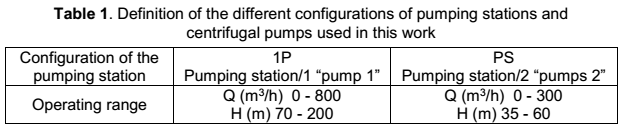
<p align="justify" class="Texto"><font style="font-family:'Verdana','sans-serif'; font-size:10.0pt; ">The  pumps used in this study are centrifugal pumps. To perform an independent  analysis of any commercial manufacturer of slurry pumps, and after a wide and  careful review of the technical literature, it was decided to designate the  pumps as &ldquo;pump1&rdquo; and &ldquo;pump 2&rdquo; and to rank them by their operating range. <a href="/img/revistas/im/v20n2/t0107217.gif">table  1</a> presents the information for the two different systems and pumps used in this  research.</font></p>     
<p align="justify" class="Texto"><font style="font-family:'Verdana','sans-serif'; font-size:10.0pt; ">Two  independent variables corresponding to slurry transportation systems were  defined: the pipe length L and the diameter D. The values selected for these  two variables agreed with the criteria used in the mining industry. The  selected values for pipe length range between 500 m (lower level) and 2.000 m  (higher level). For all cases, the horizontal pipe after the pumping station  and the inclined pipe have the same lengths. To keep the system length constant  during the simulation, possible adaptations to the length of the final  horizontal section length immediately prior to the discharge tank may be  applied. The pipe diameter ranges from 8 in (lower level) to 10 in (higher  level). A topological elevation of 40 m was kept constant for all cases.</font></p>     <p align="justify" class="Texto"><font style="font-family:'Verdana','sans-serif'; font-size:10.0pt; ">In  this study, the pumped media is a non-settling slurry. The slurry has the  characteristics of shear thinning and acting like a power law fluid [8]. The  main physical properties of iron ore slurry are a function of the volumetric  concentration, Cv (%), granulometry, D<sub>50</sub> (mm), and iron ore specific  gravity (1 unit), which were determined by applying the typical equations from  the literature [9]. In the present research, Cv and D<sub>50</sub> were  considered to range from minimums of 5 % and 100 mm, respectively, to  maximums of 10 % and 300 mm,  respectively.</font></p>     <p align="justify" class="Epigrafe"><font style="font-family:'Verdana','sans-serif'; font-size:10.0pt; "><b>Numerical  simulations</b></font></p>     <p align="justify" class="Texto"><font style="font-family:'Verdana','sans-serif'; font-size:10.0pt; ">A  demo version of AFT Fathom was used to perform the simulations. The simulations  were performed by using the Settling Slurry Modeling (SSL) module that allows,  among other capabilities, the modelling of the effects corresponding to pumping  fluids containing settling solids.</font></p>     <p align="justify" class="Texto"><font style="font-family:'Verdana','sans-serif'; font-size:10.0pt; ">Although  some centrifugal pump manufacturers design such a machine to be specifically  used for slurry pumping, their performance curves are defined for water because  of the inability to previously define specific operating conditions for  slurries. Hence, the first step in the simulation is to define the operating  conditions for each of the systems illustrated in <a href="/img/revistas/im/v20n2/f0107217.gif">figure 1</a> while considering  pure water as the pumped fluid. In these cases, the pumps performance curves  are defined in the operational range previously established in <a href="/img/revistas/im/v20n2/t0107217.gif">table 1</a>. By  combining the provided pump information with a simulation, it is possible to  obtain all of the operating parameters: volumetric flow rate, head rise, pump power  input and efficiency.</font></p>     
]]></body>
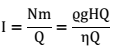
<body><![CDATA[<p align="justify" class="Texto"><font style="font-family:'Verdana','sans-serif'; font-size:10.0pt; ">The  head developed by a centrifugal pump that is handling slurry differs from the head  of a pump handling water depending upon the amount, size, shape and specific  gravity of solid particles in the slurry. The difference is estimated by the  Head Ratio (HR), which is a coefficient defined by the ratio between the head  performed by the pump when transporting slurry over the head observed when the  fluid is water in the same conditions. Similarly, it is also defined the  Efficiency Ratio (ER), which stands for the ratio between the efficiency  noticed when transporting slurry and the efficiency for water in the same  conditions. Both the HR and the ER can be determined by using Cave&rsquo;s Abacus  [9].</font></p>     <p align="justify" class="Texto"><font style="font-family:'Verdana','sans-serif'; font-size:10.0pt; ">The  energetic indicator I, the object of analysis in this study, is defined as  follows:  </font></p>     <p align="center" class="Texto"><font style="font-family:'Verdana','sans-serif'; font-size:10.0pt; "><a name="e1" id="e1"></a><img src="/img/revistas/im/v20n2/e0107217.gif" width="112" height="47" longdesc="/img/revistas/im/v20n2/e0107217.gif" />(1) </font></p>     
<p align="justify" class="Texto"><font style="font-family:'Verdana','sans-serif'; font-size:10.0pt; ">Where  Nm is the mechanical power of the pumps, Q is the volumetric flow rate, H is  the head, r is the density of the  slurry (as a function of Cv, D<sub>50</sub> and the specific gravity of the  solid), and h is the efficiency of the  pump.</font></p>     <p align="justify" class="Epigrafe"><font style="font-family:'Verdana','sans-serif'; font-size:10.0pt; "><b>Design  of experiments</b></font></p>     <p align="justify" class="Texto"><font style="font-family:'Verdana','sans-serif'; font-size:10.0pt; ">The  DOE is a statistical technique enables designers to simultaneously determine  the individual and the interacting effects of variables that could affect the  output in any process or system. An interaction can be defined as the combined  effect of two or more factors in a response [10].</font></p>     <p align="justify" class="Texto"><font style="font-family:'Verdana','sans-serif'; font-size:10.0pt; ">The  first steps in this experiment were to define the response, variables, the  variables' levels and the type of design to conduct the simulations. For this  research, the response is the energetic indicator I. The analysed variables  with regard to the piping system were the length L, the diameter D; and the  volumetric concentration Cv and the granulometry D<sub>50</sub>, relative to  the slurry&rsquo;s properties. The levels of these variables were previously defined  as well as their lower and higher levels.&nbsp; </font></p>     <p align="justify" class="Texto"><font style="font-family:'Verdana','sans-serif'; font-size:10.0pt; ">The  two-level full factorial (2<sup>k</sup>) is probably the most common and  intuitive strategy of experimental design. However, a potential concern when  using this type of design is the assumption of linearity of the effects of the  factors, which is sometimes compensated by the knowledge of previous studies.  Nevertheless, according to the best knowledge of the authors, no previous  research results relate to the application of DOE in the energetic assessment  or in the design of slurry transportation systems. Therefore, any linearity or  trend among the relationships between the factors that define this phenomenon  are unknown. For this reason, a Central Composite Design (CCD) technique was  used. To apply this technique, central values for each factor were defined: L =  1,000 m, D = 9 in., Cv=7,5 % and D<sub>50 </sub>= 200 m. A CCD with 4 factors  results in a plan comprised of 31 simulations in total.</font></p>     <p align="justify" class="Texto"><font style="font-family:'Verdana','sans-serif'; font-size:10.0pt; ">The statistical software Minitab, Windows release 17.0  standard version, was used to carry out the statistical analysis allowing the  determination of the main factors' effects, the factors' interaction effects,  the response surface and the response predictive models. </font></p>     <p align="justify" class="Subtitulo">&nbsp;</p>     ]]></body>
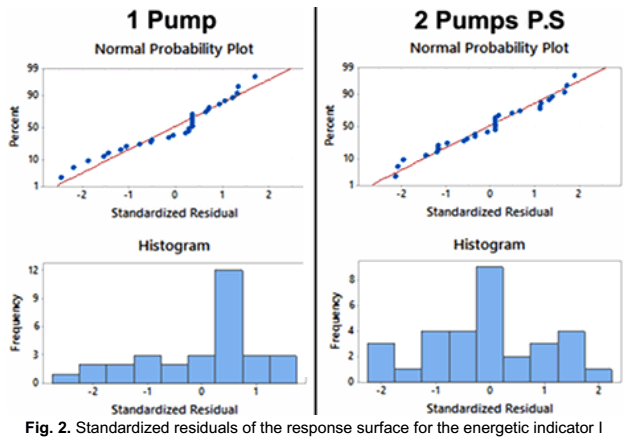
<body><![CDATA[<p align="justify" class="Subtitulo"><font style="font-family:'Verdana','sans-serif'; font-size:14.0pt; "><b>RESULTS AND DISCUSSION</b></font></p>     <p align="justify" class="Texto"><font style="font-family:'Verdana','sans-serif'; font-size:10.0pt; ">A  total of 31 simulations for each system configurations were carried out, and  the influence of each the four independent variables on the energetic indicator  I were analysed. The value of I obtained in the parametric study has been fit  to full quadratic response surface models, which include the main effects of  the independent variables, the interactions among them and the quadratic terms.</font></p>     <p align="justify" class="Texto"><font style="font-family:'Verdana','sans-serif'; font-size:10.0pt; "><a href="/img/revistas/im/v20n2/f0207217.gif">Figure  2</a> illustrates the normal probability plots and the histograms of the  standardized residuals corresponding to the models for I. From these graphs,  the accuracy of each model can be assessed. Firstly, it should be noted that  most of the residuals for both system configurations (1P and PS) are small and only  2 out, of 31 samples, have an absolute value quite larger than 2, which is the  value typically accepted to identify outliers. Secondly, the residuals of the two  outputs do not depart substantially from a straight line in the normal  probability plot, thus confirming that they are very-nearly normally  distributed. Finally, as shown in the histograms, the residuals are centred on  the zero value without any noticeable skewness. Hence, the quadratic response  surface models employed fit the data satisfactorily.</font></p>     
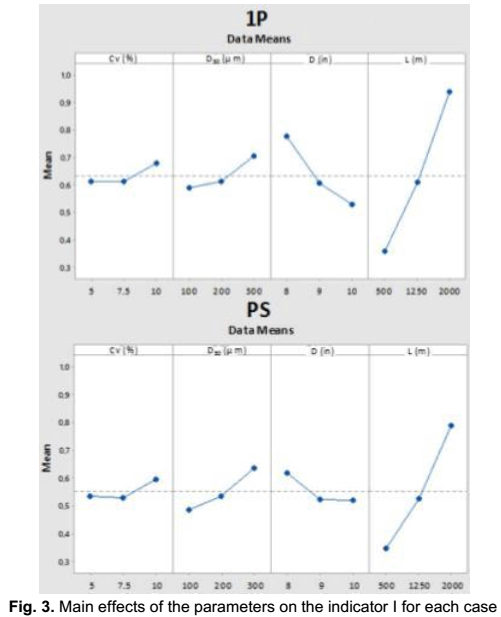
<p align="justify" class="Texto"><font style="font-family:'Verdana','sans-serif'; font-size:10.0pt; "><a href="/img/revistas/im/v20n2/f0307217.gif">Figure  3</a> depicts the main effects that the level changes of L, D, D<sub>50 </sub>and  Cv have on I for each of the slurry piping system configurations. Points in the  graphs correspond to the arithmetic mean of I, which was calculated for each  value of the factors through the 31 experiments, so that the average effect of  each variable is evidenced. As shown in <a href="/img/revistas/im/v20n2/f0307217.gif">figure 3</a>, the behaviour of the response  I, due to the variation of the factors from one level to another, has the same  trend regardless of the slurry piping system. Among the four variables, L has  the greatest amplitude of variation between the highest and the lowest level.  The minimum values of I are reached when L, Cv and D<sub>50</sub> are in their  lower levels and when D is in its higher level. </font></p>     
<p align="justify" class="Texto"><font style="font-family:'Verdana','sans-serif'; font-size:10.0pt; ">These results can be best explained from a fluid  mechanics point-of-view. The factor L has the greatest effect on the energy  consumption for any of the analysed systems. The increase of this factor, from  500 m to 2000 m, keeping other factors equal, promotes a significant increase  of approximately 60 % of the indicator I in all cases investigated. This  behaviour can be justified by the fact that, when the system length increases,  there is a significant increase in distributed head losses, and the pump must  thus provide a higher energy (per unit weight) to transport the slurry to the  tailings&rsquo; dam.</font></p>     <p align="justify" class="Texto"><font style="font-family:'Verdana','sans-serif'; font-size:10.0pt; ">The  change in pipe diameter from 8 in. to 10in. promotes an average reduction of 22,4  % of I in all simulations conducted, keeping all other factors constant. This  behaviour is due to the reduction of distributed head losses. It is well-known  that doubling the pipe diameter can reduce head losses by 27 times. It should  be noted that L and D have an inverse influence on head loss. Therefore, when D  is increased, the head loss diminishes, and the power consumption is  consequently lower.</font></p>     <p align="justify" class="Texto"><font style="font-family:'Verdana','sans-serif'; font-size:10.0pt; ">A  change from the lower level to the higher level of granulometry, that is, from  100mm to 300 mm, produces an average  increase of I of 24 %, keeping the remaining variables constant. By increasing  the granulometry, the size and the weight of the solid grains also increases.  To avoid the sedimentation of particles, a greater energy should be supplied to  increase the slurry flow velocity.</font></p>     <p align="justify" class="Texto"><font style="font-family:'Verdana','sans-serif'; font-size:10.0pt; ">The  volumetric concentration has the smallest effect on I when compared with other  factors, wherein an average increase of I of 9,2 % occurs when Cv varies from  its lower (5 %) to higher level (10 %). The influence of Cv on I can be  explained by the increase of the solid volume in the slurry.</font></p>     <p align="justify" class="Texto"><font style="font-family:'Verdana','sans-serif'; font-size:10.0pt; ">In  the present work, a thermodynamic indicator has been proposed. The novelty of  this approach it is to consider the energy consumption for transporting iron  ore waste in easy and quick way but without take into account any other effects.  By the importance of slurry transportation systems energetic characterization,  significant research efforts have been devoted towards establishing the  appropriate features to ensure the efficient transport of slurries. The slurry  system costs are related to efficiency in the energy conversion, wherein  &lsquo;efficiency&rsquo; has several possible interpretations. These interpretations can be  related, for example, to the availability of natural resources, to a better  understanding of the processes, or to any other novel approach proposed by  considering the importance of using relevant efficiency concepts in calculating  the energy cost of pumping liquids [11].</font></p>     <p align="justify" class="Texto"><font style="font-family:'Verdana','sans-serif'; font-size:10.0pt; ">Motivated  by a particularly constraining absence of water in Chile, in [12] it is  analysed energy efficiency in long-distance slurry transport by considering the  cost of water, in addition to energy cost. According to this criterion, when  water is considered in the costs of a transportation system, the optimal  concentration of the solids to be transported is an increasing function of the  throughput. Their results also show the significance of the system length and  diameter, despite the different approach used. This result improves early  findings, in which the weight of transported material relative to the use of  water was not correctly defined [13,14].</font></p>     ]]></body>
<body><![CDATA[<p align="justify" class="Texto"><font style="font-family:'Verdana','sans-serif'; font-size:10.0pt; ">Apart  from these main effects, the interactions among the factors were also  investigated by performing an analysis of variance (ANOVA) of the results. In  order to evaluate I considering the interactions among the factors, a  significance level was defined. The p-value of each second order interaction  was calculated, and those with a value smaller than 0,05 were considered  significant (i.e., a confidence interval of 95 %). According to this criterion,  it was determined that the only significant interactions on I are those between  D<sub>50</sub> and L, as well as between D and L, for both pumping systems  examined. The interaction between these two pairs of variables is shown in <a href="/img/revistas/im/v20n2/f0407217.gif">figure  4</a>. At the top of the figure, it is possible to observe the relationship among D<sub>50</sub>,  L and I for 1P and PS system configurations. The granulometry exerts almost no  influence when L is at its lower level, but its significance rises noticeably  as L goes toward to its higher levels. &nbsp;</font></p>     
<p align="justify" class="Texto"><font style="font-family:'Verdana','sans-serif'; font-size:10.0pt; ">At  the bottom of the figure, it is possible to observe the relationship among D, L  and I for the two system configurations. The value of I diminishes as D  increases and L decreases. The indicator I has a minimum value when D is  approximately 9 in. for a lower value of L. The curvature of the response  surface approximately for 9 in. for an L value of 500 m confirms this effect. Same  trend was obtained by [7], by using of a similar layout and positive  displacement pumps.</font></p>     <p align="justify" class="Texto"><font style="font-family:'Verdana','sans-serif'; font-size:10.0pt; ">The response surfaces, i.e., prediction models based  on the experiments, can be obtained from previous results. These regression models  can be used to predict the response I at any point in the space spanned by the  variables in the design. Two important  parameters should be assessed to validate the investigated models. The first is  the coefficient of determination, R<sup>2</sup><sub>adj</sub>, and the second  is the standard error of the regression, S. The value of R<sup>2</sup><sub>adj</sub> for all experiments is higher than 90 %, and S is approximately zero. Both  parameters meet appropriated values, testifying that the predictive models  obtained herein are acceptable models from statistics standpoint.</font></p>     <p align="justify" class="Texto"><font style="font-family:'Verdana','sans-serif'; font-size:10.0pt; ">From an analysis of the main effects of the  independent variables and of the interaction among some of these variables, as  previously discussed, the predicting models can be built. The resulting models  are expressed by equations 2-3 for configurations 1P and PS, respectively:</font></p>     <p align="center" style="text-align:center;text-autospace:none;"><font style="font-family:'Verdana','sans-serif'; font-size:10.0pt; "><a name="e2" id="e2"></a><img src="/img/revistas/im/v20n2/e0207217.gif" width="650" height="58" longdesc="/img/revistas/im/v20n2/e0207217.gif" />(2) </font></p>     
<p align="center" style="text-align:center;text-autospace:none;"><font style="font-family:'Verdana','sans-serif'; font-size:10.0pt; "><a name="e3" id="e3"></a><img src="/img/revistas/im/v20n2/e0307217.gif" width="640" height="71" longdesc="/img/revistas/im/v20n2/e0307217.gif" />(3)</font></p>     
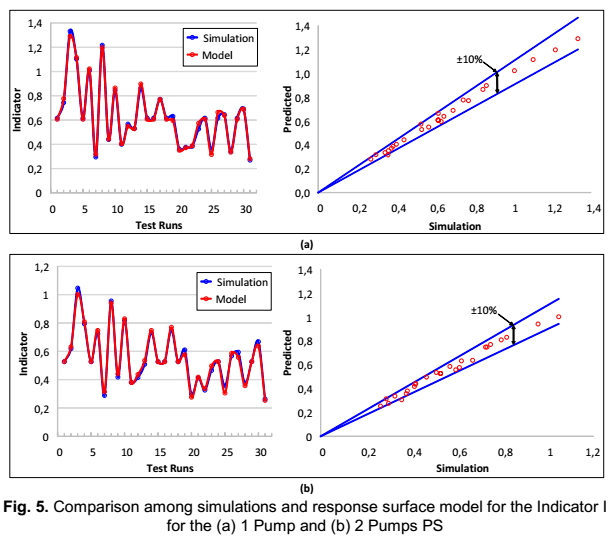
<p align="justify" style="text-align:justify;text-autospace:none;"><font style="font-family:'Verdana','sans-serif'; font-size:10.0pt; ">The R<sup>2</sup><sub>adj.</sub> and S values  for equations 2-3, respectively, are as follows: R<sup>2</sup><sub>adj.</sub>=0,988  and S=0,028 and R<sup>2</sup><sub>adj.</sub>=0,9815 and S=0,026.</font></p>     <p align="justify" style="text-align:justify;text-autospace:none;"><font style="font-family:'Verdana','sans-serif'; font-size:10.0pt; ">It is apparent that these models have two  components. The linear part, which is associated with the main effects, and the  non-linear term, which corresponds to the interactions between the parameters.</font></p>     <p align="justify" style="text-align:justify;text-autospace:none;"><font style="font-family:'Verdana','sans-serif'; font-size:10.0pt; "><a href="/img/revistas/im/v20n2/f0507217.gif">Figure 5</a> illustrates the comparison between  the simulation results and the results obtained via the reduced prediction  models. As can be observed in the right side of <a href="/img/revistas/im/v20n2/f0507217.gif">figure 5</a>, a difference of less  than 10 % is obtained in all cases, wherein the fitted values are compared with  those obtained in the simulations. These results indicate that a good agreement  exists between the models and simulations; therefore, an appropriate response  for I can be obtained by using the models.</font></p>     
<p align="justify" style="text-align:justify;"><font style="font-family:'Verdana','sans-serif'; font-size:10.0pt; ">From the obtained  models, and considering the main objective of the present study, the optimal  combination of independent variables required to minimize the indicator I was  determined under the assessed conditions.</font></p>     ]]></body>
<body><![CDATA[<p align="justify" style="text-align:justify;"><font style="font-family:'Verdana','sans-serif'; font-size:10.0pt; ">The Standard Interval Global Engine (SIGE)  method, as defined by [15], was applied to obtain the optimal combination.  <a href="/img/revistas/im/v20n2/t0207217.gif">Table 2</a> shows the optimal combinations of the independent variables for the  pumping systems analysed in the range of investigated values. From these  results, it is possible to observe that the optimal values for optimizing  (minimizing) I are as follows: Cv=5 % (lower level), D<sub>50</sub>= 100 mm (lower level), L = 500 m  (lower level) and D varying between 9,39 in and 9,17 in as a function of the  pumping system. As is well-known, this value of the diameter is not a normalized  value. Earlier statistical analysis established that 9 in. is the optimal  value, but from a practical point-of-view, it is not possible to meet this  condition. Therefore, a value of 10 in. was selected. This result is in  agreement with the physical foundation of the study phenomena, as previously  discussed.</font></p>     
<p align="justify" class="Texto"><font style="font-family:'Verdana','sans-serif'; font-size:10.0pt; ">It  is important to highlight that the desirability function is an indicator that  provides an estimate of the extent to which the solution suggested by SIGE  meets the requirements of the response I. The desirability function ranges from  0 to 1, where values close to 1 correspond to a good fit between the results  obtained via models and simulations [16, 17].</font></p>     <p align="justify" class="Texto"><font style="font-family:'Verdana','sans-serif'; font-size:10.0pt; ">Taking  the global results of the optimization into account, it is possible to observe  that the indicator I decreases by 11% when the layout with two pumps (PS) is  compared with that of only one pump (1P). It is worth noting that in the 1P  configuration, the pump has a higher operating range than the pumps used in the  PS layout and resulting in a direct economic impact on operating and  maintenance costs. However, the results obtained are unable to explicitly  demonstrate if the PS configuration meets the most effective combination of  factors for minimizing I. Choosing the best configuration will likely depend  upon other variables not directly associated with the factors studied here. In  this case, factors related to logistical conditions in real situations should  be analysed.</font></p>     <p align="justify" class="Texto"><font style="font-family:'Verdana','sans-serif'; font-size:10.0pt; ">An  interesting result of this research postulates that between the piping system  variables and slurry variables, those related to the piping system are the  significant ones. </font></p>     <p align="justify" class="Subtitulo">&nbsp;</p>     <p align="justify" class="Subtitulo"><font style="font-family:'Verdana','sans-serif'; font-size:14.0pt; "><b>CONCLUSIONES</b></font></p>     <p align="justify" class="Texto"><font style="font-family:'Verdana','sans-serif'; font-size:10.0pt; ">The  results of this work show that, regardless of the limited interval of values of  the studied variables, the results confirm that the new methodology presented  herein, which combines numerical simulation and the design of experiments, has  a huge potential to offer relevant information. This knowledge must offer to  field's professionals important tools decision, allowing the obtainment of an  appropriate combination of variables to minimize energy consumption in slurry  transportation systems.</font></p>     <p align="justify" class="Subtitulo">&nbsp;</p>     <p align="justify" class="Subtitulo"><font style="font-family:'Verdana','sans-serif'; font-size:14.0pt; "><b>ACKNOWLEDGEMENTS</b></font></p>     <p align="justify" class="Texto"><font style="font-family:'Verdana','sans-serif'; font-size:10.0pt; ">The  authors are grateful to the Facultad de Ingenier&iacute;a of the Pontificia  Universidad Cat&oacute;lica de Valpara&iacute;so-Valparaiso, Chile, for the financial support through the  INNOVA-Proyecto Ingenier&iacute;a 2030.</font></p>     ]]></body>
<body><![CDATA[<p align="justify" class="Subtitulo">&nbsp;</p>     <p align="justify" class="Subtitulo"><font style="font-family:'Verdana','sans-serif'; font-size:14.0pt; "><b>REFERENCIAS</b></font></p>     <!-- ref --><p align="justify" class="Bibliografia"><font style="font-family:'Verdana','sans-serif'; font-size:10.0pt; ">1. Schoenberger E. Environmentally sustainable mining:  The case of tailings storage facilities. Resources Policy. 2016;49:119-28.     </font></p>     <!-- ref --><p align="justify" class="Bibliografia"><font style="font-family:'Verdana','sans-serif'; font-size:10.0pt; ">2. Awuah-Offei K. Energy efficiency in mining: a  review with emphasis on the role of operators in loading and hauling operations.  Journal of Cleaner Production. 2016;117:89-97.    &nbsp; </font></p>     <!-- ref --><p align="justify" class="Bibliografia"><font style="font-family:'Verdana','sans-serif'; font-size:10.0pt; ">3. Kaushal D. CFD modeling for pipeline flow of fine  particles at high concentration. International Journal of Multiphase Flow.  2012;43:85-100.    &nbsp; </font></p>     <!-- ref --><p align="justify" class="Bibliografia"><font style="font-family:'Verdana','sans-serif'; font-size:10.0pt; ">4. Ihle C. A cost perspective for long distance ore  pipeline water and energy utilization. Part I: Optimal base values.  International Journal of Mineral Processing. 2013;122:1-12.    &nbsp; </font></p>     ]]></body>
<body><![CDATA[<!-- ref --><p align="justify" class="Bibliografia"><font style="font-family:'Verdana','sans-serif'; font-size:10.0pt; ">5. Levesque M, Millar D, Paraszczak J. Energy and  mining-the home truths Journal of Cleaner Production. 2014;84:233-55.    &nbsp; </font></p>     <!-- ref --><p align="justify" class="Bibliografia"><font style="font-family:'Verdana','sans-serif'; font-size:10.0pt; ">6. Tarodiya R, Gandhi B. Hydraulic performance and  erosive wear of centrifugal slurry pumps-A review. Powder Technology.  2017;305:27-38.    </font></p>     <p align="justify" class="Bibliografia"><font style="font-family:'Verdana','sans-serif'; font-size:10.0pt; ">7. Barcelos R,  Ara&uacute;jo E, Vilalta G. An&aacute;lise da influ&ecirc;ncia das propriedades do min&eacute;rio de ferro  no bombeamento de polpas de rejeitos minerais em sistemas com bombas  volum&eacute;tricas via simula&ccedil;&atilde;o e planejamento de experimentos. In: XV CONEMI &ndash; IX  SEEMI; Novo Hamburgo, RS: Universidade FEEVALE; 2015. [Citado diciembre de 2016] Disponible en: <a href="https://goo.gl/3XMOvy" target="_blank">https://goo.gl/3XMOvy</a> </font></p>     <!-- ref --><p align="justify" class="Bibliografia"><font style="font-family:'Verdana','sans-serif'; font-size:10.0pt; ">8. Wood D, Walters T. Operational problems in pumping  non-settling slurries resolved using an improved laminar flow pipe fitting loss  model. In: 28th International Pumps Users Symposium; Houston, USA: AFT; 2012. [Citado  diciembre de 2016] Disponible en: <a href="http://www.aft.com/learning-center/technical-papers/359-resolving-" target="_blank">http://www.aft.com/learning-center/technical-papers/359-resolving-</a>&nbsp;     </font></p>     <!-- ref --><p align="justify" class="Bibliografia"><font style="font-family:'Verdana','sans-serif'; font-size:10.0pt; ">9. Chaves A. Teoria  e Pr&aacute;tica do tratamento de min&eacute;rios. Rio de Janeiro, Brasil: Signus; 2009.     </font></p>     <!-- ref --><p align="justify" class="Bibliografia"><font style="font-family:'Verdana','sans-serif'; font-size:10.0pt; ">10. Pedrera J, Ortiz J, Vilalta  J. Significant variables in initial dilution process in submarine outfalls  systems. Alternatives comparison. In: International Symposium of Outfall  System; Otawa, Canada: Otawa University; 2016. [Citado diciembre de 2016]  Disponible en: <a href="https://www.researchgate.net/publication/315481088_Significant_variables_in_initial_dilution_process_in_submarine_outfalls_systems_Alternatives_comparison" target="_blank">https://www.researchgate.net/publication/315481088_Significant_variables_in_initial_dilution_process_in_submarine_outfalls_systems_Alternatives_comparison</a></font><!-- ref --><p align="justify" class="Bibliografia"><font style="font-family:'Verdana','sans-serif'; font-size:10.0pt; ">11. Ihle C, Tamburrino A,  Montserrat S. Identifying the relative importance of energy and water costs in  hydraulic transport systems through a combined physics- and cost-based  indicator. Journal of Cleaner Production. 2014;84:589-96.    &nbsp; </font></p>     <!-- ref --><p align="justify" class="Bibliografia"><font style="font-family:'Verdana','sans-serif'; font-size:10.0pt; ">12. Ihle C. The least energy  and water cost condition for turbulent, homogeneous pipeline slurry transport.  International Journal of Mineral Processing. 2016;148:59-64.    &nbsp; </font></p>     <!-- ref --><p align="justify" class="Bibliografia"><font style="font-family:'Verdana','sans-serif'; font-size:10.0pt; ">13. Wu J, Graham L, Wang S, et  al. Energy efficient slurry holding and transport. Minerals Engineering.  2010;23:705-12.    &nbsp; </font></p>     <!-- ref --><p align="justify" class="Bibliografia"><font style="font-family:'Verdana','sans-serif'; font-size:10.0pt; ">14. Edelin D, Czujko P,  Castelain C, et al. Experimental determination of the energy optimum for the  transport of floating particles in pipes. Exp Thermal Fluid Sci.  2015;68:634-43.    &nbsp; </font></p>     <!-- ref --><p align="justify" class="Bibliografia"><font style="font-family:'Verdana','sans-serif'; font-size:10.0pt; ">15. Hansel E, Walster G. Global  Optimization using Interval Analysis. New York, USA: Marcel Dekker; 2004.    </font></p>     ]]></body>
<body><![CDATA[<!-- ref --><p align="justify" class="Bibliografia"><font style="font-family:'Verdana','sans-serif'; font-size:10.0pt; ">16. Myers R, Montgomery D.  Response Surface Methodology. New York, USA: Wiley Interscience; 2002.    </font></p>     <!-- ref --><p align="justify" class="Bibliografia"><font style="font-family:'Verdana','sans-serif'; font-size:10.0pt; ">17. Murphy T, Tsui K, Allen J.  A review of Robust design for multiple responses. Research in Engineering  Design. 2005;15(4):201-15.    </font></p>     <p align="justify" class="Fechas">&nbsp;</p>     <p align="justify" class="Fechas">&nbsp;</p>     <p align="justify" class="Fechas"><font style="font-family:'Verdana','sans-serif'; font-size:10.0pt; ">Recibido:  17/2/2017</font></p>     <p align="justify" class="Fechas"><font style="font-family:'Verdana','sans-serif'; font-size:10.0pt; ">Aceptado:  15/4/2017</font></p>     <p align="justify" class="Autor">&nbsp;</p>     <p align="justify" class="Autor">&nbsp;</p>     ]]></body>
<body><![CDATA[<p align="justify" class="Autor"><font style="font-family:'Verdana','sans-serif'; font-size:10.0pt; "><i>Guillermo Vilalta</i>, Federal University of S&atilde;o Jo&atilde;o del-Rei, Thermal  Sciences and Fluids Department. Minas Gerais. Brasil. Correo  electr&oacute;nico: <a href="mailto:gvilalta@ufsj.edu.br">gvilalta@ufsj.edu.br</a></font></p>      ]]></body><back>
<ref-list>
<ref id="B1">
<label>1</label><nlm-citation citation-type="journal">
<person-group person-group-type="author">
<name>
<surname><![CDATA[Schoenberger]]></surname>
<given-names><![CDATA[E]]></given-names>
</name>
</person-group>
<article-title xml:lang="en"><![CDATA[Environmentally sustainable mining: The case of tailings storage facilities]]></article-title>
<source><![CDATA[Resources Policy]]></source>
<year>2016</year>
<volume>49</volume>
<page-range>119-28</page-range></nlm-citation>
</ref>
<ref id="B2">
<label>2</label><nlm-citation citation-type="journal">
<person-group person-group-type="author">
<name>
<surname><![CDATA[Awuah-Offei]]></surname>
<given-names><![CDATA[K]]></given-names>
</name>
</person-group>
<article-title xml:lang="en"><![CDATA[Energy efficiency in mining: a review with emphasis on the role of operators in loading and hauling operations]]></article-title>
<source><![CDATA[Journal of Cleaner Production]]></source>
<year>2016</year>
<volume>117</volume>
<page-range>89-97</page-range></nlm-citation>
</ref>
<ref id="B3">
<label>3</label><nlm-citation citation-type="journal">
<person-group person-group-type="author">
<name>
<surname><![CDATA[Kaushal]]></surname>
<given-names><![CDATA[D]]></given-names>
</name>
</person-group>
<article-title xml:lang="en"><![CDATA[CFD modeling for pipeline flow of fine particles at high concentration]]></article-title>
<source><![CDATA[International Journal of Multiphase Flow]]></source>
<year>2012</year>
<volume>43</volume>
<page-range>85-100</page-range></nlm-citation>
</ref>
<ref id="B4">
<label>4</label><nlm-citation citation-type="journal">
<person-group person-group-type="author">
<name>
<surname><![CDATA[Ihle]]></surname>
<given-names><![CDATA[C]]></given-names>
</name>
</person-group>
<article-title xml:lang="en"><![CDATA[A cost perspective for long distance ore pipeline water and energy utilization: Part I: Optimal base values]]></article-title>
<source><![CDATA[International Journal of Mineral Processing]]></source>
<year>2013</year>
<volume>122</volume>
<page-range>1-12</page-range></nlm-citation>
</ref>
<ref id="B5">
<label>5</label><nlm-citation citation-type="journal">
<person-group person-group-type="author">
<name>
<surname><![CDATA[Levesque]]></surname>
<given-names><![CDATA[M]]></given-names>
</name>
<name>
<surname><![CDATA[Millar]]></surname>
<given-names><![CDATA[D]]></given-names>
</name>
<name>
<surname><![CDATA[Paraszczak]]></surname>
<given-names><![CDATA[J]]></given-names>
</name>
</person-group>
<article-title xml:lang="en"><![CDATA[Energy and mining-the home truths]]></article-title>
<source><![CDATA[Journal of Cleaner Production]]></source>
<year>2014</year>
<volume>84</volume>
<page-range>233-55</page-range></nlm-citation>
</ref>
<ref id="B6">
<label>6</label><nlm-citation citation-type="journal">
<person-group person-group-type="author">
<name>
<surname><![CDATA[Tarodiya]]></surname>
<given-names><![CDATA[R]]></given-names>
</name>
<name>
<surname><![CDATA[Gandhi]]></surname>
<given-names><![CDATA[B]]></given-names>
</name>
</person-group>
<article-title xml:lang="en"><![CDATA[Hydraulic performance and erosive wear of centrifugal slurry pumps-A review]]></article-title>
<source><![CDATA[Powder Technology]]></source>
<year>2017</year>
<volume>305</volume>
<page-range>27-38</page-range></nlm-citation>
</ref>
<ref id="B7">
<label>7</label><nlm-citation citation-type="confpro">
<person-group person-group-type="author">
<name>
<surname><![CDATA[Barcelos]]></surname>
<given-names><![CDATA[R]]></given-names>
</name>
<name>
<surname><![CDATA[Araújo]]></surname>
<given-names><![CDATA[E]]></given-names>
</name>
<name>
<surname><![CDATA[Vilalta]]></surname>
<given-names><![CDATA[G]]></given-names>
</name>
</person-group>
<article-title xml:lang="es"><![CDATA[Análise da influência das propriedades do minério de ferro no bombeamento de polpas de rejeitos minerais em sistemas com bombas volumétricas via simulação e planejamento de experimentos]]></article-title>
<source><![CDATA[]]></source>
<year>2015</year>
<conf-name><![CDATA[XV CONEMI - IX SEEMI]]></conf-name>
<conf-loc>Novo Hamburgo Novo Hamburgo</conf-loc>
</nlm-citation>
</ref>
<ref id="B8">
<label>8</label><nlm-citation citation-type="confpro">
<person-group person-group-type="author">
<name>
<surname><![CDATA[Wood]]></surname>
<given-names><![CDATA[D]]></given-names>
</name>
<name>
<surname><![CDATA[Walters]]></surname>
<given-names><![CDATA[T]]></given-names>
</name>
</person-group>
<article-title xml:lang="en"><![CDATA[Operational problems in pumping non-settling slurries resolved using an improved laminar flow pipe fitting loss model]]></article-title>
<source><![CDATA[]]></source>
<year>2012</year>
<conf-name><![CDATA[28 International Pumps Users Symposium]]></conf-name>
<conf-loc>Houston Houston</conf-loc>
</nlm-citation>
</ref>
<ref id="B9">
<label>9</label><nlm-citation citation-type="book">
<person-group person-group-type="author">
<name>
<surname><![CDATA[Chaves]]></surname>
<given-names><![CDATA[A]]></given-names>
</name>
</person-group>
<source><![CDATA[Teoria e Prática do tratamento de minérios]]></source>
<year>2009</year>
<publisher-loc><![CDATA[^eRio de Janeiro Rio de Janeiro]]></publisher-loc>
<publisher-name><![CDATA[Signus]]></publisher-name>
</nlm-citation>
</ref>
<ref id="B10">
<label>10</label><nlm-citation citation-type="confpro">
<person-group person-group-type="author">
<name>
<surname><![CDATA[Pedrera]]></surname>
<given-names><![CDATA[J]]></given-names>
</name>
<name>
<surname><![CDATA[Ortiz]]></surname>
<given-names><![CDATA[J]]></given-names>
</name>
<name>
<surname><![CDATA[Vilalta]]></surname>
<given-names><![CDATA[J]]></given-names>
</name>
</person-group>
<article-title xml:lang="en"><![CDATA[Significant variables in initial dilution process in submarine outfalls systems. Alternatives comparison]]></article-title>
<source><![CDATA[]]></source>
<year>2016</year>
<conf-name><![CDATA[ International Symposium of Outfall System]]></conf-name>
<conf-loc>Otawa Otawa</conf-loc>
</nlm-citation>
</ref>
<ref id="B11">
<label>11</label><nlm-citation citation-type="journal">
<person-group person-group-type="author">
<name>
<surname><![CDATA[Ihle]]></surname>
<given-names><![CDATA[C]]></given-names>
</name>
<name>
<surname><![CDATA[Tamburrino]]></surname>
<given-names><![CDATA[A]]></given-names>
</name>
<name>
<surname><![CDATA[Montserrat]]></surname>
<given-names><![CDATA[S]]></given-names>
</name>
</person-group>
<article-title xml:lang="en"><![CDATA[Identifying the relative importance of energy and water costs in hydraulic transport systems through a combined physics- and cost-based indicator]]></article-title>
<source><![CDATA[Journal of Cleaner Production]]></source>
<year>2014</year>
<volume>84</volume>
<page-range>589-96</page-range></nlm-citation>
</ref>
<ref id="B12">
<label>12</label><nlm-citation citation-type="journal">
<person-group person-group-type="author">
<name>
<surname><![CDATA[Ihle]]></surname>
<given-names><![CDATA[C]]></given-names>
</name>
</person-group>
<article-title xml:lang="en"><![CDATA[The least energy and water cost condition for turbulent, homogeneous pipeline slurry transport]]></article-title>
<source><![CDATA[International Journal of Mineral Processing]]></source>
<year>2016</year>
<volume>148</volume>
<page-range>59-64</page-range></nlm-citation>
</ref>
<ref id="B13">
<label>13</label><nlm-citation citation-type="journal">
<person-group person-group-type="author">
<name>
<surname><![CDATA[Wu]]></surname>
<given-names><![CDATA[J]]></given-names>
</name>
<name>
<surname><![CDATA[Graham]]></surname>
<given-names><![CDATA[L]]></given-names>
</name>
<name>
<surname><![CDATA[Wang]]></surname>
<given-names><![CDATA[S]]></given-names>
</name>
</person-group>
<article-title xml:lang="en"><![CDATA[Energy efficient slurry holding and transport]]></article-title>
<source><![CDATA[Minerals Engineering]]></source>
<year>2010</year>
<volume>23</volume>
<page-range>705-12</page-range></nlm-citation>
</ref>
<ref id="B14">
<label>14</label><nlm-citation citation-type="journal">
<person-group person-group-type="author">
<name>
<surname><![CDATA[Edelin]]></surname>
<given-names><![CDATA[D]]></given-names>
</name>
<name>
<surname><![CDATA[Czujko]]></surname>
<given-names><![CDATA[P]]></given-names>
</name>
<name>
<surname><![CDATA[Castelain]]></surname>
<given-names><![CDATA[C]]></given-names>
</name>
</person-group>
<article-title xml:lang="en"><![CDATA[Experimental determination of the energy optimum for the transport of floating particles in pipes]]></article-title>
<source><![CDATA[Exp Thermal Fluid Sci]]></source>
<year>2015</year>
<volume>68</volume>
<page-range>634-43</page-range></nlm-citation>
</ref>
<ref id="B15">
<label>15</label><nlm-citation citation-type="book">
<person-group person-group-type="author">
<name>
<surname><![CDATA[Hansel]]></surname>
<given-names><![CDATA[E]]></given-names>
</name>
<name>
<surname><![CDATA[Walster]]></surname>
<given-names><![CDATA[G]]></given-names>
</name>
</person-group>
<source><![CDATA[Global Optimization using Interval Analysis]]></source>
<year>2004</year>
<publisher-loc><![CDATA[^eNew York New York]]></publisher-loc>
<publisher-name><![CDATA[Marcel Dekker]]></publisher-name>
</nlm-citation>
</ref>
<ref id="B16">
<label>16</label><nlm-citation citation-type="book">
<person-group person-group-type="author">
<name>
<surname><![CDATA[Myers]]></surname>
<given-names><![CDATA[R]]></given-names>
</name>
<name>
<surname><![CDATA[Montgomery]]></surname>
<given-names><![CDATA[D]]></given-names>
</name>
</person-group>
<source><![CDATA[Response Surface Methodology]]></source>
<year>2002</year>
<publisher-loc><![CDATA[New York ]]></publisher-loc>
<publisher-name><![CDATA[Wiley Interscience]]></publisher-name>
</nlm-citation>
</ref>
<ref id="B17">
<label>17</label><nlm-citation citation-type="journal">
<person-group person-group-type="author">
<name>
<surname><![CDATA[Murphy]]></surname>
<given-names><![CDATA[T]]></given-names>
</name>
<name>
<surname><![CDATA[Tsui]]></surname>
<given-names><![CDATA[K]]></given-names>
</name>
<name>
<surname><![CDATA[Allen]]></surname>
<given-names><![CDATA[J]]></given-names>
</name>
</person-group>
<article-title xml:lang="en"><![CDATA[A review of Robust design for multiple responses]]></article-title>
<source><![CDATA[Research in Engineering Design]]></source>
<year>2005</year>
<volume>15</volume>
<numero>4</numero>
<issue>4</issue>
<page-range>201-15</page-range></nlm-citation>
</ref>
</ref-list>
</back>
</article>