<?xml version="1.0" encoding="ISO-8859-1"?><article xmlns:mml="http://www.w3.org/1998/Math/MathML" xmlns:xlink="http://www.w3.org/1999/xlink" xmlns:xsi="http://www.w3.org/2001/XMLSchema-instance">
<front>
<journal-meta>
<journal-id>1815-5944</journal-id>
<journal-title><![CDATA[Ingeniería Mecánica]]></journal-title>
<abbrev-journal-title><![CDATA[Ingeniería Mecánica]]></abbrev-journal-title>
<issn>1815-5944</issn>
<publisher>
<publisher-name><![CDATA[Facultad de Ingeniería Mecánica. Instituto Superior Politécnico "José Antonio Echeverría"]]></publisher-name>
</publisher>
</journal-meta>
<article-meta>
<article-id>S1815-59442017000300007</article-id>
<title-group>
<article-title xml:lang="en"><![CDATA[Management audit applied to the maintenance department in hospital facilities]]></article-title>
<article-title xml:lang="es"><![CDATA[Auditoría de gestión aplicada al departamento de mantenimiento en instalaciones hospitalarias]]></article-title>
</title-group>
<contrib-group>
<contrib contrib-type="author">
<name>
<surname><![CDATA[Herrera-Galán]]></surname>
<given-names><![CDATA[Michael]]></given-names>
</name>
<xref ref-type="aff" rid="A01"/>
</contrib>
<contrib contrib-type="author">
<name>
<surname><![CDATA[Martínez-Delgado]]></surname>
<given-names><![CDATA[Edith]]></given-names>
</name>
<xref ref-type="aff" rid="A02"/>
</contrib>
</contrib-group>
<aff id="A01">
<institution><![CDATA[,Universidad Tecnológica de la Habana Facultad de Ingeniería Automática y Biomédica ]]></institution>
<addr-line><![CDATA[ La Habana]]></addr-line>
<country>Cuba</country>
</aff>
<aff id="A02">
<institution><![CDATA[,Universidad Tecnológica de la Habana Facultad de Ingeniería Industrial ]]></institution>
<addr-line><![CDATA[ La Habana]]></addr-line>
<country>Cuba</country>
</aff>
<pub-date pub-type="pub">
<day>00</day>
<month>12</month>
<year>2017</year>
</pub-date>
<pub-date pub-type="epub">
<day>00</day>
<month>12</month>
<year>2017</year>
</pub-date>
<volume>20</volume>
<numero>3</numero>
<fpage>152</fpage>
<lpage>159</lpage>
<copyright-statement/>
<copyright-year/>
<self-uri xlink:href="http://scielo.sld.cu/scielo.php?script=sci_arttext&amp;pid=S1815-59442017000300007&amp;lng=en&amp;nrm=iso"></self-uri><self-uri xlink:href="http://scielo.sld.cu/scielo.php?script=sci_abstract&amp;pid=S1815-59442017000300007&amp;lng=en&amp;nrm=iso"></self-uri><self-uri xlink:href="http://scielo.sld.cu/scielo.php?script=sci_pdf&amp;pid=S1815-59442017000300007&amp;lng=en&amp;nrm=iso"></self-uri><abstract abstract-type="short" xml:lang="en"><p><![CDATA[This work is related with the operations control in the maintenance department of hospital center, through management audits and their implementation. The study was carried out in five hospitals, with the aim of evaluate the performance of the maintenance function; as well as to demonstrate that the most critical component in the results of a management audit is the human resource. For development of the work, a survey was applied at managers and workers of the center, as a technique for data collection. In addition, monitoring tools such as Ishikawa diagram and Brainstorming were used. The study showed, among others, that technological problems, such as the availability of assets, are usually associated with a shortage of resources; however, its root cause is a mismanagement by the staff in charge of this activity in the maintenance departments. The application of the proposed method evidenced that the most critical component in the results of a management audit is the human resource.]]></p></abstract>
<abstract abstract-type="short" xml:lang="es"><p><![CDATA[El presente trabajo está dirigido al control de operaciones en el departamento de mantenimiento de entidades hospitalarias, a través de auditorías de gestión y su puesta en práctica. El estudio se realizó en 5 instituciones hospitalarias, con el objetivo de evaluar el desempeño de la función mantenimiento; así como demostrar que el componente más crítico en los resultados de una auditoría de gestión es el recurso humano. Para el desarrollo del trabajo se aplicaron encuestas a directivos y trabajadores del centro como técnica recolección de datos y se emplearon herramientas de control como el diagrama de Ishikawa y tormentas de Ideas. El estudio demostró, entre otras, que los problemas tecnológicos, como es el caso de la disponibilidad de los activos, generalmente se asocian a la escasez de recursos, sin embargo, su causa raíz es una mala gestión por parte del personal encargado de esta actividad en los departamentos de mantenimiento. La aplicación del método propuesto evidencio que el componente más crítico en los resultados de una auditoria gestión es el recurso humano.]]></p></abstract>
<kwd-group>
<kwd lng="en"><![CDATA[audits]]></kwd>
<kwd lng="en"><![CDATA[hospital maintenance]]></kwd>
<kwd lng="en"><![CDATA[management]]></kwd>
<kwd lng="es"><![CDATA[auditoría]]></kwd>
<kwd lng="es"><![CDATA[mantenimiento hospitalario]]></kwd>
<kwd lng="es"><![CDATA[gestión]]></kwd>
</kwd-group>
</article-meta>
</front><body><![CDATA[ <p align="right" style="text-align:right;"><font style="font-family:'Verdana','sans-serif'; font-size:10.0pt; "><b>Original Article</b></font></p>     <p align="justify" class="Titulo">&nbsp;</p>     <p align="justify" class="Titulo"><font style="font-family:'Verdana','sans-serif'; font-size:16.0pt; "><b>Management audit  applied to the maintenance department in hospital facilities  </b></font></p>     <p align="justify" class="TituloIngles">&nbsp;</p>     <p align="justify" class="TituloIngles"><b><font style="font-family:'Verdana','sans-serif'; font-size:14.0pt; ">Auditor&iacute;a de gesti&oacute;n aplicada al departamento de mantenimiento en  instalaciones hospitalarias</font></b></p>     <p align="justify" class="Autor">&nbsp;</p>     <p align="justify" class="Autor">&nbsp;</p>     <p align="justify" class="Autor"><b><font style="font-family:'Verdana','sans-serif'; font-size:10.0pt; ">Michael  Herrera-Gal&aacute;n<sup>I</sup>, Edith Mart&iacute;nez-Delgado<sup>II</sup></font></b></p>     <p align="justify" class="Filiacion"><font style="font-family:'Verdana','sans-serif'; font-size:10.0pt; "><sup>I</sup>Universidad Tecnol&oacute;gica de la Habana, Facultad  de Ingenier&iacute;a Autom&aacute;tica y Biom&eacute;dica. La Habana, Cuba</font></p>     <p align="justify" class="Filiacion"><font style="font-family:'Verdana','sans-serif'; font-size:10.0pt; "><sup>II</sup>Universidad Tecnol&oacute;gica de la Habana,  Facultad de Ingenier&iacute;a Industrial. La Habana, Cuba</font></p>     ]]></body>
<body><![CDATA[<p align="justify" class="TituloResumen">&nbsp;</p>     <p align="justify" class="TituloResumen">&nbsp;</p> <hr />     <p align="justify" class="TituloResumen"><font style="font-family:'Verdana','sans-serif'; font-size:10.0pt; "><b>ABSTRACT</b></font></p>     <p align="justify" class="Resumen"><font style="font-family:'Verdana','sans-serif'; font-size:10.0pt; ">This work is related with the operations control in  the maintenance department of hospital center, through management audits and  their implementation. The study was carried out in five hospitals, with the aim  of evaluate the performance of the maintenance function; as well as to  demonstrate that the most critical component in the results of a management  audit is the human resource. For development of the work, a survey was applied  at managers and workers of the center, as a technique for data collection. In  addition, monitoring tools such as Ishikawa diagram and Brainstorming were  used. The study showed, among others, that technological problems, such as the  availability of assets, are usually associated with a shortage of resources;  however, its root cause is a mismanagement by the staff in charge of this  activity in the maintenance departments. The application of the proposed method  evidenced that the most critical component in the results of a management audit  is the human resource.</font></p>     <p align="justify" class="PalabrasClaves"><font style="font-family:'Verdana','sans-serif'; font-size:10.0pt; "><b>Key  words</b>:<b> </b>audits, hospital  maintenance, management.<b> </b></font></p> <hr />     <p align="justify" class="TituloResumen"><font style="font-family:'Verdana','sans-serif'; font-size:10.0pt; "><b>RESUMEN</b></font></p>     <p align="justify" class="Resumen"><font style="font-family:'Verdana','sans-serif'; font-size:10.0pt; ">El  presente trabajo est&aacute; dirigido al control de operaciones en el departamento de  mantenimiento de entidades hospitalarias, a trav&eacute;s de auditor&iacute;as de gesti&oacute;n y  su puesta en pr&aacute;ctica. El estudio se realiz&oacute; en 5 instituciones hospitalarias,  con el objetivo de evaluar el desempe&ntilde;o de la funci&oacute;n mantenimiento; as&iacute; como  demostrar que el componente m&aacute;s cr&iacute;tico en los resultados de una auditor&iacute;a de gesti&oacute;n  es el recurso humano. Para el desarrollo del trabajo se aplicaron encuestas a  directivos y trabajadores del centro como t&eacute;cnica recolecci&oacute;n de datos y se  emplearon herramientas de control como el diagrama de Ishikawa y tormentas de  Ideas. El estudio demostr&oacute;, entre otras, que los problemas tecnol&oacute;gicos, como  es el caso de la disponibilidad de los activos, generalmente se asocian a la  escasez de recursos, sin embargo, su causa ra&iacute;z es una mala gesti&oacute;n por parte  del personal encargado de esta actividad en los departamentos de mantenimiento.  La aplicaci&oacute;n del m&eacute;todo propuesto evidencio que el componente m&aacute;s cr&iacute;tico en  los resultados de una auditoria gesti&oacute;n es el recurso humano. </font></p>     <p align="justify" class="Tituloclaves"><font style="font-family:'Verdana','sans-serif'; font-size:10.0pt; "><b>Palabras  claves:</b> auditor&iacute;a,  mantenimiento hospitalario, gesti&oacute;n.</font></p> <hr />     <p align="justify" class="Subtitulo">&nbsp;</p>     <p align="justify" class="Subtitulo">&nbsp;</p>     ]]></body>
<body><![CDATA[<p align="justify" class="Subtitulo"><font style="font-family:'Verdana','sans-serif'; font-size:14.0pt; "><b>INTRODUCTION</b></font></p>     <p align="justify" class="Texto"><font style="font-family:'Verdana','sans-serif'; font-size:10.0pt; ">The audit, in a broad sense, has been carried out for  several centuries, starting with the development of national statistics on  births and deaths in the Domesday Book from 1066, the Paris Records from 1597,  the Population law from 1840 and the first national census of England in 1801. </font></p>     <p align="justify" class="Texto"><font style="font-family:'Verdana','sans-serif'; font-size:10.0pt; ">In 1918, the American College of Surgeons defines the  principles of hospital organizational structure and the minimum criteria for  accreditation audit, giving rise to the era of inspection in the medical  sector. Since then, the term Medical Audit has been long used with different  meanings depending on the context where it is applied[1]. It is  defined as the systematic critical analysis of the quality of medical care,  including diagnostic and therapeutic procedures, use of resources and the  results of them with an impact on the clinical outcomes and quality of life of  patients [2]. Subsequent  publications define it as a process to improve the quality of patient care and  its impact through systematic reviews considering explicit criteria and the  implementation of change and accompanied of feedback processes by providers [3, 4]. </font></p>     <p align="justify" class="Texto"><font style="font-family:'Verdana','sans-serif'; font-size:10.0pt; ">However, these definitions do not include two  important components in the audit process. First, the need to prepare the  participants in the audit with the aim to promote and carry out the necessary  changes in the professional behavior; and second, the requirement to  demonstrate improvements in the quality and / or cost-effectiveness relation of  care provided as a result in an audit participation. The origin of the management  audit dates back to the early 30&rsquo;s and 40&rsquo;s in the United States due to the  growth of the federal government, with the aim of determining how federal  agencies spend and control properly, in order to determine that the federal  government agencies will spend and will control their assignments properly and  comply with the respective laws. From this date, many definitions for these  types of audit are given. A management audit is the bridge, and sometimes the  catalyst between a traditional financial auditing and a method of  administrative services to solve one or more problems.</font></p>     <p align="justify" class="Texto"><font style="font-family:'Verdana','sans-serif'; font-size:10.0pt; ">Applied to the hospital sector the management audits  take place in the departments of technical assistance, responsible for  maintaining the availability of their assets at appropriate levels and thus  ensure the quality of medical care and the cost-effectiveness of care provided.</font></p>     <p align="justify" class="Texto"><font style="font-family:'Verdana','sans-serif'; font-size:10.0pt; ">To perform a maintenance audit is as simple as  checking how the maintenance management process is performed in a hospital. The  aim pursued with auditing is not to judge the persons responsible or question  their way of working; is to identify those points susceptible to optimization  and propose organizational and management changes to achieve an improvement of  the system. This instrument provides an overview of the structure,  relationships, procedures and personnel, associated with good maintenance  practice; this is the first step in deciding and implementing improvements in  maintenance management and compliance with the accreditation standards.  Finally, are based on the collection of documentary evidence to demonstrate the  proper performance of a company, department or area in particular taking into  account their operational context.</font></p>     <p align="justify" class="Texto"><font style="font-family:'Verdana','sans-serif'; font-size:10.0pt; ">Recent research has reported many benefits in the  performing of management audit as a control of maintenance activities [5, 6]. </font></p>     <p align="justify" class="Texto"><font style="font-family:'Verdana','sans-serif'; font-size:10.0pt; ">Acosta y Troncoso [7], in thier  study titled, Maintenance assessment in hospital, have detected technological  discipline problems in the maintenance area, mainly caused by the lack of  control and exigency for many years, which indicates that things are being done  correctly at an average level of 26.57 % in the four facilities studied.  Garc&iacute;a, Cuadros and L&oacute;pez [8], applying  the technique of auditing as a management tool in primary care to improve the  energy efficiency and environmental impact of a health facility, demonstrating  that with an average investment of &euro; 11,601 per health facility is possible to  reduce energy consumption in 10,801 kW / h, saving up &euro; 2,961 per year in an  average payback period of 3.92 years and avoiding the emission of 7010 kg of CO2.  On this subject Jacobs and Visser [9], have  developed a collection of conference in the seventh edition AFRICON whose aim  was evaluating the management of maintenance department at Eskom electricity,  by highlighting the suitability of its management; however, they highlighted  some areas that require attention, for the purpose of optimizing the maintenance  function.</font></p>     <p align="justify" class="Texto"><font style="font-family:'Verdana','sans-serif'; font-size:10.0pt; ">Moreover, the authors Maisarah y Mohamad [10], in a case  study performed at a hospital in Malaysia to evaluate five key elements such  as, political leadership, plans and procedures, training and guidance,  monitoring and supervision, and service performance; used the management audit  tool. Additionally, authors like Carnero, Bana and Duarte, promote the use of  audits in the health sector through models to assess the tasks of a maintenance  department [11-13] .</font></p>     <p align="justify" class="Texto"><font style="font-family:'Verdana','sans-serif'; font-size:10.0pt; ">Summing up, the management audit is a tool with ample  benefits to prove the level of excellence of a maintenance department. The  starting point is the change of mentality that should assumed the company  executives to assimilate the results of this tool, before the new paradigm on  maintenance management [14, 15] . </font></p>     ]]></body>
<body><![CDATA[<p align="justify" class="Texto"><font style="font-family:'Verdana','sans-serif'; font-size:10.0pt; ">The main objective of the research is to evaluate  the performance of the maintenance function in hospital facilities; as well as demonstrate  that the most critical component in the results of a management audit is the  human resource. During the last decade, many research on this subject has been  registered, it can be highlighted that many of them are focused on identifying  and prioritizing maintenance processes; ending with a final report. Reviewing  the results of the investigations previously consulted, it can be concluded  that the human resource is the fundamental cause of most of the problems  detected in an audit. This research starts from the same principle,  identification and prioritization of the maintenance processes, but this time  making emphasis on human resources, proposing a method for the adequate  selection of the minimum personnel necessary to develop optimally the maintenance  function in hospital facilities. </font></p>     <p align="justify" class="Subtitulo">&nbsp;</p>     <p align="justify" class="Subtitulo"><font style="font-family:'Verdana','sans-serif'; font-size:14.0pt; "><b>METHOD</b></font></p>     <p align="justify" class="Epigrafe"><font style="font-family:'Verdana','sans-serif'; font-size:10.0pt; "><b>Subjects or Participants</b></font></p>     <p align="justify" class="Texto"><font style="font-family:'Verdana','sans-serif'; font-size:10.0pt; ">To apply the audit, it was selected five hospitals  with a high impact in the capital. The criteria for selecting the sample is  based primarily on the specialization of the services provided by each hospital  and the number of patients receiving, nationals and foreigners. Below are  listed the audited entities:</font></p> <ul>       <li><font style="font-family:'Verdana','sans-serif'; font-size:10.0pt; ">A General  Hospital,</font></li>         <li><font style="font-family:'Verdana','sans-serif'; font-size:10.0pt; ">A Children  Hospital,</font></li>         <li><font style="font-family:'Verdana','sans-serif'; font-size:10.0pt; ">An Orthopedic Hospital,</font></li>         <li><font style="font-family:'Verdana','sans-serif'; font-size:10.0pt; ">An Ophthalmological Hospital,</font></li>         <li><font style="font-family:'Verdana','sans-serif'; font-size:10.0pt; ">An Institute of Cardiology and Cardiovascular surgery</font></li>     ]]></body>
<body><![CDATA[</ul>     <p align="justify" class="Texto"><font style="font-family:'Verdana','sans-serif'; font-size:10.0pt; ">Before performing an audit of maintenance, it is  necessary to prepare a set of documents, whose analysis will be part of the  work of the person in charge of realizing. However, the most important job of  the auditor is that which can be done on the field, in the equipment, the  warehouses and with the maintenance staff [16]. The method  proposed is valid for any type of hospital, although at times small  modifications can be made to better adopt it to the reality of the audited  hospital. The value of the sample was ten workers per hospital, considering  that the basic staff of the maintenance department in the hospitals audited is  15 workers as average. It was also taken into account that they are specialized  hospitals, so the workers interviewed are those ones, who accumulate more  experience in the development of their functions.</font></p>     <p align="justify" class="Epigrafe"><font style="font-family:'Verdana','sans-serif'; font-size:10.0pt; "><b>Procedure</b></font></p>     <p align="justify" class="Texto"><font style="font-family:'Verdana','sans-serif'; font-size:10.0pt; ">The aspects evaluated for the 50 people interviewed  have a range of evaluation from 1 to 5 points, where 1 is equivalent to  deficiency and 5 is equivalent to excellence.</font></p> <ul>       <li><font style="font-family:'Verdana','sans-serif'; font-size:10.0pt; ">Equipment availability</font></li>         <li><font style="font-family:'Verdana','sans-serif'; font-size:10.0pt; ">Response to a Service Request&nbsp; </font></li>         <li><font style="font-family:'Verdana','sans-serif'; font-size:10.0pt; ">Monitoring and control of biomedical equipment</font></li>         <li><font style="font-family:'Verdana','sans-serif'; font-size:10.0pt; ">Staff training</font></li>         <li><font style="font-family:'Verdana','sans-serif'; font-size:10.0pt; ">Quality of work executed by the maintenance  technicians</font></li>         <li><font style="font-family:'Verdana','sans-serif'; font-size:10.0pt; ">Workload of maintenance technicians</font></li>         ]]></body>
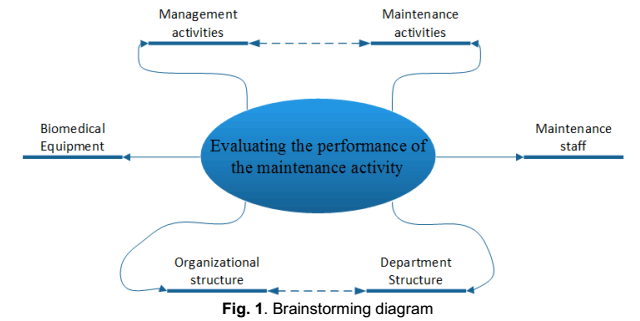
<body><![CDATA[<li><font style="font-family:'Verdana','sans-serif'; font-size:10.0pt; ">Control of the work executed by the maintenance  technicians</font></li>         <li><font style="font-family:'Verdana','sans-serif'; font-size:10.0pt; ">Effectiveness of annual maintenance planning</font></li>         <li><font style="font-family:'Verdana','sans-serif'; font-size:10.0pt; ">Department performance</font></li>     </ul>     <p align="justify" class="Texto"><font style="font-family:'Verdana','sans-serif'; font-size:10.0pt; ">With the results of the survey, it was applied as a  second tool the brainstorming. This technique allowed the team to analyze the  possible solutions to common problems detected in the five audited hospitals.  They participated in the analysis mainly, the boss of the technical services of  maintenance in each hospital, and the main specialists of each service. The  following points were the result of brainstorming performed in each of the  hospitals audited.</font></p>     <p align="justify" class="Texto"><font style="font-family:'Verdana','sans-serif'; font-size:10.0pt; ">a) Management  activities: The ideas identified at this point are summarized in verifying the  effectiveness of planning, job control executed, the response to a service  request, etc.</font></p>     <p align="justify" class="Texto"><font style="font-family:'Verdana','sans-serif'; font-size:10.0pt; ">b) Maintenance  activities: The key was to identify and evaluate the type of maintenance  applied and tasks performed.</font></p>     <p align="justify" class="Texto"><font style="font-family:'Verdana','sans-serif'; font-size:10.0pt; ">c) The biomedical  equipment: Another aspect to develop is referred to the equipment; this is a  key point in the audit process, here, technical documentation will be  identified. The classification, availability, monitoring and control of the  technologies installed are also point of analysis.</font></p>     <p align="justify" class="Texto"><font style="font-family:'Verdana','sans-serif'; font-size:10.0pt; ">d) Maintenance staff:  This is one of the critical aspects in developing our audit, the maintenance  workers are those responsible for the proper functioning of the above aspects,  and the goal here is to know the composition of the staff of the department and  their level of qualification.</font></p>     <p align="justify" class="Texto"><font style="font-family:'Verdana','sans-serif'; font-size:10.0pt; ">e) Organizational  structure: It was Identified the position occupied by the maintenance  department in the general company organization chart and was identified the  hierarchical levels and with functional dependencies.</font></p>     ]]></body>
<body><![CDATA[<p align="justify" class="Texto"><font style="font-family:'Verdana','sans-serif'; font-size:10.0pt; ">f) Department structure:  Identify the sections of technical specialties and generate ideas on how it is  organized. The magnitude of the department will depend on the amount of  service, size, equipment and technological level of health institutions in its  charge.</font></p>     <p align="justify" class="Texto"><font style="font-family:'Verdana','sans-serif'; font-size:10.0pt; "><a href="/img/revistas/im/v20n3/f0107317.gif">Figure 1</a> show as a summary the basic aspects in order  to evaluate and identify the degree of operating at maintenance department in  any hospital, regardless of its complexity. </font></p>     
<p align="justify" class="Texto"><font style="font-family:'Verdana','sans-serif'; font-size:10.0pt; ">Subsequently, another technique is applied known as  Ishikawa diagram or fishbone diagram [17]. This diagram  is a verbal tool that represents the relationship between an effect (problem)  and all the possible causes that influence in the effect. <a href="/img/revistas/im/v20n3/f0207317.gif">Figure 2</a> shows the  Ishikawa diagram, used to organize the points identified in the audit.</font></p>     
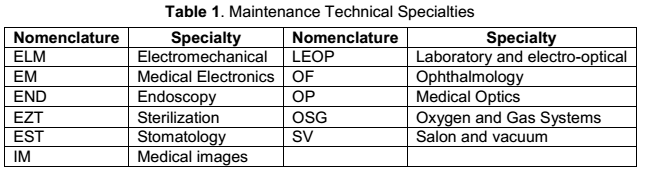
<p align="justify" class="Texto"><font style="font-family:'Verdana','sans-serif'; font-size:10.0pt; ">Finally, a method it&acute;s proposed to optimize the  functions of the maintenance department. This procedure was applied to each  ones of the technical specialties in <a href="/img/revistas/im/v20n3/t0107317.gif">table I</a>, according to the (CNE) [18]. The  procedure basically depends on three aspects, the burden of annual maintenance  plan (CPA), the time available for the technical department (FT) and the amount  of equipment to be serviced (CE). With these results we can estimate the  necessary staff (PN) to perform the maintenance function, giving answer to the  most critical component of the audit; human resources.</font></p>     
<p align="justify" class="Subtitulo">&nbsp;</p>     <p align="justify" class="Subtitulo"><font style="font-family:'Verdana','sans-serif'; font-size:14.0pt; "><b>RESULTS</b></font></p>     <p align="justify" class="Texto"><font style="font-family:'Verdana','sans-serif'; font-size:10.0pt; ">The  first result obtained is associated with the processed values of the survey.  The values are averaged and tabulated for each hospital as shown in the  maintenance radar map in <a href="/img/revistas/im/v20n3/f0307317.gif">figure 3</a>. This type of representation facilitates the  comparison between the different points analyzed in the survey with a scale of  1-5, with the following characteristics:</font></p> <ol><font style="font-family:'Verdana','sans-serif'; font-size:10.0pt; ">       
<li><font style="font-family:'Verdana','sans-serif'; font-size:10.0pt; ">Without criteria</font></li>         <li><font style="font-family:'Verdana','sans-serif'; font-size:10.0pt; ">Bad</font></li>         <li><font style="font-family:'Verdana','sans-serif'; font-size:10.0pt; ">Regular</font></li>         ]]></body>
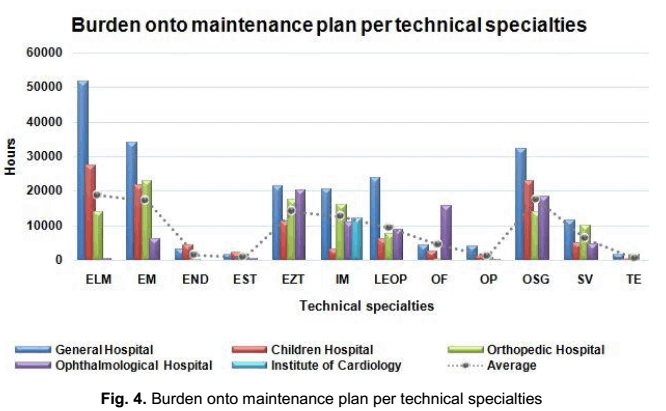
<body><![CDATA[<li><font style="font-family:'Verdana','sans-serif'; font-size:10.0pt; ">Good</font></li>         <li><font style="font-family:'Verdana','sans-serif'; font-size:10.0pt; ">Very good</font></li>         <li><font style="font-family:'Verdana','sans-serif'; font-size:10.0pt; ">Excellent</font></li> </font>    </ol>     <p align="justify" class="Texto"><font style="font-family:'Verdana','sans-serif'; font-size:10.0pt; ">Another  outcome of interest is shown in the graph of <a href="/img/revistas/im/v20n3/f0407317.gif">Figure 4</a>. It shows an example of  the burden onto maintenance plan per technical specialties, in the five  hospitals under study. We can see that this parameter depends directly on the  hospital&rsquo;s complexity, that is, the number of equipment (CE) and systems that  must be assisted routinely, causing variations in the workload of maintenance  technicians in each hospital (CPA).</font></p>     
<p align="justify" class="Texto"><font style="font-family:'Verdana','sans-serif'; font-size:10.0pt; ">The  human resource has a direct impact in this process. Considering the above  point, it was analyzed in detail this critical component in the audit.</font></p>     <p align="justify" class="Texto"><font style="font-family:'Verdana','sans-serif'; font-size:10.0pt; "><a href="#t2">Table  2</a> shows an example of the calculations made for selecting the minimum staff  needed to undertake the inspection activities and preventive maintenance (IMP)  in the Children Hospital. It was used the same method for the remainder of the  audited hospitals.</font></p>     <p align="justify" class="Texto"><font style="font-family:'Verdana','sans-serif'; font-size:10.0pt; ">Where,</font></p>    <ul>         <li><font style="font-family:'Verdana','sans-serif'; font-size:10.0pt; ">CE:  Number of equipment</font></li>         <li><font style="font-family:'Verdana','sans-serif'; font-size:10.0pt; ">CPA:  Burden onto the maintenance plan</font></li>         ]]></body>
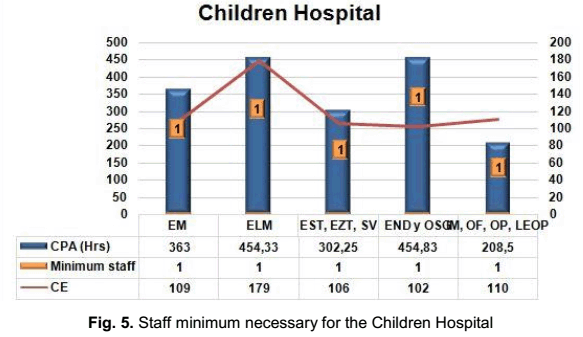
<body><![CDATA[<li><font style="font-family:'Verdana','sans-serif'; font-size:10.0pt; ">PN:  minimum staff</font></li>       </ul>      <p align="justify" class="Texto"><font style="font-family:'Verdana','sans-serif'; font-size:10.0pt; ">As  it might be expected, it is impossible to hire a person and a half or half a  person. The objective here is to concentrate the technicians in technical  specialties to gain quality of service, so it was decided to group the  specialties with equipment of similar technology and get a real value for the  number of technicians needed to execute the maintenance actions of that equipment.  The result is shown in <a href="/img/revistas/im/v20n3/f0507317.gif">figure 5</a>.</font></p>     
<p align="justify" class="Subtitulo">&nbsp;</p>     <p align="justify" class="Subtitulo"><font style="font-family:'Verdana','sans-serif'; font-size:14.0pt; "><b>DISCUSSION</b></font></p>     <p align="justify" class="Texto"><font style="font-family:'Verdana','sans-serif'; font-size:10.0pt; ">The  first aspect to be analyzed is related with the <a href="/img/revistas/im/v20n3/f0307317.gif">figure 3</a>, specifically the  equipment availability case. According to Knezevic, availability is a feature  that summarizes quantitatively, the functionality profile of a team, it&acute;s an  extremely important measure and useful in those cases where the user must make  decisions among several alternative possibilities.</font></p>     
<p align="justify" class="Texto"><font style="font-family:'Verdana','sans-serif'; font-size:10.0pt; ">According  to surveys conducted, the availability of the equipment in these centers, it&rsquo;s  less than the average of the processed values, qualitatively this means that,  at least twice in five times that you want to use the equipment it&rsquo;s out of  service. This affects directly the quality of services that the hospital can  provide. These results suggest that we should centralize our work efforts  towards this first aspect. We recommend starting with a known technique, that  is, the brainstorming to identify and group the main causes for the  underperformance of this equipment. Afterwards it is possible to use another  technique that form part of the tool group to achieve the total quality of a  service, such the well-known Pareto chart. </font></p>     <p align="justify" class="Texto"><font style="font-family:'Verdana','sans-serif'; font-size:10.0pt; ">If  we continue reviewing the diagram in <a href="/img/revistas/im/v20n3/f0307317.gif">figure 3</a>, we can observe, that in response  to a request for service, the effectiveness of planning, monitoring and control  of equipment installed; the values obtained are above average of the processed  values, this totally contradicts the values obtained of the department's  performance. </font></p>     
<p align="justify" class="Texto"><font style="font-family:'Verdana','sans-serif'; font-size:10.0pt; ">Many  authors interviewed evaluated as good the work in these departments, masking  the main cause of these problems. From this, we can conclude that is not enough  to culminate the report of auditing with the results of an interview. This  technique provides only partial information, which is useful when initiating an  investigation but it is not enough to propose solutions. However, the radar map  also provides other aspects of interest, as is the case of unstable causes;  events in which the standard deviation is too high. For the case under  analysis, we refer to staff training, the control of the work executed by the  maintenance technicians as well as workload of maintenance technicians. Let us  analyze one of these aspects in detail.</font></p>     <p align="justify" class="Texto"><font style="font-family:'Verdana','sans-serif'; font-size:10.0pt; ">The  workload of maintenance technicians, is an aspect conditioned by the burden of  the preventive maintenance plan, see <a href="/img/revistas/im/v20n3/f0407317.gif">figure 4</a>. To reduce this effect, we can  use the option of hire third parties. In this case, we decided to differentiate  the biomedical equipment according to classification rules established by the  by the national regulatory agency, and outsource at first instance the  maintenance of those equipment whose risk class is equivalent to Class III and  to assist the remaining equipment according to the availability of technical in  the department, according with risk class. </font></p>     
]]></body>
<body><![CDATA[<p align="justify" class="Texto"><font style="font-family:'Verdana','sans-serif'; font-size:10.0pt; ">An  example of the calculations made for selecting the minimum staff needed to  undertake the inspection activities and preventive maintenance (IMP) is showed  in <a href="#t2">table II</a>. Each maintenance technician must work a certain number of hours  per year;therefore, the technician accumulates a reserve of annual time that  are to be used in IMP and other unforeseen activities. It is advisable  calculate the annual reserve time available to implement activities of IMP and  the total burden onto maintenance plan. With these two parameters, it is  possible to estimate the minimum necessary staff in a hospital maintenance  department. Those persons who have some experience in the process of  determining the staff know that it is necessary to consider several factors,  regardless of the quantitative method or method of calculation used.</font></p>     <p align="center" class="Texto"><a name="t2" id="t2"></a></p>     <p align="center" class="Texto"><img src="/img/revistas/im/v20n3/t0207317.gif" alt="Table 2. Selection of maintenance staff" width="400" height="257" longdesc="/img/revistas/im/v20n3/t0207317.gif" /></p>     
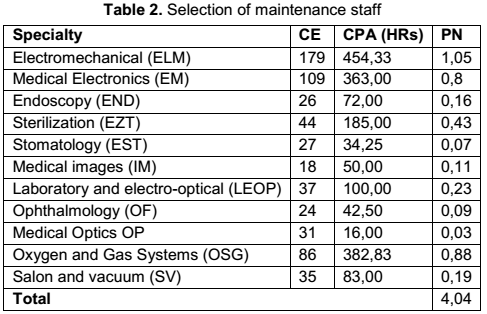
<p align="justify" class="Texto"><font style="font-family:'Verdana','sans-serif'; font-size:10.0pt; ">Another  aspect to consider when selecting our staff is the selection of the maintenance  inventory. It is need to achieve a high degree of compromise between general  maintenance inventory (includes all the equipment of the hospital) and  technical maintenance inventory (only those equipment serviced by the hospital  technicians). Removing equipment from our technical inventory in order to  decrease the number of worker needed to execute the actions of the department  could bring serious problems. It must consider that the equipment that has been  excluded from our technical inventory should be contracted to third parties, or  establish a corrective action plan to ensure patients safety in the provision  of service. </font></p>     <p align="justify" class="Texto"><font style="font-family:'Verdana','sans-serif'; font-size:10.0pt; ">According  to the Malag&oacute;n, Gal&aacute;n and Pont&oacute;n advices [19],  we should assign one biomedical engineer per maintenance specialties or for at  least every 4 or 5 of the technicians calculated. In the case under analysis,  the minimum staff needed is five specialized technicians and at least two  professionals in medical engineering or bioengineering, according with the  result in <a href="/img/revistas/im/v20n3/f0507317.gif">figure 5</a>.</font></p>     
<p align="justify" class="Subtitulo">&nbsp;</p>     <p align="justify" class="Subtitulo"><font style="font-family:'Verdana','sans-serif'; font-size:14.0pt; "><b>CONCLUSION</b></font></p>     <p align="justify" class="Texto"><font style="font-family:'Verdana','sans-serif'; font-size:10.0pt; ">The results of this  research show that the audit technique is a valuable tool in identifying and  prioritizing problems in a company; as well as emphasizes that the most  critical component in these cases is the human resource. All the aspects  surveyed depend directly on the human factor. Technological problems, such as  the availability of assets, are usually associated with a shortage of  resources; however, its root cause is a mismanagement by the staff in charge of  this activity in the maintenance departments. Thus, the fact of implement  methodologies or procedures to ensure the selection and proper adjustment of  staff is an appropriate alternative that provide a good operating performance  of the department. </font></p>     <p align="justify" class="Subtitulo">&nbsp;</p>     <p align="justify" class="Subtitulo"><font style="font-family:'Verdana','sans-serif'; font-size:14.0pt; "><b>REFERENCES</b></font></p>     ]]></body>
<body><![CDATA[<!-- ref --><p align="justify" class="Bibliografia"><font style="font-family:'Verdana','sans-serif'; font-size:10.0pt; ">1. Fraser RC, Khunti K, Baker R, et al. Effective  audit in general practice: a method for systematically developing audit  protocols containing evidence-based review criteria. British Journal of General  Practice. 1997;3(47):743-6.     </font></p>     <!-- ref --><p align="justify" class="Bibliografia"><font style="font-family:'Verdana','sans-serif'; font-size:10.0pt; ">2. Hardman E, Joughin C. Focus on clinical audit in  child and adolescent mental health services. London: Mc Graw Hill; 1998.    </font></p>     <!-- ref --><p align="justify" class="Bibliografia"><font style="font-family:'Verdana','sans-serif'; font-size:10.0pt; ">3. Stang A, Hartling L, Fera C, et al. Quality  Indicators for the Assessment and Management of Pain in the Emergency  Department: A Systematic Review. Pain Research and Management.  2014;19(6):179-90.     </font></p>     <!-- ref --><p align="justify" class="Bibliografia"><font style="font-family:'Verdana','sans-serif'; font-size:10.0pt; ">4. Henneman EA, Gawlinski A, Giuliano KK.  Surveillance: a strategy for improving patient safety in acute and critical  care units. Critical Care Nurse. 2012;32(2):9-18.     </font></p>     <!-- ref --><p align="justify" class="Bibliografia"><font style="font-family:'Verdana','sans-serif'; font-size:10.0pt; ">5. Hashim AE, Samikon SA, Hasim MS, et al. Facilities  management audit in managing healing facilities in public health care built  environment: User satisfaction viewpoint. Environment Behaviour Proceedings  Journal. 2016;1(4):83-92.     </font></p>     ]]></body>
<body><![CDATA[<!-- ref --><p align="justify" class="Bibliografia"><font style="font-family:'Verdana','sans-serif'; font-size:10.0pt; ">6. Parida A, Kumar U, Galar D, et al. Performance  measurement and management for maintenance: a literature review. Journal of Quality  in Maintenance Engineering. 2015;21(1):2-33.     </font></p>     <!-- ref --><p align="justify" class="Bibliografia"><font style="font-family:'Verdana','sans-serif'; font-size:10.0pt; ">7. Acosta-Palmer H,  Troncoso-Fleitas M. Auditoria integral de mantenimiento en instalaciones  hospitalarias, un an&aacute;lisis objetivo. Ingenier&iacute;a  Mec&aacute;nica. 2011;14(2):107-18.     </font></p>     <!-- ref --><p align="justify" class="Bibliografia"><font style="font-family:'Verdana','sans-serif'; font-size:10.0pt; ">8. Garc&iacute;a J, Cuadros F, L&oacute;pez Rodr&iacute;guez F. Energy  audit: a management tool in health centers. Gaceta sanitaria. 2011;25(6):549-51.     </font></p>     <!-- ref --><p align="justify" class="Bibliografia"><font style="font-family:'Verdana','sans-serif'; font-size:10.0pt; ">9. Jacobs T, Visser J. Evaluation of the maintenance  management function for a control plant at a substation. In: 7th AFRICON; Gaborone,  Botswana: IEEE; 2004.    </font></p>     <!-- ref --><p align="justify" class="Bibliografia"><font style="font-family:'Verdana','sans-serif'; font-size:10.0pt; ">10. Ali M, Nasbi WM. Audit assessment of the  facilities maintenance management in a public hospital in Malaysia. Journal of  Facilities Management. 2009;7(2):142-58.     </font></p>     ]]></body>
<body><![CDATA[<!-- ref --><p align="justify" class="Bibliografia"><font style="font-family:'Verdana','sans-serif'; font-size:10.0pt; ">11. Carnero MC. Auditing Model for the introduction of  Computerized Maintenance Management Systems. International Journal of Data  Science. 2015;1(1):17-41.     </font></p>     <!-- ref --><p align="justify" class="Bibliografia"><font style="font-family:'Verdana','sans-serif'; font-size:10.0pt; ">12. Carnero MC. Evaluating a Maintenance Department in  a Service Company. International Journal of Mathematical Models and Methods in  Applied Sciences. 2009;1(3):230-7.     </font></p>     <!-- ref --><p align="justify" class="Bibliografia"><font style="font-family:'Verdana','sans-serif'; font-size:10.0pt; ">13. Bana-e-Costa CA, Carnero MC, Oliveira MD. A  multi-criteria model for auditing a Predictive Maintenance Programme. European  Journal of Operational Research. 2012;217(2):381-93.     </font></p>     <!-- ref --><p align="justify" class="Bibliografia"><font style="font-family:'Verdana','sans-serif'; font-size:10.0pt; ">14. Galar D, Kumar  U, Parida A, et al. Auditor&iacute;as de mantenimiento: Una nueva visi&oacute;n del mantenimiento. Ingenier&iacute;a y gesti&oacute;n de mantenimiento.  2011;1(76):16-29.     </font></p>     <!-- ref --><p align="justify" class="Bibliografia"><font style="font-family:'Verdana','sans-serif'; font-size:10.0pt; ">15. Christersson M, Rothe P. Impacts of organizational  relocation: a conceptual framework. Journal of Corporate Real Estate.  2012;14(4):226-43.     </font></p>     ]]></body>
<body><![CDATA[<!-- ref --><p align="justify" class="Bibliografia"><font style="font-family:'Verdana','sans-serif'; font-size:10.0pt; ">16. Pintelon L, Van-Puyvelde F. Maintenance performance  reporting systems: some experiences. Journal of Quality in Maintenance  Engineering. 2006;3(1):4-15.     </font></p>     <!-- ref --><p align="justify" class="Bibliografia"><font style="font-family:'Verdana','sans-serif'; font-size:10.0pt; ">17. Espinosa F, Dias A, Salinas G. A procedure for  assessing the risks of innovation in the management of industrial maintenance. Ingeniare. 2012;20(2):242-54.     </font></p>     <!-- ref --><p align="justify" class="Bibliografia"><font style="font-family:'Verdana','sans-serif'; font-size:10.0pt; ">18. Herrera Gal&aacute;n  M. Planificaci&oacute;n del mantenimiento de equipos m&eacute;dicos a trav&eacute;s del ajuste de  plantilla. Revista Cubana de Ingenier&iacute;a. 2015;6(3):61-7.     </font></p>     <!-- ref --><p align="justify" class="Bibliografia"><font style="font-family:'Verdana','sans-serif'; font-size:10.0pt; ">19. Malag&oacute;n Londo&ntilde;o  G, Gal&aacute;n Morera R, Pont&oacute;n-Laverde G. Hospital Administration. Espa&ntilde;a: Editorial  M&eacute;dica Panamericana; 2008.     </font></p>     <p align="justify">&nbsp;</p>     <p align="justify">&nbsp;</p>     ]]></body>
<body><![CDATA[<p align="justify"><font style="font-family:'Verdana','sans-serif'; font-size:10.0pt; ">Recibido:  26/4/2017</font></p>     <p align="justify"><font style="font-family:'Verdana','sans-serif'; font-size:10.0pt; ">Aceptado:  1/7/2017</font></p>     <p align="justify" class="Autor">&nbsp;</p>     <p align="justify" class="Autor">&nbsp;</p>     <p align="justify" class="Autor"><font style="font-family:'Verdana','sans-serif'; font-size:10.0pt; "><i>Michael  Herrera-Gal&aacute;n</i>, Universidad Tecnol&oacute;gica de la Habana, Facultad de  Ingenier&iacute;a Autom&aacute;tica y Biom&eacute;dica. La Habana, Cuba. Correo electr&oacute;nico: <a href="mailto:michaelhg@automatica.cujae.edu.cu">michaelhg@automatica.cujae.edu.cu</a></font></p>      ]]></body><back>
<ref-list>
<ref id="B1">
<label>1</label><nlm-citation citation-type="journal">
<person-group person-group-type="author">
<name>
<surname><![CDATA[Fraser]]></surname>
<given-names><![CDATA[RC]]></given-names>
</name>
<name>
<surname><![CDATA[Khunti]]></surname>
<given-names><![CDATA[K]]></given-names>
</name>
<name>
<surname><![CDATA[Baker]]></surname>
<given-names><![CDATA[R]]></given-names>
</name>
</person-group>
<article-title xml:lang="en"><![CDATA[Effective audit in general practice: a method for systematically developing audit protocols containing evidence-based review criteria]]></article-title>
<source><![CDATA[British Journal of General Practice]]></source>
<year>1997</year>
<volume>3</volume>
<numero>47</numero>
<issue>47</issue>
<page-range>743-6</page-range></nlm-citation>
</ref>
<ref id="B2">
<label>2</label><nlm-citation citation-type="book">
<person-group person-group-type="author">
<name>
<surname><![CDATA[Hardman]]></surname>
<given-names><![CDATA[E]]></given-names>
</name>
<name>
<surname><![CDATA[Joughin]]></surname>
<given-names><![CDATA[C]]></given-names>
</name>
</person-group>
<source><![CDATA[Focus on clinical audit in child and adolescent mental health services]]></source>
<year>1998</year>
<publisher-loc><![CDATA[^eLondon London]]></publisher-loc>
<publisher-name><![CDATA[Mc Graw Hill]]></publisher-name>
</nlm-citation>
</ref>
<ref id="B3">
<label>3</label><nlm-citation citation-type="journal">
<person-group person-group-type="author">
<name>
<surname><![CDATA[Stang]]></surname>
<given-names><![CDATA[A]]></given-names>
</name>
<name>
<surname><![CDATA[Hartling]]></surname>
<given-names><![CDATA[L]]></given-names>
</name>
<name>
<surname><![CDATA[Fera]]></surname>
<given-names><![CDATA[C]]></given-names>
</name>
</person-group>
<article-title xml:lang="en"><![CDATA[Quality Indicators for the Assessment and Management of Pain in the Emergency Department: A Systematic Review]]></article-title>
<source><![CDATA[Pain Research and Management]]></source>
<year>2014</year>
<volume>19</volume>
<numero>6</numero>
<issue>6</issue>
<page-range>179-90</page-range></nlm-citation>
</ref>
<ref id="B4">
<label>4</label><nlm-citation citation-type="journal">
<person-group person-group-type="author">
<name>
<surname><![CDATA[Henneman]]></surname>
<given-names><![CDATA[EA]]></given-names>
</name>
<name>
<surname><![CDATA[Gawlinski]]></surname>
<given-names><![CDATA[A]]></given-names>
</name>
<name>
<surname><![CDATA[Giuliano]]></surname>
<given-names><![CDATA[KK]]></given-names>
</name>
</person-group>
<article-title xml:lang="en"><![CDATA[Surveillance: a strategy for improving patient safety in acute and critical care units]]></article-title>
<source><![CDATA[Critical Care Nurse]]></source>
<year>2012</year>
<volume>32</volume>
<numero>2</numero>
<issue>2</issue>
<page-range>9-18</page-range></nlm-citation>
</ref>
<ref id="B5">
<label>5</label><nlm-citation citation-type="journal">
<person-group person-group-type="author">
<name>
<surname><![CDATA[Hashim]]></surname>
<given-names><![CDATA[AE]]></given-names>
</name>
<name>
<surname><![CDATA[Samikon]]></surname>
<given-names><![CDATA[SA]]></given-names>
</name>
<name>
<surname><![CDATA[Hasim]]></surname>
<given-names><![CDATA[MS]]></given-names>
</name>
</person-group>
<article-title xml:lang="en"><![CDATA[Facilities management audit in managing healing facilities in public health care built environment: User satisfaction viewpoint]]></article-title>
<source><![CDATA[Environment Behaviour Proceedings Journal]]></source>
<year>2016</year>
<volume>1</volume>
<numero>4</numero>
<issue>4</issue>
<page-range>83-92</page-range></nlm-citation>
</ref>
<ref id="B6">
<label>6</label><nlm-citation citation-type="journal">
<person-group person-group-type="author">
<name>
<surname><![CDATA[Parida]]></surname>
<given-names><![CDATA[A]]></given-names>
</name>
<name>
<surname><![CDATA[Kumar]]></surname>
<given-names><![CDATA[U]]></given-names>
</name>
<name>
<surname><![CDATA[Galar]]></surname>
<given-names><![CDATA[D]]></given-names>
</name>
</person-group>
<article-title xml:lang="en"><![CDATA[Performance measurement and management for maintenance: a literature review]]></article-title>
<source><![CDATA[Journal of Quality in Maintenance Engineering]]></source>
<year>2015</year>
<volume>21</volume>
<numero>1</numero>
<issue>1</issue>
<page-range>2-33</page-range></nlm-citation>
</ref>
<ref id="B7">
<label>7</label><nlm-citation citation-type="journal">
<person-group person-group-type="author">
<name>
<surname><![CDATA[Acosta-Palmer]]></surname>
<given-names><![CDATA[H]]></given-names>
</name>
<name>
<surname><![CDATA[Troncoso-Fleitas]]></surname>
<given-names><![CDATA[M]]></given-names>
</name>
</person-group>
<article-title xml:lang="es"><![CDATA[Auditoria integral de mantenimiento en instalaciones hospitalarias, un análisis objetivo]]></article-title>
<source><![CDATA[Ingeniería Mecánica]]></source>
<year>2011</year>
<volume>14</volume>
<numero>2</numero>
<issue>2</issue>
<page-range>107-18</page-range></nlm-citation>
</ref>
<ref id="B8">
<label>8</label><nlm-citation citation-type="journal">
<person-group person-group-type="author">
<name>
<surname><![CDATA[García]]></surname>
<given-names><![CDATA[J]]></given-names>
</name>
<name>
<surname><![CDATA[Cuadros]]></surname>
<given-names><![CDATA[F]]></given-names>
</name>
<name>
<surname><![CDATA[López Rodríguez]]></surname>
<given-names><![CDATA[F]]></given-names>
</name>
</person-group>
<article-title xml:lang="en"><![CDATA[Energy audit: a management tool in health centers]]></article-title>
<source><![CDATA[Gaceta sanitaria]]></source>
<year>2011</year>
<volume>25</volume>
<numero>6</numero>
<issue>6</issue>
<page-range>549-51</page-range></nlm-citation>
</ref>
<ref id="B9">
<label>9</label><nlm-citation citation-type="confpro">
<person-group person-group-type="author">
<name>
<surname><![CDATA[Jacobs]]></surname>
<given-names><![CDATA[T]]></given-names>
</name>
<name>
<surname><![CDATA[Visser]]></surname>
<given-names><![CDATA[J]]></given-names>
</name>
</person-group>
<article-title xml:lang="en"><![CDATA[Evaluation of the maintenance management function for a control plant at a substation]]></article-title>
<source><![CDATA[]]></source>
<year>2004</year>
<conf-name><![CDATA[7 AFRICON]]></conf-name>
<conf-loc>Gaborone Gaborone</conf-loc>
</nlm-citation>
</ref>
<ref id="B10">
<label>10</label><nlm-citation citation-type="journal">
<person-group person-group-type="author">
<name>
<surname><![CDATA[Ali]]></surname>
<given-names><![CDATA[M]]></given-names>
</name>
<name>
<surname><![CDATA[Nasbi]]></surname>
<given-names><![CDATA[WM]]></given-names>
</name>
</person-group>
<article-title xml:lang="en"><![CDATA[Audit assessment of the facilities maintenance management in a public hospital in Malaysia]]></article-title>
<source><![CDATA[Journal of Facilities Management]]></source>
<year>2009</year>
<volume>7</volume>
<numero>2</numero>
<issue>2</issue>
<page-range>142-58</page-range></nlm-citation>
</ref>
<ref id="B11">
<label>11</label><nlm-citation citation-type="journal">
<person-group person-group-type="author">
<name>
<surname><![CDATA[Carnero]]></surname>
<given-names><![CDATA[MC]]></given-names>
</name>
</person-group>
<article-title xml:lang="en"><![CDATA[Auditing Model for the introduction of Computerized Maintenance Management Systems]]></article-title>
<source><![CDATA[International Journal of Data Science]]></source>
<year>2015</year>
<volume>1</volume>
<numero>1</numero>
<issue>1</issue>
<page-range>17-41</page-range></nlm-citation>
</ref>
<ref id="B12">
<label>12</label><nlm-citation citation-type="journal">
<person-group person-group-type="author">
<name>
<surname><![CDATA[Carnero]]></surname>
<given-names><![CDATA[MC]]></given-names>
</name>
</person-group>
<article-title xml:lang="en"><![CDATA[Evaluating a Maintenance Department in a Service Company]]></article-title>
<source><![CDATA[International Journal of Mathematical Models and Methods in Applied Sciences]]></source>
<year>2009</year>
<volume>1</volume>
<numero>3</numero>
<issue>3</issue>
<page-range>230-7</page-range></nlm-citation>
</ref>
<ref id="B13">
<label>13</label><nlm-citation citation-type="journal">
<person-group person-group-type="author">
<name>
<surname><![CDATA[Bana-e-Costa]]></surname>
<given-names><![CDATA[CA]]></given-names>
</name>
<name>
<surname><![CDATA[Carnero]]></surname>
<given-names><![CDATA[MC]]></given-names>
</name>
<name>
<surname><![CDATA[Oliveira]]></surname>
<given-names><![CDATA[MD]]></given-names>
</name>
</person-group>
<article-title xml:lang="en"><![CDATA[A multi-criteria model for auditing a Predictive Maintenance Programme]]></article-title>
<source><![CDATA[European Journal of Operational Research]]></source>
<year>2012</year>
<volume>217</volume>
<numero>2</numero>
<issue>2</issue>
<page-range>381-93</page-range></nlm-citation>
</ref>
<ref id="B14">
<label>14</label><nlm-citation citation-type="journal">
<person-group person-group-type="author">
<name>
<surname><![CDATA[Galar]]></surname>
<given-names><![CDATA[D]]></given-names>
</name>
<name>
<surname><![CDATA[Kumar]]></surname>
<given-names><![CDATA[U]]></given-names>
</name>
<name>
<surname><![CDATA[Parida]]></surname>
<given-names><![CDATA[A]]></given-names>
</name>
</person-group>
<article-title xml:lang="es"><![CDATA[Auditorías de mantenimiento: Una nueva visión del mantenimiento]]></article-title>
<source><![CDATA[Ingeniería y gestión de mantenimiento]]></source>
<year>2011</year>
<volume>1</volume>
<numero>76</numero>
<issue>76</issue>
<page-range>16-29</page-range></nlm-citation>
</ref>
<ref id="B15">
<label>15</label><nlm-citation citation-type="journal">
<person-group person-group-type="author">
<name>
<surname><![CDATA[Christersson]]></surname>
<given-names><![CDATA[M]]></given-names>
</name>
<name>
<surname><![CDATA[Rothe]]></surname>
<given-names><![CDATA[P]]></given-names>
</name>
</person-group>
<article-title xml:lang="en"><![CDATA[Impacts of organizational relocation: a conceptual framework]]></article-title>
<source><![CDATA[Journal of Corporate Real Estate]]></source>
<year>2012</year>
<volume>14</volume>
<numero>4</numero>
<issue>4</issue>
<page-range>226-43</page-range></nlm-citation>
</ref>
<ref id="B16">
<label>16</label><nlm-citation citation-type="journal">
<person-group person-group-type="author">
<name>
<surname><![CDATA[Pintelon]]></surname>
<given-names><![CDATA[L]]></given-names>
</name>
<name>
<surname><![CDATA[Van-Puyvelde]]></surname>
<given-names><![CDATA[F]]></given-names>
</name>
</person-group>
<article-title xml:lang="en"><![CDATA[Maintenance performance reporting systems: some experiences]]></article-title>
<source><![CDATA[Journal of Quality in Maintenance Engineering]]></source>
<year>2006</year>
<volume>3</volume>
<numero>1</numero>
<issue>1</issue>
<page-range>4-15</page-range></nlm-citation>
</ref>
<ref id="B17">
<label>17</label><nlm-citation citation-type="journal">
<person-group person-group-type="author">
<name>
<surname><![CDATA[Espinosa]]></surname>
<given-names><![CDATA[F]]></given-names>
</name>
<name>
<surname><![CDATA[Dias]]></surname>
<given-names><![CDATA[A]]></given-names>
</name>
<name>
<surname><![CDATA[Salinas]]></surname>
<given-names><![CDATA[G]]></given-names>
</name>
</person-group>
<article-title xml:lang="en"><![CDATA[A procedure for assessing the risks of innovation in the management of industrial maintenance]]></article-title>
<source><![CDATA[Ingeniare]]></source>
<year>2012</year>
<volume>20</volume>
<numero>2</numero>
<issue>2</issue>
<page-range>242-54</page-range></nlm-citation>
</ref>
<ref id="B18">
<label>18</label><nlm-citation citation-type="journal">
<person-group person-group-type="author">
<name>
<surname><![CDATA[Herrera Galán]]></surname>
<given-names><![CDATA[M]]></given-names>
</name>
</person-group>
<article-title xml:lang="pt"><![CDATA[Planificación del mantenimiento de equipos médicos a través del ajuste de plantilla]]></article-title>
<source><![CDATA[Revista Cubana de Ingeniería]]></source>
<year>2015</year>
<volume>6</volume>
<numero>3</numero>
<issue>3</issue>
<page-range>61-7</page-range></nlm-citation>
</ref>
<ref id="B19">
<label>19</label><nlm-citation citation-type="book">
<person-group person-group-type="author">
<name>
<surname><![CDATA[Malagón Londoño]]></surname>
<given-names><![CDATA[G]]></given-names>
</name>
<name>
<surname><![CDATA[Galán Morera]]></surname>
<given-names><![CDATA[R]]></given-names>
</name>
<name>
<surname><![CDATA[Pontón-Laverde]]></surname>
<given-names><![CDATA[G]]></given-names>
</name>
</person-group>
<source><![CDATA[Hospital Administration]]></source>
<year>2008</year>
<publisher-name><![CDATA[Editorial Médica Panamericana]]></publisher-name>
</nlm-citation>
</ref>
</ref-list>
</back>
</article>