<?xml version="1.0" encoding="ISO-8859-1"?><article xmlns:mml="http://www.w3.org/1998/Math/MathML" xmlns:xlink="http://www.w3.org/1999/xlink" xmlns:xsi="http://www.w3.org/2001/XMLSchema-instance">
<front>
<journal-meta>
<journal-id>1817-4078</journal-id>
<journal-title><![CDATA[Revista Novedades en Población]]></journal-title>
<abbrev-journal-title><![CDATA[Rev Nov Pob]]></abbrev-journal-title>
<issn>1817-4078</issn>
<publisher>
<publisher-name><![CDATA[Centro de Estudios Demográficos/UH]]></publisher-name>
</publisher>
</journal-meta>
<article-meta>
<article-id>S1817-40782015000200017</article-id>
<title-group>
<article-title xml:lang="en"><![CDATA[The Cuban-American Transition: Demographic Changes Drive Ideological Changes]]></article-title>
<article-title xml:lang="es"><![CDATA[La transición cubano-americana: Cambios demográficos frente a cambios ideológicos]]></article-title>
</title-group>
<contrib-group>
<contrib contrib-type="author">
<name>
<surname><![CDATA[Grenier]]></surname>
<given-names><![CDATA[Guillermo J.]]></given-names>
</name>
<xref ref-type="aff" rid="A01"/>
</contrib>
</contrib-group>
<aff id="A01">
<institution><![CDATA[,Florida International University Steven J. Green School of International and Public Affairs Department of Global & Sociocultural Studies]]></institution>
<addr-line><![CDATA[ ]]></addr-line>
</aff>
<pub-date pub-type="pub">
<day>00</day>
<month>12</month>
<year>2015</year>
</pub-date>
<pub-date pub-type="epub">
<day>00</day>
<month>12</month>
<year>2015</year>
</pub-date>
<volume>11</volume>
<numero>22</numero>
<fpage>0</fpage>
<lpage>0</lpage>
<copyright-statement/>
<copyright-year/>
<self-uri xlink:href="http://scielo.sld.cu/scielo.php?script=sci_arttext&amp;pid=S1817-40782015000200017&amp;lng=en&amp;nrm=iso"></self-uri><self-uri xlink:href="http://scielo.sld.cu/scielo.php?script=sci_abstract&amp;pid=S1817-40782015000200017&amp;lng=en&amp;nrm=iso"></self-uri><self-uri xlink:href="http://scielo.sld.cu/scielo.php?script=sci_pdf&amp;pid=S1817-40782015000200017&amp;lng=en&amp;nrm=iso"></self-uri><abstract abstract-type="short" xml:lang="en"><p><![CDATA[Cuban-Americans are changing their attitudes about many of the key components of current US/Cuba policy. The paper explores some of the social forces creating the patterns associated with the changing attitudes. Based on the data from the 2014 Cuba Poll, a descriptive analysis of relationships among key demographic variables uncovers compelling patterns associated with the ideological shift occurring in the population. Specifically, the patterns associated with ideology shifts and time of arrival of the migrant as well as his/her age and political party preference are explored. The paper makes clear that the new arrivals to Miami, as well as the younger Cubans, are significantly more interested in normalizing relations with the home country. Unfortunately, a large majority of the new arrivals (migrating since 1995), are not citizens and therefore not able to participate in the electoral processes that shape U.S. policy towards the island.]]></p></abstract>
<abstract abstract-type="short" xml:lang="es"><p><![CDATA[Los cubano-americanos están cambiando sus actitudes acerca de muchos de los componentes clave de la política actual de Estados Unidos hacia Cuba. El artículo explora algunas de las fuerzas sociales que crean los patrones asociados a esas actitudes cambiantes. En base a los datos del 2014 Cuba Poll, un análisis descriptivo de las relaciones entre las variables demográficas clave, el texto descubre patrones de peso asociados con el cambio ideológico que ocurre en la población. En concreto, patrones asociados con los cambios y el tiempo de llegada de los migrantes, así como su edad y preferencia de partido político o de ideología. El documento deja claro que las personas recién llegadas a Miami, así como los jóvenes cubanos, están significativamente más interesados en la normalización de las relaciones con su país de origen. Por desgracia, la gran mayoría de los recién llegados (desde 1995), no son ciudadanos estadounidenses y, por tanto, no pueden participar en los procesos electorales que dan forma a la política de Estados Unidos hacia la isla.]]></p></abstract>
<kwd-group>
<kwd lng="es"><![CDATA[Transition]]></kwd>
<kwd lng="es"><![CDATA[ideological changes]]></kwd>
<kwd lng="es"><![CDATA[demographic changes]]></kwd>
<kwd lng="es"><![CDATA[mogrations]]></kwd>
<kwd lng="en"><![CDATA[Transición]]></kwd>
<kwd lng="en"><![CDATA[cambios ideologicos]]></kwd>
<kwd lng="en"><![CDATA[cambios demograficos]]></kwd>
<kwd lng="en"><![CDATA[migraciones]]></kwd>
</kwd-group>
</article-meta>
</front><body><![CDATA[  	     <p align="right" style='text&#45;align:right;line&#45;height:150%'><font face="verdana" size="2"><b>    ORIGINAL ARTICLE</b></font></p>  	    <p style='text&#45;align:justify;line&#45;height:150%'><font face="verdana" size="2"><b>&nbsp;</b></font></p>  	     <p style='text&#45;align:justify;line&#45;height:150%'><font face="verdana" size="2"><b><font size="4">The    Cuban&#45;American Transition: Demographic Changes Drive Ideological Changes</font><a href="#_ftn1" name="_ftnref1" title="">*</a></b></font></p>     <p style='text&#45;align:justify;line&#45;height:150%'>&nbsp;</p>     <p style='text&#45;align:justify;line&#45;height:150%'><font face="verdana" size="2"><b><font size="3">La    transici&oacute;n cubano-americana: Cambios demogr&aacute;ficos frente a cambios    ideol&oacute;gicos. </font></b></font></p>  	     <p style='text&#45;align:justify;line&#45;height:150%'><font face="verdana" size="2"><b>&nbsp;</b></font></p>     <p style='text&#45;align:justify;line&#45;height:150%'>&nbsp;</p>  	     <p style='text&#45;align:justify;line&#45;height:150%'><font face="verdana" size="2"><b>Guillermo    J. Grenier<a href="#_ftn2" name="_ftnref2" title="">**</a></b></font></p>     <p style='text&#45;align:justify;line&#45;height:150%'><font face="verdana" size="2">Department    of Global &amp; Sociocultural Studies in the Steven J. Green School of International    and Public Affairs at Florida International University.</font></p>     ]]></body>
<body><![CDATA[<p style='text&#45;align:justify;line&#45;height:150%'>&nbsp;</p>  	    <p style='text&#45;align:justify;line&#45;height:150%'><font face="verdana" size="2"><b>&nbsp;</b></font></p>  	 <hr>     <p style='text&#45;align:justify;line&#45;height:150%'><font face="verdana" size="2"><b>Abstract</b></font></p>  	    <p style='text&#45;align:justify;line&#45;height:150%'><font face="verdana" size="2">Cuban&#45;Americans are changing their attitudes about many of the key components of current US/Cuba policy. The paper explores some of the social forces creating the patterns associated with the changing attitudes.&nbsp; Based on the data from the 2014 Cuba Poll, a descriptive analysis of relationships among key demographic variables uncovers compelling patterns associated with the ideological shift occurring in the population.&nbsp; Specifically, the patterns associated with ideology shifts and time of arrival of the migrant as well as his/her age and political party preference are explored.&nbsp; The paper makes clear that the new arrivals to Miami, as well as the younger Cubans, are significantly more interested in normalizing relations with the home country. Unfortunately, a large majority of the new arrivals (migrating since 1995), are not citizens and therefore not able to participate in the electoral processes that shape U.S. policy towards the island.</font></p>  	     <p style='text&#45;align:justify;line&#45;height:150%'><font face="verdana" size="2"><b>&nbsp;Keyword:</b>    Transition, ideological changes, demographic changes, mogrations.</font></p>  	 <hr>     <p style='text&#45;align:justify;line&#45;height:150%'><font face="verdana" size="2"><b>Resumen</b></font></p>  	    <p style='text&#45;align:justify;line&#45;height:150%'><font face="verdana" size="2">Los cubano&#45;americanos est&aacute;n cambiando sus actitudes acerca de muchos de los componentes clave de la pol&iacute;tica actual de Estados Unidos hacia Cuba. El art&iacute;culo explora algunas de las fuerzas sociales que crean los patrones asociados a esas actitudes cambiantes. En base a los datos del 2014 Cuba Poll, un an&aacute;lisis descriptivo de las relaciones entre las variables demogr&aacute;ficas clave, el texto descubre patrones de peso asociados con el cambio ideol&oacute;gico que ocurre en la poblaci&oacute;n. En concreto, patrones asociados con los cambios y el tiempo de llegada de los migrantes, as&iacute; como su edad y preferencia de partido pol&iacute;tico o de ideolog&iacute;a. El documento deja claro que las personas reci&eacute;n llegadas a Miami, as&iacute; como los j&oacute;venes cubanos, est&aacute;n significativamente m&aacute;s interesados en la normalizaci&oacute;n de las relaciones con su pa&iacute;s de origen. Por desgracia, la gran mayor&iacute;a de los reci&eacute;n llegados (desde 1995), no son ciudadanos estadounidenses y, por tanto, no pueden participar en los procesos electorales que dan forma a la pol&iacute;tica de Estados Unidos hacia la isla.</font></p>  	     <p style='text&#45;align:justify;line&#45;height:150%'><font face="verdana" size="2"><b>&nbsp;Palabras    clave:</b> Transici&oacute;n, cambios ideologicos, cambios demograficos, migraciones.</font></p> <hr>     <p>&nbsp;</p>     <p>&nbsp;</p>     ]]></body>
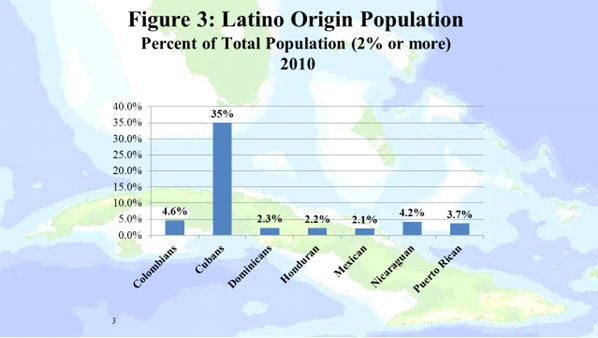
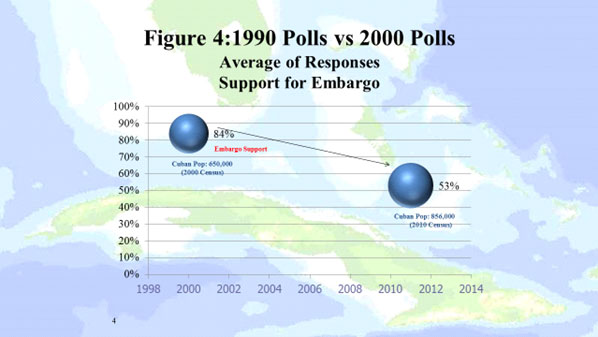
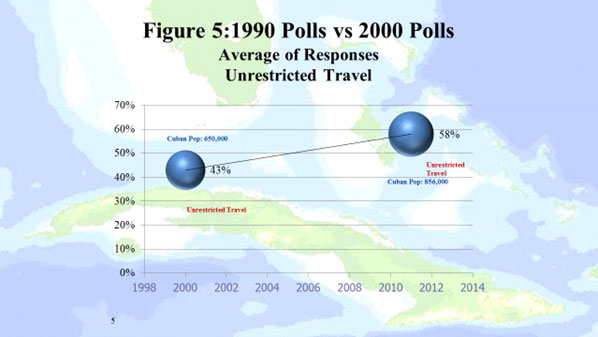
<body><![CDATA[<p style='text&#45;align:justify;line&#45;height:150%'><font face="verdana" size="2"><b><font size="3">INTRODUCTION</font></b></font></p>  	    <p style='text&#45;align:justify;line&#45;height:150%'><font face="verdana" size="2">The recently proposed changes to U.S. Cuba policy have been viewed by critics as being a capitulation to the government of Cuba and by supporters as a long needed adjustment to a failed policy inspired by Cold War geopolitics. Some in both camps consider it a risky move by President Obama. The risk involved is the alienation of the Cuban American electorate in South Florida which might put the democratic presidential candidate in 2016 in a precarious position in winning the third most populous State in the elections. Supporters of the vision point out that the Cuban&#45;American community in South Florida is changing and its long held hard&#45;line attitudes have been tempered by time and a demographic transition occurring driven by second generation and new migrants from the island.&nbsp; Much of the empirical evidence for the argument supporting changing views comes from the FIU Cuba Poll, a poll which has tracked Cuban American attitudes about U.S. Cuba policy since 1991.</font></p>  	    <p style='text&#45;align:justify;text&#45;indent:1.0cm;line&#45;height: 150%'><font face="verdana" size="2">Since 1991, the FIU Cuba Poll has measured the attitudes of Cuban&#45;Americans living in South Florida towards U.S./Cuba relations. Despite the controversy that often surrounds the poll, the research has contributed to the understanding of the changing nature of Cubans in the United States. Before the Cuba Poll, Cuban Americans were frequently characterized by their monolithic ideological "right wing" leanings. This "Exile Ideology" shaped the national perception of the nature of the Cuban American community (Grenier and P&eacute;rez, 2003). To the degree that non&#45;Cuban Americans thought of Cubans in the Miami area, they were characterized by their political features: staunch anti&#45;Castrism, militancy and political conservatism. This image was reinforced by the communities&rsquo; overwhelming political allegiance to the Republican Party (Uhlander and Garc&iacute;a, 2005).</font></p>  	     <p style='text&#45;align:justify;text&#45;indent:1.0cm;line&#45;height: 150%'><font face="verdana" size="2">In    this brief essay I present some of the results of the latest poll &#150;May    2014&#150; on the views of the Cuban community in Miami to Cuba and to the US    policy with the island. I compare some of the key responses to previous surveys    conducted since 1991 to contextualize some of the changes in the community over    the past twenty years.</font></p>  	     <p style='text&#45;align:justify;line&#45;height:150%'><font face="verdana" size="2"><b>There    are Cubans and there are Cubans: Ideological Segmentation by Time of Arrival</b></font></p>  	    <p style='text&#45;align:justify;line&#45;height:150%'><font face="verdana" size="2">In recent decades the Cuban community has grown increasingly diverse. Since the Mariel Boatlift in 1980 and, more recently, since the regularization of immigration by the 1995 Immigration Agreement, the Cuban population of Miami has developed socioeconomic characteristics unlike the earlier arrivals (Fern&aacute;ndez, 2007; Newby &amp; Dowling, 2007). For example, analyses of income differences among the pre&#45;Mariel, and the Mariel and post&#45;Mariel cohorts of Cuban immigrants, reflect stark contrasts indicating different modes of economic incorporation (Portes &amp; Puhrmann, 2013). More surprising is the fact, that after decades of a strong alliance to the Republican Party, recent studies point to an increasing growth of support for the Democratic Party and Independent affiliation among Cuban Americans.</font></p>  	    <p style='text&#45;align:justify;text&#45;indent:1.0cm;line&#45;height: 150%'><font face="verdana" size="2">The ideological diversity of the community is increasing as well. This change is driven by the flow of immigration established by the 1995 agreements and the rather unusual mode of receiving these immigrants provided by the Cuban Adjustment Act (CAA) of 1966. The special legal status afforded to Cubans was given legal grounds on 2 December 1966 when President Johnson signed the Cuban Adjustment Act &#150;providing that "any alien who is a native or citizen of Cuba and who has been inspected and admitted or paroled into the United States subsequent to 1 January 1959 and has been physically present in the United States for at least one year, may be adjusted by the Attorney General at his/her discretion and under such regulations as s/he may prescribe for an alien lawfully admitted for permanent residency&hellip;"&nbsp; In other words, the Cuban Adjustment Act establishes that any Cuban arriving in U.S. territory, even illegally, and residing there for two years (it was later shortened to one year and it is still effective) can receive the status of permanent resident in the United States. The Cubans are the only immigrant group that automatically and immediately receive a working permit, do not have to submit an affidavit of support to become lawful residents, get a social security number and public benefits for food and accommodation, adjusts their status without having to return to their country of origin to receive it and do not need lawyers or money to get the benefit of blanket parole. As far as we know, the CAA is the only law in the world that offers these privileges to a migrant group not threatened with physical extinction. This policy has provide an irresistible "carrot" to Cubans discontent with their lives on the island and it provides a significant "stick" the Cuban government to use against the United States while encouraging the exit of its dissidents and malcontents. The result of this policy has been at the constant flow of Cuban nationals to the United States for over fifty five years. This flow has changed the character of the Cuban&#45;American population from exiles to immigrants and is changing the ideological and political landscape of the community.</font></p>  	     <p style='text&#45;align:justify;text&#45;indent:1.0cm;line&#45;height: 150%'><font face="verdana" size="2">The    shifts in policy ushered in under the "normalization" agreements of 1994&#45;1995    have increased dramatically the flow of Cubans to the U.S. as well as introducing    an important change in the provisions of the Cuban Adjustment Act. The 1995    agreements committed the United States to admitting a minimum of 20 000 Cubans    per year and adjusted the CAA by introducing what has been called the "wet foot,    dry foot" policy to discourage unregulated migration from the island.&nbsp;    Under the "wet foot/dry foot" policy Cubans who make it to shore can stay in    the United States &#150;likely becoming eligible to adjust to permanent residence    under the Cuban Adjustment Act&#150;, but those who do not make it to dry land    can be repatriated unless they can demonstrate a well&#45;founded fear of persecution    if returned to Cuba. Although the agreements created an "illegal" dimension    to Cuban migration that did not exist previously, it also normalized the flow    of migrants. The minimum number of admittances does not include the admission    of immediate relatives of U.S. citizens. During the Bush years, legal migration    never reached the agreed upon totals. The first decade of the 21rst century,    however, was the most active in Cuban migration history (<a href="/img/revistas/rnp/v11n22/f0117215.jpg">figure    1</a>).</font></p>  	     <p style='text&#45;align:justify;text&#45;indent:1.0cm;line&#45;height: 150%'><font face="verdana" size="2">This    population displacement is important for several reasons. As shown in <a href="/img/revistas/rnp/v11n22/f0217215.jpg">figure    2</a>, the continuous migration from the island since 1959 has transformed Miami&#45;Dade    County into the largest metropolitan area in the US composed mostly of ethnic    minorities. Over 85% of the population belongs to a minority group. Cubans stand    out as the largest minority group. More than 35% of the population of Miami    is Cuban, and "newcomers" arriving after the signing of the 1995 migration agreement    comprise more than 35% of the Cuban population. But even this number understates    the importance of the Cuban population in the Latinization process of Miami.    As shown in <a href="/img/revistas/rnp/v11n22/f0317215.jpg">figure 3</a>, Cubans are the largest Latino    group in the county; only six other national groups represent more than 2% of    the total county population.</font></p>  	     <p style='text&#45;align:justify;text&#45;indent:1.0cm;line&#45;height: 150%'><font face="verdana" size="2">The    persistent Cubanization of Miami is significant because it is the driving force    for change in the ideological profile within the community, particularly in    their attitudes towards Cuba and its government. If we take the average of the    five surveys conducted during the 1990s and the six surveys we conduct since    2000, we see some basic trends. <a href="/img/revistas/rnp/v11n22/f0417215.jpg">Figure 4</a> shows the    average of the support expressed for the embargo during the two decades of surveys    and the number of the approximate population of Cubans in Miami at the time    of the surveys according to the U.S. Census (Census Bureau, 2002). In the 1990s,    when the number of Cubans in Miami totaled 650 000, an average 84% of respondents    supported the embargo. Over the next decade, support declined to an average    of 53% as the population of Cubans in Miami rose to 856 000. <a href="/img/revistas/rnp/v11n22/f0517215.jpg">Figure    5</a> shows a similar impact of population density on the support expressed    for unrestricted travel to Cuba by all Americans as the support increased from    43 to 58%. The density of the Cuban diaspora, fueled by newcomers appears to    be an important factor in the changing ideological profile of the community.</font></p>  	     ]]></body>
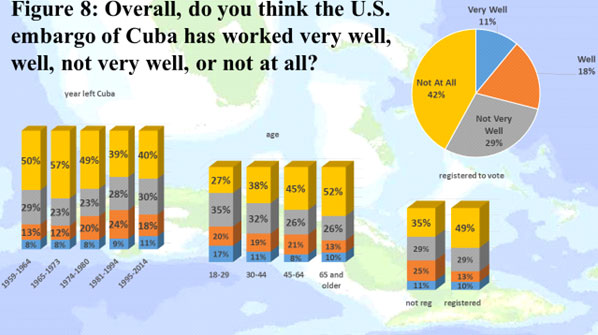
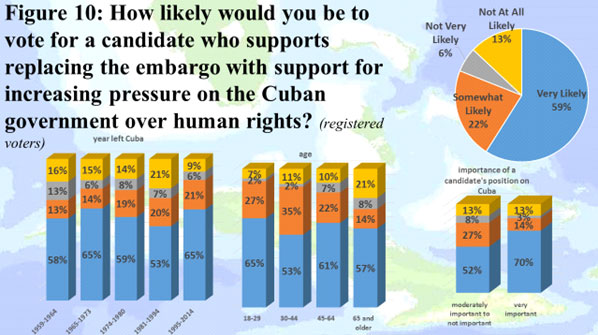
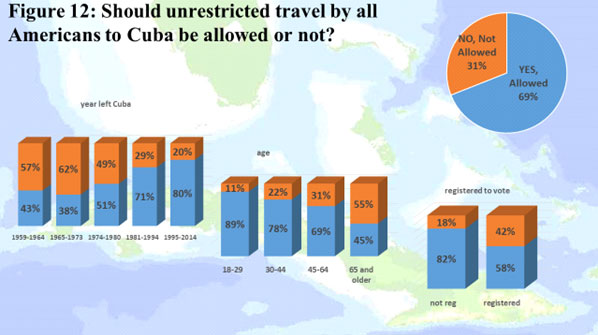
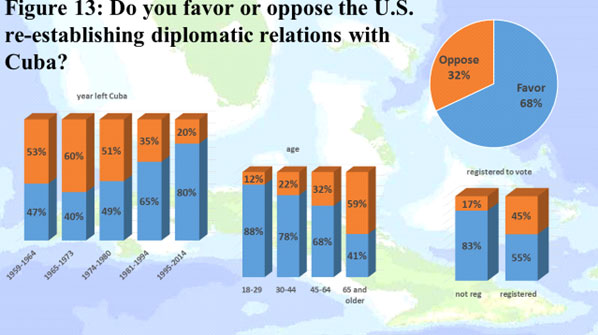
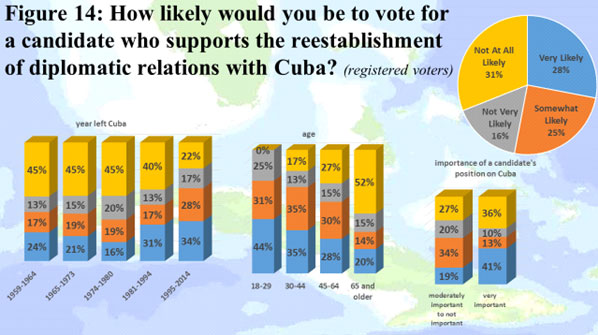
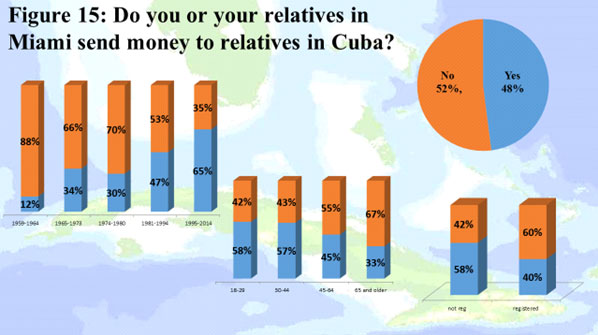
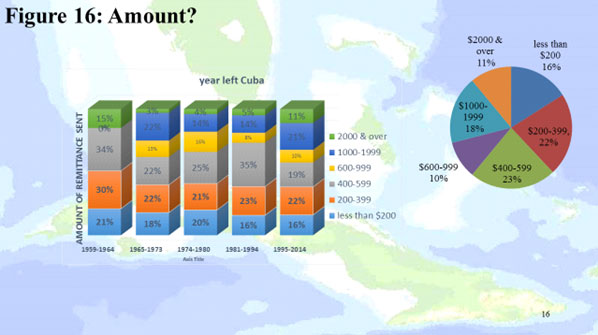
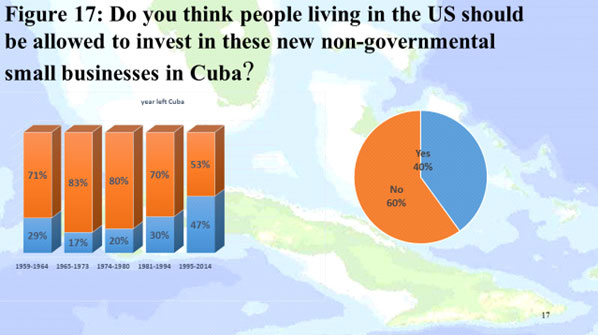
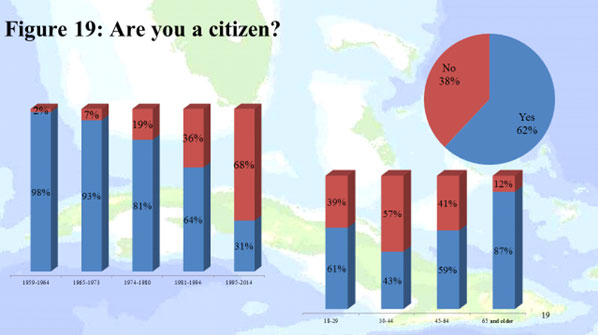
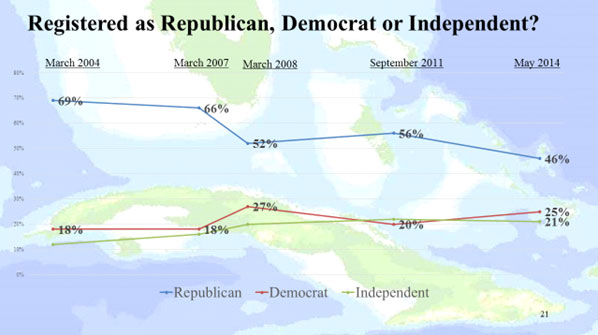
<body><![CDATA[<p style='text&#45;align:justify;text&#45;indent:1.0cm;line&#45;height: 150%'><font face="verdana" size="2">The    changes in community attitudes toward the island can be clearly seen when comparing    the survey responses over the past two and a half decades. <a href="/img/revistas/rnp/v11n22/f0617215.jpg">Figure    6</a> presents the weakening of support for the embargo during this time. The    importance of demographics in this change is evident in <a href="/img/revistas/rnp/v11n22/f0717215.jpg">figure    7</a>, drawn from the 2014 poll. Here we see conciliatory viewpoints expressed    more frequently by newcomers (since 1995) and the younger generation of the    Cuban diaspora. It is also important to note in this and other figures, the    tendency of voters. Voters are immigrants with more time in the U.S. Their attitudes    tend to be more consistent with the characteristics of the classic "exile ideology"    in their resistance to reconciliation. Newcomers, however, reflect more conciliatory    attitudes.</font></p>  	     <p style='text&#45;align:justify;text&#45;indent:1.0cm;line&#45;height: 150%'><font face="verdana" size="2">Girard,    Grenier, and Gladwin (2010) have explored the symbolic nature of support for    the embargo and this dimension of the a characteristic often associated with    a "hardline" approach to U.S./Cuba relations is evident in the 2014 poll when    we consider how effective the respondents consider the embargo to be. As <a href="/img/revistas/rnp/v11n22/f0817215.jpg">figure    8</a> shows, an overwhelming majority of Cubans in Miami (80% of post 1995 migrants)    believes that the embargo has not worked very well or at all. Perhaps because    of this belief in the inefficiency of the embargo, a large majority of Cuban&#45;Americans    are willing to use the embargo as a negotiation chip for other policies that    might be more effective in promoting change.&nbsp; 58% are willing to vote for    a candidate who proposes to replace the embargo with a policy that increases    support for small business owners in Cuba (<a href="/img/revistas/rnp/v11n22/f0917215.jpg">figure 9</a>)and    81% are willing to support a candidate who devices a way to increase pressure    on the Cuban government over human rights concerns as a replacement to the policy    of embargo (<a href="/img/revistas/rnp/v11n22/f1017215.jpg">figure 10</a>).</font></p>  	     <p style='text&#45;align:justify;text&#45;indent:1.0cm;line&#45;height: 150%'><font face="verdana" size="2">The    controversial issue of travel also responds to migratory pressures, as the trend    line shows (<a href="/img/revistas/rnp/v11n22/f1117215.jpg">figure 11</a>). In 2014, approximately 69%    of Cubans in Miami supported unrestricted travel to Cuba for all Americans (<a href="/img/revistas/rnp/v11n22/f1217215.jpg">figure    12</a>). Newcomers are more interested in restoring freedom to travel for all    residents of the United States.</font></p>  	     <p style='text&#45;align:justify;text&#45;indent:1.0cm;line&#45;height: 150%'><font face="verdana" size="2">A    major change in diplomatic policy toward the island is supported by the majority    of the population. Approximately 68% supported the reestablishment of diplomatic    relations with the Cuban government. Young Cubans as well as newcomers and Cuban&#45;Americans    are the most convinced of this change (<a href="/img/revistas/rnp/v11n22/f1317215.jpg">figure 13</a>).&nbsp;    When registered voters are asked if they would vote for a candidate who supported    establishing diplomatic relations, most young and new arrival Cuban&#45;Americans    answered that they would likely do so (<a href="/img/revistas/rnp/v11n22/f1417215.jpg">figure 14</a>).</font></p>  	     <p style='text&#45;align:justify;text&#45;indent:1.0cm;line&#45;height: 150%'><font face="verdana" size="2">Remittances    are an important feature of the diaspora/homeland relationship. <a href="/img/revistas/rnp/v11n22/f1517215.jpg">Figures    15</a> and <a href="/img/revistas/rnp/v11n22/f1617215.jpg">16</a> presents respondents categorized by    the annual amount sent to relatives on the island by time of arrival. Again,    we see the importance of the new immigrants in economic transactions. Newcomers    send more remittances than any other category (65%) and send a higher average    amount than other groups &#151;31% send over $1000 a year (<a href="/img/revistas/rnp/v11n22/f1617215.jpg">figure    16</a>). This commitment to the development of the Cuban economy is also reflected    in attitudes towards new investment opportunities on the island created by the    structural economic changes underway in Cuba. Significant number of Cuban Americans    show a desire to support and take advantage of investment opportunities on the    island (<a href="/img/revistas/rnp/v11n22/f1717215.jpg">figures 17</a> and <a href="/img/revistas/rnp/v11n22/f1817215.jpg">18</a>).</font></p>  	     <p style='text&#45;align:justify;text&#45;indent:1.0cm;line&#45;height: 150%'><font face="verdana" size="2">Ultimately,    <a href="/img/revistas/rnp/v11n22/f1917215.jpg">figures 19</a> and <a href="/img/revistas/rnp/v11n22/f2017215.jpg">20</a> present    the data most important to the process of changing national policy toward Cuba.    Although the Republican Party, traditionally regarded as the most intransigent    toward a policy change is decreasing absolute control over Cuban&#45;American    voters (<a href="/img/revistas/rnp/v11n22/f2117215.jpg">figure 21</a>), newcomers are not represented    in the register of voters in sufficient numbers to play an important role in    altering policy toward Cuba. Only 31% of newcomers have become citizens. Once    becoming citizens, however, the most recent arrivals follow the pattern of previous    waves and register to vote; 83% of the eligible post 1995 arrivals are registered.</font></p>  	    <p style='text&#45;align:justify;line&#45;height:200%'><font face="verdana" size="2"><b>&nbsp;</b></font></p>  	     <p style='text&#45;align:justify;line&#45;height:200%'><font face="verdana" size="2"><b><font size="3">CONCLUSIONES</font></b></font></p>  	    <p style='text&#45;align:justify;line&#45;height:150%'><font face="verdana" size="2">Any synthesis of Cuba Poll surveys leads to the same conclusion: demographic changes are driving the ideological changes of the Cuban community in Miami, but the ideological changes will not be reflected in a change in policy until new waves of immigrants join the second&#45;generation Cuban&#45;Americans to express their wishes at the polls. When this happens, the exile ideology will give way to a new ideology based on the recognition that the Cuban diaspora is an extension of the nation with responsibilities and duties to the civic, cultural, economic and political development not only of Miami&#45;Dade County but in Cuba.</font></p>  	     <p style='text&#45;align:justify;text&#45;indent:1.0cm;line&#45;height: 150%'><font face="verdana" size="2">This    is important because the trends could signal the end of the tendency to see    the community as ideologically monolithic and uncompromising, and the emergence    of the "new ideology of diaspora" directed at establishing and maintaining relationships    with the island. If it is true that the old exile ideology has exerted a major    influence not only in the development of an immigrant community, but also on    the foreign policy of the United States, the bearers of the new ideology will    wield similar power. Just like Reagan mobilized the Cuban&#45;American community    in the 1980s around national enterprise of destroying "the evil empire" of the    Soviet Union, so can the contemporary Cuban community be mobilized around the    more creative endeavor of contributing to the development of a 21rst century    Cuba.</font></p>     ]]></body>
<body><![CDATA[<p style='text&#45;align:justify;text&#45;indent:1.0cm;line&#45;height: 150%'>&nbsp;</p>  	     <p style='margin&#45;left:1.0cm;text&#45;align:justify;text&#45;indent: &#45;1.0cm;line&#45;height:150%'><font face="verdana" size="2"><b><font size="3">REFERENCES</font></b></font></p>  	     <p style='margin&#45;left:1.0cm;text&#45;align:justify;text&#45;indent: &#45;1.0cm;line&#45;height:150%'><font face="verdana" size="2">Census    Bureau. (2002). Census Profile of Florida: 2000. <a href="http://www.census.gov/prod/2002pubs" target="_blank">http://www.census.gov/prod/2002pubs</a><a href="http://www.census.gov/prod/2002pubs/c2kprof00&#45;fl.pdf">/c2kprof00&#45;fl.pdf</a>.    January 8, 2014.</font></p>  	    <!-- ref --><p style='margin&#45;left:1.0cm;text&#45;align:justify;text&#45;indent: &#45;1.0cm;line&#45;height:150%'><font face="verdana" size="2">Fern&aacute;ndez, G. A. (2007). Race, gender and class in the persistence of the Mariel stigma twenty years after the Exodus from Cuba. <i>International Migration Review, 41</i>(3), 602&#45;22.    </font></p>  	     <p style='margin&#45;left:1.0cm;text&#45;align:justify;text&#45;indent: &#45;1.0cm;line&#45;height:150%'><font face="verdana" size="2">Girard,    C., &amp; Grenier, G. (2008). Insulating an Ideology: The Enclave Effect on    South Florida&rsquo;s Cuban Americans. <i>Latino Journal of Behavioral Sciences,</i>    30(4), 530&#150;543.</font></p>  	    <p style='margin&#45;left:1.0cm;text&#45;align:justify;text&#45;indent: &#45;1.0cm;line&#45;height:150%'><font face="verdana" size="2">Girard, C., Grenier, G.J., &amp; Gladwin, H. (2010). The Declining Symbolic Significance of the Embargo for South Florida&rsquo;s Cuban American. <i>Latino Studies Journal, 8</i>, 4&#45;22.</font></p>  	    <p style='margin&#45;left:1.0cm;text&#45;align:justify;text&#45;indent: &#45;1.0cm;line&#45;height:150%'><font face="verdana" size="2">Grenier, G. J., &amp; P&eacute;rez, L. (2003). <i>The Legacy of Exile: Cubans in the United States</i>. USA, Boston: Allyn and Bacon.</font></p>  	    <!-- ref --><p style='margin&#45;left:1.0cm;text&#45;align:justify;text&#45;indent: &#45;1.0cm;line&#45;height:150%'><font face="verdana" size="2">Newby, C. A., &amp; Dowling, J. A. (2007). Black and Hispanic: The Racial Identification of Afro&#45;Cuban Immigrants in the Southwest. <i>Sociological Perspectives, 50</i>(3), 343&#45;366.    </font></p>  	    ]]></body>
<body><![CDATA[<!-- ref --><p style='margin&#45;left:1.0cm;text&#45;align:justify;text&#45;indent: &#45;1.0cm;line&#45;height:150%'><font face="verdana" size="2">Portes, A., and Puhrmann, A.&nbsp; (2013). A Bifurcated Enclave: The Peculiar Evolution of the Cuban Immigrant Population in the Last Decades. Paper presented at the Ninth Conference on Cuban and Cuban&#45;American Studies, May 23, 2013.    </font></p>  	     <p style='margin&#45;left:1.0cm;text&#45;align:justify;text&#45;indent: &#45;1.0cm;line&#45;height:150%'><font face="verdana" size="2">Uhlander,    C. J., and Garc&iacute;a, F. C. (2005). Learning Which Party Fits: Experience,    Ethnic Identity, and the Demographic Foundations of Latino Party Identification.    In G. M. Segura and S. Bowler (Eds.), <i>Diversity in Democracy: Minority Representatives    in the United States</i> (pp. 72&#45;101). Charlottesville: University of Virginia    Press.</font></p>     <p style='margin&#45;left:1.0cm;text&#45;align:justify;text&#45;indent: &#45;1.0cm;line&#45;height:150%'>&nbsp;</p>     <p style='margin&#45;left:1.0cm;text&#45;align:justify;text&#45;indent: &#45;1.0cm;line&#45;height:150%'>&nbsp;</p>     <p style='margin&#45;left:1.0cm;text&#45;align:justify;text&#45;indent: &#45;1.0cm;line&#45;height:150%'><font face="verdana" size="2">Recibido:    20 de octubre de 2015    <br>   Aprobado: 30 de noviembre de 2015</font></p>     <p style='margin&#45;left:1.0cm;text&#45;align:justify;text&#45;indent: &#45;1.0cm;line&#45;height:150%'><font face="verdana" size="2">&nbsp;</font></p>     <p style='margin&#45;left:1.0cm;text&#45;align:justify;text&#45;indent: &#45;1.0cm;line&#45;height:150%'>&nbsp;</p>  	     <p align="justify">&nbsp;</p> 	<hr align="left" size="1" width="33%">  	    ]]></body>
<body><![CDATA[<p style='line&#45;height:150%'><font face="verdana" size="2"><a href="#_ftnref1" name="_ftn1" title="">*</a> Presented at the Latin American Studies Association Conference (San Juan, Puerto Rico, May 27&#45;May 30, 2015).</font></p>  	    <p style='line&#45;height:150%'><font face="verdana" size="2"><a href="#_ftnref2" name="_ftn2" title="">**</a> <b>Ph.D.</b>Professor of Sociology and Graduate Program Director in the Department of Global &amp; Sociocultural Studies in the Steven J. Green School of International and Public Affairs at Florida International University. <a href="mailto:grenierg@fiu.edu">grenierg@fiu.edu</a></font></p>      ]]></body><back>
<ref-list>
<ref id="B1">
<nlm-citation citation-type="">
<person-group person-group-type="author">
<name>
<surname><![CDATA[Bureau]]></surname>
<given-names><![CDATA[Census]]></given-names>
</name>
</person-group>
<source><![CDATA[Census Profile of Florida: 2000]]></source>
<year>2002</year>
</nlm-citation>
</ref>
<ref id="B2">
<nlm-citation citation-type="journal">
<person-group person-group-type="author">
<name>
<surname><![CDATA[Fernández]]></surname>
<given-names><![CDATA[G. A]]></given-names>
</name>
</person-group>
<article-title xml:lang="en"><![CDATA[Race, gender and class in the persistence of the Mariel stigma twenty years after the Exodus from Cuba]]></article-title>
<source><![CDATA[International Migration Review]]></source>
<year>2007</year>
<volume>41</volume>
<numero>3</numero>
<issue>3</issue>
<page-range>602-22</page-range></nlm-citation>
</ref>
<ref id="B3">
<nlm-citation citation-type="journal">
<person-group person-group-type="author">
<name>
<surname><![CDATA[Girard]]></surname>
<given-names><![CDATA[C]]></given-names>
</name>
<name>
<surname><![CDATA[Grenier]]></surname>
<given-names><![CDATA[G]]></given-names>
</name>
</person-group>
<article-title xml:lang="en"><![CDATA[Insulating an Ideology: The Enclave Effect on South Florida&#8217;s Cuban Americans]]></article-title>
<source><![CDATA[Latino Journal of Behavioral Sciences]]></source>
<year>2008</year>
<volume>30</volume>
<numero>4</numero>
<issue>4</issue>
<page-range>530-543</page-range></nlm-citation>
</ref>
<ref id="B4">
<nlm-citation citation-type="journal">
<person-group person-group-type="author">
<name>
<surname><![CDATA[Girard]]></surname>
<given-names><![CDATA[C]]></given-names>
</name>
<name>
<surname><![CDATA[Grenier]]></surname>
<given-names><![CDATA[JG]]></given-names>
</name>
<name>
<surname><![CDATA[Gladwin]]></surname>
<given-names><![CDATA[H]]></given-names>
</name>
</person-group>
<article-title xml:lang="en"><![CDATA[The Declining Symbolic Significance of the Embargo for South Florida&#8217;s Cuban American]]></article-title>
<source><![CDATA[Latino Studies Journal]]></source>
<year>2010</year>
<volume>8</volume>
<page-range>4-22</page-range></nlm-citation>
</ref>
<ref id="B5">
<nlm-citation citation-type="book">
<person-group person-group-type="author">
<name>
<surname><![CDATA[Grenier]]></surname>
<given-names><![CDATA[GJ]]></given-names>
</name>
<name>
<surname><![CDATA[Pérez]]></surname>
<given-names><![CDATA[L]]></given-names>
</name>
</person-group>
<source><![CDATA[The Legacy of Exile: Cubans in the United States]]></source>
<year>2003</year>
<publisher-loc><![CDATA[Boston ]]></publisher-loc>
<publisher-name><![CDATA[Allyn and Bacon]]></publisher-name>
</nlm-citation>
</ref>
<ref id="B6">
<nlm-citation citation-type="journal">
<person-group person-group-type="author">
<name>
<surname><![CDATA[Newby]]></surname>
<given-names><![CDATA[C. A]]></given-names>
</name>
<name>
<surname><![CDATA[Dowling]]></surname>
<given-names><![CDATA[J. A]]></given-names>
</name>
</person-group>
<article-title xml:lang="en"><![CDATA[Black and Hispanic: The Racial Identification of Afro-Cuban Immigrants in the Southwest]]></article-title>
<source><![CDATA[Sociological Perspectives]]></source>
<year>2007</year>
<volume>50</volume>
<numero>3</numero>
<issue>3</issue>
<page-range>343-366</page-range></nlm-citation>
</ref>
<ref id="B7">
<nlm-citation citation-type="book">
<person-group person-group-type="author">
<name>
<surname><![CDATA[Portes]]></surname>
<given-names><![CDATA[A]]></given-names>
</name>
<name>
<surname><![CDATA[Puhrmann]]></surname>
<given-names><![CDATA[A]]></given-names>
</name>
</person-group>
<source><![CDATA[A Bifurcated Enclave: The Peculiar Evolution of the Cuban Immigrant Population in the Last Decades]]></source>
<year>2013</year>
<publisher-name><![CDATA[Paper presented at the Ninth Conference on Cuban and Cuban-American Studies]]></publisher-name>
</nlm-citation>
</ref>
<ref id="B8">
<nlm-citation citation-type="book">
<person-group person-group-type="author">
<name>
<surname><![CDATA[Uhlander]]></surname>
<given-names><![CDATA[C. J]]></given-names>
</name>
<name>
<surname><![CDATA[García]]></surname>
<given-names><![CDATA[F. C]]></given-names>
</name>
</person-group>
<article-title xml:lang="en"><![CDATA[Learning Which Party Fits: Experience, Ethnic Identity, and the Demographic Foundations of Latino Party Identification]]></article-title>
<person-group person-group-type="editor">
<name>
<surname><![CDATA[Segura]]></surname>
<given-names><![CDATA[G. M.]]></given-names>
</name>
<name>
<surname><![CDATA[Bowler]]></surname>
<given-names><![CDATA[S.]]></given-names>
</name>
</person-group>
<source><![CDATA[Diversity in Democracy: Minority Representatives in the United States]]></source>
<year>2005</year>
<publisher-loc><![CDATA[Charlottesville ]]></publisher-loc>
<publisher-name><![CDATA[University of Virginia Press]]></publisher-name>
</nlm-citation>
</ref>
</ref-list>
</back>
</article>