<?xml version="1.0" encoding="ISO-8859-1"?><article xmlns:mml="http://www.w3.org/1998/Math/MathML" xmlns:xlink="http://www.w3.org/1999/xlink" xmlns:xsi="http://www.w3.org/2001/XMLSchema-instance">
<front>
<journal-meta>
<journal-id>1993-8012</journal-id>
<journal-title><![CDATA[Minería y Geología]]></journal-title>
<abbrev-journal-title><![CDATA[Min. Geol.]]></abbrev-journal-title>
<issn>1993-8012</issn>
<publisher>
<publisher-name><![CDATA[EDUM. Universidad de Moa]]></publisher-name>
</publisher>
</journal-meta>
<article-meta>
<article-id>S1993-80122017000100005</article-id>
<title-group>
<article-title xml:lang="en"><![CDATA[Monitoring of flank wear and damage in high-speed end milling inclined surfaces of hardened steel AISI D6]]></article-title>
<article-title xml:lang="es"><![CDATA[Supervisión del desgaste y deterioro de flancos en fresado extremo de alta velocidade en superficies inclinadas de acero endurecido AISI D6]]></article-title>
</title-group>
<contrib-group>
<contrib contrib-type="author">
<name>
<surname><![CDATA[Sánchez Hechavarría]]></surname>
<given-names><![CDATA[Yanier]]></given-names>
</name>
<xref ref-type="aff" rid="A01"/>
</contrib>
<contrib contrib-type="author">
<name>
<surname><![CDATA[Mariño Cala]]></surname>
<given-names><![CDATA[Maritza]]></given-names>
</name>
<xref ref-type="aff" rid="A01"/>
</contrib>
<contrib contrib-type="author">
<name>
<surname><![CDATA[Brito Sauvanell]]></surname>
<given-names><![CDATA[Luis Ángel]]></given-names>
</name>
<xref ref-type="aff" rid="A01"/>
</contrib>
<contrib contrib-type="author">
<name>
<surname><![CDATA[Sanabria Macías]]></surname>
<given-names><![CDATA[Frank]]></given-names>
</name>
<xref ref-type="aff" rid="A01"/>
</contrib>
</contrib-group>
<aff id="A01">
<institution><![CDATA[,Universidad de Oriente  ]]></institution>
<addr-line><![CDATA[ Santiago de Cuba]]></addr-line>
<country>Cuba</country>
</aff>
<pub-date pub-type="pub">
<day>00</day>
<month>03</month>
<year>2017</year>
</pub-date>
<pub-date pub-type="epub">
<day>00</day>
<month>03</month>
<year>2017</year>
</pub-date>
<volume>33</volume>
<numero>1</numero>
<fpage>58</fpage>
<lpage>75</lpage>
<copyright-statement/>
<copyright-year/>
<self-uri xlink:href="http://scielo.sld.cu/scielo.php?script=sci_arttext&amp;pid=S1993-80122017000100005&amp;lng=en&amp;nrm=iso"></self-uri><self-uri xlink:href="http://scielo.sld.cu/scielo.php?script=sci_abstract&amp;pid=S1993-80122017000100005&amp;lng=en&amp;nrm=iso"></self-uri><self-uri xlink:href="http://scielo.sld.cu/scielo.php?script=sci_pdf&amp;pid=S1993-80122017000100005&amp;lng=en&amp;nrm=iso"></self-uri><abstract abstract-type="short" xml:lang="en"><p><![CDATA[Cutting tool condition monitoring system in the industry is mainly used to detect tool wear, breakage and chatter on the tool. In this paper, tool wear with two inclination surfaces angles was investigated in end milling inclined surface using cutting force signals. This study is focused in the time domain radial force amplitude analysis and Root Mean Square (RMS) values for tool wear monitoring in milling process. The RMS value of the radial cutting force is increased with the flank wear and inclination angle increases. The analysis of the RMS values of the radial cutting force can be effectively used for the tool wear progression monitoring during milling operations. It was confirmed that in end milling inclined surface the predominant mechanism of damage is adhesive-abrasive.]]></p></abstract>
<abstract abstract-type="short" xml:lang="es"><p><![CDATA[Los sistemas de monitoreo de las condiciones de la herramienta de corte son principalmente usados en la industria para detectar desgaste, rotura y vibraciones auto-excitadas. En este artículo se investiga el desgaste de la herramienta en el proceso de fresado de superficies inclinadas, con dos ángulos de inclinación, usando las señales de fuerza de corte. Este estudio se enfoca en el monitoreo del desgaste en el proceso de fresado a través del análisis de la amplitud de la señal de fuerza radial en el dominio del tiempo y los valores de la Raíz Media Cuadrática (RMS). Se determinó que los valores de RMS se incrementan con el aumento del desgaste de flanco y el ángulo de inclinación de la superficie. Los valores de RMS de la fuerza de corte radial son usados efectivamente para el monitoreo de la progresión del desgaste de la herramienta durante operaciones de fresado. Se confirmó, además, que el mecanismo de desgaste de la herramienta de corte en el proceso de fresado de superficies inclinadas es predominantemente adhesivo-abrasivo.]]></p></abstract>
<kwd-group>
<kwd lng="en"><![CDATA[milling]]></kwd>
<kwd lng="en"><![CDATA[monitoring]]></kwd>
<kwd lng="en"><![CDATA[inclined surfaces]]></kwd>
<kwd lng="en"><![CDATA[wear]]></kwd>
<kwd lng="en"><![CDATA[mechanism of damage]]></kwd>
<kwd lng="en"><![CDATA[cutting force]]></kwd>
<kwd lng="es"><![CDATA[fresado]]></kwd>
<kwd lng="es"><![CDATA[superficies inclinadas]]></kwd>
<kwd lng="es"><![CDATA[monitoreo]]></kwd>
<kwd lng="es"><![CDATA[desgaste]]></kwd>
<kwd lng="es"><![CDATA[mecanismos de desgaste]]></kwd>
<kwd lng="es"><![CDATA[fuerza de corte]]></kwd>
</kwd-group>
</article-meta>
</front><body><![CDATA[  	    <p align="right"><font face="verdana" size="2"><b>ART&Iacute;CULO ORIGINAL</b></font></p>     <p align="right">&nbsp;</p>  	    <p align="right"><font face="verdana" size="2"><b>&nbsp;</b></font></p>  	    <p align="left"><font face="verdana" size="4"><b>Monitoring of flank wear and damage in high&#45;speed end milling inclined surfaces of hardened steel AISI D6</b></font></p>  	    <p align="left"><font face="verdana" size="2"><b>&nbsp;</b></font></p> 	    <p align="left">&nbsp;</p>  	    <p align="left"><font face="verdana" size="3"><b><i>Supervisi&oacute;n del desgaste y deterioro de flancos en fresado extremo de alta velocidade en superficies inclinadas de acero endurecido AISI D6</i></b></font></p>  	    <p align="center">&nbsp;</p> 	    <p align="center">&nbsp;</p>     ]]></body>
<body><![CDATA[<p align="center"><font face="verdana" size="2"><b><i>&nbsp;</i></b></font></p>  	    <p align="justify"><font face="verdana" size="2"><b>Yanier S&aacute;nchez Hechavarr&iacute;a<sup>1</sup>, Maritza Mari&ntilde;o Cala<sup>1</sup>, Luis &Aacute;ngel Brito Sauvanell<sup>1</sup>, Frank Sanabria Mac&iacute;as<sup>1</sup></b></font></p>     <p align="justify">&nbsp;</p>  	    <p align="justify"><font face="verdana" size="2"><sup>1</sup>Universidad de Oriente. Santiago de Cuba. Cuba <a href="mailto:rysan@uo.edu.cu">rysan@uo.edu.cu</a></font>    <br> 	</p> 	    <p align="justify">&nbsp;</p>     <p align="justify">&nbsp;</p> <hr> 	    <p align="justify"><font face="verdana" size="3"><b>Abstract</b></font></p>  	    <p align="justify"><font face="verdana" size="2">Cutting tool condition monitoring system in the industry is mainly used to detect tool wear, breakage and chatter on the tool. In this paper, tool wear with two inclination surfaces angles was investigated in end milling inclined surface using cutting force signals. This study is focused in the time domain radial force amplitude analysis and Root Mean Square (RMS) values for tool wear monitoring in milling process. The RMS value of the radial cutting force is increased with the flank wear and inclination angle increases. The analysis of the RMS values of the radial cutting force can be effectively used for the tool wear progression monitoring during milling operations. It was confirmed that in end milling inclined surface the predominant mechanism of damage is adhesive&#150;abrasive.</font>	</p> 	    <p align="justify"><font face="verdana" size="2"><b>Keywords:</b> milling; monitoring; inclined surfaces; wear; mechanism of damage; cutting force.</font></p>  	    ]]></body>
<body><![CDATA[<p align="justify">&nbsp;</p> <hr>     <p align="justify"><font face="verdana" size="3"><b>Resumen</b></font></p>  	    <p align="justify"><font face="verdana" size="2">Los sistemas de monitoreo de las condiciones de la herramienta de corte son principalmente usados en la industria para detectar desgaste, rotura y vibraciones auto&#45;excitadas. En este art&iacute;culo se investiga el desgaste de la herramienta en el proceso de fresado de superficies inclinadas, con dos &aacute;ngulos de inclinaci&oacute;n, usando las se&ntilde;ales de fuerza de corte. Este estudio se enfoca en el monitoreo del desgaste en el proceso de fresado a trav&eacute;s del an&aacute;lisis de la amplitud de la se&ntilde;al de fuerza radial en el dominio del tiempo y los valores de la Ra&iacute;z Media Cuadr&aacute;tica (RMS). Se determin&oacute; que los valores de RMS se incrementan con el aumento del desgaste de flanco y el &aacute;ngulo de inclinaci&oacute;n de la superficie. Los valores de RMS de la fuerza de corte radial son usados efectivamente para el monitoreo de la progresi&oacute;n del desgaste de la herramienta durante operaciones de fresado. Se confirm&oacute;, adem&aacute;s, que el mecanismo de desgaste de la herramienta de corte en el proceso de fresado de superficies inclinadas es predominantemente adhesivo&#150;abrasivo.</font>	</p> 	    <p align="justify"><font face="verdana" size="2"><b>Palabras clave:</b> fresado; superficies inclinadas; monitoreo; desgaste; mecanismos de desgaste; fuerza de corte.</font></p> <hr> 	    <p align="justify">&nbsp;</p> 	    <p align="justify">&nbsp;</p> 	    <p align="justify"><font face="verdana" size="2">&nbsp;</font></p>  	    <p align="justify"><font face="verdana" size="2"><b>1. INTRODUCTION</b></font></p>  	    <p align="justify"><font face="verdana" size="2">In manufacturing industries milling is generally used to produce parts which are not axially symmetric and have many features such as holes, slots, pockets and three dimensional surfaces contours. This process is capable of producing machine elements with complex shapes and high surface quality, such as molds and dies, gears, shafts, blades, etc. The productivity of machining processes, as well as the integrity of the machined surface are strongly related to the tool wear and tool life. Tool wear, hence, becomes the key factor in the machining processes. If a worn tool is not identified beforehand, significant degradation of the workpiece quality can occur. Therefore, research in this area is still of great significance (<a href="#ref8">Jozi&#263;, Bajic and Topic 2012</a>).</font>	</p> 	    <p align="justify"><font face="verdana" size="2"><b>1.1. Tool wear</b></font></p>  	    ]]></body>
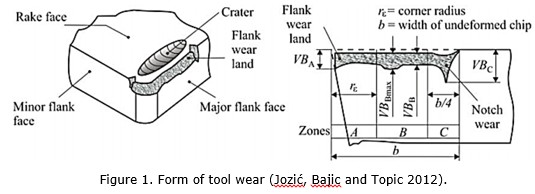
<body><![CDATA[<p align="justify"><font face="verdana" size="2">Three causes of damage are qualitatively identified: mechanical, thermal and adhesive. Mechanical damage, which includes abrasion, chipping, early fracture and fatigue, is basically independent of temperature. Thermal damage, with plastic deformation, thermal diffusion and chemical reaction as its typical forms, increases drastically with increasing temperature (It should be noted that thermal diffusion and chemical reaction are not the direct cause of damage. Rather, they cause the tool surface to be weakened so that abrasion, mechanical shock or adhesion can then more easily cause material removal). Damage based on adhesion is observed to have a local maximum in a certain temperature range (<a href="#ref4">Childs <i>et al.</i> 2000</a>).</font></p>  	    <p align="justify"><font face="verdana" size="2">Wear is a loss of material on an asperity or micro&#45;contact, or smaller scale, down to molecular or atomic removal mechanisms. It usually progresses continuously. Tribological processes leading to tool wear occur at rake and flank face, as shown in <a href="#f1">Figure 1</a> (<a href="#ref4">Childs <i>et al.</i> 2000</a>; <a href="#ref7">Grote and Atonsons 2009</a>).</font>	</p> 	    <p align="center"><font face="verdana" size="2"><img src="/img/revistas/mg/v33n1/f0105117.jpg" name="f1" id="f1" border="0"></font></p>  	    <p align="justify"><font face="verdana" size="2">Flank wear is caused by friction between the flank face of the tool and the machined workpiece surface and leads to loss of the cutting edge. Therefore, flank wear affects the dimensional accuracy and surface finish quality. In practice, flank wear is generally used as the tool wear criteria (<a href="#ref8">Jozi&#263;, Bajic and Topic 2012</a>).</font></p>  	    <p align="justify"><font face="verdana" size="2">Criteria for the selection of the tool&#8217;s end of life has to consider that the operations were carried out under a finish, where the fundamental requirement is to get a good surface finish and dimensional tolerances. For these operations flank wear VB should not exceed 0,2 mm for IT7 qualities and grades of 0,3 mm to IT8 (<a href="#ref6">Diniz, Marcondes and Coppini 2010</a>).</font>	</p> 	    <p align="justify"><font face="verdana" size="2">During milling process, the cutting edges periodically enter and exit the workpiece. Hence, it experiences stress and temperature cycling during cutting. This periodic coupled mechanical&#45;thermal cycle produces alternating compression and tensile stresses on the tool that may exceed its strength. Even if the thermal stress amplitudes are not large enough to break the tool instantly, the thermal stress cycling causes gradual fatigue failure and wear of the tool. The temperature is a direct function of the relative speed and friction force between the materials in contact. Higher speeds result in more friction energy, which increases the temperature at the contact zone between the workpiece and the tool. As the flank wear increases, the tool workpiece contact area increases too (<a href="#ref2">Altintas 2012</a>; <a href="#ref9">Jozi&#263;, Lela and Bati&#263; 2014</a>).</font>	</p> 	    <p align="justify"><font face="verdana" size="3"><b>1.2. Monitoring of the tool condition</b></font></p>  	    <p align="justify"><font face="verdana" size="2">Hence, tool wear becomes the key factor in the machining processes. If a worn tool is not identified previously, significant degradation of the workpiece quality can occur. Therefore, research in this area is of great significance. Several methods have been proposed to monitoring tool wear. There are two main categories: direct and indirect methods. With direct methods, it is possible to measure tool wear directly using some optical instrument such as video camera, which requires cutting operations to be interrupted periodically. Various indirect methods for tool condition monitoring (TCM) are used by modeling the correlation between tool wear and sensory signals, namely, the cutting force, torque, current, power, vibration, and acoustic emission acquired in machining processes (<a href="#ref17">Sivasakthivel, Velmurugan and Sudhakaran 2010</a>; <a href="#ref1">Anti&#263; <i>et al.</i> 2013</a>).</font>	</p> 	    <p align="justify"><font face="verdana" size="2"><a href="#ref12">Kwon and Fischer (2003)</a> have developed the tool wear index (TWI) and the tool life model, analyzing the wear surface areas and the tool material loss by means of micro optics, image processing, and an analysis algorithm. With relation to surface roughness, the TWI measures the minimum risk for in&#45;process tool failure, and it is integrated in an optimal control strategy according to criteria of productivity improvement and reduction of manufacturing cost.</font>	</p> 	    <p align="justify"><font face="verdana" size="2"><a href="#ref14">&Ouml;zel and other researchers (2009)</a>have investigated the influence of cutting parameters on the tool flank wear and surface roughness in hard steel finish turning. Crater and flank wear of ceramic tool are observed with scanning electron microscopy (SEM) after corresponding runs. Linear regression and neural network models are developed for the prediction of tool flank wear and surface roughness. <a href="#ref13">Lajis <i>et al.</i> (2008)</a> have performed similar modeling methodology and measuring techniques in end milling of hardened steel.</font>	</p> 	    ]]></body>
<body><![CDATA[<p align="justify"><font face="verdana" size="3"><b>1.3. Metallurgical Fundamentals</b></font></p>  	    <p align="justify"><font face="verdana" size="2">Hardness working steels, mainly applied in the tool and die making, allow the generation of a homogeneous and isotropic material microstructure. They are characterized by a high hardness, ductility, and pressure strength and possess a good dimensional stability during their heat treatment. Depending on the specific alloy composition and the heat treatment, the hardness can be varied between 50 and 70 HRC. Therefore, the high hardness of these materials can be reached by carbide precipitation and martensitic transformation (<a href="#ref18">Tonshoff, Arendt and Ben&#45;Amor 2000</a>). Precipitation hardening, for instance, leads to an improvement of the stability of the workpieces under static and especially pulsatory loads. This leads to a considerably enhanced property profile compared to conventional die materials. Hence, the lifetime of forming tools can be improved drastically (<a href="#ref11">Klocke <i>et al.</i> 2011</a>).</font>	</p> 	    <p align="justify"><font face="verdana" size="2">Furthermore, powder metallurgical steels can be customized referring to the specific area of application with respect to their hardness, heat, and wear resistance or ductility. For instance, the method of spray&#45;compacting permits the adjustment of an extreme wear resistant microstructure due to the high amount of embedded carbides (<a href="#ref15">Piotrowiak <i>et al.</i> 2004</a>; <a href="#ref11">Klocke <i>et al.</i> 2011</a>).</font>	</p> 	    <p align="justify"><font face="verdana" size="3"><b>1.4. Milling inclined surfaces</b></font></p>  	    <p align="justify"><font face="verdana" size="2">During ball end milling of inclined surfaces, the inclination angle of the machined surface is variable, which affects the active length of cutting edge and working angle values. Consequently, this phenomenon influences cutting forces (<a href="#ref10">Kitan, Kadhim and Abdulrazzaq 2011</a>; <a href="#ref21">Wojciechowski, Twardowski and Pelic 2014</a>), and vibrations generated during machining process. From the literature survey it is also resulting, that surface inclination angle affects surface roughness (<a href="#ref20">Vop&aacute;t, Peterka and Kov&aacute;&#269; 2014</a>), and the tool wear (<a href="#ref21">Wojciechowski, Twardowski and Pelic 2014</a>), during ball end milling. Therefore, the reliable prediction of milling forces including surface inclination is significant for the simulation of the machinability, cutter wear, vibrations, as well as the surface quality.</font>	</p> 	    <p align="justify"><font face="verdana" size="2">Varying the angle of the milled surface produces a change in the value of the radial and axial components of the cutting force. An increase of the inclination angle of the surface causes an increase in the radial component of the cutting force and decreases the axial component. As the radial direction is a little rigid, a higher angle inclination of the milled surface causes greater vibrations and decreasing of tool life (<a href="#ref3">Campa, L&oacute;pez De Lacalle and Celaya 2011</a>).</font>	</p> 	    <p align="justify"><font face="verdana" size="2"><a href="#ref19">T&uuml;ysuz (2012)</a> established that during finish milling of inclined surfaces, the displacements of the tool resulting from the action of the cutting force induce perpendicular vibrations to the axis of rotation of the tool and parallel vibrations to the advance vector. In addition, the radial force component produces perpendicular displacements to axis of rotation of the tool and to the advance vector.</font>	</p> 	    <p align="justify"><font face="verdana" size="2">During the milling of inclined surfaces, the tool end of life criteria must be established from the determination of the flank wear, as it is the predominant wear type. (<a href="#ref20">Vop&aacute;t, Peterka and Kov&aacute;&#269; 2014</a>) determined that ininclined surfaces milling the central wear is not verified, due to the fact that tool center has no contact with the piece, and this interaction is between the minimum effective diameter and the maximum effective diameter.</font>	</p> 	    <p align="justify"><font face="verdana" size="2">With the increasing of the radial component of the cutting force due to the low stiffness of the tool in this direction, an increase of the vibrations is produced and provokes dynamic instabilities and a decrease in tool life (<a href="#ref19">T&uuml;ysuz 2012</a>).</font>	</p> 	    <p align="justify"><font face="verdana" size="2">The purpose of this paper is to monitor the tool wear process during milling of inclined surfaces of hardened steel for cold work AISI D6 from the analysis the Root Mean Square (RMS) value of the radial cutting force. We also establish the flank wear progression and mechanisms that characterizes it.</font><font face="verdana" size="2">&nbsp;</font></p>  	    ]]></body>
<body><![CDATA[<p align="justify"><font face="verdana" size="3"><b>2. EXPERIMENTAL METHOD</b></font></p>  	    <p align="justify"><font face="verdana" size="3"><b>2.1 Equipment</b></font></p>  	    <p align="justify"><font face="verdana" size="2">The experiments were performed in a 3&#45;axis CNC vertical machining center MORI SEIKI SV 40 with 22 kW of power in the spindle motor and a maximum tool rotation of 12 000 r/min. Cemented tungsten carbide inserts with coated TiAlN, were used for the milling tests. These inserts are manufactured by SANDVIK COROMANT, their reference was R216F&#45;16 40 E&#45;L P10A and the tool holder reference was R216F&#45;16A16C&#45;063. The milling tool was changed after to obtain a maximum wear value.</font>	</p> 	    <p align="justify"><font face="verdana" size="2">Tool wear evolution during the tests was monitored using a QUIMIS stereomicroscope with 100X maximum magnification and MOTIC IMAGES PLUS 2.0 ML software. The end of the tool life was determined by a maximum flank wear (VB<sub>Bmax</sub>) of 0,2 mm. During the test, the flank wear was measured at 100 passing of the tool on the workpiece.</font>	</p> 	    <p align="justify"><font face="verdana" size="2">After concluding the tests, the tools, were examined in a scanning electron microscope (SEM) JEOL JXA&#45;840A, which provides higher magnification and has an energy dispersive X&#45;ray spectrometer (EDS) resource that allows chemical elements to be identified and then facilitates wear mechanisms to be establish or at least deduced.</font>	</p> 	    <p align="justify"><font face="verdana" size="2">A KISTLER 9257BA stationary dynamometer, a National Instruments PCI&#45;6025E analogical/digital data acquisition board and LabVIEW 8.5 software were used for 3&#45;axis cutting force (F<sub>X</sub>, F<sub>Y</sub> and F<sub>Z</sub>) measurements. The signals were processed with MatLab 2015 software. Cutting forces were measured before starting the tool wear tests, establishing its initial value and the magnitude of cutting force signals is obtained from RMS value.</font>	</p> 	    <p align="justify"><font face="verdana" size="2">In inclined milling surfaces, the tangential, radial and axial components of the cutting force on the tool, Ft, Fr and Fa, respectively, are functions of instantaneous angle (&#966;) in the feed direction and the axial immersion angle (&#954;), and can be obtained by:</font>	</p> 	    <p align="justify"><font face="verdana" size="2"><img width="469" height="60" src="/img/revistas/mg/v33n1/e0105117.png"></font><font face="verdana" size="2">&nbsp; &nbsp; &nbsp;&nbsp; &nbsp; &nbsp;  (1)</font></p> 	    <p align="justify"><font face="verdana" size="2">When the cutting forces were measured while cutting a workpiece fixed onto the dynamometer, the components measured were parallel to the three axes of the machine tool (F<sub>X</sub>, F<sub>Y</sub> and F<sub>Z</sub>) and, for our purposes, it was interesting to have the Ft, Fr and Fa component.</font>	</p> 	    <p align="justify"><font face="verdana" size="2"><b>2.2. Workpiece material</b></font></p>  	    ]]></body>
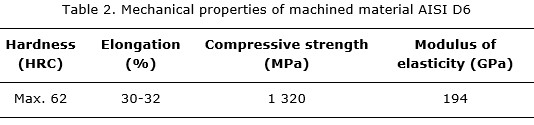
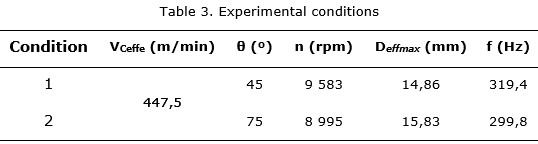
<body><![CDATA[<p align="justify"><font face="verdana" size="2">The selected workpiece material was hardened cold&#45;work tool steel AISI D6, with an approximate hardness of 62 HRC. AISI D6 tool steel is a high&#45;carbon, high chromium tool steel alloyed with tungsten that is characterized by high compressive strength, high wear resistance, high surface hardness and good hardening stability. Chemical composition and mechanical properties are shown in <a href="#t1">Tables 1</a> and <a href="#t2">2</a>.</font>	</p>     <p align="center"><img src="/img/revistas/mg/v33n1/t0105117.jpg" name="t1" id="t1"></p>     <p align="center">&nbsp;</p>     <p align="center"><img src="/img/revistas/mg/v33n1/t0205117.jpg" name="t2" id="t2"></p>     <p align="justify"><font face="verdana" size="2">Two workpieces were manufactured with dimensions of 265x215x125 mm and with inclinations of the surface to mechanize of 45&#186; and 75&#186;. The kinematics representation of movements of ball nose end mill was implemented in machining of the workpiece.</font></p>  	    <p align="justify"><font face="verdana" size="2">A free form surface can be milled using the horizontal downward strategy with two inclination angles. Both cases of ramping are shown in <a href="#f2">Figure 2</a>.</font></p>  	    <p align="center"><font face="verdana" size="2"><b><img src="/img/revistas/mg/v33n1/f0205117.jpg" name="f2" id="f2" border="0"></b></font></p> 	    <p align="justify"><font face="verdana" size="2"><b>2.3. Cutting conditions</b></font></p>  	    <p align="justify"><font face="verdana" size="2">All wear tests were carried out with the following parameters: axial depth of cut a<sub>p</sub>=0,15 mm, radial depth of cut a<sub>e</sub>=0,15 mm, feed per tooth f<sub>z</sub>=0,15 mm/tooth. Experimental conditions are shows in <a href="#t3">Table 3</a>.</font></p>  	    <p align="justify"><font face="verdana" size="2">Cutting speeds were selected in order to achieve the same value of cutting speed of the spindle 45&#176; and 75&#176; in two of the experimental conditions. The experiments were replicated 3 times to set the value of force and from which the tool reaches the maximum wear criteria, enabling the determination of the wear mechanism that produces the tool wear at the contact point between the tool and the workpiece.</font></p>  	    ]]></body>
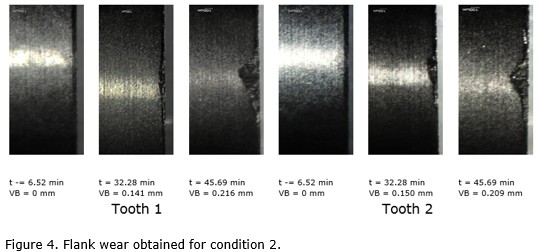
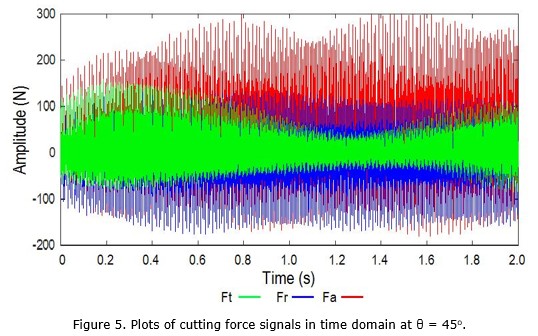
<body><![CDATA[<p align="center"><img src="/img/revistas/mg/v33n1/t0305117.jpg" name="t3" id="t3">	</p> 	    <p align="justify"><font face="verdana" size="2"><b>3. RESULTS AND DISCUSSION</b></font></p>  	    <p align="justify"><font face="verdana" size="2">Through off&#45;line tools wear measurements, it could be confirmed that the dominant wear during milling of inclined surfaces hardened steel AISI D6 is located on the cutting tool flank (Figures <a href="#f3">3</a> y <a href="#f4">4</a>). Following,&nbsp;&nbsp; the new tool (VB=0 mm), slightly worn tool (VB&#8776;0,140 mm), and severely worn tool (VB&#8805;0,2 mm) are shown.</font></p>  	    <p align="center"><font face="verdana" size="2"><img border="0" id="f3" src="/img/revistas/mg/v33n1/f0305117.jpg"></font></p> 	    <p align="justify">&nbsp;</p> 	    <p align="center"><font face="verdana" size="2"><img border="0" id="f4" src="/img/revistas/mg/v33n1/f0405117.jpg"></font></p> 	    <p align="justify"><font face="verdana" size="2">In <a href="#f3">Figure 3</a>, it can be observed that the tools used in the experimental condition 1 the wear of the two teeth of the mill is almost the same, but did not happen in the experimental condition 2 (<a href="#f4">Figure 4</a>), which shows that the middle wear point has a variation of 9 mm in the tooth 1 with respect to the tooth 2, this difference is reduced at the end of life of the tool to 6 mm. This is associated with a higher cutting tool radial deflection produced by the increase of the radial force due to the increase of the inclination of the milled surface (<a href="#ref5">De Oliveira 2007</a>). The arguments of &nbsp;this author allows to say that, through on&#45;line monitoring of the radial component of the cutting force can predict progression of the process of flank wear of the cutting tool till reach the end of life criteria and to determine the mechanisms that will produce flank wear.</font> </p> 	    <p align="justify"><font face="verdana" size="2"><b>3.1. Monitoring flank wear through the analysis of the RMS of the radial cutting force</b></font></p>  	    <p align="justify"><font face="verdana" size="2">The raw signals of the cutting forces in three axis are analyzed in time domain as showed in <a href="#f5">Figure 5</a>. The time domain is plot different cutting forces which are tangential cutting force (Ft), radial cutting force (Fr), and axial cutting force (Fa). This figure shows that the axial cutting force (Fa) is higher than Ft and Fr during the end milling process.</font></p>  	    <p align="center"><font face="verdana" size="2"><img src="/img/revistas/mg/v33n1/f0505117.jpg" name="f5" id="f5" border="0"></font></p>  	    ]]></body>
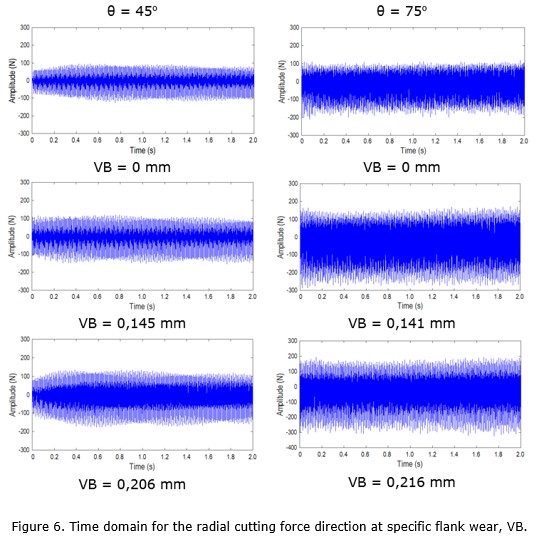
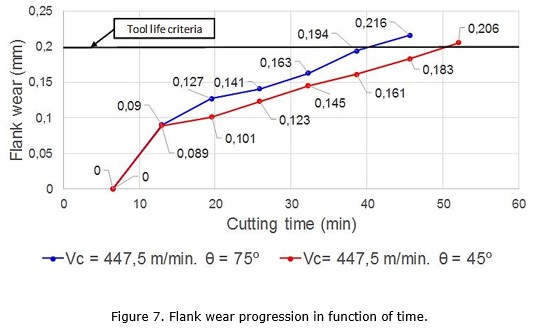
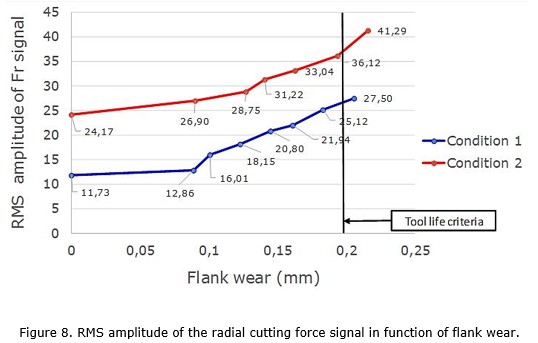
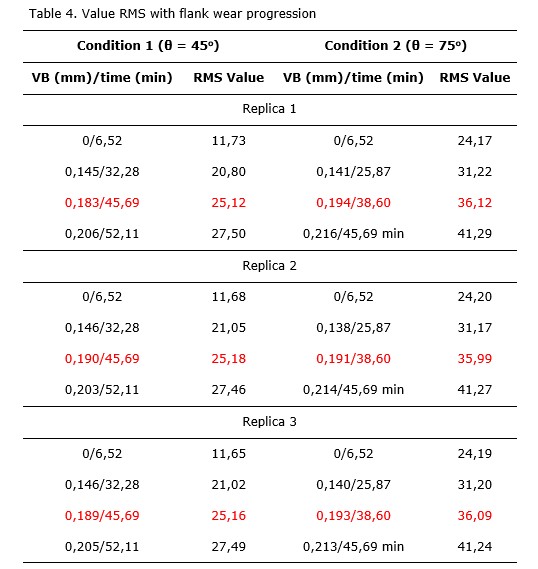
<body><![CDATA[<p align="justify"><font face="verdana" size="2"><a href="#f6">Figure 6</a> presents the radial cutting force in time domain for both inclination angles of the milling surface, for the specific flank wear values. Based on the Figures <a href="#f3">3</a> and <a href="#f4">4</a>, the amplitude of the radial cutting force signals is increased with the flank wear increasing, until the criteria VB=0,2 mm is reached. It clearly shows that the tool flank wear caused the radial cutting force increase. Besides that, the increasing of inclination angle (&#952;) also makes the signal amplitude increased.</font> </p> 	    <p align="center"><font face="verdana" size="2"><img border="0" id="f6" src="/img/revistas/mg/v33n1/f0605117.jpg"></font></p> 	    <p align="justify"><font face="verdana" size="2">To set RMS values near to the criteria of lifetime ending, tool wear progression versus time curve was made (<a href="#f7">Figure 7</a>). Taking into account this, RMS values near to maximum wear were determined to carry out on&#45;line monitoring and set as calibration values 25,15 for experimental condition 1 and 36,07 for experimental condition 2. Calibration values are colored in red (<a href="#t4">Table 4</a>).</font></p>  	    <p align="justify"><font face="verdana" size="2"><a href="#f7">Figure 7</a> clearly shows that the tool used during inclined surface milling with 75&#176; (condition 2) reached first the end of life criteria than the tool used during milling inclined surface with 45&#186; (condition 1), a point that as discussed previously, is associated with the increase of the radial cutting force component.</font></p>  	    <p align="center"><font face="verdana" size="2"><img src="/img/revistas/mg/v33n1/f0705117.jpg" name="f7" id="f7" border="0"></font></p> 	    <p align="justify"><font face="verdana" size="2"><a href="#ref16">S&aacute;nchez and other researchers (2016)</a> proved that the increasing of the inclination angle of the milled surface from 45&#176; to 75&#176; produces an increase in RMS of the radial and tangential components of cutting force, this indicates that the vibrations which are generated during milling inclined surfaces are affected by the variation of the inclination of the milled surface. In <a href="#f8">Figure 8</a>, the curve of variation of RMS value against the progression of flank wear of the tool is shown. This figure shows that the RMS value of the radial force signal increases with the increasing flank wear, observing also that the RMS values for the experimental condition 2 are higher than for the experimental condition 1 in all cases.</font> </p> 	    <p align="center"><font face="verdana" size="2"><img src="/img/revistas/mg/v33n1/f0805117.jpg" name="f8" id="f8" border="0"></font></p> 	    <p align="justify"><font face="verdana" size="2">The values of RMS of radial force signal and flank wear measurement for each set of experiments are also presented in <a href="#t4">Table 4</a>. Based on this table, the values RMS are increased with the tool wear and cutting time increasing.</font></p> 	    <p align="center"><img src="/img/revistas/mg/v33n1/t0405117.jpg" name="t4" id="t4">	</p> 	    <p align="justify"><font face="verdana" size="2">The increasing of the value of RMS is due to the widening of the contact of surface area between the work piece and the tool, so a larger value of RMS is produced due to the increase of the radial force amplitude. This is the same that has been established by previous studies in which a RMS value indicates an increase of the tangential and radial cutting force and vice versa (<a href="#ref16">S&aacute;nchez <i>et al.</i> 2016</a>). The results shown in <a href="#t4">Table 4</a> allow monitoring the wear process of the cutting tool and predict time wear criteria of tool during the milling process of inclined surfaces.</font></p>  	    ]]></body>
<body><![CDATA[<p align="justify"><font face="verdana" size="2">In front end milling processes, the increase of the radial force causes radial deflection of the tool that induces a biggest gap between the consecutive passes of the teeth causing the appearance of regenerative vibrations due to the chatter phenomena, which is related to the appearance of dynamic instabilities.</font>	</p> 	    <p align="justify"><font face="verdana" size="2"><b>3.2. Wear mechanisms</b></font></p>  	    <p align="justify"><font face="verdana" size="2">A microanalysis using Scanning Electron Microscopy (SEM) and an energy dispersive X&#45;ray spectrometer (EDS) was performed on the coated tool in two conditions. In <a href="#f9">Figure 9</a>, it can be seen that during milling of the condition 1, appear fissures evidencing abrasive wear and cracks in the central area of wear. In this condition the values of RMS of the radial force signal are lowers, indicating that the process of milling inclined surface is dynamically more stable. The presence of tungsten in the wear area is due to the presence of this material in the core of the tool, the coating is lost. The presence of titanium in the periphery of the worn area may indicate that there is still coating material in that area. These cracks are caused by the increased value of the radial force that produces the radial deflections of the tool.</font></p>  	    <p align="justify"><font face="verdana" size="2">&nbsp;</font></p>  	    <p align="center"><font face="verdana" size="2"><img src="/img/revistas/mg/v33n1/f0905117.jpg" name="f9" id="f9" border="0"></font></p>  	    <p align="justify"><font face="verdana" size="2">In <a href="#f10">Figure 10</a>, the results of SEM and EDS for condition 2 are shown. In this condition, the values of the RMS are higher indicating the dynamical instabilities. In this figure, it can be observed that in the area where there was maximum flank wear, there is tungsten presence and iron adhesion due to the exposure of the tool core. The presence of titanium in the periphery of the worn area may indicate that there is coating material in that area, similar to condition 1.</font></p>  	    <p align="justify"><font face="verdana" size="2">In the worn area (<a href="#f10">Figure 10</a>) cracks appear in the material flow direction making evident the presence of abrasive wear. Abrasive wear observed for this condition is caused by the movement of hard particles that are coming from the tool and the workpiece that are detach due to the high frequency of teeth input and the abrasive wear mechanism, higher than in all previous cases, criteria that have coincidence with <a href="#ref6">Diniz, Marcondes and Coppini (2010)</a>. All this points permit to confirm the presence of a combined adhesive abrasive wear mechanism.</font></p>  	    <p align="center"><font face="verdana" size="2"><img src="/img/revistas/mg/v33n1/f1005117.jpg" name="f10" id="f10" border="0"></font></p>  	    <p align="justify"><font face="verdana" size="2"><b>4. CONCLUSIONS</b></font></p>  	    <p align="justify"><font face="verdana" size="2">After analyzing the results, we can conclude that:</font></p>  	    ]]></body>
<body><![CDATA[<p align="justify"><font face="verdana" size="2">1. In the end milling process of inclined surfaces of the cold working hardened steel AISI D6, the predominant wear occurs in the flank surface of the tool and it is directly associated to the increase of the radial cutting force and forced vibrations .</font></p>  	    <p align="justify"><font face="verdana" size="2">2. When the inclination angle (&#952;) of the milled surface is increased, the amplitude of the cutting force in time domain is higher and the value of RMS is rising too.</font></p>  	    <p align="justify"><font face="verdana" size="2">3. It was proven that in radial cutting force signals, the proposed method gives satisfactory results for monitoring tool flank wear changes during the end milling process of inclined surfaces.</font></p>  	    <p align="justify"><font face="verdana" size="2">4. In end milling processes of inclined surfaces hardened cold working steel AISI D6, with angles of 45&#176; and 75&#176;, the wear predominant mechanism is adhesive&#150;abrasive.</font>	</p> 	    <p align="justify"><font face="verdana" size="2"><b>5. REFERENCES</b></font></p>  	    <p align="justify"><font size="2" face="verdana" id="ref1">Anti&#263;, A.; &#352;imunovi&#263;, G.; &#352;ari&#263;, T.; Milo&#353;evi&#263;, M. and Ficko, M. 2013: A model of tool wear monitoring system for turning. <i>Tehnicki Vjesnik</i> 20(2): 247&#150;254. Consulted: 10 Sept 2016. Available in: <a href="https://www.researchgate.net/publication/285539042_A_model_of_tool_wear_monitoring_system_for_turning" target="_blank">https://www.researchgate.net/publication/285539042_A_model_of_tool_wear_monitoring</a></font></p> 	    <p align="justify"><font size="2" face="verdana"><a href="https://www.researchgate.net/publication/285539042_A_model_of_tool_wear_monitoring_system_for_turning" target="_blank">_system_for_turning</a></font></p>  	    <!-- ref --><p align="justify"><font size="2" face="verdana" id="ref2">Altintas, Y. 2012: <i>Manufacturing automation: metal cutting mechanics, machine tool vibrations, and CNC design.</i> Second Edition. Cambridge University, New York.    </font></p>  	    <p align="justify"><font size="2" face="verdana" id="ref3">Campa, F. J.; L&oacute;pez De Lacalle, L. N. and Celaya, A. 2011: Chatter avoidance in the milling of thin floors with bull&#45;nose end mills: Model and stability diagrams. <i>International Journal of Machine Tools and Manufacture</i> 51: 43&#45;53. Consulted: 29 Oct 2016. Available in: <a href="http://fulltext.study/preview/pdf/784497.pdf" target="_blank">http://fulltext.study/preview/pdf/784497.pdf</a></font></p>  	    ]]></body>
<body><![CDATA[<!-- ref --><p align="justify"><font size="2" face="verdana" id="ref4">Childs, T.; Maekawa, K.; Obikawa, T. and Yamane, Y. 2000: <i>Metal Machining.</i> <i>Theory and Applications</i>. First Edition. Hodder Headline Group, London.    </font></p>  	    <!-- ref --><p align="justify" id="ref5"><font face="verdana" size="2">De Oliveira, A. J. 2007: <i>An&aacute;lise do desgaste de ferramentas no ferramentas no Fresamento com Alta Velocidade de a&#231;os endurecidos</i>. Doctoral thesis. Universidade Estadual de Campinas. Brasil. Consulted: 30 Oct 2016. Available in:</font><font face="verdana" size="2"> <a href="http://www.bibliotecadigital.unicamp.br/document/?code=vtls000415721" target="_blank">http://www.bibliotecadigital.unicamp.br/document/?code=vtls000415721</a></font><!-- ref --><p align="justify"><font size="2" face="verdana" id="ref6">Diniz, A. E.; Marcondes, F. C. and Coppini, N. L. 2010: <i>Tecnologia da usinagem dos metais</i>. S&eacute;tima edi&#231;&atilde;o. Editora Artileber Ltda, S&atilde;o Paulo.    </font></p>  	    <!-- ref --><p align="justify"><font size="2" face="verdana" id="ref7">Grote, K. H. and Atonsons, E. K. 2009: <i>Handbook of mechanical engineering</i>. Springer, New York.    </font></p>  	    <p align="justify"><font size="2" face="verdana" id="ref8">Jozi&#263;, S.; Bajic, D. and Topic, S. 2012: Flank wear in down and up milling. <i>Proceedings of the 23<sup>rd</sup> International DAAAM Symposium</i> 23(1): 0251&#45;0254. Consulted: 1 Sept 2016. Available in: <a href="http://www.daaam.info/Downloads/Pdfs/proceedings/proceedings_2012/0251_Jozicatal.pdf" target="_blank">http://www.daaam.info/Downloads/Pdfs/proceedings/proceedings_2012/0251_Jozicatal.pdf</a></font></p>  	    <p align="justify"><font size="2" face="verdana" id="ref9">Jozi&#263;, S.; Lela, B. and Bati&#263;, D. 2014: A New Mathematical Model for Flank Wear Prediction Using Functional Data Analysis Methodology. <i>Hindawi Publishing Corporation. Advances in Materials Science and Engineering</i> 2014 (ID 138168): 2&#45;8. Consulted: 12 Sept 2016. Available in: <a href="https://www.hindawi.com/journals/amse/2014/138168/abs/" target="_blank">https://www.hindawi.com/journals/amse/2014/138168/abs/</a></font></p>  	    <p align="justify"><font size="2" face="verdana" id="ref10">Kitan, H. S.; Kadhim, B. I. and Abdulrazzaq, S. A. 2011: Cutting Forces Prediction in Ball End Milling. <i>Engineering and Technology Journal</i> 29(9): 1774&#45;1789. Consulted: 27 Feb 2016.</font></p>  	    ]]></body>
<body><![CDATA[<p align="justify"><font size="2" face="verdana" id="ref11">Klocke, F.; Arntz, K.; Cabral, G. F.; Stolorz, M. and Busch. M. 2011: Characterization of tool wear in high&#45;speed milling of hardened powder metallurgical steels. <i>Hindawi Publishing Corporation Advances in Tribology</i> 2011 (ID 90648): 2&#45;13. Consulted: 23 Oct 2016. Available in: <a href="https://www.hindawi.com/journals/at/2011/906481/" target="_blank">https://www.hindawi.com/journals/at/2011/906481/</a></font></p>  	    <p align="justify"><font size="2" face="verdana" id="ref12">Kwon, Y. and Fischer, G. W. 2003: A novel approach to quantifying tool wear and tool life measurements for optimal tool management. <i>International Journal of Machine Tools and Manufacture</i> 43(4): 359&#150;368. Consulted: 28 Jan 2016. Available in: <a href="https://www.researchgate.net/publication/245096213_A_novel_approach_to_quantifying_tool_wear_and_tool_life_measurements_for_optimal_tool_management" target="_blank">https://www.researchgate.net/publication/245096213_A_novel_approach_to_quantifying_tool_</a></font></p> 	    <p align="justify"><font size="2" face="verdana"><a href="https://www.researchgate.net/publication/245096213_A_novel_approach_to_quantifying_tool_wear_and_tool_life_measurements_for_optimal_tool_management" target="_blank">wear_and_tool_life_measurements_for_optimal_tool_management</a></font></p>  	    <p align="justify"><font size="2" face="verdana" id="ref13">Lajis, M. A.; Karim, A. N. M.; Amin, A. K. M. N.; Hafiz, A. M. K. and Turnad, L. G. 2008: Prediction of tool life in end milling of hardened steel AISI D2. <i>European Journal of Scientific Research</i> 21(4): 592&#150;602. Consulted: 10 Sept 2016. Available in: <a href="http://irep.iium.edu.my/26853/1/TL_Mill_D2_#8.pdf" target="_blank">http://irep.iium.edu.my/26853/1/TL_Mill_D2_%238.pdf</a></font></p>  	    <p align="justify"><font size="2" face="verdana" id="ref14">&Ouml;zel, T.; Karpat, Y.; Figueira, L. and Davim, J. P. 2009: Modeling of surface finish and tool wear in hard turning of AISI D2 steel using ceramics wiper inserts. <i>Journal of Materials Processing Technology</i>. 209: 5448&#150;5455. Consulted: 11 March 2016. Available in: <a href="https://pdfs.semanticscholar.org/186f/21eae72eb48efeae1be2ea840d3438126c37.pdf">https://pdfs.semanticscholar.org/186f/21eae72eb48efeae1be2ea840d3438126c37.pdf</a></font></p>  	    <p align="justify"><font size="2" face="verdana" id="ref15">Piotrowiak, R.; Schuler, V.; Schruff, I. and Spiegelhauer, C. 2004: Spruhkompaktierte Hochleistungs&#45;Werkzeugstahle. <i>HTM Zeitschrift fur Werkstoffe, Warmebehandlung und Fertigung</i> 59(6): 423&#150;431. Consulted: 27 Oct 2016. Available in: <a href="http://www.hanser&#45;elibrary.com/doi/pdf/10.3139/105.100315" target="_blank">http://www.hanser&#45;elibrary.com/doi/pdf/10.3139/105.100315</a></font></p>  	    <p align="justify"><font size="2" face="verdana" id="ref16">S&aacute;nchez, Y.; Diniz, A. E.; Mari&ntilde;o, M. and Sanabria, F. 2016: Influencia del material del portaherramientas en la estabilidad din&aacute;mica del fresado de acero endurecido AISI D6. <i>Revista Iberoamericana de Ingenier&iacute;a Mec&aacute;nica</i> 20(1): 73&#45;85.</font></p>  	    <p align="justify"><font size="2" face="verdana" id="ref17">Sivasakthivel, P. S.; Velmurugan, V. and Sudhakaran, R. 2010: Prediction of vibration amplitude from machining parameters by response surface methodology in end milling. <i>International Journal of Advanced Manufacturing Technology</i> 2: 1780&#150;1789. Consulted: 23 Nov 2016. Available in: <a href="https://www.researchgate.net/publication/50281790_Prediction_of_tool_wear_from_machining_parameters_by_response_surface_methodology_in_end_milling" target="_blank">https://www.researchgate.net/publication/50281790_Prediction_of_tool_wear_from_machining_</a></font></p> 	    <p align="justify"><font size="2" face="verdana"><a href="https://www.researchgate.net/publication/50281790_Prediction_of_tool_wear_from_machining_parameters_by_response_surface_methodology_in_end_milling" target="_blank">parameters_by_response_surface_methodology_in_end_milling</a></font></p>  	    <p align="justify"><font size="2" face="verdana" id="ref18">Tonshoff, H. K.; Arendt, C. and Ben&#45;Amor R. 2000: Cutting of hardened steel. <i>Annals of the CIRP</i> 49(2): 547&#150;566. Consulted: 3 Sept 2016. Available in: <a href="https://www.researchgate.net/publication/229136898_Cutting_of_Hardened_Steel" target="_blank">https://www.researchgate.net/publication/229136898_Cutting_of_Hardened_Steel</a></font></p>  	    ]]></body>
<body><![CDATA[<!-- ref --><p align="justify"><font size="2" face="verdana" id="ref19">T&uuml;ysuz, O. 2012: <i>Prediction of cutting forces in three and five&#45;axis ball&#45;end milling with tool indentation effect.</i> Master's Thesis. The University of British Columbia. Vancouver, Canada. Consulted: 3 Sept 2016. Available in: <a href="https://open.library.ubc.ca/media/download/pdf/24/1.0072530/2/565" target="_blank">https://open.library.ubc.ca/media/download/pdf/24/1.0072530/2/565</a></font><p align="justify"><font size="2" face="verdana" id="ref20">Vop&aacute;t, T.; Peterka, J. and Kov&aacute;&#269;, M. 2014: The tool life of ball nose end mill depending on the different types of ramping. <i>Slovak University of Technology in Bratislava</i> 22(Special Number): 115&#150;121. Consulted: 1 Sept 2016. Available in: <a href="http://www.mtf.stuba.sk/docs/doc/casopis_Vedecke_prace/33SN/4&#45;Vopat.pdf" target="_blank">http://www.mtf.stuba.sk/docs/doc/casopis_Vedecke_prace/33SN/4&#45;Vopat.pdf</a></font></p>  	    <p align="justify"><font size="2" face="verdana" id="ref21">Wojciechowski, S.; Twardowski, P. and Pelic, M. 2014: Cutting forces and vibrations during ball end milling of inclined surfaces. <i>6th CIRP International Conference on High Performance Cutting</i> HPC 2014. PROCEDIA CIRP 14: 113&#45;118. Consulted: 12 April 2016. Available in: <a href="https://www.researchgate.net/publication/263049465_Cutting_Forces_and_Vibrations_During_Ball_End_Milling_of_Inclined_Surfaces">https://www.researchgate.net/publication/263049465_Cutting_Forces_and_Vibrations_During_Ball</a></font></p> 	    <p align="justify"><font size="2" face="verdana"><a href="https://www.researchgate.net/publication/263049465_Cutting_Forces_and_Vibrations_During_Ball_End_Milling_of_Inclined_Surfaces">_End_Milling_of_Inclined_Surfaces</a></font> </p> 	    <p align="justify">&nbsp;</p> 	    <p align="justify">&nbsp;</p> 	    <p align="justify">&nbsp;</p> 	    <p align="justify"><font face="verdana" size="2">Recibido: 10/10/2016</font>    <br>     <font face="verdana" size="2">Aceptado: 10/11/2016</font></p> 	    <p align="justify">&nbsp;</p> 	    ]]></body>
<body><![CDATA[<p align="justify">&nbsp;</p>     <p align="justify">&nbsp;</p>  	    <p align="justify"><font face="verdana" size="2"><i>Yanier S&aacute;nchez Hechavarr&iacute;a</i>, M&aacute;ster en Procesos de Manufactura y Materiales. Profesor Auxiliar. Universidad de Oriente. Santiago de Cuba. Cuba <a href="mailto:rysan@uo.edu.cu">rysan@uo.edu.cu</a></font></p>      ]]></body><back>
<ref-list>
<ref id="B1">
<nlm-citation citation-type="journal">
<person-group person-group-type="author">
<name>
<surname><![CDATA[Anti&#263;]]></surname>
<given-names><![CDATA[A.]]></given-names>
</name>
<name>
<surname><![CDATA[&#352;imunovi&#263;]]></surname>
<given-names><![CDATA[G.]]></given-names>
</name>
<name>
<surname><![CDATA[&#352;ari&#263;]]></surname>
<given-names><![CDATA[T.]]></given-names>
</name>
<name>
<surname><![CDATA[Milo&#353;evi&#263;]]></surname>
<given-names><![CDATA[M.]]></given-names>
</name>
<name>
<surname><![CDATA[Ficko]]></surname>
<given-names><![CDATA[M.]]></given-names>
</name>
</person-group>
<article-title xml:lang="en"><![CDATA[A model of tool wear monitoring system for turning.]]></article-title>
<source><![CDATA[Tehnicki Vjesnik]]></source>
<year></year>
<volume>20</volume>
<numero>2</numero>
<issue>2</issue>
<page-range>247-254</page-range></nlm-citation>
</ref>
<ref id="B2">
<nlm-citation citation-type="book">
<person-group person-group-type="author">
<name>
<surname><![CDATA[Altintas]]></surname>
<given-names><![CDATA[Y.]]></given-names>
</name>
</person-group>
<source><![CDATA[Manufacturing automation: metal cutting mechanics, machine tool vibrations, and CNC design.]]></source>
<year>2012</year>
<edition>Second Edition</edition>
<publisher-loc><![CDATA[New York ]]></publisher-loc>
<publisher-name><![CDATA[Cambridge University]]></publisher-name>
</nlm-citation>
</ref>
<ref id="B3">
<nlm-citation citation-type="journal">
<person-group person-group-type="author">
<name>
<surname><![CDATA[Campa]]></surname>
<given-names><![CDATA[F. J.]]></given-names>
</name>
<name>
<surname><![CDATA[López De Lacalle]]></surname>
<given-names><![CDATA[L. N.]]></given-names>
</name>
<name>
<surname><![CDATA[Celaya]]></surname>
<given-names><![CDATA[A.]]></given-names>
</name>
</person-group>
<article-title xml:lang="en"><![CDATA[Chatter avoidance in the milling of thin floors with bull-nose end mills: Model and stability diagrams.]]></article-title>
<source><![CDATA[International Journal of Machine Tools and Manufacture]]></source>
<year></year>
<volume>51</volume>
<page-range>43-53</page-range></nlm-citation>
</ref>
<ref id="B4">
<nlm-citation citation-type="book">
<person-group person-group-type="author">
<name>
<surname><![CDATA[Childs]]></surname>
<given-names><![CDATA[T.]]></given-names>
</name>
<name>
<surname><![CDATA[Maekawa]]></surname>
<given-names><![CDATA[K.]]></given-names>
</name>
<name>
<surname><![CDATA[Obikawa]]></surname>
<given-names><![CDATA[T.]]></given-names>
</name>
<name>
<surname><![CDATA[Yamane]]></surname>
<given-names><![CDATA[Y.]]></given-names>
</name>
</person-group>
<source><![CDATA[Metal Machining.: Theory and Applications.]]></source>
<year>2000</year>
<edition>First Edition</edition>
<publisher-loc><![CDATA[London ]]></publisher-loc>
<publisher-name><![CDATA[Hodder Headline Group]]></publisher-name>
</nlm-citation>
</ref>
<ref id="B5">
<nlm-citation citation-type="book">
<person-group person-group-type="author">
<name>
<surname><![CDATA[De Oliveira]]></surname>
<given-names><![CDATA[A. J.]]></given-names>
</name>
</person-group>
<source><![CDATA[Análise do desgaste de ferramentas no ferramentas no Fresamento com Alta Velocidade de aços endurecidos.]]></source>
<year>2007</year>
<publisher-name><![CDATA[Universidade Estadual de Campinas]]></publisher-name>
</nlm-citation>
</ref>
<ref id="B6">
<nlm-citation citation-type="book">
<person-group person-group-type="author">
<name>
<surname><![CDATA[Diniz]]></surname>
<given-names><![CDATA[A. E.]]></given-names>
</name>
<name>
<surname><![CDATA[Marcondes]]></surname>
<given-names><![CDATA[F. C.]]></given-names>
</name>
<name>
<surname><![CDATA[Coppini]]></surname>
<given-names><![CDATA[N. L.]]></given-names>
</name>
</person-group>
<source><![CDATA[Tecnologia da usinagem dos metais.]]></source>
<year>2010</year>
<edition>Sétima edição</edition>
<publisher-loc><![CDATA[São Paulo ]]></publisher-loc>
<publisher-name><![CDATA[Editora Artileber Ltda]]></publisher-name>
</nlm-citation>
</ref>
<ref id="B7">
<nlm-citation citation-type="book">
<person-group person-group-type="author">
<name>
<surname><![CDATA[Grote]]></surname>
<given-names><![CDATA[K. H.]]></given-names>
</name>
<name>
<surname><![CDATA[Atonsons]]></surname>
<given-names><![CDATA[E. K.]]></given-names>
</name>
</person-group>
<source><![CDATA[Handbook of mechanical engineering.]]></source>
<year>2009</year>
<publisher-loc><![CDATA[New York ]]></publisher-loc>
<publisher-name><![CDATA[Springer]]></publisher-name>
</nlm-citation>
</ref>
<ref id="B8">
<nlm-citation citation-type="">
<person-group person-group-type="author">
<name>
<surname><![CDATA[Jozi&#263;]]></surname>
<given-names><![CDATA[S.]]></given-names>
</name>
<name>
<surname><![CDATA[Bajic]]></surname>
<given-names><![CDATA[D.]]></given-names>
</name>
<name>
<surname><![CDATA[Topic]]></surname>
<given-names><![CDATA[S.]]></given-names>
</name>
</person-group>
<article-title xml:lang="en"><![CDATA[Flank wear in down and up milling.]]></article-title>
<source><![CDATA[Proceedings of the 23rd International DAAAM Symposium]]></source>
<year></year>
<volume>23</volume>
<page-range>0251-0254</page-range></nlm-citation>
</ref>
<ref id="B9">
<nlm-citation citation-type="journal">
<person-group person-group-type="author">
<name>
<surname><![CDATA[Jozi&#263;]]></surname>
<given-names><![CDATA[S.]]></given-names>
</name>
<name>
<surname><![CDATA[Lela]]></surname>
<given-names><![CDATA[B.]]></given-names>
</name>
<name>
<surname><![CDATA[Bati&#263;]]></surname>
<given-names><![CDATA[D.]]></given-names>
</name>
</person-group>
<article-title xml:lang="en"><![CDATA[A New Mathematical Model for Flank Wear Prediction Using Functional Data Analysis Methodology.]]></article-title>
<source><![CDATA[Advances in Materials Science and Engineering]]></source>
<year></year>
<volume>2014</volume>
<page-range>2-8</page-range><publisher-name><![CDATA[Hindawi Publishing Corporation]]></publisher-name>
</nlm-citation>
</ref>
<ref id="B10">
<nlm-citation citation-type="journal">
<person-group person-group-type="author">
<name>
<surname><![CDATA[Kitan]]></surname>
<given-names><![CDATA[H. S.]]></given-names>
</name>
<name>
<surname><![CDATA[Kadhim]]></surname>
<given-names><![CDATA[B. I.]]></given-names>
</name>
<name>
<surname><![CDATA[Abdulrazzaq]]></surname>
<given-names><![CDATA[S. A.]]></given-names>
</name>
</person-group>
<article-title xml:lang="en"><![CDATA[Cutting Forces Prediction in Ball End Milling.]]></article-title>
<source><![CDATA[Engineering and Technology Journal]]></source>
<year></year>
<volume>29</volume>
<numero>9</numero>
<issue>9</issue>
<page-range>1774-1789</page-range></nlm-citation>
</ref>
<ref id="B11">
<nlm-citation citation-type="journal">
<person-group person-group-type="author">
<name>
<surname><![CDATA[Klocke]]></surname>
<given-names><![CDATA[F.]]></given-names>
</name>
<name>
<surname><![CDATA[Arntz]]></surname>
<given-names><![CDATA[K.]]></given-names>
</name>
<name>
<surname><![CDATA[Cabral]]></surname>
<given-names><![CDATA[G. F.]]></given-names>
</name>
<name>
<surname><![CDATA[Stolorz]]></surname>
<given-names><![CDATA[M.]]></given-names>
</name>
<name>
<surname><![CDATA[Busch]]></surname>
<given-names><![CDATA[M.]]></given-names>
</name>
</person-group>
<article-title xml:lang="en"><![CDATA[Characterization of tool wear in high-speed milling of hardened powder metallurgical steels.]]></article-title>
<source><![CDATA[Advances in Tribology]]></source>
<year></year>
<volume>2011</volume>
<page-range>2-13</page-range><publisher-name><![CDATA[Hindawi Publishing Corporation]]></publisher-name>
</nlm-citation>
</ref>
<ref id="B12">
<nlm-citation citation-type="journal">
<person-group person-group-type="author">
<name>
<surname><![CDATA[Kwon]]></surname>
<given-names><![CDATA[Y.]]></given-names>
</name>
<name>
<surname><![CDATA[Fischer]]></surname>
<given-names><![CDATA[G. W.]]></given-names>
</name>
</person-group>
<article-title xml:lang="en"><![CDATA[A novel approach to quantifying tool wear and tool life measurements for optimal tool management.]]></article-title>
<source><![CDATA[International Journal of Machine Tools and Manufacture]]></source>
<year></year>
<volume>43</volume>
<numero>4</numero>
<issue>4</issue>
<page-range>359-368</page-range></nlm-citation>
</ref>
<ref id="B13">
<nlm-citation citation-type="journal">
<person-group person-group-type="author">
<name>
<surname><![CDATA[Lajis]]></surname>
<given-names><![CDATA[M. A.]]></given-names>
</name>
<name>
<surname><![CDATA[Karim]]></surname>
<given-names><![CDATA[A. N. M.]]></given-names>
</name>
<name>
<surname><![CDATA[Amin]]></surname>
<given-names><![CDATA[A. K. M. N.]]></given-names>
</name>
<name>
<surname><![CDATA[Hafiz]]></surname>
<given-names><![CDATA[A. M. K.]]></given-names>
</name>
<name>
<surname><![CDATA[Turnad]]></surname>
<given-names><![CDATA[L. G.]]></given-names>
</name>
</person-group>
<article-title xml:lang="en"><![CDATA[Prediction of tool life in end milling of hardened steel AISI D2.]]></article-title>
<source><![CDATA[European Journal of Scientific Research]]></source>
<year></year>
<volume>21</volume>
<numero>4</numero>
<issue>4</issue>
<page-range>592-602</page-range></nlm-citation>
</ref>
<ref id="B14">
<nlm-citation citation-type="journal">
<person-group person-group-type="author">
<name>
<surname><![CDATA[Özel]]></surname>
<given-names><![CDATA[T.]]></given-names>
</name>
<name>
<surname><![CDATA[Karpat]]></surname>
<given-names><![CDATA[Y.]]></given-names>
</name>
<name>
<surname><![CDATA[Figueira]]></surname>
<given-names><![CDATA[L.]]></given-names>
</name>
<name>
<surname><![CDATA[Davim]]></surname>
<given-names><![CDATA[J. P.]]></given-names>
</name>
</person-group>
<article-title xml:lang="en"><![CDATA[Modeling of surface finish and tool wear in hard turning of AISI D2 steel using ceramics wiper inserts.]]></article-title>
<source><![CDATA[Journal of Materials Processing Technology]]></source>
<year></year>
<volume>209</volume>
<page-range>5448-5455</page-range></nlm-citation>
</ref>
<ref id="B15">
<nlm-citation citation-type="journal">
<person-group person-group-type="author">
<name>
<surname><![CDATA[Piotrowiak]]></surname>
<given-names><![CDATA[R.]]></given-names>
</name>
<name>
<surname><![CDATA[Schuler]]></surname>
<given-names><![CDATA[V.]]></given-names>
</name>
<name>
<surname><![CDATA[Schruff]]></surname>
<given-names><![CDATA[I.]]></given-names>
</name>
<name>
<surname><![CDATA[Spiegelhauer]]></surname>
<given-names><![CDATA[C.]]></given-names>
</name>
</person-group>
<article-title xml:lang="de"><![CDATA[Spruhkompaktierte Hochleistungs-Werkzeugstahle.]]></article-title>
<source><![CDATA[HTM Zeitschrift fur Werkstoffe, Warmebehandlung und Fertigung]]></source>
<year></year>
<volume>59</volume>
<numero>6</numero>
<issue>6</issue>
<page-range>423-431</page-range></nlm-citation>
</ref>
<ref id="B16">
<nlm-citation citation-type="journal">
<person-group person-group-type="author">
<name>
<surname><![CDATA[Sánchez]]></surname>
<given-names><![CDATA[Y.]]></given-names>
</name>
<name>
<surname><![CDATA[Diniz]]></surname>
<given-names><![CDATA[A. E.]]></given-names>
</name>
<name>
<surname><![CDATA[Mariño]]></surname>
<given-names><![CDATA[M.]]></given-names>
</name>
<name>
<surname><![CDATA[Sanabria]]></surname>
<given-names><![CDATA[F.]]></given-names>
</name>
</person-group>
<article-title xml:lang="es"><![CDATA[Influencia del material del portaherramientas en la estabilidad dinámica del fresado de acero endurecido AISI D6.]]></article-title>
<source><![CDATA[Revista Iberoamericana de Ingeniería Mecánica]]></source>
<year></year>
<volume>20</volume>
<numero>1</numero>
<issue>1</issue>
<page-range>73-85</page-range></nlm-citation>
</ref>
<ref id="B17">
<nlm-citation citation-type="journal">
<person-group person-group-type="author">
<name>
<surname><![CDATA[Sivasakthivel]]></surname>
<given-names><![CDATA[P. S.]]></given-names>
</name>
<name>
<surname><![CDATA[Velmurugan]]></surname>
<given-names><![CDATA[V.]]></given-names>
</name>
<name>
<surname><![CDATA[Sudhakaran]]></surname>
<given-names><![CDATA[R.]]></given-names>
</name>
</person-group>
<article-title xml:lang="en"><![CDATA[Prediction of vibration amplitude from machining parameters by response surface methodology in end milling.]]></article-title>
<source><![CDATA[International Journal of Advanced Manufacturing Technology]]></source>
<year></year>
<volume>2</volume>
<page-range>1780-1789</page-range></nlm-citation>
</ref>
<ref id="B18">
<nlm-citation citation-type="journal">
<person-group person-group-type="author">
<name>
<surname><![CDATA[Tonshoff]]></surname>
<given-names><![CDATA[H. K.]]></given-names>
</name>
<name>
<surname><![CDATA[Arendt]]></surname>
<given-names><![CDATA[C.]]></given-names>
</name>
<name>
<surname><![CDATA[Ben-Amor]]></surname>
<given-names><![CDATA[R.]]></given-names>
</name>
</person-group>
<article-title xml:lang="en"><![CDATA[Cutting of hardened steel.]]></article-title>
<source><![CDATA[Annals of the CIRP]]></source>
<year></year>
<volume>49</volume>
<numero>2</numero>
<issue>2</issue>
<page-range>547-566</page-range></nlm-citation>
</ref>
<ref id="B19">
<nlm-citation citation-type="book">
<person-group person-group-type="author">
<name>
<surname><![CDATA[Tüysuz]]></surname>
<given-names><![CDATA[O.]]></given-names>
</name>
</person-group>
<source><![CDATA[Prediction of cutting forces in three and five-axis ball-end milling with tool indentation effect.]]></source>
<year>2012</year>
<publisher-loc><![CDATA[Vancouver ]]></publisher-loc>
<publisher-name><![CDATA[The University of British Columbia]]></publisher-name>
</nlm-citation>
</ref>
<ref id="B20">
<nlm-citation citation-type="journal">
<person-group person-group-type="author">
<name>
<surname><![CDATA[Vopát]]></surname>
<given-names><![CDATA[T.]]></given-names>
</name>
<name>
<surname><![CDATA[Peterka]]></surname>
<given-names><![CDATA[J.]]></given-names>
</name>
<name>
<surname><![CDATA[Ková&#269;]]></surname>
<given-names><![CDATA[M.]]></given-names>
</name>
</person-group>
<article-title xml:lang="en"><![CDATA[The tool life of ball nose end mill depending on the different types of ramping.]]></article-title>
<source><![CDATA[Slovak University of Technology in Bratislava]]></source>
<year></year>
<volume>22</volume>
<numero>Special Number</numero>
<issue>Special Number</issue>
<page-range>115-121</page-range></nlm-citation>
</ref>
<ref id="B21">
<nlm-citation citation-type="">
<person-group person-group-type="author">
<name>
<surname><![CDATA[Wojciechowski]]></surname>
<given-names><![CDATA[S.]]></given-names>
</name>
<name>
<surname><![CDATA[Twardowski]]></surname>
<given-names><![CDATA[P.]]></given-names>
</name>
<name>
<surname><![CDATA[Pelic]]></surname>
<given-names><![CDATA[M.]]></given-names>
</name>
</person-group>
<article-title xml:lang="en"><![CDATA[Cutting forces and vibrations during ball end milling of inclined surfaces.]]></article-title>
<source><![CDATA[6th CIRP International Conference on High Performance Cutting HPC 2014.: PROCEDIA CIRP]]></source>
<year></year>
<volume>14</volume>
<page-range>113-118</page-range></nlm-citation>
</ref>
</ref-list>
</back>
</article>