<?xml version="1.0" encoding="ISO-8859-1"?><article xmlns:mml="http://www.w3.org/1998/Math/MathML" xmlns:xlink="http://www.w3.org/1999/xlink" xmlns:xsi="http://www.w3.org/2001/XMLSchema-instance">
<front>
<journal-meta>
<journal-id>2071-0054</journal-id>
<journal-title><![CDATA[Revista Ciencias Técnicas Agropecuarias]]></journal-title>
<abbrev-journal-title><![CDATA[Rev Cie Téc Agr]]></abbrev-journal-title>
<issn>2071-0054</issn>
<publisher>
<publisher-name><![CDATA[Universidad Agraria de La Habana]]></publisher-name>
</publisher>
</journal-meta>
<article-meta>
<article-id>S2071-00542012000100007</article-id>
<title-group>
<article-title xml:lang="en"><![CDATA[Estimation of the papaya crop coefficients for improving irrigation water management in south of Havana]]></article-title>
<article-title xml:lang="es"><![CDATA[La estimación de los coeficientes de la cosecha de papaya por mejorar la dirección de agua de irrigación en el sur de La Habana]]></article-title>
</title-group>
<contrib-group>
<contrib contrib-type="author">
<name>
<surname><![CDATA[Chaterlán]]></surname>
<given-names><![CDATA[Yoima]]></given-names>
</name>
<xref ref-type="aff" rid="A01"/>
</contrib>
<contrib contrib-type="author">
<name>
<surname><![CDATA[Herández]]></surname>
<given-names><![CDATA[Geisy]]></given-names>
</name>
<xref ref-type="aff" rid="A01"/>
</contrib>
<contrib contrib-type="author">
<name>
<surname><![CDATA[Paredes]]></surname>
<given-names><![CDATA[Paula]]></given-names>
</name>
<xref ref-type="aff" rid="A02"/>
</contrib>
<contrib contrib-type="author">
<name>
<surname><![CDATA[Martínez]]></surname>
<given-names><![CDATA[Roberto]]></given-names>
</name>
<xref ref-type="aff" rid="A01"/>
</contrib>
<contrib contrib-type="author">
<name>
<surname><![CDATA[López]]></surname>
<given-names><![CDATA[Teresa]]></given-names>
</name>
<xref ref-type="aff" rid="A01"/>
</contrib>
<contrib contrib-type="author">
<name>
<surname><![CDATA[Santos Pereira]]></surname>
<given-names><![CDATA[Luis]]></given-names>
</name>
<xref ref-type="aff" rid="A02"/>
</contrib>
</contrib-group>
<aff id="A01">
<institution><![CDATA[,Instituto de Investigaciones de Ingeniería Agrícola (IAgric)  ]]></institution>
<addr-line><![CDATA[La Habana ]]></addr-line>
<country>Cuba</country>
</aff>
<aff id="A02">
<institution><![CDATA[,CEER-Biosystems Engineering Institute of Agronomy Technical Univ. of Lisbon]]></institution>
<addr-line><![CDATA[ ]]></addr-line>
<country>Portugal</country>
</aff>
<pub-date pub-type="pub">
<day>00</day>
<month>03</month>
<year>2012</year>
</pub-date>
<pub-date pub-type="epub">
<day>00</day>
<month>03</month>
<year>2012</year>
</pub-date>
<volume>21</volume>
<numero>1</numero>
<fpage>37</fpage>
<lpage>42</lpage>
<copyright-statement/>
<copyright-year/>
<self-uri xlink:href="http://scielo.sld.cu/scielo.php?script=sci_arttext&amp;pid=S2071-00542012000100007&amp;lng=en&amp;nrm=iso"></self-uri><self-uri xlink:href="http://scielo.sld.cu/scielo.php?script=sci_abstract&amp;pid=S2071-00542012000100007&amp;lng=en&amp;nrm=iso"></self-uri><self-uri xlink:href="http://scielo.sld.cu/scielo.php?script=sci_pdf&amp;pid=S2071-00542012000100007&amp;lng=en&amp;nrm=iso"></self-uri><abstract abstract-type="short" xml:lang="en"><p><![CDATA[The papaya (Carica papaya L.) is a main irrigated fruit crop in Cuba and in the tropical and subtropical regions. For environmental and irrigation management purposes, it is important to accurately estimate its crop evapotranspiration and irrigation requirements. The objective of the present study is to determine the crop coefficients (K c) and the depletion fraction for no stress (p) of the papaya, variety Maradol, as cultivated in southern Havana. Experiments took place during the period March-November, 1997 in an experimental area where soils are compacted red iron soils. The ISAREG irrigation simulation model was applied to those observed data. The calibration of the model consisted in searching the crop coefficients and the depletion fraction for no stress that minimize the differences between observed and simulated available soil water. Several statistical indicators were used to assess the goodness of fit. Results show a good adjustment between observations and model predictions, with the regression coefficient forced to the origin close to 1 (b=1,01) and a high R²=0,86. The root mean square error (RMSE) and the average absolute error (AAE ) are small, respectively RMSE=6,5 mm and AAE=4,9 mm. After calibration, the model was used to assess the current irrigation scheduling; results show that irrigation dates were anticipated relative to the required and irrigation depths were excessive, thus a large percolation occurred. The ISAREG model will be further used to generate and evaluate alternative irrigation schedules aimed at improved water productivity.]]></p></abstract>
<abstract abstract-type="short" xml:lang="es"><p><![CDATA[La papaya (la papaya de Carica L.) es uno de los cultivos principales irridados en Cuba y en las regiones tropicales y subtropicales. Para el medio ambiente y la irrigación, es importante estimar la evapotranspiración de la cosecha y los requisitos de la irrigación con precisión. El objetivo del presente estudio fue determinar los coeficientes de la cosecha (Kc) y el vaciamiento fraccional para ninguna tensión (r) de la papaya, variedad Maradol, cultivada al sur de La Habana. Los experimentos tuvieron lugar durante el periodo marzo-noviembre de 1997 en una área experimental dónde se encuentran suelos Ferralítico rojo compactado. El modelo de simulación de irrigación ISAREG se aplicó a esos datos observados. La calibración del modelo consistió en la investigación de los coeficientes de la cosecha y el vaciamiento fraccional para ninguna tensión que minimiza las diferencias observadas y el agua simulada de la tierra disponible. Se usaron varios indicadores estadísticos para evaluar la bondad de ataque. Los resultados muestran un buen ajuste entre las observaciones y predicciones del modelo, con el coeficiente de la regresión forzado al origen cerca de 1 (el b=1,01) y un R2=0,86 alto. el error de la raíz cuadrada (RMSE) y el error medio absoluto (AAE) son pequeños respectivamente RMSE=6,5 mm AAE=4,9 mm. Después de la calibración, el modelo fue acostumbrado a evaluar la planificación de la irrigación actual; muestra de los resultados que se anticiparon las fechas de la irrigación relativo a los requerimos y profundidades de la irrigación sea excesiva, así una coladura grande ocurrió. El modelo de ISAREG será acostumbrado a generar más allá y para evaluar horarios de la irrigación alternativos apuntados a la productividad de agua mejorada.]]></p></abstract>
<kwd-group>
<kwd lng="en"><![CDATA[soil water balance]]></kwd>
<kwd lng="en"><![CDATA[modelling]]></kwd>
<kwd lng="en"><![CDATA[irrigation management]]></kwd>
<kwd lng="es"><![CDATA[balance de agua-tierra]]></kwd>
<kwd lng="es"><![CDATA[modelado]]></kwd>
<kwd lng="es"><![CDATA[dirección de la irrigación]]></kwd>
</kwd-group>
</article-meta>
</front><body><![CDATA[ <p class="Estilo1" align="right"><font face="Verdana"><b><font size="2">    <br> </font></b> <strong><font size="2">ART&Iacute;CULO ORIGINAL </font> </strong></font></p>     <p class="Estilo1" align="justify">&nbsp;</p>     <p class="Estilo1" align="justify"><font size="4" face="Verdana"><b>Estimation    of the papaya crop coefficients for improving irrigation water management in    south of Havana</b> </font> </p>     <p class="Estilo1" align="justify">&nbsp;</p>     <p class="Estilo1" align="justify"><font face="Verdana"> <em style="font-style: normal; font-weight: 700"><font size="3">La    estimaci&oacute;n de los coeficientes de la cosecha de papaya por mejorar la    direcci&oacute;n de agua de irrigaci&oacute;n en el sur de La Habana</font>    </em> </font> </p>     <p class="Estilo1" align="justify">&nbsp;</p>     <p class="Estilo1" align="justify">&nbsp;</p>     <p class="Estilo1" align="justify"><strong><font size="2" face="Verdana">M.Sc. Yoima Chaterl&aacute;n,<sup>I</sup>&nbsp;  M.Sc. Geisy Her&aacute;ndez,<sup>I</sup> M.Sc. Paula Paredes,<sup>II</sup> Dr.  C. Roberto Mart&iacute;nez,<sup>I</sup> Dr. C. Teresa López,<sup>I</sup> Dr. Luis Santos Pereira,<sup>II </sup></font> </strong> </p>     <p class="Estilo1" align="justify"><font size="2" face="Verdana">I Instituto de  Investigaciones de Ingeniería Agrícola (IAgric), La Habana, Cuba.    ]]></body>
<body><![CDATA[<br> II CEER-Biosystems Engineering, Institute of Agronomy, Technical Univ. of Lisbon, Portugal.</font></p>     <p class="Estilo1" align="justify">&nbsp;</p>     <p class="Estilo1" align="justify">&nbsp;</p><hr>     <p class="Estilo1" align="justify"><font size="2" face="Verdana"><strong>ABSTRACT</strong></font></p>     <p class="Estilo1" align="justify"><font size="2" face="Verdana">The papaya (<em>Carica papaya </em> L.) is a main irrigated fruit crop in Cuba and in the tropical and subtropical regions. For environmental and irrigation management purposes, it is important to accurately estimate its crop evapotranspiration and irrigation requirements. The objective of the present study is to determine the crop coefficients (<em>K c</em>) and the depletion fraction for no stress (<em>p</em>) of the papaya, variety Maradol, as cultivated in southern Havana. Experiments took place during the period March&#8211;November, 1997 in an experimental area where soils are compacted red iron soils. The ISAREG irrigation simulation model was applied to those observed data. The calibration of the model consisted in searching the crop coefficients and the depletion fraction for no stress that minimize the differences between observed and simulated available soil water. Several statistical indicators were used to assess the goodness of fit. Results show a good adjustment between observations and model predictions, with the regression coefficient forced to the origin close to 1 (<em>b</em>=1,01) and a high <em>R<sup>2</sup></em>=0,86. The root mean square error (<em>RMSE</em>) and the average absolute error (<em>AAE </em>) are small, respectively <em>RMSE</em>=6,5 mm and <em>AAE</em>=4,9 mm. After calibration, the model was used to assess the current irrigation scheduling; results show that irrigation dates were anticipated relative to the required and irrigation depths were excessive, thus a large percolation occurred. The ISAREG model will be further used to generate and evaluate alternative irrigation schedules aimed at improved water productivity. </font> </p>     <p class="Estilo1" align="justify"><font size="2" face="Verdana"><b>Key words:</b> soil water balance, modelling, irrigation management.</font></p> <hr>     <p class="Estilo1" align="justify"><strong><font size="2" face="Verdana">RESUMEN</font></strong></p>     <p class="Estilo1" align="justify"><font size="2" face="Verdana, Arial, Helvetica, sans-serif">La    papaya (la papaya de Carica L.) es uno de los cultivos principales irridados    en Cuba y en las regiones tropicales y subtropicales. Para el medio ambiente    y la irrigaci&oacute;n, es importante estimar la evapotranspiraci&oacute;n de    la cosecha y los requisitos de la irrigaci&oacute;n con precisi&oacute;n. El    objetivo del presente estudio fue determinar los coeficientes de la cosecha    (Kc) y el vaciamiento fraccional para ninguna tensi&oacute;n (r) de la papaya,    variedad Maradol, cultivada al sur de La Habana. Los experimentos tuvieron lugar    durante el periodo marzo-noviembre de 1997 en una &aacute;rea experimental d&oacute;nde    se encuentran suelos Ferral&iacute;tico rojo compactado. El modelo de simulaci&oacute;n    de irrigaci&oacute;n ISAREG se aplic&oacute; a esos datos observados. La calibraci&oacute;n    del modelo consisti&oacute; en la investigaci&oacute;n de los coeficientes de    la cosecha y el vaciamiento fraccional para ninguna tensi&oacute;n que minimiza    las diferencias observadas y el agua simulada de la tierra disponible. Se usaron    varios indicadores estad&iacute;sticos para evaluar la bondad de ataque. Los    resultados muestran un buen ajuste entre las observaciones y predicciones del    modelo, con el coeficiente de la regresi&oacute;n forzado al origen cerca de    1 (el b=1,01) y un R2=0,86 alto. el error de la ra&iacute;z cuadrada (RMSE)    y el error medio absoluto (AAE) son peque&ntilde;os respectivamente RMSE=6,5    mm AAE=4,9 mm. Despu&eacute;s de la calibraci&oacute;n, el modelo fue acostumbrado    a evaluar la planificaci&oacute;n de la irrigaci&oacute;n actual; muestra de    los resultados que se anticiparon las fechas de la irrigaci&oacute;n relativo    a los requerimos y profundidades de la irrigaci&oacute;n sea excesiva, as&iacute;    una coladura grande ocurri&oacute;. El modelo de ISAREG ser&aacute; acostumbrado    a generar m&aacute;s all&aacute; y para evaluar horarios de la irrigaci&oacute;n    alternativos apuntados a la productividad de agua mejorada.</font></p>     <p><font size="2" face="Verdana, Arial, Helvetica, sans-serif"><strong>Palabras    clave:</strong> balance de agua-tierra, modelado, direcci&oacute;n de la irrigaci&oacute;n.    </font> </p> <hr>     <p class="Estilo1" align="justify">&nbsp;</p>     ]]></body>
<body><![CDATA[<p class="Estilo1" align="justify">&nbsp;</p>     <p class="Estilo1" align="justify"><font face="Verdana"><strong>INTRODUCTION </strong>    </font></p>     <p class="Estilo1" align="justify"><font size="2" face="Verdana">The papaya (<em>Carica papaya </em>L.) is one of the main fruit trees in the tropical and sub-tropical countries. This relates to the high nutritional value of the fruit, its excellent flavor, and utility for food industry (Alonso <em>et al., </em> 2008). Environmental factors such as temperature (Campostrini and Glenn, 2007), wind speed, water stress (Marler and Clemente, 2006) and soils chemical and physical characteristics affect papaya productivity and physiology (Campostrini and Glenn, 2007). </font></p>     <p class="Estilo1" align="justify"><font size="2" face="Verdana">Papaya irrigation management relates both with excess and deficit soil moisture. A water deficit restricts the plant growth and favors the production of male flowers (Terra de Almeida <em>et al., </em> 2003; Niklas and Marler, 2007; dos Santos <em>et al., </em> 2008), reducing the production of fruits (Aiyelaagbe <em>et al., </em> 1986; Masri <em>et al., </em> 1990; Kruger and Mostert, 1999). Studies have shown that the crop stages more sensitive to water stress are the mid vegetative stage, flowering and fruit enlargement (Aiyelaagbe <em>et al., </em> 1986). Excess irrigation affects the absorption of nutrients,<a name="OLE_LINK6">favours their lixiviation, decreases oxygen </a>availability in the root zone, and increases plant propensity to diseases (Campostrini and Yamanishi, 2001; Campostrini and Glenn, 2007). Several studies indicate that papaya should be cropped in soils with good structure and internal drainage, thus avoiding waterlogging that may cause severe damages to the plant, even its death (dos Santos <em>et al., </em> 2008). Hence, good irrigation management practices are needed when papaya has to attain high levels of production. However, there are few publications dealing with water requirements of papaya. </font> </p>     <p class="Estilo1" align="justify"><font size="2" face="Verdana">Papaya is a main crop fruit in Cuba, with approximately 5000 ha harvested (Alonso  <i>et al.,</i> 2008). The establishment of papaya in the South of Havana is being promoted because favorable climatic and soil conditions exist there. It is therefore important to develop appropriate irrigation schedules to improve papaya irrigation management and water productivity. </font> </p>     <p class="Estilo1" align="justify"><font size="2" face="Verdana">Mathematical models for simulating the soil water balance are useful tools for irrigation management (Pereira <em>et al</em>., 2003) but require proper calibration before being used for different crops and environments. This is the case of the ISAREG irrigation scheduling simulation model, which performs the soil water balance at field level and simulates alternative irrigation schedules (Teixeira and Pereira, 1992; Pereira <em>et al</em>., 2003) including assessing the impacts of those irrigation schedules on crop yields. This model has been used world-wide for a variety of crops and environments (e.g., Liu <em>et al</em>., 1998, 2006; Popova <em>et al</em>., 2006; Cholpankulov <em>et al</em>., 2008), including for Cuban conditions (Chaterl&aacute;n <i>et al.,</i> 2008, 2009). </font> </p>     <p class="Estilo1" align="justify"><font size="2" face="Verdana">The objective    of this study is to determine the crop coefficients (<em>Kc</em>), and the depletion    fraction for no stress (<em>p</em>) for papaya, which are not available in literature.    Calibrating the model for its further use in irrigation management in Cuba is    another objective of the study. </font></p>     <p class="Estilo1" align="justify">&nbsp; </p>     <p class="Estilo1" align="justify"><font face="Verdana"><strong>METHODS </strong> </font></p>     <p class="Estilo1" align="justify"><strong><font size="2" face="Verdana">Experimental site characterization </font> </strong></p>     ]]></body>
<body><![CDATA[<p class="Estilo1" align="justify"><font size="2" face="Verdana">Field data were    collected at the IIRD Experimental Station, located in the municipality of Alquizar;    province of La Habana, Cuba (latitude 22&ordm; 46' N; Longitude 82&ordm; 37'    W; altitude 6 m) during the period March to November of 1997. A climatic characterization    of the experimental site for that year (1997) is presented in <a href="/img/revistas/rcta/v21n1/f0107112.gif">Figure    1</a>. The reference evapotranspiration (<em>ETo</em>) was computed using the    FAO-PM method (Allen <em>et al., </em> 1998). According to the methodology locally    developed by Pacheco <em>et al</em>. (1995), 1997 is considered a wet year,    with annual precipitation of 2 118 mm, ranging 34 to 421 mm month<sup>-1</sup>    . For this year, precipitation largely exceeded <em>ETo </em> except for the    dry season.</font></p>     
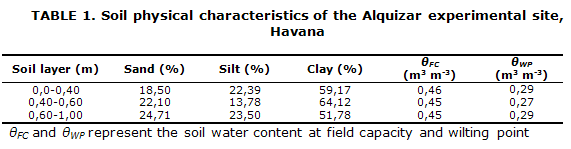
<p class="Estilo1" align="justify"><font size="2" face="Verdana">Soils are red    iron compacted soils, Rhodic <a>Ferralsol </a> according to the classification    of FAO/UNESCO (Institute of soil, 1996a, b), also called clayey (Cid, 1995).    Main characteristics of these soils are presented in <a href="#t1">Table 1</a>.    The total available soil water (<em>TAW</em>) averages 119 mm when the rooting    depth is 0,70 m. Observations of soil water potential were performed with tensiometers    at 0,20, 0,40 and 0,60 m with 3 measurements at each depth (Hern&aacute;ndez    <em>et al., </em> 2003). Soil water content data were obtained through the Van    <a>Genuchten </a> model (L&oacute;pez, 1996). </font></p>     <p class="Estilo1" align="center"><font size="2" face="Verdana"><a name="t1"></a></font>  </p>     <p align="center" class="Estilo1"><font face="Verdana"><strong><font size="2">&nbsp;    </font> </strong> <img border="0" src="/img/revistas/rcta/v21n1/t0107112.gif" width="571" height="149"></font></p>     
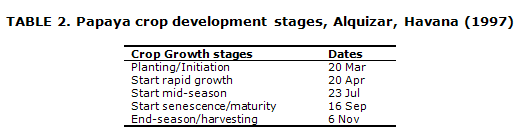
<p class="Estilo1" align="justify">&nbsp; </p>     <p class="Estilo1" align="justify"><font size="2" face="Verdana">Field experiments    were carried out with the papaya tree (<em>Carica papaya </em> L.) variety Maradol,    with a plant density of 1 851 plants ha<sup>-1</sup>; Experiments were performed    in the period 20 March to November 6, 1997. The dates for the papaya crop growth    stages are given in <a href="#t2">Table 2</a>. </font></p>     <p class="Estilo1" align="center"><font size="2" face="Verdana"><a name="t2"></a></font>  </p>     <p class="Estilo1" align="center"><font face="Verdana"><font size="2">&nbsp; </font><img border="0" src="/img/revistas/rcta/v21n1/t0207112.gif" width="523" height="134"></font></p>     
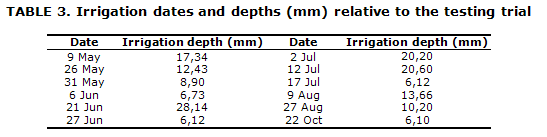
<p class="Estilo1" align="justify">&nbsp; </p>     <p class="Estilo1" align="justify"><font size="2" face="Verdana">Micro-irrigation    was used. Irrigation uniformity tests were carried out (Pizarro, 1990); the    uniformity coefficient was <em>UC </em>= 90% and the application efficiency    was 85%. <a href="#t3">Table 3</a> shows the irrigation schedule used in the    experiments; the total irrigation applied was 157 mm, with irrigation depths    ranging 6,10&#8211;28,14 mm. </font></p>     ]]></body>
<body><![CDATA[<p class="Estilo1" align="center"><font size="2" face="Verdana"><a name="t3"></a></font></p>     <p align="center" class="Estilo1"><font face="Verdana"><img border="0" src="/img/revistas/rcta/v21n1/t0307112.gif" width="547" height="137"></font></p>     
<p class="Estilo1" align="left"><em><font face="Verdana" size="2">q<sub>FC</sub>    </font> </em> <font size="2" face="Verdana">and </font><em> <font face="Verdana" size="2">q</font></em><font size="2" face="Verdana"><sub><em>WP    </em> </sub>represent the soil water content at field capacity and wilting point    </font></p>     <p align="left" class="Estilo1">&nbsp;</p>     <p align="left" class="Estilo1"><strong><font size="2" face="Verdana">The ISAREG    model </font> </strong></p>     <p class="Estilo1" align="justify"><font size="2" face="Verdana">The ISAREG model (Pereira <em>et al., </em> 2003) was selected to simulate and assess alternative irrigation schedules for papaya after proper calibration. Experimental data collected at the Irrigation Station of Alqu&iacute;zar were used to calibrate the model. The procedure applied is described in former applications to horticultural crops in the same location (Chaterlan <em>et al., </em> 2008, 2009). The actual crop evapotranspiration (<em>ET<sub>a</sub></em>) is lower than <em>ET<sub>c</sub> </em> when the soil water depletion exceeds the depletion fraction for no stress (<em>p</em>). <em> ET<sub>a</sub> </em>is estimated through the soil water balance as a function of the available soil water in the root zone as described by Teixeira and Pereira (1992). Depletion is limited to the management allowed depletion (<em>MAD</em>). When water stress is not admitted, then <em>MAD </em>=&nbsp;<em>p </em> is adopted; when deficit irrigation is applied then <em>MAD </em>&gt;&nbsp;<em>p </em>.  </font> </p>     <p class="Estilo1" align="justify"><font size="2" face="Verdana">The model computes    the water balance for a multilayered soil and is able to consider the impacts    of salinity (Pereira <em>et al., </em> 2007) and to estimate the groundwater    contribution (GC) through a parametric function (Liu <em>et al., </em> 2006).    The impact of the water stress on crop yields is evaluated with the Stewart    model (Stewart <em>et al., </em> 1977). </font></p>     <p class="Estilo1" align="justify">&nbsp; </p>     <p class="Estilo1" align="justify"><strong><font size="2" face="Verdana">Goodness of ISAREG model simulations </font> </strong></p>     <p class="Estilo1" align="justify"><font size="2" face="Verdana">In order to assess the goodness of model predictions, qualitative and statistical strategies were used. The qualitative strategy consisted of representing graphically comparisons between soil water content values observed in the field and those simulated by the model. This strategy provides a good perception of the trends and/or biases in modeling and when they occur. The second assessment strategy used linear regression forced through the origin between observed and predicted soil water content data. When the regression coefficient (<em>b</em>) is close to 1 then the covariance is close to the variance of the observed values which means that the predicted and observed values are statistically close; if the determination coefficient (<em>R<sup>2</sup></em>) is also close to 1,0, then most of the total variance of the observed values is explained by the model. Additionally, two indicators of residual estimation errors were used. The selected indicators are based upon former applications (Liu <em>et al., </em> 1998; Cholpankulov <em>et al., </em> 2008; <em>Chaterlan et al., </em> 2009).  </font> </p>     ]]></body>
<body><![CDATA[<p class="Estilo1" align="justify"><font size="2" face="Verdana">The indicators are defined bellow: </font> </p>     <p class="Estilo1" align="justify"><font size="2" face="Verdana">1) the Regression and determination coefficients relating observed and simulated data, <em>b </em>and <em> R<sup>2</sup> </em>:  </font> </p>     <p class="Estilo1"><font size="2" face="Verdana"> </font> </p>     <p class="Estilo1" align="right"> <font size="2" face="Verdana"><img src="/img/revistas/rcta/v21n1/e0107112.gif" width="571" height="83">&nbsp;</font></p>     
<p class="Estilo1" align="justify">&nbsp;</p>     <p class="Estilo1" align="justify">&nbsp;</p>     <p class="Estilo1" align="right"><font face="Verdana"> <img border="0" src="/img/revistas/rcta/v21n1/e0207112.gif" width="577" height="104"></font></p>     
<p class="Estilo1" align="justify">&nbsp;</p>     <p class="Estilo1" align="justify"><font size="2" face="Verdana">2) the root mean square error, RMSE, which characterizes the variance of the estimation errors: </font> </p>     <p class="Estilo1" align="right">&nbsp;</p>     ]]></body>
<body><![CDATA[<p class="Estilo1" align="right"><font size="2" face="Verdana">&nbsp;<img border="0" src="/img/revistas/rcta/v21n1/e0307112.gif" width="574" height="92"></font></p>     
<p class="Estilo1" align="justify"><font size="2" face="Verdana">3) the average absolute error, <em>AAE</em>, which expresses the size of estimation errors in alternative to <em>RMSE , </em>is  </font> </p>     <p class="Estilo1" align="right"><font size="2" face="Verdana"> <img border="0" src="/img/revistas/rcta/v21n1/e0407112.gif" width="577" height="48"></font></p>     
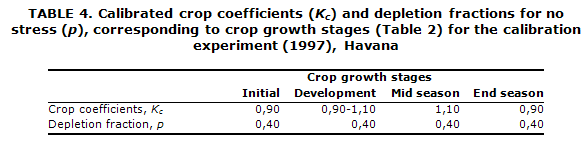
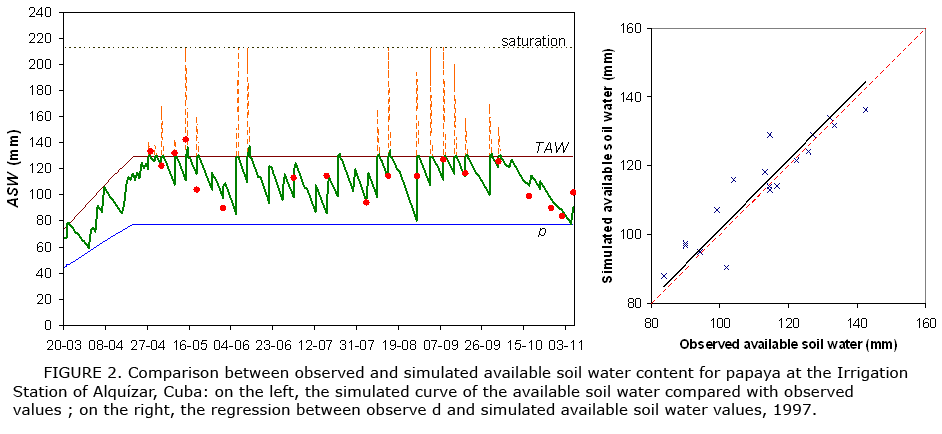
<p class="Estilo1" align="justify"><font face="Verdana" size="2">where O<sub>i</sub> and P<sub>i</sub> (i = 1, 2, &#8230;, n) are the pairs of observed and model predicted values of a given variable, and  &#332; and &#929; are the respective mean values: </font> </p>     <p class="Estilo1" align="justify">&nbsp;</p>     <p class="Estilo1" align="justify"><font face="Verdana"><b><a>RESULTS </a>AND    DISCUSSION</b><font size="2"> </font></font> </p>     <p class="Estilo1" align="left"><font size="2" face="Verdana">The calibration    procedure consisted on adjusting the crop parameters <em>K<sub>c</sub> </em>    and <em> p </em> considering the range of values they can assume, in order to    minimize the difference between observed and simulated available soil water.    The calibrated values are presented in <a href="/img/revistas/rcta/v21n1/t0407112.gif">Table    4</a>. The results from comparing the simulated and the observed available soil    water (mm) are presented in <a href="/img/revistas/rcta/v21n1/f0207112.gif">Figure    2</a>. The soil water in excess is also represented in <a href="/img/revistas/rcta/v21n1/f0207112.gif">    Figure 2</a> between field capacity (<em>FC</em>) and soil saturation (dashed    line above <em>TAW</em>); it corresponds to drainable water due to rainfall    or to excess irrigation. To note that 3 observations were performed after irrigation    and precipitation occurred and therefore they lay above <em>FC</em>. Results    show that the field observed values cover a large range of soil water content    values and that the model simulates well. </font> </p>     
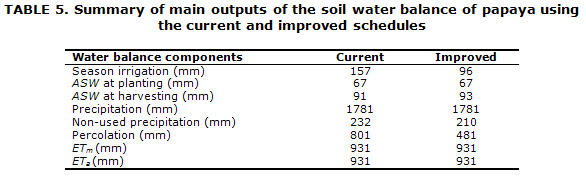
<p class="Estilo1" align="left"><font face="Verdana"><font size="2">&nbsp; </font></font><font size="2" face="Verdana">The    computed goodness of fitting indicators are as follows: <em>b</em>=1,01, thus    indicating that predicted values are close to the observed ones;<em>R<sup>2</sup></em>=0,86,    hence expressing that most of the variance is explained by the model; and the    estimation of errors <em>RMSE</em>=6.5 mm and <em>AAE</em>=4,9 mm, representing    less than 5% of <em>TAW</em>, thus indicating that estimation errors are small    and that there is a good agreement between simulated and observed available    soil water. Summarizing, results indicate that the model performs well the simulation    of the soil water balance of the micro-irrigated papaya.</font></p>     <p class="Estilo1" align="justify"><font size="2" face="Verdana">The irrigation    schedule used in the calibration experiment was evaluated. Results (<a href="/img/revistas/rcta/v21n1/t0507112.gif">Table    5</a>) show that deep percolation attained very high values (40% of the total    used water, <em>i.e., </em> the sum of irrigation and precipitation). Irrigation    depths were high (up to 28 mm), also favoring deep percolation and poor use    of precipitation. Thus, the current irrigation schedule is not appropriate to    cope with water scarcity conditions. A more efficient use of the irrigation    water is required. This implies that irrigation dates should be better adjusted    and irrigation depths controlled to decrease deep percolation. </font> </p>     
<p class="Estilo1" align="justify"><font size="2" face="Verdana">An improved irrigation    schedule using <em>MAD</em>=<em>p </em> with a fixed irrigation depth of 8 mm    was also simulated. Results are presented in <a href="/img/revistas/rcta/v21n1/t0507112.gif">Table    5</a> showing that a decrease in season irrigation may be adopted without promoting    any stress but decreasing deep percolation. </font> </p>     
]]></body>
<body><![CDATA[<p class="Estilo1" align="justify"><font size="2" face="Verdana">&nbsp; </font> </p>     <p align="left" class="Estilo1"><font face="Verdana"> </font><font face="Verdana"><strong>CONCLUSIONS    </strong> </font></p>     <p align="justify" class="Estilo1"><font size="2" face="Verdana">The ISAREG model    was successfully calibrated using past observation data of micro-irrigated papaya,    including the available soil water. Results show that the regression coefficient    relating simulated and observed data was close to 1.0 and a high determination    coefficient (0,86) was obtained. The estimation errors <em>RMSE, AAE </em> are    small respectively 6,5 and 4,9 mm, representing less than 5% of soil <em>TAW</em>.    Therefore, it can be concluded that the study produced good estimates of the    crop coefficient and depletion fraction for no stress. Furthermore, the analysis    of the current irrigation schedule showed high non-beneficial water use as deep    percolation, and an inadequate use of the precipitation. Further developments    may be attained when using the model to design improved irrigation strategies    aiming higher water productivity and saving. </font></p>     <p align="justify" class="Estilo1">&nbsp;</p>     <p align="justify" class="Estilo1"><font face="Verdana"><strong>REFERENCES</strong></font></p> <ol> 	    <li> 	    <p class="Estilo1" align="justify" style="margin-top: 0; margin-bottom: 10px">        <font size="2" face="Verdana">AIYELAAGBE, I.O.O., FAWUSI, M.O.A. BABALOLA,        O.: Growth development, yield of pawpaw (<em>Carica persica </em>L.) Homestead        selection' in response to soil moisture stress, <em>Plant and Soil</em>,        93: 427-435, 1986. </font></p>   </li> 	    <li> 	    <p class="Estilo1" align="justify" style="margin-top: 0; margin-bottom: 10px">        <font size="2" face="Verdana">ALLEN, R.G., PEREIRA, L.S., RAES, D.<i>,</i>        SMITH, M.: <em>Crop Evapotranspiration</em>, 300pp., Guidelines for Computing        Crop Water Requirements. FAO Irrigation and Drainage Paper 56, FAO, Rome,        Italy, 1998. </font></p>   </li> 	    <li> 	    ]]></body>
<body><![CDATA[<p class="Estilo1" align="justify" style="margin-top: 0; margin-bottom: 10px"> 	<font size="2" face="Verdana">ALONSO, M., TOMET, Y., RAMOS, R., FARR&Eacute;S, E., CASTRO, J.  	<i>&amp;</i> RODR&Iacute;GUEZ, M.C.: Evaluaci&oacute;n de tres cultivares de papaya del grupo solo basada en caracteres de crecimiento y productividad. 	<em>Cultivos Tropicales, </em>29(2): 59-64, 2008. </font></p></li> 	    <li> 	    <p class="Estilo1" align="justify" style="margin-top: 0; margin-bottom: 10px">        <font size="2" face="Verdana">CAMPOSTRINI, E. <i>&amp;</i> YAMANISHI O.K.:        Estimation of papaya leaf area using the central vein length, <em>Scientia        Agricola, </em>58(1):39-42, 2001. </font></p>   </li> 	    <li> 	    <p class="Estilo1" align="justify" style="margin-top: 0; margin-bottom: 10px">        <font size="2" face="Verdana">CAMPOSTRINI, E. <i>&amp;</i> GLENN, D.M.:        Ecophysiology of papaya: a review, <em>Braz. J. Plant Physiol</em>., 19(4):413-424,        2007. </font></p>   </li> 	    <li> 	    <p class="Estilo1" align="justify" style="margin-top: 0; margin-bottom: 10px">        <font size="2" face="Verdana">CHATERL&Aacute;N, Y., DUARTE, C., LE&Oacute;N,        M., PEREIRA, L.S., TEODORO, P.R. GARCIA, R.R.: <em>Coeficientes de cultivo        de la cebolla y su determinaci&oacute;n con el modelo ISAREG</em>, pp. 23-25        + CD-ROM paper 1.4. In: E. Ruz and L.S. Pereira (eds.) Modernizaci&oacute;n        de Riegos y Uso de Tecnolog&iacute;as de Informaci&oacute;n. CYTED, PROCISUR/IICA,        Montevideo, 2008 . </font></p>   </li> 	    <li> 	    <p class="Estilo1" align="justify" style="margin-top: 0; margin-bottom: 10px">        <font size="2" face="Verdana">CHATERL&Aacute;N, Y., LE&Oacute;N, M., DUARTE,        C., L&Oacute;PEZ, T., PAREDES, P. <i>&amp; </i>PEREIRA, L.S.: Determination        of crop coefficients for Horticultural crops in Cuba through field experiments        and water balance simulation. In: VI International Symposium on Irrigation        of Horticultural Crops . November 2-6, Villa del Mar, Chile, 2009. </font></p>   </li> 	    <li> 	    ]]></body>
<body><![CDATA[<p class="Estilo1" align="justify" style="margin-top: 0; margin-bottom: 10px">        <font size="2" face="Verdana">?HOLPANKULOV, E.D., INCHENKOVA, O.P., PAREDES,        P.<i>,</i> PEREIRA, L.S.: Cotton irrigation scheduling in Central Asia:        Model calibration and validation with consideration of groundwater contribution,        <em>Irrig and Drain </em>, 57: 516-532, 2008. </font></p>   </li> 	    <li> 	    <p class="Estilo1" align="justify" style="margin-top: 0; margin-bottom: 10px"> 	<font size="2" face="Verdana">CID, G.: <em>Introducci&oacute;n de m&eacute;todos y metodolog&iacute;as para la caracterizaci&oacute;n de las propiedades hidrof&iacute;sicas, as&iacute; como las variaciones espacio temporales</em>, 45pp., Informe del contrato 004-17 Instituto Investigaciones Riego Drenaje-Ministerio Tecnolog&iacute;a Ciencia Medio Ambiente, La Habana, 1995. 	</font></p></li> 	    <li> 	    <p class="Estilo1" align="justify" style="margin-top: 0; margin-bottom: 10px"> 	<font size="2" face="Verdana">DOS SANTOS, F.S.S., VIANA, T.V.A., DE AZEVEDO, B.M., OLIVEIRA, C.W.  	<i>&amp;</i> SOUSA, A.E.C.: &#8220; Efeito de diferentes laminas de irriga&ccedil;&atilde;o na cultura do mam&atilde;o&#8221;, 	<em>Eng. Agric Jaboticabal, </em>28(4): 673-680, 2008. </font></p></li> 	    <li> 	    <p class="Estilo1" align="justify" style="margin-top: 0; margin-bottom: 10px"> 	<font size="2" face="Verdana">HERN&Aacute;NDEZ, G., MART&Iacute;NEZ R., PUIG O., L&Oacute;PEZ T. &amp; SOTOMAYOR G.: &#8220;Elementos agron&oacute;micos para el riego localizado en el cultivo del papayo&#8221;  	<em>Revista Ciencias T&eacute;cnicas Agropecuarias, </em>12(2): 55-60, 2003.  	</font></p></li> 	    <li> 	    <p class="Estilo1" align="justify" style="margin-top: 0; margin-bottom: 10px">        <font size="2" face="Verdana">KRUGER, J.A., MOSTERT, P.G.: <em>Irrigation,        </em>pp. 50-59, In: Villiers, E.A. (eds) The cultivation of papaya. ARC,        LNR , South Africa, 1999. </font></p>   </li> 	    <li> 	    ]]></body>
<body><![CDATA[<p class="Estilo1" align="justify" style="margin-top: 0; margin-bottom: 10px">        <font size="2" face="Verdana">LIU, Y., TEIXEIRA, J.L., ZHANG, H.J.<i>,</i>        PEREIRA, L.S.: &#8220;Model validation and crop coefficients for irrigation        scheduling in the North China Plain, <em>Agric Water Manage, </em>36: 233&#8211;246,        1998. </font></p>   </li> 	    <li> 	    <p class="Estilo1" align="justify" style="margin-top: 0; margin-bottom: 10px">        <font size="2" face="Verdana">LIU, Y., PEREIRA, L.S. <i>&amp;</i> FERNANDO,        R.M.: Fluxes through the bottom boundary of the root zone in silty soils:        parametric approaches to estimate groundwater contribution and percolation,        <em>Agric Water Manage, </em>84: 27-40, 2006. </font></p>   </li> 	    <li> 	    <p class="Estilo1" align="justify" style="margin-top: 0; margin-bottom: 10px">        <font size="2" face="Verdana">L&Oacute;PEZ, T.: <em>Din&aacute;mica del        agua en un suelo ferral&iacute;tico rojo compactado del sur de la provincia        La Habana </em>. Tesis (en opci&oacute;n al t&iacute;tulo de M&aacute;ster        en Ciencias Agr&iacute;colas, Especialidad en Riego y Drenaje )<strong>,        </strong>Universidad Agraria de La Habana ( UNAH)-Instituto de Investigaciones        de Riego y Drenaja (IIRD), La Habana, 1996. </font></p>   </li> 	    <li> 	    <p class="Estilo1" align="justify" style="margin-top: 0; margin-bottom: 10px">        <font size="2" face="Verdana">MARLER, T.E. <i>&amp; </i>CLEMENTE, H.S.:        Papaya seedling growth response to wind and water deficit is additive, <em>HortScience,        </em>41(1): 96-98, 2006. </font></p>   </li> 	    <li> 	    <p align="justify" style="margin-top: 0; margin-bottom: 10px"> <font size="2" face="Verdana">MASRI,        M., RAZK, A.<i>, </i>GHAZALLI, M.Z.: Response of papaya (Carica papaya L.)        to limited soil moisture at reproductive stage, <em>Mardi Research Journal,        </em>18: 191-196, 1990. </font></li> 	    <li> 	    ]]></body>
<body><![CDATA[<p align="justify" style="margin-top: 0; margin-bottom: 10px"> <font size="2" face="Verdana">NIKLAS,        K.J.<i>, </i>MARLER, T.E.: <em>Carica papaya </em>(caricaceae): a case study        into the effects of domestication on plant vegetative growth and reproduction&#8221;,        <em>Am J Botany </em>, 94(6): 999-1002, 2007. </font></li> 	    <li> 	    <p align="justify" style="margin-top: 0; margin-bottom: 10px"> <font size="2" face="Verdana">PACHECO,        J., ALONSO, N., PUJOL, P., CAMEJO, E.: <em>Riego y Drenaje </em>, 414pp.,        Editorial Pueblo y Educaci&oacute;n. La Habana, Cuba, 1995. </font></li> 	    <li> 	    <p class="Estilo1" align="justify" style="margin-top: 0; margin-bottom: 10px">        <font size="2" face="Verdana">PEREIRA, L.S., TEODORO, P.R., RODRIGUES, P.N.<i>,</i>        TEIXEIRA, J.L.: Irrigation scheduling simulation: the model ISAREG. pp.        161-180, In: G. Rossi, A. Cancelliere, L.S. Pereira, T. Oweis, M. Shatanawi        and A. Zairi (eds.) Tools for Drought Mitigation in Mediterranean Regions,        Kluwer, Dordrecht, 2003. </font></p>   </li> 	    <li> 	    <p class="Estilo1" align="justify" style="margin-top: 0; margin-bottom: 10px"> 	<font size="2" face="Verdana">PEREIRA, L.S., J.M. GON&Ccedil;ALVES, B. DONG, Z. MAO 	<i>&amp;</i> S.X. FANG.: Assessing basin irrigation and scheduling strategies for saving irrigation water and controlling salinity in the Upper Yellow River Basin, China, 	<em>Agric. Water Manage</em>, 93(3), 109&#8211;122, 2007. </font></p></li> 	    <li> 	    <p align="justify" style="margin-top: 0; margin-bottom: 10px"> <font size="2" face="Verdana">POPOVA,        Z., ENEVA S.<i>,</i> PEREIRA, L.S.: Model validation, crop coefficients        and yield response factors for maize irrigation scheduling based on long-term        experiments, <em>Biosystems Eng.</em>, 95(1): 139&#8211;149, 2006. </font></li> 	    <li> 	    ]]></body>
<body><![CDATA[<p class="Estilo1" align="justify" style="margin-top: 0; margin-bottom: 10px"> 	<font size="2" face="Verdana">STEWART, J.L., HANKS, R.J., DANIELSON, R.E., JACKSON, E.B., PRUITT, W.O., FRANKLIN, W.T., RILEY, J.P.,  	<i>&amp; </i>HAGAN, R.M.: <em>Optimizing crop production through control of water and salinity levels in the soil, 	</em>Utah Water Res. Lab. Rep. PRWG151-1, Utah St. Univ., Logan, USA, 1977. 	</font></p></li> 	    <li> 	    <p align="justify" style="margin-top: 0; margin-bottom: 10px"> <font size="2" face="Verdana">TEIXEIRA,        J.L. &amp; PEREIRA, L.S.: ISAREG, an irrigation scheduling model, <em>ICID        Bulletin </em>41: 29-48. 1992. </font></li> 	    <li> 	    <p align="justify" style="margin-top: 0; margin-bottom: 10px"> <font size="2" face="Verdana">TERRA        DE ALMEIDA, F., SALES MARINHO, C., DE SOUZA, E.F. <i>&amp;</i> GRIPPA, S.:        Express&atilde;o sexual do mamoeiro sob diferentes l&acirc;minas de irriga&ccedil;&atilde;o        na regi&atilde;o norte fluminense, <em>Rev. Bras. Frutic </em>. 25(3): 383-385,        2003. </font></li>     </ol>     <p class="Estilo1" align="justify">&nbsp;</p>     <p class="Estilo1" align="justify">&nbsp;</p>     <p class="Estilo1" align="justify"><font face="Verdana, Arial, Helvetica, sans-serif" size="2">Recibido:17    de septiembre de 2010.    <br>   Aprobado:10 de diciembre de 2010. </font></p>     ]]></body>
<body><![CDATA[<p>&nbsp;</p>     <p>&nbsp;</p>     <p><font face="Verdana, Arial, Helvetica, sans-serif" size="2"><i>Yoima Chaterlán.</i>    </font><font size="2" face="Verdana">Researcher, Instituto de Investigaciones    de Ingeniería Agrícola, La Habana, Cuba, </font> <font face="Verdana, Arial, Helvetica, sans-serif" size="2">Correo    electrónico:</font><font size="2" face="Verdana"><a href="mailto:yoima@iagric.cu">yoima@iagric.cu    </a></font><font face="Verdana"><font size="2">&nbsp;<i>&amp; </i></font> <a href="mailto:ychaterlan@yahoo.es">    <font size="2">ychaterlan@yahoo.es </font> </a></font></p>      ]]></body><back>
<ref-list>
<ref id="B1">
<label>1</label><nlm-citation citation-type="journal">
<person-group person-group-type="author">
<name>
<surname><![CDATA[AIYELAAGBE]]></surname>
<given-names><![CDATA[I.O.O]]></given-names>
</name>
<name>
<surname><![CDATA[FAWUSI]]></surname>
<given-names><![CDATA[M.O.A]]></given-names>
</name>
<name>
<surname><![CDATA[BABALOLA]]></surname>
<given-names><![CDATA[O]]></given-names>
</name>
</person-group>
<article-title xml:lang="en"><![CDATA[Growth development, yield of pawpaw (Carica persica L.) Homestead selection' in response to soil moisture stress]]></article-title>
<source><![CDATA[Plant and Soil]]></source>
<year>1986</year>
<numero>93</numero>
<issue>93</issue>
<page-range>427-435</page-range></nlm-citation>
</ref>
<ref id="B2">
<label>2</label><nlm-citation citation-type="book">
<person-group person-group-type="author">
<name>
<surname><![CDATA[ALLEN]]></surname>
<given-names><![CDATA[R.G]]></given-names>
</name>
<name>
<surname><![CDATA[PEREIRA]]></surname>
<given-names><![CDATA[L.S]]></given-names>
</name>
<name>
<surname><![CDATA[RAES]]></surname>
<given-names><![CDATA[D]]></given-names>
</name>
<name>
<surname><![CDATA[SMITH]]></surname>
<given-names><![CDATA[M]]></given-names>
</name>
</person-group>
<source><![CDATA[Crop Evapotranspiration]]></source>
<year>1998</year>
<page-range>300</page-range><publisher-loc><![CDATA[Rome ]]></publisher-loc>
<publisher-name><![CDATA[Guidelines for Computing Crop Water Requirements. FAO Irrigation and Drainage Paper 56, FAO]]></publisher-name>
</nlm-citation>
</ref>
<ref id="B3">
<label>3</label><nlm-citation citation-type="journal">
<person-group person-group-type="author">
<name>
<surname><![CDATA[ALONSO]]></surname>
<given-names><![CDATA[M]]></given-names>
</name>
<name>
<surname><![CDATA[TOMET]]></surname>
<given-names><![CDATA[Y]]></given-names>
</name>
<name>
<surname><![CDATA[RAMOS]]></surname>
<given-names><![CDATA[R]]></given-names>
</name>
<name>
<surname><![CDATA[FARRÉS]]></surname>
<given-names><![CDATA[E]]></given-names>
</name>
<name>
<surname><![CDATA[CASTRO]]></surname>
<given-names><![CDATA[J]]></given-names>
</name>
<name>
<surname><![CDATA[RODRÍGUEZ]]></surname>
<given-names><![CDATA[M.C]]></given-names>
</name>
</person-group>
<article-title xml:lang="es"><![CDATA[Evaluación de tres cultivares de papaya del grupo solo basada en caracteres de crecimiento y productividad]]></article-title>
<source><![CDATA[Cultivos Tropicales]]></source>
<year>2008</year>
<volume>29</volume>
<numero>2</numero>
<issue>2</issue>
<page-range>59-64</page-range></nlm-citation>
</ref>
<ref id="B4">
<label>4</label><nlm-citation citation-type="">
<person-group person-group-type="author">
<name>
<surname><![CDATA[CAMPOSTRINI]]></surname>
<given-names><![CDATA[E]]></given-names>
</name>
<name>
<surname><![CDATA[YAMANISHI]]></surname>
<given-names><![CDATA[O.K]]></given-names>
</name>
</person-group>
<article-title xml:lang="en"><![CDATA[Estimation of papaya leaf area using the central vein length, Scientia Agricola]]></article-title>
<source><![CDATA[]]></source>
<year>2001</year>
<volume>58</volume>
<numero>1</numero>
<issue>1</issue>
<page-range>39-42</page-range></nlm-citation>
</ref>
<ref id="B5">
<label>5</label><nlm-citation citation-type="journal">
<person-group person-group-type="author">
<name>
<surname><![CDATA[CAMPOSTRINI]]></surname>
<given-names><![CDATA[E]]></given-names>
</name>
<name>
<surname><![CDATA[GLENN]]></surname>
<given-names><![CDATA[D.M]]></given-names>
</name>
</person-group>
<article-title xml:lang="en"><![CDATA[Ecophysiology of papaya: a review]]></article-title>
<source><![CDATA[Braz. J. Plant Physiol]]></source>
<year>2007</year>
<volume>19</volume>
<numero>4</numero>
<issue>4</issue>
<page-range>413-424</page-range></nlm-citation>
</ref>
<ref id="B6">
<label>6</label><nlm-citation citation-type="book">
<person-group person-group-type="author">
<name>
<surname><![CDATA[CHATERLÁN]]></surname>
<given-names><![CDATA[Y]]></given-names>
</name>
<name>
<surname><![CDATA[DUARTE]]></surname>
<given-names><![CDATA[C]]></given-names>
</name>
<name>
<surname><![CDATA[LEÓN]]></surname>
<given-names><![CDATA[M]]></given-names>
</name>
<name>
<surname><![CDATA[PEREIRA]]></surname>
<given-names><![CDATA[L.S]]></given-names>
</name>
<name>
<surname><![CDATA[TEODORO]]></surname>
<given-names><![CDATA[P.R]]></given-names>
</name>
<name>
<surname><![CDATA[GARCIA]]></surname>
<given-names><![CDATA[R.R]]></given-names>
</name>
</person-group>
<article-title xml:lang="es"><![CDATA[Coeficientes de cultivo de la cebolla y su determinación con el modelo ISAREG]]></article-title>
<person-group person-group-type="editor">
<name>
<surname><![CDATA[Ruz]]></surname>
<given-names><![CDATA[E]]></given-names>
</name>
<name>
<surname><![CDATA[Pereira]]></surname>
<given-names><![CDATA[L.S]]></given-names>
</name>
</person-group>
<source><![CDATA[Modernización de Riegos y Uso de Tecnologías de Información]]></source>
<year>2008</year>
<page-range>23-25</page-range><publisher-loc><![CDATA[Montevideo ]]></publisher-loc>
<publisher-name><![CDATA[CYTED, PROCISUR/IICA]]></publisher-name>
</nlm-citation>
</ref>
<ref id="B7">
<label>7</label><nlm-citation citation-type="">
<person-group person-group-type="author">
<name>
<surname><![CDATA[CHATERLÁN]]></surname>
<given-names><![CDATA[Y]]></given-names>
</name>
<name>
<surname><![CDATA[LEÓN]]></surname>
<given-names><![CDATA[M]]></given-names>
</name>
<name>
<surname><![CDATA[DUARTE]]></surname>
<given-names><![CDATA[C]]></given-names>
</name>
<name>
<surname><![CDATA[LÓPEZ]]></surname>
<given-names><![CDATA[T]]></given-names>
</name>
<name>
<surname><![CDATA[PAREDES]]></surname>
<given-names><![CDATA[P]]></given-names>
</name>
<name>
<surname><![CDATA[PEREIRA]]></surname>
<given-names><![CDATA[L.S]]></given-names>
</name>
</person-group>
<article-title xml:lang="en"><![CDATA[Determination of crop coefficients for Horticultural crops in Cuba through field experiments and water balance simulation]]></article-title>
<source><![CDATA[VI International Symposium on Irrigation of Horticultural Crops]]></source>
<year>2009</year>
<publisher-loc><![CDATA[Villa del Mar ]]></publisher-loc>
</nlm-citation>
</ref>
<ref id="B8">
<label>8</label><nlm-citation citation-type="journal">
<person-group person-group-type="author">
<name>
<surname><![CDATA[HOLPANKULOV]]></surname>
<given-names><![CDATA[E.D]]></given-names>
</name>
<name>
<surname><![CDATA[INCHENKOVA]]></surname>
<given-names><![CDATA[O.P]]></given-names>
</name>
<name>
<surname><![CDATA[PAREDES]]></surname>
<given-names><![CDATA[P]]></given-names>
</name>
<name>
<surname><![CDATA[PEREIRA]]></surname>
<given-names><![CDATA[L.S]]></given-names>
</name>
</person-group>
<article-title xml:lang="en"><![CDATA[Cotton irrigation scheduling in Central Asia: Model calibration and validation with consideration of groundwater contribution]]></article-title>
<source><![CDATA[Irrig and Drain]]></source>
<year>2008</year>
<numero>57</numero>
<issue>57</issue>
<page-range>516-532</page-range></nlm-citation>
</ref>
<ref id="B9">
<label>9</label><nlm-citation citation-type="book">
<person-group person-group-type="author">
<name>
<surname><![CDATA[CID]]></surname>
<given-names><![CDATA[G]]></given-names>
</name>
</person-group>
<source><![CDATA[Introducción de métodos y metodologías para la caracterización de las propiedades hidrofísicas, así como las variaciones espacio temporales]]></source>
<year>1995</year>
<page-range>45</page-range><publisher-loc><![CDATA[La Habana ]]></publisher-loc>
<publisher-name><![CDATA[Instituto Investigaciones Riego Drenaje-Ministerio Tecnología Ciencia Medio Ambiente]]></publisher-name>
</nlm-citation>
</ref>
<ref id="B10">
<label>10</label><nlm-citation citation-type="journal">
<person-group person-group-type="author">
<name>
<surname><![CDATA[DOS SANTOS]]></surname>
<given-names><![CDATA[F.S.S]]></given-names>
</name>
<name>
<surname><![CDATA[VIANA]]></surname>
<given-names><![CDATA[T.V.A]]></given-names>
</name>
<name>
<surname><![CDATA[DE AZEVEDO]]></surname>
<given-names><![CDATA[B.M]]></given-names>
</name>
<name>
<surname><![CDATA[OLIVEIRA]]></surname>
<given-names><![CDATA[C.W]]></given-names>
</name>
<name>
<surname><![CDATA[SOUSA]]></surname>
<given-names><![CDATA[A.E.C]]></given-names>
</name>
</person-group>
<article-title xml:lang="pt"><![CDATA[Efeito de diferentes laminas de irrigação na cultura do mamão]]></article-title>
<source><![CDATA[Eng. Agric Jaboticabal]]></source>
<year>2008</year>
<volume>28</volume>
<numero>4</numero>
<issue>4</issue>
<page-range>673-680</page-range></nlm-citation>
</ref>
<ref id="B11">
<label>11</label><nlm-citation citation-type="journal">
<person-group person-group-type="author">
<name>
<surname><![CDATA[HERNÁNDEZ]]></surname>
<given-names><![CDATA[G]]></given-names>
</name>
<name>
<surname><![CDATA[MARTÍNEZ]]></surname>
<given-names><![CDATA[R]]></given-names>
</name>
<name>
<surname><![CDATA[PUIG]]></surname>
<given-names><![CDATA[O]]></given-names>
</name>
<name>
<surname><![CDATA[LÓPEZ]]></surname>
<given-names><![CDATA[T]]></given-names>
</name>
<name>
<surname><![CDATA[SOTOMAYOR]]></surname>
<given-names><![CDATA[G]]></given-names>
</name>
</person-group>
<article-title xml:lang="es"><![CDATA[Elementos agronómicos para el riego localizado en el cultivo del papayo]]></article-title>
<source><![CDATA[Revista Ciencias Técnicas Agropecuarias]]></source>
<year>2003</year>
<volume>12</volume>
<numero>2</numero>
<issue>2</issue>
<page-range>55-60</page-range></nlm-citation>
</ref>
<ref id="B12">
<label>12</label><nlm-citation citation-type="book">
<person-group person-group-type="author">
<name>
<surname><![CDATA[KRUGER]]></surname>
<given-names><![CDATA[J.A]]></given-names>
</name>
<name>
<surname><![CDATA[MOSTERT]]></surname>
<given-names><![CDATA[P.G]]></given-names>
</name>
</person-group>
<article-title xml:lang="en"><![CDATA[Irrigation]]></article-title>
<person-group person-group-type="editor">
<name>
<surname><![CDATA[Villiers]]></surname>
<given-names><![CDATA[E.A]]></given-names>
</name>
</person-group>
<source><![CDATA[The cultivation of papaya]]></source>
<year>1999</year>
<page-range>50-59</page-range><publisher-name><![CDATA[ARC, LNR]]></publisher-name>
</nlm-citation>
</ref>
<ref id="B13">
<label>13</label><nlm-citation citation-type="journal">
<person-group person-group-type="author">
<name>
<surname><![CDATA[LIU]]></surname>
<given-names><![CDATA[Y]]></given-names>
</name>
<name>
<surname><![CDATA[TEIXEIRA]]></surname>
<given-names><![CDATA[J.L]]></given-names>
</name>
<name>
<surname><![CDATA[ZHANG]]></surname>
<given-names><![CDATA[H.J]]></given-names>
</name>
<name>
<surname><![CDATA[PEREIRA]]></surname>
<given-names><![CDATA[L.S]]></given-names>
</name>
</person-group>
<article-title xml:lang="en"><![CDATA[Model validation and crop coefficients for irrigation scheduling in the North China Plain]]></article-title>
<source><![CDATA[Agric Water Manage]]></source>
<year>1998</year>
<numero>36</numero>
<issue>36</issue>
<page-range>233-246</page-range></nlm-citation>
</ref>
<ref id="B14">
<label>14</label><nlm-citation citation-type="journal">
<person-group person-group-type="author">
<name>
<surname><![CDATA[LIU]]></surname>
<given-names><![CDATA[Y]]></given-names>
</name>
<name>
<surname><![CDATA[PEREIRA]]></surname>
<given-names><![CDATA[L.S]]></given-names>
</name>
<name>
<surname><![CDATA[FERNANDO]]></surname>
<given-names><![CDATA[R.M]]></given-names>
</name>
</person-group>
<article-title xml:lang="en"><![CDATA[Fluxes through the bottom boundary of the root zone in silty soils: parametric approaches to estimate groundwater contribution and percolation]]></article-title>
<source><![CDATA[Agric Water Manage]]></source>
<year>2006</year>
<numero>84</numero>
<issue>84</issue>
<page-range>27-40</page-range></nlm-citation>
</ref>
<ref id="B15">
<label>15</label><nlm-citation citation-type="book">
<person-group person-group-type="author">
<name>
<surname><![CDATA[LÓPEZ]]></surname>
<given-names><![CDATA[T]]></given-names>
</name>
</person-group>
<source><![CDATA[Dinámica del agua en un suelo ferralítico rojo compactado del sur de la provincia La Habana]]></source>
<year>1996</year>
<publisher-loc><![CDATA[La Habana ]]></publisher-loc>
<publisher-name><![CDATA[Universidad Agraria de La Habana ( UNAH)-Instituto de Investigaciones de Riego y Drenaja (IIRD)]]></publisher-name>
</nlm-citation>
</ref>
<ref id="B16">
<label>16</label><nlm-citation citation-type="journal">
<person-group person-group-type="author">
<name>
<surname><![CDATA[MARLER]]></surname>
<given-names><![CDATA[T.E]]></given-names>
</name>
<name>
<surname><![CDATA[CLEMENTE]]></surname>
<given-names><![CDATA[H.S]]></given-names>
</name>
</person-group>
<article-title xml:lang="en"><![CDATA[Papaya seedling growth response to wind and water deficit is additive]]></article-title>
<source><![CDATA[HortScience]]></source>
<year>2006</year>
<volume>41</volume>
<numero>1</numero>
<issue>1</issue>
<page-range>96-98</page-range></nlm-citation>
</ref>
<ref id="B17">
<label>17</label><nlm-citation citation-type="journal">
<person-group person-group-type="author">
<name>
<surname><![CDATA[MASRI]]></surname>
<given-names><![CDATA[M]]></given-names>
</name>
<name>
<surname><![CDATA[RAZK]]></surname>
<given-names><![CDATA[A]]></given-names>
</name>
<name>
<surname><![CDATA[GHAZALLI]]></surname>
<given-names><![CDATA[M.Z]]></given-names>
</name>
</person-group>
<article-title xml:lang="en"><![CDATA[Response of papaya (Carica papaya L.) to limited soil moisture at reproductive stage]]></article-title>
<source><![CDATA[Mardi Research Journal]]></source>
<year>1990</year>
<numero>18</numero>
<issue>18</issue>
<page-range>191-196</page-range></nlm-citation>
</ref>
<ref id="B18">
<label>18</label><nlm-citation citation-type="journal">
<person-group person-group-type="author">
<name>
<surname><![CDATA[NIKLAS]]></surname>
<given-names><![CDATA[K.J]]></given-names>
</name>
<name>
<surname><![CDATA[MARLER]]></surname>
<given-names><![CDATA[T.E]]></given-names>
</name>
</person-group>
<article-title xml:lang="es"><![CDATA[Carica papaya (caricaceae): a case study into the effects of domestication on plant vegetative growth and reproduction]]></article-title>
<source><![CDATA[Am J Botany]]></source>
<year>2007</year>
<volume>94</volume>
<numero>6</numero>
<issue>6</issue>
<page-range>999-1002</page-range></nlm-citation>
</ref>
<ref id="B19">
<label>19</label><nlm-citation citation-type="book">
<person-group person-group-type="author">
<name>
<surname><![CDATA[PACHECO]]></surname>
<given-names><![CDATA[J]]></given-names>
</name>
<name>
<surname><![CDATA[ALONSO]]></surname>
<given-names><![CDATA[N]]></given-names>
</name>
<name>
<surname><![CDATA[PUJOL]]></surname>
<given-names><![CDATA[P]]></given-names>
</name>
<name>
<surname><![CDATA[CAMEJO]]></surname>
<given-names><![CDATA[E]]></given-names>
</name>
</person-group>
<source><![CDATA[Riego y Drenaje]]></source>
<year>1995</year>
<page-range>414</page-range><publisher-loc><![CDATA[La Habana ]]></publisher-loc>
<publisher-name><![CDATA[Editorial Pueblo y Educación]]></publisher-name>
</nlm-citation>
</ref>
<ref id="B20">
<label>20</label><nlm-citation citation-type="">
<person-group person-group-type="author">
<name>
<surname><![CDATA[PEREIRA]]></surname>
<given-names><![CDATA[L.S]]></given-names>
</name>
<name>
<surname><![CDATA[TEODORO]]></surname>
<given-names><![CDATA[P.R]]></given-names>
</name>
<name>
<surname><![CDATA[RODRIGUES]]></surname>
<given-names><![CDATA[P.N]]></given-names>
</name>
<name>
<surname><![CDATA[TEIXEIRA]]></surname>
<given-names><![CDATA[J.L]]></given-names>
</name>
</person-group>
<article-title xml:lang="en"><![CDATA[Irrigation scheduling simulation: the model ISAREG]]></article-title>
<person-group person-group-type="editor">
<name>
<surname><![CDATA[Rossi]]></surname>
<given-names><![CDATA[G]]></given-names>
</name>
<name>
<surname><![CDATA[Cancelliere]]></surname>
<given-names><![CDATA[A]]></given-names>
</name>
<name>
<surname><![CDATA[Pereira]]></surname>
<given-names><![CDATA[L.S]]></given-names>
</name>
<name>
<surname><![CDATA[Oweis]]></surname>
<given-names><![CDATA[T]]></given-names>
</name>
<name>
<surname><![CDATA[Shatanawi]]></surname>
<given-names><![CDATA[M]]></given-names>
</name>
<name>
<surname><![CDATA[Zairi]]></surname>
<given-names><![CDATA[A]]></given-names>
</name>
</person-group>
<source><![CDATA[Tools for Drought Mitigation in Mediterranean Regions, Kluwer, Dordrecht]]></source>
<year>2003</year>
<page-range>161-180</page-range></nlm-citation>
</ref>
<ref id="B21">
<label>21</label><nlm-citation citation-type="journal">
<person-group person-group-type="author">
<name>
<surname><![CDATA[PEREIRA]]></surname>
<given-names><![CDATA[L.S]]></given-names>
</name>
<name>
<surname><![CDATA[GONÇALVES]]></surname>
<given-names><![CDATA[J.M]]></given-names>
</name>
<name>
<surname><![CDATA[DONG]]></surname>
<given-names><![CDATA[B]]></given-names>
</name>
<name>
<surname><![CDATA[MAO]]></surname>
<given-names><![CDATA[Z]]></given-names>
</name>
<name>
<surname><![CDATA[FANG]]></surname>
<given-names><![CDATA[S.X]]></given-names>
</name>
</person-group>
<article-title xml:lang="en"><![CDATA[Assessing basin irrigation and scheduling strategies for saving irrigation water and controlling salinity in the Upper Yellow River Basin, China]]></article-title>
<source><![CDATA[Agric. Water Manage]]></source>
<year>2007</year>
<volume>93</volume>
<numero>3</numero>
<issue>3</issue>
<page-range>109-122</page-range></nlm-citation>
</ref>
<ref id="B22">
<label>22</label><nlm-citation citation-type="journal">
<person-group person-group-type="author">
<name>
<surname><![CDATA[POPOVA]]></surname>
<given-names><![CDATA[Z]]></given-names>
</name>
<name>
<surname><![CDATA[ENEVA]]></surname>
<given-names><![CDATA[S]]></given-names>
</name>
<name>
<surname><![CDATA[PEREIRA]]></surname>
<given-names><![CDATA[L.S]]></given-names>
</name>
</person-group>
<article-title xml:lang="en"><![CDATA[Model validation, crop coefficients and yield response factors for maize irrigation scheduling based on long-term experiments]]></article-title>
<source><![CDATA[Biosystems Eng]]></source>
<year>2006</year>
<volume>95</volume>
<numero>1</numero>
<issue>1</issue>
<page-range>139-149</page-range></nlm-citation>
</ref>
<ref id="B23">
<label>23</label><nlm-citation citation-type="book">
<person-group person-group-type="author">
<name>
<surname><![CDATA[STEWART]]></surname>
<given-names><![CDATA[J.L]]></given-names>
</name>
<name>
<surname><![CDATA[HANKS]]></surname>
<given-names><![CDATA[R.J]]></given-names>
</name>
<name>
<surname><![CDATA[DANIELSON]]></surname>
<given-names><![CDATA[R.E]]></given-names>
</name>
<name>
<surname><![CDATA[JACKSON]]></surname>
<given-names><![CDATA[E.B]]></given-names>
</name>
<name>
<surname><![CDATA[PRUITT]]></surname>
<given-names><![CDATA[W.O]]></given-names>
</name>
<name>
<surname><![CDATA[FRANKLIN]]></surname>
<given-names><![CDATA[W.T]]></given-names>
</name>
<name>
<surname><![CDATA[RILEY]]></surname>
<given-names><![CDATA[J.P]]></given-names>
</name>
<name>
<surname><![CDATA[HAGAN]]></surname>
<given-names><![CDATA[R.M]]></given-names>
</name>
</person-group>
<source><![CDATA[Optimizing crop production through control of water and salinity levels in the soil]]></source>
<year>1977</year>
<publisher-name><![CDATA[Utah Water Res. Lab. Rep. PRWG151-1, Utah St. Univ., Logan]]></publisher-name>
</nlm-citation>
</ref>
<ref id="B24">
<label>24</label><nlm-citation citation-type="journal">
<person-group person-group-type="author">
<name>
<surname><![CDATA[TEIXEIRA]]></surname>
<given-names><![CDATA[J.L]]></given-names>
</name>
<name>
<surname><![CDATA[PEREIRA]]></surname>
<given-names><![CDATA[L.S]]></given-names>
</name>
</person-group>
<article-title xml:lang="en"><![CDATA[ISAREG, an irrigation scheduling model]]></article-title>
<source><![CDATA[ICID Bulletin]]></source>
<year>1992</year>
<numero>41</numero>
<issue>41</issue>
<page-range>29-48</page-range></nlm-citation>
</ref>
<ref id="B25">
<label>25</label><nlm-citation citation-type="journal">
<person-group person-group-type="author">
<name>
<surname><![CDATA[TERRA DE ALMEIDA]]></surname>
<given-names><![CDATA[F]]></given-names>
</name>
<name>
<surname><![CDATA[SALES MARINHO]]></surname>
<given-names><![CDATA[C]]></given-names>
</name>
<name>
<surname><![CDATA[DE SOUZA]]></surname>
<given-names><![CDATA[E.F]]></given-names>
</name>
<name>
<surname><![CDATA[GRIPPA]]></surname>
<given-names><![CDATA[S]]></given-names>
</name>
</person-group>
<article-title xml:lang="pt"><![CDATA[Expressão sexual do mamoeiro sob diferentes lâminas de irrigação na região norte fluminense]]></article-title>
<source><![CDATA[Rev. Bras. Frutic]]></source>
<year>2003</year>
<volume>25</volume>
<numero>3</numero>
<issue>3</issue>
<page-range>383-385</page-range></nlm-citation>
</ref>
</ref-list>
</back>
</article>