<?xml version="1.0" encoding="ISO-8859-1"?><article xmlns:mml="http://www.w3.org/1998/Math/MathML" xmlns:xlink="http://www.w3.org/1999/xlink" xmlns:xsi="http://www.w3.org/2001/XMLSchema-instance">
<front>
<journal-meta>
<journal-id>2071-0054</journal-id>
<journal-title><![CDATA[Revista Ciencias Técnicas Agropecuarias]]></journal-title>
<abbrev-journal-title><![CDATA[Rev Cie Téc Agr]]></abbrev-journal-title>
<issn>2071-0054</issn>
<publisher>
<publisher-name><![CDATA[Universidad Agraria de La Habana]]></publisher-name>
</publisher>
</journal-meta>
<article-meta>
<article-id>S2071-00542012000200002</article-id>
<title-group>
<article-title xml:lang="es"><![CDATA[Diseño, construcción y calibración de un transductor de fuerza tipo S]]></article-title>
<article-title xml:lang="en"><![CDATA[Design, construction and calibration of force transducer type S]]></article-title>
</title-group>
<contrib-group>
<contrib contrib-type="author">
<name>
<surname><![CDATA[Laffita Leyva]]></surname>
<given-names><![CDATA[Alexander]]></given-names>
</name>
<xref ref-type="aff" rid="A01"/>
</contrib>
<contrib contrib-type="author">
<name>
<surname><![CDATA[Ramos Carbajal]]></surname>
<given-names><![CDATA[Ernesto]]></given-names>
</name>
<xref ref-type="aff" rid="A01"/>
</contrib>
<contrib contrib-type="author">
<name>
<surname><![CDATA[de la Figal Costales]]></surname>
<given-names><![CDATA[Armando]]></given-names>
</name>
<xref ref-type="aff" rid="A01"/>
</contrib>
<contrib contrib-type="author">
<name>
<surname><![CDATA[Valdés Hernández]]></surname>
<given-names><![CDATA[Pedro A]]></given-names>
</name>
<xref ref-type="aff" rid="A01"/>
</contrib>
<contrib contrib-type="author">
<name>
<surname><![CDATA[Torres Cepero]]></surname>
<given-names><![CDATA[Raúl]]></given-names>
</name>
<xref ref-type="aff" rid="A01"/>
</contrib>
</contrib-group>
<aff id="A01">
<institution><![CDATA[,Centro de Mecanización Agropecuaria Universidad Agraria de La Habana ]]></institution>
<addr-line><![CDATA[ ]]></addr-line>
</aff>
<pub-date pub-type="pub">
<day>00</day>
<month>06</month>
<year>2012</year>
</pub-date>
<pub-date pub-type="epub">
<day>00</day>
<month>06</month>
<year>2012</year>
</pub-date>
<volume>21</volume>
<numero>2</numero>
<fpage>11</fpage>
<lpage>16</lpage>
<copyright-statement/>
<copyright-year/>
<self-uri xlink:href="http://scielo.sld.cu/scielo.php?script=sci_arttext&amp;pid=S2071-00542012000200002&amp;lng=en&amp;nrm=iso"></self-uri><self-uri xlink:href="http://scielo.sld.cu/scielo.php?script=sci_abstract&amp;pid=S2071-00542012000200002&amp;lng=en&amp;nrm=iso"></self-uri><self-uri xlink:href="http://scielo.sld.cu/scielo.php?script=sci_pdf&amp;pid=S2071-00542012000200002&amp;lng=en&amp;nrm=iso"></self-uri><abstract abstract-type="short" xml:lang="es"><p><![CDATA[Se diseñó, construyó y calibró un transductor de fuerza tipo S en el Centro de Mecanización Agropecuaria (CEMA) de la Universidad Agraria de La Habana (UNAH), sobre la base del análisis de tensiones y deformaciones, concentración y uniformidad de las deformaciones unitarias en la zona de colocación de los extensómetros, empleando el análisis numérico por el método de los elementos finitos. El valor máximo del esfuerzo normal equivalente brindado por el programa profesional Solid Works versión 2010, según el criterio de resistencia Von Misses, está dentro del límite de proporcionalidad del material seleccionado con un factor de seguridad de 7,05 garantizando la linealidad durante los regímenes de carga y descarga a los cuales será sometido, un nivel de sensibilidad de salida igual a 0,456 mV/V encontrándose dentro del rango recomendado para este tipo de transductor así como un bajo efecto de histéresis. El valor de la pendiente de la calibración con tres repeticiones de carga y descarga es de 0,0386 N/mV y un error de ± 0,024 N. Del análisis del procesamiento estadístico se determinó que para valores de la fuerza de tracción superiores a 5,8 N los errores cometidos se encuentra en el orden del 2,8% y a partir de valores superiores a 29,5 N los errores se encuentran por debajo del 1%.]]></p></abstract>
<abstract abstract-type="short" xml:lang="en"><p><![CDATA[In the Center of Agricultural Mechanization (CEMA) of the University Agrarian of Havana (UNAH) was design, built and calibrate a force transducer type S, it was developed above the base of analysis of tensions and deformations at the zone of placement of the extensometers, applying the method of finite elements. The maximum value of normal equivalent strain bring up by the program Solid Work applying Von Misses criteria it was within the limit of proportionality the material selected with a safety factor of 7,05. Achieve linearity and sensibility levels during the process of charge and discharge within the range recommended for this type of transducer as well as a low effect of hysteresis. The value of the slope and error of curve of calibration was 0,0386 N/mV and 0,024 N.]]></p></abstract>
<kwd-group>
<kwd lng="es"><![CDATA[transductor]]></kwd>
<kwd lng="es"><![CDATA[elementos finitos]]></kwd>
<kwd lng="es"><![CDATA[calibración]]></kwd>
<kwd lng="es"><![CDATA[diseño]]></kwd>
<kwd lng="en"><![CDATA[transducer]]></kwd>
<kwd lng="en"><![CDATA[finite elements]]></kwd>
<kwd lng="en"><![CDATA[calibration]]></kwd>
<kwd lng="en"><![CDATA[design]]></kwd>
</kwd-group>
</article-meta>
</front><body><![CDATA[ <p class="MsoNormal" style="margin-left:0cm;line-height:normal" align="right"> <font face="Verdana"><b><span style="font-size:10.0pt">ARTÍCULO ORIGINAL</span></b></font></p>     <p class="MsoNormal" style="line-height: normal; margin-left: 0cm" align="justify">&nbsp; </p>     <p class="MsoNormal" style="line-height: normal; margin-left: 0cm" align="justify"> <b><font face="Verdana" size="4">Diseño, construcción y calibración de un  transductor de fuerza tipo S</font></b></p>     <p class="MsoNormal" style="line-height: normal; margin-left: 0cm" align="justify">&nbsp;</p>     <p class="MsoNormal" style="line-height: normal; margin-left: 0cm" align="justify"> <b> <font face="Verdana"><span lang="EN-US">Design, construction and calibration of  force transducer type S</span></font></b></p>     <p class="MsoNormal" style="line-height: normal; margin-left: 0cm"> <font face="Verdana"><span lang="EN-US" style="font-size: 10.0pt">&nbsp;    <br>   </span></font></p>     <p align="left" class="MsoNormal" style="line-height: normal; margin-left: 0cm"><b><font face="Verdana"><span style="font-size: 10.0pt">Ing.    Alexander Laffita Leyva<sup> </sup>, M. Sc. Ernesto Ramos Carbajal, </span>    <font size="2">&nbsp;Dr. C. Armando García de la Figal Costales, Dr. C. Pedro    A. Valdés Hernández,&nbsp; Ing. Raúl Torres Cepero</font></font></b><b><font face="Verdana"><span style="font-size: 10.0pt">&nbsp;</span></font></b></p> <b></b>      <p class="MsoNormal" style="line-height: normal; margin-left: 0cm"> <font face="Verdana"><span style="font-size: 10.0pt">Centro de Mecanización  Agropecuaria,<sup> </sup>Universidad Agraria de La Habana, Mayabeque,&nbsp;Cuba.</span></font></p>     <p class="MsoNormal" style="line-height: normal; margin-left: 0cm">&nbsp; </p> <b>     ]]></body>
<body><![CDATA[<p class="MsoNormal" style="line-height: normal; margin-left: 0cm">&nbsp; </p> <hr>     <p class="MsoNormal" style="text-indent: 0cm; line-height: normal; margin-top:0; margin-bottom:0" align="justify">&nbsp; </p> </b>     <p class="MsoNormal" style="text-indent: 0cm; line-height: normal; margin-top:0; margin-bottom:0" align="justify"> <b> <font face="Verdana" size="2">RESUMEN</font></b></p>     <p class="MsoNormal" style="text-indent: 0cm; line-height: normal; margin-top:0; margin-bottom:0" align="justify">&nbsp; </p>     <p class="MsoNormal" style="text-indent: 0cm; line-height: normal; margin-top:0; margin-bottom:0" align="justify">    <font face="Verdana"><span style="font-size: 10.0pt">Se diseñó, </span> <span lang="ES-US" style="font-size: 10.0pt">construyó    y calibró un transductor de fuerza tipo S en el Centro de Mecanización Agropecuaria    (CEMA) de la Universidad Agraria de La Habana (UNAH), sobre la base del análisis    de tensiones y deformaciones, concentración y uniformidad de las deformaciones    unitarias en la zona de colocación de los extensómetros, empleando el </span>    <span style="font-size: 10.0pt">análisis numérico por el método de los elementos    finitos. El valor máximo del esfuerzo normal equivalente brindado por el programa    profesional Solid Works versión 2010, según el criterio de resistencia Von Misses,    está dentro del límite de proporcionalidad del material seleccionado con un    factor de seguridad de 7,05 garantizando la linealidad durante los regímenes    de carga y descarga a los cuales será sometido, un nivel de sensibilidad de    salida igual a 0,456 mV/V encontrándose dentro del rango recomendado para este    tipo de transductor así como un bajo efecto de histéresis. El    valor de la pendiente de la calibración con tres repeticiones de carga y descarga    es de 0,0386 N/mV y un error de ± 0,024 N. Del análisis del procesamiento estadístico    se determinó que para valores de la fuerza de tracción superiores a 5,8 N los    errores cometidos se encuentra en el orden del&nbsp; 2,8% y a partir de valores    superiores a 29,5 N los errores se encuentran por debajo del 1%. </span></font></p> <b>     <p class="MsoBodyTextIndent" style="text-indent: 0cm; line-height: normal; margin-top: 0; margin-bottom: 0" align="justify">&nbsp;</p> </b>     <p class="MsoBodyTextIndent" style="text-indent: 0cm; line-height: normal; margin-top: 0; margin-bottom: 0" align="justify"> <font face="Verdana"><span style="font-size: 10.0pt"><b>Palabras clave:</b>  transductor; elementos finitos, calibración, diseño.</span></font></p>     <p class="MsoBodyTextIndent" style="text-indent: 0cm; line-height: normal; margin-top: 0; margin-bottom: 0" align="justify">&nbsp; </p> <b> <hr> </b>     <p class="MsoNormal" style="text-indent:0cm;line-height:normal; margin-top:0; margin-bottom:0" align="justify"> <b>&nbsp; </b> </p>     <p class="MsoNormal" style="text-indent:0cm;line-height:normal; margin-top:0; margin-bottom:0" align="justify">    <font face="Verdana" size="2"><span lang="EN-CA"><b>ABSTRACT</b></span></font></p>     ]]></body>
<body><![CDATA[<p class="MsoNormal" style="text-indent:0cm;line-height:normal; margin-top:0; margin-bottom:0" align="justify"><font face="Verdana" size="2"><span lang="EN-CA">    <br>   </span></font></p>     <p class="MsoNormal" style="text-indent:0cm;line-height:normal; margin-top:0; margin-bottom:0" align="justify"> <font face="Verdana"><span lang="EN-CA" style="font-size: 10.0pt">In the Center  of Agricultural Mechanization (CEMA) of the University Agrarian of Havana (UNAH)  was design, built and calibrate a</span><span lang="EN-US" style="font-size: 10.0pt">  force transducer type S</span><span lang="EN-CA" style="font-size: 10.0pt">, it  was developed above the base of analysis of tensions and deformations</span></font><span lang="EN-CA" style="font-size: 10.0pt; font-family: Verdana; color: black"> </span><font face="Verdana"><span lang="EN-CA" style="font-size: 10.0pt">at the  zone of placement of the extensometers,</span></font><span lang="EN-CA" style="font-size: 10.0pt; font-family: Verdana; color: black"> </span><font face="Verdana"><span lang="EN-US" style="font-size: 10.0pt"> applying</span><span lang="EN-CA" style="font-size: 10.0pt"> the method of  finite elements.</span></font><span lang="EN-CA" style="font-size: 10.0pt; font-family: Verdana; color: black"> </span><font face="Verdana"><span lang="EN-CA" style="font-size: 10.0pt">The  maximum value of normal equivalent strain</span><span lang="EN-US" style="font-size: 10.0pt">  bring up by the program Solid Work applying Von Misses criteria it was </span> <span lang="EN-CA" style="font-size: 10.0pt">within the limit of proportionality  the material selected with a safety factor of 7,05. A</span><span lang="EN-US" style="font-size: 10.0pt">chieve  linearity and sensibility levels during the process of charge and discharge </span><span lang="EN-CA" style="font-size: 10.0pt">within the range recommended  for this type of transducer as well as a low effect of hysteresis. The value of  the slope and error of curve of calibration was 0,0386 N/mV and 0,024 N.</span></font></p> <b>     <p class="MsoNormal" align="justify" style="margin-top: 0; margin-bottom: 0">&nbsp;</p> </b>     <p class="MsoNormal" align="justify" style="margin-top: 0; margin-bottom: 0">    <font face="Verdana"> <span lang="EN-CA" style="font-size: 10.0pt; line-height: 150%"> 	<b>Key words:</b><i> </i> transducer, finite elements, calibration, design.</span></font></p> <b>     <p class="MsoNormal" align="justify" style="margin-top: 0; margin-bottom: 0">&nbsp;</p> <hr>     <p class="MsoNormal" style="text-indent:0cm;line-height:normal; margin-top:0; margin-bottom:0" align="justify">&nbsp;</p>     <p class="MsoNormal" style="text-indent:0cm;line-height:normal; margin-top:0; margin-bottom:0" align="justify">&nbsp; </p>     <p class="MsoNormal" style="text-indent:0cm;line-height:normal; margin-top:0; margin-bottom:0" align="justify">&nbsp; </p>     <p class="MsoNormal" style="text-indent:0cm;line-height:normal; margin-top:0; margin-bottom:0" align="justify">&nbsp; </p> </b>     ]]></body>
<body><![CDATA[<p class="MsoNormal" style="text-indent:0cm;line-height:normal; margin-top:0; margin-bottom:0" align="justify"> <b> <font face="Verdana">INTRODUCCIÓN</font></b></p>     <p class="MsoNormal" style="text-indent:0cm;line-height:normal; margin-top:0; margin-bottom:0" align="justify">&nbsp; </p> <font size="2" face="Verdana, Arial, Helvetica, sans-serif">Los transductores  de fuerza son ampliamente usados en el campo de la industria y las investigaciones,  presentando muchas configuraciones en equipos comerciales. Básicamente están compuestos  por: una pieza monolítica conocida como elemento elástico y por extensómetros  eléctricos que permiten medir, en el área<b> </b>de<b> </b>colocación &nbsp;de  los mismos, los niveles de deformación, preferiblemente uniformes, que experimenta  el transductor&nbsp; bajo la acción de una fuerza aplicada. Estos son diseñados  para que a fuerzas relativamente bajas permita altos niveles de deformación siendo  precisamente el elemento elástico el componente más crítico del transductor (<span style="color:black">Martínez,  2008)</span>, (<span style="color:black">Omegadyne, Inc., 1996).</span></font><b>  </b>     <p class="MsoNormal" style="text-indent:0cm; line-height:normal; margin-bottom: 0;" align="justify"><font face="Verdana"><span style="font-size:10.0pt">La    información acerca de los detalles para la construcción de dichos elementos    elásticos es poco divulgada, siendo su diseño por métodos tradicionales extremadamente    difícil por presentar configuraciones complejas para estos tipos de cálculos    (<span style="color:black">Martínez, 2006a)</span>. El uso de modernos software    CAD-3D para acometer el diseño de estos transductores garantiza al Centro de    Mecanización Agropecuaria crear las bases de un know how propio para su construcción    siendo el diseño y calibración el objetivo fundamental del presente trabajo.</span></font></p> <b>     <p class="MsoNormal" style="line-height:normal; margin-top:0; margin-bottom:0" align="justify"> <font face="Verdana">&nbsp;</font></p>     <p class="MsoNormal" style="line-height:normal; margin-top:0; margin-bottom:0" align="justify">&nbsp; </p>     <p class="MsoNormal" style="line-height:normal; margin-top:0; margin-bottom:0" align="justify">&nbsp; </p>     <p class="MsoNormal" style="line-height:normal; margin-top:0; margin-bottom:0" align="justify"> <font face="Verdana">MÉTODOS</font></p>     <p class="MsoNormal" style="text-indent:0cm;line-height:normal; margin-top:0; margin-bottom:0" align="justify">&nbsp; </p> </b>      <p class="MsoNormal" style="text-indent:0cm;line-height:normal; margin-top:0; margin-bottom:0" align="justify">    <font face="Verdana"><span style="font-size: 10.0pt">La investigación se lleva    a cabo en el Laboratorio de Tensometría del </span><span style="font-size:10.0pt">    Centro de Mecanización Agropecuaria de la Universidad Agraria de La Habana.    <span lang="ES-US">Se utilizó el software de diseño por elementos finitos Solid    Works, versión 2010 para el dimensionado el transductor de fuerza, estableciéndose    una carga máxima de </span>150 N</span><span style="font-size: 10.0pt"> <span lang="ES-US">utilizada    por </span></span> <span style="font-size: 10.0pt;color:black">Rivero (2009)</span><span style="font-size: 10.0pt"> </span>    <span lang="ES-US" style="font-size: 10.0pt">y como material </span> <span style="font-size:10.0pt">acero    AISI 1045. Se establecen las condiciones de fronteras, lo que se muestra en    la <a href="/img/revistas/rcta/v21n2/f0102212.gif">figura 1</a> y se realiza    el mallado paramétrico del modelo digitalizado.</span></font></p>     
<p class="MsoNormal" style="text-indent:0cm;line-height:normal; margin-top:0; margin-bottom:0" align="justify">&nbsp;</p>     ]]></body>
<body><![CDATA[<p class="MsoNormal" style="text-indent: 0cm; line-height: normal; margin-top:0; margin-bottom:0" align="justify"> <font face="Verdana"><span style="font-size: 10.0pt">Durante la comprobación de  la resistencia mecánica del transductor se utiliza el criterio de las máximas  tensiones de Von Mises, que se basa en la teoría de la máxima energía de corte ó  teoría de la energía de distorsión máxima y se obtiene el factor de seguridad, a  partir de la siguiente expresión:</span></font></p> <b>     <p class="MsoNormal" style="text-indent: 0cm; line-height: normal; margin-top:0; margin-bottom:0" align="justify">&nbsp; </p>     <p class="MsoNormal" style="text-indent: 0cm; line-height: normal; margin-top:0; margin-bottom:0" align="center">    <img src="/img/revistas/rcta/v21n2/e0102212.gif" width="621" height="63">  </p>     
<p class="MsoNormal" style="text-indent: 0cm; line-height: normal; margin-top:0; margin-bottom:0" align="justify">&nbsp;</p>     <p class="MsoBodyTextIndent" style="margin-bottom:0;text-indent: 0cm;line-height:normal; margin-top:0" align="justify">&nbsp;</p>     <p class="MsoBodyTextIndent" style="margin-bottom:0;text-indent: 0cm;line-height:normal; margin-top:0" align="justify">&nbsp;</p>     <p class="MsoBodyTextIndent" style="margin-bottom:0;text-indent: 0cm;line-height:normal; margin-top:0" align="justify">&nbsp;</p> </b>      <p class="MsoBodyTextIndent" style="margin-bottom:0;text-indent: 0cm;line-height:normal; margin-top:0" align="justify"><span style="font-size:10.0pt"><font face="Verdana" size="2">Los    parámetros de salida obtenidos fueron ajustados mediante cambios en las dimensiones    del transductor, de manera tal, que para la carga máxima aplicada los parámetros    de salida se encuentren dentro del límite proporcional del material (en el caso    de las tensiones normales equivalentes) y dentro de las exigencias de sensibilidad    de salida (deformaciones unitarias) apropiados para el procesamiento de las    señales en indicadores digitales comerciales (mV/V).     <br>       <br>   </font></span><font size="2" face="Verdana">La ubicación de los extensómetros    en la celda se optimizó a partir del criterio de obtener ubicaciones con máximos    valores de las deformaciones, así como su distribución uniforme, conformando    un puente completo con máxima ganancia y autocompensado térmicamente. El voltaje    de salida para un puente extensométrico de 120 &#937; se determinó utilizando    la ecuación (Godwin, 1975), (Kyowa Electronic Instruments Instruction Manual,    1973), (Martínez, 2008).</font></p> <b>     ]]></body>
<body><![CDATA[<p align="justify" style="margin-top: 0; margin-bottom: 0">&nbsp;</p>     <p align="center"><img src="/img/revistas/rcta/v21n2/e0202212.gif" width="554" height="71">  </p>     
<p align="justify" style="margin-top: 0; margin-bottom: 0">&nbsp; </p>     <p class="MsoNormal" style="text-indent:0cm;line-height:normal; text-autospace:ideograph-numeric ideograph-other; margin-top:0; margin-bottom:0" align="justify">&nbsp; </p>     <p class="MsoNormal" style="text-indent:0cm;line-height:normal; text-autospace:ideograph-numeric ideograph-other; margin-top:0; margin-bottom:0" align="justify">&nbsp; </p>     <p class="MsoNormal" style="text-indent:0cm;line-height:normal; text-autospace:ideograph-numeric ideograph-other; margin-top:0; margin-bottom:0" align="justify">    <font face="Verdana"><span style="font-size: 10.0pt"><strong>donde:&nbsp; </strong></span></font></p> </b>    <p class="MsoNormal" style="text-indent:0cm; line-height:normal; text-autospace:ideograph-numeric ideograph-other; margin-bottom: 0;" align="justify"><b><font face="Verdana"><span style="font-size: 10.0pt">E<sub>ex</sub>-</span></font></b><font face="Verdana"><span style="font-size: 10.0pt">voltaje    de excitación del puente (3 V);</span></font></p>     <p class="MsoNormal" style="text-indent:0cm; line-height:normal; text-autospace:ideograph-numeric ideograph-other; margin-bottom: 0;" align="justify"> <b><font face="Verdana"><span style="font-size: 10.0pt"> K-</span></font></b><font face="Verdana"><span style="font-size: 10.0pt">factor    de los extensómetros (K=2,1);</span></font></p>     <p class="MsoNormal" style="text-indent:0cm; line-height:normal; text-autospace:ideograph-numeric ideograph-other; margin-bottom: 0;" align="justify"> <b><font face="Verdana"><span style="font-size: 10.0pt">&#949;<sub>prom</sub>-</span></font></b><font face="Verdana"><span style="font-size: 10.0pt">deformación    longitudinal unitaria promedio en la dirección de colocación de los extensómetros    </span><span style="font-size:10.0pt; color:black">(&#956;strain)</span><span style="font-size: 10.0pt">.</span></font></p> <b>     <p class="MsoBodyTextIndent" style="margin-bottom:0;text-indent: 0cm;line-height:normal; margin-top:0" align="justify">&nbsp;</p> </b>     ]]></body>
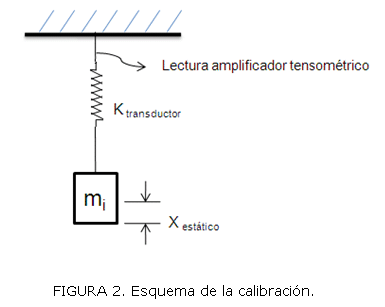
<body><![CDATA[<p class="MsoBodyTextIndent" style="margin-bottom:0;text-indent: 0cm;line-height:normal; margin-top:0" align="justify"><font face="Verdana"> <span style="font-size:10.0pt">Se    llevó a cabo la calibración estática utilizando el esquema de un muelle elástico,    según se muestra en la <a href="#f2">Figura 2</a>, sin considerar la fricción    interna. Se </span> <span lang="ES-US" style="font-size: 10.0pt">utilizó un    amplificador tensométrico,</span><span style="font-size:10.0pt"> masas de 100    y 500 g y una balanza de plato modelo PH-10&#1062;13Y con una apreciación: de    5 g.</span></font></p> <b>     <p class="MsoBodyTextIndent" style="margin-bottom:0;text-indent: 0cm;line-height:normal; margin-top:0" align="justify">&nbsp;</p>     <p class="MsoBodyTextIndent" style="margin-bottom:0;text-indent: 0cm;line-height:normal; margin-top:0" align="center"><a name="f2"></a> <img src="/img/revistas/rcta/v21n2/f0202212.gif" width="385" height="307"></p>     
<p class="MsoBodyTextIndent" style="margin-bottom:0;text-indent: 0cm;line-height:normal; margin-top:0" align="justify">&nbsp;</p>     <p class="MsoBodyTextIndent" style="margin-bottom:0;text-indent: 0cm;line-height:normal; margin-top:0" align="justify"><span style="font-size:10.0pt">&nbsp;</span></p>     <p class="MsoNormal" style="text-indent:0cm;line-height:normal; text-autospace:ideograph-numeric ideograph-other; margin-top:0; margin-bottom:0" align="justify"> <span style="font-size: 10.0pt">P<font face="Verdana">rocedimiento estadístico</font></span></p>     <p class="MsoNormal" style="text-indent:0cm;line-height:normal; text-autospace:ideograph-numeric ideograph-other; margin-top:0; margin-bottom:0" align="justify">&nbsp;</p> </b>     <p class="MsoNormal" style="text-indent:0cm;line-height:normal; text-autospace:ideograph-numeric ideograph-other; margin-top:0; margin-bottom:0" align="justify">    <font face="Verdana"> <span style="font-size: 10.0pt">Se realiza un análisis    descriptivo, utilizando el software Microsoft Excell 2010, para las deformaciones    unitarias en las zonas de colocación de los extensómetros, determinando la media    aritmética (</span><span style="font-size:10.0pt;color:black">&#949;<sub>prom</sub>)</span><span style="font-size: 10.0pt">,    desviación estándar, el intervalo de confianza con una probabilidad del 90%    según criterio de la t de student para un error relativo máximo del 10 % (Miller    <i>et al</i>., 2007).</span></font></p>     <p class="MsoNormal" style="text-indent:0cm; line-height:normal; text-autospace:ideograph-numeric ideograph-other; margin-bottom: 0;" align="justify"><font face="Verdana"><span style="font-size:10.0pt">El    cálculo del error de la calibración del transductor se realiza según García    de la Figal (2011).</span></font></p> <b>     <p class="MsoNormal" style="text-indent:0cm;line-height:normal; margin-top:0; margin-bottom:0" align="justify">&nbsp;</p>     ]]></body>
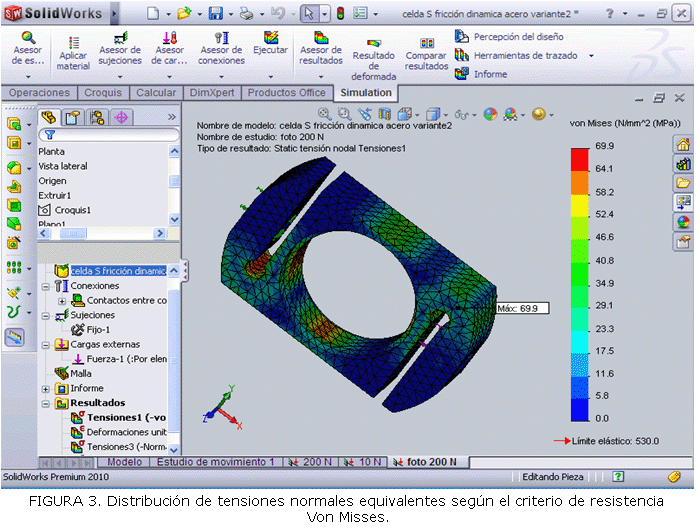
<body><![CDATA[<p class="MsoNormal" style="text-indent:0cm;line-height:normal; margin-top:0; margin-bottom:0" align="justify">&nbsp;</p>     <p class="MsoNormal" style="text-indent:0cm;line-height:normal; margin-top:0; margin-bottom:0" align="justify">&nbsp;</p>     <p class="MsoNormal" style="text-indent:0cm;line-height:normal; margin-top:0; margin-bottom:0" align="justify"> <font face="Verdana">RESULTADOS Y DISCUSIÓN</font></p>     <p class="MsoNormal" style="text-indent: 0cm; line-height: normal; margin-top:0; margin-bottom:0" align="justify">&nbsp;</p>     <p class="MsoNormal" style="text-indent: 0cm; line-height: normal; margin-top:0; margin-bottom:0" align="justify">    <font face="Verdana"><span style="font-size: 10.0pt">Resultados de las tensiones    y deformaciones</span></font></p> </b>      <p class="MsoNormal" style="text-indent: 0cm; line-height: normal; margin-bottom: 0;" align="justify"><font face="Verdana"><span style="font-size: 10.0pt">En    la <a href="/img/revistas/rcta/v21n2/f0302212.gif">Figura 3</a> se muestra    la distribución de las tensiones normales equivalentes, observándose que en    la zona de colocación de los extensómetros se generan los esfuerzos máximos    en el orden de los 69 MPa. Se obtuvo un factor de seguridad de 7,05 con lo cual    se garantiza la linealidad durante los regímenes de carga y descarga del transductor,    así como un bajo efecto de histéresis.</span></font></p>     
<p class="MsoNormal" style="text-indent: 0cm; line-height: normal; margin-bottom: 0;" align="justify"><font face="Verdana"><span style="font-size: 10.0pt">Los    resultados del estudio de deformaciones longitudinales unitarias en el eje <u>x    </u></span> <span lang="ES-US" style="font-size: 10.0pt">(</span><span style="font-size: 10.0pt">&#958;</span><sub><span lang="ES-US" style="font-size: 10.0pt">x</span></sub><span lang="ES-US" style="font-size: 10.0pt">)    </span><span style="font-size: 10.0pt">se muestran en la <a href="/img/revistas/rcta/v21n2/f0402212.gif">Figura    4</a>, apreciándose </span><span lang="ES-US" style="font-size: 10.0pt">en coloración    roja las zonas de máximas deformaciones </span><span style="font-size: 10.0pt">sometidas    a tracción. </span></font></p>     
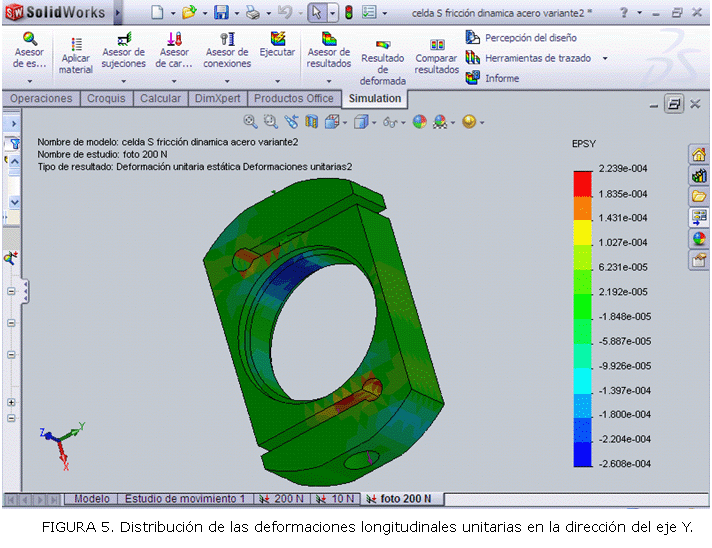
<p class="MsoNormal" style="text-indent:0cm;line-height:normal; text-autospace:ideograph-numeric ideograph-other; margin-top:0; margin-bottom:0" align="center">&nbsp;  </p>     <p class="MsoNormal" style="text-indent:0cm;line-height:normal; text-autospace:ideograph-numeric ideograph-other; margin-top:0; margin-bottom:0" align="justify"><font face="Verdana">    <span style="font-size: 10.0pt">En la <a href="/img/revistas/rcta/v21n2/f0502212.gif">Figura    5</a>, se muestran las deformaciones longitudinales unitarias a lo largo del    eje y </span> <span lang="ES-US" style="font-size: 10.0pt">(</span><span style="font-size: 10.0pt">&#958;</span><sub><span lang="ES-US" style="font-size: 10.0pt">y</span></sub><span lang="ES-US" style="font-size: 10.0pt">)</span><span style="font-size: 10.0pt">,    la </span><span lang="ES-US" style="font-size: 10.0pt">coloración azul muestra    las zonas de máximas deformaciones </span><span style="font-size: 10.0pt"> sometidas    a compresión, indicando el lugar donde será factible la colocación de los extensómetros    en el transductor de fuerza. </span></font></p> <b>      
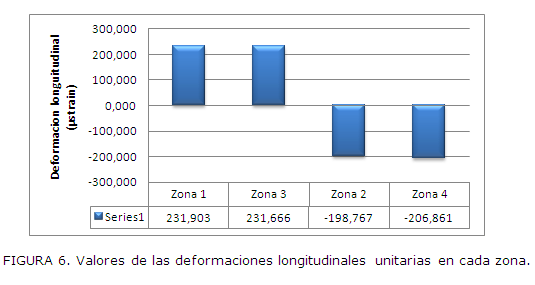
<p class="MsoNormal" style="text-indent:0cm;line-height:normal; text-autospace:ideograph-numeric ideograph-other; margin-top:0; margin-bottom:0" align="justify">&nbsp;</p> </b> <font face="Verdana" size="2">En la <a href="/img/revistas/rcta/v21n2/t0102212.gif">Tabla  1</a> se muestran los estadígrafos obtenidos del análisis descriptivo realizado  a los valores de deformación longitudinal unitaria en cada zona de colocación  de los extensómetros. Puede apreciarse que la sumatoria de los valores promedios  de la deformación unitaria, en valores absolutos, se encuentra en el orden de  los 869,16 &#956;strain, lo cual se corresponde con las recomendaciones internacionales  para los extensómetros eléctricos cuyo intervalo <span style="font-size: 10.0pt">máximo  oscila entre 1000-1300 &#956;strain (</span><span style="font-size: 10.0pt;color:black">Kyowa Electronic Instruments Instruction Manual, 1973),</span><span style="font-size: 10.0pt">  (</span><span style="font-size:10.0pt; color:black">Technical staff of measurement Group, Inc. 1988)</span><span style="font-size: 10.0pt">.</span></font>      
]]></body>
<body><![CDATA[<p class="MsoNormal" style="text-indent:0cm;line-height:normal; text-autospace:ideograph-numeric ideograph-other; margin-top:0; margin-bottom:0" align="center">&nbsp;  </p>     <p class="MsoNormal" style="line-height:normal;text-autospace: ideograph-numeric ideograph-other; margin-top:0; margin-bottom:0" align="justify"><font face="Verdana"><span style="font-size: 10.0pt">En    la <a href="#f6">Figura 6</a> se puede apreciar la distribución de los valores    de las deformaciones longitudinales unitarias obtenidas de cada zona. </span><b><span style="font-size: 10.0pt">    <br>   &nbsp;</span></b></font></p> <b>     <p class="MsoNormal" style="line-height:normal;text-autospace: ideograph-numeric ideograph-other; margin-top:0; margin-bottom:0" align="center"><a name="f6"></a>    <img border="0" src="/img/revistas/rcta/v21n2/f0602212.gif" width="535" height="285"></p>     
<p class="MsoNormal" style="line-height:normal;text-autospace: ideograph-numeric ideograph-other" align="center">&nbsp;</p>     <p class="MsoNormal" style="text-indent:0cm;line-height:normal; text-autospace:ideograph-numeric ideograph-other; margin-top:0; margin-bottom:0" align="justify"><font face="Verdana">    <span style="font-size: 10.0pt">Determinación del voltaje de salida del puente    de extensómetros</span></font></p>     <p class="MsoNormal" style="text-indent:0cm;line-height:normal; text-autospace:ideograph-numeric ideograph-other; margin-top:0; margin-bottom:0" align="justify">&nbsp;</p> </b>      <p class="MsoNormal" style="text-indent:0cm;line-height:normal; text-autospace:ideograph-numeric ideograph-other; margin-top:0; margin-bottom:0" align="justify"> <font face="Verdana"> <span style="font-size: 10.0pt">Según la expresión 2 el voltaje de salida del  puente bajo carga máxima, resultó ser de 1,369 mV obteniéndose una sensibilidad  de salida de 0,456 mV/V, la cual se encuentra en el intervalo recomendado  (0,35...0,45) (Godwin, 1975), (Herrera <i>et al.,</i> 2007), </span> <span style="font-size:10.0pt">(<span style="color:black">Martínez, 2006b)</span>.</span></font></p>     <p class="MsoNormal" style="text-indent:0cm;line-height:normal; text-autospace:ideograph-numeric ideograph-other; margin-top:0; margin-bottom:0" align="justify"><font face="Verdana">    <span style="font-size: 10.0pt"><strong>&nbsp;</strong></span></font></p>     <p class="MsoNormal" style="text-indent:0cm;line-height:normal; text-autospace:ideograph-numeric ideograph-other; margin-top:0; margin-bottom:0" align="justify">    <strong><font face="Verdana"> <span style="font-size: 10.0pt">Resultados de    la calibración del transductor</span></font></strong></p> <b>     ]]></body>
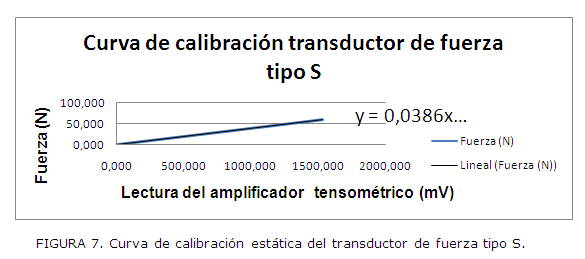
<body><![CDATA[<p class="MsoNormal" style="text-indent:0cm;line-height:normal; text-autospace:ideograph-numeric ideograph-other; margin-top:0; margin-bottom:0" align="justify">&nbsp;</p> </b>     <p class="MsoNormal" style="text-indent:0cm;line-height:normal; text-autospace:ideograph-numeric ideograph-other; margin-top:0; margin-bottom:0" align="justify"><font face="Verdana"><span style="font-size: 10.0pt">E</span></font><font face="Verdana"><span style="font-size: 10.0pt">n    la <a href="/img/revistas/rcta/v21n2/f0702212.gif">Figura 7</a> se aprecia    la curva de calibración estática, existiendo una fuerte dependencia lineal entre    las variables al ser el coeficiente de correlación igual a la unidad. </span></font>  </p>     
<p class="MsoNormal" style="text-indent:0cm;line-height:normal; text-autospace:ideograph-numeric ideograph-other; margin-top:0; margin-bottom:0" align="center">&nbsp;  </p>     <p class="MsoNormal" style="text-indent:0cm;line-height:normal; text-autospace:ideograph-numeric ideograph-other; margin-top:0; margin-bottom:0" align="justify"><font face="Verdana"> <span style="font-size: 10.0pt">El error de la calibración del transductor fue  de 0,024 N por lo que la ecuación general para determinar la fuerza tractiva se  muestra a continuación:</span></font></p> <b>     <p class="MsoNormal" style="text-indent:0cm;line-height:normal; text-autospace:ideograph-numeric ideograph-other; margin-top:0; margin-bottom:0" align="justify">&nbsp;</p>     <p class="MsoNormal" style="text-indent:0cm;line-height:normal; text-autospace:ideograph-numeric ideograph-other; margin-top:0; margin-bottom:0" align="center">    <img src="/img/revistas/rcta/v21n2/e0302212.gif" width="611" height="44">  </p>     
<p class="MsoNormal" style="text-indent:0cm;line-height:normal; text-autospace:ideograph-numeric ideograph-other; margin-top:0; margin-bottom:0" align="justify">&nbsp; </p>     <p class="MsoNormal" style="line-height:normal;text-autospace: ideograph-numeric ideograph-other; margin-top:0; margin-bottom:0" align="justify">    <font face="Verdana"> <span style="font-size: 10.0pt"><strong>donde: </strong></span></font></p> </b>    <p class="MsoNormal" style="line-height:normal; text-autospace: ideograph-numeric ideograph-other; margin-bottom: 0;" align="justify"><b><font face="Verdana"><span style="font-size: 10.0pt"> V-&nbsp;&nbsp;&nbsp; </span></font></b><font face="Verdana"><span style="font-size: 10.0pt"> lectura tomada del amplificador tensométrico, mV;</span></font></p>     <p class="MsoNormal" style="line-height:normal; text-autospace: ideograph-numeric ideograph-other; margin-bottom: 0;" align="justify"> <b><font face="Verdana"><span style="font-size: 10.0pt">F<sub>c</sub>-&nbsp;&nbsp;    </span></font></b><font face="Verdana"><span style="font-size: 10.0pt">valor de la fuerza de tracción en Newton aplicada en el transductor, N.</span></font></p>     ]]></body>
<body><![CDATA[<p class="MsoNormal" style="text-indent:0cm;line-height:normal; margin-top:0; margin-bottom:0" align="justify"> <span style="font-size:10.0pt">&nbsp;</span></p> <b>     <p class="MsoNormal" style="text-indent:0cm;line-height:normal; margin-top:0; margin-bottom:0" align="justify">&nbsp; </p>     <p class="MsoNormal" style="text-indent:0cm;line-height:normal; margin-top:0; margin-bottom:0" align="justify">&nbsp; </p>     <p class="MsoNormal" style="text-indent:0cm;line-height:normal; margin-top:0; margin-bottom:0" align="justify">&nbsp; </p>     <p class="MsoNormal" style="text-indent:0cm;line-height:normal; margin-top:0; margin-bottom:0" align="justify"> <font face="Verdana">CONCLUSIONES</font></p>     <p class="MsoNormal" style="text-indent:0cm;line-height:normal; margin-top:0; margin-bottom:0" align="justify">&nbsp; </p> </b>  <ul>       <li> <font face="Verdana"><span style="font-size:10.0pt">Se realizó el diseño      y construcción de un transductor de fuerza tipo S con un coeficiente de seguridad      igual a 7,07 garantizando </span><span style="font-size: 10.0pt"> linealidad      durante los regímenes de carga y descarga del transductor.</span></font></li>       <li><font face="Verdana"><span style="font-size: 10.0pt">Se obtuvo para el diseño      una sensibilidad de salida igual a 0,456 mV/V encontrándose dentro del rango      recomendado para este tipo de transductor.</span></font></li>       <li><font face="Verdana"><span style="font-size: 10.0pt">Se obtuvo la ecuación      lineal de dependencia funcional entre la fuerza aplicada y las deformaciones      con un valor de la pendiente igual 0,0386 N/mV.</span></font></li>       <li><font face="Verdana"><span style="font-size: 10.0pt">Se determinó el error      de la calibración igual a 0,024 N.</span></font></li>     ]]></body>
<body><![CDATA[</ul>     <p class="MsoNormal" style="text-indent:0cm;line-height:normal; margin-top:0; margin-bottom:0" align="justify">&nbsp; </p> <b>     <p class="MsoNormal" style="text-indent:0cm;line-height:normal; margin-top:0; margin-bottom:0" align="justify">&nbsp; </p>     <p class="MsoNormal" style="text-indent:0cm;line-height:normal; margin-top:0; margin-bottom:0" align="justify">&nbsp; </p>     <p class="MsoNormal" style="text-indent:0cm;line-height:normal; margin-top:0; margin-bottom:0" align="justify">&nbsp; </p>     <p class="MsoNormal" style="text-indent:0cm;line-height:normal; margin-top:0; margin-bottom:0" align="justify"> R<font face="Verdana">EFERENCIAS BIBLIOGRÁFICAS</font></p>     <p class="MsoNormal" style="text-indent:0cm;line-height:normal; margin-top:0; margin-bottom:0" align="justify">&nbsp; </p> </b>     <!-- ref --><p class="MsoHeader" style="text-indent: 0cm; margin-top:0; margin-bottom:0" align="justify"> <span style="font-size:10.0pt"><font face="Verdana">1. GARCÍA DE LA FIGAL, C.  	A.: Análisis de Incertidumbre, 8pp., </font></span> <font face="Verdana"><span lang="ES-TRAD" style="font-size: 10.0pt">Universidad Agraria de La Habana, Facultad de Ciencias Técnicas, Mayabeque,  	Cuba, (reseña), </span><span style="font-size: 10.0pt">2011.    </span></font></p> <b>     <p class="MsoHeader" style="text-indent: 0cm; margin-top:0; margin-bottom:0" align="justify">&nbsp;</p> </b>     ]]></body>
<body><![CDATA[<!-- ref --><p class="MsoNormal" style="text-indent: 0cm; margin-top:0; margin-bottom:0" align="justify">    <font face="Verdana"><span lang="EN-US" style="font-size: 10.0pt">2. GODWIN,    R. J.: An extended octagonal ring transducer for use in tillage studies,    Journal of Agricultural Engineering Research, 20: 347-352, 1975.    </span></font></p> <b>     <p class="MsoNormal" style="text-indent: 0cm; margin-top:0; margin-bottom:0" align="justify">&nbsp;</p> </b>     <p class="MsoNormal" style="text-indent: 0cm; margin-top:0; margin-bottom:0" align="justify">    <font face="Verdana"><span lang="PT-BR" style="font-size: 10.0pt">3. HERRERA,    S. M.; E. LÓPEZ; A. SÁNCHEZ; O. </span><span style="font-size: 10.0pt">GONZÁLEZ    y C. IGLESIAS: Estudio de nuevos materiales para la construcción de Órganos    de trabajo empleados en la labranza de suelos Abrasivos, 106pp.,    Informe de proyecto, Universidad Agraria de La HYabana, Cuba, 2007.</span></font></p> <b>     <p class="MsoNormal" style="text-indent: 0cm; margin-top:0; margin-bottom:0" align="justify">&nbsp;</p> </b>     <!-- ref --><p class="MsoNormal" style="text-indent: 0cm; margin-top:0; margin-bottom:0" align="justify"> <font face="Verdana"><span lang="EN-US" style="font-size: 10.0pt; color: black"> 4. KYOWA ELECTRONIC  	INSTRUMENTS INSTRUCTION MANUAL: Strain Gage and Temperature Sensor. Kyowa  	Electronic Instruments CO., LTD. </span> <span style="font-size:10.0pt;color:black">Japan, 1973.    </span></font></p> <b>     <p class="MsoNormal" style="text-indent: 0cm; margin-top:0; margin-bottom:0" align="justify">&nbsp;</p> </b>     <!-- ref --><p class="MsoNormal" style="text-indent: 0cm; margin-top:0; margin-bottom:0" align="justify">    <font face="Verdana"><span style="font-size:10.0pt; color:black">5. MARTÍNEZ, R. A.: Contribución a la modelación matemática conceptual    dirigida al cálculo de parámetros en procesos de aplicación en la agricultura,    419pp., </span><span style="font-size:10.0pt">Tesis (presentada para    obtener el&nbsp;título    de Doctor en Ciencias), Universidad    Agraria de La Habana, Cuba,<span style="color:black"> 2006.    </span></span></font></p> <b>     ]]></body>
<body><![CDATA[<p class="MsoNormal" style="text-indent: 0cm; margin-top:0; margin-bottom:0" align="justify">&nbsp;</p> </b>     <!-- ref --><p class="MsoNormal" style="text-indent: 0cm; margin-top:0; margin-bottom:0" align="justify"> <font face="Verdana" size="2">6. </font><font face="Verdana"> <span style="font-size:10.0pt; color:black">MARTÍNEZ, R. A.: Software para el cálculo de barras de cargas  	para básculas electrónicas, Universidad Agraria de La Habana, Centro de  	Mecanización Agropecuaria, &nbsp;La Habana, 2006.    </span></font></p>     <p class="MsoNormal" style="text-indent: 0cm; margin-top:0; margin-bottom:0" align="justify"> <font face="Verdana"><span style="font-size:10.0pt; color:black">&nbsp;</span></font></p>     <!-- ref --><p class="MsoHeader" style="text-indent: 0cm; margin-top:0; margin-bottom:0" align="justify"> <font face="Verdana"><span style="font-size:10.0pt;color:black">7. MARTÍNEZ, R.  	A.:</span><span style="font-size:10.0pt"> Sistema de medición. Aplicación  	Ingeniería Mecánica Agrícola, 52pp., </span> <span lang="ES-TRAD" style="font-size: 10.0pt">Universidad Agraria de La  	Habana, Facultad de Mecanización, La Habana, (reseña),</span><span style="font-size:10.0pt">  	2008.    </span></font></p> <b>     <p class="MsoHeader" style="text-indent: 0cm; margin-top:0; margin-bottom:0" align="justify">&nbsp;</p> </b>     <!-- ref --><p class="MsoNormal" style="text-indent: 0cm; margin-top:0; margin-bottom:0" align="justify"> <font face="Verdana"><span style="font-size: 10.0pt">8. MILLER, I. R.; J.E.  	FREUND y R. JOHNSON: Probabilidad y estadística para ingenieros, Tomo  	II, Editorial Félix Varela, La Habana, 2007.    </span></font></p> <b>     <p class="MsoNormal" style="text-indent: 0cm; margin-top:0; margin-bottom:0" align="justify">&nbsp;</p> </b>     ]]></body>
<body><![CDATA[<!-- ref --><p class="MsoNormal" style="text-indent: 0cm; margin-top:0; margin-bottom:0" align="justify"> <font face="Verdana"><span lang="EN-US" style="font-size: 10.0pt; color: black"> 9. OMEGADYNE, INC.: Omegadyne Pressure, Force, load, Torque Data Book, USA, 1996.    </span></font></p> <b>     <p class="MsoNormal" style="text-indent: 0cm; margin-top:0; margin-bottom:0" align="justify">&nbsp;</p> </b>     <!-- ref --><p class="MsoNormal" style="text-indent: 0cm; margin-top:0; margin-bottom:0" align="justify">    <font face="Verdana"><span style="font-size:10.0pt; color:black">10. RIVERO, P. Y.: </span><span style="font-size:10.0pt">Fundamentación    de los Parámetros de Diseño de una Sonda para la medición del Índice de Cuña    del Suelo, 66pp., </span><span lang="ES-TRAD" style="font-size: 10.0pt">Trabajo    de Diploma (en opción al título de Ingeniero en&nbsp;Mecanización Agropecuaria),    Universidad Agraria de La Habana, </span><span style="font-size:10.0pt">2009.    </span></font></p> <b>     <p class="MsoNormal" style="text-indent: 0cm; margin-top:0; margin-bottom:0" align="justify">&nbsp;</p> </b>     <!-- ref --><p align="justify" style="margin-top: 0; margin-bottom: 0"> <span lang="EN-US" style="font-size: 10.0pt; line-height: 150%; font-family: Verdana; color: black">    11. TECHNICAL STAFF OF MEASUREMENT GROUP: Strain Gage Based Transducers,    Their Design and Construction. Measurements Group, Inc., Raleigh, North Carolina,    27611, ISBN 0-9619057-0-USA,    1988.    </span></p> <b>     <p align="justify" style="margin-top: 0; margin-bottom: 0">&nbsp;</p>     <p align="justify" style="margin-top: 0; margin-bottom: 0">&nbsp;</p>     ]]></body>
<body><![CDATA[<p align="justify" style="margin-top: 0; margin-bottom: 0">&nbsp;</p> </b>     <p class="MsoNormal" style="text-indent:0cm;line-height:normal; text-autospace:ideograph-numeric ideograph-other; margin-top:0; margin-bottom:0" align="justify">    <span style="line-height: 150%; font-family: Verdana"><font size="2">Recibido:    20 de diciembre de 2010.</font></span></p>     <p class="MsoNormal" style="text-indent:0cm;line-height:normal; text-autospace:ideograph-numeric ideograph-other; margin-top:0; margin-bottom:0" align="justify">   <font face="Verdana" size="2">Aprobado:    30 de enero de 2012. </font></p> <b>     <p></p>     <p class="MsoNormal" style="line-height:normal; text-autospace:ideograph-numeric ideograph-other; margin-top:0; margin-bottom:0" align="justify"> <font face="Verdana" size="2">&nbsp; </font> </p>     <p class="MsoNormal" style="line-height:normal; text-autospace:ideograph-numeric ideograph-other; margin-top:0; margin-bottom:0" align="justify"> <font face="Verdana" size="2">&nbsp; </font> </p> </b>     <p class="MsoFootnoteText" style="text-indent:0cm;line-height: normal; margin-top:0; margin-bottom:0" align="justify"> <span style="line-height: 150%; font-family: Verdana"><font size="2"><i>    Alexander Laffita Leyva, </i>Especialista,<i> </i>Centro de Mecanización Agropecuaria,    Universidad Agraria de La Habana, </font></span><font face="Verdana" size="2">    Autopista Nacional&nbsp; km 23 ½, Carretera de Tapaste, San José de las Lajas,    Mayabeque, Cuba</font><span style="line-height: 150%; font-family: Verdana"><font size="2">,    Correo electrónico: </font> <a style="color: blue; text-decoration: underline; text-underline: single" href="mailto:alexl@isch.edu.cu">    <font size="2">alexl@isch.edu.cu</font></a></span><font face="Verdana"><span style="font-size:8.0pt">&nbsp;</span></font></p>      ]]></body><back>
<ref-list>
<ref id="B1">
<label>1</label><nlm-citation citation-type="book">
<person-group person-group-type="author">
<name>
<surname><![CDATA[GARCÍA DE LA FIGAL]]></surname>
<given-names><![CDATA[C. A]]></given-names>
</name>
</person-group>
<source><![CDATA[Análisis de Incertidumbre]]></source>
<year>2011</year>
<page-range>8</page-range><publisher-loc><![CDATA[Mayabeque ]]></publisher-loc>
<publisher-name><![CDATA[Universidad Agraria de La Habana, Facultad de Ciencias Técnicas]]></publisher-name>
</nlm-citation>
</ref>
<ref id="B2">
<label>2</label><nlm-citation citation-type="journal">
<person-group person-group-type="author">
<name>
<surname><![CDATA[GODWIN]]></surname>
<given-names><![CDATA[R. J]]></given-names>
</name>
</person-group>
<article-title xml:lang="en"><![CDATA[An extended octagonal ring transducer for use in tillage studies]]></article-title>
<source><![CDATA[Journal of Agricultural Engineering Research]]></source>
<year>1975</year>
<numero>20</numero>
<issue>20</issue>
<page-range>347-352</page-range></nlm-citation>
</ref>
<ref id="B3">
<label>3</label><nlm-citation citation-type="book">
<person-group person-group-type="author">
<name>
<surname><![CDATA[HERRERA]]></surname>
<given-names><![CDATA[S. M]]></given-names>
</name>
<name>
<surname><![CDATA[LÓPEZ]]></surname>
<given-names><![CDATA[E]]></given-names>
</name>
<name>
<surname><![CDATA[SÁNCHEZ]]></surname>
<given-names><![CDATA[A]]></given-names>
</name>
<name>
<surname><![CDATA[GONZÁLEZ]]></surname>
<given-names><![CDATA[O]]></given-names>
</name>
<name>
<surname><![CDATA[IGLESIAS]]></surname>
<given-names><![CDATA[C]]></given-names>
</name>
</person-group>
<source><![CDATA[Estudio de nuevos materiales para la construcción de Órganos de trabajo empleados en la labranza de suelos Abrasivos]]></source>
<year>2007</year>
<page-range>106</page-range><publisher-name><![CDATA[Universidad Agraria de La Habana]]></publisher-name>
</nlm-citation>
</ref>
<ref id="B4">
<label>4</label><nlm-citation citation-type="book">
<collab>KYOWA ELECTRONIC INSTRUMENTS INSTRUCTION MANUAL</collab>
<source><![CDATA[Strain Gage and Temperature Sensor]]></source>
<year>1973</year>
<publisher-name><![CDATA[Kyowa Electronic Instruments CO., LTD]]></publisher-name>
</nlm-citation>
</ref>
<ref id="B5">
<label>5</label><nlm-citation citation-type="book">
<person-group person-group-type="author">
<name>
<surname><![CDATA[MARTÍNEZ]]></surname>
<given-names><![CDATA[R. A]]></given-names>
</name>
</person-group>
<source><![CDATA[Contribución a la modelación matemática conceptual dirigida al cálculo de parámetros en procesos de aplicación en la agricultura]]></source>
<year>2006</year>
<page-range>419</page-range><publisher-name><![CDATA[Universidad Agraria de La Habana]]></publisher-name>
</nlm-citation>
</ref>
<ref id="B6">
<label>6</label><nlm-citation citation-type="book">
<person-group person-group-type="author">
<name>
<surname><![CDATA[MARTÍNEZ]]></surname>
<given-names><![CDATA[R. A]]></given-names>
</name>
</person-group>
<source><![CDATA[Software para el cálculo de barras de cargas para básculas electrónicas]]></source>
<year>2006</year>
<publisher-loc><![CDATA[La Habana ]]></publisher-loc>
<publisher-name><![CDATA[Universidad Agraria de La Habana, Centro de Mecanización Agropecuaria]]></publisher-name>
</nlm-citation>
</ref>
<ref id="B7">
<label>7</label><nlm-citation citation-type="book">
<person-group person-group-type="author">
<name>
<surname><![CDATA[MARTÍNEZ]]></surname>
<given-names><![CDATA[R. A]]></given-names>
</name>
</person-group>
<source><![CDATA[Sistema de medición. Aplicación Ingeniería Mecánica Agrícola]]></source>
<year>2008</year>
<page-range>52</page-range><publisher-loc><![CDATA[La Habana ]]></publisher-loc>
<publisher-name><![CDATA[Universidad Agraria de La HabanaFacultad de Mecanización]]></publisher-name>
</nlm-citation>
</ref>
<ref id="B8">
<label>8</label><nlm-citation citation-type="book">
<person-group person-group-type="author">
<name>
<surname><![CDATA[MILLER]]></surname>
<given-names><![CDATA[I. R]]></given-names>
</name>
<name>
<surname><![CDATA[FREUND]]></surname>
<given-names><![CDATA[J.E]]></given-names>
</name>
<name>
<surname><![CDATA[JOHNSON]]></surname>
<given-names><![CDATA[R]]></given-names>
</name>
</person-group>
<source><![CDATA[Probabilidad y estadística para ingenieros]]></source>
<year>2007</year>
<publisher-loc><![CDATA[La Habana ]]></publisher-loc>
<publisher-name><![CDATA[Editorial Félix Varela]]></publisher-name>
</nlm-citation>
</ref>
<ref id="B9">
<label>9</label><nlm-citation citation-type="book">
<collab>OMEGADYNE, INC</collab>
<source><![CDATA[Omegadyne Pressure, Force, load]]></source>
<year>1996</year>
<publisher-name><![CDATA[Torque Data Book]]></publisher-name>
</nlm-citation>
</ref>
<ref id="B10">
<label>10</label><nlm-citation citation-type="book">
<person-group person-group-type="author">
<name>
<surname><![CDATA[RIVERO]]></surname>
<given-names><![CDATA[P. Y]]></given-names>
</name>
</person-group>
<source><![CDATA[Fundamentación de los Parámetros de Diseño de una Sonda para la medición del Índice de Cuña del Suelo]]></source>
<year>2009</year>
<page-range>66</page-range><publisher-name><![CDATA[Universidad Agraria de La Habana]]></publisher-name>
</nlm-citation>
</ref>
<ref id="B11">
<label>11</label><nlm-citation citation-type="book">
<collab>TECHNICAL STAFF OF MEASUREMENT GROUP</collab>
<source><![CDATA[Strain Gage Based Transducers, Their Design and Construction]]></source>
<year>1988</year>
<publisher-name><![CDATA[Measurements Group, Inc]]></publisher-name>
</nlm-citation>
</ref>
</ref-list>
</back>
</article>