<?xml version="1.0" encoding="ISO-8859-1"?><article xmlns:mml="http://www.w3.org/1998/Math/MathML" xmlns:xlink="http://www.w3.org/1999/xlink" xmlns:xsi="http://www.w3.org/2001/XMLSchema-instance">
<front>
<journal-meta>
<journal-id>2071-0054</journal-id>
<journal-title><![CDATA[Revista Ciencias Técnicas Agropecuarias]]></journal-title>
<abbrev-journal-title><![CDATA[Rev Cie Téc Agr]]></abbrev-journal-title>
<issn>2071-0054</issn>
<publisher>
<publisher-name><![CDATA[Universidad Agraria de La Habana]]></publisher-name>
</publisher>
</journal-meta>
<article-meta>
<article-id>S2071-00542014000200004</article-id>
<title-group>
<article-title xml:lang="en"><![CDATA[Use of Queueing Theory to organization of the complex rice harvest-transport on the Agroindustrial Rice Complex “Los Palacios”]]></article-title>
<article-title xml:lang="es"><![CDATA[Uso de la Teoría de Colas para la organización del complejo cosecha-transporte del arroz en el Complejo Agroindustrial Arrocero “Los Palacios”]]></article-title>
</title-group>
<contrib-group>
<contrib contrib-type="author">
<name>
<surname><![CDATA[Morejón Mesa]]></surname>
<given-names><![CDATA[Yanoy]]></given-names>
</name>
<xref ref-type="aff" rid="A01"/>
</contrib>
<contrib contrib-type="author">
<name>
<surname><![CDATA[Iglesias Coronel]]></surname>
<given-names><![CDATA[Ciro E.]]></given-names>
</name>
<xref ref-type="aff" rid="A01"/>
</contrib>
</contrib-group>
<aff id="A01">
<institution><![CDATA[,Universidad Agraria de La Habana Facultad de Ciencias Técnicas ]]></institution>
<addr-line><![CDATA[Mayabeque San José de las Lajas]]></addr-line>
<country>Cuba</country>
</aff>
<pub-date pub-type="pub">
<day>00</day>
<month>06</month>
<year>2014</year>
</pub-date>
<pub-date pub-type="epub">
<day>00</day>
<month>06</month>
<year>2014</year>
</pub-date>
<volume>23</volume>
<numero>2</numero>
<fpage>23</fpage>
<lpage>26</lpage>
<copyright-statement/>
<copyright-year/>
<self-uri xlink:href="http://scielo.sld.cu/scielo.php?script=sci_arttext&amp;pid=S2071-00542014000200004&amp;lng=en&amp;nrm=iso"></self-uri><self-uri xlink:href="http://scielo.sld.cu/scielo.php?script=sci_abstract&amp;pid=S2071-00542014000200004&amp;lng=en&amp;nrm=iso"></self-uri><self-uri xlink:href="http://scielo.sld.cu/scielo.php?script=sci_pdf&amp;pid=S2071-00542014000200004&amp;lng=en&amp;nrm=iso"></self-uri><abstract abstract-type="short" xml:lang="en"><p><![CDATA[The present research was carried out on the Agroindustrial Rice Complex “Los Palacios”, on Pinar del Rio province. The investigation had as main goal the study of the means stop probabilities, on the base of stochastic process, considering economical features that appear during the work of the complex rice harvest-transport with the harvester machine New Holland TC-57 and the joint tractor New Holland TS-6020 with trailers RA-6, looking for its rational organization. For the solution of this problem was used the Queueing Theory, taking the economical criteria of itsoptimization the minimum added expenses in one hour by harvester machines and means of transport stops in service, besides it is determined the quantity means of transport for a harvester brigade under probabilistic basis.]]></p></abstract>
<abstract abstract-type="short" xml:lang="es"><p><![CDATA[La presente investigación se realizó en el Complejo Agroindustrial Arrocero “Los Palacios”, provincia Pinar del Rio. La investigación tuvo como objetivo principal el estudio de las probabilidades promedio de paradas, sobre la base de los procesos estocásticos, considerándose el aspecto económico durante el trabajo del complejo cosecha-transporte del arroz con la cosechadora New Holland TC -57 y el conjunto tractor New Holland TS-6020 con remolques RA-6, buscándose de esta forma su organización racional.Para la solución de este problema se utilizó la Teoría de Colas, tomándose el criterio económico de los mínimos gastos sumados por paradas de las cosechadoras y los medios de transporte, ademas se determinó la cantidad de medios de transporte para una brigada de cosecha bajo bases probabilísticas.]]></p></abstract>
<kwd-group>
<kwd lng="en"><![CDATA[rice]]></kwd>
<kwd lng="en"><![CDATA[probabilities]]></kwd>
<kwd lng="en"><![CDATA[mechanization]]></kwd>
<kwd lng="es"><![CDATA[cosecha mecanizada de arroz]]></kwd>
<kwd lng="es"><![CDATA[teoría de las probabilidades]]></kwd>
<kwd lng="es"><![CDATA[sistemas mecanizados]]></kwd>
</kwd-group>
</article-meta>
</front><body><![CDATA[ <div align="right">       <p><font face="Verdana, Arial, Helvetica, sans-serif" size="2"><B>ART&Iacute;CULO      ORIGINAL </B></font></p>       <p>&nbsp;</p> </div> <B>     <P>      <P>      <P><font face="Verdana, Arial, Helvetica, sans-serif" size="4">Use of Queueing Theory to organization of the complex rice harvest-transport on the Agroindustrial Rice Complex “Los Palacios”</font>      <P>&nbsp;      <P>      <P><font face="Verdana, Arial, Helvetica, sans-serif" size="3">Uso de la Teoría de Colas para la organización  del complejo cosecha-transporte del arroz en el Complejo Agroindustrial Arrocero “Los Palacios” </font>      <P>&nbsp;     ]]></body>
<body><![CDATA[<P>&nbsp; </B>     <P>      <P>      <P><b><font face="Verdana, Arial, Helvetica, sans-serif" size="2">M.Sc. Yanoy Morejón Mesa, Dr.C. Ciro E. Iglesias Coronel </font></b><font face="Verdana, Arial, Helvetica, sans-serif" size="2">    </font>      <P><font face="Verdana, Arial, Helvetica, sans-serif" size="2">Universidad Agraria de La Habana. Facultad de Ciencias Técnicas, San José de las Lajas, Mayabeque, Cuba. </font>      <P>&nbsp;     <P>&nbsp; <hr>     <P>      <P>      <P> <font face="Verdana, Arial, Helvetica, sans-serif" size="2"><B>ABSTRACT </B></font>      ]]></body>
<body><![CDATA[<p><font face="Verdana, Arial, Helvetica, sans-serif" size="2">The present research was carried out on the Agroindustrial Rice Complex “Los Palacios”, on Pinar del Rio province. The investigation had as main goal the study of the means stop probabilities, on the base of stochastic process, considering economical features that appear during the work of the complex rice harvest-transport with the harvester machine New Holland TC-57 and the joint tractor New Holland TS-6020 with trailers RA-6, looking for its rational organization. For the solution of this problem was used the Queueing Theory, taking the economical criteria of itsoptimization the minimum added expenses in one hour by harvester machines and means of transport stops in service, besides it is determined the quantity means of transport for a harvester brigade under probabilistic basis. </font></p>     <p><font face="Verdana, Arial, Helvetica, sans-serif" size="2"> <b>Key words:</b> rice, probabilities, mechanization.</font></p> <hr>      <P> <font face="Verdana, Arial, Helvetica, sans-serif" size="2"><B>RESUMEN</B></font>      <P><font face="Verdana, Arial, Helvetica, sans-serif" size="2">La presente investigación se realizó en el Complejo Agroindustrial Arrocero “Los Palacios”, provincia Pinar del Rio. La investigación tuvo como objetivo principal el estudio de las probabilidades promedio de paradas, sobre la base de los procesos estocásticos, considerándose el aspecto económico durante el trabajo del complejo cosecha-transporte del arroz con la cosechadora New Holland TC -57 y el conjunto tractor New Holland TS-6020 con remolques RA-6, buscándose de esta forma su organización racional.Para la solución de este problema se utilizó la Teoría de Colas, tomándose el criterio económico de los mínimos gastos sumados por paradas de las cosechadoras y los medios de transporte, ademas se determinó la cantidad de medios de transporte para una brigada de cosecha bajo bases probabilísticas. </font>      <p><font face="Verdana, Arial, Helvetica, sans-serif" size="2"> <b>Palabras clave:    </b>cosecha mecanizada de arroz, teoría de las probabilidades, sistemas mecanizados.    </font> </p> <hr>      <P>      <P>&nbsp;     <P>&nbsp;     <P><font face="Verdana, Arial, Helvetica, sans-serif" size="3"><B>INTRODUCTION</B>    </font>      <P><font face="Verdana, Arial, Helvetica, sans-serif" size="2"> </font><font face="Verdana, Arial, Helvetica, sans-serif" size="2">For    the organization of the harvest-transport brigade of the rice it is important    to consider technical and economical aspects, having in mind the minimum expenses    for unit of time and/or unit of grain harvested and transported, where a noticeable    influence is made by the harvester machine productivity, the means of transport    capacity, the distance of transportation, the vials type and conditions, the    waiting time to the charge of grain on the field and the discharge on the Reception    Center (Betancourt & Bullaín, 2007). </font>     ]]></body>
<body><![CDATA[<P><font face="Verdana, Arial, Helvetica, sans-serif" size="2">The Queueing Theory    was studied by (A. Kaufmann, 1981) and others authors (Buffa, 1968; Escudero,    1972; Cooper, 1981; Gross and Harris, 1985; Kashyahp & Chandry, 1988; Medhi,    1991; Walfrand, 1988; Wolff, 1989; Martinez, 2004) making possible the analysis    of waiting phenomenon that is related with the stochastic process, through mathematical    models, that make possible to annex the probabilities; besides facilitating    to make decisions that give us the possibility to improve the process organization    and the systems rationality on the basis of costs reduction. </font>     <P><font face="Verdana, Arial, Helvetica, sans-serif" size="2">There are few developed    research about the Queueing Theory use in the agricultural process, for that    reason the present research is about the technological harvest-transport process of the rice, making an analysis of every component that conform the complex and there were determined the indicators and parameters that made an influence in the efficiency of this process. Determining the organization of the process harvest-transport means, considering the economical criteria of the minimum added expenses for the harvester machine and the means of transport stops during one hour. </font>      <P>&nbsp;      <P>      <P><font face="Verdana, Arial, Helvetica, sans-serif" size="3"><B>METHODS </B></font><font face="Verdana, Arial, Helvetica, sans-serif" size="2"><B><I>    </I></B> </font>      <P><font face="Verdana, Arial, Helvetica, sans-serif" size="2"><b>Theoretical    fundaments to the organization of the rice harvest-transport process</b></font>     <P><font face="Verdana, Arial, Helvetica, sans-serif" size="2"> During the mechanized    harvest flow several kinds of machines are used, such as: harvester machines,    means of transport and Grain Reception Center. The condition of continuity of    productive flow is the equality between productivities of every mechanized link    for a brigade.</font>     <P align="center"><img src="/img/revistas/rcta/v23n2/e0104214.gif" width="552" height="40">      
<P><font face="Verdana, Arial, Helvetica, sans-serif" size="2">Where: </font>     <P><font face="Verdana, Arial, Helvetica, sans-serif" size="2">n<sub>i</sub> –    Quantity of joints for a link i determined;     ]]></body>
<body><![CDATA[<br>   W<sub>i</sub> –productivity of the joint in the productive link i. </font>      <P><font face="Verdana, Arial, Helvetica, sans-serif" size="2">During the harvest-transport    process the pendulum route is used (distance travelled with charge until the    Reception Center and distance travelled empty till the field) (Iglesias et al,    2012; González, 1993). </font>     <P><font face="Verdana, Arial, Helvetica, sans-serif" size="2"><b>Determination    of the harvest-transport means organization using the Queueing Theory </b></font>     <P><font face="Verdana, Arial, Helvetica, sans-serif" size="2">The effective work    of the harvest-transport complex depends on the transport service organization;    therefore the rational determination of this means presents some difficulties    during the productive process. </font>     <P><font face="Verdana, Arial, Helvetica, sans-serif" size="2">In production conditions,    in the moment of harvester machine is fulfilled with grain and the arrival to    the field of the means of transport don’t correspond. For this reason the duration    of the turn time, depends on the movement speed, of the times used in the Reception    Center, and for the harvester machine location on the field and in the path    outside the field. Other causes that have an influence in the harvester machine    fulfilling with grain are: the relief, the productive yield, the grain humidity    during the working day, etc. All the things previously mentioned can produce    the unproductive stop of the harvester machine and means of transport. (Iglesias    et al, 2011; Iglesias, 2006). </font>     <P><font face="Verdana, Arial, Helvetica, sans-serif" size="2">Economically is    convenient the minimum relation between the quantity of harvester machine and    means of transport (Pérez and Iglesias, 1992). This criteria is achieved by    the following expression: </font>     <P align="center"><img src="/img/revistas/rcta/v23n2/e0204214.gif" width="580" height="40">      
<P><font face="Verdana, Arial, Helvetica, sans-serif" size="2">Where:</font>     <P><font face="Verdana, Arial, Helvetica, sans-serif" size="2">C<sub>PC</sub>-    Losses per one hour of harvester machine stop waiting the means of transport    to serve, peso;    <br>   &lambda; Mean quantity of harvester machine fulfilled of grain (Demand of service    in one hour);    ]]></body>
<body><![CDATA[<br>   t<sub>w</sub>- Waiting mean time of every demand, h;     <br>   C<sub>t</sub>- Cost per hour in the maintenance of the means of transport, peso/h;        <br>   n- Quantity of means of transport to give services to a harvester machines group.    </font>      <P><font face="Verdana, Arial, Helvetica, sans-serif" size="2">In the queueing    system it is used the stationery single flow of Poisson, which is free of consequences.    This means that in equal time the demand of a service for two or more is few    probable, for this, it is important consider the following hypothesis: </font>     <P><font face="Verdana, Arial, Helvetica, sans-serif" size="2">1st- The probability    P<sub>c</sub> (t) doesn’t depend of the time interval and don’t have dependence    of the initial time; </font>     <P><font face="Verdana, Arial, Helvetica, sans-serif" size="2">2nd- Two events    don’t occur never at the same time (the probability that two events happen together    is very small); </font>     <P><font face="Verdana, Arial, Helvetica, sans-serif" size="2">3rd- If it is considered    a very small time interval &lambda; &Delta;t, selected in whichever instant,    the probability is equal to &Delta;t; the quantity &lambda; is called mean rate    of enters or demand average of service in a unit of time. </font>     <P><font face="Verdana, Arial, Helvetica, sans-serif" size="2">The magnitude &phi;    can be whichever (coefficient of system charge). A steady regime exists when    &phi; < n, in contrary case &phi; &le; n the system can’t satisfy the demand    and the queue grow indefinitely. </font>      <P>&nbsp;      <P>      ]]></body>
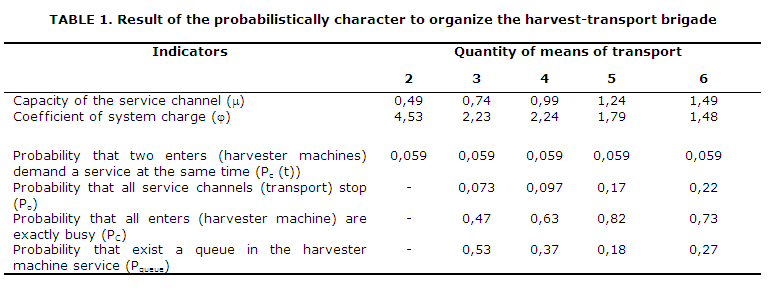
<body><![CDATA[<P><font face="Verdana, Arial, Helvetica, sans-serif" size="3"><B>RESULTS AND DISCUSSION</B></font><font face="Verdana, Arial, Helvetica, sans-serif" size="2"><B>    </B> </font>      <P><font face="Verdana, Arial, Helvetica, sans-serif" size="2"><b>Determination    of the harvest-transport means organization using the Queueing Theory</b></font>     <P><font face="Verdana, Arial, Helvetica, sans-serif" size="2"> For the determination    of the rational quantity of transport means was taken a harvest-transport brigade    conformed by three harvester machines New Holland TC-57 and a transport link    conformed by tractors New Holland TS-6020 everyone with two trailers RA-6. The    rice field had a mean yield of 3,7 t/ha, and the transportation distance was    of 13 km on pavement and 5 km on land from to the harvest field until the Reception    Center. </font><font face="Verdana, Arial, Helvetica, sans-serif" size="2">The    results obtained were the following: </font>     <P><font face="Verdana, Arial, Helvetica, sans-serif" size="2">&#149; The productivity    of the harvester machine in explotation time to an agricultural yield of 3,7    t/ha was 3,03 t/h. </font>     <P><font face="Verdana, Arial, Helvetica, sans-serif" size="2">&#149; The cycle time    was of 4,02 h, this value is considered elevated, the main cause of this value    was the vials conditions. </font>     <P><font face="Verdana, Arial, Helvetica, sans-serif" size="2">Using the expression    4 was possible determining the quantity of means of transport without considering    the probabilities being this 4,56 means, but for the real conditions four means    were considered, taking this quantity of means as comparison base for two, three,    four, five and six means of transport, to determine the probabilistical and    economical characters. </font>     <P><font face="Verdana, Arial, Helvetica, sans-serif" size="2">The mean time of    the harvester machine to fulfill its capacity for this yield was 0,45h, So in    one hour the channel can satisfy 2,22 joints of transport. </font>     <P><font face="Verdana, Arial, Helvetica, sans-serif" size="2">The <a href="/img/revistas/rcta/v23n2/t0104214.gif">Table    1</a> shows the probabilistical character of the harvest-transport; when the    quantities of means of transport change, showing that with five means of transport    the probability that exist a queue in the harvester machine service is lower.</font>      
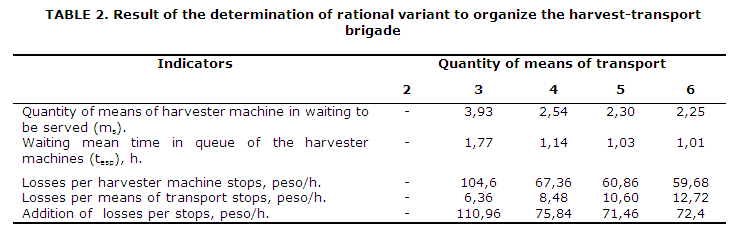
<P><font face="Verdana, Arial, Helvetica, sans-serif" size="2">The <a href="/img/revistas/rcta/v23n2/t0204214.gif">Table    2</a> shows the determination of rational variant to organize the harvest-transport    brigade on economical base, showing that with five means of transport the value    of the addition of losses per stops is lower. </font>      
<P>&nbsp;     ]]></body>
<body><![CDATA[<P><font face="Verdana, Arial, Helvetica, sans-serif" size="3"><b>CONCLUSIONS    </b></font>     <P><font face="Verdana, Arial, Helvetica, sans-serif" size="2">&#149; This research    validates the aplication of Queueing Theory for the rational organization of    the harvest-transport complex, considering probabilistical and economical aspects.    </font>     <P><font face="Verdana, Arial, Helvetica, sans-serif" size="2">&#149; The probabilistical    character is directly proportional to the addition of losses per stops, because    of the variant of five transport joint it is obtained the minimum cost per stops    and the minimum probability that exist a queue in the harvester machine service.    </font>     <P><font face="Verdana, Arial, Helvetica, sans-serif" size="2">&#149; The rational quantity    of transport joints is five with a cost of 71,46 peso/h, that in comparison    with the actual composition with a cost of 75,84 peso/h, it is obtained an income    of 43,8 peso per a working turn. </font>      <P>&nbsp;     <P>&nbsp;      <P>     <P>     <P>      <P><font face="Verdana, Arial, Helvetica, sans-serif" size="3"><B>REFERENCES</B></font><font face="Verdana, Arial, Helvetica, sans-serif" size="2">    </font>      ]]></body>
<body><![CDATA[<!-- ref --><P><font face="Verdana, Arial, Helvetica, sans-serif" size="2">1. BETANCOURT,    Y. & A. BULLAÍN: <i>Modelación de los medios de transporte en el proceso de    cosecha del arroz por camiones con la utilización de la teoría del servicio    masivo</i>, 75pp., Trabajo de Diploma en opción al título de Ingeniero Mecanizador    Agropecuario, UNAH-CEMA, La Habana, Cuba.2007.     </font>      <!-- ref --><P><font face="Verdana, Arial, Helvetica, sans-serif" size="2">2. BUFFA, E.: <i>Operations    Management: Problems and Models</i>, Ed. Revolucionaria, La Habana. Cuba, 1968.        </font>      <!-- ref --><P><font face="Verdana, Arial, Helvetica, sans-serif" size="2">3. COOPER, R.:    <i>Introduction to Queueing Theory</i>, 2da ed., Elseiver North Holland, New    York, USA, 1981.    </font>      <!-- ref --><P><font face="Verdana, Arial, Helvetica, sans-serif" size="2"> 4. ESCUDERO, L.F.:    <i>Aplicaciones de la teoría de colas</i>. Ediciones Deusto, Bilbao, España,    1972.     </font>      <!-- ref --><P><font face="Verdana, Arial, Helvetica, sans-serif" size="2">5. GONZÁLEZ, R.:    <i>Explotación del parque de maquinaria</i>, Editorial Félix Varela, La Habana.    Cuba, 1993.     </font>      ]]></body>
<body><![CDATA[<!-- ref --><P><font face="Verdana, Arial, Helvetica, sans-serif" size="2">6. GROSS, D. &    C.M. HARRIS: <i>Fundamentals of Queueing Theory</i>, 2da ed., John Wiley &amp;    Sons, New York, USA, 1985.     </font>      <!-- ref --><P><font face="Verdana, Arial, Helvetica, sans-serif" size="2">7. IGLESIAS, C.    C., Y. MOREJÓN & R. LLANES: “Determinación de la composición racional del complejo    cosecha-transporte del arroz con la aplicación de la Teoría del Servicio Masivo    en el Complejo Agroindustrial Arrocero “Los Palacios”, <i>Revista de Ciencias    Técnicas Agropecuarias</i>, 21 (2): 24-29, 2012.     </font>      <!-- ref --><P><font face="Verdana, Arial, Helvetica, sans-serif" size="2">8. IGLESIAS, C.    C., Y. MOREJÓN, M. ALVÁREZ: &quot;Determinación de la composición del complejo    cosecha-transporte de la caña de azúcar con la aplicación de la Teoría del Servicio    Masivo Cuba&quot;. En: <i>Congreso Internacional de Ciencias Agropecuarias,    Agrociencia, Agring</i>, UNAH, Mayabeque, Cuba, 2011.    </font>      <!-- ref --><P><font face="Verdana, Arial, Helvetica, sans-serif" size="2">9. IGLESIAS, C.E.    &quot;Fundamentación de la cantidad óptima de medios de transporte en el eslabón    de cosecha de caña por el método del servicio masivo Cuba&quot;, En: <i>Congreso    Internacional de Ciencias Agropecuarias, Agrociencia, Agring</i>, UNAH, La Habana,    2006.     </font>      <!-- ref --><P><font face="Verdana, Arial, Helvetica, sans-serif" size="2">10. KASHYAHP, B.R.K.    & M.L. CHANDRY: <i>An Introduction to Queueing Theory</i>, A&A Publications,    Kingston, Ontario, Cánada, 1988.     </font>      ]]></body>
<body><![CDATA[<!-- ref --><P><font face="Verdana, Arial, Helvetica, sans-serif" size="2">11. KAUFMANN, A.:    <i>Métodos y modelos de la investigación de operaciones</i>, 570pp., Editorial    Pueblo y Educación, La Habana, Cuba, 1981.     </font>      <!-- ref --><P><font face="Verdana, Arial, Helvetica, sans-serif" size="2">12. MARTÍNEZ, M.:    <i>Teoría de colas. Investigación de operaciones</i>, Universidad Alejandro    de Humboldt. Carcacas, Venezuela, (Monografia), 2004.     </font>      <!-- ref --><P><font face="Verdana, Arial, Helvetica, sans-serif" size="2">13. MEDHI, J.:    <i>Stochastic Models in Queueing Theory</i>, Academic Press, San Diego, USA,    1991.     </font>      <!-- ref --><P><font face="Verdana, Arial, Helvetica, sans-serif" size="2">14. PÉREZ, B. &    C. IGLESIAS: <i>Investigación de la transportación de la caña por camiones</i>,    70pp, Trabajo de Diploma en opción al título de Ingeniero Mecanizador Agropecuario,    UNAH, La Habana, Cuba, 1992.     </font>      <!-- ref --><P><font face="Verdana, Arial, Helvetica, sans-serif" size="2">15. WALFRAND, J.    <i>An Introduction to Queueing Networks</i>, Prentice-Hall, Englewood Cliffs,    NJ. USA, 1988.     </font>      ]]></body>
<body><![CDATA[<!-- ref --><P><font face="Verdana, Arial, Helvetica, sans-serif" size="2">16. WOLFF, R. W.:    <i>Stochastic Models and the Theory of Queues</i>, Prentice-Hall, Englewood    Cliffs, NJ. USA, 1989.     </font>      <P>&nbsp;     <P>&nbsp;      <P>     <P>     <P>      <P>      <P><font face="Verdana, Arial, Helvetica, sans-serif" size="2"><b>Recibido:</b>    19 de septiembre de 2012.    <BR>   <b>Aprobado:</b> 28 de enero de 2014.</font>      ]]></body>
<body><![CDATA[<P>&nbsp;     <P>&nbsp;      <P>     <P>     <P>      <P>      <P><font face="Verdana, Arial, Helvetica, sans-serif" size="2"><I>Yanoy Morejón    Mesa</I>. Universidad Agraria de La Habana. Facultad de Ciencias Técnicas, San José de las Lajas, Mayabeque, Cuba. CP: 32700.Correo electr&oacute;nico: <U><FONT COLOR="#0000ff"><a href="mailto:ymm@unah.edu.cu">ymm@unah.edu.cu</a></FONT></U>    </font>       ]]></body><back>
<ref-list>
<ref id="B1">
<label>1</label><nlm-citation citation-type="book">
<person-group person-group-type="author">
<name>
<surname><![CDATA[BETANCOURT]]></surname>
<given-names><![CDATA[Y.]]></given-names>
</name>
<name>
<surname><![CDATA[BULLAÍN]]></surname>
<given-names><![CDATA[A.]]></given-names>
</name>
</person-group>
<source><![CDATA[Modelación de los medios de transporte en el proceso de cosecha del arroz por camiones con la utilización de la teoría del servicio masivo]]></source>
<year>2007</year>
<page-range>75</page-range><publisher-loc><![CDATA[La Habana ]]></publisher-loc>
<publisher-name><![CDATA[UNAH-CEMA]]></publisher-name>
</nlm-citation>
</ref>
<ref id="B2">
<label>2</label><nlm-citation citation-type="book">
<person-group person-group-type="author">
<name>
<surname><![CDATA[BUFFA]]></surname>
<given-names><![CDATA[E.]]></given-names>
</name>
</person-group>
<source><![CDATA[Operations Management: Problems and Models]]></source>
<year>1968</year>
<publisher-loc><![CDATA[La Habana ]]></publisher-loc>
<publisher-name><![CDATA[Ed. Revolucionaria]]></publisher-name>
</nlm-citation>
</ref>
<ref id="B3">
<label>3</label><nlm-citation citation-type="book">
<person-group person-group-type="author">
<name>
<surname><![CDATA[COOPER]]></surname>
<given-names><![CDATA[R.]]></given-names>
</name>
</person-group>
<source><![CDATA[Introduction to Queueing Theory]]></source>
<year>1981</year>
<edition>2da</edition>
<publisher-loc><![CDATA[New York ]]></publisher-loc>
<publisher-name><![CDATA[Elseiver North Holland]]></publisher-name>
</nlm-citation>
</ref>
<ref id="B4">
<label>4</label><nlm-citation citation-type="book">
<person-group person-group-type="author">
<name>
<surname><![CDATA[ESCUDERO]]></surname>
<given-names><![CDATA[L.F.]]></given-names>
</name>
</person-group>
<source><![CDATA[Aplicaciones de la teoría de colas.]]></source>
<year>1972</year>
<publisher-loc><![CDATA[Bilbao ]]></publisher-loc>
<publisher-name><![CDATA[Ediciones Deusto]]></publisher-name>
</nlm-citation>
</ref>
<ref id="B5">
<label>5</label><nlm-citation citation-type="book">
<person-group person-group-type="author">
<name>
<surname><![CDATA[GONZÁLEZ]]></surname>
<given-names><![CDATA[R.]]></given-names>
</name>
</person-group>
<source><![CDATA[Explotación del parque de maquinaria]]></source>
<year>1993</year>
<publisher-loc><![CDATA[La Habana ]]></publisher-loc>
<publisher-name><![CDATA[Editorial Félix Varela]]></publisher-name>
</nlm-citation>
</ref>
<ref id="B6">
<label>6</label><nlm-citation citation-type="book">
<person-group person-group-type="author">
<name>
<surname><![CDATA[GROSS]]></surname>
<given-names><![CDATA[D.]]></given-names>
</name>
<name>
<surname><![CDATA[HARRIS]]></surname>
<given-names><![CDATA[C.M.]]></given-names>
</name>
</person-group>
<source><![CDATA[Fundamentals of Queueing Theory]]></source>
<year>1985</year>
<edition>2da</edition>
<publisher-loc><![CDATA[New York ]]></publisher-loc>
<publisher-name><![CDATA[John Wiley & Sons]]></publisher-name>
</nlm-citation>
</ref>
<ref id="B7">
<label>7</label><nlm-citation citation-type="journal">
<person-group person-group-type="author">
<name>
<surname><![CDATA[IGLESIAS]]></surname>
<given-names><![CDATA[C. C.]]></given-names>
</name>
<name>
<surname><![CDATA[MOREJÓN]]></surname>
<given-names><![CDATA[Y.]]></given-names>
</name>
<name>
<surname><![CDATA[LLANES]]></surname>
<given-names><![CDATA[R.]]></given-names>
</name>
</person-group>
<article-title xml:lang="es"><![CDATA[Determinación de la composición racional del complejo cosecha-transporte del arroz con la aplicación de la Teoría del Servicio Masivo en el Complejo Agroindustrial Arrocero “Los Palacios]]></article-title>
<source><![CDATA[Revista de Ciencias Técnicas Agropecuarias]]></source>
<year>2012</year>
<volume>21</volume>
<numero>2</numero>
<issue>2</issue>
<page-range>24-29</page-range></nlm-citation>
</ref>
<ref id="B8">
<label>8</label><nlm-citation citation-type="book">
<person-group person-group-type="author">
<name>
<surname><![CDATA[MOREJÓN]]></surname>
<given-names><![CDATA[Y.]]></given-names>
</name>
<name>
<surname><![CDATA[IGLESIAS]]></surname>
<given-names><![CDATA[C. C.]]></given-names>
</name>
<name>
<surname><![CDATA[ALVÁREZ]]></surname>
<given-names><![CDATA[M.]]></given-names>
</name>
</person-group>
<article-title xml:lang="es"><![CDATA[Determinación de la composición del complejo cosecha-transporte de la caña de azúcar con la aplicación de la Teoría del Servicio Masivo Cuba]]></article-title>
<source><![CDATA[Congreso Internacional de Ciencias Agropecuarias, Agrociencia, Agring]]></source>
<year>2011</year>
<publisher-loc><![CDATA[Mayabeque ]]></publisher-loc>
<publisher-name><![CDATA[UNAH]]></publisher-name>
</nlm-citation>
</ref>
<ref id="B9">
<label>9</label><nlm-citation citation-type="book">
<person-group person-group-type="author">
<name>
<surname><![CDATA[IGLESIAS]]></surname>
<given-names><![CDATA[C.E.]]></given-names>
</name>
</person-group>
<article-title xml:lang="es"><![CDATA[Fundamentación de la cantidad óptima de medios de transporte en el eslabón de cosecha de caña por el método del servicio masivo Cuba]]></article-title>
<source><![CDATA[Congreso Internacional de Ciencias Agropecuarias, Agrociencia, Agring]]></source>
<year>2006</year>
<publisher-loc><![CDATA[La Habana ]]></publisher-loc>
<publisher-name><![CDATA[UNAH]]></publisher-name>
</nlm-citation>
</ref>
<ref id="B10">
<label>10</label><nlm-citation citation-type="book">
<person-group person-group-type="author">
<name>
<surname><![CDATA[KASHYAHP]]></surname>
<given-names><![CDATA[B.R.K.]]></given-names>
</name>
<name>
<surname><![CDATA[CHANDRY]]></surname>
<given-names><![CDATA[M.L.]]></given-names>
</name>
</person-group>
<source><![CDATA[An Introduction to Queueing Theory]]></source>
<year>1988</year>
<publisher-loc><![CDATA[Kingston^eOntario Ontario]]></publisher-loc>
<publisher-name><![CDATA[A & A Publications]]></publisher-name>
</nlm-citation>
</ref>
<ref id="B11">
<label>11</label><nlm-citation citation-type="book">
<person-group person-group-type="author">
<name>
<surname><![CDATA[KAUFMANN]]></surname>
<given-names><![CDATA[A.]]></given-names>
</name>
</person-group>
<source><![CDATA[Métodos y modelos de la investigación de operaciones]]></source>
<year>1981</year>
<page-range>570</page-range><publisher-loc><![CDATA[La Habana ]]></publisher-loc>
<publisher-name><![CDATA[Editorial Pueblo y Educación]]></publisher-name>
</nlm-citation>
</ref>
<ref id="B12">
<label>12</label><nlm-citation citation-type="book">
<person-group person-group-type="author">
<name>
<surname><![CDATA[MARTÍNEZ]]></surname>
<given-names><![CDATA[M.]]></given-names>
</name>
</person-group>
<source><![CDATA[Teoría de colas. Investigación de operaciones]]></source>
<year>2004</year>
<publisher-loc><![CDATA[Carcacas ]]></publisher-loc>
<publisher-name><![CDATA[Universidad Alejandro de Humboldt]]></publisher-name>
</nlm-citation>
</ref>
<ref id="B13">
<label>13</label><nlm-citation citation-type="book">
<person-group person-group-type="author">
<name>
<surname><![CDATA[MEDHI]]></surname>
<given-names><![CDATA[J.]]></given-names>
</name>
</person-group>
<source><![CDATA[Stochastic Models in Queueing Theory]]></source>
<year>1991</year>
<publisher-loc><![CDATA[San Diego ]]></publisher-loc>
<publisher-name><![CDATA[Academic Press]]></publisher-name>
</nlm-citation>
</ref>
<ref id="B14">
<label>14</label><nlm-citation citation-type="book">
<person-group person-group-type="author">
<name>
<surname><![CDATA[PÉREZ]]></surname>
<given-names><![CDATA[B.]]></given-names>
</name>
<name>
<surname><![CDATA[IGLESIAS]]></surname>
<given-names><![CDATA[C.]]></given-names>
</name>
</person-group>
<source><![CDATA[Investigación de la transportación de la caña por camiones]]></source>
<year>1992</year>
<page-range>70</page-range><publisher-loc><![CDATA[La Habana ]]></publisher-loc>
<publisher-name><![CDATA[UNAH]]></publisher-name>
</nlm-citation>
</ref>
<ref id="B15">
<label>15</label><nlm-citation citation-type="book">
<person-group person-group-type="author">
<name>
<surname><![CDATA[WALFRAND]]></surname>
<given-names><![CDATA[J.]]></given-names>
</name>
</person-group>
<source><![CDATA[An Introduction to Queueing Networks]]></source>
<year>1988</year>
<publisher-loc><![CDATA[Englewood Cliffs^eNJ NJ]]></publisher-loc>
<publisher-name><![CDATA[Prentice-Hall]]></publisher-name>
</nlm-citation>
</ref>
<ref id="B16">
<label>16</label><nlm-citation citation-type="book">
<person-group person-group-type="author">
<name>
<surname><![CDATA[WOLFF]]></surname>
<given-names><![CDATA[R. W.]]></given-names>
</name>
</person-group>
<source><![CDATA[Stochastic Models and the Theory of Queues]]></source>
<year>1989</year>
<publisher-loc><![CDATA[Englewood Cliffs^eNJ NJ]]></publisher-loc>
<publisher-name><![CDATA[Prentice-Hall]]></publisher-name>
</nlm-citation>
</ref>
</ref-list>
</back>
</article>