<?xml version="1.0" encoding="ISO-8859-1"?><article xmlns:mml="http://www.w3.org/1998/Math/MathML" xmlns:xlink="http://www.w3.org/1999/xlink" xmlns:xsi="http://www.w3.org/2001/XMLSchema-instance">
<front>
<journal-meta>
<journal-id>2079-3480</journal-id>
<journal-title><![CDATA[Cuban Journal of Agricultural Science]]></journal-title>
<abbrev-journal-title><![CDATA[Cuban J. Agric. Sci.]]></abbrev-journal-title>
<issn>2079-3480</issn>
<publisher>
<publisher-name><![CDATA[Editorial del Instituto de Ciencia Animal]]></publisher-name>
</publisher>
</journal-meta>
<article-meta>
<article-id>S2079-34802015000100003</article-id>
<title-group>
<article-title xml:lang="en"><![CDATA[Factors determining the efficiency of milk production in systems of double purpose in Pastaza province, Ecuador]]></article-title>
<article-title xml:lang="es"><![CDATA[Factores que determinan la eficiencia de la producción de leche en sistemas de doble propósito en la provincia de Pastaza, Ecuador]]></article-title>
</title-group>
<contrib-group>
<contrib contrib-type="author">
<name>
<surname><![CDATA[Vargas]]></surname>
<given-names><![CDATA[J.C]]></given-names>
</name>
<xref ref-type="aff" rid="A01"/>
</contrib>
<contrib contrib-type="author">
<name>
<surname><![CDATA[Benítez]]></surname>
<given-names><![CDATA[D.G]]></given-names>
</name>
<xref ref-type="aff" rid="A02"/>
</contrib>
<contrib contrib-type="author">
<name>
<surname><![CDATA[Torres]]></surname>
<given-names><![CDATA[Verena]]></given-names>
</name>
<xref ref-type="aff" rid="A03"/>
</contrib>
<contrib contrib-type="author">
<name>
<surname><![CDATA[Ríos]]></surname>
<given-names><![CDATA[Sandra]]></given-names>
</name>
<xref ref-type="aff" rid="A04"/>
</contrib>
<contrib contrib-type="author">
<name>
<surname><![CDATA[Soria]]></surname>
<given-names><![CDATA[Sandra]]></given-names>
</name>
<xref ref-type="aff" rid="A01"/>
</contrib>
</contrib-group>
<aff id="A01">
<institution><![CDATA[,Universidad Estatal Amazónica  ]]></institution>
<addr-line><![CDATA[ ]]></addr-line>
<country>Ecuador</country>
</aff>
<aff id="A02">
<institution><![CDATA[,Instituto de Investigaciones Agropecuarias “Jorge Dimitrov”  ]]></institution>
<addr-line><![CDATA[Bayamo Granma]]></addr-line>
<country>Cuba</country>
</aff>
<aff id="A03">
<institution><![CDATA[,Instituto de Ciencia Animal  ]]></institution>
<addr-line><![CDATA[San José de las Lajas Mayabeque]]></addr-line>
<country>Cuba</country>
</aff>
<aff id="A04">
<institution><![CDATA[,Universidad Nacional de Córdova  ]]></institution>
<addr-line><![CDATA[ Córdoba]]></addr-line>
<country>Argentina</country>
</aff>
<pub-date pub-type="pub">
<day>00</day>
<month>03</month>
<year>2015</year>
</pub-date>
<pub-date pub-type="epub">
<day>00</day>
<month>03</month>
<year>2015</year>
</pub-date>
<volume>49</volume>
<numero>1</numero>
<fpage>17</fpage>
<lpage>21</lpage>
<copyright-statement/>
<copyright-year/>
<self-uri xlink:href="http://scielo.sld.cu/scielo.php?script=sci_arttext&amp;pid=S2079-34802015000100003&amp;lng=en&amp;nrm=iso"></self-uri><self-uri xlink:href="http://scielo.sld.cu/scielo.php?script=sci_abstract&amp;pid=S2079-34802015000100003&amp;lng=en&amp;nrm=iso"></self-uri><self-uri xlink:href="http://scielo.sld.cu/scielo.php?script=sci_pdf&amp;pid=S2079-34802015000100003&amp;lng=en&amp;nrm=iso"></self-uri><abstract abstract-type="short" xml:lang="en"><p><![CDATA[In order to identify the factors determining the productive efficiency of dairy cattle in Pastaza, Ecuador, a non-experimental design was used, which controlled the effects of the climatic areas and height levels, for applying a survey system in 116 farms with more than 10 heads and five years of consecutive activity. The Statistical Model of Impact Measuring (SMIM), which is a combination of multivariate methods, was applied to identify the impact of these factors on cattle rearing systems. The discrete variables were analyzed by means of contingency tables, which combined the identified groups and the variables that influence on productive efficiency, environment and social risks related to cattle rearing sustainability. The factors determining the productive efficiency of the main step of milk production were production, environmental situation and size of exploitation. These factors explain the 73.76 % of the accumulated variance. The efficiency of the evaluated systems is related to the procedures carried out in the cattle rearing processes and to the social performance of the leading actors, who decide the alternatives to be applied and the way of managing productive systems. In Amazonic ecosystems, sustainable cattle rearing can be feasible if the productive activity is organized, the proper alternatives to ecosystem demands are adopted, and the environmental management programs, adequate for this region, are implemented]]></p></abstract>
<abstract abstract-type="short" xml:lang="es"><p><![CDATA[Para identificar los factores que determinan la eficiencia productiva en el eslabón primario de la cadena ganadera de leche, en Pastaza, Ecuador, se utilizó un diseño no experimental, que controló los efectos de piso climático y rangos de altura, para aplicar un sistema de encuesta en 116 fincas con más de 10 cabezas y cinco años de actividad consecutiva. Se aplicó el Modelo Estadístico de Medición de Impacto (MEMI), que es una combinación de métodos multivariados, para identificar los impactos de estos factores en los sistemas ganaderos. Se analizaron las variables discretas mediante la utilización de tablas de contingencia que combinaron los grupos identificados y las variables que inciden en la eficiencia productiva, el ambiente y los riesgos sociales asociados a la sostenibilidad de la ganadería. Los factores que determinan la eficiencia productiva del eslabón primario de producción de leche fueron: producción, situación ambiental y tamaño de la explotación que, en conjunto, explican 73,76 % de la varianza acumulada. La eficiencia en los sistemas evaluados está relacionada con los procedimientos que se ejecutan en los procesos ganaderos y con el comportamiento social de los actores que los conducen, quienes deciden las alternativas que se aplican y la manera de gerenciar los sistemas productivos. En los ecosistemas amazónicos, la ganadería sostenible es factible, si se ordena la actividad productiva, se adoptan alternativas apropiadas a las exigencias de los ecosistemas y se implementan programas de gestión ambiental, apropiados a esta región]]></p></abstract>
<kwd-group>
<kwd lng="en"><![CDATA[productive efficiency]]></kwd>
<kwd lng="en"><![CDATA[impact]]></kwd>
<kwd lng="en"><![CDATA[productive chain]]></kwd>
<kwd lng="en"><![CDATA[Amazonia]]></kwd>
<kwd lng="es"><![CDATA[eficiencia productiva]]></kwd>
<kwd lng="es"><![CDATA[impacto]]></kwd>
<kwd lng="es"><![CDATA[cadena productiva]]></kwd>
<kwd lng="es"><![CDATA[Amazonia]]></kwd>
</kwd-group>
</article-meta>
</front><body><![CDATA[ <p align="right"><font size="2" face="Verdana, Arial, Helvetica, sans-serif"><b>ORIGINAL ARTICLE</b></font></p>     <p>&nbsp;</p>     <p align="justify"><font size="4" face="Verdana, Arial, Helvetica, sans-serif"><strong>Factors determining the efficiency of milk production in systems of double purpose in Pastaza province, Ecuador </strong></font></p>     <p>&nbsp;</p>     <p align="justify"><font size="3" face="Verdana, Arial, Helvetica, sans-serif"><strong>Factores que determinan la eficiencia de la  producción de leche en sistemas de doble propósito en la provincia de Pastaza, Ecuador</strong> </font></p>     <p align="justify">&nbsp;</p>     <p>&nbsp;</p>     <p><font size="2" face="Verdana, Arial, Helvetica, sans-serif"><strong>J.C. Vargas,</strong><sup><strong>I</strong></sup><strong> D.G. Ben&iacute;tez,</strong><sup><strong>II</strong></sup><strong> Verena Torres,</strong><sup><strong>III</strong></sup><strong> Sandra Ríos,</strong><sup><strong>IV</strong></sup><strong> Sandra Soria,</strong><sup><strong>I</strong></sup></font></p>     <p><font size="2" face="Verdana, Arial, Helvetica, sans-serif"><strong> </strong></font><font size="2" face="Verdana, Arial, Helvetica, sans-serif"><sup>I</sup>Universidad Estatal Amazónica, km 2 ½, Puyo a Tena (Paso Lateral), Ecuador.    <br>   <sup>II</sup>Instituto de Investigaciones Agropecuarias “Jorge Dimitrov”, Carretera de Bayamo a Manzanillo, km 17,  Peralejo. Bayamo, Granma. Cuba.     ]]></body>
<body><![CDATA[<br>   <sup>III</sup>Instituto de Ciencia Animal, Apartado Postal 24, San José de las Lajas, Mayabeque, Cuba.    <br>   <sup>I</sup><sup>V</sup>Universidad Nacional de Córdova. Av. Valparaíso s/n, X5000HRV Córdoba, Argentina. </font></p>     <p>&nbsp;</p>     <p>&nbsp;</p> <hr>     <p><font size="2" face="Verdana, Arial, Helvetica, sans-serif"><strong>ABSTRACT</strong></font></p>     <p align="justify"><font size="2" face="Verdana, Arial, Helvetica, sans-serif">In order to identify the factors determining the productive efficiency   of dairy cattle in Pastaza, Ecuador, a non-experimental design was used,   which controlled the effects of   the climatic areas and height levels, for applying a survey system in   116 farms with more than 10 heads and five years of consecutive   activity. The Statistical Model of   Impact Measuring (SMIM), which is a combination of multivariate methods,   was applied to identify the impact of these factors on cattle rearing   systems. The discrete variables   were analyzed by means of contingency tables, which combined the   identified groups and the variables that influence on productive   efficiency, environment and social risks related   to cattle rearing sustainability. The factors determining the productive   efficiency of the main step of milk production were production,   environmental situation and size of   exploitation. These factors explain the 73.76 % of the accumulated   variance. The efficiency of the evaluated systems is related to the   procedures carried out in the cattle rearing processes   and to the social performance of the leading actors, who decide the   alternatives to be applied and the way of managing productive systems.   In Amazonic ecosystems, sustainable   cattle rearing can be feasible if the productive activity is organized,   the proper alternatives to ecosystem demands are adopted, and the   environmental management programs,   adequate for this region, are implemented.</font></p>     <p><font size="2" face="Verdana, Arial, Helvetica, sans-serif"><strong>Key words:</strong> productive efficiency, impact, productive chain, Amazonia.</font></p> <hr>     <p><font size="2" face="Verdana, Arial, Helvetica, sans-serif"><strong>RESUMEN</strong></font></p>     <p align="justify"><font size="2" face="Verdana, Arial, Helvetica, sans-serif">Para  identificar los factores que determinan la eficiencia productiva   en el eslab&oacute;n primario de la cadena ganadera de leche, en Pastaza,   Ecuador, se utiliz&oacute; un dise&ntilde;o   no experimental, que control&oacute; los efectos de piso clim&aacute;tico y rangos de   altura, para aplicar un sistema de encuesta en 116 fincas con  m&aacute;s de 10   cabezas y cinco a&ntilde;os de   actividad consecutiva. Se aplic&oacute; el Modelo Estad&iacute;stico de Medici&oacute;n de   Impacto (MEMI), que es una combinaci&oacute;n de m&eacute;todos multivariados, para   identificar los impactos de estos   factores en los sistemas ganaderos. Se analizaron las variables   discretas mediante la utilizaci&oacute;n de tablas de contingencia que   combinaron los grupos identificados y las variables   que inciden en la eficiencia productiva, el  ambiente y los riesgos   sociales asociados a la sostenibilidad de la ganader&iacute;a. Los factores que   determinan la eficiencia productiva   del eslab&oacute;n primario de producci&oacute;n de leche fueron: producci&oacute;n,   situaci&oacute;n ambiental y tama&ntilde;o de la explotaci&oacute;n que, en conjunto,   explican  73,76 % de la varianza acumulada.   La eficiencia en  los sistemas evaluados est&aacute; relacionada con los   procedimientos que se ejecutan en los procesos ganaderos y con el   comportamiento social de los actores que   los conducen, quienes deciden las alternativas que se aplican y la   manera de gerenciar los sistemas productivos. En los ecosistemas   amaz&oacute;nicos, la ganader&iacute;a sostenible es   factible, si se ordena la actividad productiva, se adoptan alternativas   apropiadas a las exigencias de los ecosistemas y se implementan   programas de gesti&oacute;n ambiental, apropiados a   esta regi&oacute;n.</font></p>     <p><font size="2" face="Verdana, Arial, Helvetica, sans-serif"><strong>Palabras    clave: </strong>eficiencia productiva, impacto, cadena productiva, Amazonia.</font></p> <hr>     ]]></body>
<body><![CDATA[<p>&nbsp;</p>     <p>&nbsp;</p>     <p><font size="2" face="Verdana, Arial, Helvetica, sans-serif"><strong><font size="3">INTRODUCTION</font></strong></font></p> <font size="2" face="Verdana, Arial, Helvetica, sans-serif">    <p align="JUSTIFY">Pastaza is the largest province from the Republic of   Ecuador. It is located in the center of the Ecuadorian Amazon Region   (RAE, initials   in Spanish), between the coordinates 1&ordm; 10&acute; SL, 78&ordm; 10 WL and 2&ordm; 35&acute; SL,   76&ordm; 40&acute; WL. It has an area of 29.773   km<sup>2</sup>, which is divided into 25.5 % of the RAE and 12 % of   national territory. It is characterized by having 81 % of its territory   occupied with non intervened woods. Its   ecosystems have an extraordinary richness of natural resources and   biodiversity. Due to the nature of its relief, climate and edaphic   formation of its   woods, it is considered as a fragile territory, especially opposed to   the use of economical activities that affect its woods and ecosystems   (INIAP 2010). </p>     <p align="JUSTIFY">Agricultural frontier is name of the surface in   which the different anthropic activities take place. In Pastaza   province, this frontier has a   surface of 413.3 ha, which goes from the 1.900 m o.s.l. of the Andean   foothill to the 350 m o.s.l. near the Amazonic plains (Vargas <em>et al.</em> 2014). In the agricultural frontier, soil is mainly used   for cattle rearing and permanent crops, which were established without   an order based on policies   of territorial organization. Consequently, lands dedicated to   agriculture and animal husbandry were more used than their own stocking   rate   capacity. Specifically, during the last ten years, the surface used for   cattle increased in 154 %, which had severe negative effects for the environment (INIAP 2010). </p>     <p align="JUSTIFY">According to sources of the Ministerio de   Acuacultura, Ganader&iacute;a, Agricultura y Pesca (MAGAP 2014), there are more   than 38,000 heads   of cattle in this territory, which means 5.9 % of all the cattle in RAE.   This heads are located in 1,663 cattle farms in exploitation, which   mainly   use double purpose systems. These systems generate 24.94 thousands of   liters of milk daily, which represent 6.5 % of the volume reached at   national level (ATPA 2014 and ESPAC 2014). </p>     <p align="JUSTIFY">The alternative of generalized production is   based on tethering grazing. A reduced amount of producers used   electrical fences for   controlling their animals. Therefore, a grass surface per animal,   similar to the one used in tethering grazing is established.   Concentrates are used as   grass complement, which are provided without a rational pattern, and   their intake frequency varies from two to three times a week, even once a     day. Providing minerals is considered a necessity, and popular formulas   in the market, designed without considering soil limitations or   environmental characteristics of Amazonia, are used for this purpose. </p>     <p>The objective of this study was to identify the factors   determining productive efficiency in the primary link of milk production   chain in   double purpose systems from Pastaza.</p> </font>     <p>&nbsp;</p>     <p><font size="3" face="Verdana, Arial, Helvetica, sans-serif"> <strong>MATERIALS AND METHODS</strong> </font></p> <font size="2" face="Verdana, Arial, Helvetica, sans-serif">    ]]></body>
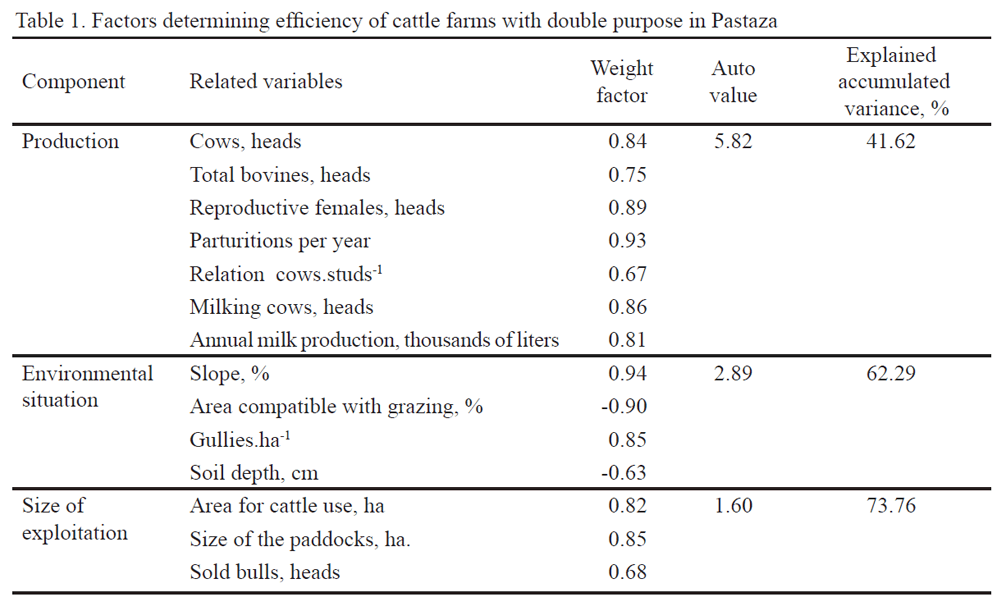
<body><![CDATA[<p align="JUSTIFY"><em>Diagnosis and survey</em>. A survey with 56   variables was designed to evaluate the performance of social, economic,   environmental and   productive dimensions of cattle rearing systems from Pastaza. The survey   was applied according to a non-experimental design, which controlled   the   effects of climatic areas and height levels that determine the   differences of the edaphoclimatic performance of the agricultural   frontier of the   province, and modify productivity of cattle rearing systems and animal   performance. </p>     <p align="JUSTIFY"><em>Sample size</em>. Farms having a herd of more than 10 cattle heads and more than five years of   consecutive activity were considered as population of this study. The   sample size was   determined according to Snedecor and Cochran (1989), starting from 650   milk producer farms in double purpose systems, located in this territory     (Agrocalidad 2011). When applying the criterion of maximum variance   (Torres1987) to guarantee an adequate sample size for all the variables   to measure,   the value of 31.2 of s2 muestral was considered with 3 % of prefixed error and 95 % of reliability level. The estimated sample size was 130 farms. </p>     <p align="JUSTIFY">The field work demonstrated that, in specific   sectors, the amount of existing farms decreased due to different causes   associated to the   change of productive activity, loss or sale of herds because of the   effect of devastating diseases or lack of profitability leading to farm   abandonment.   The amount of visited farms was reduced to 116 due to these reasons.   According to the calculated variance for the real sample obtained, the   statistics were achieved again and the validity of the sample was   demonstrated for the research purpose. </p>     <p align="JUSTIFY"><em>Creation of a data   matrix</em>. The information obtained during the samplings was organized   in data matrixes of Excel worksheets. The   visited cattle rearing systems were located in lines and the study   object variables were located in columns. Each database was strictly   examined   and those farms that lacked of relevant information were removed,   because the survey taker did not specified with precision the section.   Besides,   the cases in which appeared atypical values or those not having more   than five years of consecutive activity and a minimal amount of animals   of   ten or more cattle heads were eliminated. After eliminating the farms   with atypical data or incomplete information, the sample size was   reduced to   90 farms, which is big enough to endure the evaluation validity of   cattle rearing systems with double purpose in Pastaza province. </p>     <p align="justify"><em>Determination of essential factors for productive   efficiency</em>. The Statistical Model of Impact Measuring (SMIM) of Torres <em>et al.</em> (2013) was applied to summarize the gathered information.   The discrete variables, which influence on system performance and are   related to   social, environmental and productive dimensions, were also analyzed in   order to characterize their performance in each identified group,   evaluate the risks that cattle rearing undergo and the implementation of   inefficient livestock practices. Contingency tables were used, in which     the identified groups and the variables of interest that influence on   productive efficiency, as well as the negative environmental effect of   cattle rearing and social risks associated to sustainability of animal   husbandry in Pastaza.</p> </font>     <p>&nbsp;</p>     <p><font size="3" face="Verdana, Arial, Helvetica, sans-serif"><strong>RESULTS AND DISCUSSION</strong></font></p> <font size="2" face="Verdana, Arial, Helvetica, sans-serif">    <p align="JUSTIFY"><a href="/img/revistas/cjas/v49n1/t0103115.gif">Table 1</a> shows the factors determining productive   efficiency of cattle rearing systems dedicated to milk production. The   production factor is related to the indicators that define productive   efficiency, size of herd in exploitation and production volume. The rest   of   evaluated variables, associated to this component, maintain their   relative importance to evaluate these systems. However, the presented   homogeneity of variance has a low contribution to the component   modeling, although these variables are essential to explain or adopt   sustainable production alternatives for this Amazonian territory. </p>     
<p align="JUSTIFY">Reproduction is considered as the most important   process of any cattle rearing exploitation. It defines herd structure,   relative   potential of production expected from cattle rearing system, feeding   program established for obtaining high and stable production, modeling   of health system, management system, expected amount of sales, insurance   foreseen for system management and productive practices   that should be established for its optimal functioning (Ben&iacute;tez 2010 and   Moreno Sandoval <em>et al.</em> 2011). In cattle rearing systems from   Pastaza, the production component explains 41.62 % of the extracted   variance according to the model fixed to the performed evaluation. </p>     <p align="JUSTIFY">The environmental situation component explains up   to 62.29 % of the accumulated variance due to the fixed model. This   component   is related to variables that indicate the environmental situation of   these cattle rearing systems. The land slope conditions the rainfall   pattern, maximum intensity of rains and infiltration capacity of soil.   The land covering conditions the erosion danger. While the land slope   increases, the speed of drainage also increases, as well as the rain   erosive ability and land degradation associated to these natural   phenomena   (FAO 2000 and Murgueitio and Ibrahim 2004). </p>     ]]></body>
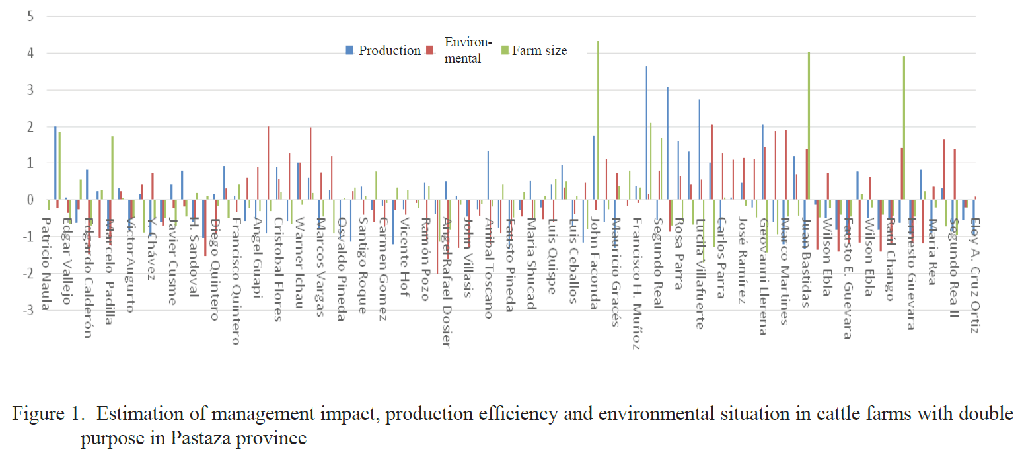
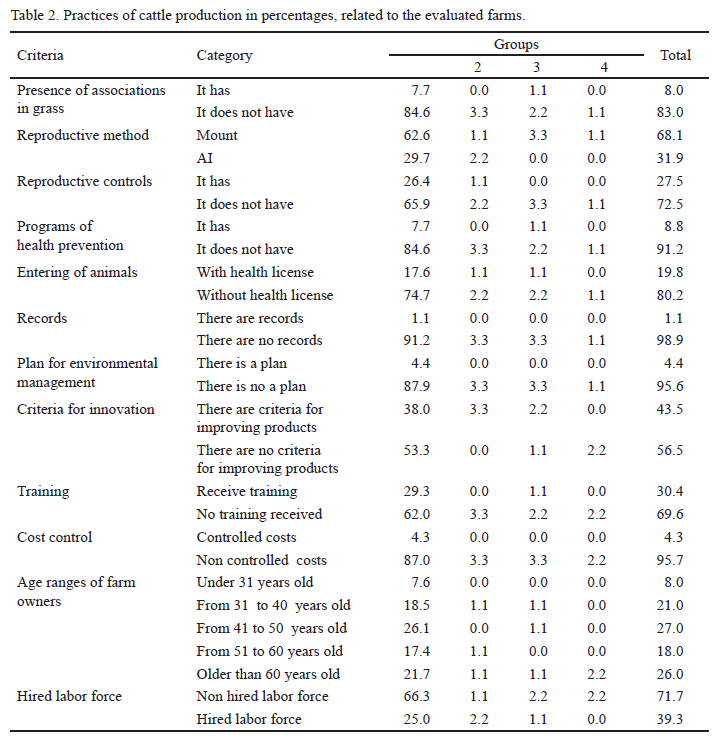
<body><![CDATA[<p align="JUSTIFY">In the agricultural frontier of Pastaza, the   rainfall pattern and relief influence on land degradation due to erosion   provoked by   grazing (Vargas <em>et al.</em> 2014).  Intensity and extension of erosion   increase with land slope. Degradation is also related to the area   percentage considered adequate for grazing, which are those with slopes   lower than 30 %. This variable and land slope are related to soil depth,     which decreases while the slope increases in the system (Ram&iacute;rez <em>et al.</em> 2012). </p>     <p align="JUSTIFY">The size of exploitation, which is related to   grazing area and size of used paddocks, is the third component that   explains 73.76 % of   the accumulated variance of the model. </p>     <p align="JUSTIFY"><a href="/img/revistas/cjas/v49n1/f0103115.gif">Figure 1</a> shows the impact of these components on   each cattle farm evaluated in the milk production system of Pastaza.   Each   farm represented in the x axis obtains three indicators in a scale of   values that indicates their relative situation regarding the rest of the     evaluated farms, which are represented by colored bars in the y axis.   Procedures leading to cattle rearing processes have a decisive influence   on   the efficiency of systems dedicated to milk production. <a href="/img/revistas/cjas/v49n1/t0203115.gif">Table 2</a> shows   some of the most highlighted procedures. </p>     
<p align="JUSTIFY">The 83 % of the systems have no associations with   grasses and legumes with enough extension to contribute to positive   changes in   the processes of feeding and environmental protection in these systems.   The 68 % of herds use the mount as a reproductive method and 63.7   % serve the female reproducers using a technique of intensive   reproduction. Traceability of cattle rearing procedures is another   essential factor for achieving a high efficiency in dairy exploitations.   The 72.5 % have no controls on reproductive process, and 98.9 % have   no register of the activities they carry out.  In 80.2 % of the studied   cases, there are no health licenses to mobilize their herds and 91.2 %   have no prevention programs designed by specialists. No producer   practices the quarantine when the animals enter their lands. </p>     <p align="JUSTIFY">The plan of environmental management for a cattle   rearing entity implies the application of procedures to mitigate or   stop land   degradation, the establishment of health security measures, use of   biologically and economically efficient production alternatives, and   guarantee   high incomes and low costs, as well as improving life quality of   producers and their family (FAO 2009 and 2012). In 95.6 % of the studied     cases, no environmental management program or plan was applied and 76.9 %   of the cases did not protect properly the water sources existing   in the cattle rearing systems. </p>     <p align="JUSTIFY"> Efficiency achieved in the productive systems is   mainly related to the social performance of the actors that lead to it.   Therefore,   in 56.5% of the evaluated systems, there are no criteria for improving   their products, 69.6 % do not receive training on alternatives   for livestock production, environmental management, cost control or   management of   their productive systems. An amount of 95.7 % of the systems has no   control of their management costs, which increases risks and   vulnerability of these systems in exploitation. </p>     <p align="JUSTIFY">Only 46.7 % of the producers having areas for   cattle use are specialized in this productive activity. The 35.9 %   carries out   other agricultural activities besides animal husbandry and 17 % have   other jobs not related to agriculture. In cattle rearing systems   dedicated   to milk production, the labor force constituted by family represents   71.7 % of the labor force involved in this productive activity, while   the 31.5 % hire labor forces for productive management. Out of these   figures, 86.3 % hires a person for management and the rest   hires up to two workers. In 44 % of the farms, the people are older   than 51 years   old and 18% are older than 60 years old. Out of them, 26.6 % have nobody   to replace them in the production process. </p>     <p align="JUSTIFY">Factors determining productive efficiency of   cattle rearing systems depend on the adopted productive alternative,   which   determines production level. They also depend on the characteristics of   land relief, which is related to environment degradation and dimensions   of   the system in exploitation. </p>     <p align="JUSTIFY">The ability of producers is another dimension   that influence on efficiency reached in cattle rearing systems.   Indicators related to   this attribute are the ability of innovation, traceability achieved in   livestock productions, application of efficient cattle rearing   practices,   health program performed and ability to protect the environment. This   ability is reflected on quantitative indicators determining livestock   production in Pastaza. </p>     <p align="JUSTIFY"> The environmental dimension is the most   unprotected of the livestock production systems due to a generalized   ignorance regarding   the function of environmental services on sustainability of productive   systems. There are no designs or programs implemented for   protecting the environment and assuring good agricultural practices in   cattle rearing systems from Pastaza. There are no innovation programs   designed for typified ecosystems in Pastaza province, aimed to improve   the ability of producers to manage their cattle rearing systems and to   make them sustainable. </p>     ]]></body>
<body><![CDATA[<p align="justify">It is necessary to identify and adapt technological alternatives   that should be adequate for a sustainable food production from   livestock in Pastaza. In Amazonian ecosystems, sustainable cattle   rearing is feasible if productive activity is organized, proper   alternatives   to ecosystems demands are adopted and environmental management programs   are implemented, which have to be in correspondence   to the characteristics of the ecosystems of this region.</p> </font>     <p>&nbsp;</p>     <p align="justify"><font size="2" face="Verdana, Arial, Helvetica, sans-serif"><font size="3"><strong>BIBLIOGRAPHY</strong></font></font></p>     <!-- ref --><p align="justify"><font size="2" face="Verdana, Arial, Helvetica, sans-serif">Agrocalidad. 2011. <em>Statistical  data</em>. , Puyo, Ecuador.    <br>       <!-- ref --><br>   ATPA. 2014. <em>Reconversi&oacute;n  agroproductiva sostenible en la Amazon&iacute;a Ecuatoriana</em>. Quito, Ecuador:  Ministerio de la Agricultura, Ganader&iacute;a, Acuacultura y Pesca.    <br>       <!-- ref --><br>   Ben&iacute;tez D. 2010. <em>Tecnolog&iacute;as  sostenibles de producci&oacute;n ganadera en sistemas fr&aacute;giles y degradados</em>. Cuba:  Bayamo, 190 p.    <br>       <!-- ref --><br>   ESPAC. 2014. <em>Database. Encuesta  de Superficie y Producci&oacute;n Agropecuaria Continua (BBD)</em>. , Available:  &lt;<a href="http// www.ecuadorencifras.gob.ec/encuestas-de-superficiey- producción-agropecuaria-continua-bbd/" target="_blank">http// www.ecuadorencifras.gob.ec/encuestas-de-superficiey-  producci&oacute;n-agropecuaria-continua-bbd/</a>&gt;, [Accessed:&nbsp;October 7, 2013].    <br>       <!-- ref --><br>   FAO. 2000. <em>Manual de pr&aacute;cticas  integradas de manejo y conservaci&oacute;n de suelos</em>. Roma: FAO, 220 p.    <br>       <!-- ref --><br>   FAO. 2009. <em>Gu&iacute;a de buenas  pr&aacute;cticas ganaderas para la seguridad sanitaria de los alimentos de origen  animal</em>. , Available: &lt;<a href="http//www.oie.int/filedmin/home/ esp/currentsscientific-issues/docs/pdf/esp-guide.pdf" target="_blank">http//www.oie.int/filedmin/home/  esp/currentsscientific-issues/docs/pdf/esp-guide.pdf</a>&gt;, [Accessed:&nbsp;July  13, 2013].    <br>       <!-- ref --><br>   FAO &amp; FIL. 2012. <em>Gu&iacute;a de  buenas pr&aacute;cticas en explotaciones lecheras</em>. (ser. Producci&oacute;n y Sanidad Animal,  no. ser. 8), Italia, Roma.    <br>       <!-- ref --><br>   INIAP. 2010. <em>Mejoramiento y  recuperaci&oacute;n de la investigaci&oacute;n, soberan&iacute;a, seguridad alimentaria y desarrollo  agropecuario sostenible en la amazonia ecuatoriana</em>. , Available: &lt;<a href="http// www.iniap.gob.ec" target="_blank">http//  www.iniap.gob.ec</a>&gt;, [Accessed:&nbsp;September 12, 2013].    <br>       <!-- ref --><br>   MAGAP. 2014. <em>Datos estad&iacute;sticos  del Ministerio de Acuacultura Ganader&iacute;a Agricultura y Pesca</em>.  Available:  &lt;<a href="http//www.ecuadorencifras.com" target="_blank">http//www.ecuadorencifras.com</a>&gt;, [Accessed:&nbsp;July 13, 2013].    <br>       <!-- ref --><br>   Moreno-Sandoval J. A.,  Alcalzar-Acosta H., Guzm&aacute;n-Guzm&aacute;n M., Tanijo J. C. &amp; Cardona O. 2011. <em>Ganader&iacute;a  ecol&oacute;gica: Manejo reproductivo de la hembra bovina</em>. Cieniagro, Cartilla 7,  Available: &lt;<a href="http//www. ibepa.org.com" target="_blank">http//www. ibepa.org.com</a>&gt;, [Accessed:&nbsp;July 13, 2013].    <br>       <br>   Murgueitio E. &amp; Ibrahim M. 2004.  &lsquo;&lsquo;Ganader&iacute;a y medio ambiente&rsquo;&rsquo;. In: <em>XII Congreso Venezolano de Producci&oacute;n  Animal</em>, pp. 187&ndash;202.    <br>       <!-- ref --><br>   Ram&iacute;rez A., Ben&iacute;tez D., P&eacute;rez M. B.  &amp; Montecelos Y. 2012. <em>Utilizaci&oacute;n del SIG y el REGPAST para la  definici&oacute;n de comunidades de pastos en zonas monta&ntilde;osas</em>. Agrocentro.    <br>       <!-- ref --><br>   Snedecor G. W. &amp; Cochran W. G. 1989. <em>Statistical Methods</em>. 8th  ed., Iowa State University Press, 503 p., ISBN: 978-0-8138-1561-9.    <br>       <br>   Torres V. 1986. &lsquo;&lsquo;Visual method for estimating pasture availability. II.  Determination of sample size&rsquo;&rsquo;. <em>Cuban Journal of Agricultural Science</em>,  20, p. 117, ISSN: 0034-7485.    ]]></body>
<body><![CDATA[<br>       <br>   Torres V., Cobo R., Sanchez L. &amp;  Raez N. 2013. &lsquo;&lsquo;Statistical tool for measuring the impact of milk production on the local  development of a province in Cuba&rsquo;&rsquo;. <em>Livestock Research for Rural  Development</em>, 25 (9), Available:  &lt;<a href="http://www.lrrd.cipav.org.co/lrrd25/9/torr25159.htm" target="_blank">http://www.lrrd.cipav.org.co/lrrd25/9/torr25159.htm</a>&gt;,  [Accessed:&nbsp;July 13, 2013].    <br>       <br> Vargas J.  C., Ben&iacute;tez J. D., Torres V., R&iacute;os S., Soria S., Navarrete H. &amp; P&eacute;rez Ruano  M. 2014. <em>Tipificaci&oacute;n de los sistemas de producci&oacute;n ganaderos en la  provincia Pastaza</em>. Informe de resultado del proyecto: &lsquo;Tipificaci&oacute;n de los  sistemas de producci&oacute;n ganaderos en la provincia Pastaza, Modelo de gesti&oacute;n&rsquo;,  Puyo: Universidad Estatal Amaz&oacute;nica, p. 81.</font></p>     <p align="justify">&nbsp;</p> <font size="2" face="Verdana, Arial, Helvetica, sans-serif"></font>     <p>&nbsp;</p>     <p><font size="2" face="Verdana, Arial, Helvetica, sans-serif">Received: November 15, 2014    <br> Accepted: December 15, 2014</font></p>     <p>&nbsp;</p>     <p>&nbsp;</p>     ]]></body>
<body><![CDATA[<p><font size="2" face="Verdana, Arial, Helvetica, sans-serif"><em>J.C. Vargas,</em> Universidad Estatal Amazónica, km 2 ½, Puyo a Tena (Paso Lateral), Ecuador.    Email: <a href="mailto:rectorado@uea.edu.ec">rectorado@uea.edu.ec</a></font></p>      ]]></body><back>
<ref-list>
<ref id="B1">
<nlm-citation citation-type="">
<person-group person-group-type="author">
<name>
<surname><![CDATA[Agrocalidad]]></surname>
</name>
</person-group>
<source><![CDATA[Statistical data]]></source>
<year>2011</year>
</nlm-citation>
</ref>
<ref id="B2">
<nlm-citation citation-type="book">
<person-group person-group-type="author">
<name>
<surname><![CDATA[ATPA]]></surname>
</name>
</person-group>
<source><![CDATA[Reconversión agroproductiva sostenible en la Amazonía Ecuatoriana]]></source>
<year>2014</year>
<publisher-loc><![CDATA[Quito, Ecuador ]]></publisher-loc>
<publisher-name><![CDATA[Ministerio de la Agricultura, Ganadería, Acuacultura y Pesca]]></publisher-name>
</nlm-citation>
</ref>
<ref id="B3">
<nlm-citation citation-type="book">
<person-group person-group-type="author">
<name>
<surname><![CDATA[Benítez]]></surname>
<given-names><![CDATA[D.]]></given-names>
</name>
</person-group>
<source><![CDATA[Tecnologías sostenibles de producción ganadera en sistemas frágiles y degradados]]></source>
<year>2010</year>
<page-range>190</page-range><publisher-loc><![CDATA[Cuba ]]></publisher-loc>
<publisher-name><![CDATA[Bayamo]]></publisher-name>
</nlm-citation>
</ref>
<ref id="B4">
<nlm-citation citation-type="">
<person-group person-group-type="author">
<name>
<surname><![CDATA[ESPAC]]></surname>
</name>
</person-group>
<source><![CDATA[Database. Encuesta de Superficie y Producción Agropecuaria Continua (BBD)]]></source>
<year>2014</year>
</nlm-citation>
</ref>
<ref id="B5">
<nlm-citation citation-type="book">
<person-group person-group-type="author">
<name>
<surname><![CDATA[FAO]]></surname>
</name>
</person-group>
<source><![CDATA[Manual de prácticas integradas de manejo y conservación de suelos]]></source>
<year>2000</year>
<page-range>220</page-range><publisher-loc><![CDATA[Roma ]]></publisher-loc>
<publisher-name><![CDATA[FAO]]></publisher-name>
</nlm-citation>
</ref>
<ref id="B6">
<nlm-citation citation-type="">
<person-group person-group-type="author">
<name>
<surname><![CDATA[FAO]]></surname>
</name>
</person-group>
<source><![CDATA[Guía de buenas prácticas ganaderas para la seguridad sanitaria de los alimentos de origen animal]]></source>
<year>2009</year>
</nlm-citation>
</ref>
<ref id="B7">
<nlm-citation citation-type="">
<person-group person-group-type="author">
<name>
<surname><![CDATA[FAO-FIL]]></surname>
</name>
</person-group>
<source><![CDATA[Guía de buenas prácticas en explotaciones lecheras]]></source>
<year>2012</year>
<publisher-loc><![CDATA[Italia, Roma ]]></publisher-loc>
</nlm-citation>
</ref>
<ref id="B8">
<nlm-citation citation-type="">
<person-group person-group-type="author">
<name>
<surname><![CDATA[INIAP]]></surname>
</name>
</person-group>
<source><![CDATA[Mejoramiento y recuperación de la investigación, soberanía, seguridad alimentaria y desarrollo agropecuario sostenible en la amazonia ecuatoriana]]></source>
<year>2010</year>
</nlm-citation>
</ref>
<ref id="B9">
<nlm-citation citation-type="">
<person-group person-group-type="author">
<name>
<surname><![CDATA[MAGAP]]></surname>
</name>
</person-group>
<source><![CDATA[Datos estadísticos del Ministerio de Acuacultura Ganadería Agricultura y Pesca]]></source>
<year>2014</year>
</nlm-citation>
</ref>
<ref id="B10">
<nlm-citation citation-type="">
<person-group person-group-type="author">
<name>
<surname><![CDATA[Moreno-Sandoval]]></surname>
<given-names><![CDATA[J. A.]]></given-names>
</name>
<name>
<surname><![CDATA[Alcalzar-Acosta]]></surname>
<given-names><![CDATA[H.]]></given-names>
</name>
<name>
<surname><![CDATA[Guzmán-Guzmán]]></surname>
<given-names><![CDATA[M.]]></given-names>
</name>
<name>
<surname><![CDATA[Tanijo]]></surname>
<given-names><![CDATA[J. C.]]></given-names>
</name>
<name>
<surname><![CDATA[Cardona]]></surname>
<given-names><![CDATA[O.]]></given-names>
</name>
</person-group>
<source><![CDATA[Ganadería ecológica: Manejo reproductivo de la hembra bovina]]></source>
<year>2011</year>
</nlm-citation>
</ref>
<ref id="B11">
<nlm-citation citation-type="">
<person-group person-group-type="author">
<name>
<surname><![CDATA[Murgueitio]]></surname>
<given-names><![CDATA[E.]]></given-names>
</name>
<name>
<surname><![CDATA[Ibrahim]]></surname>
<given-names><![CDATA[M.]]></given-names>
</name>
</person-group>
<article-title xml:lang="nd"><![CDATA[Ganadería y medio ambiente]]></article-title>
<source><![CDATA[]]></source>
<year>2004</year>
<page-range>187–202</page-range></nlm-citation>
</ref>
<ref id="B12">
<nlm-citation citation-type="book">
<person-group person-group-type="author">
<name>
<surname><![CDATA[Ramírez]]></surname>
<given-names><![CDATA[A.]]></given-names>
</name>
<name>
<surname><![CDATA[Benítez]]></surname>
<given-names><![CDATA[D.]]></given-names>
</name>
<name>
<surname><![CDATA[Pérez]]></surname>
<given-names><![CDATA[M. B.]]></given-names>
</name>
<name>
<surname><![CDATA[Montecelos]]></surname>
<given-names><![CDATA[Y.]]></given-names>
</name>
</person-group>
<source><![CDATA[Utilización del SIG y el REGPAST para la definición de comunidades de pastos en zonas montañosas]]></source>
<year>2012</year>
<publisher-name><![CDATA[Agrocentro]]></publisher-name>
</nlm-citation>
</ref>
<ref id="B13">
<nlm-citation citation-type="book">
<person-group person-group-type="author">
<name>
<surname><![CDATA[Snedecor]]></surname>
<given-names><![CDATA[G. W.]]></given-names>
</name>
<name>
<surname><![CDATA[Cochran]]></surname>
<given-names><![CDATA[W. G.]]></given-names>
</name>
</person-group>
<source><![CDATA[Statistical Methods]]></source>
<year>1989</year>
<edition>8th</edition>
<page-range>503</page-range><publisher-name><![CDATA[Iowa State University Press]]></publisher-name>
</nlm-citation>
</ref>
<ref id="B14">
<nlm-citation citation-type="journal">
<person-group person-group-type="author">
<name>
<surname><![CDATA[Torres]]></surname>
<given-names><![CDATA[V.]]></given-names>
</name>
</person-group>
<article-title xml:lang="nd"><![CDATA[Visual method for estimating pasture availability. II. Determination of sample size]]></article-title>
<source><![CDATA[Cuban Journal of Agricultural Science]]></source>
<year>1986</year>
<volume>20</volume>
<page-range>117</page-range></nlm-citation>
</ref>
<ref id="B15">
<nlm-citation citation-type="journal">
<person-group person-group-type="author">
<name>
<surname><![CDATA[Torres]]></surname>
<given-names><![CDATA[V.]]></given-names>
</name>
<name>
<surname><![CDATA[Cobo]]></surname>
<given-names><![CDATA[R.]]></given-names>
</name>
<name>
<surname><![CDATA[Sanchez]]></surname>
<given-names><![CDATA[L.]]></given-names>
</name>
<name>
<surname><![CDATA[Raez]]></surname>
<given-names><![CDATA[N.]]></given-names>
</name>
</person-group>
<article-title xml:lang="nd"><![CDATA[Statistical tool for measuring the impact of milk production on the local development of a province in Cuba]]></article-title>
<source><![CDATA[Livestock Research for Rural Development]]></source>
<year>2013</year>
<volume>25</volume>
<numero>9</numero>
<issue>9</issue>
</nlm-citation>
</ref>
<ref id="B16">
<nlm-citation citation-type="book">
<person-group person-group-type="author">
<name>
<surname><![CDATA[Vargas]]></surname>
<given-names><![CDATA[J. C.]]></given-names>
</name>
<name>
<surname><![CDATA[Benítez]]></surname>
<given-names><![CDATA[J. D.]]></given-names>
</name>
<name>
<surname><![CDATA[Torres]]></surname>
<given-names><![CDATA[V.]]></given-names>
</name>
<name>
<surname><![CDATA[Ríos]]></surname>
<given-names><![CDATA[S.]]></given-names>
</name>
<name>
<surname><![CDATA[Soria]]></surname>
<given-names><![CDATA[S.]]></given-names>
</name>
<name>
<surname><![CDATA[Navarrete]]></surname>
<given-names><![CDATA[H.]]></given-names>
</name>
<name>
<surname><![CDATA[Pérez Ruano]]></surname>
<given-names><![CDATA[M.]]></given-names>
</name>
</person-group>
<source><![CDATA[Tipificación de los sistemas de producción ganaderos en la provincia Pastaza]]></source>
<year>2014</year>
<page-range>81</page-range><publisher-loc><![CDATA[Puyo ]]></publisher-loc>
<publisher-name><![CDATA[Universidad Estatal Amazónica]]></publisher-name>
</nlm-citation>
</ref>
</ref-list>
</back>
</article>