<?xml version="1.0" encoding="ISO-8859-1"?><article xmlns:mml="http://www.w3.org/1998/Math/MathML" xmlns:xlink="http://www.w3.org/1999/xlink" xmlns:xsi="http://www.w3.org/2001/XMLSchema-instance">
<front>
<journal-meta>
<journal-id>2079-3480</journal-id>
<journal-title><![CDATA[Cuban Journal of Agricultural Science]]></journal-title>
<abbrev-journal-title><![CDATA[Cuban J. Agric. Sci.]]></abbrev-journal-title>
<issn>2079-3480</issn>
<publisher>
<publisher-name><![CDATA[Editorial del Instituto de Ciencia Animal]]></publisher-name>
</publisher>
</journal-meta>
<article-meta>
<article-id>S2079-34802015000100006</article-id>
<title-group>
<article-title xml:lang="en"><![CDATA[Evaluation of three saponification methods on two types of fat as protection against bovine ruminal degradation]]></article-title>
<article-title xml:lang="es"><![CDATA[Evaluación de tres métodos de saponificación en dos tipos de grasas como protección ante la degradación ruminal bovina]]></article-title>
</title-group>
<contrib-group>
<contrib contrib-type="author">
<name>
<surname><![CDATA[Proaño]]></surname>
<given-names><![CDATA[F]]></given-names>
</name>
<xref ref-type="aff" rid="A01"/>
</contrib>
<contrib contrib-type="author">
<name>
<surname><![CDATA[Stuart]]></surname>
<given-names><![CDATA[J.R]]></given-names>
</name>
<xref ref-type="aff" rid="A02"/>
</contrib>
<contrib contrib-type="author">
<name>
<surname><![CDATA[Chongo]]></surname>
<given-names><![CDATA[Bertha]]></given-names>
</name>
<xref ref-type="aff" rid="A02"/>
</contrib>
<contrib contrib-type="author">
<name>
<surname><![CDATA[Flores]]></surname>
<given-names><![CDATA[L]]></given-names>
</name>
<xref ref-type="aff" rid="A01"/>
</contrib>
<contrib contrib-type="author">
<name>
<surname><![CDATA[Herrera]]></surname>
<given-names><![CDATA[Magaly]]></given-names>
</name>
<xref ref-type="aff" rid="A02"/>
</contrib>
<contrib contrib-type="author">
<name>
<surname><![CDATA[Medina]]></surname>
<given-names><![CDATA[Yolaine]]></given-names>
</name>
<xref ref-type="aff" rid="A02"/>
</contrib>
<contrib contrib-type="author">
<name>
<surname><![CDATA[Sarduy]]></surname>
<given-names><![CDATA[Lucía]]></given-names>
</name>
<xref ref-type="aff" rid="A02"/>
</contrib>
</contrib-group>
<aff id="A01">
<institution><![CDATA[,Escuela Superior Politécnica de Chimborazo Facultad de Ciencias Pecuarias ]]></institution>
<addr-line><![CDATA[ Riobamba]]></addr-line>
<country>Ecuador</country>
</aff>
<aff id="A02">
<institution><![CDATA[,Instituto de Ciencia Animal  ]]></institution>
<addr-line><![CDATA[San José de las Lajas Mayabeque]]></addr-line>
<country>Cuba</country>
</aff>
<pub-date pub-type="pub">
<day>00</day>
<month>03</month>
<year>2015</year>
</pub-date>
<pub-date pub-type="epub">
<day>00</day>
<month>03</month>
<year>2015</year>
</pub-date>
<volume>49</volume>
<numero>1</numero>
<fpage>35</fpage>
<lpage>39</lpage>
<copyright-statement/>
<copyright-year/>
<self-uri xlink:href="http://scielo.sld.cu/scielo.php?script=sci_arttext&amp;pid=S2079-34802015000100006&amp;lng=en&amp;nrm=iso"></self-uri><self-uri xlink:href="http://scielo.sld.cu/scielo.php?script=sci_abstract&amp;pid=S2079-34802015000100006&amp;lng=en&amp;nrm=iso"></self-uri><self-uri xlink:href="http://scielo.sld.cu/scielo.php?script=sci_pdf&amp;pid=S2079-34802015000100006&amp;lng=en&amp;nrm=iso"></self-uri><abstract abstract-type="short" xml:lang="en"><p><![CDATA[To evaluate the saponification of two fat raw matters, ovine suet and residual of African palm oil (Elaeis guineensis), by means of the use of sodium hydroxide, potassium and calcium, with the purpose of protecting these fats from the bovine ruminal degradation, an experiment according to a completely random design, with factorial arrangement 3 x 2 was conducted. A bromatological analysis of the obtained soaps, evaluation of consistency and profitability by means of cost-benefit indicator was carried out. The variance analysis showed significant interaction among the studied factors. The dry matter was higher in the residual of palm oil soaps treated with calcium, sodium and potassium (P d» 0001). Likewise, ash was higher in these soaps (P d» 0001).It was higher with the potassium hydroxide. This hydroxide allowed soaps with higher (P < 0, 0002) protein concentrations (with both fat sources).The higher concentration of fat was in the ovine suet soaps (P d» 0001).The calcium hydroxide saponification acted in an optimum way in the consistency of residual palm oil and ovine suet soaps. The cost benefit showed higher values (1.25) in the residual palm oil soaps protected with calcium. It is concluded that the studied saponification methods (sodium, potassium and calcium hydroxide) allowed an appropriate nutrients concentration in the obtained soaps, high contribution of fat in ovine suet, adequately hardness in calcium soaps, acceptable levels of in vitro solubility and high profitability for calcium soaps]]></p></abstract>
<abstract abstract-type="short" xml:lang="es"><p><![CDATA[Para evaluar la saponificación de dos materias primas grasas, sebo ovino y residuos de aceite de palma africana (Elaeis guineensis), mediante la utilización de hidróxido de sodio, potasio y calcio, con el propósito de proteger estas grasas de la degradación ruminal bovina, se condujo un experimento según diseño completamente al azar, con arreglo factorial 3 x 2. Se realizó análisis bromatológico de los jabones obtenidos, evaluación de consistencia y rentabilidad mediante el indicador beneficio-costo. El análisis de varianza mostró interacción significativa entre los factores estudiados. La materia seca fue mayor en los jabones de residuos de aceite de palma tratados con calcio, sodio y potasio (P d 0001). Igualmente, la ceniza resultó superior en estos jabones (P d 0001). Fue más elevada con el hidróxido de potasio. Este hidróxido permitió jabones con más altas (P < 0.0002) concentraciones de proteína (con ambas fuentes de grasa). La mayor concentración de grasa se encontró en los jabones de sebo ovino (P d 0001). La saponificación con hidróxido de calcio actuó de manera óptima en la consistencia de los jabones de residuos de aceite de palma y sebo ovino. El beneficio-costo indicó valores más altos (1.25) en los jabones de residuos de aceite de palma protegidos con calcio. Se concluye que los métodos de saponificación estudiados (hidróxido de sodio, potasio y calcio) permitieron una adecuada concentración de nutrientes en los jabones obtenidos, alto aporte de grasa en sebo ovino, dureza adecuada en los jabones de calcio, aceptables niveles de solubilidad in vitro y alta rentabilidad para jabones de calcio]]></p></abstract>
<kwd-group>
<kwd lng="en"><![CDATA[protection]]></kwd>
<kwd lng="en"><![CDATA[fat sources]]></kwd>
<kwd lng="en"><![CDATA[ruminant]]></kwd>
<kwd lng="es"><![CDATA[protection]]></kwd>
<kwd lng="es"><![CDATA[fat sources]]></kwd>
<kwd lng="es"><![CDATA[ruminant]]></kwd>
</kwd-group>
</article-meta>
</front><body><![CDATA[ <p align="right"><font size="2" face="Verdana, Arial, Helvetica, sans-serif"><b>ORIGINAL ARTICLE</b></font></p>     <p>&nbsp;</p>     <p><font size="4" face="Verdana, Arial, Helvetica, sans-serif"><strong>Evaluation of three saponification methods on two types of fat as protection against bovine ruminal degradation</strong></font></p>     <p>&nbsp;</p>     <p><font size="3" face="Verdana, Arial, Helvetica, sans-serif"><strong>Evaluación de tres métodos de saponificación en dos tipos de grasas como protección  ante la degradación ruminal bovina   </strong> </font></p>     <p>&nbsp;</p>     <p>&nbsp;</p>     <p><font size="2" face="Verdana, Arial, Helvetica, sans-serif"><strong>F. Proaño,</strong><sup><strong>I</strong></sup><strong> J.R. Stuart,</strong><sup><strong>II</strong></sup><strong> Bertha Chongo,</strong><sup><strong>II</strong></sup><strong> L. Flores,</strong><sup><strong>I</strong></sup><strong> Magaly Herrera,</strong><sup><strong>II</strong></sup><strong> Yolaine Medina,</strong><sup><strong>II</strong></sup><strong> Lucía Sarduy,</strong><sup><strong>II</strong></sup></font></p>     <p><font size="2" face="Verdana, Arial, Helvetica, sans-serif"><strong> </strong></font><font size="2" face="Verdana, Arial, Helvetica, sans-serif"><sup>I</sup>Facultad de Ciencias Pecuarias. Escuela Superior Politécnica de Chimborazo. Riobamba-Ecuador.    <br>   <sup>II</sup>Instituto de Ciencia Animal, Apartado Postal 24, San José de las Lajas, Mayabeque, Cuba. </font></p>     ]]></body>
<body><![CDATA[<p>&nbsp;</p>     <p>&nbsp;</p> <hr>     <p><font size="2" face="Verdana, Arial, Helvetica, sans-serif"><strong>ABSTRACT</strong></font></p> <font size="2" face="Verdana, Arial, Helvetica, sans-serif">    <p align="JUSTIFY">To evaluate the saponification of two fat raw matters, ovine suet and residual of African palm oil   (<em>Elaeis guineensis</em>), by means of the use of sodium hydroxide,   potassium   and calcium, with the purpose of protecting these fats from the bovine   ruminal degradation, an experiment according to a completely random   design, with factorial arrangement   3 x 2 was conducted. A bromatological analysis of the obtained soaps,   evaluation of consistency and profitability by means of cost-benefit   indicator was carried out. The   variance analysis showed significant interaction among the studied   factors. The dry matter was higher in the residual of palm oil soaps   treated with calcium, sodium and potassium (P   d&raquo; 0001). Likewise, ash was higher in these soaps (P d&raquo; 0001).It was   higher with the potassium hydroxide. This hydroxide allowed soaps with   higher (P &lt; 0, 0002)   protein concentrations (with both fat sources).The higher concentration   of fat was in the ovine suet soaps (P d&raquo; 0001).The calcium hydroxide saponification   acted in an optimum way in the consistency of  residual palm oil and   ovine suet soaps. The cost  benefit showed higher   values (1.25) in the residual palm oil soaps protected with calcium. It   is concluded that the studied saponification methods (sodium, potassium   and calcium hydroxide) allowed   an appropriate nutrients concentration in the obtained soaps, high   contribution of fat in ovine suet, adequately hardness in calcium soaps,   acceptable levels of <em>in vitro</em> solubility and high profitability for calcium soaps.</p> </font>     <p><font size="2" face="Verdana, Arial, Helvetica, sans-serif"><strong>Key words:</strong> protection, fat sources, ruminant.</font></p> <hr>     <p><font size="2" face="Verdana, Arial, Helvetica, sans-serif"><strong>RESUMEN</strong></font></p> <font size="2" face="Verdana, Arial, Helvetica, sans-serif">    <p align="JUSTIFY">Para evaluar la saponificaci&oacute;n de dos materias primas grasas, sebo ovino y residuos de aceite de palma africana   (<em>Elaeis guineensis</em>), mediante la utilizaci&oacute;n de hidr&oacute;xido de   sodio, potasio y calcio, con el prop&oacute;sito de proteger estas grasas de la   degradaci&oacute;n ruminal bovina, se condujo un experimento seg&uacute;n dise&ntilde;o   completamente al azar, con arreglo   factorial 3 x 2. Se realiz&oacute; an&aacute;lisis bromatol&oacute;gico de los jabones   obtenidos, evaluaci&oacute;n de consistencia y rentabilidad mediante el   indicador beneficio-costo. El an&aacute;lisis de varianza   mostr&oacute; interacci&oacute;n significativa entre los factores estudiados. La   materia seca fue mayor en los jabones de residuos de aceite de palma   tratados con calcio, sodio y potasio (P d   0001). Igualmente, la ceniza result&oacute; superior en estos jabones (P d   0001). Fue m&aacute;s elevada con el hidr&oacute;xido de potasio. Este hidr&oacute;xido   permiti&oacute; jabones con m&aacute;s altas (P &lt;   0.0002) concentraciones de prote&iacute;na (con ambas fuentes de grasa). La   mayor concentraci&oacute;n de grasa se encontr&oacute; en los jabones de sebo ovino (P   d 0001). La saponificaci&oacute;n   con hidr&oacute;xido de calcio actu&oacute; de manera &oacute;ptima en la consistencia de los   jabones de residuos de aceite de palma y sebo ovino. El beneficio-costo   indic&oacute; valores m&aacute;s altos (1.25)   en los jabones de residuos de aceite de palma protegidos con calcio. Se   concluye que los m&eacute;todos de saponificaci&oacute;n estudiados (hidr&oacute;xido de   sodio, potasio y calcio)   permitieron una adecuada concentraci&oacute;n de nutrientes en los jabones   obtenidos, alto aporte de grasa en sebo ovino, dureza adecuada en los   jabones de calcio, aceptables niveles   de solubilidad <em>in vitro</em> y alta rentabilidad para jabones de calcio.</p> </font>     <p><font size="2" face="Verdana, Arial, Helvetica, sans-serif"><strong>Palabras    clave:</strong>    protection, fat sources, ruminant.</font></p> <hr>     <p>&nbsp;</p>     <p>&nbsp;</p>     ]]></body>
<body><![CDATA[<p><font size="2" face="Verdana, Arial, Helvetica, sans-serif"><strong><font size="3">INTRODUCTION</font></strong></font></p> <font size="2" face="Verdana, Arial, Helvetica, sans-serif">    <p align="JUSTIFY">The supplementation with bypass  fat is an   alternative to increase the energetic density in fitting ration to dairy   cows (Tyagi 2010)   that have an energy negative balance after parturition (Gallardo 2011),   because fats are inert in the rumen and digestible in the intestinal   tract. </p>     <p align="JUSTIFY">Four types of inert fats have been informed:   recovered with proteins, hardness hydrogenated fats, seeds and calcium   salts of fatty   acids (Cabrera and Carpio 2007). </p>     <p align="JUSTIFY">The calcium salts of fatty acids are obtained by   saponification.During this process, free fatty acids are join with   calcium ions.   These compounds showed high melting point and solubility in pH lower at   5.5.Therefore, they are not dissociated in the rumen and dissolved   in the ruminal liquid. The abomasums show pH from 2 to 2.5 that can be   dissociated by means of the release of fatty acids and   calcium molecules, compounds that can be digested in the intestine   (Salvador <em>et al.</em> 2009). </p>     <p align="JUSTIFY">The saponification is a chemical reaction between   a fatty acid and a base, in which it is obtained the acid salt as a   main product   (Mateos <em>et al.</em> 1996).The bases or alkaline can be sodium salts or   potassium (Bernardini and Gonz&aacute;lez 2009 and Bas 2001) and of   calcium (InfoCarne 2008 and Herrera and Calleja 2011).All have a caustic   power (Garc&iacute;a 2002 and Garc&iacute;a and Cruz 2011) and could give   similar results, as protection of fatty acids against ruminal   degradation. </p>     <p align="JUSTIFY">In a previous research study, the ovine suet and   palm oil residuals were characterized, abundant elements in Ecuador. The   poor use   of these resources contributes to the environmental pollution. The   contents, relatively high, of unsaturated fatty acids present in palm   oil residuals and ovine suet, could be used in the dairy cows diet, but   this required to protect these fats from ruminal degradation, so they   were transform into bypass fats. </p>     <p align="JUSTIFY">The objective of this research was to evaluate three saponification methods (sodium, potassium hydroxide and calcium) on two   types of fats(ovine suet and palm oil residuals), with the purpose of protecting them to the bovine ruminal degradation.</p> </font>     <p>&nbsp;</p>     <p><font size="3" face="Verdana, Arial, Helvetica, sans-serif"> <strong>MATERIALS AND METHODS</strong> </font></p> <font size="2" face="Verdana, Arial, Helvetica, sans-serif">    <p align="JUSTIFY">The research was carried out in the Chemical Sciences   Laboratory, belonging to Facultad de Ciencias Pecuarias de la Escuela   Superior Polit&eacute;cnica de Chimborazo, in Ecuador. This facility is located   at 2,754 m o.s.l, with annual average temperature of 13.36 &ordm;C and   annual precipitation of 490.8mm, according to reports from the   Meteorological Annual (ESPOCH 2011). </p>     ]]></body>
<body><![CDATA[<p align="JUSTIFY"> It was used sodium hydroxide (NaOH), potassium (KOH) and calcium (Ca(OH)<sub>2</sub>) to saponificate ovine suet and residuals from the   oil industry of African palm (<em>Elaeis   guineensis</em>), according to completely random design with factorial   arrangement 3x2 with 3 repetitions.   Data were processed by means of Infostat, (version 2012).Each sample   constituted an experimental unit and each one was analyzed by   duplicated. The treatments were the followings: </p>     <p align="JUSTIFY">T1: Ovine suet    saponificated with KOH 	    <br>   T2: Oil palm residuals saponificated with KOH	    <br>   T3: Ovine suet    saponificated with NaOH	    <br> T4: Oil palm residuals saponificated with NAOH    <br> T5: Ovine suet saponificated with Ca (OH)<sub>2</sub>    <br> T6:Oil palm residuals saponificated with  Ca(OH)<sub>2</sub></p> </font>  <font size="2" face="Verdana, Arial, Helvetica, sans-serif">     <p align="JUSTIFY"> The soaps, once obtained, were subjected to a   bromatological analysis (DM, minerals, fat, protein, fiber and NFE)   according to   AOAC 2005.The consistency was evaluated with a non parametric scale,   from 1 to 4 points. Profitability was analyzed by means of cost   benefit indicator(C/B=totals income/ totals cost). </p>     <p align="JUSTIFY">The bromatological analysis considered the   percentage content of DM, from which was calculated the content of   minerals, protein,   fat, fiber and NFE. </p>     <p align="JUSTIFY">For the consistency determination, punctuation scale from 0 to 4 was applied, where: </p>     ]]></body>
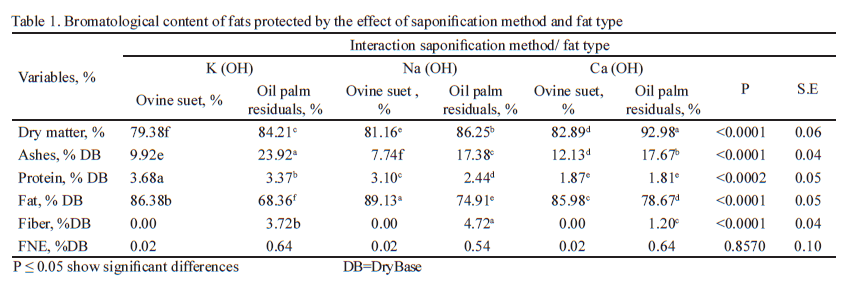
<body><![CDATA[<p align="JUSTIFY"> 0=soaps with phase separation (watery and saponificate) </p>     <p align="JUSTIFY"> 1=doughy soaps </p>     <p align="JUSTIFY"> 2= soft soaps </p>     <p align="JUSTIFY"> 3=half hard soaps and </p>     <p align="JUSTIFY"> 4=firms or hard soaps </p>     <p align="JUSTIFY">Duncan (1995) test was used for mean comparison in necessary cases. The non parametric measure was carried out according   Conover (1999).</p> </font>     <p>&nbsp;</p>     <p><font size="3" face="Verdana, Arial, Helvetica, sans-serif"><strong>RESULTS AND DISCUSSION</strong></font></p> <font size="2" face="Verdana, Arial, Helvetica, sans-serif">    <p align="JUSTIFY">The statistical analysis showed the significance of the studied factors interaction (fat x saponification methods).The   bromatological contents of the different studied fats are showed in <a href="/img/revistas/cjas/v49n1/t0106115.gif">table 1</a>. </p>     
<p align="JUSTIFY">The soaps made with oil palm residuals (92.28%   with calcium, 86.25% with sodium and 84.21 % with potassium) showed   the highest (P d&raquo; 0001) DM content regarding to those formulated with   ovine suet (calcium 82.89, sodium 81.16 and potassium 79.38%). </p>     ]]></body>
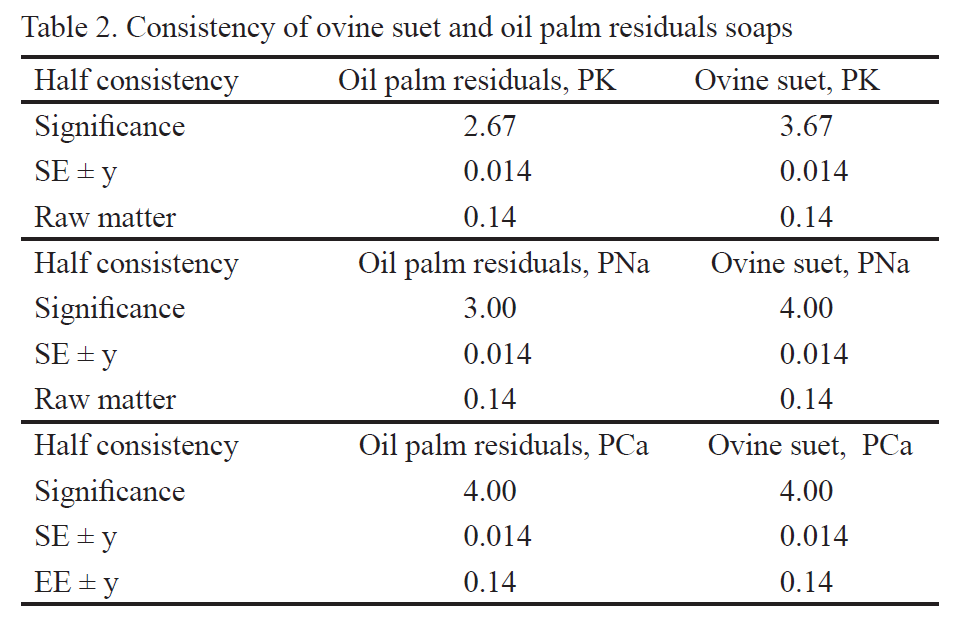
<body><![CDATA[<p align="JUSTIFY">The higher ash concentrations (P d&raquo; 0001) in dry   base are showed by the soaps made with oil palm residuals (potassium   23.92%, calcium 17.67% and sodium 17.38%) compared to those made with   ovine suet (calcium 12.13%, potassium 9.92% and sodium 7.74%). </p>     <p align="JUSTIFY">The potassium hydroxide, as saponificate   material, allowed obtaining soaps with high protein concentration (3.68%   in ovine   suet and 3.37% in oil palm residuals). It fallows the sodium hydroxide   (3.10%to ovine suet and 2.44% to oil palm residuals).Soaps with   low protein concentration (P&lt;0.0002) corresponded to the calcium   hydroxide (1.87% in ovine suet and 1.81% in oil palm residuals). </p>     <p align="JUSTIFY">The ovine suet soaps showed higher fat concentration(sodium 89.13%, potassium 86.38 %and calcium 85.98%) regarding the   soaps made with oil palm residuals(calcium 78.67%, sodium 74.91% and potassium 68.36%). </p>     <p align="JUSTIFY">The ovine suet soaps did not showed fiber   presence. Those of oil palm residuals protected with sodium showed the   higher   (P&lt;0.0001) fiber levels (4.72%), fallow by those formulated with oil   palm residuals and protected with potassium (3.72%).Those made with   oil palm residuals, protected with calcium (1.2%) were in last position . </p>     <p align="JUSTIFY">Regarding to the content of nitrogen free   extract, all soaps showed similar values, did not exits statistical   differences (P e&raquo; 0.1). </p>     <p align="JUSTIFY"><a href="/img/revistas/cjas/v49n1/t0206115.gif">Table 2</a> shows the results of consistency. Calcium hydroxide acted optimally and similar in soap consistency; the sodium   and potassium hydroxide allowed optimal hardness, only when they acted in the ovine suet. </p>     
<p align="JUSTIFY">As reference to the profitability possible to   obtain in protected fats elaboration from oil palm residuals and ovine   suet, cost-   benefit indicator was used , whose value are showed in <a href="/img/revistas/cjas/v49n1/t0306115.gif">table 3</a>. </p>     
<p align="JUSTIFY">The calcic soaps of oil palm residuals showed the   highest values (1.25) in cost benefit indicator. Fallow by the calcic   soaps of   ovine suet (1.17) and the sodium ones, formulated with oil palm   residuals (1.13).The fulfilled analysis was partial because they were   not considered in this values the effects in animal production. </p>     <p align="JUSTIFY"> The rule of the Standardization National   Institute of Ecuador (SIN 1981) establish that the soaps made with   animal fat and   oils should contain, at least, 65% of dry matter, parameter that has   taken as reference to consider the success of chemical process applied   to oil palm residuals and ovine suet. The higher dry matter   concentration in the soaps of oil palm residuals could be due to solid   residuals presence that constitute the raw matter, coming from residuals   of palm fruit. </p>     <p align="JUSTIFY">The soaps of oil palm residuals showed higher ash   concentration regarding to those of ovine suet, probably due to that   the raw   matter of oil palm residuals contain more ash than the ovine suet.   Consequently, ash content showed direct relation with the ones of   raw matters. It is known that ashes are an indicator of mineral content   and have structural functions (P, Ca, Mg, Fe) and electrolytic (Na,   K, Ca, Mg) that acted in the osmotic pressure, equilibrium and membrane   permeability and tissues. It also takes part,in catalyst   functions (Na, Mn, Cu, I, Se).Because of this, is very important that   food destined to animals diet contribute important amount of minerals to     the ration. Murillo <em>et al.</em> (2013) informed decrease of the   interval conception parturition in supplemented cows with mineral   concentrate and oil palm regarding to non supplemented cows. This shows   that the energy supplement cannot act if it is with minerals   contribution that, by general, is relatively low in suets. In oil palm   residuals do not happen in that way, in which the ash contribution was   significantly higher regarding to ovine suet. </p>     ]]></body>
<body><![CDATA[<p align="JUSTIFY">Regarding to protein concentrations, the   saponification techniques that required a thermal treatment can   influence in an   apparent protein denatured contained in the raw matters, what is obvious   in the soaps made with calcium hydroxide. This statement coincide   to that informed by P&eacute;rez (2007) and Luque (2008), whose stated that in   saponification process take place a protein denature , due   to temperature changes and pH variation that caused the bridges break   that constitutes the tertiary protein structure, making them   insoluble in water. </p>     <p align="JUSTIFY"> The higher bromatological concentration of fat   in the ovine suet soaps are logics if the levels of this element   presents in raw   matter are considered regarding to oil palm residuals. The results of   this study suggest that the bromatological characteristic of the   studied soaps depends on the used raw matter, especially regarding   minerals, fat and fiber. </p>     <p align="JUSTIFY">Regarding consistency (<a href="/img/revistas/cjas/v49n1/t0206115.gif">table 2</a>), calcium hydroxide permitted the soaps optimum hardness, indistinctly of the raw matter on   which it acted, can be used in saponification process, be of oil palm residuals or ovine suet. Otherwise, the use of sodium and   potasium hydroxidesis not recommended for the saponification of oil palm residues, since soft soaps  are get that could have   conservation problems, fundamentally in the mixture of the raw materials used in the elaboration of concentrates. </p>     
<p align="JUSTIFY">The profitability calculation, in function of   cost- benefit indicator, allows affirming that the fats elaboration   protected from   the ruminal degradation, would be profitable if it is used the calcium   hydroxide as saponificate element. The lower profitabilities   were observed when using potassium hydroxide, in whose values can   influence, in a decisive way, the chemical reagent cost. </p>     <p align="JUSTIFY">It is concluded that the procedures used to   saponificate the raw matter studied, were appropriate. An adequate dry   matter   concentration, high ash concentration (especially in oil palm   residuals), important energy contribution (especially in ovine suet),   appropriate   hardness (especially with calcium) and high profitability (especially to   calcium soaps) were observed. The results suggest that the   bromatological characteristic of soaps depends on the raw matter   particularities, especially regarding to minerals, fat and fiber. </p>     <p>It is recommended the use of calcium hydroxide as saponificated element for ovine suet and oil palm residuals, because with it   was obtained the best hardness of soaps and the highest profitability levels. It should be complemented the viability study of   applied procedures by means of <em>in situ</em> degradability and <em>in vivo</em> digestibility. </p> </font>     <p>&nbsp;</p>     <p><font size="2" face="Verdana, Arial, Helvetica, sans-serif"><font size="3"><strong>BIBLIOGRAPHY</strong></font></font></p> <font size="2" face="Verdana, Arial, Helvetica, sans-serif">    <!-- ref --><p align="JUSTIFY">AOAC. 2005. <em>Official methods of analysis of AOAC   International</em>. 18th ed., EEUU: AOAC International.     </p>     ]]></body>
<body><![CDATA[<!-- ref --><p align="JUSTIFY">Bernardini P. 2009. <em>El aceite vegetal. Estudio de la viscosidad y densidad de diferentes aceites para su uso como   biocombustible</em>. , Available: &lt;<a href="http://upcommons.upc.edu/pfc/ bitstream/2099.1/9403/6/3.4.%20El%20aceite%20vegetal" target="_blank">http://upcommons.upc.edu/pfc/ bitstream/2099.1/9403/6/3.4.%20El%20aceite%20vegetal</a>&gt;, [Accessed:&nbsp;October   8, 2014].     </p>     <!-- ref --><p align="JUSTIFY">Cabrera O. &amp; Carpio P. 2007. <em>Rendimiento de vacas Holstein en lactaci&oacute;n alimentadas con grasa sobre pasante en las   dietas</em>. , Available: &lt;<a href="http://www.engormix.com" target="_blank">http://www.engormix.com</a>&gt;, [Accessed:&nbsp;May 12, 2014].     </p>     <!-- ref --><p align="JUSTIFY">Conover W. J. 1999. <em>Practical Nonparametric   Statistics</em>. New York: John Wiley &amp; Sons, Inc.     </p>     <!-- ref --><p align="JUSTIFY">Di Rienzo J. A., Casanoves F., Balzarini M. G., Gonz&aacute;lez L. &amp; Robledo C. W. 2012. <em>InfoStat</em>. version 2012, [Windows],   Universidad Nacional de C&oacute;rdoba, Argentina: Grupo InfoStat, Available: &lt;<a href="http://www.infostat.com.ar/" target="_blank">http://www.infostat.com.ar/</a>&gt;    . </p>     <!-- ref --><p align="JUSTIFY">Duncan D. B. 1955. ``Multiple range and multiple F tests''. <em>Biometrics</em>, 11 (1), pp. 142.     </p>     ]]></body>
<body><![CDATA[<!-- ref --><p align="JUSTIFY">ESPOCH. 2011. <em>Estaci&oacute;n Agrometeorol&oacute;gica de la Facultad de Recursos Naturales. Escuela Superior Polit&eacute;cnica de   Chimborazo</em>. p. 65.     </p>     <!-- ref --><p align="JUSTIFY">Gallardo M. 2011. <em>Los nutrientes By-pass en los sistemas lecheros Pastoriles: una moda o una   necesidad</em>. Infoganadero Centroamericano, Available: &lt;<a href="http://www.proagrolab.com.ar/ampliar-articulos?id=119" target="_blank">http://www.proagrolab.com.ar/ampliar-articulos?id=119</a>&gt;    . </p>     <!-- ref --><p align="JUSTIFY">Garc&iacute;a C. G. M. &amp; Cruz C. L. U. 2011. <em>Elaboraci&oacute;n de cuatro tipos de jab&oacute;nes utilizando aceites vegetales residuales de   palma afric&aacute;na (Elaeis Guineensis) mediante el m&eacute;todo de saponificaci&oacute;n en la Universidad Estatal de   Bol&iacute;var</em>. Graduated Thesis, Facultad de Ciencias Agropecuarias, Venezuela, 67-70 p.     </p>     <!-- ref --><p align="JUSTIFY">Garc&iacute;a M. 2002. <em>Manual de pr&aacute;cticas de qu&iacute;mica org&aacute;nica   II</em>. Facultad de Ciencias Qu&iacute;micas, ESPOCH, 41-44 p.     </p>     <!-- ref --><p align="JUSTIFY">Gonz&aacute;lez F. &amp; Bas F. 2001. <em>Las Grasas Protegidas como fuente energ&eacute;tica en la alimentaci&oacute;n de vacas   lecheras</em>. Chile: Universidad Cat&oacute;lica, p. 12.     </p>     ]]></body>
<body><![CDATA[<!-- ref --><p align="JUSTIFY">Herrera F. &amp; Calleja F. 2011. <em>Caracterizaci&oacute;n de las grasas de sobrepaso por medio de cromatograf&iacute;a de   gases</em>. Veracruzana, Poza Rica, Tuxpan., 9 p.     </p>     <!-- ref --><p align="JUSTIFY">INEN. 1981. <em>Normas de calidad para   jabones</em>. no. 839, Inst. Instituto Ecuatoriano de Normalizaci&oacute;n, Quito. Ecuador.     </p>     <p align="JUSTIFY">InfoCarne. 2008. <em>Alimentos para vacas lecheras. Toda la carne en   internet</em>. , Available:   &lt;<a href="http://www.infocarne.com/bovino/ lipidos.asp" target="_blank">http://www.infocarne.com/bovino/ lipidos.asp</a>&gt;, [Accessed:&nbsp;November 3, 2014]. </p>     <!-- ref --><p align="JUSTIFY">Luque M. 2008. <em>Estructura y propiedades de las prote&iacute;nas.Texto B&aacute;sico de Qu&iacute;mica   General</em>. 1st ed., Riobamba, Ecuador, 23 p.     </p>     <p align="JUSTIFY">Mateos G. G., Rebollar P. G. &amp; Medel P. 1996. <em>Utilizaci&oacute;n de grasas y productos lip&iacute;dicos en alimentaci&oacute;n animal: grasas   puras y mezclas</em>. Espa&ntilde;a: Fundaci&oacute;n Espa&ntilde;ola para el Desarrollo de la Nutrici&oacute;n Animal, p. 5, Available:   &lt;<a href="https://www.researchgate.net/profile/Gonzalo_Mateos/publication /28180429_Utilizacin_de_grasas_y_productos_lipdicos_en_alimentacin_animal_grasas_puras_y_mezclas/links /02bfe51119a1899d8d000000.pdf" target="_blank">https://www.researchgate.net/profile/Gonzalo_Mateos/publication  /28180429_Utilizacin_de_grasas_y_productos_lipdicos_en_alimentacin_animal_grasas_puras_y_mezclas/links  /02bfe51119a1899d8d000000.pdf</a>&gt;, [Accessed:&nbsp;November 3, 2014]. </p>     <!-- ref --><p align="JUSTIFY">Murillo B., Vera B. &amp; Zambrano F. 2013. <em>Mezcla concentrado mineral y aceite de palma sobre par&aacute;metros reproductivos   en vacas lecheras en la Parroquia Colorado del Cant&oacute;n   Manta</em>. Escuela Superior Polit&eacute;cnica Agropecuaria de Manab&iacute;   Manuel F&eacute;lix L&oacute;pez, 12-45 p.     </p>     ]]></body>
<body><![CDATA[<!-- ref --><p align="JUSTIFY">P&eacute;rez P. 2007. <em>Grasas de   Sobrepaso</em>. no. ES2005/070190.     </p>     <p align="JUSTIFY">Pinos S. A., Ortiz M. &amp; Brito G. 2012. <em>Uso de Grasa By Pass en Ganado Lechero.</em> FCP-ESPOCH, Riobamba, Ecuador, 35   p., Available: &lt;<a href="http://dspace.espoch.edu.ec/handle/123456789/2101" target="_blank">http://dspace.espoch.edu.ec/handle/123456789/2101</a>&gt;, [Accessed:&nbsp;November 3, 2014]. </p>     <!-- ref --><p align="JUSTIFY">Salvador A., Alvarado C., Contreras I., Betancourt R., Gallo J. &amp; Caigua A. 2009. ``Efecto de la alimentaci&oacute;n con grasa   sobrepasante sobre la producci&oacute;n y composici&oacute;n de la leche de cabra en condiciones tropicales''. <em>Zootecnia Tropical</em>, 27 (3), pp. 285298.     </p>     <!-- ref --><p align="JUSTIFY">Tyagi N., Thakur S. S. &amp; Shelke S. K. 2010. ``Effect of bypass fat supplementation on productive and reproductive   performance in crossbred cows''. <em>Tropical animal health and   production</em>, 42 (8), pp. 1749-1755.    </p></font>     <p>&nbsp;</p>     <p>&nbsp;</p>     <p><font size="2" face="Verdana, Arial, Helvetica, sans-serif">Received: November 3, 2014     ]]></body>
<body><![CDATA[<br> Accepted: December 1, 2014</font></p>     <p>&nbsp;</p>     <p>&nbsp;</p>     <p><font size="2" face="Verdana, Arial, Helvetica, sans-serif"><em>F. Proaño,</em> Facultad de Ciencias Pecuarias. Escuela Superior Politécnica de Chimborazo. Riobamba-Ecuador.    Email: <a href="mailto:fredyproanioortiz@gmail.com">fredyproanioortiz@gmail.com</a></font></p>      ]]></body><back>
<ref-list>
<ref id="B1">
<nlm-citation citation-type="book">
<person-group person-group-type="author">
<name>
<surname><![CDATA[AOAC]]></surname>
</name>
</person-group>
<source><![CDATA[Official methods of analysis of AOAC International]]></source>
<year>2005</year>
<edition>18th</edition>
<publisher-loc><![CDATA[EEUU ]]></publisher-loc>
<publisher-name><![CDATA[AOAC International]]></publisher-name>
</nlm-citation>
</ref>
<ref id="B2">
<nlm-citation citation-type="">
<person-group person-group-type="author">
<name>
<surname><![CDATA[Bernardini]]></surname>
<given-names><![CDATA[P.]]></given-names>
</name>
</person-group>
<source><![CDATA[El aceite vegetal. Estudio de la viscosidad y densidad de diferentes aceites para su uso como biocombustible]]></source>
<year>2009</year>
</nlm-citation>
</ref>
<ref id="B3">
<nlm-citation citation-type="">
<person-group person-group-type="author">
<name>
<surname><![CDATA[Cabrera]]></surname>
<given-names><![CDATA[O.]]></given-names>
</name>
<name>
<surname><![CDATA[Carpio]]></surname>
<given-names><![CDATA[P.]]></given-names>
</name>
</person-group>
<source><![CDATA[Rendimiento de vacas Holstein en lactación alimentadas con grasa sobre pasante en las dietas]]></source>
<year>2007</year>
</nlm-citation>
</ref>
<ref id="B4">
<nlm-citation citation-type="book">
<person-group person-group-type="author">
<name>
<surname><![CDATA[Conover]]></surname>
<given-names><![CDATA[W. J.]]></given-names>
</name>
</person-group>
<source><![CDATA[Practical Nonparametric Statistics]]></source>
<year>1999</year>
<publisher-loc><![CDATA[New York ]]></publisher-loc>
<publisher-name><![CDATA[John Wiley & Sons, Inc.]]></publisher-name>
</nlm-citation>
</ref>
<ref id="B5">
<nlm-citation citation-type="book">
<person-group person-group-type="author">
<name>
<surname><![CDATA[Di Rienzo]]></surname>
<given-names><![CDATA[J. A.]]></given-names>
</name>
<name>
<surname><![CDATA[Casanoves]]></surname>
<given-names><![CDATA[F.]]></given-names>
</name>
<name>
<surname><![CDATA[Balzarini]]></surname>
<given-names><![CDATA[M. G.]]></given-names>
</name>
<name>
<surname><![CDATA[González]]></surname>
<given-names><![CDATA[L.]]></given-names>
</name>
<name>
<surname><![CDATA[Robledo]]></surname>
<given-names><![CDATA[C. W.]]></given-names>
</name>
</person-group>
<source><![CDATA[InfoStat]]></source>
<year>2012</year>
<publisher-loc><![CDATA[Universidad Nacional de Córdoba, Argentina ]]></publisher-loc>
<publisher-name><![CDATA[Grupo InfoStat]]></publisher-name>
</nlm-citation>
</ref>
<ref id="B6">
<nlm-citation citation-type="journal">
<person-group person-group-type="author">
<name>
<surname><![CDATA[Duncan]]></surname>
<given-names><![CDATA[D. B.]]></given-names>
</name>
</person-group>
<article-title xml:lang="nd"><![CDATA[Multiple range and multiple F tests]]></article-title>
<source><![CDATA[Biometrics]]></source>
<year>1955</year>
<volume>11</volume>
<numero>1</numero>
<issue>1</issue>
<page-range>1–42</page-range></nlm-citation>
</ref>
<ref id="B7">
<nlm-citation citation-type="">
<person-group person-group-type="author">
<name>
<surname><![CDATA[ESPOCH]]></surname>
</name>
</person-group>
<source><![CDATA[Estación Agrometeorológica de la Facultad de Recursos Naturales. Escuela Superior Politécnica de Chimborazo]]></source>
<year>2011</year>
<page-range>65</page-range></nlm-citation>
</ref>
<ref id="B8">
<nlm-citation citation-type="">
<person-group person-group-type="author">
<name>
<surname><![CDATA[Gallardo]]></surname>
<given-names><![CDATA[M.]]></given-names>
</name>
</person-group>
<source><![CDATA[Los nutrientes By-pass en los sistemas lecheros Pastoriles: una moda o una necesidad]]></source>
<year>2011</year>
</nlm-citation>
</ref>
<ref id="B9">
<nlm-citation citation-type="book">
<person-group person-group-type="author">
<name>
<surname><![CDATA[García]]></surname>
<given-names><![CDATA[C. G. M.]]></given-names>
</name>
<name>
<surname><![CDATA[Cruz]]></surname>
<given-names><![CDATA[C. L. U.]]></given-names>
</name>
</person-group>
<source><![CDATA[Elaboración de cuatro tipos de jabónes utilizando aceites vegetales residuales de palma africána (Elaeis Guineensis) mediante el método de saponificación en la Universidad Estatal de Bolívar]]></source>
<year>2011</year>
<page-range>67-70</page-range><publisher-loc><![CDATA[Venezuela ]]></publisher-loc>
<publisher-name><![CDATA[Facultad de Ciencias Agropecuarias]]></publisher-name>
</nlm-citation>
</ref>
<ref id="B10">
<nlm-citation citation-type="book">
<person-group person-group-type="author">
<name>
<surname><![CDATA[García]]></surname>
<given-names><![CDATA[M.]]></given-names>
</name>
</person-group>
<source><![CDATA[Manual de prácticas de química orgánica II]]></source>
<year>2002</year>
<page-range>41-44</page-range><publisher-name><![CDATA[Facultad de Ciencias Químicas, ESPOCH]]></publisher-name>
</nlm-citation>
</ref>
<ref id="B11">
<nlm-citation citation-type="book">
<person-group person-group-type="author">
<name>
<surname><![CDATA[González]]></surname>
<given-names><![CDATA[F.]]></given-names>
</name>
<name>
<surname><![CDATA[Bas]]></surname>
<given-names><![CDATA[F.]]></given-names>
</name>
</person-group>
<source><![CDATA[Las Grasas Protegidas como fuente energética en la alimentación de vacas lecheras]]></source>
<year>2001</year>
<page-range>12</page-range><publisher-loc><![CDATA[Chile ]]></publisher-loc>
<publisher-name><![CDATA[Universidad Católica]]></publisher-name>
</nlm-citation>
</ref>
<ref id="B12">
<nlm-citation citation-type="book">
<person-group person-group-type="author">
<name>
<surname><![CDATA[Herrera]]></surname>
<given-names><![CDATA[F.]]></given-names>
</name>
<name>
<surname><![CDATA[Calleja]]></surname>
<given-names><![CDATA[F.]]></given-names>
</name>
</person-group>
<source><![CDATA[Caracterización de las grasas de sobrepaso por medio de cromatografía de gases]]></source>
<year>2011</year>
<page-range>9</page-range><publisher-loc><![CDATA[Poza Rica, Tuxpan. ]]></publisher-loc>
<publisher-name><![CDATA[Veracruzana]]></publisher-name>
</nlm-citation>
</ref>
<ref id="B13">
<nlm-citation citation-type="">
<person-group person-group-type="author">
<name>
<surname><![CDATA[INEN]]></surname>
</name>
</person-group>
<source><![CDATA[Normas de calidad para jabones]]></source>
<year>1981</year>
<publisher-loc><![CDATA[Quito. Ecuador ]]></publisher-loc>
</nlm-citation>
</ref>
<ref id="B14">
<nlm-citation citation-type="">
<person-group person-group-type="author">
<name>
<surname><![CDATA[InfoCarne]]></surname>
</name>
</person-group>
<source><![CDATA[Alimentos para vacas lecheras. Toda la carne en internet]]></source>
<year>2008</year>
</nlm-citation>
</ref>
<ref id="B15">
<nlm-citation citation-type="">
<person-group person-group-type="author">
<name>
<surname><![CDATA[Luque]]></surname>
<given-names><![CDATA[M.]]></given-names>
</name>
</person-group>
<source><![CDATA[Estructura y propiedades de las proteínas.Texto Básico de Química General]]></source>
<year>2008</year>
<edition>1st</edition>
<page-range>23</page-range><publisher-loc><![CDATA[Riobamba, Ecuador ]]></publisher-loc>
</nlm-citation>
</ref>
<ref id="B16">
<nlm-citation citation-type="book">
<person-group person-group-type="author">
<name>
<surname><![CDATA[Mateos]]></surname>
<given-names><![CDATA[G. G.]]></given-names>
</name>
<name>
<surname><![CDATA[Rebollar]]></surname>
<given-names><![CDATA[P. G.]]></given-names>
</name>
<name>
<surname><![CDATA[Medel]]></surname>
<given-names><![CDATA[P.]]></given-names>
</name>
</person-group>
<source><![CDATA[Utilización de grasas y productos lipídicos en alimentación animal: grasas puras y mezclas]]></source>
<year>1996</year>
<page-range>5</page-range><publisher-loc><![CDATA[España ]]></publisher-loc>
<publisher-name><![CDATA[Fundación Española para el Desarrollo de la Nutrición Animal]]></publisher-name>
</nlm-citation>
</ref>
<ref id="B17">
<nlm-citation citation-type="book">
<person-group person-group-type="author">
<name>
<surname><![CDATA[Murillo]]></surname>
<given-names><![CDATA[B.]]></given-names>
</name>
<name>
<surname><![CDATA[Vera]]></surname>
<given-names><![CDATA[B.]]></given-names>
</name>
<name>
<surname><![CDATA[Zambrano]]></surname>
<given-names><![CDATA[F.]]></given-names>
</name>
</person-group>
<source><![CDATA[Mezcla concentrado mineral y aceite de palma sobre parámetros reproductivos en vacas lecheras en la Parroquia Colorado del Cantón Manta]]></source>
<year>2013</year>
<page-range>12-45</page-range><publisher-name><![CDATA[Escuela Superior Politécnica Agropecuaria de Manabí Manuel Félix López]]></publisher-name>
</nlm-citation>
</ref>
<ref id="B18">
<nlm-citation citation-type="">
<person-group person-group-type="author">
<name>
<surname><![CDATA[Pérez]]></surname>
<given-names><![CDATA[P.]]></given-names>
</name>
</person-group>
<source><![CDATA[Grasas de Sobrepaso]]></source>
<year>2007</year>
</nlm-citation>
</ref>
<ref id="B19">
<nlm-citation citation-type="book">
<person-group person-group-type="author">
<name>
<surname><![CDATA[Pinos]]></surname>
<given-names><![CDATA[S. A.]]></given-names>
</name>
<name>
<surname><![CDATA[Ortiz]]></surname>
<given-names><![CDATA[M.]]></given-names>
</name>
<name>
<surname><![CDATA[Brito]]></surname>
<given-names><![CDATA[G.]]></given-names>
</name>
</person-group>
<source><![CDATA[Uso de Grasa By Pass en Ganado Lechero.]]></source>
<year>2012</year>
<page-range>35</page-range><publisher-loc><![CDATA[Riobamba, Ecuador ]]></publisher-loc>
<publisher-name><![CDATA[FCP-ESPOCH]]></publisher-name>
</nlm-citation>
</ref>
<ref id="B20">
<nlm-citation citation-type="journal">
<person-group person-group-type="author">
<name>
<surname><![CDATA[Salvador]]></surname>
<given-names><![CDATA[A.]]></given-names>
</name>
<name>
<surname><![CDATA[Alvarado]]></surname>
<given-names><![CDATA[C.]]></given-names>
</name>
<name>
<surname><![CDATA[Contreras]]></surname>
<given-names><![CDATA[I.]]></given-names>
</name>
<name>
<surname><![CDATA[Betancourt]]></surname>
<given-names><![CDATA[R.]]></given-names>
</name>
<name>
<surname><![CDATA[Gallo]]></surname>
<given-names><![CDATA[J.]]></given-names>
</name>
<name>
<surname><![CDATA[Caigua]]></surname>
<given-names><![CDATA[A.]]></given-names>
</name>
</person-group>
<article-title xml:lang="nd"><![CDATA[Efecto de la alimentación con grasa sobrepasante sobre la producción y composición de la leche de cabra en condiciones tropicales]]></article-title>
<source><![CDATA[Zootecnia Tropical]]></source>
<year>2009</year>
<volume>27</volume>
<numero>3</numero>
<issue>3</issue>
<page-range>285–298</page-range></nlm-citation>
</ref>
<ref id="B21">
<nlm-citation citation-type="journal">
<person-group person-group-type="author">
<name>
<surname><![CDATA[Tyagi]]></surname>
<given-names><![CDATA[N.]]></given-names>
</name>
<name>
<surname><![CDATA[Thakur]]></surname>
<given-names><![CDATA[S. S.]]></given-names>
</name>
<name>
<surname><![CDATA[Shelke]]></surname>
<given-names><![CDATA[S. K.]]></given-names>
</name>
</person-group>
<article-title xml:lang="nd"><![CDATA[Effect of bypass fat supplementation on productive and reproductive performance in crossbred cows]]></article-title>
<source><![CDATA[Tropical animal health and production]]></source>
<year>2010</year>
<volume>42</volume>
<numero>8</numero>
<issue>8</issue>
<page-range>1749–1755</page-range></nlm-citation>
</ref>
</ref-list>
</back>
</article>