<?xml version="1.0" encoding="ISO-8859-1"?><article xmlns:mml="http://www.w3.org/1998/Math/MathML" xmlns:xlink="http://www.w3.org/1999/xlink" xmlns:xsi="http://www.w3.org/2001/XMLSchema-instance">
<front>
<journal-meta>
<journal-id>2079-3480</journal-id>
<journal-title><![CDATA[Cuban Journal of Agricultural Science]]></journal-title>
<abbrev-journal-title><![CDATA[Cuban J. Agric. Sci.]]></abbrev-journal-title>
<issn>2079-3480</issn>
<publisher>
<publisher-name><![CDATA[Editorial del Instituto de Ciencia Animal]]></publisher-name>
</publisher>
</journal-meta>
<article-meta>
<article-id>S2079-34802015000100008</article-id>
<title-group>
<article-title xml:lang="en"><![CDATA[Growth of Pichia guilliermondii strain Levica 27 in different energy sources and nitrogen]]></article-title>
<article-title xml:lang="es"><![CDATA[Crecimiento de Pichia guilliermondii cepa Levica 27 en diferentes fuentes de energía y nitrógeno]]></article-title>
</title-group>
<contrib-group>
<contrib contrib-type="author">
<name>
<surname><![CDATA[Marrero]]></surname>
<given-names><![CDATA[Yoandra]]></given-names>
</name>
<xref ref-type="aff" rid="A01"/>
</contrib>
<contrib contrib-type="author">
<name>
<surname><![CDATA[Montoya]]></surname>
<given-names><![CDATA[C. A]]></given-names>
</name>
<xref ref-type="aff" rid="A03"/>
</contrib>
<contrib contrib-type="author">
<name>
<surname><![CDATA[Ruiz]]></surname>
<given-names><![CDATA[O]]></given-names>
</name>
<xref ref-type="aff" rid="A02"/>
</contrib>
<contrib contrib-type="author">
<name>
<surname><![CDATA[Elías]]></surname>
<given-names><![CDATA[A]]></given-names>
</name>
<xref ref-type="aff" rid="A01"/>
</contrib>
<contrib contrib-type="author">
<name>
<surname><![CDATA[Madera]]></surname>
<given-names><![CDATA[N]]></given-names>
</name>
<xref ref-type="aff" rid="A03"/>
</contrib>
</contrib-group>
<aff id="A01">
<institution><![CDATA[,Instituto de Ciencia Animal  ]]></institution>
<addr-line><![CDATA[San José de las Lajas Mayabeque]]></addr-line>
<country>Cuba</country>
</aff>
<aff id="A02">
<institution><![CDATA[,Universidad Autónoma de Chihuahua  ]]></institution>
<addr-line><![CDATA[ Chihuahua]]></addr-line>
<country>México</country>
</aff>
<aff id="A03">
<institution><![CDATA[,Ciudad Universitaria Prolongación Josefa Ortiz de Domínguez ]]></institution>
<addr-line><![CDATA[ Culiacán Rosales]]></addr-line>
<country>México</country>
</aff>
<pub-date pub-type="pub">
<day>00</day>
<month>03</month>
<year>2015</year>
</pub-date>
<pub-date pub-type="epub">
<day>00</day>
<month>03</month>
<year>2015</year>
</pub-date>
<volume>49</volume>
<numero>1</numero>
<fpage>47</fpage>
<lpage>52</lpage>
<copyright-statement/>
<copyright-year/>
<self-uri xlink:href="http://scielo.sld.cu/scielo.php?script=sci_arttext&amp;pid=S2079-34802015000100008&amp;lng=en&amp;nrm=iso"></self-uri><self-uri xlink:href="http://scielo.sld.cu/scielo.php?script=sci_abstract&amp;pid=S2079-34802015000100008&amp;lng=en&amp;nrm=iso"></self-uri><self-uri xlink:href="http://scielo.sld.cu/scielo.php?script=sci_pdf&amp;pid=S2079-34802015000100008&amp;lng=en&amp;nrm=iso"></self-uri><abstract abstract-type="short" xml:lang="en"><p><![CDATA[The growth of Pichia guilliermondii yeast Levica 27 strain was studied for its use as microbial additive in ruminant animals. Therefore, yeast growth in NRF medium and malt extract were compared. Then, their development was evaluated when carbohydrates and nitrogen sources varied in the formulation of NRF medium. In sugars, the glucose was substituted by sucrose and lactose and in case of nitrogen the tryptone was substituted by ammonium sulfate, casein and urea. There was not interaction between treatments and the time of study for the count of Levica 27cells in malt extracts and NRF solutions, and there were not differences between both media. In NRF medium, the best growths were achieved when glucose and sucrose were used at 72h and the last one decreased the pH of the medium (P Â 0.001).The casein and urea caused higher growth (P Â 0.001) after 48h, but urea caused increase of pH. It is concluded that the strain Levica 27 growth was higher before glucose or sucrose, casein or urea. Studies are recommended to design an economical mean of culture with national sources that allows the obtaining of a preparation with Levica 27 with additive effect on ruminants]]></p></abstract>
<abstract abstract-type="short" xml:lang="es"><p><![CDATA[Se estudió el crecimiento de la levadura Pichia guilliermondii cepa Levica 27 para su utilización como aditivo microbiano en animales rumiantes. Para ello se comparó el crecimiento de la levadura en los caldos NRF y extracto de malta. Luego, se evaluó su desarrollo al variar los carbohidratos y fuentes de nitrógeno presentes en la fomulación del caldo NRF. En los azúcares se sustituyó la glucosa por sacarosa y lactosa y en el caso del nitrógeno se sustituyó la triptona por sulfato de amonio, caseína y urea. No hubo interacción entre los tratamientos y el tiempo de estudio para el conteo de células de Levica 27 en los caldos extracto de malta y NRF, y no hubo diferencias entre ambos medios. En el medio NRF, los mejores crecimientos se lograron cuando se utilizó glucosa y sacarosa a las 72 h, y esta última disminuyó el pH del medio (P Â 0.001). La caseína y la urea provocaron mayor crecimiento (P Â 0.001) a partir de las 48 h, pero la urea provocó aumento del pH. Se concluye que el crecimiento de la cepa Levica 27 fue superior ante glucosa o sacarosa, caseína o urea. Se recomiendan estudios para diseñar un medio de cultivo económico con fuentes nacionales, que permita la obtención de un preparado con Levica 27 con efecto aditivo en rumiantes]]></p></abstract>
<kwd-group>
<kwd lng="en"><![CDATA[Pichia guilliermondii]]></kwd>
<kwd lng="en"><![CDATA[carbohydrates]]></kwd>
<kwd lng="en"><![CDATA[nitrogen]]></kwd>
<kwd lng="es"><![CDATA[Pichia guilliermondii]]></kwd>
<kwd lng="es"><![CDATA[carbohidratos]]></kwd>
<kwd lng="es"><![CDATA[nitrógeno]]></kwd>
</kwd-group>
</article-meta>
</front><body><![CDATA[ <p align="right"><font size="2" face="Verdana, Arial, Helvetica, sans-serif"><b>ORIGINAL ARTICLE</b></font></p>     <p>&nbsp;</p>     <p><font size="4" face="Verdana, Arial, Helvetica, sans-serif"><strong>Growth of <em>Pichia guilliermondii </em>strain Levica 27 in different  energy sources and nitrogen</strong></font></p>     <p>&nbsp;</p>     <p><font size="3" face="Verdana, Arial, Helvetica, sans-serif"><strong>Crecimiento de <em>Pichia guilliermondii</em> cepa Levica 27 en diferentes fuentes de energía y nitrógeno   </strong></font></p>     <p>&nbsp;</p>     <p>&nbsp;</p>     <p><font size="2" face="Verdana, Arial, Helvetica, sans-serif"><strong>Yoandra Marrero,</strong><sup><strong>I</strong></sup><strong> C. A. Montoya,</strong><sup><strong>III</strong></sup><strong> O.Ruiz,</strong><sup><strong>II</strong></sup><strong> A. Elías,</strong><sup><strong>I</strong></sup><strong> N. Madera,</strong><sup><strong>III</strong></sup></font></p>     <p><font size="2" face="Verdana, Arial, Helvetica, sans-serif"><strong> </strong></font><font size="2" face="Verdana, Arial, Helvetica, sans-serif"><sup>I</sup>Instituto de Ciencia Animal, Apartado Postal 24, San José de las Lajas, Mayabeque, Cuba.    <br>   <sup>II</sup>Universidad Autónoma de Chihuahua, Av. Universidad s/n, Arboledas, 31110 Chihuahua, Chih., México.     ]]></body>
<body><![CDATA[<br>   <sup>III</sup>Prolongación Josefa Ortiz de Domínguez S/N, Ciudad Universitaria, 80040 Culiacán Rosales, Sin., México. </font></p>     <p>&nbsp;</p>     <p>&nbsp;</p> <hr>     <p><font size="2" face="Verdana, Arial, Helvetica, sans-serif"><strong>ABSTRACT</strong></font></p>     <p align="justify"><font size="2" face="Verdana, Arial, Helvetica, sans-serif">The growth of <em>Pichia   guilliermondii</em> yeast Levica 27 strain was studied for its use as   microbial additive in ruminant animals. Therefore, yeast growth in NRF   medium and malt extract were compared. Then, their development was   evaluated when carbohydrates and nitrogen sources varied in the   formulation of NRF   medium. In sugars, the glucose was substituted by sucrose and lactose   and in case of nitrogen the tryptone was substituted by ammonium   sulfate, casein and urea. There was not interaction between treatments   and the time of study for the count of Levica 27cells in malt extracts   and NRF solutions, and there were not differences   between both media. In NRF medium, the best growths were achieved when   glucose and sucrose were used at 72h and the last one decreased the pH   of the medium (P &Acirc; 0.001).The casein and urea caused higher growth (P &Acirc;   0.001) after 48h, but urea caused increase of pH. It is concluded that   the strain Levica 27 growth was   higher before glucose or sucrose, casein or urea. Studies are   recommended to design an economical mean of culture with national   sources that allows the obtaining of a preparation with Levica 27 with   additive effect on ruminants.</font></p>     <p><font size="2" face="Verdana, Arial, Helvetica, sans-serif"><strong>Key words:</strong> <em>Pichia guilliermondii</em>, carbohydrates, nitrogen.</font></p> <hr>     <p><font size="2" face="Verdana, Arial, Helvetica, sans-serif"><strong>RESUMEN</strong></font></p>     <p align="justify"><font size="2" face="Verdana, Arial, Helvetica, sans-serif">Se estudi&oacute; el crecimiento de la levadura <em>Pichia guilliermondii</em> cepa Levica 27 para su utilizaci&oacute;n como   aditivo microbiano en animales rumiantes. Para ello se compar&oacute; el   crecimiento de la levadura en los caldos NRF y extracto de malta. Luego,   se evalu&oacute; su desarrollo al variar los carbohidratos y fuentes   de nitr&oacute;geno presentes en la fomulaci&oacute;n del caldo NRF. En los az&uacute;cares   se sustituy&oacute; la glucosa por sacarosa y lactosa y en el caso del   nitr&oacute;geno se sustituy&oacute; la triptona por sulfato de amonio, case&iacute;na y   urea. No hubo interacci&oacute;n entre los tratamientos y el tiempo de estudio   para el conteo de c&eacute;lulas de Levica 27   en los caldos extracto de malta y NRF, y no hubo diferencias entre ambos   medios. En el medio NRF, los mejores crecimientos se lograron cuando se   utiliz&oacute; glucosa y sacarosa a las 72 h, y esta &uacute;ltima disminuy&oacute; el pH   del medio (P &Acirc; 0.001). La case&iacute;na y la urea provocaron mayor crecimiento   (P &Acirc; 0.001) a   partir de las 48 h, pero la urea provoc&oacute; aumento del pH. Se concluye que   el crecimiento de la cepa Levica 27 fue superior ante glucosa o   sacarosa, case&iacute;na o urea. Se recomiendan estudios para dise&ntilde;ar un  medio   de cultivo econ&oacute;mico con fuentes nacionales, que permita la obtenci&oacute;n   de un preparado con Levica 27   con efecto aditivo en rumiantes.</font></p>     <p><font size="2" face="Verdana, Arial, Helvetica, sans-serif"><strong>Palabras    clave:</strong> <em>Pichia guilliermondii</em>, carbohidratos, nitr&oacute;geno.</font></p> <hr>     <p>&nbsp;</p>     ]]></body>
<body><![CDATA[<p>&nbsp;</p>     <p><font size="2" face="Verdana, Arial, Helvetica, sans-serif"><strong><font size="3">INTRODUCTION</font></strong></font></p> <font size="2" face="Verdana, Arial, Helvetica, sans-serif">    <p align="JUSTIFY">The addition of yeasts to the diet of ruminant   animals exerts favorable effects on the microbial population and on the   fermentative indicators of the rumen and as consequence; it improves   health and animals productivity (Bruno <em>et al.</em> 2009 and Al Ibrahim <em>et al.</em> 2012). </p>     <p align="JUSTIFY">The Animal Science Institute (ICA) from the   Republic of Cuba has a collection of yeast isolated from the ruminal   ecosystem, which do not belong to Saccharomyces genus, showed potential   as ruminal additive   (Marrero<em> et al</em>. 2013). It was demonstrated that Levica 27 from   the above collection and belong to <em>Pichia   guillermondii</em> specie stimulated , principally, gas production <em>in vitro</em> from fibrous substrates compared with the rest of the strains of the collection and with <em>S.cerevisiae</em> (Marrero <em>et al</em>. 2014). </p>     <p align="JUSTIFY">These results justify the search of an   appropriate culture medium, economically feasible, for the obtaining of   an additive product to pilot scale, that allow to show the activator   effect of the strain on animals in production. </p>     <p align="JUSTIFY">It is known that the design of the culture medium   is one of the most important tasks inside the biological technology.   According to Winkler (1998), in the total cost of the biotechnological   products, raw matters can represent between 30 and 80 %.The composition   of the   culture medium it also has to satisfy all the nutritional requirements   from the microorganism. In this sense, yeasts are able to survive under   adverse conditions, behaving as facultative anaerobes. They are also   easy to cultivate whether in the laboratory as to industrial scale,   using a   culture medium that includes sugars, minerals salts, and a small   quantity of nitrogen source (Alvarez   1995). </p>     <p align="JUSTIFY">The objective of this study was to evaluate the growth of <em>Pichia guilliermondii</em> strain Levica 27 in different energy sources and nitrogen, for a later design of a culture medium.</p> </font>     <p>&nbsp;</p>     <p><font size="3" face="Verdana, Arial, Helvetica, sans-serif"> <strong>MATERIALS AND METHODS</strong> </font></p> <font size="2" face="Verdana, Arial, Helvetica, sans-serif">    <p align="JUSTIFY"><em>Biological material and culture   media</em>. The strain Levica 27, belonging to <em>Pichia guilliermondii </em>specie, located in Gen Bank, with number JF894143 was used. This   strain belongs to yeasts collection from ICA (RYCASI), with registration   number 980 in the   World Data Center for Microorganisms (WDCM). </p>     ]]></body>
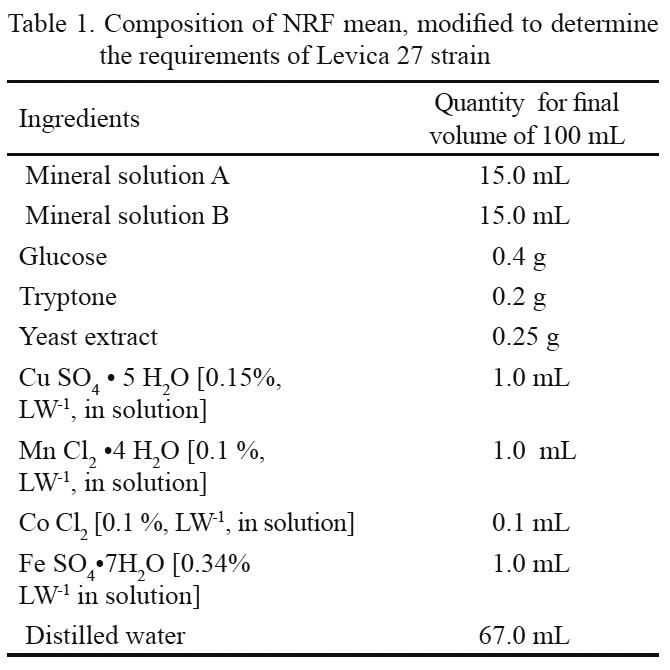
<body><![CDATA[<p align="JUSTIFY">The malt extract and NRF culture, of Caldwell and   Bryant (1966), modified by Elias (1971) were studied, since although   the first one is specifically used for fungi and yeast culture, it does   not have the mineral solutions of the second in its formulation, which   could favor  yeast development. </p>     <p align="JUSTIFY">The NRF medium is used for ruminal yeasts culture   therefore was eliminated from its composition the cellobiose, soluble   starch, sodium lactate, hemin, volatile fatty acids, HCL-cysteine,   Na<sub>2</sub>S.9H<sub>2</sub>O and Na<sub>2</sub> HCO<sub>3</sub>.The composition of the medium used is showed in <a href="/img/revistas/cjas/v49n1/t0108115.gif">table 1</a>. </p>     
<p align="JUSTIFY">The mineral solution A contains, per 1,000 mL,   K2HPO<sub>4</sub>, 3.0 g. The mineral solution B contains, per 1,000 mL:   KH<sub>2</sub>PO<sub>4</sub>, 3.0 g;   SO<sub>4</sub> (NH4)<sub>2</sub>, 6.0 g; NaCl, 6.0 g;   MgSO<sub>4</sub>.7H<sub>2</sub>O, 0.6 g and   CaCl2, 0.6 g. </p>     <p align="JUSTIFY"><em>Preparation of yeast   inoculu</em>m. A yeast culture obtained at 24h was used, from which a lop   was taken, and was diluted in 10mL of malt solution extractmedium . It   was incubated at 30 &ordm;C during 24 h for their reactivation.Then, from this   culture, 0.5mL was inoculated in an erlenmeyer of 100mL with 50 mL of   the same medium and was incubated under the same conditions. This   constituted the inoculums for the studies and shows a concentration of   57.1   x 10<sup>-7</sup> cel.mL<sup>-1</sup> of live cells. </p>     <p align="JUSTIFY"><em>Experimental procedure</em>. The growth of the   yeast strain in the extract malt medium and the modified NRF solution   was first compared. The first mean was used, specifically, for fungi and   yeasts culture, but it not have in its formulation the minerals   solutions of   the second one. For this, 0.1mL of the inoculum above cited in test   tubes that contained 10mL of both media was added. Four tubes per   treatment for every study hour were used. Tubes constituted the   experimental unit. At 0, 4, 8,12,24,36 and 48 h the pH and optical   density (O.D) were determined. Cell counts were also made in Neubauer   camera. For this, yeasts were tinted according to Painting and Kirsop   (1990) method. </p>     <p align="JUSTIFY">Later on the strain growth was studied in NRF   medium when changing sugars and nitrogen sources, according to the   study. In the first case, glucose was substituted by sucrose and lactose   and for nitrogen sources, the ammonium sulfate found in the B mineral   solution was removing to included tryptone (144 mg), casein (144 mg) and   urea (24.4 mg).For this, same as in the curves study, 0.1mL of the   inoculums was added in test tubes that contained 10 mL of both media.   Four tubes per treatment for every study hour were used.   Tubes constituted the experimental unit. At 0, 48 and 72 h the pH and O.D were determined. </p>     <p align="JUSTIFY">The pH was measured with a portable potentiometer   HANNATM., model HI 9017, &plusmn; 0.1 precise units. The O.D was measured by   colorimetry, with an espectrophonometer HACH, model DR 5000, at 530 nm. </p>     <p align="JUSTIFY"><em>Statistical analysis</em>. A completely   randomized design was used, with four repetitions per treatment in every   study hour. The experimental results were analyzed with the InfoStat   statistical package, version 1.0 (Balzarini <em>et al.</em> 2001).In the microorganism counts,   data were transformed according to LN, to assure variance normality. The   Duncan (1955) test was applied, in necessary cases to distinguish   differences between means.</p> </font>     <p>&nbsp;</p>     <p><font size="3" face="Verdana, Arial, Helvetica, sans-serif"><strong>RESULTS AND DISCUSSION</strong></font></p> <font size="2" face="Verdana, Arial, Helvetica, sans-serif">    ]]></body>
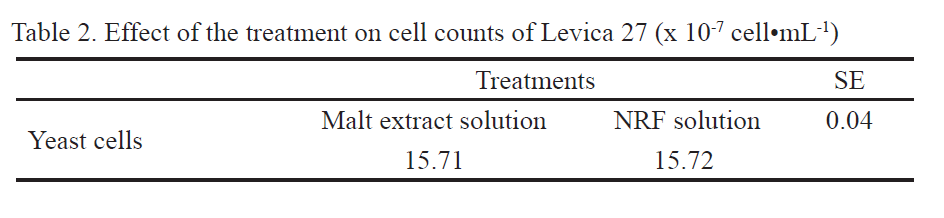
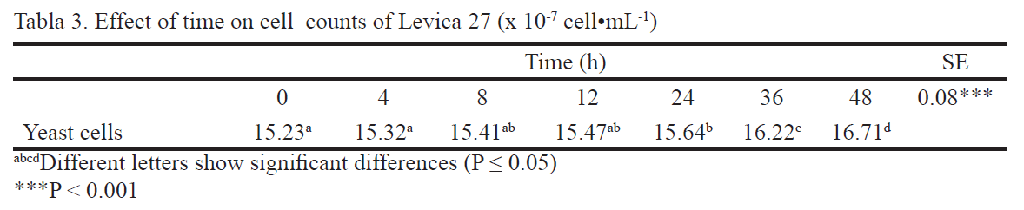
<body><![CDATA[<p align="JUSTIFY">To growth analysis, yeasts have high similarities   with heterotrophic bacteria than with the filamentous ascomycetes and   basidiomycetes with which are taxonomically related. Therefore, if are   excluded some yeasts genus similar to filamentous fungi, can be said   that its growing has an excellent approximation to a homogeneous   population of unicellular heterotrophic organisms (Casadesus <em>et al.</em> 1985). </p>     <p align="JUSTIFY">When analyzing the curves that create the cell   count of Levica 27 in malt extract and NRF media (<a href="/img/revistas/cjas/v49n1/f0108115.gif">figure 1</a>) was proven   the similarity between them. The statistical analyses showed that there   was not interaction between treatments and the study time. There were   not differences in the number of cell that grew in both media (<a href="/img/revistas/cjas/v49n1/t0208115.gif">table 2</a>),   showing that the NRF medium is appropriated for the culture strain in   study and the evaluation of its growth before different carbohydrates   and nitrogen sources. However, in <a href="/img/revistas/cjas/v49n1/t0308115.gif">table 3</a> are show   the significance differences (P &Acirc; 0.001) that were found in the time,   logically by the increase of cell numbers that shows the microorganisms,   due to its reproduction, when they are in a culture medium with the   necessary nutrients for this process. </p>     
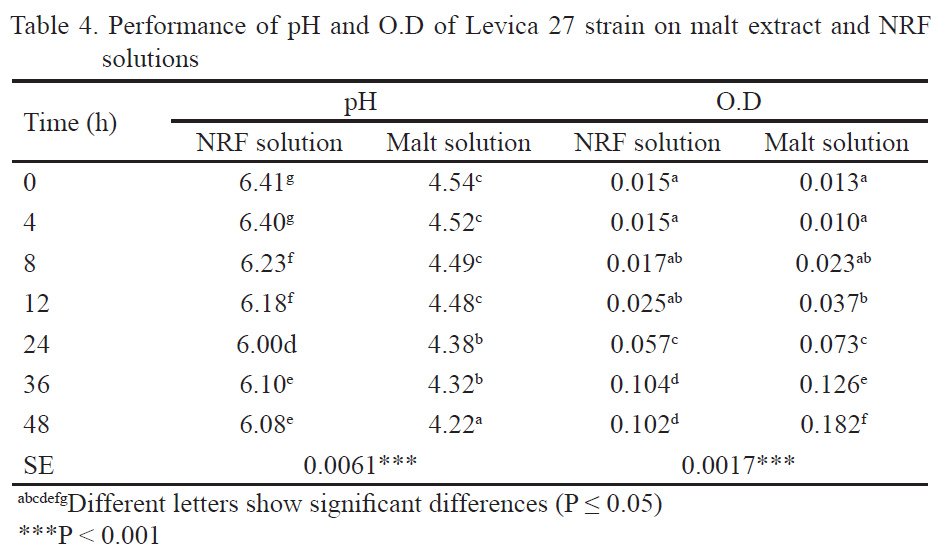
<p align="JUSTIFY">The previous results, in both culture media,   verified the existence of two from the four phases described by Mateos   (2005) for the microorganism growths in general: lag phase and   exponential phase or logarithmic. </p>     <p align="JUSTIFY">The existence of the stationary and decline or   death phases was not verified, since there was increase of cell counts   up to the 48h. Apparently, the nutrients quantity in the medium was   enough to achieve a yeast growth up to this hour. </p>     <p align="JUSTIFY">The growth Lag phase of Levica 27 was extended up   to the 8h. In the adaptation and recovery periods in which this phase   is divided, first the cells are adapted to the new medium conditions,   and could happen decrease in viable cells percentage. Later on begins   to increase the cellular division speed. </p>     <p align="JUSTIFY">The exponential growth phase is show from 8h up   to the 48 h. To this regard, Mateos(2005) show that, in this period,   nutrients are used quickly and the number of cells is increased. As   consequence, final metabolites are accumulated and can bring changes in   the   pH. This statement is corroborated in <a href="/img/revistas/cjas/v49n1/t0408115.gif">table 4</a>, which shows the pH and OD   of Levica 27 culture in the study means. In both indicators, there were   interaction between time and treatments. Decrease of the pH was   observed, while OD increases. </p>     
<p align="JUSTIFY">It should highlight that yeast grew at high pH in   the NRF medium (from 6.0 to 4.41) regarding to malt medium (from 4.22   to 4.54).To this regard, Carrillo (2003) explained that yeasts accept a   pH range between 3 and 10, but prefers a lightly acid habitat, with   pH from 4.5 to 6.5, corresponding with the obtained values in both   cultures. </p>     <p align="JUSTIFY">The microorganism growth can be verified by   direct cell count method, and by indirect methods, as the turbidity   measurement through O.D (Pandey <em>et al.</em> 2001).For this reason, studies of O.D lineal regression adjusted to cell count for media in study were   carried out and the corresponding equations were stated: </p>     <p align="JUSTIFY"><u>Malt extract smedium</u></p>     <p align="JUSTIFY">Cell count =3.21 x   10<sup>6</sup> + 67.32 x 10<sup>6</sup> (O.D) </p>     ]]></body>
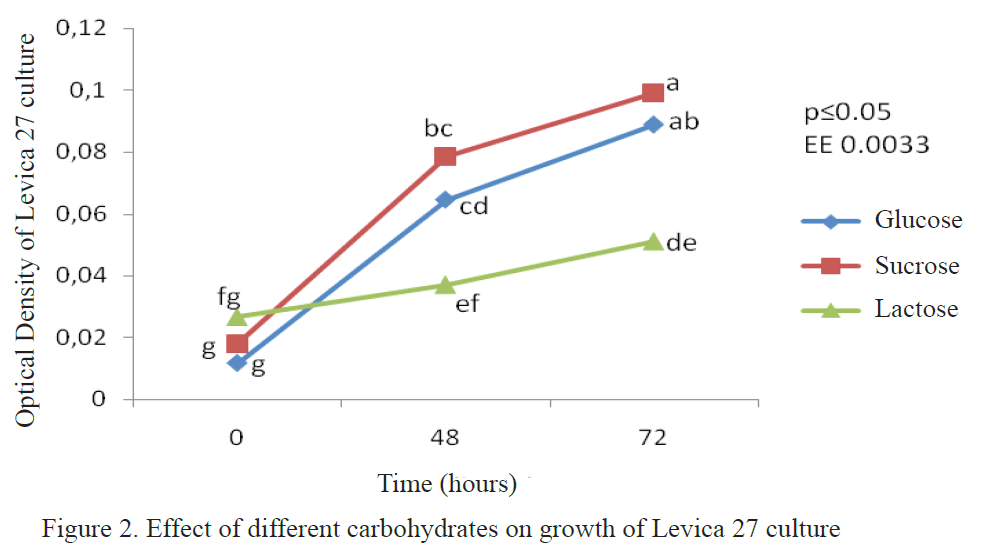
<body><![CDATA[<p align="JUSTIFY"><u>NRF medium</u></p>     <p align="JUSTIFY">Cell count= 2.84 x   10<sup>6</sup> + 110.07 x 10<sup>6</sup> (O.D) </p>     <p align="JUSTIFY">The results showed high regression coefficients of   R<sup>2</sup>= 0.90 in the malt extract medium and   R<sup>2</sup>= 0.60 in NRF solution, with P &Acirc; 0.001in both cases. </p>     <p align="JUSTIFY">This showed the possibility to use the O.D as indicator of Levica 27 growth in these culture media. </p>     <p align="JUSTIFY">Microorganism growth dynamics depends on multiple   factors. Besides the genus, specie and, specifically, the strain,   variability is observed when different conditions, culture media and   inoculum doses are used. This statement is confirmed by Tai Shin <em>et al.</em> (2002), Castillo (2009) and Angulo (2012), who showed heterogeneous results in the growth dynamics of <em>Candida norvegensis</em>, due to the use of culture medium and   different inoculums doses. Everything seems to indicate that doses of   inoculum inclusion were decisive in   the differences among the three studies. The first two studies included   20 and 5% respectively, and the third one, 0.1%. </p>     <p align="JUSTIFY">Although this study was carried out with a strain of the <em>P. guilliermondii</em> specie, the inoculum dosis was the same used by   Angulo (2012). Probably the amount of inoculum was very low, which   caused that Lag growth phase were extended up to the 8 h. </p>     <p align="JUSTIFY">Results showed the possibility to study the growth of <em>Pichia guilliermondii</em> strain Levica 27, in NRF medium with   different energy sources and nitrogen. <a href="/img/revistas/cjas/v49n1/f0208115.gif">Figure 2</a> shows the OD values of   the strain culture in NRF medium for the three carbohydrates used as   energy sources. All sugars were used by the yeast, but the best growths   were reached up to the 48 h, when glucose and sucrose were used,   although with sucrose at 48h the same O.D values were reached as with   glucose at 72h.This should be taken into account due to the   lower time used by the strain for growing with this carbohydrate. </p>     
<p align="JUSTIFY">Similar studies, in those the NRF medium was used   to determine the strain requirements from the same genus, showed that   this one mostly used glucose as energy source, when was compared with   sucrose and lactose  (Angulo 2012).This shows the specificity   that exits in yeast species, as for the use of carbohydrates sources. </p>     <p align="JUSTIFY">The previous has been confirmed by Kurtzman and   Fell (1998), whose describe the yeast capacity to use a wide range of   compounds, among them carbohydrates that lend them a significant value   to be use in the industry and agriculture. </p>     <p align="JUSTIFY">In the media that contained glucose and sucrose   had pH decrease (<a href="/img/revistas/cjas/v49n1/t0508115.gif">table 5</a>) at 48h, which extended with sucrose medium at   72h.However, this one stayed in the optimal range described  for yeast   growth(Carrillo, 2003) and the described result is confirmed in <a href="/img/revistas/cjas/v49n1/t0408115.gif">table 4</a>. </p>     
]]></body>
<body><![CDATA[<p align="JUSTIFY">S&aacute;nchez <em>et al.</em> (2007), when studying the pH influence in the growth of a <em>P. guilliermondii</em> strain, determined that there were not   differences in this yeast growing in the pH interval between 5 and 7, in   which the higher biomass production were reached. They also verified   that   they can also work with pH from 4 to 4.5, without a marked affectation   in growth. However, at pH 3, there was a radical affectation of growth,   due to the high acidity of the   mean. </p>     <p align="JUSTIFY">Contrary to previous researches, with yeasts from the same genus, but from the <em>I. orientalis</em> specie, 92% of survival to PH 3 was maintained (Tai Shin <em>et al.</em> 2002).From there, the importance of the specific studies   in each strain, when is intended to use yeasts   in ruminant animals feeding. The hardies to low pH could be more   effective in diets with concentrates, in those the presence of   carbohydrates of easy fermentation decrease the rumen pH. </p>     <p align="JUSTIFY">Calder&oacute;n <em>et al.</em> (2005) suggested that   yeasts can get nitrogen to synthesize unicellular protein and the common   sources are ammonium, urea and amino acids.This was evidenced in this   study, with Levica 27 growing in different nitrogen sources (<a href="/img/revistas/cjas/v49n1/f0308115.gif">figure   3</a>).It can   verify that O.D values, when using casein, urea and triptane, they   duplicate those that are obtained in ammonium sulfate presence.   Regarding, Villamil and Zapata (1999) mention that all yeasts can use   nitrogen in the weight ammonium ion, either in chlorides,   nitrates, sulphates, ammonium phosphates, and can use the sulfur from   the ammonium sulphate for the synthesis of some amino acids(Sarmiento   and Herrera 2003). </p>     
<p align="JUSTIFY">If the results of <a href="/img/revistas/cjas/v49n1/f0208115.gif">figure 2</a> and <a href="/img/revistas/cjas/v49n1/f0308115.gif">3</a> are analyzed it   could recommend different combinations of carbohydrates and nitrogen   sources taking into account their market prices. </p>     
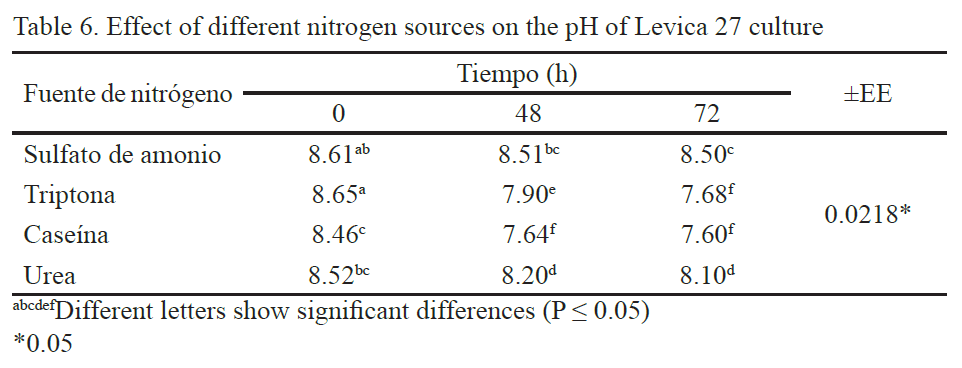
<p align="JUSTIFY">The presence of all nitrogen sources caused   gradual decrease of the pH, at 48 and 72 h (<a href="/img/revistas/cjas/v49n1/t0608115.gif">table 6</a>), and the urea   maintained values over the optimal for yeasts. Although the growth was   not affected, this aspect should be kept in mind if it chosen the urea   as source   in culture medium to the studied strain. Nevertheless, S&aacute;nchez <em>et al.</em> (2007) designed a mean of simple culture for <em>P. guilliermondii</em>, without yeast extract, that contained molasses   as carbon source and urea as nitrogen source. These authors obtained   high biomass   levels in submerged cultures as in solid state fermentation. </p>     
<p align="JUSTIFY">It is concluded that the growth of <em>Pichia guilliermondii</em> strain Levica 27 was higher in presence of   glucose or sucrose and casein or urea, when was compared with other   energy and nitrogen sources, respectively. It is recommended to carry   out studies to design   an economical culture medium with energy and nitrogen national sources   that allow the obtaining of a preparation with Levica 27 to make <em>in vivo</em> studies and check the additive strain effect. </p> </font>     <p>&nbsp;</p>     <p><font size="2" face="Verdana, Arial, Helvetica, sans-serif"><font size="3"><strong>BIBLIOGRAPHY</strong></font></font></p> <font size="2" face="Verdana, Arial, Helvetica, sans-serif">     <!-- ref --><p align="JUSTIFY">Al Ibrahim R. M., Gath V. P., Campion D. P., McCarney C., Duffy P. &amp; Mulligan F. J. 2012. ``The effect of abrupt or   gradual introduction to pasture after calving and supplementation with Saccharomyces cerevisiae (Strain 1026) on ruminal pH and   fermentation in early lactation dairy cows''. <em>Animal feed science and   technology</em>, 178 (1), pp. 40-47.     </p>     ]]></body>
<body><![CDATA[<!-- ref --><p align="JUSTIFY">Angulo C. 2012. <em>Crecimiento y requerimientos nutricionales de la levadura candida norvegensis como activador   ruminal</em>. PhD Thesis, Facultad de Zootecnia y Ecolog&iacute;a, Universidad Aut&oacute;noma de Chihuahua, Chihuahua, M&eacute;xico.     </p>     <p align="JUSTIFY">Angulo C., Ruiz-Barrera O., Castillo Y., Marrero Y., El&iacute;as A., Arzola C., Mancillas P. C. &amp; D&iacute;az D. 2013. ``Growth dynamics   and metabolites produced in the fermentation of Candida norvegensis yeast''. <em>Cuban Journal of Agricultural Science</em>, 47 (2),   Available: &lt;<a href="http://www.lebas.com.mx/files/7.pdf" target="_blank">http://www.lebas.com.mx/files/7.pdf</a>&gt;, [Accessed:&nbsp;November 7, 2014]. </p>     <!-- ref --><p align="JUSTIFY">Balzarini M. G., Casanoves F., Di Rienzo J. A., Gonz&aacute;lez L. A. &amp; Robledo C. W. 2001. <em>InfoStat</em>. version 2001, C&oacute;rdoba,   Argentina: Universidad de C&oacute;rdoba.     </p>     <!-- ref --><p align="JUSTIFY">Bruno R. G. S., Rutigliano H. M., Cerri R. L., Robinson P. H. &amp; Santos J. E. P. 2009. ``Effect of feeding Saccharomyces   cerevisiae on performance of dairy cows during summer heat stress''. <em>Animal Feed Science and Technology</em>, 150 (3), pp. 175-186.     </p>     <p align="JUSTIFY">Calder&oacute;n J. O., El&iacute;as A. &amp; Valdivi&eacute; M. 2005.   ``Din&aacute;mica de la fermentaci&oacute;n en estado s&oacute;lido de la camas de cascarilla   de caf&eacute;   en inicio de ponedoras inoculadas con vitafert''. <em>REDVET. Revista Electr&oacute;nica de   Veterinaria</em>, 6 (5), Available: &lt;<a href="http://www.veterinaria.org/revistas/redvet/n050505/050521.pdf?" target="_blank">http://www.veterinaria.org/revistas/redvet/n050505/050521.pdf?</a>&gt;, [Accessed:&nbsp;November 7, 2014]. </p>     <!-- ref --><p align="JUSTIFY">Caldwell D. R. &amp; Bryant M. P. 1966. ``Medium without rumen fluid for nonselective enumeration and isolation of rumen   bacteria''. <em>Applied microbiology</em>, 14 (5), pp. 794-801.     </p>     ]]></body>
<body><![CDATA[<!-- ref --><p align="JUSTIFY">Carrillo L. 2003. ``Levaduras. Cultivo, identificaci&oacute;n, ambiente y sinonimia''. In: <em>Los hongos de los alimentos y forrajes</em>,   Universidad Nacional de Salta, ISBN: 987-9381-19-X, Available: &lt;<a href="http://www.unsa.edu.ar/matbib/ hongos/09htextolevaduras.pdf" target="_blank">http://www.unsa.edu.ar/matbib/   hongos/09htextolevaduras.pdf</a>&gt;, [Accessed:&nbsp;July 12, 2010].     </p>     <!-- ref --><p align="JUSTIFY">Casadesus L., Rojas T., Brizuela A. L. &amp; S&aacute;nchez A. Y. 1985. <em>Micolog&iacute;a</em>. La Habana, Cuba: Universidad de la Habana, Facultad   de Biolog&iacute;a.     </p>     <!-- ref --><p align="JUSTIFY">Castillo Y. 2009. <em>Fermentaci&oacute;n in vitro para obtener la levadura Candida norvegensis en mezclas de alfalfa y paja de avena   con bagazo de manzana fermentado y sus efectos sobre la actividad microbiana   ruminal</em>. PhD.Thesis, Facultad de Zootecnia y   Ecolog&iacute;a, Universidad Aut&oacute;noma de Chihuahua, Chihuahua, M&eacute;xico.     </p>     <!-- ref --><p align="JUSTIFY">Duncan D. B. 1955. ``Multiple range and multiple F tests''. <em>Biometrics</em>, 11 (1), pp. 142.     </p>     <!-- ref --><p align="JUSTIFY">Elias A. 1971. <em>The rumen bacteria of animals fed on a high molasses-urea   diet</em>. PhD. Thesis, Aberdeen.     </p>     ]]></body>
<body><![CDATA[<!-- ref --><p align="JUSTIFY">Kurtzman C. P. &amp; Fell J. W. 1998. <em>The yeast, a taxonomic study</em>. 4th ed., ELSEVIER, 13-19 p.     </p>     <!-- ref --><p align="JUSTIFY">Marrero Y., Burrola-Barraza M. E., Castillo Y., Basso L. C., Rosa C. A., Ruiz O., Gonz&aacute;lez-Rodr&iacute;guez E. &amp; others. 2012.   ``Identification of Levica yeasts as a potential ruminal microbial additive''. <em>Czech Journal of Animal Science</em>, 58 (10), pp. 460-469.     </p>     <!-- ref --><p align="JUSTIFY">Mateos P. F. 2005. <em>Crecimiento   microbiano</em>. Departamento de Microbiolog&iacute;a y gen&eacute;tica, Universidad de Salamanca,   Available: &lt;<a href="http:/nostoc.usual.es" target="_blank">http:/nostoc.usual.es</a>&gt;, [Accessed:&nbsp;April 1, 2005].     </p>     <!-- ref --><p align="JUSTIFY">Nogal P. J. &Aacute;. 1995. ``Los probi&oacute;ticos como complemento alimenticio''. <em>Mundo ganadero</em>, (11), pp. 38-46.     </p>     <!-- ref --><p align="JUSTIFY">Painting K. &amp; Kirsop B. 1990. ``A quick method for estimating the percentage of viable cells in a yeast population, using   methylene blue staining''. <em>World Journal of Microbiology and   Biotechnology</em>, 6 (3), pp. 346-347.     </p>     ]]></body>
<body><![CDATA[<!-- ref --><p align="JUSTIFY">Pandey A., Soccol C. R., Rodriguez-Leon J. A. &amp; Nigam P. 2001. ``Factors that influence solid state fermentation''. In: <em>Solid State Fermentation in Biotechnology: Fundamentals and   Applications</em>, Asiatech.     </p>     <p align="JUSTIFY">S&aacute;nchez M. I., Santos A., Dustet J. C., Guerra G., Le&oacute;n T., Arg&uuml;elles J., Ramos-Leal M., Manzano A. M., Casado G. &amp; G&oacute;mez   B. 2007. ``Estudio fisiol&oacute;gico de una cepa de levadura con potencialidades para el enriquecimiento proteico del bagazo de ca&ntilde;a   de az&uacute;car''. <em>Revista CENIC Ciencias   Biol&oacute;gicas</em>, 38 (1), Available: &lt;<a href="http://revista.cnic.edu.cu/revistaCB/sites/default/files/articulos /CB-2007-1-039-043.pdf" target="_blank">http://revista.cnic.edu.cu/revistaCB/sites/default/files/articulos  /CB-2007-1-039-043.pdf</a>&gt;, [Accessed:&nbsp;November 7, 2014]. </p>     <!-- ref --><p align="JUSTIFY">Sarmiento A. &amp; Herrera J. 2003. <em>Obtenci&oacute;n y caracterizaci&oacute;n de un banco de levaduras con potencial aplicaci&oacute;n   probi&oacute;tica</em>. Degree Thesis, Pontificia Universidad Javeriana, Bogot&aacute;, Colombia.     </p>     <!-- ref --><p align="JUSTIFY">Shin H. T., Lim Y. B., Koh J. H., Kim J. Y., Baig   S. Y. &amp; Lee J. H. 2002. ``Growth of Issatchenkia orientalis in   aerobic batch and   fed-batch cultures''. <em>Journal of   Microbiology</em>, 40 (1), pp. 82-85.     </p>     <!-- ref --><p align="JUSTIFY">Villamil Y. &amp; Zapata Y. 1999. <em>Caracterizaci&oacute;n de levaduras fermentadoras aisladas de frutas en descomposici&oacute;n con   potencial aplicaci&oacute;n productora de   etanol</em>. Degree Thesis, Pontificia Universidad Javeriana, Bogot&aacute;    . </p>     <!-- ref --><p align="JUSTIFY">Winkler M. A. 1988. ``Optimisation and time-profiling in fermentation processes''. <em>Progress in industrial microbiology</em>, 25, pp.   91-150.    </p></font>     <p align="JUSTIFY">&nbsp;</p>     <p align="JUSTIFY">&nbsp;</p>     <p><font size="2" face="Verdana, Arial, Helvetica, sans-serif">Received: November 7, 2014    <br> Accepted: December 1, 2014</font></p>     <p>&nbsp;</p>     <p>&nbsp;</p>     <p><font size="2" face="Verdana, Arial, Helvetica, sans-serif"><em>Yoandra Marrero,</em> Instituto de Ciencia Animal, Apartado Postal 24, San José de las Lajas, Mayabeque, Cuba.  Email: <a href="mailto:ymarrero@ica.co.cu">ymarrero@ica.co.cu</a></font></p>      ]]></body><back>
<ref-list>
<ref id="B1">
<nlm-citation citation-type="journal">
<person-group person-group-type="author">
<name>
<surname><![CDATA[Al Ibrahim]]></surname>
<given-names><![CDATA[R. M.]]></given-names>
</name>
<name>
<surname><![CDATA[Gath]]></surname>
<given-names><![CDATA[V. P.]]></given-names>
</name>
<name>
<surname><![CDATA[Campion]]></surname>
<given-names><![CDATA[D. P.]]></given-names>
</name>
<name>
<surname><![CDATA[McCarney]]></surname>
<given-names><![CDATA[C.]]></given-names>
</name>
<name>
<surname><![CDATA[Duffy]]></surname>
<given-names><![CDATA[P.]]></given-names>
</name>
<name>
<surname><![CDATA[Mulligan]]></surname>
<given-names><![CDATA[F. J.]]></given-names>
</name>
</person-group>
<article-title xml:lang="nd"><![CDATA[The effect of abrupt or gradual introduction to pasture after calving and supplementation with Saccharomyces cerevisiae (Strain 1026) on ruminal pH and fermentation in early lactation dairy cows]]></article-title>
<source><![CDATA[Animal feed science and technology]]></source>
<year>2012</year>
<volume>178</volume>
<numero>1</numero>
<issue>1</issue>
<page-range>40–47</page-range></nlm-citation>
</ref>
<ref id="B2">
<nlm-citation citation-type="book">
<person-group person-group-type="author">
<name>
<surname><![CDATA[Angulo]]></surname>
<given-names><![CDATA[C.]]></given-names>
</name>
</person-group>
<source><![CDATA[Crecimiento y requerimientos nutricionales de la levadura candida norvegensis como activador ruminal]]></source>
<year>2012</year>
<publisher-loc><![CDATA[Chihuahua, México ]]></publisher-loc>
<publisher-name><![CDATA[Facultad de Zootecnia y Ecología, Universidad Autónoma de Chihuahua]]></publisher-name>
</nlm-citation>
</ref>
<ref id="B3">
<nlm-citation citation-type="journal">
<person-group person-group-type="author">
<name>
<surname><![CDATA[Angulo]]></surname>
<given-names><![CDATA[C.]]></given-names>
</name>
<name>
<surname><![CDATA[Ruiz-Barrera]]></surname>
<given-names><![CDATA[O.]]></given-names>
</name>
<name>
<surname><![CDATA[Castillo]]></surname>
<given-names><![CDATA[Y.]]></given-names>
</name>
<name>
<surname><![CDATA[Marrero]]></surname>
<given-names><![CDATA[Y.]]></given-names>
</name>
<name>
<surname><![CDATA[Elías]]></surname>
<given-names><![CDATA[A.]]></given-names>
</name>
<name>
<surname><![CDATA[Arzola]]></surname>
<given-names><![CDATA[C.]]></given-names>
</name>
<name>
<surname><![CDATA[Mancillas]]></surname>
<given-names><![CDATA[P. C.]]></given-names>
</name>
<name>
<surname><![CDATA[Díaz]]></surname>
<given-names><![CDATA[D.]]></given-names>
</name>
</person-group>
<article-title xml:lang="nd"><![CDATA[Growth dynamics and metabolites produced in the fermentation of Candida norvegensis yeast]]></article-title>
<source><![CDATA[Cuban Journal of Agricultural Science]]></source>
<year>2013</year>
<volume>47</volume>
<numero>2</numero>
<issue>2</issue>
</nlm-citation>
</ref>
<ref id="B4">
<nlm-citation citation-type="book">
<person-group person-group-type="author">
<name>
<surname><![CDATA[Balzarini]]></surname>
<given-names><![CDATA[M. G.]]></given-names>
</name>
<name>
<surname><![CDATA[Casanoves]]></surname>
<given-names><![CDATA[F.]]></given-names>
</name>
<name>
<surname><![CDATA[Di Rienzo]]></surname>
<given-names><![CDATA[J. A.]]></given-names>
</name>
<name>
<surname><![CDATA[González]]></surname>
<given-names><![CDATA[L. A.]]></given-names>
</name>
<name>
<surname><![CDATA[Robledo]]></surname>
<given-names><![CDATA[C. W.]]></given-names>
</name>
</person-group>
<source><![CDATA[InfoStat]]></source>
<year>2001</year>
<publisher-loc><![CDATA[Córdoba, Argentina ]]></publisher-loc>
<publisher-name><![CDATA[Universidad de Córdoba]]></publisher-name>
</nlm-citation>
</ref>
<ref id="B5">
<nlm-citation citation-type="journal">
<person-group person-group-type="author">
<name>
<surname><![CDATA[Bruno]]></surname>
<given-names><![CDATA[R. G. S.]]></given-names>
</name>
<name>
<surname><![CDATA[Rutigliano]]></surname>
<given-names><![CDATA[H. M.]]></given-names>
</name>
<name>
<surname><![CDATA[Cerri]]></surname>
<given-names><![CDATA[R. L.]]></given-names>
</name>
<name>
<surname><![CDATA[Robinson]]></surname>
<given-names><![CDATA[P. H.]]></given-names>
</name>
<name>
<surname><![CDATA[Santos]]></surname>
<given-names><![CDATA[J. E. P.]]></given-names>
</name>
</person-group>
<article-title xml:lang="nd"><![CDATA[Effect of feeding Saccharomyces cerevisiae on performance of dairy cows during summer heat stress]]></article-title>
<source><![CDATA[Animal Feed Science and Technology]]></source>
<year>2009</year>
<volume>150</volume>
<numero>3</numero>
<issue>3</issue>
<page-range>175–186</page-range></nlm-citation>
</ref>
<ref id="B6">
<nlm-citation citation-type="journal">
<person-group person-group-type="author">
<name>
<surname><![CDATA[Calderón]]></surname>
<given-names><![CDATA[J. O.]]></given-names>
</name>
<name>
<surname><![CDATA[Elías]]></surname>
<given-names><![CDATA[A.]]></given-names>
</name>
<name>
<surname><![CDATA[Valdivié]]></surname>
<given-names><![CDATA[M.]]></given-names>
</name>
</person-group>
<article-title xml:lang="nd"><![CDATA[Dinámica de la fermentación en estado sólido de la camas de cascarilla de café en inicio de ponedoras inoculadas con vitafert]]></article-title>
<source><![CDATA[REDVET. Revista Electrónica de Veterinaria]]></source>
<year>2005</year>
<volume>6</volume>
<numero>5</numero>
<issue>5</issue>
</nlm-citation>
</ref>
<ref id="B7">
<nlm-citation citation-type="journal">
<person-group person-group-type="author">
<name>
<surname><![CDATA[Caldwell]]></surname>
<given-names><![CDATA[D. R.]]></given-names>
</name>
<name>
<surname><![CDATA[Bryant]]></surname>
<given-names><![CDATA[M. P.]]></given-names>
</name>
</person-group>
<article-title xml:lang="nd"><![CDATA[Medium without rumen fluid for nonselective enumeration and isolation of rumen bacteria]]></article-title>
<source><![CDATA[Applied microbiology]]></source>
<year>1966</year>
<volume>14</volume>
<numero>5</numero>
<issue>5</issue>
<page-range>794–801</page-range></nlm-citation>
</ref>
<ref id="B8">
<nlm-citation citation-type="book">
<person-group person-group-type="author">
<name>
<surname><![CDATA[Carrillo]]></surname>
<given-names><![CDATA[L.]]></given-names>
</name>
</person-group>
<article-title xml:lang="nd"><![CDATA[Levaduras. Cultivo, identificación, ambiente y sinonimia]]></article-title>
<source><![CDATA[Los hongos de los alimentos y forrajes]]></source>
<year>2003</year>
<publisher-name><![CDATA[Universidad Nacional de Salta]]></publisher-name>
</nlm-citation>
</ref>
<ref id="B9">
<nlm-citation citation-type="book">
<person-group person-group-type="author">
<name>
<surname><![CDATA[Casadesus]]></surname>
<given-names><![CDATA[L.]]></given-names>
</name>
<name>
<surname><![CDATA[Rojas]]></surname>
<given-names><![CDATA[T.]]></given-names>
</name>
<name>
<surname><![CDATA[Brizuela]]></surname>
<given-names><![CDATA[A. L.]]></given-names>
</name>
<name>
<surname><![CDATA[Sánchez]]></surname>
<given-names><![CDATA[A. Y.]]></given-names>
</name>
</person-group>
<source><![CDATA[Micología]]></source>
<year>1985</year>
<publisher-loc><![CDATA[La Habana, Cuba ]]></publisher-loc>
<publisher-name><![CDATA[Universidad de la Habana, Facultad de Biología]]></publisher-name>
</nlm-citation>
</ref>
<ref id="B10">
<nlm-citation citation-type="book">
<person-group person-group-type="author">
<name>
<surname><![CDATA[Castillo]]></surname>
<given-names><![CDATA[Y.]]></given-names>
</name>
</person-group>
<source><![CDATA[Fermentación in vitro para obtener la levadura Candida norvegensis en mezclas de alfalfa y paja de avena con bagazo de manzana fermentado y sus efectos sobre la actividad microbiana ruminal]]></source>
<year>2009</year>
<publisher-loc><![CDATA[Chihuahua, México ]]></publisher-loc>
<publisher-name><![CDATA[Facultad de Zootecnia y Ecología, Universidad Autónoma de Chihuahua]]></publisher-name>
</nlm-citation>
</ref>
<ref id="B11">
<nlm-citation citation-type="journal">
<person-group person-group-type="author">
<name>
<surname><![CDATA[Duncan]]></surname>
<given-names><![CDATA[D. B.]]></given-names>
</name>
</person-group>
<article-title xml:lang="nd"><![CDATA[Multiple range and multiple F tests]]></article-title>
<source><![CDATA[Biometrics]]></source>
<year>1955</year>
<volume>11</volume>
<numero>1</numero>
<issue>1</issue>
<page-range>1–42</page-range></nlm-citation>
</ref>
<ref id="B12">
<nlm-citation citation-type="">
<person-group person-group-type="author">
<name>
<surname><![CDATA[Elias]]></surname>
<given-names><![CDATA[A.]]></given-names>
</name>
</person-group>
<source><![CDATA[The rumen bacteria of animals fed on a high molasses-urea diet]]></source>
<year>1971</year>
<publisher-loc><![CDATA[Aberdeen ]]></publisher-loc>
</nlm-citation>
</ref>
<ref id="B13">
<nlm-citation citation-type="book">
<person-group person-group-type="author">
<name>
<surname><![CDATA[Kurtzman]]></surname>
<given-names><![CDATA[C. P.]]></given-names>
</name>
<name>
<surname><![CDATA[Fell]]></surname>
<given-names><![CDATA[J. W.]]></given-names>
</name>
</person-group>
<source><![CDATA[The yeast, a taxonomic study]]></source>
<year>1998</year>
<edition>4th</edition>
<page-range>13-19</page-range><publisher-name><![CDATA[ELSEVIER]]></publisher-name>
</nlm-citation>
</ref>
<ref id="B14">
<nlm-citation citation-type="journal">
<person-group person-group-type="author">
<name>
<surname><![CDATA[Marrero]]></surname>
<given-names><![CDATA[Y.]]></given-names>
</name>
<name>
<surname><![CDATA[Burrola-Barraza]]></surname>
<given-names><![CDATA[M. E.]]></given-names>
</name>
<name>
<surname><![CDATA[Castillo]]></surname>
<given-names><![CDATA[Y.]]></given-names>
</name>
<name>
<surname><![CDATA[Basso]]></surname>
<given-names><![CDATA[L. C.]]></given-names>
</name>
<name>
<surname><![CDATA[Rosa]]></surname>
<given-names><![CDATA[C. A.]]></given-names>
</name>
<name>
<surname><![CDATA[Ruiz]]></surname>
<given-names><![CDATA[O.]]></given-names>
</name>
<name>
<surname><![CDATA[González-Rodríguez]]></surname>
<given-names><![CDATA[E.]]></given-names>
</name>
</person-group>
<article-title xml:lang="nd"><![CDATA[Identification of Levica yeasts as a potential ruminal microbial additive]]></article-title>
<source><![CDATA[Czech Journal of Animal Science]]></source>
<year>2012</year>
<volume>58</volume>
<numero>10</numero>
<issue>10</issue>
<page-range>460–469</page-range></nlm-citation>
</ref>
<ref id="B15">
<nlm-citation citation-type="">
<person-group person-group-type="author">
<name>
<surname><![CDATA[Mateos]]></surname>
<given-names><![CDATA[P. F.]]></given-names>
</name>
</person-group>
<source><![CDATA[Crecimiento microbiano]]></source>
<year>2005</year>
</nlm-citation>
</ref>
<ref id="B16">
<nlm-citation citation-type="journal">
<person-group person-group-type="author">
<name>
<surname><![CDATA[Nogal]]></surname>
<given-names><![CDATA[P. J. Á.]]></given-names>
</name>
</person-group>
<article-title xml:lang="nd"><![CDATA[Los probióticos como complemento alimenticio]]></article-title>
<source><![CDATA[Mundo ganadero]]></source>
<year>1995</year>
<numero>11</numero>
<issue>11</issue>
<page-range>38–46</page-range></nlm-citation>
</ref>
<ref id="B17">
<nlm-citation citation-type="journal">
<person-group person-group-type="author">
<name>
<surname><![CDATA[Painting]]></surname>
<given-names><![CDATA[K.]]></given-names>
</name>
<name>
<surname><![CDATA[Kirsop]]></surname>
<given-names><![CDATA[B.]]></given-names>
</name>
</person-group>
<article-title xml:lang="nd"><![CDATA[A quick method for estimating the percentage of viable cells in a yeast population, using methylene blue staining]]></article-title>
<source><![CDATA[World Journal of Microbiology and Biotechnology]]></source>
<year>1990</year>
<volume>6</volume>
<numero>3</numero>
<issue>3</issue>
<page-range>346–347</page-range></nlm-citation>
</ref>
<ref id="B18">
<nlm-citation citation-type="book">
<person-group person-group-type="author">
<name>
<surname><![CDATA[Pandey]]></surname>
<given-names><![CDATA[A.]]></given-names>
</name>
<name>
<surname><![CDATA[Soccol]]></surname>
<given-names><![CDATA[C. R.]]></given-names>
</name>
<name>
<surname><![CDATA[Rodriguez-Leon]]></surname>
<given-names><![CDATA[J. A.]]></given-names>
</name>
<name>
<surname><![CDATA[Nigam]]></surname>
<given-names><![CDATA[P.]]></given-names>
</name>
</person-group>
<article-title xml:lang="nd"><![CDATA[Factors that influence solid state fermentation]]></article-title>
<source><![CDATA[Solid State Fermentation in Biotechnology: Fundamentals and Applications]]></source>
<year>2001</year>
<publisher-name><![CDATA[Asiatech]]></publisher-name>
</nlm-citation>
</ref>
<ref id="B19">
<nlm-citation citation-type="journal">
<person-group person-group-type="author">
<name>
<surname><![CDATA[Sánchez]]></surname>
<given-names><![CDATA[M. I.]]></given-names>
</name>
<name>
<surname><![CDATA[Santos]]></surname>
<given-names><![CDATA[A.]]></given-names>
</name>
<name>
<surname><![CDATA[Dustet]]></surname>
<given-names><![CDATA[J. C.]]></given-names>
</name>
<name>
<surname><![CDATA[Guerra]]></surname>
<given-names><![CDATA[G.]]></given-names>
</name>
<name>
<surname><![CDATA[León]]></surname>
<given-names><![CDATA[T.]]></given-names>
</name>
<name>
<surname><![CDATA[Argüelles]]></surname>
<given-names><![CDATA[J.]]></given-names>
</name>
<name>
<surname><![CDATA[Ramos-Leal]]></surname>
<given-names><![CDATA[M.]]></given-names>
</name>
<name>
<surname><![CDATA[Manzano]]></surname>
<given-names><![CDATA[A. M.]]></given-names>
</name>
<name>
<surname><![CDATA[Casado]]></surname>
<given-names><![CDATA[G.]]></given-names>
</name>
<name>
<surname><![CDATA[Gómez]]></surname>
<given-names><![CDATA[B.]]></given-names>
</name>
</person-group>
<article-title xml:lang="nd"><![CDATA[Estudio fisiológico de una cepa de levadura con potencialidades para el enriquecimiento proteico del bagazo de caña de azúcar]]></article-title>
<source><![CDATA[Revista CENIC Ciencias Biológicas]]></source>
<year>2007</year>
<volume>38</volume>
<numero>1</numero>
<issue>1</issue>
</nlm-citation>
</ref>
<ref id="B20">
<nlm-citation citation-type="book">
<person-group person-group-type="author">
<name>
<surname><![CDATA[Sarmiento]]></surname>
<given-names><![CDATA[A.]]></given-names>
</name>
<name>
<surname><![CDATA[Herrera]]></surname>
<given-names><![CDATA[J.]]></given-names>
</name>
</person-group>
<source><![CDATA[Obtención y caracterización de un banco de levaduras con potencial aplicación probiótica]]></source>
<year>2003</year>
<publisher-loc><![CDATA[Bogotá, Colombia ]]></publisher-loc>
<publisher-name><![CDATA[Pontificia Universidad Javeriana]]></publisher-name>
</nlm-citation>
</ref>
<ref id="B21">
<nlm-citation citation-type="journal">
<person-group person-group-type="author">
<name>
<surname><![CDATA[Shin]]></surname>
<given-names><![CDATA[H. T.]]></given-names>
</name>
<name>
<surname><![CDATA[Lim]]></surname>
<given-names><![CDATA[Y. B.]]></given-names>
</name>
<name>
<surname><![CDATA[Koh]]></surname>
<given-names><![CDATA[J. H.]]></given-names>
</name>
<name>
<surname><![CDATA[Kim]]></surname>
<given-names><![CDATA[J. Y.]]></given-names>
</name>
<name>
<surname><![CDATA[Baig]]></surname>
<given-names><![CDATA[S. Y.]]></given-names>
</name>
<name>
<surname><![CDATA[Lee]]></surname>
<given-names><![CDATA[J. H.]]></given-names>
</name>
</person-group>
<article-title xml:lang="nd"><![CDATA[Growth of Issatchenkia orientalis in aerobic batch and fed-batch cultures]]></article-title>
<source><![CDATA[Journal of Microbiology]]></source>
<year>2002</year>
<volume>40</volume>
<numero>1</numero>
<issue>1</issue>
<page-range>82–85</page-range></nlm-citation>
</ref>
<ref id="B22">
<nlm-citation citation-type="book">
<person-group person-group-type="author">
<name>
<surname><![CDATA[Villamil]]></surname>
<given-names><![CDATA[Y.]]></given-names>
</name>
<name>
<surname><![CDATA[Zapata]]></surname>
<given-names><![CDATA[Y.]]></given-names>
</name>
</person-group>
<source><![CDATA[Caracterización de levaduras fermentadoras aisladas de frutas en descomposición con potencial aplicación productora de etanol]]></source>
<year>1999</year>
<publisher-loc><![CDATA[Bogotá ]]></publisher-loc>
<publisher-name><![CDATA[Pontificia Universidad Javeriana]]></publisher-name>
</nlm-citation>
</ref>
<ref id="B23">
<nlm-citation citation-type="journal">
<person-group person-group-type="author">
<name>
<surname><![CDATA[Winkler]]></surname>
<given-names><![CDATA[M. A.]]></given-names>
</name>
</person-group>
<article-title xml:lang="nd"><![CDATA[Optimisation and time-profiling in fermentation processes]]></article-title>
<source><![CDATA[Progress in industrial microbiology]]></source>
<year>1988</year>
<volume>25</volume>
<page-range>91–150</page-range></nlm-citation>
</ref>
</ref-list>
</back>
</article>