<?xml version="1.0" encoding="ISO-8859-1"?><article xmlns:mml="http://www.w3.org/1998/Math/MathML" xmlns:xlink="http://www.w3.org/1999/xlink" xmlns:xsi="http://www.w3.org/2001/XMLSchema-instance">
<front>
<journal-meta>
<journal-id>2079-3480</journal-id>
<journal-title><![CDATA[Cuban Journal of Agricultural Science]]></journal-title>
<abbrev-journal-title><![CDATA[Cuban J. Agric. Sci.]]></abbrev-journal-title>
<issn>2079-3480</issn>
<publisher>
<publisher-name><![CDATA[Editorial del Instituto de Ciencia Animal]]></publisher-name>
</publisher>
</journal-meta>
<article-meta>
<article-id>S2079-34802015000100009</article-id>
<title-group>
<article-title xml:lang="en"><![CDATA[Evaluation of diet formulation based on digestible amino acids and true metabolizable energy on broiler breeder performance]]></article-title>
<article-title xml:lang="es"><![CDATA[Evaluación de la formulación de dietas basadas en aminoácidos digeribles y en energía verdadera metabolizable en el comportamiento de gallinas reproductoras de engorde]]></article-title>
</title-group>
<contrib-group>
<contrib contrib-type="author">
<name>
<surname><![CDATA[Nasr]]></surname>
<given-names><![CDATA[J]]></given-names>
</name>
<xref ref-type="aff" rid="A01"/>
</contrib>
</contrib-group>
<aff id="A01">
<institution><![CDATA[,Islamic Azad University Saveh Branch Department of Animal Science]]></institution>
<addr-line><![CDATA[ ]]></addr-line>
<country>Iran</country>
</aff>
<pub-date pub-type="pub">
<day>00</day>
<month>03</month>
<year>2015</year>
</pub-date>
<pub-date pub-type="epub">
<day>00</day>
<month>03</month>
<year>2015</year>
</pub-date>
<volume>49</volume>
<numero>1</numero>
<fpage>53</fpage>
<lpage>57</lpage>
<copyright-statement/>
<copyright-year/>
<self-uri xlink:href="http://scielo.sld.cu/scielo.php?script=sci_arttext&amp;pid=S2079-34802015000100009&amp;lng=en&amp;nrm=iso"></self-uri><self-uri xlink:href="http://scielo.sld.cu/scielo.php?script=sci_abstract&amp;pid=S2079-34802015000100009&amp;lng=en&amp;nrm=iso"></self-uri><self-uri xlink:href="http://scielo.sld.cu/scielo.php?script=sci_pdf&amp;pid=S2079-34802015000100009&amp;lng=en&amp;nrm=iso"></self-uri><abstract abstract-type="short" xml:lang="en"><p><![CDATA[A study was conducted to determine the effects of the formulation of diets based on digestible amino acids of feeds and nitrogen corrected apparent metabolizable energy on the performance of Arian broiler breeder from 50 to 64 weeks old. Four treatments with six replicates (7 females with a male) were applied, using a completely randomized experimental design and a 2 × 2 factorial arrangement. Four experimental diets were formulated based on two factors: first, two levels of Apparent and True Metabolizable Energy corrected for Nitrogen (AMEn and TMEn) and second, two levels of Total (TAA) and Digestible Amino Acids (DAA) of feeds. Feeding broiler breeders AMEn diet significantly increased egg weight, while the egg mass, fertility and hatchability were significantly different, which were affected by diets formulation based on energy (P<0.05). Diet formulated with DAA significantly improved egg weight, Haugh unit and fertility (P<0.01). Treatment 2 (AMEn+TAA) was significantly highest in egg weight, (68.97 g); egg mass, (43.1 g/hen/day); albumen height, (7.96 mm); Haugh unit, (86.32); fertility, (81.51 %); hatchability, (64.69 %); chicken weight, 50.27 (g) and amount of chickens per hen, (34.3) (P<0.05). This experiment showed that diet formulation based on AMEn + DAA for broiler breeder significantly increased performance]]></p></abstract>
<abstract abstract-type="short" xml:lang="es"><p><![CDATA[Se realizó un estudio para determinar los efectos de la formulación de las dietas, basadas en aminoácidos digeribles de los alimentos y de nitrógeno considerando la energía metabolizable aparente corregida, en el comportamiento de reproductoras Arian de 50 a 64 semanas. Se utilizó un diseño experimental completamente aleatorizado con cuatro tratamientos con seis réplicas (siete hembras con un macho), con arreglo factorial de 2 × 2. Cuatro dietas experimentales se formularon sobre la base de dos factores, donde el primero incluyó dos niveles de Energía Metabolizable Verdadera (TMEn) y Aparente (AMEn) corregidas para Nitrógeno y el segundo incluyó dos niveles de Aminoácidos Digeribles (DAA) y Totales (TAA) de los alimentos. La alimentación de las reproductoras con la dieta de AMEn aumentó significativamente el peso de los huevos, mientras que la fertilidad y capacidad de eclosión de la masa de los huevos fue significativamente diferente, lo cual se afectó por la formulación de las dietas basadas en energía (P<0.05). La dieta formulada sobre la base de DAA mejoró significativamente el peso de los huevos, la unidad Haugh y la fertilidad (P<0.01). El tratamiento 2 (AMEn+TAA) fue significativamente superior en cuanto a peso de huevos (68.97 g), masa de los huevos (43.1 g/gallina/día), altura de albúmina (7.96 mm), unidad Haugh (86.32), fertilidad (81.51 %), capacidad de eclosión (64.69 %), peso de los pollitos (50.27 g) y número de pollitos por gallina (34.3) (P<0.05). Este experimento demostró que la formulación de dietas basadas en AMEn + DAA aumentó significativamente el desempeño de las reproductoras]]></p></abstract>
<kwd-group>
<kwd lng="en"><![CDATA[broiler breeders]]></kwd>
<kwd lng="en"><![CDATA[energy]]></kwd>
<kwd lng="en"><![CDATA[amino acids]]></kwd>
<kwd lng="en"><![CDATA[chicken]]></kwd>
<kwd lng="es"><![CDATA[reproductoras]]></kwd>
<kwd lng="es"><![CDATA[energía]]></kwd>
<kwd lng="es"><![CDATA[aminoácidos]]></kwd>
<kwd lng="es"><![CDATA[pollo]]></kwd>
</kwd-group>
</article-meta>
</front><body><![CDATA[ <p align="right"><font size="2" face="Verdana, Arial, Helvetica, sans-serif"><b>ORIGINAL ARTICLE</b></font></p>     <p>&nbsp;</p>     <p><font size="4" face="Verdana, Arial, Helvetica, sans-serif"><strong>Evaluation of diet formulation based on digestible amino acids and true metabolizable energy on broiler breeder performance</strong></font></p>     <p>&nbsp;</p>     <p><font size="3" face="Verdana, Arial, Helvetica, sans-serif"><strong>Evaluación de la formulación de dietas basadas en aminoácidos digeribles y en energía verdadera metabolizable en el comportamiento de gallinas reproductoras de engorde   </strong> </font></p>     <p>&nbsp;</p>     <p>&nbsp;</p>     <p><font size="2" face="Verdana, Arial, Helvetica, sans-serif"><strong>J. Nasr,</strong><sup><strong>I</strong></sup></font></p>     <p><font size="2" face="Verdana, Arial, Helvetica, sans-serif"><strong> </strong></font><font size="2" face="Verdana, Arial, Helvetica, sans-serif"><sup>I</sup>Department of Animal Science, Saveh Branch, Islamic Azad University, Saveh, Iran. </font></p>     <p>&nbsp;</p>     ]]></body>
<body><![CDATA[<p>&nbsp;</p> <hr>     <p><font size="2" face="Verdana, Arial, Helvetica, sans-serif"><strong>ABSTRACT</strong></font></p>     <p align="justify"><font size="2" face="Verdana, Arial, Helvetica, sans-serif">A study was conducted to determine the effects of the formulation of diets based on digestible amino acids of feeds and nitrogen corrected apparent metabolizable energy on the performance of Arian broiler breeder from 50 to 64 weeks old. Four treatments with six replicates  (7 females with a male) were applied, using a completely randomized experimental design and a 2 &times; 2 factorial arrangement. Four experimental diets were formulated based on two factors: first, two levels of Apparent and True Metabolizable Energy corrected for Nitrogen (AMEn and TMEn) and second, two levels of Total (TAA) and Digestible Amino Acids (DAA) of feeds. Feeding broiler breeders AMEn diet significantly increased egg weight, while the egg mass, fertility and hatchability were significantly different, which were affected by diets formulation based on energy (P&lt;0.05). Diet formulated with DAA significantly improved egg weight, Haugh unit and fertility (P&lt;0.01). Treatment 2 (AMEn+TAA) was significantly highest in egg weight, (68.97 g); egg mass, (43.1 g/hen/day); albumen height, (7.96 mm); Haugh unit, (86.32); fertility, (81.51 %); hatchability, (64.69 %); chicken weight, 50.27 (g) and amount of chickens per hen, (34.3) (P&lt;0.05). This experiment showed that diet formulation based on AMEn + DAA for broiler breeder significantly increased performance.</font></p>     <p><font size="2" face="Verdana, Arial, Helvetica, sans-serif"><strong>Key words:</strong> broiler breeders, energy, amino acids, chicken.</font></p> <hr>     <p><font size="2" face="Verdana, Arial, Helvetica, sans-serif"><strong>RESUMEN</strong></font></p>     <p align="justify"><font size="2" face="Verdana, Arial, Helvetica, sans-serif">Se realizó un estudio para determinar los efectos de la formulación de las dietas, basadas en aminoácidos digeribles de los alimentos y de nitrógeno considerando la energía metabolizable aparente corregida, en el comportamiento de reproductoras Arian de 50 a 64 semanas. Se utilizó un diseño experimental completamente aleatorizado con cuatro tratamientos con seis réplicas (siete hembras con un macho), con arreglo factorial de 2 × 2. Cuatro dietas experimentales se formularon sobre la base de dos factores, donde el primero incluyó dos niveles de Energía Metabolizable Verdadera (TMEn) y Aparente (AMEn) corregidas para Nitrógeno y el segundo incluyó dos niveles de Aminoácidos Digeribles (DAA) y Totales (TAA) de los alimentos. La alimentación de las reproductoras con la dieta de AMEn aumentó significativamente el peso de los huevos, mientras que la fertilidad y capacidad de eclosión de la masa de los huevos fue significativamente diferente, lo cual se afectó por la formulación de las dietas basadas en energía (P<0.05). La dieta formulada sobre la base de DAA mejoró significativamente el peso de los huevos, la unidad Haugh y la fertilidad (P<0.01). El tratamiento 2 (AMEn+TAA) fue significativamente superior en cuanto a peso de huevos (68.97 g), masa de los huevos (43.1 g/gallina/día), altura de albúmina (7.96 mm), unidad Haugh (86.32), fertilidad (81.51 %), capacidad de eclosión (64.69 %), peso de los pollitos (50.27 g) y número de pollitos por gallina (34.3) (P<0.05). Este experimento demostró que la formulación de dietas basadas en AMEn + DAA aumentó significativamente el desempeño de las reproductoras.</font></p>     <p><font size="2" face="Verdana, Arial, Helvetica, sans-serif"><strong>Palabras    clave:</strong>    reproductoras, energía, aminoácidos, pollo.</font></p> <hr>     <p>&nbsp;</p>     <p>&nbsp;</p>     <p><font size="2" face="Verdana, Arial, Helvetica, sans-serif"><strong><font size="3">INTRODUCTION</font></strong></font></p> <font size="2" face="Verdana, Arial, Helvetica, sans-serif">    ]]></body>
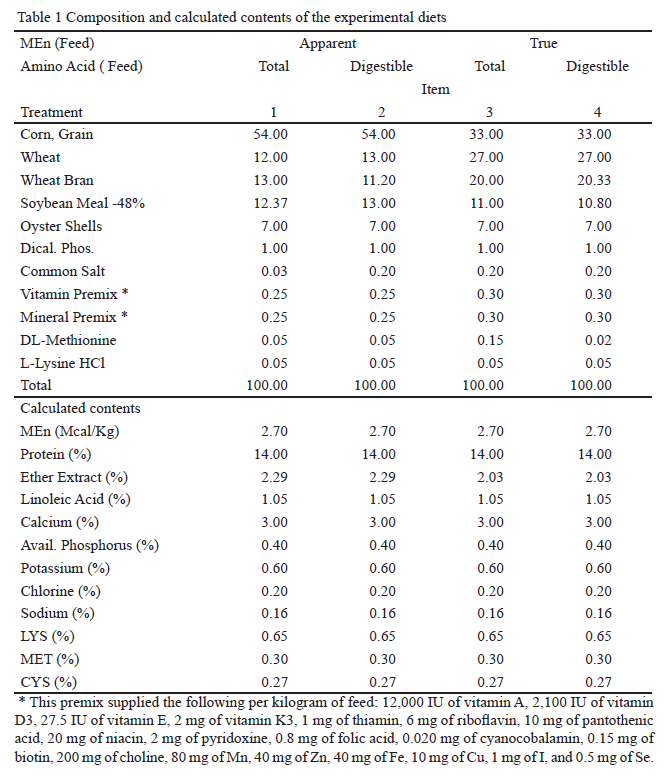
<body><![CDATA[<p align="JUSTIFY">Energy and amino acids are the most important factors   in the diet of broiler breeder hens. Any changes in the daily nutrients   intake of broiler breeder hens must be based on their requirements.   Apart from the requirements for essential amino acids,   protein requirements will be related to the total needs for nitrogen and   to any adverse effects of protein excess. The minimum total nitrogen   requirement of broiler breeders, like any other poultry, has not been   critically determined (Fisher 1987 and 1998). </p>     <p align="JUSTIFY">The yolk and albumen in the egg supply the   developing embryo with nutrients, water and minerals for normal growth.   Yolk is an important nutritional component of the avian egg because it   contributes in 75% of the Joules and provides all the lipids,   and thus the energy, for the developing embryo (Noble <em>et al.</em> 1996), as well as being an important protein source (Deeming 2002). </p>     <p align="JUSTIFY">Nutrition of broiler breeder hens can influence   on egg quality and is, therefore, extremely important for the embryo   development and for the successful hatching of a high quality chick.   Current recommendation for diet formulation for broiler   breeder hens are expressed as daily nutrient intakes based on Apparent   Metabolism Energy (AME) rather than True Metabolism Energy (TME) of   feeds (Ross Manual 2007). </p>     <p align="JUSTIFY">Absorption and retention rate of amino acids   depends on two factors. The first factor is digestibility (protein   hydrolysis and absorption) and the second is the rate of amino acids   retention. All amino acids are not available in the food for maintenance     and production. Part of amino acids is not digestible and can vary among   different feeds. So to adjust poultry diets with digestible amino acids   of foods is much better and easier to meet the real requirements of   birds for maintenance and production (Leeson   and Summers 2000). </p>     <p align="JUSTIFY">The objective of this experiment was to evaluate   type of broiler breeder formulation diets on performance. Diets based on   two types of energy (AMEn, TMEn) and two types of amino acids of feeds   (total and digestible).</p> </font>     <p>&nbsp;</p>     <p><font size="3" face="Verdana, Arial, Helvetica, sans-serif"> <strong>MATERIALS AND METHODS</strong> </font></p> <font size="2" face="Verdana, Arial, Helvetica, sans-serif">    <p align="JUSTIFY">To determine the effects of diet formulation on the   Arian broiler breeder performance, 168 hens and 24 males was used (50 to   64 week). A completely randomized experimental design with a 2 &times; 2   factorial arrangement was used, with four treatments   and sex replications per treatment. The first factor included two types   of Apparent and True Metabolizable Energy corrected for nitrogen (AMEn   and TMEn) of feeds, the second factor included two levels of Total Amino   Acids (TAA) and Digestible Amino   Acids of feeds (DAA). At 50 weeks of age, broiler breeders were weighed,   and allocated to treatment groups based on the mean body weight (g),   female (3550 &plusmn; 25) and male (4390 &plusmn; 30). </p>     <p align="JUSTIFY">The pattern of total and digestible amino acids   and also nitrogen corrected apparent and true metabolizable energy were   determined for foods (Yaghobfar and Boidaji 2002 and Yaghobfar and   Zahedifar 2003). The adjustments of diets were based on   the requirements of Arian broiler breeder (Arian Breeder Management   Guide, 2002). <a href="/img/revistas/cjas/v49n1/t0109115.gif">Table 1</a> shows the composition and calculated contents of   the diets. Foods provided was mashed and milled with a 3 mm screen to   obtain a similar particle size in all   diets. Both, males and female broiler breeders received the same diets   at 8:00 am. Diets provided 410 Kcal of metabolizable   energy and 21/2 g of protein on a day. Eggs were collected at 52, 56,   60 and 64 weeks old. A random sample of eggs production per day from   each replicate (24 total eggs/day) was collected to   determine egg characteristics. An amount of 168 eggs were used for   measuring egg characteristics in a week (7 eggs for every replicated). </p>     
<p align="JUSTIFY">At the end of the week, eggs (about 30 eggs per   replicate) were put into a Maino, force-draft incubator (Model II, Maino   Enrico Co., Italy). On the 18th d of incubation, eggs with apparently   living embryos were transferred to hatching   baskets and randomly distributed in the same trolley. All chicks were   removed at 21.5 d of incubation. Both, hatchability (number of saleable   chicks hatched per all eggs set&times;100) and fertility (number of fertile   eggs set per all eggs set&times;100)   were calculated. </p>     ]]></body>
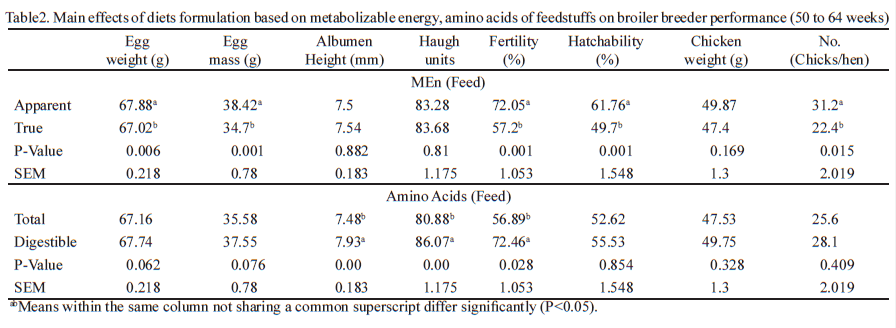
<body><![CDATA[<p align="JUSTIFY">Data were analyzed by 2&times;2 factorial arrangement   (GLM procedure, An ANOVA of SAS Institute, 2001) and where significance   occurred, means were compared with Duncan (1955) multiple range tests.   Output data were expressed as means with SEM.</p> </font>     <p>&nbsp;</p>     <p><font size="3" face="Verdana, Arial, Helvetica, sans-serif"><strong>RESULTS AND DISCUSSION</strong></font></p> <font size="2" face="Verdana, Arial, Helvetica, sans-serif">    <p align="JUSTIFY">The results indicated that egg weight was   significantly superior on treatment fed diets formulation based on AMEn   by 67.88 than TMEn by 67.02 g (P&lt;0.05). These results agree with   Leeson and Summers (2000), who showed that increased energy   intake had significantly positive effects on egg weight. </p>     <p align="JUSTIFY">Bornstein <em>et al.</em> (1979), Bornstein and Lev (1982) and Attia <em>et al.</em> (1995) observed that the broiler breeder hens (21 to 61   weeks) had a significant positive correlation between energy intake   (396, 423 and 450 kcal/hen/day) and fertility   and hatchability. No reports describe the effects of diet formulation   based on MEn and amino acids of feedstuffs on fertility and   hatchability. </p>     <p align="JUSTIFY">Diets formulation based on amino acids of feed   (TAAF, DAA) had significantly increased in albumen height, Haugh unit   and fertility (P&lt;0.05). The results of this experiment agree with the   report of Butts and Cunningham (1972),   who informed that a reduction in albumen is observed when birds receive   low-protein diets, suggesting that these diets are lower in essential   amino acids (EAA). This diet leads to insufficient protein synthesis to   meet the needs for egg   formation. Chemical composition of eggs can be influenced by dietary   protein level. </p>     <p align="JUSTIFY">The egg size and internal quality of eggs are   important for hatching eggs. Fertility and hatchability are the major   economical traits in broiler breeder reproductive performance.   Hatchability was significant in diet formulation based on energy and   amino acids of feedstuffs (<a href="/img/revistas/cjas/v49n1/t0209115.gif">table 2</a>). Main effects of energy was   significant in fertility (P&lt;0.05). The fertility and hatchability   were significantly higher on treatment fed diets formulation based on   AMEn by 72.05 and 61.76% than on TMEn by 57.2 and   49.7%, respectively (P&lt;0.05). These results are in agreement with the   findings of Benton and Brake (1996), who noted that the rate of water   loss from the egg during incubation was not influenced by albumen   quality, but suggested that thick albumen may   slow vital gas diffusion, limit nutrient availability to the embryo,   and, subsequently, increase the incidence of embryonic death. Changes in   hatchability of broiler breeder females have been reported to be   related to many factors, such as storage time (Kirk <em>et al.</em> 1980), incubation position, incubation conditions (Kirk <em>et al.</em>1980 and Tullett and Burton 1982), and shell quality   (Bennett 1992). Other researchers have found that bird age (Mather and   Laughlin 1979) and egg size (Morris <em>et al.</em> 1968) also affect hatchability but this experiment showed   that broiler breeder hens fed AMEn diets had a higher egg weight,   fertility and hatchability. This difference was significant (P&lt;0.05). </p>     
<p align="JUSTIFY">The interaction between energy and amino acids of   feeds had significant difference on performance and egg   characteristics. The diets formulation based on AMEn+DAA had best   performance in egg weight, (68.97 g); egg mass, (43.1   g/hen/day); albumen height, (7.96 mm); Haugh unit (86.32); fertility, (81.51%); hatchability, (64.69 %); chicken   weight, (50.27 g) and No. chickens per hen (34.3).This difference was   significant (<a href="/img/revistas/cjas/v49n1/t0309115.gif">table 3</a>). </p>     
<p align="JUSTIFY">The amount of chickens from each broiler breeder   hen (50 to 64 weeks) was significantly different. Treatment 2 (AMEn+DAA)   had 34.3 chicks and treatment 4 (TMEn+DAA) had 21.8 chicks. There are   no reports on interactions between   the effects of diet formulation based on MEn and amino acids of feeds as   they influence on reproductive performance of broiler breeders. </p>     <p align="JUSTIFY">Diet formulation based on AMEn + DAA for broiler   breeder significantly increased egg weight, egg mass, albumen hieght,   Haugh unit, fertility, hatchability, chicken weight and number of   chickens per hen. Feeding broiler breeder digestible amino   acids of feedstuffs significantly increased egg weight more than broiler   breeders fed total amino acids of feeds density diets. Formulating   broiler diets based on digestible amino acids of feeds gives a better   prediction of dietary protein quality and broiler   breeder performance than total amino acids. </p>     ]]></body>
<body><![CDATA[<p align="JUSTIFY">Feeding broiler breeder AMEn diets significantly increased fertility, hatchability and amount of chickens per hen. </p> </font>     <p>&nbsp;</p>     <p><font size="2" face="Verdana, Arial, Helvetica, sans-serif"><font size="3"><strong>BIBLIOGRAPHY</strong></font></font></p> <font size="2" face="Verdana, Arial, Helvetica, sans-serif">    <!-- ref --><p align="justify">Arian B. 2002. <em>Management Guide</em>. 4th ed., Armaghan: Ministry of  Agriculture.    <br>       <br>   Attia Y. A., Burke W. H., Yamani K.  A. &amp; Jensen L. S. 1995. &lsquo;&lsquo;Daily energy allotments and  performance of broiler breeders. 2. Females&rsquo;&rsquo;. <em>Poultry Science</em>, 74 (2),  pp. 261&ndash;270.    <br>       <br>   Bennett C. D. 1992. &lsquo;&lsquo;The influence of shell thickness on hatchability in  commercial broiler breeder flocks&rsquo;&rsquo;. <em>The Journal of Applied Poultry Research</em>,  1 (1), pp. 61&ndash;65.    <br>       <br>   Benton C. E. &amp; Brake J. 1996. &lsquo;&lsquo;The effect of broiler breeder flock age  and length of egg storage on egg albumen during early incubation&rsquo;&rsquo;. <em>Poultry  Science</em>, 75 (9), pp. 1069&ndash;1075.    ]]></body>
<body><![CDATA[<br>       <br>   Bornstein S., Hurwitz S. &amp; Lev Y. 1979. &lsquo;&lsquo;The amino acid and energy  requirements of broiler breeder hens&rsquo;&rsquo;. <em>Poultry Science</em>, 58 (1), pp. 104&ndash;116.    <br>       <br>   Bornstein S. &amp; Lev Y. 1982.  &lsquo;&lsquo;The energy requirements of broiler breeders during the pullet-layer  transition period&rsquo;&rsquo;. <em>Poultry Science</em>, 61 (4), pp. 755&ndash;765.    <br>       <br>   Burke W. &amp; Jensen L. S. 1994.  &lsquo;&lsquo;Energy restriction of breeder hens affects performance&rsquo;&rsquo;. <em>Arbor Accres  Review</em>, 37 (1).    <br>       <br>   Butts J. N. &amp; Cunningham F. E.  1972. &lsquo;&lsquo;Effect of dietary protein on selected properties of the egg&rsquo;&rsquo;. <em>Poultry  Science</em>, 51 (5), pp. 1726&ndash;1734.    <br>       <br>   Deeming D. C. &amp; Deeming D. .  2002. &lsquo;&lsquo;Embryonic development and utilisation of egg components&rsquo;&rsquo;. In: <em>Avian  incubation: behaviour, environment, and evolution</em>, vol. 13, Oxford:     ]]></body>
<body><![CDATA[<br>   Oxford  University Press, pp. 43&ndash;53.    <br>       <br>   Duncan D. B. 1955. &lsquo;&lsquo;Multiple range  and multiple F tests&rsquo;&rsquo;. <em>Biometrics</em>, 11 (1), pp. 1&ndash;42.    <br>       <br>   Fisher C. 1987. &lsquo;&lsquo;Calculating amino  acid requirements&rsquo;&rsquo;. In: Sydney, Australia: Poultry   Husbandry Research  Foundation, pp. 104&ndash;122.    <br>       <br>   Fisher C. 1998. &lsquo;&lsquo;Lysine: amino acid  requirements of broiler breeders&rsquo;&rsquo;. <em>Poultry Science</em>, 77 (1), pp.  124&ndash;133.    <br>       <br>   Ingram D. R. &amp; Wilson H. R.  1987. &lsquo;&lsquo;Ad libitum feeding of broiler breeders prior to peak egg production&rsquo;&rsquo;. <em>Nutrition  reports international</em>, 36 (4), pp. 839&ndash;845.    <br>       ]]></body>
<body><![CDATA[<br>   Kirk S., Emmans G. C., McDonald R.  &amp; Arnot D. 1980. &lsquo;&lsquo;Factors affecting the hatchability of eggs from broiler  breeders&rsquo;&rsquo;. <em>British Poultry Science</em>, 21 (1), pp. 37&ndash;53.    <br>       <br>   Leeson S. &amp; Summers J. D. 1983.  &lsquo;&lsquo;Consequence of increased feed allowance for growing broiler breeder pullets  as a means of stimulating early maturity&rsquo;&rsquo;. <em>Poultry Science</em>, 62 (1), pp.  6&ndash;11.    <br>       <!-- ref --><br>   Leeson S. &amp; Summers J. D. 2000. <em>Broiler  breeder production</em>. Guelph, Ontario: University books.    <br>       <br>   Mather C. M. &amp; Laughlin K. F.  1979. &lsquo;&lsquo;Storage of hatching eggs: The interaction between parental age and  early embryonic development&rsquo;&rsquo;. <em>British Poultry Science</em>, 20 (6), pp.  595&ndash;604.    <br>       <br>   Morris R. H., Hessels D. F. &amp;  Bishop R. J. 1968. &lsquo;&lsquo;The relationship between hatching egg weight and  subsequent performance of broiler chickens&rsquo;&rsquo;. <em>British Poultry Science</em>, 9  (4), pp. 305&ndash;315.    <br>       ]]></body>
<body><![CDATA[<br>   Noble R. C., Speake B. K., McCartney  R., Foggin C. M. &amp; Deeming D. C. 1996. &lsquo;&lsquo;Yolk lipids and their fatty acids  in the wild and captive ostrich (Struthio camelus)&rsquo;&rsquo;. <em>Comparative  Biochemistry and Physiology Part B: Biochemistry and Molecular Biology</em>, 113  (4), pp. 753&ndash;756.    <br>       <!-- ref --><br>   Ross 308. 2007. <em>Parent Stock Nutrition Specification Manual</em>.  Scotland, UK.    <br>       <!-- ref --><br>   SAS Institute. 2001. <em>The SAS System for Windows</em>. version Release  8.02.SAS Inst. Inc., Cary. NC.    <br>       <br>   Tullett S. G. &amp; Burton F. G. 1982. &lsquo;&lsquo;Factors affecting the weight and  water status of the chick at hatch&rsquo;&rsquo;. <em>British Poultry Science</em>, 23 (4), pp. 361&ndash;369.    <br>       <br>   Wilson H. R. &amp; Harms R. H. 1986.  &lsquo;&lsquo;Performance of broiler breeders as affected by body weight during the  breeding season&rsquo;&rsquo;. <em>Poultry Science</em>, 65 (6), pp. 1052&ndash;1057.    <br>       ]]></body>
<body><![CDATA[<br>   Yaghobfar A. &amp; Boldaji F. 2002.  &lsquo;&lsquo;Influence of level of feed input and procedure on metabolisable energy and  endogenous energy loss (EEL) with adult cockerels&rsquo;&rsquo;. <em>British poultry science</em>,  43 (5), pp. 696&ndash;704.    <br>       <br> Yaghobfar A.  &amp; Zahedifar M. 2003. &lsquo;&lsquo;Endogenous losses of energy and amino acids in birds  and their effect on true metabolisable energy values and availability of amino  acids in maize&rsquo;&rsquo;. <em>British poultry science</em>, 44 (5), pp. 719&ndash;725.</p></font>     <p align="justify">&nbsp;</p>     <p align="justify">&nbsp;</p>      <p><font size="2" face="Verdana, Arial, Helvetica, sans-serif">Received: December 21, 2012    <br> Accepted: November 1, 2013</font></p>     <p>&nbsp;</p>     <p>&nbsp;</p>     <p><font size="2" face="Verdana, Arial, Helvetica, sans-serif"><em>J. Nasr,</em> Department of Animal Science, Saveh Branch, Islamic Azad University, Saveh, Iran.    Email: <a href="mailto:Javadnasr@iau-saveh.ac.ir  ">Javadnasr@iau-saveh.ac.ir  </a></font></p>     ]]></body>
<body><![CDATA[ ]]></body><back>
<ref-list>
<ref id="B1">
<nlm-citation citation-type="book">
<person-group person-group-type="author">
<name>
<surname><![CDATA[Arian]]></surname>
<given-names><![CDATA[B.]]></given-names>
</name>
</person-group>
<source><![CDATA[Management Guide]]></source>
<year>2002</year>
<edition>4th</edition>
<publisher-loc><![CDATA[Armaghan ]]></publisher-loc>
<publisher-name><![CDATA[Ministry of Agriculture]]></publisher-name>
</nlm-citation>
</ref>
<ref id="B2">
<nlm-citation citation-type="journal">
<person-group person-group-type="author">
<name>
<surname><![CDATA[Attia]]></surname>
<given-names><![CDATA[Y. A.]]></given-names>
</name>
<name>
<surname><![CDATA[Burke]]></surname>
<given-names><![CDATA[W. H.]]></given-names>
</name>
<name>
<surname><![CDATA[Yamani]]></surname>
<given-names><![CDATA[K. A.]]></given-names>
</name>
<name>
<surname><![CDATA[Jensen]]></surname>
<given-names><![CDATA[L. S.]]></given-names>
</name>
</person-group>
<article-title xml:lang="nd"><![CDATA[Daily energy allotments and performance of broiler breeders. 2. Females]]></article-title>
<source><![CDATA[Poultry Science]]></source>
<year>1995</year>
<volume>74</volume>
<numero>2</numero>
<issue>2</issue>
<page-range>261–270</page-range></nlm-citation>
</ref>
<ref id="B3">
<nlm-citation citation-type="journal">
<person-group person-group-type="author">
<name>
<surname><![CDATA[Bennett]]></surname>
<given-names><![CDATA[C. D.]]></given-names>
</name>
</person-group>
<article-title xml:lang="nd"><![CDATA[The influence of shell thickness on hatchability in commercial broiler breeder flocks]]></article-title>
<source><![CDATA[The Journal of Applied Poultry Research]]></source>
<year>1992</year>
<volume>1</volume>
<numero>1</numero>
<issue>1</issue>
<page-range>61–65</page-range></nlm-citation>
</ref>
<ref id="B4">
<nlm-citation citation-type="journal">
<person-group person-group-type="author">
<name>
<surname><![CDATA[Benton]]></surname>
<given-names><![CDATA[C. E.]]></given-names>
</name>
<name>
<surname><![CDATA[Brake]]></surname>
<given-names><![CDATA[J.]]></given-names>
</name>
</person-group>
<article-title xml:lang="nd"><![CDATA[The effect of broiler breeder flock age and length of egg storage on egg albumen during early incubation]]></article-title>
<source><![CDATA[Poultry Science]]></source>
<year>1996</year>
<volume>75</volume>
<numero>9</numero>
<issue>9</issue>
<page-range>1069–1075</page-range></nlm-citation>
</ref>
<ref id="B5">
<nlm-citation citation-type="journal">
<person-group person-group-type="author">
<name>
<surname><![CDATA[Bornstein]]></surname>
<given-names><![CDATA[S.]]></given-names>
</name>
<name>
<surname><![CDATA[Hurwitz]]></surname>
<given-names><![CDATA[S.]]></given-names>
</name>
<name>
<surname><![CDATA[Lev]]></surname>
<given-names><![CDATA[Y.]]></given-names>
</name>
</person-group>
<article-title xml:lang="nd"><![CDATA[The amino acid and energy requirements of broiler breeder hens]]></article-title>
<source><![CDATA[Poultry Science]]></source>
<year>1979</year>
<volume>58</volume>
<numero>1</numero>
<issue>1</issue>
<page-range>104–116</page-range></nlm-citation>
</ref>
<ref id="B6">
<nlm-citation citation-type="journal">
<person-group person-group-type="author">
<name>
<surname><![CDATA[Bornstein]]></surname>
<given-names><![CDATA[S.]]></given-names>
</name>
<name>
<surname><![CDATA[Lev]]></surname>
<given-names><![CDATA[Y.]]></given-names>
</name>
</person-group>
<article-title xml:lang="nd"><![CDATA[The energy requirements of broiler breeders during the pullet-layer transition period]]></article-title>
<source><![CDATA[Poultry Science]]></source>
<year>1982</year>
<volume>61</volume>
<numero>4</numero>
<issue>4</issue>
<page-range>755–765</page-range></nlm-citation>
</ref>
<ref id="B7">
<nlm-citation citation-type="journal">
<person-group person-group-type="author">
<name>
<surname><![CDATA[Burke]]></surname>
<given-names><![CDATA[W.]]></given-names>
</name>
<name>
<surname><![CDATA[Jensen]]></surname>
<given-names><![CDATA[L. S.]]></given-names>
</name>
</person-group>
<article-title xml:lang="nd"><![CDATA[Energy restriction of breeder hens affects performance]]></article-title>
<source><![CDATA[Arbor Accres Review]]></source>
<year>1994</year>
<volume>37</volume>
<numero>1</numero>
<issue>1</issue>
</nlm-citation>
</ref>
<ref id="B8">
<nlm-citation citation-type="journal">
<person-group person-group-type="author">
<name>
<surname><![CDATA[Butts]]></surname>
<given-names><![CDATA[J. N.]]></given-names>
</name>
<name>
<surname><![CDATA[Cunningham]]></surname>
<given-names><![CDATA[F. E.]]></given-names>
</name>
</person-group>
<article-title xml:lang="nd"><![CDATA[Effect of dietary protein on selected properties of the egg]]></article-title>
<source><![CDATA[Poultry Science]]></source>
<year>1972</year>
<volume>51</volume>
<numero>5</numero>
<issue>5</issue>
<page-range>1726–1734</page-range></nlm-citation>
</ref>
<ref id="B9">
<nlm-citation citation-type="book">
<person-group person-group-type="author">
<name>
<surname><![CDATA[Deeming]]></surname>
<given-names><![CDATA[D. C.]]></given-names>
</name>
<name>
<surname><![CDATA[Deeming]]></surname>
<given-names><![CDATA[D. .]]></given-names>
</name>
</person-group>
<article-title xml:lang="nd"><![CDATA[Embryonic development and utilisation of egg components]]></article-title>
<source><![CDATA[Avian incubation: behaviour, environment, and evolution]]></source>
<year>2002</year>
<volume>13</volume>
<page-range>43–53</page-range><publisher-loc><![CDATA[Oxford ]]></publisher-loc>
<publisher-name><![CDATA[Oxford University Press]]></publisher-name>
</nlm-citation>
</ref>
<ref id="B10">
<nlm-citation citation-type="journal">
<person-group person-group-type="author">
<name>
<surname><![CDATA[Duncan]]></surname>
<given-names><![CDATA[D. B.]]></given-names>
</name>
</person-group>
<article-title xml:lang="nd"><![CDATA[Multiple range and multiple F tests]]></article-title>
<source><![CDATA[Biometrics]]></source>
<year>1955</year>
<volume>11</volume>
<numero>1</numero>
<issue>1</issue>
<page-range>1–42</page-range></nlm-citation>
</ref>
<ref id="B11">
<nlm-citation citation-type="book">
<person-group person-group-type="author">
<name>
<surname><![CDATA[Fisher]]></surname>
<given-names><![CDATA[C.]]></given-names>
</name>
</person-group>
<article-title xml:lang="nd"><![CDATA[Calculating amino acid requirements]]></article-title>
<source><![CDATA[]]></source>
<year>1987</year>
<page-range>104–122</page-range><publisher-loc><![CDATA[Sydney, Australia ]]></publisher-loc>
<publisher-name><![CDATA[Poultry Husbandry Research Foundation]]></publisher-name>
</nlm-citation>
</ref>
<ref id="B12">
<nlm-citation citation-type="journal">
<person-group person-group-type="author">
<name>
<surname><![CDATA[Fisher]]></surname>
<given-names><![CDATA[C.]]></given-names>
</name>
</person-group>
<article-title xml:lang="nd"><![CDATA[Lysine: amino acid requirements of broiler breeders]]></article-title>
<source><![CDATA[Poultry Science]]></source>
<year>1998</year>
<volume>77</volume>
<numero>1</numero>
<issue>1</issue>
<page-range>124–133</page-range></nlm-citation>
</ref>
<ref id="B13">
<nlm-citation citation-type="journal">
<person-group person-group-type="author">
<name>
<surname><![CDATA[Ingram]]></surname>
<given-names><![CDATA[D. R.]]></given-names>
</name>
<name>
<surname><![CDATA[Wilson]]></surname>
<given-names><![CDATA[H. R.]]></given-names>
</name>
</person-group>
<article-title xml:lang="nd"><![CDATA[Ad libitum feeding of broiler breeders prior to peak egg production]]></article-title>
<source><![CDATA[Nutrition reports international]]></source>
<year>1987</year>
<volume>36</volume>
<numero>4</numero>
<issue>4</issue>
<page-range>839–845</page-range></nlm-citation>
</ref>
<ref id="B14">
<nlm-citation citation-type="journal">
<person-group person-group-type="author">
<name>
<surname><![CDATA[Kirk]]></surname>
<given-names><![CDATA[S.]]></given-names>
</name>
<name>
<surname><![CDATA[Emmans]]></surname>
<given-names><![CDATA[G. C.]]></given-names>
</name>
<name>
<surname><![CDATA[McDonald]]></surname>
<given-names><![CDATA[R.]]></given-names>
</name>
<name>
<surname><![CDATA[Arnot]]></surname>
<given-names><![CDATA[D.]]></given-names>
</name>
</person-group>
<article-title xml:lang="nd"><![CDATA[Factors affecting the hatchability of eggs from broiler breeders]]></article-title>
<source><![CDATA[British Poultry Science]]></source>
<year>1980</year>
<volume>21</volume>
<numero>1</numero>
<issue>1</issue>
<page-range>37–53</page-range></nlm-citation>
</ref>
<ref id="B15">
<nlm-citation citation-type="journal">
<person-group person-group-type="author">
<name>
<surname><![CDATA[Leeson]]></surname>
<given-names><![CDATA[S.]]></given-names>
</name>
<name>
<surname><![CDATA[Summers]]></surname>
<given-names><![CDATA[J. D.]]></given-names>
</name>
</person-group>
<article-title xml:lang="nd"><![CDATA[Consequence of increased feed allowance for growing broiler breeder pullets as a means of stimulating early maturity]]></article-title>
<source><![CDATA[Poultry Science]]></source>
<year>1983</year>
<volume>62</volume>
<numero>1</numero>
<issue>1</issue>
<page-range>6–11</page-range></nlm-citation>
</ref>
<ref id="B16">
<nlm-citation citation-type="book">
<person-group person-group-type="author">
<name>
<surname><![CDATA[Leeson]]></surname>
<given-names><![CDATA[S.]]></given-names>
</name>
<name>
<surname><![CDATA[Summers]]></surname>
<given-names><![CDATA[J. D.]]></given-names>
</name>
</person-group>
<source><![CDATA[Broiler breeder production]]></source>
<year>2000</year>
<publisher-loc><![CDATA[Guelph, Ontario ]]></publisher-loc>
<publisher-name><![CDATA[University books]]></publisher-name>
</nlm-citation>
</ref>
<ref id="B17">
<nlm-citation citation-type="journal">
<person-group person-group-type="author">
<name>
<surname><![CDATA[Mather]]></surname>
<given-names><![CDATA[C. M.]]></given-names>
</name>
<name>
<surname><![CDATA[Laughlin]]></surname>
<given-names><![CDATA[K. F.]]></given-names>
</name>
</person-group>
<article-title xml:lang="nd"><![CDATA[Storage of hatching eggs: The interaction between parental age and early embryonic development]]></article-title>
<source><![CDATA[British Poultry Science]]></source>
<year>1979</year>
<volume>20</volume>
<numero>6</numero>
<issue>6</issue>
<page-range>595–604</page-range></nlm-citation>
</ref>
<ref id="B18">
<nlm-citation citation-type="journal">
<person-group person-group-type="author">
<name>
<surname><![CDATA[Morris]]></surname>
<given-names><![CDATA[R. H.]]></given-names>
</name>
<name>
<surname><![CDATA[Hessels]]></surname>
<given-names><![CDATA[D. F.]]></given-names>
</name>
<name>
<surname><![CDATA[Bishop]]></surname>
<given-names><![CDATA[R. J.]]></given-names>
</name>
</person-group>
<article-title xml:lang="nd"><![CDATA[The relationship between hatching egg weight and subsequent performance of broiler chickens]]></article-title>
<source><![CDATA[British Poultry Science]]></source>
<year>1968</year>
<volume>9</volume>
<numero>4</numero>
<issue>4</issue>
<page-range>305–315</page-range></nlm-citation>
</ref>
<ref id="B19">
<nlm-citation citation-type="journal">
<person-group person-group-type="author">
<name>
<surname><![CDATA[Noble]]></surname>
<given-names><![CDATA[R. C.]]></given-names>
</name>
<name>
<surname><![CDATA[Speake]]></surname>
<given-names><![CDATA[B. K.]]></given-names>
</name>
<name>
<surname><![CDATA[McCartney]]></surname>
<given-names><![CDATA[R.]]></given-names>
</name>
<name>
<surname><![CDATA[Foggin]]></surname>
<given-names><![CDATA[C. M.]]></given-names>
</name>
<name>
<surname><![CDATA[Deeming]]></surname>
<given-names><![CDATA[D. C.]]></given-names>
</name>
</person-group>
<article-title xml:lang="nd"><![CDATA[Yolk lipids and their fatty acids in the wild and captive ostrich (Struthio camelus)]]></article-title>
<source><![CDATA[Comparative Biochemistry and Physiology Part B: Biochemistry and Molecular Biology]]></source>
<year>1996</year>
<volume>113</volume>
<numero>4</numero>
<issue>4</issue>
<page-range>753–756</page-range></nlm-citation>
</ref>
<ref id="B20">
<nlm-citation citation-type="">
<person-group person-group-type="author">
<name>
<surname><![CDATA[Ross 308]]></surname>
</name>
</person-group>
<source><![CDATA[Parent Stock Nutrition Specification Manual]]></source>
<year>2007</year>
<publisher-loc><![CDATA[Scotland, UK ]]></publisher-loc>
</nlm-citation>
</ref>
<ref id="B21">
<nlm-citation citation-type="">
<person-group person-group-type="author">
<name>
<surname><![CDATA[SAS Institute]]></surname>
</name>
</person-group>
<source><![CDATA[The SAS System for Windows]]></source>
<year>2001</year>
<publisher-loc><![CDATA[Cary. NC. ]]></publisher-loc>
</nlm-citation>
</ref>
<ref id="B22">
<nlm-citation citation-type="journal">
<person-group person-group-type="author">
<name>
<surname><![CDATA[Tullett]]></surname>
<given-names><![CDATA[S. G.]]></given-names>
</name>
<name>
<surname><![CDATA[Burton]]></surname>
<given-names><![CDATA[F. G.]]></given-names>
</name>
</person-group>
<article-title xml:lang="nd"><![CDATA[Factors affecting the weight and water status of the chick at hatch]]></article-title>
<source><![CDATA[British Poultry Science]]></source>
<year>1982</year>
<volume>23</volume>
<numero>4</numero>
<issue>4</issue>
<page-range>361–369</page-range></nlm-citation>
</ref>
<ref id="B23">
<nlm-citation citation-type="journal">
<person-group person-group-type="author">
<name>
<surname><![CDATA[Wilson]]></surname>
<given-names><![CDATA[H. R.]]></given-names>
</name>
<name>
<surname><![CDATA[Harms]]></surname>
<given-names><![CDATA[R. H.]]></given-names>
</name>
</person-group>
<article-title xml:lang="nd"><![CDATA[Performance of broiler breeders as affected by body weight during the breeding season]]></article-title>
<source><![CDATA[Poultry Science]]></source>
<year>1986</year>
<volume>65</volume>
<numero>6</numero>
<issue>6</issue>
<page-range>1052–1057</page-range></nlm-citation>
</ref>
<ref id="B24">
<nlm-citation citation-type="journal">
<person-group person-group-type="author">
<name>
<surname><![CDATA[Yaghobfar]]></surname>
<given-names><![CDATA[A.]]></given-names>
</name>
<name>
<surname><![CDATA[Boldaji]]></surname>
<given-names><![CDATA[F.]]></given-names>
</name>
</person-group>
<article-title xml:lang="nd"><![CDATA[Influence of level of feed input and procedure on metabolisable energy and endogenous energy loss (EEL) with adult cockerels]]></article-title>
<source><![CDATA[British poultry science]]></source>
<year>2002</year>
<volume>43</volume>
<numero>5</numero>
<issue>5</issue>
<page-range>696–704</page-range></nlm-citation>
</ref>
<ref id="B25">
<nlm-citation citation-type="journal">
<person-group person-group-type="author">
<name>
<surname><![CDATA[Yaghobfar]]></surname>
<given-names><![CDATA[A.]]></given-names>
</name>
<name>
<surname><![CDATA[Zahedifar]]></surname>
<given-names><![CDATA[M.]]></given-names>
</name>
</person-group>
<article-title xml:lang="nd"><![CDATA[Endogenous losses of energy and amino acids in birds and their effect on true metabolisable energy values and availability of amino acids in maize]]></article-title>
<source><![CDATA[British poultry science]]></source>
<year>2003</year>
<volume>44</volume>
<numero>5</numero>
<issue>5</issue>
<page-range>719–725</page-range></nlm-citation>
</ref>
</ref-list>
</back>
</article>