<?xml version="1.0" encoding="ISO-8859-1"?><article xmlns:mml="http://www.w3.org/1998/Math/MathML" xmlns:xlink="http://www.w3.org/1999/xlink" xmlns:xsi="http://www.w3.org/2001/XMLSchema-instance">
<front>
<journal-meta>
<journal-id>2079-3480</journal-id>
<journal-title><![CDATA[Cuban Journal of Agricultural Science]]></journal-title>
<abbrev-journal-title><![CDATA[Cuban J. Agric. Sci.]]></abbrev-journal-title>
<issn>2079-3480</issn>
<publisher>
<publisher-name><![CDATA[Editorial del Instituto de Ciencia Animal]]></publisher-name>
</publisher>
</journal-meta>
<article-meta>
<article-id>S2079-34802015000100011</article-id>
<title-group>
<article-title xml:lang="en"><![CDATA[Silage of alternative feeds of Cuban origin, a technical, economical and environmental option for the production of pork meat]]></article-title>
<article-title xml:lang="es"><![CDATA[Ensilado de alimentos alternativos, de origen cubano, una alternativa técnica, económica y ambiental para la producción de carne de cerdo]]></article-title>
</title-group>
<contrib-group>
<contrib contrib-type="author">
<name>
<surname><![CDATA[Lezcano]]></surname>
<given-names><![CDATA[P]]></given-names>
</name>
<xref ref-type="aff" rid="A01"/>
</contrib>
<contrib contrib-type="author">
<name>
<surname><![CDATA[Vazquez]]></surname>
<given-names><![CDATA[Arelys]]></given-names>
</name>
<xref ref-type="aff" rid="A01"/>
</contrib>
<contrib contrib-type="author">
<name>
<surname><![CDATA[Bolaños]]></surname>
<given-names><![CDATA[A]]></given-names>
</name>
<xref ref-type="aff" rid="A02"/>
</contrib>
<contrib contrib-type="author">
<name>
<surname><![CDATA[Piloto]]></surname>
<given-names><![CDATA[J.L]]></given-names>
</name>
<xref ref-type="aff" rid="A03"/>
</contrib>
<contrib contrib-type="author">
<name>
<surname><![CDATA[Martínez]]></surname>
<given-names><![CDATA[Mayuly]]></given-names>
</name>
<xref ref-type="aff" rid="A01"/>
</contrib>
<contrib contrib-type="author">
<name>
<surname><![CDATA[Rodríguez]]></surname>
<given-names><![CDATA[Y]]></given-names>
</name>
<xref ref-type="aff" rid="A01"/>
</contrib>
</contrib-group>
<aff id="A01">
<institution><![CDATA[,Instituto de Ciencia Animal  ]]></institution>
<addr-line><![CDATA[San José de las Lajas Mayabeque]]></addr-line>
<country>Cuba</country>
</aff>
<aff id="A02">
<institution><![CDATA[,Grupo Empresarial Azucarero Mayabeque Batey Amistad con los Pueblos ]]></institution>
<addr-line><![CDATA[Güines Mayabeque]]></addr-line>
</aff>
<aff id="A03">
<institution><![CDATA[,Instituto de Investigaciones Porcinas  ]]></institution>
<addr-line><![CDATA[Punta Brava La Habana]]></addr-line>
<country>Cuba</country>
</aff>
<pub-date pub-type="pub">
<day>00</day>
<month>03</month>
<year>2015</year>
</pub-date>
<pub-date pub-type="epub">
<day>00</day>
<month>03</month>
<year>2015</year>
</pub-date>
<volume>49</volume>
<numero>1</numero>
<fpage>65</fpage>
<lpage>69</lpage>
<copyright-statement/>
<copyright-year/>
<self-uri xlink:href="http://scielo.sld.cu/scielo.php?script=sci_arttext&amp;pid=S2079-34802015000100011&amp;lng=en&amp;nrm=iso"></self-uri><self-uri xlink:href="http://scielo.sld.cu/scielo.php?script=sci_abstract&amp;pid=S2079-34802015000100011&amp;lng=en&amp;nrm=iso"></self-uri><self-uri xlink:href="http://scielo.sld.cu/scielo.php?script=sci_pdf&amp;pid=S2079-34802015000100011&amp;lng=en&amp;nrm=iso"></self-uri><abstract abstract-type="short" xml:lang="en"><p><![CDATA[For evaluating maize substitution by liquid silage from a mixture of sugar cane molasses B, saccharomyces cream, sweet potato tubercle and concentrated vinasse (0, 33, 66 and 100 % dry basis), 144 Yorkshire/Duroc x Landrace pigs, males and females, in equal proportion with a live weight of 30 kg were used. Animals were distributed in four treatments, according to a completely randomized design. They were housed in collective corrals at a rate of six animals/corral and six replications/treatment. There were no significant differences between treatments for 0, 33 and 66 % substitution but the opposite occurred between these and 100 % maize substitution (P d» 0.05) for average daily gain (532, 565, 544 and 495, and 758, 779, 753 and 687g) in the phases of 0-56 and 0-98 d of stay, respectively. The same took place with total feed conversion (3.22, 3.16, 3.38 and 4.16 kg DM/kg increase and 3.63, 3.54, 3.76 and 4.48 kg DM /kg increase) in both stages, respectively. It was demonstrated that the silage of alternative feeds of Cuban origin (AEC) substituted efficiently the imported maize for pig fattening when used up to 66 % with economical and environmental advantages]]></p></abstract>
<abstract abstract-type="short" xml:lang="es"><p><![CDATA[Para evaluar la sustitución del maíz por un ensilado líquido, a partir de una mezcla de miel B de caña de azúcar, crema sacharomyces, tubérculo de boniato y vinaza concentrada (0, 33, 66 y 100 % en base seca), se utilizaron 144 cerdos Yorkshire/Duroc x Landrace, machos y hembras, en igual proporción, con 30 kg de peso vivo. Se distribuyeron en cuatro tratamientos, según diseño completamente aleatorizado. Se alojaron en corrales colectivos, a razón de seis animales/corral y seis repeticiones/tratamiento. No se encontraron diferencias significativas entre tratamientos para 0, 33 y 66 % de sustitución, y sí entre estos y 100 % de sustitución del maíz (P d» 0.05) para la ganancia media diaria (532, 565, 544 y 495) y (758, 779, 753 y 687g) en las etapas de 0-56 y 0-98 d de estancia, respectivamente. Lo mismo ocurrió con la conversión alimentaria total (3.22, 3.16, 3.38 y 4.16 kg MS/kg aumento y 3.63, 3.54, 3.76 y 4.48 kg MS/kg aumento) ambas etapas, respectivamente. Se demostró que el ensilado de alimentos alternativos de origen cubano (AEC) sustituyó eficientemente el maíz de importación en la ceba de cerdos, cuando se utilizó hasta 66 %, con ventajas económicas y ambientales]]></p></abstract>
<kwd-group>
<kwd lng="en"><![CDATA[maize]]></kwd>
<kwd lng="en"><![CDATA[silage]]></kwd>
<kwd lng="en"><![CDATA[pigs]]></kwd>
<kwd lng="es"><![CDATA[maíz]]></kwd>
<kwd lng="es"><![CDATA[ensilaje]]></kwd>
<kwd lng="es"><![CDATA[cerdos]]></kwd>
</kwd-group>
</article-meta>
</front><body><![CDATA[ <p align="right"><font size="2" face="Verdana, Arial, Helvetica, sans-serif"><b>ORIGINAL ARTICLE</b></font></p>     <p>&nbsp;</p>     <p><font size="4" face="Verdana, Arial, Helvetica, sans-serif"><strong>Silage of alternative feeds of Cuban origin, a technical, economical and environmental option for the production of pork meat</strong></font></p>     <p>&nbsp;</p>     <p><font size="3" face="Verdana, Arial, Helvetica, sans-serif"><strong>Ensilado de alimentos alternativos, de origen cubano, una alternativa técnica, económica y ambiental para la producción de carne de cerdo </strong> </font></p>     <p>&nbsp;</p>     <p>&nbsp;</p>     <p><font size="2" face="Verdana, Arial, Helvetica, sans-serif"><strong>P. Lezcano,</strong><sup><strong>I</strong></sup><strong> Arelys Vazquez,</strong><sup><strong>I</strong></sup><strong> A. Bolaños,</strong><sup><strong>II</strong></sup><strong> J.L. Piloto,</strong><sup><strong>III</strong></sup><strong> Mayuly  Martínez,</strong><sup><strong>I</strong></sup><strong> Y. Rodríguez,</strong><sup><strong>I</strong></sup></font></p>     <p><font size="2" face="Verdana, Arial, Helvetica, sans-serif"><strong> </strong></font><font size="2" face="Verdana, Arial, Helvetica, sans-serif"><sup>I</sup>Instituto de Ciencia Animal, Apartado Postal 24, San José de las Lajas, Mayabeque, Cuba.    <br>   <sup>II</sup>Grupo Empresarial Azucarero Mayabeque, Batey Amistad con los Pueblos, Carretera San Nicolás  km. 4 ½,  Güines, Mayabeque.     ]]></body>
<body><![CDATA[<br>   <sup>III</sup>Instituto de Investigaciones Porcinas, Carretera Guatao, km 1 ½, Punta Brava 19 200 La Habana, Cuba. </font></p>     <p>&nbsp;</p>     <p>&nbsp;</p> <hr>     <p><font size="2" face="Verdana, Arial, Helvetica, sans-serif"><strong>ABSTRACT</strong></font></p>     <p align="justify"><font size="2" face="Verdana, Arial, Helvetica, sans-serif">For evaluating maize substitution by liquid silage from a mixture of   sugar cane molasses B, saccharomyces cream, sweet potato tubercle and   concentrated vinasse (0, 33, 66 and 100 % dry basis), 144   Yorkshire/Duroc x Landrace pigs, males and females, in equal proportion   with a live weight of 30 kg   were used. Animals were distributed in four treatments, according to a   completely randomized design.  They were housed in collective corrals at   a rate of six animals/corral and six replications/treatment. There were   no significant differences between treatments for 0, 33 and 66 %   substitution but the opposite   occurred between these and 100 % maize substitution (P d&raquo; 0.05) for   average daily gain (532, 565, 544 and 495, and 758, 779, 753 and 687g)   in the phases of 0-56 and 0-98 d of stay, respectively.   The same took   place with total feed conversion (3.22, 3.16, 3.38 and 4.16 kg DM/kg   increase and 3.63, 3.54, 3.76   and 4.48 kg DM /kg increase) in both stages, respectively. It was   demonstrated that the silage of alternative feeds of Cuban origin (AEC)   substituted efficiently the imported maize for pig fattening when used   up to 66 % with economical and environmental advantages.</font></p>     <p><font size="2" face="Verdana, Arial, Helvetica, sans-serif"><strong>Key words:</strong> maize, silage, pigs.</font></p> <hr>     <p><font size="2" face="Verdana, Arial, Helvetica, sans-serif"><strong>RESUMEN</strong></font></p> <font size="2" face="Verdana, Arial, Helvetica, sans-serif">    <p align="JUSTIFY">Para evaluar la sustituci&oacute;n del ma&iacute;z por un ensilado   l&iacute;quido, a partir de una mezcla de miel B de ca&ntilde;a de az&uacute;car, crema   sacharomyces, tub&eacute;rculo de boniato y vinaza concentrada (0, 33, 66 y 100   % en base seca), se utilizaron 144 cerdos Yorkshire/Duroc x Landrace,   machos y hembras, en   igual proporci&oacute;n, con 30 kg de peso vivo. Se distribuyeron en cuatro   tratamientos, seg&uacute;n dise&ntilde;o completamente aleatorizado.  Se alojaron en   corrales colectivos, a raz&oacute;n de seis animales/corral y seis   repeticiones/tratamiento. No se encontraron diferencias significativas   entre tratamientos para 0,   33 y 66 % de sustituci&oacute;n, y s&iacute; entre estos y 100 % de sustituci&oacute;n del   ma&iacute;z (P d&raquo; 0.05) para la ganancia media diaria (532,   565, 544 y 495)  y (758, 779, 753 y 687g)  en las etapas de  0-56 y 0-98   d de estancia, respectivamente. Lo mismo ocurri&oacute; con  la conversi&oacute;n   alimentaria total (3.22, 3.16, 3.38 y 4.16 kg MS/kg aumento  y  3.63,   3.54, 3.76 y 4.48 kg MS/kg   aumento) ambas etapas, respectivamente. Se demostr&oacute;  que el ensilado de   alimentos alternativos de origen cubano (AEC) sustituy&oacute; eficientemente   el ma&iacute;z de importaci&oacute;n en la ceba de cerdos, cuando se utiliz&oacute; hasta 66   %,  con ventajas econ&oacute;micas y ambientales.</p> </font>     <p><font size="2" face="Verdana, Arial, Helvetica, sans-serif"><strong>Palabras    clave:</strong>    maíz, ensilaje, cerdos.</font></p> <hr>     <p>&nbsp;</p>     ]]></body>
<body><![CDATA[<p>&nbsp;</p>     <p><font size="2" face="Verdana, Arial, Helvetica, sans-serif"><strong><font size="3">INTRODUCTION</font></strong></font></p> <font size="2" face="Verdana, Arial, Helvetica, sans-serif">    <p align="JUSTIFY">Factors such as globalization, the world's population   growth, the climatic change and the biofuel production have presently   contributed notably to the reduction of the availability of the majority   of the foods, both for human or animal consumption (FAO 2013). </p>     <p align="JUSTIFY">Tropical countries, apart from some exceptions,   are not efficient producers of energetic and protein grains for animal   feeding.  In some cases, the competition for feeds between animals and   humans inclines the balance, as logical, to these latter. However,   in the tropics, sugar cane production and its derivatives, by-products,   tubercles, roots and protein forage of different origins, is important,   since can attenuate, to a large extent the deficit of traditional feeds,   as well as to reduce the feeding costs for producing   meat and eggs destined to the population of these regions (Figueroa y Ly   1990). </p>     <p align="JUSTIFY">The above mentioned feeds have been widely   studied by diverse authors with good results. For example, enriched   molasses and cassava meal are capable of substituting efficiently all   the energy contributed by maize in food production of animal origin   (Buitrago 1990, Figueroa and Ly 1990, Hermida 2012 and Zacar&iacute;as 2012). </p>     <p align="JUSTIFY">A procedure named yoghurt of cassava was produced   by the farmers of the central region of Cuba.  It consists of grinding   the cassava root with the peel, adding water until covering it and, for   each 50 kg of root, a liter of natural yogurt must be used.   This technology was rapidly extended due to its easy preparation,   preservation capacity, possibility of using any type of cassava, even   that non fit for human consumption and good acceptance by pigs at levels   higher than 50 %.  At the same time, producers   essayed and attained the substitution of cassava by sweet potato,   obtaining similar results and the same advantages. </p>     <p align="JUSTIFY">With this background, a multidisciplinary group   of researchers of the Institute of Animal Science (ICA) designed the   industrialization of this technology, which was materialized by the   Sugar Business Group (AZCUBA), at the Base Business Unit   (UEB) &laquo;H&eacute;ctor Molina &laquo;, of Mayabeque province. For that, the team of   researchers proposed the formulations evaluated with good results at   research scale, at the Institute as part of the producers of the zone.    The objective of this research was to evaluate the   industrial ensiled feed in the feeding of growing-fattening pigs.</p> </font>     <p>&nbsp;</p>     <p><font size="3" face="Verdana, Arial, Helvetica, sans-serif"> <strong>MATERIALS AND METHODS</strong> </font></p> <font size="2" face="Verdana, Arial, Helvetica, sans-serif">    <p align="JUSTIFY">One hundred forty four crossbred (Yorkshire x   Yorkshire/Duroc) pigs, castrated males and females, in equal   proportions, with 30 kg live weight were used. Animals were distributed   in four treatments, according to a completely randomized design for   studying maize substitution (0, 33, 66 and 100 % in dry basis (DB) by   the silage obtained industrially at the UEB &laquo;H&eacute;ctor Molina&raquo; from a   mixture of sugar cane molasses B, saccharomyces cream, grinded sweet   potato and concentrated vinasse (wasteof the alcoholic fermentation of final molasses). </p>     ]]></body>
<body><![CDATA[<p align="JUSTIFY">Animals were housed in collective corrals at a   rate of six animals/corral and six replications/treatment.  They were   fed daily from the first hours of the morning.  <a href="/img/revistas/cjas/v49n1/t0111115.gif">Table 1</a> shows the   composition of the experimental diets. </p>     
<p align="JUSTIFY">First of all, the standard of dry feed (DF) was   supplied which was moistened by the AEC according the mentioned   treatments.  After consuming the greatest part of the moistened dry feed   (approximately 1 h), the silage was supplied according to the   scale established for the weight range, which varied weekly (<a href="/img/revistas/cjas/v49n1/t0211115.gif">table 2</a>).    Water was given through suction nipples.  Animals were weighed at the   beginning and every 28 d until the end of the trial at 98 d. </p>     
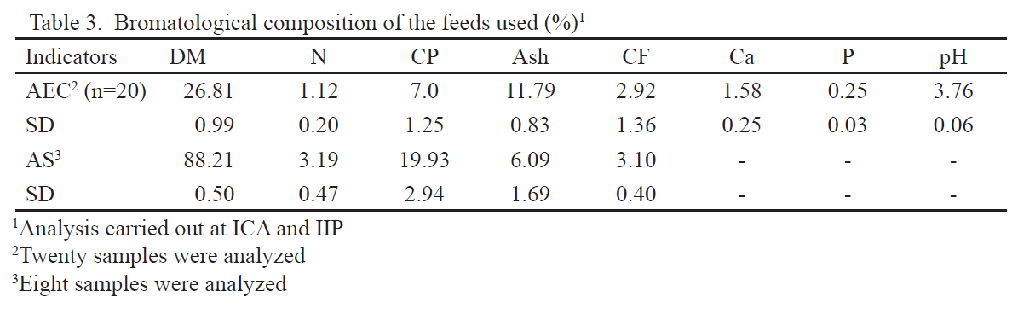
<p align="JUSTIFY">The bromatological composition (<a href="/img/revistas/cjas/v49n1/t0311115.gif">table 3</a>) of the   ensiled material and the dry feed (DF) was determined by the methodology   described in AOAC (2006) (DM, Ash, CP (N x 6.25) and CF).  Calcium (Ca)   and phosphorus (P) were determined according Silva   and de Queiroz (2004). </p>     
<p align="JUSTIFY">The microbiological analyses were carried out for   establishing the hygienic-health care quality of the ensilage produced.   Coliform count was realized according to the pattern NC-120 4832:2002,   total bacteria count according to the pattern NC-120   4833:2002, fungi count by NC-120 7954:2002 and the determination of   Salmonella according to NC-120 7954:2002.  pH was measured by a digital   potentiometer with glass electrode, buffering solutions of pH 4 and 7,   and an electromagnetic  stirring rod for   sample homogenization. </p>     <p align="JUSTIFY">The economic analysis considered the maize cost (90 % DM) of 350 USD   t<sup>-1</sup> and of the AEC (at 90 % DM) of 97.7 USD   t<sup>-1</sup>. Feeding cost per fattened pig was determined. </p>     <p align="JUSTIFY">Results were processed using the statistical program INFOSTAT of Balzarini <em>et al.</em> (2001) Version 1.  Differences between means were established as per Duncan (1955).</p> </font>     <p>&nbsp;</p>     <p><font size="3" face="Verdana, Arial, Helvetica, sans-serif"><strong>RESULTS AND DISCUSSION</strong></font></p> <font size="2" face="Verdana, Arial, Helvetica, sans-serif">    <p align="JUSTIFY">Results from the microbiological analysis were in the   range of the indicators established in the regulations (NC-120   4833:2002, NC-120 7954:2002, NC-120 7954:2002) issued by the Institute   of  Veterinary Medicine of the Republic of Cuba   (2002) for total bacteria count, coliforms, total fungi count and   salmonella (<a href="/img/revistas/cjas/v49n1/t0411115.gif">table 4</a>).  The growth of these pathogens is limited by the   acid pH (3.76) characteristic of the product (Lechevestrier 2005).  This   is associated with the fact that there were no   infectious diarrheas or deaths of animals in the treatments with AEC   which in part is due to the acid pH that also creates a favorable   environment in the gastrointestinal tract of the animals.  Also it is   possible to predict an effect of the <em>Saccharomyces cerevisiae</em> yeast included in the feed. It is known   that the active elements of its wall known as oligosaccharides from   glucanes and mananes, selectively activate the growth of microorganisms   in the gastrointestinal tract (P&eacute;rez 2000 and Galindo <em>et al.</em> 2010) and of the lactobacilli excluding pathogen bacteria   (Blonmdeau 2001), either by a reduction of its possibilities of adhesion   to the wall or directly by an antagonist effect against them (Rodr&iacute;guez   2010). This implies an important saving of medicines as   the antibiotics frequently used for attacking some enteric situations   during the rearing. </p>     
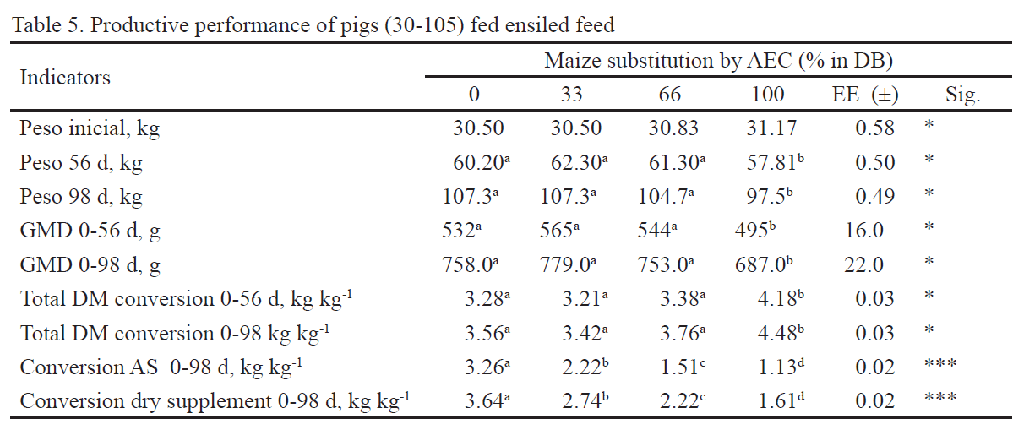
<p align="JUSTIFY">In <a href="/img/revistas/cjas/v49n1/t0511115.gif">table 5</a> is shown that there were no   significant differences for final live weight and average daily gain   (ADG) at 56 and 98 d of experimental stay  but there were between these   and 100 % maize substitution (P d&raquo; 0.05), although the value reported did not   result insignificant to current situations, related to the prices or the   cereal crisis.  A similar tendency was observed with total conversion   in dry basis for the stages analyzed.  It must be highlighted that   conversion is reduced significantly (P d&raquo; 0.01) as maize is substituted   by the silage.  This offers a pattern for the saving of this cereal   destined to growing-fattening of pigs, according to the feeding   technology used. </p>     
]]></body>
<body><![CDATA[<p align="JUSTIFY">Traditional silages, of grass forages and   legumes, are known and prepared since ancient times, mainly in temperate   countries. They are the feeding base of ruminant animals in the coldest   months, in which bovine cattle have to be stabulated (Ca&ntilde;ete and   Sancha 1998). Other biological and chemical silages are produced and   used efficiently in animal feeding from fishing wastes (D&iacute;az 2004 and   Marrero <em>et al.</em> 2009). In addition, the silage of the enriched cassava root is known for fattening pigs (Almaguel <em>et al.</em> 2010). Lezcano <em>et al.</em> (2014) reported high live   weight gains in growing-fattening pigs, on substituting the energy from   maize by cassava root ensiled with water and yogurt or vinasse from   alcohol distilleries. </p>     <p align="JUSTIFY">Hidalgo (2011) carried out other important   studies with concentrated vinasse as additive in poultry and attained   important responses in replacement chicks and layers. Similarly, Mora <em>et al.</em> (2013) referred to the utilization of concentrated vinasse as feed in   pig fattening. </p>     <p align="JUSTIFY">It is important to underline the study of Piloto <em>et al.</em> (1990) substituting soybean by Saccharomyces yeast in pig   fattening with diets of intermediate A and B molasses. These authors   obtained ADG higher than 700 g with marked reduction in the cost per ton of pork meat. </p>     <p align="JUSTIFY">Productive results showed in this study confirm   those previously mentioned.  However, they differ from these because   alternative feeds are mixed, industrially processed and turn into an   energy feed capable of substituting up to 66 % of the maize of the   diet for growth-fattening pigs. Also, they are the first ones reported   for AEC in diets for growing-fattening pigs. </p>     <p align="JUSTIFY">With the plant for processing AEC 60 t d<sup>-1</sup> are   obtained.  The silage can be preserved for six months, without loosing   its nutritional and organoleptic characteristics. On using vinasse from   distilleries, an industrial waste of high polluting effect, a   contribution to environment care is made.  In addition, the   Saccharomyces cream  and molasses B are by-products of the sugar   agroindustry that do not compete directly with human feeding. On the   other hand, the sweet potato that lost commercial value by diverse   causes   is reutilized making good use of it, avoiding in this ways its   putrefaction and consequent contamination. </p>     <p align="JUSTIFY">The economic analysis was carried out taking into   account the maize substitution as energy source of high price in the   international market that continues increasing.  <a href="/img/revistas/cjas/v49n1/t0611115.gif">Table 6</a> shows the   notable reduction of the cost of the diets by the substitution of this   source of energy for growing-fattening pigs. </p>     
<p align="JUSTIFY">Results of this study evidence that the feeding   costs with the inclusion of 66 % AEC per fattened piglet are   considerably reduced regarding the control with a 39.6 % saving. The economical viability of this   technology is high, besides representing the reduction of environmental   pollution, since industrial wastes and tropical roots not used for human   consumption are utilized. </p>     <p align="JUSTIFY">The proposed ensiled feed is an alternative for   the majority of tropical countries, since it is easy to obtain at any   scale and allows that small and medium producers not giving up the   production of pork meat due to the high cereal prices in the last years   as   animal feed (FAO 2008). </p>     <p align="JUSTIFY">From results obtained the substitution of 66 %   maize by AEC is possible for growing-fattening pigs.  With its   utilization important economic and environmental advantages are attained. </p> </font>     <p>&nbsp;</p>     ]]></body>
<body><![CDATA[<p><font size="3" face="Verdana, Arial, Helvetica, sans-serif"><strong>ACKNOWLEDGEMENTS</strong></font></p>     <p align="justify"><font size="2" face="Verdana, Arial, Helvetica, sans-serif">Thanks are given to the technicians of the Laboratory of Biochemistry of the Institute of Animal Science and of the Institute of Swine Research (IIP) and to the workers of the pig premises. Likewise gratitude is expressed to the referees that reviewed this paper for their suggestions.</font></p>     <p>&nbsp;</p>     <p><font size="2" face="Verdana, Arial, Helvetica, sans-serif"><font size="3"><strong>BIBLIOGRAPHY</strong></font></font></p> <font size="2" face="Verdana, Arial, Helvetica, sans-serif">    <p align="justify">Almaguel R. E., Piloto J. L., Cruz  E., Rivero M. &amp; Ly J. 2010. &lsquo;&lsquo;Comportamiento productivo de cerdos en  crecimiento ceba alimentados con ensilado enriquecido de yuca (manihot  esculenta crantz)&rsquo;&rsquo;. <em>Revista Computadorizada de Producci&oacute;n Porcina Volumen</em>,  17 (3), Available:  &lt;<a href="http://www.iip.co.cu/RCPP/173/173_12artRAlmaguer.pdf" target="_blank">http://www.iip.co.cu/RCPP/173/173_12artRAlmaguer.pdf</a>&gt;,  [Accessed:&nbsp;December 19, 2014].    <br>       <!-- ref --><br>   AOAC. 2006. <em>Official Methods of Analysis</em>. vol. 20, Arlington, VA:  AOAC, 15 p.    <br>       <!-- ref --><br>   Balzarini M. G., Casanoves F., Di  Rienzo J. A., Gonz&aacute;lez L. A. &amp; Robledo C. W. 2001. <em>InfoStat</em>. version  2001, C&oacute;rdoba, Argentina: Universidad de C&oacute;rdoba.    <br>       ]]></body>
<body><![CDATA[<!-- ref --><br>   BioCen. 2001. <em>Manual de medios de  cultivo. Agar violeta rojo bilis</em>. no. 4011, BioCen, p. 23.    <br>       <!-- ref --><br>   Blondeau K. 2001. <em>La paroi des levures: Structure et fonctions,  potentiels th&egrave;rapeutiques et technologiques</em>. Universit&eacute; Paris Sud, 155 p.    <br>       <br>   Buitrago J. A. 1990. <em>La yuca en  la alimentaci&oacute;n animal</em>. (no. ser. 85), CIAT, 446 p.,  Available:  &lt;<a href="https://books.google.com/books?hl=es&lr=&id=ksJvmhB1LzkC&oi=fnd&pg=PP2&dq=La+yuca+en+la+alimentaci%C3%B3n+animal.+Ed.+Centro+Internacional+de+Agricultura+Tropical&ots=vsBVZj2ggn&sig=ULCdQddCIPok6acOUgRqWlu8Otk" target="_blank">https://books.google.com/books?hl=es&amp;lr=&amp;id=ksJvmhB1LzkC&amp;oi=fnd&amp;pg=PP2&amp;dq=La+yuca+en+la+alimentaci%C3%B3n+animal.+Ed.+Centro+Internacional+de+Agricultura+Tropical&amp;ots=vsBVZj2ggn&amp;sig=ULCdQddCIPok6acOUgRqWlu8Otk</a>&gt;,  [December 19, 2014].    <br>       <br>   Ca&ntilde;eque V. &amp; Salda&ntilde;a J. L. S.  1998. <em>Ensilado de forrajes y su empleo en la alimentaci&oacute;n de rumiantes</em>.  Mendi Prensa, Madrid, p. 260, Available:  &lt;<a href="http://www.sidalc.net/cgi-bin/wxis.exe/?IsisScript=BCTAB.xis&method=post&formato=2&cantidad=1&expresion=mfn=000027" target="_blank">http://www.sidalc.net/cgi-bin/wxis.exe/?IsisScript=BCTAB.xis&amp;method=post&amp;formato=2&amp;cantidad=1&amp;expresion=mfn=000027</a>&gt;,  [Accessed:&nbsp;December 19, 2014].    <br>       <!-- ref --><br>   D&iacute;az H. L. 2004. <em>Efecto de la  suplementacion con ensilaje de residuos de una planta procesadora de tilapia  (Oreochromis niloticus) sobre el consumo voluntario y la digestibilidad de  nutrientes de heno de gram&iacute;neas y leguminosas tropicales</em>. Tesis de  Maestr&iacute;a, Puerto Rico.    <br>       ]]></body>
<body><![CDATA[<br>   Duncans D. B. 1955. &lsquo;&lsquo;Multiple range  and multiple F test&rsquo;&rsquo;. <em>Biometrics</em>, 11 (1).    <br>       <!-- ref --><br>   FAO. 2008. <em>Aumento en los precios  de los alimentos en Am&eacute;rica Latina</em>. Roma,  Italia: FAO, p. 11.    <br>       <!-- ref --><br>   FAO. 2013. <em>Food Outlook. Bianual Report on Global Markets</em>. Roma , Italia: FAO, p. 140.    <br>       <br>   Figueroa V. &amp; Ly J. 1990. <em>Alimentaci&oacute;n  porcina no convencional.</em> p. 215, Available:  &lt;<a href="http://www.sidalc.net/cgi-bin/wxis.exe/?IsisScript=bac.xis&method=post&formato=2&cantidad=1&expresion=mfn=038993" target="_blank">http://www.sidalc.net/cgi-bin/wxis.exe/?IsisScript=bac.xis&amp;method=post&amp;formato=2&amp;cantidad=1&amp;expresion=mfn=038993</a>&gt;,  [Accessed:&nbsp;December 19, 2014].    <br>       <br>   Galindo J., D&iacute;az A., Gonz&aacute;lez N.,  Sosa A., Marrero Y., Aldana A. I., Moreira O., Bocourt R., Torres V., Sarduy L.  &amp; others. 2010. &lsquo;&lsquo;Effect of hydrolized enzymatic product of Saccharomyces cerevisiae  yeasts on the ruminal microbial population with substrate of Pennisetum  prupureum vc. Cuba CT-115 under in vitro conditions.&rsquo;&rsquo;. <em>Cuban Journal of  Agricultural Science</em>, 44 (3), pp. 275&ndash;279.    <br>       ]]></body>
<body><![CDATA[<br>   Garc&iacute;a R. &amp; Michelela G. 2008.  &lsquo;&lsquo;Producci&oacute;n Animal Tropical&rsquo;&rsquo;. In: Instituto de Ciencia Animal, Mayabeque,  Cuba.    <br>       <!-- ref --><br>   Hermida H. 2012. <em>Evaluaci&oacute;n de la  harina de yuca (Manihot esculenta Crantz) como componente energ&eacute;tico en la ceba  de pollos machos camperos k 53</em>. Tesis de Maestr&iacute;a, Instituto de Ciencia  Animal, Cuba, 79 p.    <br>       <!-- ref --><br>   Hidalgo S. K. 2011. <em>Evaluaci&oacute;n de  la vinaza concentrada de destiler&iacute;a como aditivo en pollitas de remplazo y  gallinas ponedoras</em>. Tesis Dr. C., Instituto de Ciencia Animal, Mayabeque,  Cuba, 100 p.    <br>       <!-- ref --><br>   Lechevestrier Y. 2005. <em>Digestion  et absorption des acides amin&eacute;s dans l&acute;intestin grete du porc</em>. These  Doctorat, Institut National Agronomique, Paris-Grigon, 160 p.    <br>       <br>   Lezcano P. L., Berto D. A., Bicudo  S. J., Curcelli F., Figueiredo P. G. &amp; Navarro M. I. V. 2014. &lsquo;&lsquo;Yuca  ensilada como fuente de energ&iacute;a para cerdos en crecimiento&rsquo;&rsquo;. <em>Avances en  Investigaci&oacute;n Agropecuaria</em>, 18 (3), pp. 41&ndash;48.    <br>       ]]></body>
<body><![CDATA[<br>   Marrero M., L&oacute;pez J. L., Leiva L.,  Blanco M., Sor&iacute;s A. L. &amp; S&aacute;nchez H. 2009. &lsquo;&lsquo;Ensilado biol&oacute;gico de desechos  pesqueros con el empleo de recursos locales&rsquo;&rsquo;. <em>Revista Computadorizada de  Producci&oacute;n Porcina Volumen</em>, 16 (3), Available:  &lt;<a href="http://pigtrop.cirad.fr/index.php/ez_pigtrop_fr/content/download/7957/44287/file/163%2005artMMarrero.pdf" target="_blank">http://pigtrop.cirad.fr/index.php/ez_pigtrop_fr/content/download/7957/44287/file/163%2005artMMarrero.pdf</a>&gt;,  [Accessed:&nbsp;December 19, 2014].    <br>       <br>   Mora L. M. 2013. &lsquo;&lsquo;Utilizaci&oacute;n de  vinazas de destileria concentrada en la alimentaci&oacute;n de cerdo en ceba&rsquo;&rsquo;. <em>Revista  Computadorizada de Producci&oacute;n Porcina Volumen</em>, 20 (4), Available:  &lt;<a href="http://www.iip.co.cu/RCPP/204/204_07LMMora.pdf" target="_blank">http://www.iip.co.cu/RCPP/204/204_07LMMora.pdf</a>&gt;, [Accessed:&nbsp;December 19, 2014].    <br>       <!-- ref --><br>   NCR. 1998. <em>Nutrient requirements of swine</em>. 10th ed., Washington,  D.C.: National Academy Press, Washington, DC.    <br>       <!-- ref --><br>   P&eacute;rez M. 2000. <em>Obtenci&oacute;n de un  hidrolizado de crema de levadura de destiler&iacute;a y evaluaci&oacute;n de su actividad  probi&oacute;tica</em>. Tesis Doctorado, Instituto de Ciencia Animal, Cuba, 111 p.    <br>       <!-- ref --><br>   Piloto J. L., Carbalho F., Ferreira  A. J. &amp; Figueroa V. 1990. <em>Sustituci&oacute;n de la soya por levadura  Saccharomyces en la ceba de cerdos en dietas de mieles intermedias A y B.</em> XII Reuni&oacute;n de la Asociaci&oacute;n Latinoamericana de Producci&oacute;n Animal, Brasil.    <br>       ]]></body>
<body><![CDATA[<!-- ref --><br>   Rodr&iacute;guez M. 2010. <em>Evaluaci&oacute;n in  vitro de la actividad antibacteriana del hidrolizado enzim&aacute;tico de levadura  Saccharomyces cerevisiae</em>. Tesis de Maestr&iacute;a, Instituto de Ciencia Animal,  La Habana, Cuba, 92 p.    <br>       <!-- ref --><br>   Rodr&iacute;guez S. 2007. <em>Plegable  instructivo de divulgaci&oacute;n a productores porcinos en Cuba sobre togur de yuca</em>.      .    <br>       <!-- ref --><br>   Silva J. &amp; de Queiroz A. C.  2004. <em>Determinaci&oacute;n de f&oacute;sforo y calcio inorg&aacute;nico total</em>. Universidad  Federal de Viscosa. Brasil, 169 p.    <br>       <!-- ref --><br> Zacarias J.  B. 2012. <em>Alimentaci&oacute;n de pollos de engorde, gallinas ponedoras y sus  reemplazos con harina de yuca (Manihot esculenta Crantz) y aceite de palma  africana (Elaeis guinecencis paq) con impacto econ&oacute;mico para Angola</em>. Tesis  Dr. C., Instituto de Ciencia Animal, Cuba.    </p></font>     <p align="justify">&nbsp;</p>     ]]></body>
<body><![CDATA[<p align="justify">&nbsp;</p>      <p><font size="2" face="Verdana, Arial, Helvetica, sans-serif">Received: December 19, 2014    <br>   Accepted: December 28, 2014</font></p>     <p>&nbsp;</p>     <p>&nbsp;</p>     <p><font size="2" face="Verdana, Arial, Helvetica, sans-serif"><em>P. Lezcano,</em> Instituto de Ciencia Animal, Apartado Postal 24, San José de las Lajas, Mayabeque, Cuba.    Email: <a href="mailto:plezcano@ica.co.cu">plezcano@ica.co.cu</a></font></p>      ]]></body><back>
<ref-list>
<ref id="B1">
<nlm-citation citation-type="journal">
<person-group person-group-type="author">
<name>
<surname><![CDATA[Almaguel]]></surname>
<given-names><![CDATA[R. E.]]></given-names>
</name>
<name>
<surname><![CDATA[Piloto]]></surname>
<given-names><![CDATA[J. L.]]></given-names>
</name>
<name>
<surname><![CDATA[Cruz]]></surname>
<given-names><![CDATA[E.]]></given-names>
</name>
<name>
<surname><![CDATA[Rivero]]></surname>
<given-names><![CDATA[M.]]></given-names>
</name>
<name>
<surname><![CDATA[Ly]]></surname>
<given-names><![CDATA[J.]]></given-names>
</name>
</person-group>
<article-title xml:lang="nd"><![CDATA[Comportamiento productivo de cerdos en crecimiento ceba alimentados con ensilado enriquecido de yuca (manihot esculenta crantz)]]></article-title>
<source><![CDATA[Revista Computadorizada de Producción Porcina Volumen]]></source>
<year>2010</year>
<volume>17</volume>
<numero>3</numero>
<issue>3</issue>
</nlm-citation>
</ref>
<ref id="B2">
<nlm-citation citation-type="book">
<person-group person-group-type="author">
<name>
<surname><![CDATA[AOAC]]></surname>
</name>
</person-group>
<source><![CDATA[Official Methods of Analysis]]></source>
<year>2006</year>
<volume>20</volume>
<page-range>15</page-range><publisher-loc><![CDATA[Arlington, VA ]]></publisher-loc>
<publisher-name><![CDATA[AOAC]]></publisher-name>
</nlm-citation>
</ref>
<ref id="B3">
<nlm-citation citation-type="book">
<person-group person-group-type="author">
<name>
<surname><![CDATA[Balzarini]]></surname>
<given-names><![CDATA[M. G.]]></given-names>
</name>
<name>
<surname><![CDATA[Casanoves]]></surname>
<given-names><![CDATA[F.]]></given-names>
</name>
<name>
<surname><![CDATA[Di Rienzo]]></surname>
<given-names><![CDATA[J. A.]]></given-names>
</name>
<name>
<surname><![CDATA[González]]></surname>
<given-names><![CDATA[L. A.]]></given-names>
</name>
<name>
<surname><![CDATA[Robledo]]></surname>
<given-names><![CDATA[C. W.]]></given-names>
</name>
</person-group>
<source><![CDATA[InfoStat]]></source>
<year>2001</year>
<publisher-loc><![CDATA[Córdoba, Argentina ]]></publisher-loc>
<publisher-name><![CDATA[Universidad de Córdoba]]></publisher-name>
</nlm-citation>
</ref>
<ref id="B4">
<nlm-citation citation-type="book">
<person-group person-group-type="author">
<name>
<surname><![CDATA[BioCen]]></surname>
</name>
</person-group>
<source><![CDATA[Manual de medios de cultivo. Agar violeta rojo bilis]]></source>
<year>2001</year>
<page-range>23</page-range><publisher-name><![CDATA[BioCen]]></publisher-name>
</nlm-citation>
</ref>
<ref id="B5">
<nlm-citation citation-type="book">
<person-group person-group-type="author">
<name>
<surname><![CDATA[Blondeau]]></surname>
<given-names><![CDATA[K.]]></given-names>
</name>
</person-group>
<source><![CDATA[La paroi des levures: Structure et fonctions, potentiels thèrapeutiques et technologiques]]></source>
<year>2001</year>
<page-range>155</page-range><publisher-name><![CDATA[Université Paris Sud]]></publisher-name>
</nlm-citation>
</ref>
<ref id="B6">
<nlm-citation citation-type="book">
<person-group person-group-type="author">
<name>
<surname><![CDATA[Buitrago]]></surname>
<given-names><![CDATA[J. A.]]></given-names>
</name>
</person-group>
<source><![CDATA[La yuca en la alimentación animal]]></source>
<year>1990</year>
<page-range>446</page-range><publisher-name><![CDATA[CIAT]]></publisher-name>
</nlm-citation>
</ref>
<ref id="B7">
<nlm-citation citation-type="book">
<person-group person-group-type="author">
<name>
<surname><![CDATA[Cañeque]]></surname>
<given-names><![CDATA[V.]]></given-names>
</name>
<name>
<surname><![CDATA[Saldaña]]></surname>
<given-names><![CDATA[J. L. S.]]></given-names>
</name>
</person-group>
<source><![CDATA[Ensilado de forrajes y su empleo en la alimentación de rumiantes]]></source>
<year>1998</year>
<page-range>260</page-range><publisher-name><![CDATA[Mendi Prensa, Madrid]]></publisher-name>
</nlm-citation>
</ref>
<ref id="B8">
<nlm-citation citation-type="">
<person-group person-group-type="author">
<name>
<surname><![CDATA[Díaz]]></surname>
<given-names><![CDATA[H. L.]]></given-names>
</name>
</person-group>
<source><![CDATA[Efecto de la suplementacion con ensilaje de residuos de una planta procesadora de tilapia (Oreochromis niloticus) sobre el consumo voluntario y la digestibilidad de nutrientes de heno de gramíneas y leguminosas tropicales]]></source>
<year>2004</year>
<publisher-loc><![CDATA[Puerto Rico ]]></publisher-loc>
</nlm-citation>
</ref>
<ref id="B9">
<nlm-citation citation-type="journal">
<person-group person-group-type="author">
<name>
<surname><![CDATA[Duncans]]></surname>
<given-names><![CDATA[D. B.]]></given-names>
</name>
</person-group>
<article-title xml:lang="nd"><![CDATA[Multiple range and multiple F test]]></article-title>
<source><![CDATA[Biometrics]]></source>
<year>1955</year>
<volume>11</volume>
<numero>1</numero>
<issue>1</issue>
</nlm-citation>
</ref>
<ref id="B10">
<nlm-citation citation-type="book">
<person-group person-group-type="author">
<name>
<surname><![CDATA[FAO]]></surname>
</name>
</person-group>
<source><![CDATA[Aumento en los precios de los alimentos en América Latina]]></source>
<year>2008</year>
<page-range>11</page-range><publisher-loc><![CDATA[Roma, Italia ]]></publisher-loc>
<publisher-name><![CDATA[FAO]]></publisher-name>
</nlm-citation>
</ref>
<ref id="B11">
<nlm-citation citation-type="book">
<person-group person-group-type="author">
<name>
<surname><![CDATA[FAO]]></surname>
</name>
</person-group>
<source><![CDATA[Food Outlook. Bianual Report on Global Markets]]></source>
<year>2013</year>
<page-range>140</page-range><publisher-loc><![CDATA[Roma , Italia ]]></publisher-loc>
<publisher-name><![CDATA[FAO]]></publisher-name>
</nlm-citation>
</ref>
<ref id="B12">
<nlm-citation citation-type="">
<person-group person-group-type="author">
<name>
<surname><![CDATA[Figueroa]]></surname>
<given-names><![CDATA[V.]]></given-names>
</name>
<name>
<surname><![CDATA[Ly]]></surname>
<given-names><![CDATA[J.]]></given-names>
</name>
</person-group>
<source><![CDATA[Alimentación porcina no convencional.]]></source>
<year>1990</year>
<page-range>215</page-range></nlm-citation>
</ref>
<ref id="B13">
<nlm-citation citation-type="journal">
<person-group person-group-type="author">
<name>
<surname><![CDATA[Galindo]]></surname>
<given-names><![CDATA[J.]]></given-names>
</name>
<name>
<surname><![CDATA[Díaz]]></surname>
<given-names><![CDATA[A.]]></given-names>
</name>
<name>
<surname><![CDATA[González]]></surname>
<given-names><![CDATA[N.]]></given-names>
</name>
<name>
<surname><![CDATA[Sosa]]></surname>
<given-names><![CDATA[A.]]></given-names>
</name>
<name>
<surname><![CDATA[Marrero]]></surname>
<given-names><![CDATA[Y.]]></given-names>
</name>
<name>
<surname><![CDATA[Aldana]]></surname>
<given-names><![CDATA[A. I.]]></given-names>
</name>
<name>
<surname><![CDATA[Moreira]]></surname>
<given-names><![CDATA[O.]]></given-names>
</name>
<name>
<surname><![CDATA[Bocourt]]></surname>
<given-names><![CDATA[R.]]></given-names>
</name>
<name>
<surname><![CDATA[Torres]]></surname>
<given-names><![CDATA[V.]]></given-names>
</name>
<name>
<surname><![CDATA[Sarduy]]></surname>
<given-names><![CDATA[L.]]></given-names>
</name>
</person-group>
<article-title xml:lang="nd"><![CDATA[Effect of hydrolized enzymatic product of Saccharomyces cerevisiae yeasts on the ruminal microbial population with substrate of Pennisetum prupureum vc. Cuba CT-115 under in vitro conditions.]]></article-title>
<source><![CDATA[Cuban Journal of Agricultural Science]]></source>
<year>2010</year>
<volume>44</volume>
<numero>3</numero>
<issue>3</issue>
<page-range>275–279</page-range></nlm-citation>
</ref>
<ref id="B14">
<nlm-citation citation-type="">
<person-group person-group-type="author">
<name>
<surname><![CDATA[García]]></surname>
<given-names><![CDATA[R.]]></given-names>
</name>
<name>
<surname><![CDATA[Michelela]]></surname>
<given-names><![CDATA[G.]]></given-names>
</name>
</person-group>
<article-title xml:lang="nd"><![CDATA[Producción Animal Tropical]]></article-title>
<source><![CDATA[]]></source>
<year>2008</year>
<publisher-loc><![CDATA[Instituto de Ciencia Animal, Mayabeque, Cuba ]]></publisher-loc>
</nlm-citation>
</ref>
<ref id="B15">
<nlm-citation citation-type="book">
<person-group person-group-type="author">
<name>
<surname><![CDATA[Hermida]]></surname>
<given-names><![CDATA[H.]]></given-names>
</name>
</person-group>
<source><![CDATA[Evaluación de la harina de yuca (Manihot esculenta Crantz) como componente energético en la ceba de pollos machos camperos k 53]]></source>
<year>2012</year>
<page-range>79</page-range><publisher-loc><![CDATA[Cuba ]]></publisher-loc>
<publisher-name><![CDATA[Instituto de Ciencia Animal]]></publisher-name>
</nlm-citation>
</ref>
<ref id="B16">
<nlm-citation citation-type="book">
<person-group person-group-type="author">
<name>
<surname><![CDATA[Hidalgo]]></surname>
<given-names><![CDATA[S. K.]]></given-names>
</name>
</person-group>
<source><![CDATA[Evaluación de la vinaza concentrada de destilería como aditivo en pollitas de remplazo y gallinas ponedoras]]></source>
<year>2011</year>
<page-range>100</page-range><publisher-loc><![CDATA[Mayabeque, Cuba ]]></publisher-loc>
<publisher-name><![CDATA[Instituto de Ciencia Animal]]></publisher-name>
</nlm-citation>
</ref>
<ref id="B17">
<nlm-citation citation-type="book">
<person-group person-group-type="author">
<name>
<surname><![CDATA[Lechevestrier]]></surname>
<given-names><![CDATA[Y.]]></given-names>
</name>
</person-group>
<source><![CDATA[Digestion et absorption des acides aminés dans l´intestin grete du porc]]></source>
<year>2005</year>
<page-range>160</page-range><publisher-loc><![CDATA[Paris-Grigon ]]></publisher-loc>
<publisher-name><![CDATA[Institut National Agronomique]]></publisher-name>
</nlm-citation>
</ref>
<ref id="B18">
<nlm-citation citation-type="journal">
<person-group person-group-type="author">
<name>
<surname><![CDATA[Lezcano]]></surname>
<given-names><![CDATA[P. L.]]></given-names>
</name>
<name>
<surname><![CDATA[Berto]]></surname>
<given-names><![CDATA[D. A.]]></given-names>
</name>
<name>
<surname><![CDATA[Bicudo]]></surname>
<given-names><![CDATA[S. J.]]></given-names>
</name>
<name>
<surname><![CDATA[Curcelli]]></surname>
<given-names><![CDATA[F.]]></given-names>
</name>
<name>
<surname><![CDATA[Figueiredo]]></surname>
<given-names><![CDATA[P. G.]]></given-names>
</name>
<name>
<surname><![CDATA[Navarro]]></surname>
<given-names><![CDATA[M. I. V.]]></given-names>
</name>
</person-group>
<article-title xml:lang="nd"><![CDATA[Yuca ensilada como fuente de energía para cerdos en crecimiento]]></article-title>
<source><![CDATA[Avances en Investigación Agropecuaria]]></source>
<year>2014</year>
<volume>18</volume>
<numero>3</numero>
<issue>3</issue>
<page-range>41–48</page-range></nlm-citation>
</ref>
<ref id="B19">
<nlm-citation citation-type="journal">
<person-group person-group-type="author">
<name>
<surname><![CDATA[Marrero]]></surname>
<given-names><![CDATA[M.]]></given-names>
</name>
<name>
<surname><![CDATA[López]]></surname>
<given-names><![CDATA[J. L.]]></given-names>
</name>
<name>
<surname><![CDATA[Leiva]]></surname>
<given-names><![CDATA[L.]]></given-names>
</name>
<name>
<surname><![CDATA[Blanco]]></surname>
<given-names><![CDATA[M.]]></given-names>
</name>
<name>
<surname><![CDATA[Sorís]]></surname>
<given-names><![CDATA[A. L.]]></given-names>
</name>
<name>
<surname><![CDATA[Sánchez]]></surname>
<given-names><![CDATA[H.]]></given-names>
</name>
</person-group>
<article-title xml:lang="nd"><![CDATA[Ensilado biológico de desechos pesqueros con el empleo de recursos locales]]></article-title>
<source><![CDATA[Revista Computadorizada de Producción Porcina Volumen]]></source>
<year>2009</year>
<volume>16</volume>
<numero>3</numero>
<issue>3</issue>
</nlm-citation>
</ref>
<ref id="B20">
<nlm-citation citation-type="journal">
<person-group person-group-type="author">
<name>
<surname><![CDATA[Mora]]></surname>
<given-names><![CDATA[L. M.]]></given-names>
</name>
</person-group>
<article-title xml:lang="nd"><![CDATA[Utilización de vinazas de destileria concentrada en la alimentación de cerdo en ceba]]></article-title>
<source><![CDATA[Revista Computadorizada de Producción Porcina Volumen]]></source>
<year>2013</year>
<volume>20</volume>
<numero>4</numero>
<issue>4</issue>
</nlm-citation>
</ref>
<ref id="B21">
<nlm-citation citation-type="book">
<person-group person-group-type="author">
<name>
<surname><![CDATA[NCR]]></surname>
</name>
</person-group>
<source><![CDATA[Nutrient requirements of swine]]></source>
<year>1998</year>
<edition>10th</edition>
<publisher-loc><![CDATA[Washington, D.C. ]]></publisher-loc>
<publisher-name><![CDATA[National Academy Press, Washington, DC]]></publisher-name>
</nlm-citation>
</ref>
<ref id="B22">
<nlm-citation citation-type="book">
<person-group person-group-type="author">
<name>
<surname><![CDATA[Pérez]]></surname>
<given-names><![CDATA[M.]]></given-names>
</name>
</person-group>
<source><![CDATA[Obtención de un hidrolizado de crema de levadura de destilería y evaluación de su actividad probiótica]]></source>
<year>2000</year>
<page-range>111</page-range><publisher-loc><![CDATA[Cuba ]]></publisher-loc>
<publisher-name><![CDATA[Instituto de Ciencia Animal]]></publisher-name>
</nlm-citation>
</ref>
<ref id="B23">
<nlm-citation citation-type="">
<person-group person-group-type="author">
<name>
<surname><![CDATA[Piloto]]></surname>
<given-names><![CDATA[J. L.]]></given-names>
</name>
<name>
<surname><![CDATA[Carbalho]]></surname>
<given-names><![CDATA[F.]]></given-names>
</name>
<name>
<surname><![CDATA[Ferreira]]></surname>
<given-names><![CDATA[A. J.]]></given-names>
</name>
<name>
<surname><![CDATA[Figueroa]]></surname>
<given-names><![CDATA[V.]]></given-names>
</name>
</person-group>
<source><![CDATA[Sustitución de la soya por levadura Saccharomyces en la ceba de cerdos en dietas de mieles intermedias A y B.]]></source>
<year>1990</year>
<publisher-loc><![CDATA[Brasil ]]></publisher-loc>
</nlm-citation>
</ref>
<ref id="B24">
<nlm-citation citation-type="book">
<person-group person-group-type="author">
<name>
<surname><![CDATA[Rodríguez]]></surname>
<given-names><![CDATA[M.]]></given-names>
</name>
</person-group>
<source><![CDATA[Evaluación in vitro de la actividad antibacteriana del hidrolizado enzimático de levadura Saccharomyces cerevisiae]]></source>
<year>2010</year>
<page-range>92</page-range><publisher-loc><![CDATA[La Habana, Cuba ]]></publisher-loc>
<publisher-name><![CDATA[Instituto de Ciencia Animal]]></publisher-name>
</nlm-citation>
</ref>
<ref id="B25">
<nlm-citation citation-type="">
<person-group person-group-type="author">
<name>
<surname><![CDATA[Rodríguez]]></surname>
<given-names><![CDATA[S.]]></given-names>
</name>
</person-group>
<source><![CDATA[Plegable instructivo de divulgación a productores porcinos en Cuba sobre togur de yuca]]></source>
<year>2007</year>
</nlm-citation>
</ref>
<ref id="B26">
<nlm-citation citation-type="book">
<person-group person-group-type="author">
<name>
<surname><![CDATA[Silva]]></surname>
<given-names><![CDATA[J.]]></given-names>
</name>
<name>
<surname><![CDATA[de Queiroz]]></surname>
<given-names><![CDATA[A. C.]]></given-names>
</name>
</person-group>
<source><![CDATA[Determinación de fósforo y calcio inorgánico total]]></source>
<year>2004</year>
<page-range>169</page-range><publisher-name><![CDATA[Universidad Federal de Viscosa. Brasil]]></publisher-name>
</nlm-citation>
</ref>
<ref id="B27">
<nlm-citation citation-type="book">
<person-group person-group-type="author">
<name>
<surname><![CDATA[Zacarias]]></surname>
<given-names><![CDATA[J. B.]]></given-names>
</name>
</person-group>
<source><![CDATA[Alimentación de pollos de engorde, gallinas ponedoras y sus reemplazos con harina de yuca (Manihot esculenta Crantz) y aceite de palma africana (Elaeis guinecencis paq) con impacto económico para Angola]]></source>
<year>2012</year>
<publisher-loc><![CDATA[Cuba ]]></publisher-loc>
<publisher-name><![CDATA[Instituto de Ciencia Animal]]></publisher-name>
</nlm-citation>
</ref>
</ref-list>
</back>
</article>