<?xml version="1.0" encoding="ISO-8859-1"?><article xmlns:mml="http://www.w3.org/1998/Math/MathML" xmlns:xlink="http://www.w3.org/1999/xlink" xmlns:xsi="http://www.w3.org/2001/XMLSchema-instance">
<front>
<journal-meta>
<journal-id>2079-3480</journal-id>
<journal-title><![CDATA[Cuban Journal of Agricultural Science]]></journal-title>
<abbrev-journal-title><![CDATA[Cuban J. Agric. Sci.]]></abbrev-journal-title>
<issn>2079-3480</issn>
<publisher>
<publisher-name><![CDATA[Editorial del Instituto de Ciencia Animal]]></publisher-name>
</publisher>
</journal-meta>
<article-meta>
<article-id>S2079-34802015000100016</article-id>
<title-group>
<article-title xml:lang="en"><![CDATA[Addition of an enzymatic complex to a sorghum mixture with different granulometries and its effect on nitrogen digestibility and metabolizable energy of birds]]></article-title>
<article-title xml:lang="es"><![CDATA[Adición de un complejo enzimático en mezcla de sorgo con diferentes granulometrías: su efecto en la digestibilidad del nitrógeno y energía metabolizable de aves]]></article-title>
</title-group>
<contrib-group>
<contrib contrib-type="author">
<name>
<surname><![CDATA[Lira]]></surname>
<given-names><![CDATA[E.F]]></given-names>
</name>
<xref ref-type="aff" rid="A01"/>
</contrib>
<contrib contrib-type="author">
<name>
<surname><![CDATA[Farfán]]></surname>
<given-names><![CDATA[C.J]]></given-names>
</name>
<xref ref-type="aff" rid="A01"/>
</contrib>
<contrib contrib-type="author">
<name>
<surname><![CDATA[Araque]]></surname>
<given-names><![CDATA[H.E]]></given-names>
</name>
<xref ref-type="aff" rid="A01"/>
</contrib>
</contrib-group>
<aff id="A01">
<institution><![CDATA[,Universidad Central de Venezuela Facultad de Agronomía Instituto de Producción Animal]]></institution>
<addr-line><![CDATA[Maracay Estado Aragua]]></addr-line>
<country>Venezuela</country>
</aff>
<pub-date pub-type="pub">
<day>00</day>
<month>03</month>
<year>2015</year>
</pub-date>
<pub-date pub-type="epub">
<day>00</day>
<month>03</month>
<year>2015</year>
</pub-date>
<volume>49</volume>
<numero>1</numero>
<fpage>93</fpage>
<lpage>97</lpage>
<copyright-statement/>
<copyright-year/>
<self-uri xlink:href="http://scielo.sld.cu/scielo.php?script=sci_arttext&amp;pid=S2079-34802015000100016&amp;lng=en&amp;nrm=iso"></self-uri><self-uri xlink:href="http://scielo.sld.cu/scielo.php?script=sci_abstract&amp;pid=S2079-34802015000100016&amp;lng=en&amp;nrm=iso"></self-uri><self-uri xlink:href="http://scielo.sld.cu/scielo.php?script=sci_pdf&amp;pid=S2079-34802015000100016&amp;lng=en&amp;nrm=iso"></self-uri><abstract abstract-type="short" xml:lang="en"><p><![CDATA[In order to evaluate the effect of the addition of an enzymatic complex in a sorghum mixture on the true digestibility of nitrogen (TND) and metabolizable energy (TME) of roosters, an experiment with 56 roosters of Bovans Brown breed were used. Three levels of granulometry (G) were established (1, 3 and 5 mm). Six treatments were developed: T1) sorghum mixture without enzymatic complex + G 1 mm; T2) sorghum mixture with enzymatic complex + G 1 mm; T3) sorghum mixture without enzymatic complex + G 3 mm; T4) sorghum mixture with enzymatic complex + G 3 mm; T5) sorghum mixture without enzymatic complex + G 5 mm and T6) sorghum mixture with enzymatic complex + G 5 mm. A completely randomized design, with a factorial arrangement of 3 x 2 and 8 roosters (repetition) per treatment, was used. There were no statistical differences for factors of granulomtry and presence or not of the enzymatic complex in the TME (16.04 MJ/kg DM). For TND, there was interaction with the between the enzimatic complex and the granulometry (P < 0.001). T4 had the highest digestibility (95.82 ± 1.66 %) and T2 had the lowest (83.43 ± 2.71 %). It can be concluded that adding the enzymatic complex do not affect the evaluated variables. However, it is recommended to use the sorghum mixture with granulometry of 3 mm, because it maintains the TME and increases the TDN]]></p></abstract>
<abstract abstract-type="short" xml:lang="es"><p><![CDATA[Para evaluar el efecto de la adición de un complejo enzimático en una mezcla de sorgo en la digestibilidad verdadera del nitrógeno (DVN) y energía metabolizable (EMV) en gallos, se realizó un experimento con 56 gallos de la línea Bovans Brown. Se establecieron tres niveles de granulometría (G) para la mezcla de sorgo: 1, 3 y 5 mm. Se desarrollaron seis tratamientos: T1) mezcla de sorgo sin complejo enzimático, + G1 mm; T2) mezcla de sorgo con complejo enzimático + G1 mm; T3) mezcla de sorgo sin complejo enzimático + G3 mm; T4) mezcla de sorgo con complejo enzimático + G3 mm; T5) mezcla de sorgo sin complejo enzimático + G5 mm y T6) mezcla de sorgo con complejo enzimático + G5mm. Se aplicó diseño completamente aleatorizado, con arreglo factorial 3 x 2 y ocho gallos (repetición) por tratamiento. No se encontraron diferencias estadísticas para los factores granulometría y presencia o no del complejo enzimático en la EMV (16.04 MJ/kg MS). Para la DVN, hubo interacción en el complejo enzimático y la granulametría (P < 0.001). El T4 tuvo la mayor digestibilidad (95.82 ± 1.66 %) y el T2 la menor (83.43 ± 2.71 %). Se concluye que la adición del complejo enzimático no afecta las variables evaluadas. Sin embargo, se recomiendan usar la mezcla de sorgo con granulometría de 3 mm, ya que se mantiene la EMV y aumenta la DVN]]></p></abstract>
<kwd-group>
<kwd lng="en"><![CDATA[exogenous enzymes]]></kwd>
<kwd lng="en"><![CDATA[diets]]></kwd>
<kwd lng="en"><![CDATA[rosters]]></kwd>
<kwd lng="en"><![CDATA[particle size]]></kwd>
<kwd lng="en"><![CDATA[tannins]]></kwd>
<kwd lng="es"><![CDATA[enzimas exógenas]]></kwd>
<kwd lng="es"><![CDATA[dietas]]></kwd>
<kwd lng="es"><![CDATA[gallos]]></kwd>
<kwd lng="es"><![CDATA[tamaño de partículas]]></kwd>
<kwd lng="es"><![CDATA[taninos]]></kwd>
</kwd-group>
</article-meta>
</front><body><![CDATA[ <p align="right"><font size="2" face="Verdana, Arial, Helvetica,   sans-serif"><b>ORIGINAL ARTICLE</b></font></p>     <p>&nbsp;</p>     <p><font size="4" face="Verdana, Arial, Helvetica, sans-serif"><strong>Addition of an enzymatic complex to a sorghum mixture with different granulometries and its effect on nitrogen digestibility and metabolizable energy of birds</strong></font></p>     <p>&nbsp;</p>     <p><font size="3" face="Verdana, Arial, Helvetica, sans-serif"><strong>Adición de un complejo enzimático en mezcla de sorgo con diferentes granulometrías: su efecto en la digestibilidad del nitrógeno y energía metabolizable de aves   </strong> </font></p>     <p>&nbsp;</p>     <p>&nbsp;</p>     <p><font size="2" face="Verdana, Arial, Helvetica, sans-serif"><strong>E.F. Lira,</strong><sup><strong>I</strong></sup><strong> C.J. Farfán,</strong><sup><strong>I</strong></sup><strong> H.E Araque,</strong><sup><strong>I</strong></sup></font></p>     <p><font size="2" face="Verdana, Arial, Helvetica, sans-serif"><strong> </strong></font><font size="2" face="Verdana, Arial, Helvetica, sans-serif"><sup>I</sup>Universidad Central de Venezuela. Facultad de Agronomía. Instituto de Producción Animal. Apartado Postal 4579.  Maracay 2101, Estado Aragua. Venezuela.</font></p>     <p>&nbsp;</p>     ]]></body>
<body><![CDATA[<p>&nbsp;</p> <hr>     <p><font size="2" face="Verdana, Arial, Helvetica, sans-serif"><strong>ABSTRACT</strong></font></p>     <p align="justify"><font size="2" face="Verdana, Arial, Helvetica, sans-serif">In order to evaluate the effect of the addition of an enzymatic complex in a sorghum mixture on the true digestibility of nitrogen (TND) and metabolizable energy (TME) of roosters, an experiment with 56 roosters of Bovans Brown breed were used. Three levels of granulometry (G) were established (1, 3 and 5 mm). Six treatments were developed: T1) sorghum mixture without enzymatic complex + G 1 mm; T2) sorghum mixture with enzymatic complex + G 1 mm; T3) sorghum mixture without enzymatic complex + G 3 mm; T4) sorghum mixture with enzymatic complex + G 3 mm; T5) sorghum mixture without enzymatic complex + G 5 mm and T6) sorghum mixture with enzymatic complex + G 5 mm. A completely randomized design, with a factorial arrangement of 3 x 2 and 8 roosters (repetition) per treatment, was used. There were no statistical differences for factors of granulomtry and presence or not of the enzymatic complex in the TME  (16.04 MJ/kg DM). For TND, there was interaction with the between the enzimatic complex and the granulometry (P < 0.001). T4 had the highest digestibility (95.82 ± 1.66 %) and T2 had the lowest (83.43 ± 2.71 %). It can be concluded that adding the enzymatic complex do not affect the evaluated variables. However, it is recommended to use the sorghum mixture with granulometry of 3 mm, because it maintains the TME and increases the TDN.</font></p>     <p><font size="2" face="Verdana, Arial, Helvetica, sans-serif"><strong>Key words:</strong> exogenous enzymes, diets, rosters, particle size, tannins.</font></p> <hr>     <p><font size="2" face="Verdana, Arial, Helvetica, sans-serif"><strong>RESUMEN</strong></font></p>     <p align="justify"><font size="2" face="Verdana, Arial, Helvetica, sans-serif">Para evaluar el efecto de la adición de un complejo enzimático en una mezcla de sorgo en la digestibilidad verdadera del nitrógeno (DVN) y energía metabolizable (EMV) en gallos, se realizó un experimento con 56 gallos de la línea Bovans Brown. Se establecieron tres niveles de granulometría (G) para la mezcla de sorgo: 1, 3 y 5 mm. Se desarrollaron seis tratamientos: T1) mezcla de sorgo sin complejo enzimático, + G1 mm; T2) mezcla de sorgo con complejo enzimático + G1 mm; T3) mezcla de sorgo sin complejo enzimático + G3 mm; T4) mezcla de sorgo con complejo enzimático + G3 mm; T5) mezcla de sorgo sin complejo enzimático + G5 mm y T6) mezcla de sorgo con complejo enzimático + G5mm. Se aplicó diseño completamente aleatorizado, con arreglo factorial 3 x 2 y ocho gallos (repetición) por tratamiento. No se encontraron diferencias estadísticas para los factores granulometría y presencia o no del complejo enzimático en la EMV  (16.04 MJ/kg MS). Para la DVN, hubo interacción en el complejo enzimático y la granulametría (P < 0.001). El T4 tuvo la mayor digestibilidad (95.82 ± 1.66 %) y el T2 la menor (83.43 ± 2.71 %). Se concluye que la adición del complejo enzimático no afecta las variables evaluadas. Sin embargo, se recomiendan usar la mezcla de sorgo con granulometría de 3 mm, ya que se mantiene la EMV y aumenta la DVN.</font></p>     <p><font size="2" face="Verdana, Arial, Helvetica, sans-serif"><strong>Palabras    clave:</strong>    enzimas exógenas, dietas, gallos, tamaño de partículas, taninos.</font></p> <hr>     <p>&nbsp;</p>     <p>&nbsp;</p>     <p><font size="2" face="Verdana, Arial, Helvetica, sans-serif"><strong><font size="3">INTRODUCTION</font></strong></font></p> <font size="2" face="Verdana, Arial, Helvetica, sans-serif">    ]]></body>
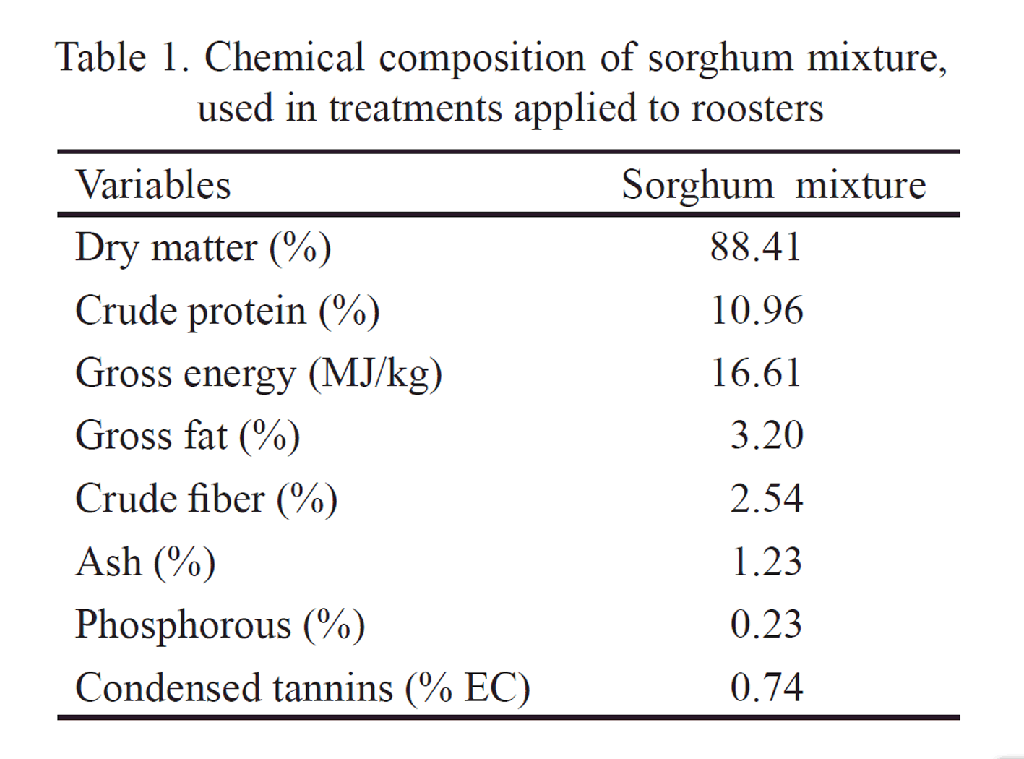
<body><![CDATA[<p align="JUSTIFY">Feeding birds in some Latin American countries like   Venezuela have had an intake pattern based on cereals (maize), with   scarce and low productivity. Consequently, there is a marked external   dependence. It is important to consider that, in Venezuela, diets for   poultry production are processed through the importing of their main   basic ingredients, like maize and soy. High prices of these essential   ingredients for diets and demands of the current poultry production lead   to search for nutritional alternatives that allow to take advantage   of the production of other available cereals. Grain sorghum   (<em>Sorghum bicolor</em> L. Moench.) is a widely used agricultural crop,   with perspectives and high adaptability to different climatic conditions   (Sandoval and Valencia 2005 and Chuck-Hernandez <em>et al.</em> 2011). However, it presents condensed tannins (CT) among   its chemical constituents. They have the responsibility of reducing the   nutritional value of the grain, when it is used in diets for   non-ruminant animals (Jaramillo 2008 and Farf&aacute;n 2010). </p>     <p align="JUSTIFY">Under these conditions, it is necessary to study   compounds that allow, somehow, to stop or diminish the antinutritional   factors of raw matters. This is the case of exogenous enzymes, which   help with food digestibility, like the enzymatic complex, obtained   through   the technique of fermentation in solid state (Selle and Ranvindran 2008,   M&eacute;ndez <em>et al.</em> 2009 and Selle <em>et al.</em> 2010). </p>     <p align="JUSTIFY">Another alternative for an efficient use of   sorghum is the variation of grain granulometry. This procedure is based   on studies that confirm the benefits of grinding cereals in grains.   According to Kilburn and Edwards (2004) and Mateos <em>et al.</em> (2005), the beneficial effect of grinding is more   important with ingredients like sorghum because its external fibrous   protection is difficult to degrade in the gizzard and to be affected by   endogenous enzymes of gastrointestinal system. </p>     <p align="JUSTIFY">The objective of this study was to evaluate the   addition of an enzymatic complex to a sorghum mixture at three levels of   granulometry in the TDN and TME.</p> </font>     <p>&nbsp;</p>     <p><font size="3" face="Verdana, Arial, Helvetica, sans-serif"> <strong>MATERIALS AND METHODS</strong> </font></p> <font size="2" face="Verdana, Arial, Helvetica, sans-serif">    <p align="JUSTIFY">The research was carried out in the facilities of the   Instituto de Producci&oacute;n Animal, in the Laboratorio Secci&oacute;n de Aves,   from the Facultad de Agronom&iacute;a at the Universidad Central de Venezuela.   This institution is located in Maracay, Aragua state, at 10&ordm; 17&acute; 5" N,   and 64&ordm; 13&acute; 28" W, at 480 m o.s.l. Its mean temperature is 25 &ordm;C and its   relative humidity is 75 % (INIA 2012). </p>     <p align="JUSTIFY">An amount of 56 roosters, from Bovans Brown breed   and 36 weeks old, were used, according to methodology described by   Sibbald (1976). Roosters were kept in individual metallic cages, of 43   cm high, 47 cm deep and 26 cm wide. These cages had a cup drinker   and a tray for collecting feces. Their dimensions were 35 x 55 cm, to   assure an effective collection of feces. A completely randomized design   was used, with a factorial arrangement of 3 x 2, corresponding to the   treatments applied (sorghum mixture with three levels   of granulometry 1, 3 and 5 mm) and presence or not of the enzymatic   complex. Seven groups were established. Six groups corresponded to the   applied treatments and another group was created with roosters for   collecting feces generated by the endogenous, with the   objective of quantifying fecal metabolic excretion. Eight roosters were   used per treatment, and each rooster represented an experimental unit. </p>     <p align="JUSTIFY">For preparing treatments, grains of sorghum   mixture from Criollo I, Chaguarama III, Himeca 101, and Himeca 400   varieties were used. These are kept in silos of industrial storage of   raw matters for livestock use. A sample of grains of sorghum mixture was   taken   to determine their chemical composition (<a href="/img/revistas/cjas/v49n1/t0116115.gif">table 1</a>), according to AOAC   (2000). Grains were ground in a Nogueira&reg; mil, DPM 4 model, with three   levels of granulometry (1, 3 and 5 mm). The enzimatic complex was   produced through fermentation in solid state and   was directed, mainly, to the rupture of non-starch polysaccharide   chains, with a composition reported by the manufacturer: 300 units of   phytase/g, 100 units of xylanase/g, 700 units protease/g, a minimum of 40 units of cellulase/g, 30 units of amylase/g, 4,000 units of pectinase/g and a minimum of 200 units of   &acirc;-glucanase/g. The recommended addition of CE to the diets was 0.02 % (Allzyme SSF&reg;. Alltech Inc., Kentucky USA). </p>     
<p align="JUSTIFY">For managing excretions and determining true   digestibility of nitrogen (TDN) and true metabolizable energy (TME), a   diet was considered for the group of endogenous roosters, composed by   maize starch (48 %), sugar (48 %) and a pre-mixture of minerals and vitamins (4 %) (Bourdillon <em>et al.</em> 1990). Total collection of feces per experimental unit was   carried out in trays for 48 h. Later, they were placed in aluminum   trays, where they were weighed and dried in an   oven at 65 &ordm;C for 48 h (Sibbald 1976). Feces were ground in a   Thomas&reg; lab mil with a sieve of 1 mm. Gross energy was determined in an   adiabatic calorimetric pump, Parr&reg; brand. Total nitrogen was determined   according to Kjeldahl (AOAC 2000), while the uric nitrogen   was determined according to the method of direct spectrophotometry,   described by Marquardt (1983). Once the GE and excreted nitrogen without   uric nitrogen (total nitrogen-uric nitrogen) from the used diets were   determined, TDN and TME of each treatment were   calculated regarding the following formulas: </p>     ]]></body>
<body><![CDATA[<p align="JUSTIFY">Determination of <a href="#e1">TDN</a>: </p> </font>     <p align="center"><font size="2" face="Verdana, Arial, Helvetica, sans-serif"><a name="e1"></a></font></p>     <p align="center"><font size="2" face="Verdana, Arial, Helvetica, sans-serif"><img src="../img/revistas/cjas/v49n1/e0116115.gif" width="430" height="71" longdesc="/img/revistas/cjas/v49n1/e0116115.gif"></font></p> <font size="2" face="Verdana, Arial, Helvetica, sans-serif">     
<p align="JUSTIFY">where: </p>     <p align="JUSTIFY">Nc: nitr&oacute;geno consumido </p>     <p align="JUSTIFY">ENWUN: excreted nitrogen without uric nitrogen </p>     <p align="JUSTIFY">FMN: fecal metabolic nitrogen, quantified trough rooster established for collecting the endogenous. </p>     <p align="JUSTIFY">Determinacion of <a href="#e2">TME</a>, according to Sibbald (1978): </p> </font>     <p align="center"><font size="2" face="Verdana, Arial, Helvetica, sans-serif"><a name="e2"></a></font></p>     <p align="center"><font size="2" face="Verdana, Arial, Helvetica, sans-serif"><img src="../img/revistas/cjas/v49n1/e0216115.gif" width="450" height="90" longdesc="/img/revistas/cjas/v49n1/e0216115.gif"></font></p> <font size="2" face="Verdana, Arial, Helvetica, sans-serif">     
]]></body>
<body><![CDATA[<p align="JUSTIFY">Where: </p>     <p align="JUSTIFY"> IDM: ingested dry matter </p>     <p align="JUSTIFY">excDM: excreted dry matter </p>     <p align="JUSTIFY">endDM: dry matter excreted by the endogenous </p>     <p align="JUSTIFY">GEfo: gross energy of food </p>     <p align="JUSTIFY">GEfe: gross energy of feces </p>     <p align="JUSTIFY">EGEendx: excreted gross energy, quantified trough the roosters established for collecting the endogenous. </p>     <p align="JUSTIFY">Data of evaluated variables (TDN and TME) were   analyzed according to a completely random design, with a 3 x 2 factorial   arrangement and 8 roosters (repetitions) per treatment. The Statistic   program, version 8.0, was used. Values for each variable were   expressed through the means and their standard errors. Statistical   differences were considered at the &lt; 0.05 probability level. The mean   test was applied according to the Tukey procedure (Steel <em>et al.</em> 1997).</p> </font>     <p>&nbsp;</p>     <p><font size="3" face="Verdana, Arial, Helvetica, sans-serif"><strong>RESULTS AND DISCUSSION</strong></font></p> <font size="2" face="Verdana, Arial, Helvetica, sans-serif">    ]]></body>
<body><![CDATA[<p align="JUSTIFY">There was no effect of factors and interaction after   analyzing the TME of a sorghum mixture, with different granulometries   and the addition of an enzymatic complex (<a href="/img/revistas/cjas/v49n1/t0216115.gif">table 2</a>). The maximum value   was 16.07 MJ/kg DM and the minimum was 15.51 MJ/kg   DM. According to these results, there was no variation of the energy   with the addition of the enzymatic complex. This additive has the   ability of increasing the energy contribution in cereals and, specially,   in raw   matters with secondary metabolites (Selle and Ranvindran 2008 and M&eacute;ndez <em>et al.</em> 2009). The TME in roosters did not vary with the used of   granulometries, considering that using a thin one (1 mm), there is no   better exposure to the surface of sorghum mixture for the   endogenous and exogenous enzymes to act on, with the objective of   improving the energy metabolism of the birds. According to studies of   Kilburn and Edwards (2004) and Mateos <em>et al.</em> (2005), a granulometry higher than 5.61 mm in poultry   production is, probably, more convenient    than smaller sizes, because gross particles can be retained in the   gizzard for more time than the fine ones. A superior time of retention   in the proximal portion of the digestive tract favors the solubility of   particles and the later enzymatic access (Mateos and Grobas   1993). This way, an excessively fine grinding can reduce digestive   motility and contact between nutrients and enzymes (Mateos <em>et al.</em> 2005). Therefore, there could also be a reduction of TME   in finely ground diets. This fact was demonstrated by Capdevila (1993),   who   obtained values of TME for diets in meals and granules of 13.31 and   13.74 MJ/kg, respectively. </p>     
<p align="JUSTIFY">In similar studies, Tavernari <em>et al.</em> (2008) did not found significant effects with the addition   of the enzymatic complex in sunflower meals. The same was reported by   Fuente <em>et al.</em> (1995), who evaluated an enzymatic complex in diets based   on barley. These authors   referred that the TME had no significant improvement. This response   could be regulated by an effect of contact time among diet, exogenous   enzyme and adequate substrate on diet for the enzymatic complex to act   properly. In other studies, Wu <em>et al.</em> (2004) evaluated a phytase of fermentation in solid state   in a diet for poultry and reported that the effect of the enzyme on   apparent metabolizable energy was not significant. In addition, Fuente <em>et al.</em> (1995) assessed an enzymatic complex on diets based on barely, and the metabolizable energy had   no significant improvements. Olukosi <em>et al.</em> (2007), in a similar   study, stated that there was no effect of TME when using an enzymatic   complex in diets based on maize and soy. Therefore, these authors   concluded that there could be a deficiency on the action of the   complex because there was no additive effect of enzymes that were part   of it. </p>     <p align="JUSTIFY">The previous results evidence that energy present   in the sorghum mixture, used in this study, is not totally available   when adding the enzymatic complex, probably due to the content of   tannins, which form complexes with the ability of inhibiting the   activity of   amylase and compromise the starch digestibility (Taylor 2005 and   P&eacute;rez-Maldonado and Rodr&iacute;guez 2007). This study coincides with the   results reported by Selle <em>et al.</em> (2010), who referred that there is a negative correlation   between the metabolizable energy and the   concentration of tannins from sorghum grains, because the varieties of   sorghum with 0.45 %, catechin equivalents (CE), decrease the ME of the   grain in 3 %, regarding diets with sorghum grains of 0.15 % CE. This   study confirmed a similar performance when it included diets   with sorghum mixtures and tannin contents of 0.74 % CE. </p>     <p align="JUSTIFY">Regarding the TDN in roosters (<a href="/img/revistas/cjas/v49n1/t0316115.gif">table 3</a>), there were   statistical differences (P &lt; 0.01) for different granulometries and   the interaction between granulometry and enzymatic complex (P &lt;   0.001). T4 had the highest TDN, corresponding to the granulometry of 3   mm, and T2   presented the lowest TDN. There was a difference of 12.39 % of   digestibility among the treatments. This agrees with the analysis of   granulometry simple factor, where the highest TDN is for MSO in 3 mm,   with 93.31 %, being statistically different to the   MSO, with 1 mm (88.31 %). It is possible that the diet flow within the   animal would increased with the lowest granulometry (1 mm) and there is   less activity in the gizzard and proventriculus for beginning to degrade     nutrients of raw matters, which negatively affects digestibility. The   presence of the enzymatic complex do not represented statistical   differences. Out of these results, it is evident that the sorghum   mixture with 3 mm of granulometry favors digestibility and confirms the   reports   of Wiseman (1993), who refers that diminishing the granulometry through   grinding, a nutritional benefit is obtained, if the decrease is   considered between 5 mm and 3 mm. Mateos and Grobas (1993) expressed   that the reduction of particle size, reached after grinding,   has low nutritional value for birds. This effect is observed with   granulometry of 1 mm. </p>     
<p align="JUSTIFY"> Values of TDN in roosters obtained in this study   were slightly superior to those reported by Farf&aacute;n (2010). This author   obtained a TDN of 78.81 and 81.52 % in diets with 100 % of sorghum mixture   without enzymatic complex and 100 % of sorghum mixture with enzymatic   complex, respectively. Likewise, there was no significant variation in   the addition of the enzymatic complex. Similarly, Jaramillo <em>et al.</em> (1991) obtained 55 % of TDN of sorghum. This value was   affected by the content of tannins within the sorghum, which was   considered as high. After evaluating the TDN is important to consider   the levels of condensed tannins, because, according to Latorre and   Calder&oacute;n   (1998), there is a considerable decrease, when comparing a low level of   condensed tannins (0.17 % CE) with a high level (3.24 % EC), obtaining a   TDN of  69.54 and 50.85 %, respectively. Ravindran <em>et al.</em> (1999) evaluated the addition of phytase to diets based on   sorghum,   and the digestibility improved. Something similar happened in studies of   Jim&eacute;nez (2000), in which the enzymatic supplementation of diets based   on sorghum and maize increased the fecal apparent digestibility of crude   protein. Wayne and Xiuhua (2010) indicated that   adding the protease and phytase+protease to diets based on sorghum   increases the TDN in 82 and 83 % respectively, and there is an evident   effect, as it was expected in this study, regarding the use of enzymatic   complex. </p>     <p align="JUSTIFY">Under the conditions of this experiment, the   different granulometries used and the addition of the enzymatic complex   did not affect the true metabolizable energy. However, there was effect   of the granulometries and their interaction with the enzymatic complex   on   the true metabolizable energy. Therefore, it is recommended the use of   the sorghum mixture with granulometries of 3 mm, because it maintains   the true metabolizable energy and increases nitrogen digestibility. </p> </font>     <p>&nbsp;</p>     <p><font size="3" face="Verdana, Arial, Helvetica, sans-serif"><strong>ACKNOWLEDGEMENTS</strong></font></p>     <p align="justify"><font size="2" face="Verdana, Arial, Helvetica, sans-serif">Thanks to Laboratorio Sección de Aves de la Facultad de Agronomía, de la Universidad Central de Venezuela, for their logistical support, and to Alltech fromVenezuela S.C.S, for their financial support for developing this research.</font></p>     <p>&nbsp;</p>     ]]></body>
<body><![CDATA[<p><font size="2" face="Verdana, Arial, Helvetica, sans-serif"><font size="3"><strong>BIBLIOGRAPHY</strong></font></font></p> <font size="2" face="Verdana, Arial, Helvetica, sans-serif">    <!-- ref --><p align="justify">AOAC. 2000. <em>Official methods of analysis of AOAC international</em>. 13th  ed., Gaithersburg, MD: AOAC International Suite.    <br>       <br>   Bourdillon A., Carr&eacute; B., Conan L., Francesch M., Fuentes M., Huyghebaert  G., Janssen W., Leclercq B., Lessire M. &amp; McNab J. 1990. &lsquo;&lsquo;European  reference method of in vivo determination of metabolisable energy in poultry:  reproducibility, effect of age, comparison with predicted values&rsquo;&rsquo;. <em>British poultry science</em>, 31 (3), pp. 567&ndash;576.    <br>       <br>   Capdevila J.  1993. &lsquo;&lsquo;El proceso de granulaci&oacute;n. Experiencias pr&aacute;cticas&rsquo;&rsquo;. In: <em>IX Curso de  especializaci&oacute;n FEDNA</em>, Barcelona, Espa&ntilde;a, Available:  &lt;<a href="http://www.adiveter.com/ftp_public/articulo1496.pdf" target="_blank">http://www.adiveter.com/ftp_public/articulo1496.pdf</a>&gt;,  [Accessed:&nbsp;December 4, 2013].    <br>       <br>   Chuck-Hern&aacute;ndez  C., P&eacute;rez-Carrillo E., Heredia-Olea E. &amp; Serna-Sald&iacute;var S. O. 2011. &lsquo;&lsquo;Sorgo  como un cultivo multifac&eacute;tico para la producci&oacute;n de bioetanol en M&eacute;xico:  tecnolog&iacute;as, avances y &aacute;reas de oportunidad&rsquo;&rsquo;. <em>Revista mexicana de  ingenier&iacute;a qu&iacute;mica</em>, 10 (3), pp. 529&ndash;549.    <br>       <!-- ref --><br>   Farf&aacute;n C.  2010. <em>Determinaci&oacute;n de la digestibilidad de la energ&iacute;a y del nitr&oacute;geno de  una mezcla de sorgo nacional utilizando un complejo enzim&aacute;tico en gallos  adultos y cerdos en crecimiento</em>. Facultades de Agronom&iacute;a y Ciencias  Veterinarias, Maracay, Venezuela, 32 p.    <br>       <br>   Fuente J.  M., P&eacute;rez P. &amp; Villamide M. J. 1995. &lsquo;&lsquo;Effect of  dietary enzyme on the metabolizable energy of diets with increasing levels of  barley fed to broilers at different ages&rsquo;&rsquo;. <em>Animal feed science and technology</em>, 56 (1), pp. 45&ndash;53.    <br>       <!-- ref --><br>   INIA. 2012. <em>Reporte  de estaci&oacute;n climatol&oacute;gica</em>. Maracay-Venezuela: Unidad Agroclimatol&oacute;gica,  Instituto Nacional de Investigaciones Agropecuarias.    <br>       <br>   Jaramillo M.  2008. &lsquo;&lsquo;Sorgos gran&iacute;fero genot&iacute;picamente pardos: nuevos conceptos en  toxicolog&iacute;a y respuesta de las aves&rsquo;&rsquo;. In: <em>X Congreso Nacional de Avicultura</em>,  Venezuela, p. 14, Available:  &lt;<a href="http://www.wpsa-aeca.es/aeca_imgs_docs/wpsa1236271687a.pdf" target="_blank">http://www.wpsa-aeca.es/aeca_imgs_docs/wpsa1236271687a.pdf</a>&gt;,  [Accessed:&nbsp;December 4, 2013].    <br>       <br>   Jaramillo  M., Le&oacute;n A., Angulo I. &amp; Pe&ntilde;a M. 1991. &lsquo;&lsquo;Valor Nutricional de cultivares de  sorgo gran&iacute;fero (Sorghum bicolor (L) Moench) altos en taninos producidos en  Venezuela II. Energ&iacute;a Metabolizable&rsquo;&rsquo;. <em>Zootecnia Trop</em>, 12, p. 23.    <br>       <!-- ref --><br>   Jim&eacute;nez M.  2000. <em>Evaluaci&oacute;n de complejos enzim&aacute;ticos en alimentaci&oacute;n de pollos de  engorde</em>. Polit&eacute;cnica, Madrid, Espa&ntilde;a, 164 p., Available:  &lt;<a href="http://oa.upm.es/837/01/02200009.pdf" target="_blank">http://oa.upm.es/837/01/02200009.pdf</a>&gt;, [Accessed:&nbsp;February 26,  2016].    <br>       <br>   Kilburn J. &amp; Edwards H. M. 2004. &lsquo;&lsquo;The effect of particle size of  commercial soybean meal on performance and nutrient utilization of broiler  chicks&rsquo;&rsquo;. <em>Poultry  science</em>, 83 (3),  pp. 428&ndash;432.    <br>       <br>   Latorre S.  J. &amp; Calder&oacute;n C. A. 1998. <em>Evaluaci&oacute;n fisiol&oacute;gica y nutricional del  efecto de los taninos en los principales sorgos gran&iacute;feros (Sorghum bicolor (L)  moench) cultivados en Colombia</em>. vol. 7, Corporaci&oacute;n Colombiana de      <br>   Investigaci&oacute;n Agropecuaria, 163 p., Available:  &lt;<a href="http://www.sidalc.net/cgi-bin/wxis.exe/?IsisScript=bac.xis&method=post&formato=2&cantidad=1&expresion=mfn=059417" target="_blank">http://www.sidalc.net/cgi-bin/wxis.exe/?IsisScript=bac.xis&amp;method=post&amp;formato=2&amp;cantidad=1&amp;expresion=mfn=059417</a>&gt;,  [Accessed:&nbsp;December 4, 2013].    <br>       <br>   Marquardt R. R. 1983. &lsquo;&lsquo;A simple spectrophotometric method for the direct  determination of uric acid in avian excreta&rsquo;&rsquo;. <em>Poultry Science</em>, 62 (10), pp. 2106&ndash;2108.    <br>       <br>   Mateos G.  G., Grobas S. &amp; Coren S. C. L. 1993. &lsquo;&lsquo;El proceso de granulaci&oacute;n: bases  cient&iacute;ficas y efectos nutricionales&rsquo;&rsquo;. In: <em>IX Curso de Especializacion FEDNA</em>,  Barcelona, Espa&ntilde;a, Available:  &lt;<a href="http://www.acorex.com/FR/pienso/Elprocesodegranulacionbasescientificasyefectosnutricionales.pdf" target="_blank">http://www.acorex.com/FR/pienso/Elprocesodegranulacionbasescientificasyefectosnutricionales.pdf</a>&gt;,  [Accessed:&nbsp;December 4, 2013].    <br>       ]]></body>
<body><![CDATA[<br>   Mateos G.  G., Valencia D. G. &amp; Piqueras B. V. 2005. &lsquo;&lsquo;Influencia del procesado de  ingredientes y piensos terminados sobre la productividad en monog&aacute;stricos&rsquo;&rsquo;.  In: <em>XXI Curso de especializaci&oacute;n FEDNA</em>, Madrid, Espa&ntilde;a, Available:  &lt;<a href="https://www.researchgate.net/profile/Gonzalo_Mateos/publication/28179808_Influencia_del_procesado_de_ingredientes_y_piensos_terminados_sobre_la_productividad_en_monogstricos/links/0fcfd51421a81e87f0000000.pdf" target="_blank">https://www.researchgate.net/profile/Gonzalo_Mateos/publication/28179808_Influencia_del_procesado_de_ingredientes_y_piensos_terminados_sobre_la_productividad_en_monogstricos/links/0fcfd51421a81e87f0000000.pdf</a>&gt;,  [Accessed:&nbsp;December 4, 2013].    <br>       <br>   M&eacute;ndez A.  D., Cort&eacute;s A., Fuente B., L&oacute;pez C. &amp; Gonz&aacute;lez E. A. 2009. &lsquo;&lsquo;Efecto de un  complejo enzim&aacute;tico en dietas sorgo+ soya sobre la digestibilidad ileal de  amino&aacute;cidos, energ&iacute;a metabolizable y productividad en pollos&rsquo;&rsquo;. <em>T&eacute;cnica  Pecuaria en M&eacute;xico</em>, 47 (1), pp. 16&ndash;26.    <br>       <br>   Olukosi O.  A., Cowieson A. J. &amp; Adeola O. 2007. &lsquo;&lsquo;Age-related  influence of a cocktail of xylanase, amylase, and protease or phytase  individually or in combination in broilers&rsquo;&rsquo;. <em>Poultry Science</em>, 86 (1),  pp. 77&ndash;86.    <br>       <!-- ref --><br>   P&eacute;rez M. R. &amp; Rodr&iacute;guez H. 2007. <em>Nutritional characteristics of  sorghum from Queensland and New South Wale for chicken meat production</em>.  RIRDC Publication, no. 7, Rural Industries Research and Development  Corporation.    <br>       <br>   Ravindran V., Cabahug S., Ravindran G. &amp; Bryden W. L. 1999. &lsquo;&lsquo;Influence  of microbial phytase on apparent ileal amino acid digestibility of feedstuffs  for broilers&rsquo;&rsquo;. <em>Poultry  Science</em>, 78 (5),  pp. 699&ndash;706.    <br>       ]]></body>
<body><![CDATA[<br>   Sandoval M.  A. &amp; Valencia Rodr&iacute;guez A. Y. 2005. <em>Granulometr&iacute;a en harinas y contenido  de taninos en el grano de sorgos criollos cultivados en seis departamentos de  El Salvador</em>. Facultad de Qu&iacute;mica y Farmacia, San Salvador, El Salvador, 134  p., Available: &lt;<a href="http://ri.ues.edu.sv/id/eprint/5264" target="_blank">http://ri.ues.edu.sv/id/eprint/5264</a>&gt;,  [Accessed:&nbsp;December 4, 2013].    <br>       <br>   Selle P. H. &amp; Ravindran V. 2008. &lsquo;&lsquo;Phytate-degrading enzymes in pig  nutrition&rsquo;&rsquo;. <em>Livestock Science</em>, 113 (2), pp. 99&ndash;122.    <br>       <br>   Sibbald I. R. 1976. &lsquo;&lsquo;A bioassay for true metabolizable energy in  feedingstuffs&rsquo;&rsquo;. <em>Poultry science</em>, 55 (1), pp. 303&ndash;308.    <br>       <br>   Sibbald I. R. 1978. &lsquo;&lsquo;The effect of the age of the assay bird on the true  metabolizable energy values of feedingstuffs&rsquo;&rsquo;. <em>Poultry Science</em>, 57 (4), pp. 1008&ndash;1012.    <br>       <br>   Steel R. G. &amp; JH Dickey D. A. 1997. <em>Principles and procedures of  statistics a biometrical approach</em>. (no. ser. 519.5 S813 1997), 3rd ed.,  WCB/McGraw-Hill, 141-155 p., Available:  &lt;<a href="http://www.sidalc.net/cgi-bin/wxis.exe/?IsisScript=ORTON.xis&B1=Buscar&formato=1&cantidad=50&expresion=Torrie,%20J.H" target="_blank">http://www.sidalc.net/cgi-bin/wxis.exe/?IsisScript=ORTON.xis&amp;B1=Buscar&amp;formato=1&amp;cantidad=50&amp;expresion=Torrie,%20J.H</a>&gt;,  [Accessed:&nbsp;December 4, 2013].    <br>       ]]></body>
<body><![CDATA[<br>   Tavernari F.  C., Albino L. F. T., Morata R. L., Dutra J&uacute;nior W. M., Rostagno H. S. &amp;  Viana M. T. S. 2008. &lsquo;&lsquo;Inclusion of sunflower meal,  with or without enzyme supplementation, in broiler diets&rsquo;&rsquo;. <em>Revista Brasileira de Ci&ecirc;ncia  Av&iacute;cola</em>, 10 (4),  pp. 233&ndash;238.    <br>       <br>   Taylor J. R.  N. 2005. &lsquo;&lsquo;Non-starch polysaccharides, protein and starch: form function and  feed&ndash;highlights on sorghum&rsquo;&rsquo;. <em>Proceedings, Australian Poultry Science  Symposium</em>, 17, p. 16.    <br>       <br>   Wayne B. L. &amp; Xiuhua L. 2010. &lsquo;&lsquo;Amino acid digestibility and poultry  feed formulation: expression, limitations and application&rsquo;&rsquo;. <em>Revista Brasileira de Zootecnia</em>, 39, pp. 279&ndash;287.    <br>       <br>   Wiseman J.  1993. &lsquo;&lsquo;El procesado de cereales en dietas de monog&aacute;stricos&rsquo;&rsquo;. In: <em>IX Curso  de especializaci&oacute;n FEDNA Barcelona. Espa&ntilde;a</em>, Barcelona. Espa&ntilde;a, Available:  &lt;<a href="http://www.ucv.ve/fileadmin/user_upload/facultad_agronomia/Procesamiento_de_Cereales.pdf" target="_blank">http://www.ucv.ve/fileadmin/user_upload/facultad_agronomia/Procesamiento_de_Cereales.pdf</a>&gt;,  [Accessed:&nbsp;December 4, 2013].    <br>       <br> Wu Y. B.,  Ravindran V. &amp; Hendriks W. H. 2004. &lsquo;&lsquo;Influence of exogenous enzyme supplementation  on energy utilisation and nutrient digestibility of cereals for broilers&rsquo;&rsquo;. <em>Journal of the Science of Food and  Agriculture</em>, 84 (14),  pp. 1817&ndash;1822.</p></font>     <p align="justify">&nbsp;</p>     ]]></body>
<body><![CDATA[<p align="justify">&nbsp;</p>      <p><font size="2" face="Verdana, Arial, Helvetica, sans-serif">Received: December 4, 2013    <br> Accepted: January 30, 2014</font></p>     <p>&nbsp;</p>     <p>&nbsp;</p>     <p><font size="2" face="Verdana, Arial, Helvetica, sans-serif"><em>E.F. Lira,</em> Universidad Central de Venezuela. Facultad de Agronomía. Instituto de Producción Animal. Apartado Postal 4579.  Maracay 2101, Estado Aragua. Venezuela .    Email: <a href="mailto:charly.farfan@gmail.com ">charly.farfan@gmail.com </a></font></p>      ]]></body><back>
<ref-list>
<ref id="B1">
<nlm-citation citation-type="book">
<person-group person-group-type="author">
<name>
<surname><![CDATA[AOAC]]></surname>
</name>
</person-group>
<source><![CDATA[Official methods of analysis of AOAC international]]></source>
<year>2000</year>
<edition>13th</edition>
<publisher-loc><![CDATA[Gaithersburg, MD ]]></publisher-loc>
<publisher-name><![CDATA[AOAC International Suite]]></publisher-name>
</nlm-citation>
</ref>
<ref id="B2">
<nlm-citation citation-type="journal">
<person-group person-group-type="author">
<name>
<surname><![CDATA[Bourdillon]]></surname>
<given-names><![CDATA[A.]]></given-names>
</name>
<name>
<surname><![CDATA[Carré]]></surname>
<given-names><![CDATA[B.]]></given-names>
</name>
<name>
<surname><![CDATA[Conan]]></surname>
<given-names><![CDATA[L.]]></given-names>
</name>
<name>
<surname><![CDATA[Francesch]]></surname>
<given-names><![CDATA[M.]]></given-names>
</name>
<name>
<surname><![CDATA[Fuentes]]></surname>
<given-names><![CDATA[M.]]></given-names>
</name>
<name>
<surname><![CDATA[Huyghebaert]]></surname>
<given-names><![CDATA[G.]]></given-names>
</name>
<name>
<surname><![CDATA[Janssen]]></surname>
<given-names><![CDATA[W.]]></given-names>
</name>
<name>
<surname><![CDATA[Leclercq]]></surname>
<given-names><![CDATA[B.]]></given-names>
</name>
<name>
<surname><![CDATA[Lessire]]></surname>
<given-names><![CDATA[M.]]></given-names>
</name>
<name>
<surname><![CDATA[McNab]]></surname>
<given-names><![CDATA[J.]]></given-names>
</name>
</person-group>
<article-title xml:lang="nd"><![CDATA[European reference method of in vivo determination of metabolisable energy in poultry: reproducibility, effect of age, comparison with predicted values]]></article-title>
<source><![CDATA[British poultry science]]></source>
<year>1990</year>
<volume>31</volume>
<numero>3</numero>
<issue>3</issue>
<page-range>567–576</page-range></nlm-citation>
</ref>
<ref id="B3">
<nlm-citation citation-type="">
<person-group person-group-type="author">
<name>
<surname><![CDATA[Capdevila]]></surname>
<given-names><![CDATA[J.]]></given-names>
</name>
</person-group>
<article-title xml:lang="nd"><![CDATA[El proceso de granulación. Experiencias prácticas]]></article-title>
<source><![CDATA[IX Curso de especialización FEDNA]]></source>
<year>1993</year>
<publisher-loc><![CDATA[Barcelona, España ]]></publisher-loc>
</nlm-citation>
</ref>
<ref id="B4">
<nlm-citation citation-type="journal">
<person-group person-group-type="author">
<name>
<surname><![CDATA[Chuck-Hernández]]></surname>
<given-names><![CDATA[C.]]></given-names>
</name>
<name>
<surname><![CDATA[Pérez-Carrillo]]></surname>
<given-names><![CDATA[E.]]></given-names>
</name>
<name>
<surname><![CDATA[Heredia-Olea]]></surname>
<given-names><![CDATA[E.]]></given-names>
</name>
<name>
<surname><![CDATA[Serna-Saldívar]]></surname>
<given-names><![CDATA[S. O.]]></given-names>
</name>
</person-group>
<article-title xml:lang="nd"><![CDATA[Sorgo como un cultivo multifacético para la producción de bioetanol en México: tecnologías, avances y áreas de oportunidad]]></article-title>
<source><![CDATA[Revista mexicana de ingeniería química]]></source>
<year>2011</year>
<volume>10</volume>
<numero>3</numero>
<issue>3</issue>
<page-range>529–549</page-range></nlm-citation>
</ref>
<ref id="B5">
<nlm-citation citation-type="book">
<person-group person-group-type="author">
<name>
<surname><![CDATA[Farfán]]></surname>
<given-names><![CDATA[C.]]></given-names>
</name>
</person-group>
<source><![CDATA[Determinación de la digestibilidad de la energía y del nitrógeno de una mezcla de sorgo nacional utilizando un complejo enzimático en gallos adultos y cerdos en crecimiento]]></source>
<year>2010</year>
<page-range>32</page-range><publisher-loc><![CDATA[Maracay, Venezuela ]]></publisher-loc>
<publisher-name><![CDATA[Facultades de Agronomía y Ciencias Veterinarias]]></publisher-name>
</nlm-citation>
</ref>
<ref id="B6">
<nlm-citation citation-type="journal">
<person-group person-group-type="author">
<name>
<surname><![CDATA[Fuente]]></surname>
<given-names><![CDATA[J. M.]]></given-names>
</name>
<name>
<surname><![CDATA[Pérez]]></surname>
<given-names><![CDATA[P.]]></given-names>
</name>
<name>
<surname><![CDATA[Villamide]]></surname>
<given-names><![CDATA[M. J.]]></given-names>
</name>
</person-group>
<article-title xml:lang="nd"><![CDATA[Effect of dietary enzyme on the metabolizable energy of diets with increasing levels of barley fed to broilers at different ages]]></article-title>
<source><![CDATA[Animal feed science and technology]]></source>
<year>1995</year>
<volume>56</volume>
<numero>1</numero>
<issue>1</issue>
<page-range>45–53</page-range></nlm-citation>
</ref>
<ref id="B7">
<nlm-citation citation-type="book">
<person-group person-group-type="author">
<name>
<surname><![CDATA[INIA]]></surname>
</name>
</person-group>
<source><![CDATA[Reporte de estación climatológica]]></source>
<year>2012</year>
<publisher-loc><![CDATA[Maracay-Venezuela ]]></publisher-loc>
<publisher-name><![CDATA[Unidad Agroclimatológica, Instituto Nacional de Investigaciones Agropecuarias]]></publisher-name>
</nlm-citation>
</ref>
<ref id="B8">
<nlm-citation citation-type="">
<person-group person-group-type="author">
<name>
<surname><![CDATA[Jaramillo]]></surname>
<given-names><![CDATA[M.]]></given-names>
</name>
</person-group>
<article-title xml:lang="nd"><![CDATA[Sorgos granífero genotípicamente pardos: nuevos conceptos en toxicología y respuesta de las aves]]></article-title>
<source><![CDATA[X Congreso Nacional de Avicultura]]></source>
<year>2008</year>
<page-range>14</page-range><publisher-loc><![CDATA[Venezuela ]]></publisher-loc>
</nlm-citation>
</ref>
<ref id="B9">
<nlm-citation citation-type="journal">
<person-group person-group-type="author">
<name>
<surname><![CDATA[Jaramillo]]></surname>
<given-names><![CDATA[M.]]></given-names>
</name>
<name>
<surname><![CDATA[León]]></surname>
<given-names><![CDATA[A.]]></given-names>
</name>
<name>
<surname><![CDATA[Angulo]]></surname>
<given-names><![CDATA[I.]]></given-names>
</name>
<name>
<surname><![CDATA[Peña]]></surname>
<given-names><![CDATA[M.]]></given-names>
</name>
</person-group>
<article-title xml:lang="nd"><![CDATA[Valor Nutricional de cultivares de sorgo granífero (Sorghum bicolor (L) Moench) altos en taninos producidos en Venezuela II. Energía Metabolizable]]></article-title>
<source><![CDATA[Zootecnia Trop]]></source>
<year>1991</year>
<volume>12</volume>
<page-range>23</page-range></nlm-citation>
</ref>
<ref id="B10">
<nlm-citation citation-type="book">
<person-group person-group-type="author">
<name>
<surname><![CDATA[Jiménez]]></surname>
<given-names><![CDATA[M.]]></given-names>
</name>
</person-group>
<source><![CDATA[Evaluación de complejos enzimáticos en alimentación de pollos de engorde]]></source>
<year>2000</year>
<page-range>164</page-range><publisher-loc><![CDATA[Madrid, España ]]></publisher-loc>
<publisher-name><![CDATA[Politécnica]]></publisher-name>
</nlm-citation>
</ref>
<ref id="B11">
<nlm-citation citation-type="journal">
<person-group person-group-type="author">
<name>
<surname><![CDATA[Kilburn]]></surname>
<given-names><![CDATA[J.]]></given-names>
</name>
<name>
<surname><![CDATA[Edwards]]></surname>
<given-names><![CDATA[H. M.]]></given-names>
</name>
</person-group>
<article-title xml:lang="nd"><![CDATA[The effect of particle size of commercial soybean meal on performance and nutrient utilization of broiler chicks]]></article-title>
<source><![CDATA[Poultry science]]></source>
<year>2004</year>
<volume>83</volume>
<numero>3</numero>
<issue>3</issue>
<page-range>428–432</page-range></nlm-citation>
</ref>
<ref id="B12">
<nlm-citation citation-type="book">
<person-group person-group-type="author">
<name>
<surname><![CDATA[Latorre]]></surname>
<given-names><![CDATA[S. J.]]></given-names>
</name>
<name>
<surname><![CDATA[Calderón]]></surname>
<given-names><![CDATA[C. A.]]></given-names>
</name>
</person-group>
<source><![CDATA[Evaluación fisiológica y nutricional del efecto de los taninos en los principales sorgos graníferos (Sorghum bicolor (L) moench) cultivados en Colombia]]></source>
<year>1998</year>
<volume>7</volume>
<page-range>163</page-range><publisher-name><![CDATA[Corporación Colombiana de Investigación Agropecuaria]]></publisher-name>
</nlm-citation>
</ref>
<ref id="B13">
<nlm-citation citation-type="journal">
<person-group person-group-type="author">
<name>
<surname><![CDATA[Marquardt]]></surname>
<given-names><![CDATA[R. R.]]></given-names>
</name>
</person-group>
<article-title xml:lang="nd"><![CDATA[A simple spectrophotometric method for the direct determination of uric acid in avian excreta]]></article-title>
<source><![CDATA[Poultry Science]]></source>
<year>1983</year>
<volume>62</volume>
<numero>10</numero>
<issue>10</issue>
<page-range>2106–2108</page-range></nlm-citation>
</ref>
<ref id="B14">
<nlm-citation citation-type="">
<person-group person-group-type="author">
<name>
<surname><![CDATA[Mateos]]></surname>
<given-names><![CDATA[G. G.]]></given-names>
</name>
<name>
<surname><![CDATA[Grobas]]></surname>
<given-names><![CDATA[S.]]></given-names>
</name>
<name>
<surname><![CDATA[Coren]]></surname>
<given-names><![CDATA[S. C. L.]]></given-names>
</name>
</person-group>
<article-title xml:lang="nd"><![CDATA[El proceso de granulación: bases científicas y efectos nutricionales]]></article-title>
<source><![CDATA[IX Curso de Especializacion FEDNA]]></source>
<year>1993</year>
<publisher-loc><![CDATA[Barcelona, España ]]></publisher-loc>
</nlm-citation>
</ref>
<ref id="B15">
<nlm-citation citation-type="">
<person-group person-group-type="author">
<name>
<surname><![CDATA[Mateos]]></surname>
<given-names><![CDATA[G. G.]]></given-names>
</name>
<name>
<surname><![CDATA[Valencia]]></surname>
<given-names><![CDATA[D. G.]]></given-names>
</name>
<name>
<surname><![CDATA[Piqueras]]></surname>
<given-names><![CDATA[B. V.]]></given-names>
</name>
</person-group>
<article-title xml:lang="nd"><![CDATA[Influencia del procesado de ingredientes y piensos terminados sobre la productividad en monogástricos]]></article-title>
<source><![CDATA[XXI Curso de especialización FEDNA]]></source>
<year>2005</year>
<publisher-loc><![CDATA[Madrid, España ]]></publisher-loc>
</nlm-citation>
</ref>
<ref id="B16">
<nlm-citation citation-type="journal">
<person-group person-group-type="author">
<name>
<surname><![CDATA[Méndez]]></surname>
<given-names><![CDATA[A. D.]]></given-names>
</name>
<name>
<surname><![CDATA[Cortés]]></surname>
<given-names><![CDATA[A.]]></given-names>
</name>
<name>
<surname><![CDATA[Fuente]]></surname>
<given-names><![CDATA[B.]]></given-names>
</name>
<name>
<surname><![CDATA[López]]></surname>
<given-names><![CDATA[C.]]></given-names>
</name>
<name>
<surname><![CDATA[González]]></surname>
<given-names><![CDATA[E. A.]]></given-names>
</name>
</person-group>
<article-title xml:lang="nd"><![CDATA[Efecto de un complejo enzimático en dietas sorgo+ soya sobre la digestibilidad ileal de aminoácidos, energía metabolizable y productividad en pollos]]></article-title>
<source><![CDATA[Técnica Pecuaria en México]]></source>
<year>2009</year>
<volume>47</volume>
<numero>1</numero>
<issue>1</issue>
<page-range>16–26</page-range></nlm-citation>
</ref>
<ref id="B17">
<nlm-citation citation-type="journal">
<person-group person-group-type="author">
<name>
<surname><![CDATA[Olukosi]]></surname>
<given-names><![CDATA[O. A.]]></given-names>
</name>
<name>
<surname><![CDATA[Cowieson]]></surname>
<given-names><![CDATA[A. J.]]></given-names>
</name>
<name>
<surname><![CDATA[Adeola]]></surname>
<given-names><![CDATA[O.]]></given-names>
</name>
</person-group>
<article-title xml:lang="nd"><![CDATA[Age-related influence of a cocktail of xylanase, amylase, and protease or phytase individually or in combination in broilers]]></article-title>
<source><![CDATA[Poultry Science]]></source>
<year>2007</year>
<volume>86</volume>
<numero>1</numero>
<issue>1</issue>
<page-range>77–86</page-range></nlm-citation>
</ref>
<ref id="B18">
<nlm-citation citation-type="book">
<person-group person-group-type="author">
<name>
<surname><![CDATA[Pérez]]></surname>
<given-names><![CDATA[M. R.]]></given-names>
</name>
<name>
<surname><![CDATA[Rodríguez]]></surname>
<given-names><![CDATA[H.]]></given-names>
</name>
</person-group>
<source><![CDATA[Nutritional characteristics of sorghum from Queensland and New South Wale for chicken meat production]]></source>
<year>2007</year>
<publisher-name><![CDATA[Rural Industries Research and Development Corporation]]></publisher-name>
</nlm-citation>
</ref>
<ref id="B19">
<nlm-citation citation-type="journal">
<person-group person-group-type="author">
<name>
<surname><![CDATA[Ravindran]]></surname>
<given-names><![CDATA[V.]]></given-names>
</name>
<name>
<surname><![CDATA[Cabahug]]></surname>
<given-names><![CDATA[S.]]></given-names>
</name>
<name>
<surname><![CDATA[Ravindran]]></surname>
<given-names><![CDATA[G.]]></given-names>
</name>
<name>
<surname><![CDATA[Bryden]]></surname>
<given-names><![CDATA[W. L.]]></given-names>
</name>
</person-group>
<article-title xml:lang="nd"><![CDATA[Influence of microbial phytase on apparent ileal amino acid digestibility of feedstuffs for broilers]]></article-title>
<source><![CDATA[Poultry Science]]></source>
<year>1999</year>
<volume>78</volume>
<numero>5</numero>
<issue>5</issue>
<page-range>699–706</page-range></nlm-citation>
</ref>
<ref id="B20">
<nlm-citation citation-type="book">
<person-group person-group-type="author">
<name>
<surname><![CDATA[Sandoval]]></surname>
<given-names><![CDATA[M. A.]]></given-names>
</name>
<name>
<surname><![CDATA[Valencia Rodríguez]]></surname>
<given-names><![CDATA[A. Y.]]></given-names>
</name>
</person-group>
<source><![CDATA[Granulometría en harinas y contenido de taninos en el grano de sorgos criollos cultivados en seis departamentos de El Salvador]]></source>
<year>2005</year>
<page-range>134</page-range><publisher-loc><![CDATA[San Salvador, El Salvador ]]></publisher-loc>
<publisher-name><![CDATA[Facultad de Química y Farmacia]]></publisher-name>
</nlm-citation>
</ref>
<ref id="B21">
<nlm-citation citation-type="journal">
<person-group person-group-type="author">
<name>
<surname><![CDATA[Selle]]></surname>
<given-names><![CDATA[P. H.]]></given-names>
</name>
<name>
<surname><![CDATA[Ravindran]]></surname>
<given-names><![CDATA[V.]]></given-names>
</name>
</person-group>
<article-title xml:lang="nd"><![CDATA[Phytate-degrading enzymes in pig nutrition]]></article-title>
<source><![CDATA[Livestock Science]]></source>
<year>2008</year>
<volume>113</volume>
<numero>2</numero>
<issue>2</issue>
<page-range>99–122</page-range></nlm-citation>
</ref>
<ref id="B22">
<nlm-citation citation-type="journal">
<person-group person-group-type="author">
<name>
<surname><![CDATA[Sibbald]]></surname>
<given-names><![CDATA[I. R.]]></given-names>
</name>
</person-group>
<article-title xml:lang="nd"><![CDATA[A bioassay for true metabolizable energy in feedingstuffs]]></article-title>
<source><![CDATA[Poultry science]]></source>
<year>1976</year>
<volume>55</volume>
<numero>1</numero>
<issue>1</issue>
<page-range>303–308</page-range></nlm-citation>
</ref>
<ref id="B23">
<nlm-citation citation-type="journal">
<person-group person-group-type="author">
<name>
<surname><![CDATA[Sibbald]]></surname>
<given-names><![CDATA[I. R.]]></given-names>
</name>
</person-group>
<article-title xml:lang="nd"><![CDATA[The effect of the age of the assay bird on the true metabolizable energy values of feedingstuffs]]></article-title>
<source><![CDATA[Poultry Science]]></source>
<year>1978</year>
<volume>57</volume>
<numero>4</numero>
<issue>4</issue>
<page-range>1008–1012</page-range></nlm-citation>
</ref>
<ref id="B24">
<nlm-citation citation-type="book">
<person-group person-group-type="author">
<name>
<surname><![CDATA[Steel]]></surname>
<given-names><![CDATA[R. G.]]></given-names>
</name>
<name>
<surname><![CDATA[JH Dickey]]></surname>
<given-names><![CDATA[D. A.]]></given-names>
</name>
</person-group>
<source><![CDATA[Principles and procedures of statistics a biometrical approach]]></source>
<year>1997</year>
<edition>3rd</edition>
<page-range>141-155</page-range><publisher-name><![CDATA[WCB/McGraw-Hill]]></publisher-name>
</nlm-citation>
</ref>
<ref id="B25">
<nlm-citation citation-type="journal">
<person-group person-group-type="author">
<name>
<surname><![CDATA[Tavernari]]></surname>
<given-names><![CDATA[F. C.]]></given-names>
</name>
<name>
<surname><![CDATA[Albino]]></surname>
<given-names><![CDATA[L. F. T.]]></given-names>
</name>
<name>
<surname><![CDATA[Morata]]></surname>
<given-names><![CDATA[R. L.]]></given-names>
</name>
<name>
<surname><![CDATA[Dutra Júnior]]></surname>
<given-names><![CDATA[W. M.]]></given-names>
</name>
<name>
<surname><![CDATA[Rostagno]]></surname>
<given-names><![CDATA[H. S.]]></given-names>
</name>
<name>
<surname><![CDATA[Viana]]></surname>
<given-names><![CDATA[M. T. S.]]></given-names>
</name>
</person-group>
<article-title xml:lang="nd"><![CDATA[Inclusion of sunflower meal, with or without enzyme supplementation, in broiler diets]]></article-title>
<source><![CDATA[Revista Brasileira de Ciência Avícola]]></source>
<year>2008</year>
<volume>10</volume>
<numero>4</numero>
<issue>4</issue>
<page-range>233–238</page-range></nlm-citation>
</ref>
<ref id="B26">
<nlm-citation citation-type="journal">
<person-group person-group-type="author">
<name>
<surname><![CDATA[Taylor]]></surname>
<given-names><![CDATA[J. R. N.]]></given-names>
</name>
</person-group>
<article-title xml:lang="nd"><![CDATA[Non-starch polysaccharides, protein and starch: form function and feed–highlights on sorghum]]></article-title>
<source><![CDATA[Proceedings, Australian Poultry Science Symposium]]></source>
<year>2005</year>
<volume>17</volume>
<page-range>16</page-range></nlm-citation>
</ref>
<ref id="B27">
<nlm-citation citation-type="journal">
<person-group person-group-type="author">
<name>
<surname><![CDATA[Wayne]]></surname>
<given-names><![CDATA[B. L.]]></given-names>
</name>
<name>
<surname><![CDATA[Xiuhua]]></surname>
<given-names><![CDATA[L.]]></given-names>
</name>
</person-group>
<article-title xml:lang="nd"><![CDATA[Amino acid digestibility and poultry feed formulation: expression, limitations and application]]></article-title>
<source><![CDATA[Revista Brasileira de Zootecnia]]></source>
<year>2010</year>
<volume>39</volume>
<page-range>279–287</page-range></nlm-citation>
</ref>
<ref id="B28">
<nlm-citation citation-type="">
<person-group person-group-type="author">
<name>
<surname><![CDATA[Wiseman]]></surname>
<given-names><![CDATA[J.]]></given-names>
</name>
</person-group>
<article-title xml:lang="nd"><![CDATA[El procesado de cereales en dietas de monogástricos]]></article-title>
<source><![CDATA[IX Curso de especialización FEDNA Barcelona. España]]></source>
<year>1993</year>
<publisher-loc><![CDATA[Barcelona. España ]]></publisher-loc>
</nlm-citation>
</ref>
<ref id="B29">
<nlm-citation citation-type="journal">
<person-group person-group-type="author">
<name>
<surname><![CDATA[Wu]]></surname>
<given-names><![CDATA[Y. B.]]></given-names>
</name>
<name>
<surname><![CDATA[Ravindran]]></surname>
<given-names><![CDATA[V.]]></given-names>
</name>
<name>
<surname><![CDATA[Hendriks]]></surname>
<given-names><![CDATA[W. H.]]></given-names>
</name>
</person-group>
<article-title xml:lang="nd"><![CDATA[Influence of exogenous enzyme supplementation on energy utilisation and nutrient digestibility of cereals for broilers]]></article-title>
<source><![CDATA[Journal of the Science of Food and Agriculture]]></source>
<year>2004</year>
<volume>84</volume>
<numero>14</numero>
<issue>14</issue>
<page-range>1817–1822</page-range></nlm-citation>
</ref>
</ref-list>
</back>
</article>
