<?xml version="1.0" encoding="ISO-8859-1"?><article xmlns:mml="http://www.w3.org/1998/Math/MathML" xmlns:xlink="http://www.w3.org/1999/xlink" xmlns:xsi="http://www.w3.org/2001/XMLSchema-instance">
<front>
<journal-meta>
<journal-id>2079-3480</journal-id>
<journal-title><![CDATA[Cuban Journal of Agricultural Science]]></journal-title>
<abbrev-journal-title><![CDATA[Cuban J. Agric. Sci.]]></abbrev-journal-title>
<issn>2079-3480</issn>
<publisher>
<publisher-name><![CDATA[Editorial del Instituto de Ciencia Animal]]></publisher-name>
</publisher>
</journal-meta>
<article-meta>
<article-id>S2079-34802015000100017</article-id>
<title-group>
<article-title xml:lang="en"><![CDATA[Influence of the beginning of soil preparation and the number of rows for sowing relationship on the establishment of multiple mixtures of creeping legumes associated with grasses]]></article-title>
<article-title xml:lang="es"><![CDATA[Influencia del inicio de la preparación del suelo y del número de surcos a sembrar en el establecimiento de mezclas múltiples de leguminosas rastreras asociadas a gramíneas]]></article-title>
</title-group>
<contrib-group>
<contrib contrib-type="author">
<name>
<surname><![CDATA[Ruíz]]></surname>
<given-names><![CDATA[T. E]]></given-names>
</name>
<xref ref-type="aff" rid="A01"/>
</contrib>
<contrib contrib-type="author">
<name>
<surname><![CDATA[Febles]]></surname>
<given-names><![CDATA[G]]></given-names>
</name>
<xref ref-type="aff" rid="A01"/>
</contrib>
<contrib contrib-type="author">
<name>
<surname><![CDATA[Díaz]]></surname>
<given-names><![CDATA[H]]></given-names>
</name>
<xref ref-type="aff" rid="A01"/>
</contrib>
<contrib contrib-type="author">
<name>
<surname><![CDATA[Díaz]]></surname>
<given-names><![CDATA[J]]></given-names>
</name>
<xref ref-type="aff" rid="A01"/>
</contrib>
</contrib-group>
<aff id="A01">
<institution><![CDATA[,Instituto de Ciencia Animal  ]]></institution>
<addr-line><![CDATA[San José de las Lajas La Habana]]></addr-line>
</aff>
<pub-date pub-type="pub">
<day>00</day>
<month>03</month>
<year>2015</year>
</pub-date>
<pub-date pub-type="epub">
<day>00</day>
<month>03</month>
<year>2015</year>
</pub-date>
<volume>49</volume>
<numero>1</numero>
<fpage>99</fpage>
<lpage>102</lpage>
<copyright-statement/>
<copyright-year/>
<self-uri xlink:href="http://scielo.sld.cu/scielo.php?script=sci_arttext&amp;pid=S2079-34802015000100017&amp;lng=en&amp;nrm=iso"></self-uri><self-uri xlink:href="http://scielo.sld.cu/scielo.php?script=sci_abstract&amp;pid=S2079-34802015000100017&amp;lng=en&amp;nrm=iso"></self-uri><self-uri xlink:href="http://scielo.sld.cu/scielo.php?script=sci_pdf&amp;pid=S2079-34802015000100017&amp;lng=en&amp;nrm=iso"></self-uri><abstract abstract-type="short" xml:lang="en"><p><![CDATA[An experiment was conducted for studying the effect of the starting time of soil preparation and the number of the rows for sowing on the establishment of multiple mixtures of creeping legumes associated with grasses. A random block design, in factorial arrangement with four replications was applied. Factors were: time of starting soil preparation (February, March and April) and the number (2:2 and 2:3) of rows for sowing (grass-legume) and an unsown control. Trials were repeated in time. Legumes were Centrosema pubescens (centro), Macroptilium atropurpureum (siratro), Neonotonia wightii (glycine), Stylosanthes guyanensis (stylo) and Calopogonium mucunoides (Calopogonium), associated with Panicum maximum (guinea grass). They were sown in a red ferrallitic soil at the beginning of the rainy season. The time of starting soil preparation for the sowing in February showed important values for legume yield (2.2 t DM/ha) and grasses (4.3 t DM/ha). The highest weed incidence in all treatments at the end of the rainy period was present in the areas where the association was not sown (1.06-2.68 t DM/ha). This incidence was lower as the time of preparation was shorter. The best performance for the rows for sowing (grass-legume) was present for the 2:3 relationship, in measurements as important as higher number of legumes/m² and lower number of weeds/m². As the presence of weed plants increased, the amount of rooted points was affected. The number of legume plants/m² showed differences and was reflected on their yield. It was lower for March and April treatments. It is concluded that starting soil preparation in February favors the harmonic plant development, the rooted points of creeping legumes, as well as the balance of the system components and their persistency]]></p></abstract>
<abstract abstract-type="short" xml:lang="es"><p><![CDATA[Se condujo un experimento para estudiar efecto del momento de inicio de la preparación de suelo y del número de surcos a sembrar en el establecimiento de mezclas múltiples de leguminosas rastreras, en asociación con gramíneas. Se aplicó diseños de bloques al azar, en arreglo factorial con cuatro réplicas. Los factores fueron: momento de comenzar la preparación de suelo (febrero, marzo y abril) y número de surcos a sembrar (gramínea-leguminosa; 2:2 y 2:3) y un control sin sembrar. Los trabajos se repitieron en el tiempo. Las leguminosas fueron Centrosema pubescens (centro), Macroptilium atropurpureum (siratro), Neonotonia wightii (glycine), Stylosanthes guyanensis (stylo) y Calopogonium mucunoides (Calopogonium), asociadas a Panicum maximum (guinea). Se sembraron en un suelo ferrálico rojo al inicio de la estación lluviosa.El momento de comenzar la preparación de suelo para la siembra en febrero mostró valores importantes para el rendimiento de la leguminosa (2.2 t MS/ha) y gramínea (4,3 t MS/ha). La mayor incidencia de malezas en todos los tratamientos al final del período lluvioso se presentó en las áreas donde no se sembró la asociación (1.06 2.68 t MS/ha). Esta incidencia fue menor en la medida que el tiempo de preparación fue más corto. El mejor comportamiento para el número de surcos a sembrar (gramínea-leguminosa) se presentó para la relación 2:3, en medidas tan importantes como mayor número de leguminosas/m² y menor número de malezas/m². Según aumentó la presencia de plantas de malezas, se afectó la cantidad de puntos enraizados. El número de plantas de leguminosas/m² presentó diferencias y se reflejó en su rendimiento. Fue menor para los tratamientos de marzo y abril. Se concluye que comenzar la preparación del suelo en febrero favorece el desarrollo armónico de plantas, los puntos enraizados de las leguminosas rastreras, así como el equilibrio de los componentes del sistema y su persistencia]]></p></abstract>
<kwd-group>
<kwd lng="en"><![CDATA[soil preparation]]></kwd>
<kwd lng="en"><![CDATA[row relationship]]></kwd>
<kwd lng="en"><![CDATA[creeping legumes]]></kwd>
<kwd lng="en"><![CDATA[grasses]]></kwd>
<kwd lng="en"><![CDATA[weeds]]></kwd>
<kwd lng="es"><![CDATA[preparación de suelo]]></kwd>
<kwd lng="es"><![CDATA[relación de surco]]></kwd>
<kwd lng="es"><![CDATA[leguminosas rastreras]]></kwd>
<kwd lng="es"><![CDATA[gramíneas]]></kwd>
<kwd lng="es"><![CDATA[malezas]]></kwd>
</kwd-group>
</article-meta>
</front><body><![CDATA[ <p align="right"><font size="2" face="Verdana, Arial, Helvetica,   sans-serif"><b>ORIGINAL ARTICLE</b></font></p>     <p>&nbsp;</p>     <p><font size="4" face="Verdana, Arial, Helvetica, sans-serif"><strong>Influence of the beginning of soil preparation and the number of rows for sowing relationship on the establishment of multiple mixtures of creeping legumes associated with grasses</strong></font></p>     <p>&nbsp;</p>     <p><font size="3" face="Verdana, Arial, Helvetica, sans-serif"><strong>Influencia del inicio de la preparación del suelo y del número de surcos a sembrar en el establecimiento de mezclas múltiples de leguminosas rastreras asociadas a gramíneas   </strong> </font></p>     <p>&nbsp;</p>     <p>&nbsp;</p>     <p><font size="2" face="Verdana, Arial, Helvetica, sans-serif"><strong>T. E. Ruíz,</strong><sup><strong>I</strong></sup><strong> G. Febles,</strong><sup><strong>I</strong></sup><strong> H. Díaz,</strong><sup><strong>I</strong></sup><strong> J. Díaz,</strong><sup><strong>I</strong></sup></font></p>     <p><font size="2" face="Verdana, Arial, Helvetica, sans-serif"><strong> </strong></font><font size="2" face="Verdana, Arial, Helvetica, sans-serif"><sup>I</sup>Instituto de Ciencia Animal, Apartado Postal 24, San José de las Lajas, La Habana.</font></p>     <p>&nbsp;</p>     ]]></body>
<body><![CDATA[<p>&nbsp;</p> <hr>     <p><font size="2" face="Verdana, Arial, Helvetica, sans-serif"><strong>ABSTRACT</strong></font></p>      <p align="JUSTIFY"><font size="2" face="Verdana, Arial, Helvetica, sans-serif">An experiment was conducted for studying the effect   of the starting time of soil preparation and the number of the rows for   sowing on the establishment of multiple mixtures of creeping legumes   associated with grasses. A random block design, in factorial arrangement   with four replications was applied.   Factors were: time of starting soil preparation (February, March and   April) and the number (2:2 and 2:3) of rows for sowing (grass-legume)   and an unsown control. Trials were repeated in time.  Legumes were <em>Centrosema pubescens</em> (centro), <em>Macroptilium   atropurpureum</em> (siratro), <em>Neonotonia   wightii</em> (glycine), <em>Stylosanthes guyanensis </em>(stylo) and <em>Calopogonium mucunoides</em> (Calopogonium), associated with <em>Panicum maximum</em> (guinea grass). They were sown in a red   ferrallitic soil at the beginning of the rainy season.  The time of   starting soil preparation for the sowing in February showed important   values for legume yield (2.2 t   DM/ha) and grasses (4.3 t DM/ha).  The highest weed incidence in all   treatments at the end of the rainy period was present in the areas where   the association was not sown (1.06-2.68 t DM/ha).  This incidence was lower as the   time of preparation was shorter.  The best performance for the rows for   sowing (grass-legume) was present for the 2:3 relationship, in   measurements as important as higher number of   legumes/m<sup>2</sup> and lower number of   weeds/m<sup>2</sup>. As the presence of weed plants   increased, the amount of rooted points was affected. The number of legume   plants/m<sup>2</sup> showed differences and was reflected on their   yield.  It was lower for March and April treatments. It is concluded   that starting soil preparation in February favors the harmonic plant   development, the rooted points of creeping legumes,   as well as the balance of the system components and their persistency</font><font size="2" face="Verdana, Arial, Helvetica, sans-serif">.</font></p>     <p><font size="2" face="Verdana, Arial, Helvetica, sans-serif"><strong>Key words:</strong> soil preparation, row relationship, creeping legumes, grasses, weeds.</font></p> <hr>     <p><font size="2" face="Verdana, Arial, Helvetica, sans-serif"><strong>RESUMEN</strong></font></p>     <p align="justify"><font size="2" face="Verdana, Arial, Helvetica, sans-serif">Se condujo un experimento para estudiar efecto del momento de inicio de    la preparaci&oacute;n de suelo y del n&uacute;mero de surcos a sembrar en el   establecimiento de mezclas m&uacute;ltiples de leguminosas rastreras, en   asociaci&oacute;n con gram&iacute;neas. Se aplic&oacute; dise&ntilde;os de bloques al azar, en   arreglo factorial con cuatro   r&eacute;plicas. Los factores fueron: momento de comenzar la preparaci&oacute;n de   suelo (febrero, marzo y abril) y n&uacute;mero de surcos a sembrar   (gram&iacute;nea-leguminosa; 2:2 y 2:3) y un control sin sembrar. Los trabajos   se repitieron en el tiempo. Las leguminosas fueron <em>Centrosema pubescens</em> (centro), <em>Macroptilium   atropurpureum</em> (siratro), <em>Neonotonia   wightii</em> (glycine), <em>Stylosanthes guyanensis </em>(stylo) y <em>Calopogonium mucunoides</em> (Calopogonium), asociadas a <em>Panicum maximum</em> (guinea). Se sembraron en un suelo ferr&aacute;lico rojo   al inicio de la estaci&oacute;n lluviosa.El momento de comenzar la preparaci&oacute;n   de suelo para la siembra en   febrero mostr&oacute; valores importantes para el rendimiento de la leguminosa   (2.2 t MS/ha) y gram&iacute;nea (4,3 t MS/ha). La mayor incidencia de malezas   en todos los tratamientos al final del per&iacute;odo lluvioso se present&oacute; en   las &aacute;reas donde no se sembr&oacute; la asociaci&oacute;n (1.06  2.68 t MS/ha). Esta   incidencia fue menor en   la medida que el tiempo de preparaci&oacute;n fue m&aacute;s corto. El mejor   comportamiento para el n&uacute;mero de surcos a sembrar (gram&iacute;nea-leguminosa)   se present&oacute; para  la relaci&oacute;n 2:3, en medidas tan importantes como mayor   n&uacute;mero de   leguminosas/m<sup>2</sup> y menor n&uacute;mero de   malezas/m<sup>2</sup>. Seg&uacute;n aument&oacute; la presencia   de plantas de malezas, se afect&oacute; la cantidad de puntos enraizados. El n&uacute;mero de plantas de   leguminosas/m<sup>2</sup> present&oacute; diferencias  y se reflej&oacute; en su   rendimiento. Fue menor para los tratamientos de marzo y abril. Se   concluye que comenzar la preparaci&oacute;n del suelo en febrero favorece el   desarrollo arm&oacute;nico   de plantas, los puntos enraizados de las leguminosas rastreras, as&iacute; como   el equilibrio de los componentes del sistema y su persistencia.</font></p>     <p><font size="2" face="Verdana, Arial, Helvetica, sans-serif"><strong>Palabras    clave:</strong>    preparación de suelo, relación de surco, leguminosas rastreras, gramíneas, malezas.</font></p> <hr>     <p>&nbsp;</p>     <p>&nbsp;</p>     <p><font size="2" face="Verdana, Arial, Helvetica, sans-serif"><strong><font size="3">INTRODUCTION</font></strong></font></p> <font size="2" face="Verdana, Arial, Helvetica, sans-serif">    ]]></body>
<body><![CDATA[<p align="JUSTIFY">The poor persistency of forage legumes associated   with grasses under grazing, is one of the main factors limiting their   acceptance by producers (Andrade <em>et al.</em> 2004). According to Simeao <em>et   al.</em> (2006), legume persistency is directly associated   with the survival of their plants and the seed production for maintaining the legume in the system through natural resowing. </p>     <p align="JUSTIFY">An analysis realized at the Institute of Animal   Science of Cuba (Ruiz and Febles 2006) reviewed all the information   obtained in the country regarding creeping legume persistency in   grasslands. It was found that among the aspects influencing   on this performance is the amount of rooted points, the sowing methods   used, weed presence, as well as the beginning of the exploitation of   these species without attaining a satisfactory establishment, among   other factors. </p>     <p align="JUSTIFY">Amezquita (1999) indicated that soil preparation,   if required, must be directed to correct some physical limitation   present in its depth where the roots grow. Once solved the physical   problems, those of chemical order must be worked out, associated   with amendments and to the application of lacking or deficient nutritive   elements for creating a good environment of organic matter in order   that beneficial microorganisms can act conveniently. </p>     <p align="JUSTIFY">The objective of this study was to study the   effect of the time of starting soil preparation and the number of rows   for sowing on the establishment of multiple mixtures of creeping legumes   in association with grasses.</p> </font>     <p>&nbsp;</p>     <p><font size="3" face="Verdana, Arial, Helvetica, sans-serif"> <strong>MATERIALS AND METHODS</strong> </font></p> <font size="2" face="Verdana, Arial, Helvetica, sans-serif">    <p align="JUSTIFY"><em>Treatments and design</em>. A random block design   in factorial arrangement with four replications was applied.  Factors   were:  time of starting soil preparation (February, March and April),   number ofrows for sowing (grass: legume; 2:2 and 2:3) and unsown   control. </p>     <p align="JUSTIFY"><em>Experimental procedure</em>. The experiments were carried out in a red ferrallitic soil of fast drainage, clayey and deep on limestone (Hern&aacute;ndez <em>et al.</em> 1999), equivalent to the subtype cambisol  ferralic rodic   according to FAO-UNESCO (Duran   and P&eacute;rez 1994).  Research was developed in the experimental area of the   Department of Pastures and Forages of the Institute of Animal Science   of Cuba, located at Western part of the country at 22&ordm; 53' North   latitude and 82&ordm; 02' of West longitude at   an altitude of 80 m.a.s.l. </p>     <p align="JUSTIFY">Soil preparation was by ploughing, two harrow   passes and rowing all the area at 0.70 m. Sowing was carried out in June   when the rainy period was stabilized. Experimental plots had a net area   of 7 x 6 m. Seed were inoculated with the   adequate Rhizobium strain for each species.  For the legume mixtures, 8   kg/ha of P.G.S. was used. Grass and legume sowing was conducted   according the methodology described by Ruiz <em>et al.</em> (2000). </p>     <p align="JUSTIFY">The mixture consisted of the associations of the legumes <em>Centrosema pubescens</em> (centro), <em>Macroptilium   atropurpureum</em> (Siratro), <em>Neonotonia   wightii</em> (glycine), <em>Calopogonium   mucunoides</em> (Calopogonium) and <em>Stylosanthes guyanensis </em>(stylo) with the grass <em>Panicum maximum</em> (guinea grass). </p>     ]]></body>
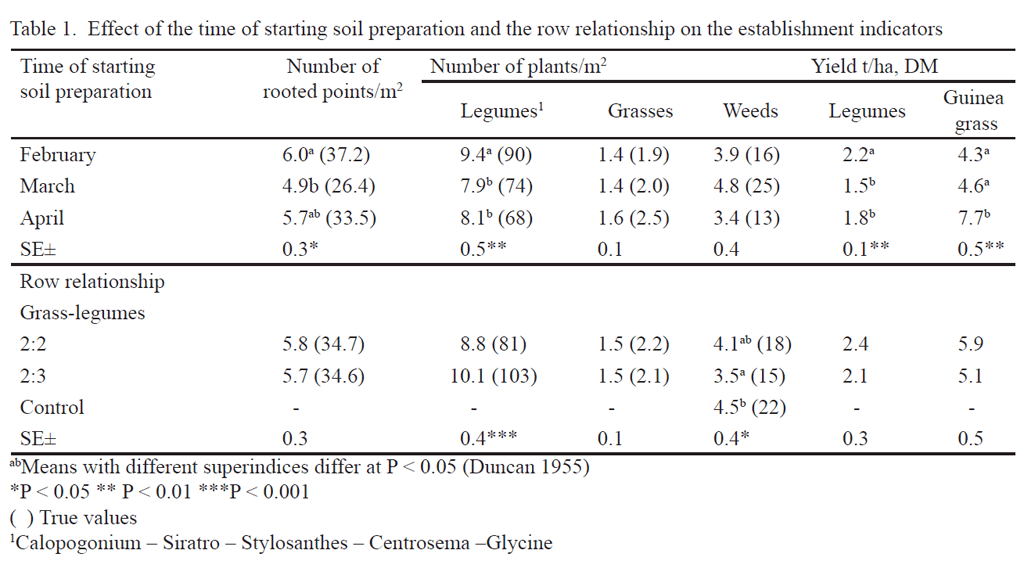
<body><![CDATA[<p align="JUSTIFY">For studying the performance of the association, three observations from each treatment were taken in 0.25   m<sup>2</sup> fixed frames for the measurements plant population/m<sup>2</sup> (legumes-grass-weeds), number of rooted   points/m<sup>2</sup> of the legumes, percentage of weeds and yield, t DM/ha (legumes-grasses-weeds). </p>     <p align="JUSTIFY">From these measurements, the two formers were   transformed according to &laquo;x and for the botanical composition, arc sin   &laquo;x was used. For determining biomass production of legumes and guinea   grass, cutting was at 20 and 10 cm height, respectively.   All measurements were performed 80 days after the germination of the   species sown. An analysis of variance was made and Duncan's (1955) test   was applied in the necessary  cases. </p>     <p align="JUSTIFY">All treatments received the same number of field labors for soil preparation (ploughing- harrow-harrow).</p> </font>     <p>&nbsp;</p>     <p><font size="3" face="Verdana, Arial, Helvetica, sans-serif"><strong>RESULTS AND DISCUSSION</strong></font></p> <font size="2" face="Verdana, Arial, Helvetica, sans-serif">    <p align="JUSTIFY">There was no interaction between factors for the   measurements under study (<a href="/img/revistas/cjas/v49n1/t0117115.gif">table 1</a>).  When the effect of the time of   starting soil preparation for sowing, was evaluated with preparation   times shorter than three months (<a href="/img/revistas/cjas/v49n1/t0117115.gif">table 1</a>), it was found   that when preparationstarted in February there were important values for   legume and grass yield.  The same occurred for other measurements under   assessment. The best performance of the number of rows for sowing   (grass-legume) at the time   of establishment was shown in the relationship 2:3, in measurements as   important as higher number of   legumes/m<sup>2</sup> and lower number of   weeds/m<sup>2</sup>. </p>     
<p align="JUSTIFY">In <a href="/img/revistas/cjas/v49n1/t0117115.gif">table 1</a> is shown that as the numerical value   of weed plants increased, the amount of rooted points was affected as it   took place in March. Meanwhile, the number of legume   plants/m<sup>2</sup> presented differences and thus, was reflected in   its yield   when it was lower as it occurred in the treatments of March and April.   The above mentioned indicates that the weed factor markedly influenced   on the sowing and initial development of the legume-grass plants. </p>     
<p align="JUSTIFY">There was interaction for the weeds regarding weight (t DM/ha). It must be highlighted (<a href="/img/revistas/cjas/v49n1/t0217115.gif">table 2</a>) that   the highest incidence, measured in all treatments at the end of the   rainy period, was evident in areas where the association was not sown.   This became lower as the preparation time was shorter   (April, March and February).  This performance can be associated with   the fact that the preparation was realized in a phase with some level of   rainfall (April) that favors weed germination and thus, their   elimination in the process of soil preparation.  In   that regard, Kolmans and V&aacute;squez (1999) indicated that for a correct   land tilling it must be realized in the season where the conditions of   humidity, temperature and solar radiation are most favorable. </p>     
<p align="JUSTIFY">There were no differences regarding weed presence   in sowings realized at the different times for starting soil   preparation.  Weed incidence is not desirable for starting the   exploitation of an association, since they influence negatively on the   future stability of the grassland.  It must be borne in mind that weed   incidence in areas exploited by the animals could provoke differences   between them, as an indicator of pasture stability. </p>     <p align="JUSTIFY">In a study carried out by Ruiz and Febles (2008)   for determining the performance of different combinations of grass   legumes against two times of soil preparation, it was found that sowing   of more than one legume presented superior   performance for all indicators when compared to the sowing of only one   species. Soil preparation by time period longer than three months before   sowing does not show marked influence on indicators as important as   higher weed presence, lower population   values and rooted points of legumes, aspects of great importance for   attaining good establishments. The preparation time lower than three   months presented more satisfactory values, since lower weed incidence   and higher amount of plants and rooted   points per area (rooted points) were obtained. </p>     ]]></body>
<body><![CDATA[<p align="JUSTIFY">Data analysis confirms what was reported by   Am&eacute;zquita (2002) on indicating the need that researchers working in the   edaphological field should develop indicators and critical levels that   can be used as indicators of the improvement or   degradation, in function of the soil utilization time. </p>     <p align="JUSTIFY">Reyes <em>et al.</em> (1995) stated that the   conventional method of soil preparation may be more productive that   direct sowing or tilling reduction, but the latter allow an   establishment that although slow, its cost is low. These authors   recommends using plough +   two harrow passes and suggest further studies under different   conditions.  Similar conclusions were referred by Bernal <em>et al.</em>(2003). </p>     <p align="JUSTIFY">Ruiz <em>et al.</em> (2000) and Padilla <em>et al.</em> (2005) coincide in that better results are attained in   pasture establishment when soil preparations are realized during short   periods (three months). </p>     <p align="JUSTIFY">In addition, the literature information in the   last years is scarce and mainly centered on the use of zero soil tilling   in cultures as maize, sorghum and not in pastures and forages. Similar   conclusions were cited by Lok <em>et al.</em> (2011) on pointing out the need of studying further soil   and pastures indicators that reflect better the stability of legume   systems. </p>     <p align="JUSTIFY">It is concluded that the beginning of soil   preparation in February favors the harmonic plant and rooted points of   creeping legume development. This is displayed in the balance and   persistency between the system components. </p> </font>     <p>&nbsp;</p>     <p><font size="3" face="Verdana, Arial, Helvetica, sans-serif"><strong>ACKNOWLEDGEMENTS</strong></font></p>     <p><font size="2" face="Verdana, Arial, Helvetica, sans-serif">Thanks are due to Dr. Verena Torres and to the technician Luc&iacute;a Sarduy   from the Department of Biomathematics of the Institute of Animal Science   for the statistical analysis of the data.</font></p>     <p>&nbsp;</p>     <p><font size="2" face="Verdana, Arial, Helvetica, sans-serif"><font size="3"><strong>BIBLIOGRAPHY</strong></font></font></p> <font size="2" face="Verdana, Arial, Helvetica, sans-serif">    ]]></body>
<body><![CDATA[<p align="justify">Am&eacute;zquita E. 1999. <em>Problemas de  degradaci&oacute;n de suelos en los llanos orientales y enfoque de la investigaci&oacute;n  para entenderlos y controlarlos</em>. Colombia: CIAT, Available:  &lt;<a href="http://webpc.ciat.cgiar.org/suelos/e_nacionales/problemas_degradacion.pdf" target="_blank">http://webpc.ciat.cgiar.org/suelos/e_nacionales/problemas_degradacion.pdf</a>&gt;,  [Accessed:&nbsp;July 15, 2014].    <br>       <!-- ref --><br>   Am&eacute;zquita E. 2002. <em>Hacia la  sostenibilidad de los suelos en los llanos orientales de Colombia</em>.  Colombia: CIAT.    <br>       <br>   Andrade R. P., Karia C. T. &amp;  Ramos A. K. B. 2004. &lsquo;&lsquo;Stylosanthes as a forage  legume at its centre of diversity&rsquo;&rsquo;. In: <em>High-yielding anthracnose-resistant  Stylosanthes for agricultural systems</em>, Canberra: Aciar, pp. 39&ndash;50,  Available: &lt;<a href="http://www.cabdirect.org/abstracts/20043151628.html" target="_blank">http://www.cabdirect.org/abstracts/20043151628.html</a>&gt;,  [Accessed:&nbsp;July 15, 2014].    <br>       <!-- ref --><br>   Bernal N., Montealegre G., Nolan S.  &amp; Ram&iacute;rez L. M. 2003. <em>Efecto de cuatro m&eacute;todos de labranza sobre las propiedades  f&iacute;sicas y la p&eacute;rdida de suelo en la rotaci&oacute;n papa-pastos en un ecosistema  h&uacute;medo alto andino de Colombia</em>. Palmira, Colombia: Universidad Nacional de  Colombia.    <br>       <br>   Duncan D. B. 1955. &lsquo;&lsquo;Multiple range  and multiple F tests&rsquo;&rsquo;. <em>Biometrics</em>, 11 (1), pp. 1&ndash;42.    <br>       ]]></body>
<body><![CDATA[<br>   Duran J. L. &amp; P&eacute;rez J. M. 1994.  &lsquo;&lsquo;Correlaci&oacute;n de la clasificaci&oacute;n gen&eacute;tica con otros sistemas de  clasificaci&oacute;n&rsquo;&rsquo;. In: <em>Primera conferencia de clasificaci&oacute;n de los suelos</em>,  La Habana, Cuba, p. 21.    <br>       <!-- ref --><br>   Hern&aacute;ndez A., P&eacute;rez J. M. &amp;  Bosch O. 1999. <em>Nueva versi&oacute;n de clasificaci&oacute;n gen&eacute;tica de los suelos de Cuba</em>.  Cuba: AGRINFOR, 64 p.    <br>       <!-- ref --><br>   Kolmans E. &amp; V&aacute;squez D. 1999. <em>Manual  de agricultura ecol&oacute;gica</em>. Nicaragua: MAELA-SIMAS, 19 p.    <br>       <br>   Lok S., Crespo G., Torres V., Ruiz  T. E., Fraga S. &amp; Noda A. 2011. &lsquo;&lsquo;Determination and selection  of indicators in a grassland based on a multiple mixture of creeping legumes  with fattening cattle&rsquo;&rsquo;. <em>Cuban Journal of Agricultural Science</em>, 45 (1),  Available:  &lt;<a href="http://www.ciencia-animal.org/cuban-journal-of-agricultural-science/articles/V45-N1-Y2011-P059-Sandra-Lok.pdf" target="_blank">http://www.ciencia-animal.org/cuban-journal-of-agricultural-science/articles/V45-N1-Y2011-P059-Sandra-Lok.pdf</a>&gt;,  [Accessed:&nbsp;July 15, 2014].    <br>       <br>   Padilla C., Sardi&ntilde;as Y., Cino D. M.  &amp; Curbelo F. 2005. &lsquo;&lsquo;Initiation moment of the  soil preparation and its economical repercussion on the establishment of  Pennisetum purpureum Schum (elephant grass Cuba CT-115) and the control of  Sporolobus indicus LR Br (wiregrass)&rsquo;&rsquo;. <em>Cuban Journal of Agricultural Science</em>, 39 (4), pp. 623&ndash;630.    <br>       ]]></body>
<body><![CDATA[<br>   Reyes F., Hern&aacute;ndez D. &amp;  Carballo M. 1995. &lsquo;&lsquo;Efecto del laboreo minimo en el establecimiento de  asociaciones m&uacute;ltiples&rsquo;&rsquo;. <em>Pastos y Forrajes</em>, 19 (1), Available:  &lt;<a href="http://payfo.ihatuey.cu/index.php/pasto/article/view/1031" target="_blank">http://payfo.ihatuey.cu/index.php/pasto/article/view/1031</a>&gt;,  [Accessed:&nbsp;July 15, 2014].    <br>       <br>   Ruiz T. E. &amp; Febles G. 2006.  &lsquo;&lsquo;Principios Agron&oacute;micos para la Producci&oacute;n de Pastos. Parte 1. Agrot&eacute;cnia para  el fomento de sistemas con leguminosas&rsquo;&rsquo;. In: <em>Recursos Forrajeros. Herb&aacute;ceas  y Arb&oacute;reas</em>, Universidad de San Carlos de Guatemala: Universitaria, p. 103.    <br>       <br>   Ruiz T. E. &amp; Febles G. 2008.  &lsquo;&lsquo;Establecimiento de leguminosas rastreras en cultivo puro. Modulo II: Pastos  tropicales, principios generales, agrotecnia y producci&oacute;n de biomasa&rsquo;&rsquo;. In: <em>Diplomado:  Manejo y alimentaci&oacute;n de bovinos en el tr&oacute;pico</em>, Tantakin, FIRA, M&eacute;xico, p.  185.    <br>       <br>   Ruiz T. E., Febles G., Castillo E.  &amp; El&iacute;as A. 2000. &lsquo;&lsquo;Leguminosas herb&aacute;ceas en la producci&oacute;n pecuaria.  Reflexiones y Posibilidades&rsquo;&rsquo;. In: <em>Estrategias de alimentaci&oacute;n con recursos  locales para la ganader&iacute;a de doble prop&oacute;sito en &eacute;pocas cr&iacute;tica (Curso)</em>,  vol. 46, M&eacute;xico: Universidad de Colima.    <br>       <br> Simeao R.,  Resende M., Valle C., Jank L., Laura V. &amp; Chiari L. 2006. &lsquo;&lsquo;Analise genetica  do carater sobrevivencia em Stylosanthes guianensis e implicacoes na selecao  para produtividade&rsquo;&rsquo;. In: <em>43 Reuniao Anual da Sociedade Brasileira de  Zootecnia</em>, Joao Pesson-PB.</p></font>     <p align="justify">&nbsp;</p>     ]]></body>
<body><![CDATA[<p align="justify">&nbsp;</p>     <p><font size="2" face="Verdana, Arial, Helvetica, sans-serif">Received: July 15, 2014    <br> Accepted: November 1, 2014</font></p>     <p>&nbsp;</p>     <p>&nbsp;</p>     <p><font size="2" face="Verdana, Arial, Helvetica, sans-serif"><em>T. E. Ruíz,</em> Instituto de Ciencia Animal, Apartado Postal 24, San José de las Lajas, La Habana.    Email: <a href="mailto:teruizv@ica.co.cu ">teruizv@ica.co.cu </a></font></p>      ]]></body><back>
<ref-list>
<ref id="B1">
<nlm-citation citation-type="book">
<person-group person-group-type="author">
<name>
<surname><![CDATA[Amézquita]]></surname>
<given-names><![CDATA[E.]]></given-names>
</name>
</person-group>
<source><![CDATA[Problemas de degradación de suelos en los llanos orientales y enfoque de la investigación para entenderlos y controlarlos]]></source>
<year>1999</year>
<publisher-loc><![CDATA[Colombia ]]></publisher-loc>
<publisher-name><![CDATA[CIAT]]></publisher-name>
</nlm-citation>
</ref>
<ref id="B2">
<nlm-citation citation-type="book">
<person-group person-group-type="author">
<name>
<surname><![CDATA[Amézquita]]></surname>
<given-names><![CDATA[E.]]></given-names>
</name>
</person-group>
<source><![CDATA[Hacia la sostenibilidad de los suelos en los llanos orientales de Colombia]]></source>
<year>2002</year>
<publisher-loc><![CDATA[Colombia ]]></publisher-loc>
<publisher-name><![CDATA[CIAT]]></publisher-name>
</nlm-citation>
</ref>
<ref id="B3">
<nlm-citation citation-type="book">
<person-group person-group-type="author">
<name>
<surname><![CDATA[Andrade]]></surname>
<given-names><![CDATA[R. P.]]></given-names>
</name>
<name>
<surname><![CDATA[Karia]]></surname>
<given-names><![CDATA[C. T.]]></given-names>
</name>
<name>
<surname><![CDATA[Ramos]]></surname>
<given-names><![CDATA[A. K. B.]]></given-names>
</name>
</person-group>
<article-title xml:lang="nd"><![CDATA[Stylosanthes as a forage legume at its centre of diversity]]></article-title>
<source><![CDATA[High-yielding anthracnose-resistant Stylosanthes for agricultural systems]]></source>
<year>2004</year>
<page-range>39–50</page-range><publisher-loc><![CDATA[Canberra ]]></publisher-loc>
<publisher-name><![CDATA[Aciar]]></publisher-name>
</nlm-citation>
</ref>
<ref id="B4">
<nlm-citation citation-type="book">
<person-group person-group-type="author">
<name>
<surname><![CDATA[Bernal]]></surname>
<given-names><![CDATA[N.]]></given-names>
</name>
<name>
<surname><![CDATA[Montealegre]]></surname>
<given-names><![CDATA[G.]]></given-names>
</name>
<name>
<surname><![CDATA[Nolan]]></surname>
<given-names><![CDATA[S.]]></given-names>
</name>
<name>
<surname><![CDATA[Ramírez]]></surname>
<given-names><![CDATA[L. M.]]></given-names>
</name>
</person-group>
<source><![CDATA[Efecto de cuatro métodos de labranza sobre las propiedades físicas y la pérdida de suelo en la rotación papa-pastos en un ecosistema húmedo alto andino de Colombia]]></source>
<year>2003</year>
<publisher-loc><![CDATA[Palmira, Colombia ]]></publisher-loc>
<publisher-name><![CDATA[Universidad Nacional de Colombia]]></publisher-name>
</nlm-citation>
</ref>
<ref id="B5">
<nlm-citation citation-type="journal">
<person-group person-group-type="author">
<name>
<surname><![CDATA[Duncan]]></surname>
<given-names><![CDATA[D. B.]]></given-names>
</name>
</person-group>
<article-title xml:lang="nd"><![CDATA[Multiple range and multiple F tests]]></article-title>
<source><![CDATA[Biometrics]]></source>
<year>1955</year>
<volume>11</volume>
<numero>1</numero>
<issue>1</issue>
<page-range>1–42</page-range></nlm-citation>
</ref>
<ref id="B6">
<nlm-citation citation-type="">
<person-group person-group-type="author">
<name>
<surname><![CDATA[Duran]]></surname>
<given-names><![CDATA[J. L.]]></given-names>
</name>
<name>
<surname><![CDATA[Pérez]]></surname>
<given-names><![CDATA[J. M.]]></given-names>
</name>
</person-group>
<article-title xml:lang="nd"><![CDATA[Correlación de la clasificación genética con otros sistemas de clasificación]]></article-title>
<source><![CDATA[]]></source>
<year>1994</year>
<page-range>21</page-range><publisher-loc><![CDATA[La Habana, Cuba ]]></publisher-loc>
</nlm-citation>
</ref>
<ref id="B7">
<nlm-citation citation-type="book">
<person-group person-group-type="author">
<name>
<surname><![CDATA[Hernández]]></surname>
<given-names><![CDATA[A.]]></given-names>
</name>
<name>
<surname><![CDATA[Pérez]]></surname>
<given-names><![CDATA[J. M.]]></given-names>
</name>
<name>
<surname><![CDATA[Bosch]]></surname>
<given-names><![CDATA[O.]]></given-names>
</name>
</person-group>
<source><![CDATA[Nueva versión de clasificación genética de los suelos de Cuba]]></source>
<year>1999</year>
<page-range>64</page-range><publisher-loc><![CDATA[Cuba ]]></publisher-loc>
<publisher-name><![CDATA[AGRINFOR]]></publisher-name>
</nlm-citation>
</ref>
<ref id="B8">
<nlm-citation citation-type="book">
<person-group person-group-type="author">
<name>
<surname><![CDATA[Kolmans]]></surname>
<given-names><![CDATA[E.]]></given-names>
</name>
<name>
<surname><![CDATA[Vásquez]]></surname>
<given-names><![CDATA[D.]]></given-names>
</name>
</person-group>
<source><![CDATA[Manual de agricultura ecológica]]></source>
<year>1999</year>
<page-range>19</page-range><publisher-loc><![CDATA[Nicaragua ]]></publisher-loc>
<publisher-name><![CDATA[MAELA-SIMAS]]></publisher-name>
</nlm-citation>
</ref>
<ref id="B9">
<nlm-citation citation-type="journal">
<person-group person-group-type="author">
<name>
<surname><![CDATA[Lok]]></surname>
<given-names><![CDATA[S.]]></given-names>
</name>
<name>
<surname><![CDATA[Crespo]]></surname>
<given-names><![CDATA[G.]]></given-names>
</name>
<name>
<surname><![CDATA[Torres]]></surname>
<given-names><![CDATA[V.]]></given-names>
</name>
<name>
<surname><![CDATA[Ruiz]]></surname>
<given-names><![CDATA[T. E.]]></given-names>
</name>
<name>
<surname><![CDATA[Fraga]]></surname>
<given-names><![CDATA[S.]]></given-names>
</name>
<name>
<surname><![CDATA[Noda]]></surname>
<given-names><![CDATA[A.]]></given-names>
</name>
</person-group>
<article-title xml:lang="nd"><![CDATA[Determination and selection of indicators in a grassland based on a multiple mixture of creeping legumes with fattening cattle]]></article-title>
<source><![CDATA[Cuban Journal of Agricultural Science]]></source>
<year>2011</year>
<volume>45</volume>
<numero>1</numero>
<issue>1</issue>
</nlm-citation>
</ref>
<ref id="B10">
<nlm-citation citation-type="journal">
<person-group person-group-type="author">
<name>
<surname><![CDATA[Padilla]]></surname>
<given-names><![CDATA[C.]]></given-names>
</name>
<name>
<surname><![CDATA[Sardiñas]]></surname>
<given-names><![CDATA[Y.]]></given-names>
</name>
<name>
<surname><![CDATA[Cino]]></surname>
<given-names><![CDATA[D. M.]]></given-names>
</name>
<name>
<surname><![CDATA[Curbelo]]></surname>
<given-names><![CDATA[F.]]></given-names>
</name>
</person-group>
<article-title xml:lang="nd"><![CDATA[Initiation moment of the soil preparation and its economical repercussion on the establishment of Pennisetum purpureum Schum (elephant grass Cuba CT-115) and the control of Sporolobus indicus LR Br (wiregrass)]]></article-title>
<source><![CDATA[Cuban Journal of Agricultural Science]]></source>
<year>2005</year>
<volume>39</volume>
<numero>4</numero>
<issue>4</issue>
<page-range>623–630</page-range></nlm-citation>
</ref>
<ref id="B11">
<nlm-citation citation-type="journal">
<person-group person-group-type="author">
<name>
<surname><![CDATA[Reyes]]></surname>
<given-names><![CDATA[F.]]></given-names>
</name>
<name>
<surname><![CDATA[Hernández]]></surname>
<given-names><![CDATA[D.]]></given-names>
</name>
<name>
<surname><![CDATA[Carballo]]></surname>
<given-names><![CDATA[M.]]></given-names>
</name>
</person-group>
<article-title xml:lang="nd"><![CDATA[Efecto del laboreo minimo en el establecimiento de asociaciones múltiples]]></article-title>
<source><![CDATA[Pastos y Forrajes]]></source>
<year>1995</year>
<volume>19</volume>
<numero>1</numero>
<issue>1</issue>
</nlm-citation>
</ref>
<ref id="B12">
<nlm-citation citation-type="book">
<person-group person-group-type="author">
<name>
<surname><![CDATA[Ruiz]]></surname>
<given-names><![CDATA[T. E.]]></given-names>
</name>
<name>
<surname><![CDATA[Febles]]></surname>
<given-names><![CDATA[G.]]></given-names>
</name>
</person-group>
<article-title xml:lang="nd"><![CDATA[Principios Agronómicos para la Producción de Pastos. Parte 1. Agrotécnia para el fomento de sistemas con leguminosas]]></article-title>
<source><![CDATA[Recursos Forrajeros. Herbáceas y Arbóreas]]></source>
<year>2006</year>
<page-range>103</page-range><publisher-loc><![CDATA[Universidad de San Carlos de Guatemala ]]></publisher-loc>
<publisher-name><![CDATA[Universitaria]]></publisher-name>
</nlm-citation>
</ref>
<ref id="B13">
<nlm-citation citation-type="">
<person-group person-group-type="author">
<name>
<surname><![CDATA[Ruiz]]></surname>
<given-names><![CDATA[T. E.]]></given-names>
</name>
<name>
<surname><![CDATA[Febles]]></surname>
<given-names><![CDATA[G.]]></given-names>
</name>
</person-group>
<article-title xml:lang="nd"><![CDATA[Establecimiento de leguminosas rastreras en cultivo puro. Modulo II: Pastos tropicales, principios generales, agrotecnia y producción de biomasa]]></article-title>
<source><![CDATA[]]></source>
<year>2008</year>
<page-range>185</page-range><publisher-loc><![CDATA[Tantakin, FIRA, México ]]></publisher-loc>
</nlm-citation>
</ref>
<ref id="B14">
<nlm-citation citation-type="book">
<person-group person-group-type="author">
<name>
<surname><![CDATA[Ruiz]]></surname>
<given-names><![CDATA[T. E.]]></given-names>
</name>
<name>
<surname><![CDATA[Febles]]></surname>
<given-names><![CDATA[G.]]></given-names>
</name>
<name>
<surname><![CDATA[Castillo]]></surname>
<given-names><![CDATA[E.]]></given-names>
</name>
<name>
<surname><![CDATA[Elías]]></surname>
<given-names><![CDATA[A.]]></given-names>
</name>
</person-group>
<article-title xml:lang="nd"><![CDATA[Leguminosas herbáceas en la producción pecuaria. Reflexiones y Posibilidades]]></article-title>
<source><![CDATA[Estrategias de alimentación con recursos locales para la ganadería de doble propósito en épocas crítica (Curso)]]></source>
<year>2000</year>
<volume>46</volume>
<publisher-loc><![CDATA[México ]]></publisher-loc>
<publisher-name><![CDATA[Universidad de Colima]]></publisher-name>
</nlm-citation>
</ref>
<ref id="B15">
<nlm-citation citation-type="">
<person-group person-group-type="author">
<name>
<surname><![CDATA[Simeao]]></surname>
<given-names><![CDATA[R.]]></given-names>
</name>
<name>
<surname><![CDATA[Resende]]></surname>
<given-names><![CDATA[M.]]></given-names>
</name>
<name>
<surname><![CDATA[Valle]]></surname>
<given-names><![CDATA[C.]]></given-names>
</name>
<name>
<surname><![CDATA[Jank]]></surname>
<given-names><![CDATA[L.]]></given-names>
</name>
<name>
<surname><![CDATA[Laura]]></surname>
<given-names><![CDATA[V.]]></given-names>
</name>
<name>
<surname><![CDATA[Chiari]]></surname>
<given-names><![CDATA[L.]]></given-names>
</name>
</person-group>
<article-title xml:lang="nd"><![CDATA[Analise genetica do carater sobrevivencia em Stylosanthes guianensis e implicacoes na selecao para produtividade]]></article-title>
<source><![CDATA[]]></source>
<year>2006</year>
<publisher-loc><![CDATA[Joao Pesson-PB ]]></publisher-loc>
</nlm-citation>
</ref>
</ref-list>
</back>
</article>