<?xml version="1.0" encoding="ISO-8859-1"?><article xmlns:mml="http://www.w3.org/1998/Math/MathML" xmlns:xlink="http://www.w3.org/1999/xlink" xmlns:xsi="http://www.w3.org/2001/XMLSchema-instance">
<front>
<journal-meta>
<journal-id>2079-3480</journal-id>
<journal-title><![CDATA[Cuban Journal of Agricultural Science]]></journal-title>
<abbrev-journal-title><![CDATA[Cuban J. Agric. Sci.]]></abbrev-journal-title>
<issn>2079-3480</issn>
<publisher>
<publisher-name><![CDATA[Editorial del Instituto de Ciencia Animal]]></publisher-name>
</publisher>
</journal-meta>
<article-meta>
<article-id>S2079-34802015000200004</article-id>
<title-group>
<article-title xml:lang="en"><![CDATA[Principal results of the studies carried out at the Instituto de Ciencia Animal on bovine milk production]]></article-title>
<article-title xml:lang="es"><![CDATA[Principales resultados de los estudios desarrollados en el Instituto de Ciencia animal en la producción de leche bovina]]></article-title>
</title-group>
<contrib-group>
<contrib contrib-type="author">
<name>
<surname><![CDATA[Reyes]]></surname>
<given-names><![CDATA[J.J]]></given-names>
</name>
<xref ref-type="aff" rid="A01"/>
</contrib>
</contrib-group>
<aff id="A01">
<institution><![CDATA[,Instituto de Ciencia Animal  ]]></institution>
<addr-line><![CDATA[San José de las Lajas Mayabeque]]></addr-line>
<country>Cuba</country>
</aff>
<pub-date pub-type="pub">
<day>00</day>
<month>06</month>
<year>2015</year>
</pub-date>
<pub-date pub-type="epub">
<day>00</day>
<month>06</month>
<year>2015</year>
</pub-date>
<volume>49</volume>
<numero>2</numero>
<fpage>153</fpage>
<lpage>159</lpage>
<copyright-statement/>
<copyright-year/>
<self-uri xlink:href="http://scielo.sld.cu/scielo.php?script=sci_arttext&amp;pid=S2079-34802015000200004&amp;lng=en&amp;nrm=iso"></self-uri><self-uri xlink:href="http://scielo.sld.cu/scielo.php?script=sci_abstract&amp;pid=S2079-34802015000200004&amp;lng=en&amp;nrm=iso"></self-uri><self-uri xlink:href="http://scielo.sld.cu/scielo.php?script=sci_pdf&amp;pid=S2079-34802015000200004&amp;lng=en&amp;nrm=iso"></self-uri><abstract abstract-type="short" xml:lang="en"><p><![CDATA[The main results obtained in milk production under Cuban conditions, with the grass as basic foods are shown. With the appropriate interaction of stocking rate and grass varieties, dairy productions between 8 and 9 kg d-1 during the rainy season were reached, with stocking rate of 3.0 cows ha-1 in coast cross Bermuda grass (Cynodon dactylon), 4.0 cows ha-1 in pangola grass (Digitaria decumbens Stent) and 5.0 cows ha-1 in star grass (Cynodon nlemfuensis).For the grass rotational management, the number of paddocks per group was between four and eight. The application of the pin pointer method and followers make possible higher balance between the composition and grass quantity and the animals requirements. With the use of legumes in the system, productions of 15 kg milk cow-1 d-1 can reached, with the lower supplement use. The supplementation showed higher advantage when the differential between the grass and the animal potential was more marked. The supplementation effect was higher at the beginning of lactation. The feeding systems with restricted grazing in the dry season, complemented with silage or sugar cane as forage, reached individuals productions between 7 and 8 kg of milk d-1, with complement intake between 5.8 and 7.3 kg DM cow -1 d-1for sugar cane and silage, respectively]]></p></abstract>
<abstract abstract-type="short" xml:lang="es"><p><![CDATA[Se muestran los principales resultados obtenidos en producción de leche bovina en las condiciones de Cuba, con el pasto como alimento base. Con la interacción adecuada de las cargas y variedades de pasto, se alcanzaron producciones lácteas entre 8 y 9 kg d-1 durante la época de lluvias, con carga de 3.0 vacas ha-1 en bermuda cruzada (Cynodon dactylon), 4.0 vacas ha-1 en pangola (Digitaria decumbens Stent) y 5.0 vacas ha-1 en pasto estrella (Cynodon nlemfuensis). Para el manejo rotacional del pasto, el número de cuartones por grupo estuvo entre cuatro y ocho. La aplicación del método de puntero y continuadores posibilitó mayor equilibrio entre la composición y cantidad de pasto y los requerimientos de los animales. Con la utilización de las leguminosas en el sistema, se puede llegar a producciones de 15 kg leche vaca-1 d-1, con mínimo uso de suplemento. La suplementación mostró mayor ventaja cuando el diferencial entre el pasto y el potencial del animal fue más marcado. El efecto del suplemento fue mayor al inicio de la lactación. Los sistemas de alimentación con pastoreo restringido en el período poco lluvioso, complementados con ensilaje o caña de azúcar como forraje, alcanzaron producciones individuales entre 7 y 8 kg de leche d-1, con consumo de complemento entre 5.8 y 7.3 kg MS vaca-1 d-1 para la caña y ensilaje, respectivamente]]></p></abstract>
<kwd-group>
<kwd lng="en"><![CDATA[grazing]]></kwd>
<kwd lng="en"><![CDATA[grasses]]></kwd>
<kwd lng="en"><![CDATA[legumes]]></kwd>
<kwd lng="en"><![CDATA[supplementation]]></kwd>
<kwd lng="en"><![CDATA[milk]]></kwd>
<kwd lng="en"><![CDATA[quality]]></kwd>
<kwd lng="es"><![CDATA[pastoreo]]></kwd>
<kwd lng="es"><![CDATA[gramíneas]]></kwd>
<kwd lng="es"><![CDATA[leguminosas]]></kwd>
<kwd lng="es"><![CDATA[suplementación]]></kwd>
<kwd lng="es"><![CDATA[leche]]></kwd>
<kwd lng="es"><![CDATA[calidad]]></kwd>
</kwd-group>
</article-meta>
</front><body><![CDATA[ <p align="right"><font size="2" face="Verdana, Arial, Helvetica,   sans-serif"><b>REVIEW</b></font></p>     <p>&nbsp;</p>     <p align="justify"><font size="4" face="Verdana, Arial, Helvetica, sans-serif"><b>Principal results of the studies carried out at the Instituto de  Ciencia Animal on bovine milk production</b></font></p>     <p align="justify">&nbsp;</p>     <p align="justify"><font size="3" face="Verdana, Arial, Helvetica, sans-serif"><b>Principales resultados de los estudios desarrollados en el Instituto de Ciencia animal en la producción de leche bovina</b></font></p>     <p align="justify">&nbsp;</p>     <p align="justify">&nbsp;</p>     <p align="justify"><font size="2" face="Verdana, Arial, Helvetica, sans-serif"><b>J.J. Reyes,</b><sup><b>I</b></sup></font></p> <font size="2" face="Verdana, Arial, Helvetica, sans-serif"><sup>I</sup>Instituto de Ciencia Animal, Apartado Postal 24, San José de las Lajas, Mayabeque, Cuba.</font>   </p>     <p align="justify">&nbsp;</p>     <p align="justify">&nbsp;</p> <hr align="JUSTIFY">     ]]></body>
<body><![CDATA[<p align="justify"><font size="2" face="Verdana, Arial, Helvetica, sans-serif"><b>ABSTRACT</b></font></p>     <p align="justify"><font size="2" face="Verdana, Arial, Helvetica, sans-serif"><span lang="EN-US">The main results  obtained in milk production under Cuban conditions, with the grass as basic  foods are shown. With the  appropriate interaction of stocking rate and grass varieties, dairy productions  between 8 and 9 kg d<sup>-1</sup> during the rainy season were reached, with  stocking rate of 3.0 cows ha<sup>-1</sup> in coast cross Bermuda grass (<em>Cynodon</em><em> dactylon</em>),  4.0 cows ha<sup>-1</sup> in pangola grass (<em>Digitaria</em><em> decumbens</em> Stent) and 5.0 cows ha<sup>-1</sup> in star grass (<em>Cynodon</em><em> nlemfuensis</em>).For the grass rotational management,  the number of paddocks per group was between four and eight. The  application of the pin pointer method and followers make possible higher  balance between the composition and grass quantity and the animals  requirements. With the use of legumes in the system, productions of 15 kg milk  cow<sup>-1</sup> d<sup>-1</sup> can reached, with the lower supplement use. The  supplementation showed higher advantage when the differential between the grass  and the animal potential was more marked. The supplementation effect was higher  at the beginning of lactation. The feeding systems with restricted grazing in  the dry season, complemented with silage or sugar cane as forage, reached  individuals productions between 7 and 8 kg of milk d<sup>-1</sup>, with  complement intake between 5.8 and 7.3 kg DM cow <sup>-1</sup> d<sup>-1</sup>for  sugar cane and silage, respectively.</span>.</font></p>     <p align="justify"><font size="2" face="Verdana, Arial, Helvetica, sans-serif"><b>Key words:</b> grazing, grasses, legumes, supplementation, milk, quality.</font></p> <hr align="JUSTIFY">     <p align="justify"><font size="2" face="Verdana, Arial, Helvetica, sans-serif"><b>RESUMEN</b></font></p>     <p align="justify"><font size="2" face="Verdana, Arial, Helvetica, sans-serif">Se muestran los principales  resultados obtenidos en producci&oacute;n de leche bovina en las condiciones de Cuba,  con el pasto como alimento base.&nbsp; Con la interacci&oacute;n adecuada de las cargas y  variedades de pasto, se alcanzaron producciones l&aacute;cteas entre 8 y 9 kg d<sup>-1</sup>  durante la &eacute;poca de lluvias, con carga de 3.0 vacas ha<sup>-1</sup> en bermuda  cruzada (<em>Cynodon</em><em> dactylon</em>),  4.0 vacas ha<sup>-1</sup> en pangola (<em>Digitaria</em><em> decumbens</em> Stent) y 5.0 vacas ha<sup>-1</sup> en pasto estrella (<em>Cynodon</em><em> nlemfuensis</em>). Para el manejo rotacional del  pasto, el n&uacute;mero de cuartones por grupo estuvo entre cuatro y ocho. La  aplicaci&oacute;n del m&eacute;todo de puntero y continuadores posibilit&oacute; mayor equilibrio  entre la composici&oacute;n y cantidad de pasto y los requerimientos de los animales.  Con la utilizaci&oacute;n de las leguminosas en el sistema, se puede llegar a  producciones de 15 kg leche vaca<sup>-1</sup> d<sup>-1</sup>, con m&iacute;nimo uso de  suplemento. La suplementaci&oacute;n mostr&oacute; mayor ventaja cuando el diferencial entre  el pasto y el potencial del animal fue m&aacute;s marcado. El efecto del suplemento  fue mayor al inicio de la lactaci&oacute;n. Los sistemas de alimentaci&oacute;n con pastoreo  restringido en el per&iacute;odo poco lluvioso, complementados con ensilaje o ca&ntilde;a de  az&uacute;car como forraje, alcanzaron producciones individuales entre 7 y 8 kg de  leche d<sup>-1</sup>, con consumo de complemento entre 5.8 y 7.3 kg MS vaca<sup>-1</sup>  d<sup>-1</sup> para la ca&ntilde;a y ensilaje, respectivamente.</font></p>     <p align="justify"><font size="2" face="Verdana, Arial, Helvetica, sans-serif"><b>Palabras    clave:</b>    pastoreo, gramíneas, leguminosas, suplementación, leche, calidad.</font></p> <hr align="JUSTIFY">     <p align="justify">&nbsp;</p>     <p align="justify">&nbsp;</p>     <p align="justify"><strong><font size="3" face="Verdana, Arial, Helvetica, sans-serif"><span lang="EN-US">INTRODUCTION</span></font></strong></p>     <p align="justify"><font size="2" face="Verdana, Arial, Helvetica, sans-serif"><span lang="EN-US">Under Cuban conditions, the dairy animal management should be  developed based on grasses, in accordance with the systems that are adjusted to  the present, in which there is not irrigation and the chemical fertilizers  application is in very low quantity or null. The most appropriate genotypes for  Cuban conditions are those from cattle cross Holstein x Zebu, (Siboney and Mamb&iacute; de Cuba), or  other genotypes that have the appropriate rustic. The semi stabulation  is the most used grass management system (Senra  2005a).</span></font></p>     ]]></body>
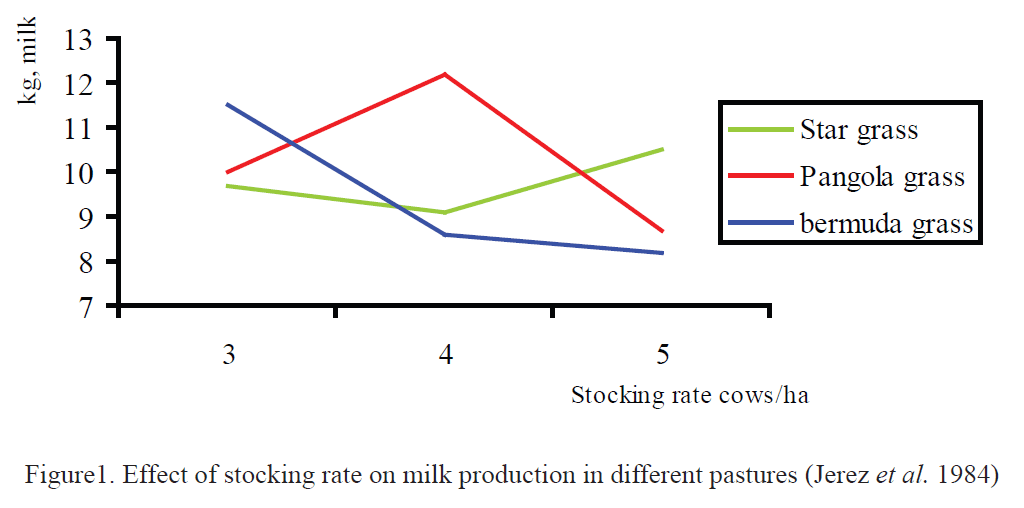
<body><![CDATA[<p align="justify"><font size="2" face="Verdana, Arial, Helvetica, sans-serif"><span lang="EN-US">The necessity that has the tropical countries of developing milk  production systems based on grasses it is known, in which those factors that  supposedly limit it should improve with the application of the appropriate  management and the introduction of grasses of higher yield and quality,  although some demand of certain quantity of inputs (irrigation and fertilization),  in function of the quality benefit, that directly influences in animal intake  (P&eacute;rez Infante 1982).</span></font></p>     <p align="justify"><font size="2" face="Verdana, Arial, Helvetica, sans-serif"><span lang="EN-US">The objective of this review is to inform about researches carried  out in the Instituto de Ciencia  Animal, mainly concerning milk production based on grasses, under Cuban  conditions. Factors related with the supplementation and complementation, that  should be adjusted with the necessary flexibility are also    analyzed.&nbsp; </span></font></p>     <p align="justify"><font size="2" face="Verdana, Arial, Helvetica, sans-serif"><span lang="EN-US">&nbsp;</span></font></p>     <p align="justify"><strong><font size="3" face="Verdana, Arial, Helvetica, sans-serif"><span lang="EN-US">MILK PRODUCTION BASED ON TROPICAL  GRASSES AND SUPPLEMENTATION DURING    THE DRY SEASON </span></font></strong></p>     <p align="justify"><font size="2" face="Verdana, Arial, Helvetica, sans-serif"><span lang="EN-US">The study of grazing method continues being object of researchers  and producers interest, because opinions about which is the most appropriate  method have not been to unify. The grazing methods should be applied with the  necessary flexibility, according to the characteristics of each exploitation  system, which covers the type of animal production, soil, climate, grass  specie, animal potential, available resources, producer objectives and social  aspects.&nbsp; </span></font></p>     <p align="justify"><font size="2" face="Verdana, Arial, Helvetica, sans-serif"><span lang="EN-US">It is considered that the rotational grazing, mainly that of high  density, in which the Rotational Grazing Voisin (RGV)  is included, represents an advance in the grassland management, regarding to  the continuous grazing. However, the application of a management system to the  grass in a faster way, can&nbsp; present some  problems that should be avoid with the right application of management and  nutrition principles,&nbsp; besides the  periodic and integral evaluation of the functioning of methods of the grassland  ecosystem management(Senra <em>et al.</em> 2005b).</span></font></p>     <p align="justify"><font size="2" face="Verdana, Arial, Helvetica, sans-serif"><span lang="EN-US">The possibilities of the grass intake are what determine their  productive potentialities. Studies about the possible effect of three stocking  rates (3.2, 4.2 and&nbsp; 5.0 animals/ha) in  production and composition of milk from cows grazing pangola  grass showed that milk production decrease (P &lt; 0.05) 27.8 % with the  highest stocking rate, while the other two did not differ, the same as dairy  components(Pedroso and Garc&iacute;a1977). </span></font></p>     <p align="justify"><font size="2" face="Verdana, Arial, Helvetica, sans-serif"><span lang="EN-US">Jerez <em>et al.</em> (1984) showed that  grass variety influences in the stocking rate for the milk production. When  studying the star grass, coast cross No1 bermuda  grass (<em>Cynodon dactylon</em>)  and pangola grass varieties, all fertilized with 50  kg N/ha every two rotations during the rainy season and three stocking rates  (3.0, 4.0&nbsp; and 5.0 cows/ha), the mentioned  authors found interaction(P &lt; 0.05) between the grass specie and the stoking  rate for milk production (<a href="/img/revistas/cjas/v49n2/f0104215.gif">figure 1</a>).The higher yields in milk, with stocking  rate of 5.0 cows/ha, were reached with the star grass(9.7, 9.1 and 10.5  kg/cow/d, for 3, 4 and 5 cows/ha, respectively. The opposite happened with  coast cross Bermuda grass and pangola grass, grasses  that keep decreasing tendency when increasing the stocking rate, since the  daily supply decrease. Under tropic conditions, the availability is higher to  30 kg DM/cow/d, which not improve milk production&nbsp;&nbsp; (Stobbs  1977).&nbsp; </span></font></p>     
<p align="justify"><font size="2" face="Verdana, Arial, Helvetica, sans-serif"><span lang="EN-US">These results of the different stocking  rate are related with the availability and quality of the grass that is  supplied to the animals. Mart&iacute;nez and Jerez (1979),  when analyzing the productive performance of cows in pagola  grass grazing, divided in three groups (high, low and mid production), with  leaders and followers systems, verified that daily mean productions of milk  were 11.7, 7.2 and 4.3 L/cow/d, for high, mid and low groups, respectively. Mart&iacute;nez and Pereiro (1979)  informed that in cows that graze pangola grass, the  milk production was higher    (P &lt; 0.01) for those that calving in June- August trimester, regarding those  that did it in September- November (8.3 vs 7.4  kg/cow/d).This is explained because in the June &ndash;August trimester the climate  influence is positive (precipitations, luminance and temperatures), which  affect the grass availability and quality during this stage in which lactation  begins.&nbsp; &nbsp;</span></font></p>     <p align="justify"><font size="2" face="Verdana, Arial, Helvetica, sans-serif"><span lang="EN-US">The study of factors that influence the management of grazing dairy  cows has received attention from researchers and producers, because of the  importance of achieving higher efficiency in milk production systems and  management factors. The number of paddocks has been a matter of dispute, since  in general no differences between a paddock (continuous grazing system) and  several of them (rotational grazing system) are not reported, when grasses are  naturals and without fertilization. However, with improved grasses, rotational  grazing may exceed, in animal production, between 13 and 25% (Senra 2005b).</span></font></p>     ]]></body>
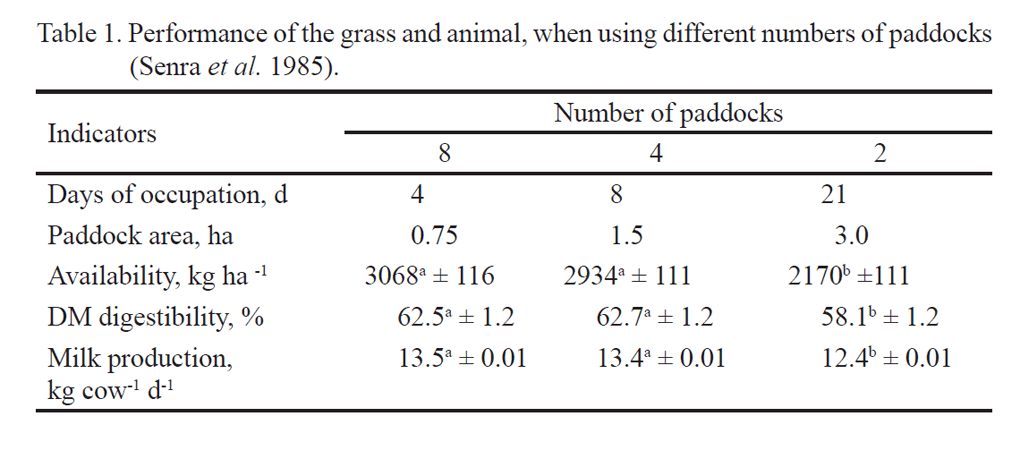
<body><![CDATA[<p align="justify"><font size="2" face="Verdana, Arial, Helvetica, sans-serif"><span lang="EN-US">In many studies, the results of  comparing different number of paddocks have been contradictories. The obtained  advantages by increasing the number of padocks in  rotational grazing are associated with high stocking rates, which were due,  mainly, to the higher possibilities of preserving the grass surplus.&nbsp; A general opinion to follow is to reduce the  number of paddocks, whenever the animal and grass performance were not  affected, which is based on the possibilities of reducing the cost in  investment and maintenance of fences and allies. </span> </font></p>     <p align="justify"><font size="2" face="Verdana, Arial, Helvetica, sans-serif"><span lang="EN-US">Senra <em>et al.</em> (1985) reported that when studying three numbers of paddocks per group (eight,  four and two paddocks), with fixed stocking rate of    3.66 cows/ ha, there were no differences in the individual milk production  between eight and four paddocks, but both were higher (P &lt;0.05) to the  system of two paddocks in 8.8 and 7.5% for eight and four paddocks,  respectively (<a href="/img/revistas/cjas/v49n2/t0104215.gif">table 1</a>).</span></font></p>     
<p align="justify"><font size="2" face="Verdana, Arial, Helvetica, sans-serif"><span lang="EN-US">&nbsp;The availability and grass residue  were lower in the two paddocks system, without differences between eight and  four (<a href="/img/revistas/cjas/v49n2/t0104215.gif">table 1</a>), while the live weight increase was higher (P &lt;0.05) in eight  paddocks, without differences between four and two (493, 479 and 473 kg / cow  for 8, 4 and 2, respectively). The grassland purity, after two years, was  approximately 90.0% for the three systems, so the management of four number of  paddocks per group of dairy cows in star grass areas is suggested, with the  purpose of not affecting the animal and grass performance.</span></font></p>     
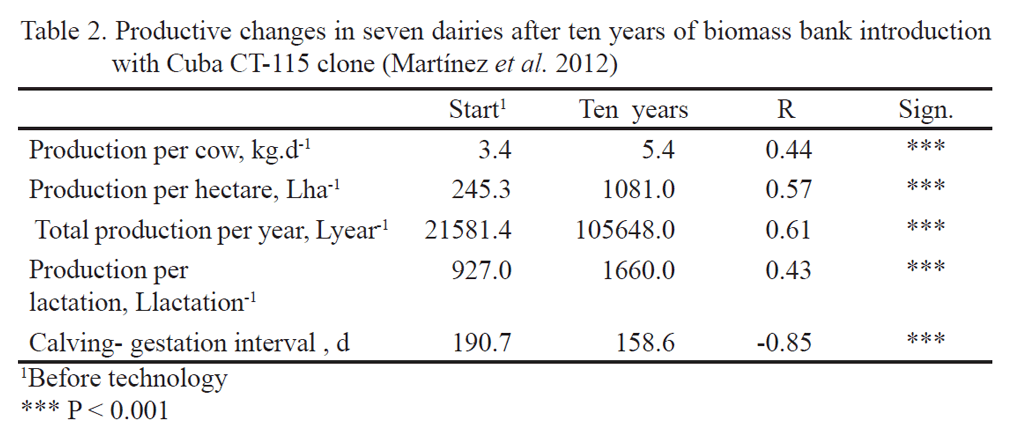
<p align="justify"><font size="2" face="Verdana, Arial, Helvetica, sans-serif"><span lang="EN-US">These results are based on that the  occupation days can be increased and maintain the adequate uniformity in the  individual milk production, whenever increase, proportionally, the paddock  area, since the milk decrease is not related, necessarily, with the occupation  days, but with the total availability of grass per animal and the first day of  stay in the paddock. This can be explained on the basis of Stobbs  (1977) results, who noted that the &ldquo;availability limit of maximum selection and  consumption&rdquo; exits. That is, milk production will not decrease until the  occupation time has not allowed reducing the availability below this maximum  selection limit and consumption (Senra 2005ab).</span></font></p>     <p align="justify"><font size="2" face="Verdana, Arial, Helvetica, sans-serif"><span lang="EN-US">An aspect of interest that support the  opinion of reducing the number of paddocks is the behavior of grazing cows,  because of its relation with the grass availability and quality. Senra <em>et al.</em> (1989) reported that there were not  differences in time spent grazing (492, 509 and 520 minutes d<sup>-1</sup>, for  eight, four and two paddocks, respectively). </span></font></p>     <p align="justify"><font size="2" face="Verdana, Arial, Helvetica, sans-serif"><span lang="EN-US">The need of using more efficient  systems, with low external inputs for cattle production, has brought  significant progress. Among them may be mentioned the possibility of using  trees or creeping legumes in limited areas to the protein bank, and increase  them to complete their association in 100% of the grazing area. This has been  demonstrated in dairy cows, when increasing animal production and the  decreasing of costs per produced liter. Legumes contribute to increasing the  amount of dry matter supplied and the ration quality (Mej&iacute;as <em>et al.</em> 2009).</span> </font></p>     <p align="justify"><font size="2" face="Verdana, Arial, Helvetica, sans-serif"><span lang="EN-US">In dairy production, Pereiro  and El&iacute;as (1988) reported that&nbsp; when management the glycine (<em>Neonotonia wightii</em>)  bank during three hours daily, in alternate days or every third day, there&nbsp; were not found differences in milk production  16. 1, 16.5 and 15.9&nbsp;  kg/cow/d respectively. However, with the use of legume  differences they were always higher     (P &lt;0.001) regarding to the use of only pangola  grass (12.4 kg/cow/d). The results showed that when using the supplementary  grazing, with three hours a day in glycine grass, can be performed on alternate  days or every three days, without affecting cows    performance.</span> </font></p>     <p align="justify"><font size="2" face="Verdana, Arial, Helvetica, sans-serif"><span lang="EN-US">To cover the food deficit in the dry  season has been worked in several directions: the complementation to grass with  silage or other forages was used and technologies of only grazing with better  performance grasses were introduced during the dry season. Thus, the technology  of biomass bank was established with Cuba CT-115 (<em>Pennisetum purpureum</em> Cuba CT-115) clone, which has been the  most widespread in the country in the last years, mainly in milk production.  Martinez <em>et al.</em> (2012) reported that when promoting this technology  during ten years, under production conditions in seven dairies of UBPC &ldquo;Desembarco del Granma&rdquo;, dairy production per lactation  increased in 73.3 L and per area, in 59.4 L/ha/year. Similarly, it was found  that the areas percentage with Cuba CT-115 clone and the number of paddocks  showed the highest contributions to technological change    (<a href="/img/revistas/cjas/v49n2/t0204215.gif">table 2</a>).</span></font></p>     
<p align="justify"><font size="2" face="Verdana, Arial, Helvetica, sans-serif"><span lang="EN-US">The use of silage as a complement in the  dry season has been reported from an analysis of the production system. Lamazare <em>et al.</em> (1991) obtained productions of 11.6  kg of milk cow<sup>-1</sup>d<sup>-1</sup>, without affecting the physical  condition of the animals and the silage intakes by cows were 7.3 kg DM d<sup>-1</sup>.  With the use of silage in animal feeding, rumen pH decreases, in order to  stabilize in cows that intake silage. Galindo <em>et al.</em> (1982) reported  that to include zeolite to the diet, the pH was stable in the hours of maximum  fermentation. without differences between the  different hours studied, when the zeolites proportions were 0.5 and 1% of the  diet. With the same purpose, Senra <em>et al.</em> (1979) used different amounts of hay (15 and 30% of the diet) in cows receiving  silage <em>ad libitum</em>. These authors found differences in milk production,  for treatments received hay, but not between amounts (7.32, 7.71 and 7.89 kg/d,  for 0, 15 and 30% of hay, respectively).</span> </font></p>     <p align="justify"><font size="2" face="Verdana, Arial, Helvetica, sans-serif"><span lang="EN-US">Pereiro <em>et al.</em> (1982) reported that&nbsp; when using a combination of grass pastures  with three hours in&nbsp; glycine, and  complementation with three forage variants, hay or silages,&nbsp; differences were not observed in dairy  production and in total milk solids (TS) (12.9, 12.3 and 12.2 L/cow/d and  11.36; ll.14 and 11.40% (TS) with forages, hays and silages, respectively). The  animals made higher dry matter intake (P &lt;0.05) in the forages treatment in  11.7 and 32.17%, higher to hay and silage, respectively. The results show the  possibility of using glycine restricted grazing during the dry season, when  there are low-quality foods for milk production.</span> </font></p>     ]]></body>
<body><![CDATA[<p align="justify"><font size="2" face="Verdana, Arial, Helvetica, sans-serif"><span lang="EN-US">The studies of sugar cane forage, as  complementation alternative in the dry season for milk production, have  indicated variability in dairy production (between 3.3 and 13.2 kg/cow/d), as  in the forage intake (3.8 to    11.6 kg DM/cow/d) (Martin 2005), apparently because of their low protein levels  and soluble sugars high content (Gonz&aacute;lez 1995). This negatively affects in the  animal behavior and makes needed to add nitrogen (urea) to improve the daily  fresh forage intake (<a href="/img/revistas/cjas/v49n2/f0204215.gif">figure 2</a>). Thus, intake increases (P &lt;0.001) from 18.4,  without urea, to 20.3 kg FM/d of sugar cane with the highest amount of urea,  increasing milk production (P &lt;0.05) from 8.21 to 9.14 kg/cow/d. It is  suggested to add at least 1% of urea, regarding the forage fresh weight  (Gonzalez <em>et al.</em> 1989).</span> </font></p>     
<p align="justify"><font size="2" face="Verdana, Arial, Helvetica, sans-serif"><span lang="EN-US">Gonzalez <em>et al.</em> (1989) reported  that when including other fresh forage to diets based on sugarcane integral  forage, increased (P &lt;0.001) the total diet intake, with values of 9.61;  12.02; 12.89 kg DM/animal/d, but decreased (P &lt;0.001) sugar cane intake to  values of 7.59; 7.15; and 6.75 for 0, 2.5 and 5.0% of live weight of the other  forage, respectively. <em>In situ</em> digestibility of the DM and cell wall,  differences were not found, confirming that the inclusion of other forages  replaced, partially, the sugar cane intake as basic food, but their combination  improved the total of foods, without increasing the DM digestibility and the  cell wall of the diet.</span> </font></p>     <p align="justify"><font size="2" face="Verdana, Arial, Helvetica, sans-serif"><span lang="EN-US">Likewise, Garc&iacute;a <em>et al.</em> (1994) studied the complementation to  grass in the dry season, with   15 kg FM of saccharina or 15 kg FM of sugar cane  forage, with equal additive (urea and salts). They found that milk production  was higher (P &lt;0.001) with the use of saccharina  (9.9 vs 9.3 kg/d). They thus showed that the previous  fermentation of sugar cane forage improves the response of those animals that  intake the unfermented sugar cane, regarding to those that ingested fresh, with  unfermented additives.</span></font></p>     <p align="justify"><font size="2" face="Verdana, Arial, Helvetica, sans-serif"><span lang="EN-US">In feeding systems studies based on improved grasses and in dry  season, restricted grazing is used (three hours) plus forage of integral sugar  cane as complement during three years. Alonso and Senra  (1992) reported that cows showed production in that period of      9.7 kg of milk/cow/d and maintained a good physical condition. The cane forage  intakes were in the order of    5.8 kg DM/cow/d. </span></font></p>     <p align="justify"><font size="2" face="Verdana, Arial, Helvetica, sans-serif"><span lang="EN-US">&nbsp;</span></font><font size="2" face="Verdana, Arial, Helvetica, sans-serif"><span lang="EN-US">&nbsp;</span></font></p>     <p align="justify"><strong><font size="3" face="Verdana, Arial, Helvetica, sans-serif"><span lang="EN-US">USE OF SUPPLEMENTATION IN FUNCTION  OF IMPROVING MILK PRODUCTION    UNDER TROPICAL CONDITIONS</span></font></strong></p>     <p align="justify"><font size="2" face="Verdana, Arial, Helvetica, sans-serif"><span lang="EN-US">There have been carried out several studies with the supplements  application to increase the milk productivity of cows grazing tropical  pastures. It is reported that the response to this activity is low in cows with  potentials lower than 4000 kg milk/lactation, and basic food with high  availability and good quality (Martinez <em>et al.</em> 1976, Ruiz <em>et al.</em> 1981, and Garcia 2010). The existence of more response in milk to  supplementation during the first seven weeks of lactation, offers advantage  regarding the use of the concentrate to the start of lactation. As the  lactation progresses, the response to supplementation level decreases, and the  milk production does not differ between supplemented cows or not, or between  supplementation levels (Martinez <em>et al.</em> 1976).</span></font></p>     <p align="justify"><font size="2" face="Verdana, Arial, Helvetica, sans-serif"><span lang="EN-US">To improve the efficiency of supplementation  use, Garcia <em>et al.</em> (1980) fractionated the concentrate to three times a  day, and obtained improvements (P &lt;0.001) in milk production (13.6, 14.0 and  14.9 kg/cow/day, for one, two or three times a day, respectively), without  effect on voluntary intake or milk composition. A distribution of concentrate  three times a day it is suggested, when means supplementation levels are  supplied, resulting in higher efficiency in the dairy animal.</span></font></p>     <p align="justify"><font size="2" face="Verdana, Arial, Helvetica, sans-serif"><span lang="EN-US">As a result of high cereals prices, researches with the objective of  replacing cereals in the dairy cows feeding in grazing were carried out. It has  been proven&nbsp; that several proportions  cereal / molasses in supplementation for cows, the daily milk production,  expressed in percent, and the yield during the standardization period, were  negatively correlated with the amount of molasses    (r = - 0.70) . There was similar trend regarding the yield of non-fatty solids  (r = -0.66) (Clark <em>et al.</em> (1973).</span></font></p>     <p align="justify"><font size="2" face="Verdana, Arial, Helvetica, sans-serif"><span lang="EN-US">Reyes <em>et al.</em> (2003) reported similar results, when  substituting 50% of the concentrate by enriched molasses in grazing cows. These  authors verify decreased    (P &lt;0.05) in the fat percentage (3.10 against 3.99%), caused that milk  production, corrected to 4% fat, decrease (P&lt;0.01) with the use of enriched  molasses (11.60 against 12.54 kg/cow/d). This negative effect could be  eliminating with the inclusion of 4% zeolite or calcium carbonate to the  enriched molasses mixture.</span></font></p>     ]]></body>
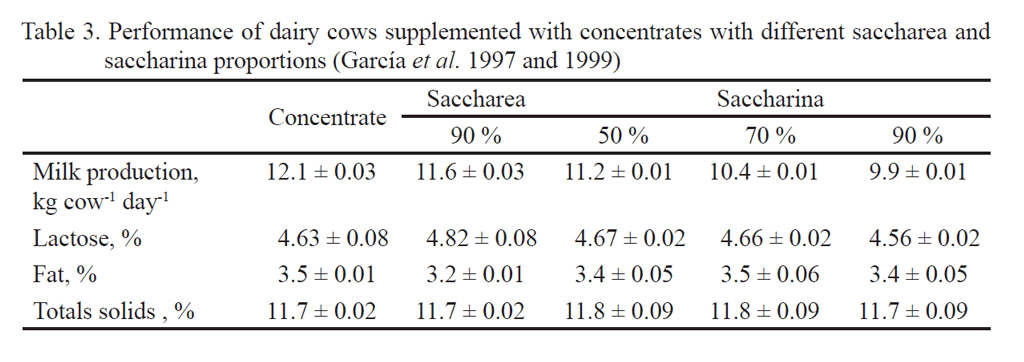
<body><![CDATA[<p align="justify"><font size="2" face="Verdana, Arial, Helvetica, sans-serif"><span lang="EN-US">Jord&aacute;n and El&iacute;as  (2002), when evaluating the replacement of 20% maize in the concentrate by  wheat bran or raw sugar, found that in genetics dairies with improved grasses  and fertilized with 200 kg  Nha<sup>-1</sup> year<sup>-1</sup></span> <span lang="EN-US">with irrigation, productions of 20.02, 21.60  and    22.28 kg of milk/cow/d for the first, second and third year were achieved,  respectively. Also, these authors verified that the efficiency of the  supplement use increased from 2.5 to 2.7 kg of milk kg of concentrate <sup>-1</sup>.</span></font></p>     <p align="justify"><font size="2" face="Verdana, Arial, Helvetica, sans-serif"><span lang="EN-US">In order to maintain the use of national raw materials, mainly from  sugarcane, there were carried out different experiments. Garcia <em>et al.</em> (1997),  when substituting 90% of cereals by saccharea  concentrate (integral sugar cane milled, salt and urea mixture) to supplement  grazing cows, reported that milk production did not differ. Better indicators  of saccharea feed in weight gain (245 vs    113 g/cow/d), milk fat (3.5 vs 3.2%) and total so1ids  (11.7 vs 11.2%) (<a href="/img/revistas/cjas/v49n2/t0304215.gif">table 3</a>)  were obtained.</span></font></p>     
<p align="justify"><font size="2" face="Verdana, Arial, Helvetica, sans-serif"><span lang="EN-US">Saccharina technology (Elias <em>et al.</em> 1990) it was also applied for the  supplementation to grazing dairy cows. Garcia <em>et al.</em> (1999), when  substituting the cereals concentrate by saccharina,  in 5,000 kg of milk lactation<sup>-1</sup> cows, reported that dairy production  decreased between 5.2 and 8.4% for 50% substitution up to 16.1%, when the  substitution reached 90% (<a href="/img/revistas/cjas/v49n2/t0304215.gif">table 3</a>).</span></font></p>     
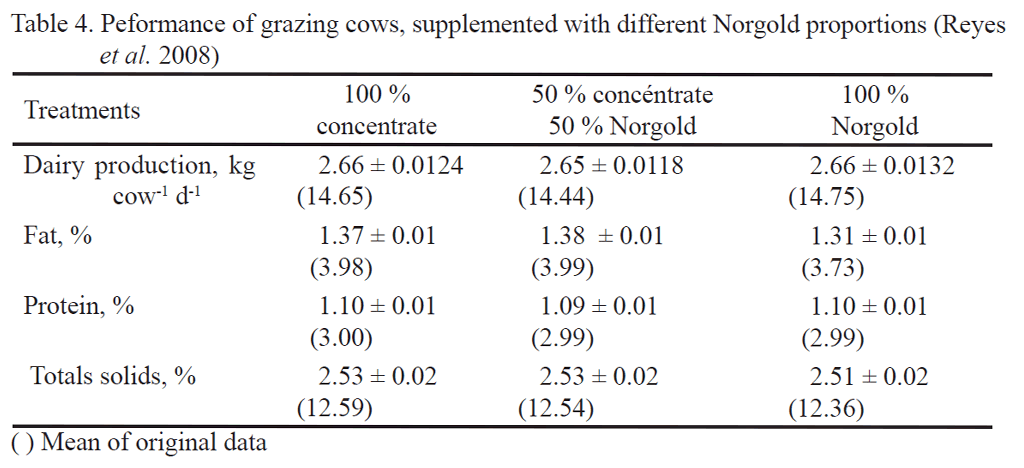
<p align="justify"><font size="2" face="Verdana, Arial, Helvetica, sans-serif"><span lang="EN-US">The cereals sources that constitute the  supplement can influence in animal productivity. Reyes <em>et al.</em> (1997),  when evaluating two cereals sources in feed formulation  with 50% of saccharina, reported that milk production  were higher (P&lt;0.001) with the use of maize in the formulation of saccharina concentrate them with the use of&nbsp; wheat (15.3 and 14.2 kg milk/cow/d). In the milk composition of the animals that  received these supplements differences in the percentages of protein and fat  (3.13 and 3.35 and 3.12% and 3.31% for supplements with corn and wheat,  respectively) were not found.</span></font></p>     <p align="justify"><font size="2" face="Verdana, Arial, Helvetica, sans-serif"><span lang="EN-US">The  distillers dried grains (Norgold) introduced in Cuba  are high composition in protein, on the order of 30.9%, with low degradation  rate in the rumen and energy, based on the fat composition of 10.7% (Herrera  and Jordan 2010). This product has been used as a supplement to grazing cows.  Reyes <em>et al</em>. (2008) carried out researches in order to compare the  product regarding to commercial concentrates in different proportions. These authors  reported that milk productions were not affected between treatments (14.7, 14.4  and    14.8 kg/cow/d, to 100% of feed, 50% feed - Norgold  and 100 Norgold %, respectively). However, from the  point of view of dairy quality, the fat milk percentage of the animals  supplemented with 100% Norgold was lower (P &lt;0.01)  than the rest of the animals, which&nbsp; not  differ&nbsp; each other ( 3.98, 3.99 and 3.73%  for treatments with 100% feed, 50% of commercial feed and Norgold  and 100 %Norgold, respectively). The rest of dairy  components did not showed differences (<a href="/img/revistas/cjas/v49n2/t0404215.gif">table 4</a>).</span></font></p>     
<p align="justify"><font size="2" face="Verdana, Arial, Helvetica, sans-serif"><span lang="EN-US">&nbsp;</span></font></p>     <p align="justify"><strong><font size="3" face="Verdana, Arial, Helvetica, sans-serif"><span lang="EN-US">FINAL CONSIDERATIONS</span></font></strong></p>     <p align="justify"><font size="2" face="Verdana, Arial, Helvetica, sans-serif"><span lang="EN-US">From the reviewing of articles published by Cuban Journal of  Agricultural Science considerations, especially those referring to milk  production, it can be considered that:</span></font></p>     <p align="justify"><font size="2" face="Verdana, Arial, Helvetica, sans-serif"><span lang="EN-US">-There is interaction between grass varieties and stocking rate.  They can be obtained with tropical grasses dairy production between 9 and 11  kg/d during the rainy season, with stocking rate of 3.0 cows/ha in coast cross bermuda grass, 4.0 cows/ha in pangola  grass and    5.0 cows/ha in star grass. It was shown that in the star grass are other  factors of the species behavior that may influence in the obtaining of higher  production with higher stocking rates: their growth habit, structure,  availability of the youngest leaves and stems with better quality, when it is  grazing. </span></font></p>     <p align="justify"><font size="2" face="Verdana, Arial, Helvetica, sans-serif"><span lang="EN-US">-The use of leaders and followers grazing system show better  nutritional balance between grass supply and animals requirements, according to  their nutritionals demanding.</span></font></p>     ]]></body>
<body><![CDATA[<p align="justify"><font size="2" face="Verdana, Arial, Helvetica, sans-serif"><span lang="EN-US">-The rotational grass management can be implemented with four  paddocks per group, without affected grass and animal components </span></font></p>     <p align="justify"><font size="2" face="Verdana, Arial, Helvetica, sans-serif"><span lang="EN-US">-Efficiency of supplementation to cows in grazing agrees with the  differential that exists between the base diet and productive potential of the  animal, which shows that at the beginning of lactation (first seven weeks), it  is when higher response can be obtains from the supplement, whether  concentrated or legumes foods were used. </span></font></p>     <p align="justify"><font size="2" face="Verdana, Arial, Helvetica, sans-serif"><span lang="EN-US">-During the low precipitations period, the grass availability does  not covers the animal needs, so the complementation with other voluminous foods  should carried out, and be able to maintain the productive levels. The sugar  cane forage fresh or fermented plays an important role, whenever it is supplied  properly chopped and with the necessary additives (nitrogen and minerals).</span></font></p>     <p align="justify">&nbsp;</p>     <p align="justify"><font size="3" face="Verdana, Arial, Helvetica, sans-serif"><strong>REFERENCES</strong></font></p>     <p align="justify"><font size="2" face="Verdana, Arial, Helvetica, sans-serif">Alonso J. R. &amp; Senra A. 1992. <span lang="EN-US">&lsquo;&lsquo;Production system for dairy  cows without irrigation and whole sugar cane forage supplied during the dry  season. Milk production and composition and live weight performance&rsquo;&rsquo;. <em>Cuban  Journal of Agricultural Science</em>, 26 (2), pp. 125&ndash;132.</span></font></p>     <p align="justify"><font size="2" face="Verdana, Arial, Helvetica, sans-serif"><span lang="EN-US">Clark J., Geerken C. M., Preston T. R. &amp; Zamora A. 1973. &lsquo;&lsquo;Molasses as  an energy source in low fibre diets for milk production. 3. The effect of  varying the molasses: grain ratio in a low fibre basal diet&rsquo;&rsquo;. <em>Cuban Journal  of Agricultural Science</em>, 7, pp. 155&ndash;167.</span></font></p>     <p align="justify"><font size="2" face="Verdana, Arial, Helvetica, sans-serif"><span lang="EN-US">Elias A., Lezcano O., Lezcano P., Cordero J. &amp; Quintana L. 1990. &lsquo;&lsquo;A  review on the development of a protein sugar cane enrichment technology through  solid state fermentation (Saccharina)&rsquo;&rsquo;. <em>Cuban Journal of Agricultural  Science</em>, 24 (1), pp. 1&ndash;13, CABDirect2.</span></font></p>     <p align="justify"><font size="2" face="Verdana, Arial, Helvetica, sans-serif"><span lang="EN-US">Galindo J., Elias A. &amp; Cordero J. 1982. &lsquo;&lsquo;The addition of zeolite to  silage diets. 1. Effect of the zeolite level on the rumen cellulolisis of cows  fed silage&rsquo;&rsquo;. </span><em>Cuban Journal of Agricultural Science</em>, 16 (3), pp. 277&ndash;284.</font></p>     <p align="justify"><font size="2" face="Verdana, Arial, Helvetica, sans-serif"><span lang="EN-US">Garc&iacute;a L. R. 2010. &lsquo;&lsquo;Influence of three long-term supplementation systems  on dairy cows&rsquo;&rsquo;. <em>Cuban Journal of Agricultural Science</em>, 44 (1),  Available: &lt;<a href="http://ediciones.ica.edu.cu/index.php/CJAS/article/view/284" target="_blank">http://ediciones.ica.edu.cu/index.php/CJAS/article/view/284</a>&gt;,  [Accessed:&nbsp;March 16, 2016].</span></font></p>     ]]></body>
<body><![CDATA[<p align="justify"><font size="2" face="Verdana, Arial, Helvetica, sans-serif">Garc&iacute;a L. R., Mora E., El&iacute;as A., Garcia Trujillo R. &amp; Alfonso F. 1994. <span lang="EN-US">&lsquo;&lsquo;Comparative evaluation of humid saccharina (rustic) and fresh sugar cane  (with additives) for milk production under non-irrigated conditions&rsquo;&rsquo;. <em>Cuban  Journal of Agricultural Science</em>, 28 (1), pp. 47&ndash;50.</span></font></p>     <p align="justify"><font size="2" face="Verdana, Arial, Helvetica, sans-serif"><span lang="EN-US">Garc&iacute;a R., Elias A., Capdevila J., Reyes J., Mejias R. &amp; Herrera J. M.  1999. &lsquo;&lsquo;Saccharina in feeds for grazing cows. Milk production&rsquo;&rsquo;. <em>Cuban  Journal of Agricultural Science</em>, 33 (3), pp. 247&ndash;251.</span></font></p>     <p align="justify"><font size="2" face="Verdana, Arial, Helvetica, sans-serif"><span lang="EN-US">Garc&iacute;a R., Elias A. &amp; Herrera J. 1997. &lsquo;&lsquo;The use of Saccharea (sugar  cane+ urea+ minerals) in milk production as a cereal substitute for feeds&rsquo;&rsquo;. <em>Cuban  Journal of Agricultural Science</em>, 31 (3), pp. 248&ndash;252.</span></font></p>     <p align="justify"><font size="2" face="Verdana, Arial, Helvetica, sans-serif"><span lang="EN-US">Garcia R., Ruiz R., Elias A., Menchaca M. L. &amp; Gomez E. 1980.  &lsquo;&lsquo;Concentrate fractioning for dairy cows. 1. Effect on milk pproduction and  composition&rsquo;&rsquo;. <em>Cuban Journal of Agricultural Science</em>, 14 (2), pp.  125&ndash;130.</span></font></p>     <!-- ref --><p align="justify"><font size="2" face="Verdana, Arial, Helvetica, sans-serif">Gonz&aacute;lez R. F. 1995. <em>Contribuci&oacute;n  al estudio de los factores que limitan el consumo de forraje de ca&ntilde;a de az&uacute;car  integral por los bovinos</em>. Ph.D. Thesis, Instituto de Ciencia Animal, La Habana, Cuba.    </font></p>     <p align="justify"><font size="2" face="Verdana, Arial, Helvetica, sans-serif">Gonz&aacute;lez R., Munoz  E., Alfonso F., Gonzalez R. M. &amp; Enrique A. V.  1989. <span lang="EN-US">&lsquo;&lsquo;Sugar cane as forage for milk production. 1. Effect of star grass  inclusion (<em>Cynodon nlemfuensis</em>) on feed consumption and digestibility&rsquo;&rsquo;. <em>Cuban Journal of Agricultural Science</em>, 23 (2), pp. 131&ndash;136.</span></font></p>     <p align="justify"><font size="2" face="Verdana, Arial, Helvetica, sans-serif"><span lang="EN-US">Herrera J. &amp; Jord&aacute;n H. 2010. &lsquo;&lsquo;Distiller&rsquo;s dried grains, a viable  alternative for cattle milk production. Characteristics, composition and use&rsquo;&rsquo;. <em>Cuban Journal of Agricultural Science</em>, 44 (2), p. 97.</span></font></p>     <p align="justify"><font size="2" face="Verdana, Arial, Helvetica, sans-serif">Jerez I., Rodr&iacute;guez V. &amp; Rivero  J. L. 1984. <span lang="EN-US">&lsquo;&lsquo;Milk production from three tropical pastures: coast cross bermuda grass  No. 1 (<em>Cynodon dactylon</em>), improved star grass (<em>Cyondon nlemfuensis</em>)  and pangola grass (<em>Digitaria decumbens</em>) during the rainy season&rsquo;&rsquo;. <em>Cuban  Journal of Agricultural Science</em>, 18, p. 253.</span></font></p>     <p align="justify"><font size="2" face="Verdana, Arial, Helvetica, sans-serif"><span lang="EN-US">Jordan H. &amp; Elias A. 2002. &lsquo;&lsquo;Effect of three types of concentrates on  milk production in Holstein cows of high potential in three commercial cattle  units&rsquo;&rsquo;. <em>Cuban Journal of Agricultural Science</em>, 36 (4), pp. 321&ndash;326.</span></font></p>     ]]></body>
<body><![CDATA[<p align="justify"><font size="2" face="Verdana, Arial, Helvetica, sans-serif"><span lang="EN-US">Lamazares E., Senra A., Dominguez G. H. &amp; Mora E. 1991. &lsquo;&lsquo;Performance  of dairy cows in a feeding and management system under non-irrigated  conditions&rsquo;&rsquo;. <em>Cuban Journal of Agricultural Science</em>, 25 (3), pp.  245&ndash;254.</span></font></p>     <p align="justify"><font size="2" face="Verdana, Arial, Helvetica, sans-serif"><span lang="EN-US">Mart&iacute;nez O., Torres V. &amp; Aguilar P. I. 2012. &lsquo;&lsquo;Impact of biomass banks  with Pennisetum purpureum (Cuba CT-115) on milk production&rsquo;&rsquo;. <em>Cuban Journal  of Agricultural Science</em>, 46 (3), p. 253, ISSN: 2079-3480.</span></font></p>     <p align="justify"><font size="2" face="Verdana, Arial, Helvetica, sans-serif"><span lang="EN-US">Mart&iacute;nez R. O. &amp; Jerez I. 1979. &lsquo;&lsquo;Milk production of Holstein and  Holstein x Ceb&uacute; grazing pangola grass (<em>Digitaria decumbens</em> Stent)  without concentrate supplementation&rsquo;&rsquo;. </span><em>Cuban Journal of Agricultural Science</em>, 13, p. 11.</font></p>     <p align="justify"><font size="2" face="Verdana, Arial, Helvetica, sans-serif">Martinez R. O. &amp; Pereiro M. 1979. <span lang="EN-US">&lsquo;&lsquo;Concentrate supplementation  according to the lactation stage and calving trimesteer of cows grazing pangola  grass (<em>Digitaria decumbens</em> Stent)&rsquo;&rsquo;. <em>Cuban Journal of Agricultural  Science</em>, 13, pp. 247&ndash;253.</span></font></p>     <p align="justify"><font size="2" face="Verdana, Arial, Helvetica, sans-serif"><span lang="EN-US">Martinez R. O., Venereo A. &amp; Serrano M. 1976. &lsquo;&lsquo;Concentrate  supplementation and milk-production&rsquo;&rsquo;. <em>Cuban Journal of Agricultural Science</em>,  10 (3), pp. 267&ndash;273.</span></font></p>     <p align="justify"><font size="2" face="Verdana, Arial, Helvetica, sans-serif"><span lang="EN-US">Mart&iacute;n P. C. 2005. &lsquo;&lsquo;The use of sugarcane for meat and milk production&rsquo;&rsquo;. </span><em>Cuban Journal  of Agricultural Science</em>, 39, pp. 415&ndash;425.</font></p>     <p align="justify"><font size="2" face="Verdana, Arial, Helvetica, sans-serif">Mejias R., Michelena J. B., Ruiz T. E.,  Diaz B., Rojas Y., Gutierrez O., Lopez M. A., Crespo G. &amp; Peraza J. L.  2009. <span lang="EN-US">&lsquo;&lsquo;Evaluation of growth and reproduction in dairy heifers grazing legumes  under productive conditions&rsquo;&rsquo;. <em>Cuban Journal of Agricultural Science</em>, 43  (2), pp. 115&ndash;120.</span></font></p>     <p align="justify"><font size="2" face="Verdana, Arial, Helvetica, sans-serif"><span lang="EN-US">Pedroso D. M. &amp; Garc&iacute;a R. 1977. &lsquo;&lsquo;A note on the effect of stocking rate  on milk and yield composition of grazing animals&rsquo;&rsquo;. <em>Cuban Journal of  Agricultural Science</em>, 11, p. 311.</span></font></p>     <p align="justify"><font size="2" face="Verdana, Arial, Helvetica, sans-serif"><span lang="EN-US">Pereiro M. &amp; El&iacute;as A. 1987. &lsquo;&lsquo;A study on different Glycine (<em>Neonotonia  wightii</em>) restricted grazing frequencies on the productive performance of  dairy cows on a pangola grass (<em>Digitaria decumbens</em>) sward during the  rainy season&rsquo;&rsquo;. <em>Cuban Journal of Agricultural Science</em>, 21 (2), pp.  129&ndash;134.</span></font></p>     <p align="justify"><font size="2" face="Verdana, Arial, Helvetica, sans-serif"><span lang="EN-US">Pereiro M., Ugarte J., El&iacute;as A. &amp; Zuaznabar G. 1982. &lsquo;&lsquo;The effect of  diets based on forage, hay or silage on the performance of dairy cows under  restricted grazing of <em>Neonotonia wightii</em>&rsquo;&rsquo;. <em>Cuban Journal of  Agricultural Science</em>, 16 (3), pp. 251&ndash;256.</span></font></p>     ]]></body>
<body><![CDATA[<p align="justify"><font size="2" face="Verdana, Arial, Helvetica, sans-serif"><span lang="EN-US">P&eacute;rez Infante F. 1982. &lsquo;&lsquo;Effects of different pasture components on the  consumption and milk production of cows grazing in five different pastures&rsquo;&rsquo;. <em>Cuban  Journal of Agricultural Science</em>, 16 (2), pp. 141&ndash;147.</span></font></p>     <p align="justify"><font size="2" face="Verdana, Arial, Helvetica, sans-serif"><span lang="EN-US">Reyes J., Elias A. &amp; Lopez R. G. 1997. &lsquo;&lsquo;Maize or wheat in rations  based on Saccharina for grazing dairy cows&rsquo;&rsquo;. </span><em>Cuban Journal of Agricultural Science</em>, 31 (3), pp. 239&ndash;243.</font></p>     <p align="justify"><font size="2" face="Verdana, Arial, Helvetica, sans-serif">Reyes J., Garcia  R. &amp; Rey S. 2003. <span lang="EN-US">&lsquo;&lsquo;Use of zeolite and calcium  carbonate (CO3Ca) as additives in sugarcane molasses mixtures enriched with  vegetable oil and proteic meal for grazing dairy cows&rsquo;&rsquo;. <em>Cuban Journal of  Agricultural Science</em>, 37 (4), pp. 369&ndash;374.</span></font></p>     <p align="justify"><font size="2" face="Verdana, Arial, Helvetica, sans-serif"><span lang="EN-US">Reyes J. J., Rodriguez J. M., Rey S., Perez L. &amp; Noda A. 2008.  &lsquo;&lsquo;Preliminary results of the effect of the supplementation with different  proportions of Norgold concentrate to dairy cows grazing grasses and legumes&rsquo;&rsquo;. <em>Cuban Journal of Agricultural Science</em>, 42 (2), pp. 145&ndash;149.</span></font></p>     <p align="justify"><font size="2" face="Verdana, Arial, Helvetica, sans-serif"><span lang="EN-US">Ruiz R., Cairo J., Mart&iacute;nez R. O. &amp; Herrera R. S. 1981. &lsquo;&lsquo;Milk  production of cows grazing Coast cross No. 1 bermuda grass (<em>Cynodon dactylon</em> Pers). II. Sward structure and productive potential&rsquo;&rsquo;. <em>Cuban Journal of  Agricultural Science</em>, 15, p. 133.</span></font></p>     <p align="justify"><font size="2" face="Verdana, Arial, Helvetica, sans-serif"><span lang="EN-US">Senra A. 2005. &lsquo;&lsquo;Indices to monitor the efficiency and sustainability of  the grassland ecosystem in cattle rearing&rsquo;&rsquo;. <em>Cuban Journal of Agricultural  Science</em>, 39 (1), pp. 13&ndash;20.</span></font></p>     <p align="justify"><font size="2" face="Verdana, Arial, Helvetica, sans-serif"><span lang="EN-US">Senra A., Mart&iacute;nez R. O., Jord&aacute;n H., Ruiz T., Reyes J., Guevara R. V. &amp;  Ray J. V. 2005. &lsquo;&lsquo;Basic principles of the efficient and sustainable rotational  grazing for the American subtropics&rsquo;&rsquo;. <em>Cuban Journal of Agricultural Science</em>,  39 (1), pp. 21&ndash;27.</span></font></p>     <p align="justify"><font size="2" face="Verdana, Arial, Helvetica, sans-serif"><span lang="EN-US">Senra A., Menchaca M., Galindo J. &amp; Ugarte J. 1985. &lsquo;&lsquo;Effect of the  number of paddocks on milk production of cows grazing irrigated and fertilized  improved star grass (<em>Cynodon nlemfuensis</em>)&rsquo;&rsquo;. <em>Cuban Journal of  Agricultural Science</em>, 19 (1), pp. 1&ndash;12.</span></font></p>     <p align="justify"><font size="2" face="Verdana, Arial, Helvetica, sans-serif"><span lang="EN-US">Senra A., Ugarte J., Diallo A. M. &amp; Galindo J. 1989. &lsquo;&lsquo;Grazing habit of  Holstein cows during the dry season on different numbers of fertilized and  irrigated star grass (<em>Cynodon nlemfuensis</em>) paddocks&rsquo;&rsquo;. <em>Cuban Journal  of Agricultural Science</em>, 23 (3), pp. 241&ndash;249.</span></font></p>     <p align="justify"><font size="2" face="Verdana, Arial, Helvetica, sans-serif"><span lang="EN-US">Senra A., Ugarte J., Elias A. &amp; Ruiz R. 1979. &lsquo;&lsquo;Effect of including  limited quantities of hay to cows grazing in drylots and supplemented with  silage&rsquo;&rsquo;. <em>Cuban Journal of Agricultural Science</em>, 13 (2), pp. 119&ndash;125.</span></font></p>     ]]></body>
<body><![CDATA[<p align="justify"><font size="2" face="Verdana, Arial, Helvetica, sans-serif"><span lang="EN-US">Stobbs T. 1977. &lsquo;&lsquo;Short-term  effects of herbage allowance on milk production, milk composition and grazing  time of cows grazing nitrogen-fertilized tropical grass pasture&rsquo;&rsquo;. </span><em>Australian Journal  of Experimental Agriculture</em>, 17 (89), pp. 892&ndash;898</font>.</p>     <p align="justify">&nbsp;</p>     <p align="justify">&nbsp;</p>     <p align="justify"><font size="2" face="Verdana, Arial, Helvetica, sans-serif">Received: January 1, 2015    <br>   Accepted: February 1, 2015</font></p>     <p align="justify">&nbsp;</p>     <p align="justify">&nbsp;</p>     <p align="justify"><font size="2" face="Verdana, Arial, Helvetica, sans-serif"><i>J.J. Reyes,</i> Instituto de Ciencia Animal, Apartado Postal 24, San José de las Lajas, Mayabeque, Cuba.    Email: <a href="mailto:jreyes@ica.co.cu">jreyes@ica.co.cu</a></font></p>      ]]></body><back>
<ref-list>
<ref id="B1">
<nlm-citation citation-type="journal">
<person-group person-group-type="author">
<name>
<surname><![CDATA[Alonso]]></surname>
<given-names><![CDATA[J. R.]]></given-names>
</name>
<name>
<surname><![CDATA[Senra]]></surname>
<given-names><![CDATA[A.]]></given-names>
</name>
</person-group>
<article-title xml:lang="nd"><![CDATA[Production system for dairy cows without irrigation and whole sugar cane forage supplied during the dry season. Milk production and composition and live weight performance]]></article-title>
<source><![CDATA[Cuban Journal of Agricultural Science]]></source>
<year>1992</year>
<volume>26</volume>
<numero>2</numero>
<issue>2</issue>
<page-range>125-132</page-range></nlm-citation>
</ref>
<ref id="B2">
<nlm-citation citation-type="journal">
<person-group person-group-type="author">
<name>
<surname><![CDATA[Clark]]></surname>
<given-names><![CDATA[J.]]></given-names>
</name>
<name>
<surname><![CDATA[Geerken]]></surname>
<given-names><![CDATA[C. M.]]></given-names>
</name>
<name>
<surname><![CDATA[Preston]]></surname>
<given-names><![CDATA[T. R.]]></given-names>
</name>
<name>
<surname><![CDATA[Zamora]]></surname>
<given-names><![CDATA[A.]]></given-names>
</name>
</person-group>
<article-title xml:lang="nd"><![CDATA[Molasses as an energy source in low fibre diets for milk production. 3. The effect of varying the molasses: grain ratio in a low fibre basal diet]]></article-title>
<source><![CDATA[Cuban Journal of Agricultural Science]]></source>
<year>1973</year>
<volume>7</volume>
<page-range>155-167</page-range></nlm-citation>
</ref>
<ref id="B3">
<nlm-citation citation-type="journal">
<person-group person-group-type="author">
<name>
<surname><![CDATA[Elias]]></surname>
<given-names><![CDATA[A.]]></given-names>
</name>
<name>
<surname><![CDATA[Lezcano]]></surname>
<given-names><![CDATA[O.]]></given-names>
</name>
<name>
<surname><![CDATA[Lezcano]]></surname>
<given-names><![CDATA[P.]]></given-names>
</name>
<name>
<surname><![CDATA[Cordero]]></surname>
<given-names><![CDATA[J.]]></given-names>
</name>
<name>
<surname><![CDATA[Quintana]]></surname>
<given-names><![CDATA[L.]]></given-names>
</name>
</person-group>
<article-title xml:lang="nd"><![CDATA[A review on the development of a protein sugar cane enrichment technology through solid state fermentation (Saccharina)]]></article-title>
<source><![CDATA[Cuban Journal of Agricultural Science]]></source>
<year>1990</year>
<volume>24</volume>
<numero>1</numero>
<issue>1</issue>
<page-range>1-13</page-range></nlm-citation>
</ref>
<ref id="B4">
<nlm-citation citation-type="journal">
<person-group person-group-type="author">
<name>
<surname><![CDATA[Galindo]]></surname>
<given-names><![CDATA[J.]]></given-names>
</name>
<name>
<surname><![CDATA[Elias]]></surname>
<given-names><![CDATA[A.]]></given-names>
</name>
<name>
<surname><![CDATA[Cordero]]></surname>
<given-names><![CDATA[J.]]></given-names>
</name>
</person-group>
<article-title xml:lang="nd"><![CDATA[The addition of zeolite to silage diets. 1. Effect of the zeolite level on the rumen cellulolisis of cows fed silage]]></article-title>
<source><![CDATA[Cuban Journal of Agricultural Science]]></source>
<year>1982</year>
<volume>16</volume>
<numero>3</numero>
<issue>3</issue>
<page-range>277-284</page-range></nlm-citation>
</ref>
<ref id="B5">
<nlm-citation citation-type="journal">
<person-group person-group-type="author">
<name>
<surname><![CDATA[García]]></surname>
<given-names><![CDATA[L. R.]]></given-names>
</name>
</person-group>
<article-title xml:lang="nd"><![CDATA[Influence of three long-term supplementation systems on dairy cows]]></article-title>
<source><![CDATA[Cuban Journal of Agricultural Science]]></source>
<year>2010</year>
<volume>44</volume>
<numero>1</numero>
<issue>1</issue>
</nlm-citation>
</ref>
<ref id="B6">
<nlm-citation citation-type="journal">
<person-group person-group-type="author">
<name>
<surname><![CDATA[García]]></surname>
<given-names><![CDATA[L. R.]]></given-names>
</name>
<name>
<surname><![CDATA[Mora]]></surname>
<given-names><![CDATA[E.]]></given-names>
</name>
<name>
<surname><![CDATA[Elías]]></surname>
<given-names><![CDATA[A.]]></given-names>
</name>
<name>
<surname><![CDATA[Garcia Trujillo]]></surname>
<given-names><![CDATA[R.]]></given-names>
</name>
<name>
<surname><![CDATA[Alfonso]]></surname>
<given-names><![CDATA[F.]]></given-names>
</name>
</person-group>
<article-title xml:lang="nd"><![CDATA[Comparative evaluation of humid saccharina (rustic) and fresh sugar cane (with additives) for milk production under non-irrigated conditions]]></article-title>
<source><![CDATA[Cuban Journal of Agricultural Science]]></source>
<year>1994</year>
<volume>28</volume>
<numero>1</numero>
<issue>1</issue>
<page-range>47-50</page-range></nlm-citation>
</ref>
<ref id="B7">
<nlm-citation citation-type="journal">
<person-group person-group-type="author">
<name>
<surname><![CDATA[García]]></surname>
<given-names><![CDATA[R.]]></given-names>
</name>
<name>
<surname><![CDATA[Elias]]></surname>
<given-names><![CDATA[A.]]></given-names>
</name>
<name>
<surname><![CDATA[Capdevila]]></surname>
<given-names><![CDATA[J.]]></given-names>
</name>
<name>
<surname><![CDATA[Reyes]]></surname>
<given-names><![CDATA[J.]]></given-names>
</name>
<name>
<surname><![CDATA[Mejias]]></surname>
<given-names><![CDATA[R.]]></given-names>
</name>
<name>
<surname><![CDATA[Herrera]]></surname>
<given-names><![CDATA[J. M.]]></given-names>
</name>
</person-group>
<article-title xml:lang="nd"><![CDATA[Saccharina in feeds for grazing cows. Milk production]]></article-title>
<source><![CDATA[Cuban Journal of Agricultural Science]]></source>
<year>1999</year>
<volume>33</volume>
<numero>3</numero>
<issue>3</issue>
<page-range>247-251</page-range></nlm-citation>
</ref>
<ref id="B8">
<nlm-citation citation-type="journal">
<person-group person-group-type="author">
<name>
<surname><![CDATA[García]]></surname>
<given-names><![CDATA[R.]]></given-names>
</name>
<name>
<surname><![CDATA[Elias]]></surname>
<given-names><![CDATA[A.]]></given-names>
</name>
<name>
<surname><![CDATA[Herrera]]></surname>
<given-names><![CDATA[J.]]></given-names>
</name>
</person-group>
<article-title xml:lang="nd"><![CDATA[The use of Saccharea (sugar cane+ urea+ minerals) in milk production as a cereal substitute for feeds]]></article-title>
<source><![CDATA[Cuban Journal of Agricultural Science]]></source>
<year>1997</year>
<volume>31</volume>
<numero>3</numero>
<issue>3</issue>
<page-range>248-252</page-range></nlm-citation>
</ref>
<ref id="B9">
<nlm-citation citation-type="journal">
<person-group person-group-type="author">
<name>
<surname><![CDATA[Garcia]]></surname>
<given-names><![CDATA[R.]]></given-names>
</name>
<name>
<surname><![CDATA[Ruiz]]></surname>
<given-names><![CDATA[R.]]></given-names>
</name>
<name>
<surname><![CDATA[Elias]]></surname>
<given-names><![CDATA[A.]]></given-names>
</name>
<name>
<surname><![CDATA[Menchaca]]></surname>
<given-names><![CDATA[M. L.]]></given-names>
</name>
<name>
<surname><![CDATA[Gomez]]></surname>
<given-names><![CDATA[E.]]></given-names>
</name>
</person-group>
<article-title xml:lang="nd"><![CDATA[Concentrate fractioning for dairy cows. 1. Effect on milk pproduction and composition]]></article-title>
<source><![CDATA[Cuban Journal of Agricultural Science]]></source>
<year>1980</year>
<volume>14</volume>
<numero>2</numero>
<issue>2</issue>
<page-range>125-130</page-range></nlm-citation>
</ref>
<ref id="B10">
<nlm-citation citation-type="journal">
<person-group person-group-type="author">
<name>
<surname><![CDATA[González]]></surname>
<given-names><![CDATA[R.]]></given-names>
</name>
<name>
<surname><![CDATA[Munoz]]></surname>
<given-names><![CDATA[E.]]></given-names>
</name>
<name>
<surname><![CDATA[Alfonso]]></surname>
<given-names><![CDATA[F.]]></given-names>
</name>
<name>
<surname><![CDATA[Gonzalez]]></surname>
<given-names><![CDATA[R. M.]]></given-names>
</name>
<name>
<surname><![CDATA[Enrique]]></surname>
<given-names><![CDATA[A. V.]]></given-names>
</name>
</person-group>
<article-title xml:lang="nd"><![CDATA[Sugar cane as forage for milk production. 1. Effect of star grass inclusion (Cynodon nlemfuensis) on feed consumption and digestibility]]></article-title>
<source><![CDATA[Cuban Journal of Agricultural Science]]></source>
<year>1989</year>
<volume>23</volume>
<numero>2</numero>
<issue>2</issue>
<page-range>131-136</page-range></nlm-citation>
</ref>
<ref id="B11">
<nlm-citation citation-type="book">
<person-group person-group-type="author">
<name>
<surname><![CDATA[González]]></surname>
<given-names><![CDATA[R. F.]]></given-names>
</name>
</person-group>
<source><![CDATA[Contribución al estudio de los factores que limitan el consumo de forraje de caña de azúcar integral por los bovinos]]></source>
<year>1995</year>
<publisher-loc><![CDATA[La Habana, Cuba ]]></publisher-loc>
<publisher-name><![CDATA[Instituto de Ciencia Animal]]></publisher-name>
</nlm-citation>
</ref>
<ref id="B12">
<nlm-citation citation-type="journal">
<person-group person-group-type="author">
<name>
<surname><![CDATA[Herrera]]></surname>
<given-names><![CDATA[J.]]></given-names>
</name>
<name>
<surname><![CDATA[Jordán]]></surname>
<given-names><![CDATA[H.]]></given-names>
</name>
</person-group>
<article-title xml:lang="nd"><![CDATA[Distiller’s dried grains, a viable alternative for cattle milk production. Characteristics, composition and use]]></article-title>
<source><![CDATA[Cuban Journal of Agricultural Science]]></source>
<year>2010</year>
<volume>44</volume>
<numero>2</numero>
<issue>2</issue>
<page-range>97</page-range></nlm-citation>
</ref>
<ref id="B13">
<nlm-citation citation-type="journal">
<person-group person-group-type="author">
<name>
<surname><![CDATA[Jerez]]></surname>
<given-names><![CDATA[I.]]></given-names>
</name>
<name>
<surname><![CDATA[Rodríguez]]></surname>
<given-names><![CDATA[V.]]></given-names>
</name>
<name>
<surname><![CDATA[Rivero]]></surname>
<given-names><![CDATA[J. L.]]></given-names>
</name>
</person-group>
<article-title xml:lang="nd"><![CDATA[Milk production from three tropical pastures: coast cross bermuda grass No. 1 (Cynodon dactylon), improved star grass (Cyondon nlemfuensis) and pangola grass (Digitaria decumbens) during the rainy season]]></article-title>
<source><![CDATA[Cuban Journal of Agricultural Science]]></source>
<year>1984</year>
<volume>18</volume>
<page-range>253</page-range></nlm-citation>
</ref>
<ref id="B14">
<nlm-citation citation-type="journal">
<person-group person-group-type="author">
<name>
<surname><![CDATA[Jordan]]></surname>
<given-names><![CDATA[H.]]></given-names>
</name>
<name>
<surname><![CDATA[Elias]]></surname>
<given-names><![CDATA[A.]]></given-names>
</name>
</person-group>
<article-title xml:lang="nd"><![CDATA[Effect of three types of concentrates on milk production in Holstein cows of high potential in three commercial cattle units]]></article-title>
<source><![CDATA[Cuban Journal of Agricultural Science]]></source>
<year>2002</year>
<volume>36</volume>
<numero>4</numero>
<issue>4</issue>
<page-range>321-326</page-range></nlm-citation>
</ref>
<ref id="B15">
<nlm-citation citation-type="journal">
<person-group person-group-type="author">
<name>
<surname><![CDATA[Lamazares]]></surname>
<given-names><![CDATA[E.]]></given-names>
</name>
<name>
<surname><![CDATA[Senra]]></surname>
<given-names><![CDATA[A.]]></given-names>
</name>
<name>
<surname><![CDATA[Dominguez]]></surname>
<given-names><![CDATA[G. H.]]></given-names>
</name>
<name>
<surname><![CDATA[Mora]]></surname>
<given-names><![CDATA[E.]]></given-names>
</name>
</person-group>
<article-title xml:lang="nd"><![CDATA[Performance of dairy cows in a feeding and management system under non-irrigated conditions]]></article-title>
<source><![CDATA[Cuban Journal of Agricultural Science]]></source>
<year>1991</year>
<volume>25</volume>
<numero>3</numero>
<issue>3</issue>
<page-range>245-254</page-range></nlm-citation>
</ref>
<ref id="B16">
<nlm-citation citation-type="journal">
<person-group person-group-type="author">
<name>
<surname><![CDATA[Martínez]]></surname>
<given-names><![CDATA[O.]]></given-names>
</name>
<name>
<surname><![CDATA[Torres]]></surname>
<given-names><![CDATA[V.]]></given-names>
</name>
<name>
<surname><![CDATA[Aguilar]]></surname>
<given-names><![CDATA[P. I.]]></given-names>
</name>
</person-group>
<article-title xml:lang="nd"><![CDATA[Impact of biomass banks with Pennisetum purpureum (Cuba CT-115) on milk production]]></article-title>
<source><![CDATA[Cuban Journal of Agricultural Science]]></source>
<year>2012</year>
<volume>46</volume>
<numero>3</numero>
<issue>3</issue>
<page-range>253</page-range></nlm-citation>
</ref>
<ref id="B17">
<nlm-citation citation-type="journal">
<person-group person-group-type="author">
<name>
<surname><![CDATA[Martínez]]></surname>
<given-names><![CDATA[R. O.]]></given-names>
</name>
<name>
<surname><![CDATA[Jerez]]></surname>
<given-names><![CDATA[I.]]></given-names>
</name>
</person-group>
<article-title xml:lang="nd"><![CDATA[Milk production of Holstein and Holstein x Cebú grazing pangola grass (Digitaria decumbens Stent) without concentrate supplementation]]></article-title>
<source><![CDATA[Cuban Journal of Agricultural Science]]></source>
<year>1979</year>
<volume>13</volume>
<page-range>11</page-range></nlm-citation>
</ref>
<ref id="B18">
<nlm-citation citation-type="journal">
<person-group person-group-type="author">
<name>
<surname><![CDATA[Martinez]]></surname>
<given-names><![CDATA[R. O.]]></given-names>
</name>
<name>
<surname><![CDATA[Pereiro]]></surname>
<given-names><![CDATA[M.]]></given-names>
</name>
</person-group>
<article-title xml:lang="nd"><![CDATA[Concentrate supplementation according to the lactation stage and calving trimesteer of cows grazing pangola grass (Digitaria decumbens Stent)]]></article-title>
<source><![CDATA[Cuban Journal of Agricultural Science]]></source>
<year>1979</year>
<volume>13</volume>
<page-range>247-253</page-range></nlm-citation>
</ref>
<ref id="B19">
<nlm-citation citation-type="journal">
<person-group person-group-type="author">
<name>
<surname><![CDATA[Martinez]]></surname>
<given-names><![CDATA[R. O.]]></given-names>
</name>
<name>
<surname><![CDATA[Venereo]]></surname>
<given-names><![CDATA[A.]]></given-names>
</name>
<name>
<surname><![CDATA[Serrano]]></surname>
<given-names><![CDATA[M.]]></given-names>
</name>
</person-group>
<article-title xml:lang="nd"><![CDATA[Concentrate supplementation and milk-production]]></article-title>
<source><![CDATA[Cuban Journal of Agricultural Science]]></source>
<year>1976</year>
<volume>10</volume>
<numero>3</numero>
<issue>3</issue>
<page-range>267-273</page-range></nlm-citation>
</ref>
<ref id="B20">
<nlm-citation citation-type="journal">
<person-group person-group-type="author">
<name>
<surname><![CDATA[Martín]]></surname>
<given-names><![CDATA[P. C.]]></given-names>
</name>
</person-group>
<article-title xml:lang="nd"><![CDATA[The use of sugarcane for meat and milk production]]></article-title>
<source><![CDATA[Cuban Journal of Agricultural Science]]></source>
<year>2005</year>
<volume>39</volume>
<page-range>415-425</page-range></nlm-citation>
</ref>
<ref id="B21">
<nlm-citation citation-type="journal">
<person-group person-group-type="author">
<name>
<surname><![CDATA[Mejias]]></surname>
<given-names><![CDATA[R.]]></given-names>
</name>
<name>
<surname><![CDATA[Michelena]]></surname>
<given-names><![CDATA[J. B.]]></given-names>
</name>
<name>
<surname><![CDATA[Ruiz]]></surname>
<given-names><![CDATA[T. E.]]></given-names>
</name>
<name>
<surname><![CDATA[Diaz]]></surname>
<given-names><![CDATA[B.]]></given-names>
</name>
<name>
<surname><![CDATA[Rojas]]></surname>
<given-names><![CDATA[Y.]]></given-names>
</name>
<name>
<surname><![CDATA[Gutierrez]]></surname>
<given-names><![CDATA[O.]]></given-names>
</name>
<name>
<surname><![CDATA[Lopez]]></surname>
<given-names><![CDATA[M. A.]]></given-names>
</name>
<name>
<surname><![CDATA[Crespo]]></surname>
<given-names><![CDATA[G.]]></given-names>
</name>
<name>
<surname><![CDATA[Peraza]]></surname>
<given-names><![CDATA[J. L.]]></given-names>
</name>
</person-group>
<article-title xml:lang="nd"><![CDATA[Evaluation of growth and reproduction in dairy heifers grazing legumes under productive conditions]]></article-title>
<source><![CDATA[Cuban Journal of Agricultural Science]]></source>
<year>2009</year>
<volume>43</volume>
<numero>2</numero>
<issue>2</issue>
<page-range>115-120</page-range></nlm-citation>
</ref>
<ref id="B22">
<nlm-citation citation-type="journal">
<person-group person-group-type="author">
<name>
<surname><![CDATA[Pedroso]]></surname>
<given-names><![CDATA[D. M.]]></given-names>
</name>
<name>
<surname><![CDATA[García]]></surname>
<given-names><![CDATA[R.]]></given-names>
</name>
</person-group>
<article-title xml:lang="nd"><![CDATA[A note on the effect of stocking rate on milk and yield composition of grazing animals]]></article-title>
<source><![CDATA[Cuban Journal of Agricultural Science]]></source>
<year>1977</year>
<volume>11</volume>
<page-range>311</page-range></nlm-citation>
</ref>
<ref id="B23">
<nlm-citation citation-type="journal">
<person-group person-group-type="author">
<name>
<surname><![CDATA[Pereiro]]></surname>
<given-names><![CDATA[M.]]></given-names>
</name>
<name>
<surname><![CDATA[Elías]]></surname>
<given-names><![CDATA[A.]]></given-names>
</name>
</person-group>
<article-title xml:lang="nd"><![CDATA[A study on different Glycine (Neonotonia wightii) restricted grazing frequencies on the productive performance of dairy cows on a pangola grass (Digitaria decumbens) sward during the rainy season]]></article-title>
<source><![CDATA[Cuban Journal of Agricultural Science]]></source>
<year>1987</year>
<volume>21</volume>
<numero>2</numero>
<issue>2</issue>
<page-range>129-134</page-range></nlm-citation>
</ref>
<ref id="B24">
<nlm-citation citation-type="journal">
<person-group person-group-type="author">
<name>
<surname><![CDATA[Pereiro]]></surname>
<given-names><![CDATA[M.]]></given-names>
</name>
<name>
<surname><![CDATA[Ugarte]]></surname>
<given-names><![CDATA[J.]]></given-names>
</name>
<name>
<surname><![CDATA[Elías]]></surname>
<given-names><![CDATA[A.]]></given-names>
</name>
<name>
<surname><![CDATA[Zuaznabar]]></surname>
<given-names><![CDATA[G.]]></given-names>
</name>
</person-group>
<article-title xml:lang="nd"><![CDATA[The effect of diets based on forage, hay or silage on the performance of dairy cows under restricted grazing of Neonotonia wightii]]></article-title>
<source><![CDATA[Cuban Journal of Agricultural Science]]></source>
<year>1982</year>
<volume>16</volume>
<numero>3</numero>
<issue>3</issue>
<page-range>251-256</page-range></nlm-citation>
</ref>
<ref id="B25">
<nlm-citation citation-type="journal">
<person-group person-group-type="author">
<name>
<surname><![CDATA[Pérez Infante]]></surname>
<given-names><![CDATA[F.]]></given-names>
</name>
</person-group>
<article-title xml:lang="nd"><![CDATA[Effects of different pasture components on the consumption and milk production of cows grazing in five different pastures]]></article-title>
<source><![CDATA[Cuban Journal of Agricultural Science]]></source>
<year>1982</year>
<volume>16</volume>
<numero>2</numero>
<issue>2</issue>
<page-range>141-147</page-range></nlm-citation>
</ref>
<ref id="B26">
<nlm-citation citation-type="journal">
<person-group person-group-type="author">
<name>
<surname><![CDATA[Reyes]]></surname>
<given-names><![CDATA[J.]]></given-names>
</name>
<name>
<surname><![CDATA[Elias]]></surname>
<given-names><![CDATA[A.]]></given-names>
</name>
<name>
<surname><![CDATA[Lopez]]></surname>
<given-names><![CDATA[R. G.]]></given-names>
</name>
</person-group>
<article-title xml:lang="nd"><![CDATA[Maize or wheat in rations based on Saccharina for grazing dairy cows]]></article-title>
<source><![CDATA[Cuban Journal of Agricultural Science]]></source>
<year>1997</year>
<volume>31</volume>
<numero>3</numero>
<issue>3</issue>
<page-range>239-243</page-range></nlm-citation>
</ref>
<ref id="B27">
<nlm-citation citation-type="journal">
<person-group person-group-type="author">
<name>
<surname><![CDATA[Reyes]]></surname>
<given-names><![CDATA[J.]]></given-names>
</name>
<name>
<surname><![CDATA[Garcia]]></surname>
<given-names><![CDATA[R.]]></given-names>
</name>
<name>
<surname><![CDATA[Rey]]></surname>
<given-names><![CDATA[S.]]></given-names>
</name>
</person-group>
<article-title xml:lang="nd"><![CDATA[Use of zeolite and calcium carbonate (CO3Ca) as additives in sugarcane molasses mixtures enriched with vegetable oil and proteic meal for grazing dairy cows]]></article-title>
<source><![CDATA[Cuban Journal of Agricultural Science]]></source>
<year>2003</year>
<volume>37</volume>
<numero>4</numero>
<issue>4</issue>
<page-range>369-374</page-range></nlm-citation>
</ref>
<ref id="B28">
<nlm-citation citation-type="journal">
<person-group person-group-type="author">
<name>
<surname><![CDATA[Reyes]]></surname>
<given-names><![CDATA[J. J.]]></given-names>
</name>
<name>
<surname><![CDATA[Rodriguez]]></surname>
<given-names><![CDATA[J. M.]]></given-names>
</name>
<name>
<surname><![CDATA[Rey]]></surname>
<given-names><![CDATA[S.]]></given-names>
</name>
<name>
<surname><![CDATA[Perez]]></surname>
<given-names><![CDATA[L.]]></given-names>
</name>
<name>
<surname><![CDATA[Noda]]></surname>
<given-names><![CDATA[A.]]></given-names>
</name>
</person-group>
<article-title xml:lang="nd"><![CDATA[Preliminary results of the effect of the supplementation with different proportions of Norgold concentrate to dairy cows grazing grasses and legumes]]></article-title>
<source><![CDATA[Cuban Journal of Agricultural Science]]></source>
<year>2008</year>
<volume>42</volume>
<numero>2</numero>
<issue>2</issue>
<page-range>145-149</page-range></nlm-citation>
</ref>
<ref id="B29">
<nlm-citation citation-type="journal">
<person-group person-group-type="author">
<name>
<surname><![CDATA[Ruiz]]></surname>
<given-names><![CDATA[R.]]></given-names>
</name>
<name>
<surname><![CDATA[Cairo]]></surname>
<given-names><![CDATA[J.]]></given-names>
</name>
<name>
<surname><![CDATA[Martínez]]></surname>
<given-names><![CDATA[R. O.]]></given-names>
</name>
<name>
<surname><![CDATA[Herrera]]></surname>
<given-names><![CDATA[R. S.]]></given-names>
</name>
</person-group>
<article-title xml:lang="nd"><![CDATA[Milk production of cows grazing Coast cross No. 1 bermuda grass (Cynodon dactylon Pers). II. Sward structure and productive potential]]></article-title>
<source><![CDATA[Cuban Journal of Agricultural Science]]></source>
<year>1981</year>
<volume>15</volume>
<page-range>133</page-range></nlm-citation>
</ref>
<ref id="B30">
<nlm-citation citation-type="journal">
<person-group person-group-type="author">
<name>
<surname><![CDATA[Senra]]></surname>
<given-names><![CDATA[A.]]></given-names>
</name>
</person-group>
<article-title xml:lang="nd"><![CDATA[Indices to monitor the efficiency and sustainability of the grassland ecosystem in cattle rearing]]></article-title>
<source><![CDATA[Cuban Journal of Agricultural Science]]></source>
<year>2005</year>
<volume>39</volume>
<numero>1</numero>
<issue>1</issue>
<page-range>13-20</page-range></nlm-citation>
</ref>
<ref id="B31">
<nlm-citation citation-type="journal">
<person-group person-group-type="author">
<name>
<surname><![CDATA[Senra]]></surname>
<given-names><![CDATA[A.]]></given-names>
</name>
<name>
<surname><![CDATA[Martínez]]></surname>
<given-names><![CDATA[R. O.]]></given-names>
</name>
<name>
<surname><![CDATA[Jordán]]></surname>
<given-names><![CDATA[H.]]></given-names>
</name>
<name>
<surname><![CDATA[Ruiz]]></surname>
<given-names><![CDATA[T.]]></given-names>
</name>
<name>
<surname><![CDATA[Reyes]]></surname>
<given-names><![CDATA[J.]]></given-names>
</name>
<name>
<surname><![CDATA[Guevara]]></surname>
<given-names><![CDATA[R. V.]]></given-names>
</name>
<name>
<surname><![CDATA[Ray]]></surname>
<given-names><![CDATA[J. V.]]></given-names>
</name>
</person-group>
<article-title xml:lang="nd"><![CDATA[Basic principles of the efficient and sustainable rotational grazing for the American subtropics]]></article-title>
<source><![CDATA[Cuban Journal of Agricultural Science]]></source>
<year>2005</year>
<volume>39</volume>
<numero>1</numero>
<issue>1</issue>
<page-range>21-27</page-range></nlm-citation>
</ref>
<ref id="B32">
<nlm-citation citation-type="journal">
<person-group person-group-type="author">
<name>
<surname><![CDATA[Senra]]></surname>
<given-names><![CDATA[A.]]></given-names>
</name>
<name>
<surname><![CDATA[Menchaca]]></surname>
<given-names><![CDATA[M.]]></given-names>
</name>
<name>
<surname><![CDATA[Galindo]]></surname>
<given-names><![CDATA[J.]]></given-names>
</name>
<name>
<surname><![CDATA[Ugarte]]></surname>
<given-names><![CDATA[J.]]></given-names>
</name>
</person-group>
<article-title xml:lang="nd"><![CDATA[Effect of the number of paddocks on milk production of cows grazing irrigated and fertilized improved star grass (Cynodon nlemfuensis)]]></article-title>
<source><![CDATA[Cuban Journal of Agricultural Science]]></source>
<year>1985</year>
<volume>19</volume>
<numero>1</numero>
<issue>1</issue>
<page-range>1-12</page-range></nlm-citation>
</ref>
<ref id="B33">
<nlm-citation citation-type="journal">
<person-group person-group-type="author">
<name>
<surname><![CDATA[Senra]]></surname>
<given-names><![CDATA[A.]]></given-names>
</name>
<name>
<surname><![CDATA[Ugarte]]></surname>
<given-names><![CDATA[J.]]></given-names>
</name>
<name>
<surname><![CDATA[Diallo]]></surname>
<given-names><![CDATA[A. M.]]></given-names>
</name>
<name>
<surname><![CDATA[Galindo]]></surname>
<given-names><![CDATA[J.]]></given-names>
</name>
</person-group>
<article-title xml:lang="nd"><![CDATA[Grazing habit of Holstein cows during the dry season on different numbers of fertilized and irrigated star grass (Cynodon nlemfuensis) paddocks]]></article-title>
<source><![CDATA[Cuban Journal of Agricultural Science]]></source>
<year>1989</year>
<volume>23</volume>
<numero>3</numero>
<issue>3</issue>
<page-range>241-249</page-range></nlm-citation>
</ref>
<ref id="B34">
<nlm-citation citation-type="journal">
<person-group person-group-type="author">
<name>
<surname><![CDATA[Senra]]></surname>
<given-names><![CDATA[A.]]></given-names>
</name>
<name>
<surname><![CDATA[Ugarte]]></surname>
<given-names><![CDATA[J.]]></given-names>
</name>
<name>
<surname><![CDATA[Elias]]></surname>
<given-names><![CDATA[A.]]></given-names>
</name>
<name>
<surname><![CDATA[Ruiz]]></surname>
<given-names><![CDATA[R.]]></given-names>
</name>
</person-group>
<article-title xml:lang="nd"><![CDATA[Effect of including limited quantities of hay to cows grazing in drylots and supplemented with silage]]></article-title>
<source><![CDATA[Cuban Journal of Agricultural Science]]></source>
<year>1979</year>
<volume>13</volume>
<numero>2</numero>
<issue>2</issue>
<page-range>119-125</page-range></nlm-citation>
</ref>
<ref id="B35">
<nlm-citation citation-type="journal">
<person-group person-group-type="author">
<name>
<surname><![CDATA[Stobbs]]></surname>
<given-names><![CDATA[T.]]></given-names>
</name>
</person-group>
<article-title xml:lang="nd"><![CDATA[Short-term effects of herbage allowance on milk production, milk composition and grazing time of cows grazing nitrogen-fertilized tropical grass pasture]]></article-title>
<source><![CDATA[Australian Journal of Experimental Agriculture]]></source>
<year>1977</year>
<volume>17</volume>
<numero>89</numero>
<issue>89</issue>
<page-range>892-898</page-range></nlm-citation>
</ref>
</ref-list>
</back>
</article>