<?xml version="1.0" encoding="ISO-8859-1"?><article xmlns:mml="http://www.w3.org/1998/Math/MathML" xmlns:xlink="http://www.w3.org/1999/xlink" xmlns:xsi="http://www.w3.org/2001/XMLSchema-instance">
<front>
<journal-meta>
<journal-id>2079-3480</journal-id>
<journal-title><![CDATA[Cuban Journal of Agricultural Science]]></journal-title>
<abbrev-journal-title><![CDATA[Cuban J. Agric. Sci.]]></abbrev-journal-title>
<issn>2079-3480</issn>
<publisher>
<publisher-name><![CDATA[Editorial del Instituto de Ciencia Animal]]></publisher-name>
</publisher>
</journal-meta>
<article-meta>
<article-id>S2079-34802015000200005</article-id>
<title-group>
<article-title xml:lang="en"><![CDATA[Performance of river buffaloes (Bubalus bubalis) from Buffalypso breed in feeding systems based on grazing: fifteen years of researches in the Instituto de Ciencia Animal]]></article-title>
<article-title xml:lang="es"><![CDATA[Comportamiento de búfalos de agua (Bubalus bubalis) de la raza Buffalypso en sistemas de alimentación basados en pastoreo: quince años de investigaciones en el Instituto de Ciencia Animal]]></article-title>
</title-group>
<contrib-group>
<contrib contrib-type="author">
<name>
<surname><![CDATA[Fundora]]></surname>
<given-names><![CDATA[O]]></given-names>
</name>
<xref ref-type="aff" rid="A01"/>
</contrib>
</contrib-group>
<aff id="A01">
<institution><![CDATA[,Instituto de Ciencia Animal  ]]></institution>
<addr-line><![CDATA[San José de las Lajas Mayabeque]]></addr-line>
<country>Cuba</country>
</aff>
<pub-date pub-type="pub">
<day>00</day>
<month>06</month>
<year>2015</year>
</pub-date>
<pub-date pub-type="epub">
<day>00</day>
<month>06</month>
<year>2015</year>
</pub-date>
<volume>49</volume>
<numero>2</numero>
<fpage>161</fpage>
<lpage>171</lpage>
<copyright-statement/>
<copyright-year/>
<self-uri xlink:href="http://scielo.sld.cu/scielo.php?script=sci_arttext&amp;pid=S2079-34802015000200005&amp;lng=en&amp;nrm=iso"></self-uri><self-uri xlink:href="http://scielo.sld.cu/scielo.php?script=sci_abstract&amp;pid=S2079-34802015000200005&amp;lng=en&amp;nrm=iso"></self-uri><self-uri xlink:href="http://scielo.sld.cu/scielo.php?script=sci_pdf&amp;pid=S2079-34802015000200005&amp;lng=en&amp;nrm=iso"></self-uri><abstract abstract-type="short" xml:lang="en"><p><![CDATA[The progress of researches carried out in the Instituto de Ciencia Animal were showed out, they were about productive behavior, feeding behavior, milk and carcass composition, as well as the characterization of lactation and growth curves of buffaloes from Buffalypso breed in feeding grazing systems. Values of milk production per lactation of, approximately, 800kg as average were informed. The equation that was fitted to lactation curve Yt = 1.86 + 0.03 t + 0.00003 t² + 1.13 ln t, where t is the time in lactation days, showed maximum production values of 4.87 l.buffalo-1.day-1in the interval between 31 and 40 days. In the first 100 d, more than the half and at 200d more than 91% of the total milk production were obtained. The lactation persistence was above 4kg up to 120 d, while correlations between milk production and buffaloes post-parturition weight were not observed. The buffaloes liveweight gain showed 1.6 times higher values in comparison with cattle, and the fattening time was significantly decreased in Buffalypso animals, although they dedicated less time to grass intake, and use it more efficiently. The equations that are adjusted to the growth curve are 4.92 +18.43 (± 0.21) age, where: 3 < age (month) < 24 in males and 546.34/ (1+exp (-0.13 (± 0.003) age + 2.28 (± 0.039), where: 0 < age (month) < 43 in females. Buffaloes showed carcass yield (50.0 to 50.2%) and meat (61.6 to 62.2%) lower to those observed in cattle, but higher in meat production per time and surface unit, as consequence of the best productive behavior. It is discuss about the elements that influence in the behavior and it is suggested to carry out studies with the new crossbreeding of this specie]]></p></abstract>
<abstract abstract-type="short" xml:lang="es"><p><![CDATA[Se reseñan los avances alcanzados en las investigaciones realizadas en el Instituto de Ciencia Animal acerca del comportamiento productivo, la conducta alimentaria, la composición de la leche y las canales, así como la caracterización de las curvas de lactancia y crecimiento de búfalos de la raza Buffalypso en sistemas de alimentación en pastoreo. Se informaron valores de producción de leche por lactancia de, aproximadamente, 800 kg como promedio. La ecuación que se ajustó a la curva de lactancia fue Yt = 1.86 + 0.03 t + 0.00003 t² + 1.13 ln t, donde t es el tiempo en días de lactancia, mostró valores máximos de producción de 4.87 L bufala-1.dia-1 en el intervalo comprendido entre los 31 y 40 d. En los primeros 100 d, se obtuvo más de la mitad y a los 200 d más de 91 % de la producción total de leche. La persistencia de la lactancia se mantuvo por encima de 4 kg hasta los 120 d, mientras que no se observaron correlaciones entre la producción de leche y el peso postparto de las búfalas. Las ganancias de peso vivo en los búfalos mostró valores 1.6 veces superiores en comparación con los vacunos, y el tiempo de ceba se redujo significativamente en los animales Buffalypso, aunque dedicaron menos tiempo al consumo de pastos, aunque lo utilizaron más eficientemente. Las ecuaciones que se ajustan a la curva de crecimiento son 4.92 +18.43 (± 0.21) edad, donde: 3 < edad (mes) < 24 en los machos y 546.34/(1+exp (-0.13 (± 0.003) edad + 2.28 (± 0.039), donde: 0 < edad (mes) < 43 en las hembras. Los búfalos mostraron rendimientos de las canales (50.0 a 50.2%) y de carne (61.6 a 62.2%) inferiores a los observados en vacunos, pero superiores en producción de carne por unidad de tiempo y de superficie, como consecuencia del mejor comportamiento productivo. Se discute acerca de los elementos que más influyen en el comportamiento y se sugiere realizar estudios con los nuevos cruzamientos de esta especie]]></p></abstract>
<kwd-group>
<kwd lng="en"><![CDATA[buffaloes]]></kwd>
<kwd lng="en"><![CDATA[behavior]]></kwd>
<kwd lng="en"><![CDATA[lactation curve]]></kwd>
<kwd lng="en"><![CDATA[growth curve]]></kwd>
<kwd lng="es"><![CDATA[búfalos]]></kwd>
<kwd lng="es"><![CDATA[comportamiento]]></kwd>
<kwd lng="es"><![CDATA[curva de lactancia]]></kwd>
<kwd lng="es"><![CDATA[curva de crecimiento]]></kwd>
</kwd-group>
</article-meta>
</front><body><![CDATA[ <p align="right"><font size="2" face="Verdana, Arial, Helvetica,   sans-serif"><b>REVIEW</b></font></p>     <p>&nbsp;</p>     <p align="justify"><font size="4" face="Verdana, Arial, Helvetica, sans-serif"><b>Performance of river buffaloes (<em>Bubalus bubalis</em>) from Buffalypso breed in feeding systems based on grazing: fifteen years of researches in the Instituto de Ciencia Animal</b></font></p>     <p align="justify">&nbsp;</p>     <p align="justify"><font size="3" face="Verdana, Arial, Helvetica, sans-serif"><b>Comportamiento de búfalos de agua (<em>Bubalus bubalis</em>) de la raza  Buffalypso en sistemas de alimentación basados en pastoreo: quince años de investigaciones en el Instituto de Ciencia Animal</b></font></p>     <p align="justify">&nbsp;</p>     <p align="justify">&nbsp;</p>     <p align="justify"><font size="2" face="Verdana, Arial, Helvetica, sans-serif"><b>O. Fundora,</b><sup><b>I</b></sup></font></p> <font size="2" face="Verdana, Arial, Helvetica, sans-serif"><sup>I</sup>Instituto de Ciencia Animal, Apartado Postal 24, San José de las Lajas, Mayabeque, Cuba.</font>   </p>     <p align="justify">&nbsp;</p>     <p align="justify">&nbsp;</p> <hr align="JUSTIFY">     ]]></body>
<body><![CDATA[<p align="justify"><font size="2" face="Verdana, Arial, Helvetica, sans-serif"><b>ABSTRACT</b></font></p>     <p align="justify"><font size="2" face="Verdana, Arial, Helvetica, sans-serif"><span lang="EN-US">The progress of  researches carried out in the Instituto de Ciencia Animal were showed out, they  were about productive behavior, feeding behavior, milk and carcass composition,  as well as the characterization of lactation and growth curves of buffaloes  from Buffalypso breed in feeding&nbsp; grazing  systems. Values of milk production per lactation of, approximately, 800kg as  average were informed. The equation that was fitted to lactation curve Yt =  1.86 + 0.03 t + 0.00003 t<sup>2</sup> + 1.13 ln t, where t is the time in  lactation days, showed maximum production values of 4.87 l.buffalo<sup>-1</sup>.day<sup>-1</sup>in  the interval between 31 and 40 days. In the first 100 d, more than the half and  at 200d more than 91% of the total milk production were obtained. The lactation  persistence was above 4kg up to 120 d, while correlations between milk  production and buffaloes post-parturition weight were not observed. The  buffaloes liveweight gain showed 1.6 times higher values in comparison with  cattle, and the fattening time was significantly decreased in Buffalypso  animals, although they dedicated less time to grass intake, and use it more  efficiently. The equations that are adjusted to the growth curve are 4.92  +18.43 (&plusmn; 0.21) age, where:&nbsp; 3 &lt; age  (month) &lt; 24 in males and 546.34/ (1+exp (-0.13 (&plusmn; 0.003) age + 2.28 (&plusmn;  0.039), where: 0 &lt; age (month) &lt; 43 in females. Buffaloes showed carcass  yield (50.0 to 50.2%) and meat (61.6 to 62.2%) lower to those observed in  cattle, but higher in meat production per time and surface unit, as consequence  of the best productive behavior. It is discuss about the elements that  influence in the behavior and it is suggested to carry out studies with the new  crossbreeding of this specie</span>.</font></p>     <p align="justify"><font size="2" face="Verdana, Arial, Helvetica, sans-serif"><b>Key words:</b> buffaloes, behavior, lactation curve, growth curve.</font></p> <hr align="JUSTIFY">     <p align="justify"><font size="2" face="Verdana, Arial, Helvetica, sans-serif"><b>RESUMEN</b></font></p>     <p align="justify"><font size="2" face="Verdana, Arial, Helvetica, sans-serif">Se rese&ntilde;an los avances alcanzados en las investigaciones realizadas en el  Instituto de Ciencia Animal acerca del comportamiento productivo, la conducta  alimentaria, la composici&oacute;n de la leche y las canales, as&iacute; como la  caracterizaci&oacute;n de las curvas de lactancia y crecimiento de b&uacute;falos de la raza  Buffalypso en sistemas de alimentaci&oacute;n en pastoreo. Se informaron valores de  producci&oacute;n de leche por lactancia de, aproximadamente, 800 kg como promedio. La  ecuaci&oacute;n que se ajust&oacute; a la curva de lactancia fue Yt = 1.86 + 0.03 t + 0.00003  t<sup>2</sup> + 1.13 ln t, donde t es el tiempo en d&iacute;as de lactancia, mostr&oacute;  valores m&aacute;ximos de producci&oacute;n de 4.87 L bufala<sup>-1</sup>.dia<sup>-1</sup> en  el intervalo comprendido entre los 31 y 40 d. En los primeros 100 d, se obtuvo  m&aacute;s de la mitad y a los 200 d m&aacute;s de 91 % de la producci&oacute;n total de leche. La  persistencia de la lactancia se mantuvo por encima de 4 kg hasta los 120 d,  mientras que&nbsp; no se observaron  correlaciones&nbsp; entre la producci&oacute;n de  leche y el peso postparto de las b&uacute;falas. Las ganancias de peso vivo en los  b&uacute;falos mostr&oacute; valores 1.6 veces superiores en comparaci&oacute;n con los vacunos, y  el tiempo de ceba se redujo significativamente en los animales Buffalypso,  aunque dedicaron menos tiempo al consumo de pastos, aunque lo utilizaron m&aacute;s  eficientemente. Las ecuaciones que se ajustan a la curva de crecimiento son  4.92 +18.43 (&plusmn; 0.21) edad, donde: 3 &lt; edad (mes) &lt; 24 en los machos y  546.34/(1+exp (-0.13 (&plusmn; 0.003) edad + 2.28 (&plusmn; 0.039), donde: 0 &lt; edad (mes)  &lt; 43 en las hembras. Los b&uacute;falos mostraron rendimientos de las canales (50.0  a 50.2%) y de carne (61.6 a 62.2%) inferiores a los observados en vacunos, pero  superiores en producci&oacute;n de carne por unidad de tiempo y de superficie, como  consecuencia del mejor comportamiento productivo. Se discute acerca de los elementos  que m&aacute;s influyen en el comportamiento y se sugiere realizar estudios con los  nuevos cruzamientos de esta especie.</font></p>     <p align="justify"><font size="2" face="Verdana, Arial, Helvetica, sans-serif"><b>Palabras    clave:</b>  búfalos, comportamiento, curva de lactancia, curva de crecimiento.</font></p> <hr align="JUSTIFY">     <p align="justify">&nbsp;</p>     <p align="justify">&nbsp;</p>     <p align="justify"><strong><font size="3" face="Verdana, Arial, Helvetica, sans-serif"><span lang="EN-US">INTRODUCTION</span></font></strong></p>     <p align="justify"><font size="2" face="Verdana, Arial, Helvetica, sans-serif"><span lang="EN-US">The introduction of buffalo specie in Cuba is still recently. For  their economical value, to design feeding and  management systems that were in agreement with this specie, it is of great  importance knowing the productive behavior of these animals, their feeding  behavior and its products composition. </span></font></p>     ]]></body>
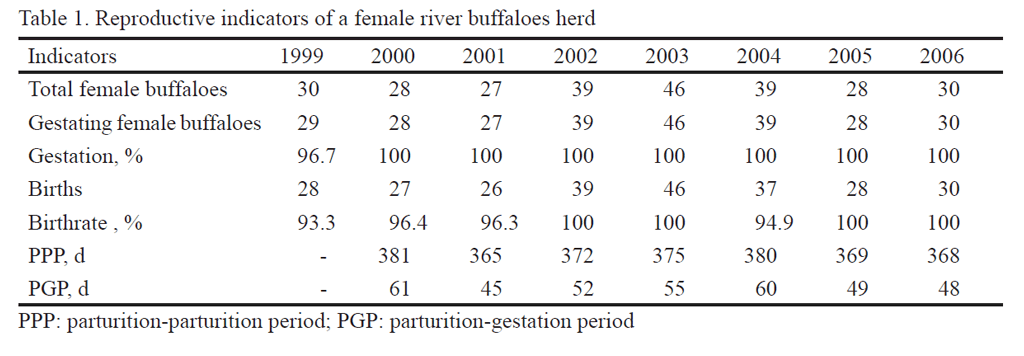
<body><![CDATA[<p align="justify"><font size="2" face="Verdana, Arial, Helvetica, sans-serif"><span lang="EN-US">In the tropic, buffaloes behavior is the  result of feeding system conditions based on grasses. The low dry matter yield,  bad quality, seasonal distribution of grasses and their inefficient use, due to  the inappropriate management (FAO 2001) influence negatively on the productive  results.</span></font></p>     <p align="justify"><font size="2" face="Verdana, Arial, Helvetica, sans-serif"><span lang="EN-US">In the international sphere, studies  about buffaloes behavior show higher values to those informed in researches  carried out with cattle submitted to feeding systems in which prevails, in  their botanical composition, natural grasses with&nbsp; moderated animal stocking rate. The lactation  curve and liveweight changes and body size that  buffaloes showed during their life, has not been studied enough (Borguese <em>et al.</em> 2013).An appropriate way to describe  this performance is the use of mathematical models(Kratochv&iacute;lov&aacute; <em>et al.</em> 2002).</span> </font></p>     <p align="justify"><font size="2" face="Verdana, Arial, Helvetica, sans-serif"><span lang="EN-US">In fattening cattle, carcass indicators and their components can be  affected by management and feeding systems, speed of animals growing, liveweight and slaughter age, as well as breed and sexual  condition, among other factors (Avilez 2006 and Uriyapongson 2013).As it been verified, it seems to be that  these conditions also influences on the carcass indicators in buffaloes.</span></font></p>     <p align="justify"><font size="2" face="Verdana, Arial, Helvetica, sans-serif"><span lang="EN-US">The objective of this research is to show the results of the  researches carried out in the Instituto de Ciencia Animal de la Rep&uacute;blica de  Cuba in 2000-2014, so it can offer a behavior characterization, milk  composition, carcass and Buffalypso buffaloes meat in feeding systems based on grazing, with  animal load adjusted to these conditions.&nbsp; </span></font></p>     <p align="justify"><font size="2" face="Verdana, Arial, Helvetica, sans-serif"><span lang="EN-US">&nbsp;</span></font></p>     <p align="justify"><strong><font size="3" face="Verdana, Arial, Helvetica, sans-serif"><span lang="EN-US">REPRODUCTIVE BEHAVIOR</span></font></strong></p>     <p align="justify"><font size="2" face="Verdana, Arial, Helvetica, sans-serif"><span lang="EN-US">For the study of the unproductive  behavior, the data of all female Buffalypso buffaloes  of a dairy from the Instituto de Ciencia  Animal in the period of 1999-2007 are shown and covers the first eight  lactation. The number of female buffaloes with more than eight parturitions  decreased in this period, as consequence of the incorporation of F1 animals (Buffalypso x Mediterranean) in the dairy showing another  performance, that is not the purpose of this research. </span></font></p>     <p align="justify"><font size="2" face="Verdana, Arial, Helvetica, sans-serif"><span lang="EN-US">To determined female buffaloes gestation, a rectal diagnostic to the  whole mass was carried out. In <a href="/img/revistas/cjas/v49n2/t0105215.gif">table 1</a> are showed the female buffaloes  reproductive indicators in the evaluated years. Gestation level was excellent,  if it is considered that in different years all female buffaloes were gestated,  except on 1999, year in which the informed level was not the best (96.7 %)  regarding the rest.</span></font></p>     
<p align="justify"><font size="2" face="Verdana, Arial, Helvetica, sans-serif"><span lang="EN-US">In spite of having a prolonged  gestation, approximately 315d, the parturition-gestation and parturition-  parturition periods allowed to get an annual calf. Although high birthrate  levels were reached, in the evaluated period five abortions and died calves in  the years 1999, 2000, 2001and 2004 were showed. Nevertheless, with these  indicators it can achieve a very encouraging rhythm of the mass growing, aspect  of interest if the specie perspectives in cattle development are considered. &nbsp;</span></font></p>     <p align="justify"><font size="2" face="Verdana, Arial, Helvetica, sans-serif"><span lang="EN-US">&nbsp;</span></font></p>     ]]></body>
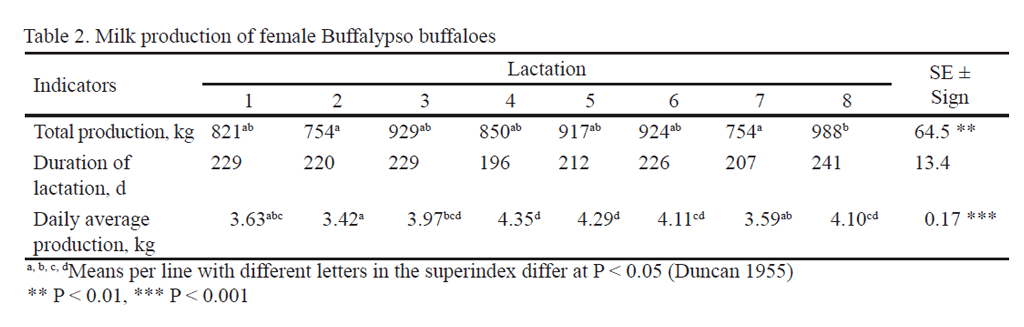
<body><![CDATA[<p align="justify"><strong><font size="3" face="Verdana, Arial, Helvetica, sans-serif"><span lang="EN-US">PRODUCTIVE PERFORMANCE</span></font></strong></p>     <p align="justify"><font size="2" face="Verdana, Arial, Helvetica, sans-serif"><span lang="EN-US">The studies of (Buffalypso) buffaloes  productive performance in grazing feeding systems show that behaves as double  purpose animals, with milk production in restricted suckling next to 800kg per  lactation and liveweight gain during growth similar  to cattle dedicated to meat production in Cuba, in similar management and  feeding conditions, indicator that can be higher in bubaline specie, when  animals are only feeding with grass (Fundora <em>et  al.</em> 2003).&nbsp;&nbsp; </span></font></p>     <p align="justify"><font size="2" face="Verdana, Arial, Helvetica, sans-serif"><span lang="EN-US">&nbsp;</span></font></p>     <p align="justify"><strong><font size="3" face="Verdana, Arial, Helvetica, sans-serif"><span lang="EN-US">PRODUCTION AND MILK QUALITY</span></font></strong></p>     <p align="justify"><font size="2" face="Verdana, Arial, Helvetica, sans-serif"><span lang="EN-US">The Buffalypso female buffaloes milk  production in feeding system base on grasses,  supplemented or not, with stocking rates between 0.8 and 1.2 UGM ha<sup>-1</sup>,  although lower to those of other breeds dedicated&nbsp; to this purpose, show annual production  potential next to 800 kg female buffalo<sup>-1</sup>, value that varies  according to genetic and environmental factors.&nbsp; </span></font></p>     <p align="justify"><font size="2" face="Verdana, Arial, Helvetica, sans-serif"><span lang="EN-US">When the genetic selection was not  assisted in the dairy of the female buffaloes of this breed, productions of 743  kg, in lactations of 202 were achieved (Mitat 2011).  However, the selection of female buffaloes daughters with higher productions,  improved these indicators. In the herd from the Instituto  de Ciencia Animal de Cuba, the productions were  increased each year by the replace effect, approximately, 15% of female  buffaloes with worsted productions by the offspring of that which were more  efficient.&nbsp; &nbsp;</span></font></p>     <p align="justify"><font size="2" face="Verdana, Arial, Helvetica, sans-serif"><span lang="EN-US">Although other management factors can  influence, the results of <a href="/img/revistas/cjas/v49n2/t0205215.gif">table 2</a> shows that up to the fourth lactation milk  production was increased, when incorporating offspring of the best female  buffaloes. Later to the eighth lactation, the increase of these indicators  continued, but it also influenced, the incorporation of female buffaloes of  higher dairy potential breeds. The production decrease in the seventh lactation  was due to changes in management, to stabling the animals in the dry season.</span> </font></p>     
<p align="justify"><font size="2" face="Verdana, Arial, Helvetica, sans-serif"><span lang="EN-US">The results of the last lactation  productions (<a href="/img/revistas/cjas/v49n2/t0205215.gif">table 2</a>) are similar to the informed by Scanonne  (2006) in selected female buffaloes herds in  Venezuela, and higher to those referred to Fraga <em>et  al.</em> (2007) in a herd of a Cattle Enterprise in Cuba with low attention to  the selection, aspect that reaffirms the importance of genetic selection.</span> </font></p>     
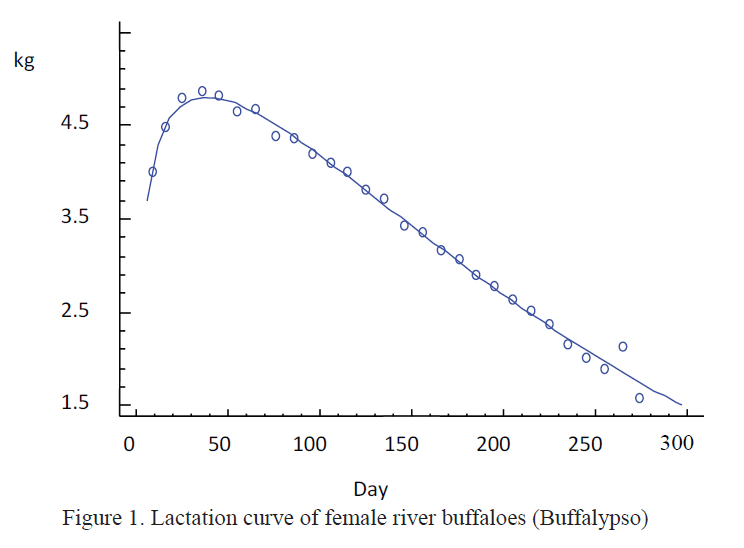
<p align="justify"><font size="2" face="Verdana, Arial, Helvetica, sans-serif"><span lang="EN-US">The lactation curve that characterized the female Buffalypso buffaloes milk production of the herd was adjusted  by means of the quadratic logarithmic model (<a href="/img/revistas/cjas/v49n2/f0105215.gif">figure1</a>).In the equation Yt = 1.86 + 0.03 t + 0.00003 t<sup>2</sup> + 1.13 ln t, that is adjusted to the curve, t represents the time  in days, and showed higher values of 4.87 L daily per female buffalo, between  31 and 40 lactation days, These results are similar to the informed by Borguese <em>et al.</em> (2013).</span></font></p>     
<p align="justify"><font size="2" face="Verdana, Arial, Helvetica, sans-serif"><span lang="EN-US">The most important results of these studies in feeding systems based  on grasses and restricted suckling, related with milk production and lactation  curve, suggest that in the first 100 lactation days is obtained more than a  half of the total milk production, and it is not necessary to longer the  lactation by a higher period to 200d, because in this time more than 91% of  total production is achieved. They also show that the higher milk production  value was 4.87 kg, and it was obtained in the 30 to      40 d range, as average. These results show that lactation persistence was above  of 4 kg until 120d.From 180d, production decrease, was lower to 3 kg daily. The  productive behavior of the mentioned herd was above that pointed out by CENCOP  (2011) for the national herd in the different lactation periods. The studies  suggest that the correlations between milk production and post-parturition  weigh of female buffaloes were not    significant.&nbsp; </span></font></p>     ]]></body>
<body><![CDATA[<p align="justify"><font size="2" face="Verdana, Arial, Helvetica, sans-serif"><span lang="EN-US">To evaluate in a comparative way milk composition, Fundora <em>et al.</em> (2001) carried out a study in female Buffalypso buffaloes and Holstein x Zebu cows (15/16 x  1/16), both fed with star grass (<em>Cynodon nlenfluensis</em>).The research showed (<a href="/img/revistas/cjas/v49n2/t0305215.gif">table 3</a>) that fat  levels duplicated those verified in cows, while total solids and milk protein  values were 1.38 times higher in female buffaloes milk. It was considered that  in order to obtain 1 kg of milk corrected to 4% fat, cows should produce 1.2kg  of milk, amount reached with 0.55 kg of female buffaloes milk, what suggested  to be used in the elaboration of dairy products, with the consequence benefit  for dairy industry. </span></font></p>     
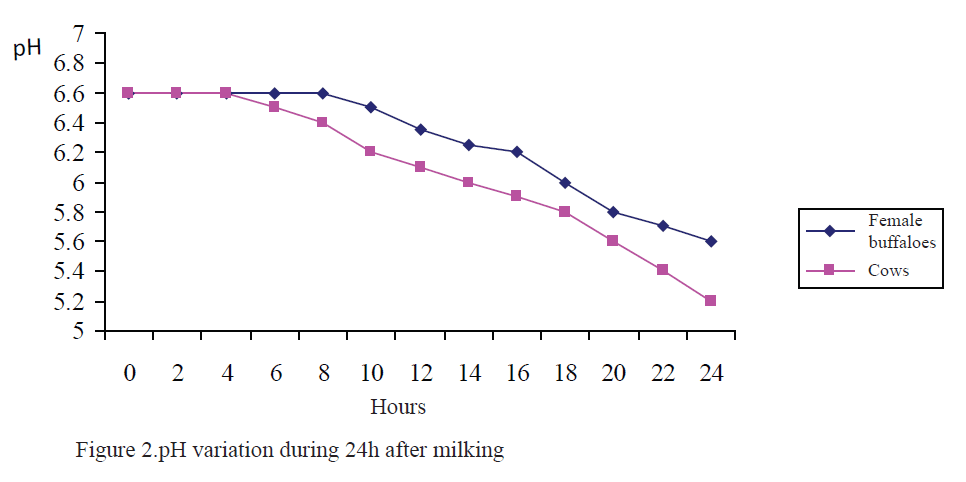
<p align="justify"><font size="2" face="Verdana, Arial, Helvetica, sans-serif"><span lang="EN-US">Certain characteristics that facilitate  the productive process also prevail: the highest size of the fat globules of  female buffaloes milk which favors churning to produce butter (Ganguli 1998); also, higher percentage of coagulation  influence positively in quality (Garc&iacute;a 1993) and the higher size of the caseine micelle, that reduce protein looses  during the industrial process (Ganguli 1992).</span></font></p>     <p align="justify"><font size="2" face="Verdana, Arial, Helvetica, sans-serif"><span lang="EN-US">Fundora <em>et al.</em> (2001) informed that the  pH of cow milk was stable, with values approximately 6.6 after four hours, but  was reduced to 6.54 six hours after milking, and it declined to reach 5.2  twenty four hours after milking. However, pH first dropped four hours later in  buffaloes milk, that is, ten hours after milking, and continued decreasing to  reach 5.53 twenty four hours after milking. Thus, pH declined during the first  twenty four hours after milking in 1.4 units in cows and 1.06 in female buffaloes milk (<a href="/img/revistas/cjas/v49n2/f0205215.gif">figure 2</a>).</span> </font></p>     
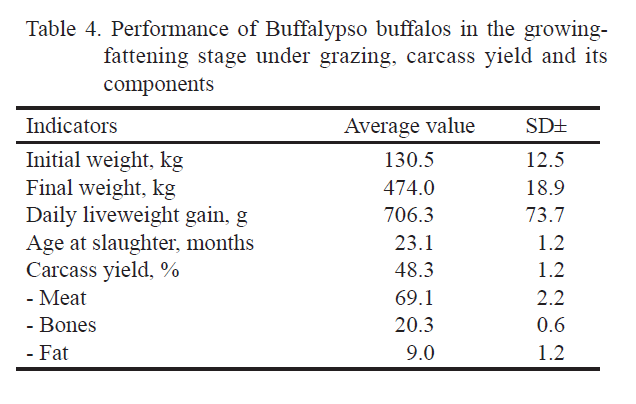
<p align="justify"><font size="2" face="Verdana, Arial, Helvetica, sans-serif"><span lang="EN-US">On comparing cow and female buffaloes milk stability showed that, in  the first ones, the change in reductase was produced  at 6.2 h. No change was observed in female buffaloes  milk ten hours after milking. This could be associated to that found by Garc&iacute;a  (1993) regarding the lower bacterial growth in female buffaloes  milk, which is related to its high lecithin content and to a glycoprotein which  inhibits the development of undesirable bacteria that require iron.</span></font></p>     <p align="justify"><font size="2" face="Verdana, Arial, Helvetica, sans-serif"><span lang="EN-US">These results, from the practical point  of view, constitutes an important element win the management of fresh female  buffaloes milk for human consumption or when milk is processed outside the  dairy unit, where collection is more complicated, due to female buffaloes are  generally located in areas of difficult access.&nbsp;&nbsp;&nbsp; </span></font></p>     <p align="justify"><font size="2" face="Verdana, Arial, Helvetica, sans-serif"><span lang="EN-US">&nbsp;</span></font></p>     <p align="justify"><strong><font size="3" face="Verdana, Arial, Helvetica, sans-serif"><span lang="EN-US">MEAT PRODUCTION</span></font></strong></p>     <p align="justify"><font size="2" face="Verdana, Arial, Helvetica, sans-serif"><span lang="EN-US">The results of experiments based on the  fattening of grazing buffaloes, in which specific studies on buffaloes Buffalypso are included, and others in which this breed is  compared with Carabao and its crossings, that are  used for meat production in Cuba. Comparisons with cattle are also exposed,  with the objective to know the Buffalypso  potentialities for meat production. &nbsp;</span></font></p>     <p align="justify"><font size="2" face="Verdana, Arial, Helvetica, sans-serif"><span lang="EN-US">In a study to evaluate the behavior and  carcass composition of Buffalypso buffaloes, fed with  star grass, natural grasses and native legumes (Fundora <em>et al.</em> 2004), the animals attained the slaughter liveweight  at 23.1 months of age, with an average daily gain rate higher than 700g (<a href="/img/revistas/cjas/v49n2/t0405215.gif">table  4</a>).The behavior was good, considering the poor botanical composition of  pastures, with approximately 38% of low consumable plants. Earlier age at  slaughter and higher liveweight than those for cattle  in similar systems were obtained, according to the results observed by Vald&eacute;s  and Senra (1999) and Castillo <em>et al.</em> (2000).</span> </font></p>     
<p align="justify"><font size="2" face="Verdana, Arial, Helvetica, sans-serif"><span lang="EN-US">The carcass yield is relatively low, in which the skin weight  influenced because it has a greater thickness than the cattle, and also the  head weight because it has a higher development.</span></font></p>     ]]></body>
<body><![CDATA[<p align="justify"><font size="2" face="Verdana, Arial, Helvetica, sans-serif"><span lang="EN-US">In a comparison of the productive  performance and the behavior of Buffalypso buffaloes  and commercial zebu of 261and 294 kg of liveweight  respectively, that grazed together and intake grasses composed by star (<em>Cynodon nlenfluensis</em>),  mixture of natural grasses mixture and razor grass (<em>Paspalum virgatum</em>) and 60g of mineral salts daily per  animal per day, higher liveweight gain were verified  in buffaloes during 287 d that the experiment lasted (<a href="/img/revistas/cjas/v49n2/t0505215.gif">table 5</a>), with rate 1.6  times higher in comparison with cattle.</span></font></p>     
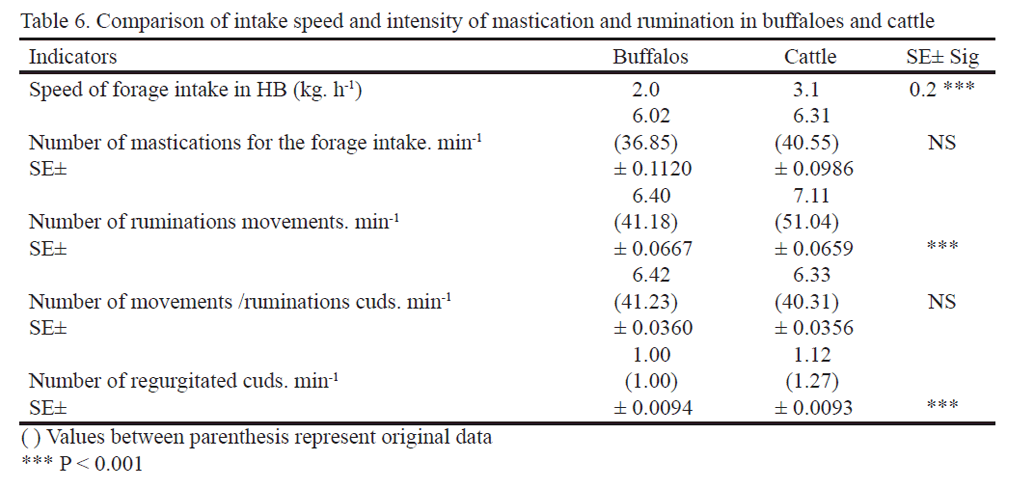
<p align="justify"><font size="2" face="Verdana, Arial, Helvetica, sans-serif"><span lang="EN-US">The results of <a href="/img/revistas/cjas/v49n2/t0505215.gif">table 5</a> shows that  buffaloes in spite of gaining more liveweight they  dedicated less time to grasses intake, because they used this fibrous food more  efficiently than the cattle, due to the anatomical and physiological  characteristics that supposed higher food intake per unit of time according to  that informed by Carrero (1998).However, the opposite  was demonstrated in Fundora <em>et al.</em> (2007)  later study. Buffaloes dedicated less time to grasses and dry matter intake  related to the liveweight and metabolic weight. The  intake speed was lower in this specie too    (<a href="/img/revistas/cjas/v49n2/t0605215.gif">table 6</a>).</span></font></p>     
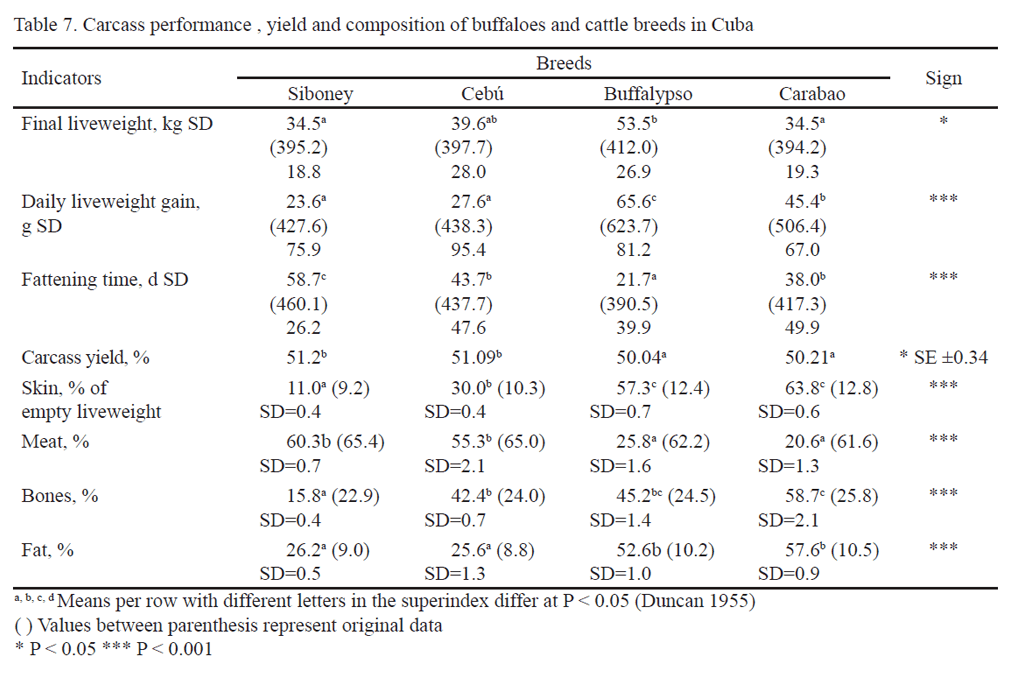
<p align="justify"><font size="2" face="Verdana, Arial, Helvetica, sans-serif"><span lang="EN-US">The comparative study of the intensity  of mastication and rumination of buffaloes and cattle indicated that, in spite  of the number of mastication for the forage ingestion and the number of  movements per each ruminated cud were similar, the number of regurgitated cuds  and ruminations movements per unit of time was lower than in buffaloes. From  the proportion of circadian time devoted to ingestion, dry matter intake and  the number of mastications movements per unit of  time, was estimated that buffaloes and cattle performed 11 886 and 19 210 mastications movements per day and 2406 and 3074 movements kg<sup>-1</sup> of dry matter ingested,  respectively. This represented in buffaloes 61.9 and 78.2 % of movements  regarding to those of cattle. On the other hand, when considering the circadian  time devoted to rumination and the number of jaw movements performed for this  activity, the buffaloes made 26 032 movements daily and cattle, 29 031, this  represented11.5 % lower than the former.</span> </font></p>     <p align="justify"><font size="2" face="Verdana, Arial, Helvetica, sans-serif"><span lang="EN-US">The decrease of jaw movements per unit  of time in ingestion and rumination could be one of the causes that contribute  to the best productive performance of the buffaloes regarding to cattle, in  similar feeding and management conditions. This was also observed by Rodas <em>et al.</em> (2001) and could be due to lower energy  expenditure in these activities.</span></font></p>     <p align="justify"><font size="2" face="Verdana, Arial, Helvetica, sans-serif"><span lang="EN-US">In a second experiment, Fundora <em>et al.</em> (2014) compared the behavior and  carcass composition of the two buffloes breed and two  of cattle, used in Cuba fattening. A total of 20 Buffalypso  buffaloes same quantity of Carabao or crossbreed, 20  crossbreed cattle Siboney de Cuba and 20 Commertial Zebu were used, with initial liveweights  of 170, 184, 201 and 209 kg, respectively. The animals were located together,  in grazing of 77 ha, divided in four paddocks during a year. </span></font></p>     <p align="justify"><font size="2" face="Verdana, Arial, Helvetica, sans-serif"><span lang="EN-US">Although the initial liveweight  was lower in the Buffalypso, the daily liveweight gains (DLW) were higher in this breed in the  total fattening stage, regarding to the obtained in Siboney  breed cattle and in the rest of evaluated genotypes. That is why; fattening  time was significantly decreased in Buffalypso  animals. The worst behavior in both traits show it the cattle of both breeds  (<a href="/img/revistas/cjas/v49n2/t0705215.gif">table 7</a>).This result is important, if it is considered that, in 2002, Cuba has  100 dairies of females (Buffalypso) buffaloes  approximately, that were substantially increased up to 249 units in 2010  (Garc&iacute;a 2011). As consequence, the quantity of males that these annually  produced, it significantly increased the meat contribution to the industry.</span> </font></p>     
<p align="justify"><font size="2" face="Verdana, Arial, Helvetica, sans-serif"><span lang="EN-US">Buffaloes, in comparison with cattle, showed lower yield of carcass  and meat as carcass percentage. The first one is related with the skin weight  that was higher in buffaloes. Similar results referred Huerta-Leindez (1999) and Angulo (2005), and it is the most  influence element, joined to the head and belly, in carcass yield (Mendes-  Jorge and de Lima 2011).</span></font></p>     <p align="justify"><font size="2" face="Verdana, Arial, Helvetica, sans-serif"><span lang="EN-US">The obtained results suggest that  buffaloes use efficiently the grass, as consequence of the appropriate fibers  digestion, as Wanapat and Chanthakhoun  (2009) showed. It is probable that the higher behavior of Buffalypso  regarding to Carabao is due to the first one is more  docile, what is associated to rearing system in dairies, while the Carabao rearing system is in raising pen, where the  relation with the man is poor. In these lasts a nervous behavior was observed  during its management. </span></font></p>     <p align="justify"><font size="2" face="Verdana, Arial, Helvetica, sans-serif"><span lang="EN-US">The yield in buffaloes  meat could be affected by the higher percentage of subcutaneous fat in their  carcass. This matter could be due to low energy losses of buffaloes in  mastication and rumination activities, as it was showed before. </span></font></p>     <p align="justify"><font size="2" face="Verdana, Arial, Helvetica, sans-serif"><span lang="EN-US">Nevertheless, the liveweight  (251, 218, 196 and 202 kg. ha<sup>-1</sup>) and meat (72.0, 62.0, 60.1 and    53.6 kg. ha<sup>-1</sup>) production in Buffalypso, Carabao, Zebu and Syboney,  respectively, suggest more efficiency for meat production in Buffalypso, as consequence of the higher growth rhythm of  this breed.</span></font></p>     ]]></body>
<body><![CDATA[<p align="justify"><font size="2" face="Verdana, Arial, Helvetica, sans-serif"><span lang="EN-US">The buffaloes of Buffalypso  breed showed higher weight of the later quarters and its proportion regarding  to carcass, where the most valuable cuts are located, according to Mendes and  de Lima (2012). A similar result was informed by Mendes <em>et al.</em> (1997 a,b) and Mendes and Fontes (1997)&nbsp; in  cattle and in some buffaloes breeds, while in Carabao  the opposite happened. Nevertheless, the proportion of first quality meat  regarding the carcass was similar in animals of both breeds. Similar  proportions of first and second quality meat were also observed, regarding the  total meat in both breeds (<a href="/img/revistas/cjas/v49n2/f0305215.gif">figure 3</a>).&nbsp; </span></font></p>     
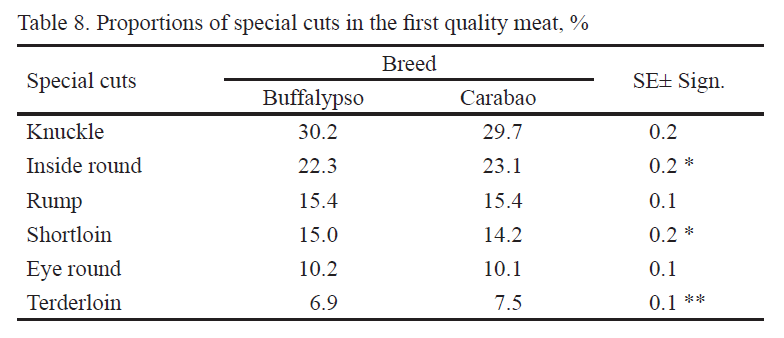
<p align="justify"><font size="2" face="Verdana, Arial, Helvetica, sans-serif"><span lang="EN-US">The highest development of forequarter  respect hindquarter Carabao buffaloes, may be caused  by their frequent use as a labor tool in many countries, which did not happen  with animals of breeds that originated Buffalypso  breed. These last have been dedicated mostly to milk production. </span></font></p>     <p align="justify"><font size="2" face="Verdana, Arial, Helvetica, sans-serif"><span lang="EN-US">Although Buffalipso breed showed higher  development, the similarity in the first quality meat proportion regarding the  carcass in animals of both breeds, although this meat type is in the later  quarters, as it was showed before, could be related with the particulars  characteristics of the different cuts of this area in each breed, aspect that  should be study&nbsp; more exactly. </span></font></p>     <p align="justify"><font size="2" face="Verdana, Arial, Helvetica, sans-serif"><span lang="EN-US">The percentages of special cuts in the  first quality meat are show in <a href="/img/revistas/cjas/v49n2/t0805215.gif">table 8</a>.The knuckle, rump and eye round did not  significantly differ between breeds, while Carabao  buffalo produced higher inside round and tenderloin proportions and less of shortloin, in comparison with Buffalypso.  However, in absolute terms, Buffalyso buffaloes  produced 6kg more of total meat (3.9 kg of second quality meat and 2.1 kg of  first quality meat).The tenderloin is excepted, that had similar weight in both  breeds. The remainder cuts of the first quality meat weighed&nbsp; more in the animals of Buffalypso  breed, as consequence of the higher&nbsp; liveweight reached by these ones (Fundora <em>et al.</em> 2014) and of their carcass to the slaughther.</span></font></p>     
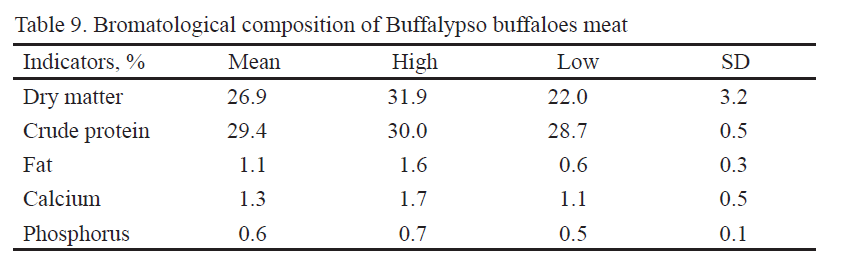
<p align="justify"><font size="2" face="Verdana, Arial, Helvetica, sans-serif"><span lang="EN-US">The meat bromatological  composition of the Buffalypso buffaloes is show in  <a href="/img/revistas/cjas/v49n2/t0905215.gif">table 9</a>.The average values of dry matter and nutrients are similar to the  informed by other authors (Mendes and Andrighetto  2005 and Andrighetto <em>et al.</em> 2007).The higher  protein level in the meat samples could contributed to the veined or marbled  color, if the intermuscular fat level is adequate, in  accordance with the informations carried out by Reback (2011).</span></font></p>     
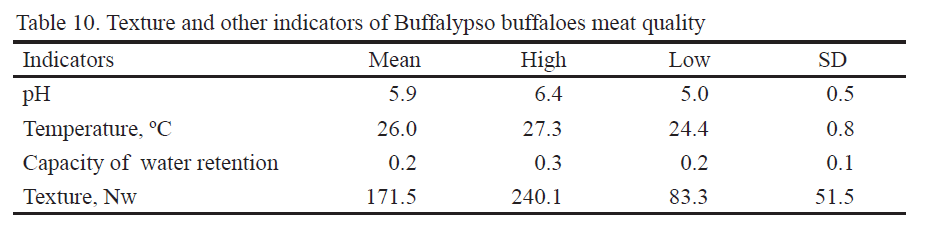
<p align="justify"><font size="2" face="Verdana, Arial, Helvetica, sans-serif"><span lang="EN-US">The texture and water retention are two  important elements in the meat. As <a href="/img/revistas/cjas/v49n2/t1005215.gif">table 10</a> showed, meat can be classify as  tender, since texture values are relatively low, while water retention capacity  is appropriated. In bovine, Sa&ntilde;udo <em>et al.</em> (2004), observed similar results in low age animals, what suggests that the  slaughtered buffaloes in this study, with approximately two years of age,  produced tender meats, to what can contribute the specie characteristics,  related with their longevity that overcomes to the bovine specie.  These results, related with the high protein level and texture (<a href="/img/revistas/cjas/v49n2/t0405215.gif">tables 4</a> and  <a href="/img/revistas/cjas/v49n2/t0505215.gif">5</a>), joined to the informed by other authors, that suggest a meat with nutraceutical effects (Zicarelli  2012), show the necessity to continue studies on the carcass and buffaloes  meat, in this and in other feeding and management systems, to get a competitive  meat going to the market and persons that need to consume proteins coming from  healthy protein sources.</span></font></p>     
<p align="justify"><font size="2" face="Verdana, Arial, Helvetica, sans-serif"><span lang="EN-US">&nbsp;</span></font><font size="2" face="Verdana, Arial, Helvetica, sans-serif"><span lang="EN-US">&nbsp;</span></font></p>     <p align="justify"><strong><font size="3" face="Verdana, Arial, Helvetica, sans-serif"><span lang="EN-US">GROWTH CURVE </span></font></strong></p>     <p align="justify"><font size="2" face="Verdana, Arial, Helvetica, sans-serif"><span lang="EN-US">For the study of Buffalypso  buffaloes growth curve, data of the liveweight of the males and females, born from 30 primiparous female buffaloes and the two fallowing calvings were used. The offspring feeding system consisted  on the intake of the whole milk in free suckling up to 10d of age, and  restricted suckling and rotational grazing from 11d up to the weaning. Later  on, the animals were separated by sex and were allocated in a rotational  grazing system with a mixture of natural grasses and star grass, up to the  slaughter of the males and the incorporation to reproduction of the females.</span> </font></p>     <p align="justify"><font size="2" face="Verdana, Arial, Helvetica, sans-serif"><span lang="EN-US">Linear and logistic models were used to select that of best fit. The  equation y = a+ bx was used for the linear model and  y = a / (1 + exp &acirc; (- &atilde;x)  for the logistic, where a and exp &atilde; represent the  slope of the curve, respectively. The initial value of the parameters was  calculated through Microsoft Excell on Window XP. The  models were adjusted through the statistical SPSS on Windows. V10.1 (Visauta 1998).</span></font></p>     ]]></body>
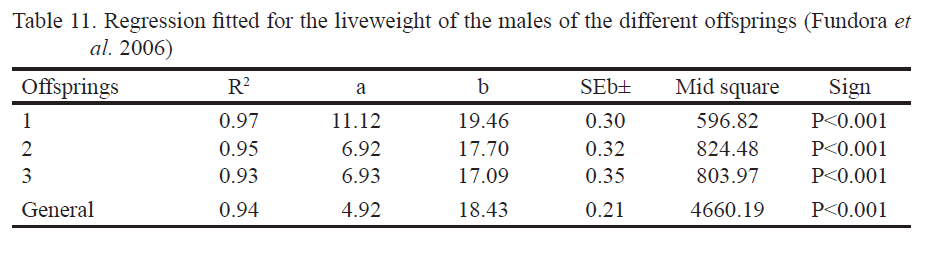
<body><![CDATA[<p align="justify"><font size="2" face="Verdana, Arial, Helvetica, sans-serif"><span lang="EN-US">Due to the liveweight  of the males was obtained from three months of age up to 500 kg, maximum weight  of slaughter, the liveweight curves are in  correspondence with the performance of this indicator up to this weight.</span> </font></p>     <p align="justify"><font size="2" face="Verdana, Arial, Helvetica, sans-serif"><span lang="EN-US">In <a href="/img/revistas/cjas/v49n2/t1105215.gif">table 11</a> are showed the results of the linear models adjusted for  each offspring and the general model in the males. All the adjustments were  significant, with values of R<sup>2</sup> higher to 93%.The values of  regression coefficients are the monthly increase of liveweight  of each offspring and the general. </span></font></p>     
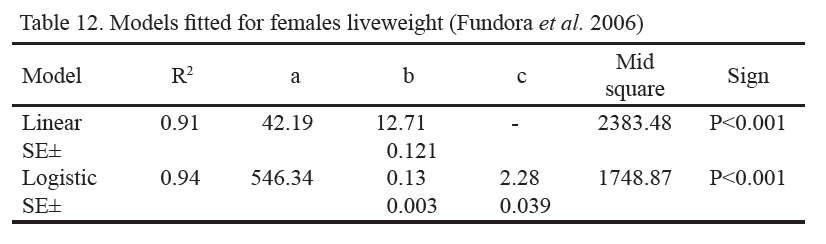
<p align="justify"><font size="2" face="Verdana, Arial, Helvetica, sans-serif"><span lang="EN-US">The monthly liveweight performance of the  first offspring was higher. This result was associated to the fact that the  animals of this offspring had better quality pastures, which were deteriorated  later as the animal stocking rate was increased. In the second and third were  almost the same. These coefficients of regression may be interpreted as the  monthly increase of liveweight, that is, 19.46  kg/month in the first offspring, 17.7 kg in the second and 17.1 kg in the third.  The general regression was estimated, due to the similarity of the obtained  coefficients for each offspring. This table shows, the regression obtained,  which had slope of 18.4 kg/month, corresponding to the monthly liveweight gain with higher variance, due to the pool of  the three previous variances. </span></font></p>     <p align="justify"><font size="2" face="Verdana, Arial, Helvetica, sans-serif"><span lang="EN-US">According to these results, the equation  that expresses the performance of the monthly liveweight  gain in kg of the males Buffalypso buffaloes is the  following:</span> </font></p>     <p align="justify"><font size="2" face="Verdana, Arial, Helvetica, sans-serif"><span lang="EN-US">LW males (kg) = 4.92 +18.43 (&plusmn; 0.21) age, </span></font><font size="2" face="Verdana, Arial, Helvetica, sans-serif"><span lang="EN-US">where:  3 &lt; age (month) &lt; 24</span></font></p>     <p align="justify"><font size="2" face="Verdana, Arial, Helvetica, sans-serif"><span lang="EN-US">In the analysis of the females there was a liveweight  performance that was stabilized after 25 months of age, thus both models were  tested to analyze the best fit from the statistical point of view. This  stability from    25 months of age is of importance from the practical point of view, because it  indicates, from that, the animals may be incorporated to reproduction because  they have almost grown completely</span></font>.</p>     <p align="justify"><font size="2" face="Verdana, Arial, Helvetica, sans-serif"><span lang="EN-US">Both models had the same determination  coefficients. However, the variance was lower in the logistic model, ensuring  better goodness of fit (<a href="/img/revistas/cjas/v49n2/t1205215.gif">table 12</a>).</span></font></p>     
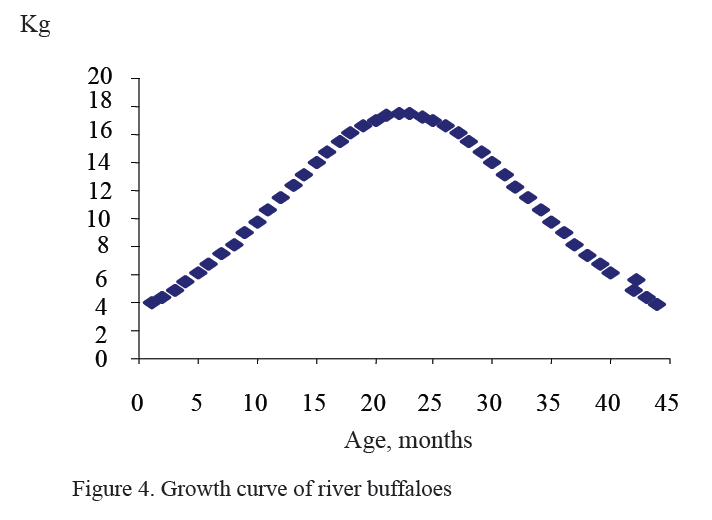
<p align="justify"><font size="2" face="Verdana, Arial, Helvetica, sans-serif"><span lang="EN-US">The convenience of using other models  such as the estocastic, by the proximity of the  observed values and the estimates in the grow curve were showed by Torres and Sampaio (2005). However, the results of the informed  adjustments in this study are adequate for the interpretation of the grow curve  of the females Buffalypso, but it is recommended to  develop studies where this mathematical model is evaluated.</span></font></p>     <p align="justify"><font size="2" face="Verdana, Arial, Helvetica, sans-serif"><span lang="EN-US"><a href="/img/revistas/cjas/v49n2/f0405215.gif">Figure 4</a> represents the growth model of  the females, obtained from the liveweight curve (Fundora <em>et al.</em> 2006). It can observed the maximum  growth between 21 and 26 months, whereas before 5, and since 40 months, is very  low, with values lower than 7 kg monthly. This is logical, considering that  before the 5 months calves were feed only with an amount of restricted milk,  and grasses of regular to bad quality, period in  which have not completely developed their digestive system, while females buffaloes have been attained most of the growth  since that age.&nbsp;&nbsp; </span></font></p>     
<p align="justify"><font size="2" face="Verdana, Arial, Helvetica, sans-serif"><span lang="EN-US">The model of determination of the growth  curve of females Buffalypso is determined by the  equation: -ab exp (-bt+ c)/1+ 2 exp (-bt+ c) + exp (-bt+ c) 2.</span></font></p>     ]]></body>
<body><![CDATA[<p align="justify"><font size="2" face="Verdana, Arial, Helvetica, sans-serif"><span lang="EN-US">According to these result, the equation  expressing the performance of the monthly liveweight  gain in kg of the females Buffalypso buffaloes up to  43 months     <br>   is: </span> </font></p>     <p align="justify"><font size="2" face="Verdana, Arial, Helvetica, sans-serif"><span lang="EN-US">LWG, kg (females) = 546.34/ (1+exp (-0.13 (&plusmn; 0.003) age + 2.28 (&plusmn;  0.039), where 0 &lt; age (months) &lt; 43&nbsp;  &nbsp;&nbsp;&nbsp;&nbsp;&nbsp;&nbsp;&nbsp;</span></font></p>     <p align="justify"><font size="2" face="Verdana, Arial, Helvetica, sans-serif"><span lang="EN-US">&nbsp;</span></font></p>     <p align="justify"><strong><font size="3" face="Verdana, Arial, Helvetica, sans-serif"><span lang="EN-US">CONCLUSIONS AND RECOMMENDATIONS</span></font></strong></p>     <p align="justify"><font size="2" face="Verdana, Arial, Helvetica, sans-serif"><span lang="EN-US">It is concluded that in feeding system based on grazing, with  natural grasses, the females Buffalypso buffaloes  with restricted suckling have average potential of 800 kg.lactation<sup>-1</sup>,but when genetic selection is  applied the productions increases. The duration of lactations, although with  individual variability, they suggested that they should not extended for a  period higher to 200 d.</span></font></p>     <p align="justify"><font size="2" face="Verdana, Arial, Helvetica, sans-serif"><span lang="EN-US">The characterization of the lactation curve of females from this  breed show a maximum of production between the 31 and 40 d of lactation and  their persistence significantly decreased from 120d.</span></font></p>     <p align="justify"><font size="2" face="Verdana, Arial, Helvetica, sans-serif"><span lang="EN-US">Milk composition is similar to that informed in other breeds and  show higher stability in comparison with cow milk.</span></font></p>     <p align="justify"><font size="2" face="Verdana, Arial, Helvetica, sans-serif"><span lang="EN-US">The males productive behavior in the  fattening stage is higher to that showed by cattle, in same management and  feeding conditions in systems based on grass, prevalence natural grasses, and  higher daily liveweight gains and liveweight  gains per surface unit, indicators that reduce the lowers yields of their  carcass and the animals final performance. These results are associated to the  best use of the vegetable fiber by the many physiological factors effect.&nbsp;&nbsp; </span></font></p>     <p align="justify"><font size="2" face="Verdana, Arial, Helvetica, sans-serif"><span lang="EN-US">The growth curve of the female Buffalypso buffaloes showed higher weight gains between 21  and 26 months, aspect that should be considered to select the best moment to  incorporate the female young buffaloes.</span> </font></p>     ]]></body>
<body><![CDATA[<p align="justify"><font size="2" face="Verdana, Arial, Helvetica, sans-serif"><span lang="EN-US">It is recommended to continue studies about this species behavior in  the new genotypes that are developing in the country and to establish new  feeding and management strategies, according with the results of the researches  reviewing here.&nbsp; </span></font></p>     <p align="justify">&nbsp;</p>     <p align="justify"><font size="3" face="Verdana, Arial, Helvetica, sans-serif"><strong>REFERENCES</strong></font></p>     <p align="justify"><font size="2" face="Verdana, Arial, Helvetica, sans-serif">Andrighetto C., Mendes A., Calixto  M. G. &amp; Storti S. M. 2007. &lsquo;&lsquo;Caracter&iacute;sticas qualitativas da carca&ccedil;a e da  carne de bubalinos mediterr&acirc;neo terminados em confinamento e abatidos em  diferentes pesos&rsquo;&rsquo;. In: <em>III Congresso Brasileiro de Ci&ecirc;ncia e Tecnologia da  Carne</em>, vol. 3, Instituto de Tecnologia de Alimentos S&atilde;o Paulo, p. 18,  Available:  &lt;<a href="http://www.bufalo.com.br/trabalhos/andrighetto_2005_car_carc_carne_bub.pdf" target="_blank">http://www.bufalo.com.br/trabalhos/andrighetto_2005_car_carc_carne_bub.pdf</a>&gt;,  [Accessed:&nbsp;March 16, 2016].</font></p>     <p align="justify"><font size="2" face="Verdana, Arial, Helvetica, sans-serif">Angulo R. A., Restrepo L. F. &amp;  Berdugo J. A. 2005. &lsquo;&lsquo;Caracter&iacute;sticas de calidad de las canales bufalinas y  vacunas comercializadas en Medell&iacute;n, Colombia&rsquo;&rsquo;. <em><span lang="EN-US">Livestock  Research for Rural Development</span></em><span lang="EN-US">, 17 (9), Available:  &lt;<a href="http://www.lrrd.cipav.org.co/lrrd17/9/angu17103.htm" target="_blank">http://www.lrrd.cipav.org.co/lrrd17/9/angu17103.htm</a>&gt;, [Accessed:&nbsp;March  16, 2016].</span></font></p>     <p align="justify"><font size="2" face="Verdana, Arial, Helvetica, sans-serif">Avilez J. P. 2006. <em>Grasa en la  canal bovina y su relaci&oacute;n con la alimentaci&oacute;n</em>. <span lang="EN-US">Univ.  C&oacute;rdova, Available: &lt;<a href="http://64.233.169.104/ search?q=cache:KszSFQ5YrdUJ:www.tecnovet.uchile. cl/CDA/tecnovet_articulo/0,1409,SCID%25253D9406% 252526ISID%25253D446,00.html+canales%2BCharolais &hl=es&ct=clnk&cd=16&gl=cu" target="_blank">http://64.233.169.104/  search?q=cache:KszSFQ5YrdUJ:www.tecnovet.uchile.  cl/CDA/tecnovet_articulo/0,1409,SCID%25253D9406% 252526ISID%25253D446,00.html+canales%2BCharolais  &amp;hl=es&amp;ct=clnk&amp;cd=16&amp;gl=cu</a>&gt;, [Accessed:&nbsp;September 10,  2014].</span></font></p>     <p align="justify"><font size="2" face="Verdana, Arial, Helvetica, sans-serif"><span lang="EN-US">Borghese A., Boselli C. &amp; Rosati R. 2013. &lsquo;&lsquo;Lactation curve and milk  flow&rsquo;&rsquo;. In: <em>Buffalo Bulletin</em>, <em>10th World Buffalo Congress</em>, vol.  32, International Buffalo Information Center, pp. 334&ndash;350, Available:  &lt;<a href="http://ibic.lib.ku.ac.th/e-Bulletin/IBBUSI201301030.pdf" target="_blank">http://ibic.lib.ku.ac.th/e-Bulletin/IBBUSI201301030.pdf</a>&gt;,  [Accessed:&nbsp;March 16, 2016].</span></font></p>     <p align="justify"><font size="2" face="Verdana, Arial, Helvetica, sans-serif">Carrero J. C. 1998. &lsquo;&lsquo;El b&uacute;falo como  alternativa de producci&oacute;n animal en Venezuela. IV. Seminario sobre manejo y  utilizaci&oacute;n de pastos y forrajes en sistemas de producci&oacute;n animal&rsquo;&rsquo;. <em>Rev.  UNELLEZ</em>, 1, p. 67.</font></p>     <p align="justify"><font size="2" face="Verdana, Arial, Helvetica, sans-serif">Castillo E., Ruiz T. E., Febles G.,  Crespo G., Galindo J., Chongo B. &amp; Hernandez J. L. 2000. <span lang="EN-US">&lsquo;&lsquo;Effect of the inclusion of leucaena at 100% in the native pasture area on  the performance of male cattle&rsquo;&rsquo;. </span><em>Cuban Journal of Agricultural Science</em>, 34 (4), pp. 299&ndash;303, CABDirect2.</font></p>     <!-- ref --><p align="justify"><font size="2" face="Verdana, Arial, Helvetica, sans-serif">CENCOP. 2011. <em>An&aacute;lisis del estado  actual y de los resultados de la producci&oacute;n lechera del b&uacute;falo en Cuba</em>.  Cuba: Ministerio de la Agricultura (MINAGRI).    </font></p>     <p align="justify"><font size="2" face="Verdana, Arial, Helvetica, sans-serif">Duncans D. B. 1955. &lsquo;&lsquo;Multiple range  and multiple F test&rsquo;&rsquo;. <em><span lang="EN-US">Biometrics</span></em><span lang="EN-US">, 11 (1).</span></font></p>     <p align="justify"><font size="2" face="Verdana, Arial, Helvetica, sans-serif"><span lang="EN-US">FAO. 2001. <em>Guideline for growing pasture and fodder</em>. , Available:  &lt;<a href="http://www.iphpk.gov.mv/English>-" target="_blank">http://www.iphpk.gov.mv/English&gt;-</a>&gt;, [Accessed:&nbsp;September 3,  2005].</span></font></p>     <p align="justify"><font size="2" face="Verdana, Arial, Helvetica, sans-serif">Fraga L. M., Garc&iacute;a Y., Mora M.,  Guzm&aacute;n G., Camba O. &amp; Rodr&iacute;guez M. 2007. <span lang="EN-US">&lsquo;&lsquo;Milk yield  and reproductive performance of Buffalypso in a Genetic Enterprise in Havana  province. Preliminary results&rsquo;&rsquo;. <em>Cuban Journal of Agricultural Science</em>,  41, p. 117.</span></font></p>     <p align="justify"><font size="2" face="Verdana, Arial, Helvetica, sans-serif"><span lang="EN-US">Fundora O., Franzolin R., Casta&ntilde;eda P. C., Bautista I. S. &amp; Pe&ntilde;a Y. A.  2014. &lsquo;&lsquo;Performance and feeding behavior of Mediterranean river buffaloes fed  different proportions of maize and sugar cane silage rations&rsquo;&rsquo;. </span><em>Cuban Journal of Agricultural  Science</em>, 47 (2), p.  155.</font></p>     <p align="justify"><font size="2" face="Verdana, Arial, Helvetica, sans-serif">Fundora O., Gonzalez M. E., Lezcano  O., Montejo A., Pompa N. &amp; Enriquez A. V. 2001. <span lang="EN-US">&lsquo;&lsquo;A  comparative study of milk composition and stability of Murrah river buffaloes  and Holstein cows grazing star grass&rsquo;&rsquo;. <em>Cuban Journal of Agricultural  Science</em>, 35 (3), pp. 219&ndash;222.</span></font></p>     <p align="justify"><font size="2" face="Verdana, Arial, Helvetica, sans-serif"><span lang="EN-US">Fundora O., Gonzalez M. E., Tuero O. &amp; Vera A. M. 2003. &lsquo;&lsquo;Comparison of  the productive performance and behavior of grazing river buffaloes and bulls  crossbred with Zebu in the growing-fattening period&rsquo;&rsquo;. <em>Cuban Journal of  Agricultural Science</em>, 37 (2), pp. 155&ndash;159.</span></font></p>     <p align="justify"><font size="2" face="Verdana, Arial, Helvetica, sans-serif"><span lang="EN-US">Fundora O., Quintana F. O. &amp; Gonzalez M. E. 2004. &lsquo;&lsquo;Performance and  carcass composition in river buffaloes fed a mixture of star grass, natural  pastures and native legumes&rsquo;&rsquo;. <em>Cuban Journal of Agricultural Science</em>, 38  (1), pp. 41&ndash;44.</span></font></p>     <p align="justify"><font size="2" face="Verdana, Arial, Helvetica, sans-serif"><span lang="EN-US">Fundora O., Torres V., Gonzalez M. E. &amp; Noda A. 2006. &lsquo;&lsquo;Growth curve  and liveweight in a river buffalo herd&rsquo;&rsquo;. </span><em>Cuban Journal of Agricultural Science</em>, 40 (4), pp. 401&ndash;405.</font></p>     <p align="justify"><font size="2" face="Verdana, Arial, Helvetica, sans-serif">Fundora O., Tuero O., Gonzalez M.  E., Rivadineira W., Alfonso F., Zamora A. &amp; Vera A. M. 2007. <span lang="EN-US">&lsquo;&lsquo;Comparative study of the feeding behavior of river buffaloes and Siboney  de Cuba breed at the fattening stage&rsquo;&rsquo;. <em>Cuban Journal of Agricultural  Science</em>, 41 (3), pp. 231&ndash;235.</span></font></p>     ]]></body>
<body><![CDATA[<!-- ref --><p align="justify"><font size="2" face="Verdana, Arial, Helvetica, sans-serif"><span lang="EN-US">Ganguli N. C. 1992. <em>Prospects of buffalo production in the Mediterranean  and Middle East</em>. Wageningen: PUDOC. Sci. Publ., 393 p.    </span></font></p>     <p align="justify"><font size="2" face="Verdana, Arial, Helvetica, sans-serif"><span lang="EN-US">Ganguli N. C. 1998. &lsquo;&lsquo;Milk production and quality in Asia&rsquo;&rsquo;. </span><em>Indian - Dairyman</em>, 50, p. 9.</font></p>     <p align="justify"><font size="2" face="Verdana, Arial, Helvetica, sans-serif">Garc&iacute;a A. 2011. &lsquo;&lsquo;Resultados y  perspectivas de la crianza del b&uacute;falo en Cuba&rsquo;&rsquo;. In: <em>VI Simposio de B&uacute;falos  de Las Am&eacute;ricas, VI Simposio de Europa y Am&eacute;rica</em>, La Habana, Cuba.</font></p>     <!-- ref --><p align="justify"><font size="2" face="Verdana, Arial, Helvetica, sans-serif">Garc&iacute;a Y. 1993. <em>Caracter&iacute;sticas  de la leche de b&uacute;falas</em>. Graduated Thesis, UNESR, Venezuela, 167 p.    </font></p>     <!-- ref --><p align="justify"><font size="2" face="Verdana, Arial, Helvetica, sans-serif">Huerta-Leindez N. 1999. <em>Comparaci&oacute;n  entre b&uacute;falos de agua y vacunos acebuados</em>. Technical Report, Maracaibo,  Venezuela: Asobufalo, p. 5.    </font></p>     <p align="justify"><font size="2" face="Verdana, Arial, Helvetica, sans-serif">Kratochvilova M., Hyankov&aacute; L.,  Knizetov&aacute; H., Fiedler J. &amp; Urban F. 2002. &lsquo;&lsquo;Growth curve analysis in cattle  from early maturity and mature body size viewpoints&rsquo;&rsquo;. <em>Czech Journal of  Animal Science</em>, 47 (4), pp. 125&ndash;132.</font></p>     <!-- ref --><p align="justify"><font size="2" face="Verdana, Arial, Helvetica, sans-serif">Mendes A. &amp; Andrighetto C. 2005. <em>Caracter&iacute;sticas de Carca&ccedil;a de Bubalinos. Anais do Zootecnia</em>. Campo  Grande-MS., 27 p.    </font></p>     <p align="justify"><font size="2" face="Verdana, Arial, Helvetica, sans-serif">Mendes A. &amp; de Lima C. 2012.  &lsquo;&lsquo;Produ&ccedil;&atilde;o e Qualidade da Carne Bubalina&rsquo;&rsquo;. In: <em>Anais do III Simp&oacute;sio  Paulista de Bubalinocultura</em>, Sao Paulo, Brasil: Jaboticabal, p. 7.</font></p>     <p align="justify"><font size="2" face="Verdana, Arial, Helvetica, sans-serif">Mendes A. &amp; Fontes C. A. A.  1997. &lsquo;&lsquo;Feedlot performance of buffalo and cattle bulls, slaughtered at two  stages of maturity&rsquo;&rsquo;. In: <em>Proceedings 5th World Buffalo Congress</em>, Royal  Palace, Caserta, Italy, pp. 428&ndash;432, CABDirect2.</font></p>     <p align="justify"><font size="2" face="Verdana, Arial, Helvetica, sans-serif">Mendes J. A., Fontes C. A. A.,  Freitas J. de, Soares J. E., Rodrigues L. R. R., RESENDE F. de &amp; Queir&oacute;z A.  C. 1997a. &lsquo;&lsquo;Rendimento de carca&ccedil;a e de cortes b&aacute;sicos de bovinos e bubalinos,  abatidos em diferentes est&aacute;dios de maturidade&rsquo;&rsquo;. <em>Revista Brasileira de  Zootecnia</em>, 26 (5), pp. 1048&ndash;1054.</font></p>     <p align="justify"><font size="2" face="Verdana, Arial, Helvetica, sans-serif">Mendes J. A., Mattos J. C. A. de  &amp; Nogueira J. R. 1997b. &lsquo;&lsquo;Rendimentos de cortes comerciais da carca&ccedil;a de  bubalinos e bovinos terminados em confinamento&rsquo;&rsquo;. <em>Reuni&atilde;o Anual da Sociedade  Brasileira de Zootecnia</em>, 34, pp. 323&ndash;325.</font></p>     <p align="justify"><font size="2" face="Verdana, Arial, Helvetica, sans-serif">Mendes-Jorge A. &amp; de Lima C.  2011. &lsquo;&lsquo;Cadeia produtiva da carne de buffalo. Vis&aring;o da Universidade&rsquo;&rsquo;. In: <em>II  Simposio da cadeia produtiva da Bubalinocultura</em>, p. 1.</font></p>     <p align="justify"><font size="2" face="Verdana, Arial, Helvetica, sans-serif">Mitat A. 2011. &lsquo;&lsquo;El Buffalypso en  Cuba&rsquo;&rsquo;. In: <em>VI Simposio de B&uacute;falos de las Am&eacute;ricas y Europa</em>, La Habana, Cuba.</font></p>     <p align="justify"><font size="2" face="Verdana, Arial, Helvetica, sans-serif">Reback G. E. 2011. &lsquo;&lsquo;Avances en los  estudios de la composici&oacute;n de &aacute;cidos grasos de la carne de b&uacute;falos&rsquo;&rsquo;. In: <em>VI  Simposio de B&uacute;falos de las Am&eacute;ricas y Europa</em>, La Habana, p. 3.</font></p>     <p align="justify"><font size="2" face="Verdana, Arial, Helvetica, sans-serif">Rodas A., Huerta-Leindez N., Vidal  A., Colina O. &amp; Rodr&iacute;guez R. 2001. &lsquo;&lsquo;Ritmo de crecimiento a sabana de  grupos contempor&aacute;neos de b&uacute;falos de agua y vacunos acebuados&rsquo;&rsquo;. <span lang="EN-US">In: <em>The buffalo. An alternative for animal agriculture in the third  millenium</em>, vol. 2, p. 76.</span></font></p>     <p align="justify"><font size="2" face="Verdana, Arial, Helvetica, sans-serif">Sa&ntilde;udo C., Macie E. S., Olleta J.  L., Villarroel M., Panea B. &amp; Albert&#305; P. 2004. <span lang="EN-US">&lsquo;&lsquo;The effects of slaughter weight, breed type and ageing time on beef meat  quality using two different texture devices&rsquo;&rsquo;. </span><em>Meat Science</em>, 66 (4), pp. 925&ndash;932.</font></p>     ]]></body>
<body><![CDATA[<p align="justify"><font size="2" face="Verdana, Arial, Helvetica, sans-serif">Scannone H. A. 2006. &lsquo;&lsquo;Explotaci&oacute;n  del b&uacute;falo en Venezuela&rsquo;&rsquo;. In: <em>Memorias del III Simposio B&uacute;falos de las  Americas. 2do Simposio de B&uacute;falos Europa-Am&eacute;rica</em>, pp. 39&ndash;44.</font></p>     <p align="justify"><font size="2" face="Verdana, Arial, Helvetica, sans-serif">Torres V. &amp; Sampaio I. 2005.  &lsquo;&lsquo;Modelo escol&aacute;stico del comportamiento productivo en la etapa de crecimiento  ceba de b&uacute;falos de agua&rsquo;&rsquo;. In: <em>Congreso Internacional de Producci&oacute;n Animal.  Secci&oacute;n Biometr&iacute;a</em>, La Habana, p. 25.</font></p>     <p align="justify"><font size="2" face="Verdana, Arial, Helvetica, sans-serif"><span lang="EN-US">Uriyapongson S. 2013. &lsquo;&lsquo;Buffalo and Buffalo Meat in Thailand&rsquo;&rsquo;. In: <em>Proceeding  The 10th World Buffalo Congress. The 7th World Buffalo Congress</em>, Thailand,  p. 35.</span></font></p>     <p align="justify"><font size="2" face="Verdana, Arial, Helvetica, sans-serif"><span lang="EN-US">Valdes G. &amp; Senra A. 1999. &lsquo;&lsquo;meat production under grazing conditions  in Cuba&rsquo;&rsquo;. </span><em>Cuban  Journal of Agricultural Science</em>, 33 (1), pp. 1&ndash;12.</font></p>     <!-- ref --><p align="justify"><font size="2" face="Verdana, Arial, Helvetica, sans-serif">Visauta V. 1998. <em>An&aacute;lisis  estad&iacute;stico con SPSS para Windows</em>. (ser. Estad&iacute;stica multivariada), vol. 2,  Mc Graw- Hill/ Interamericana de Espa&ntilde;a, SAV.    </font></p>     <p align="justify"><font size="2" face="Verdana, Arial, Helvetica, sans-serif"><span lang="EN-US">Wanapat M. &amp; Chanthakhoun V. 2009. &lsquo;&lsquo;Recent advances in rumen ecology,  digestion and feeding strategies of swamp buffaloes&rsquo;&rsquo;. </span><em>Proceeding IV Simp&oacute;sio de B&uacute;falos  das Am&eacute;ricas</em>, 5, pp.  27&ndash;36.</font></p>     <p align="justify"><font size="2" face="Verdana, Arial, Helvetica, sans-serif">Zicarelli L.  2012. <span lang="EN-US">&lsquo;&lsquo;Nutraceutical effects of meat and milk of buffalo&rsquo;&rsquo;. </span>In: <em>III Simp&oacute;sio Paulista de  Bubalinocultura</em>, p. 2</font></p>     <p align="justify">&nbsp;</p>     <p align="justify">&nbsp;</p>     ]]></body>
<body><![CDATA[<p align="justify"><font size="2" face="Verdana, Arial, Helvetica, sans-serif">Received: January 1, 2015    <br>   Accepted: February 1, 2015</font></p>     <p align="justify">&nbsp;</p>     <p align="justify">&nbsp;</p>     <p align="justify"><font size="2" face="Verdana, Arial, Helvetica, sans-serif"><i>O. Fundora ,</i> Instituto de Ciencia Animal, Apartado Postal 24, San José de las Lajas, Mayabeque, Cuba.    Email: <a href="mailto:ofundora@ica.co.cu">ofundora@ica.co.cu</a></font></p>      ]]></body><back>
<ref-list>
<ref id="B1">
<nlm-citation citation-type="book">
<person-group person-group-type="author">
<name>
<surname><![CDATA[Andrighetto]]></surname>
<given-names><![CDATA[C.]]></given-names>
</name>
<name>
<surname><![CDATA[Mendes]]></surname>
<given-names><![CDATA[A.]]></given-names>
</name>
<name>
<surname><![CDATA[Calixto]]></surname>
<given-names><![CDATA[M. G.]]></given-names>
</name>
<name>
<surname><![CDATA[Storti]]></surname>
<given-names><![CDATA[S. M.]]></given-names>
</name>
</person-group>
<article-title xml:lang="nd"><![CDATA[Características qualitativas da carcaça e da carne de bubalinos mediterrâneo terminados em confinamento e abatidos em diferentes pesos]]></article-title>
<source><![CDATA[III Congresso Brasileiro de Ciência e Tecnologia da Carne]]></source>
<year>2007</year>
<volume>3</volume>
<page-range>18</page-range><publisher-name><![CDATA[Instituto de Tecnologia de Alimentos São Paulo]]></publisher-name>
</nlm-citation>
</ref>
<ref id="B2">
<nlm-citation citation-type="journal">
<person-group person-group-type="author">
<name>
<surname><![CDATA[Angulo]]></surname>
<given-names><![CDATA[R. A.]]></given-names>
</name>
<name>
<surname><![CDATA[Restrepo]]></surname>
<given-names><![CDATA[L. F.]]></given-names>
</name>
<name>
<surname><![CDATA[Berdugo]]></surname>
<given-names><![CDATA[J. A.]]></given-names>
</name>
</person-group>
<article-title xml:lang="nd"><![CDATA[Características de calidad de las canales bufalinas y vacunas comercializadas en Medellín, Colombia]]></article-title>
<source><![CDATA[Livestock Research for Rural Development]]></source>
<year>2005</year>
<volume>17</volume>
<numero>9</numero>
<issue>9</issue>
</nlm-citation>
</ref>
<ref id="B3">
<nlm-citation citation-type="">
<person-group person-group-type="author">
<name>
<surname><![CDATA[Avilez]]></surname>
<given-names><![CDATA[J. P.]]></given-names>
</name>
</person-group>
<source><![CDATA[Grasa en la canal bovina y su relación con la alimentación]]></source>
<year>2006</year>
</nlm-citation>
</ref>
<ref id="B4">
<nlm-citation citation-type="book">
<person-group person-group-type="author">
<name>
<surname><![CDATA[Borghese]]></surname>
<given-names><![CDATA[A.]]></given-names>
</name>
<name>
<surname><![CDATA[Boselli]]></surname>
<given-names><![CDATA[C.]]></given-names>
</name>
<name>
<surname><![CDATA[Rosati]]></surname>
<given-names><![CDATA[R.]]></given-names>
</name>
</person-group>
<article-title xml:lang="nd"><![CDATA[Lactation curve and milk flow]]></article-title>
<source><![CDATA[Buffalo Bulletin]]></source>
<year>2013</year>
<volume>32</volume>
<page-range>334-350</page-range><publisher-name><![CDATA[International Buffalo Information Center]]></publisher-name>
</nlm-citation>
</ref>
<ref id="B5">
<nlm-citation citation-type="journal">
<person-group person-group-type="author">
<name>
<surname><![CDATA[Carrero]]></surname>
<given-names><![CDATA[J. C.]]></given-names>
</name>
</person-group>
<article-title xml:lang="nd"><![CDATA[El búfalo como alternativa de producción animal en Venezuela. IV. Seminario sobre manejo y utilización de pastos y forrajes en sistemas de producción animal]]></article-title>
<source><![CDATA[Rev. UNELLEZ]]></source>
<year>1998</year>
<volume>1</volume>
<page-range>67</page-range></nlm-citation>
</ref>
<ref id="B6">
<nlm-citation citation-type="journal">
<person-group person-group-type="author">
<name>
<surname><![CDATA[Castillo]]></surname>
<given-names><![CDATA[E.]]></given-names>
</name>
<name>
<surname><![CDATA[Ruiz]]></surname>
<given-names><![CDATA[T. E.]]></given-names>
</name>
<name>
<surname><![CDATA[Febles]]></surname>
<given-names><![CDATA[G.]]></given-names>
</name>
<name>
<surname><![CDATA[Crespo]]></surname>
<given-names><![CDATA[G.]]></given-names>
</name>
<name>
<surname><![CDATA[Galindo]]></surname>
<given-names><![CDATA[J.]]></given-names>
</name>
<name>
<surname><![CDATA[Chongo]]></surname>
<given-names><![CDATA[B.]]></given-names>
</name>
<name>
<surname><![CDATA[Hernandez]]></surname>
<given-names><![CDATA[J. L.]]></given-names>
</name>
</person-group>
<article-title xml:lang="nd"><![CDATA[Effect of the inclusion of leucaena at 100% in the native pasture area on the performance of male cattle]]></article-title>
<source><![CDATA[Cuban Journal of Agricultural Science]]></source>
<year>2000</year>
<volume>34</volume>
<numero>4</numero>
<issue>4</issue>
<page-range>299-303</page-range></nlm-citation>
</ref>
<ref id="B7">
<nlm-citation citation-type="book">
<person-group person-group-type="author">
<name>
<surname><![CDATA[CENCOP]]></surname>
</name>
</person-group>
<source><![CDATA[Análisis del estado actual y de los resultados de la producción lechera del búfalo en Cuba]]></source>
<year>2011</year>
<publisher-loc><![CDATA[Cuba ]]></publisher-loc>
<publisher-name><![CDATA[Ministerio de la Agricultura (MINAGRI)]]></publisher-name>
</nlm-citation>
</ref>
<ref id="B8">
<nlm-citation citation-type="journal">
<person-group person-group-type="author">
<name>
<surname><![CDATA[Duncans]]></surname>
<given-names><![CDATA[D. B.]]></given-names>
</name>
</person-group>
<article-title xml:lang="nd"><![CDATA[Multiple range and multiple F test]]></article-title>
<source><![CDATA[Biometrics]]></source>
<year>1955</year>
<volume>11</volume>
<numero>1</numero>
<issue>1</issue>
</nlm-citation>
</ref>
<ref id="B9">
<nlm-citation citation-type="">
<person-group person-group-type="author">
<name>
<surname><![CDATA[FAO]]></surname>
</name>
</person-group>
<source><![CDATA[Guideline for growing pasture and fodder]]></source>
<year>2001</year>
</nlm-citation>
</ref>
<ref id="B10">
<nlm-citation citation-type="journal">
<person-group person-group-type="author">
<name>
<surname><![CDATA[Fraga]]></surname>
<given-names><![CDATA[L. M.]]></given-names>
</name>
<name>
<surname><![CDATA[García]]></surname>
<given-names><![CDATA[Y.]]></given-names>
</name>
<name>
<surname><![CDATA[Mora]]></surname>
<given-names><![CDATA[M.]]></given-names>
</name>
<name>
<surname><![CDATA[Guzmán]]></surname>
<given-names><![CDATA[G.]]></given-names>
</name>
<name>
<surname><![CDATA[Camba]]></surname>
<given-names><![CDATA[O.]]></given-names>
</name>
<name>
<surname><![CDATA[Rodríguez]]></surname>
<given-names><![CDATA[M.]]></given-names>
</name>
</person-group>
<article-title xml:lang="nd"><![CDATA[Milk yield and reproductive performance of Buffalypso in a Genetic Enterprise in Havana province. Preliminary results]]></article-title>
<source><![CDATA[Cuban Journal of Agricultural Science]]></source>
<year>2007</year>
<volume>41</volume>
<page-range>117</page-range></nlm-citation>
</ref>
<ref id="B11">
<nlm-citation citation-type="journal">
<person-group person-group-type="author">
<name>
<surname><![CDATA[Fundora]]></surname>
<given-names><![CDATA[O.]]></given-names>
</name>
<name>
<surname><![CDATA[Franzolin]]></surname>
<given-names><![CDATA[R.]]></given-names>
</name>
<name>
<surname><![CDATA[Castañeda]]></surname>
<given-names><![CDATA[P. C.]]></given-names>
</name>
<name>
<surname><![CDATA[Bautista]]></surname>
<given-names><![CDATA[I. S.]]></given-names>
</name>
<name>
<surname><![CDATA[Peña]]></surname>
<given-names><![CDATA[Y. A.]]></given-names>
</name>
</person-group>
<article-title xml:lang="nd"><![CDATA[Performance and feeding behavior of Mediterranean river buffaloes fed different proportions of maize and sugar cane silage rations]]></article-title>
<source><![CDATA[Cuban Journal of Agricultural Science]]></source>
<year>2014</year>
<volume>47</volume>
<numero>2</numero>
<issue>2</issue>
<page-range>155</page-range></nlm-citation>
</ref>
<ref id="B12">
<nlm-citation citation-type="journal">
<person-group person-group-type="author">
<name>
<surname><![CDATA[Fundora]]></surname>
<given-names><![CDATA[O.]]></given-names>
</name>
<name>
<surname><![CDATA[Gonzalez]]></surname>
<given-names><![CDATA[M. E.]]></given-names>
</name>
<name>
<surname><![CDATA[Lezcano]]></surname>
<given-names><![CDATA[O.]]></given-names>
</name>
<name>
<surname><![CDATA[Montejo]]></surname>
<given-names><![CDATA[A.]]></given-names>
</name>
<name>
<surname><![CDATA[Pompa]]></surname>
<given-names><![CDATA[N.]]></given-names>
</name>
<name>
<surname><![CDATA[Enriquez]]></surname>
<given-names><![CDATA[A. V.]]></given-names>
</name>
</person-group>
<article-title xml:lang="nd"><![CDATA[A comparative study of milk composition and stability of Murrah river buffaloes and Holstein cows grazing star grass]]></article-title>
<source><![CDATA[Cuban Journal of Agricultural Science]]></source>
<year>2001</year>
<volume>35</volume>
<numero>3</numero>
<issue>3</issue>
<page-range>219-222</page-range></nlm-citation>
</ref>
<ref id="B13">
<nlm-citation citation-type="journal">
<person-group person-group-type="author">
<name>
<surname><![CDATA[Fundora]]></surname>
<given-names><![CDATA[O.]]></given-names>
</name>
<name>
<surname><![CDATA[Gonzalez]]></surname>
<given-names><![CDATA[M. E.]]></given-names>
</name>
<name>
<surname><![CDATA[Tuero]]></surname>
<given-names><![CDATA[O.]]></given-names>
</name>
<name>
<surname><![CDATA[Vera]]></surname>
<given-names><![CDATA[A. M.]]></given-names>
</name>
</person-group>
<article-title xml:lang="nd"><![CDATA[Comparison of the productive performance and behavior of grazing river buffaloes and bulls crossbred with Zebu in the growing-fattening period]]></article-title>
<source><![CDATA[Cuban Journal of Agricultural Science]]></source>
<year>2003</year>
<volume>37</volume>
<numero>2</numero>
<issue>2</issue>
<page-range>155-159</page-range></nlm-citation>
</ref>
<ref id="B14">
<nlm-citation citation-type="journal">
<person-group person-group-type="author">
<name>
<surname><![CDATA[Fundora]]></surname>
<given-names><![CDATA[O.]]></given-names>
</name>
<name>
<surname><![CDATA[Quintana]]></surname>
<given-names><![CDATA[F. O.]]></given-names>
</name>
<name>
<surname><![CDATA[Gonzalez]]></surname>
<given-names><![CDATA[M. E.]]></given-names>
</name>
</person-group>
<article-title xml:lang="nd"><![CDATA[Performance and carcass composition in river buffaloes fed a mixture of star grass, natural pastures and native legumes]]></article-title>
<source><![CDATA[Cuban Journal of Agricultural Science]]></source>
<year>2004</year>
<volume>38</volume>
<numero>1</numero>
<issue>1</issue>
<page-range>41-44</page-range></nlm-citation>
</ref>
<ref id="B15">
<nlm-citation citation-type="journal">
<person-group person-group-type="author">
<name>
<surname><![CDATA[Fundora]]></surname>
<given-names><![CDATA[O.]]></given-names>
</name>
<name>
<surname><![CDATA[Torres]]></surname>
<given-names><![CDATA[V.]]></given-names>
</name>
<name>
<surname><![CDATA[Gonzalez]]></surname>
<given-names><![CDATA[M. E.]]></given-names>
</name>
<name>
<surname><![CDATA[Noda]]></surname>
<given-names><![CDATA[A.]]></given-names>
</name>
</person-group>
<article-title xml:lang="nd"><![CDATA[Growth curve and liveweight in a river buffalo herd]]></article-title>
<source><![CDATA[Cuban Journal of Agricultural Science]]></source>
<year>2006</year>
<volume>40</volume>
<numero>4</numero>
<issue>4</issue>
<page-range>401-405</page-range></nlm-citation>
</ref>
<ref id="B16">
<nlm-citation citation-type="journal">
<person-group person-group-type="author">
<name>
<surname><![CDATA[Fundora]]></surname>
<given-names><![CDATA[O.]]></given-names>
</name>
<name>
<surname><![CDATA[Tuero]]></surname>
<given-names><![CDATA[O.]]></given-names>
</name>
<name>
<surname><![CDATA[Gonzalez]]></surname>
<given-names><![CDATA[M. E.]]></given-names>
</name>
<name>
<surname><![CDATA[Rivadineira]]></surname>
<given-names><![CDATA[W.]]></given-names>
</name>
<name>
<surname><![CDATA[Alfonso]]></surname>
<given-names><![CDATA[F.]]></given-names>
</name>
<name>
<surname><![CDATA[Zamora]]></surname>
<given-names><![CDATA[A.]]></given-names>
</name>
<name>
<surname><![CDATA[Vera]]></surname>
<given-names><![CDATA[A. M.]]></given-names>
</name>
</person-group>
<article-title xml:lang="nd"><![CDATA[Comparative study of the feeding behavior of river buffaloes and Siboney de Cuba breed at the fattening stage]]></article-title>
<source><![CDATA[Cuban Journal of Agricultural Science]]></source>
<year>2007</year>
<volume>41</volume>
<numero>3</numero>
<issue>3</issue>
<page-range>231-235</page-range></nlm-citation>
</ref>
<ref id="B17">
<nlm-citation citation-type="book">
<person-group person-group-type="author">
<name>
<surname><![CDATA[Ganguli]]></surname>
<given-names><![CDATA[N. C.]]></given-names>
</name>
</person-group>
<source><![CDATA[Prospects of buffalo production in the Mediterranean and Middle East]]></source>
<year>1992</year>
<page-range>393</page-range><publisher-loc><![CDATA[Wageningen ]]></publisher-loc>
<publisher-name><![CDATA[PUDOC. Sci. Publ.]]></publisher-name>
</nlm-citation>
</ref>
<ref id="B18">
<nlm-citation citation-type="journal">
<person-group person-group-type="author">
<name>
<surname><![CDATA[Ganguli]]></surname>
<given-names><![CDATA[N. C.]]></given-names>
</name>
</person-group>
<article-title xml:lang="nd"><![CDATA[Milk production and quality in Asia]]></article-title>
<source><![CDATA[Indian - Dairyman]]></source>
<year>1998</year>
<volume>50</volume>
<page-range>9</page-range></nlm-citation>
</ref>
<ref id="B19">
<nlm-citation citation-type="">
<person-group person-group-type="author">
<name>
<surname><![CDATA[García]]></surname>
<given-names><![CDATA[A.]]></given-names>
</name>
</person-group>
<article-title xml:lang="nd"><![CDATA[Resultados y perspectivas de la crianza del búfalo en Cuba]]></article-title>
<source><![CDATA[]]></source>
<year>2011</year>
<publisher-loc><![CDATA[La Habana, Cuba ]]></publisher-loc>
</nlm-citation>
</ref>
<ref id="B20">
<nlm-citation citation-type="book">
<person-group person-group-type="author">
<name>
<surname><![CDATA[García]]></surname>
<given-names><![CDATA[Y.]]></given-names>
</name>
</person-group>
<source><![CDATA[Características de la leche de búfalas]]></source>
<year>1993</year>
<page-range>167</page-range><publisher-loc><![CDATA[Venezuela ]]></publisher-loc>
<publisher-name><![CDATA[UNESR]]></publisher-name>
</nlm-citation>
</ref>
<ref id="B21">
<nlm-citation citation-type="book">
<person-group person-group-type="author">
<name>
<surname><![CDATA[Huerta-Leindez]]></surname>
<given-names><![CDATA[N.]]></given-names>
</name>
</person-group>
<source><![CDATA[Comparación entre búfalos de agua y vacunos acebuados]]></source>
<year>1999</year>
<page-range>5</page-range><publisher-loc><![CDATA[Maracaibo, Venezuela ]]></publisher-loc>
<publisher-name><![CDATA[Asobufalo]]></publisher-name>
</nlm-citation>
</ref>
<ref id="B22">
<nlm-citation citation-type="journal">
<person-group person-group-type="author">
<name>
<surname><![CDATA[Kratochvilova]]></surname>
<given-names><![CDATA[M.]]></given-names>
</name>
<name>
<surname><![CDATA[Hyanková]]></surname>
<given-names><![CDATA[L.]]></given-names>
</name>
<name>
<surname><![CDATA[Knizetová]]></surname>
<given-names><![CDATA[H.]]></given-names>
</name>
<name>
<surname><![CDATA[Fiedler]]></surname>
<given-names><![CDATA[J.]]></given-names>
</name>
<name>
<surname><![CDATA[Urban]]></surname>
<given-names><![CDATA[F.]]></given-names>
</name>
</person-group>
<article-title xml:lang="nd"><![CDATA[Growth curve analysis in cattle from early maturity and mature body size viewpoints]]></article-title>
<source><![CDATA[Czech Journal of Animal Science]]></source>
<year>2002</year>
<volume>47</volume>
<numero>4</numero>
<issue>4</issue>
<page-range>125-132</page-range></nlm-citation>
</ref>
<ref id="B23">
<nlm-citation citation-type="">
<person-group person-group-type="author">
<name>
<surname><![CDATA[Mendes]]></surname>
<given-names><![CDATA[A.]]></given-names>
</name>
<name>
<surname><![CDATA[Andrighetto]]></surname>
<given-names><![CDATA[C.]]></given-names>
</name>
</person-group>
<source><![CDATA[Características de Carcaça de Bubalinos. Anais do Zootecnia]]></source>
<year>2005</year>
<page-range>27</page-range><publisher-loc><![CDATA[Campo Grande-MS. ]]></publisher-loc>
</nlm-citation>
</ref>
<ref id="B24">
<nlm-citation citation-type="book">
<person-group person-group-type="author">
<name>
<surname><![CDATA[Mendes]]></surname>
<given-names><![CDATA[A.]]></given-names>
</name>
<name>
<surname><![CDATA[de Lima]]></surname>
<given-names><![CDATA[C.]]></given-names>
</name>
</person-group>
<article-title xml:lang="nd"><![CDATA[Produção e Qualidade da Carne Bubalina]]></article-title>
<source><![CDATA[]]></source>
<year>2012</year>
<page-range>7</page-range><publisher-loc><![CDATA[Sao Paulo, Brasil ]]></publisher-loc>
<publisher-name><![CDATA[Jaboticabal]]></publisher-name>
</nlm-citation>
</ref>
<ref id="B25">
<nlm-citation citation-type="">
<person-group person-group-type="author">
<name>
<surname><![CDATA[Mendes]]></surname>
<given-names><![CDATA[A.]]></given-names>
</name>
<name>
<surname><![CDATA[Fontes]]></surname>
<given-names><![CDATA[C. A. A.]]></given-names>
</name>
</person-group>
<article-title xml:lang="nd"><![CDATA[Feedlot performance of buffalo and cattle bulls, slaughtered at two stages of maturity]]></article-title>
<source><![CDATA[]]></source>
<year>1997</year>
<page-range>428-432</page-range><publisher-loc><![CDATA[Royal Palace, Caserta, Italy ]]></publisher-loc>
</nlm-citation>
</ref>
<ref id="B26">
<nlm-citation citation-type="journal">
<person-group person-group-type="author">
<name>
<surname><![CDATA[Mendes]]></surname>
<given-names><![CDATA[J. A.]]></given-names>
</name>
<name>
<surname><![CDATA[Fontes]]></surname>
<given-names><![CDATA[C. A. A.]]></given-names>
</name>
<name>
<surname><![CDATA[Freitas]]></surname>
<given-names><![CDATA[J. de]]></given-names>
</name>
<name>
<surname><![CDATA[Soares]]></surname>
<given-names><![CDATA[J. E.]]></given-names>
</name>
<name>
<surname><![CDATA[Rodrigues]]></surname>
<given-names><![CDATA[L. R. R.]]></given-names>
</name>
<name>
<surname><![CDATA[RESENDE]]></surname>
<given-names><![CDATA[F. de]]></given-names>
</name>
<name>
<surname><![CDATA[Queiróz]]></surname>
<given-names><![CDATA[A. C.]]></given-names>
</name>
</person-group>
<article-title xml:lang="nd"><![CDATA[Rendimento de carcaça e de cortes básicos de bovinos e bubalinos, abatidos em diferentes estádios de maturidade]]></article-title>
<source><![CDATA[Revista Brasileira de Zootecnia]]></source>
<year>1997</year>
<volume>26</volume>
<numero>5</numero>
<issue>5</issue>
<page-range>1048-1054</page-range></nlm-citation>
</ref>
<ref id="B27">
<nlm-citation citation-type="journal">
<person-group person-group-type="author">
<name>
<surname><![CDATA[Mendes]]></surname>
<given-names><![CDATA[J. A.]]></given-names>
</name>
<name>
<surname><![CDATA[Mattos]]></surname>
<given-names><![CDATA[J. C. A. de]]></given-names>
</name>
<name>
<surname><![CDATA[Nogueira]]></surname>
<given-names><![CDATA[J. R.]]></given-names>
</name>
</person-group>
<article-title xml:lang="nd"><![CDATA[Rendimentos de cortes comerciais da carcaça de bubalinos e bovinos terminados em confinamento]]></article-title>
<source><![CDATA[Reunião Anual da Sociedade Brasileira de Zootecnia]]></source>
<year>1997</year>
<volume>34</volume>
<page-range>323-325</page-range></nlm-citation>
</ref>
<ref id="B28">
<nlm-citation citation-type="">
<person-group person-group-type="author">
<name>
<surname><![CDATA[Mendes-Jorge]]></surname>
<given-names><![CDATA[A.]]></given-names>
</name>
<name>
<surname><![CDATA[de Lima]]></surname>
<given-names><![CDATA[C.]]></given-names>
</name>
</person-group>
<article-title xml:lang="nd"><![CDATA[Cadeia produtiva da carne de buffalo. Visåo da Universidade]]></article-title>
<source><![CDATA[]]></source>
<year>2011</year>
<page-range>1</page-range></nlm-citation>
</ref>
<ref id="B29">
<nlm-citation citation-type="">
<person-group person-group-type="author">
<name>
<surname><![CDATA[Mitat]]></surname>
<given-names><![CDATA[A.]]></given-names>
</name>
</person-group>
<article-title xml:lang="nd"><![CDATA[El Buffalypso en Cuba]]></article-title>
<source><![CDATA[]]></source>
<year>2011</year>
<publisher-loc><![CDATA[La Habana, Cuba ]]></publisher-loc>
</nlm-citation>
</ref>
<ref id="B30">
<nlm-citation citation-type="">
<person-group person-group-type="author">
<name>
<surname><![CDATA[Reback]]></surname>
<given-names><![CDATA[G. E.]]></given-names>
</name>
</person-group>
<article-title xml:lang="nd"><![CDATA[Avances en los estudios de la composición de ácidos grasos de la carne de búfalos]]></article-title>
<source><![CDATA[]]></source>
<year>2011</year>
<page-range>3</page-range><publisher-loc><![CDATA[La Habana ]]></publisher-loc>
</nlm-citation>
</ref>
<ref id="B31">
<nlm-citation citation-type="">
<person-group person-group-type="author">
<name>
<surname><![CDATA[Rodas]]></surname>
<given-names><![CDATA[A.]]></given-names>
</name>
<name>
<surname><![CDATA[Huerta-Leindez]]></surname>
<given-names><![CDATA[N.]]></given-names>
</name>
<name>
<surname><![CDATA[Vidal]]></surname>
<given-names><![CDATA[A.]]></given-names>
</name>
<name>
<surname><![CDATA[Colina]]></surname>
<given-names><![CDATA[O.]]></given-names>
</name>
<name>
<surname><![CDATA[Rodríguez]]></surname>
<given-names><![CDATA[R.]]></given-names>
</name>
</person-group>
<article-title xml:lang="nd"><![CDATA[Ritmo de crecimiento a sabana de grupos contemporáneos de búfalos de agua y vacunos acebuados]]></article-title>
<source><![CDATA[]]></source>
<year>2001</year>
<volume>2</volume>
<page-range>76</page-range></nlm-citation>
</ref>
<ref id="B32">
<nlm-citation citation-type="journal">
<person-group person-group-type="author">
<name>
<surname><![CDATA[Sañudo]]></surname>
<given-names><![CDATA[C.]]></given-names>
</name>
<name>
<surname><![CDATA[Macie]]></surname>
<given-names><![CDATA[E. S.]]></given-names>
</name>
<name>
<surname><![CDATA[Olleta]]></surname>
<given-names><![CDATA[J. L.]]></given-names>
</name>
<name>
<surname><![CDATA[Villarroel]]></surname>
<given-names><![CDATA[M.]]></given-names>
</name>
<name>
<surname><![CDATA[Panea]]></surname>
<given-names><![CDATA[B.]]></given-names>
</name>
<name>
<surname><![CDATA[Alberti]]></surname>
<given-names><![CDATA[P.]]></given-names>
</name>
</person-group>
<article-title xml:lang="nd"><![CDATA[The effects of slaughter weight, breed type and ageing time on beef meat quality using two different texture devices]]></article-title>
<source><![CDATA[Meat Science]]></source>
<year>2004</year>
<volume>66</volume>
<numero>4</numero>
<issue>4</issue>
<page-range>925-932</page-range></nlm-citation>
</ref>
<ref id="B33">
<nlm-citation citation-type="">
<person-group person-group-type="author">
<name>
<surname><![CDATA[Scannone]]></surname>
<given-names><![CDATA[H. A.]]></given-names>
</name>
</person-group>
<article-title xml:lang="nd"><![CDATA[Explotación del búfalo en Venezuela]]></article-title>
<source><![CDATA[]]></source>
<year>2006</year>
<page-range>39-44</page-range></nlm-citation>
</ref>
<ref id="B34">
<nlm-citation citation-type="">
<person-group person-group-type="author">
<name>
<surname><![CDATA[Torres]]></surname>
<given-names><![CDATA[V.]]></given-names>
</name>
<name>
<surname><![CDATA[Sampaio]]></surname>
<given-names><![CDATA[I.]]></given-names>
</name>
</person-group>
<article-title xml:lang="nd"><![CDATA[Modelo escolástico del comportamiento productivo en la etapa de crecimiento ceba de búfalos de agua]]></article-title>
<source><![CDATA[]]></source>
<year>2005</year>
<page-range>25</page-range><publisher-loc><![CDATA[La Habana ]]></publisher-loc>
</nlm-citation>
</ref>
<ref id="B35">
<nlm-citation citation-type="">
<person-group person-group-type="author">
<name>
<surname><![CDATA[Uriyapongson]]></surname>
<given-names><![CDATA[S.]]></given-names>
</name>
</person-group>
<article-title xml:lang="nd"><![CDATA[Buffalo and Buffalo Meat in Thailand]]></article-title>
<source><![CDATA[]]></source>
<year>2013</year>
<page-range>35</page-range><publisher-loc><![CDATA[Thailand ]]></publisher-loc>
</nlm-citation>
</ref>
<ref id="B36">
<nlm-citation citation-type="journal">
<person-group person-group-type="author">
<name>
<surname><![CDATA[Valdes]]></surname>
<given-names><![CDATA[G.]]></given-names>
</name>
<name>
<surname><![CDATA[Senra]]></surname>
<given-names><![CDATA[A.]]></given-names>
</name>
</person-group>
<article-title xml:lang="nd"><![CDATA[meat production under grazing conditions in Cuba]]></article-title>
<source><![CDATA[Cuban Journal of Agricultural Science]]></source>
<year>1999</year>
<volume>33</volume>
<numero>1</numero>
<issue>1</issue>
<page-range>1-12</page-range></nlm-citation>
</ref>
<ref id="B37">
<nlm-citation citation-type="book">
<person-group person-group-type="author">
<name>
<surname><![CDATA[Visauta]]></surname>
<given-names><![CDATA[V.]]></given-names>
</name>
</person-group>
<source><![CDATA[Análisis estadístico con SPSS para Windows]]></source>
<year>1998</year>
<volume>2</volume>
<publisher-name><![CDATA[Mc Graw- Hill/ Interamericana de España]]></publisher-name>
</nlm-citation>
</ref>
<ref id="B38">
<nlm-citation citation-type="journal">
<person-group person-group-type="author">
<name>
<surname><![CDATA[Wanapat]]></surname>
<given-names><![CDATA[M.]]></given-names>
</name>
<name>
<surname><![CDATA[Chanthakhoun]]></surname>
<given-names><![CDATA[V.]]></given-names>
</name>
</person-group>
<article-title xml:lang="nd"><![CDATA[Recent advances in rumen ecology, digestion and feeding strategies of swamp buffaloes]]></article-title>
<source><![CDATA[Proceeding IV Simpósio de Búfalos das Américas]]></source>
<year>2009</year>
<volume>5</volume>
<page-range>27-36</page-range></nlm-citation>
</ref>
<ref id="B39">
<nlm-citation citation-type="">
<person-group person-group-type="author">
<name>
<surname><![CDATA[Zicarelli]]></surname>
<given-names><![CDATA[L.]]></given-names>
</name>
</person-group>
<article-title xml:lang="nd"><![CDATA[Nutraceutical effects of meat and milk of buffalo]]></article-title>
<source><![CDATA[]]></source>
<year>2012</year>
<page-range>2</page-range></nlm-citation>
</ref>
</ref-list>
</back>
</article>