<?xml version="1.0" encoding="ISO-8859-1"?><article xmlns:mml="http://www.w3.org/1998/Math/MathML" xmlns:xlink="http://www.w3.org/1999/xlink" xmlns:xsi="http://www.w3.org/2001/XMLSchema-instance">
<front>
<journal-meta>
<journal-id>2079-3480</journal-id>
<journal-title><![CDATA[Cuban Journal of Agricultural Science]]></journal-title>
<abbrev-journal-title><![CDATA[Cuban J. Agric. Sci.]]></abbrev-journal-title>
<issn>2079-3480</issn>
<publisher>
<publisher-name><![CDATA[Editorial del Instituto de Ciencia Animal]]></publisher-name>
</publisher>
</journal-meta>
<article-meta>
<article-id>S2079-34802015000300003</article-id>
<title-group>
<article-title xml:lang="en"><![CDATA[Phenotypic plasticity of Cuban Zebu sires evaluated in different Cuban regions]]></article-title>
<article-title xml:lang="es"><![CDATA[Plasticidad fenotípica de sementales Cebú Cubano evaluados en diferentes regiones de Cuba]]></article-title>
</title-group>
<contrib-group>
<contrib contrib-type="author">
<name>
<surname><![CDATA[Rodríguez]]></surname>
<given-names><![CDATA[Yusleiby]]></given-names>
</name>
<xref ref-type="aff" rid="A01"/>
</contrib>
<contrib contrib-type="author">
<name>
<surname><![CDATA[Ponce de León]]></surname>
<given-names><![CDATA[Raquel]]></given-names>
</name>
<xref ref-type="aff" rid="A01"/>
</contrib>
<contrib contrib-type="author">
<name>
<surname><![CDATA[Álvarez]]></surname>
<given-names><![CDATA[A]]></given-names>
</name>
<xref ref-type="aff" rid="A01"/>
</contrib>
<contrib contrib-type="author">
<name>
<surname><![CDATA[Rodríguez]]></surname>
<given-names><![CDATA[M]]></given-names>
</name>
<xref ref-type="aff" rid="A02"/>
</contrib>
</contrib-group>
<aff id="A01">
<institution><![CDATA[,Instituto de Ciencia Animal  ]]></institution>
<addr-line><![CDATA[San José de las Lajas Mayabeque]]></addr-line>
<country>Cuba</country>
</aff>
<aff id="A02">
<institution><![CDATA[,Centro para el Mejoramiento Animal de la Ganadería Tropical  ]]></institution>
<addr-line><![CDATA[Loma de Tierra La Habana]]></addr-line>
<country>Cuba</country>
</aff>
<pub-date pub-type="pub">
<day>00</day>
<month>09</month>
<year>2015</year>
</pub-date>
<pub-date pub-type="epub">
<day>00</day>
<month>09</month>
<year>2015</year>
</pub-date>
<volume>49</volume>
<numero>3</numero>
<fpage>289</fpage>
<lpage>297</lpage>
<copyright-statement/>
<copyright-year/>
<self-uri xlink:href="http://scielo.sld.cu/scielo.php?script=sci_arttext&amp;pid=S2079-34802015000300003&amp;lng=en&amp;nrm=iso"></self-uri><self-uri xlink:href="http://scielo.sld.cu/scielo.php?script=sci_abstract&amp;pid=S2079-34802015000300003&amp;lng=en&amp;nrm=iso"></self-uri><self-uri xlink:href="http://scielo.sld.cu/scielo.php?script=sci_pdf&amp;pid=S2079-34802015000300003&amp;lng=en&amp;nrm=iso"></self-uri><abstract abstract-type="short" xml:lang="en"><p><![CDATA[The phenotypic plasticity of Cuban Zebu sires from their progenies performance test in different regions of the country was analyzed. A number of 15293 weight records at 18 months of animals born in five Cuban enterprises in 1981-2012 were considered. A single-trait animal model allowed evaluating all animals together and consequently, to each individual enterprise. In both cases, the random effects of the individual and error, fixed of the contemporary group and age at the start of the test as quadratic covariate are included. In all enterprises the heritabilities and Spearman correlations between the breeding values of sires with offspring were obtained. The hertabilities were of 0.239 ± 0.047, 0.244 ± 0.056, 0.284 ± 0.040, 0.261 ± 0.044 and 0.153 ± 0.065, for “Camilo Cienfuegos”, “San Juan”, “Rodas” and “Rescate de Sanguily” and genetic and rearing “Manuel Fajardo”, respectively. Breeding values varied between -29.31 and 36.51 kg. "Rodas" and "Rescate de Sanguily" cattle enterprises were of higher range, while the Genetic and Rearing Enterprise "Manuel Fajardo" showed low fluctuations, but higher mean (6.94). Positive and low correlations between breeding values (0.28 - 0.58) indicated the phenotypic plasticity existence, that is manifested in changes in the ranking. It is concluded that it could assess the use, not only of robust animals (which behave appropriately in all regions of the country), but animals with phenotypic plasticity and higher breeding values for a specific region. It achieves increase in live weight]]></p></abstract>
<abstract abstract-type="short" xml:lang="es"><p><![CDATA[Se analizó la plasticidad fenotípica de sementales Cebú Cubano a partir de la prueba de comportamiento de sus hijos en diferentes regiones del país. Se consideraron 15293 registros de peso a los 18 meses de animales nacidos en cinco empresas cubanas en el período 1981-2012. Un modelo animal univariado permitió evaluar todos los animales de manera conjunta y posteriormente, a cada empresa individual. En ambos casos, se incluyeron los efectos aleatorios del individuo y del error, fijo del grupo de contemporáneos y edad al inicio de la prueba como covariable cuadrática. En todas las empresas se obtuvieron las heredabilidades y las correlaciones de Spearman entre los valores genéticos de sementales con descendencia. Las heredabilidades fueron de 0.239 ± 0.047, 0.244 ± 0.056, 0.284 ± 0.040, 0.261 ± 0.044 y 0.153 ± 0.065, para las empresas pecuarias “Camilo Cienfuegos”, “San Juan”, “Rodas”, “Rescate de Sanguily” y la de Genética y de Cría “Manuel Fajardo”, respectivamente. Los valores genéticos variaron entre -29.31 y 36.51 kg. Las empresas pecuarias “Rodas” y “Rescate de Sanguily” fueron las de mayor amplitud, mientras que la Empresa Genética y de Cría “Manuel Fajardo” presentó menores fluctuaciones, pero mayor media (6.94). Las positivas y bajas correlaciones entre los valores genéticos (0.28-0.58) indicaron la existencia de plasticidad fenotípica, que se manifiesta en cambios en el orden de mérito de los sementales. Se concluye que se pudiera valorar la utilización, no solo de animales robustos (que se comportan adecuadamente en todas las regiones del país), sino de animales con plasticidad fenotípica y con mayores valores genéticos para una región específica. Se logra así incremento en el peso vivo]]></p></abstract>
<kwd-group>
<kwd lng="en"><![CDATA[Cuban Zebu]]></kwd>
<kwd lng="en"><![CDATA[genotype - environment interaction]]></kwd>
<kwd lng="en"><![CDATA[region]]></kwd>
<kwd lng="es"><![CDATA[Cebú cubano]]></kwd>
<kwd lng="es"><![CDATA[interacción genotipo-ambiente]]></kwd>
<kwd lng="es"><![CDATA[región]]></kwd>
</kwd-group>
</article-meta>
</front><body><![CDATA[ <p align="right"><font size="2" face="Verdana, Arial, Helvetica,   sans-serif"><b>ORIGINAL ARTICLE</b></font></p>     <p>&nbsp;</p>     <p align="justify"><font size="4" face="Verdana, Arial, Helvetica, sans-serif"><b>Phenotypic plasticity of Cuban Zebu sires evaluated in different  Cuban regions</b></font></p>     <p align="justify">&nbsp;</p>     <p align="justify"><font size="3" face="Verdana, Arial, Helvetica, sans-serif"><b>Plasticidad fenotípica de sementales Cebú Cubano evaluados en diferentes regiones de Cuba</b></font></p>     <p align="justify">&nbsp;</p>     <p align="justify">&nbsp;</p>     <p align="justify"><font size="2" face="Verdana, Arial, Helvetica, sans-serif"><b>Yusleiby Rodríguez,</b><sup><b>I</b></sup><b> Raquel</b><b> Ponce de León,</b><sup><b>I</b></sup><b> A. Álvarez,</b><sup><b>I</b></sup><b> M. Rodríguez,</b><sup><b>II</b></sup></font></p> <font size="2" face="Verdana, Arial, Helvetica, sans-serif"><sup>I</sup>Instituto de Ciencia Animal, Apartado Postal 24, San José de las Lajas, Mayabeque, Cuba.</font>   </p>       <br>   <font size="2" face="Verdana, Arial, Helvetica, sans-serif"><sup>II</sup>Centro para el Mejoramiento Animal de la Ganadería Tropical. Ave 101 e/ 100 y 62 No. 6214,      Loma de Tierra, La Habana, Cuba.</font>     <p align="justify">&nbsp;</p>     ]]></body>
<body><![CDATA[<p align="justify">&nbsp;</p> <hr align="JUSTIFY">     <p align="justify"><font size="2" face="Verdana, Arial, Helvetica, sans-serif"><b>ABSTRACT</b></font></p>     <p align="justify"><font size="2" face="Verdana, Arial, Helvetica, sans-serif">The phenotypic plasticity of Cuban Zebu sires from their progenies performance test in different regions of the country was analyzed. A number of 15293 weight records at 18 months of animals born in five Cuban enterprises in 1981-2012 were considered. A single-trait animal model allowed evaluating all animals together and consequently, to each individual enterprise. In both cases, the random effects of the individual and error, fixed of the contemporary group and age at the start of the test as quadratic covariate are included. In all enterprises the heritabilities and Spearman correlations between the breeding values of sires with offspring were obtained. The hertabilities were of 0.239 &plusmn; 0.047, 0.244 &plusmn; 0.056, 0.284 &plusmn; 0.040, 0.261 &plusmn; 0.044 and 0.153 &plusmn; 0.065, for &ldquo;Camilo Cienfuegos&rdquo;, &ldquo;San Juan&rdquo;, &ldquo;Rodas&rdquo; and &ldquo;Rescate de Sanguily&rdquo; and genetic and rearing &ldquo;Manuel Fajardo&rdquo;, respectively. Breeding values varied between -29.31 and 36.51 kg. &quot;Rodas&quot; and &quot;Rescate de Sanguily&quot; cattle enterprises were of higher range, while the Genetic and Rearing Enterprise &quot;Manuel Fajardo&quot; showed low fluctuations, but higher mean (6.94). Positive and low correlations between breeding values (0.28 - 0.58) indicated the phenotypic plasticity existence, that is manifested in changes in the ranking. It is concluded that it could assess the use, not only of robust animals (which behave appropriately in all regions of the country), but animals with phenotypic plasticity and higher breeding values for a specific region. It achieves increase in live weight.</font></p>     <p align="justify"><font size="2" face="Verdana, Arial, Helvetica, sans-serif"><b>Key words:</b> Cuban Zebu, genotype - environment interaction, region.</font></p> <hr align="JUSTIFY">     <p align="justify"><font size="2" face="Verdana, Arial, Helvetica, sans-serif"><b>RESUMEN</b></font></p>     <p align="justify"><font size="2" face="Verdana, Arial, Helvetica, sans-serif">Se analiz&oacute; la plasticidad fenot&iacute;pica de sementales Ceb&uacute; Cubano a partir de la prueba de comportamiento de sus hijos en diferentes regiones del pa&iacute;s. Se consideraron 15293 registros de peso a los 18 meses de animales nacidos en cinco empresas cubanas en el per&iacute;odo 1981-2012. Un modelo animal univariado permiti&oacute; evaluar todos los animales de manera conjunta y posteriormente, a cada empresa individual. En ambos casos, se incluyeron los efectos aleatorios del individuo y del error, fijo del grupo de contempor&aacute;neos y edad al inicio de la prueba como covariable cuadr&aacute;tica. En todas las empresas se obtuvieron las heredabilidades y las correlaciones de Spearman entre los valores gen&eacute;ticos de sementales con descendencia. Las heredabilidades fueron de 0.239 &plusmn; 0.047, 0.244 &plusmn; 0.056, 0.284 &plusmn; 0.040, 0.261 &plusmn; 0.044 y 0.153 &plusmn; 0.065, para las empresas pecuarias &ldquo;Camilo Cienfuegos&rdquo;, &ldquo;San Juan&rdquo;, &ldquo;Rodas&rdquo;, &ldquo;Rescate de Sanguily&rdquo; y la de Gen&eacute;tica y de Cr&iacute;a &ldquo;Manuel Fajardo&rdquo;, respectivamente. Los valores gen&eacute;ticos variaron entre -29.31 y 36.51 kg. Las empresas pecuarias &ldquo;Rodas&rdquo; y &ldquo;Rescate de Sanguily&rdquo; fueron las de mayor amplitud, mientras que la Empresa Gen&eacute;tica y de Cr&iacute;a &ldquo;Manuel Fajardo&rdquo; present&oacute; menores fluctuaciones, pero mayor media (6.94). Las positivas y bajas correlaciones entre los valores gen&eacute;ticos (0.28-0.58) indicaron la existencia de plasticidad fenot&iacute;pica, que se manifiesta en cambios en el orden de m&eacute;rito de los sementales. Se concluye que se pudiera valorar la utilizaci&oacute;n, no solo de animales robustos (que se comportan adecuadamente en todas las regiones del pa&iacute;s), sino de animales con plasticidad fenot&iacute;pica y con  mayores valores gen&eacute;ticos para una regi&oacute;n espec&iacute;fica. Se logra as&iacute; incremento en el peso vivo.</font></p>     <p align="justify"><font size="2" face="Verdana, Arial, Helvetica, sans-serif"><b>Palabras    clave:</b>    Ceb&uacute; cubano, interacci&oacute;n genotipo-ambiente, regi&oacute;n.</font></p> <hr align="JUSTIFY">     <p align="justify">&nbsp;</p>     <p align="justify">&nbsp;</p>  <font size="2" face="Verdana, Arial, Helvetica, sans-serif"></font>    <p align="justify"><strong><font size="3" face="Verdana, Arial, Helvetica, sans-serif">INTRODUCTION</font></strong></p>     ]]></body>
<body><![CDATA[<p align="justify"><font size="2" face="Verdana, Arial, Helvetica, sans-serif">During last decades, the improvement  program of Cuban Zebu cattle has favored the selection of future sires for a  supposedly homogeneous environment, due to the standardized characteristics of  the grazing performance test on grazing, by which animals are evaluated during  12 months. The sires breeding values are estimated by a single trait animal  model that analyzes all the animals, and then the bulls with higher weights or  daily gains are selected at the end of the test. The use of BLUP methodology,  animal model for genetic evaluations, had fundamentally improvement these  animals precision (Guerra <em>et al.</em> 2002), but in current evaluations do  not take into account the possible existence of genotype-environment    interaction. </font></p>     <p align="justify"><font size="2" face="Verdana, Arial, Helvetica, sans-serif">Several researches developed in America  reported varied results that suggest a certain possibility of genetic  variability in the characteristics related to body weight. In <em>B. indicus</em> breeds,  Lobo <em>et al.</em> (1994), Mercadante <em>et al.</em> (1995) and Plasse <em>et al.</em> (2002) reported  heritability (h<sup>2</sup>) estimates for weight at 18 months, which varied  between 0.13 and 0.31. In Cuba, Guerra <em>et al.</em> (2002), by means of an  animal model estimated heritability of 0.20 for the same characteristic in the  Cuban Zebu. </font></p>     <p align="justify"><font size="2" face="Verdana, Arial, Helvetica, sans-serif">The heritability estimates are important to promote by selection an  improvement program. However, the productive performance not always reaches the  expected levels, due to the influence of several environmental factors that determine  its expression. The climatic, nutritional and management changes favor the  appearance of phenotypic plasticity. </font></p>     <p align="justify"><font size="2" face="Verdana, Arial, Helvetica, sans-serif">In Cuba there has been developed this type of studies in dairy  cattle, mainly in Holstein (Men&eacute;ndez 2007), Siboney de Cuba (Su&aacute;rez <em>et al.</em> 2009) and Mamb&iacute; de Cuba (Hern&aacute;ndez <em>et al.</em> 2012).In Cuban Zebu breed,  Rodr&iacute;guez and Guerra (2013) and Rodr&iacute;guez <em>et al.</em> (2014) analyzed the  response of the male offspring from sires in different management environments,  defined by the mean value of the weight gain of the contemporary group. </font></p>     <p align="justify"><font size="2" face="Verdana, Arial, Helvetica, sans-serif">&nbsp;Considering that the plan of  current use of Cuban Zebu sires do not consider the possible existence of  genotype-environment interaction, the objective of this study was to determine  whether phenotypic plasticity is manifested in Cuban Zebu sires, depending on  the region of the country in that the performance test is carried    out.</font></p>     <p align="justify">&nbsp;</p>     <p align="justify"><strong><font size="3" face="Verdana, Arial, Helvetica, sans-serif">MATERIALS AND METHODS</font></strong></p>     <p align="justify"><font size="2" face="Verdana, Arial, Helvetica, sans-serif">The information (15293 observations) corresponds to the data of the  final weight of performance test of the Cuban Zebu future sires, fitted at 18  months of age. For entry to the test, the individuals weaned at six months of  age must fulfill the requirements to being offspring of sires dams and should  have a weaning weight higher than the month mean; they should also fulfill with  the phenotypic characteristics of genetic pattern. It was also kept in mind  their progenitors breeding value, for the weight at 18 months. The alimentary  base during this period was constituted by <em>Cynodon nlemfuensis </em>and <em>Panicum  maximum</em>, as well as minerals salts. A total of 1.5 kg/animal/d of the  available concentrate were supplemented. During the dry season, it was  complemented with king grass or sugar cane, at a rate of    20 kg/d/LAU. In these areas a stocking rate no higher of 1.5 LAU/ha and a  minimum of 12 paddocks was    considered.&nbsp; </font></p>     <p align="justify"><font size="2" face="Verdana, Arial, Helvetica, sans-serif">&nbsp;From an initial total of  16085 records captured by the Livestock Control System in the six enterprises  where the tests were performed, 15293 were considered, corresponding to males  born between 1981 and 2012. A 4% of the observations corresponding to an  enterprise with few amounts of data, when not possessing adequate progenitors  representation, even period of time set in the analysis (only from the 2000  year onwards).</font></p>     <p align="justify"><font size="2" face="Verdana, Arial, Helvetica, sans-serif">&nbsp;Out of the five studied enterprises, two  corresponded to the west of Cuba, two at the center of the country and one to  the east (<a href="/img/revistas/cjas/v49n3/f0103315.gif">figure 1</a>). The western region was represented by the Genetic  Enterprise &quot;Camilo Cienfuegos&quot;, located in Corralito farm, in  Consolacion del Sur municipality, belonging to Pinar del Rio province (the most  western in Cuba).It was also joined to the study the Enterprise &quot;San  Juan&quot;, in Mart&iacute; municipality, located to the northeast of Matanzas  province.</font></p>     
]]></body>
<body><![CDATA[<p align="justify"><font size="2" face="Verdana, Arial, Helvetica, sans-serif">In the central region there were taken into account the data of the  Enterprises &ldquo;Rodas&rdquo;, in the municipality of the same name (northwestern of  Cienfuegos province),and &ldquo;Rescate de Sanguily&rdquo; in Vertientes, Camag&uuml;ey  province. The eastern representation corresponded to Genetic and Rearing  Enterprise &ldquo;Manuel Fajardo&rdquo;, located in Jiguani municipality, belonging to the  north part of Sierra Maestra, Granma province. </font></p>     <p align="justify"><font size="2" face="Verdana, Arial, Helvetica, sans-serif">Contemporaries groups were defined from the enterprise information,  year and four- month period of birth for the general model and year- four-  month period of birth for the analysis of the enterprises individually. Those  groups with less than five observations were eliminated, as well as progenitors  that were not represented, at least in three enterprises. Subsequently, the  information was divided into five data sets corresponding to each of the  enterprises. The summary with the number of observations, weight mean  values&nbsp; at 18 months and total of female  contemporaries groups in each data set is shown in <a href="/img/revistas/cjas/v49n3/t0103315.gif">table 1</a>. The pedigree file considered  799 progenitors and 12125 dams in total.</font></p>     
<p align="justify"><font size="2" face="Verdana, Arial, Helvetica, sans-serif">To obtain the variances, heritabilities, and breeding values, Wombat  (Meyer 2006) program was used. An animal single trait model was analyzed by  means of its application, which considered as random the individual and the  error effects; as fixed the contemporaries group (enterprise-year of birth &ndash;  four-month period of birth or year of birth- four- month period of birth,  depending on the dataset) and age at the start of the test, as quadratic  covariable.&nbsp; </font></p>     <p align="justify"><font size="2" face="Verdana, Arial, Helvetica, sans-serif">The model, as matrix rotation, is represented in the following way:</font></p>     <p align="justify"><font size="2" face="Verdana, Arial, Helvetica, sans-serif">y = X&beta;+ Z&alpha; + e </font></p>     <p align="justify"><font size="2" face="Verdana, Arial, Helvetica, sans-serif">Where:</font></p>     <p align="justify"><font size="2" face="Verdana, Arial, Helvetica, sans-serif">y = vector of the observations corresponding to final weights.</font></p>     <p align="justify"><font size="2" face="Verdana, Arial, Helvetica, sans-serif">&beta; = vector of the fixed effects, that include the sires  contemporaries group and the quadratic regression of the age at the end of the  test.</font></p>     <p align="justify"><font size="2" face="Verdana, Arial, Helvetica, sans-serif">&alpha; = vector of&nbsp; random genetic  additive effects.</font></p>     <p align="justify"><font size="2" face="Verdana, Arial, Helvetica, sans-serif">X y Z = incidence matrices relating the observations with fixed and  random effects respectively, taken with normal distribution, mean equal zero  and variance equal I&sigma;<sub>a</sub><sup>2</sup>.</font></p>     ]]></body>
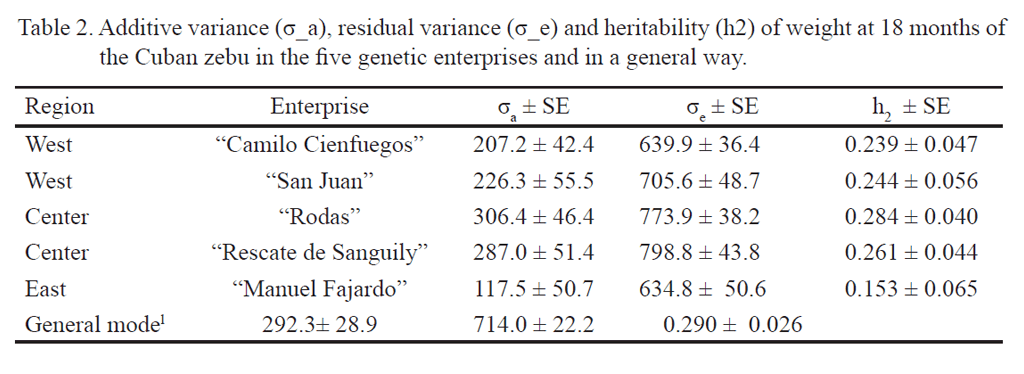
<body><![CDATA[<p align="justify"><font size="2" face="Verdana, Arial, Helvetica, sans-serif">I = identity marix.</font></p>     <p align="justify"><font size="2" face="Verdana, Arial, Helvetica, sans-serif">e = vector of random residual effects. This one is taken with normal  distribution, zero mean and variance I&sigma;<sub>e</sub><sup>2</sup>.</font></p>     <p align="justify"><font size="2" face="Verdana, Arial, Helvetica, sans-serif">The criteria of fit goodness considered for models were the maximum  likelihood logarithm (Llog), Akaike Information Criterion (AIC) and Bayesian  Information Criterion (BIC).</font></p>     <p align="justify"><font size="2" face="Verdana, Arial, Helvetica, sans-serif">Later on, in the five  enterprises the breeding values of the 57 sires with offspring were selected.  By INFOSTAT (Di Rienzo <em>et al.</em> 2012) Spearman correlations between the  general breeding value (equivalent to that used in the national evaluation) and  specific for each enterprise as well as between each pair of enterprises were     <br>   calculated.</font></p>     <p align="justify">&nbsp;</p>     <p align="justify"><strong><font size="3" face="Verdana, Arial, Helvetica, sans-serif">RESULTS AND DISCUSSION </font></strong></p>     <p align="justify"><font size="2" face="Verdana, Arial, Helvetica, sans-serif">Heritabilities for final live weight (<a href="/img/revistas/cjas/v49n3/t0203315.gif">table 2</a>) resulted moderate.  Men&eacute;ndez <em>et al.</em> (2006) obtained similar values to those of this study by  means of character state model models and of random regressions (0.23) for this  same trait in the Cuban Zebu. These results were also higher in four of the  enterprises, regarding the value informed by Espinoza <em>et al.</em> (2008) in  this same breed, for this same trait and through a single-trait model  (0.19).Equally, these values were similar to that obtained by Guill&eacute;n <em>et al.</em> (2011) (0.16 &plusmn; 0.03 and    0.26 &plusmn; 0.05) for a uni- trait and bi- trait model in this breed    respectively.</font></p>     
<p align="justify"><font size="2" face="Verdana, Arial, Helvetica, sans-serif">The higher heritabilities obtained in &ldquo;Rodas&rdquo; and &ldquo;Rescate de  Sanguily&rdquo; enterprises (central region) are justified because they were the ones  that showed higher additive genetic variances. </font></p>     <p align="justify"><font size="2" face="Verdana, Arial, Helvetica, sans-serif">&ldquo;Rodas&rdquo; has appropriate conditions for livestock, when&nbsp;&nbsp; having organic clay soils with ferrallitic  elements. These ones have low erosion potential and are not salinized, making  them very productive. Precipitations are abundant, with annual mean between  1400 and 1600 mm. This confirms that informed by P&eacute;golo (2009), who refers that  environmental conditions and of favorable management make possible better  expression of the additive genetic variability, so that the heritability  estimates will be higher than in unfavorable environments. </font></p>     ]]></body>
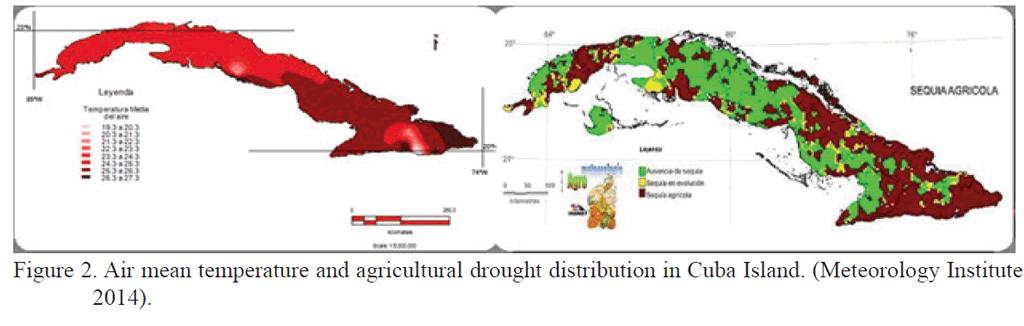
<body><![CDATA[<p align="justify"><font size="2" face="Verdana, Arial, Helvetica, sans-serif">On the other hand, the lowest heritability value was obtained for  the eastern region, which coincides with the lower number of observations and  higher standard errors. Also, Jiguan&iacute;, where Genetic and Rearing Enterprise  &ldquo;Manuel Fajardo&rdquo; is located, during the dry season, recorded precipitations  between 200 and    300 mm, which is insufficient for grasses in&nbsp;  this period. This area, of very low precipitations, is known for being  one of the driest plains of Cuba, because of deforestation (Instituto de  Meteorolog&iacute;a 2014).</font></p>     <p align="justify"><font size="2" face="Verdana, Arial, Helvetica, sans-serif">In <a href="/img/revistas/cjas/v49n3/f0203315.gif">figure 2</a> is showed the distribution  of the air mean temperature and of agricutural drought in Cuba.In both cases,  the eastern region is the most unfavorable in terms of these indicators. It has  been shown that the combined effect of air temperature, solar radiation, wind  and humidity, as well as thermal amplitude have important effect on cattle. The  stress caused by hot is determined by their intensity as their duration, which  directly acts on the animal thermoregulatory mechanisms. </font></p>     
<p align="justify"><font size="2" face="Verdana, Arial, Helvetica, sans-serif">The statistics of the breeding values of 57 sires common to the five  enterprises are showed in <a href="/img/revistas/cjas/v49n3/t0303315.gif">table 3</a>. As the table shows, &ldquo;Camilo Cienfuegos&rdquo; and  &ldquo;Rodas&rdquo; enterprises were those that showed the most favorable ranges for the  selection. The first of them showed the higher breeding values mean.</font></p>     
<p align="justify"><font size="2" face="Verdana, Arial, Helvetica, sans-serif">Spearman correlation between the breeding values estimated by the  general model and each enterprise was lower to the unit (<a href="/img/revistas/cjas/v49n3/t0403315.gif">table 4</a>). Robertson  (1959) presented the theoretical bases that suggest that the genotype-  environment interaction only have important for the biology and agriculture, if  the genetic correlation between the same characteristic in different  environments is lower to 0.8. The possible explanation is that the same trait  can partially controlled by a group of genes in each environment and therefore,  the genetic merit is specific for each environmental subclass (Falconer and  Mackay 1996). </font></p>     
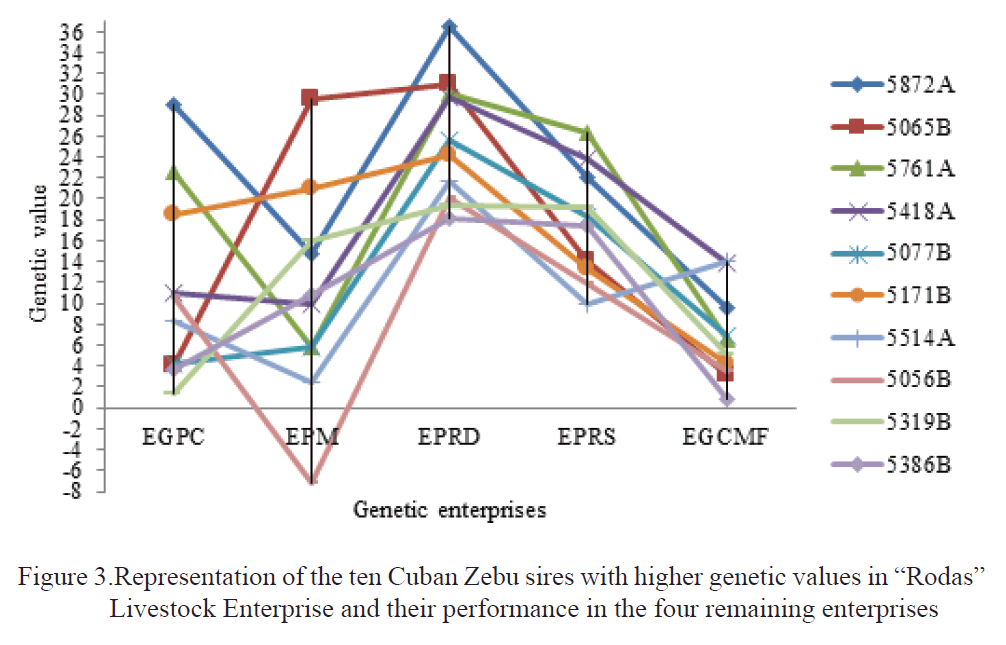
<p align="justify"><font size="2" face="Verdana, Arial, Helvetica, sans-serif">To illustrate the changes the ranking of  sires (<a href="/img/revistas/cjas/v49n3/f0303315.gif">figures 3</a> and <a href="/img/revistas/cjas/v49n3/f0403315.gif">4</a>) ten Cuban Zebu sires with higher and lower breeding  values in &ldquo;Rodas&rdquo; enterprise were selected and it was contrasted with their  performance in the four remaining enterprises. An example of the change in the  ranking is show in the 5065B sire, that is first in Matanzas and Cienfuegos  classification.However, it is in last&nbsp;  places in the remaining enterprises.The opposite happens with the 5338B  sire,with unfavorable performance in all regions, even in Camag&uuml;ey.From the 57  selected sires, approximatelly a 23 % could be classified as robust,since it is  able to maintain a similar performance in all regions of the country, but only  four of them have improvements breeding values in all environments.The rest  shows phenotypic plasticity.In&nbsp;  genaral,68% of the breeding values estimates for the five enterprises  were positive or improvements. </font></p>     
<p align="justify"><font size="2" face="Verdana, Arial, Helvetica, sans-serif">Rodr&iacute;guez and Guerra (2013) obtained  similar results in Cuba, in Cuban Zebu specifically, when considering the mean  values of the contemporaries groups as different environments, or management  environments.Likewise, De Souza <em>et al.</em> (1997) and&nbsp; Silva <em>et al.</em> (2008) obtained&nbsp; results on changes in the ranking in eight  different tropical regions of Brazil. Both researchers&nbsp; evaluated the genotype- enviroment  interaction of the live weight in Nellore breed, considering as enviroment the  differentt geographical regions of Brazil.</font></p>     <p align="justify"><font size="2" face="Verdana, Arial, Helvetica, sans-serif">In the Cuban Zebu improvement program,  the applied selection intensity is only one in the whole country, and only one  heritability value for the whole population is used. From the breeding values,  the sires classification is carried out, without considering the country region  where the semen will be used. It could be justified the existence of a  differential response in the breeding values of sires between the enterprises  where the performance test is carried out because these are located in very  distant regions among each other, that show differences in altitude, air mean  temperature, amount of precipitations and soil type. They also differ in regard  to the management of each enterprise.&nbsp;&nbsp; &nbsp;&nbsp;</font></p>     <p align="justify"><font size="2" face="Verdana, Arial, Helvetica, sans-serif">It is conclude that is possible to carry  out a selection process per final weihgt in the Cuban Zebu current population,  from the&nbsp; recorded heritabilty values in  the five enterprises.However, it should be considered the existance of changes  in the sires ranking according with the place in which their offspring carry  out the performance test.From this results, it could assess the sires current  use plan and the use of robust animals(that be able appropiately behave in all  Cuba regions).If on the opposite, the nutritional and management resources are  locally guaranteed (high environment), it may be more appropiate the use of  animals with phenotypic plasticity.In other words,animals that show the highest  breeding values for this specific region, which would allow to increase te  genetic progress for the live weight in this  breed.</font></p>     <p align="justify">&nbsp;</p>     <p align="justify"><strong><font size="3" face="Verdana, Arial, Helvetica, sans-serif">REFERENCES</font></strong></p>     ]]></body>
<body><![CDATA[<!-- ref --><p align="justify"><font size="2" face="Verdana, Arial, Helvetica, sans-serif">Anon. 2014. <em>El Clima de Cuba.  Caracter&iacute;sticas generales</em>. , Available:  &lt;<a href="www.insmet.cu" target="_blank">www.insmet.cu</a>&gt;, [Consulted:&nbsp;October 20, 2014].    </font></p>     <p align="justify"><font size="2" face="Verdana, Arial, Helvetica, sans-serif">de Souza, J. C., Campos, da S. L. O., Filho, K. E., Ramos, A., Alencar,  M. M. &amp; Gadini, C. H. 1997. &lsquo;&lsquo;Estudio de las  correlaciones gen&eacute;ticas y de ambiente para el peso al destete en bovinos de la  raza Nellore en el Brasil&rsquo;&rsquo;. <em>Archivos  Latinoamericanos de Producci&oacute;n Animal</em>, 5: 485.</font></p>     <!-- ref --><p align="justify"><font size="2" face="Verdana, Arial, Helvetica, sans-serif">Di Rienzo, J. A., Casanoves, F., Balzarini, M. G.,  Gonz&aacute;lez, L., Tablada, M. &amp; Robledo, C. W. 2012. <em>InfoStat</em>.  version 2012, (Windows),  Universidad Nacional de C&oacute;rdoba, Argentina: Grupo InfoStat,  Available: &lt;<a href="http://www.infostat.com.ar/" target="_blank">http://www.infostat.com.ar/</a>&gt;    .</font></p>     <p align="justify"><font size="2" face="Verdana, Arial, Helvetica, sans-serif">Espinoza, J. L., Palacios, A., Guerra, D., Gonz&aacute;lez,  D., Ortega, R. &amp; Rodr&iacute;guez, F. 2008. &lsquo;&lsquo;Comparaci&oacute;n de dos modelos para la estimaci&oacute;n  de par&aacute;metros y valores gen&eacute;ticos del peso en ganado Ceb&uacute;&rsquo;&rsquo;. <em><span lang="EN-US">Agrociencia</span></em><span lang="EN-US">, 42: 29.</span></font></p>     <!-- ref --><p align="justify"><font size="2" face="Verdana, Arial, Helvetica, sans-serif"><span lang="EN-US">Falconer, D. S. &amp; Mackay,  T. F. C. 1996. <em>Introduction to Quantitative Genetics</em>. </span>England: Longman Group Ltd. Essex, 464 p.    </font></p>     <p align="justify"><font size="2" face="Verdana, Arial, Helvetica, sans-serif">Guerra, D., Rodr&iacute;guez, M., Ramos, F., Planas, T.,  Ortiz, J., Torres, J. A. &amp; Falc&oacute;n, R. 2002. &lsquo;&lsquo;Evaluaci&oacute;n gen&eacute;tica de las  razas de carne en Cuba&rsquo;&rsquo;. In: <em>II Congreso Internacional Mejora Animal</em>,  La Habana, Cuba, p. 4, No. 561.</font></p>     <p align="justify"><font size="2" face="Verdana, Arial, Helvetica, sans-serif">Hern&aacute;ndez, A., Ponce de Le&oacute;n, R., Guerra, D., Garc&iacute;a,  S. M., Guzm&aacute;n, G. &amp; Mora, M. 2012. <span lang="EN-US">&lsquo;&lsquo;Interaction  genotype-environment for dairy production in Mamb&iacute; de  Cuba cattle&rsquo;&rsquo;. </span><em>Cuban Journal of Agricultural Science</em>, 46: 351.</font></p>     ]]></body>
<body><![CDATA[<p align="justify"><font size="2" face="Verdana, Arial, Helvetica, sans-serif">L&ocirc;bo, R., de los Reyes, A., Ferraz, J., Bezerra, L., Mercadante, M. &amp; Duarte, F. 1994. <span lang="EN-US">&lsquo;&lsquo;Bivariate animal model analysis of growth weights and scrotal  circumference of Nellore cattle in Brasil&rsquo;&rsquo;. In: <em>5th  World Congress of Genetics Applied to Livestock Production</em>, Guelph, Canada,  p. 199.</span></font></p>     <p align="justify"><font size="2" face="Verdana, Arial, Helvetica, sans-serif">Men&eacute;ndez, A. 2007. &lsquo;&lsquo;Acerca de una estrategia gen&eacute;tica  para el ganado vacuno en Cuba. Reflexiones-argumentacionesproposiciones&rsquo;&rsquo;.  In: <em>Curso impartido en la Universidad Agraria de La Habana &lsquo;Fructuoso  Rodr&iacute;guez P&eacute;rez&rsquo;</em>, La Habana, Cuba.</font></p>     <p align="justify"><font size="2" face="Verdana, Arial, Helvetica, sans-serif">Men&eacute;ndez, A., Guerra, D., Planas, T., Ramos, F. &amp;  Fern&aacute;ndez, C. L. 2006. <span lang="EN-US">&lsquo;&lsquo;Genetic parameters of live  weight of Zebu males in performance test under Cuban grazing conditions,  estimated by univariate, multi-trait and random  regression models&rsquo;&rsquo;. </span><em>Cuban Journal of Agricultural Science</em>, 40: 397.</font></p>     <p align="justify"><font size="2" face="Verdana, Arial, Helvetica, sans-serif">Mercadante, M. E., Lobo, R. B. &amp; de los Reyes, A.  1995. &lsquo;&lsquo;Par&aacute;metros gen&eacute;ticos para caracter&iacute;sticas de crecimiento en Cebu&iacute;nos de carne&rsquo;&rsquo;. <em><span lang="EN-US">Archivos Latinoamericanos  de Producci&oacute;n Animal</span></em><span lang="EN-US">, 3: 45.</span></font></p>     <p align="justify"><font size="2" face="Verdana, Arial, Helvetica, sans-serif"><span lang="EN-US">Meyer, K. 2006. &lsquo;&lsquo;&lsquo;WOMBAT&rsquo;.  Digging deep for quantitative genetic analyses by restricted maximum  likelihood&rsquo;&rsquo;. In: <em>World Congress on genetic applied to Livestock Production</em>,  Belo Horizonte, p. 8.</span></font></p>     <!-- ref --><p align="justify"><font size="2" face="Verdana, Arial, Helvetica, sans-serif">P&eacute;golo, N. T. 2009. <em>Intera&ccedil;&atilde;o gen&oacute;tipo-ambiente e sensibilidade  ambiental em bovinos de corte</em>. Ph.D. Thesis, Universidade  de S&atilde;o Paulo, S&atilde;o Paulo, Brasil, 115 p.    </font></p>     <p align="justify"><font size="2" face="Verdana, Arial, Helvetica, sans-serif">Plasse, D., Verde, O., Fossi,  H., Romero, R., Hoogesteijn, R., Bastidas, P. &amp;  Bastardo, J. 2002. <span lang="EN-US">&lsquo;&lsquo;(Co)variance  components, genetic parameters and annual trends for calf weight in a pedigree  Brahman herd under selection for three decades&rsquo;&rsquo;. <em>J. Anim. Breed. Genet.,</em> 119: 141.</span></font></p>     <p align="justify"><font size="2" face="Verdana, Arial, Helvetica, sans-serif"><span lang="EN-US">Robertson, A. 1959. &lsquo;&lsquo;The  sampling variance of the genetic correlation coefficient&rsquo;&rsquo;. <em>Biometrics</em>,  15: 469.</span></font></p>     <p align="justify"><font size="2" face="Verdana, Arial, Helvetica, sans-serif"><span lang="EN-US">Rodr&iacute;guez, Y. &amp; Guerra, D.  2013. &lsquo;&lsquo;Evidence of genotype-environment interaction for final live weight in  the performance test of the Cuban Zebu&rsquo;&rsquo;. <em>Cuban Journal of Agricultural  Science</em>, 47: 13.</span></font></p>     ]]></body>
<body><![CDATA[<p align="justify"><font size="2" face="Verdana, Arial, Helvetica, sans-serif"><span lang="EN-US">Rodr&iacute;guez, Y., Ponce de Le&oacute;n,  R., Tamassia, N. &amp; Nunes,  H. 2014. &lsquo;&lsquo;Influences of environmental descriptor for detect genotype by  environmental interaction in Cuban Zebu population&rsquo;&rsquo;. In: <em>10th World  Congress of Genetics Appl. Livestock Prod.</em> p. 00.</span></font></p>     <p align="justify"><font size="2" face="Verdana, Arial, Helvetica, sans-serif"><span lang="EN-US">Silva, J., Roberto, P., Weber,  T., Augusti, A., Grigoletto,  J. &amp; de Almeida, M. 2008. </span>&lsquo;&lsquo;Efeito da intera&ccedil;&atilde;o gen&oacute;tipo-ambiente sobre o peso ao  nascimento, aos 205 e aos 550 dias de idade de bovinos da ra&ccedil;a Nelore na Regi&atilde;o  Sul do Brasil&rsquo;&rsquo;. <em>Rev. Bras. Zoot.</em>,  37: 54.</font></p>     <p align="justify"><font size="2" face="Verdana, Arial, Helvetica, sans-serif">Su&aacute;rez, M. A., Zubizarreta, I. &amp;  P&eacute;rez, T. 2009. &lsquo;&lsquo;Interacci&oacute;n genotipo ambiente en ganado bovino Siboney de  Cuba&rsquo;&rsquo;. <em>Livest. Res. Rural Develop.</em>, 21: 00&ndash;00.</font></p>     <p align="justify">&nbsp;</p>     <p align="justify">&nbsp;</p>     <p align="justify"><font size="2" face="Verdana, Arial, Helvetica, sans-serif">Received: January  6, 2015    <br> Accepted: May 19, 2015</font></p>     <p align="justify">&nbsp;</p>     <p align="justify">&nbsp;</p>     <p align="justify"><font size="2" face="Verdana, Arial, Helvetica, sans-serif"><i>Yusleiby Rodríguez,</i> Instituto de Ciencia Animal, Apartado Postal 24, San José de las Lajas, Mayabeque, Cuba.    Email: <a href="mailto:yusleiby@ica.co.cu">yusleiby@ica.co.cu</a></font></p>     ]]></body>
<body><![CDATA[ ]]></body><back>
<ref-list>
<ref id="B1">
<nlm-citation citation-type="">
<person-group person-group-type="author">
<name>
<surname><![CDATA[Anon]]></surname>
</name>
</person-group>
<source><![CDATA[El Clima de Cuba. Características generales]]></source>
<year>2014</year>
</nlm-citation>
</ref>
<ref id="B2">
<nlm-citation citation-type="journal">
<person-group person-group-type="author">
<name>
<surname><![CDATA[de Souza]]></surname>
<given-names><![CDATA[J. C.]]></given-names>
</name>
<name>
<surname><![CDATA[Campos]]></surname>
<given-names><![CDATA[da S. L. O.]]></given-names>
</name>
<name>
<surname><![CDATA[Filho]]></surname>
<given-names><![CDATA[K. E.]]></given-names>
</name>
<name>
<surname><![CDATA[Ramos]]></surname>
<given-names><![CDATA[A.]]></given-names>
</name>
<name>
<surname><![CDATA[Alencar]]></surname>
<given-names><![CDATA[M. M.]]></given-names>
</name>
<name>
<surname><![CDATA[Gadini]]></surname>
<given-names><![CDATA[C. H.]]></given-names>
</name>
</person-group>
<article-title xml:lang="nd"><![CDATA[Estudio de las correlaciones genéticas y de ambiente para el peso al destete en bovinos de la raza Nellore en el Brasil]]></article-title>
<source><![CDATA[Archivos Latinoamericanos de Producción Animal]]></source>
<year>1997</year>
<volume>5</volume>
<page-range>485</page-range></nlm-citation>
</ref>
<ref id="B3">
<nlm-citation citation-type="book">
<person-group person-group-type="author">
<name>
<surname><![CDATA[Di Rienzo]]></surname>
<given-names><![CDATA[J. A.]]></given-names>
</name>
<name>
<surname><![CDATA[Casanoves]]></surname>
<given-names><![CDATA[F.]]></given-names>
</name>
<name>
<surname><![CDATA[Balzarini]]></surname>
<given-names><![CDATA[M. G.]]></given-names>
</name>
<name>
<surname><![CDATA[González]]></surname>
<given-names><![CDATA[L.]]></given-names>
</name>
<name>
<surname><![CDATA[Tablada]]></surname>
<given-names><![CDATA[M.]]></given-names>
</name>
<name>
<surname><![CDATA[Robledo]]></surname>
<given-names><![CDATA[C. W.]]></given-names>
</name>
</person-group>
<source><![CDATA[InfoStat]]></source>
<year>2012</year>
<publisher-loc><![CDATA[Universidad Nacional de Córdoba, Argentina ]]></publisher-loc>
<publisher-name><![CDATA[Grupo InfoStat]]></publisher-name>
</nlm-citation>
</ref>
<ref id="B4">
<nlm-citation citation-type="journal">
<person-group person-group-type="author">
<name>
<surname><![CDATA[Espinoza]]></surname>
<given-names><![CDATA[J. L.]]></given-names>
</name>
<name>
<surname><![CDATA[Palacios]]></surname>
<given-names><![CDATA[A.]]></given-names>
</name>
<name>
<surname><![CDATA[Guerra]]></surname>
<given-names><![CDATA[D.]]></given-names>
</name>
<name>
<surname><![CDATA[González]]></surname>
<given-names><![CDATA[D.]]></given-names>
</name>
<name>
<surname><![CDATA[Ortega]]></surname>
<given-names><![CDATA[R.]]></given-names>
</name>
<name>
<surname><![CDATA[Rodríguez]]></surname>
<given-names><![CDATA[F.]]></given-names>
</name>
</person-group>
<article-title xml:lang="nd"><![CDATA[Comparación de dos modelos para la estimación de parámetros y valores genéticos del peso en ganado Cebú]]></article-title>
<source><![CDATA[Agrociencia]]></source>
<year>2008</year>
<volume>42</volume>
<page-range>29</page-range></nlm-citation>
</ref>
<ref id="B5">
<nlm-citation citation-type="book">
<person-group person-group-type="author">
<name>
<surname><![CDATA[Falconer]]></surname>
<given-names><![CDATA[D. S.]]></given-names>
</name>
<name>
<surname><![CDATA[Mackay]]></surname>
<given-names><![CDATA[T. F. C.]]></given-names>
</name>
</person-group>
<source><![CDATA[Introduction to Quantitative Genetics]]></source>
<year>1996</year>
<page-range>464</page-range><publisher-loc><![CDATA[England ]]></publisher-loc>
<publisher-name><![CDATA[Longman Group Ltd. Essex]]></publisher-name>
</nlm-citation>
</ref>
<ref id="B6">
<nlm-citation citation-type="">
<person-group person-group-type="author">
<name>
<surname><![CDATA[Guerra]]></surname>
<given-names><![CDATA[D.]]></given-names>
</name>
<name>
<surname><![CDATA[Rodríguez]]></surname>
<given-names><![CDATA[M.]]></given-names>
</name>
<name>
<surname><![CDATA[Ramos]]></surname>
<given-names><![CDATA[F.]]></given-names>
</name>
<name>
<surname><![CDATA[Planas]]></surname>
<given-names><![CDATA[T.]]></given-names>
</name>
<name>
<surname><![CDATA[Ortiz]]></surname>
<given-names><![CDATA[J.]]></given-names>
</name>
<name>
<surname><![CDATA[Torres]]></surname>
<given-names><![CDATA[J. A.]]></given-names>
</name>
<name>
<surname><![CDATA[Falcón]]></surname>
<given-names><![CDATA[R.]]></given-names>
</name>
</person-group>
<article-title xml:lang="nd"><![CDATA[Evaluación genética de las razas de carne en Cuba]]></article-title>
<source><![CDATA[]]></source>
<year>2002</year>
<page-range>4</page-range><publisher-loc><![CDATA[La Habana, Cuba ]]></publisher-loc>
</nlm-citation>
</ref>
<ref id="B7">
<nlm-citation citation-type="journal">
<person-group person-group-type="author">
<name>
<surname><![CDATA[Hernández]]></surname>
<given-names><![CDATA[A.]]></given-names>
</name>
<name>
<surname><![CDATA[Ponce de León]]></surname>
<given-names><![CDATA[R.]]></given-names>
</name>
<name>
<surname><![CDATA[Guerra]]></surname>
<given-names><![CDATA[D.]]></given-names>
</name>
<name>
<surname><![CDATA[García]]></surname>
<given-names><![CDATA[S. M.]]></given-names>
</name>
<name>
<surname><![CDATA[Guzmán]]></surname>
<given-names><![CDATA[G.]]></given-names>
</name>
<name>
<surname><![CDATA[Mora]]></surname>
<given-names><![CDATA[M.]]></given-names>
</name>
</person-group>
<article-title xml:lang="nd"><![CDATA[Interaction genotype-environment for dairy production in Mambí de Cuba cattle]]></article-title>
<source><![CDATA[Cuban Journal of Agricultural Science]]></source>
<year>2012</year>
<volume>46</volume>
<page-range>351</page-range></nlm-citation>
</ref>
<ref id="B8">
<nlm-citation citation-type="">
<person-group person-group-type="author">
<name>
<surname><![CDATA[Lôbo]]></surname>
<given-names><![CDATA[R.]]></given-names>
</name>
<name>
<surname><![CDATA[de los Reyes]]></surname>
<given-names><![CDATA[A.]]></given-names>
</name>
<name>
<surname><![CDATA[Ferraz]]></surname>
<given-names><![CDATA[J.]]></given-names>
</name>
<name>
<surname><![CDATA[Bezerra]]></surname>
<given-names><![CDATA[L.]]></given-names>
</name>
<name>
<surname><![CDATA[Mercadante]]></surname>
<given-names><![CDATA[M.]]></given-names>
</name>
<name>
<surname><![CDATA[Duarte]]></surname>
<given-names><![CDATA[F.]]></given-names>
</name>
</person-group>
<article-title xml:lang="nd"><![CDATA[Bivariate animal model analysis of growth weights and scrotal circumference of Nellore cattle in Brasil]]></article-title>
<source><![CDATA[]]></source>
<year>1994</year>
<page-range>199</page-range><publisher-loc><![CDATA[Guelph, Canada ]]></publisher-loc>
</nlm-citation>
</ref>
<ref id="B9">
<nlm-citation citation-type="">
<person-group person-group-type="author">
<name>
<surname><![CDATA[Menéndez]]></surname>
<given-names><![CDATA[A.]]></given-names>
</name>
</person-group>
<article-title xml:lang="nd"><![CDATA[Acerca de una estrategia genética para el ganado vacuno en Cuba. Reflexiones-argumentacionesproposiciones]]></article-title>
<source><![CDATA[]]></source>
<year>2007</year>
<publisher-loc><![CDATA[La Habana, Cuba ]]></publisher-loc>
</nlm-citation>
</ref>
<ref id="B10">
<nlm-citation citation-type="journal">
<person-group person-group-type="author">
<name>
<surname><![CDATA[Menéndez]]></surname>
<given-names><![CDATA[A.]]></given-names>
</name>
<name>
<surname><![CDATA[Guerra]]></surname>
<given-names><![CDATA[D.]]></given-names>
</name>
<name>
<surname><![CDATA[Planas]]></surname>
<given-names><![CDATA[T.]]></given-names>
</name>
<name>
<surname><![CDATA[Ramos]]></surname>
<given-names><![CDATA[F.]]></given-names>
</name>
<name>
<surname><![CDATA[Fernández]]></surname>
<given-names><![CDATA[C. L.]]></given-names>
</name>
</person-group>
<article-title xml:lang="nd"><![CDATA[Genetic parameters of live weight of Zebu males in performance test under Cuban grazing conditions, estimated by univariate, multi-trait and random regression models]]></article-title>
<source><![CDATA[Cuban Journal of Agricultural Science]]></source>
<year>2006</year>
<volume>40</volume>
<page-range>397</page-range></nlm-citation>
</ref>
<ref id="B11">
<nlm-citation citation-type="journal">
<person-group person-group-type="author">
<name>
<surname><![CDATA[Mercadante]]></surname>
<given-names><![CDATA[M. E.]]></given-names>
</name>
<name>
<surname><![CDATA[Lobo]]></surname>
<given-names><![CDATA[R. B.]]></given-names>
</name>
<name>
<surname><![CDATA[de los Reyes]]></surname>
<given-names><![CDATA[A.]]></given-names>
</name>
</person-group>
<article-title xml:lang="nd"><![CDATA[Parámetros genéticos para características de crecimiento en Cebuínos de carne]]></article-title>
<source><![CDATA[Archivos Latinoamericanos de Producción Animal]]></source>
<year>1995</year>
<volume>3</volume>
<page-range>45</page-range></nlm-citation>
</ref>
<ref id="B12">
<nlm-citation citation-type="">
<person-group person-group-type="author">
<name>
<surname><![CDATA[Meyer]]></surname>
<given-names><![CDATA[K.]]></given-names>
</name>
</person-group>
<article-title xml:lang="nd"><![CDATA[‘WOMBAT’. Digging deep for quantitative genetic analyses by restricted maximum likelihood]]></article-title>
<source><![CDATA[]]></source>
<year>2006</year>
<page-range>8</page-range><publisher-loc><![CDATA[Belo Horizonte ]]></publisher-loc>
</nlm-citation>
</ref>
<ref id="B13">
<nlm-citation citation-type="book">
<person-group person-group-type="author">
<name>
<surname><![CDATA[Pégolo]]></surname>
<given-names><![CDATA[N. T.]]></given-names>
</name>
</person-group>
<source><![CDATA[Interação genótipo-ambiente e sensibilidade ambiental em bovinos de corte]]></source>
<year>2009</year>
<page-range>115</page-range><publisher-loc><![CDATA[São Paulo, Brasil ]]></publisher-loc>
<publisher-name><![CDATA[Universidade de São Paulo]]></publisher-name>
</nlm-citation>
</ref>
<ref id="B14">
<nlm-citation citation-type="journal">
<person-group person-group-type="author">
<name>
<surname><![CDATA[Plasse]]></surname>
<given-names><![CDATA[D.]]></given-names>
</name>
<name>
<surname><![CDATA[Verde]]></surname>
<given-names><![CDATA[O.]]></given-names>
</name>
<name>
<surname><![CDATA[Fossi]]></surname>
<given-names><![CDATA[H.]]></given-names>
</name>
<name>
<surname><![CDATA[Romero]]></surname>
<given-names><![CDATA[R.]]></given-names>
</name>
<name>
<surname><![CDATA[Hoogesteijn]]></surname>
<given-names><![CDATA[R.]]></given-names>
</name>
<name>
<surname><![CDATA[Bastidas]]></surname>
<given-names><![CDATA[P.]]></given-names>
</name>
<name>
<surname><![CDATA[Bastardo]]></surname>
<given-names><![CDATA[J.]]></given-names>
</name>
</person-group>
<article-title xml:lang="nd"><![CDATA[(Co)variance components, genetic parameters and annual trends for calf weight in a pedigree Brahman herd under selection for three decades]]></article-title>
<source><![CDATA[J. Anim. Breed. Genet.]]></source>
<year>2002</year>
<volume>119</volume>
<page-range>141</page-range></nlm-citation>
</ref>
<ref id="B15">
<nlm-citation citation-type="journal">
<person-group person-group-type="author">
<name>
<surname><![CDATA[Robertson]]></surname>
<given-names><![CDATA[A.]]></given-names>
</name>
</person-group>
<article-title xml:lang="nd"><![CDATA[The sampling variance of the genetic correlation coefficient]]></article-title>
<source><![CDATA[Biometrics]]></source>
<year>1959</year>
<volume>15</volume>
<page-range>469</page-range></nlm-citation>
</ref>
<ref id="B16">
<nlm-citation citation-type="journal">
<person-group person-group-type="author">
<name>
<surname><![CDATA[Rodríguez]]></surname>
<given-names><![CDATA[Y.]]></given-names>
</name>
<name>
<surname><![CDATA[Guerra]]></surname>
<given-names><![CDATA[D.]]></given-names>
</name>
</person-group>
<article-title xml:lang="nd"><![CDATA[Evidence of genotype-environment interaction for final live weight in the performance test of the Cuban Zebu]]></article-title>
<source><![CDATA[Cuban Journal of Agricultural Science]]></source>
<year>2013</year>
<volume>47</volume>
<page-range>13</page-range></nlm-citation>
</ref>
<ref id="B17">
<nlm-citation citation-type="">
<person-group person-group-type="author">
<name>
<surname><![CDATA[Rodríguez]]></surname>
<given-names><![CDATA[Y.]]></given-names>
</name>
<name>
<surname><![CDATA[Ponce de León]]></surname>
<given-names><![CDATA[R.]]></given-names>
</name>
<name>
<surname><![CDATA[Tamassia]]></surname>
<given-names><![CDATA[N.]]></given-names>
</name>
<name>
<surname><![CDATA[Nunes]]></surname>
<given-names><![CDATA[H.]]></given-names>
</name>
</person-group>
<article-title xml:lang="nd"><![CDATA[Influences of environmental descriptor for detect genotype by environmental interaction in Cuban Zebu population]]></article-title>
<source><![CDATA[]]></source>
<year>2014</year>
<page-range>00</page-range></nlm-citation>
</ref>
<ref id="B18">
<nlm-citation citation-type="journal">
<person-group person-group-type="author">
<name>
<surname><![CDATA[Silva]]></surname>
<given-names><![CDATA[J.]]></given-names>
</name>
<name>
<surname><![CDATA[Roberto]]></surname>
<given-names><![CDATA[P.]]></given-names>
</name>
<name>
<surname><![CDATA[Weber]]></surname>
<given-names><![CDATA[T.]]></given-names>
</name>
<name>
<surname><![CDATA[Augusti]]></surname>
<given-names><![CDATA[A.]]></given-names>
</name>
<name>
<surname><![CDATA[Grigoletto]]></surname>
<given-names><![CDATA[J.]]></given-names>
</name>
<name>
<surname><![CDATA[de Almeida]]></surname>
<given-names><![CDATA[M.]]></given-names>
</name>
</person-group>
<article-title xml:lang="nd"><![CDATA[Efeito da interação genótipo-ambiente sobre o peso ao nascimento, aos 205 e aos 550 dias de idade de bovinos da raça Nelore na Região Sul do Brasil]]></article-title>
<source><![CDATA[Rev. Bras. Zoot.]]></source>
<year>2008</year>
<volume>37</volume>
<page-range>54</page-range></nlm-citation>
</ref>
<ref id="B19">
<nlm-citation citation-type="journal">
<person-group person-group-type="author">
<name>
<surname><![CDATA[Suárez]]></surname>
<given-names><![CDATA[M. A.]]></given-names>
</name>
<name>
<surname><![CDATA[Zubizarreta]]></surname>
<given-names><![CDATA[I.]]></given-names>
</name>
<name>
<surname><![CDATA[Pérez]]></surname>
<given-names><![CDATA[T.]]></given-names>
</name>
</person-group>
<article-title xml:lang="nd"><![CDATA[Interacción genotipo ambiente en ganado bovino Siboney de Cuba]]></article-title>
<source><![CDATA[Livest. Res. Rural Develop.]]></source>
<year>2009</year>
<volume>21</volume>
<page-range>00-00</page-range></nlm-citation>
</ref>
</ref-list>
</back>
</article>