<?xml version="1.0" encoding="ISO-8859-1"?><article xmlns:mml="http://www.w3.org/1998/Math/MathML" xmlns:xlink="http://www.w3.org/1999/xlink" xmlns:xsi="http://www.w3.org/2001/XMLSchema-instance">
<front>
<journal-meta>
<journal-id>2079-3480</journal-id>
<journal-title><![CDATA[Cuban Journal of Agricultural Science]]></journal-title>
<abbrev-journal-title><![CDATA[Cuban J. Agric. Sci.]]></abbrev-journal-title>
<issn>2079-3480</issn>
<publisher>
<publisher-name><![CDATA[Editorial del Instituto de Ciencia Animal]]></publisher-name>
</publisher>
</journal-meta>
<article-meta>
<article-id>S2079-34802015000300005</article-id>
<title-group>
<article-title xml:lang="en"><![CDATA[Modeling of live weight per age in fattening bovines under a silvopastoral system with Leucaena leucocephala]]></article-title>
<article-title xml:lang="es"><![CDATA[Modelación de peso vivo por edad en bovinos de engorde en silvopastoreo con Leucaena leucocephala]]></article-title>
</title-group>
<contrib-group>
<contrib contrib-type="author">
<name>
<surname><![CDATA[Iraola]]></surname>
<given-names><![CDATA[J]]></given-names>
</name>
<xref ref-type="aff" rid="A01"/>
</contrib>
<contrib contrib-type="author">
<name>
<surname><![CDATA[García]]></surname>
<given-names><![CDATA[Yenny]]></given-names>
</name>
<xref ref-type="aff" rid="A01"/>
</contrib>
<contrib contrib-type="author">
<name>
<surname><![CDATA[Muñoz]]></surname>
<given-names><![CDATA[E]]></given-names>
</name>
<xref ref-type="aff" rid="A01"/>
</contrib>
<contrib contrib-type="author">
<name>
<surname><![CDATA[Fraga]]></surname>
<given-names><![CDATA[L.M]]></given-names>
</name>
<xref ref-type="aff" rid="A01"/>
</contrib>
<contrib contrib-type="author">
<name>
<surname><![CDATA[Barros-Rodríguez]]></surname>
<given-names><![CDATA[M]]></given-names>
</name>
<xref ref-type="aff" rid="A02"/>
</contrib>
<contrib contrib-type="author">
<name>
<surname><![CDATA[Hernández]]></surname>
<given-names><![CDATA[J.L]]></given-names>
</name>
<xref ref-type="aff" rid="A01"/>
</contrib>
<contrib contrib-type="author">
<name>
<surname><![CDATA[Moreira]]></surname>
<given-names><![CDATA[E]]></given-names>
</name>
<xref ref-type="aff" rid="A01"/>
</contrib>
</contrib-group>
<aff id="A01">
<institution><![CDATA[,Instituto de Ciencia Animal  ]]></institution>
<addr-line><![CDATA[San José de las Lajas Mayabeque]]></addr-line>
<country>Cuba</country>
</aff>
<aff id="A02">
<institution><![CDATA[,Universidad Técnica de Ambato Facultad de Ciencias Agropecuarias ]]></institution>
<addr-line><![CDATA[ ]]></addr-line>
<country>Ecuador</country>
</aff>
<pub-date pub-type="pub">
<day>00</day>
<month>09</month>
<year>2015</year>
</pub-date>
<pub-date pub-type="epub">
<day>00</day>
<month>09</month>
<year>2015</year>
</pub-date>
<volume>49</volume>
<numero>3</numero>
<fpage>307</fpage>
<lpage>315</lpage>
<copyright-statement/>
<copyright-year/>
<self-uri xlink:href="http://scielo.sld.cu/scielo.php?script=sci_arttext&amp;pid=S2079-34802015000300005&amp;lng=en&amp;nrm=iso"></self-uri><self-uri xlink:href="http://scielo.sld.cu/scielo.php?script=sci_abstract&amp;pid=S2079-34802015000300005&amp;lng=en&amp;nrm=iso"></self-uri><self-uri xlink:href="http://scielo.sld.cu/scielo.php?script=sci_pdf&amp;pid=S2079-34802015000300005&amp;lng=en&amp;nrm=iso"></self-uri><abstract abstract-type="short" xml:lang="en"><p><![CDATA[The modeling of the curve of live weight per age in non-castrated male bovines under a silvopastoral system with Leucaena leucocephala during four productive cycles was evaluated. For that purpose, four genetic groups were used: Zebu, crossbred Zebu, crossbred Zebu and dairy crossbreds, with 74, 80, 90 and 90 animals, respectively. Monthly weighing was carried out in all the cycles. For deciding the goodness of fit, the following criteria were proposed: mean square of the error, fitted R², model significance, parameter significance and graphic distribution of residues. The non-linear models (Gompertz and Logistic) were only fitted in the second and third productive cycle under the specific conditions of the study. The simple linear model showed adequate adjustments in every cycle, and showed lower values of mean square of the error than the non-linear models in the second and third cycles. There were no marked differences of liveweight increase among the four genetic groups evaluated, with daily mean gains around and superior to 0.700 kg. This indicates the need of developing specific strategies for the ending stages of male bovines under silvopastoral conditions. Further studies on modeling with higher liveweight at sacrifice of Zebu and crossbred animals are suggested, which will allow to predict the productive performance of these animals. Interpreting the results and controlling the indicators, like food balance and management, could substantially improve the indicators of liveweight at sacrifice in a silvopastoral system with leucaena and grasses]]></p></abstract>
<abstract abstract-type="short" xml:lang="es"><p><![CDATA[Se evaluó mediante la modelación la curva de peso vivo por edad de bovinos machos, sin castrar, en silvopastoreo con leucaena (Leucaena leucocephala) durante cuatro ciclos productivos. Se utilizaron para ello los siguientes grupos genéticos: Cebú, Cebú mestizos, Cebú mestizos y mestizos lecheros, con 74, 80, 90 y 90 animales, respectivamente. Se realizaron los pesajes mensualmente en todos los ciclos. Para la decisión de bondad de ajuste de los modelos, se propusieron los criterios siguientes: cuadrado medio del error, R² ajustado, significación del modelo, significación de los parámetros y distribución gráfica de los residuos. Los modelos no lineales (Gompertz y Logístico) solo se ajustaron en el segundo y el tercer ciclo productivo en las condiciones específicas de estudio. El modelo lineal simple presentó adecuados ajustes en todos los ciclos, y mostró menores valores del cuadrado medio del error que los modelos no lineales en el segundo y tercer ciclo. No se encontraron marcadas diferencias de incremento de peso vivo entre los cuatro grupos genéticos evaluados, con ganancias medias diarias cercanas y superiores a 0.700 kg. Esto indica la necesidad de desarrollar estrategias específicas para la finalización de bovinos machos en silvopastoreo. Se sugiere profundizar en estudios de modelación con mayor peso vivo de sacrificio en animales Cebú y mestizos, lo que permitiría predecir el comportamiento productivo de estos animales. Con la interpretación de los resultados y el control de indicadores, como el balance alimentario y el manejo, se pudieran mejorar sustancialmente los indicadores de peso vivo al sacrificio en silvopastoreo con leucaena y gramíneas]]></p></abstract>
<kwd-group>
<kwd lng="en"><![CDATA[linear and non-linear model]]></kwd>
<kwd lng="en"><![CDATA[bovines]]></kwd>
<kwd lng="en"><![CDATA[silvopastoral system]]></kwd>
<kwd lng="es"><![CDATA[modelo lineal y no lineal]]></kwd>
<kwd lng="es"><![CDATA[bovinos]]></kwd>
<kwd lng="es"><![CDATA[silvopastoreo]]></kwd>
</kwd-group>
</article-meta>
</front><body><![CDATA[ <p align="right"><font size="2" face="Verdana, Arial, Helvetica,   sans-serif"><b>ORIGINAL ARTICLE</b></font></p>     <p>&nbsp;</p>     <p align="justify"><font size="4" face="Verdana, Arial, Helvetica, sans-serif"><b>Modeling of live weight per age in fattening bovines under a silvopastoral system with <i>Leucaena leucocephala</i></b></font></p>     <p align="justify">&nbsp;</p>     <p align="justify"><font size="3" face="Verdana, Arial, Helvetica, sans-serif"><b>Modelación de peso vivo por edad  en bovinos de engorde en  silvopastoreo con  <i>Leucaena leucocephala</i></b></font></p>     <p align="justify">&nbsp;</p>     <p align="justify">&nbsp;</p>     <p align="justify"><font size="2" face="Verdana, Arial, Helvetica, sans-serif"><b>J. Iraola,</b><sup><b>I</b></sup><b> Yenny García,</b><sup><b>I</b></sup><b> E. Muñoz,</b><sup><b>I</b></sup><b> L.M. Fraga,</b><sup><b>I</b></sup><b> M. Barros-Rodríguez,</b><sup><b>II</b></sup><b> J.L. Hernández,</b><sup><b>I</b></sup><b> E. Moreira,</b><sup><b>I</b></sup></font></p> <font size="2" face="Verdana, Arial, Helvetica, sans-serif"><sup>I</sup>Instituto de Ciencia Animal, Apartado Postal 24, San José de las Lajas, Mayabeque, Cuba.</font><font size="2" face="Verdana, Arial, Helvetica, sans-serif"><sup>    <br>   II</sup>Facultad de Ciencias Agropecuarias, Universidad Técnica de Ambato, Ecuador.</font>   </p>       <p align="justify">&nbsp;</p>     ]]></body>
<body><![CDATA[<p align="justify">&nbsp;</p> <hr align="JUSTIFY">     <p align="justify"><font size="2" face="Verdana, Arial, Helvetica, sans-serif"><b>ABSTRACT</b></font></p>     <p align="justify"><font size="2" face="Verdana, Arial, Helvetica, sans-serif">The modeling of the curve of live weight per age in non-castrated male  bovines under a silvopastoral system with <em>Leucaena leucocephala</em> during four productive cycles was evaluated. For that purpose, four genetic  groups were used: Zebu, crossbred Zebu, crossbred Zebu and dairy crossbreds,  with 74, 80, 90 and 90 animals, respectively. Monthly weighing was carried out  in all the cycles. For deciding the goodness of fit, the following criteria  were proposed: mean square of the error, fitted R<sup>2</sup>, model  significance, parameter significance and graphic distribution of residues. The  non-linear models (Gompertz and Logistic) were only  fitted in the second and third productive cycle under the specific conditions  of the study. The simple linear model showed adequate adjustments in every  cycle, and showed lower values of mean square of the error than the non-linear  models in the second and third cycles. There were no marked differences of liveweight increase among the four genetic groups evaluated, with daily mean gains around  and superior to 0.700 kg. This indicates the need of developing specific  strategies for the ending stages of male bovines under silvopastoral conditions. Further studies on modeling with higher liveweight at sacrifice of Zebu and crossbred animals are suggested, which will allow to  predict the productive performance of these animals. Interpreting the results  and controlling the indicators, like food balance and management, could  substantially improve the indicators of liveweight at  sacrifice in a silvopastoral system with leucaena and grasses.</font></p>     <p align="justify"><font size="2" face="Verdana, Arial, Helvetica, sans-serif"><b>Key words:</b> linear and non-linear model, bovines, silvopastoral system.</font></p> <hr align="JUSTIFY">     <p align="justify"><font size="2" face="Verdana, Arial, Helvetica, sans-serif"><b>RESUMEN</b></font></p>     <p align="justify"><font size="2" face="Verdana, Arial, Helvetica, sans-serif">Se evalu&oacute; mediante la modelaci&oacute;n la curva de peso vivo  por edad de bovinos machos, sin castrar, en silvopastoreo con leucaena (<em>Leucaena leucocephala</em>) durante cuatro ciclos productivos.  Se utilizaron para ello los siguientes grupos gen&eacute;ticos: Ceb&uacute;, Ceb&uacute; mestizos,  Ceb&uacute; mestizos y mestizos lecheros, con 74, 80, 90 y 90 animales,  respectivamente. Se realizaron los pesajes mensualmente en todos los ciclos.  Para la decisi&oacute;n de bondad de ajuste de los modelos, se propusieron los  criterios siguientes: cuadrado medio del error, R<sup>2</sup> ajustado, significaci&oacute;n del modelo, significaci&oacute;n de  los par&aacute;metros y distribuci&oacute;n gr&aacute;fica de los residuos. Los modelos no lineales  (Gompertz y Log&iacute;stico) solo se ajustaron en el  segundo y el tercer ciclo productivo en las&nbsp;  condiciones espec&iacute;ficas de estudio. El modelo lineal simple present&oacute;  adecuados ajustes en todos los ciclos, y mostr&oacute; menores valores del cuadrado  medio del error que los modelos no lineales en el segundo y tercer ciclo. No se  encontraron marcadas diferencias de incremento de peso vivo entre los cuatro grupos  gen&eacute;ticos evaluados, con ganancias medias diarias cercanas y superiores a 0.700  kg. Esto indica la necesidad de desarrollar estrategias espec&iacute;ficas para la  finalizaci&oacute;n de bovinos machos en silvopastoreo. Se  sugiere profundizar en estudios de modelaci&oacute;n con mayor peso vivo de sacrificio  en animales Ceb&uacute; y mestizos, lo que permitir&iacute;a predecir el comportamiento  productivo de estos animales. Con la interpretaci&oacute;n de los resultados y el  control de indicadores, como el balance alimentario y el manejo, se pudieran  mejorar sustancialmente los indicadores de peso vivo al sacrificio en silvopastoreo con leucaena y  gram&iacute;neas.</font></p>     <p align="justify"><font size="2" face="Verdana, Arial, Helvetica, sans-serif"><b>Palabras    clave:</b>  modelo lineal y no lineal, bovinos, silvopastoreo.</font></p> <hr align="JUSTIFY">     <p align="justify">&nbsp;</p>     <p align="justify">&nbsp;</p> <font size="2" face="Verdana, Arial, Helvetica, sans-serif"></font>    <p align="justify"><strong><font size="3" face="Verdana, Arial, Helvetica, sans-serif">INTRODUCTION</font></strong></p>     ]]></body>
<body><![CDATA[<p align="justify"><font size="2" face="Verdana, Arial, Helvetica, sans-serif">Modeling researches of liveweight per age are very  important in animal production, mainly from the economical point of view.  According to Agudelo <em>et al.</em> (2008), Nogales (2009) and Posada <em>et al.</em> (2011), different prediction models can be used that will allow to plan the  management and decision-making. In this case, the models will be linear and  non-linear (Gompertz 1825, Brody 1945, Bertalanffy 1957 and Nelder 1961), among  others. The use of these models, as well as other methodologies, appears  frequently in the references.</font></p>     <p align="justify"><font size="2" face="Verdana, Arial, Helvetica, sans-serif">In Cuba, since Menchaca (1990) carried out modeling  studies in fattening cattle, the application of models gained importance, which  had the purpose of using them under production conditions. D&iacute;az (2008)  evaluated the weighted growth of dairy crossbred, Zebu and Charolais from Cuba  genotypes, in the categories of pre-fattening and growth-finishing, in a system  established with herbaceous legumes and silvopastoral conditions with leucaena  in 100 % of the area. This author referred that linear and non-linear models  (Gompertz and Logistic) has a good fit in the evaluated genotypes. However, in  the pre-fattening category with Charolais from Cuba, only the simple regression  linear model was fitted. Nevertheless, it confirmed the usefulness of growth  curves because they allow the dynamic fit of requirements per categories  regarding the increase of liveweight with age. In addition, its use will allow  to predict and reduce losses in technological costs of opportunities and  decision-making, as a guarantee for improving meat productivity (Iraola 2013).  The objective of this research was to deepen and evaluate the estimation of  curves of liveweight per age in male non-castrated bovines, during the growth  and finishing stages under silvopastoral conditions.</font></p>     <p align="justify">&nbsp;</p>     <p align="justify"><strong><font size="3" face="Verdana, Arial, Helvetica, sans-serif">MATERIALS AND METHODS</font></strong></p>     <p align="justify"><font size="2" face="Verdana, Arial, Helvetica, sans-serif">The study was developed in  areas of the Institute of Animal Science from Cuba, located at 22&deg; 53' N and  82&deg; 02' W and 92 m o.s.l. Four production cycles with non-castrated male  bovines were evaluated. The monthly weighings per production cycle were  performed:    5 (2008), 8 (2009), 10 (2010) and 10 (2011), respectively. The following  genetic groups were used in each cycle: Zebu, crossbred Zebu, crossbred Zebu  and dairy crossbreds, with 74, 80, 90 and 90 animals, respectively. A rotational  grazing took place under silvopastoral conditions with leucaena, associated  with a mixture of natural and improved grasses, without irrigation and without  fertilization. The inclusion of leucaena reached 50% of the area. An amount of  50 g of salt per animal per day was provided.</font></p>     <p align="justify"><font size="2" face="Verdana, Arial, Helvetica, sans-serif">The period evaluated in the first productive cycle was  the finishing stage. The remaining cycles included growth and finishing stages.  Three models were selected for studying the adjustment of liveweight curve  (<a href="/img/revistas/cjas/v49n3/t0105315.gif">table 1</a>). For estimating the parameters, the modified method of Gauss-Newton  was used, available at the proc NLIN SAS, version 9.1 (2007). For the selection  of models, some criteria defined by Guerra <em>et al.</em> (2003) and Torres <em>et  al.</em>(2012) were considered. These are the following criteria:</font></p>     
<p align="justify"><font size="2" face="Verdana, Arial, Helvetica, sans-serif">1. R<sup>2</sup> fitted to the degrees of freedom of the  model</font></p>     <p align="justify"><font size="2" face="Verdana, Arial, Helvetica, sans-serif">2. The value of the  mean square of the prediction error (MSE) </font></p>     <p align="justify"><font size="2" face="Verdana, Arial, Helvetica, sans-serif">3. Test of model significance </font></p>     <p align="justify"><font size="2" face="Verdana, Arial, Helvetica, sans-serif">4. Test of parameter significance </font></p>     ]]></body>
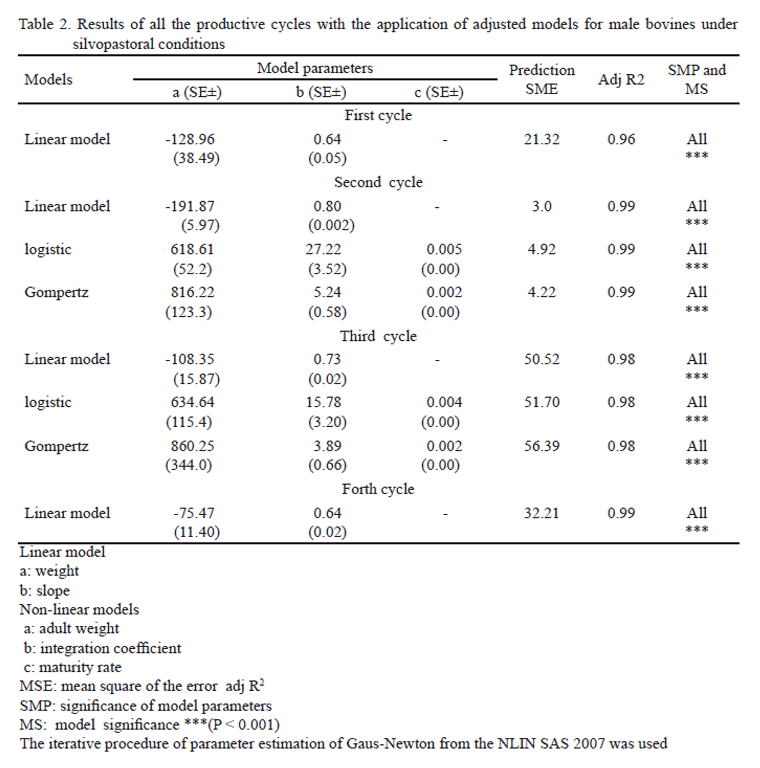
<body><![CDATA[<p align="justify"><font size="2" face="Verdana, Arial, Helvetica, sans-serif">5. Amount of iterations, determining the high or low  convergence difficulty (Brown <em>et al.</em> 1976)</font></p>     <p align="justify"><font size="2" face="Verdana, Arial, Helvetica, sans-serif">6. Graphic distribution of residues</font></p>     <p align="justify">&nbsp;</p>     <p align="justify"><strong><font size="3" face="Verdana, Arial, Helvetica, sans-serif">RESULTS AND DISCUSSION</font></strong></p>     <p align="justify"><font size="2" face="Verdana, Arial, Helvetica, sans-serif"><a href="/img/revistas/cjas/v49n3/t0205315.gif">Table 2</a> shows the results obtained after fitting the  different models used for all the productive cycles. The models were  significant in every case, as well as the parameters of curves.&nbsp;&nbsp; </font></p>     
<p align="justify"><font size="2" face="Verdana, Arial, Helvetica, sans-serif">In the first productive cycle, the linear model  presented appropriate fit, according to the analyzed criteria. There was a  fitted coefficient of determination of 96%, accompanied by the mean square of  the error (21.32). In the second and third productive cycle, the three models  (linear, logistic and Gompertz) were fitted. The mean square of the error of  the three models in the second cycle was small and was higher in the third,  with regard to non-linear models analyzed. In the logistic model, the  asymptotic weight (a) was inferior and maturity rate (c) was superior in the  second and third cycle. However, the integration coefficient (b) was inferior  in both. Finally, in the curve of the fourth productive cycle, the simple  linear model showed appropriate approaches to the curve observed with the adj.  R<sup>2</sup> of 99%. This indicated that the simple linear model explained  best the weight per age relationship in the life phases included on the  research, for all the productive cycles, because it showed the lowest values of  MSE with respect to non-linear models in the second and third cycle.</font></p>     <p align="justify"><font size="2" face="Verdana, Arial, Helvetica, sans-serif">Modeling of liveweight per  age for the four productive cycles, referring to the daily mean gain (DMG) that  ranged between 649 and 769 g (<a href="/img/revistas/cjas/v49n3/t0305315.gif">table 3</a>), could be described by the suitable fit  of the models used in accordance with the evaluated growth-finishing phases and  the stability of the four productive    cycles. </font></p>     
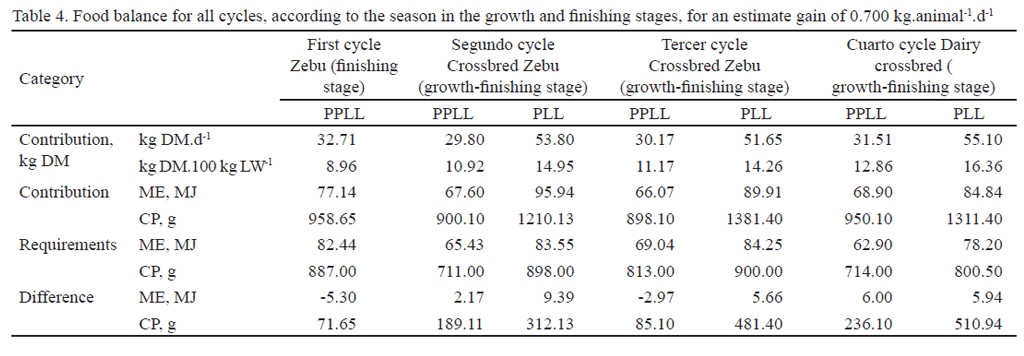
<p align="justify"><font size="2" face="Verdana, Arial, Helvetica, sans-serif">Regarding the first cycle,  the curve of liveweight showed linear tendency almost until the last weighing.  However, the linear model overestimated the liveweight at some points of the  observed curve. This could be explained by the lack of metabolic energy that  showed the system to meet the animal requirements at the finishing stage.  Obviously, it could be important because it affected the individual daily gain.  The energy deficit in this cycle was confirmed with the exercises of food  balance performed after using the requirement tables (<a href="/img/revistas/cjas/v49n3/t0405315.gif">table 4</a>) of Martin and  Palma (1999). In the practice, the food balance relationship for fattening  animals, mainly the energy-protein balance, daily mean gain and growth  prediction with the use of different models (McPhee 2009), among other  productive elements, would allow to correct, with technology and management  decisions, the losses of weight gains in different genotypes during a  determined growth stage in grazing, according to the season and different  productive conditions.&nbsp; </font></p>     
<p align="justify"><font size="2" face="Verdana, Arial, Helvetica, sans-serif">In the second cycle, linear functions and Gompertz and  logistic models described the observed curve with ascending tendency, and, in  the final phase, they had a similar performance to the previously described  cycle, which did not show a stable phase. According to Rodr&iacute;guez <em>et al.</em> (2011), the results confirmed the ability of these genetic animals to obtain  liveweight at slaughtering superior to 400 kg, which would allow to improve  carcass meat yield. Bittante <em>et al.</em> (2011) stated that this animal  performance depends on the weight and age relationship, under normal production  conditions.&nbsp;&nbsp; </font></p>     <p align="justify"><font size="2" face="Verdana, Arial, Helvetica, sans-serif">&nbsp;Likewise, in the  third cycle, the linear, logistic and Gompertz models were fitted. All had some  difficulties to describe the curvature change, from the third weighing up to  the seventh, time that coincided with the transition from dry to rainy season,  although there were no marked differences related to individual gain, which was  slightly higher at 0.086 kg in this last period. This explained the performance  in this study. However, unlike the previous fattening cycle, the final phase of  the curvature showed a slight stability, which might be related to weight at  slaughtering, superior to the rest of the analyzed    cycles.</font></p>     ]]></body>
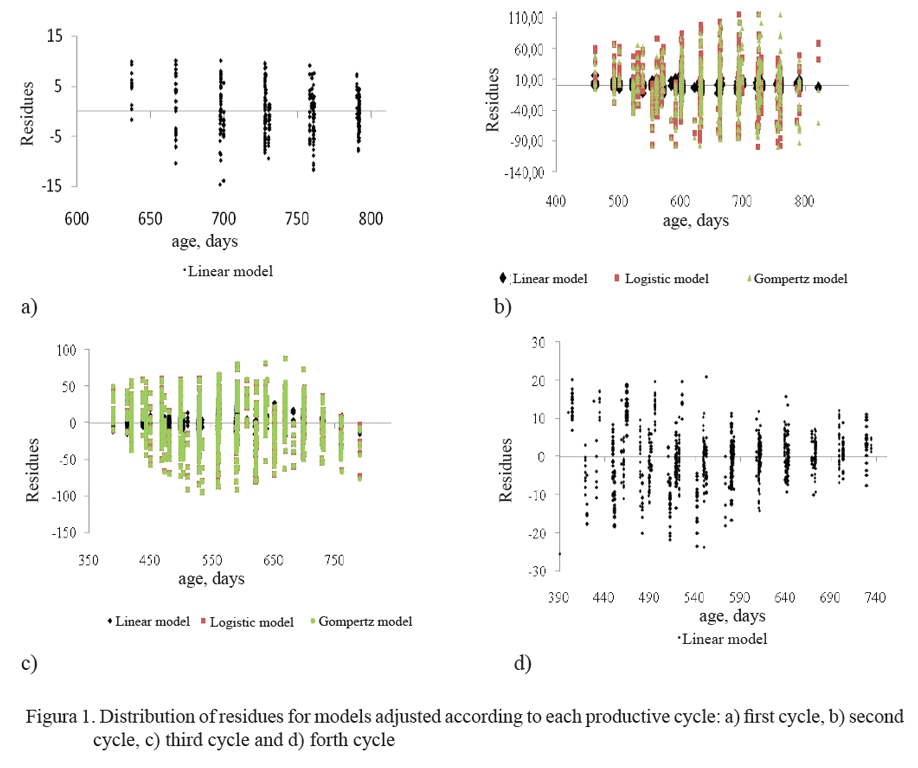
<body><![CDATA[<p align="justify"><font size="2" face="Verdana, Arial, Helvetica, sans-serif">The fourth cycle showed a similar performance to the  previous cycles. The linear function described a good accompaniment in all  phases of the observed curve, although the animals were sacrificed with the  lowest body weight.</font></p>     <p align="justify"><font size="2" face="Verdana, Arial, Helvetica, sans-serif">In the calculation of food  balance based on grasses, with the exception of the first cycle, included in  the finishing phase, which was strategically supplemented, there was an increase  of crude protein (CP) in the contribution of the system, resulting in an excess  in the balance. Chongo (1988) stated that an excess of CP can produce an  additional energy cost for its removal as urea. Therefore, this study allows to  infer that, even though the energy covered the requirements for the estimated  gain, an important part of it was used to counteract the excess of protein, and  could limit the performance of animals, based on the daily mean gain. In  addition, the energy would not be enough, according to the balance performed in  this system to increase daily mean gains superior to 0.800 kg. These results  agree with those reported by D&iacute;az <em>et al.</em> (2009) and Iraola (2013), who  refer that metabolizable energy is a limiting factor for obtaining higher daily  gains in a silvopastoral system with leucaena, which could be corrected with  sources of soluble sugars, in order to search for greater energy-protein  ruminal synchronism. </font></p>     <p align="justify"><font size="2" face="Verdana, Arial, Helvetica, sans-serif">The results of this study  confirm those of Tedeschi <em>et al.</em> (2000) in the Latin American context,  as well as those reported by D&iacute;az (2008) and Iraola <em>et al.</em> (2014) in  Cuba, under similar conditions. These results, according to Fern&aacute;ndez (1996),  Agudelo <em>et al.</em> (2008) and Grimm <em>et al.</em> (2010), are very related  to the evolution of animal liveweight in the time. Therefore, under normal  feeding conditions, growth speed tends to be linear and it can be maintained  until animals reach their adult individual weight and stop growing. Generally,  fat deposition in muscles increases, as well as the percentage of bones in the  carcass. In this sense, the control of food balance contributes to finding  feeding deficiencies in the system and avoiding problems in the individual gain  of animals (Iraola 2014).&nbsp;&nbsp; </font></p>     <p align="justify"><font size="2" face="Verdana, Arial, Helvetica, sans-serif">Therefore, the evaluated  growth and finishing stages favored the suitable adjustment of the linear model  in each cycle. Some results reported by Menchaca (1991ab), Ca&ntilde;eque and Sa&ntilde;udo  (2005) and Jones (2014) could help to confirm the results obtained in that  study with beef cattle for these growth    stages.</font></p>     <p align="justify"><font size="2" face="Verdana, Arial, Helvetica, sans-serif">Residues indicated normal distribution of their values  for all cycles (<a href="/img/revistas/cjas/v49n3/f0105315.gif">figure 1a, b, c and d</a>). In the simple linear model, values  ranged from -20 to 20, and in the non-linear models, between -150 and 150. The  development of biomass production, from the second production cycle,  contributed to stabilize the estimated daily mean gain, without marked  problems, according to the season, with a favorable productive performance for  tropical conditions. This allowed a mean duration in grazing during the  growth-fattening stage, from the second cycle of eight and nine months, in  order to obtain mean liveweight at slaughtering between 380 and 416 kg with  these genetic groups (<a href="/img/revistas/cjas/v49n3/t0305315.gif">table 3</a>). </font></p>     
<p align="justify"><font size="2" face="Verdana, Arial, Helvetica, sans-serif">The results support a linear  performance in the evaluated genetic groups. This indicates that commercial  arguments are needed in order to maximize profitability in these genotypes,  because if the animals finish fattening stage under silvopastoral conditions  with leucaena and a mixture of improved and natural grasses, genetic and  non-genetic factors (climate, management, and some others) should be considered  to achieve better productive indicators (Justin <em>et al.</em> 2012). Therefore,  control should be together with some indicators, such as food balance per  season, and others related to management, so as to ensure animal productivity  in the real context of each productive system.</font></p>     <p align="justify"><font size="2" face="Verdana, Arial, Helvetica, sans-serif">It can be concluded that the  model of linear growth was fitted in all fattening cycles. The non-linear  (Gompertz and logistic) models were fitted in the second and third cycle in the  life phases evaluated in this study. This indicates the need to develop  specific strategies for the finishing stage of male cattle in silvopastoral  systems with leucaena. Further studies on growth models with superior  liveweight at slaughtering in Zebu and crossbred animals are suggested, which  would predict the productive performance over time. Interpreting results,  control indicators such as food balance and management, could substantially  improve the indicators of liveweight at slaughtering, under silvopastoral  conditions with leucaena and grasses.</font></p>     <p align="justify">&nbsp;</p>     <p align="justify"><strong><font size="3" face="Verdana, Arial, Helvetica, sans-serif">ACKNOWLEDGEMENTS </font></strong></p>     <p align="justify"><font size="2" face="Verdana, Arial, Helvetica, sans-serif">Thanks to the workers from the fattening unit &ldquo;Ayala&rdquo;  and to the Department of Animal Genetics from the Institute of Animal Sciences.</font></p>     ]]></body>
<body><![CDATA[<p align="justify">&nbsp;</p>     <p align="justify"><font size="3" face="Verdana, Arial, Helvetica, sans-serif"><strong>REFERENCES</strong></font></p>     <p align="justify"><font size="2" face="Verdana, Arial, Helvetica, sans-serif">Agudelo, D. A., Cer&oacute;n, M. F. &amp; Restrepo, L. F.  2009. &lsquo;&lsquo;Modelaci&oacute;n de las funciones de crecimiento aplicadas a la producci&oacute;n animal&rsquo;&rsquo;. <em>Revista Colombiana de Ciencias Pecuarias</em>, 21 (1): 39&ndash;58.</font></p>     <p align="justify"><font size="2" face="Verdana, Arial, Helvetica, sans-serif">Bittante, G., Cecchinato,  A., Dal Zotto, R., De Marchi, M. &amp; Penasa, M. 2011. <span lang="EN-US">&lsquo;&lsquo;Adjusting for age can lead to biased genetic evaluation for body weight  in cattle&rsquo;&rsquo;. <em>Livestock Science</em>, 140 (1): 1&ndash;7.</span></font></p>     <!-- ref --><p align="justify"><font size="2" face="Verdana, Arial, Helvetica, sans-serif"><span lang="EN-US">Brody, S. 1945. <em>Bioenergetics  and growth</em>. New York: Reinhhold Publication, 1023  p.    </span></font></p>     <p align="justify"><font size="2" face="Verdana, Arial, Helvetica, sans-serif"><span lang="EN-US">Brown, J. E., Fitzhugh, H. A.  &amp; Cartwright, T. C. 1976. &lsquo;&lsquo;A comparison of nonlinear models for describing  weight-age relationships in cattle&rsquo;&rsquo;. </span><em>Journal of Animal Science</em>, 42 (4): 810&ndash;818.</font></p>     <!-- ref --><p align="justify"><font size="2" face="Verdana, Arial, Helvetica, sans-serif">Ca&ntilde;eque, V. &amp; Sa&ntilde;udo, C. 2005. <em>Estandarizaci&oacute;n  de las metodolog&iacute;as para evaluar la calidad del producto (animales vivos,  canal, carne y grasa) en los rumiantes</em>. Espa&ntilde;a: INIA, 17 p.    </font></p>     <p align="justify"><font size="2" face="Verdana, Arial, Helvetica, sans-serif">Chongo, B. 1988. &lsquo;&lsquo;Metabolismo de los amino&aacute;cidos&rsquo;&rsquo;.  In: <em>Bioqu&iacute;mica nutricional. Metabolismo intermediario</em>, vol. 2, La  Habana, Cuba: Instituto de Ciencia Animal, p. 85.</font></p>     ]]></body>
<body><![CDATA[<!-- ref --><p align="justify"><font size="2" face="Verdana, Arial, Helvetica, sans-serif">D&iacute;az, A. 2008. <em>Producci&oacute;n de carne bovina en  pastoreo con gram&iacute;neas y leguminosas</em>. Ph.D. Thesis, Instituto de Ciencia Animal, La Habana, Cuba, 132  p.    </font></p>     <p align="justify"><font size="2" face="Verdana, Arial, Helvetica, sans-serif">D&iacute;az, A., Castillo, E., Mart&iacute;n, P. C. &amp; Hern&aacute;ndez,  J. L. 2009. <span lang="EN-US">&lsquo;&lsquo;Fattening of crossbred dairy bulls in silvopastoral  systems with leucaena, access to biomass bank and  rumen activating supplement&rsquo;&rsquo;. </span><em>Cuban Journal of Agricultural Science</em>, 43: 235.</font></p>     <!-- ref --><p align="justify"><font size="2" face="Verdana, Arial, Helvetica, sans-serif">Fern&aacute;ndez, L. 1996. <em>Modelos que describen la  din&aacute;mica de los procesos biol&oacute;gicos en las Ciencias Agropecuarias</em>. <span lang="EN-US">M.Sc. Thesis, La Habana, Cuba, 68 p.    </span></font></p>     <p align="justify"><font size="2" face="Verdana, Arial, Helvetica, sans-serif"><span lang="EN-US">Gompertz, B. 1825. &lsquo;&lsquo;On the nature of the function expressive of the law of human  mortality, and on a new mode of determining the value of life contingencies&rsquo;&rsquo;. <em>Philosophical  transactions of the Royal Society of London</em>, 115: 513&ndash;583.</span></font></p>     <p align="justify"><font size="2" face="Verdana, Arial, Helvetica, sans-serif"><span lang="EN-US">Grimm, K. J., Ram, N. &amp; Hamagami, F. 2010. &lsquo;&lsquo;Nonlinear growth curves in developmental  research&rsquo;&rsquo;. <em>Child Development</em>, 82 (5): 1357&ndash;1371.</span></font></p>     <p align="justify"><font size="2" face="Verdana, Arial, Helvetica, sans-serif"><span lang="EN-US">Guerra, C. W., Cabrera, A.  &amp; Fern&aacute;ndez, L. 2003. &lsquo;&lsquo;Criteria for the  selection of statistical models in scientific research&rsquo;&rsquo;. </span><em>Cuban Journal  of Agricultural Science</em>, 37 (1): 3&ndash;9.</font></p>     <p align="justify"><font size="2" face="Verdana, Arial, Helvetica, sans-serif">Iraola, J. 2012. &lsquo;&lsquo;Evaluaci&oacute;n del dise&ntilde;o y  manejo de un silvopastoreo para la producci&oacute;n de  carne de res&rsquo;&rsquo;. In: <em>V Encuentro Internacional de J&oacute;venes Agropecuarios  INTERJOVEN 2012</em>, Mayabeque, Cuba.</font></p>     <!-- ref --><p align="justify"><font size="2" face="Verdana, Arial, Helvetica, sans-serif">Iraola, J. 2013. <em>Redise&ntilde;o y manejo de  un arreglo agroforestal para mejorar la capacidad de carga biol&oacute;gica con ganado  de engorde</em>. Ph.D. Thesis,  Instituto de Ciencia Animal, Mayabeque, Cuba.    </font></p>     <p align="justify"><font size="2" face="Verdana, Arial, Helvetica, sans-serif">Iraola, J. 2014. &lsquo;&lsquo;Estrategia de redise&ntilde;o  ecol&oacute;gica para la recuperaci&oacute;n de pasturas degradadas en sistemas de engorde  bovino&rsquo;&rsquo;. In: <em>II Foro Internacional de Alimentaci&oacute;n de Rumiantes, Chiapas</em>,  M&eacute;xico.</font></p>     <p align="justify"><font size="2" face="Verdana, Arial, Helvetica, sans-serif">Iraola, J., Mu&ntilde;oz, E., Garc&iacute;a, Y.,  Hern&aacute;ndez, J. L. &amp; Moreira, E. 2014. &lsquo;&lsquo;Estrategia de redise&ntilde;o ecol&oacute;gica  para la recuperaci&oacute;n de pasturas degradadas en un sistema agrosilvopastoril  de engorde bovino&rsquo;&rsquo;. In: <em>III Convenci&oacute;n Internacional Agrodesarrollo  2014</em>, Varadero, Cuba.</font></p>     <p align="justify"><font size="2" face="Verdana, Arial, Helvetica, sans-serif">Jones, S. 2014. &lsquo;&lsquo;Growth of Meat Animals. <span lang="EN-US">Growth Patterns&rsquo;&rsquo;. In: <em>Encyclopedia of Meat Sciences</em>, 2nd ed., p.  61.</span></font></p>     <p align="justify"><font size="2" face="Verdana, Arial, Helvetica, sans-serif"><span lang="EN-US">Justin, A. W., Moe, S. R.  &amp; Skarpe, C. 2012. &lsquo;&lsquo;Pasture shade and farm  management effects on cow productivity in the tropics&rsquo;&rsquo;. </span><em>Agriculture, Ecosystems  &amp; Environment</em>, 155: 105&ndash;110.</font></p>     <!-- ref --><p align="justify"><font size="2" face="Verdana, Arial, Helvetica, sans-serif">Mart&iacute;n, P. C. &amp; Palma, J. M. 1999. <em>Manual para  fincas y ranchos ganaderos</em>. <span lang="EN-US">Colima, M&eacute;xico: Agrosystems, 120 p.    </span></font></p>     <p align="justify"><font size="2" face="Verdana, Arial, Helvetica, sans-serif"><span lang="EN-US">McPhee, M. J. 2009.  &lsquo;&lsquo;Mathematical modeling in agricultural systems: A case study of modeling fat  deposition in beef cattle for research and industry&rsquo;&rsquo;. In: <em>18th World IMACS,  MODSIM Congress</em>, Cairns, Australia.</span></font></p>     <p align="justify"><font size="2" face="Verdana, Arial, Helvetica, sans-serif"><span lang="EN-US">Menchaca, M. A. 1990. &lsquo;&lsquo;The use of stage model for describing animal growth curves&rsquo;&rsquo;. <em>Cuban Journal of Agricultural Science</em>, 24: 31.</span></font></p>     <p align="justify"><font size="2" face="Verdana, Arial, Helvetica, sans-serif"><span lang="EN-US">Menchaca, M. A. 1991a. &lsquo;&lsquo;Modeling of a bovine weight growth. 1. An intrinsically  linear model for growth representation&rsquo;&rsquo;. <em>Cuban Journal of Agricultural  Science</em>, 25: 125.</span></font></p>     ]]></body>
<body><![CDATA[<p align="justify"><font size="2" face="Verdana, Arial, Helvetica, sans-serif"><span lang="EN-US">Menchaca, M. A. 1991b. &lsquo;&lsquo;Modeling of a bovine weight growth. 2. Multiplicative  model for controlling the growth curve and other effects&rsquo;&rsquo;. <em>Cuban Journal of  Agricultural Science</em>, 25: 231.</span></font></p>     <p align="justify"><font size="2" face="Verdana, Arial, Helvetica, sans-serif"><span lang="EN-US">Nelder, J. A. 1961. &lsquo;&lsquo;The fitting of a generalization of the logistic curve&rsquo;&rsquo;. </span><em>Biometrics</em>, 17 (1): 89&ndash;110.</font></p>     <p align="justify"><font size="2" face="Verdana, Arial, Helvetica, sans-serif">Nogales, S. 2009. &lsquo;&lsquo;Estudio preliminar de la curva de  crecimiento de la raza bovina marisme&ntilde;a en cebadero convencional&rsquo;&rsquo;. In: <em>X  Simposio Iberoamericano sobre Conservaci&oacute;n y Utilizaci&oacute;n de Recursos Zoogen&eacute;ticos</em>, Palmira, Colombia, p. 21.</font></p>     <p align="justify"><font size="2" face="Verdana, Arial, Helvetica, sans-serif">Posada, S., Rosero, R., Rodr&iacute;guez, N. &amp; Costa, A.  2011. &lsquo;&lsquo;Estimaci&oacute;n de par&aacute;metros de curvas de crecimiento de ganado Nellore criado en confinamiento&rsquo;&rsquo;. <em>Revista MVZ C&oacute;rdoba</em>,  16 (3): 2701&ndash;2710.</font></p>     <p align="justify"><font size="2" face="Verdana, Arial, Helvetica, sans-serif">Rodr&iacute;guez, D., Mart&iacute;n, P. C., Tuero, O. &amp; Sarduy, L. 2011. <span lang="EN-US">&lsquo;&lsquo;Characterization of  carcasses of Holstein upgraded bulls fed complete diets of forage from  sugarcane and Pennisetum purpureum  vc. Cuba CT-115&rsquo;&rsquo;. <em>Cuban  Journal of Agricultural Science</em>, 45: 369.</span></font></p>     <p align="justify"><font size="2" face="Verdana, Arial, Helvetica, sans-serif"><span lang="EN-US">SAS 2007. <em>SAS User&rsquo;s guide:  Statistics</em>. version 9.1.3, N.C. USA: SAS Institute  Inc.</span></font></p>     <p align="justify"><font size="2" face="Verdana, Arial, Helvetica, sans-serif">Tedeschi, L. O., Boin,  C., Nardon, R. F. &amp; Leme,  P. R. 2000. &lsquo;&lsquo;Estudo da curva de crescimento  de animais da ra&ccedil;a Guzer&aacute; e seus cruzamentos  alimentados a pasto, com e sem  suplementa&ccedil;&atilde;o. 1. An&aacute;lise e  sele&ccedil;&atilde;o das fun&ccedil;&otilde;es n&atilde;o-lineares&rsquo;&rsquo;. <em>Revista Brasileira de Zootecnia</em>, 29  (2): 630&ndash;637.</font></p>     <p align="justify"><font size="2" face="Verdana, Arial, Helvetica, sans-serif">Torres, V., Barbosa, I., Meyer, R., Noda, A. &amp; Sarduy, L. 2012. <span lang="EN-US">&lsquo;&lsquo;Criteria of goodness of fit test in the selection of non-linear models  for the description of biological performances&rsquo;&rsquo;. <em>Cuban Journal of  Agricultural Science</em>, 46: 345.</span></font></p>     <p align="justify"><font size="2" face="Verdana, Arial, Helvetica, sans-serif"><span lang="EN-US">Von Bertalanffy, L. 1957. &lsquo;&lsquo;Quantitative laws in  metabolism and growth&rsquo;&rsquo;. </span><em>Quarterly Review of Biology</em>, 32: 217&ndash;231.</font></p>     <p align="justify">&nbsp;</p>     ]]></body>
<body><![CDATA[<p align="justify">&nbsp;</p>     <p align="justify"><font size="2" face="Verdana, Arial, Helvetica, sans-serif">Received: July 9, 2014    <br> Accepted: March 31, 2015</font></p>     <p align="justify">&nbsp;</p>     <p align="justify">&nbsp;</p>     <p align="justify"><font size="2" face="Verdana, Arial, Helvetica, sans-serif"><i>J. Iraola,</i> Instituto de Ciencia Animal, Apartado Postal 24, San José de las Lajas, Mayabeque, Cuba.    Email: <a href="mailto:jiraola@ica.co.cu">jiraola@ica.co.cu</a></font></p>      ]]></body><back>
<ref-list>
<ref id="B1">
<nlm-citation citation-type="journal">
<person-group person-group-type="author">
<name>
<surname><![CDATA[Agudelo]]></surname>
<given-names><![CDATA[D. A.]]></given-names>
</name>
<name>
<surname><![CDATA[Cerón]]></surname>
<given-names><![CDATA[M. F.]]></given-names>
</name>
<name>
<surname><![CDATA[Restrepo]]></surname>
<given-names><![CDATA[L. F.]]></given-names>
</name>
</person-group>
<article-title xml:lang="nd"><![CDATA[Modelación de las funciones de crecimiento aplicadas a la producción animal]]></article-title>
<source><![CDATA[Revista Colombiana de Ciencias Pecuarias]]></source>
<year>2009</year>
<volume>21</volume>
<numero>1</numero>
<issue>1</issue>
<page-range>39-58</page-range></nlm-citation>
</ref>
<ref id="B2">
<nlm-citation citation-type="journal">
<person-group person-group-type="author">
<name>
<surname><![CDATA[Bittante]]></surname>
<given-names><![CDATA[G.]]></given-names>
</name>
<name>
<surname><![CDATA[Cecchinato]]></surname>
<given-names><![CDATA[A.]]></given-names>
</name>
<name>
<surname><![CDATA[Dal Zotto]]></surname>
<given-names><![CDATA[R.]]></given-names>
</name>
<name>
<surname><![CDATA[De Marchi]]></surname>
<given-names><![CDATA[M.]]></given-names>
</name>
<name>
<surname><![CDATA[Penasa]]></surname>
<given-names><![CDATA[M.]]></given-names>
</name>
</person-group>
<article-title xml:lang="nd"><![CDATA[Adjusting for age can lead to biased genetic evaluation for body weight in cattle]]></article-title>
<source><![CDATA[Livestock Science]]></source>
<year>2011</year>
<volume>140</volume>
<numero>1</numero>
<issue>1</issue>
<page-range>1-7</page-range></nlm-citation>
</ref>
<ref id="B3">
<nlm-citation citation-type="book">
<person-group person-group-type="author">
<name>
<surname><![CDATA[Brody]]></surname>
<given-names><![CDATA[S.]]></given-names>
</name>
</person-group>
<source><![CDATA[Bioenergetics and growth]]></source>
<year>1945</year>
<page-range>1023</page-range><publisher-loc><![CDATA[New York ]]></publisher-loc>
<publisher-name><![CDATA[Reinhhold Publication]]></publisher-name>
</nlm-citation>
</ref>
<ref id="B4">
<nlm-citation citation-type="journal">
<person-group person-group-type="author">
<name>
<surname><![CDATA[Brown]]></surname>
<given-names><![CDATA[J. E.]]></given-names>
</name>
<name>
<surname><![CDATA[Fitzhugh]]></surname>
<given-names><![CDATA[H. A.]]></given-names>
</name>
<name>
<surname><![CDATA[Cartwright]]></surname>
<given-names><![CDATA[T. C.]]></given-names>
</name>
</person-group>
<article-title xml:lang="nd"><![CDATA[A comparison of nonlinear models for describing weight-age relationships in cattle]]></article-title>
<source><![CDATA[Journal of Animal Science]]></source>
<year>1976</year>
<volume>42</volume>
<numero>4</numero>
<issue>4</issue>
<page-range>810-818</page-range></nlm-citation>
</ref>
<ref id="B5">
<nlm-citation citation-type="book">
<person-group person-group-type="author">
<name>
<surname><![CDATA[Cañeque]]></surname>
<given-names><![CDATA[V.]]></given-names>
</name>
<name>
<surname><![CDATA[Sañudo]]></surname>
<given-names><![CDATA[C.]]></given-names>
</name>
</person-group>
<source><![CDATA[Estandarización de las metodologías para evaluar la calidad del producto (animales vivos, canal, carne y grasa) en los rumiantes]]></source>
<year>2005</year>
<page-range>17</page-range><publisher-loc><![CDATA[España ]]></publisher-loc>
<publisher-name><![CDATA[INIA]]></publisher-name>
</nlm-citation>
</ref>
<ref id="B6">
<nlm-citation citation-type="book">
<person-group person-group-type="author">
<name>
<surname><![CDATA[Chongo]]></surname>
<given-names><![CDATA[B.]]></given-names>
</name>
</person-group>
<article-title xml:lang="nd"><![CDATA[Metabolismo de los aminoácidos]]></article-title>
<source><![CDATA[Bioquímica nutricional. Metabolismo intermediario]]></source>
<year>1988</year>
<volume>2</volume>
<page-range>85</page-range><publisher-loc><![CDATA[La Habana, Cuba ]]></publisher-loc>
<publisher-name><![CDATA[Instituto de Ciencia Animal]]></publisher-name>
</nlm-citation>
</ref>
<ref id="B7">
<nlm-citation citation-type="book">
<person-group person-group-type="author">
<name>
<surname><![CDATA[Díaz]]></surname>
<given-names><![CDATA[A.]]></given-names>
</name>
</person-group>
<source><![CDATA[Producción de carne bovina en pastoreo con gramíneas y leguminosas]]></source>
<year>2008</year>
<page-range>132</page-range><publisher-loc><![CDATA[La Habana, Cuba ]]></publisher-loc>
<publisher-name><![CDATA[Instituto de Ciencia Animal]]></publisher-name>
</nlm-citation>
</ref>
<ref id="B8">
<nlm-citation citation-type="journal">
<person-group person-group-type="author">
<name>
<surname><![CDATA[Díaz]]></surname>
<given-names><![CDATA[A.]]></given-names>
</name>
<name>
<surname><![CDATA[Castillo]]></surname>
<given-names><![CDATA[E.]]></given-names>
</name>
<name>
<surname><![CDATA[Martín]]></surname>
<given-names><![CDATA[P. C.]]></given-names>
</name>
<name>
<surname><![CDATA[Hernández]]></surname>
<given-names><![CDATA[J. L.]]></given-names>
</name>
</person-group>
<article-title xml:lang="nd"><![CDATA[Fattening of crossbred dairy bulls in silvopastoral systems with leucaena, access to biomass bank and rumen activating supplement]]></article-title>
<source><![CDATA[Cuban Journal of Agricultural Science]]></source>
<year>2009</year>
<volume>43</volume>
<page-range>235</page-range></nlm-citation>
</ref>
<ref id="B9">
<nlm-citation citation-type="">
<person-group person-group-type="author">
<name>
<surname><![CDATA[Fernández]]></surname>
<given-names><![CDATA[L.]]></given-names>
</name>
</person-group>
<source><![CDATA[Modelos que describen la dinámica de los procesos biológicos en las Ciencias Agropecuarias]]></source>
<year>1996</year>
<page-range>68</page-range><publisher-loc><![CDATA[La Habana, Cuba ]]></publisher-loc>
</nlm-citation>
</ref>
<ref id="B10">
<nlm-citation citation-type="journal">
<person-group person-group-type="author">
<name>
<surname><![CDATA[Gompertz]]></surname>
<given-names><![CDATA[B.]]></given-names>
</name>
</person-group>
<article-title xml:lang="nd"><![CDATA[On the nature of the function expressive of the law of human mortality, and on a new mode of determining the value of life contingencies]]></article-title>
<source><![CDATA[Philosophical transactions of the Royal Society of London]]></source>
<year>1825</year>
<volume>115</volume>
<page-range>513-583</page-range></nlm-citation>
</ref>
<ref id="B11">
<nlm-citation citation-type="journal">
<person-group person-group-type="author">
<name>
<surname><![CDATA[Grimm]]></surname>
<given-names><![CDATA[K. J.]]></given-names>
</name>
<name>
<surname><![CDATA[Ram]]></surname>
<given-names><![CDATA[N.]]></given-names>
</name>
<name>
<surname><![CDATA[Hamagami]]></surname>
<given-names><![CDATA[F.]]></given-names>
</name>
</person-group>
<article-title xml:lang="nd"><![CDATA[Nonlinear growth curves in developmental research]]></article-title>
<source><![CDATA[Child Development]]></source>
<year>2010</year>
<volume>82</volume>
<numero>5</numero>
<issue>5</issue>
<page-range>1357-1371</page-range></nlm-citation>
</ref>
<ref id="B12">
<nlm-citation citation-type="journal">
<person-group person-group-type="author">
<name>
<surname><![CDATA[Guerra]]></surname>
<given-names><![CDATA[C. W.]]></given-names>
</name>
<name>
<surname><![CDATA[Cabrera]]></surname>
<given-names><![CDATA[A.]]></given-names>
</name>
<name>
<surname><![CDATA[Fernández]]></surname>
<given-names><![CDATA[L.]]></given-names>
</name>
</person-group>
<article-title xml:lang="nd"><![CDATA[Criteria for the selection of statistical models in scientific research]]></article-title>
<source><![CDATA[Cuban Journal of Agricultural Science]]></source>
<year>2003</year>
<volume>37</volume>
<numero>1</numero>
<issue>1</issue>
<page-range>3-9</page-range></nlm-citation>
</ref>
<ref id="B13">
<nlm-citation citation-type="">
<person-group person-group-type="author">
<name>
<surname><![CDATA[Iraola]]></surname>
<given-names><![CDATA[J.]]></given-names>
</name>
</person-group>
<article-title xml:lang="nd"><![CDATA[Evaluación del diseño y manejo de un silvopastoreo para la producción de carne de res]]></article-title>
<source><![CDATA[]]></source>
<year>2012</year>
<publisher-loc><![CDATA[Mayabeque, Cuba ]]></publisher-loc>
</nlm-citation>
</ref>
<ref id="B14">
<nlm-citation citation-type="book">
<person-group person-group-type="author">
<name>
<surname><![CDATA[Iraola]]></surname>
<given-names><![CDATA[J.]]></given-names>
</name>
</person-group>
<source><![CDATA[Rediseño y manejo de un arreglo agroforestal para mejorar la capacidad de carga biológica con ganado de engorde]]></source>
<year>2013</year>
<publisher-loc><![CDATA[Mayabeque, Cuba ]]></publisher-loc>
<publisher-name><![CDATA[Instituto de Ciencia Animal]]></publisher-name>
</nlm-citation>
</ref>
<ref id="B15">
<nlm-citation citation-type="">
<person-group person-group-type="author">
<name>
<surname><![CDATA[Iraola]]></surname>
<given-names><![CDATA[J.]]></given-names>
</name>
</person-group>
<article-title xml:lang="nd"><![CDATA[Estrategia de rediseño ecológica para la recuperación de pasturas degradadas en sistemas de engorde bovino]]></article-title>
<source><![CDATA[]]></source>
<year>2014</year>
<publisher-loc><![CDATA[México ]]></publisher-loc>
</nlm-citation>
</ref>
<ref id="B16">
<nlm-citation citation-type="">
<person-group person-group-type="author">
<name>
<surname><![CDATA[Iraola]]></surname>
<given-names><![CDATA[J.]]></given-names>
</name>
<name>
<surname><![CDATA[Muñoz]]></surname>
<given-names><![CDATA[E.]]></given-names>
</name>
<name>
<surname><![CDATA[García]]></surname>
<given-names><![CDATA[Y.]]></given-names>
</name>
<name>
<surname><![CDATA[Hernández]]></surname>
<given-names><![CDATA[J. L.]]></given-names>
</name>
<name>
<surname><![CDATA[Moreira]]></surname>
<given-names><![CDATA[E.]]></given-names>
</name>
</person-group>
<article-title xml:lang="nd"><![CDATA[Estrategia de rediseño ecológica para la recuperación de pasturas degradadas en un sistema agrosilvopastoril de engorde bovino]]></article-title>
<source><![CDATA[]]></source>
<year>2014</year>
<publisher-loc><![CDATA[Varadero, Cuba ]]></publisher-loc>
</nlm-citation>
</ref>
<ref id="B17">
<nlm-citation citation-type="">
<person-group person-group-type="author">
<name>
<surname><![CDATA[Jones]]></surname>
<given-names><![CDATA[S.]]></given-names>
</name>
</person-group>
<article-title xml:lang="nd"><![CDATA[Growth of Meat Animals. Growth Patterns]]></article-title>
<source><![CDATA[Encyclopedia of Meat Sciences]]></source>
<year>2014</year>
<edition>2nd</edition>
<page-range>61</page-range></nlm-citation>
</ref>
<ref id="B18">
<nlm-citation citation-type="journal">
<person-group person-group-type="author">
<name>
<surname><![CDATA[Justin]]></surname>
<given-names><![CDATA[A. W.]]></given-names>
</name>
<name>
<surname><![CDATA[Moe]]></surname>
<given-names><![CDATA[S. R.]]></given-names>
</name>
<name>
<surname><![CDATA[Skarpe]]></surname>
<given-names><![CDATA[C.]]></given-names>
</name>
</person-group>
<article-title xml:lang="nd"><![CDATA[Pasture shade and farm management effects on cow productivity in the tropics]]></article-title>
<source><![CDATA[Agriculture, Ecosystems & Environment]]></source>
<year>2012</year>
<volume>155</volume>
<page-range>105-110</page-range></nlm-citation>
</ref>
<ref id="B19">
<nlm-citation citation-type="book">
<person-group person-group-type="author">
<name>
<surname><![CDATA[Martín]]></surname>
<given-names><![CDATA[P. C.]]></given-names>
</name>
<name>
<surname><![CDATA[Palma]]></surname>
<given-names><![CDATA[J. M.]]></given-names>
</name>
</person-group>
<source><![CDATA[Manual para fincas y ranchos ganaderos]]></source>
<year>1999</year>
<page-range>120</page-range><publisher-loc><![CDATA[Colima, México ]]></publisher-loc>
<publisher-name><![CDATA[Agrosystems]]></publisher-name>
</nlm-citation>
</ref>
<ref id="B20">
<nlm-citation citation-type="">
<person-group person-group-type="author">
<name>
<surname><![CDATA[McPhee]]></surname>
<given-names><![CDATA[M. J.]]></given-names>
</name>
</person-group>
<article-title xml:lang="nd"><![CDATA[Mathematical modeling in agricultural systems: A case study of modeling fat deposition in beef cattle for research and industry]]></article-title>
<source><![CDATA[]]></source>
<year>2009</year>
<publisher-loc><![CDATA[Cairns, Australia ]]></publisher-loc>
</nlm-citation>
</ref>
<ref id="B21">
<nlm-citation citation-type="journal">
<person-group person-group-type="author">
<name>
<surname><![CDATA[Menchaca]]></surname>
<given-names><![CDATA[M. A.]]></given-names>
</name>
</person-group>
<article-title xml:lang="nd"><![CDATA[The use of stage model for describing animal growth curves]]></article-title>
<source><![CDATA[Cuban Journal of Agricultural Science]]></source>
<year>1990</year>
<volume>24</volume>
<page-range>31</page-range></nlm-citation>
</ref>
<ref id="B22">
<nlm-citation citation-type="journal">
<person-group person-group-type="author">
<name>
<surname><![CDATA[Menchaca]]></surname>
<given-names><![CDATA[M. A.]]></given-names>
</name>
</person-group>
<article-title xml:lang="nd"><![CDATA[Modeling of a bovine weight growth. 1. An intrinsically linear model for growth representation]]></article-title>
<source><![CDATA[Cuban Journal of Agricultural Science]]></source>
<year>1991</year>
<volume>25</volume>
<page-range>125</page-range></nlm-citation>
</ref>
<ref id="B23">
<nlm-citation citation-type="journal">
<person-group person-group-type="author">
<name>
<surname><![CDATA[Menchaca]]></surname>
<given-names><![CDATA[M. A.]]></given-names>
</name>
</person-group>
<article-title xml:lang="nd"><![CDATA[Modeling of a bovine weight growth. 2. Multiplicative model for controlling the growth curve and other effects]]></article-title>
<source><![CDATA[Cuban Journal of Agricultural Science]]></source>
<year>1991</year>
<volume>25</volume>
<page-range>231</page-range></nlm-citation>
</ref>
<ref id="B24">
<nlm-citation citation-type="journal">
<person-group person-group-type="author">
<name>
<surname><![CDATA[Nelder]]></surname>
<given-names><![CDATA[J. A.]]></given-names>
</name>
</person-group>
<article-title xml:lang="nd"><![CDATA[The fitting of a generalization of the logistic curve]]></article-title>
<source><![CDATA[Biometrics]]></source>
<year>1961</year>
<volume>17</volume>
<numero>1</numero>
<issue>1</issue>
<page-range>89-110</page-range></nlm-citation>
</ref>
<ref id="B25">
<nlm-citation citation-type="">
<person-group person-group-type="author">
<name>
<surname><![CDATA[Nogales]]></surname>
<given-names><![CDATA[S.]]></given-names>
</name>
</person-group>
<article-title xml:lang="nd"><![CDATA[Estudio preliminar de la curva de crecimiento de la raza bovina marismeña en cebadero convencional]]></article-title>
<source><![CDATA[]]></source>
<year>2009</year>
<page-range>21</page-range><publisher-loc><![CDATA[Palmira, Colombia ]]></publisher-loc>
</nlm-citation>
</ref>
<ref id="B26">
<nlm-citation citation-type="journal">
<person-group person-group-type="author">
<name>
<surname><![CDATA[Posada]]></surname>
<given-names><![CDATA[S.]]></given-names>
</name>
<name>
<surname><![CDATA[Rosero]]></surname>
<given-names><![CDATA[R.]]></given-names>
</name>
<name>
<surname><![CDATA[Rodríguez]]></surname>
<given-names><![CDATA[N.]]></given-names>
</name>
<name>
<surname><![CDATA[Costa]]></surname>
<given-names><![CDATA[A.]]></given-names>
</name>
</person-group>
<article-title xml:lang="nd"><![CDATA[Estimación de parámetros de curvas de crecimiento de ganado Nellore criado en confinamiento]]></article-title>
<source><![CDATA[Revista MVZ Córdoba]]></source>
<year>2011</year>
<volume>16</volume>
<numero>3</numero>
<issue>3</issue>
<page-range>2701-2710</page-range></nlm-citation>
</ref>
<ref id="B27">
<nlm-citation citation-type="journal">
<person-group person-group-type="author">
<name>
<surname><![CDATA[Rodríguez]]></surname>
<given-names><![CDATA[D.]]></given-names>
</name>
<name>
<surname><![CDATA[Martín]]></surname>
<given-names><![CDATA[P. C.]]></given-names>
</name>
<name>
<surname><![CDATA[Tuero]]></surname>
<given-names><![CDATA[O.]]></given-names>
</name>
<name>
<surname><![CDATA[Sarduy]]></surname>
<given-names><![CDATA[L.]]></given-names>
</name>
</person-group>
<article-title xml:lang="nd"><![CDATA[Characterization of carcasses of Holstein upgraded bulls fed complete diets of forage from sugarcane and Pennisetum purpureum vc. Cuba CT-115]]></article-title>
<source><![CDATA[Cuban Journal of Agricultural Science]]></source>
<year>2011</year>
<volume>45</volume>
<page-range>369</page-range></nlm-citation>
</ref>
<ref id="B28">
<nlm-citation citation-type="book">
<person-group person-group-type="author">
<name>
<surname><![CDATA[SAS]]></surname>
</name>
</person-group>
<source><![CDATA[SAS User’s guide: Statistics]]></source>
<year>2007</year>
<publisher-loc><![CDATA[N.C. USA ]]></publisher-loc>
<publisher-name><![CDATA[SAS Institute Inc.]]></publisher-name>
</nlm-citation>
</ref>
<ref id="B29">
<nlm-citation citation-type="journal">
<person-group person-group-type="author">
<name>
<surname><![CDATA[Tedeschi]]></surname>
<given-names><![CDATA[L. O.]]></given-names>
</name>
<name>
<surname><![CDATA[Boin]]></surname>
<given-names><![CDATA[C.]]></given-names>
</name>
<name>
<surname><![CDATA[Nardon]]></surname>
<given-names><![CDATA[R. F.]]></given-names>
</name>
<name>
<surname><![CDATA[Leme]]></surname>
<given-names><![CDATA[P. R.]]></given-names>
</name>
</person-group>
<article-title xml:lang="nd"><![CDATA[Estudo da curva de crescimento de animais da raça Guzerá e seus cruzamentos alimentados a pasto, com e sem suplementação. 1. Análise e seleção das funções não-lineares]]></article-title>
<source><![CDATA[Revista Brasileira de Zootecnia]]></source>
<year>2000</year>
<volume>29</volume>
<numero>2</numero>
<issue>2</issue>
<page-range>630-637</page-range></nlm-citation>
</ref>
<ref id="B30">
<nlm-citation citation-type="journal">
<person-group person-group-type="author">
<name>
<surname><![CDATA[Torres]]></surname>
<given-names><![CDATA[V.]]></given-names>
</name>
<name>
<surname><![CDATA[Barbosa]]></surname>
<given-names><![CDATA[I.]]></given-names>
</name>
<name>
<surname><![CDATA[Meyer]]></surname>
<given-names><![CDATA[R.]]></given-names>
</name>
<name>
<surname><![CDATA[Noda]]></surname>
<given-names><![CDATA[A.]]></given-names>
</name>
<name>
<surname><![CDATA[Sarduy]]></surname>
<given-names><![CDATA[L.]]></given-names>
</name>
</person-group>
<article-title xml:lang="nd"><![CDATA[Criteria of goodness of fit test in the selection of non-linear models for the description of biological performances]]></article-title>
<source><![CDATA[Cuban Journal of Agricultural Science]]></source>
<year>2012</year>
<volume>46</volume>
<page-range>345</page-range></nlm-citation>
</ref>
<ref id="B31">
<nlm-citation citation-type="journal">
<person-group person-group-type="author">
<name>
<surname><![CDATA[Von Bertalanffy]]></surname>
<given-names><![CDATA[L.]]></given-names>
</name>
</person-group>
<article-title xml:lang="nd"><![CDATA[Quantitative laws in metabolism and growth]]></article-title>
<source><![CDATA[Quarterly Review of Biology]]></source>
<year>1957</year>
<volume>32</volume>
<page-range>217-231</page-range></nlm-citation>
</ref>
</ref-list>
</back>
</article>