<?xml version="1.0" encoding="ISO-8859-1"?><article xmlns:mml="http://www.w3.org/1998/Math/MathML" xmlns:xlink="http://www.w3.org/1999/xlink" xmlns:xsi="http://www.w3.org/2001/XMLSchema-instance">
<front>
<journal-meta>
<journal-id>2079-3480</journal-id>
<journal-title><![CDATA[Cuban Journal of Agricultural Science]]></journal-title>
<abbrev-journal-title><![CDATA[Cuban J. Agric. Sci.]]></abbrev-journal-title>
<issn>2079-3480</issn>
<publisher>
<publisher-name><![CDATA[Editorial del Instituto de Ciencia Animal]]></publisher-name>
</publisher>
</journal-meta>
<article-meta>
<article-id>S2079-34802015000300006</article-id>
<title-group>
<article-title xml:lang="en"><![CDATA[Comparison between two techniques for estimating voluntary intake of female buffaloes under grazing conditions. Technical note]]></article-title>
<article-title xml:lang="es"><![CDATA[Comparación de dos técnicas para la estimación del consumo voluntario de búfalas en pastoreo. Nota técnica]]></article-title>
</title-group>
<contrib-group>
<contrib contrib-type="author">
<name>
<surname><![CDATA[Gutiérrez]]></surname>
<given-names><![CDATA[Odilia]]></given-names>
</name>
<xref ref-type="aff" rid="A01"/>
</contrib>
<contrib contrib-type="author">
<name>
<surname><![CDATA[Cairo]]></surname>
<given-names><![CDATA[J]]></given-names>
</name>
<xref ref-type="aff" rid="A01"/>
</contrib>
<contrib contrib-type="author">
<name>
<surname><![CDATA[Ramírez]]></surname>
<given-names><![CDATA[B]]></given-names>
</name>
<xref ref-type="aff" rid="A02"/>
</contrib>
<contrib contrib-type="author">
<name>
<surname><![CDATA[Vasallo]]></surname>
<given-names><![CDATA[G]]></given-names>
</name>
<xref ref-type="aff" rid="A01"/>
</contrib>
<contrib contrib-type="author">
<name>
<surname><![CDATA[Varela]]></surname>
<given-names><![CDATA[M]]></given-names>
</name>
<xref ref-type="aff" rid="A01"/>
</contrib>
</contrib-group>
<aff id="A01">
<institution><![CDATA[,Instituto de Ciencia Animal  ]]></institution>
<addr-line><![CDATA[San José de las Lajas Mayabeque]]></addr-line>
<country>Cuba</country>
</aff>
<aff id="A02">
<institution><![CDATA[,Universidad de Granma  ]]></institution>
<addr-line><![CDATA[Bayamo Granma]]></addr-line>
<country>Cuba</country>
</aff>
<pub-date pub-type="pub">
<day>00</day>
<month>09</month>
<year>2015</year>
</pub-date>
<pub-date pub-type="epub">
<day>00</day>
<month>09</month>
<year>2015</year>
</pub-date>
<volume>49</volume>
<numero>3</numero>
<fpage>317</fpage>
<lpage>320</lpage>
<copyright-statement/>
<copyright-year/>
<self-uri xlink:href="http://scielo.sld.cu/scielo.php?script=sci_arttext&amp;pid=S2079-34802015000300006&amp;lng=en&amp;nrm=iso"></self-uri><self-uri xlink:href="http://scielo.sld.cu/scielo.php?script=sci_abstract&amp;pid=S2079-34802015000300006&amp;lng=en&amp;nrm=iso"></self-uri><self-uri xlink:href="http://scielo.sld.cu/scielo.php?script=sci_pdf&amp;pid=S2079-34802015000300006&amp;lng=en&amp;nrm=iso"></self-uri><abstract abstract-type="short" xml:lang="en"><p><![CDATA[In order to compare two techniques for estimating dry matter intake of female buffaloes under grazing conditions, 25 pairs of data were used, obtained from the application of the technique of double marking (Cr2O3 and IAA) and estimation by the method of metabolizable energy. The analysis of variance for a probability level of 95.0% indicated that there were no differences between the intakes estimated by the methods of double marking (17.20 kg DM/d) and energy (16.84 kg DM/d). There was a high correspondence between the DM intakes estimated by both methods, with determination (R² = 0.94) and correlation coefficient (r = 0.97), and low values of the mean square error. The results demonstrate that the methodology for estimating intake under grazing conditions, proposed by NRC (2001) and adapted by Pérez Infante (2013), can be compared with the traditional technique of double marking, which may be useful for further studies on intake under grazing conditions, destined to buffaloes]]></p></abstract>
<abstract abstract-type="short" xml:lang="es"><p><![CDATA[Para establecer comparaciones entre dos técnicas, con el propósito de estimar el consumo de materia seca de búfalas en pastoreo, se utilizaron 25 pares de datos obtenidos de la aplicación de la técnica de doble marcaje (Cr2O3 y CAI) y de estimación por el método de la energía metabolizable. El análisis de la varianza para nivel de confianza de 95.0 % indicó que no hubo diferencias entre los consumos estimados por los métodos de doble marcaje (17.20 kg MS/d) y energía (16.84 kg MS/d). Hubo alta correspondencia entre el consumo de MS estimado por ambos métodos, con coeficiente de correlación (r = 0.97) y determinación (R² =0.94) y bajos valores del cuadrado medio del error. Los resultados demuestran que la metodología para estimar el consumo en pastoreo, propuesta por NRC (2001) y adaptada por Pérez Infante (2013), es comparable con la tradicional del doble marcaje, lo que pudiera resultar de gran utilidad para estudios posteriores de consumo en pastoreo, destinados a la especie bubalina]]></p></abstract>
<kwd-group>
<kwd lng="en"><![CDATA[ingestion]]></kwd>
<kwd lng="en"><![CDATA[grasses]]></kwd>
<kwd lng="en"><![CDATA[markers]]></kwd>
<kwd lng="es"><![CDATA[ingestión]]></kwd>
<kwd lng="es"><![CDATA[pastos]]></kwd>
<kwd lng="es"><![CDATA[marcadores]]></kwd>
</kwd-group>
</article-meta>
</front><body><![CDATA[ <p align="right"><font size="2" face="Verdana, Arial, Helvetica,   sans-serif"><b>TECHNICAL NOTE</b></font></p>     <p>&nbsp;</p>     <p align="justify"><font size="4" face="Verdana, Arial, Helvetica, sans-serif"><b>Comparison between two techniques for estimating voluntary intake of female buffaloes under grazing conditions. Technical note</b></font></p>     <p align="justify">&nbsp;</p>     <p align="justify"><font size="3" face="Verdana, Arial, Helvetica, sans-serif"><b>Comparación de dos técnicas para la estimación del consumo voluntario de búfalas en pastoreo. Nota técnica</b></font></p>     <p align="justify">&nbsp;</p>     <p align="justify">&nbsp;</p>     <p align="justify"><font size="2" face="Verdana, Arial, Helvetica, sans-serif"><b>Odilia Gutiérrez,</b><sup><b>I</b></sup><b> J. Cairo,</b><sup><b>I</b></sup><b> B. Ramírez,</b><sup><b>II</b></sup><b> G. Vasallo,</b><sup><b>I</b></sup><b> M. Varela,</b><sup><b>I</b></sup></font></p> <font size="2" face="Verdana, Arial, Helvetica, sans-serif"><sup>I</sup>Instituto de Ciencia Animal, Apartado Postal 24, San José de las Lajas, Mayabeque, Cuba.</font><font size="2" face="Verdana, Arial, Helvetica, sans-serif"><sup>    <br>   II</sup>Universidad de Granma, Bayamo, Granma, Cuba.</font>   </p>     <p align="justify">&nbsp;</p>     ]]></body>
<body><![CDATA[<p align="justify">&nbsp;</p> <hr align="JUSTIFY">     <p align="justify"><font size="2" face="Verdana, Arial, Helvetica, sans-serif"><b>ABSTRACT</b></font></p>     <p align="justify"><font size="2" face="Verdana, Arial, Helvetica, sans-serif"><span lang="EN-US">In order to compare two techniques for estimating dry matter intake of  female buffaloes under grazing conditions, 25 pairs of data were used, obtained  from the application of the technique of double marking (Cr<sub>2</sub>O<sub>3</sub>  and IAA) and estimation by the method of metabolizable  energy. The analysis of variance for a probability level of 95.0% indicated  that there were no differences between the intakes estimated by the methods of  double marking (17.20 kg DM/d) and energy  (16.84 kg DM/d). There was a high correspondence between the DM intakes  estimated by both methods, with determination (R<sup>2</sup> = 0.94) and  correlation coefficient (r = 0.97), and low values of the mean square error.  The results demonstrate that the methodology for estimating intake under  grazing conditions, proposed by NRC (2001) and adapted by P&eacute;rez Infante (2013), can be compared with the traditional technique  of double marking, which may be useful for further studies on intake under  grazing conditions, destined to buffaloes</span>.</font></p>     <p align="justify"><font size="2" face="Verdana, Arial, Helvetica, sans-serif"><b>Key words:</b> ingestion, grasses, markers.</font></p> <hr align="JUSTIFY">     <p align="justify"><font size="2" face="Verdana, Arial, Helvetica, sans-serif"><b>RESUMEN</b></font></p>     <p align="justify"><font size="2" face="Verdana, Arial, Helvetica, sans-serif">Para establecer comparaciones entre dos&nbsp; t&eacute;cnicas, con el prop&oacute;sito de estimar el  consumo de materia seca de b&uacute;falas en pastoreo, se utilizaron 25 pares de datos  obtenidos de la aplicaci&oacute;n de la t&eacute;cnica de doble marcaje (Cr<sub>2</sub>O<sub>3</sub>  y CAI) y de&nbsp; estimaci&oacute;n por el  m&eacute;todo de la energ&iacute;a metabolizable. El an&aacute;lisis de la  varianza para&nbsp; nivel de confianza de 95.0  % indic&oacute; que no hubo diferencias entre los consumos estimados por los m&eacute;todos  de doble marcaje (17.20 kg MS/d) y&nbsp;  energ&iacute;a  (16.84 kg MS/d). Hubo alta correspondencia entre&nbsp; el consumo de MS estimado por ambos m&eacute;todos,  con&nbsp; coeficiente de correlaci&oacute;n  (r = 0.97) y determinaci&oacute;n (R<sup>2</sup> =0.94) y bajos valores del cuadrado  medio del error. Los resultados demuestran que&nbsp;  la metodolog&iacute;a para estimar el consumo en pastoreo, propuesta por NRC  (2001) y&nbsp; adaptada por P&eacute;rez Infante  (2013), es comparable con la tradicional del doble marcaje, lo que&nbsp; pudiera resultar de gran utilidad para  estudios posteriores de consumo en pastoreo, destinados a la especie bubalina.</font></p>     <p align="justify"><font size="2" face="Verdana, Arial, Helvetica, sans-serif"><b>Palabras    clave:</b>    ingestión, pastos, marcadores.</font></p> <hr align="JUSTIFY">     <p align="justify">&nbsp;</p>     <p align="justify">&nbsp;</p>     <p align="justify"><strong><font size="3" face="Verdana, Arial, Helvetica, sans-serif"><span lang="EN-US">INTRODUCTION</span></font></strong></p> <font size="2" face="Verdana, Arial, Helvetica, sans-serif"></font>    ]]></body>
<body><![CDATA[<p align="justify"><font size="2" face="Verdana, Arial, Helvetica, sans-serif">Food intake is the most  important element for determining animal production (Correa <em>et al.</em> 2009). The method of external markers is frequently used for its estimation.  One of the most used markers is chromium oxide (Cr<sub>2</sub>O<sub>3</sub>).  Some studies were carried out for achieving the most precise estimation of  intake under grazing conditions, and the most used technique was that of two  markers, Cr<sub>2</sub>O<sub>3</sub> and insoluble acid ashes (IAA), proposed  by Geerken <em>et al.</em> (1987). </font></p>     <p align="justify"><font size="2" face="Verdana, Arial, Helvetica, sans-serif">NRC (2001) proposes a less complex method for estimating  dry matter intake of cows in grazing, which only takes into account the  measurable indicators belonging to the animals. P&eacute;rez Infante (2013) introduced  an adaptation to this methodology, which relates the requirements of  metabolizable energy of the animal with that provided by the grass. This method  was not used before for estimating dry matter intake of female buffaloes in  grazing, so the objective of this study was to establish comparisons between  the two techniques for estimating dry matter intake of female buffaloes in  grazing. </font></p>     <p align="justify"><font size="2" face="Verdana, Arial, Helvetica, sans-serif">In order to compare the two methods of intake estimation  of female buffaloes in grazing, 25 data of individual intake were taken,  determined by the application of the technique of double marking with Cr<sub>2</sub>O<sub>3</sub>  and insoluble acid ashes (Geerken <em>et al.</em> 1987), and 25 data of intake of  the same female buffaloes, estimated by the methodology proposed by P&eacute;rez  Infante (2013). For estimating intake through the method of metabolizable  energy, liveweight, and production and composition of milk from animals was  taken into consideration. The tables of nutritional requirements of M&eacute;ndez and  Lima (2011) for lactating female buffaloes were used.</font></p>     <p align="justify"><font size="2" face="Verdana, Arial, Helvetica, sans-serif"><a href="/img/revistas/cjas/v49n3/t0106315.gif">Table 1</a> shows the data of dry matter intake, estimated  by the methods of double marking and metabolizable energy. There were mean  intakes of 17.2 and 17.84 kg of DM and there were no differences among them.  These results represent figures around 2.4 % of liveweight, and coincide with  those of Guti&eacute;rrez <em>et al.</em> (2014) for female buffaloes in grazing, under  the same conditions of this study.</font></p>     
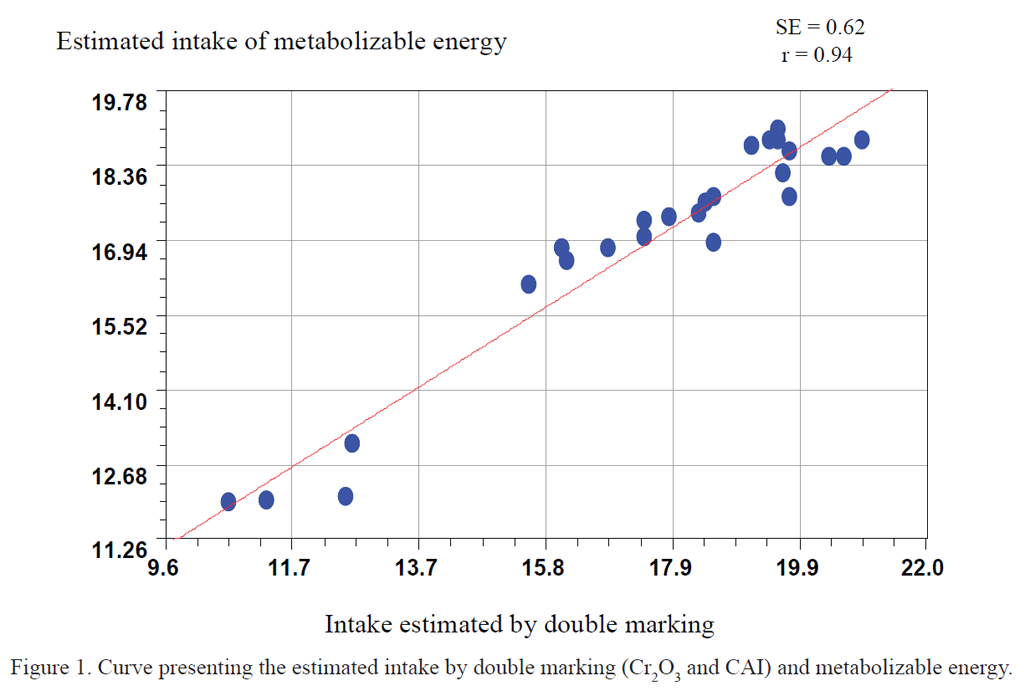
<p align="justify"><font size="2" face="Verdana, Arial, Helvetica, sans-serif"><a href="/img/revistas/cjas/v49n3/f0106315.gif">Figure 1</a> shows the curve that presents the estimated dry  matter intake obtained through the two methods. The analysis of variance, for a  probability level of    95.0 %, indicated that there were no differences among the intakes estimated by  the methods of double marking and metabolizable energy, with a low mean square  of the prediction error. </font></p>     
<p align="justify"><font size="2" face="Verdana, Arial, Helvetica, sans-serif">Analysis of linear regression: </font></p>     <p align="justify"><font size="2" face="Verdana, Arial, Helvetica, sans-serif"><u>Variable N&nbsp;&nbsp; R&sup2;&nbsp; R&sup2;  Aj ECMP&nbsp; AIC&nbsp;&nbsp; BIC</u></font></p>     <p align="justify"><font size="2" face="Verdana, Arial, Helvetica, sans-serif">&nbsp;&nbsp;&nbsp;&nbsp;&nbsp;&nbsp;&nbsp;&nbsp;&nbsp; 25  0.94&nbsp; 0.93 0.68 60.64 64.30</font></p>     <p align="justify"><font size="2" face="Verdana, Arial, Helvetica, sans-serif">There was a high correspondence among the intake  estimations, after comparing the data obtained by the markers and the estimated  by the metabolizable energy with coefficient of correlation (r = 0.94).</font></p>     <p align="justify"><font size="2" face="Verdana, Arial, Helvetica, sans-serif">Y = a + bx&nbsp;&nbsp;&nbsp; </font></p>     ]]></body>
<body><![CDATA[<p align="justify"><font size="2" face="Verdana, Arial, Helvetica, sans-serif">where: </font></p>     <p align="justify"><font size="2" face="Verdana, Arial, Helvetica, sans-serif">a: 4.05&nbsp;&nbsp; </font></p>     <p align="justify"><font size="2" face="Verdana, Arial, Helvetica, sans-serif">b: 0.73</font></p>     <p align="justify"><font size="2" face="Verdana, Arial, Helvetica, sans-serif">R<sup>2</sup> = 0.94 </font></p>     <p align="justify"><font size="2" face="Verdana, Arial, Helvetica, sans-serif">&nbsp;Dulau (2011)  reported a good correlation between the methods, by cut and by net energy,  using the calculation of intake of milking males in grazing, where the  measuring method through the pasture measuring underestimated it. Correa <em>et  al.</em> (2009) also made comparisons among the estimated intakes with the use  of markers (ADFiis/Cr) and the results of the equations from NRC (2001) and  from the Cornell net carbohydrates and proteins system (CNCPS) through the  analysis of variance and the mean square of the prediction error (ECMP) of each  equation. In this case, the coefficients of determination (R<sup>2</sup>) were  low, together with the high values of the mean square of the error, which  demonstrated a low prediction of    intake.</font></p>     <p align="justify"><font size="2" face="Verdana, Arial, Helvetica, sans-serif">However, this study showed a great correspondence  between the method of double marking (traditional) and the one of metabolizable  energy, with a coefficient of correlation of 0.94, and low values of the mean  square of the error. </font></p>     <p align="justify"><font size="2" face="Verdana, Arial, Helvetica, sans-serif">The technique of intake estimation by double marking has  demonstrated its reliability, due to the almost total recovery of Cr from the  feces (Bargo 2008). In this study, taken as reference, it was closely related  to the method of metabolizable energy, which could be faster and simpler due to  its principles, with a proper control of the indicators belonging to the  animals. Nevertheless, it is necessary to point out that the comparison was  performed with female buffaloes in grazing with different intake habits to  bovines. </font></p>     <p align="justify"><font size="2" face="Verdana, Arial, Helvetica, sans-serif">It is important to highlight that the main result of  this study is the practical value of the methodology reviewed by P&eacute;rez Infante  (2013). Its application, under production conditions, is completely feasible  and very important because it solves, with a high level of accuracy, the  problem of estimating with the best precision dry matter intake of animals.</font></p>     <p align="justify"><font size="2" face="Verdana, Arial, Helvetica, sans-serif">Nevertheless, it is necessary to increase the number of  observations in grazing systems under different conditions to confirm the  validity of technology.</font></p>     <p align="justify">&nbsp;</p>     ]]></body>
<body><![CDATA[<p align="justify"><strong><font size="3" face="Verdana, Arial, Helvetica, sans-serif">REFERENCES</font></strong></p>     <p align="justify"><font size="2" face="Verdana, Arial, Helvetica, sans-serif">Bargo, F. 2008. &lsquo;&lsquo;Consumo de materia seca  en vacas en pastoreo&rsquo;&rsquo;. In: <em>31 Congreso Argentino de Producci&oacute;n Animal</em>, Available: &lt;<a href="www.produccion-animal.com.ar" target="_blank">www.produccion-animal.com.ar</a>&gt;, [Consulted:&nbsp;November 3,  2014].</font></p>     <p align="justify"><font size="2" face="Verdana, Arial, Helvetica, sans-serif">Correa, H. J., Pab&oacute;n, M. L. &amp; Carulla, J. E. 2009.  &lsquo;&lsquo;Estimaci&oacute;n del consumo de materia seca en vacas Holstein  bajo pastoreo en el tr&oacute;pico alto de Antioquia&rsquo;&rsquo;. <em>Livestock Research in Rural Development</em>,  21: 207.</font></p>     <!-- ref --><p align="justify"><font size="2" face="Verdana, Arial, Helvetica, sans-serif">Dulau, D. 2011. <em>Estimaci&oacute;n del consumo  en pastoreo. Comparaci&oacute;n de distintos m&eacute;todos</em>. , Available:  &lt;<a href="http://www.engormix. com/MA-agricultura/pasturas/articulos/produccion-animal-pastoreo-definiciones-t1439/p0.htm" target="_blank">http://www.engormix.  com/MA-agricultura/pasturas/articulos/produccion-animal-pastoreo-definiciones-t1439/p0.htm</a>&gt;,  [Consulted:&nbsp;November  4, 2012].    </font></p>     <p align="justify"><font size="2" face="Verdana, Arial, Helvetica, sans-serif">Geerken, C. M., Calzadilla, D. &amp;  Gonz&aacute;lez, R. 1987. &lsquo;&lsquo;Aplicaci&oacute;n de la t&eacute;cnica de dos marcadores para medir el  consumo de pastos y la digestibilidad de la raci&oacute;n en vacas en pastoreo  suplementadas con concentrado&rsquo;&rsquo;. <em>Pastos y Forrajes</em>, 10: 266.</font></p>     <p align="justify"><font size="2" face="Verdana, Arial, Helvetica, sans-serif">Guti&eacute;rrez, O. J., Cairo, B., Ram&iacute;rez, N., Dorta, G., Vasallo &amp; Varela, M. 2014. <span lang="EN-US">&lsquo;&lsquo;Voluntary intake and productive performance of female buffaloes with a  new pre-mixture adjusted to their nutritional requirements&rsquo;&rsquo;. </span><em>Cuban Journal  of Agricultural Science</em>, 48: 109.</font></p>     <p align="justify"><font size="2" face="Verdana, Arial, Helvetica, sans-serif">Mendez, A. J. &amp; de Lima, F. 2011.  &lsquo;&lsquo;Aspectos nutricionales del b&uacute;falo&rsquo;&rsquo;. <em><span lang="EN-US">Tecnolog&iacute;a en Marcha</span></em><span lang="EN-US">, 24 (5): 105&ndash;120.</span></font></p>     <!-- ref --><p align="justify"><font size="2" face="Verdana, Arial, Helvetica, sans-serif"><span lang="EN-US">NRC 2001. <em>The nutrient  requirement of dairy cattle</em>. 7th ed., Washington D.C.: National Academy  Press, 381 p.    </span></font></p>     ]]></body>
<body><![CDATA[<!-- ref --><p align="justify"><font size="2" face="Verdana, Arial, Helvetica, sans-serif">P&eacute;rez, I. F. 2013. <em>Nueva  ganader&iacute;a en pastos</em>. Asociaci&oacute;n Cubana de Producci&oacute;n Animal, ISBN:  978-959-307-075-1.    </font></p>     <p align="justify">&nbsp;</p>     <p align="justify">&nbsp;</p>      <p align="justify"><font size="2" face="Verdana, Arial, Helvetica, sans-serif">Received: January 19, 2015    <br> Accepted: July 28, 2015</font></p>     <p align="justify">&nbsp;</p>     <p align="justify">&nbsp;</p>     <p align="justify"><font size="2" face="Verdana, Arial, Helvetica, sans-serif"><i>Odilia Gutiérrez,</i> Instituto de Ciencia Animal, Apartado Postal 24, San José de las Lajas, Mayabeque, Cuba.    Email: <a href="mailto:ogutirrez@ica.co.cu">ogutirrez@ica.co.cu</a></font></p>      ]]></body><back>
<ref-list>
<ref id="B1">
<nlm-citation citation-type="">
<person-group person-group-type="author">
<name>
<surname><![CDATA[Bargo]]></surname>
<given-names><![CDATA[F.]]></given-names>
</name>
</person-group>
<article-title xml:lang="nd"><![CDATA[Consumo de materia seca en vacas en pastoreo]]></article-title>
<source><![CDATA[]]></source>
<year>2008</year>
</nlm-citation>
</ref>
<ref id="B2">
<nlm-citation citation-type="journal">
<person-group person-group-type="author">
<name>
<surname><![CDATA[Correa]]></surname>
<given-names><![CDATA[H. J.]]></given-names>
</name>
<name>
<surname><![CDATA[Pabón]]></surname>
<given-names><![CDATA[M. L.]]></given-names>
</name>
<name>
<surname><![CDATA[Carulla]]></surname>
<given-names><![CDATA[J. E.]]></given-names>
</name>
</person-group>
<article-title xml:lang="nd"><![CDATA[Estimación del consumo de materia seca en vacas Holstein bajo pastoreo en el trópico alto de Antioquia]]></article-title>
<source><![CDATA[Livestock Research in Rural Development]]></source>
<year>2009</year>
<volume>21</volume>
<page-range>207</page-range></nlm-citation>
</ref>
<ref id="B3">
<nlm-citation citation-type="">
<person-group person-group-type="author">
<name>
<surname><![CDATA[Dulau]]></surname>
<given-names><![CDATA[D.]]></given-names>
</name>
</person-group>
<source><![CDATA[Estimación del consumo en pastoreo. Comparación de distintos métodos]]></source>
<year>2011</year>
</nlm-citation>
</ref>
<ref id="B4">
<nlm-citation citation-type="journal">
<person-group person-group-type="author">
<name>
<surname><![CDATA[Geerken]]></surname>
<given-names><![CDATA[C. M.]]></given-names>
</name>
<name>
<surname><![CDATA[Calzadilla]]></surname>
<given-names><![CDATA[D.]]></given-names>
</name>
<name>
<surname><![CDATA[González]]></surname>
<given-names><![CDATA[R.]]></given-names>
</name>
</person-group>
<article-title xml:lang="nd"><![CDATA[Aplicación de la técnica de dos marcadores para medir el consumo de pastos y la digestibilidad de la ración en vacas en pastoreo suplementadas con concentrado]]></article-title>
<source><![CDATA[Pastos y Forrajes]]></source>
<year>1987</year>
<volume>10</volume>
<page-range>266</page-range></nlm-citation>
</ref>
<ref id="B5">
<nlm-citation citation-type="journal">
<person-group person-group-type="author">
<name>
<surname><![CDATA[Gutiérrez]]></surname>
<given-names><![CDATA[O. J.]]></given-names>
</name>
<name>
<surname><![CDATA[Cairo]]></surname>
<given-names><![CDATA[B.]]></given-names>
</name>
<name>
<surname><![CDATA[Ramírez]]></surname>
<given-names><![CDATA[N.]]></given-names>
</name>
<name>
<surname><![CDATA[Dorta]]></surname>
<given-names><![CDATA[G.]]></given-names>
</name>
<name>
<surname><![CDATA[Vasallo]]></surname>
</name>
<name>
<surname><![CDATA[Varela]]></surname>
<given-names><![CDATA[M.]]></given-names>
</name>
</person-group>
<article-title xml:lang="nd"><![CDATA[Voluntary intake and productive performance of female buffaloes with a new pre-mixture adjusted to their nutritional requirements]]></article-title>
<source><![CDATA[Cuban Journal of Agricultural Science]]></source>
<year>2014</year>
<volume>48</volume>
<page-range>109</page-range></nlm-citation>
</ref>
<ref id="B6">
<nlm-citation citation-type="journal">
<person-group person-group-type="author">
<name>
<surname><![CDATA[Mendez]]></surname>
<given-names><![CDATA[A. J.]]></given-names>
</name>
<name>
<surname><![CDATA[de Lima]]></surname>
<given-names><![CDATA[F.]]></given-names>
</name>
</person-group>
<article-title xml:lang="nd"><![CDATA[Aspectos nutricionales del búfalo]]></article-title>
<source><![CDATA[Tecnología en Marcha]]></source>
<year>2011</year>
<volume>24</volume>
<numero>5</numero>
<issue>5</issue>
<page-range>105-120</page-range></nlm-citation>
</ref>
<ref id="B7">
<nlm-citation citation-type="book">
<person-group person-group-type="author">
<name>
<surname><![CDATA[NRC]]></surname>
</name>
</person-group>
<source><![CDATA[The nutrient requirement of dairy cattle]]></source>
<year>2001</year>
<edition>7th</edition>
<page-range>381</page-range><publisher-loc><![CDATA[Washington D.C. ]]></publisher-loc>
<publisher-name><![CDATA[National Academy Press]]></publisher-name>
</nlm-citation>
</ref>
<ref id="B8">
<nlm-citation citation-type="book">
<person-group person-group-type="author">
<name>
<surname><![CDATA[Pérez]]></surname>
<given-names><![CDATA[I. F.]]></given-names>
</name>
</person-group>
<source><![CDATA[Nueva ganadería en pastos]]></source>
<year>2013</year>
<publisher-name><![CDATA[Asociación Cubana de Producción Animal]]></publisher-name>
</nlm-citation>
</ref>
</ref-list>
</back>
</article>