<?xml version="1.0" encoding="ISO-8859-1"?><article xmlns:mml="http://www.w3.org/1998/Math/MathML" xmlns:xlink="http://www.w3.org/1999/xlink" xmlns:xsi="http://www.w3.org/2001/XMLSchema-instance">
<front>
<journal-meta>
<journal-id>2079-3480</journal-id>
<journal-title><![CDATA[Cuban Journal of Agricultural Science]]></journal-title>
<abbrev-journal-title><![CDATA[Cuban J. Agric. Sci.]]></abbrev-journal-title>
<issn>2079-3480</issn>
<publisher>
<publisher-name><![CDATA[Editorial del Instituto de Ciencia Animal]]></publisher-name>
</publisher>
</journal-meta>
<article-meta>
<article-id>S2079-34802015000300007</article-id>
<title-group>
<article-title xml:lang="en"><![CDATA[Pregnancy rate obtained with four hormonal protocols for fixed-time artificial insemination in nulliparous water buffaloes (Bubalus bubalis)]]></article-title>
<article-title xml:lang="es"><![CDATA[Tasa de gestación obtenida con cuatro protocolos hormonales para la inseminación artificial a tiempo fijo en búfalas de río nulíparas (Bubalus bubalis)]]></article-title>
</title-group>
<contrib-group>
<contrib contrib-type="author">
<name>
<surname><![CDATA[Gallego]]></surname>
<given-names><![CDATA[C]]></given-names>
</name>
<xref ref-type="aff" rid="A01"/>
</contrib>
<contrib contrib-type="author">
<name>
<surname><![CDATA[Alonso]]></surname>
<given-names><![CDATA[J.C]]></given-names>
</name>
<xref ref-type="aff" rid="A02"/>
</contrib>
<contrib contrib-type="author">
<name>
<surname><![CDATA[García López]]></surname>
<given-names><![CDATA[R]]></given-names>
</name>
<xref ref-type="aff" rid="A01"/>
</contrib>
<contrib contrib-type="author">
<name>
<surname><![CDATA[Padrón]]></surname>
<given-names><![CDATA[E]]></given-names>
</name>
<xref ref-type="aff" rid="A03"/>
</contrib>
<contrib contrib-type="author">
<name>
<surname><![CDATA[Fraga]]></surname>
<given-names><![CDATA[L.M]]></given-names>
</name>
<xref ref-type="aff" rid="A01"/>
</contrib>
<contrib contrib-type="author">
<name>
<surname><![CDATA[Méndez]]></surname>
<given-names><![CDATA[Mildred]]></given-names>
</name>
<xref ref-type="aff" rid="A01"/>
</contrib>
<contrib contrib-type="author">
<name>
<surname><![CDATA[Oba]]></surname>
<given-names><![CDATA[Eunice]]></given-names>
</name>
<xref ref-type="aff" rid="A04"/>
</contrib>
</contrib-group>
<aff id="A01">
<institution><![CDATA[,Instituto de Ciencia Animal  ]]></institution>
<addr-line><![CDATA[San José de las Lajas Mayabeque]]></addr-line>
<country>Cuba</country>
</aff>
<aff id="A02">
<institution><![CDATA[,Universidad Agraria de La Habana  ]]></institution>
<addr-line><![CDATA[San José de las Lajas Mayabeque]]></addr-line>
<country>Cuba</country>
</aff>
<aff id="A03">
<institution><![CDATA[,Empresa Pecuaria Genética Bubalina  ]]></institution>
<addr-line><![CDATA[Güines Mayabeque]]></addr-line>
<country>Cuba</country>
</aff>
<aff id="A04">
<institution><![CDATA[,Universidad Estatal Paulista  ]]></institution>
<addr-line><![CDATA[Campus de Botucatu São Paulo]]></addr-line>
<country>Brasil</country>
</aff>
<pub-date pub-type="pub">
<day>00</day>
<month>09</month>
<year>2015</year>
</pub-date>
<pub-date pub-type="epub">
<day>00</day>
<month>09</month>
<year>2015</year>
</pub-date>
<volume>49</volume>
<numero>3</numero>
<fpage>321</fpage>
<lpage>327</lpage>
<copyright-statement/>
<copyright-year/>
<self-uri xlink:href="http://scielo.sld.cu/scielo.php?script=sci_arttext&amp;pid=S2079-34802015000300007&amp;lng=en&amp;nrm=iso"></self-uri><self-uri xlink:href="http://scielo.sld.cu/scielo.php?script=sci_abstract&amp;pid=S2079-34802015000300007&amp;lng=en&amp;nrm=iso"></self-uri><self-uri xlink:href="http://scielo.sld.cu/scielo.php?script=sci_pdf&amp;pid=S2079-34802015000300007&amp;lng=en&amp;nrm=iso"></self-uri><abstract abstract-type="short" xml:lang="en"><p><![CDATA[A total of 120 nulliparous water buffaloes were used to evaluate the effect of different hormonal protocols with fixed-time artificial insemination on the pregnancy rate. Protocol 1 received 2.0 mg of estradiol benzoate and a progesterone intravaginal device for nine days. After the device removal, 0.5 mg of Prostaglandin F2&#945;, 500 UI of equine chorionic gonadotropin and 0.5 mg of estradiol cypionate were applied. Protocol 2 was similar to 1, but without the chorionic gonadotrophin. In protocol 3, two doses of 0.5 mg of Prostaglandin F2&#945; were injected, with an interval of 11d, and 0.5 mg of estradiol cypionate was added to the last dose. Protocol 4 was similar to 3, but, after 48h of the last Prostaglandin F2&#945;, 0.01 mg of Buserelin Acetate was injected. Time-fixed artificial inseminations were performed between 56 and 58 h (protocols 1, 2 and 3) and between 20 and 24 h (protocol 4) after the last hormonal application. Pregnancy rates in protocol 1 (60.8%), 2 (50. 3 %) and 4 (57.3 %) were superior (P<0.05) to those of protocol 3 (16.0 %). The equine chorionic gonadotrophin had no influence on the increase or decrease of fertility. In the protocol with double doses of Prostaglandin F2&#945; and estradiol cypionate, fertility decreased, but increased when the estradiol was substituted by Buserelin Acetate. It can be concluded that protocols 1, 2 and 3 synchronize the estrum and ovulation with good pregnancy rates, and it is possible to apply fixed-time artificial insemination for increasing birth rate in herds and achieving economic benefits]]></p></abstract>
<abstract abstract-type="short" xml:lang="es"><p><![CDATA[Se utilizaron 120 búfalas de río nulíparas para evaluar el efecto en la tasa de gestación de diferentes protocolos hormonales con inseminación artificial a tiempo fijo. El protocolo 1 recibió 2.0 mg de Benzoato de estradiol y un dispositivo intravaginal de progesterona durante nueve días. Al retirarse el dispositivo, se aplicó 0.5 mg de Prostaglandina F2&#945;, 500 UI de Gonadotropina coriónica equina y 0.5 mg de Cipionato de estradiol. El protocolo 2 fue similar al 1, pero sin la Gonadotropina coriónica. En el protocolo 3, se inyectaron dos dosis de 0.5 mg de Prostaglandina F2&#945;, con intervalo de 11 d, conjuntamente con la última se administró 0.5 mg de Cipionato de estradiol. El protocolo 4 fue similar al 3, pero luego de 48 h de la última Prostaglandina F2&#945;, se inyectó 0.01 mg de Acetato de Buserelina. Las inseminaciones artificiales a tiempo fijo se realizaron entre 56 y 58 h (protocolos 1, 2, 3) y 20-24 h (protocolo 4) posteriores a la última aplicación hormonal. Las tasas de gestación en el protocolo 1 (60.8%), 2 (50. 3 %) y 4 (57.3 %) fueron superiores (P < 0.05) a la del protocolo 3 (16.0 %). Se comprobó que la Gonadotropina coriónica equina no influyó en el incremento o reducción de la fertilidad. En el protocolo con doble dosis de Prostaglandina F2&#945; y Cipionato de estradiol, la fertilidad disminuyó, y aumentó cuando se sustituyó el estradiol por Acetato de Buserelina. Se concluye que los protocolos 1,2 y 3 sincronizan el estro y la ovulación con buenas tasas de gestación, y que es posible aplicar la inseminación artificial a tiempo fijo para incrementar la natalidad en los rebaños y lograr beneficios económicos]]></p></abstract>
<kwd-group>
<kwd lng="en"><![CDATA[hormonal protocols]]></kwd>
<kwd lng="en"><![CDATA[fixed-time artificial insemination]]></kwd>
<kwd lng="en"><![CDATA[nulliparous buffaloes]]></kwd>
<kwd lng="es"><![CDATA[protocolos hormonales]]></kwd>
<kwd lng="es"><![CDATA[inseminación artificial a tiempo fijo]]></kwd>
<kwd lng="es"><![CDATA[búfalas nulíparas]]></kwd>
</kwd-group>
</article-meta>
</front><body><![CDATA[ <p align="right"><font size="2" face="Verdana, Arial, Helvetica,   sans-serif"><b>ORIGINAL ARTICLE</b></font></p>     <p>&nbsp;</p>     <p align="justify"><font size="4" face="Verdana, Arial, Helvetica, sans-serif"><b>Pregnancy rate obtained with four hormonal protocols for fixed-time artificial insemination in nulliparous water buffaloes (<em>Bubalus bubalis</em>)</b></font></p>     <p align="justify">&nbsp;</p>     <p align="justify"><font size="3" face="Verdana, Arial, Helvetica, sans-serif"><b>Tasa de gestación obtenida con cuatro protocolos hormonales para la inseminación artificial a tiempo fijo en búfalas de río nulíparas (<em>Bubalus bubalis</em>)</b></font></p>     <p align="justify">&nbsp;</p>     <p align="justify">&nbsp;</p>     <p align="justify"><font size="2" face="Verdana, Arial, Helvetica, sans-serif"><b>C. Gallego,</b><sup><b>I</b></sup><b> J.C. Alonso,</b><sup><b>II</b></sup><b> R. García López,</b><sup><b>I</b></sup><b> E. Padrón,</b><sup><b>III</b></sup><b> L.M. Fraga,</b><sup><b>I</b></sup><b> Mildred Méndez,</b><sup><b>I</b></sup><b> Eunice Oba,</b><sup><b>IV</b></sup></font></p> <font size="2" face="Verdana, Arial, Helvetica, sans-serif"><sup>I</sup>Instituto de Ciencia Animal, Apartado Postal 24, San José de las Lajas, Mayabeque, Cuba.    <br> </font><font size="2" face="Verdana, Arial, Helvetica, sans-serif"><sup>II</sup>Universidad Agraria de La Habana, Carretera de Tapaste y Autopista Nacional, San José de las Lajas, Mayabeque, Cuba.    <br> </font><font size="2" face="Verdana, Arial, Helvetica, sans-serif"><sup>III</sup>Empresa Pecuaria Genética Bubalina «El Cangre», El Cangre km 6 1/2, Güines, Mayabeque, Cuba.</font>   </p>       ]]></body>
<body><![CDATA[<br>   <font size="2" face="Verdana, Arial, Helvetica, sans-serif"><sup>IV</sup>Universidad Estatal Paulista. Campus de Botucatu, Estado de São Paulo, Brasil.</font>   </p>     <p align="justify">&nbsp;</p>     <p align="justify">&nbsp;</p> <hr align="JUSTIFY">     <p align="justify"><font size="2" face="Verdana, Arial, Helvetica, sans-serif"><b>ABSTRACT</b></font></p>     <p align="justify"><font size="2" face="Verdana, Arial, Helvetica, sans-serif">A total of 120 nulliparous water buffaloes were used to evaluate the effect of different hormonal protocols with fixed-time artificial insemination on the pregnancy rate. Protocol 1 received 2.0 mg of estradiol benzoate and a progesterone intravaginal device for nine days. After the device removal,    0.5 mg of Prostaglandin F2&alpha;, 500 UI of equine chorionic gonadotropin and 0.5 mg of estradiol cypionate were applied. Protocol 2 was similar to 1, but without the chorionic gonadotrophin. In protocol 3, two doses of 0.5 mg of Prostaglandin F2&alpha; were injected, with an interval of 11d, and 0.5 mg of estradiol cypionate was added to the last dose. Protocol 4 was similar to 3, but, after 48h of the last Prostaglandin F2&alpha;, 0.01 mg of Buserelin Acetate was injected. Time-fixed artificial inseminations were performed between 56 and 58 h (protocols 1, 2 and 3) and between 20 and 24 h (protocol 4) after the last hormonal application. Pregnancy rates in protocol 1 (60.8%), 2 (50. 3 %) and    4 (57.3 %) were superior (P&lt;0.05) to those of protocol  3 (16.0 %). The equine chorionic gonadotrophin had no influence on the increase or decrease of fertility. In the protocol with double doses of Prostaglandin F2&alpha; and estradiol cypionate, fertility decreased, but increased when the estradiol was substituted by Buserelin Acetate. It can be concluded that protocols 1, 2 and 3 synchronize the estrum and ovulation with good pregnancy rates, and it is possible to apply fixed-time artificial insemination for increasing birth rate in herds and achieving economic benefits.</font></p>     <p align="justify"><font size="2" face="Verdana, Arial, Helvetica, sans-serif"><b>Key words:</b> hormonal protocols, fixed-time artificial insemination, nulliparous buffaloes.</font></p> <hr align="JUSTIFY">     <p align="justify"><font size="2" face="Verdana, Arial, Helvetica, sans-serif"><b>RESUMEN</b></font></p>     <p align="justify"><font size="2" face="Verdana, Arial, Helvetica, sans-serif">Se utilizaron 120 b&uacute;falas de r&iacute;o nul&iacute;paras para evaluar el efecto en la tasa de gestaci&oacute;n de diferentes protocolos hormonales con inseminaci&oacute;n artificial a tiempo fijo. El protocolo 1 recibi&oacute; 2.0 mg de Benzoato de estradiol y un dispositivo intravaginal de progesterona durante nueve d&iacute;as. Al retirarse el dispositivo, se aplic&oacute; 0.5 mg de Prostaglandina F2&alpha;, 500 UI de Gonadotropina cori&oacute;nica equina y 0.5 mg de Cipionato de estradiol. El protocolo 2 fue similar al 1, pero sin la Gonadotropina cori&oacute;nica. En el protocolo 3, se inyectaron dos dosis de 0.5 mg de Prostaglandina F2&alpha;, con intervalo de 11 d, conjuntamente con la &uacute;ltima se administr&oacute; 0.5 mg de Cipionato de estradiol. El protocolo 4 fue similar al 3, pero luego de 48 h de la &uacute;ltima Prostaglandina F2&alpha;, se inyect&oacute; 0.01 mg de Acetato de Buserelina. Las inseminaciones artificiales a tiempo fijo se realizaron entre 56 y 58 h (protocolos 1, 2, 3) y 20-24 h (protocolo 4) posteriores a la &uacute;ltima aplicaci&oacute;n hormonal. Las tasas de gestaci&oacute;n en el protocolo 1 (60.8%), 2 (50. 3 %) y 4 (57.3 %) fueron superiores (P &lt; 0.05) a la del protocolo 3 (16.0 %). Se comprob&oacute; que la Gonadotropina cori&oacute;nica equina no influy&oacute; en el incremento o reducci&oacute;n de la fertilidad. En el protocolo con doble dosis de Prostaglandina F2&alpha; y Cipionato de estradiol, la fertilidad disminuy&oacute;, y aument&oacute; cuando se sustituy&oacute; el estradiol por Acetato de Buserelina. Se concluye que los protocolos 1,2 y 3 sincronizan el estro y la ovulaci&oacute;n con buenas tasas de gestaci&oacute;n, y que es posible aplicar la inseminaci&oacute;n artificial a tiempo fijo para incrementar la natalidad en los reba&ntilde;os y lograr beneficios econ&oacute;micos.</font></p>     <p align="justify"><font size="2" face="Verdana, Arial, Helvetica, sans-serif"><b>Palabras    clave:</b>    protocolos hormonales, inseminaci&oacute;n artificial a tiempo fijo, b&uacute;falas nul&iacute;paras.</font></p> <hr align="JUSTIFY">     <p align="justify">&nbsp;</p>     ]]></body>
<body><![CDATA[<p align="justify">&nbsp;</p>     <p align="justify"><strong><font size="3" face="Verdana, Arial, Helvetica, sans-serif">INTRODUCTION</font></strong></p>     <p align="justify"><font size="2" face="Verdana, Arial, Helvetica, sans-serif">Artificial insemination in  buffaloes, like in other domestic species, contributes to health improvement  and productive progress of herds (Hafez, 1995). However, in order to achieve  this purpose, female buffaloes face different difficulties like poor  performance and expression of heat, and variability of its appearance during  the day. This makes difficult the notice of the estrus and the determination of  the most adequate moment to perform a successful insemination (Das and Kan  2010). In addition, there are other limitations related to the short period of  service acceptance, variability of ovulation time, and ovarian inactivity  during the summer months (El-Wishy 2007).&nbsp;&nbsp;&nbsp;&nbsp;&nbsp;&nbsp;&nbsp;&nbsp;&nbsp; </font></p>     <p align="justify"><font size="2" face="Verdana, Arial, Helvetica, sans-serif">In order to solve these  problems, Mishra <em>et al.</em> (2007) stated the use of estrus induction and  synchronization methods with hormonal protocols (progesterone, estrogens,  prostaglandins and gonadotropins) applied to female cattle, and obtain good  results in fertility. Nevertheless, as these treatments also need to detect the  heat, they do not solve the problems in this species because they do not  guarantee a proper synchronization between the estrus and the ovulation (Mohan  and Prakash 2010). Therefore, nowadays, protocols that also include the  synchronization of ovulation for performing the fixed-time artificial  insemination (FTAI) are recommended (Porto Filho <em>et al.</em> 2014). </font></p>     <p align="justify"><font size="2" face="Verdana, Arial, Helvetica, sans-serif">The objective of this paper was to evaluate the effect  of four hormonal protocols, which would induce the estrus and synchronize  ovulation, on pregnancy percentage and expenses of the FTAI of nulliparous  female water buffaloes during the season of higher estrus cyclicity. </font></p>     <p align="justify">&nbsp;</p>     <p align="justify"><strong><font size="3" face="Verdana, Arial, Helvetica, sans-serif">MATERIALS AND METHODS&nbsp;&nbsp;&nbsp;&nbsp;&nbsp; </font></strong></p>     <p align="justify"><font size="2" face="Verdana, Arial, Helvetica, sans-serif"><em>Stage of study, location and selection of animals</em>. The research was carried out on October, 2013, in a development  unit belonging to the Empresa Pecuaria &ldquo;El Cangre&rdquo; (latitude 23&ordm; 5.35&rsquo; N;  longitude 82&ordm; 30.5&rsquo; W), in G&uuml;ines, Mayabeque province, Cuba. An amount of 120  nulliparous female water buffaloes were used, with ages between 22 and 24  months old and mean live weight of 374.97 &plusmn;21.94 kg, with no gynecological  anomalies at rectal palpation, and free of diseases like tuberculosis and  brucellosis.&nbsp; Before applying the  hormonal protocols, an examination of internal genital organs was performed  (rectal palpation and ultrasonography) to 30 % of the animals in each group,  with the purpose of verifying the ovarian cyclicity. </font></p>     <p align="justify"><font size="2" face="Verdana, Arial, Helvetica, sans-serif"><em>Management and feeding</em>.  Female buffaloes were managed through day and continuous grazing (from 06:00  a.m. to 07:00 p.m.) with access to lakes and natural shade. At night, they  stayed remained stabulated, without supplements and complements, and received  water at will. Star grass (<em>Cynodon nlemfuensis</em>), without fertilization  and irrigation, prevailed as base food. There were also natural grasses  included, mainly <em>Bothriochloa pertusa</em> and <em>Paspalum notatum</em>. Under  these conditions, grasses presented an availability of 37.00 kg of     <br>   DM/female buffalo and covered all the requirements for female buffaloes.</font></p>     ]]></body>
<body><![CDATA[<p align="justify"><font size="2" face="Verdana, Arial, Helvetica, sans-serif"><em>Experimental design</em>. Four  groups of female buffaloes (n=30/group) were established, which presented a  body condition superior to 3.0, in a scale between 1 and 5 points (Kapa and  Alapati 2013). Four hormonal protocols (P) were applied to these groups. P1  received 2.0 mg of estradiol benzoate (BE2, Sincrodiol&reg;) and a progesterone  intravaginal device (DIVP4, Primer&reg;) for nine days. After the device removal,  0.5 mg of Prostaglandin F2&alpha; (PGF2&alpha;, Ciosin&reg;), 500 UI of equine chorionic  gonadotropin (eCG, Novormon&reg;) and 0.5 mg of estradiol cypionate (CE, E.C.P&reg;)  were applied. P2 was similar to P1, but without the eCG. In P3, two doses of  0.5 mg of PGF2&alpha; were injected, with an interval of 11d, and 0.5 mg of CE was  added to the last dose. P4 was similar to P3, but, after 48h of the last PGF2&alpha;,  0.01 mg of Buserelin Acetate (GnRH, Sincroforte&reg;) was injected. Time-fixed  artificial inseminations were performed between 56 and 58 h (P1, P2 and P3) and  between 20 and 24 h (P4) after the last hormonal application. All the hormones  used, except DIVP4, were administered intramuscularly. <a href="/img/revistas/cjas/v49n3/f0107315.gif">Figure 1</a> shows the  diagrams of the treatments proposed for TFAI.</font></p>     
<p align="justify"><font size="2" face="Verdana, Arial, Helvetica, sans-serif">Pregnancy diagnosis was carried out at 45 d, using a  transrectal ecography (AQUILA PRO Esaote Pie Medical&reg;), with a linear probe of  8.0 and 10.0 MHz. The TFAI was performed with semen from Mediterranean breed,  with fertility certification, from Italy (Central de Inseminaci&oacute;n Artificial  &ldquo;Coffa Semen Bubalino&rdquo;). For its preservation, it was stored in 0.50 mL straws  and in tanks of liquid nitrogen (-196 &deg;C). The semen defrosted at 37.0 C&deg; for  45 seconds, previous to the insemination with a Cassou insemination gun.</font></p>     <p align="justify"><font size="2" face="Verdana, Arial, Helvetica, sans-serif"><em>Statistical analysis</em>.  Mixed generalized linear models were applied (Wolfinger and O&rsquo;Connell 1993),  with help of GLIMMIX from SAS (2013), version 9.3. The model considered the  treatment (hormonal protocol) as fixed effect, and the animal nested in the  treatment as a random effect. The co-variable of liveweight at TFAI was  analyzed, but it was not significant so, it was not included on the final model.  In order to determine the differences among pregnancy rates obtained in each  hormonal protocol, the test of Tukey, modified by Kramer (1956), was used, with  a signification level for P&lt;0.05. The pregnancy variable was considered as  binomial, and its analysis was contemplated in the program (binomial  distribution and logit link). The values were retransformed:</font></p>     <p align="justify"><font size="2" face="Verdana, Arial, Helvetica, sans-serif">Used model</font></p>     <p align="justify"><font size="2" face="Verdana, Arial, Helvetica, sans-serif">&nbsp;Yjk&nbsp; = &mu;+ Aj+ Cj (Ak) +&nbsp; ejk</font></p>     <p align="justify"><font size="2" face="Verdana, Arial, Helvetica, sans-serif">Where:</font></p>     <p align="justify"><font size="2" face="Verdana, Arial, Helvetica, sans-serif">Yjk = f (&micro;) fenotypical value expected from the studied  variables, according to its specific function of link </font></p>     <p align="justify"><font size="2" face="Verdana, Arial, Helvetica, sans-serif">&mu; = mean or intercept</font></p>     <p align="justify"><font size="2" face="Verdana, Arial, Helvetica, sans-serif">Aj = fixed effect of the j-th hormonal protocol (k= I,  II, III, IV)</font></p>     <p align="justify"><font size="2" face="Verdana, Arial, Helvetica, sans-serif">Ck (Aj) = random effect of the k-th female buffalo  nested in the j-th hormonal protocol </font></p>     ]]></body>
<body><![CDATA[<p align="justify"><font size="2" face="Verdana, Arial, Helvetica, sans-serif">ejk = random error, due to each NID~(0, s2e) observation</font></p>     <p align="justify"><font size="2" face="Verdana, Arial, Helvetica, sans-serif"><em>Expenses of hormonal therapies</em>. The expenses were determined from the cost of each hormone  (Brazil) and the expenses for each hormonal protocol, taking into account the  hormone and the dose used. Expenses of hormonal protocols (USD) were calculated  per animal and per pregnancy. Pregnancy expenses (GG) per each hormonal  protocol was obtained through the following expression: </font></p>     <p align="justify"><font size="2" face="Verdana, Arial, Helvetica, sans-serif">GG= GTP &divide; NBP. </font></p>     <p align="justify"><font size="2" face="Verdana, Arial, Helvetica, sans-serif">Where:</font></p>     <p align="justify"><font size="2" face="Verdana, Arial, Helvetica, sans-serif">GTP= total expenses per each protocol per group </font></p>     <p align="justify"><font size="2" face="Verdana, Arial, Helvetica, sans-serif">NBP= number of pregnant female buffaloes in each group</font></p>     <p align="justify">&nbsp;</p>     <p align="justify"><strong><font size="3" face="Verdana, Arial, Helvetica, sans-serif">RESULTS AND DISCUSSION</font></strong></p>     <p align="justify"><font size="2" face="Verdana, Arial, Helvetica, sans-serif">Regarding the variable  pregnancy percentage, the analysis of variance showed significant effect (P  &lt; 0.05) among the hormonal treatments during the season of larger  reproductive activity. The combination of two doses of PGF2&alpha;, with an interval  of 11 d, and the administration of CE (P3) showed a pregnancy percentage  significantly inferior regarding the rest of the hormonal protocols (1, 2, 4),  which had no differences among them. After analyzing the results obtained  between treatments 1 and 2, it was confirmed that removing eCG (P2) did not  affect the pregnancy percentage. However, the pregnancy percentage increased  significantly in the protocol that substituted CE for GnRH (P4), similar to P1  and P2. These results demonstrate that CE affected fertility in the treatments  with double doses of PGF2&alpha;  (<a href="/img/revistas/cjas/v49n3/f0207315.gif">figure 2</a>). </font></p>     
<p align="justify"><font size="2" face="Verdana, Arial, Helvetica, sans-serif">Crudelli <em>et al.</em> (2005) reported similar results  to those reached in P3, after finding pregnancy percentages of 11.10 % in  primiparous buffaloes with continuous lactation. The second application of GnRH  of Ovsynch&reg; protocol was replaced by the administration of CE the same day in  which PGF2&alpha; was applied. The cited authors considered that low pregnancy  indexes could be caused by an anticipated appearance of ovulation regarding the  time of FTAI (58-60 hr), because after 48h of the application of CE, follicles  with ovulation capacity (follicular diameter of 8.00 and 8.50 mm) were found.</font></p>     ]]></body>
<body><![CDATA[<p align="justify"><font size="2" face="Verdana, Arial, Helvetica, sans-serif">Although this study did not determine the follicular  development during the hormonal treatment, the results could indicate that CE  stimulated earlier the ovulation, regarding the time of FTAI (56-58 hr) in P3.  This situation was similar to that observed by other researchers. It is also  possible that nulliparous female buffaloes, during the stage of higher ovarian  activity, presented, in advance, follicles with ovulatory capacity (&lt;48h).  This analysis relates to studies by Presicce <em>et al.</em> (2005), who  confirmed that nulliparous female buffaloes showed higher daily follicular  growth rate (1.30 mm.d<sup>-1</sup>) than primiparous females (0.95 mm.d<sup>-1</sup>).</font></p>     <p align="justify"><font size="2" face="Verdana, Arial, Helvetica, sans-serif">De Rensis and Lopez-Gatius  (2007), in a similar season, also obtained inferior values to those of this  study (P1, 2 and 4) in female buffaloes under lactation. This disagreement  could be related to the body and reproductive state of animals at the beginning  of the postpartum hormonal treatment, as a result of the negative energy  balance they experience during lactation, which interferes on the range and  frequency of FSH (Follicle-Stimulating Hormone) pulses and the pre-ovulatory  peak of LH (Luteinizing Hormone), and, consequently, the post-partum ovarian    activity. </font></p>     <p align="justify"><font size="2" face="Verdana, Arial, Helvetica, sans-serif">Animals that received double doses of PGF2&alpha; and GnRH  showed a favorable pregnancy percentage for the species, which indicated an  effective synchronization between the ovulatory period and the moment of the  fixed-time artificial insemination. This therapy could represent an interesting  alternative in the programs of FTAI in nulliparous buffaloes during the season  of higher ovarian activity.</font></p>     <p align="justify"><font size="2" face="Verdana, Arial, Helvetica, sans-serif">Results confirm the criterion of Ohashi (2003), who  stated that therapies combining PGF2&alpha; and GnRH are relatively easy because they  only imply the parenteral supply of products. In addition, its current costs  are affordable, which is an important aspect for a wider use of programs of  FTAI in buffaloes.</font></p>     <p align="justify"><font size="2" face="Verdana, Arial, Helvetica, sans-serif">&nbsp;Marques <em>et al.</em> (2005) state the positive effect of eCG on the increase of ovulatory follicle  size, which improves the ovulation and pregnancy indexes. However, Baruselli  and Carvalho (2005) pointed out that buffaloes show efficient responses with  hormonal protocols for TFAI without eCG during the favorable reproductive  season. Nevertheless, during the unfavorable reproductive season, hormonal  therapies need eCG to stimulate the follicular development.</font></p>     <p align="justify"><font size="2" face="Verdana, Arial, Helvetica, sans-serif">The criteria of these authors agree with the results of  this study, in which the animals from P1 and P2 showed similar pregnancy  percentage (<a href="/img/revistas/cjas/v49n3/f0207315.gif">figure 2</a>). This study demonstrated that the eCG can be excluded, during  the season of more ovarian activity, from the protocols using DIVP4, associated  to estradiol esters, luteollitic and synchronizing ovulation products, with the  objective of stimulating and normalizing the follicular wave, the estrum and  ovulation.&nbsp; </font></p>     
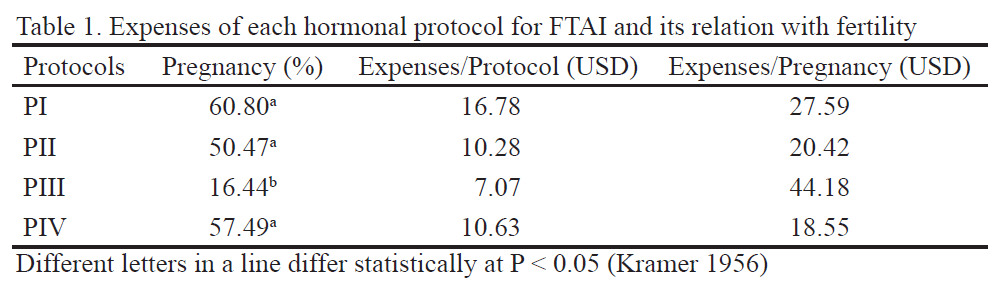
<p align="justify"><font size="2" face="Verdana, Arial, Helvetica, sans-serif">As <a href="/img/revistas/cjas/v49n3/t0107315.gif">table 1</a> shows, the  protocols that did not use eCG (P2, P3 and P4) as stimulant of follicular  development showed the lowest expenses per animal, regarding the group that  included this hormone (P1). Similar results were found by Noguera <em>et al.</em> (2013), after comparing the expenses of Ovsynch&reg; (9.50 USD) and Cl-Synch (19.33  USD) therapies with a protocol that used and intravaginal sponge of synthetic  P4 (Pregna-Heat-E&reg;, VIATECA), BE2 (2,0mg), eCG&nbsp;  (400 IU, Folligon&reg;) and GnRH (0.0084 mg Buserelin Acetate, Conceptal&reg;)  in nulliparous female buffaloes during the season of higher ovarian activity  (43.13 USD), without finding differences regarding the pregnancy percentage at  fixed-time artificial insemination. However, the lowest expenses per gestation  were shown by the protocol that associated PGF2alpha and GnRH (PIV) hormones. </font></p>     
<p align="justify"><font size="2" face="Verdana, Arial, Helvetica, sans-serif">Unlike bovines, most of hormonal therapies in buffaloes  synchronize the wave of follicular development and estrum, and ovulation, due  to the variations in process duration. In this sense, other input are needed,  which make therapies more expensive and limit technology implementation.  However, during the favorable season for reproduction, expenses can decrease  because it is possible to use protocols that do not use hormones (eCG) to  stimulate the follicular development (Baruselli and Carvalho 2005). </font></p>     <p align="justify"><font size="2" face="Verdana, Arial, Helvetica, sans-serif">It was demonstrated that  pregnancy rates in P1    (60.8 %), P2 (50.3 %) and P4 (57.3 %) were superior    (P &lt; 0.05) to P3 (16.0 %). There was no influence of eCG on the increase or  reduction of fertility. In the protocol with double doses of PGF2&alpha; and CE,  fertility decreases, and it increases when the estradiol is substituted by  GnRH. It was evident that the protocol with the most reduced cost (P3) had  lower percentage and higher expenses per gestation, regarding the rest of the  therapies. However, P1 and P2 showed a fertility that did not differ from P4,  although with expenses to obtain a gestation superior to this last group (<a href="/img/revistas/cjas/v49n3/t0107315.gif">table  1</a>), which is an aspect that classified it as the most efficient treatment. It  can be concluded that protocols 1, 2 and 3 synchronize with the estrum and  ovulation with a good pregnancy percentage. It is also possible to apply the  FTAI for increasing birth rate in buffalo herds, with economical benefits.&nbsp; </font></p>     
<p align="justify">&nbsp;</p>     ]]></body>
<body><![CDATA[<p align="justify"><strong><font size="3" face="Verdana, Arial, Helvetica, sans-serif">ACKNOWLEDGEMENTS </font></strong></p>     <p align="justify"><font size="2" face="Verdana, Arial, Helvetica, sans-serif">Thanks to the Coordinaci&oacute;n de Perfeccionamiento para la  Educaci&oacute;n Superior of the&nbsp;&nbsp; Brazil  Republic (CAPES) for the financing (Project 96/2010) to perform this study.</font></p>     <p align="justify">&nbsp;</p>     <p align="justify"><font size="3" face="Verdana, Arial, Helvetica, sans-serif"><strong>REFERENCES</strong></font></p>     <p align="justify"><font size="2" face="Verdana, Arial, Helvetica, sans-serif">Baruselli, P. S. &amp;  Carvalho, N. A. T. 2005. &lsquo;&lsquo;Controle  do desenvolvimiento folicular para emprego de biotecnologias da reprodu&ccedil;&atilde;o em  bubalinos (<em>Bubalus bubalis</em>)&rsquo;&rsquo;. <em>Revista Brasileira de Reprodu&ccedil;&atilde;o  Animal</em>, 27: 102.</font></p>     <p align="justify"><font size="2" face="Verdana, Arial, Helvetica, sans-serif">B&oacute;, G. A., Cutaia, L., Peres, L. C., Pincinato, D.,  Mora&ntilde;a, D. &amp; Baruselli, P. S. 2007. &lsquo;&lsquo;Technologies  for Fixed-Time artificial insemination and their influence on reproductive  performance of <em>Bos indicus</em> catle&rsquo;&rsquo;. In: <em>Reproduction in Domestic  Ruminants VI</em>, Nottinghan niversity Press, pp. 223&ndash;236.</font></p>     <p align="justify"><font size="2" face="Verdana, Arial, Helvetica, sans-serif">Crudeli, G., Pellerano, G., Fontana, S., Amuchastegui,  F. &amp; Molinari, F. 2005. &lsquo;&lsquo;Inseminaci&oacute;n artificial a tiempo fijo en la  b&uacute;fala. Comparaci&oacute;n de diferentes dosis de cipionato de estradiol versus  protocolo Ovsynch&rsquo;&rsquo;. In: <em>I Congreso Europeo&ndash;Americano de B&uacute;falos</em>,  Salerno, Italia.</font></p>     <p align="justify"><font size="2" face="Verdana, Arial, Helvetica, sans-serif">Das, G. K. &amp; Khan, F. A. 2010. &lsquo;&lsquo;Summer Anoestrus in Buffalo &ndash; A Review&rsquo;&rsquo;. <em>Reprod Dom Anim</em>, 45:  494.</font></p>     <p align="justify"><font size="2" face="Verdana, Arial, Helvetica, sans-serif">de Rensis, F. &amp;  Lopez-Gatius, F. 2007. &lsquo;&lsquo;Protocols for synchronizing estrus and ovulation in  buffalo (Bubalus bubalis): a review&rsquo;&rsquo;. <em>Theriogenology</em>, 67: 216.</font></p>     <p align="justify"><font size="2" face="Verdana, Arial, Helvetica, sans-serif">El-Wishy, A. B. 2007. &lsquo;&lsquo;The  postpartum buffalo: I. Endocrinological changes and uterine involution&rsquo;&rsquo;. <em>Anim.  Reprod. Sci.</em>, 97: 215.</font></p>     ]]></body>
<body><![CDATA[<!-- ref --><p align="justify"><font size="2" face="Verdana, Arial, Helvetica, sans-serif">Hafez, E. 1995. <em>Reprodu&ccedil;&atilde;o  animal: Comportamento Reprodutivo</em>. 6th ed., S&atilde;o Paulo: Manole, 581 p.    </font></p>     <p align="justify"><font size="2" face="Verdana, Arial, Helvetica, sans-serif">Kapa, S. &amp; Alapati, A.  2013. &lsquo;&lsquo;Body Condition Score (BCS) system in Murrah buffaloes&rsquo;&rsquo;. <em>Buffalo  Bulletin</em>, 32: 1298.</font></p>     <p align="justify"><font size="2" face="Verdana, Arial, Helvetica, sans-serif">Kramer, C. Y. 1956.  &lsquo;&lsquo;Extension of multiple range tests to group means with unequal numbers of  replications&rsquo;&rsquo;. <em>Biometrics</em>, 12: 307.</font></p>     <p align="justify"><font size="2" face="Verdana, Arial, Helvetica, sans-serif">Marques, M. O., Sa Filho, M. F., Gimenes, L. U.,  Figueiredo, T. B., S&oacute;ria, G. F. &amp; Baruselli, P. S. 2005. &lsquo;&lsquo;Efeito do  tratamento com PGF2&alpha; na inser&ccedil;&atilde;oe/ou tratamento com eCG na remo&ccedil;&atilde;o do  dispositivo intravaginal de progesterona na taxa de concep&ccedil;&atilde;o &aacute; insemina&ccedil;&atilde;o  artificial em tempo fixo em novilhas nelore&rsquo;&rsquo;. <em>Acta Sci.  Vet.</em>, 33: 287.</font></p>     <p align="justify"><font size="2" face="Verdana, Arial, Helvetica, sans-serif">Mishra, V., Mishra, A. K.  &amp; Sharma, R. 2007. &lsquo;&lsquo;Effect of ambient temperature on <em>in vitro</em> fertilization of <em>Bubaline oocyte</em>&rsquo;&rsquo;. <em>Anim. Reprod. Sci.</em>, 100: 384.</font></p>     <p align="justify"><font size="2" face="Verdana, Arial, Helvetica, sans-serif">Mohan, K. &amp; Prakash, B. S.  2010. &lsquo;&lsquo;Changes in endogenous estrogens and expression of behaviors associated  with estrus during the periovulatory period in Heatsynch treated Murrah  buffaloes (<em>Bubalus bubalis</em>)&rsquo;&rsquo;. <em>Trop. Anim. Health Prod.</em>, 42: 952.</font></p>     <p align="justify"><font size="2" face="Verdana, Arial, Helvetica, sans-serif">Noguera, S. E., Vale, W. G.,  Ribeiro, H. F. L., Rolim Filho, S. T., Reis, A. N., Sousa, J. S. &amp; Silva,  A. O. 2013. &lsquo;&lsquo;Fixed-time artificial insemination in cows and buffaloes using an  intravaginal releasing progesterone insert&rsquo;&rsquo;. <em>Livestock Research for Rural  Development</em>, 25: 247.</font></p>     <!-- ref --><p align="justify"><font size="2" face="Verdana, Arial, Helvetica, sans-serif">Ohashi, O. M. 2003. <em>Contribui&ccedil;&atilde;o  ao estudo dos bubalinos. Per&iacute;odos de 1972-2001</em>. , Palestras.    </font></p>     ]]></body>
<body><![CDATA[<p align="justify"><font size="2" face="Verdana, Arial, Helvetica, sans-serif">Porto Filho, R., Gimenes, L., Monteiro, B., Carvalho,  N., Ghuman, S., Madureira, E. &amp; Baruselli, P. 2014. &lsquo;&lsquo;Detection of estrous behavior in buffalo heifers byradiotelemetry  following PGF2&alpha; administration during theearly or late luteal phase&rsquo;&rsquo;. <em>Animal Rep. Sci.</em>, 144: 94.</font></p>     <p align="justify"><font size="2" face="Verdana, Arial, Helvetica, sans-serif">Presicce, G. A., Bella, A., Terzano, G. M., De Santis,  G. &amp; Senatore, E. M. 2005. &lsquo;&lsquo;Postpartum ovarian  follicular dynamics in primiparous and pluriparous Mediterranean Italian  buffaloes (<em>Bubalus bubalis</em>)&rsquo;&rsquo;. <em>Theriogenology</em>, 63: 1439.</font></p>     <p align="justify"><font size="2" face="Verdana, Arial, Helvetica, sans-serif">SAS 2013. <em>SAS User&rsquo;s guide:  Statistics</em>. version 9.3, N.C., USA: SAS Institute Inc.</font></p>     <p align="justify"><font size="2" face="Verdana, Arial, Helvetica, sans-serif">Wolfinger, R. &amp; O&rsquo;Connell, M. 1993. &lsquo;&lsquo;Generalized linear models: a  pseudo-likelihood approach&rsquo;&rsquo;. <em>J. Statist. Computo Simul.</em>, 48: 243.</font></p>     <p align="justify">&nbsp;</p>     <p align="justify">&nbsp;</p>     <p align="justify"><font size="2" face="Verdana, Arial, Helvetica, sans-serif">Received: September 25, 2014    <br> Accepted: April 1, 2015</font></p>     <p align="justify">&nbsp;</p>     <p align="justify">&nbsp;</p>     ]]></body>
<body><![CDATA[<p align="justify"><font size="2" face="Verdana, Arial, Helvetica, sans-serif"><i>C. Gallego,</i> Instituto de Ciencia Animal, Apartado Postal 24, San José de las Lajas, Mayabeque, Cuba.    Email: <a href="mailto:cgallego@ica.co.cu">cgallego@ica.co.cu</a></font></p>      ]]></body><back>
<ref-list>
<ref id="B1">
<nlm-citation citation-type="journal">
<person-group person-group-type="author">
<name>
<surname><![CDATA[Baruselli]]></surname>
<given-names><![CDATA[P. S.]]></given-names>
</name>
<name>
<surname><![CDATA[Carvalho]]></surname>
<given-names><![CDATA[N. A. T.]]></given-names>
</name>
</person-group>
<article-title xml:lang="nd"><![CDATA[Controle do desenvolvimiento folicular para emprego de biotecnologias da reprodução em bubalinos (Bubalus bubalis)]]></article-title>
<source><![CDATA[Revista Brasileira de Reprodução Animal]]></source>
<year>2005</year>
<volume>27</volume>
<page-range>102</page-range></nlm-citation>
</ref>
<ref id="B2">
<nlm-citation citation-type="book">
<person-group person-group-type="author">
<name>
<surname><![CDATA[Bó]]></surname>
<given-names><![CDATA[G. A.]]></given-names>
</name>
<name>
<surname><![CDATA[Cutaia]]></surname>
<given-names><![CDATA[L.]]></given-names>
</name>
<name>
<surname><![CDATA[Peres]]></surname>
<given-names><![CDATA[L. C.]]></given-names>
</name>
<name>
<surname><![CDATA[Pincinato]]></surname>
<given-names><![CDATA[D.]]></given-names>
</name>
<name>
<surname><![CDATA[Moraña]]></surname>
<given-names><![CDATA[D.]]></given-names>
</name>
<name>
<surname><![CDATA[Baruselli]]></surname>
<given-names><![CDATA[P. S.]]></given-names>
</name>
</person-group>
<article-title xml:lang="nd"><![CDATA[Technologies for Fixed-Time artificial insemination and their influence on reproductive performance of Bos indicus catle]]></article-title>
<source><![CDATA[Reproduction in Domestic Ruminants VI]]></source>
<year>2007</year>
<page-range>223-236</page-range><publisher-name><![CDATA[Nottinghan niversity Press]]></publisher-name>
</nlm-citation>
</ref>
<ref id="B3">
<nlm-citation citation-type="">
<person-group person-group-type="author">
<name>
<surname><![CDATA[Crudeli]]></surname>
<given-names><![CDATA[G.]]></given-names>
</name>
<name>
<surname><![CDATA[Pellerano]]></surname>
<given-names><![CDATA[G.]]></given-names>
</name>
<name>
<surname><![CDATA[Fontana]]></surname>
<given-names><![CDATA[S.]]></given-names>
</name>
<name>
<surname><![CDATA[Amuchastegui]]></surname>
<given-names><![CDATA[F.]]></given-names>
</name>
<name>
<surname><![CDATA[Molinari]]></surname>
<given-names><![CDATA[F.]]></given-names>
</name>
</person-group>
<article-title xml:lang="nd"><![CDATA[Inseminación artificial a tiempo fijo en la búfala. Comparación de diferentes dosis de cipionato de estradiol versus protocolo Ovsynch]]></article-title>
<source><![CDATA[]]></source>
<year>2005</year>
<publisher-loc><![CDATA[Salerno, Italia ]]></publisher-loc>
</nlm-citation>
</ref>
<ref id="B4">
<nlm-citation citation-type="journal">
<person-group person-group-type="author">
<name>
<surname><![CDATA[Das]]></surname>
<given-names><![CDATA[G. K.]]></given-names>
</name>
<name>
<surname><![CDATA[Khan]]></surname>
<given-names><![CDATA[F. A.]]></given-names>
</name>
</person-group>
<article-title xml:lang="nd"><![CDATA[Summer Anoestrus in Buffalo - A Review]]></article-title>
<source><![CDATA[Reprod Dom Anim]]></source>
<year>2010</year>
<volume>45</volume>
<page-range>494</page-range></nlm-citation>
</ref>
<ref id="B5">
<nlm-citation citation-type="journal">
<person-group person-group-type="author">
<name>
<surname><![CDATA[de Rensis]]></surname>
<given-names><![CDATA[F.]]></given-names>
</name>
<name>
<surname><![CDATA[Lopez-Gatius]]></surname>
<given-names><![CDATA[F.]]></given-names>
</name>
</person-group>
<article-title xml:lang="nd"><![CDATA[Protocols for synchronizing estrus and ovulation in buffalo (Bubalus bubalis): a review]]></article-title>
<source><![CDATA[Theriogenology]]></source>
<year>2007</year>
<volume>67</volume>
<page-range>216</page-range></nlm-citation>
</ref>
<ref id="B6">
<nlm-citation citation-type="journal">
<person-group person-group-type="author">
<name>
<surname><![CDATA[El-Wishy]]></surname>
<given-names><![CDATA[A. B.]]></given-names>
</name>
</person-group>
<article-title xml:lang="nd"><![CDATA[The postpartum buffalo: I. Endocrinological changes and uterine involution]]></article-title>
<source><![CDATA[Anim. Reprod. Sci.]]></source>
<year>2007</year>
<volume>97</volume>
<page-range>215</page-range></nlm-citation>
</ref>
<ref id="B7">
<nlm-citation citation-type="book">
<person-group person-group-type="author">
<name>
<surname><![CDATA[Hafez]]></surname>
<given-names><![CDATA[E.]]></given-names>
</name>
</person-group>
<source><![CDATA[Reprodução animal: Comportamento Reprodutivo]]></source>
<year>1995</year>
<edition>6th</edition>
<page-range>581</page-range><publisher-loc><![CDATA[São Paulo ]]></publisher-loc>
<publisher-name><![CDATA[Manole]]></publisher-name>
</nlm-citation>
</ref>
<ref id="B8">
<nlm-citation citation-type="journal">
<person-group person-group-type="author">
<name>
<surname><![CDATA[Kapa]]></surname>
<given-names><![CDATA[S.]]></given-names>
</name>
<name>
<surname><![CDATA[Alapati]]></surname>
<given-names><![CDATA[A.]]></given-names>
</name>
</person-group>
<article-title xml:lang="nd"><![CDATA[Body Condition Score (BCS) system in Murrah buffaloes]]></article-title>
<source><![CDATA[Buffalo Bulletin]]></source>
<year>2013</year>
<volume>32</volume>
<page-range>1298</page-range></nlm-citation>
</ref>
<ref id="B9">
<nlm-citation citation-type="journal">
<person-group person-group-type="author">
<name>
<surname><![CDATA[Kramer]]></surname>
<given-names><![CDATA[C. Y.]]></given-names>
</name>
</person-group>
<article-title xml:lang="nd"><![CDATA[Extension of multiple range tests to group means with unequal numbers of replications]]></article-title>
<source><![CDATA[Biometrics]]></source>
<year>1956</year>
<volume>12</volume>
<page-range>307</page-range></nlm-citation>
</ref>
<ref id="B10">
<nlm-citation citation-type="journal">
<person-group person-group-type="author">
<name>
<surname><![CDATA[Marques]]></surname>
<given-names><![CDATA[M. O.]]></given-names>
</name>
<name>
<surname><![CDATA[Sa Filho]]></surname>
<given-names><![CDATA[M. F.]]></given-names>
</name>
<name>
<surname><![CDATA[Gimenes]]></surname>
<given-names><![CDATA[L. U.]]></given-names>
</name>
<name>
<surname><![CDATA[Figueiredo]]></surname>
<given-names><![CDATA[T. B.]]></given-names>
</name>
<name>
<surname><![CDATA[Sória]]></surname>
<given-names><![CDATA[G. F.]]></given-names>
</name>
<name>
<surname><![CDATA[Baruselli]]></surname>
<given-names><![CDATA[P. S.]]></given-names>
</name>
</person-group>
<article-title xml:lang="nd"><![CDATA[Efeito do tratamento com PGF2a na inserçãoe/ou tratamento com eCG na remoção do dispositivo intravaginal de progesterona na taxa de concepção á inseminação artificial em tempo fixo em novilhas nelore]]></article-title>
<source><![CDATA[Acta Sci. Vet.]]></source>
<year>2005</year>
<volume>33</volume>
<page-range>287</page-range></nlm-citation>
</ref>
<ref id="B11">
<nlm-citation citation-type="journal">
<person-group person-group-type="author">
<name>
<surname><![CDATA[Mishra]]></surname>
<given-names><![CDATA[V.]]></given-names>
</name>
<name>
<surname><![CDATA[Mishra]]></surname>
<given-names><![CDATA[A. K.]]></given-names>
</name>
<name>
<surname><![CDATA[Sharma]]></surname>
<given-names><![CDATA[R.]]></given-names>
</name>
</person-group>
<article-title xml:lang="nd"><![CDATA[Effect of ambient temperature on in vitro fertilization of Bubaline oocyte]]></article-title>
<source><![CDATA[Anim. Reprod. Sci.]]></source>
<year>2007</year>
<volume>100</volume>
<page-range>384</page-range></nlm-citation>
</ref>
<ref id="B12">
<nlm-citation citation-type="journal">
<person-group person-group-type="author">
<name>
<surname><![CDATA[Mohan]]></surname>
<given-names><![CDATA[K.]]></given-names>
</name>
<name>
<surname><![CDATA[Prakash]]></surname>
<given-names><![CDATA[B. S.]]></given-names>
</name>
</person-group>
<article-title xml:lang="nd"><![CDATA[Changes in endogenous estrogens and expression of behaviors associated with estrus during the periovulatory period in Heatsynch treated Murrah buffaloes (Bubalus bubalis)]]></article-title>
<source><![CDATA[Trop. Anim. Health Prod.]]></source>
<year>2010</year>
<volume>42</volume>
<page-range>952</page-range></nlm-citation>
</ref>
<ref id="B13">
<nlm-citation citation-type="journal">
<person-group person-group-type="author">
<name>
<surname><![CDATA[Noguera]]></surname>
<given-names><![CDATA[S. E.]]></given-names>
</name>
<name>
<surname><![CDATA[Vale]]></surname>
<given-names><![CDATA[W. G.]]></given-names>
</name>
<name>
<surname><![CDATA[Ribeiro]]></surname>
<given-names><![CDATA[H. F. L.]]></given-names>
</name>
<name>
<surname><![CDATA[Rolim Filho]]></surname>
<given-names><![CDATA[S. T.]]></given-names>
</name>
<name>
<surname><![CDATA[Reis]]></surname>
<given-names><![CDATA[A. N.]]></given-names>
</name>
<name>
<surname><![CDATA[Sousa]]></surname>
<given-names><![CDATA[J. S.]]></given-names>
</name>
<name>
<surname><![CDATA[Silva]]></surname>
<given-names><![CDATA[A. O.]]></given-names>
</name>
</person-group>
<article-title xml:lang="nd"><![CDATA[Fixed-time artificial insemination in cows and buffaloes using an intravaginal releasing progesterone insert]]></article-title>
<source><![CDATA[Livestock Research for Rural Development]]></source>
<year>2013</year>
<volume>25</volume>
<page-range>247</page-range></nlm-citation>
</ref>
<ref id="B14">
<nlm-citation citation-type="">
<person-group person-group-type="author">
<name>
<surname><![CDATA[Ohashi]]></surname>
<given-names><![CDATA[O. M.]]></given-names>
</name>
</person-group>
<source><![CDATA[Contribuição ao estudo dos bubalinos. Períodos de 1972-2001]]></source>
<year>2003</year>
</nlm-citation>
</ref>
<ref id="B15">
<nlm-citation citation-type="journal">
<person-group person-group-type="author">
<name>
<surname><![CDATA[Porto Filho]]></surname>
<given-names><![CDATA[R.]]></given-names>
</name>
<name>
<surname><![CDATA[Gimenes]]></surname>
<given-names><![CDATA[L.]]></given-names>
</name>
<name>
<surname><![CDATA[Monteiro]]></surname>
<given-names><![CDATA[B.]]></given-names>
</name>
<name>
<surname><![CDATA[Carvalho]]></surname>
<given-names><![CDATA[N.]]></given-names>
</name>
<name>
<surname><![CDATA[Ghuman]]></surname>
<given-names><![CDATA[S.]]></given-names>
</name>
<name>
<surname><![CDATA[Madureira]]></surname>
<given-names><![CDATA[E.]]></given-names>
</name>
<name>
<surname><![CDATA[Baruselli]]></surname>
<given-names><![CDATA[P.]]></given-names>
</name>
</person-group>
<article-title xml:lang="nd"><![CDATA[Detection of estrous behavior in buffalo heifers byradiotelemetry following PGF2a administration during theearly or late luteal phase]]></article-title>
<source><![CDATA[Animal Rep. Sci.]]></source>
<year>2014</year>
<volume>144</volume>
<page-range>94</page-range></nlm-citation>
</ref>
<ref id="B16">
<nlm-citation citation-type="journal">
<person-group person-group-type="author">
<name>
<surname><![CDATA[Presicce]]></surname>
<given-names><![CDATA[G. A.]]></given-names>
</name>
<name>
<surname><![CDATA[Bella]]></surname>
<given-names><![CDATA[A.]]></given-names>
</name>
<name>
<surname><![CDATA[Terzano]]></surname>
<given-names><![CDATA[G. M.]]></given-names>
</name>
<name>
<surname><![CDATA[De Santis]]></surname>
<given-names><![CDATA[G.]]></given-names>
</name>
<name>
<surname><![CDATA[Senatore]]></surname>
<given-names><![CDATA[E. M.]]></given-names>
</name>
</person-group>
<article-title xml:lang="nd"><![CDATA[Postpartum ovarian follicular dynamics in primiparous and pluriparous Mediterranean Italian buffaloes (Bubalus bubalis)]]></article-title>
<source><![CDATA[Theriogenology]]></source>
<year>2005</year>
<volume>63</volume>
<page-range>1439</page-range></nlm-citation>
</ref>
<ref id="B17">
<nlm-citation citation-type="book">
<person-group person-group-type="author">
<name>
<surname><![CDATA[SAS]]></surname>
</name>
</person-group>
<source><![CDATA[SAS User’s guide: Statistics]]></source>
<year>2013</year>
<publisher-loc><![CDATA[N.C., USA ]]></publisher-loc>
<publisher-name><![CDATA[SAS Institute Inc.]]></publisher-name>
</nlm-citation>
</ref>
<ref id="B18">
<nlm-citation citation-type="journal">
<person-group person-group-type="author">
<name>
<surname><![CDATA[Wolfinger]]></surname>
<given-names><![CDATA[R.]]></given-names>
</name>
<name>
<surname><![CDATA[O’Connell]]></surname>
<given-names><![CDATA[M.]]></given-names>
</name>
</person-group>
<article-title xml:lang="nd"><![CDATA[Generalized linear models: a pseudo-likelihood approach]]></article-title>
<source><![CDATA[J. Statist. Computo Simul.]]></source>
<year>1993</year>
<volume>48</volume>
<page-range>243</page-range></nlm-citation>
</ref>
</ref-list>
</back>
</article>