<?xml version="1.0" encoding="ISO-8859-1"?><article xmlns:mml="http://www.w3.org/1998/Math/MathML" xmlns:xlink="http://www.w3.org/1999/xlink" xmlns:xsi="http://www.w3.org/2001/XMLSchema-instance">
<front>
<journal-meta>
<journal-id>2079-3480</journal-id>
<journal-title><![CDATA[Cuban Journal of Agricultural Science]]></journal-title>
<abbrev-journal-title><![CDATA[Cuban J. Agric. Sci.]]></abbrev-journal-title>
<issn>2079-3480</issn>
<publisher>
<publisher-name><![CDATA[Editorial del Instituto de Ciencia Animal]]></publisher-name>
</publisher>
</journal-meta>
<article-meta>
<article-id>S2079-34802015000300009</article-id>
<title-group>
<article-title xml:lang="en"><![CDATA[Productive indicators of lambs in native grasslands, supplemented with Acacia cochliacantha, in the dry tropic of Guerrero, Mexico]]></article-title>
<article-title xml:lang="es"><![CDATA[Indicadores productivos de corderos en praderas nativas, suplementados con Acacia cochliacantha, en el trópico seco de Guerrero, México]]></article-title>
</title-group>
<contrib-group>
<contrib contrib-type="author">
<name>
<surname><![CDATA[Mireles]]></surname>
<given-names><![CDATA[E.J]]></given-names>
</name>
<xref ref-type="aff" rid="A01"/>
</contrib>
<contrib contrib-type="author">
<name>
<surname><![CDATA[Rodríguez]]></surname>
<given-names><![CDATA[D]]></given-names>
</name>
<xref ref-type="aff" rid="A02"/>
</contrib>
<contrib contrib-type="author">
<name>
<surname><![CDATA[Jordán]]></surname>
<given-names><![CDATA[H]]></given-names>
</name>
<xref ref-type="aff" rid="A02"/>
</contrib>
<contrib contrib-type="author">
<name>
<surname><![CDATA[Ramírez]]></surname>
<given-names><![CDATA[Aurora H]]></given-names>
</name>
<xref ref-type="aff" rid="A03"/>
</contrib>
<contrib contrib-type="author">
<name>
<surname><![CDATA[García]]></surname>
<given-names><![CDATA[Águeda]]></given-names>
</name>
<xref ref-type="aff" rid="A03"/>
</contrib>
<contrib contrib-type="author">
<name>
<surname><![CDATA[Gutiérrez]]></surname>
<given-names><![CDATA[I]]></given-names>
</name>
<xref ref-type="aff" rid="A01"/>
</contrib>
</contrib-group>
<aff id="A01">
<institution><![CDATA[,Universidad Autónoma de Guerrero Unidad Académica de Medicina Veterinaria y Zootecnia ]]></institution>
<addr-line><![CDATA[ ]]></addr-line>
<country>México</country>
</aff>
<aff id="A02">
<institution><![CDATA[,Instituto de Ciencia Animal Departamento de Rumiantes ]]></institution>
<addr-line><![CDATA[San José de las Lajas ]]></addr-line>
<country>Cuba</country>
</aff>
<aff id="A03">
<institution><![CDATA[,Universidad Nacional Autónoma de México Facultad de Medicina Veterinaria y Zootecnia Departamento de Nutrición Animal y Bioquímica]]></institution>
<addr-line><![CDATA[ ]]></addr-line>
</aff>
<pub-date pub-type="pub">
<day>00</day>
<month>09</month>
<year>2015</year>
</pub-date>
<pub-date pub-type="epub">
<day>00</day>
<month>09</month>
<year>2015</year>
</pub-date>
<volume>49</volume>
<numero>3</numero>
<fpage>339</fpage>
<lpage>348</lpage>
<copyright-statement/>
<copyright-year/>
<self-uri xlink:href="http://scielo.sld.cu/scielo.php?script=sci_arttext&amp;pid=S2079-34802015000300009&amp;lng=en&amp;nrm=iso"></self-uri><self-uri xlink:href="http://scielo.sld.cu/scielo.php?script=sci_abstract&amp;pid=S2079-34802015000300009&amp;lng=en&amp;nrm=iso"></self-uri><self-uri xlink:href="http://scielo.sld.cu/scielo.php?script=sci_pdf&amp;pid=S2079-34802015000300009&amp;lng=en&amp;nrm=iso"></self-uri><abstract abstract-type="short" xml:lang="en"><p><![CDATA[In order to quantify some productive indicators and the botanical composition of diets for lambs, supplemented with ground and whole pods of Acacia cochliacantha, related to the requirements of dry matter intake, 60 Pelibuey-Black Belly x Dorper-Katadhin lambs were used, with 20.4 ± 2.1 kg of LW, divided by a completely at random experimental design, with six treatments. During the dry period, the treatments were: grazing (Pas), grazing plus 15 % of supplementation with ground pods (Pas 15), and grazing plus 30 % of supplementation with ground pods (Pas 30) for 105 d. During the rainy period, the treatments were: grazing (Past), grazing plus 30 % of ground pods (Past 30M), and grazing plus 30 % of whole pods (Past 30E) for 84 d. The daily weight gain was determined every 21 d. At the end of this study, six animals of each group were slaughter to determine hot carcass yield, and register the weight of some viscera, and pericardial and perirenal fat. The analysis of variance and the test of Duncan (P < 0.05) were applied to the data. During the dry period, the daily weight gain was 68, 59 and 63 g, and the hot carcass yield was 37.09, 37.85 and 39.10 % for grazing, grazing plus 15 % of supplementation with ground pods, and grazing plus 30 % of supplementation with ground pods, respectively. During the rainy period, the gain was 120, 105, and 113 g, and the yield was 40.51, 42.02 and 40.10 % for grazing, grazing plus 30 % of supplementation with ground pods, and grazing plus 30 % of supplementation with whole pods, respectively. It can be concluded that the botanical composition of the diets for lambs was similar during both seasons. Irrigated native grasslands produced less daily weight gain and hot carcass yield during the dry season than during the rainy period. The supplementation with ground or whole pods of Acacia cochliacantha had no influence on the studied indicators]]></p></abstract>
<abstract abstract-type="short" xml:lang="es"><p><![CDATA[Para cuantificar algunos indicadores productivos y la composición botánica de la dieta de corderos que pastaron, suplementados con diferentes porcentajes de vaina molida y entera de Acacia cochliacantha, en relación con los requerimientos de ingestión de materia seca, se utilizaron 60 corderos, de 20.4 ± 2.1 kg de PV, de raza Pelibuey-Black Belly x Dorper-Katadhin, divididos en diseño completamente al azar. En el período seco se aplicaron los tratamientos: pastoreo (Pas); pastoreo y 15 % de suplementación con vaina molida (Pas 15) y pastoreo más 30 % de suplementación con vaina molida (pas 30) durante 105 d en el período seco, pastoreo(Past); pastoreo más 30 % de vaina molida (Past 30M) y pastoreo más 30 % de vaina entera (past 30E) durante 84 d en el período lluvioso. Se determinó, cada 21 d, la ganancia diaria de peso. Al final del trabajo, seis animales de cada grupo se sacrificaron para determinar el rendimiento en canal caliente y registrar los pesos de algunas vísceras y de la grasa pericárdica y perirenal. Los datos se sometieron a análisis de varianza y a la prueba de Duncan (P< 0.05). Para el período seco, la ganancia diaria de peso fue de 68, 59 y 63 g, y el rendimiento en canal caliente de 37.09, 37.85 y 39.10 % en pastoreo, pastoreo más 15 % de vaina molida y pastoreo con 30 % de vaina molida, respectivamente. Para el lluvioso, la ganancia fue de 120, 105, 113 g, y el rendimiento de 40.51, 42.02 y 40.10 % en pastoreo, pastoreo más 30 % de vaina molida y pastoreo más 30 % de vaina entera, respectivamente. Se concluye que la composición botánica de la dieta de los corderos fue similar en los períodos seco y lluvioso. Las praderas nativas irrigadas produjeron menor ganancia diaria de peso y rendimiento en canal caliente en el período seco con respecto al lluvioso. La suplementación con vainas molidas o enteras de A. cochliacantha no influyó en los indicadores estudiados]]></p></abstract>
<kwd-group>
<kwd lng="en"><![CDATA[lambs]]></kwd>
<kwd lng="en"><![CDATA[native grasslands]]></kwd>
<kwd lng="en"><![CDATA[productive indicators]]></kwd>
<kwd lng="es"><![CDATA[corderos]]></kwd>
<kwd lng="es"><![CDATA[praderas nativas]]></kwd>
<kwd lng="es"><![CDATA[indicadores productivos]]></kwd>
</kwd-group>
</article-meta>
</front><body><![CDATA[ <p align="right"><font size="2" face="Verdana, Arial, Helvetica,   sans-serif"><b>ORIGINAL ARTICLE</b></font></p>     <p>&nbsp;</p>     <p align="justify"><font size="4" face="Verdana, Arial, Helvetica, sans-serif"><b>Productive indicators of lambs in native grasslands, supplemented with <em>Acacia cochliacantha</em>, in the dry tropic of Guerrero, Mexico</b></font></p>     <p align="justify">&nbsp;</p>     <p align="justify"><font size="3" face="Verdana, Arial, Helvetica, sans-serif"><b>Indicadores productivos de corderos en praderas nativas, suplementados con <em>Acacia cochliacantha</em>, en el trópico seco de Guerrero, México</b></font></p>     <p align="justify">&nbsp;</p>     <p align="justify">&nbsp;</p>     <p align="justify"><font size="2" face="Verdana, Arial, Helvetica, sans-serif"><b>E.J. Mireles,</b><sup><b>I</b></sup><b> D. Rodríguez,</b><sup><b>II</b></sup><b> H. Jordán ,</b><sup><b>II</b></sup><b> Aurora H. Ramírez,</b><sup><b>III</b></sup><b> Águeda García,</b><sup><b>III</b></sup><b> I. Gutiérrez,</b><sup><b>I</b></sup></font></p>     <p align="justify"><font size="2" face="Verdana, Arial, Helvetica, sans-serif"><sup>I</sup>Unidad Académica de Medicina Veterinaria y Zootecnia de la Universidad Autónoma de Guerrero, México. km 2.5.    Carretera Cd. Altamirano-Iguala Cd Altamirano Gro. CP 40660.    <br>   </font><font size="2" face="Verdana, Arial, Helvetica, sans-serif"><sup>II</sup>Departamento de Rumiantes, Instituto de Ciencia Animal, Apartado Postal 24, San José de las Lajas, Cuba.</font><font size="2" face="Verdana, Arial, Helvetica, sans-serif"><sup>    ]]></body>
<body><![CDATA[<br>   III</sup>Departamento de Nutrición Animal y Bioquímica, Facultad de Medicina Veterinaria y Zootecnia, Universidad    Nacional  Autónoma de México.</font></p>     <p align="justify">&nbsp;</p>     <p align="justify">&nbsp;</p> <hr align="JUSTIFY">     <p align="justify"><font size="2" face="Verdana, Arial, Helvetica, sans-serif"><b>ABSTRACT</b></font></p>     <p align="justify"><font size="2" face="Verdana, Arial, Helvetica, sans-serif">In order to quantify some productive indicators and  the botanical composition of diets for lambs, supplemented with ground and whole  pods of <em>Acacia cochliacantha</em>, related to the requirements of dry matter  intake, 60 Pelibuey-Black Belly x Dorper-Katadhin lambs were used, with 20.4 &plusmn;  2.1 kg of LW, divided by a completely at random experimental design, with six  treatments. During the dry period, the treatments were: grazing (Pas), grazing  plus 15 % of supplementation with ground pods (Pas 15), and grazing plus  30 % of supplementation with ground pods (Pas 30) for 105 d. During the rainy  period, the treatments were: grazing (Past), grazing plus  30 % of ground pods (Past 30M), and grazing plus 30 % of whole pods (Past 30E)  for 84 d. The daily weight gain was determined every 21 d. At the end of this  study, six animals of each group were slaughter to determine hot carcass yield,  and register the weight of some viscera, and pericardial and perirenal  fat.&nbsp; The analysis of variance and the  test of Duncan (P &lt; 0.05) were applied to the data. During the dry period,  the daily weight gain was 68, 59 and 63 g, and the hot carcass yield was 37.09,  37.85 and 39.10 % for grazing, grazing plus 15 % of supplementation with ground  pods, and grazing plus 30 % of supplementation with ground pods, respectively.  During the rainy period, the gain was 120, 105, and 113 g, and the yield was  40.51, 42.02 and 40.10 % for grazing, grazing plus 30 % of supplementation with  ground pods, and grazing plus 30 % of supplementation with whole pods,  respectively. It can be concluded that the botanical composition of the diets  for lambs was similar during both seasons. Irrigated native grasslands produced  less daily weight gain and hot carcass yield during the dry season than during  the rainy period. The supplementation with ground or whole pods of <em>Acacia  cochliacantha</em> had no influence on the studied indicators.</font></p>     <p align="justify"><font size="2" face="Verdana, Arial, Helvetica, sans-serif"><b>Key words:</b> lambs, native grasslands, productive indicators.</font></p> <hr align="JUSTIFY">     <p align="justify"><font size="2" face="Verdana, Arial, Helvetica, sans-serif"><b>RESUMEN</b></font></p>     <p align="justify"><font size="2" face="Verdana, Arial, Helvetica, sans-serif">Para cuantificar algunos indicadores productivos y la  composici&oacute;n bot&aacute;nica de la dieta de corderos que pastaron, suplementados con  diferentes porcentajes de vaina molida y entera de <em>Acacia cochliacantha</em>,  en relaci&oacute;n con los requerimientos de ingesti&oacute;n de materia seca, se utilizaron  60 corderos, de 20.4 &plusmn; 2.1 kg de PV, de raza Pelibuey-Black Belly x  Dorper-Katadhin, divididos en dise&ntilde;o completamente al azar. En el per&iacute;odo seco  se aplicaron los tratamientos: pastoreo (Pas); pastoreo y 15 % de suplementaci&oacute;n  con vaina molida (Pas 15) y pastoreo m&aacute;s 30 % de suplementaci&oacute;n con vaina  molida (pas 30) durante 105 d en el per&iacute;odo seco, pastoreo(Past); pastoreo m&aacute;s  30 % de vaina molida (Past 30M) y pastoreo m&aacute;s 30 % de vaina entera (past 30E)  durante 84 d en el per&iacute;odo lluvioso. Se determin&oacute;, cada&nbsp; 21 d, la ganancia diaria de peso. Al final  del trabajo, seis animales de cada grupo se sacrificaron para determinar el  rendimiento en canal caliente y registrar los pesos de algunas v&iacute;sceras y de la  grasa&nbsp; peric&aacute;rdica y perirenal. Los datos  se sometieron a&nbsp; an&aacute;lisis de varianza y a  la prueba de Duncan (P&lt; 0.05). Para el per&iacute;odo seco, la ganancia diaria de  peso fue de 68, 59 y 63 g, y el rendimiento en canal caliente de 37.09, 37.85 y  39.10 % en pastoreo, pastoreo m&aacute;s 15 % de vaina molida y pastoreo con 30 % de  vaina molida, respectivamente. Para el lluvioso, la ganancia fue de 120, 105,  113 g, y el rendimiento de 40.51, 42.02 y 40.10 % en pastoreo, pastoreo m&aacute;s 30  % de vaina molida y pastoreo m&aacute;s 30 % de vaina entera, respectivamente. Se  concluye que la composici&oacute;n bot&aacute;nica de la dieta de los corderos fue similar en  los per&iacute;odos seco y lluvioso. Las praderas nativas irrigadas produjeron menor  ganancia diaria de peso y rendimiento en canal caliente en el per&iacute;odo seco con  respecto al lluvioso. La suplementaci&oacute;n con vainas molidas o enteras de&nbsp; <em>A. cochliacantha</em> no influy&oacute; en los  indicadores estudiados.</font></p>     <p align="justify"><font size="2" face="Verdana, Arial, Helvetica, sans-serif"><b>Palabras    clave:</b>    corderos, praderas nativas, indicadores productivos.</font></p> <hr align="JUSTIFY">     <p align="justify">&nbsp;</p>     ]]></body>
<body><![CDATA[<p align="justify">&nbsp;</p>     <p align="justify"><strong><font size="3" face="Verdana, Arial, Helvetica, sans-serif">INTRODUCTION</font></strong></p>     <p align="justify"><font size="2" face="Verdana, Arial, Helvetica, sans-serif">Ovine meat production in  Mexico is not enough to cover the demand of this product. Therefore, more than  40 % of the national consumption is imported (Mart&iacute;nez <em>et al.</em> 2009). The  intensive fattening is expensive due to the high prices of grains and pastes of  oleaginous plants to obtain daily weight gains of 250 g or more (Macedo and  Castellanos 2004 and Mac&iacute;as-Cruz <em>et al.</em> 2010).&nbsp; </font></p>     <p align="justify"><font size="2" face="Verdana, Arial, Helvetica, sans-serif">In order to reduce costs,  non-conventional feeds are used, which represent a different option (Albuernez <em>et  al.</em> 1996 and Marshall 2000). Another alternative is the use of forages as a  more economical feed in the dry tropic during the long dry period, in which the  obtaining of nutrients is difficult all the year. It is not the same in  irrigation systems, available in all Mexico, although in the state of Guerrero,  60 % of the irrigation surface is not cultivated (CONAGUA 2009).&nbsp; The objective of this study was to determine  the botanical composition of diets, the daily weight gain and hot carcass yield  of lambs in irrigated native grasslands and supplemented with ground or whole  pods of <em>A. cochliacantha</em>.</font></p>     <p align="justify">&nbsp;</p>     <p align="justify"><strong><font size="3" face="Verdana, Arial, Helvetica, sans-serif">MATERIALS AND METHODS</font></strong></p>     <p align="justify"><font size="2" face="Verdana, Arial, Helvetica, sans-serif">This study was carried out during the dry period,&nbsp; from October, 2012 to January, 2013, and  during the rainy period from June to September, 2013, at the Unidad Acad&eacute;mica  de Medicina Veterinaria y Zootecnia de la Universidad Aut&oacute;noma de Guerrero. This institution is located at km 2.5 de la  carretera Altamirano-Iguala, Pungarabato municipality, Tierra Caliente region,  Guerrero, Mexico. This area is located at 18&ordm; 20` 30&rdquo;  NL and 100&ordm; 39` 18&rdquo; WL. The climate, according to a classification of K&ouml;open,  is sub-humid warm AWo  type.</font></p>     <p align="justify"><font size="2" face="Verdana, Arial, Helvetica, sans-serif"><em>Animals</em>. An amount of 60  Pelibuey-Black Belly x Dorper-Katadhin lambs were used, with 20.4&plusmn;2.1 kg of  liveweight. They were orally wormed with albendazole (7.5 mg/kg of weight). An  amount of 500,000 IU of vitamin A and 75,000 IU of vitamin D were applied  intramuscularly, as well as 50 mg of vitamin E. Supplementation with ground  pods and whole pods had different percentages, regarding the requirements of DM  ingestion, depending on the metabolic weight (W<sup>0.75</sup>) and the daily  weight gain (DWG) according to    DMI= -0.124 + 0.0711 W<sup>0.75</sup> + 0.0015 DWG g (Pulina <em>et al.</em> 1996). Lambs were distributed according to a completely random design, divided  into six treatments. During the dry period, the treatments applied were 1)  grazing plus    0 % of supplementation (Pas), 2) grazing plus 15 % of supplementation with  ground pods (Pas15M), and 3) grazing plus 30 % of supplementation with ground  pods (Pas30M). During the rainy period, the treatments were 4) grazing plus 0 %  of supplementation (Past), 5) grazing plus 30 % of supplementation with ground  pods (Past30M), and 6) grazing plus 30 % of whole pods (Past30E). </font></p>     <p align="justify"><font size="2" face="Verdana, Arial, Helvetica, sans-serif"><em>Grasslands and supplements</em>. Six native grasslands were selected at random, with 20 x 40 m and  rotational grazing of five days per 30 d of recovery. Every grassland was  divided into three for the grazing of the six groups, three per each period.  They were irrigated every seven days by flooding during the dry period and they  were fertilized once a year with ovine manure, at a rate of 10 t/ha (Gonz&aacute;lez  1995). Weeds were extracted from the root. The grass was cut every three months  for avoiding the growth of shrubs over 50 cm high. The grasslands were composed  by grasses (<em>Chloris virgata</em> Sw., <em>Cynodon dactylon</em> L. Pers., <em>Bouteloua  media</em> E. Fourn Gould et Kapadia, <em>Paspalum notatum</em> Fl&uuml;gg&eacute;y, and  Setaria spp,), shrubs (<em>Acacia cochliacantha</em>, and <em>Acasia farnesiana</em> L. Willd), herbaceous plants (<em>Ipomoea pedatisecta</em> Mart. et Gal, <em>Anoda  acerifolia</em> Cav., <em>Cyperus esculentus</em> L., and <em>Desmanthus virgatus</em> L. Willd), and weeds (<em>Sida rhombifolia</em> L., <em>Senna obtusifolia</em> L.  H.S. Irwin et Barneby, previously called <em>Cassia tora</em> L., and <em>Asclepias  curassavica</em> L.). The chemical composition of the pod was: DM (94.0), CP  (11.9), EE (3.1), ashes (6.4), CF (32.3), NFE (46.4), ADF (46.2), NDF (59.9),  cellular content (40.1), hemicellulose (13.7), cellulose (33.5), lignin (12.1)  and <em>in vitro</em> digestibility of dry matter (31.7 %).&nbsp;&nbsp; </font></p>     <p align="justify"><font size="2" face="Verdana, Arial, Helvetica, sans-serif"><em>Management and feeding</em>. Lambs had a period of adaptation of 10  d. They grazed daily from     ]]></body>
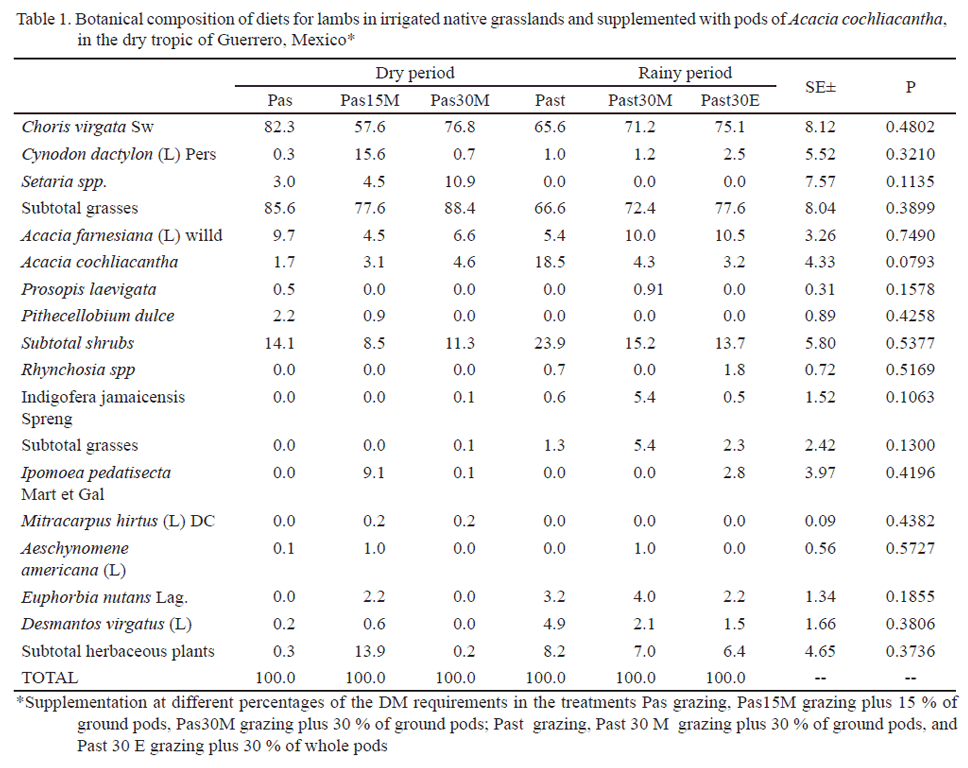
<body><![CDATA[<br>   9:00 a.m. to 6:00 p.m. in the Pas15M, Pas30M, and Past30M treatments. The  animals were provided with 102, 205, 205 g of ground pods, respectively, and  205 g of whole pods in the Past30E treatment. The bromatological composition of  the consumed grassland was determined according to AOAC (1990), at the  Laboratorio de Bromatolog&iacute;a y Bioqu&iacute;mica de la Universidad Nacional Aut&oacute;noma de  M&eacute;xico (UNAM), as well as the NDF and ADF, regarding van Soest <em>et al.</em> (1991). The <em>in vitro</em> digestibility of dry matter (IVDDM) was determined  according to Tilley and Terry (1963). </font></p>     <p align="justify"><font size="2" face="Verdana, Arial, Helvetica, sans-serif">A proximal chemical analysis was performed to the plants  that formed the botanical composition of diets provided to lambs. The botanical  composition of diets was determined from the samples obtained with two  exclusion cages of 1 m<sup>2</sup> (FAO 1996) per each treatment, placed in  three of the six grasslands selected at random. Inside the cages, the  proportions of plants were manually cut, which were previously ingested by the  lambs during the dry and rainy seasons.</font></p>     <p align="justify"><font size="2" face="Verdana, Arial, Helvetica, sans-serif">The animals were weighted every 21 d, after feeding. Six  lambs were sacrificed from each group, selected at random. The living animal  and the hot carcass were weighed in a balance with a scale of 500 kg and of    0.2 kg. A balance of 2,610 g, with a 0.1 g scale, was used to register the  weight of the pericardial and perirenal fat, heart, kidneys, liver and  gallbladder.&nbsp; </font></p>     <p align="justify"><font size="2" face="Verdana, Arial, Helvetica, sans-serif">The variables botanical composition of diets, daily  weight gain, hot carcass yield, weight of perirenal and pericardial fat, heart  and liver were studied.</font></p>     <p align="justify"><font size="2" face="Verdana, Arial, Helvetica, sans-serif">An analysis of variance was applied to the data and the  means of each treatment were compared using the test of Duncan (P &lt; 0.05),  according to reports of Balzarini <em>et al.</em> (2012).</font></p>     <p align="justify">&nbsp;</p>     <p align="justify"><strong><font size="3" face="Verdana, Arial, Helvetica, sans-serif">RESULTS AND DISCUSSION</font></strong></p>     <p align="justify"><font size="2" face="Verdana, Arial, Helvetica, sans-serif">In the botanical composition of diets, there was no  significant difference among the six treatments or among grasses, shrubs,  legumes and herbaceous plants. This could be caused by the extraction of weeds  from their roots after each grazing, by the periodical cutting of shrubs and by  the irrigation during the dry period. This irrigation probably stimulated the  growth of some plants as Setaria spp and <em>Pithecellobium dulce</em> and during  the rainy period, the presence of Rhynchosia spp. was confirmed (<a href="/img/revistas/cjas/v49n3/t0109315.gif">table 1</a>).  Abusuwar and Ahmed (2010) reported 87 % for grasses and 13.28 % for herbaceous  plants in the Pas15M group, in semiarid lands of Sudan. These figures are  similar to those of this study.&nbsp; </font></p>     
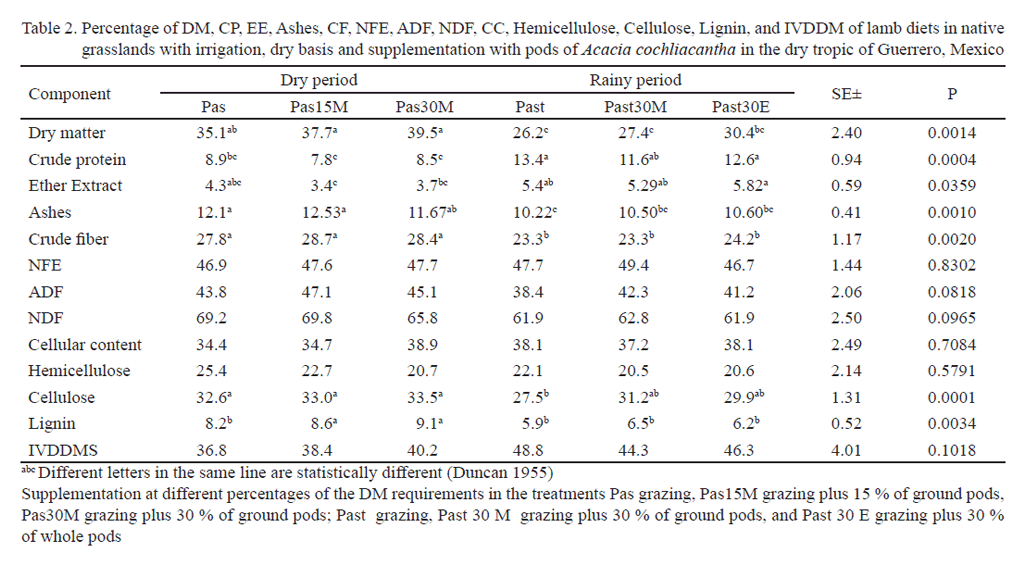
<p align="justify"><font size="2" face="Verdana, Arial, Helvetica, sans-serif">The percentages of CP during the dry period were different  from those in the rainy period (P&lt;0.001). There was similarity only between  Pas and Past30M, which means between the treatment of the lowest percentage  during the rainy period and that of the highest percentage during the dry  season (<a href="/img/revistas/cjas/v49n3/t0209315.gif">table 2</a>). Percentages of CP from dry period are in the necessary  minimum limit (Bondi 1989) to establish an acceptable fermentative activity of  ruminal microorganisms. On the contrary, in the rainy period, it was around 13  % in the ration, figure that the cited author points as necessary for the best  ruminal protein synthesis.</font></p>     
<p align="justify"><font size="2" face="Verdana, Arial, Helvetica, sans-serif">CP percentages during the rainy period were higher than  11 %. This value is close to that reported by Ma <em>et al.</em> (2014) in ovine  grazing native grasslands during the autumn (11.4 %) and at the end of spring  (13.1), but it is lower than the amount of CP reported for the summer (17.7 %).</font></p>     ]]></body>
<body><![CDATA[<p align="justify"><font size="2" face="Verdana, Arial, Helvetica, sans-serif">CF percentages were different (P &lt; 0.05) and probably  caused the differences in the content of CP. Probably, this could be attributed  to the effect of rains and environmental temperature during the rainy period,  which produced a higher representation of <em>A. farnesiana</em> and <em>A.  cochliacantha</em> in the diets, along with the highest percentage of herbaceous  plants.</font></p>     <p align="justify"><font size="2" face="Verdana, Arial, Helvetica, sans-serif">Lignin content during the dry period was different (P  &lt; 0.001) from that during the rainy period (<a href="/img/revistas/cjas/v49n3/t0209315.gif">table 2</a>). These percentages of  lignin had an effect on the nutritional value of diets, because after the union  of lignin with cellulose and hemicellulose, the degradation of feed decreases  in the rumen, so there is a lower nutritional value of feed at a higher lignin  percentage (McDonald 2006).</font></p>     
<p align="justify"><font size="2" face="Verdana, Arial, Helvetica, sans-serif">The percentages of NFE, ADF,  NDF, cell content, hemicellulose and IVDDM in the six groups of lambs were  statistically similar (<a href="/img/revistas/cjas/v49n3/t0209315.gif">table 2</a>). The differences observed in CP and lignin can  be possibly attributed to the highest percentage of legumes with 1.32, 5.35 and  2.27 % during the rainy period. During the dry period, the figures were lower  than 0.10 % (<a href="/img/revistas/cjas/v49n3/t0109315.gif">table 1</a>). The herbaceous plants followed this performance, with  more than 7 % during the rainy period. In Pas and Pas30M, it was not higher  than 0.5 %, except Pas25M (13.89 %), but with lower percentage of shrubs and  grasses (<a href="/img/revistas/cjas/v49n3/t0109315.gif">table 1</a>). </font></p>     
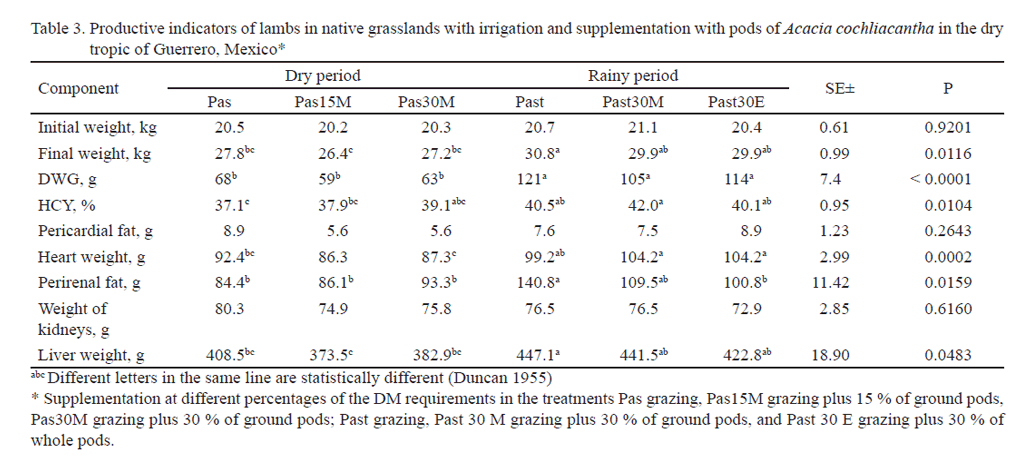
<p align="justify"><font size="2" face="Verdana, Arial, Helvetica, sans-serif">The mean DWG (P &lt; 0.05)  were 63 g during the dry period and 113 g during the rainy season (<a href="/img/revistas/cjas/v49n3/t0309315.gif">table 3</a>).  This was caused by the highest percentage of CP during the rainy period, and  the lowest percentage of lignin, regarding the dry period (<a href="/img/revistas/cjas/v49n3/t0209315.gif">table 2</a>), which  possibly produced higher digestibility of ingested food and, consequently, a  better use of energy during the rainy period. It may also be caused by the  higher forage availability due to the effect of rains. V&aacute;zquez <em>et al.</em> (2012) reported 8 g of DWG in Pelibuey x Dorper lambs, in grasslands of <em>Paspalum  notatum</em> and <em>Axonopus compressus</em>. There is a difference because the  grasslands used in this study were constituted by grasses, shrubs and  herbaceous plants. However, the cited authors, after supplementing with  nutritional blocks of 20 % of <em>Leucaena leucocephala</em>, obtained 48 and 68  g of DWG, with the inclusion of 20 % of wheat bran in the block. Ekiz <em>et al.</em> (2013) reported 87.15 g of DWG in lambs fed in grasslands of temperate areas,  with 52 % of grasses (<em>Festuca spp.</em> and <em>Lolium spp.</em>), legumes (<em>Trifolium  spp., Medicago spp.</em>, and <em>Vicia spp.</em>) and 26 % of other families,  compared to the DWG obtained in this research during the dry season. This could  be attributed to the 11.5 % of CP compared to less than 9 % obtained in the dry  period (<a href="/img/revistas/cjas/v49n3/t0209315.gif">table 2</a>), which is confirmed after comparing the DWG of lambs during  the rainy period, with more than 11.5 % of CP in the diet. Dickhoefer <em>et al.</em> (2014) reported DWG of 98 g with light grazing and 62 g with intensive grazing  in a study with lambs grazing in native grasslands in a  semi-arid climate from the steppes of Mongolia,    China.</font></p>     
<p align="justify"><font size="2" face="Verdana, Arial, Helvetica, sans-serif">Retama <em>et al.</em> (2012), after feeding lambs in a  silvopastoral system with irrigation in the dry tropic, with 65 % of <em>Cynodon  nlemfuensis</em>, 30% of <em>Leucaena leucocephala</em> and 5 % of shrubs and  herbaceous plants, reported 33 g of DWG. However, the value was 80 g after  supplementing with 1.5 % of LW with ground grains of maize. This figure was  higher than the one of this study during the dry period, which can be  attributed to the energy and protein provided by maize. However, it was  inferior to the value reported during the rainy season.&nbsp; </font></p>     <p align="justify"><font size="2" face="Verdana, Arial, Helvetica, sans-serif">Fern&aacute;ndez <em>et al.</em> (1997) reported 71 g of DWG in  lambs grazing in native grasslands complemented with nutritional blocks. Ortiz <em>et  al.</em> (2007) obtained 77 g in native grassland of <em>Bothriochloa pertusa</em> in lambs supplemented with molasses (6 g kg<sup>-1</sup> LW). Getu <em>et al.</em> (2012) referred 75.3 g in native grasslands of Andropogon, Pennisetum&nbsp; and clover species, which are similar amounts  to those obtained in this study in the dry period. However, the values of DWG  from rainy period were similar to those obtained by the cited authors after  they used native grassland hay, 160 g of cotton seed paste and 200 g of wheat  grains, obtaining 114 g of    DWG.</font></p>     <p align="justify"><font size="2" face="Verdana, Arial, Helvetica, sans-serif">D&iacute;az (2010) reported 61.3 g of DWG in a study with lambs  of 22 kg, which were grazing in grasslands of <em>Cynodon plectostachyus</em>,  with 13.9 % of CP, irrigation and fertilization with urea (33 kg de N ha<sup>-1</sup>).  These animals consumed 180.5 g of DM of a supplement with 26.8 % of CP and  obtained 61.3 g of DWG. These gains are similar to those reported in this  research during the dry period and inferior to those of the rainy season. After  the animals also received    25 mL of a semi-liquid compound, known as Vitafert, the DWG was 73.7 g. This  could be attributed to the reduced IMS (456.5 and 450.4 g) reported by D&iacute;az  (2010) for the group that received Vitafert and the other that did not receive  it, respectively.</font></p>     <p align="justify"><font size="2" face="Verdana, Arial, Helvetica, sans-serif">Fr&iacute;as (2010) reported DWG of 85 g, inferior to those  from the rainy period, in Pelibuey x Katahdin and Dorper lambs, fgrazing 6 h in  star grass and intake of&nbsp; 600 g animal d<sup>-1</sup>  of Saccharina, plus Vitafert. This author referred that, after feeding  stabulated Pelibuey lambs with intake of 4 kg of green king grass <em>Pennisetum  purpureum</em> CT-115, 100 g/d of a commercial feed and 537.5 g of Saccharina  animal d<sup>-1</sup>, DWG of 109 g animal d<sup>-1</sup> were achieved, which  was close to the 121, 105 and 114 g obtained in this study with Past, Past30M  and Past30E,    respectively.</font></p>     <p align="justify"><font size="2" face="Verdana, Arial, Helvetica, sans-serif">Engadine Swiss lambs, in grasslands of Ryegrass and  clovers, had an average DWG of 105 g, inferior to the amount obtained (122 g)  in a study of Willems <em>et al.</em> (2013) with Valaisian Blacknose sheep. This  last value was similar to the one obtained in this study with Past, Pas30M and  Past50E (121, 105 and 114 g, respectively). However, these values were slightly  superior to those reported by Ma <em>et al.</em> (2014), who stated 83 and 99 g  of DWG in lambs grazing in native grasslands of semi-arid climate in China, at  the end of the spring and the autumn, respectively, but inferior to those of  autumn with    135 g.</font></p>     <p align="justify"><font size="2" face="Verdana, Arial, Helvetica, sans-serif">The hot carcass yield (HCY)  was statistically similar among the groups of the dry period. The same  performance occurred during the rainy period (<a href="/img/revistas/cjas/v49n3/t0309315.gif">table 3</a>). However, the value of  Past30M (42.0 %) was superior (P &lt; 0.05) to the Pas (37.1 %) and to the  Pas15M    (37.9 %). This could possibly be attributed to the effect of supplementation  with 30 % of the pods, compared to the supplementation in Pas and with 15 % in  Pas15M, because the HCY, in the treatment with Past30M    (39.1 %) during the dry period, was statistically similar to that obtained in  the rainy period. The values of this study were similar to those reported by  Ekiz <em>et al.</em> (2013) in Kivircik lambs, which were grazing in wheat  stubbles and in native grasslands, composed by 52% of grasses, 22% of legumes  and 26 % of other plants, with 11.5 % of CP in the grassland and 10.5 % in the  stubble. The cited authors referred 38.52 % of    HCY. </font></p>     
]]></body>
<body><![CDATA[<p align="justify"><font size="2" face="Verdana, Arial, Helvetica, sans-serif">In grazing Pelibuey lambs, with a predominance of <em>Bothriochloa  pertusa</em>, supplemented with 6 g of molasses per day, Ortiz <em>et al.</em> (2007) reported 45.8 % of HCY, which is superior to the value referred in this  study, possibly caused by the daily supplementation with molasses.</font></p>     <p align="justify"><font size="2" face="Verdana, Arial, Helvetica, sans-serif">Willems <em>et al.</em> (2013) obtained 38.4 % of HCY in a  study with Swiss Valaisian Blacknose sheep, in grasslands with Ryegrass and  clovers and poor, medium and high quality of nutrients, at different heights  over the sea level (400 to 2,150 m). This value was similar to the one obtained  in this study.</font></p>     <p align="justify"><font size="2" face="Verdana, Arial, Helvetica, sans-serif">In this study, the HCY in  Past30M was 42.02, similar to that informed by Ekiz <em>et al.</em> (2013)    (42.31 %) in a study with lambs fed with alfalfa hay and concentrate, with  17.67 % of CP consumed <em>ad libintum</em>. It was also similar to the values  obtained by Partida <em>et al.</em> (1989), who reported 41 % of HCY with the use  of 2.6 Mcal ME/ kg of DM in the diet. The HCY was inferior to that reported by  Ortiz <em>et al.</em> (2007), who reached 45.8 %, after feeding the lambs in  native grasslands of <em>Bothriochloa pertusa</em> and supplemented with molasses  (6 g kg<sup>-1</sup>LW). This could be attributed, possibly, to the highest  ingestion of energy represented by supplementation. </font></p>     <p align="justify"><font size="2" face="Verdana, Arial, Helvetica, sans-serif">In Pelibuey x Katahdin Dorper lambs, grazing star grass  during 6 h and intake of 600 g animal d<sup>-1</sup> of Saccharina plus  Vitafer, Fr&iacute;as (2010) reported 43.09 % of HCY, which is slightly superior the  value obtained in the rainy period. However, the cited author obtained 42.04 %  of HCY after feeding Pelibuey lambs with    4 kg of&nbsp; <em>P. purpureum </em>cv. CT-115,  537.5 g of Saccharina and    100 g of a commercial feed, which was similar to the 42.02 % referred for  Past30M.</font></p>     <p align="justify"><font size="2" face="Verdana, Arial, Helvetica, sans-serif">Willems <em>et al.</em> (2013) reported 43.9 % of HCY for  Swiss Engadine Sheep lambs in grasslands of Ryegrass and clovers. This value is  higher than the one reported in this study.</font></p>     <p align="justify"><font size="2" face="Verdana, Arial, Helvetica, sans-serif">The weight of liver and  heart were similar among the non supplemented lambs and those supplemented&nbsp; with 30% and superior to (P &lt; 0.05) 15%  (<a href="/img/revistas/cjas/v49n3/t0309315.gif">table 3</a>).&nbsp; This was probably related to  the highest LW reached by lambs at slaughtering, because these lambs showed the  highest weight of liver and kidney, and the lowest (373.5 g liver and 86.3 g  heart) corresponded to    26.4 kg of LW in the treatment Pas15M. The values of liver were inferior to  those reported by Ortiz <em>et al.</em> (2007) with 537 g in lambs in grasslands  of <em>Bothriochloa pertusa</em>, supplemented with molasses (6 g kg<sup>-1</sup>LW).  This could be attributed to the contribution of sugars represented by the  molasses, because the content of sucrose is metabolically transformed into an  energy reserve in the liver as glycogen and, consequently, increases its  weight, because up to 10% of the weight of this organ may correspond to hepatic  glycogen (McDonald <em>et al.</em>  2006). </font></p>     
<p align="justify"><font size="2" face="Verdana, Arial, Helvetica, sans-serif">The weights of the  kidneys were statistically similar in every treatment (<a href="/img/revistas/cjas/v49n3/t0309315.gif">table 3</a>) and similar to  that reported by Ortiz <em>et al.</em> (2007), who informed    79 g. The weights of the pericardial fat were similar in the six groups. Heart  weights were matched to those reported by Nuernberg <em>et al.</em> (2008) in  grazing lambs slaughtered with 25 kg of LW and heart weight of 100 g.</font></p>     
<p align="justify"><font size="2" face="Verdana, Arial, Helvetica, sans-serif">The weight of the perirenal fat was 140.8 g (P&lt;0.05)  in Past, regarding the figures during the dry period and the 100.8 g of the  Past30E (<a href="/img/revistas/cjas/v49n3/t0309315.gif">table 3</a>). This low value can be probably attributed to the  supplementation with whole pods provided to this group. </font></p>     
<p align="justify">&nbsp;</p>     <p align="justify"><strong><font size="3" face="Verdana, Arial, Helvetica, sans-serif">CONCLUSIONS</font></strong></p>     ]]></body>
<body><![CDATA[<p align="justify"><font size="2" face="Verdana, Arial, Helvetica, sans-serif">Botanical composition of the diets for lambs was similar  during the dry and rainy period. The irrigated grasslands produced less DWG and  HCY during the first period, regarding the second. The supplementation with  ground or whole pods of <em>Acacia cochliacantha</em> had no influence on the  studied indicators. Therefore, the supplementation in irrigated native  grasslands with management is not recommended.&nbsp; </font></p>     <p align="justify">&nbsp;</p>     <p align="justify"><font size="3" face="Verdana, Arial, Helvetica, sans-serif"><strong>REFERENCES</strong></font></p>     <p align="justify"><font size="2" face="Verdana, Arial, Helvetica, sans-serif">Abusuwar, A. O. &amp; Ahmed, E. O. 2010. &lsquo;&lsquo;Animal diet botanical composition as indicators for pasture status in the  semi-arid rangeland of Sudan (South Darfur State)&rsquo;&rsquo;. <em>Agric. Biol. J. N. Anim.</em>, 1: 894.</font></p>     <p align="justify"><font size="2" face="Verdana, Arial, Helvetica, sans-serif">Albuernez, R., Delgado, A., Per&oacute;n, N. &amp; Perera, A.  1996. &lsquo;&lsquo;Ca&ntilde;a de az&uacute;car y urea para ceba de corderos. Efecto del tratamiento  qu&iacute;mico de la harina de girasol con diferentes niveles de formaldeh&iacute;do&rsquo;&rsquo;. <em>Rev. Cub. Reprod. Anim.</em>, 22: 45.</font></p>     <!-- ref --><p align="justify"><font size="2" face="Verdana, Arial, Helvetica, sans-serif">AOAC 1990. <em>Official Methods  of Analysis</em>. 15th ed., Washington, DC, USA: Ass. Off. Anal. Chem.    </font></p>     <!-- ref --><p align="justify"><font size="2" face="Verdana, Arial, Helvetica, sans-serif">Balzarini, M. G., Gonz&aacute;lez, L., Tablada, M.,  Casanoves, F., Di Rienzo, J. A. &amp; Robledo, C. W. 2012. <em>Paquete  estad&iacute;stico INFOSTAT</em>. Argentina: Universidad Nacional de C&oacute;rdoba.    </font></p>     <!-- ref --><p align="justify"><font size="2" face="Verdana, Arial, Helvetica, sans-serif">Bondi, A. A. 1989. <em>Nutrici&oacute;n animal</em>. Zaragoza,  Espa&ntilde;a: Acribia, 50-161 p.    </font></p>     <!-- ref --><p align="justify"><font size="2" face="Verdana, Arial, Helvetica, sans-serif">CONAGUA. 2010. <em>Comisi&oacute;n Nacional del Agua.  Estad&iacute;stica del agua en la cuenca del R&iacute;o Balsas</em>. , Available:  &lt;<a href="http://www. conagua.gob.mx/CONAGUA07/Noticias/Estad%C3%ADsticas%20del%20Agua%20en%20la%20cuenca%20del%20 R%C3%ADo%20Balsas,%202010.pdf" target="_blank">http://www.  conagua.gob.mx/CONAGUA07/Noticias/Estad%C3%ADsticas%20del%20Agua%20en%20la%20cuenca%20del%20  R%C3%ADo%20Balsas,%202010.pdf</a>&gt;, [Consulted:&nbsp;July 10, 2013].    </font></p>     <!-- ref --><p align="justify"><font size="2" face="Verdana, Arial, Helvetica, sans-serif">D&iacute;az, Q. V. 2010. <em>Efecto del Vitafer en el  comportamiento de ovinos en finalizaci&oacute;n en pastoreo suplementados con  sacchapulido</em>. M.Sc. Thesis, Colegio de Postgraduados, Tabasco, Mexico.    </font></p>     <p align="justify"><font size="2" face="Verdana, Arial, Helvetica, sans-serif">Dickhoefer, U., Hao, J., Bosing, M. B., Lin, L.,  Gierus, M., Taube, F. &amp; Susenbeth, A. 2014. &lsquo;&lsquo;Feed  intake and performance of sheep grazing semiarid grassland in response to  different grazing systems&rsquo;&rsquo;. <em>Relangend Ecology &amp; Management</em>, 67:  145.</font></p>     <p align="justify"><font size="2" face="Verdana, Arial, Helvetica, sans-serif">Ekiz, B., Demirel, G., Yilmaz,  A., Ozcan, M., Yalcintan, H., Kokak, O. &amp; Altinel, A. 2013. &lsquo;&lsquo;Slaughter  characteristics, carcass quality and fatty acid composition of lambs under four  different production systems&rsquo;&rsquo;. <em>Small. Rumin. Res.</em>, 114: 26.</font></p>     <!-- ref --><p align="justify"><font size="2" face="Verdana, Arial, Helvetica, sans-serif">FAO 1996. <em>Principios de manejo de praderas  naturales</em>. 2nd ed., Santiago de Chile: Instituto Nacional de Tecnolog&iacute;a  Agropecuaria-INTA, Oficina Regional de la FAO para Am&eacute;rica Latina y el Caribe,  118-119 p.    </font></p>     <p align="justify"><font size="2" face="Verdana, Arial, Helvetica, sans-serif">Fern&aacute;ndez, G., San Mart&iacute;n, F. &amp; Escurra, E. 1997.  &lsquo;&lsquo;Uso de bloques nutricionales en la suplementaci&oacute;n de ovinos al pastoreo&rsquo;&rsquo;. <em>Rev.  Inv. Pec</em>, 8: 29.</font></p>     ]]></body>
<body><![CDATA[<!-- ref --><p align="justify"><font size="2" face="Verdana, Arial, Helvetica, sans-serif">Fr&iacute;as, J. C. 2010. <em>Evaluaci&oacute;n de la calidad y  rendimiento de la carne de ovinos de pelo en pastoreo suplementados con ca&ntilde;a de  az&uacute;car fermentada en Tabasco</em>. M.Sc. Thesis, Colegio de Postgraduados,  Tabasco, Mexico.    </font></p>     <p align="justify"><font size="2" face="Verdana, Arial, Helvetica, sans-serif">Getu, K., Mesfin, D., Aemiro, K. &amp; Getnet, A.  2012. &lsquo;&lsquo;Comparative evaluation of Tree Lucerne (<em>Chamaecytisus palmensis</em>)  over conventional protein supplements in supporting growth of yearling Horro  lambs&rsquo;&rsquo;. <em>Livestock  Res. Rural Development</em>, 24: 1.</font></p>     <!-- ref --><p align="justify"><font size="2" face="Verdana, Arial, Helvetica, sans-serif">Gonz&aacute;lez, S. A. 1995. <em>Aplicaci&oacute;n y efecto residual  del esti&eacute;rcol en producci&oacute;n y calidad del buffel (Cenchrus ciliaris C.V.  Texas-4464) en el tr&oacute;pico seco</em>. M.Sc. Thesis, Universidad de Colima,  M&eacute;xico, Available: &lt;<a href="http://digest.ucol.mx/tesis posgrado/Pdf%20Gonzalez%20Sotelo.pdf" target="_blank">http://digest.ucol.mx/tesis posgrado/Pdf%20Gonzalez%20Sotelo.pdf</a>&gt;,  [Consulted:&nbsp;January 10, 2012].    </font></p>     <!-- ref --><p align="justify"><font size="2" face="Verdana, Arial, Helvetica, sans-serif">INIA 1982. <em>Diagn&oacute;stico de la problem&aacute;tica del  cultivo de ma&iacute;z en la regi&oacute;n de la Tierra Caliente (Guerrero y Michoac&aacute;n)</em>.  Altamirano Guerrero, M&eacute;xico: Mimeo.    </font></p>     <p align="justify"><font size="2" face="Verdana, Arial, Helvetica, sans-serif">Macedo, R. &amp; Castellanos, Y. 2004. &lsquo;&lsquo;Rentabilidad  de un sistema intensivo de producci&oacute;n ovino en el tr&oacute;pico&rsquo;&rsquo;. <em>Avances Inv.  Agropec.</em>, 8: 1.</font></p>     <p align="justify"><font size="2" face="Verdana, Arial, Helvetica, sans-serif">Mac&iacute;as, U., &Aacute;lvarez, F. D., Rodr&iacute;guez, J., Correa, A.,  Torrentera, N. G., Molina, L. &amp; Avenda&ntilde;o, L. 2010. &lsquo;&lsquo;Crecimiento y caracter&iacute;sticas  de canal en corderos Pelibuey puros y cruzados F1 con razas Dorper y Katahdin  en confinamiento&rsquo;&rsquo;. <em>Arch. Med. Vet.</em>, 42: 147.</font></p>     <p align="justify"><font size="2" face="Verdana, Arial, Helvetica, sans-serif">Ma, L., Yuan, F., Liang, H.  &amp; Rong, Y. 2014. &lsquo;&lsquo;The effects of grazing management on the vegetation,  diet quality, intake and performance of free grazing sheep&rsquo;&rsquo;. <em>Livestock Science</em>, 161: 185.</font></p>     ]]></body>
<body><![CDATA[<!-- ref --><p align="justify"><font size="2" face="Verdana, Arial, Helvetica, sans-serif">Marshall, W. A. 2000. <em>Contribuci&oacute;n al estudio de la  ceba ovina estabulada sobre la base de heno y suplemento proteico con harina de  soya y gallinaza</em>. Ph.D. Thesis, Instituto de Ciencia Animal, La Habana,  Cuba.    </font></p>     <p align="justify"><font size="2" face="Verdana, Arial, Helvetica, sans-serif">Mart&iacute;nez, G. S., Aguirre, O. J., Zepeda, G. J., Ulloa,  C. R., Figueroa, M. R., Mac&iacute;as, C. H. &amp; Moreno, F. L. A. 2009. &lsquo;&lsquo;La  ovinocultura de Nayarit, M&eacute;xico&rsquo;&rsquo;. In: Cavalloti V. B. A. &amp; Marcof A. C. F.  (eds.), <em>Ganader&iacute;a y Seguridad Alimentaria en Tiempo de Crisis</em>, Chapingo,  M&eacute;xico, DF, pp. 305&ndash;309.</font></p>     <p align="justify"><font size="2" face="Verdana, Arial, Helvetica, sans-serif">McDonald, P., Edwards, R. A.,  Greenhalgh, J. F. D. &amp; Morgan, C. A. 2006. &lsquo;&lsquo;Nutrici&oacute;n animal&rsquo;&rsquo;. In: <em>Valoraci&oacute;n de los  alimentos (A) Digestibilidad</em>, 6th ed., Zaragoza, Espa&ntilde;a: Acribia, pp.  205&ndash;208.</font></p>     <p align="justify"><font size="2" face="Verdana, Arial, Helvetica, sans-serif">Nuernberg, K., Fischer, A.,  Ender, K. &amp; Dannenberger, D. 2008. &lsquo;&lsquo;Meat quality and fatty acid  composition of lipids in muscle and fatty tissue of Skudde lambs fed grass  versus concentrate&rsquo;&rsquo;. <em>Small  Ruminant Res.</em>, 74: 279.</font></p>     <p align="justify"><font size="2" face="Verdana, Arial, Helvetica, sans-serif">Ortiz, A., El&iacute;as, A. &amp; Valdivie, M. 2007.  &lsquo;&lsquo;Evaluaci&oacute;n de la pollinaza de cascarilla de caf&eacute; como complemento alimenticio  en la ceba de ovinos en pastoreo&rsquo;&rsquo;. <em>Pastos y Forrajes</em>, 30: 279.</font></p>     <!-- ref --><p align="justify"><font size="2" face="Verdana, Arial, Helvetica, sans-serif">Partida, B. E. 1983. <em>Evaluaci&oacute;n del crecimiento  compensatorio de borregos en etapa de finalizaci&oacute;n, mediante el uso de ensilaje  de ma&iacute;z amoniado</em>. Graduated Thesis, Facultad de Medicina Veterinaria y  Zootecnia, UNAM, Mexico.    </font></p>     <p align="justify"><font size="2" face="Verdana, Arial, Helvetica, sans-serif">Pulina, G., Bettati, T., Serra, F. A. &amp; Razio, O.  1996. &lsquo;&lsquo;Costruzione e validazione di un software per l&rsquo;alimentazione degli  ovini da latte&rsquo;&rsquo;. In: <em>Atti Congresso Nazionale della Societa Italiana di  Patologia e di Allevamento degli Ovini e dei Caprini</em>, p. 11.</font></p>     <p align="justify"><font size="2" face="Verdana, Arial, Helvetica, sans-serif">Retama, F. C., Torres, A. J., Sandoval, C. C. A.,  Aguilar, C. A. J., C&aacute;mara, S. R. &amp; Canul-Ku, H. L. 2012. &lsquo;&lsquo;Maize supplementation of Pelibuey sheep in a silvopastoral fodder  selection, nutrient intake and resilience against gastrointestinal nematodes&rsquo;&rsquo;. <em>Animal</em>, 6: 145.</font></p>     ]]></body>
<body><![CDATA[<p align="justify"><font size="2" face="Verdana, Arial, Helvetica, sans-serif">Romano, M. J. L., Hern&aacute;ndez, G. J. &amp; Castellanos,  R. A. 1983. &lsquo;&lsquo;Repercusi&oacute;n del valor nutritivo de la dieta sobre el crecimiento  del borrego Pelibuey&rsquo;&rsquo;. <em>Tec. Pec. Mex.</em>, 45: 67.</font></p>     <p align="justify"><font size="2" face="Verdana, Arial, Helvetica, sans-serif">Tilley, J. M. A. &amp; Terry,  R. A. 1963. &lsquo;&lsquo;A two-stage technique for the A two-stage technique for the in  vitro digestion of forage crops&rsquo;&rsquo;. <em>Brit. Grass. Soc.</em>, 18: 104&ndash;113.</font></p>     <p align="justify"><font size="2" face="Verdana, Arial, Helvetica, sans-serif">Van Soest, P. J., Robertson,  J. B. &amp; Lewis, B. A. 1991. &lsquo;&lsquo;Methods for dietary fiber, neutral detergent  fiber and non-starch polysaccharides in relation to animal nutrition&rsquo;&rsquo;. <em>J. Dairy Sci.</em>, 74: 3583.</font></p>     <p align="justify"><font size="2" face="Verdana, Arial, Helvetica, sans-serif">V&aacute;zquez, M. P., Castel&aacute;n, O. O. A., Garc&iacute;a, M. . .  &amp; Avil&eacute;s, N. F. 2012. &lsquo;&lsquo;Uso de bloques nutricionales como complemento para  ovinos en el tr&oacute;pico seco del altiplano central de M&eacute;xico&rsquo;&rsquo;. <em>Tropical and Subtropical Agroecosystems</em>, 15: 87.</font></p>     <p align="justify"><font size="2" face="Verdana, Arial, Helvetica, sans-serif">  Willems, H., Kreuzer, M. &amp; Leiber, F. 2014.  &lsquo;&lsquo;Alpha-linolenic and linoleic acid in meat and adipose tissue of grazing lambs  differ among alpine pasture types with contrasting plant species and phenolic  compound composition&rsquo;&rsquo;. <em>Small  Ruminant Res.</em>, 116:  173   .</font></p>     <p align="justify">&nbsp;</p>     <p align="justify">&nbsp;</p>     <p align="justify"><font size="2" face="Verdana, Arial, Helvetica, sans-serif">Received: June 26, 2014    <br> Accepted: April 15, 2015</font></p>     <p align="justify">&nbsp;</p>     ]]></body>
<body><![CDATA[<p align="justify">&nbsp;</p>     <p align="justify"><font size="2" face="Verdana, Arial, Helvetica, sans-serif"><i>E.J. Mireles,</i> Unidad Académica de Medicina Veterinaria y Zootecnia de la Universidad Autónoma de Guerrero, México. km 2.5.  Carretera Cd. Altamirano-Iguala Cd Altamirano Gro. CP 40660.    Email: <a href="mailto:emirelesmartinez@gmail.com">emirelesmartinez@gmail.com</a></font></p>      ]]></body><back>
<ref-list>
<ref id="B1">
<nlm-citation citation-type="journal">
<person-group person-group-type="author">
<name>
<surname><![CDATA[Abusuwar]]></surname>
<given-names><![CDATA[A. O.]]></given-names>
</name>
<name>
<surname><![CDATA[Ahmed]]></surname>
<given-names><![CDATA[E. O.]]></given-names>
</name>
</person-group>
<article-title xml:lang="nd"><![CDATA[Animal diet botanical composition as indicators for pasture status in the semi-arid rangeland of Sudan (South Darfur State)]]></article-title>
<source><![CDATA[Agric. Biol. J. N. Anim.]]></source>
<year>2010</year>
<volume>1</volume>
<page-range>894</page-range></nlm-citation>
</ref>
<ref id="B2">
<nlm-citation citation-type="journal">
<person-group person-group-type="author">
<name>
<surname><![CDATA[Albuernez]]></surname>
<given-names><![CDATA[R.]]></given-names>
</name>
<name>
<surname><![CDATA[Delgado]]></surname>
<given-names><![CDATA[A.]]></given-names>
</name>
<name>
<surname><![CDATA[Perón]]></surname>
<given-names><![CDATA[N.]]></given-names>
</name>
<name>
<surname><![CDATA[Perera]]></surname>
<given-names><![CDATA[A.]]></given-names>
</name>
</person-group>
<article-title xml:lang="nd"><![CDATA[Caña de azúcar y urea para ceba de corderos. Efecto del tratamiento químico de la harina de girasol con diferentes niveles de formaldehído]]></article-title>
<source><![CDATA[Rev. Cub. Reprod. Anim.]]></source>
<year>1996</year>
<volume>22</volume>
<page-range>45</page-range></nlm-citation>
</ref>
<ref id="B3">
<nlm-citation citation-type="book">
<person-group person-group-type="author">
<name>
<surname><![CDATA[AOAC]]></surname>
</name>
</person-group>
<source><![CDATA[Official Methods of Analysis]]></source>
<year>1990</year>
<edition>15th</edition>
<publisher-loc><![CDATA[Washington, DC, USA ]]></publisher-loc>
<publisher-name><![CDATA[Ass. Off. Anal. Chem.]]></publisher-name>
</nlm-citation>
</ref>
<ref id="B4">
<nlm-citation citation-type="book">
<person-group person-group-type="author">
<name>
<surname><![CDATA[Balzarini]]></surname>
<given-names><![CDATA[M. G.]]></given-names>
</name>
<name>
<surname><![CDATA[González]]></surname>
<given-names><![CDATA[L.]]></given-names>
</name>
<name>
<surname><![CDATA[Tablada]]></surname>
<given-names><![CDATA[M.]]></given-names>
</name>
<name>
<surname><![CDATA[Casanoves]]></surname>
<given-names><![CDATA[F.]]></given-names>
</name>
<name>
<surname><![CDATA[Di Rienzo]]></surname>
<given-names><![CDATA[J. A.]]></given-names>
</name>
<name>
<surname><![CDATA[Robledo]]></surname>
<given-names><![CDATA[C. W.]]></given-names>
</name>
</person-group>
<source><![CDATA[Paquete estadístico INFOSTAT]]></source>
<year>2012</year>
<publisher-loc><![CDATA[Argentina ]]></publisher-loc>
<publisher-name><![CDATA[Universidad Nacional de Córdoba]]></publisher-name>
</nlm-citation>
</ref>
<ref id="B5">
<nlm-citation citation-type="book">
<person-group person-group-type="author">
<name>
<surname><![CDATA[Bondi]]></surname>
<given-names><![CDATA[A. A.]]></given-names>
</name>
</person-group>
<source><![CDATA[Nutrición animal]]></source>
<year>1989</year>
<page-range>50-161</page-range><publisher-loc><![CDATA[Zaragoza, España ]]></publisher-loc>
<publisher-name><![CDATA[Acribia]]></publisher-name>
</nlm-citation>
</ref>
<ref id="B6">
<nlm-citation citation-type="">
<person-group person-group-type="author">
<name>
<surname><![CDATA[CONAGUA]]></surname>
</name>
</person-group>
<source><![CDATA[Comisión Nacional del Agua. Estadística del agua en la cuenca del Río Balsas]]></source>
<year>2010</year>
</nlm-citation>
</ref>
<ref id="B7">
<nlm-citation citation-type="book">
<person-group person-group-type="author">
<name>
<surname><![CDATA[Díaz]]></surname>
<given-names><![CDATA[Q. V.]]></given-names>
</name>
</person-group>
<source><![CDATA[Efecto del Vitafer en el comportamiento de ovinos en finalización en pastoreo suplementados con sacchapulido]]></source>
<year>2010</year>
<publisher-loc><![CDATA[Tabasco, Mexico ]]></publisher-loc>
<publisher-name><![CDATA[Colegio de Postgraduados]]></publisher-name>
</nlm-citation>
</ref>
<ref id="B8">
<nlm-citation citation-type="journal">
<person-group person-group-type="author">
<name>
<surname><![CDATA[Dickhoefer]]></surname>
<given-names><![CDATA[U.]]></given-names>
</name>
<name>
<surname><![CDATA[Hao]]></surname>
<given-names><![CDATA[J.]]></given-names>
</name>
<name>
<surname><![CDATA[Bosing]]></surname>
<given-names><![CDATA[M. B.]]></given-names>
</name>
<name>
<surname><![CDATA[Lin]]></surname>
<given-names><![CDATA[L.]]></given-names>
</name>
<name>
<surname><![CDATA[Gierus]]></surname>
<given-names><![CDATA[M.]]></given-names>
</name>
<name>
<surname><![CDATA[Taube]]></surname>
<given-names><![CDATA[F.]]></given-names>
</name>
<name>
<surname><![CDATA[Susenbeth]]></surname>
<given-names><![CDATA[A.]]></given-names>
</name>
</person-group>
<article-title xml:lang="nd"><![CDATA[Feed intake and performance of sheep grazing semiarid grassland in response to different grazing systems]]></article-title>
<source><![CDATA[Relangend Ecology & Management]]></source>
<year>2014</year>
<volume>67</volume>
<page-range>145</page-range></nlm-citation>
</ref>
<ref id="B9">
<nlm-citation citation-type="journal">
<person-group person-group-type="author">
<name>
<surname><![CDATA[Ekiz]]></surname>
<given-names><![CDATA[B.]]></given-names>
</name>
<name>
<surname><![CDATA[Demirel]]></surname>
<given-names><![CDATA[G.]]></given-names>
</name>
<name>
<surname><![CDATA[Yilmaz]]></surname>
<given-names><![CDATA[A.]]></given-names>
</name>
<name>
<surname><![CDATA[Ozcan]]></surname>
<given-names><![CDATA[M.]]></given-names>
</name>
<name>
<surname><![CDATA[Yalcintan]]></surname>
<given-names><![CDATA[H.]]></given-names>
</name>
<name>
<surname><![CDATA[Kokak]]></surname>
<given-names><![CDATA[O.]]></given-names>
</name>
<name>
<surname><![CDATA[Altinel]]></surname>
<given-names><![CDATA[A.]]></given-names>
</name>
</person-group>
<article-title xml:lang="nd"><![CDATA[Slaughter characteristics, carcass quality and fatty acid composition of lambs under four different production systems]]></article-title>
<source><![CDATA[Small. Rumin. Res.]]></source>
<year>2013</year>
<volume>114</volume>
<page-range>26</page-range></nlm-citation>
</ref>
<ref id="B10">
<nlm-citation citation-type="book">
<person-group person-group-type="author">
<name>
<surname><![CDATA[FAO]]></surname>
</name>
</person-group>
<source><![CDATA[Principios de manejo de praderas naturales]]></source>
<year>1996</year>
<edition>2nd</edition>
<page-range>118-119</page-range><publisher-loc><![CDATA[Santiago de Chile ]]></publisher-loc>
<publisher-name><![CDATA[Instituto Nacional de Tecnología Agropecuaria-INTA, Oficina Regional de la FAO para América Latina y el Caribe]]></publisher-name>
</nlm-citation>
</ref>
<ref id="B11">
<nlm-citation citation-type="journal">
<person-group person-group-type="author">
<name>
<surname><![CDATA[Fernández]]></surname>
<given-names><![CDATA[G.]]></given-names>
</name>
<name>
<surname><![CDATA[San Martín]]></surname>
<given-names><![CDATA[F.]]></given-names>
</name>
<name>
<surname><![CDATA[Escurra]]></surname>
<given-names><![CDATA[E.]]></given-names>
</name>
</person-group>
<article-title xml:lang="nd"><![CDATA[Uso de bloques nutricionales en la suplementación de ovinos al pastoreo]]></article-title>
<source><![CDATA[Rev. Inv. Pec]]></source>
<year>1997</year>
<volume>8</volume>
<page-range>29</page-range></nlm-citation>
</ref>
<ref id="B12">
<nlm-citation citation-type="book">
<person-group person-group-type="author">
<name>
<surname><![CDATA[Frías]]></surname>
<given-names><![CDATA[J. C.]]></given-names>
</name>
</person-group>
<source><![CDATA[Evaluación de la calidad y rendimiento de la carne de ovinos de pelo en pastoreo suplementados con caña de azúcar fermentada en Tabasco]]></source>
<year>2010</year>
<publisher-loc><![CDATA[Tabasco, Mexico ]]></publisher-loc>
<publisher-name><![CDATA[Colegio de Postgraduados]]></publisher-name>
</nlm-citation>
</ref>
<ref id="B13">
<nlm-citation citation-type="journal">
<person-group person-group-type="author">
<name>
<surname><![CDATA[Getu]]></surname>
<given-names><![CDATA[K.]]></given-names>
</name>
<name>
<surname><![CDATA[Mesfin]]></surname>
<given-names><![CDATA[D.]]></given-names>
</name>
<name>
<surname><![CDATA[Aemiro]]></surname>
<given-names><![CDATA[K.]]></given-names>
</name>
<name>
<surname><![CDATA[Getnet]]></surname>
<given-names><![CDATA[A.]]></given-names>
</name>
</person-group>
<article-title xml:lang="nd"><![CDATA[Comparative evaluation of Tree Lucerne (Chamaecytisus palmensis) over conventional protein supplements in supporting growth of yearling Horro lambs]]></article-title>
<source><![CDATA[Livestock Res. Rural Development]]></source>
<year>2012</year>
<volume>24</volume>
<page-range>1</page-range></nlm-citation>
</ref>
<ref id="B14">
<nlm-citation citation-type="book">
<person-group person-group-type="author">
<name>
<surname><![CDATA[González]]></surname>
<given-names><![CDATA[S. A.]]></given-names>
</name>
</person-group>
<source><![CDATA[Aplicación y efecto residual del estiércol en producción y calidad del buffel (Cenchrus ciliaris C.V. Texas-4464) en el trópico seco]]></source>
<year>1995</year>
<publisher-loc><![CDATA[México ]]></publisher-loc>
<publisher-name><![CDATA[Universidad de Colima]]></publisher-name>
</nlm-citation>
</ref>
<ref id="B15">
<nlm-citation citation-type="book">
<person-group person-group-type="author">
<name>
<surname><![CDATA[INIA]]></surname>
</name>
</person-group>
<source><![CDATA[Diagnóstico de la problemática del cultivo de maíz en la región de la Tierra Caliente (Guerrero y Michoacán)]]></source>
<year>1982</year>
<publisher-loc><![CDATA[Altamirano Guerrero, México ]]></publisher-loc>
<publisher-name><![CDATA[Mimeo]]></publisher-name>
</nlm-citation>
</ref>
<ref id="B16">
<nlm-citation citation-type="journal">
<person-group person-group-type="author">
<name>
<surname><![CDATA[Macedo]]></surname>
<given-names><![CDATA[R.]]></given-names>
</name>
<name>
<surname><![CDATA[Castellanos]]></surname>
<given-names><![CDATA[Y.]]></given-names>
</name>
</person-group>
<article-title xml:lang="nd"><![CDATA[Rentabilidad de un sistema intensivo de producción ovino en el trópico]]></article-title>
<source><![CDATA[Avances Inv. Agropec.]]></source>
<year>2004</year>
<volume>8</volume>
<page-range>1</page-range></nlm-citation>
</ref>
<ref id="B17">
<nlm-citation citation-type="journal">
<person-group person-group-type="author">
<name>
<surname><![CDATA[Macías]]></surname>
<given-names><![CDATA[U.]]></given-names>
</name>
<name>
<surname><![CDATA[Álvarez]]></surname>
<given-names><![CDATA[F. D.]]></given-names>
</name>
<name>
<surname><![CDATA[Rodríguez]]></surname>
<given-names><![CDATA[J.]]></given-names>
</name>
<name>
<surname><![CDATA[Correa]]></surname>
<given-names><![CDATA[A.]]></given-names>
</name>
<name>
<surname><![CDATA[Torrentera]]></surname>
<given-names><![CDATA[N. G.]]></given-names>
</name>
<name>
<surname><![CDATA[Molina]]></surname>
<given-names><![CDATA[L.]]></given-names>
</name>
<name>
<surname><![CDATA[Avendaño]]></surname>
<given-names><![CDATA[L.]]></given-names>
</name>
</person-group>
<article-title xml:lang="nd"><![CDATA[Crecimiento y características de canal en corderos Pelibuey puros y cruzados F1 con razas Dorper y Katahdin en confinamiento]]></article-title>
<source><![CDATA[Arch. Med. Vet.]]></source>
<year>2010</year>
<volume>42</volume>
<page-range>147</page-range></nlm-citation>
</ref>
<ref id="B18">
<nlm-citation citation-type="journal">
<person-group person-group-type="author">
<name>
<surname><![CDATA[Ma]]></surname>
<given-names><![CDATA[L.]]></given-names>
</name>
<name>
<surname><![CDATA[Yuan]]></surname>
<given-names><![CDATA[F.]]></given-names>
</name>
<name>
<surname><![CDATA[Liang]]></surname>
<given-names><![CDATA[H.]]></given-names>
</name>
<name>
<surname><![CDATA[Rong]]></surname>
<given-names><![CDATA[Y.]]></given-names>
</name>
</person-group>
<article-title xml:lang="nd"><![CDATA[The effects of grazing management on the vegetation, diet quality, intake and performance of free grazing sheep]]></article-title>
<source><![CDATA[Livestock Science]]></source>
<year>2014</year>
<volume>161</volume>
<page-range>185</page-range></nlm-citation>
</ref>
<ref id="B19">
<nlm-citation citation-type="book">
<person-group person-group-type="author">
<name>
<surname><![CDATA[Marshall]]></surname>
<given-names><![CDATA[W. A.]]></given-names>
</name>
</person-group>
<source><![CDATA[Contribución al estudio de la ceba ovina estabulada sobre la base de heno y suplemento proteico con harina de soya y gallinaza]]></source>
<year>2000</year>
<publisher-loc><![CDATA[La Habana, Cuba ]]></publisher-loc>
<publisher-name><![CDATA[Instituto de Ciencia Animal]]></publisher-name>
</nlm-citation>
</ref>
<ref id="B20">
<nlm-citation citation-type="">
<person-group person-group-type="author">
<name>
<surname><![CDATA[Martínez]]></surname>
<given-names><![CDATA[G. S.]]></given-names>
</name>
<name>
<surname><![CDATA[Aguirre]]></surname>
<given-names><![CDATA[O. J.]]></given-names>
</name>
<name>
<surname><![CDATA[Zepeda]]></surname>
<given-names><![CDATA[G. J.]]></given-names>
</name>
<name>
<surname><![CDATA[Ulloa]]></surname>
<given-names><![CDATA[C. R.]]></given-names>
</name>
<name>
<surname><![CDATA[Figueroa]]></surname>
<given-names><![CDATA[M. R.]]></given-names>
</name>
<name>
<surname><![CDATA[Macías]]></surname>
<given-names><![CDATA[C. H.]]></given-names>
</name>
<name>
<surname><![CDATA[Moreno]]></surname>
<given-names><![CDATA[F. L. A.]]></given-names>
</name>
</person-group>
<article-title xml:lang="nd"><![CDATA[La ovinocultura de Nayarit, México]]></article-title>
<person-group person-group-type="editor">
<name>
<surname><![CDATA[Cavalloti]]></surname>
<given-names><![CDATA[V. B. A.]]></given-names>
</name>
<name>
<surname><![CDATA[Marcof]]></surname>
<given-names><![CDATA[A. C. F.]]></given-names>
</name>
</person-group>
<source><![CDATA[Ganadería y Seguridad Alimentaria en Tiempo de Crisis]]></source>
<year>2009</year>
<page-range>305-309</page-range><publisher-loc><![CDATA[Chapingo, México, DF ]]></publisher-loc>
</nlm-citation>
</ref>
<ref id="B21">
<nlm-citation citation-type="book">
<person-group person-group-type="author">
<name>
<surname><![CDATA[McDonald]]></surname>
<given-names><![CDATA[P.]]></given-names>
</name>
<name>
<surname><![CDATA[Edwards]]></surname>
<given-names><![CDATA[R. A.]]></given-names>
</name>
<name>
<surname><![CDATA[Greenhalgh]]></surname>
<given-names><![CDATA[J. F. D.]]></given-names>
</name>
<name>
<surname><![CDATA[Morgan]]></surname>
<given-names><![CDATA[C. A.]]></given-names>
</name>
</person-group>
<article-title xml:lang="nd"><![CDATA[Nutrición animal]]></article-title>
<source><![CDATA[Valoración de los alimentos (A) Digestibilidad]]></source>
<year>2006</year>
<edition>6th</edition>
<page-range>205-208</page-range><publisher-loc><![CDATA[Zaragoza, España ]]></publisher-loc>
<publisher-name><![CDATA[Acribia]]></publisher-name>
</nlm-citation>
</ref>
<ref id="B22">
<nlm-citation citation-type="journal">
<person-group person-group-type="author">
<name>
<surname><![CDATA[Nuernberg]]></surname>
<given-names><![CDATA[K.]]></given-names>
</name>
<name>
<surname><![CDATA[Fischer]]></surname>
<given-names><![CDATA[A.]]></given-names>
</name>
<name>
<surname><![CDATA[Ender]]></surname>
<given-names><![CDATA[K.]]></given-names>
</name>
<name>
<surname><![CDATA[Dannenberger]]></surname>
<given-names><![CDATA[D.]]></given-names>
</name>
</person-group>
<article-title xml:lang="nd"><![CDATA[Meat quality and fatty acid composition of lipids in muscle and fatty tissue of Skudde lambs fed grass versus concentrate]]></article-title>
<source><![CDATA[Small Ruminant Res.]]></source>
<year>2008</year>
<volume>74</volume>
<page-range>279</page-range></nlm-citation>
</ref>
<ref id="B23">
<nlm-citation citation-type="journal">
<person-group person-group-type="author">
<name>
<surname><![CDATA[Ortiz]]></surname>
<given-names><![CDATA[A.]]></given-names>
</name>
<name>
<surname><![CDATA[Elías]]></surname>
<given-names><![CDATA[A.]]></given-names>
</name>
<name>
<surname><![CDATA[Valdivie]]></surname>
<given-names><![CDATA[M.]]></given-names>
</name>
</person-group>
<article-title xml:lang="nd"><![CDATA[Evaluación de la pollinaza de cascarilla de café como complemento alimenticio en la ceba de ovinos en pastoreo]]></article-title>
<source><![CDATA[Pastos y Forrajes]]></source>
<year>2007</year>
<volume>30</volume>
<page-range>279</page-range></nlm-citation>
</ref>
<ref id="B24">
<nlm-citation citation-type="book">
<person-group person-group-type="author">
<name>
<surname><![CDATA[Partida]]></surname>
<given-names><![CDATA[B. E.]]></given-names>
</name>
</person-group>
<source><![CDATA[Evaluación del crecimiento compensatorio de borregos en etapa de finalización, mediante el uso de ensilaje de maíz amoniado]]></source>
<year>1983</year>
<publisher-loc><![CDATA[Mexico ]]></publisher-loc>
<publisher-name><![CDATA[Facultad de Medicina Veterinaria y Zootecnia, UNAM]]></publisher-name>
</nlm-citation>
</ref>
<ref id="B25">
<nlm-citation citation-type="">
<person-group person-group-type="author">
<name>
<surname><![CDATA[Pulina]]></surname>
<given-names><![CDATA[G.]]></given-names>
</name>
<name>
<surname><![CDATA[Bettati]]></surname>
<given-names><![CDATA[T.]]></given-names>
</name>
<name>
<surname><![CDATA[Serra]]></surname>
<given-names><![CDATA[F. A.]]></given-names>
</name>
<name>
<surname><![CDATA[Razio]]></surname>
<given-names><![CDATA[O.]]></given-names>
</name>
</person-group>
<article-title xml:lang="nd"><![CDATA[Costruzione e validazione di un software per l’alimentazione degli ovini da latte]]></article-title>
<source><![CDATA[]]></source>
<year>1996</year>
<page-range>11</page-range></nlm-citation>
</ref>
<ref id="B26">
<nlm-citation citation-type="journal">
<person-group person-group-type="author">
<name>
<surname><![CDATA[Retama]]></surname>
<given-names><![CDATA[F. C.]]></given-names>
</name>
<name>
<surname><![CDATA[Torres]]></surname>
<given-names><![CDATA[A. J.]]></given-names>
</name>
<name>
<surname><![CDATA[Sandoval]]></surname>
<given-names><![CDATA[C. C. A.]]></given-names>
</name>
<name>
<surname><![CDATA[Aguilar]]></surname>
<given-names><![CDATA[C. A. J.]]></given-names>
</name>
<name>
<surname><![CDATA[Cámara]]></surname>
<given-names><![CDATA[S. R.]]></given-names>
</name>
<name>
<surname><![CDATA[Canul-Ku]]></surname>
<given-names><![CDATA[H. L.]]></given-names>
</name>
</person-group>
<article-title xml:lang="nd"><![CDATA[Maize supplementation of Pelibuey sheep in a silvopastoral fodder selection, nutrient intake and resilience against gastrointestinal nematodes]]></article-title>
<source><![CDATA[Animal]]></source>
<year>2012</year>
<volume>6</volume>
<page-range>145</page-range></nlm-citation>
</ref>
<ref id="B27">
<nlm-citation citation-type="journal">
<person-group person-group-type="author">
<name>
<surname><![CDATA[Romano]]></surname>
<given-names><![CDATA[M. J. L.]]></given-names>
</name>
<name>
<surname><![CDATA[Hernández]]></surname>
<given-names><![CDATA[G. J.]]></given-names>
</name>
<name>
<surname><![CDATA[Castellanos]]></surname>
<given-names><![CDATA[R. A.]]></given-names>
</name>
</person-group>
<article-title xml:lang="nd"><![CDATA[Repercusión del valor nutritivo de la dieta sobre el crecimiento del borrego Pelibuey]]></article-title>
<source><![CDATA[Tec. Pec. Mex.]]></source>
<year>1983</year>
<volume>45</volume>
<page-range>67</page-range></nlm-citation>
</ref>
<ref id="B28">
<nlm-citation citation-type="journal">
<person-group person-group-type="author">
<name>
<surname><![CDATA[Tilley]]></surname>
<given-names><![CDATA[J. M. A.]]></given-names>
</name>
<name>
<surname><![CDATA[Terry]]></surname>
<given-names><![CDATA[R. A.]]></given-names>
</name>
</person-group>
<article-title xml:lang="nd"><![CDATA[A two-stage technique for the A two-stage technique for the in vitro digestion of forage crops]]></article-title>
<source><![CDATA[Brit. Grass. Soc.]]></source>
<year>1963</year>
<volume>18</volume>
<page-range>104-113</page-range></nlm-citation>
</ref>
<ref id="B29">
<nlm-citation citation-type="journal">
<person-group person-group-type="author">
<name>
<surname><![CDATA[Van Soest]]></surname>
<given-names><![CDATA[P. J.]]></given-names>
</name>
<name>
<surname><![CDATA[Robertson]]></surname>
<given-names><![CDATA[J. B.]]></given-names>
</name>
<name>
<surname><![CDATA[Lewis]]></surname>
<given-names><![CDATA[B. A.]]></given-names>
</name>
</person-group>
<article-title xml:lang="nd"><![CDATA[Methods for dietary fiber, neutral detergent fiber and non-starch polysaccharides in relation to animal nutrition]]></article-title>
<source><![CDATA[J. Dairy Sci.]]></source>
<year>1991</year>
<volume>74</volume>
<page-range>3583</page-range></nlm-citation>
</ref>
<ref id="B30">
<nlm-citation citation-type="journal">
<person-group person-group-type="author">
<name>
<surname><![CDATA[Vázquez]]></surname>
<given-names><![CDATA[M. P.]]></given-names>
</name>
<name>
<surname><![CDATA[Castelán]]></surname>
<given-names><![CDATA[O. O. A.]]></given-names>
</name>
<name>
<surname><![CDATA[García]]></surname>
<given-names><![CDATA[M. . .]]></given-names>
</name>
<name>
<surname><![CDATA[Avilés]]></surname>
<given-names><![CDATA[N. F.]]></given-names>
</name>
</person-group>
<article-title xml:lang="nd"><![CDATA[Uso de bloques nutricionales como complemento para ovinos en el trópico seco del altiplano central de México]]></article-title>
<source><![CDATA[Tropical and Subtropical Agroecosystems]]></source>
<year>2012</year>
<volume>15</volume>
<page-range>87</page-range></nlm-citation>
</ref>
<ref id="B31">
<nlm-citation citation-type="journal">
<person-group person-group-type="author">
<name>
<surname><![CDATA[Willems]]></surname>
<given-names><![CDATA[H.]]></given-names>
</name>
<name>
<surname><![CDATA[Kreuzer]]></surname>
<given-names><![CDATA[M.]]></given-names>
</name>
<name>
<surname><![CDATA[Leiber]]></surname>
<given-names><![CDATA[F.]]></given-names>
</name>
</person-group>
<article-title xml:lang="nd"><![CDATA[Alpha-linolenic and linoleic acid in meat and adipose tissue of grazing lambs differ among alpine pasture types with contrasting plant species and phenolic compound composition]]></article-title>
<source><![CDATA[Small Ruminant Res.]]></source>
<year>2014</year>
<volume>116</volume>
<page-range>173</page-range></nlm-citation>
</ref>
</ref-list>
</back>
</article>