<?xml version="1.0" encoding="ISO-8859-1"?><article xmlns:mml="http://www.w3.org/1998/Math/MathML" xmlns:xlink="http://www.w3.org/1999/xlink" xmlns:xsi="http://www.w3.org/2001/XMLSchema-instance">
<front>
<journal-meta>
<journal-id>2079-3480</journal-id>
<journal-title><![CDATA[Cuban Journal of Agricultural Science]]></journal-title>
<abbrev-journal-title><![CDATA[Cuban J. Agric. Sci.]]></abbrev-journal-title>
<issn>2079-3480</issn>
<publisher>
<publisher-name><![CDATA[Editorial del Instituto de Ciencia Animal]]></publisher-name>
</publisher>
</journal-meta>
<article-meta>
<article-id>S2079-34802015000300014</article-id>
<title-group>
<article-title xml:lang="en"><![CDATA[Enzymatic hydrolyzed preparation of Saccharomyces cerevisiae: an additive with antibacterial potential for animal feeding]]></article-title>
<article-title xml:lang="es"><![CDATA[Hidrolizado enzimático de Saccharomyces cerevisiae: un aditivo con potencial antibacteriano para la alimentación animal]]></article-title>
</title-group>
<contrib-group>
<contrib contrib-type="author">
<name>
<surname><![CDATA[Rodríguez]]></surname>
<given-names><![CDATA[Marlen]]></given-names>
</name>
<xref ref-type="aff" rid="A01"/>
</contrib>
<contrib contrib-type="author">
<name>
<surname><![CDATA[Milián]]></surname>
<given-names><![CDATA[Grethel]]></given-names>
</name>
<xref ref-type="aff" rid="A01"/>
</contrib>
<contrib contrib-type="author">
<name>
<surname><![CDATA[Rondón]]></surname>
<given-names><![CDATA[Ana J]]></given-names>
</name>
<xref ref-type="aff" rid="A01"/>
</contrib>
<contrib contrib-type="author">
<name>
<surname><![CDATA[Bocourt]]></surname>
<given-names><![CDATA[R]]></given-names>
</name>
<xref ref-type="aff" rid="A02"/>
</contrib>
<contrib contrib-type="author">
<name>
<surname><![CDATA[Laurencio]]></surname>
<given-names><![CDATA[Marta]]></given-names>
</name>
<xref ref-type="aff" rid="A01"/>
</contrib>
<contrib contrib-type="author">
<name>
<surname><![CDATA[Portilla]]></surname>
<given-names><![CDATA[Yadileiny]]></given-names>
</name>
<xref ref-type="aff" rid="A01"/>
</contrib>
<contrib contrib-type="author">
<name>
<surname><![CDATA[Beruvides]]></surname>
<given-names><![CDATA[A]]></given-names>
</name>
<xref ref-type="aff" rid="A01"/>
</contrib>
</contrib-group>
<aff id="A01">
<institution><![CDATA[,Universidad de Matanzas Centro de Estudios Biotecnológicos ]]></institution>
<addr-line><![CDATA[ Matanzas]]></addr-line>
<country>Cuba</country>
</aff>
<aff id="A02">
<institution><![CDATA[,Instituto de Ciencia Animal  ]]></institution>
<addr-line><![CDATA[San José de las Lajas Mayabeque]]></addr-line>
<country>Cuba</country>
</aff>
<pub-date pub-type="pub">
<day>00</day>
<month>09</month>
<year>2015</year>
</pub-date>
<pub-date pub-type="epub">
<day>00</day>
<month>09</month>
<year>2015</year>
</pub-date>
<volume>49</volume>
<numero>3</numero>
<fpage>389</fpage>
<lpage>397</lpage>
<copyright-statement/>
<copyright-year/>
<self-uri xlink:href="http://scielo.sld.cu/scielo.php?script=sci_arttext&amp;pid=S2079-34802015000300014&amp;lng=en&amp;nrm=iso"></self-uri><self-uri xlink:href="http://scielo.sld.cu/scielo.php?script=sci_abstract&amp;pid=S2079-34802015000300014&amp;lng=en&amp;nrm=iso"></self-uri><self-uri xlink:href="http://scielo.sld.cu/scielo.php?script=sci_pdf&amp;pid=S2079-34802015000300014&amp;lng=en&amp;nrm=iso"></self-uri><abstract abstract-type="short" xml:lang="en"><p><![CDATA[In order to evaluate the antibacterial potential of an enzymatic hydrolyzed preparation of Saccharomyces cerevisiae, three in vitro experiments were performed. The confrontation of the bio-preparation with the pathogenic microorganisms was performed through the methods of substance diffusion in agar, the co-culture establishment and the co-aggregation technique. Bacterial isolations were taken from the liver of sick chicken, and were isolated and identified at the Laboratorio de Investigación y Diagnóstico Aviar (LIDA) in Matanzas. It was demonstrated that the hydrolyzed preparation contains antibacterial substances, mainly bacteriocins and/or antibiotics, which inhibit the growth of Klebsiella spp., Streptococcus spp., Staphylococcus spp., Salmonella spp. and E. coli spp. The antibacterial effect of this additive was demonstrated after decreasing the population of pathogenic bacteria, when they are cultivated in the same medium. The strains of Salmonella spp. and E. coli spp. induce the ability of co-aggregation (32.7 and 22.3 %, respectively) to the components of the cell wall of yeasts within the hydrolyzed preparation. Results indicate the limited growth of bacterial strains in the presence of the enzymatic hydrolyzed preparation of yeast. This activity is multifactorial and unleashes different processes that are interrelated and, as a consequence, favor the improvements of physiology, yield and health of animals. Therefore, it can be used as an additive for animal feeding]]></p></abstract>
<abstract abstract-type="short" xml:lang="es"><p><![CDATA[Para evaluar el potencial antibacteriano de un hidrolizado enzimático de Saccharomyces cerevisiae, se realizaron tres experimentos in vitro. El enfrentamiento del biopreparado a los microorganismos patógenos se realizó mediante los métodos de difusión de sustancias en agar, el establecimiento de cocultivos y la técnica de la coagregación. Los aislados bacterianos procedían del hígado de pollos enfermos y se aislaron e identificaron en el Laboratorio de Investigación y Diagnóstico Aviar (LIDA) de Matanzas. Se demostró que el hidrolizado contiene sustancias antibacterianas, fundamentalmente bacteriocinas y/o antibióticos que inhiben el crecimiento de Klebsiella spp., Streptococcus spp., Staphylococcus spp., Salmonella spp. y E. coli spp. Se comprobó el efecto antibacteriano de este aditivo, al disminuir la población de bacterias patógenas, cuando se cultivan en el mismo medio. Se observó que las cepas de Salmonella spp. y E. coli spp. inducen habilidad de coagregación (32.7 y 22.3 %, respectivamente) a los componentes de la pared celular de las levaduras presentes en el hidrolizado. Los resultados indican el limitado crecimiento de las cepas bacterianas en presencia del hidrolizado enzimático de levadura. Esta actividad es multifactorial y desencadena diferentes procesos que se interrelacionan y como consecuencia, provocan mejoras en la fisiología, el rendimiento y la salud de los animales. Por ello, se puede inferir su utilización como aditivo en la alimentación animal]]></p></abstract>
<kwd-group>
<kwd lng="en"><![CDATA[enzymatic hydrolyzed preparation]]></kwd>
<kwd lng="en"><![CDATA[antibacterial activity]]></kwd>
<kwd lng="en"><![CDATA[co-aggregation]]></kwd>
<kwd lng="en"><![CDATA[pathogenic bacteria]]></kwd>
<kwd lng="es"><![CDATA[hidrolizado enzimático]]></kwd>
<kwd lng="es"><![CDATA[actividad antibacteriana]]></kwd>
<kwd lng="es"><![CDATA[coagregación]]></kwd>
<kwd lng="es"><![CDATA[bacterias patógenas]]></kwd>
</kwd-group>
</article-meta>
</front><body><![CDATA[ <p align="right"><font size="2" face="Verdana, Arial, Helvetica,   sans-serif"><b>ORIGINAL ARTICLE</b></font></p>     <p>&nbsp;</p>     <p align="justify"><font size="4" face="Verdana, Arial, Helvetica, sans-serif"><b>Enzymatic hydrolyzed preparation of <em>Saccharomyces cerevisiae</em>: an additive with antibacterial potential for animal feeding</b></font></p>     <p align="justify">&nbsp;</p>     <p align="justify"><font size="3" face="Verdana, Arial, Helvetica, sans-serif"><b>Hidrolizado enzimático de <em>Saccharomyces cerevisiae</em>: un aditivo con potencial antibacteriano para la alimentación animal</b></font></p>     <p align="justify">&nbsp;</p>     <p align="justify">&nbsp;</p>     <p align="justify"><font size="2" face="Verdana, Arial, Helvetica, sans-serif"><b>Marlen Rodríguez,</b><sup><b>I</b></sup><b> Grethel Milián,</b><sup><b>I</b></sup><b> Ana J. Rondón,</b><sup><b>I</b></sup><b> R. Bocourt,</b><sup><b>II</b></sup><b> Marta Laurencio,</b><sup><b>I</b></sup><b> Yadileiny Portilla,</b><sup><b>I</b></sup><b> A. Beruvides,</b><sup><b>I</b></sup></font></p>     <p align="justify"><font size="2" face="Verdana, Arial, Helvetica, sans-serif"><sup>I</sup>Centro de Estudios Biotecnológicos, Universidad de Matanzas, Autopista a Varadero, km 3 ½, Matanzas, Cuba.    <br>   </font><font size="2" face="Verdana, Arial, Helvetica, sans-serif"><sup>II</sup>Instituto de Ciencia Animal, Apartado Postal 24, San José de las Lajas. Mayabeque, Cuba.</font></p>     ]]></body>
<body><![CDATA[<p align="justify">&nbsp;</p>     <p align="justify">&nbsp;</p> <hr align="JUSTIFY">     <p align="justify"><font size="2" face="Verdana, Arial, Helvetica, sans-serif"><b>ABSTRACT</b></font></p>     <p align="justify"><font size="2" face="Verdana, Arial, Helvetica, sans-serif">In  order to evaluate the antibacterial potential of an enzymatic hydrolyzed  preparation of <em>Saccharomyces cerevisiae</em>, three <em>in vitro</em> experiments were performed. The confrontation of the bio-preparation with the  pathogenic microorganisms was performed through the methods of substance  diffusion in agar, the co-culture establishment and the co-aggregation  technique. Bacterial isolations were taken from the liver of sick chicken, and  were isolated and identified at the Laboratorio de Investigaci&oacute;n y Diagn&oacute;stico Aviar  (LIDA) in Matanzas. It was demonstrated that the hydrolyzed preparation  contains antibacterial substances, mainly bacteriocins and/or antibiotics,  which inhibit the growth of <em>Klebsiella spp.</em>, <em>Streptococcus spp.</em>, <em>Staphylococcus  spp.</em>, <em>Salmonella spp.</em> and <em>E. coli spp.</em> The antibacterial  effect of this additive was demonstrated after decreasing the population of  pathogenic bacteria, when they are cultivated in the same medium. The strains  of <em>Salmonella spp.</em> and <em>E. coli spp.</em> induce the ability of  co-aggregation (32.7 and  22.3 %, respectively) to the components of the cell wall of yeasts within the  hydrolyzed preparation. Results indicate the limited growth of bacterial  strains in the presence of the enzymatic hydrolyzed preparation of yeast. This  activity is multifactorial and unleashes different processes that are  interrelated and, as a consequence, favor the improvements of physiology, yield  and health of animals. Therefore, it can be used as an additive for animal  feeding.</font></p>     <p align="justify"><font size="2" face="Verdana, Arial, Helvetica, sans-serif"><b>Key words:</b> enzymatic hydrolyzed preparation, antibacterial activity, co-aggregation, pathogenic bacteria.</font></p> <hr align="JUSTIFY">     <p align="justify"><font size="2" face="Verdana, Arial, Helvetica, sans-serif"><b>RESUMEN</b></font></p>     <p align="justify"><font size="2" face="Verdana, Arial, Helvetica, sans-serif">Para  evaluar el potencial antibacteriano de un hidrolizado enzim&aacute;tico de <em>Saccharomyces  cerevisiae</em>, se realizaron tres experimentos <em>in vitro</em>. El  enfrentamiento del biopreparado a los microorganismos pat&oacute;genos se realiz&oacute;  mediante los m&eacute;todos de difusi&oacute;n de sustancias en agar, el establecimiento de  cocultivos y la t&eacute;cnica de la coagregaci&oacute;n. Los aislados bacterianos proced&iacute;an  del h&iacute;gado de pollos enfermos y se aislaron e identificaron en el Laboratorio  de Investigaci&oacute;n y Diagn&oacute;stico Aviar (LIDA) de Matanzas. Se demostr&oacute; que el  hidrolizado contiene sustancias antibacterianas, fundamentalmente bacteriocinas  y/o antibi&oacute;ticos que inhiben el crecimiento de <em>Klebsiella spp.</em>, <em>Streptococcus  spp.</em>, <em>Staphylococcus spp.</em>, <em>Salmonella spp.</em> y <em>E. coli spp.</em> Se comprob&oacute; el efecto antibacteriano de este aditivo, al disminuir la poblaci&oacute;n  de bacterias pat&oacute;genas, cuando se cultivan en el mismo medio. Se observ&oacute; que  las cepas de <em>Salmonella spp.</em> y <em>E. coli spp.</em> inducen habilidad de  coagregaci&oacute;n (32.7 y 22.3 %, respectivamente) a los componentes de la pared  celular de las levaduras presentes en el hidrolizado. Los resultados indican el  limitado crecimiento de las cepas bacterianas en presencia del hidrolizado  enzim&aacute;tico de levadura. Esta actividad es multifactorial y desencadena diferentes  procesos que se interrelacionan y como consecuencia, provocan mejoras en la  fisiolog&iacute;a, el rendimiento y la salud de los animales. Por ello, se puede  inferir su utilizaci&oacute;n como aditivo en la alimentaci&oacute;n animal.</font></p>     <p align="justify"><font size="2" face="Verdana, Arial, Helvetica, sans-serif"><b>Palabras    clave:</b>    hidrolizado enzimático, actividad antibacteriana, coagregación, bacterias patógenas.</font></p> <hr align="JUSTIFY">     <p align="justify">&nbsp;</p>     <p align="justify">&nbsp;</p>     ]]></body>
<body><![CDATA[<p align="justify"><font size="2" face="Verdana, Arial, Helvetica, sans-serif"><strong><font size="3">INTRODUCTION</font></strong></font></p>     <p align="justify"><font size="2" face="Verdana, Arial, Helvetica, sans-serif">The biotechnological treatment and use of yeast residues allows the  use of food additives for animal production because these are low cost products  with positive effects on health and on the zootechnical performance of animals.  On the other hand, their utilization contributes to the decrease the risks of  environmental contamination (Fleet 2007, Jacques and Casaregola 2008 and P&eacute;rez <em>et  al.</em> 2012). </font></p>     <p align="justify"><font size="2" face="Verdana, Arial, Helvetica, sans-serif">Among the substances with prebiotic activity, there are some of the  structural components of the cell walls of yeasts, and the strains from <em>Saccharomyces  cerevisiae</em> are among the most used. Polysaccharides and other products of their  hydrolysis produce prebiotic effects, mainly because they stimulate the  immunological response and prevent infectious diseases in animals and humans  (Lourenco <em>et al.</em> 2011and Van-Staden and Dicks 2012). </font></p>     <p align="justify"><font size="2" face="Verdana, Arial, Helvetica, sans-serif">Because of its nutritional, pharmacological and dynamic  characteristics, the strains of <em>Saccharomyces cerevisiae</em> (Sc) have been  used in animal feeding for several decades, because they provide proteins,  minerals, and B complex vitamins. In addition, their cell wall is formed,  partly, by mannanes and beta-glucanes that, after being released, may favor the  intestinal exclusion of pathogenic bacteria (Moslehi-Jenabian <em>et al.</em> 2010 and Carro <em>et al.</em> 2014).</font></p>     <p align="justify"><font size="2" face="Verdana, Arial, Helvetica, sans-serif">P&eacute;rez <em>et al.</em> (2006) described the methodology for obtaining  the enzymatic hydrolyzed preparation of <em>Saccharomyces cerevisiae</em>. This  product contains viable cells of Bacillus and its endospores, which potentiate  the favorable effects of this bio-preparation on the prevention of infectious  diseases in animals of zootechnical importance (P&eacute;rez <em>et al.</em> 2011 and  Mili&aacute;n <em>et al.</em> 2014). However, it is not known which specific  antimicrobial action develops this bio-preparation in front of harmful bacteria  from the gastrointestinal ecosystem. Therefore, the objective of this study was  to evaluate the antibacterial potential of an enzymatic hydrolyzed preparation  of <em>Saccharomyces cerevisiae</em> in front of potentially pathogenic strains,  using three <em>in vitro</em> experiments. </font></p>     <p align="justify">&nbsp;</p>     <p align="justify"><strong><font size="3" face="Verdana, Arial, Helvetica, sans-serif">MATERIALS AND METHODS</font></strong></p>     <p align="justify"><font size="2" face="Verdana, Arial, Helvetica, sans-serif"><em>Production of an Enzymatic Hydrolyzed Preparation of Yeast</em>. The cream of <em>Saccharomyces cerevisiae</em> was obtained from an  alcohol distillery plant belonging to the Complejo Agroindustrial &ldquo;Jes&uacute;s Rab&iacute;&rdquo;  in Calimete, Matanzas province. For preparing the enzymatic raw and producing  the hydrolyzed of <em>S. cerevisiae</em> yeast, the methodology described and  registered by P&eacute;rez <em>et al.</em> (2006) was used.</font></p>     <p align="justify"><font size="2" face="Verdana, Arial, Helvetica, sans-serif"><em>Treatment of the indicator strains</em>. Wild  strains of <em>Klebsiella spp.</em>, <em>Streptococcus spp.</em>, <em>Staphylococcus  spp.</em>, <em>Salmonella spp.</em> and <em>E. coli</em> were used, which were  isolated from the liver of sick fowls and identified at the Laboratorio de  Investigaci&oacute;n y Diagn&oacute;stico Aviar (LIDA) from Matanzas. All the indicator  strains were inoculated in a nutrient-enriched medium and incubated into a  shaker (MAXQ-600), under anaerobic conditions for 24 hours at 37 &ordm;C.</font></p>     <p align="justify"><font size="2" face="Verdana, Arial, Helvetica, sans-serif"><em>Determination of the antibacterial  effect of the hydrolyzed preparation in co-cultures with potentially pathogenic  bacteria</em>. The  antagonistic activity of an enzymatic hydrolyzed preparation of yeast was  studied through the associated cultures or culture mixtures. The technique  described by Orlowski and Bielecka (2006), and modified by Rodr&iacute;guez (2010),  was used. The development of a co-culture took place in a shiny green bile  medium (BVB, Biocen), which was added in flasks of 100 mL, at a rate of 50 mL  of effective volume. An amount of 3.6 mL of the enzymatic hydrolyzed  preparation and 5 mL of the culture with the potentially pathogenic or  indicator microorganism (with a population of 1x10<sup>9</sup> CFU.mL<sup>-1</sup>)  were added to each flask. Once they are mixed, the co-cultures were incubated  under static conditions for 12 h at    37 &ordm;C, and samples were taken at 0, 4, 8, 12, 16, 20 and 24 h in order to  perform serial dilutions in a peptone medium (1 %). The culture took place in  plaques with Agar MacConkey (Biocen) for counting viables. As indicator  strains, the pure strains of <em>Klebsiella spp.</em>, <em>Streptococcus spp.</em>, <em>Staphylococcus spp.</em>, <em>Salmonella spp.</em> and <em>E. coli</em> were  used, which were inoculated in the same medium (BVB). </font></p>     ]]></body>
<body><![CDATA[<p align="justify"><font size="2" face="Verdana, Arial, Helvetica, sans-serif"><em>Determination of antibacterial substances</em>. The method of diffusion of substances in agar was applied, which  was proposed by Schillinger and Lucke (1989).&nbsp; </font></p>     <p align="justify"><font size="2" face="Verdana, Arial, Helvetica, sans-serif"><em>Determination of antibacterial substances of the hydrolyzed  preparation in front of positive and negative Gram bacteria</em>. A total of 10 mL of the hydrolyzed preparation were taken and they  were centrifuged at 15,000 rpm at 5 &ordm;C for 10 min. in a refrigerated centrifuge  (P-selecta-Mixtasel). Later, the supernatant was sterilized with cellulose  acetate filters, with pores of 0.22 &mu;m (Minisart, satorius 600 kPa max). The  supernatant was used in three variants:&nbsp;  V1- supernatant without modification, V2 &ndash; modified supernatant, with  the addition of NaOH 0.1 N (up to pH 7) to remove the action of acids, and V3 &ndash;  modified supernatant with the addition of the pronase enzyme (1 mg. mL<sup>-1</sup>)  to remove the action of bacteriocins. The potentially pathogenic strains used  in the previous experiment were used as indicator strains.</font></p>     <p align="justify"><font size="2" face="Verdana, Arial, Helvetica, sans-serif"><em>Development of the technique of diffusion in agar</em>. An amount of 200 &mu;L was taken from the cultures of the indicator  strains. They were inoculated in tubes with 20 mL of nutrient enriched agar  (with 1 % of Ion-Agar, OXOID) at 45 &ordm;C. They were poured in plaques for their  solidification. In each plaque that contained indicator strains, small wells of  7 mm of diameter were opened, in which 20 &mu;L of variants 1, 2 and 3 of the  supernatant of the hydrolyzed preparation were deposited. The plaques were  maintained at 5 &ordm;C for 4 h until achieving the best diffusion of substances in  agar. Later, they were incubated for 24 h at 37 &ordm;C until finding the growth and  appearance of inhibition halos. The diameter of halos was measured with a  ruler. The diameter of the small wells was subtracted from each value.&nbsp; </font></p>     <p align="justify"><font size="2" face="Verdana, Arial, Helvetica, sans-serif"><em>Determination of the co-aggregation of potentially pathogenic  bacteria to the components of the cell Wall of yeasts within the the hydrolyzed  preparation</em>. The percent of co-aggregation was  determined using the formula of Or&#322;owski and Bielecka (2006).</font></p>     <p align="justify"><font size="2" face="Verdana, Arial, Helvetica, sans-serif">Percent of co-aggregation={[(AX<sub>t</sub> +Ay<sub>t</sub>)/2 &ndash; A<sub>t</sub>  (x + y) / (Ax<sub>i</sub> + Ay<sub>i</sub>)/2)]}. 100</font></p>     <p align="justify"><font size="2" face="Verdana, Arial, Helvetica, sans-serif">Where: </font></p>     <p align="justify"><font size="2" face="Verdana, Arial, Helvetica, sans-serif">AX<sub>t</sub>: Absorbency at 5 h of the indicator strain </font></p>     <p align="justify"><font size="2" face="Verdana, Arial, Helvetica, sans-serif">Ay<sub>t</sub>: Absorbency at 5 h of the yeast hydrolyzed  preparation&nbsp; </font></p>     <p align="justify"><font size="2" face="Verdana, Arial, Helvetica, sans-serif">A<sub>t</sub> (x + y): Absorbency of the mixture of indicator strain  + yeast hydrolyzed preparation&nbsp; </font></p>     <p align="justify"><font size="2" face="Verdana, Arial, Helvetica, sans-serif">Ax<sub>i</sub>: Absorbency of the indicator strain in the initial  time</font></p>     ]]></body>
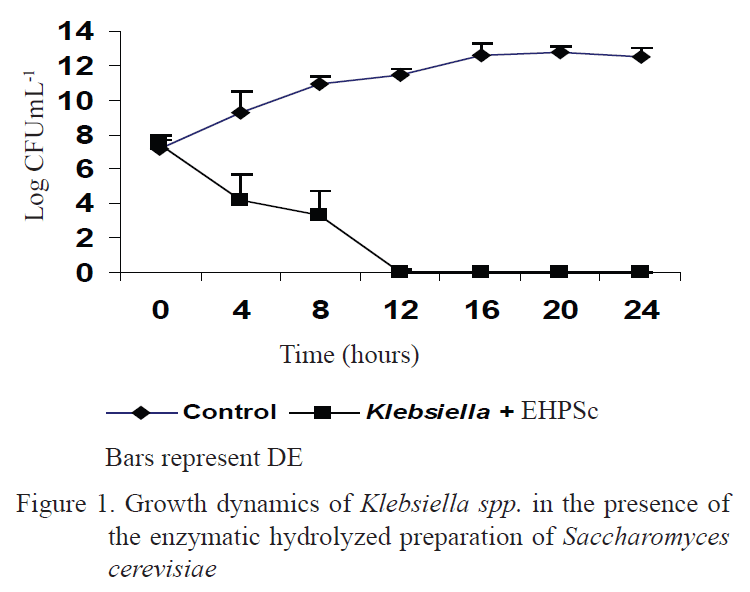
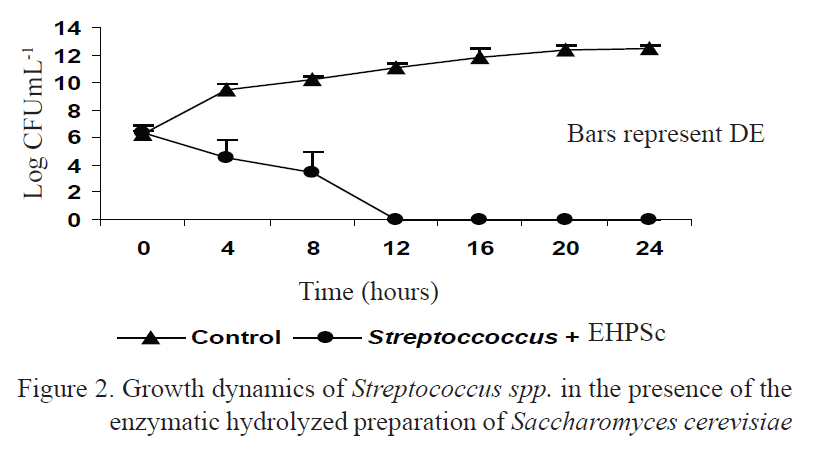
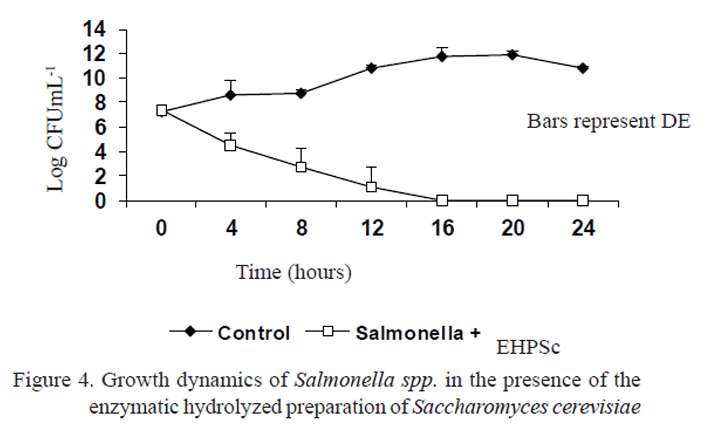
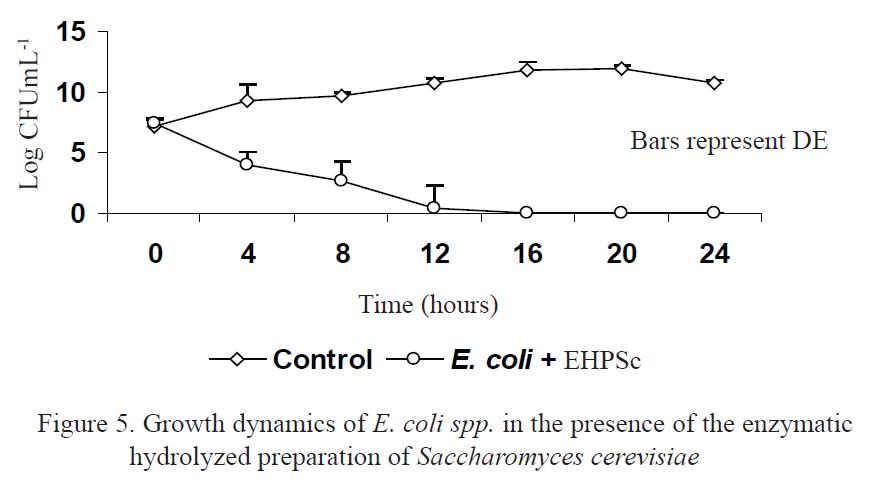
<body><![CDATA[<p align="justify"><font size="2" face="Verdana, Arial, Helvetica, sans-serif">Ay<sub>i</sub>: Absorbency of the yeast hydrolyzed preparation in  the initial time</font></p>     <p align="justify"><font size="2" face="Verdana, Arial, Helvetica, sans-serif"><em>Statistical processing of data</em>. Three  replications were performed per each experiment and per each simple. The  results were analyzed according to a design of simple classification. The  system INFOSTAT Version 1 (Balzarini <em>et al.</em> 2001) was used for data  processing. The analysis of variance were performed to verify the differences  among means, with a level of significance of P&lt;0.05. The test of Duncan  (1955) was used to perform multiple comparisons among the means. The counting  of viable microorganisms was turned into Log N to guarantee the normality  conditions in the growth    curve.</font></p>     <p align="justify">&nbsp;</p>     <p align="justify"><strong><font size="3" face="Verdana, Arial, Helvetica, sans-serif">RESULTS AND DISCUSSION</font></strong></p>     <p align="justify"><font size="2" face="Verdana, Arial, Helvetica, sans-serif"><a href="/img/revistas/cjas/v49n3/f0114315.gif">Figures 1</a>, <a href="/img/revistas/cjas/v49n3/f0214315.gif">2</a>, <a href="/img/revistas/cjas/v49n3/f0314315.gif">3</a>, <a href="/img/revistas/cjas/v49n3/f0414315.gif">4</a> and <a href="/img/revistas/cjas/v49n3/f0514315.gif">5</a> show the results of the development of  co-cultures with the enzymatic hydrolyzed preparation and the indicator strains <em>Klebsiella spp.</em>, <em>Streptococcus spp.</em>, <em>Staphylococcus spp.</em>, <em>Salmonella  spp.</em> and <em>E. coli</em>. There was no growth of the indicator strains in  the medium with the dose used in this bio-preparation, while they showed an  accelerate growth in the control culture.&nbsp; </font></p>     
<p align="justify"><font size="2" face="Verdana, Arial, Helvetica, sans-serif">It was verified that, as the time went  by, the cells of indicator strains lost their viability and, after    12 hours, there were no live cells in the co-cultures of <em>Klebsiella spp.</em>, <em>Streptococcus spp.</em>, <em>Staphylococcus spp.</em> and <em>E. coli spp.</em> The co-culture of <em>Salmonella spp.</em> showed a total reduction after 16  hours. These results indicate that there are antimicrobial substances in this  bio-preparation that limit the growth of the inoculated pathogenic  strains.&nbsp; </font></p>     <p align="justify"><font size="2" face="Verdana, Arial, Helvetica, sans-serif">It is known that hydrolysis of the cell wall components of <em>Saccharomyces  cerevisiae</em> is achieved using enzymes that produce Bacillus cells. The  literature refers to the function of this genus in the production of  bactericide and bacteriostatic substances (Mili&aacute;n 2009 and Ayala <em>et al.</em> 2012).</font></p>     <p align="justify"><font size="2" face="Verdana, Arial, Helvetica, sans-serif">Similar results have been reported by Svetoch <em>et al.</em> (2011),  and Bayoda (2013), who demonstrate the antagonistic activity of a hydrolyzed  preparation of <em>Saccharomyces cerevisiae</em> and of&nbsp; <em>Bacillus subtilis</em> 21BMC, respectively,  in front of different pathogenic microorganism, including the <em>Candida  albicans</em>, Proteus, <em>E. coli</em>, Shigella and Salmonella.</font></p>     <p align="justify"><font size="2" face="Verdana, Arial, Helvetica, sans-serif">According to Cho <em>et al.</em> (2011), the utilization of bacteria  from Bacillus genus is a result of their ability to produce endospores. Studies  carried out by Leser <em>et al.</em> (2008) state that these strains (spores or  vegetative cells) exclude pathogenic microorganisms by competitive adhesion or  by synthesis of antimicrobial    substances.</font></p>     <p align="justify"><font size="2" face="Verdana, Arial, Helvetica, sans-serif">The presence of Bacillus and its endospores in the hydrolyzed  preparation of yeast could cause the inhibition of the growth of indicator  strains in front of this bio-preparation.&nbsp; </font></p>     ]]></body>
<body><![CDATA[<p align="justify"><font size="2" face="Verdana, Arial, Helvetica, sans-serif"><a href="/img/revistas/cjas/v49n3/t0114315.gif">Table 1</a> shows the results of the determination of the antibacterial  substances in the enzymatic hydrolyzed preparation in front of indicator  strains. </font></p>     
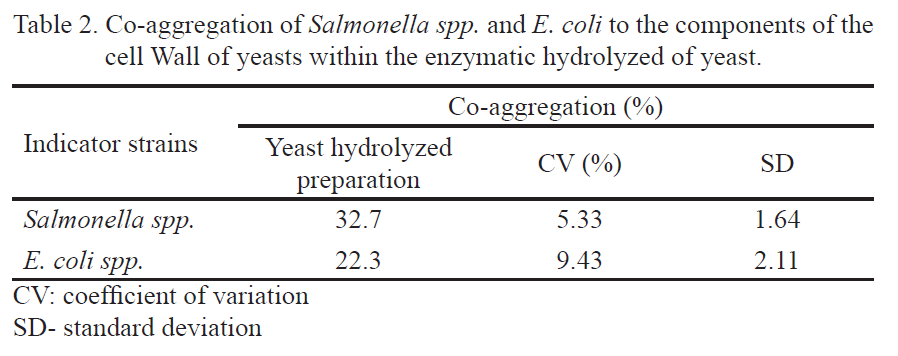
<p align="justify"><font size="2" face="Verdana, Arial, Helvetica, sans-serif">The enzymatic hydrolyzed preparation of  yeast caused the formation of inhibition halos in the supernatants of V1 and V2  in front of strains of <em>Klebsiella spp.</em>, <em>Streptococcus spp.</em>, <em>Staphylococcus  spp.</em>, <em>Salmonella spp.</em> and <em>E. coli spp.</em> These results indicate  the presence of bacteriocins and/or antibiotics in this hydrolyzed preparation,  because there was an inhibition of the indicator strains with the supernatant  of V3 (acid production). </font></p>     <p align="justify"><font size="2" face="Verdana, Arial, Helvetica, sans-serif">Similar studies, carried out by Vondruskova <em>et al.</em> (2010) and  Ansari <em>et al.</em> (2012), demonstrate that different strains of <em>Bacillus  subtilis</em> are able of generating substances like bacitracin, polymixin,  difficidin, subtilin and mycobacillin, which are antibiotics that inhibit the  growth of pathogenic microorganisms from the intestine of animals.</font></p>     <p align="justify"><font size="2" face="Verdana, Arial, Helvetica, sans-serif">The inhibiting activity of <em>Bacillus subtilis</em> was also  evaluated by mass spectroscopy (Lim-Teo <em>et al.</em> 2005) and it was  demonstrated that this bacteria does not have the ability to inhibit <em>Clostridium  difficile</em>, <em>Streptococcus pneumoniae</em>, <em>Campylobacter jejuni</em> ATCC-35918, <em>Campylobacter coli</em> ATCC-51798 and <em>Clostridium perfringens</em> ATCC- 13124, due to the production of bacteriocins.</font></p>     <p align="justify"><font size="2" face="Verdana, Arial, Helvetica, sans-serif">According to these results, the highest inhibiting activity existed  in front of the strain of Salmonella (P&lt;0.05), followed by <em>E. coli</em>.  In young animals,    70 % of the infections due to enterobacteria show the presence of these agents  as the most commonly isolated microorganisms (P&eacute;rez <em>et al.</em> 2011 and  Tellez <em>et al.</em>  2012).&nbsp; </font></p>     <p align="justify"><font size="2" face="Verdana, Arial, Helvetica, sans-serif">According to the literature (Gusils <em>et al.</em> 2008 and Fernando  2008), Gram-negative bacteria, like <em>E. coli</em> and Salmonella, use fimbriae  to adhere to the target cells of the intestine of animals. These proteins  (adhesins), within the fimbriae of pathogenic microorganisms, fix themselves to  the receptors of cell walls of yeasts, and are capable of dragging pathogenic  bacteria, due to their ability of bonding these microbes to their cell walls or  joining by the receptive areas of the pathogens, which are connected to the  intestinal mucus (P&eacute;rez-Sotelo <em>et al.</em> 2005 and Moslehi-Jenabian <em>et  al.</em> 2010).&nbsp;&nbsp; </font></p>     <p align="justify"><font size="2" face="Verdana, Arial, Helvetica, sans-serif">During the last years, the use of probiotics in prophylaxis and  therapy of gastrointestinal diseases has been a subject of great interest and  scientific discussion. Nowadays, the importance and possible efficiency of  biotic therapy (probiotics and prebiotics) has been recognized as a medical  tool for treating digestive diseases (Carro <em>et al.</em> 2014). </font></p>     <p align="justify"><font size="2" face="Verdana, Arial, Helvetica, sans-serif"><a href="/img/revistas/cjas/v49n3/t0214315.gif">Table 2</a> shows the percent of co-aggregation reached by the cells of <em>Salmonella  spp.</em> and <em>E. coli spp.</em> to the components of the cell wall of yeasts  within the enzymatic hydrolyzed preparation of S.    cerevisiae.</font></p>     
<p align="justify"><font size="2" face="Verdana, Arial, Helvetica, sans-serif">According to Suman Saran <em>et al.</em> (2012), the self-aggregation  in bacteria can be defined as the phenomenon of aggregation among cells of the  same strain, while the co-aggregation means the aggregation occurring between  different species. The capacity of aggregation is related to the adhesion,  which is a characteristic of <em>E. coli</em> and <em>Salmonella spp.</em></font></p>     <p align="justify"><font size="2" face="Verdana, Arial, Helvetica, sans-serif">As <a href="/img/revistas/cjas/v49n3/t0214315.gif">table 2</a> shows, the percentages of co-aggregation reported in this  study could be related to the significant presence of cell wall fractions of  yeasts within the enzymatic hydrolyzed preparation. Regarding this fact,  S&aacute;nchez-Hern&aacute;ndez <em>et al.</em> (2012) stated that when pathogens add to the  cell wall of yeasts, a protective effect is induced, and this <em>S. cerevisiae</em>-pathogen  complex is rapidly removed from the digestive    tract.</font></p>     
]]></body>
<body><![CDATA[<p align="justify"><font size="2" face="Verdana, Arial, Helvetica, sans-serif">Scientific studies demonstrate that  mannane oligosaccharides (MOS) are efficient for the agglutination of pathogens  like Salmonella and <em>E. coli</em>, regulate the colonization of pathogens and  generate the reestablishment of the beneficial flora, improving the intestinal  health of animals (Celyk <em>et al.</em> 2003 and Khati <em>et al.</em> 2007). The  adhesion property of MOS is demonstrated in this experiment and reveals the  probiotic potential of this additive in antimicrobial activity. </font></p>     <p align="justify"><font size="2" face="Verdana, Arial, Helvetica, sans-serif">For several years, multidisciplinary  groups have worked on the introduction of these bio-preparations in animal  production, due to their effect on yield and health of animals, and to the use  of an economically viable technology for Cuban conditions (P&eacute;rez <em>et al.</em> 2006). &nbsp;&nbsp;</font></p>     <p align="justify"><font size="2" face="Verdana, Arial, Helvetica, sans-serif">The results achieved in this study demonstrate the antibacterial  potential of the enzymatic hydrolyzed preparation of yeast in front of the  evaluated pathogenic microorganisms. The inhibiting activity, due to the  production of bacteriocins and/or antibiotics and to the co-aggregation with  pathogens, indicates the limited growth of bacterial strains in the presence of  this bio-preparation.&nbsp; This activity is  multifactorial and unleashes different processes that are interrelated and  provoke, as a consequence, the improvements of physiology, yield and health of  animals. Therefore, it can be used as an additive for animal feeding.&nbsp; </font></p>     <p align="justify">&nbsp;</p>     <p align="justify"><strong><font size="3" face="Verdana, Arial, Helvetica, sans-serif">REFERENCES</font></strong></p>     <p align="justify"><font size="2" face="Verdana, Arial, Helvetica, sans-serif">Ansari, A., Aman, A., Siddiqui, N., Iqbal, S., Ali, U.  &amp; Qader, S. 2012. &lsquo;&lsquo;Bacteriocin (BACIB17):  screening, isolation and production from Bacillus subtilis KIBGE IB-17&rsquo;&rsquo;. <em>The  Karachi Institute of Biotechnology &amp; Genetic</em>, 25: 195.</font></p>     <p align="justify"><font size="2" face="Verdana, Arial, Helvetica, sans-serif">Ayala, L., Bocourt, R., Mili&aacute;n,  G., Castro, M., Herrera, M. &amp; Guzm&aacute;n, J. 2012. &lsquo;&lsquo;Assessment of a probiotic  based on Bacillus subtilis and its endospores in the obtainment of healthy  lungs of pigs&rsquo;&rsquo;. <em>Cuban J.  Agric. Sci.</em>, 46: 391.</font></p>     <!-- ref --><p align="justify"><font size="2" face="Verdana, Arial, Helvetica, sans-serif">Bayoda, B. 2013. <em>Evaluaci&oacute;n in vitro de la  actividad antimicrobiana de una cepa de Bacillus subtilis con potencial  probi&oacute;tico</em>. Engineering Thesis, Universidad de Matanzas, Matanzas, Cuba.    </font></p>     <!-- ref --><p align="justify"><font size="2" face="Verdana, Arial, Helvetica, sans-serif">Carro, M. D., Saro, S., Mateos, I., D&iacute;as, A. &amp;  Ranilla, M. J.n.d. <em>Perspectivas y retos de los extractos vegetales como aditivos  alimentarios en rumiantes</em>. Grupo As&iacute;s Biomedia, S.L., 4-6 p.    </font></p>     <p align="justify"><font size="2" face="Verdana, Arial, Helvetica, sans-serif">Celyk, K., Denly, M. &amp; Savas, T. 2003. &lsquo;&lsquo;Reduction of toxic effects of Aflatoxin B1 by using Baker yeast (S.  cerevisiae) in growing broiler chicken diets&rsquo;&rsquo;. <em>Rev. Bras. Zootec</em>, 32: 615.</font></p>     <p align="justify"><font size="2" face="Verdana, Arial, Helvetica, sans-serif">Cho, J. H., Zhao, P. Y. &amp; Kim, I. H. 2011. &lsquo;&lsquo;Probiotics as a Dietary Additive for Pigs. J. Animal and Veterinary  Advances&rsquo;&rsquo;. In: vol. 10, p. 2127.</font></p>     <p align="justify"><font size="2" face="Verdana, Arial, Helvetica, sans-serif">Duncan, B. 1955. &lsquo;&lsquo;Multiple  ranges and multiple F test&rsquo;&rsquo;. <em>Biometrics</em>, 11: 1.</font></p>     <!-- ref --><p align="justify"><font size="2" face="Verdana, Arial, Helvetica, sans-serif">Fernando, N. 2008. <em>Utilizaci&oacute;n de oligosac&aacute;ridos  mananos como promotor de crecimiento en cr&iacute;a y levante de pollitas de  reposici&oacute;n Lohman Brown y su efecto hasta el pico de producci&oacute;n</em>.  Engineering Thesis, Escuela Superior Polit&eacute;cnica de Chimborazo, Chimborazo.  Ecuador.    </font></p>     <p align="justify"><font size="2" face="Verdana, Arial, Helvetica, sans-serif">Fleet, G. H. 2007. &lsquo;&lsquo;Yeasts in  foods and beverages: impact on product quality and safety&rsquo;&rsquo;. <em>Curr. Opinion  Biotechnol</em>, 18: 170.</font></p>     <p align="justify"><font size="2" face="Verdana, Arial, Helvetica, sans-serif">Gusils, C., Oppezzo, O.,  Pizarro, R. &amp; Gonzalez, S. 2008. &lsquo;&lsquo;Adhesion of probiotic lactobacilli to  chick intestinal mucus&rsquo;&rsquo;. <em>Can. J. Microbiol</em>, 49: 472.</font></p>     <!-- ref --><p align="justify"><font size="2" face="Verdana, Arial, Helvetica, sans-serif">INFOSTAT 2009. <em>Grupo InfoStat, FCA</em>. version 1,  Universidad Nacional de C&oacute;rdova, Argentina.    </font></p>     ]]></body>
<body><![CDATA[<p align="justify"><font size="2" face="Verdana, Arial, Helvetica, sans-serif">Jacques, N. &amp; Casaregola,  S. 2008. &lsquo;&lsquo;Safety assessment of dairy microorganisms: The hemiascomycetous  yeasts&rsquo;&rsquo;. <em>Int. J. Food Microbiol</em>, 126: 321.</font></p>     <p align="justify"><font size="2" face="Verdana, Arial, Helvetica, sans-serif">Khati, B., Kolte, B.,  Shendare, R., Palve, H., Mandlekar, S. &amp; Shisodiya, J. 2007. &lsquo;&lsquo;Effect of  low protein level supplemented with or without yeast (Saccharomyces cerevisiae)  on haematological and immunological profile of broiler quails&rsquo;&rsquo;. <em>Royal  Veterinary J. of India</em>, 3: 131.</font></p>     <p align="justify"><font size="2" face="Verdana, Arial, Helvetica, sans-serif">Leser, T. D., Knarreborg, A.  &amp; Worm, J. 2008. &lsquo;&lsquo;Germination and outgrowth of Bacillus subtilis and  Bacillus licheniformis spores in the gastrointestinal tract of pigs&rsquo;&rsquo;. <em>J.  Appl. Microbiol</em>, 104: 1025.</font></p>     <p align="justify"><font size="2" face="Verdana, Arial, Helvetica, sans-serif">Lim, T., Yeow, A. &amp; Tan,  M. 2005. &lsquo;&lsquo;Inhibition of Clostridium perfringens by a Novel Strain of Bacillus  subtilis Isolated from the Gastrointestinal Tracts of Healthy Chickens&rsquo;&rsquo;. <em>Appl.  Environmental Microbiol</em>, 71: 4185.</font></p>     <p align="justify"><font size="2" face="Verdana, Arial, Helvetica, sans-serif">Louren&ccedil;o, M., Hayashi, R. M.,  Pickler, L., Miglino, L. B., Kuritza, L. &amp; Santin, E. 2011. &lsquo;&lsquo;Expresi&oacute;n de c&eacute;lulas caliciformes  y linf&oacute;citos t cd3 en la mucosa intestinal de pollos de engorde suplementados  con oligosac&aacute;ridos mananos&rsquo;&rsquo;. In: <em>XXII Congreso Latinoamericano de  Avicultura</em>, Curitiba, Brasil: Universidad Federal de Paran&aacute;.</font></p>     <!-- ref --><p align="justify"><font size="2" face="Verdana, Arial, Helvetica, sans-serif">Mili&aacute;n, G. 2009. <em>Obtenci&oacute;n de cultivos de Bacillus  spp. y sus endosporas. Evaluaci&oacute;n de su actividad probi&oacute;tica en pollos (Gallus  gallus domesticus)</em>. PhD Thesis, Instituto de Ciencia Animal, La Habana,  Cuba.    </font></p>     <p align="justify"><font size="2" face="Verdana, Arial, Helvetica, sans-serif">Mili&aacute;n, G., Rond&oacute;n, A. J., P&eacute;rez, M., Samaniego, L.  M., Ria&ntilde;o, J., Bocourt, R., Ranilla, M. J., Carro, M. D., Rodr&iacute;guez, M. &amp;  Laurencio, M. 2014. &lsquo;&lsquo;Isolation and identification of strains of  Bacillus spp. in different ecosystems, with probiotic purposes, and their use  in animals&rsquo;&rsquo;. <em>Cuban J. Agric. Sci</em>, 48: 347.</font></p>     <p align="justify"><font size="2" face="Verdana, Arial, Helvetica, sans-serif">Moslehi-Jenabian, S.,  Lindegaard, L. &amp; Jespersen, L. 2010. &lsquo;&lsquo;Review: beneficial effects of  probiotic and food borne yeasts on human health&rsquo;&rsquo;. <em>Nutrients</em>, 2: 449.</font></p>     <p align="justify"><font size="2" face="Verdana, Arial, Helvetica, sans-serif">Or&#322;owski, A. &amp; Bielecka,  M. 2006. &lsquo;&lsquo;Preliminary characteristics of Lactobacillus and Bifidobacterium  strains as probiotic candidates&rsquo;&rsquo;. <em>Pol. J. Food Nutr. Sci.</em>, 15: 269.</font></p>     ]]></body>
<body><![CDATA[<p align="justify"><font size="2" face="Verdana, Arial, Helvetica, sans-serif">P&eacute;rez, M., Laurencio, M., Rond&oacute;n, A. J., Mili&aacute;n, G.,  Arteaga, F., Rodr&iacute;guez, M. &amp; Borges, Y. 2012. &lsquo;&lsquo;Evaluaci&oacute;n de una mezcla  probi&oacute;tica en la alimentaci&oacute;n de gallinas ponedoras en una unidad de producci&oacute;n  comercial&rsquo;&rsquo;. <em>Rev. Pastos y Forrajes</em>, 35: 311.</font></p>     <p align="justify"><font size="2" face="Verdana, Arial, Helvetica, sans-serif">P&eacute;rez, M., Laurencio, M., Rond&oacute;n, A. j, Mili&aacute;n, G.,  Bocourt, R. &amp; Arteaga, F. 2011. &lsquo;&lsquo;Actividad antimicrobiana de una mezcla  probi&oacute;tica de exclusi&oacute;n competitiva y su estabilidad en el tiempo&rsquo;&rsquo;. <em>Rev.  Salud Anim.</em>, 33: 147.</font></p>     <!-- ref --><p align="justify"><font size="2" face="Verdana, Arial, Helvetica, sans-serif">P&eacute;rez, M. Q., Mili&aacute;n, G., Piad, R. B., Gonz&aacute;lez, R.  C., Bocourt, R. S. &amp; Sav&oacute;n, V. 2006. <em>Hidrolizado de fondaje de cubetas  de destiler&iacute;as de alcohol con un crudo enzim&aacute;tico de la cepa de Bacillus  licheniformis E-44 y su procedimiento de obtenci&oacute;n</em>. no. 23179. (Int.cl.8) A  23 J 1/00, 3/30, C 12N 9/56.    </font></p>     <p align="justify"><font size="2" face="Verdana, Arial, Helvetica, sans-serif">P&eacute;rez-Sotelo, L. S., Talavera, R. M., Monroy, H. G.,  Bernab&eacute;, S. L., Cuar&oacute;n, J. A., Ibarg&uuml;engoytia, R., Montes de Oca, J. &amp;  V&aacute;zquez, J. C. 2005. &lsquo;&lsquo;In vitro evaluation of the  binding capacity of Saccharomyces cerevisiae Sc47 to adhere to the wall of  Salmonella spp&rsquo;&rsquo;. <em>Revista  Latinoamericana de Microbiolog&iacute;a</em>, 47: 70.</font></p>     <!-- ref --><p align="justify"><font size="2" face="Verdana, Arial, Helvetica, sans-serif">Rodr&iacute;guez, M. 2010. <em>Evaluaci&oacute;n in vitro de la  actividad antimicrobiana del hidrolizado enzim&aacute;tico de levadura Saccharomyces  cerevisiae</em>. Master Thesis, Instituto de Ciencia Animal, Cuba.    </font></p>     <p align="justify"><font size="2" face="Verdana, Arial, Helvetica, sans-serif">S&aacute;nchez-Hern&aacute;ndez, J. A., Mayta-Baldivieso, M. J.  &amp; Rivera-Tapia, J. A. 2012. &lsquo;&lsquo;Alteraciones del pH vaginal asociado a  lactobacilos o bacilo de Doderlein&rsquo;&rsquo;. <em>Revista Latinoamericana de Patolog&iacute;a  Cl&iacute;nica y Medicina</em>, 59: 56.</font></p>     <p align="justify"><font size="2" face="Verdana, Arial, Helvetica, sans-serif">Schillinger, U. &amp; Lucke, F. K. 1989. &lsquo;&lsquo;Antibacterial Activity of Lactobacillus sake Isolated from Meat&rsquo;&rsquo;. <em>Appl.  Environm. Microbiol.</em>, 55: 1901.</font></p>     <p align="justify"><font size="2" face="Verdana, Arial, Helvetica, sans-serif">Suman Saran, M. S., Bisht, K.,  Singh, U. V. &amp; Teotia, S. 2012. &lsquo;&lsquo;Comparing Adhesion Attributes of two  Isolotes of Lactobacillus Acidophilus for Assessment of prebiotics Honey and  Inulin&rsquo;&rsquo;. <em>International  J. Sci. Research Publications</em>.</font></p>     ]]></body>
<body><![CDATA[<p align="justify"><font size="2" face="Verdana, Arial, Helvetica, sans-serif">Svetoch, E. A., Eruslanov, B.  V., Levchuk, V. P., Perelygin, V. V., Mitsevich, E. V., Mitsevich, I. P.,  Stepanshin, J., Dyatlov, I., Seal, B. S. &amp; Stern, N. J. 2011. &lsquo;&lsquo;Isolation  of Lactobacillus salivarius 1077 (NRRL B-50053) and Characterization of Its  Bacteriocin, Including the Antimicrobial Activity Spectrum&rsquo;&rsquo;. <em>Appl. Environ  Microbiol</em>, 77: 2749.</font></p>     <p align="justify"><font size="2" face="Verdana, Arial, Helvetica, sans-serif">Tellez, G., Pixley, B. E.,  Wolfenden, S., Layton, L. &amp; Hargis, B. 2012. &lsquo;&lsquo;Probiotics/direct fed  microbials for Salmonella control in poultry G Probiotics/direct fed microbials  for Salmonella control in poultry&rsquo;&rsquo;. <em>Food Research International</em>, 45:  628.</font></p>     <p align="justify"><font size="2" face="Verdana, Arial, Helvetica, sans-serif">Van Staden, A. D. &amp; Dicks,  L. M. 2012. &lsquo;&lsquo;Applications, antibiotic release and alternatives to  antibiotics&rsquo;&rsquo;. <em>J Appl. Biomater Funct Mater</em>, 10: 2.</font></p>     <p align="justify"><font size="2" face="Verdana, Arial, Helvetica, sans-serif">  Vondruskova, H., Slamova, R., Trckova, M., Zraly,  Z. &amp; Pavlik, I. 2010. &lsquo;&lsquo;Alternatives to antibiotic growth promoters in  prevention of diarrhea in weaned piglets: a review&rsquo;&rsquo;. <em>Veterinarni Medicina</em>, 55: 199.</font></p>     <p align="justify">&nbsp;</p>     <p align="justify">&nbsp;</p>     <p align="justify"><font size="2" face="Verdana, Arial, Helvetica, sans-serif">Received: February 2, 2015    <br> Accepted: June 22, 2015</font></p>     <p align="justify">&nbsp;</p>     <p align="justify">&nbsp;</p>     ]]></body>
<body><![CDATA[<p align="justify"><font size="2" face="Verdana, Arial, Helvetica, sans-serif"><i>Marlen Rodríguez,</i> Centro de Estudios Biotecnológicos, Universidad de Matanzas, Autopista a Varadero, km 3 ½, Matanzas, Cuba.    Email: <a href="mailto:marlen.rodriguez@umcc.cu">marlen.rodriguez@umcc.cu</a></font></p>      ]]></body><back>
<ref-list>
<ref id="B1">
<nlm-citation citation-type="journal">
<person-group person-group-type="author">
<name>
<surname><![CDATA[Ansari]]></surname>
<given-names><![CDATA[A.]]></given-names>
</name>
<name>
<surname><![CDATA[Aman]]></surname>
<given-names><![CDATA[A.]]></given-names>
</name>
<name>
<surname><![CDATA[Siddiqui]]></surname>
<given-names><![CDATA[N.]]></given-names>
</name>
<name>
<surname><![CDATA[Iqbal]]></surname>
<given-names><![CDATA[S.]]></given-names>
</name>
<name>
<surname><![CDATA[Ali]]></surname>
<given-names><![CDATA[U.]]></given-names>
</name>
<name>
<surname><![CDATA[Qader]]></surname>
<given-names><![CDATA[S.]]></given-names>
</name>
</person-group>
<article-title xml:lang="nd"><![CDATA[Bacteriocin (BACIB17): screening, isolation and production from Bacillus subtilis KIBGE IB-17]]></article-title>
<source><![CDATA[The Karachi Institute of Biotechnology & Genetic]]></source>
<year>2012</year>
<volume>25</volume>
<page-range>195</page-range></nlm-citation>
</ref>
<ref id="B2">
<nlm-citation citation-type="journal">
<person-group person-group-type="author">
<name>
<surname><![CDATA[Ayala]]></surname>
<given-names><![CDATA[L.]]></given-names>
</name>
<name>
<surname><![CDATA[Bocourt]]></surname>
<given-names><![CDATA[R.]]></given-names>
</name>
<name>
<surname><![CDATA[Milián]]></surname>
<given-names><![CDATA[G.]]></given-names>
</name>
<name>
<surname><![CDATA[Castro]]></surname>
<given-names><![CDATA[M.]]></given-names>
</name>
<name>
<surname><![CDATA[Herrera]]></surname>
<given-names><![CDATA[M.]]></given-names>
</name>
<name>
<surname><![CDATA[Guzmán]]></surname>
<given-names><![CDATA[J.]]></given-names>
</name>
</person-group>
<article-title xml:lang="nd"><![CDATA[Assessment of a probiotic based on Bacillus subtilis and its endospores in the obtainment of healthy lungs of pigs]]></article-title>
<source><![CDATA[Cuban J. Agric. Sci.]]></source>
<year>2012</year>
<volume>46</volume>
<page-range>391</page-range></nlm-citation>
</ref>
<ref id="B3">
<nlm-citation citation-type="book">
<person-group person-group-type="author">
<name>
<surname><![CDATA[Bayoda]]></surname>
<given-names><![CDATA[B.]]></given-names>
</name>
</person-group>
<source><![CDATA[Evaluación in vitro de la actividad antimicrobiana de una cepa de Bacillus subtilis con potencial probiótico]]></source>
<year>2013</year>
<publisher-loc><![CDATA[Matanzas, Cuba ]]></publisher-loc>
<publisher-name><![CDATA[Universidad de Matanzas]]></publisher-name>
</nlm-citation>
</ref>
<ref id="B4">
<nlm-citation citation-type="book">
<person-group person-group-type="author">
<name>
<surname><![CDATA[Carro]]></surname>
<given-names><![CDATA[M. D.]]></given-names>
</name>
<name>
<surname><![CDATA[Saro]]></surname>
<given-names><![CDATA[S.]]></given-names>
</name>
<name>
<surname><![CDATA[Mateos]]></surname>
<given-names><![CDATA[I.]]></given-names>
</name>
<name>
<surname><![CDATA[Días]]></surname>
<given-names><![CDATA[A.]]></given-names>
</name>
<name>
<surname><![CDATA[Ranilla]]></surname>
<given-names><![CDATA[M. J.]]></given-names>
</name>
</person-group>
<source><![CDATA[Perspectivas y retos de los extractos vegetales como aditivos alimentarios en rumiantes]]></source>
<year></year>
<page-range>4-6</page-range><publisher-name><![CDATA[Grupo Asís Biomedia, S.L.]]></publisher-name>
</nlm-citation>
</ref>
<ref id="B5">
<nlm-citation citation-type="journal">
<person-group person-group-type="author">
<name>
<surname><![CDATA[Celyk]]></surname>
<given-names><![CDATA[K.]]></given-names>
</name>
<name>
<surname><![CDATA[Denly]]></surname>
<given-names><![CDATA[M.]]></given-names>
</name>
<name>
<surname><![CDATA[Savas]]></surname>
<given-names><![CDATA[T.]]></given-names>
</name>
</person-group>
<article-title xml:lang="nd"><![CDATA[Reduction of toxic effects of Aflatoxin B1 by using Baker yeast (S. cerevisiae) in growing broiler chicken diets]]></article-title>
<source><![CDATA[Rev. Bras. Zootec]]></source>
<year>2003</year>
<volume>32</volume>
<page-range>615</page-range></nlm-citation>
</ref>
<ref id="B6">
<nlm-citation citation-type="">
<person-group person-group-type="author">
<name>
<surname><![CDATA[Cho]]></surname>
<given-names><![CDATA[J. H.]]></given-names>
</name>
<name>
<surname><![CDATA[Zhao]]></surname>
<given-names><![CDATA[P. Y.]]></given-names>
</name>
<name>
<surname><![CDATA[Kim]]></surname>
<given-names><![CDATA[I. H.]]></given-names>
</name>
</person-group>
<article-title xml:lang="nd"><![CDATA[Probiotics as a Dietary Additive for Pigs. J. Animal and Veterinary Advances]]></article-title>
<source><![CDATA[]]></source>
<year>2011</year>
<volume>10</volume>
<page-range>2127</page-range></nlm-citation>
</ref>
<ref id="B7">
<nlm-citation citation-type="journal">
<person-group person-group-type="author">
<name>
<surname><![CDATA[Duncan]]></surname>
<given-names><![CDATA[B.]]></given-names>
</name>
</person-group>
<article-title xml:lang="nd"><![CDATA[Multiple ranges and multiple F test]]></article-title>
<source><![CDATA[Biometrics]]></source>
<year>1955</year>
<volume>11</volume>
<page-range>1</page-range></nlm-citation>
</ref>
<ref id="B8">
<nlm-citation citation-type="book">
<person-group person-group-type="author">
<name>
<surname><![CDATA[Fernando]]></surname>
<given-names><![CDATA[N.]]></given-names>
</name>
</person-group>
<source><![CDATA[Utilización de oligosacáridos mananos como promotor de crecimiento en cría y levante de pollitas de reposición Lohman Brown y su efecto hasta el pico de producción]]></source>
<year>2008</year>
<publisher-loc><![CDATA[Chimborazo. Ecuador ]]></publisher-loc>
<publisher-name><![CDATA[Escuela Superior Politécnica de Chimborazo]]></publisher-name>
</nlm-citation>
</ref>
<ref id="B9">
<nlm-citation citation-type="journal">
<person-group person-group-type="author">
<name>
<surname><![CDATA[Fleet]]></surname>
<given-names><![CDATA[G. H.]]></given-names>
</name>
</person-group>
<article-title xml:lang="nd"><![CDATA[Yeasts in foods and beverages: impact on product quality and safety]]></article-title>
<source><![CDATA[Curr. Opinion Biotechnol]]></source>
<year>2007</year>
<volume>18</volume>
<page-range>170</page-range></nlm-citation>
</ref>
<ref id="B10">
<nlm-citation citation-type="journal">
<person-group person-group-type="author">
<name>
<surname><![CDATA[Gusils]]></surname>
<given-names><![CDATA[C.]]></given-names>
</name>
<name>
<surname><![CDATA[Oppezzo]]></surname>
<given-names><![CDATA[O.]]></given-names>
</name>
<name>
<surname><![CDATA[Pizarro]]></surname>
<given-names><![CDATA[R.]]></given-names>
</name>
<name>
<surname><![CDATA[Gonzalez]]></surname>
<given-names><![CDATA[S.]]></given-names>
</name>
</person-group>
<article-title xml:lang="nd"><![CDATA[Adhesion of probiotic lactobacilli to chick intestinal mucus]]></article-title>
<source><![CDATA[Can. J. Microbiol]]></source>
<year>2008</year>
<volume>49</volume>
<page-range>472</page-range></nlm-citation>
</ref>
<ref id="B11">
<nlm-citation citation-type="">
<person-group person-group-type="author">
<name>
<surname><![CDATA[INFOSTAT]]></surname>
</name>
</person-group>
<source><![CDATA[Grupo InfoStat, FCA]]></source>
<year>2009</year>
<publisher-loc><![CDATA[Universidad Nacional de Córdova, Argentina ]]></publisher-loc>
</nlm-citation>
</ref>
<ref id="B12">
<nlm-citation citation-type="journal">
<person-group person-group-type="author">
<name>
<surname><![CDATA[Jacques]]></surname>
<given-names><![CDATA[N.]]></given-names>
</name>
<name>
<surname><![CDATA[Casaregola]]></surname>
<given-names><![CDATA[S.]]></given-names>
</name>
</person-group>
<article-title xml:lang="nd"><![CDATA[Safety assessment of dairy microorganisms: The hemiascomycetous yeasts]]></article-title>
<source><![CDATA[Int. J. Food Microbiol]]></source>
<year>2008</year>
<volume>126</volume>
<page-range>321</page-range></nlm-citation>
</ref>
<ref id="B13">
<nlm-citation citation-type="journal">
<person-group person-group-type="author">
<name>
<surname><![CDATA[Khati]]></surname>
<given-names><![CDATA[B.]]></given-names>
</name>
<name>
<surname><![CDATA[Kolte]]></surname>
<given-names><![CDATA[B.]]></given-names>
</name>
<name>
<surname><![CDATA[Shendare]]></surname>
<given-names><![CDATA[R.]]></given-names>
</name>
<name>
<surname><![CDATA[Palve]]></surname>
<given-names><![CDATA[H.]]></given-names>
</name>
<name>
<surname><![CDATA[Mandlekar]]></surname>
<given-names><![CDATA[S.]]></given-names>
</name>
<name>
<surname><![CDATA[Shisodiya]]></surname>
<given-names><![CDATA[J.]]></given-names>
</name>
</person-group>
<article-title xml:lang="nd"><![CDATA[Effect of low protein level supplemented with or without yeast (Saccharomyces cerevisiae) on haematological and immunological profile of broiler quails]]></article-title>
<source><![CDATA[Royal Veterinary J. of India]]></source>
<year>2007</year>
<volume>3</volume>
<page-range>131</page-range></nlm-citation>
</ref>
<ref id="B14">
<nlm-citation citation-type="journal">
<person-group person-group-type="author">
<name>
<surname><![CDATA[Leser]]></surname>
<given-names><![CDATA[T. D.]]></given-names>
</name>
<name>
<surname><![CDATA[Knarreborg]]></surname>
<given-names><![CDATA[A.]]></given-names>
</name>
<name>
<surname><![CDATA[Worm]]></surname>
<given-names><![CDATA[J.]]></given-names>
</name>
</person-group>
<article-title xml:lang="nd"><![CDATA[Germination and outgrowth of Bacillus subtilis and Bacillus licheniformis spores in the gastrointestinal tract of pigs]]></article-title>
<source><![CDATA[J. Appl. Microbiol]]></source>
<year>2008</year>
<volume>104</volume>
<page-range>1025</page-range></nlm-citation>
</ref>
<ref id="B15">
<nlm-citation citation-type="journal">
<person-group person-group-type="author">
<name>
<surname><![CDATA[Lim]]></surname>
<given-names><![CDATA[T.]]></given-names>
</name>
<name>
<surname><![CDATA[Yeow]]></surname>
<given-names><![CDATA[A.]]></given-names>
</name>
<name>
<surname><![CDATA[Tan]]></surname>
<given-names><![CDATA[M.]]></given-names>
</name>
</person-group>
<article-title xml:lang="nd"><![CDATA[Inhibition of Clostridium perfringens by a Novel Strain of Bacillus subtilis Isolated from the Gastrointestinal Tracts of Healthy Chickens]]></article-title>
<source><![CDATA[Appl. Environmental Microbiol]]></source>
<year>2005</year>
<volume>71</volume>
<page-range>4185</page-range></nlm-citation>
</ref>
<ref id="B16">
<nlm-citation citation-type="book">
<person-group person-group-type="author">
<name>
<surname><![CDATA[Lourenço]]></surname>
<given-names><![CDATA[M.]]></given-names>
</name>
<name>
<surname><![CDATA[Hayashi]]></surname>
<given-names><![CDATA[R. M.]]></given-names>
</name>
<name>
<surname><![CDATA[Pickler]]></surname>
<given-names><![CDATA[L.]]></given-names>
</name>
<name>
<surname><![CDATA[Miglino]]></surname>
<given-names><![CDATA[L. B.]]></given-names>
</name>
<name>
<surname><![CDATA[Kuritza]]></surname>
<given-names><![CDATA[L.]]></given-names>
</name>
<name>
<surname><![CDATA[Santin]]></surname>
<given-names><![CDATA[E.]]></given-names>
</name>
</person-group>
<article-title xml:lang="nd"><![CDATA[Expresión de células caliciformes y linfócitos t cd3 en la mucosa intestinal de pollos de engorde suplementados con oligosacáridos mananos]]></article-title>
<source><![CDATA[]]></source>
<year>2011</year>
<publisher-loc><![CDATA[Curitiba, Brasil ]]></publisher-loc>
<publisher-name><![CDATA[Universidad Federal de Paraná]]></publisher-name>
</nlm-citation>
</ref>
<ref id="B17">
<nlm-citation citation-type="book">
<person-group person-group-type="author">
<name>
<surname><![CDATA[Milián]]></surname>
<given-names><![CDATA[G.]]></given-names>
</name>
</person-group>
<source><![CDATA[Obtención de cultivos de Bacillus spp. y sus endosporas. Evaluación de su actividad probiótica en pollos (Gallus gallus domesticus)]]></source>
<year>2009</year>
<publisher-loc><![CDATA[La Habana, Cuba ]]></publisher-loc>
<publisher-name><![CDATA[Instituto de Ciencia Animal]]></publisher-name>
</nlm-citation>
</ref>
<ref id="B18">
<nlm-citation citation-type="journal">
<person-group person-group-type="author">
<name>
<surname><![CDATA[Milián]]></surname>
<given-names><![CDATA[G.]]></given-names>
</name>
<name>
<surname><![CDATA[Rondón]]></surname>
<given-names><![CDATA[A. J.]]></given-names>
</name>
<name>
<surname><![CDATA[Pérez]]></surname>
<given-names><![CDATA[M.]]></given-names>
</name>
<name>
<surname><![CDATA[Samaniego]]></surname>
<given-names><![CDATA[L. M.]]></given-names>
</name>
<name>
<surname><![CDATA[Riaño]]></surname>
<given-names><![CDATA[J.]]></given-names>
</name>
<name>
<surname><![CDATA[Bocourt]]></surname>
<given-names><![CDATA[R.]]></given-names>
</name>
<name>
<surname><![CDATA[Ranilla]]></surname>
<given-names><![CDATA[M. J.]]></given-names>
</name>
<name>
<surname><![CDATA[Carro]]></surname>
<given-names><![CDATA[M. D.]]></given-names>
</name>
<name>
<surname><![CDATA[Rodríguez]]></surname>
<given-names><![CDATA[M.]]></given-names>
</name>
<name>
<surname><![CDATA[Laurencio]]></surname>
<given-names><![CDATA[M.]]></given-names>
</name>
</person-group>
<article-title xml:lang="nd"><![CDATA[Isolation and identification of strains of Bacillus spp. in different ecosystems, with probiotic purposes, and their use in animals]]></article-title>
<source><![CDATA[Cuban J. Agric. Sci]]></source>
<year>2014</year>
<volume>48</volume>
<page-range>347</page-range></nlm-citation>
</ref>
<ref id="B19">
<nlm-citation citation-type="journal">
<person-group person-group-type="author">
<name>
<surname><![CDATA[Moslehi-Jenabian]]></surname>
<given-names><![CDATA[S.]]></given-names>
</name>
<name>
<surname><![CDATA[Lindegaard]]></surname>
<given-names><![CDATA[L.]]></given-names>
</name>
<name>
<surname><![CDATA[Jespersen]]></surname>
<given-names><![CDATA[L.]]></given-names>
</name>
</person-group>
<article-title xml:lang="nd"><![CDATA[Review: beneficial effects of probiotic and food borne yeasts on human health]]></article-title>
<source><![CDATA[Nutrients]]></source>
<year>2010</year>
<volume>2</volume>
<page-range>449</page-range></nlm-citation>
</ref>
<ref id="B20">
<nlm-citation citation-type="journal">
<person-group person-group-type="author">
<name>
<surname><![CDATA[Orlowski]]></surname>
<given-names><![CDATA[A.]]></given-names>
</name>
<name>
<surname><![CDATA[Bielecka]]></surname>
<given-names><![CDATA[M.]]></given-names>
</name>
</person-group>
<article-title xml:lang="nd"><![CDATA[Preliminary characteristics of Lactobacillus and Bifidobacterium strains as probiotic candidates]]></article-title>
<source><![CDATA[Pol. J. Food Nutr. Sci.]]></source>
<year>2006</year>
<volume>15</volume>
<page-range>269</page-range></nlm-citation>
</ref>
<ref id="B21">
<nlm-citation citation-type="journal">
<person-group person-group-type="author">
<name>
<surname><![CDATA[Pérez]]></surname>
<given-names><![CDATA[M.]]></given-names>
</name>
<name>
<surname><![CDATA[Laurencio]]></surname>
<given-names><![CDATA[M.]]></given-names>
</name>
<name>
<surname><![CDATA[Rondón]]></surname>
<given-names><![CDATA[A. J.]]></given-names>
</name>
<name>
<surname><![CDATA[Milián]]></surname>
<given-names><![CDATA[G.]]></given-names>
</name>
<name>
<surname><![CDATA[Arteaga]]></surname>
<given-names><![CDATA[F.]]></given-names>
</name>
<name>
<surname><![CDATA[Rodríguez]]></surname>
<given-names><![CDATA[M.]]></given-names>
</name>
<name>
<surname><![CDATA[Borges]]></surname>
<given-names><![CDATA[Y.]]></given-names>
</name>
</person-group>
<article-title xml:lang="nd"><![CDATA[Evaluación de una mezcla probiótica en la alimentación de gallinas ponedoras en una unidad de producción comercial]]></article-title>
<source><![CDATA[Rev. Pastos y Forrajes]]></source>
<year>2012</year>
<volume>35</volume>
<page-range>311</page-range></nlm-citation>
</ref>
<ref id="B22">
<nlm-citation citation-type="journal">
<person-group person-group-type="author">
<name>
<surname><![CDATA[Pérez]]></surname>
<given-names><![CDATA[M.]]></given-names>
</name>
<name>
<surname><![CDATA[Laurencio]]></surname>
<given-names><![CDATA[M.]]></given-names>
</name>
<name>
<surname><![CDATA[Rondón]]></surname>
<given-names><![CDATA[A. j]]></given-names>
</name>
<name>
<surname><![CDATA[Milián]]></surname>
<given-names><![CDATA[G.]]></given-names>
</name>
<name>
<surname><![CDATA[Bocourt]]></surname>
<given-names><![CDATA[R.]]></given-names>
</name>
<name>
<surname><![CDATA[Arteaga]]></surname>
<given-names><![CDATA[F.]]></given-names>
</name>
</person-group>
<article-title xml:lang="nd"><![CDATA[Actividad antimicrobiana de una mezcla probiótica de exclusión competitiva y su estabilidad en el tiempo]]></article-title>
<source><![CDATA[Rev. Salud Anim.]]></source>
<year>2011</year>
<volume>33</volume>
<page-range>147</page-range></nlm-citation>
</ref>
<ref id="B23">
<nlm-citation citation-type="">
<person-group person-group-type="author">
<name>
<surname><![CDATA[Pérez]]></surname>
<given-names><![CDATA[M. Q.]]></given-names>
</name>
<name>
<surname><![CDATA[Milián]]></surname>
<given-names><![CDATA[G.]]></given-names>
</name>
<name>
<surname><![CDATA[Piad]]></surname>
<given-names><![CDATA[R. B.]]></given-names>
</name>
<name>
<surname><![CDATA[González]]></surname>
<given-names><![CDATA[R. C.]]></given-names>
</name>
<name>
<surname><![CDATA[Bocourt]]></surname>
<given-names><![CDATA[R. S.]]></given-names>
</name>
<name>
<surname><![CDATA[Savón]]></surname>
<given-names><![CDATA[V.]]></given-names>
</name>
</person-group>
<source><![CDATA[Hidrolizado de fondaje de cubetas de destilerías de alcohol con un crudo enzimático de la cepa de Bacillus licheniformis E-44 y su procedimiento de obtención]]></source>
<year>2006</year>
</nlm-citation>
</ref>
<ref id="B24">
<nlm-citation citation-type="journal">
<person-group person-group-type="author">
<name>
<surname><![CDATA[Pérez-Sotelo]]></surname>
<given-names><![CDATA[L. S.]]></given-names>
</name>
<name>
<surname><![CDATA[Talavera]]></surname>
<given-names><![CDATA[R. M.]]></given-names>
</name>
<name>
<surname><![CDATA[Monroy]]></surname>
<given-names><![CDATA[H. G.]]></given-names>
</name>
<name>
<surname><![CDATA[Bernabé]]></surname>
<given-names><![CDATA[S. L.]]></given-names>
</name>
<name>
<surname><![CDATA[Cuarón]]></surname>
<given-names><![CDATA[J. A.]]></given-names>
</name>
<name>
<surname><![CDATA[Ibargüengoytia]]></surname>
<given-names><![CDATA[R.]]></given-names>
</name>
<name>
<surname><![CDATA[Montes de Oca]]></surname>
<given-names><![CDATA[J.]]></given-names>
</name>
<name>
<surname><![CDATA[Vázquez]]></surname>
<given-names><![CDATA[J. C.]]></given-names>
</name>
</person-group>
<article-title xml:lang="nd"><![CDATA[In vitro evaluation of the binding capacity of Saccharomyces cerevisiae Sc47 to adhere to the wall of Salmonella spp]]></article-title>
<source><![CDATA[Revista Latinoamericana de Microbiología]]></source>
<year>2005</year>
<volume>47</volume>
<page-range>70</page-range></nlm-citation>
</ref>
<ref id="B25">
<nlm-citation citation-type="book">
<person-group person-group-type="author">
<name>
<surname><![CDATA[Rodríguez]]></surname>
<given-names><![CDATA[M.]]></given-names>
</name>
</person-group>
<source><![CDATA[Evaluación in vitro de la actividad antimicrobiana del hidrolizado enzimático de levadura Saccharomyces cerevisiae]]></source>
<year>2010</year>
<publisher-loc><![CDATA[Cuba ]]></publisher-loc>
<publisher-name><![CDATA[Instituto de Ciencia Animal]]></publisher-name>
</nlm-citation>
</ref>
<ref id="B26">
<nlm-citation citation-type="journal">
<person-group person-group-type="author">
<name>
<surname><![CDATA[Sánchez-Hernández]]></surname>
<given-names><![CDATA[J. A.]]></given-names>
</name>
<name>
<surname><![CDATA[Mayta-Baldivieso]]></surname>
<given-names><![CDATA[M. J.]]></given-names>
</name>
<name>
<surname><![CDATA[Rivera-Tapia]]></surname>
<given-names><![CDATA[J. A.]]></given-names>
</name>
</person-group>
<article-title xml:lang="nd"><![CDATA[Alteraciones del pH vaginal asociado a lactobacilos o bacilo de Doderlein]]></article-title>
<source><![CDATA[Revista Latinoamericana de Patología Clínica y Medicina]]></source>
<year>2012</year>
<volume>59</volume>
<page-range>56</page-range></nlm-citation>
</ref>
<ref id="B27">
<nlm-citation citation-type="journal">
<person-group person-group-type="author">
<name>
<surname><![CDATA[Schillinger]]></surname>
<given-names><![CDATA[U.]]></given-names>
</name>
<name>
<surname><![CDATA[Lucke]]></surname>
<given-names><![CDATA[F. K.]]></given-names>
</name>
</person-group>
<article-title xml:lang="nd"><![CDATA[Antibacterial Activity of Lactobacillus sake Isolated from Meat]]></article-title>
<source><![CDATA[Appl. Environm. Microbiol.]]></source>
<year>1989</year>
<volume>55</volume>
<page-range>1901</page-range></nlm-citation>
</ref>
<ref id="B28">
<nlm-citation citation-type="journal">
<person-group person-group-type="author">
<name>
<surname><![CDATA[Suman Saran]]></surname>
<given-names><![CDATA[M. S.]]></given-names>
</name>
<name>
<surname><![CDATA[Bisht]]></surname>
<given-names><![CDATA[K.]]></given-names>
</name>
<name>
<surname><![CDATA[Singh]]></surname>
<given-names><![CDATA[U. V.]]></given-names>
</name>
<name>
<surname><![CDATA[Teotia]]></surname>
<given-names><![CDATA[S.]]></given-names>
</name>
</person-group>
<article-title xml:lang="nd"><![CDATA[Comparing Adhesion Attributes of two Isolotes of Lactobacillus Acidophilus for Assessment of prebiotics Honey and Inulin]]></article-title>
<source><![CDATA[International J. Sci. Research Publications]]></source>
<year>2012</year>
</nlm-citation>
</ref>
<ref id="B29">
<nlm-citation citation-type="journal">
<person-group person-group-type="author">
<name>
<surname><![CDATA[Svetoch]]></surname>
<given-names><![CDATA[E. A.]]></given-names>
</name>
<name>
<surname><![CDATA[Eruslanov]]></surname>
<given-names><![CDATA[B. V.]]></given-names>
</name>
<name>
<surname><![CDATA[Levchuk]]></surname>
<given-names><![CDATA[V. P.]]></given-names>
</name>
<name>
<surname><![CDATA[Perelygin]]></surname>
<given-names><![CDATA[V. V.]]></given-names>
</name>
<name>
<surname><![CDATA[Mitsevich]]></surname>
<given-names><![CDATA[E. V.]]></given-names>
</name>
<name>
<surname><![CDATA[Mitsevich]]></surname>
<given-names><![CDATA[I. P.]]></given-names>
</name>
<name>
<surname><![CDATA[Stepanshin]]></surname>
<given-names><![CDATA[J.]]></given-names>
</name>
<name>
<surname><![CDATA[Dyatlov]]></surname>
<given-names><![CDATA[I.]]></given-names>
</name>
<name>
<surname><![CDATA[Seal]]></surname>
<given-names><![CDATA[B. S.]]></given-names>
</name>
<name>
<surname><![CDATA[Stern]]></surname>
<given-names><![CDATA[N. J.]]></given-names>
</name>
</person-group>
<article-title xml:lang="nd"><![CDATA[Isolation of Lactobacillus salivarius 1077 (NRRL B-50053) and Characterization of Its Bacteriocin, Including the Antimicrobial Activity Spectrum]]></article-title>
<source><![CDATA[Appl. Environ Microbiol]]></source>
<year>2011</year>
<volume>77</volume>
<page-range>2749</page-range></nlm-citation>
</ref>
<ref id="B30">
<nlm-citation citation-type="journal">
<person-group person-group-type="author">
<name>
<surname><![CDATA[Tellez]]></surname>
<given-names><![CDATA[G.]]></given-names>
</name>
<name>
<surname><![CDATA[Pixley]]></surname>
<given-names><![CDATA[B. E.]]></given-names>
</name>
<name>
<surname><![CDATA[Wolfenden]]></surname>
<given-names><![CDATA[S.]]></given-names>
</name>
<name>
<surname><![CDATA[Layton]]></surname>
<given-names><![CDATA[L.]]></given-names>
</name>
<name>
<surname><![CDATA[Hargis]]></surname>
<given-names><![CDATA[B.]]></given-names>
</name>
</person-group>
<article-title xml:lang="nd"><![CDATA[Probiotics/direct fed microbials for Salmonella control in poultry G Probiotics/direct fed microbials for Salmonella control in poultry]]></article-title>
<source><![CDATA[Food Research International]]></source>
<year>2012</year>
<volume>45</volume>
<page-range>628</page-range></nlm-citation>
</ref>
<ref id="B31">
<nlm-citation citation-type="journal">
<person-group person-group-type="author">
<name>
<surname><![CDATA[Van Staden]]></surname>
<given-names><![CDATA[A. D.]]></given-names>
</name>
<name>
<surname><![CDATA[Dicks]]></surname>
<given-names><![CDATA[L. M.]]></given-names>
</name>
</person-group>
<article-title xml:lang="nd"><![CDATA[Applications, antibiotic release and alternatives to antibiotics]]></article-title>
<source><![CDATA[J Appl. Biomater Funct Mater]]></source>
<year>2012</year>
<volume>10</volume>
<page-range>2</page-range></nlm-citation>
</ref>
<ref id="B32">
<nlm-citation citation-type="journal">
<person-group person-group-type="author">
<name>
<surname><![CDATA[Vondruskova]]></surname>
<given-names><![CDATA[H.]]></given-names>
</name>
<name>
<surname><![CDATA[Slamova]]></surname>
<given-names><![CDATA[R.]]></given-names>
</name>
<name>
<surname><![CDATA[Trckova]]></surname>
<given-names><![CDATA[M.]]></given-names>
</name>
<name>
<surname><![CDATA[Zraly]]></surname>
<given-names><![CDATA[Z.]]></given-names>
</name>
<name>
<surname><![CDATA[Pavlik]]></surname>
<given-names><![CDATA[I.]]></given-names>
</name>
</person-group>
<article-title xml:lang="nd"><![CDATA[Alternatives to antibiotic growth promoters in prevention of diarrhea in weaned piglets: a review]]></article-title>
<source><![CDATA[Veterinarni Medicina]]></source>
<year>2010</year>
<volume>55</volume>
<page-range>199</page-range></nlm-citation>
</ref>
</ref-list>
</back>
</article>